Cambridge IGCSE Environmental Management 0680 — 2005 Oct/Nov Paper 4 · Variant 1
0680/41/O/N/05
The question paper and its mark scheme, free to read here and free to download. This is Cambridge’s own paper, exactly as it was sat.
Question paper16 pages

Mark scheme3 pages
Answers below. Sit the paper first if you are practising.
Paper as text
Question paper, page 1
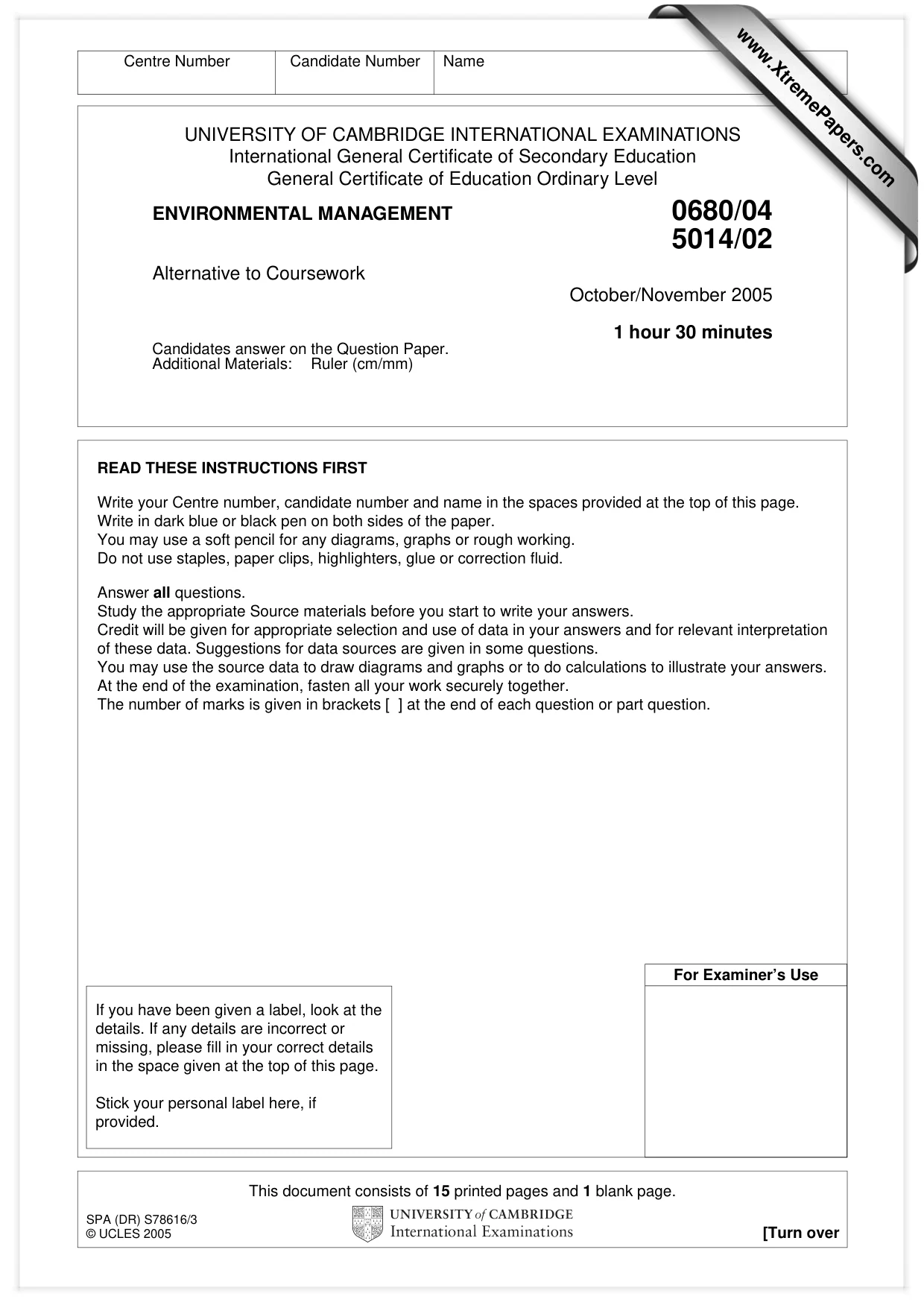
This document consists of 15 printed pages and 1 blank page. SPA (DR) S78616/3 © UCLES 2005 [Turn over UNIVERSITY OF CAMBRIDGE INTERNATIONAL EXAMINATIONS International General Certificate of Secondary Education General Certificate of Education Ordinary Level ENVIRONMENTAL MANAGEMENT 0680/04 5014/02 Alternative to Coursework October/November 2005 1 hour 30 minutes Candidates answer on the Question Paper. Additional Materials: Ruler (cm/mm) READ THESE INSTRUCTIONS FIRST Write your Centre number, candidate number and name in the spaces provided at the top of this page. Write in dark blue or black pen on both sides of the paper. You may use a soft pencil for any diagrams, graphs or rough working. Do not use staples, paper clips, highlighters, glue or correction fluid. Answer all questions. Study the appropriate Source materials before you start to write your answers. Credit will be given for appropriate selection and use of data in your answers and for relevant interpretation of these data. Suggestions for data sources are given in some questions. You may use the source data to draw diagrams and graphs or to do calculations to illustrate your answers. At the end of the examination, fasten all your work securely together. The number of marks is given in brackets [ ] at the end of each question or part question. Centre Number Candidate Number Name For Examiner’s Use If you have been given a label, look at the details. If any details are incorrect or missing, please fill in your correct details in the space given at the top of this page. Stick your personal label here, if provided. www.XtremePapers.com
Question paper, page 3
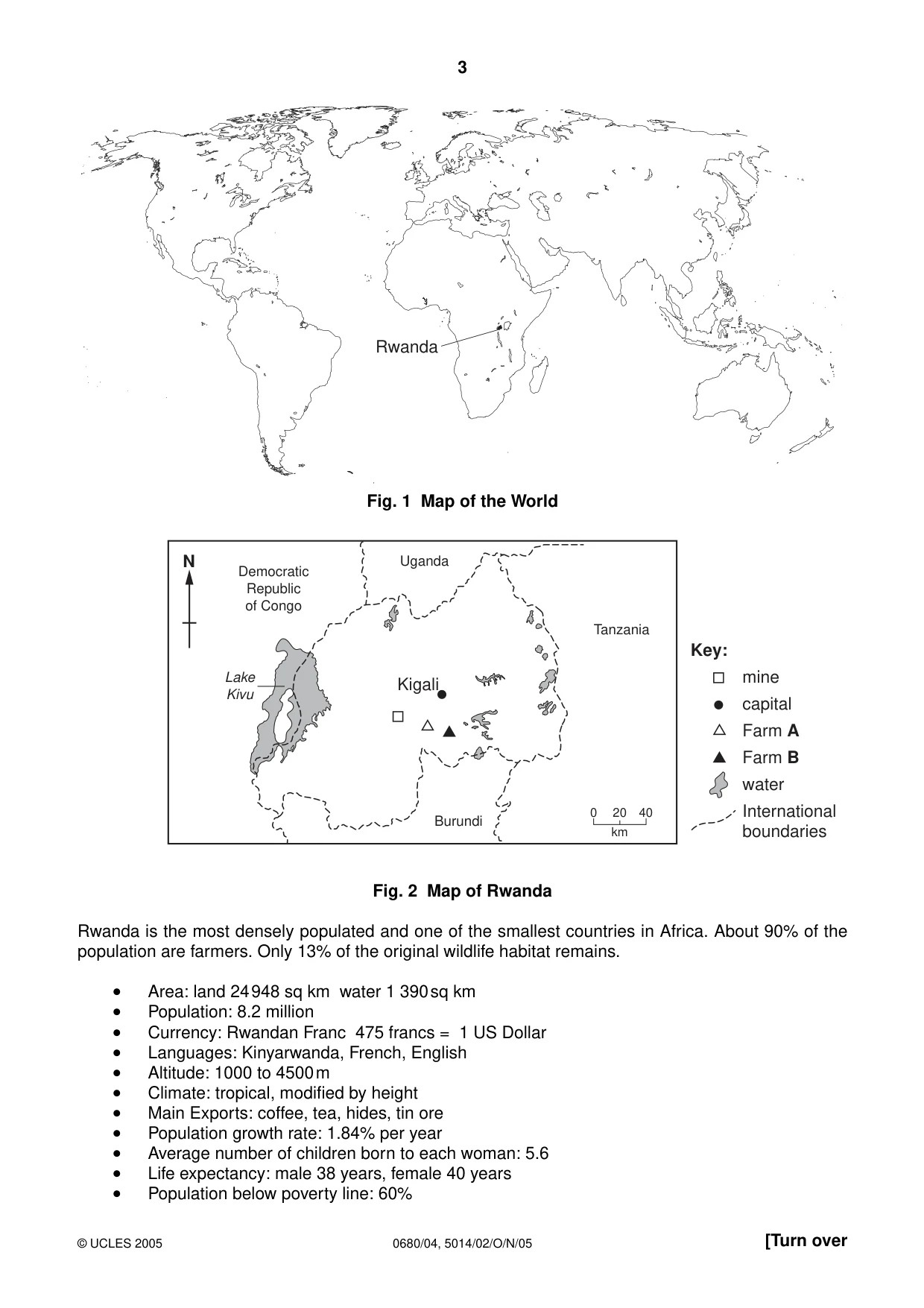
3 0680/04, 5014/02/O/N/05 [Turn over Fig. 1 Map of the World Fig. 2 Map of Rwanda Rwanda is the most densely populated and one of the smallest countries in Africa. About 90% of the population are farmers. Only 13% of the original wildlife habitat remains. • Area: land 24948 sq km water 1 390sq km • Population: 8.2 million • Currency: Rwandan Franc 475 francs = 1 US Dollar • Languages: Kinyarwanda, French, English • Altitude: 1000 to 4500m • Climate: tropical, modified by height • Main Exports: coffee, tea, hides, tin ore • Population growth rate: 1.84% per year • Average number of children born to each woman: 5.6 • Life expectancy: male 38 years, female 40 years • Population below poverty line: 60% Kigali Democratic Republic of Congo Uganda Tanzania Burundi Lake Kivu 0 20 km 40 Key: mine capital Farm A Farm B water N International boundaries Rwanda © UCLES 2005
Question paper, page 4
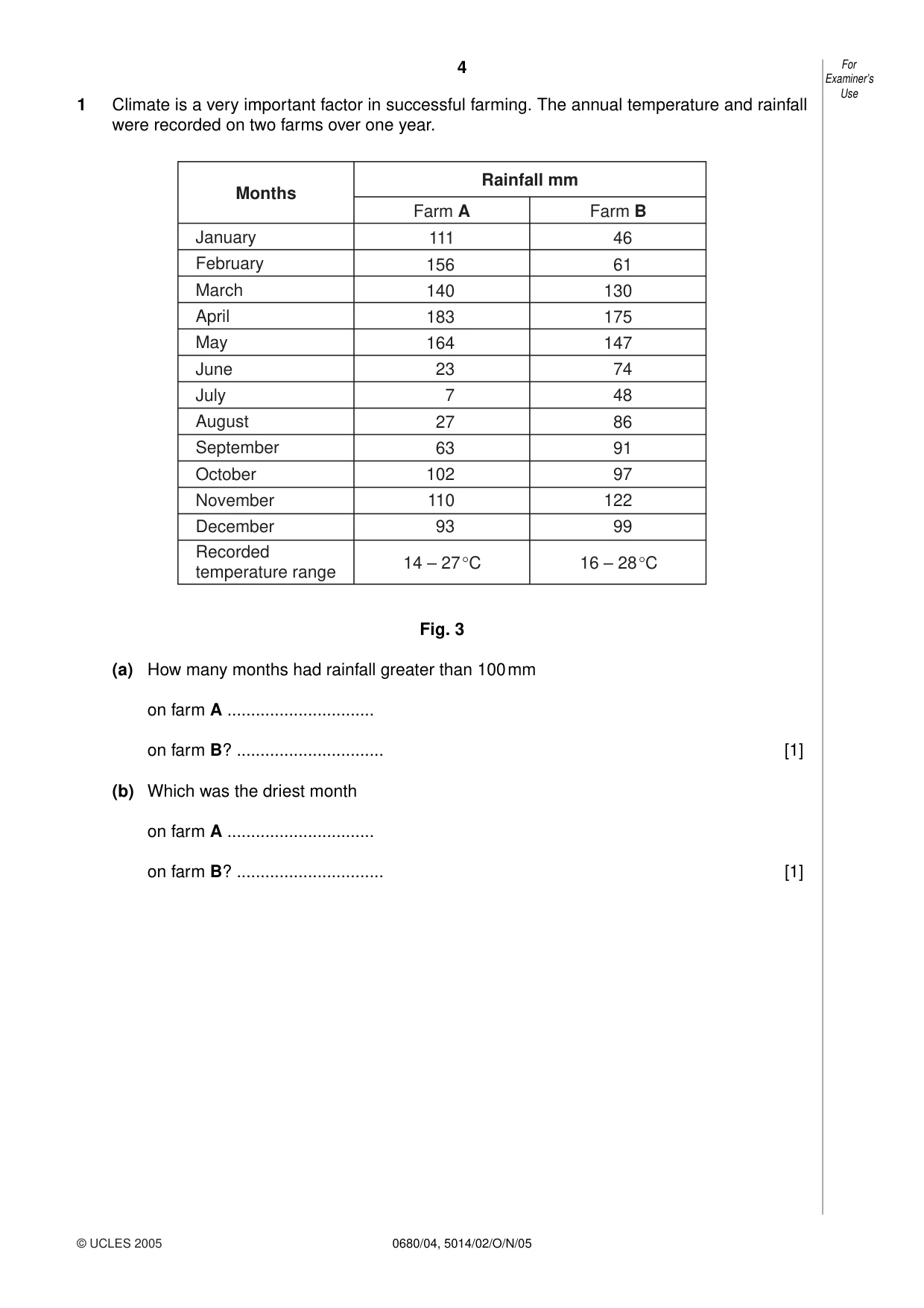
© UCLES 2005 4 0680/04, 5014/02/O/N/05 1 Climate is a very important factor in successful farming. The annual temperature and rainfall were recorded on two farms over one year. Fig. 3 (a) How many months had rainfall greater than 100mm on farm A … on farm B? … [1] (b) Which was the driest month on farm A … on farm B? … [1] 111 Months Rainfall mm January February March April May June July August September October November December Recorded temperature range Farm A Farm B 156 140 183 164 23 7 27 63 102 110 93 46 61 130 175 147 74 48 86 91 97 122 99 14 – 27°C 16 – 28°C For Examiner’s Use
Question paper, page 5
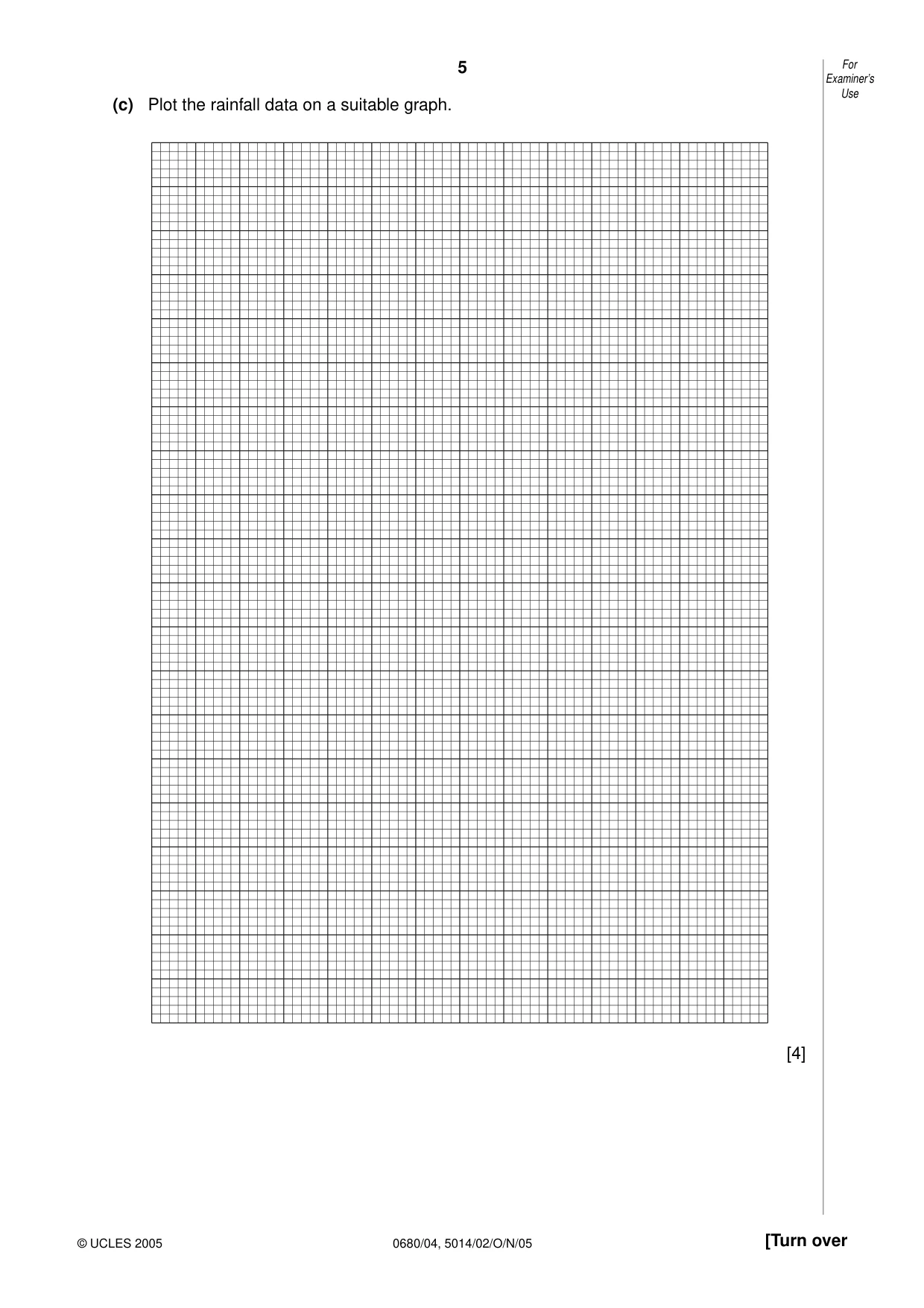
5 0680/04, 5014/02/O/N/05 [Turn over (c) Plot the rainfall data on a suitable graph. [4] For Examiner’s Use © UCLES 2005
Question paper, page 6
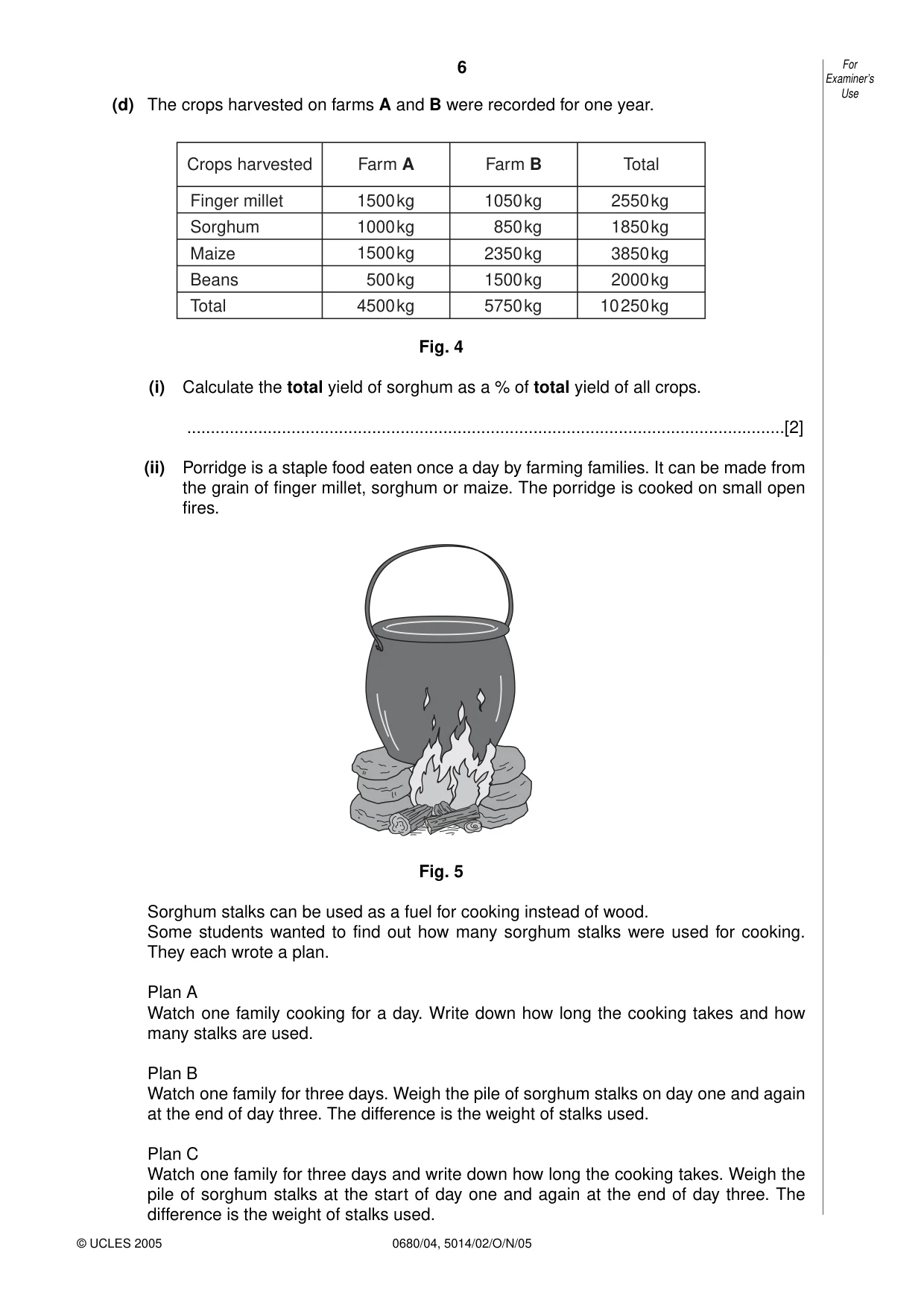
6 0680/04, 5014/02/O/N/05 (d) The crops harvested on farms A and B were recorded for one year. Fig. 4 (i) Calculate the total yield of sorghum as a % of total yield of all crops. …[2] (ii) Porridge is a staple food eaten once a day by farming families. It can be made from the grain of finger millet, sorghum or maize. The porridge is cooked on small open fires. Fig. 5 Sorghum stalks can be used as a fuel for cooking instead of wood. Some students wanted to find out how many sorghum stalks were used for cooking. They each wrote a plan. Plan A Watch one family cooking for a day. Write down how long the cooking takes and how many stalks are used. Plan B Watch one family for three days. Weigh the pile of sorghum stalks on day one and again at the end of day three. The difference is the weight of stalks used. Plan C Watch one family for three days and write down how long the cooking takes. Weigh the pile of sorghum stalks at the start of day one and again at the end of day three. The difference is the weight of stalks used. Crops harvested Farm A Farm B Total Finger millet 1500kg 1000kg 1500kg 500kg 4500kg 1050kg 850kg 2350kg 1500kg 5750kg 2550kg 1850kg 3850kg 2000kg 10250kg Sorghum Maize Beans Total For Examiner’s Use © UCLES 2005
Question paper, page 7
7 0680/04, 5014/02/O/N/05 [Turn over Draw a table to show how you would record the data from plan C. [3] (iii) Which plan is least likely to give reliable data? Give a reason for your answer. … …[2] (e) An average family uses 3kg of cooking fuel each day. If they run out of sorghum stalks they have to walk 10km to collect wood. • The students calculated that 3kg x 365 days = 1095kg of sorghum stalks are needed to cook for one year. • An average harvest of one hectare gives 1950kg sorghum stalks. • After a new sorghum crop is planted intensive labour is needed to carry out weeding to stop sorghum plants dying. What advice would you give farmers? … … …[2] © UCLES 2005 For Examiner’s Use
Question paper, page 8
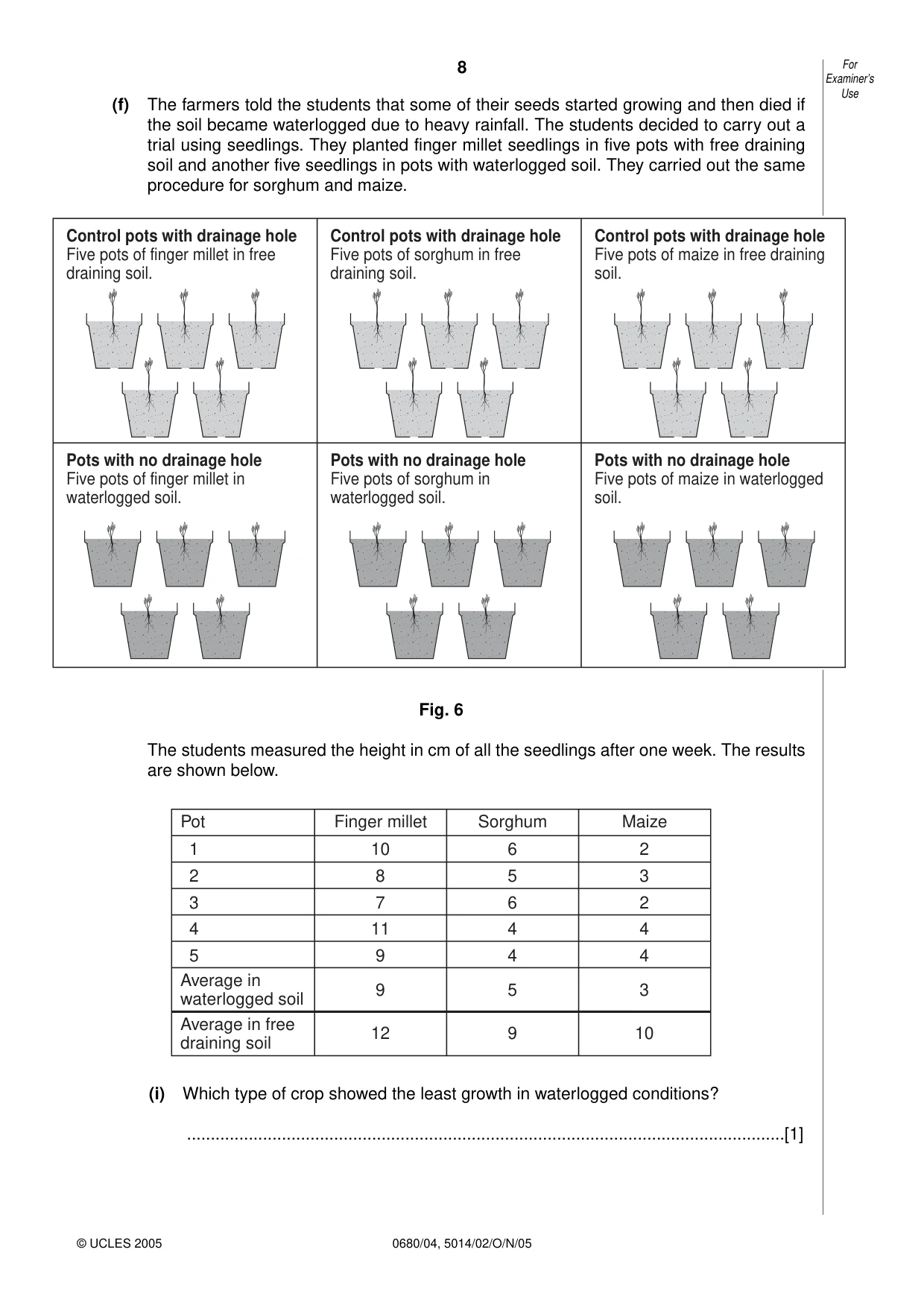
8 0680/04, 5014/02/O/N/05 (f) The farmers told the students that some of their seeds started growing and then died if the soil became waterlogged due to heavy rainfall. The students decided to carry out a trial using seedlings. They planted finger millet seedlings in five pots with free draining soil and another five seedlings in pots with waterlogged soil. They carried out the same procedure for sorghum and maize. Fig. 6 The students measured the height in cm of all the seedlings after one week. The results are shown below. (i) Which type of crop showed the least growth in waterlogged conditions? …[1] Pot 1 2 3 4 5 10 8 7 11 9 6 5 6 4 4 2 3 2 4 4 9 5 3 12 9 10 Average in waterlogged soil Average in free draining soil Finger millet Sorghum Maize For Examiner’s Use © UCLES 2005 Control pots with drainage hole Five pots of finger millet in free draining soil. Control pots with drainage hole Five pots of sorghum in free draining soil. Control pots with drainage hole Five pots of maize in free draining soil. Pots with no drainage hole Five pots of finger millet in waterlogged soil. Pots with no drainage hole Five pots of sorghum in waterlogged soil. Pots with no drainage hole Five pots of maize in waterlogged soil.
Question paper, page 9
9 0680/04, 5014/02/O/N/05 [Turn over (ii) Why did the students plant five pots for each type of crop? … …[1] (iii) The farmer wanted to plant crops in February. Using information in the table and Fig. 3 suggest, with a reason, which crops should be planted. (Give at least two types of crop for each farm.) on farm A … … … on farm B … … …[4] (iv) One student wanted to repeat the trial before suggesting any changes on farms A and B. State three pieces of information you would need to carry out exactly the same trial. … … … …[3] For Examiner’s Use © UCLES 2005
Question paper, page 10
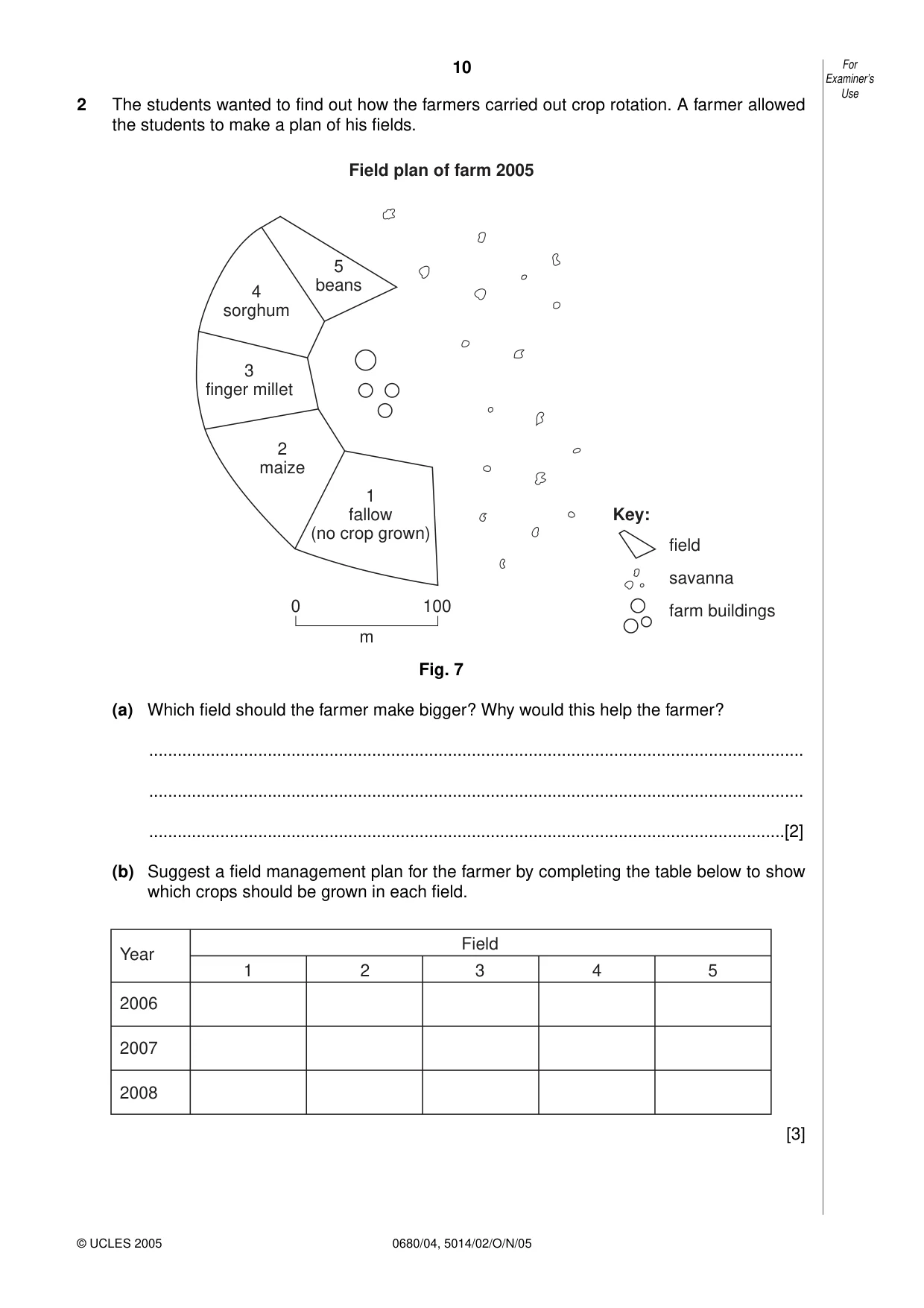
10 0680/04, 5014/02/O/N/05 2 The students wanted to find out how the farmers carried out crop rotation. A farmer allowed the students to make a plan of his fields. Fig. 7 (a) Which field should the farmer make bigger? Why would this help the farmer? … … …[2] (b) Suggest a field management plan for the farmer by completing the table below to show which crops should be grown in each field. [3] Year 2006 2007 2008 1 2 3 Field 4 5 5 beans 4 sorghum 3 finger millet 2 maize 1 fallow (no crop grown) 0 100 m Key: field savanna farm buildings Field plan of farm 2005 For Examiner’s Use © UCLES 2005
Question paper, page 11
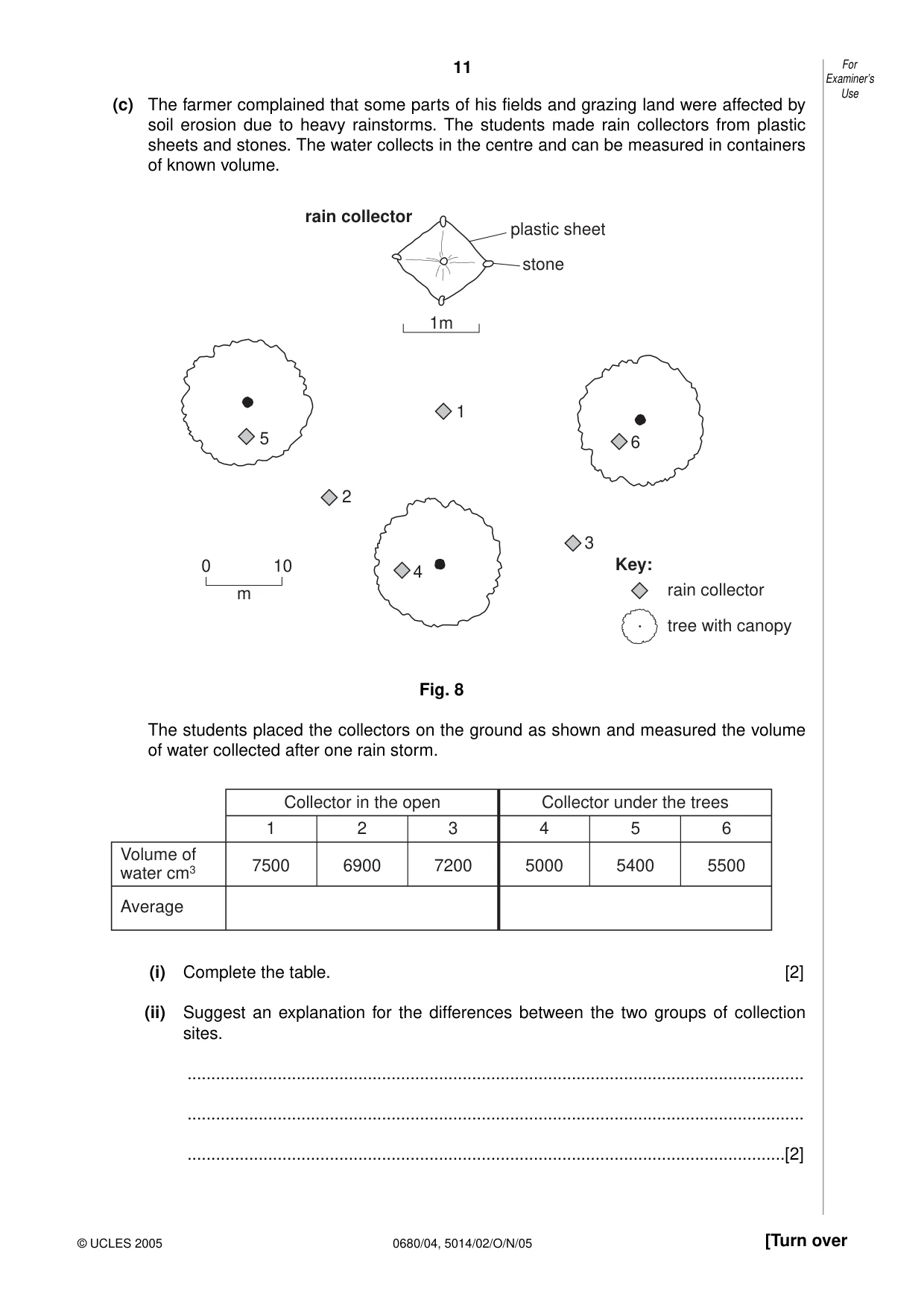
11 0680/04, 5014/02/O/N/05 [Turn over (c) The farmer complained that some parts of his fields and grazing land were affected by soil erosion due to heavy rainstorms. The students made rain collectors from plastic sheets and stones. The water collects in the centre and can be measured in containers of known volume. Fig. 8 The students placed the collectors on the ground as shown and measured the volume of water collected after one rain storm. (i) Complete the table. [2] (ii) Suggest an explanation for the differences between the two groups of collection sites. … … …[2] Volume of water cm3 Average 1 2 3 4 5 6 7500 6900 7200 5000 5400 5500 Collector in the open Collector under the trees 1m plastic sheet stone rain collector 0 10 5 3 2 1 4 6 m Key: rain collector tree with canopy For Examiner’s Use © UCLES 2005
Question paper, page 12
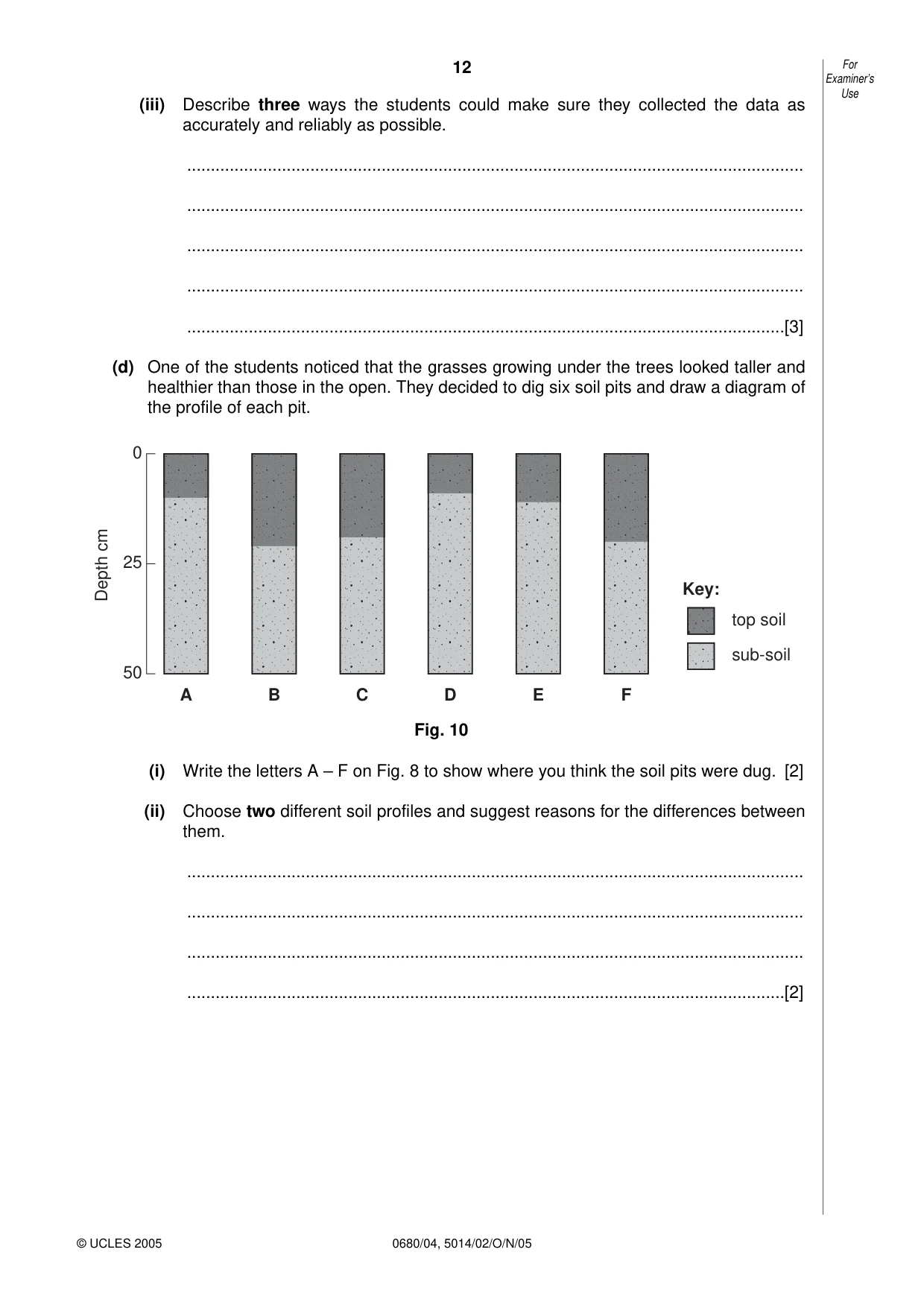
12 0680/04, 5014/02/O/N/05 (iii) Describe three ways the students could make sure they collected the data as accurately and reliably as possible. … … … … …[3] (d) One of the students noticed that the grasses growing under the trees looked taller and healthier than those in the open. They decided to dig six soil pits and draw a diagram of the profile of each pit. Fig. 10 (i) Write the letters A – F on Fig. 8 to show where you think the soil pits were dug. [2] (ii) Choose two different soil profiles and suggest reasons for the differences between them. … … … …[2] 50 25 0 Depth cm A B C D E F Key: top soil sub-soil For Examiner’s Use © UCLES 2005
Question paper, page 13
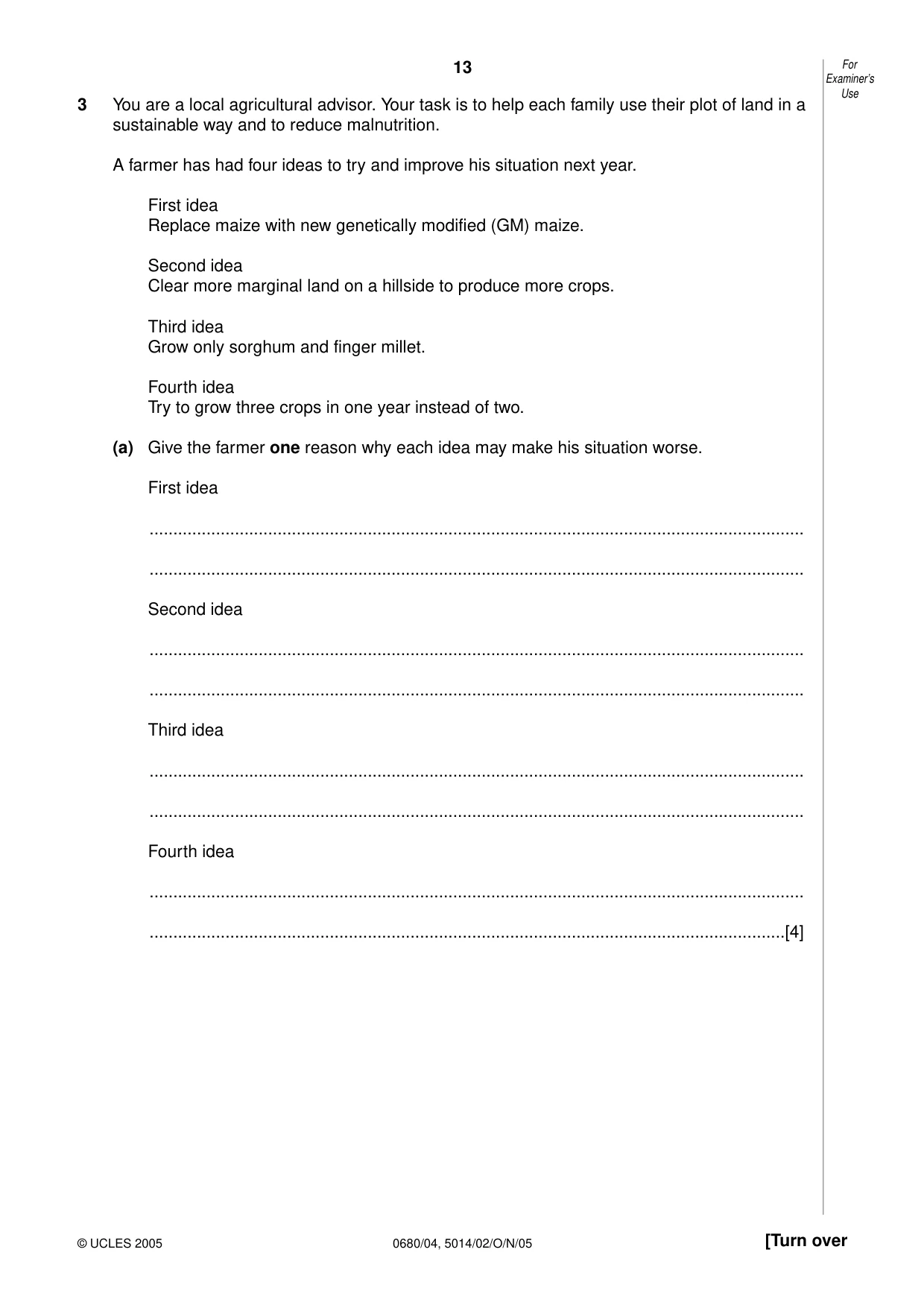
13 0680/04, 5014/02/O/N/05 [Turn over 3 You are a local agricultural advisor. Your task is to help each family use their plot of land in a sustainable way and to reduce malnutrition. A farmer has had four ideas to try and improve his situation next year. First idea Replace maize with new genetically modified (GM) maize. Second idea Clear more marginal land on a hillside to produce more crops. Third idea Grow only sorghum and finger millet. Fourth idea Try to grow three crops in one year instead of two. (a) Give the farmer one reason why each idea may make his situation worse. First idea … … Second idea … … Third idea … … Fourth idea … …[4] For Examiner’s Use © UCLES 2005
Question paper, page 14
© UCLES 2005 14 0680/04, 5014/02/O/N/05 (b) Another farmer thinks that the students have gathered helpful information which he can use to carry out sustainable farming in future and prevent malnutrition in his family. Suggest methods the farmer could use to farm sustainably and provide enough food for his family. … … … … … … … … … …[5] For Examiner’s Use
Question paper, page 15
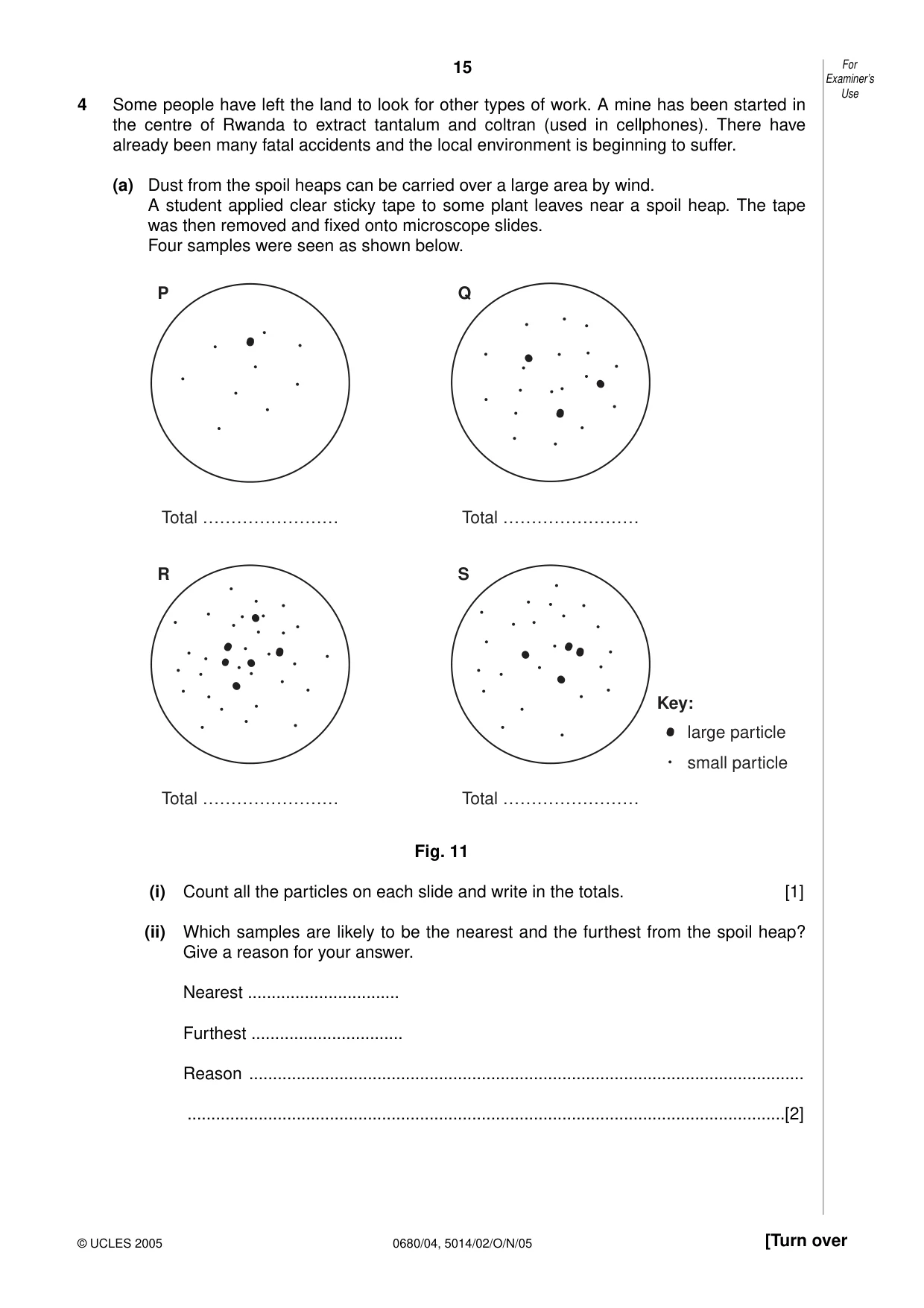
15 0680/04, 5014/02/O/N/05 [Turn over 4 Some people have left the land to look for other types of work. A mine has been started in the centre of Rwanda to extract tantalum and coltran (used in cellphones). There have already been many fatal accidents and the local environment is beginning to suffer. (a) Dust from the spoil heaps can be carried over a large area by wind. A student applied clear sticky tape to some plant leaves near a spoil heap. The tape was then removed and fixed onto microscope slides. Four samples were seen as shown below. Fig. 11 (i) Count all the particles on each slide and write in the totals. [1] (ii) Which samples are likely to be the nearest and the furthest from the spoil heap? Give a reason for your answer. Nearest … Furthest … Reason … …[2] Total …………………… P Total …………………… Q Total …………………… R Total …………………… S Key: large particle small particle For Examiner’s Use © UCLES 2005
Question paper, page 16
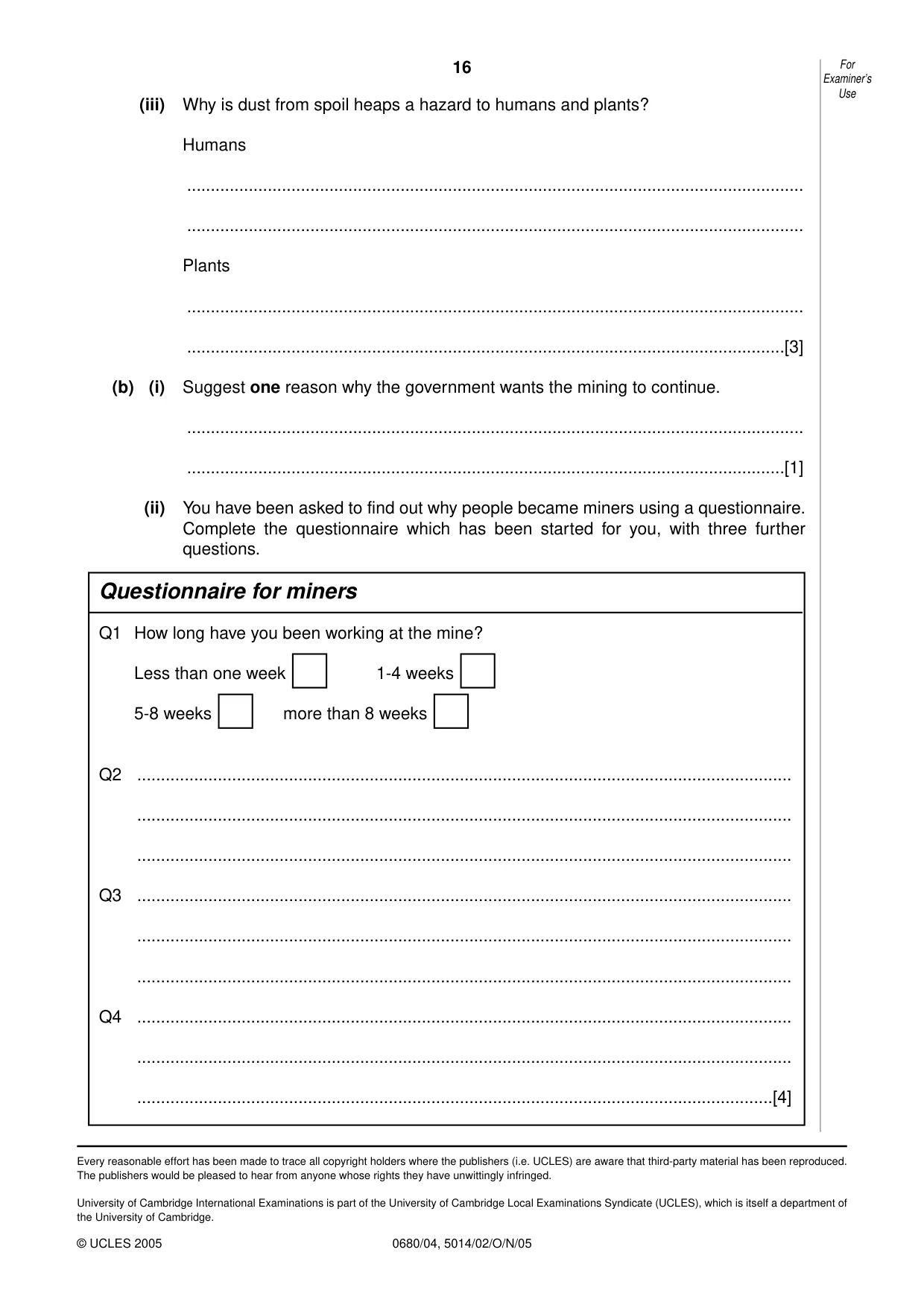
16 0680/04, 5014/02/O/N/05 (iii) Why is dust from spoil heaps a hazard to humans and plants? Humans … … Plants … …[3] (b) (i) Suggest one reason why the government wants the mining to continue. … …[1] (ii) You have been asked to find out why people became miners using a questionnaire. Complete the questionnaire which has been started for you, with three further questions. © UCLES 2005 Every reasonable effort has been made to trace all copyright holders where the publishers (i.e. UCLES) are aware that third-party material has been reproduced. The publishers would be pleased to hear from anyone whose rights they have unwittingly infringed. University of Cambridge International Examinations is part of the University of Cambridge Local Examinations Syndicate (UCLES), which is itself a department of the University of Cambridge. Questionnaire for miners Q1 How long have you been working at the mine? Less than one week 1-4 weeks 5-8 weeks more than 8 weeks Q2 … … … Q3 … … … Q4 … … …[4] For Examiner’s Use
Mark scheme, page 1
UNIVERSITY OF CAMBRIDGE INTERNATIONAL EXAMINATIONS International General Certificate of Secondary Education MARK SCHEME for the November 2005 question paper 0680 ENVIRONMENTAL MANAGEMENT 0680/04 Paper 4 maximum mark 60 This mark scheme is published as an aid to teachers and students, to indicate the requirements of the examination. It shows the basis on which Examiners were initially instructed to award marks. It does not indicate the details of the discussions that took place at an Examiners’ meeting before marking began. Any substantial changes to the mark scheme that arose from these discussions will be recorded in the published Report on the Examination. All Examiners are instructed that alternative correct answers and unexpected approaches in candidates’ scripts must be given marks that fairly reflect the relevant knowledge and skills demonstrated. Mark schemes must be read in conjunction with the question papers and the Report on the Examination. The minimum marks in these components needed for various grades were previously published with these mark schemes, but are now instead included in the Report on the Examination for this session. • CIE will not enter into discussion or correspondence in connection with these mark schemes. CIE is publishing the mark schemes for the October/November 2005 question papers for most IGCSE and GCE Advanced Level and Advanced Subsidiary Level syllabuses and some Ordinary Level syllabuses. www.XtremePapers.com
Mark scheme, page 2
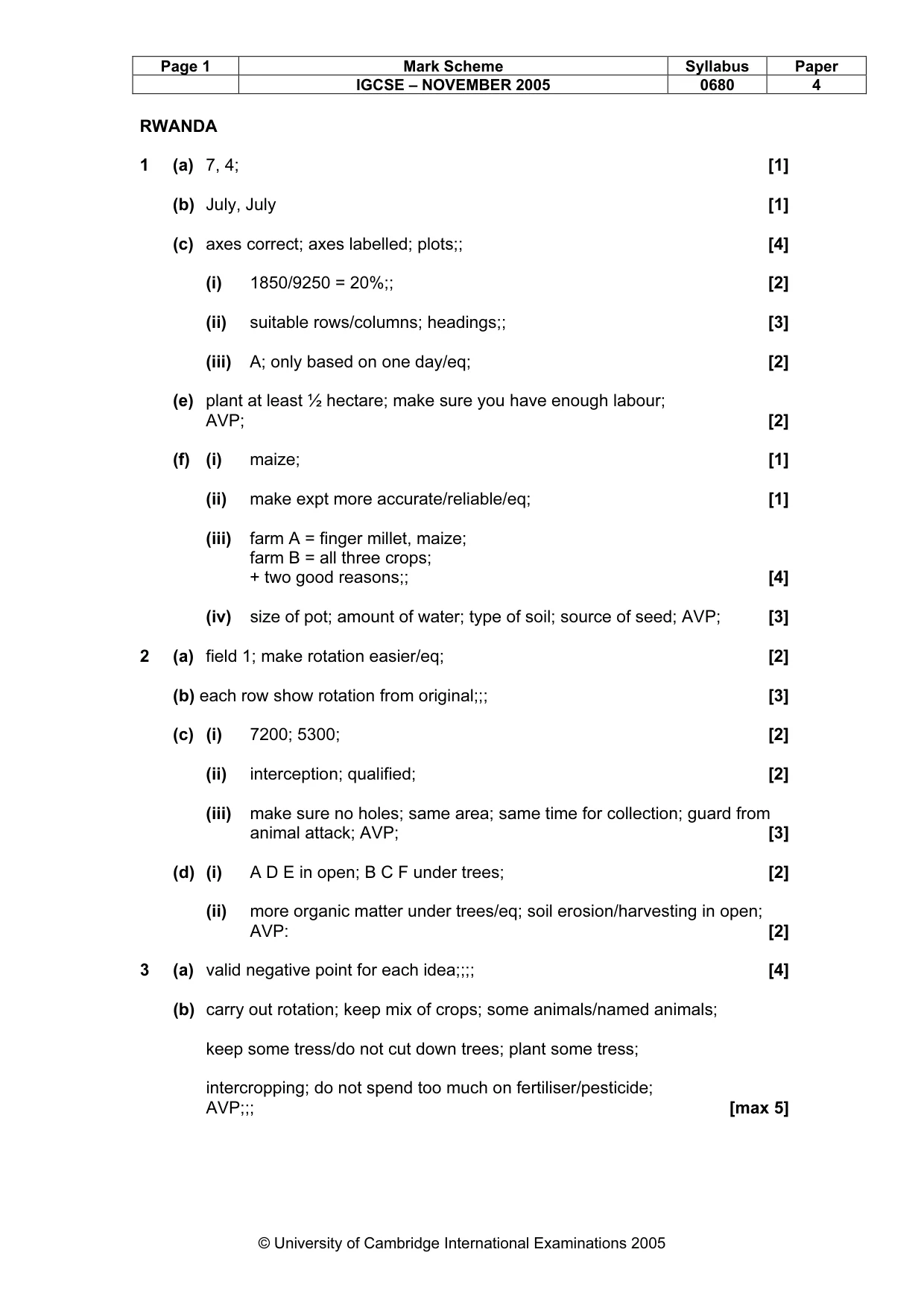
Page 1 Mark Scheme Syllabus Paper IGCSE – NOVEMBER 2005 0680 4 © University of Cambridge International Examinations 2005 RWANDA 1 (a) 7, 4; [1] (b) July, July [1] (c) axes correct; axes labelled; plots;; [4] (i) 1850/9250 = 20%;; [2] (ii) suitable rows/columns; headings;; [3] (iii) A; only based on one day/eq; [2] (e) plant at least ½ hectare; make sure you have enough labour; AVP; [2] (f) (i) maize; [1] (ii) make expt more accurate/reliable/eq; [1] (iii) farm A = finger millet, maize; farm B = all three crops; + two good reasons;; [4] (iv) size of pot; amount of water; type of soil; source of seed; AVP; [3] 2 (a) field 1; make rotation easier/eq; [2] (b) each row show rotation from original;;; [3] (c) (i) 7200; 5300; [2] (ii) interception; qualified; [2] (iii) make sure no holes; same area; same time for collection; guard from animal attack; AVP; [3] (d) (i) A D E in open; B C F under trees; [2] (ii) more organic matter under trees/eq; soil erosion/harvesting in open; AVP: [2] 3 (a) valid negative point for each idea;;;; [4] (b) carry out rotation; keep mix of crops; some animals/named animals; keep some tress/do not cut down trees; plant some tress; intercropping; do not spend too much on fertiliser/pesticide; AVP;;; [max 5]
Mark scheme, page 3
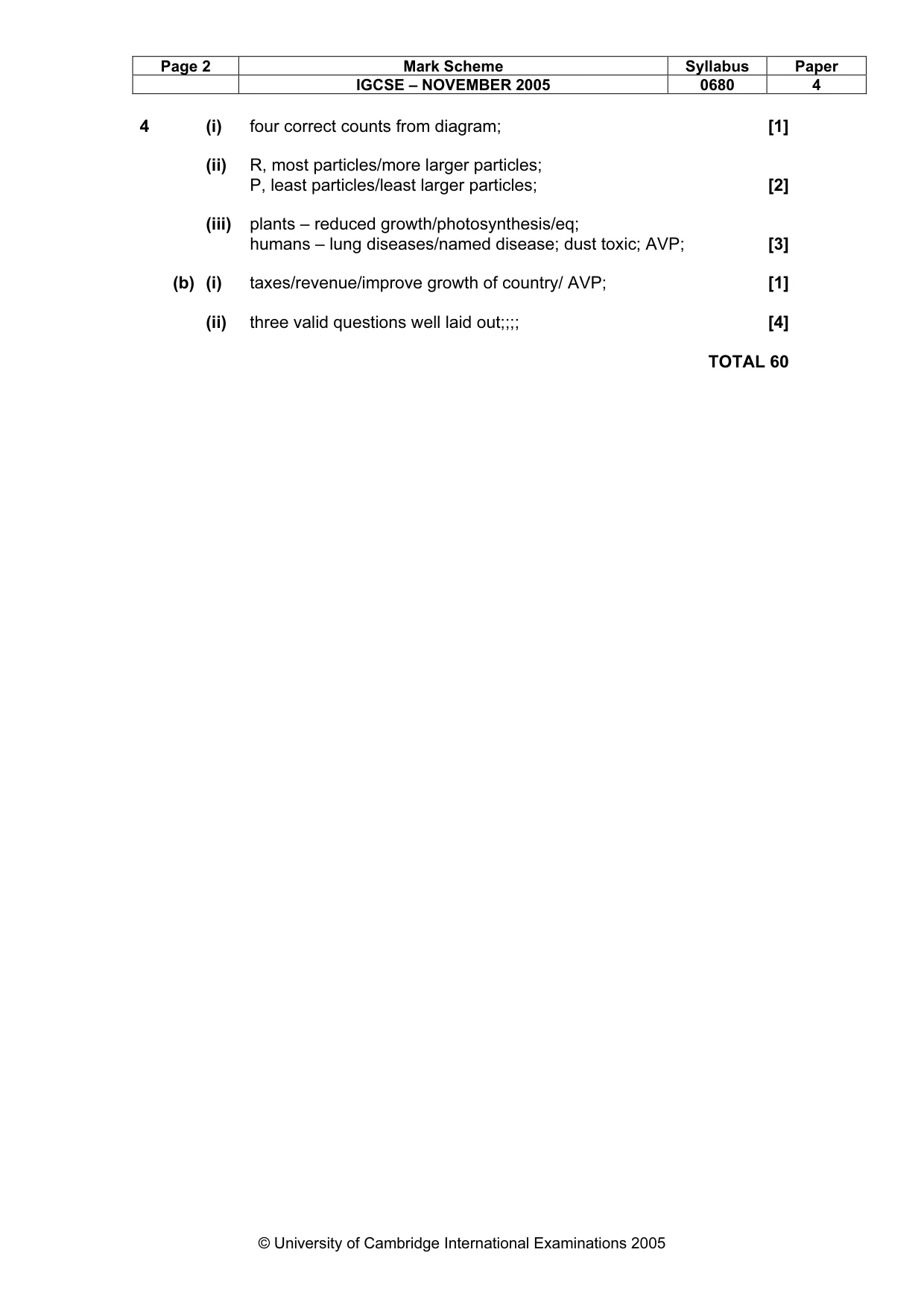
Page 2 Mark Scheme Syllabus Paper IGCSE – NOVEMBER 2005 0680 4 © University of Cambridge International Examinations 2005 4 (i) four correct counts from diagram; [1] (ii) R, most particles/more larger particles; P, least particles/least larger particles; [2] (iii) plants – reduced growth/photosynthesis/eq; humans – lung diseases/named disease; dust toxic; AVP; [3] (b) (i) taxes/revenue/improve growth of country/ AVP; [1] (ii) three valid questions well laid out;;;; [4] TOTAL 60