Cambridge IGCSE Environmental Management 0680 — 2005 May/June Paper 4 · Variant 1
0680/41/M/J/05
The question paper and its mark scheme, free to read here and free to download. This is Cambridge’s own paper, exactly as it was sat.
Question paper16 pages



Mark scheme5 pages
Answers below. Sit the paper first if you are practising.
Paper as text
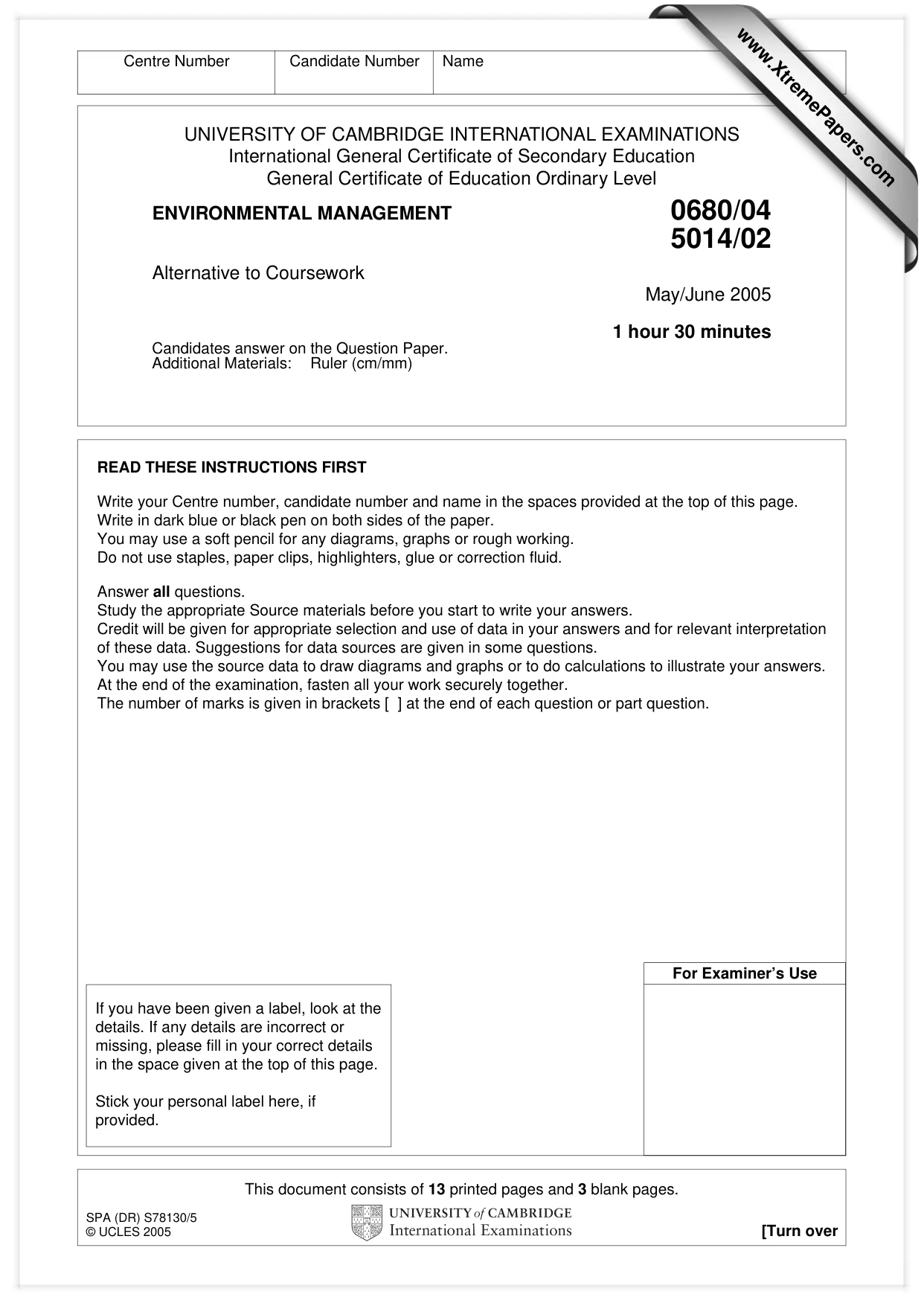
Question paper, page 1
This document consists of 13 printed pages and 3 blank pages. SPA (DR) S78130/5 © UCLES 2005 [Turn over UNIVERSITY OF CAMBRIDGE INTERNATIONAL EXAMINATIONS International General Certificate of Secondary Education General Certificate of Education Ordinary Level ENVIRONMENTAL MANAGEMENT 0680/04 5014/02 Alternative to Coursework May/June 2005 1 hour 30 minutes Candidates answer on the Question Paper. Additional Materials: Ruler (cm/mm) READ THESE INSTRUCTIONS FIRST Write your Centre number, candidate number and name in the spaces provided at the top of this page. Write in dark blue or black pen on both sides of the paper. You may use a soft pencil for any diagrams, graphs or rough working. Do not use staples, paper clips, highlighters, glue or correction fluid. Answer all questions. Study the appropriate Source materials before you start to write your answers. Credit will be given for appropriate selection and use of data in your answers and for relevant interpretation of these data. Suggestions for data sources are given in some questions. You may use the source data to draw diagrams and graphs or to do calculations to illustrate your answers. At the end of the examination, fasten all your work securely together. The number of marks is given in brackets [ ] at the end of each question or part question. Centre Number Candidate Number Name For Examiner’s Use If you have been given a label, look at the details. If any details are incorrect or missing, please fill in your correct details in the space given at the top of this page. Stick your personal label here, if provided. www.XtremePapers.com
Question paper, page 2
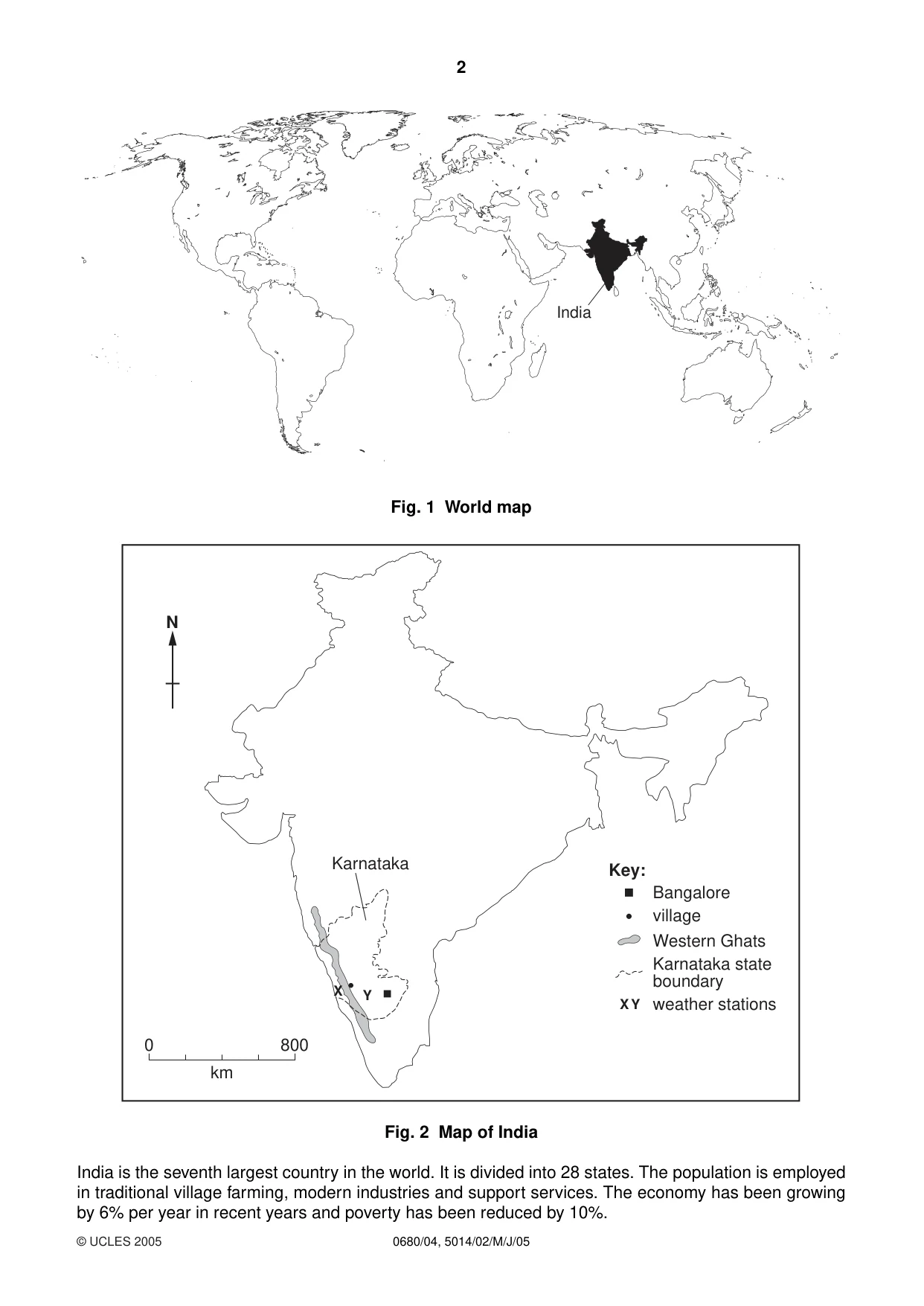
© UCLES 2005 2 0680/04, 5014/02/M/J/05 Fig. 1 World map Fig. 2 Map of India India is the seventh largest country in the world. It is divided into 28 states. The population is employed in traditional village farming, modern industries and support services. The economy has been growing by 6% per year in recent years and poverty has been reduced by 10%. Y X XY 0 800 km Key: Bangalore village Western Ghats weather stations Karnataka state boundary N Karnataka India
Question paper, page 3
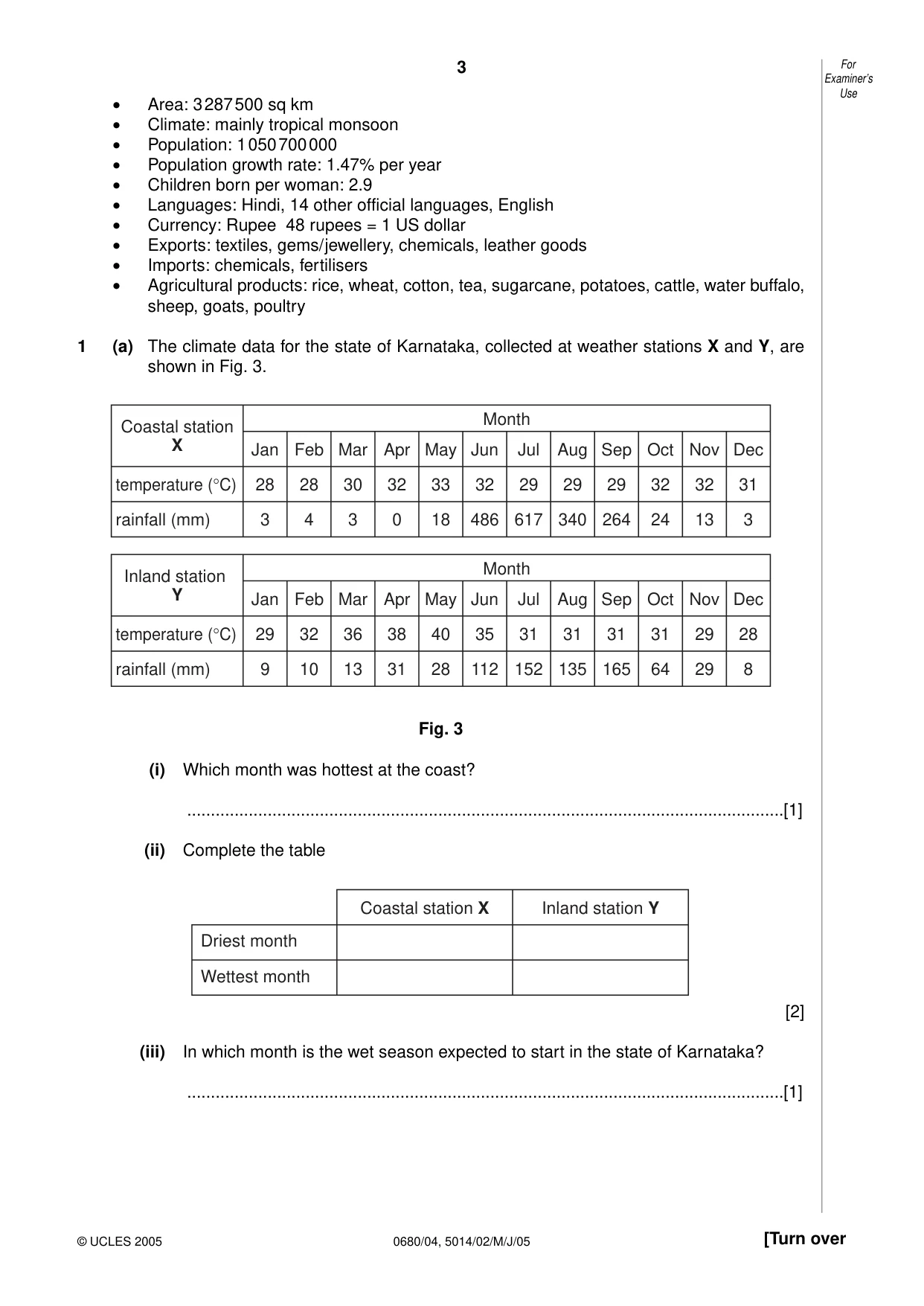
3 0680/04, 5014/02/M/J/05 [Turn over • Area: 3287500 sq km • Climate: mainly tropical monsoon • Population: 1050700000 • Population growth rate: 1.47% per year • Children born per woman: 2.9 • Languages: Hindi, 14 other official languages, English • Currency: Rupee 48 rupees = 1 US dollar • Exports: textiles, gems/jewellery, chemicals, leather goods • Imports: chemicals, fertilisers • Agricultural products: rice, wheat, cotton, tea, sugarcane, potatoes, cattle, water buffalo, sheep, goats, poultry 1 (a) The climate data for the state of Karnataka, collected at weather stations X and Y, are shown in Fig. 3. Fig. 3 (i) Which month was hottest at the coast? …[1] (ii) Complete the table [2] (iii) In which month is the wet season expected to start in the state of Karnataka? …[1] Driest month Wettest month Coastal station X Inland station Y Month Inland station Y Feb Jan temperature (°C) rainfall (mm) Mar Apr May Jun Jul Aug Sep Oct Nov Dec 32 29 36 38 40 35 31 31 31 31 29 28 10 9 13 31 28 112 152 135 165 64 29 8 Month Coastal station X Feb Jan temperature (°C) rainfall (mm) Mar Apr May Jun Jul Aug Sep Oct Nov Dec 28 28 30 32 33 32 29 29 29 32 32 31 4 3 3 0 18 486 617 340 264 24 13 3 For Examiner’s Use © UCLES 2005
Question paper, page 4
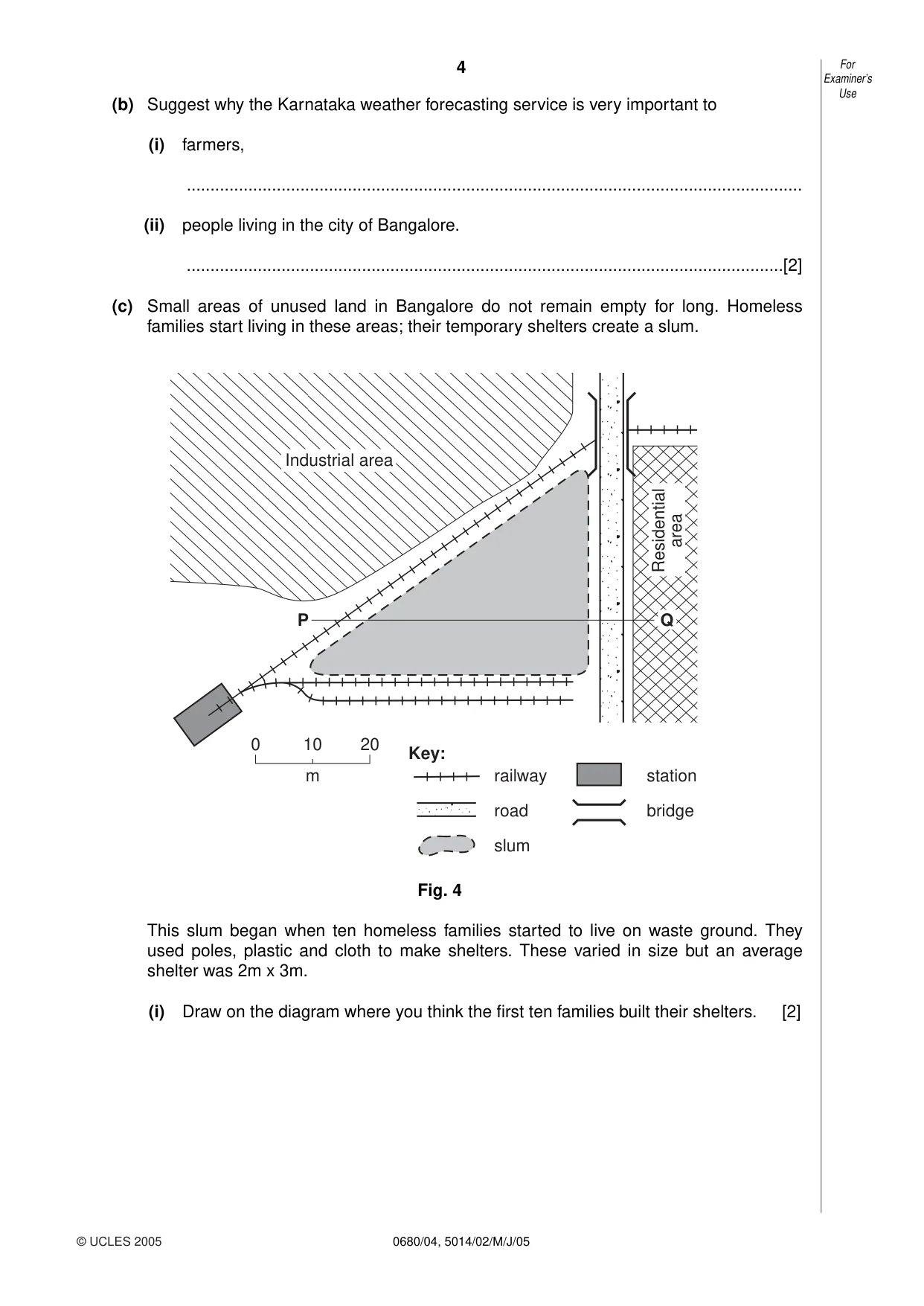
© UCLES 2005 4 0680/04, 5014/02/M/J/05 (b) Suggest why the Karnataka weather forecasting service is very important to (i) farmers, … (ii) people living in the city of Bangalore. …[2] (c) Small areas of unused land in Bangalore do not remain empty for long. Homeless families start living in these areas; their temporary shelters create a slum. Fig. 4 This slum began when ten homeless families started to live on waste ground. They used poles, plastic and cloth to make shelters. These varied in size but an average shelter was 2m x 3m. (i) Draw on the diagram where you think the first ten families built their shelters. [2] P Q Residential area Industrial area 0 10 m 20 Key: railway road slum station bridge For Examiner’s Use
Question paper, page 5
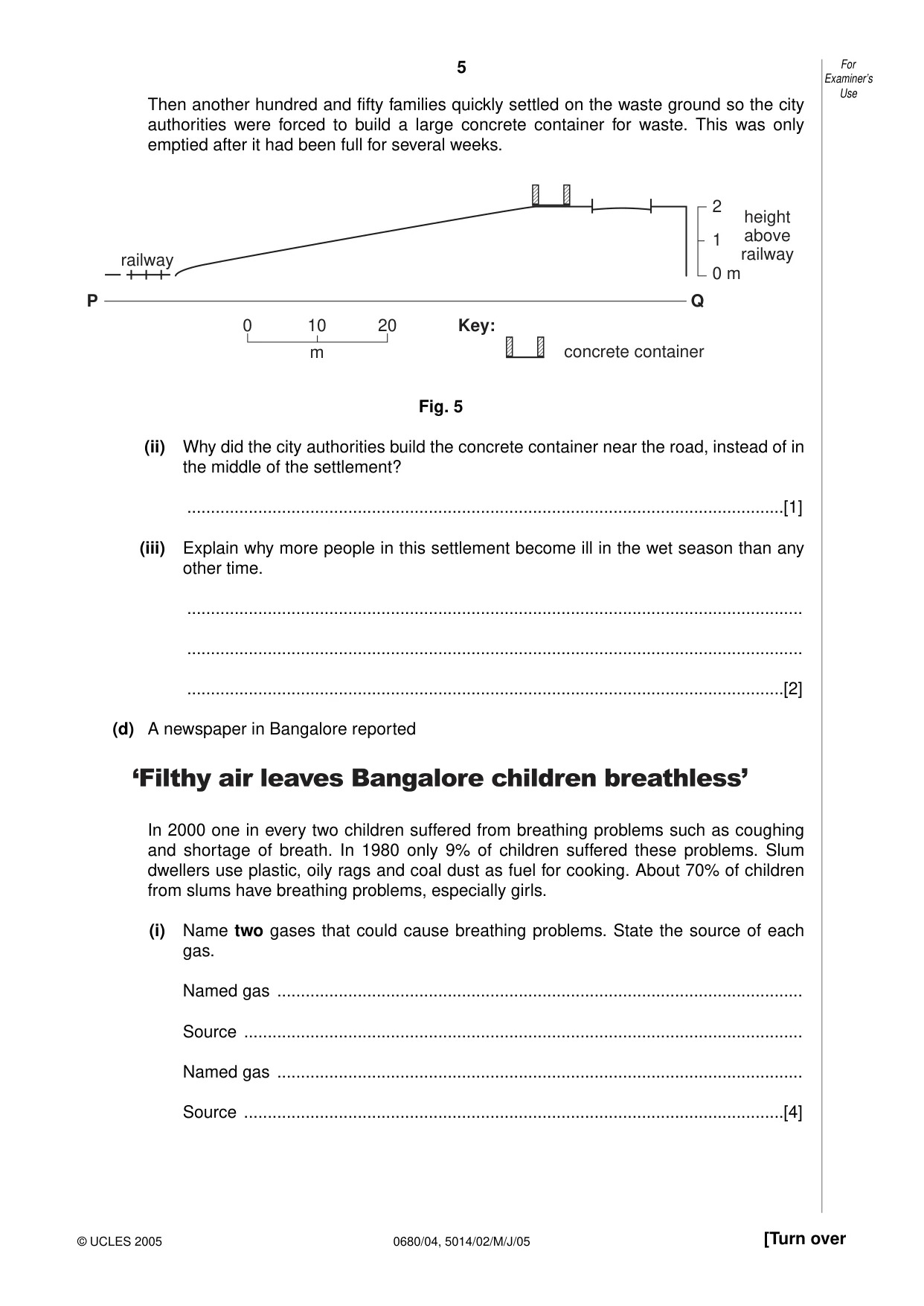
5 0680/04, 5014/02/M/J/05 [Turn over Then another hundred and fifty families quickly settled on the waste ground so the city authorities were forced to build a large concrete container for waste. This was only emptied after it had been full for several weeks. Fig. 5 (ii) Why did the city authorities build the concrete container near the road, instead of in the middle of the settlement? …[1] (iii) Explain why more people in this settlement become ill in the wet season than any other time. … … …[2] (d) A newspaper in Bangalore reported In 2000 one in every two children suffered from breathing problems such as coughing and shortage of breath. In 1980 only 9% of children suffered these problems. Slum dwellers use plastic, oily rags and coal dust as fuel for cooking. About 70% of children from slums have breathing problems, especially girls. (i) Name two gases that could cause breathing problems. State the source of each gas. Named gas … Source … Named gas … Source …[4] Q P 0 10 m 20 2 1 0 m railway Key: concrete container height above railway For Examiner’s Use © UCLES 2005
Question paper, page 6
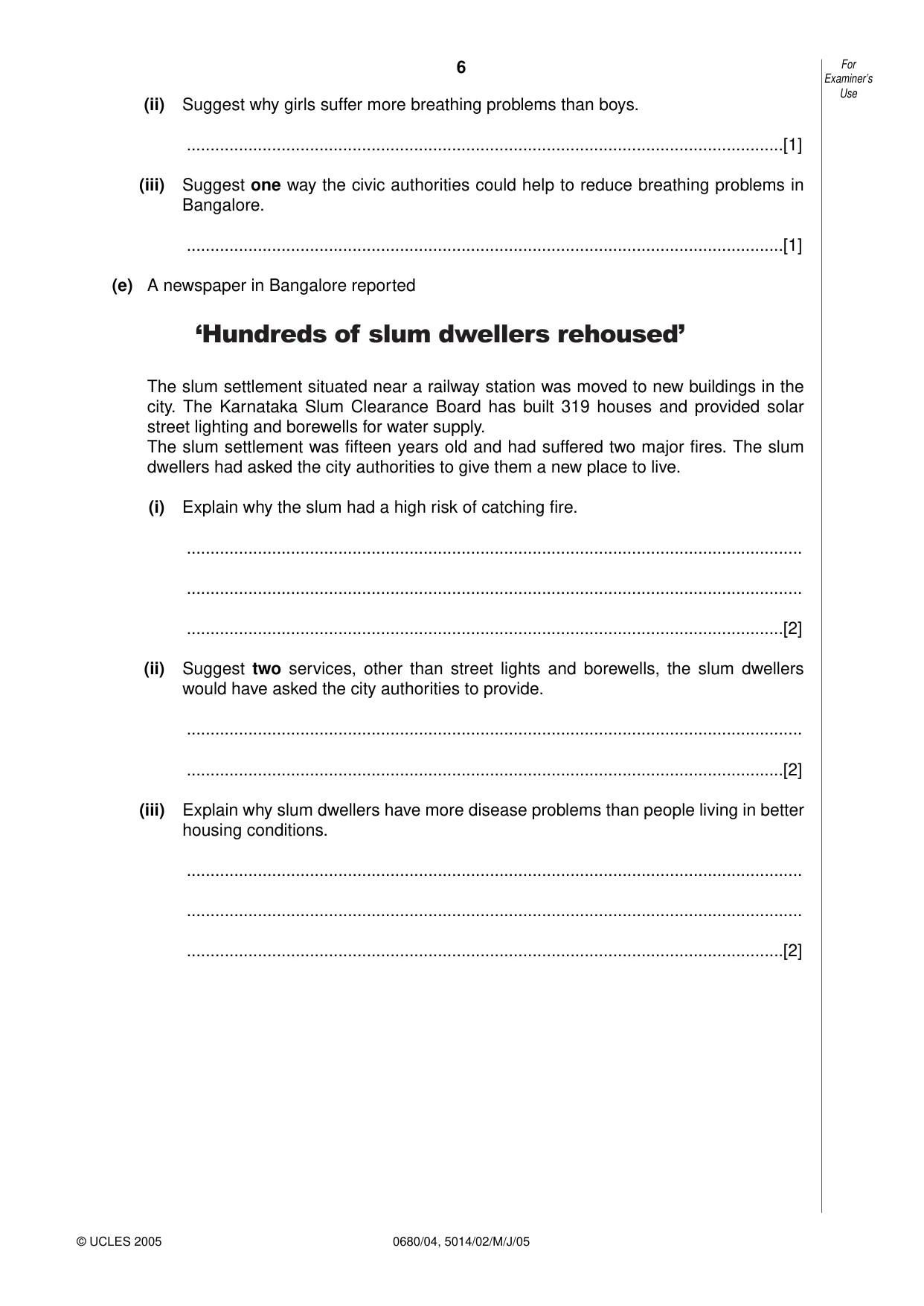
6 0680/04, 5014/02/M/J/05 (ii) Suggest why girls suffer more breathing problems than boys. …[1] (iii) Suggest one way the civic authorities could help to reduce breathing problems in Bangalore. …[1] (e) A newspaper in Bangalore reported The slum settlement situated near a railway station was moved to new buildings in the city. The Karnataka Slum Clearance Board has built 319 houses and provided solar street lighting and borewells for water supply. The slum settlement was fifteen years old and had suffered two major fires. The slum dwellers had asked the city authorities to give them a new place to live. (i) Explain why the slum had a high risk of catching fire. … … …[2] (ii) Suggest two services, other than street lights and borewells, the slum dwellers would have asked the city authorities to provide. … …[2] (iii) Explain why slum dwellers have more disease problems than people living in better housing conditions. … … …[2] For Examiner’s Use © UCLES 2005
Question paper, page 7
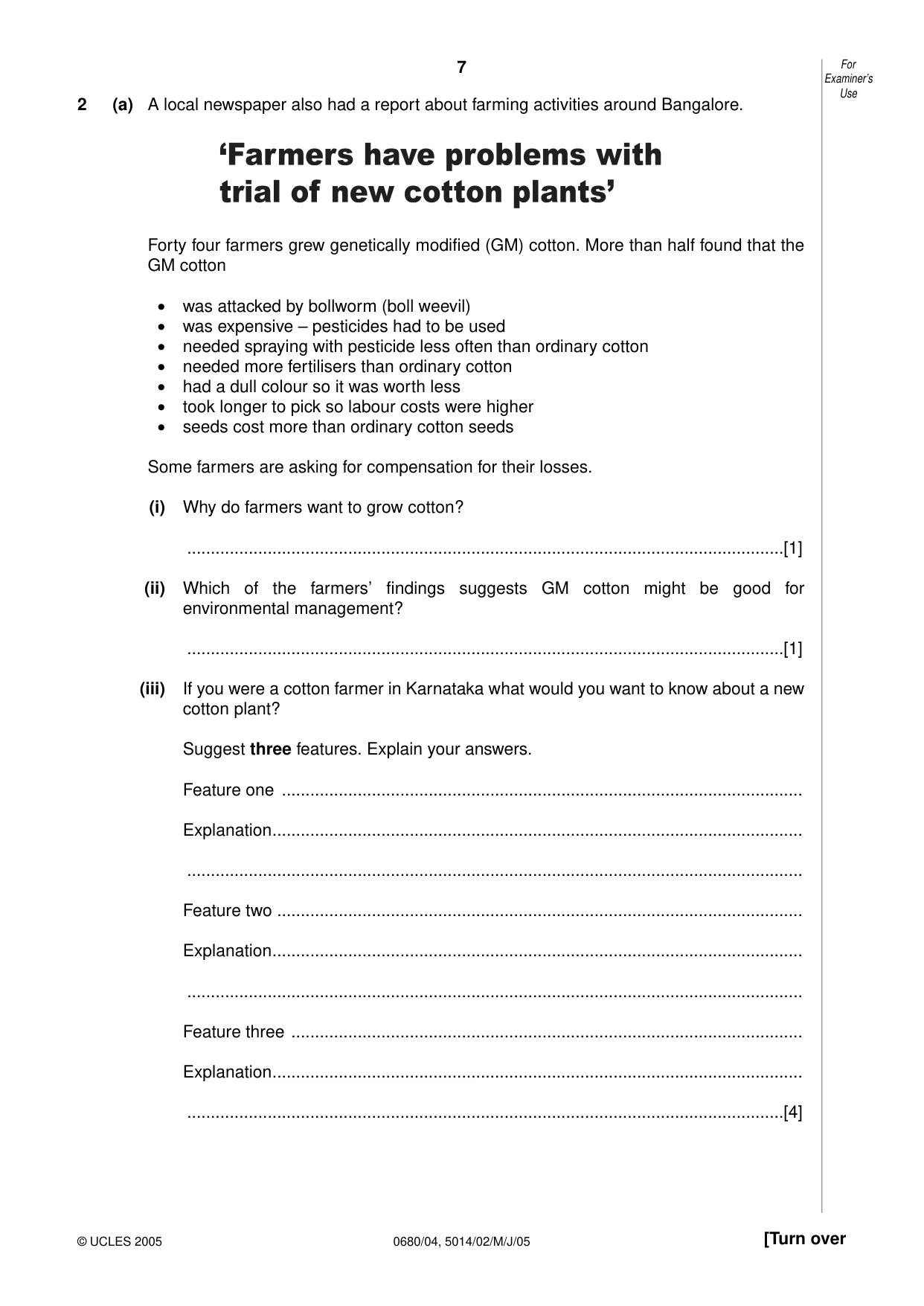
7 0680/04, 5014/02/M/J/05 [Turn over 2 (a) A local newspaper also had a report about farming activities around Bangalore. Forty four farmers grew genetically modified (GM) cotton. More than half found that the GM cotton • was attacked by bollworm (boll weevil) • was expensive – pesticides had to be used • needed spraying with pesticide less often than ordinary cotton • needed more fertilisers than ordinary cotton • had a dull colour so it was worth less • took longer to pick so labour costs were higher • seeds cost more than ordinary cotton seeds Some farmers are asking for compensation for their losses. (i) Why do farmers want to grow cotton? …[1] (ii) Which of the farmers’ findings suggests GM cotton might be good for environmental management? …[1] (iii) If you were a cotton farmer in Karnataka what would you want to know about a new cotton plant? Suggest three features. Explain your answers. Feature one … Explanation… … Feature two … Explanation… … Feature three … Explanation… …[4] For Examiner’s Use © UCLES 2005
Question paper, page 8
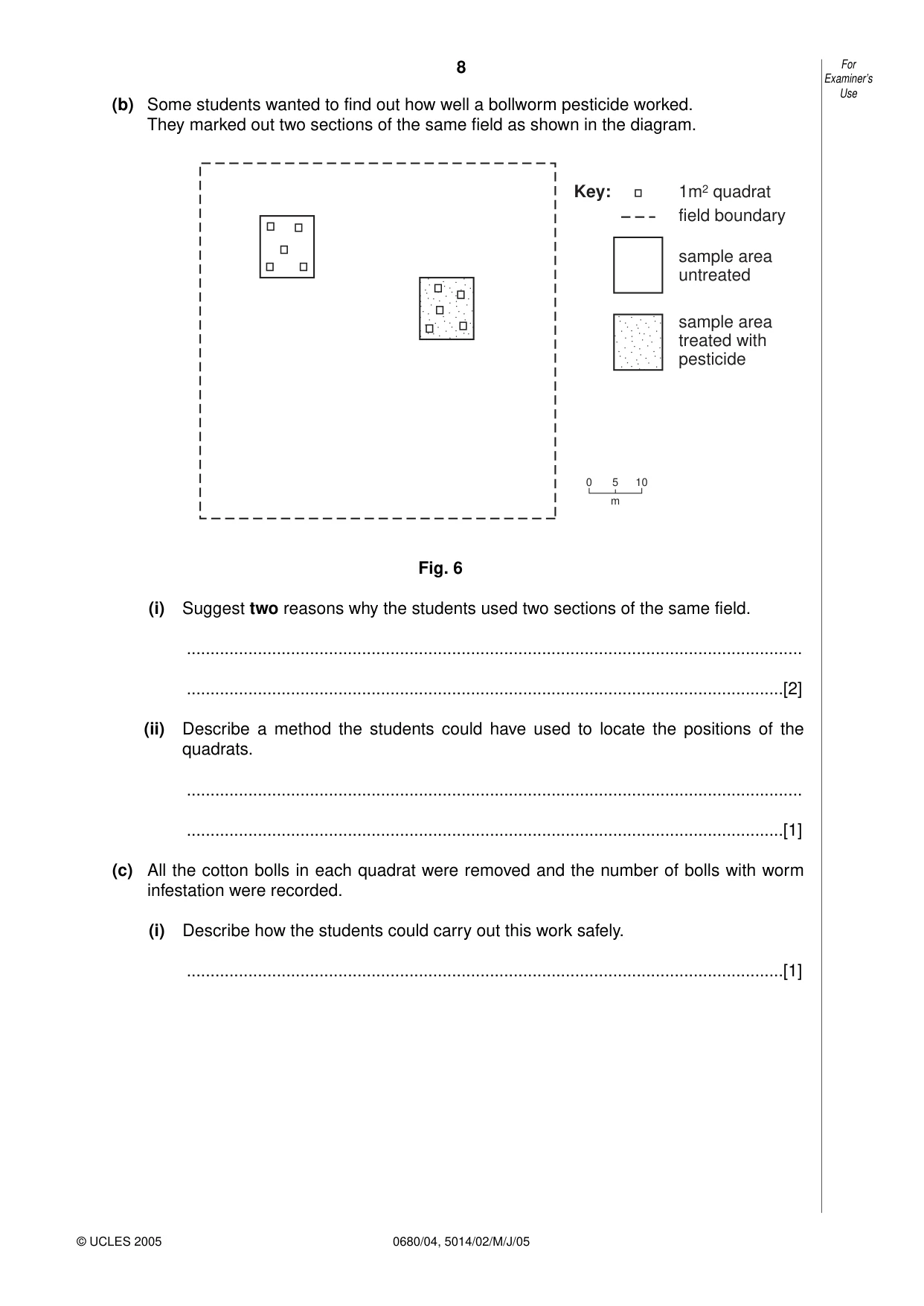
8 0680/04, 5014/02/M/J/05 (b) Some students wanted to find out how well a bollworm pesticide worked. They marked out two sections of the same field as shown in the diagram. Fig. 6 (i) Suggest two reasons why the students used two sections of the same field. … …[2] (ii) Describe a method the students could have used to locate the positions of the quadrats. … …[1] (c) All the cotton bolls in each quadrat were removed and the number of bolls with worm infestation were recorded. (i) Describe how the students could carry out this work safely. …[1] 0 5 m 10 Key: 1m2 quadrat field boundary sample area untreated sample area treated with pesticide For Examiner’s Use © UCLES 2005
Question paper, page 9
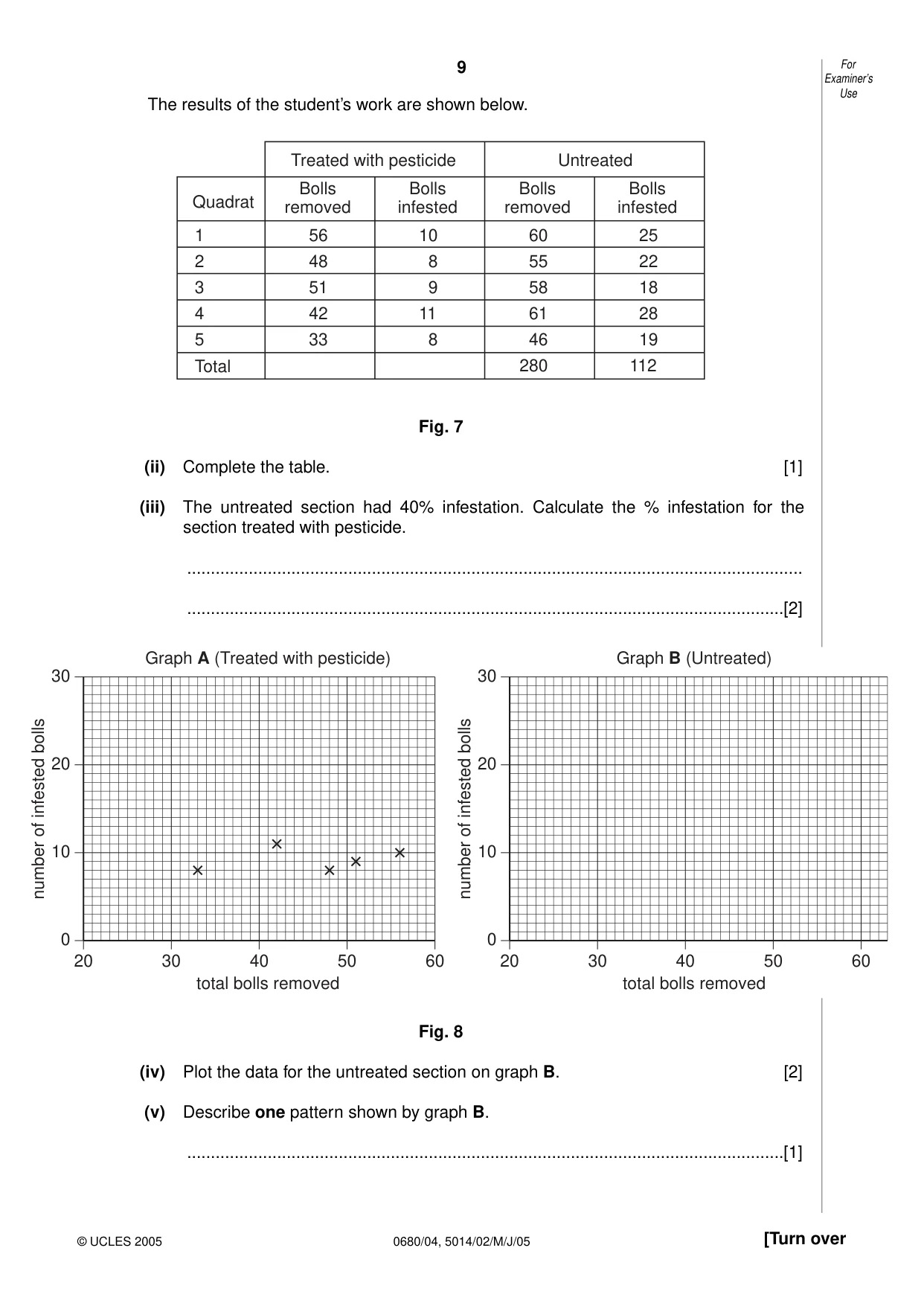
9 0680/04, 5014/02/M/J/05 [Turn over The results of the student’s work are shown below. Fig. 7 (ii) Complete the table. [1] (iii) The untreated section had 40% infestation. Calculate the % infestation for the section treated with pesticide. … …[2] Fig. 8 (iv) Plot the data for the untreated section on graph B. [2] (v) Describe one pattern shown by graph B. …[1] Quadrat Bolls removed Bolls infested Bolls removed Bolls infested 1 2 3 4 5 Total 56 48 51 42 33 10 8 9 11 8 60 55 58 61 46 280 25 22 18 28 19 112 Treated with pesticide Untreated For Examiner’s Use © UCLES 2005 20 30 40 50 60 0 10 20 30 number of infested bolls total bolls removed 20 30 40 50 60 0 10 20 30 number of infested bolls total bolls removed Graph A (Treated with pesticide) Graph B (Untreated)
Question paper, page 10
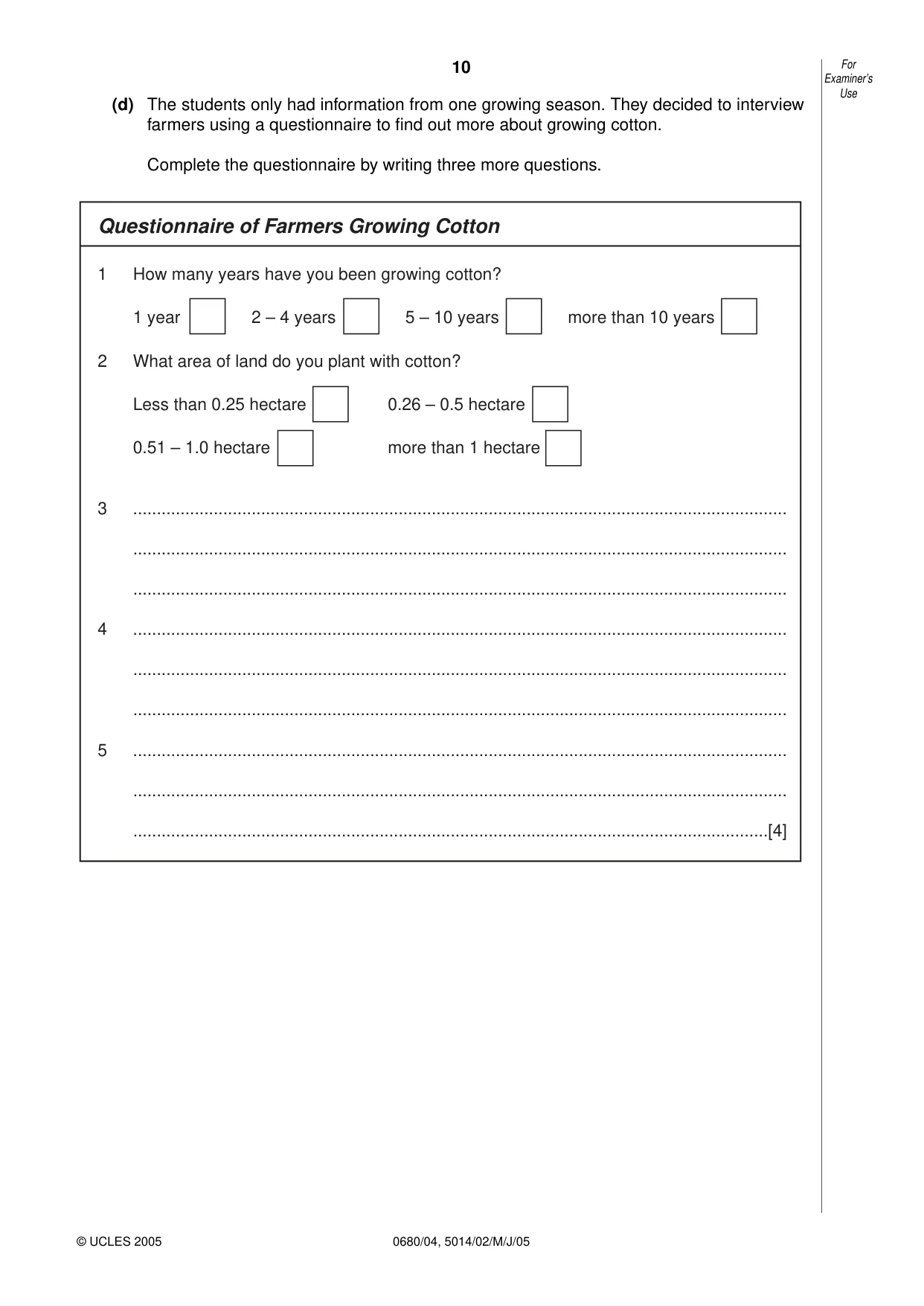
10 0680/04, 5014/02/M/J/05 (d) The students only had information from one growing season. They decided to interview farmers using a questionnaire to find out more about growing cotton. Complete the questionnaire by writing three more questions. Questionnaire of Farmers Growing Cotton 1 How many years have you been growing cotton? 1 year 2 – 4 years 5 – 10 years more than 10 years 2 What area of land do you plant with cotton? Less than 0.25 hectare 0.26 – 0.5 hectare 0.51 – 1.0 hectare more than 1 hectare 3 … … … 4 … … … 5 … … …[4] For Examiner’s Use © UCLES 2005
Question paper, page 11
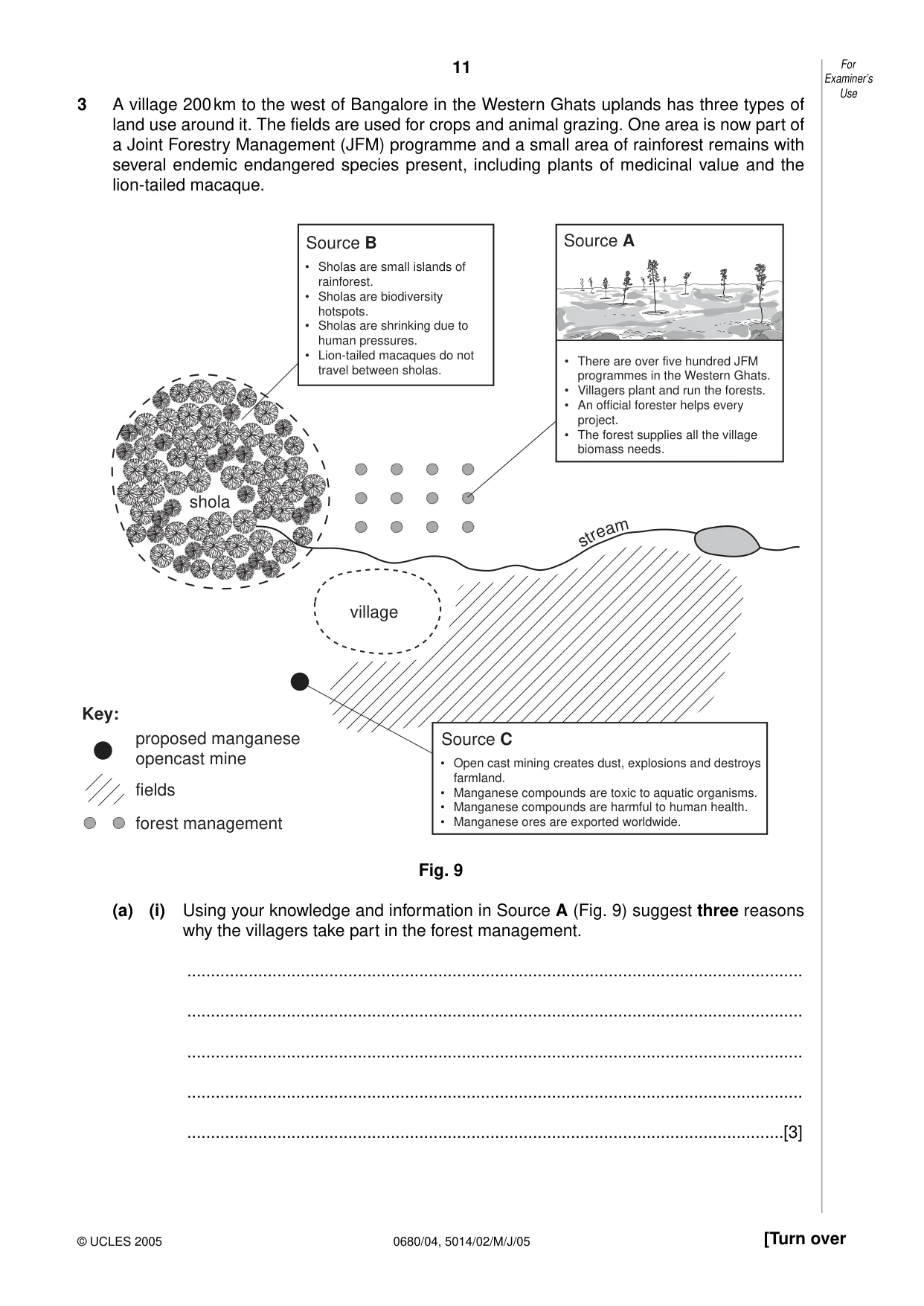
11 0680/04, 5014/02/M/J/05 [Turn over 3 A village 200km to the west of Bangalore in the Western Ghats uplands has three types of land use around it. The fields are used for crops and animal grazing. One area is now part of a Joint Forestry Management (JFM) programme and a small area of rainforest remains with several endemic endangered species present, including plants of medicinal value and the lion-tailed macaque. Fig. 9 (a) (i) Using your knowledge and information in Source A (Fig. 9) suggest three reasons why the villagers take part in the forest management. … … … … …[3] str e a m village shola Key: proposed manganese opencast mine fields forest management Source A Source B • There are over five hundred JFM programmes in the Western Ghats. • Villagers plant and run the forests. • An official forester helps every project. • The forest supplies all the village biomass needs. • Sholas are small islands of rainforest. • Sholas are biodiversity hotspots. • Sholas are shrinking due to human pressures. • Lion-tailed macaques do not travel between sholas. Source C • Open cast mining creates dust, explosions and destroys farmland. • Manganese compounds are toxic to aquatic organisms. • Manganese compounds are harmful to human health. • Manganese ores are exported worldwide. For Examiner’s Use © UCLES 2005
Question paper, page 12
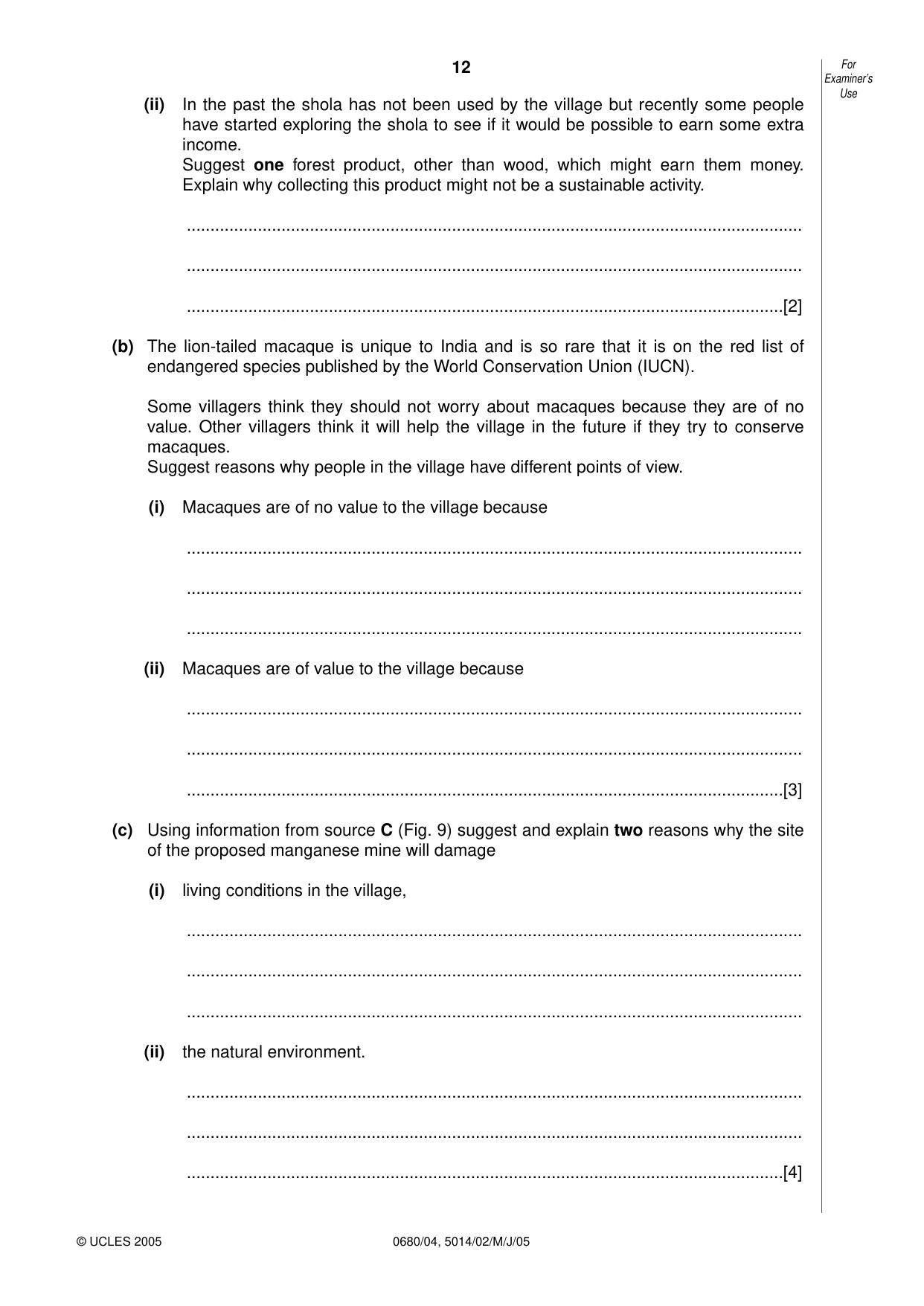
12 0680/04, 5014/02/M/J/05 (ii) In the past the shola has not been used by the village but recently some people have started exploring the shola to see if it would be possible to earn some extra income. Suggest one forest product, other than wood, which might earn them money. Explain why collecting this product might not be a sustainable activity. … … …[2] (b) The lion-tailed macaque is unique to India and is so rare that it is on the red list of endangered species published by the World Conservation Union (IUCN). Some villagers think they should not worry about macaques because they are of no value. Other villagers think it will help the village in the future if they try to conserve macaques. Suggest reasons why people in the village have different points of view. (i) Macaques are of no value to the village because … … … (ii) Macaques are of value to the village because … … …[3] (c) Using information from source C (Fig. 9) suggest and explain two reasons why the site of the proposed manganese mine will damage (i) living conditions in the village, … … … (ii) the natural environment. … … …[4] For Examiner’s Use © UCLES 2005
Question paper, page 13
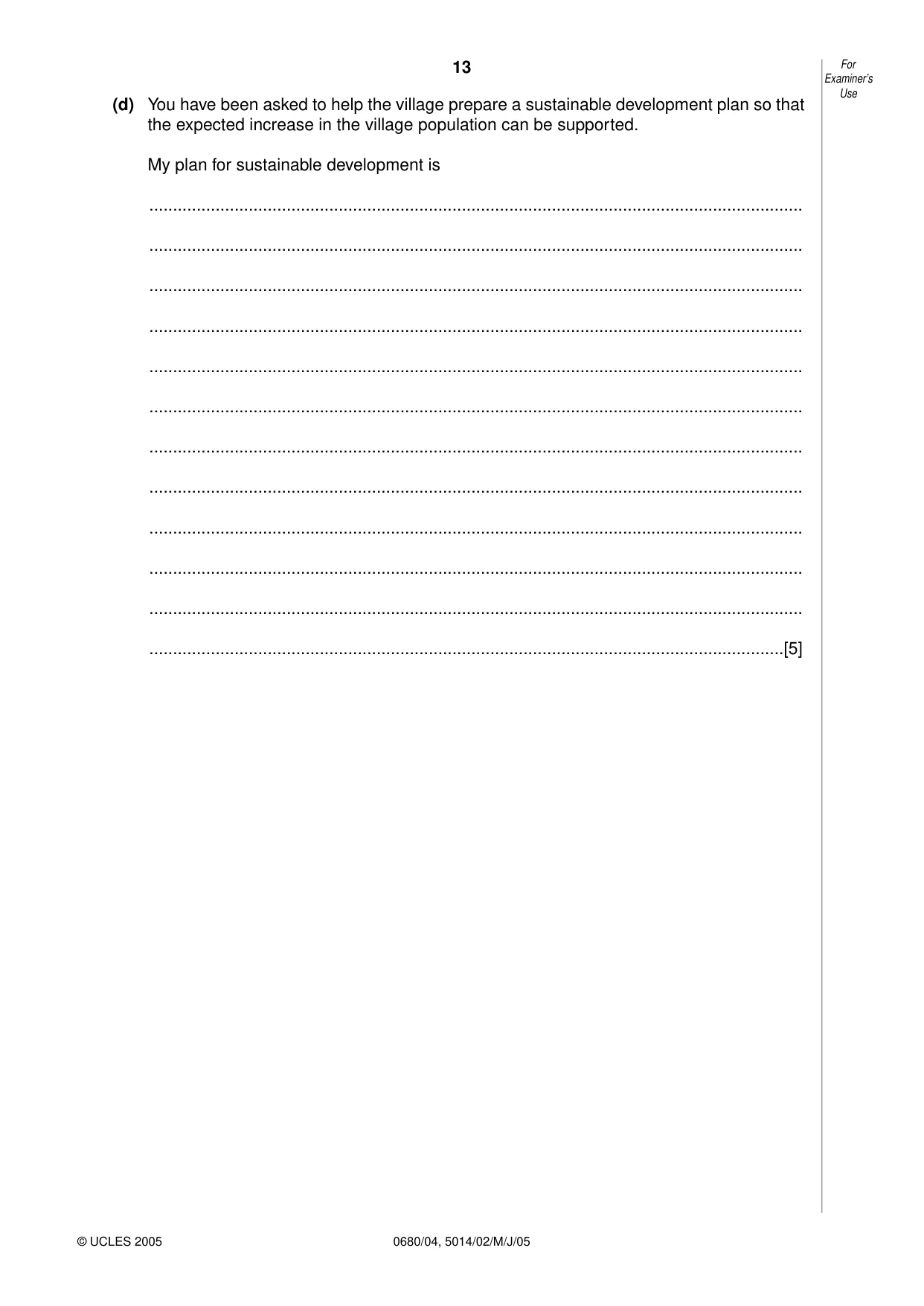
13 0680/04, 5014/02/M/J/05 (d) You have been asked to help the village prepare a sustainable development plan so that the expected increase in the village population can be supported. My plan for sustainable development is … … … … … … … … … … … …[5] For Examiner’s Use © UCLES 2005
Question paper, page 16
16 0680/04, 5014/02/M/J/05 BLANK PAGE Permission to reproduce items where third-party owned material protected by copyright is included has been sought and cleared where possible. Every reasonable effort has been made by the publisher (UCLES) to trace copyright holders, but if any items requiring clearance have unwittingly been included, the publisher will be pleased to make amends at the earliest possible opportunity. University of Cambridge International Examinations is part of the University of Cambridge Local Examinations Syndicate (UCLES), which is itself a department of the University of Cambridge.
Mark scheme, page 1
UNIVERSITY OF CAMBRIDGE INTERNATIONAL EXAMINATIONS International General Certificate of Secondary Education MARK SCHEME for the June 2005 question paper 0680 ENVIRONMENTAL MANAGEMENT 0680/04 Paper 4 (Alternative to Coursework), maximum mark 60 This mark scheme is published as an aid to teachers and students, to indicate the requirements of the examination. It shows the basis on which Examiners were initially instructed to award marks. It does not indicate the details of the discussions that took place at an Examiners’ meeting before marking began. Any substantial changes to the mark scheme that arose from these discussions will be recorded in the published Report on the Examination. All Examiners are instructed that alternative correct answers and unexpected approaches in candidates’ scripts must be given marks that fairly reflect the relevant knowledge and skills demonstrated. Mark schemes must be read in conjunction with the question papers and the Report on the Examination. • CIE will not enter into discussion or correspondence in connection with these mark schemes. CIE is publishing the mark schemes for the June 2005 question papers for most IGCSE and GCE Advanced Level and Advanced Subsidiary Level syllabuses and some Ordinary Level syllabuses. www.XtremePapers.com
Mark scheme, page 2
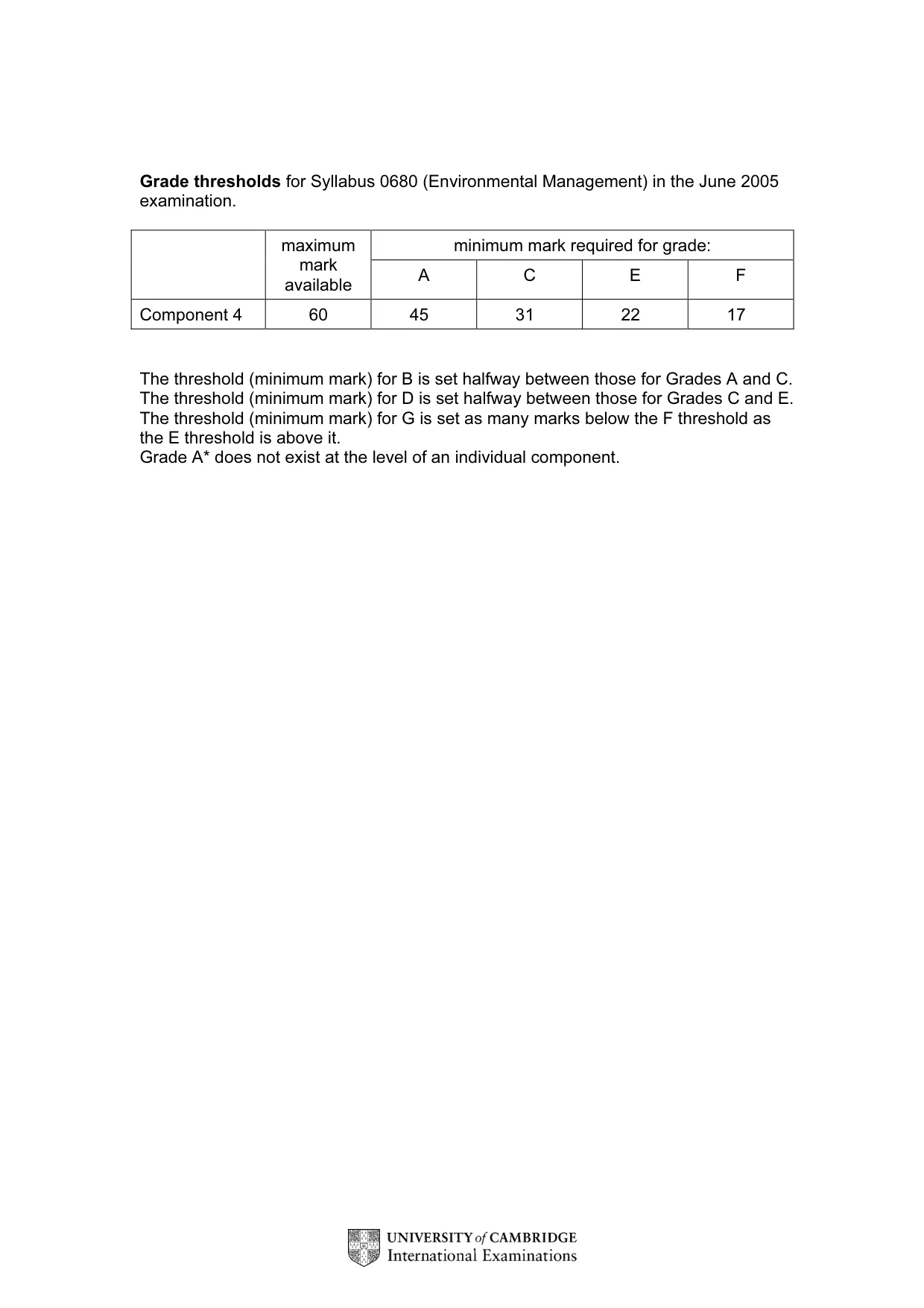
Grade thresholds for Syllabus 0680 (Environmental Management) in the June 2005 examination. minimum mark required for grade: maximum mark available A C E F Component 4 60 45 31 22 17 The threshold (minimum mark) for B is set halfway between those for Grades A and C. The threshold (minimum mark) for D is set halfway between those for Grades C and E. The threshold (minimum mark) for G is set as many marks below the F threshold as the E threshold is above it. Grade A* does not exist at the level of an individual component.
Mark scheme, page 3
June 2005 IGCSE MARK SCHEME MAXIMUM MARK: 60 SYLLABUS/COMPONENT: 0680/04 ENVIRONMENTAL MANAGEMENT (Alternative to Coursework)
Mark scheme, page 4
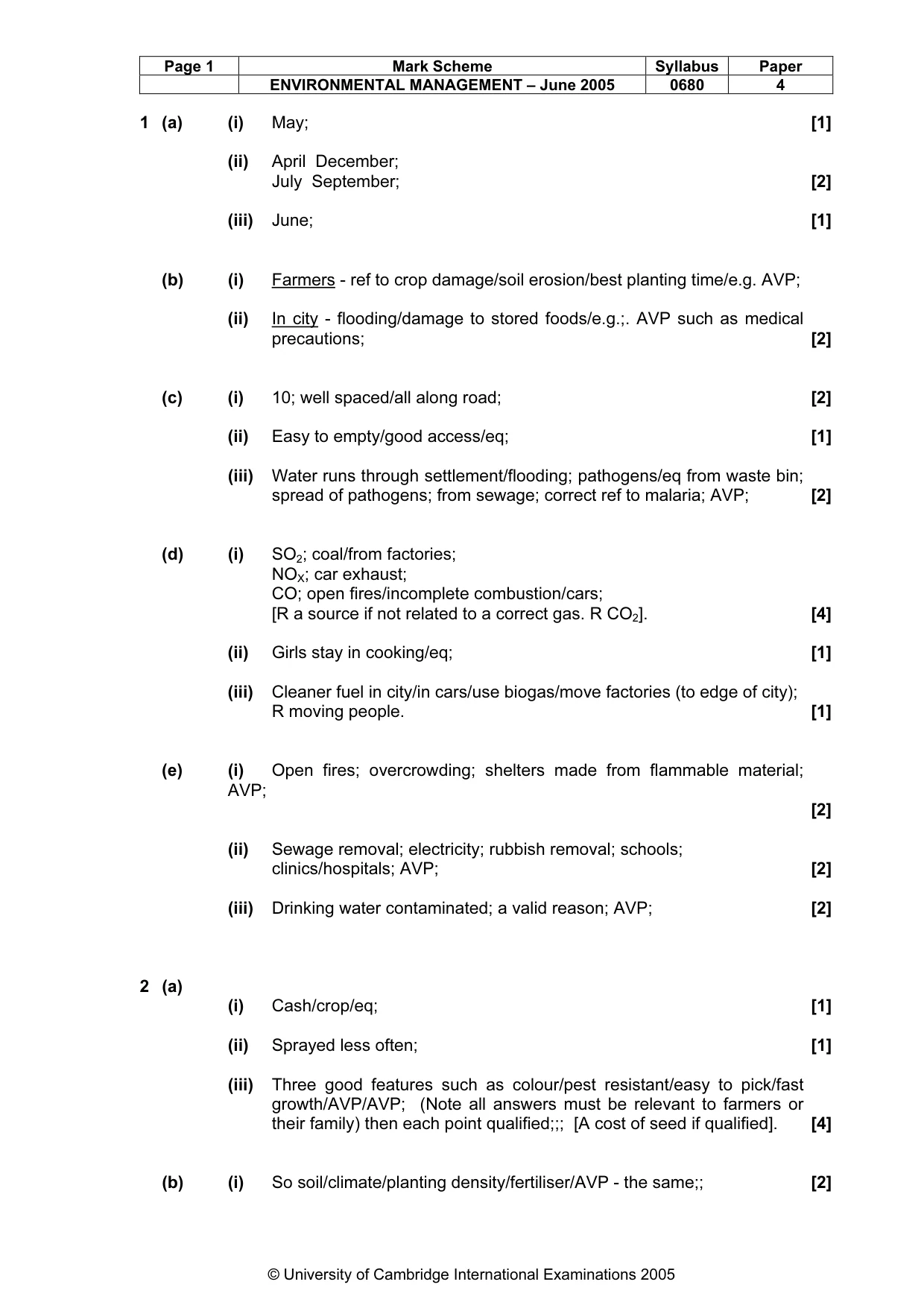
Page 1 Mark Scheme Syllabus Paper ENVIRONMENTAL MANAGEMENT – June 2005 0680 4 © University of Cambridge International Examinations 2005 1 (a) (i) May; [1] (ii) April December; July September; [2] (iii) June; [1] (b) (i) Farmers - ref to crop damage/soil erosion/best planting time/e.g. AVP; (ii) In city - flooding/damage to stored foods/e.g.;. AVP such as medical precautions; [2] (c) (i) 10; well spaced/all along road; [2] (ii) Easy to empty/good access/eq; [1] (iii) Water runs through settlement/flooding; pathogens/eq from waste bin; spread of pathogens; from sewage; correct ref to malaria; AVP; [2] (d) (i) SO2; coal/from factories; NOX; car exhaust; CO; open fires/incomplete combustion/cars; [R a source if not related to a correct gas. R CO2]. [4] (ii) Girls stay in cooking/eq; [1] (iii) Cleaner fuel in city/in cars/use biogas/move factories (to edge of city); R moving people. [1] (e) (i) Open fires; overcrowding; shelters made from flammable material; AVP; [2] (ii) Sewage removal; electricity; rubbish removal; schools; clinics/hospitals; AVP; [2] (iii) Drinking water contaminated; a valid reason; AVP; [2] 2 (a) (i) Cash/crop/eq; [1] (ii) Sprayed less often; [1] (iii) Three good features such as colour/pest resistant/easy to pick/fast growth/AVP/AVP; (Note all answers must be relevant to farmers or their family) then each point qualified;;; [A cost of seed if qualified]. [4] (b) (i) So soil/climate/planting density/fertiliser/AVP - the same;; [2]
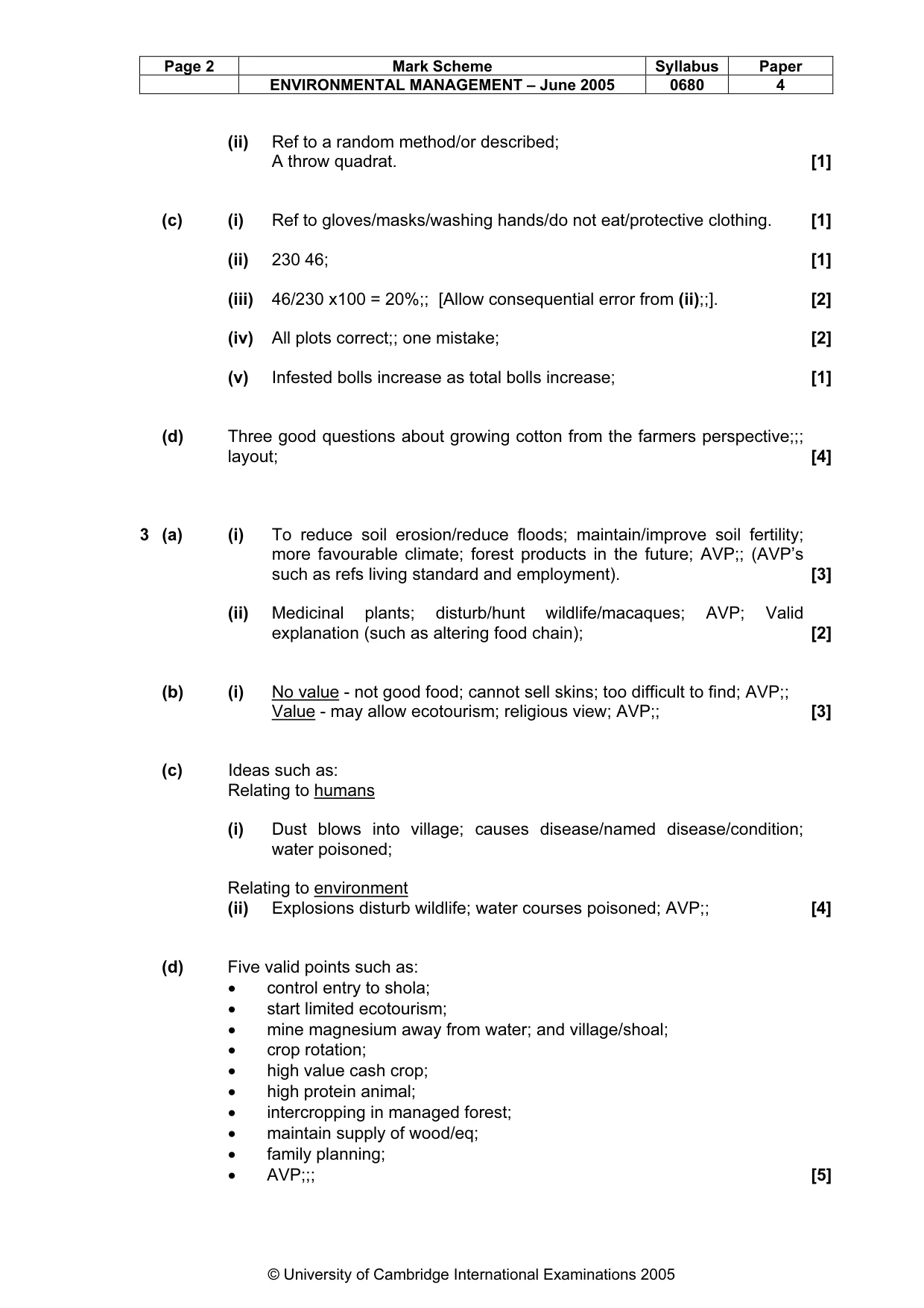
Mark scheme, page 5
Page 2 Mark Scheme Syllabus Paper ENVIRONMENTAL MANAGEMENT – June 2005 0680 4 © University of Cambridge International Examinations 2005 (ii) Ref to a random method/or described; A throw quadrat. [1] (c) (i) Ref to gloves/masks/washing hands/do not eat/protective clothing. [1] (ii) 230 46; [1] (iii) 46/230 x100 = 20%;; [Allow consequential error from (ii);;]. [2] (iv) All plots correct;; one mistake; [2] (v) Infested bolls increase as total bolls increase; [1] (d) Three good questions about growing cotton from the farmers perspective;;; layout; [4] 3 (a) (i) To reduce soil erosion/reduce floods; maintain/improve soil fertility; more favourable climate; forest products in the future; AVP;; (AVP’s such as refs living standard and employment). [3] (ii) Medicinal plants; disturb/hunt wildlife/macaques; AVP; Valid explanation (such as altering food chain); [2] (b) (i) No value - not good food; cannot sell skins; too difficult to find; AVP;; Value - may allow ecotourism; religious view; AVP;; [3] (c) Ideas such as: Relating to humans (i) Dust blows into village; causes disease/named disease/condition; water poisoned; Relating to environment (ii) Explosions disturb wildlife; water courses poisoned; AVP;; [4] (d) Five valid points such as: • control entry to shola; • start limited ecotourism; • mine magnesium away from water; and village/shoal; • crop rotation; • high value cash crop; • high protein animal; • intercropping in managed forest; • maintain supply of wood/eq; • family planning; • AVP;;; [5]