Cambridge IGCSE Environmental Management 0680 — 2004 Oct/Nov Paper 4 · Variant 1
0680/41/O/N/04
The question paper and its mark scheme, free to read here and free to download. This is Cambridge’s own paper, exactly as it was sat.
Question paper16 pages



Mark scheme5 pages
Answers below. Sit the paper first if you are practising.
Paper as text
Question paper, page 1
This document consists of 13 printed pages and 3 blank pages. (DR) S60229/2 © UCLES 2004 [Turn over UNIVERSITY OF CAMBRIDGE INTERNATIONAL EXAMINATIONS International General Certificate of Secondary Education General Certificate of Education Ordinary Level ENVIRONMENTAL MANAGEMENT 0680/04 5014/02 Alternative to Coursework October/November 2004 1 hour 30 minutes Candidates answer on the Question Paper. Additional Materials: Ruler (cm/mm) READ THESE INSTRUCTIONS FIRST Write your Centre number, candidate number and name on all the work you hand in. Write in dark blue or black pen on both sides of the paper. You may use a soft pencil for any diagrams, graphs or rough working. Do not use staples, paper clips, highlighters, glue or correction fluid. Answer all questions. Study the appropriate Source materials before you start to write your answers. Credit will be given for appropriate selection and use of data in your answers and for relevant interpretation of these data. Suggestions for data sources are given in some questions. You may use the source data to draw diagrams and graphs or to do calculations to illustrate your answers. At the end of the examination, fasten all your work securely together. The number of marks is given in brackets [ ] at the end of each question or part question. Centre Number Candidate Number Name For Examiner’s Use If you have been given a label, look at the details. If any details are incorrect or missing, please fill in your correct details in the space given at the top of this page. Stick your personal label here, if provided. www.XtremePapers.com
Question paper, page 2
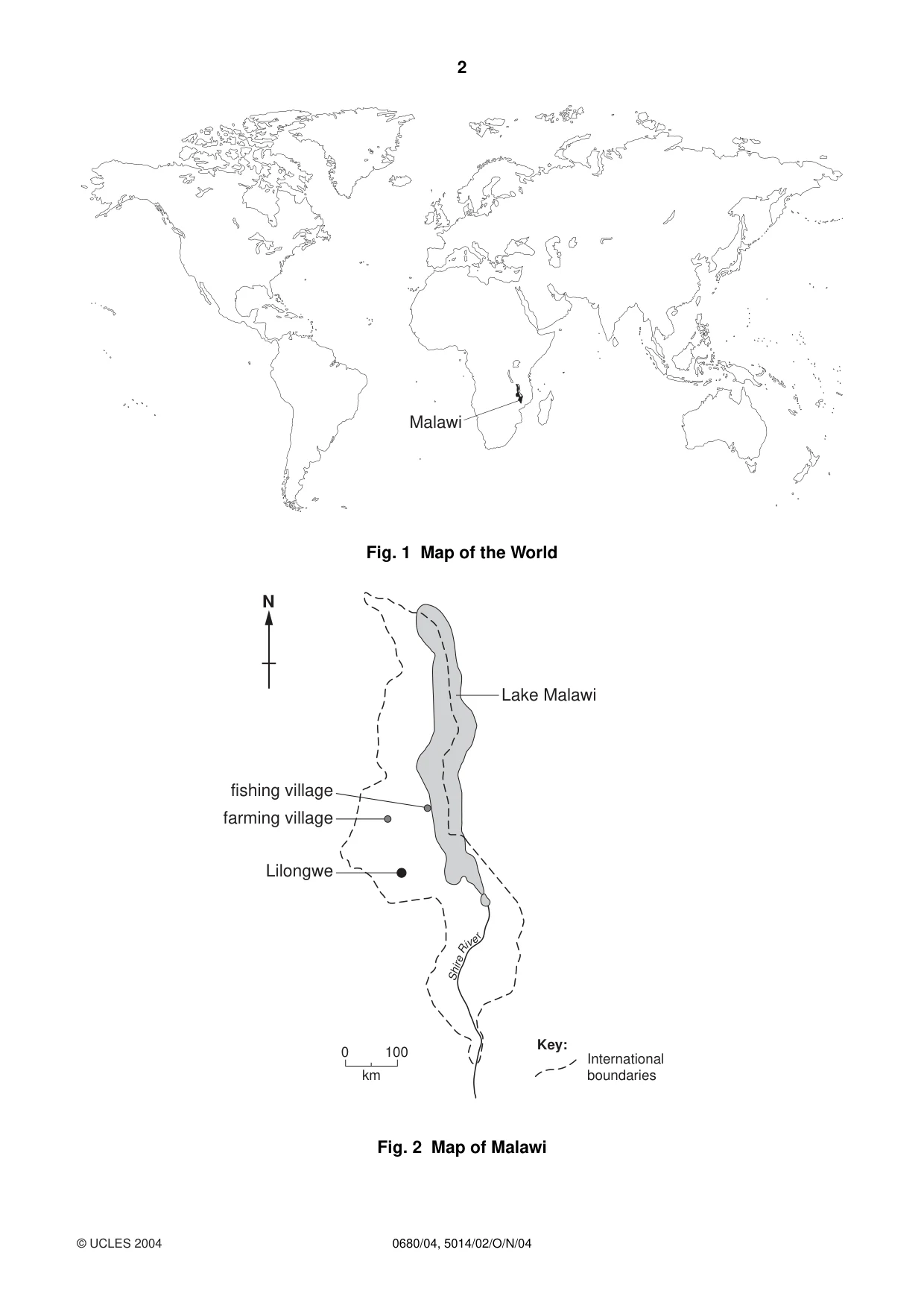
© UCLES 2004 2 0680/04, 5014/02/O/N/04 Fig. 1 Map of the World Fig. 2 Map of Malawi Lake Malawi fishing village farming village Lilongwe Sh ire R i v e r 0 100 km Key: International boundaries N Malawi
Question paper, page 3
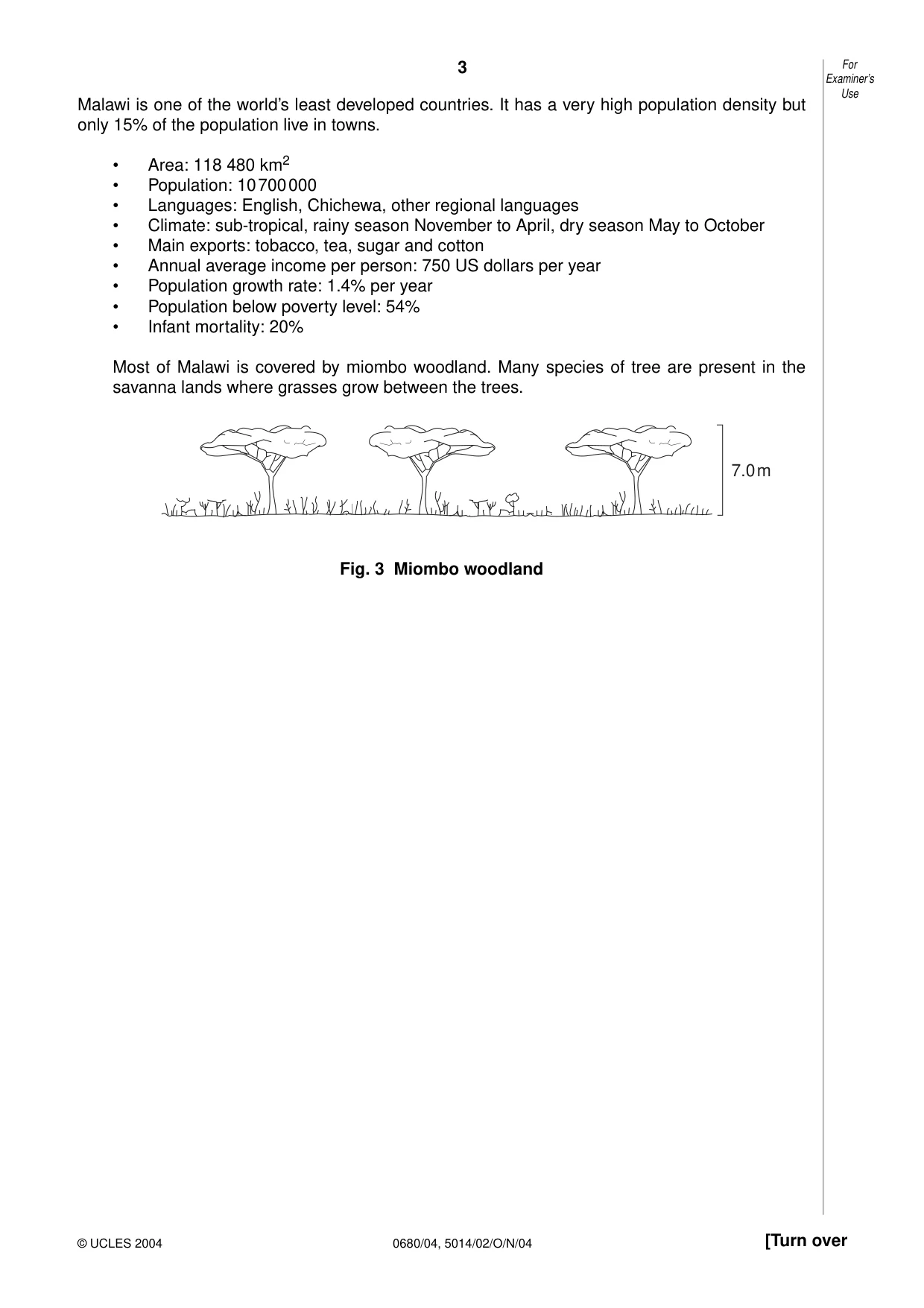
3 0680/04, 5014/02/O/N/04 [Turn over Malawi is one of the world’s least developed countries. It has a very high population density but only 15% of the population live in towns. • Area: 118 480 km2 • Population: 10700000 • Languages: English, Chichewa, other regional languages • Climate: sub-tropical, rainy season November to April, dry season May to October • Main exports: tobacco, tea, sugar and cotton • Annual average income per person: 750 US dollars per year • Population growth rate: 1.4% per year • Population below poverty level: 54% • Infant mortality: 20% Most of Malawi is covered by miombo woodland. Many species of tree are present in the savanna lands where grasses grow between the trees. Fig. 3 Miombo woodland 7.0m For Examiner’s Use © UCLES 2004
Question paper, page 4
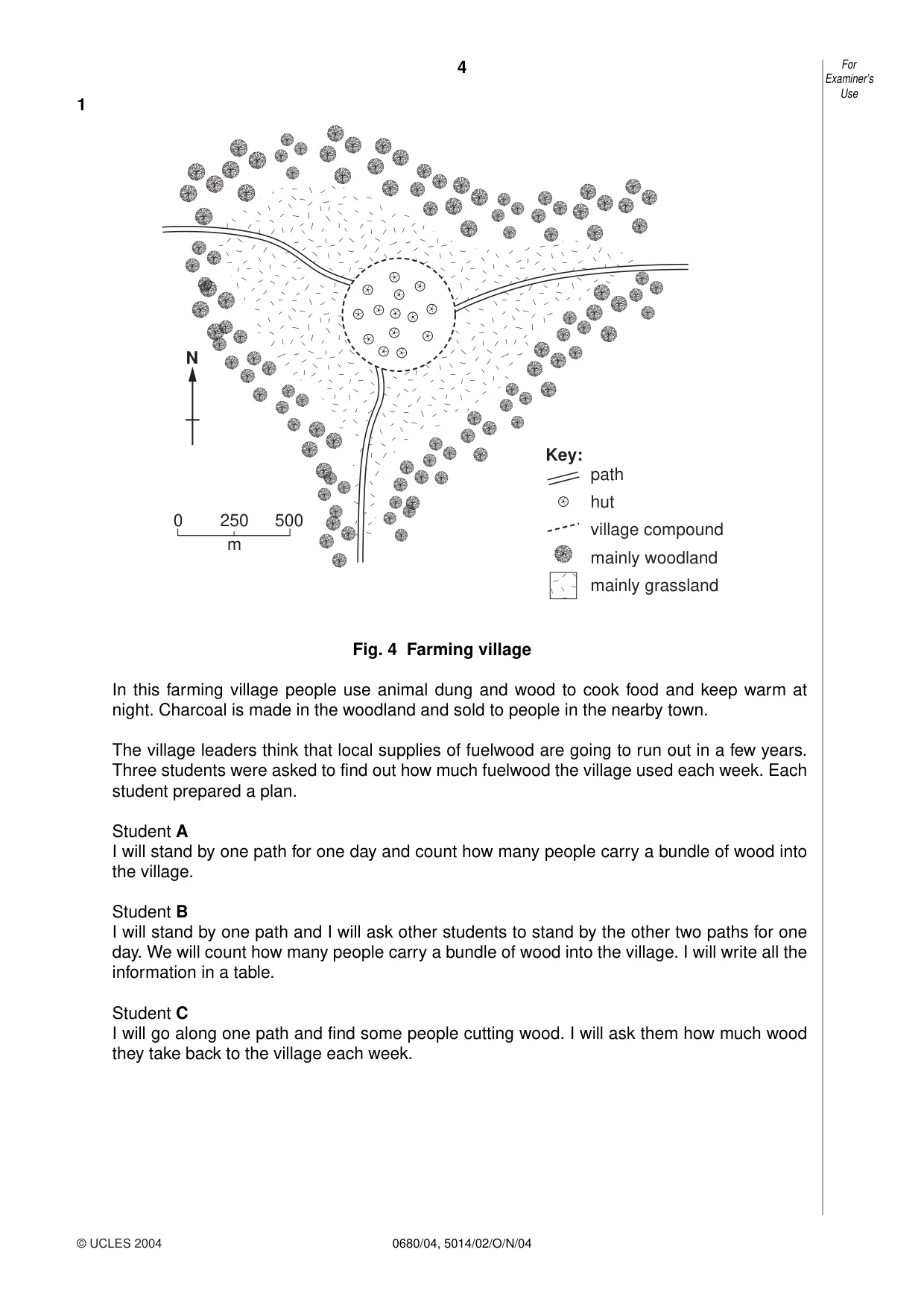
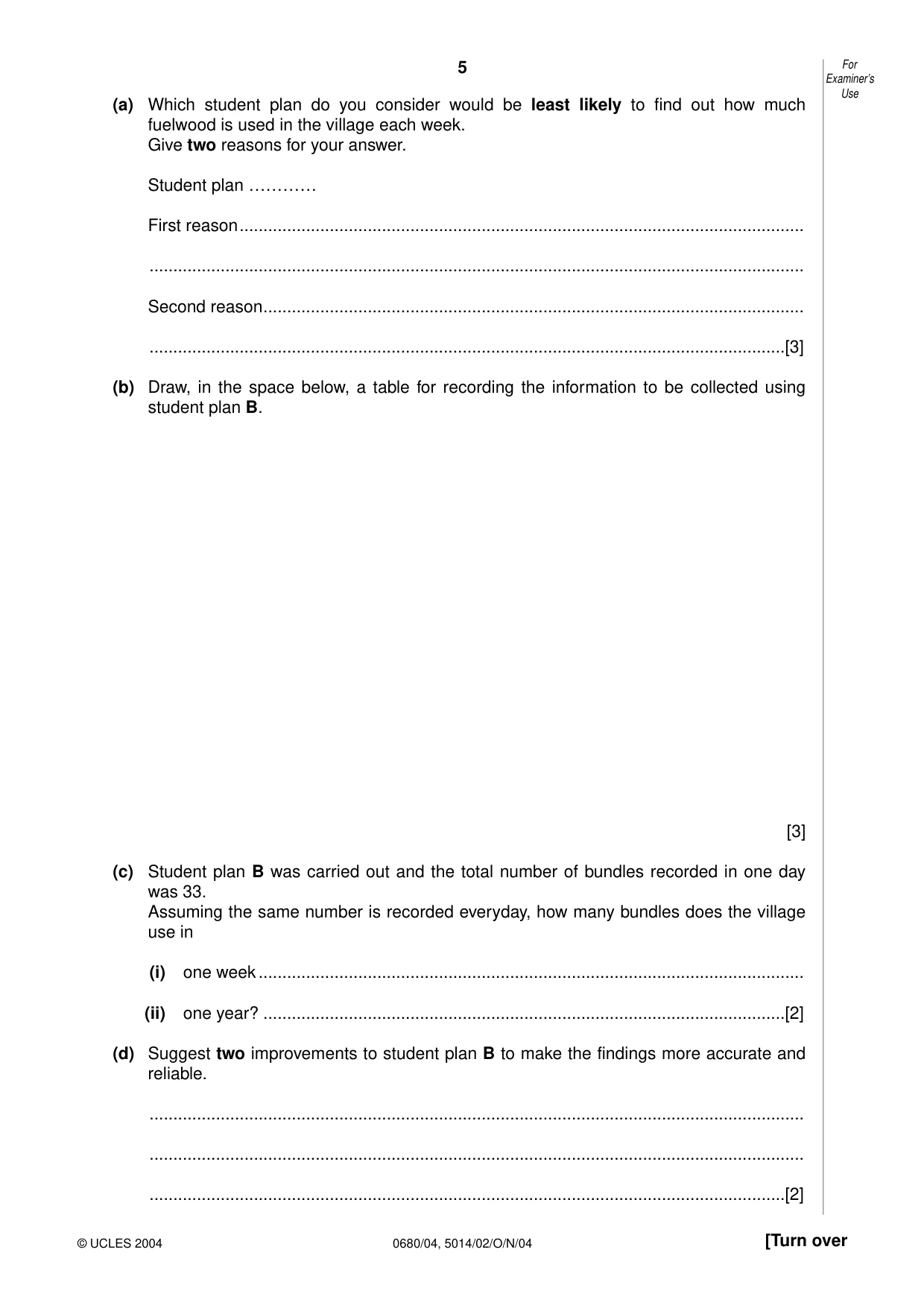
© UCLES 2004 4 0680/04, 5014/02/O/N/04 1 Fig. 4 Farming village In this farming village people use animal dung and wood to cook food and keep warm at night. Charcoal is made in the woodland and sold to people in the nearby town. The village leaders think that local supplies of fuelwood are going to run out in a few years. Three students were asked to find out how much fuelwood the village used each week. Each student prepared a plan. Student A I will stand by one path for one day and count how many people carry a bundle of wood into the village. Student B I will stand by one path and I will ask other students to stand by the other two paths for one day. We will count how many people carry a bundle of wood into the village. I will write all the information in a table. Student C I will go along one path and find some people cutting wood. I will ask them how much wood they take back to the village each week. N 0 250 m 500 Key: path hut village compound mainly woodland mainly grassland For Examiner’s Use
Question paper, page 5
5 0680/04, 5014/02/O/N/04 [Turn over (a) Which student plan do you consider would be least likely to find out how much fuelwood is used in the village each week. Give two reasons for your answer. Student plan ………… First reason… … Second reason… …[3] (b) Draw, in the space below, a table for recording the information to be collected using student plan B. [3] (c) Student plan B was carried out and the total number of bundles recorded in one day was 33. Assuming the same number is recorded everyday, how many bundles does the village use in (i) one week… (ii) one year? …[2] (d) Suggest two improvements to student plan B to make the findings more accurate and reliable. … … …[2] For Examiner’s Use © UCLES 2004
Question paper, page 6
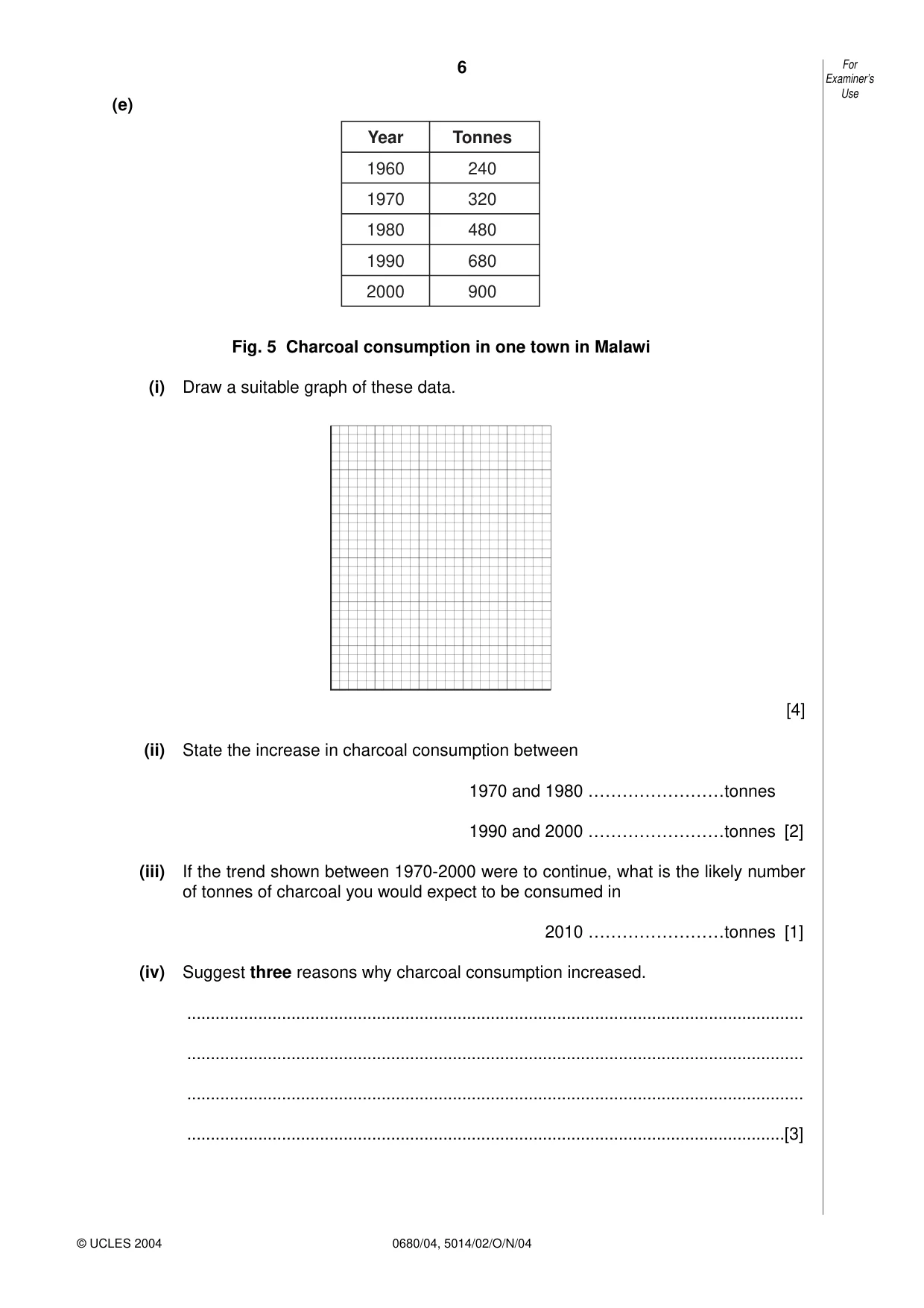
6 0680/04, 5014/02/O/N/04 (e) Fig. 5 Charcoal consumption in one town in Malawi (i) Draw a suitable graph of these data. [4] (ii) State the increase in charcoal consumption between 1970 and 1980 ……………………tonnes 1990 and 2000 ……………………tonnes [2] (iii) If the trend shown between 1970-2000 were to continue, what is the likely number of tonnes of charcoal you would expect to be consumed in 2010 ……………………tonnes [1] (iv) Suggest three reasons why charcoal consumption increased. … … … …[3] Year Tonnes 1960 1970 1980 1990 2000 240 320 480 680 900 For Examiner’s Use © UCLES 2004
Question paper, page 7
7 0680/04, 5014/02/O/N/04 [Turn over BLANK PAGE
Question paper, page 8
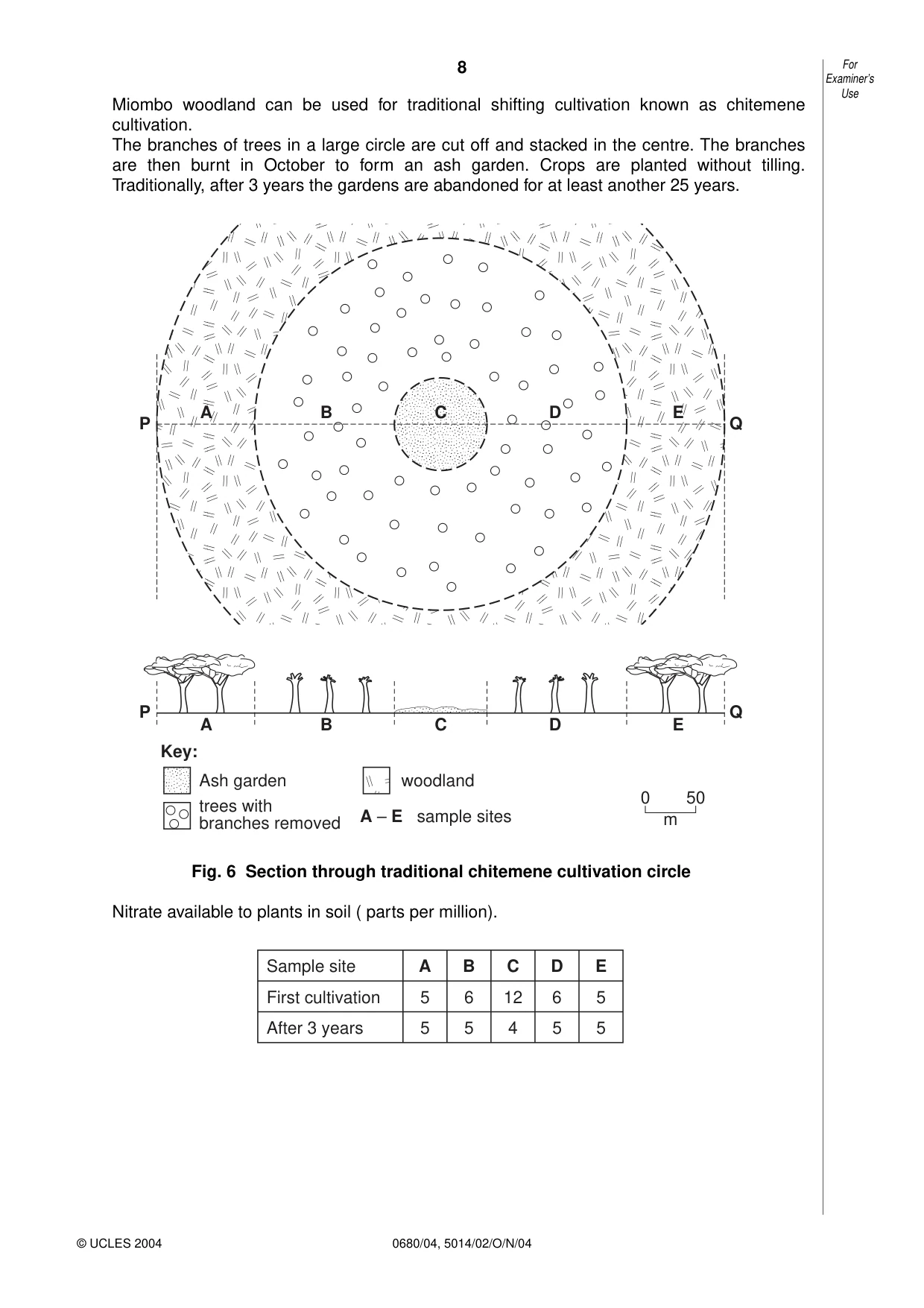
8 0680/04, 5014/02/O/N/04 Miombo woodland can be used for traditional shifting cultivation known as chitemene cultivation. The branches of trees in a large circle are cut off and stacked in the centre. The branches are then burnt in October to form an ash garden. Crops are planted without tilling. Traditionally, after 3 years the gardens are abandoned for at least another 25 years. Fig. 6 Section through traditional chitemene cultivation circle Nitrate available to plants in soil ( parts per million). Sample site First cultivation After 3 years A B C D E 5 6 12 6 5 5 5 4 5 5 0 50 m P A B C D E A B C D E Q P Q Key: Ash garden trees with branches removed woodland A – E sample sites For Examiner’s Use © UCLES 2004
Question paper, page 9
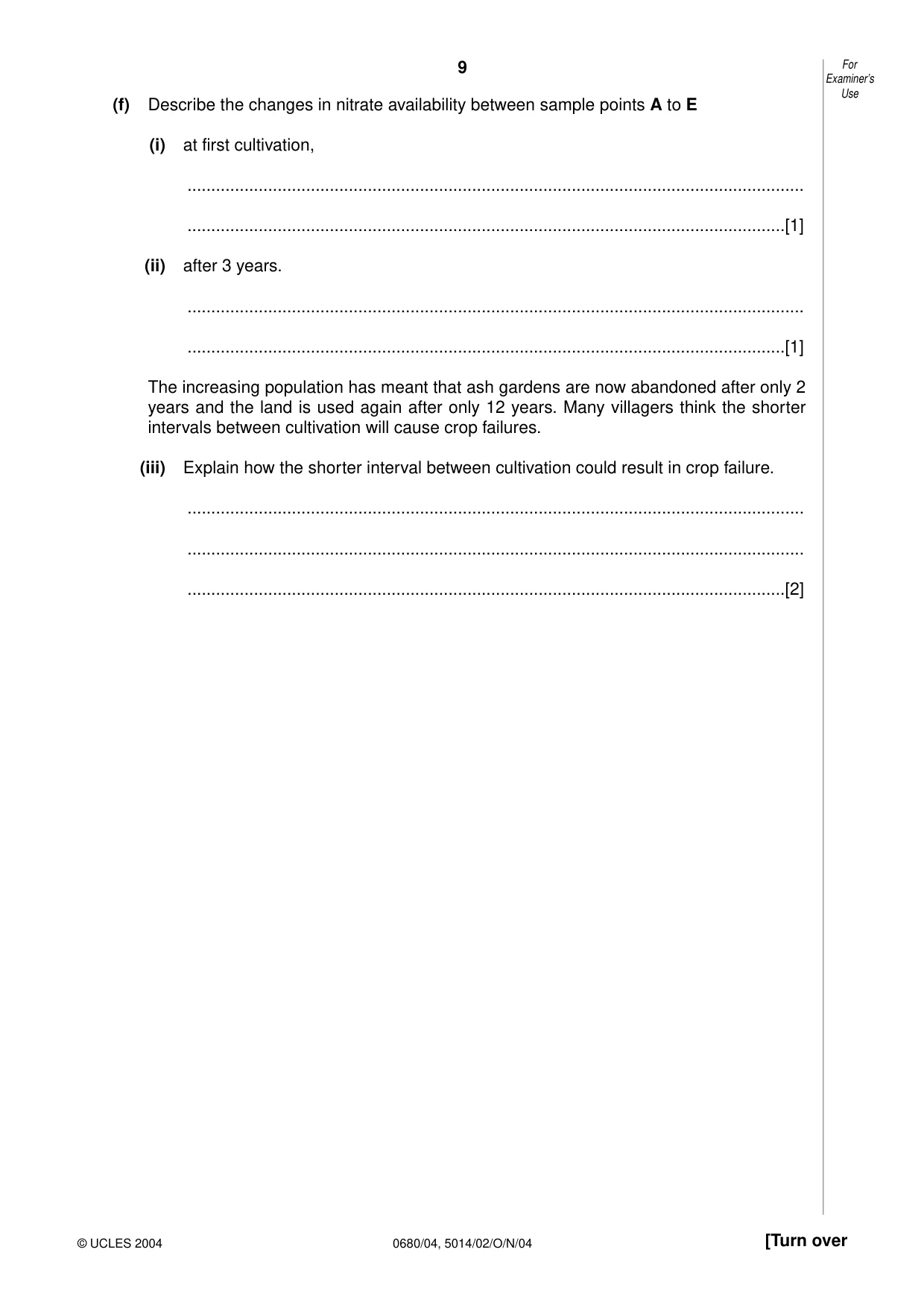
9 0680/04, 5014/02/O/N/04 [Turn over (f) Describe the changes in nitrate availability between sample points A to E (i) at first cultivation, … …[1] (ii) after 3 years. … …[1] The increasing population has meant that ash gardens are now abandoned after only 2 years and the land is used again after only 12 years. Many villagers think the shorter intervals between cultivation will cause crop failures. (iii) Explain how the shorter interval between cultivation could result in crop failure. … … …[2] For Examiner’s Use © UCLES 2004
Question paper, page 10
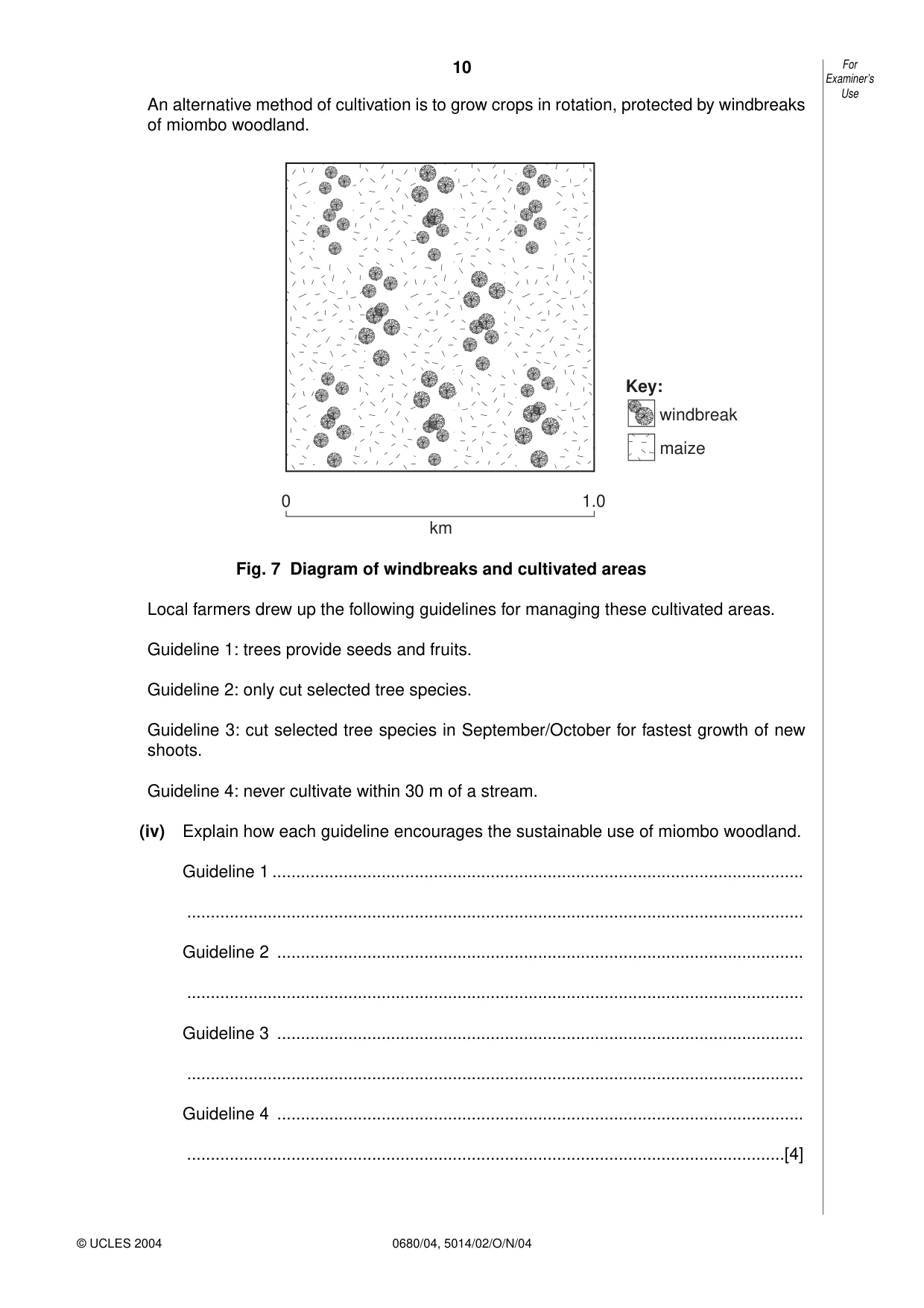
10 0680/04, 5014/02/O/N/04 An alternative method of cultivation is to grow crops in rotation, protected by windbreaks of miombo woodland. Fig. 7 Diagram of windbreaks and cultivated areas Local farmers drew up the following guidelines for managing these cultivated areas. Guideline 1: trees provide seeds and fruits. Guideline 2: only cut selected tree species. Guideline 3: cut selected tree species in September/October for fastest growth of new shoots. Guideline 4: never cultivate within 30 m of a stream. (iv) Explain how each guideline encourages the sustainable use of miombo woodland. Guideline 1 … … Guideline 2 … … Guideline 3 … … Guideline 4 … …[4] 0 1.0 km Key: windbreak maize For Examiner’s Use © UCLES 2004
Question paper, page 11
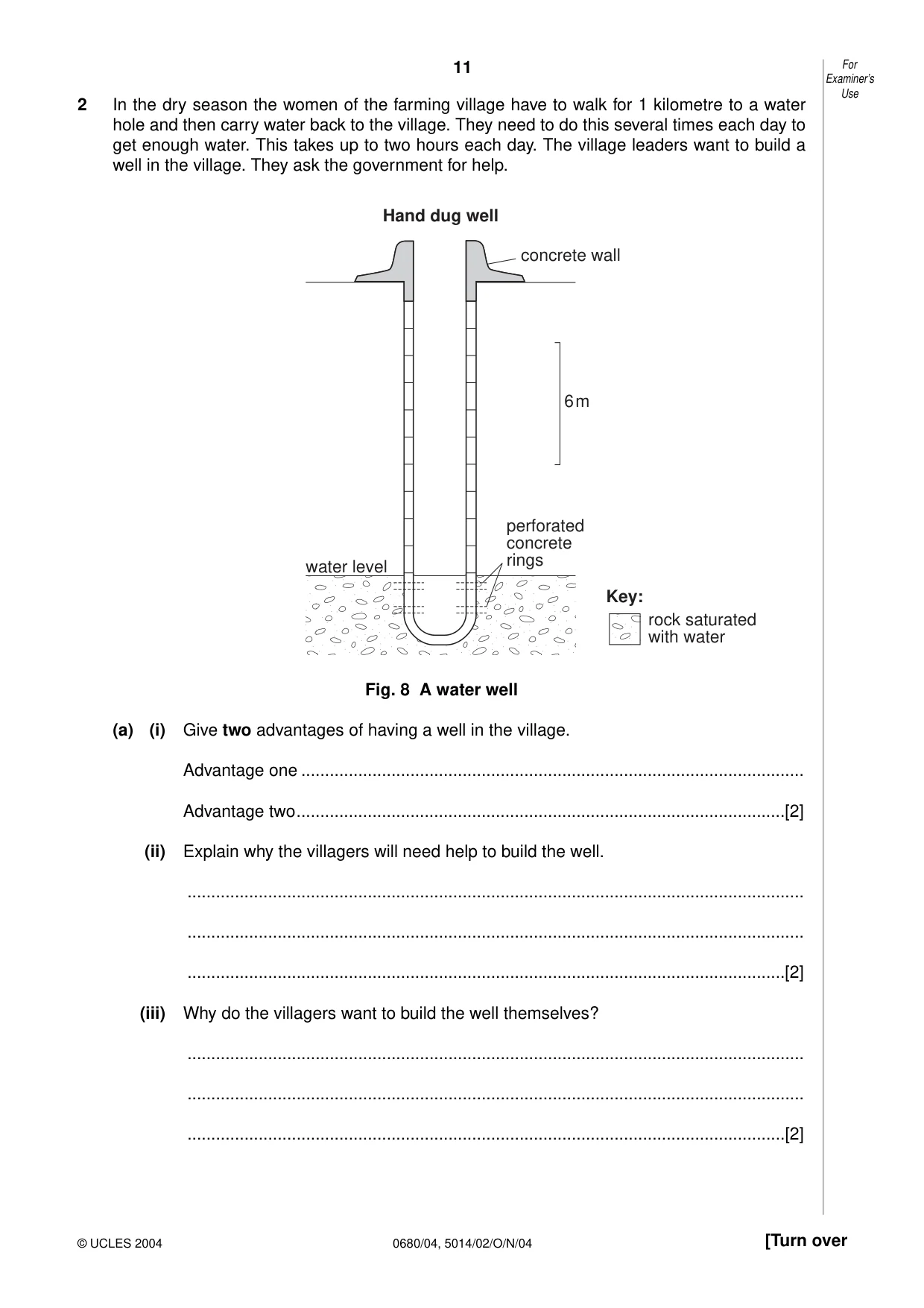
11 0680/04, 5014/02/O/N/04 [Turn over 2 In the dry season the women of the farming village have to walk for 1 kilometre to a water hole and then carry water back to the village. They need to do this several times each day to get enough water. This takes up to two hours each day. The village leaders want to build a well in the village. They ask the government for help. Fig. 8 A water well (a) (i) Give two advantages of having a well in the village. Advantage one … Advantage two…[2] (ii) Explain why the villagers will need help to build the well. … … …[2] (iii) Why do the villagers want to build the well themselves? … … …[2] 6m concrete wall perforated concrete rings rock saturated with water water level Key: Hand dug well For Examiner’s Use © UCLES 2004
Question paper, page 12
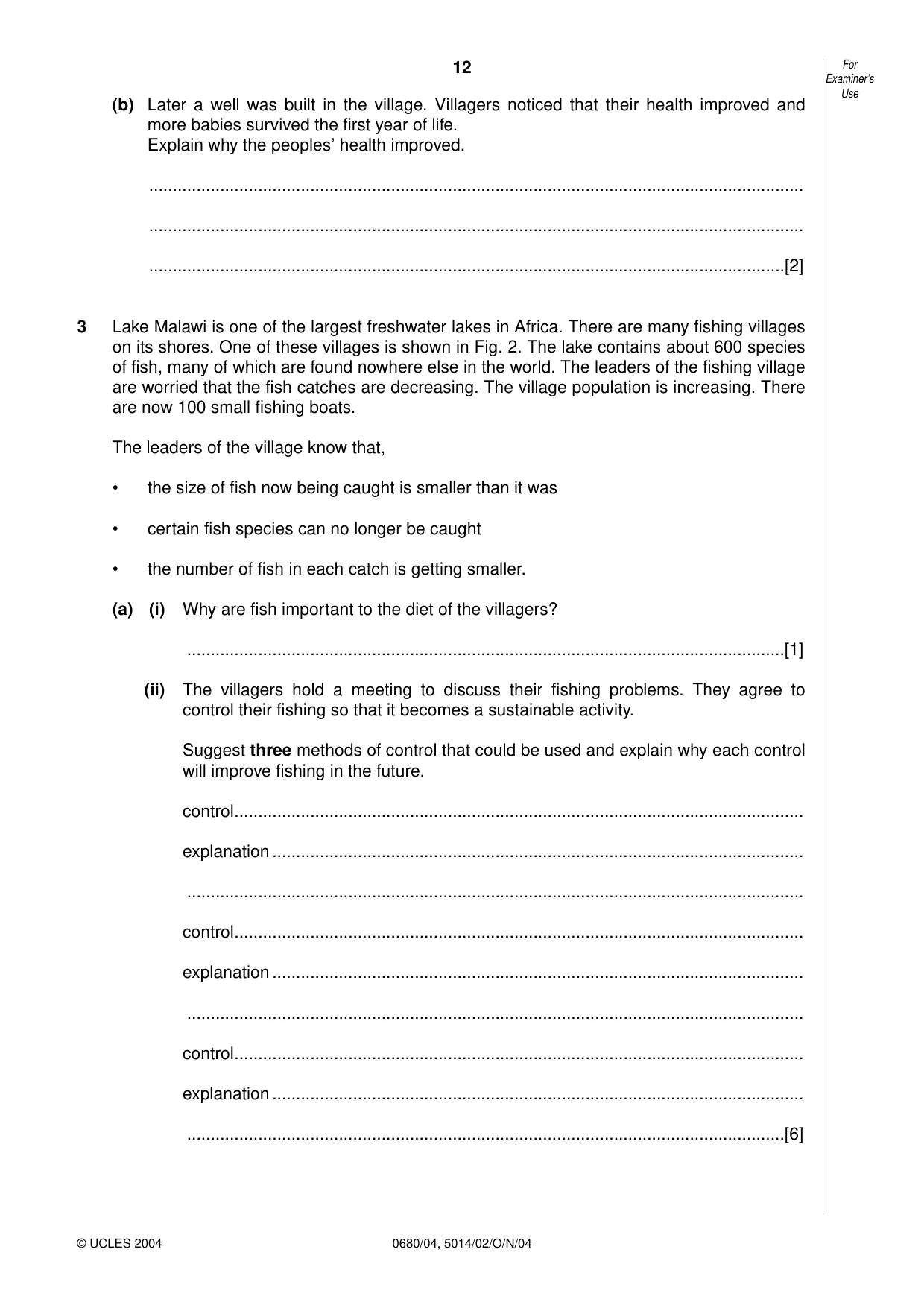
12 0680/04, 5014/02/O/N/04 (b) Later a well was built in the village. Villagers noticed that their health improved and more babies survived the first year of life. Explain why the peoples’ health improved. … … …[2] 3 Lake Malawi is one of the largest freshwater lakes in Africa. There are many fishing villages on its shores. One of these villages is shown in Fig. 2. The lake contains about 600 species of fish, many of which are found nowhere else in the world. The leaders of the fishing village are worried that the fish catches are decreasing. The village population is increasing. There are now 100 small fishing boats. The leaders of the village know that, • the size of fish now being caught is smaller than it was • certain fish species can no longer be caught • the number of fish in each catch is getting smaller. (a) (i) Why are fish important to the diet of the villagers? …[1] (ii) The villagers hold a meeting to discuss their fishing problems. They agree to control their fishing so that it becomes a sustainable activity. Suggest three methods of control that could be used and explain why each control will improve fishing in the future. control… explanation … … control… explanation … … control… explanation … …[6] For Examiner’s Use © UCLES 2004
Question paper, page 13
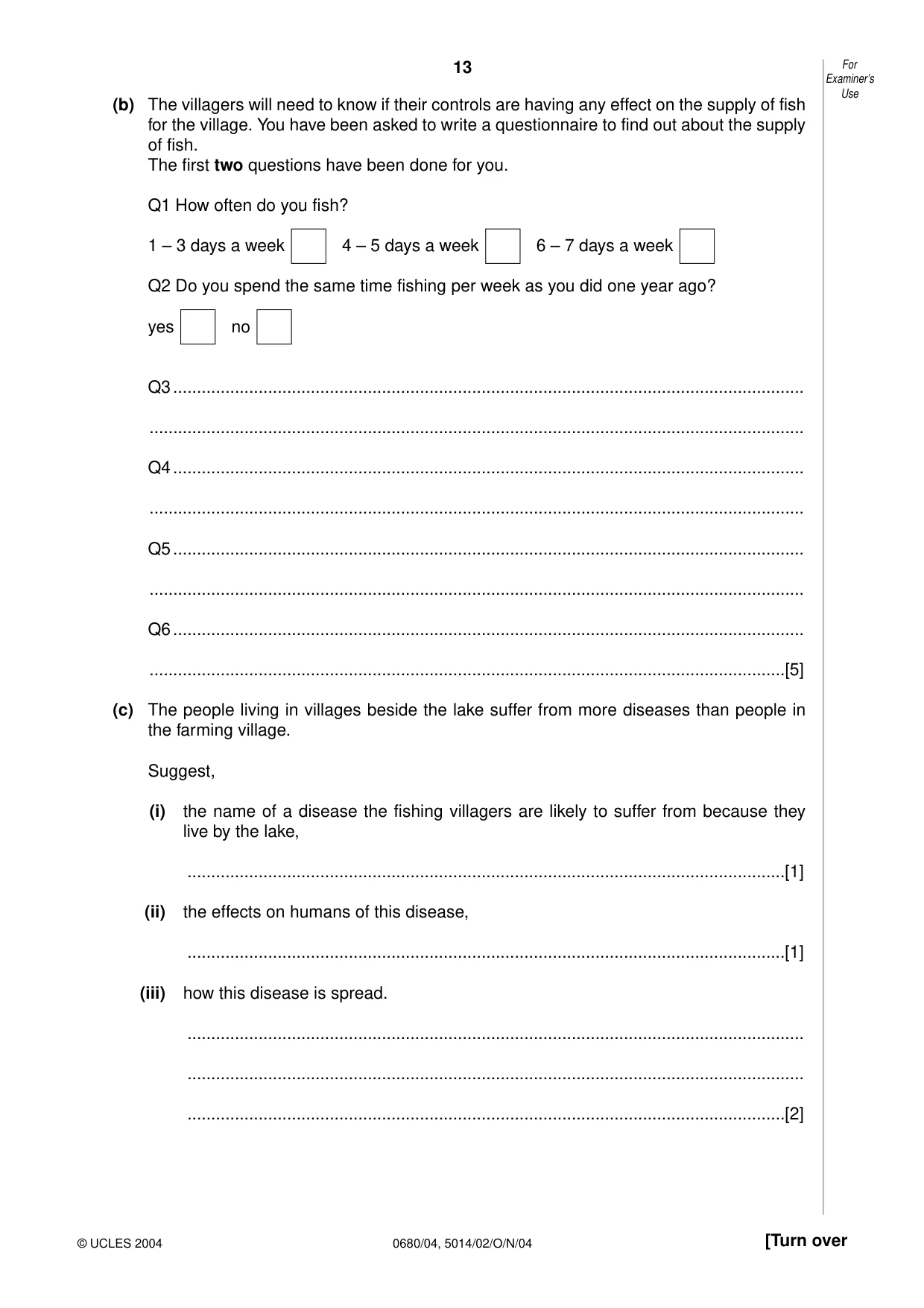
13 0680/04, 5014/02/O/N/04 [Turn over (b) The villagers will need to know if their controls are having any effect on the supply of fish for the village. You have been asked to write a questionnaire to find out about the supply of fish. The first two questions have been done for you. Q1 How often do you fish? 1 – 3 days a week 4 – 5 days a week 6 – 7 days a week Q2 Do you spend the same time fishing per week as you did one year ago? yes no Q3… … Q4… … Q5… … Q6… …[5] (c) The people living in villages beside the lake suffer from more diseases than people in the farming village. Suggest, (i) the name of a disease the fishing villagers are likely to suffer from because they live by the lake, …[1] (ii) the effects on humans of this disease, …[1] (iii) how this disease is spread. … … …[2] For Examiner’s Use © UCLES 2004
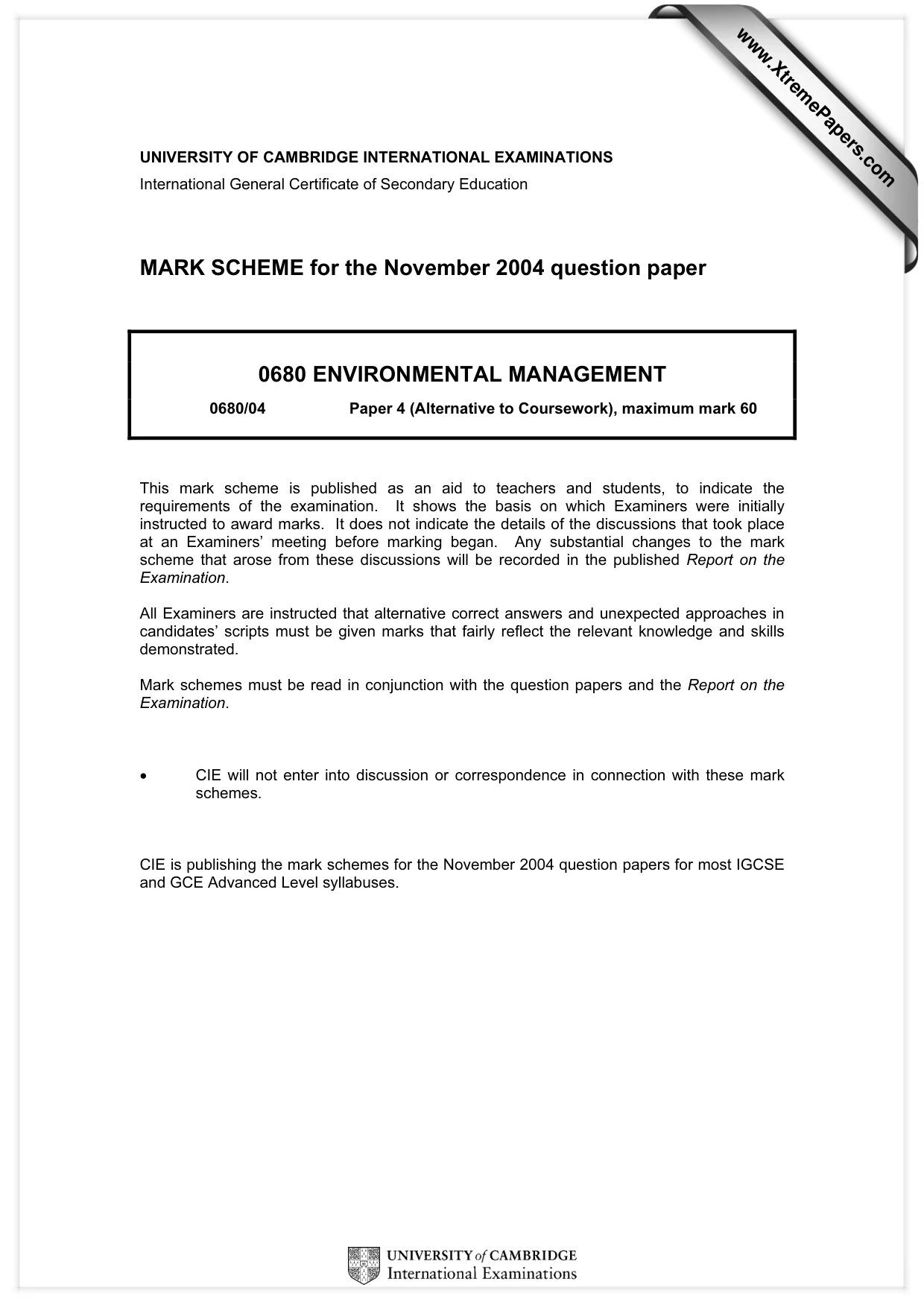
Question paper, page 14
© UCLES 2004 14 0680/04, 5014/02/O/N/04 4 Elephants live around the farming village and the fishing village. The elephants damage villages in search of food. In the past some elephants were killed for food and their ivory tusks were sold for export. Poachers killed many elephants for their ivory tusks. The government protected the elephants and international trade in ivory was banned. Elephant populations are increasing again and some international trade in ivory is now allowed. Ecotourism has increased so some villagers earn money guiding tourists to see the elephants. Elephant populations have to be controlled to prevent serious environmental damage. (a) (i) Explain how the villagers will benefit from international trade in ivory. … … …[2] (ii) Explain why the international trade in ivory must be limited and controlled. … … …[2] (b) (i) Suggest reasons why ecotourists visiting Malawi might not approve of the elephants being used as a resource by the villagers. … … …[2] (ii) Suggest reasons why the villagers want to reduce the elephant population. … … …[2] For Examiner’s Use
Question paper, page 16
© UCLES 2004 16 0680/04, 5014/02/O/N/04 BLANK PAGE University of Cambridge International Examinations is part of the University of Cambridge Local Examinations Syndicate (UCLES) which is itself a department of the University of Cambridge.
Mark scheme, page 1
UNIVERSITY OF CAMBRIDGE INTERNATIONAL EXAMINATIONS International General Certificate of Secondary Education MARK SCHEME for the November 2004 question paper 0680 ENVIRONMENTAL MANAGEMENT 0680/04 Paper 4 (Alternative to Coursework), maximum mark 60 This mark scheme is published as an aid to teachers and students, to indicate the requirements of the examination. It shows the basis on which Examiners were initially instructed to award marks. It does not indicate the details of the discussions that took place at an Examiners’ meeting before marking began. Any substantial changes to the mark scheme that arose from these discussions will be recorded in the published Report on the Examination. All Examiners are instructed that alternative correct answers and unexpected approaches in candidates’ scripts must be given marks that fairly reflect the relevant knowledge and skills demonstrated. Mark schemes must be read in conjunction with the question papers and the Report on the Examination. • CIE will not enter into discussion or correspondence in connection with these mark schemes. CIE is publishing the mark schemes for the November 2004 question papers for most IGCSE and GCE Advanced Level syllabuses. www.XtremePapers.com
Mark scheme, page 2
Grade thresholds taken for Syllabus 0680 (Environmental Management) in the November 2004 examination. minimum mark required for grade: maximum mark available A C E F Component 4 60 42 32 25 19 The threshold (minimum mark) for B is set halfway between those for Grades A and C. The threshold (minimum mark) for D is set halfway between those for Grades C and E. The threshold (minimum mark) for G is set as many marks below the F threshold as the E threshold is above it. Grade A* does not exist at the level of an individual component.
Mark scheme, page 3
November 2004 INTERNATIONAL GCSE MARK SCHEME MAXIMUM MARK: 60 SYLLABUS/COMPONENT: 0680/04 ENVIRONMENTAL MANAGEMENT (Alternative to Coursework)
Mark scheme, page 4
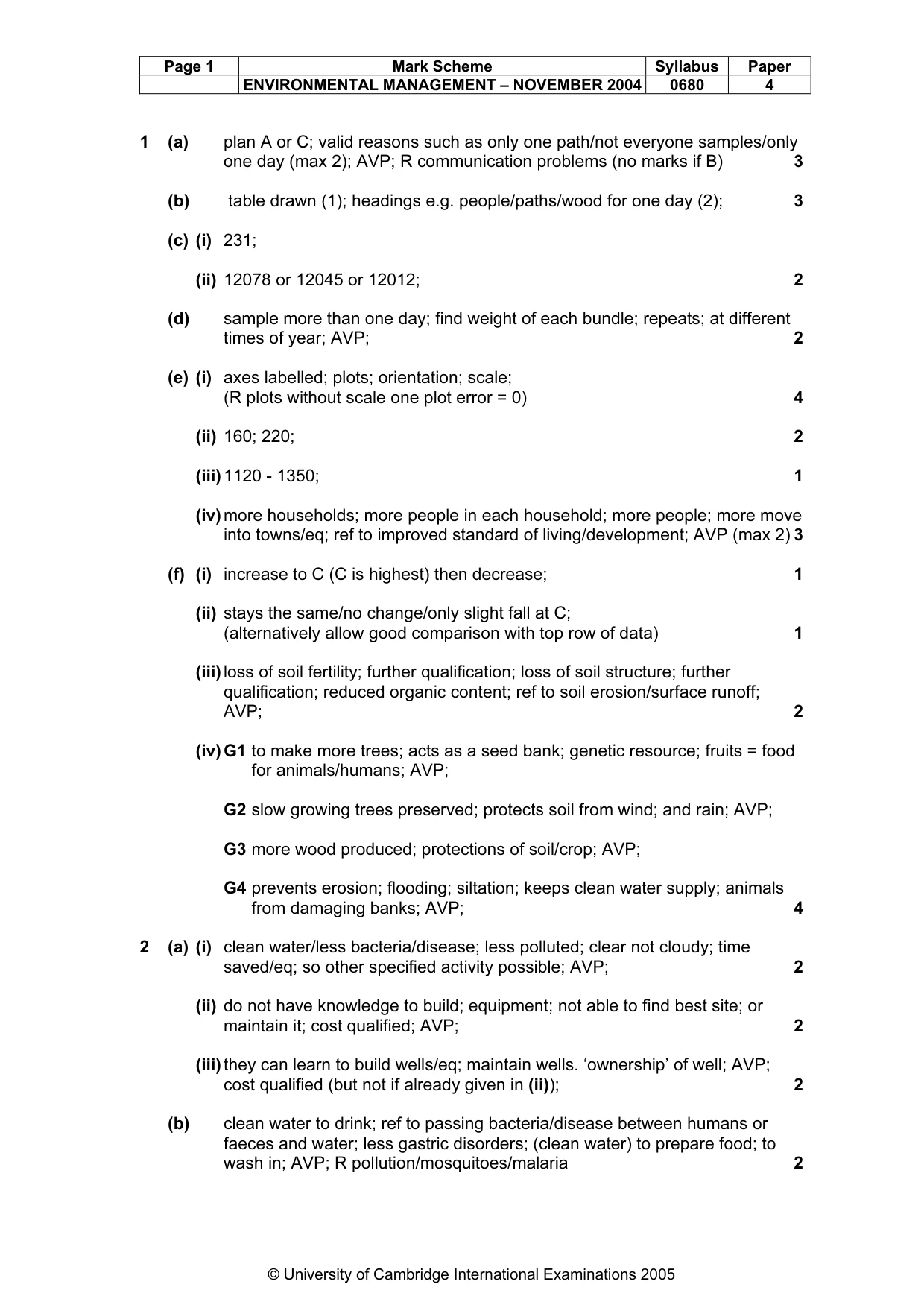
Page 1 Mark Scheme Syllabus Paper ENVIRONMENTAL MANAGEMENT – NOVEMBER 2004 0680 4 © University of Cambridge International Examinations 2005 1 (a) plan A or C; valid reasons such as only one path/not everyone samples/only one day (max 2); AVP; R communication problems (no marks if B) 3 (b) table drawn (1); headings e.g. people/paths/wood for one day (2); 3 (c) (i) 231; (ii) 12078 or 12045 or 12012; 2 (d) sample more than one day; find weight of each bundle; repeats; at different times of year; AVP; 2 (e) (i) axes labelled; plots; orientation; scale; (R plots without scale one plot error = 0) 4 (ii) 160; 220; 2 (iii) 1120 - 1350; 1 (iv) more households; more people in each household; more people; more move into towns/eq; ref to improved standard of living/development; AVP (max 2) 3 (f) (i) increase to C (C is highest) then decrease; 1 (ii) stays the same/no change/only slight fall at C; (alternatively allow good comparison with top row of data) 1 (iii) loss of soil fertility; further qualification; loss of soil structure; further qualification; reduced organic content; ref to soil erosion/surface runoff; AVP; 2 (iv) G1 to make more trees; acts as a seed bank; genetic resource; fruits = food for animals/humans; AVP; G2 slow growing trees preserved; protects soil from wind; and rain; AVP; G3 more wood produced; protections of soil/crop; AVP; G4 prevents erosion; flooding; siltation; keeps clean water supply; animals from damaging banks; AVP; 4 2 (a) (i) clean water/less bacteria/disease; less polluted; clear not cloudy; time saved/eq; so other specified activity possible; AVP; 2 (ii) do not have knowledge to build; equipment; not able to find best site; or maintain it; cost qualified; AVP; 2 (iii) they can learn to build wells/eq; maintain wells. ‘ownership’ of well; AVP; cost qualified (but not if already given in (ii)); 2 (b) clean water to drink; ref to passing bacteria/disease between humans or faeces and water; less gastric disorders; (clean water) to prepare food; to wash in; AVP; R pollution/mosquitoes/malaria 2
Mark scheme, page 5
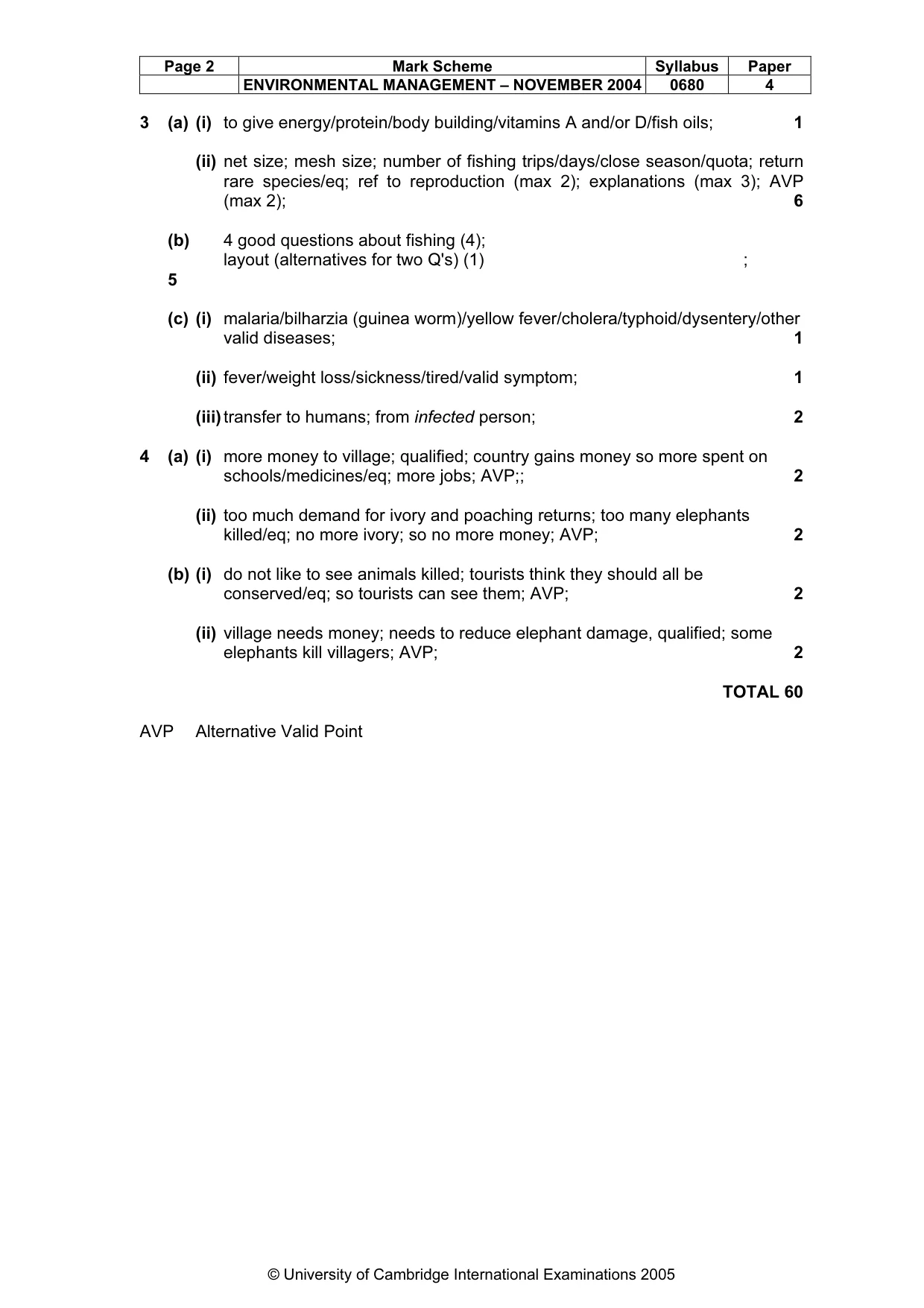
Page 2 Mark Scheme Syllabus Paper ENVIRONMENTAL MANAGEMENT – NOVEMBER 2004 0680 4 © University of Cambridge International Examinations 2005 3 (a) (i) to give energy/protein/body building/vitamins A and/or D/fish oils; 1 (ii) net size; mesh size; number of fishing trips/days/close season/quota; return rare species/eq; ref to reproduction (max 2); explanations (max 3); AVP (max 2); 6 (b) 4 good questions about fishing (4); layout (alternatives for two Q's) (1) ; 5 (c) (i) malaria/bilharzia (guinea worm)/yellow fever/cholera/typhoid/dysentery/other valid diseases; 1 (ii) fever/weight loss/sickness/tired/valid symptom; 1 (iii) transfer to humans; from infected person; 2 4 (a) (i) more money to village; qualified; country gains money so more spent on schools/medicines/eq; more jobs; AVP;; 2 (ii) too much demand for ivory and poaching returns; too many elephants killed/eq; no more ivory; so no more money; AVP; 2 (b) (i) do not like to see animals killed; tourists think they should all be conserved/eq; so tourists can see them; AVP; 2 (ii) village needs money; needs to reduce elephant damage, qualified; some elephants kill villagers; AVP; 2 TOTAL 60 AVP Alternative Valid Point