Cambridge IGCSE Environmental Management 0680 — 2004 May/June Paper 4 · Variant 1
0680/41/M/J/04
The question paper and its mark scheme, free to read here and free to download. This is Cambridge’s own paper, exactly as it was sat.
Question paper16 pages


Mark scheme
No mark scheme is in the library for this paper.
Paper as text
Question paper, page 1
This document consists of 14 printed pages and 2 blank pages. (DR) S60196/2 © UCLES 2004 [Turn over UNIVERSITY OF CAMBRIDGE INTERNATIONAL EXAMINATIONS International General Certificate of Secondary Education General Certificate of Education Ordinary Level ENVIRONMENTAL MANAGEMENT 0680/04 5014/02 Alternative to Coursework May/June 2004 1 hour 30 minutes Candidates answer on the Question Paper. Additional Materials: Ruler (cm/mm) READ THESE INSTRUCTIONS FIRST Write your Centre number, candidate number and name on all the work you hand in. Write in dark blue or black pen on both sides of the paper. You may use a soft pencil for any diagrams, graphs or rough working. Do not use staples, paper clips, highlighters, glue or correction fluid. Answer all questions. Study the appropriate Source materials before you start to write your answers. Credit will be given for appropriate selection and use of data in your answers and for relevant interpretation of these data. Suggestions for data sources are given in some questions. You may use the source data to draw diagrams and graphs or to do calculations to illustrate your answers. At the end of the examination, fasten all your work securely together. The number of marks is given in brackets [ ] at the end of each question or part question. Centre Number Candidate Number Name For Examiner’s Use If you have been given a label, look at the details. If any details are incorrect or missing, please fill in your correct details in the space given at the top of this page. Stick your personal label here, if provided. www.XtremePapers.com
Question paper, page 2
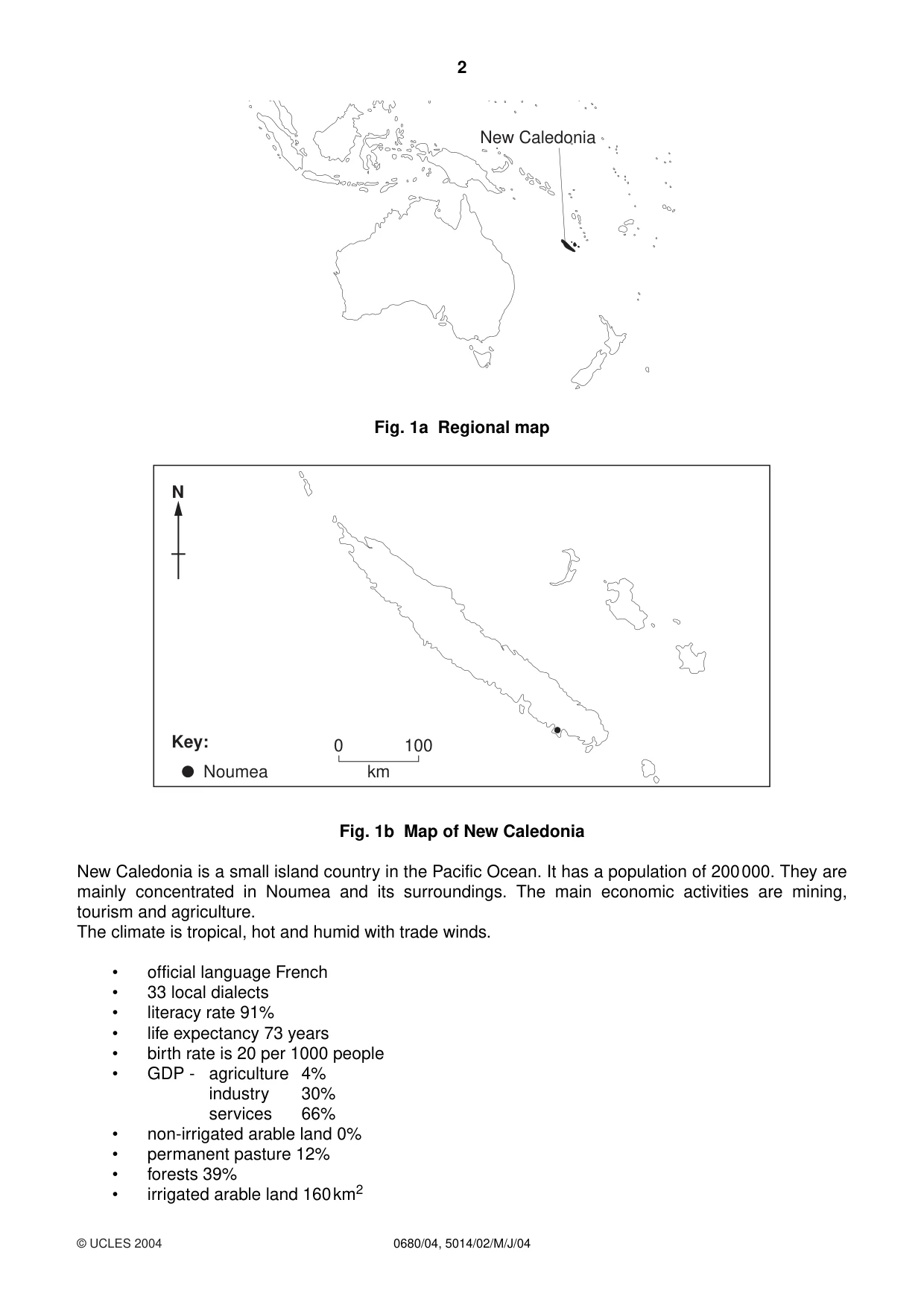
© UCLES 2004 2 0680/04, 5014/02/M/J/04 Fig. 1a Regional map Fig. 1b Map of New Caledonia New Caledonia is a small island country in the Pacific Ocean. It has a population of 200000. They are mainly concentrated in Noumea and its surroundings. The main economic activities are mining, tourism and agriculture. The climate is tropical, hot and humid with trade winds. • official language French • 33 local dialects • literacy rate 91% • life expectancy 73 years • birth rate is 20 per 1000 people • GDP - agriculture 4% industry 30% services 66% • non-irrigated arable land 0% • permanent pasture 12% • forests 39% • irrigated arable land 160km2 N 0 100 km Noumea Key: New Caledonia
Question paper, page 3
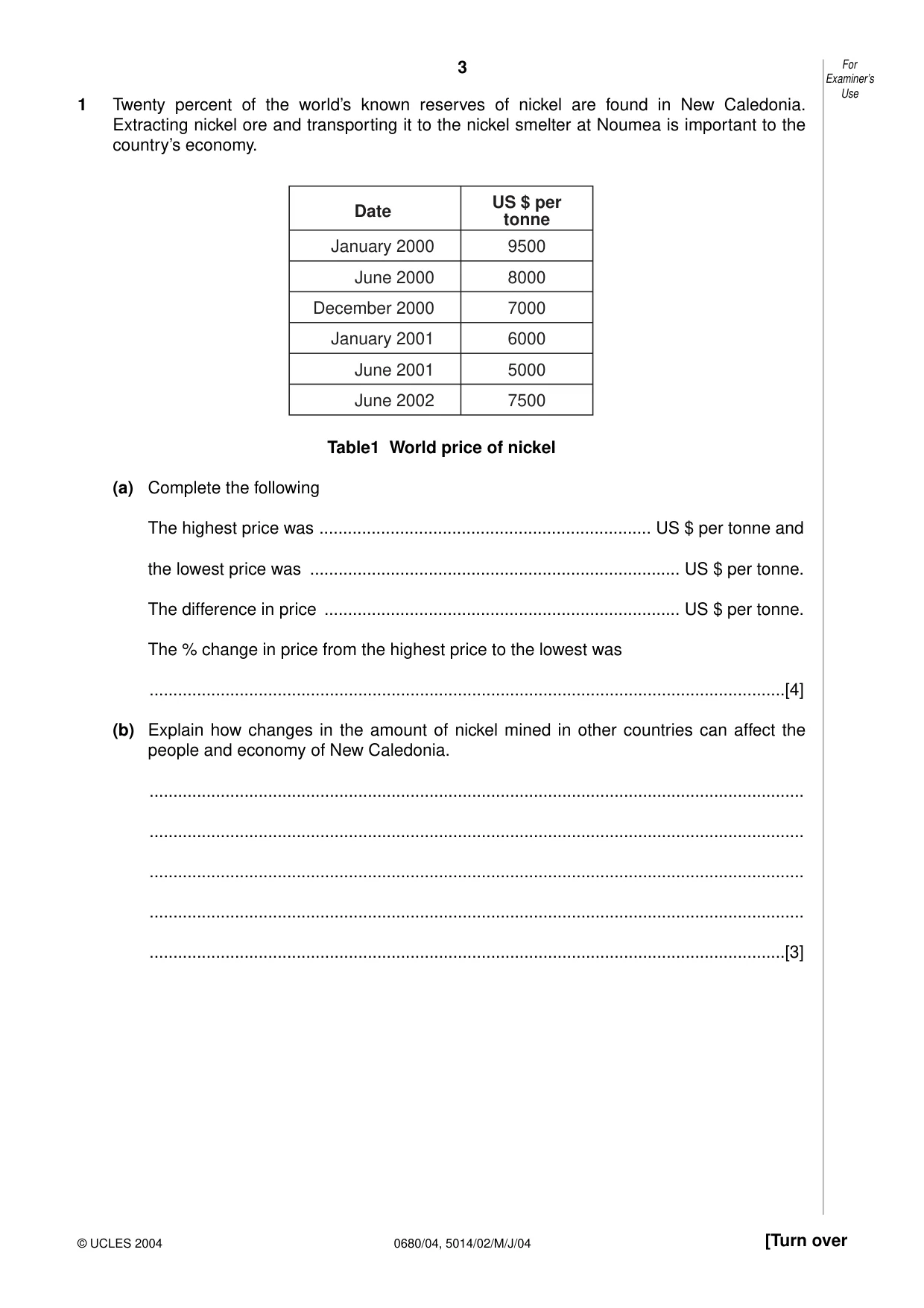
3 0680/04, 5014/02/M/J/04 [Turn over 1 Twenty percent of the world’s known reserves of nickel are found in New Caledonia. Extracting nickel ore and transporting it to the nickel smelter at Noumea is important to the country’s economy. Table1 World price of nickel (a) Complete the following The highest price was … US $ per tonne and the lowest price was … US $ per tonne. The difference in price … US $ per tonne. The % change in price from the highest price to the lowest was …[4] (b) Explain how changes in the amount of nickel mined in other countries can affect the people and economy of New Caledonia. … … … … …[3] January 2000 9500 8000 7000 6000 5000 7500 June 2000 December 2000 January 2001 June 2001 June 2002 Date US $ per tonne For Examiner’s Use © UCLES 2004
Question paper, page 4
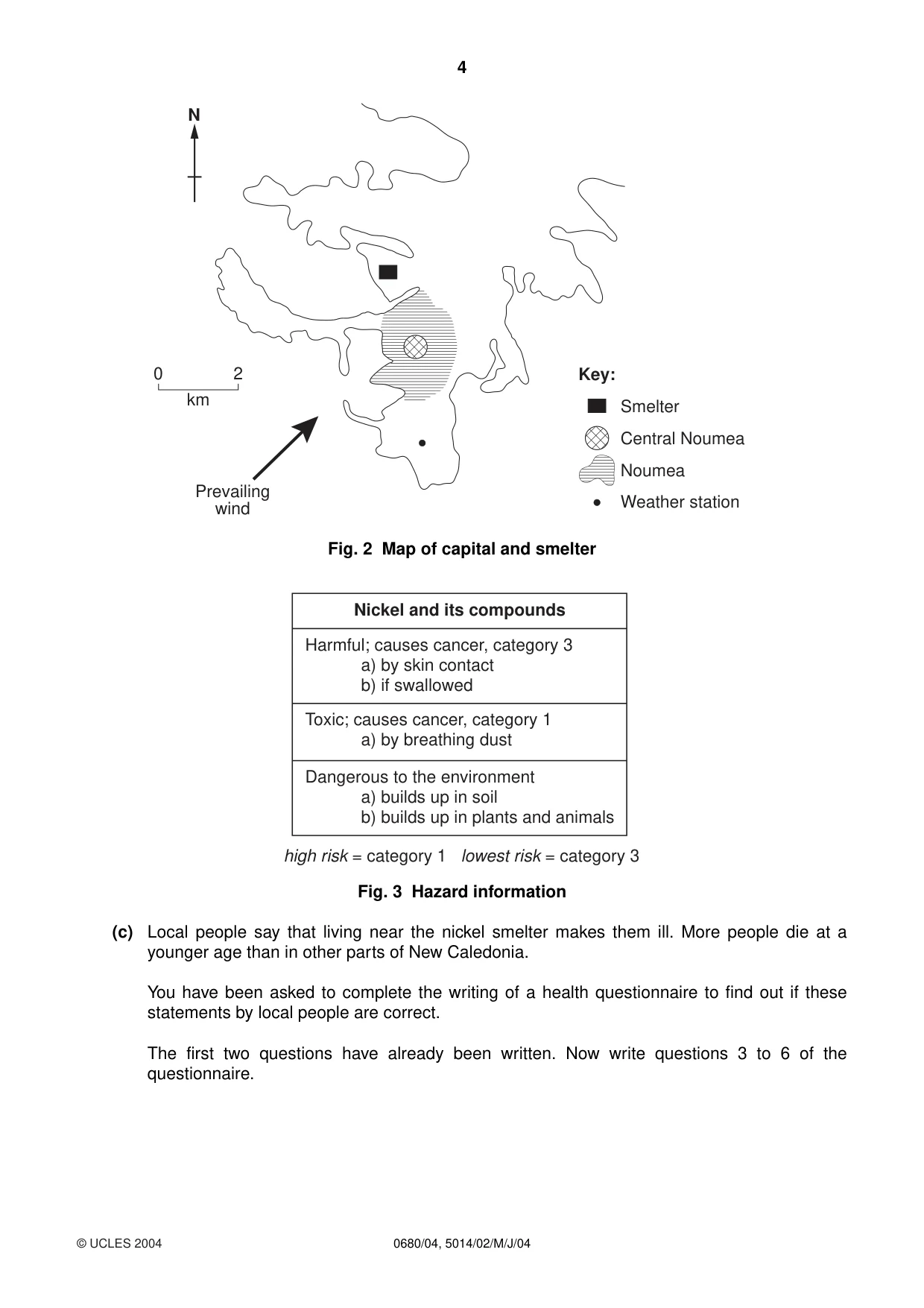
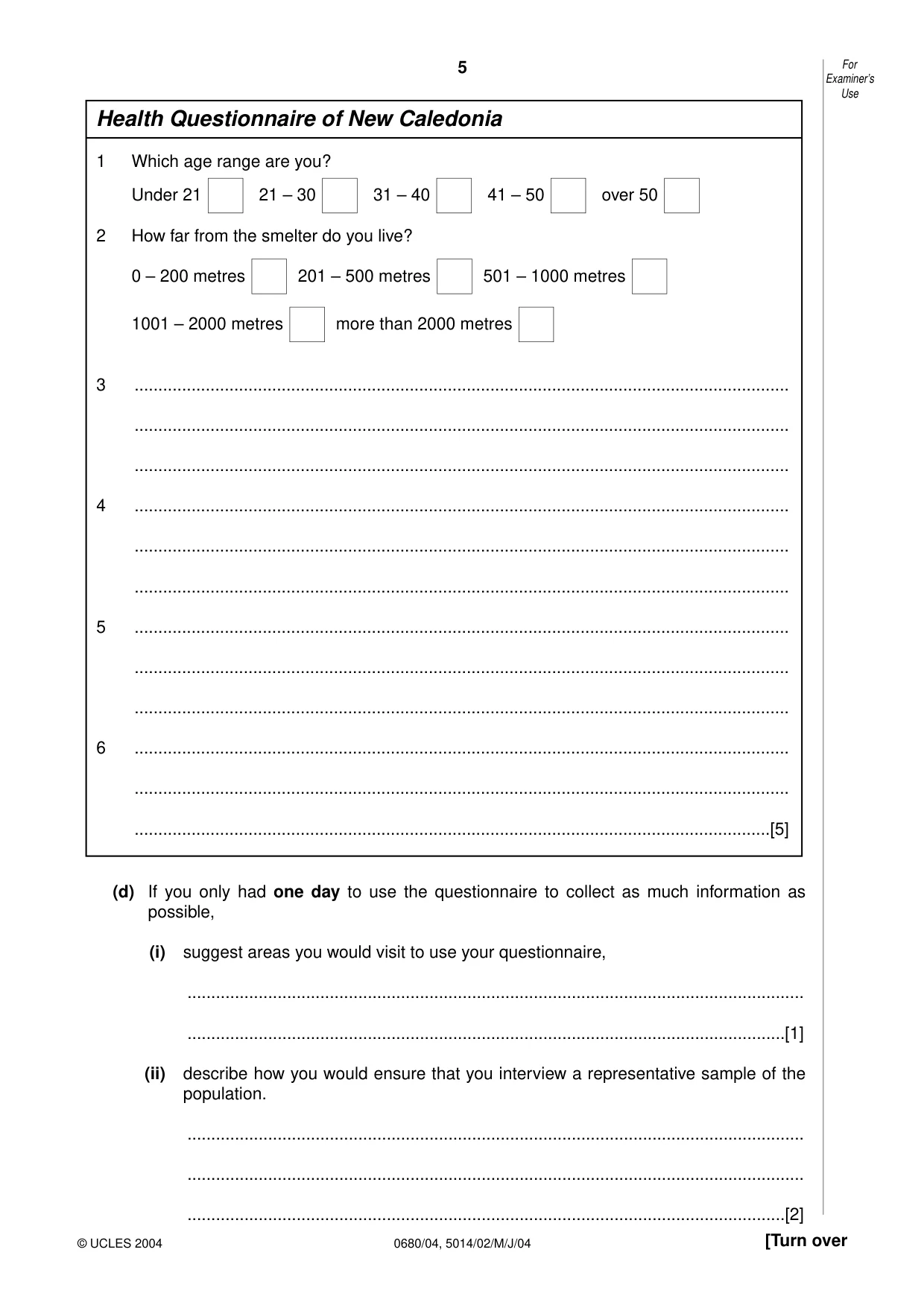
© UCLES 2004 4 0680/04, 5014/02/M/J/04 Fig. 2 Map of capital and smelter Fig. 3 Hazard information (c) Local people say that living near the nickel smelter makes them ill. More people die at a younger age than in other parts of New Caledonia. You have been asked to complete the writing of a health questionnaire to find out if these statements by local people are correct. The first two questions have already been written. Now write questions 3 to 6 of the questionnaire. Nickel and its compounds Harmful; causes cancer, category 3 a) by skin contact b) if swallowed Toxic; causes cancer, category 1 a) by breathing dust Dangerous to the environment a) builds up in soil b) builds up in plants and animals high risk = category 1 lowest risk = category 3 N 0 2 km Prevailing wind Key: Smelter Central Noumea Noumea Weather station
Question paper, page 5
5 0680/04, 5014/02/M/J/04 [Turn over (d) If you only had one day to use the questionnaire to collect as much information as possible, (i) suggest areas you would visit to use your questionnaire, … …[1] (ii) describe how you would ensure that you interview a representative sample of the population. … … …[2] For Examiner’s Use © UCLES 2004 Health Questionnaire of New Caledonia 1 Which age range are you? Under 21 21 – 30 31 – 40 41 – 50 over 50 2 How far from the smelter do you live? 0 – 200 metres 201 – 500 metres 501 – 1000 metres 1001 – 2000 metres more than 2000 metres 3 … … … 4 … … … 5 … … … 6 … … …[5]
Question paper, page 6
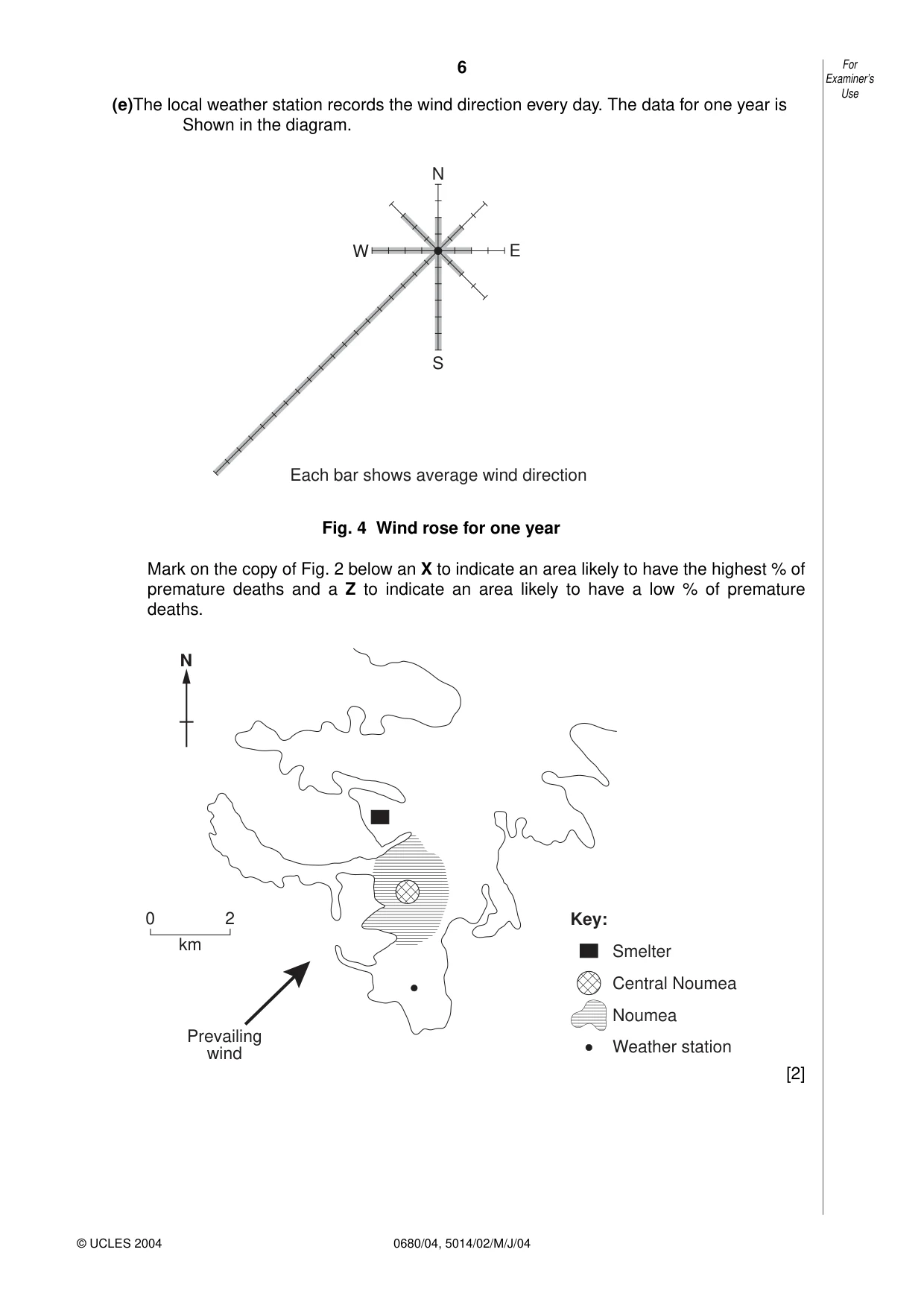
6 0680/04, 5014/02/M/J/04 (e)The local weather station records the wind direction every day. The data for one year is Shown in the diagram. Fig. 4 Wind rose for one year Mark on the copy of Fig. 2 below an X to indicate an area likely to have the highest % of premature deaths and a Z to indicate an area likely to have a low % of premature deaths. [2] N 0 2 km Prevailing wind Key: Smelter Central Noumea Noumea Weather station N E W S Each bar shows average wind direction For Examiner’s Use © UCLES 2004
Question paper, page 7
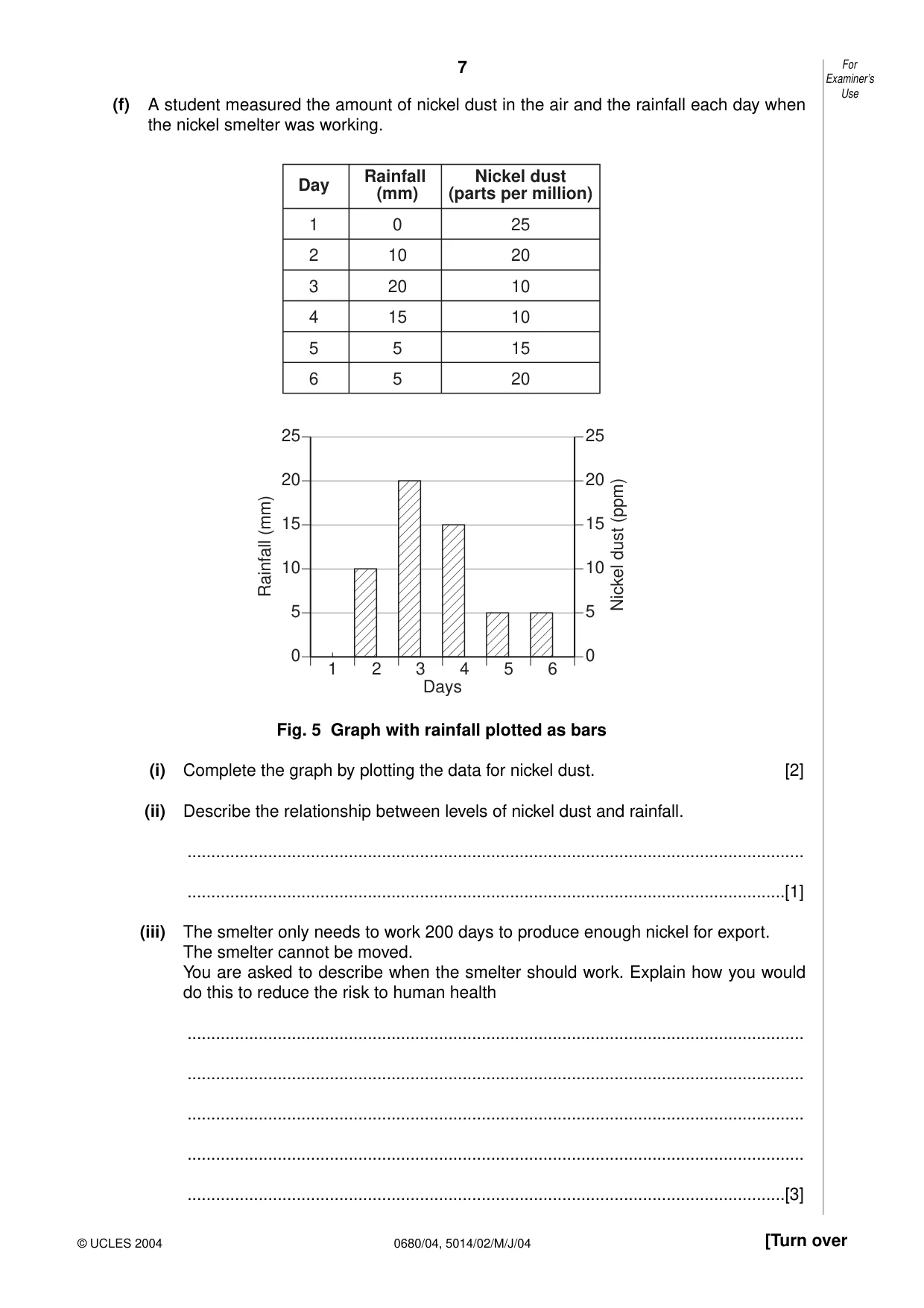
7 0680/04, 5014/02/M/J/04 [Turn over (f) A student measured the amount of nickel dust in the air and the rainfall each day when the nickel smelter was working. Fig. 5 Graph with rainfall plotted as bars (i) Complete the graph by plotting the data for nickel dust. [2] (ii) Describe the relationship between levels of nickel dust and rainfall. … …[1] (iii) The smelter only needs to work 200 days to produce enough nickel for export. The smelter cannot be moved. You are asked to describe when the smelter should work. Explain how you would do this to reduce the risk to human health … … … … …[3] 1 2 3 4 5 6 Days 0 5 10 15 20 25 0 5 10 15 20 25 Rainfall (mm) Nickel dust (ppm) Day Rainfall (mm) Nickel dust (parts per million) 1 2 3 4 5 6 0 10 20 15 5 5 25 20 10 10 15 20 For Examiner’s Use © UCLES 2004
Question paper, page 8
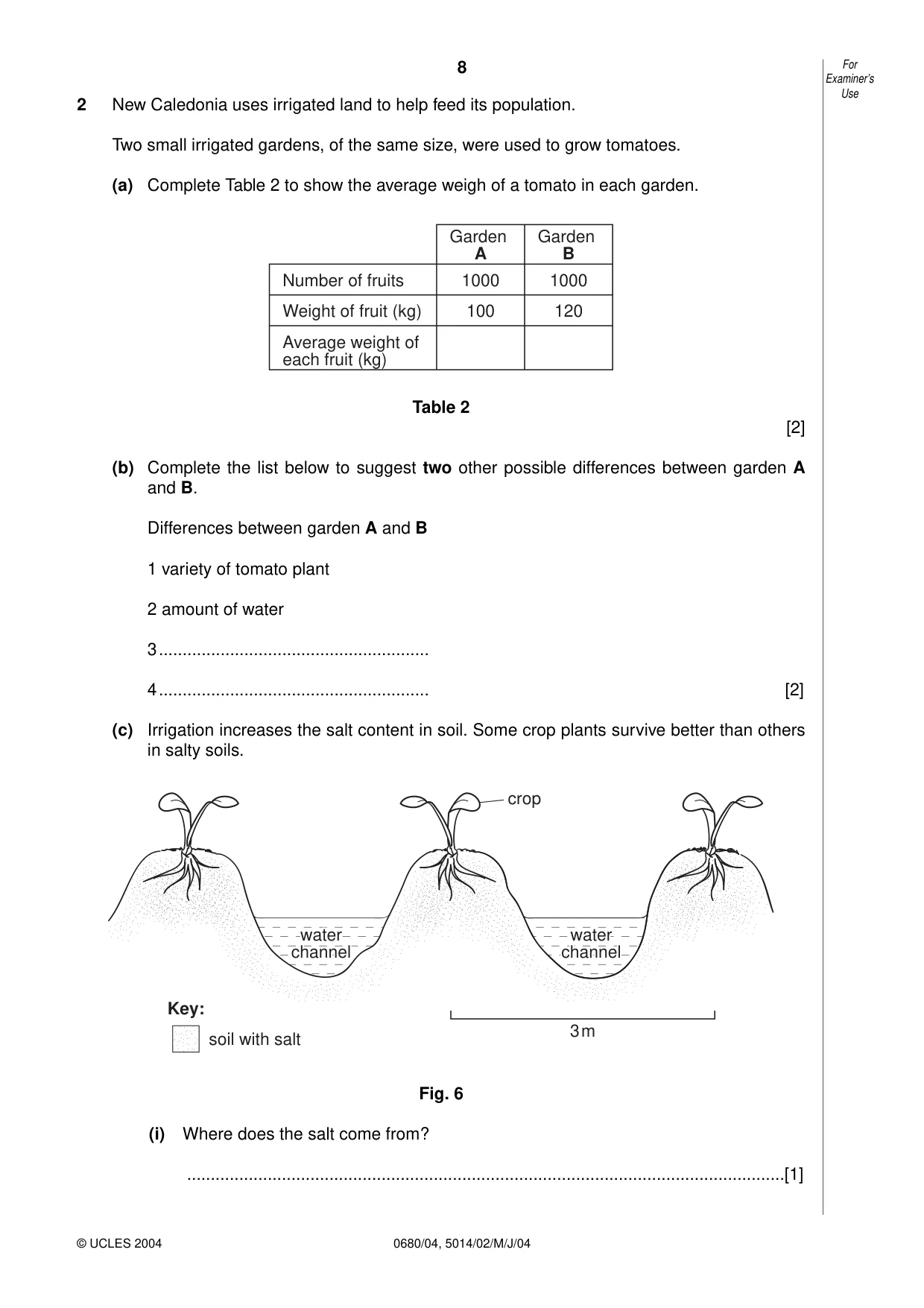
8 0680/04, 5014/02/M/J/04 2 New Caledonia uses irrigated land to help feed its population. Two small irrigated gardens, of the same size, were used to grow tomatoes. (a) Complete Table 2 to show the average weigh of a tomato in each garden. Table 2 [2] (b) Complete the list below to suggest two other possible differences between garden A and B. Differences between garden A and B 1 variety of tomato plant 2 amount of water 3… 4… [2] (c) Irrigation increases the salt content in soil. Some crop plants survive better than others in salty soils. Fig. 6 (i) Where does the salt come from? …[1] crop soil with salt 3m Key: water water channel channel water channel water water channel channel water channel Average weight of each fruit (kg) Weight of fruit (kg) Number of fruits Garden A Garden B 1000 100 1000 120 For Examiner’s Use © UCLES 2004
Question paper, page 9
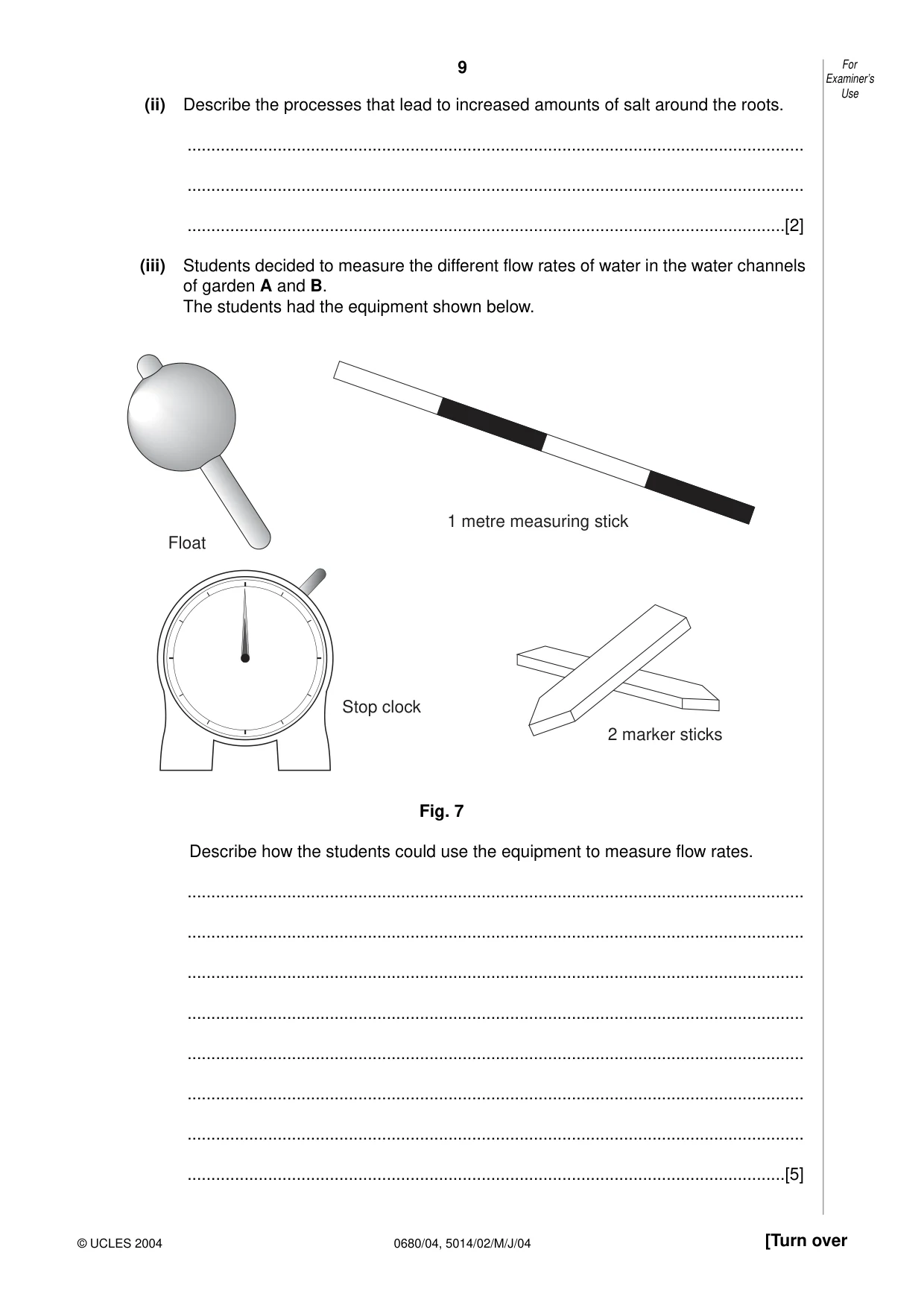
9 0680/04, 5014/02/M/J/04 [Turn over (ii) Describe the processes that lead to increased amounts of salt around the roots. … … …[2] (iii) Students decided to measure the different flow rates of water in the water channels of garden A and B. The students had the equipment shown below. Fig. 7 Describe how the students could use the equipment to measure flow rates. … … … … … … … …[5] Float 1 metre measuring stick Stop clock 2 marker sticks For Examiner’s Use © UCLES 2004
Question paper, page 10
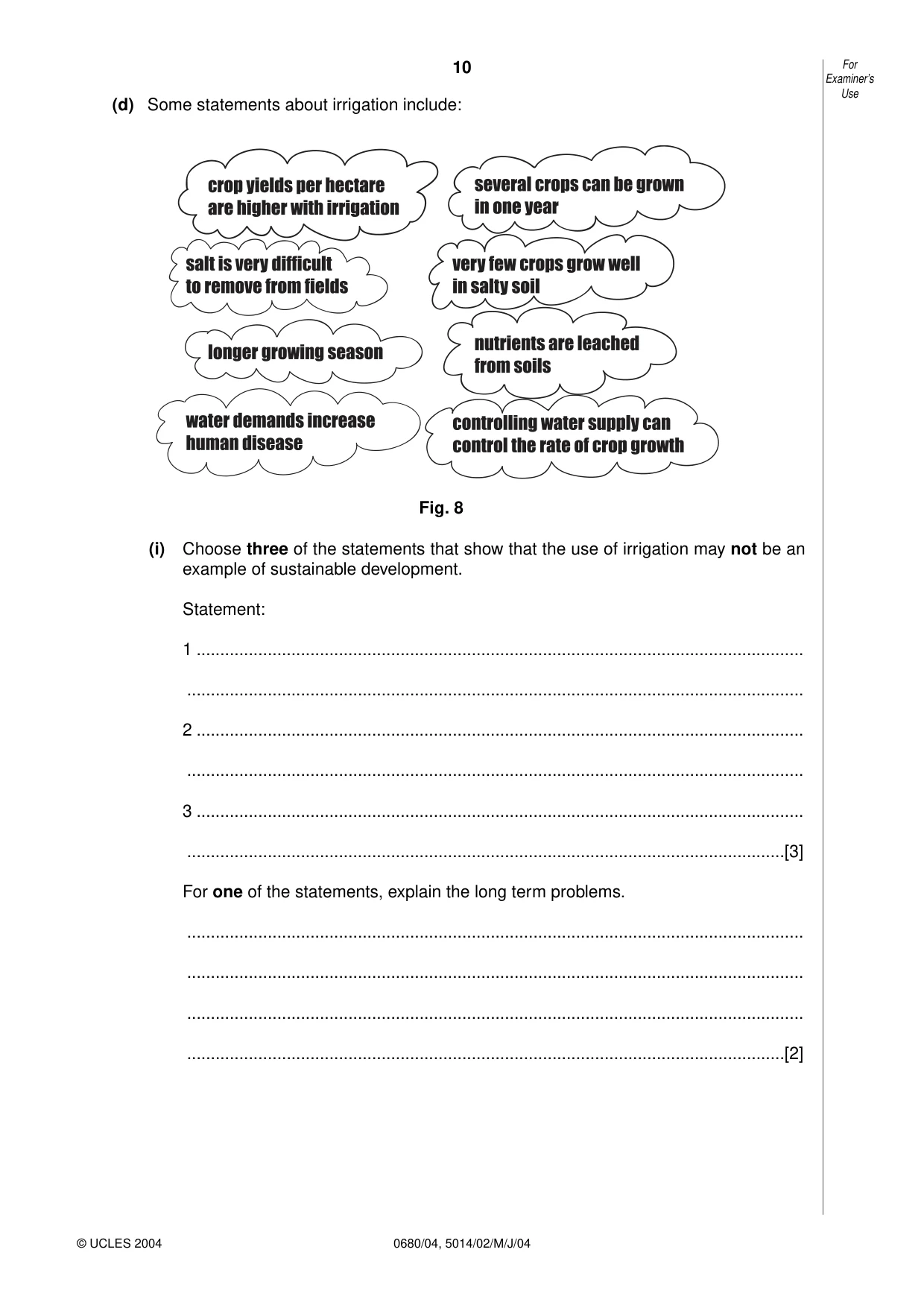
10 0680/04, 5014/02/M/J/04 (d) Some statements about irrigation include: Fig. 8 (i) Choose three of the statements that show that the use of irrigation may not be an example of sustainable development. Statement: 1 … … 2 … … 3 … …[3] For one of the statements, explain the long term problems. … … … …[2] For Examiner’s Use © UCLES 2004
Question paper, page 11
11 0680/04, 5014/02/M/J/04 [Turn over (ii) Select three statements that suggest irrigation benefits the people of New Caledonia. Statement: 1 … 2 … 3 …[3] For one of the statements,explain the long term benefits. … … …[2] For Examiner’s Use © UCLES 2004
Question paper, page 12
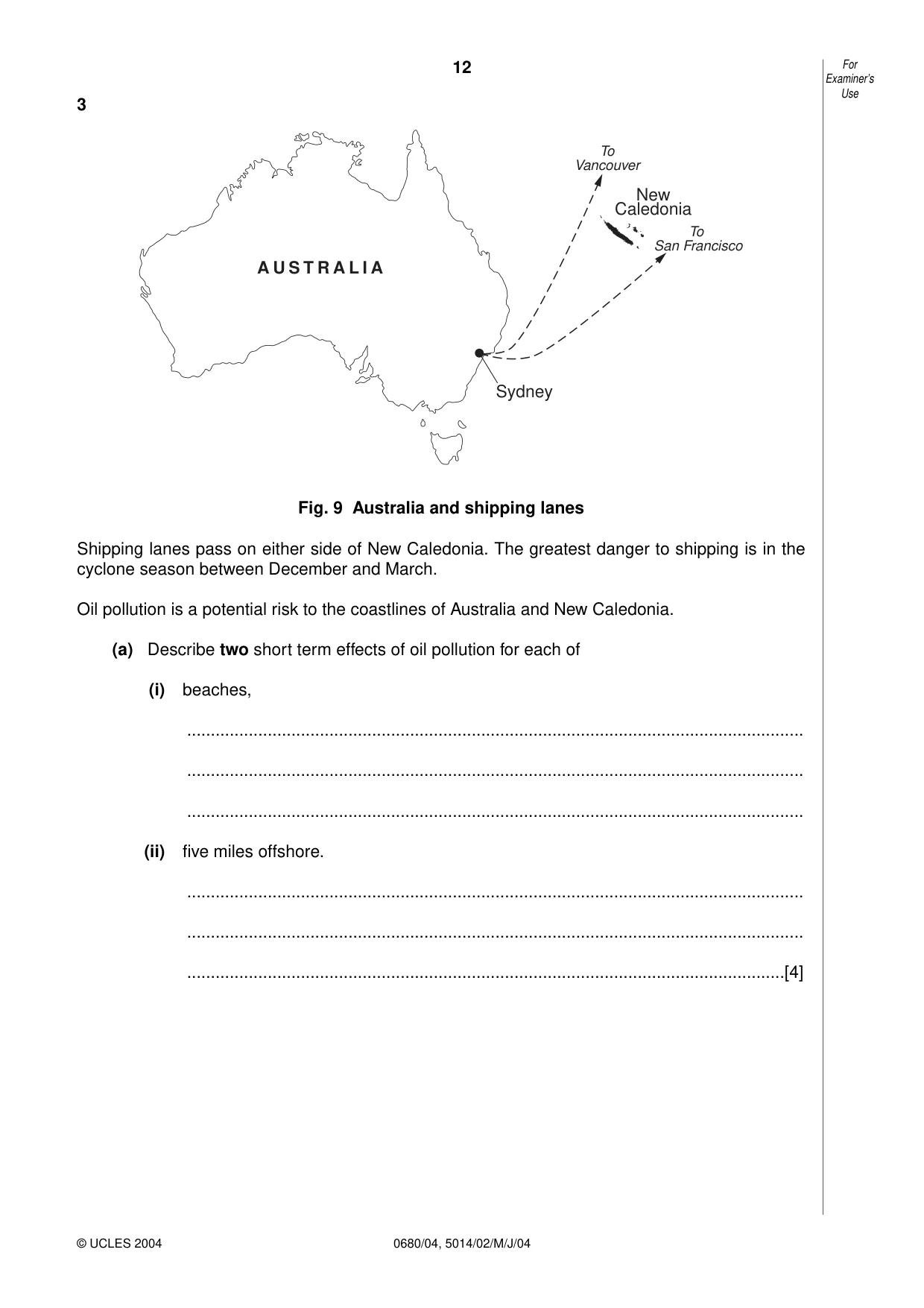
12 0680/04, 5014/02/M/J/04 3 Fig. 9 Australia and shipping lanes Shipping lanes pass on either side of New Caledonia. The greatest danger to shipping is in the cyclone season between December and March. Oil pollution is a potential risk to the coastlines of Australia and New Caledonia. (a) Describe two short term effects of oil pollution for each of (i) beaches, … … … (ii) five miles offshore. … … …[4] To Vancouver To San Francisco Sydney New Caledonia A U S T R A L I A For Examiner’s Use © UCLES 2004
Question paper, page 13
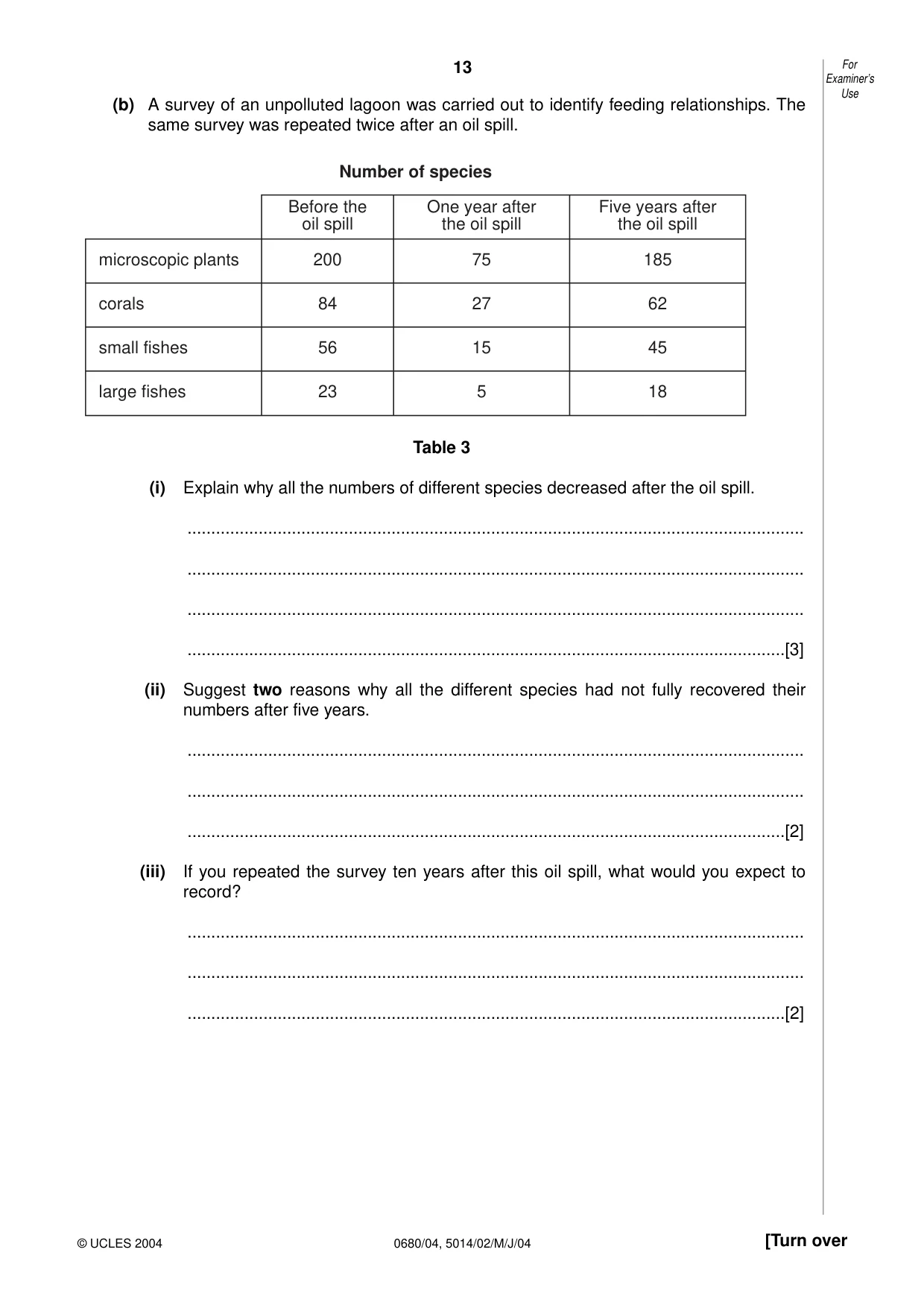
13 0680/04, 5014/02/M/J/04 [Turn over (b) A survey of an unpolluted lagoon was carried out to identify feeding relationships. The same survey was repeated twice after an oil spill. Table 3 (i) Explain why all the numbers of different species decreased after the oil spill. … … … …[3] (ii) Suggest two reasons why all the different species had not fully recovered their numbers after five years. … … …[2] (iii) If you repeated the survey ten years after this oil spill, what would you expect to record? … … …[2] Before the oil spill One year after the oil spill Five years after the oil spill microscopic plants corals small fishes large fishes 200 84 56 23 75 27 15 5 185 62 45 18 Number of species For Examiner’s Use © UCLES 2004
Question paper, page 14
14 0680/04, 5014/02/M/J/04 (c) Describe how an oil spill affects local people (i) in the first six months following the oil spill, … … … (ii) five years after the oil spill. … … …[4] For Examiner’s Use © UCLES 2004
Question paper, page 16
16 0680/04, 5014/02/M/J/04 BLANK PAGE University of Cambridge International Examinations is part of the University of Cambridge Local Examinations Syndicate (UCLES) which is itself a department of the University of Cambridge.