Cambridge IGCSE English - Second Language (oral endorsement) 0510 — 2018 Oct/Nov Paper 4 · Variant 2
0510/42/O/N/18 · 40 marks · ≈45 min
The question paper and its mark scheme, free to read here and free to download. This is Cambridge’s own paper, exactly as it was sat.
Question paper12 pages




Mark scheme4 pages
Answers below. Sit the paper first if you are practising.
Paper as text
Question paper, page 1
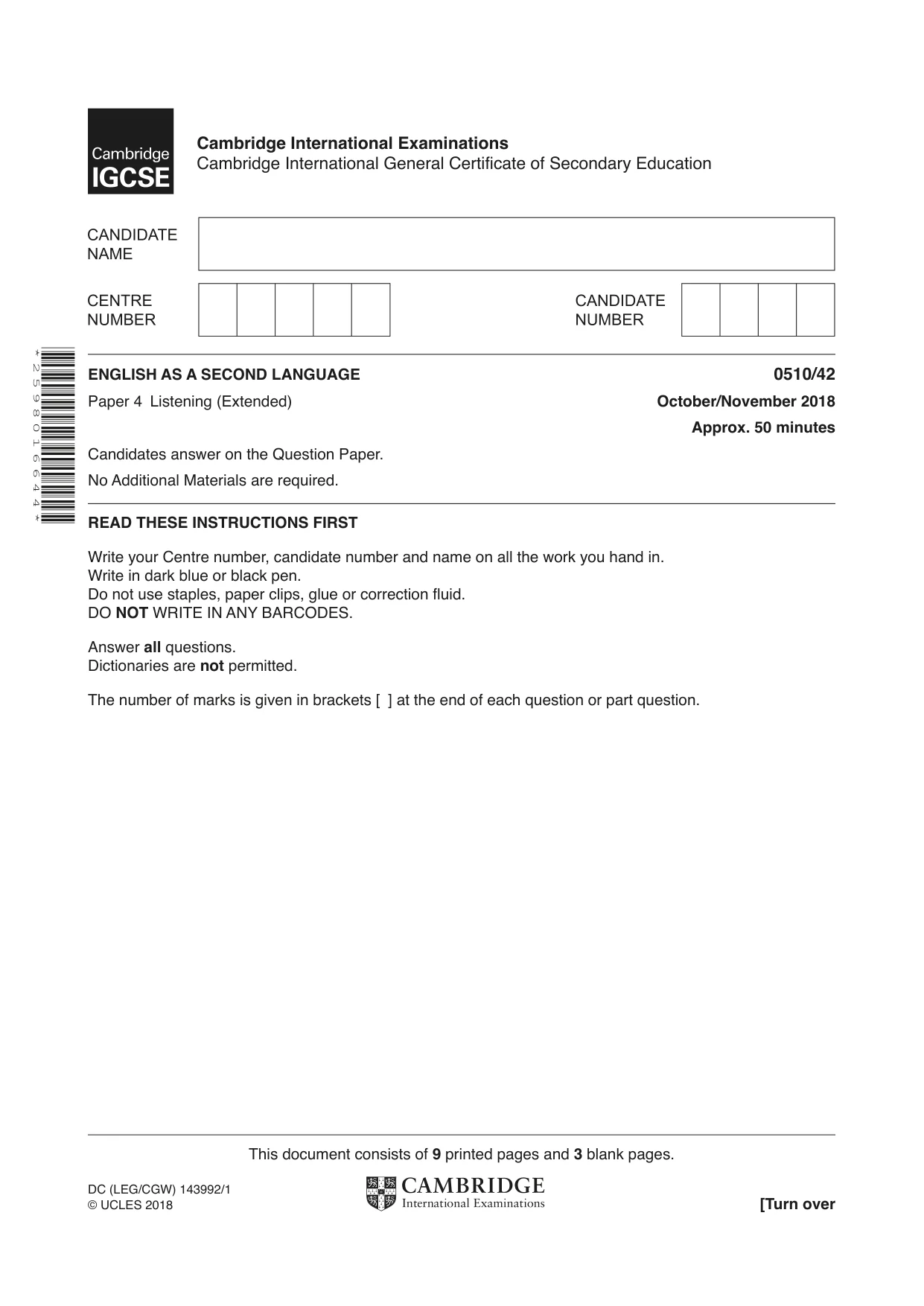
This document consists of 9 printed pages and 3 blank pages. DC (LEG/CGW) 143992/1 © UCLES 2018 [Turn over Cambridge International Examinations Cambridge International General Certificate of Secondary Education * 2 5 9 8 0 1 6 6 4 4 * ENGLISH AS A SECOND LANGUAGE 0510/42 Paper 4 Listening (Extended) October/November 2018 Approx. 50 minutes Candidates answer on the Question Paper. No Additional Materials are required. READ THESE INSTRUCTIONS FIRST Write your Centre number, candidate number and name on all the work you hand in. Write in dark blue or black pen. Do not use staples, paper clips, glue or correction fluid. DO NOT WRITE IN ANY BARCODES. Answer all questions. Dictionaries are not permitted. The number of marks is given in brackets [ ] at the end of each question or part question.
Question paper, page 2
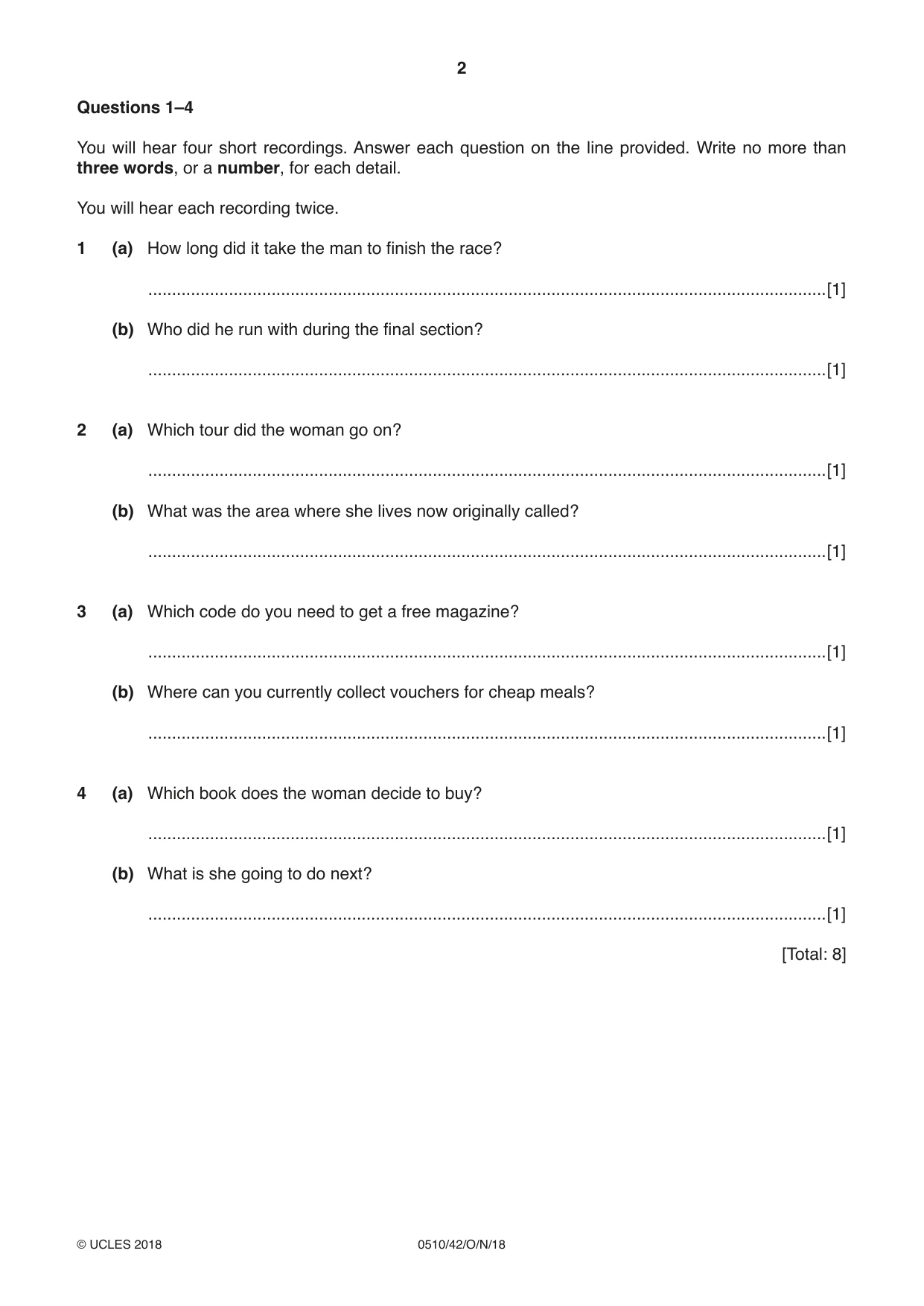
2 0510/42/O/N/18 © UCLES 2018 Questions 1–4 You will hear four short recordings. Answer each question on the line provided. Write no more than three words, or a number, for each detail. You will hear each recording twice. 1 (a) How long did it take the man to finish the race? …[1] (b) Who did he run with during the final section? …[1] 2 (a) Which tour did the woman go on? …[1] (b) What was the area where she lives now originally called? …[1] 3 (a) Which code do you need to get a free magazine? …[1] (b) Where can you currently collect vouchers for cheap meals? …[1] 4 (a) Which book does the woman decide to buy? …[1] (b) What is she going to do next? …[1] [Total: 8]
Question paper, page 3
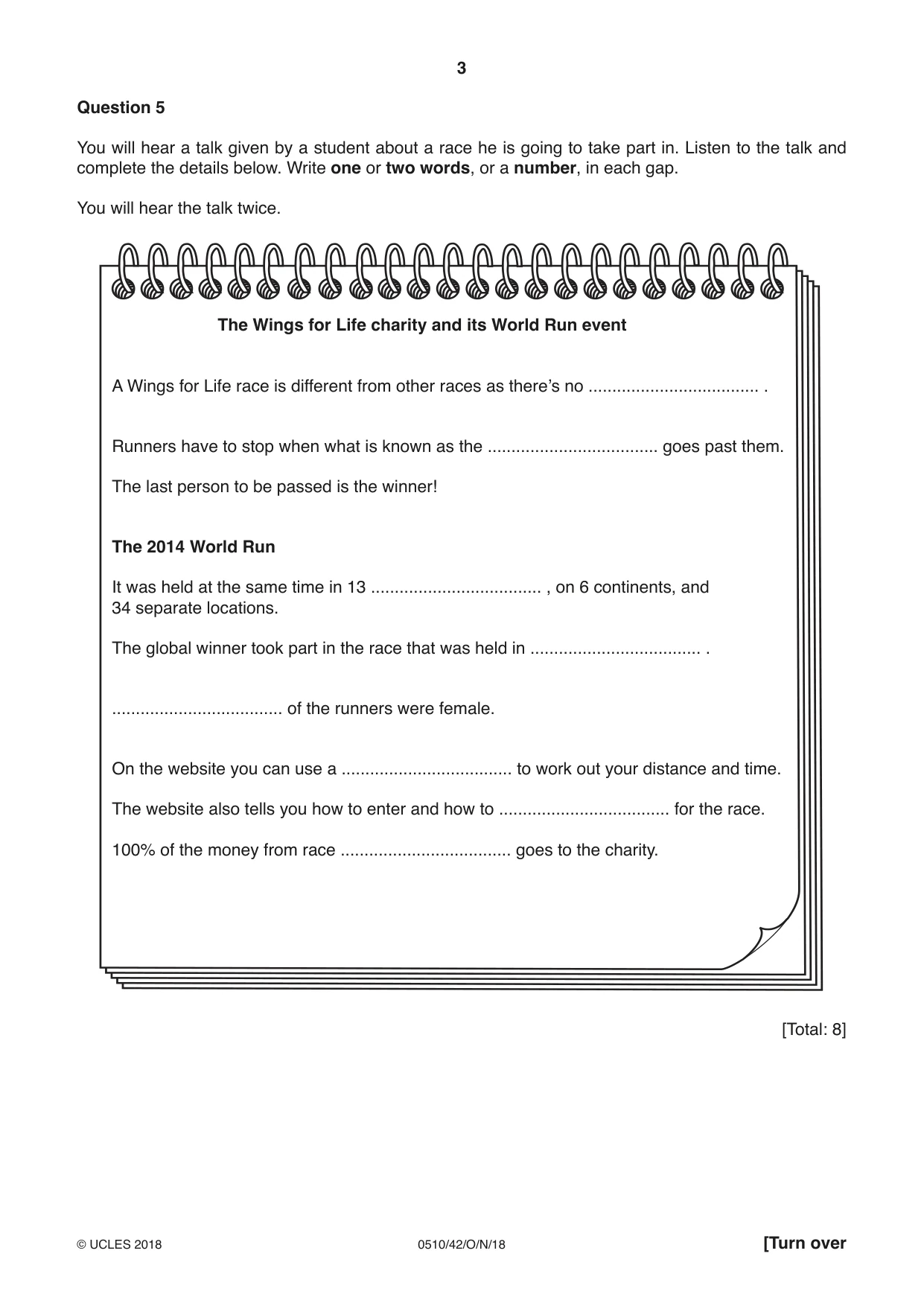
3 0510/42/O/N/18 © UCLES 2018 [Turn over Question 5 You will hear a talk given by a student about a race he is going to take part in. Listen to the talk and complete the details below. Write one or two words, or a number, in each gap. You will hear the talk twice. The Wings for Life charity and its World Run event A Wings for Life race is different from other races as there’s no … . Runners have to stop when what is known as the … goes past them. The last person to be passed is the winner! The 2014 World Run It was held at the same time in 13 … , on 6 continents, and 34 separate locations. The global winner took part in the race that was held in … . … of the runners were female. On the website you can use a … to work out your distance and time. The website also tells you how to enter and how to … for the race. 100% of the money from race … goes to the charity. [Total: 8]
Question paper, page 4
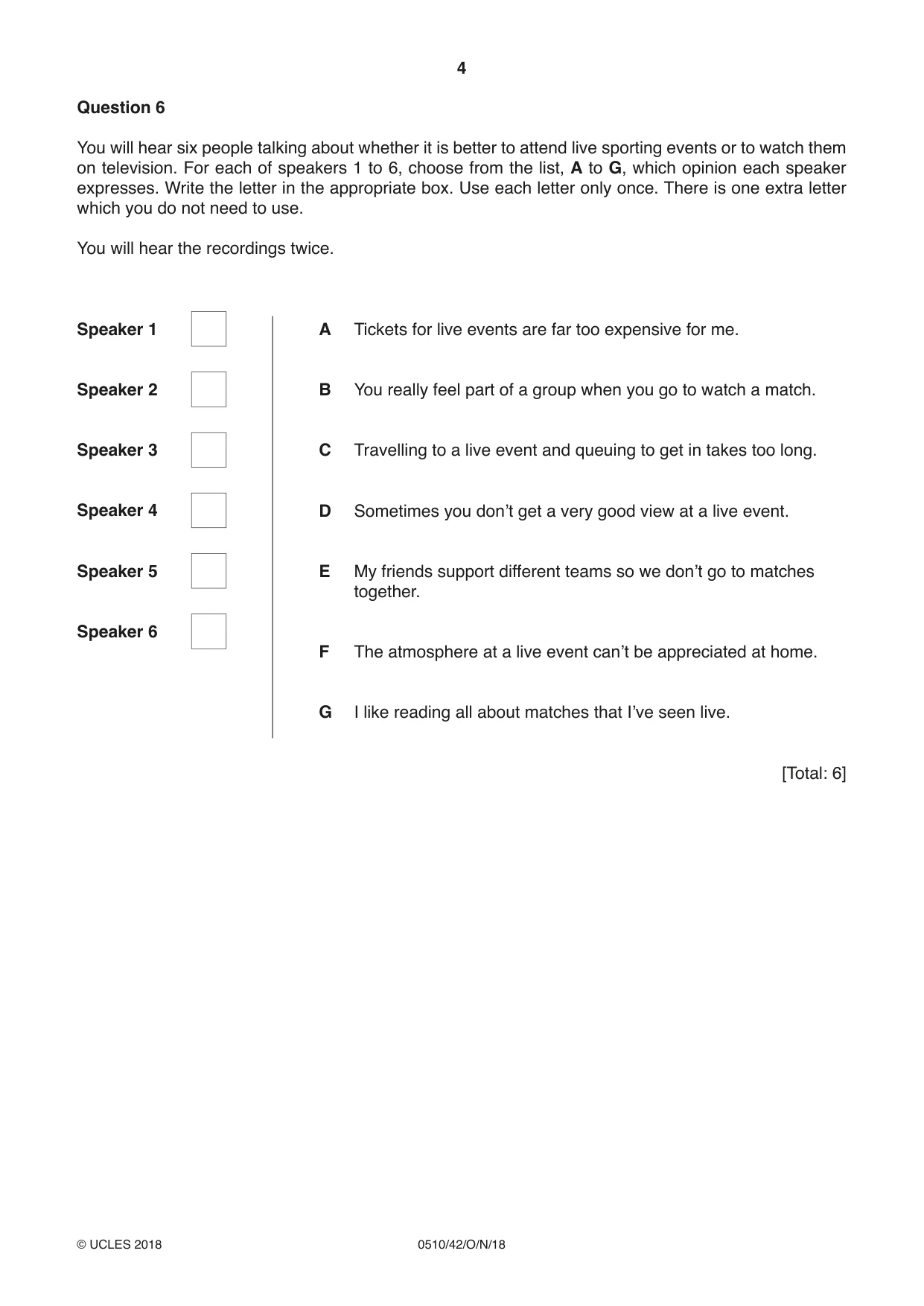
4 0510/42/O/N/18 © UCLES 2018 Question 6 You will hear six people talking about whether it is better to attend live sporting events or to watch them on television. For each of speakers 1 to 6, choose from the list, A to G, which opinion each speaker expresses. Write the letter in the appropriate box. Use each letter only once. There is one extra letter which you do not need to use. You will hear the recordings twice. Speaker 1 A Tickets for live events are far too expensive for me. Speaker 2 B You really feel part of a group when you go to watch a match. Speaker 3 C Travelling to a live event and queuing to get in takes too long. Speaker 4 D Sometimes you don’t get a very good view at a live event. Speaker 5 E My friends support different teams so we don’t go to matches together. Speaker 6 F The atmosphere at a live event can’t be appreciated at home. G I like reading all about matches that I’ve seen live. [Total: 6]
Question paper, page 5
5 0510/42/O/N/18 © UCLES 2018 [Turn over Please turn over for Question 7.
Question paper, page 6
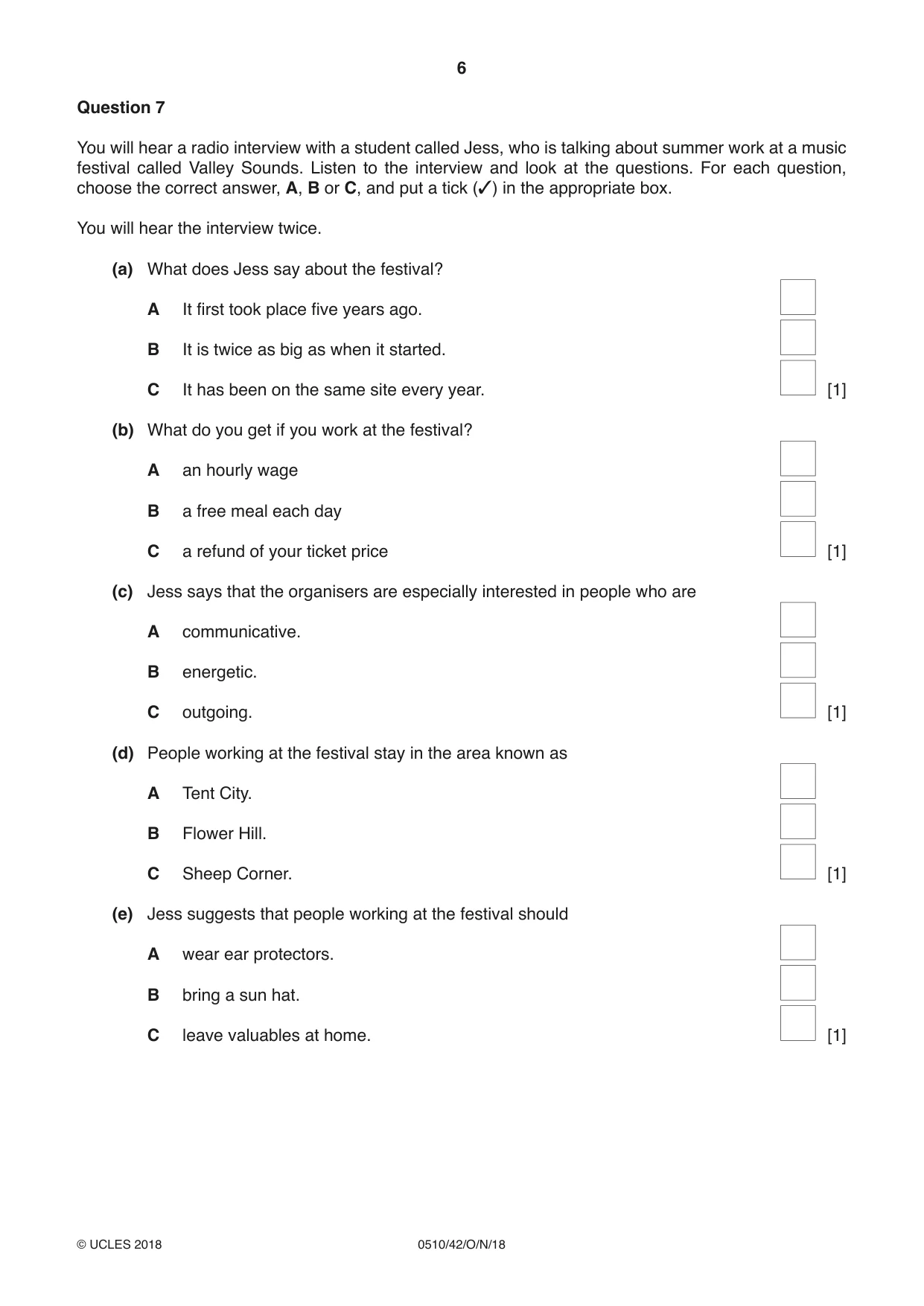
6 0510/42/O/N/18 © UCLES 2018 Question 7 You will hear a radio interview with a student called Jess, who is talking about summer work at a music festival called Valley Sounds. Listen to the interview and look at the questions. For each question, choose the correct answer, A, B or C, and put a tick (✓) in the appropriate box. You will hear the interview twice. (a) What does Jess say about the festival? A It first took place five years ago. B It is twice as big as when it started. C It has been on the same site every year. [1] (b) What do you get if you work at the festival? A an hourly wage B a free meal each day C a refund of your ticket price [1] (c) Jess says that the organisers are especially interested in people who are A communicative. B energetic. C outgoing. [1] (d) People working at the festival stay in the area known as A Tent City. B Flower Hill. C Sheep Corner. [1] (e) Jess suggests that people working at the festival should A wear ear protectors. B bring a sun hat. C leave valuables at home. [1]
Question paper, page 7
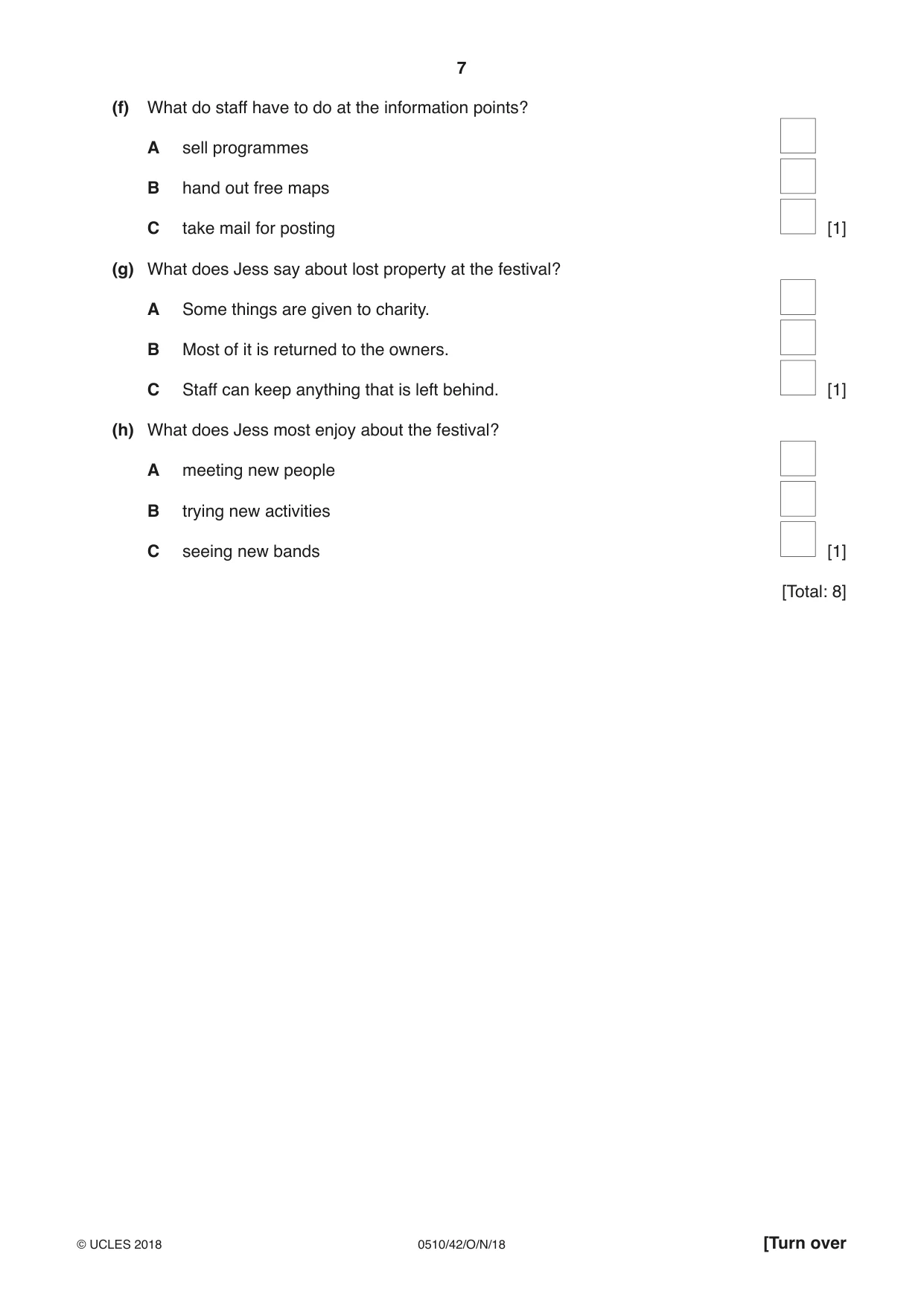
7 0510/42/O/N/18 © UCLES 2018 [Turn over (f) What do staff have to do at the information points? A sell programmes B hand out free maps C take mail for posting [1] (g) What does Jess say about lost property at the festival? A Some things are given to charity. B Most of it is returned to the owners. C Staff can keep anything that is left behind. [1] (h) What does Jess most enjoy about the festival? A meeting new people B trying new activities C seeing new bands [1] [Total: 8]
Question paper, page 8
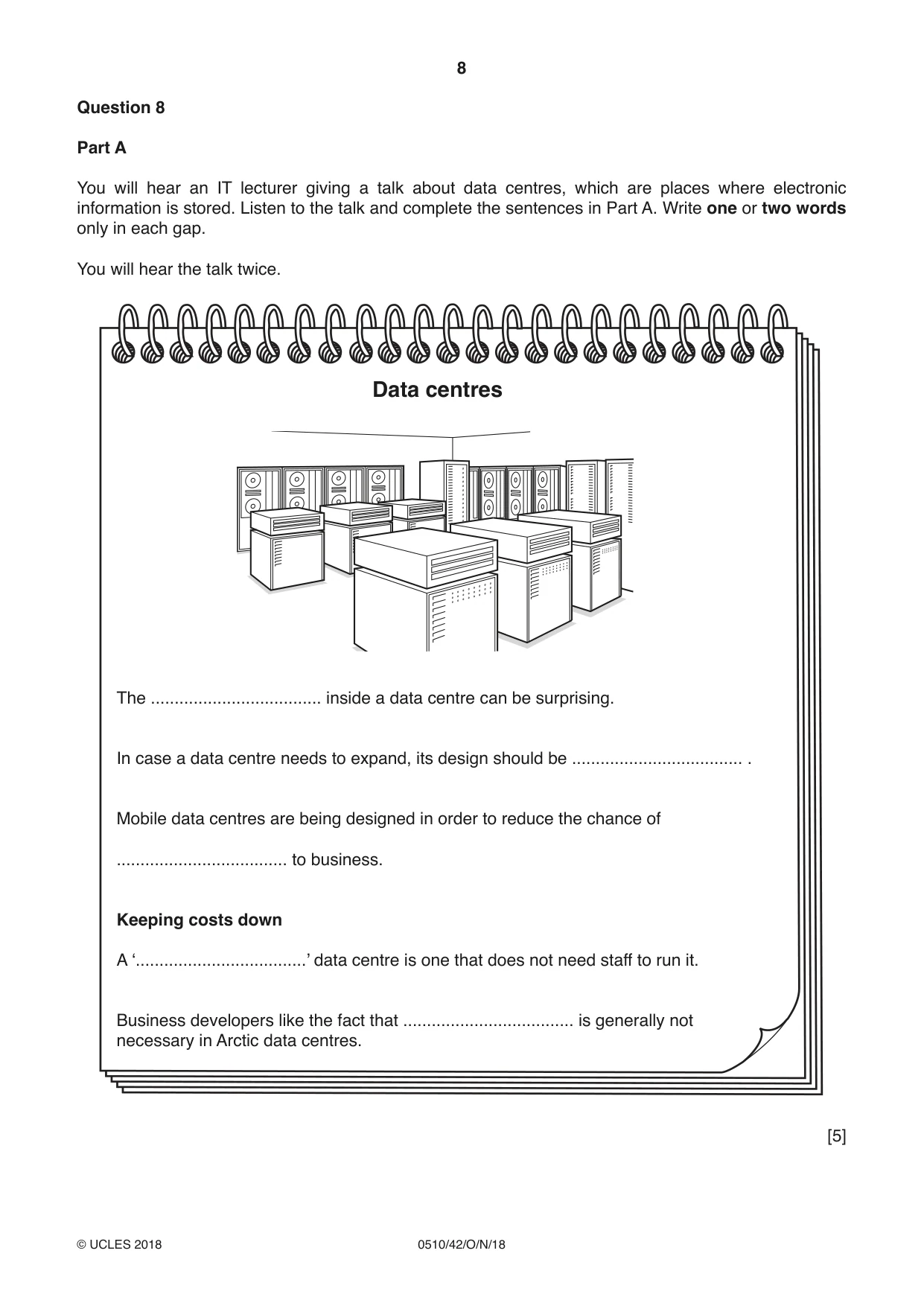
8 0510/42/O/N/18 © UCLES 2018 Question 8 Part A You will hear an IT lecturer giving a talk about data centres, which are places where electronic information is stored. Listen to the talk and complete the sentences in Part A. Write one or two words only in each gap. You will hear the talk twice. Data centres The … inside a data centre can be surprising. In case a data centre needs to expand, its design should be … . Mobile data centres are being designed in order to reduce the chance of … to business. Keeping costs down A ‘…’ data centre is one that does not need staff to run it. Business developers like the fact that … is generally not necessary in Arctic data centres. [5]
Question paper, page 9
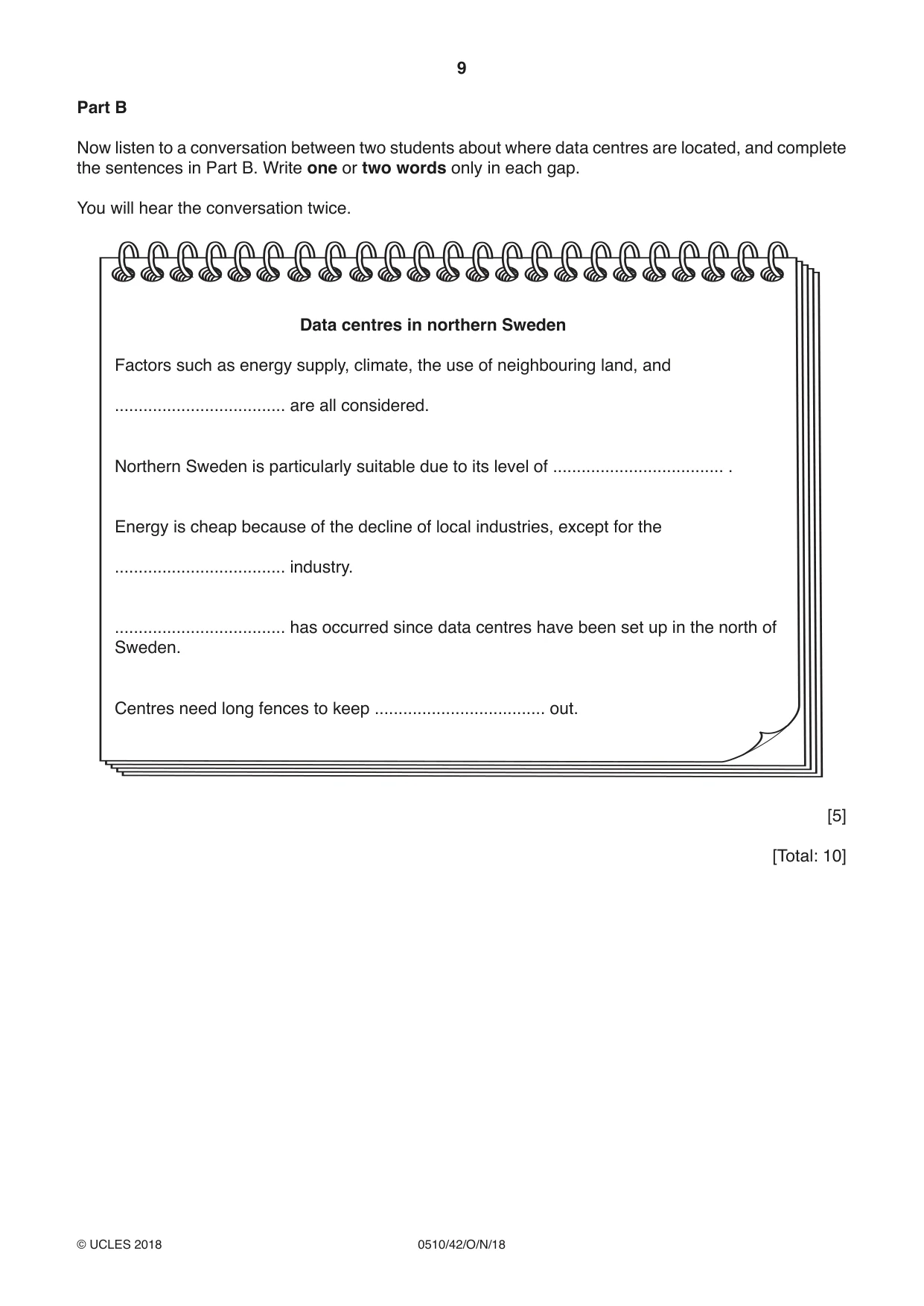
9 0510/42/O/N/18 © UCLES 2018 Part B Now listen to a conversation between two students about where data centres are located, and complete the sentences in Part B. Write one or two words only in each gap. You will hear the conversation twice. Data centres in northern Sweden Factors such as energy supply, climate, the use of neighbouring land, and … are all considered. Northern Sweden is particularly suitable due to its level of … . Energy is cheap because of the decline of local industries, except for the … industry. … has occurred since data centres have been set up in the north of Sweden. Centres need long fences to keep … out. [5] [Total: 10]
Question paper, page 10
10 0510/42/O/N/18 © UCLES 2018 BLANK PAGE
Question paper, page 11
11 0510/42/O/N/18 © UCLES 2018 BLANK PAGE
Question paper, page 12
12 0510/42/O/N/18 © UCLES 2018 Permission to reproduce items where third-party owned material protected by copyright is included has been sought and cleared where possible. Every reasonable effort has been made by the publisher (UCLES) to trace copyright holders, but if any items requiring clearance have unwittingly been included, the publisher will be pleased to make amends at the earliest possible opportunity. To avoid the issue of disclosure of answer-related information to candidates, all copyright acknowledgements are reproduced online in the Cambridge International Examinations Copyright Acknowledgements Booklet. This is produced for each series of examinations and is freely available to download at www.cie.org.uk after the live examination series. Cambridge International Examinations is part of the Cambridge Assessment Group. Cambridge Assessment is the brand name of University of Cambridge Local Examinations Syndicate (UCLES), which is itself a department of the University of Cambridge. BLANK PAGE
Mark scheme, page 1
This document consists of 4 printed pages. © UCLES 2018 [Turn over Cambridge Assessment International Education Cambridge International General Certificate of Secondary Education ENGLISH AS A SECOND LANGUAGE 0510/42 Paper 4 Listening (Extended) October/November 2018 MARK SCHEME Maximum Mark: 40 Published This mark scheme is published as an aid to teachers and candidates, to indicate the requirements of the examination. It shows the basis on which Examiners were instructed to award marks. It does not indicate the details of the discussions that took place at an Examiners’ meeting before marking began, which would have considered the acceptability of alternative answers. Mark schemes should be read in conjunction with the question paper and the Principal Examiner Report for Teachers. Cambridge International will not enter into discussions about these mark schemes. Cambridge International is publishing the mark schemes for the October/November 2018 series for most Cambridge IGCSE™, Cambridge International A and AS Level components and some Cambridge O Level components.
Mark scheme, page 2
0510/42 Cambridge IGCSE – Mark Scheme PUBLISHED October/November 2018 © UCLES 2018 Page 2 of 4 Generic Marking Principles These general marking principles must be applied by all examiners when marking candidate answers. They should be applied alongside the specific content of the mark scheme or generic level descriptors for a question. Each question paper and mark scheme will also comply with these marking principles. GENERIC MARKING PRINCIPLE 1: Marks must be awarded in line with: • the specific content of the mark scheme or the generic level descriptors for the question • the specific skills defined in the mark scheme or in the generic level descriptors for the question • the standard of response required by a candidate as exemplified by the standardisation scripts. GENERIC MARKING PRINCIPLE 2: Marks awarded are always whole marks (not half marks, or other fractions). GENERIC MARKING PRINCIPLE 3: Marks must be awarded positively: • marks are awarded for correct/valid answers, as defined in the mark scheme. However, credit is given for valid answers which go beyond the scope of the syllabus and mark scheme, referring to your Team Leader as appropriate • marks are awarded when candidates clearly demonstrate what they know and can do • marks are not deducted for errors • marks are not deducted for omissions • answers should only be judged on the quality of spelling, punctuation and grammar when these features are specifically assessed by the question as indicated by the mark scheme. The meaning, however, should be unambiguous. GENERIC MARKING PRINCIPLE 4: Rules must be applied consistently e.g. in situations where candidates have not followed instructions or in the application of generic level descriptors. GENERIC MARKING PRINCIPLE 5: Marks should be awarded using the full range of marks defined in the mark scheme for the question (however; the use of the full mark range may be limited according to the quality of the candidate responses seen). GENERIC MARKING PRINCIPLE 6: Marks awarded are based solely on the requirements as defined in the mark scheme. Marks should not be awarded with grade thresholds or grade descriptors in mind.
Mark scheme, page 3
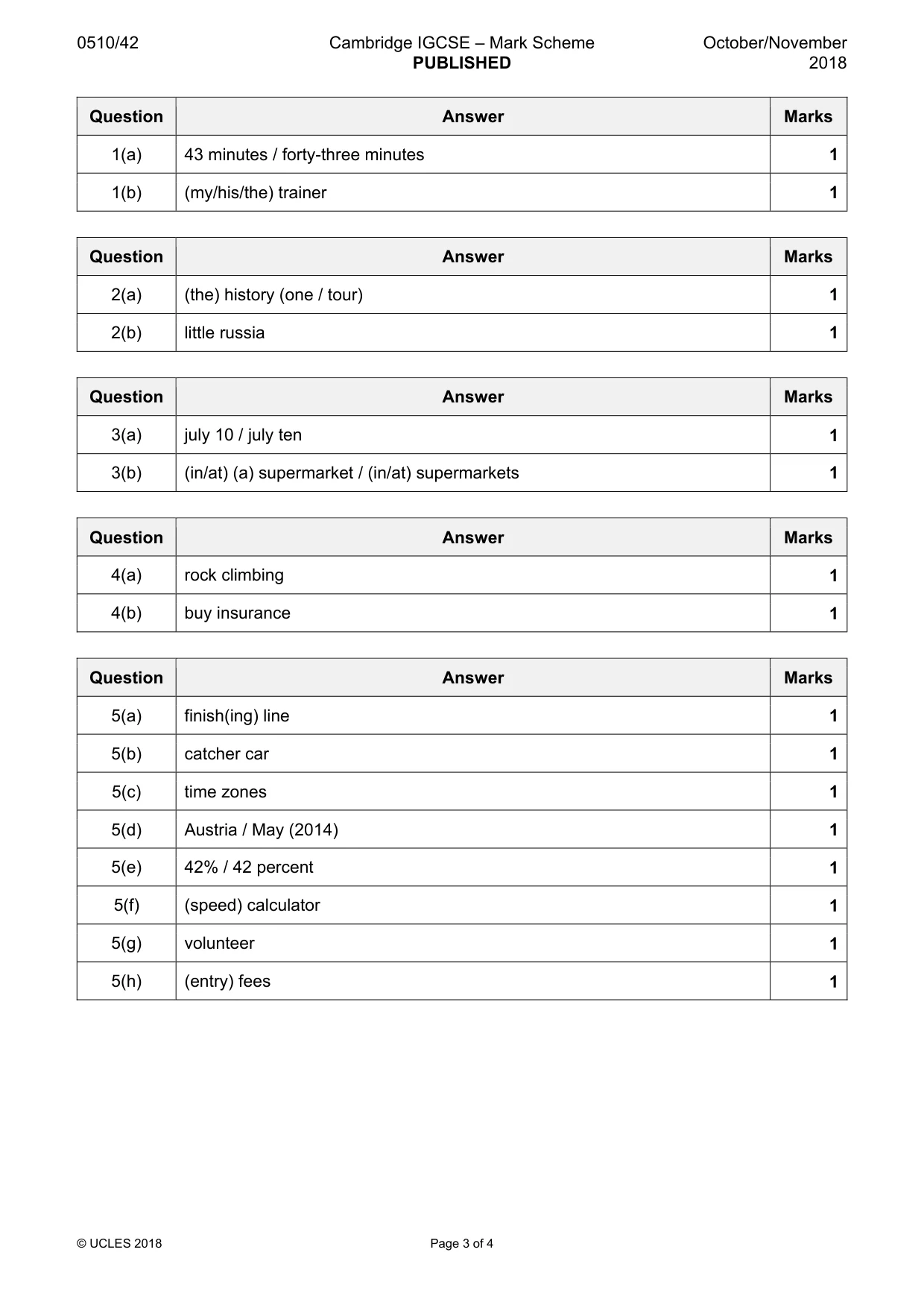
0510/42 Cambridge IGCSE – Mark Scheme PUBLISHED October/November 2018 © UCLES 2018 Page 3 of 4 Question Answer Marks 1(a) 43 minutes / forty-three minutes 1 1(b) (my/his/the) trainer 1 Question Answer Marks 2(a) (the) history (one / tour) 1 2(b) little russia 1 Question Answer Marks 3(a) july 10 / july ten 1 3(b) (in/at) (a) supermarket / (in/at) supermarkets 1 Question Answer Marks 4(a) rock climbing 1 4(b) buy insurance 1 Question Answer Marks 5(a) finish(ing) line 1 5(b) catcher car 1 5(c) time zones 1 5(d) Austria / May (2014) 1 5(e) 42% / 42 percent 1 5(f) (speed) calculator 1 5(g) volunteer 1 5(h) (entry) fees 1
Mark scheme, page 4
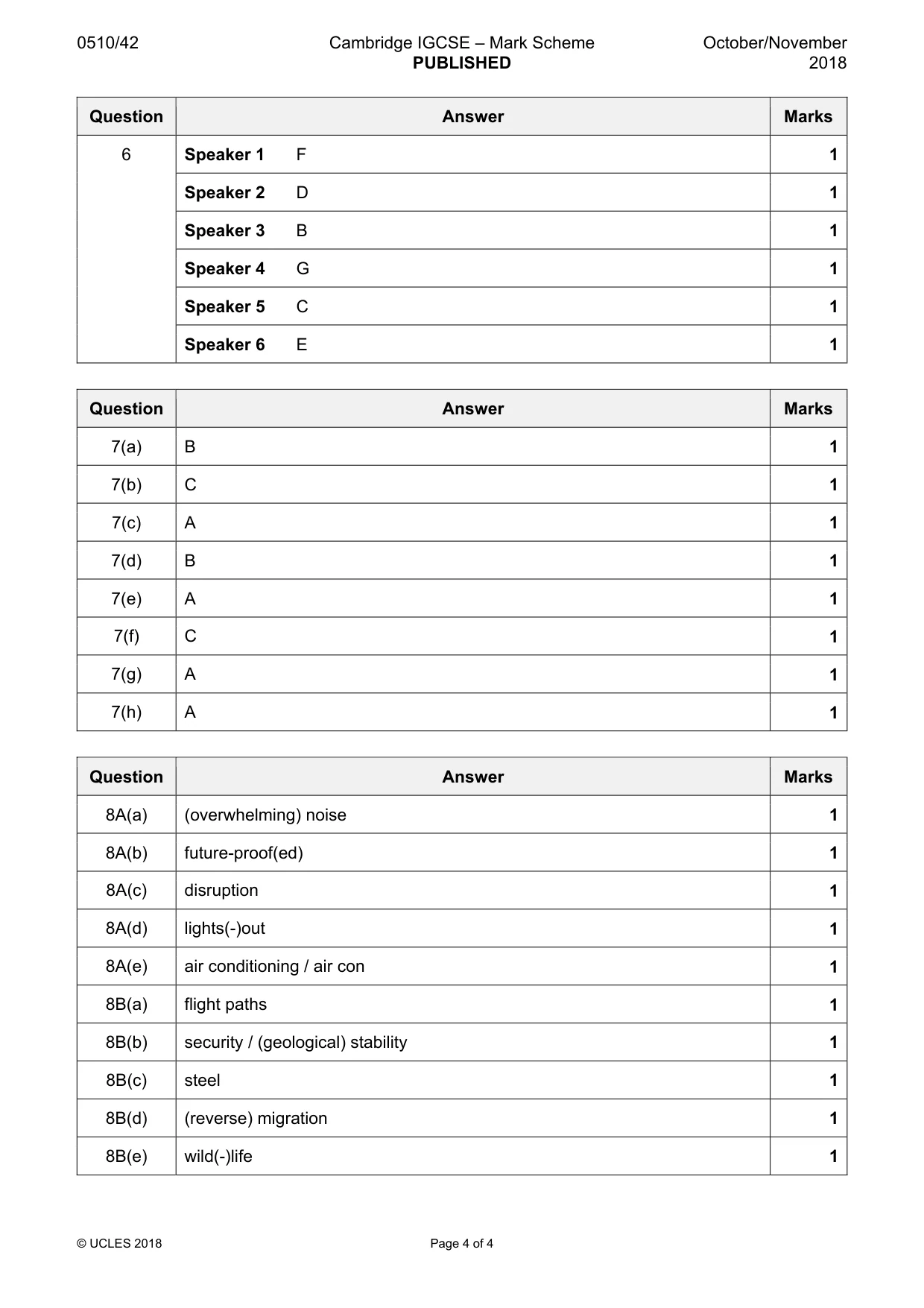
0510/42 Cambridge IGCSE – Mark Scheme PUBLISHED October/November 2018 © UCLES 2018 Page 4 of 4 Question Answer Marks 6 Speaker 1 F 1 Speaker 2 D 1 Speaker 3 B 1 Speaker 4 G 1 Speaker 5 C 1 Speaker 6 E 1 Question Answer Marks 7(a) B 1 7(b) C 1 7(c) A 1 7(d) B 1 7(e) A 1 7(f) C 1 7(g) A 1 7(h) A 1 Question Answer Marks 8A(a) (overwhelming) noise 1 8A(b) future-proof(ed) 1 8A(c) disruption 1 8A(d) lights(-)out 1 8A(e) air conditioning / air con 1 8B(a) flight paths 1 8B(b) security / (geological) stability 1 8B(c) steel 1 8B(d) (reverse) migration 1 8B(e) wild(-)life 1
What you needed in this session
Cambridge’s own grade thresholds for 2018 Oct/Nov, Paper 4 · Variant 2. A higher threshold means an easier paper — the bar moves with how the cohort did.