Cambridge IGCSE English - Second Language (oral endorsement) 0510 — 2018 Oct/Nov Paper 4 · Variant 3
0510/43/O/N/18 · 40 marks · ≈45 min
The question paper and its mark scheme, free to read here and free to download. This is Cambridge’s own paper, exactly as it was sat.
Question paper12 pages




Mark scheme4 pages
Answers below. Sit the paper first if you are practising.
Paper as text
Question paper, page 1
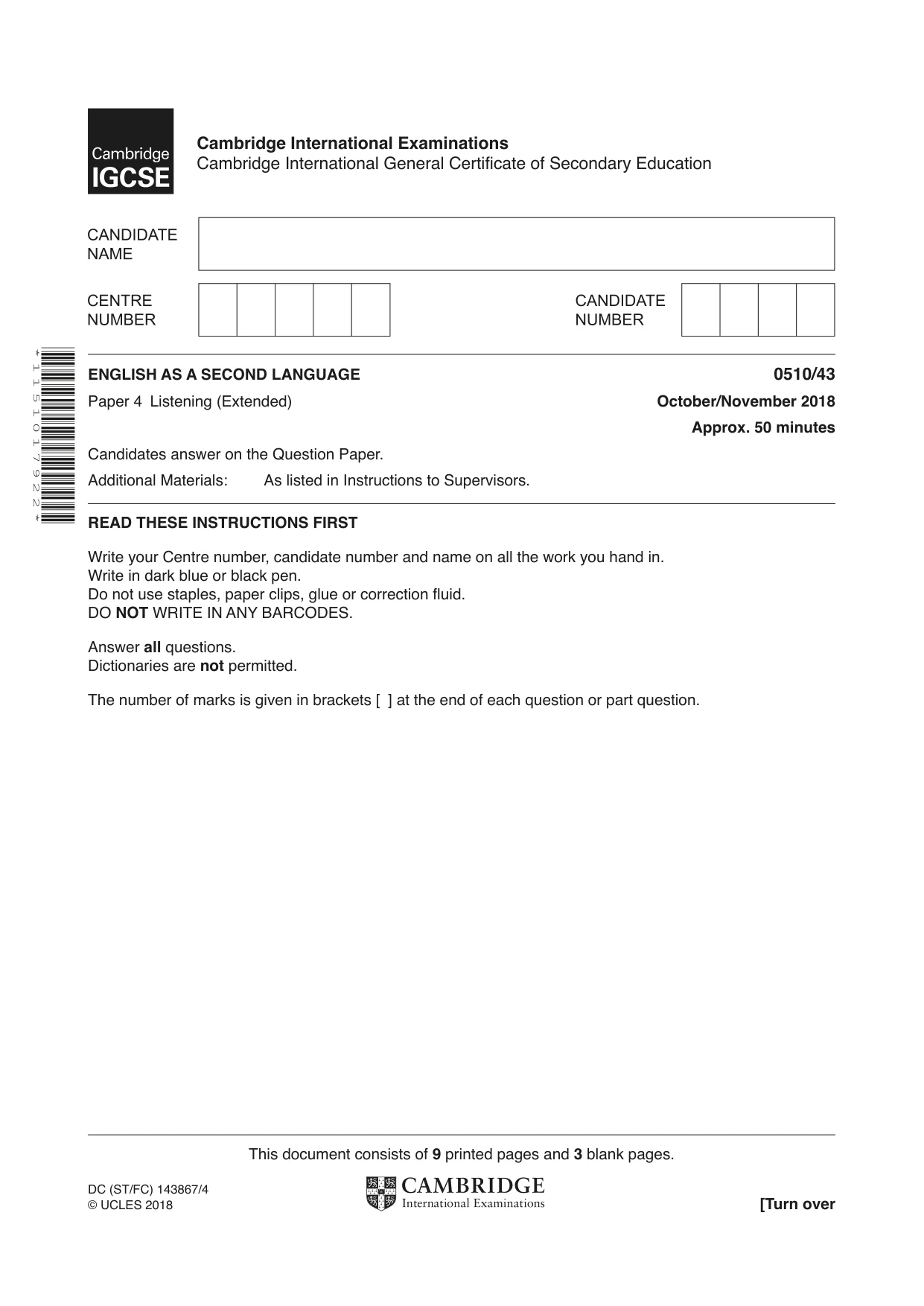
* 1 1 5 1 0 1 7 9 2 2 * This document consists of 9 printed pages and 3 blank pages. DC (ST/FC) 143867/4 © UCLES 2018 [Turn over Cambridge International Examinations Cambridge International General Certificate of Secondary Education ENGLISH AS A SECOND LANGUAGE 0510/43 Paper 4 Listening (Extended) October/November 2018 Approx. 50 minutes Candidates answer on the Question Paper. Additional Materials: As listed in Instructions to Supervisors. READ THESE INSTRUCTIONS FIRST Write your Centre number, candidate number and name on all the work you hand in. Write in dark blue or black pen. Do not use staples, paper clips, glue or correction fluid. DO NOT WRITE IN ANY BARCODES. Answer all questions. Dictionaries are not permitted. The number of marks is given in brackets [ ] at the end of each question or part question.
Question paper, page 2
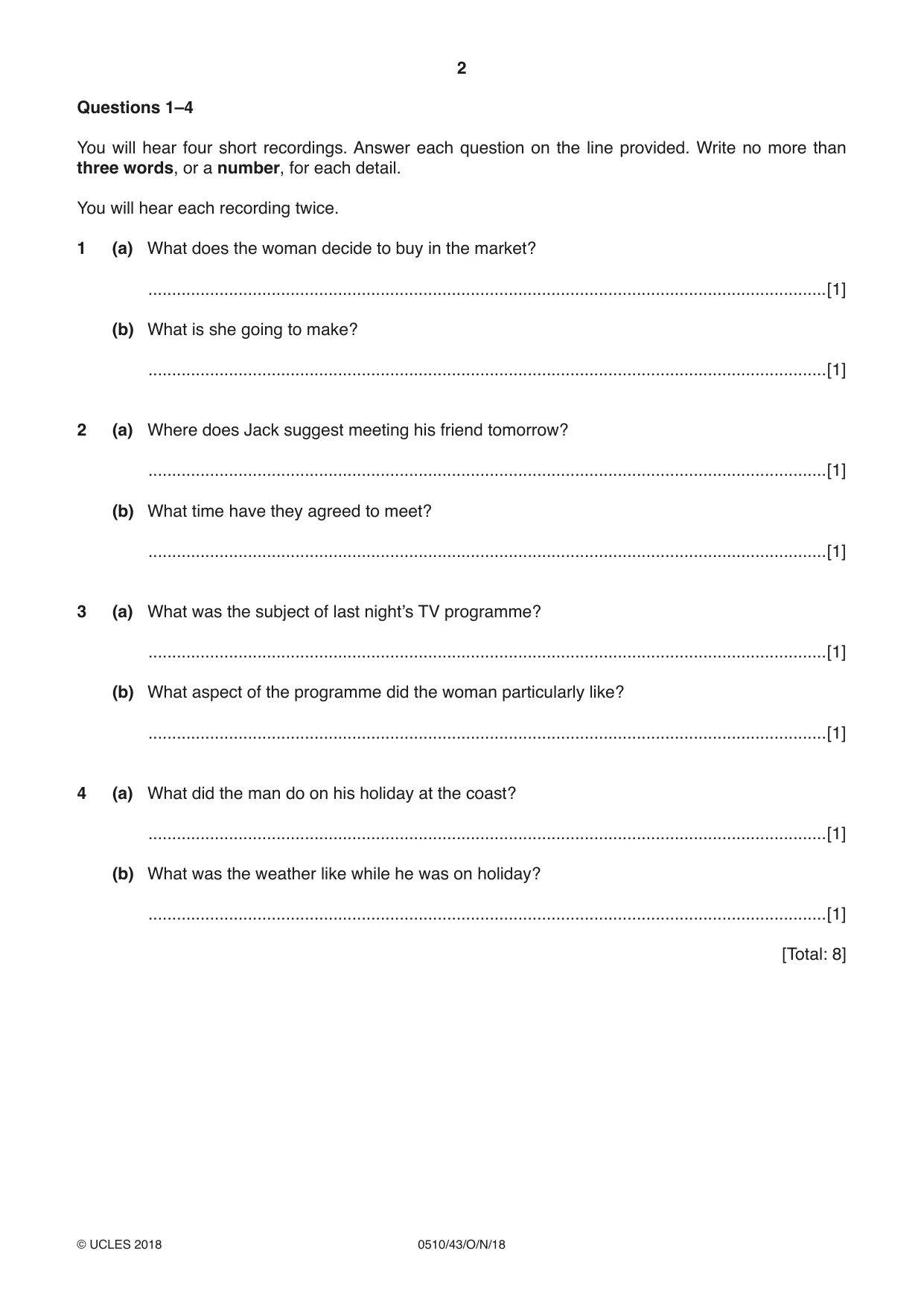
2 0510/43/O/N/18 © UCLES 2018 Questions 1–4 You will hear four short recordings. Answer each question on the line provided. Write no more than three words, or a number, for each detail. You will hear each recording twice. 1 (a) What does the woman decide to buy in the market? …[1] (b) What is she going to make? …[1] 2 (a) Where does Jack suggest meeting his friend tomorrow? …[1] (b) What time have they agreed to meet? …[1] 3 (a) What was the subject of last night’s TV programme? …[1] (b) What aspect of the programme did the woman particularly like? …[1] 4 (a) What did the man do on his holiday at the coast? …[1] (b) What was the weather like while he was on holiday? …[1] [Total: 8]
Question paper, page 3
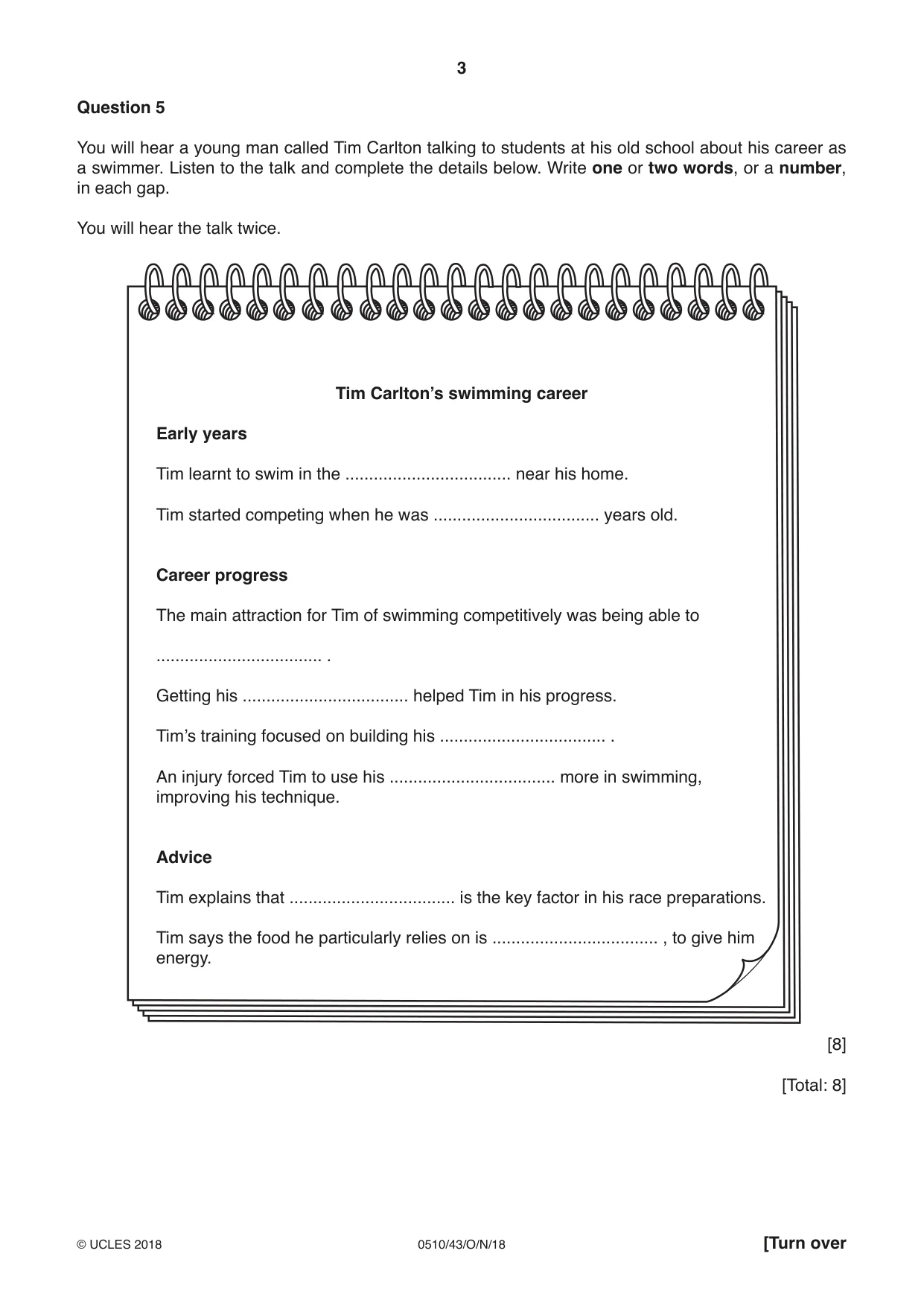
3 0510/43/O/N/18 © UCLES 2018 [Turn over Question 5 You will hear a young man called Tim Carlton talking to students at his old school about his career as a swimmer. Listen to the talk and complete the details below. Write one or two words, or a number, in each gap. You will hear the talk twice. Tim Carlton’s swimming career Early years Tim learnt to swim in the … near his home. Tim started competing when he was … years old. Career progress The main attraction for Tim of swimming competitively was being able to … . Getting his … helped Tim in his progress. Tim’s training focused on building his … . An injury forced Tim to use his … more in swimming, improving his technique. Advice Tim explains that … is the key factor in his race preparations. Tim says the food he particularly relies on is … , to give him energy. [8] [Total: 8]
Question paper, page 4
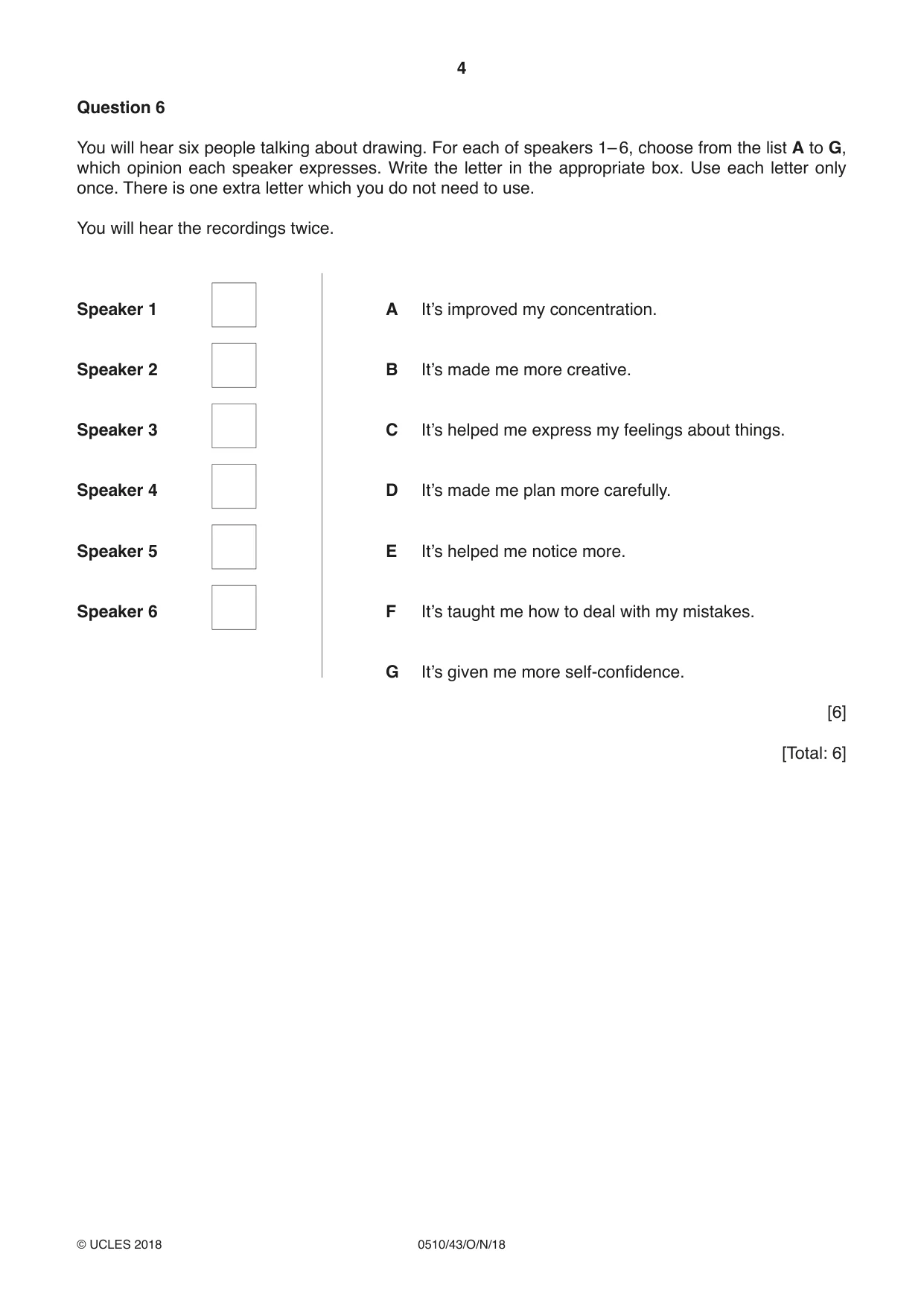
4 0510/43/O/N/18 © UCLES 2018 Question 6 You will hear six people talking about drawing. For each of speakers 1– 6, choose from the list A to G, which opinion each speaker expresses. Write the letter in the appropriate box. Use each letter only once. There is one extra letter which you do not need to use. You will hear the recordings twice. Speaker 1 A It’s improved my concentration. Speaker 2 B It’s made me more creative. Speaker 3 C It’s helped me express my feelings about things. Speaker 4 D It’s made me plan more carefully. Speaker 5 E It’s helped me notice more. Speaker 6 F It’s taught me how to deal with my mistakes. G It’s given me more self-confidence. [6] [Total: 6]
Question paper, page 5
5 0510/43/O/N/18 © UCLES 2018 [Turn over Please turn over for Question 7.
Question paper, page 6
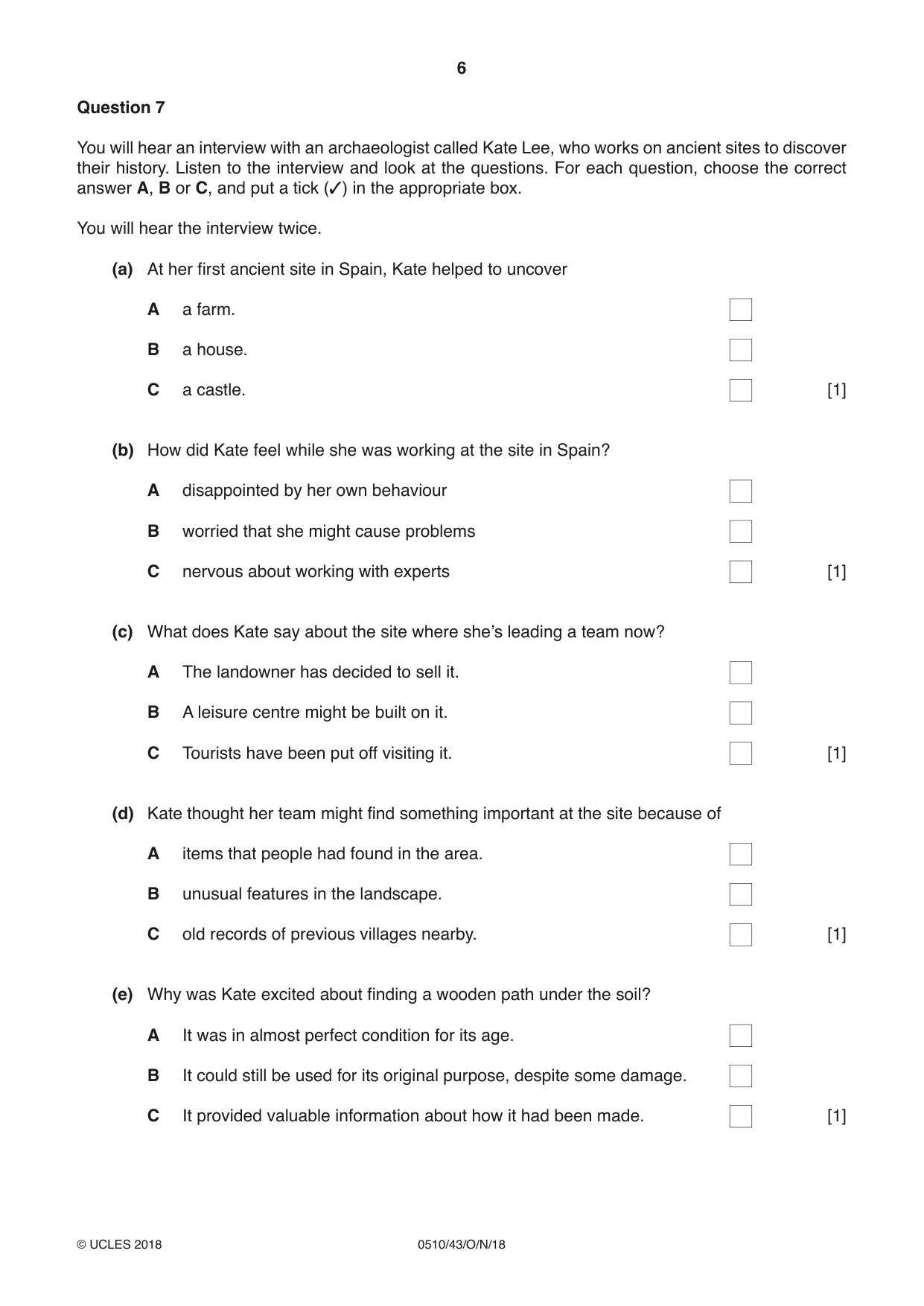
6 0510/43/O/N/18 © UCLES 2018 Question 7 You will hear an interview with an archaeologist called Kate Lee, who works on ancient sites to discover their history. Listen to the interview and look at the questions. For each question, choose the correct answer A, B or C, and put a tick (✓) in the appropriate box. You will hear the interview twice. (a) At her first ancient site in Spain, Kate helped to uncover A a farm. B a house. C a castle. [1] (b) How did Kate feel while she was working at the site in Spain? A disappointed by her own behaviour B worried that she might cause problems C nervous about working with experts [1] (c) What does Kate say about the site where she’s leading a team now? A The landowner has decided to sell it. B A leisure centre might be built on it. C Tourists have been put off visiting it. [1] (d) Kate thought her team might find something important at the site because of A items that people had found in the area. B unusual features in the landscape. C old records of previous villages nearby. [1] (e) Why was Kate excited about finding a wooden path under the soil? A It was in almost perfect condition for its age. B It could still be used for its original purpose, despite some damage. C It provided valuable information about how it had been made. [1]
Question paper, page 7
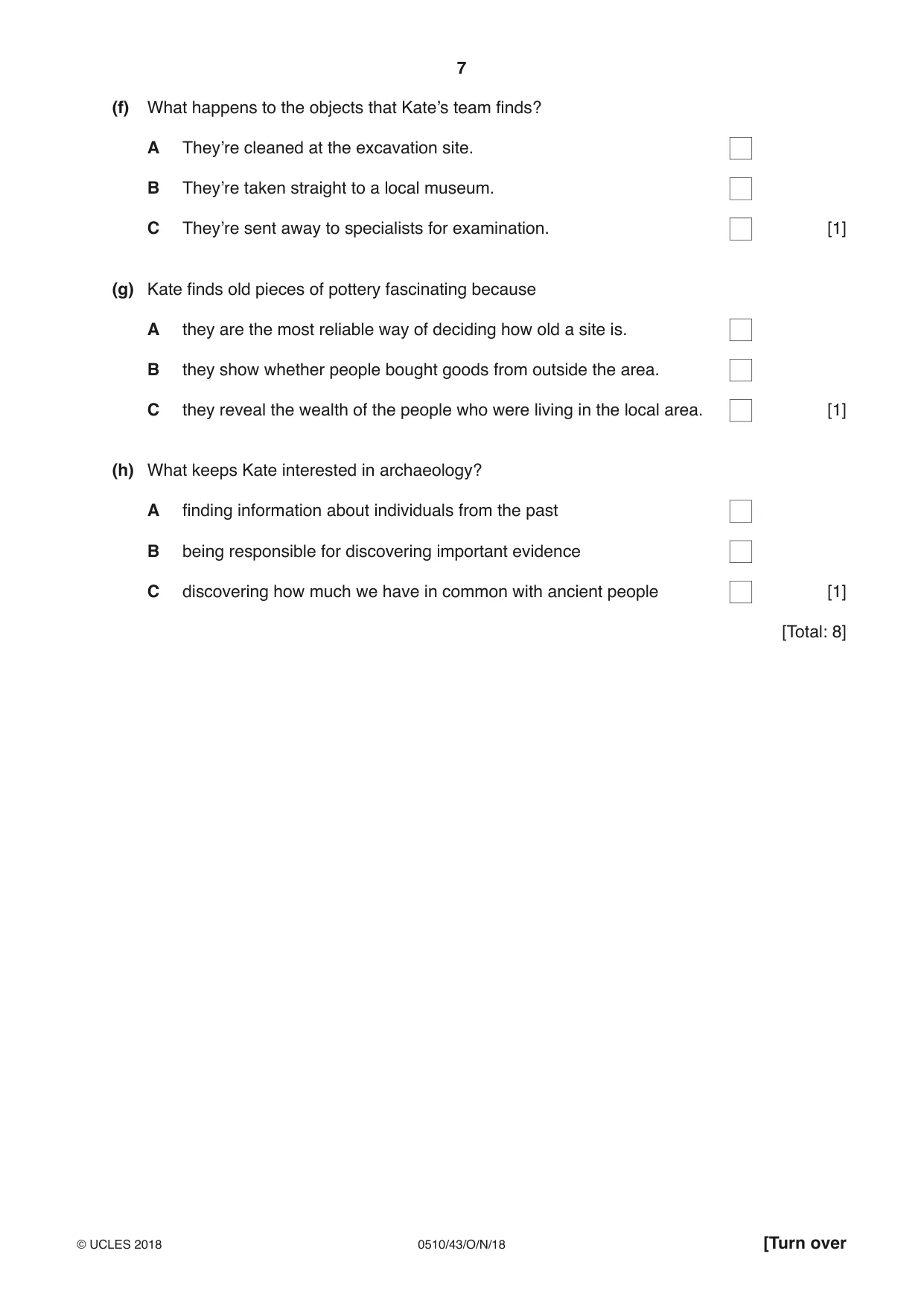
7 0510/43/O/N/18 © UCLES 2018 [Turn over (f) What happens to the objects that Kate’s team finds? A They’re cleaned at the excavation site. B They’re taken straight to a local museum. C They’re sent away to specialists for examination. [1] (g) Kate finds old pieces of pottery fascinating because A they are the most reliable way of deciding how old a site is. B they show whether people bought goods from outside the area. C they reveal the wealth of the people who were living in the local area. [1] (h) What keeps Kate interested in archaeology? A finding information about individuals from the past B being responsible for discovering important evidence C discovering how much we have in common with ancient people [1] [Total: 8]
Question paper, page 8
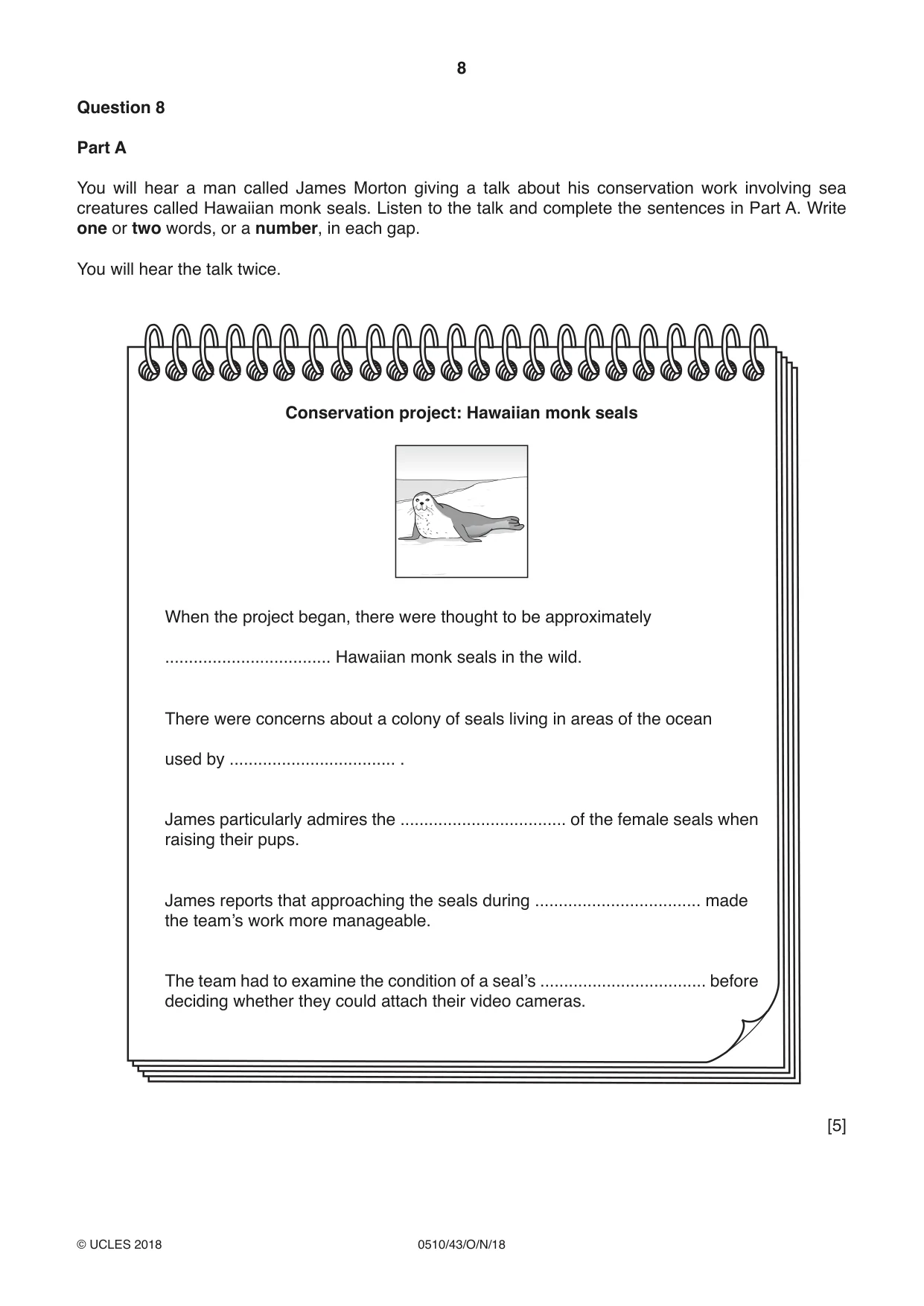
8 0510/43/O/N/18 © UCLES 2018 Question 8 Part A You will hear a man called James Morton giving a talk about his conservation work involving sea creatures called Hawaiian monk seals. Listen to the talk and complete the sentences in Part A. Write one or two words, or a number, in each gap. You will hear the talk twice. Conservation project: Hawaiian monk seals When the project began, there were thought to be approximately … Hawaiian monk seals in the wild. There were concerns about a colony of seals living in areas of the ocean used by … . James particularly admires the … of the female seals when raising their pups. James reports that approaching the seals during … made the team’s work more manageable. The team had to examine the condition of a seal’s … before deciding whether they could attach their video cameras. [5]
Question paper, page 9
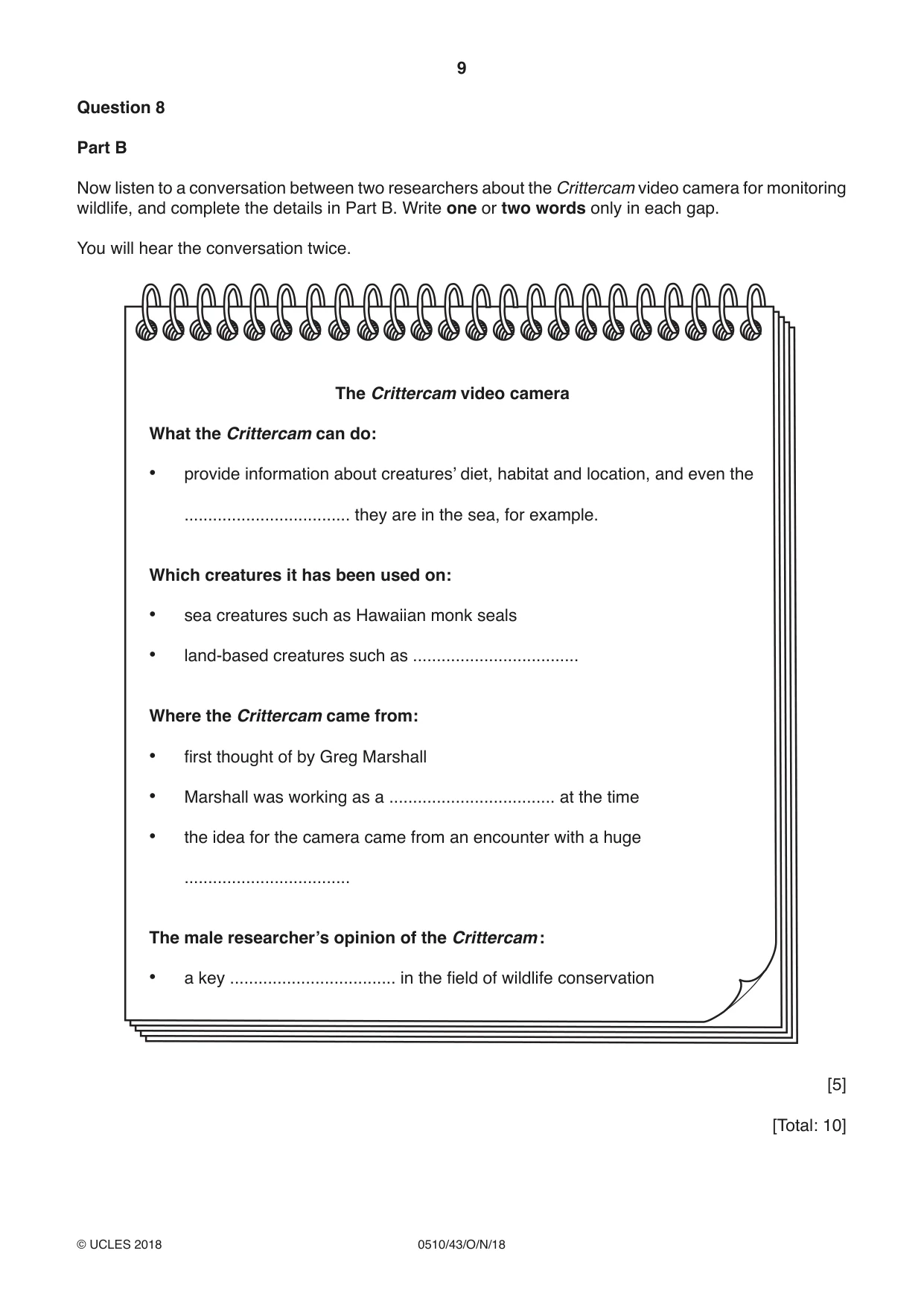
9 0510/43/O/N/18 © UCLES 2018 Question 8 Part B Now listen to a conversation between two researchers about the Crittercam video camera for monitoring wildlife, and complete the details in Part B. Write one or two words only in each gap. You will hear the conversation twice. The Crittercam video camera What the Crittercam can do: • provide information about creatures’ diet, habitat and location, and even the … they are in the sea, for example. Which creatures it has been used on: • sea creatures such as Hawaiian monk seals • land-based creatures such as … Where the Crittercam came from: • first thought of by Greg Marshall • Marshall was working as a … at the time • the idea for the camera came from an encounter with a huge … The male researcher’s opinion of the Crittercam : • a key … in the field of wildlife conservation [5] [Total: 10]
Question paper, page 10
10 0510/43/O/N/18 © UCLES 2018 BLANK PAGE
Question paper, page 11
11 0510/43/O/N/18 © UCLES 2018 BLANK PAGE
Question paper, page 12
12 0510/43/O/N/18 © UCLES 2018 Permission to reproduce items where third-party owned material protected by copyright is included has been sought and cleared where possible. Every reasonable effort has been made by the publisher (UCLES) to trace copyright holders, but if any items requiring clearance have unwittingly been included, the publisher will be pleased to make amends at the earliest possible opportunity. To avoid the issue of disclosure of answer-related information to candidates, all copyright acknowledgements are reproduced online in the Cambridge International Examinations Copyright Acknowledgements Booklet. This is produced for each series of examinations and is freely available to download at www.cie.org.uk after the live examination series. Cambridge International Examinations is part of the Cambridge Assessment Group. Cambridge Assessment is the brand name of University of Cambridge Local Examinations Syndicate (UCLES), which is itself a department of the University of Cambridge. BLANK PAGE
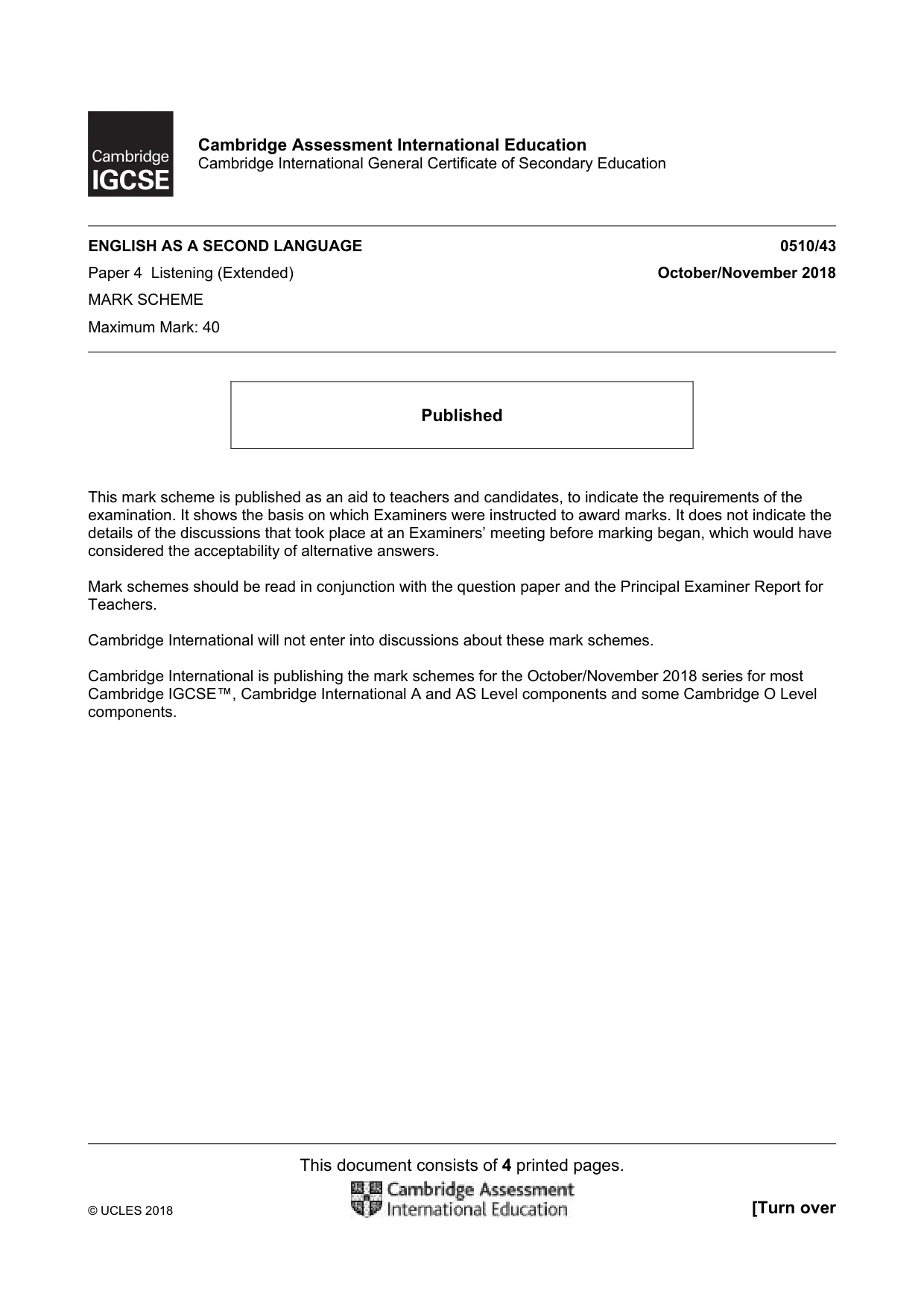
Mark scheme, page 1
This document consists of 4 printed pages. © UCLES 2018 [Turn over Cambridge Assessment International Education Cambridge International General Certificate of Secondary Education ENGLISH AS A SECOND LANGUAGE 0510/43 Paper 4 Listening (Extended) October/November 2018 MARK SCHEME Maximum Mark: 40 Published This mark scheme is published as an aid to teachers and candidates, to indicate the requirements of the examination. It shows the basis on which Examiners were instructed to award marks. It does not indicate the details of the discussions that took place at an Examiners’ meeting before marking began, which would have considered the acceptability of alternative answers. Mark schemes should be read in conjunction with the question paper and the Principal Examiner Report for Teachers. Cambridge International will not enter into discussions about these mark schemes. Cambridge International is publishing the mark schemes for the October/November 2018 series for most Cambridge IGCSE™, Cambridge International A and AS Level components and some Cambridge O Level components.
Mark scheme, page 2
0510/43 Cambridge IGCSE – Mark Scheme PUBLISHED October/November 2018 © UCLES 2018 Page 2 of 4 Generic Marking Principles These general marking principles must be applied by all examiners when marking candidate answers. They should be applied alongside the specific content of the mark scheme or generic level descriptors for a question. Each question paper and mark scheme will also comply with these marking principles. GENERIC MARKING PRINCIPLE 1: Marks must be awarded in line with: • the specific content of the mark scheme or the generic level descriptors for the question • the specific skills defined in the mark scheme or in the generic level descriptors for the question • the standard of response required by a candidate as exemplified by the standardisation scripts. GENERIC MARKING PRINCIPLE 2: Marks awarded are always whole marks (not half marks, or other fractions). GENERIC MARKING PRINCIPLE 3: Marks must be awarded positively: • marks are awarded for correct/valid answers, as defined in the mark scheme. However, credit is given for valid answers which go beyond the scope of the syllabus and mark scheme, referring to your Team Leader as appropriate • marks are awarded when candidates clearly demonstrate what they know and can do • marks are not deducted for errors • marks are not deducted for omissions • answers should only be judged on the quality of spelling, punctuation and grammar when these features are specifically assessed by the question as indicated by the mark scheme. The meaning, however, should be unambiguous. GENERIC MARKING PRINCIPLE 4: Rules must be applied consistently e.g. in situations where candidates have not followed instructions or in the application of generic level descriptors. GENERIC MARKING PRINCIPLE 5: Marks should be awarded using the full range of marks defined in the mark scheme for the question (however; the use of the full mark range may be limited according to the quality of the candidate responses seen). GENERIC MARKING PRINCIPLE 6: Marks awarded are based solely on the requirements as defined in the mark scheme. Marks should not be awarded with grade thresholds or grade descriptors in mind.
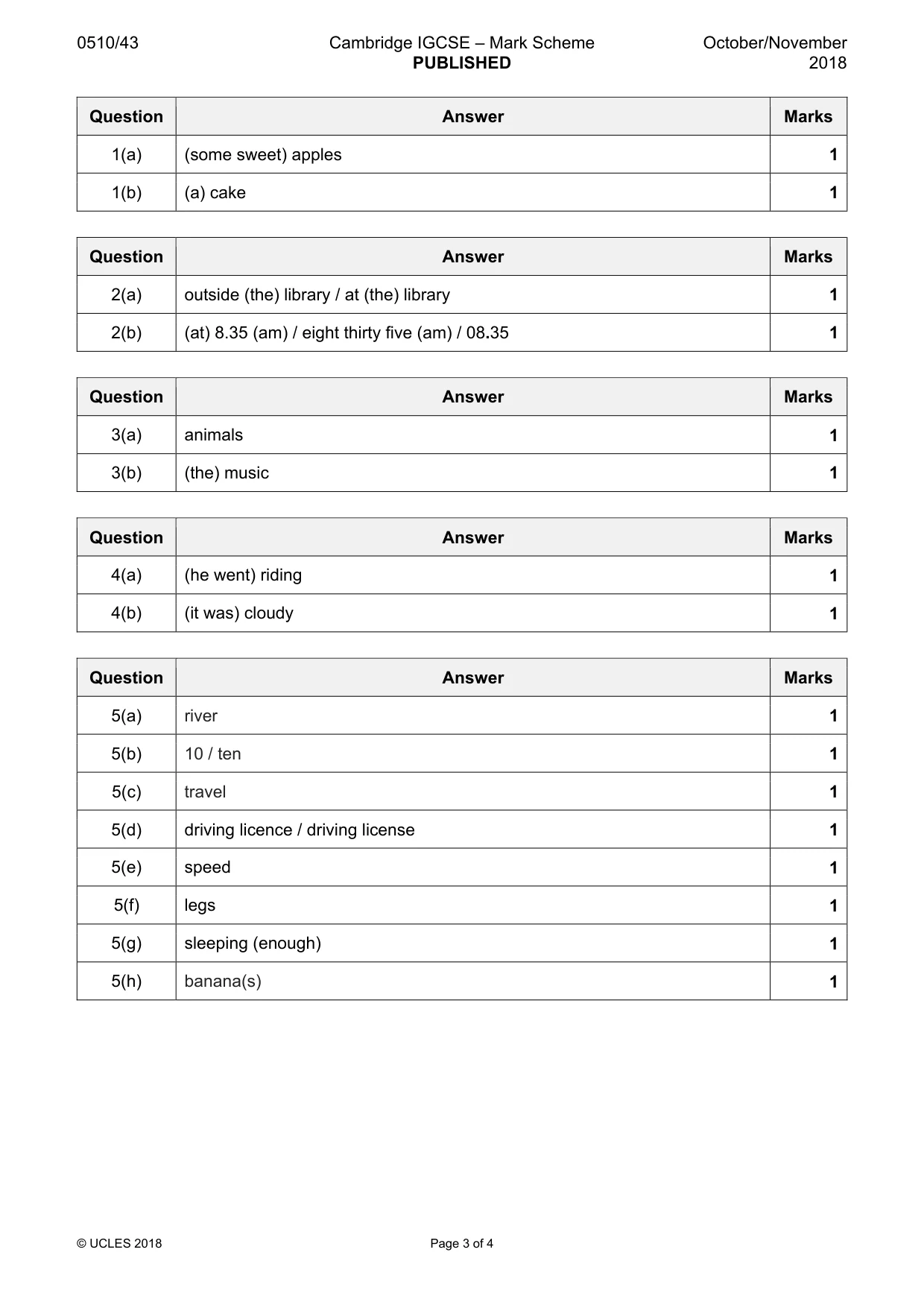
Mark scheme, page 3
0510/43 Cambridge IGCSE – Mark Scheme PUBLISHED October/November 2018 © UCLES 2018 Page 3 of 4 Question Answer Marks 1(a) (some sweet) apples 1 1(b) (a) cake 1 Question Answer Marks 2(a) outside (the) library / at (the) library 1 2(b) (at) 8.35 (am) / eight thirty five (am) / 08.35 1 Question Answer Marks 3(a) animals 1 3(b) (the) music 1 Question Answer Marks 4(a) (he went) riding 1 4(b) (it was) cloudy 1 Question Answer Marks 5(a) river 1 5(b) 10 / ten 1 5(c) travel 1 5(d) driving licence / driving license 1 5(e) speed 1 5(f) legs 1 5(g) sleeping (enough) 1 5(h) banana(s) 1
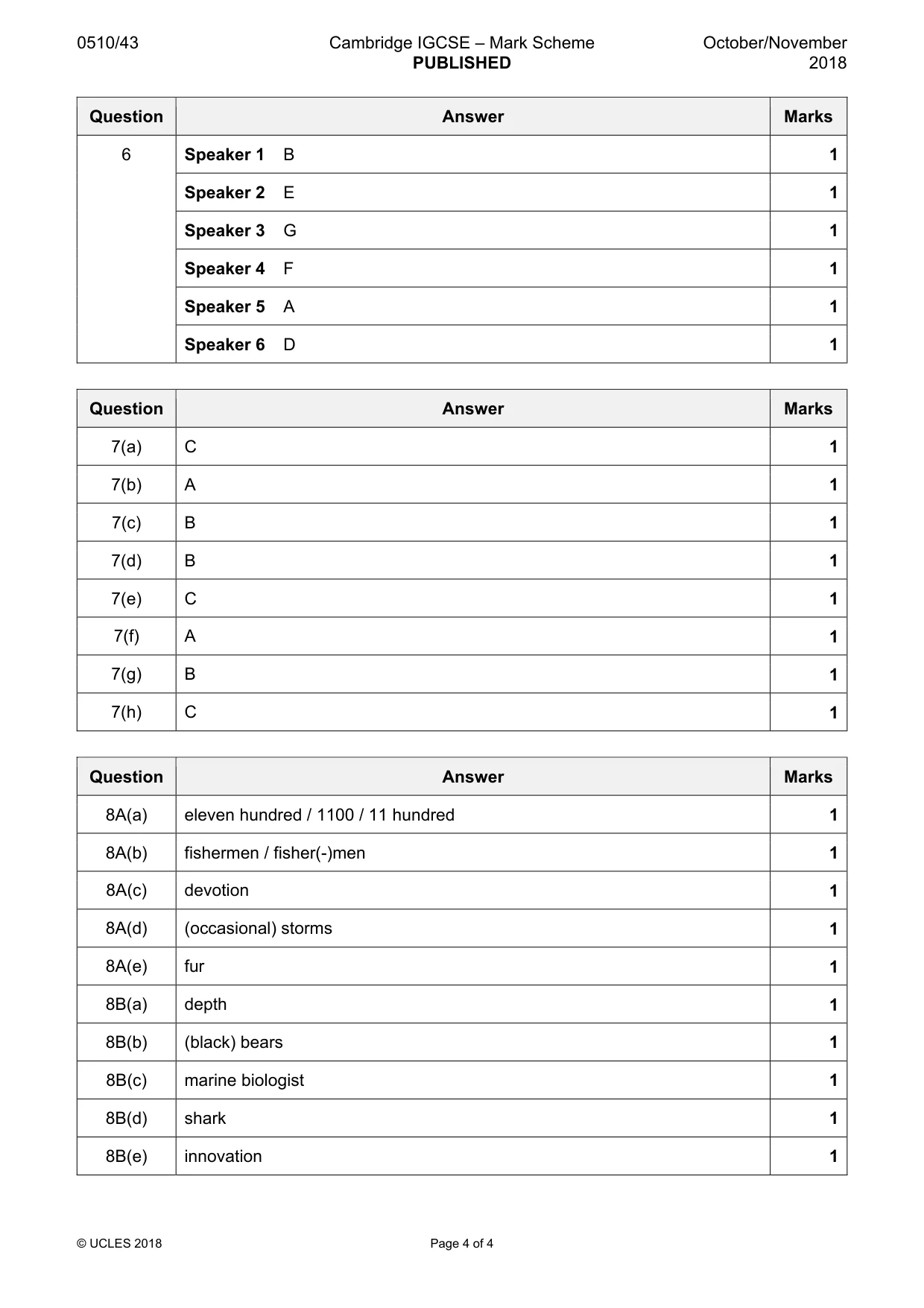
Mark scheme, page 4
0510/43 Cambridge IGCSE – Mark Scheme PUBLISHED October/November 2018 © UCLES 2018 Page 4 of 4 Question Answer Marks 6 Speaker 1 B 1 Speaker 2 E 1 Speaker 3 G 1 Speaker 4 F 1 Speaker 5 A 1 Speaker 6 D 1 Question Answer Marks 7(a) C 1 7(b) A 1 7(c) B 1 7(d) B 1 7(e) C 1 7(f) A 1 7(g) B 1 7(h) C 1 Question Answer Marks 8A(a) eleven hundred / 1100 / 11 hundred 1 8A(b) fishermen / fisher(-)men 1 8A(c) devotion 1 8A(d) (occasional) storms 1 8A(e) fur 1 8B(a) depth 1 8B(b) (black) bears 1 8B(c) marine biologist 1 8B(d) shark 1 8B(e) innovation 1
What you needed in this session
Cambridge’s own grade thresholds for 2018 Oct/Nov, Paper 4 · Variant 3. A higher threshold means an easier paper — the bar moves with how the cohort did.