Cambridge IGCSE English - Second Language (oral endorsement) 0510 — 2022 Feb/March Paper 4 · Variant 2
0510/42/F/M/22 · 40 marks · ≈45 min
The question paper and its mark scheme, free to read here and free to download. This is Cambridge’s own paper, exactly as it was sat.
Question paper12 pages



Mark scheme16 pages
Answers below. Sit the paper first if you are practising.
Paper as text
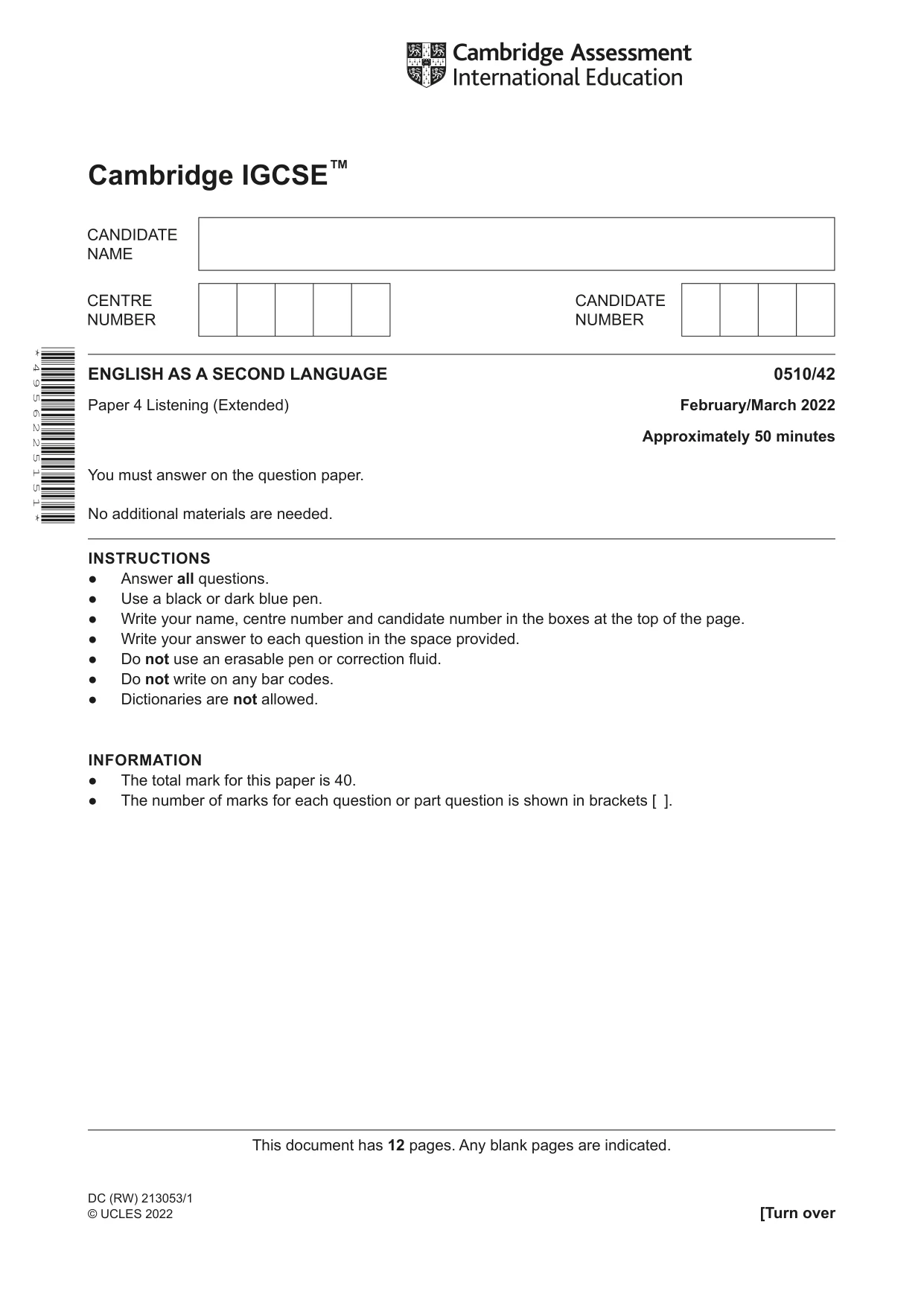
Question paper, page 1
This document has 12 pages. Any blank pages are indicated. [Turn over DC (RW) 213053/1 © UCLES 2022 * 4 9 5 6 2 2 5 1 5 1 * ENGLISH AS A SECOND LANGUAGE 0510/42 Paper 4 Listening (Extended) February/March 2022 Approximately 50 minutes You must answer on the question paper. No additional materials are needed. INSTRUCTIONS ● Answer all questions. ● Use a black or dark blue pen. ● Write your name, centre number and candidate number in the boxes at the top of the page. ● Write your answer to each question in the space provided. ● Do not use an erasable pen or correction fluid. ● Do not write on any bar codes. ● Dictionaries are not allowed. INFORMATION ● The total mark for this paper is 40. ● The number of marks for each question or part question is shown in brackets [ ]. Cambridge IGCSE™
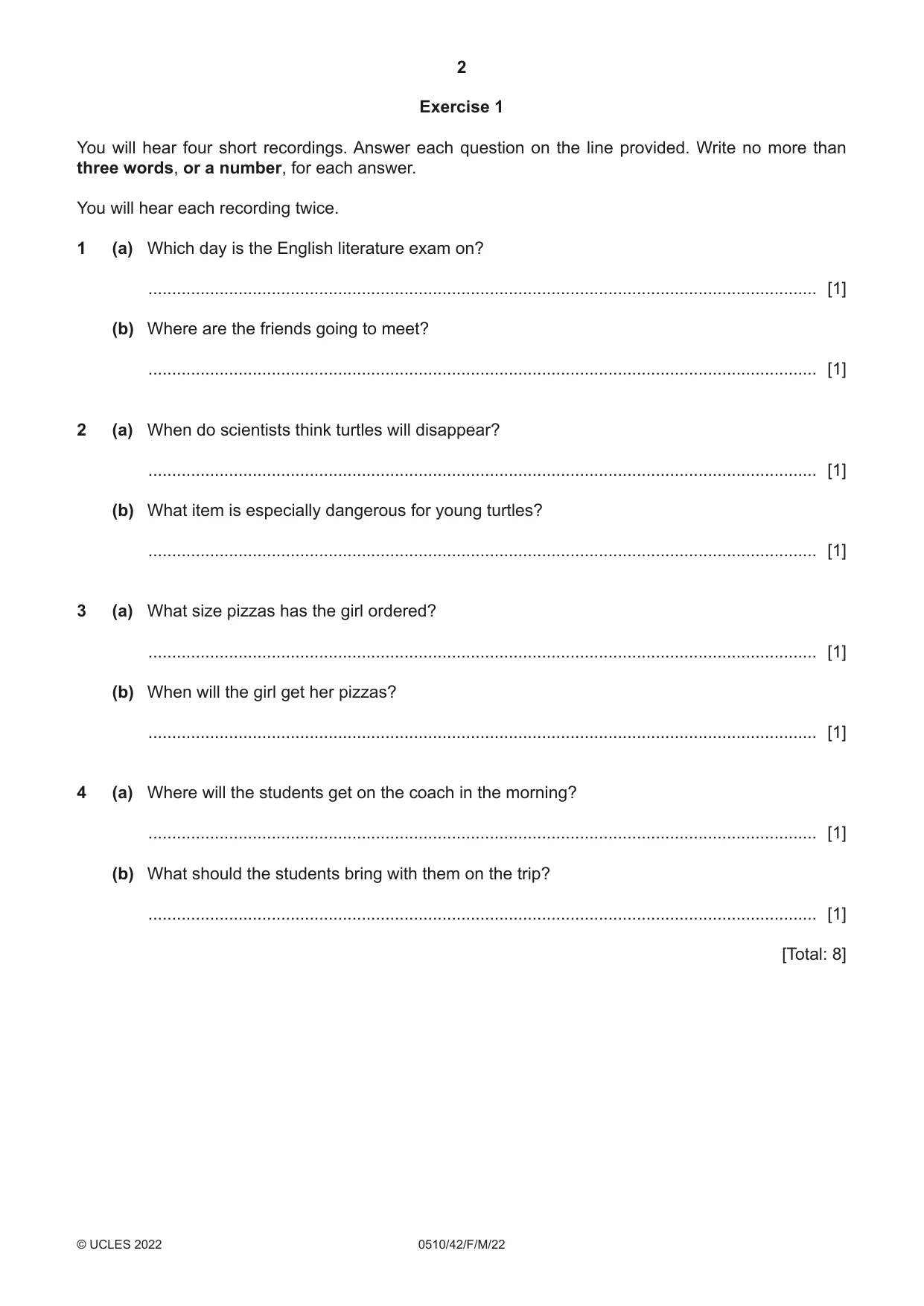
Question paper, page 2
2 0510/42/F/M/22 © UCLES 2022 Exercise 1 You will hear four short recordings. Answer each question on the line provided. Write no more than three words, or a number, for each answer. You will hear each recording twice. 1 (a) Which day is the English literature exam on? … [1] (b) Where are the friends going to meet? … [1] 2 (a) When do scientists think turtles will disappear? … [1] (b) What item is especially dangerous for young turtles? … [1] 3 (a) What size pizzas has the girl ordered? … [1] (b) When will the girl get her pizzas? … [1] 4 (a) Where will the students get on the coach in the morning? … [1] (b) What should the students bring with them on the trip? … [1] [Total: 8]
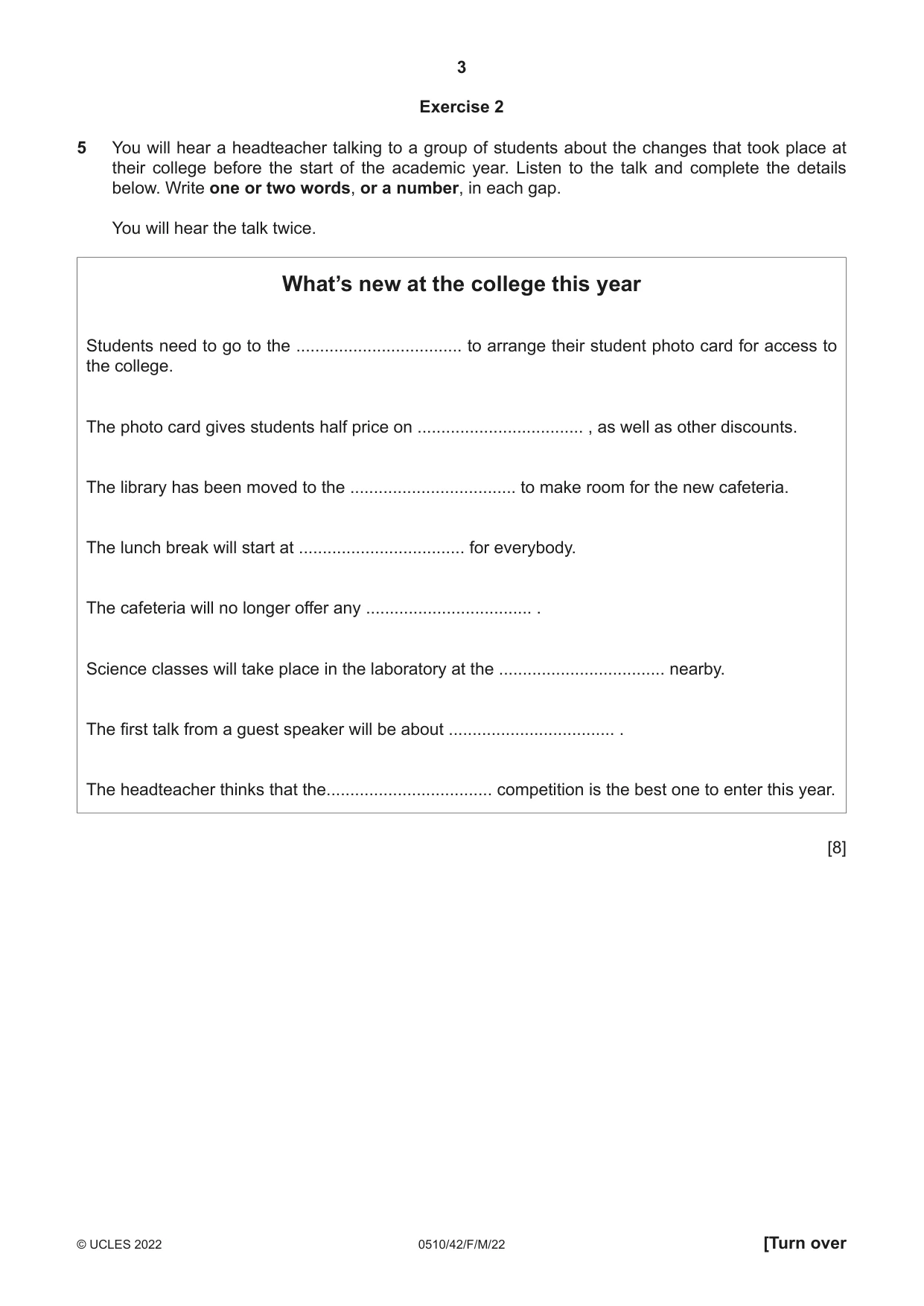
Question paper, page 3
3 0510/42/F/M/22 © UCLES 2022 [Turn over Exercise 2 5 You will hear a headteacher talking to a group of students about the changes that took place at their college before the start of the academic year. Listen to the talk and complete the details below. Write one or two words, or a number, in each gap. You will hear the talk twice. What’s new at the college this year Students need to go to the … to arrange their student photo card for access to the college. The photo card gives students half price on … , as well as other discounts. The library has been moved to the … to make room for the new cafeteria. The lunch break will start at … for everybody. The cafeteria will no longer offer any … . Science classes will take place in the laboratory at the … nearby. The first talk from a guest speaker will be about … . The headteacher thinks that the… competition is the best one to enter this year. [8]
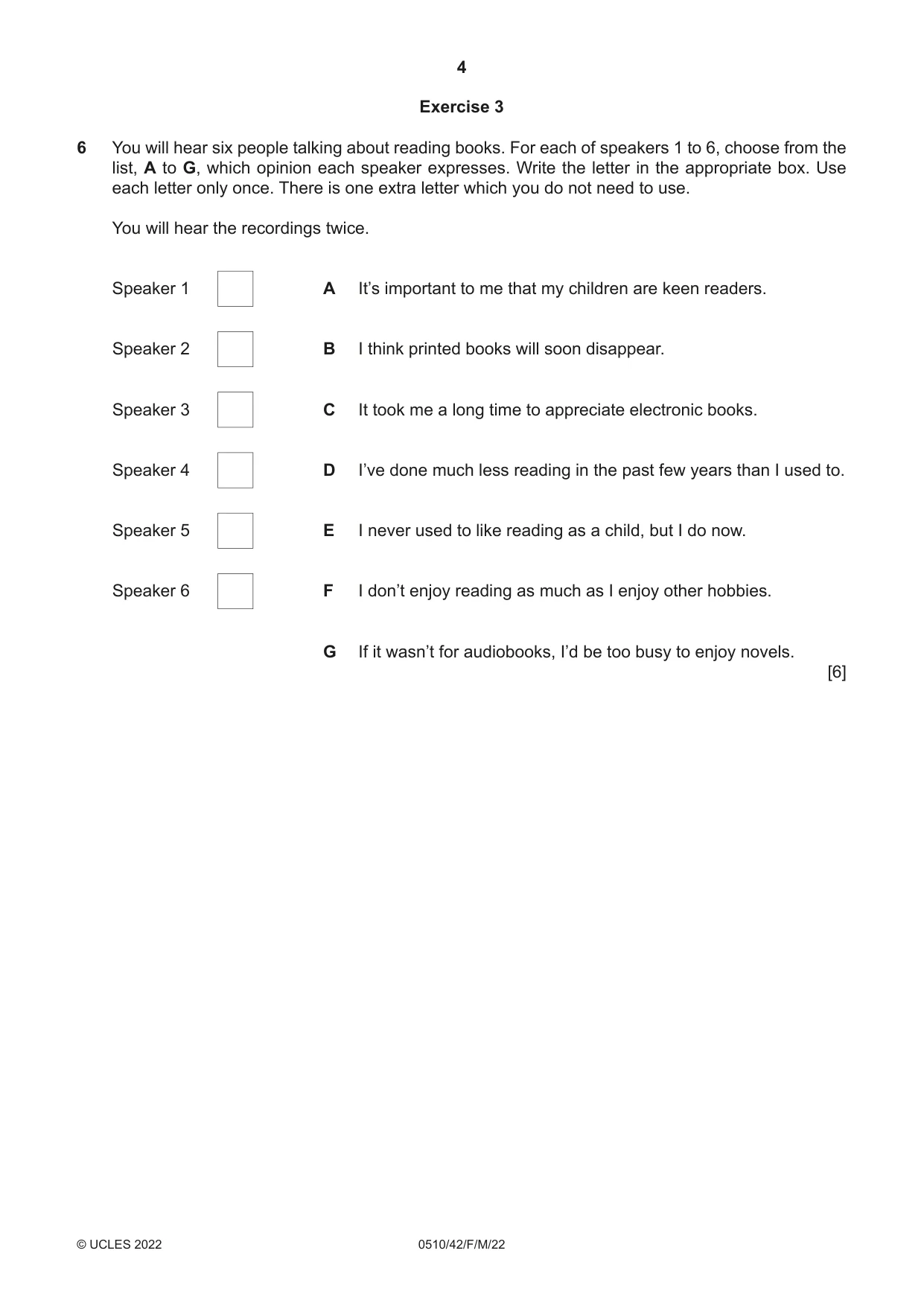
Question paper, page 4
4 0510/42/F/M/22 © UCLES 2022 Exercise 3 6 You will hear six people talking about reading books. For each of speakers 1 to 6, choose from the list, A to G, which opinion each speaker expresses. Write the letter in the appropriate box. Use each letter only once. There is one extra letter which you do not need to use. You will hear the recordings twice. Speaker 1 A It’s important to me that my children are keen readers. Speaker 2 B I think printed books will soon disappear. Speaker 3 C It took me a long time to appreciate electronic books. Speaker 4 D I’ve done much less reading in the past few years than I used to. Speaker 5 E I never used to like reading as a child, but I do now. Speaker 6 F I don’t enjoy reading as much as I enjoy other hobbies. G If it wasn’t for audiobooks, I’d be too busy to enjoy novels. [6]
Question paper, page 5
5 0510/42/F/M/22 © UCLES 2022 [Turn over Please turn over for Exercise 4
Question paper, page 6
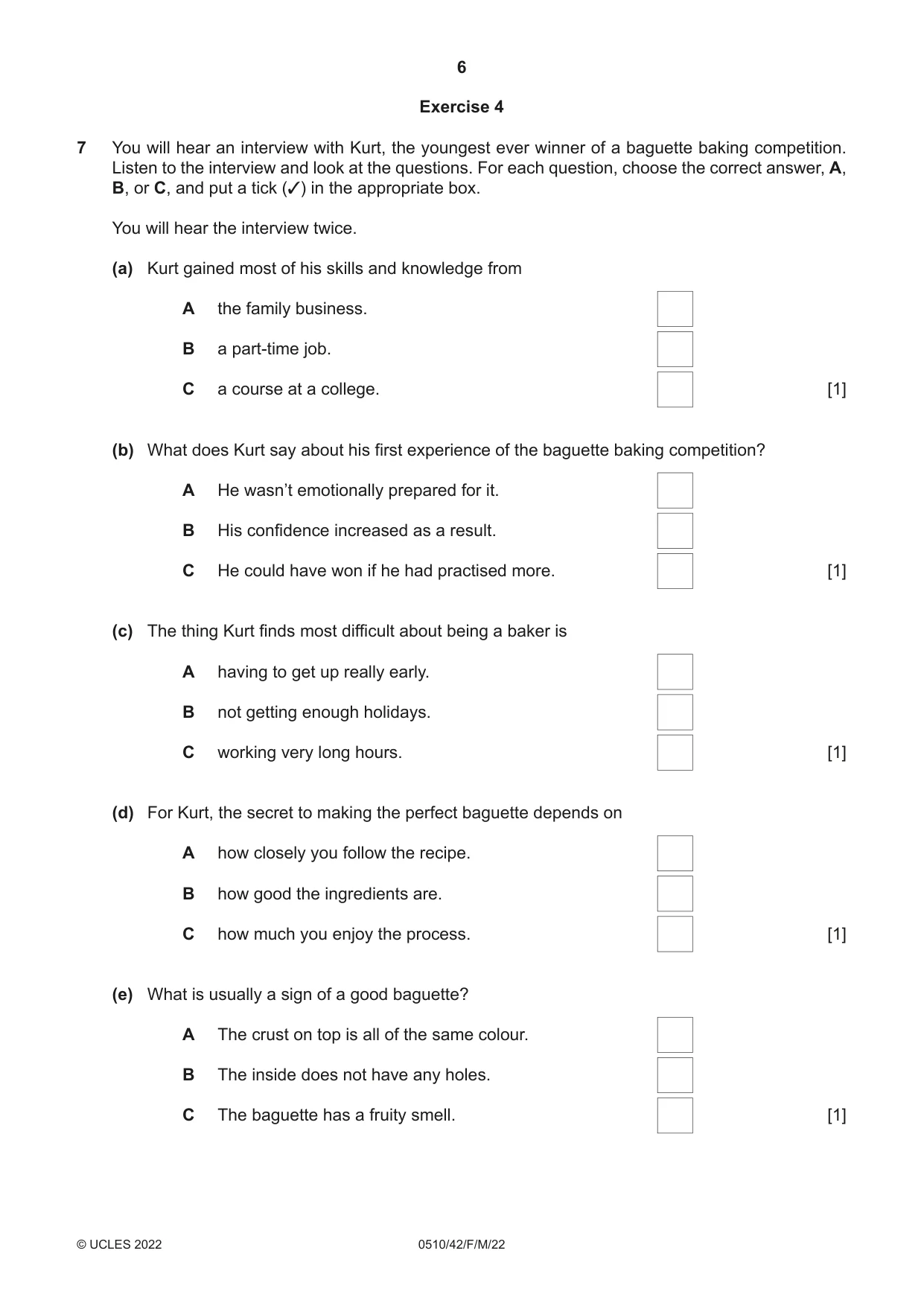
6 0510/42/F/M/22 © UCLES 2022 Exercise 4 7 You will hear an interview with Kurt, the youngest ever winner of a baguette baking competition. Listen to the interview and look at the questions. For each question, choose the correct answer, A, B, or C, and put a tick (3) in the appropriate box. You will hear the interview twice. (a) Kurt gained most of his skills and knowledge from A the family business. B a part-time job. C a course at a college. [1] (b) What does Kurt say about his first experience of the baguette baking competition? A He wasn’t emotionally prepared for it. B His confidence increased as a result. C He could have won if he had practised more. [1] (c) The thing Kurt finds most difficult about being a baker is A having to get up really early. B not getting enough holidays. C working very long hours. [1] (d) For Kurt, the secret to making the perfect baguette depends on A how closely you follow the recipe. B how good the ingredients are. C how much you enjoy the process. [1] (e) What is usually a sign of a good baguette? A The crust on top is all of the same colour. B The inside does not have any holes. C The baguette has a fruity smell. [1]
Question paper, page 7
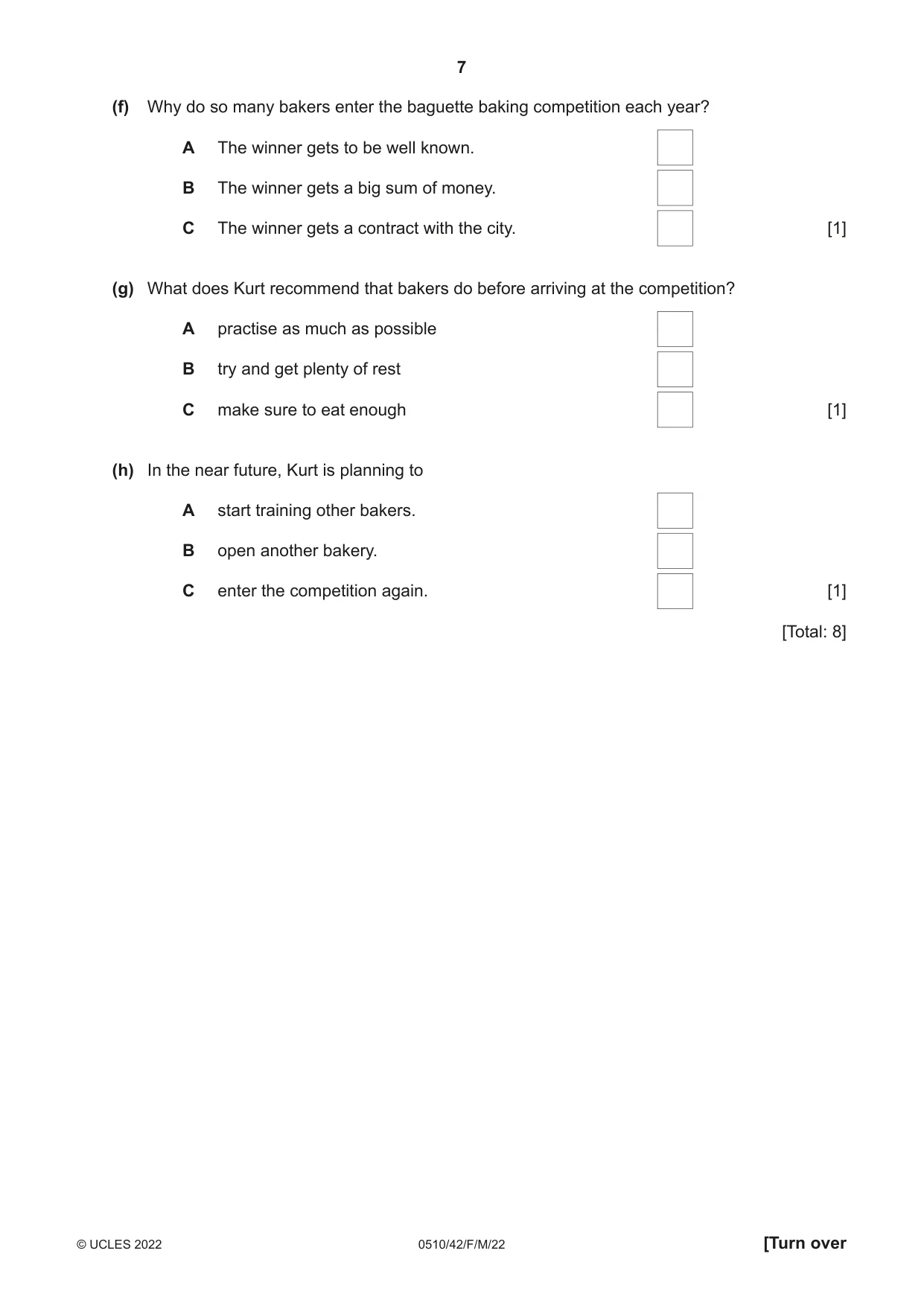
7 0510/42/F/M/22 © UCLES 2022 [Turn over (f) Why do so many bakers enter the baguette baking competition each year? A The winner gets to be well known. B The winner gets a big sum of money. C The winner gets a contract with the city. [1] (g) What does Kurt recommend that bakers do before arriving at the competition? A practise as much as possible B try and get plenty of rest C make sure to eat enough [1] (h) In the near future, Kurt is planning to A start training other bakers. B open another bakery. C enter the competition again. [1] [Total: 8]
Question paper, page 8
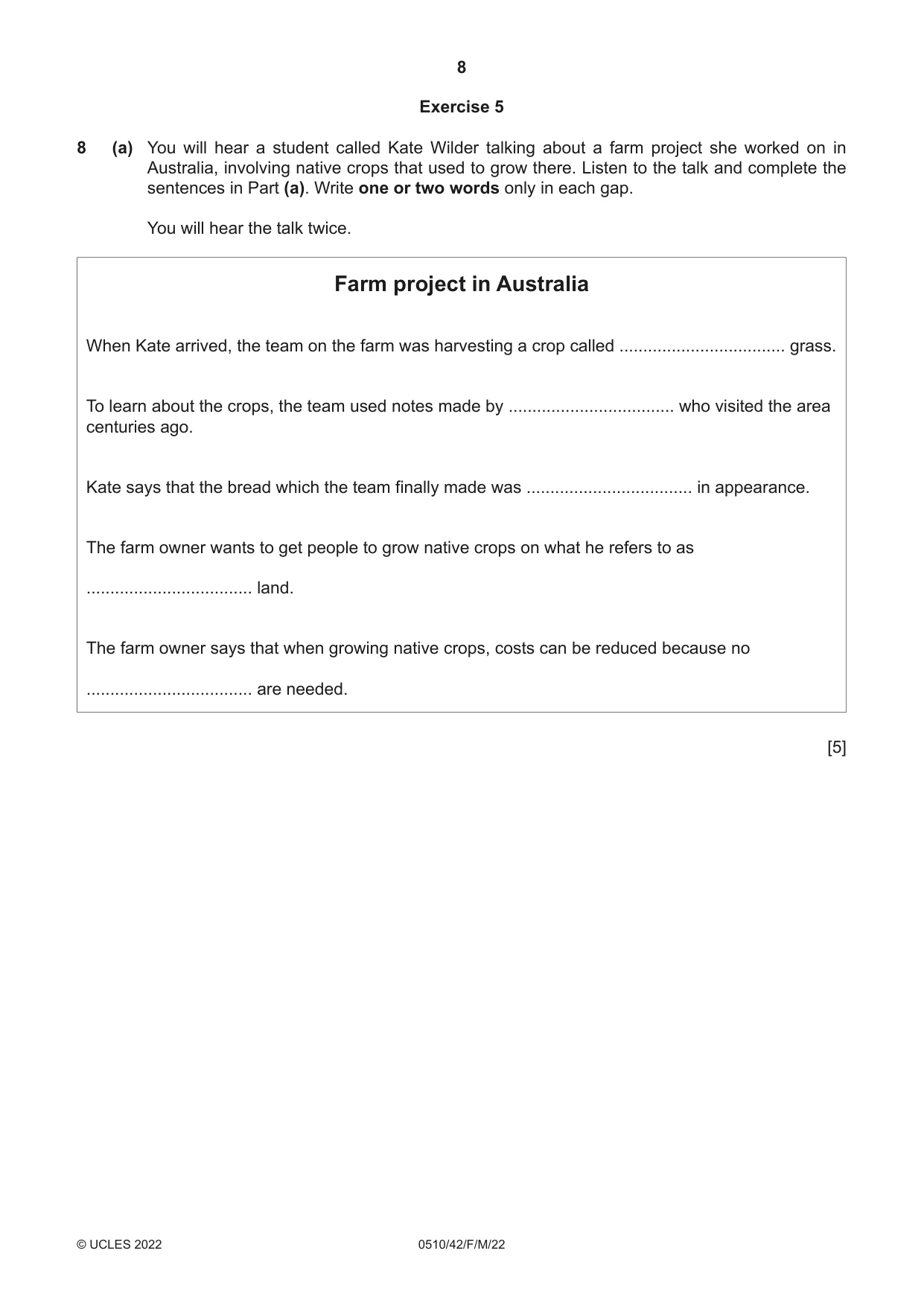
8 0510/42/F/M/22 © UCLES 2022 Exercise 5 8 (a) You will hear a student called Kate Wilder talking about a farm project she worked on in Australia, involving native crops that used to grow there. Listen to the talk and complete the sentences in Part (a). Write one or two words only in each gap. You will hear the talk twice. Farm project in Australia When Kate arrived, the team on the farm was harvesting a crop called … grass. To learn about the crops, the team used notes made by … who visited the area centuries ago. Kate says that the bread which the team finally made was … in appearance. The farm owner wants to get people to grow native crops on what he refers to as … land. The farm owner says that when growing native crops, costs can be reduced because no … are needed. [5]
Question paper, page 9
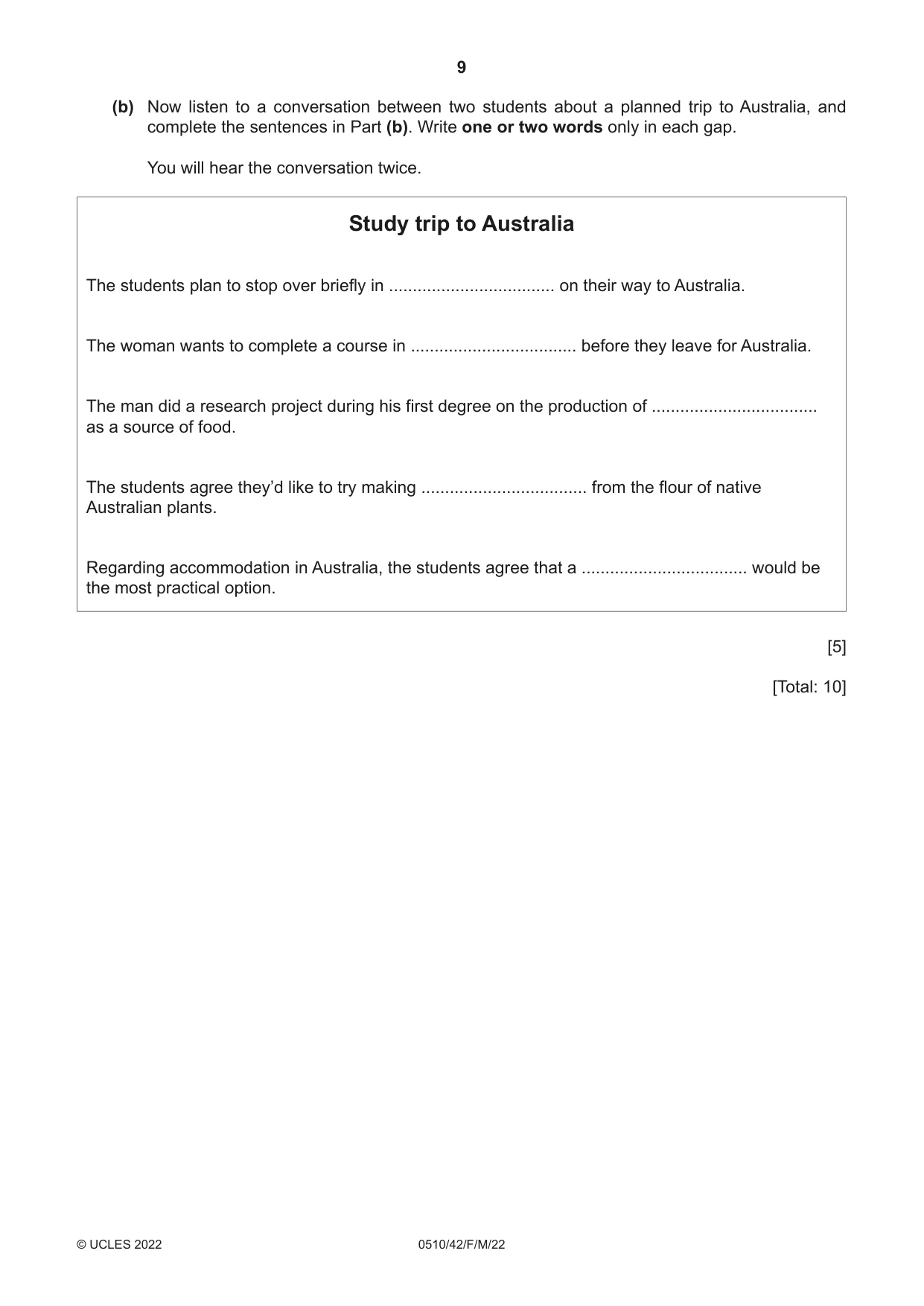
9 0510/42/F/M/22 © UCLES 2022 (b) Now listen to a conversation between two students about a planned trip to Australia, and complete the sentences in Part (b). Write one or two words only in each gap. You will hear the conversation twice. Study trip to Australia The students plan to stop over briefly in … on their way to Australia. The woman wants to complete a course in … before they leave for Australia. The man did a research project during his first degree on the production of … as a source of food. The students agree they’d like to try making … from the flour of native Australian plants. Regarding accommodation in Australia, the students agree that a … would be the most practical option. [5] [Total: 10]
Question paper, page 10
10 0510/42/F/M/22 © UCLES 2022 BLANK PAGE
Question paper, page 11
11 0510/42/F/M/22 © UCLES 2022 BLANK PAGE
Question paper, page 12
12 0510/42/F/M/22 © UCLES 2022 Permission to reproduce items where third-party owned material protected by copyright is included has been sought and cleared where possible. Every reasonable effort has been made by the publisher (UCLES) to trace copyright holders, but if any items requiring clearance have unwittingly been included, the publisher will be pleased to make amends at the earliest possible opportunity. To avoid the issue of disclosure of answer-related information to candidates, all copyright acknowledgements are reproduced online in the Cambridge Assessment International Education Copyright Acknowledgements Booklet. This is produced for each series of examinations and is freely available to download at www.cambridgeinternational.org after the live examination series. Cambridge Assessment International Education is part of Cambridge Assessment. Cambridge Assessment is the brand name of the University of Cambridge Local Examinations Syndicate (UCLES), which is a department of the University of Cambridge. BLANK PAGE
Mark scheme, page 1
This document consists of 16 printed pages. © UCLES 2022 [Turn over Cambridge IGCSE™ ENGLISH AS A SECOND LANGAUGE 0510/42 Paper 4 Listening (Extended) February/March 2022 MARK SCHEME Maximum Mark: 40 Published This mark scheme is published as an aid to teachers and candidates, to indicate the requirements of the examination. It shows the basis on which Examiners were instructed to award marks. It does not indicate the details of the discussions that took place at an Examiners’ meeting before marking began, which would have considered the acceptability of alternative answers. Mark schemes should be read in conjunction with the question paper and the Principal Examiner Report for Teachers. Cambridge International will not enter into discussions about these mark schemes. Cambridge International is publishing the mark schemes for the February/March 2022 series for most Cambridge IGCSE™, Cambridge International A and AS Level components and some Cambridge O Level components.
Mark scheme, page 2
0510/42 Cambridge IGCSE – Mark Scheme PUBLISHED February/March 2022 © UCLES 2022 Page 2 of 16 Generic Marking Principles These general marking principles must be applied by all examiners when marking candidate answers. They should be applied alongside the specific content of the mark scheme or generic level descriptors for a question. Each question paper and mark scheme will also comply with these marking principles. GENERIC MARKING PRINCIPLE 1: Marks must be awarded in line with: • the specific content of the mark scheme or the generic level descriptors for the question • the specific skills defined in the mark scheme or in the generic level descriptors for the question • the standard of response required by a candidate as exemplified by the standardisation scripts. GENERIC MARKING PRINCIPLE 2: Marks awarded are always whole marks (not half marks, or other fractions). GENERIC MARKING PRINCIPLE 3: Marks must be awarded positively: • marks are awarded for correct/valid answers, as defined in the mark scheme. However, credit is given for valid answers which go beyond the scope of the syllabus and mark scheme, referring to your Team Leader as appropriate • marks are awarded when candidates clearly demonstrate what they know and can do • marks are not deducted for errors • marks are not deducted for omissions • answers should only be judged on the quality of spelling, punctuation and grammar when these features are specifically assessed by the question as indicated by the mark scheme. The meaning, however, should be unambiguous. GENERIC MARKING PRINCIPLE 4: Rules must be applied consistently, e.g. in situations where candidates have not followed instructions or in the application of generic level descriptors. GENERIC MARKING PRINCIPLE 5: Marks should be awarded using the full range of marks defined in the mark scheme for the question (however; the use of the full mark range may be limited according to the quality of the candidate responses seen). GENERIC MARKING PRINCIPLE 6: Marks awarded are based solely on the requirements as defined in the mark scheme. Marks should not be awarded with grade thresholds or grade descriptors in mind.
Mark scheme, page 3
0510/42 Cambridge IGCSE – Mark Scheme PUBLISHED February/March 2022 © UCLES 2022 Page 3 of 16 English & Media subject specific general marking principles (To be read in conjunction with the Generic Marking Principles (and requiring further guidance on how to place marks within levels)) Components using level descriptors: • We use level descriptors as a guide to broad understanding of the qualities normally expected of, or typical of, work in a level. • Level descriptors are a means of general guidance, and should not be interpreted as hurdle statements. • Where indicative content notes are supplied for a question, these are not a prescription of required content, and must not be treated as such. Alternative correct points and unexpected answers in candidates’ scripts must be given marks that fairly reflect the knowledge and skills demonstrated. • While we may have legitimate expectations as to the ground most answers may occupy, we must at all times be prepared to meet candidates on their chosen ground, provided it is relevant ground (e.g. clearly related to and derived from a relevant passage/text and meeting the mark scheme requirements for the question). Components using point-based marking: Point marking is often used to reward knowledge, understanding and application of skills. We give credit where the candidate’s answer shows relevant knowledge, understanding and application of skills in answering the question. We do not give credit where the answer shows confusion. From this it follows that we: a DO credit answers which are worded differently from the mark scheme if they clearly convey the same meaning (unless the mark scheme requires a specific term). b DO credit alternative answers/examples which are not written in the mark scheme if they are correct. c DO credit answers where candidates give more than one correct answer in one prompt/numbered/scaffolded space where extended writing is required rather than list-type answers. For example, questions that require n reasons (e.g. State two reasons…). d DO NOT credit answers simply for using a ‘key term’ unless that is all that is required. (Check for evidence it is understood and not used wrongly.). e DO NOT credit answers which are obviously self-contradicting or trying to cover all possibilities. f DO NOT give further credit for what is effectively repetition of a correct point already credited unless the language itself is being tested. This applies equally to ‘mirror statements’ (i.e. polluted/not polluted). g DO NOT require spellings to be correct, unless this is part of the test. However spellings of syllabus terms must allow for clear and unambiguous separation from other syllabus terms with which they may be confused (e.g. Corrasion/Corrosion).
Mark scheme, page 4
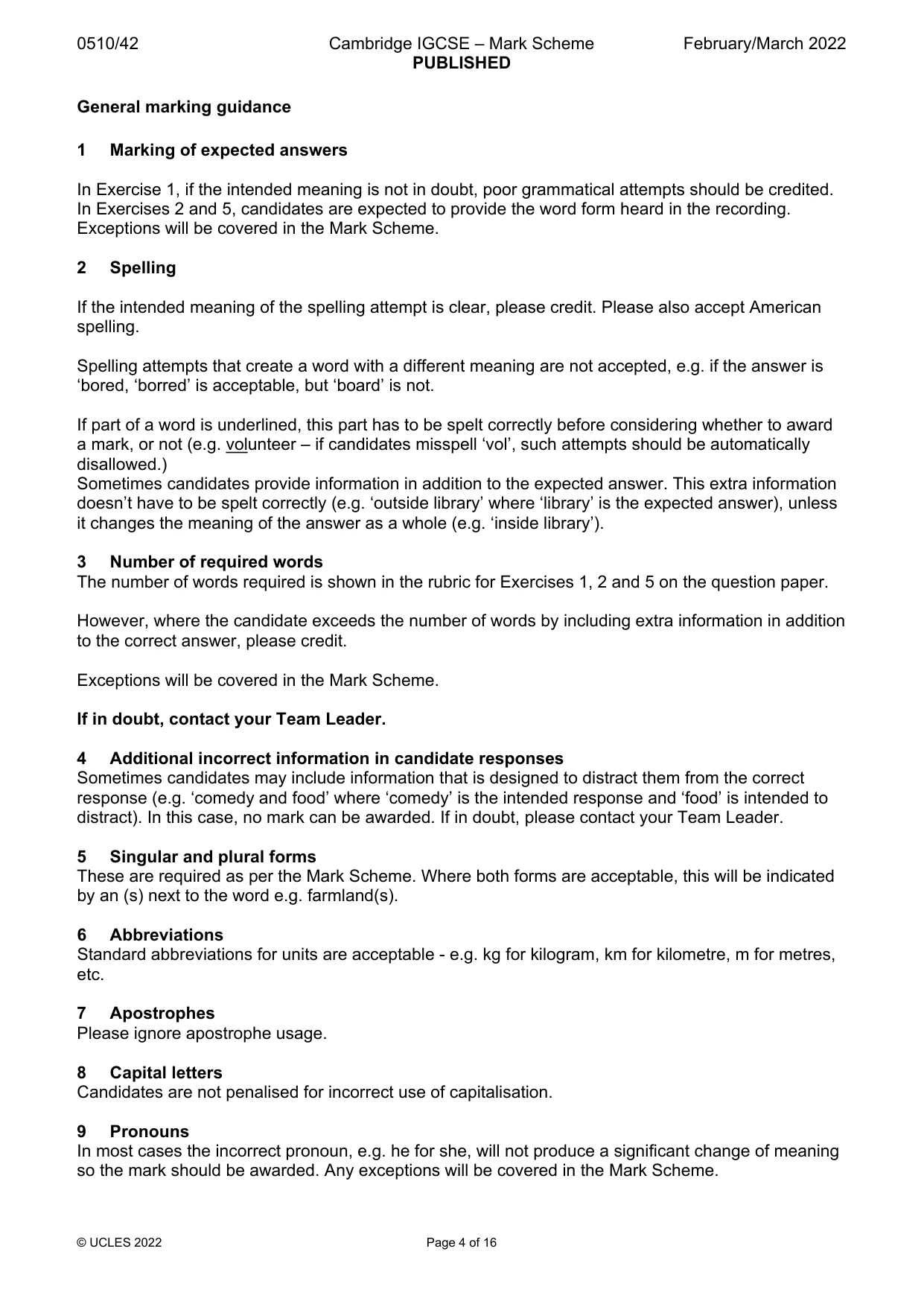
0510/42 Cambridge IGCSE – Mark Scheme PUBLISHED February/March 2022 © UCLES 2022 Page 4 of 16 General marking guidance 1 Marking of expected answers In Exercise 1, if the intended meaning is not in doubt, poor grammatical attempts should be credited. In Exercises 2 and 5, candidates are expected to provide the word form heard in the recording. Exceptions will be covered in the Mark Scheme. 2 Spelling If the intended meaning of the spelling attempt is clear, please credit. Please also accept American spelling. Spelling attempts that create a word with a different meaning are not accepted, e.g. if the answer is ‘bored, ‘borred’ is acceptable, but ‘board’ is not. If part of a word is underlined, this part has to be spelt correctly before considering whether to award a mark, or not (e.g. volunteer – if candidates misspell ‘vol’, such attempts should be automatically disallowed.) Sometimes candidates provide information in addition to the expected answer. This extra information doesn’t have to be spelt correctly (e.g. ‘outside library’ where ‘library’ is the expected answer), unless it changes the meaning of the answer as a whole (e.g. ‘inside library’). 3 Number of required words The number of words required is shown in the rubric for Exercises 1, 2 and 5 on the question paper. However, where the candidate exceeds the number of words by including extra information in addition to the correct answer, please credit. Exceptions will be covered in the Mark Scheme. If in doubt, contact your Team Leader. 4 Additional incorrect information in candidate responses Sometimes candidates may include information that is designed to distract them from the correct response (e.g. ‘comedy and food’ where ‘comedy’ is the intended response and ‘food’ is intended to distract). In this case, no mark can be awarded. If in doubt, please contact your Team Leader. 5 Singular and plural forms These are required as per the Mark Scheme. Where both forms are acceptable, this will be indicated by an (s) next to the word e.g. farmland(s). 6 Abbreviations Standard abbreviations for units are acceptable - e.g. kg for kilogram, km for kilometre, m for metres, etc. 7 Apostrophes Please ignore apostrophe usage. 8 Capital letters Candidates are not penalised for incorrect use of capitalisation. 9 Pronouns In most cases the incorrect pronoun, e.g. he for she, will not produce a significant change of meaning so the mark should be awarded. Any exceptions will be covered in the Mark Scheme.
Mark scheme, page 5
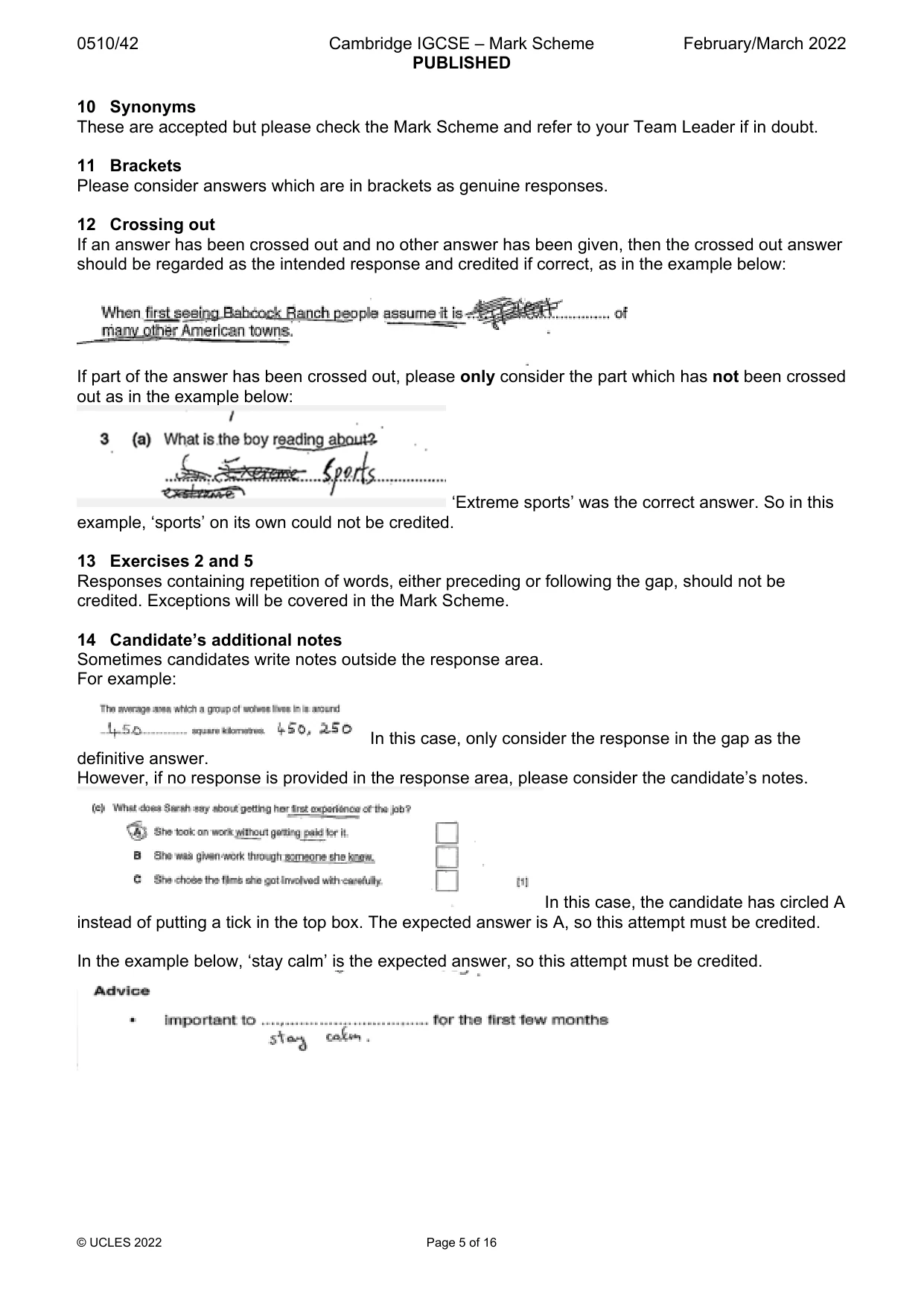
0510/42 Cambridge IGCSE – Mark Scheme PUBLISHED February/March 2022 © UCLES 2022 Page 5 of 16 10 Synonyms These are accepted but please check the Mark Scheme and refer to your Team Leader if in doubt. 11 Brackets Please consider answers which are in brackets as genuine responses. 12 Crossing out If an answer has been crossed out and no other answer has been given, then the crossed out answer should be regarded as the intended response and credited if correct, as in the example below: If part of the answer has been crossed out, please only consider the part which has not been crossed out as in the example below: ‘Extreme sports’ was the correct answer. So in this example, ‘sports’ on its own could not be credited. 13 Exercises 2 and 5 Responses containing repetition of words, either preceding or following the gap, should not be credited. Exceptions will be covered in the Mark Scheme. 14 Candidate’s additional notes Sometimes candidates write notes outside the response area. For example: In this case, only consider the response in the gap as the definitive answer. However, if no response is provided in the response area, please consider the candidate’s notes. In this case, the candidate has circled A instead of putting a tick in the top box. The expected answer is A, so this attempt must be credited. In the example below, ‘stay calm’ is the expected answer, so this attempt must be credited.
Mark scheme, page 6
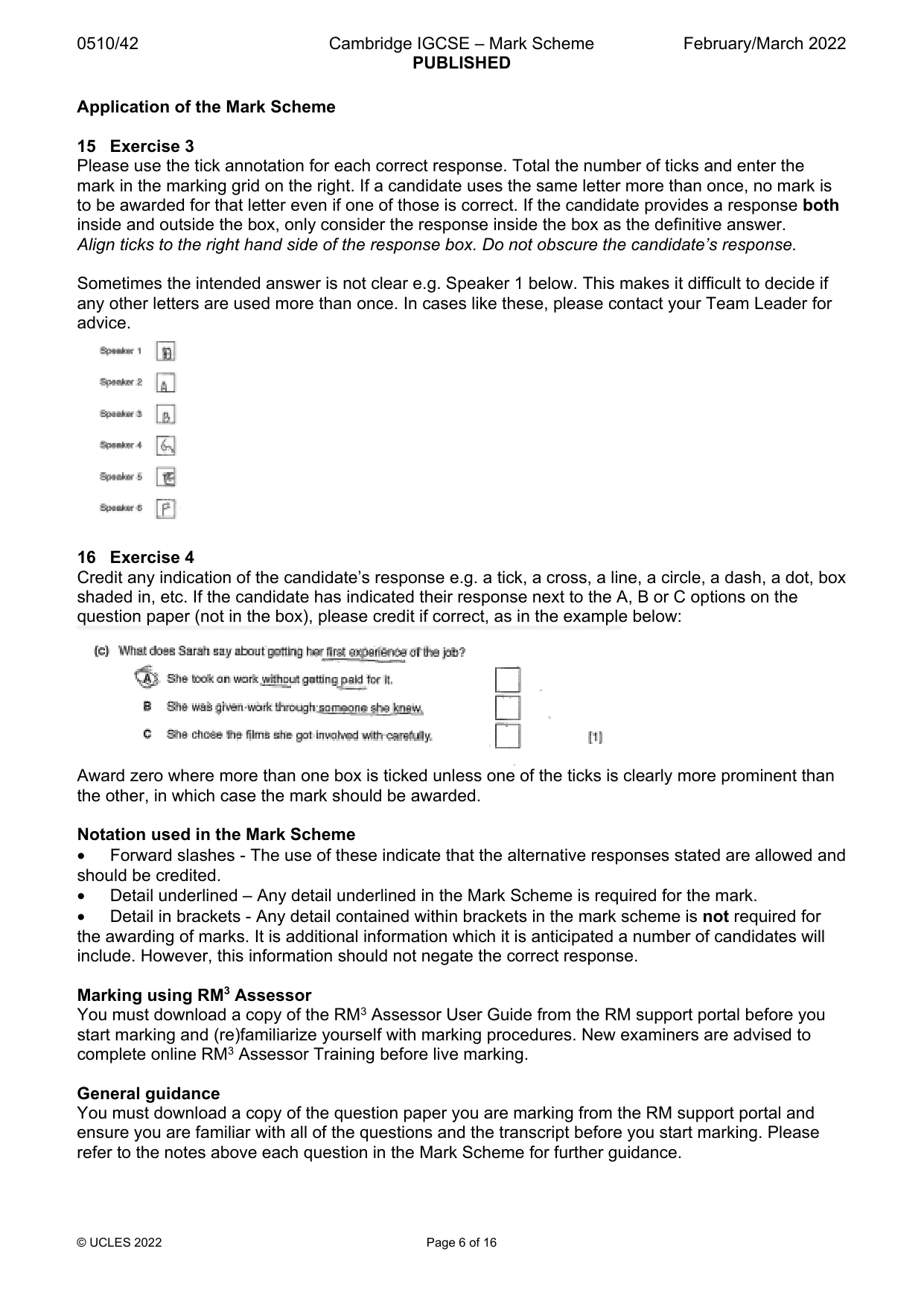
0510/42 Cambridge IGCSE – Mark Scheme PUBLISHED February/March 2022 © UCLES 2022 Page 6 of 16 Application of the Mark Scheme 15 Exercise 3 Please use the tick annotation for each correct response. Total the number of ticks and enter the mark in the marking grid on the right. If a candidate uses the same letter more than once, no mark is to be awarded for that letter even if one of those is correct. If the candidate provides a response both inside and outside the box, only consider the response inside the box as the definitive answer. Align ticks to the right hand side of the response box. Do not obscure the candidate’s response. Sometimes the intended answer is not clear e.g. Speaker 1 below. This makes it difficult to decide if any other letters are used more than once. In cases like these, please contact your Team Leader for advice. 16 Exercise 4 Credit any indication of the candidate’s response e.g. a tick, a cross, a line, a circle, a dash, a dot, box shaded in, etc. If the candidate has indicated their response next to the A, B or C options on the question paper (not in the box), please credit if correct, as in the example below: Award zero where more than one box is ticked unless one of the ticks is clearly more prominent than the other, in which case the mark should be awarded. Notation used in the Mark Scheme • Forward slashes - The use of these indicate that the alternative responses stated are allowed and should be credited. • Detail underlined – Any detail underlined in the Mark Scheme is required for the mark. • Detail in brackets - Any detail contained within brackets in the mark scheme is not required for the awarding of marks. It is additional information which it is anticipated a number of candidates will include. However, this information should not negate the correct response. Marking using RM3 Assessor You must download a copy of the RM3 Assessor User Guide from the RM support portal before you start marking and (re)familiarize yourself with marking procedures. New examiners are advised to complete online RM3 Assessor Training before live marking. General guidance You must download a copy of the question paper you are marking from the RM support portal and ensure you are familiar with all of the questions and the transcript before you start marking. Please refer to the notes above each question in the Mark Scheme for further guidance.
Mark scheme, page 7
0510/42 Cambridge IGCSE – Mark Scheme PUBLISHED February/March 2022 © UCLES 2022 Page 7 of 16 Practice scripts The practice scripts are designed to familiarise you with the Mark Scheme and they may contain common incorrect or unexpected answers. When you have worked through the practice scripts and are confident that you know how to apply the Mark Scheme, you may start marking the standardisation scripts. Standardisation scripts These are used to ensure all examiners are applying the Mark Scheme accurately and consistently. For this reason, your team leader cannot answer any queries about these scripts before they have been submitted. You should mark them very carefully according to the final Mark Scheme and guidance provided. Your team leader will then check your marking of the standardisation scripts and will provide feedback only after you have submitted all of them. If he/she is satisfied with your marking, you will be authorised to start live marking. If he/she is not satisfied, some, or all, of your scripts may be returned to you for remarking. If he/she is still not satisfied, then you will be asked to mark a second standardisation sample. You must complete the standardisation process and marking for 0510 before attempting to mark any other component. Seeded scripts ‘Seeded scripts’ enable your marking to be monitored throughout the marking period. These scripts have been given a definitive mark by the standardisation team. Your team leader will be able to check your marking against the definitive marks for the script and he/she may provide feedback to you. Additional objects You may come across a script with an ‘additional object’ attached to it. This may be a word- processed document (where the candidate has applied for special arrangements for the exam). You must check all of the ‘additional object’ as well as the question paper booklet to ensure that the entire candidate response has been seen and marked. Where you consider an answer is incomplete, please look for any additional writing on blank pages. Blank pages You must look at the blank pages at the end of the script to ensure that there is no additional material to be marked. Please mark all blank pages with the annotation ‘SEEN’ to show you have checked them.
Mark scheme, page 8
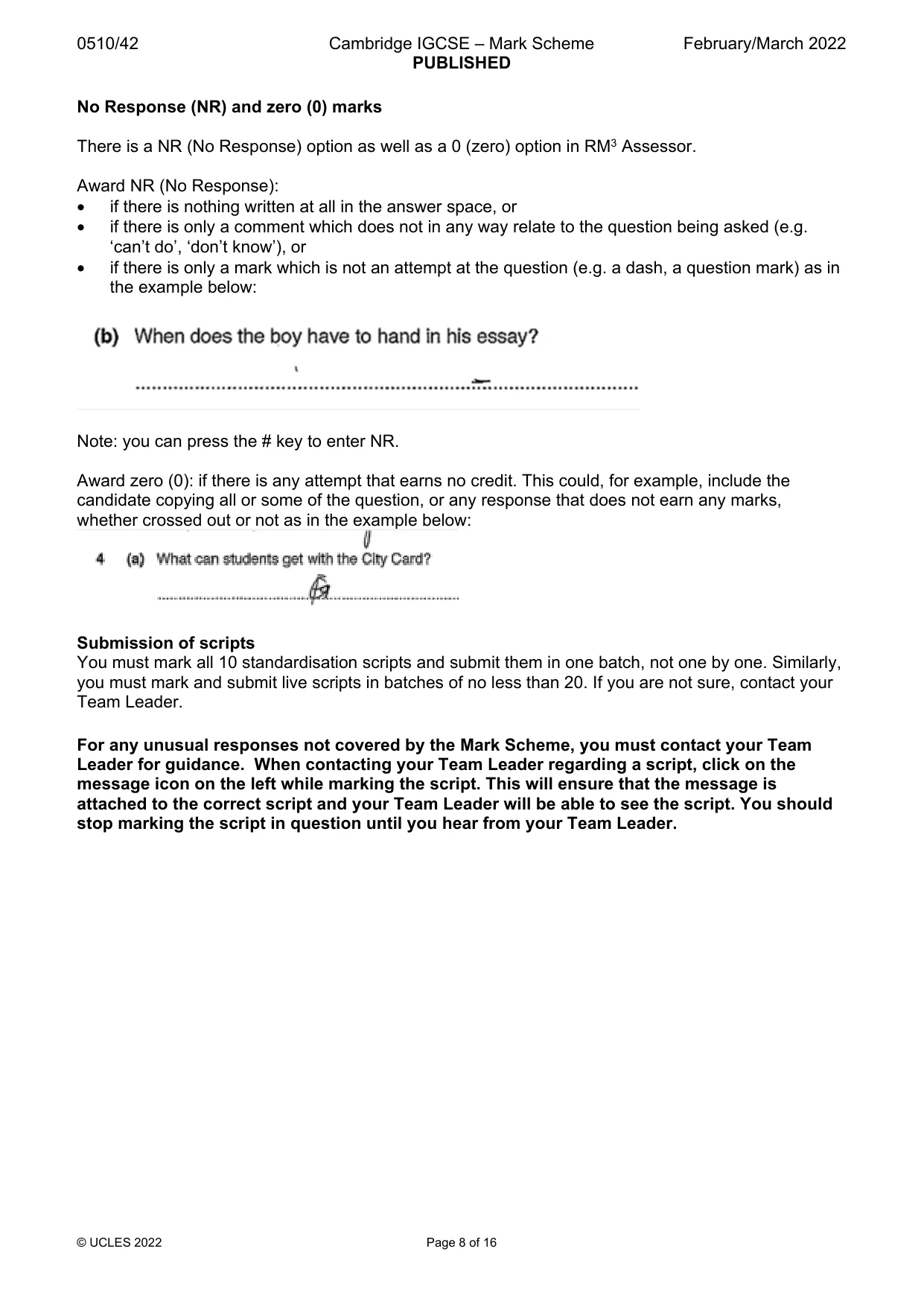
0510/42 Cambridge IGCSE – Mark Scheme PUBLISHED February/March 2022 © UCLES 2022 Page 8 of 16 No Response (NR) and zero (0) marks There is a NR (No Response) option as well as a 0 (zero) option in RM3 Assessor. Award NR (No Response): • if there is nothing written at all in the answer space, or • if there is only a comment which does not in any way relate to the question being asked (e.g. ‘can’t do’, ‘don’t know’), or • if there is only a mark which is not an attempt at the question (e.g. a dash, a question mark) as in the example below: Note: you can press the # key to enter NR. Award zero (0): if there is any attempt that earns no credit. This could, for example, include the candidate copying all or some of the question, or any response that does not earn any marks, whether crossed out or not as in the example below: Submission of scripts You must mark all 10 standardisation scripts and submit them in one batch, not one by one. Similarly, you must mark and submit live scripts in batches of no less than 20. If you are not sure, contact your Team Leader. For any unusual responses not covered by the Mark Scheme, you must contact your Team Leader for guidance. When contacting your Team Leader regarding a script, click on the message icon on the left while marking the script. This will ensure that the message is attached to the correct script and your Team Leader will be able to see the script. You should stop marking the script in question until you hear from your Team Leader.
Mark scheme, page 9
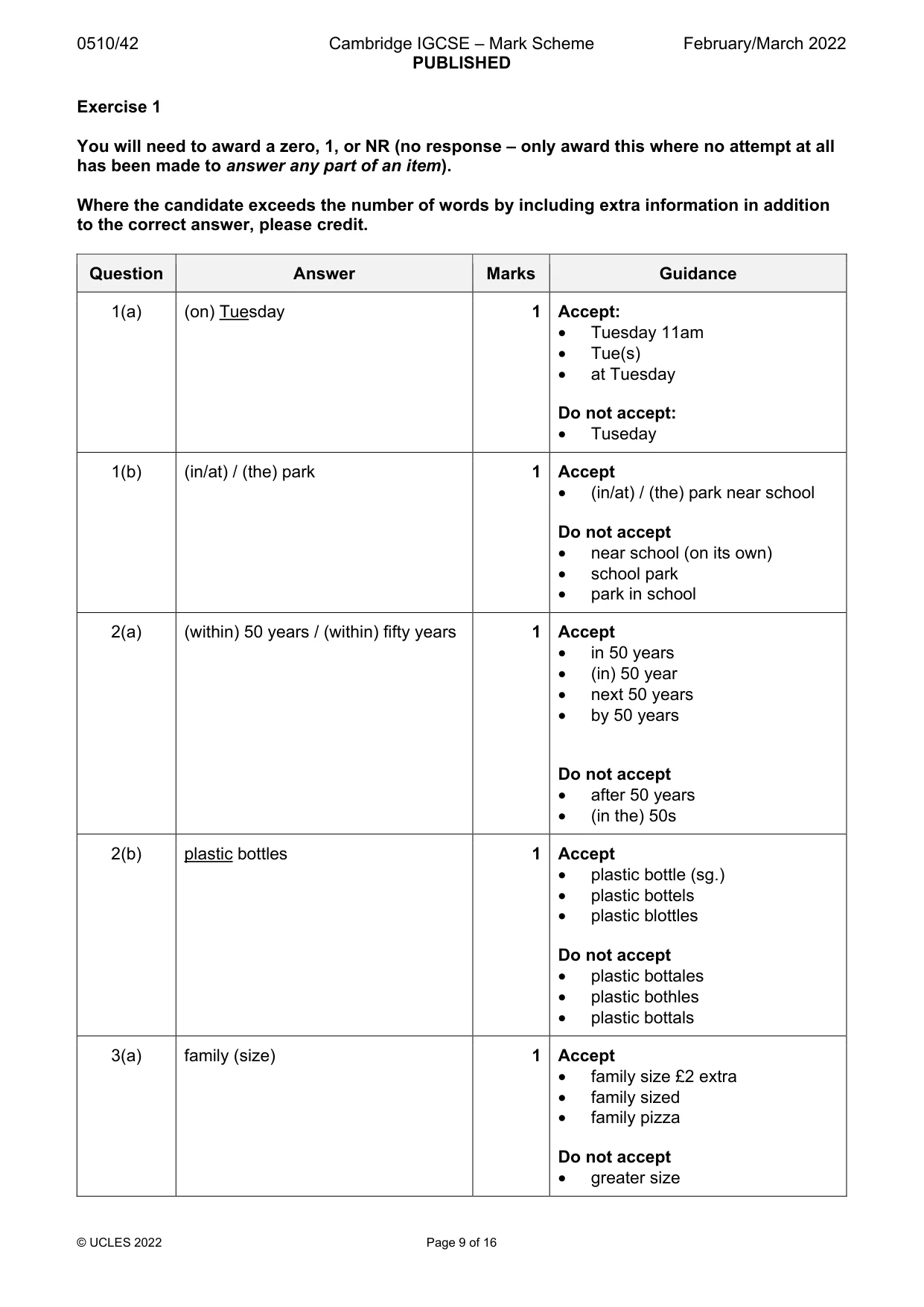
0510/42 Cambridge IGCSE – Mark Scheme PUBLISHED February/March 2022 © UCLES 2022 Page 9 of 16 Exercise 1 You will need to award a zero, 1, or NR (no response – only award this where no attempt at all has been made to answer any part of an item). Where the candidate exceeds the number of words by including extra information in addition to the correct answer, please credit. Question Answer Marks Guidance 1(a) (on) Tuesday 1 Accept: • Tuesday 11am • Tue(s) • at Tuesday Do not accept: • Tuseday 1(b) (in/at) / (the) park 1 Accept • (in/at) / (the) park near school Do not accept • near school (on its own) • school park • park in school 2(a) (within) 50 years / (within) fifty years 1 Accept • in 50 years • (in) 50 year • next 50 years • by 50 years Do not accept • after 50 years • (in the) 50s 2(b) plastic bottles 1 Accept • plastic bottle (sg.) • plastic bottels • plastic blottles Do not accept • plastic bottales • plastic bothles • plastic bottals 3(a) family (size) 1 Accept • family size £2 extra • family sized • family pizza Do not accept • greater size
Mark scheme, page 10
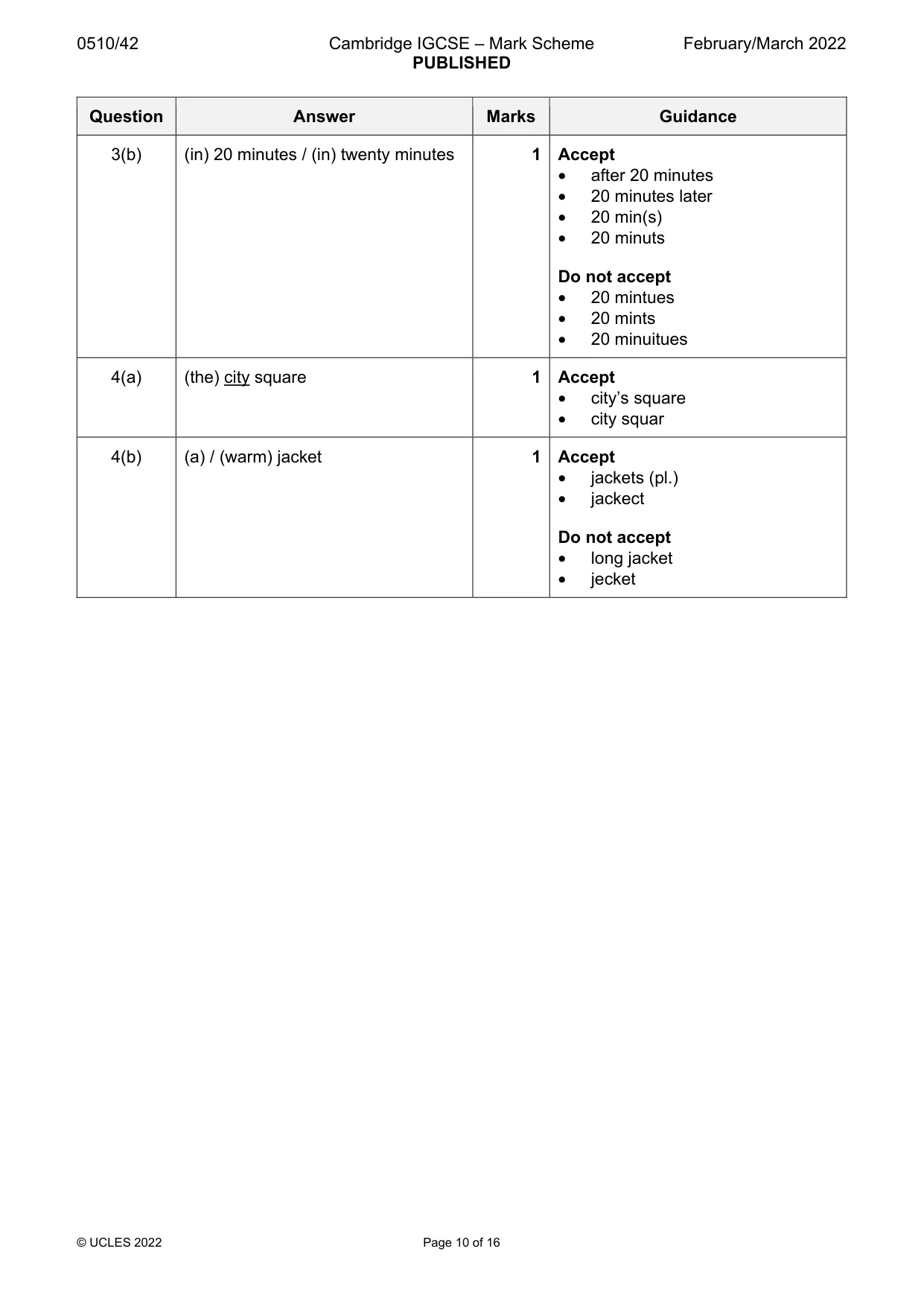
0510/42 Cambridge IGCSE – Mark Scheme PUBLISHED February/March 2022 © UCLES 2022 Page 10 of 16 Question Answer Marks Guidance 3(b) (in) 20 minutes / (in) twenty minutes 1 Accept • after 20 minutes • 20 minutes later • 20 min(s) • 20 minuts Do not accept • 20 mintues • 20 mints • 20 minuitues 4(a) (the) city square 1 Accept • city’s square • city squar 4(b) (a) / (warm) jacket 1 Accept • jackets (pl.) • jackect Do not accept • long jacket • jecket
Mark scheme, page 11
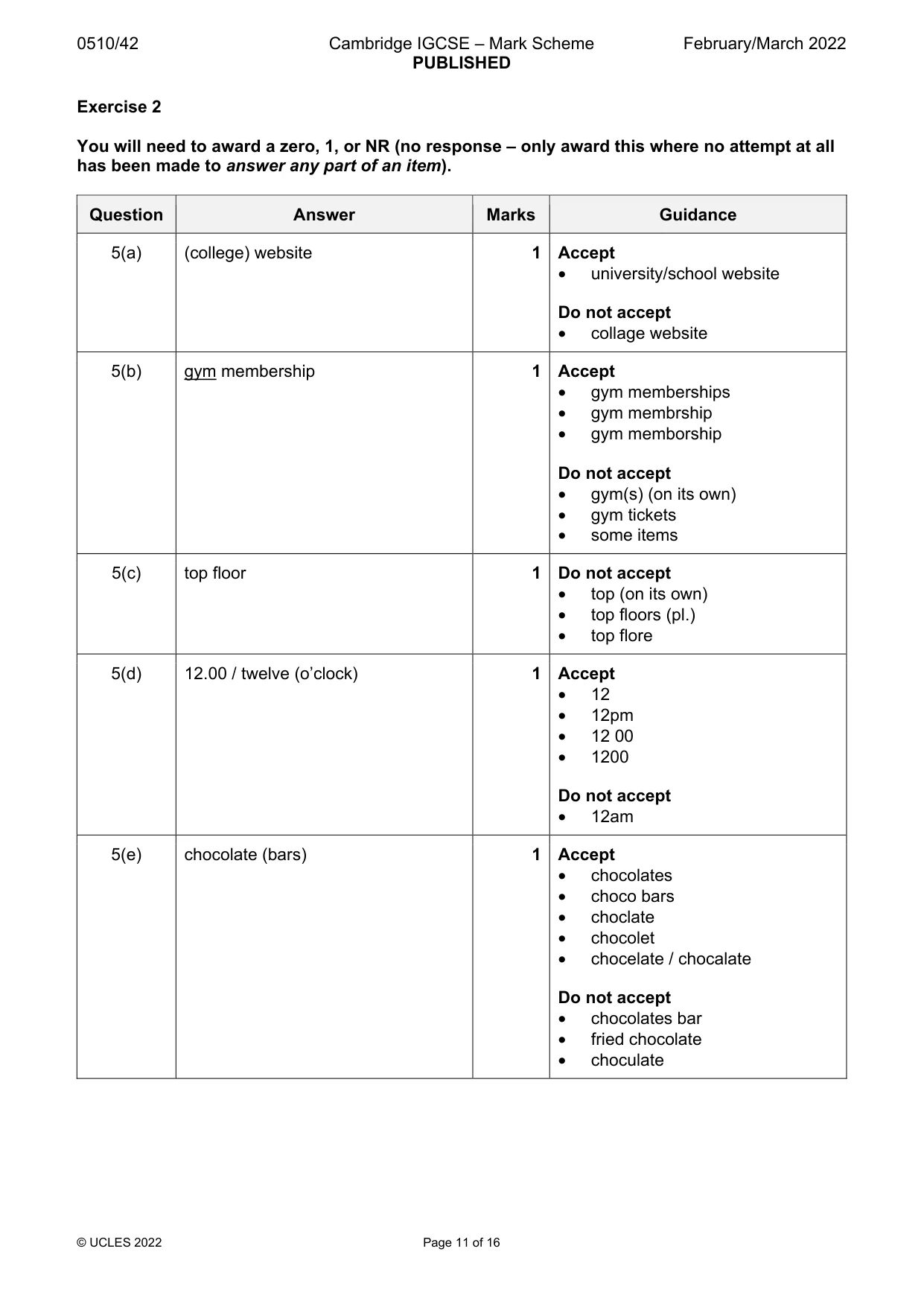
0510/42 Cambridge IGCSE – Mark Scheme PUBLISHED February/March 2022 © UCLES 2022 Page 11 of 16 Exercise 2 You will need to award a zero, 1, or NR (no response – only award this where no attempt at all has been made to answer any part of an item). Question Answer Marks Guidance 5(a) (college) website 1 Accept • university/school website Do not accept • collage website 5(b) gym membership 1 Accept • gym memberships • gym membrship • gym memborship Do not accept • gym(s) (on its own) • gym tickets • some items 5(c) top floor 1 Do not accept • top (on its own) • top floors (pl.) • top flore 5(d) 12.00 / twelve (o’clock) 1 Accept • 12 • 12pm • 12 00 • 1200 Do not accept • 12am 5(e) chocolate (bars) 1 Accept • chocolates • choco bars • choclate • chocolet • chocelate / chocalate Do not accept • chocolates bar • fried chocolate • choculate
Mark scheme, page 12
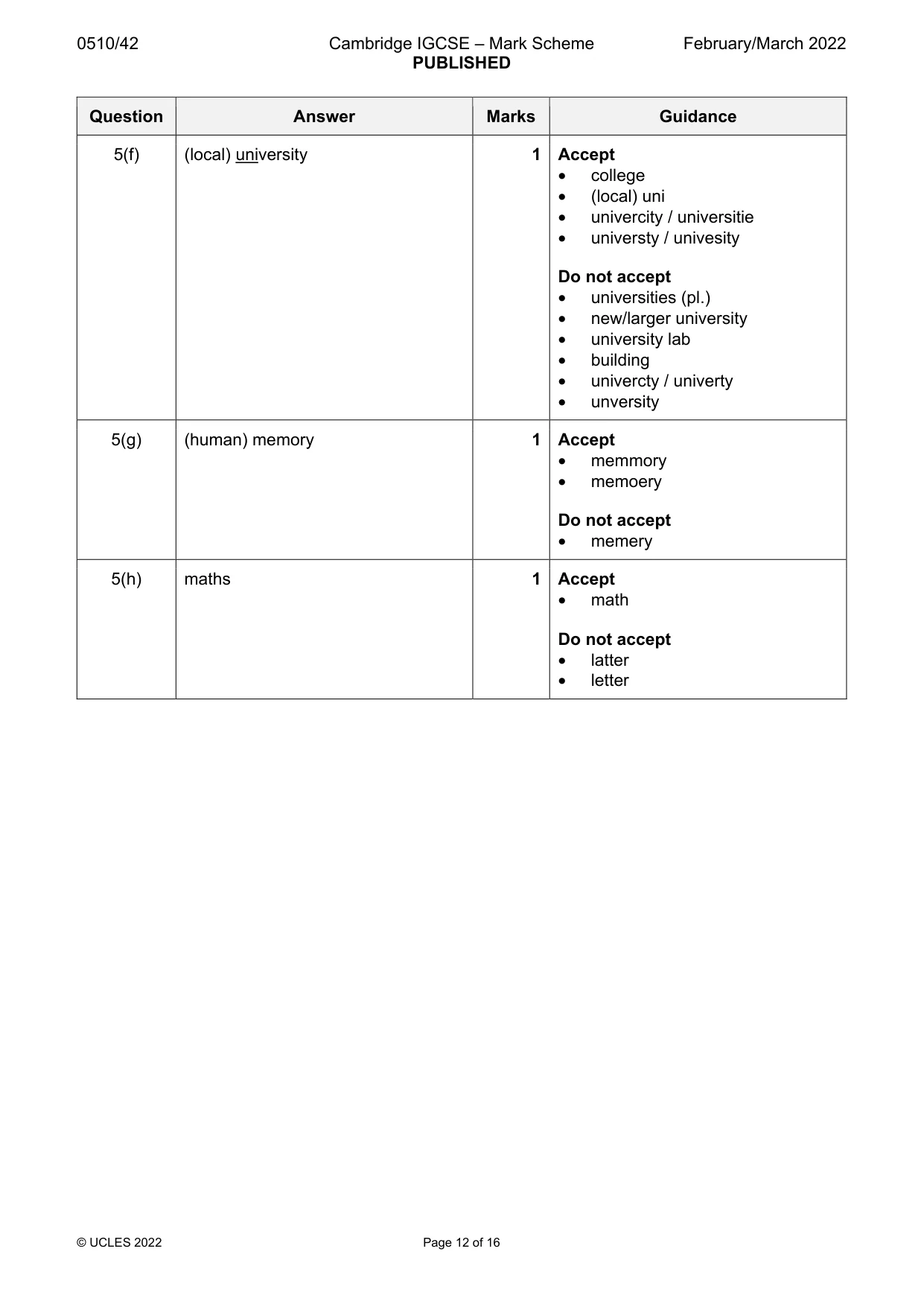
0510/42 Cambridge IGCSE – Mark Scheme PUBLISHED February/March 2022 © UCLES 2022 Page 12 of 16 Question Answer Marks Guidance 5(f) (local) university 1 Accept • college • (local) uni • univercity / universitie • universty / univesity Do not accept • universities (pl.) • new/larger university • university lab • building • univercty / univerty • unversity 5(g) (human) memory 1 Accept • memmory • memoery Do not accept • memery 5(h) maths 1 Accept • math Do not accept • latter • letter
Mark scheme, page 13
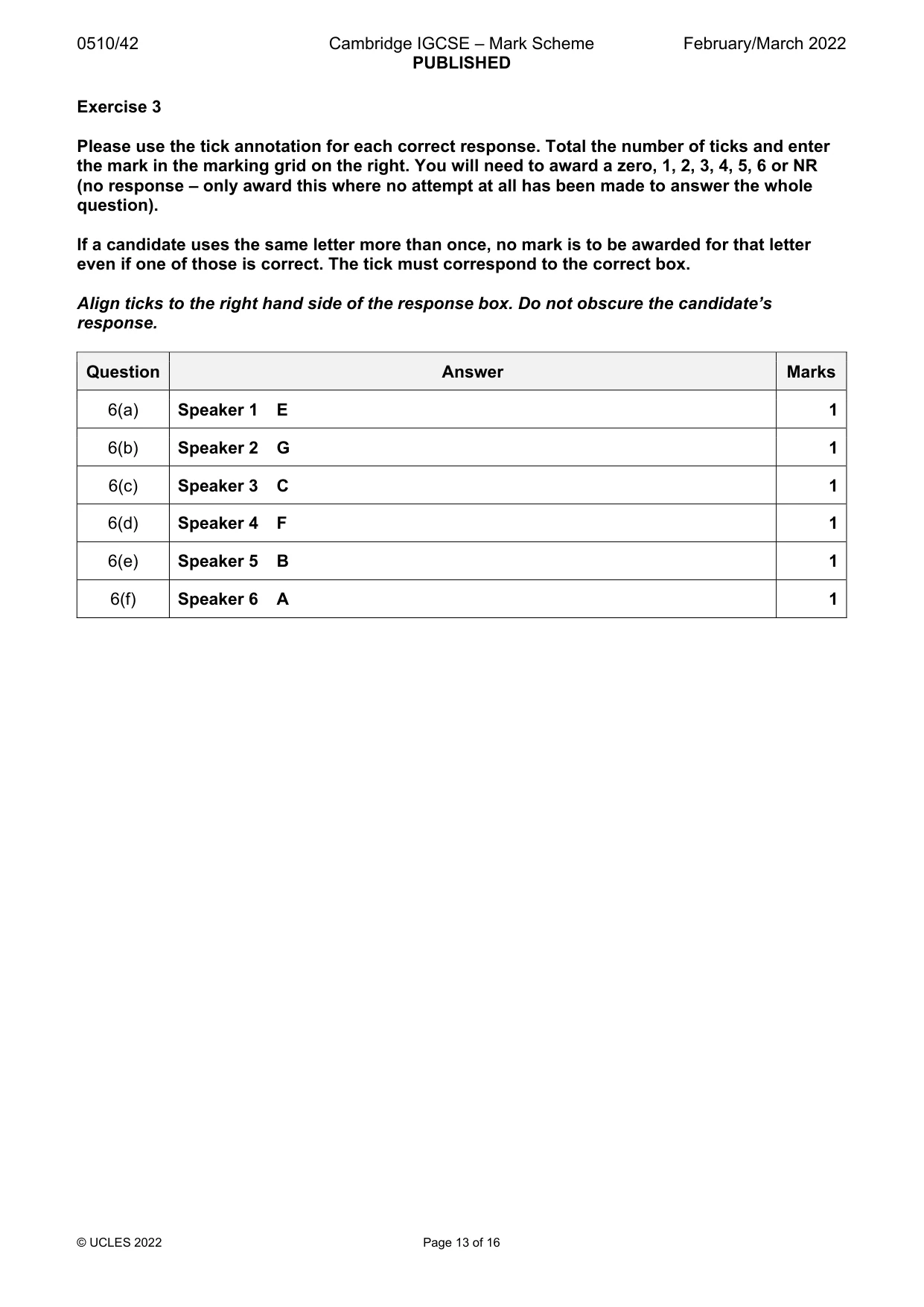
0510/42 Cambridge IGCSE – Mark Scheme PUBLISHED February/March 2022 © UCLES 2022 Page 13 of 16 Exercise 3 Please use the tick annotation for each correct response. Total the number of ticks and enter the mark in the marking grid on the right. You will need to award a zero, 1, 2, 3, 4, 5, 6 or NR (no response – only award this where no attempt at all has been made to answer the whole question). If a candidate uses the same letter more than once, no mark is to be awarded for that letter even if one of those is correct. The tick must correspond to the correct box. Align ticks to the right hand side of the response box. Do not obscure the candidate’s response. Question Answer Marks 6(a) Speaker 1 E 1 6(b) Speaker 2 G 1 6(c) Speaker 3 C 1 6(d) Speaker 4 F 1 6(e) Speaker 5 B 1 6(f) Speaker 6 A 1
Mark scheme, page 14
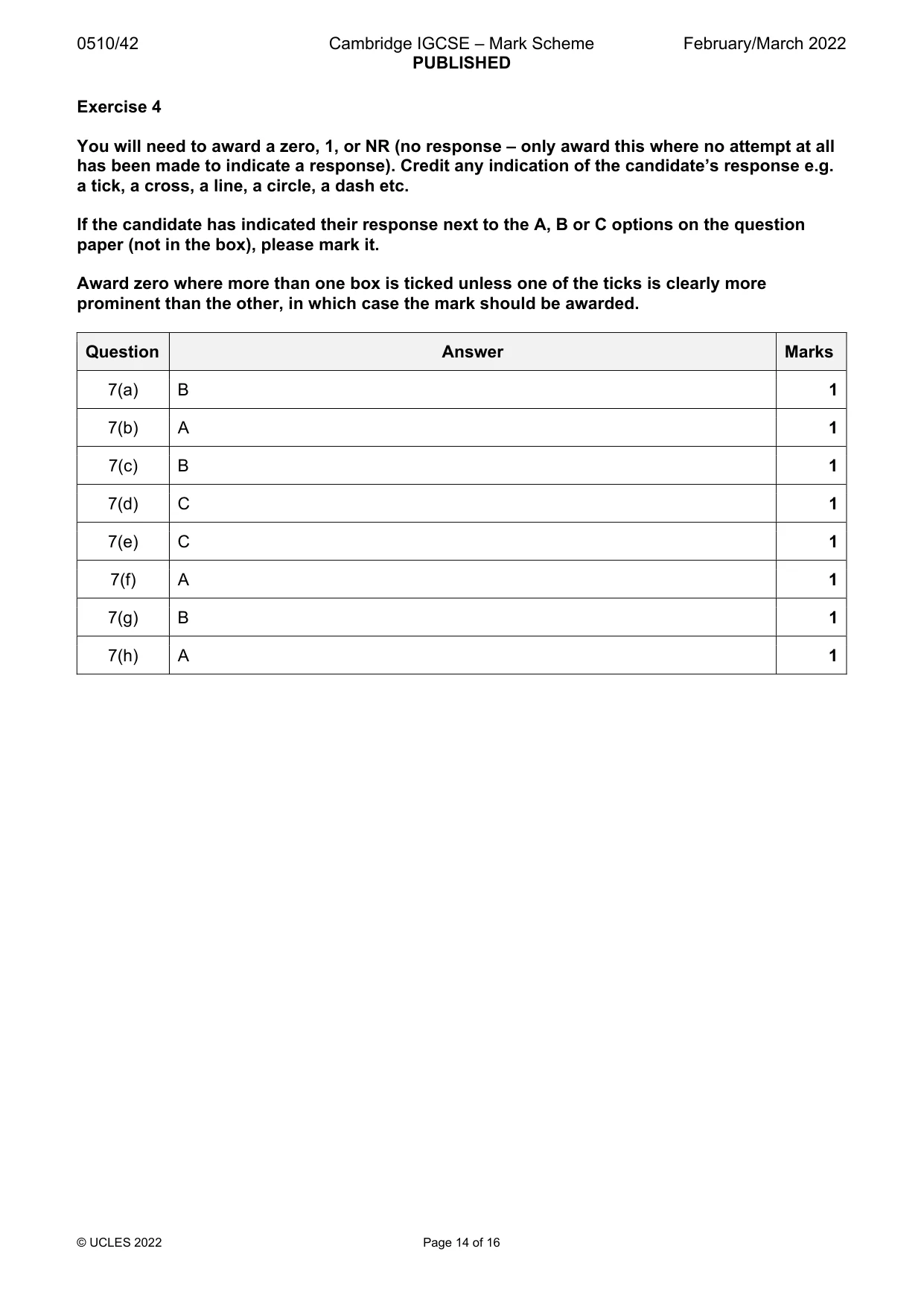
0510/42 Cambridge IGCSE – Mark Scheme PUBLISHED February/March 2022 © UCLES 2022 Page 14 of 16 Exercise 4 You will need to award a zero, 1, or NR (no response – only award this where no attempt at all has been made to indicate a response). Credit any indication of the candidate’s response e.g. a tick, a cross, a line, a circle, a dash etc. If the candidate has indicated their response next to the A, B or C options on the question paper (not in the box), please mark it. Award zero where more than one box is ticked unless one of the ticks is clearly more prominent than the other, in which case the mark should be awarded. Question Answer Marks 7(a) B 1 7(b) A 1 7(c) B 1 7(d) C 1 7(e) C 1 7(f) A 1 7(g) B 1 7(h) A 1
Mark scheme, page 15
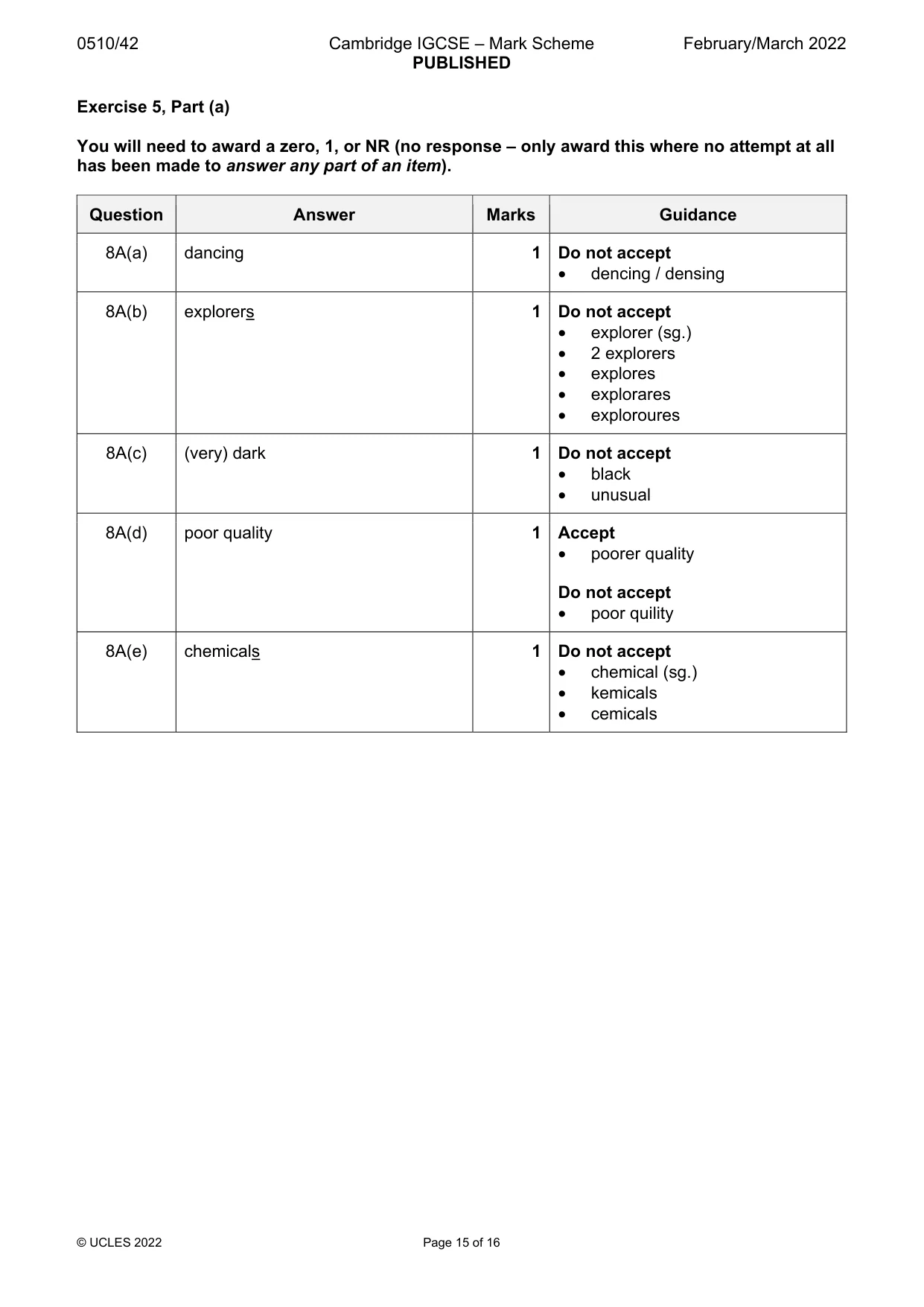
0510/42 Cambridge IGCSE – Mark Scheme PUBLISHED February/March 2022 © UCLES 2022 Page 15 of 16 Exercise 5, Part (a) You will need to award a zero, 1, or NR (no response – only award this where no attempt at all has been made to answer any part of an item). Question Answer Marks Guidance 8A(a) dancing 1 Do not accept • dencing / densing 8A(b) explorers 1 Do not accept • explorer (sg.) • 2 explorers • explores • explorares • exploroures 8A(c) (very) dark 1 Do not accept • black • unusual 8A(d) poor quality 1 Accept • poorer quality Do not accept • poor quility 8A(e) chemicals 1 Do not accept • chemical (sg.) • kemicals • cemicals
Mark scheme, page 16
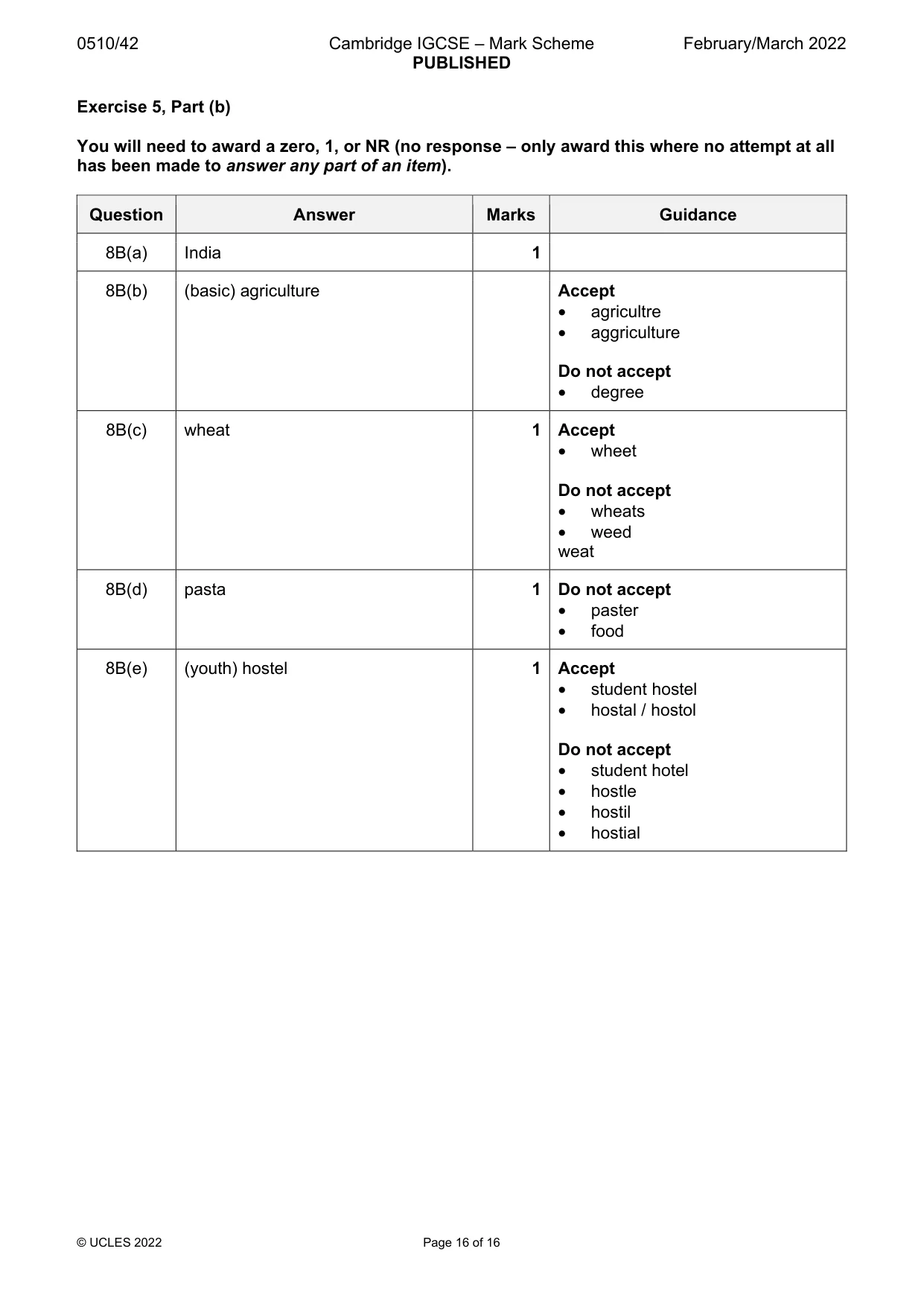
0510/42 Cambridge IGCSE – Mark Scheme PUBLISHED February/March 2022 © UCLES 2022 Page 16 of 16 Exercise 5, Part (b) You will need to award a zero, 1, or NR (no response – only award this where no attempt at all has been made to answer any part of an item). Question Answer Marks Guidance 8B(a) India 1 8B(b) (basic) agriculture Accept • agricultre • aggriculture Do not accept • degree 8B(c) wheat 1 Accept • wheet Do not accept • wheats • weed weat 8B(d) pasta 1 Do not accept • paster • food 8B(e) (youth) hostel 1 Accept • student hostel • hostal / hostol Do not accept • student hotel • hostle • hostil • hostial
What you needed in this session
Cambridge’s own grade thresholds for 2022 Feb/March, Paper 4 · Variant 2. A higher threshold means an easier paper — the bar moves with how the cohort did.