Cambridge IGCSE English - Second Language (oral endorsement) 0510 — 2018 Oct/Nov Paper 4 · Variant 1
0510/41/O/N/18 · 40 marks · ≈45 min
The question paper and its mark scheme, free to read here and free to download. This is Cambridge’s own paper, exactly as it was sat.
Question paper12 pages

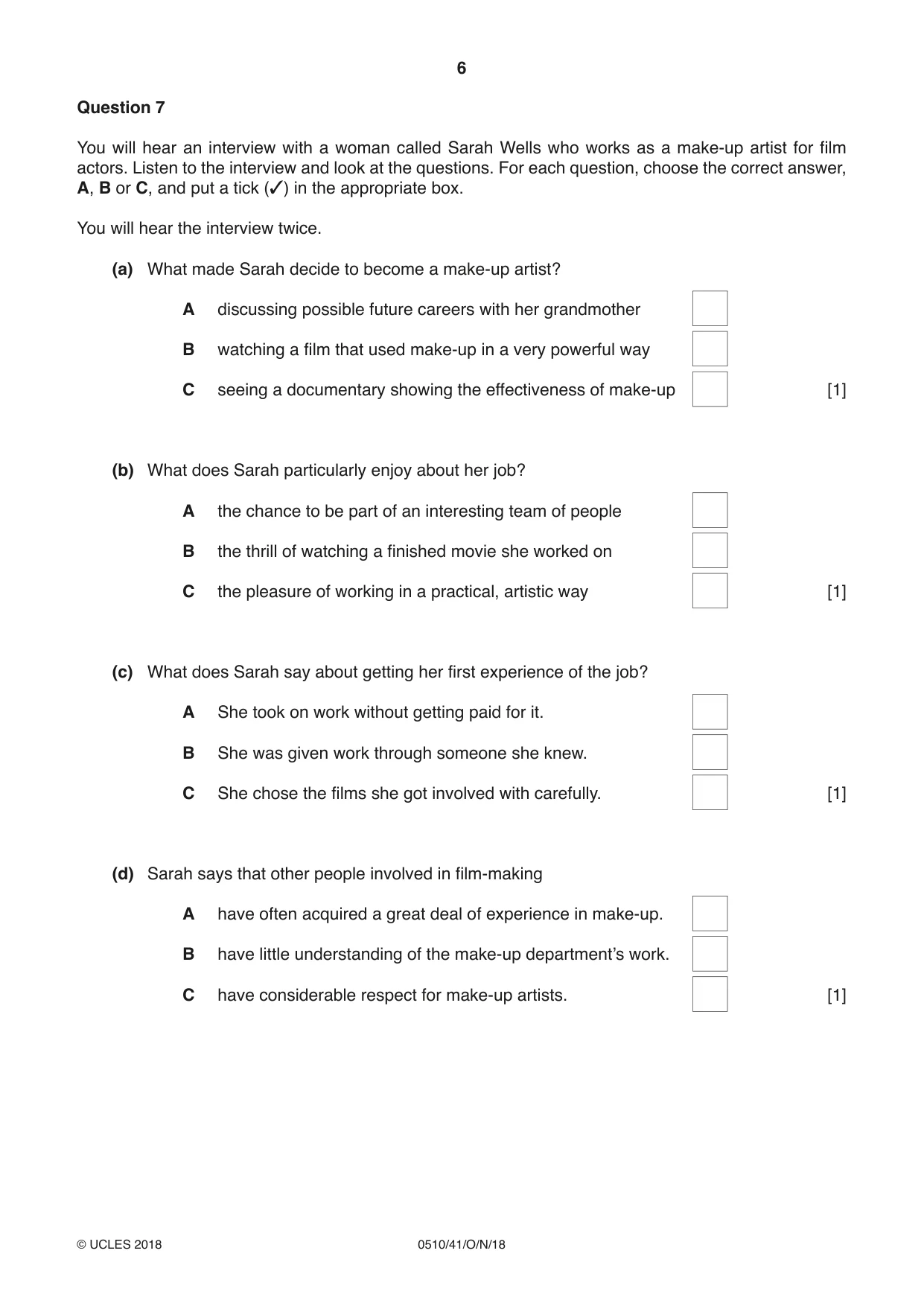



Mark scheme4 pages
Answers below. Sit the paper first if you are practising.
Paper as text
Question paper, page 1
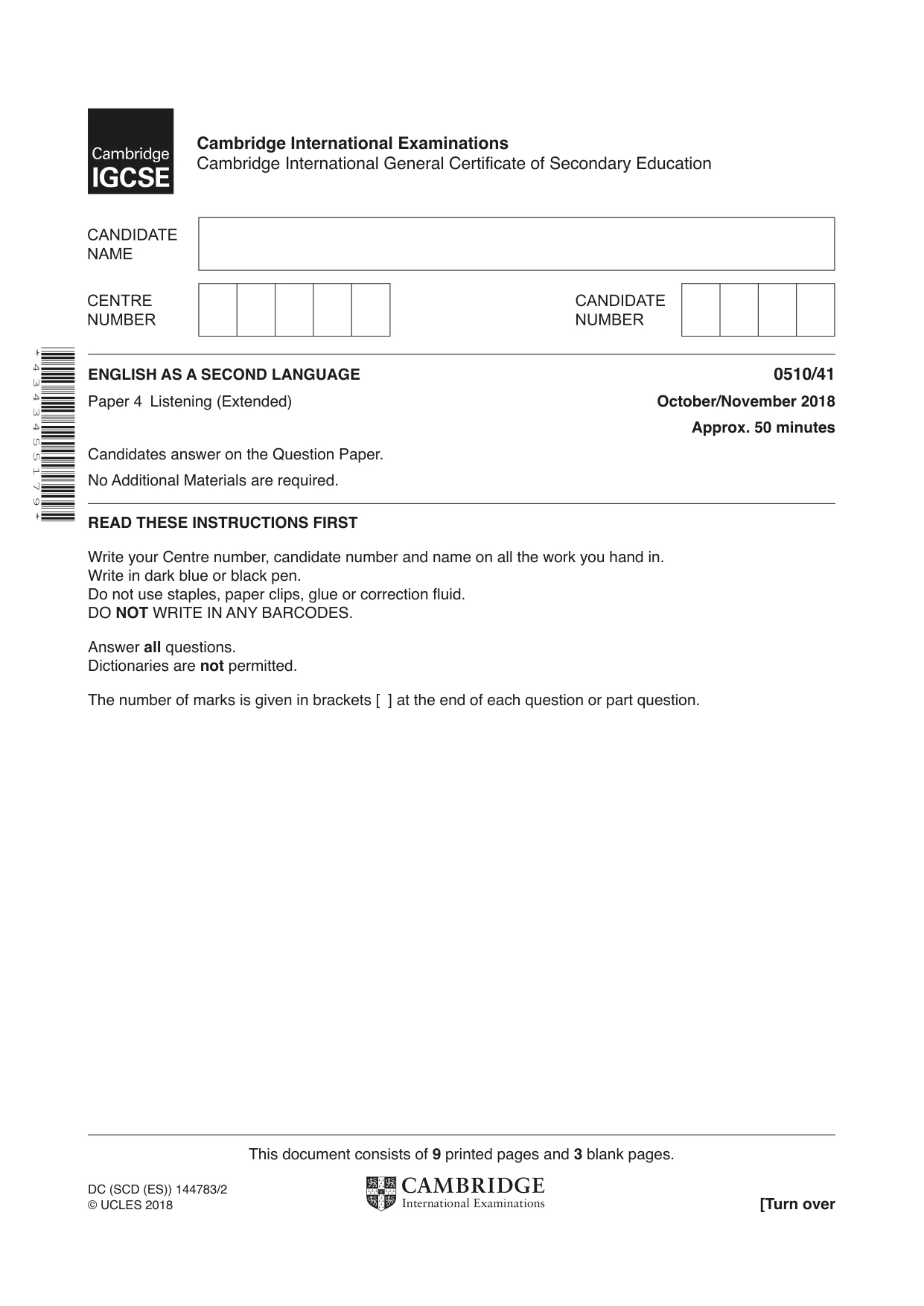
This document consists of 9 printed pages and 3 blank pages. DC (SCD (ES)) 144783/2 © UCLES 2018 [Turn over Cambridge International Examinations Cambridge International General Certificate of Secondary Education * 4 3 4 3 4 5 5 1 7 9 * ENGLISH AS A SECOND LANGUAGE 0510/41 Paper 4 Listening (Extended) October/November 2018 Approx. 50 minutes Candidates answer on the Question Paper. No Additional Materials are required. READ THESE INSTRUCTIONS FIRST Write your Centre number, candidate number and name on all the work you hand in. Write in dark blue or black pen. Do not use staples, paper clips, glue or correction fluid. DO NOT WRITE IN ANY BARCODES. Answer all questions. Dictionaries are not permitted. The number of marks is given in brackets [ ] at the end of each question or part question.
Question paper, page 2
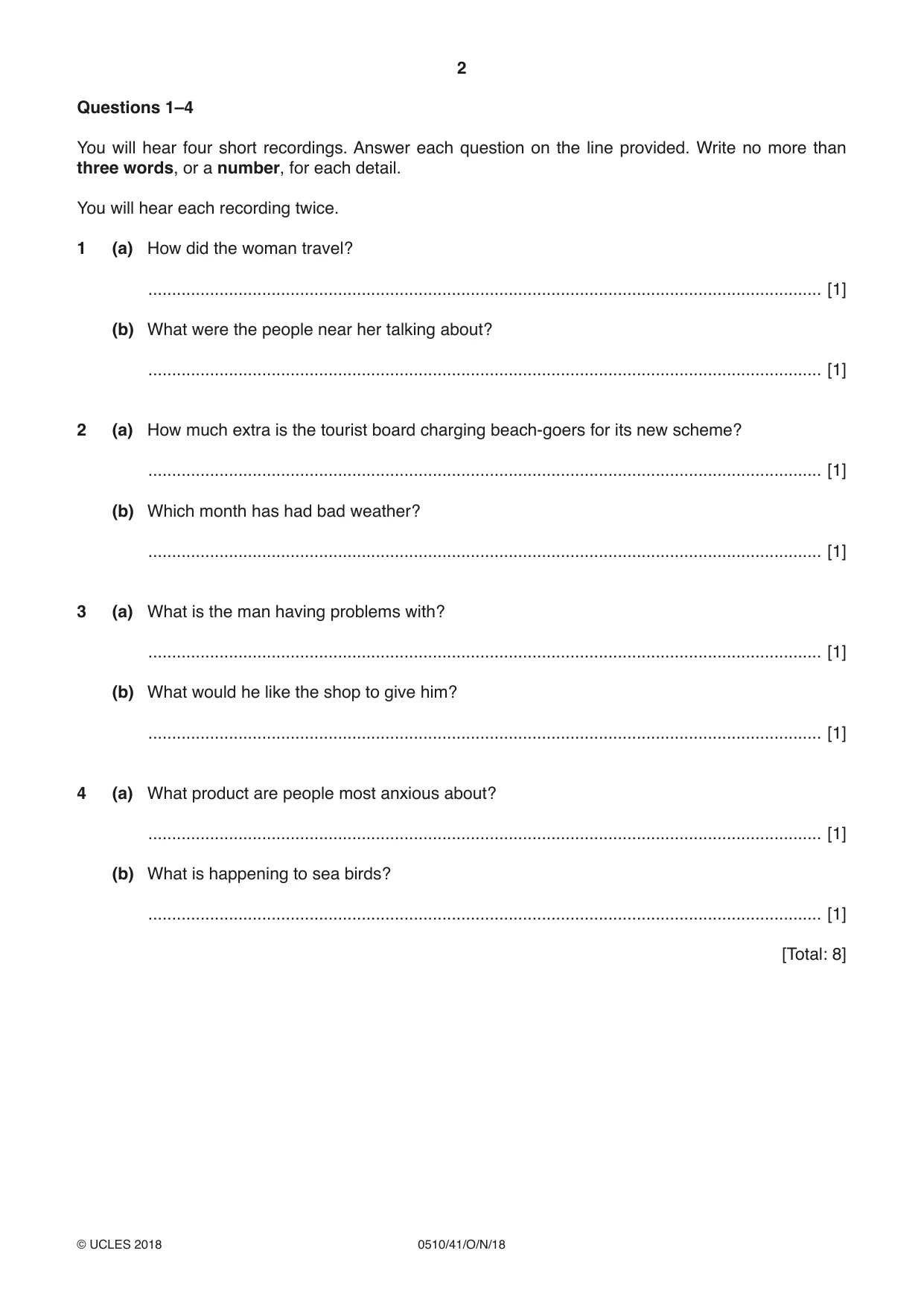
2 0510/41/O/N/18 © UCLES 2018 Questions 1–4 You will hear four short recordings. Answer each question on the line provided. Write no more than three words, or a number, for each detail. You will hear each recording twice. 1 (a) How did the woman travel? … [1] (b) What were the people near her talking about? … [1] 2 (a) How much extra is the tourist board charging beach-goers for its new scheme? … [1] (b) Which month has had bad weather? … [1] 3 (a) What is the man having problems with? … [1] (b) What would he like the shop to give him? … [1] 4 (a) What product are people most anxious about? … [1] (b) What is happening to sea birds? … [1] [Total: 8]
Question paper, page 3
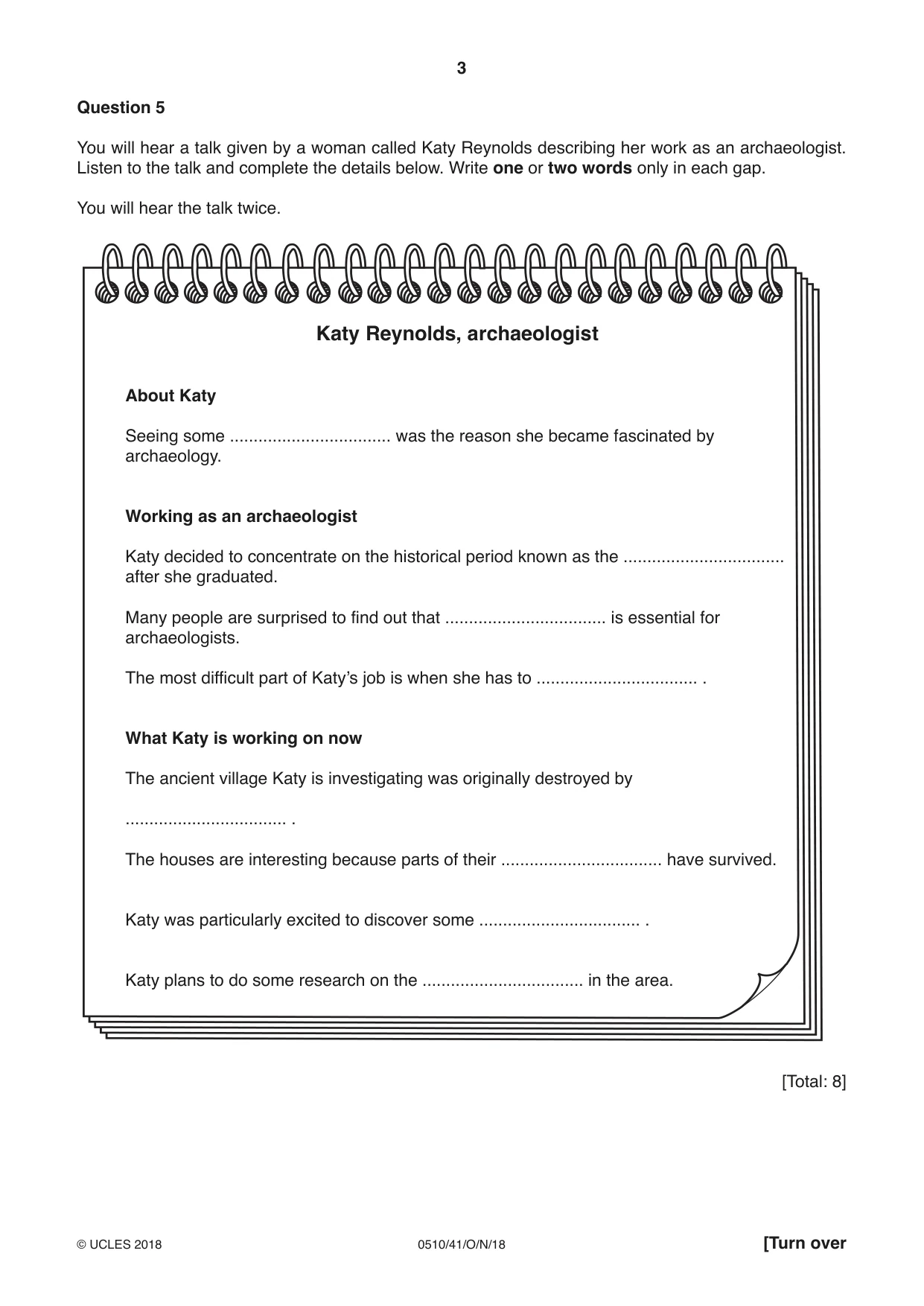
3 0510/41/O/N/18 © UCLES 2018 [Turn over Question 5 You will hear a talk given by a woman called Katy Reynolds describing her work as an archaeologist. Listen to the talk and complete the details below. Write one or two words only in each gap. You will hear the talk twice. Katy Reynolds, archaeologist About Katy Seeing some … was the reason she became fascinated by archaeology. Working as an archaeologist Katy decided to concentrate on the historical period known as the … after she graduated. Many people are surprised to find out that … is essential for archaeologists. The most difficult part of Katy’s job is when she has to … . What Katy is working on now The ancient village Katy is investigating was originally destroyed by … . The houses are interesting because parts of their … have survived. Katy was particularly excited to discover some … . Katy plans to do some research on the … in the area. [Total: 8]
Question paper, page 4
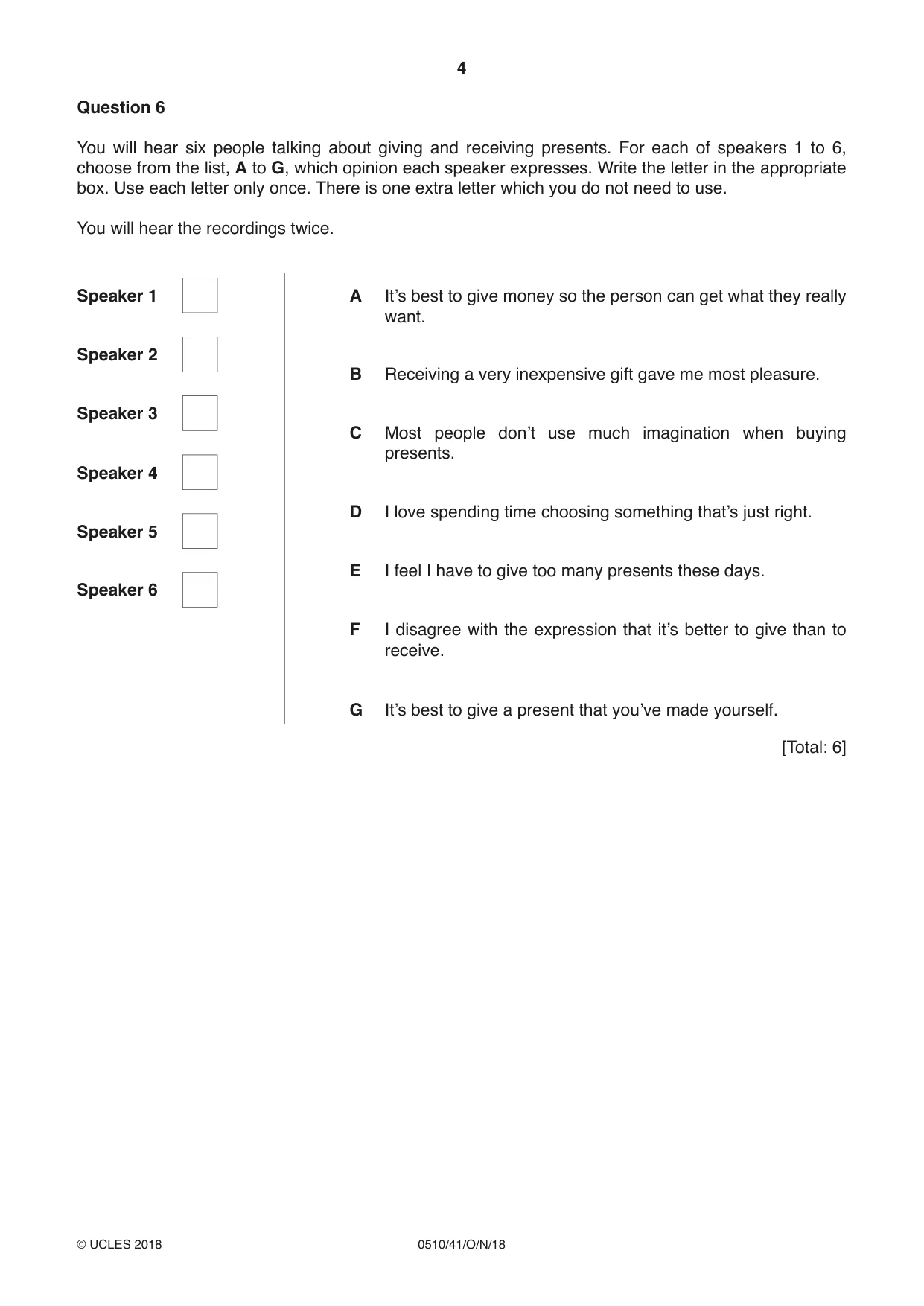
4 0510/41/O/N/18 © UCLES 2018 Question 6 You will hear six people talking about giving and receiving presents. For each of speakers 1 to 6, choose from the list, A to G, which opinion each speaker expresses. Write the letter in the appropriate box. Use each letter only once. There is one extra letter which you do not need to use. You will hear the recordings twice. Speaker 1 A It’s best to give money so the person can get what they really want. Speaker 2 B Receiving a very inexpensive gift gave me most pleasure. Speaker 3 C Most people don’t use much imagination when buying presents. Speaker 4 D I love spending time choosing something that’s just right. Speaker 5 E I feel I have to give too many presents these days. Speaker 6 F I disagree with the expression that it’s better to give than to receive. G It’s best to give a present that you’ve made yourself. [Total: 6]
Question paper, page 5
5 0510/41/O/N/18 © UCLES 2018 [Turn over Please turn over for Question 7.
Question paper, page 6
6 0510/41/O/N/18 © UCLES 2018 Question 7 You will hear an interview with a woman called Sarah Wells who works as a make-up artist for film actors. Listen to the interview and look at the questions. For each question, choose the correct answer, A, B or C, and put a tick (✓) in the appropriate box. You will hear the interview twice. (a) What made Sarah decide to become a make-up artist? A discussing possible future careers with her grandmother B watching a film that used make-up in a very powerful way C seeing a documentary showing the effectiveness of make-up [1] (b) What does Sarah particularly enjoy about her job? A the chance to be part of an interesting team of people B the thrill of watching a finished movie she worked on C the pleasure of working in a practical, artistic way [1] (c) What does Sarah say about getting her first experience of the job? A She took on work without getting paid for it. B She was given work through someone she knew. C She chose the films she got involved with carefully. [1] (d) Sarah says that other people involved in film-making A have often acquired a great deal of experience in make-up. B have little understanding of the make-up department’s work. C have considerable respect for make-up artists. [1]
Question paper, page 7
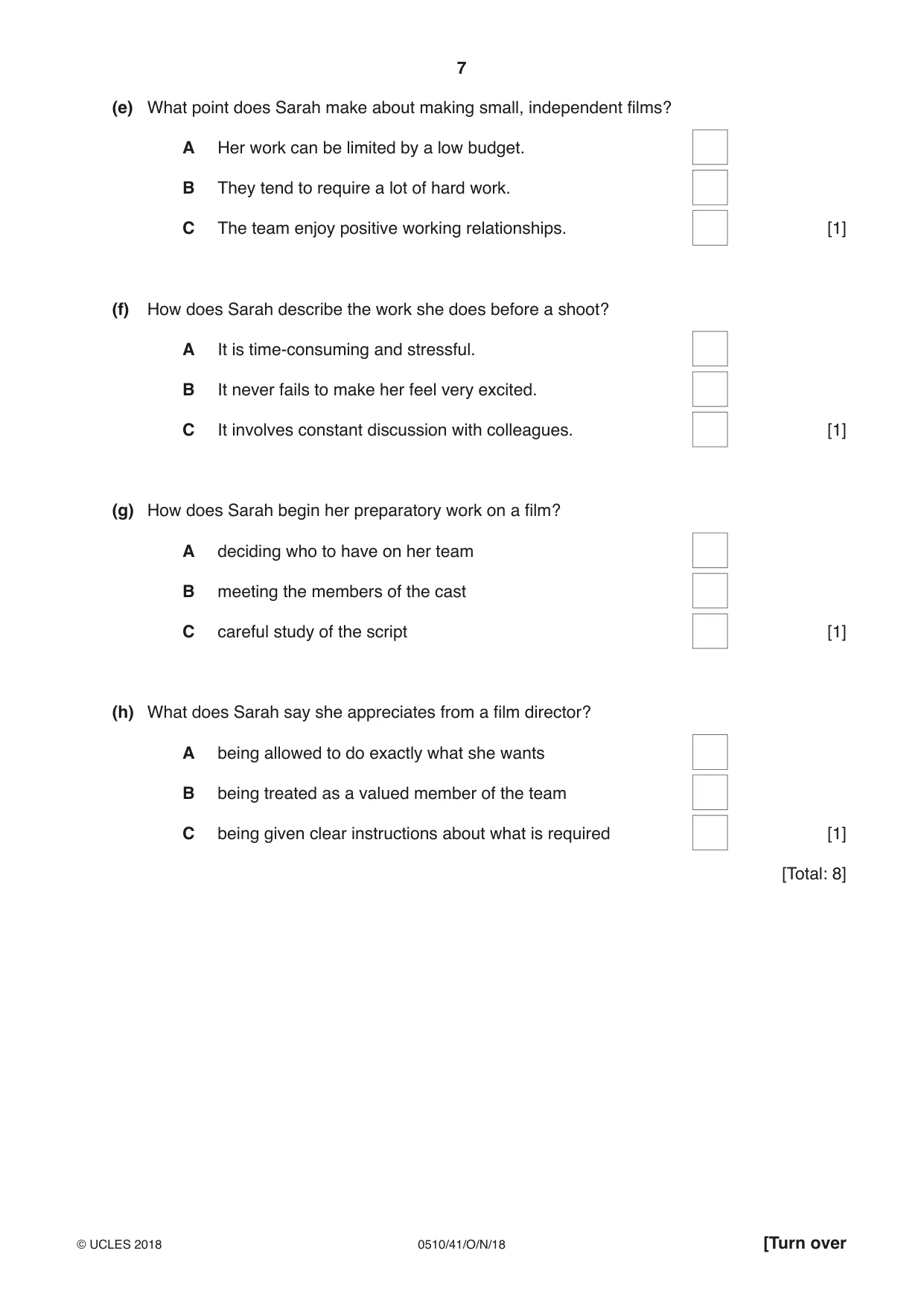
7 0510/41/O/N/18 © UCLES 2018 [Turn over (e) What point does Sarah make about making small, independent films? A Her work can be limited by a low budget. B They tend to require a lot of hard work. C The team enjoy positive working relationships. [1] (f) How does Sarah describe the work she does before a shoot? A It is time-consuming and stressful. B It never fails to make her feel very excited. C It involves constant discussion with colleagues. [1] (g) How does Sarah begin her preparatory work on a film? A deciding who to have on her team B meeting the members of the cast C careful study of the script [1] (h) What does Sarah say she appreciates from a film director? A being allowed to do exactly what she wants B being treated as a valued member of the team C being given clear instructions about what is required [1] [Total: 8]
Question paper, page 8
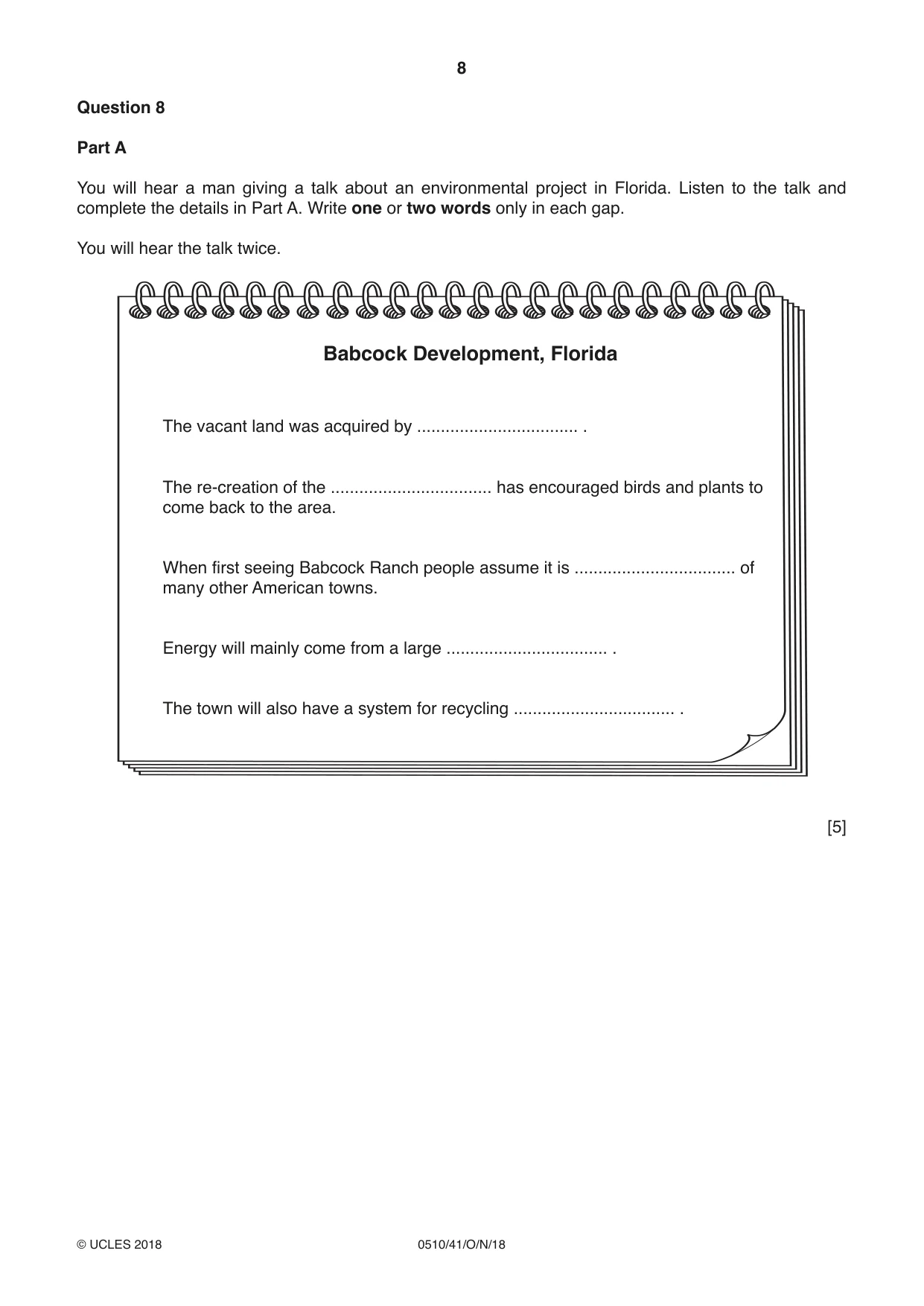
8 0510/41/O/N/18 © UCLES 2018 Question 8 Part A You will hear a man giving a talk about an environmental project in Florida. Listen to the talk and complete the details in Part A. Write one or two words only in each gap. You will hear the talk twice. [5] Babcock Development, Florida The vacant land was acquired by … . The re-creation of the … has encouraged birds and plants to come back to the area. When first seeing Babcock Ranch people assume it is … of many other American towns. Energy will mainly come from a large … . The town will also have a system for recycling … .
Question paper, page 9
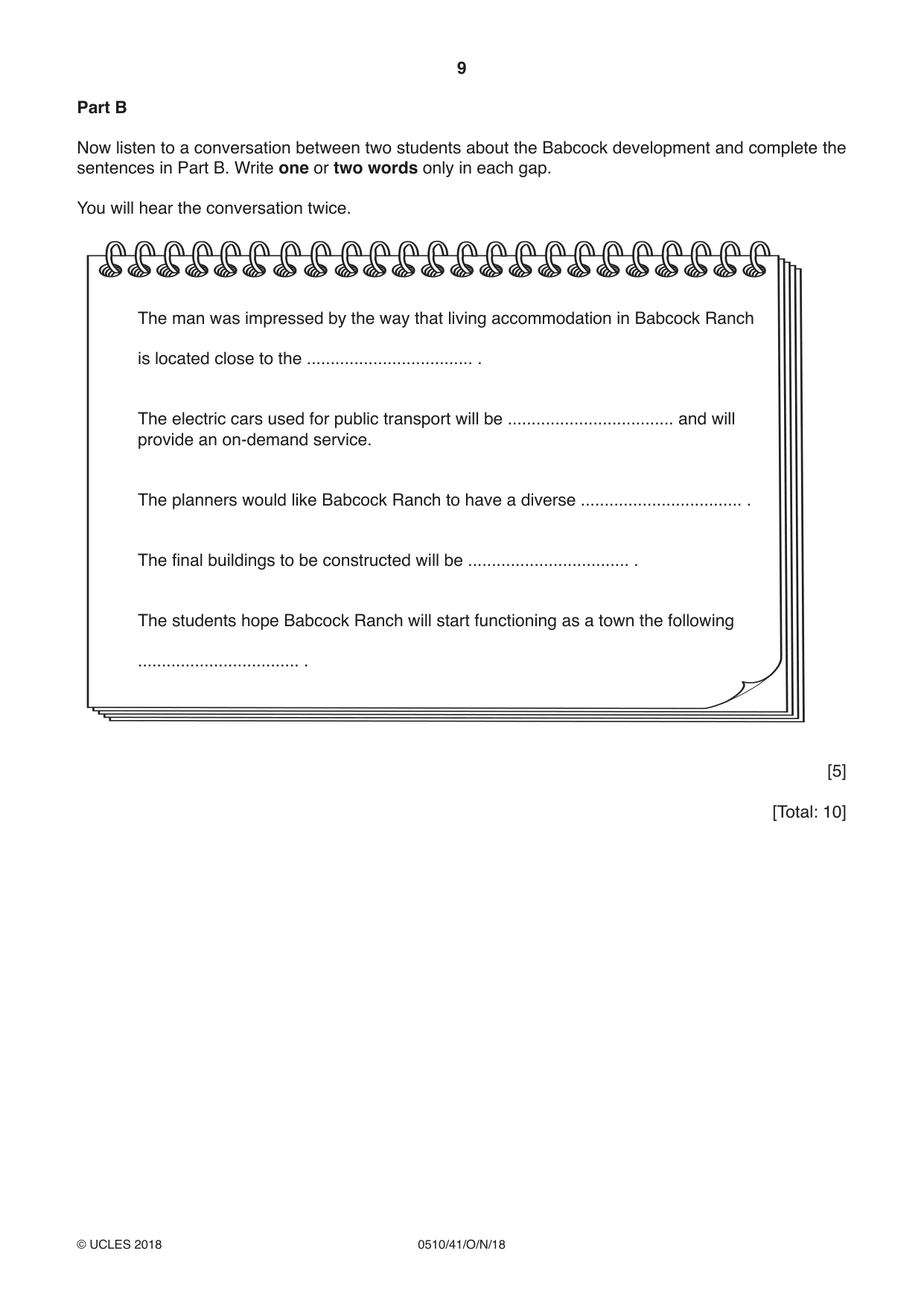
9 0510/41/O/N/18 © UCLES 2018 Part B Now listen to a conversation between two students about the Babcock development and complete the sentences in Part B. Write one or two words only in each gap. You will hear the conversation twice. [5] [Total: 10] The man was impressed by the way that living accommodation in Babcock Ranch is located close to the … . The electric cars used for public transport will be … and will provide an on-demand service. The planners would like Babcock Ranch to have a diverse … . The final buildings to be constructed will be … . The students hope Babcock Ranch will start functioning as a town the following … .
Question paper, page 10
10 0510/41/O/N/18 © UCLES 2018 BLANK PAGE
Question paper, page 11
11 0510/41/O/N/18 © UCLES 2018 BLANK PAGE
Question paper, page 12
12 0510/41/O/N/18 © UCLES 2018 BLANK PAGE Permission to reproduce items where third-party owned material protected by copyright is included has been sought and cleared where possible. Every reasonable effort has been made by the publisher (UCLES) to trace copyright holders, but if any items requiring clearance have unwittingly been included, the publisher will be pleased to make amends at the earliest possible opportunity. To avoid the issue of disclosure of answer-related information to candidates, all copyright acknowledgements are reproduced online in the Cambridge International Examinations Copyright Acknowledgements Booklet. This is produced for each series of examinations and is freely available to download at www.cie.org.uk after the live examination series. Cambridge International Examinations is part of the Cambridge Assessment Group. Cambridge Assessment is the brand name of University of Cambridge Local Examinations Syndicate (UCLES), which is itself a department of the University of Cambridge.
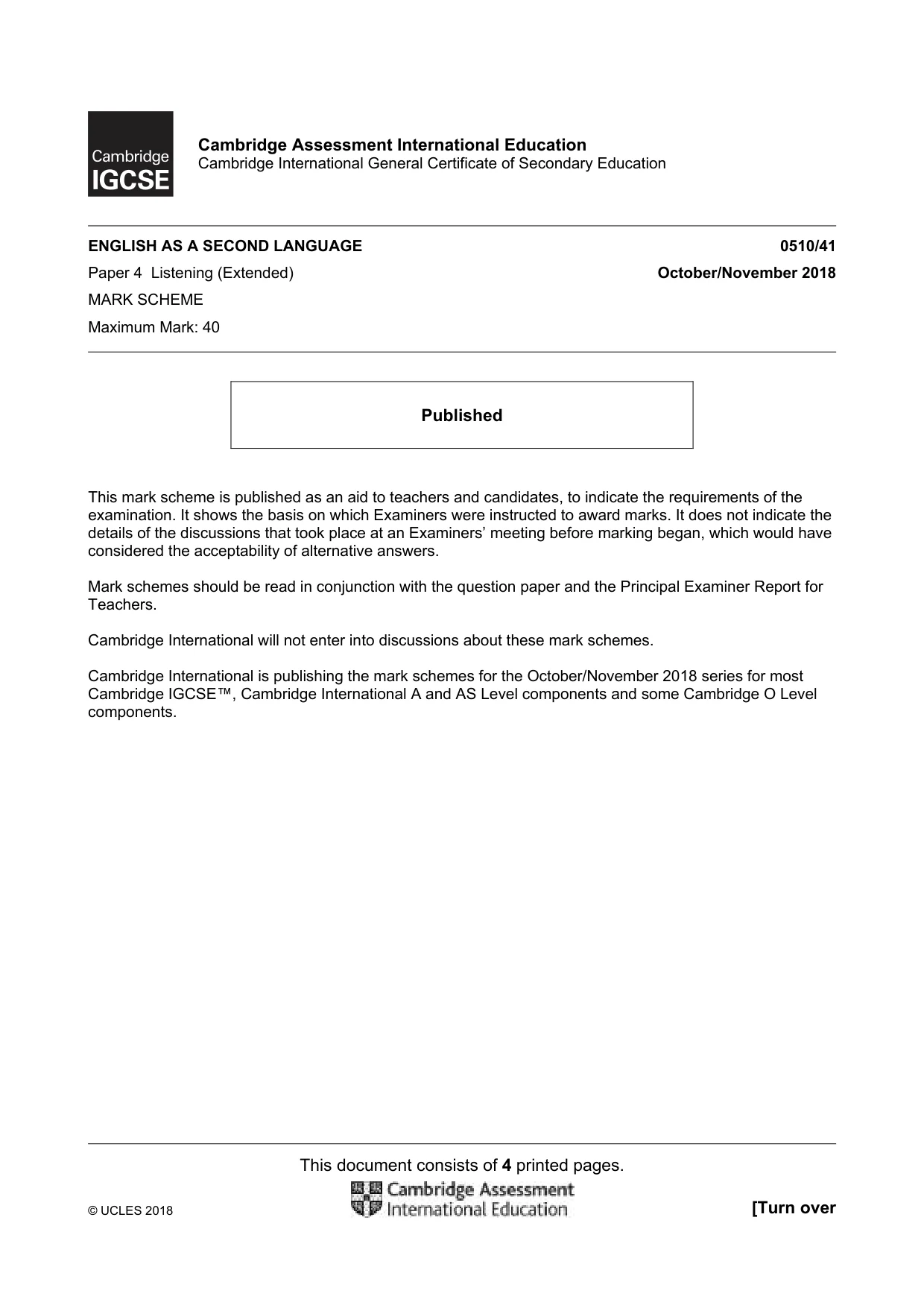
Mark scheme, page 1
This document consists of 4 printed pages. © UCLES 2018 [Turn over Cambridge Assessment International Education Cambridge International General Certificate of Secondary Education ENGLISH AS A SECOND LANGUAGE 0510/41 Paper 4 Listening (Extended) October/November 2018 MARK SCHEME Maximum Mark: 40 Published This mark scheme is published as an aid to teachers and candidates, to indicate the requirements of the examination. It shows the basis on which Examiners were instructed to award marks. It does not indicate the details of the discussions that took place at an Examiners’ meeting before marking began, which would have considered the acceptability of alternative answers. Mark schemes should be read in conjunction with the question paper and the Principal Examiner Report for Teachers. Cambridge International will not enter into discussions about these mark schemes. Cambridge International is publishing the mark schemes for the October/November 2018 series for most Cambridge IGCSE™, Cambridge International A and AS Level components and some Cambridge O Level components.
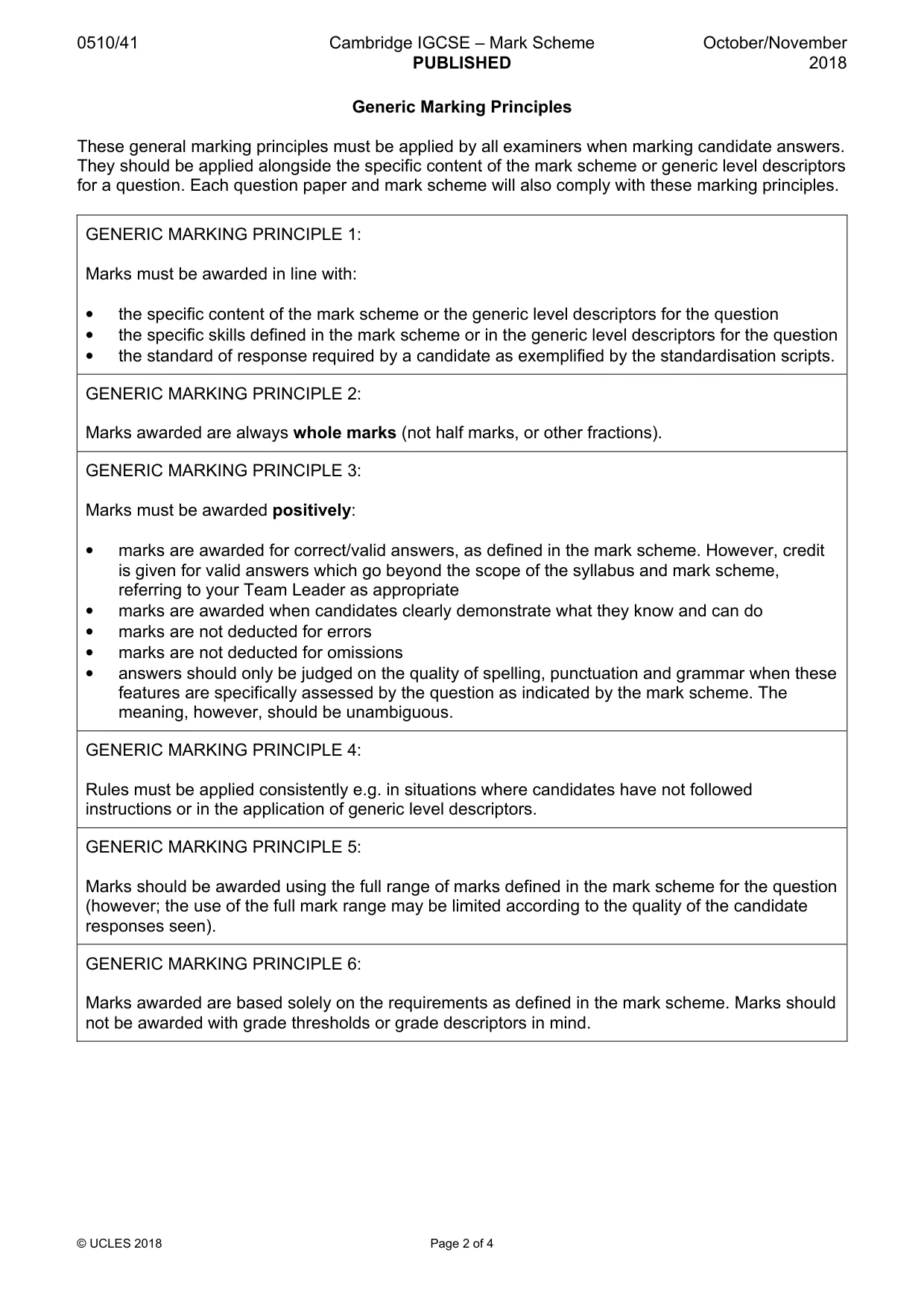
Mark scheme, page 2
0510/41 Cambridge IGCSE – Mark Scheme PUBLISHED October/November 2018 © UCLES 2018 Page 2 of 4 Generic Marking Principles These general marking principles must be applied by all examiners when marking candidate answers. They should be applied alongside the specific content of the mark scheme or generic level descriptors for a question. Each question paper and mark scheme will also comply with these marking principles. GENERIC MARKING PRINCIPLE 1: Marks must be awarded in line with: • the specific content of the mark scheme or the generic level descriptors for the question • the specific skills defined in the mark scheme or in the generic level descriptors for the question • the standard of response required by a candidate as exemplified by the standardisation scripts. GENERIC MARKING PRINCIPLE 2: Marks awarded are always whole marks (not half marks, or other fractions). GENERIC MARKING PRINCIPLE 3: Marks must be awarded positively: • marks are awarded for correct/valid answers, as defined in the mark scheme. However, credit is given for valid answers which go beyond the scope of the syllabus and mark scheme, referring to your Team Leader as appropriate • marks are awarded when candidates clearly demonstrate what they know and can do • marks are not deducted for errors • marks are not deducted for omissions • answers should only be judged on the quality of spelling, punctuation and grammar when these features are specifically assessed by the question as indicated by the mark scheme. The meaning, however, should be unambiguous. GENERIC MARKING PRINCIPLE 4: Rules must be applied consistently e.g. in situations where candidates have not followed instructions or in the application of generic level descriptors. GENERIC MARKING PRINCIPLE 5: Marks should be awarded using the full range of marks defined in the mark scheme for the question (however; the use of the full mark range may be limited according to the quality of the candidate responses seen). GENERIC MARKING PRINCIPLE 6: Marks awarded are based solely on the requirements as defined in the mark scheme. Marks should not be awarded with grade thresholds or grade descriptors in mind.
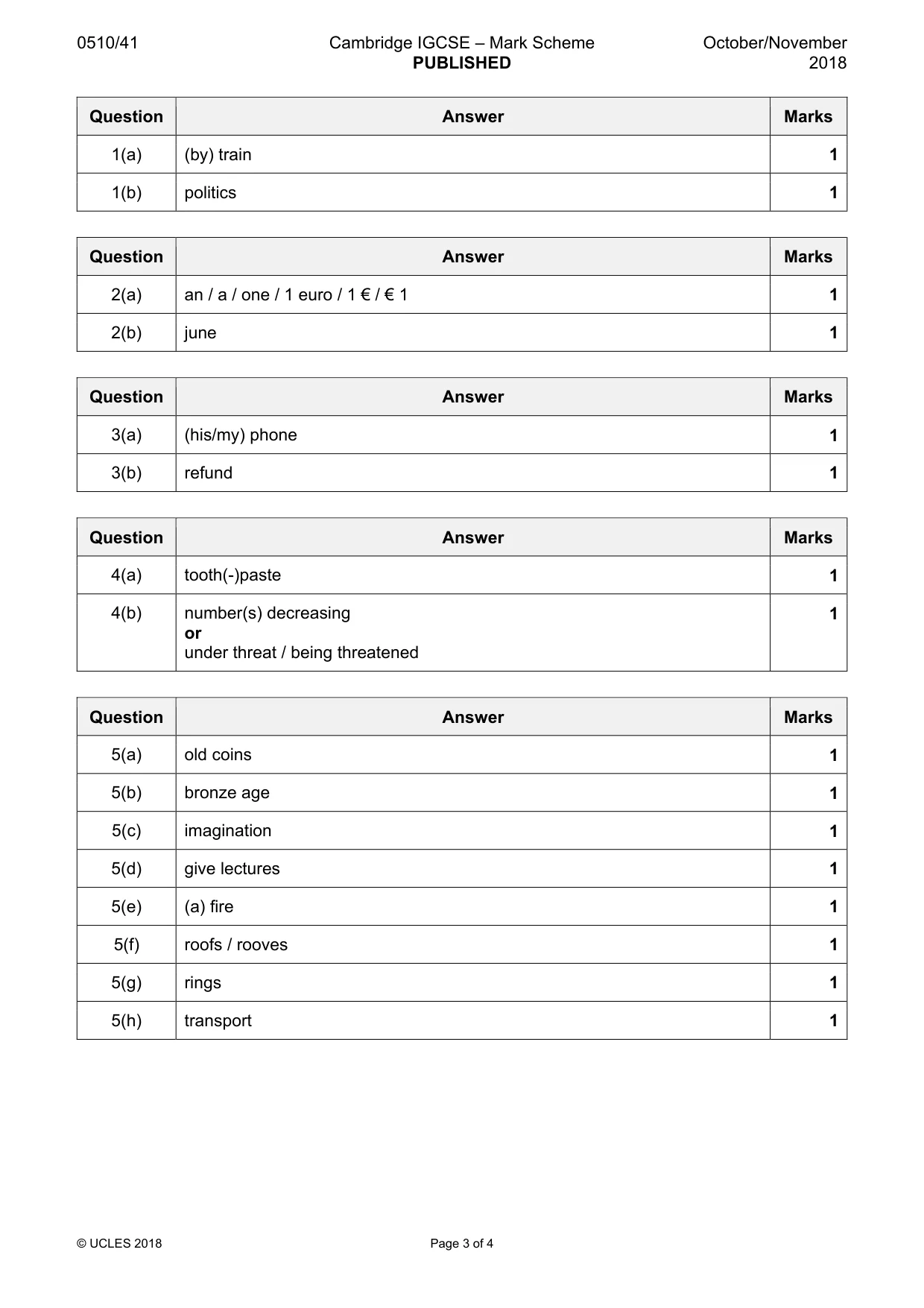
Mark scheme, page 3
0510/41 Cambridge IGCSE – Mark Scheme PUBLISHED October/November 2018 © UCLES 2018 Page 3 of 4 Question Answer Marks 1(a) (by) train 1 1(b) politics 1 Question Answer Marks 2(a) an / a / one / 1 euro / 1 € / € 1 1 2(b) june 1 Question Answer Marks 3(a) (his/my) phone 1 3(b) refund 1 Question Answer Marks 4(a) tooth(-)paste 1 4(b) number(s) decreasing or under threat / being threatened 1 Question Answer Marks 5(a) old coins 1 5(b) bronze age 1 5(c) imagination 1 5(d) give lectures 1 5(e) (a) fire 1 5(f) roofs / rooves 1 5(g) rings 1 5(h) transport 1
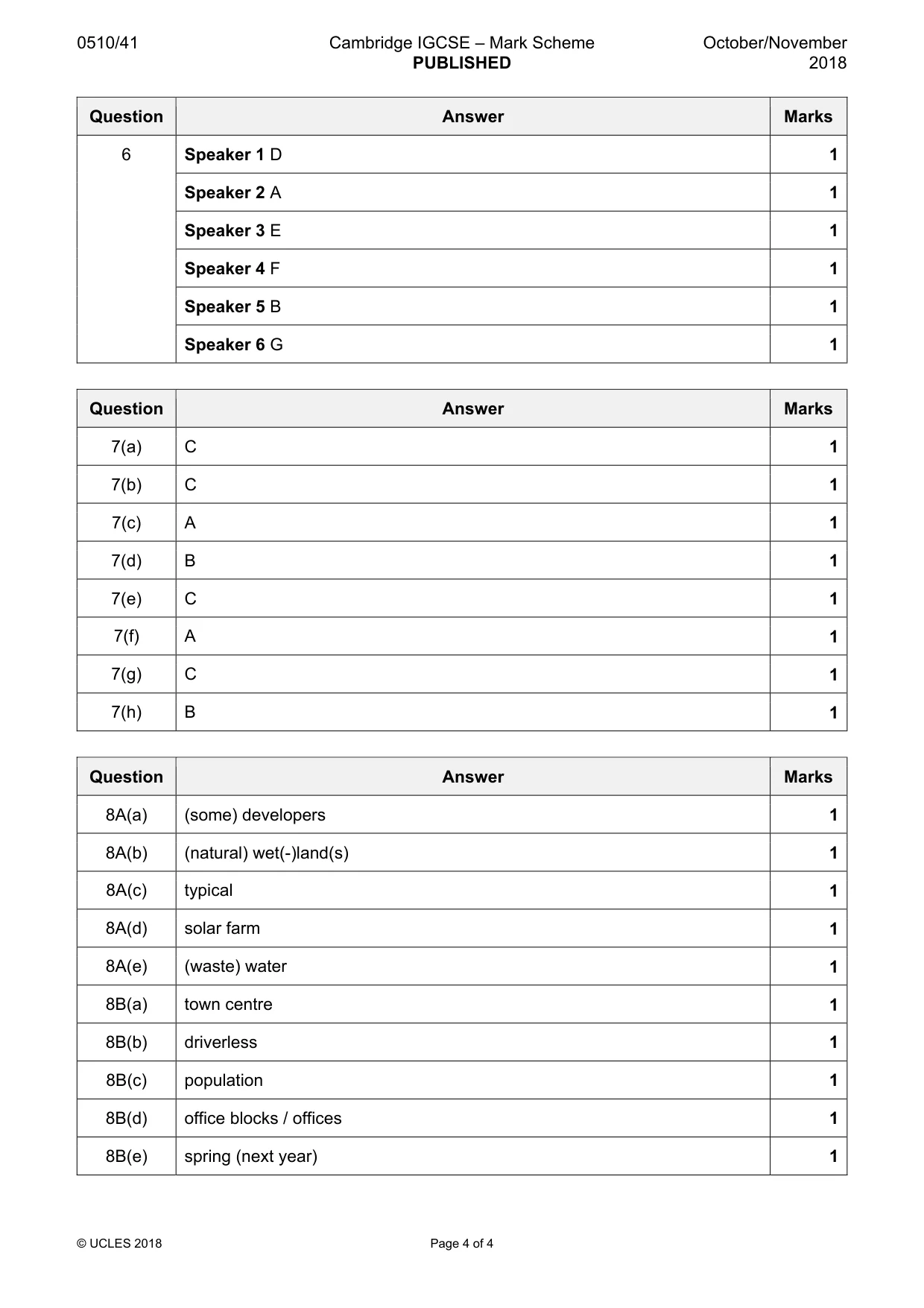
Mark scheme, page 4
0510/41 Cambridge IGCSE – Mark Scheme PUBLISHED October/November 2018 © UCLES 2018 Page 4 of 4 Question Answer Marks 6 Speaker 1 D 1 Speaker 2 A 1 Speaker 3 E 1 Speaker 4 F 1 Speaker 5 B 1 Speaker 6 G 1 Question Answer Marks 7(a) C 1 7(b) C 1 7(c) A 1 7(d) B 1 7(e) C 1 7(f) A 1 7(g) C 1 7(h) B 1 Question Answer Marks 8A(a) (some) developers 1 8A(b) (natural) wet(-)land(s) 1 8A(c) typical 1 8A(d) solar farm 1 8A(e) (waste) water 1 8B(a) town centre 1 8B(b) driverless 1 8B(c) population 1 8B(d) office blocks / offices 1 8B(e) spring (next year) 1
What you needed in this session
Cambridge’s own grade thresholds for 2018 Oct/Nov, Paper 4 · Variant 1. A higher threshold means an easier paper — the bar moves with how the cohort did.