Cambridge IGCSE English - Second Language (oral endorsement) 0510 — 2016 Oct/Nov Paper 4 · Variant 2
0510/42/O/N/16 · 40 marks · ≈45 min
The question paper and its mark scheme, free to read here and free to download. This is Cambridge’s own paper, exactly as it was sat.
Question paper12 pages




Mark scheme16 pages
Answers below. Sit the paper first if you are practising.

Paper as text
Question paper, page 1
This document consists of 9 printed pages and 3 blank pages. DC (RCL (KM)) 116465/3 © UCLES 2016 [Turn over Cambridge International Examinations Cambridge International General Certificate of Secondary Education * 9 1 1 5 4 9 7 6 8 2 * ENGLISH AS A SECOND LANGUAGE 0510/42 Paper 4 Listening (Extended) October/November 2016 Approx. 50 minutes Candidates answer on the Question Paper. No Additional Materials are required. READ THESE INSTRUCTIONS FIRST Write your Centre number, candidate number and name on all the work you hand in. Write in dark blue or black pen. Do not use staples, paper clips, glue or correction fluid. DO NOT WRITE IN ANY BARCODES. Answer all questions. Dictionaries are not permitted. The number of marks is given in brackets [ ] at the end of each question or part question.
Question paper, page 2
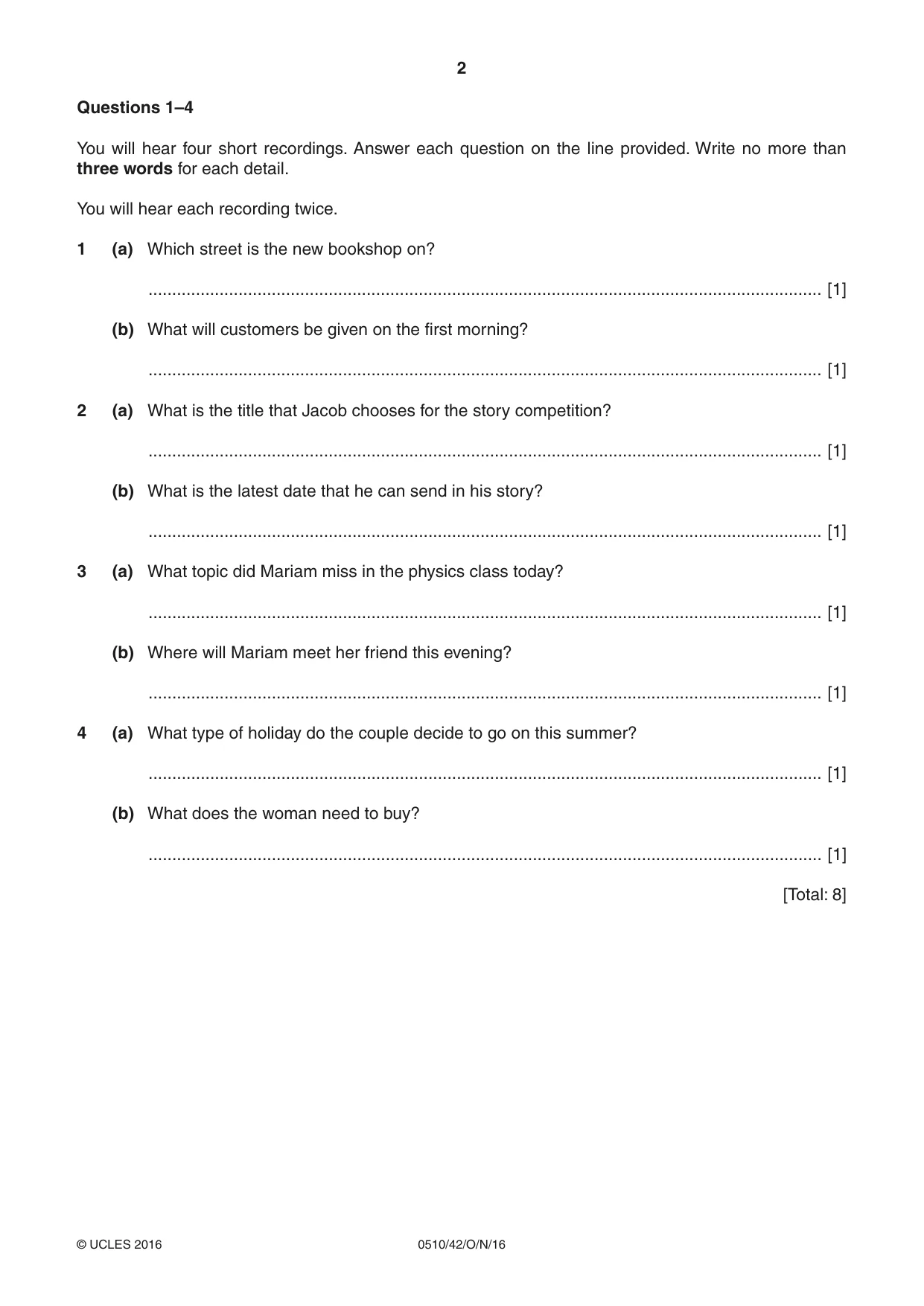
2 0510/42/O/N/16 © UCLES 2016 Questions 1–4 You will hear four short recordings. Answer each question on the line provided. Write no more than three words for each detail. You will hear each recording twice. 1 (a) Which street is the new bookshop on? … [1] (b) What will customers be given on the first morning? … [1] 2 (a) What is the title that Jacob chooses for the story competition? … [1] (b) What is the latest date that he can send in his story? … [1] 3 (a) What topic did Mariam miss in the physics class today? … [1] (b) Where will Mariam meet her friend this evening? … [1] 4 (a) What type of holiday do the couple decide to go on this summer? … [1] (b) What does the woman need to buy? … [1] [Total: 8]
Question paper, page 3
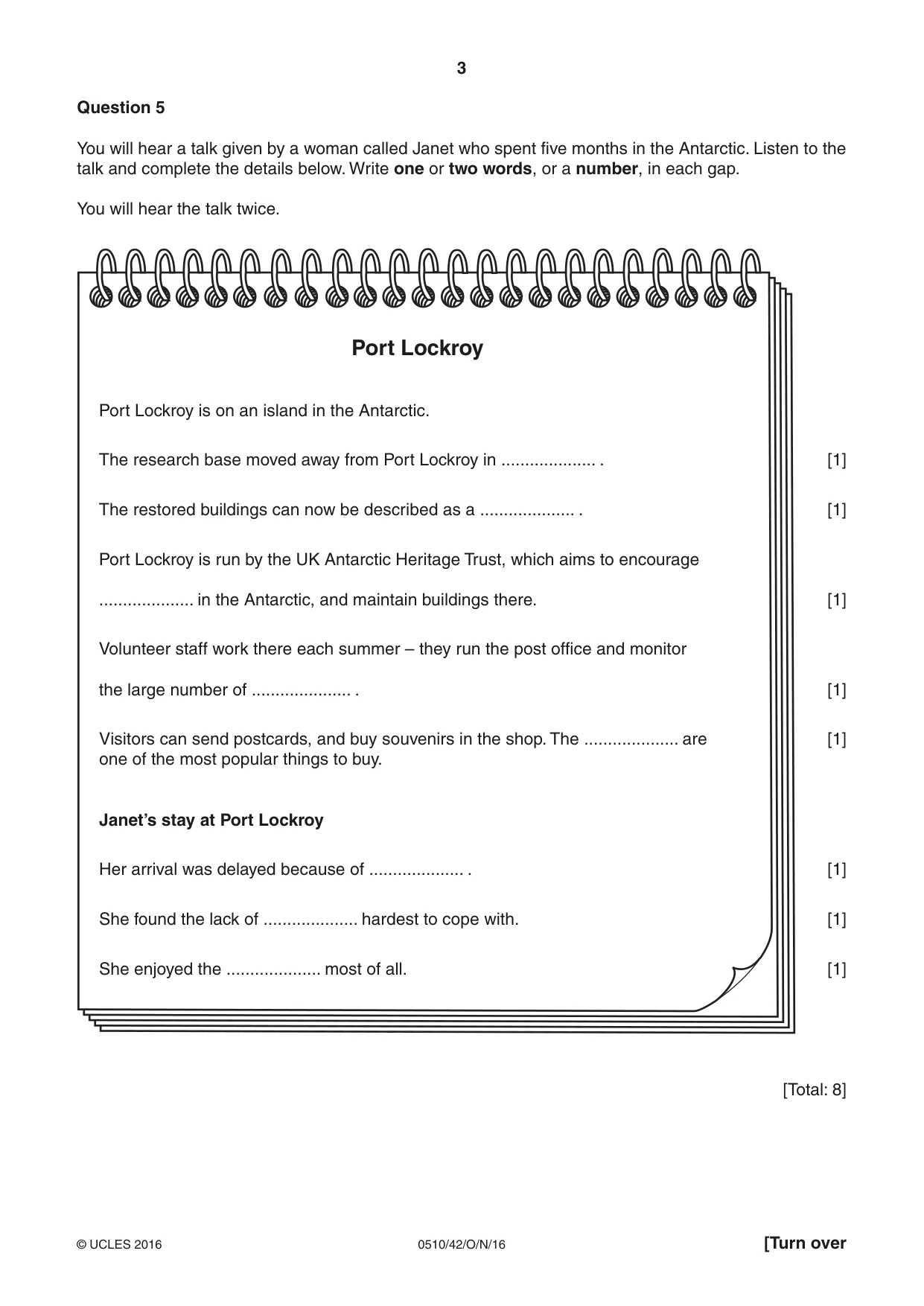
3 0510/42/O/N/16 © UCLES 2016 [Turn over Question 5 You will hear a talk given by a woman called Janet who spent five months in the Antarctic. Listen to the talk and complete the details below. Write one or two words, or a number, in each gap. You will hear the talk twice. Port Lockroy Port Lockroy is on an island in the Antarctic. The research base moved away from Port Lockroy in … . [1] The restored buildings can now be described as a … . [1] Port Lockroy is run by the UK Antarctic Heritage Trust, which aims to encourage … in the Antarctic, and maintain buildings there. [1] Volunteer staff work there each summer – they run the post office and monitor the large number of … . [1] Visitors can send postcards, and buy souvenirs in the shop. The … are [1] one of the most popular things to buy. Janet’s stay at Port Lockroy Her arrival was delayed because of … . [1] She found the lack of … hardest to cope with. [1] She enjoyed the … most of all. [1] [Total: 8]
Question paper, page 4
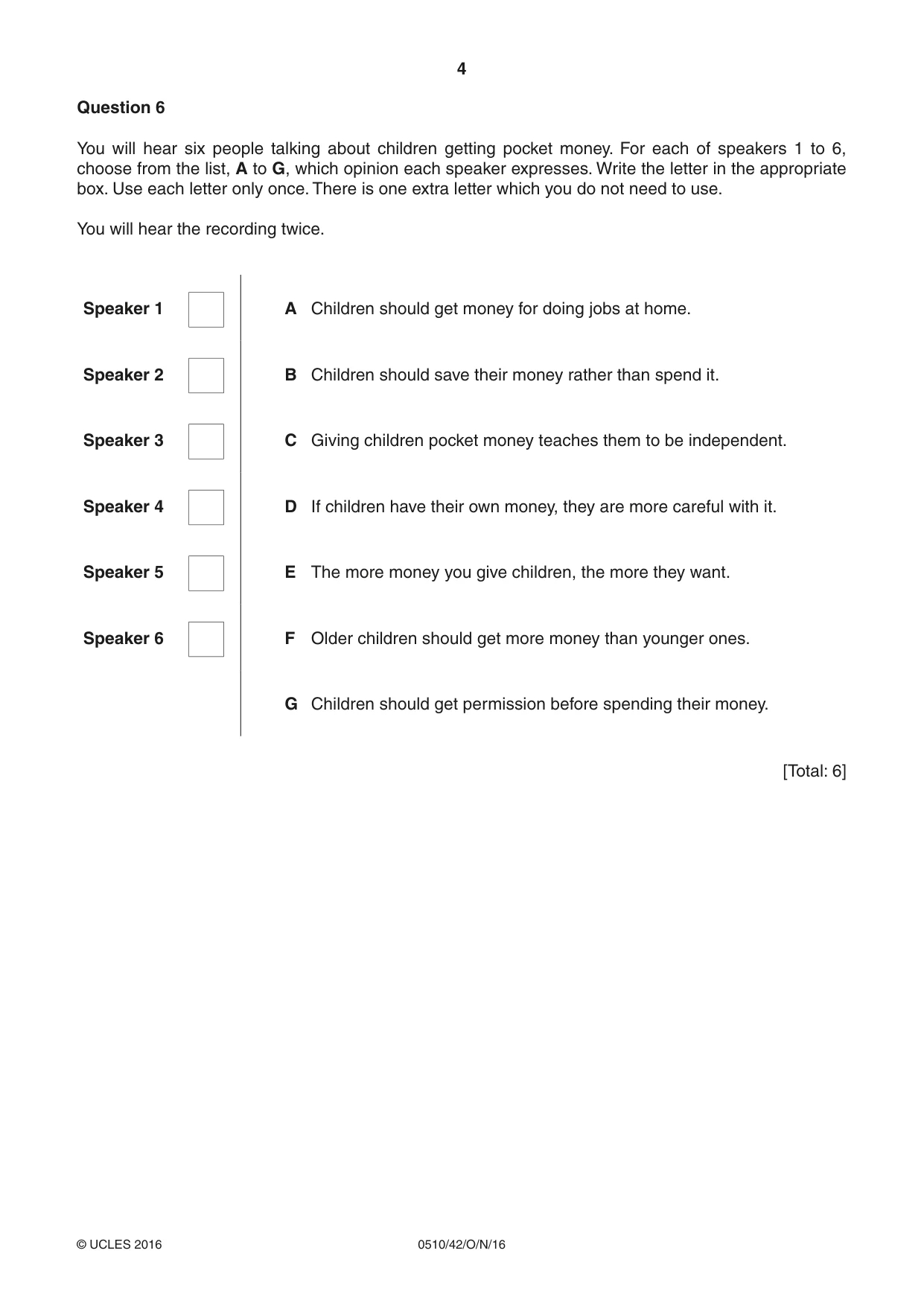
4 0510/42/O/N/16 © UCLES 2016 Question 6 You will hear six people talking about children getting pocket money. For each of speakers 1 to 6, choose from the list, A to G, which opinion each speaker expresses. Write the letter in the appropriate box. Use each letter only once. There is one extra letter which you do not need to use. You will hear the recording twice. Speaker 1 A Children should get money for doing jobs at home. Speaker 2 B Children should save their money rather than spend it. Speaker 3 C Giving children pocket money teaches them to be independent. Speaker 4 D If children have their own money, they are more careful with it. Speaker 5 E The more money you give children, the more they want. Speaker 6 F Older children should get more money than younger ones. G Children should get permission before spending their money. [Total: 6]
Question paper, page 5
5 0510/42/O/N/16 © UCLES 2016 [Turn over Please turn over for Question 7.
Question paper, page 6
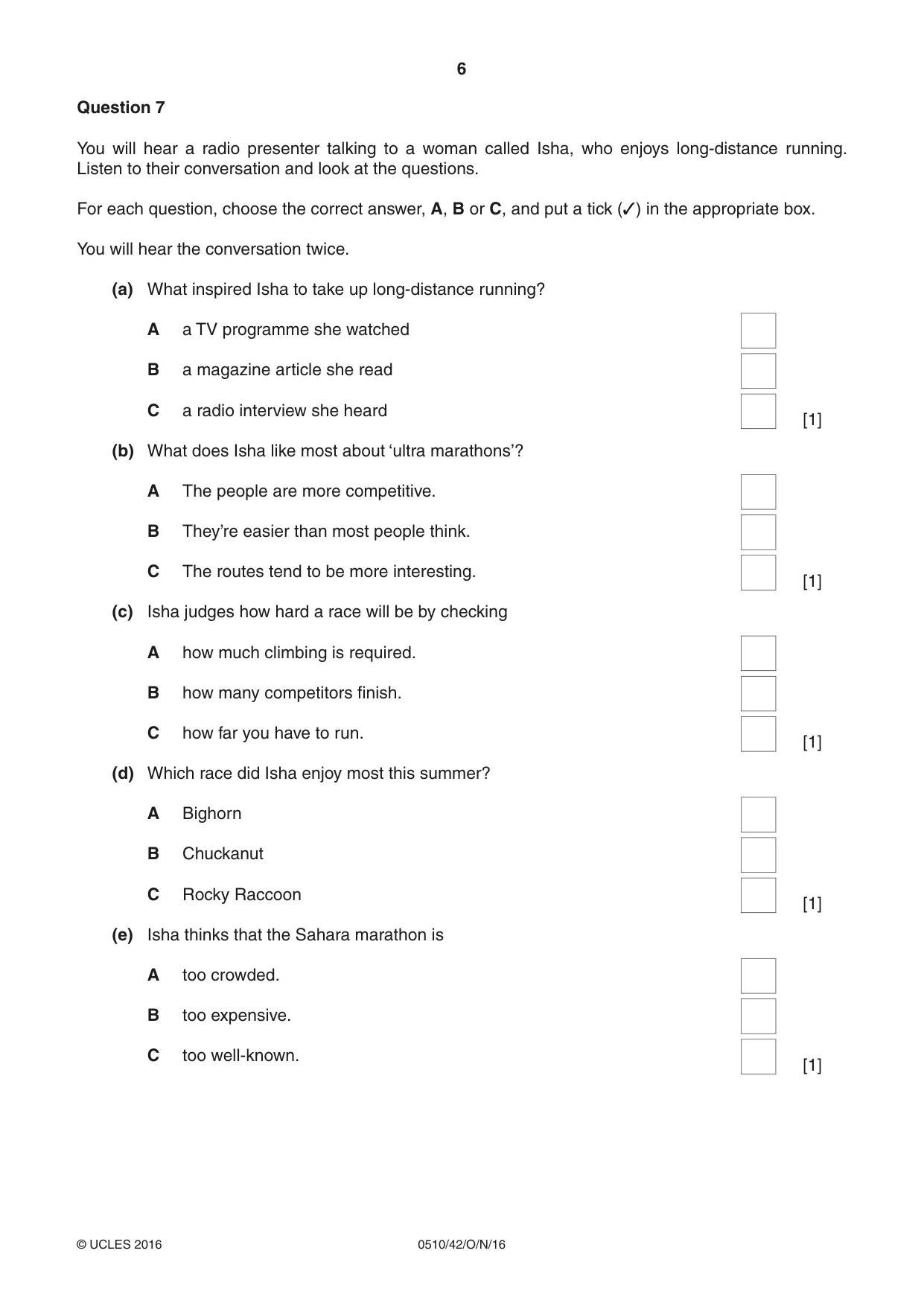
6 0510/42/O/N/16 © UCLES 2016 Question 7 You will hear a radio presenter talking to a woman called Isha, who enjoys long-distance running. Listen to their conversation and look at the questions. For each question, choose the correct answer, A, B or C, and put a tick (3) in the appropriate box. You will hear the conversation twice. (a) What inspired Isha to take up long-distance running? A a TV programme she watched B a magazine article she read C a radio interview she heard [1] (b) What does Isha like most about ‘ultra marathons’? A The people are more competitive. B They’re easier than most people think. C The routes tend to be more interesting. [1] (c) Isha judges how hard a race will be by checking A how much climbing is required. B how many competitors finish. C how far you have to run. [1] (d) Which race did Isha enjoy most this summer? A Bighorn B Chuckanut C Rocky Raccoon [1] (e) Isha thinks that the Sahara marathon is A too crowded. B too expensive. C too well-known. [1]
Question paper, page 7
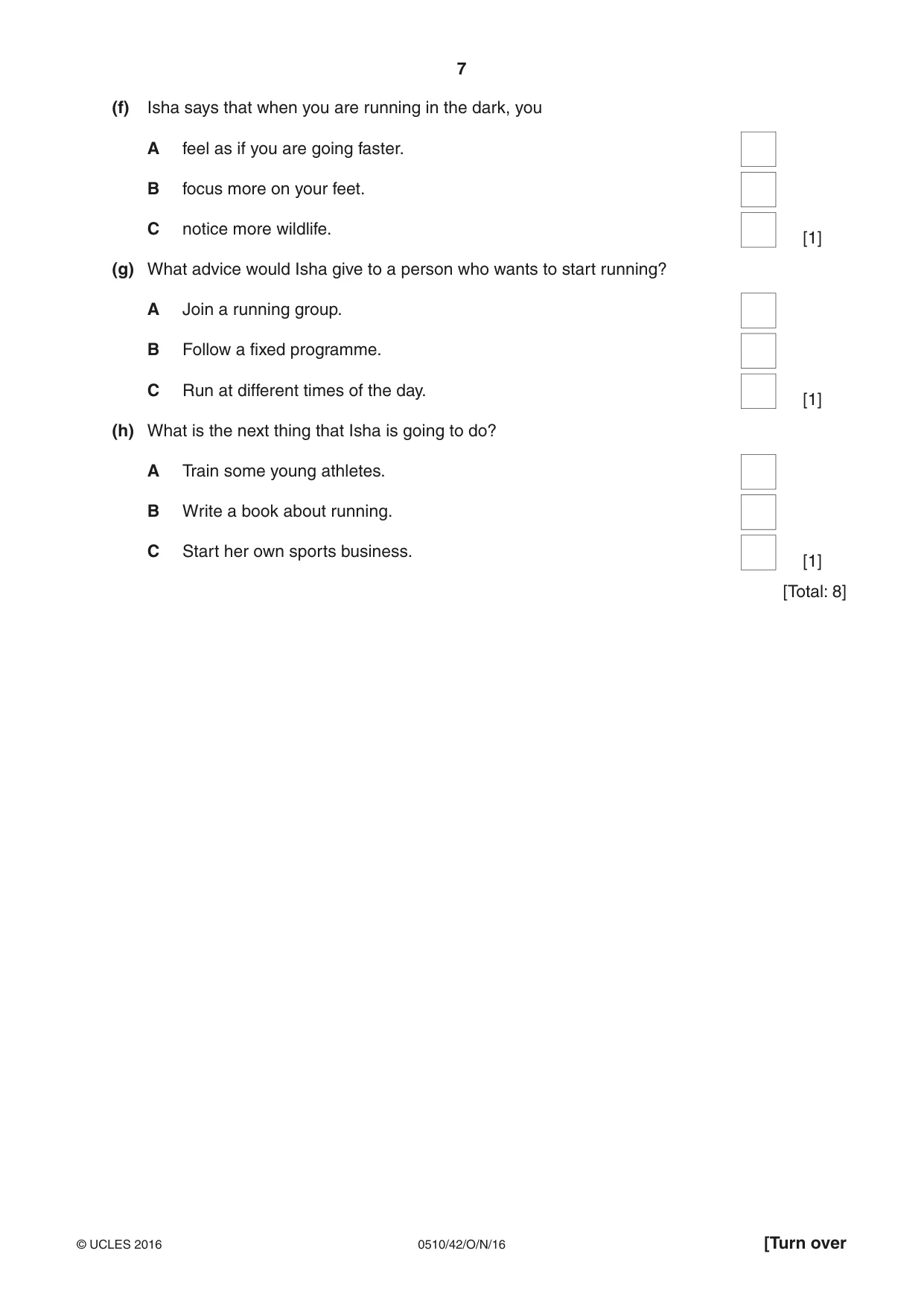
7 0510/42/O/N/16 © UCLES 2016 [Turn over (f) Isha says that when you are running in the dark, you A feel as if you are going faster. B focus more on your feet. C notice more wildlife. [1] (g) What advice would Isha give to a person who wants to start running? A Join a running group. B Follow a fixed programme. C Run at different times of the day. [1] (h) What is the next thing that Isha is going to do? A Train some young athletes. B Write a book about running. C Start her own sports business. [1] [Total: 8]
Question paper, page 8
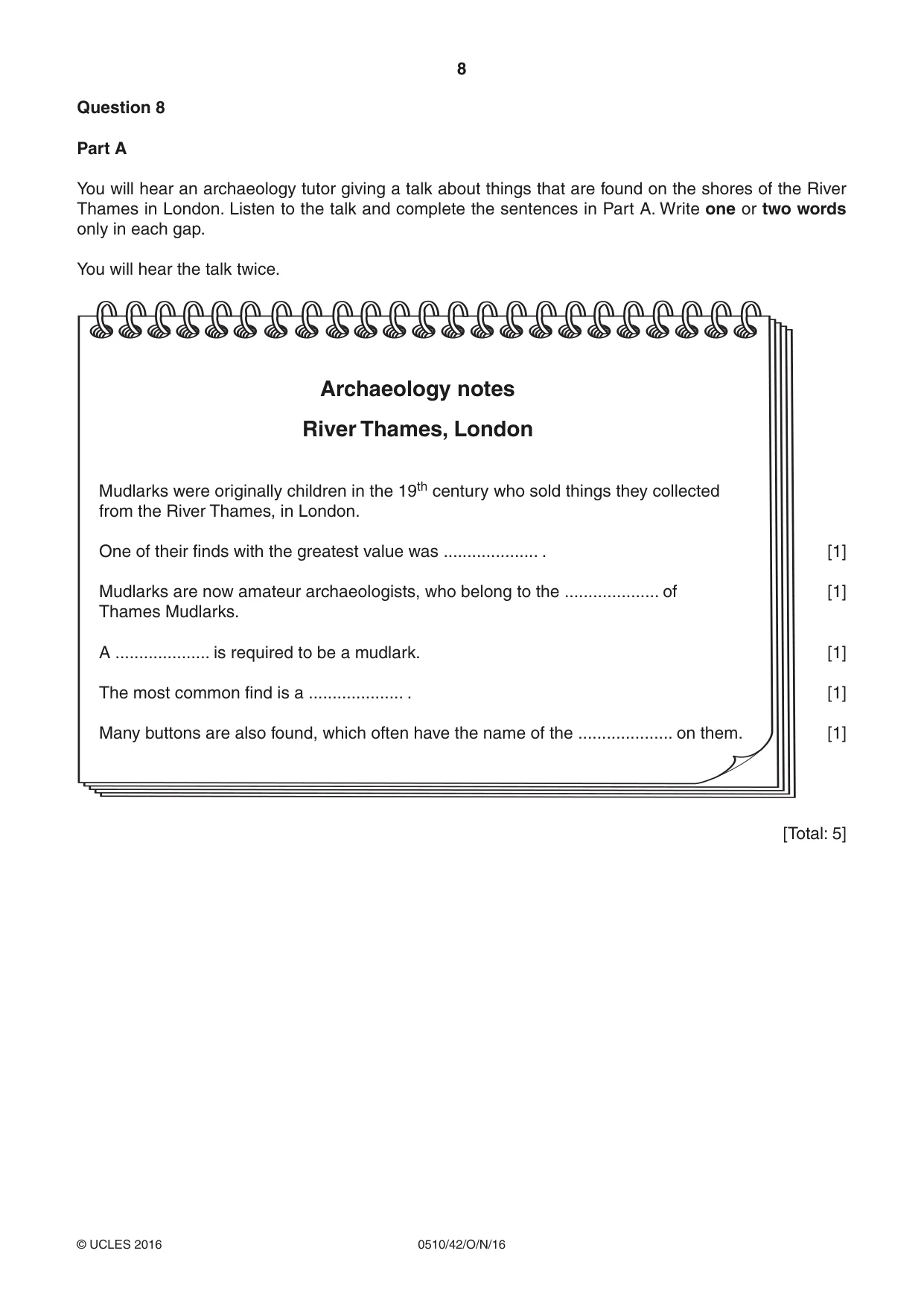
8 0510/42/O/N/16 © UCLES 2016 Question 8 Part A You will hear an archaeology tutor giving a talk about things that are found on the shores of the River Thames in London. Listen to the talk and complete the sentences in Part A. Write one or two words only in each gap. You will hear the talk twice. Archaeology notes River Thames, London Mudlarks were originally children in the 19th century who sold things they collected from the River Thames, in London. One of their finds with the greatest value was … . [1] Mudlarks are now amateur archaeologists, who belong to the … of [1] Thames Mudlarks. A … is required to be a mudlark. [1] The most common find is a … . [1] Many buttons are also found, which often have the name of the … on them. [1] [Total: 5]
Question paper, page 9
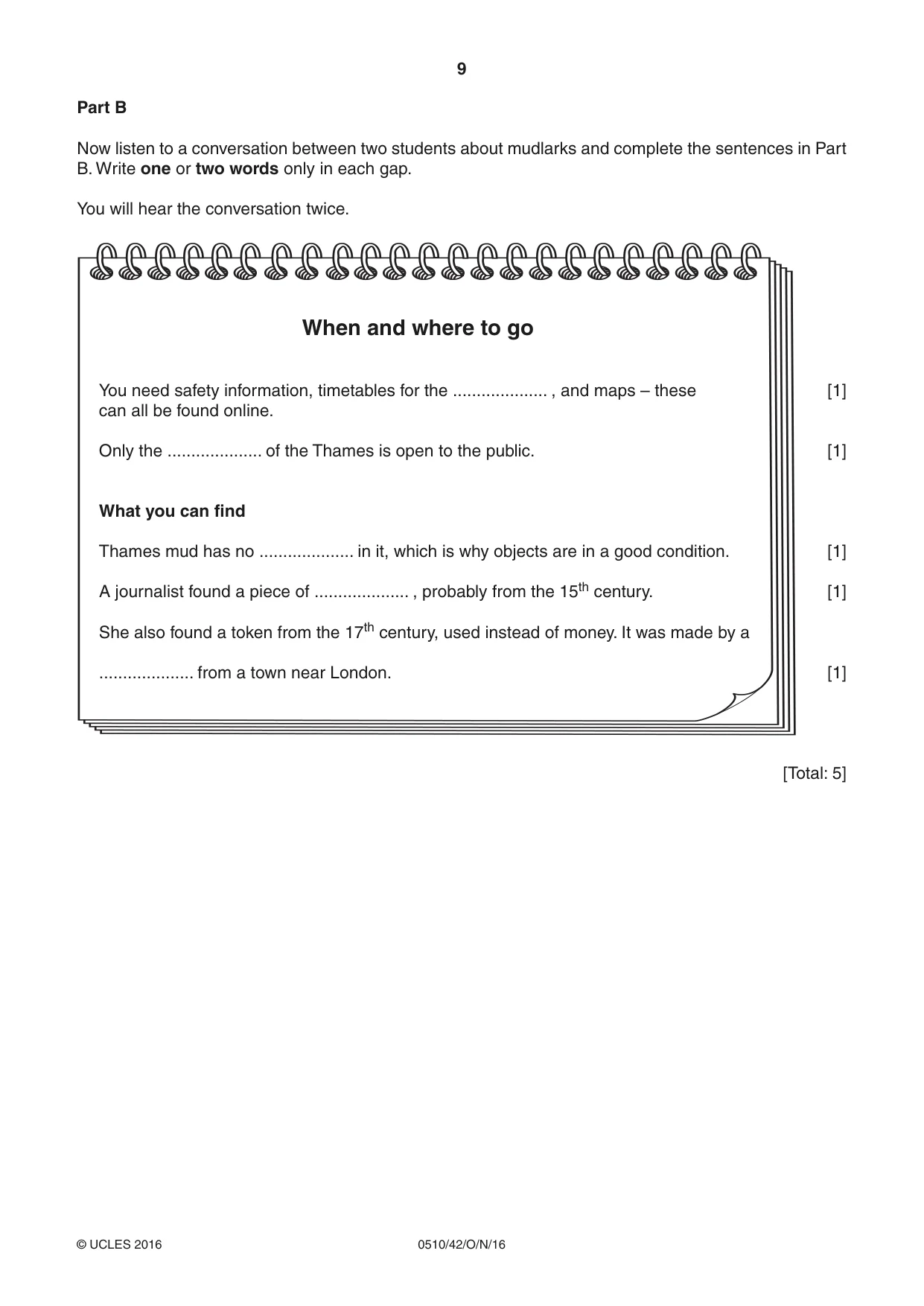
9 0510/42/O/N/16 © UCLES 2016 Part B Now listen to a conversation between two students about mudlarks and complete the sentences in Part B. Write one or two words only in each gap. You will hear the conversation twice. When and where to go You need safety information, timetables for the … , and maps – these [1] can all be found online. Only the … of the Thames is open to the public. [1] What you can find Thames mud has no … in it, which is why objects are in a good condition. [1] A journalist found a piece of … , probably from the 15th century. [1] She also found a token from the 17th century, used instead of money. It was made by a … from a town near London. [1] [Total: 5]
Question paper, page 10
10 0510/42/O/N/16 © UCLES 2016 BLANK PAGE
Question paper, page 11
11 0510/42/O/N/16 © UCLES 2016 BLANK PAGE
Question paper, page 12
12 0510/42/O/N/16 © UCLES 2016 Permission to reproduce items where third-party owned material protected by copyright is included has been sought and cleared where possible. Every reasonable effort has been made by the publisher (UCLES) to trace copyright holders, but if any items requiring clearance have unwittingly been included, the publisher will be pleased to make amends at the earliest possible opportunity. To avoid the issue of disclosure of answer-related information to candidates, all copyright acknowledgements are reproduced online in the Cambridge International Examinations Copyright Acknowledgements Booklet. This is produced for each series of examinations and is freely available to download at www.cie.org.uk after the live examination series. Cambridge International Examinations is part of the Cambridge Assessment Group. Cambridge Assessment is the brand name of University of Cambridge Local Examinations Syndicate (UCLES), which is itself a department of the University of Cambridge. BLANK PAGE
Mark scheme, page 1
® IGCSE is the registered trademark of Cambridge International Examinations. This document consists of 16 printed pages. © UCLES 2016 [Turn over Cambridge International Examinations Cambridge International General Certificate of Secondary Education ENGLISH AS A SECOND LANGUAGE 0510/42 Paper 4 Listening (Extended) October/November 2016 MARK SCHEME Maximum Mark: 40 Published This mark scheme is published as an aid to teachers and candidates, to indicate the requirements of the examination. It shows the basis on which Examiners were instructed to award marks. It does not indicate the details of the discussions that took place at an Examiners’ meeting before marking began, which would have considered the acceptability of alternative answers. Mark schemes should be read in conjunction with the question paper and the Principal Examiner Report for Teachers. Cambridge will not enter into discussions about these mark schemes. Cambridge is publishing the mark schemes for the October/November 2016 series for most Cambridge IGCSE®, Cambridge International A and AS Level components and some Cambridge O Level components.
Mark scheme, page 2
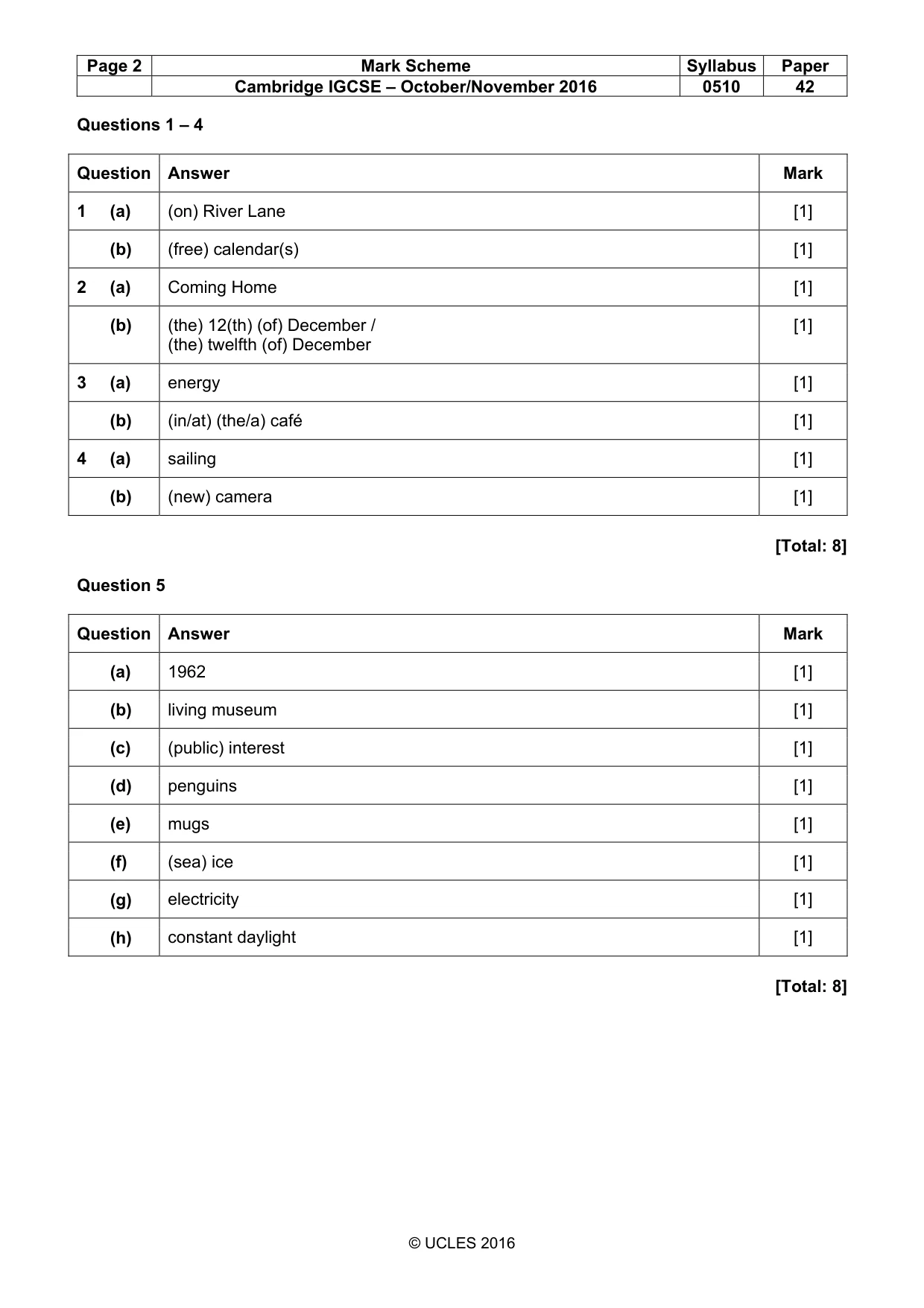
Page 2 Mark Scheme Syllabus Paper Cambridge IGCSE – October/November 2016 0510 42 © UCLES 2016 Questions 1 – 4 Question Answer Mark 1 (a) (on) River Lane [1] (b) (free) calendar(s) [1] 2 (a) Coming Home [1] (b) (the) 12(th) (of) December / (the) twelfth (of) December [1] 3 (a) energy [1] (b) (in/at) (the/a) café [1] 4 (a) sailing [1] (b) (new) camera [1] [Total: 8] Question 5 Question Answer Mark (a) 1962 [1] (b) living museum [1] (c) (public) interest [1] (d) penguins [1] (e) mugs [1] (f) (sea) ice [1] (g) electricity [1] (h) constant daylight [1] [Total: 8]
Mark scheme, page 3
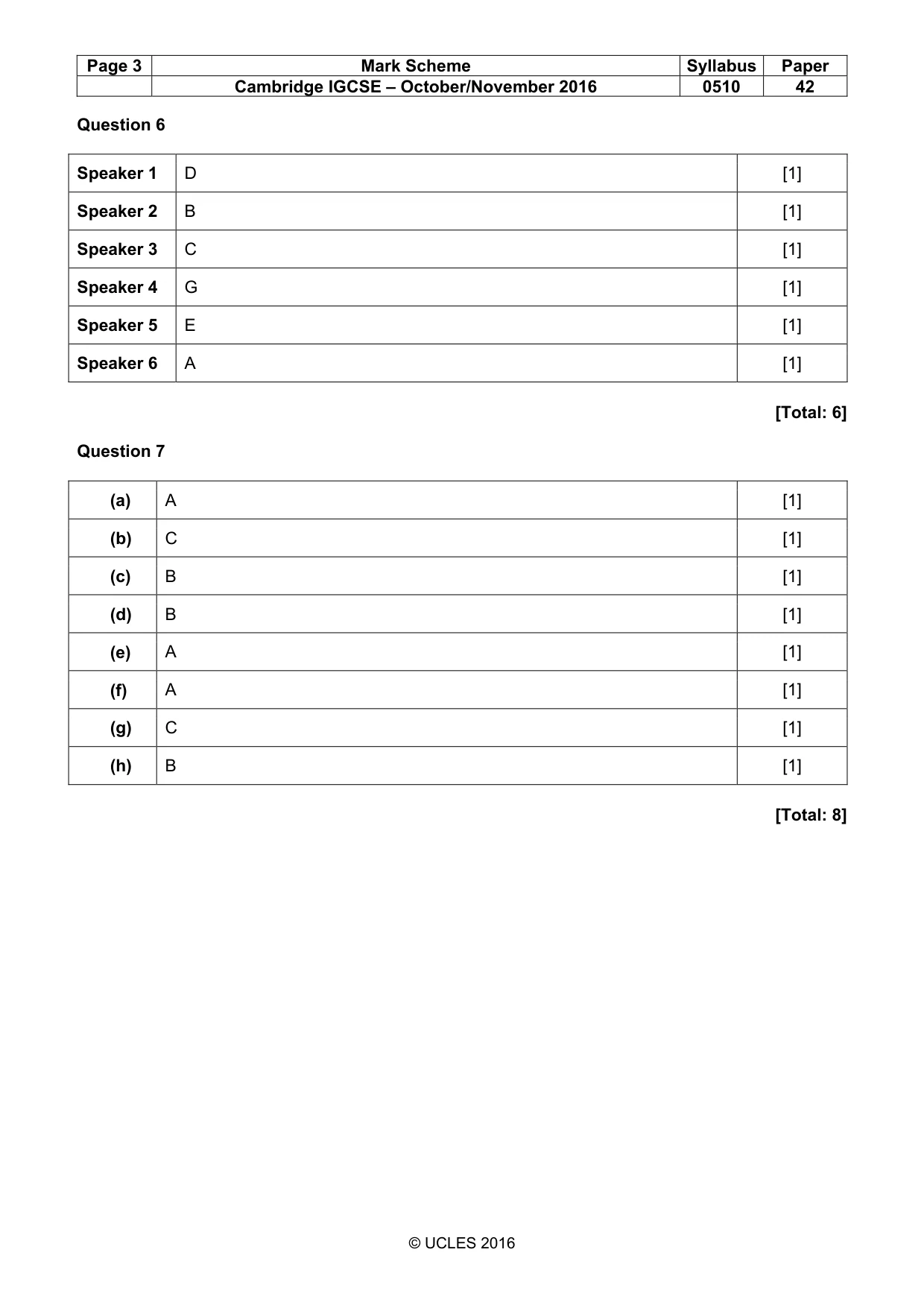
Page 3 Mark Scheme Syllabus Paper Cambridge IGCSE – October/November 2016 0510 42 © UCLES 2016 Question 6 Speaker 1 D [1] Speaker 2 B [1] Speaker 3 C [1] Speaker 4 G [1] Speaker 5 E [1] Speaker 6 A [1] [Total: 6] Question 7 (a) A [1] (b) C [1] (c) B [1] (d) B [1] (e) A [1] (f) A [1] (g) C [1] (h) B [1] [Total: 8]
Mark scheme, page 4
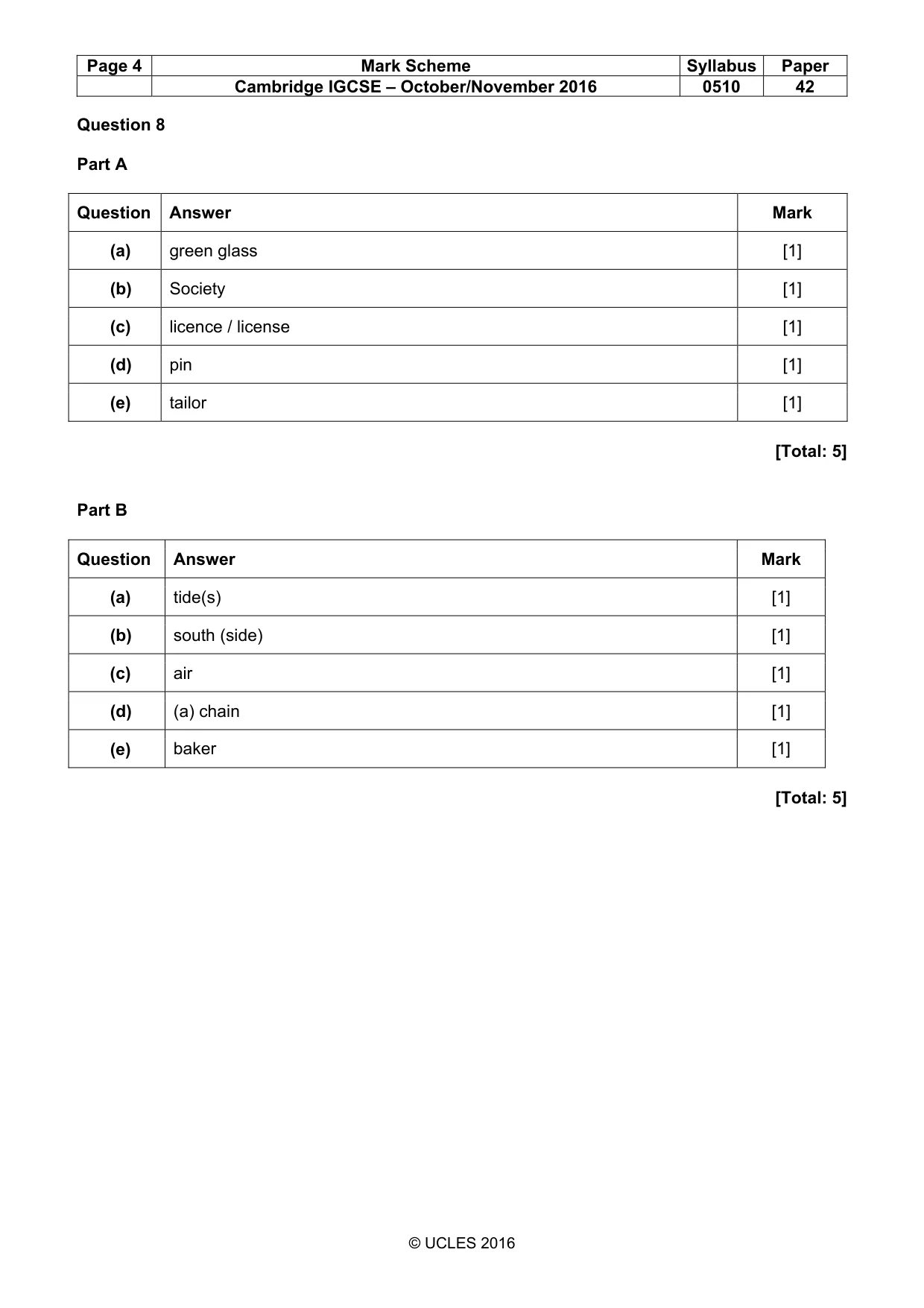
Page 4 Mark Scheme Syllabus Paper Cambridge IGCSE – October/November 2016 0510 42 © UCLES 2016 Question 8 Part A Question Answer Mark (a) green glass [1] (b) Society [1] (c) licence / license [1] (d) pin [1] (e) tailor [1] [Total: 5] Part B Question Answer Mark (a) tide(s) [1] (b) south (side) [1] (c) air [1] (d) (a) chain [1] (e) baker [1] [Total: 5]
Mark scheme, page 5
Page 5 Mark Scheme Syllabus Paper Cambridge IGCSE – October/November 2016 0510 42 © UCLES 2016 Transcript Listening (Extended) November 2016 TRACK 1 R1 Cambridge International Examinations International General Certificate of Secondary Education November examination series 2016 English as a Second Language Extended Tier – Listening Comprehension Welcome to the exam. In a moment, your teacher is going to give out the question papers. When you get your paper, fill in your name, Centre number and candidate number on the front page. Do not talk to anyone during the exam. If you would like the recording to be louder or quieter, tell your teacher NOW. The recording will not be stopped while you are doing the exam. Teacher: please give out the question papers, and when all the candidates are ready to start the test, please turn the recording back on. [BEEP]
Mark scheme, page 6
Page 6 Mark Scheme Syllabus Paper Cambridge IGCSE – October/November 2016 0510 42 © UCLES 2016 TRACK 2 R1 Now you are all ready, here is the exam. Questions 1–4 You will hear four short recordings. Answer each question on the line provided. Write no more than three words for each detail. You will hear each recording twice. Pause 00’05” R1 Question 1 (a) Which street is the new bookshop on? (b) What will customers be given on the first morning? (radio announcement – M, 40s) *I know many of you were disappointed when our well-loved bookshop on Green Road closed last month. Well, you’ll be delighted to hear it’s re-opening next Saturday, just around the corner on River Lane. To celebrate the re-opening, the shop has planned all sorts of events and special offers for customers. Make sure you turn up early on opening day – you’ll receive a free calendar if you do, but only until lunchtime. After that, there’s a children’s session with games and music – they each get a poster to take away with them. So, bring your kids along and make it a day to remember!** Pause 00’10” Repeat from * to ** Pause 00’05” R1 Question 2 (a) What is the title that Jacob chooses for the story competition? (b) What is the latest date that he can send in his story? (M&F: both students in late teens) F *Jacob, are you going to enter that short story competition I told you about? M Oh, I was just thinking about that. I was actually trying to decide what to write, as there’s a choice of titles, isn’t there? F Yes, you can either call it ‘Coming Home’, or ‘The Journey’. I’ve chosen the second one. M In that case, I’ll go for the other one! I’ve got some ideas already. But I can’t remember what the deadline is – was it the fifth of January? F That’s when they’re announcing the winners! You’ve got to submit it by the twelfth of December. So you’ll need to get on with it!**
Mark scheme, page 7
Page 7 Mark Scheme Syllabus Paper Cambridge IGCSE – October/November 2016 0510 42 © UCLES 2016 Pause 00’10” Repeat from * to ** Pause 00’05” R1 Question 3 (a) What topic did Mariam miss in the physics class today? (b) Where will Mariam meet her friend this evening? (F, student, 18–20ish – answerphone message) *Hi Mariam. I hope it was ok at the dentist this morning. I’m just phoning to tell you about the physics lesson you missed. It was a revision class, so the teacher let us choose what to do. Quite a few of us wanted to study atoms again, so we’re doing that next. Anyway, we went over energy, and got some really useful handouts on it – I’ve got copies for you too. I’ll bring them this evening. I won’t have time to come to the cinema with you and your sister, so I’ll catch up with you afterwards in the café, about 8 o’clock. See you then!** Pause 00’10” Repeat from * to ** Pause 00’05” R1 Question 4 (a) What type of holiday do the couple decide to go on this summer? (b) What does the woman need to buy? (husband and wife, both 30s ish) M *Have you had a chance to look at the holiday brochure yet? F Yes. The cycling trips look wonderful and so do the trekking holidays. Though I suppose we should do something different this summer. We could try a sailing trip – what do you think? M I like that idea a lot! F Great! That was easy! Perhaps we should book this evening. Oh, I’ll be able to take some amazing pictures if I manage to get a new camera in time. Let’s go shopping this weekend. You could get yourself a new backpack at the same time! M Good idea!** Pause 00’10” Repeat from * to ** Pause 00’05” R1 That is the end of the four short recordings. In a moment you will hear Question 5. Now look at the questions for this part of the exam. Pause 00’20”
Mark scheme, page 8
Page 8 Mark Scheme Syllabus Paper Cambridge IGCSE – October/November 2016 0510 42 © UCLES 2016 TRACK 3 R1 Question 5 You will hear a talk given by a woman called Janet who spent five months in the Antarctic. Listen to the talk and complete the details below. Write one or two words, or a number, in each gap. You will hear the talk twice. (F, 40s) *Thanks for inviting me here today. My name’s Janet Holmes, and I think most of you know I work as a doctor. But last year, I took a five-month break from my job and went to a place called Port Lockroy, which is on an island in the Antarctic, as a volunteer. I actually worked in one of the world’s most remote post offices – quite a change from my usual job. First, I’ll tell you a bit about Port Lockroy. It was originally established in 1944, as a base for research scientists, and it remained occupied until 1962, when the base was transferred to another location. The buildings were abandoned, but later they were restored to their original condition. In 1996, they were re-opened, and are now what’s known as a living museum. Around 18 000 visitors come each year, to see what life was like for the scientists who were based here, find out more about the Antarctic, and of course visit the small gift shop and post office. The whole place is run by the United Kingdom Antarctic Heritage Trust, which was set up to preserve Antarctic buildings and promote public interest in all aspects of the Antarctic, including the history, culture and traditions, and of course the nature. Port Lockroy is only open for five months each summer, and it’s run by a team of four volunteers. They have several jobs to do, including keeping a check on the huge population of penguins, which are under threat from seals, and running the post office and gift shop. Over the five-month summer season, visitors send around 80 000 letters and postcards, which can take eight weeks to reach their final destinations. The shop sells a range of souvenirs, including things like key rings, which are my favourite; mugs, which are always in demand; and other things like hats and scarves. Money from visiting tourists is used to fund the site, as well as other places on the continent. The journey to Port Lockroy is an adventure in itself. We travelled by boat from the southern tip of South America – that always takes time because of storms and strong winds in the Antarctic Ocean. However, our boat was unexpectedly trapped by sea ice for three days, just a few hundred metres away from our destination. Once we finally arrived, we settled in to our new accommodation, which was one small wooden hut for the four of us. We knew there wouldn’t be much space for us all, but we got on very well. There’s no central heating in the post office, and we became used to that quite quickly, but I did miss having electricity there after a while. My five-month stay went past far too quickly, and I have so many positive memories of my time there. The scenery was unforgettable, and the wildlife was really exciting. It was great meeting visitors from all around the world, while staying in such a remote location – you wouldn’t expect those two things to go together. But for me, nothing could beat the constant daylight – it hardly got dark at all for a few weeks during my stay. Overall, the whole experience was really memorable.** Pause 00’30”
Mark scheme, page 9
Page 9 Mark Scheme Syllabus Paper Cambridge IGCSE – October/November 2016 0510 42 © UCLES 2016 R1 Now you will hear the talk again. Repeat from * to ** Pause 00’30” R1 That is the end of the talk. In a moment you will hear Question 6. Now look at the questions for this part of the exam. Pause 00’25”
Mark scheme, page 10
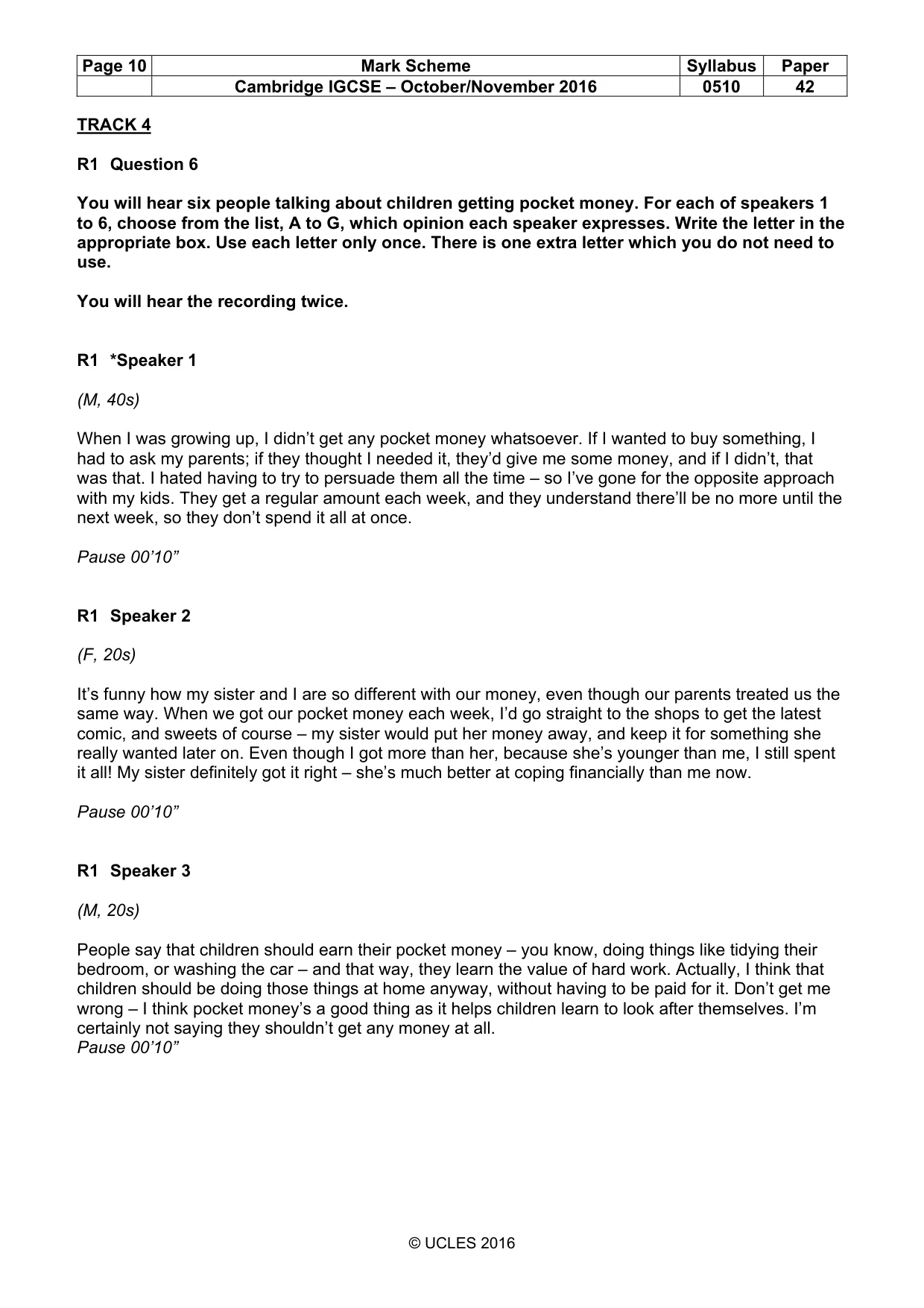
Page 10 Mark Scheme Syllabus Paper Cambridge IGCSE – October/November 2016 0510 42 © UCLES 2016 TRACK 4 R1 Question 6 You will hear six people talking about children getting pocket money. For each of speakers 1 to 6, choose from the list, A to G, which opinion each speaker expresses. Write the letter in the appropriate box. Use each letter only once. There is one extra letter which you do not need to use. You will hear the recording twice. R1 *Speaker 1 (M, 40s) When I was growing up, I didn’t get any pocket money whatsoever. If I wanted to buy something, I had to ask my parents; if they thought I needed it, they’d give me some money, and if I didn’t, that was that. I hated having to try to persuade them all the time – so I’ve gone for the opposite approach with my kids. They get a regular amount each week, and they understand there’ll be no more until the next week, so they don’t spend it all at once. Pause 00’10” R1 Speaker 2 (F, 20s) It’s funny how my sister and I are so different with our money, even though our parents treated us the same way. When we got our pocket money each week, I’d go straight to the shops to get the latest comic, and sweets of course – my sister would put her money away, and keep it for something she really wanted later on. Even though I got more than her, because she’s younger than me, I still spent it all! My sister definitely got it right – she’s much better at coping financially than me now. Pause 00’10” R1 Speaker 3 (M, 20s) People say that children should earn their pocket money – you know, doing things like tidying their bedroom, or washing the car – and that way, they learn the value of hard work. Actually, I think that children should be doing those things at home anyway, without having to be paid for it. Don’t get me wrong – I think pocket money’s a good thing as it helps children learn to look after themselves. I’m certainly not saying they shouldn’t get any money at all. Pause 00’10”
Mark scheme, page 11
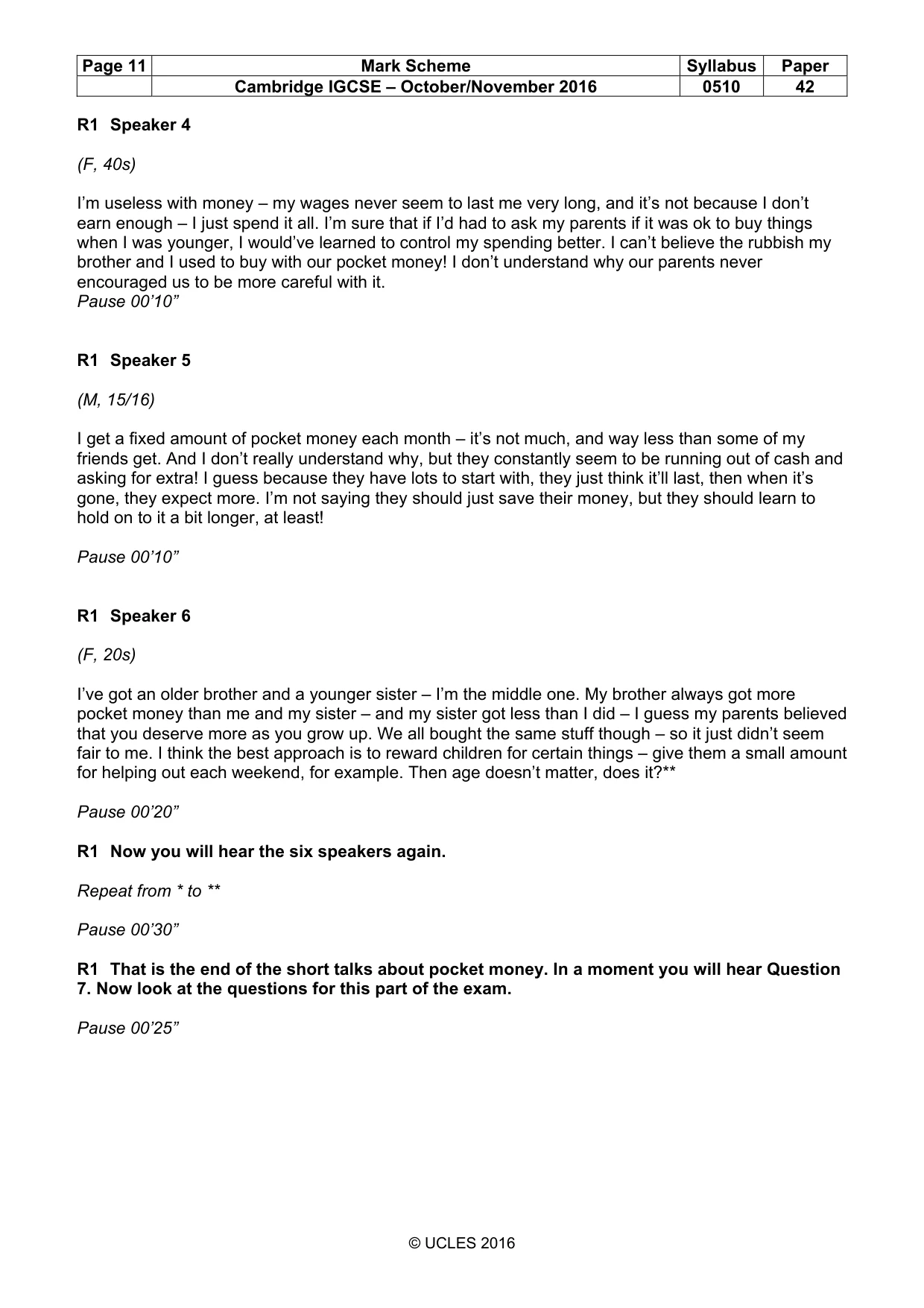
Page 11 Mark Scheme Syllabus Paper Cambridge IGCSE – October/November 2016 0510 42 © UCLES 2016 R1 Speaker 4 (F, 40s) I’m useless with money – my wages never seem to last me very long, and it’s not because I don’t earn enough – I just spend it all. I’m sure that if I’d had to ask my parents if it was ok to buy things when I was younger, I would’ve learned to control my spending better. I can’t believe the rubbish my brother and I used to buy with our pocket money! I don’t understand why our parents never encouraged us to be more careful with it. Pause 00’10” R1 Speaker 5 (M, 15/16) I get a fixed amount of pocket money each month – it’s not much, and way less than some of my friends get. And I don’t really understand why, but they constantly seem to be running out of cash and asking for extra! I guess because they have lots to start with, they just think it’ll last, then when it’s gone, they expect more. I’m not saying they should just save their money, but they should learn to hold on to it a bit longer, at least! Pause 00’10” R1 Speaker 6 (F, 20s) I’ve got an older brother and a younger sister – I’m the middle one. My brother always got more pocket money than me and my sister – and my sister got less than I did – I guess my parents believed that you deserve more as you grow up. We all bought the same stuff though – so it just didn’t seem fair to me. I think the best approach is to reward children for certain things – give them a small amount for helping out each weekend, for example. Then age doesn’t matter, does it?** Pause 00’20” R1 Now you will hear the six speakers again. Repeat from * to ** Pause 00’30” R1 That is the end of the short talks about pocket money. In a moment you will hear Question 7. Now look at the questions for this part of the exam. Pause 00’25”
Mark scheme, page 12
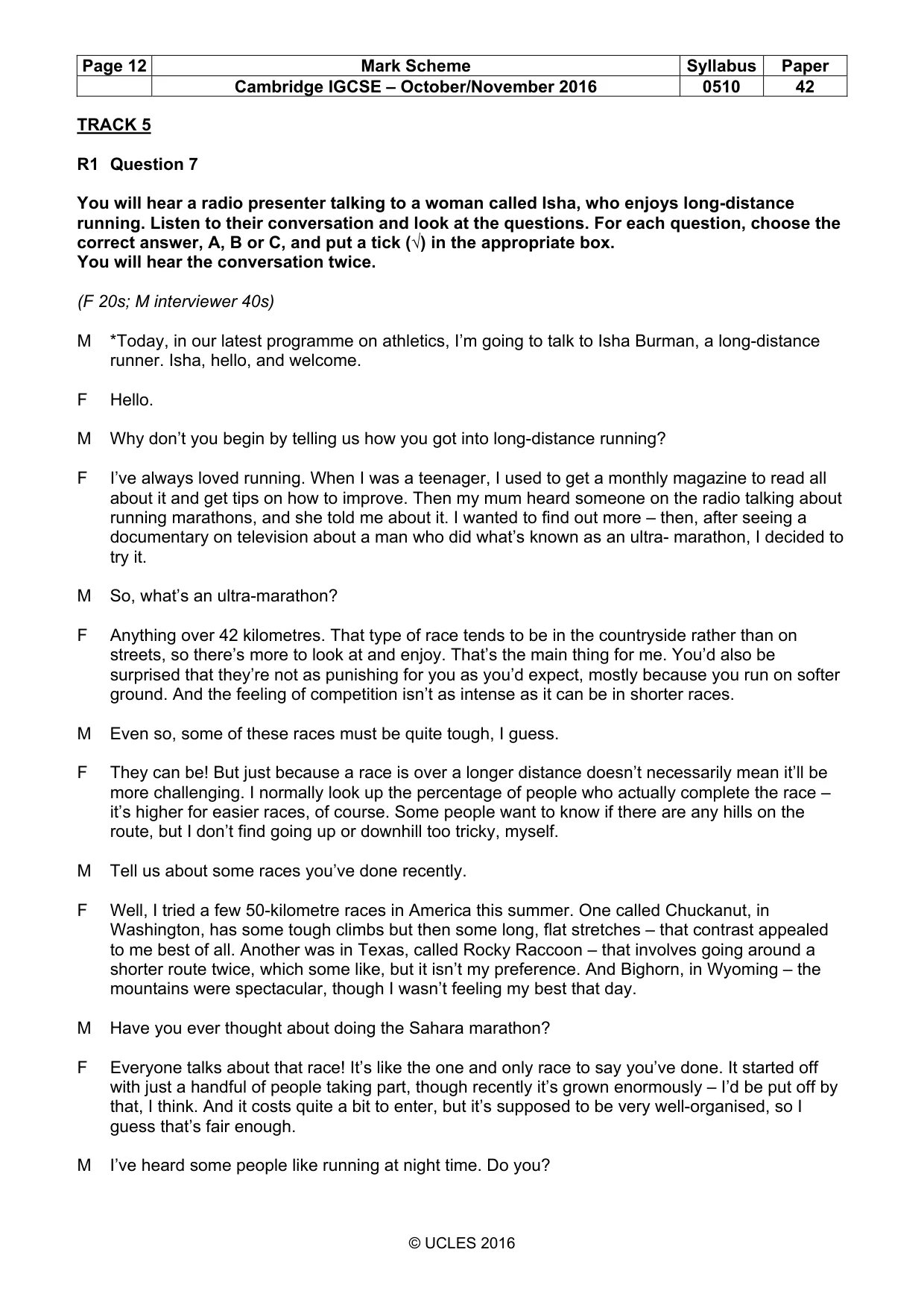
Page 12 Mark Scheme Syllabus Paper Cambridge IGCSE – October/November 2016 0510 42 © UCLES 2016 TRACK 5 R1 Question 7 You will hear a radio presenter talking to a woman called Isha, who enjoys long-distance running. Listen to their conversation and look at the questions. For each question, choose the correct answer, A, B or C, and put a tick (√) in the appropriate box. You will hear the conversation twice. (F 20s; M interviewer 40s) M *Today, in our latest programme on athletics, I’m going to talk to Isha Burman, a long-distance runner. Isha, hello, and welcome. F Hello. M Why don’t you begin by telling us how you got into long-distance running? F I’ve always loved running. When I was a teenager, I used to get a monthly magazine to read all about it and get tips on how to improve. Then my mum heard someone on the radio talking about running marathons, and she told me about it. I wanted to find out more – then, after seeing a documentary on television about a man who did what’s known as an ultra- marathon, I decided to try it. M So, what’s an ultra-marathon? F Anything over 42 kilometres. That type of race tends to be in the countryside rather than on streets, so there’s more to look at and enjoy. That’s the main thing for me. You’d also be surprised that they’re not as punishing for you as you’d expect, mostly because you run on softer ground. And the feeling of competition isn’t as intense as it can be in shorter races. M Even so, some of these races must be quite tough, I guess. F They can be! But just because a race is over a longer distance doesn’t necessarily mean it’ll be more challenging. I normally look up the percentage of people who actually complete the race – it’s higher for easier races, of course. Some people want to know if there are any hills on the route, but I don’t find going up or downhill too tricky, myself. M Tell us about some races you’ve done recently. F Well, I tried a few 50-kilometre races in America this summer. One called Chuckanut, in Washington, has some tough climbs but then some long, flat stretches – that contrast appealed to me best of all. Another was in Texas, called Rocky Raccoon – that involves going around a shorter route twice, which some like, but it isn’t my preference. And Bighorn, in Wyoming – the mountains were spectacular, though I wasn’t feeling my best that day. M Have you ever thought about doing the Sahara marathon? F Everyone talks about that race! It’s like the one and only race to say you’ve done. It started off with just a handful of people taking part, though recently it’s grown enormously – I’d be put off by that, I think. And it costs quite a bit to enter, but it’s supposed to be very well-organised, so I guess that’s fair enough. M I’ve heard some people like running at night time. Do you?
Mark scheme, page 13
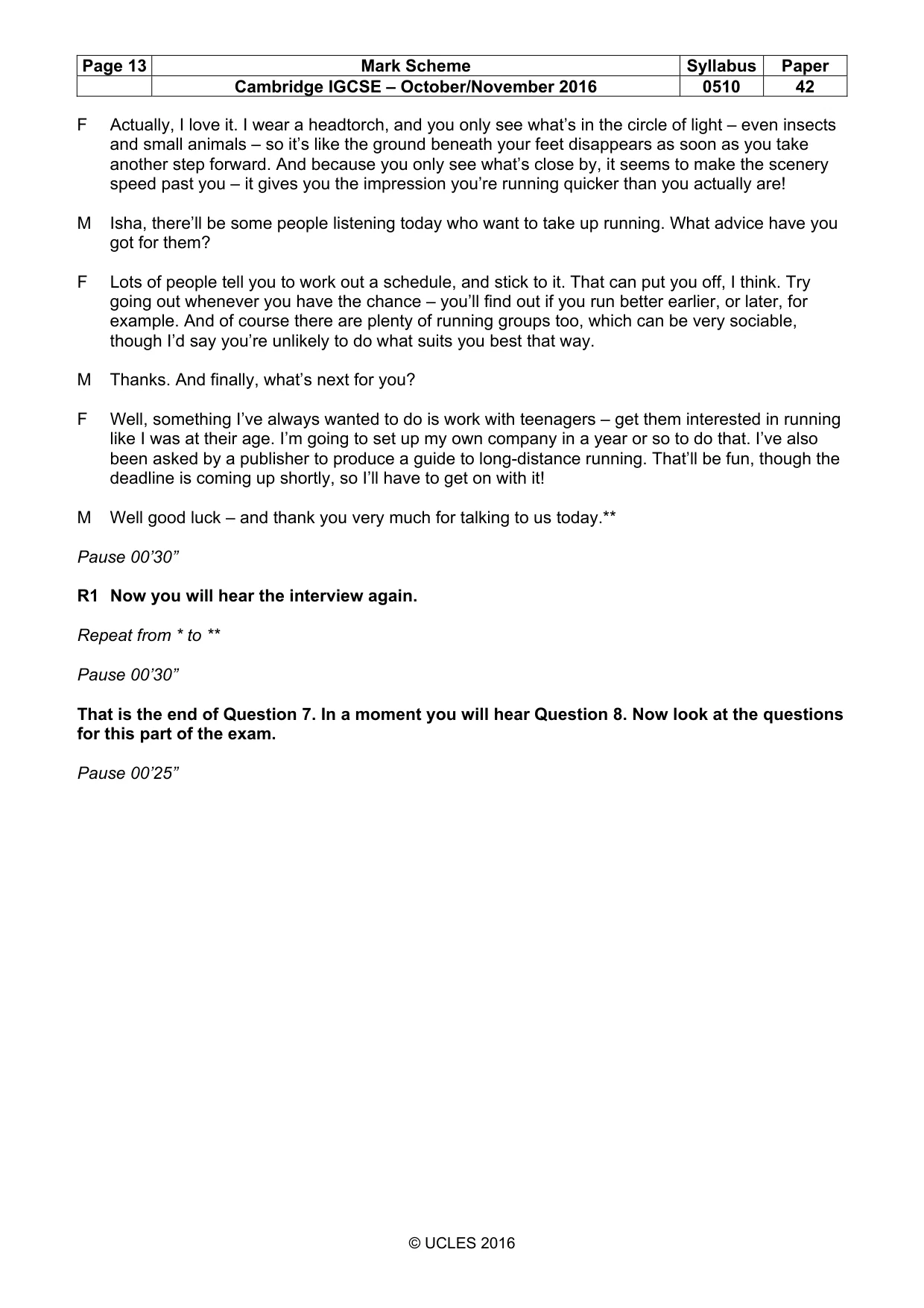
Page 13 Mark Scheme Syllabus Paper Cambridge IGCSE – October/November 2016 0510 42 © UCLES 2016 F Actually, I love it. I wear a headtorch, and you only see what’s in the circle of light – even insects and small animals – so it’s like the ground beneath your feet disappears as soon as you take another step forward. And because you only see what’s close by, it seems to make the scenery speed past you – it gives you the impression you’re running quicker than you actually are! M Isha, there’ll be some people listening today who want to take up running. What advice have you got for them? F Lots of people tell you to work out a schedule, and stick to it. That can put you off, I think. Try going out whenever you have the chance – you’ll find out if you run better earlier, or later, for example. And of course there are plenty of running groups too, which can be very sociable, though I’d say you’re unlikely to do what suits you best that way. M Thanks. And finally, what’s next for you? F Well, something I’ve always wanted to do is work with teenagers – get them interested in running like I was at their age. I’m going to set up my own company in a year or so to do that. I’ve also been asked by a publisher to produce a guide to long-distance running. That’ll be fun, though the deadline is coming up shortly, so I’ll have to get on with it! M Well good luck – and thank you very much for talking to us today.** Pause 00’30” R1 Now you will hear the interview again. Repeat from * to ** Pause 00’30” That is the end of Question 7. In a moment you will hear Question 8. Now look at the questions for this part of the exam. Pause 00’25”
Mark scheme, page 14
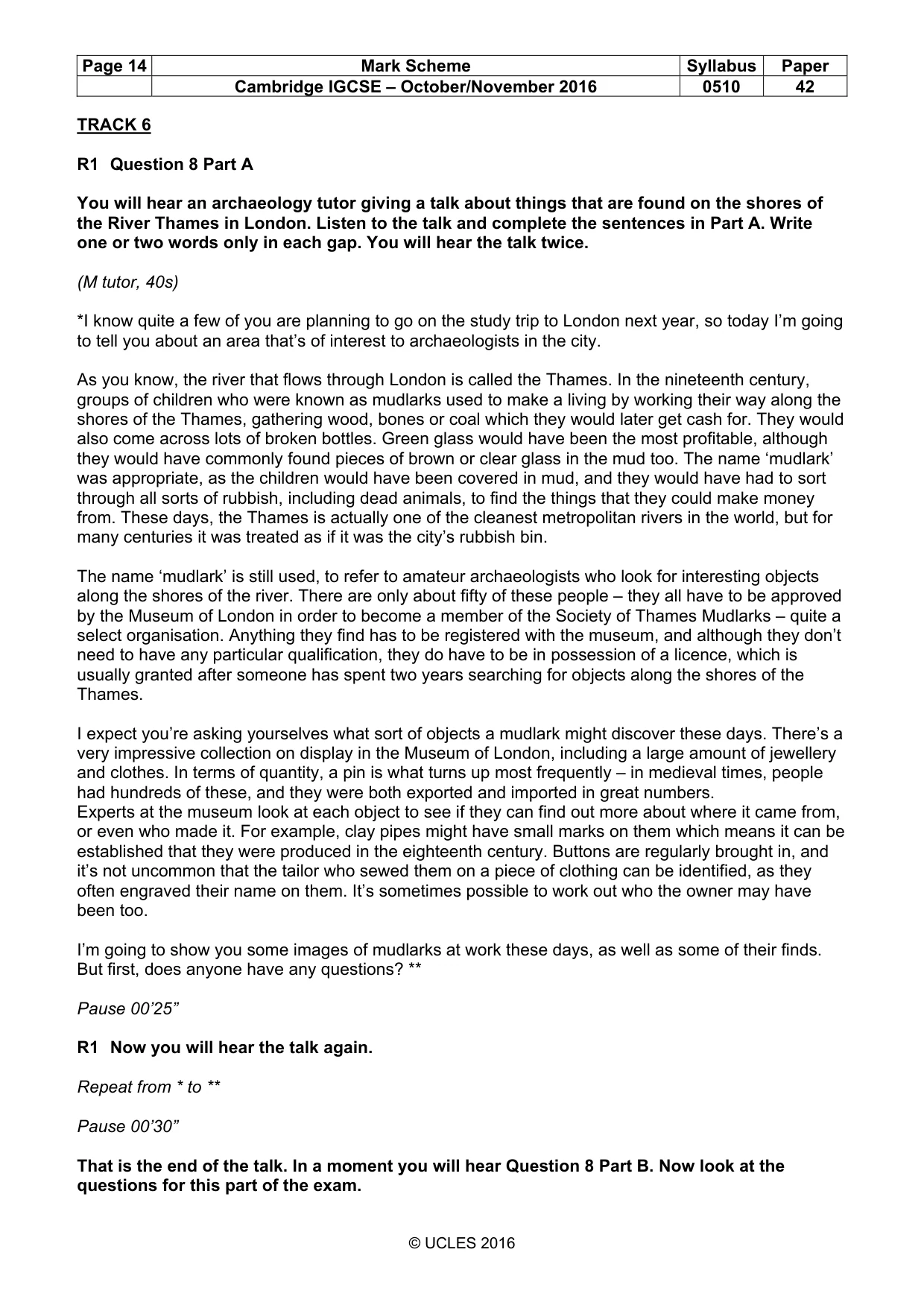
Page 14 Mark Scheme Syllabus Paper Cambridge IGCSE – October/November 2016 0510 42 © UCLES 2016 TRACK 6 R1 Question 8 Part A You will hear an archaeology tutor giving a talk about things that are found on the shores of the River Thames in London. Listen to the talk and complete the sentences in Part A. Write one or two words only in each gap. You will hear the talk twice. (M tutor, 40s) *I know quite a few of you are planning to go on the study trip to London next year, so today I’m going to tell you about an area that’s of interest to archaeologists in the city. As you know, the river that flows through London is called the Thames. In the nineteenth century, groups of children who were known as mudlarks used to make a living by working their way along the shores of the Thames, gathering wood, bones or coal which they would later get cash for. They would also come across lots of broken bottles. Green glass would have been the most profitable, although they would have commonly found pieces of brown or clear glass in the mud too. The name ‘mudlark’ was appropriate, as the children would have been covered in mud, and they would have had to sort through all sorts of rubbish, including dead animals, to find the things that they could make money from. These days, the Thames is actually one of the cleanest metropolitan rivers in the world, but for many centuries it was treated as if it was the city’s rubbish bin. The name ‘mudlark’ is still used, to refer to amateur archaeologists who look for interesting objects along the shores of the river. There are only about fifty of these people – they all have to be approved by the Museum of London in order to become a member of the Society of Thames Mudlarks – quite a select organisation. Anything they find has to be registered with the museum, and although they don’t need to have any particular qualification, they do have to be in possession of a licence, which is usually granted after someone has spent two years searching for objects along the shores of the Thames. I expect you’re asking yourselves what sort of objects a mudlark might discover these days. There’s a very impressive collection on display in the Museum of London, including a large amount of jewellery and clothes. In terms of quantity, a pin is what turns up most frequently – in medieval times, people had hundreds of these, and they were both exported and imported in great numbers. Experts at the museum look at each object to see if they can find out more about where it came from, or even who made it. For example, clay pipes might have small marks on them which means it can be established that they were produced in the eighteenth century. Buttons are regularly brought in, and it’s not uncommon that the tailor who sewed them on a piece of clothing can be identified, as they often engraved their name on them. It’s sometimes possible to work out who the owner may have been too. I’m going to show you some images of mudlarks at work these days, as well as some of their finds. But first, does anyone have any questions? ** Pause 00’25” R1 Now you will hear the talk again. Repeat from * to ** Pause 00’30” That is the end of the talk. In a moment you will hear Question 8 Part B. Now look at the questions for this part of the exam.
Mark scheme, page 15
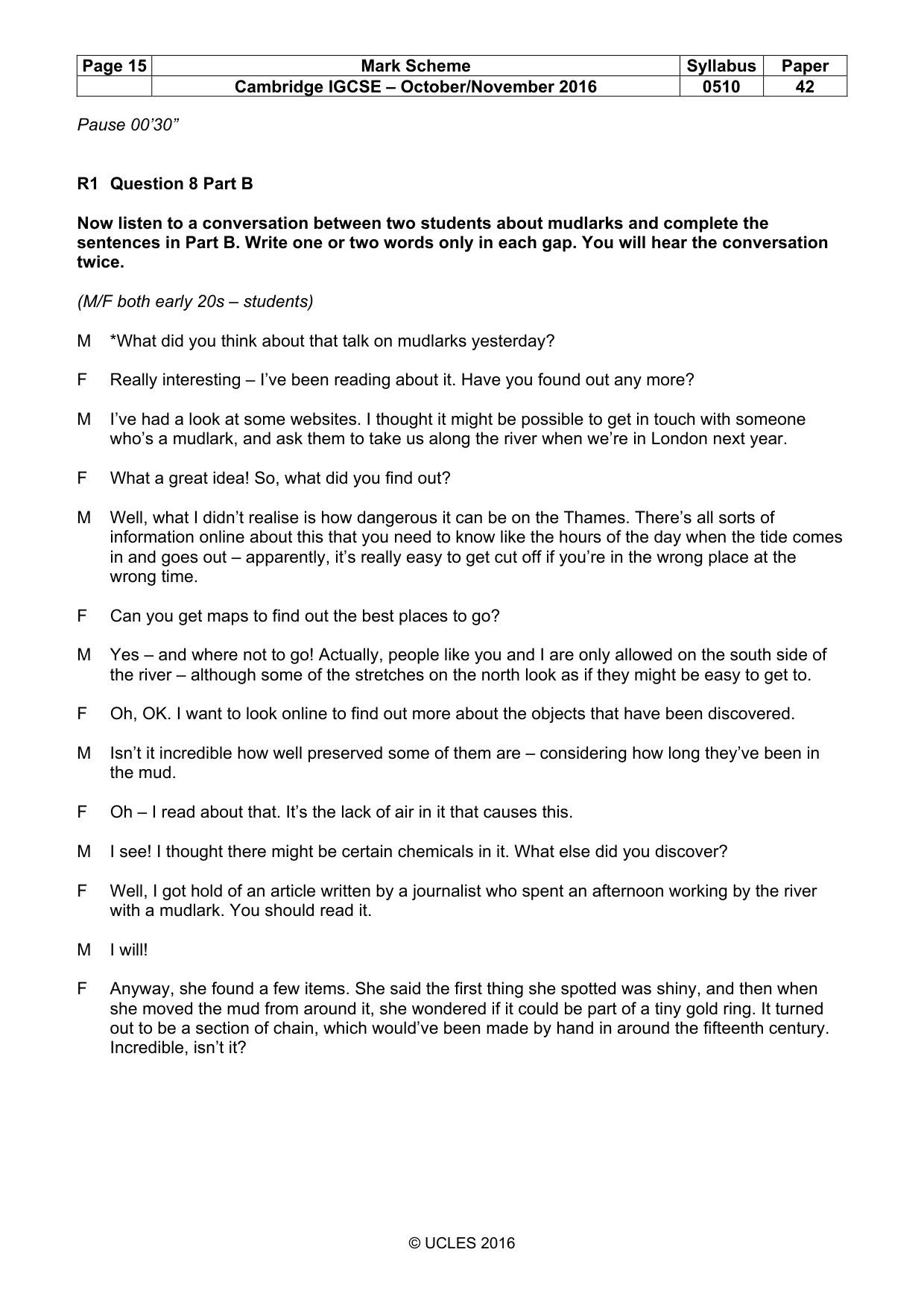
Page 15 Mark Scheme Syllabus Paper Cambridge IGCSE – October/November 2016 0510 42 © UCLES 2016 Pause 00’30” R1 Question 8 Part B Now listen to a conversation between two students about mudlarks and complete the sentences in Part B. Write one or two words only in each gap. You will hear the conversation twice. (M/F both early 20s – students) M *What did you think about that talk on mudlarks yesterday? F Really interesting – I’ve been reading about it. Have you found out any more? M I’ve had a look at some websites. I thought it might be possible to get in touch with someone who’s a mudlark, and ask them to take us along the river when we’re in London next year. F What a great idea! So, what did you find out? M Well, what I didn’t realise is how dangerous it can be on the Thames. There’s all sorts of information online about this that you need to know like the hours of the day when the tide comes in and goes out – apparently, it’s really easy to get cut off if you’re in the wrong place at the wrong time. F Can you get maps to find out the best places to go? M Yes – and where not to go! Actually, people like you and I are only allowed on the south side of the river – although some of the stretches on the north look as if they might be easy to get to. F Oh, OK. I want to look online to find out more about the objects that have been discovered. M Isn’t it incredible how well preserved some of them are – considering how long they’ve been in the mud. F Oh – I read about that. It’s the lack of air in it that causes this. M I see! I thought there might be certain chemicals in it. What else did you discover? F Well, I got hold of an article written by a journalist who spent an afternoon working by the river with a mudlark. You should read it. M I will! F Anyway, she found a few items. She said the first thing she spotted was shiny, and then when she moved the mud from around it, she wondered if it could be part of a tiny gold ring. It turned out to be a section of chain, which would’ve been made by hand in around the fifteenth century. Incredible, isn’t it?
Mark scheme, page 16
Page 16 Mark Scheme Syllabus Paper Cambridge IGCSE – October/November 2016 0510 42 © UCLES 2016 M It is! I love the fact that you can discover so much about an object like that. F Yes! Another thing this journalist found was what she thought was a coin, and they took it to the museum to be examined. It was actually a seventeenth-century token, which would’ve been used as an alternative to money. The museum has got lots of these – there’s one made by a shopkeeper, for example. The one she dug up happened to have been produced by a baker, and they’ve even discovered that he came from a town called Reading, which is not far from London. It’s quite amazing what you can find out from one little object like that, isn’t it!** Pause 00’25” R1 Now you will hear the conversation again. Repeat from * to ** Pause 00’30” That is the end of Question 8, and of the exam. In a moment your teacher will collect your papers. Please check that you have written your name, Centre number and candidate number on the front of your question paper. Remember, you must not talk until all the papers have been collected. Pause 00’10” R1 Teacher, please collect all the papers.
What you needed in this session
Cambridge’s own grade thresholds for 2016 Oct/Nov, Paper 4 · Variant 2. A higher threshold means an easier paper — the bar moves with how the cohort did.