Cambridge IGCSE English - Second Language (oral endorsement) 0510 — 2016 Oct/Nov Paper 4 · Variant 1
0510/41/O/N/16 · 40 marks · ≈45 min
The question paper and its mark scheme, free to read here and free to download. This is Cambridge’s own paper, exactly as it was sat.
Question paper12 pages




Mark scheme18 pages
Answers below. Sit the paper first if you are practising.
Paper as text
Question paper, page 1
This document consists of 9 printed pages and 3 blank pages. DC (LEG/CGW) 116467/3 © UCLES 2016 [Turn over Cambridge International Examinations Cambridge International General Certificate of Secondary Education * 9 5 6 5 1 0 7 9 4 6 * ENGLISH AS A SECOND LANGUAGE 0510/41 Paper 4 Listening (Extended) October/November 2016 Approx. 50 minutes Candidates answer on the Question Paper. Additional Materials: As listed in Instructions to Supervisors. READ THESE INSTRUCTIONS FIRST Write your Centre number, candidate number and name on all the work you hand in. Write in dark blue or black pen. Do not use staples, paper clips, glue or correction fluid. DO NOT WRITE IN ANY BARCODES. Answer all questions. Dictionaries are not permitted. At the end of the examination, fasten all your work securely together. The number of marks is given in brackets [ ] at the end of each question or part question.
Question paper, page 2
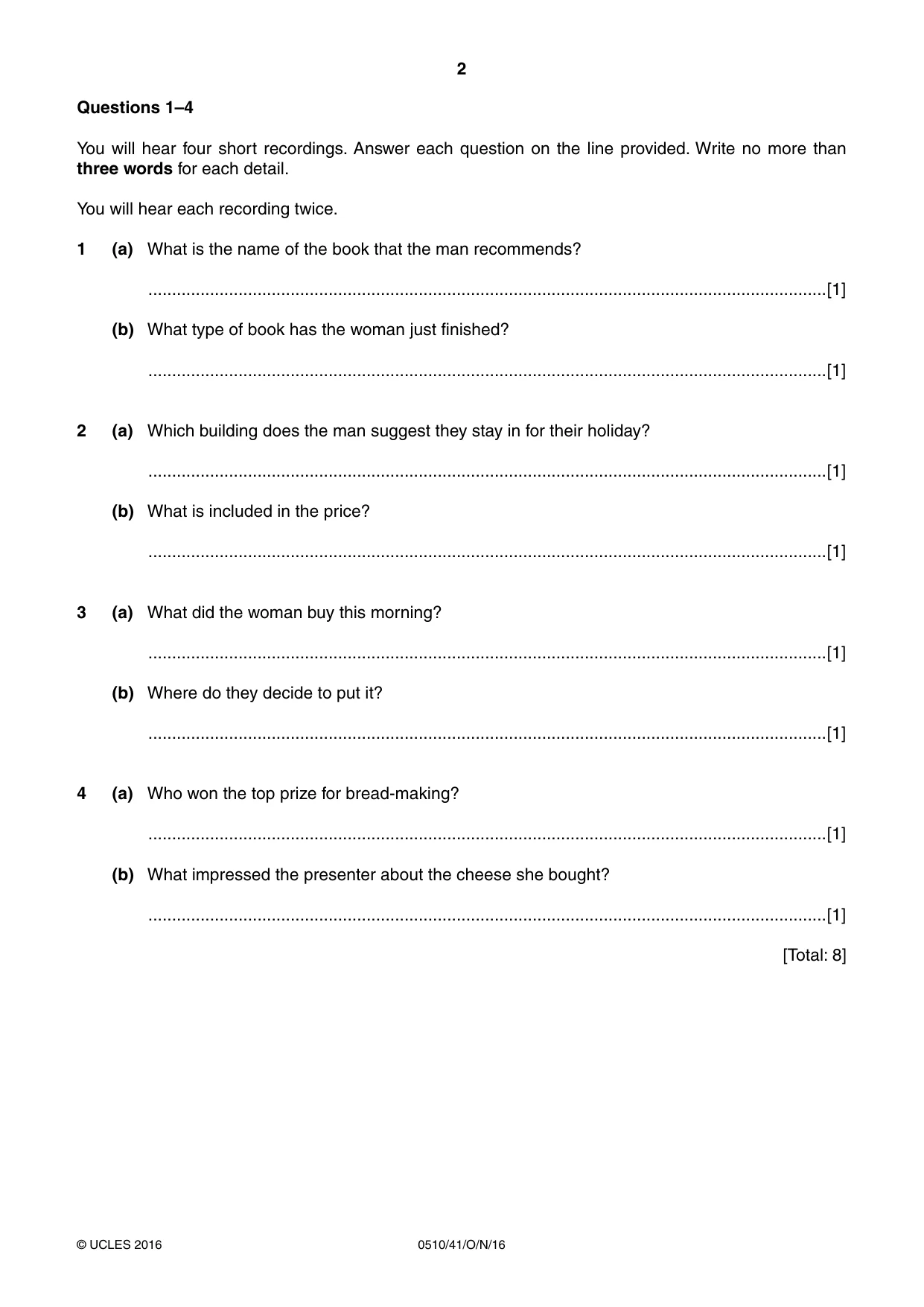
2 0510/41/O/N/16 © UCLES 2016 Questions 1–4 You will hear four short recordings. Answer each question on the line provided. Write no more than three words for each detail. You will hear each recording twice. 1 (a) What is the name of the book that the man recommends? …[1] (b) What type of book has the woman just finished? …[1] 2 (a) Which building does the man suggest they stay in for their holiday? …[1] (b) What is included in the price? …[1] 3 (a) What did the woman buy this morning? …[1] (b) Where do they decide to put it? …[1] 4 (a) Who won the top prize for bread-making? …[1] (b) What impressed the presenter about the cheese she bought? …[1] [Total: 8]
Question paper, page 3
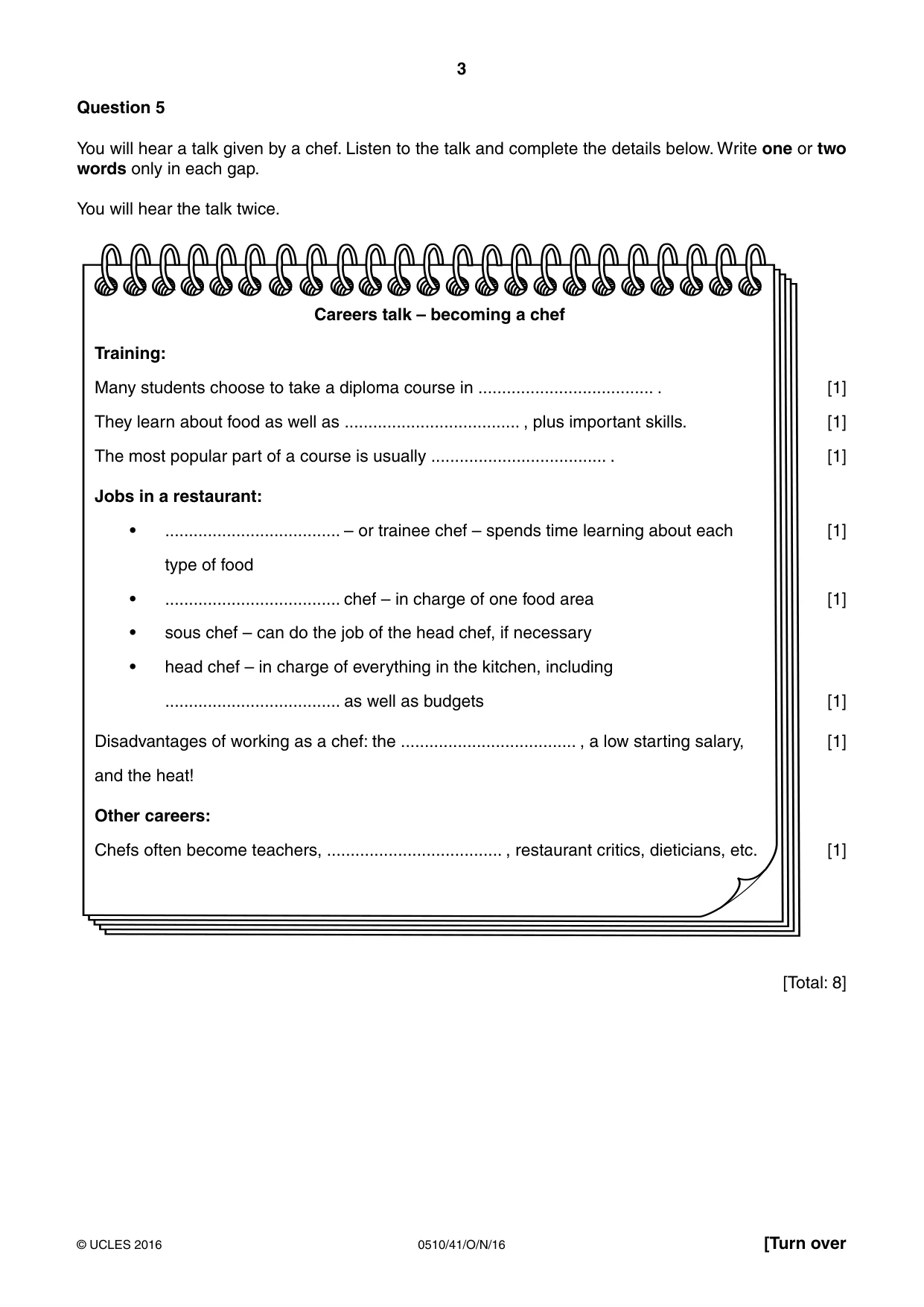
3 0510/41/O/N/16 © UCLES 2016 [Turn over Question 5 You will hear a talk given by a chef. Listen to the talk and complete the details below. Write one or two words only in each gap. You will hear the talk twice. Careers talk – becoming a chef Training: Many students choose to take a diploma course in … . [1] They learn about food as well as … , plus important skills. [1] The most popular part of a course is usually … . [1] Jobs in a restaurant: • … – or trainee chef – spends time learning about each [1] type of food • … chef – in charge of one food area [1] • sous chef – can do the job of the head chef, if necessary • head chef – in charge of everything in the kitchen, including … as well as budgets [1] Disadvantages of working as a chef: the … , a low starting salary, [1] and the heat! Other careers: Chefs often become teachers, … , restaurant critics, dieticians, etc. [1] [Total: 8]
Question paper, page 4
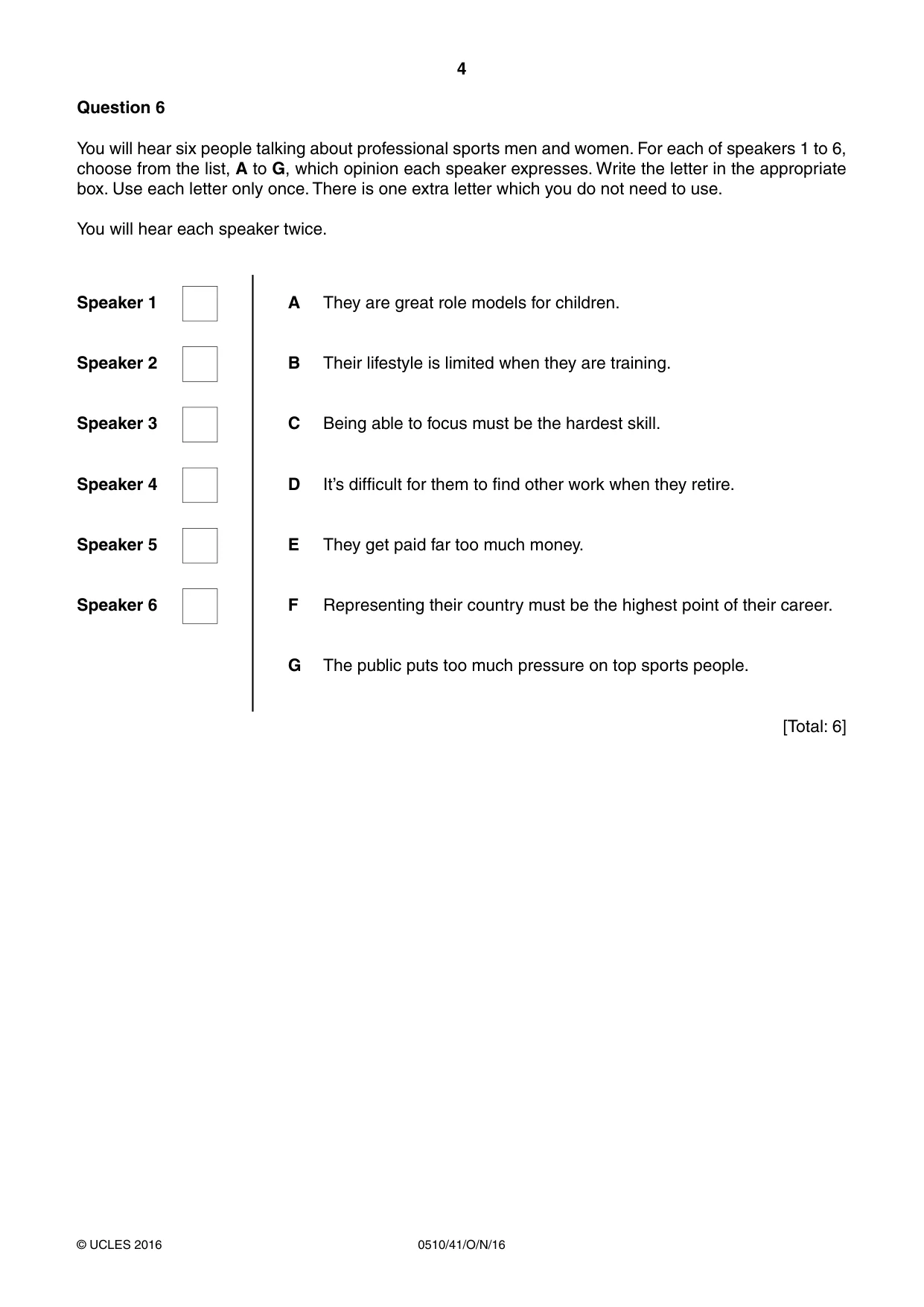
4 0510/41/O/N/16 © UCLES 2016 Question 6 You will hear six people talking about professional sports men and women. For each of speakers 1 to 6, choose from the list, A to G, which opinion each speaker expresses. Write the letter in the appropriate box. Use each letter only once. There is one extra letter which you do not need to use. You will hear each speaker twice. Speaker 1 Speaker 2 Speaker 3 Speaker 4 Speaker 5 Speaker 6 A They are great role models for children. B Their lifestyle is limited when they are training. C Being able to focus must be the hardest skill. D It’s difficult for them to find other work when they retire. E They get paid far too much money. F Representing their country must be the highest point of their career. G The public puts too much pressure on top sports people. [Total: 6]
Question paper, page 5
5 0510/41/O/N/16 © UCLES 2016 [Turn over Please turn over for Question 7.
Question paper, page 6
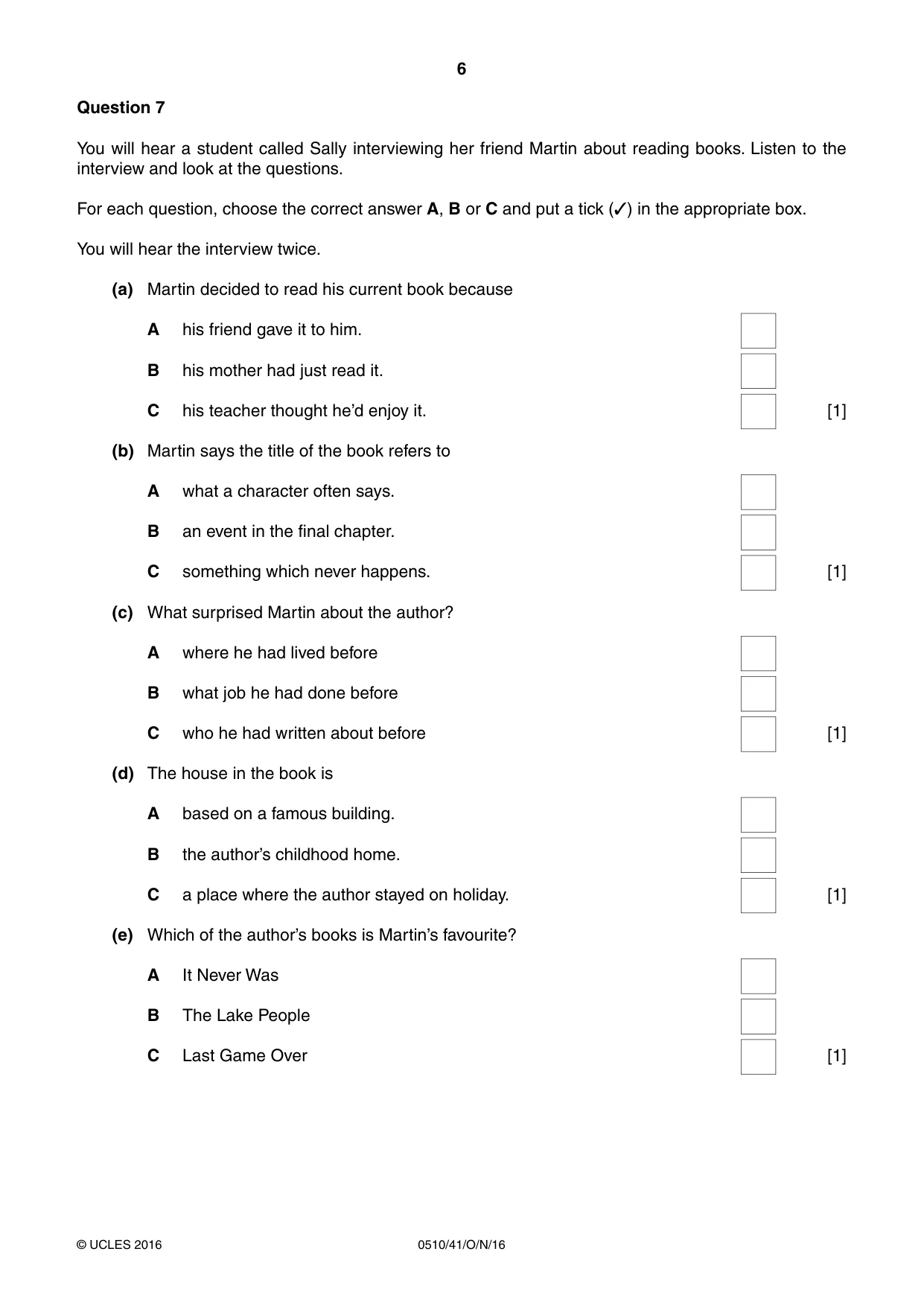
6 0510/41/O/N/16 © UCLES 2016 Question 7 You will hear a student called Sally interviewing her friend Martin about reading books. Listen to the interview and look at the questions. For each question, choose the correct answer A, B or C and put a tick (✓) in the appropriate box. You will hear the interview twice. (a) Martin decided to read his current book because A his friend gave it to him. B his mother had just read it. C his teacher thought he’d enjoy it. [1] (b) Martin says the title of the book refers to A what a character often says. B an event in the final chapter. C something which never happens. [1] (c) What surprised Martin about the author? A where he had lived before B what job he had done before C who he had written about before [1] (d) The house in the book is A based on a famous building. B the author’s childhood home. C a place where the author stayed on holiday. [1] (e) Which of the author’s books is Martin’s favourite? A It Never Was B The Lake People C Last Game Over [1]
Question paper, page 7
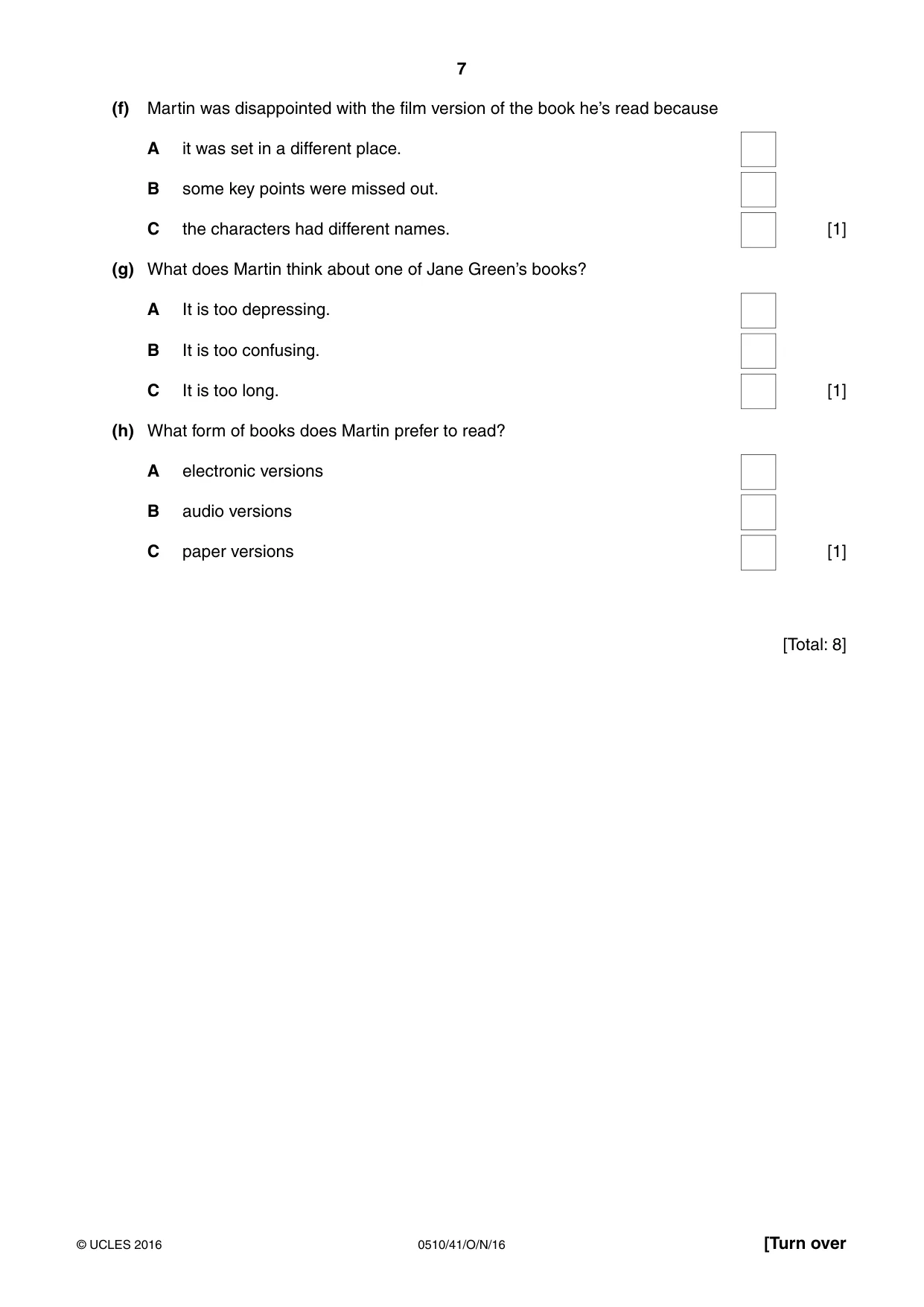
7 0510/41/O/N/16 © UCLES 2016 [Turn over (f) Martin was disappointed with the film version of the book he’s read because A it was set in a different place. B some key points were missed out. C the characters had different names. [1] (g) What does Martin think about one of Jane Green’s books? A It is too depressing. B It is too confusing. C It is too long. [1] (h) What form of books does Martin prefer to read? A electronic versions B audio versions C paper versions [1] [Total: 8]
Question paper, page 8
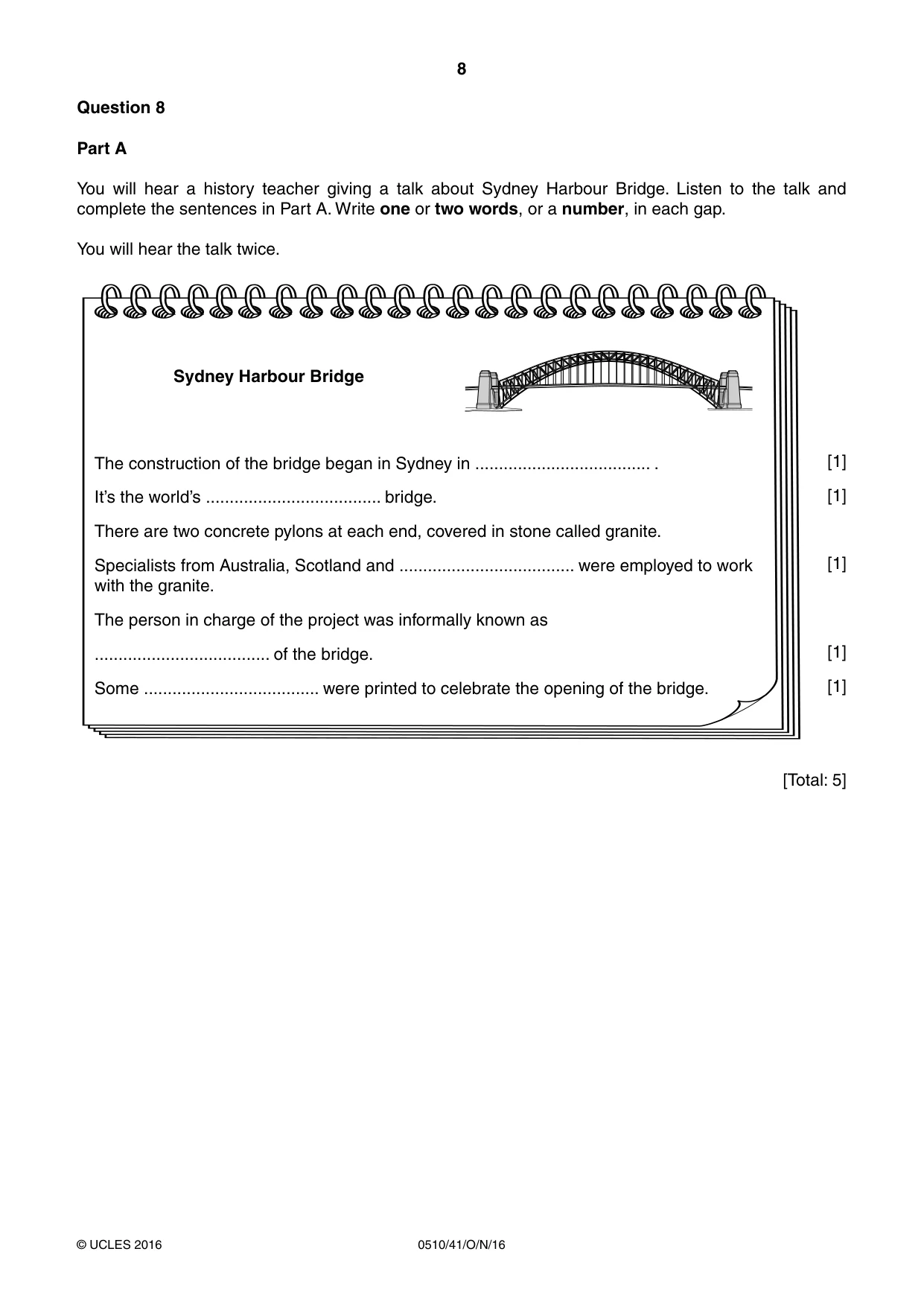
8 0510/41/O/N/16 © UCLES 2016 Question 8 Part A You will hear a history teacher giving a talk about Sydney Harbour Bridge. Listen to the talk and complete the sentences in Part A. Write one or two words, or a number, in each gap. You will hear the talk twice. Sydney Harbour Bridge The construction of the bridge began in Sydney in … . It’s the world’s … bridge. There are two concrete pylons at each end, covered in stone called granite. Specialists from Australia, Scotland and … were employed to work with the granite. The person in charge of the project was informally known as … of the bridge. Some … were printed to celebrate the opening of the bridge. [1] [1] [1] [1] [1] [Total: 5]
Question paper, page 9
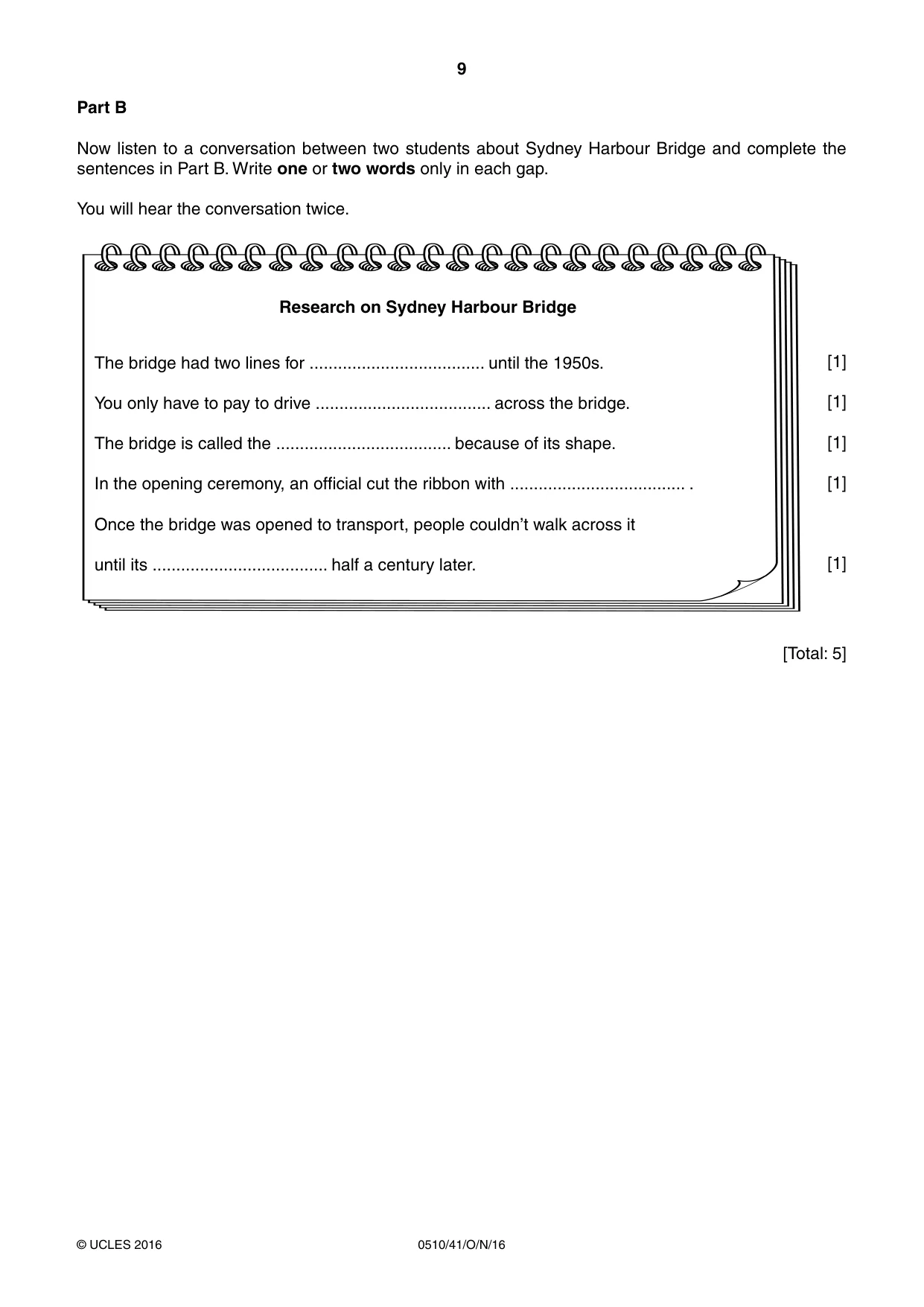
9 0510/41/O/N/16 © UCLES 2016 Part B Now listen to a conversation between two students about Sydney Harbour Bridge and complete the sentences in Part B. Write one or two words only in each gap. You will hear the conversation twice. Research on Sydney Harbour Bridge The bridge had two lines for … until the 1950s. You only have to pay to drive … across the bridge. The bridge is called the … because of its shape. In the opening ceremony, an official cut the ribbon with … . Once the bridge was opened to transport, people couldn’t walk across it until its … half a century later. [1] [1] [1] [1] [1] [Total: 5]
Question paper, page 10
10 0510/41/O/N/16 © UCLES 2016 BLANK PAGE
Question paper, page 11
11 0510/41/O/N/16 © UCLES 2016 BLANK PAGE
Question paper, page 12
12 0510/41/O/N/16 © UCLES 2016 Permission to reproduce items where third-party owned material protected by copyright is included has been sought and cleared where possible. Every reasonable effort has been made by the publisher (UCLES) to trace copyright holders, but if any items requiring clearance have unwittingly been included, the publisher will be pleased to make amends at the earliest possible opportunity. To avoid the issue of disclosure of answer-related information to candidates, all copyright acknowledgements are reproduced online in the Cambridge International Examinations Copyright Acknowledgements Booklet. This is produced for each series of examinations and is freely available to download at www.cie.org.uk after the live examination series. Cambridge International Examinations is part of the Cambridge Assessment Group. Cambridge Assessment is the brand name of University of Cambridge Local Examinations Syndicate (UCLES), which is itself a department of the University of Cambridge. BLANK PAGE
Mark scheme, page 1
® IGCSE is the registered trademark of Cambridge International Examinations. This document consists of 18 printed pages. © UCLES 2016 [Turn over Cambridge International Examinations Cambridge International General Certificate of Secondary Education ENGLISH AS A SECOND LANGUAGE 0510/41 Paper 4 Listening (Extended) October/November 2016 MARK SCHEME Maximum Mark: 40 Published This mark scheme is published as an aid to teachers and candidates, to indicate the requirements of the examination. It shows the basis on which Examiners were instructed to award marks. It does not indicate the details of the discussions that took place at an Examiners’ meeting before marking began, which would have considered the acceptability of alternative answers. Mark schemes should be read in conjunction with the question paper and the Principal Examiner Report for Teachers. Cambridge will not enter into discussions about these mark schemes. Cambridge is publishing the mark schemes for the October/November 2016 series for most Cambridge IGCSE®, Cambridge International A and AS Level components and some Cambridge O Level components.
Mark scheme, page 2
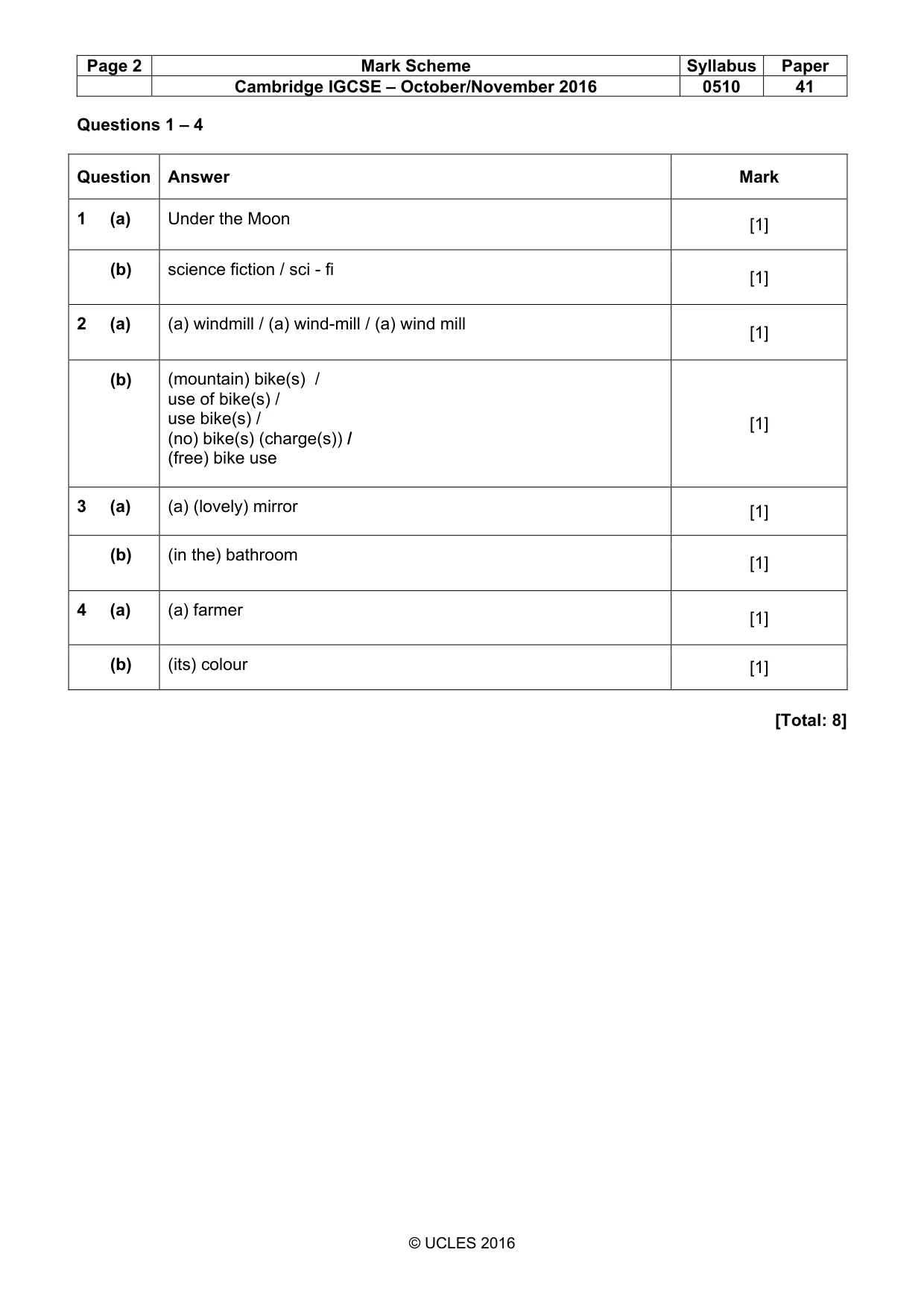
Page 2 Mark Scheme Syllabus Paper Cambridge IGCSE – October/November 2016 0510 41 © UCLES 2016 Questions 1 – 4 Question Answer Mark 1 (a) Under the Moon [1] (b) science fiction / sci - fi [1] 2 (a) (a) windmill / (a) wind-mill / (a) wind mill [1] (b) (mountain) bike(s) / use of bike(s) / use bike(s) / (no) bike(s) (charge(s)) / (free) bike use [1] 3 (a) (a) (lovely) mirror [1] (b) (in the) bathroom [1] 4 (a) (a) farmer [1] (b) (its) colour [1] [Total: 8]
Mark scheme, page 3
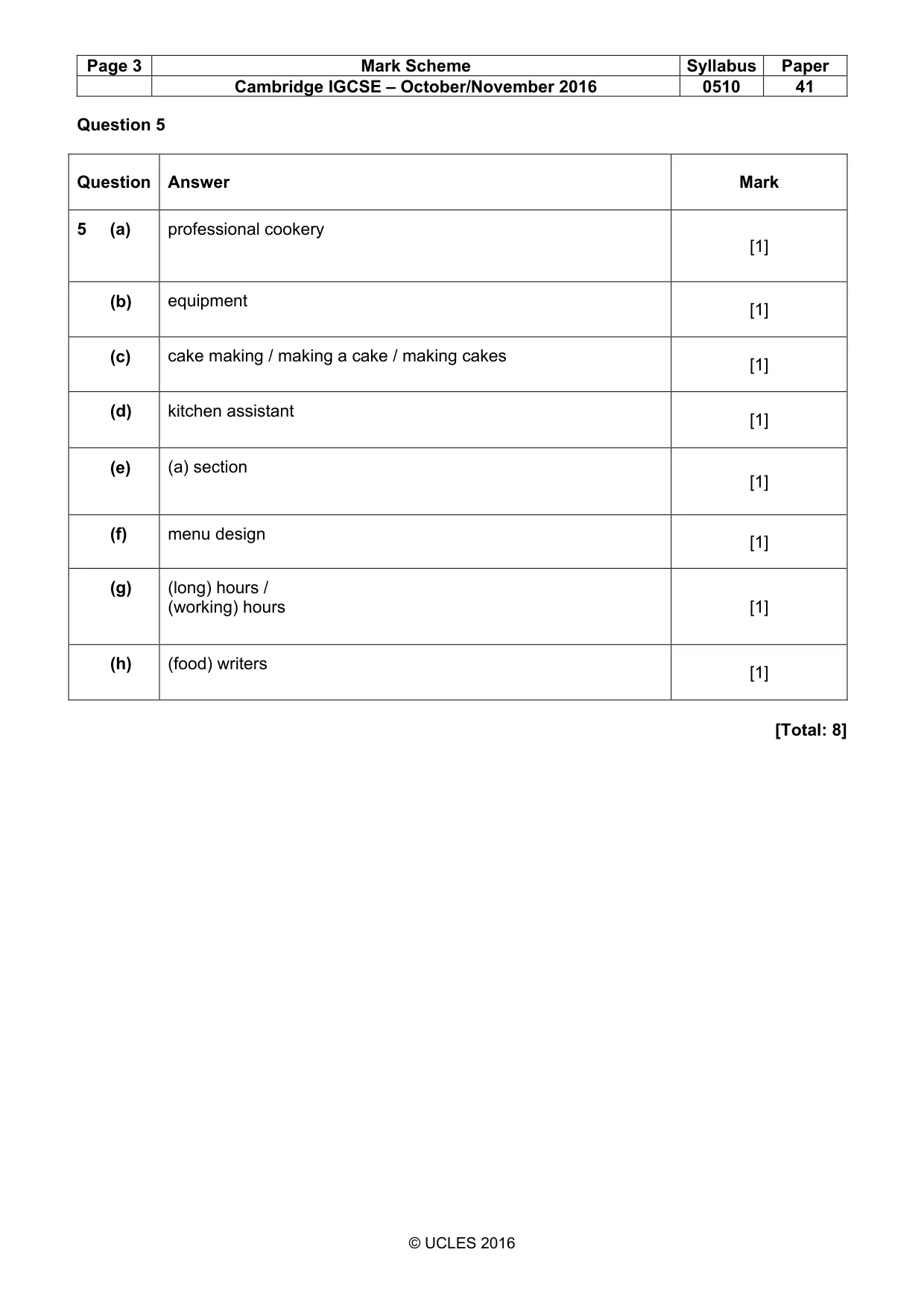
Page 3 Mark Scheme Syllabus Paper Cambridge IGCSE – October/November 2016 0510 41 © UCLES 2016 Question 5 Question Answer Mark 5 (a) professional cookery [1] (b) equipment [1] (c) cake making / making a cake / making cakes [1] (d) kitchen assistant [1] (e) (a) section [1] (f) menu design [1] (g) (long) hours / (working) hours [1] (h) (food) writers [1] [Total: 8]
Mark scheme, page 4
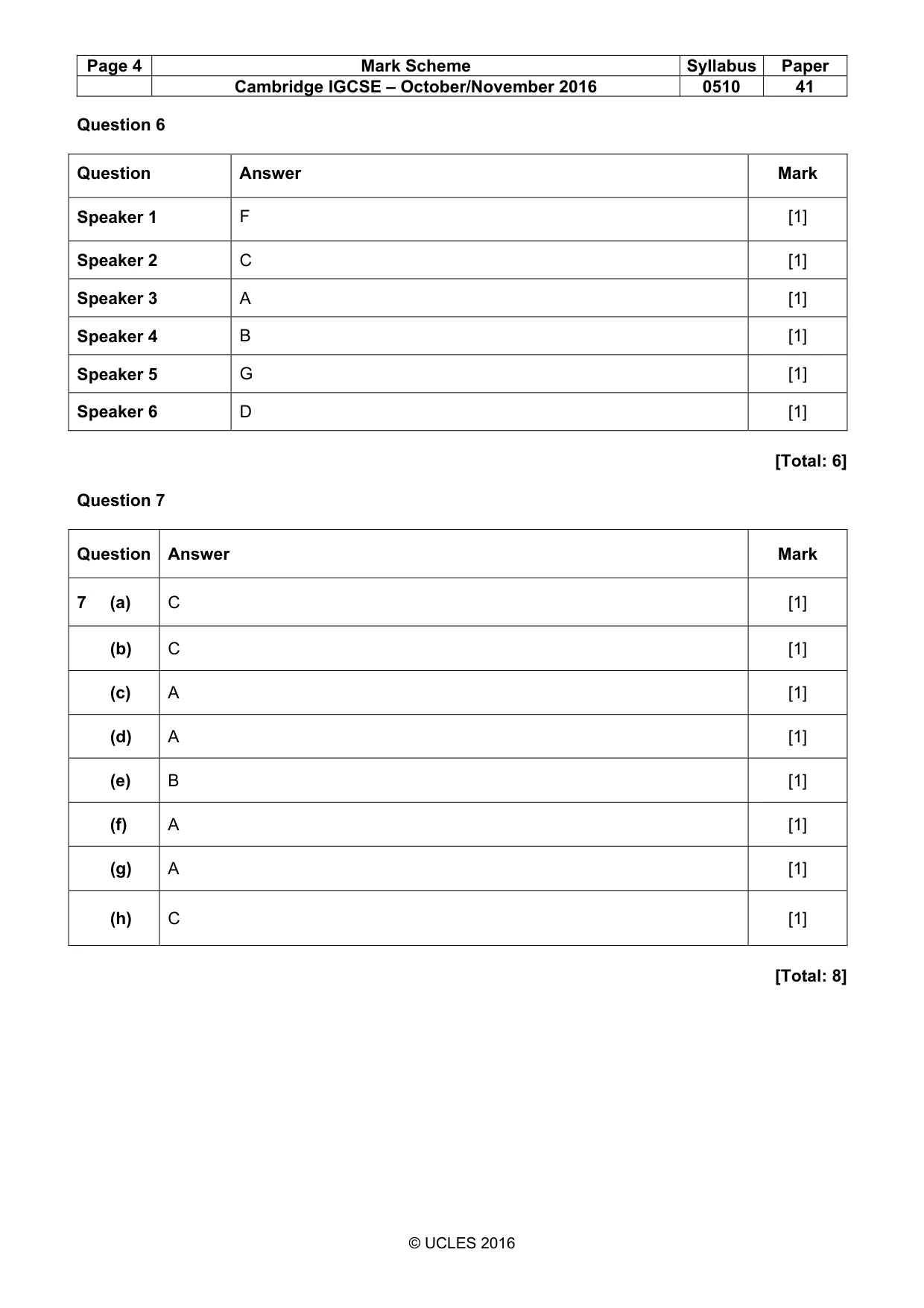
Page 4 Mark Scheme Syllabus Paper Cambridge IGCSE – October/November 2016 0510 41 © UCLES 2016 Question 6 Question Answer Mark Speaker 1 F [1] Speaker 2 C [1] Speaker 3 A [1] Speaker 4 B [1] Speaker 5 G [1] Speaker 6 D [1] [Total: 6] Question 7 Question Answer Mark 7 (a) C [1] (b) C [1] (c) A [1] (d) A [1] (e) B [1] (f) A [1] (g) A [1] (h) C [1] [Total: 8]
Mark scheme, page 5
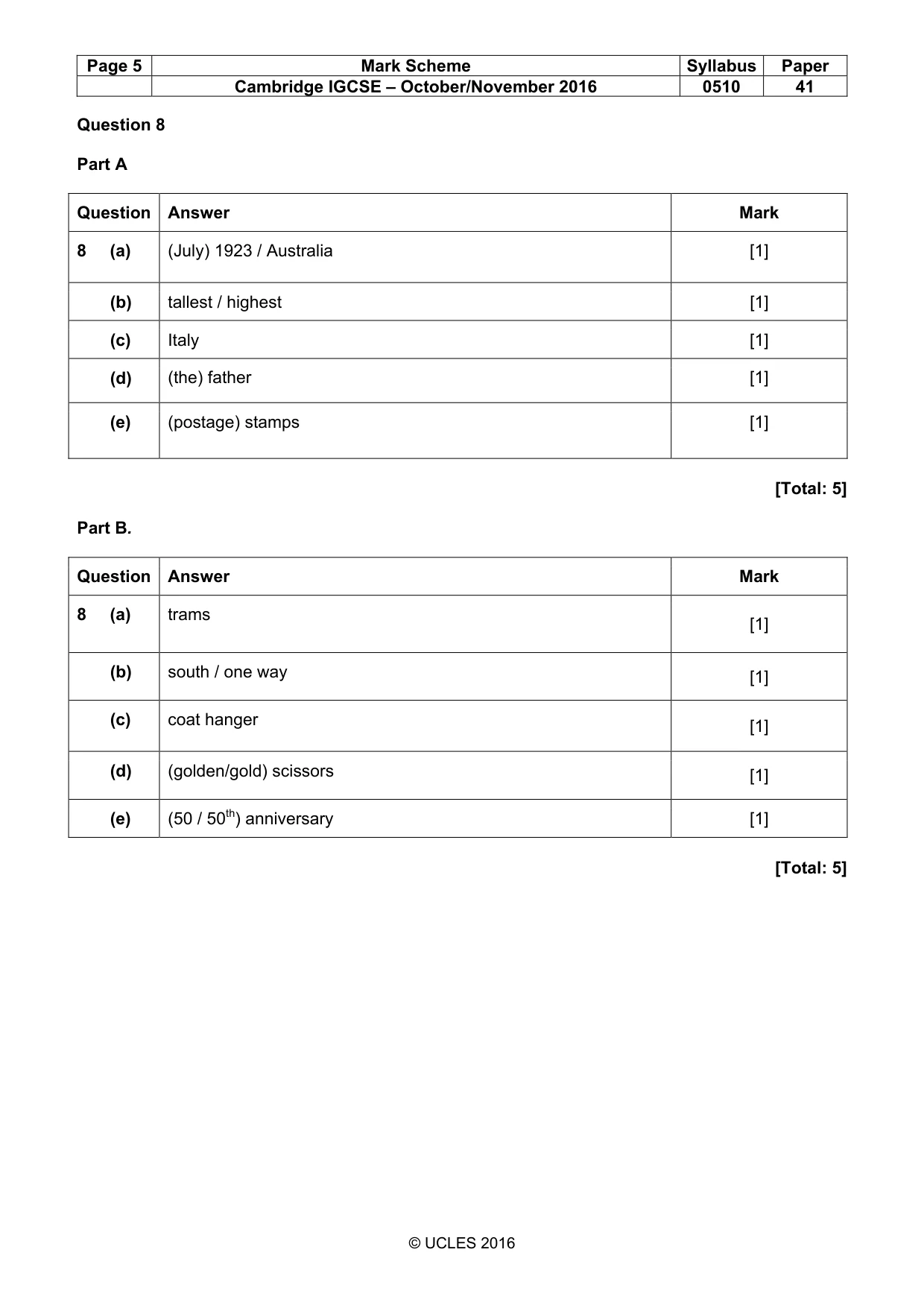
Page 5 Mark Scheme Syllabus Paper Cambridge IGCSE – October/November 2016 0510 41 © UCLES 2016 Question 8 Part A Question Answer Mark 8 (a) (July) 1923 / Australia [1] (b) tallest / highest [1] (c) Italy [1] (d) (the) father [1] (e) (postage) stamps [1] [Total: 5] Part B. Question Answer Mark 8 (a) trams [1] (b) south / one way [1] (c) coat hanger [1] (d) (golden/gold) scissors [1] (e) (50 / 50th) anniversary [1] [Total: 5]
Mark scheme, page 6
Page 6 Mark Scheme Syllabus Paper Cambridge IGCSE – October/November 2016 0510 41 © UCLES 2016 Transcript Listening (Extended) November 2016 TRACK 1 R1 Cambridge International Examinations International General Certificate of Secondary Education November examination series 2016 English as a Second Language Extended Tier – Listening Comprehension Welcome to the exam. In a moment, your teacher is going to give out the question papers. When you get your paper, fill in your name, Centre number and candidate number on the front page. Do not talk to anyone during the exam. If you would like the recording to be louder or quieter, tell your teacher NOW. The recording will not be stopped while you are doing the exam. Teacher: please give out the question papers, and when all the candidates are ready to start the test, please turn the recording back on. [BEEP]
Mark scheme, page 7
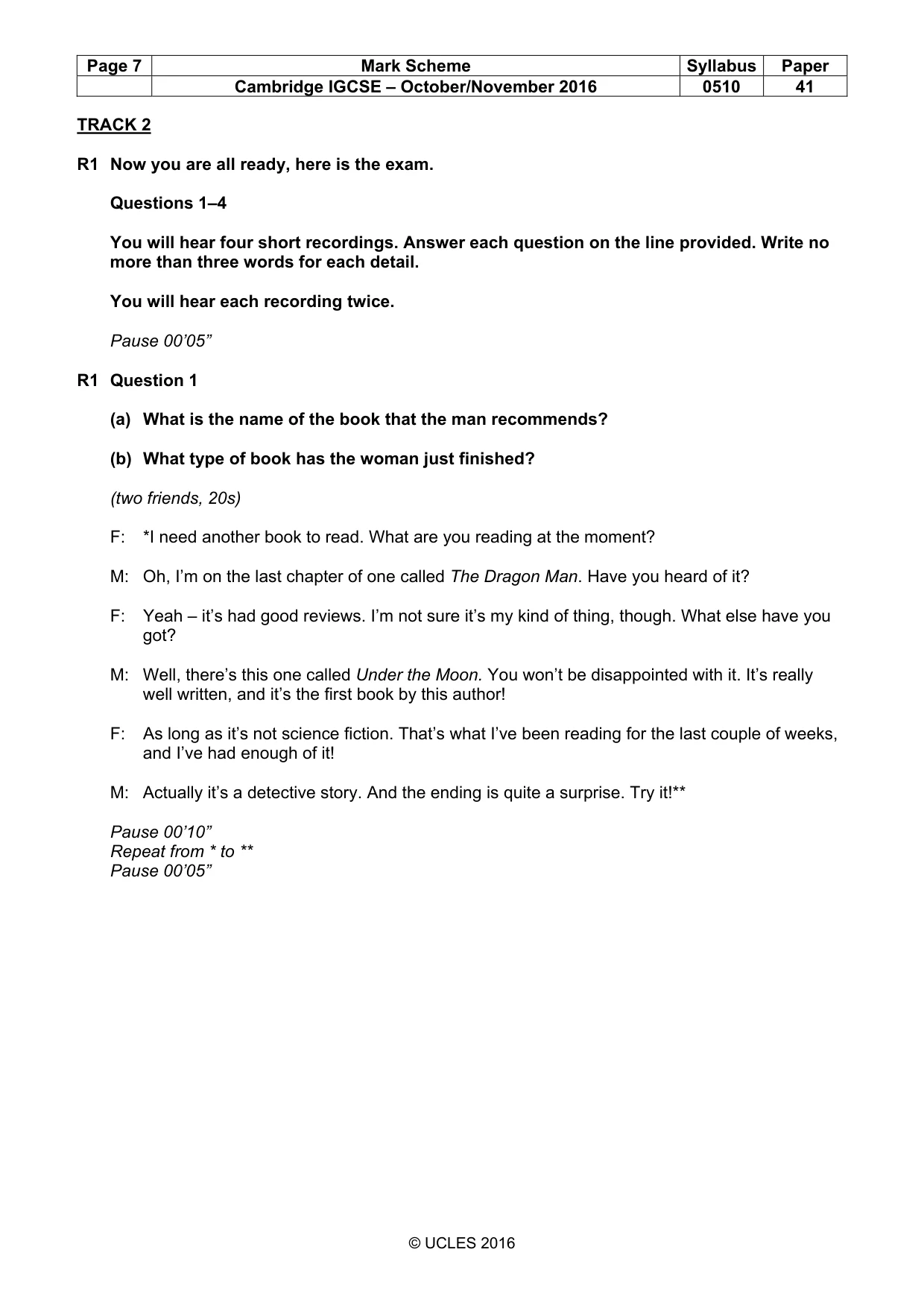
Page 7 Mark Scheme Syllabus Paper Cambridge IGCSE – October/November 2016 0510 41 © UCLES 2016 TRACK 2 R1 Now you are all ready, here is the exam. Questions 1–4 You will hear four short recordings. Answer each question on the line provided. Write no more than three words for each detail. You will hear each recording twice. Pause 00’05” R1 Question 1 (a) What is the name of the book that the man recommends? (b) What type of book has the woman just finished? (two friends, 20s) F: *I need another book to read. What are you reading at the moment? M: Oh, I’m on the last chapter of one called The Dragon Man. Have you heard of it? F: Yeah – it’s had good reviews. I’m not sure it’s my kind of thing, though. What else have you got? M: Well, there’s this one called Under the Moon. You won’t be disappointed with it. It’s really well written, and it’s the first book by this author! F: As long as it’s not science fiction. That’s what I’ve been reading for the last couple of weeks, and I’ve had enough of it! M: Actually it’s a detective story. And the ending is quite a surprise. Try it!** Pause 00’10” Repeat from * to ** Pause 00’05”
Mark scheme, page 8
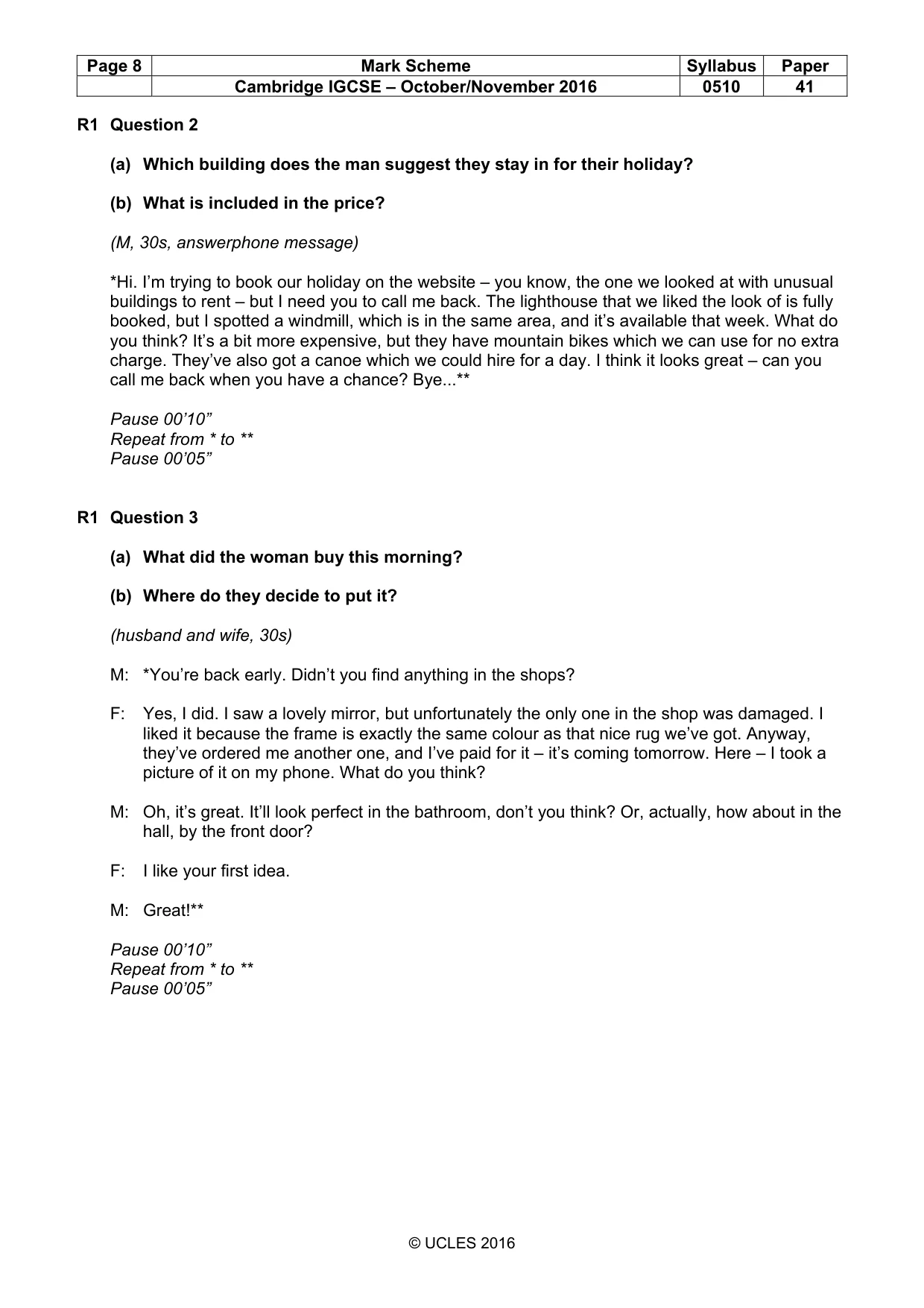
Page 8 Mark Scheme Syllabus Paper Cambridge IGCSE – October/November 2016 0510 41 © UCLES 2016 R1 Question 2 (a) Which building does the man suggest they stay in for their holiday? (b) What is included in the price? (M, 30s, answerphone message) *Hi. I’m trying to book our holiday on the website – you know, the one we looked at with unusual buildings to rent – but I need you to call me back. The lighthouse that we liked the look of is fully booked, but I spotted a windmill, which is in the same area, and it’s available that week. What do you think? It’s a bit more expensive, but they have mountain bikes which we can use for no extra charge. They’ve also got a canoe which we could hire for a day. I think it looks great – can you call me back when you have a chance? Bye...** Pause 00’10” Repeat from * to ** Pause 00’05” R1 Question 3 (a) What did the woman buy this morning? (b) Where do they decide to put it? (husband and wife, 30s) M: *You’re back early. Didn’t you find anything in the shops? F: Yes, I did. I saw a lovely mirror, but unfortunately the only one in the shop was damaged. I liked it because the frame is exactly the same colour as that nice rug we’ve got. Anyway, they’ve ordered me another one, and I’ve paid for it – it’s coming tomorrow. Here – I took a picture of it on my phone. What do you think? M: Oh, it’s great. It’ll look perfect in the bathroom, don’t you think? Or, actually, how about in the hall, by the front door? F: I like your first idea. M: Great!** Pause 00’10” Repeat from * to ** Pause 00’05”
Mark scheme, page 9
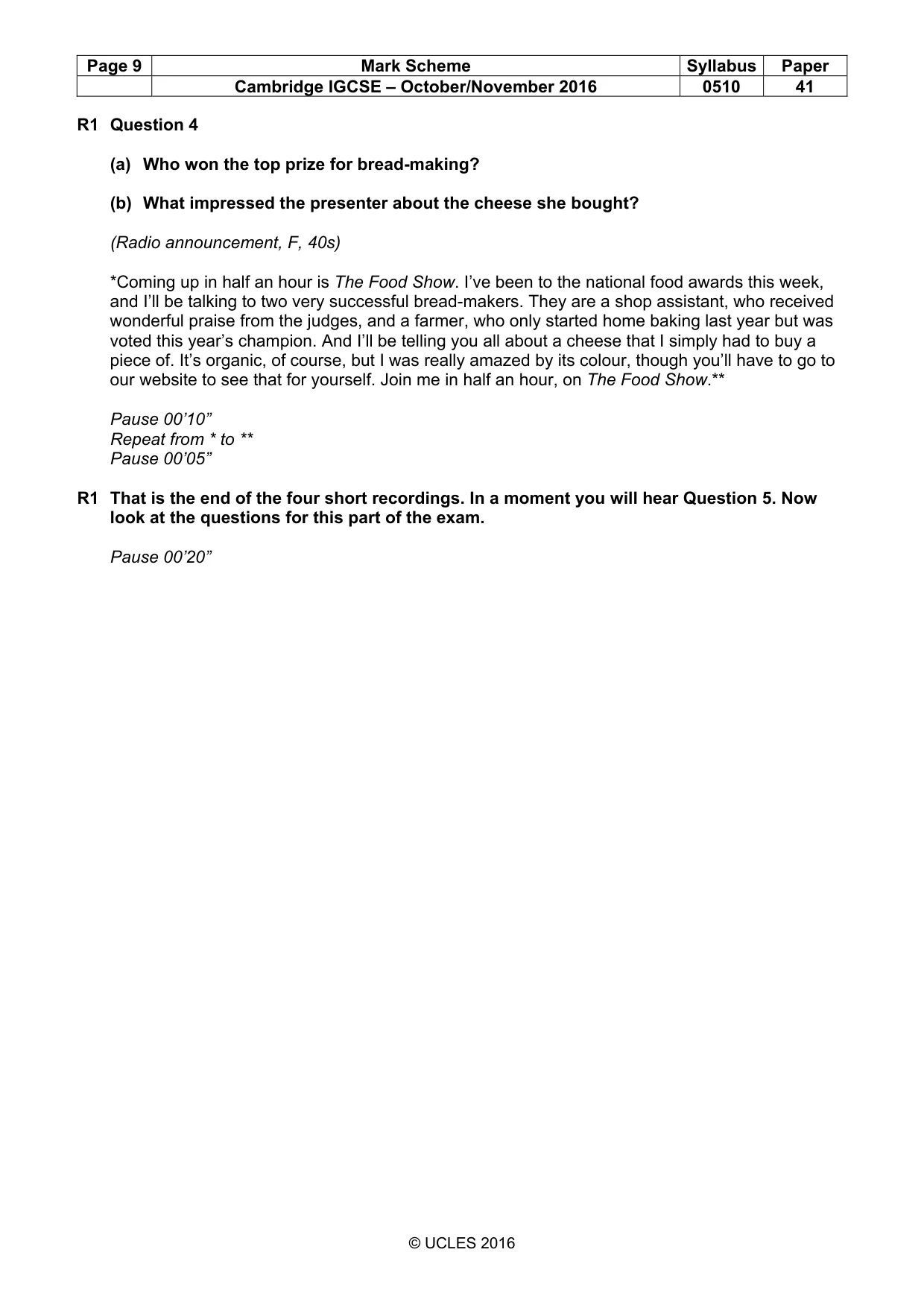
Page 9 Mark Scheme Syllabus Paper Cambridge IGCSE – October/November 2016 0510 41 © UCLES 2016 R1 Question 4 (a) Who won the top prize for bread-making? (b) What impressed the presenter about the cheese she bought? (Radio announcement, F, 40s) *Coming up in half an hour is The Food Show. I’ve been to the national food awards this week, and I’ll be talking to two very successful bread-makers. They are a shop assistant, who received wonderful praise from the judges, and a farmer, who only started home baking last year but was voted this year’s champion. And I’ll be telling you all about a cheese that I simply had to buy a piece of. It’s organic, of course, but I was really amazed by its colour, though you’ll have to go to our website to see that for yourself. Join me in half an hour, on The Food Show.** Pause 00’10” Repeat from * to ** Pause 00’05” R1 That is the end of the four short recordings. In a moment you will hear Question 5. Now look at the questions for this part of the exam. Pause 00’20”
Mark scheme, page 10
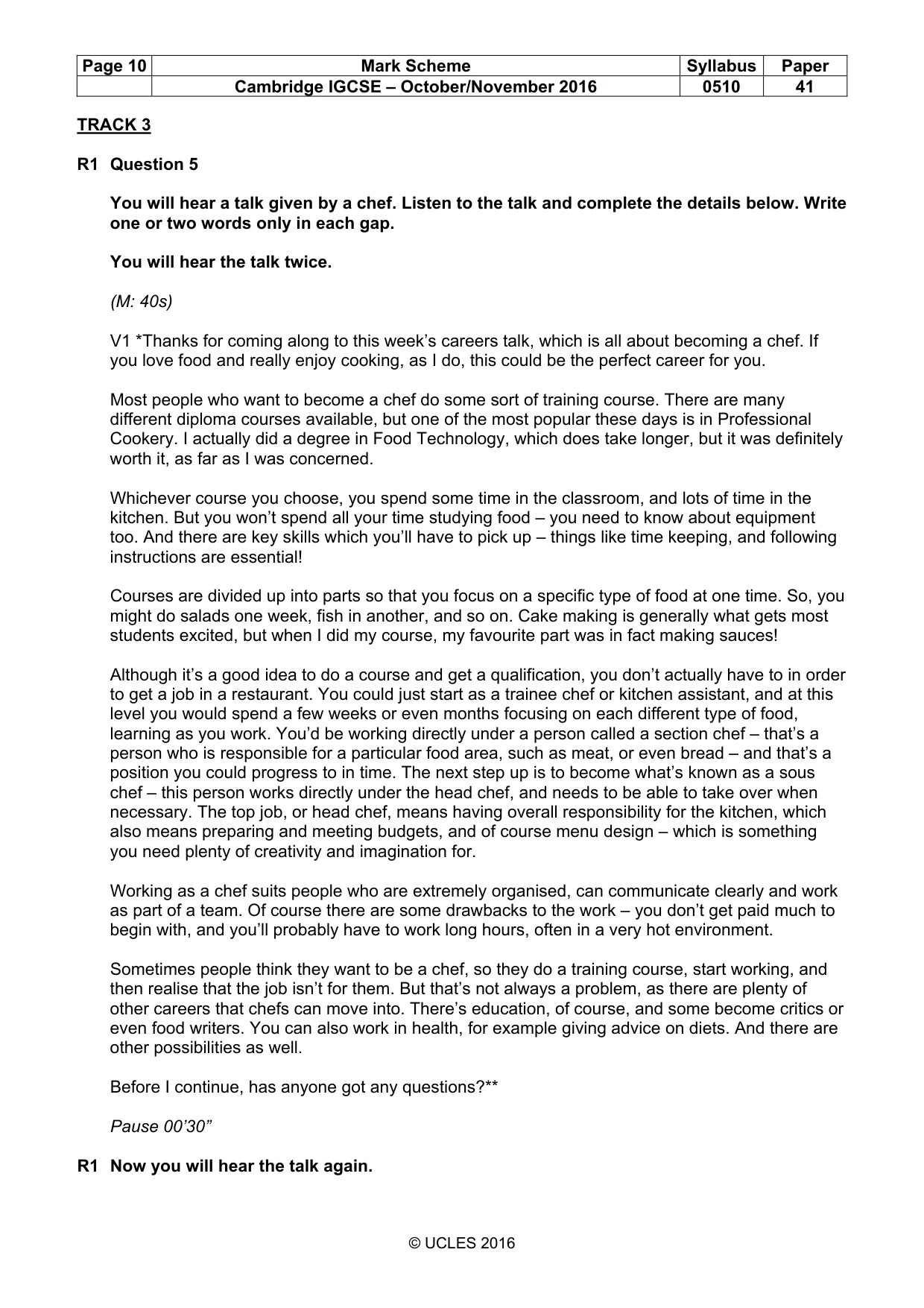
Page 10 Mark Scheme Syllabus Paper Cambridge IGCSE – October/November 2016 0510 41 © UCLES 2016 TRACK 3 R1 Question 5 You will hear a talk given by a chef. Listen to the talk and complete the details below. Write one or two words only in each gap. You will hear the talk twice. (M: 40s) V1 *Thanks for coming along to this week’s careers talk, which is all about becoming a chef. If you love food and really enjoy cooking, as I do, this could be the perfect career for you. Most people who want to become a chef do some sort of training course. There are many different diploma courses available, but one of the most popular these days is in Professional Cookery. I actually did a degree in Food Technology, which does take longer, but it was definitely worth it, as far as I was concerned. Whichever course you choose, you spend some time in the classroom, and lots of time in the kitchen. But you won’t spend all your time studying food – you need to know about equipment too. And there are key skills which you’ll have to pick up – things like time keeping, and following instructions are essential! Courses are divided up into parts so that you focus on a specific type of food at one time. So, you might do salads one week, fish in another, and so on. Cake making is generally what gets most students excited, but when I did my course, my favourite part was in fact making sauces! Although it’s a good idea to do a course and get a qualification, you don’t actually have to in order to get a job in a restaurant. You could just start as a trainee chef or kitchen assistant, and at this level you would spend a few weeks or even months focusing on each different type of food, learning as you work. You’d be working directly under a person called a section chef – that’s a person who is responsible for a particular food area, such as meat, or even bread – and that’s a position you could progress to in time. The next step up is to become what’s known as a sous chef – this person works directly under the head chef, and needs to be able to take over when necessary. The top job, or head chef, means having overall responsibility for the kitchen, which also means preparing and meeting budgets, and of course menu design – which is something you need plenty of creativity and imagination for. Working as a chef suits people who are extremely organised, can communicate clearly and work as part of a team. Of course there are some drawbacks to the work – you don’t get paid much to begin with, and you’ll probably have to work long hours, often in a very hot environment. Sometimes people think they want to be a chef, so they do a training course, start working, and then realise that the job isn’t for them. But that’s not always a problem, as there are plenty of other careers that chefs can move into. There’s education, of course, and some become critics or even food writers. You can also work in health, for example giving advice on diets. And there are other possibilities as well. Before I continue, has anyone got any questions?** Pause 00’30” R1 Now you will hear the talk again.
Mark scheme, page 11
Page 11 Mark Scheme Syllabus Paper Cambridge IGCSE – October/November 2016 0510 41 © UCLES 2016 Repeat from * to ** Pause 00’30” R1 That is the end of the talk. In a moment you will hear Question 6. Now look at the questions for this part of the exam. Pause 00’25”
Mark scheme, page 12
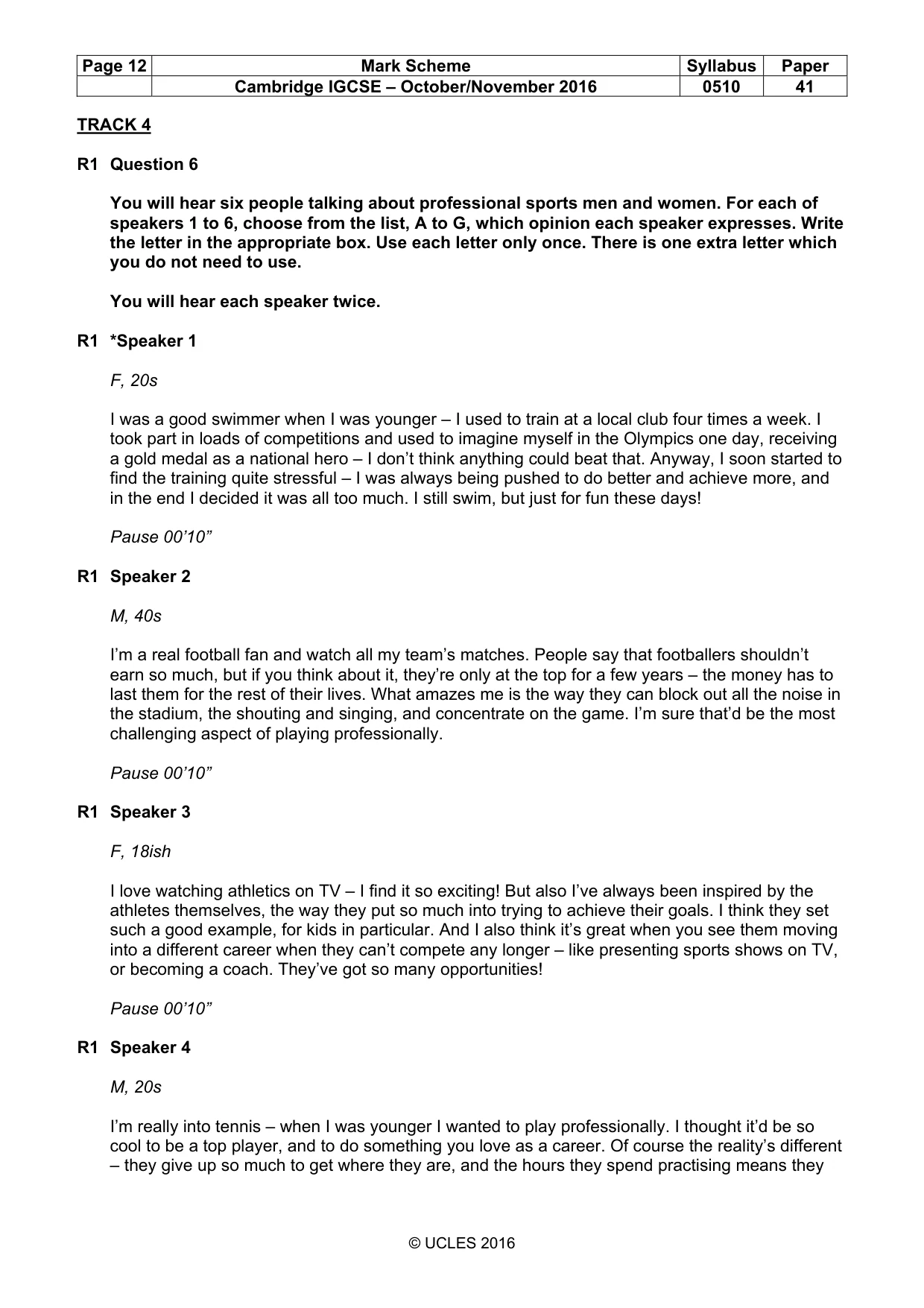
Page 12 Mark Scheme Syllabus Paper Cambridge IGCSE – October/November 2016 0510 41 © UCLES 2016 TRACK 4 R1 Question 6 You will hear six people talking about professional sports men and women. For each of speakers 1 to 6, choose from the list, A to G, which opinion each speaker expresses. Write the letter in the appropriate box. Use each letter only once. There is one extra letter which you do not need to use. You will hear each speaker twice. R1 *Speaker 1 F, 20s I was a good swimmer when I was younger – I used to train at a local club four times a week. I took part in loads of competitions and used to imagine myself in the Olympics one day, receiving a gold medal as a national hero – I don’t think anything could beat that. Anyway, I soon started to find the training quite stressful – I was always being pushed to do better and achieve more, and in the end I decided it was all too much. I still swim, but just for fun these days! Pause 00’10” R1 Speaker 2 M, 40s I’m a real football fan and watch all my team’s matches. People say that footballers shouldn’t earn so much, but if you think about it, they’re only at the top for a few years – the money has to last them for the rest of their lives. What amazes me is the way they can block out all the noise in the stadium, the shouting and singing, and concentrate on the game. I’m sure that’d be the most challenging aspect of playing professionally. Pause 00’10” R1 Speaker 3 F, 18ish I love watching athletics on TV – I find it so exciting! But also I’ve always been inspired by the athletes themselves, the way they put so much into trying to achieve their goals. I think they set such a good example, for kids in particular. And I also think it’s great when you see them moving into a different career when they can’t compete any longer – like presenting sports shows on TV, or becoming a coach. They’ve got so many opportunities! Pause 00’10” R1 Speaker 4 M, 20s I’m really into tennis – when I was younger I wanted to play professionally. I thought it’d be so cool to be a top player, and to do something you love as a career. Of course the reality’s different – they give up so much to get where they are, and the hours they spend practising means they
Mark scheme, page 13
Page 13 Mark Scheme Syllabus Paper Cambridge IGCSE – October/November 2016 0510 41 © UCLES 2016 can’t do things that a normal person takes for granted, like going out with friends at the weekend. But then they do get to travel all over the world, so it’s not all bad! Pause 00’10” R1 Speaker 5 F, 40s Sometimes I feel sorry for professional sports men and women – we all have such high expectations of them and then we all criticise them for their performance when they don’t win the medal or beat the record that we thought they should’ve. They’re only human, after all! I think part of the problem is that we all hear about the huge amounts they can get in prize money or from sponsors, but actually I think they deserve it if they succeed! Pause 00’10” R1 Speaker 6 M, 30s People who get to the top in their sport have so many qualities besides being extremely fit and strong. They work really hard, and they don’t get distracted when they are aiming for something. So I think they should be able to use these skills in later life when they stop playing professionally – really there should be far more opportunities for them than it seems there actually are. I can’t understand why so many of them don’t move on to something else so easily.** Pause 00’20” R1 Now you will hear the six speakers again. Repeat from * to ** Pause 00’30” R1 That is the end of the short talks about professional sports men and women. In a moment you will hear Question 7. Now look at the questions for this part of the exam. Pause 00’25”
Mark scheme, page 14
Page 14 Mark Scheme Syllabus Paper Cambridge IGCSE – October/November 2016 0510 41 © UCLES 2016 TRACK 5 R1 Question 7 You will hear a student called Sally interviewing her friend Martin about reading books. Listen to the interview and look at the questions. For each question, choose the correct answer A, B or C and put a tick (9) in the appropriate box. You will hear the interview twice. F: Sally (late teens) M: Martin (late teens) F: *Hi Martin. As you know, I’m supposed to interview somebody and then give a presentation to the class about what books young people read, so I appreciate your help with this. M: Sure no problem, Sally. F: Well, I know you love to read, but how do you choose your books? M: Normally, I just look at the description at the back of the book, but it was different for the one I’m reading now. I was talking to my mum about what to read and she said she’d heard about this interesting new book on the radio. Then our teacher recommended the same book to me and my friend Billy because he knows we both like adventure stories. Surprisingly, Billy couldn’t get into it and gave it away, but I loved it. F: Hmm, I might read it myself. It’s called Tomorrow’s the Day, isn’t it? Does the title mean anything? M: Yes, it does, actually. One of the characters says this phrase, ‘Tomorrow’s the Day’, right at the start of the story, suggesting that a big change is going to take place. But it doesn’t, even though you keep expecting it to, right up to the end of the story. F: I think I really like this author. Can you tell me a bit more about him? M: Well, he used to be a journalist writing about successful sportsmen and sportswomen, before he published his first novel. What I didn’t realise until recently, though, was that he spent a couple of years in this town as a student. F: Oh, right. Let’s talk about the book itself now. Where does the story take place? M: The story is set in and around the main character’s home – a big house in the countryside. I thought this house must’ve been where he’d grown up, or perhaps where he’d spent time on holiday, because he described it so well. In fact, the author was inspired by a well-known castle in Scotland he’d seen in a documentary. F: I know that this author has written several books. Which one is the winner for you? M: Well, I’ve read a few of his books, but not all of them. Last Game Over wasn’t bad and I’ve read really good reviews of It Never Was. I’m actually thinking of reading it next to see for myself if it’s as good as they say. The story that impressed me, though, was The Lake People. I just couldn’t put it down. F: Wasn’t one of the author’s novels turned into a movie?
Mark scheme, page 15
Page 15 Mark Scheme Syllabus Paper Cambridge IGCSE – October/November 2016 0510 41 © UCLES 2016 M: Yes, and I wish they hadn’t done that. Obviously, they couldn’t include the entire plot – it would’ve been far too long for a movie and it didn’t bother me that the names had been changed. But I noticed they filmed it in a different location. That was a real shame. F: What about other authors? Have you read anything by Jane Green? She’s my favourite. M: I’m not really sure about her. Her books tend to be very long which probably puts some people off, but doesn’t really bother me that much. The book I read had so many characters in it that I thought I’d find it difficult to keep a track of who is who. In the end, it was the tragedy after tragedy in the plot that spoilt it for me. F: Fair enough. I guess we all like different things. That brings me to my last question. How do you like to read your books? M: When I was growing up, my grandma had a lot of books on tapes so that she could listen to them because her eyesight was a bit poor. And you may be surprised how many people still use them. I’m quite traditional, so books that are printed are my top choice. A lot of my friends say it’s time I started using my tablet to read books, and that I’d love it. I’ll have to think about that. F: Well, I think I’ve got enough for my presentation now. Thanks again for all your help.** Pause 00’30” R1 Now you will hear the interview again. Repeat from * to ** Pause 00’30” That is the end of Question 7. In a moment you will hear Question 8. Now look at the questions for this part of the exam. Pause 00’30”
Mark scheme, page 16
Page 16 Mark Scheme Syllabus Paper Cambridge IGCSE – October/November 2016 0510 41 © UCLES 2016 TRACK 6 R1 Question 8 Part A You will hear a history teacher giving a talk about Sydney Harbour Bridge. Listen to the talk and complete the sentences in Part A. Write one or two words, or a number, in each gap. You will hear the talk twice. (F, 40s) *I’m going to talk to you today about a world-famous landmark, perhaps one of the most photographed ones too. It’s Sydney Harbour Bridge, in Australia – there’s a picture of it on your notes for those of you who aren’t familiar with it, although I’m sure most of you have seen images of it before. We’ll start with a bit of history. Plans to construct a bridge across the harbour in Sydney began as early as 1815, but a request for possible designs wasn’t made until 1900. It was in March 1932 that the formal ceremony took place to mark the opening of the bridge – that was several years after the construction work had started in July 1923. Due to the size of the harbour, it was a real achievement to construct the bridge across it. It’s actually only the sixth longest of its type in the world, but it is the tallest, at 134 metres. It was also the widest, at 48.8 metres, until another similar bridge was built elsewhere just a few years ago. The bridge is made of steel, the majority of which was imported from England. At each end of the steel arch, you can see there is a large post, called a pylon, which looks a bit like a tower. These pylons are made of concrete, and are covered in granite, a stone which was sourced locally. 250 stonemasons had the task of extracting the granite from a local quarry. Some of them were locals, but they also came from as far afield as Italy and Scotland. John Bradfield, who was the Chief Engineer of the bridge, was responsible for the entire project. Locally, he earned the nickname ‘father of the bridge’ because of the length of time he spent on the project – he was actually appointed in 1914 to start working on the design. He was completely dedicated to the success of the project. When construction was eventually complete, and safety tests had been carried out, the bridge was declared safe for public use. It was widely celebrated – for example several songs were composed and postage stamps were designed and issued to mark the occasion. Huge crowds attended on the day – it was really quite an occasion which drew people into the city from all around. Right. Before I continue, let’s take a look at some of the images of the bridge as it was being constructed.** Pause 00’30” R1 Now you will hear the talk again. Repeat from * to ** Pause 00’30” That is the end of the talk. In a moment you will hear Question 8 part B. Now look at the questions for this part of the exam. Pause 00’30”
Mark scheme, page 17
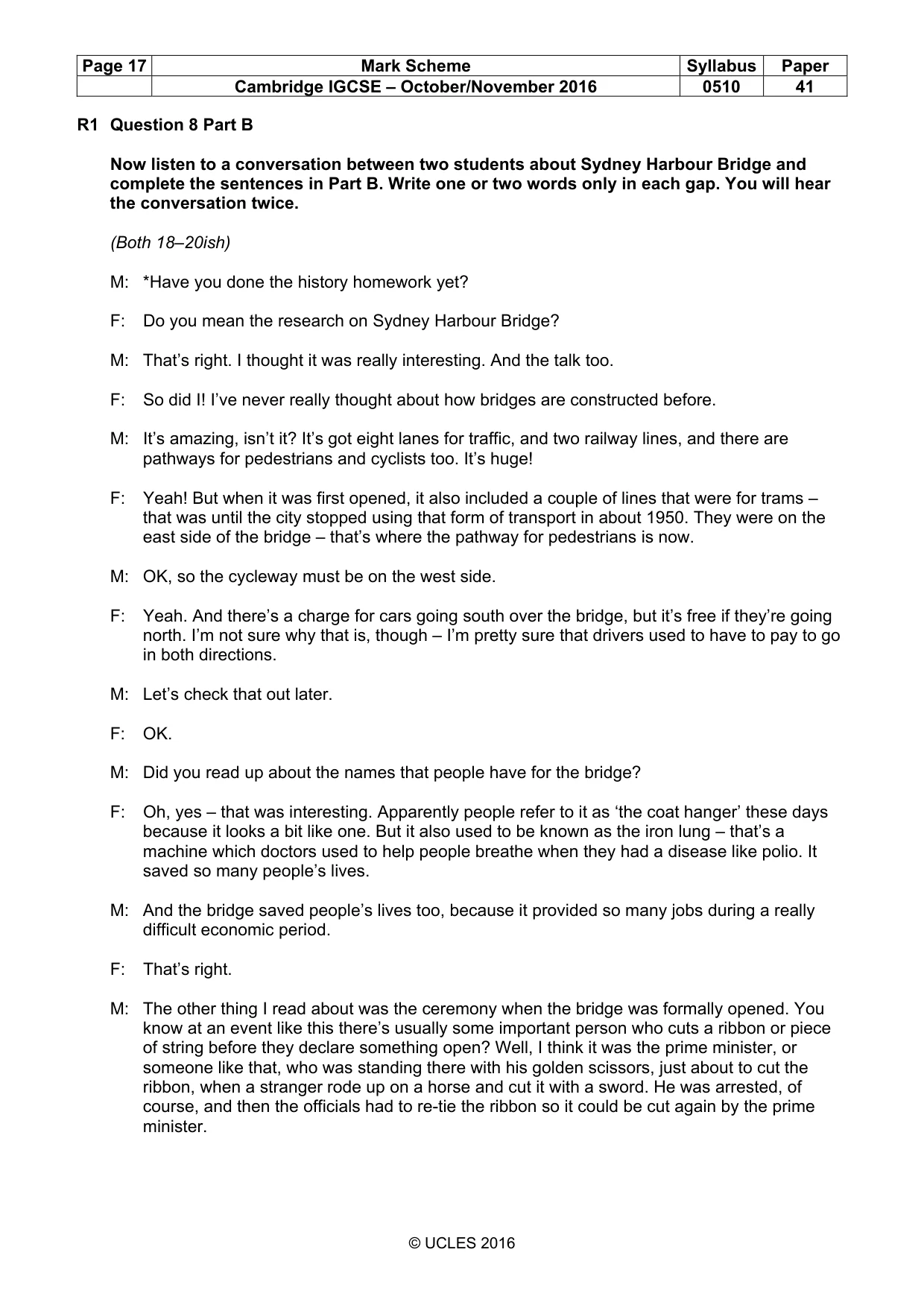
Page 17 Mark Scheme Syllabus Paper Cambridge IGCSE – October/November 2016 0510 41 © UCLES 2016 R1 Question 8 Part B Now listen to a conversation between two students about Sydney Harbour Bridge and complete the sentences in Part B. Write one or two words only in each gap. You will hear the conversation twice. (Both 18–20ish) M: *Have you done the history homework yet? F: Do you mean the research on Sydney Harbour Bridge? M: That’s right. I thought it was really interesting. And the talk too. F: So did I! I’ve never really thought about how bridges are constructed before. M: It’s amazing, isn’t it? It’s got eight lanes for traffic, and two railway lines, and there are pathways for pedestrians and cyclists too. It’s huge! F: Yeah! But when it was first opened, it also included a couple of lines that were for trams – that was until the city stopped using that form of transport in about 1950. They were on the east side of the bridge – that’s where the pathway for pedestrians is now. M: OK, so the cycleway must be on the west side. F: Yeah. And there’s a charge for cars going south over the bridge, but it’s free if they’re going north. I’m not sure why that is, though – I’m pretty sure that drivers used to have to pay to go in both directions. M: Let’s check that out later. F: OK. M: Did you read up about the names that people have for the bridge? F: Oh, yes – that was interesting. Apparently people refer to it as ‘the coat hanger’ these days because it looks a bit like one. But it also used to be known as the iron lung – that’s a machine which doctors used to help people breathe when they had a disease like polio. It saved so many people’s lives. M: And the bridge saved people’s lives too, because it provided so many jobs during a really difficult economic period. F: That’s right. M: The other thing I read about was the ceremony when the bridge was formally opened. You know at an event like this there’s usually some important person who cuts a ribbon or piece of string before they declare something open? Well, I think it was the prime minister, or someone like that, who was standing there with his golden scissors, just about to cut the ribbon, when a stranger rode up on a horse and cut it with a sword. He was arrested, of course, and then the officials had to re-tie the ribbon so it could be cut again by the prime minister.
Mark scheme, page 18
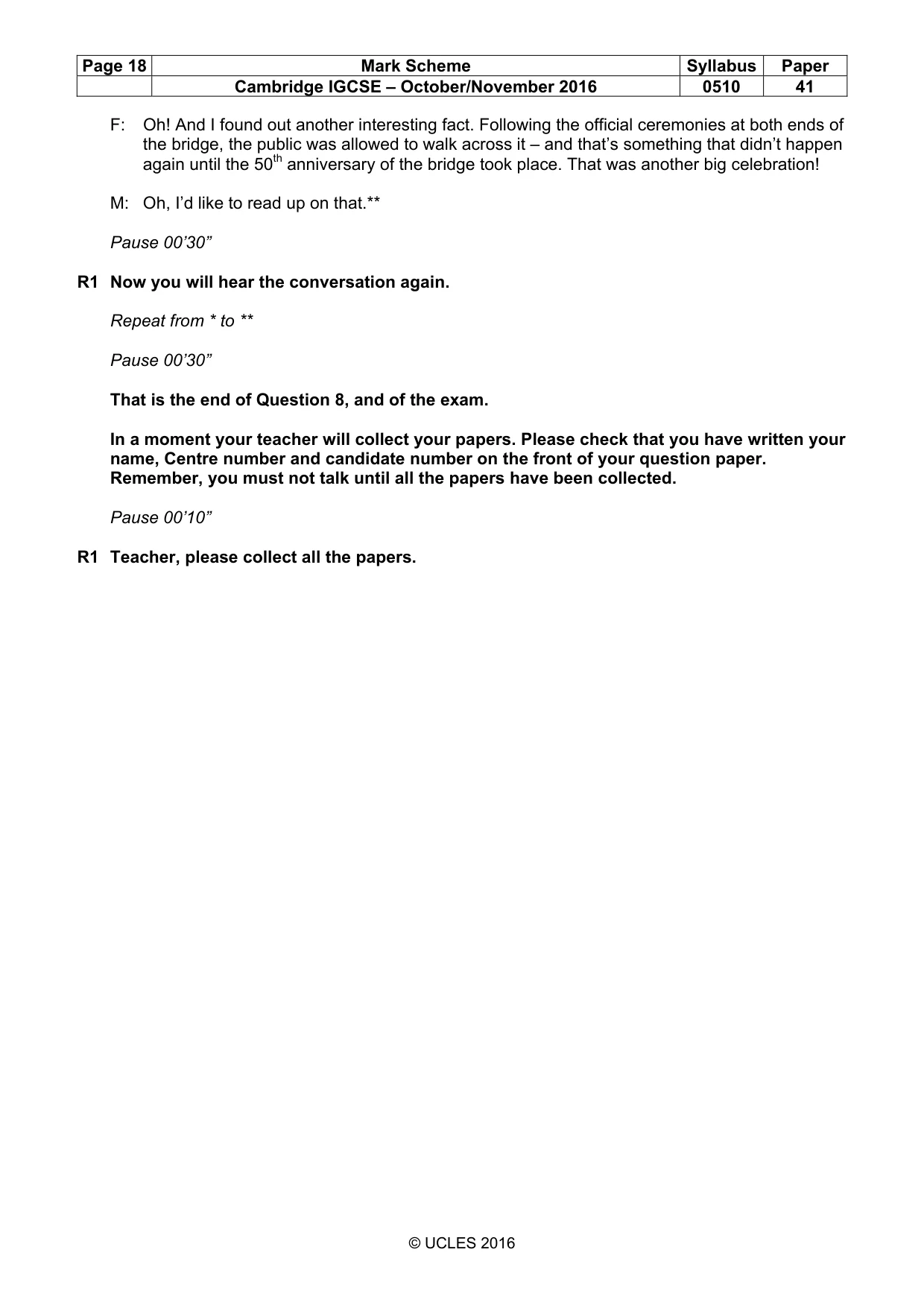
Page 18 Mark Scheme Syllabus Paper Cambridge IGCSE – October/November 2016 0510 41 © UCLES 2016 F: Oh! And I found out another interesting fact. Following the official ceremonies at both ends of the bridge, the public was allowed to walk across it – and that’s something that didn’t happen again until the 50th anniversary of the bridge took place. That was another big celebration! M: Oh, I’d like to read up on that.** Pause 00’30” R1 Now you will hear the conversation again. Repeat from * to ** Pause 00’30” That is the end of Question 8, and of the exam. In a moment your teacher will collect your papers. Please check that you have written your name, Centre number and candidate number on the front of your question paper. Remember, you must not talk until all the papers have been collected. Pause 00’10” R1 Teacher, please collect all the papers.
What you needed in this session
Cambridge’s own grade thresholds for 2016 Oct/Nov, Paper 4 · Variant 1. A higher threshold means an easier paper — the bar moves with how the cohort did.