Cambridge IGCSE English - Second Language (oral endorsement) 0510 — 2016 Oct/Nov Paper 4 · Variant 3
0510/43/O/N/16 · 40 marks · ≈45 min
The question paper and its mark scheme, free to read here and free to download. This is Cambridge’s own paper, exactly as it was sat.
Question paper12 pages




Mark scheme16 pages
Answers below. Sit the paper first if you are practising.
Paper as text
Question paper, page 1
This document consists of 9 printed pages and 3 blank pages. DC (RCL (JDA)) 116464/3 © UCLES 2016 [Turn over Cambridge International Examinations Cambridge International General Certificate of Secondary Education * 5 3 4 2 4 9 3 2 1 2 * ENGLISH AS A SECOND LANGUAGE 0510/43 Paper 4 Listening (Extended) October/November 2016 Approx. 50 minutes Candidates answer on the Question Paper. Additional Materials: As listed in Instructions to Supervisors. READ THESE INSTRUCTIONS FIRST Write your Centre number, candidate number and name on all the work you hand in. Write in dark blue or black pen. Do not use staples, paper clips, glue or correction fluid. DO NOT WRITE IN ANY BARCODES. Answer all questions. Dictionaries are not permitted. The number of marks is given in brackets [ ] at the end of each question or part question.
Question paper, page 2
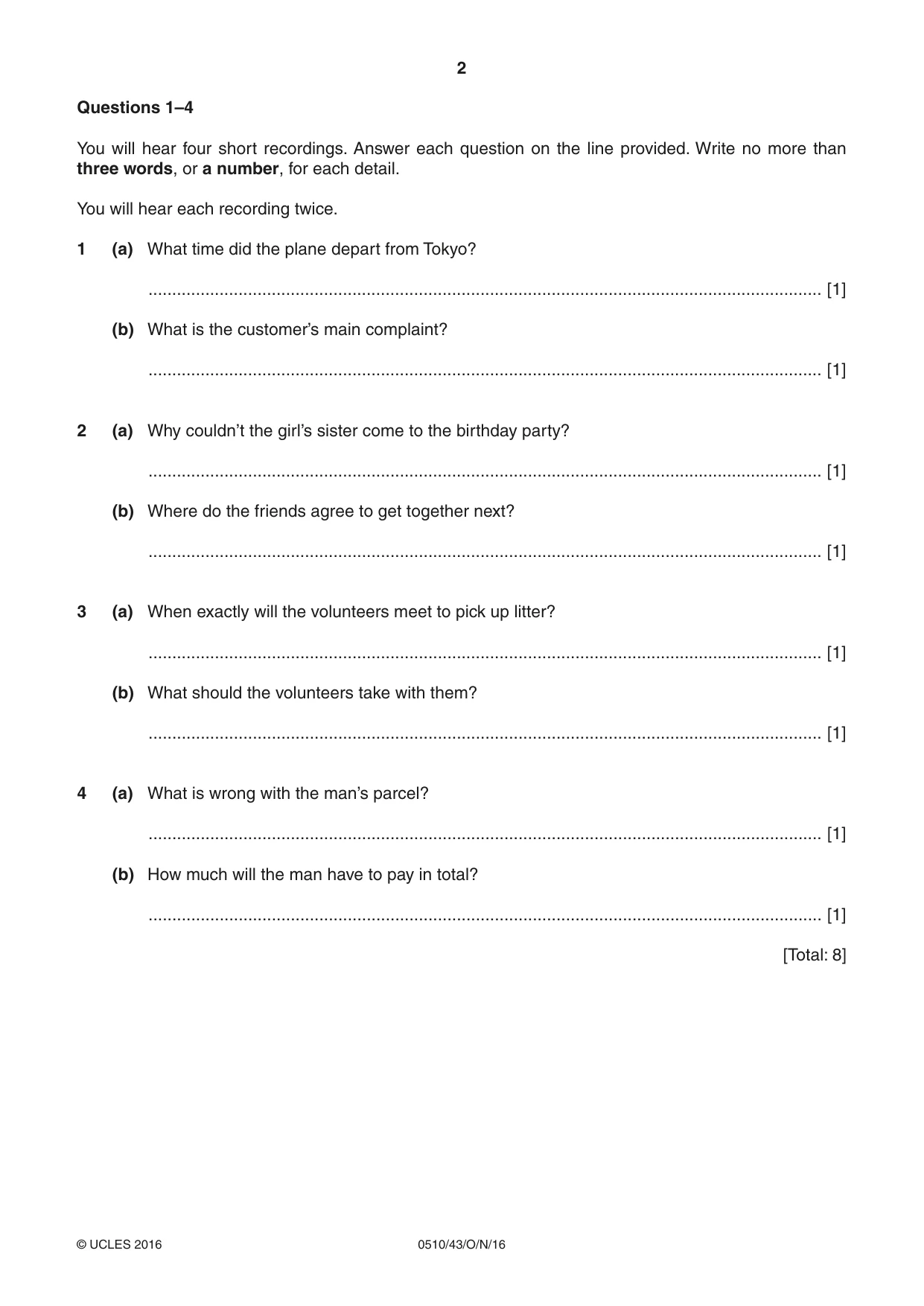
2 0510/43/O/N/16 © UCLES 2016 Questions 1–4 You will hear four short recordings. Answer each question on the line provided. Write no more than three words, or a number, for each detail. You will hear each recording twice. 1 (a) What time did the plane depart from Tokyo? … [1] (b) What is the customer’s main complaint? … [1] 2 (a) Why couldn’t the girl’s sister come to the birthday party? … [1] (b) Where do the friends agree to get together next? … [1] 3 (a) When exactly will the volunteers meet to pick up litter? … [1] (b) What should the volunteers take with them? … [1] 4 (a) What is wrong with the man’s parcel? … [1] (b) How much will the man have to pay in total? … [1] [Total: 8]
Question paper, page 3
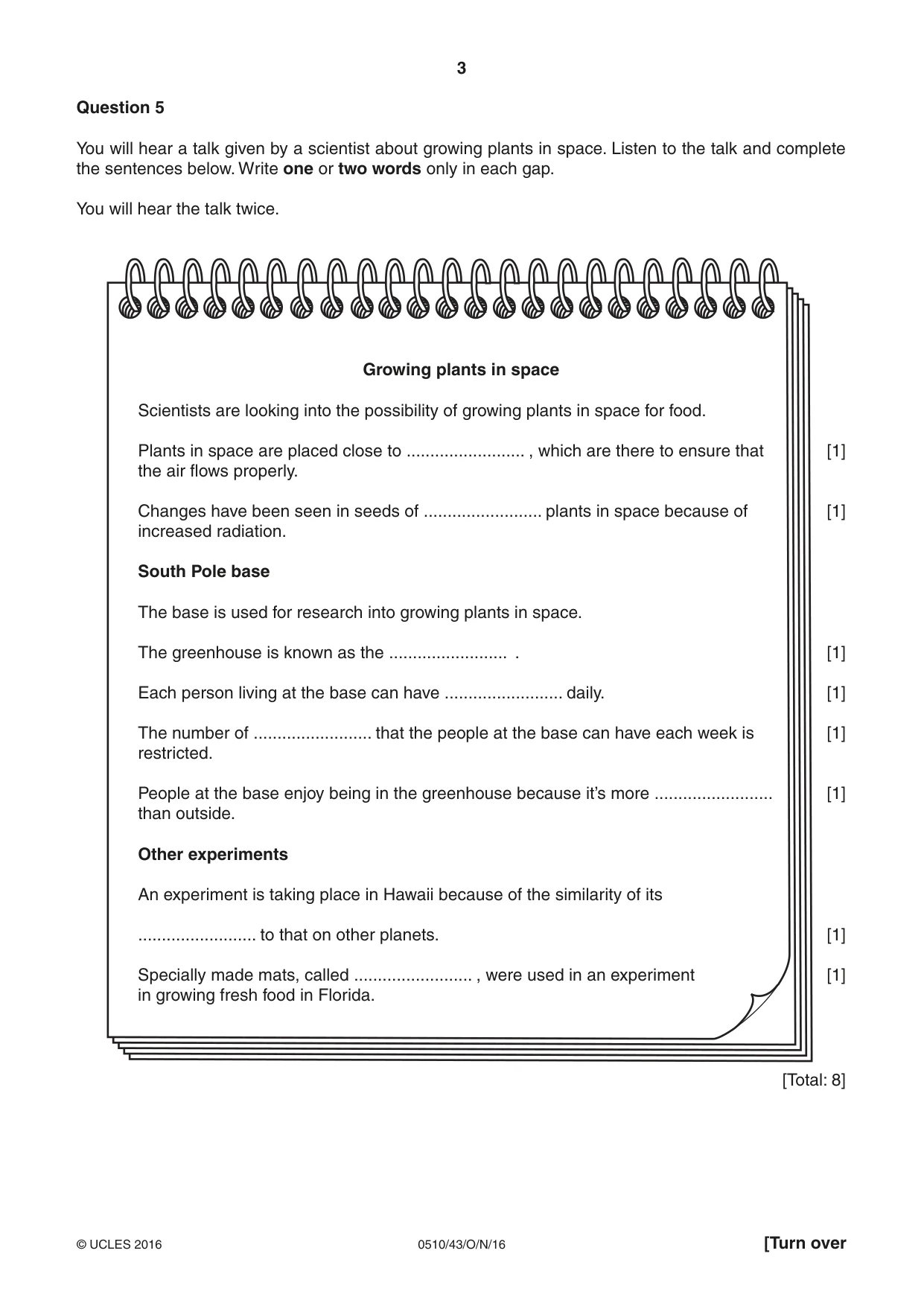
3 0510/43/O/N/16 © UCLES 2016 [Turn over Question 5 You will hear a talk given by a scientist about growing plants in space. Listen to the talk and complete the sentences below. Write one or two words only in each gap. You will hear the talk twice. Growing plants in space Scientists are looking into the possibility of growing plants in space for food. Plants in space are placed close to … , which are there to ensure that [1] the air flows properly. Changes have been seen in seeds of … plants in space because of [1] increased radiation. South Pole base The base is used for research into growing plants in space. The greenhouse is known as the … . [1] Each person living at the base can have … daily. [1] The number of … that the people at the base can have each week is [1] restricted. People at the base enjoy being in the greenhouse because it’s more … [1] than outside. Other experiments An experiment is taking place in Hawaii because of the similarity of its … to that on other planets. [1] Specially made mats, called … , were used in an experiment [1] in growing fresh food in Florida. [Total: 8]
Question paper, page 4
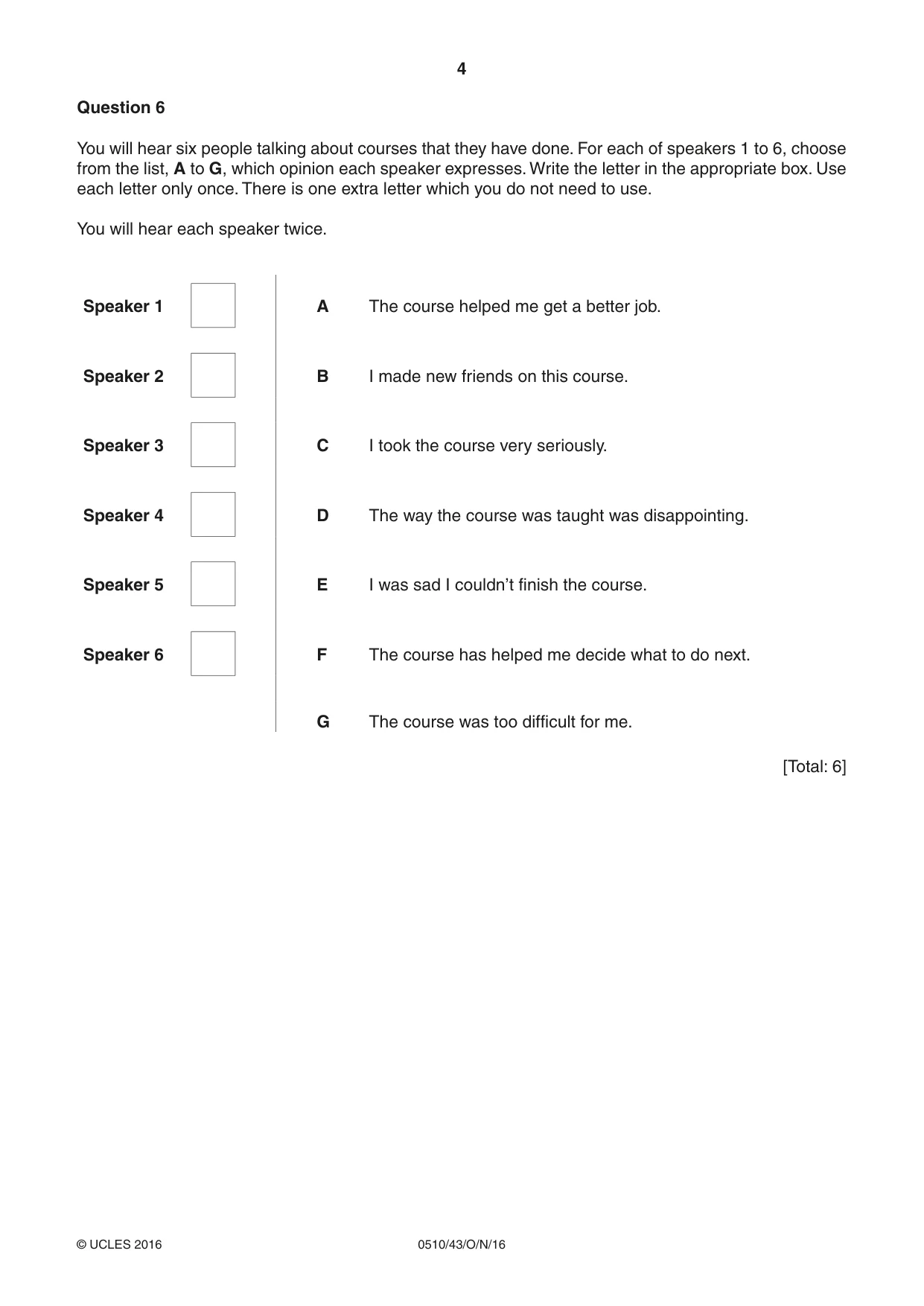
4 0510/43/O/N/16 © UCLES 2016 Question 6 You will hear six people talking about courses that they have done. For each of speakers 1 to 6, choose from the list, A to G, which opinion each speaker expresses. Write the letter in the appropriate box. Use each letter only once. There is one extra letter which you do not need to use. You will hear each speaker twice. Speaker 1 A The course helped me get a better job. Speaker 2 B I made new friends on this course. Speaker 3 C I took the course very seriously. Speaker 4 D The way the course was taught was disappointing. Speaker 5 E I was sad I couldn’t finish the course. Speaker 6 F The course has helped me decide what to do next. G The course was too difficult for me. [Total: 6]
Question paper, page 5
5 0510/43/O/N/16 © UCLES 2016 [Turn over Please turn over for Question 7.
Question paper, page 6
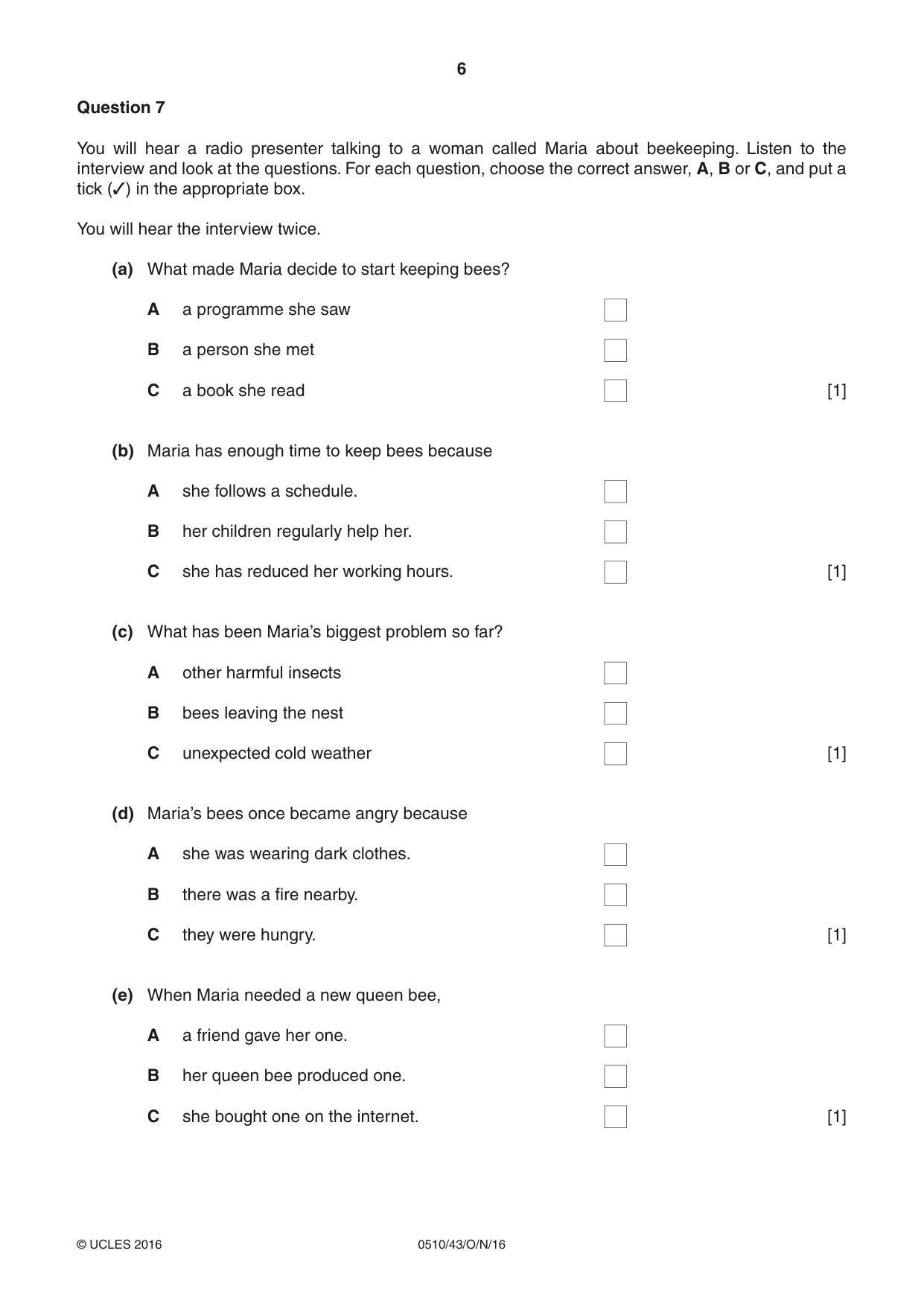
6 0510/43/O/N/16 © UCLES 2016 Question 7 You will hear a radio presenter talking to a woman called Maria about beekeeping. Listen to the interview and look at the questions. For each question, choose the correct answer, A, B or C, and put a tick (✓) in the appropriate box. You will hear the interview twice. (a) What made Maria decide to start keeping bees? A a programme she saw B a person she met C a book she read [1] (b) Maria has enough time to keep bees because A she follows a schedule. B her children regularly help her. C she has reduced her working hours. [1] (c) What has been Maria’s biggest problem so far? A other harmful insects B bees leaving the nest C unexpected cold weather [1] (d) Maria’s bees once became angry because A she was wearing dark clothes. B there was a fire nearby. C they were hungry. [1] (e) When Maria needed a new queen bee, A a friend gave her one. B her queen bee produced one. C she bought one on the internet. [1]
Question paper, page 7
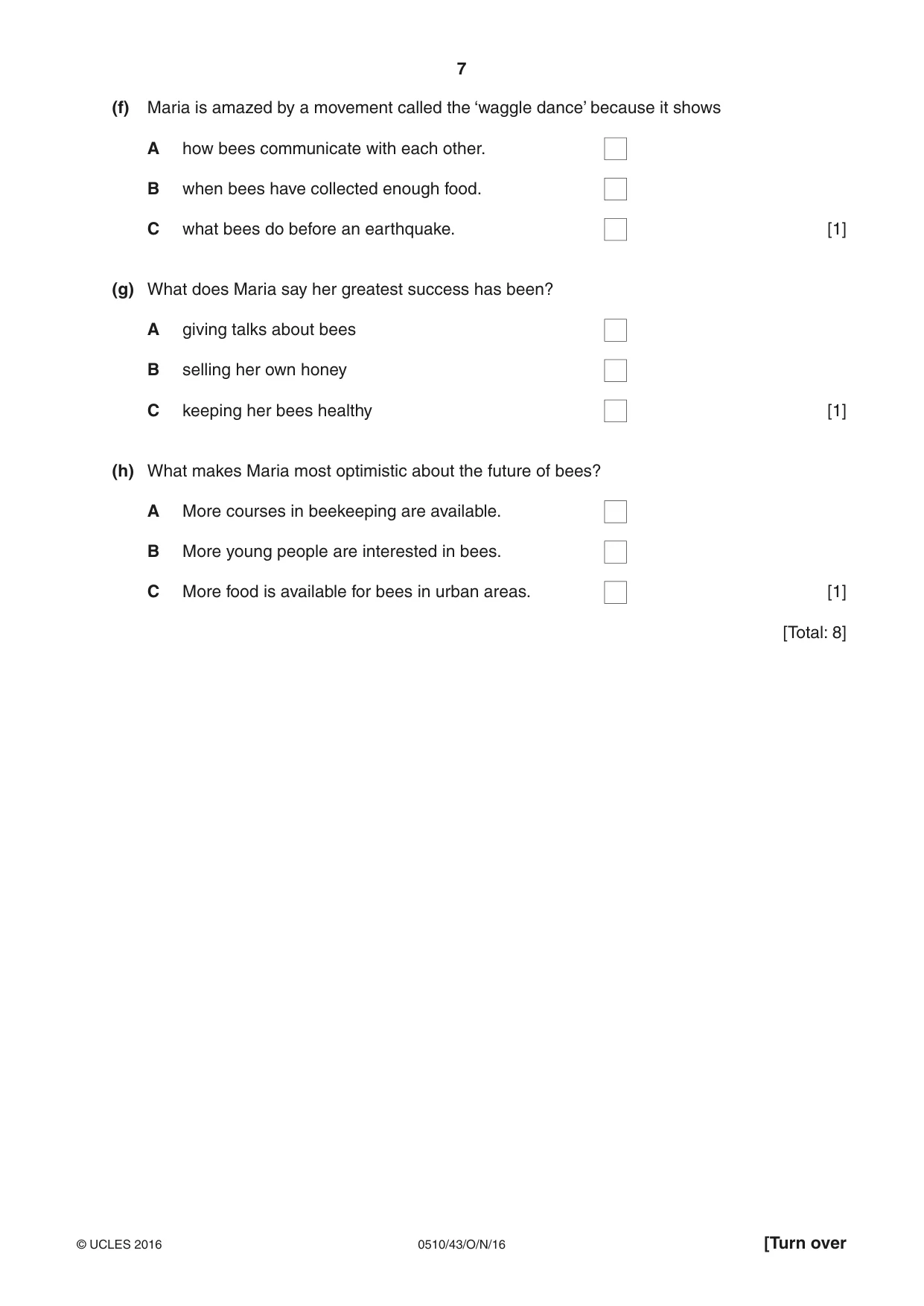
7 0510/43/O/N/16 © UCLES 2016 [Turn over (f) Maria is amazed by a movement called the ‘waggle dance’ because it shows A how bees communicate with each other. B when bees have collected enough food. C what bees do before an earthquake. [1] (g) What does Maria say her greatest success has been? A giving talks about bees B selling her own honey C keeping her bees healthy [1] (h) What makes Maria most optimistic about the future of bees? A More courses in beekeeping are available. B More young people are interested in bees. C More food is available for bees in urban areas. [1] [Total: 8]
Question paper, page 8
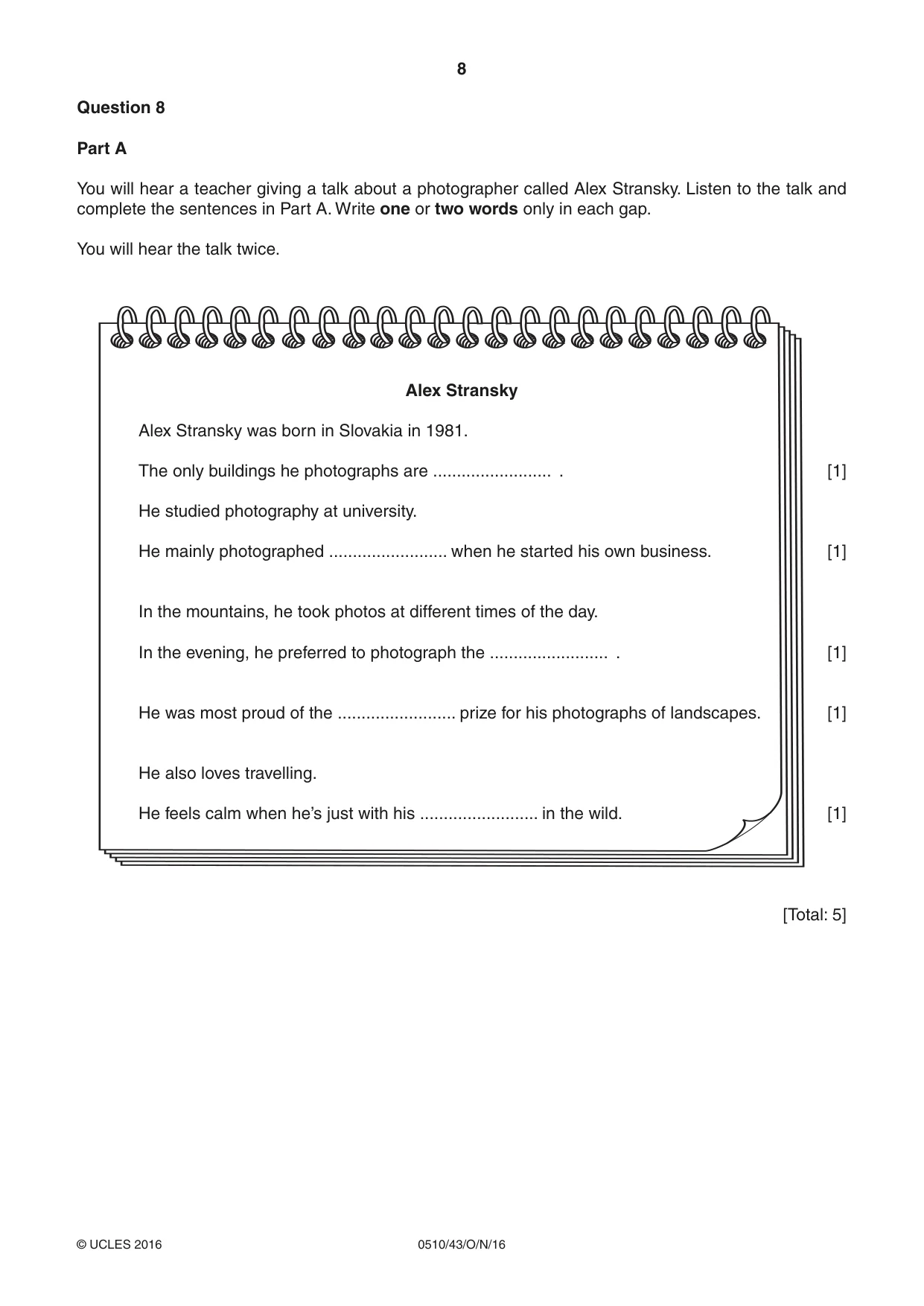
8 0510/43/O/N/16 © UCLES 2016 Question 8 Part A You will hear a teacher giving a talk about a photographer called Alex Stransky. Listen to the talk and complete the sentences in Part A. Write one or two words only in each gap. You will hear the talk twice. Alex Stransky Alex Stransky was born in Slovakia in 1981. The only buildings he photographs are … . [1] He studied photography at university. He mainly photographed … when he started his own business. [1] In the mountains, he took photos at different times of the day. In the evening, he preferred to photograph the … . [1] He was most proud of the … prize for his photographs of landscapes. [1] He also loves travelling. He feels calm when he’s just with his … in the wild. [1] [Total: 5]
Question paper, page 9
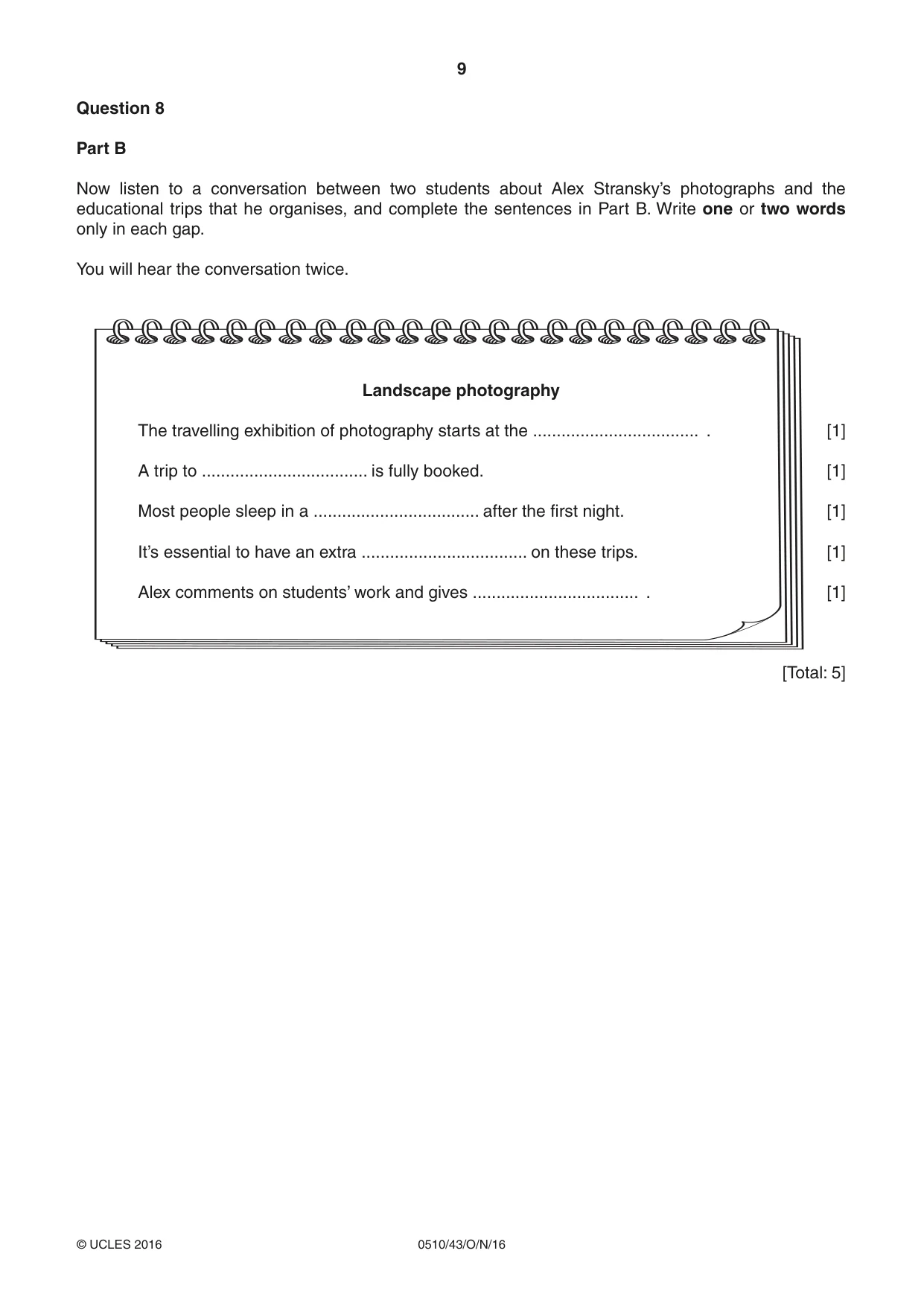
9 0510/43/O/N/16 © UCLES 2016 Question 8 Part B Now listen to a conversation between two students about Alex Stransky’s photographs and the educational trips that he organises, and complete the sentences in Part B. Write one or two words only in each gap. You will hear the conversation twice. Landscape photography The travelling exhibition of photography starts at the … . [1] A trip to … is fully booked. [1] Most people sleep in a … after the first night. [1] It’s essential to have an extra … on these trips. [1] Alex comments on students’ work and gives … . [1] [Total: 5]
Question paper, page 10
10 0510/43/O/N/16 © UCLES 2016 BLANK PAGE
Question paper, page 11
11 0510/43/O/N/16 © UCLES 2016 BLANK PAGE
Question paper, page 12
12 0510/43/O/N/16 © UCLES 2016 Permission to reproduce items where third-party owned material protected by copyright is included has been sought and cleared where possible. Every reasonable effort has been made by the publisher (UCLES) to trace copyright holders, but if any items requiring clearance have unwittingly been included, the publisher will be pleased to make amends at the earliest possible opportunity. To avoid the issue of disclosure of answer-related information to candidates, all copyright acknowledgements are reproduced online in the Cambridge International Examinations Copyright Acknowledgements Booklet. This is produced for each series of examinations and is freely available to download at www.cie.org.uk after the live examination series. Cambridge International Examinations is part of the Cambridge Assessment Group. Cambridge Assessment is the brand name of University of Cambridge Local Examinations Syndicate (UCLES), which is itself a department of the University of Cambridge. BLANK PAGE
Mark scheme, page 1
® IGCSE is the registered trademark of Cambridge International Examinations. This document consists of 16 printed pages. © UCLES 2016 [Turn over Cambridge International Examinations Cambridge International General Certificate of Secondary Education ENGLISH AS A SECOND LANGUAGE 0510/43 Paper 4 Listening (Extended) October/November 2016 MARK SCHEME Maximum Mark: 40 Published This mark scheme is published as an aid to teachers and candidates, to indicate the requirements of the examination. It shows the basis on which Examiners were instructed to award marks. It does not indicate the details of the discussions that took place at an Examiners’ meeting before marking began, which would have considered the acceptability of alternative answers. Mark schemes should be read in conjunction with the question paper and the Principal Examiner Report for Teachers. Cambridge will not enter into discussions about these mark schemes. Cambridge is publishing the mark schemes for the October/November 2016 series for most Cambridge IGCSE®, Cambridge International A and AS Level components and some Cambridge O Level components.
Mark scheme, page 2
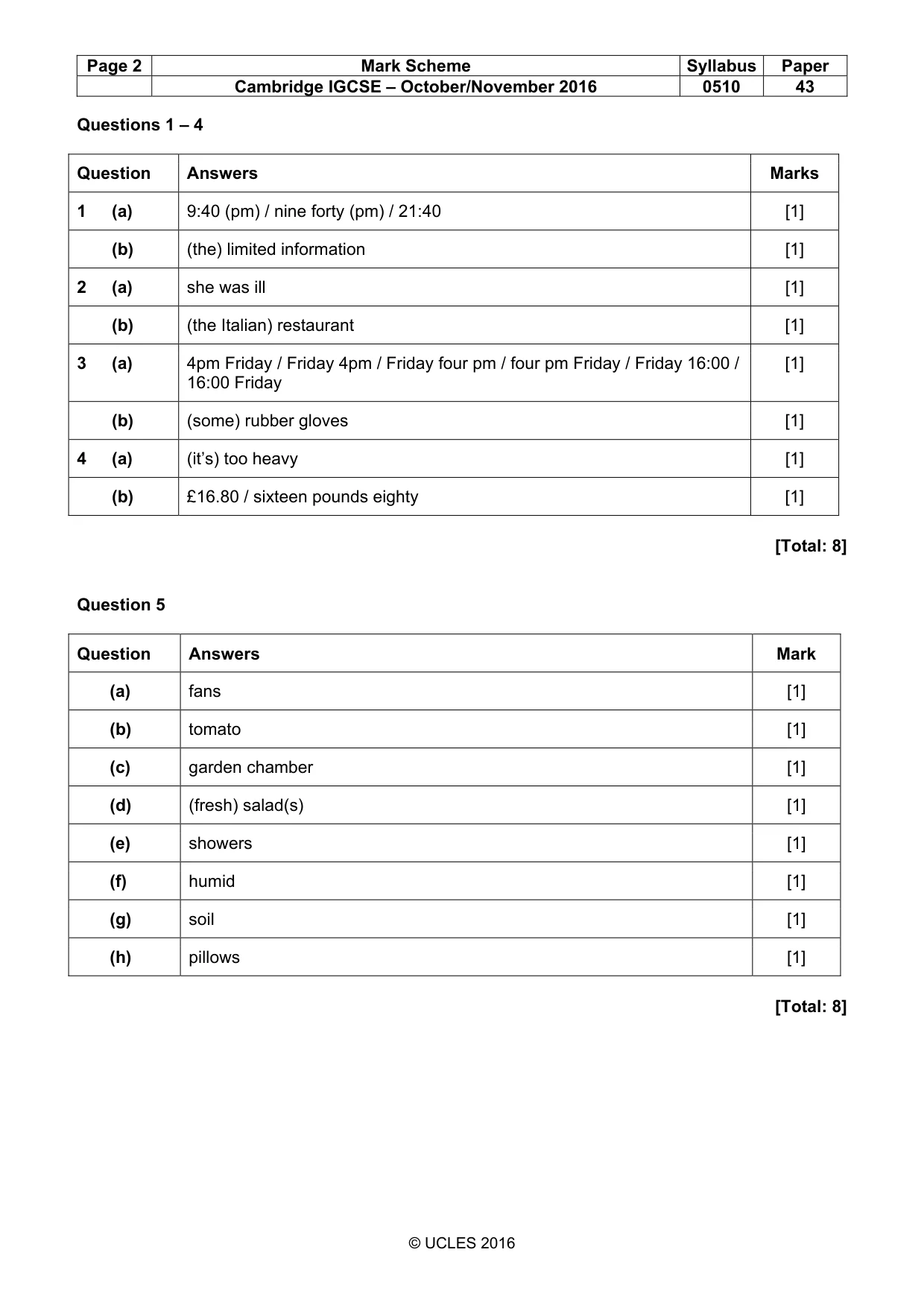
Page 2 Mark Scheme Syllabus Paper Cambridge IGCSE – October/November 2016 0510 43 © UCLES 2016 Questions 1 – 4 Question Answers Marks 1 (a) 9:40 (pm) / nine forty (pm) / 21:40 [1] (b) (the) limited information [1] 2 (a) she was ill [1] (b) (the Italian) restaurant [1] 3 (a) 4pm Friday / Friday 4pm / Friday four pm / four pm Friday / Friday 16:00 / 16:00 Friday [1] (b) (some) rubber gloves [1] 4 (a) (it’s) too heavy [1] (b) £16.80 / sixteen pounds eighty [1] [Total: 8] Question 5 Question Answers Mark (a) fans [1] (b) tomato [1] (c) garden chamber [1] (d) (fresh) salad(s) [1] (e) showers [1] (f) humid [1] (g) soil [1] (h) pillows [1] [Total: 8]
Mark scheme, page 3
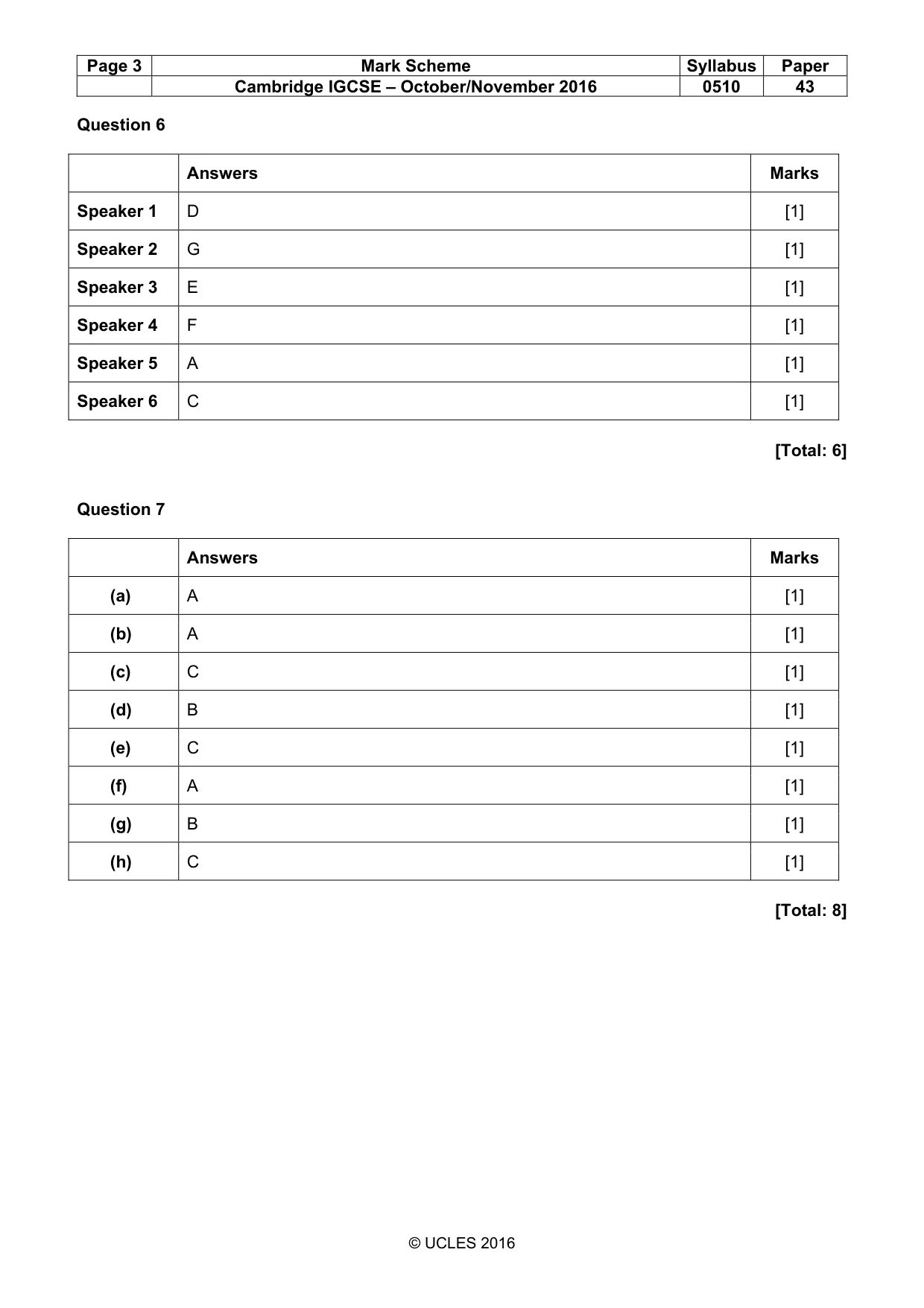
Page 3 Mark Scheme Syllabus Paper Cambridge IGCSE – October/November 2016 0510 43 © UCLES 2016 Question 6 Answers Marks Speaker 1 D [1] Speaker 2 G [1] Speaker 3 E [1] Speaker 4 F [1] Speaker 5 A [1] Speaker 6 C [1] [Total: 6] Question 7 Answers Marks (a) A [1] (b) A [1] (c) C [1] (d) B [1] (e) C [1] (f) A [1] (g) B [1] (h) C [1] [Total: 8]
Mark scheme, page 4
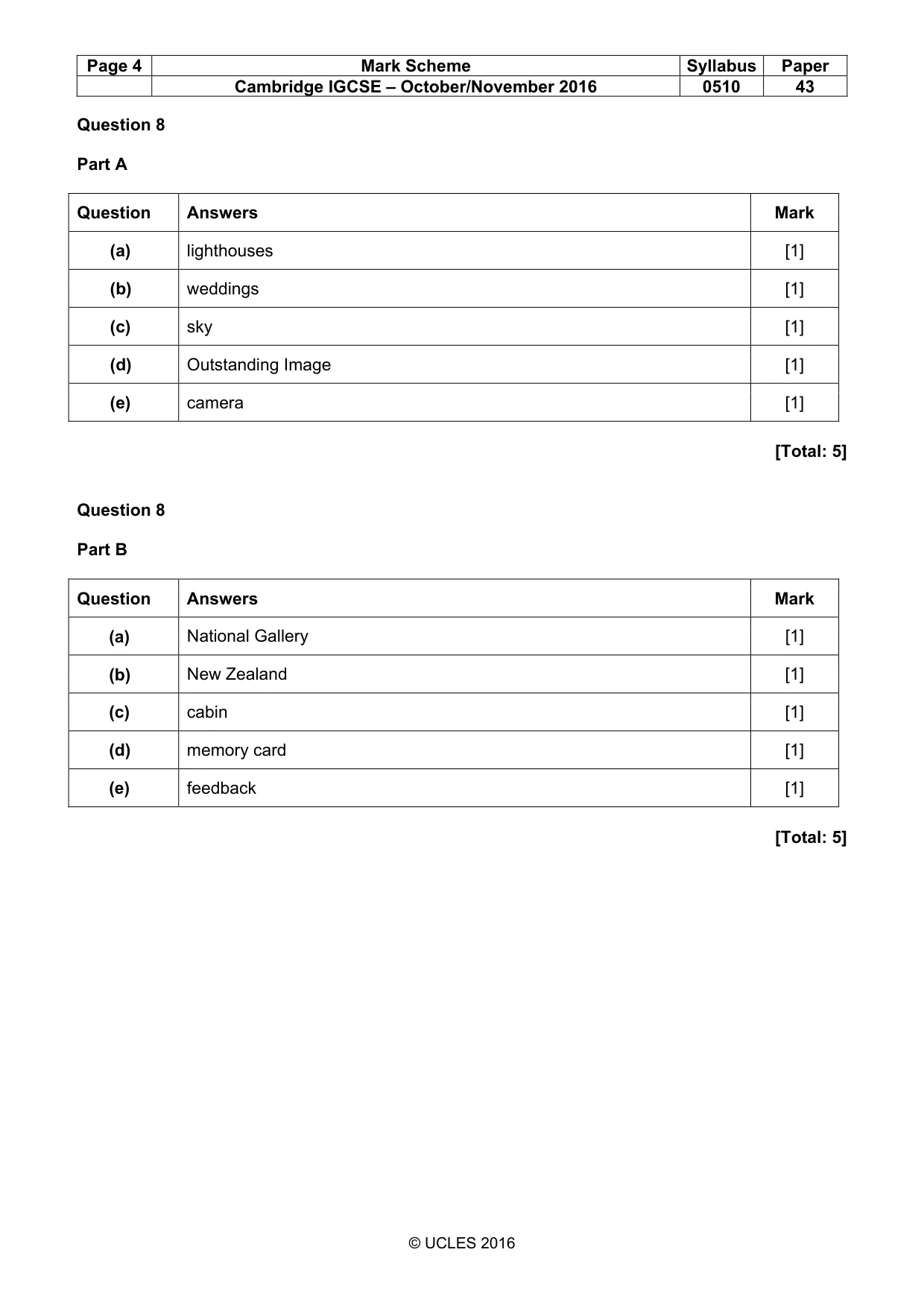
Page 4 Mark Scheme Syllabus Paper Cambridge IGCSE – October/November 2016 0510 43 © UCLES 2016 Question 8 Part A Question Answers Mark (a) lighthouses [1] (b) weddings [1] (c) sky [1] (d) Outstanding Image [1] (e) camera [1] [Total: 5] Question 8 Part B Question Answers Mark (a) National Gallery [1] (b) New Zealand [1] (c) cabin [1] (d) memory card [1] (e) feedback [1] [Total: 5]
Mark scheme, page 5
Page 5 Mark Scheme Syllabus Paper Cambridge IGCSE – October/November 2016 0510 43 © UCLES 2016 TRANSCRIPT Listening (Extended) November 2016 TRACK 1 R1 Cambridge International Examinations International General Certificate of Secondary Education November examination series 2016 English as a Second Language Extended Tier – Listening Comprehension Welcome to the exam. In a moment, your teacher is going to give out the question papers. When you get your paper, fill in your name, Centre number and candidate number on the front page. Do not talk to anyone during the exam. If you would like the recording to be louder or quieter, tell your teacher NOW. The recording will not be stopped while you are doing the exam. Teacher: please give out the question papers, and when all the candidates are ready to start the test, please turn the recording back on. [BEEP]
Mark scheme, page 6
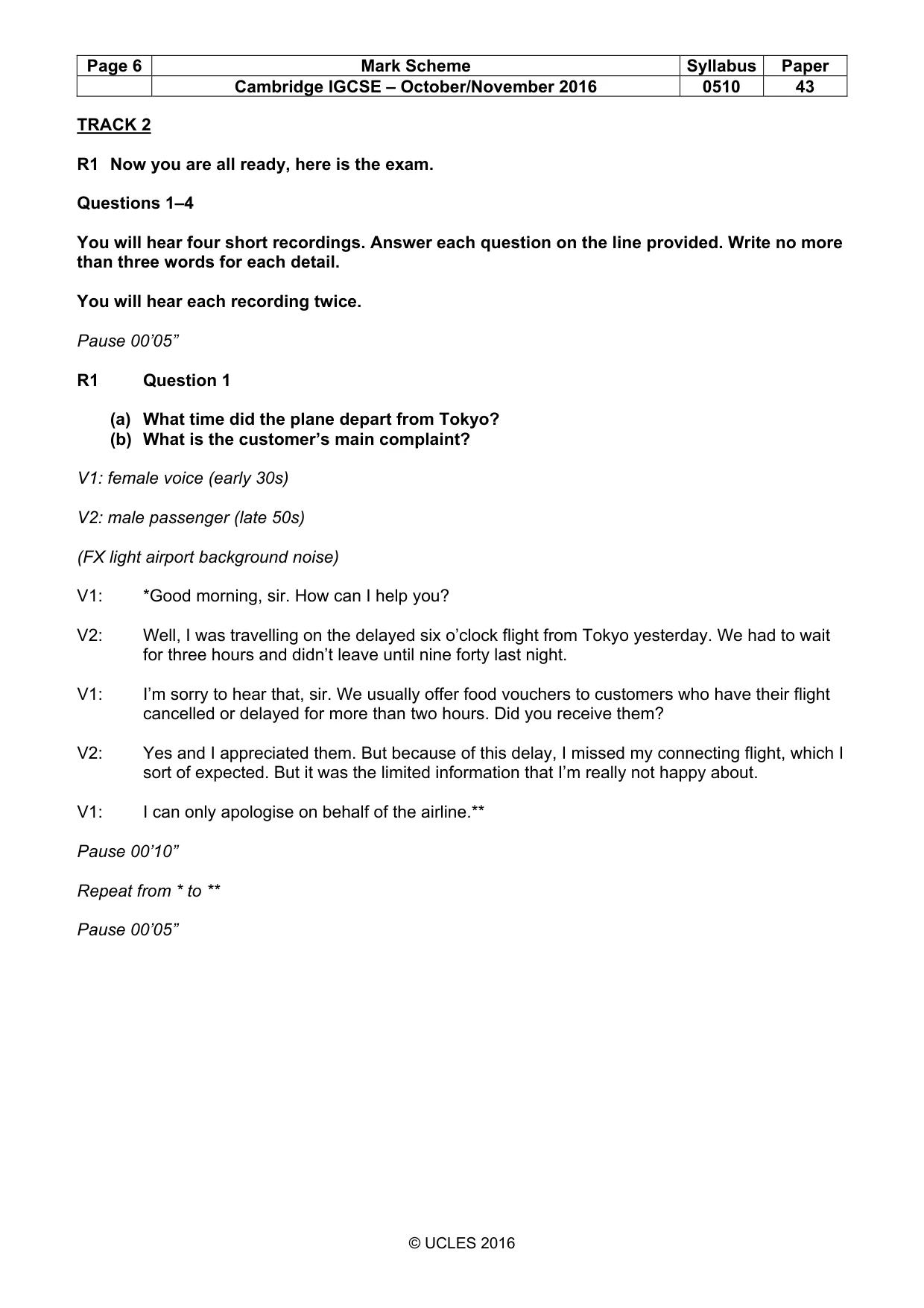
Page 6 Mark Scheme Syllabus Paper Cambridge IGCSE – October/November 2016 0510 43 © UCLES 2016 TRACK 2 R1 Now you are all ready, here is the exam. Questions 1–4 You will hear four short recordings. Answer each question on the line provided. Write no more than three words for each detail. You will hear each recording twice. Pause 00’05” R1 Question 1 (a) What time did the plane depart from Tokyo? (b) What is the customer’s main complaint? V1: female voice (early 30s) V2: male passenger (late 50s) (FX light airport background noise) V1: *Good morning, sir. How can I help you? V2: Well, I was travelling on the delayed six o’clock flight from Tokyo yesterday. We had to wait for three hours and didn’t leave until nine forty last night. V1: I’m sorry to hear that, sir. We usually offer food vouchers to customers who have their flight cancelled or delayed for more than two hours. Did you receive them? V2: Yes and I appreciated them. But because of this delay, I missed my connecting flight, which I sort of expected. But it was the limited information that I’m really not happy about. V1: I can only apologise on behalf of the airline.** Pause 00’10” Repeat from * to ** Pause 00’05”
Mark scheme, page 7
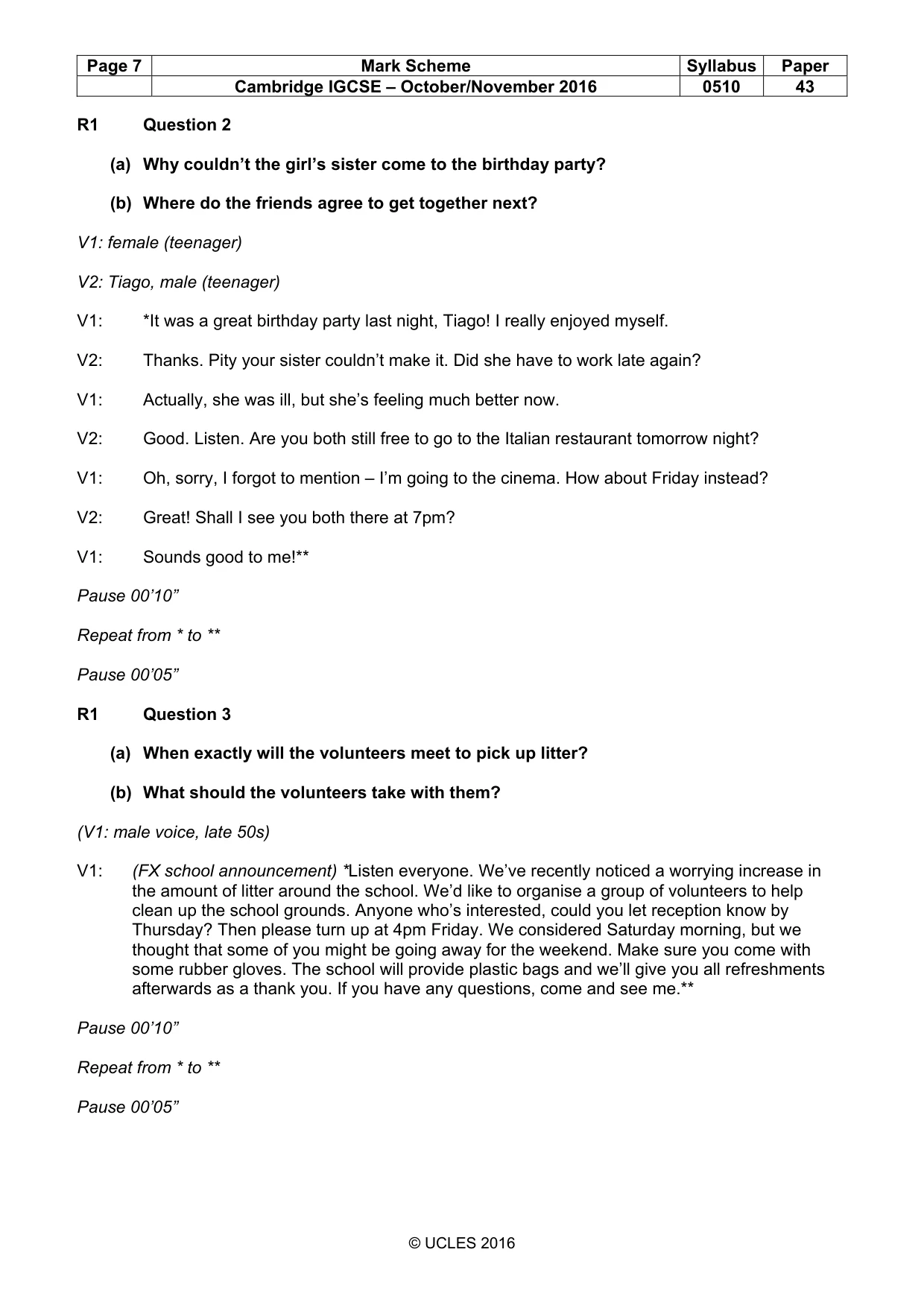
Page 7 Mark Scheme Syllabus Paper Cambridge IGCSE – October/November 2016 0510 43 © UCLES 2016 R1 Question 2 (a) Why couldn’t the girl’s sister come to the birthday party? (b) Where do the friends agree to get together next? V1: female (teenager) V2: Tiago, male (teenager) V1: *It was a great birthday party last night, Tiago! I really enjoyed myself. V2: Thanks. Pity your sister couldn’t make it. Did she have to work late again? V1: Actually, she was ill, but she’s feeling much better now. V2: Good. Listen. Are you both still free to go to the Italian restaurant tomorrow night? V1: Oh, sorry, I forgot to mention – I’m going to the cinema. How about Friday instead? V2: Great! Shall I see you both there at 7pm? V1: Sounds good to me!** Pause 00’10” Repeat from * to ** Pause 00’05” R1 Question 3 (a) When exactly will the volunteers meet to pick up litter? (b) What should the volunteers take with them? (V1: male voice, late 50s) V1: (FX school announcement) *Listen everyone. We’ve recently noticed a worrying increase in the amount of litter around the school. We’d like to organise a group of volunteers to help clean up the school grounds. Anyone who’s interested, could you let reception know by Thursday? Then please turn up at 4pm Friday. We considered Saturday morning, but we thought that some of you might be going away for the weekend. Make sure you come with some rubber gloves. The school will provide plastic bags and we’ll give you all refreshments afterwards as a thank you. If you have any questions, come and see me.** Pause 00’10” Repeat from * to ** Pause 00’05”
Mark scheme, page 8
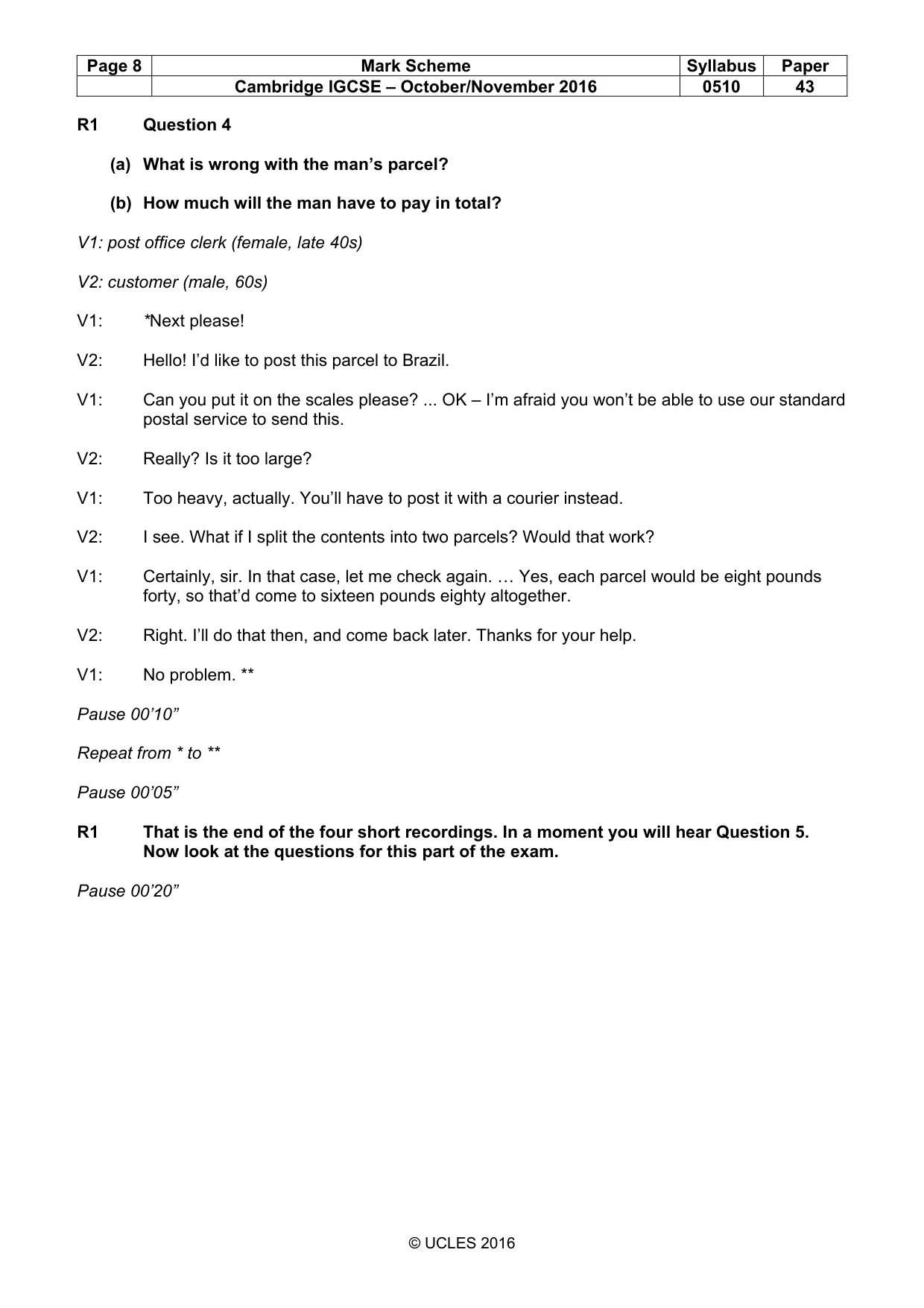
Page 8 Mark Scheme Syllabus Paper Cambridge IGCSE – October/November 2016 0510 43 © UCLES 2016 R1 Question 4 (a) What is wrong with the man’s parcel? (b) How much will the man have to pay in total? V1: post office clerk (female, late 40s) V2: customer (male, 60s) V1: *Next please! V2: Hello! I’d like to post this parcel to Brazil. V1: Can you put it on the scales please? ... OK – I’m afraid you won’t be able to use our standard postal service to send this. V2: Really? Is it too large? V1: Too heavy, actually. You’ll have to post it with a courier instead. V2: I see. What if I split the contents into two parcels? Would that work? V1: Certainly, sir. In that case, let me check again. … Yes, each parcel would be eight pounds forty, so that’d come to sixteen pounds eighty altogether. V2: Right. I’ll do that then, and come back later. Thanks for your help. V1: No problem. ** Pause 00’10” Repeat from * to ** Pause 00’05” R1 That is the end of the four short recordings. In a moment you will hear Question 5. Now look at the questions for this part of the exam. Pause 00’20”
Mark scheme, page 9
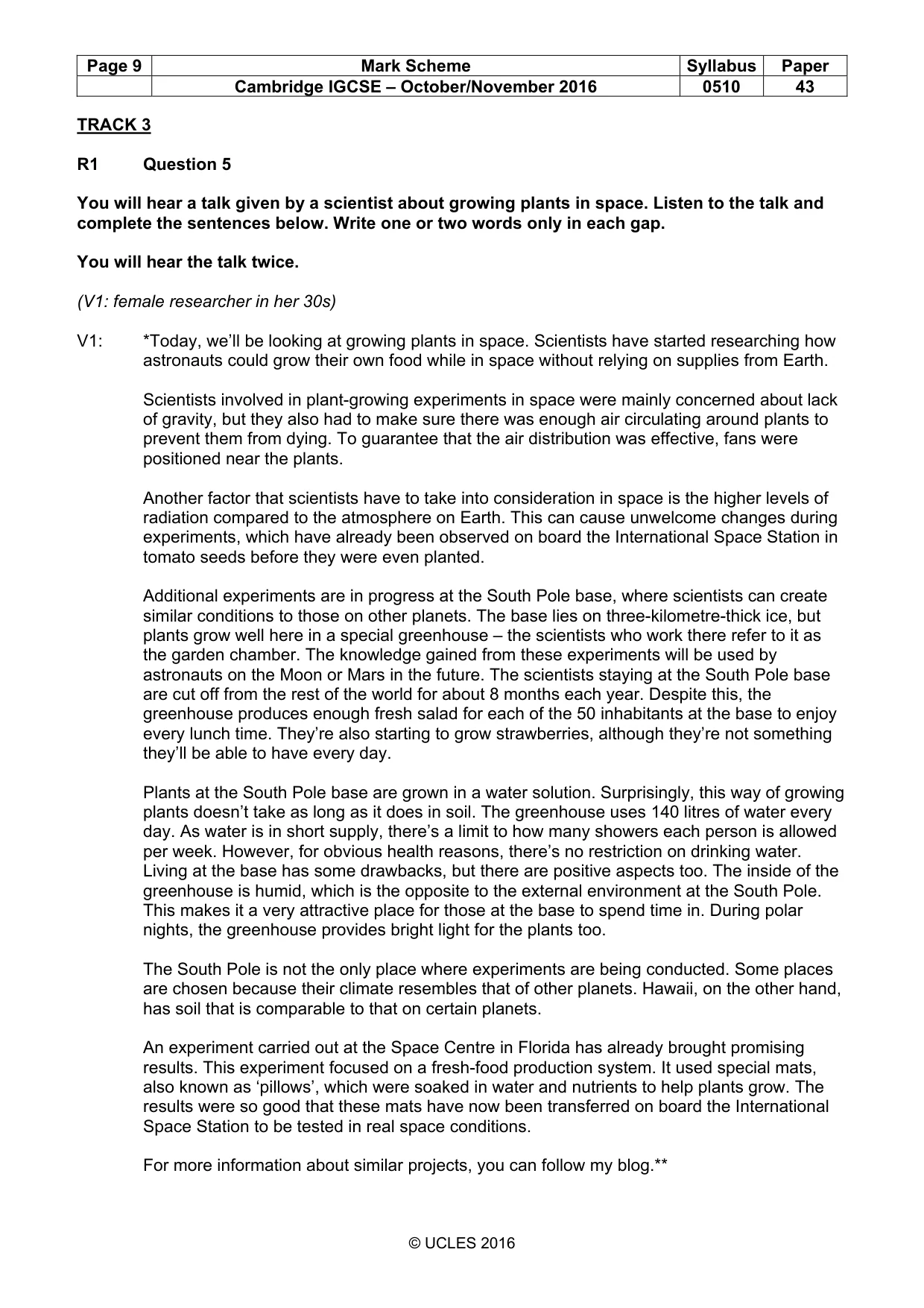
Page 9 Mark Scheme Syllabus Paper Cambridge IGCSE – October/November 2016 0510 43 © UCLES 2016 TRACK 3 R1 Question 5 You will hear a talk given by a scientist about growing plants in space. Listen to the talk and complete the sentences below. Write one or two words only in each gap. You will hear the talk twice. (V1: female researcher in her 30s) V1: *Today, we’ll be looking at growing plants in space. Scientists have started researching how astronauts could grow their own food while in space without relying on supplies from Earth. Scientists involved in plant-growing experiments in space were mainly concerned about lack of gravity, but they also had to make sure there was enough air circulating around plants to prevent them from dying. To guarantee that the air distribution was effective, fans were positioned near the plants. Another factor that scientists have to take into consideration in space is the higher levels of radiation compared to the atmosphere on Earth. This can cause unwelcome changes during experiments, which have already been observed on board the International Space Station in tomato seeds before they were even planted. Additional experiments are in progress at the South Pole base, where scientists can create similar conditions to those on other planets. The base lies on three-kilometre-thick ice, but plants grow well here in a special greenhouse – the scientists who work there refer to it as the garden chamber. The knowledge gained from these experiments will be used by astronauts on the Moon or Mars in the future. The scientists staying at the South Pole base are cut off from the rest of the world for about 8 months each year. Despite this, the greenhouse produces enough fresh salad for each of the 50 inhabitants at the base to enjoy every lunch time. They’re also starting to grow strawberries, although they’re not something they’ll be able to have every day. Plants at the South Pole base are grown in a water solution. Surprisingly, this way of growing plants doesn’t take as long as it does in soil. The greenhouse uses 140 litres of water every day. As water is in short supply, there’s a limit to how many showers each person is allowed per week. However, for obvious health reasons, there’s no restriction on drinking water. Living at the base has some drawbacks, but there are positive aspects too. The inside of the greenhouse is humid, which is the opposite to the external environment at the South Pole. This makes it a very attractive place for those at the base to spend time in. During polar nights, the greenhouse provides bright light for the plants too. The South Pole is not the only place where experiments are being conducted. Some places are chosen because their climate resembles that of other planets. Hawaii, on the other hand, has soil that is comparable to that on certain planets. An experiment carried out at the Space Centre in Florida has already brought promising results. This experiment focused on a fresh-food production system. It used special mats, also known as ‘pillows’, which were soaked in water and nutrients to help plants grow. The results were so good that these mats have now been transferred on board the International Space Station to be tested in real space conditions. For more information about similar projects, you can follow my blog.**
Mark scheme, page 10
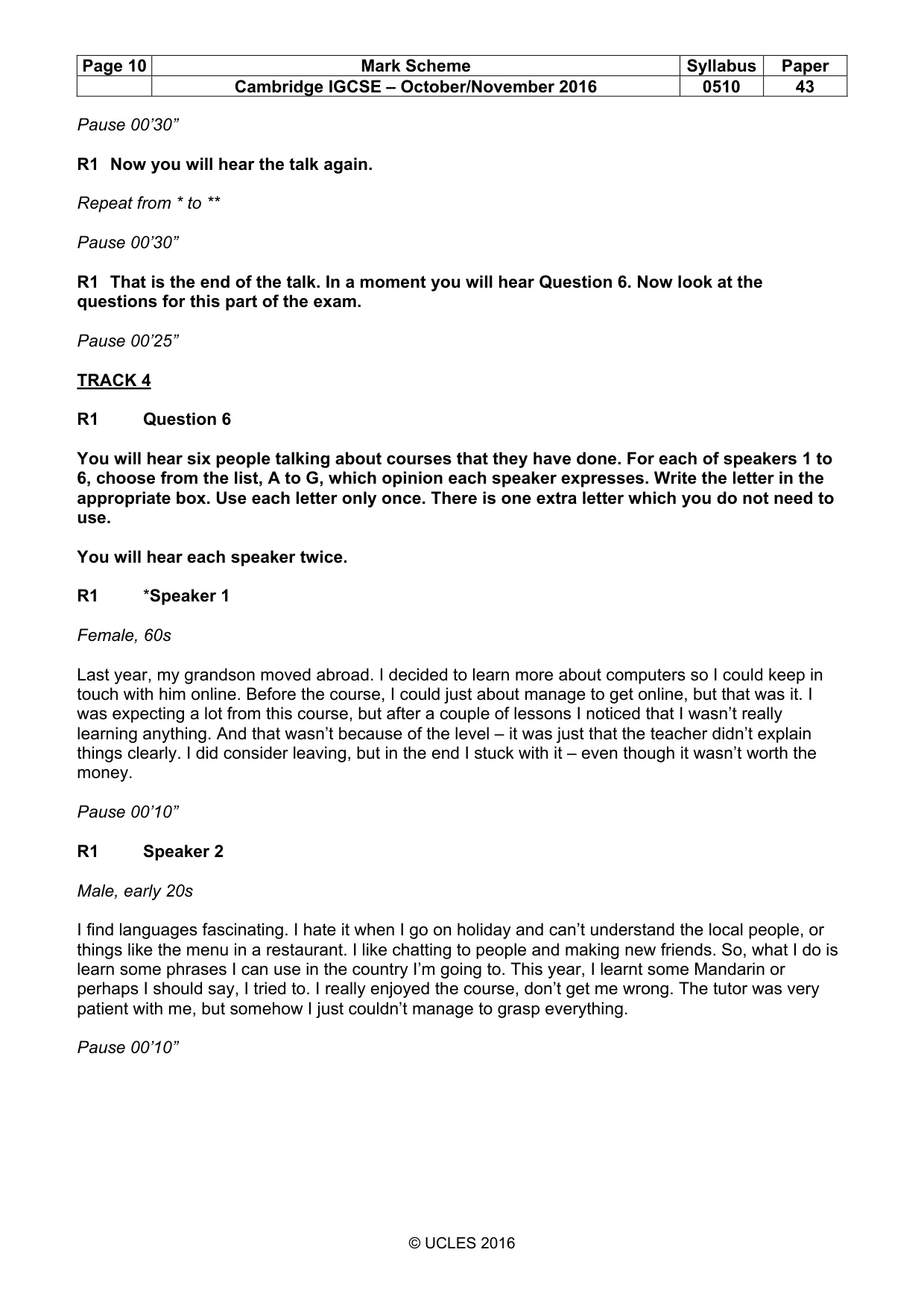
Page 10 Mark Scheme Syllabus Paper Cambridge IGCSE – October/November 2016 0510 43 © UCLES 2016 Pause 00’30” R1 Now you will hear the talk again. Repeat from * to ** Pause 00’30” R1 That is the end of the talk. In a moment you will hear Question 6. Now look at the questions for this part of the exam. Pause 00’25” TRACK 4 R1 Question 6 You will hear six people talking about courses that they have done. For each of speakers 1 to 6, choose from the list, A to G, which opinion each speaker expresses. Write the letter in the appropriate box. Use each letter only once. There is one extra letter which you do not need to use. You will hear each speaker twice. R1 *Speaker 1 Female, 60s Last year, my grandson moved abroad. I decided to learn more about computers so I could keep in touch with him online. Before the course, I could just about manage to get online, but that was it. I was expecting a lot from this course, but after a couple of lessons I noticed that I wasn’t really learning anything. And that wasn’t because of the level – it was just that the teacher didn’t explain things clearly. I did consider leaving, but in the end I stuck with it – even though it wasn’t worth the money. Pause 00’10” R1 Speaker 2 Male, early 20s I find languages fascinating. I hate it when I go on holiday and can’t understand the local people, or things like the menu in a restaurant. I like chatting to people and making new friends. So, what I do is learn some phrases I can use in the country I’m going to. This year, I learnt some Mandarin or perhaps I should say, I tried to. I really enjoyed the course, don’t get me wrong. The tutor was very patient with me, but somehow I just couldn’t manage to grasp everything. Pause 00’10”
Mark scheme, page 11
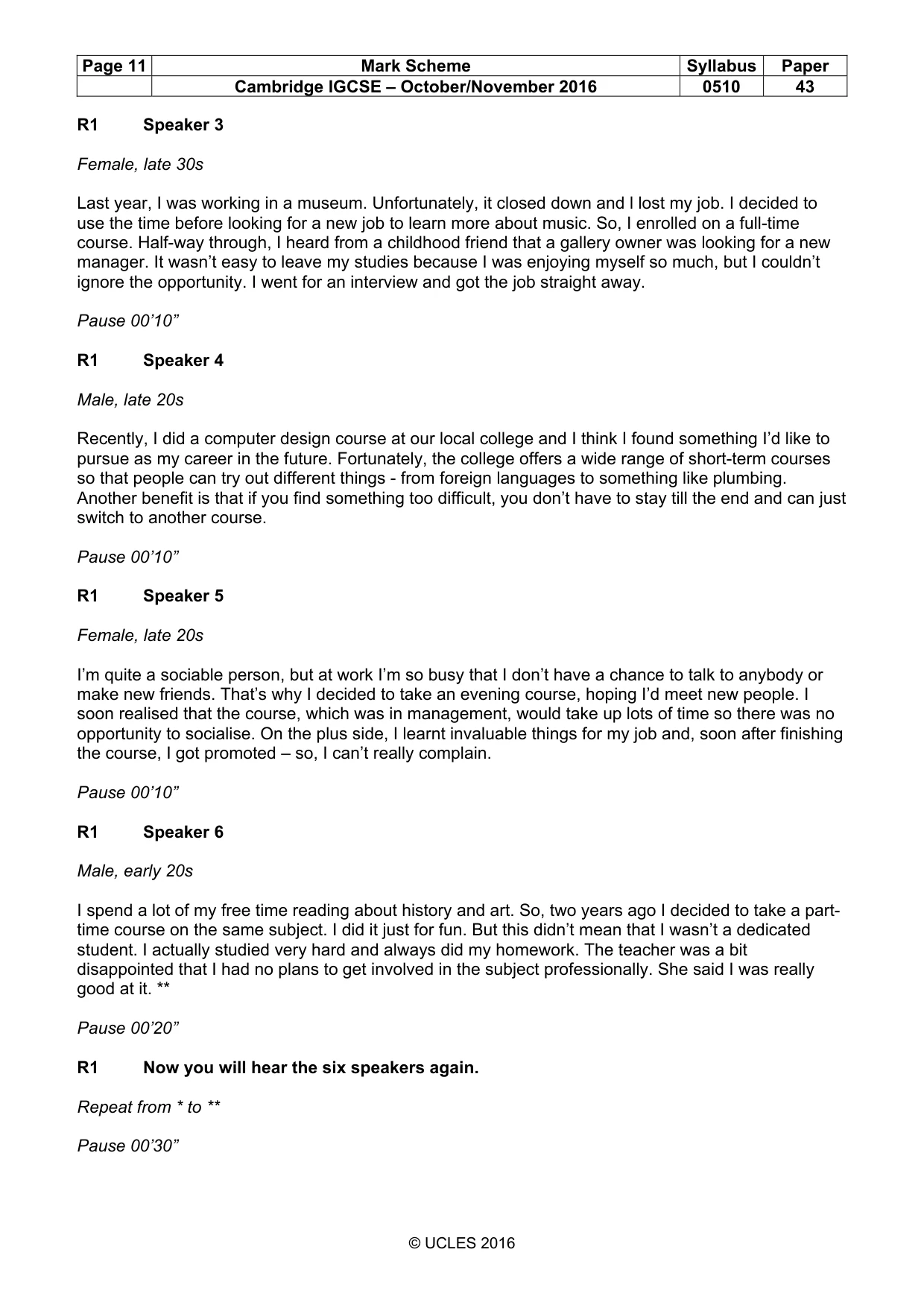
Page 11 Mark Scheme Syllabus Paper Cambridge IGCSE – October/November 2016 0510 43 © UCLES 2016 R1 Speaker 3 Female, late 30s Last year, I was working in a museum. Unfortunately, it closed down and l lost my job. I decided to use the time before looking for a new job to learn more about music. So, I enrolled on a full-time course. Half-way through, I heard from a childhood friend that a gallery owner was looking for a new manager. It wasn’t easy to leave my studies because I was enjoying myself so much, but I couldn’t ignore the opportunity. I went for an interview and got the job straight away. Pause 00’10” R1 Speaker 4 Male, late 20s Recently, I did a computer design course at our local college and I think I found something I’d like to pursue as my career in the future. Fortunately, the college offers a wide range of short-term courses so that people can try out different things - from foreign languages to something like plumbing. Another benefit is that if you find something too difficult, you don’t have to stay till the end and can just switch to another course. Pause 00’10” R1 Speaker 5 Female, late 20s I’m quite a sociable person, but at work I’m so busy that I don’t have a chance to talk to anybody or make new friends. That’s why I decided to take an evening course, hoping I’d meet new people. I soon realised that the course, which was in management, would take up lots of time so there was no opportunity to socialise. On the plus side, I learnt invaluable things for my job and, soon after finishing the course, I got promoted – so, I can’t really complain. Pause 00’10” R1 Speaker 6 Male, early 20s I spend a lot of my free time reading about history and art. So, two years ago I decided to take a part- time course on the same subject. I did it just for fun. But this didn’t mean that I wasn’t a dedicated student. I actually studied very hard and always did my homework. The teacher was a bit disappointed that I had no plans to get involved in the subject professionally. She said I was really good at it. ** Pause 00’20” R1 Now you will hear the six speakers again. Repeat from * to ** Pause 00’30”
Mark scheme, page 12
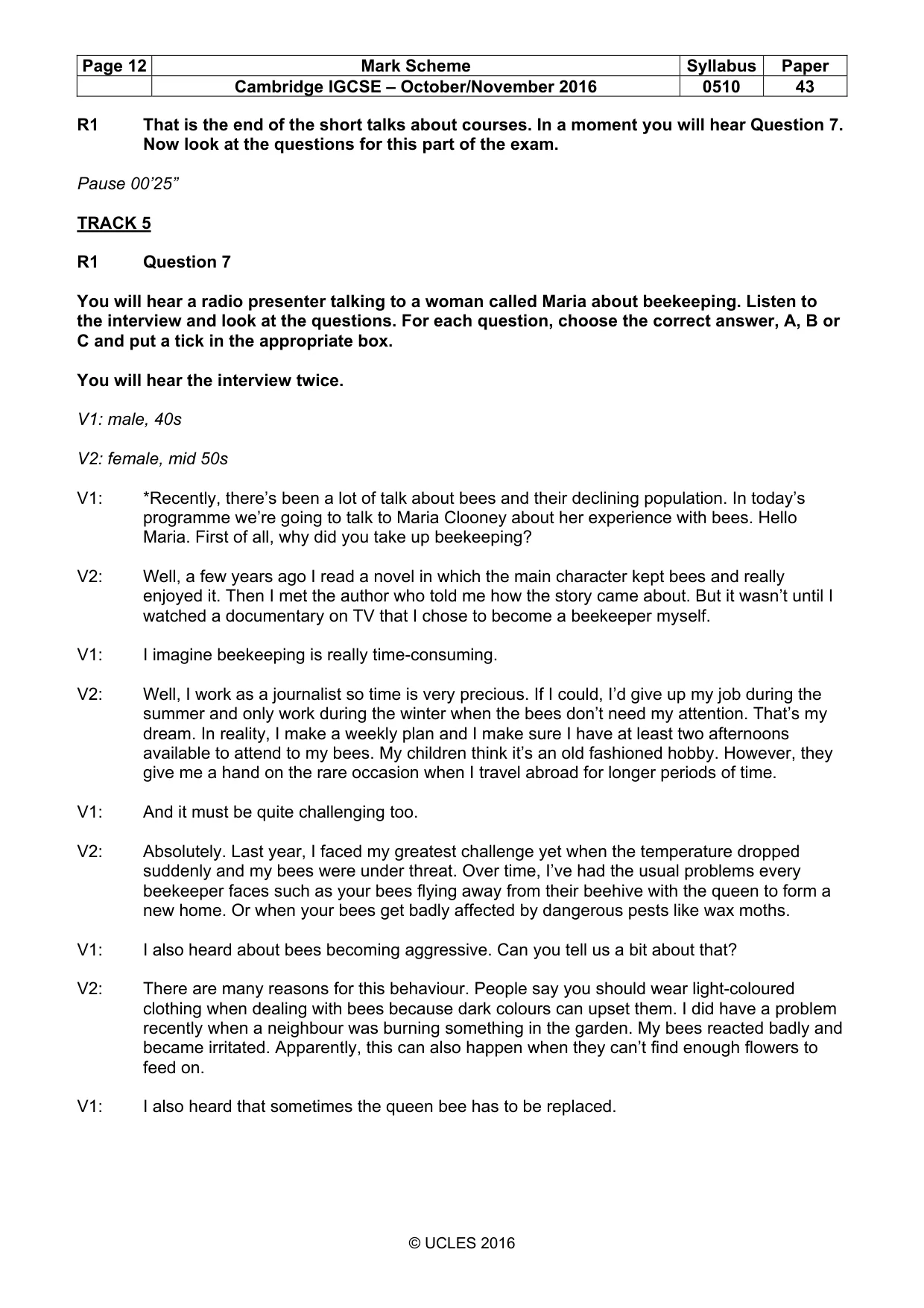
Page 12 Mark Scheme Syllabus Paper Cambridge IGCSE – October/November 2016 0510 43 © UCLES 2016 R1 That is the end of the short talks about courses. In a moment you will hear Question 7. Now look at the questions for this part of the exam. Pause 00’25” TRACK 5 R1 Question 7 You will hear a radio presenter talking to a woman called Maria about beekeeping. Listen to the interview and look at the questions. For each question, choose the correct answer, A, B or C and put a tick in the appropriate box. You will hear the interview twice. V1: male, 40s V2: female, mid 50s V1: *Recently, there’s been a lot of talk about bees and their declining population. In today’s programme we’re going to talk to Maria Clooney about her experience with bees. Hello Maria. First of all, why did you take up beekeeping? V2: Well, a few years ago I read a novel in which the main character kept bees and really enjoyed it. Then I met the author who told me how the story came about. But it wasn’t until I watched a documentary on TV that I chose to become a beekeeper myself. V1: I imagine beekeeping is really time-consuming. V2: Well, I work as a journalist so time is very precious. If I could, I’d give up my job during the summer and only work during the winter when the bees don’t need my attention. That’s my dream. In reality, I make a weekly plan and I make sure I have at least two afternoons available to attend to my bees. My children think it’s an old fashioned hobby. However, they give me a hand on the rare occasion when I travel abroad for longer periods of time. V1: And it must be quite challenging too. V2: Absolutely. Last year, I faced my greatest challenge yet when the temperature dropped suddenly and my bees were under threat. Over time, I’ve had the usual problems every beekeeper faces such as your bees flying away from their beehive with the queen to form a new home. Or when your bees get badly affected by dangerous pests like wax moths. V1: I also heard about bees becoming aggressive. Can you tell us a bit about that? V2: There are many reasons for this behaviour. People say you should wear light-coloured clothing when dealing with bees because dark colours can upset them. I did have a problem recently when a neighbour was burning something in the garden. My bees reacted badly and became irritated. Apparently, this can also happen when they can’t find enough flowers to feed on. V1: I also heard that sometimes the queen bee has to be replaced.
Mark scheme, page 13
Page 13 Mark Scheme Syllabus Paper Cambridge IGCSE – October/November 2016 0510 43 © UCLES 2016 V2: That’s right. Once, when I had to get a new one, I got a tip from a friend who also keeps bees. She suggested ordering one online. I was quite astonished that people can do that and to my surprise received the special delivery in the post within three days of ordering. In some cases though, the existing queen bee can naturally create a new queen when the group gets too big. V1: You’re very interested in the behaviour of bees, aren’t you? V2: Yes, last year I was invited to a lab to observe something called the waggle dance. I’d always thought that this dance was a response to a possible danger, such as an earthquake. But in fact, it’s what happens when a bee has found a good source of food and it returns to indicate the distance and the direction of it to the rest of the bees. That’s what I find incredible. V1: Indeed. We’ve mentioned the challenges of beekeeping, but what about the rewards? V2: Well, just ensuring your bees don’t pick up any diseases is quite an achievement. I’ve been asked to do some presentations about bees and how important they are for us. I really enjoy doing this. But that was nothing compared to the feeling I got when people started buying my honey at the local market. V1: And how about bees in the future? V2: Well, many people worry about bees, but I remain positive. I’ve noticed that more young people are taking up beekeeping as a hobby, especially in cities. And thanks to lots of parks in our towns, there’s been an increase in the amount of food for bees to survive on. This, especially, is really encouraging for me personally. I’ve also noticed a rise in the number of college courses that offer beekeeping. So let’s do our best to make sure that bees are here to stay. V1: That’s a very good message to end on. Thank you Maria.** Pause 00’30” R1 Now you will hear the interview again. Repeat from * to ** Pause 00’30” That is the end of Question 7. In a moment you will hear Question 8. Now look at the questions for this part of the exam. Pause 00’25”
Mark scheme, page 14
Page 14 Mark Scheme Syllabus Paper Cambridge IGCSE – October/November 2016 0510 43 © UCLES 2016 TRACK 6 R1 Question 8 Part A You will hear a teacher giving a talk about a photographer called Alex Stransky. Listen to the talk and complete the sentences in Part A. Write one or two words only in each gap. You will hear the talk twice. V1: male (late 30s) V1: *In this week’s talks, we’ve been focusing on new talents in all forms of art. For my talk today, I’ve chosen a young photographer, Alex Stransky, who was born in Slovakia in 1981. Alex’s style is easily recognisable and I love the way he captures the mood of each place he visits. He claims that he only takes photographs of natural places and stays away from manmade structures like bridges or castles. The one exception to the rule is lighthouses. He says he’s fascinated by their history. Alex has always been a keen photographer and as a child he would spend his summer holidays taking pictures of animals, trees and anything that caught his eye. His father noticed his talent and encouraged him to pursue his hobby and study photography at university. After graduating, Alex got a job as a portrait photographer at a local studio. A few years later he set up his own small company focusing on weddings. However, he knew this was only a start and he wanted to concentrate on landscapes. In his spare time, he still visited his beloved mountains. He would vary when he went there, either going at sunrise or sunset. At dawn, he would photograph the peaks surrounded by the morning mist. The sky was his favourite thing to take pictures of, towards the end of the day when the sun was setting. He had to be quick to capture these images. If he waited a few minutes, the scene could be very different. Alex’s first big break came when his photos were published in a magazine called the Travel Digest. Then other offers followed and Alex put together his first public exhibition. It was a great success, but the finest moment for him came when, after entering a contest held each year, he won ‘The Outstanding Image’ award in the landscape category. Now he’s got his eye on the World Photography Awards next year where he’d love for his work on landscapes to be recognised. Alex has always enjoyed travelling as much as taking photos. His favourite spots are in Scotland and Norway. He loves uninhabited locations with exceptional natural beauty and believes the best way to express his experiences from these travels is in pictures rather than words. Being alone with only his camera as his best friend is something he finds both relaxing and inspiring. Before we look at some of Alex’s photos, are there any questions?** Pause 00’25” R1 Now you will hear the talk again. Repeat from * to ** Pause 00’30” That is the end of the talk. In a moment you will hear Question 8 Part B. Now look at the questions for this part of the exam. Pause 00’30”
Mark scheme, page 15
Page 15 Mark Scheme Syllabus Paper Cambridge IGCSE – October/November 2016 0510 43 © UCLES 2016 R1 Question 8 Part B Part B Now listen to a conversation between two students about Alex Stransky’s photographs and the educational trips that he organises, and complete the sentences in Part B. Write one or two words only in each gap. You will hear the conversation twice. V1: Tomek (male, early 20s) V2: Carmen (female, early 20s) V1: *Hi Carmen. How are things? V2: Hi Tomek. I was just thinking about you! I went to the talk last Thursday and really enjoyed it. I know that you also love photography so I wanted to tell you about it. V1: Yes, I heard it was great. Some of my other friends went and they can’t stop talking about it. Speaking of which, did you know that Stransky’s exhibition is in town soon? Before coming to our Town Hall, the exhibition is first on display at the National Gallery and then it moves on to Ontario’s Exhibition Centre. V2: I had no idea. Are you going? V1: Definitely. I’m really into landscape photography. Fancy coming? V2: That would be great. I also found out on his webpage that he organises trips where he teaches you how to take pictures in the wild. V1: Funny you should say that. A friend of mine actually went on one of those trips with Stransky. V2: No way. Where to? V1: They went to the Swiss Alps. He has nothing but praise for it and that got me thinking that I’d love to do it too. I can’t decide between a trip to Corsica or the Dolomites in Italy. Another popular option, which unfortunately for me is completely sold out, is New Zealand. Or there’s Norway, but trips there don’t start until next year, and I don’t want to wait that long. V2: So, where do you stay on these trips? V1: Well, on arrival, most people stay overnight in a hotel, but some choose a bed and breakfast because it’s cheaper. Then, once you start hiking, you spend each night in a cabin. A few brave people sleep just under the sky in a sleeping bag, but that doesn’t happen very often. V2: And what are these trips like? V1: Well, it’s a mixture of photography classes and adventure in the wild. Stransky visits all the destinations himself before he takes his students there so he knows exactly which spots are good for photographing and what time of day to go. If you visit his website, you get a breakdown of things you need to bring. Apart from the obvious, like a good camera, you must take at least one spare memory card. Having a USB stick helps, but Stransky normally has his laptop to upload the pictures of each day and he keeps the photos on his laptop till the end of the trip. You look at them together, and he gives you feedback and praise. In the evening, you socialise with the others. V2: That sounds brilliant. I wouldn’t mind going on one of these trips too!**
Mark scheme, page 16
Page 16 Mark Scheme Syllabus Paper Cambridge IGCSE – October/November 2016 0510 43 © UCLES 2016 Pause 00’30” R1 Now you will hear the conversation again. Repeat from * to ** Pause 00’25” That is the end of Question 8, and of the exam. In a moment your teacher will collect your papers. Please check that you have written your name, Centre number and candidate number on the front of your question paper. Remember, you must not talk until all the papers have been collected. Pause 00’10” R1 Teacher, please collect all the papers.
What you needed in this session
Cambridge’s own grade thresholds for 2016 Oct/Nov, Paper 4 · Variant 3. A higher threshold means an easier paper — the bar moves with how the cohort did.