Cambridge IGCSE English - Literature in English (9-1) 0992 — 2025 Oct/Nov Paper 1 · Variant 2
0992/12/O/N/25 · 50 marks · ≈56 min
The question paper and its mark scheme, free to read here and free to download. This is Cambridge’s own paper, exactly as it was sat.
Question paper28 pages



Mark scheme5 pages
Answers below. Sit the paper first if you are practising.
Paper as text
Question paper, page 1
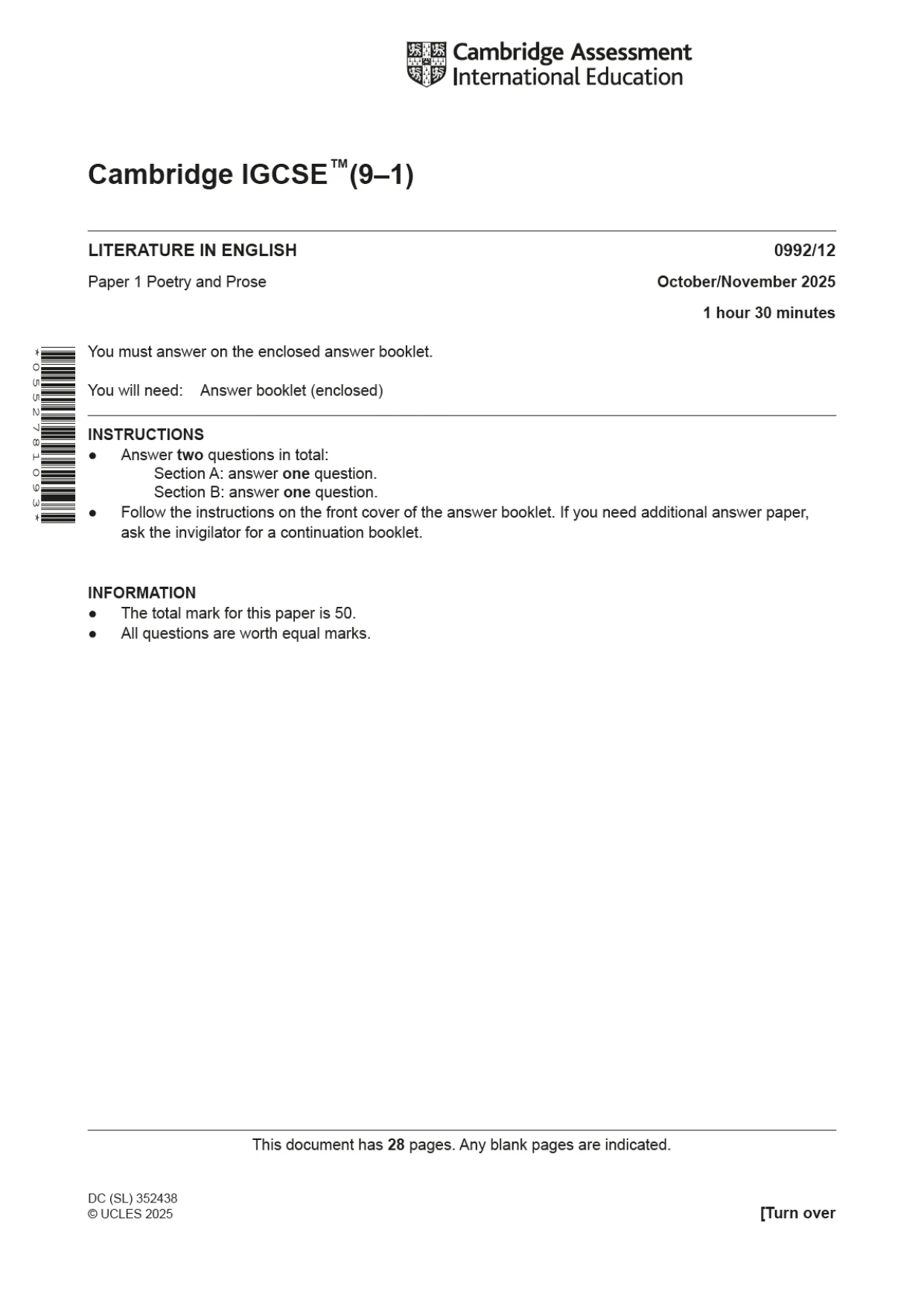
Cambridge Assessment International Education Cambridge IGCSE™(9-1) LITERATURE IN ENGLISH 0992/12 Paper 1 Poetry and Prose October/November 2025 1 hour 30 minutes You must answer on the enclosed answer booklet. You will need: Answer booklet (enclosed) INSTRUCTIONS e Answer two questions in total: Section A: answer one question. Section B: answer one question. e Follow the instructions on the front cover of the answer booklet. If you need additional answer paper, ask the invigilator for a continuation booklet. INFORMATION e The total mark for this paper is 50. e All questions are worth equal marks. This document has 28 pages. Any blank pages are indicated. DC (SL) 352438 © UCLES 2025 [Turn over
Question paper, page 2
2 0992/12/O/N/25 © UCLES 2025 BLANK PAGE
Question paper, page 3
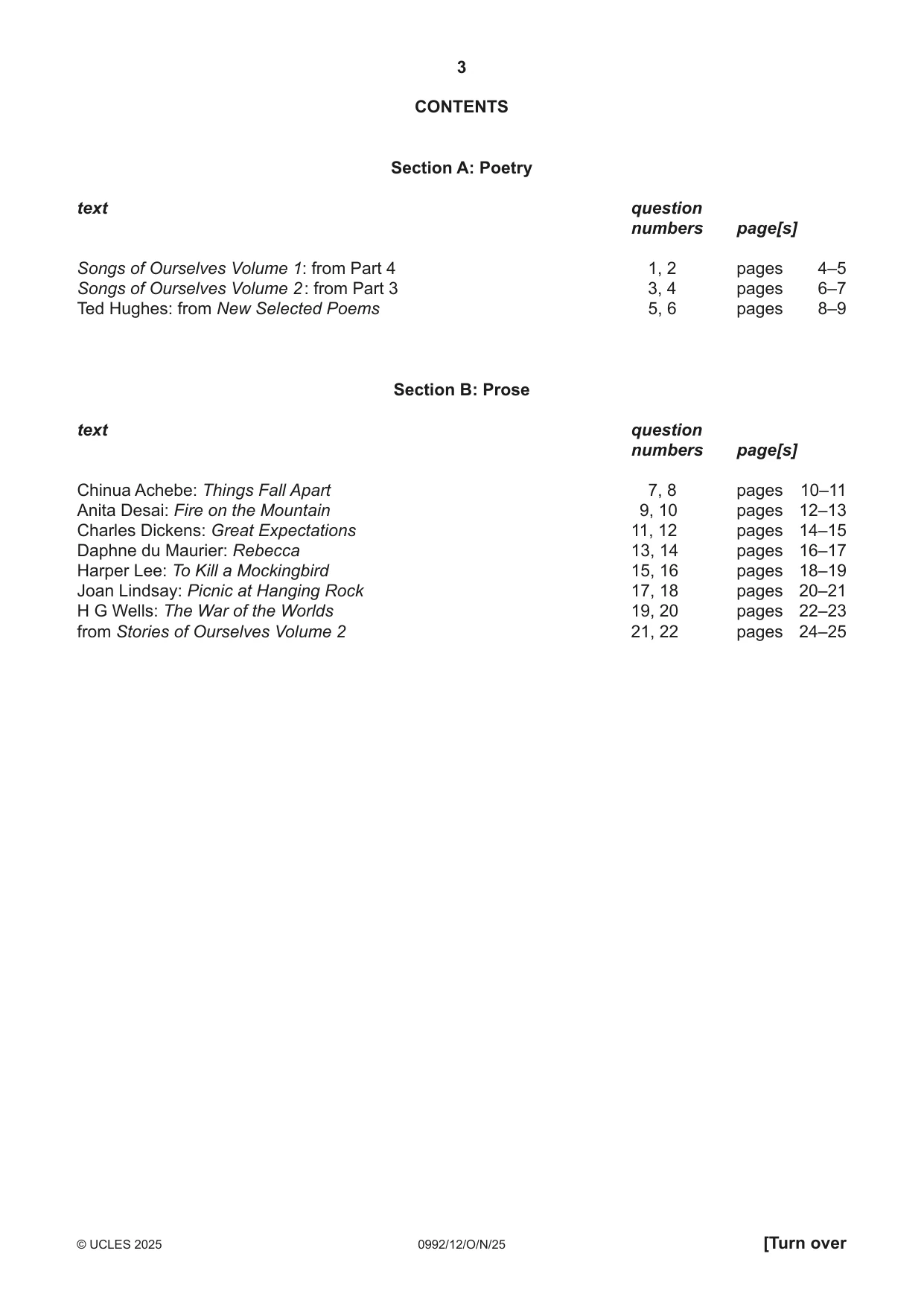
3 0992/12/O/N/25 © UCLES 2025 [Turn over CONTENTS Section A: Poetry text question numbers page[s] Songs of Ourselves Volume 1: from Part 4 1, 2 pages 4–5 Songs of Ourselves Volume 2 : from Part 3 3, 4 pages 6–7 Ted Hughes: from New Selected Poems 5, 6 pages 8–9 Section B: Prose text question numbers page[s] Chinua Achebe: Things Fall Apart 7, 8 pages 10–11 Anita Desai: Fire on the Mountain 9, 10 pages 12–13 Charles Dickens: Great Expectations 11, 12 pages 14–15 Daphne du Maurier: Rebecca 13, 14 pages 16–17 Harper Lee: To Kill a Mockingbird 15, 16 pages 18–19 Joan Lindsay: Picnic at Hanging Rock 17, 18 pages 20–21 H G Wells: The War of the Worlds 19, 20 pages 22–23 from Stories of Ourselves Volume 2 21, 22 pages 24–25
Question paper, page 4
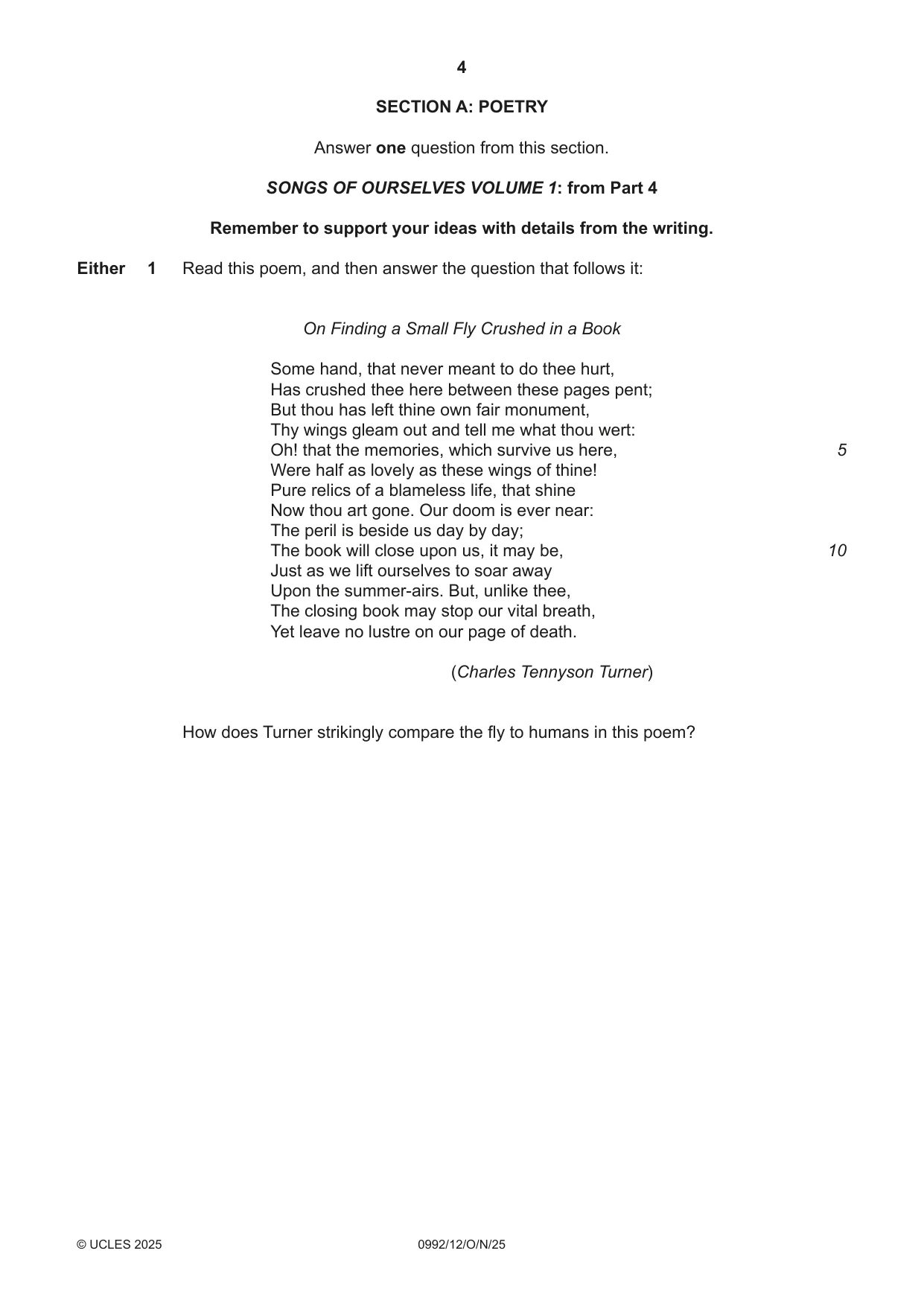
4 0992/12/O/N/25 © UCLES 2025 SECTION A: POETRY Answer one question from this section. SONGS OF OURSELVES VOLUME 1: from Part 4 Remember to support your ideas with details from the writing. Either 1 Read this poem, and then answer the question that follows it: On Finding a Small Fly Crushed in a Book Some hand, that never meant to do thee hurt, Has crushed thee here between these pages pent; But thou has left thine own fair monument, Thy wings gleam out and tell me what thou wert: Oh! that the memories, which survive us here, Were half as lovely as these wings of thine! Pure relics of a blameless life, that shine Now thou art gone. Our doom is ever near: The peril is beside us day by day; The book will close upon us, it may be, Just as we lift ourselves to soar away Upon the summer-airs. But, unlike thee, The closing book may stop our vital breath, Yet leave no lustre on our page of death. (Charles Tennyson Turner) How does Turner strikingly compare the fly to humans in this poem? 5 10
Question paper, page 5
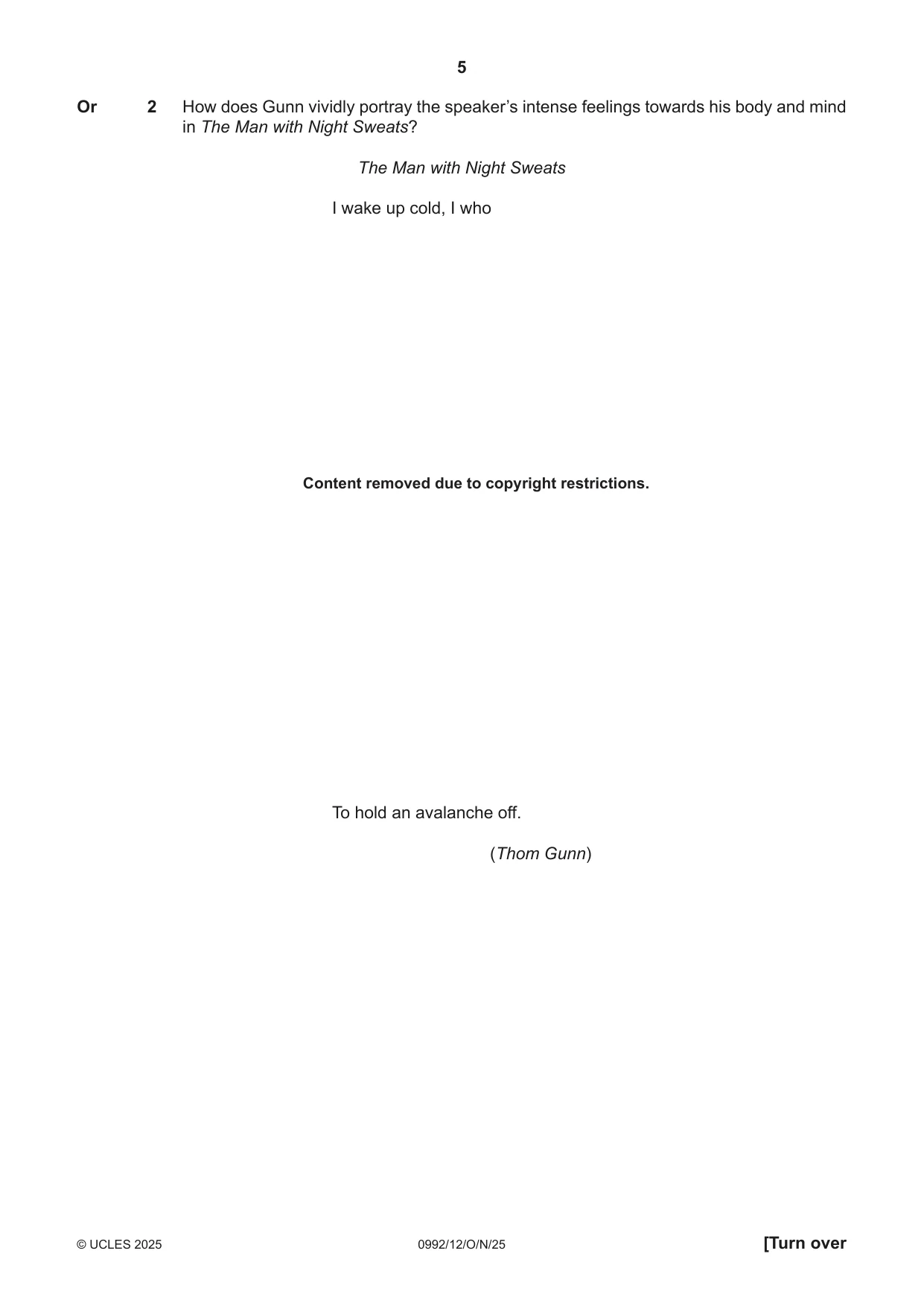
5 0992/12/O/N/25 © UCLES 2025 [Turn over Or 2 How does Gunn vividly portray the speaker’s intense feelings towards his body and mind in The Man with Night Sweats? The Man with Night Sweats I wake up cold, I who To hold an avalanche off. (Thom Gunn) Content removed due to copyright restrictions.
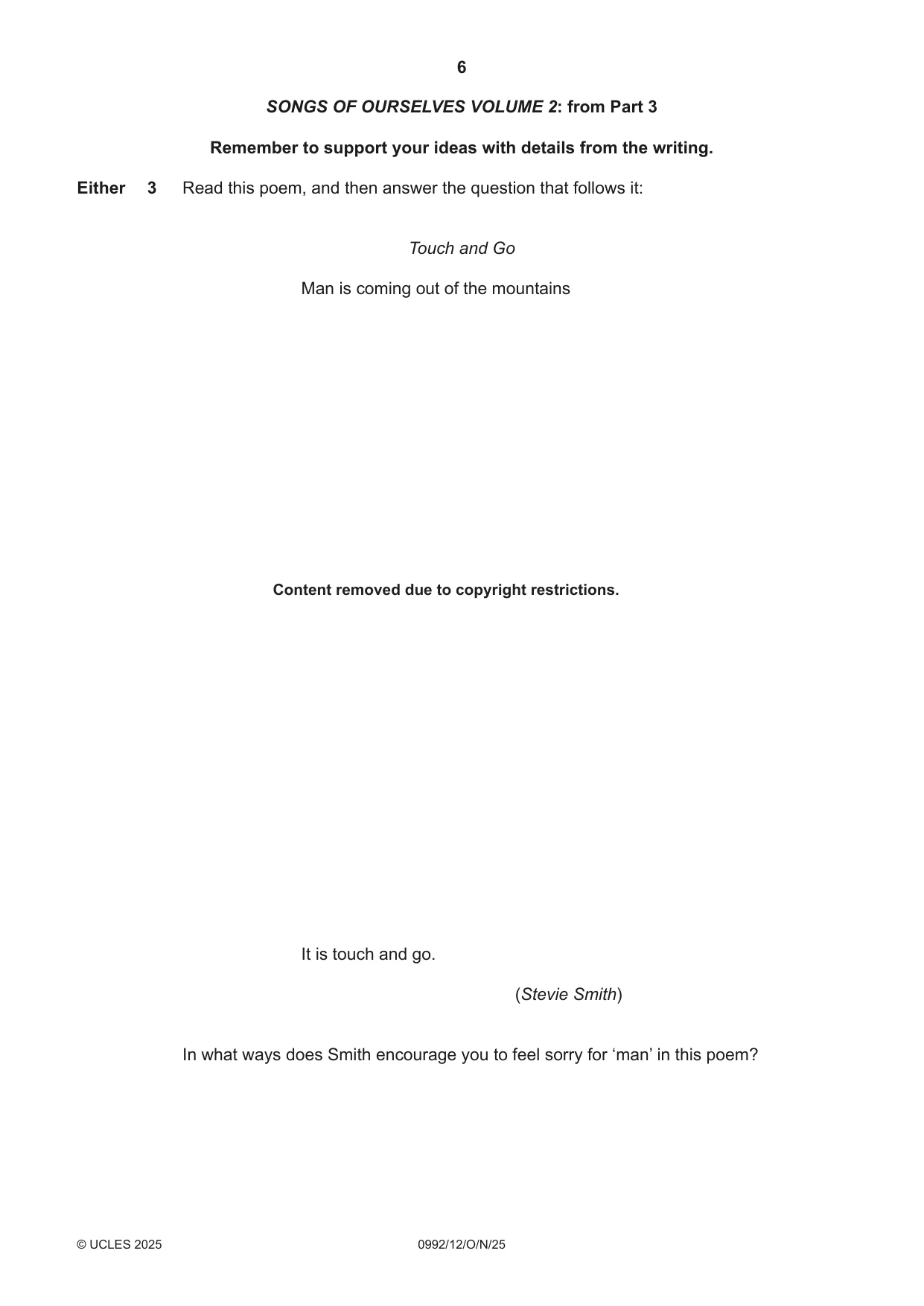
Question paper, page 6
6 0992/12/O/N/25 © UCLES 2025 SONGS OF OURSELVES VOLUME 2: from Part 3 Remember to support your ideas with details from the writing. Either 3 Read this poem, and then answer the question that follows it: Touch and Go Man is coming out of the mountains It is touch and go. (Stevie Smith) In what ways does Smith encourage you to feel sorry for ‘man’ in this poem? Content removed due to copyright restrictions.
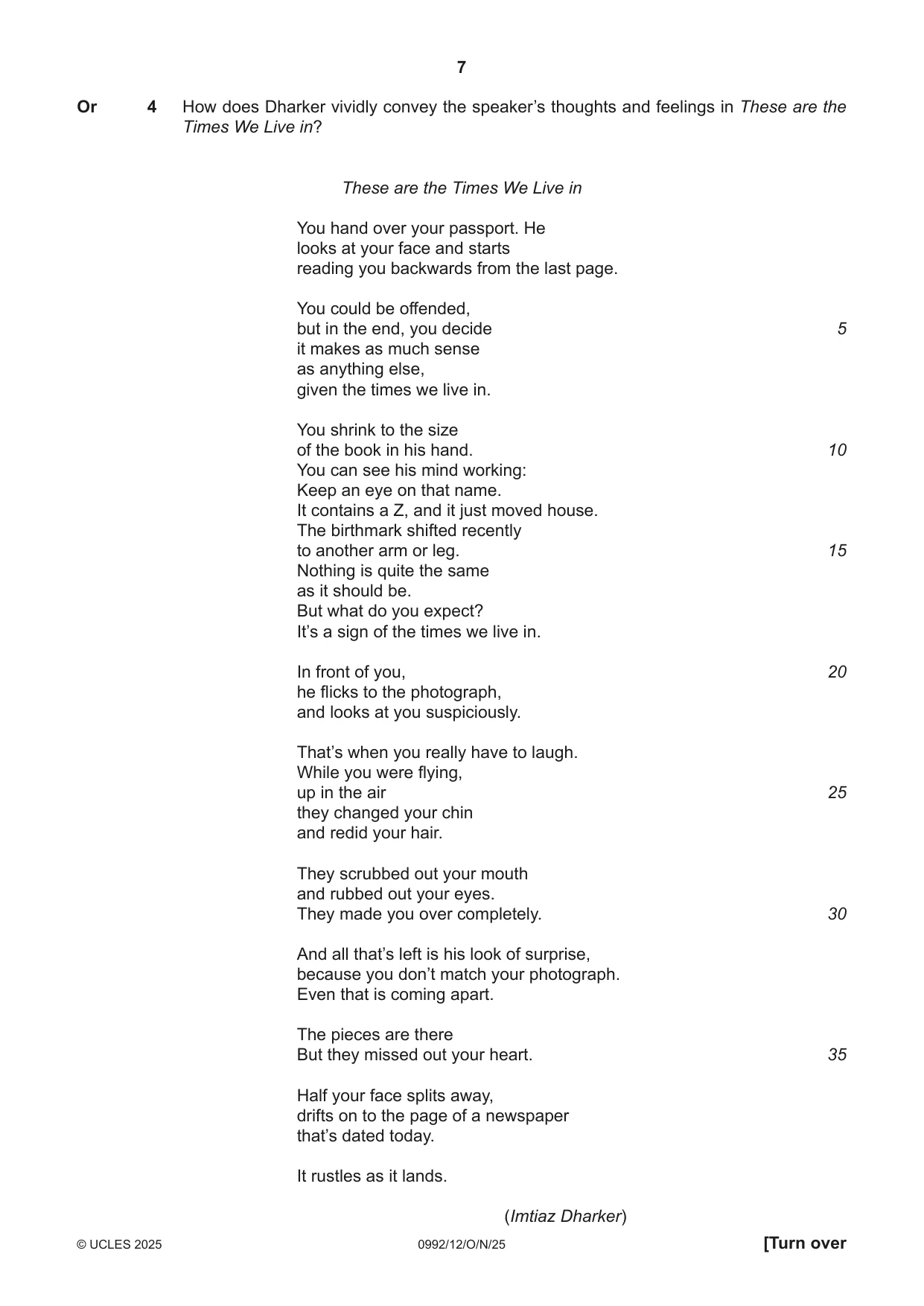
Question paper, page 7
7 0992/12/O/N/25 © UCLES 2025 [Turn over Or 4 How does Dharker vividly convey the speaker’s thoughts and feelings in These are the Times We Live in? These are the Times We Live in You hand over your passport. He looks at your face and starts reading you backwards from the last page. You could be offended, but in the end, you decide it makes as much sense as anything else, given the times we live in. You shrink to the size of the book in his hand. You can see his mind working: Keep an eye on that name. It contains a Z, and it just moved house. The birthmark shifted recently to another arm or leg. Nothing is quite the same as it should be. But what do you expect? It’s a sign of the times we live in. In front of you, he flicks to the photograph, and looks at you suspiciously. That’s when you really have to laugh. While you were flying, up in the air they changed your chin and redid your hair. They scrubbed out your mouth and rubbed out your eyes. They made you over completely. And all that’s left is his look of surprise, because you don’t match your photograph. Even that is coming apart. The pieces are there But they missed out your heart. Half your face splits away, drifts on to the page of a newspaper that’s dated today. It rustles as it lands. (Imtiaz Dharker) 5 10 15 20 25 30 35
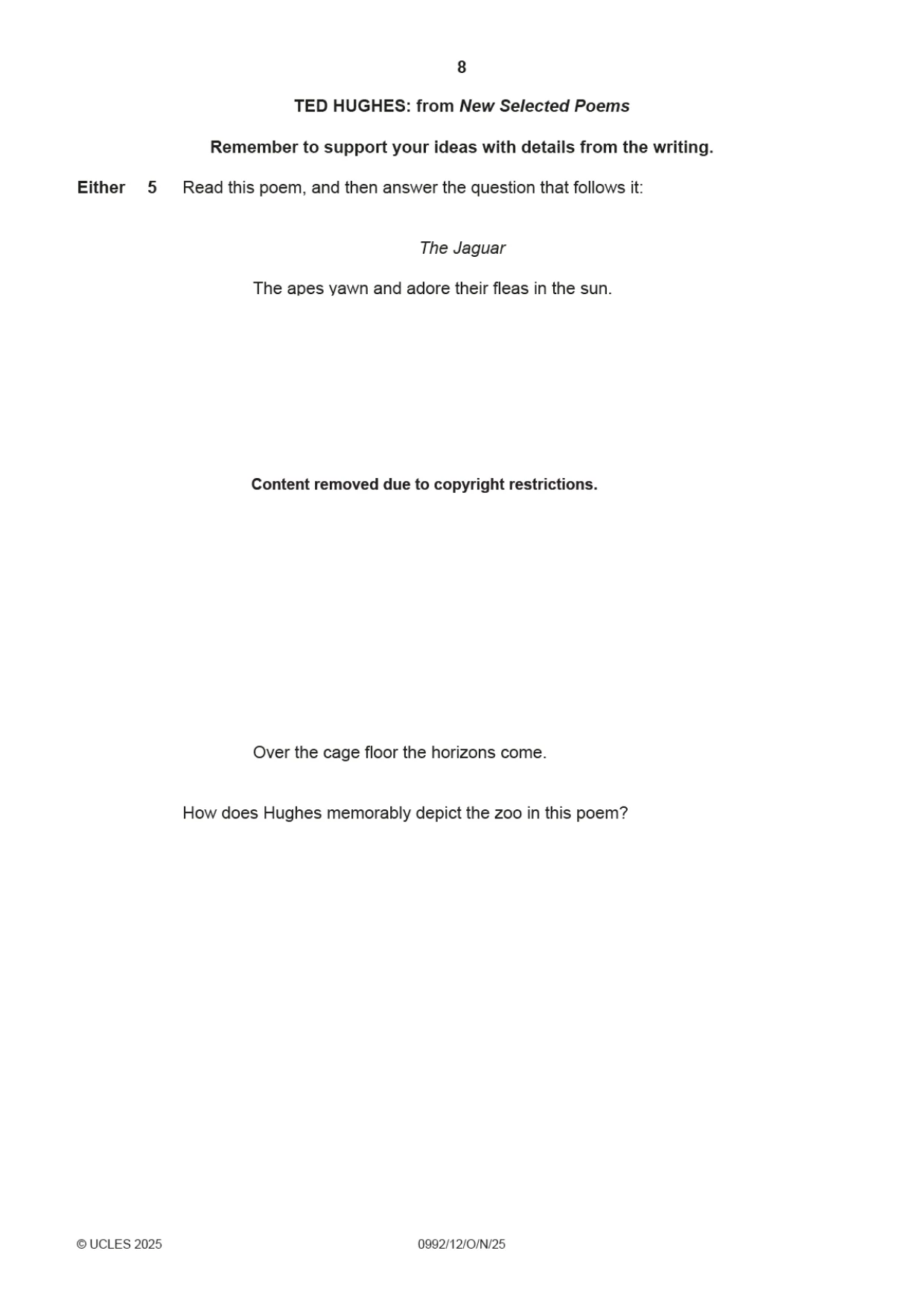
Question paper, page 8
8 TED HUGHES: from New Selected Poems Remember to support your ideas with details from the writing. Either 5 Read this poem, and then answer the question that follows it: The Jaguar The apes yawn and adore their fleas in the sun. Content removed due to copyright restrictions. Over the cage floor the horizons come. How does Hughes memorably depict the zoo in this poem? ©UCLES 2025 0992/12/0/N/25
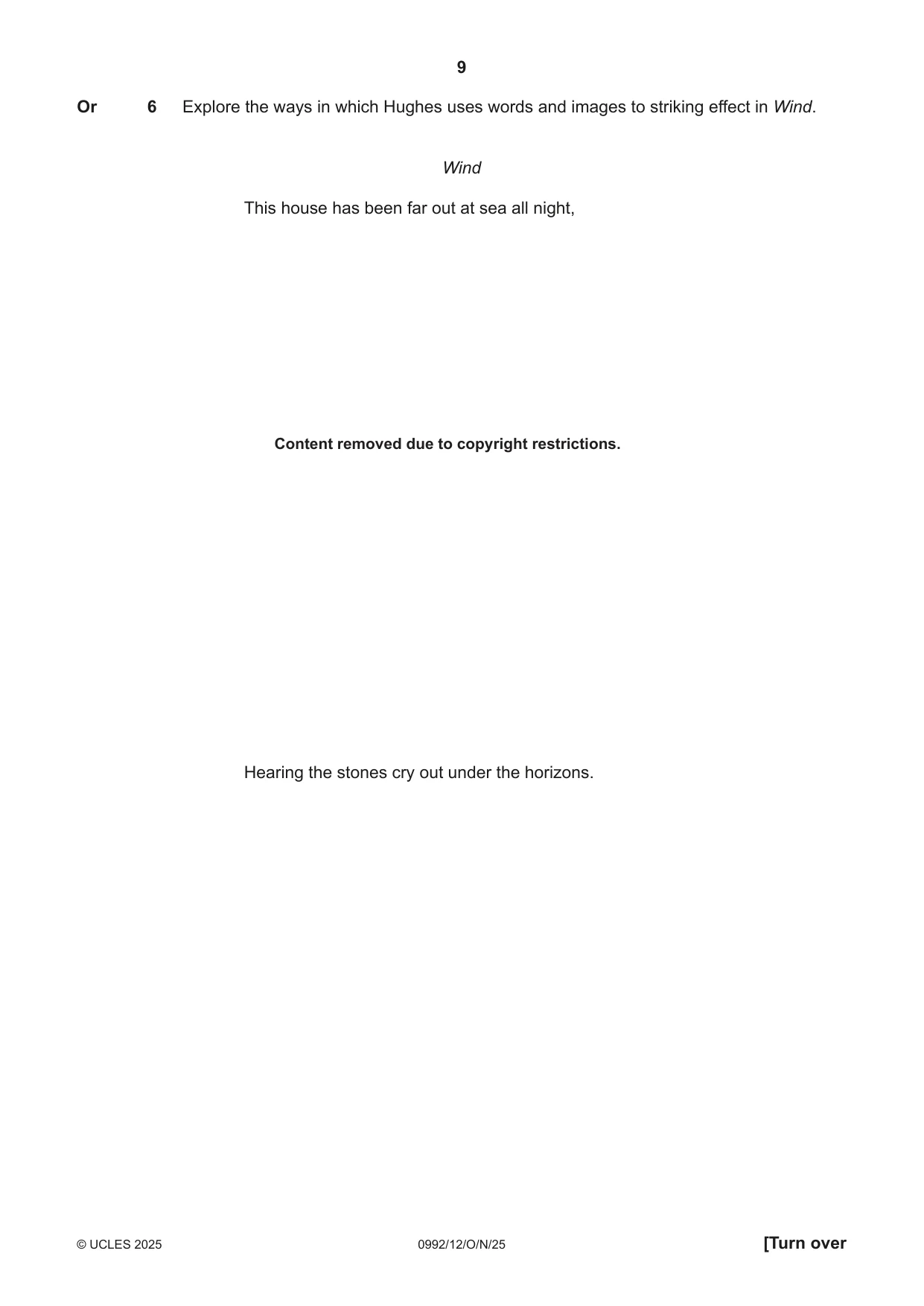
Question paper, page 9
9 0992/12/O/N/25 © UCLES 2025 [Turn over Or 6 Explore the ways in which Hughes uses words and images to striking effect in Wind. Wind This house has been far out at sea all night, Hearing the stones cry out under the horizons. Content removed due to copyright restrictions.
Question paper, page 10
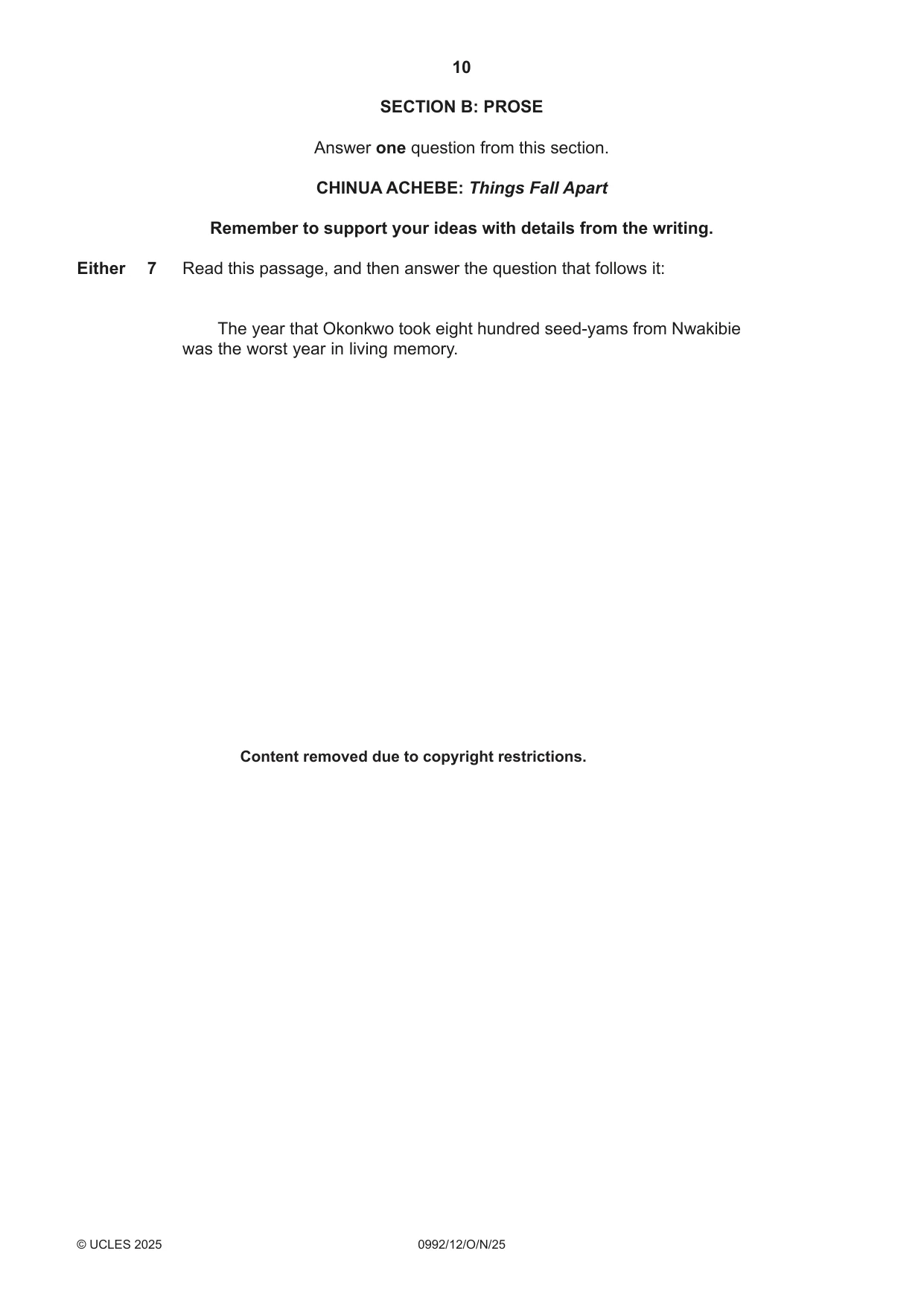
10 0992/12/O/N/25 © UCLES 2025 SECTION B: PROSE Answer one question from this section. CHINUA ACHEBE: Things Fall Apart Remember to support your ideas with details from the writing. Either 7 Read this passage, and then answer the question that follows it: The year that Okonkwo took eight hundred seed-yams from Nwakibie was the worst year in living memory. Content removed due to copyright restrictions.
Question paper, page 11
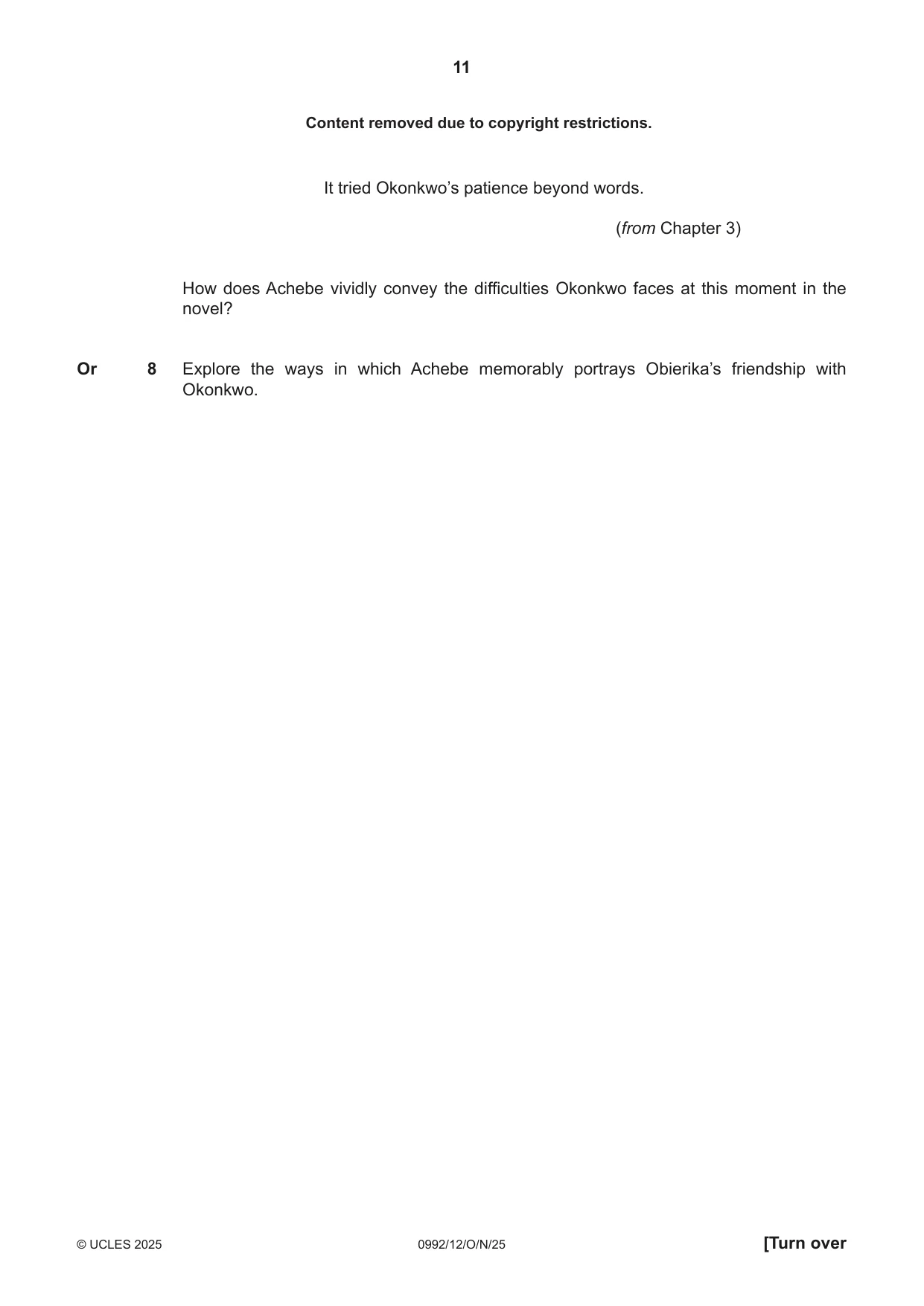
11 0992/12/O/N/25 © UCLES 2025 [Turn over It tried Okonkwo’s patience beyond words. (from Chapter 3) How does Achebe vividly convey the difficulties Okonkwo faces at this moment in the novel? Or 8 Explore the ways in which Achebe memorably portrays Obierika’s friendship with Okonkwo. Content removed due to copyright restrictions.
Question paper, page 12
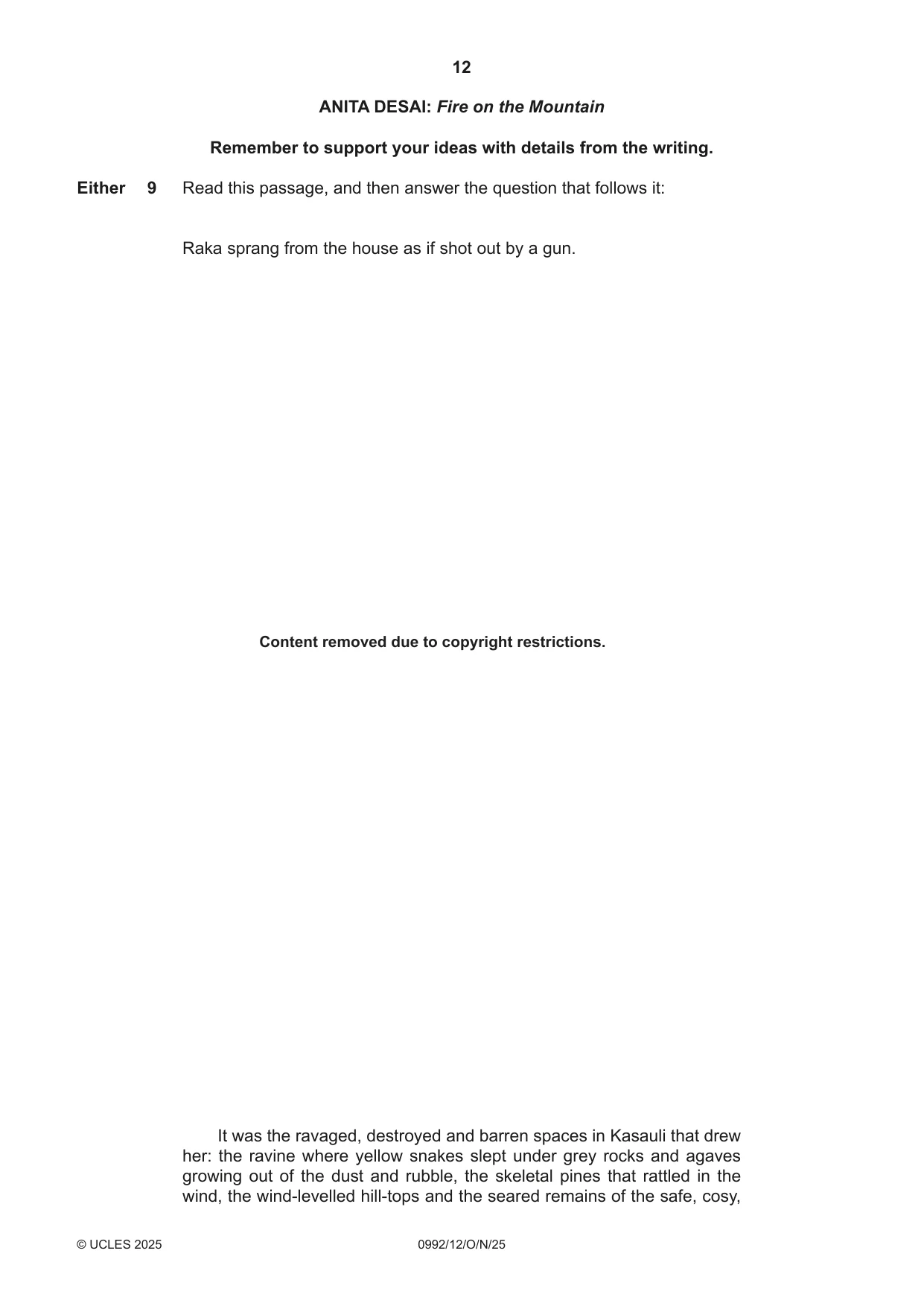
12 0992/12/O/N/25 © UCLES 2025 ANITA DESAI: Fire on the Mountain Remember to support your ideas with details from the writing. Either 9 Read this passage, and then answer the question that follows it: Raka sprang from the house as if shot out by a gun. It was the ravaged, destroyed and barren spaces in Kasauli that drew her: the ravine where yellow snakes slept under grey rocks and agaves growing out of the dust and rubble, the skeletal pines that rattled in the wind, the wind-levelled hill-tops and the seared remains of the safe, cosy, Content removed due to copyright restrictions.
Question paper, page 13
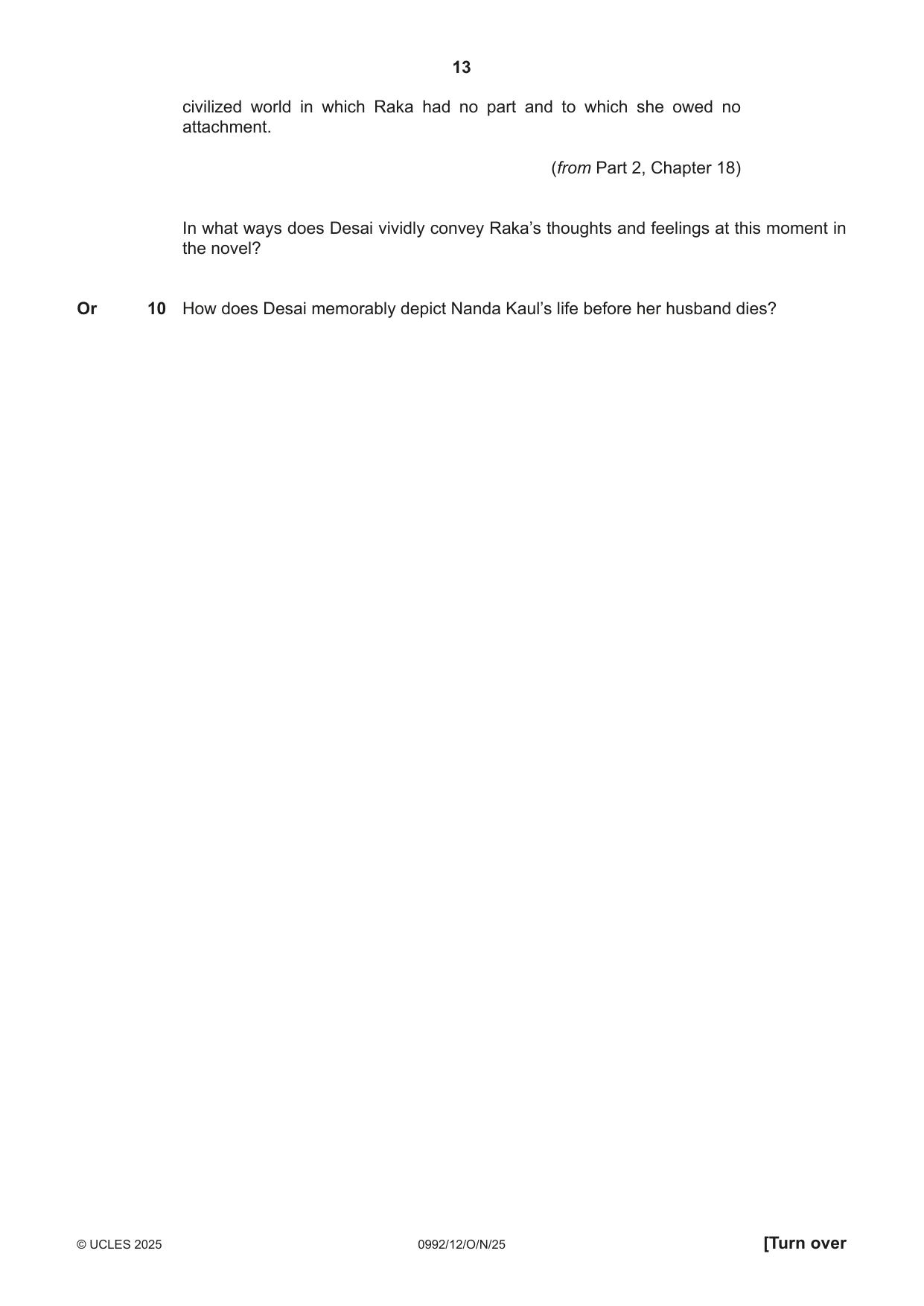
13 0992/12/O/N/25 © UCLES 2025 [Turn over civilized world in which Raka had no part and to which she owed no attachment. (from Part 2, Chapter 18) In what ways does Desai vividly convey Raka’s thoughts and feelings at this moment in the novel? Or 10 How does Desai memorably depict Nanda Kaul’s life before her husband dies?
Question paper, page 14
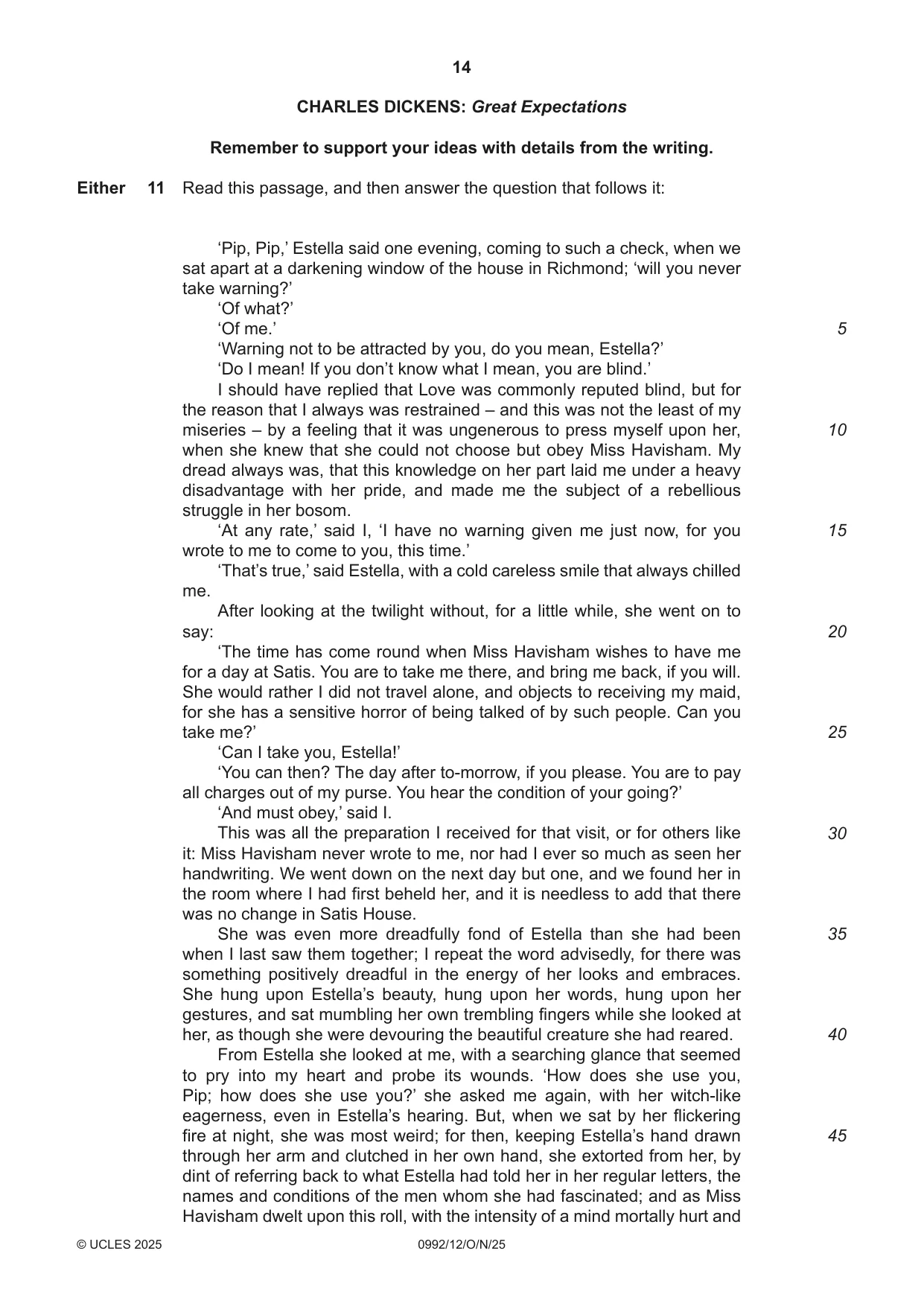
14 0992/12/O/N/25 © UCLES 2025 CHARLES DICKENS: Great Expectations Remember to support your ideas with details from the writing. Either 11 Read this passage, and then answer the question that follows it: ‘Pip, Pip,’ Estella said one evening, coming to such a check, when we sat apart at a darkening window of the house in Richmond; ‘will you never take warning?’ ‘Of what?’ ‘Of me.’ ‘Warning not to be attracted by you, do you mean, Estella?’ ‘Do I mean! If you don’t know what I mean, you are blind.’ I should have replied that Love was commonly reputed blind, but for the reason that I always was restrained – and this was not the least of my miseries – by a feeling that it was ungenerous to press myself upon her, when she knew that she could not choose but obey Miss Havisham. My dread always was, that this knowledge on her part laid me under a heavy disadvantage with her pride, and made me the subject of a rebellious struggle in her bosom. ‘At any rate,’ said I, ‘I have no warning given me just now, for you wrote to me to come to you, this time.’ ‘That’s true,’ said Estella, with a cold careless smile that always chilled me. After looking at the twilight without, for a little while, she went on to say: ‘The time has come round when Miss Havisham wishes to have me for a day at Satis. You are to take me there, and bring me back, if you will. She would rather I did not travel alone, and objects to receiving my maid, for she has a sensitive horror of being talked of by such people. Can you take me?’ ‘Can I take you, Estella!’ ‘You can then? The day after to-morrow, if you please. You are to pay all charges out of my purse. You hear the condition of your going?’ ‘And must obey,’ said I. This was all the preparation I received for that visit, or for others like it: Miss Havisham never wrote to me, nor had I ever so much as seen her handwriting. We went down on the next day but one, and we found her in the room where I had first beheld her, and it is needless to add that there was no change in Satis House. She was even more dreadfully fond of Estella than she had been when I last saw them together; I repeat the word advisedly, for there was something positively dreadful in the energy of her looks and embraces. She hung upon Estella’s beauty, hung upon her words, hung upon her gestures, and sat mumbling her own trembling fingers while she looked at her, as though she were devouring the beautiful creature she had reared. From Estella she looked at me, with a searching glance that seemed to pry into my heart and probe its wounds. ‘How does she use you, Pip; how does she use you?’ she asked me again, with her witch-like eagerness, even in Estella’s hearing. But, when we sat by her flickering fire at night, she was most weird; for then, keeping Estella’s hand drawn through her arm and clutched in her own hand, she extorted from her, by dint of referring back to what Estella had told her in her regular letters, the names and conditions of the men whom she had fascinated; and as Miss Havisham dwelt upon this roll, with the intensity of a mind mortally hurt and 5 10 15 20 25 30 35 40 45
Question paper, page 15
15 0992/12/O/N/25 © UCLES 2025 [Turn over diseased, she sat with her other hand on her crutch stick, and her chin on that, and her wan bright eyes glaring at me, a very spectre. (from Chapter 38) In what ways does Dickens make this such a disturbing moment in the novel? Or 12 How does Dickens create such memorable impressions of Biddy? 50
Question paper, page 16
16 0992/12/O/N/25 © UCLES 2025 DAPHNE DU MAURIER: Rebecca Remember to support your ideas with details from the writing. Either 13 Read this passage, and then answer the question that follows it: Thank God for Favell’s laugh. Content removed due to copyright restrictions
Question paper, page 17
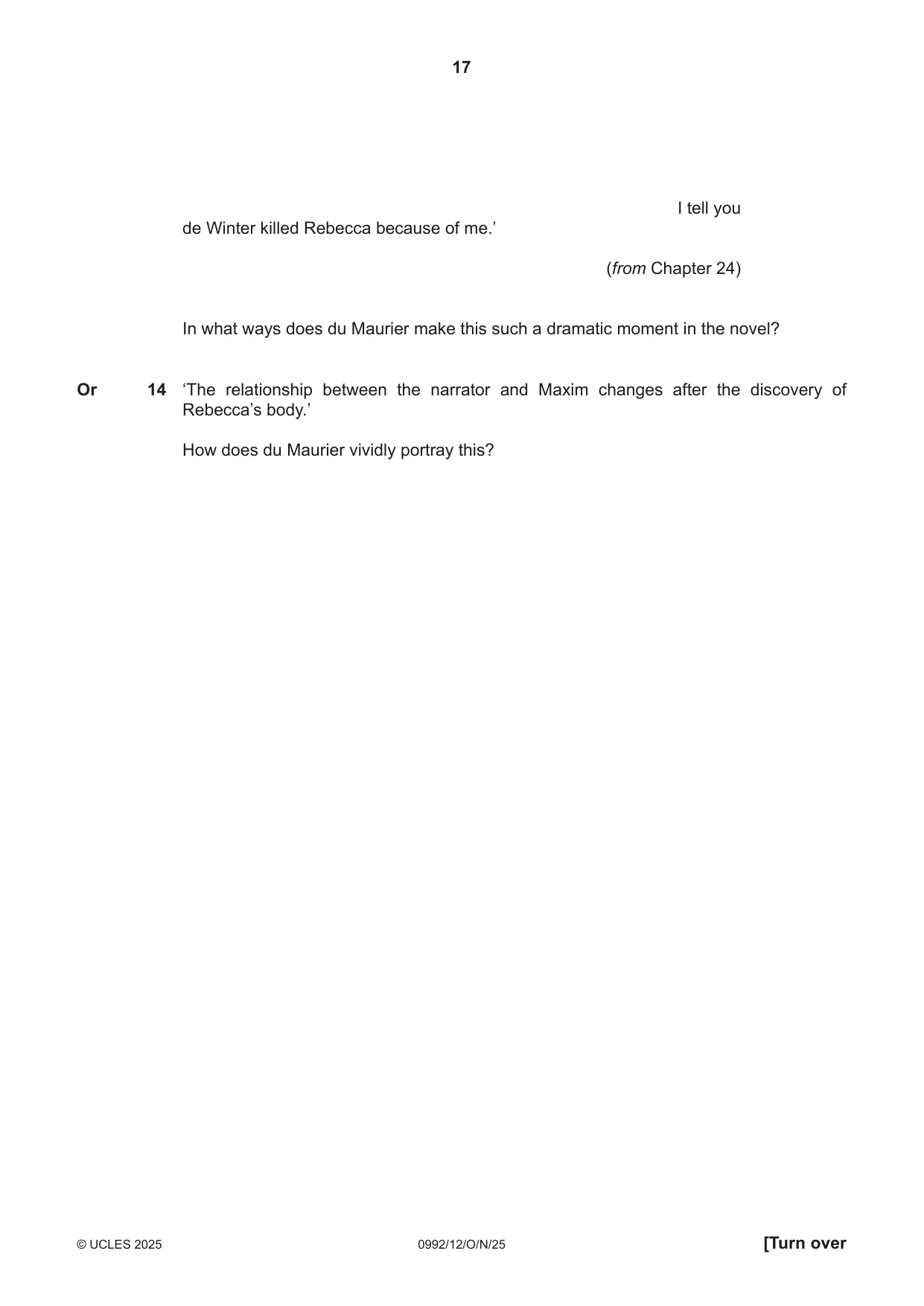
17 0992/12/O/N/25 © UCLES 2025 [Turn over I tell you de Winter killed Rebecca because of me.’ (from Chapter 24) In what ways does du Maurier make this such a dramatic moment in the novel? Or 14 ‘The relationship between the narrator and Maxim changes after the discovery of Rebecca’s body.’ How does du Maurier vividly portray this?
Question paper, page 18
18 0992/12/O/N/25 © UCLES 2025 HARPER LEE: To Kill a Mockingbird Remember to support your ideas with details from the writing. Either 15 Read this passage, and then answer the question that follows it: ‘You oughta let your mother know where you are,’ said Jem. Content removed due to copyright restrictions
Question paper, page 19
19 0992/12/O/N/25 © UCLES 2025 [Turn over ‘I wonder what the next two hours will bring.’ (from Chapter 14) In what ways does Lee make this moment in the novel both serious and amusing? Or 16 How does Lee vividly depict Scout’s early days at school?
Question paper, page 20
20 0992/12/O/N/25 © UCLES 2025 JOAN LINDSAY: Picnic at Hanging Rock Remember to support your ideas with details from the writing. Either 17 Read this passage, and then answer the question that follows it: ‘Listen! Three of your young ladies and Miss McCraw are missing at the Rock.’ (from Chapter 4) How does Lindsay make this such a dramatic moment in the novel? Content removed due to copyright restrictions
Question paper, page 21
21 0992/12/O/N/25 © UCLES 2025 [Turn over Or 18 In what ways does Lindsay use letters to make such a striking impact in the novel?
Question paper, page 22
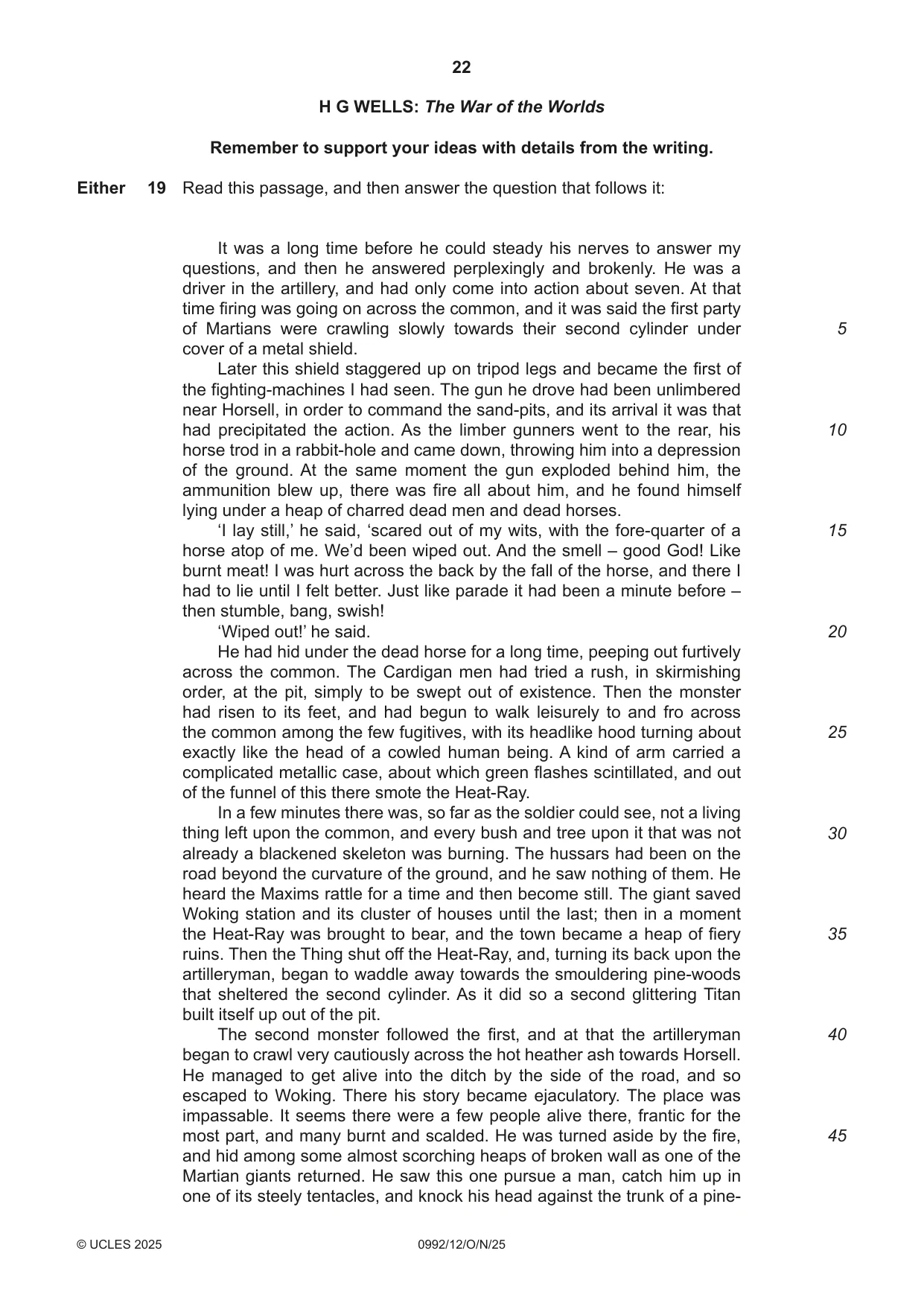
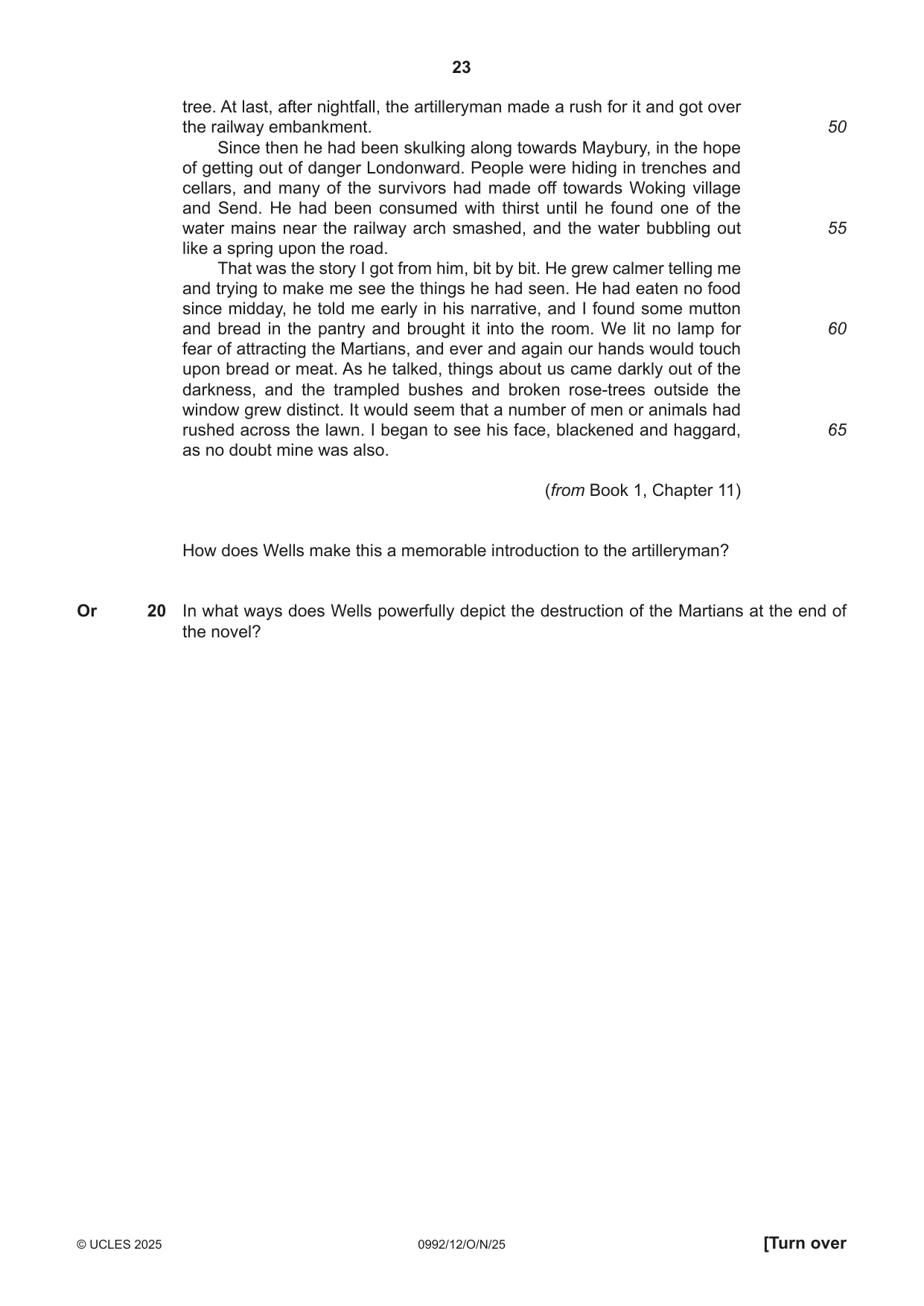
22 0992/12/O/N/25 © UCLES 2025 H G WELLS: The War of the Worlds Remember to support your ideas with details from the writing. Either 19 Read this passage, and then answer the question that follows it: It was a long time before he could steady his nerves to answer my questions, and then he answered perplexingly and brokenly. He was a driver in the artillery, and had only come into action about seven. At that time firing was going on across the common, and it was said the first party of Martians were crawling slowly towards their second cylinder under cover of a metal shield. Later this shield staggered up on tripod legs and became the first of the fighting-machines I had seen. The gun he drove had been unlimbered near Horsell, in order to command the sand-pits, and its arrival it was that had precipitated the action. As the limber gunners went to the rear, his horse trod in a rabbit-hole and came down, throwing him into a depression of the ground. At the same moment the gun exploded behind him, the ammunition blew up, there was fire all about him, and he found himself lying under a heap of charred dead men and dead horses. ‘I lay still,’ he said, ‘scared out of my wits, with the fore-quarter of a horse atop of me. We’d been wiped out. And the smell – good God! Like burnt meat! I was hurt across the back by the fall of the horse, and there I had to lie until I felt better. Just like parade it had been a minute before – then stumble, bang, swish! ‘Wiped out!’ he said. He had hid under the dead horse for a long time, peeping out furtively across the common. The Cardigan men had tried a rush, in skirmishing order, at the pit, simply to be swept out of existence. Then the monster had risen to its feet, and had begun to walk leisurely to and fro across the common among the few fugitives, with its headlike hood turning about exactly like the head of a cowled human being. A kind of arm carried a complicated metallic case, about which green flashes scintillated, and out of the funnel of this there smote the Heat-Ray. In a few minutes there was, so far as the soldier could see, not a living thing left upon the common, and every bush and tree upon it that was not already a blackened skeleton was burning. The hussars had been on the road beyond the curvature of the ground, and he saw nothing of them. He heard the Maxims rattle for a time and then become still. The giant saved Woking station and its cluster of houses until the last; then in a moment the Heat-Ray was brought to bear, and the town became a heap of fiery ruins. Then the Thing shut off the Heat-Ray, and, turning its back upon the artilleryman, began to waddle away towards the smouldering pine-woods that sheltered the second cylinder. As it did so a second glittering Titan built itself up out of the pit. The second monster followed the first, and at that the artilleryman began to crawl very cautiously across the hot heather ash towards Horsell. He managed to get alive into the ditch by the side of the road, and so escaped to Woking. There his story became ejaculatory. The place was impassable. It seems there were a few people alive there, frantic for the most part, and many burnt and scalded. He was turned aside by the fire, and hid among some almost scorching heaps of broken wall as one of the Martian giants returned. He saw this one pursue a man, catch him up in one of its steely tentacles, and knock his head against the trunk of a pine- 5 10 15 20 25 30 35 40 45
Question paper, page 23
23 0992/12/O/N/25 © UCLES 2025 [Turn over tree. At last, after nightfall, the artilleryman made a rush for it and got over the railway embankment. Since then he had been skulking along towards Maybury, in the hope of getting out of danger Londonward. People were hiding in trenches and cellars, and many of the survivors had made off towards Woking village and Send. He had been consumed with thirst until he found one of the water mains near the railway arch smashed, and the water bubbling out like a spring upon the road. That was the story I got from him, bit by bit. He grew calmer telling me and trying to make me see the things he had seen. He had eaten no food since midday, he told me early in his narrative, and I found some mutton and bread in the pantry and brought it into the room. We lit no lamp for fear of attracting the Martians, and ever and again our hands would touch upon bread or meat. As he talked, things about us came darkly out of the darkness, and the trampled bushes and broken rose-trees outside the window grew distinct. It would seem that a number of men or animals had rushed across the lawn. I began to see his face, blackened and haggard, as no doubt mine was also. (from Book 1, Chapter 11) How does Wells make this a memorable introduction to the artilleryman? Or 20 In what ways does Wells powerfully depict the destruction of the Martians at the end of the novel? 50 55 60 65
Question paper, page 24
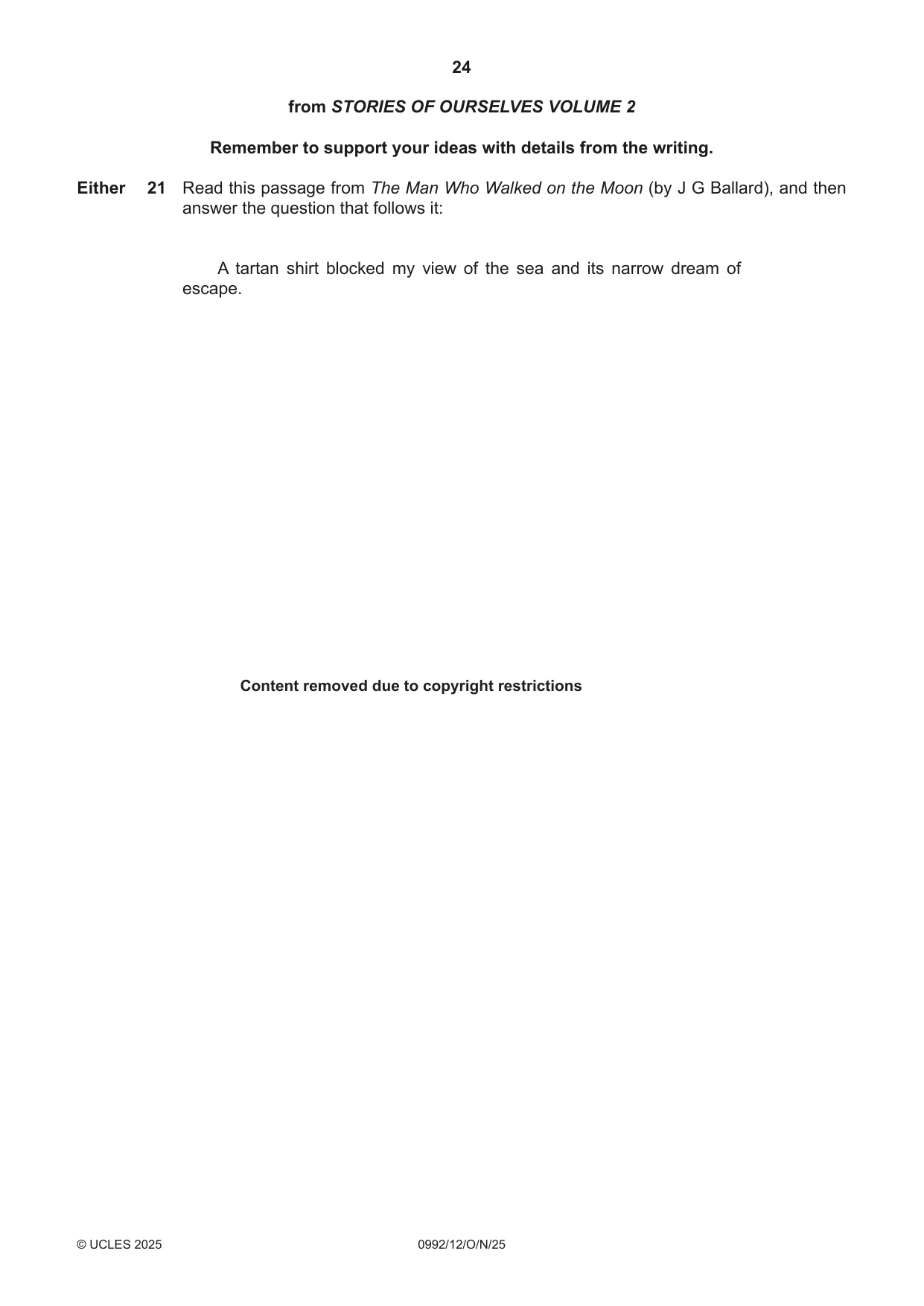
24 0992/12/O/N/25 © UCLES 2025 from STORIES OF OURSELVES VOLUME 2 Remember to support your ideas with details from the writing. Either 21 Read this passage from The Man Who Walked on the Moon (by J G Ballard), and then answer the question that follows it: A tartan shirt blocked my view of the sea and its narrow dream of escape. Content removed due to copyright restrictions
Question paper, page 25
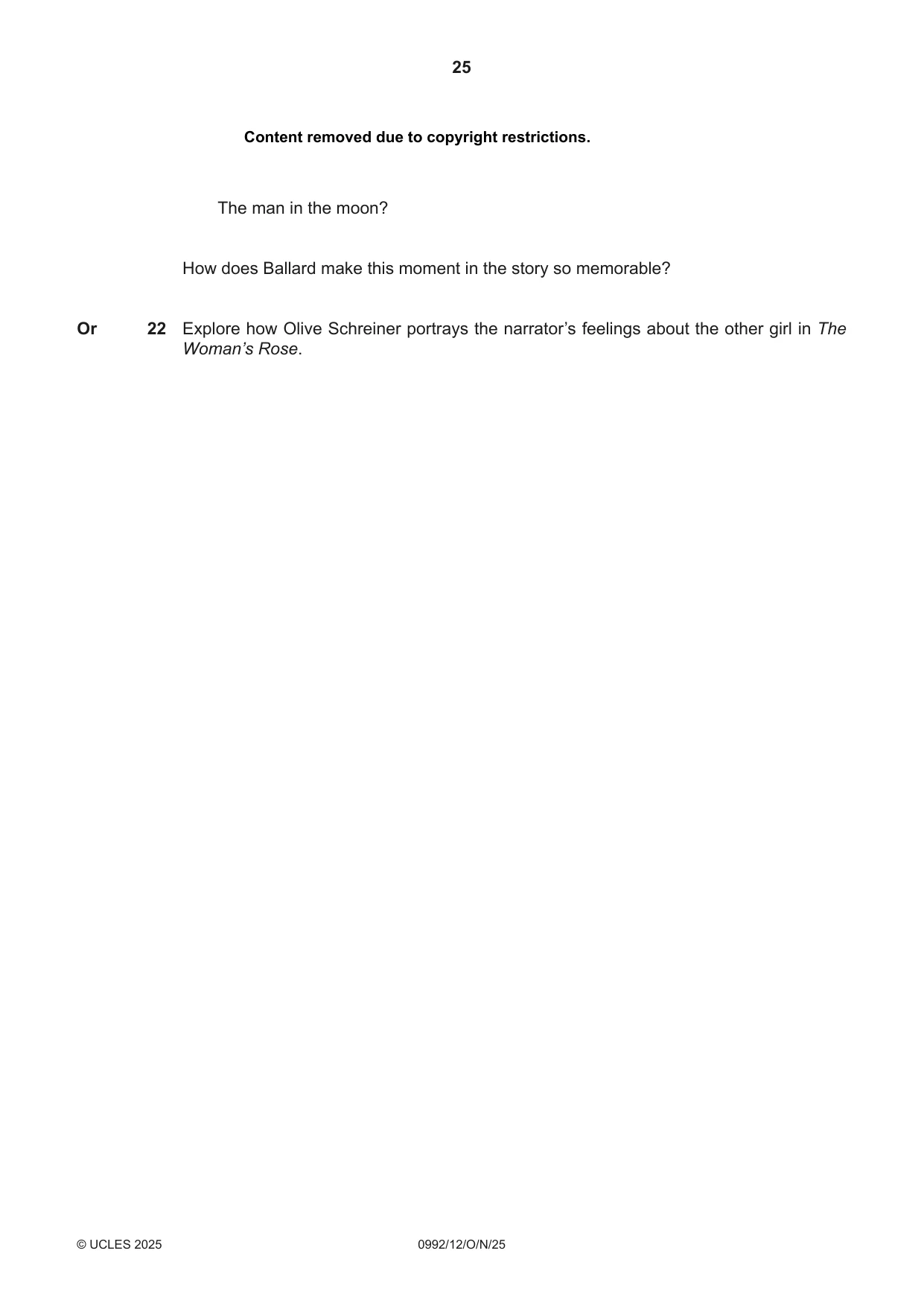
25 0992/12/O/N/25 © UCLES 2025 The man in the moon? How does Ballard make this moment in the story so memorable? Or 22 Explore how Olive Schreiner portrays the narrator’s feelings about the other girl in The Woman’s Rose. Content removed due to copyright restrictions.
Question paper, page 26
26 0992/12/O/N/25 © UCLES 2025 BLANK PAGE
Question paper, page 27
27 0992/12/O/N/25 © UCLES 2025 BLANK PAGE
Question paper, page 28
28 0992/12/O/N/25 © UCLES 2025 Permission to reproduce items where third-party owned material protected by copyright is included has been sought and cleared where possible. Every reasonable effort has been made by the publisher (UCLES) to trace copyright holders, but if any items requiring clearance have unwittingly been included, the publisher will be pleased to make amends at the earliest possible opportunity. To avoid the issue of disclosure of answer-related information to candidates, all copyright acknowledgements are reproduced online in the Cambridge Assessment International Education Copyright Acknowledgements Booklet. This is produced for each series of examinations and is freely available to download at www.cambridgeinternational.org after the live examination series. Cambridge Assessment International Education is part of Cambridge Assessment. Cambridge Assessment is the brand name of the University of Cambridge Local Examinations Syndicate (UCLES), which is a department of the University of Cambridge. BLANK PAGE
Mark scheme, page 1
This document consists of 5 printed pages. © Cambridge University Press & Assessment 2025 [Turn over Cambridge IGCSE™ (9–1) LITERATURE IN ENGLISH 0992/12 Paper 1 Poetry and Prose October/November 2025 MARK SCHEME Maximum Mark: 50 Published This mark scheme is published as an aid to teachers and candidates, to indicate the requirements of the examination. It shows the basis on which Examiners were instructed to award marks. It does not indicate the details of the discussions that took place at an Examiners’ meeting before marking began, which would have considered the acceptability of alternative answers. Mark schemes should be read in conjunction with the question paper and the Principal Examiner Report for Teachers. Cambridge International will not enter into discussions about these mark schemes. Cambridge International is publishing the mark schemes for the October/November 2025 series for most Cambridge IGCSE, Cambridge International A and AS Level components, and some Cambridge O Level components.
Mark scheme, page 2
0992/12 Cambridge IGCSE (9–1) – Mark Scheme PUBLISHED October/November 2025 © Cambridge University Press & Assessment 2025 Page 2 of 5 Generic Marking Principles These general marking principles must be applied by all examiners when marking candidate answers. They should be applied alongside the specific content of the mark scheme or generic level descriptions for a question. Each question paper and mark scheme will also comply with these marking principles. GENERIC MARKING PRINCIPLE 1: Marks must be awarded in line with: • the specific content of the mark scheme or the generic level descriptors for the question • the specific skills defined in the mark scheme or in the generic level descriptors for the question • the standard of response required by a candidate as exemplified by the standardisation scripts. GENERIC MARKING PRINCIPLE 2: Marks awarded are always whole marks (not half marks, or other fractions). GENERIC MARKING PRINCIPLE 3: Marks must be awarded positively: • marks are awarded for correct/valid answers, as defined in the mark scheme. However, credit is given for valid answers which go beyond the scope of the syllabus and mark scheme, referring to your Team Leader as appropriate • marks are awarded when candidates clearly demonstrate what they know and can do • marks are not deducted for errors • marks are not deducted for omissions • answers should only be judged on the quality of spelling, punctuation and grammar when these features are specifically assessed by the question as indicated by the mark scheme. The meaning, however, should be unambiguous. GENERIC MARKING PRINCIPLE 4: Rules must be applied consistently, e.g. in situations where candidates have not followed instructions or in the application of generic level descriptors. GENERIC MARKING PRINCIPLE 5: Marks should be awarded using the full range of marks defined in the mark scheme for the question (however; the use of the full mark range may be limited according to the quality of the candidate responses seen). GENERIC MARKING PRINCIPLE 6: Marks awarded are based solely on the requirements as defined in the mark scheme. Marks should not be awarded with grade thresholds or grade descriptors in mind.
Mark scheme, page 3
0992/12 Cambridge IGCSE (9–1) – Mark Scheme PUBLISHED October/November 2025 © Cambridge University Press & Assessment 2025 Page 3 of 5 English & Media subject specific general marking principles (To be read in conjunction with the Generic Marking Principles (and requiring further guidance on how to place marks within levels)) Components using level descriptors: • We use level descriptors as a guide to broad understanding of the qualities normally expected of, or typical of, work in a level. • Level descriptors are a means of general guidance and should not be interpreted as hurdle statements. • Where indicative content notes are supplied for a question, these are not a prescription of required content, and must not be treated as such. Alternative correct points and unexpected answers in candidates’ scripts must be given marks that fairly reflect the knowledge and skills demonstrated. • While we may have legitimate expectations as to the ground most answers may occupy, we must at all times be prepared to meet candidates on their chosen ground, provided it is relevant ground (e.g. clearly related to and derived from a relevant passage/text and meeting the mark scheme requirements for the question). Components using point-based marking: Point marking is often used to reward knowledge, understanding and application of skills. We give credit where the candidate’s answer shows relevant knowledge, understanding and application of skills in answering the question. We do not give credit where the answer shows confusion. From this it follows that we: a DO credit answers which are worded differently from the mark scheme if they clearly convey the same meaning (unless the mark scheme requires a specific term). b DO credit alternative answers/examples which are not written in the mark scheme if they are correct. c DO credit answers where candidates give more than one correct answer in one prompt/numbered/scaffolded space where extended writing is required rather than list-type answers. For example, questions that require n reasons (e.g. State two reasons…). d DO NOT credit answers simply for using a ‘key term’ unless that is all that is required. (Check for evidence it is understood and not used incorrectly.) e DO NOT credit answers which are obviously self-contradicting or trying to cover all possibilities. f DO NOT give further credit for what is effectively repetition of a correct point already credited unless the language itself is being tested. This applies equally to ‘mirror statements’ (i.e. polluted/not polluted). g DO NOT require spellings to be correct, unless this is part of the test. However, spellings of syllabus terms must allow for clear and unambiguous separation from other syllabus terms with which they may be confused (e.g. Corrasion/Corrosion).
Mark scheme, page 4
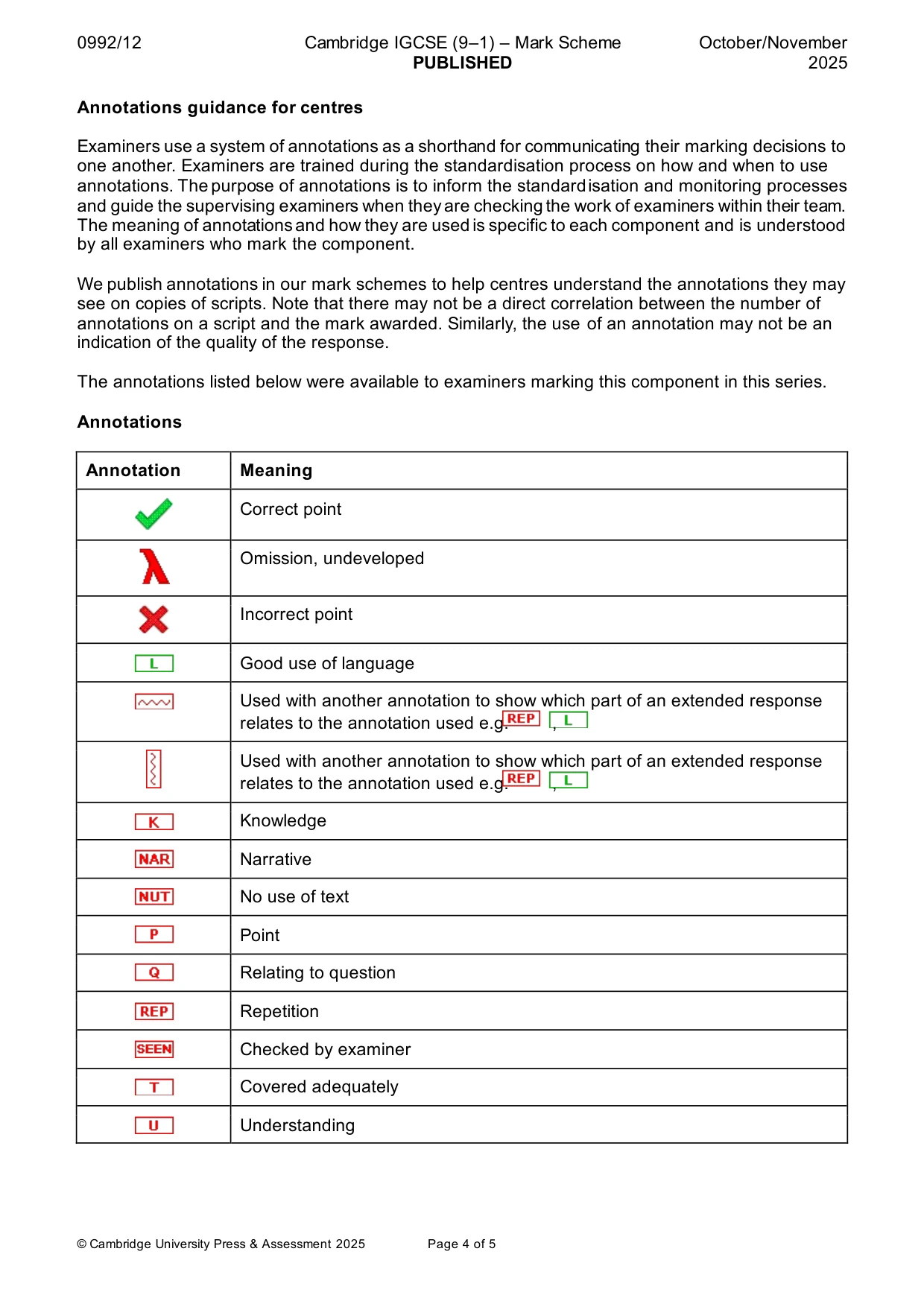
0992/12 Cambridge IGCSE (9–1) – Mark Scheme PUBLISHED October/November 2025 © Cambridge University Press & Assessment 2025 Page 4 of 5 Annotations guidance for centres Examiners use a system of annotations as a shorthand for communicating their marking decisions to one another. Examiners are trained during the standardisation process on how and when to use annotations. The purpose of annotations is to inform the standardisation and monitoring processes and guide the supervising examiners when they are checking the work of examiners within their team. The meaning of annotations and how they are used is specific to each component and is understood by all examiners who mark the component. We publish annotations in our mark schemes to help centres understand the annotations they may see on copies of scripts. Note that there may not be a direct correlation between the number of annotations on a script and the mark awarded. Similarly, the use of an annotation may not be an indication of the quality of the response. The annotations listed below were available to examiners marking this component in this series. Annotations Annotation Meaning Correct point Omission, undeveloped Incorrect point Good use of language Used with another annotation to show which part of an extended response relates to the annotation used e.g. , Used with another annotation to show which part of an extended response relates to the annotation used e.g. , Knowledge Narrative No use of text Point Relating to question Repetition Checked by examiner Covered adequately Understanding
Mark scheme, page 5
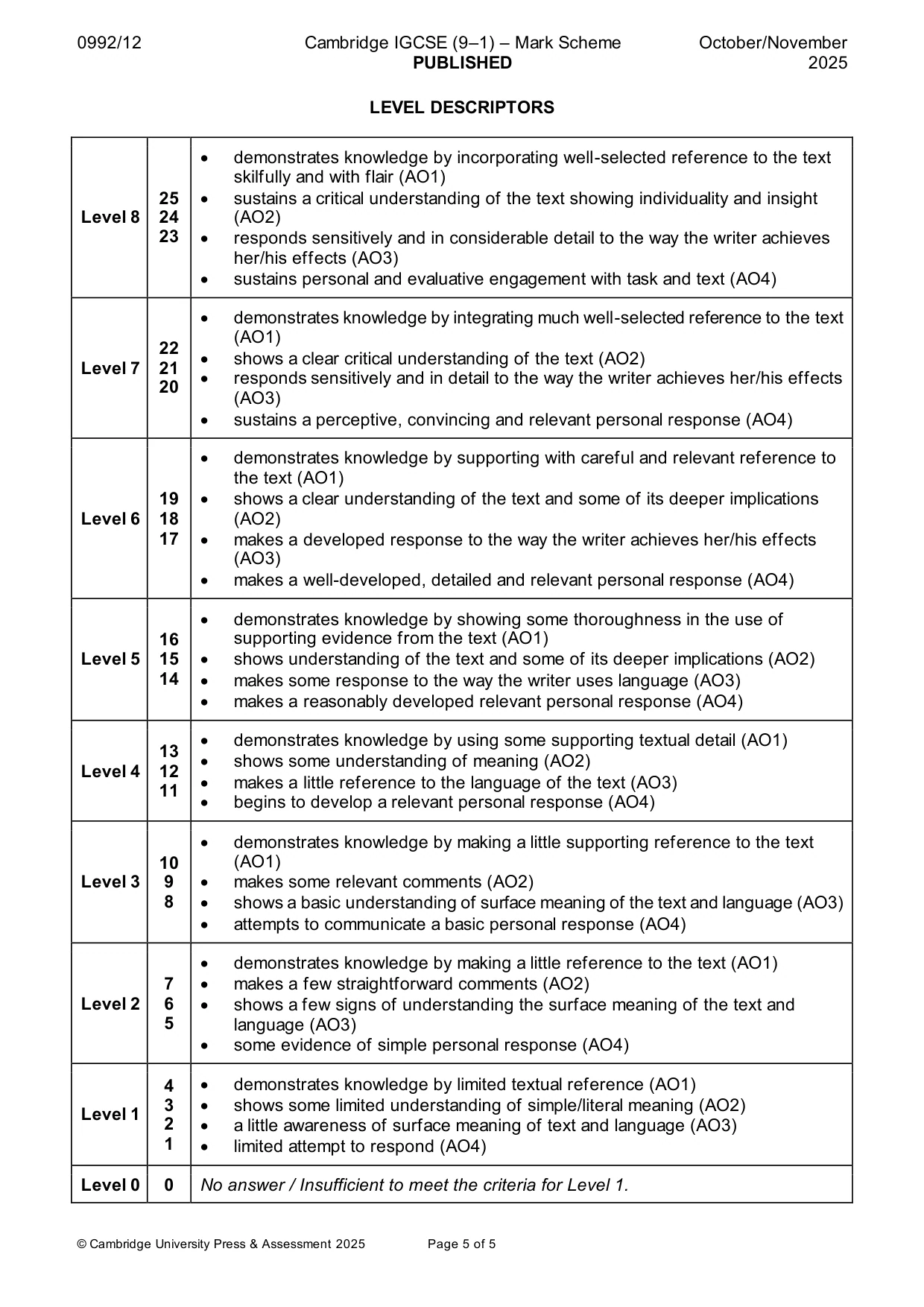
0992/12 Cambridge IGCSE (9–1) – Mark Scheme PUBLISHED October/November 2025 © Cambridge University Press & Assessment 2025 Page 5 of 5 LEVEL DESCRIPTORS Level 8 25 24 23 • demonstrates knowledge by incorporating well-selected reference to the text skilfully and with flair (AO1) • sustains a critical understanding of the text showing individuality and insight (AO2) • responds sensitively and in considerable detail to the way the writer achieves her/his effects (AO3) • sustains personal and evaluative engagement with task and text (AO4) Level 7 22 21 20 • demonstrates knowledge by integrating much well-selected reference to the text (AO1) • shows a clear critical understanding of the text (AO2) • responds sensitively and in detail to the way the writer achieves her/his effects (AO3) • sustains a perceptive, convincing and relevant personal response (AO4) Level 6 19 18 17 • demonstrates knowledge by supporting with careful and relevant reference to the text (AO1) • shows a clear understanding of the text and some of its deeper implications (AO2) • makes a developed response to the way the writer achieves her/his effects (AO3) • makes a well-developed, detailed and relevant personal response (AO4) Level 5 16 15 14 • demonstrates knowledge by showing some thoroughness in the use of supporting evidence from the text (AO1) • shows understanding of the text and some of its deeper implications (AO2) • makes some response to the way the writer uses language (AO3) • makes a reasonably developed relevant personal response (AO4) Level 4 13 12 11 • demonstrates knowledge by using some supporting textual detail (AO1) • shows some understanding of meaning (AO2) • makes a little reference to the language of the text (AO3) • begins to develop a relevant personal response (AO4) Level 3 10 9 8 • demonstrates knowledge by making a little supporting reference to the text (AO1) • makes some relevant comments (AO2) • shows a basic understanding of surface meaning of the text and language (AO3) • attempts to communicate a basic personal response (AO4) Level 2 7 6 5 • demonstrates knowledge by making a little reference to the text (AO1) • makes a few straightforward comments (AO2) • shows a few signs of understanding the surface meaning of the text and language (AO3) • some evidence of simple personal response (AO4) Level 1 4 3 2 1 • demonstrates knowledge by limited textual reference (AO1) • shows some limited understanding of simple/literal meaning (AO2) • a little awareness of surface meaning of text and language (AO3) • limited attempt to respond (AO4) Level 0 0 No answer / Insufficient to meet the criteria for Level 1.
What you needed in this session
Cambridge’s own grade thresholds for 2025 Oct/Nov, Paper 1 · Variant 2. A higher threshold means an easier paper — the bar moves with how the cohort did.