Cambridge IGCSE English - Literature in English (9-1) 0992 — 2022 May/June Paper 1 · Variant 2
0992/12/M/J/22 · 50 marks · ≈56 min
The question paper and its mark scheme, free to read here and free to download. This is Cambridge’s own paper, exactly as it was sat.
Question paper28 pages








Mark scheme4 pages
Answers below. Sit the paper first if you are practising.
Paper as text
Question paper, page 1
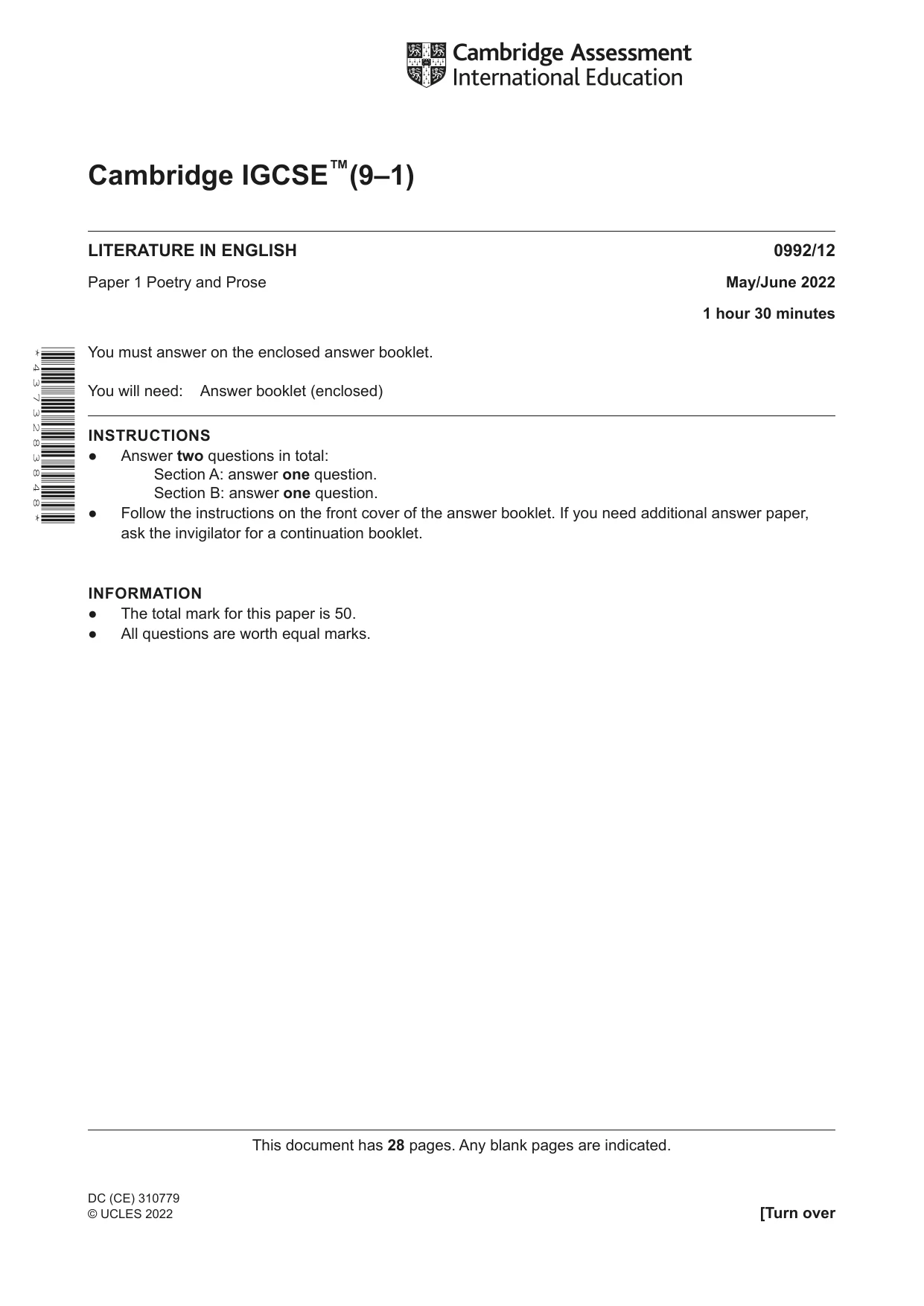
This document has 28 pages. Any blank pages are indicated. Cambridge IGCSE™(9–1) * 4 3 7 3 2 8 3 8 4 8 * LITERATURE IN ENGLISH 0992/12 Paper 1 Poetry and Prose May/June 2022 1 hour 30 minutes You must answer on the enclosed answer booklet. You will need: Answer booklet (enclosed) INSTRUCTIONS ● Answer two questions in total: Section A: answer one question. Section B: answer one question. ● Follow the instructions on the front cover of the answer booklet. If you need additional answer paper, ask the invigilator for a continuation booklet. INFORMATION ● The total mark for this paper is 50. ● All questions are worth equal marks. DC (CE) 310779 © UCLES 2022 [Turn over
Question paper, page 2
2 0992/12/M/J/22 © UCLES 2022 BLANK PAGE
Question paper, page 3
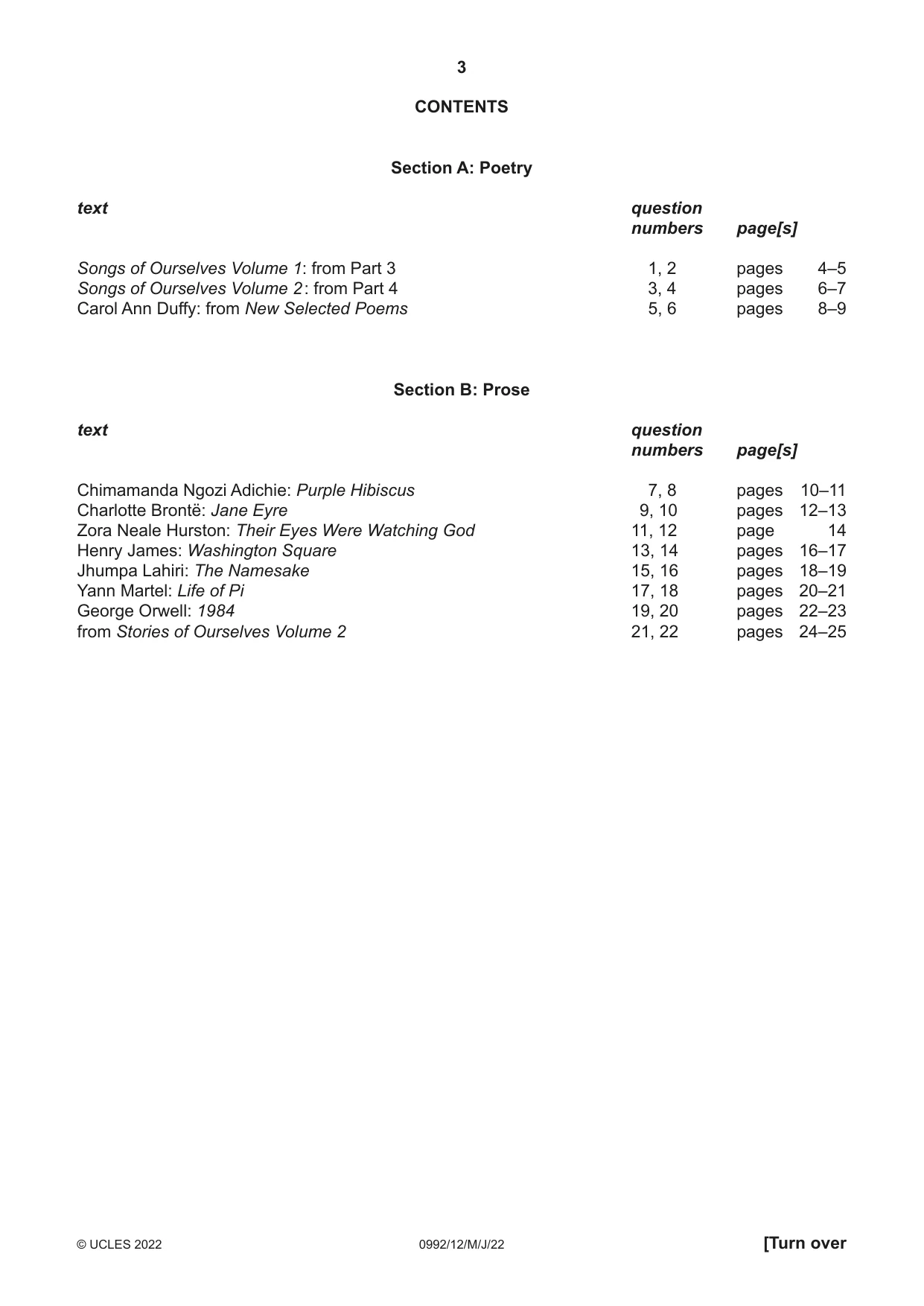
3 0992/12/M/J/22 © UCLES 2022 [Turn over CONTENTS Section A: Poetry text question numbers page[s] Songs of Ourselves Volume 1: from Part 3 1, 2 pages 4–5 Songs of Ourselves Volume 2 : from Part 4 3, 4 pages 6–7 Carol Ann Duffy: from New Selected Poems 5, 6 pages 8–9 Section B: Prose text question numbers page[s] Chimamanda Ngozi Adichie: Purple Hibiscus 7, 8 pages 10–11 Charlotte Brontë: Jane Eyre 9, 10 pages 12–13 Zora Neale Hurston: Their Eyes Were Watching God 11, 12 page 14 Henry James: Washington Square 13, 14 pages 16–17 Jhumpa Lahiri: The Namesake 15, 16 pages 18–19 Yann Martel: Life of Pi 17, 18 pages 20–21 George Orwell: 1984 19, 20 pages 22–23 from Stories of Ourselves Volume 2 21, 22 pages 24–25
Question paper, page 4
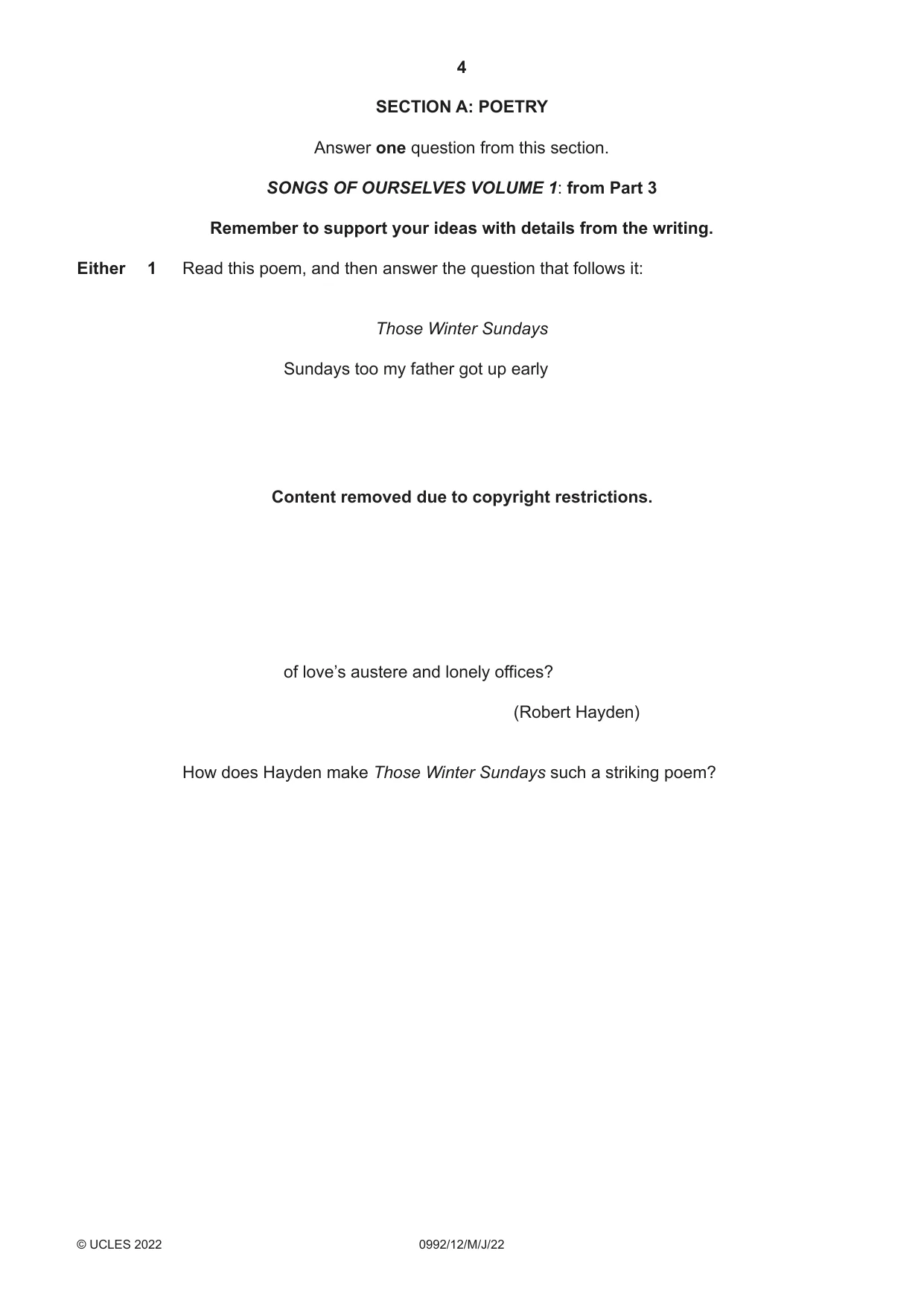
4 0992/12/M/J/22 © UCLES 2022 SECTION A: POETRY Answer one question from this section. SONGS OF OURSELVES VOLUME 1: from Part 3 Remember to support your ideas with details from the writing. Either 1 Read this poem, and then answer the question that follows it: Those Winter Sundays Sundays too my father got up early of love’s austere and lonely offices? (Robert Hayden) How does Hayden make Those Winter Sundays such a striking poem? Content removed due to copyright restrictions.
Question paper, page 5
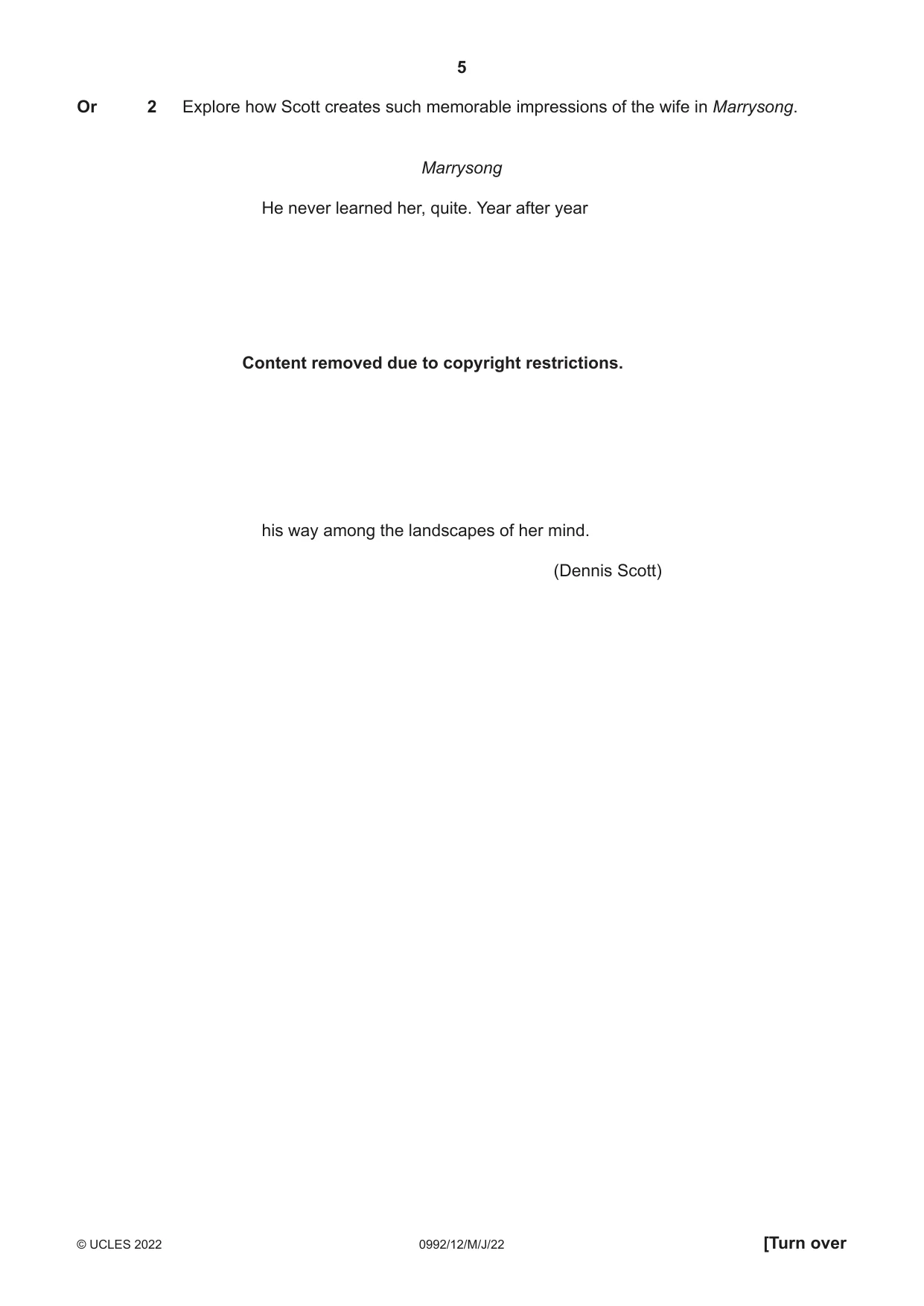
5 0992/12/M/J/22 © UCLES 2022 [Turn over Or 2 Explore how Scott creates such memorable impressions of the wife in Marrysong. Marrysong He never learned her, quite. Year after year his way among the landscapes of her mind. (Dennis Scott) Content removed due to copyright restrictions.
Question paper, page 6
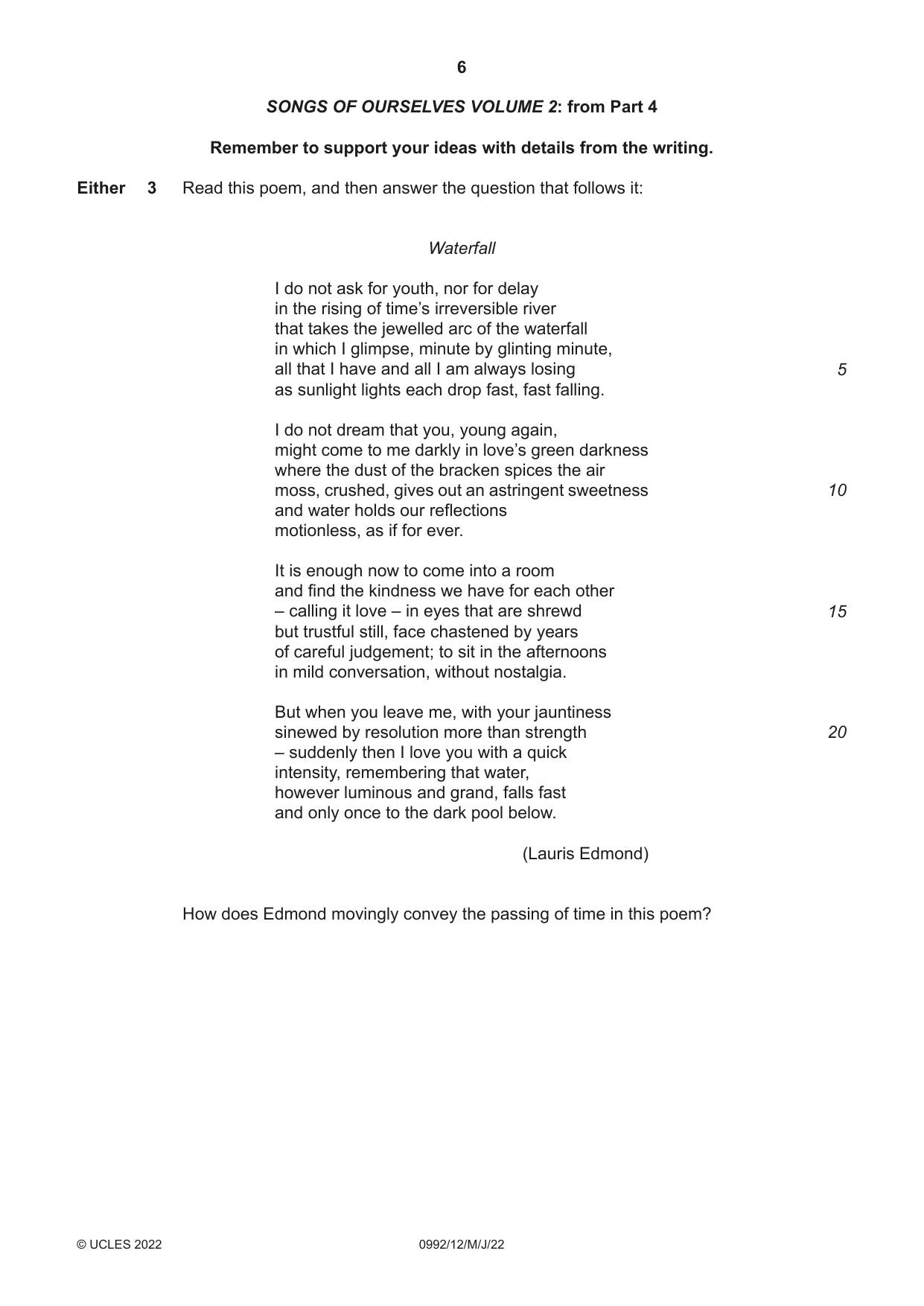
6 0992/12/M/J/22 © UCLES 2022 SONGS OF OURSELVES VOLUME 2: from Part 4 Remember to support your ideas with details from the writing. Either 3 Read this poem, and then answer the question that follows it: Waterfall I do not ask for youth, nor for delay in the rising of time’s irreversible river that takes the jewelled arc of the waterfall in which I glimpse, minute by glinting minute, all that I have and all I am always losing as sunlight lights each drop fast, fast falling. I do not dream that you, young again, might come to me darkly in love’s green darkness where the dust of the bracken spices the air moss, crushed, gives out an astringent sweetness and water holds our reflections motionless, as if for ever. It is enough now to come into a room and find the kindness we have for each other – calling it love – in eyes that are shrewd but trustful still, face chastened by years of careful judgement; to sit in the afternoons in mild conversation, without nostalgia. But when you leave me, with your jauntiness sinewed by resolution more than strength – suddenly then I love you with a quick intensity, remembering that water, however luminous and grand, falls fast and only once to the dark pool below. (Lauris Edmond) How does Edmond movingly convey the passing of time in this poem? 5 10 15 20
Question paper, page 7
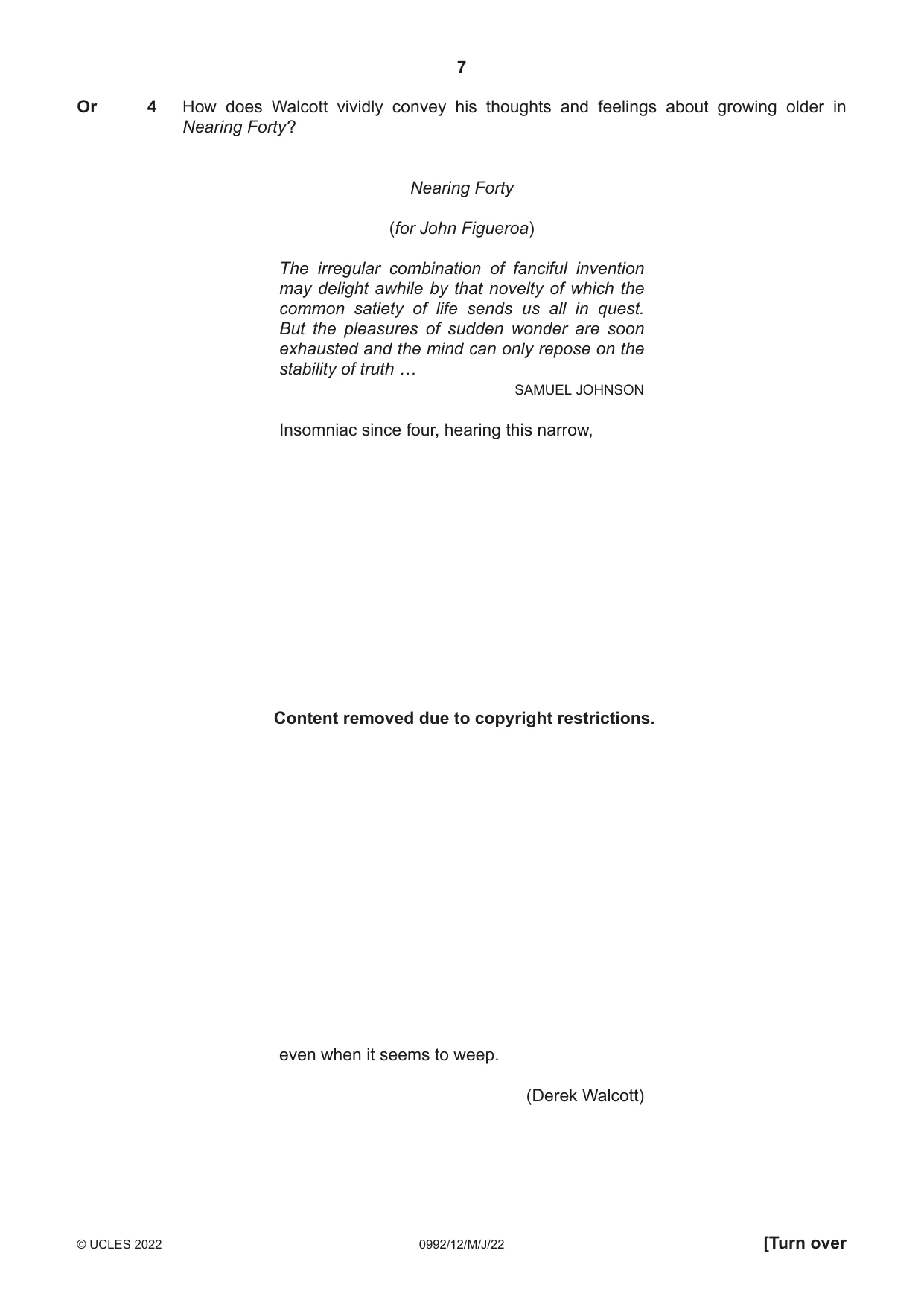
7 0992/12/M/J/22 © UCLES 2022 [Turn over Or 4 How does Walcott vividly convey his thoughts and feelings about growing older in Nearing Forty? Nearing Forty (for John Figueroa) The irregular combination of fanciful invention may delight awhile by that novelty of which the common satiety of life sends us all in quest. But the pleasures of sudden wonder are soon exhausted and the mind can only repose on the stability of truth … SAMUEL JOHNSON Insomniac since four, hearing this narrow, even when it seems to weep. (Derek Walcott) Content removed due to copyright restrictions.
Question paper, page 8
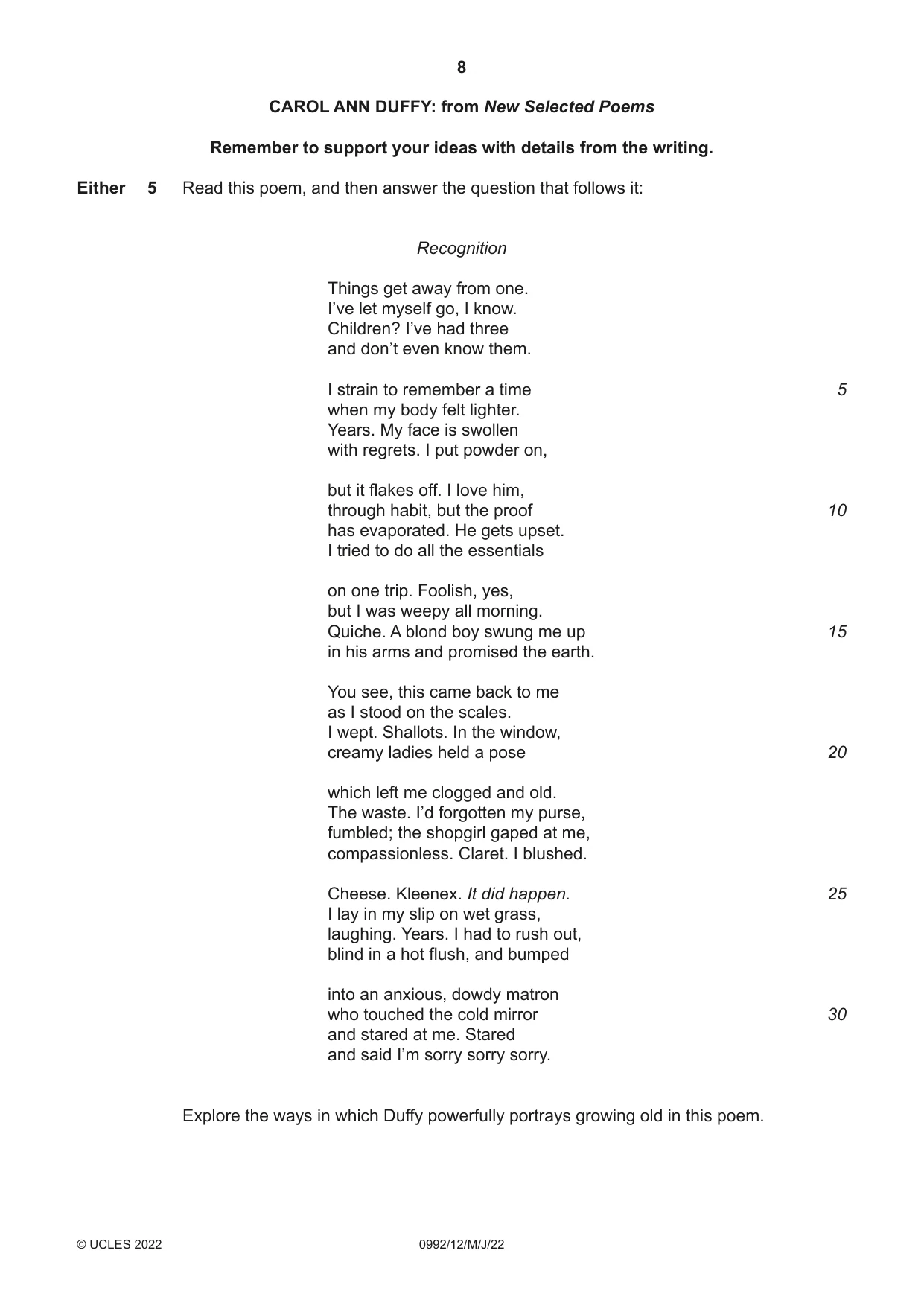
8 0992/12/M/J/22 © UCLES 2022 CAROL ANN DUFFY: from New Selected Poems Remember to support your ideas with details from the writing. Either 5 Read this poem, and then answer the question that follows it: Recognition Things get away from one. I’ve let myself go, I know. Children? I’ve had three and don’t even know them. I strain to remember a time when my body felt lighter. Years. My face is swollen with regrets. I put powder on, but it flakes off. I love him, through habit, but the proof has evaporated. He gets upset. I tried to do all the essentials on one trip. Foolish, yes, but I was weepy all morning. Quiche. A blond boy swung me up in his arms and promised the earth. You see, this came back to me as I stood on the scales. I wept. Shallots. In the window, creamy ladies held a pose which left me clogged and old. The waste. I’d forgotten my purse, fumbled; the shopgirl gaped at me, compassionless. Claret. I blushed. Cheese. Kleenex. It did happen. I lay in my slip on wet grass, laughing. Years. I had to rush out, blind in a hot flush, and bumped into an anxious, dowdy matron who touched the cold mirror and stared at me. Stared and said I’m sorry sorry sorry. Explore the ways in which Duffy powerfully portrays growing old in this poem. 5 10 15 20 25 30
Question paper, page 9
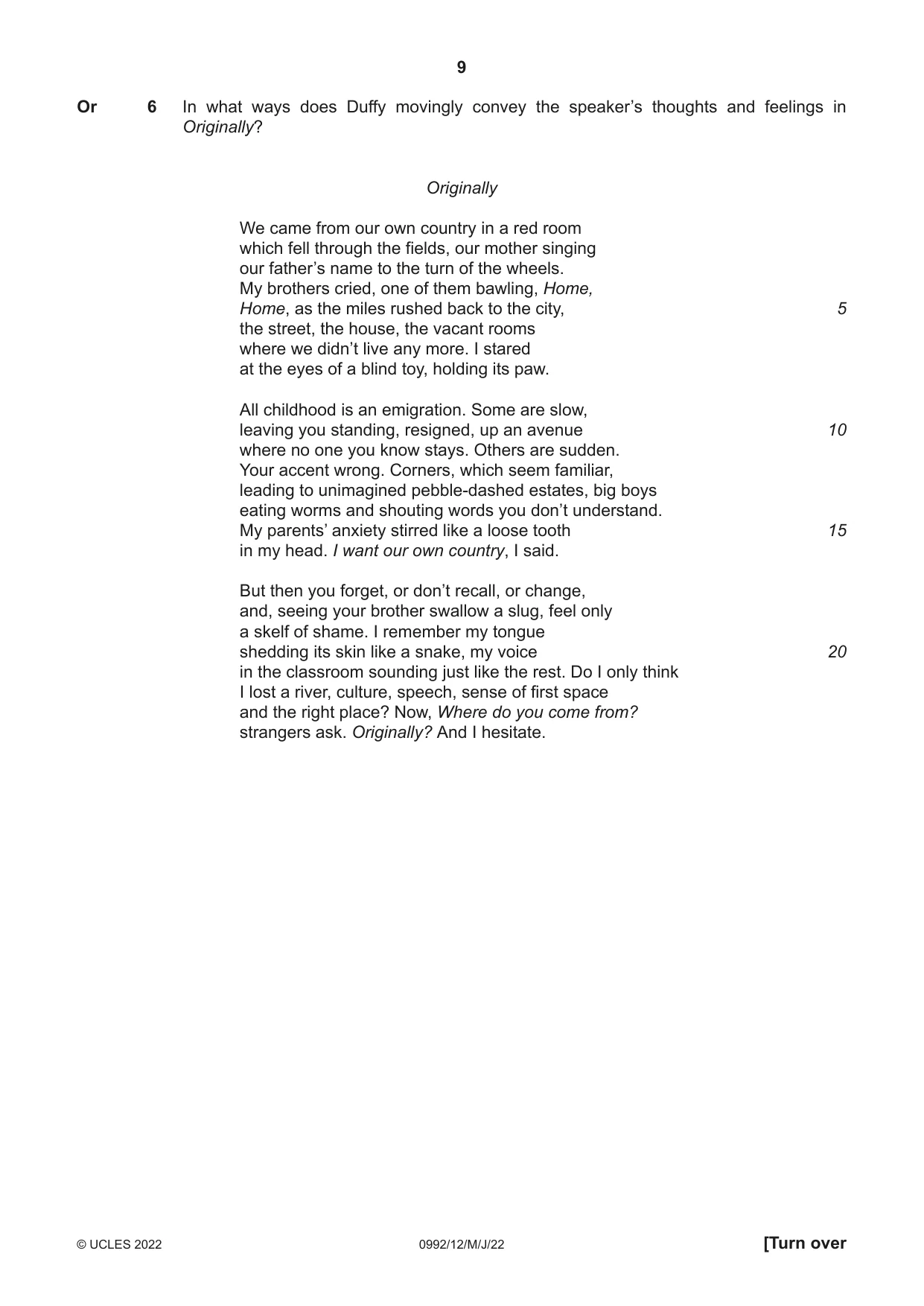
9 0992/12/M/J/22 © UCLES 2022 [Turn over Or 6 In what ways does Duffy movingly convey the speaker’s thoughts and feelings in Originally? Originally We came from our own country in a red room which fell through the fields, our mother singing our father’s name to the turn of the wheels. My brothers cried, one of them bawling, Home, Home, as the miles rushed back to the city, the street, the house, the vacant rooms where we didn’t live any more. I stared at the eyes of a blind toy, holding its paw. All childhood is an emigration. Some are slow, leaving you standing, resigned, up an avenue where no one you know stays. Others are sudden. Your accent wrong. Corners, which seem familiar, leading to unimagined pebble-dashed estates, big boys eating worms and shouting words you don’t understand. My parents’ anxiety stirred like a loose tooth in my head. I want our own country, I said. But then you forget, or don’t recall, or change, and, seeing your brother swallow a slug, feel only a skelf of shame. I remember my tongue shedding its skin like a snake, my voice in the classroom sounding just like the rest. Do I only think I lost a river, culture, speech, sense of first space and the right place? Now, Where do you come from? strangers ask. Originally? And I hesitate. 5 10 15 20
Question paper, page 10
10 0992/12/M/J/22 © UCLES 2022 SECTION B: PROSE Answer one question from this section. CHIMAMANDA NGOZI ADICHIE: Purple Hibiscus Remember to support your ideas with details from the writing. Either 7 Read this passage, and then answer the question that follows it: I knew Papa would come in to say good night, to kiss my forehead. Content removed due to copyright restrictions.
Question paper, page 11
11 0992/12/M/J/22 © UCLES 2022 [Turn over I closed my eyes and slipped away into quiet. How does Adichie make this such a disturbing moment in the novel? Or 8 Kambili describes Aunty Ifeoma as ‘fearless’. Explore two moments when Adichie makes this fearlessness very clear. Content removed due to copyright restrictions.
Question paper, page 12
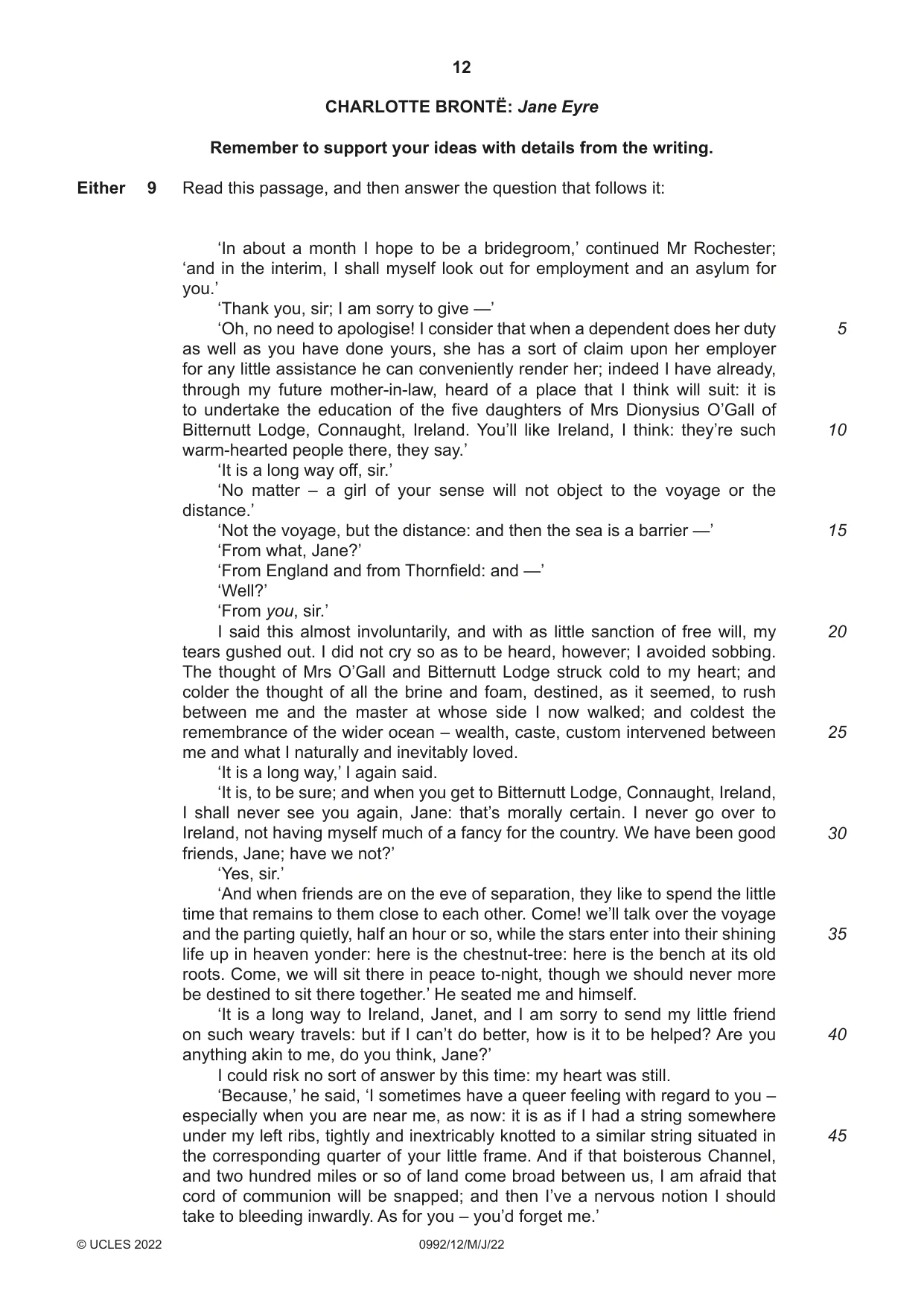
12 0992/12/M/J/22 © UCLES 2022 CHARLOTTE BRONTË: Jane Eyre Remember to support your ideas with details from the writing. Either 9 Read this passage, and then answer the question that follows it: ‘In about a month I hope to be a bridegroom,’ continued Mr Rochester; ‘and in the interim, I shall myself look out for employment and an asylum for you.’ ‘Thank you, sir; I am sorry to give —’ ‘Oh, no need to apologise! I consider that when a dependent does her duty as well as you have done yours, she has a sort of claim upon her employer for any little assistance he can conveniently render her; indeed I have already, through my future mother-in-law, heard of a place that I think will suit: it is to undertake the education of the five daughters of Mrs Dionysius O’Gall of Bitternutt Lodge, Connaught, Ireland. You’ll like Ireland, I think: they’re such warm-hearted people there, they say.’ ‘It is a long way off, sir.’ ‘No matter – a girl of your sense will not object to the voyage or the distance.’ ‘Not the voyage, but the distance: and then the sea is a barrier —’ ‘From what, Jane?’ ‘From England and from Thornfield: and —’ ‘Well?’ ‘From you, sir.’ I said this almost involuntarily, and with as little sanction of free will, my tears gushed out. I did not cry so as to be heard, however; I avoided sobbing. The thought of Mrs O’Gall and Bitternutt Lodge struck cold to my heart; and colder the thought of all the brine and foam, destined, as it seemed, to rush between me and the master at whose side I now walked; and coldest the remembrance of the wider ocean – wealth, caste, custom intervened between me and what I naturally and inevitably loved. ‘It is a long way,’ I again said. ‘It is, to be sure; and when you get to Bitternutt Lodge, Connaught, Ireland, I shall never see you again, Jane: that’s morally certain. I never go over to Ireland, not having myself much of a fancy for the country. We have been good friends, Jane; have we not?’ ‘Yes, sir.’ ‘And when friends are on the eve of separation, they like to spend the little time that remains to them close to each other. Come! we’ll talk over the voyage and the parting quietly, half an hour or so, while the stars enter into their shining life up in heaven yonder: here is the chestnut-tree: here is the bench at its old roots. Come, we will sit there in peace to-night, though we should never more be destined to sit there together.’ He seated me and himself. ‘It is a long way to Ireland, Janet, and I am sorry to send my little friend on such weary travels: but if I can’t do better, how is it to be helped? Are you anything akin to me, do you think, Jane?’ I could risk no sort of answer by this time: my heart was still. ‘Because,’ he said, ‘I sometimes have a queer feeling with regard to you – especially when you are near me, as now: it is as if I had a string somewhere under my left ribs, tightly and inextricably knotted to a similar string situated in the corresponding quarter of your little frame. And if that boisterous Channel, and two hundred miles or so of land come broad between us, I am afraid that cord of communion will be snapped; and then I’ve a nervous notion I should take to bleeding inwardly. As for you – you’d forget me.’ 5 10 15 20 25 30 35 40 45
Question paper, page 13
13 0992/12/M/J/22 © UCLES 2022 [Turn over ‘That I never should, sir: you know —’ Impossible to proceed. ‘Jane, do you hear that nightingale singing in the wood? Listen!’ In listening, I sobbed convulsively; for I could repress what I endured no longer; I was obliged to yield, and I was shaken from head to foot with acute distress. When I did speak, it was only to express an impetuous wish that I had never been born, or never come to Thornfield. (from Chapter 23) How does Brontë make this such a moving moment in the novel? Or 10 ‘A monster’. To what extent does Brontë persuade you to agree with this description of Bertha Rochester? 50 55
Question paper, page 14
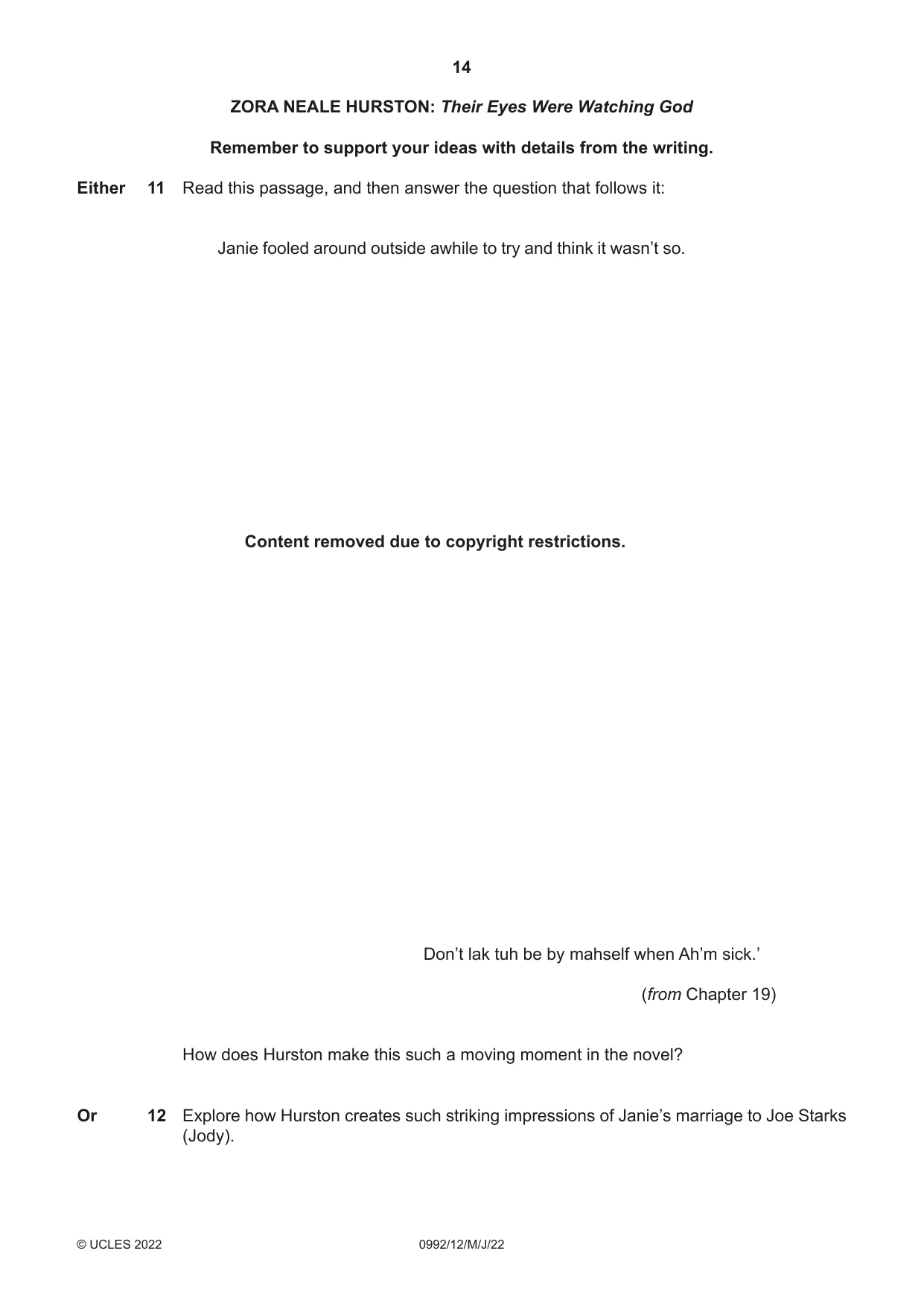
14 0992/12/M/J/22 © UCLES 2022 ZORA NEALE HURSTON: Their Eyes Were Watching God Remember to support your ideas with details from the writing. Either 11 Read this passage, and then answer the question that follows it: Janie fooled around outside awhile to try and think it wasn’t so. Don’t lak tuh be by mahself when Ah’m sick.’ (from Chapter 19) How does Hurston make this such a moving moment in the novel? Or 12 Explore how Hurston creates such striking impressions of Janie’s marriage to Joe Starks (Jody). Content removed due to copyright restrictions.
Question paper, page 15
15 0992/12/M/J/22 © UCLES 2022 [Turn over TURN OVER FOR QUESTION 13.
Question paper, page 16
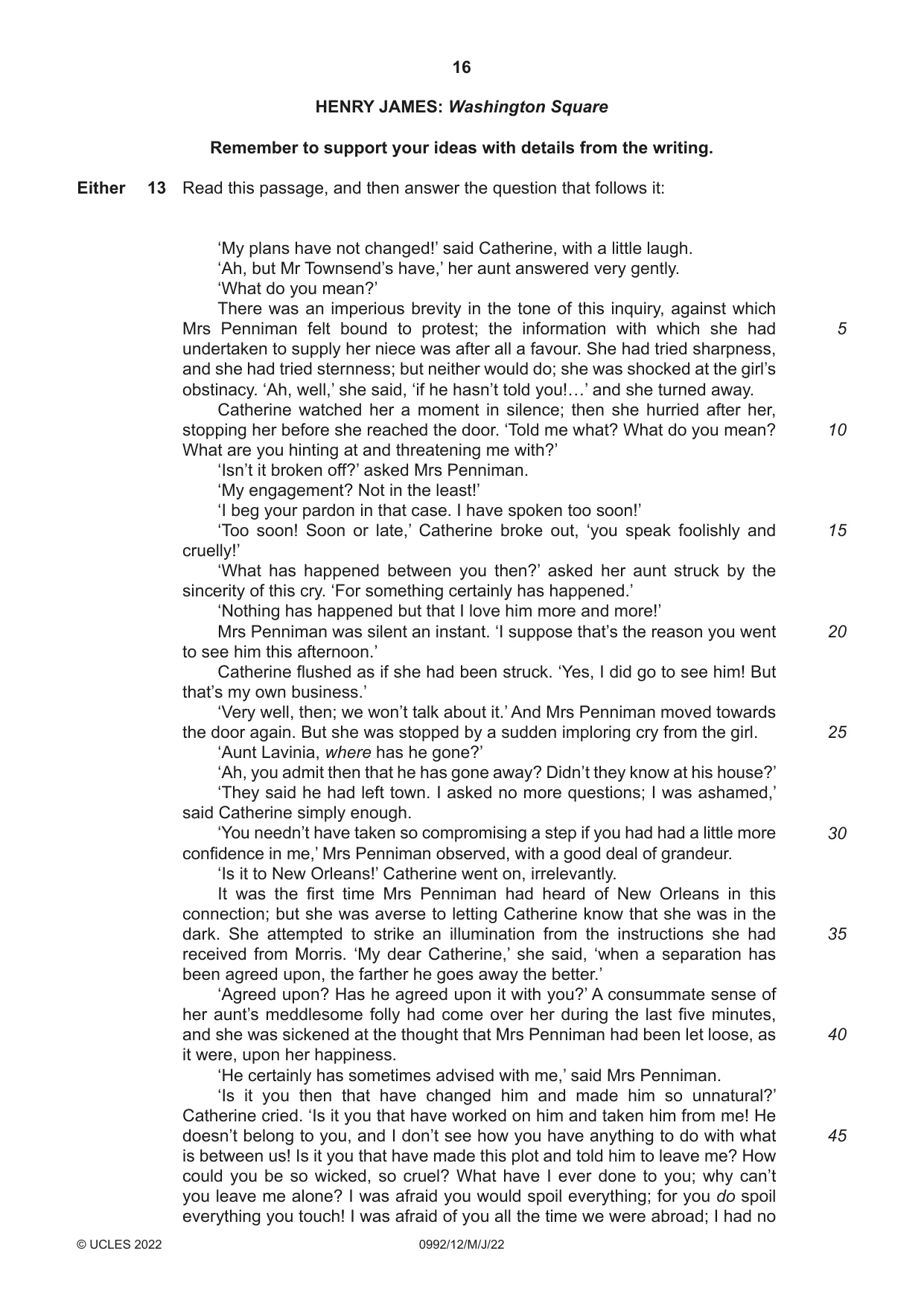
16 0992/12/M/J/22 © UCLES 2022 HENRY JAMES: Washington Square Remember to support your ideas with details from the writing. Either 13 Read this passage, and then answer the question that follows it: ‘My plans have not changed!’ said Catherine, with a little laugh. ‘Ah, but Mr Townsend’s have,’ her aunt answered very gently. ‘What do you mean?’ There was an imperious brevity in the tone of this inquiry, against which Mrs Penniman felt bound to protest; the information with which she had undertaken to supply her niece was after all a favour. She had tried sharpness, and she had tried sternness; but neither would do; she was shocked at the girl’s obstinacy. ‘Ah, well,’ she said, ‘if he hasn’t told you!…’ and she turned away. Catherine watched her a moment in silence; then she hurried after her, stopping her before she reached the door. ‘Told me what? What do you mean? What are you hinting at and threatening me with?’ ‘Isn’t it broken off?’ asked Mrs Penniman. ‘My engagement? Not in the least!’ ‘I beg your pardon in that case. I have spoken too soon!’ ‘Too soon! Soon or late,’ Catherine broke out, ‘you speak foolishly and cruelly!’ ‘What has happened between you then?’ asked her aunt struck by the sincerity of this cry. ‘For something certainly has happened.’ ‘Nothing has happened but that I love him more and more!’ Mrs Penniman was silent an instant. ‘I suppose that’s the reason you went to see him this afternoon.’ Catherine flushed as if she had been struck. ‘Yes, I did go to see him! But that’s my own business.’ ‘Very well, then; we won’t talk about it.’ And Mrs Penniman moved towards the door again. But she was stopped by a sudden imploring cry from the girl. ‘Aunt Lavinia, where has he gone?’ ‘Ah, you admit then that he has gone away? Didn’t they know at his house?’ ‘They said he had left town. I asked no more questions; I was ashamed,’ said Catherine simply enough. ‘You needn’t have taken so compromising a step if you had had a little more confidence in me,’ Mrs Penniman observed, with a good deal of grandeur. ‘Is it to New Orleans!’ Catherine went on, irrelevantly. It was the first time Mrs Penniman had heard of New Orleans in this connection; but she was averse to letting Catherine know that she was in the dark. She attempted to strike an illumination from the instructions she had received from Morris. ‘My dear Catherine,’ she said, ‘when a separation has been agreed upon, the farther he goes away the better.’ ‘Agreed upon? Has he agreed upon it with you?’ A consummate sense of her aunt’s meddlesome folly had come over her during the last five minutes, and she was sickened at the thought that Mrs Penniman had been let loose, as it were, upon her happiness. ‘He certainly has sometimes advised with me,’ said Mrs Penniman. ‘Is it you then that have changed him and made him so unnatural?’ Catherine cried. ‘Is it you that have worked on him and taken him from me! He doesn’t belong to you, and I don’t see how you have anything to do with what is between us! Is it you that have made this plot and told him to leave me? How could you be so wicked, so cruel? What have I ever done to you; why can’t you leave me alone? I was afraid you would spoil everything; for you do spoil everything you touch! I was afraid of you all the time we were abroad; I had no 5 10 15 20 25 30 35 40 45
Question paper, page 17
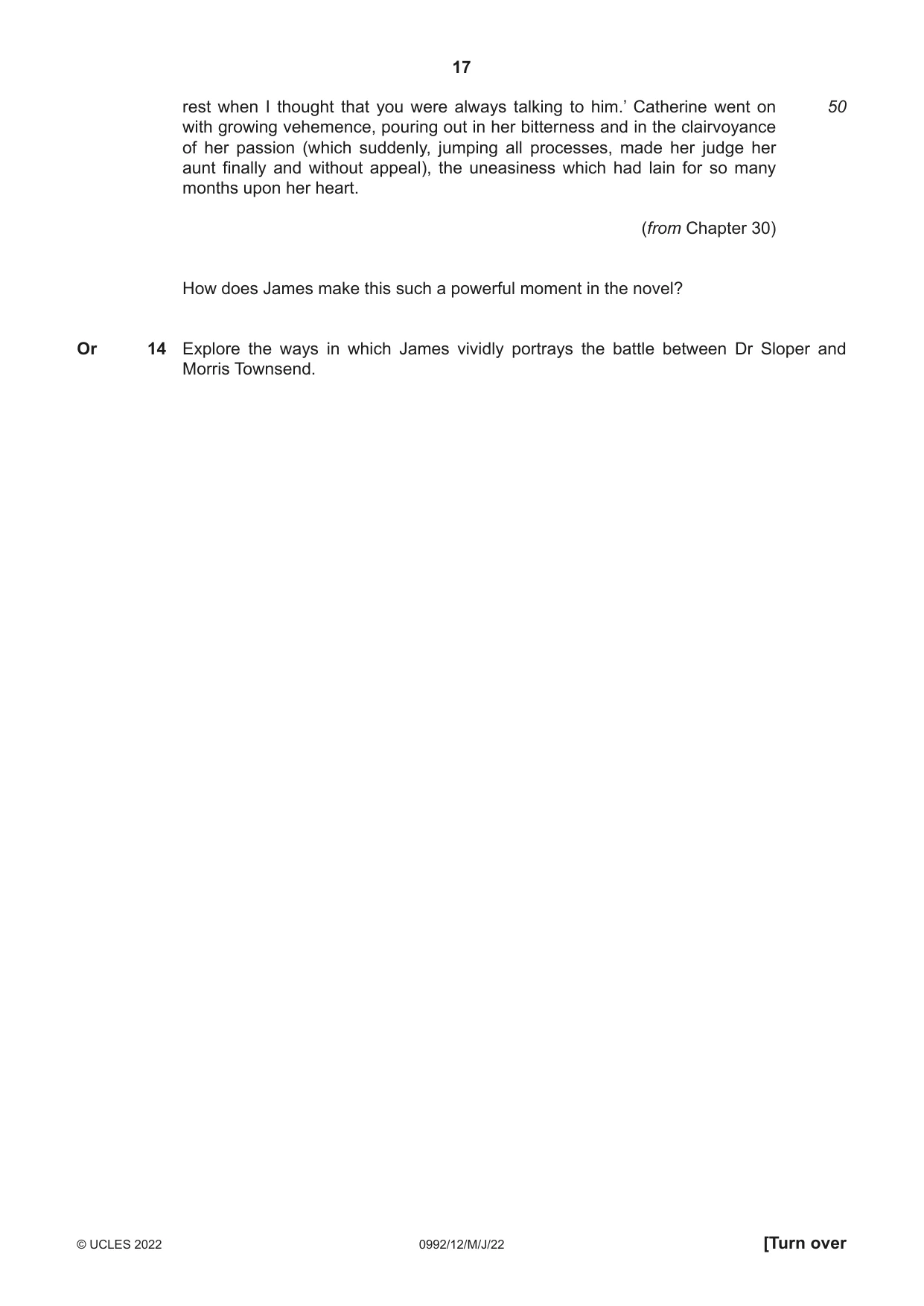
17 0992/12/M/J/22 © UCLES 2022 [Turn over rest when I thought that you were always talking to him.’ Catherine went on with growing vehemence, pouring out in her bitterness and in the clairvoyance of her passion (which suddenly, jumping all processes, made her judge her aunt finally and without appeal), the uneasiness which had lain for so many months upon her heart. (from Chapter 30) How does James make this such a powerful moment in the novel? Or 14 Explore the ways in which James vividly portrays the battle between Dr Sloper and Morris Townsend. 50
Question paper, page 18
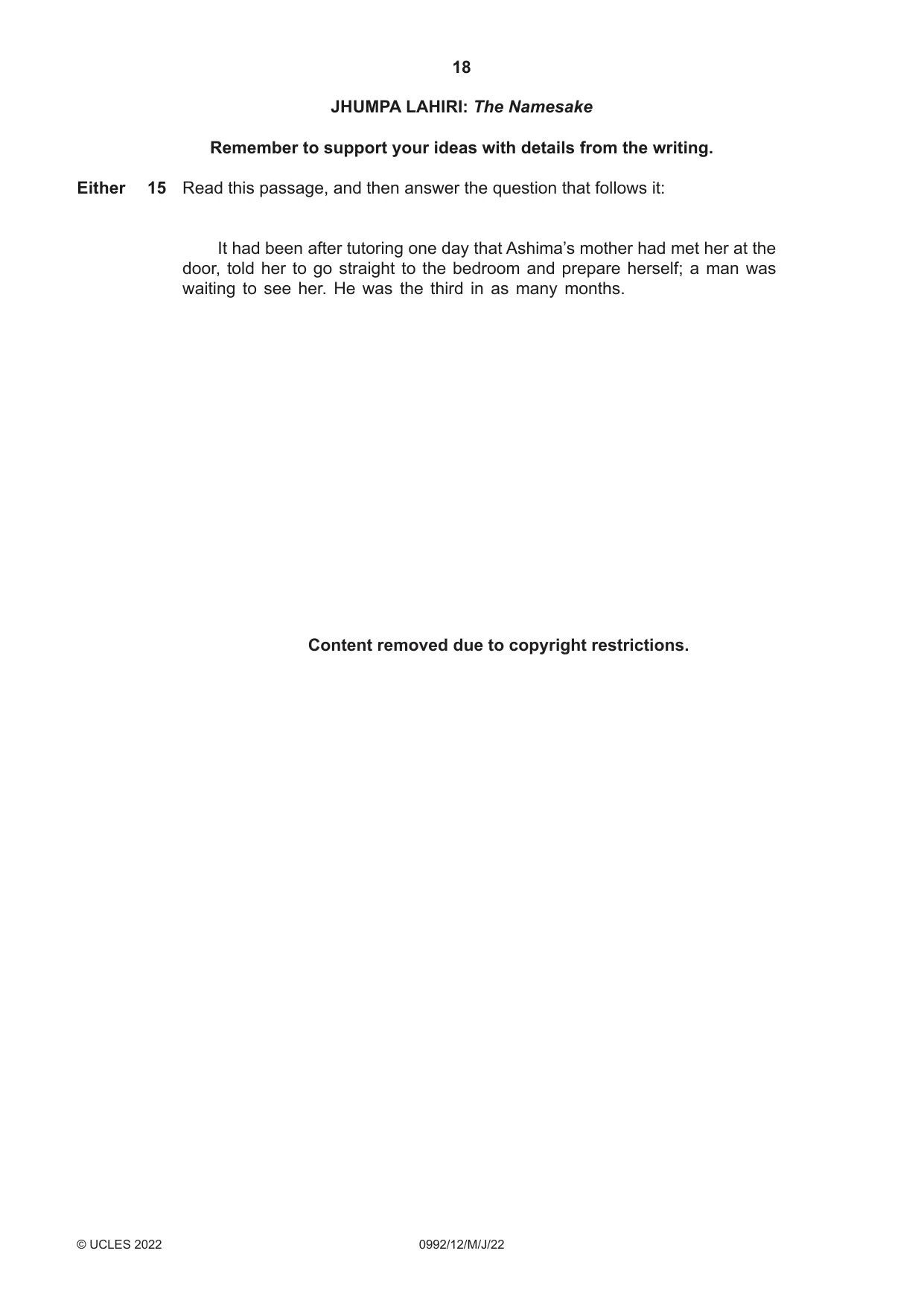
18 0992/12/M/J/22 © UCLES 2022 JHUMPA LAHIRI: The Namesake Remember to support your ideas with details from the writing. Either 15 Read this passage, and then answer the question that follows it: It had been after tutoring one day that Ashima’s mother had met her at the door, told her to go straight to the bedroom and prepare herself; a man was waiting to see her. He was the third in as many months. Content removed due to copyright restrictions.
Question paper, page 19
19 0992/12/M/J/22 © UCLES 2022 [Turn over These were her last moments as Ashima Bhaduri, before becoming Ashima Ganguli. (from Chapter 1) In what ways does Lahiri make this such an entertaining and memorable moment in the novel? Or 16 How does Lahiri powerfully convey Gogol’s feelings about his names? Content removed due to copyright restrictions.
Question paper, page 20
20 0992/12/M/J/22 © UCLES 2022 YANN MARTEL: Life of Pi Remember to support your ideas with details from the writing. Either 17 Read this passage, and then answer the question that follows it: We must have been at a sixty-degree incline when we reached the summit of the swell and broke through its crest onto the other side. The smallest portion of the swell’s supply of water crashed down on us. I felt as if I were being pummelled by a great fist. The lifeboat abruptly tilted forward and everything was reversed: I was now at the lower end of the lifeboat, and the water that had swamped it, with a tiger soaking in it, came my way. I did not feel the tiger—I had no precise idea of where Richard Parker was; it was pitch-black beneath the tarpaulin—but before we reached the next valley I was half-drowned. For the rest of that day and into the night, we went up and down, up and down, up and down, until terror became monotonous and was replaced by numbness and a complete giving-up. I held on to the tarpaulin rope with one hand and the edge of the bow bench with the other, while my body lay flat against the side bench. In this position—water pouring in, water pouring out— the tarpaulin beat me to a pulp, I was soaked and chilled, and I was bruised and cut by bones and turtle shells. The noise of the storm was constant, as was Richard Parker’s snarling. Sometime during the night my mind noted that the storm was over. We were bobbing on the sea in a normal way. Through a tear in the tarpaulin I glimpsed the night sky. Starry and cloudless. I undid the tarpaulin and lay on top of it. I noticed the loss of the raft at dawn. All that was left of it were two tied oars and the life jacket between them. They had the same effect on me as the last standing beam of a burnt-down house would have on a householder. I turned and scrutinized every quarter of the horizon. Nothing. My little marine town had vanished. That the sea anchors, miraculously, were not lost—they continued to tug at the lifeboat faithfully—was a consolation that had no effect. The loss of the raft was perhaps not fatal to my body, but it felt fatal to my spirits. The boat was in a sorry state. The tarpaulin was torn in several places, some tears evidently the work of Richard Parker’s claws. Much of our food was gone, either lost overboard or destroyed by the water that had come in. I was sore all over and had a bad cut on my thigh; the wound was swollen and white. I was nearly too afraid to check the contents of the locker. Thank God none of the water bags had split. The net and the solar stills, which I had not entirely deflated, had filled the empty space and prevented the bags from moving too much. I felt exhausted and depressed. I unhooked the tarpaulin at the stern. Richard Parker was so silent I wondered whether he had drowned. He hadn’t. As I rolled back the tarpaulin to the middle bench and daylight came to him, he stirred and growled. He climbed out of the water and set himself on the stern bench. I took out needle and thread and went about mending the tears in the tarpaulin. Later I tied one of the buckets to a rope and bailed the boat. Richard Parker watched me distractedly. He seemed to find nearly everything I did boring. The day was hot and I proceeded slowly. One haul brought me something I had lost. I considered it. Cradled in the palm of my hand was all that remained between me and death: the last of the orange whistles. (from Chapter 83) How does Martel powerfully depict the impact of the storm at this moment in the novel? 5 10 15 20 25 30 35 40
Question paper, page 21
21 0992/12/M/J/22 © UCLES 2022 [Turn over Or 18 ‘Pi and Richard Parker are both enemies and allies.’ In what ways does Martel vividly convey this?
Question paper, page 22
22 0992/12/M/J/22 © UCLES 2022 GEORGE ORWELL: 1984 Remember to support your ideas with details from the writing. Either 19 Read this passage, and then answer the question that follows it: Winston kept his back turned to the telescreen. It was safer; though, as he well knew, even a back can be revealing. A kilometre away the Ministry of Truth, his place of work, towered vast and white above the grimy landscape. This, he thought with a sort of vague distaste – this was London, chief city of Airstrip One, itself the third most populous of the provinces of Oceania. He tried to squeeze out some childhood memory that should tell him whether London had always been quite like this. Were there always these vistas of rotting nineteenth-century houses, their sides shored up with baulks of timber, their windows patched with cardboard and their roofs with corrugated iron, their crazy garden walls sagging in all directions? And the bombed sites where the plaster dust swirled in the air and the willowherb straggled over the heaps of rubble; and the places where the bombs had cleared a larger patch and there had sprung up sordid colonies of wooden dwellings like chicken-houses? But it was no use, he could not remember: nothing remained of his childhood except a series of bright-lit tableaux, occurring against no background and mostly unintelligible. The Ministry of Truth – Minitrue, in Newspeak – was startlingly different from any other object in sight. It was an enormous pyramidal structure of glittering white concrete, soaring up, terrace after terrace, three hundred metres into the air. From where Winston stood it was just possible to read, picked out on its white face in elegant lettering, the three slogans of the Party: WAR IS PEACE FREEDOM IS SLAVERY IGNORANCE IS STRENGTH. The Ministry of Truth contained, it was said, three thousand rooms above ground level, and corresponding ramifications below. Scattered about London there were just three other buildings of similar appearance and size. So completely did they dwarf the surrounding architecture that from the roof of Victory Mansions you could see all four of them simultaneously. They were the homes of the four Ministries between which the entire apparatus of government was divided. The Ministry of Truth, which concerned itself with news, entertainment, education and the fine arts. The Ministry of Peace, which concerned itself with war. The Ministry of Love, which maintained law and order. And the Ministry of Plenty, which was responsible for economic affairs. Their names, in Newspeak: Minitrue, Minipax, Miniluv and Miniplenty. The Ministry of Love was the really frightening one. There were no windows in it at all. Winston had never been inside the Ministry of Love, nor within half a kilometre of it. It was a place impossible to enter except on official business, and then only by penetrating through a maze of barbed-wire entanglements, steel doors and hidden machine-gun nests. Even the streets leading up to its outer barriers were roamed by gorilla-faced guards in black uniforms, armed with jointed truncheons. (from Part 1 Chapter 1) Explore how Orwell creates such striking impressions of London and the four Ministries at this moment in the novel. 5 10 15 20 25 30 35 40
Question paper, page 23
23 0992/12/M/J/22 © UCLES 2022 [Turn over Or 20 How does Orwell powerfully convey the Party’s methods of controlling people’s thoughts?
Question paper, page 24
24 0992/12/M/J/22 © UCLES 2022 from Stories of Ourselves Volume 2 Remember to support your ideas with details from the writing. Either 21 Read this passage from The Reservoir (by Janet Frame), and then answer the question that follows it: It was said to be four or five miles along the gully, Content removed due to copyright restrictions.
Question paper, page 25
25 0992/12/M/J/22 © UCLES 2022 the little valleys with their new growth of lush grass where the creek had ‘changed its course’, and no longer flowed. How does Frame vividly convey the fascination that the Reservoir holds for the children? Or 22 Explore the ways in which Richardson makes you feel sorry for Dolly in And Women Must Weep. Content removed due to copyright restrictions.
Question paper, page 26
26 0992/12/M/J/22 © UCLES 2022 BLANK PAGE
Question paper, page 27
27 0992/12/M/J/22 © UCLES 2022 BLANK PAGE
Question paper, page 28
28 0992/12/M/J/22 © UCLES 2022 Permission to reproduce items where third-party owned material protected by copyright is included has been sought and cleared where possible. Every reasonable effort has been made by the publisher (UCLES) to trace copyright holders, but if any items requiring clearance have unwittingly been included, the publisher will be pleased to make amends at the earliest possible opportunity. To avoid the issue of disclosure of answer-related information to candidates, all copyright acknowledgements are reproduced online in the Cambridge Assessment International Education Copyright Acknowledgements Booklet. This is produced for each series of examinations and is freely available to download at www.cambridgeinternational.org after the live examination series. Cambridge Assessment International Education is part of Cambridge Assessment. Cambridge Assessment is the brand name of the University of Cambridge Local Examinations Syndicate (UCLES), which is a department of the University of Cambridge. BLANK PAGE
Mark scheme, page 1
This document consists of 4 printed pages. © UCLES 2022 [Turn over Cambridge IGCSE™ (9–1) LITERATURE IN ENGLISH (9–1) 0992/12 Paper 1 Poetry and Prose 12 May/June 2022 MARK SCHEME Maximum Mark: 50 Published This mark scheme is published as an aid to teachers and candidates, to indicate the requirements of the examination. It shows the basis on which Examiners were instructed to award marks. It does not indicate the details of the discussions that took place at an Examiners’ meeting before marking began, which would have considered the acceptability of alternative answers. Mark schemes should be read in conjunction with the question paper and the Principal Examiner Report for Teachers. Cambridge International will not enter into discussions about these mark schemes. Cambridge International is publishing the mark schemes for the May/June 2022 series for most Cambridge IGCSE, Cambridge International A and AS Level and Cambridge Pre-U components, and some Cambridge O Level components.
Mark scheme, page 2
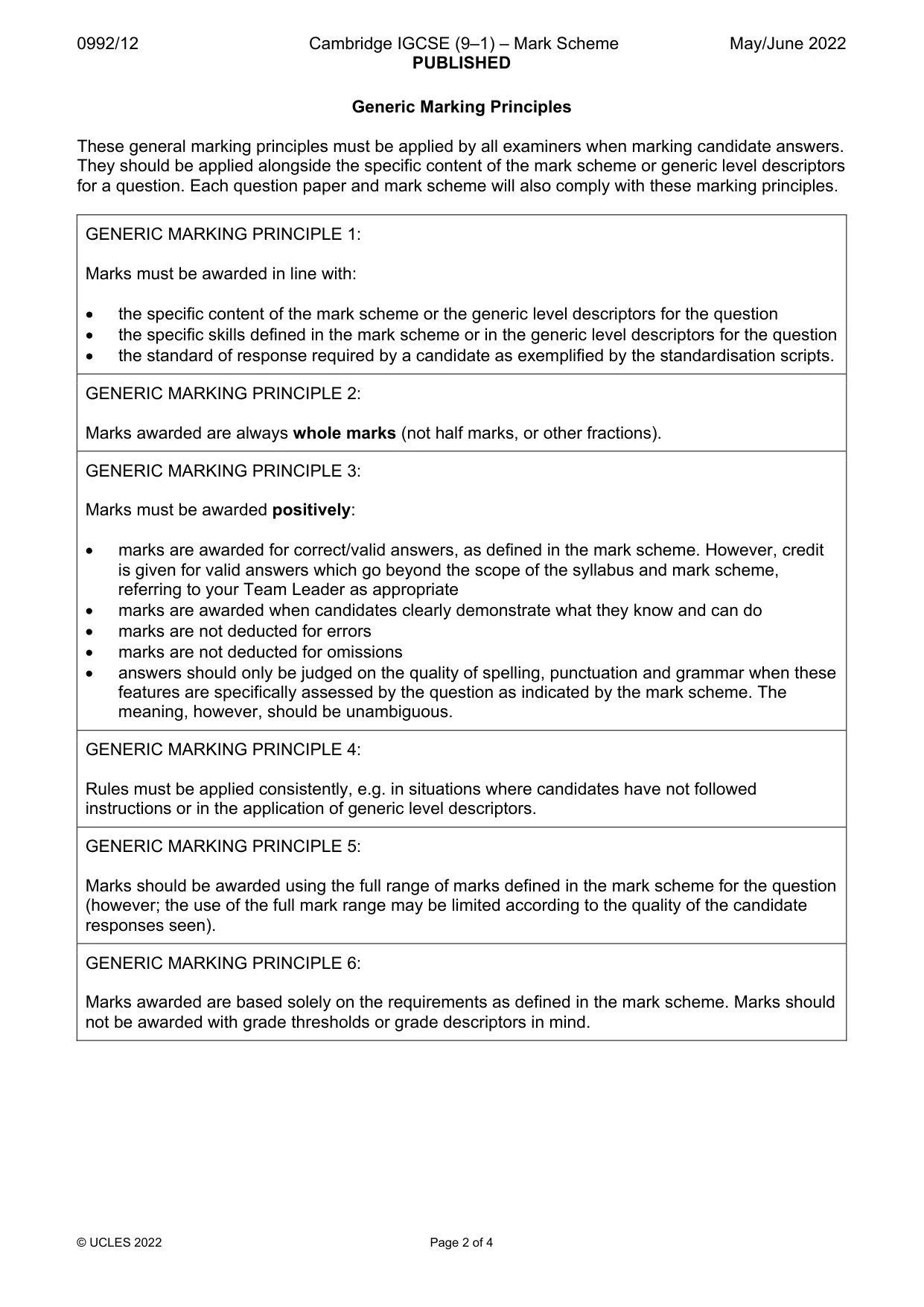
0992/12 Cambridge IGCSE (9–1) – Mark Scheme PUBLISHED May/June 2022 © UCLES 2022 Page 2 of 4 Generic Marking Principles These general marking principles must be applied by all examiners when marking candidate answers. They should be applied alongside the specific content of the mark scheme or generic level descriptors for a question. Each question paper and mark scheme will also comply with these marking principles. GENERIC MARKING PRINCIPLE 1: Marks must be awarded in line with: the specific content of the mark scheme or the generic level descriptors for the question the specific skills defined in the mark scheme or in the generic level descriptors for the question the standard of response required by a candidate as exemplified by the standardisation scripts. GENERIC MARKING PRINCIPLE 2: Marks awarded are always whole marks (not half marks, or other fractions). GENERIC MARKING PRINCIPLE 3: Marks must be awarded positively: marks are awarded for correct/valid answers, as defined in the mark scheme. However, credit is given for valid answers which go beyond the scope of the syllabus and mark scheme, referring to your Team Leader as appropriate marks are awarded when candidates clearly demonstrate what they know and can do marks are not deducted for errors marks are not deducted for omissions answers should only be judged on the quality of spelling, punctuation and grammar when these features are specifically assessed by the question as indicated by the mark scheme. The meaning, however, should be unambiguous. GENERIC MARKING PRINCIPLE 4: Rules must be applied consistently, e.g. in situations where candidates have not followed instructions or in the application of generic level descriptors. GENERIC MARKING PRINCIPLE 5: Marks should be awarded using the full range of marks defined in the mark scheme for the question (however; the use of the full mark range may be limited according to the quality of the candidate responses seen). GENERIC MARKING PRINCIPLE 6: Marks awarded are based solely on the requirements as defined in the mark scheme. Marks should not be awarded with grade thresholds or grade descriptors in mind.
Mark scheme, page 3
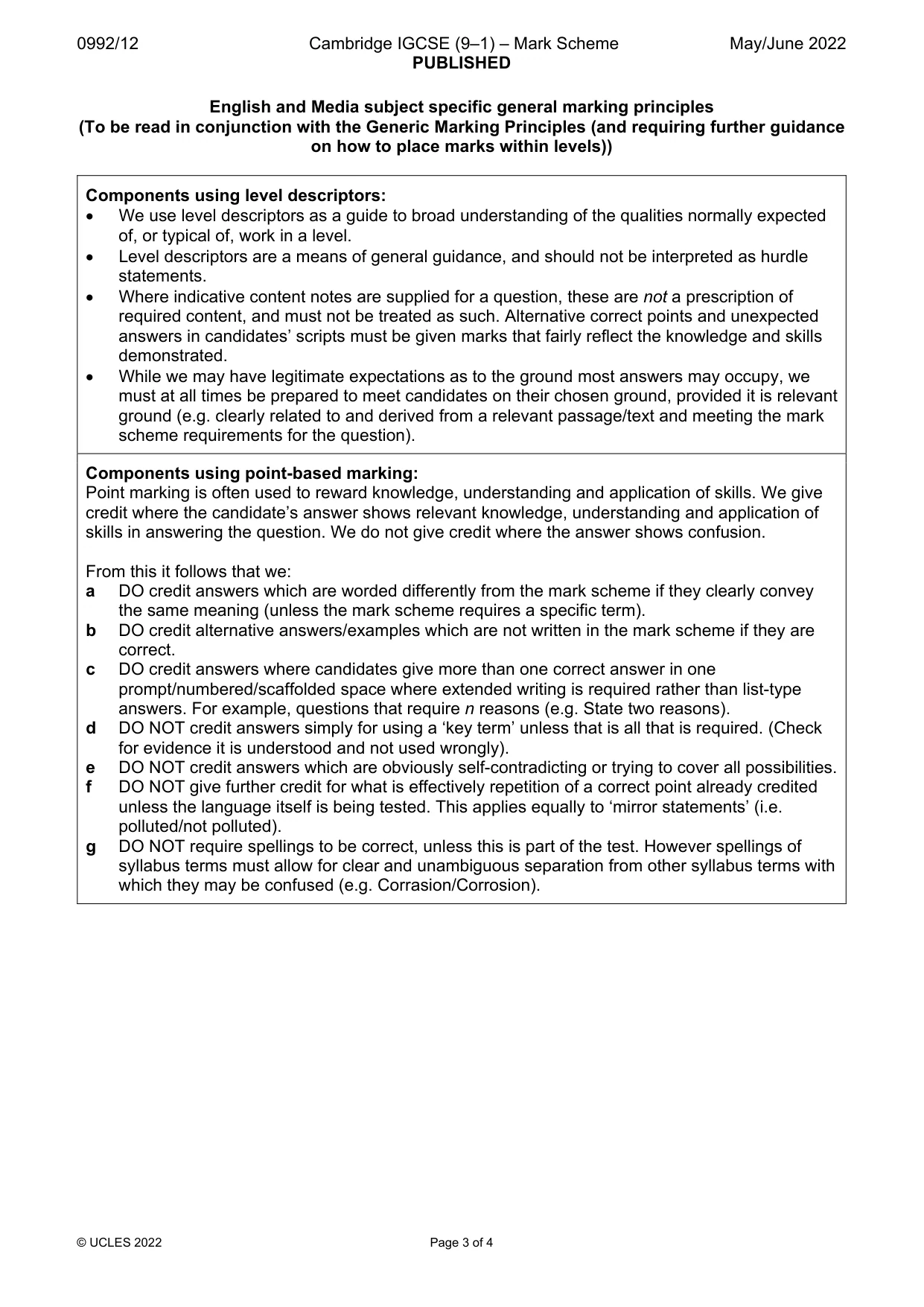
0992/12 Cambridge IGCSE (9–1) – Mark Scheme PUBLISHED May/June 2022 © UCLES 2022 Page 3 of 4 English and Media subject specific general marking principles (To be read in conjunction with the Generic Marking Principles (and requiring further guidance on how to place marks within levels)) Components using level descriptors: We use level descriptors as a guide to broad understanding of the qualities normally expected of, or typical of, work in a level. Level descriptors are a means of general guidance, and should not be interpreted as hurdle statements. Where indicative content notes are supplied for a question, these are not a prescription of required content, and must not be treated as such. Alternative correct points and unexpected answers in candidates’ scripts must be given marks that fairly reflect the knowledge and skills demonstrated. While we may have legitimate expectations as to the ground most answers may occupy, we must at all times be prepared to meet candidates on their chosen ground, provided it is relevant ground (e.g. clearly related to and derived from a relevant passage/text and meeting the mark scheme requirements for the question). Components using point-based marking: Point marking is often used to reward knowledge, understanding and application of skills. We give credit where the candidate’s answer shows relevant knowledge, understanding and application of skills in answering the question. We do not give credit where the answer shows confusion. From this it follows that we: a DO credit answers which are worded differently from the mark scheme if they clearly convey the same meaning (unless the mark scheme requires a specific term). b DO credit alternative answers/examples which are not written in the mark scheme if they are correct. c DO credit answers where candidates give more than one correct answer in one prompt/numbered/scaffolded space where extended writing is required rather than list-type answers. For example, questions that require n reasons (e.g. State two reasons). d DO NOT credit answers simply for using a ‘key term’ unless that is all that is required. (Check for evidence it is understood and not used wrongly). e DO NOT credit answers which are obviously self-contradicting or trying to cover all possibilities. f DO NOT give further credit for what is effectively repetition of a correct point already credited unless the language itself is being tested. This applies equally to ‘mirror statements’ (i.e. polluted/not polluted). g DO NOT require spellings to be correct, unless this is part of the test. However spellings of syllabus terms must allow for clear and unambiguous separation from other syllabus terms with which they may be confused (e.g. Corrasion/Corrosion).
Mark scheme, page 4
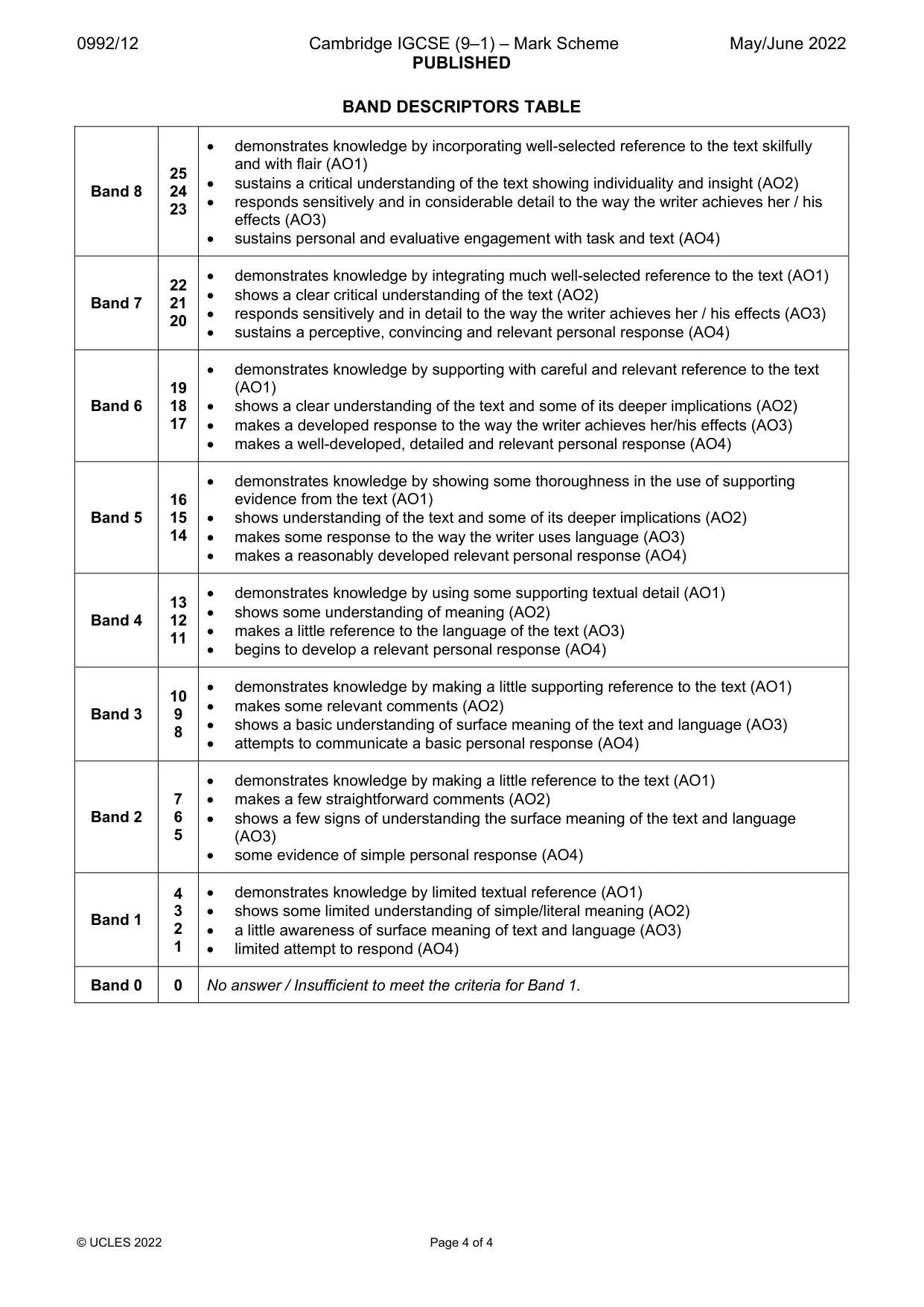
0992/12 Cambridge IGCSE (9–1) – Mark Scheme PUBLISHED May/June 2022 © UCLES 2022 Page 4 of 4 BAND DESCRIPTORS TABLE Band 8 25 24 23 demonstrates knowledge by incorporating well-selected reference to the text skilfully and with flair (AO1) sustains a critical understanding of the text showing individuality and insight (AO2) responds sensitively and in considerable detail to the way the writer achieves her / his effects (AO3) sustains personal and evaluative engagement with task and text (AO4) Band 7 22 21 20 demonstrates knowledge by integrating much well-selected reference to the text (AO1) shows a clear critical understanding of the text (AO2) responds sensitively and in detail to the way the writer achieves her / his effects (AO3) sustains a perceptive, convincing and relevant personal response (AO4) Band 6 19 18 17 demonstrates knowledge by supporting with careful and relevant reference to the text (AO1) shows a clear understanding of the text and some of its deeper implications (AO2) makes a developed response to the way the writer achieves her/his effects (AO3) makes a well-developed, detailed and relevant personal response (AO4) Band 5 16 15 14 demonstrates knowledge by showing some thoroughness in the use of supporting evidence from the text (AO1) shows understanding of the text and some of its deeper implications (AO2) makes some response to the way the writer uses language (AO3) makes a reasonably developed relevant personal response (AO4) Band 4 13 12 11 demonstrates knowledge by using some supporting textual detail (AO1) shows some understanding of meaning (AO2) makes a little reference to the language of the text (AO3) begins to develop a relevant personal response (AO4) Band 3 10 9 8 demonstrates knowledge by making a little supporting reference to the text (AO1) makes some relevant comments (AO2) shows a basic understanding of surface meaning of the text and language (AO3) attempts to communicate a basic personal response (AO4) Band 2 7 6 5 demonstrates knowledge by making a little reference to the text (AO1) makes a few straightforward comments (AO2) shows a few signs of understanding the surface meaning of the text and language (AO3) some evidence of simple personal response (AO4) Band 1 4 3 2 1 demonstrates knowledge by limited textual reference (AO1) shows some limited understanding of simple/literal meaning (AO2) a little awareness of surface meaning of text and language (AO3) limited attempt to respond (AO4) Band 0 0 No answer / Insufficient to meet the criteria for Band 1.
What you needed in this session
Cambridge’s own grade thresholds for 2022 May/June, Paper 1 · Variant 2. A higher threshold means an easier paper — the bar moves with how the cohort did.