Cambridge IGCSE English - Literature in English (9-1) 0992 — 2023 Oct/Nov Paper 1 · Variant 2
0992/12/O/N/23 · 50 marks · ≈56 min
The question paper and its mark scheme, free to read here and free to download. This is Cambridge’s own paper, exactly as it was sat.
Question paper28 pages

Mark scheme4 pages
Answers below. Sit the paper first if you are practising.
Paper as text
Question paper, page 1
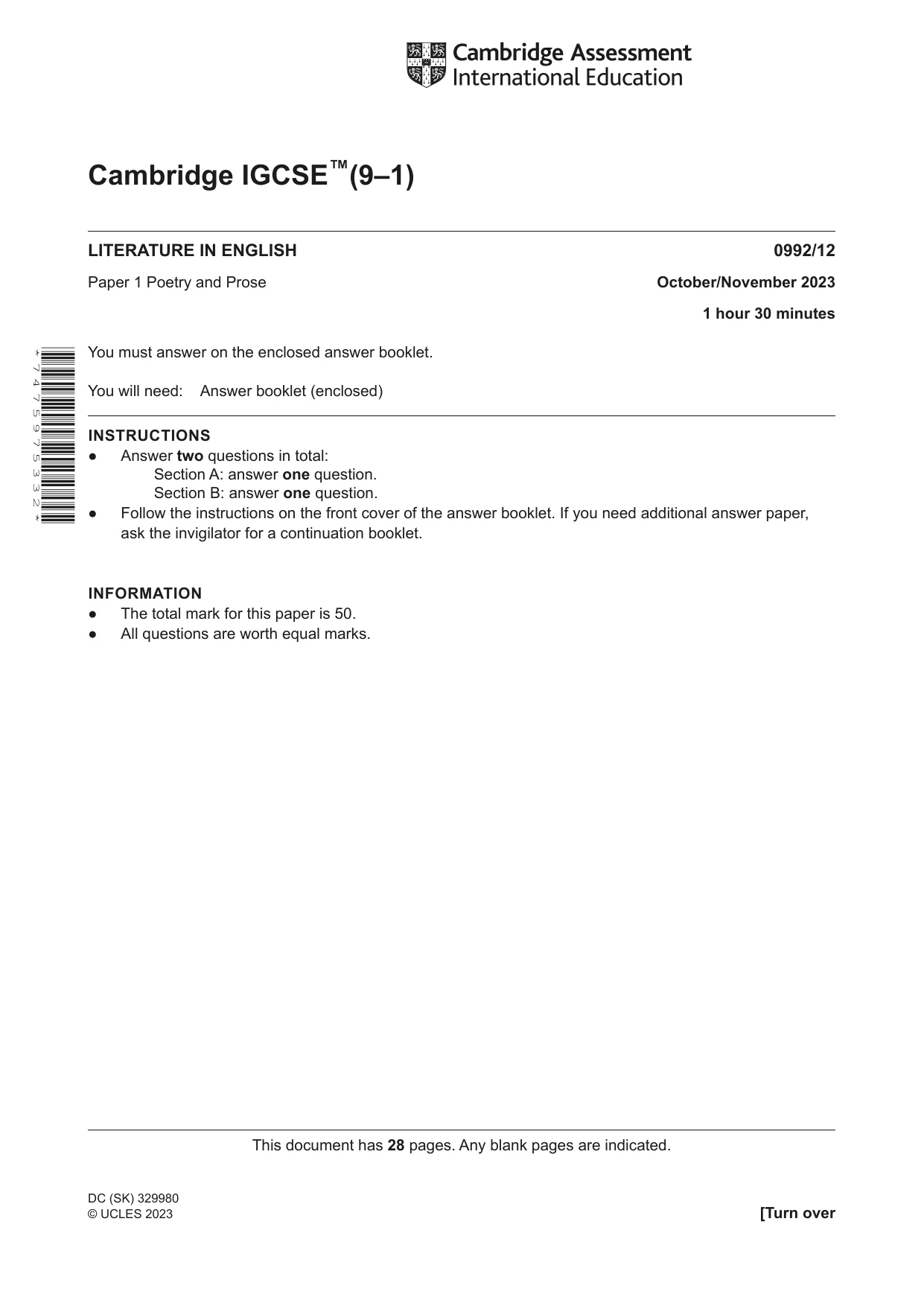
This document has 28 pages. Any blank pages are indicated. [Turn over Cambridge IGCSE™(9–1) * 7 4 7 5 9 7 5 3 3 2 * DC (SK) 329980 © UCLES 2023 LITERATURE IN ENGLISH 0992/12 Paper 1 Poetry and Prose October/November 2023 1 hour 30 minutes You must answer on the enclosed answer booklet. You will need: Answer booklet (enclosed) INSTRUCTIONS ● Answer two questions in total: Section A: answer one question. Section B: answer one question. ● Follow the instructions on the front cover of the answer booklet. If you need additional answer paper, ask the invigilator for a continuation booklet. INFORMATION ● The total mark for this paper is 50. ● All questions are worth equal marks.
Question paper, page 2
2 0992/12/O/N/23 © UCLES 2023 BLANK PAGE
Question paper, page 3
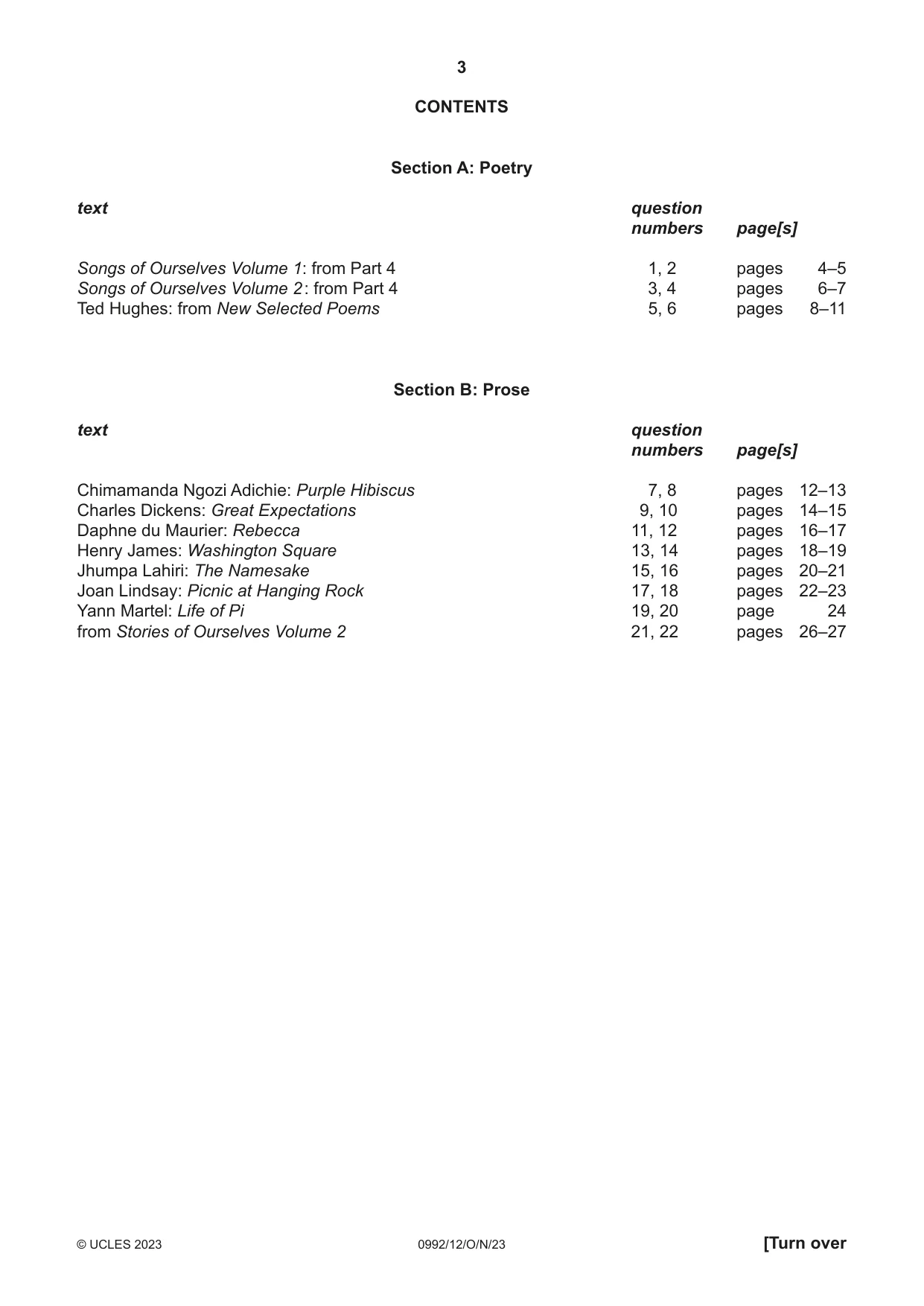
3 0992/12/O/N/23 © UCLES 2023 [Turn over CONTENTS Section A: Poetry text question numbers page[s] Songs of Ourselves Volume 1: from Part 4 1, 2 pages 4–5 Songs of Ourselves Volume 2 : from Part 4 3, 4 pages 6–7 Ted Hughes: from New Selected Poems 5, 6 pages 8–11 Section B: Prose text question numbers page[s] Chimamanda Ngozi Adichie: Purple Hibiscus 7, 8 pages 12–13 Charles Dickens: Great Expectations 9, 10 pages 14–15 Daphne du Maurier: Rebecca 11, 12 pages 16–17 Henry James: Washington Square 13, 14 pages 18–19 Jhumpa Lahiri: The Namesake 15, 16 pages 20–21 Joan Lindsay: Picnic at Hanging Rock 17, 18 pages 22–23 Yann Martel: Life of Pi 19, 20 page 24 from Stories of Ourselves Volume 2 21, 22 pages 26–27
Question paper, page 4
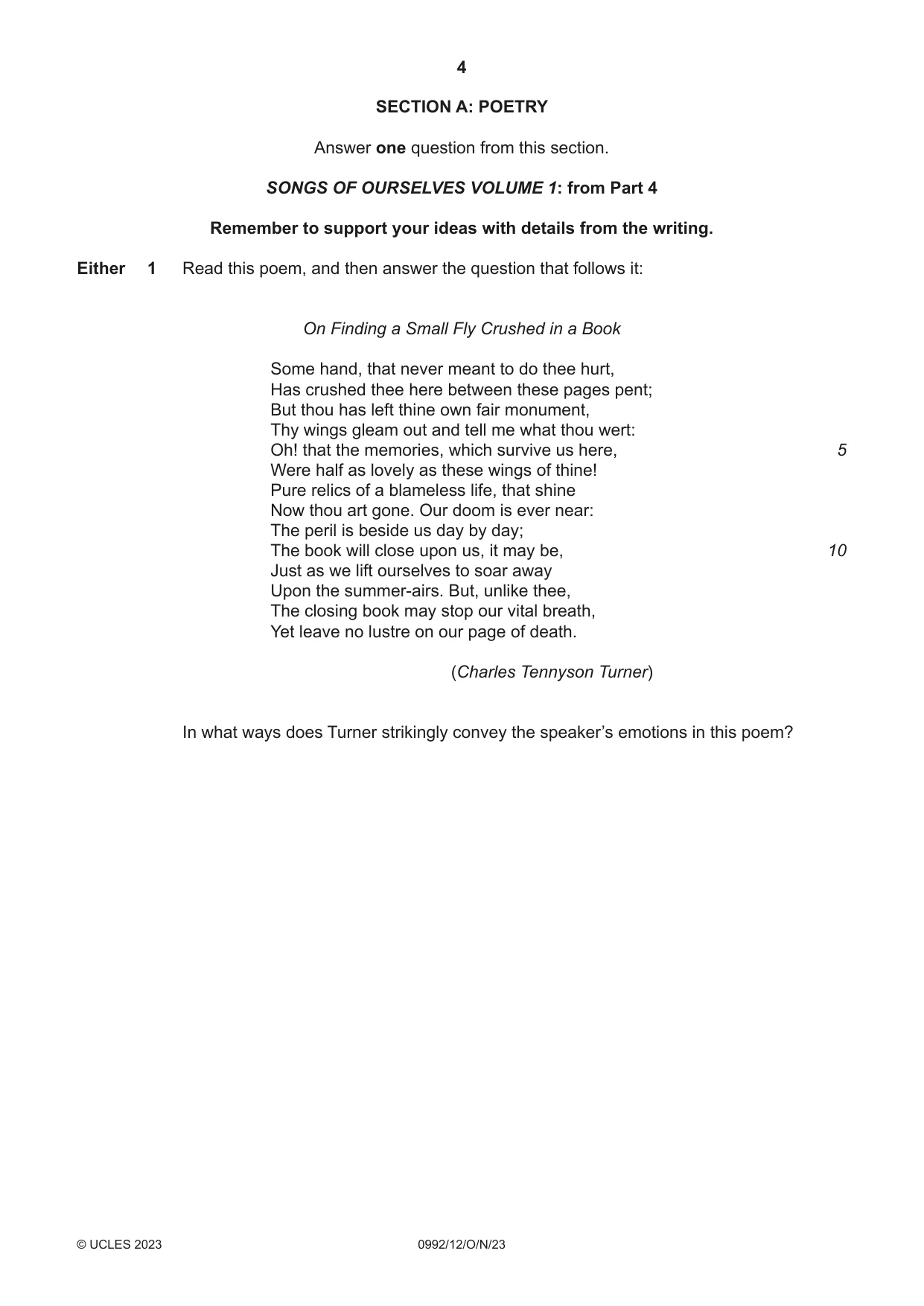
4 0992/12/O/N/23 © UCLES 2023 SECTION A: POETRY Answer one question from this section. SONGS OF OURSELVES VOLUME 1: from Part 4 Remember to support your ideas with details from the writing. Either 1 Read this poem, and then answer the question that follows it: On Finding a Small Fly Crushed in a Book Some hand, that never meant to do thee hurt, Has crushed thee here between these pages pent; But thou has left thine own fair monument, Thy wings gleam out and tell me what thou wert: Oh! that the memories, which survive us here, Were half as lovely as these wings of thine! Pure relics of a blameless life, that shine Now thou art gone. Our doom is ever near: The peril is beside us day by day; The book will close upon us, it may be, Just as we lift ourselves to soar away Upon the summer-airs. But, unlike thee, The closing book may stop our vital breath, Yet leave no lustre on our page of death. (Charles Tennyson Turner) In what ways does Turner strikingly convey the speaker’s emotions in this poem? 5 10
Question paper, page 5
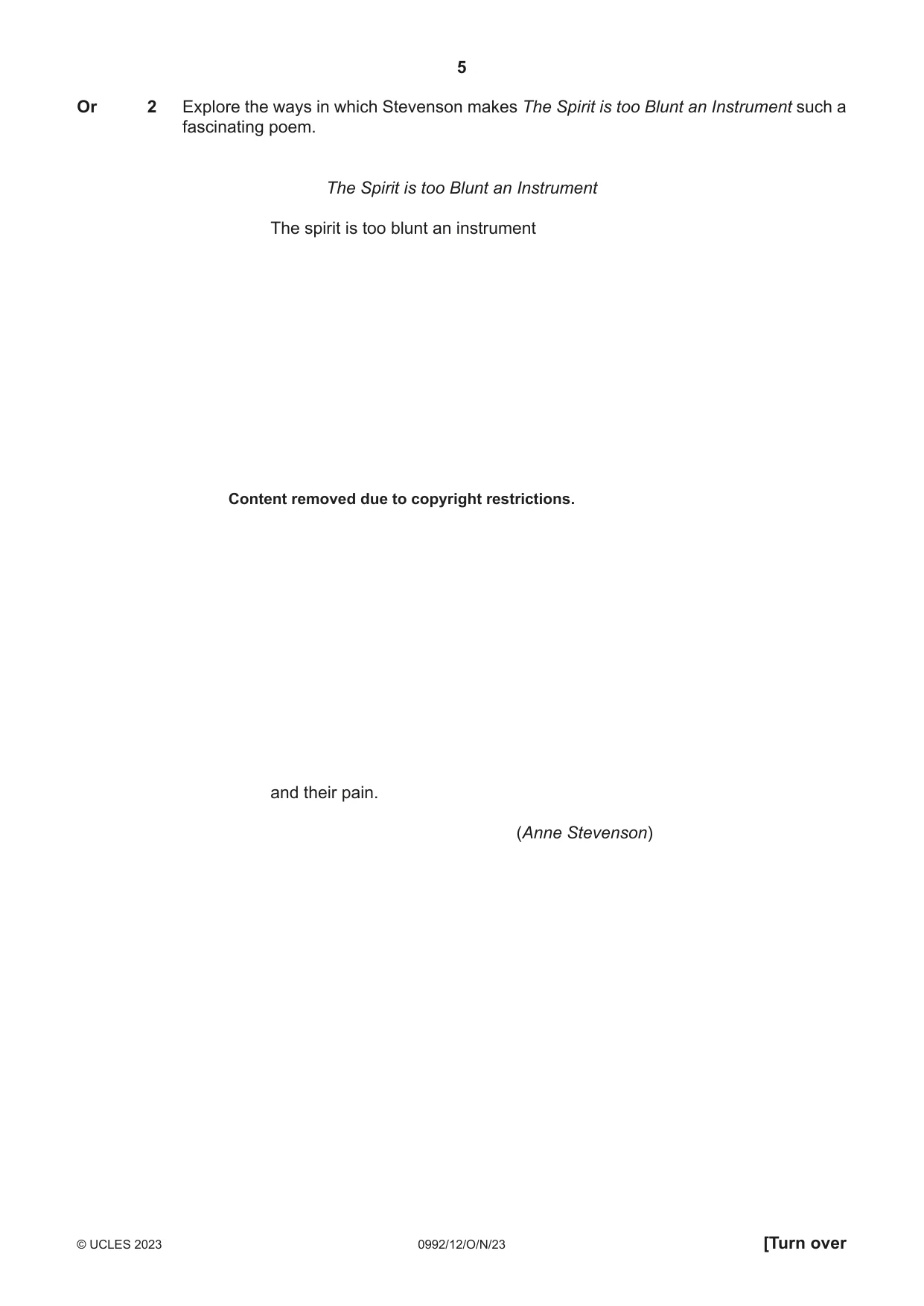
5 0992/12/O/N/23 © UCLES 2023 [Turn over Or 2 Explore the ways in which Stevenson makes The Spirit is too Blunt an Instrument such a fascinating poem. The Spirit is too Blunt an Instrument The spirit is too blunt an instrument and their pain. (Anne Stevenson) Content removed due to copyright restrictions.
Question paper, page 6
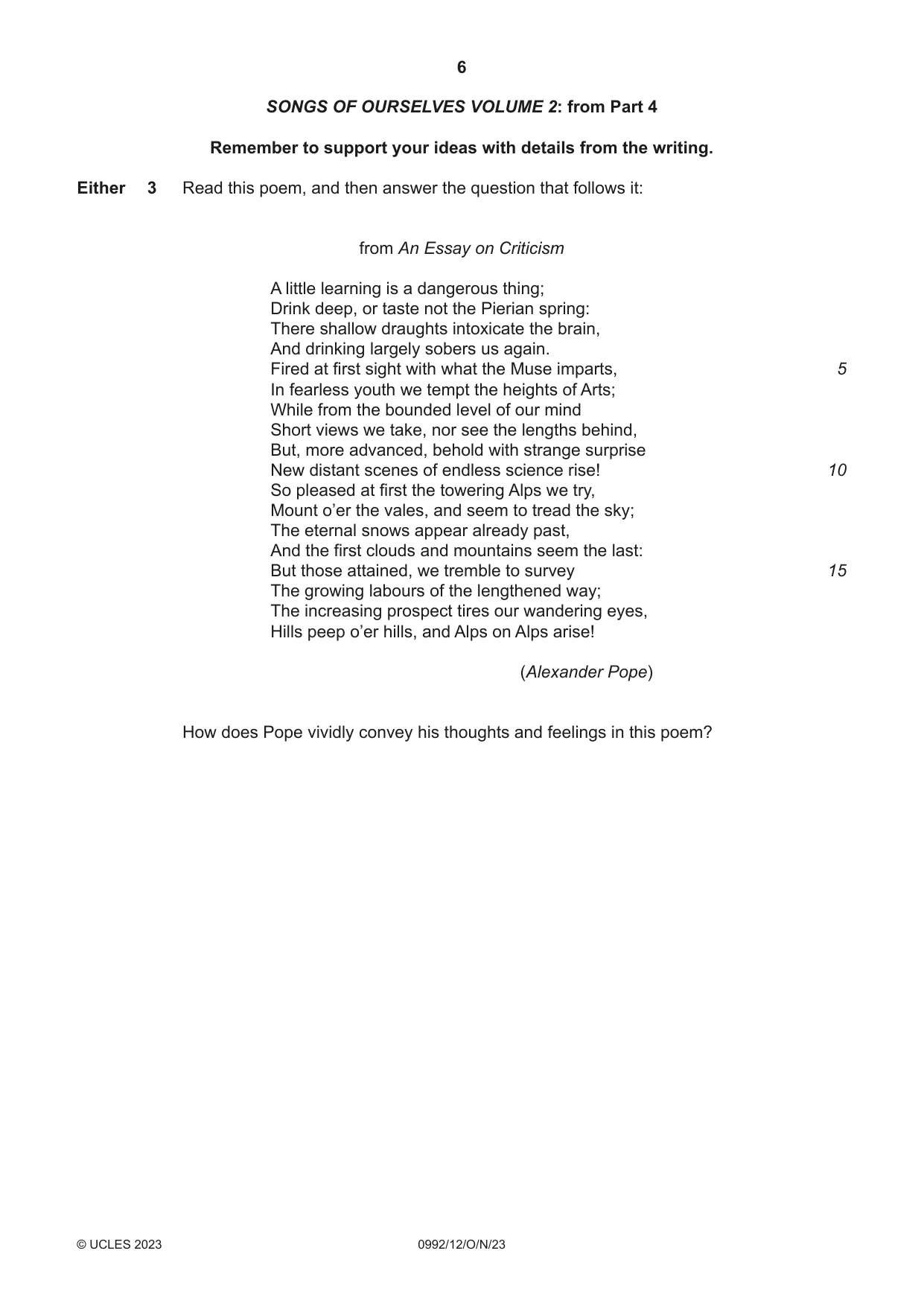
6 0992/12/O/N/23 © UCLES 2023 SONGS OF OURSELVES VOLUME 2: from Part 4 Remember to support your ideas with details from the writing. Either 3 Read this poem, and then answer the question that follows it: from An Essay on Criticism A little learning is a dangerous thing; Drink deep, or taste not the Pierian spring: There shallow draughts intoxicate the brain, And drinking largely sobers us again. Fired at first sight with what the Muse imparts, In fearless youth we tempt the heights of Arts; While from the bounded level of our mind Short views we take, nor see the lengths behind, But, more advanced, behold with strange surprise New distant scenes of endless science rise! So pleased at first the towering Alps we try, Mount o’er the vales, and seem to tread the sky; The eternal snows appear already past, And the first clouds and mountains seem the last: But those attained, we tremble to survey The growing labours of the lengthened way; The increasing prospect tires our wandering eyes, Hills peep o’er hills, and Alps on Alps arise! (Alexander Pope) How does Pope vividly convey his thoughts and feelings in this poem? 5 10 15
Question paper, page 7
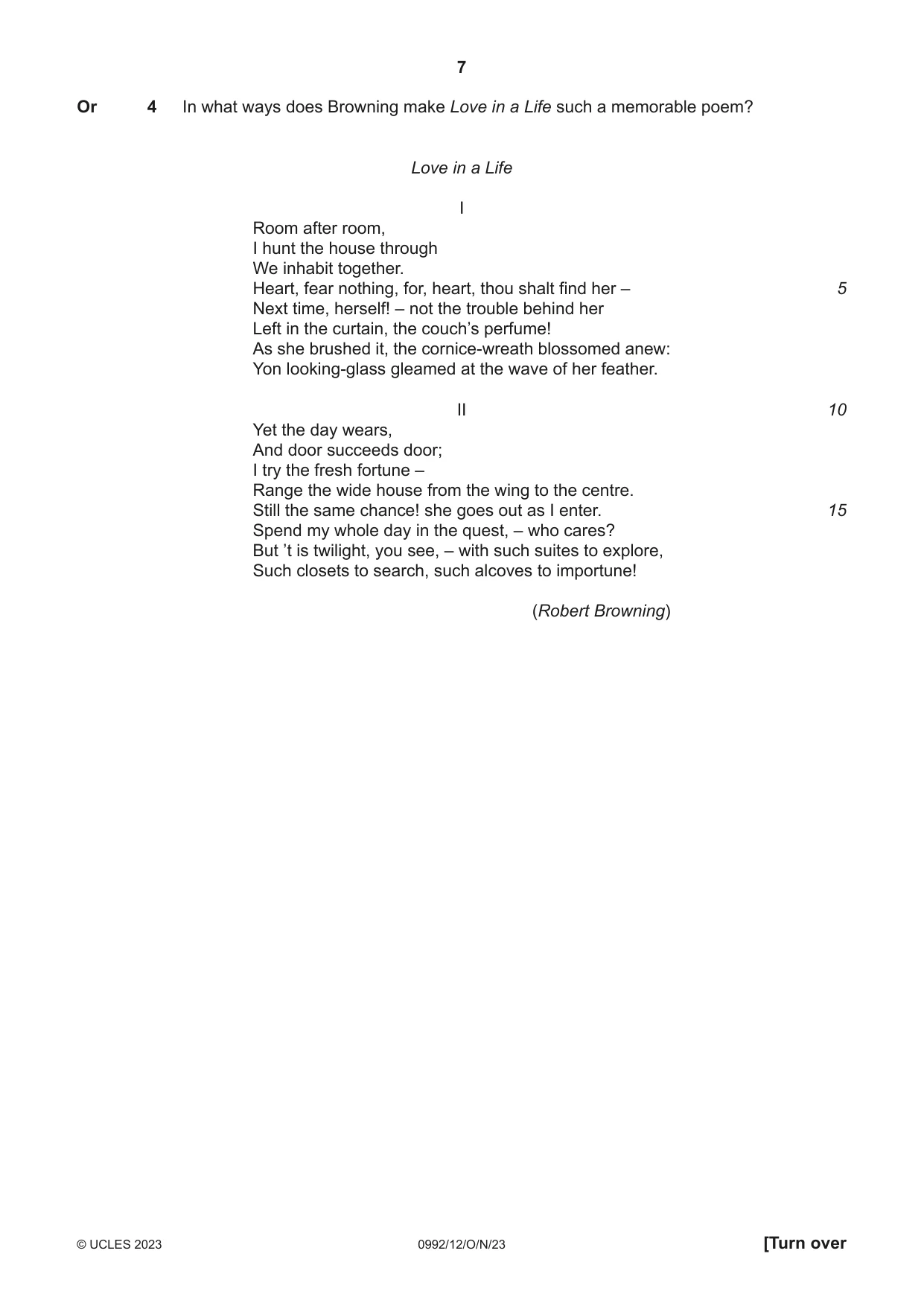
7 0992/12/O/N/23 © UCLES 2023 [Turn over Or 4 In what ways does Browning make Love in a Life such a memorable poem? Love in a Life I Room after room, I hunt the house through We inhabit together. Heart, fear nothing, for, heart, thou shalt find her – Next time, herself! – not the trouble behind her Left in the curtain, the couch’s perfume! As she brushed it, the cornice-wreath blossomed anew: Yon looking-glass gleamed at the wave of her feather. II Yet the day wears, And door succeeds door; I try the fresh fortune – Range the wide house from the wing to the centre. Still the same chance! she goes out as I enter. Spend my whole day in the quest, – who cares? But ’t is twilight, you see, – with such suites to explore, Such closets to search, such alcoves to importune! (Robert Browning) 5 10 15
Question paper, page 8
8 0992/12/O/N/23 © UCLES 2023 TED HUGHES: from New Selected Poems Remember to support your ideas with details from the writing. Either 5 Read this poem, and then answer the question that follows it: Roe-Deer In the dawn-dirty light, in the biggest snow of the year Back to the ordinary. How does Hughes memorably convey his experience of seeing the roe-deer? Content removed due to copyright restrictions.
Question paper, page 9
9 0992/12/O/N/23 © UCLES 2023 [Turn over TURN OVER FOR QUESTION 6
Question paper, page 10
10 0992/12/O/N/23 © UCLES 2023 Or 6 In what ways does Hughes movingly convey strong emotions in Anniversary? Anniversary My mother in her feathers of flame Content removed due to copyright restrictions.
Question paper, page 11
11 0992/12/O/N/23 © UCLES 2023 [Turn over Able for all that distance to think me him. Content removed due to copyright restrictions.
Question paper, page 12
12 0992/12/O/N/23 © UCLES 2023 SECTION B: PROSE Answer one question from this section. CHIMAMANDA NGOZI ADICHIE: Purple Hibiscus Remember to support your ideas with details from the writing. Either 7 Read this passage, and then answer the question that follows it: Father Amadi’s car smelled like him, a clean scent that made me think of a clear azure sky. ‘You run too fast,’ I said, panting. Content removed due to copyright restrictions.
Question paper, page 13
13 0992/12/O/N/23 © UCLES 2023 [Turn over In what ways does Adichie make this such a memorable moment in the novel? Or 8 Explore the ways in which Adichie makes you feel sorry for Jaja.
Question paper, page 14
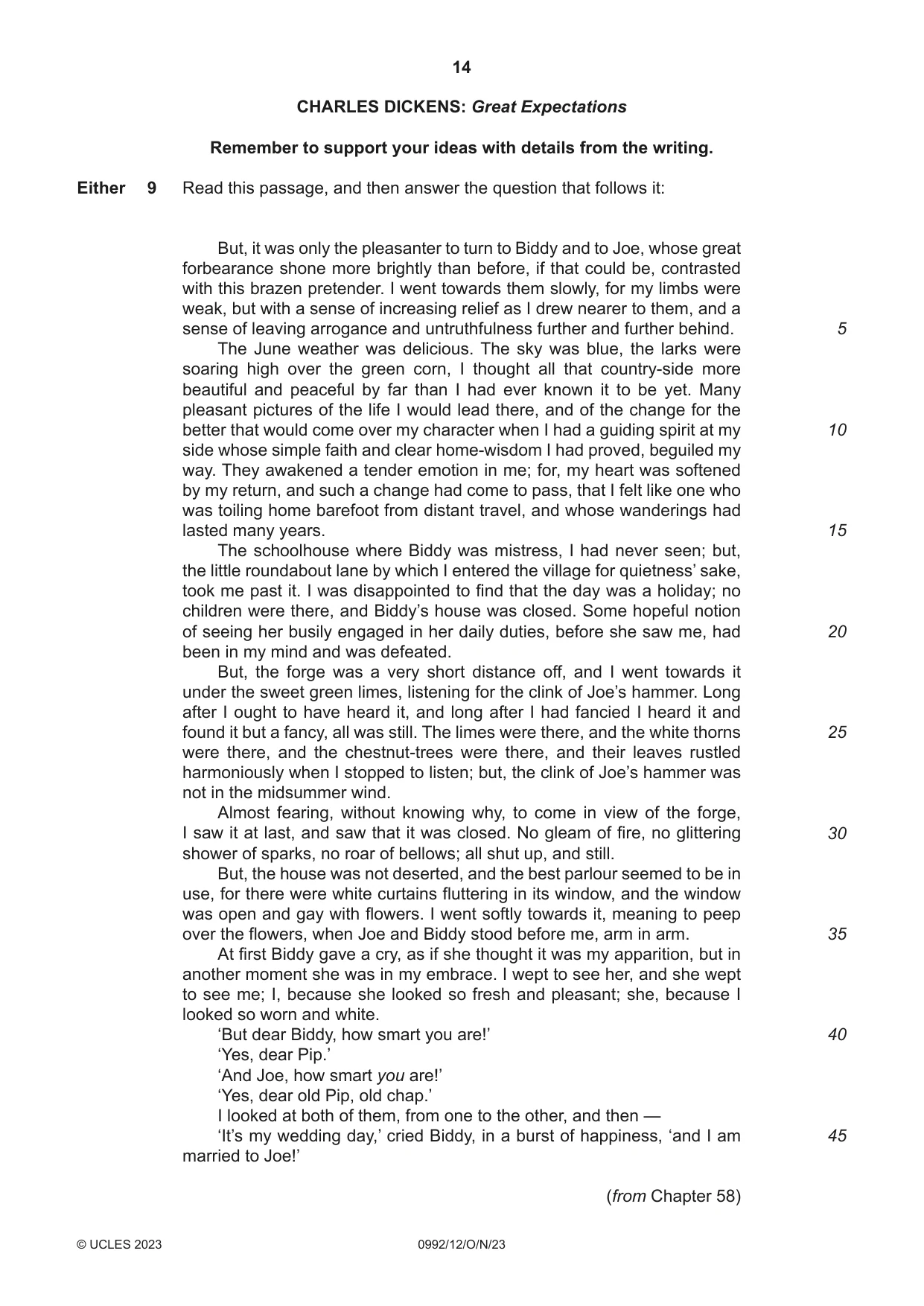
14 0992/12/O/N/23 © UCLES 2023 CHARLES DICKENS: Great Expectations Remember to support your ideas with details from the writing. Either 9 Read this passage, and then answer the question that follows it: But, it was only the pleasanter to turn to Biddy and to Joe, whose great forbearance shone more brightly than before, if that could be, contrasted with this brazen pretender. I went towards them slowly, for my limbs were weak, but with a sense of increasing relief as I drew nearer to them, and a sense of leaving arrogance and untruthfulness further and further behind. The June weather was delicious. The sky was blue, the larks were soaring high over the green corn, I thought all that country-side more beautiful and peaceful by far than I had ever known it to be yet. Many pleasant pictures of the life I would lead there, and of the change for the better that would come over my character when I had a guiding spirit at my side whose simple faith and clear home-wisdom I had proved, beguiled my way. They awakened a tender emotion in me; for, my heart was softened by my return, and such a change had come to pass, that I felt like one who was toiling home barefoot from distant travel, and whose wanderings had lasted many years. The schoolhouse where Biddy was mistress, I had never seen; but, the little roundabout lane by which I entered the village for quietness’ sake, took me past it. I was disappointed to find that the day was a holiday; no children were there, and Biddy’s house was closed. Some hopeful notion of seeing her busily engaged in her daily duties, before she saw me, had been in my mind and was defeated. But, the forge was a very short distance off, and I went towards it under the sweet green limes, listening for the clink of Joe’s hammer. Long after I ought to have heard it, and long after I had fancied I heard it and found it but a fancy, all was still. The limes were there, and the white thorns were there, and the chestnut-trees were there, and their leaves rustled harmoniously when I stopped to listen; but, the clink of Joe’s hammer was not in the midsummer wind. Almost fearing, without knowing why, to come in view of the forge, I saw it at last, and saw that it was closed. No gleam of fire, no glittering shower of sparks, no roar of bellows; all shut up, and still. But, the house was not deserted, and the best parlour seemed to be in use, for there were white curtains fluttering in its window, and the window was open and gay with flowers. I went softly towards it, meaning to peep over the flowers, when Joe and Biddy stood before me, arm in arm. At first Biddy gave a cry, as if she thought it was my apparition, but in another moment she was in my embrace. I wept to see her, and she wept to see me; I, because she looked so fresh and pleasant; she, because I looked so worn and white. ‘But dear Biddy, how smart you are!’ ‘Yes, dear Pip.’ ‘And Joe, how smart you are!’ ‘Yes, dear old Pip, old chap.’ I looked at both of them, from one to the other, and then — ‘It’s my wedding day,’ cried Biddy, in a burst of happiness, ‘and I am married to Joe!’ (from Chapter 58) 5 10 15 20 25 30 35 40 45
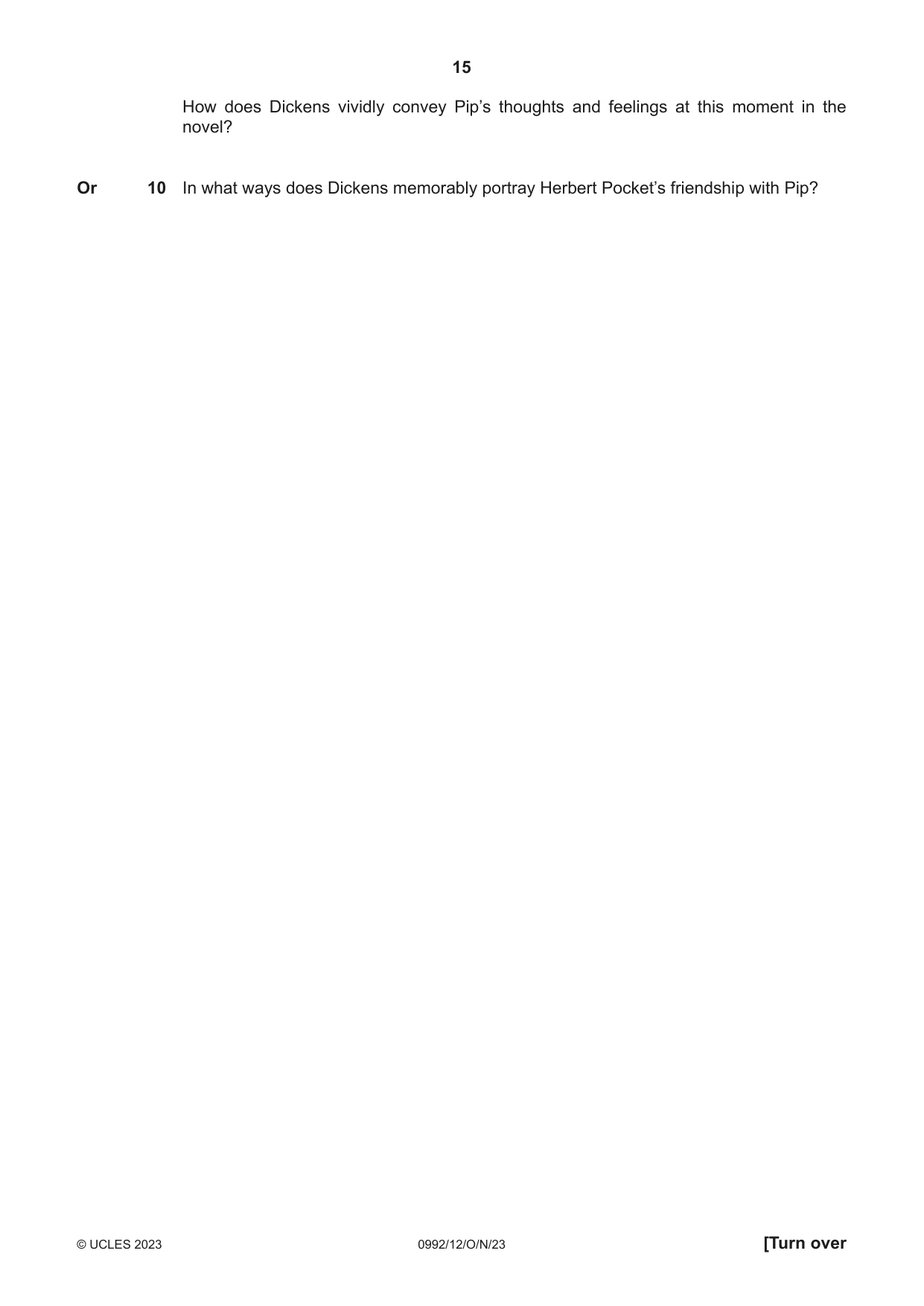
Question paper, page 15
15 0992/12/O/N/23 © UCLES 2023 [Turn over How does Dickens vividly convey Pip’s thoughts and feelings at this moment in the novel? Or 10 In what ways does Dickens memorably portray Herbert Pocket’s friendship with Pip?
Question paper, page 16
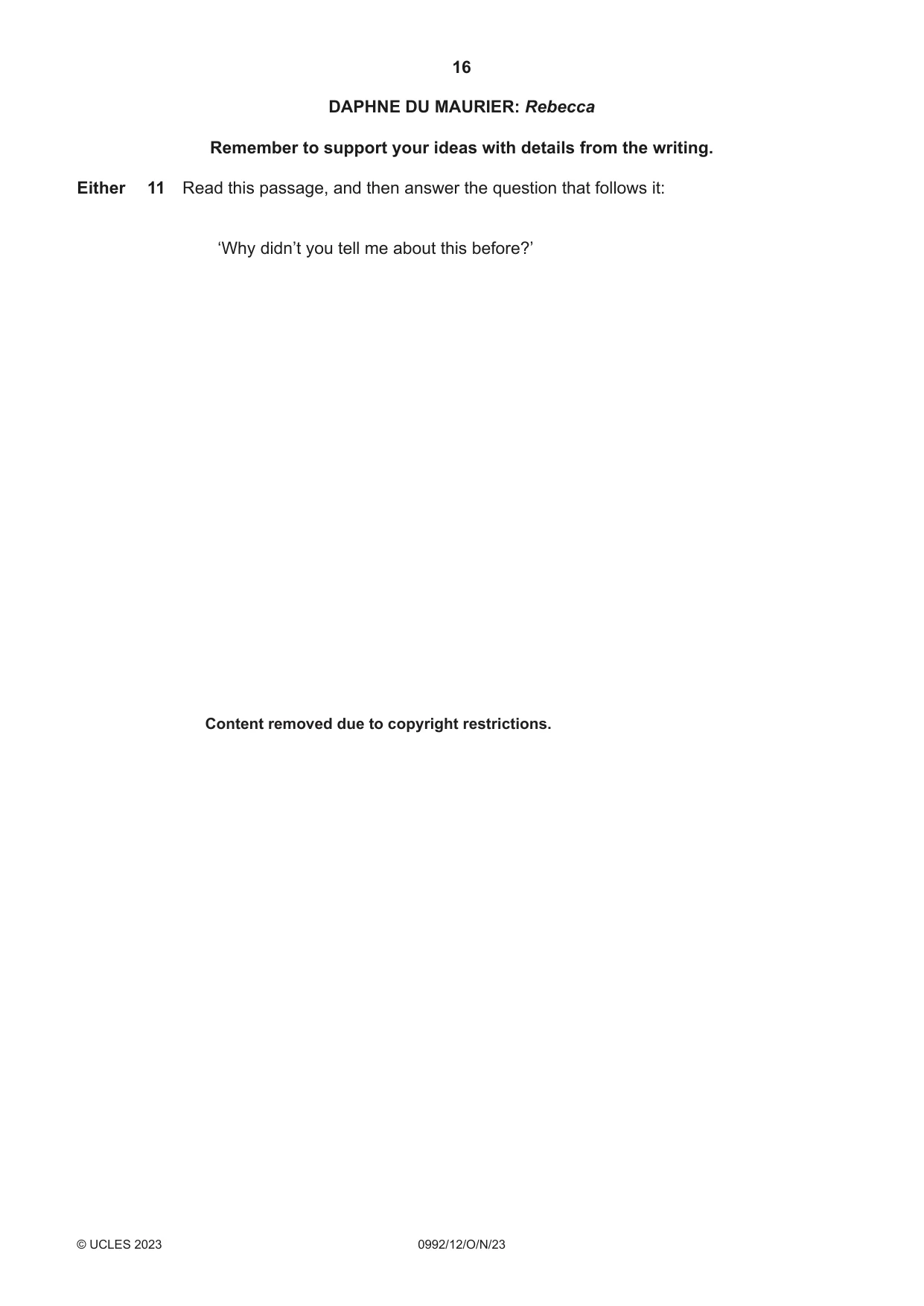
16 0992/12/O/N/23 © UCLES 2023 DAPHNE DU MAURIER: Rebecca Remember to support your ideas with details from the writing. Either 11 Read this passage, and then answer the question that follows it: ‘Why didn’t you tell me about this before?’ Content removed due to copyright restrictions.
Question paper, page 17
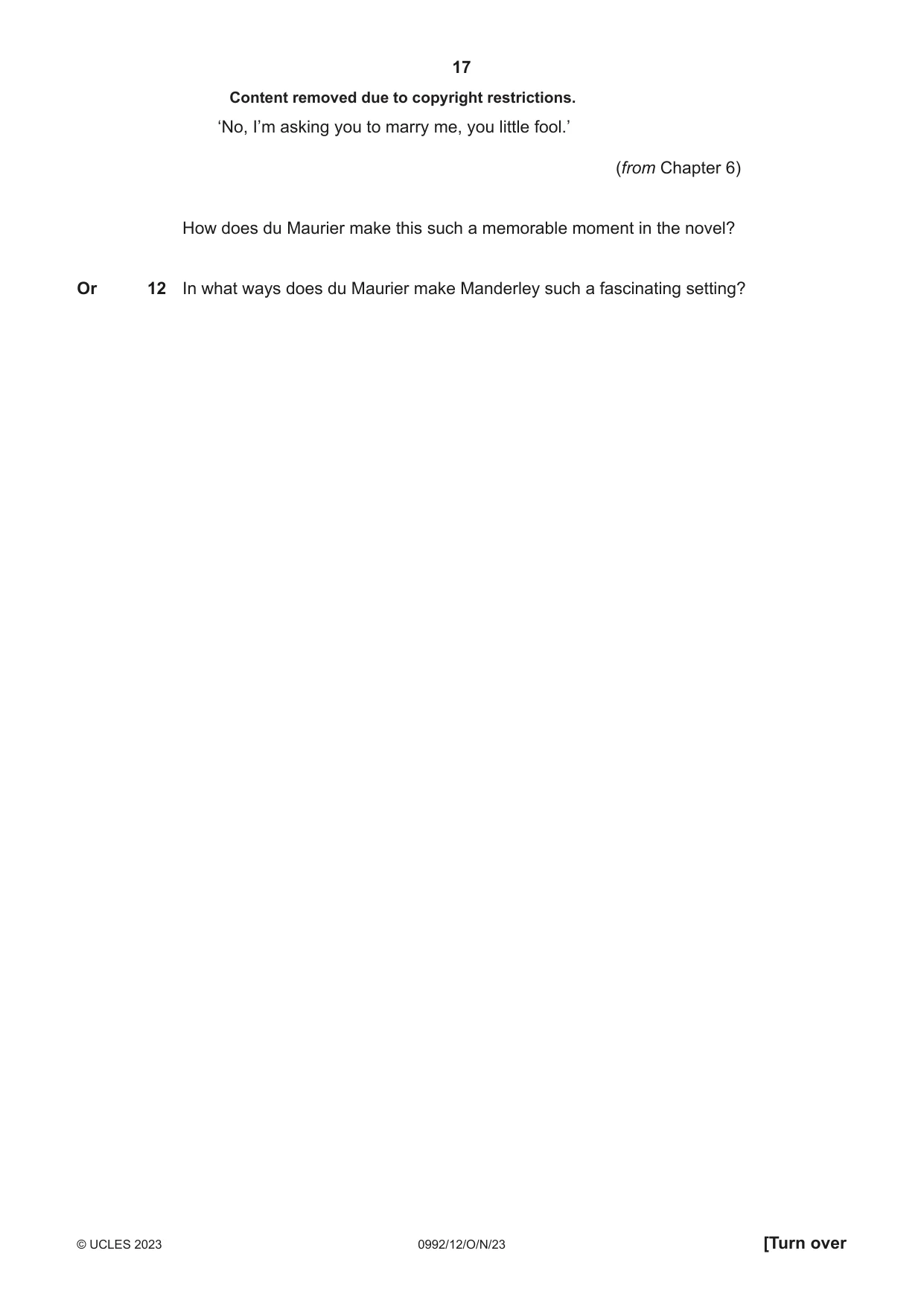
17 0992/12/O/N/23 © UCLES 2023 [Turn over ‘No, I’m asking you to marry me, you little fool.’ (from Chapter 6) How does du Maurier make this such a memorable moment in the novel? Or 12 In what ways does du Maurier make Manderley such a fascinating setting? Content removed due to copyright restrictions.
Question paper, page 18
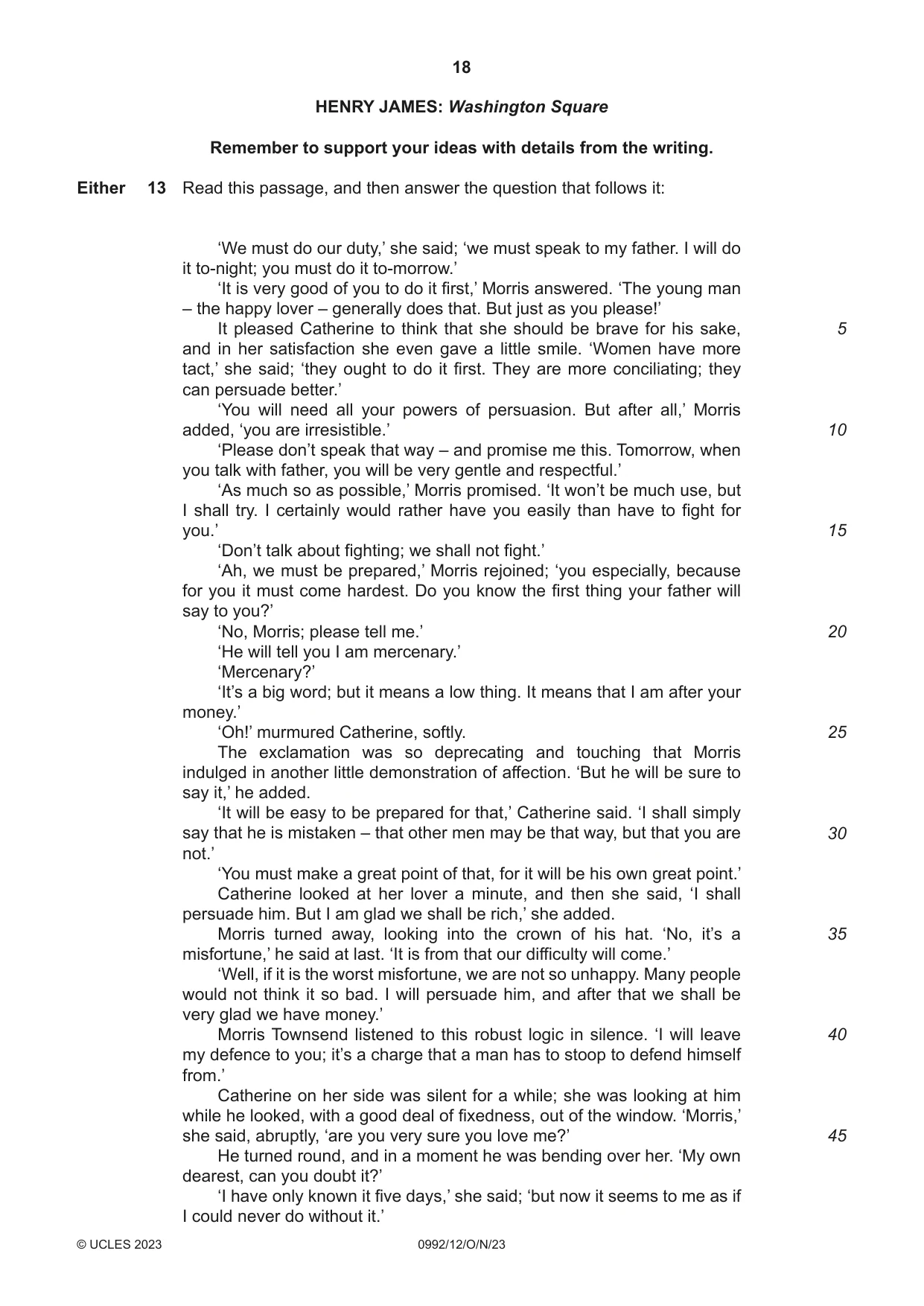
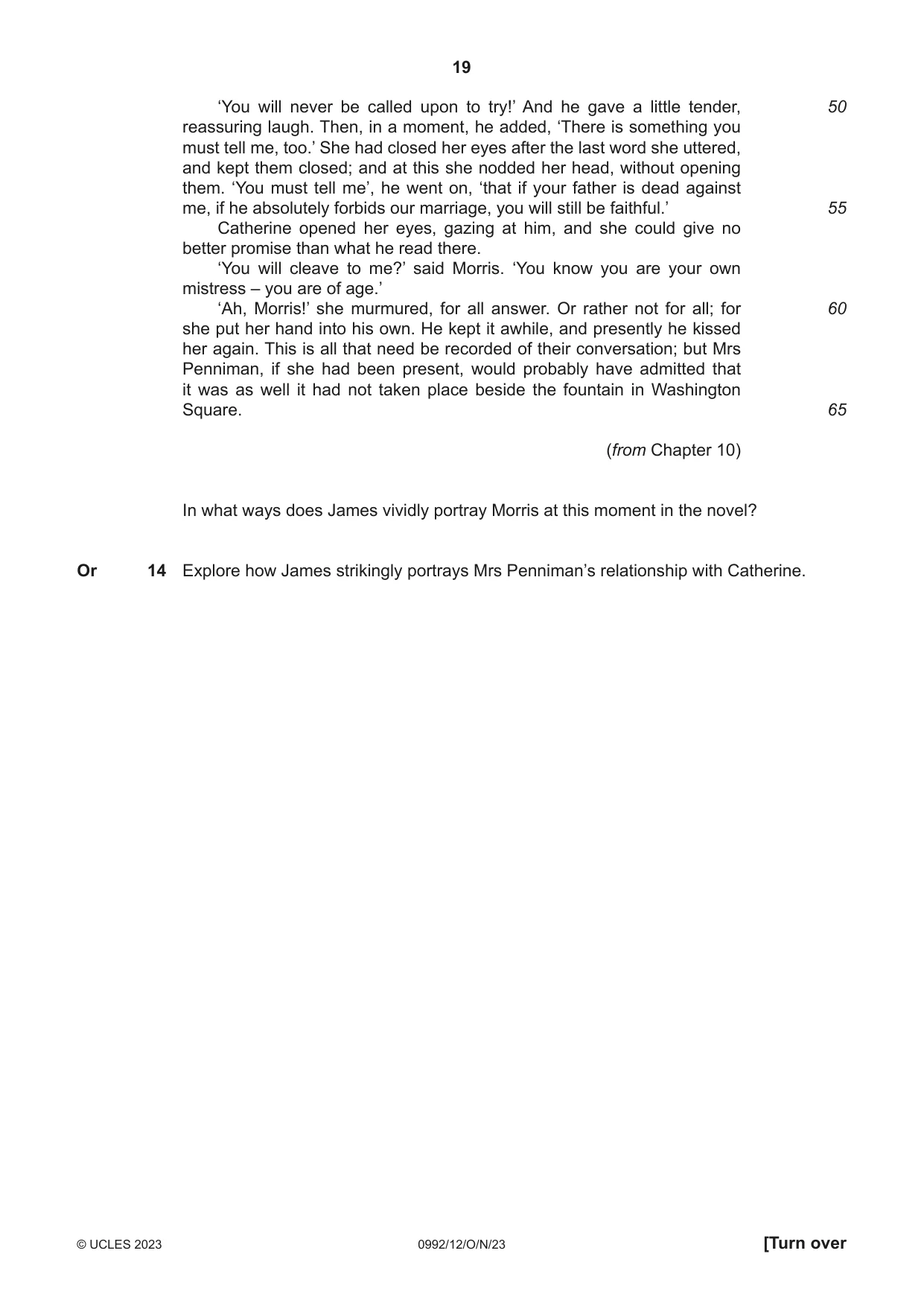
18 0992/12/O/N/23 © UCLES 2023 HENRY JAMES: Washington Square Remember to support your ideas with details from the writing. Either 13 Read this passage, and then answer the question that follows it: ‘We must do our duty,’ she said; ‘we must speak to my father. I will do it to-night; you must do it to-morrow.’ ‘It is very good of you to do it first,’ Morris answered. ‘The young man – the happy lover – generally does that. But just as you please!’ It pleased Catherine to think that she should be brave for his sake, and in her satisfaction she even gave a little smile. ‘Women have more tact,’ she said; ‘they ought to do it first. They are more conciliating; they can persuade better.’ ‘You will need all your powers of persuasion. But after all,’ Morris added, ‘you are irresistible.’ ‘Please don’t speak that way – and promise me this. Tomorrow, when you talk with father, you will be very gentle and respectful.’ ‘As much so as possible,’ Morris promised. ‘It won’t be much use, but I shall try. I certainly would rather have you easily than have to fight for you.’ ‘Don’t talk about fighting; we shall not fight.’ ‘Ah, we must be prepared,’ Morris rejoined; ‘you especially, because for you it must come hardest. Do you know the first thing your father will say to you?’ ‘No, Morris; please tell me.’ ‘He will tell you I am mercenary.’ ‘Mercenary?’ ‘It’s a big word; but it means a low thing. It means that I am after your money.’ ‘Oh!’ murmured Catherine, softly. The exclamation was so deprecating and touching that Morris indulged in another little demonstration of affection. ‘But he will be sure to say it,’ he added. ‘It will be easy to be prepared for that,’ Catherine said. ‘I shall simply say that he is mistaken – that other men may be that way, but that you are not.’ ‘You must make a great point of that, for it will be his own great point.’ Catherine looked at her lover a minute, and then she said, ‘I shall persuade him. But I am glad we shall be rich,’ she added. Morris turned away, looking into the crown of his hat. ‘No, it’s a misfortune,’ he said at last. ‘It is from that our difficulty will come.’ ‘Well, if it is the worst misfortune, we are not so unhappy. Many people would not think it so bad. I will persuade him, and after that we shall be very glad we have money.’ Morris Townsend listened to this robust logic in silence. ‘I will leave my defence to you; it’s a charge that a man has to stoop to defend himself from.’ Catherine on her side was silent for a while; she was looking at him while he looked, with a good deal of fixedness, out of the window. ‘Morris,’ she said, abruptly, ‘are you very sure you love me?’ He turned round, and in a moment he was bending over her. ‘My own dearest, can you doubt it?’ ‘I have only known it five days,’ she said; ‘but now it seems to me as if I could never do without it.’ 5 10 15 20 25 30 35 40 45
Question paper, page 19
19 0992/12/O/N/23 © UCLES 2023 [Turn over ‘You will never be called upon to try!’ And he gave a little tender, reassuring laugh. Then, in a moment, he added, ‘There is something you must tell me, too.’ She had closed her eyes after the last word she uttered, and kept them closed; and at this she nodded her head, without opening them. ‘You must tell me’, he went on, ‘that if your father is dead against me, if he absolutely forbids our marriage, you will still be faithful.’ Catherine opened her eyes, gazing at him, and she could give no better promise than what he read there. ‘You will cleave to me?’ said Morris. ‘You know you are your own mistress – you are of age.’ ‘Ah, Morris!’ she murmured, for all answer. Or rather not for all; for she put her hand into his own. He kept it awhile, and presently he kissed her again. This is all that need be recorded of their conversation; but Mrs Penniman, if she had been present, would probably have admitted that it was as well it had not taken place beside the fountain in Washington Square. (from Chapter 10) In what ways does James vividly portray Morris at this moment in the novel? Or 14 Explore how James strikingly portrays Mrs Penniman’s relationship with Catherine. 50 55 60 65
Question paper, page 20
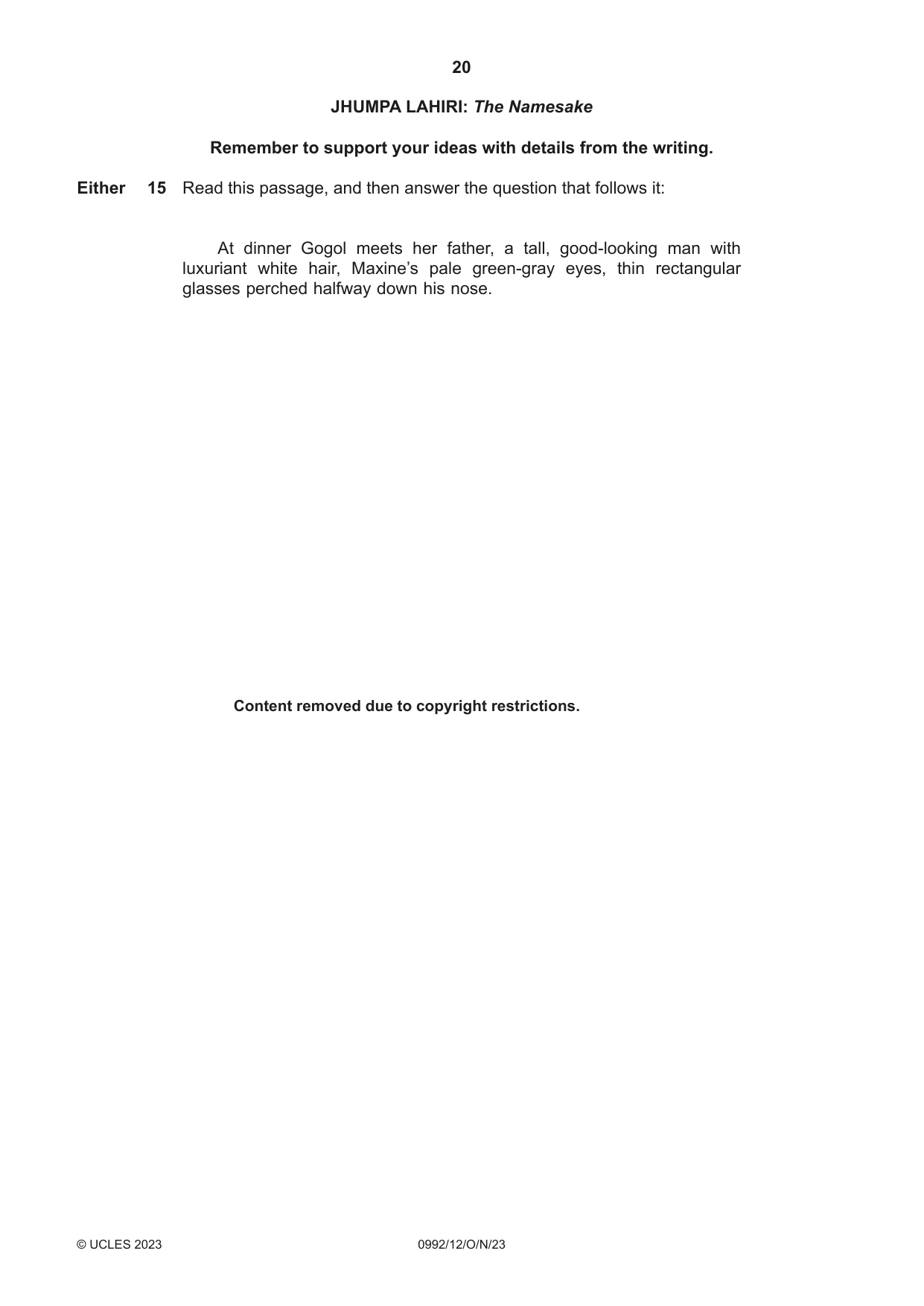
20 0992/12/O/N/23 © UCLES 2023 JHUMPA LAHIRI: The Namesake Remember to support your ideas with details from the writing. Either 15 Read this passage, and then answer the question that follows it: At dinner Gogol meets her father, a tall, good-looking man with luxuriant white hair, Maxine’s pale green-gray eyes, thin rectangular glasses perched halfway down his nose. Content removed due to copyright restrictions.
Question paper, page 21
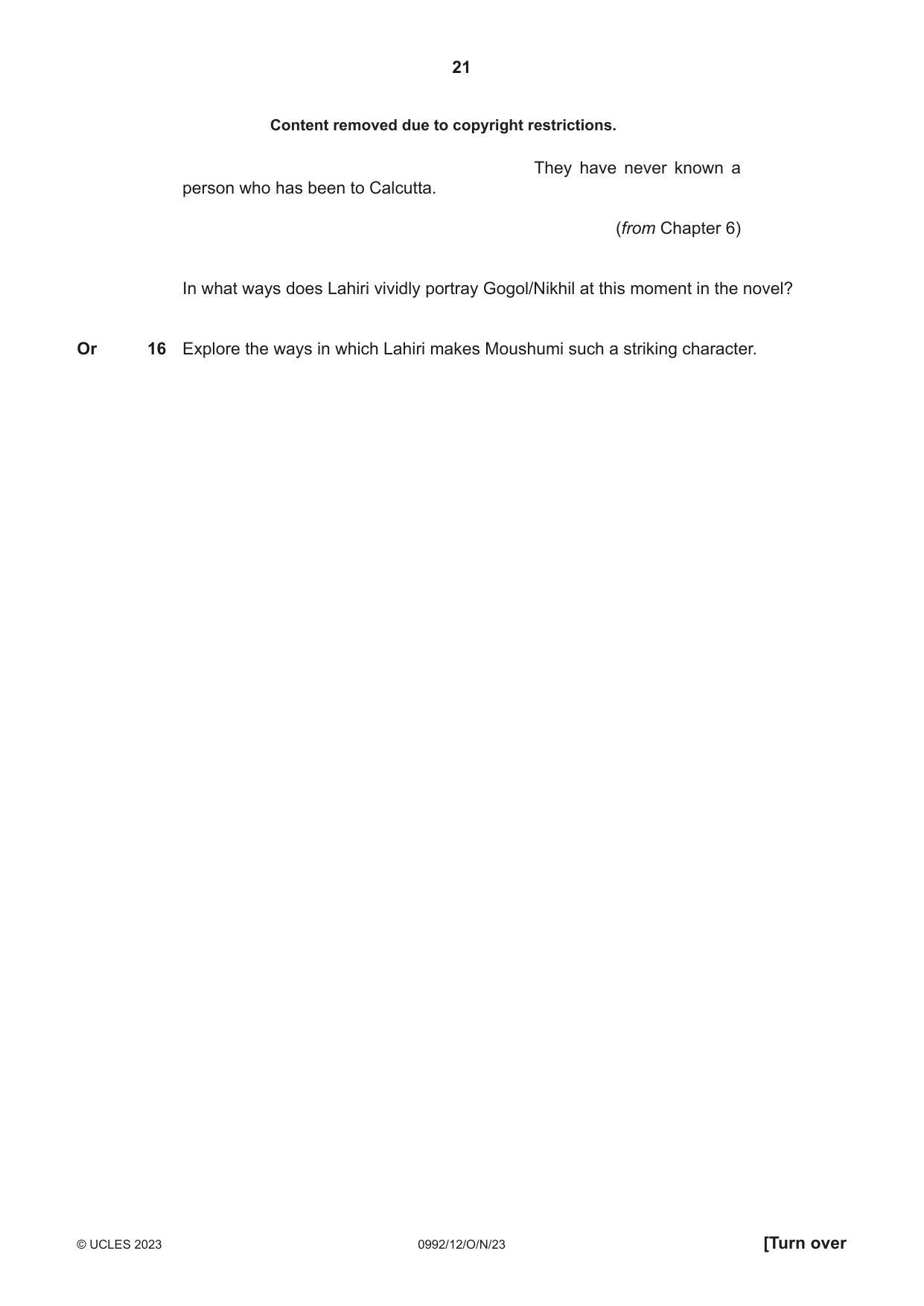
21 0992/12/O/N/23 © UCLES 2023 [Turn over They have never known a person who has been to Calcutta. (from Chapter 6) In what ways does Lahiri vividly portray Gogol/Nikhil at this moment in the novel? Or 16 Explore the ways in which Lahiri makes Moushumi such a striking character. Content removed due to copyright restrictions.
Question paper, page 22
22 0992/12/O/N/23 © UCLES 2023 JOAN LINDSAY: Picnic at Hanging Rock Remember to support your ideas with details from the writing. Either 17 Read this passage, and then answer the question that follows it: Miranda tossed back her straight corn-coloured hair, smiling and waving at a pale little pointed face looking dejectedly down at the animated scene below. With his kindly shrewd blue eyes and cheeks perpetually blooming like the Mount Macedon rose gardens, he was a prime favourite with everyone in the district; even Mrs Appleyard called him her ‘good man’ and enjoyed graciously inviting him into her study for a glass of sherry … (from Chapter 1) Content removed due to copyright restrictions.
Question paper, page 23
23 0992/12/O/N/23 © UCLES 2023 [Turn over In what ways does Lindsay make this a revealing and significant moment in the novel? Or 18 How does Lindsay strikingly portray Irma’s relationship with Mike?
Question paper, page 24
24 0992/12/O/N/23 © UCLES 2023 YANN MARTEL: Life of Pi Remember to support your ideas with details from the writing. Either 19 Read this passage, and then answer the question that follows it: Richard Parker’s head was barely above water. I turned around, stepped over the zebra and threw myself overboard. (from Chapter 37) In what ways does Martel make this such an entertaining moment in the novel? Or 20 Explore how Martel strikingly depicts Pi’s experiences on the meerkat island. Content removed due to copyright restrictions.
Question paper, page 25
25 0992/12/O/N/23 © UCLES 2023 [Turn over TURN OVER FOR QUESTION 21.
Question paper, page 26
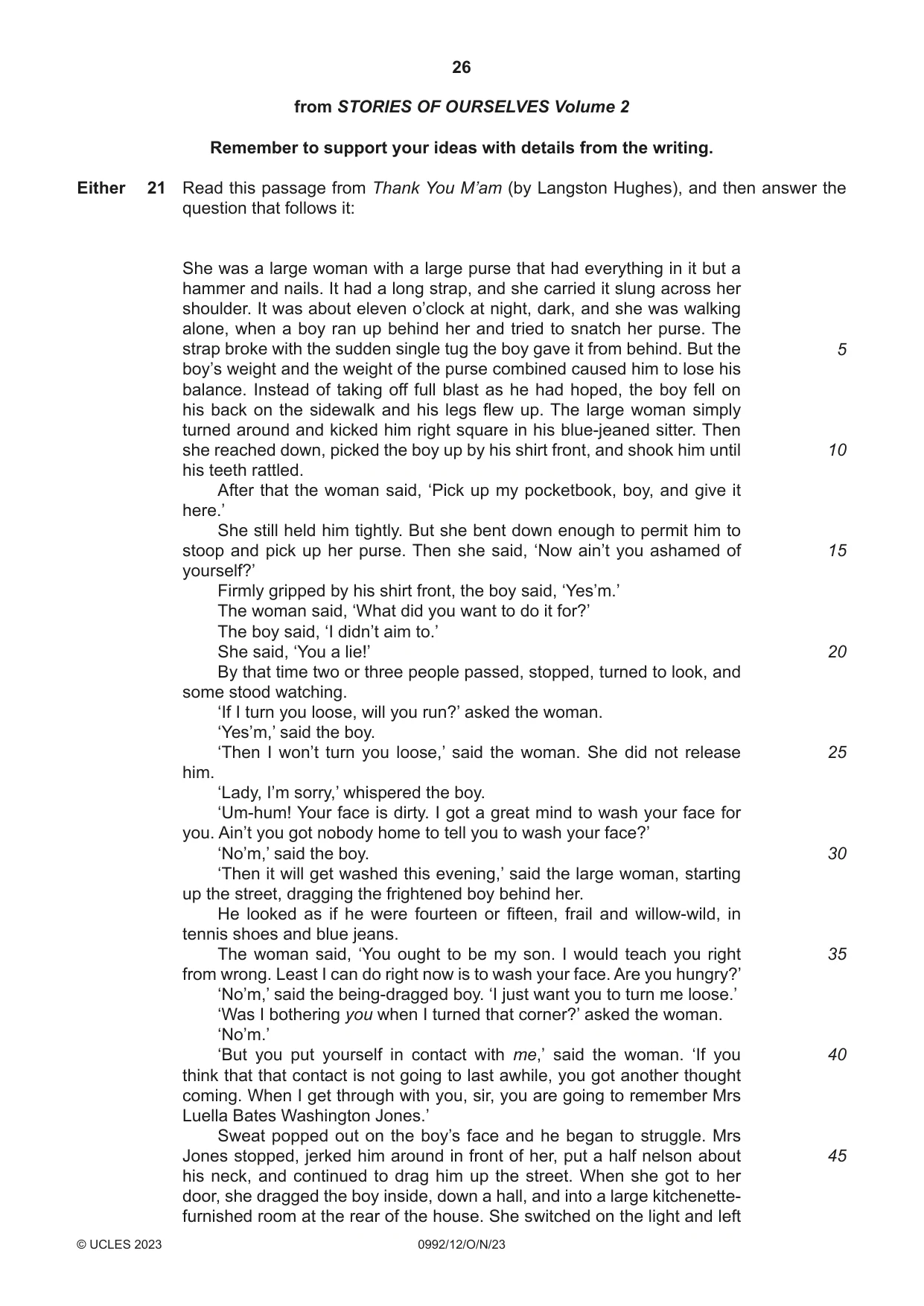
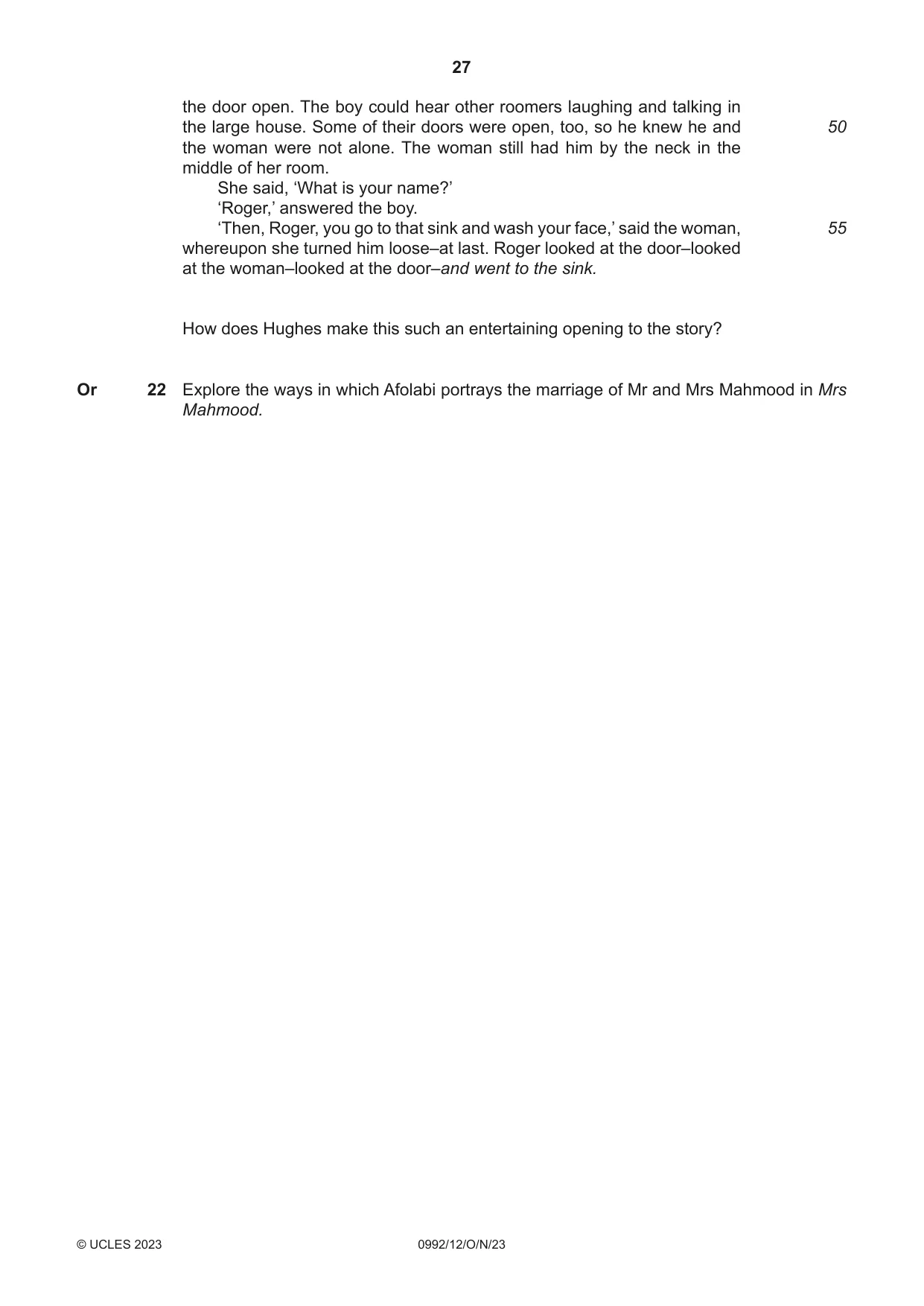
26 0992/12/O/N/23 © UCLES 2023 from STORIES OF OURSELVES Volume 2 Remember to support your ideas with details from the writing. Either 21 Read this passage from Thank You M’am (by Langston Hughes), and then answer the question that follows it: She was a large woman with a large purse that had everything in it but a hammer and nails. It had a long strap, and she carried it slung across her shoulder. It was about eleven o’clock at night, dark, and she was walking alone, when a boy ran up behind her and tried to snatch her purse. The strap broke with the sudden single tug the boy gave it from behind. But the boy’s weight and the weight of the purse combined caused him to lose his balance. Instead of taking off full blast as he had hoped, the boy fell on his back on the sidewalk and his legs flew up. The large woman simply turned around and kicked him right square in his blue-jeaned sitter. Then she reached down, picked the boy up by his shirt front, and shook him until his teeth rattled. After that the woman said, ‘Pick up my pocketbook, boy, and give it here.’ She still held him tightly. But she bent down enough to permit him to stoop and pick up her purse. Then she said, ‘Now ain’t you ashamed of yourself?’ Firmly gripped by his shirt front, the boy said, ‘Yes’m.’ The woman said, ‘What did you want to do it for?’ The boy said, ‘I didn’t aim to.’ She said, ‘You a lie!’ By that time two or three people passed, stopped, turned to look, and some stood watching. ‘If I turn you loose, will you run?’ asked the woman. ‘Yes’m,’ said the boy. ‘Then I won’t turn you loose,’ said the woman. She did not release him. ‘Lady, I’m sorry,’ whispered the boy. ‘Um-hum! Your face is dirty. I got a great mind to wash your face for you. Ain’t you got nobody home to tell you to wash your face?’ ‘No’m,’ said the boy. ‘Then it will get washed this evening,’ said the large woman, starting up the street, dragging the frightened boy behind her. He looked as if he were fourteen or fifteen, frail and willow-wild, in tennis shoes and blue jeans. The woman said, ‘You ought to be my son. I would teach you right from wrong. Least I can do right now is to wash your face. Are you hungry?’ ‘No’m,’ said the being-dragged boy. ‘I just want you to turn me loose.’ ‘Was I bothering you when I turned that corner?’ asked the woman. ‘No’m.’ ‘But you put yourself in contact with me,’ said the woman. ‘If you think that that contact is not going to last awhile, you got another thought coming. When I get through with you, sir, you are going to remember Mrs Luella Bates Washington Jones.’ Sweat popped out on the boy’s face and he began to struggle. Mrs Jones stopped, jerked him around in front of her, put a half nelson about his neck, and continued to drag him up the street. When she got to her door, she dragged the boy inside, down a hall, and into a large kitchenette- furnished room at the rear of the house. She switched on the light and left 5 10 15 20 25 30 35 40 45
Question paper, page 27
27 0992/12/O/N/23 © UCLES 2023 the door open. The boy could hear other roomers laughing and talking in the large house. Some of their doors were open, too, so he knew he and the woman were not alone. The woman still had him by the neck in the middle of her room. She said, ‘What is your name?’ ‘Roger,’ answered the boy. ‘Then, Roger, you go to that sink and wash your face,’ said the woman, whereupon she turned him loose–at last. Roger looked at the door–looked at the woman–looked at the door–and went to the sink. How does Hughes make this such an entertaining opening to the story? Or 22 Explore the ways in which Afolabi portrays the marriage of Mr and Mrs Mahmood in Mrs Mahmood. 50 55
Question paper, page 28
28 0992/12/O/N/23 © UCLES 2023 Permission to reproduce items where third-party owned material protected by copyright is included has been sought and cleared where possible. Every reasonable effort has been made by the publisher (UCLES) to trace copyright holders, but if any items requiring clearance have unwittingly been included, the publisher will be pleased to make amends at the earliest possible opportunity. To avoid the issue of disclosure of answer-related information to candidates, all copyright acknowledgements are reproduced online in the Cambridge Assessment International Education Copyright Acknowledgements Booklet. This is produced for each series of examinations and is freely available to download at www.cambridgeinternational.org after the live examination series. Cambridge Assessment International Education is part of Cambridge Assessment. Cambridge Assessment is the brand name of the University of Cambridge Local Examinations Syndicate (UCLES), which is a department of the University of Cambridge. BLANK PAGE
Mark scheme, page 1
This document consists of 4 printed pages. © UCLES 2023 [Turn over Cambridge IGCSE™ (9–1) LITERATURE IN ENGLISH 0992/12 Paper 1 Poetry and Prose October/November 2023 MARK SCHEME Maximum Mark: 50 Published This mark scheme is published as an aid to teachers and candidates, to indicate the requirements of the examination. It shows the basis on which Examiners were instructed to award marks. It does not indicate the details of the discussions that took place at an Examiners’ meeting before marking began, which would have considered the acceptability of alternative answers. Mark schemes should be read in conjunction with the question paper and the Principal Examiner Report for Teachers. Cambridge International will not enter into discussions about these mark schemes. Cambridge International is publishing the mark schemes for the October/November 2023 series for most Cambridge IGCSE, Cambridge International A and AS Level components, and some Cambridge O Level components.
Mark scheme, page 2
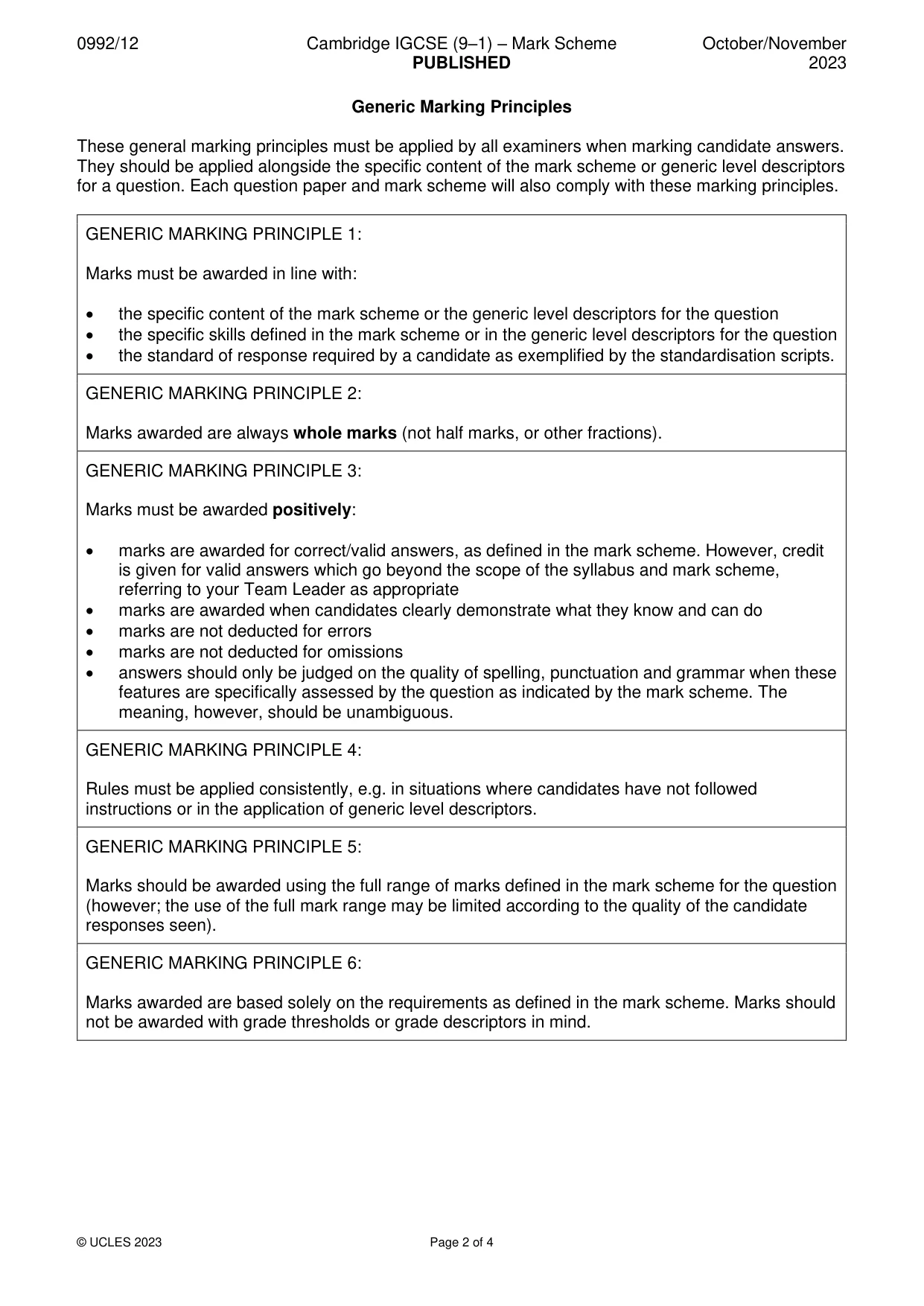
0992/12 Cambridge IGCSE (9–1) – Mark Scheme PUBLISHED October/November 2023 © UCLES 2023 Page 2 of 4 Generic Marking Principles These general marking principles must be applied by all examiners when marking candidate answers. They should be applied alongside the specific content of the mark scheme or generic level descriptors for a question. Each question paper and mark scheme will also comply with these marking principles. GENERIC MARKING PRINCIPLE 1: Marks must be awarded in line with: • the specific content of the mark scheme or the generic level descriptors for the question • the specific skills defined in the mark scheme or in the generic level descriptors for the question • the standard of response required by a candidate as exemplified by the standardisation scripts. GENERIC MARKING PRINCIPLE 2: Marks awarded are always whole marks (not half marks, or other fractions). GENERIC MARKING PRINCIPLE 3: Marks must be awarded positively: • marks are awarded for correct/valid answers, as defined in the mark scheme. However, credit is given for valid answers which go beyond the scope of the syllabus and mark scheme, referring to your Team Leader as appropriate • marks are awarded when candidates clearly demonstrate what they know and can do • marks are not deducted for errors • marks are not deducted for omissions • answers should only be judged on the quality of spelling, punctuation and grammar when these features are specifically assessed by the question as indicated by the mark scheme. The meaning, however, should be unambiguous. GENERIC MARKING PRINCIPLE 4: Rules must be applied consistently, e.g. in situations where candidates have not followed instructions or in the application of generic level descriptors. GENERIC MARKING PRINCIPLE 5: Marks should be awarded using the full range of marks defined in the mark scheme for the question (however; the use of the full mark range may be limited according to the quality of the candidate responses seen). GENERIC MARKING PRINCIPLE 6: Marks awarded are based solely on the requirements as defined in the mark scheme. Marks should not be awarded with grade thresholds or grade descriptors in mind.
Mark scheme, page 3
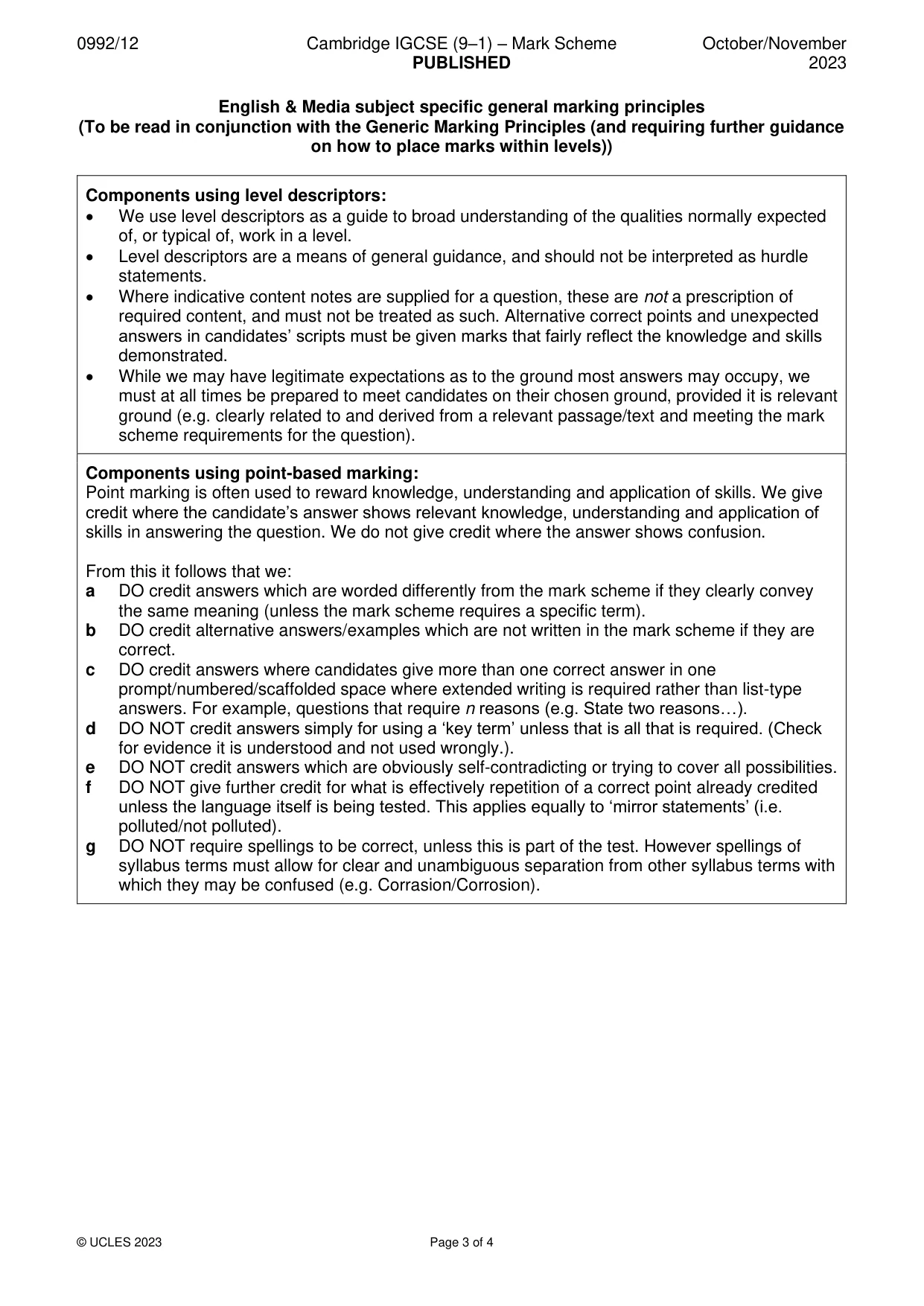
0992/12 Cambridge IGCSE (9–1) – Mark Scheme PUBLISHED October/November 2023 © UCLES 2023 Page 3 of 4 English & Media subject specific general marking principles (To be read in conjunction with the Generic Marking Principles (and requiring further guidance on how to place marks within levels)) Components using level descriptors: • We use level descriptors as a guide to broad understanding of the qualities normally expected of, or typical of, work in a level. • Level descriptors are a means of general guidance, and should not be interpreted as hurdle statements. • Where indicative content notes are supplied for a question, these are not a prescription of required content, and must not be treated as such. Alternative correct points and unexpected answers in candidates’ scripts must be given marks that fairly reflect the knowledge and skills demonstrated. • While we may have legitimate expectations as to the ground most answers may occupy, we must at all times be prepared to meet candidates on their chosen ground, provided it is relevant ground (e.g. clearly related to and derived from a relevant passage/text and meeting the mark scheme requirements for the question). Components using point-based marking: Point marking is often used to reward knowledge, understanding and application of skills. We give credit where the candidate’s answer shows relevant knowledge, understanding and application of skills in answering the question. We do not give credit where the answer shows confusion. From this it follows that we: a DO credit answers which are worded differently from the mark scheme if they clearly convey the same meaning (unless the mark scheme requires a specific term). b DO credit alternative answers/examples which are not written in the mark scheme if they are correct. c DO credit answers where candidates give more than one correct answer in one prompt/numbered/scaffolded space where extended writing is required rather than list-type answers. For example, questions that require n reasons (e.g. State two reasons…). d DO NOT credit answers simply for using a ‘key term’ unless that is all that is required. (Check for evidence it is understood and not used wrongly.). e DO NOT credit answers which are obviously self-contradicting or trying to cover all possibilities. f DO NOT give further credit for what is effectively repetition of a correct point already credited unless the language itself is being tested. This applies equally to ‘mirror statements’ (i.e. polluted/not polluted). g DO NOT require spellings to be correct, unless this is part of the test. However spellings of syllabus terms must allow for clear and unambiguous separation from other syllabus terms with which they may be confused (e.g. Corrasion/Corrosion).
Mark scheme, page 4
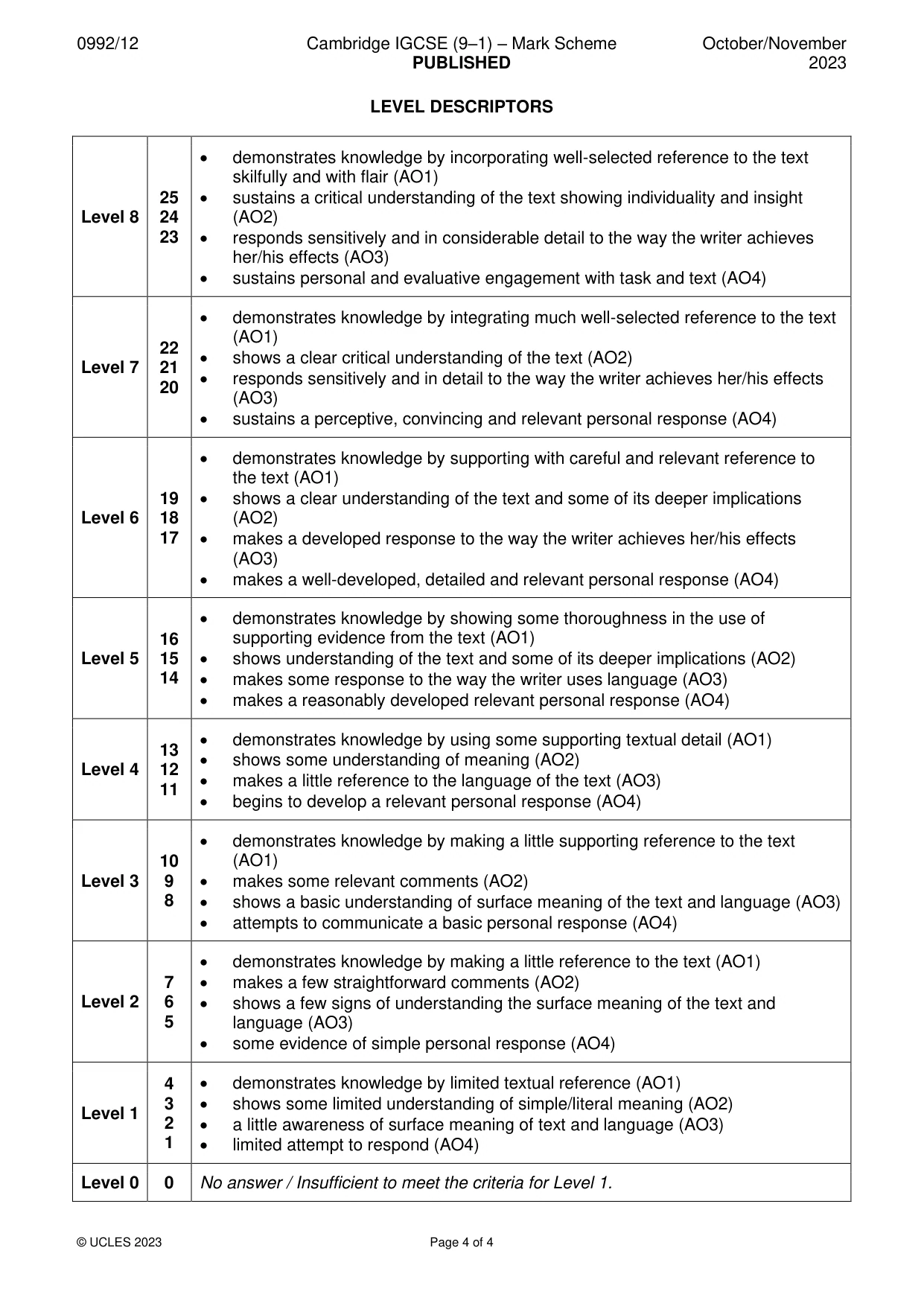
0992/12 Cambridge IGCSE (9–1) – Mark Scheme PUBLISHED October/November 2023 © UCLES 2023 Page 4 of 4 LEVEL DESCRIPTORS Level 8 25 24 23 • demonstrates knowledge by incorporating well-selected reference to the text skilfully and with flair (AO1) • sustains a critical understanding of the text showing individuality and insight (AO2) • responds sensitively and in considerable detail to the way the writer achieves her/his effects (AO3) • sustains personal and evaluative engagement with task and text (AO4) Level 7 22 21 20 • demonstrates knowledge by integrating much well-selected reference to the text (AO1) • shows a clear critical understanding of the text (AO2) • responds sensitively and in detail to the way the writer achieves her/his effects (AO3) • sustains a perceptive, convincing and relevant personal response (AO4) Level 6 19 18 17 • demonstrates knowledge by supporting with careful and relevant reference to the text (AO1) • shows a clear understanding of the text and some of its deeper implications (AO2) • makes a developed response to the way the writer achieves her/his effects (AO3) • makes a well-developed, detailed and relevant personal response (AO4) Level 5 16 15 14 • demonstrates knowledge by showing some thoroughness in the use of supporting evidence from the text (AO1) • shows understanding of the text and some of its deeper implications (AO2) • makes some response to the way the writer uses language (AO3) • makes a reasonably developed relevant personal response (AO4) Level 4 13 12 11 • demonstrates knowledge by using some supporting textual detail (AO1) • shows some understanding of meaning (AO2) • makes a little reference to the language of the text (AO3) • begins to develop a relevant personal response (AO4) Level 3 10 9 8 • demonstrates knowledge by making a little supporting reference to the text (AO1) • makes some relevant comments (AO2) • shows a basic understanding of surface meaning of the text and language (AO3) • attempts to communicate a basic personal response (AO4) Level 2 7 6 5 • demonstrates knowledge by making a little reference to the text (AO1) • makes a few straightforward comments (AO2) • shows a few signs of understanding the surface meaning of the text and language (AO3) • some evidence of simple personal response (AO4) Level 1 4 3 2 1 • demonstrates knowledge by limited textual reference (AO1) • shows some limited understanding of simple/literal meaning (AO2) • a little awareness of surface meaning of text and language (AO3) • limited attempt to respond (AO4) Level 0 0 No answer / Insufficient to meet the criteria for Level 1.
What you needed in this session
Cambridge’s own grade thresholds for 2023 Oct/Nov, Paper 1 · Variant 2. A higher threshold means an easier paper — the bar moves with how the cohort did.