Cambridge IGCSE English - Literature in English (9-1) 0992 — 2024 May/June Paper 1 · Variant 2
0992/12/M/J/24 · 50 marks · ≈56 min
The question paper and its mark scheme, free to read here and free to download. This is Cambridge’s own paper, exactly as it was sat.
Question paper28 pages




Mark scheme4 pages
Answers below. Sit the paper first if you are practising.
Paper as text
Question paper, page 1
This document has 28 pages. Any blank pages are indicated. [Turn over Cambridge IGCSE™(9–1) * 3 0 7 4 1 6 9 9 9 1 * DC (SL) 341466 © UCLES 2024 LITERATURE IN ENGLISH 0992/12 Paper 1 Poetry and Prose May/June 2024 1 hour 30 minutes You must answer on the enclosed answer booklet. You will need: Answer booklet (enclosed) INSTRUCTIONS ● Answer two questions in total: Section A: answer one question. Section B: answer one question. ● Follow the instructions on the front cover of the answer booklet. If you need additional answer paper, ask the invigilator for a continuation booklet. INFORMATION ● The total mark for this paper is 50. ● All questions are worth equal marks.
Question paper, page 2
2 0992/12/M/J/24 © UCLES 2024 BLANK PAGE
Question paper, page 3
3 0992/12/M/J/24 © UCLES 2024 [Turn over CONTENTS Section A: Poetry text question numbers page[s] Songs of Ourselves Volume 1: from Part 4 1, 2 pages 4–5 Songs of Ourselves Volume 2 : from Part 4 3, 4 pages 6–8 Ted Hughes: from New Selected Poems 5, 6 pages 10–11 Section B: Prose text question numbers page[s] Chimamanda Ngozi Adichie: Purple Hibiscus 7, 8 pages 12–13 Charles Dickens: Great Expectations 9, 10 pages 14–15 Daphne du Maurier: Rebecca 11, 12 pages 16–17 Jhumpa Lahiri: The Namesake 13, 14 pages 18–19 Joan Lindsay: Picnic at Hanging Rock 15, 16 pages 20–21 Yann Martel: Life of Pi 17, 18 pages 22–23 H G Wells: The War of the Worlds 19, 20 pages 24–25 from Stories of Ourselves Volume 2 21, 22 pages 26–27
Question paper, page 4
4 0992/12/M/J/24 © UCLES 2024 SECTION A: POETRY Answer one question from this section. SONGS OF OURSELVES VOLUME 1: from Part 4 Remember to support your ideas with details from the writing. Either 1 Read this poem, and then answer the question that follows it: From Long Distance Though my mother was already two years dead and the disconnected number I still call. (Tony Harrison) In what ways does Harrison make this such a moving poem? Content removed due to copyright restrictions.
Question paper, page 5
5 0992/12/M/J/24 © UCLES 2024 [Turn over Or 2 Explore the ways in which Wright makes Request To A Year both amusing and serious. Request To A Year If the year is meditating a suitable gift, reach back and bring me the firmness of her hand. (Judith Wright) Content removed due to copyright restrictions.
Question paper, page 6
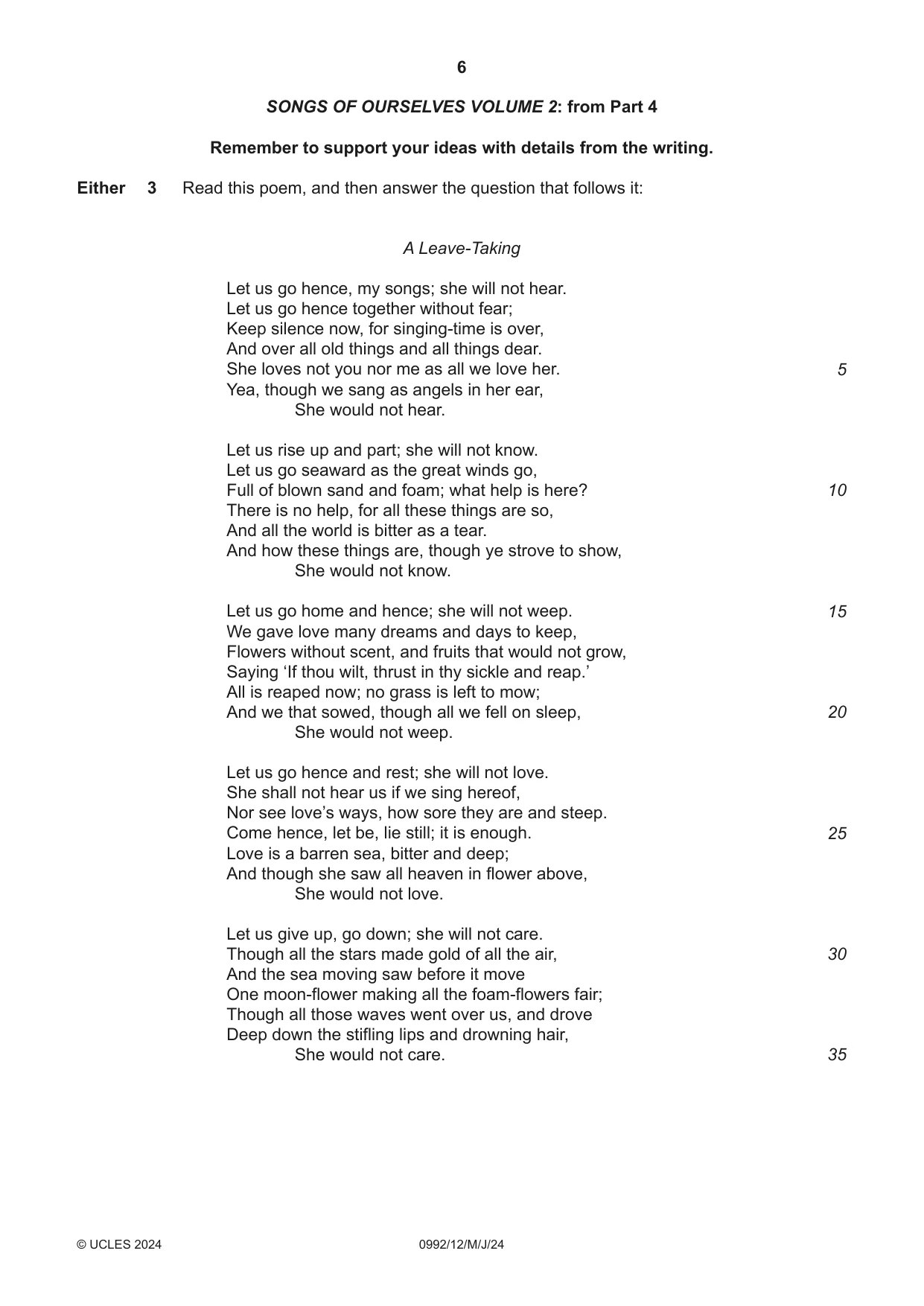
6 0992/12/M/J/24 © UCLES 2024 SONGS OF OURSELVES VOLUME 2: from Part 4 Remember to support your ideas with details from the writing. Either 3 Read this poem, and then answer the question that follows it: A Leave-Taking Let us go hence, my songs; she will not hear. Let us go hence together without fear; Keep silence now, for singing-time is over, And over all old things and all things dear. She loves not you nor me as all we love her. Yea, though we sang as angels in her ear, She would not hear. Let us rise up and part; she will not know. Let us go seaward as the great winds go, Full of blown sand and foam; what help is here? There is no help, for all these things are so, And all the world is bitter as a tear. And how these things are, though ye strove to show, She would not know. Let us go home and hence; she will not weep. We gave love many dreams and days to keep, Flowers without scent, and fruits that would not grow, Saying ‘If thou wilt, thrust in thy sickle and reap.’ All is reaped now; no grass is left to mow; And we that sowed, though all we fell on sleep, She would not weep. Let us go hence and rest; she will not love. She shall not hear us if we sing hereof, Nor see love’s ways, how sore they are and steep. Come hence, let be, lie still; it is enough. Love is a barren sea, bitter and deep; And though she saw all heaven in flower above, She would not love. Let us give up, go down; she will not care. Though all the stars made gold of all the air, And the sea moving saw before it move One moon-flower making all the foam-flowers fair; Though all those waves went over us, and drove Deep down the stifling lips and drowning hair, She would not care. 5 10 15 20 25 30 35
Question paper, page 7
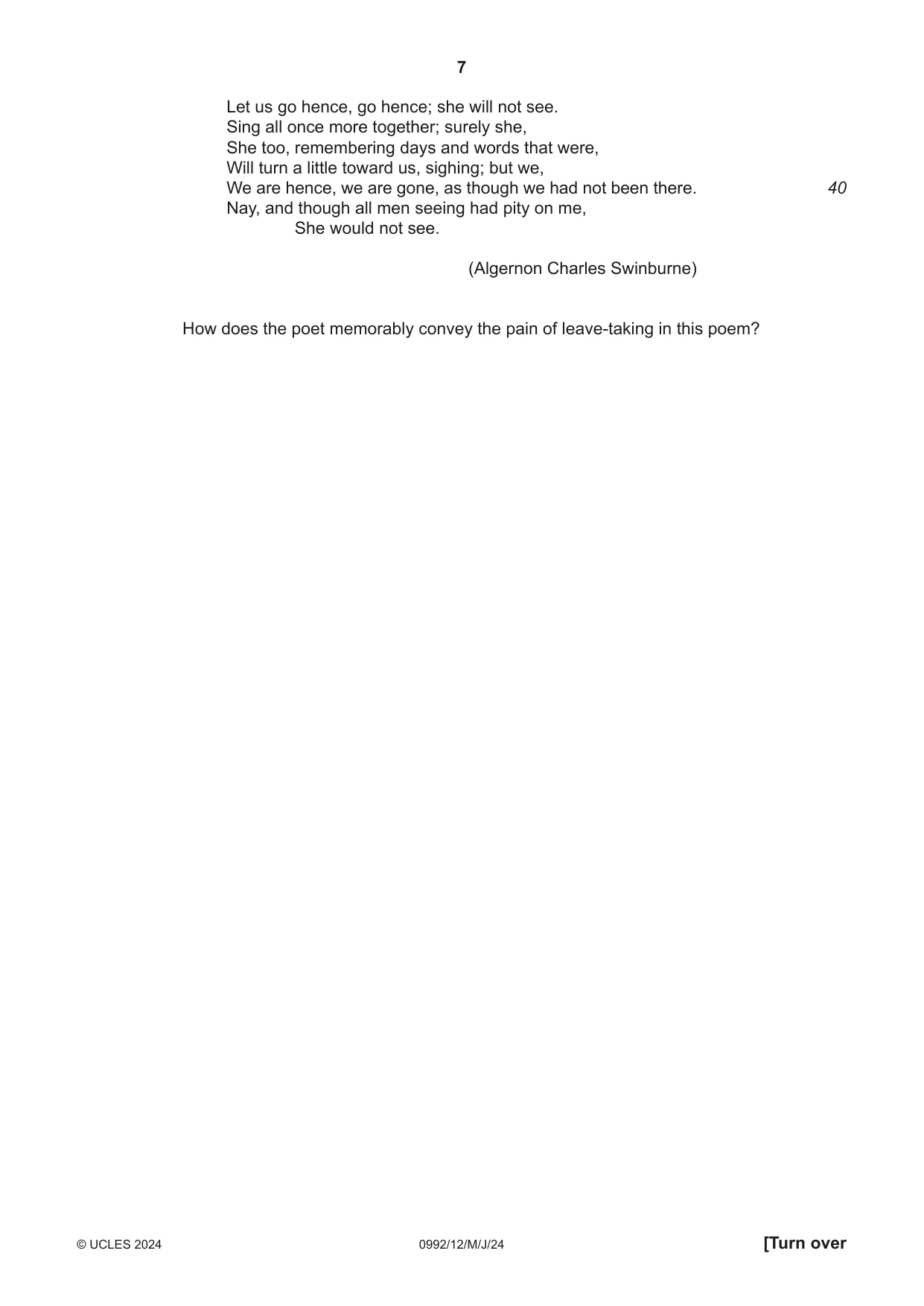
7 0992/12/M/J/24 © UCLES 2024 [Turn over Let us go hence, go hence; she will not see. Sing all once more together; surely she, She too, remembering days and words that were, Will turn a little toward us, sighing; but we, We are hence, we are gone, as though we had not been there. Nay, and though all men seeing had pity on me, She would not see. (Algernon Charles Swinburne) How does the poet memorably convey the pain of leave-taking in this poem? 40
Question paper, page 8
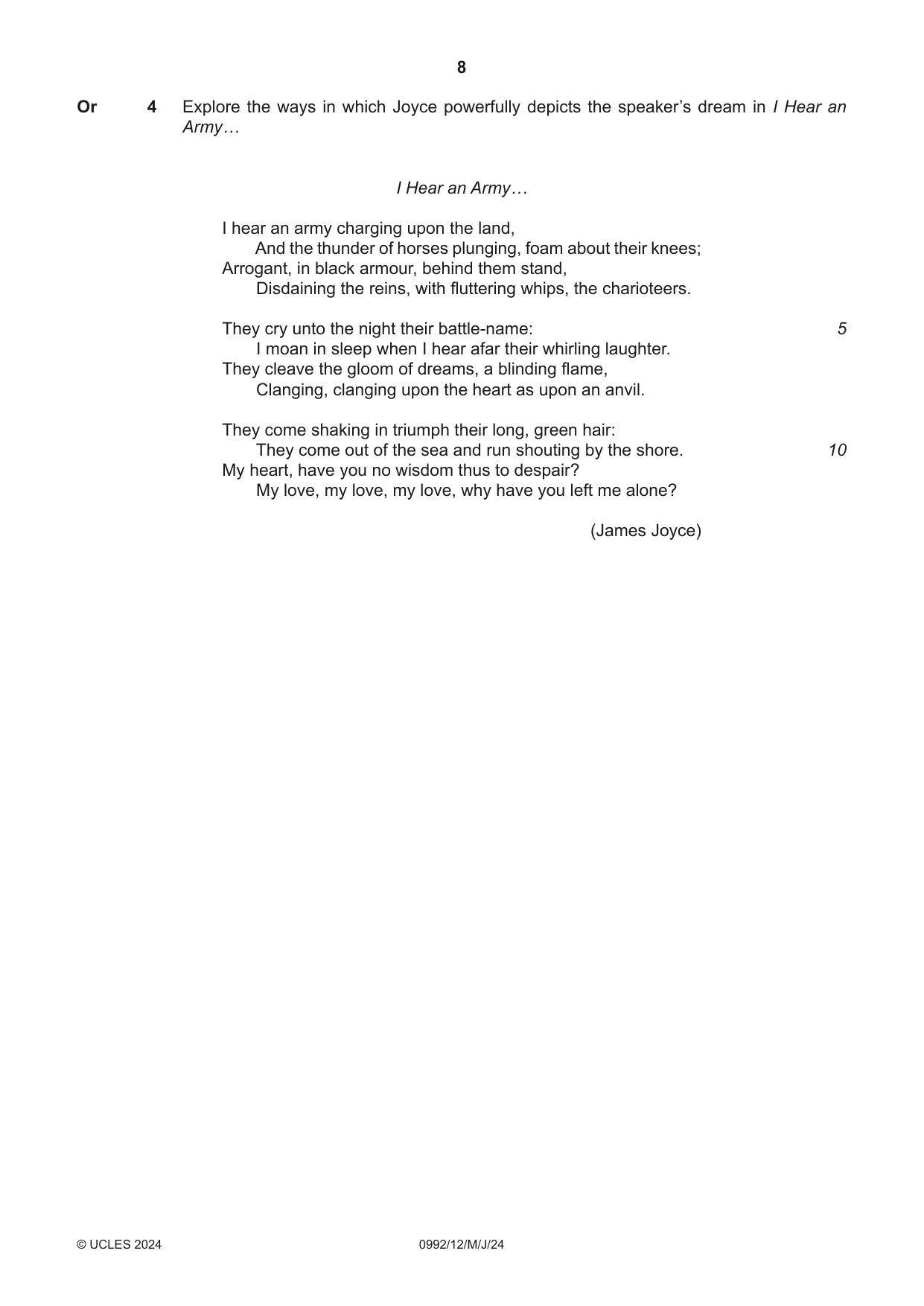
8 0992/12/M/J/24 © UCLES 2024 Or 4 Explore the ways in which Joyce powerfully depicts the speaker’s dream in I Hear an Army… I Hear an Army… I hear an army charging upon the land, And the thunder of horses plunging, foam about their knees; Arrogant, in black armour, behind them stand, Disdaining the reins, with fluttering whips, the charioteers. They cry unto the night their battle-name: I moan in sleep when I hear afar their whirling laughter. They cleave the gloom of dreams, a blinding flame, Clanging, clanging upon the heart as upon an anvil. They come shaking in triumph their long, green hair: They come out of the sea and run shouting by the shore. My heart, have you no wisdom thus to despair? My love, my love, my love, why have you left me alone? (James Joyce) 5 10
Question paper, page 9
9 0992/12/M/J/24 © UCLES 2024 [Turn over TURN OVER FOR QUESTION 5.
Question paper, page 10
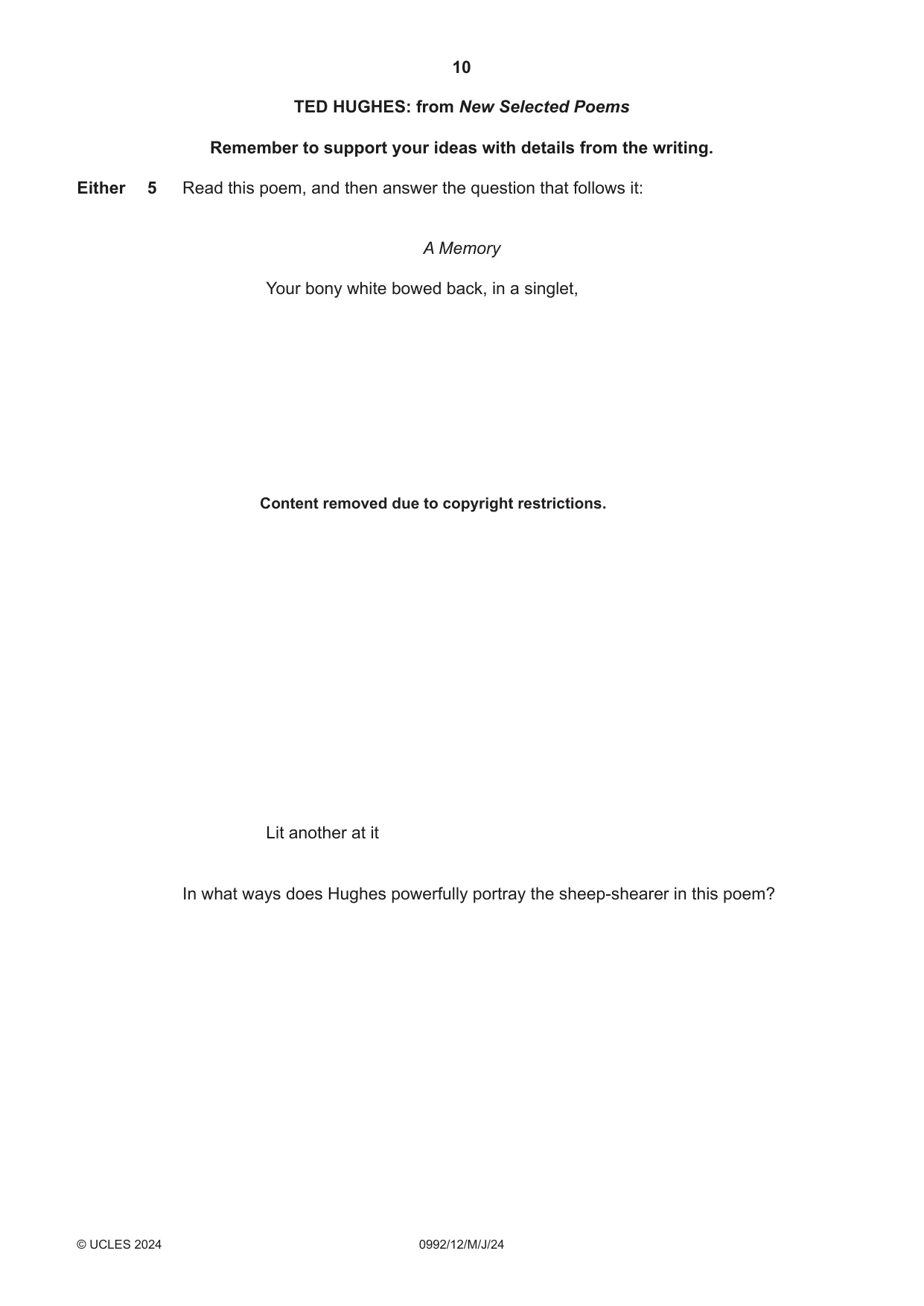
10 0992/12/M/J/24 © UCLES 2024 TED HUGHES: from New Selected Poems Remember to support your ideas with details from the writing. Either 5 Read this poem, and then answer the question that follows it: A Memory Your bony white bowed back, in a singlet, Lit another at it In what ways does Hughes powerfully portray the sheep-shearer in this poem? Content removed due to copyright restrictions.
Question paper, page 11
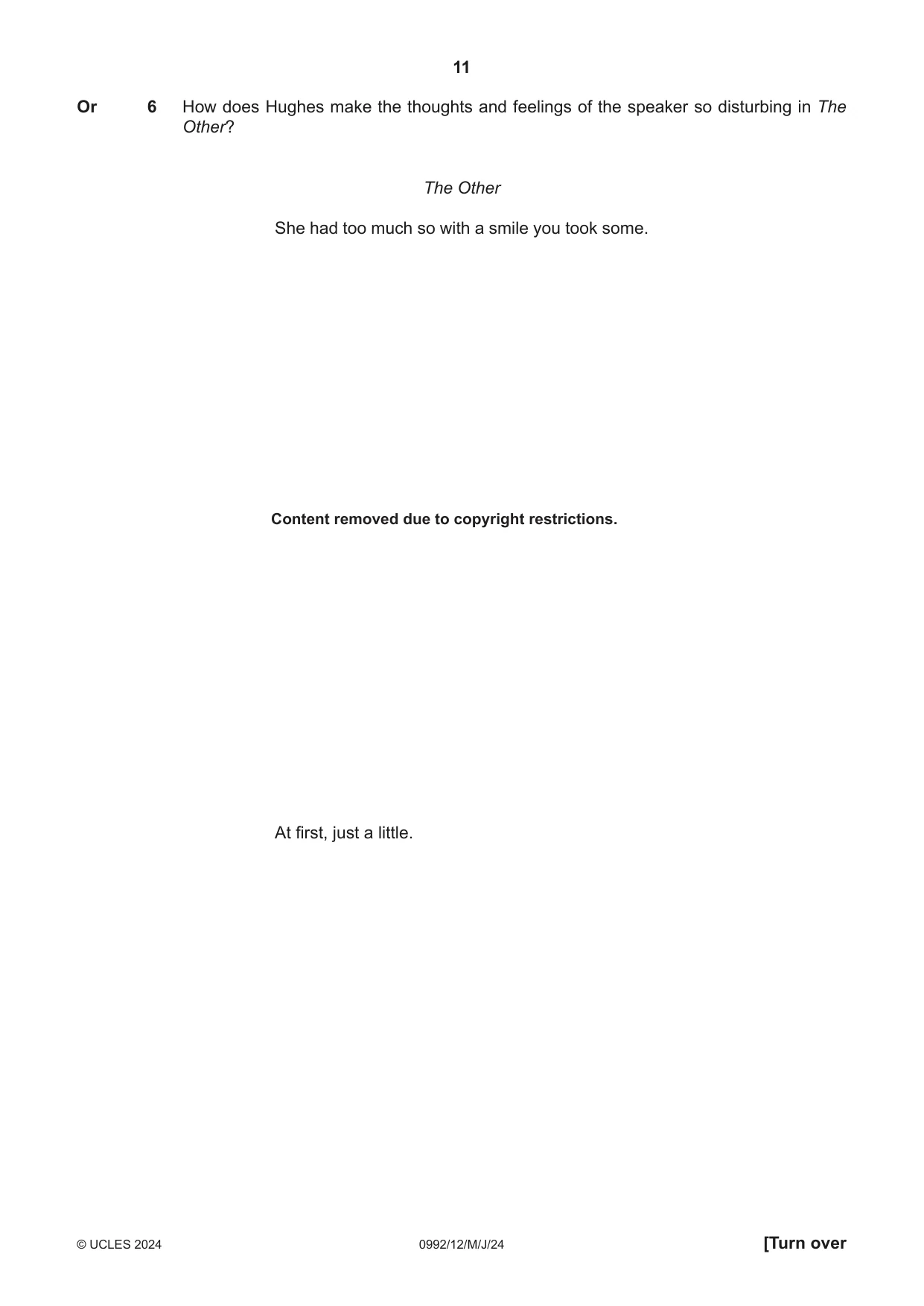
11 0992/12/M/J/24 © UCLES 2024 [Turn over Or 6 How does Hughes make the thoughts and feelings of the speaker so disturbing in The Other? The Other She had too much so with a smile you took some. At first, just a little. Content removed due to copyright restrictions.
Question paper, page 12
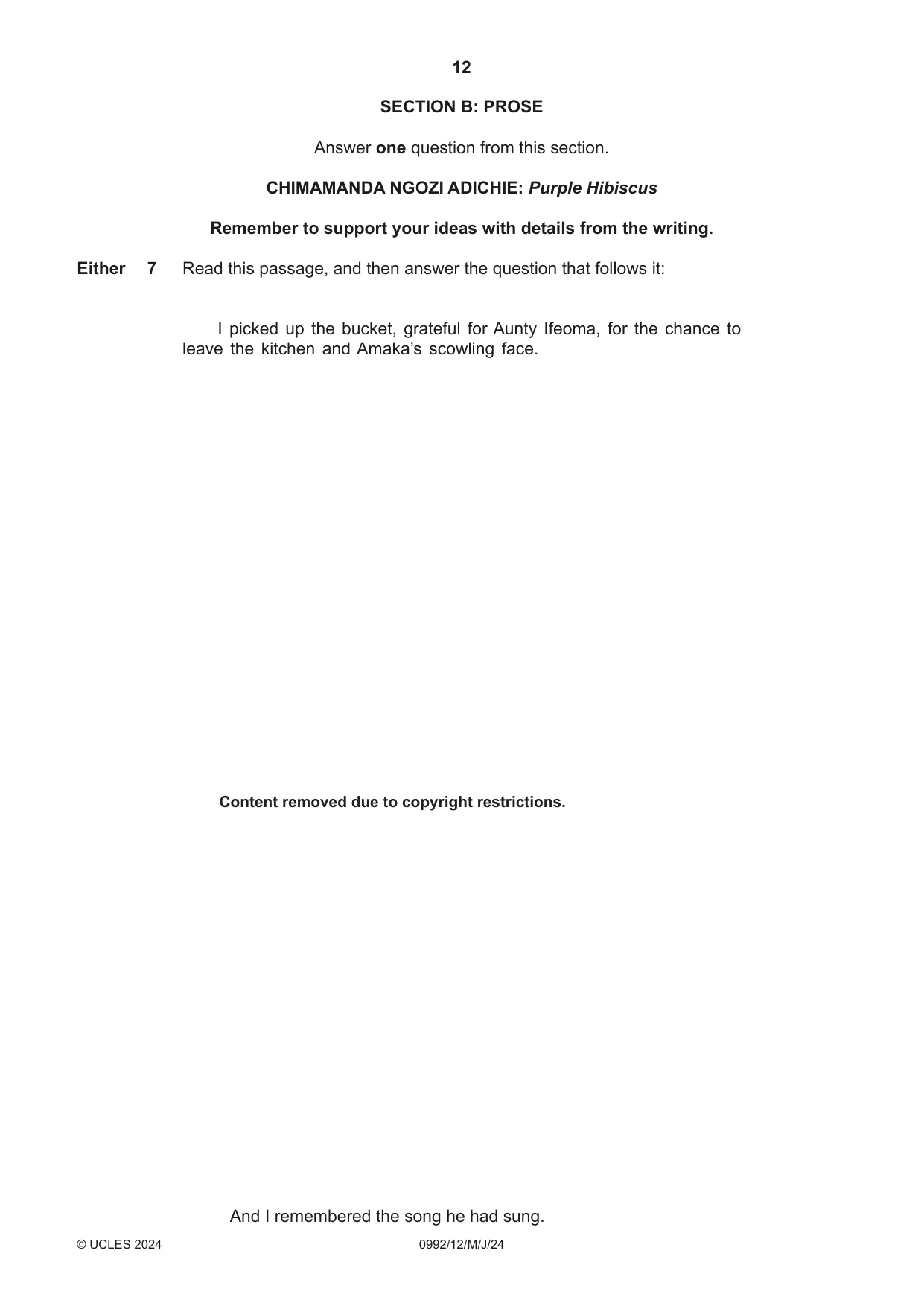
12 0992/12/M/J/24 © UCLES 2024 SECTION B: PROSE Answer one question from this section. CHIMAMANDA NGOZI ADICHIE: Purple Hibiscus Remember to support your ideas with details from the writing. Either 7 Read this passage, and then answer the question that follows it: I picked up the bucket, grateful for Aunty Ifeoma, for the chance to leave the kitchen and Amaka’s scowling face. And I remembered the song he had sung. Content removed due to copyright restrictions.
Question paper, page 13
13 0992/12/M/J/24 © UCLES 2024 [Turn over How does Adichie make this such a memorable and significant introduction to Father Amadi? Or 8 In what ways does Adichie encourage you to admire Jaja?
Question paper, page 14
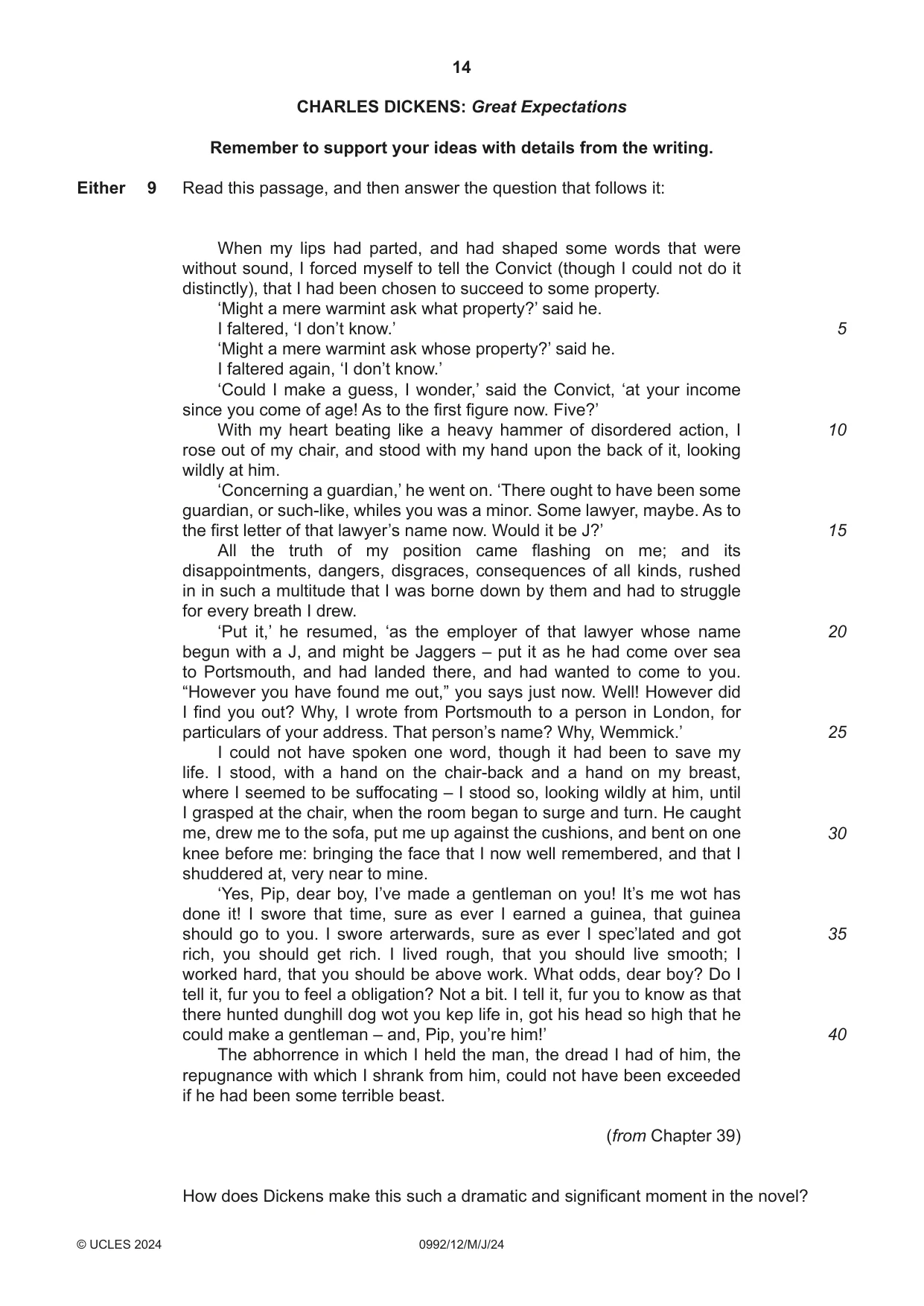
14 0992/12/M/J/24 © UCLES 2024 CHARLES DICKENS: Great Expectations Remember to support your ideas with details from the writing. Either 9 Read this passage, and then answer the question that follows it: When my lips had parted, and had shaped some words that were without sound, I forced myself to tell the Convict (though I could not do it distinctly), that I had been chosen to succeed to some property. ‘Might a mere warmint ask what property?’ said he. I faltered, ‘I don’t know.’ ‘Might a mere warmint ask whose property?’ said he. I faltered again, ‘I don’t know.’ ‘Could I make a guess, I wonder,’ said the Convict, ‘at your income since you come of age! As to the first figure now. Five?’ With my heart beating like a heavy hammer of disordered action, I rose out of my chair, and stood with my hand upon the back of it, looking wildly at him. ‘Concerning a guardian,’ he went on. ‘There ought to have been some guardian, or such-like, whiles you was a minor. Some lawyer, maybe. As to the first letter of that lawyer’s name now. Would it be J?’ All the truth of my position came flashing on me; and its disappointments, dangers, disgraces, consequences of all kinds, rushed in in such a multitude that I was borne down by them and had to struggle for every breath I drew. ‘Put it,’ he resumed, ‘as the employer of that lawyer whose name begun with a J, and might be Jaggers – put it as he had come over sea to Portsmouth, and had landed there, and had wanted to come to you. “However you have found me out,” you says just now. Well! However did I find you out? Why, I wrote from Portsmouth to a person in London, for particulars of your address. That person’s name? Why, Wemmick.’ I could not have spoken one word, though it had been to save my life. I stood, with a hand on the chair-back and a hand on my breast, where I seemed to be suffocating – I stood so, looking wildly at him, until I grasped at the chair, when the room began to surge and turn. He caught me, drew me to the sofa, put me up against the cushions, and bent on one knee before me: bringing the face that I now well remembered, and that I shuddered at, very near to mine. ‘Yes, Pip, dear boy, I’ve made a gentleman on you! It’s me wot has done it! I swore that time, sure as ever I earned a guinea, that guinea should go to you. I swore arterwards, sure as ever I spec’lated and got rich, you should get rich. I lived rough, that you should live smooth; I worked hard, that you should be above work. What odds, dear boy? Do I tell it, fur you to feel a obligation? Not a bit. I tell it, fur you to know as that there hunted dunghill dog wot you kep life in, got his head so high that he could make a gentleman – and, Pip, you’re him!’ The abhorrence in which I held the man, the dread I had of him, the repugnance with which I shrank from him, could not have been exceeded if he had been some terrible beast. (from Chapter 39) How does Dickens make this such a dramatic and significant moment in the novel? 5 10 15 20 25 30 35 40
Question paper, page 15
15 0992/12/M/J/24 © UCLES 2024 [Turn over Or 10 How far does Dickens make it possible for you to have sympathy for Estella?
Question paper, page 16
16 0992/12/M/J/24 © UCLES 2024 DAPHNE DU MAURIER: Rebecca Remember to support your ideas with details from the writing. Either 11 Read this passage, and then answer the question that follows it: We sat there together without saying anything. Content removed due to copyright restrictions.
Question paper, page 17
17 0992/12/M/J/24 © UCLES 2024 [Turn over ‘Yes.’ (from Chapter 20) In what ways does du Maurier make this such a tense moment in the novel? Or 12 Explore the ways in which du Maurier presents Rebecca’s wickedness. Content removed due to copyright restrictions.
Question paper, page 18
18 0992/12/M/J/24 © UCLES 2024 JHUMPA LAHIRI: The Namesake Remember to support your ideas with details from the writing. Either 13 Read this passage, and then answer the question that follows it: There is nothing decorating the room apart from the Massachusetts state and American flags and an oil portrait of a judge. Content removed due to copyright restrictions.
Question paper, page 19
19 0992/12/M/J/24 © UCLES 2024 [Turn over Everyone who comes to his going-away-to-college party writes ‘Good Luck, Gogol’ on the cards. (from Chapter 5) How does Lahiri strikingly convey Gogol’s thoughts and feelings at this moment in the novel? Or 14 In what ways does Lahiri memorably portray the marriage between Ashoke and Ashima? Content removed due to copyright restrictions.
Question paper, page 20
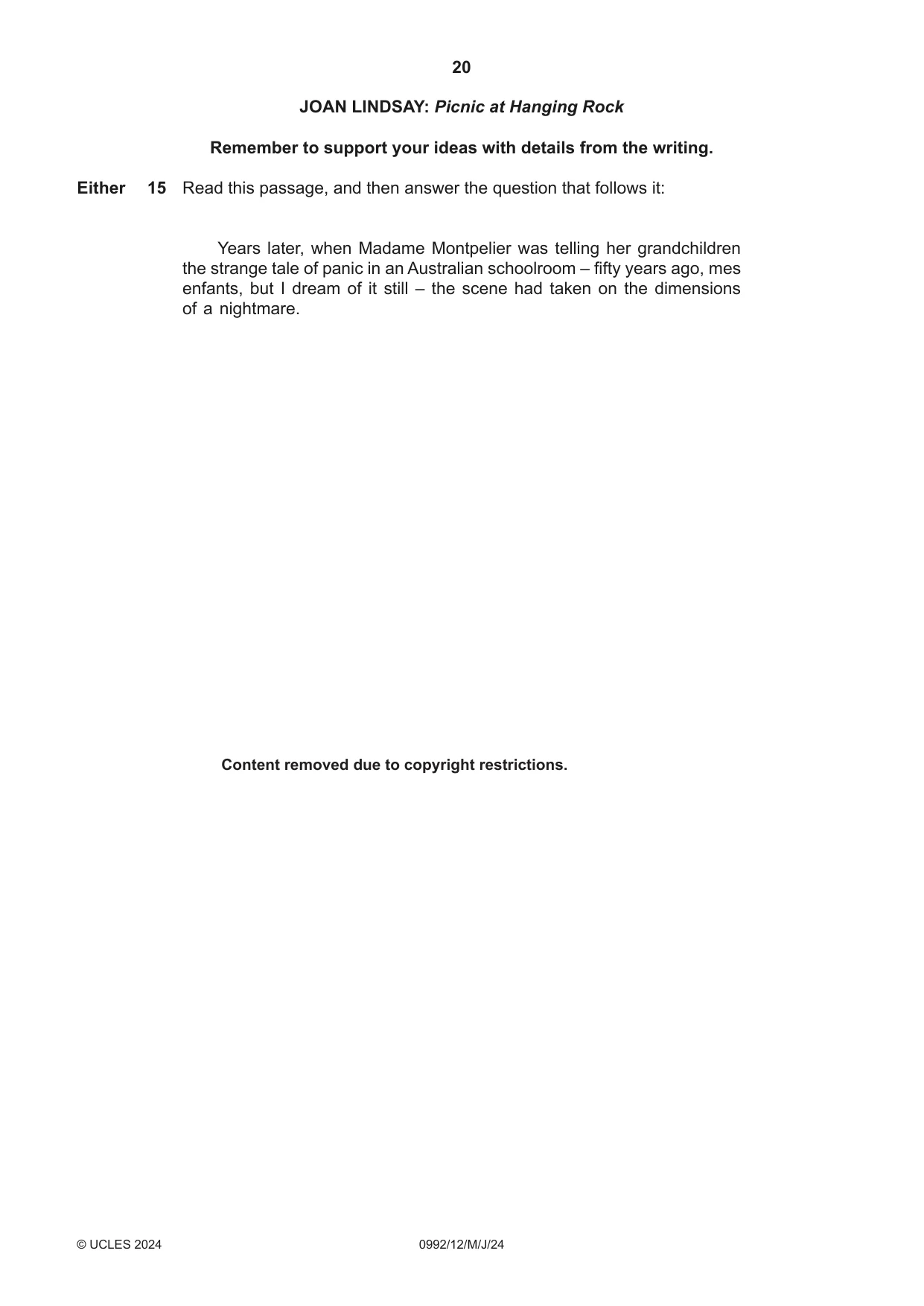
20 0992/12/M/J/24 © UCLES 2024 JOAN LINDSAY: Picnic at Hanging Rock Remember to support your ideas with details from the writing. Either 15 Read this passage, and then answer the question that follows it: Years later, when Madame Montpelier was telling her grandchildren the strange tale of panic in an Australian schoolroom – fifty years ago, mes enfants, but I dream of it still – the scene had taken on the dimensions of a nightmare. Content removed due to copyright restrictions.
Question paper, page 21
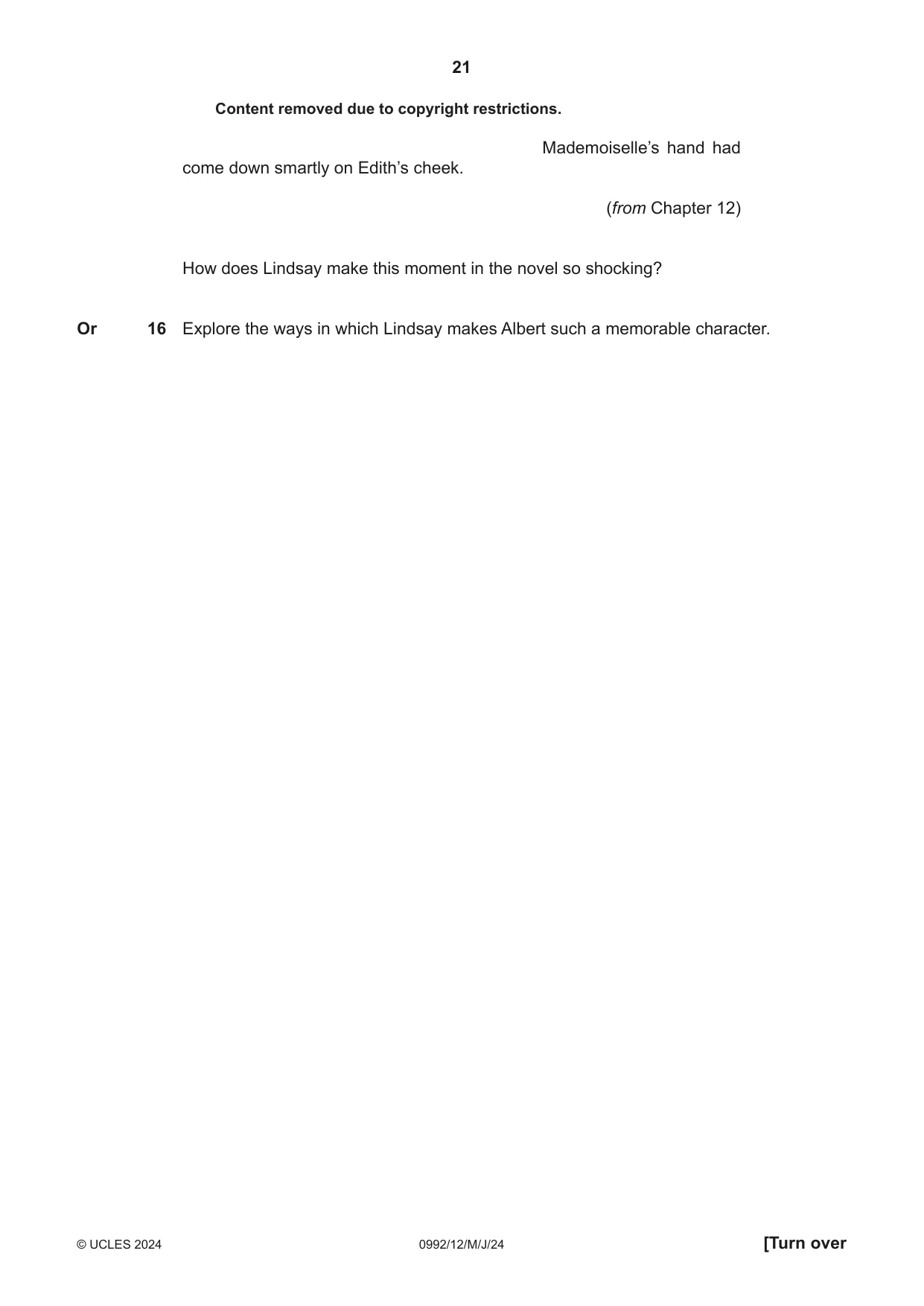
21 0992/12/M/J/24 © UCLES 2024 [Turn over Mademoiselle’s hand had come down smartly on Edith’s cheek. (from Chapter 12) How does Lindsay make this moment in the novel so shocking? Or 16 Explore the ways in which Lindsay makes Albert such a memorable character. Content removed due to copyright restrictions.
Question paper, page 22
22 0992/12/M/J/24 © UCLES 2024 YANN MARTEL: Life of Pi Remember to support your ideas with details from the writing. Either 17 Read this passage, and then answer the question that follows it: I said, ‘Richard Parker, is something wrong? Content removed due to copyright restrictions.
Question paper, page 23
23 0992/12/M/J/24 © UCLES 2024 [Turn over I heard the words, ‘Is someone there?’ (from Chapter 90) How does Martel make this moment in the novel both moving and dramatic? Or 18 Explore the ways in which Martel portrays Pi as such a likeable character. Do not use the passage printed in Question 17 when answering this question. Content removed due to copyright restrictions.
Question paper, page 24
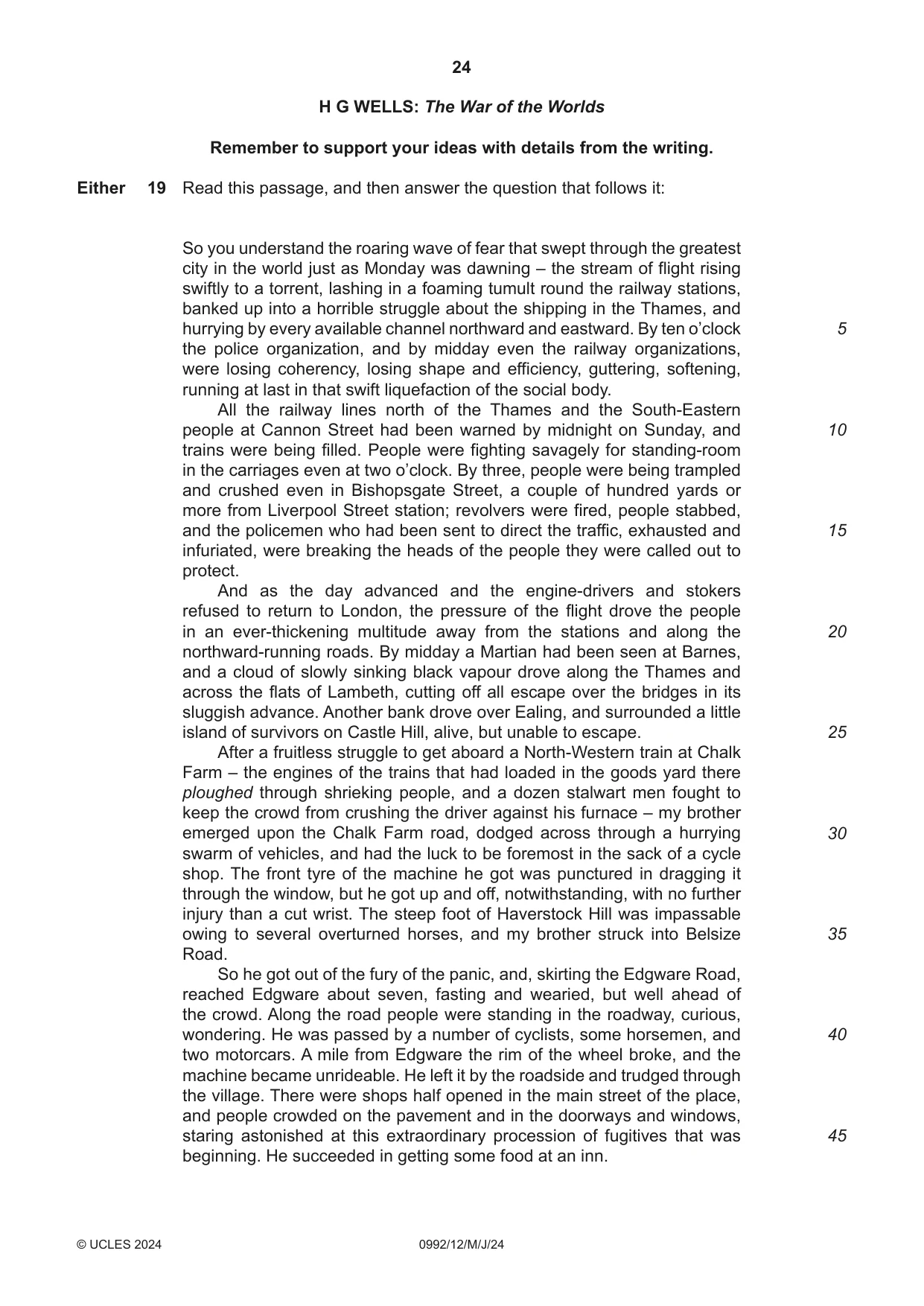
24 0992/12/M/J/24 © UCLES 2024 H G WELLS: The War of the Worlds Remember to support your ideas with details from the writing. Either 19 Read this passage, and then answer the question that follows it: So you understand the roaring wave of fear that swept through the greatest city in the world just as Monday was dawning – the stream of flight rising swiftly to a torrent, lashing in a foaming tumult round the railway stations, banked up into a horrible struggle about the shipping in the Thames, and hurrying by every available channel northward and eastward. By ten o’clock the police organization, and by midday even the railway organizations, were losing coherency, losing shape and efficiency, guttering, softening, running at last in that swift liquefaction of the social body. All the railway lines north of the Thames and the South-Eastern people at Cannon Street had been warned by midnight on Sunday, and trains were being filled. People were fighting savagely for standing-room in the carriages even at two o’clock. By three, people were being trampled and crushed even in Bishopsgate Street, a couple of hundred yards or more from Liverpool Street station; revolvers were fired, people stabbed, and the policemen who had been sent to direct the traffic, exhausted and infuriated, were breaking the heads of the people they were called out to protect. And as the day advanced and the engine-drivers and stokers refused to return to London, the pressure of the flight drove the people in an ever-thickening multitude away from the stations and along the northward-running roads. By midday a Martian had been seen at Barnes, and a cloud of slowly sinking black vapour drove along the Thames and across the flats of Lambeth, cutting off all escape over the bridges in its sluggish advance. Another bank drove over Ealing, and surrounded a little island of survivors on Castle Hill, alive, but unable to escape. After a fruitless struggle to get aboard a North-Western train at Chalk Farm – the engines of the trains that had loaded in the goods yard there ploughed through shrieking people, and a dozen stalwart men fought to keep the crowd from crushing the driver against his furnace – my brother emerged upon the Chalk Farm road, dodged across through a hurrying swarm of vehicles, and had the luck to be foremost in the sack of a cycle shop. The front tyre of the machine he got was punctured in dragging it through the window, but he got up and off, notwithstanding, with no further injury than a cut wrist. The steep foot of Haverstock Hill was impassable owing to several overturned horses, and my brother struck into Belsize Road. So he got out of the fury of the panic, and, skirting the Edgware Road, reached Edgware about seven, fasting and wearied, but well ahead of the crowd. Along the road people were standing in the roadway, curious, wondering. He was passed by a number of cyclists, some horsemen, and two motorcars. A mile from Edgware the rim of the wheel broke, and the machine became unrideable. He left it by the roadside and trudged through the village. There were shops half opened in the main street of the place, and people crowded on the pavement and in the doorways and windows, staring astonished at this extraordinary procession of fugitives that was beginning. He succeeded in getting some food at an inn. 5 10 15 20 25 30 35 40 45
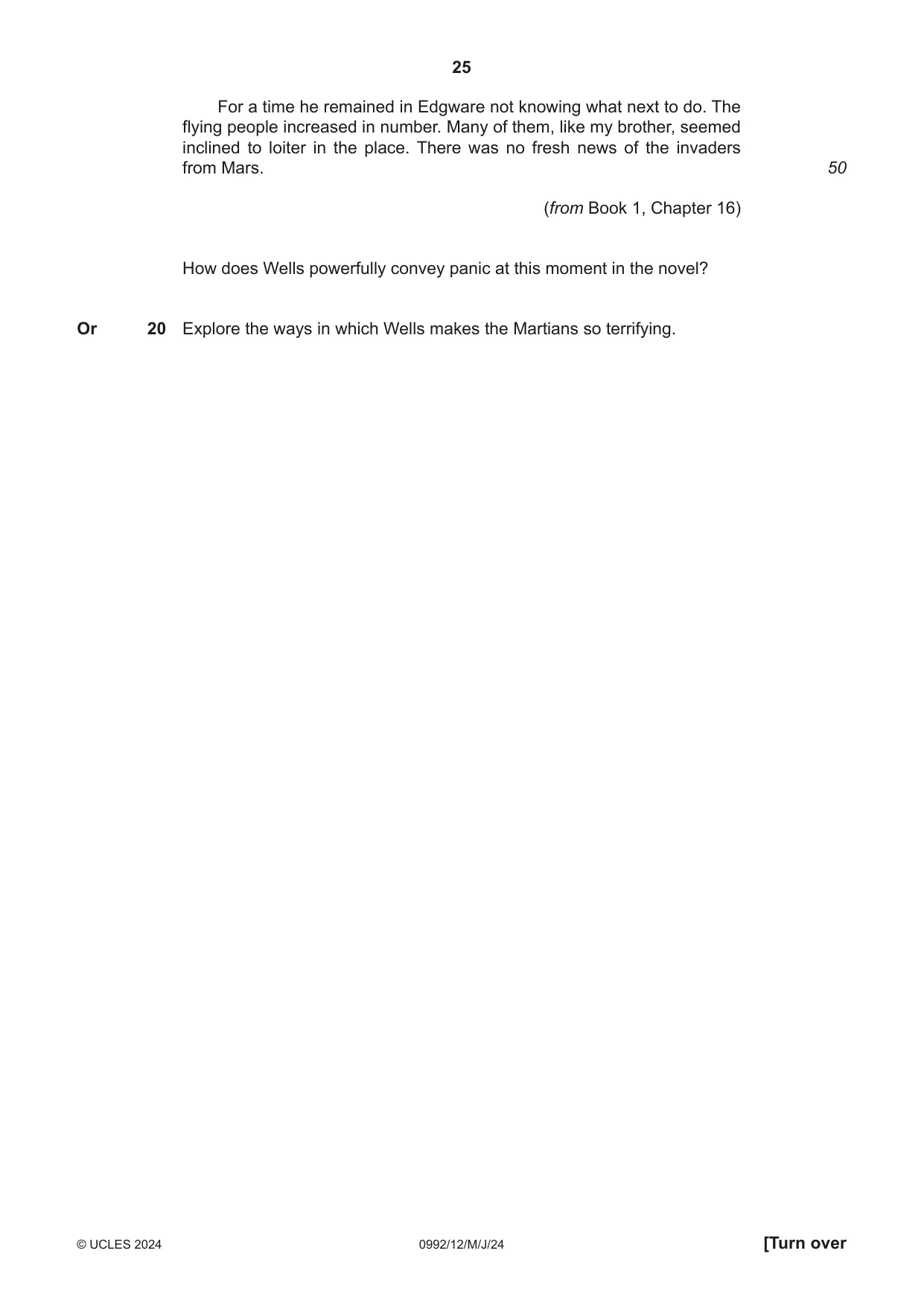
Question paper, page 25
25 0992/12/M/J/24 © UCLES 2024 [Turn over For a time he remained in Edgware not knowing what next to do. The flying people increased in number. Many of them, like my brother, seemed inclined to loiter in the place. There was no fresh news of the invaders from Mars. (from Book 1, Chapter 16) How does Wells powerfully convey panic at this moment in the novel? Or 20 Explore the ways in which Wells makes the Martians so terrifying. 50
Question paper, page 26
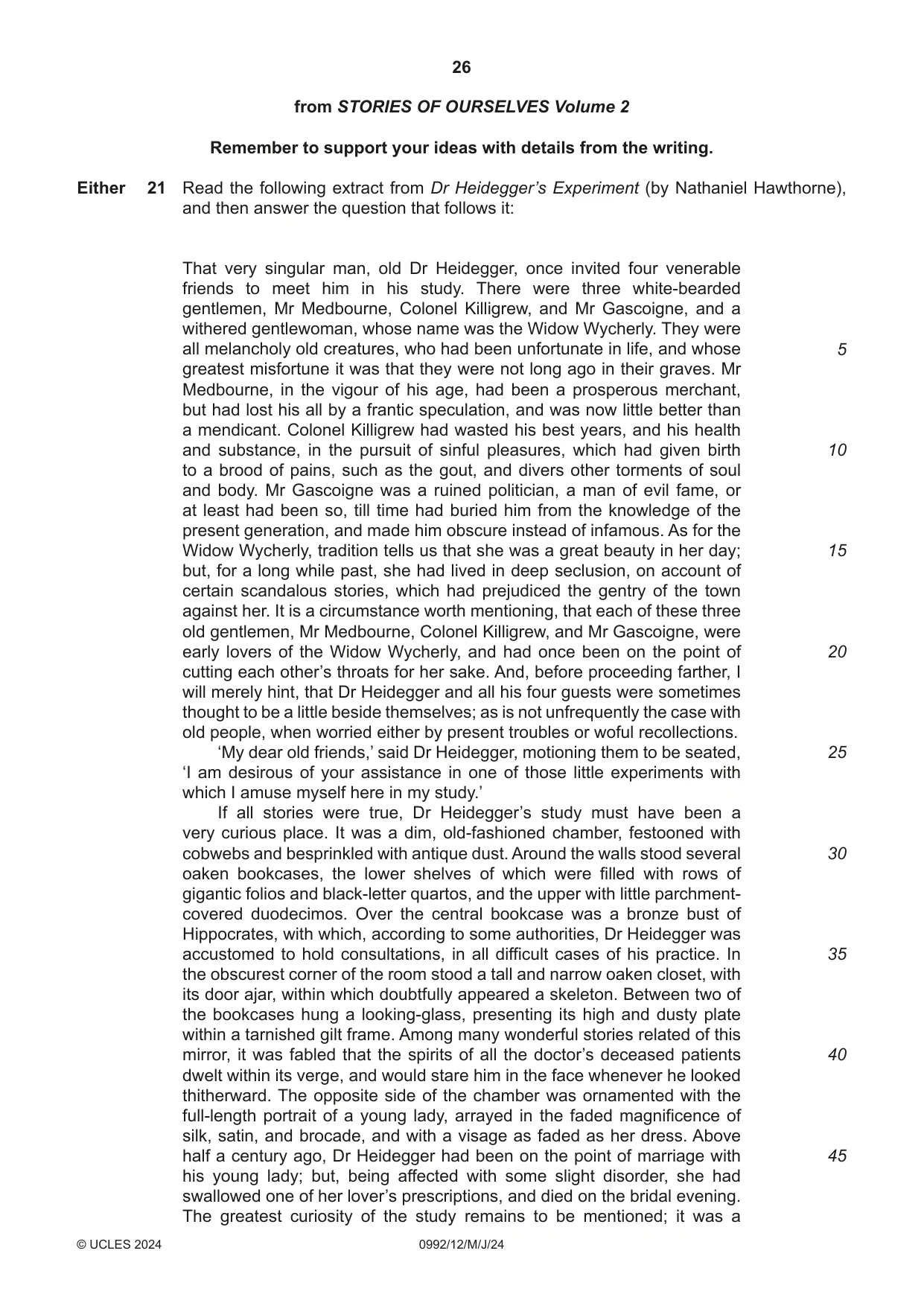
26 0992/12/M/J/24 © UCLES 2024 from STORIES OF OURSELVES Volume 2 Remember to support your ideas with details from the writing. Either 21 Read the following extract from Dr Heidegger’s Experiment (by Nathaniel Hawthorne), and then answer the question that follows it: That very singular man, old Dr Heidegger, once invited four venerable friends to meet him in his study. There were three white-bearded gentlemen, Mr Medbourne, Colonel Killigrew, and Mr Gascoigne, and a withered gentlewoman, whose name was the Widow Wycherly. They were all melancholy old creatures, who had been unfortunate in life, and whose greatest misfortune it was that they were not long ago in their graves. Mr Medbourne, in the vigour of his age, had been a prosperous merchant, but had lost his all by a frantic speculation, and was now little better than a mendicant. Colonel Killigrew had wasted his best years, and his health and substance, in the pursuit of sinful pleasures, which had given birth to a brood of pains, such as the gout, and divers other torments of soul and body. Mr Gascoigne was a ruined politician, a man of evil fame, or at least had been so, till time had buried him from the knowledge of the present generation, and made him obscure instead of infamous. As for the Widow Wycherly, tradition tells us that she was a great beauty in her day; but, for a long while past, she had lived in deep seclusion, on account of certain scandalous stories, which had prejudiced the gentry of the town against her. It is a circumstance worth mentioning, that each of these three old gentlemen, Mr Medbourne, Colonel Killigrew, and Mr Gascoigne, were early lovers of the Widow Wycherly, and had once been on the point of cutting each other’s throats for her sake. And, before proceeding farther, I will merely hint, that Dr Heidegger and all his four guests were sometimes thought to be a little beside themselves; as is not unfrequently the case with old people, when worried either by present troubles or woful recollections. ‘My dear old friends,’ said Dr Heidegger, motioning them to be seated, ‘I am desirous of your assistance in one of those little experiments with which I amuse myself here in my study.’ If all stories were true, Dr Heidegger’s study must have been a very curious place. It was a dim, old-fashioned chamber, festooned with cobwebs and besprinkled with antique dust. Around the walls stood several oaken bookcases, the lower shelves of which were filled with rows of gigantic folios and black-letter quartos, and the upper with little parchment- covered duodecimos. Over the central bookcase was a bronze bust of Hippocrates, with which, according to some authorities, Dr Heidegger was accustomed to hold consultations, in all difficult cases of his practice. In the obscurest corner of the room stood a tall and narrow oaken closet, with its door ajar, within which doubtfully appeared a skeleton. Between two of the bookcases hung a looking-glass, presenting its high and dusty plate within a tarnished gilt frame. Among many wonderful stories related of this mirror, it was fabled that the spirits of all the doctor’s deceased patients dwelt within its verge, and would stare him in the face whenever he looked thitherward. The opposite side of the chamber was ornamented with the full-length portrait of a young lady, arrayed in the faded magnificence of silk, satin, and brocade, and with a visage as faded as her dress. Above half a century ago, Dr Heidegger had been on the point of marriage with his young lady; but, being affected with some slight disorder, she had swallowed one of her lover’s prescriptions, and died on the bridal evening. The greatest curiosity of the study remains to be mentioned; it was a 5 10 15 20 25 30 35 40 45
Question paper, page 27
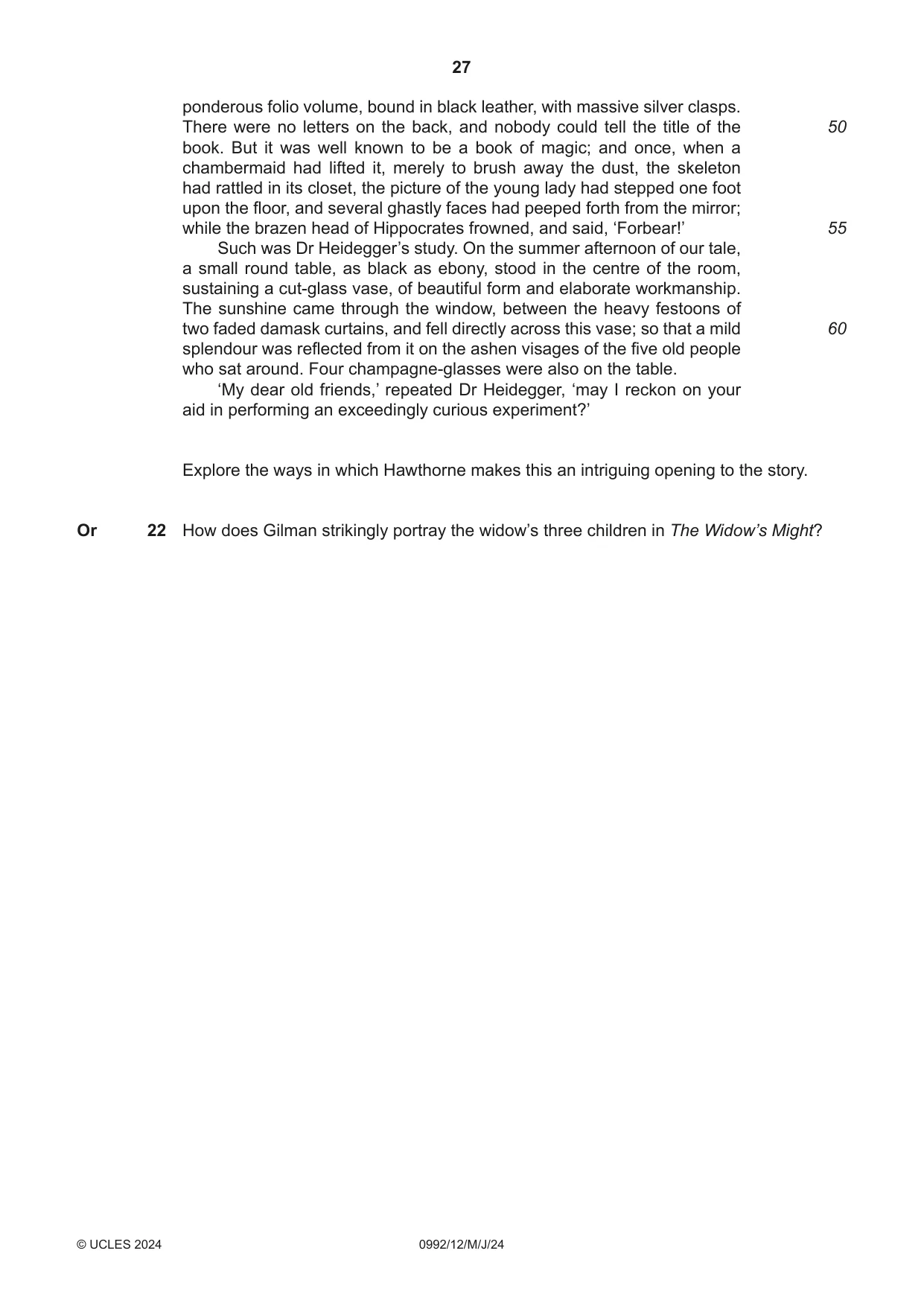
27 0992/12/M/J/24 © UCLES 2024 ponderous folio volume, bound in black leather, with massive silver clasps. There were no letters on the back, and nobody could tell the title of the book. But it was well known to be a book of magic; and once, when a chambermaid had lifted it, merely to brush away the dust, the skeleton had rattled in its closet, the picture of the young lady had stepped one foot upon the floor, and several ghastly faces had peeped forth from the mirror; while the brazen head of Hippocrates frowned, and said, ‘Forbear!’ Such was Dr Heidegger’s study. On the summer afternoon of our tale, a small round table, as black as ebony, stood in the centre of the room, sustaining a cut-glass vase, of beautiful form and elaborate workmanship. The sunshine came through the window, between the heavy festoons of two faded damask curtains, and fell directly across this vase; so that a mild splendour was reflected from it on the ashen visages of the five old people who sat around. Four champagne-glasses were also on the table. ‘My dear old friends,’ repeated Dr Heidegger, ‘may I reckon on your aid in performing an exceedingly curious experiment?’ Explore the ways in which Hawthorne makes this an intriguing opening to the story. Or 22 How does Gilman strikingly portray the widow’s three children in The Widow’s Might? 50 55 60
Question paper, page 28
28 0992/12/M/J/24 © UCLES 2024 Permission to reproduce items where third-party owned material protected by copyright is included has been sought and cleared where possible. Every reasonable effort has been made by the publisher (UCLES) to trace copyright holders, but if any items requiring clearance have unwittingly been included, the publisher will be pleased to make amends at the earliest possible opportunity. To avoid the issue of disclosure of answer-related information to candidates, all copyright acknowledgements are reproduced online in the Cambridge Assessment International Education Copyright Acknowledgements Booklet. This is produced for each series of examinations and is freely available to download at www.cambridgeinternational.org after the live examination series. Cambridge Assessment International Education is part of Cambridge Assessment. Cambridge Assessment is the brand name of the University of Cambridge Local Examinations Syndicate (UCLES), which is a department of the University of Cambridge. BLANK PAGE
Mark scheme, page 1
This document consists of 4 printed pages. © Cambridge University Press & Assessment 2024 [Turn over Cambridge IGCSE™ (9–1) LITERATURE IN ENGLISH (9–1) 0992/12 Paper 1 Poetry and Prose May/June 2024 MARK SCHEME Maximum Mark: 50 Published This mark scheme is published as an aid to teachers and candidates, to indicate the requirements of the examination. It shows the basis on which Examiners were instructed to award marks. It does not indicate the details of the discussions that took place at an Examiners’ meeting before marking began, which would have considered the acceptability of alternative answers. Mark schemes should be read in conjunction with the question paper and the Principal Examiner Report for Teachers. Cambridge International will not enter into discussions about these mark schemes. Cambridge International is publishing the mark schemes for the May/June 2024 series for most Cambridge IGCSE, Cambridge International A and AS Level and Cambridge Pre-U components, and some Cambridge O Level components.
Mark scheme, page 2
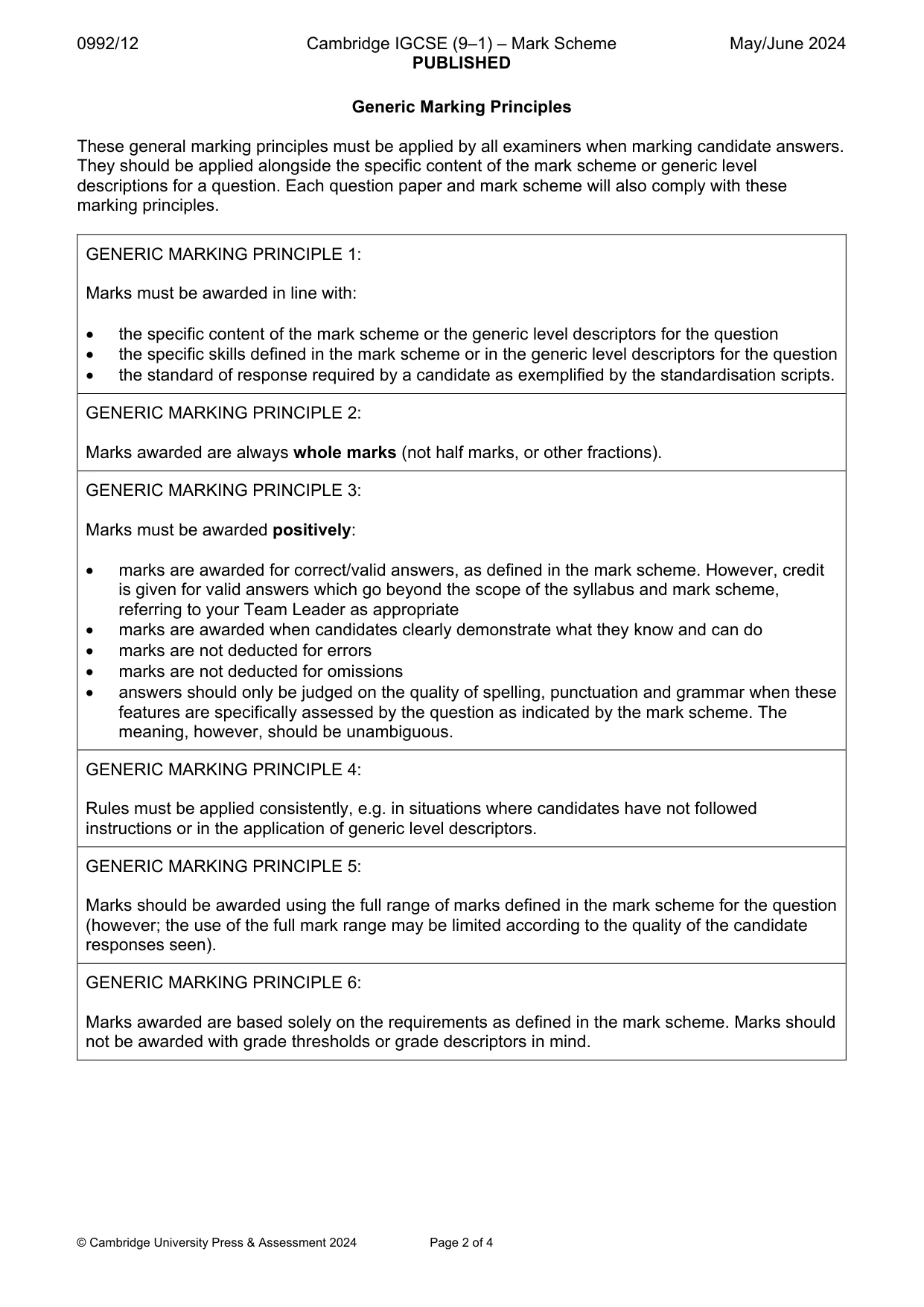
0992/12 Cambridge IGCSE (9–1) – Mark Scheme PUBLISHED May/June 2024 © Cambridge University Press & Assessment 2024 Page 2 of 4 Generic Marking Principles These general marking principles must be applied by all examiners when marking candidate answers. They should be applied alongside the specific content of the mark scheme or generic level descriptions for a question. Each question paper and mark scheme will also comply with these marking principles. GENERIC MARKING PRINCIPLE 1: Marks must be awarded in line with: the specific content of the mark scheme or the generic level descriptors for the question the specific skills defined in the mark scheme or in the generic level descriptors for the question the standard of response required by a candidate as exemplified by the standardisation scripts. GENERIC MARKING PRINCIPLE 2: Marks awarded are always whole marks (not half marks, or other fractions). GENERIC MARKING PRINCIPLE 3: Marks must be awarded positively: marks are awarded for correct/valid answers, as defined in the mark scheme. However, credit is given for valid answers which go beyond the scope of the syllabus and mark scheme, referring to your Team Leader as appropriate marks are awarded when candidates clearly demonstrate what they know and can do marks are not deducted for errors marks are not deducted for omissions answers should only be judged on the quality of spelling, punctuation and grammar when these features are specifically assessed by the question as indicated by the mark scheme. The meaning, however, should be unambiguous. GENERIC MARKING PRINCIPLE 4: Rules must be applied consistently, e.g. in situations where candidates have not followed instructions or in the application of generic level descriptors. GENERIC MARKING PRINCIPLE 5: Marks should be awarded using the full range of marks defined in the mark scheme for the question (however; the use of the full mark range may be limited according to the quality of the candidate responses seen). GENERIC MARKING PRINCIPLE 6: Marks awarded are based solely on the requirements as defined in the mark scheme. Marks should not be awarded with grade thresholds or grade descriptors in mind.
Mark scheme, page 3
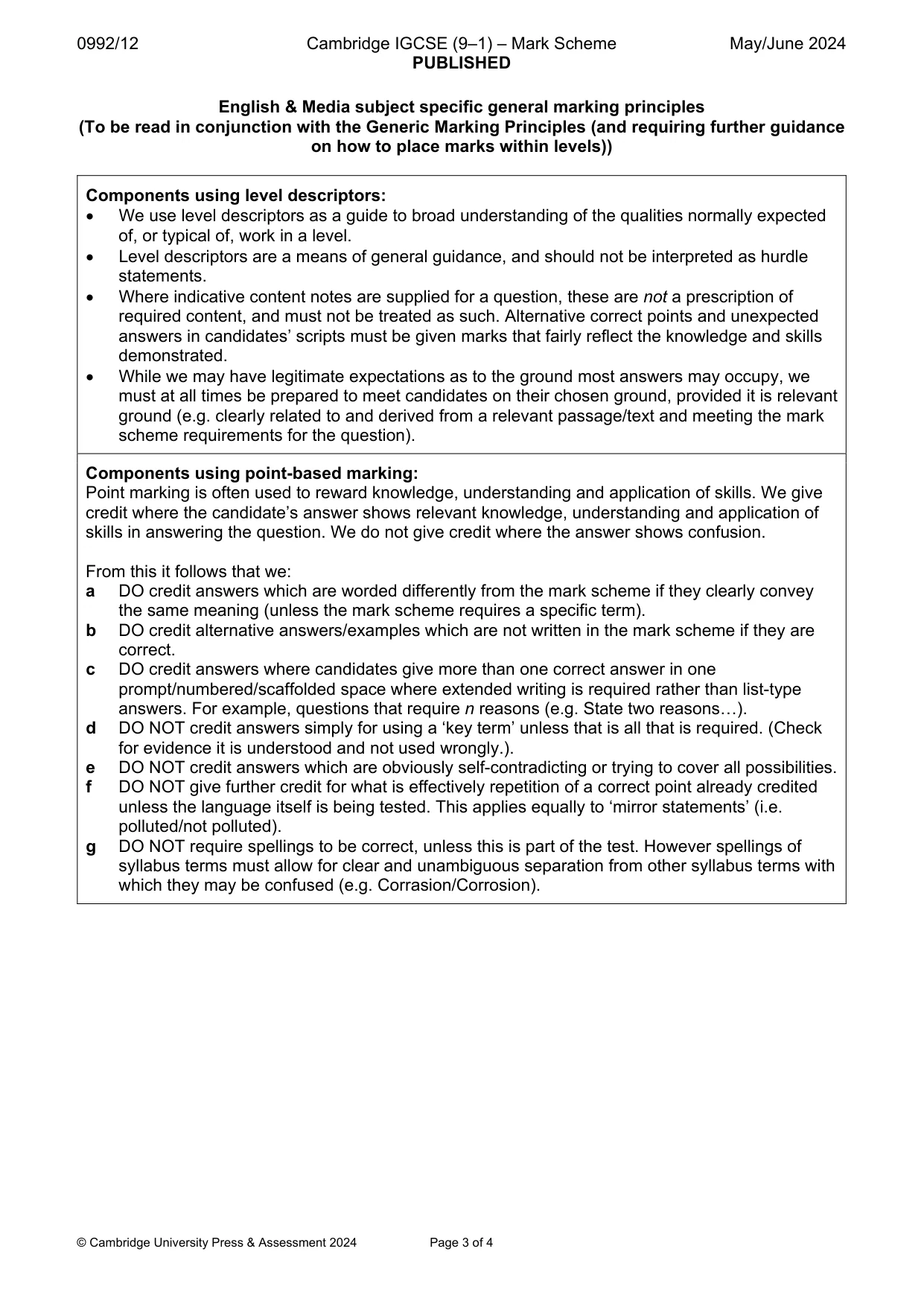
0992/12 Cambridge IGCSE (9–1) – Mark Scheme PUBLISHED May/June 2024 © Cambridge University Press & Assessment 2024 Page 3 of 4 English & Media subject specific general marking principles (To be read in conjunction with the Generic Marking Principles (and requiring further guidance on how to place marks within levels)) Components using level descriptors: We use level descriptors as a guide to broad understanding of the qualities normally expected of, or typical of, work in a level. Level descriptors are a means of general guidance, and should not be interpreted as hurdle statements. Where indicative content notes are supplied for a question, these are not a prescription of required content, and must not be treated as such. Alternative correct points and unexpected answers in candidates’ scripts must be given marks that fairly reflect the knowledge and skills demonstrated. While we may have legitimate expectations as to the ground most answers may occupy, we must at all times be prepared to meet candidates on their chosen ground, provided it is relevant ground (e.g. clearly related to and derived from a relevant passage/text and meeting the mark scheme requirements for the question). Components using point-based marking: Point marking is often used to reward knowledge, understanding and application of skills. We give credit where the candidate’s answer shows relevant knowledge, understanding and application of skills in answering the question. We do not give credit where the answer shows confusion. From this it follows that we: a DO credit answers which are worded differently from the mark scheme if they clearly convey the same meaning (unless the mark scheme requires a specific term). b DO credit alternative answers/examples which are not written in the mark scheme if they are correct. c DO credit answers where candidates give more than one correct answer in one prompt/numbered/scaffolded space where extended writing is required rather than list-type answers. For example, questions that require n reasons (e.g. State two reasons…). d DO NOT credit answers simply for using a ‘key term’ unless that is all that is required. (Check for evidence it is understood and not used wrongly.). e DO NOT credit answers which are obviously self-contradicting or trying to cover all possibilities. f DO NOT give further credit for what is effectively repetition of a correct point already credited unless the language itself is being tested. This applies equally to ‘mirror statements’ (i.e. polluted/not polluted). g DO NOT require spellings to be correct, unless this is part of the test. However spellings of syllabus terms must allow for clear and unambiguous separation from other syllabus terms with which they may be confused (e.g. Corrasion/Corrosion).
Mark scheme, page 4
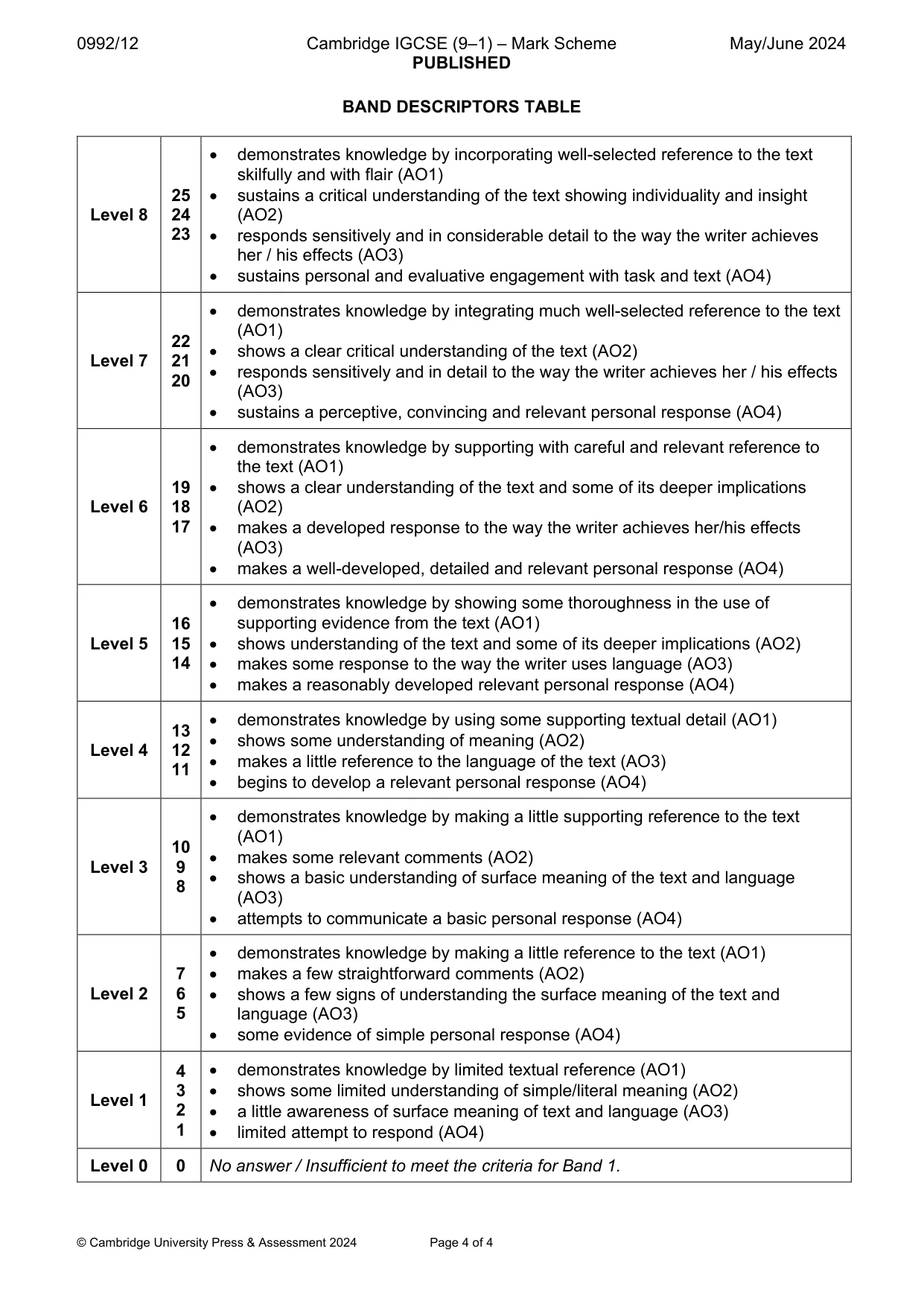
0992/12 Cambridge IGCSE (9–1) – Mark Scheme PUBLISHED May/June 2024 © Cambridge University Press & Assessment 2024 Page 4 of 4 BAND DESCRIPTORS TABLE Level 8 25 24 23 demonstrates knowledge by incorporating well-selected reference to the text skilfully and with flair (AO1) sustains a critical understanding of the text showing individuality and insight (AO2) responds sensitively and in considerable detail to the way the writer achieves her / his effects (AO3) sustains personal and evaluative engagement with task and text (AO4) Level 7 22 21 20 demonstrates knowledge by integrating much well-selected reference to the text (AO1) shows a clear critical understanding of the text (AO2) responds sensitively and in detail to the way the writer achieves her / his effects (AO3) sustains a perceptive, convincing and relevant personal response (AO4) Level 6 19 18 17 demonstrates knowledge by supporting with careful and relevant reference to the text (AO1) shows a clear understanding of the text and some of its deeper implications (AO2) makes a developed response to the way the writer achieves her/his effects (AO3) makes a well-developed, detailed and relevant personal response (AO4) Level 5 16 15 14 demonstrates knowledge by showing some thoroughness in the use of supporting evidence from the text (AO1) shows understanding of the text and some of its deeper implications (AO2) makes some response to the way the writer uses language (AO3) makes a reasonably developed relevant personal response (AO4) Level 4 13 12 11 demonstrates knowledge by using some supporting textual detail (AO1) shows some understanding of meaning (AO2) makes a little reference to the language of the text (AO3) begins to develop a relevant personal response (AO4) Level 3 10 9 8 demonstrates knowledge by making a little supporting reference to the text (AO1) makes some relevant comments (AO2) shows a basic understanding of surface meaning of the text and language (AO3) attempts to communicate a basic personal response (AO4) Level 2 7 6 5 demonstrates knowledge by making a little reference to the text (AO1) makes a few straightforward comments (AO2) shows a few signs of understanding the surface meaning of the text and language (AO3) some evidence of simple personal response (AO4) Level 1 4 3 2 1 demonstrates knowledge by limited textual reference (AO1) shows some limited understanding of simple/literal meaning (AO2) a little awareness of surface meaning of text and language (AO3) limited attempt to respond (AO4) Level 0 0 No answer / Insufficient to meet the criteria for Band 1.
What you needed in this session
Cambridge’s own grade thresholds for 2024 May/June, Paper 1 · Variant 2. A higher threshold means an easier paper — the bar moves with how the cohort did.