Cambridge IGCSE English - Literature in English (9-1) 0992 — 2025 May/June Paper 1 · Variant 2
0992/12/M/J/25 · 50 marks · ≈56 min
The question paper and its mark scheme, free to read here and free to download. This is Cambridge’s own paper, exactly as it was sat.
Question paper28 pages




Mark scheme5 pages
Answers below. Sit the paper first if you are practising.
Paper as text
Question paper, page 1
This document has 28 pages. Any blank pages are indicated. [Turn over Cambridge IGCSE™(9–1) * 8 0 3 9 1 1 4 6 6 0 * DC (EV) 359281/1 R © UCLES 2025 LITERATURE IN ENGLISH 0992/12 Paper 1 Poetry and Prose May/June 2025 1 hour 30 minutes You must answer on the enclosed answer booklet. You will need: Answer booklet (enclosed) INSTRUCTIONS ● Answer two questions in total: Section A: answer one question. Section B: answer one question. ● Follow the instructions on the front cover of the answer booklet. If you need additional answer paper, ask the invigilator for a continuation booklet. INFORMATION ● The total mark for this paper is 50. ● All questions are worth equal marks.
Question paper, page 2
2 0992/12/M/J/25 © UCLES 2025 BLANK PAGE
Question paper, page 3
3 0992/12/M/J/25 © UCLES 2025 [Turn over CONTENTS Section A: Poetry text question numbers page[s] Songs of Ourselves Volume 1: from Part 4 1, 2 pages 4–5 Songs of Ourselves Volume 2 : from Part 3 3, 4 pages 6–7 Ted Hughes: from New Selected Poems 5, 6 pages 8–9 Section B: Prose text question numbers page[s] Chinua Achebe: Things Fall Apart 7, 8 pages 10–11 Anita Desai: Fire on the Mountain 9, 10 pages 12–13 Charles Dickens: Great Expectations 11, 12 pages 14–15 Daphne du Maurier: Rebecca 13, 14 pages 16–17 Harper Lee: To Kill a Mockingbird 15, 16 pages 18–19 Joan Lindsay: Picnic at Hanging Rock 17, 18 pages 20–21 H G Wells: The War of the Worlds 19, 20 pages 22–23 from Stories of Ourselves Volume 2 21, 22 pages 24–25
Question paper, page 4
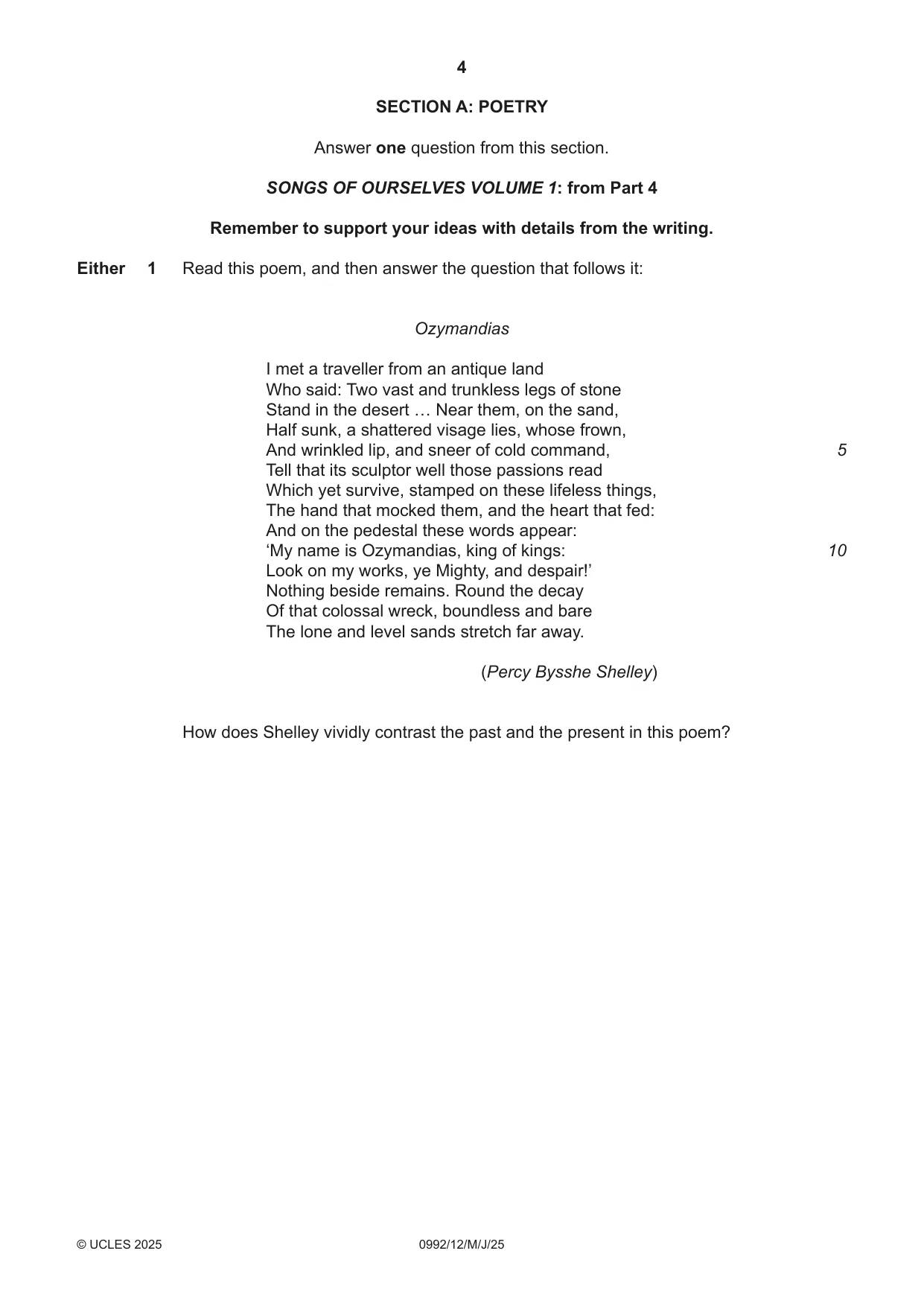
4 0992/12/M/J/25 © UCLES 2025 SECTION A: POETRY Answer one question from this section. SONGS OF OURSELVES VOLUME 1: from Part 4 Remember to support your ideas with details from the writing. Either 1 Read this poem, and then answer the question that follows it: Ozymandias I met a traveller from an antique land Who said: Two vast and trunkless legs of stone Stand in the desert … Near them, on the sand, Half sunk, a shattered visage lies, whose frown, And wrinkled lip, and sneer of cold command, 5 Tell that its sculptor well those passions read Which yet survive, stamped on these lifeless things, The hand that mocked them, and the heart that fed: And on the pedestal these words appear: ‘My name is Ozymandias, king of kings: 10 Look on my works, ye Mighty, and despair!’ Nothing beside remains. Round the decay Of that colossal wreck, boundless and bare The lone and level sands stretch far away. (Percy Bysshe Shelley) How does Shelley vividly contrast the past and the present in this poem?
Question paper, page 5
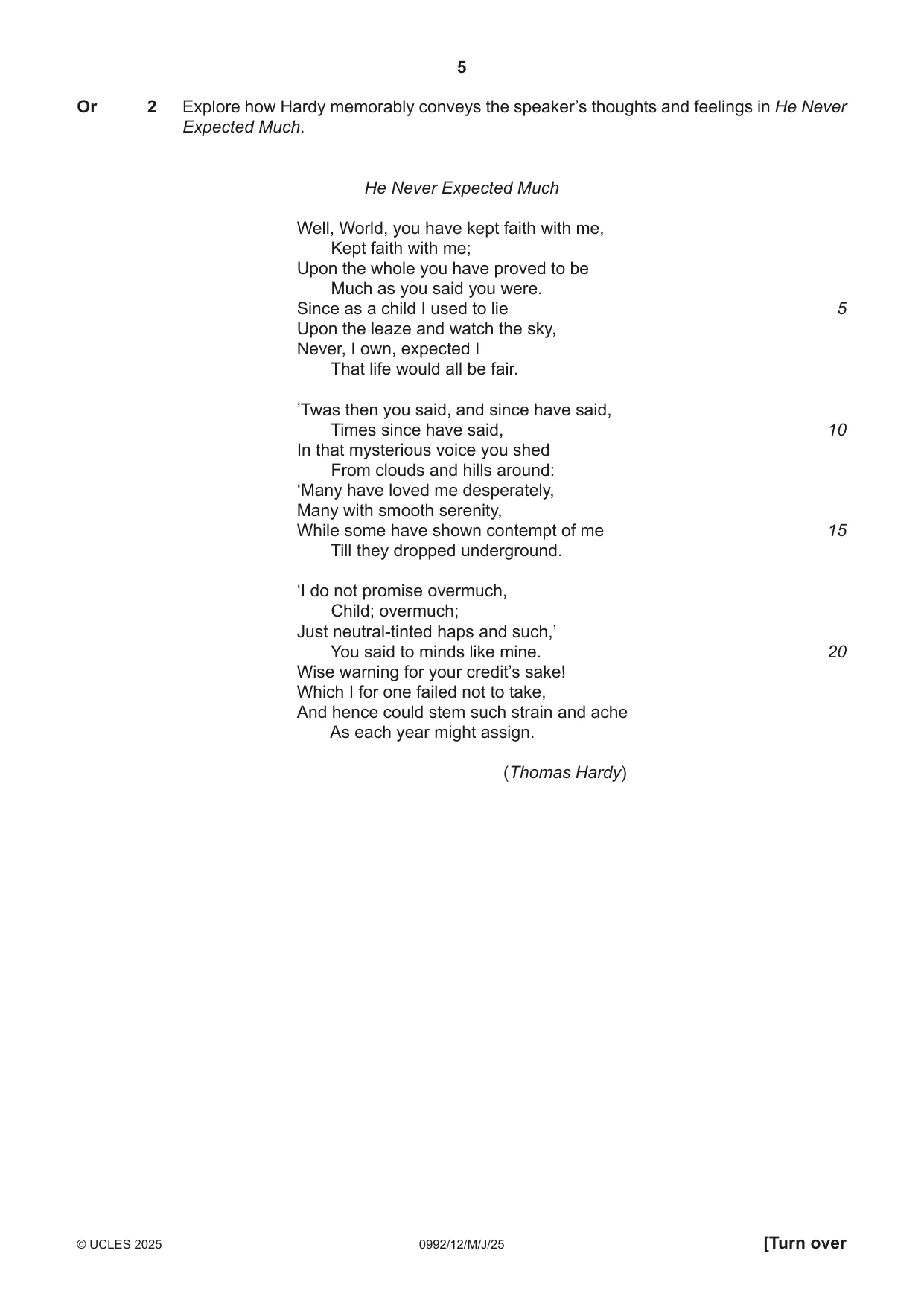
5 0992/12/M/J/25 © UCLES 2025 [Turn over Or 2 Explore how Hardy memorably conveys the speaker’s thoughts and feelings in He Never Expected Much. He Never Expected Much Well, World, you have kept faith with me, Kept faith with me; Upon the whole you have proved to be Much as you said you were. Since as a child I used to lie 5 Upon the leaze and watch the sky, Never, I own, expected I That life would all be fair. ’Twas then you said, and since have said, Times since have said, 10 In that mysterious voice you shed From clouds and hills around: ‘Many have loved me desperately, Many with smooth serenity, While some have shown contempt of me 15 Till they dropped underground. ‘I do not promise overmuch, Child; overmuch; Just neutral-tinted haps and such,’ You said to minds like mine. 20 Wise warning for your credit’s sake! Which I for one failed not to take, And hence could stem such strain and ache As each year might assign. (Thomas Hardy)
Question paper, page 6
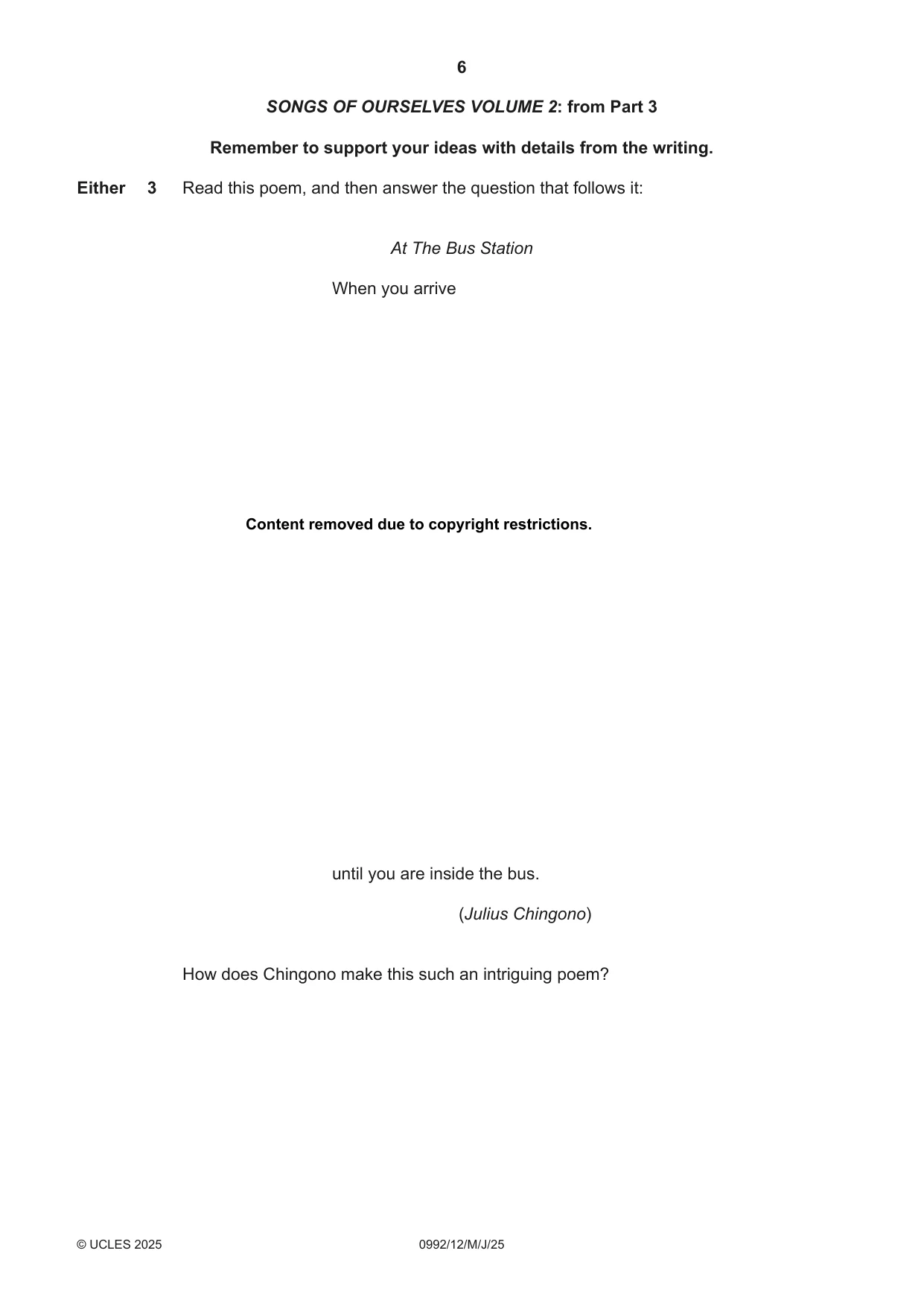
6 0992/12/M/J/25 © UCLES 2025 SONGS OF OURSELVES VOLUME 2: from Part 3 Remember to support your ideas with details from the writing. Either 3 Read this poem, and then answer the question that follows it: At The Bus Station When you arrive until you are inside the bus. (Julius Chingono) How does Chingono make this such an intriguing poem? Content removed due to copyright restrictions.
Question paper, page 7
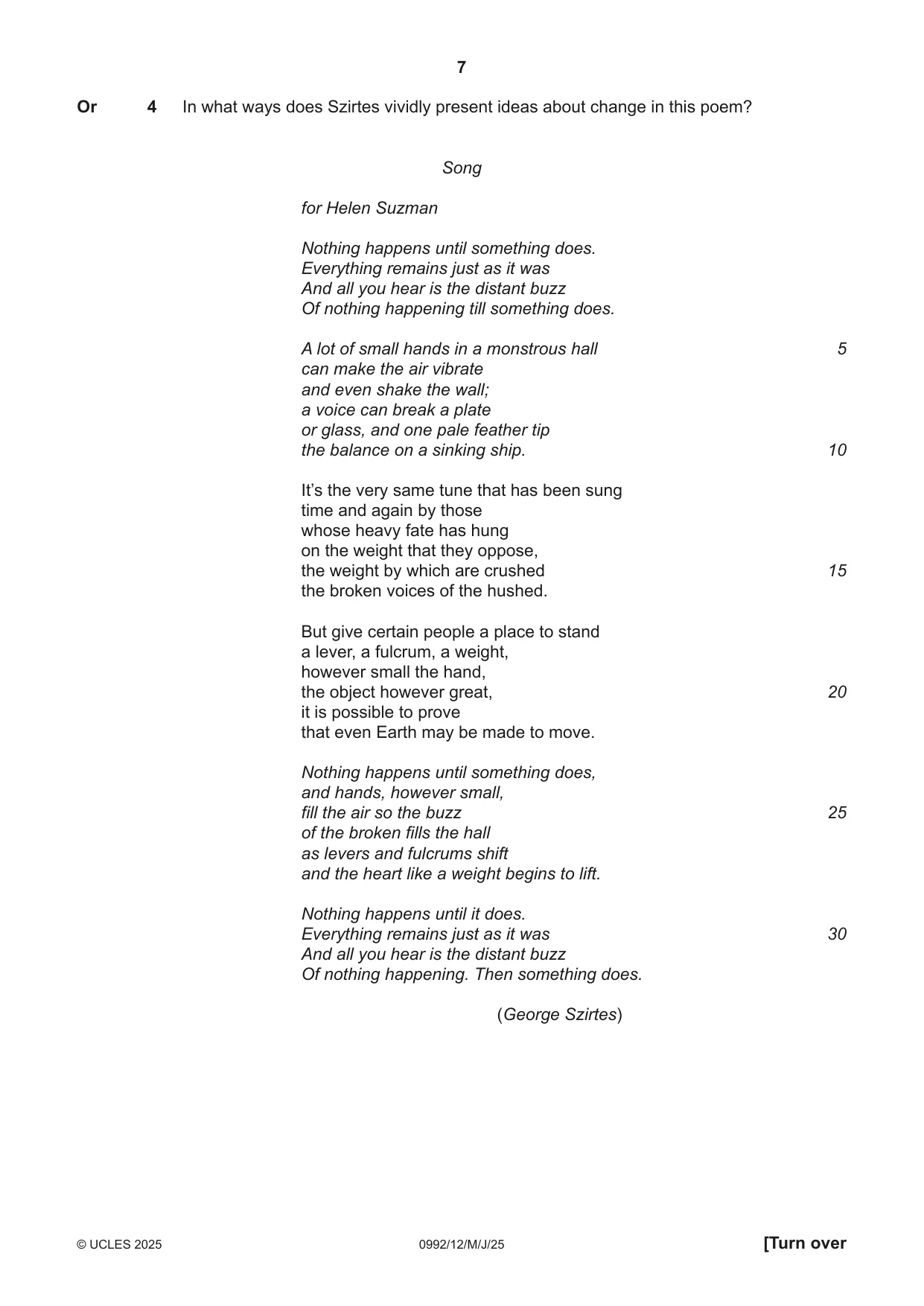
7 0992/12/M/J/25 © UCLES 2025 [Turn over Or 4 In what ways does Szirtes vividly present ideas about change in this poem? Song for Helen Suzman Nothing happens until something does. Everything remains just as it was And all you hear is the distant buzz Of nothing happening till something does. A lot of small hands in a monstrous hall 5 can make the air vibrate and even shake the wall; a voice can break a plate or glass, and one pale feather tip the balance on a sinking ship. 10 It’s the very same tune that has been sung time and again by those whose heavy fate has hung on the weight that they oppose, the weight by which are crushed 15 the broken voices of the hushed. But give certain people a place to stand a lever, a fulcrum, a weight, however small the hand, the object however great, 20 it is possible to prove that even Earth may be made to move. Nothing happens until something does, and hands, however small, fill the air so the buzz 25 of the broken fills the hall as levers and fulcrums shift and the heart like a weight begins to lift. Nothing happens until it does. Everything remains just as it was 30 And all you hear is the distant buzz Of nothing happening. Then something does. (George Szirtes)
Question paper, page 8
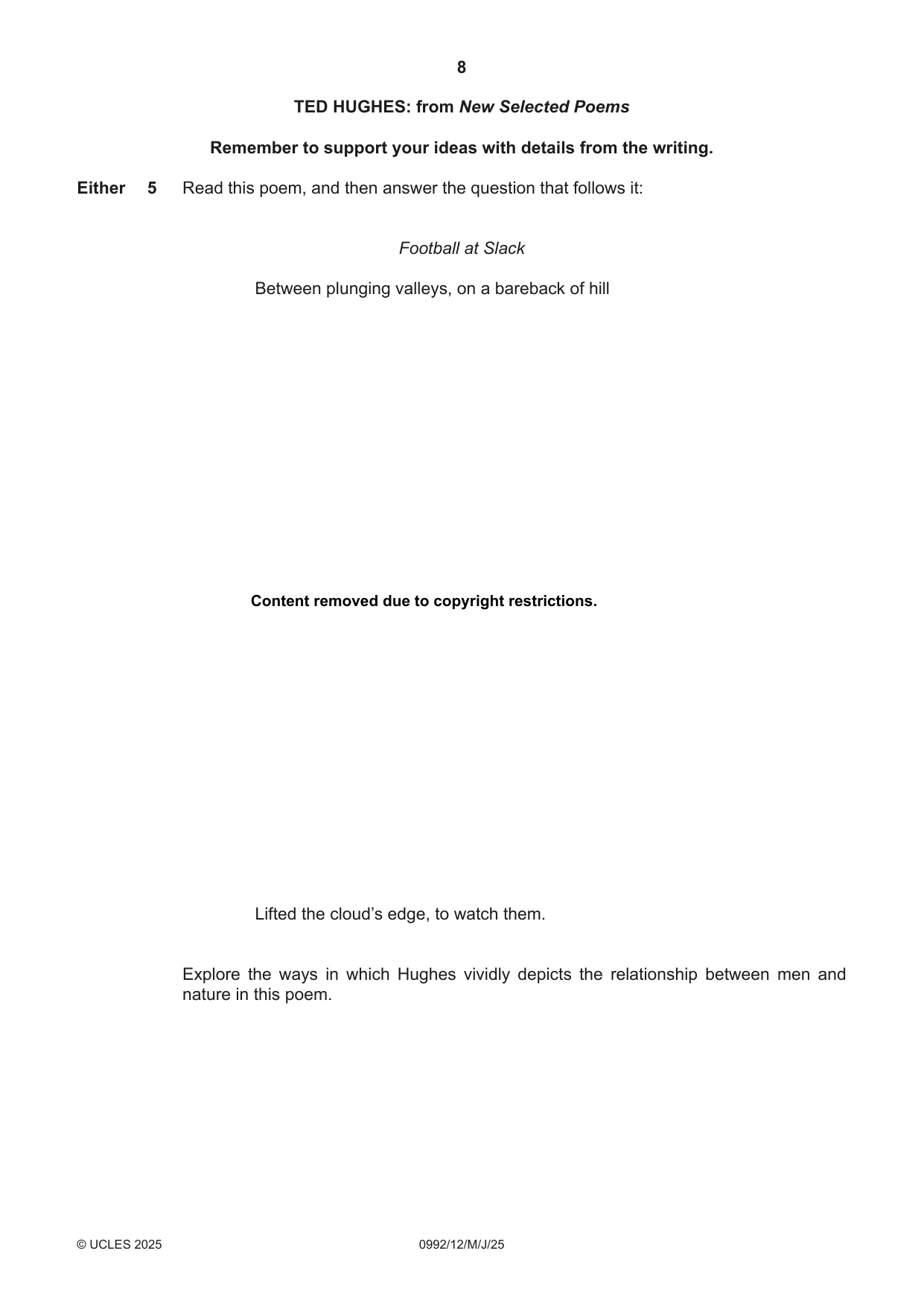
8 0992/12/M/J/25 © UCLES 2025 TED HUGHES: from New Selected Poems Remember to support your ideas with details from the writing. Either 5 Read this poem, and then answer the question that follows it: Football at Slack Between plunging valleys, on a bareback of hill Lifted the cloud’s edge, to watch them. Explore the ways in which Hughes vividly depicts the relationship between men and nature in this poem. Content removed due to copyright restrictions.
Question paper, page 9
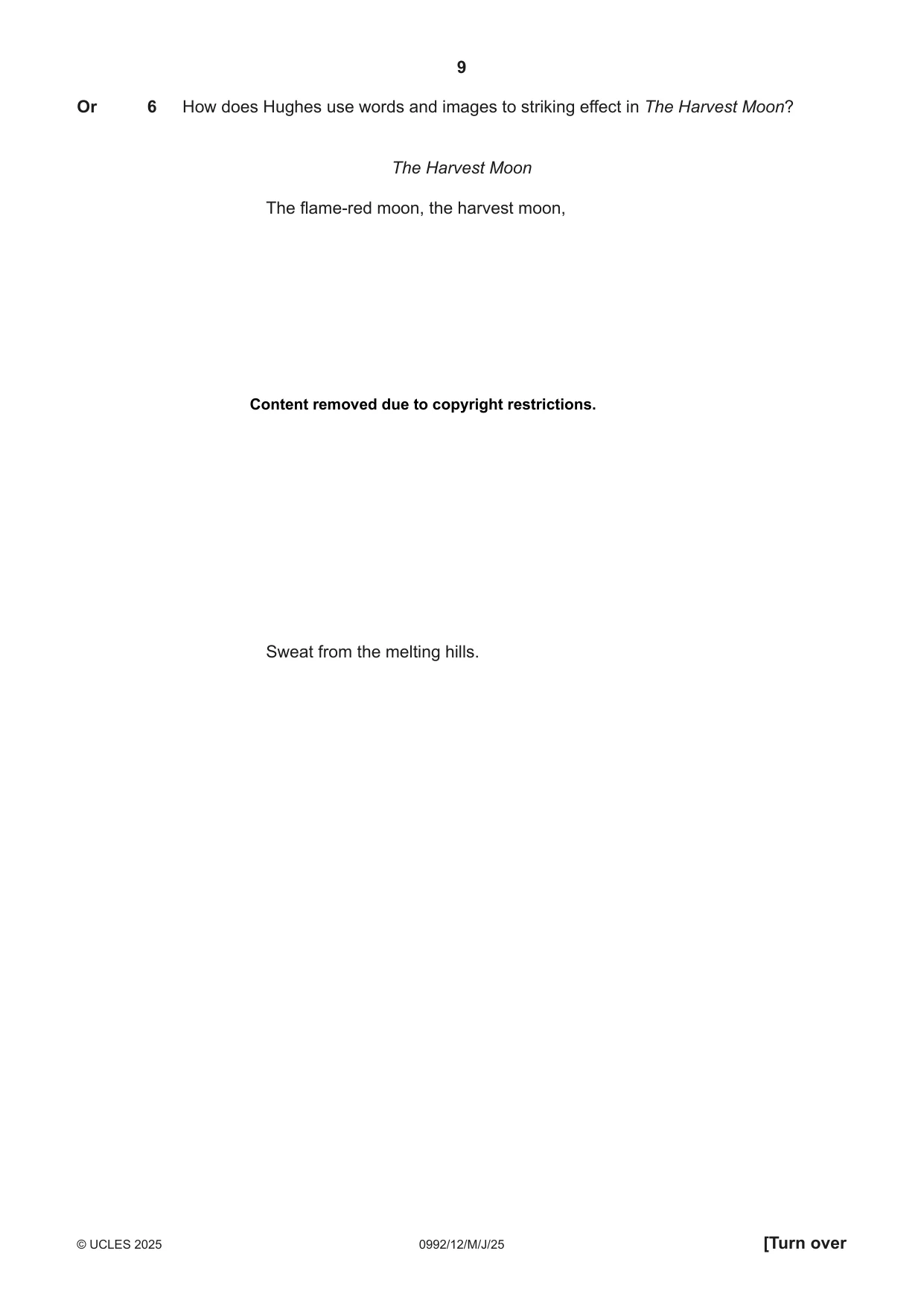
9 0992/12/M/J/25 © UCLES 2025 [Turn over Or 6 How does Hughes use words and images to striking effect in The Harvest Moon? The Harvest Moon The flame-red moon, the harvest moon, Sweat from the melting hills. Content removed due to copyright restrictions.
Question paper, page 10
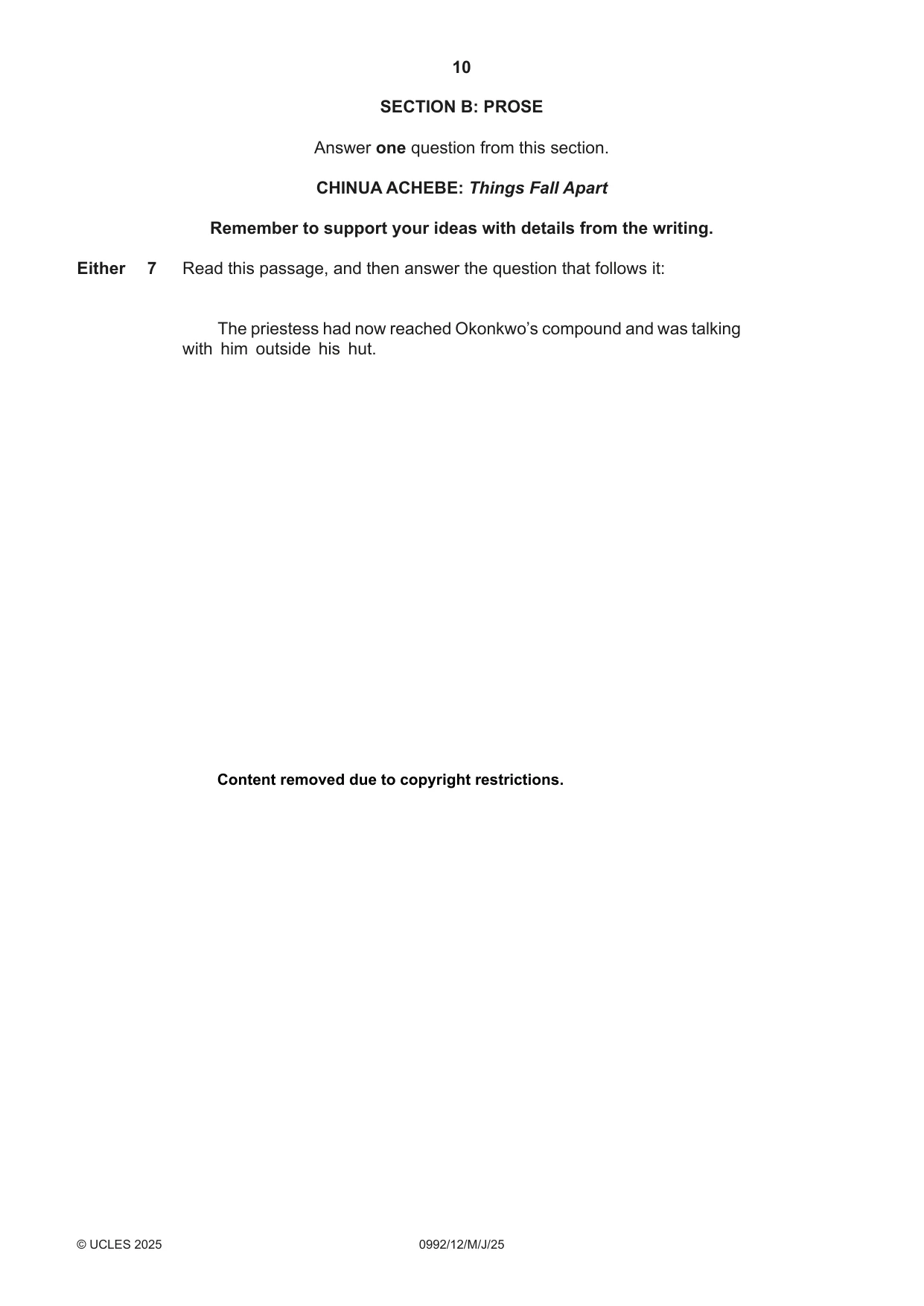
10 0992/12/M/J/25 © UCLES 2025 SECTION B: PROSE Answer one question from this section. CHINUA ACHEBE: Things Fall Apart Remember to support your ideas with details from the writing. Either 7 Read this passage, and then answer the question that follows it: The priestess had now reached Okonkwo’s compound and was talking with him outside his hut. Content removed due to copyright restrictions.
Question paper, page 11
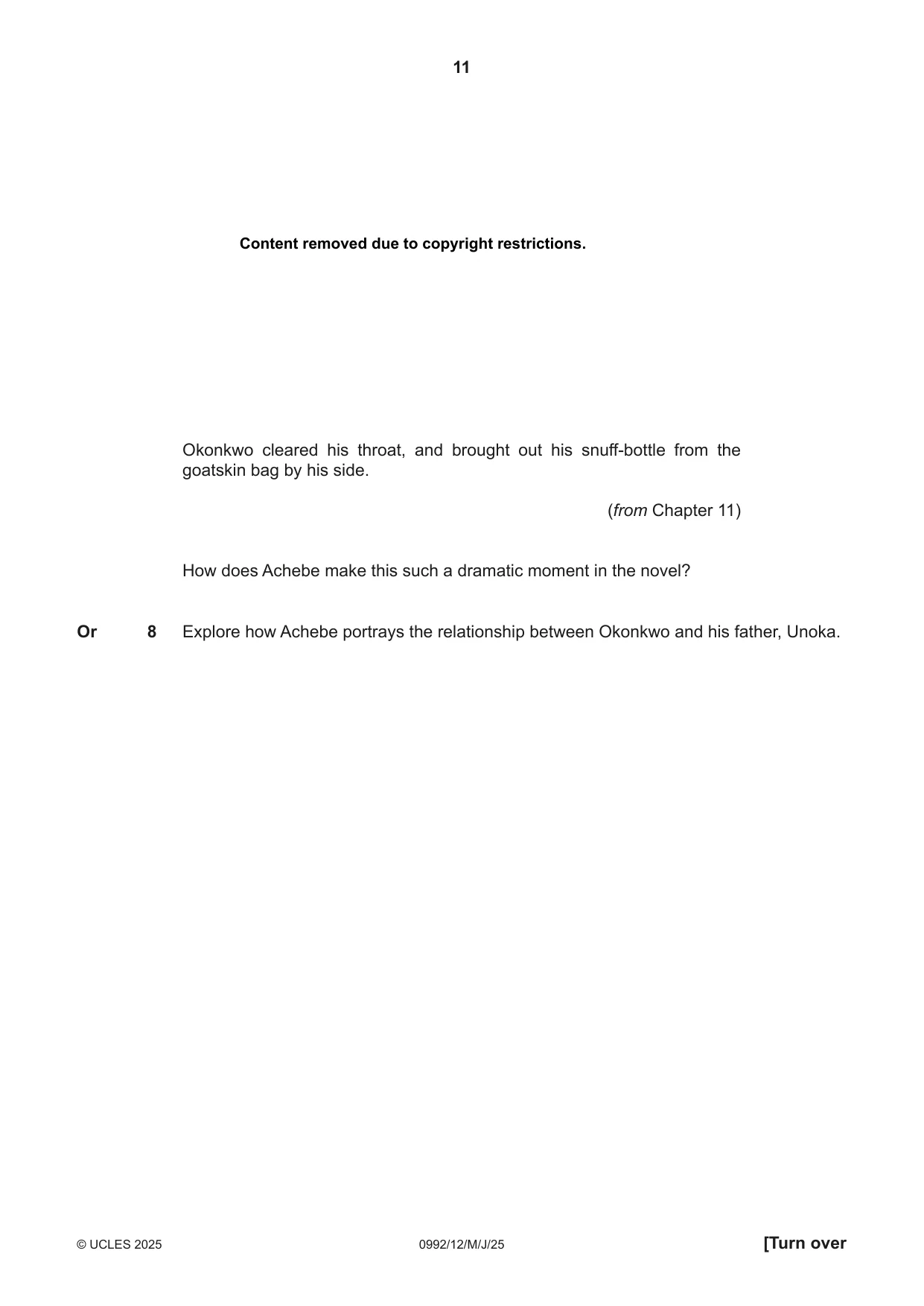
11 0992/12/M/J/25 © UCLES 2025 [Turn over Okonkwo cleared his throat, and brought out his snuff-bottle from the goatskin bag by his side. (from Chapter 11) How does Achebe make this such a dramatic moment in the novel? Or 8 Explore how Achebe portrays the relationship between Okonkwo and his father, Unoka. Content removed due to copyright restrictions.
Question paper, page 12
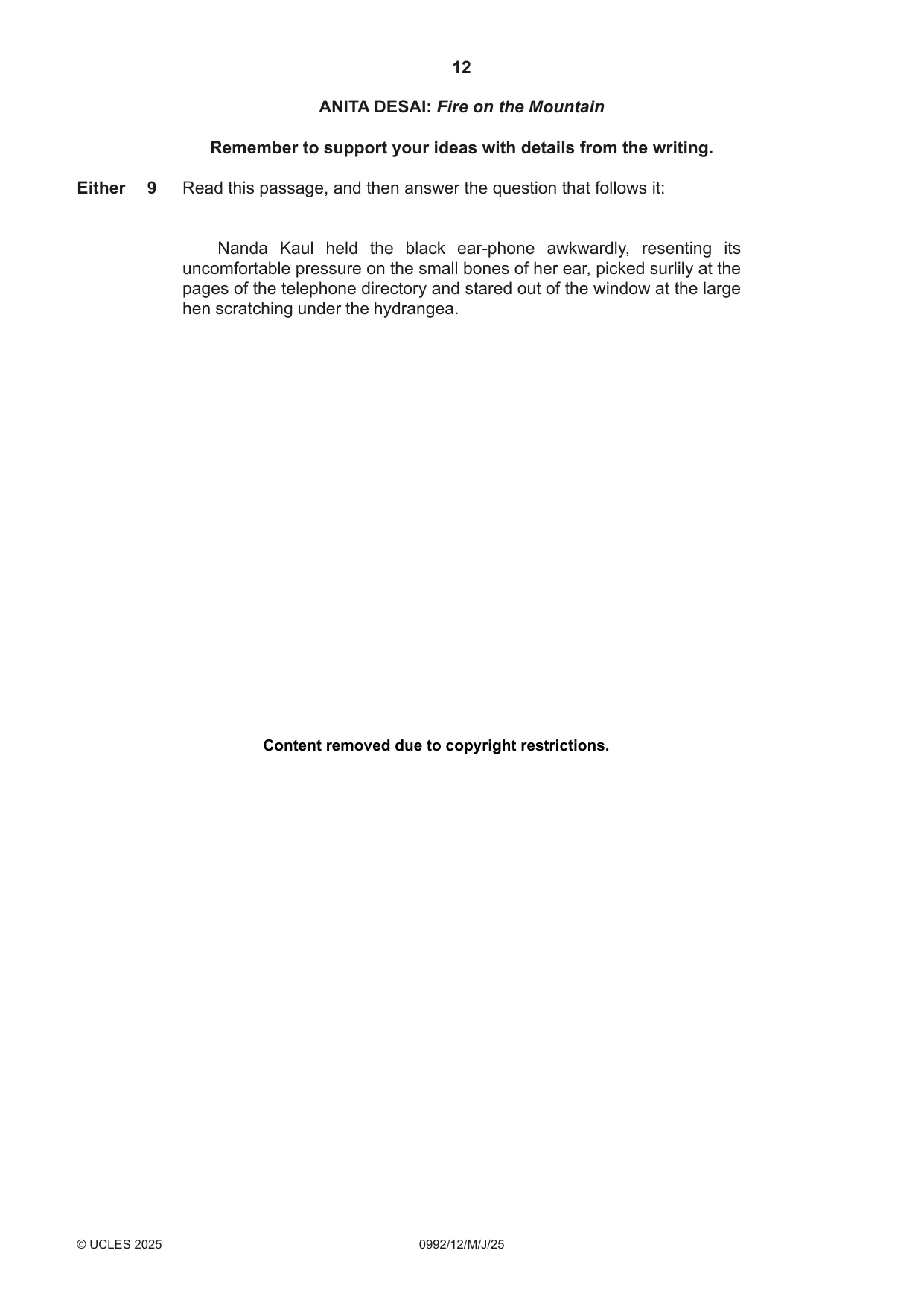
12 0992/12/M/J/25 © UCLES 2025 ANITA DESAI: Fire on the Mountain Remember to support your ideas with details from the writing. Either 9 Read this passage, and then answer the question that follows it: Nanda Kaul held the black ear-phone awkwardly, resenting its uncomfortable pressure on the small bones of her ear, picked surlily at the pages of the telephone directory and stared out of the window at the large hen scratching under the hydrangea. Content removed due to copyright restrictions.
Question paper, page 13
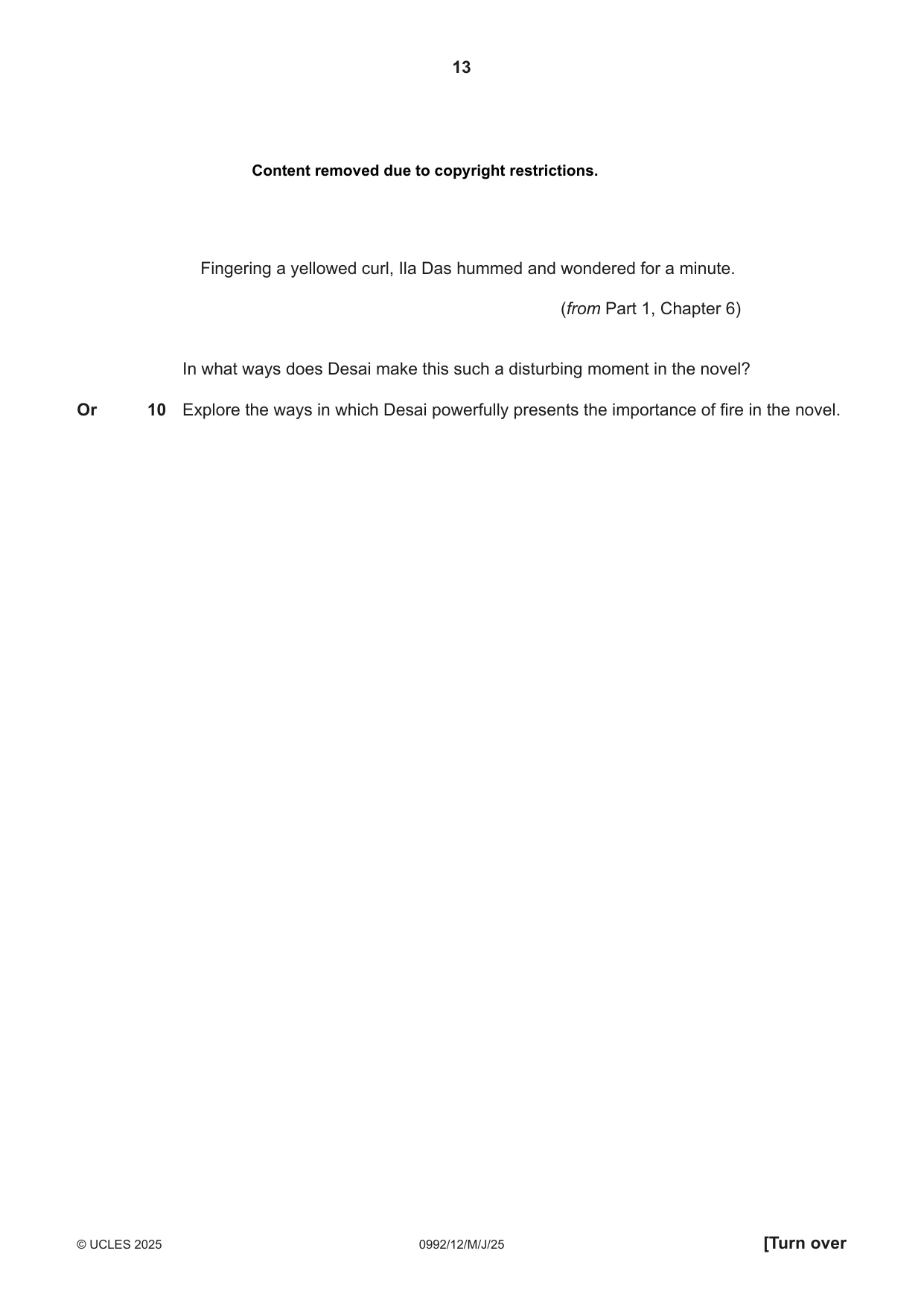
13 0992/12/M/J/25 © UCLES 2025 [Turn over Fingering a yellowed curl, Ila Das hummed and wondered for a minute. (from Part 1, Chapter 6) In what ways does Desai make this such a disturbing moment in the novel? Or 10 Explore the ways in which Desai powerfully presents the importance of fire in the novel. Content removed due to copyright restrictions.
Question paper, page 14
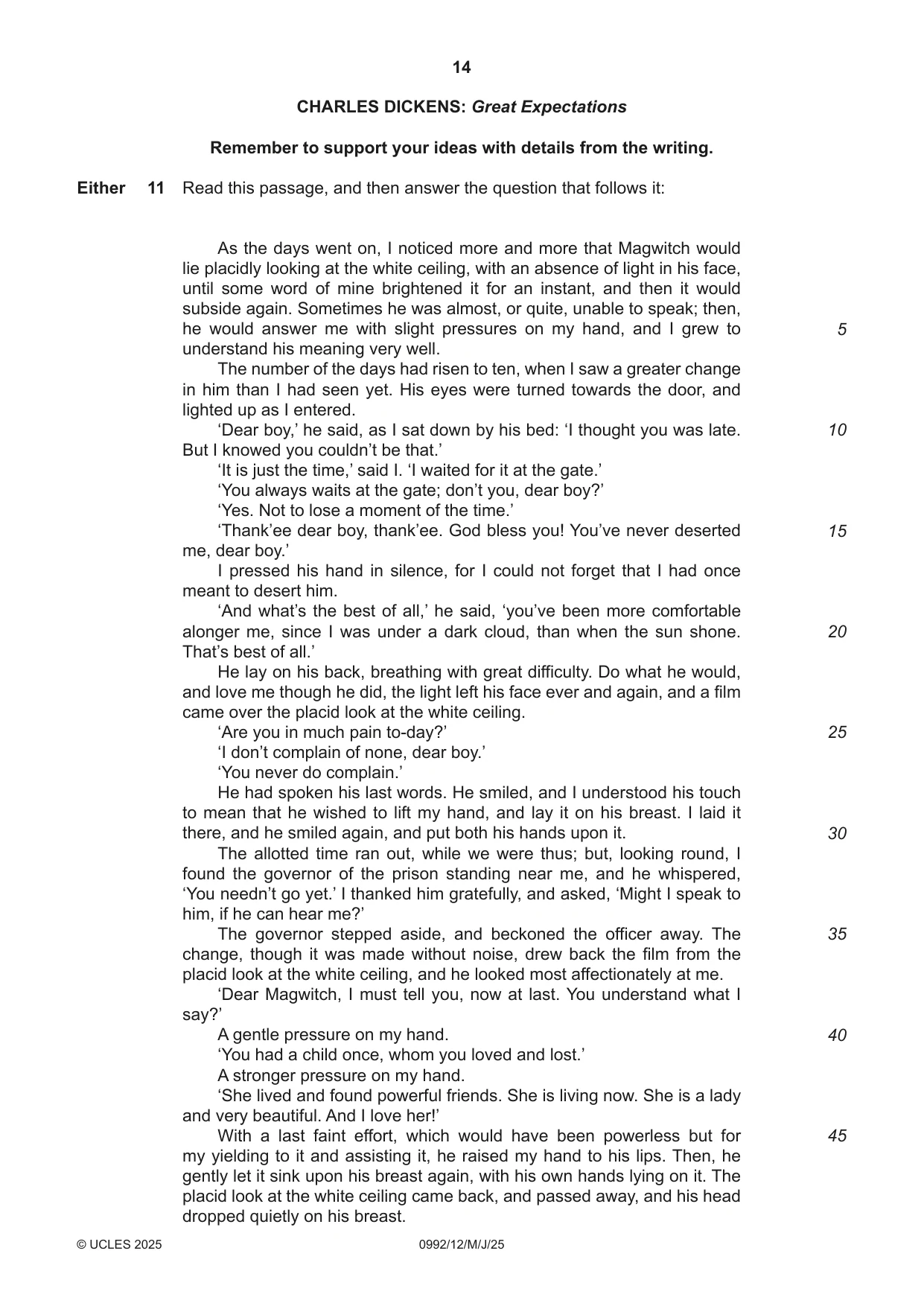
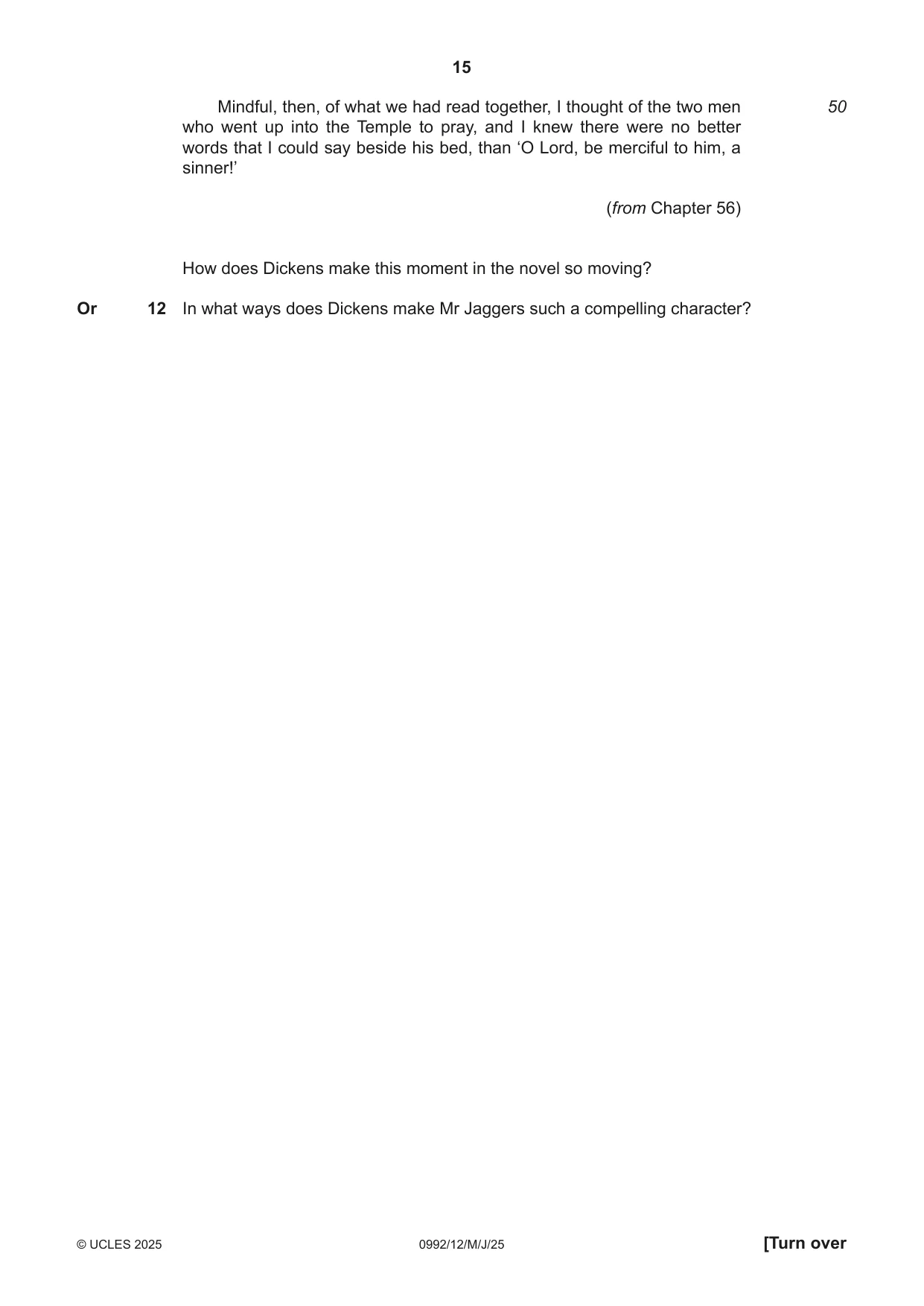
14 0992/12/M/J/25 © UCLES 2025 CHARLES DICKENS: Great Expectations Remember to support your ideas with details from the writing. Either 11 Read this passage, and then answer the question that follows it: As the days went on, I noticed more and more that Magwitch would lie placidly looking at the white ceiling, with an absence of light in his face, until some word of mine brightened it for an instant, and then it would subside again. Sometimes he was almost, or quite, unable to speak; then, he would answer me with slight pressures on my hand, and I grew to understand his meaning very well. The number of the days had risen to ten, when I saw a greater change in him than I had seen yet. His eyes were turned towards the door, and lighted up as I entered. ‘Dear boy,’ he said, as I sat down by his bed: ‘I thought you was late. But I knowed you couldn’t be that.’ ‘It is just the time,’ said I. ‘I waited for it at the gate.’ ‘You always waits at the gate; don’t you, dear boy?’ ‘Yes. Not to lose a moment of the time.’ ‘Thank’ee dear boy, thank’ee. God bless you! You’ve never deserted me, dear boy.’ I pressed his hand in silence, for I could not forget that I had once meant to desert him. ‘And what’s the best of all,’ he said, ‘you’ve been more comfortable alonger me, since I was under a dark cloud, than when the sun shone. That’s best of all.’ He lay on his back, breathing with great difficulty. Do what he would, and love me though he did, the light left his face ever and again, and a film came over the placid look at the white ceiling. ‘Are you in much pain to-day?’ ‘I don’t complain of none, dear boy.’ ‘You never do complain.’ He had spoken his last words. He smiled, and I understood his touch to mean that he wished to lift my hand, and lay it on his breast. I laid it there, and he smiled again, and put both his hands upon it. The allotted time ran out, while we were thus; but, looking round, I found the governor of the prison standing near me, and he whispered, ‘You needn’t go yet.’ I thanked him gratefully, and asked, ‘Might I speak to him, if he can hear me?’ The governor stepped aside, and beckoned the officer away. The change, though it was made without noise, drew back the film from the placid look at the white ceiling, and he looked most affectionately at me. ‘Dear Magwitch, I must tell you, now at last. You understand what I say?’ A gentle pressure on my hand. ‘You had a child once, whom you loved and lost.’ A stronger pressure on my hand. ‘She lived and found powerful friends. She is living now. She is a lady and very beautiful. And I love her!’ With a last faint effort, which would have been powerless but for my yielding to it and assisting it, he raised my hand to his lips. Then, he gently let it sink upon his breast again, with his own hands lying on it. The placid look at the white ceiling came back, and passed away, and his head dropped quietly on his breast. 5 10 15 20 25 30 35 40 45
Question paper, page 15
15 0992/12/M/J/25 © UCLES 2025 [Turn over Mindful, then, of what we had read together, I thought of the two men who went up into the Temple to pray, and I knew there were no better words that I could say beside his bed, than ‘O Lord, be merciful to him, a sinner!’ (from Chapter 56) How does Dickens make this moment in the novel so moving? Or 12 In what ways does Dickens make Mr Jaggers such a compelling character? 50
Question paper, page 16
16 0992/12/M/J/25 © UCLES 2025 DAPHNE DU MAURIER: Rebecca Remember to support your ideas with details from the writing. Either 13 Read this passage, and then answer the question that follows it: I was so deep in my picture, I even saw the porter pocketing his tip and going back through the swing-door of the hotel, saying something over his shoulder to the commissionaire, that I did not notice the slowing-down of the car, and it was only when we stopped, drawing up by the side of the road, that I brought myself back to the present once again. Content removed due to copyright restrictions.
Question paper, page 17
17 0992/12/M/J/25 © UCLES 2025 [Turn over The glamour of it had gone with my happy mood, and at the thought of it my frozen face quivered into feeling, my adult pride was lost, and those despicable tears rejoicing at their conquest welled into my eyes and strayed upon my cheeks. (from Chapter 5) In what ways does du Maurier make this such a revealing moment in the novel? Or 14 Explore how du Maurier vividly reveals the relationship between Maxim and Rebecca during the course of the novel. Content removed due to copyright restrictions.
Question paper, page 18
18 0992/12/M/J/25 © UCLES 2025 HARPER LEE: To Kill a Mockingbird Remember to support your ideas with details from the writing. Either 15 Read this passage, and then answer the question that follows it: Later, when I was supposed to be in bed, I went down the hall for a drink of water and heard Atticus and Uncle Jack in the living-room: ‘I shall never marry, Atticus.’ Content removed due to copyright restrictions.
Question paper, page 19
19 0992/12/M/J/25 © UCLES 2025 [Turn over But I never figured out how Atticus knew I was listening, and it was not until many years later that I realized he wanted me to hear every word he said. (from Chapter 9) In what ways does Lee create such striking impressions of Atticus at this moment in the novel? Or 16 How far does Lee encourage you to feel sympathy for Mrs Dubose? Content removed due to copyright restrictions.
Question paper, page 20
20 0992/12/M/J/25 © UCLES 2025 JOAN LINDSAY: Picnic at Hanging Rock Remember to support your ideas with details from the writing. Either 17 Read this passage, and then answer the question that follows it: As the dog-cart turned in at the College gates his passenger caught sight of her favourite pupil Sara Waybourne on the front lawn, and briskly waved her umbrella. ‘ Your friend, Henrietta Valange. (from Chapter 9) Content removed due to copyright restrictions.
Question paper, page 21
21 0992/12/M/J/25 © UCLES 2025 [Turn over How does Lindsay make this such a sad and significant moment in the novel? Or 18 Explore the ways in which Lindsay makes Hanging Rock such a mysterious setting in the novel.
Question paper, page 22
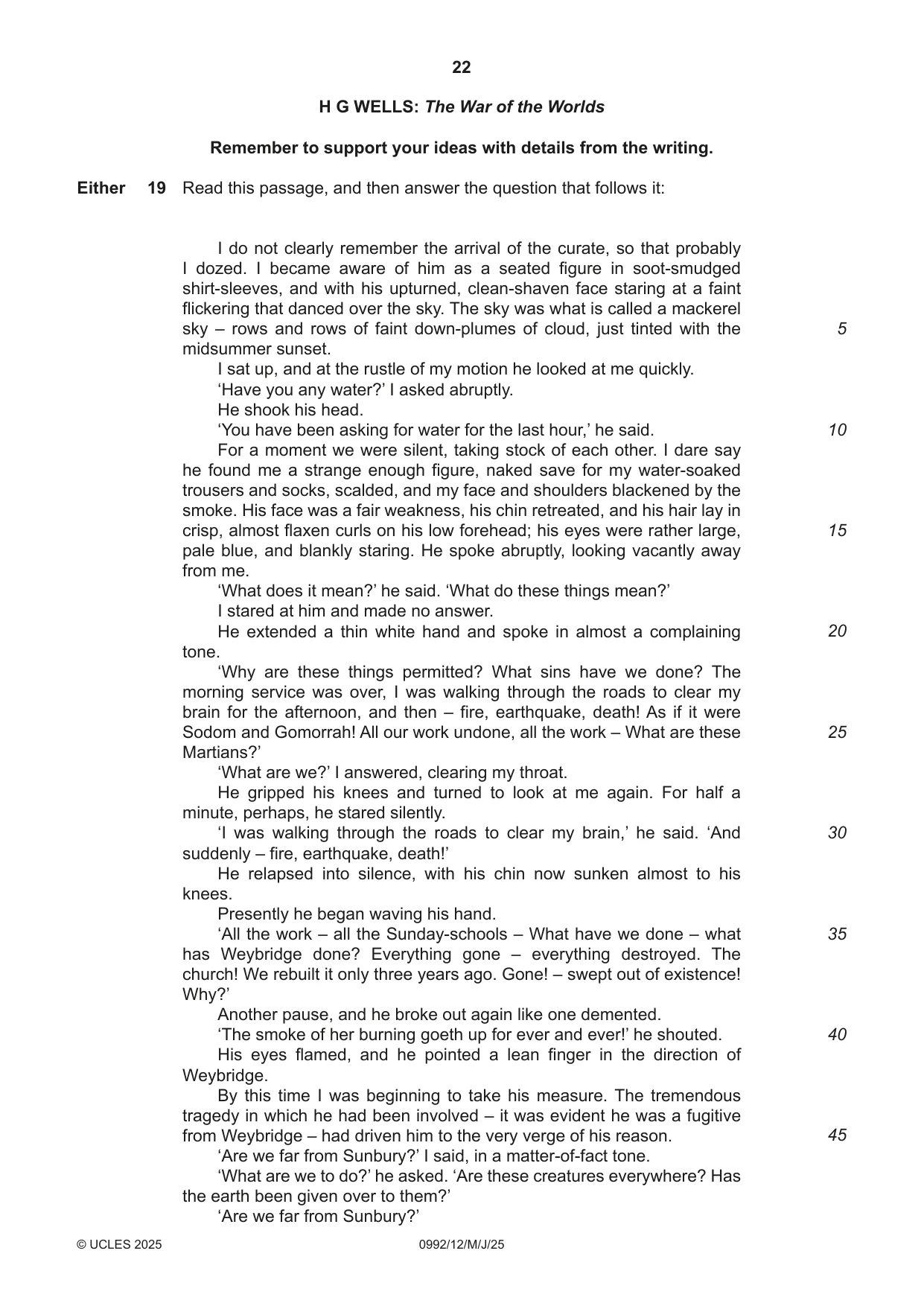
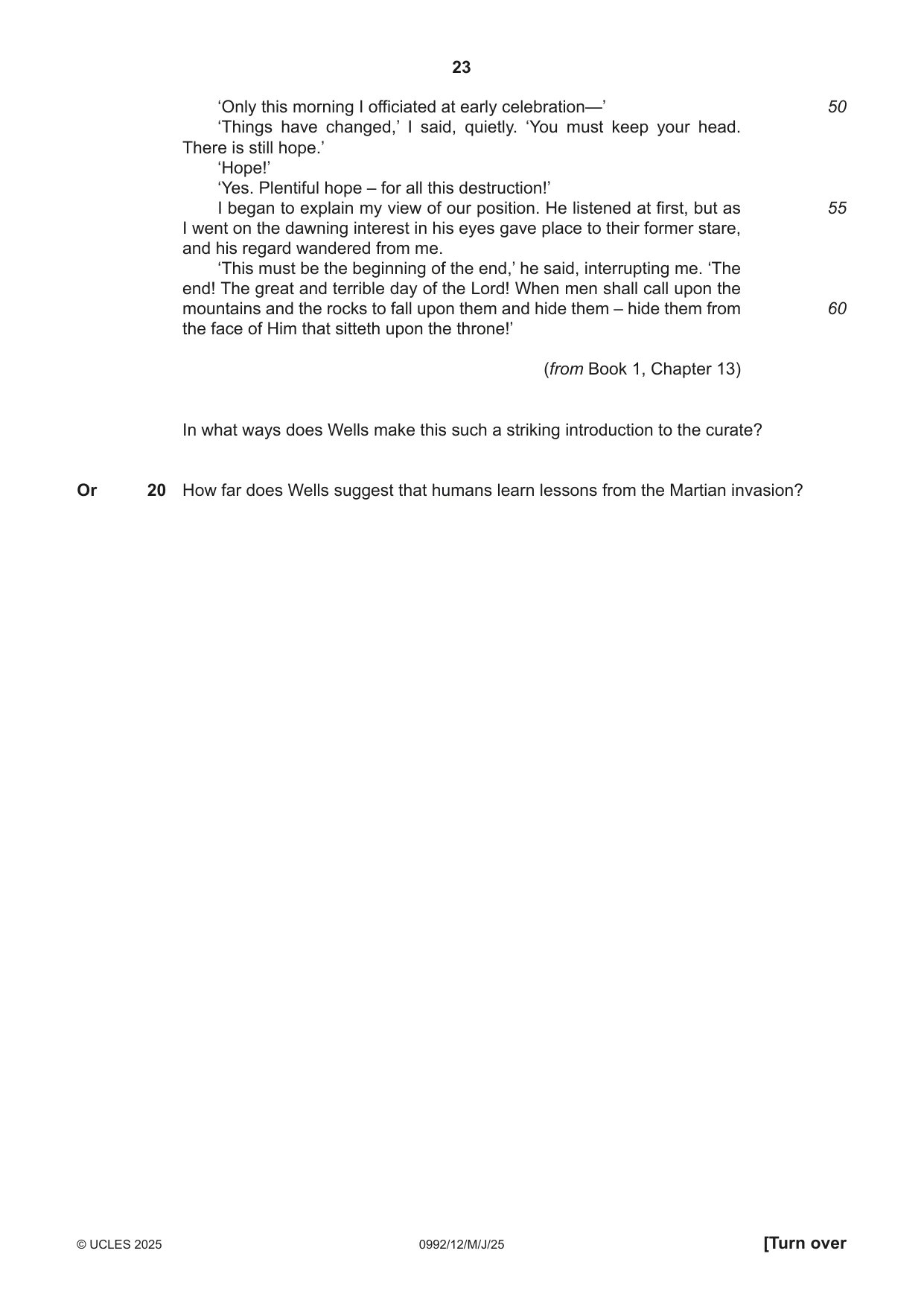
22 0992/12/M/J/25 © UCLES 2025 H G WELLS: The War of the Worlds Remember to support your ideas with details from the writing. Either 19 Read this passage, and then answer the question that follows it: I do not clearly remember the arrival of the curate, so that probably I dozed. I became aware of him as a seated figure in soot-smudged shirt-sleeves, and with his upturned, clean-shaven face staring at a faint flickering that danced over the sky. The sky was what is called a mackerel sky – rows and rows of faint down-plumes of cloud, just tinted with the midsummer sunset. I sat up, and at the rustle of my motion he looked at me quickly. ‘Have you any water?’ I asked abruptly. He shook his head. ‘You have been asking for water for the last hour,’ he said. For a moment we were silent, taking stock of each other. I dare say he found me a strange enough figure, naked save for my water-soaked trousers and socks, scalded, and my face and shoulders blackened by the smoke. His face was a fair weakness, his chin retreated, and his hair lay in crisp, almost flaxen curls on his low forehead; his eyes were rather large, pale blue, and blankly staring. He spoke abruptly, looking vacantly away from me. ‘What does it mean?’ he said. ‘What do these things mean?’ I stared at him and made no answer. He extended a thin white hand and spoke in almost a complaining tone. ‘Why are these things permitted? What sins have we done? The morning service was over, I was walking through the roads to clear my brain for the afternoon, and then – fire, earthquake, death! As if it were Sodom and Gomorrah! All our work undone, all the work – What are these Martians?’ ‘What are we?’ I answered, clearing my throat. He gripped his knees and turned to look at me again. For half a minute, perhaps, he stared silently. ‘I was walking through the roads to clear my brain,’ he said. ‘And suddenly – fire, earthquake, death!’ He relapsed into silence, with his chin now sunken almost to his knees. Presently he began waving his hand. ‘All the work – all the Sunday-schools – What have we done – what has Weybridge done? Everything gone – everything destroyed. The church! We rebuilt it only three years ago. Gone! – swept out of existence! Why?’ Another pause, and he broke out again like one demented. ‘The smoke of her burning goeth up for ever and ever!’ he shouted. His eyes flamed, and he pointed a lean finger in the direction of Weybridge. By this time I was beginning to take his measure. The tremendous tragedy in which he had been involved – it was evident he was a fugitive from Weybridge – had driven him to the very verge of his reason. ‘Are we far from Sunbury?’ I said, in a matter-of-fact tone. ‘What are we to do?’ he asked. ‘Are these creatures everywhere? Has the earth been given over to them?’ ‘Are we far from Sunbury?’ 5 10 15 20 25 30 35 40 45
Question paper, page 23
23 0992/12/M/J/25 © UCLES 2025 [Turn over ‘Only this morning I officiated at early celebration—’ ‘Things have changed,’ I said, quietly. ‘You must keep your head. There is still hope.’ ‘Hope!’ ‘Yes. Plentiful hope – for all this destruction!’ I began to explain my view of our position. He listened at first, but as I went on the dawning interest in his eyes gave place to their former stare, and his regard wandered from me. ‘This must be the beginning of the end,’ he said, interrupting me. ‘The end! The great and terrible day of the Lord! When men shall call upon the mountains and the rocks to fall upon them and hide them – hide them from the face of Him that sitteth upon the throne!’ (from Book 1, Chapter 13) In what ways does Wells make this such a striking introduction to the curate? Or 20 How far does Wells suggest that humans learn lessons from the Martian invasion? 50 55 60
Question paper, page 24
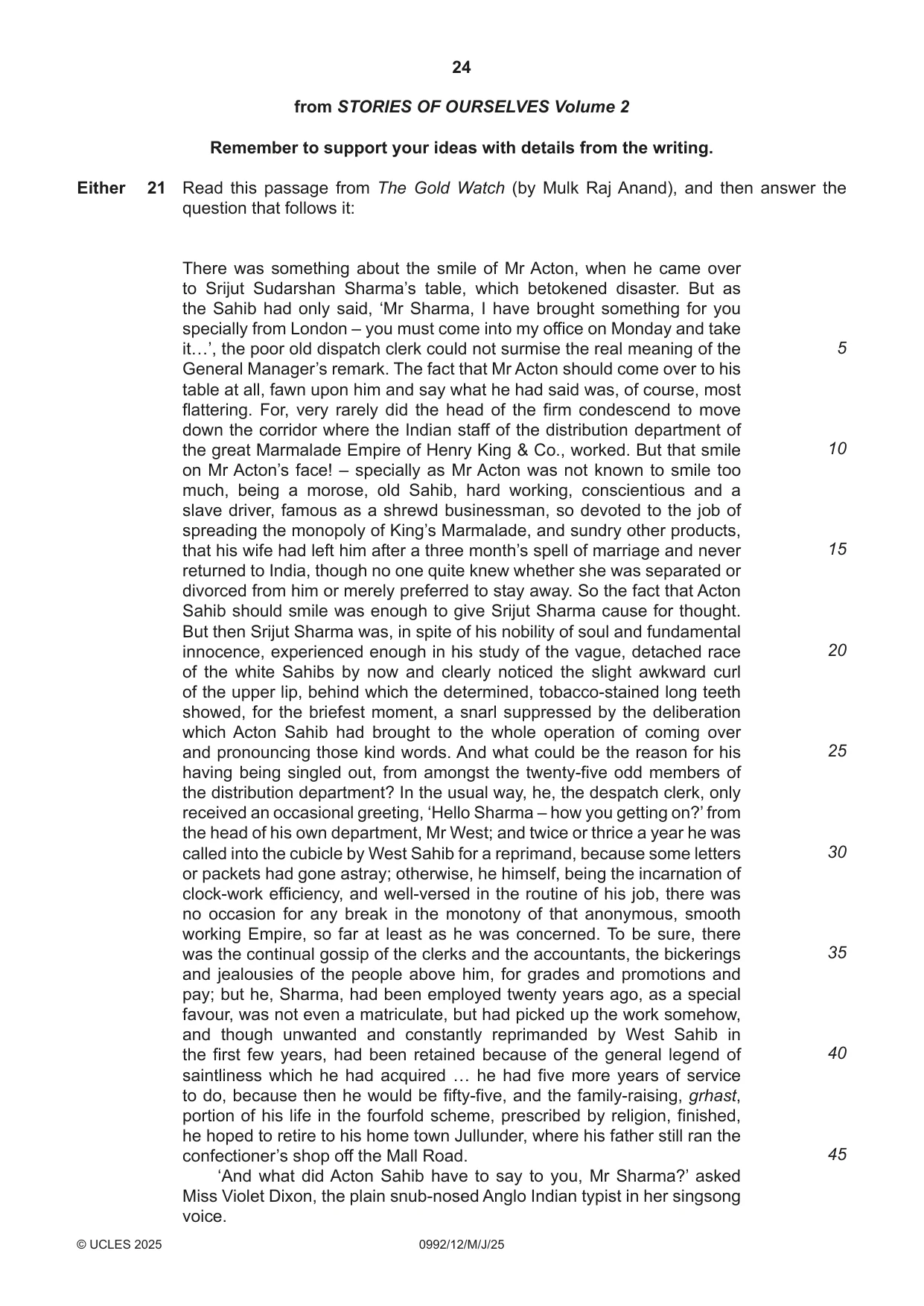
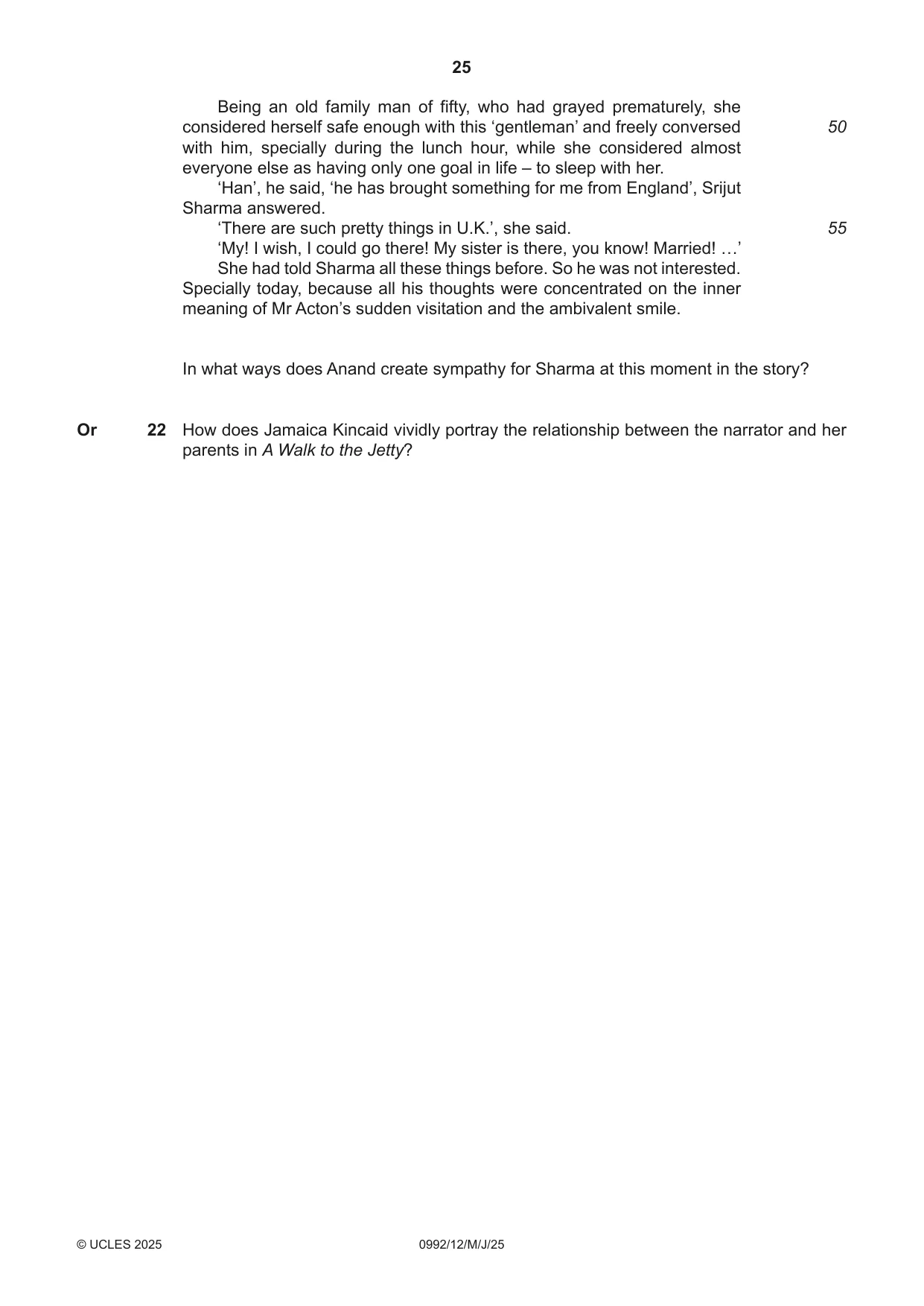
24 0992/12/M/J/25 © UCLES 2025 from STORIES OF OURSELVES Volume 2 Remember to support your ideas with details from the writing. Either 21 Read this passage from The Gold Watch (by Mulk Raj Anand), and then answer the question that follows it: There was something about the smile of Mr Acton, when he came over to Srijut Sudarshan Sharma’s table, which betokened disaster. But as the Sahib had only said, ‘Mr Sharma, I have brought something for you specially from London – you must come into my office on Monday and take it…’, the poor old dispatch clerk could not surmise the real meaning of the General Manager’s remark. The fact that Mr Acton should come over to his table at all, fawn upon him and say what he had said was, of course, most flattering. For, very rarely did the head of the firm condescend to move down the corridor where the Indian staff of the distribution department of the great Marmalade Empire of Henry King & Co., worked. But that smile on Mr Acton’s face! – specially as Mr Acton was not known to smile too much, being a morose, old Sahib, hard working, conscientious and a slave driver, famous as a shrewd businessman, so devoted to the job of spreading the monopoly of King’s Marmalade, and sundry other products, that his wife had left him after a three month’s spell of marriage and never returned to India, though no one quite knew whether she was separated or divorced from him or merely preferred to stay away. So the fact that Acton Sahib should smile was enough to give Srijut Sharma cause for thought. But then Srijut Sharma was, in spite of his nobility of soul and fundamental innocence, experienced enough in his study of the vague, detached race of the white Sahibs by now and clearly noticed the slight awkward curl of the upper lip, behind which the determined, tobacco-stained long teeth showed, for the briefest moment, a snarl suppressed by the deliberation which Acton Sahib had brought to the whole operation of coming over and pronouncing those kind words. And what could be the reason for his having being singled out, from amongst the twenty-five odd members of the distribution department? In the usual way, he, the despatch clerk, only received an occasional greeting, ‘Hello Sharma – how you getting on?’ from the head of his own department, Mr West; and twice or thrice a year he was called into the cubicle by West Sahib for a reprimand, because some letters or packets had gone astray; otherwise, he himself, being the incarnation of clock-work efficiency, and well-versed in the routine of his job, there was no occasion for any break in the monotony of that anonymous, smooth working Empire, so far at least as he was concerned. To be sure, there was the continual gossip of the clerks and the accountants, the bickerings and jealousies of the people above him, for grades and promotions and pay; but he, Sharma, had been employed twenty years ago, as a special favour, was not even a matriculate, but had picked up the work somehow, and though unwanted and constantly reprimanded by West Sahib in the first few years, had been retained because of the general legend of saintliness which he had acquired … he had five more years of service to do, because then he would be fifty-five, and the family-raising, grhast, portion of his life in the fourfold scheme, prescribed by religion, finished, he hoped to retire to his home town Jullunder, where his father still ran the confectioner’s shop off the Mall Road. ‘And what did Acton Sahib have to say to you, Mr Sharma?’ asked Miss Violet Dixon, the plain snub-nosed Anglo Indian typist in her singsong voice. 5 10 15 20 25 30 35 40 45
Question paper, page 25
25 0992/12/M/J/25 © UCLES 2025 Being an old family man of fifty, who had grayed prematurely, she considered herself safe enough with this ‘gentleman’ and freely conversed with him, specially during the lunch hour, while she considered almost everyone else as having only one goal in life – to sleep with her. ‘Han’, he said, ‘he has brought something for me from England’, Srijut Sharma answered. ‘There are such pretty things in U.K.’, she said. ‘My! I wish, I could go there! My sister is there, you know! Married! …’ She had told Sharma all these things before. So he was not interested. Specially today, because all his thoughts were concentrated on the inner meaning of Mr Acton’s sudden visitation and the ambivalent smile. In what ways does Anand create sympathy for Sharma at this moment in the story? Or 22 How does Jamaica Kincaid vividly portray the relationship between the narrator and her parents in A Walk to the Jetty? 50 55
Question paper, page 26
26 0992/12/M/J/25 © UCLES 2025 BLANK PAGE
Question paper, page 27
27 0992/12/M/J/25 © UCLES 2025 BLANK PAGE
Question paper, page 28
28 0992/12/M/J/25 © UCLES 2025 Permission to reproduce items where third-party owned material protected by copyright is included has been sought and cleared where possible. Every reasonable effort has been made by the publisher (UCLES) to trace copyright holders, but if any items requiring clearance have unwittingly been included, the publisher will be pleased to make amends at the earliest possible opportunity. To avoid the issue of disclosure of answer-related information to candidates, all copyright acknowledgements are reproduced online in the Cambridge Assessment International Education Copyright Acknowledgements Booklet. This is produced for each series of examinations and is freely available to download at www.cambridgeinternational.org after the live examination series. Cambridge Assessment International Education is part of Cambridge Assessment. Cambridge Assessment is the brand name of the University of Cambridge Local Examinations Syndicate (UCLES), which is a department of the University of Cambridge. BLANK PAGE
Mark scheme, page 1
This document consists of 5 printed pages. © Cambridge University Press & Assessment 2025 [Turn over Cambridge IGCSE™ (9–1) LITERATURE IN ENGLISH (9–1) 0992/12 Paper 1 Poetry and Prose May/June 2025 MARK SCHEME Maximum Mark: 50 Published This mark scheme is published as an aid to teachers and candidates, to indicate the requirements of the examination. It shows the basis on which Examiners were instructed to award marks. It does not indicate the details of the discussions that took place at an Examiners’ meeting before marking began, which would have considered the acceptability of alternative answers. Mark schemes should be read in conjunction with the question paper and the Principal Examiner Report for Teachers. Cambridge International will not enter into discussions about these mark schemes. Cambridge International is publishing the mark schemes for the May/June 2025 series for most Cambridge IGCSE, Cambridge International A and AS Level components, and some Cambridge O Level components.
Mark scheme, page 2
0992/12 Cambridge IGCSE (9–1) – Mark Scheme PUBLISHED May/June 2025 © Cambridge University Press & Assessment 2025 Page 2 of 5 Generic Marking Principles These general marking principles must be applied by all examiners when marking candidate answers. They should be applied alongside the specific content of the mark scheme or generic level descriptions for a question. Each question paper and mark scheme will also comply with these marking principles. GENERIC MARKING PRINCIPLE 1: Marks must be awarded in line with: • the specific content of the mark scheme or the generic level descriptors for the question • the specific skills defined in the mark scheme or in the generic level descriptors for the question • the standard of response required by a candidate as exemplified by the standardisation scripts. GENERIC MARKING PRINCIPLE 2: Marks awarded are always whole marks (not half marks, or other fractions). GENERIC MARKING PRINCIPLE 3: Marks must be awarded positively: • marks are awarded for correct/valid answers, as defined in the mark scheme. However, credit is given for valid answers which go beyond the scope of the syllabus and mark scheme, referring to your Team Leader as appropriate • marks are awarded when candidates clearly demonstrate what they know and can do • marks are not deducted for errors • marks are not deducted for omissions • answers should only be judged on the quality of spelling, punctuation and grammar when these features are specifically assessed by the question as indicated by the mark scheme. The meaning, however, should be unambiguous. GENERIC MARKING PRINCIPLE 4: Rules must be applied consistently, e.g. in situations where candidates have not followed instructions or in the application of generic level descriptors. GENERIC MARKING PRINCIPLE 5: Marks should be awarded using the full range of marks defined in the mark scheme for the question (however; the use of the full mark range may be limited according to the quality of the candidate responses seen). GENERIC MARKING PRINCIPLE 6: Marks awarded are based solely on the requirements as defined in the mark scheme. Marks should not be awarded with grade thresholds or grade descriptors in mind.
Mark scheme, page 3
0992/12 Cambridge IGCSE (9–1) – Mark Scheme PUBLISHED May/June 2025 © Cambridge University Press & Assessment 2025 Page 3 of 5 English & Media subject specific general marking principles (To be read in conjunction with the Generic Marking Principles (and requiring further guidance on how to place marks within levels)) Components using level descriptors: • We use level descriptors as a guide to broad understanding of the qualities normally expected of, or typical of, work in a level. • Level descriptors are a means of general guidance and should not be interpreted as hurdle statements. • Where indicative content notes are supplied for a question, these are not a prescription of required content, and must not be treated as such. Alternative correct points and unexpected answers in candidates’ scripts must be given marks that fairly reflect the knowledge and skills demonstrated. • While we may have legitimate expectations as to the ground most answers may occupy, we must at all times be prepared to meet candidates on their chosen ground, provided it is relevant ground (e.g. clearly related to and derived from a relevant passage/text and meeting the mark scheme requirements for the question). Components using point-based marking: Point marking is often used to reward knowledge, understanding and application of skills. We give credit where the candidate’s answer shows relevant knowledge, understanding and application of skills in answering the question. We do not give credit where the answer shows confusion. From this it follows that we: a DO credit answers which are worded differently from the mark scheme if they clearly convey the same meaning (unless the mark scheme requires a specific term). b DO credit alternative answers/examples which are not written in the mark scheme if they are correct. c DO credit answers where candidates give more than one correct answer in one prompt/numbered/scaffolded space where extended writing is required rather than list-type answers. For example, questions that require n reasons (e.g. State two reasons…). d DO NOT credit answers simply for using a ‘key term’ unless that is all that is required. (Check for evidence it is understood and not used incorrectly.) e DO NOT credit answers which are obviously self-contradicting or trying to cover all possibilities. f DO NOT give further credit for what is effectively repetition of a correct point already credited unless the language itself is being tested. This applies equally to ‘mirror statements’ (i.e. polluted/not polluted). g DO NOT require spellings to be correct, unless this is part of the test. However, spellings of syllabus terms must allow for clear and unambiguous separation from other syllabus terms with which they may be confused (e.g. Corrasion/Corrosion).
Mark scheme, page 4
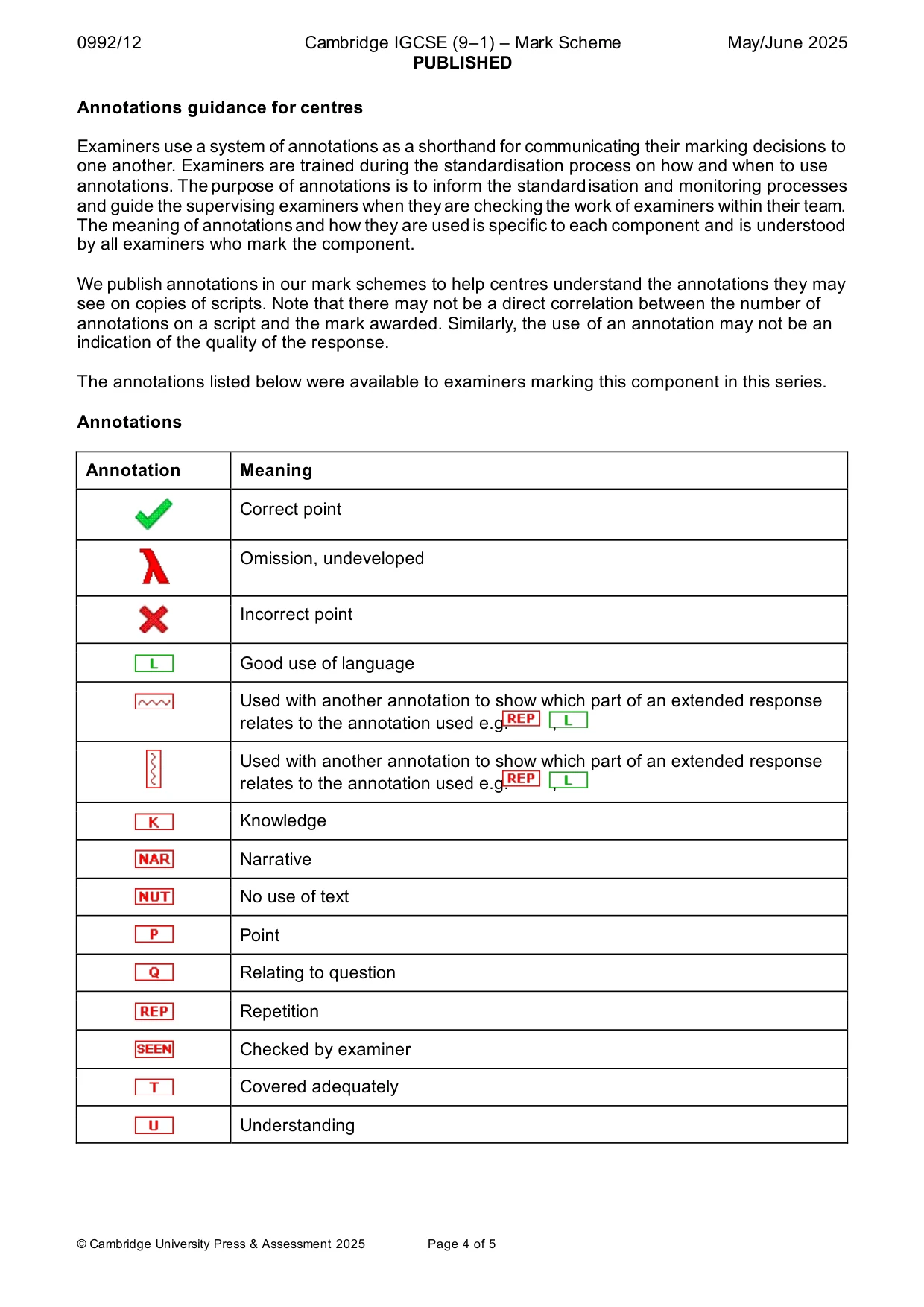
0992/12 Cambridge IGCSE (9–1) – Mark Scheme PUBLISHED May/June 2025 © Cambridge University Press & Assessment 2025 Page 4 of 5 Annotations guidance for centres Examiners use a system of annotations as a shorthand for communicating their marking decisions to one another. Examiners are trained during the standardisation process on how and when to use annotations. The purpose of annotations is to inform the standardisation and monitoring processes and guide the supervising examiners when they are checking the work of examiners within their team. The meaning of annotations and how they are used is specific to each component and is understood by all examiners who mark the component. We publish annotations in our mark schemes to help centres understand the annotations they may see on copies of scripts. Note that there may not be a direct correlation between the number of annotations on a script and the mark awarded. Similarly, the use of an annotation may not be an indication of the quality of the response. The annotations listed below were available to examiners marking this component in this series. Annotations Annotation Meaning Correct point Omission, undeveloped Incorrect point Good use of language Used with another annotation to show which part of an extended response relates to the annotation used e.g. , Used with another annotation to show which part of an extended response relates to the annotation used e.g. , Knowledge Narrative No use of text Point Relating to question Repetition Checked by examiner Covered adequately Understanding
Mark scheme, page 5
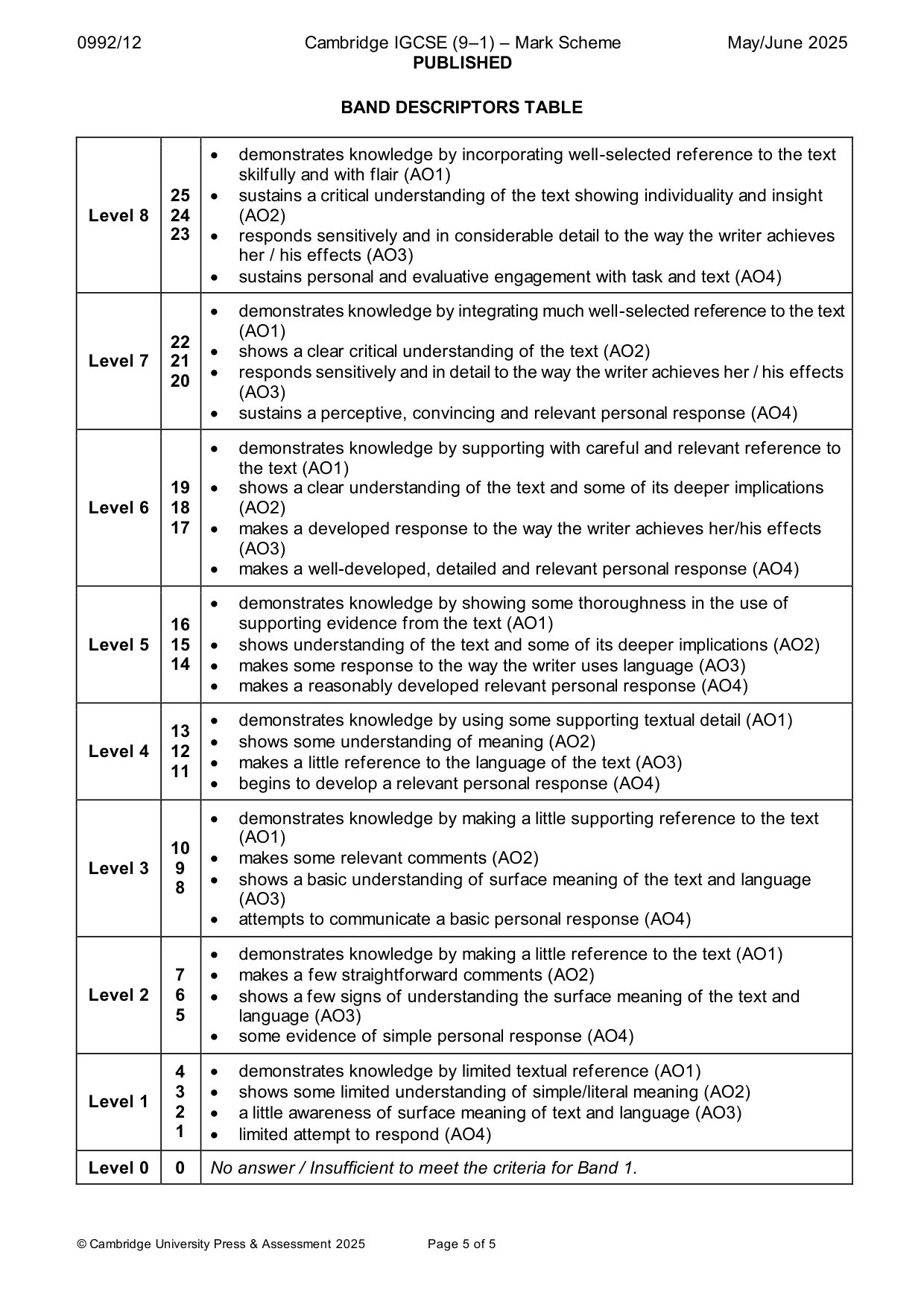
0992/12 Cambridge IGCSE (9–1) – Mark Scheme PUBLISHED May/June 2025 © Cambridge University Press & Assessment 2025 Page 5 of 5 BAND DESCRIPTORS TABLE Level 8 25 24 23 • demonstrates knowledge by incorporating well-selected reference to the text skilfully and with flair (AO1) • sustains a critical understanding of the text showing individuality and insight (AO2) • responds sensitively and in considerable detail to the way the writer achieves her / his effects (AO3) • sustains personal and evaluative engagement with task and text (AO4) Level 7 22 21 20 • demonstrates knowledge by integrating much well-selected reference to the text (AO1) • shows a clear critical understanding of the text (AO2) • responds sensitively and in detail to the way the writer achieves her / his effects (AO3) • sustains a perceptive, convincing and relevant personal response (AO4) Level 6 19 18 17 • demonstrates knowledge by supporting with careful and relevant reference to the text (AO1) • shows a clear understanding of the text and some of its deeper implications (AO2) • makes a developed response to the way the writer achieves her/his effects (AO3) • makes a well-developed, detailed and relevant personal response (AO4) Level 5 16 15 14 • demonstrates knowledge by showing some thoroughness in the use of supporting evidence from the text (AO1) • shows understanding of the text and some of its deeper implications (AO2) • makes some response to the way the writer uses language (AO3) • makes a reasonably developed relevant personal response (AO4) Level 4 13 12 11 • demonstrates knowledge by using some supporting textual detail (AO1) • shows some understanding of meaning (AO2) • makes a little reference to the language of the text (AO3) • begins to develop a relevant personal response (AO4) Level 3 10 9 8 • demonstrates knowledge by making a little supporting reference to the text (AO1) • makes some relevant comments (AO2) • shows a basic understanding of surface meaning of the text and language (AO3) • attempts to communicate a basic personal response (AO4) Level 2 7 6 5 • demonstrates knowledge by making a little reference to the text (AO1) • makes a few straightforward comments (AO2) • shows a few signs of understanding the surface meaning of the text and language (AO3) • some evidence of simple personal response (AO4) Level 1 4 3 2 1 • demonstrates knowledge by limited textual reference (AO1) • shows some limited understanding of simple/literal meaning (AO2) • a little awareness of surface meaning of text and language (AO3) • limited attempt to respond (AO4) Level 0 0 No answer / Insufficient to meet the criteria for Band 1.
What you needed in this session
Cambridge’s own grade thresholds for 2025 May/June, Paper 1 · Variant 2. A higher threshold means an easier paper — the bar moves with how the cohort did.