Cambridge IGCSE English - Literature in English (9-1) 0992 — 2023 May/June Paper 1 · Variant 2
0992/12/M/J/23 · 50 marks · ≈56 min
The question paper and its mark scheme, free to read here and free to download. This is Cambridge’s own paper, exactly as it was sat.
Question paper28 pages

Mark scheme4 pages
Answers below. Sit the paper first if you are practising.
Paper as text
Question paper, page 1
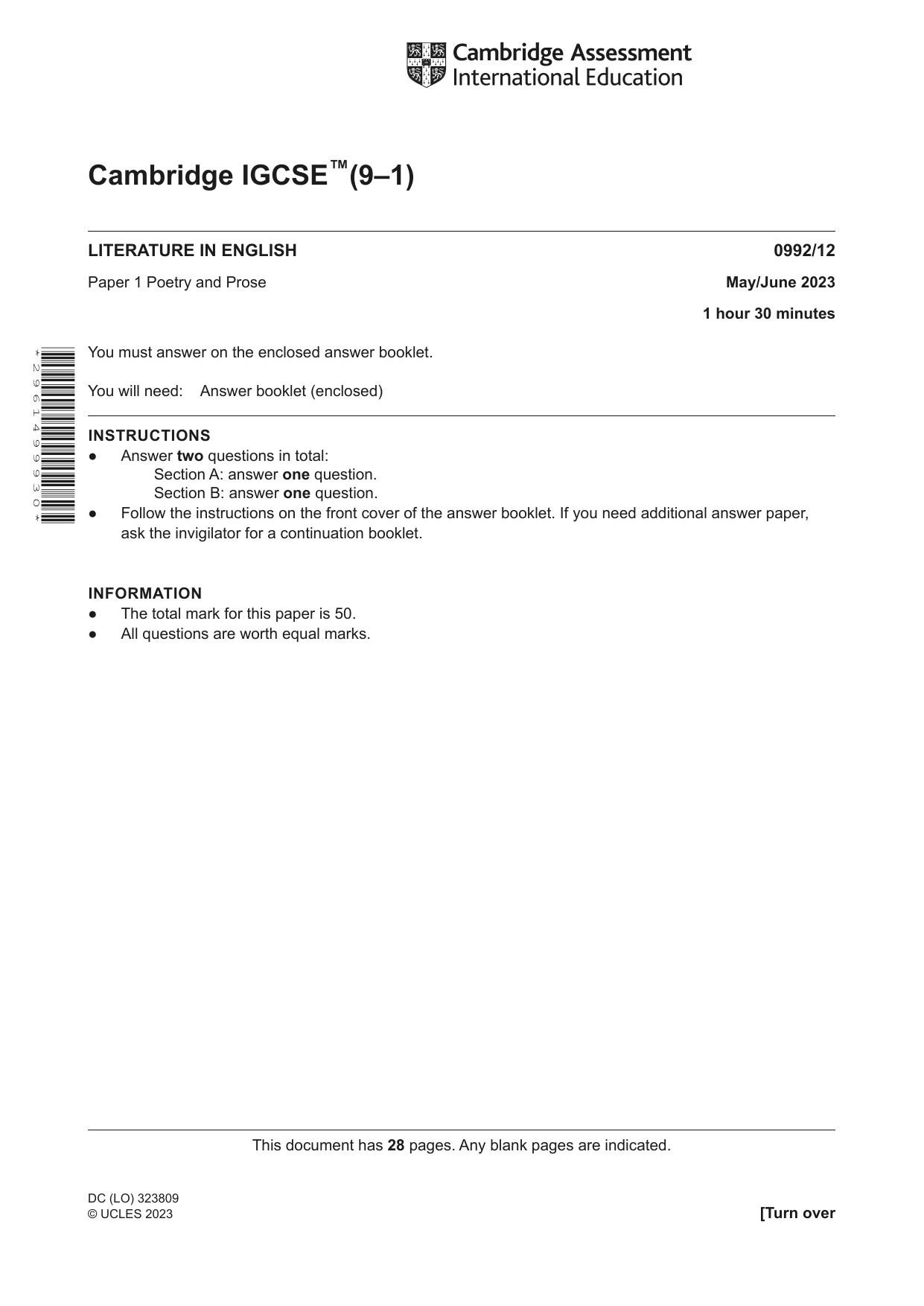
This document has 28 pages. Any blank pages are indicated. [Turn over Cambridge IGCSE™(9–1) * 2 9 6 1 4 9 9 9 3 0 * DC (LO) 323809 © UCLES 2023 LITERATURE IN ENGLISH 0992/12 Paper 1 Poetry and Prose May/June 2023 1 hour 30 minutes You must answer on the enclosed answer booklet. You will need: Answer booklet (enclosed) INSTRUCTIONS ● Answer two questions in total: Section A: answer one question. Section B: answer one question. ● Follow the instructions on the front cover of the answer booklet. If you need additional answer paper, ask the invigilator for a continuation booklet. INFORMATION ● The total mark for this paper is 50. ● All questions are worth equal marks.
Question paper, page 2
2 0992/12/M/J/23 © UCLES 2023 BLANK PAGE
Question paper, page 3
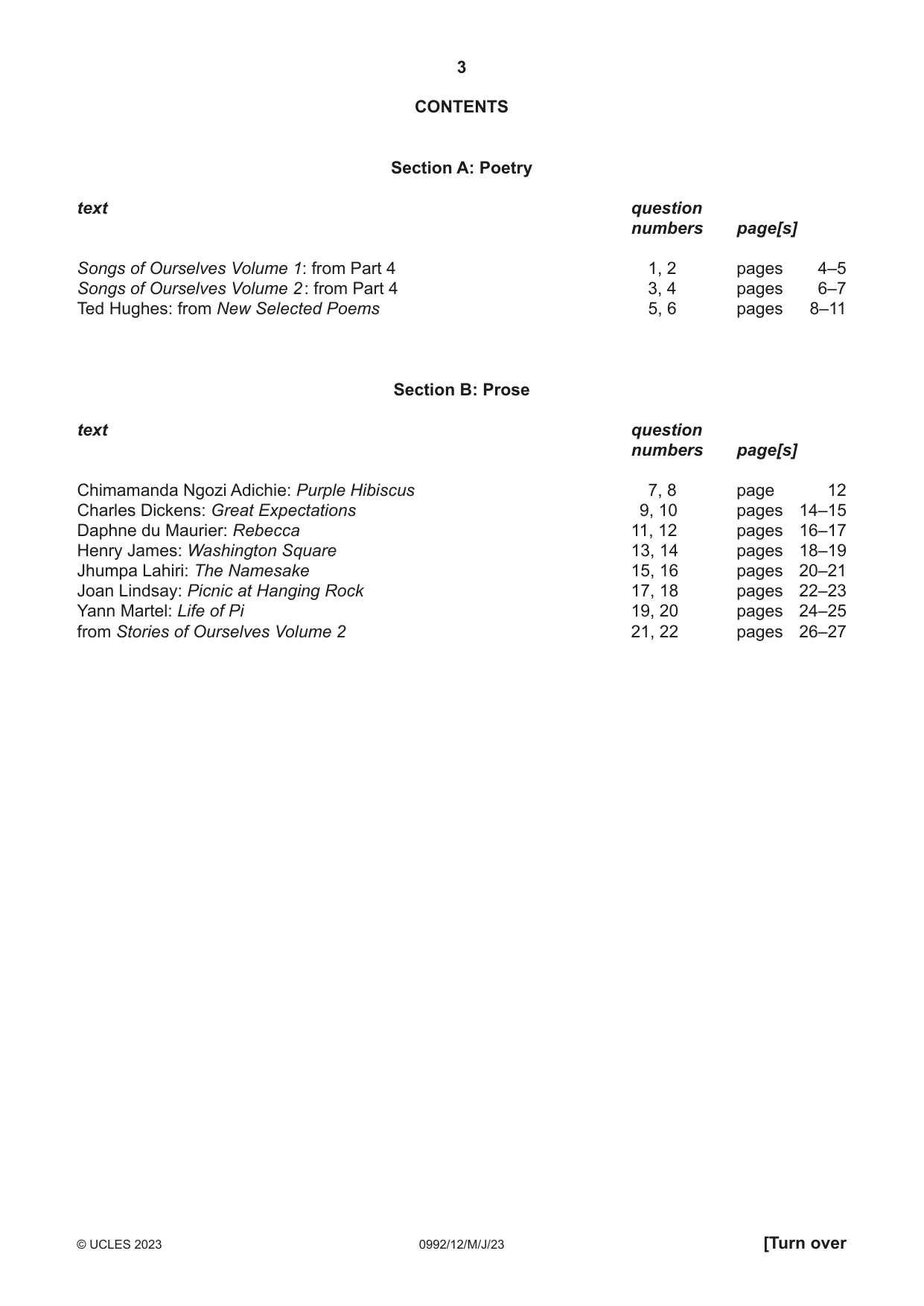
3 0992/12/M/J/23 © UCLES 2023 [Turn over CONTENTS Section A: Poetry text question numbers page[s] Songs of Ourselves Volume 1: from Part 4 1, 2 pages 4–5 Songs of Ourselves Volume 2 : from Part 4 3, 4 pages 6–7 Ted Hughes: from New Selected Poems 5, 6 pages 8–11 Section B: Prose text question numbers page[s] Chimamanda Ngozi Adichie: Purple Hibiscus 7, 8 page 12 Charles Dickens: Great Expectations 9, 10 pages 14–15 Daphne du Maurier: Rebecca 11, 12 pages 16–17 Henry James: Washington Square 13, 14 pages 18–19 Jhumpa Lahiri: The Namesake 15, 16 pages 20–21 Joan Lindsay: Picnic at Hanging Rock 17, 18 pages 22–23 Yann Martel: Life of Pi 19, 20 pages 24–25 from Stories of Ourselves Volume 2 21, 22 pages 26–27
Question paper, page 4
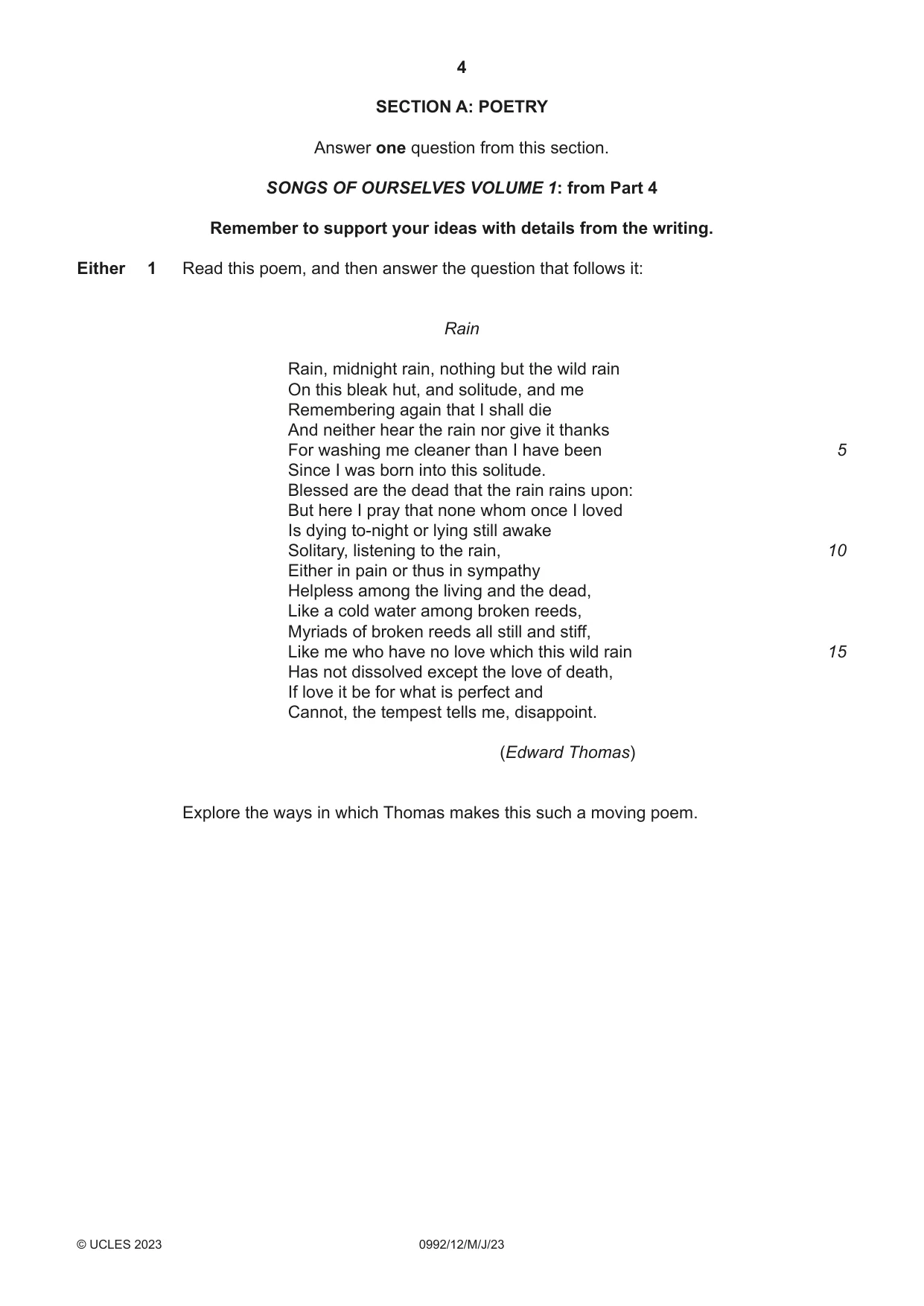
4 0992/12/M/J/23 © UCLES 2023 SECTION A: POETRY Answer one question from this section. SONGS OF OURSELVES VOLUME 1: from Part 4 Remember to support your ideas with details from the writing. Either 1 Read this poem, and then answer the question that follows it: Rain Rain, midnight rain, nothing but the wild rain On this bleak hut, and solitude, and me Remembering again that I shall die And neither hear the rain nor give it thanks For washing me cleaner than I have been Since I was born into this solitude. Blessed are the dead that the rain rains upon: But here I pray that none whom once I loved Is dying to-night or lying still awake Solitary, listening to the rain, Either in pain or thus in sympathy Helpless among the living and the dead, Like a cold water among broken reeds, Myriads of broken reeds all still and stiff, Like me who have no love which this wild rain Has not dissolved except the love of death, If love it be for what is perfect and Cannot, the tempest tells me, disappoint. (Edward Thomas) Explore the ways in which Thomas makes this such a moving poem. 5 10 15
Question paper, page 5
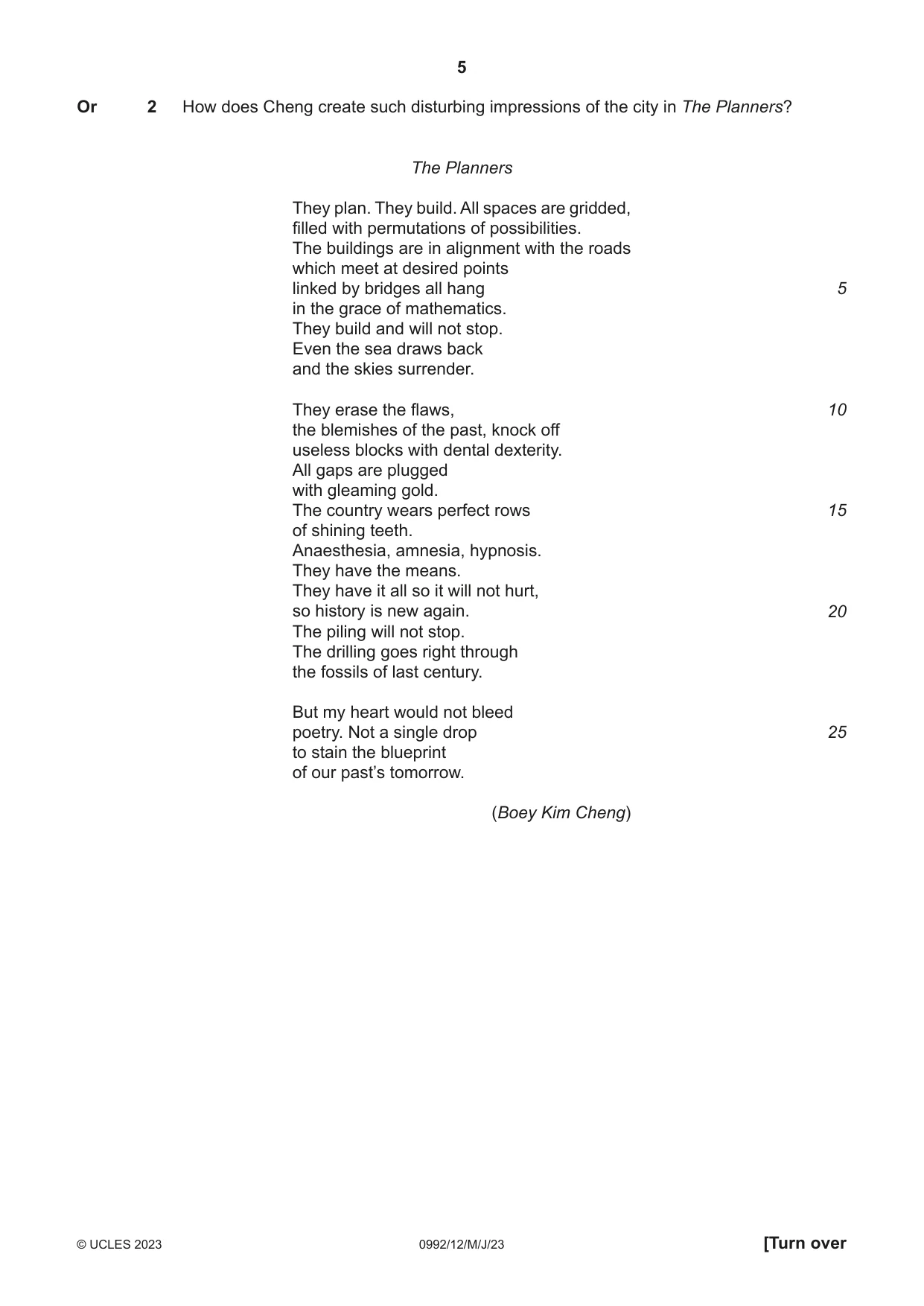
5 0992/12/M/J/23 © UCLES 2023 [Turn over Or 2 How does Cheng create such disturbing impressions of the city in The Planners? The Planners They plan. They build. All spaces are gridded, filled with permutations of possibilities. The buildings are in alignment with the roads which meet at desired points linked by bridges all hang in the grace of mathematics. They build and will not stop. Even the sea draws back and the skies surrender. They erase the flaws, the blemishes of the past, knock off useless blocks with dental dexterity. All gaps are plugged with gleaming gold. The country wears perfect rows of shining teeth. Anaesthesia, amnesia, hypnosis. They have the means. They have it all so it will not hurt, so history is new again. The piling will not stop. The drilling goes right through the fossils of last century. But my heart would not bleed poetry. Not a single drop to stain the blueprint of our past’s tomorrow. (Boey Kim Cheng) 5 10 15 20 25
Question paper, page 6
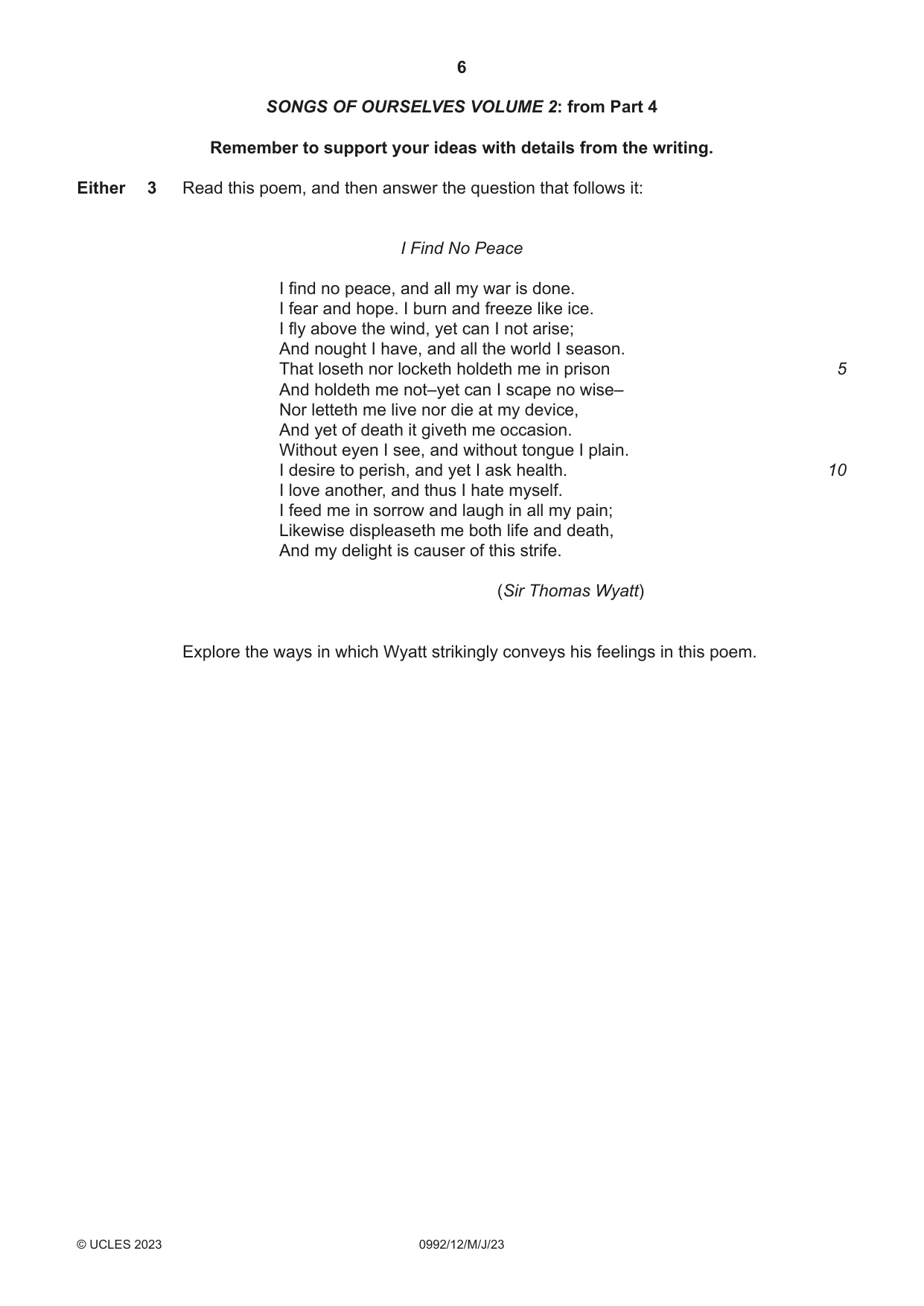
6 0992/12/M/J/23 © UCLES 2023 SONGS OF OURSELVES VOLUME 2: from Part 4 Remember to support your ideas with details from the writing. Either 3 Read this poem, and then answer the question that follows it: I Find No Peace I find no peace, and all my war is done. I fear and hope. I burn and freeze like ice. I fly above the wind, yet can I not arise; And nought I have, and all the world I season. That loseth nor locketh holdeth me in prison And holdeth me not–yet can I scape no wise– Nor letteth me live nor die at my device, And yet of death it giveth me occasion. Without eyen I see, and without tongue I plain. I desire to perish, and yet I ask health. I love another, and thus I hate myself. I feed me in sorrow and laugh in all my pain; Likewise displeaseth me both life and death, And my delight is causer of this strife. (Sir Thomas Wyatt) Explore the ways in which Wyatt strikingly conveys his feelings in this poem. 5 10
Question paper, page 7
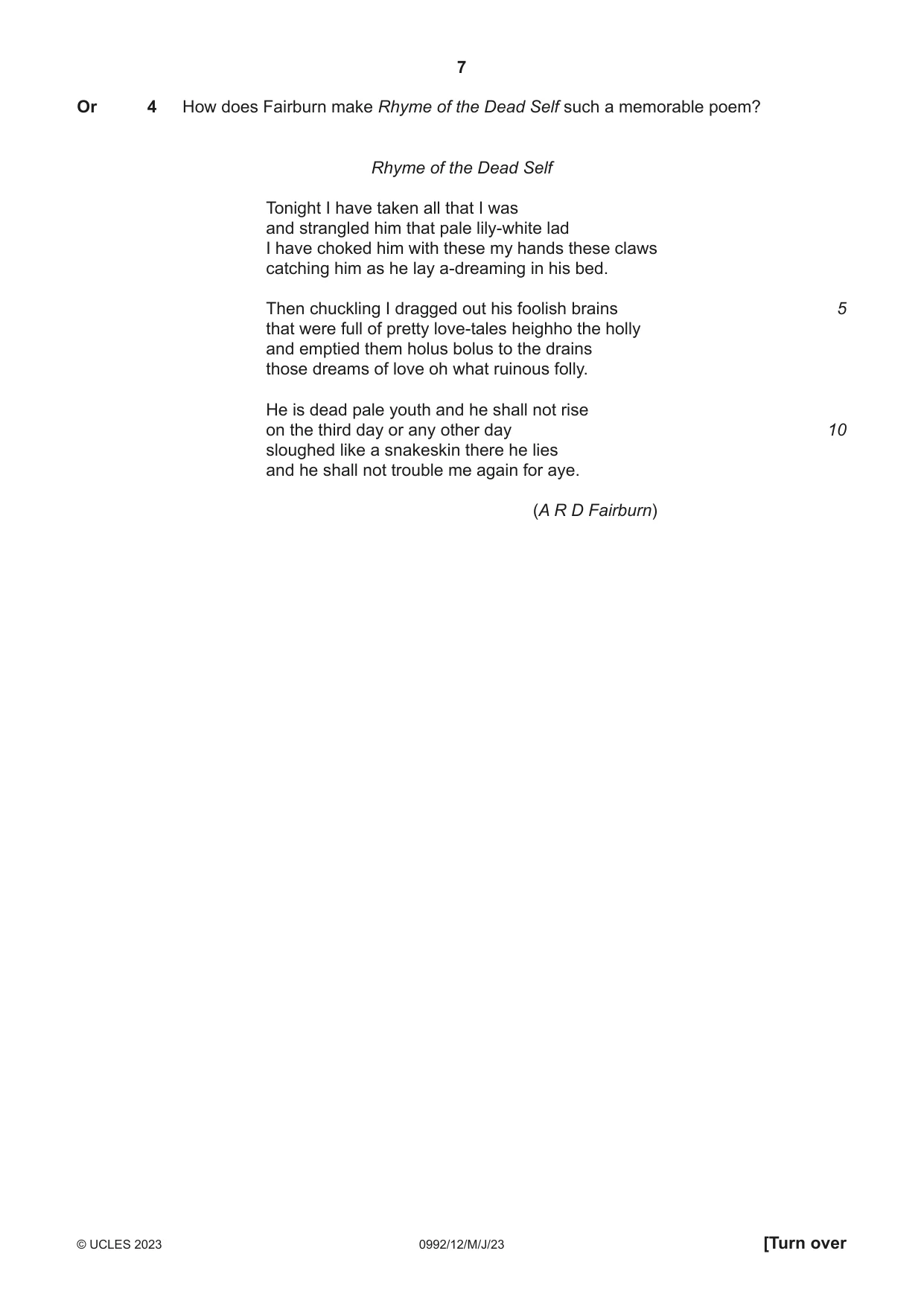
7 0992/12/M/J/23 © UCLES 2023 [Turn over Or 4 How does Fairburn make Rhyme of the Dead Self such a memorable poem? Rhyme of the Dead Self Tonight I have taken all that I was and strangled him that pale lily-white lad I have choked him with these my hands these claws catching him as he lay a-dreaming in his bed. Then chuckling I dragged out his foolish brains that were full of pretty love-tales heighho the holly and emptied them holus bolus to the drains those dreams of love oh what ruinous folly. He is dead pale youth and he shall not rise on the third day or any other day sloughed like a snakeskin there he lies and he shall not trouble me again for aye. (A R D Fairburn) 5 10
Question paper, page 8
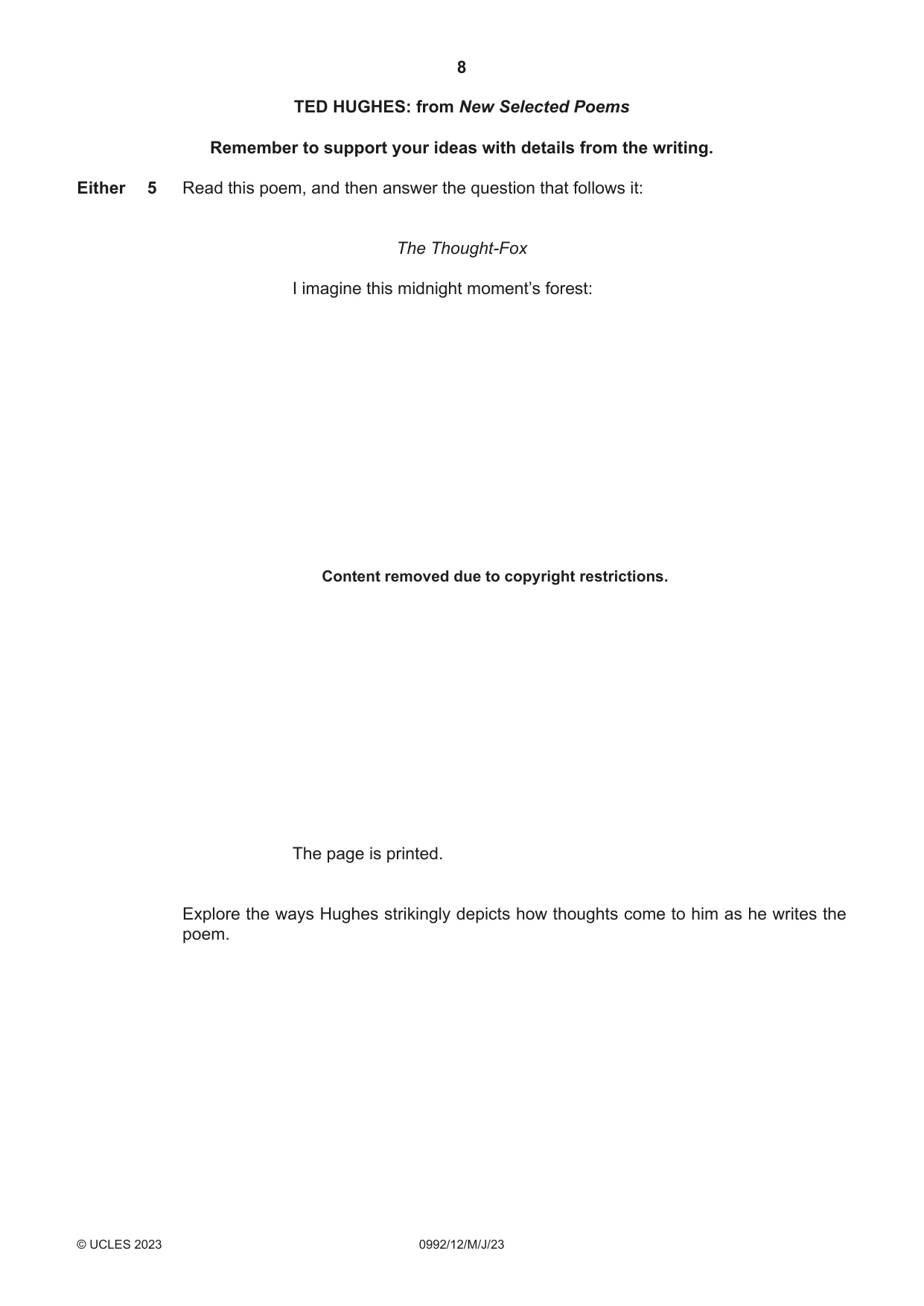
8 0992/12/M/J/23 © UCLES 2023 TED HUGHES: from New Selected Poems Remember to support your ideas with details from the writing. Either 5 Read this poem, and then answer the question that follows it: The Thought-Fox I imagine this midnight moment’s forest: The page is printed. Explore the ways Hughes strikingly depicts how thoughts come to him as he writes the poem. Content removed due to copyright restrictions.
Question paper, page 9
9 0992/12/M/J/23 © UCLES 2023 [Turn over TURN OVER FOR QUESTION 6.
Question paper, page 10
10 0992/12/M/J/23 © UCLES 2023 Or 6 How does Hughes powerfully depict his early morning walk in The Horses? The Horses I climbed through woods in the hour-before-dawn dark. Content removed due to copyright restrictions.
Question paper, page 11
11 0992/12/M/J/23 © UCLES 2023 [Turn over Hearing the horizons endure. Content removed due to copyright restrictions.
Question paper, page 12
12 0992/12/M/J/23 © UCLES 2023 SECTION B: PROSE Answer one question from this section. CHIMAMANDA NGOZI ADICHIE: Purple Hibiscus Remember to support your ideas with details from the writing. Either 7 Read this passage, and then answer the question that follows it: We were all in the living room, playing cards, when the phone rang that evening. He had seemed immortal. How does Adichie make this such a dramatic moment in the novel? Or 8 Explore the ways in which Adichie vividly depicts Kambili’s school days. Content removed due to copyright restrictions.
Question paper, page 13
13 0992/12/M/J/23 © UCLES 2023 [Turn over TURN OVER FOR QUESTION 9.
Question paper, page 14
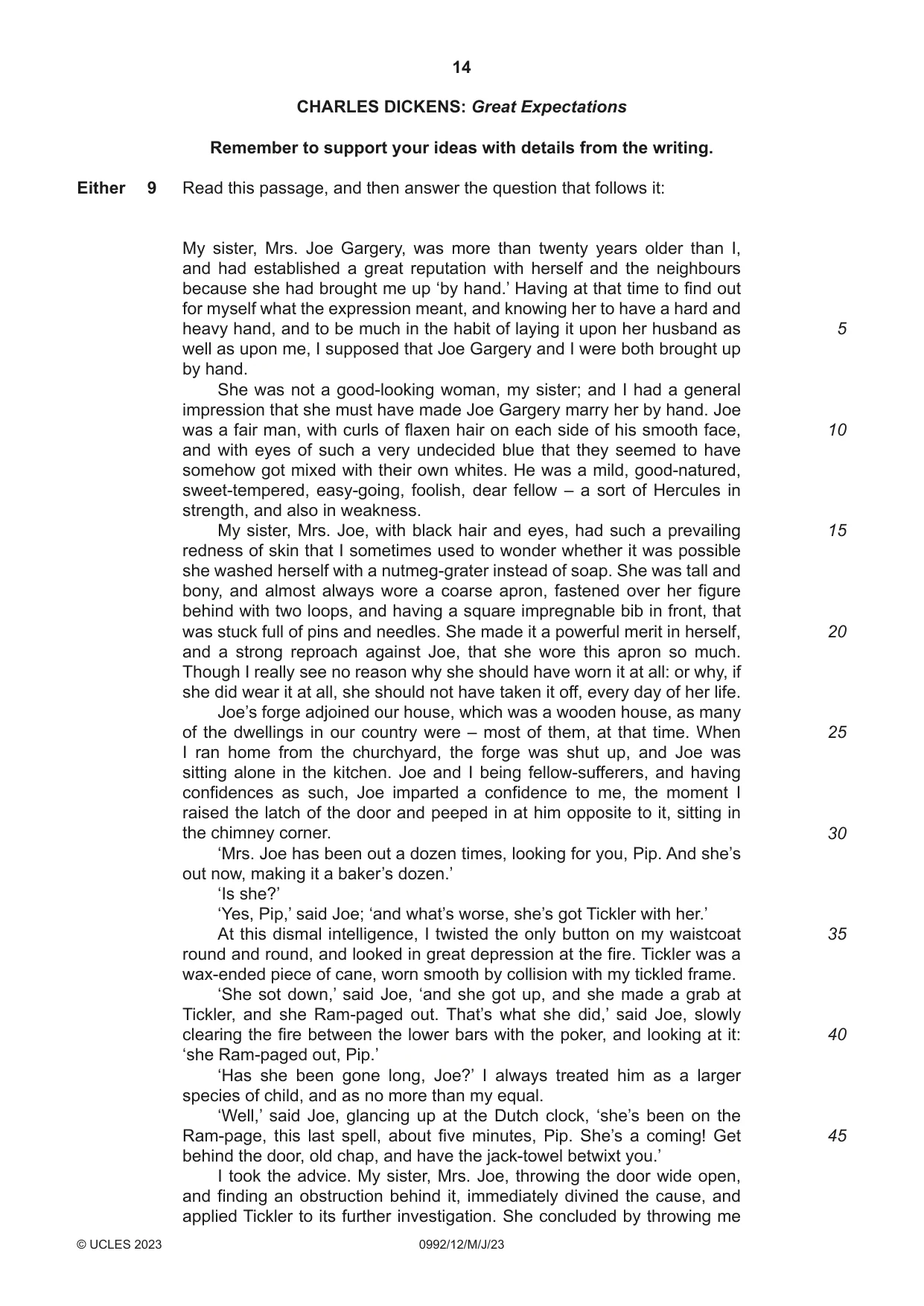
14 0992/12/M/J/23 © UCLES 2023 CHARLES DICKENS: Great Expectations Remember to support your ideas with details from the writing. Either 9 Read this passage, and then answer the question that follows it: My sister, Mrs. Joe Gargery, was more than twenty years older than I, and had established a great reputation with herself and the neighbours because she had brought me up ‘by hand.’ Having at that time to find out for myself what the expression meant, and knowing her to have a hard and heavy hand, and to be much in the habit of laying it upon her husband as well as upon me, I supposed that Joe Gargery and I were both brought up by hand. She was not a good-looking woman, my sister; and I had a general impression that she must have made Joe Gargery marry her by hand. Joe was a fair man, with curls of flaxen hair on each side of his smooth face, and with eyes of such a very undecided blue that they seemed to have somehow got mixed with their own whites. He was a mild, good-natured, sweet-tempered, easy-going, foolish, dear fellow – a sort of Hercules in strength, and also in weakness. My sister, Mrs. Joe, with black hair and eyes, had such a prevailing redness of skin that I sometimes used to wonder whether it was possible she washed herself with a nutmeg-grater instead of soap. She was tall and bony, and almost always wore a coarse apron, fastened over her figure behind with two loops, and having a square impregnable bib in front, that was stuck full of pins and needles. She made it a powerful merit in herself, and a strong reproach against Joe, that she wore this apron so much. Though I really see no reason why she should have worn it at all: or why, if she did wear it at all, she should not have taken it off, every day of her life. Joe’s forge adjoined our house, which was a wooden house, as many of the dwellings in our country were – most of them, at that time. When I ran home from the churchyard, the forge was shut up, and Joe was sitting alone in the kitchen. Joe and I being fellow-sufferers, and having confidences as such, Joe imparted a confidence to me, the moment I raised the latch of the door and peeped in at him opposite to it, sitting in the chimney corner. ‘Mrs. Joe has been out a dozen times, looking for you, Pip. And she’s out now, making it a baker’s dozen.’ ‘Is she?’ ‘Yes, Pip,’ said Joe; ‘and what’s worse, she’s got Tickler with her.’ At this dismal intelligence, I twisted the only button on my waistcoat round and round, and looked in great depression at the fire. Tickler was a wax-ended piece of cane, worn smooth by collision with my tickled frame. ‘She sot down,’ said Joe, ‘and she got up, and she made a grab at Tickler, and she Ram-paged out. That’s what she did,’ said Joe, slowly clearing the fire between the lower bars with the poker, and looking at it: ‘she Ram-paged out, Pip.’ ‘Has she been gone long, Joe?’ I always treated him as a larger species of child, and as no more than my equal. ‘Well,’ said Joe, glancing up at the Dutch clock, ‘she’s been on the Ram-page, this last spell, about five minutes, Pip. She’s a coming! Get behind the door, old chap, and have the jack-towel betwixt you.’ I took the advice. My sister, Mrs. Joe, throwing the door wide open, and finding an obstruction behind it, immediately divined the cause, and applied Tickler to its further investigation. She concluded by throwing me 5 10 15 20 25 30 35 40 45
Question paper, page 15
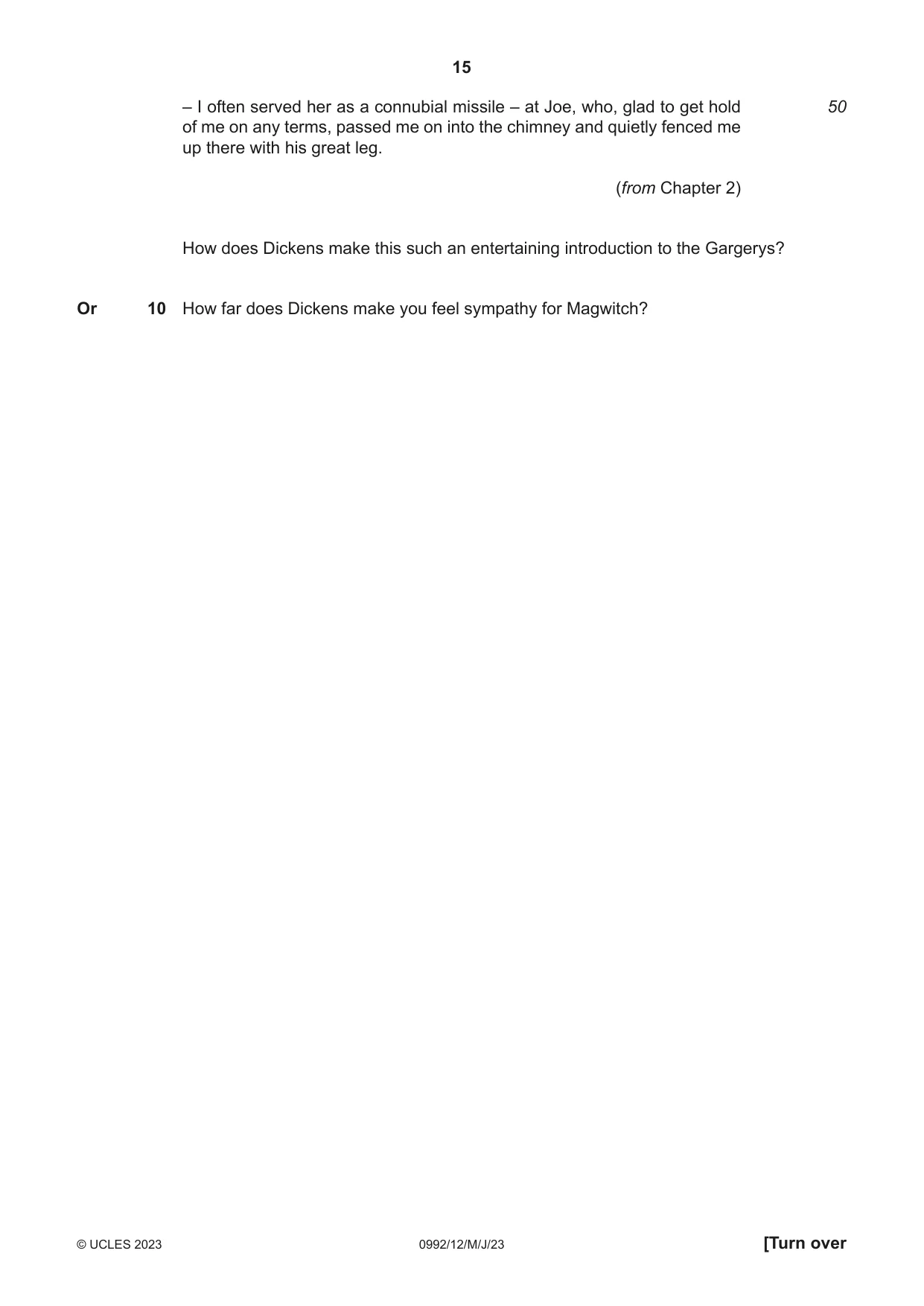
15 0992/12/M/J/23 © UCLES 2023 [Turn over – I often served her as a connubial missile – at Joe, who, glad to get hold of me on any terms, passed me on into the chimney and quietly fenced me up there with his great leg. (from Chapter 2) How does Dickens make this such an entertaining introduction to the Gargerys? Or 10 How far does Dickens make you feel sympathy for Magwitch? 50
Question paper, page 16
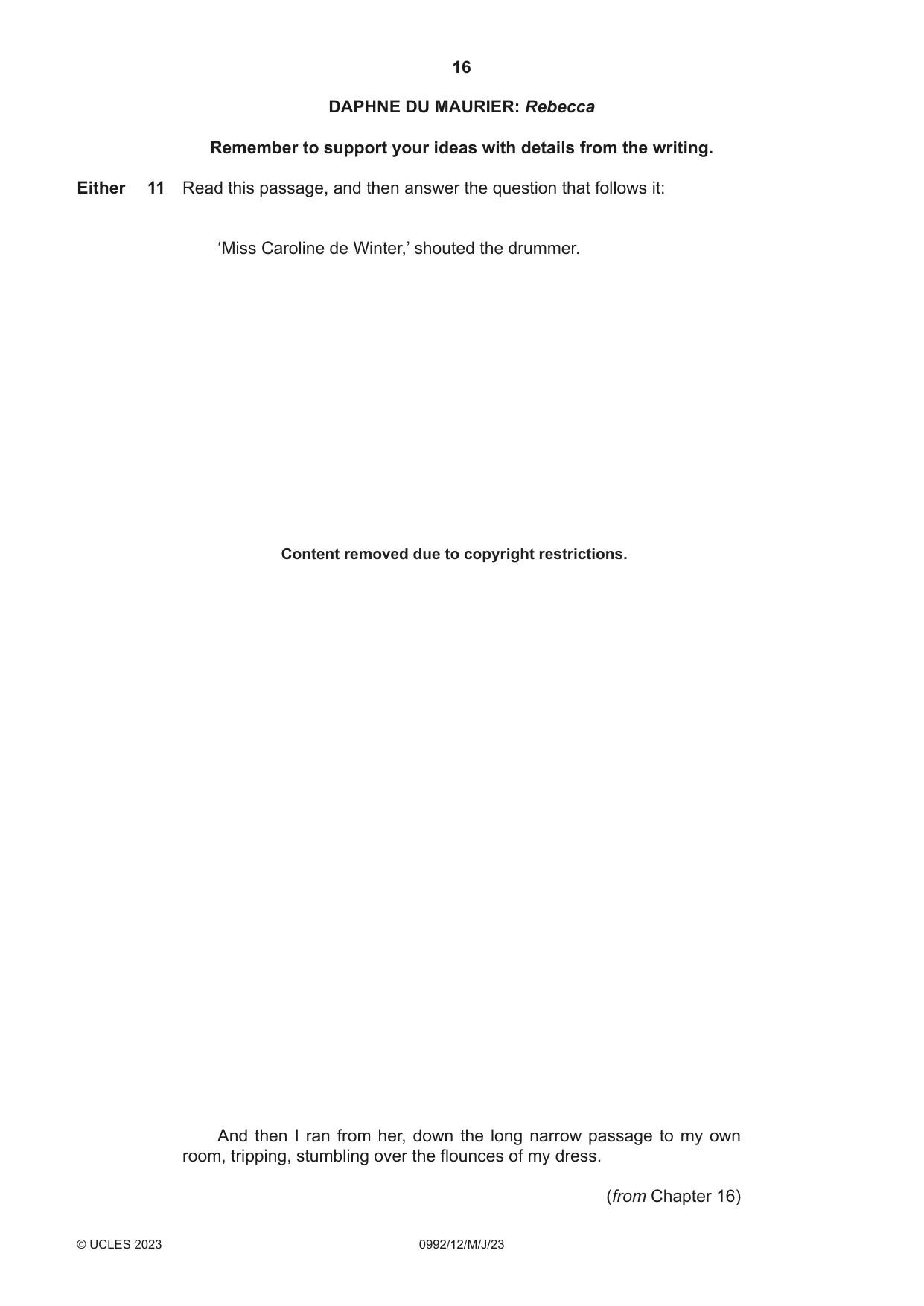
16 0992/12/M/J/23 © UCLES 2023 DAPHNE DU MAURIER: Rebecca Remember to support your ideas with details from the writing. Either 11 Read this passage, and then answer the question that follows it: ‘Miss Caroline de Winter,’ shouted the drummer. And then I ran from her, down the long narrow passage to my own room, tripping, stumbling over the flounces of my dress. (from Chapter 16) Content removed due to copyright restrictions.
Question paper, page 17
17 0992/12/M/J/23 © UCLES 2023 [Turn over How does du Maurier make this such a powerful moment in the novel? Or 12 Explore the ways in which du Maurier memorably portrays Frank Crawley.
Question paper, page 18
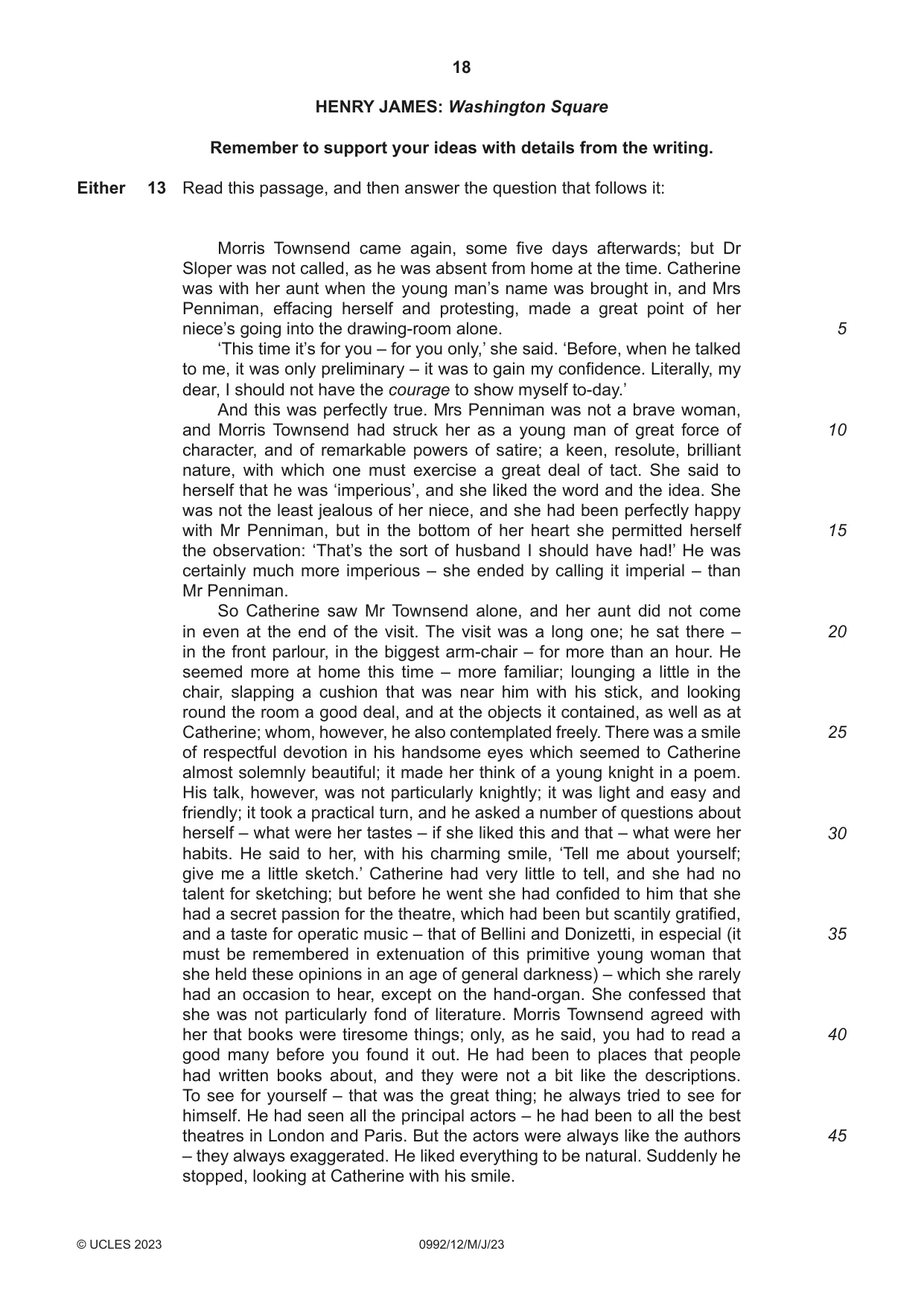
18 0992/12/M/J/23 © UCLES 2023 HENRY JAMES: Washington Square Remember to support your ideas with details from the writing. Either 13 Read this passage, and then answer the question that follows it: Morris Townsend came again, some five days afterwards; but Dr Sloper was not called, as he was absent from home at the time. Catherine was with her aunt when the young man’s name was brought in, and Mrs Penniman, effacing herself and protesting, made a great point of her niece’s going into the drawing-room alone. ‘This time it’s for you – for you only,’ she said. ‘Before, when he talked to me, it was only preliminary – it was to gain my confidence. Literally, my dear, I should not have the courage to show myself to-day.’ And this was perfectly true. Mrs Penniman was not a brave woman, and Morris Townsend had struck her as a young man of great force of character, and of remarkable powers of satire; a keen, resolute, brilliant nature, with which one must exercise a great deal of tact. She said to herself that he was ‘imperious’, and she liked the word and the idea. She was not the least jealous of her niece, and she had been perfectly happy with Mr Penniman, but in the bottom of her heart she permitted herself the observation: ‘That’s the sort of husband I should have had!’ He was certainly much more imperious – she ended by calling it imperial – than Mr Penniman. So Catherine saw Mr Townsend alone, and her aunt did not come in even at the end of the visit. The visit was a long one; he sat there – in the front parlour, in the biggest arm-chair – for more than an hour. He seemed more at home this time – more familiar; lounging a little in the chair, slapping a cushion that was near him with his stick, and looking round the room a good deal, and at the objects it contained, as well as at Catherine; whom, however, he also contemplated freely. There was a smile of respectful devotion in his handsome eyes which seemed to Catherine almost solemnly beautiful; it made her think of a young knight in a poem. His talk, however, was not particularly knightly; it was light and easy and friendly; it took a practical turn, and he asked a number of questions about herself – what were her tastes – if she liked this and that – what were her habits. He said to her, with his charming smile, ‘Tell me about yourself; give me a little sketch.’ Catherine had very little to tell, and she had no talent for sketching; but before he went she had confided to him that she had a secret passion for the theatre, which had been but scantily gratified, and a taste for operatic music – that of Bellini and Donizetti, in especial (it must be remembered in extenuation of this primitive young woman that she held these opinions in an age of general darkness) – which she rarely had an occasion to hear, except on the hand-organ. She confessed that she was not particularly fond of literature. Morris Townsend agreed with her that books were tiresome things; only, as he said, you had to read a good many before you found it out. He had been to places that people had written books about, and they were not a bit like the descriptions. To see for yourself – that was the great thing; he always tried to see for himself. He had seen all the principal actors – he had been to all the best theatres in London and Paris. But the actors were always like the authors – they always exaggerated. He liked everything to be natural. Suddenly he stopped, looking at Catherine with his smile. 5 10 15 20 25 30 35 40 45
Question paper, page 19
19 0992/12/M/J/23 © UCLES 2023 [Turn over ‘That’s what I like you for; you are so natural! Excuse me,’ he added; ‘you see I am natural myself!’ (from Chapter 6) In what ways does James strikingly portray the characters at this moment in the novel? Or 14 To what extent does James make it possible for you to admire Dr Sloper?
Question paper, page 20
20 0992/12/M/J/23 © UCLES 2023 JHUMPA LAHIRI: The Namesake Remember to support your ideas with details from the writing. Either 15 Read this passage, and then answer the question that follows it: Nikhil consults his map and for the next few days he follows the routes she has charted for him with a pencil. Content removed due to copyright restrictions.
Question paper, page 21
21 0992/12/M/J/23 © UCLES 2023 [Turn over But she refuses to indulge him, moving her chair out of view with a scrape on the pavement; she doesn’t want to be mistaken for a tourist in this city, she says. (from Chapter 9) Explore the ways in which Lahiri makes this such a revealing moment in the novel. Or 16 How does Lahiri create such memorable impressions of Ashoke’s life? Content removed due to copyright restrictions.
Question paper, page 22
22 0992/12/M/J/23 © UCLES 2023 JOAN LINDSAY: Picnic at Hanging Rock Remember to support your ideas with details from the writing. Either 17 Read this passage, and then answer the question that follows it: ‘Miss Edith, did anyone suggest which way they wanted to go?’ Content removed due to copyright restrictions.
Question paper, page 23
23 0992/12/M/J/23 © UCLES 2023 [Turn over And that was the last and only piece of factual information to be extracted from Edith Horton, either on Wednesday, February the eighteenth, or on any subsequent occasion. (from Chapter 5) In what ways does Lindsay make this moment in the novel both entertaining and significant? Or 18 How does Lindsay’s portrayal of Sara Waybourne’s suffering contribute to the power of the novel? Content removed due to copyright restrictions.
Question paper, page 24
24 0992/12/M/J/23 © UCLES 2023 YANN MARTEL: Life of Pi Remember to support your ideas with details from the writing. Either 19 Read this passage, and then answer the question that follows it: I looked around at the horizon. Plan Number Seven: Keep Him Alive. (from Chapter 57) Content removed due to copyright restrictions.
Question paper, page 25
25 0992/12/M/J/23 © UCLES 2023 [Turn over How does Martel strikingly convey Pi’s excitement with his plan at this moment in the novel? Or 20 Explore the ways in which Martel vividly depicts Pi’s extreme suffering during his time at sea.
Question paper, page 26
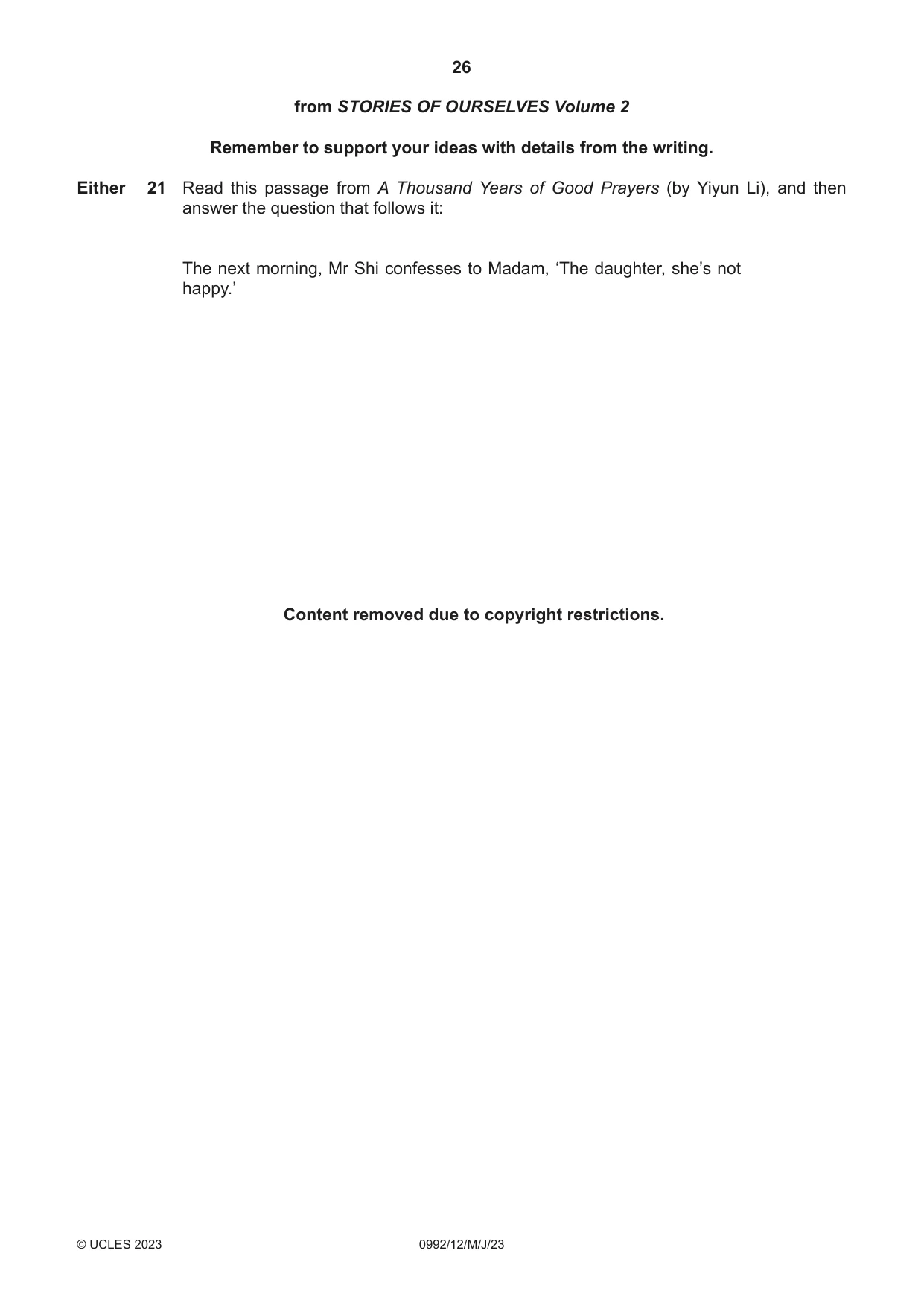
26 0992/12/M/J/23 © UCLES 2023 from STORIES OF OURSELVES Volume 2 Remember to support your ideas with details from the writing. Either 21 Read this passage from A Thousand Years of Good Prayers (by Yiyun Li), and then answer the question that follows it: The next morning, Mr Shi confesses to Madam, ‘The daughter, she’s not happy.’ Content removed due to copyright restrictions.
Question paper, page 27
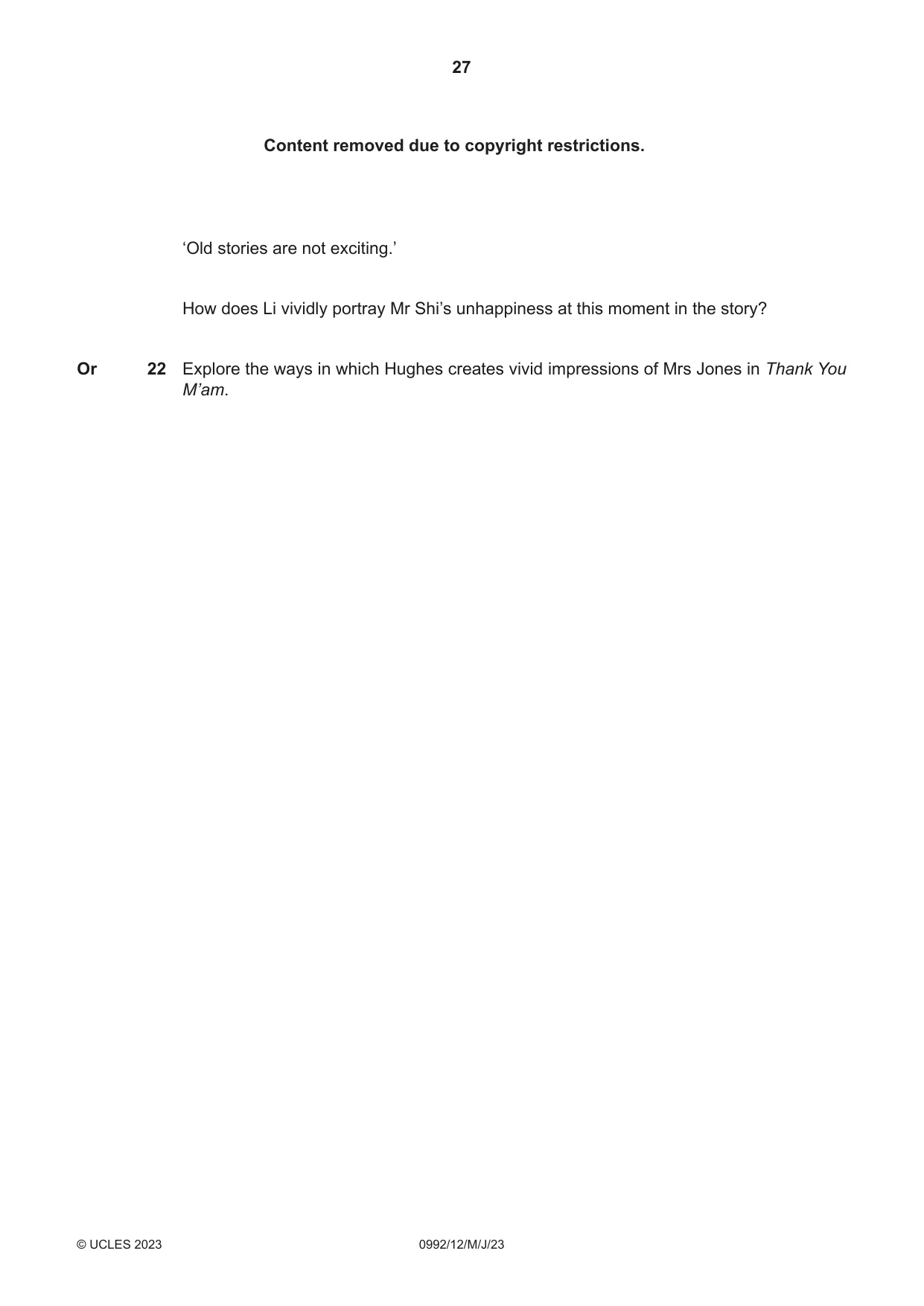
27 0992/12/M/J/23 © UCLES 2023 ‘Old stories are not exciting.’ How does Li vividly portray Mr Shi’s unhappiness at this moment in the story? Or 22 Explore the ways in which Hughes creates vivid impressions of Mrs Jones in Thank You M’am. Content removed due to copyright restrictions.
Question paper, page 28
28 0992/12/M/J/23 © UCLES 2023 Permission to reproduce items where third-party owned material protected by copyright is included has been sought and cleared where possible. Every reasonable effort has been made by the publisher (UCLES) to trace copyright holders, but if any items requiring clearance have unwittingly been included, the publisher will be pleased to make amends at the earliest possible opportunity. To avoid the issue of disclosure of answer-related information to candidates, all copyright acknowledgements are reproduced online in the Cambridge Assessment International Education Copyright Acknowledgements Booklet. This is produced for each series of examinations and is freely available to download at www.cambridgeinternational.org after the live examination series. Cambridge Assessment International Education is part of Cambridge Assessment. Cambridge Assessment is the brand name of the University of Cambridge Local Examinations Syndicate (UCLES), which is a department of the University of Cambridge. BLANK PAGE
Mark scheme, page 1
This document consists of 4 printed pages. © UCLES 2023 [Turn over Cambridge IGCSE™ (9–1) LITERATURE IN ENGLISH (9–1) 0992/12 Paper 1 Poetry and Prose May/June 2023 MARK SCHEME Maximum Mark: 50 Published This mark scheme is published as an aid to teachers and candidates, to indicate the requirements of the examination. It shows the basis on which Examiners were instructed to award marks. It does not indicate the details of the discussions that took place at an Examiners’ meeting before marking began, which would have considered the acceptability of alternative answers. Mark schemes should be read in conjunction with the question paper and the Principal Examiner Report for Teachers. Cambridge International will not enter into discussions about these mark schemes. Cambridge International is publishing the mark schemes for the May/June 2023 series for most Cambridge IGCSE, Cambridge International A and AS Level and Cambridge Pre-U components, and some Cambridge O Level components.
Mark scheme, page 2
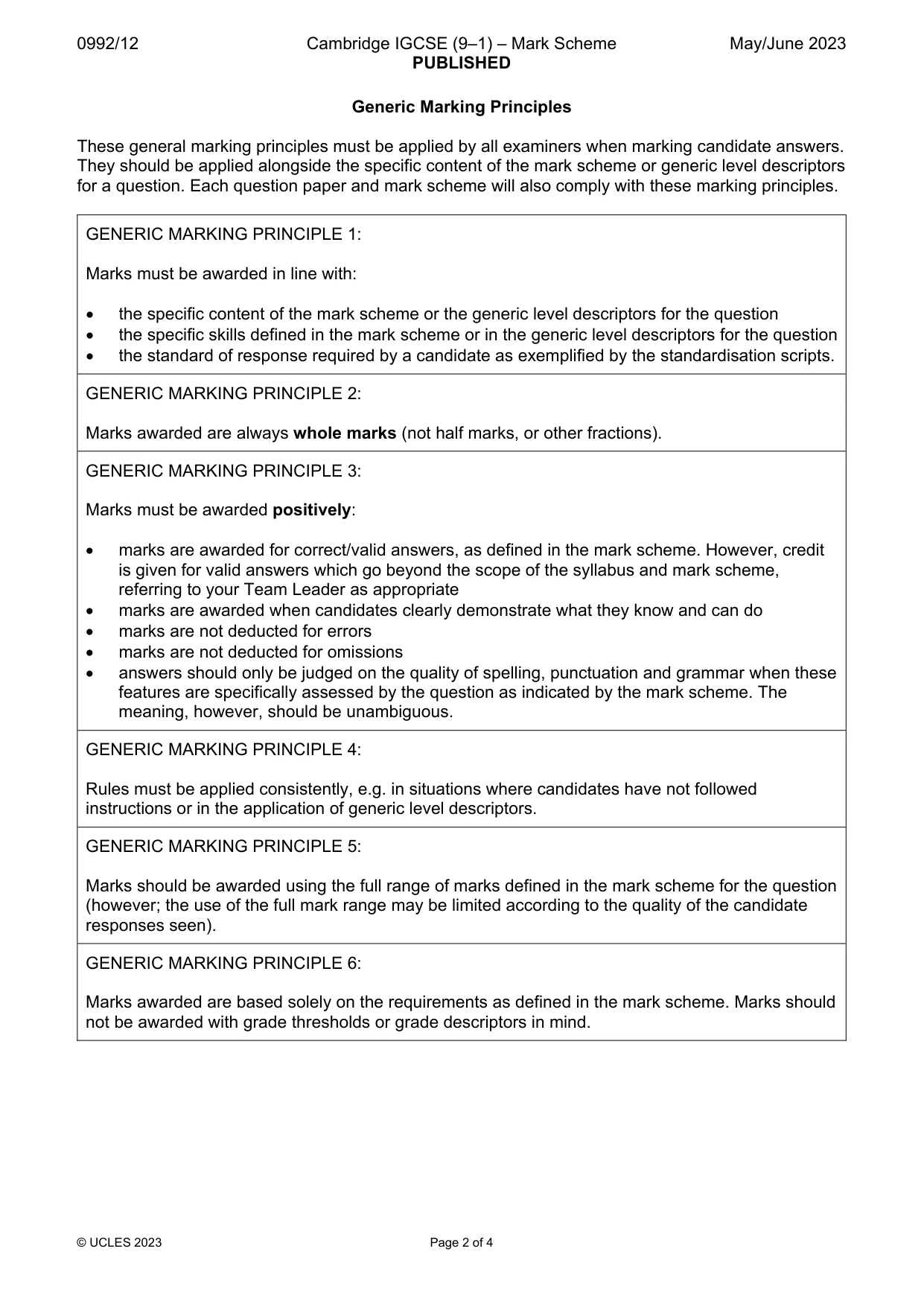
0992/12 Cambridge IGCSE (9–1) – Mark Scheme PUBLISHED May/June 2023 © UCLES 2023 Page 2 of 4 Generic Marking Principles These general marking principles must be applied by all examiners when marking candidate answers. They should be applied alongside the specific content of the mark scheme or generic level descriptors for a question. Each question paper and mark scheme will also comply with these marking principles. GENERIC MARKING PRINCIPLE 1: Marks must be awarded in line with: the specific content of the mark scheme or the generic level descriptors for the question the specific skills defined in the mark scheme or in the generic level descriptors for the question the standard of response required by a candidate as exemplified by the standardisation scripts. GENERIC MARKING PRINCIPLE 2: Marks awarded are always whole marks (not half marks, or other fractions). GENERIC MARKING PRINCIPLE 3: Marks must be awarded positively: marks are awarded for correct/valid answers, as defined in the mark scheme. However, credit is given for valid answers which go beyond the scope of the syllabus and mark scheme, referring to your Team Leader as appropriate marks are awarded when candidates clearly demonstrate what they know and can do marks are not deducted for errors marks are not deducted for omissions answers should only be judged on the quality of spelling, punctuation and grammar when these features are specifically assessed by the question as indicated by the mark scheme. The meaning, however, should be unambiguous. GENERIC MARKING PRINCIPLE 4: Rules must be applied consistently, e.g. in situations where candidates have not followed instructions or in the application of generic level descriptors. GENERIC MARKING PRINCIPLE 5: Marks should be awarded using the full range of marks defined in the mark scheme for the question (however; the use of the full mark range may be limited according to the quality of the candidate responses seen). GENERIC MARKING PRINCIPLE 6: Marks awarded are based solely on the requirements as defined in the mark scheme. Marks should not be awarded with grade thresholds or grade descriptors in mind.
Mark scheme, page 3
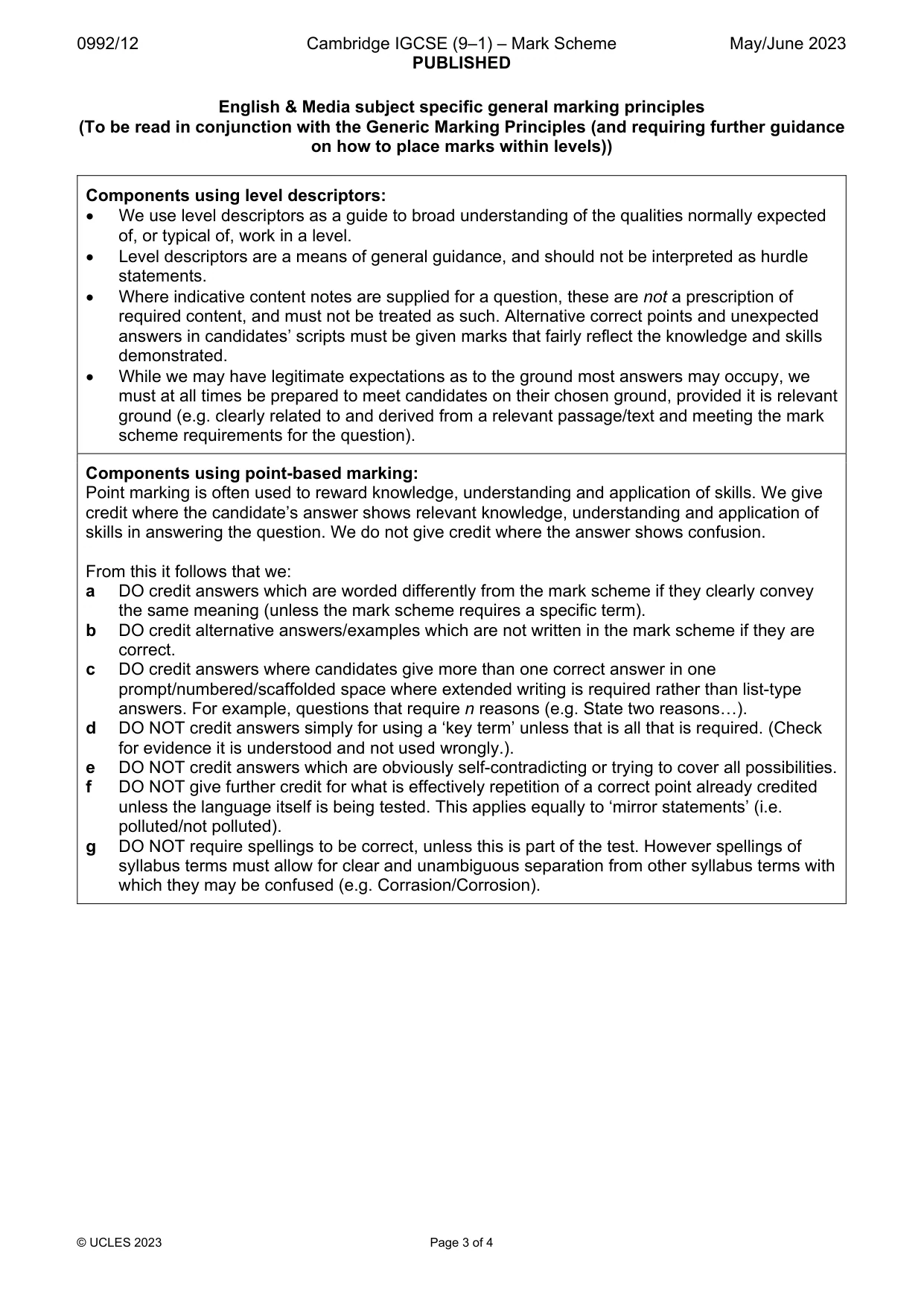
0992/12 Cambridge IGCSE (9–1) – Mark Scheme PUBLISHED May/June 2023 © UCLES 2023 Page 3 of 4 English & Media subject specific general marking principles (To be read in conjunction with the Generic Marking Principles (and requiring further guidance on how to place marks within levels)) Components using level descriptors: We use level descriptors as a guide to broad understanding of the qualities normally expected of, or typical of, work in a level. Level descriptors are a means of general guidance, and should not be interpreted as hurdle statements. Where indicative content notes are supplied for a question, these are not a prescription of required content, and must not be treated as such. Alternative correct points and unexpected answers in candidates’ scripts must be given marks that fairly reflect the knowledge and skills demonstrated. While we may have legitimate expectations as to the ground most answers may occupy, we must at all times be prepared to meet candidates on their chosen ground, provided it is relevant ground (e.g. clearly related to and derived from a relevant passage/text and meeting the mark scheme requirements for the question). Components using point-based marking: Point marking is often used to reward knowledge, understanding and application of skills. We give credit where the candidate’s answer shows relevant knowledge, understanding and application of skills in answering the question. We do not give credit where the answer shows confusion. From this it follows that we: a DO credit answers which are worded differently from the mark scheme if they clearly convey the same meaning (unless the mark scheme requires a specific term). b DO credit alternative answers/examples which are not written in the mark scheme if they are correct. c DO credit answers where candidates give more than one correct answer in one prompt/numbered/scaffolded space where extended writing is required rather than list-type answers. For example, questions that require n reasons (e.g. State two reasons…). d DO NOT credit answers simply for using a ‘key term’ unless that is all that is required. (Check for evidence it is understood and not used wrongly.). e DO NOT credit answers which are obviously self-contradicting or trying to cover all possibilities. f DO NOT give further credit for what is effectively repetition of a correct point already credited unless the language itself is being tested. This applies equally to ‘mirror statements’ (i.e. polluted/not polluted). g DO NOT require spellings to be correct, unless this is part of the test. However spellings of syllabus terms must allow for clear and unambiguous separation from other syllabus terms with which they may be confused (e.g. Corrasion/Corrosion).
Mark scheme, page 4
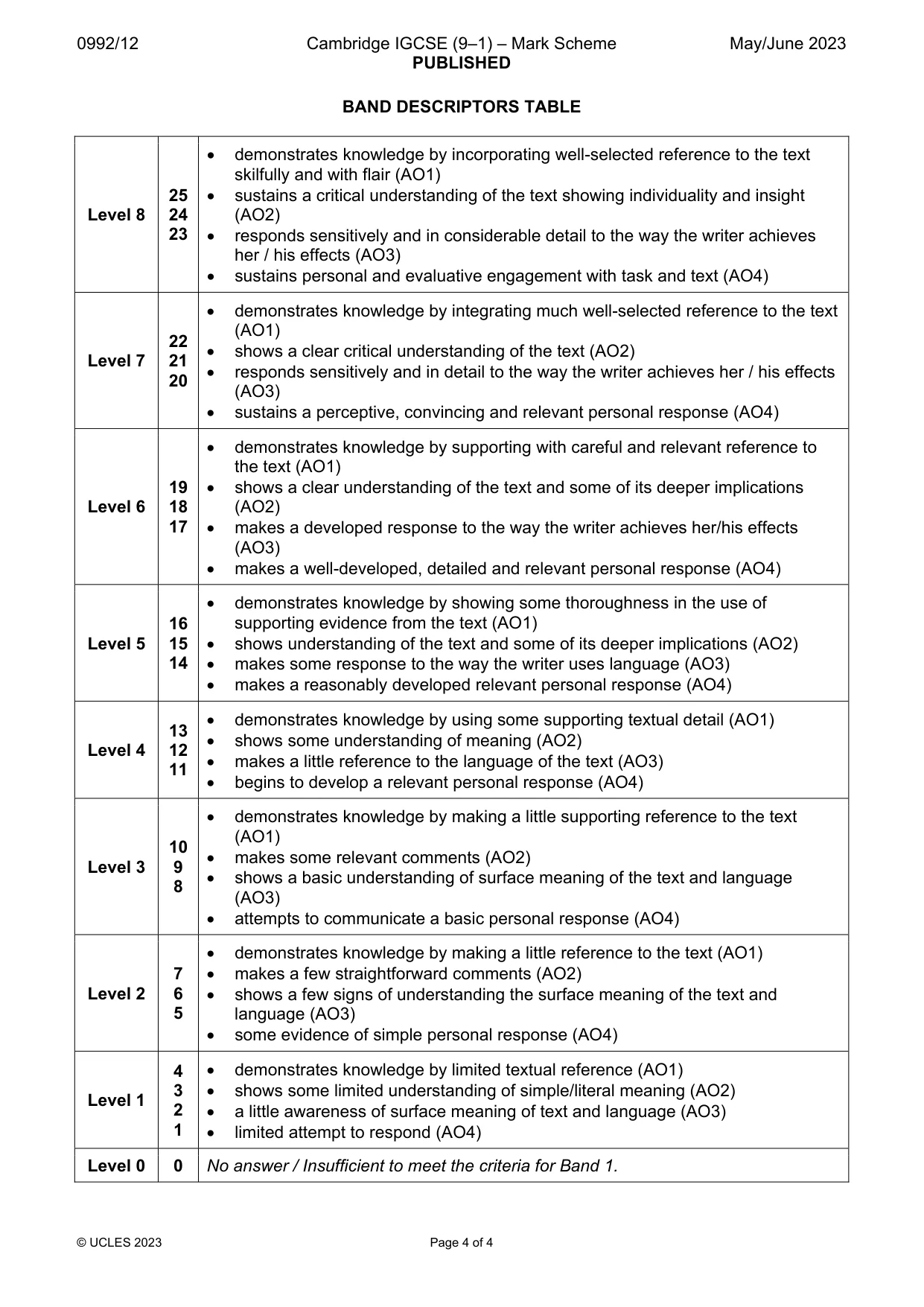
0992/12 Cambridge IGCSE (9–1) – Mark Scheme PUBLISHED May/June 2023 © UCLES 2023 Page 4 of 4 BAND DESCRIPTORS TABLE Level 8 25 24 23 demonstrates knowledge by incorporating well-selected reference to the text skilfully and with flair (AO1) sustains a critical understanding of the text showing individuality and insight (AO2) responds sensitively and in considerable detail to the way the writer achieves her / his effects (AO3) sustains personal and evaluative engagement with task and text (AO4) Level 7 22 21 20 demonstrates knowledge by integrating much well-selected reference to the text (AO1) shows a clear critical understanding of the text (AO2) responds sensitively and in detail to the way the writer achieves her / his effects (AO3) sustains a perceptive, convincing and relevant personal response (AO4) Level 6 19 18 17 demonstrates knowledge by supporting with careful and relevant reference to the text (AO1) shows a clear understanding of the text and some of its deeper implications (AO2) makes a developed response to the way the writer achieves her/his effects (AO3) makes a well-developed, detailed and relevant personal response (AO4) Level 5 16 15 14 demonstrates knowledge by showing some thoroughness in the use of supporting evidence from the text (AO1) shows understanding of the text and some of its deeper implications (AO2) makes some response to the way the writer uses language (AO3) makes a reasonably developed relevant personal response (AO4) Level 4 13 12 11 demonstrates knowledge by using some supporting textual detail (AO1) shows some understanding of meaning (AO2) makes a little reference to the language of the text (AO3) begins to develop a relevant personal response (AO4) Level 3 10 9 8 demonstrates knowledge by making a little supporting reference to the text (AO1) makes some relevant comments (AO2) shows a basic understanding of surface meaning of the text and language (AO3) attempts to communicate a basic personal response (AO4) Level 2 7 6 5 demonstrates knowledge by making a little reference to the text (AO1) makes a few straightforward comments (AO2) shows a few signs of understanding the surface meaning of the text and language (AO3) some evidence of simple personal response (AO4) Level 1 4 3 2 1 demonstrates knowledge by limited textual reference (AO1) shows some limited understanding of simple/literal meaning (AO2) a little awareness of surface meaning of text and language (AO3) limited attempt to respond (AO4) Level 0 0 No answer / Insufficient to meet the criteria for Band 1.
What you needed in this session
Cambridge’s own grade thresholds for 2023 May/June, Paper 1 · Variant 2. A higher threshold means an easier paper — the bar moves with how the cohort did.