Cambridge IGCSE English - Literature in English 0475 — 2023 Feb/March Paper 1 · Variant 2
0475/12/F/M/23 · 50 marks · ≈56 min
The question paper and its mark scheme, free to read here and free to download. This is Cambridge’s own paper, exactly as it was sat.
Question paper28 pages






Mark scheme4 pages
Answers below. Sit the paper first if you are practising.
Paper as text
Question paper, page 1
This document has 28 pages. Any blank pages are indicated. [Turn over Cambridge IGCSE™ * 6 1 1 0 9 4 4 4 0 5 * DC (RCL (DF)) 313267/2 © UCLES 2023 LITERATURE IN ENGLISH 0475/12 Paper 1 Poetry and Prose February/March 2023 1 hour 30 minutes You must answer on the enclosed answer booklet. You will need: Answer booklet (enclosed) INSTRUCTIONS ● Answer two questions in total: Section A: answer one question. Section B: answer one question. ● Follow the instructions on the front cover of the answer booklet. If you need additional answer paper, ask the invigilator for a continuation booklet. INFORMATION ● The total mark for this paper is 50. ● All questions are worth equal marks.
Question paper, page 2
2 0475/12/F/M/23 © UCLES 2023 BLANK PAGE
Question paper, page 3
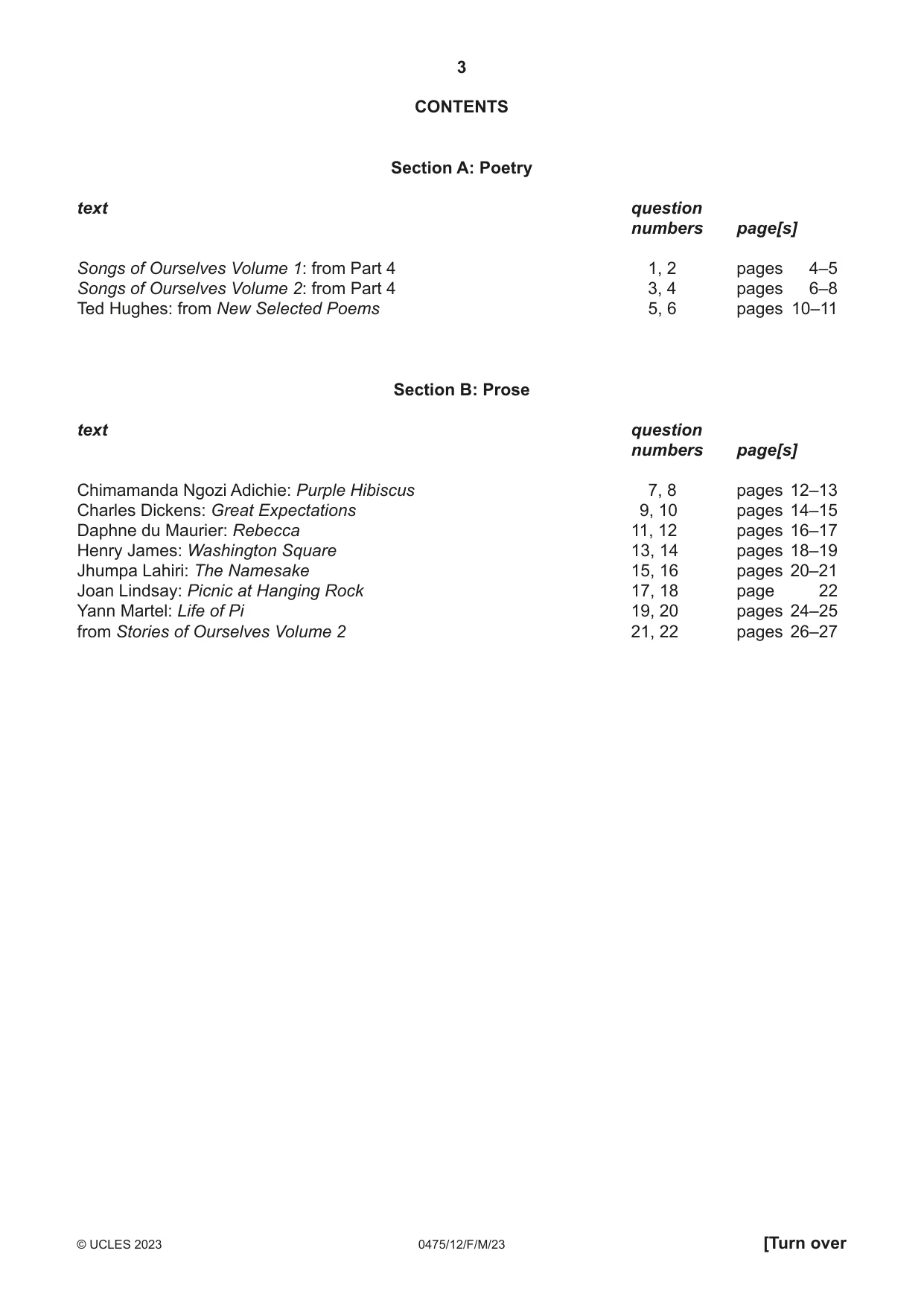
3 0475/12/F/M/23 © UCLES 2023 [Turn over CONTENTS Section A: Poetry text question numbers page[s] Songs of Ourselves Volume 1: from Part 4 1, 2 pages 4–5 Songs of Ourselves Volume 2: from Part 4 3, 4 pages 6–8 Ted Hughes: from New Selected Poems 5, 6 pages 10–11 Section B: Prose text question numbers page[s] Chimamanda Ngozi Adichie: Purple Hibiscus 7, 8 pages 12–13 Charles Dickens: Great Expectations 9, 10 pages 14–15 Daphne du Maurier: Rebecca 11, 12 pages 16–17 Henry James: Washington Square 13, 14 pages 18–19 Jhumpa Lahiri: The Namesake 15, 16 pages 20–21 Joan Lindsay: Picnic at Hanging Rock 17, 18 page 22 Yann Martel: Life of Pi 19, 20 pages 24–25 from Stories of Ourselves Volume 2 21, 22 pages 26–27
Question paper, page 4
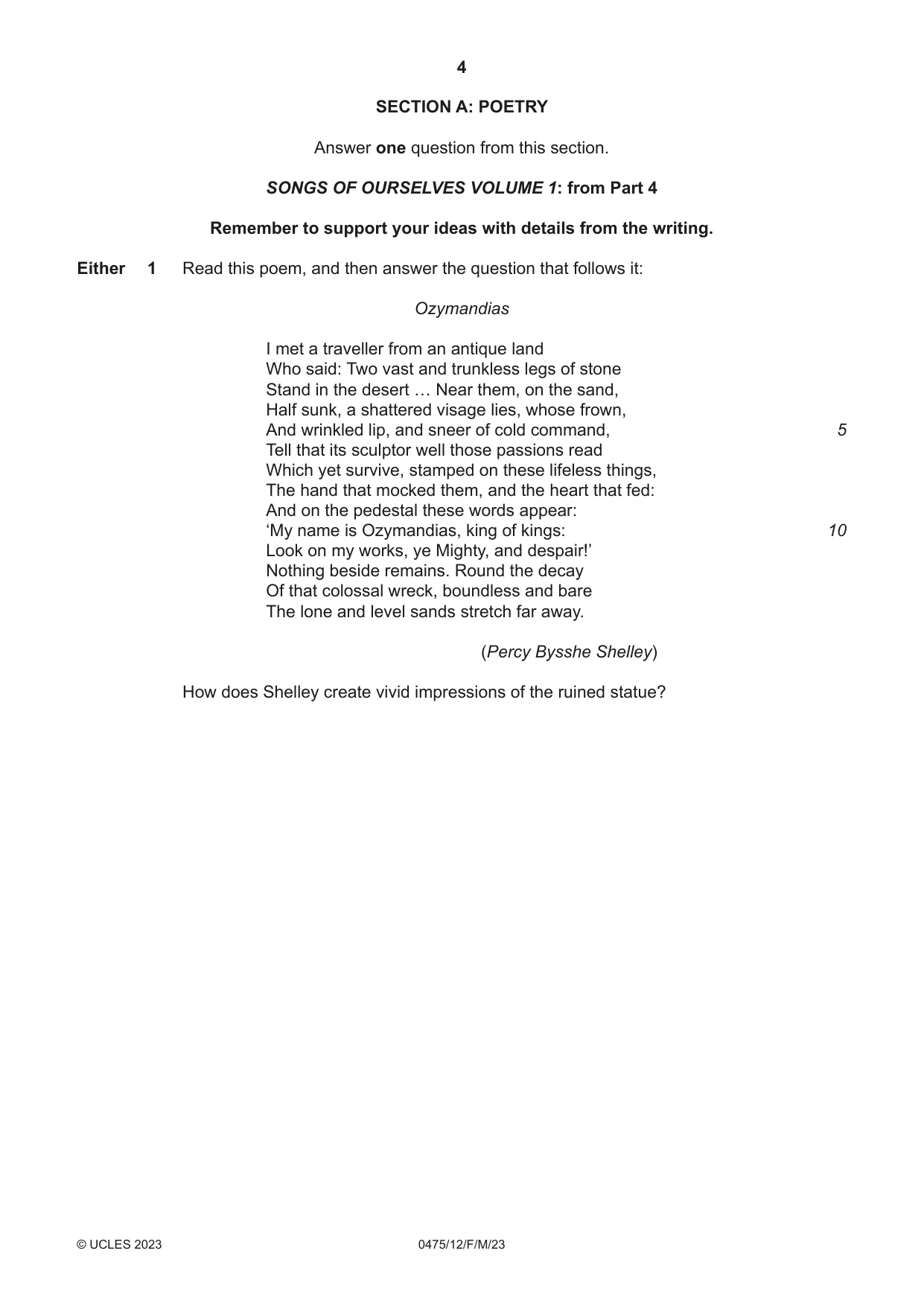
4 0475/12/F/M/23 © UCLES 2023 SECTION A: POETRY Answer one question from this section. SONGS OF OURSELVES VOLUME 1: from Part 4 Remember to support your ideas with details from the writing. Either 1 Read this poem, and then answer the question that follows it: Ozymandias I met a traveller from an antique land Who said: Two vast and trunkless legs of stone Stand in the desert … Near them, on the sand, Half sunk, a shattered visage lies, whose frown, And wrinkled lip, and sneer of cold command, Tell that its sculptor well those passions read Which yet survive, stamped on these lifeless things, The hand that mocked them, and the heart that fed: And on the pedestal these words appear: ‘My name is Ozymandias, king of kings: Look on my works, ye Mighty, and despair!’ Nothing beside remains. Round the decay Of that colossal wreck, boundless and bare The lone and level sands stretch far away. (Percy Bysshe Shelley) How does Shelley create vivid impressions of the ruined statue? 5 10
Question paper, page 5
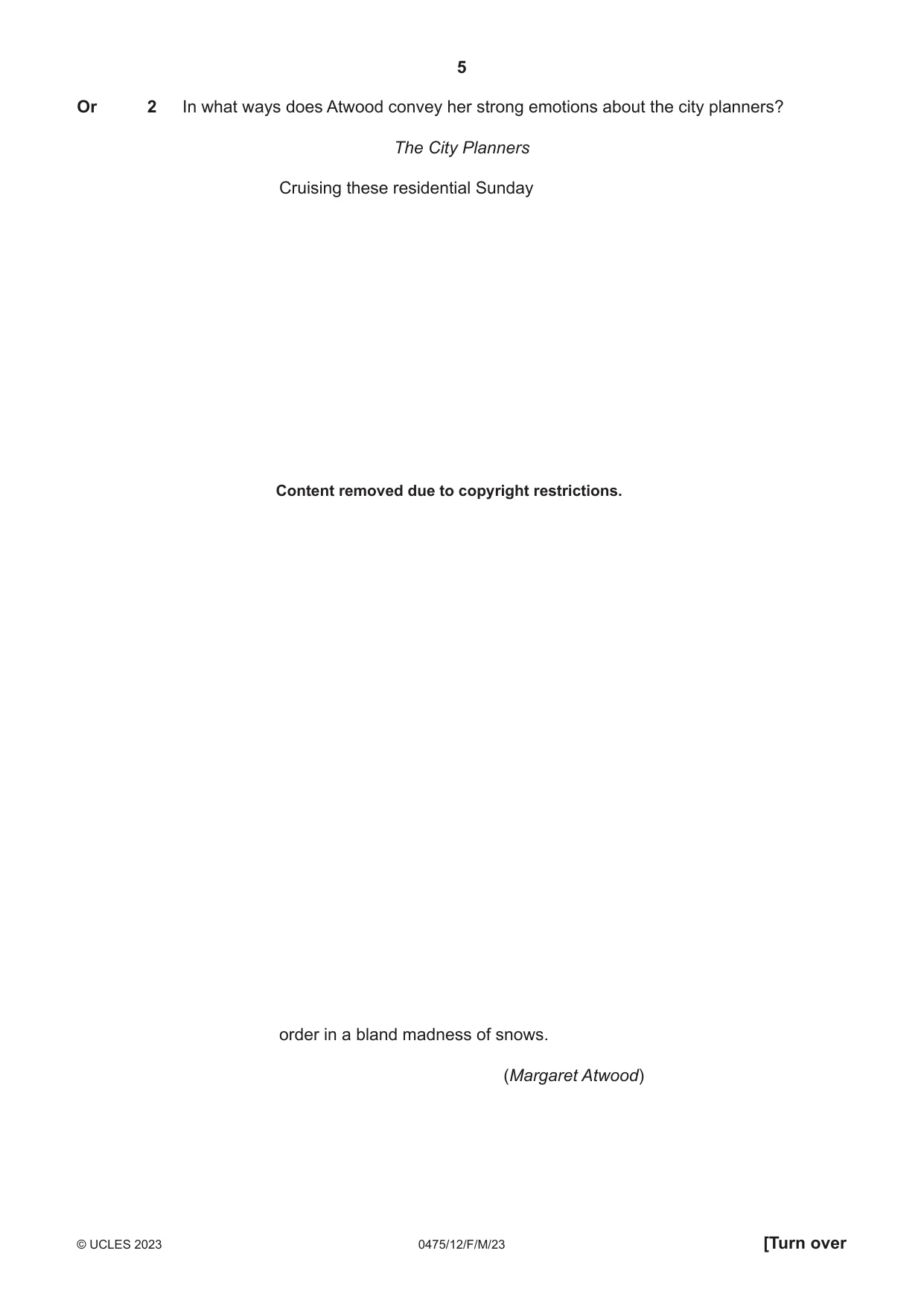
5 0475/12/F/M/23 © UCLES 2023 [Turn over Or 2 In what ways does Atwood convey her strong emotions about the city planners? The City Planners Cruising these residential Sunday order in a bland madness of snows. (Margaret Atwood) Content removed due to copyright restrictions.
Question paper, page 6
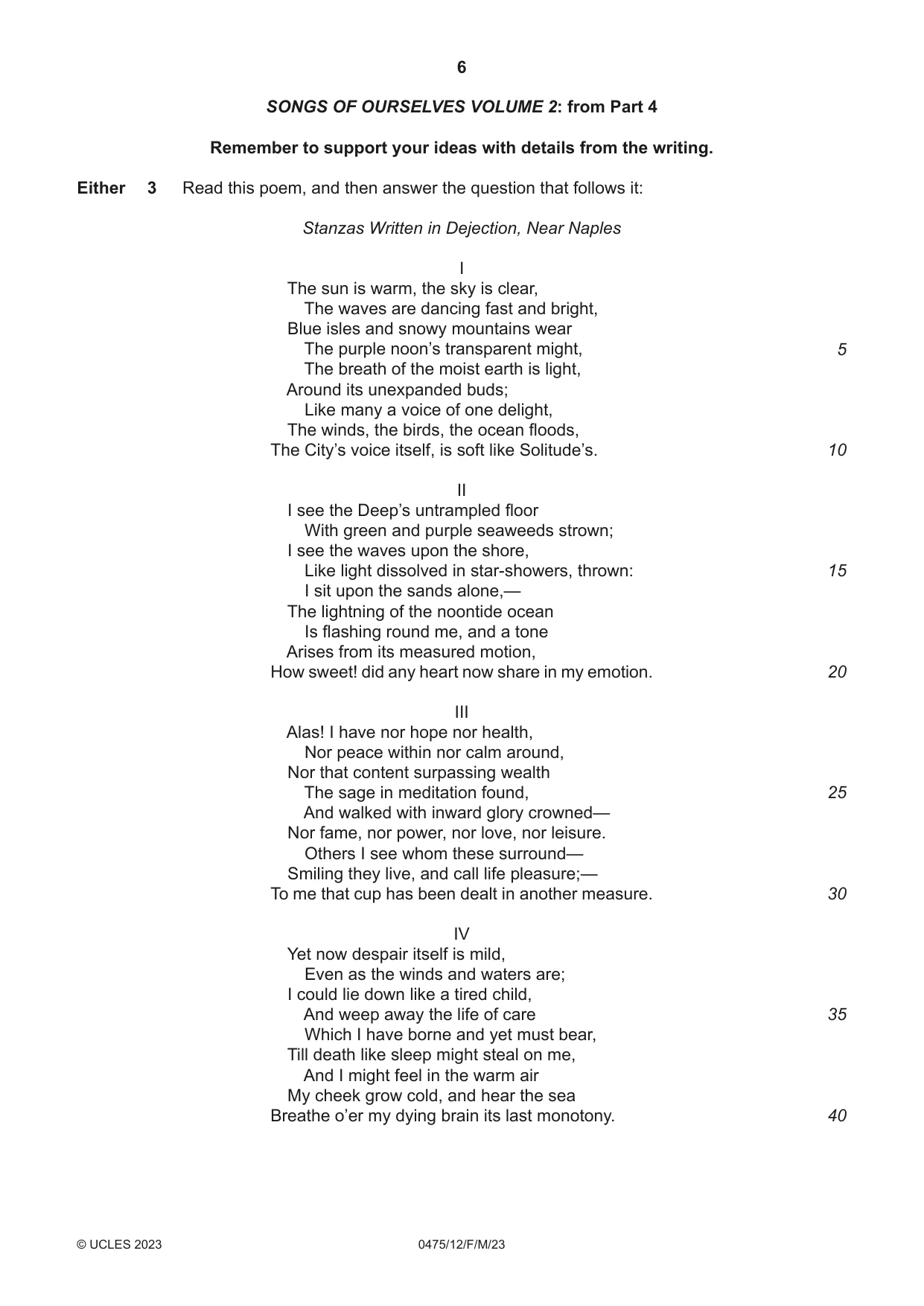
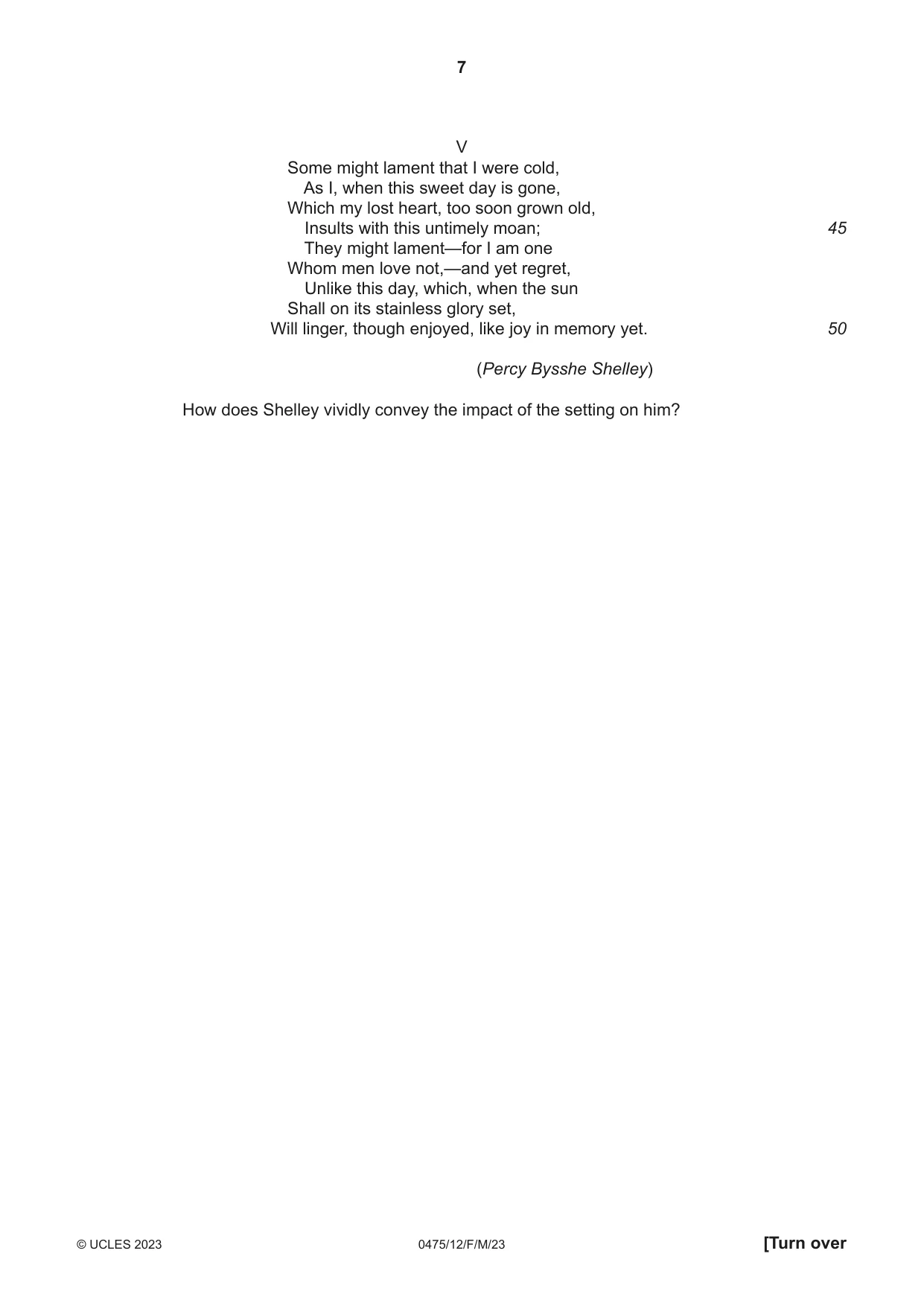
6 0475/12/F/M/23 © UCLES 2023 SONGS OF OURSELVES VOLUME 2: from Part 4 Remember to support your ideas with details from the writing. Either 3 Read this poem, and then answer the question that follows it: Stanzas Written in Dejection, Near Naples I The sun is warm, the sky is clear, The waves are dancing fast and bright, Blue isles and snowy mountains wear The purple noon’s transparent might, The breath of the moist earth is light, Around its unexpanded buds; Like many a voice of one delight, The winds, the birds, the ocean floods, The City’s voice itself, is soft like Solitude’s. II I see the Deep’s untrampled floor With green and purple seaweeds strown; I see the waves upon the shore, Like light dissolved in star-showers, thrown: I sit upon the sands alone,— The lightning of the noontide ocean Is flashing round me, and a tone Arises from its measured motion, How sweet! did any heart now share in my emotion. III Alas! I have nor hope nor health, Nor peace within nor calm around, Nor that content surpassing wealth The sage in meditation found, And walked with inward glory crowned— Nor fame, nor power, nor love, nor leisure. Others I see whom these surround— Smiling they live, and call life pleasure;— To me that cup has been dealt in another measure. IV Yet now despair itself is mild, Even as the winds and waters are; I could lie down like a tired child, And weep away the life of care Which I have borne and yet must bear, Till death like sleep might steal on me, And I might feel in the warm air My cheek grow cold, and hear the sea Breathe o’er my dying brain its last monotony. 5 10 15 20 25 30 35 40
Question paper, page 7
7 0475/12/F/M/23 © UCLES 2023 [Turn over V Some might lament that I were cold, As I, when this sweet day is gone, Which my lost heart, too soon grown old, Insults with this untimely moan; They might lament—for I am one Whom men love not,—and yet regret, Unlike this day, which, when the sun Shall on its stainless glory set, Will linger, though enjoyed, like joy in memory yet. (Percy Bysshe Shelley) How does Shelley vividly convey the impact of the setting on him? 45 50
Question paper, page 8
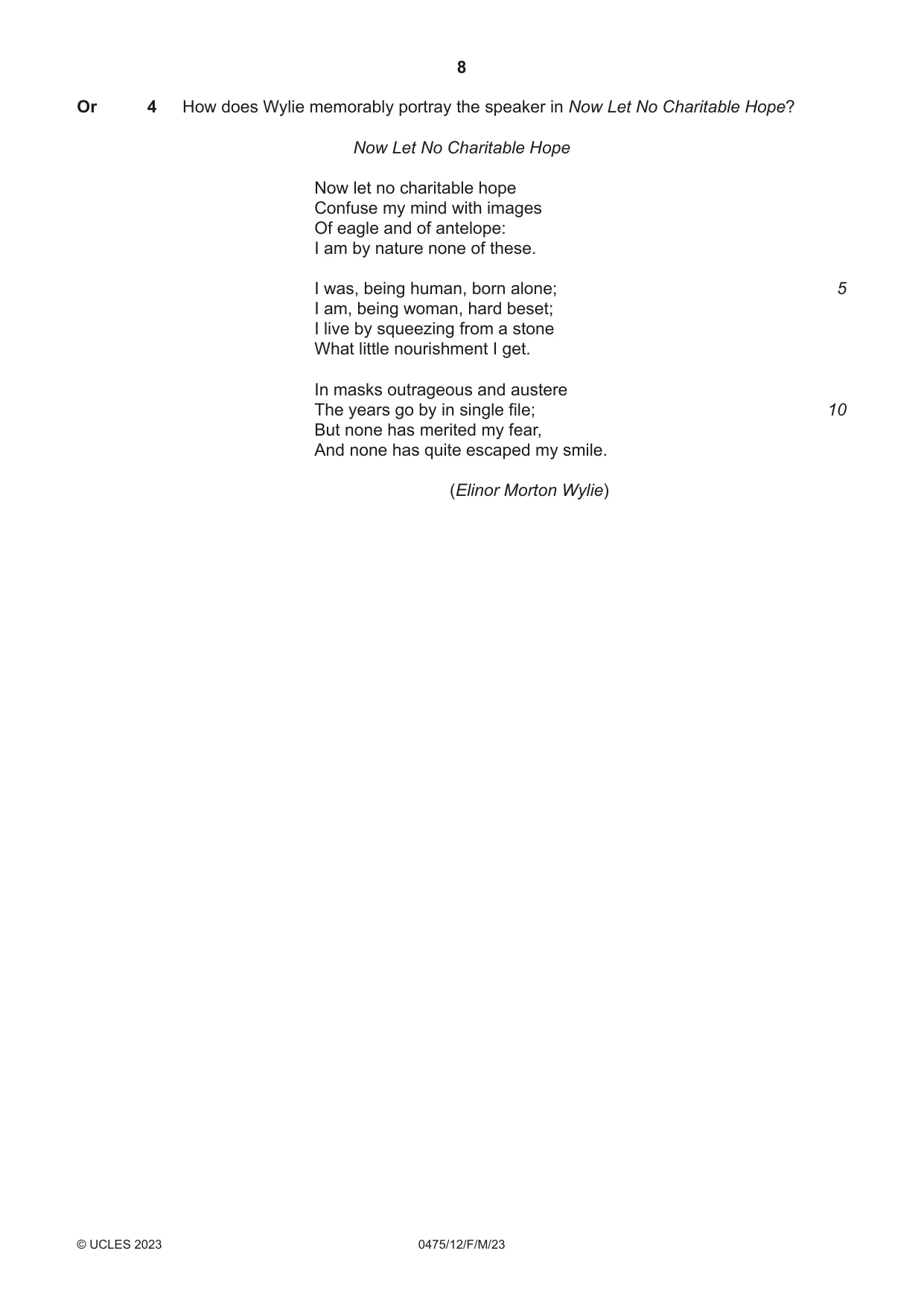
8 0475/12/F/M/23 © UCLES 2023 Or 4 How does Wylie memorably portray the speaker in Now Let No Charitable Hope? Now Let No Charitable Hope Now let no charitable hope Confuse my mind with images Of eagle and of antelope: I am by nature none of these. I was, being human, born alone; I am, being woman, hard beset; I live by squeezing from a stone What little nourishment I get. In masks outrageous and austere The years go by in single file; But none has merited my fear, And none has quite escaped my smile. (Elinor Morton Wylie) 5 10
Question paper, page 9
9 0475/12/F/M/23 © UCLES 2023 [Turn over TURN OVER FOR QUESTION 5.
Question paper, page 10
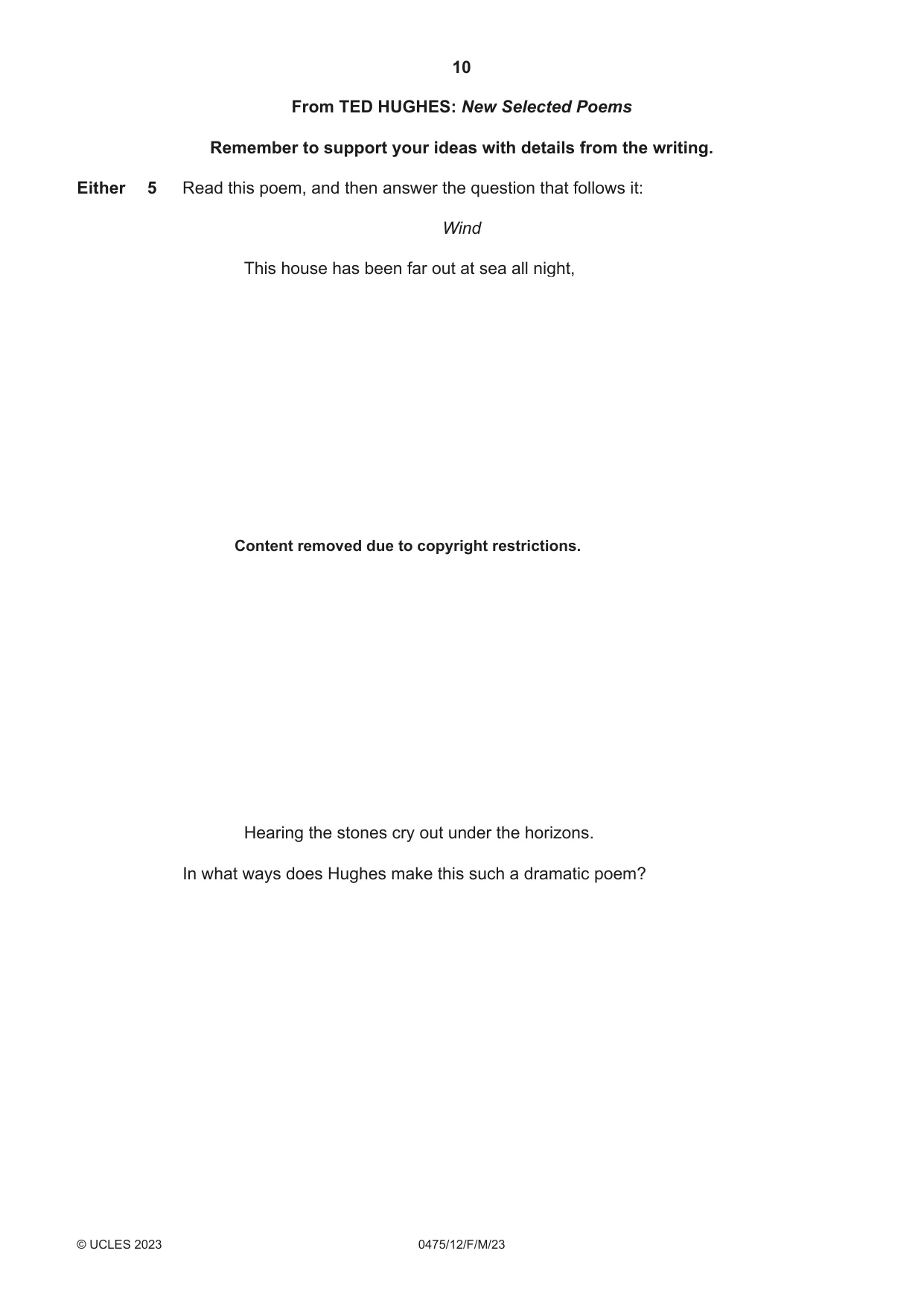
10 0475/12/F/M/23 © UCLES 2023 From TED HUGHES: New Selected Poems Remember to support your ideas with details from the writing. Either 5 Read this poem, and then answer the question that follows it: Wind This house has been far out at sea all night, Hearing the stones cry out under the horizons. In what ways does Hughes make this such a dramatic poem? Content removed due to copyright restrictions.
Question paper, page 11
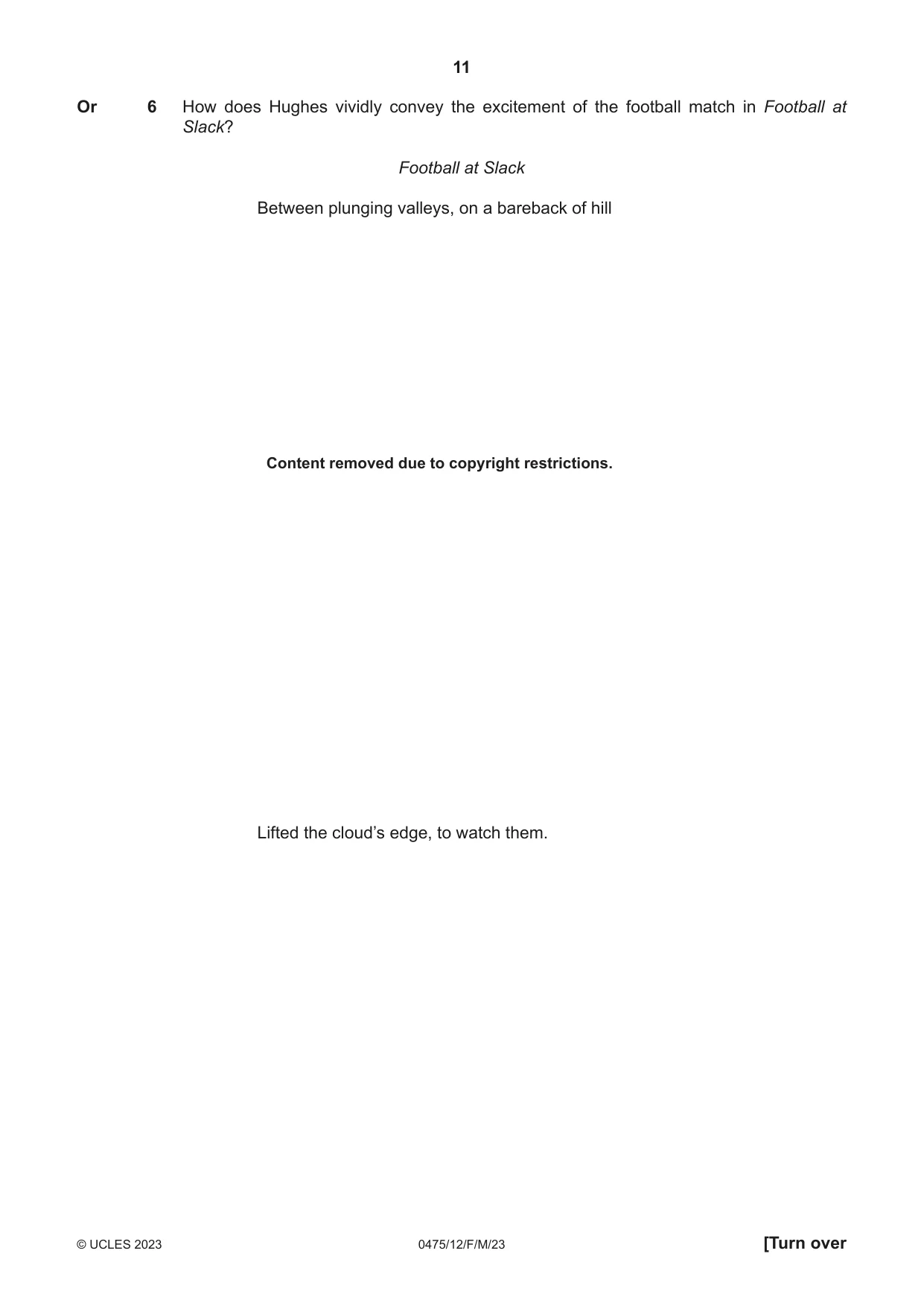
11 0475/12/F/M/23 © UCLES 2023 [Turn over Or 6 How does Hughes vividly convey the excitement of the football match in Football at Slack? Football at Slack Between plunging valleys, on a bareback of hill Lifted the cloud’s edge, to watch them. Content removed due to copyright restrictions.
Question paper, page 12
12 0475/12/F/M/23 © UCLES 2023 SECTION B: PROSE Answer one question from this section. CHIMAMANDA NGOZI ADICHIE: Purple Hibiscus Remember to support your ideas with details from the writing. Either 7 Read this passage, and then answer the question that follows it: ‘This cell has many interesting characters,’ Jaja says. Content removed due to copyright restrictions.
Question paper, page 13
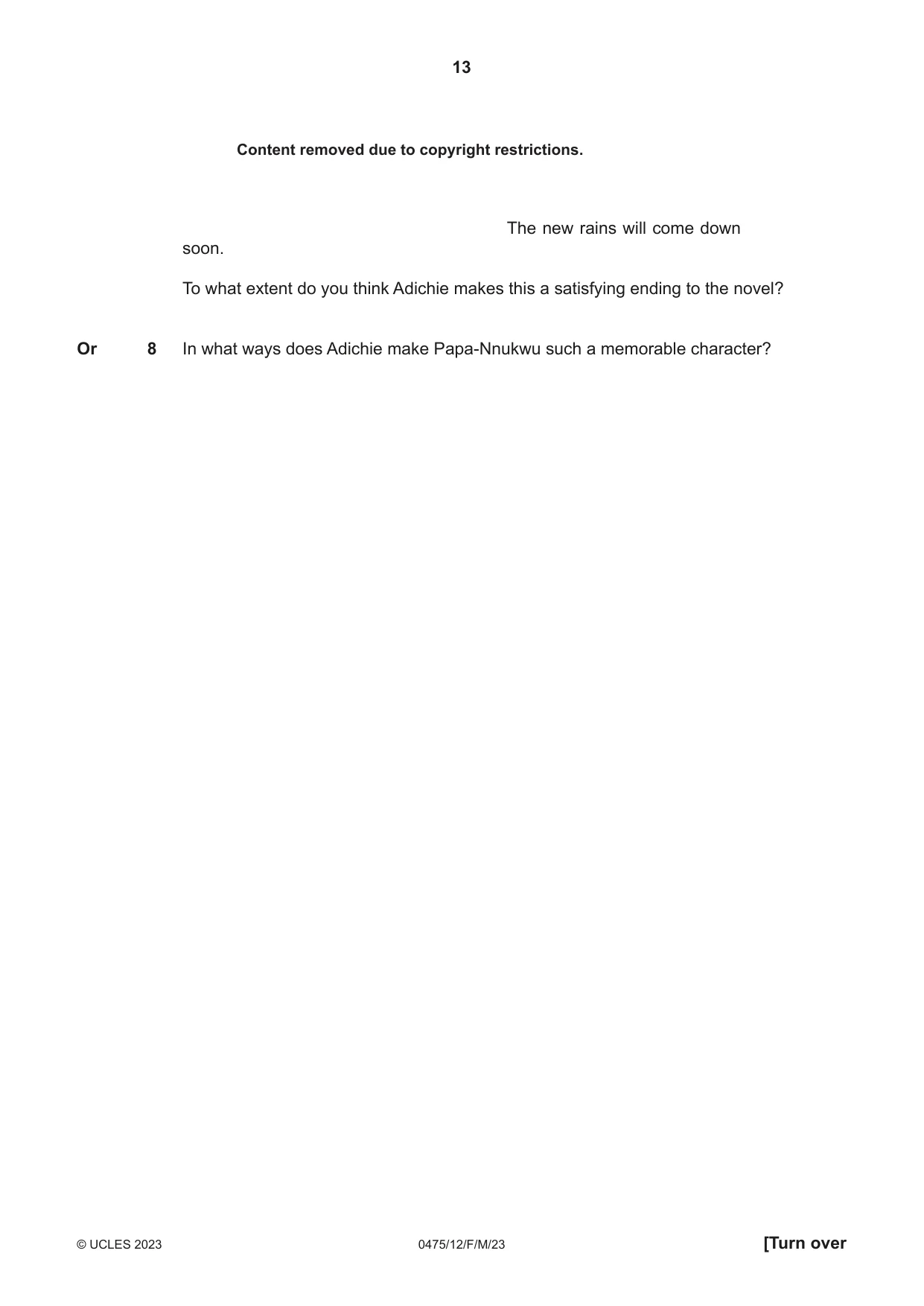
13 0475/12/F/M/23 © UCLES 2023 [Turn over The new rains will come down soon. To what extent do you think Adichie makes this a satisfying ending to the novel? Or 8 In what ways does Adichie make Papa-Nnukwu such a memorable character? Content removed due to copyright restrictions.
Question paper, page 14
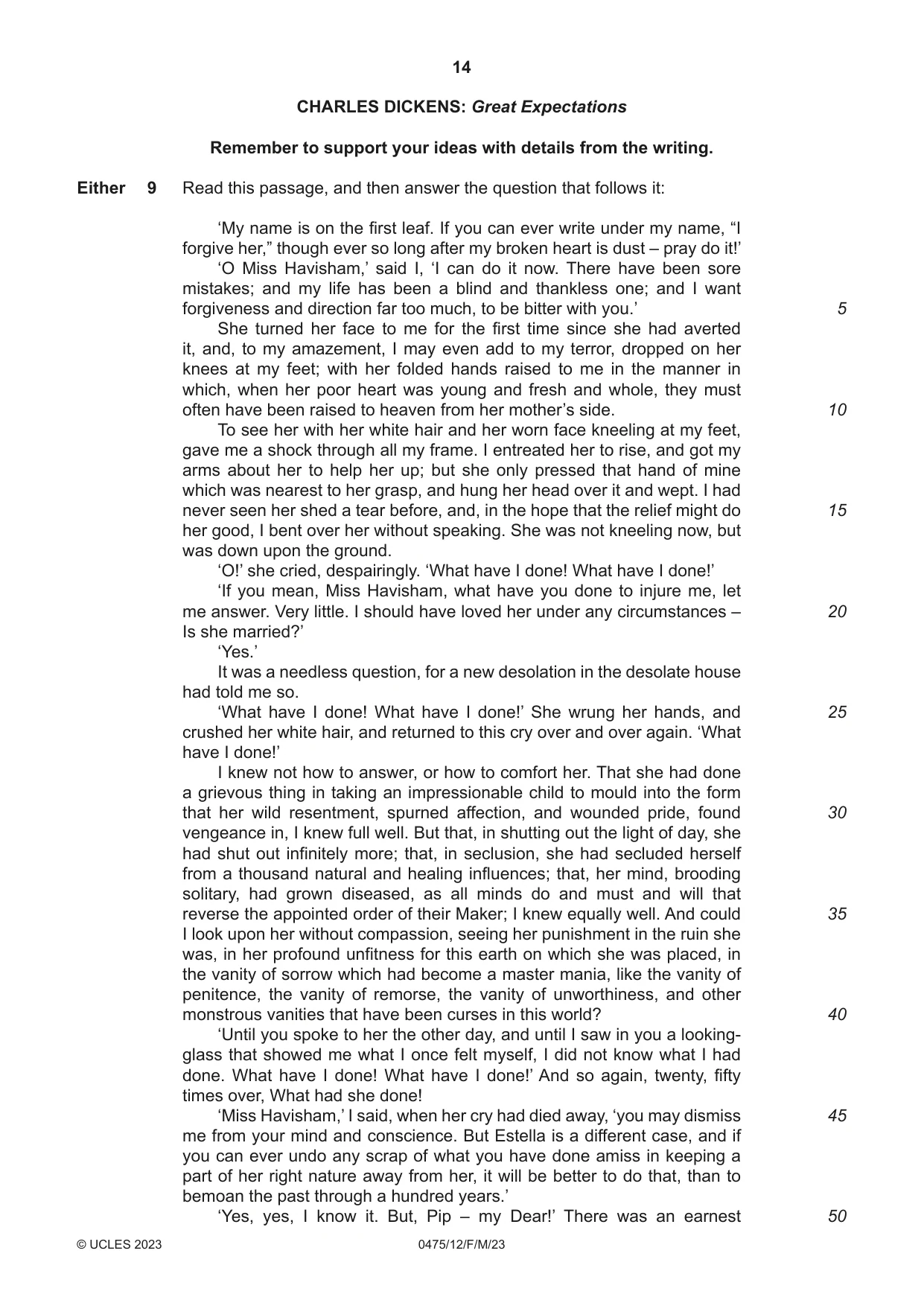
14 0475/12/F/M/23 © UCLES 2023 CHARLES DICKENS: Great Expectations Remember to support your ideas with details from the writing. Either 9 Read this passage, and then answer the question that follows it: ‘My name is on the first leaf. If you can ever write under my name, “I forgive her,” though ever so long after my broken heart is dust – pray do it!’ ‘O Miss Havisham,’ said I, ‘I can do it now. There have been sore mistakes; and my life has been a blind and thankless one; and I want forgiveness and direction far too much, to be bitter with you.’ She turned her face to me for the first time since she had averted it, and, to my amazement, I may even add to my terror, dropped on her knees at my feet; with her folded hands raised to me in the manner in which, when her poor heart was young and fresh and whole, they must often have been raised to heaven from her mother’s side. To see her with her white hair and her worn face kneeling at my feet, gave me a shock through all my frame. I entreated her to rise, and got my arms about her to help her up; but she only pressed that hand of mine which was nearest to her grasp, and hung her head over it and wept. I had never seen her shed a tear before, and, in the hope that the relief might do her good, I bent over her without speaking. She was not kneeling now, but was down upon the ground. ‘O!’ she cried, despairingly. ‘What have I done! What have I done!’ ‘If you mean, Miss Havisham, what have you done to injure me, let me answer. Very little. I should have loved her under any circumstances – Is she married?’ ‘Yes.’ It was a needless question, for a new desolation in the desolate house had told me so. ‘What have I done! What have I done!’ She wrung her hands, and crushed her white hair, and returned to this cry over and over again. ‘What have I done!’ I knew not how to answer, or how to comfort her. That she had done a grievous thing in taking an impressionable child to mould into the form that her wild resentment, spurned affection, and wounded pride, found vengeance in, I knew full well. But that, in shutting out the light of day, she had shut out infinitely more; that, in seclusion, she had secluded herself from a thousand natural and healing influences; that, her mind, brooding solitary, had grown diseased, as all minds do and must and will that reverse the appointed order of their Maker; I knew equally well. And could I look upon her without compassion, seeing her punishment in the ruin she was, in her profound unfitness for this earth on which she was placed, in the vanity of sorrow which had become a master mania, like the vanity of penitence, the vanity of remorse, the vanity of unworthiness, and other monstrous vanities that have been curses in this world? ‘Until you spoke to her the other day, and until I saw in you a looking- glass that showed me what I once felt myself, I did not know what I had done. What have I done! What have I done!’ And so again, twenty, fifty times over, What had she done! ‘Miss Havisham,’ I said, when her cry had died away, ‘you may dismiss me from your mind and conscience. But Estella is a different case, and if you can ever undo any scrap of what you have done amiss in keeping a part of her right nature away from her, it will be better to do that, than to bemoan the past through a hundred years.’ ‘Yes, yes, I know it. But, Pip – my Dear!’ There was an earnest 5 10 15 20 25 30 35 40 45 50
Question paper, page 15
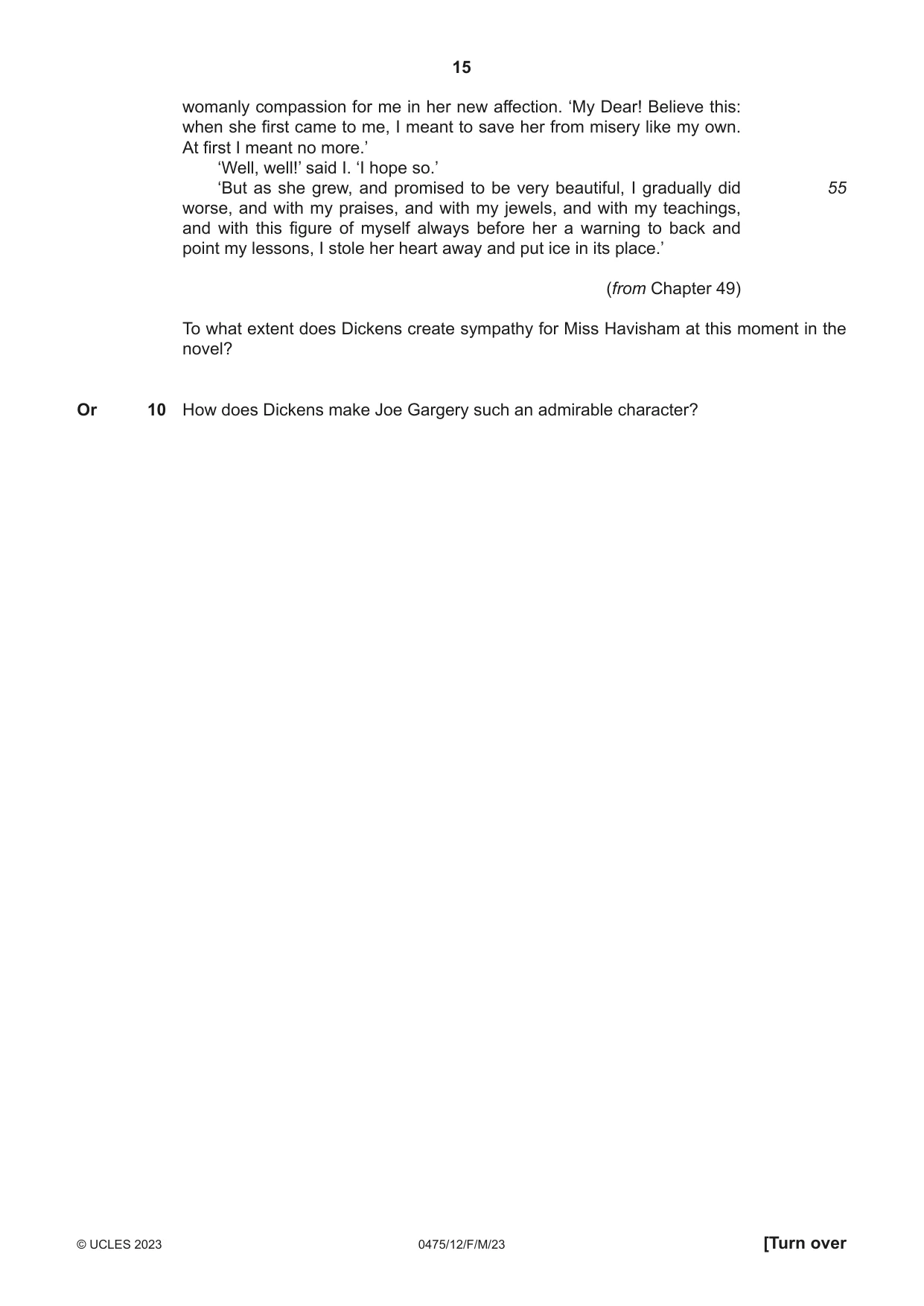
15 0475/12/F/M/23 © UCLES 2023 [Turn over womanly compassion for me in her new affection. ‘My Dear! Believe this: when she first came to me, I meant to save her from misery like my own. At first I meant no more.’ ‘Well, well!’ said I. ‘I hope so.’ ‘But as she grew, and promised to be very beautiful, I gradually did worse, and with my praises, and with my jewels, and with my teachings, and with this figure of myself always before her a warning to back and point my lessons, I stole her heart away and put ice in its place.’ (from Chapter 49) To what extent does Dickens create sympathy for Miss Havisham at this moment in the novel? Or 10 How does Dickens make Joe Gargery such an admirable character? 55
Question paper, page 16
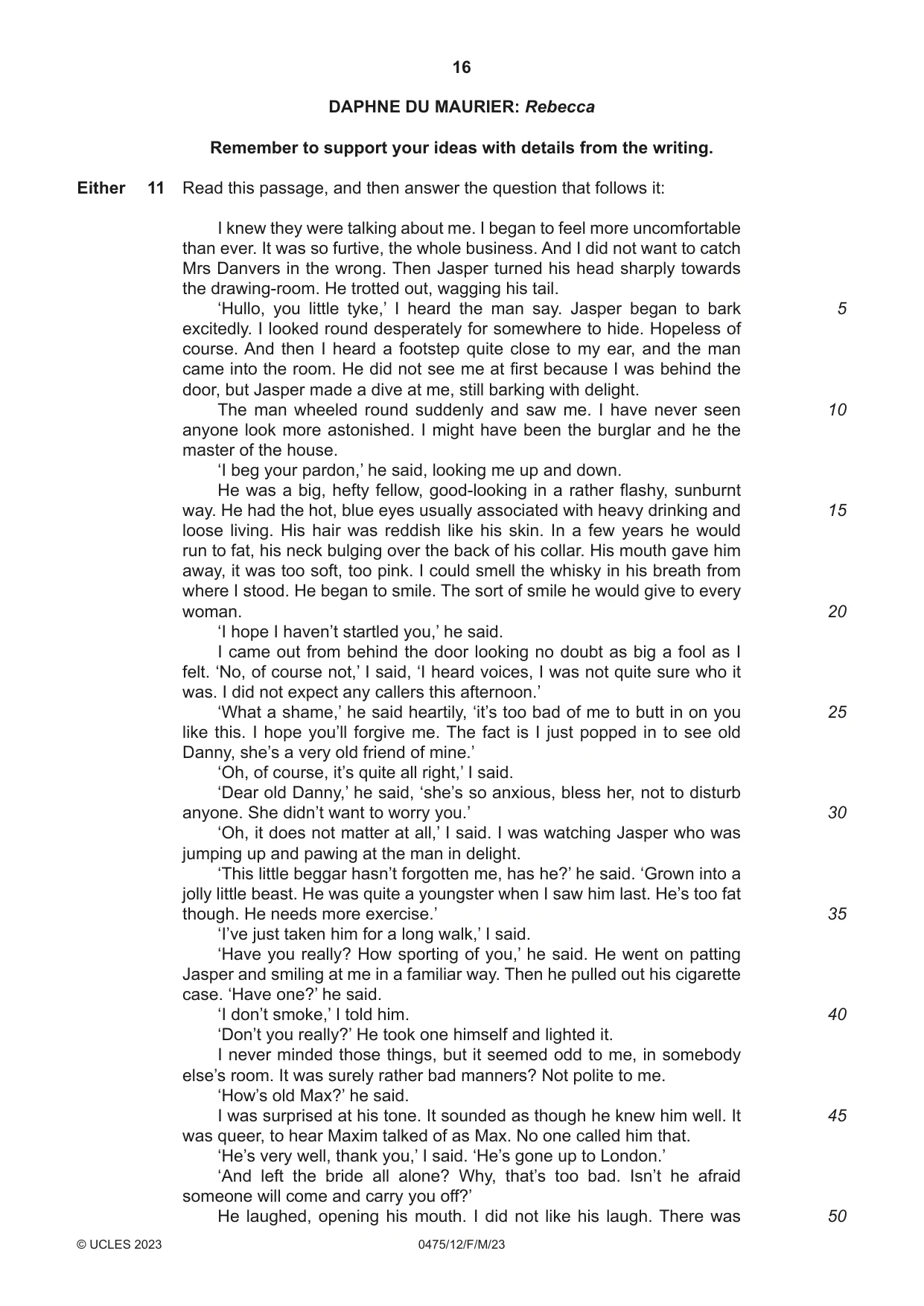
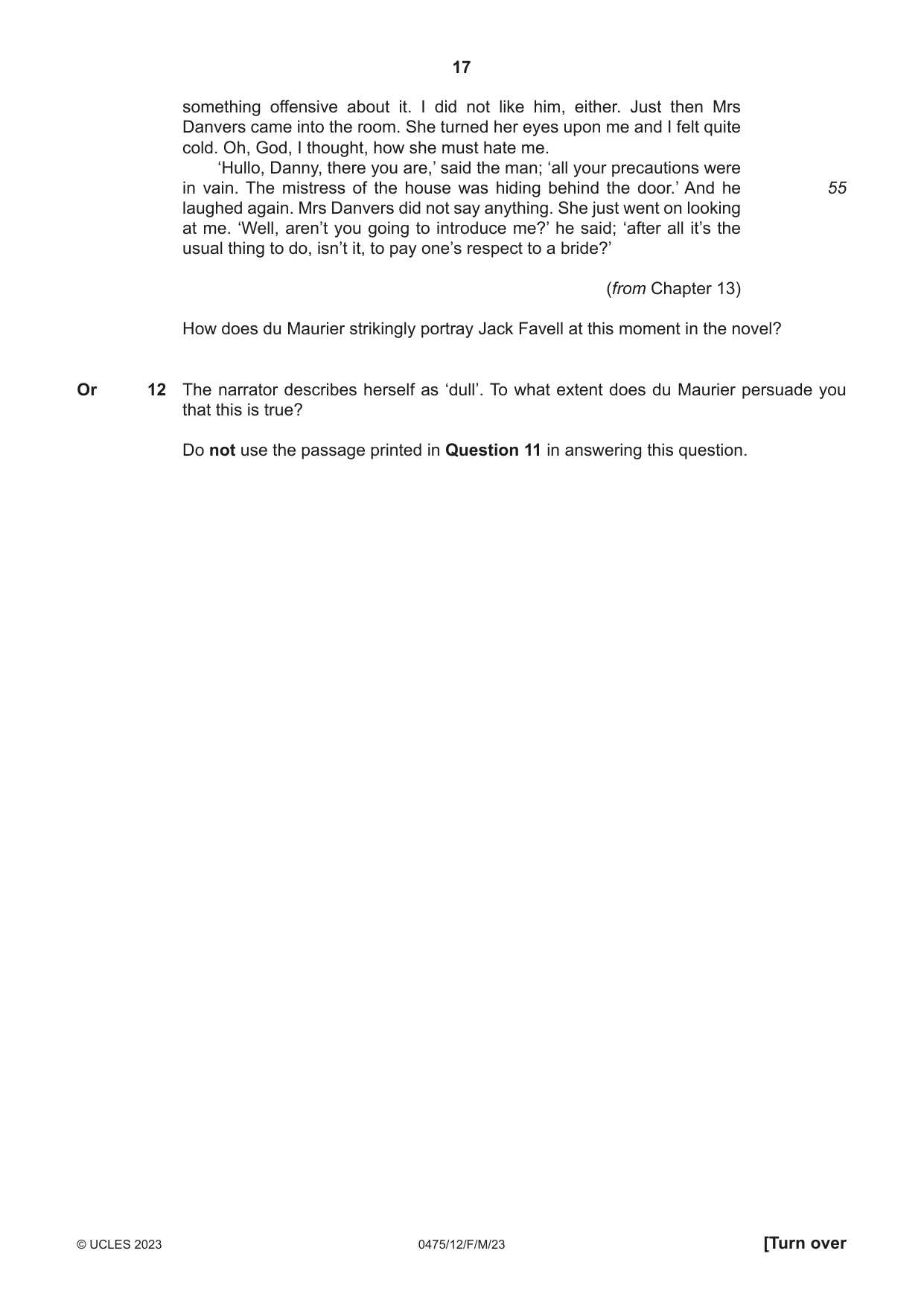
16 0475/12/F/M/23 © UCLES 2023 DAPHNE DU MAURIER: Rebecca Remember to support your ideas with details from the writing. Either 11 Read this passage, and then answer the question that follows it: I knew they were talking about me. I began to feel more uncomfortable than ever. It was so furtive, the whole business. And I did not want to catch Mrs Danvers in the wrong. Then Jasper turned his head sharply towards the drawing-room. He trotted out, wagging his tail. ‘Hullo, you little tyke,’ I heard the man say. Jasper began to bark excitedly. I looked round desperately for somewhere to hide. Hopeless of course. And then I heard a footstep quite close to my ear, and the man came into the room. He did not see me at first because I was behind the door, but Jasper made a dive at me, still barking with delight. The man wheeled round suddenly and saw me. I have never seen anyone look more astonished. I might have been the burglar and he the master of the house. ‘I beg your pardon,’ he said, looking me up and down. He was a big, hefty fellow, good-looking in a rather flashy, sunburnt way. He had the hot, blue eyes usually associated with heavy drinking and loose living. His hair was reddish like his skin. In a few years he would run to fat, his neck bulging over the back of his collar. His mouth gave him away, it was too soft, too pink. I could smell the whisky in his breath from where I stood. He began to smile. The sort of smile he would give to every woman. ‘I hope I haven’t startled you,’ he said. I came out from behind the door looking no doubt as big a fool as I felt. ‘No, of course not,’ I said, ‘I heard voices, I was not quite sure who it was. I did not expect any callers this afternoon.’ ‘What a shame,’ he said heartily, ‘it’s too bad of me to butt in on you like this. I hope you’ll forgive me. The fact is I just popped in to see old Danny, she’s a very old friend of mine.’ ‘Oh, of course, it’s quite all right,’ I said. ‘Dear old Danny,’ he said, ‘she’s so anxious, bless her, not to disturb anyone. She didn’t want to worry you.’ ‘Oh, it does not matter at all,’ I said. I was watching Jasper who was jumping up and pawing at the man in delight. ‘This little beggar hasn’t forgotten me, has he?’ he said. ‘Grown into a jolly little beast. He was quite a youngster when I saw him last. He’s too fat though. He needs more exercise.’ ‘I’ve just taken him for a long walk,’ I said. ‘Have you really? How sporting of you,’ he said. He went on patting Jasper and smiling at me in a familiar way. Then he pulled out his cigarette case. ‘Have one?’ he said. ‘I don’t smoke,’ I told him. ‘Don’t you really?’ He took one himself and lighted it. I never minded those things, but it seemed odd to me, in somebody else’s room. It was surely rather bad manners? Not polite to me. ‘How’s old Max?’ he said. I was surprised at his tone. It sounded as though he knew him well. It was queer, to hear Maxim talked of as Max. No one called him that. ‘He’s very well, thank you,’ I said. ‘He’s gone up to London.’ ‘And left the bride all alone? Why, that’s too bad. Isn’t he afraid someone will come and carry you off?’ He laughed, opening his mouth. I did not like his laugh. There was 5 10 15 20 25 30 35 40 45 50
Question paper, page 17
17 0475/12/F/M/23 © UCLES 2023 [Turn over something offensive about it. I did not like him, either. Just then Mrs Danvers came into the room. She turned her eyes upon me and I felt quite cold. Oh, God, I thought, how she must hate me. ‘Hullo, Danny, there you are,’ said the man; ‘all your precautions were in vain. The mistress of the house was hiding behind the door.’ And he laughed again. Mrs Danvers did not say anything. She just went on looking at me. ‘Well, aren’t you going to introduce me?’ he said; ‘after all it’s the usual thing to do, isn’t it, to pay one’s respect to a bride?’ (from Chapter 13) How does du Maurier strikingly portray Jack Favell at this moment in the novel? Or 12 The narrator describes herself as ‘dull’. To what extent does du Maurier persuade you that this is true? Do not use the passage printed in Question 11 in answering this question. 55
Question paper, page 18
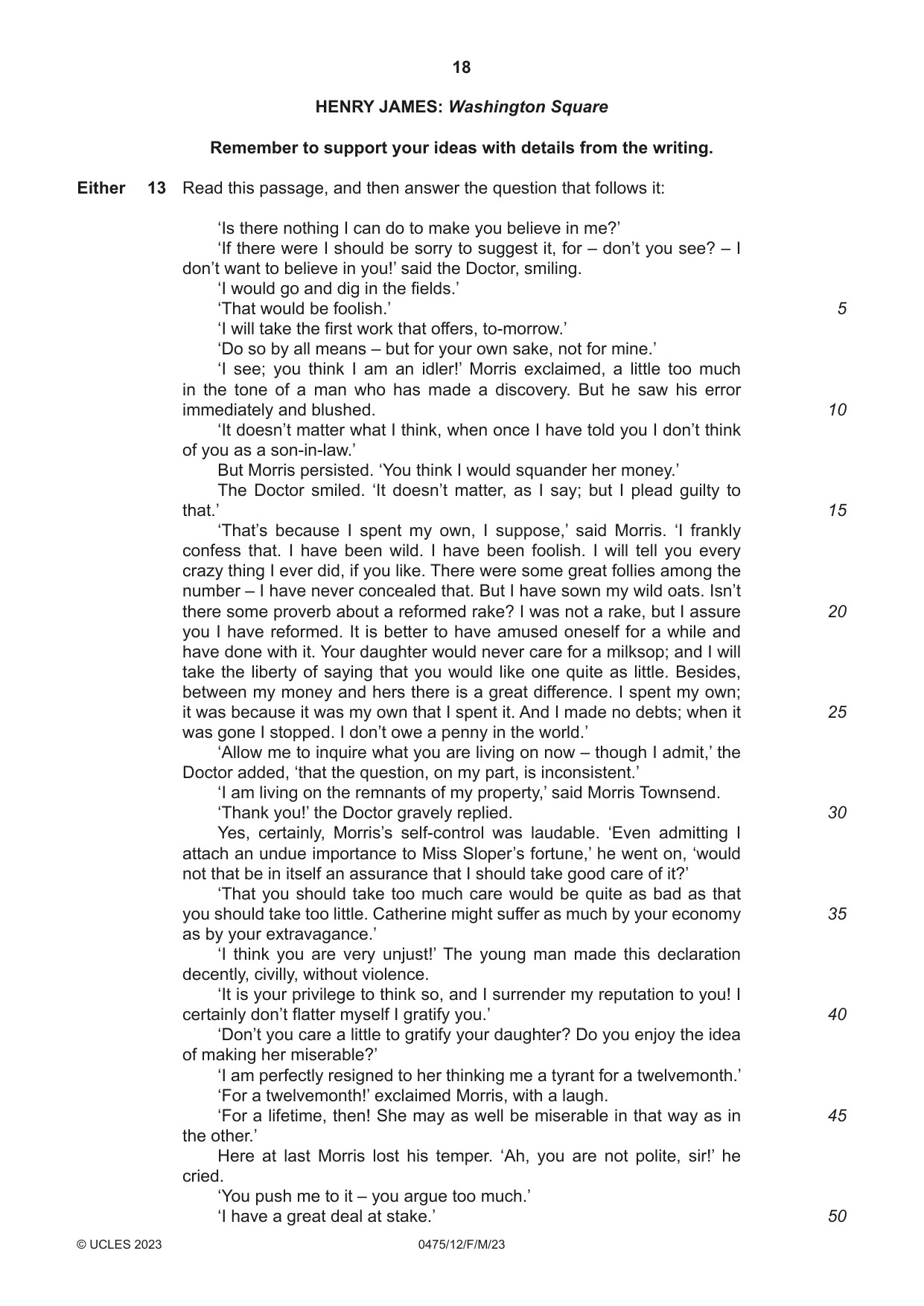
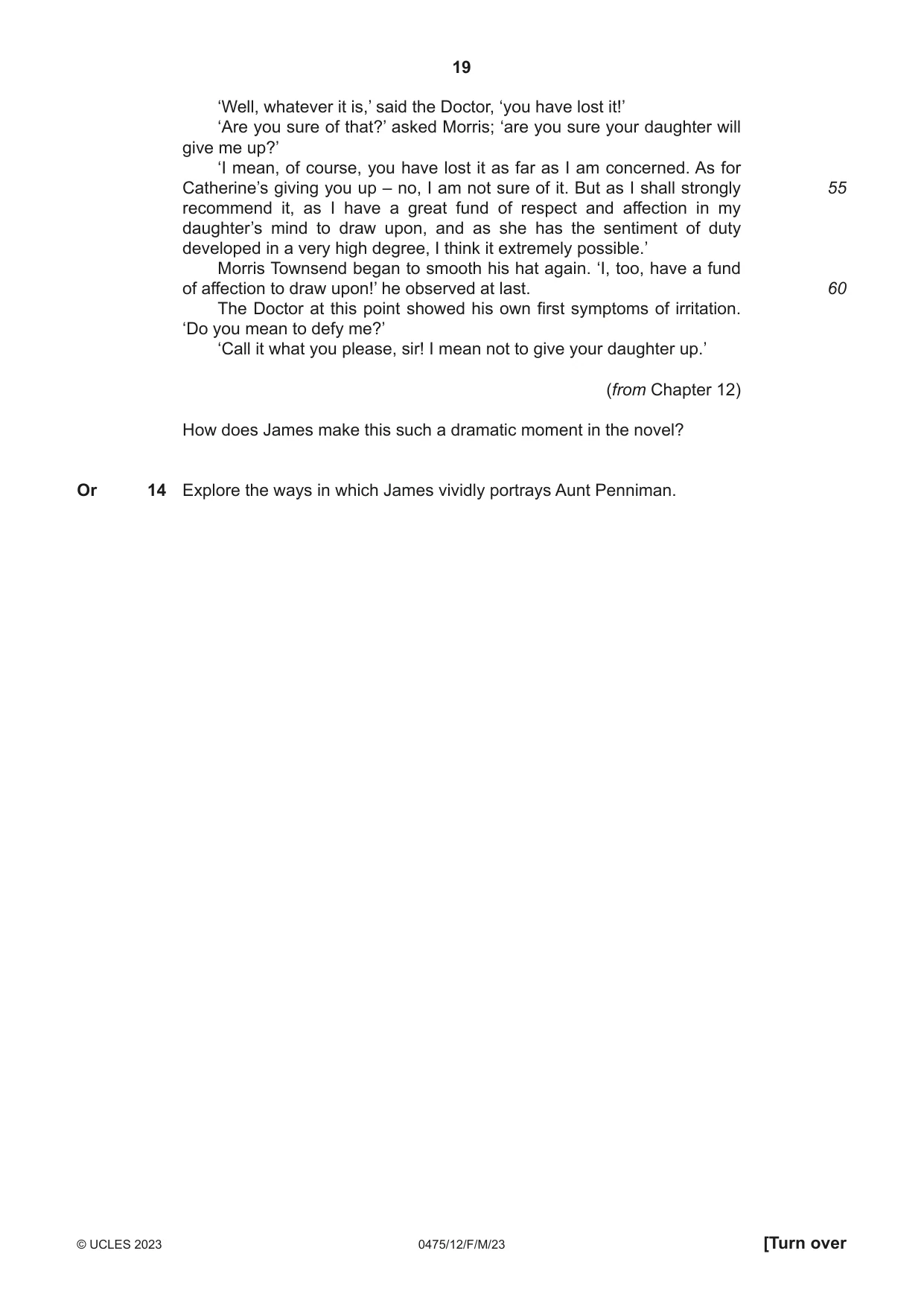
18 0475/12/F/M/23 © UCLES 2023 HENRY JAMES: Washington Square Remember to support your ideas with details from the writing. Either 13 Read this passage, and then answer the question that follows it: ‘Is there nothing I can do to make you believe in me?’ ‘If there were I should be sorry to suggest it, for – don’t you see? – I don’t want to believe in you!’ said the Doctor, smiling. ‘I would go and dig in the fields.’ ‘That would be foolish.’ ‘I will take the first work that offers, to-morrow.’ ‘Do so by all means – but for your own sake, not for mine.’ ‘I see; you think I am an idler!’ Morris exclaimed, a little too much in the tone of a man who has made a discovery. But he saw his error immediately and blushed. ‘It doesn’t matter what I think, when once I have told you I don’t think of you as a son-in-law.’ But Morris persisted. ‘You think I would squander her money.’ The Doctor smiled. ‘It doesn’t matter, as I say; but I plead guilty to that.’ ‘That’s because I spent my own, I suppose,’ said Morris. ‘I frankly confess that. I have been wild. I have been foolish. I will tell you every crazy thing I ever did, if you like. There were some great follies among the number – I have never concealed that. But I have sown my wild oats. Isn’t there some proverb about a reformed rake? I was not a rake, but I assure you I have reformed. It is better to have amused oneself for a while and have done with it. Your daughter would never care for a milksop; and I will take the liberty of saying that you would like one quite as little. Besides, between my money and hers there is a great difference. I spent my own; it was because it was my own that I spent it. And I made no debts; when it was gone I stopped. I don’t owe a penny in the world.’ ‘Allow me to inquire what you are living on now – though I admit,’ the Doctor added, ‘that the question, on my part, is inconsistent.’ ‘I am living on the remnants of my property,’ said Morris Townsend. ‘Thank you!’ the Doctor gravely replied. Yes, certainly, Morris’s self-control was laudable. ‘Even admitting I attach an undue importance to Miss Sloper’s fortune,’ he went on, ‘would not that be in itself an assurance that I should take good care of it?’ ‘That you should take too much care would be quite as bad as that you should take too little. Catherine might suffer as much by your economy as by your extravagance.’ ‘I think you are very unjust!’ The young man made this declaration decently, civilly, without violence. ‘It is your privilege to think so, and I surrender my reputation to you! I certainly don’t flatter myself I gratify you.’ ‘Don’t you care a little to gratify your daughter? Do you enjoy the idea of making her miserable?’ ‘I am perfectly resigned to her thinking me a tyrant for a twelvemonth.’ ‘For a twelvemonth!’ exclaimed Morris, with a laugh. ‘For a lifetime, then! She may as well be miserable in that way as in the other.’ Here at last Morris lost his temper. ‘Ah, you are not polite, sir!’ he cried. ‘You push me to it – you argue too much.’ ‘I have a great deal at stake.’ 5 10 15 20 25 30 35 40 45 50
Question paper, page 19
19 0475/12/F/M/23 © UCLES 2023 [Turn over ‘Well, whatever it is,’ said the Doctor, ‘you have lost it!’ ‘Are you sure of that?’ asked Morris; ‘are you sure your daughter will give me up?’ ‘I mean, of course, you have lost it as far as I am concerned. As for Catherine’s giving you up – no, I am not sure of it. But as I shall strongly recommend it, as I have a great fund of respect and affection in my daughter’s mind to draw upon, and as she has the sentiment of duty developed in a very high degree, I think it extremely possible.’ Morris Townsend began to smooth his hat again. ‘I, too, have a fund of affection to draw upon!’ he observed at last. The Doctor at this point showed his own first symptoms of irritation. ‘Do you mean to defy me?’ ‘Call it what you please, sir! I mean not to give your daughter up.’ (from Chapter 12) How does James make this such a dramatic moment in the novel? Or 14 Explore the ways in which James vividly portrays Aunt Penniman. 55 60
Question paper, page 20
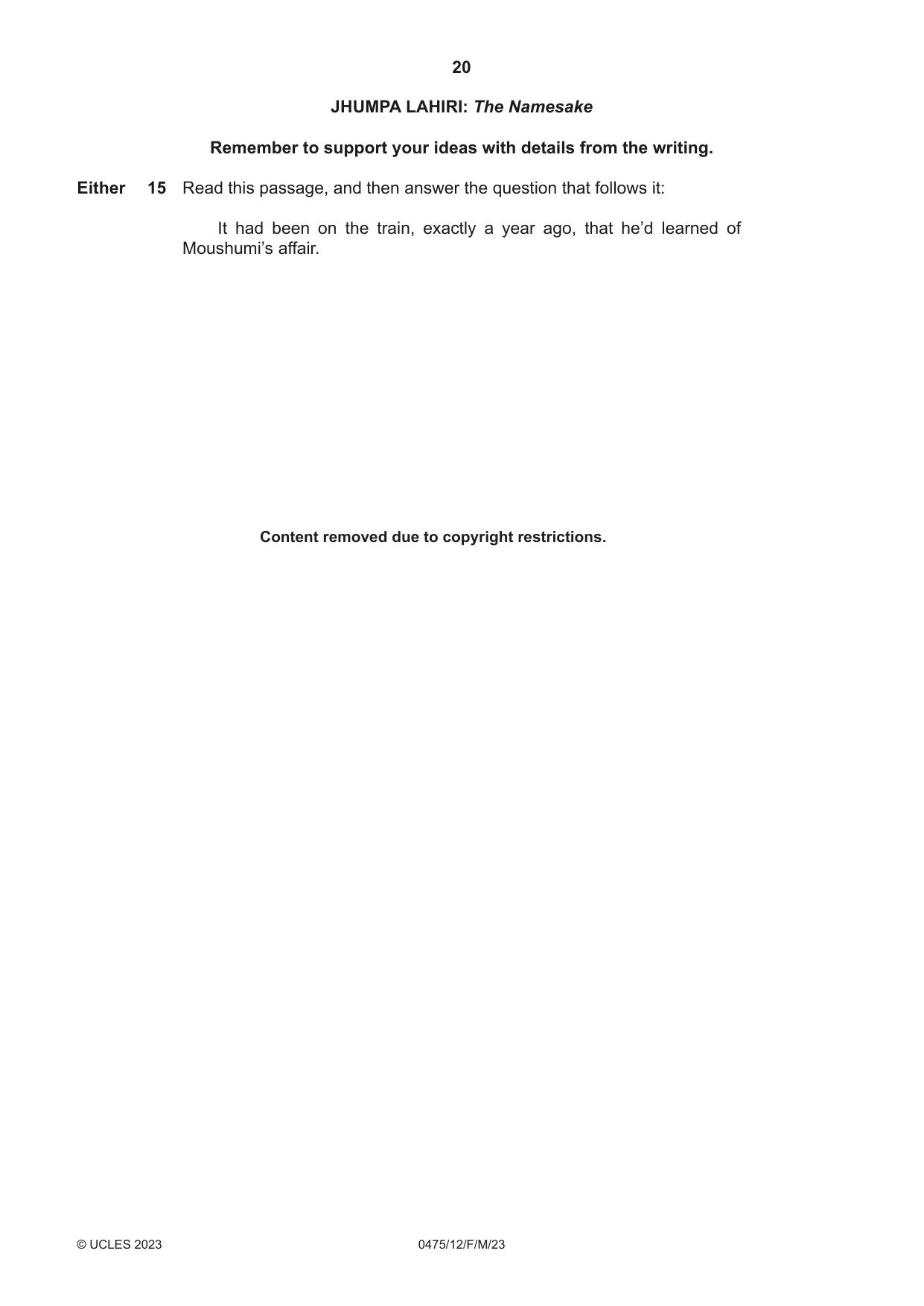
20 0475/12/F/M/23 © UCLES 2023 JHUMPA LAHIRI: The Namesake Remember to support your ideas with details from the writing. Either 15 Read this passage, and then answer the question that follows it: It had been on the train, exactly a year ago, that he’d learned of Moushumi’s affair. Content removed due to copyright restrictions.
Question paper, page 21
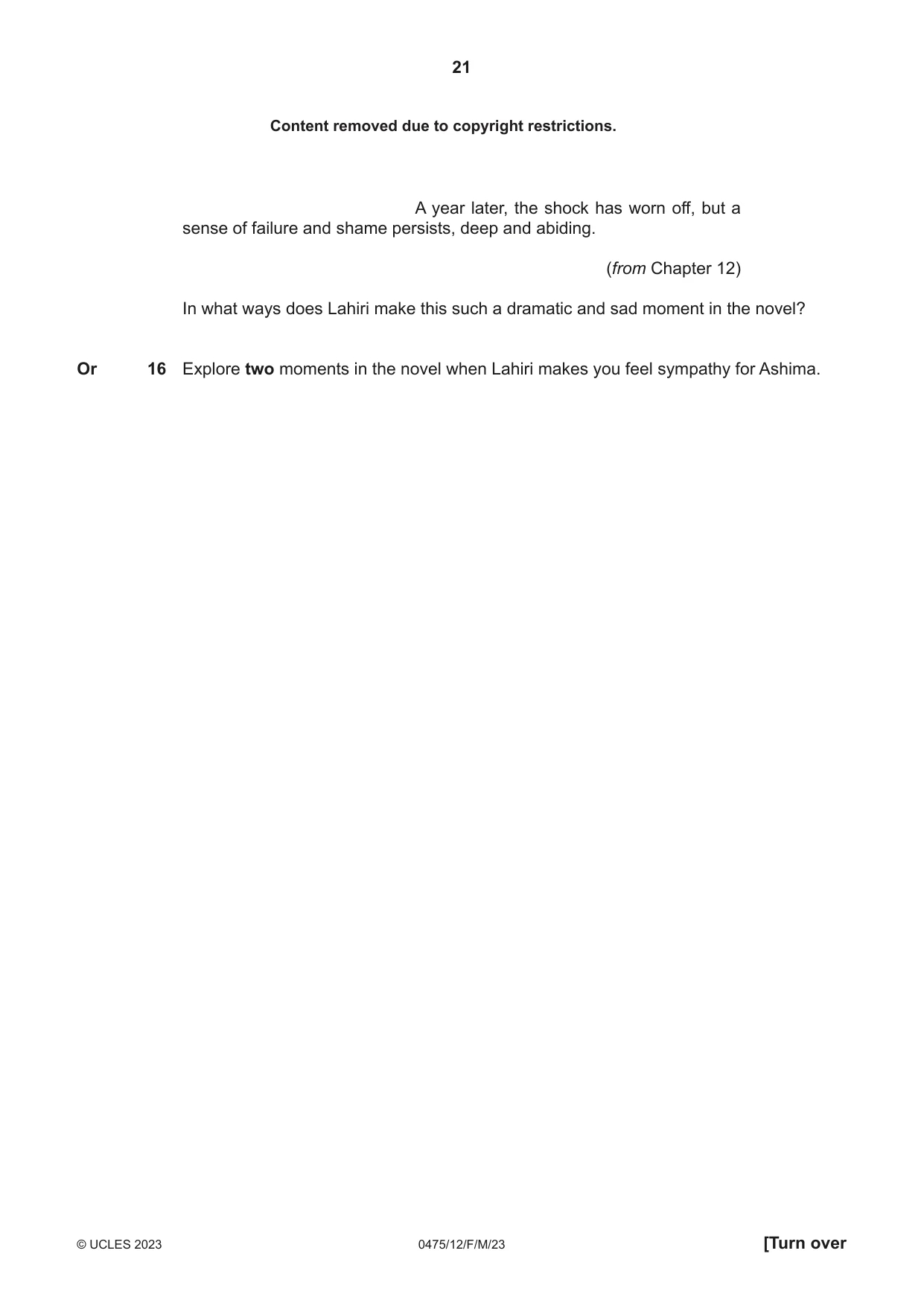
21 0475/12/F/M/23 © UCLES 2023 [Turn over A year later, the shock has worn off, but a sense of failure and shame persists, deep and abiding. (from Chapter 12) In what ways does Lahiri make this such a dramatic and sad moment in the novel? Or 16 Explore two moments in the novel when Lahiri makes you feel sympathy for Ashima. Content removed due to copyright restrictions.
Question paper, page 22
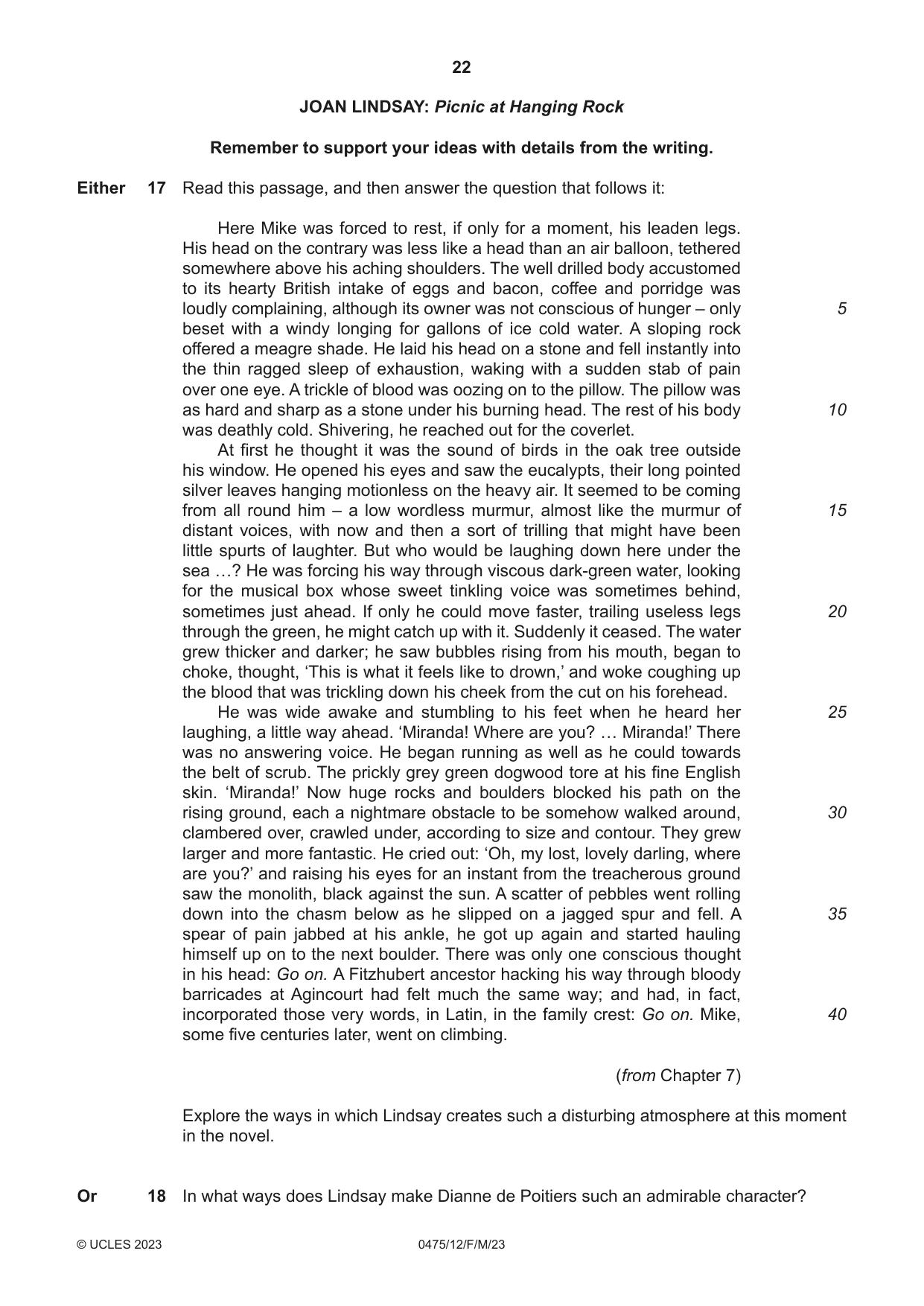
22 0475/12/F/M/23 © UCLES 2023 JOAN LINDSAY: Picnic at Hanging Rock Remember to support your ideas with details from the writing. Either 17 Read this passage, and then answer the question that follows it: Here Mike was forced to rest, if only for a moment, his leaden legs. His head on the contrary was less like a head than an air balloon, tethered somewhere above his aching shoulders. The well drilled body accustomed to its hearty British intake of eggs and bacon, coffee and porridge was loudly complaining, although its owner was not conscious of hunger – only beset with a windy longing for gallons of ice cold water. A sloping rock offered a meagre shade. He laid his head on a stone and fell instantly into the thin ragged sleep of exhaustion, waking with a sudden stab of pain over one eye. A trickle of blood was oozing on to the pillow. The pillow was as hard and sharp as a stone under his burning head. The rest of his body was deathly cold. Shivering, he reached out for the coverlet. At first he thought it was the sound of birds in the oak tree outside his window. He opened his eyes and saw the eucalypts, their long pointed silver leaves hanging motionless on the heavy air. It seemed to be coming from all round him – a low wordless murmur, almost like the murmur of distant voices, with now and then a sort of trilling that might have been little spurts of laughter. But who would be laughing down here under the sea …? He was forcing his way through viscous dark-green water, looking for the musical box whose sweet tinkling voice was sometimes behind, sometimes just ahead. If only he could move faster, trailing useless legs through the green, he might catch up with it. Suddenly it ceased. The water grew thicker and darker; he saw bubbles rising from his mouth, began to choke, thought, ‘This is what it feels like to drown,’ and woke coughing up the blood that was trickling down his cheek from the cut on his forehead. He was wide awake and stumbling to his feet when he heard her laughing, a little way ahead. ‘Miranda! Where are you? … Miranda!’ There was no answering voice. He began running as well as he could towards the belt of scrub. The prickly grey green dogwood tore at his fine English skin. ‘Miranda!’ Now huge rocks and boulders blocked his path on the rising ground, each a nightmare obstacle to be somehow walked around, clambered over, crawled under, according to size and contour. They grew larger and more fantastic. He cried out: ‘Oh, my lost, lovely darling, where are you?’ and raising his eyes for an instant from the treacherous ground saw the monolith, black against the sun. A scatter of pebbles went rolling down into the chasm below as he slipped on a jagged spur and fell. A spear of pain jabbed at his ankle, he got up again and started hauling himself up on to the next boulder. There was only one conscious thought in his head: Go on. A Fitzhubert ancestor hacking his way through bloody barricades at Agincourt had felt much the same way; and had, in fact, incorporated those very words, in Latin, in the family crest: Go on. Mike, some five centuries later, went on climbing. (from Chapter 7) Explore the ways in which Lindsay creates such a disturbing atmosphere at this moment in the novel. Or 18 In what ways does Lindsay make Dianne de Poitiers such an admirable character? 5 10 15 20 25 30 35 40
Question paper, page 23
23 0475/12/F/M/23 © UCLES 2023 [Turn over TURN OVER FOR QUESTION 19.
Question paper, page 24
24 0475/12/F/M/23 © UCLES 2023 YANN MARTEL: Life of Pi Remember to support your ideas with details from the writing. Either 19 Read this passage, and then answer the question that follows it: It was on a Sunday morning. Content removed due to copyright restrictions.
Question paper, page 25
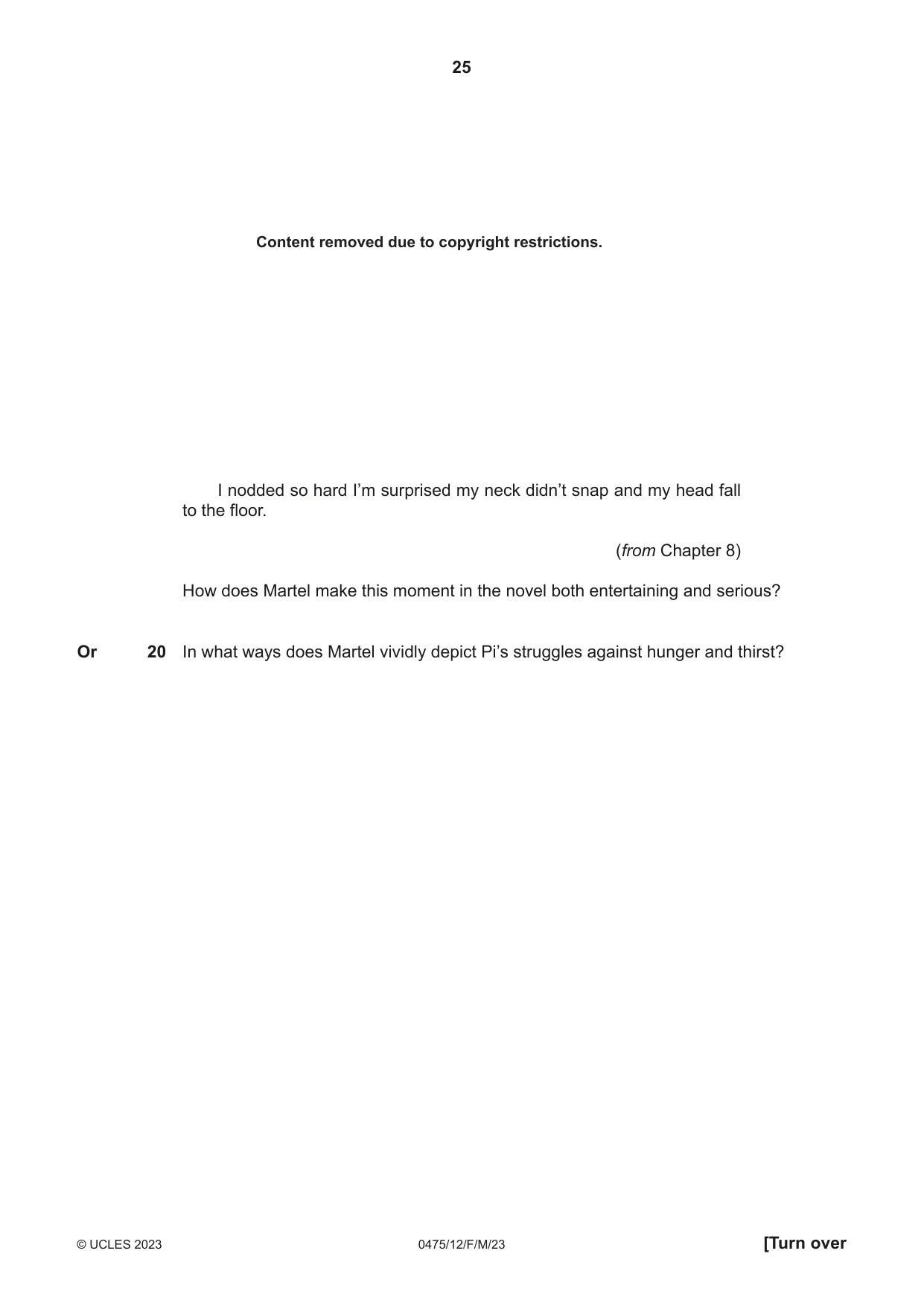
25 0475/12/F/M/23 © UCLES 2023 [Turn over I nodded so hard I’m surprised my neck didn’t snap and my head fall to the floor. (from Chapter 8) How does Martel make this moment in the novel both entertaining and serious? Or 20 In what ways does Martel vividly depict Pi’s struggles against hunger and thirst? Content removed due to copyright restrictions.
Question paper, page 26
26 0475/12/F/M/23 © UCLES 2023 from STORIES OF OURSELVES Volume 2 Remember to support your ideas with details from the writing. Either 21 Read this passage from Sharmaji (by Anjana Appachana), and then answer the question that follows it: Sharma was late for work. When he signed his name in the attendance register, the clerk in the personnel department shook his head disapprovingly. ‘Very bad, very bad, Sharmaji,’ he said, clicking his tongue. ‘This is the fourteenth time you are late this month.’ Sharma’s brow darkened. ‘You keep quiet, Mahesh,’ he replied. ‘Who are you to tell me I’m late? You are a clerk, I am a clerk. You don’t have the authority to tell me anything. Understood?’ Mahesh retreated behind his desk. He said, ‘What I am telling you, I am telling you for your own good. Why you must take it in the wrong spirit I do not understand.’ ‘You don’t tell me what is good for me,’ Sharma said. He raised his voice. ‘I am twenty-five years older than you.’ He had an audience by now. The other latecomers and those working in the personnel department were watching with intense interest. Sharma continued, ‘I have been in this company for twenty-five years. At that time you were in your mother’s womb.’ He surveyed his delighted audience. ‘He thinks that after reading our personal files he has power over us.’ He snapped his fingers in front of Mahesh’s face. ‘I can show you how much power you have! What can a pipsqueak like you teach me! It is for me to teach you!’ ‘Sharmaji,’ said Mahesh, folding his hands, ‘I take back my words. Now please leave me alone. And I beg of you, do not shout in the personnel department. It sounds very bad.’ Sharma chuckled. He raised his voice. ‘Shouting? I am not shouting. I am talking to you. Is it forbidden to talk in the personnel department? Is this an office or a school?’ He smiled again at his audience. Everyone was spellbound. He said, ‘So Mahesh, you now think you can tell me how to behave. Very good. What else can you teach me?’ ‘Yes, Mahesh, tell him,’ urged Gupta, the clerk from the accounts department. He was also late, but only for the ninth time in the month. Mahesh looked harassed. ‘You keep out of this, Gupta. This is not your business.’ ‘Mahesh,’ said Gupta. ‘You are in the wrong profession. You should have been a teacher, a professor. Join Delhi University. We will all give you recommendations!’ Everyone roared with laughter. Mohan, the peon, was the loudest. ‘Today we are having fun,’ he said between guffaws. ‘Oh, this is wonderful!’ ‘What is wonderful, Mohan?’ It was the personnel officer, Miss Das. A sudden silence fell in the room. Everyone looked away. She glanced at her watch and then at the silent group. ‘What is happening?’ she asked. ‘Why is there this mela here?’ ‘Madam, we came to sign the attendance register,’ Sharma said. Gupta slid out of the room. She looked pointedly at her watch. ‘The register, should have been signed forty-five minutes ago.’ 5 10 15 20 25 30 35 40 45
Question paper, page 27
27 0475/12/F/M/23 © UCLES 2023 Sharma looked her straight in the eyes. ‘Madam,’ he said, ‘what to do, my daughter has a temperature. I had to take her to the clinic so I got a little late.’ ‘Did you inform your manager that you would be late?’ ‘I don’t have a phone at home, madam.’ ‘Why didn’t you inform him yesterday?’ ‘Madam, I did not know yesterday. My daughter fell ill this morning.’ She looked at the register. ‘Has your daughter been ill fourteen days of the month?’ Mahesh smirked. ‘Oh, madam,’ said Sharma, ‘that was my other daughter. You know this virus, madam. All my daughters have been falling ill, one after the other. I have three.’ ‘Fourteen days,’ she repeated, shaking her head. ‘Yes madam, three daughters with this virus. Well, madam, I should be getting along.’ He sauntered out of the room. How does Appachana make this such a striking introduction to Sharma? Or 22 Explore the ways in which Hawthorne vividly depicts the foolishness of the characters in Dr Heidegger’s Experiment. 50 55 60
Question paper, page 28
28 0475/12/F/M/23 © UCLES 2023 Permission to reproduce items where third-party owned material protected by copyright is included has been sought and cleared where possible. Every reasonable effort has been made by the publisher (UCLES) to trace copyright holders, but if any items requiring clearance have unwittingly been included, the publisher will be pleased to make amends at the earliest possible opportunity. To avoid the issue of disclosure of answer-related information to candidates, all copyright acknowledgements are reproduced online in the Cambridge Assessment International Education Copyright Acknowledgements Booklet. This is produced for each series of examinations and is freely available to download at www.cambridgeinternational.org after the live examination series. Cambridge Assessment International Education is part of Cambridge Assessment. Cambridge Assessment is the brand name of the University of Cambridge Local Examinations Syndicate (UCLES), which is a department of the University of Cambridge. BLANK PAGE
Mark scheme, page 1
This document consists of 4 printed pages. © UCLES 2023 [Turn over Cambridge IGCSE™ LITERATURE IN ENGLISH 0475/12 Paper 1 Poetry and Prose February/March 2023 MARK SCHEME Maximum Mark: 50 Published This mark scheme is published as an aid to teachers and candidates, to indicate the requirements of the examination. It shows the basis on which Examiners were instructed to award marks. It does not indicate the details of the discussions that took place at an Examiners’ meeting before marking began, which would have considered the acceptability of alternative answers. Mark schemes should be read in conjunction with the question paper and the Principal Examiner Report for Teachers. Cambridge International will not enter into discussions about these mark schemes. Cambridge International is publishing the mark schemes for the February/March 2023 series for most Cambridge IGCSE™, Cambridge International A and AS Level components and some Cambridge O Level components.
Mark scheme, page 2
0475/12 Cambridge IGCSE – Mark Scheme PUBLISHED February/March 2023 © UCLES 2023 Page 2 of 4 Generic Marking Principles These general marking principles must be applied by all examiners when marking candidate answers. They should be applied alongside the specific content of the mark scheme or generic level descriptors for a question. Each question paper and mark scheme will also comply with these marking principles. GENERIC MARKING PRINCIPLE 1: Marks must be awarded in line with: • the specific content of the mark scheme or the generic level descriptors for the question • the specific skills defined in the mark scheme or in the generic level descriptors for the question • the standard of response required by a candidate as exemplified by the standardisation scripts. GENERIC MARKING PRINCIPLE 2: Marks awarded are always whole marks (not half marks, or other fractions). GENERIC MARKING PRINCIPLE 3: Marks must be awarded positively: • marks are awarded for correct/valid answers, as defined in the mark scheme. However, credit is given for valid answers which go beyond the scope of the syllabus and mark scheme, referring to your Team Leader as appropriate • marks are awarded when candidates clearly demonstrate what they know and can do • marks are not deducted for errors • marks are not deducted for omissions • answers should only be judged on the quality of spelling, punctuation and grammar when these features are specifically assessed by the question as indicated by the mark scheme. The meaning, however, should be unambiguous. GENERIC MARKING PRINCIPLE 4: Rules must be applied consistently, e.g. in situations where candidates have not followed instructions or in the application of generic level descriptors. GENERIC MARKING PRINCIPLE 5: Marks should be awarded using the full range of marks defined in the mark scheme for the question (however; the use of the full mark range may be limited according to the quality of the candidate responses seen). GENERIC MARKING PRINCIPLE 6: Marks awarded are based solely on the requirements as defined in the mark scheme. Marks should not be awarded with grade thresholds or grade descriptors in mind.
Mark scheme, page 3
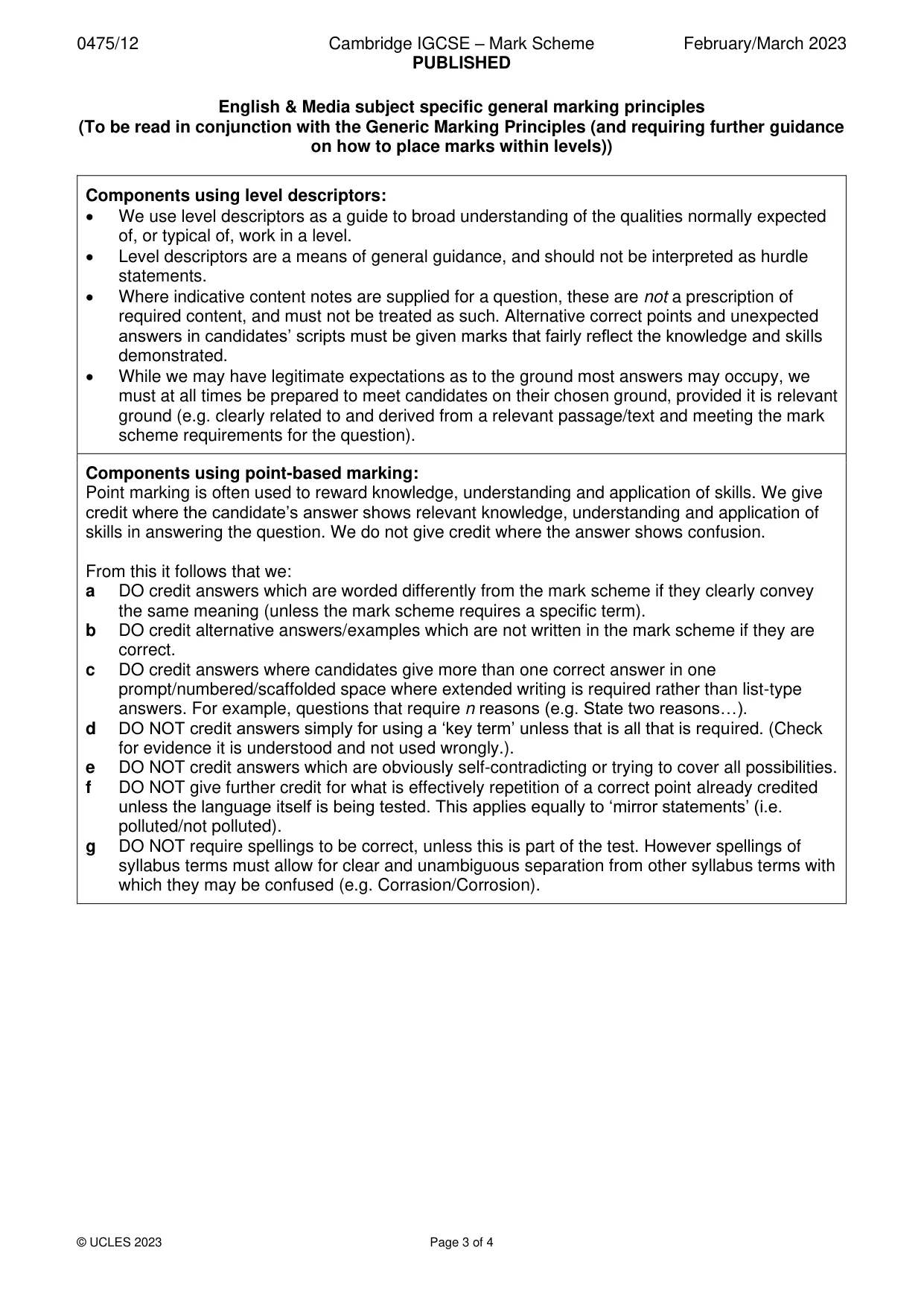
0475/12 Cambridge IGCSE – Mark Scheme PUBLISHED February/March 2023 © UCLES 2023 Page 3 of 4 English & Media subject specific general marking principles (To be read in conjunction with the Generic Marking Principles (and requiring further guidance on how to place marks within levels)) Components using level descriptors: • We use level descriptors as a guide to broad understanding of the qualities normally expected of, or typical of, work in a level. • Level descriptors are a means of general guidance, and should not be interpreted as hurdle statements. • Where indicative content notes are supplied for a question, these are not a prescription of required content, and must not be treated as such. Alternative correct points and unexpected answers in candidates’ scripts must be given marks that fairly reflect the knowledge and skills demonstrated. • While we may have legitimate expectations as to the ground most answers may occupy, we must at all times be prepared to meet candidates on their chosen ground, provided it is relevant ground (e.g. clearly related to and derived from a relevant passage/text and meeting the mark scheme requirements for the question). Components using point-based marking: Point marking is often used to reward knowledge, understanding and application of skills. We give credit where the candidate’s answer shows relevant knowledge, understanding and application of skills in answering the question. We do not give credit where the answer shows confusion. From this it follows that we: a DO credit answers which are worded differently from the mark scheme if they clearly convey the same meaning (unless the mark scheme requires a specific term). b DO credit alternative answers/examples which are not written in the mark scheme if they are correct. c DO credit answers where candidates give more than one correct answer in one prompt/numbered/scaffolded space where extended writing is required rather than list-type answers. For example, questions that require n reasons (e.g. State two reasons…). d DO NOT credit answers simply for using a ‘key term’ unless that is all that is required. (Check for evidence it is understood and not used wrongly.). e DO NOT credit answers which are obviously self-contradicting or trying to cover all possibilities. f DO NOT give further credit for what is effectively repetition of a correct point already credited unless the language itself is being tested. This applies equally to ‘mirror statements’ (i.e. polluted/not polluted). g DO NOT require spellings to be correct, unless this is part of the test. However spellings of syllabus terms must allow for clear and unambiguous separation from other syllabus terms with which they may be confused (e.g. Corrasion/Corrosion).
Mark scheme, page 4
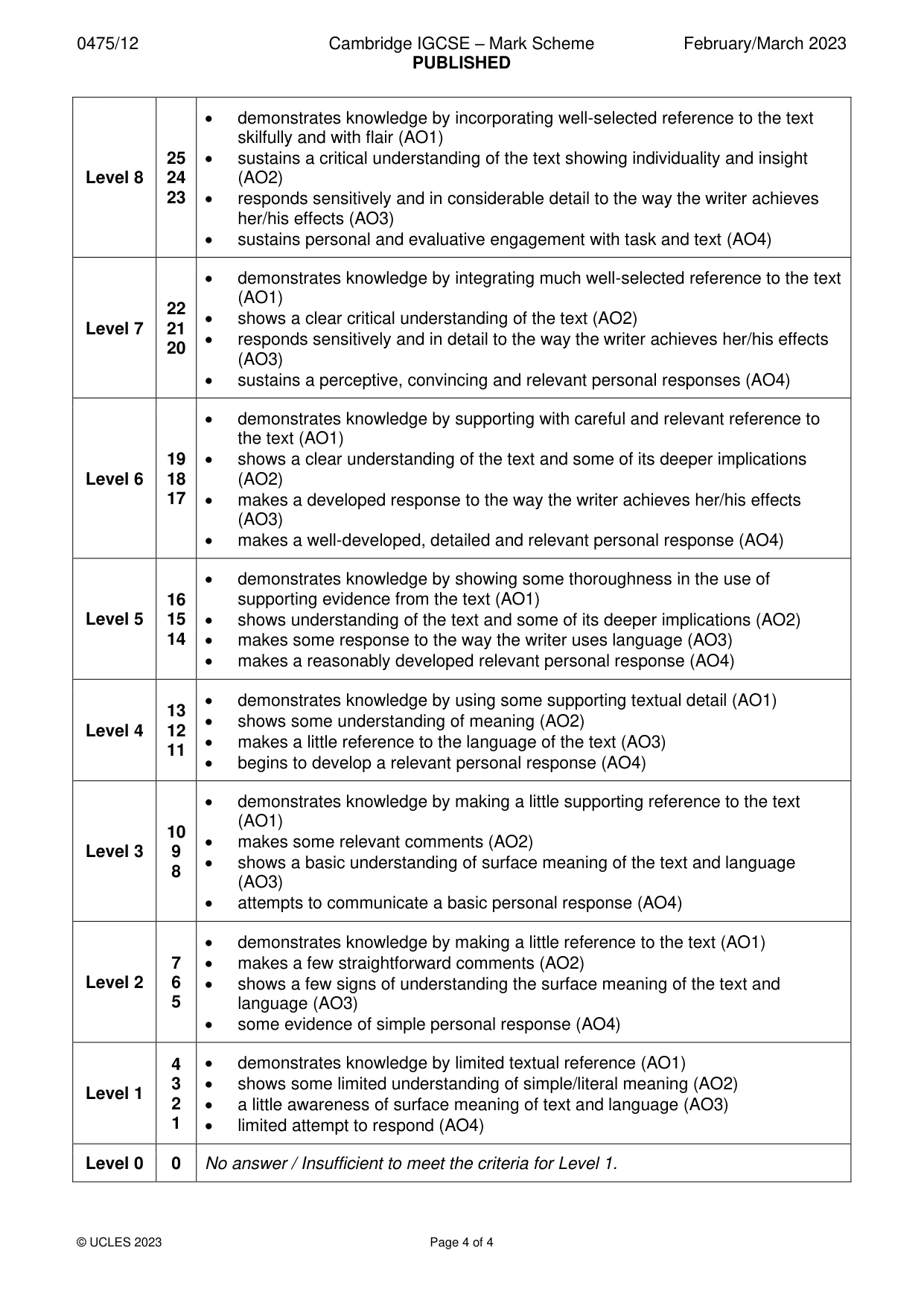
0475/12 Cambridge IGCSE – Mark Scheme PUBLISHED February/March 2023 © UCLES 2023 Page 4 of 4 Level 8 25 24 23 • demonstrates knowledge by incorporating well-selected reference to the text skilfully and with flair (AO1) • sustains a critical understanding of the text showing individuality and insight (AO2) • responds sensitively and in considerable detail to the way the writer achieves her/his effects (AO3) • sustains personal and evaluative engagement with task and text (AO4) Level 7 22 21 20 • demonstrates knowledge by integrating much well-selected reference to the text (AO1) • shows a clear critical understanding of the text (AO2) • responds sensitively and in detail to the way the writer achieves her/his effects (AO3) • sustains a perceptive, convincing and relevant personal responses (AO4) Level 6 19 18 17 • demonstrates knowledge by supporting with careful and relevant reference to the text (AO1) • shows a clear understanding of the text and some of its deeper implications (AO2) • makes a developed response to the way the writer achieves her/his effects (AO3) • makes a well-developed, detailed and relevant personal response (AO4) Level 5 16 15 14 • demonstrates knowledge by showing some thoroughness in the use of supporting evidence from the text (AO1) • shows understanding of the text and some of its deeper implications (AO2) • makes some response to the way the writer uses language (AO3) • makes a reasonably developed relevant personal response (AO4) Level 4 13 12 11 • demonstrates knowledge by using some supporting textual detail (AO1) • shows some understanding of meaning (AO2) • makes a little reference to the language of the text (AO3) • begins to develop a relevant personal response (AO4) Level 3 10 9 8 • demonstrates knowledge by making a little supporting reference to the text (AO1) • makes some relevant comments (AO2) • shows a basic understanding of surface meaning of the text and language (AO3) • attempts to communicate a basic personal response (AO4) Level 2 7 6 5 • demonstrates knowledge by making a little reference to the text (AO1) • makes a few straightforward comments (AO2) • shows a few signs of understanding the surface meaning of the text and language (AO3) • some evidence of simple personal response (AO4) Level 1 4 3 2 1 • demonstrates knowledge by limited textual reference (AO1) • shows some limited understanding of simple/literal meaning (AO2) • a little awareness of surface meaning of text and language (AO3) • limited attempt to respond (AO4) Level 0 0 No answer / Insufficient to meet the criteria for Level 1.
What you needed in this session
Cambridge’s own grade thresholds for 2023 Feb/March, Paper 1 · Variant 2. A higher threshold means an easier paper — the bar moves with how the cohort did.