Cambridge IGCSE English - Literature in English 0475 — 2025 Feb/March Paper 1 · Variant 2
0475/12/F/M/25 · 50 marks · ≈56 min
The question paper and its mark scheme, free to read here and free to download. This is Cambridge’s own paper, exactly as it was sat.
Question paper28 pages




Mark scheme5 pages
Answers below. Sit the paper first if you are practising.
Paper as text
Question paper, page 1
This document has 28 pages. Any blank pages are indicated. [Turn over Cambridge IGCSE™ DC (CE) 341315/2 © UCLES 2025 LITERATURE IN ENGLISH 0475/12 Paper 1 Poetry and Prose February/March 2025 1 hour 30 minutes You must answer on the enclosed answer booklet. You will need: Answer booklet (enclosed) INSTRUCTIONS ● Answer two questions in total: Section A: answer one question. Section B: answer one question. ● Follow the instructions on the front cover of the answer booklet. If you need additional answer paper, ask the invigilator for a continuation booklet. INFORMATION ● The total mark for this paper is 50. ● All questions are worth equal marks. * 4 1 3 7 2 8 2 4 4 3 *
Question paper, page 2
2 0475/12/F/M/25 © UCLES 2025 BLANK PAGE
Question paper, page 3
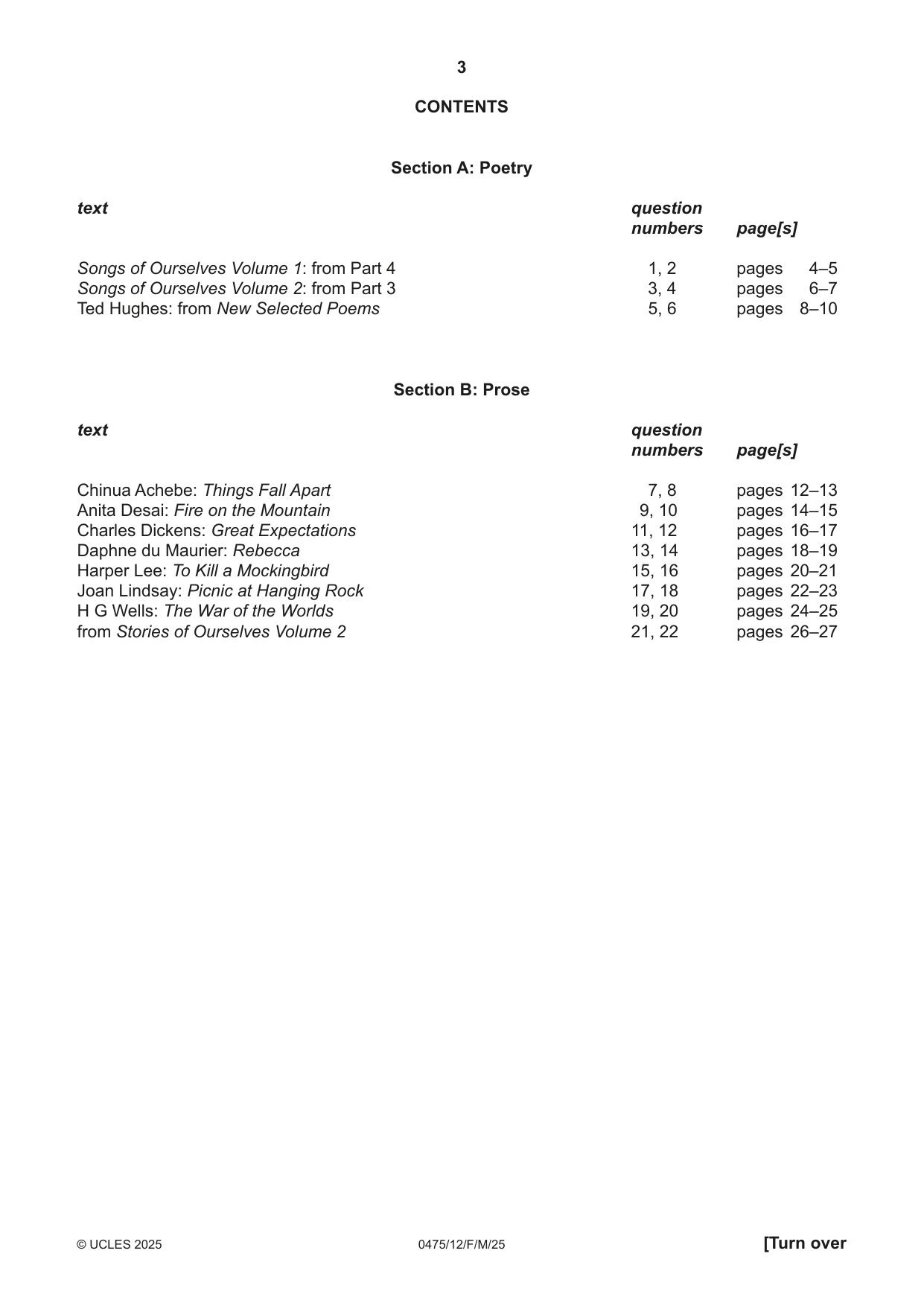
3 0475/12/F/M/25 © UCLES 2025 [Turn over CONTENTS Section A: Poetry text question numbers page[s] Songs of Ourselves Volume 1: from Part 4 1, 2 pages 4–5 Songs of Ourselves Volume 2: from Part 3 3, 4 pages 6–7 Ted Hughes: from New Selected Poems 5, 6 pages 8–10 Section B: Prose text question numbers page[s] Chinua Achebe: Things Fall Apart 7, 8 pages 12–13 Anita Desai: Fire on the Mountain 9, 10 pages 14–15 Charles Dickens: Great Expectations 11, 12 pages 16–17 Daphne du Maurier: Rebecca 13, 14 pages 18–19 Harper Lee: To Kill a Mockingbird 15, 16 pages 20–21 Joan Lindsay: Picnic at Hanging Rock 17, 18 pages 22–23 H G Wells: The War of the Worlds 19, 20 pages 24–25 from Stories of Ourselves Volume 2 21, 22 pages 26–27
Question paper, page 4
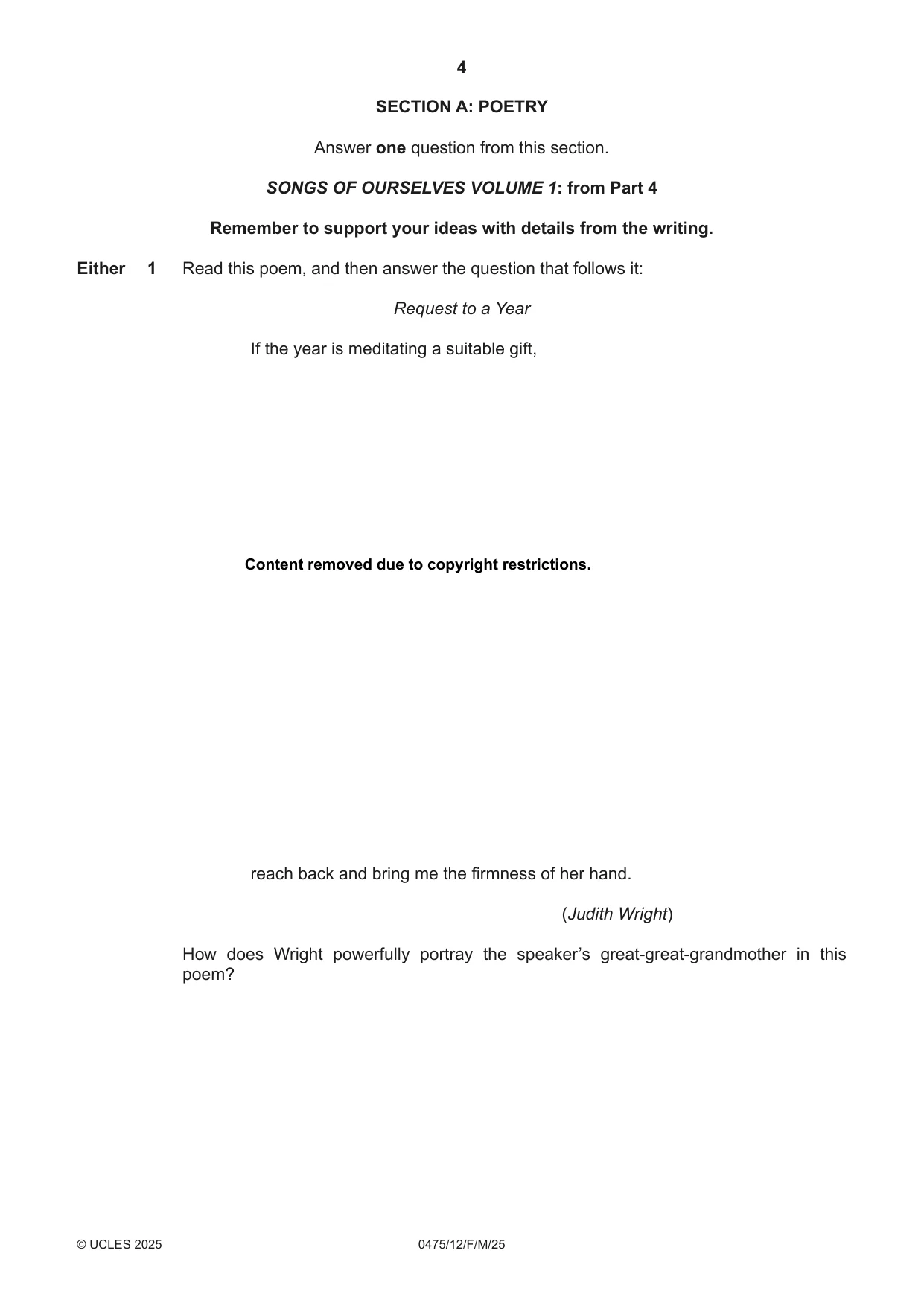
4 0475/12/F/M/25 © UCLES 2025 SECTION A: POETRY Answer one question from this section. SONGS OF OURSELVES VOLUME 1: from Part 4 Remember to support your ideas with details from the writing. Either 1 Read this poem, and then answer the question that follows it: Request to a Year If the year is meditating a suitable gift, reach back and bring me the firmness of her hand. (Judith Wright) How does Wright powerfully portray the speaker’s great-great-grandmother in this poem? Content removed due to copyright restrictions.
Question paper, page 5
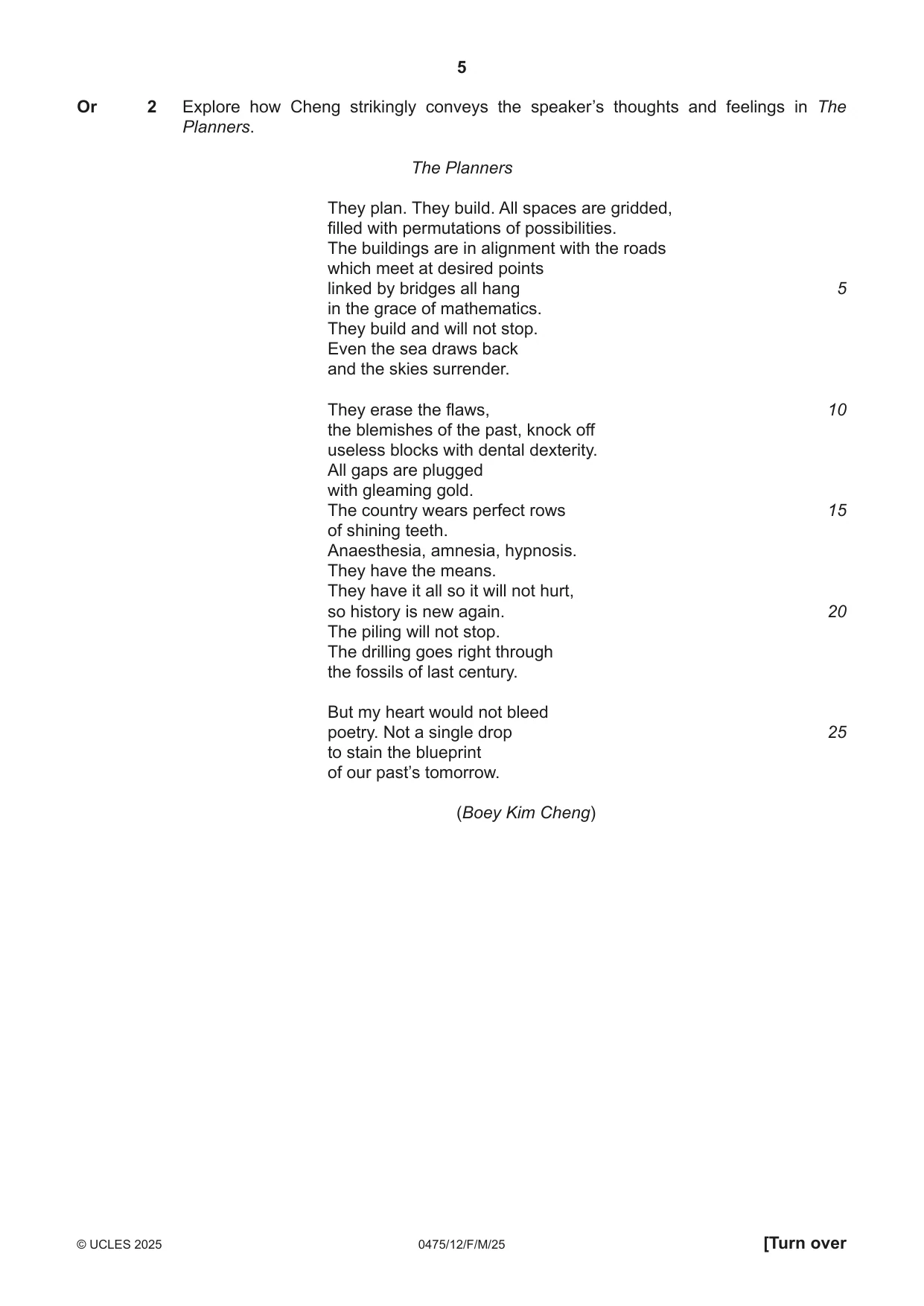
5 0475/12/F/M/25 © UCLES 2025 [Turn over Or 2 Explore how Cheng strikingly conveys the speaker’s thoughts and feelings in The Planners. The Planners They plan. They build. All spaces are gridded, filled with permutations of possibilities. The buildings are in alignment with the roads which meet at desired points linked by bridges all hang 5 in the grace of mathematics. They build and will not stop. Even the sea draws back and the skies surrender. They erase the flaws, 10 the blemishes of the past, knock off useless blocks with dental dexterity. All gaps are plugged with gleaming gold. The country wears perfect rows 15 of shining teeth. Anaesthesia, amnesia, hypnosis. They have the means. They have it all so it will not hurt, so history is new again. 20 The piling will not stop. The drilling goes right through the fossils of last century. But my heart would not bleed poetry. Not a single drop 25 to stain the blueprint of our past’s tomorrow. (Boey Kim Cheng)
Question paper, page 6
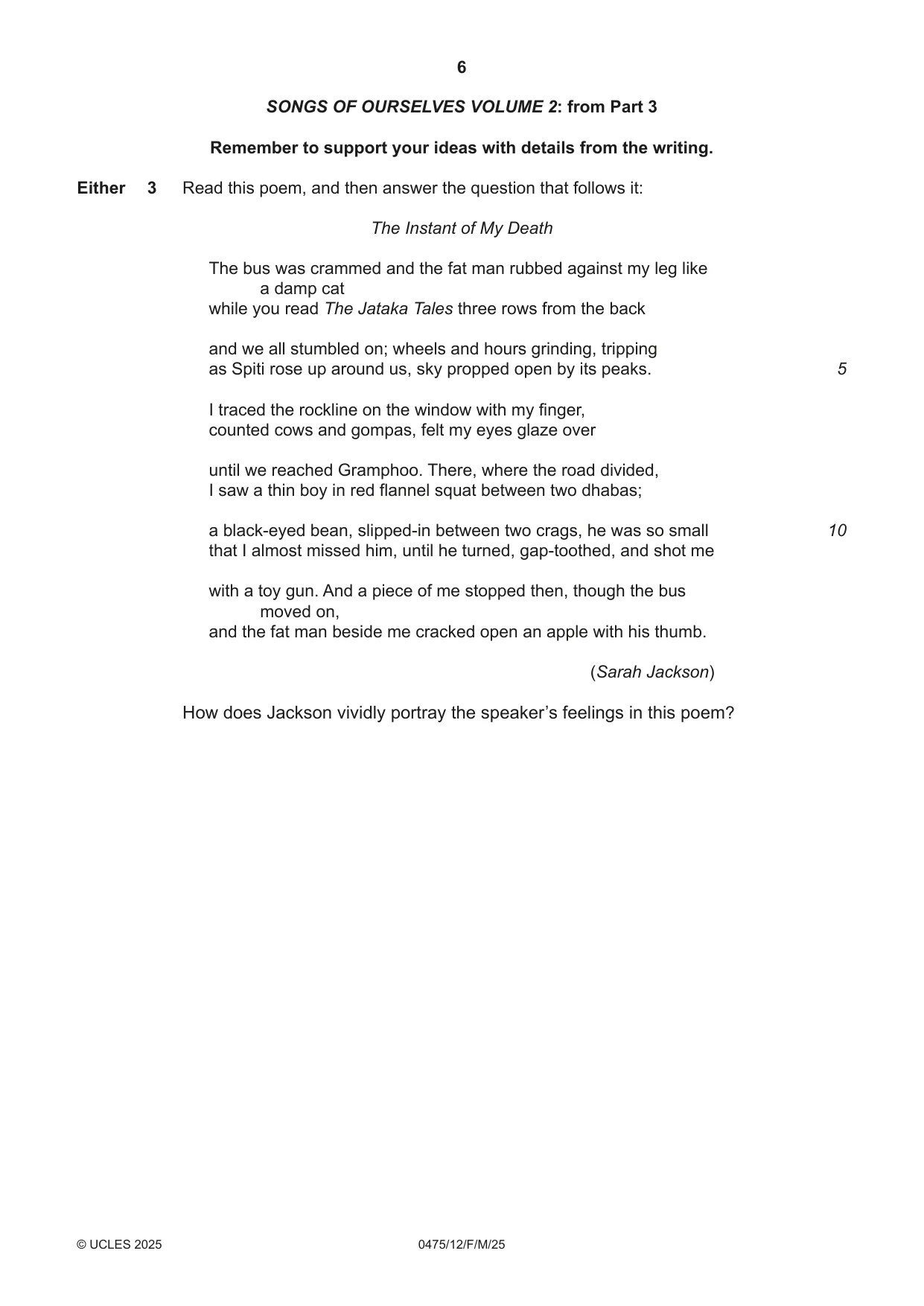
6 0475/12/F/M/25 © UCLES 2025 SONGS OF OURSELVES VOLUME 2: from Part 3 Remember to support your ideas with details from the writing. Either 3 Read this poem, and then answer the question that follows it: The Instant of My Death The bus was crammed and the fat man rubbed against my leg like a damp cat while you read The Jataka Tales three rows from the back and we all stumbled on; wheels and hours grinding, tripping as Spiti rose up around us, sky propped open by its peaks. 5 I traced the rockline on the window with my finger, counted cows and gompas, felt my eyes glaze over until we reached Gramphoo. There, where the road divided, I saw a thin boy in red flannel squat between two dhabas; a black-eyed bean, slipped-in between two crags, he was so small 10 that I almost missed him, until he turned, gap-toothed, and shot me with a toy gun. And a piece of me stopped then, though the bus moved on, and the fat man beside me cracked open an apple with his thumb. (Sarah Jackson) How does Jackson vividly portray the speaker’s feelings in this poem?
Question paper, page 7
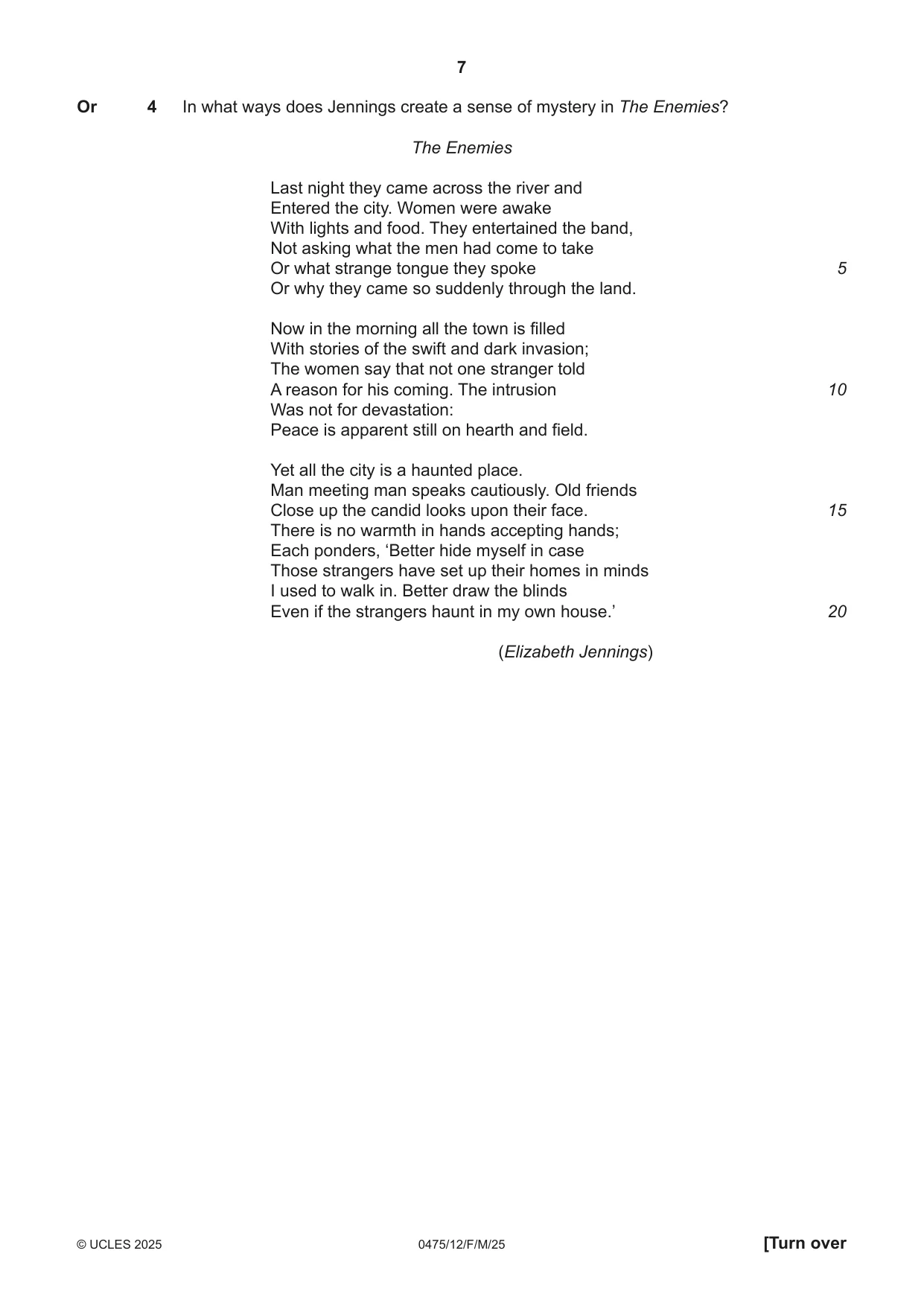
7 0475/12/F/M/25 © UCLES 2025 [Turn over Or 4 In what ways does Jennings create a sense of mystery in The Enemies? The Enemies Last night they came across the river and Entered the city. Women were awake With lights and food. They entertained the band, Not asking what the men had come to take Or what strange tongue they spoke 5 Or why they came so suddenly through the land. Now in the morning all the town is filled With stories of the swift and dark invasion; The women say that not one stranger told A reason for his coming. The intrusion 10 Was not for devastation: Peace is apparent still on hearth and field. Yet all the city is a haunted place. Man meeting man speaks cautiously. Old friends Close up the candid looks upon their face. 15 There is no warmth in hands accepting hands; Each ponders, ‘Better hide myself in case Those strangers have set up their homes in minds I used to walk in. Better draw the blinds Even if the strangers haunt in my own house.’ 20 (Elizabeth Jennings)
Question paper, page 8
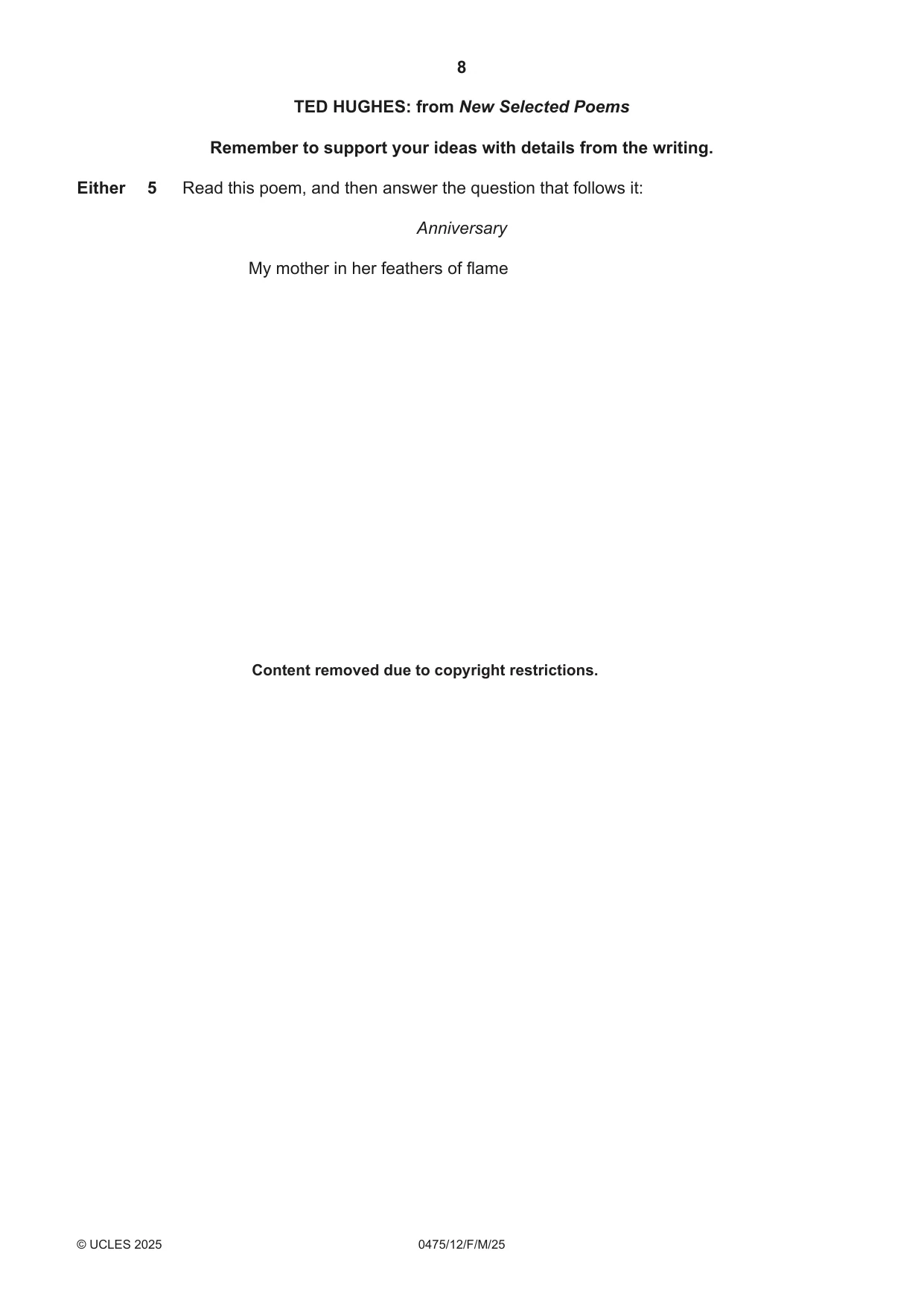
8 0475/12/F/M/25 © UCLES 2025 TED HUGHES: from New Selected Poems Remember to support your ideas with details from the writing. Either 5 Read this poem, and then answer the question that follows it: Anniversary My mother in her feathers of flame Content removed due to copyright restrictions.
Question paper, page 9
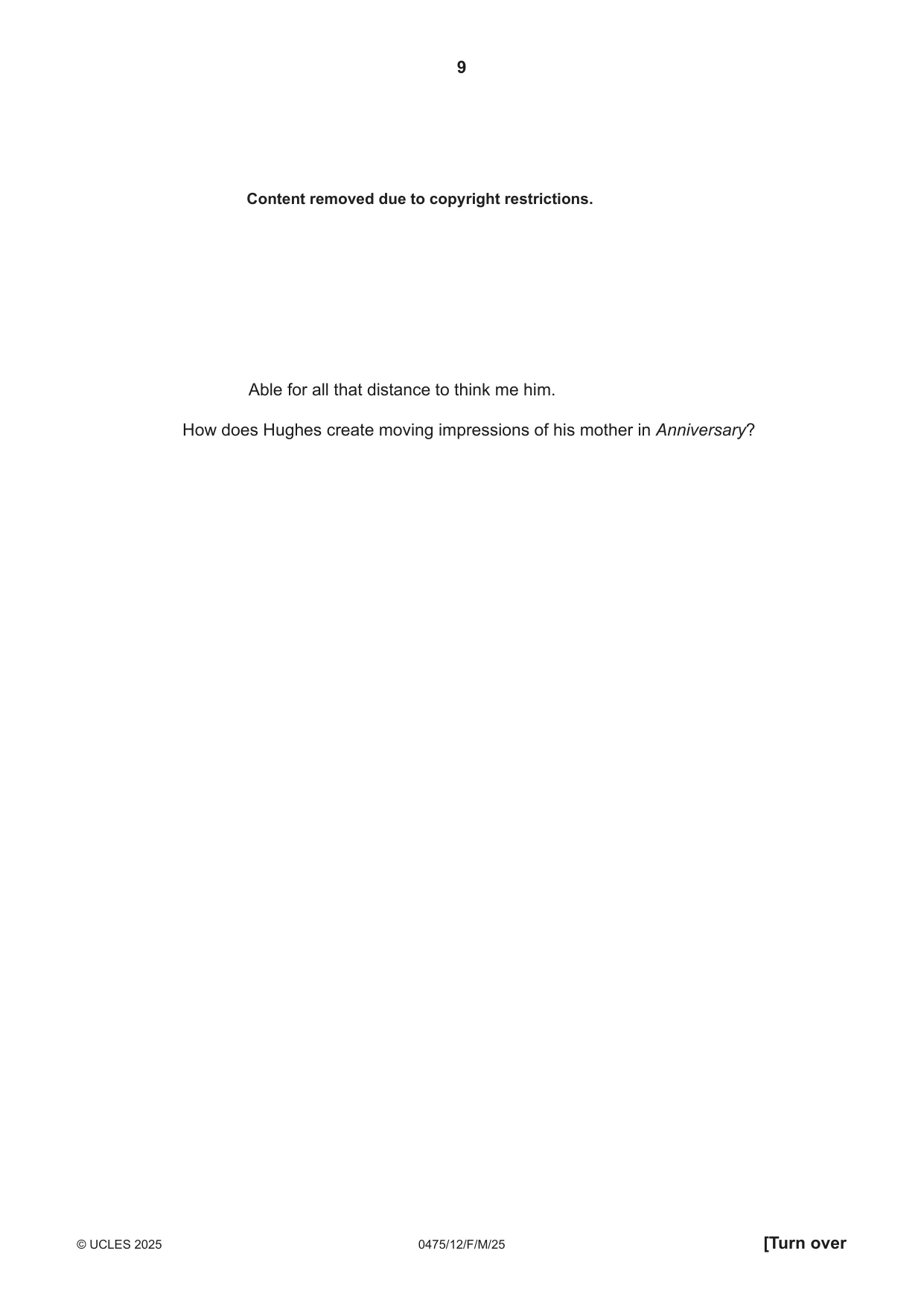
9 0475/12/F/M/25 © UCLES 2025 [Turn over Able for all that distance to think me him. How does Hughes create moving impressions of his mother in Anniversary? Content removed due to copyright restrictions.
Question paper, page 10
10 0475/12/F/M/25 © UCLES 2025 Or 6 Explore the ways in which Hughes makes The Thought-Fox such a powerful poem. The Thought-Fox I imagine this midnight moment’s forest: The page is printed. Content removed due to copyright restrictions.
Question paper, page 11
11 0475/12/F/M/25 © UCLES 2025 [Turn over BLANK PAGE
Question paper, page 12
12 0475/12/F/M/25 © UCLES 2025 SECTION B: PROSE Answer one question from this section. CHINUA ACHEBE: Things Fall Apart Remember to support your ideas with details from the writing. Either 7 Read this passage, and then answer the question that follows it: Ikemefuna came to Umuofia at the end of the carefree season between harvest and planting. Content removed due to copyright restrictions.
Question paper, page 13
13 0475/12/F/M/25 © UCLES 2025 [Turn over He rose and left the hut. (from Chapter 4) In what ways does Achebe make this moment in the novel so memorable? Or 8 How does Achebe encourage you to feel sorry for Nwoye? Content removed due to copyright restrictions.
Question paper, page 14
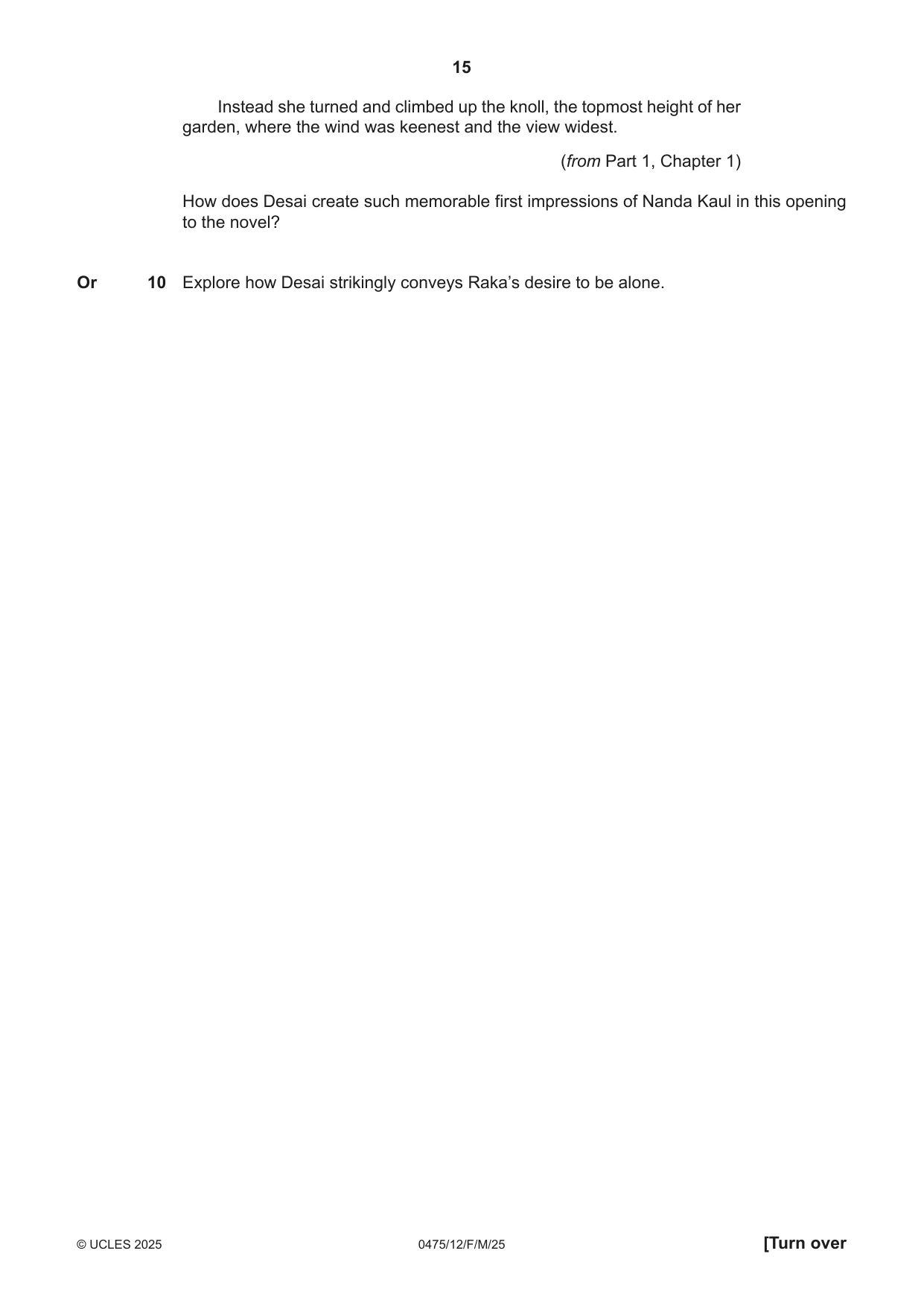
14 0475/12/F/M/25 © UCLES 2025 ANITA DESAI: Fire on the Mountain Remember to support your ideas with details from the writing. Either 9 Read this passage, and then answer the question that follows it: Nanda Kaul paused under the pine trees to take in their scented sibilance and listen to the cicadas fiddling invisibly under the mesh of pine needles when she saw the postman slowly winding his way along the Upper Mall. Content removed due to copyright restrictions.
Question paper, page 15
15 0475/12/F/M/25 © UCLES 2025 [Turn over Instead she turned and climbed up the knoll, the topmost height of her garden, where the wind was keenest and the view widest. (from Part 1, Chapter 1) How does Desai create such memorable first impressions of Nanda Kaul in this opening to the novel? Or 10 Explore how Desai strikingly conveys Raka’s desire to be alone.
Question paper, page 16
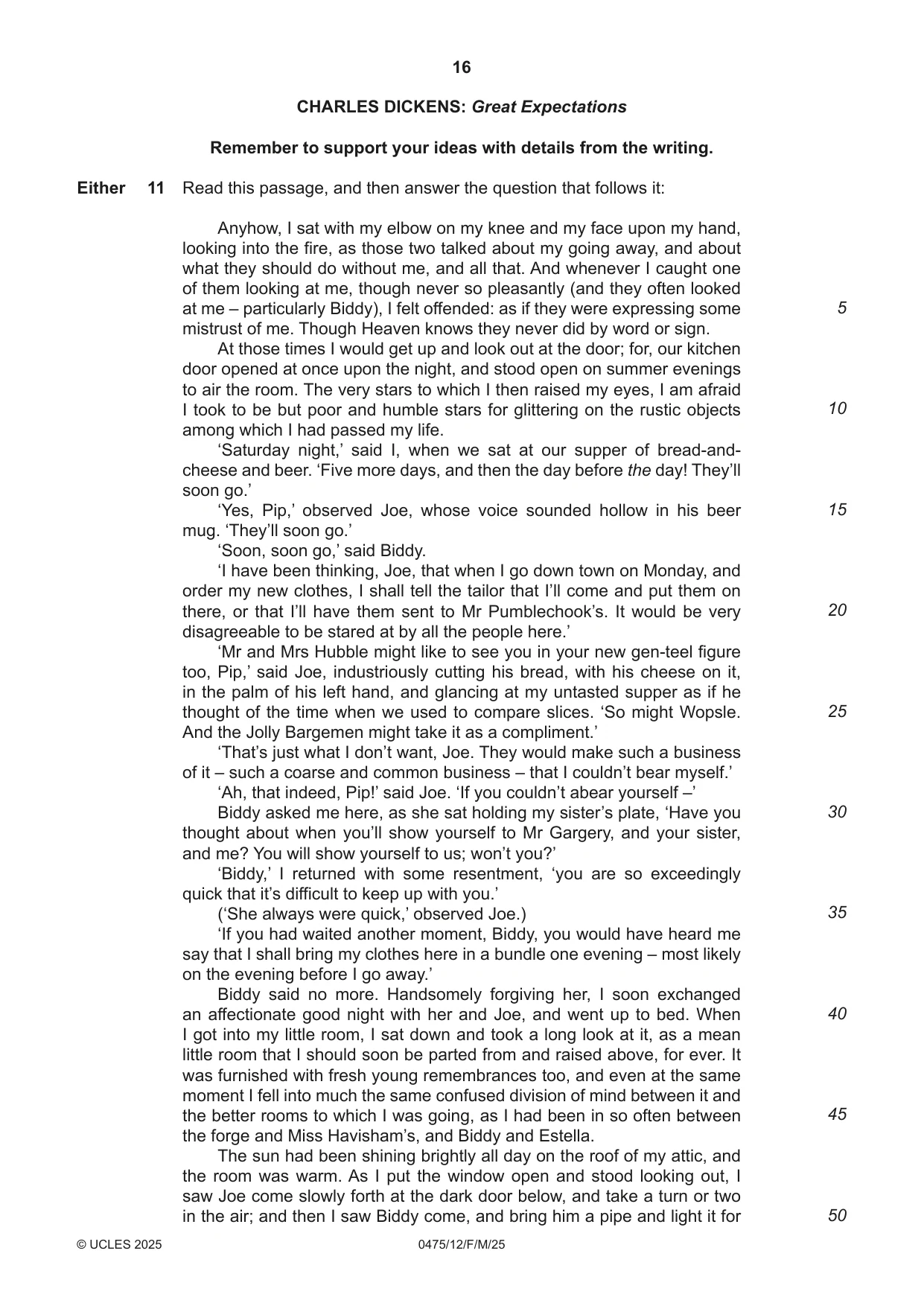
16 0475/12/F/M/25 © UCLES 2025 CHARLES DICKENS: Great Expectations Remember to support your ideas with details from the writing. Either 11 Read this passage, and then answer the question that follows it: Anyhow, I sat with my elbow on my knee and my face upon my hand, looking into the fire, as those two talked about my going away, and about what they should do without me, and all that. And whenever I caught one of them looking at me, though never so pleasantly (and they often looked at me – particularly Biddy), I felt offended: as if they were expressing some mistrust of me. Though Heaven knows they never did by word or sign. At those times I would get up and look out at the door; for, our kitchen door opened at once upon the night, and stood open on summer evenings to air the room. The very stars to which I then raised my eyes, I am afraid I took to be but poor and humble stars for glittering on the rustic objects among which I had passed my life. ‘Saturday night,’ said I, when we sat at our supper of bread-and- cheese and beer. ‘Five more days, and then the day before the day! They’ll soon go.’ ‘Yes, Pip,’ observed Joe, whose voice sounded hollow in his beer mug. ‘They’ll soon go.’ ‘Soon, soon go,’ said Biddy. ‘I have been thinking, Joe, that when I go down town on Monday, and order my new clothes, I shall tell the tailor that I’ll come and put them on there, or that I’ll have them sent to Mr Pumblechook’s. It would be very disagreeable to be stared at by all the people here.’ ‘Mr and Mrs Hubble might like to see you in your new gen-teel figure too, Pip,’ said Joe, industriously cutting his bread, with his cheese on it, in the palm of his left hand, and glancing at my untasted supper as if he thought of the time when we used to compare slices. ‘So might Wopsle. And the Jolly Bargemen might take it as a compliment.’ ‘That’s just what I don’t want, Joe. They would make such a business of it – such a coarse and common business – that I couldn’t bear myself.’ ‘Ah, that indeed, Pip!’ said Joe. ‘If you couldn’t abear yourself –’ Biddy asked me here, as she sat holding my sister’s plate, ‘Have you thought about when you’ll show yourself to Mr Gargery, and your sister, and me? You will show yourself to us; won’t you?’ ‘Biddy,’ I returned with some resentment, ‘you are so exceedingly quick that it’s difficult to keep up with you.’ (‘She always were quick,’ observed Joe.) ‘If you had waited another moment, Biddy, you would have heard me say that I shall bring my clothes here in a bundle one evening – most likely on the evening before I go away.’ Biddy said no more. Handsomely forgiving her, I soon exchanged an affectionate good night with her and Joe, and went up to bed. When I got into my little room, I sat down and took a long look at it, as a mean little room that I should soon be parted from and raised above, for ever. It was furnished with fresh young remembrances too, and even at the same moment I fell into much the same confused division of mind between it and the better rooms to which I was going, as I had been in so often between the forge and Miss Havisham’s, and Biddy and Estella. The sun had been shining brightly all day on the roof of my attic, and the room was warm. As I put the window open and stood looking out, I saw Joe come slowly forth at the dark door below, and take a turn or two in the air; and then I saw Biddy come, and bring him a pipe and light it for 5 10 15 20 25 30 35 40 45 50
Question paper, page 17
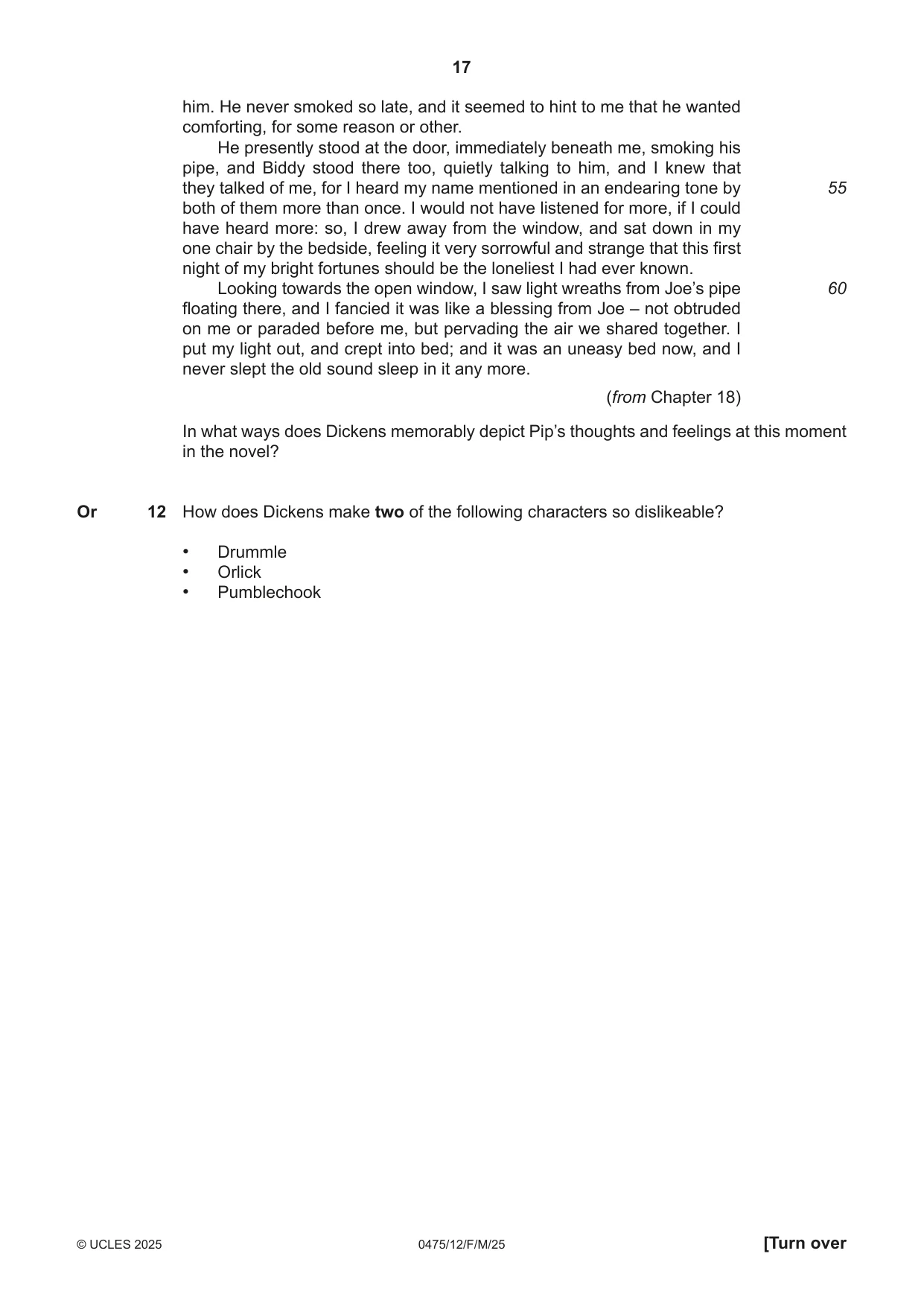
17 0475/12/F/M/25 © UCLES 2025 [Turn over him. He never smoked so late, and it seemed to hint to me that he wanted comforting, for some reason or other. He presently stood at the door, immediately beneath me, smoking his pipe, and Biddy stood there too, quietly talking to him, and I knew that they talked of me, for I heard my name mentioned in an endearing tone by both of them more than once. I would not have listened for more, if I could have heard more: so, I drew away from the window, and sat down in my one chair by the bedside, feeling it very sorrowful and strange that this first night of my bright fortunes should be the loneliest I had ever known. Looking towards the open window, I saw light wreaths from Joe’s pipe floating there, and I fancied it was like a blessing from Joe – not obtruded on me or paraded before me, but pervading the air we shared together. I put my light out, and crept into bed; and it was an uneasy bed now, and I never slept the old sound sleep in it any more. (from Chapter 18) In what ways does Dickens memorably depict Pip’s thoughts and feelings at this moment in the novel? Or 12 How does Dickens make two of the following characters so dislikeable? • Drummle • Orlick • Pumblechook 55 60
Question paper, page 18
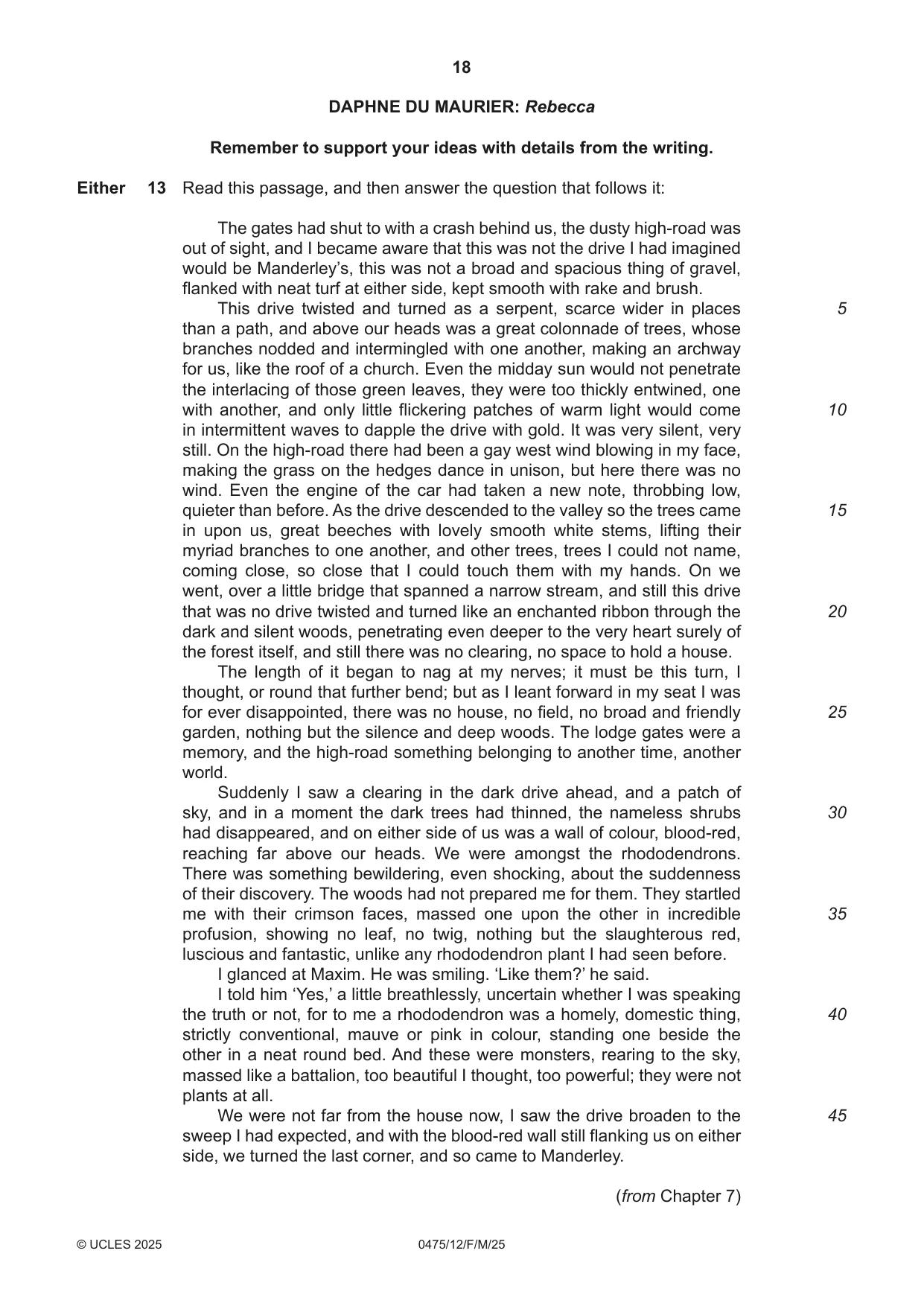
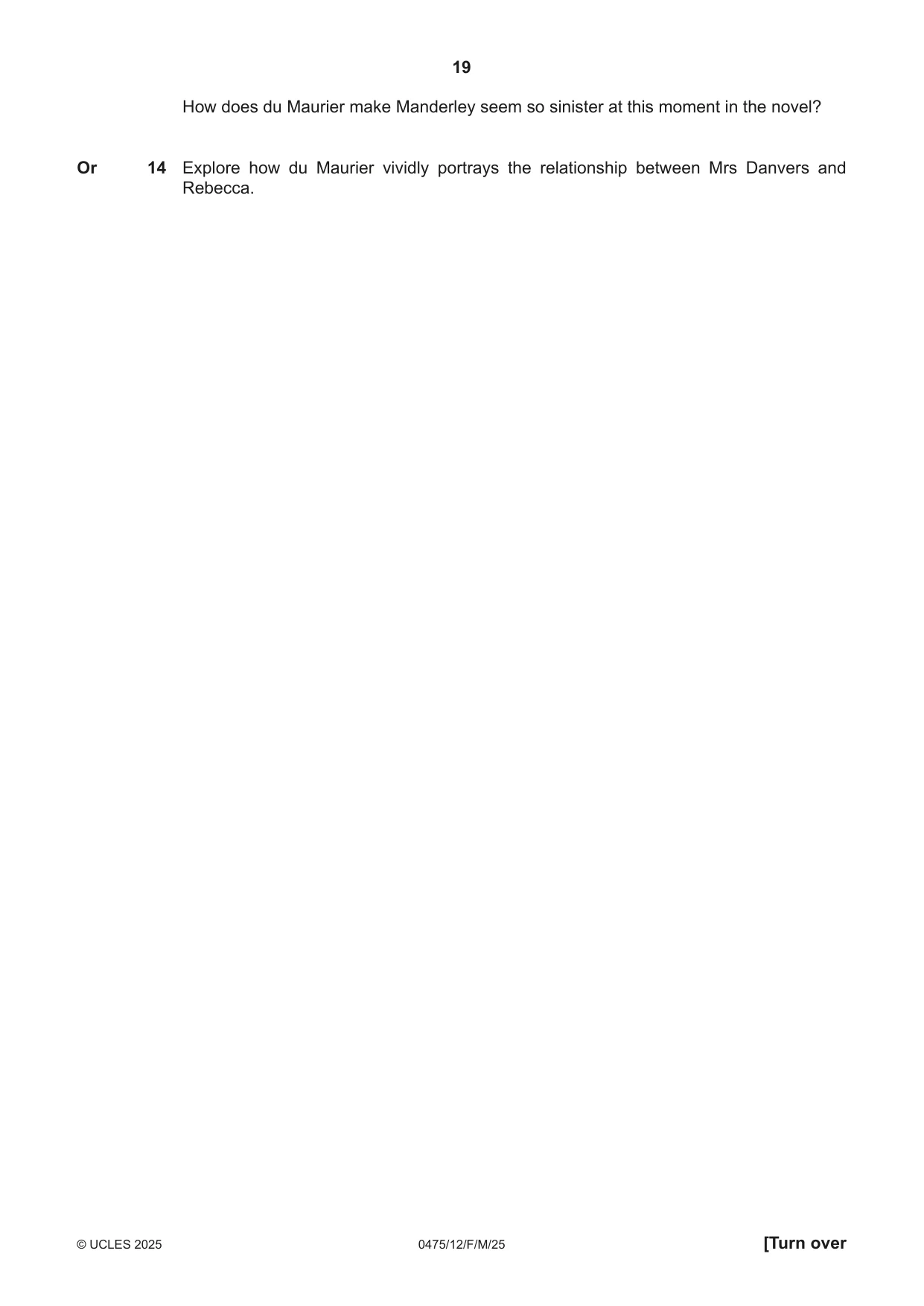
18 0475/12/F/M/25 © UCLES 2025 DAPHNE DU MAURIER: Rebecca Remember to support your ideas with details from the writing. Either 13 Read this passage, and then answer the question that follows it: The gates had shut to with a crash behind us, the dusty high-road was out of sight, and I became aware that this was not the drive I had imagined would be Manderley’s, this was not a broad and spacious thing of gravel, flanked with neat turf at either side, kept smooth with rake and brush. This drive twisted and turned as a serpent, scarce wider in places than a path, and above our heads was a great colonnade of trees, whose branches nodded and intermingled with one another, making an archway for us, like the roof of a church. Even the midday sun would not penetrate the interlacing of those green leaves, they were too thickly entwined, one with another, and only little flickering patches of warm light would come in intermittent waves to dapple the drive with gold. It was very silent, very still. On the high-road there had been a gay west wind blowing in my face, making the grass on the hedges dance in unison, but here there was no wind. Even the engine of the car had taken a new note, throbbing low, quieter than before. As the drive descended to the valley so the trees came in upon us, great beeches with lovely smooth white stems, lifting their myriad branches to one another, and other trees, trees I could not name, coming close, so close that I could touch them with my hands. On we went, over a little bridge that spanned a narrow stream, and still this drive that was no drive twisted and turned like an enchanted ribbon through the dark and silent woods, penetrating even deeper to the very heart surely of the forest itself, and still there was no clearing, no space to hold a house. The length of it began to nag at my nerves; it must be this turn, I thought, or round that further bend; but as I leant forward in my seat I was for ever disappointed, there was no house, no field, no broad and friendly garden, nothing but the silence and deep woods. The lodge gates were a memory, and the high-road something belonging to another time, another world. Suddenly I saw a clearing in the dark drive ahead, and a patch of sky, and in a moment the dark trees had thinned, the nameless shrubs had disappeared, and on either side of us was a wall of colour, blood-red, reaching far above our heads. We were amongst the rhododendrons. There was something bewildering, even shocking, about the suddenness of their discovery. The woods had not prepared me for them. They startled me with their crimson faces, massed one upon the other in incredible profusion, showing no leaf, no twig, nothing but the slaughterous red, luscious and fantastic, unlike any rhododendron plant I had seen before. I glanced at Maxim. He was smiling. ‘Like them?’ he said. I told him ‘Yes,’ a little breathlessly, uncertain whether I was speaking the truth or not, for to me a rhododendron was a homely, domestic thing, strictly conventional, mauve or pink in colour, standing one beside the other in a neat round bed. And these were monsters, rearing to the sky, massed like a battalion, too beautiful I thought, too powerful; they were not plants at all. We were not far from the house now, I saw the drive broaden to the sweep I had expected, and with the blood-red wall still flanking us on either side, we turned the last corner, and so came to Manderley. (from Chapter 7) 5 10 15 20 25 30 35 40 45
Question paper, page 19
19 0475/12/F/M/25 © UCLES 2025 [Turn over How does du Maurier make Manderley seem so sinister at this moment in the novel? Or 14 Explore how du Maurier vividly portrays the relationship between Mrs Danvers and Rebecca.
Question paper, page 20
20 0475/12/F/M/25 © UCLES 2025 HARPER LEE: To Kill a Mockingbird Remember to support your ideas with details from the writing. Either 15 Read this passage, and then answer the question that follows it: After supper, Atticus sat down with the paper and called, ‘Scout, ready to read?’ Content removed due to copyright restrictions.
Question paper, page 21
21 0475/12/F/M/25 © UCLES 2025 [Turn over I don’t know of any landowner around here who begrudges those children any game their father can hit.’ (from Chapter 3) Explore the ways in which Lee makes this such a memorable moment in the novel. Or 16 How does Lee powerfully portray Atticus during the trial? Content removed due to copyright restrictions.
Question paper, page 22
22 0475/12/F/M/25 © UCLES 2025 JOAN LINDSAY: Picnic at Hanging Rock Remember to support your ideas with details from the writing. Either 17 Read this passage, and then answer the question that follows it: Irma, who had taken a few steps towards the centre of the room, now paused uncertainly and smiled back. The voice of evil cackled as the tumult grew. (from Chapter 12) Content removed due to copyright restrictions.
Question paper, page 23
23 0475/12/F/M/25 © UCLES 2025 [Turn over How does Lindsay make this such a disturbing moment in the novel? Or 18 Explore the ways in which Lindsay makes Mike such an admirable character.
Question paper, page 24
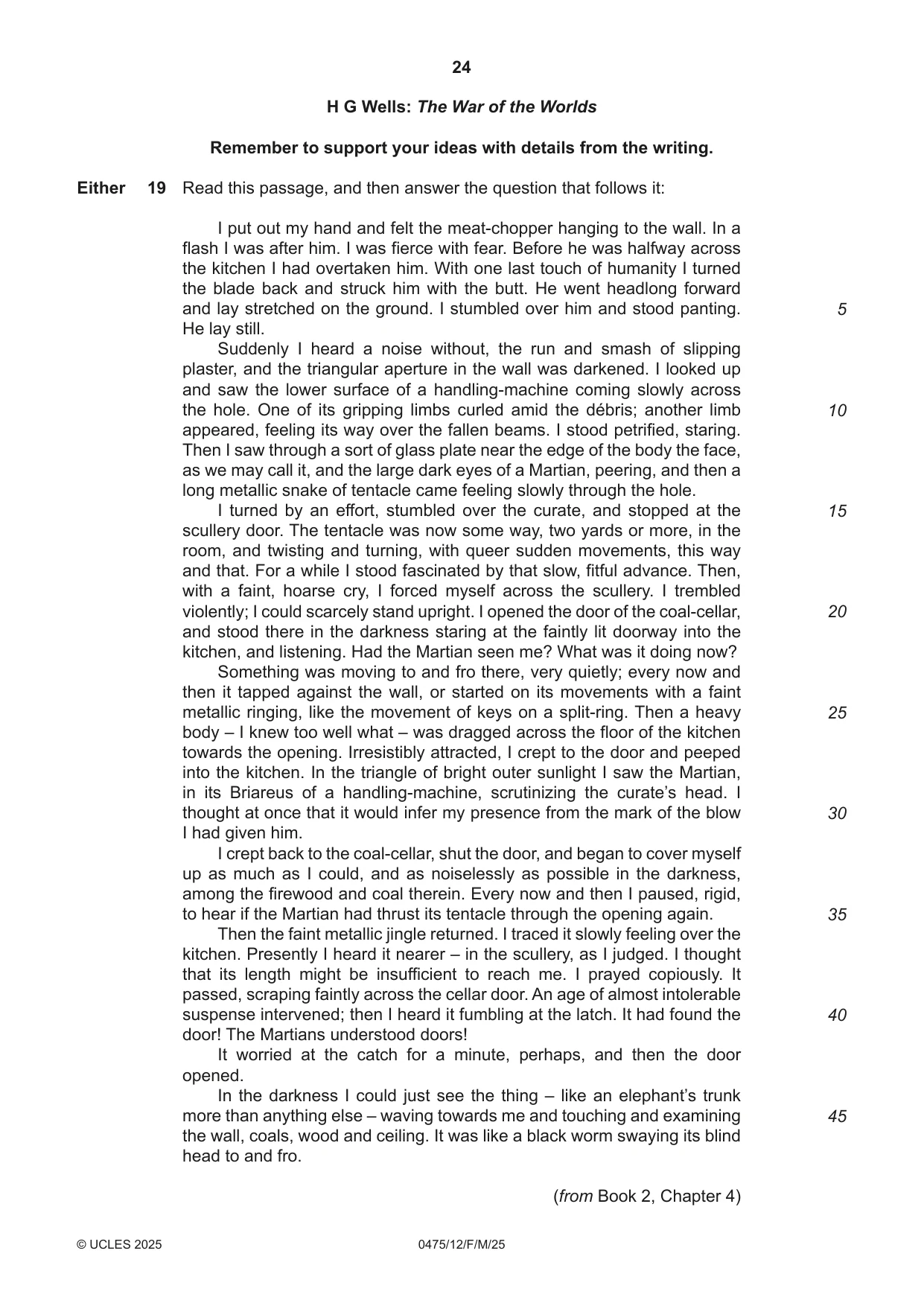
24 0475/12/F/M/25 © UCLES 2025 H G Wells: The War of the Worlds Remember to support your ideas with details from the writing. Either 19 Read this passage, and then answer the question that follows it: I put out my hand and felt the meat-chopper hanging to the wall. In a flash I was after him. I was fierce with fear. Before he was halfway across the kitchen I had overtaken him. With one last touch of humanity I turned the blade back and struck him with the butt. He went headlong forward and lay stretched on the ground. I stumbled over him and stood panting. He lay still. Suddenly I heard a noise without, the run and smash of slipping plaster, and the triangular aperture in the wall was darkened. I looked up and saw the lower surface of a handling-machine coming slowly across the hole. One of its gripping limbs curled amid the débris; another limb appeared, feeling its way over the fallen beams. I stood petrified, staring. Then I saw through a sort of glass plate near the edge of the body the face, as we may call it, and the large dark eyes of a Martian, peering, and then a long metallic snake of tentacle came feeling slowly through the hole. I turned by an effort, stumbled over the curate, and stopped at the scullery door. The tentacle was now some way, two yards or more, in the room, and twisting and turning, with queer sudden movements, this way and that. For a while I stood fascinated by that slow, fitful advance. Then, with a faint, hoarse cry, I forced myself across the scullery. I trembled violently; I could scarcely stand upright. I opened the door of the coal-cellar, and stood there in the darkness staring at the faintly lit doorway into the kitchen, and listening. Had the Martian seen me? What was it doing now? Something was moving to and fro there, very quietly; every now and then it tapped against the wall, or started on its movements with a faint metallic ringing, like the movement of keys on a split-ring. Then a heavy body – I knew too well what – was dragged across the floor of the kitchen towards the opening. Irresistibly attracted, I crept to the door and peeped into the kitchen. In the triangle of bright outer sunlight I saw the Martian, in its Briareus of a handling-machine, scrutinizing the curate’s head. I thought at once that it would infer my presence from the mark of the blow I had given him. I crept back to the coal-cellar, shut the door, and began to cover myself up as much as I could, and as noiselessly as possible in the darkness, among the firewood and coal therein. Every now and then I paused, rigid, to hear if the Martian had thrust its tentacle through the opening again. Then the faint metallic jingle returned. I traced it slowly feeling over the kitchen. Presently I heard it nearer – in the scullery, as I judged. I thought that its length might be insufficient to reach me. I prayed copiously. It passed, scraping faintly across the cellar door. An age of almost intolerable suspense intervened; then I heard it fumbling at the latch. It had found the door! The Martians understood doors! It worried at the catch for a minute, perhaps, and then the door opened. In the darkness I could just see the thing – like an elephant’s trunk more than anything else – waving towards me and touching and examining the wall, coals, wood and ceiling. It was like a black worm swaying its blind head to and fro. (from Book 2, Chapter 4) 5 10 15 20 25 30 35 40 45
Question paper, page 25
25 0475/12/F/M/25 © UCLES 2025 [Turn over How does Wells make this such a horrifying moment in the novel? Or 20 To what extent does Wells suggest hope for the future by the end of the novel?
Question paper, page 26
26 0475/12/F/M/25 © UCLES 2025 from STORIES OF OURSELVES Volume 2 Remember to support your ideas with details from the writing. Either 21 Read this passage from The Black Ball (by Ralph Ellison), and then answer the question that follows it: As I came around the building past the tall new evergreens, I could hear the boy crying in just that note no other child has, and when I came completely around I found him standing looking up into a window with tears on his face. Content removed due to copyright restrictions.
Question paper, page 27
27 0475/12/F/M/25 © UCLES 2025 Maybe there was a color other than white on the old ball. In what ways does Ellison make this such a disturbing moment in the story? Or 22 How does Aminatta Forna make Haywards Heath such a sad story? Content removed due to copyright restrictions.
Question paper, page 28
28 0475/12/F/M/25 © UCLES 2025 Permission to reproduce items where third-party owned material protected by copyright is included has been sought and cleared where possible. Every reasonable effort has been made by the publisher (UCLES) to trace copyright holders, but if any items requiring clearance have unwittingly been included, the publisher will be pleased to make amends at the earliest possible opportunity. To avoid the issue of disclosure of answer-related information to candidates, all copyright acknowledgements are reproduced online in the Cambridge Assessment International Education Copyright Acknowledgements Booklet. This is produced for each series of examinations and is freely available to download at www.cambridgeinternational.org after the live examination series. Cambridge Assessment International Education is part of Cambridge Assessment. Cambridge Assessment is the brand name of the University of Cambridge Local Examinations Syndicate (UCLES), which is a department of the University of Cambridge. BLANK PAGE
Mark scheme, page 1
This document consists of 5 printed pages. © Cambridge University Press & Assessment 2025 [Turn over Cambridge IGCSE™ LITERATURE IN ENGLISH 0475/12 Paper 1 Poetry and Prose February/March 2025 MARK SCHEME Maximum Mark: 50 Published This mark scheme is published as an aid to teachers and candidates, to indicate the requirements of the examination. It shows the basis on which Examiners were instructed to award marks. It does not indicate the details of the discussions that took place at an Examiners’ meeting before marking began, which would have considered the acceptability of alternative answers. Mark schemes should be read in conjunction with the question paper and the Principal Examiner Report for Teachers. Cambridge International will not enter into discussions about these mark schemes. Cambridge International is publishing the mark schemes for the February/March 2025 series for most Cambridge IGCSE, Cambridge International A and AS Level components, and some Cambridge O Level components.
Mark scheme, page 2
0475/12 Cambridge IGCSE – Mark Scheme PUBLISHED February/March 2025 © Cambridge University Press & Assessment 2025 Page 2 of 5 Generic Marking Principles These general marking principles must be applied by all examiners when marking candidate answers. They should be applied alongside the specific content of the mark scheme or generic level descriptions for a question. Each question paper and mark scheme will also comply with these marking principles. GENERIC MARKING PRINCIPLE 1: Marks must be awarded in line with: • the specific content of the mark scheme or the generic level descriptors for the question • the specific skills defined in the mark scheme or in the generic level descriptors for the question • the standard of response required by a candidate as exemplified by the standardisation scripts. GENERIC MARKING PRINCIPLE 2: Marks awarded are always whole marks (not half marks, or other fractions). GENERIC MARKING PRINCIPLE 3: Marks must be awarded positively: • marks are awarded for correct/valid answers, as defined in the mark scheme. However, credit is given for valid answers which go beyond the scope of the syllabus and mark scheme, referring to your Team Leader as appropriate • marks are awarded when candidates clearly demonstrate what they know and can do • marks are not deducted for errors • marks are not deducted for omissions • answers should only be judged on the quality of spelling, punctuation and grammar when these features are specifically assessed by the question as indicated by the mark scheme. The meaning, however, should be unambiguous. GENERIC MARKING PRINCIPLE 4: Rules must be applied consistently, e.g. in situations where candidates have not followed instructions or in the application of generic level descriptors. GENERIC MARKING PRINCIPLE 5: Marks should be awarded using the full range of marks defined in the mark scheme for the question (however; the use of the full mark range may be limited according to the quality of the candidate responses seen). GENERIC MARKING PRINCIPLE 6: Marks awarded are based solely on the requirements as defined in the mark scheme. Marks should not be awarded with grade thresholds or grade descriptors in mind.
Mark scheme, page 3
0475/12 Cambridge IGCSE – Mark Scheme PUBLISHED February/March 2025 © Cambridge University Press & Assessment 2025 Page 3 of 5 English & Media subject specific general marking principles (To be read in conjunction with the Generic Marking Principles (and requiring further guidance on how to place marks within levels)) Components using level descriptors: • We use level descriptors as a guide to broad understanding of the qualities normally expected of, or typical of, work in a level. • Level descriptors are a means of general guidance, and should not be interpreted as hurdle statements. • Where indicative content notes are supplied for a question, these are not a prescription of required content, and must not be treated as such. Alternative correct points and unexpected answers in candidates’ scripts must be given marks that fairly reflect the knowledge and skills demonstrated. • While we may have legitimate expectations as to the ground most answers may occupy, we must at all times be prepared to meet candidates on their chosen ground, provided it is relevant ground (e.g. clearly related to and derived from a relevant passage/text and meeting the mark scheme requirements for the question). Components using point-based marking: Point marking is often used to reward knowledge, understanding and application of skills. We give credit where the candidate’s answer shows relevant knowledge, understanding and application of skills in answering the question. We do not give credit where the answer shows confusion. From this it follows that we: a DO credit answers which are worded differently from the mark scheme if they clearly convey the same meaning (unless the mark scheme requires a specific term). b DO credit alternative answers/examples which are not written in the mark scheme if they are correct. c DO credit answers where candidates give more than one correct answer in one prompt/numbered/scaffolded space where extended writing is required rather than list-type answers. For example, questions that require n reasons (e.g. State two reasons…). d DO NOT credit answers simply for using a ‘key term’ unless that is all that is required. (Check for evidence it is understood and not used wrongly.) e DO NOT credit answers which are obviously self-contradicting or trying to cover all possibilities. f DO NOT give further credit for what is effectively repetition of a correct point already credited unless the language itself is being tested. This applies equally to ‘mirror statements’ (i.e. polluted/not polluted). g DO NOT require spellings to be correct, unless this is part of the test. However spellings of syllabus terms must allow for clear and unambiguous separation from other syllabus terms with which they may be confused (e.g. Corrasion/Corrosion).
Mark scheme, page 4
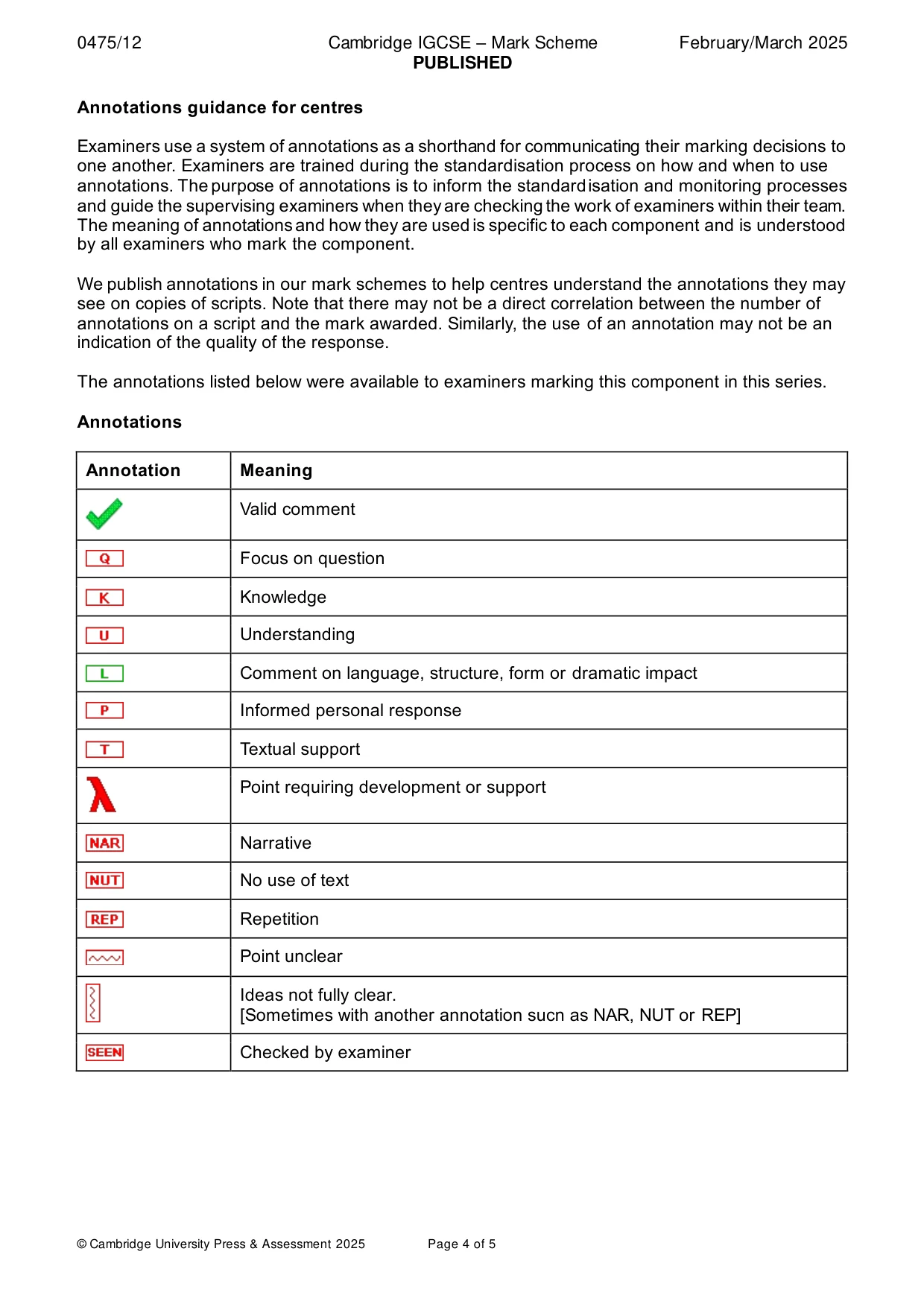
0475/12 Cambridge IGCSE – Mark Scheme PUBLISHED February/March 2025 © Cambridge University Press & Assessment 2025 Page 4 of 5 Annotations guidance for centres Examiners use a system of annotations as a shorthand for communicating their marking decisions to one another. Examiners are trained during the standardisation process on how and when to use annotations. The purpose of annotations is to inform the standardisation and monitoring processes and guide the supervising examiners when they are checking the work of examiners within their team. The meaning of annotations and how they are used is specific to each component and is understood by all examiners who mark the component. We publish annotations in our mark schemes to help centres understand the annotations they may see on copies of scripts. Note that there may not be a direct correlation between the number of annotations on a script and the mark awarded. Similarly, the use of an annotation may not be an indication of the quality of the response. The annotations listed below were available to examiners marking this component in this series. Annotations Annotation Meaning Valid comment Focus on question Knowledge Understanding Comment on language, structure, form or dramatic impact Informed personal response Textual support Point requiring development or support Narrative No use of text Repetition Point unclear Ideas not fully clear. [Sometimes with another annotation sucn as NAR, NUT or REP] Checked by examiner
Mark scheme, page 5
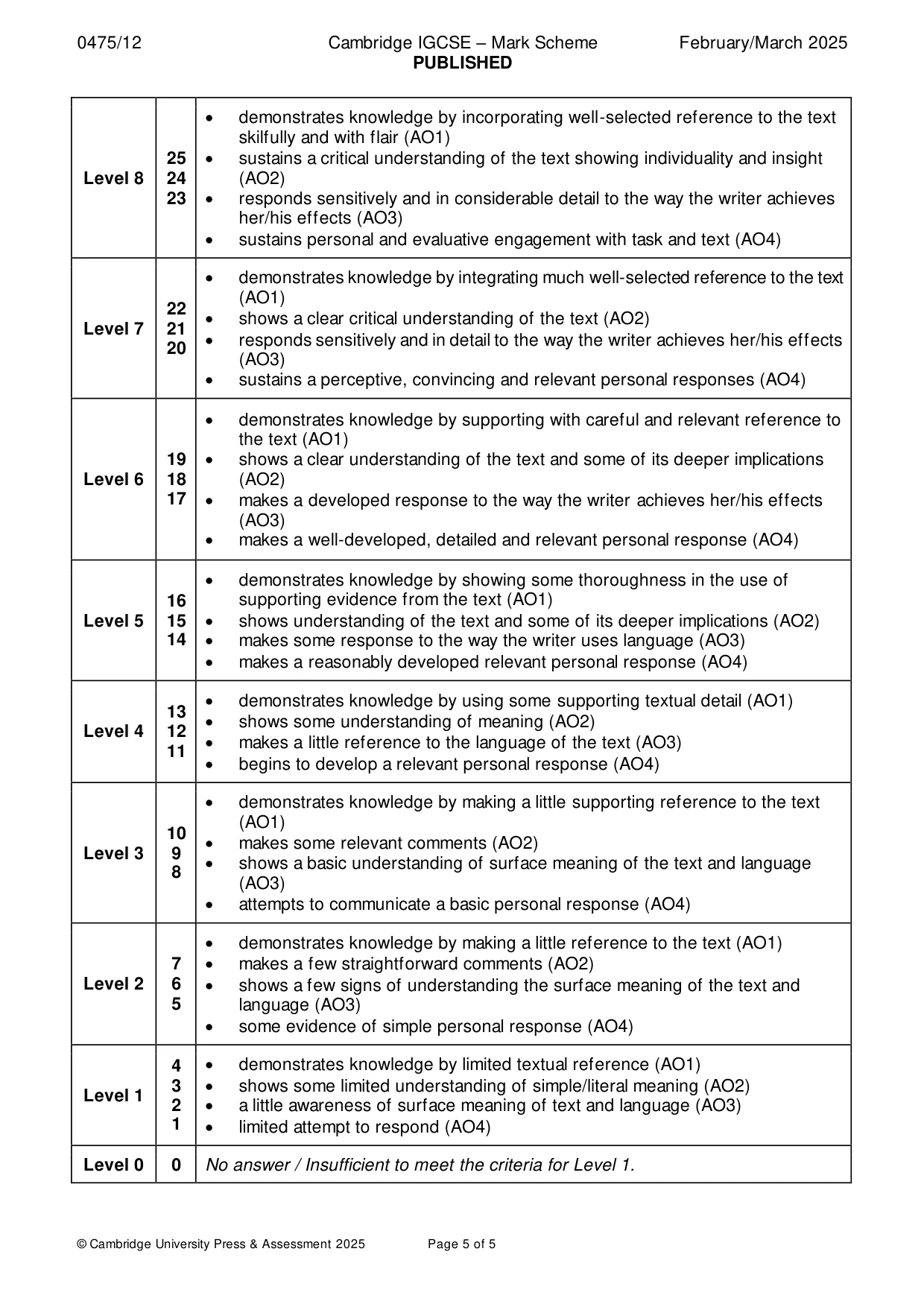
0475/12 Cambridge IGCSE – Mark Scheme PUBLISHED February/March 2025 © Cambridge University Press & Assessment 2025 Page 5 of 5 Level 8 25 24 23 • demonstrates knowledge by incorporating well-selected reference to the text skilfully and with flair (AO1) • sustains a critical understanding of the text showing individuality and insight (AO2) • responds sensitively and in considerable detail to the way the writer achieves her/his effects (AO3) • sustains personal and evaluative engagement with task and text (AO4) Level 7 22 21 20 • demonstrates knowledge by integrating much well-selected reference to the text (AO1) • shows a clear critical understanding of the text (AO2) • responds sensitively and in detail to the way the writer achieves her/his effects (AO3) • sustains a perceptive, convincing and relevant personal responses (AO4) Level 6 19 18 17 • demonstrates knowledge by supporting with careful and relevant reference to the text (AO1) • shows a clear understanding of the text and some of its deeper implications (AO2) • makes a developed response to the way the writer achieves her/his effects (AO3) • makes a well-developed, detailed and relevant personal response (AO4) Level 5 16 15 14 • demonstrates knowledge by showing some thoroughness in the use of supporting evidence from the text (AO1) • shows understanding of the text and some of its deeper implications (AO2) • makes some response to the way the writer uses language (AO3) • makes a reasonably developed relevant personal response (AO4) Level 4 13 12 11 • demonstrates knowledge by using some supporting textual detail (AO1) • shows some understanding of meaning (AO2) • makes a little reference to the language of the text (AO3) • begins to develop a relevant personal response (AO4) Level 3 10 9 8 • demonstrates knowledge by making a little supporting reference to the text (AO1) • makes some relevant comments (AO2) • shows a basic understanding of surface meaning of the text and language (AO3) • attempts to communicate a basic personal response (AO4) Level 2 7 6 5 • demonstrates knowledge by making a little reference to the text (AO1) • makes a few straightforward comments (AO2) • shows a few signs of understanding the surface meaning of the text and language (AO3) • some evidence of simple personal response (AO4) Level 1 4 3 2 1 • demonstrates knowledge by limited textual reference (AO1) • shows some limited understanding of simple/literal meaning (AO2) • a little awareness of surface meaning of text and language (AO3) • limited attempt to respond (AO4) Level 0 0 No answer / Insufficient to meet the criteria for Level 1.
What you needed in this session
Cambridge’s own grade thresholds for 2025 Feb/March, Paper 1 · Variant 2. A higher threshold means an easier paper — the bar moves with how the cohort did.