Cambridge IGCSE English - Literature in English 0475 — 2024 Feb/March Paper 1 · Variant 2
0475/12/F/M/24 · 50 marks · ≈56 min
The question paper and its mark scheme, free to read here and free to download. This is Cambridge’s own paper, exactly as it was sat.
Question paper28 pages




Mark scheme4 pages
Answers below. Sit the paper first if you are practising.
Paper as text
Question paper, page 1
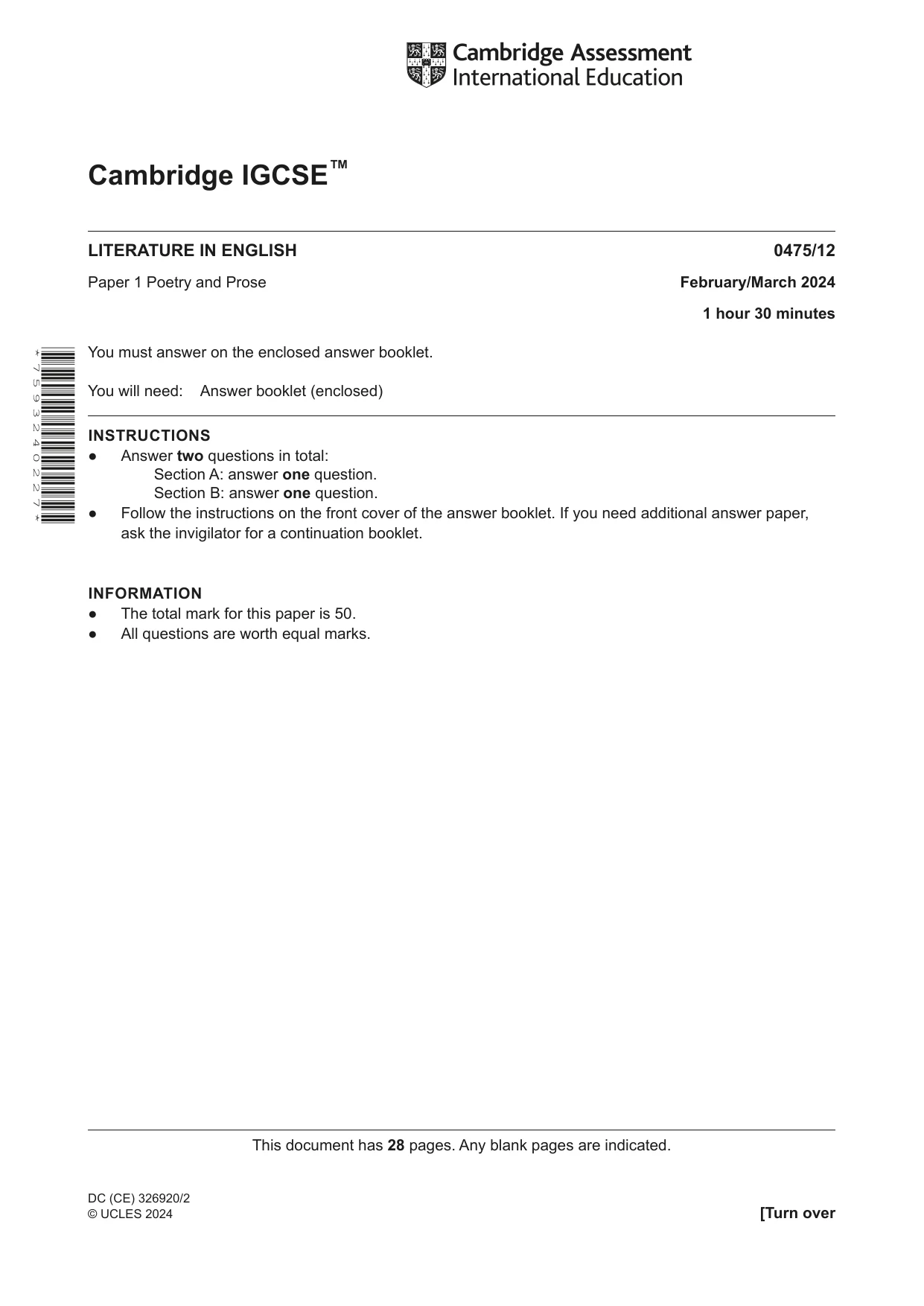
This document has 28 pages. Any blank pages are indicated. [Turn over Cambridge IGCSE™ DC (CE) 326920/2 © UCLES 2024 LITERATURE IN ENGLISH 0475/12 Paper 1 Poetry and Prose February/March 2024 1 hour 30 minutes You must answer on the enclosed answer booklet. You will need: Answer booklet (enclosed) INSTRUCTIONS ● Answer two questions in total: Section A: answer one question. Section B: answer one question. ● Follow the instructions on the front cover of the answer booklet. If you need additional answer paper, ask the invigilator for a continuation booklet. INFORMATION ● The total mark for this paper is 50. ● All questions are worth equal marks. * 7 5 9 3 2 4 0 2 2 7 *
Question paper, page 2
2 0475/12/F/M/24 © UCLES 2024 BLANK PAGE
Question paper, page 3
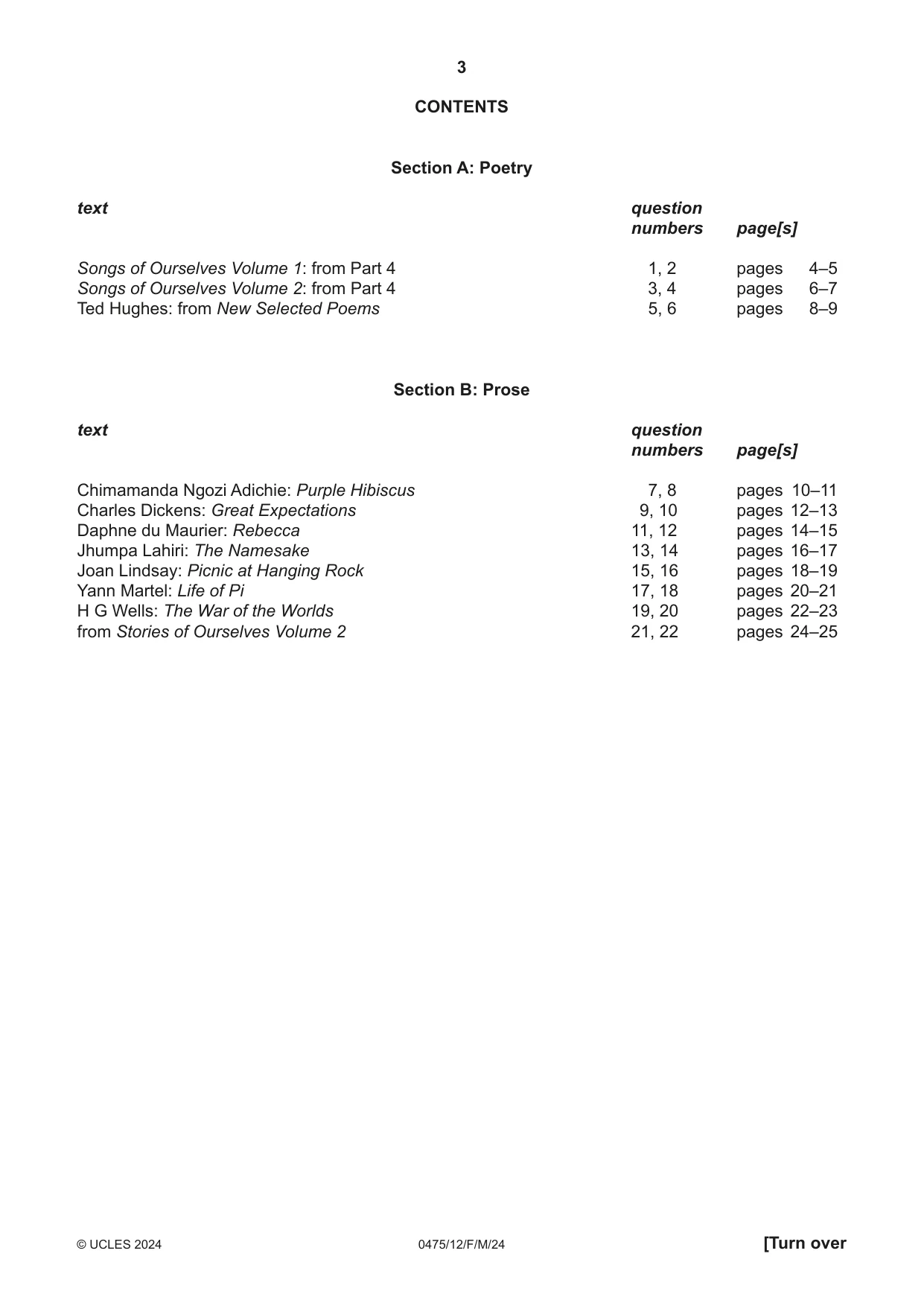
3 0475/12/F/M/24 © UCLES 2024 [Turn over CONTENTS Section A: Poetry text question numbers page[s] Songs of Ourselves Volume 1: from Part 4 1, 2 pages 4–5 Songs of Ourselves Volume 2: from Part 4 3, 4 pages 6–7 Ted Hughes: from New Selected Poems 5, 6 pages 8–9 Section B: Prose text question numbers page[s] Chimamanda Ngozi Adichie: Purple Hibiscus 7, 8 pages 10–11 Charles Dickens: Great Expectations 9, 10 pages 12–13 Daphne du Maurier: Rebecca 11, 12 pages 14–15 Jhumpa Lahiri: The Namesake 13, 14 pages 16–17 Joan Lindsay: Picnic at Hanging Rock 15, 16 pages 18–19 Yann Martel: Life of Pi 17, 18 pages 20–21 H G Wells: The War of the Worlds 19, 20 pages 22–23 from Stories of Ourselves Volume 2 21, 22 pages 24–25
Question paper, page 4
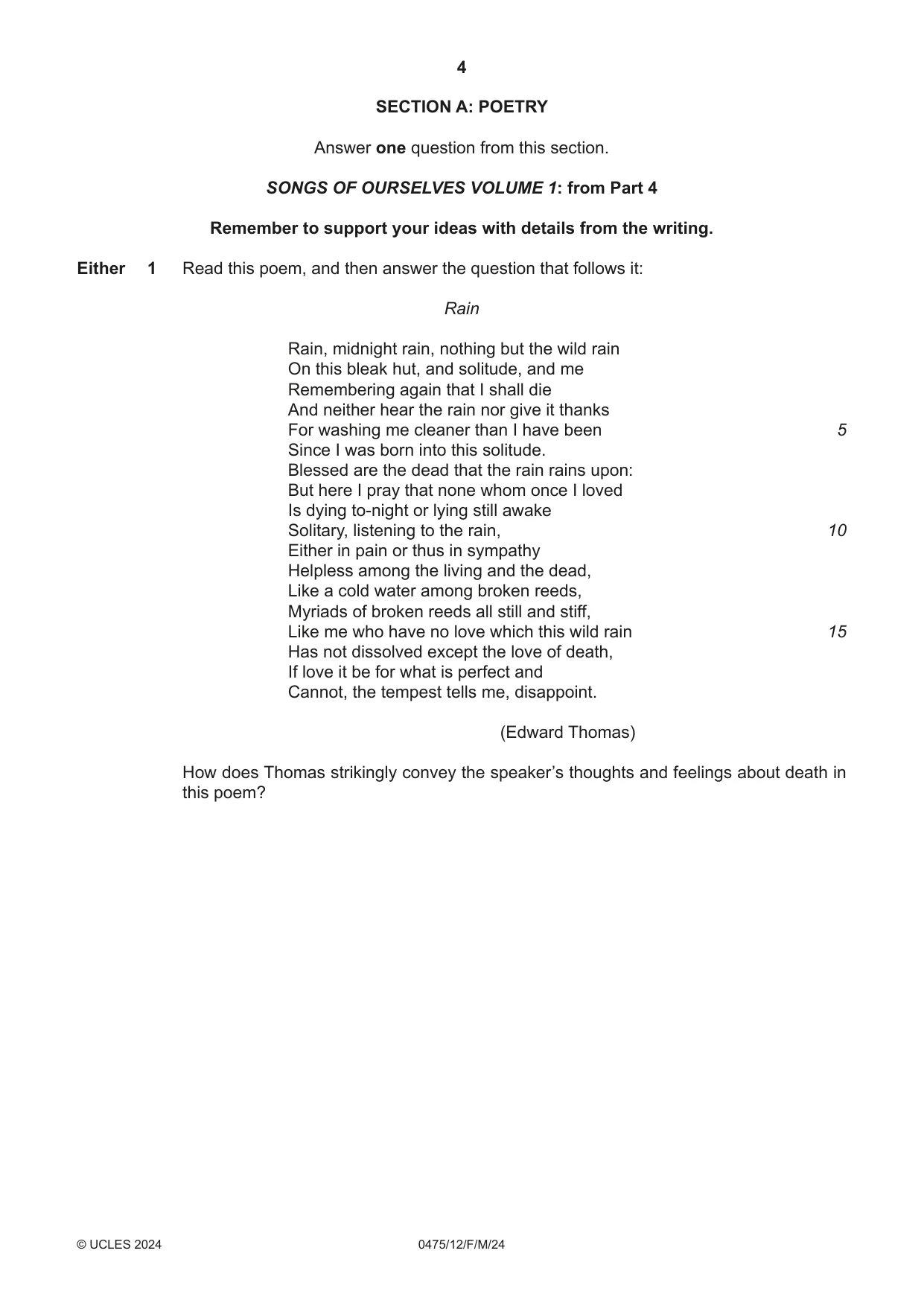
4 0475/12/F/M/24 © UCLES 2024 SECTION A: POETRY Answer one question from this section. SONGS OF OURSELVES VOLUME 1: from Part 4 Remember to support your ideas with details from the writing. Either 1 Read this poem, and then answer the question that follows it: Rain Rain, midnight rain, nothing but the wild rain On this bleak hut, and solitude, and me Remembering again that I shall die And neither hear the rain nor give it thanks For washing me cleaner than I have been 5 Since I was born into this solitude. Blessed are the dead that the rain rains upon: But here I pray that none whom once I loved Is dying to-night or lying still awake Solitary, listening to the rain, 10 Either in pain or thus in sympathy Helpless among the living and the dead, Like a cold water among broken reeds, Myriads of broken reeds all still and stiff, Like me who have no love which this wild rain 15 Has not dissolved except the love of death, If love it be for what is perfect and Cannot, the tempest tells me, disappoint. (Edward Thomas) How does Thomas strikingly convey the speaker’s thoughts and feelings about death in this poem?
Question paper, page 5
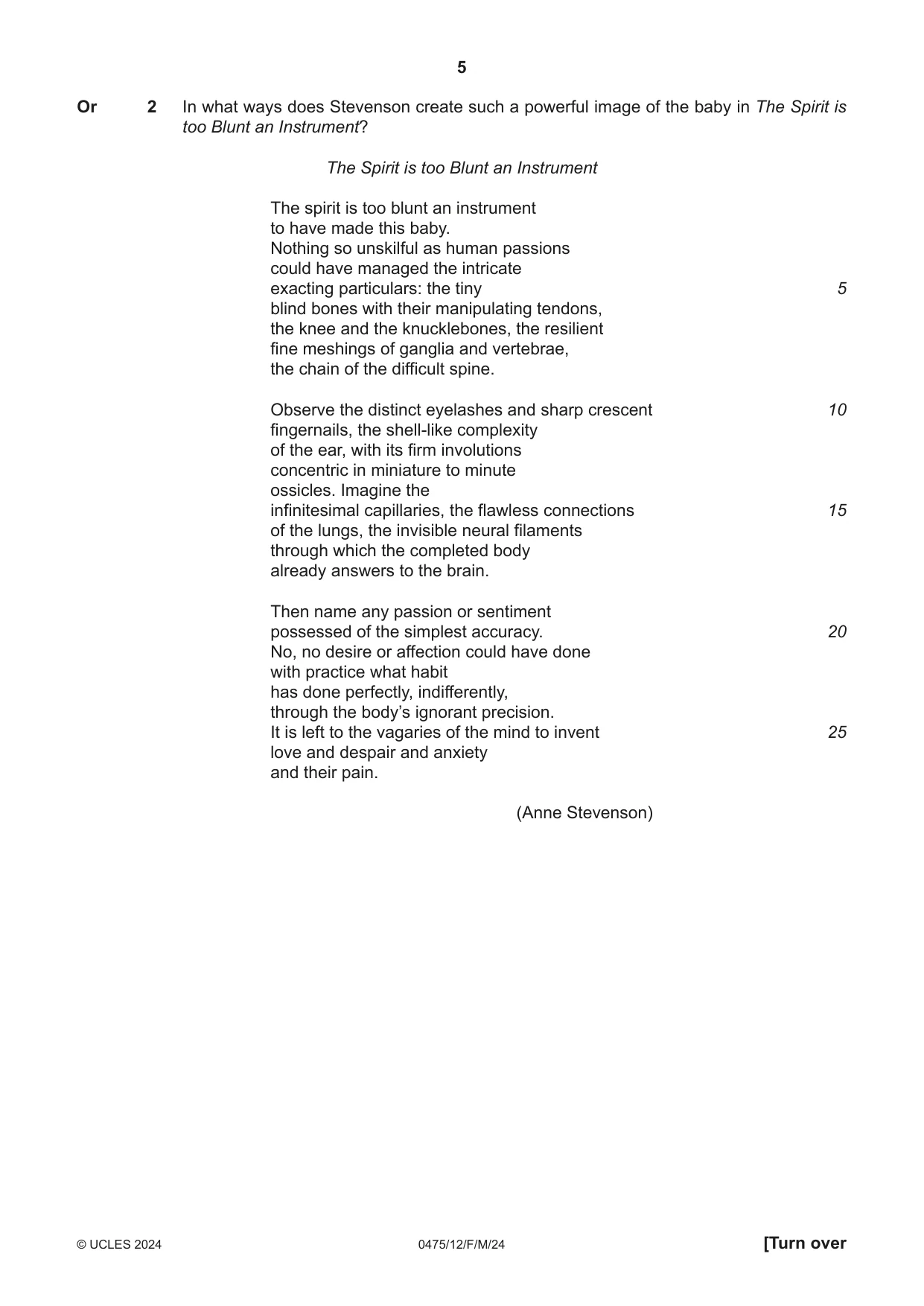
5 0475/12/F/M/24 © UCLES 2024 [Turn over Or 2 In what ways does Stevenson create such a powerful image of the baby in The Spirit is too Blunt an Instrument? The Spirit is too Blunt an Instrument The spirit is too blunt an instrument to have made this baby. Nothing so unskilful as human passions could have managed the intricate exacting particulars: the tiny 5 blind bones with their manipulating tendons, the knee and the knucklebones, the resilient fine meshings of ganglia and vertebrae, the chain of the difficult spine. Observe the distinct eyelashes and sharp crescent 10 fingernails, the shell-like complexity of the ear, with its firm involutions concentric in miniature to minute ossicles. Imagine the infinitesimal capillaries, the flawless connections 15 of the lungs, the invisible neural filaments through which the completed body already answers to the brain. Then name any passion or sentiment possessed of the simplest accuracy. 20 No, no desire or affection could have done with practice what habit has done perfectly, indifferently, through the body’s ignorant precision. It is left to the vagaries of the mind to invent 25 love and despair and anxiety and their pain. (Anne Stevenson)
Question paper, page 6
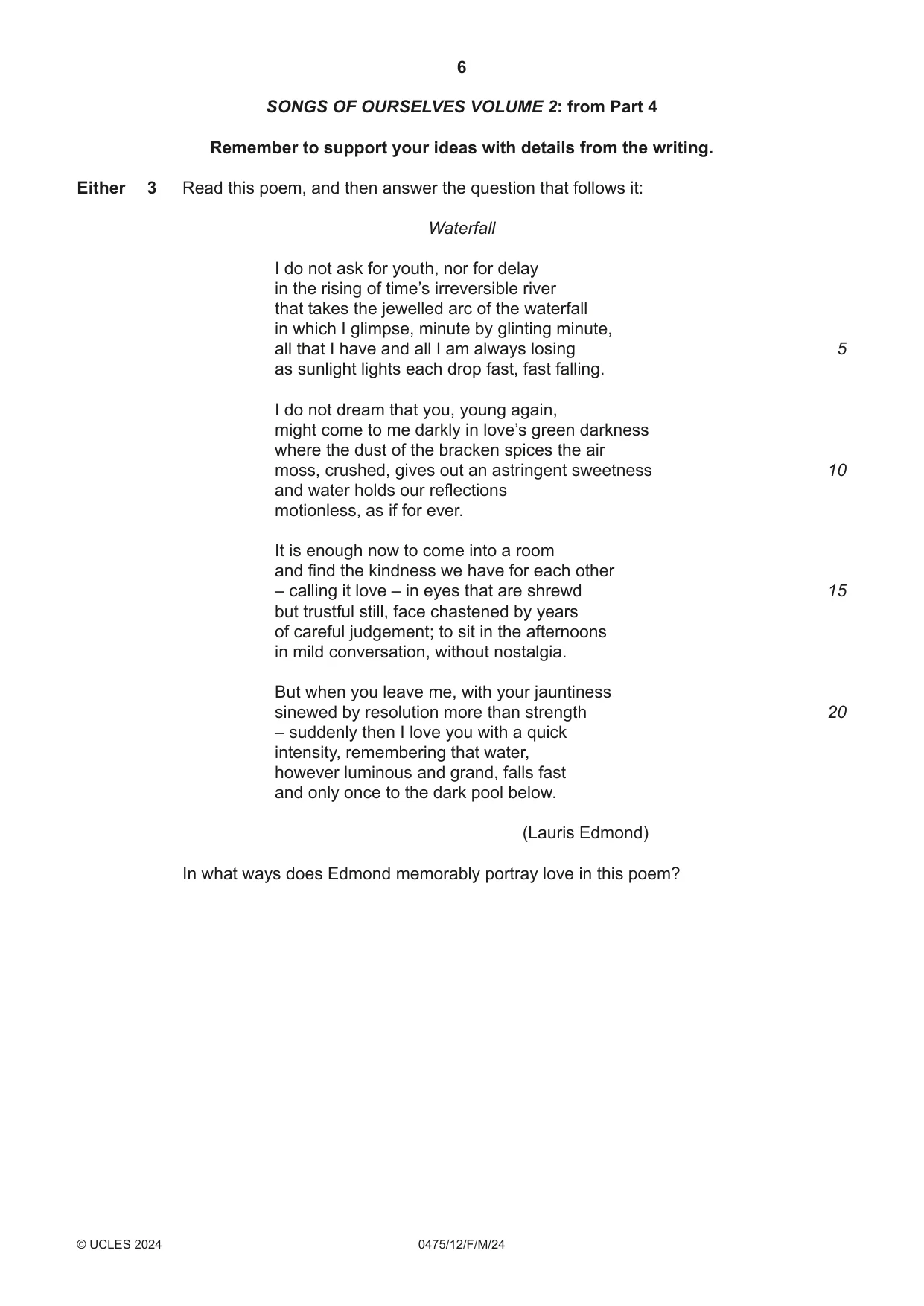
6 0475/12/F/M/24 © UCLES 2024 SONGS OF OURSELVES VOLUME 2: from Part 4 Remember to support your ideas with details from the writing. Either 3 Read this poem, and then answer the question that follows it: Waterfall I do not ask for youth, nor for delay in the rising of time’s irreversible river that takes the jewelled arc of the waterfall in which I glimpse, minute by glinting minute, all that I have and all I am always losing 5 as sunlight lights each drop fast, fast falling. I do not dream that you, young again, might come to me darkly in love’s green darkness where the dust of the bracken spices the air moss, crushed, gives out an astringent sweetness 10 and water holds our reflections motionless, as if for ever. It is enough now to come into a room and find the kindness we have for each other – calling it love – in eyes that are shrewd 15 but trustful still, face chastened by years of careful judgement; to sit in the afternoons in mild conversation, without nostalgia. But when you leave me, with your jauntiness sinewed by resolution more than strength 20 – suddenly then I love you with a quick intensity, remembering that water, however luminous and grand, falls fast and only once to the dark pool below. (Lauris Edmond) In what ways does Edmond memorably portray love in this poem?
Question paper, page 7
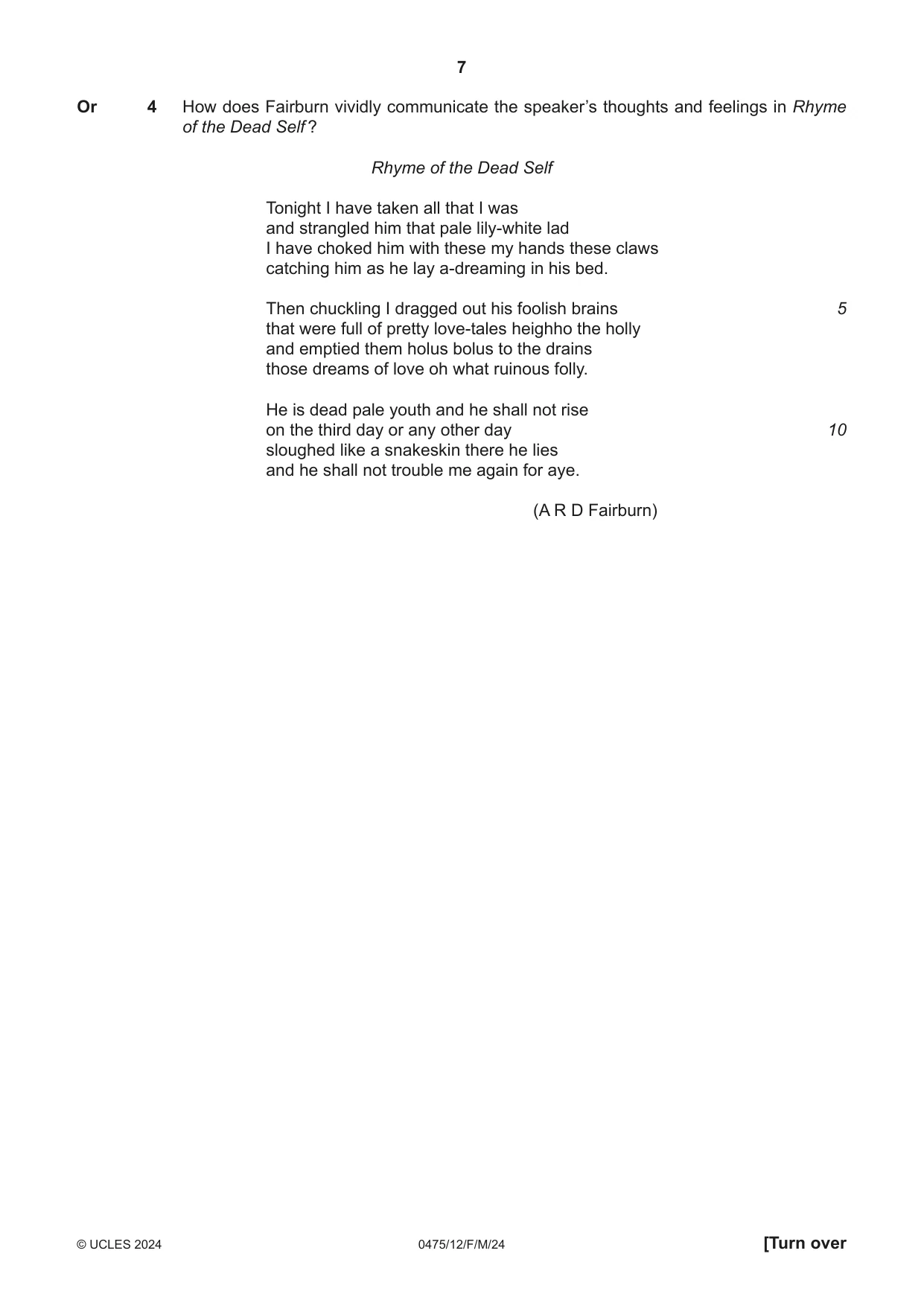
7 0475/12/F/M/24 © UCLES 2024 [Turn over Or 4 How does Fairburn vividly communicate the speaker’s thoughts and feelings in Rhyme of the Dead Self ? Rhyme of the Dead Self Tonight I have taken all that I was and strangled him that pale lily-white lad I have choked him with these my hands these claws catching him as he lay a-dreaming in his bed. Then chuckling I dragged out his foolish brains 5 that were full of pretty love-tales heighho the holly and emptied them holus bolus to the drains those dreams of love oh what ruinous folly. He is dead pale youth and he shall not rise on the third day or any other day 10 sloughed like a snakeskin there he lies and he shall not trouble me again for aye. (A R D Fairburn)
Question paper, page 8
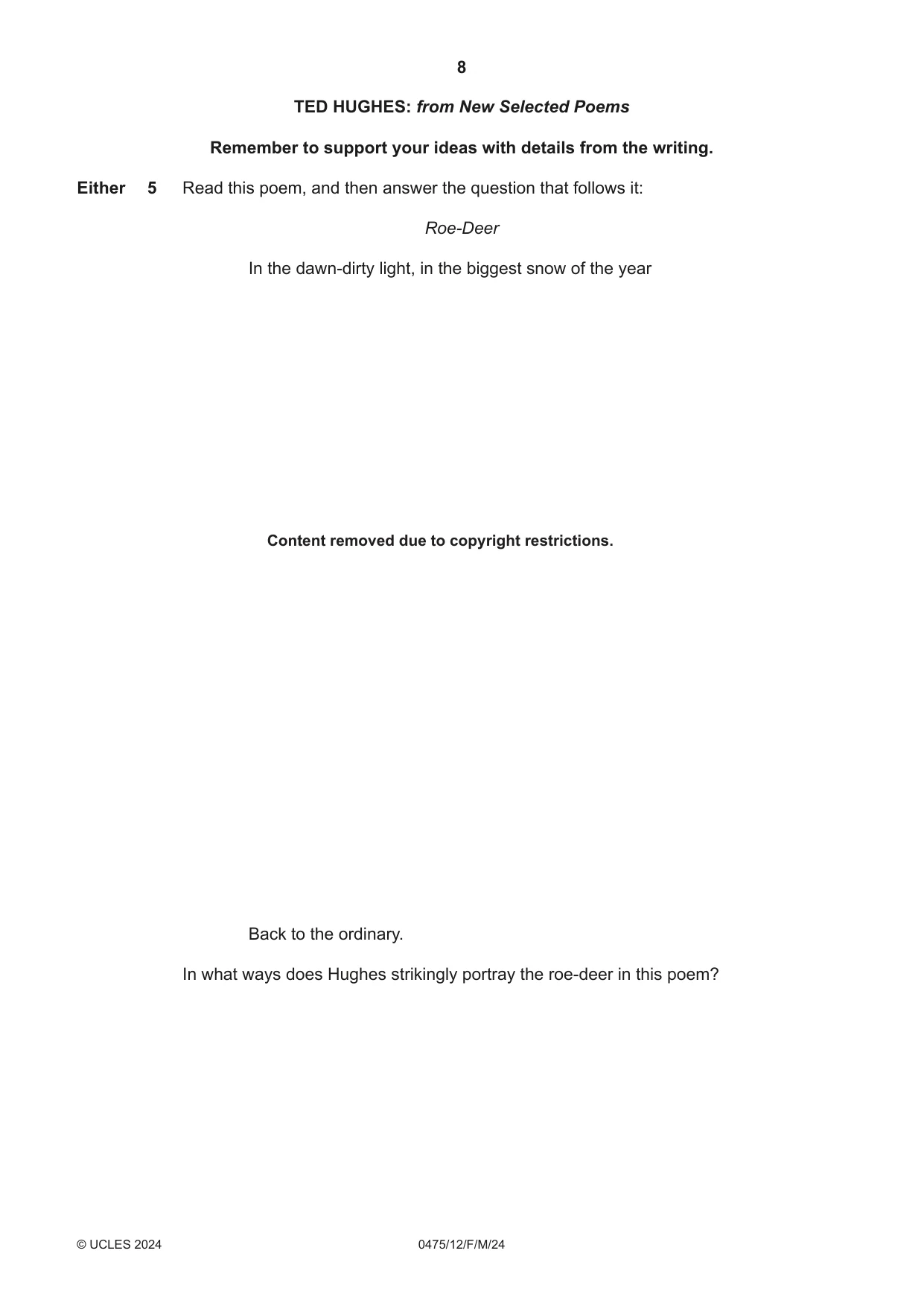
8 0475/12/F/M/24 © UCLES 2024 TED HUGHES: from New Selected Poems Remember to support your ideas with details from the writing. Either 5 Read this poem, and then answer the question that follows it: Roe-Deer In the dawn-dirty light, in the biggest snow of the year Back to the ordinary. In what ways does Hughes strikingly portray the roe-deer in this poem? Content removed due to copyright restrictions.
Question paper, page 9
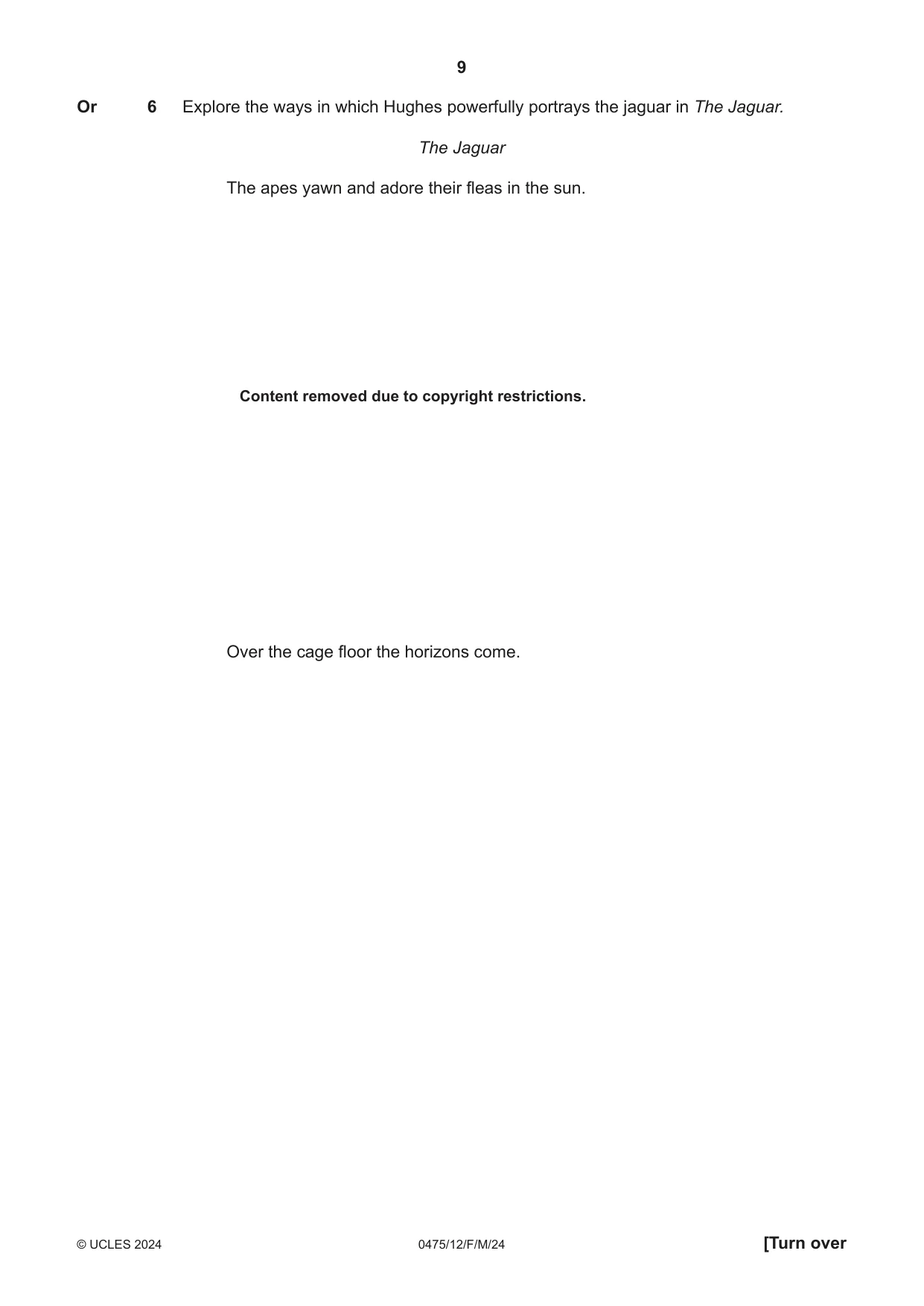
9 0475/12/F/M/24 © UCLES 2024 [Turn over Or 6 Explore the ways in which Hughes powerfully portrays the jaguar in The Jaguar. The Jaguar The apes yawn and adore their fleas in the sun. Over the cage floor the horizons come. Content removed due to copyright restrictions.
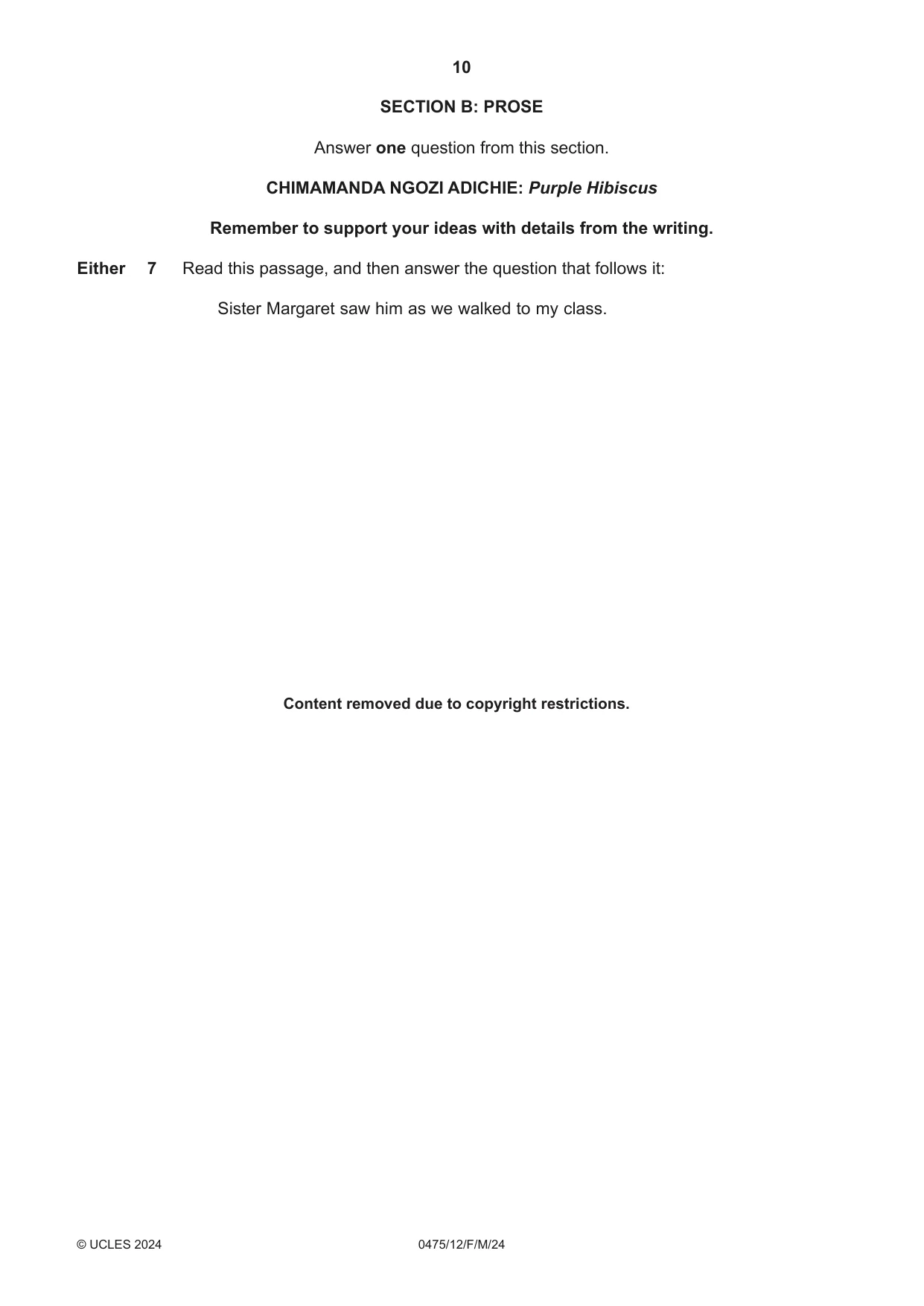
Question paper, page 10
10 0475/12/F/M/24 © UCLES 2024 SECTION B: PROSE Answer one question from this section. CHIMAMANDA NGOZI ADICHIE: Purple Hibiscus Remember to support your ideas with details from the writing. Either 7 Read this passage, and then answer the question that follows it: Sister Margaret saw him as we walked to my class. Content removed due to copyright restrictions.
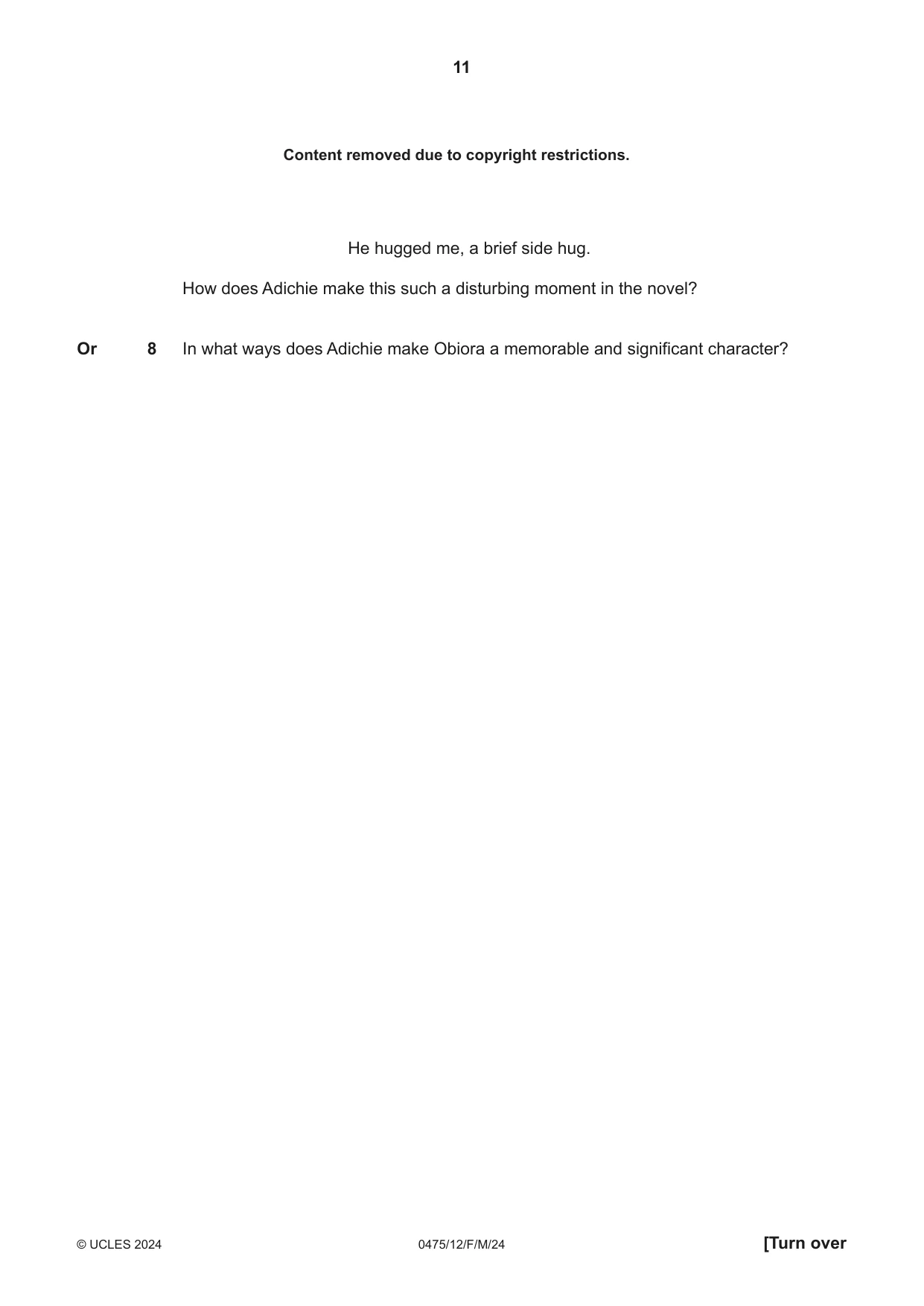
Question paper, page 11
11 0475/12/F/M/24 © UCLES 2024 [Turn over He hugged me, a brief side hug. How does Adichie make this such a disturbing moment in the novel? Or 8 In what ways does Adichie make Obiora a memorable and significant character? Content removed due to copyright restrictions.
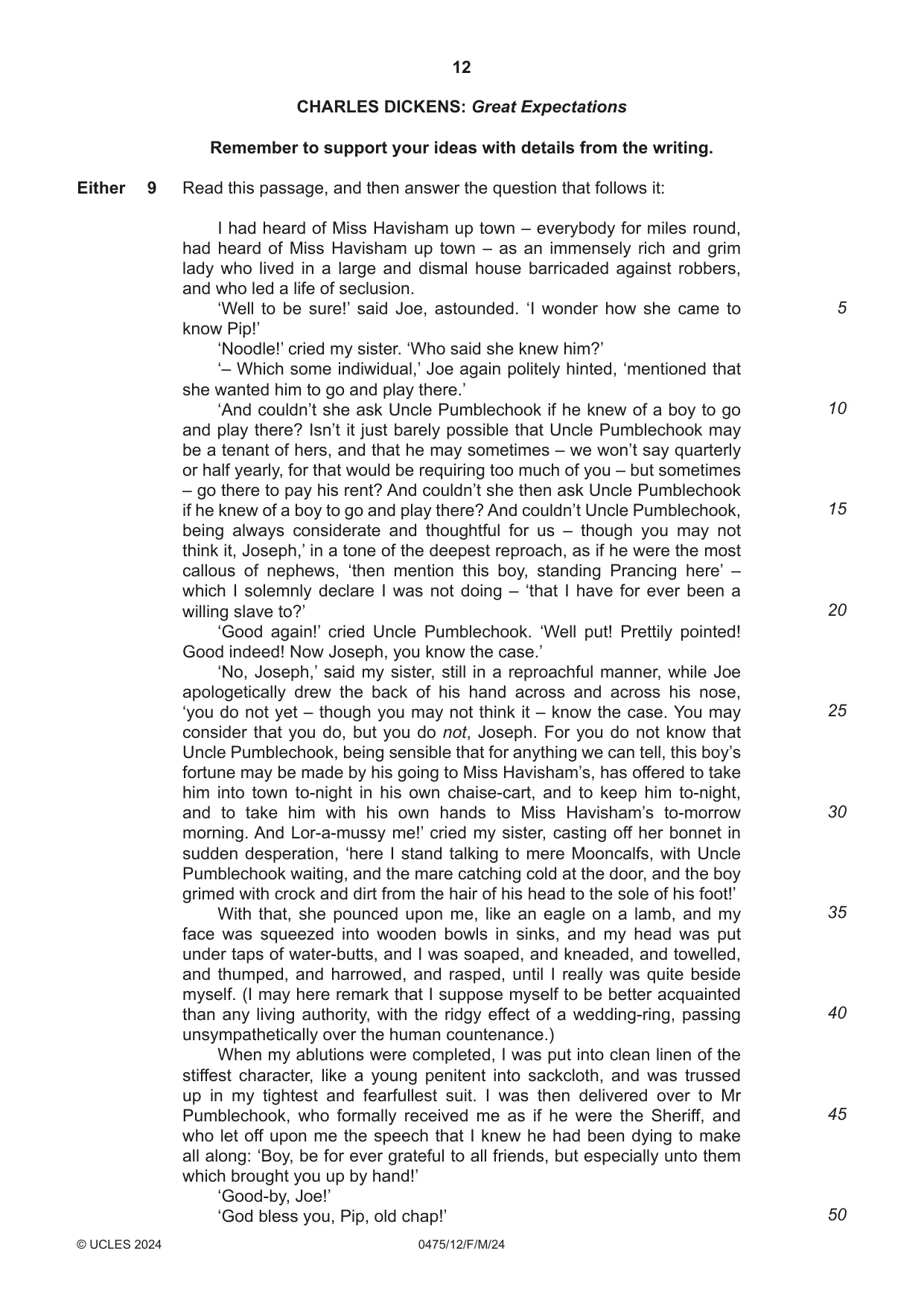
Question paper, page 12
12 0475/12/F/M/24 © UCLES 2024 CHARLES DICKENS: Great Expectations Remember to support your ideas with details from the writing. Either 9 Read this passage, and then answer the question that follows it: I had heard of Miss Havisham up town – everybody for miles round, had heard of Miss Havisham up town – as an immensely rich and grim lady who lived in a large and dismal house barricaded against robbers, and who led a life of seclusion. ‘Well to be sure!’ said Joe, astounded. ‘I wonder how she came to know Pip!’ ‘Noodle!’ cried my sister. ‘Who said she knew him?’ ‘– Which some indiwidual,’ Joe again politely hinted, ‘mentioned that she wanted him to go and play there.’ ‘And couldn’t she ask Uncle Pumblechook if he knew of a boy to go and play there? Isn’t it just barely possible that Uncle Pumblechook may be a tenant of hers, and that he may sometimes – we won’t say quarterly or half yearly, for that would be requiring too much of you – but sometimes – go there to pay his rent? And couldn’t she then ask Uncle Pumblechook if he knew of a boy to go and play there? And couldn’t Uncle Pumblechook, being always considerate and thoughtful for us – though you may not think it, Joseph,’ in a tone of the deepest reproach, as if he were the most callous of nephews, ‘then mention this boy, standing Prancing here’ – which I solemnly declare I was not doing – ‘that I have for ever been a willing slave to?’ ‘Good again!’ cried Uncle Pumblechook. ‘Well put! Prettily pointed! Good indeed! Now Joseph, you know the case.’ ‘No, Joseph,’ said my sister, still in a reproachful manner, while Joe apologetically drew the back of his hand across and across his nose, ‘you do not yet – though you may not think it – know the case. You may consider that you do, but you do not, Joseph. For you do not know that Uncle Pumblechook, being sensible that for anything we can tell, this boy’s fortune may be made by his going to Miss Havisham’s, has offered to take him into town to-night in his own chaise-cart, and to keep him to-night, and to take him with his own hands to Miss Havisham’s to-morrow morning. And Lor-a-mussy me!’ cried my sister, casting off her bonnet in sudden desperation, ‘here I stand talking to mere Mooncalfs, with Uncle Pumblechook waiting, and the mare catching cold at the door, and the boy grimed with crock and dirt from the hair of his head to the sole of his foot!’ With that, she pounced upon me, like an eagle on a lamb, and my face was squeezed into wooden bowls in sinks, and my head was put under taps of water-butts, and I was soaped, and kneaded, and towelled, and thumped, and harrowed, and rasped, until I really was quite beside myself. (I may here remark that I suppose myself to be better acquainted than any living authority, with the ridgy effect of a wedding-ring, passing unsympathetically over the human countenance.) When my ablutions were completed, I was put into clean linen of the stiffest character, like a young penitent into sackcloth, and was trussed up in my tightest and fearfullest suit. I was then delivered over to Mr Pumblechook, who formally received me as if he were the Sheriff, and who let off upon me the speech that I knew he had been dying to make all along: ‘Boy, be for ever grateful to all friends, but especially unto them which brought you up by hand!’ ‘Good-by, Joe!’ ‘God bless you, Pip, old chap!’ 5 10 15 20 25 30 35 40 45 50
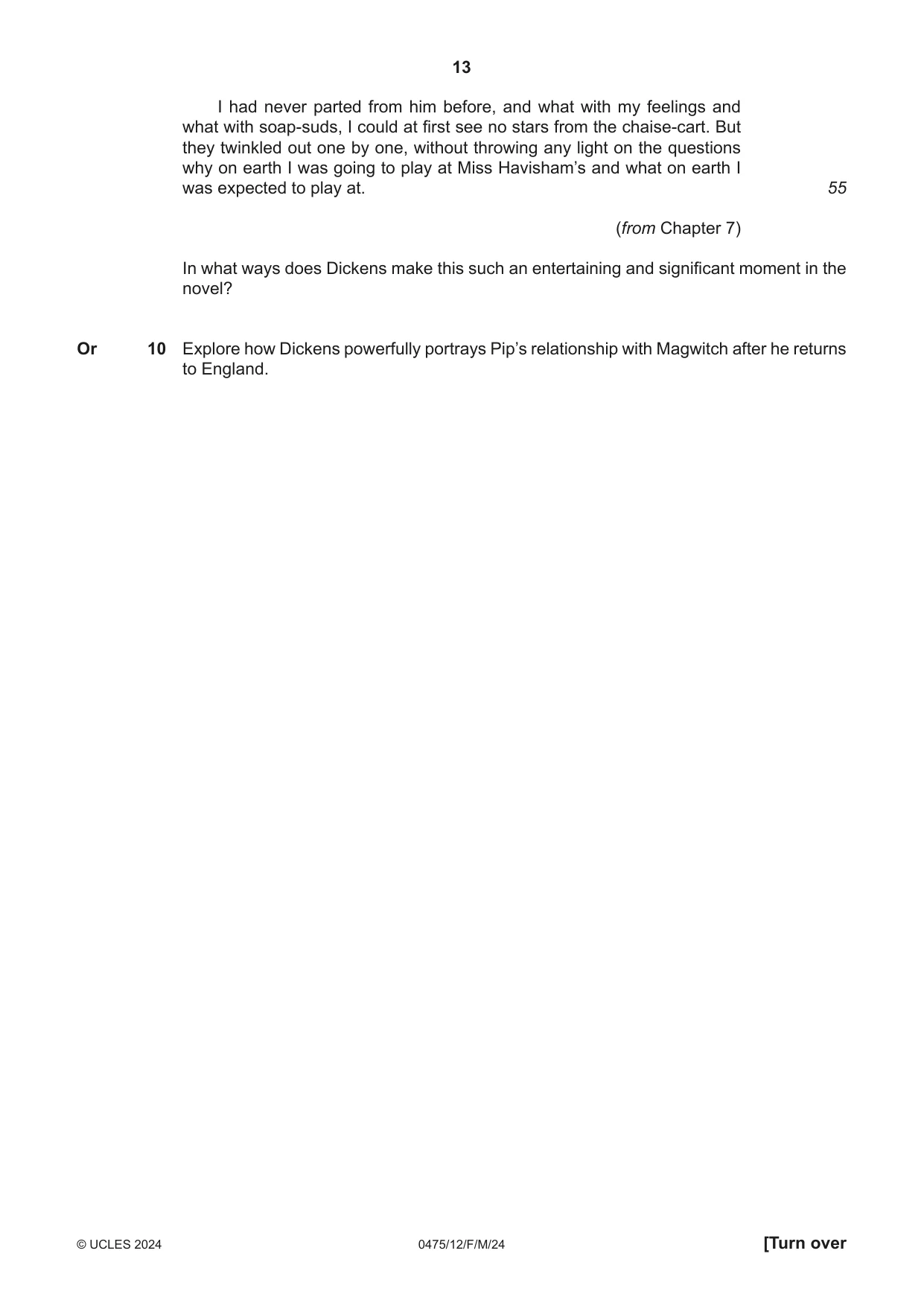
Question paper, page 13
13 0475/12/F/M/24 © UCLES 2024 [Turn over I had never parted from him before, and what with my feelings and what with soap-suds, I could at first see no stars from the chaise-cart. But they twinkled out one by one, without throwing any light on the questions why on earth I was going to play at Miss Havisham’s and what on earth I was expected to play at. (from Chapter 7) In what ways does Dickens make this such an entertaining and significant moment in the novel? Or 10 Explore how Dickens powerfully portrays Pip’s relationship with Magwitch after he returns to England. 55
Question paper, page 14
14 0475/12/F/M/24 © UCLES 2024 DAPHNE DU MAURIER: Rebecca Remember to support your ideas with details from the writing. Either 11 Read this passage, and then answer the question that follows it: He whipped round and looked at me as I sat there huddled on the floor. It doesn’t make for sanity, does it, living with the devil.’ (from Chapter 20) Content removed due to copyright restrictions.
Question paper, page 15
15 0475/12/F/M/24 © UCLES 2024 [Turn over In what ways does du Maurier make this such a revealing moment in the novel? Or 12 Explore how du Maurier makes Beatrice such a memorable character.
Question paper, page 16
16 0475/12/F/M/24 © UCLES 2024 JHUMPA LAHIRI: The Namesake Remember to support your ideas with details from the writing. Either 13 Read this passage, and then answer the question that follows it: That evening Ashoke goes home to the apartment, checks for the letter. Content removed due to copyright restrictions.
Question paper, page 17
17 0475/12/F/M/24 © UCLES 2024 [Turn over She knows the story of the accident, a story she first heard with polite newlywed sympathy, but the thought of which now, now especially, makes her blood go cold. (from Chapter 2) Explore the ways in which Lahiri makes this such a memorable moment in the novel. Or 14 How does Lahiri create such vivid impressions of Gogol as he grows up? Content removed due to copyright restrictions.
Question paper, page 18
18 0475/12/F/M/24 © UCLES 2024 JOAN LINDSAY: Picnic at Hanging Rock Remember to support your ideas with details from the writing. Either 15 Read this passage, and then answer the question that follows it: Doctor McKenzie was right: ‘Don’t think about the Rock, dear child. Content removed due to copyright restrictions.
Question paper, page 19
19 0475/12/F/M/24 © UCLES 2024 [Turn over For a person who found difficulty in expressing himself on paper, the writer had conveyed his meaning remarkably well. (from Chapter 11) How does Lindsay make this such a powerfully dramatic moment in the novel? Or 16 To what extent does Lindsay make it possible for you to feel sorry for Mrs Appleyard? Content removed due to copyright restrictions.
Question paper, page 20
20 0475/12/F/M/24 © UCLES 2024 YANN MARTEL: Life of Pi Remember to support your ideas with details from the writing. Either 17 Read this passage, and then answer the question that follows it: In my case, to protect myself from Richard Parker while I trained him, I made a shield with a turtle shell. My fifth shield lasted me the rest of his training. (from Chapter 72) Content removed due to copyright restrictions.
Question paper, page 21
21 0475/12/F/M/24 © UCLES 2024 [Turn over How does Martel strikingly portray Pi at this moment in the novel? Or 18 Explore two moments in the novel which Martel makes particularly moving. Do not use the passage printed in Question 17 in answering this question.
Question paper, page 22
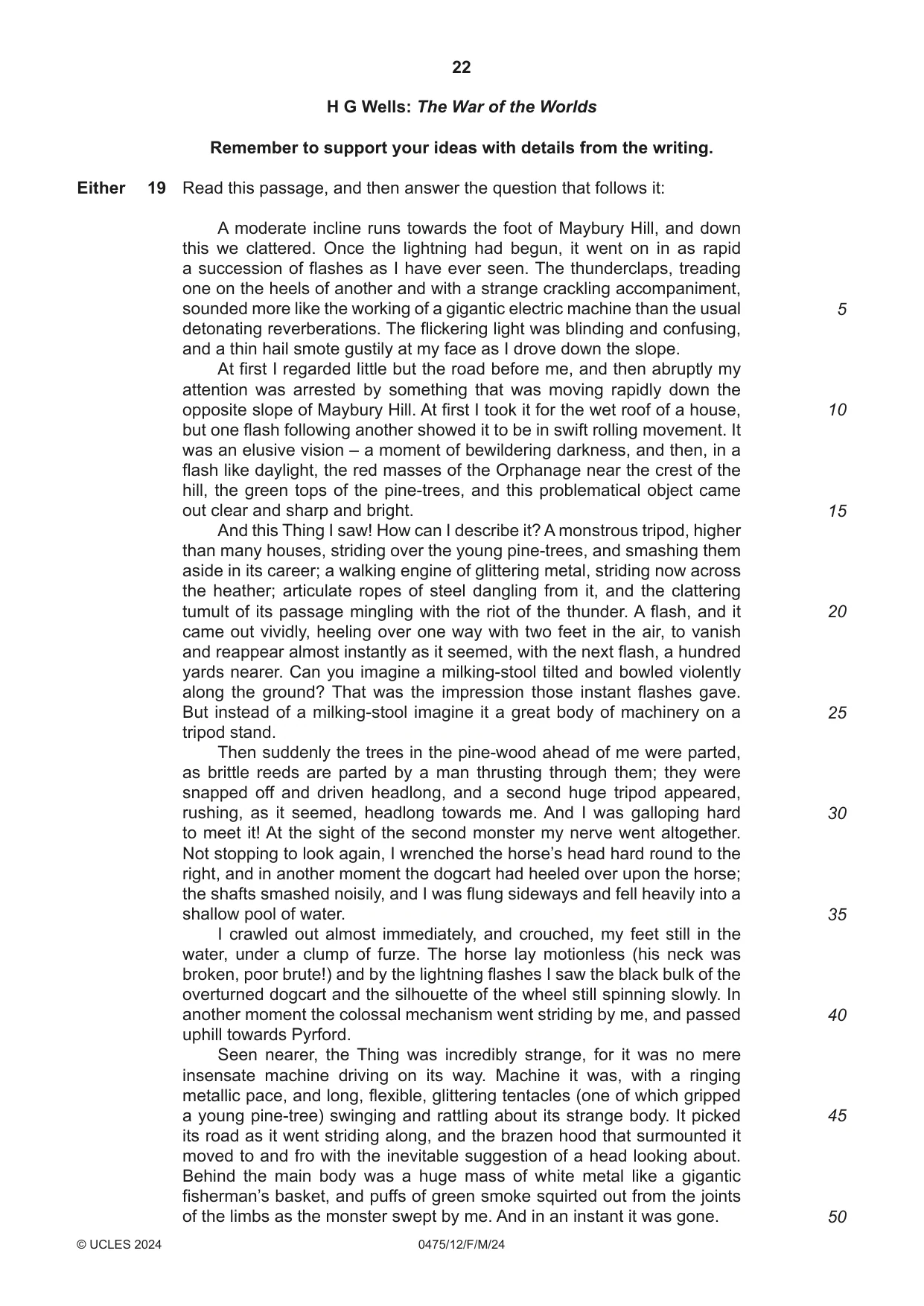
22 0475/12/F/M/24 © UCLES 2024 H G Wells: The War of the Worlds Remember to support your ideas with details from the writing. Either 19 Read this passage, and then answer the question that follows it: A moderate incline runs towards the foot of Maybury Hill, and down this we clattered. Once the lightning had begun, it went on in as rapid a succession of flashes as I have ever seen. The thunderclaps, treading one on the heels of another and with a strange crackling accompaniment, sounded more like the working of a gigantic electric machine than the usual detonating reverberations. The flickering light was blinding and confusing, and a thin hail smote gustily at my face as I drove down the slope. At first I regarded little but the road before me, and then abruptly my attention was arrested by something that was moving rapidly down the opposite slope of Maybury Hill. At first I took it for the wet roof of a house, but one flash following another showed it to be in swift rolling movement. It was an elusive vision – a moment of bewildering darkness, and then, in a flash like daylight, the red masses of the Orphanage near the crest of the hill, the green tops of the pine-trees, and this problematical object came out clear and sharp and bright. And this Thing I saw! How can I describe it? A monstrous tripod, higher than many houses, striding over the young pine-trees, and smashing them aside in its career; a walking engine of glittering metal, striding now across the heather; articulate ropes of steel dangling from it, and the clattering tumult of its passage mingling with the riot of the thunder. A flash, and it came out vividly, heeling over one way with two feet in the air, to vanish and reappear almost instantly as it seemed, with the next flash, a hundred yards nearer. Can you imagine a milking-stool tilted and bowled violently along the ground? That was the impression those instant flashes gave. But instead of a milking-stool imagine it a great body of machinery on a tripod stand. Then suddenly the trees in the pine-wood ahead of me were parted, as brittle reeds are parted by a man thrusting through them; they were snapped off and driven headlong, and a second huge tripod appeared, rushing, as it seemed, headlong towards me. And I was galloping hard to meet it! At the sight of the second monster my nerve went altogether. Not stopping to look again, I wrenched the horse’s head hard round to the right, and in another moment the dogcart had heeled over upon the horse; the shafts smashed noisily, and I was flung sideways and fell heavily into a shallow pool of water. I crawled out almost immediately, and crouched, my feet still in the water, under a clump of furze. The horse lay motionless (his neck was broken, poor brute!) and by the lightning flashes I saw the black bulk of the overturned dogcart and the silhouette of the wheel still spinning slowly. In another moment the colossal mechanism went striding by me, and passed uphill towards Pyrford. Seen nearer, the Thing was incredibly strange, for it was no mere insensate machine driving on its way. Machine it was, with a ringing metallic pace, and long, flexible, glittering tentacles (one of which gripped a young pine-tree) swinging and rattling about its strange body. It picked its road as it went striding along, and the brazen hood that surmounted it moved to and fro with the inevitable suggestion of a head looking about. Behind the main body was a huge mass of white metal like a gigantic fisherman’s basket, and puffs of green smoke squirted out from the joints of the limbs as the monster swept by me. And in an instant it was gone. 5 10 15 20 25 30 35 40 45 50
Question paper, page 23
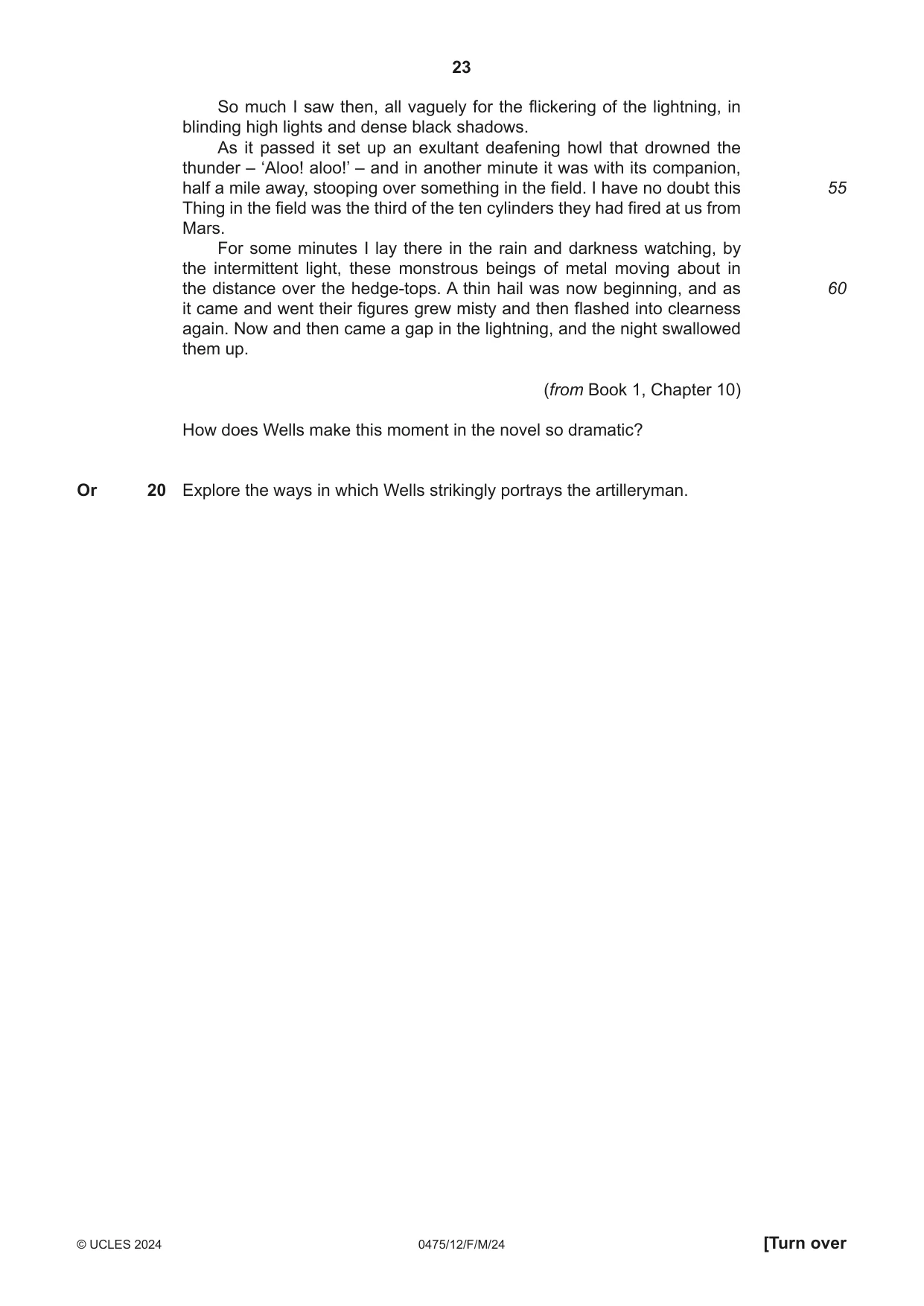
23 0475/12/F/M/24 © UCLES 2024 [Turn over So much I saw then, all vaguely for the flickering of the lightning, in blinding high lights and dense black shadows. As it passed it set up an exultant deafening howl that drowned the thunder – ‘Aloo! aloo!’ – and in another minute it was with its companion, half a mile away, stooping over something in the field. I have no doubt this Thing in the field was the third of the ten cylinders they had fired at us from Mars. For some minutes I lay there in the rain and darkness watching, by the intermittent light, these monstrous beings of metal moving about in the distance over the hedge-tops. A thin hail was now beginning, and as it came and went their figures grew misty and then flashed into clearness again. Now and then came a gap in the lightning, and the night swallowed them up. (from Book 1, Chapter 10) How does Wells make this moment in the novel so dramatic? Or 20 Explore the ways in which Wells strikingly portrays the artilleryman. 55 60
Question paper, page 24
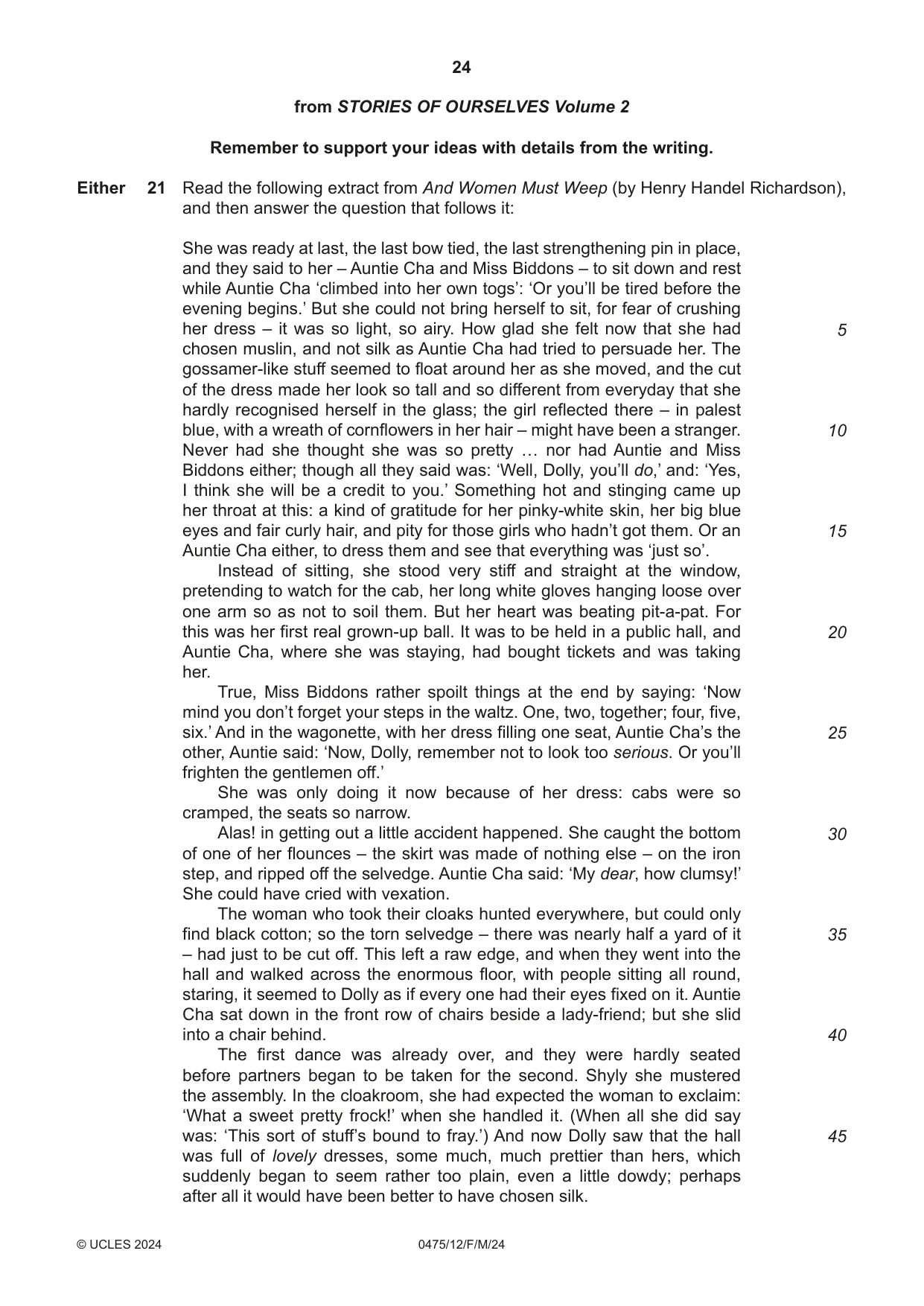
24 0475/12/F/M/24 © UCLES 2024 from STORIES OF OURSELVES Volume 2 Remember to support your ideas with details from the writing. Either 21 Read the following extract from And Women Must Weep (by Henry Handel Richardson), and then answer the question that follows it: She was ready at last, the last bow tied, the last strengthening pin in place, and they said to her – Auntie Cha and Miss Biddons – to sit down and rest while Auntie Cha ‘climbed into her own togs’: ‘Or you’ll be tired before the evening begins.’ But she could not bring herself to sit, for fear of crushing her dress – it was so light, so airy. How glad she felt now that she had chosen muslin, and not silk as Auntie Cha had tried to persuade her. The gossamer-like stuff seemed to float around her as she moved, and the cut of the dress made her look so tall and so different from everyday that she hardly recognised herself in the glass; the girl reflected there – in palest blue, with a wreath of cornflowers in her hair – might have been a stranger. Never had she thought she was so pretty … nor had Auntie and Miss Biddons either; though all they said was: ‘Well, Dolly, you’ll do,’ and: ‘Yes, I think she will be a credit to you.’ Something hot and stinging came up her throat at this: a kind of gratitude for her pinky-white skin, her big blue eyes and fair curly hair, and pity for those girls who hadn’t got them. Or an Auntie Cha either, to dress them and see that everything was ‘just so’. Instead of sitting, she stood very stiff and straight at the window, pretending to watch for the cab, her long white gloves hanging loose over one arm so as not to soil them. But her heart was beating pit-a-pat. For this was her first real grown-up ball. It was to be held in a public hall, and Auntie Cha, where she was staying, had bought tickets and was taking her. True, Miss Biddons rather spoilt things at the end by saying: ‘Now mind you don’t forget your steps in the waltz. One, two, together; four, five, six.’ And in the wagonette, with her dress filling one seat, Auntie Cha’s the other, Auntie said: ‘Now, Dolly, remember not to look too serious. Or you’ll frighten the gentlemen off.’ She was only doing it now because of her dress: cabs were so cramped, the seats so narrow. Alas! in getting out a little accident happened. She caught the bottom of one of her flounces – the skirt was made of nothing else – on the iron step, and ripped off the selvedge. Auntie Cha said: ‘My dear, how clumsy!’ She could have cried with vexation. The woman who took their cloaks hunted everywhere, but could only find black cotton; so the torn selvedge – there was nearly half a yard of it – had just to be cut off. This left a raw edge, and when they went into the hall and walked across the enormous floor, with people sitting all round, staring, it seemed to Dolly as if every one had their eyes fixed on it. Auntie Cha sat down in the front row of chairs beside a lady-friend; but she slid into a chair behind. The first dance was already over, and they were hardly seated before partners began to be taken for the second. Shyly she mustered the assembly. In the cloakroom, she had expected the woman to exclaim: ‘What a sweet pretty frock!’ when she handled it. (When all she did say was: ‘This sort of stuff’s bound to fray.’) And now Dolly saw that the hall was full of lovely dresses, some much, much prettier than hers, which suddenly began to seem rather too plain, even a little dowdy; perhaps after all it would have been better to have chosen silk. 5 10 15 20 25 30 35 40 45
Question paper, page 25
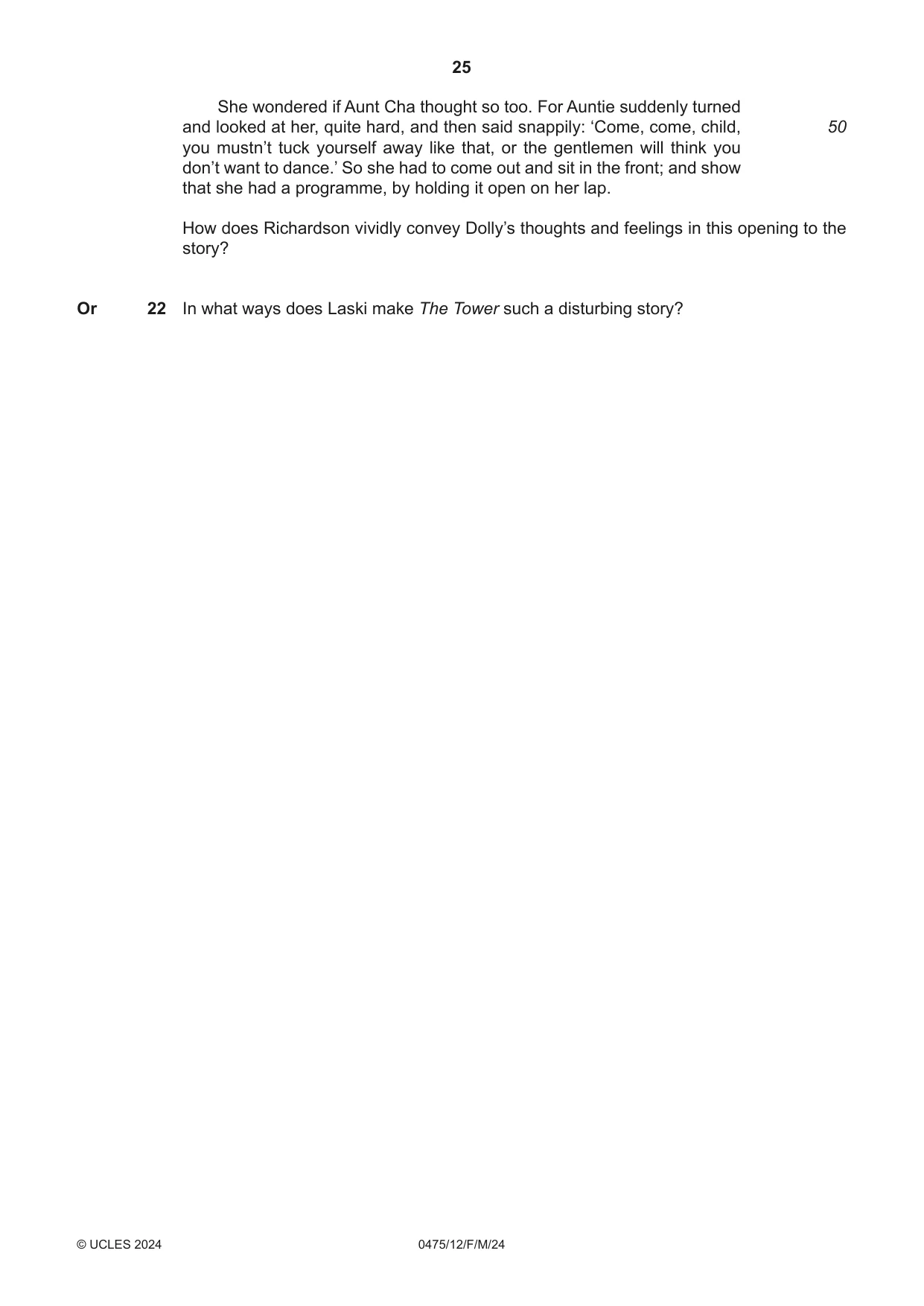
25 0475/12/F/M/24 © UCLES 2024 She wondered if Aunt Cha thought so too. For Auntie suddenly turned and looked at her, quite hard, and then said snappily: ‘Come, come, child, you mustn’t tuck yourself away like that, or the gentlemen will think you don’t want to dance.’ So she had to come out and sit in the front; and show that she had a programme, by holding it open on her lap. How does Richardson vividly convey Dolly’s thoughts and feelings in this opening to the story? Or 22 In what ways does Laski make The Tower such a disturbing story? 50
Question paper, page 26
26 0475/12/F/M/24 © UCLES 2024 BLANK PAGE
Question paper, page 27
27 0475/12/F/M/24 © UCLES 2024 BLANK PAGE
Question paper, page 28
28 0475/12/F/M/24 © UCLES 2024 Permission to reproduce items where third-party owned material protected by copyright is included has been sought and cleared where possible. Every reasonable effort has been made by the publisher (UCLES) to trace copyright holders, but if any items requiring clearance have unwittingly been included, the publisher will be pleased to make amends at the earliest possible opportunity. To avoid the issue of disclosure of answer-related information to candidates, all copyright acknowledgements are reproduced online in the Cambridge Assessment International Education Copyright Acknowledgements Booklet. This is produced for each series of examinations and is freely available to download at www.cambridgeinternational.org after the live examination series. Cambridge Assessment International Education is part of Cambridge Assessment. Cambridge Assessment is the brand name of the University of Cambridge Local Examinations Syndicate (UCLES), which is a department of the University of Cambridge. BLANK PAGE
Mark scheme, page 1
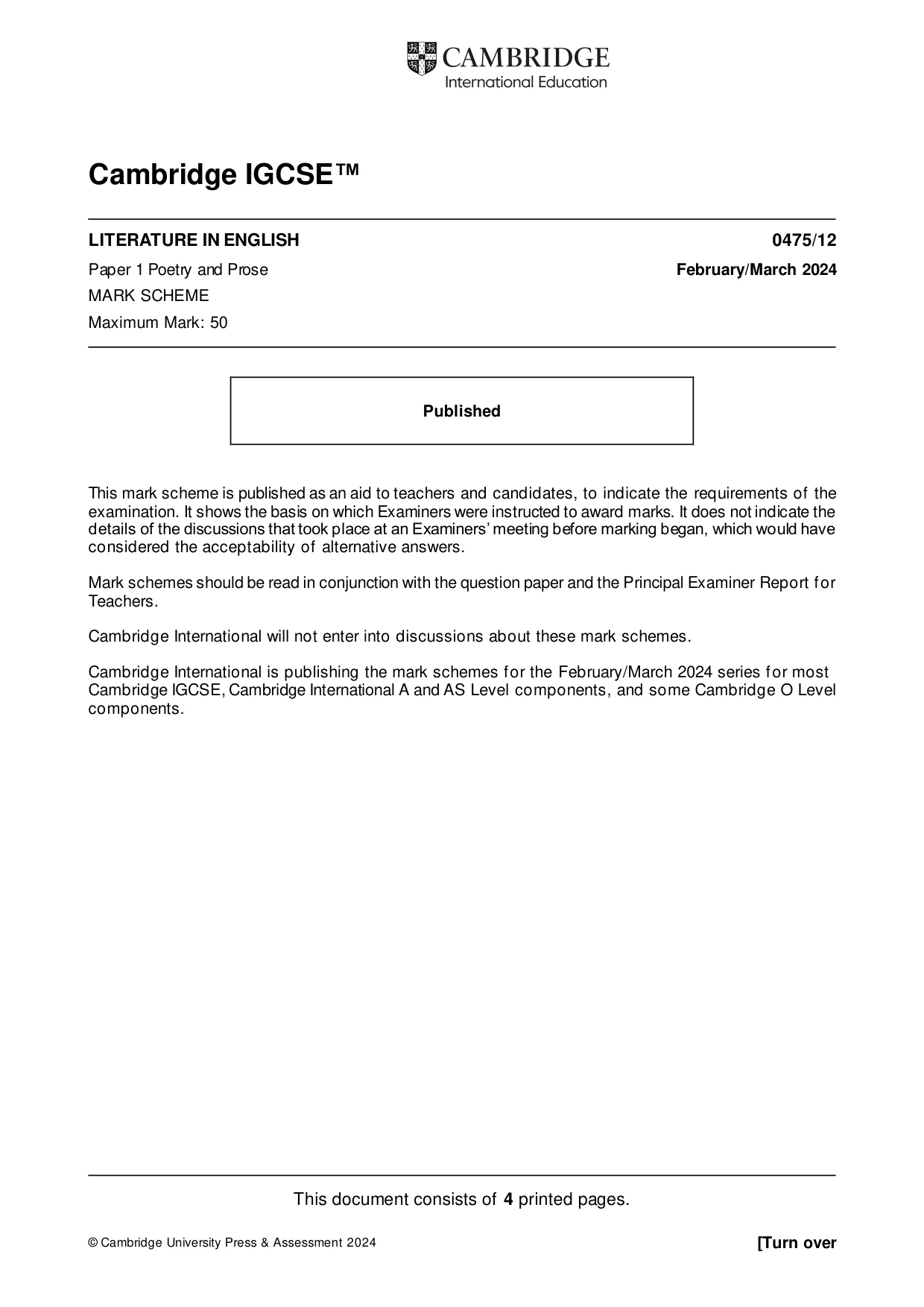
This document consists of 4 printed pages. © Cambridge University Press & Assessment 2024 [Turn over Cambridge IGCSE™ LITERATURE IN ENGLISH 0475/12 Paper 1 Poetry and Prose February/March 2024 MARK SCHEME Maximum Mark: 50 Published This mark scheme is published as an aid to teachers and candidates, to indicate the requirements of the examination. It shows the basis on which Examiners were instructed to award marks. It does not indicate the details of the discussions that took place at an Examiners’ meeting before marking began, which would have considered the acceptability of alternative answers. Mark schemes should be read in conjunction with the question paper and the Principal Examiner Report for Teachers. Cambridge International will not enter into discussions about these mark schemes. Cambridge International is publishing the mark schemes for the February/March 2024 series for most Cambridge IGCSE, Cambridge International A and AS Level components, and some Cambridge O Level components.
Mark scheme, page 2
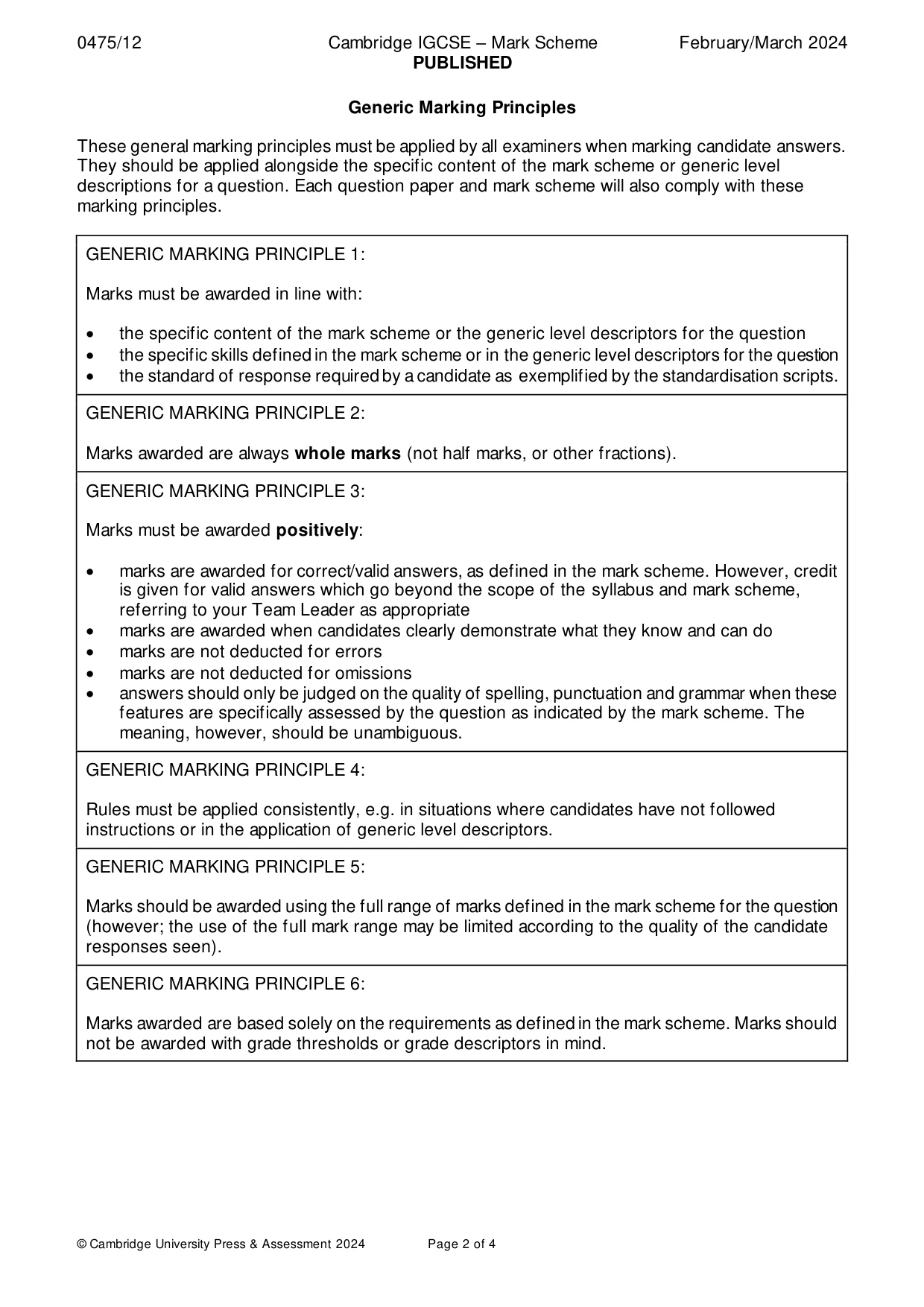
0475/12 Cambridge IGCSE – Mark Scheme PUBLISHED February/March 2024 © Cambridge University Press & Assessment 2024 Page 2 of 4 Generic Marking Principles These general marking principles must be applied by all examiners when marking candidate answers. They should be applied alongside the specific content of the mark scheme or generic level descriptions for a question. Each question paper and mark scheme will also comply with these marking principles. GENERIC MARKING PRINCIPLE 1: Marks must be awarded in line with: • the specific content of the mark scheme or the generic level descriptors for the question • the specific skills defined in the mark scheme or in the generic level descriptors for the question • the standard of response required by a candidate as exemplified by the standardisation scripts. GENERIC MARKING PRINCIPLE 2: Marks awarded are always whole marks (not half marks, or other fractions). GENERIC MARKING PRINCIPLE 3: Marks must be awarded positively: • marks are awarded for correct/valid answers, as defined in the mark scheme. However, credit is given for valid answers which go beyond the scope of the syllabus and mark scheme, referring to your Team Leader as appropriate • marks are awarded when candidates clearly demonstrate what they know and can do • marks are not deducted for errors • marks are not deducted for omissions • answers should only be judged on the quality of spelling, punctuation and grammar when these features are specifically assessed by the question as indicated by the mark scheme. The meaning, however, should be unambiguous. GENERIC MARKING PRINCIPLE 4: Rules must be applied consistently, e.g. in situations where candidates have not followed instructions or in the application of generic level descriptors. GENERIC MARKING PRINCIPLE 5: Marks should be awarded using the full range of marks defined in the mark scheme for the question (however; the use of the full mark range may be limited according to the quality of the candidate responses seen). GENERIC MARKING PRINCIPLE 6: Marks awarded are based solely on the requirements as defined in the mark scheme. Marks should not be awarded with grade thresholds or grade descriptors in mind.
Mark scheme, page 3
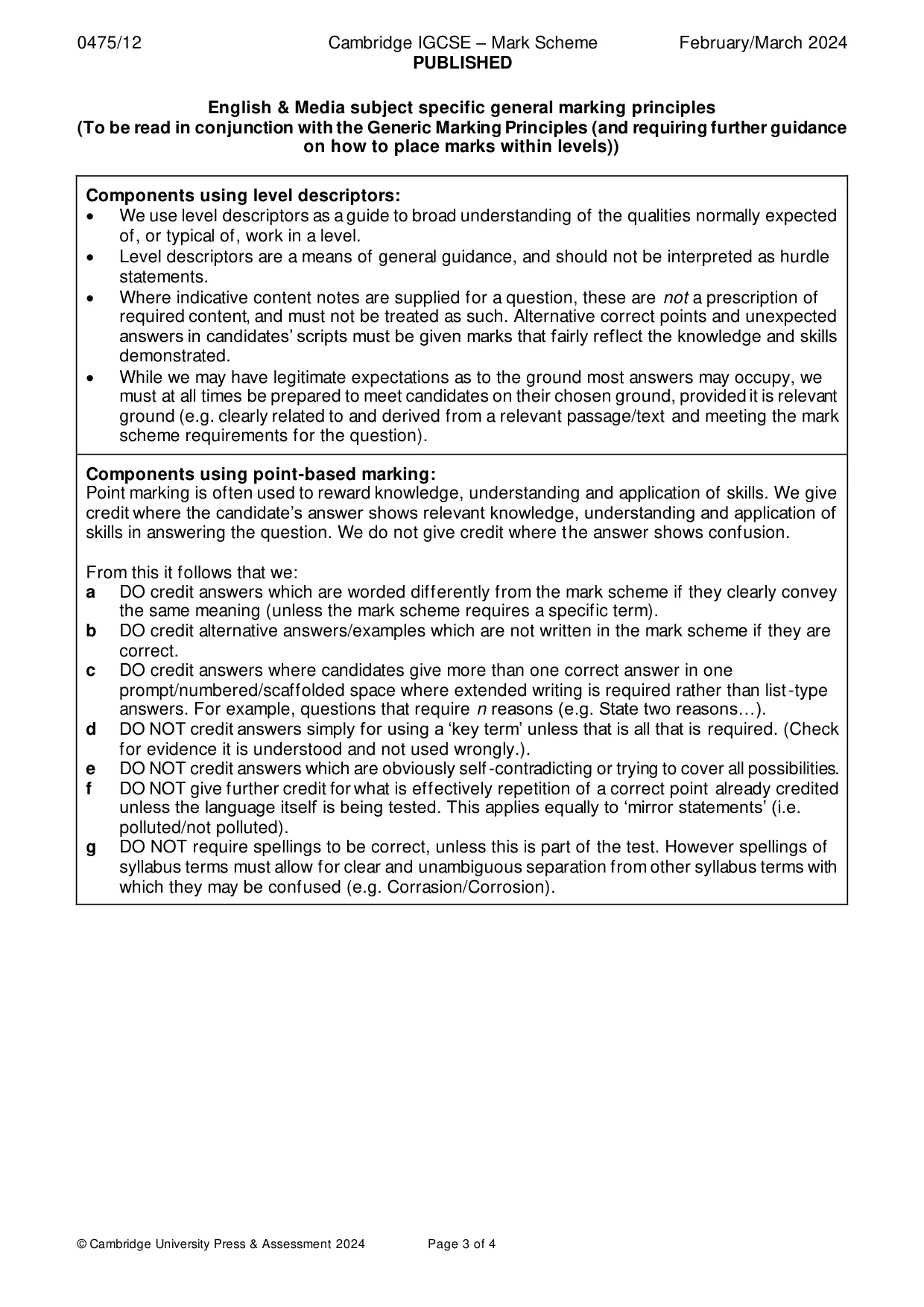
0475/12 Cambridge IGCSE – Mark Scheme PUBLISHED February/March 2024 © Cambridge University Press & Assessment 2024 Page 3 of 4 English & Media subject specific general marking principles (To be read in conjunction with the Generic Marking Principles (and requiring further guidance on how to place marks within levels)) Components using level descriptors: • We use level descriptors as a guide to broad understanding of the qualities normally expected of, or typical of, work in a level. • Level descriptors are a means of general guidance, and should not be interpreted as hurdle statements. • Where indicative content notes are supplied for a question, these are not a prescription of required content, and must not be treated as such. Alternative correct points and unexpected answers in candidates’ scripts must be given marks that fairly reflect the knowledge and skills demonstrated. • While we may have legitimate expectations as to the ground most answers may occupy, we must at all times be prepared to meet candidates on their chosen ground, provided it is relevant ground (e.g. clearly related to and derived from a relevant passage/text and meeting the mark scheme requirements for the question). Components using point-based marking: Point marking is often used to reward knowledge, understanding and application of skills. We give credit where the candidate’s answer shows relevant knowledge, understanding and application of skills in answering the question. We do not give credit where the answer shows confusion. From this it follows that we: a DO credit answers which are worded differently from the mark scheme if they clearly convey the same meaning (unless the mark scheme requires a specific term). b DO credit alternative answers/examples which are not written in the mark scheme if they are correct. c DO credit answers where candidates give more than one correct answer in one prompt/numbered/scaffolded space where extended writing is required rather than list-type answers. For example, questions that require n reasons (e.g. State two reasons…). d DO NOT credit answers simply for using a ‘key term’ unless that is all that is required. (Check for evidence it is understood and not used wrongly.). e DO NOT credit answers which are obviously self-contradicting or trying to cover all possibilities. f DO NOT give further credit for what is effectively repetition of a correct point already credited unless the language itself is being tested. This applies equally to ‘mirror statements’ (i.e. polluted/not polluted). g DO NOT require spellings to be correct, unless this is part of the test. However spellings of syllabus terms must allow for clear and unambiguous separation from other syllabus terms with which they may be confused (e.g. Corrasion/Corrosion).
Mark scheme, page 4
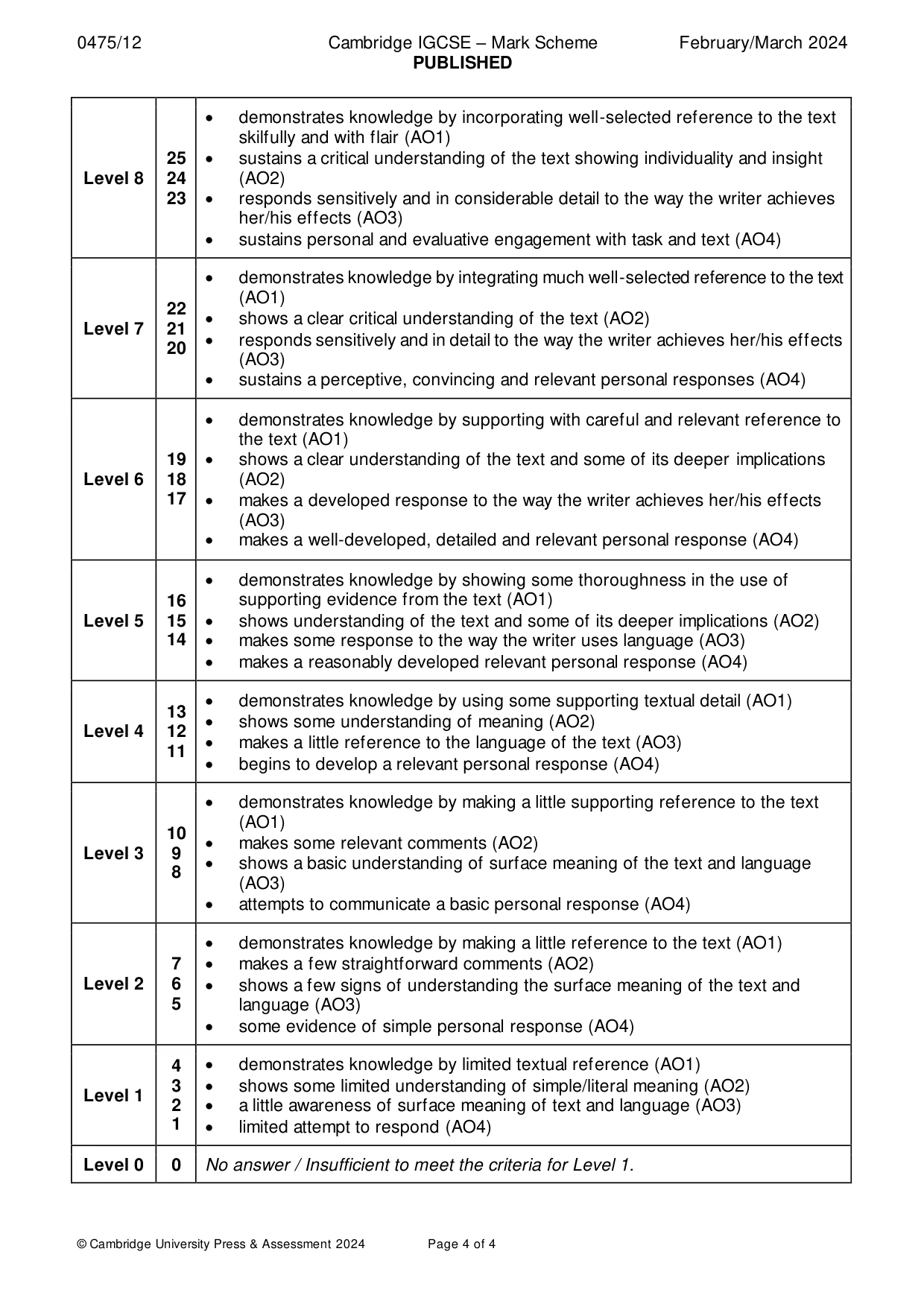
0475/12 Cambridge IGCSE – Mark Scheme PUBLISHED February/March 2024 © Cambridge University Press & Assessment 2024 Page 4 of 4 Level 8 25 24 23 • demonstrates knowledge by incorporating well-selected reference to the text skilfully and with flair (AO1) • sustains a critical understanding of the text showing individuality and insight (AO2) • responds sensitively and in considerable detail to the way the writer achieves her/his effects (AO3) • sustains personal and evaluative engagement with task and text (AO4) Level 7 22 21 20 • demonstrates knowledge by integrating much well-selected reference to the text (AO1) • shows a clear critical understanding of the text (AO2) • responds sensitively and in detail to the way the writer achieves her/his effects (AO3) • sustains a perceptive, convincing and relevant personal responses (AO4) Level 6 19 18 17 • demonstrates knowledge by supporting with careful and relevant reference to the text (AO1) • shows a clear understanding of the text and some of its deeper implications (AO2) • makes a developed response to the way the writer achieves her/his effects (AO3) • makes a well-developed, detailed and relevant personal response (AO4) Level 5 16 15 14 • demonstrates knowledge by showing some thoroughness in the use of supporting evidence from the text (AO1) • shows understanding of the text and some of its deeper implications (AO2) • makes some response to the way the writer uses language (AO3) • makes a reasonably developed relevant personal response (AO4) Level 4 13 12 11 • demonstrates knowledge by using some supporting textual detail (AO1) • shows some understanding of meaning (AO2) • makes a little reference to the language of the text (AO3) • begins to develop a relevant personal response (AO4) Level 3 10 9 8 • demonstrates knowledge by making a little supporting reference to the text (AO1) • makes some relevant comments (AO2) • shows a basic understanding of surface meaning of the text and language (AO3) • attempts to communicate a basic personal response (AO4) Level 2 7 6 5 • demonstrates knowledge by making a little reference to the text (AO1) • makes a few straightforward comments (AO2) • shows a few signs of understanding the surface meaning of the text and language (AO3) • some evidence of simple personal response (AO4) Level 1 4 3 2 1 • demonstrates knowledge by limited textual reference (AO1) • shows some limited understanding of simple/literal meaning (AO2) • a little awareness of surface meaning of text and language (AO3) • limited attempt to respond (AO4) Level 0 0 No answer / Insufficient to meet the criteria for Level 1.
What you needed in this session
Cambridge’s own grade thresholds for 2024 Feb/March, Paper 1 · Variant 2. A higher threshold means an easier paper — the bar moves with how the cohort did.