Cambridge IGCSE English - Literature 0486 — 2014 May/June Paper 3 · Variant 3
0486/33/M/J/14 · 25 marks · ≈28 min
The question paper and its mark scheme, free to read here and free to download. This is Cambridge’s own paper, exactly as it was sat.
Question paper8 pages


Mark scheme3 pages
Answers below. Sit the paper first if you are practising.
Paper as text
Question paper, page 1
This document consists of 5 printed pages, 3 blank pages and 1 insert. DC RCL (KM) 81697/3 © UCLES 2014 [Turn over Cambridge International Examinations Cambridge International General Certificate of Secondary Education * 6 0 6 7 4 4 7 7 5 8 * LITERATURE (ENGLISH) 0486/33 Paper 3 Unseen May/June 2014 1 hour 15 minutes No Additional Materials are required. READ THESE INSTRUCTIONS FIRST An answer booklet is provided inside this question paper. You should follow the instructions on the front cover of the answer booklet. If you need additional answer paper ask the invigilator for a continuation booklet. Answer either Question 1 or Question 2. You are advised to spend about 20 minutes reading the question paper and planning your answer. Both questions in this paper carry equal marks.
Question paper, page 2
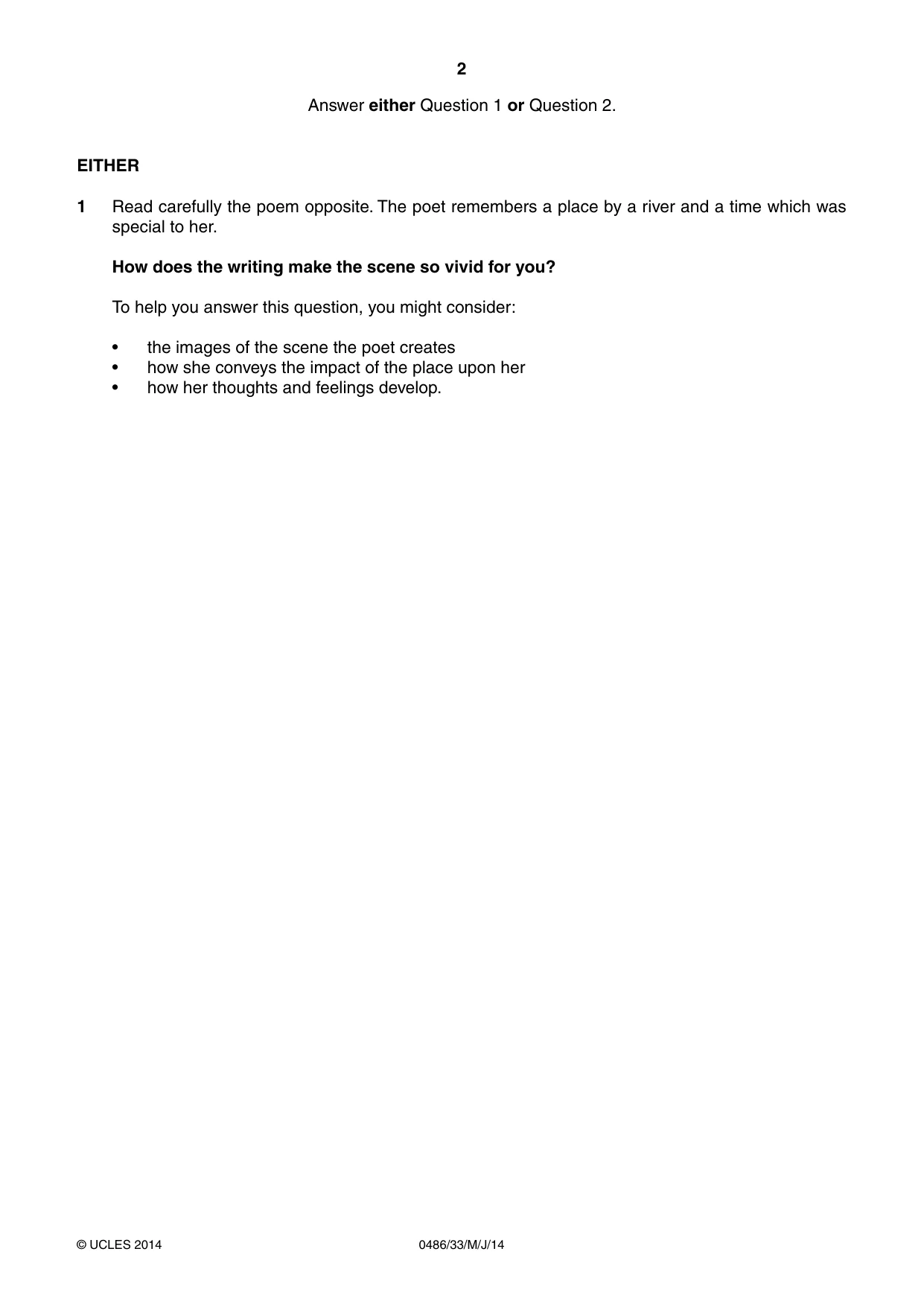
2 0486/33/M/J/14 © UCLES 2014 Answer either Question 1 or Question 2. EITHER 1 Read carefully the poem opposite. The poet remembers a place by a river and a time which was special to her. How does the writing make the scene so vivid for you? To help you answer this question, you might consider: • the images of the scene the poet creates • how she conveys the impact of the place upon her • how her thoughts and feelings develop.
Question paper, page 3
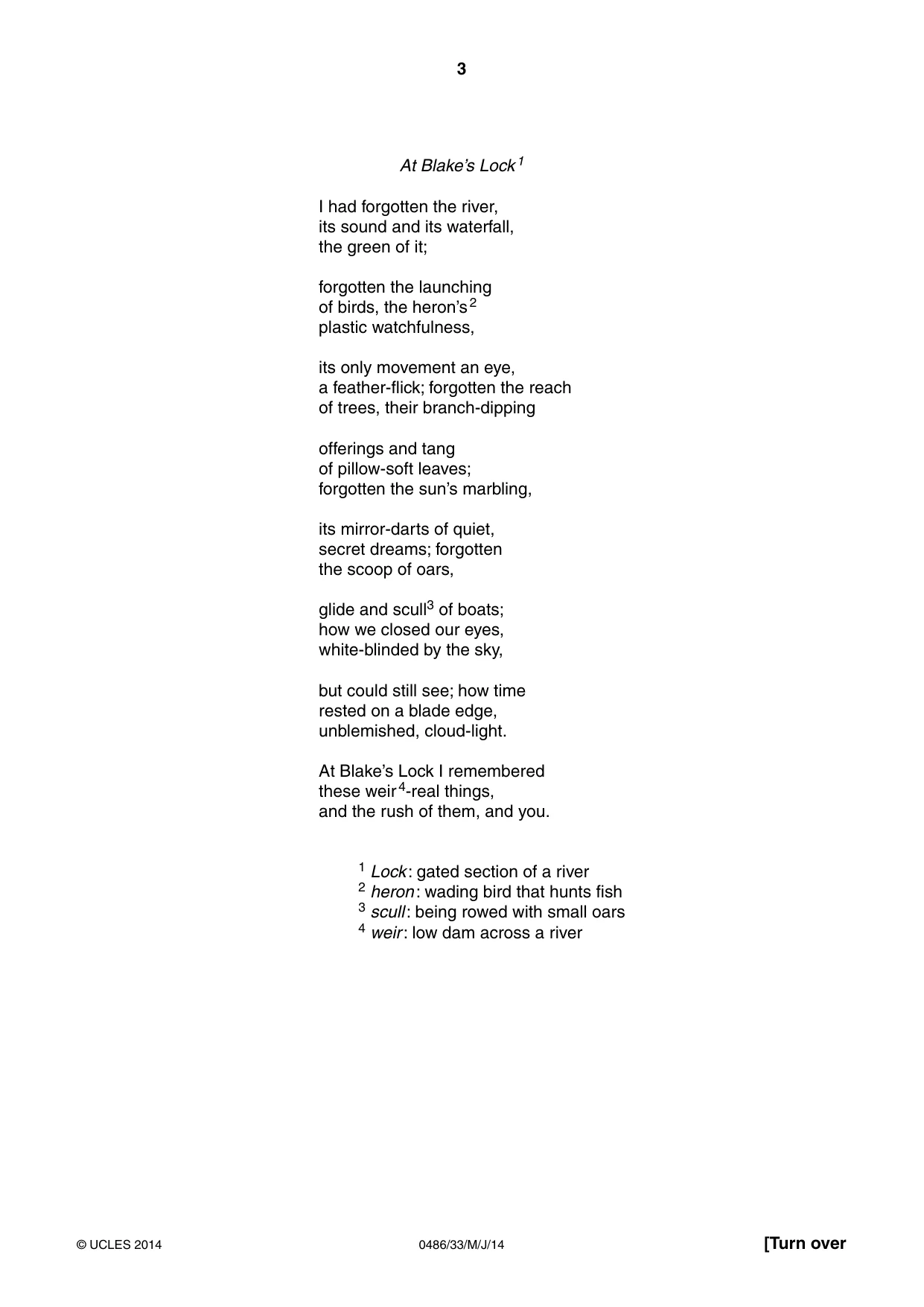
3 0486/33/M/J/14 © UCLES 2014 [Turn over At Blake’s Lock 1 I had forgotten the river, its sound and its waterfall, the green of it; forgotten the launching of birds, the heron’s 2 plastic watchfulness, its only movement an eye, a feather-flick; forgotten the reach of trees, their branch-dipping offerings and tang of pillow-soft leaves; forgotten the sun’s marbling, its mirror-darts of quiet, secret dreams; forgotten the scoop of oars, glide and scull3 of boats; how we closed our eyes, white-blinded by the sky, but could still see; how time rested on a blade edge, unblemished, cloud-light. At Blake’s Lock I remembered these weir 4-real things, and the rush of them, and you. 1 Lock : gated section of a river 2 heron : wading bird that hunts fish 3 scull : being rowed with small oars 4 weir : low dam across a river
Question paper, page 4
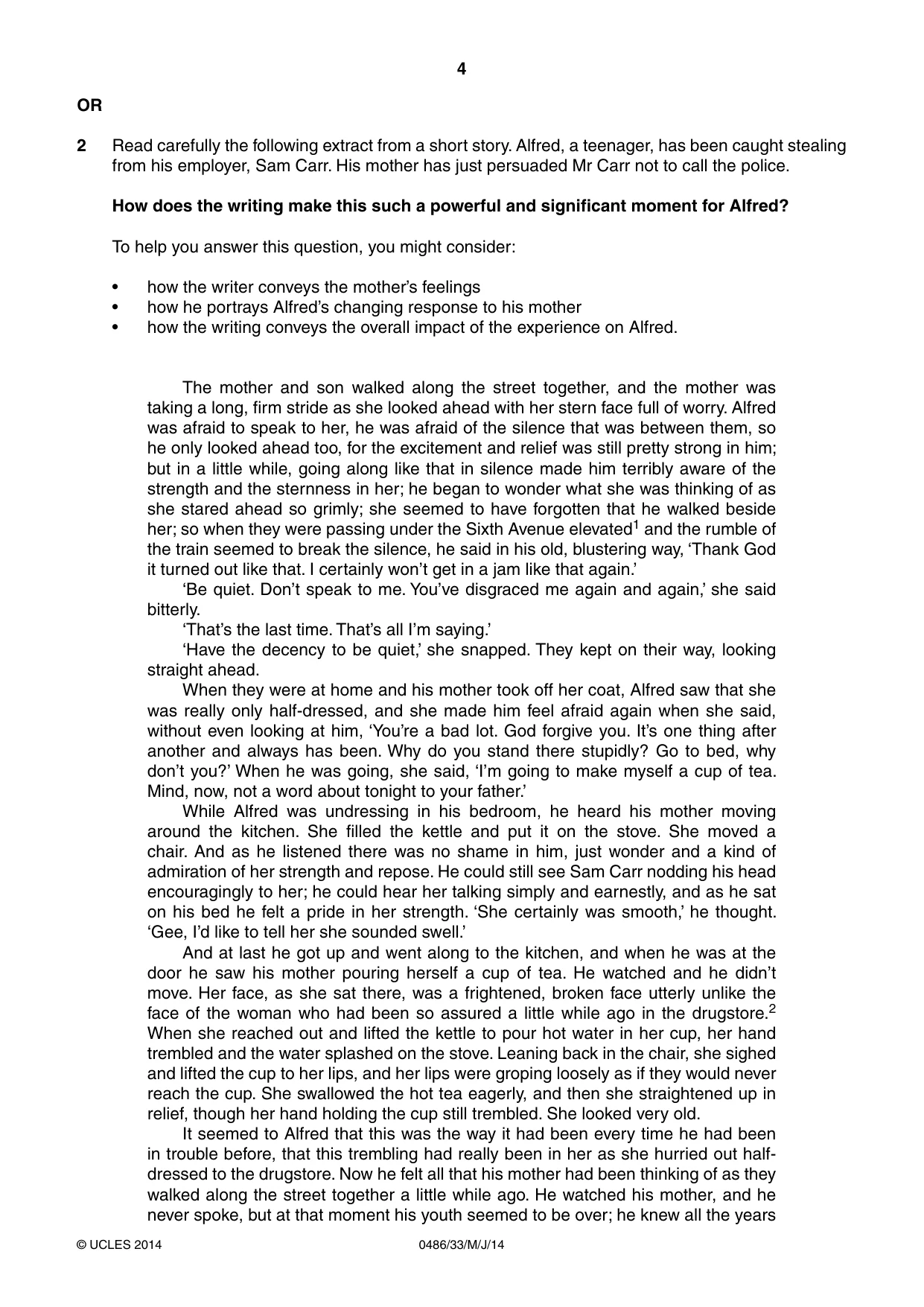
4 0486/33/M/J/14 © UCLES 2014 OR 2 Read carefully the following extract from a short story. Alfred, a teenager, has been caught stealing from his employer, Sam Carr. His mother has just persuaded Mr Carr not to call the police. How does the writing make this such a powerful and significant moment for Alfred? To help you answer this question, you might consider: • how the writer conveys the mother’s feelings • how he portrays Alfred’s changing response to his mother • how the writing conveys the overall impact of the experience on Alfred. The mother and son walked along the street together, and the mother was taking a long, firm stride as she looked ahead with her stern face full of worry. Alfred was afraid to speak to her, he was afraid of the silence that was between them, so he only looked ahead too, for the excitement and relief was still pretty strong in him; but in a little while, going along like that in silence made him terribly aware of the strength and the sternness in her; he began to wonder what she was thinking of as she stared ahead so grimly; she seemed to have forgotten that he walked beside her; so when they were passing under the Sixth Avenue elevated1 and the rumble of the train seemed to break the silence, he said in his old, blustering way, ‘Thank God it turned out like that. I certainly won’t get in a jam like that again.’ ‘Be quiet. Don’t speak to me. You’ve disgraced me again and again,’ she said bitterly. ‘That’s the last time. That’s all I’m saying.’ ‘Have the decency to be quiet,’ she snapped. They kept on their way, looking straight ahead. When they were at home and his mother took off her coat, Alfred saw that she was really only half-dressed, and she made him feel afraid again when she said, without even looking at him, ‘You’re a bad lot. God forgive you. It’s one thing after another and always has been. Why do you stand there stupidly? Go to bed, why don’t you?’ When he was going, she said, ‘I’m going to make myself a cup of tea. Mind, now, not a word about tonight to your father.’ While Alfred was undressing in his bedroom, he heard his mother moving around the kitchen. She filled the kettle and put it on the stove. She moved a chair. And as he listened there was no shame in him, just wonder and a kind of admiration of her strength and repose. He could still see Sam Carr nodding his head encouragingly to her; he could hear her talking simply and earnestly, and as he sat on his bed he felt a pride in her strength. ‘She certainly was smooth,’ he thought. ‘Gee, I’d like to tell her she sounded swell.’ And at last he got up and went along to the kitchen, and when he was at the door he saw his mother pouring herself a cup of tea. He watched and he didn’t move. Her face, as she sat there, was a frightened, broken face utterly unlike the face of the woman who had been so assured a little while ago in the drugstore.2 When she reached out and lifted the kettle to pour hot water in her cup, her hand trembled and the water splashed on the stove. Leaning back in the chair, she sighed and lifted the cup to her lips, and her lips were groping loosely as if they would never reach the cup. She swallowed the hot tea eagerly, and then she straightened up in relief, though her hand holding the cup still trembled. She looked very old. It seemed to Alfred that this was the way it had been every time he had been in trouble before, that this trembling had really been in her as she hurried out half- dressed to the drugstore. Now he felt all that his mother had been thinking of as they walked along the street together a little while ago. He watched his mother, and he never spoke, but at that moment his youth seemed to be over; he knew all the years
Question paper, page 5
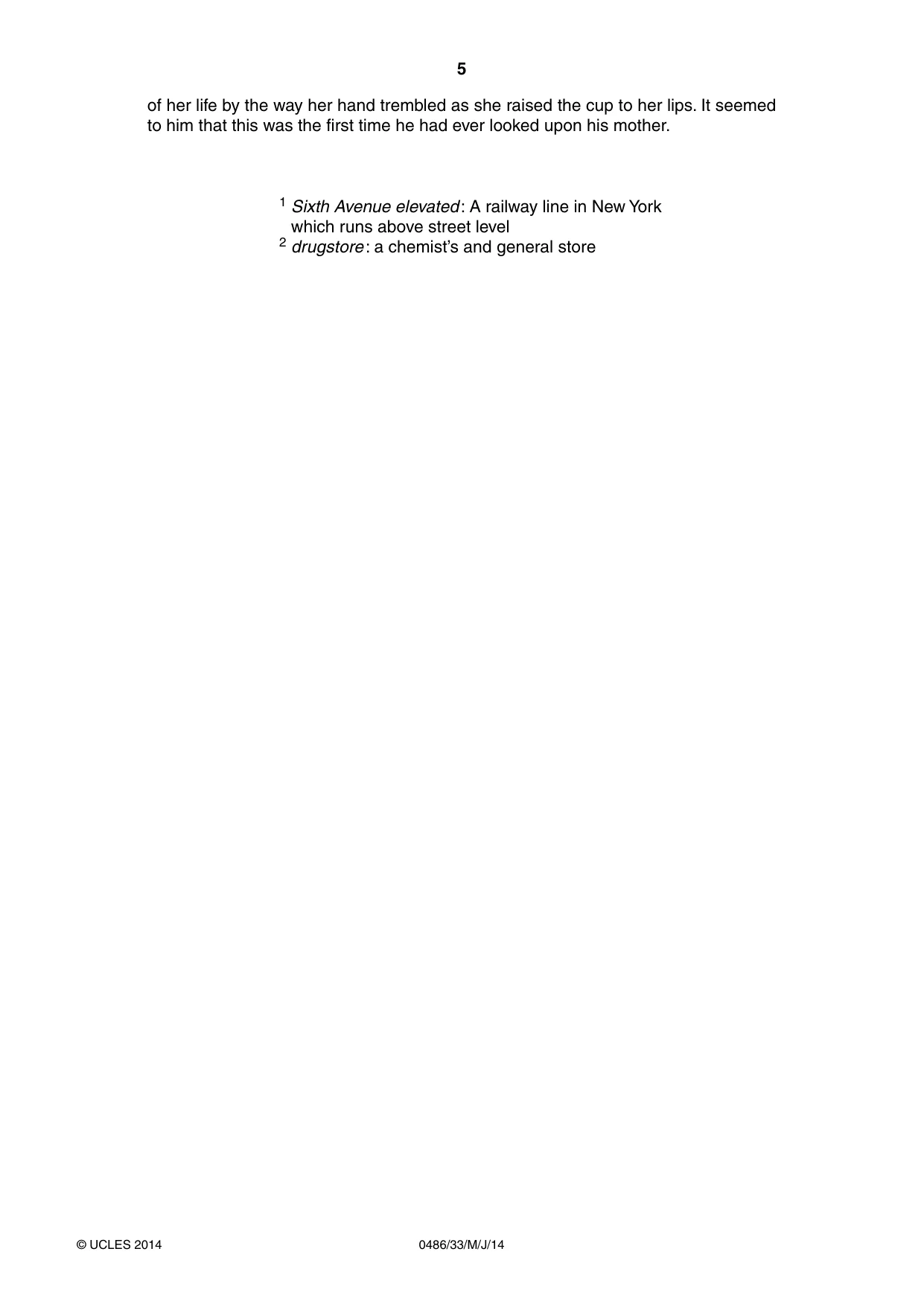
5 0486/33/M/J/14 © UCLES 2014 of her life by the way her hand trembled as she raised the cup to her lips. It seemed to him that this was the first time he had ever looked upon his mother. 1 Sixth Avenue elevated : A railway line in New York which runs above street level 2 drugstore : a chemist’s and general store
Question paper, page 6
6 0486/33/M/J/14 © UCLES 2014 BLANK PAGE
Question paper, page 7
7 0486/33/M/J/14 © UCLES 2014 BLANK PAGE
Question paper, page 8
8 0486/33/M/J/14 © UCLES 2014 Copyright Acknowledgements: Question 1 © Claire Dyer; At Blake’s Lock, from Reading Poetry, An Anthology; Two Rivers Press; 2011. Question 2 © ed. Angela Macmillan; Morley Callaghan; All the Years of Her Life, from A Little Aloud ; Published by Chatto & Windus. Reprinted by permission of The Random House Group Ltd; 2010. Permission to reproduce items where third-party owned material protected by copyright is included has been sought and cleared where possible. Every reasonable effort has been made by the publisher (UCLES) to trace copyright holders, but if any items requiring clearance have unwittingly been included, the publisher will be pleased to make amends at the earliest possible opportunity. Cambridge International Examinations is part of the Cambridge Assessment Group. Cambridge Assessment is the brand name of University of Cambridge Local Examinations Syndicate (UCLES), which is itself a department of the University of Cambridge. BLANK PAGE
Mark scheme, page 1
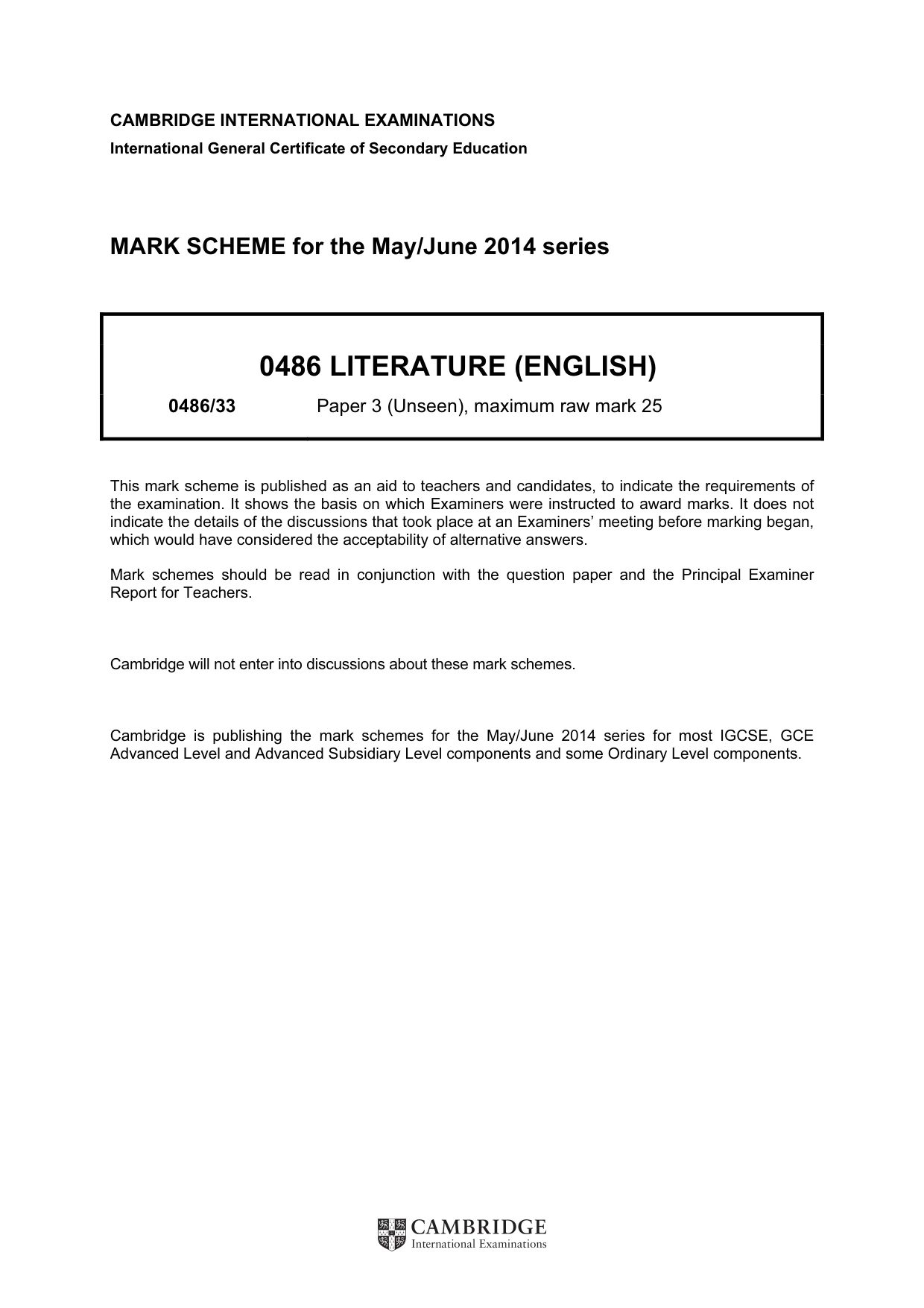
CAMBRIDGE INTERNATIONAL EXAMINATIONS International General Certificate of Secondary Education MARK SCHEME for the May/June 2014 series 0486 LITERATURE (ENGLISH) 0486/33 Paper 3 (Unseen), maximum raw mark 25 This mark scheme is published as an aid to teachers and candidates, to indicate the requirements of the examination. It shows the basis on which Examiners were instructed to award marks. It does not indicate the details of the discussions that took place at an Examiners’ meeting before marking began, which would have considered the acceptability of alternative answers. Mark schemes should be read in conjunction with the question paper and the Principal Examiner Report for Teachers. Cambridge will not enter into discussions about these mark schemes. Cambridge is publishing the mark schemes for the May/June 2014 series for most IGCSE, GCE Advanced Level and Advanced Subsidiary Level components and some Ordinary Level components.
Mark scheme, page 2
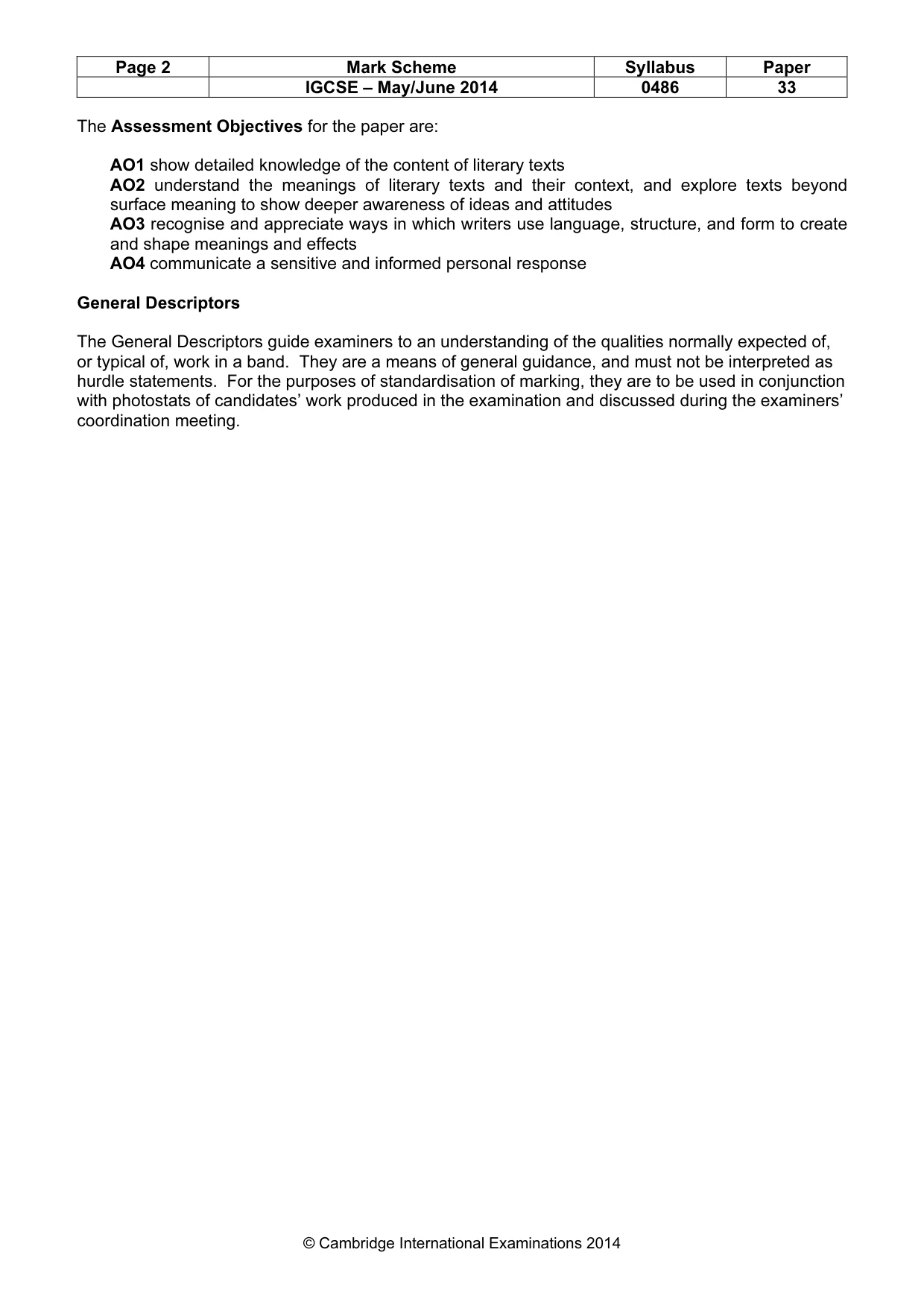
Page 2 Mark Scheme Syllabus Paper IGCSE – May/June 2014 0486 33 © Cambridge International Examinations 2014 The Assessment Objectives for the paper are: AO1 show detailed knowledge of the content of literary texts AO2 understand the meanings of literary texts and their context, and explore texts beyond surface meaning to show deeper awareness of ideas and attitudes AO3 recognise and appreciate ways in which writers use language, structure, and form to create and shape meanings and effects AO4 communicate a sensitive and informed personal response General Descriptors The General Descriptors guide examiners to an understanding of the qualities normally expected of, or typical of, work in a band. They are a means of general guidance, and must not be interpreted as hurdle statements. For the purposes of standardisation of marking, they are to be used in conjunction with photostats of candidates’ work produced in the examination and discussed during the examiners’ coordination meeting.
Mark scheme, page 3
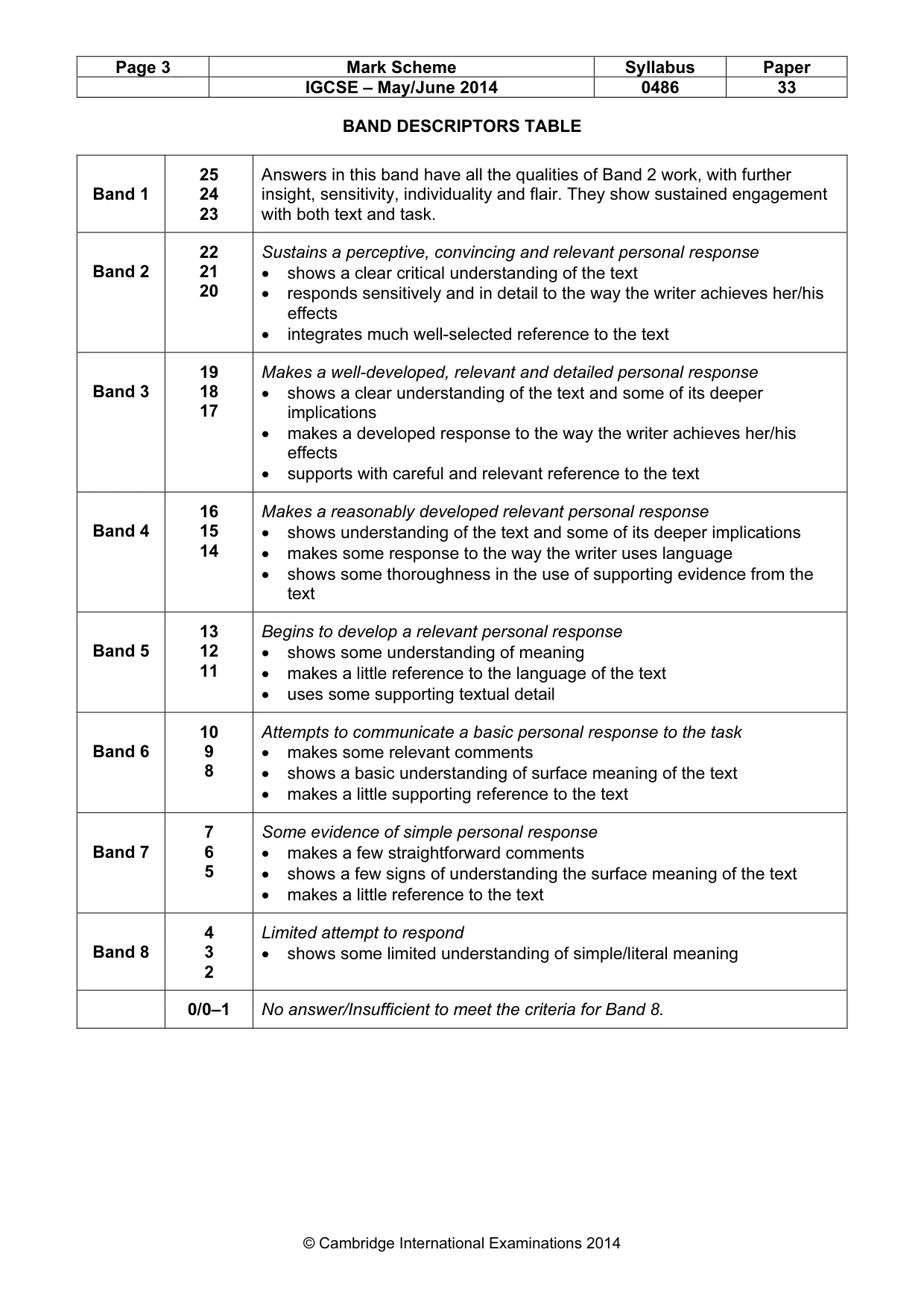
Page 3 Mark Scheme Syllabus Paper IGCSE – May/June 2014 0486 33 © Cambridge International Examinations 2014 BAND DESCRIPTORS TABLE Band 1 25 24 23 Answers in this band have all the qualities of Band 2 work, with further insight, sensitivity, individuality and flair. They show sustained engagement with both text and task. Band 2 22 21 20 Sustains a perceptive, convincing and relevant personal response • shows a clear critical understanding of the text • responds sensitively and in detail to the way the writer achieves her/his effects • integrates much well-selected reference to the text Band 3 19 18 17 Makes a well-developed, relevant and detailed personal response • shows a clear understanding of the text and some of its deeper implications • makes a developed response to the way the writer achieves her/his effects • supports with careful and relevant reference to the text Band 4 16 15 14 Makes a reasonably developed relevant personal response • shows understanding of the text and some of its deeper implications • makes some response to the way the writer uses language • shows some thoroughness in the use of supporting evidence from the text Band 5 13 12 11 Begins to develop a relevant personal response • shows some understanding of meaning • makes a little reference to the language of the text • uses some supporting textual detail Band 6 10 9 8 Attempts to communicate a basic personal response to the task • makes some relevant comments • shows a basic understanding of surface meaning of the text • makes a little supporting reference to the text Band 7 7 6 5 Some evidence of simple personal response • makes a few straightforward comments • shows a few signs of understanding the surface meaning of the text • makes a little reference to the text Band 8 4 3 2 Limited attempt to respond • shows some limited understanding of simple/literal meaning 0/0–1 No answer/Insufficient to meet the criteria for Band 8.
What you needed in this session
Cambridge’s own grade thresholds for 2014 May/June, Paper 3 · Variant 3. A higher threshold means an easier paper — the bar moves with how the cohort did.