Cambridge IGCSE English - Literature 0486 — 2014 May/June Paper 3 · Variant 1
0486/31/M/J/14 · 25 marks · ≈28 min
The question paper and its mark scheme, free to read here and free to download. This is Cambridge’s own paper, exactly as it was sat.
Question paper8 pages


Mark scheme3 pages
Answers below. Sit the paper first if you are practising.
Paper as text
Question paper, page 1
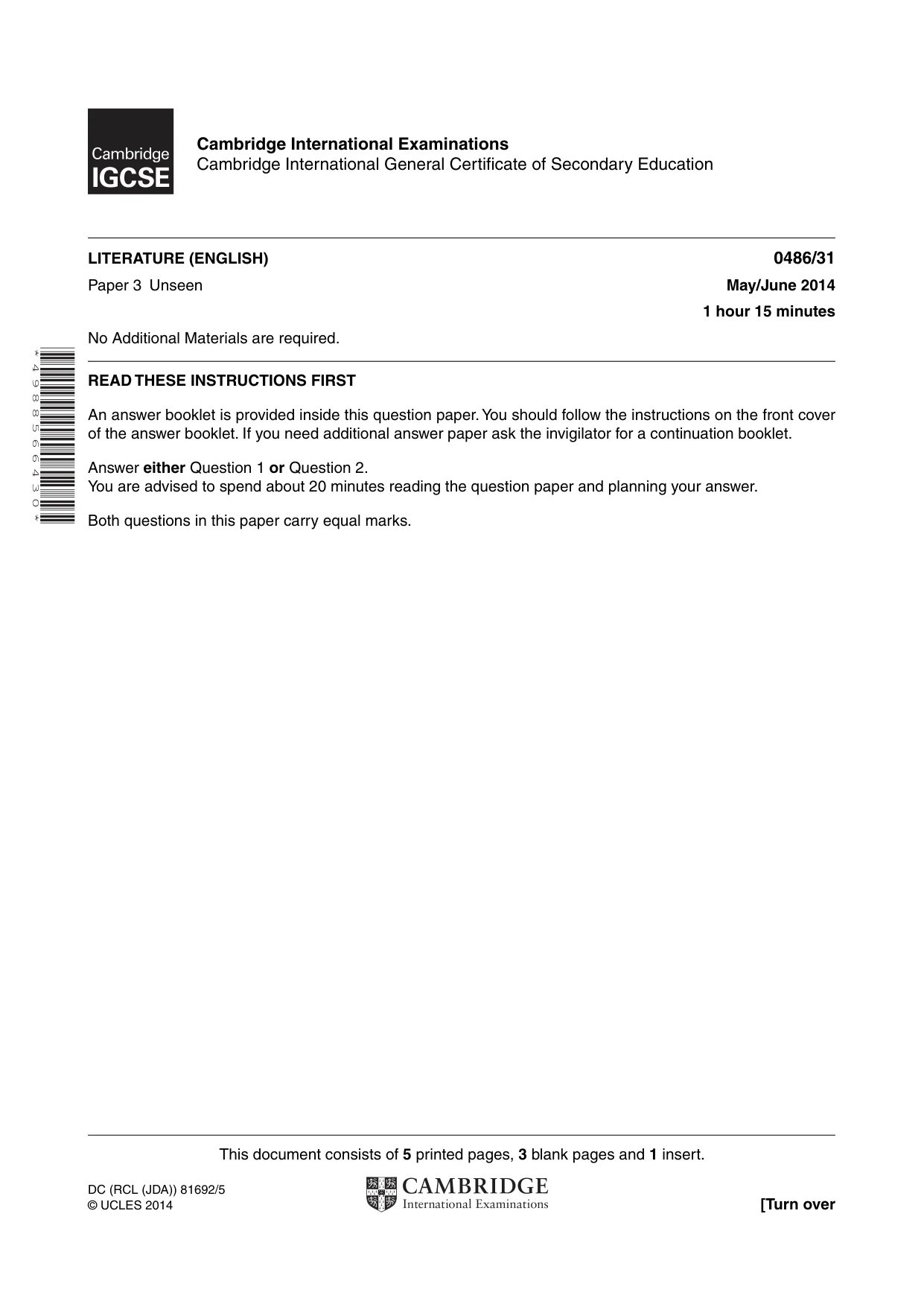
This document consists of 5 printed pages, 3 blank pages and 1 insert. DC (RCL (JDA)) 81692/5 © UCLES 2014 [Turn over Cambridge International Examinations Cambridge International General Certificate of Secondary Education * 4 9 8 8 5 6 6 4 3 0 * LITERATURE (ENGLISH) 0486/31 Paper 3 Unseen May/June 2014 1 hour 15 minutes No Additional Materials are required. READ THESE INSTRUCTIONS FIRST An answer booklet is provided inside this question paper. You should follow the instructions on the front cover of the answer booklet. If you need additional answer paper ask the invigilator for a continuation booklet. Answer either Question 1 or Question 2. You are advised to spend about 20 minutes reading the question paper and planning your answer. Both questions in this paper carry equal marks.
Question paper, page 2
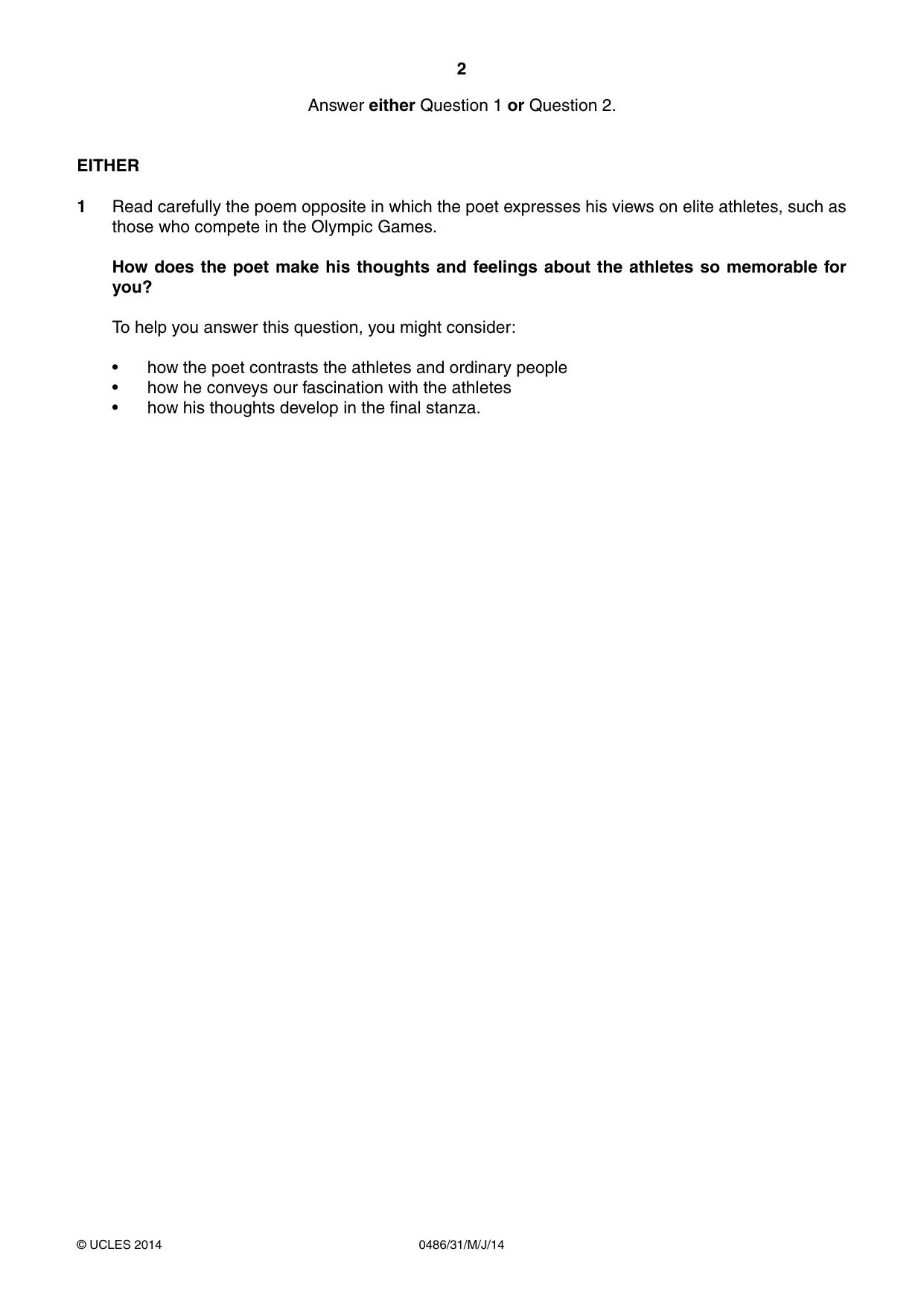
2 0486/31/M/J/14 © UCLES 2014 Answer either Question 1 or Question 2. EITHER 1 Read carefully the poem opposite in which the poet expresses his views on elite athletes, such as those who compete in the Olympic Games. How does the poet make his thoughts and feelings about the athletes so memorable for you? To help you answer this question, you might consider: • how the poet contrasts the athletes and ordinary people • how he conveys our fascination with the athletes • how his thoughts develop in the final stanza.
Question paper, page 3
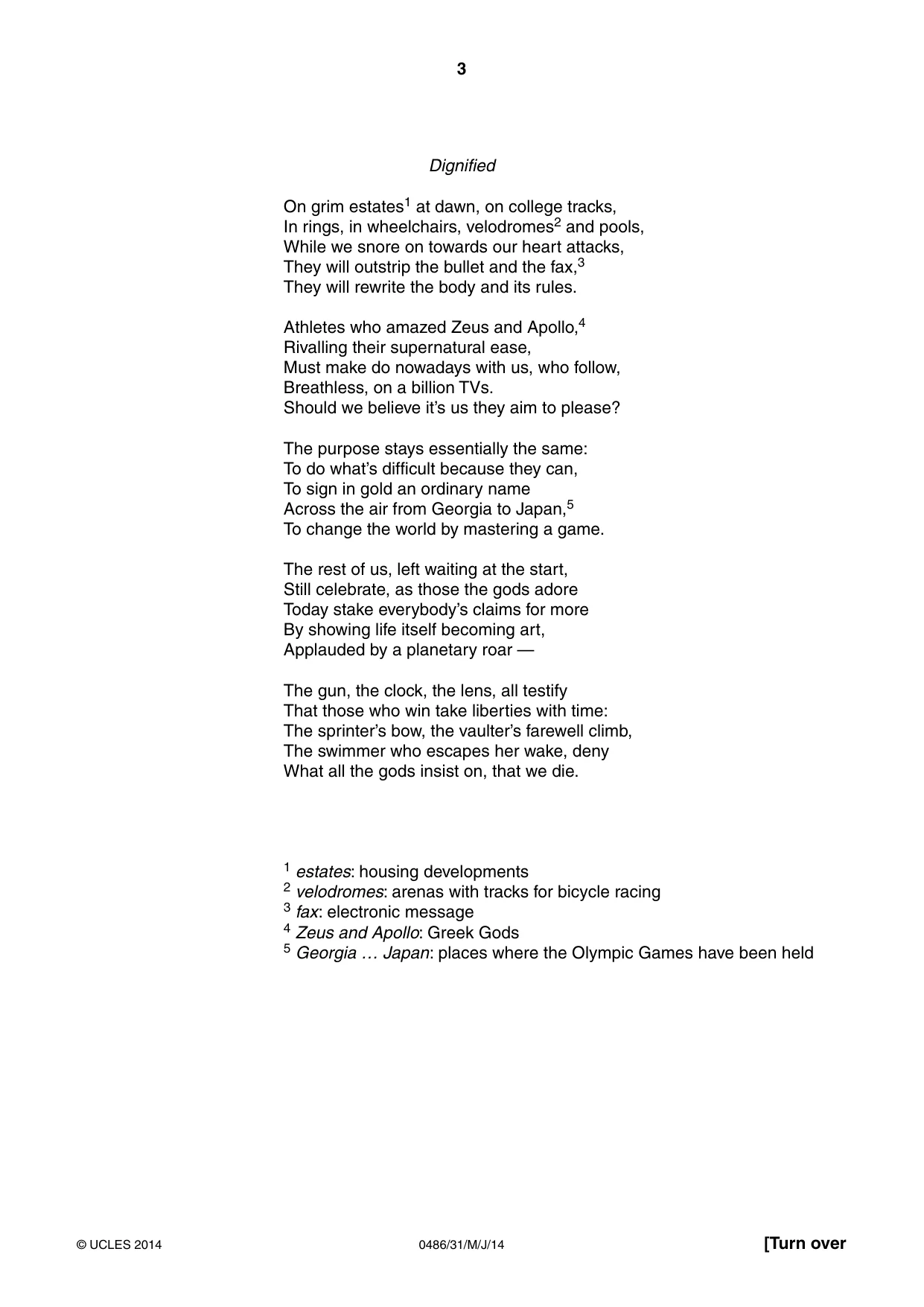
3 0486/31/M/J/14 © UCLES 2014 [Turn over Dignified On grim estates1 at dawn, on college tracks, In rings, in wheelchairs, velodromes2 and pools, While we snore on towards our heart attacks, They will outstrip the bullet and the fax,3 They will rewrite the body and its rules. Athletes who amazed Zeus and Apollo,4 Rivalling their supernatural ease, Must make do nowadays with us, who follow, Breathless, on a billion TVs. Should we believe it’s us they aim to please? The purpose stays essentially the same: To do what’s difficult because they can, To sign in gold an ordinary name Across the air from Georgia to Japan,5 To change the world by mastering a game. The rest of us, left waiting at the start, Still celebrate, as those the gods adore Today stake everybody’s claims for more By showing life itself becoming art, Applauded by a planetary roar — The gun, the clock, the lens, all testify That those who win take liberties with time: The sprinter’s bow, the vaulter’s farewell climb, The swimmer who escapes her wake, deny What all the gods insist on, that we die. 1 estates: housing developments 2 velodromes: arenas with tracks for bicycle racing 3 fax : electronic message 4 Zeus and Apollo: Greek Gods 5 Georgia … Japan : places where the Olympic Games have been held
Question paper, page 4
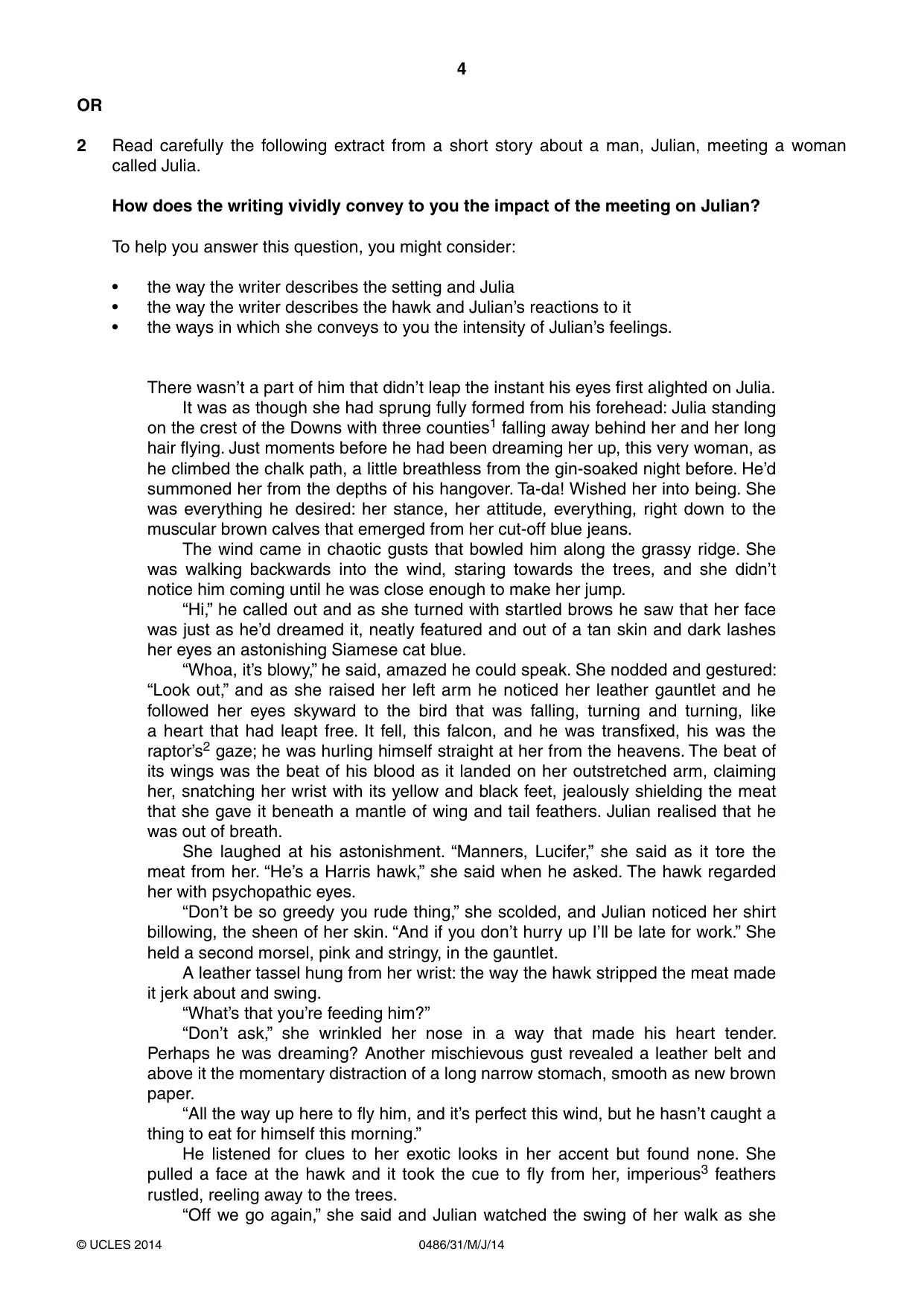
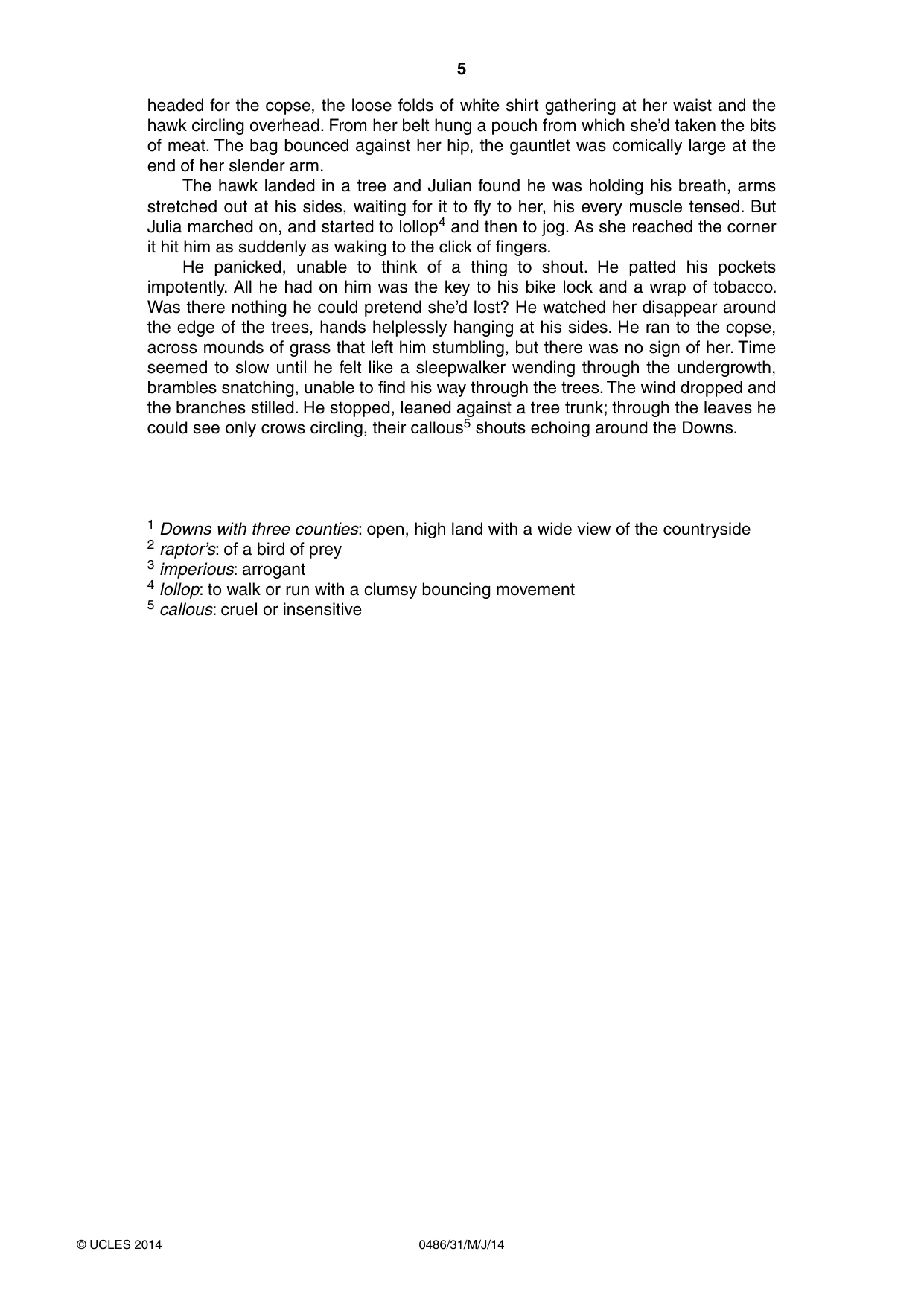
4 0486/31/M/J/14 © UCLES 2014 OR 2 Read carefully the following extract from a short story about a man, Julian, meeting a woman called Julia. How does the writing vividly convey to you the impact of the meeting on Julian? To help you answer this question, you might consider: • the way the writer describes the setting and Julia • the way the writer describes the hawk and Julian’s reactions to it • the ways in which she conveys to you the intensity of Julian’s feelings. There wasn’t a part of him that didn’t leap the instant his eyes first alighted on Julia. It was as though she had sprung fully formed from his forehead: Julia standing on the crest of the Downs with three counties1 falling away behind her and her long hair flying. Just moments before he had been dreaming her up, this very woman, as he climbed the chalk path, a little breathless from the gin-soaked night before. He’d summoned her from the depths of his hangover. Ta-da! Wished her into being. She was everything he desired: her stance, her attitude, everything, right down to the muscular brown calves that emerged from her cut-off blue jeans. The wind came in chaotic gusts that bowled him along the grassy ridge. She was walking backwards into the wind, staring towards the trees, and she didn’t notice him coming until he was close enough to make her jump. “Hi,” he called out and as she turned with startled brows he saw that her face was just as he’d dreamed it, neatly featured and out of a tan skin and dark lashes her eyes an astonishing Siamese cat blue. “Whoa, it’s blowy,” he said, amazed he could speak. She nodded and gestured: “Look out,” and as she raised her left arm he noticed her leather gauntlet and he followed her eyes skyward to the bird that was falling, turning and turning, like a heart that had leapt free. It fell, this falcon, and he was transfixed, his was the raptor’s2 gaze; he was hurling himself straight at her from the heavens. The beat of its wings was the beat of his blood as it landed on her outstretched arm, claiming her, snatching her wrist with its yellow and black feet, jealously shielding the meat that she gave it beneath a mantle of wing and tail feathers. Julian realised that he was out of breath. She laughed at his astonishment. “Manners, Lucifer,” she said as it tore the meat from her. “He’s a Harris hawk,” she said when he asked. The hawk regarded her with psychopathic eyes. “Don’t be so greedy you rude thing,” she scolded, and Julian noticed her shirt billowing, the sheen of her skin. “And if you don’t hurry up I’ll be late for work.” She held a second morsel, pink and stringy, in the gauntlet. A leather tassel hung from her wrist: the way the hawk stripped the meat made it jerk about and swing. “What’s that you’re feeding him?” “Don’t ask,” she wrinkled her nose in a way that made his heart tender. Perhaps he was dreaming? Another mischievous gust revealed a leather belt and above it the momentary distraction of a long narrow stomach, smooth as new brown paper. “All the way up here to fly him, and it’s perfect this wind, but he hasn’t caught a thing to eat for himself this morning.” He listened for clues to her exotic looks in her accent but found none. She pulled a face at the hawk and it took the cue to fly from her, imperious3 feathers rustled, reeling away to the trees. “Off we go again,” she said and Julian watched the swing of her walk as she
Question paper, page 5
5 0486/31/M/J/14 © UCLES 2014 headed for the copse, the loose folds of white shirt gathering at her waist and the hawk circling overhead. From her belt hung a pouch from which she’d taken the bits of meat. The bag bounced against her hip, the gauntlet was comically large at the end of her slender arm. The hawk landed in a tree and Julian found he was holding his breath, arms stretched out at his sides, waiting for it to fly to her, his every muscle tensed. But Julia marched on, and started to lollop4 and then to jog. As she reached the corner it hit him as suddenly as waking to the click of fingers. He panicked, unable to think of a thing to shout. He patted his pockets impotently. All he had on him was the key to his bike lock and a wrap of tobacco. Was there nothing he could pretend she’d lost? He watched her disappear around the edge of the trees, hands helplessly hanging at his sides. He ran to the copse, across mounds of grass that left him stumbling, but there was no sign of her. Time seemed to slow until he felt like a sleepwalker wending through the undergrowth, brambles snatching, unable to find his way through the trees. The wind dropped and the branches stilled. He stopped, leaned against a tree trunk; through the leaves he could see only crows circling, their callous5 shouts echoing around the Downs. 1 Downs with three counties: open, high land with a wide view of the countryside 2 raptor’s: of a bird of prey 3 imperious: arrogant 4 lollop: to walk or run with a clumsy bouncing movement 5 callous: cruel or insensitive
Question paper, page 6
6 0486/31/M/J/14 © UCLES 2014 BLANK PAGE
Question paper, page 7
7 0486/31/M/J/14 © UCLES 2014 BLANK PAGE
Question paper, page 8
8 0486/31/M/J/14 © UCLES 2014 Copyright Acknowledgements: Question 1 © Sean O’Brien; Dignified, from Sports Pages in Not Just a Game: Sporting Poetry; Five Leaves; 2006. Question 2 © Polly Sampson; The Man Who Fell, from The Guardian Review Book of Short Stories; Guardian News & Media Ltd; 2011. Permission to reproduce items where third-party owned material protected by copyright is included has been sought and cleared where possible. Every reasonable effort has been made by the publisher (UCLES) to trace copyright holders, but if any items requiring clearance have unwittingly been included, the publisher will be pleased to make amends at the earliest possible opportunity. Cambridge International Examinations is part of the Cambridge Assessment Group. Cambridge Assessment is the brand name of University of Cambridge Local Examinations Syndicate (UCLES), which is itself a department of the University of Cambridge. BLANK PAGE
Mark scheme, page 1
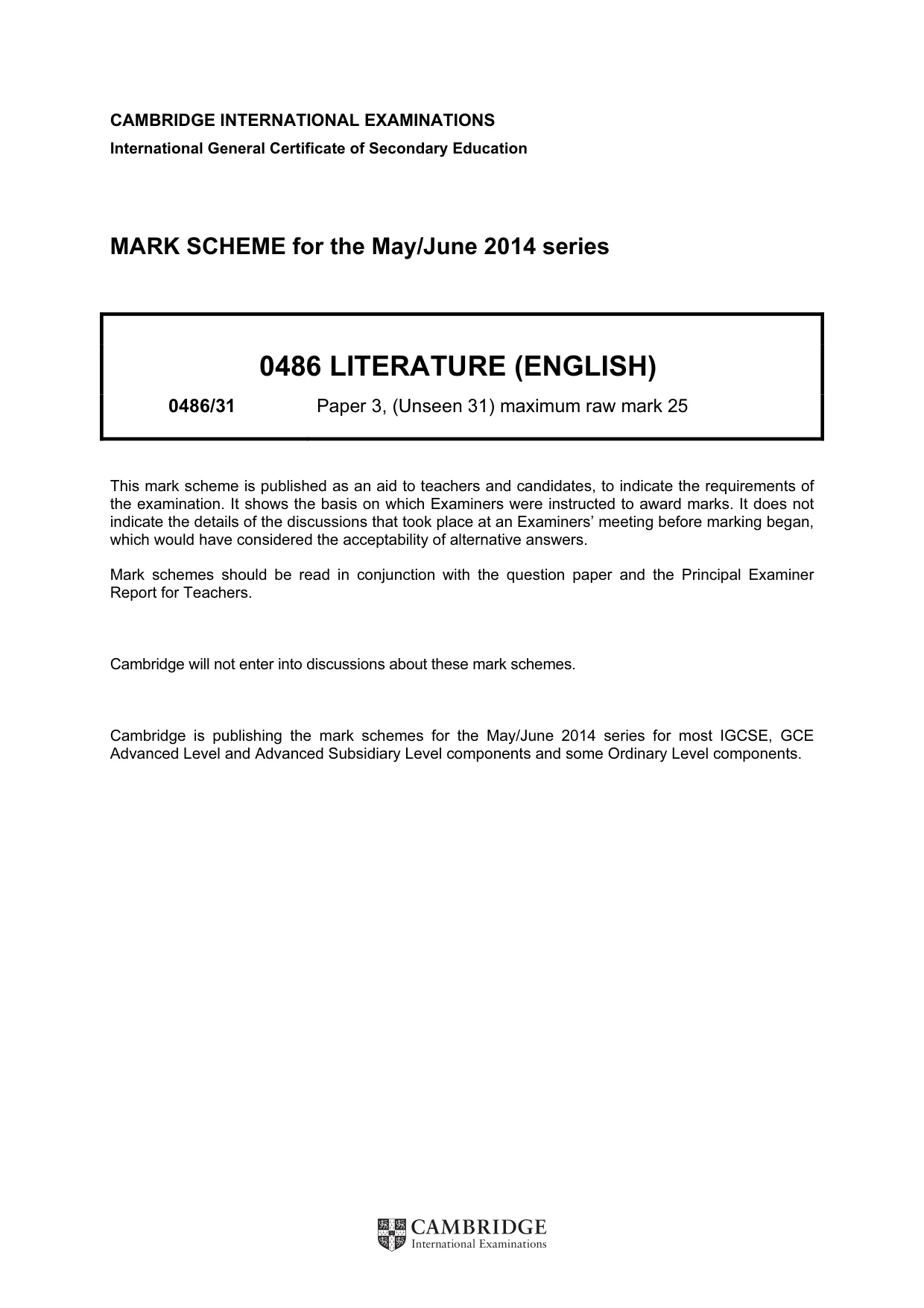
CAMBRIDGE INTERNATIONAL EXAMINATIONS International General Certificate of Secondary Education MARK SCHEME for the May/June 2014 series 0486 LITERATURE (ENGLISH) 0486/31 Paper 3, (Unseen 31) maximum raw mark 25 This mark scheme is published as an aid to teachers and candidates, to indicate the requirements of the examination. It shows the basis on which Examiners were instructed to award marks. It does not indicate the details of the discussions that took place at an Examiners’ meeting before marking began, which would have considered the acceptability of alternative answers. Mark schemes should be read in conjunction with the question paper and the Principal Examiner Report for Teachers. Cambridge will not enter into discussions about these mark schemes. Cambridge is publishing the mark schemes for the May/June 2014 series for most IGCSE, GCE Advanced Level and Advanced Subsidiary Level components and some Ordinary Level components.
Mark scheme, page 2
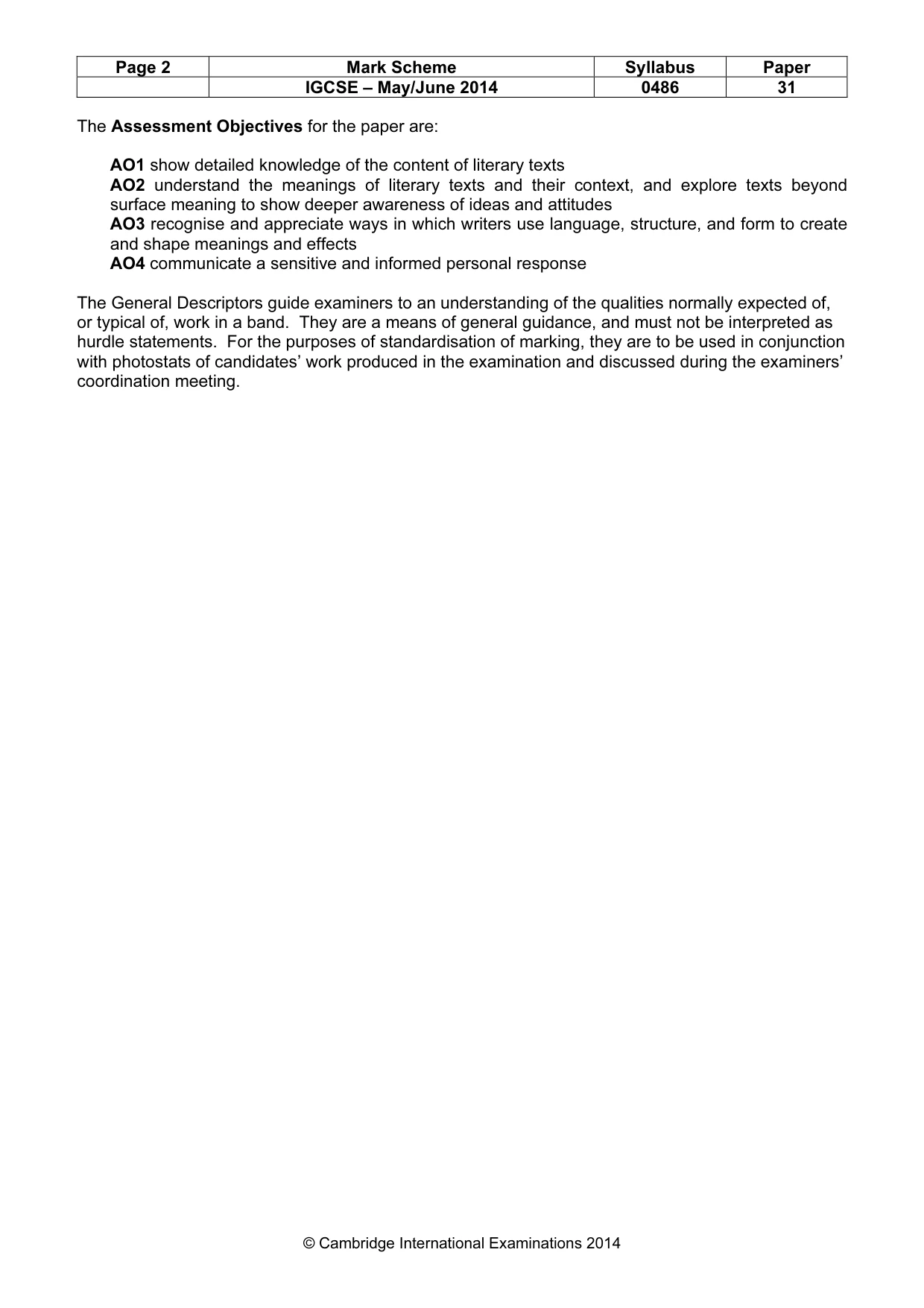
Page 2 Mark Scheme Syllabus Paper IGCSE – May/June 2014 0486 31 © Cambridge International Examinations 2014 The Assessment Objectives for the paper are: AO1 show detailed knowledge of the content of literary texts AO2 understand the meanings of literary texts and their context, and explore texts beyond surface meaning to show deeper awareness of ideas and attitudes AO3 recognise and appreciate ways in which writers use language, structure, and form to create and shape meanings and effects AO4 communicate a sensitive and informed personal response The General Descriptors guide examiners to an understanding of the qualities normally expected of, or typical of, work in a band. They are a means of general guidance, and must not be interpreted as hurdle statements. For the purposes of standardisation of marking, they are to be used in conjunction with photostats of candidates’ work produced in the examination and discussed during the examiners’ coordination meeting.
Mark scheme, page 3
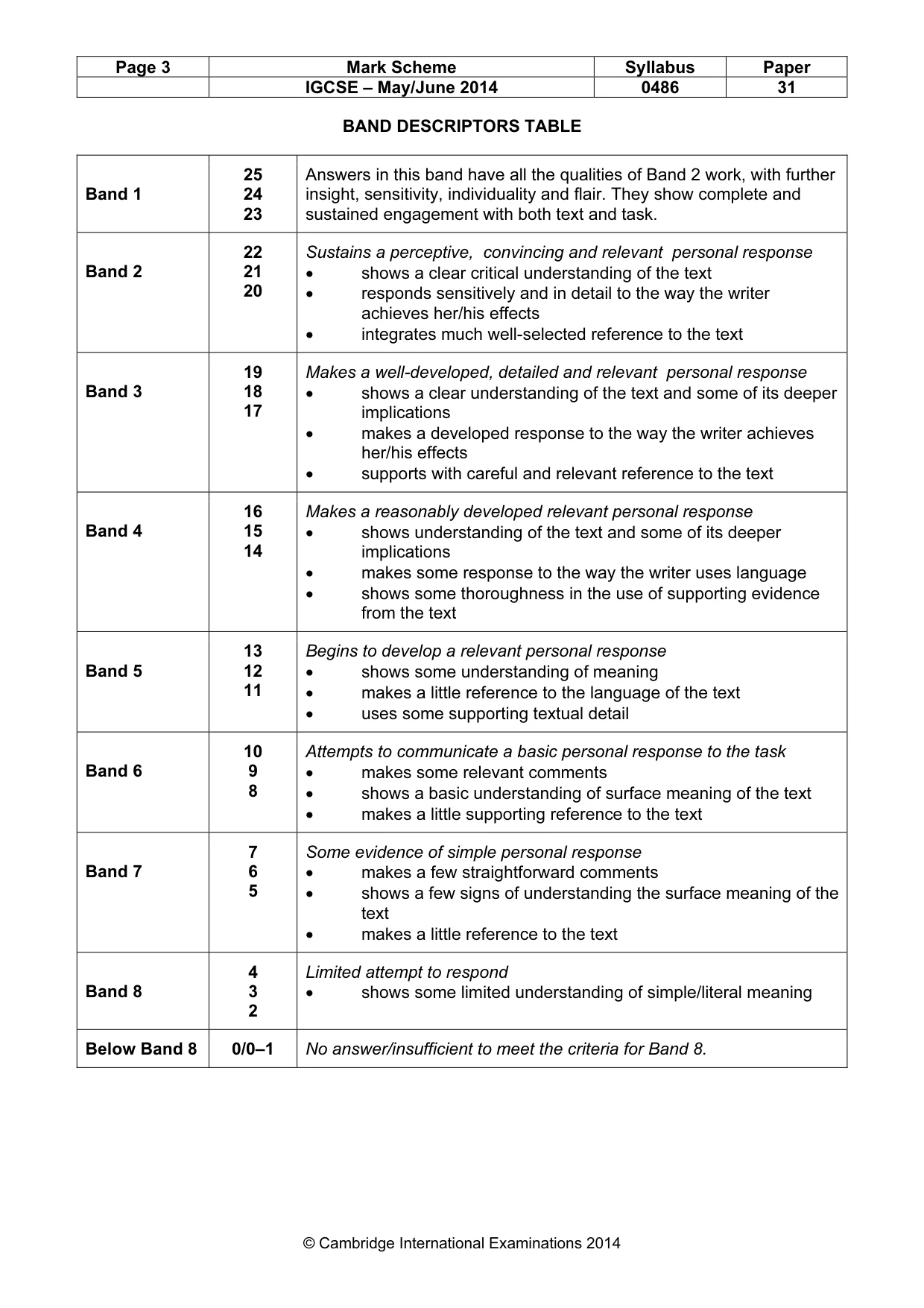
Page 3 Mark Scheme Syllabus Paper IGCSE – May/June 2014 0486 31 © Cambridge International Examinations 2014 BAND DESCRIPTORS TABLE Band 1 25 24 23 Answers in this band have all the qualities of Band 2 work, with further insight, sensitivity, individuality and flair. They show complete and sustained engagement with both text and task. Band 2 22 21 20 Sustains a perceptive, convincing and relevant personal response • shows a clear critical understanding of the text • responds sensitively and in detail to the way the writer achieves her/his effects • integrates much well-selected reference to the text Band 3 19 18 17 Makes a well-developed, detailed and relevant personal response • shows a clear understanding of the text and some of its deeper implications • makes a developed response to the way the writer achieves her/his effects • supports with careful and relevant reference to the text Band 4 16 15 14 Makes a reasonably developed relevant personal response • shows understanding of the text and some of its deeper implications • makes some response to the way the writer uses language • shows some thoroughness in the use of supporting evidence from the text Band 5 13 12 11 Begins to develop a relevant personal response • shows some understanding of meaning • makes a little reference to the language of the text • uses some supporting textual detail Band 6 10 9 8 Attempts to communicate a basic personal response to the task • makes some relevant comments • shows a basic understanding of surface meaning of the text • makes a little supporting reference to the text Band 7 7 6 5 Some evidence of simple personal response • makes a few straightforward comments • shows a few signs of understanding the surface meaning of the text • makes a little reference to the text Band 8 4 3 2 Limited attempt to respond • shows some limited understanding of simple/literal meaning Below Band 8 0/0–1 No answer/insufficient to meet the criteria for Band 8.
What you needed in this session
Cambridge’s own grade thresholds for 2014 May/June, Paper 3 · Variant 1. A higher threshold means an easier paper — the bar moves with how the cohort did.