Cambridge IGCSE English - Literature 0486 — 2013 May/June Paper 3 · Variant 3
0486/33/M/J/13 · 25 marks · ≈28 min
The question paper and its mark scheme, free to read here and free to download. This is Cambridge’s own paper, exactly as it was sat.
Question paper8 pages



Mark scheme3 pages
Answers below. Sit the paper first if you are practising.
Paper as text
Question paper, page 1
This document consists of 5 printed pages and 3 blank pages. DC (LEG) 63675/2 © UCLES 2013 [Turn over UNIVERSITY OF CAMBRIDGE INTERNATIONAL EXAMINATIONS International General Certificate of Secondary Education * 5 0 9 8 8 0 1 5 8 4 * LITERATURE (ENGLISH) 0486/33 Paper 3 Unseen May/June 2013 1 hour 15 minutes Additional Materials: Answer Booklet/Paper READ THESE INSTRUCTIONS FIRST If you have been given an Answer Booklet, follow the instructions on the front cover of the Booklet. Write your Centre number, candidate number and name on all the work you hand in. Write in dark blue or black pen. Do not use staples, paper clips, highlighters, glue or correction fluid. Answer either Question 1 or Question 2. You are advised to spend about 20 minutes reading the question paper and planning your answer. At the end of the examination, fasten all your work securely together. Both questions in this paper carry equal marks. www.XtremePapers.com
Question paper, page 2
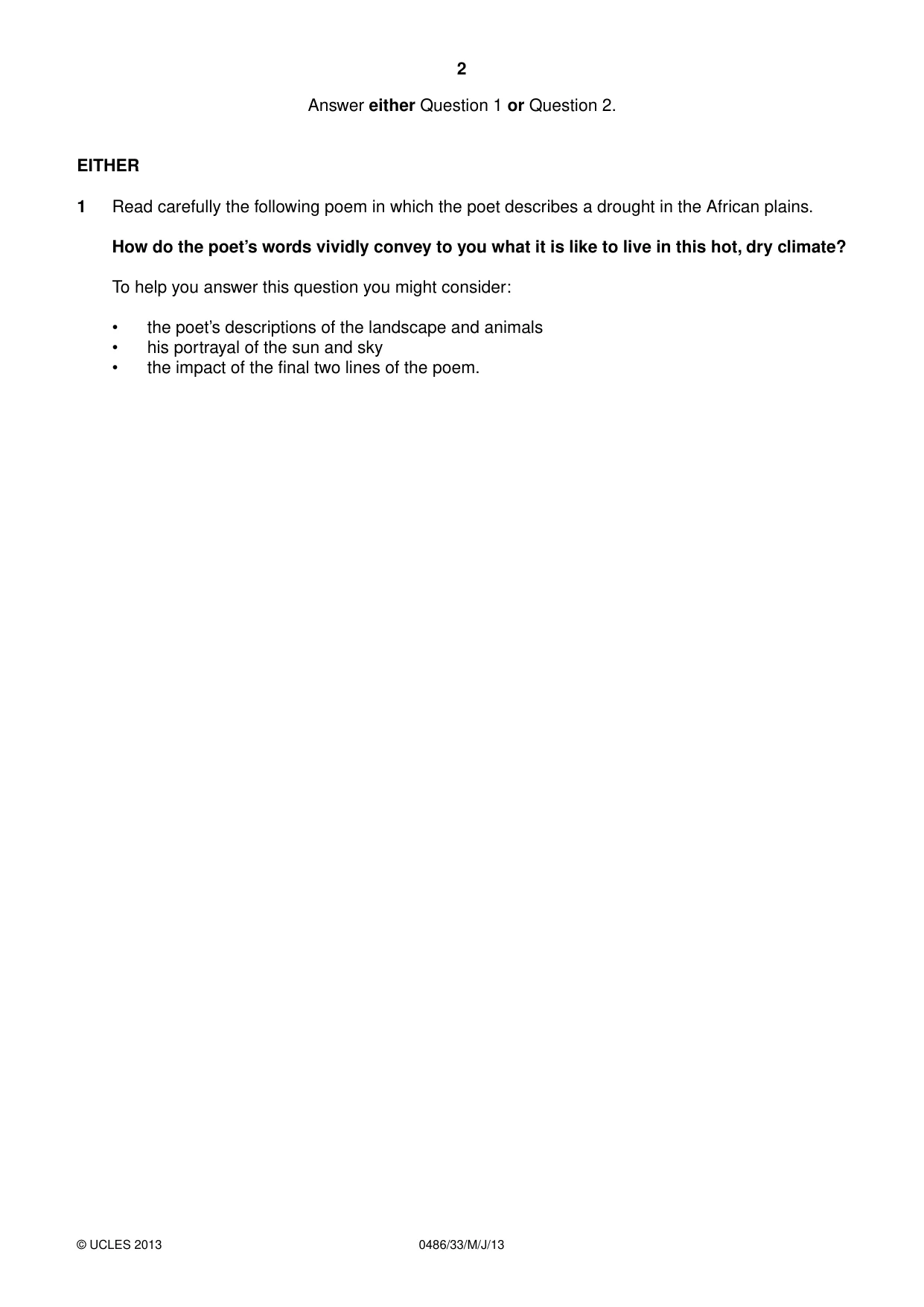
2 0486/33/M/J/13 © UCLES 2013 Answer either Question 1 or Question 2. EITHER 1 Read carefully the following poem in which the poet describes a drought in the African plains. How do the poet’s words vividly convey to you what it is like to live in this hot, dry climate? To help you answer this question you might consider: • the poet’s descriptions of the landscape and animals • his portrayal of the sun and sky • the impact of the final two lines of the poem.
Question paper, page 3
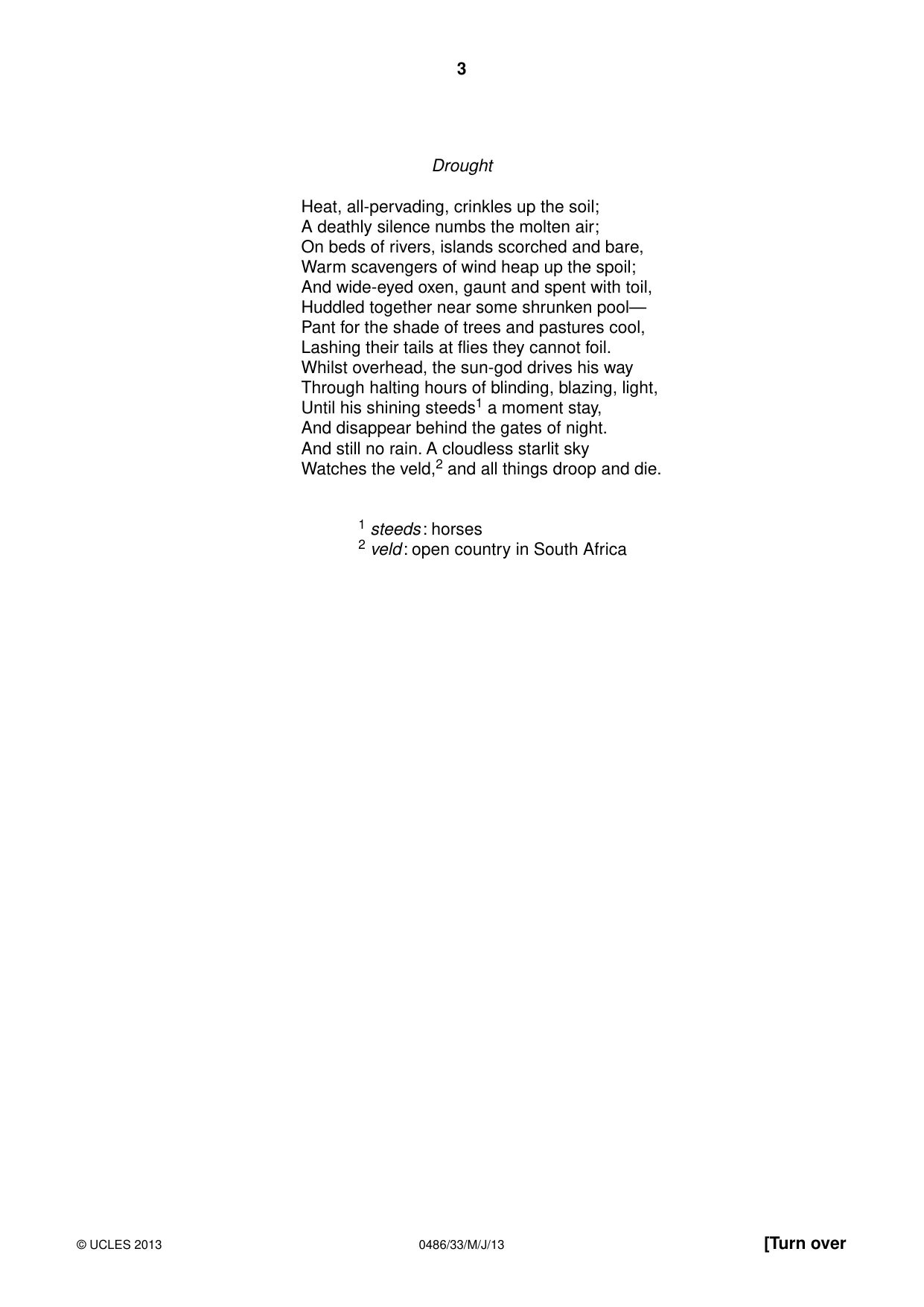
3 0486/33/M/J/13 © UCLES 2013 [Turn over Drought Heat, all-pervading, crinkles up the soil; A deathly silence numbs the molten air; On beds of rivers, islands scorched and bare, Warm scavengers of wind heap up the spoil; And wide-eyed oxen, gaunt and spent with toil, Huddled together near some shrunken pool— Pant for the shade of trees and pastures cool, Lashing their tails at flies they cannot foil. Whilst overhead, the sun-god drives his way Through halting hours of blinding, blazing, light, Until his shining steeds1 a moment stay, And disappear behind the gates of night. And still no rain. A cloudless starlit sky Watches the veld,2 and all things droop and die. 1 steeds : horses 2 veld : open country in South Africa
Question paper, page 4
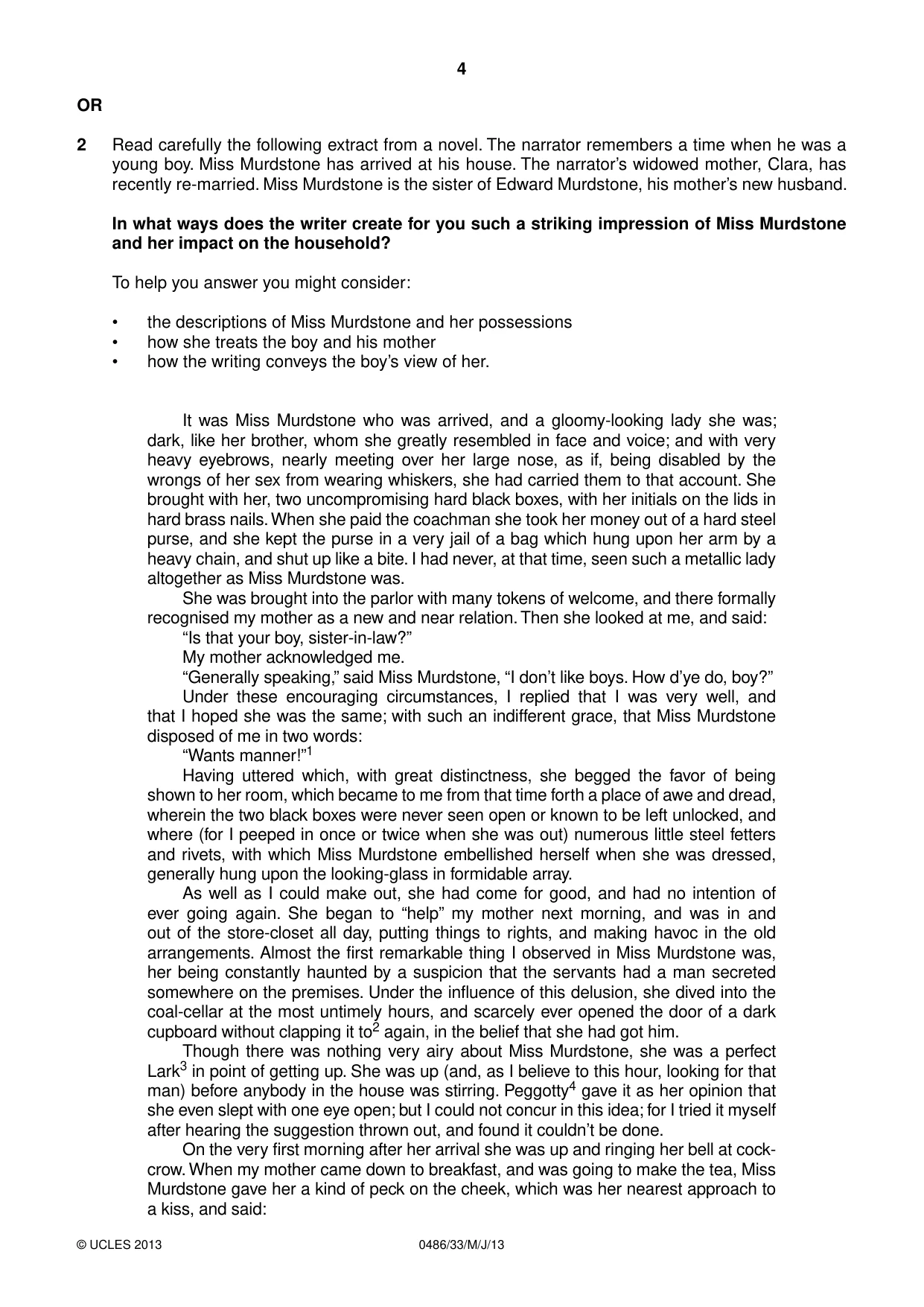
4 0486/33/M/J/13 © UCLES 2013 OR 2 Read carefully the following extract from a novel. The narrator remembers a time when he was a young boy. Miss Murdstone has arrived at his house. The narrator’s widowed mother, Clara, has recently re-married. Miss Murdstone is the sister of Edward Murdstone, his mother’s new husband. In what ways does the writer create for you such a striking impression of Miss Murdstone and her impact on the household? To help you answer you might consider: • the descriptions of Miss Murdstone and her possessions • how she treats the boy and his mother • how the writing conveys the boy’s view of her. It was Miss Murdstone who was arrived, and a gloomy-looking lady she was; dark, like her brother, whom she greatly resembled in face and voice; and with very heavy eyebrows, nearly meeting over her large nose, as if, being disabled by the wrongs of her sex from wearing whiskers, she had carried them to that account. She brought with her, two uncompromising hard black boxes, with her initials on the lids in hard brass nails. When she paid the coachman she took her money out of a hard steel purse, and she kept the purse in a very jail of a bag which hung upon her arm by a heavy chain, and shut up like a bite. I had never, at that time, seen such a metallic lady altogether as Miss Murdstone was. She was brought into the parlor with many tokens of welcome, and there formally recognised my mother as a new and near relation. Then she looked at me, and said: “Is that your boy, sister-in-law?” My mother acknowledged me. “Generally speaking,” said Miss Murdstone, “I don’t like boys. How d’ye do, boy?” Under these encouraging circumstances, I replied that I was very well, and that I hoped she was the same; with such an indifferent grace, that Miss Murdstone disposed of me in two words: “Wants manner!”1 Having uttered which, with great distinctness, she begged the favor of being shown to her room, which became to me from that time forth a place of awe and dread, wherein the two black boxes were never seen open or known to be left unlocked, and where (for I peeped in once or twice when she was out) numerous little steel fetters and rivets, with which Miss Murdstone embellished herself when she was dressed, generally hung upon the looking-glass in formidable array. As well as I could make out, she had come for good, and had no intention of ever going again. She began to “help” my mother next morning, and was in and out of the store-closet all day, putting things to rights, and making havoc in the old arrangements. Almost the first remarkable thing I observed in Miss Murdstone was, her being constantly haunted by a suspicion that the servants had a man secreted somewhere on the premises. Under the influence of this delusion, she dived into the coal-cellar at the most untimely hours, and scarcely ever opened the door of a dark cupboard without clapping it to2 again, in the belief that she had got him. Though there was nothing very airy about Miss Murdstone, she was a perfect Lark3 in point of getting up. She was up (and, as I believe to this hour, looking for that man) before anybody in the house was stirring. Peggotty4 gave it as her opinion that she even slept with one eye open; but I could not concur in this idea; for I tried it myself after hearing the suggestion thrown out, and found it couldn’t be done. On the very first morning after her arrival she was up and ringing her bell at cock- crow. When my mother came down to breakfast, and was going to make the tea, Miss Murdstone gave her a kind of peck on the cheek, which was her nearest approach to a kiss, and said:
Question paper, page 5
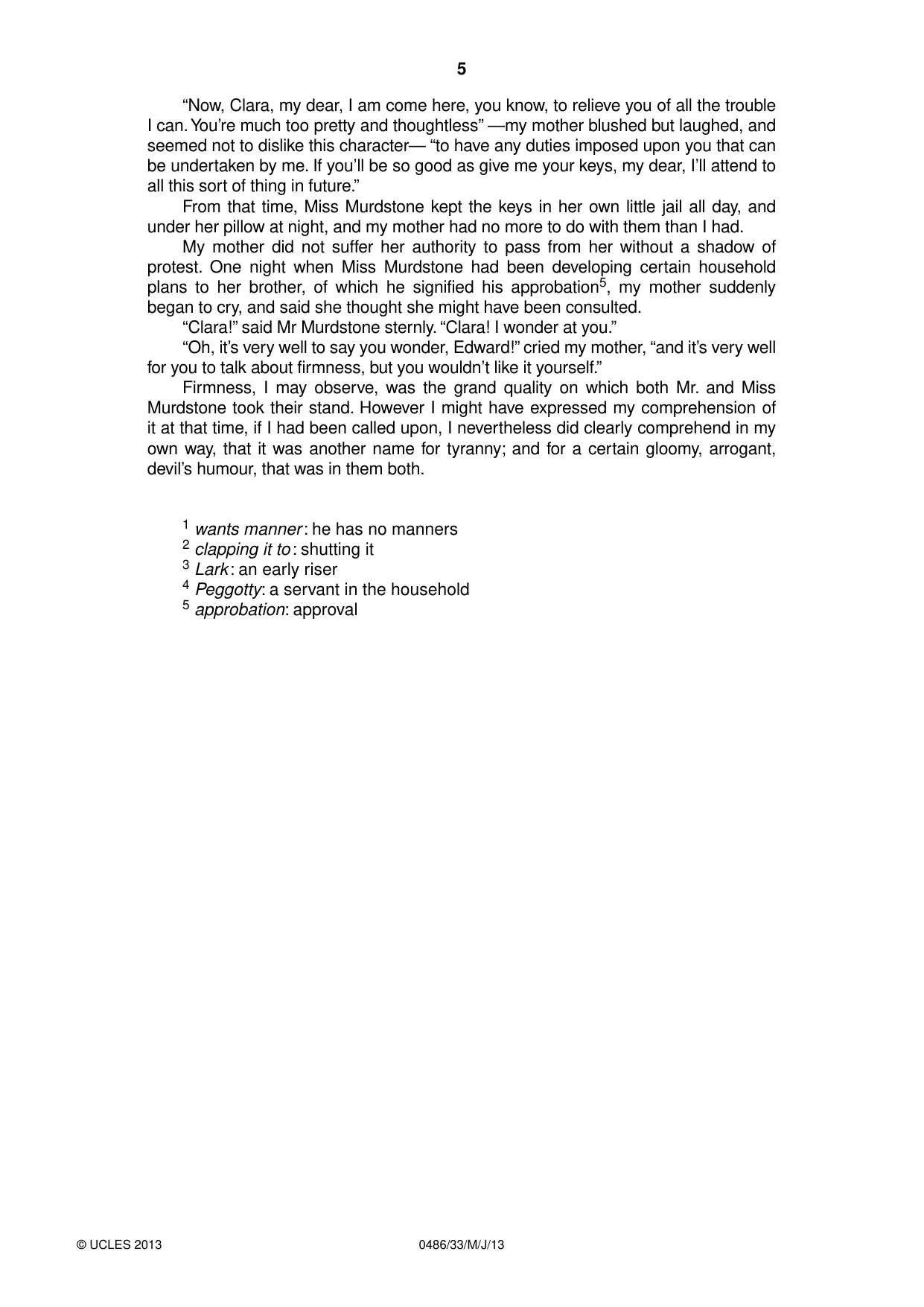
5 0486/33/M/J/13 © UCLES 2013 “Now, Clara, my dear, I am come here, you know, to relieve you of all the trouble I can. You’re much too pretty and thoughtless” —my mother blushed but laughed, and seemed not to dislike this character— “to have any duties imposed upon you that can be undertaken by me. If you’ll be so good as give me your keys, my dear, I’ll attend to all this sort of thing in future.” From that time, Miss Murdstone kept the keys in her own little jail all day, and under her pillow at night, and my mother had no more to do with them than I had. My mother did not suffer her authority to pass from her without a shadow of protest. One night when Miss Murdstone had been developing certain household plans to her brother, of which he signified his approbation5, my mother suddenly began to cry, and said she thought she might have been consulted. “Clara!” said Mr Murdstone sternly. “Clara! I wonder at you.” “Oh, it’s very well to say you wonder, Edward!” cried my mother, “and it’s very well for you to talk about firmness, but you wouldn’t like it yourself.” Firmness, I may observe, was the grand quality on which both Mr. and Miss Murdstone took their stand. However I might have expressed my comprehension of it at that time, if I had been called upon, I nevertheless did clearly comprehend in my own way, that it was another name for tyranny; and for a certain gloomy, arrogant, devil’s humour, that was in them both. 1 wants manner : he has no manners 2 clapping it to : shutting it 3 Lark : an early riser 4 Peggotty: a servant in the household 5 approbation: approval
Question paper, page 6
6 0486/33/M/J/13 © UCLES 2013 BLANK PAGE
Question paper, page 7
7 0486/33/M/J/13 © UCLES 2013 BLANK PAGE
Question paper, page 8
8 0486/33/M/J/13 © UCLES 2013 BLANK PAGE Copyright Acknowledgements: Question 1 © Dennis Lefebure; Drought, in Laura & Derek Brown, A Way of Living ; George G Harrap & Co; 1969. Permission to reproduce items where third-party owned material protected by copyright is included has been sought and cleared where possible. Every reasonable effort has been made by the publisher (UCLES) to trace copyright holders, but if any items requiring clearance have unwittingly been included, the publisher will be pleased to make amends at the earliest possible opportunity. University of Cambridge International Examinations is part of the Cambridge Assessment Group. Cambridge Assessment is the brand name of University of Cambridge Local Examinations Syndicate (UCLES), which is itself a department of the University of Cambridge.
Mark scheme, page 1
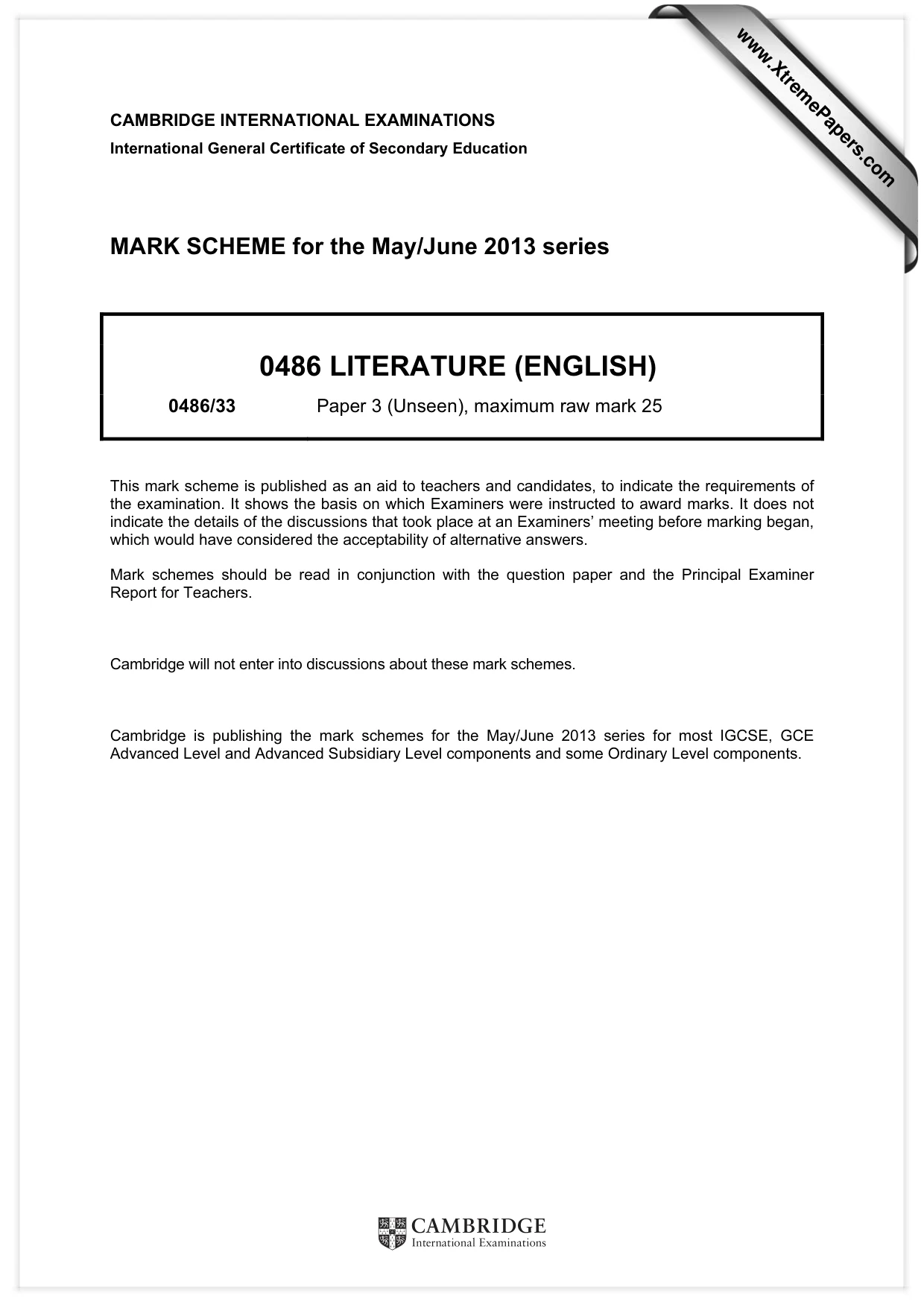
CAMBRIDGE INTERNATIONAL EXAMINATIONS International General Certificate of Secondary Education MARK SCHEME for the May/June 2013 series 0486 LITERATURE (ENGLISH) 0486/33 Paper 3 (Unseen), maximum raw mark 25 This mark scheme is published as an aid to teachers and candidates, to indicate the requirements of the examination. It shows the basis on which Examiners were instructed to award marks. It does not indicate the details of the discussions that took place at an Examiners’ meeting before marking began, which would have considered the acceptability of alternative answers. Mark schemes should be read in conjunction with the question paper and the Principal Examiner Report for Teachers. Cambridge will not enter into discussions about these mark schemes. Cambridge is publishing the mark schemes for the May/June 2013 series for most IGCSE, GCE Advanced Level and Advanced Subsidiary Level components and some Ordinary Level components. www.XtremePapers.com
Mark scheme, page 2
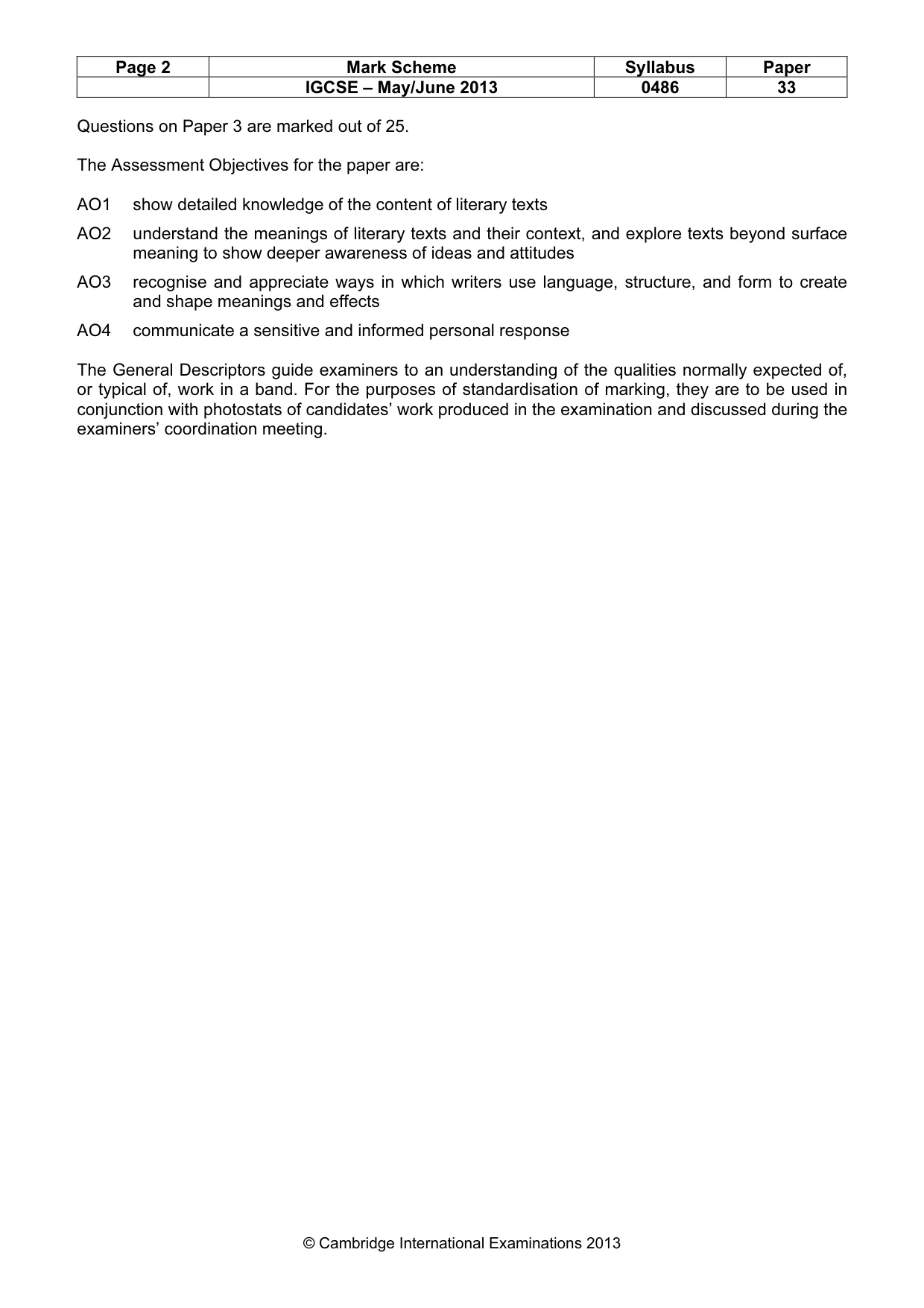
Page 2 Mark Scheme Syllabus Paper IGCSE – May/June 2013 0486 33 © Cambridge International Examinations 2013 Questions on Paper 3 are marked out of 25. The Assessment Objectives for the paper are: AO1 show detailed knowledge of the content of literary texts AO2 understand the meanings of literary texts and their context, and explore texts beyond surface meaning to show deeper awareness of ideas and attitudes AO3 recognise and appreciate ways in which writers use language, structure, and form to create and shape meanings and effects AO4 communicate a sensitive and informed personal response The General Descriptors guide examiners to an understanding of the qualities normally expected of, or typical of, work in a band. For the purposes of standardisation of marking, they are to be used in conjunction with photostats of candidates’ work produced in the examination and discussed during the examiners’ coordination meeting.
Mark scheme, page 3
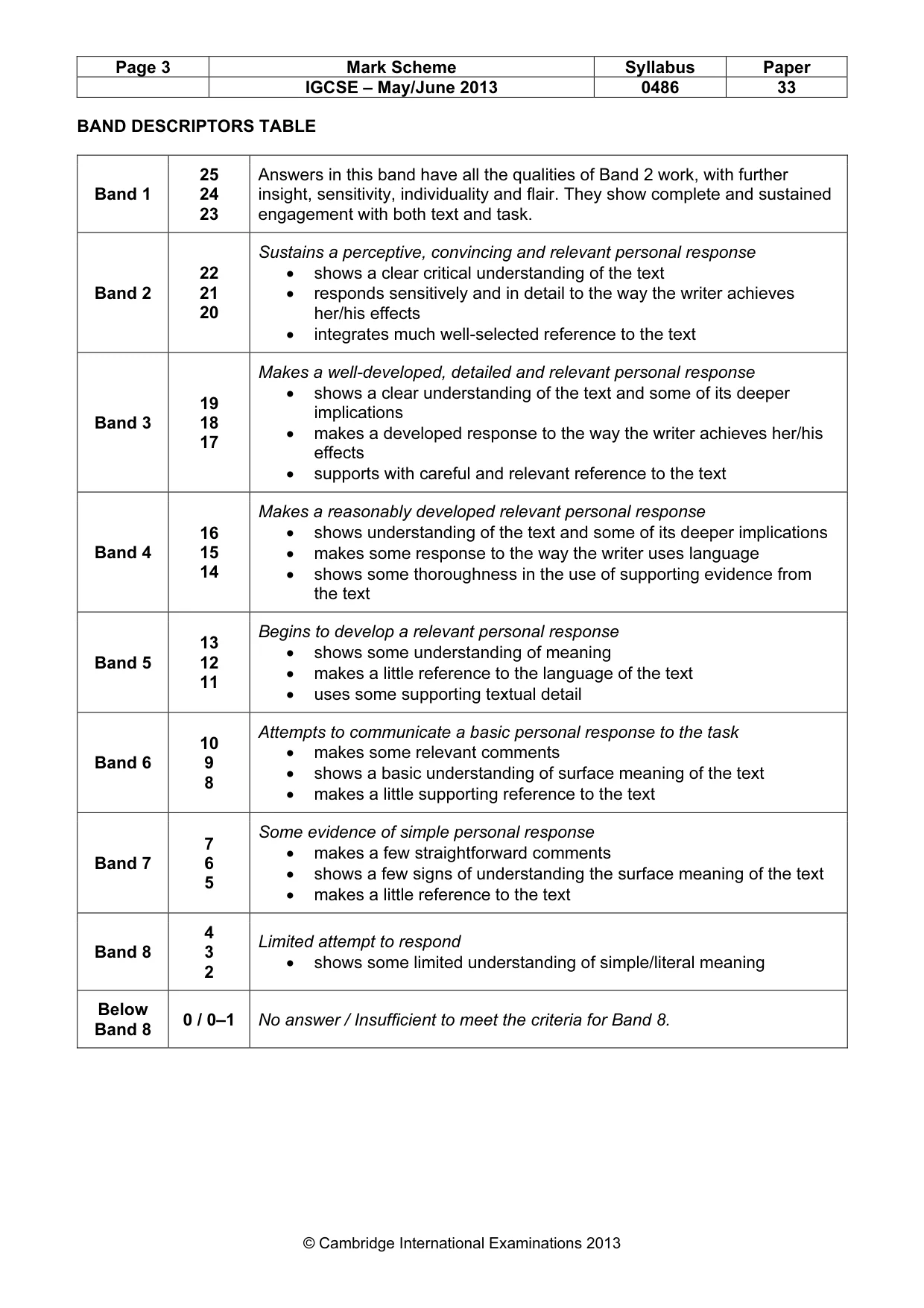
Page 3 Mark Scheme Syllabus Paper IGCSE – May/June 2013 0486 33 © Cambridge International Examinations 2013 BAND DESCRIPTORS TABLE Band 1 25 24 23 Answers in this band have all the qualities of Band 2 work, with further insight, sensitivity, individuality and flair. They show complete and sustained engagement with both text and task. Band 2 22 21 20 Sustains a perceptive, convincing and relevant personal response • shows a clear critical understanding of the text • responds sensitively and in detail to the way the writer achieves her/his effects • integrates much well-selected reference to the text Band 3 19 18 17 Makes a well-developed, detailed and relevant personal response • shows a clear understanding of the text and some of its deeper implications • makes a developed response to the way the writer achieves her/his effects • supports with careful and relevant reference to the text Band 4 16 15 14 Makes a reasonably developed relevant personal response • shows understanding of the text and some of its deeper implications • makes some response to the way the writer uses language • shows some thoroughness in the use of supporting evidence from the text Band 5 13 12 11 Begins to develop a relevant personal response • shows some understanding of meaning • makes a little reference to the language of the text • uses some supporting textual detail Band 6 10 9 8 Attempts to communicate a basic personal response to the task • makes some relevant comments • shows a basic understanding of surface meaning of the text • makes a little supporting reference to the text Band 7 7 6 5 Some evidence of simple personal response • makes a few straightforward comments • shows a few signs of understanding the surface meaning of the text • makes a little reference to the text Band 8 4 3 2 Limited attempt to respond • shows some limited understanding of simple/literal meaning Below Band 8 0 / 0–1 No answer / Insufficient to meet the criteria for Band 8.
What you needed in this session
Cambridge’s own grade thresholds for 2013 May/June, Paper 3 · Variant 3. A higher threshold means an easier paper — the bar moves with how the cohort did.