Cambridge IGCSE English - Literature 0486 — 2013 May/June Paper 3 · Variant 2
0486/32/M/J/13 · 25 marks · ≈28 min
The question paper and its mark scheme, free to read here and free to download. This is Cambridge’s own paper, exactly as it was sat.
Question paper8 pages


Mark scheme3 pages
Answers below. Sit the paper first if you are practising.
Paper as text
Question paper, page 1
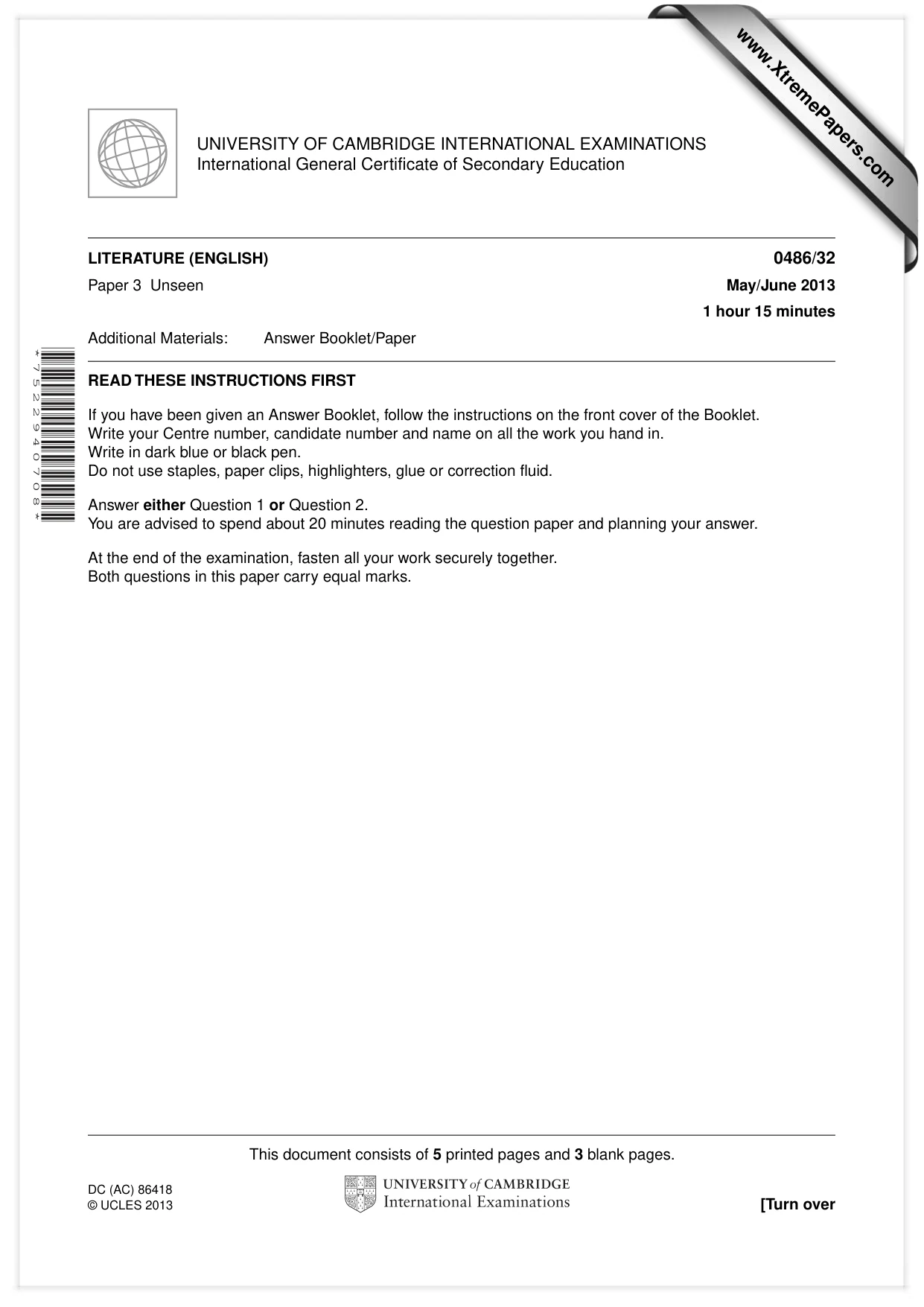
This document consists of 5 printed pages and 3 blank pages. DC (AC) 86418 © UCLES 2013 [Turn over UNIVERSITY OF CAMBRIDGE INTERNATIONAL EXAMINATIONS International General Certificate of Secondary Education * 7 5 2 2 9 4 0 7 0 8 * LITERATURE (ENGLISH) 0486/32 Paper 3 Unseen May/June 2013 1 hour 15 minutes Additional Materials: Answer Booklet/Paper READ THESE INSTRUCTIONS FIRST If you have been given an Answer Booklet, follow the instructions on the front cover of the Booklet. Write your Centre number, candidate number and name on all the work you hand in. Write in dark blue or black pen. Do not use staples, paper clips, highlighters, glue or correction fluid. Answer either Question 1 or Question 2. You are advised to spend about 20 minutes reading the question paper and planning your answer. At the end of the examination, fasten all your work securely together. Both questions in this paper carry equal marks. www.XtremePapers.com
Question paper, page 2
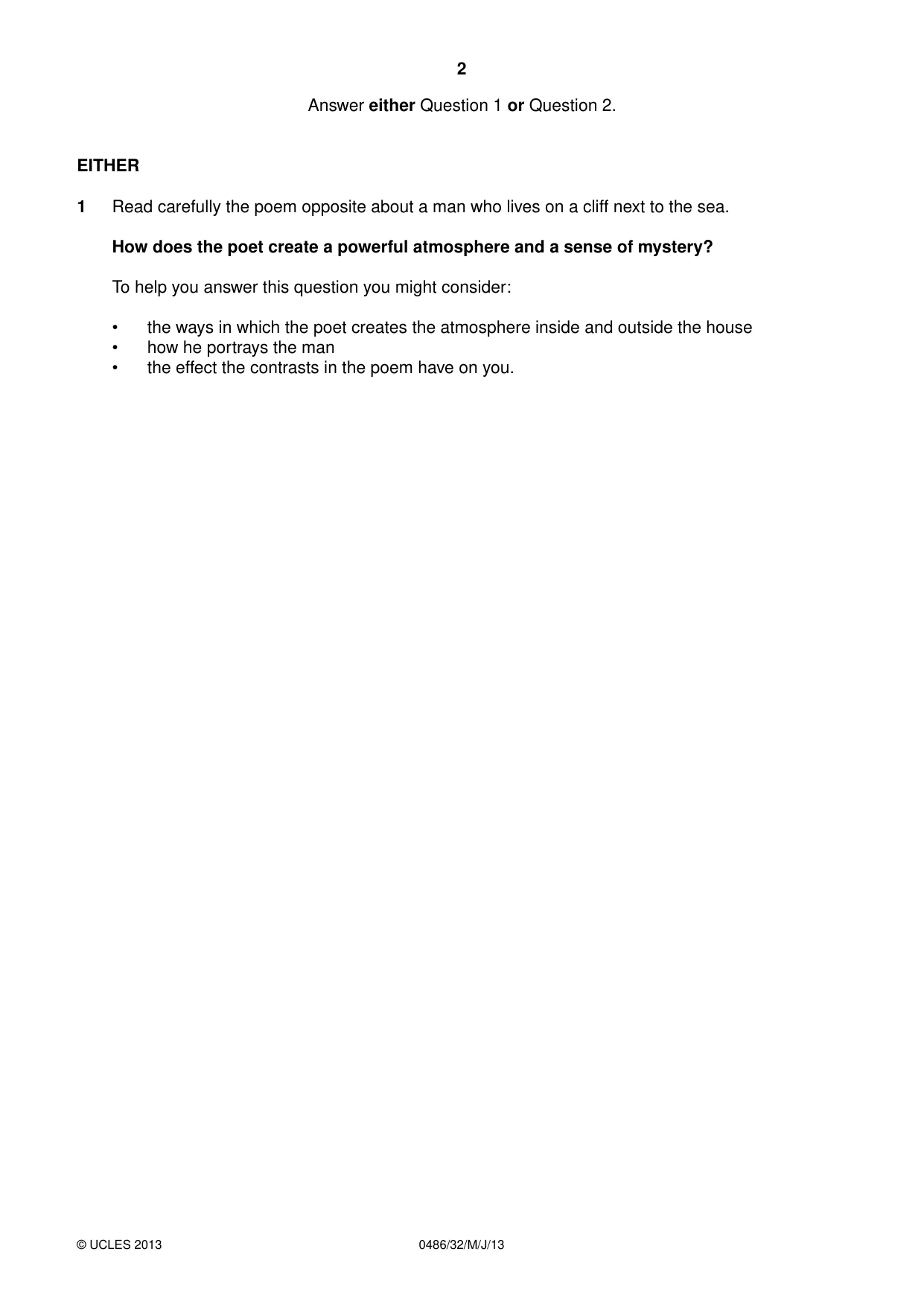
2 0486/32/M/J/13 © UCLES 2013 Answer either Question 1 or Question 2. EITHER 1 Read carefully the poem opposite about a man who lives on a cliff next to the sea. How does the poet create a powerful atmosphere and a sense of mystery? To help you answer this question you might consider: • the ways in which the poet creates the atmosphere inside and outside the house • how he portrays the man • the effect the contrasts in the poem have on you.
Question paper, page 3
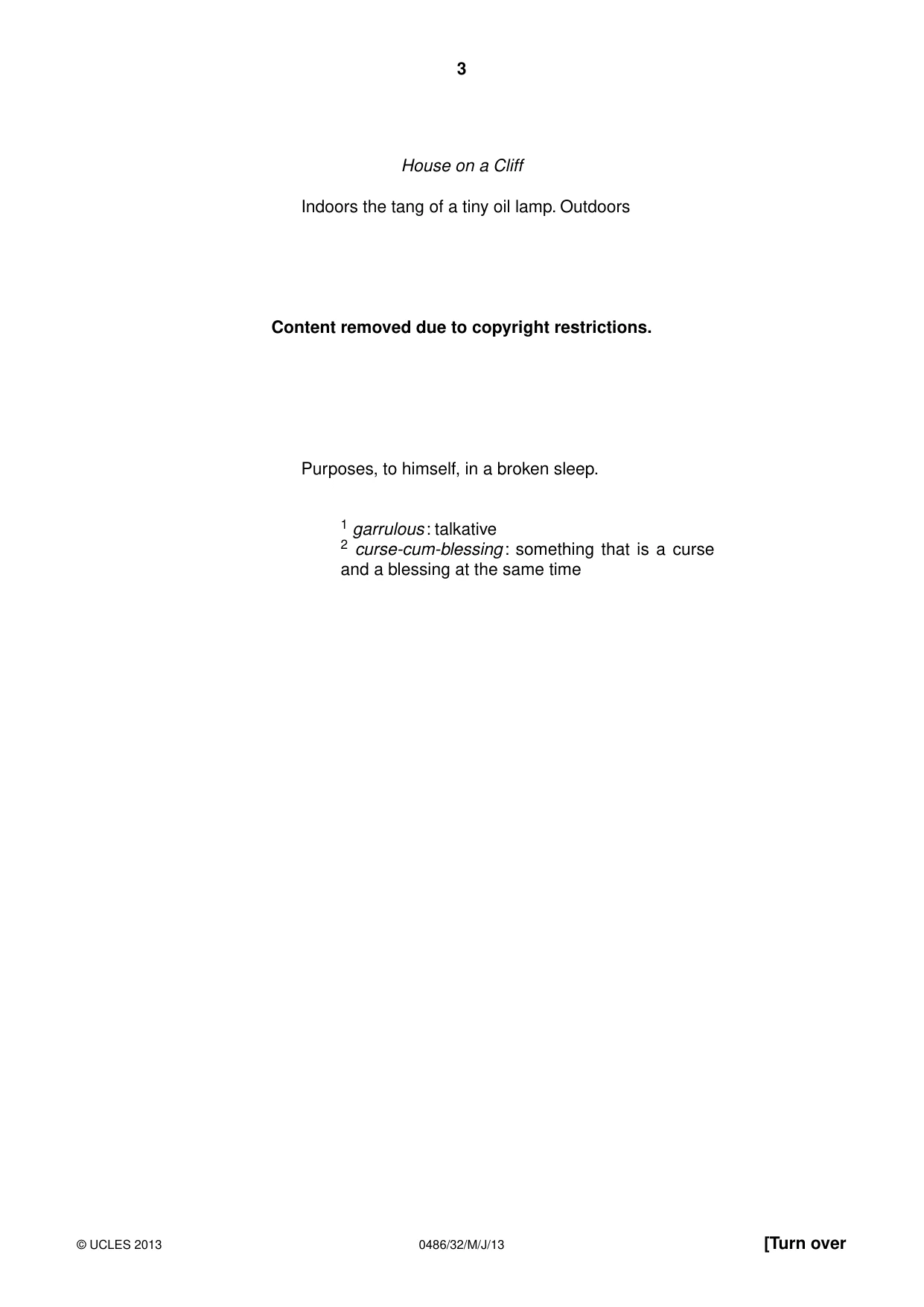
3 0486/32/M/J/13 © UCLES 2013 [Turn over House on a Cliff Indoors the tang of a tiny oil lamp. Outdoors Content removed due to copyright restrictions. Purposes, to himself, in a broken sleep. 1 garrulous : talkative 2 curse-cum-blessing : something that is a curse and a blessing at the same time
Question paper, page 4
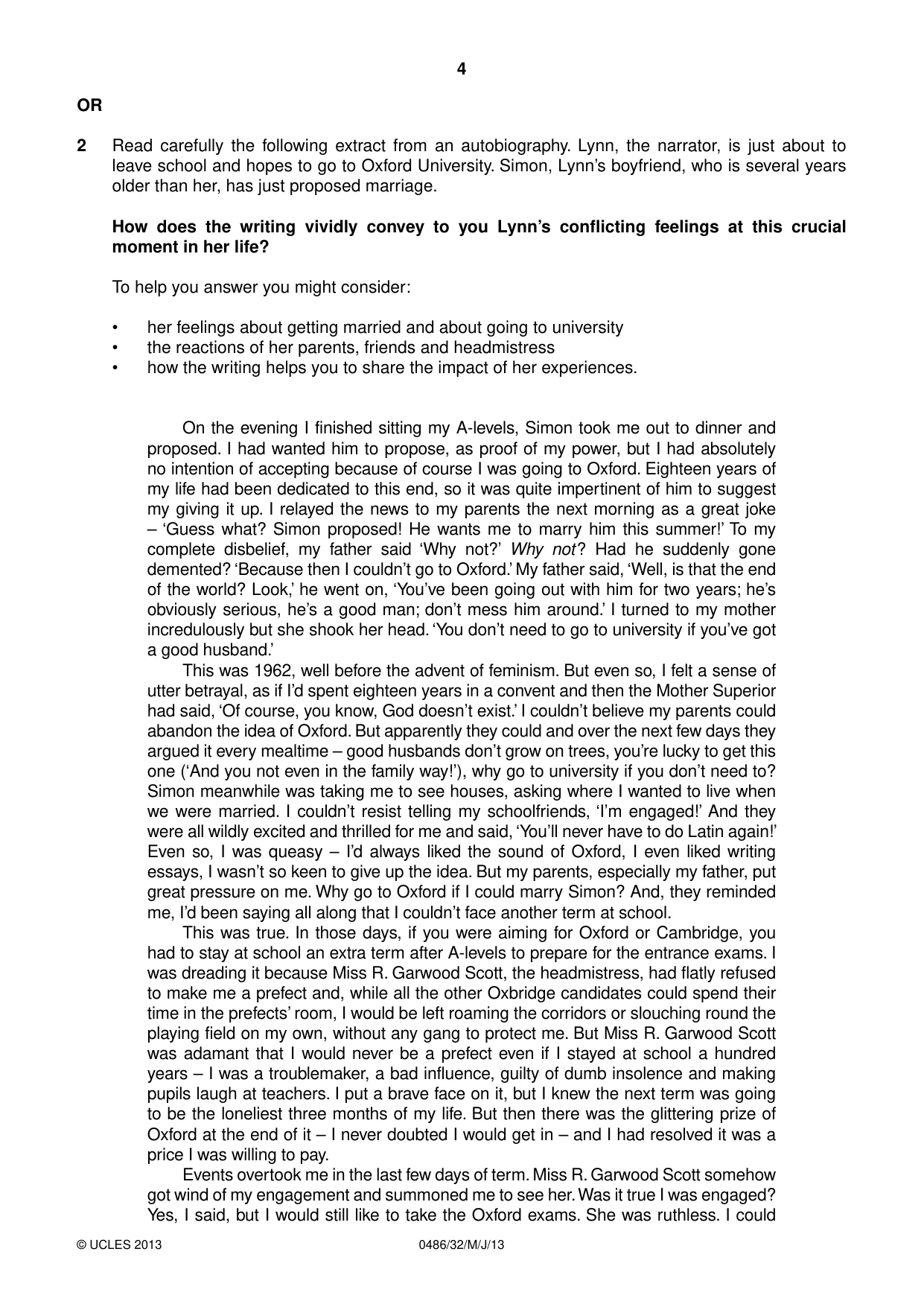
4 0486/32/M/J/13 © UCLES 2013 OR 2 Read carefully the following extract from an autobiography. Lynn, the narrator, is just about to leave school and hopes to go to Oxford University. Simon, Lynn’s boyfriend, who is several years older than her, has just proposed marriage. How does the writing vividly convey to you Lynn’s conflicting feelings at this crucial moment in her life? To help you answer you might consider: • her feelings about getting married and about going to university • the reactions of her parents, friends and headmistress • how the writing helps you to share the impact of her experiences. On the evening I finished sitting my A-levels, Simon took me out to dinner and proposed. I had wanted him to propose, as proof of my power, but I had absolutely no intention of accepting because of course I was going to Oxford. Eighteen years of my life had been dedicated to this end, so it was quite impertinent of him to suggest my giving it up. I relayed the news to my parents the next morning as a great joke – ‘Guess what? Simon proposed! He wants me to marry him this summer!’ To my complete disbelief, my father said ‘Why not?’ Why not ? Had he suddenly gone demented? ‘Because then I couldn’t go to Oxford.’ My father said, ‘Well, is that the end of the world? Look,’ he went on, ‘You’ve been going out with him for two years; he’s obviously serious, he’s a good man; don’t mess him around.’ I turned to my mother incredulously but she shook her head. ‘You don’t need to go to university if you’ve got a good husband.’ This was 1962, well before the advent of feminism. But even so, I felt a sense of utter betrayal, as if I’d spent eighteen years in a convent and then the Mother Superior had said, ‘Of course, you know, God doesn’t exist.’ I couldn’t believe my parents could abandon the idea of Oxford. But apparently they could and over the next few days they argued it every mealtime – good husbands don’t grow on trees, you’re lucky to get this one (‘And you not even in the family way!’), why go to university if you don’t need to? Simon meanwhile was taking me to see houses, asking where I wanted to live when we were married. I couldn’t resist telling my schoolfriends, ‘I’m engaged!’ And they were all wildly excited and thrilled for me and said, ‘You’ll never have to do Latin again!’ Even so, I was queasy – I’d always liked the sound of Oxford, I even liked writing essays, I wasn’t so keen to give up the idea. But my parents, especially my father, put great pressure on me. Why go to Oxford if I could marry Simon? And, they reminded me, I’d been saying all along that I couldn’t face another term at school. This was true. In those days, if you were aiming for Oxford or Cambridge, you had to stay at school an extra term after A-levels to prepare for the entrance exams. I was dreading it because Miss R. Garwood Scott, the headmistress, had flatly refused to make me a prefect and, while all the other Oxbridge candidates could spend their time in the prefects’ room, I would be left roaming the corridors or slouching round the playing field on my own, without any gang to protect me. But Miss R. Garwood Scott was adamant that I would never be a prefect even if I stayed at school a hundred years – I was a troublemaker, a bad influence, guilty of dumb insolence and making pupils laugh at teachers. I put a brave face on it, but I knew the next term was going to be the loneliest three months of my life. But then there was the glittering prize of Oxford at the end of it – I never doubted I would get in – and I had resolved it was a price I was willing to pay. Events overtook me in the last few days of term. Miss R. Garwood Scott somehow got wind of my engagement and summoned me to see her. Was it true I was engaged? Yes, I said, but I would still like to take the Oxford exams. She was ruthless. I could
Question paper, page 5
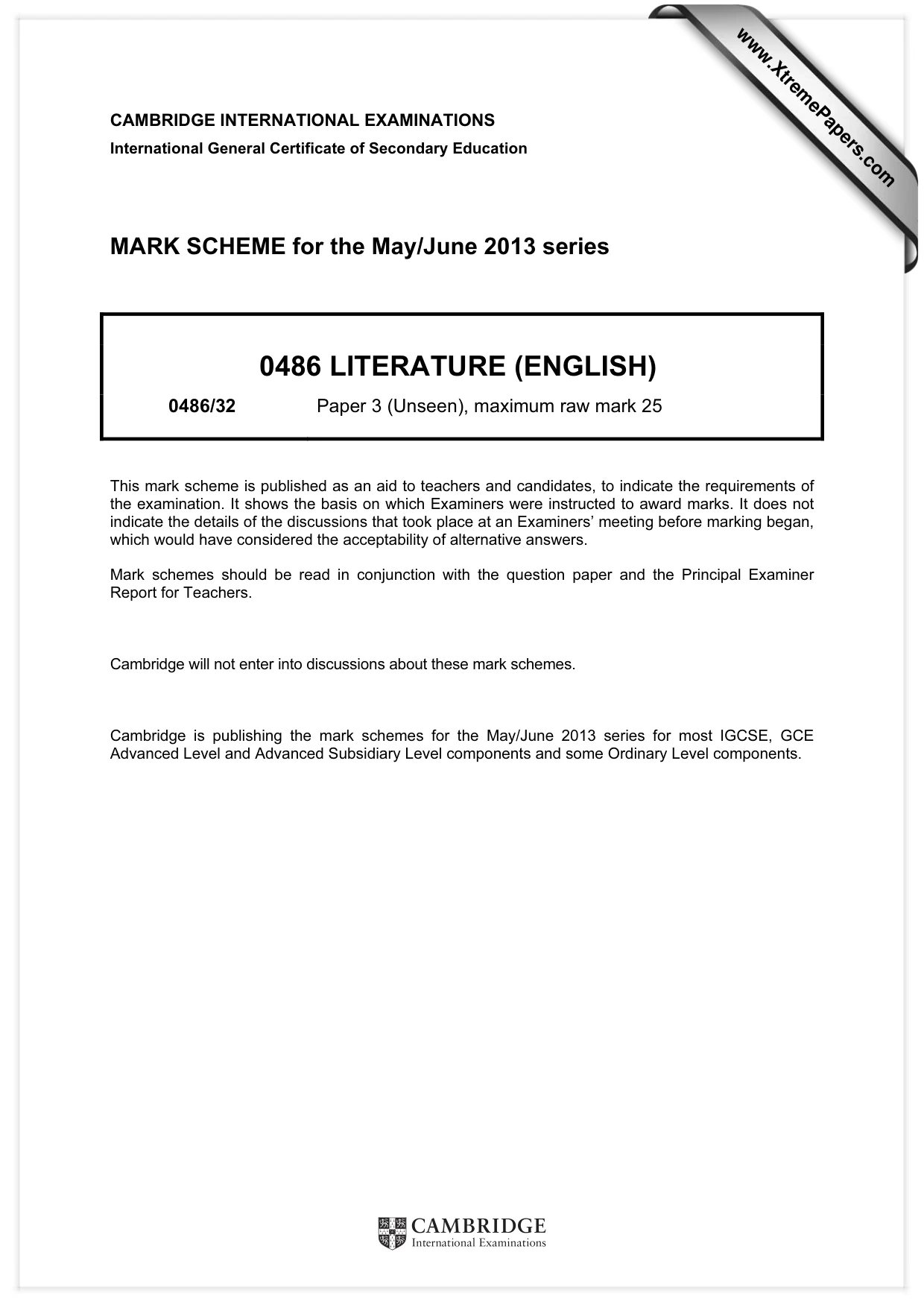
5 0486/32/M/J/13 © UCLES 2013 either be engaged or take the exams but not both. I stared at her. ‘So I won’t take the Oxford exams,’ I said. My little gang was waiting for me outside her study. ‘I told her I was leaving,’ I announced. ‘She tried to persuade me to stay but I refused.’ They all congratulated me and begged to be bridesmaids. Then I went to the bogs1 and cried my eyes out. I told my parents: ‘I’m not going to Oxford, I’m marrying Simon.’ ‘Oh good!’ they said. ‘Wonderful.’ When Simon came that evening, they made lots of happy jokes about not losing a daughter but gaining a son. Simon chuckled and waved his hands about, poured drinks and proposed toasts – but I caught the flash of panic in his eyes. 1 bogs : lavatories (slang)
Question paper, page 6
6 0486/32/M/J/13 © UCLES 2013 BLANK PAGE
Question paper, page 7
7 0486/32/M/J/13 © UCLES 2013 BLANK PAGE
Question paper, page 8
8 0486/32/M/J/13 © UCLES 2013 BLANK PAGE Copyright Acknowledgements: Question 1 © Louis MacNeice; House on a Cliff, in ed. Andrew Motion; Here to Eternity ; Faber & Faber Ltd; 2001. Question 2 © Lynn Barber; An Education; Penguin Books Ltd; 2009. Permission to reproduce items where third-party owned material protected by copyright is included has been sought and cleared where possible. Every reasonable effort has been made by the publisher (UCLES) to trace copyright holders, but if any items requiring clearance have unwittingly been included, the publisher will be pleased to make amends at the earliest possible opportunity. University of Cambridge International Examinations is part of the Cambridge Assessment Group. Cambridge Assessment is the brand name of University of Cambridge Local Examinations Syndicate (UCLES), which is itself a department of the University of Cambridge.
Mark scheme, page 1
CAMBRIDGE INTERNATIONAL EXAMINATIONS International General Certificate of Secondary Education MARK SCHEME for the May/June 2013 series 0486 LITERATURE (ENGLISH) 0486/32 Paper 3 (Unseen), maximum raw mark 25 This mark scheme is published as an aid to teachers and candidates, to indicate the requirements of the examination. It shows the basis on which Examiners were instructed to award marks. It does not indicate the details of the discussions that took place at an Examiners’ meeting before marking began, which would have considered the acceptability of alternative answers. Mark schemes should be read in conjunction with the question paper and the Principal Examiner Report for Teachers. Cambridge will not enter into discussions about these mark schemes. Cambridge is publishing the mark schemes for the May/June 2013 series for most IGCSE, GCE Advanced Level and Advanced Subsidiary Level components and some Ordinary Level components. www.XtremePapers.com
Mark scheme, page 2
Page 2 Mark Scheme Syllabus Paper IGCSE – May/June 2013 0486 32 © Cambridge International Examinations 2013 Questions on Paper 3 are marked out of 25. The Assessment Objectives for the paper are: AO1 show detailed knowledge of the content of literary texts AO2 understand the meanings of literary texts and their context, and explore texts beyond surface meaning to show deeper awareness of ideas and attitudes AO3 recognise and appreciate ways in which writers use language, structure, and form to create and shape meanings and effects AO4 communicate a sensitive and informed personal response The General Descriptors guide examiners to an understanding of the qualities normally expected of, or typical of, work in a band. For the purposes of standardisation of marking, they are to be used in conjunction with photostats of candidates’ work produced in the examination and discussed during the examiners’ coordination meeting.
Mark scheme, page 3
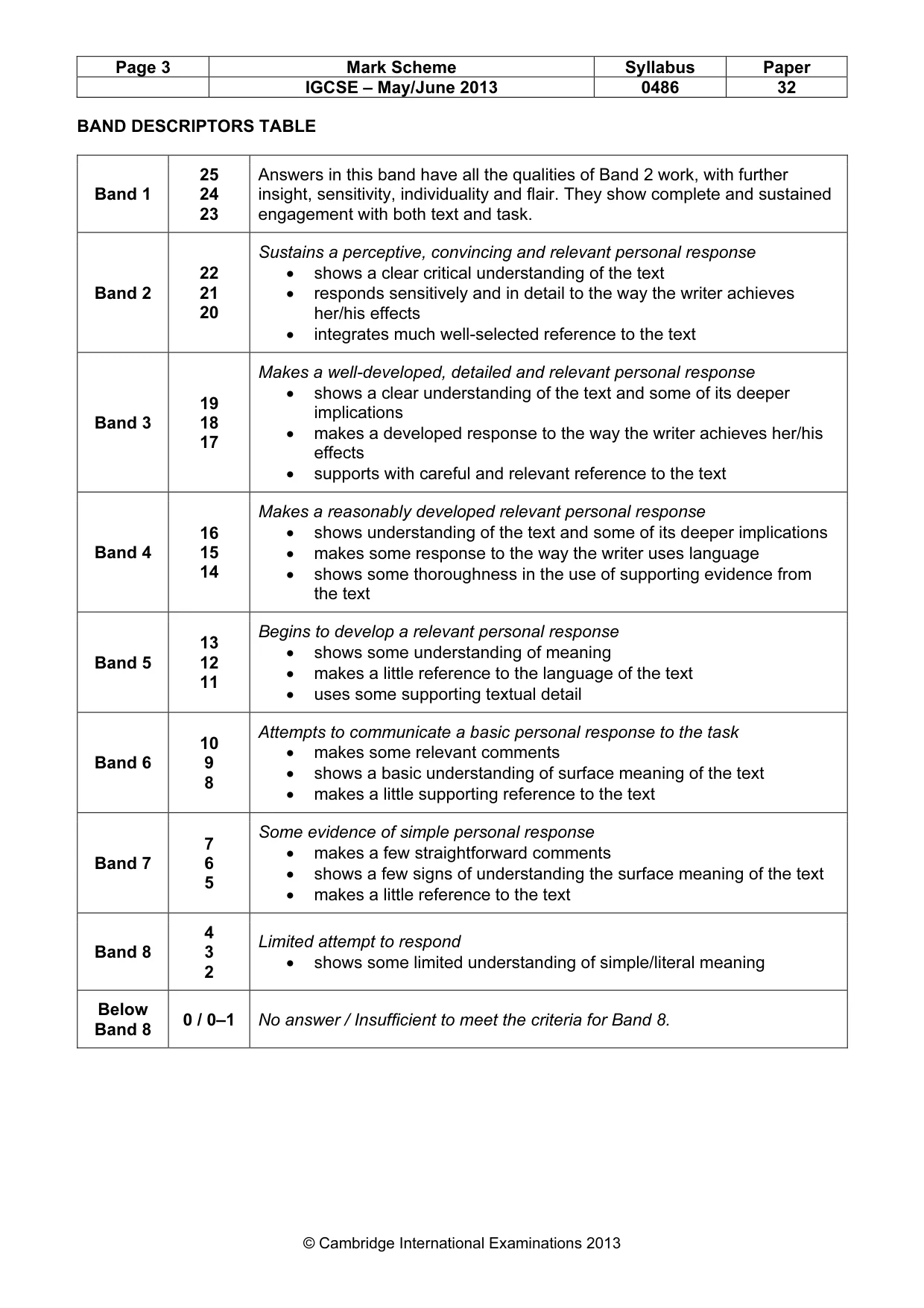
Page 3 Mark Scheme Syllabus Paper IGCSE – May/June 2013 0486 32 © Cambridge International Examinations 2013 BAND DESCRIPTORS TABLE Band 1 25 24 23 Answers in this band have all the qualities of Band 2 work, with further insight, sensitivity, individuality and flair. They show complete and sustained engagement with both text and task. Band 2 22 21 20 Sustains a perceptive, convincing and relevant personal response • shows a clear critical understanding of the text • responds sensitively and in detail to the way the writer achieves her/his effects • integrates much well-selected reference to the text Band 3 19 18 17 Makes a well-developed, detailed and relevant personal response • shows a clear understanding of the text and some of its deeper implications • makes a developed response to the way the writer achieves her/his effects • supports with careful and relevant reference to the text Band 4 16 15 14 Makes a reasonably developed relevant personal response • shows understanding of the text and some of its deeper implications • makes some response to the way the writer uses language • shows some thoroughness in the use of supporting evidence from the text Band 5 13 12 11 Begins to develop a relevant personal response • shows some understanding of meaning • makes a little reference to the language of the text • uses some supporting textual detail Band 6 10 9 8 Attempts to communicate a basic personal response to the task • makes some relevant comments • shows a basic understanding of surface meaning of the text • makes a little supporting reference to the text Band 7 7 6 5 Some evidence of simple personal response • makes a few straightforward comments • shows a few signs of understanding the surface meaning of the text • makes a little reference to the text Band 8 4 3 2 Limited attempt to respond • shows some limited understanding of simple/literal meaning Below Band 8 0 / 0–1 No answer / Insufficient to meet the criteria for Band 8.
What you needed in this session
Cambridge’s own grade thresholds for 2013 May/June, Paper 3 · Variant 2. A higher threshold means an easier paper — the bar moves with how the cohort did.