Cambridge IGCSE English - Literature 0486 — 2011 Oct/Nov Paper 1 · Variant 3
0486/13/O/N/11 · 75 marks · ≈84 min
The question paper and its mark scheme, free to read here and free to download. This is Cambridge’s own paper, exactly as it was sat.
Question paper8 pages

Mark scheme3 pages
Answers below. Sit the paper first if you are practising.
Paper as text
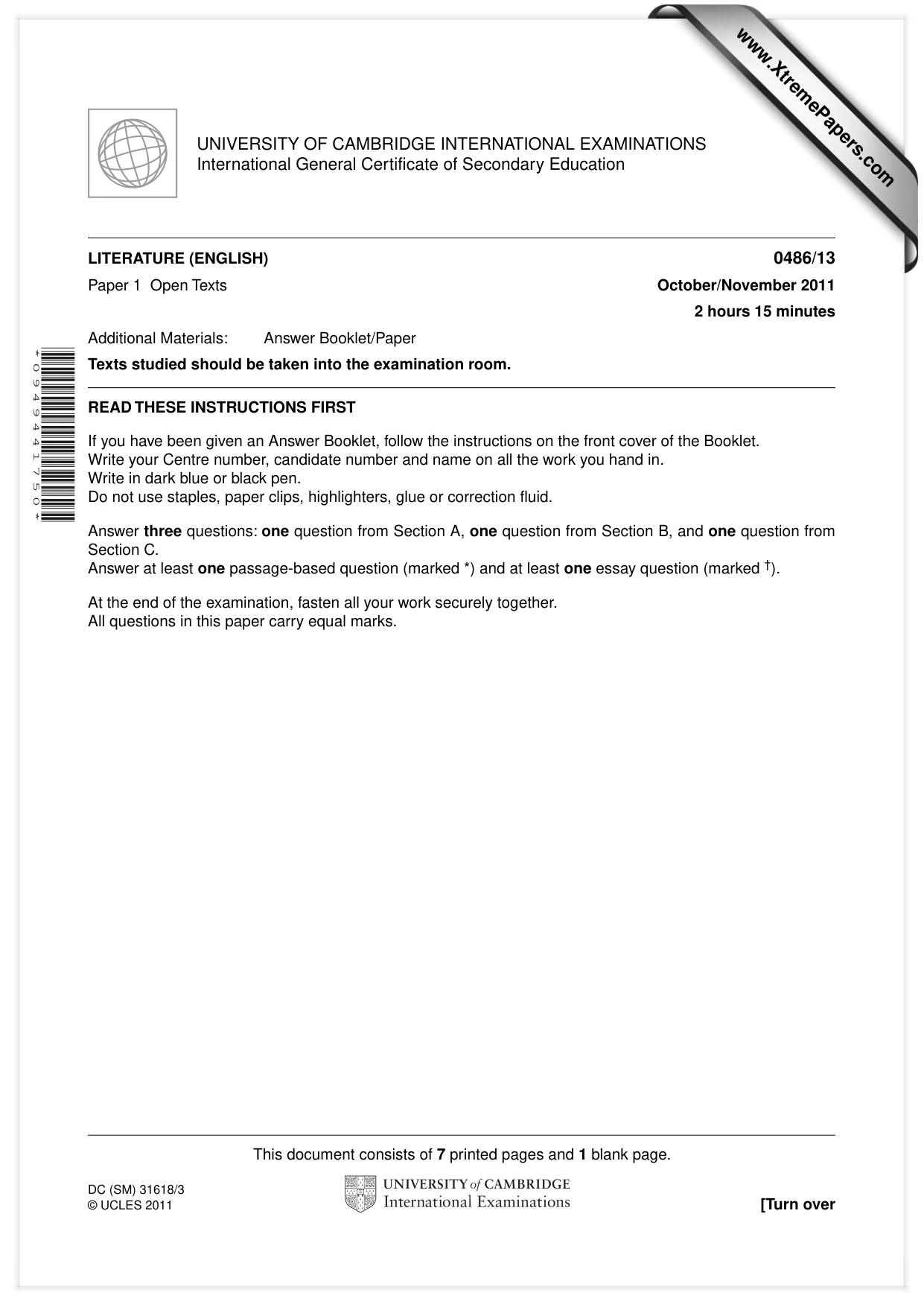
Question paper, page 1
This document consists of 7 printed pages and 1 blank page. DC (SM) 31618/3 © UCLES 2011 [Turn over UNIVERSITY OF CAMBRIDGE INTERNATIONAL EXAMINATIONS International General Certificate of Secondary Education * 0 9 4 9 4 4 1 7 5 0 * LITERATURE (ENGLISH) 0486/13 Paper 1 Open Texts October/November 2011 2 hours 15 minutes Additional Materials: Answer Booklet/Paper Texts studied should be taken into the examination room. READ THESE INSTRUCTIONS FIRST If you have been given an Answer Booklet, follow the instructions on the front cover of the Booklet. Write your Centre number, candidate number and name on all the work you hand in. Write in dark blue or black pen. Do not use staples, paper clips, highlighters, glue or correction fluid. Answer three questions: one question from Section A, one question from Section B, and one question from Section C. Answer at least one passage-based question (marked *) and at least one essay question (marked †). At the end of the examination, fasten all your work securely together. All questions in this paper carry equal marks. www.XtremePapers.com
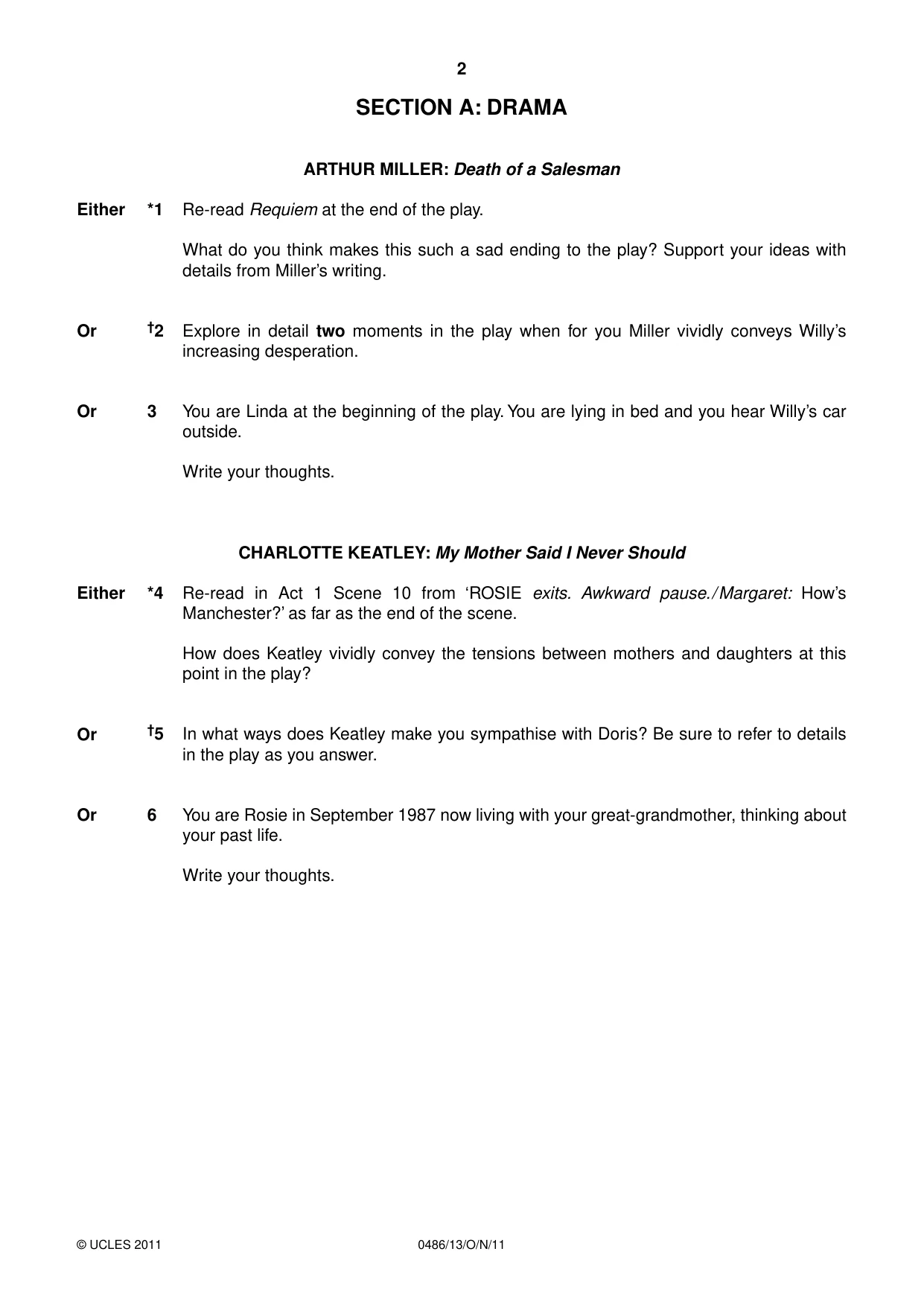
Question paper, page 2
2 0486/13/O/N/11 © UCLES 2011 SECTION A: DRAMA ARTHUR MILLER: Death of a Salesman Either *1 Re-read Requiem at the end of the play. What do you think makes this such a sad ending to the play? Support your ideas with details from Miller’s writing. Or †2 Explore in detail two moments in the play when for you Miller vividly conveys Willy’s increasing desperation. Or 3 You are Linda at the beginning of the play. You are lying in bed and you hear Willy’s car outside. Write your thoughts. CHARLOTTE KEATLEY: My Mother Said I Never Should Either *4 Re-read in Act 1 Scene 10 from ‘ROSIE exits. Awkward pause. / Margaret: How’s Manchester?’ as far as the end of the scene. How does Keatley vividly convey the tensions between mothers and daughters at this point in the play? Or †5 In what ways does Keatley make you sympathise with Doris? Be sure to refer to details in the play as you answer. Or 6 You are Rosie in September 1987 now living with your great-grandmother, thinking about your past life. Write your thoughts.
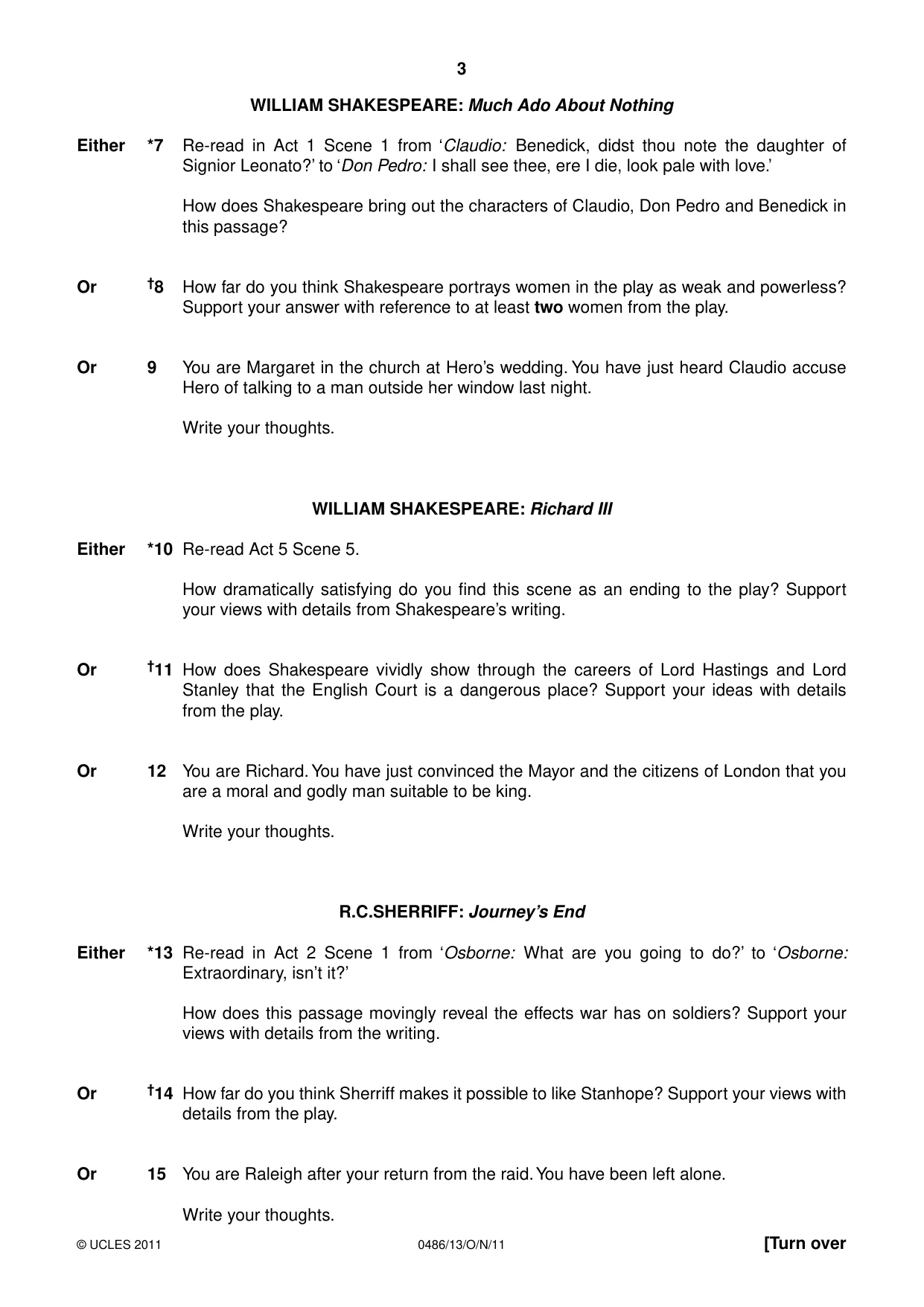
Question paper, page 3
3 0486/13/O/N/11 © UCLES 2011 [Turn over WILLIAM SHAKESPEARE: Much Ado About Nothing Either *7 Re-read in Act 1 Scene 1 from ‘Claudio: Benedick, didst thou note the daughter of Signior Leonato?’ to ‘Don Pedro: I shall see thee, ere I die, look pale with love.’ How does Shakespeare bring out the characters of Claudio, Don Pedro and Benedick in this passage? Or †8 How far do you think Shakespeare portrays women in the play as weak and powerless? Support your answer with reference to at least two women from the play. Or 9 You are Margaret in the church at Hero’s wedding. You have just heard Claudio accuse Hero of talking to a man outside her window last night. Write your thoughts. WILLIAM SHAKESPEARE: Richard III Either *10 Re-read Act 5 Scene 5. How dramatically satisfying do you find this scene as an ending to the play? Support your views with details from Shakespeare’s writing. Or †11 How does Shakespeare vividly show through the careers of Lord Hastings and Lord Stanley that the English Court is a dangerous place? Support your ideas with details from the play. Or 12 You are Richard. You have just convinced the Mayor and the citizens of London that you are a moral and godly man suitable to be king. Write your thoughts. R.C.SHERRIFF: Journey’s End Either *13 Re-read in Act 2 Scene 1 from ‘Osborne: What are you going to do?’ to ‘Osborne: Extraordinary, isn’t it?’ How does this passage movingly reveal the effects war has on soldiers? Support your views with details from the writing. Or †14 How far do you think Sherriff makes it possible to like Stanhope? Support your views with details from the play. Or 15 You are Raleigh after your return from the raid. You have been left alone. Write your thoughts.
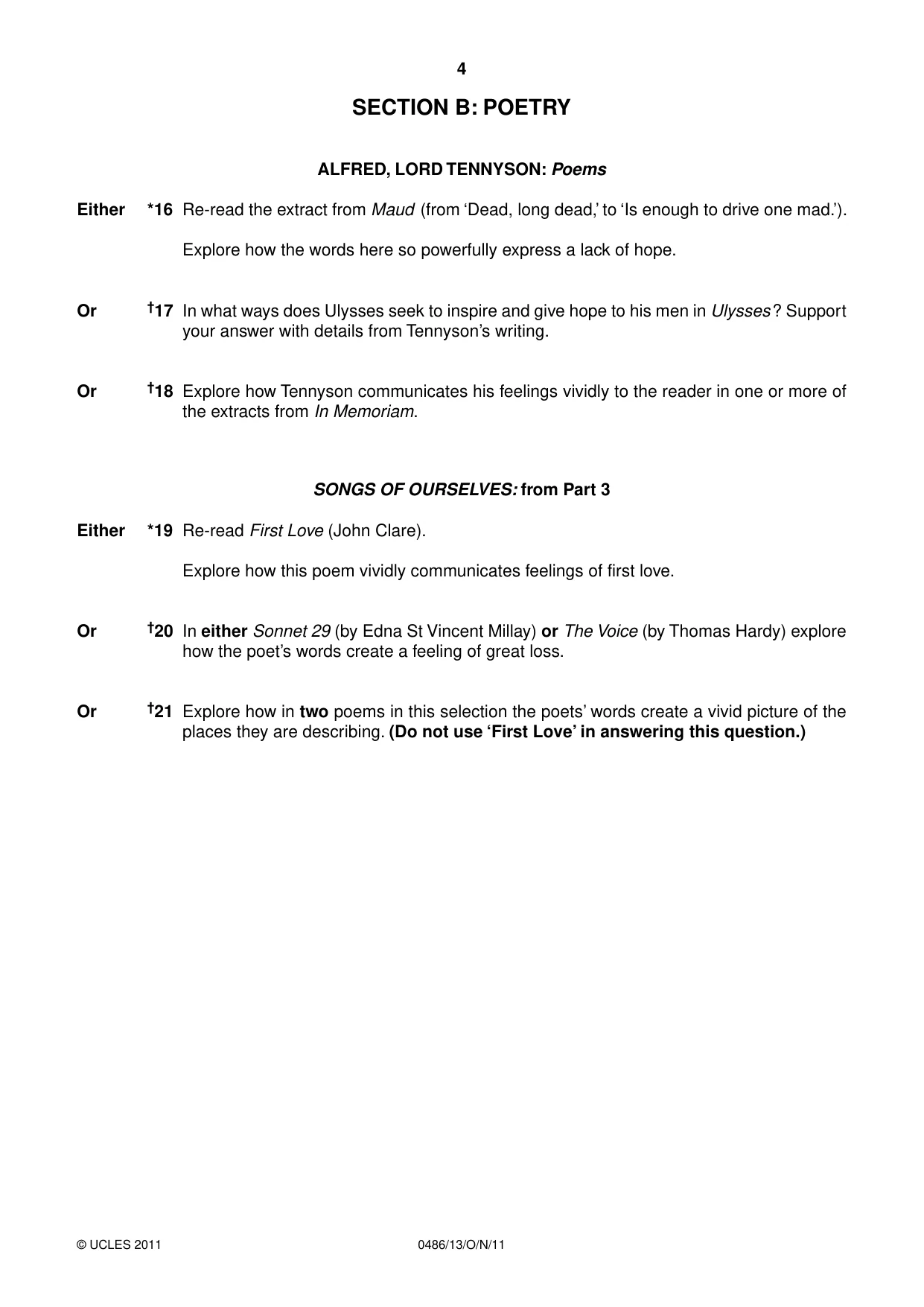
Question paper, page 4
4 0486/13/O/N/11 © UCLES 2011 SECTION B: POETRY ALFRED, LORD TENNYSON: Poems Either *16 Re-read the extract from Maud (from ‘Dead, long dead,’ to ‘Is enough to drive one mad.’). Explore how the words here so powerfully express a lack of hope. Or †17 In what ways does Ulysses seek to inspire and give hope to his men in Ulysses ? Support your answer with details from Tennyson’s writing. Or †18 Explore how Tennyson communicates his feelings vividly to the reader in one or more of the extracts from In Memoriam. SONGS OF OURSELVES: from Part 3 Either *19 Re-read First Love (John Clare). Explore how this poem vividly communicates feelings of first love. Or †20 In either Sonnet 29 (by Edna St Vincent Millay) or The Voice (by Thomas Hardy) explore how the poet’s words create a feeling of great loss. Or †21 Explore how in two poems in this selection the poets’ words create a vivid picture of the places they are describing. (Do not use ‘First Love’ in answering this question.)
Question paper, page 5
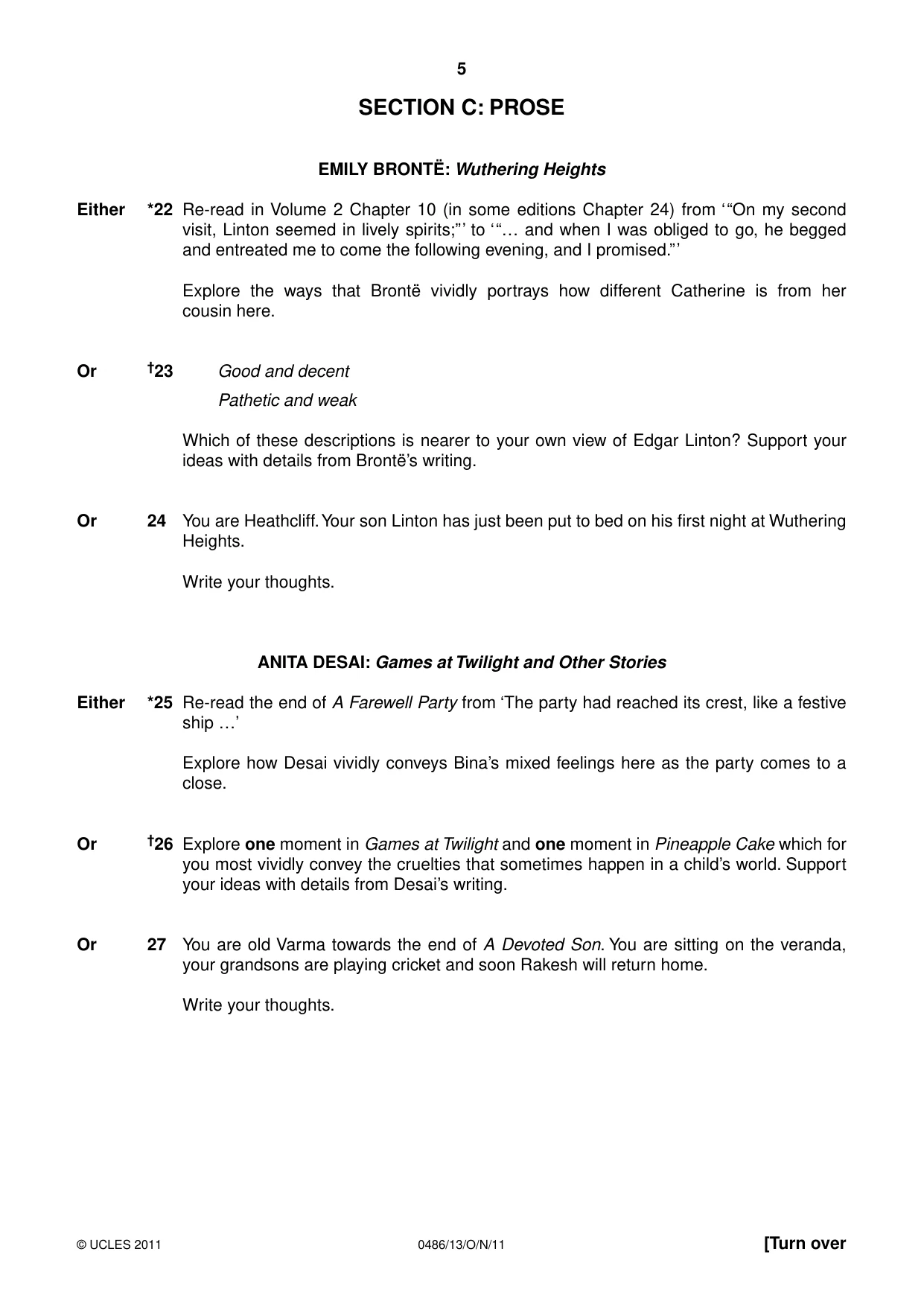
5 0486/13/O/N/11 © UCLES 2011 [Turn over SECTION C: PROSE EMILY BRONTË: Wuthering Heights Either *22 Re-read in Volume 2 Chapter 10 (in some editions Chapter 24) from ‘ “On my second visit, Linton seemed in lively spirits;” ’ to ‘ “… and when I was obliged to go, he begged and entreated me to come the following evening, and I promised.” ’ Explore the ways that Brontë vividly portrays how different Catherine is from her cousin here. Or †23 Good and decent Pathetic and weak Which of these descriptions is nearer to your own view of Edgar Linton? Support your ideas with details from Brontë’s writing. Or 24 You are Heathcliff. Your son Linton has just been put to bed on his first night at Wuthering Heights. Write your thoughts. ANITA DESAI: Games at Twilight and Other Stories Either *25 Re-read the end of A Farewell Party from ‘The party had reached its crest, like a festive ship …’ Explore how Desai vividly conveys Bina’s mixed feelings here as the party comes to a close. Or †26 Explore one moment in Games at Twilight and one moment in Pineapple Cake which for you most vividly convey the cruelties that sometimes happen in a child’s world. Support your ideas with details from Desai’s writing. Or 27 You are old Varma towards the end of A Devoted Son. You are sitting on the veranda, your grandsons are playing cricket and soon Rakesh will return home. Write your thoughts.
Question paper, page 6
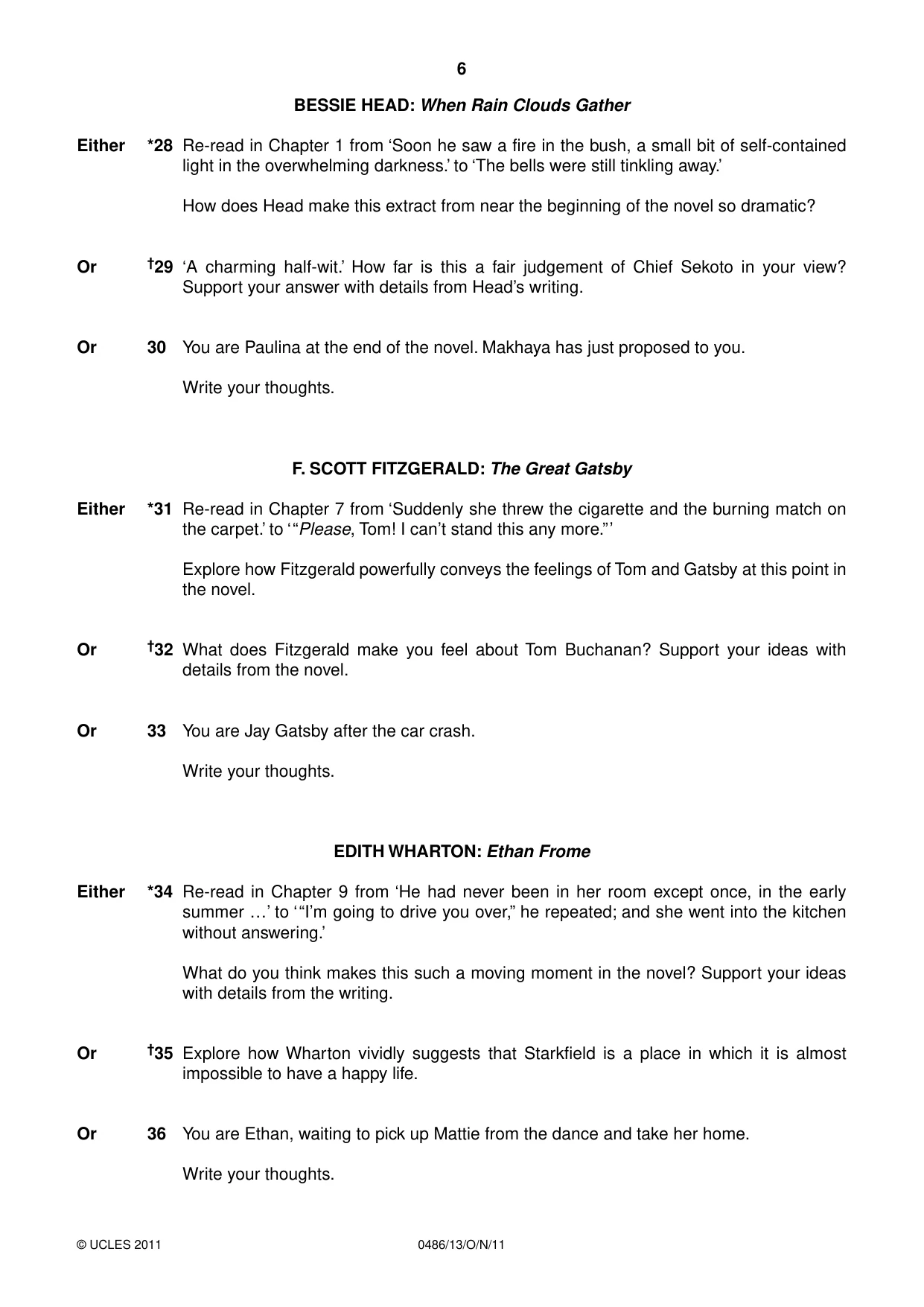
6 0486/13/O/N/11 © UCLES 2011 BESSIE HEAD: When Rain Clouds Gather Either *28 Re-read in Chapter 1 from ‘Soon he saw a fire in the bush, a small bit of self-contained light in the overwhelming darkness.’ to ‘The bells were still tinkling away.’ How does Head make this extract from near the beginning of the novel so dramatic? Or †29 ‘A charming half-wit.’ How far is this a fair judgement of Chief Sekoto in your view? Support your answer with details from Head’s writing. Or 30 You are Paulina at the end of the novel. Makhaya has just proposed to you. Write your thoughts. F. SCOTT FITZGERALD: The Great Gatsby Either *31 Re-read in Chapter 7 from ‘Suddenly she threw the cigarette and the burning match on the carpet.’ to ‘ “Please, Tom! I can’t stand this any more.” ’ Explore how Fitzgerald powerfully conveys the feelings of Tom and Gatsby at this point in the novel. Or †32 What does Fitzgerald make you feel about Tom Buchanan? Support your ideas with details from the novel. Or 33 You are Jay Gatsby after the car crash. Write your thoughts. EDITH WHARTON: Ethan Frome Either *34 Re-read in Chapter 9 from ‘He had never been in her room except once, in the early summer …’ to ‘ “I’m going to drive you over,” he repeated; and she went into the kitchen without answering.’ What do you think makes this such a moving moment in the novel? Support your ideas with details from the writing. Or †35 Explore how Wharton vividly suggests that Starkfield is a place in which it is almost impossible to have a happy life. Or 36 You are Ethan, waiting to pick up Mattie from the dance and take her home. Write your thoughts.
Question paper, page 7
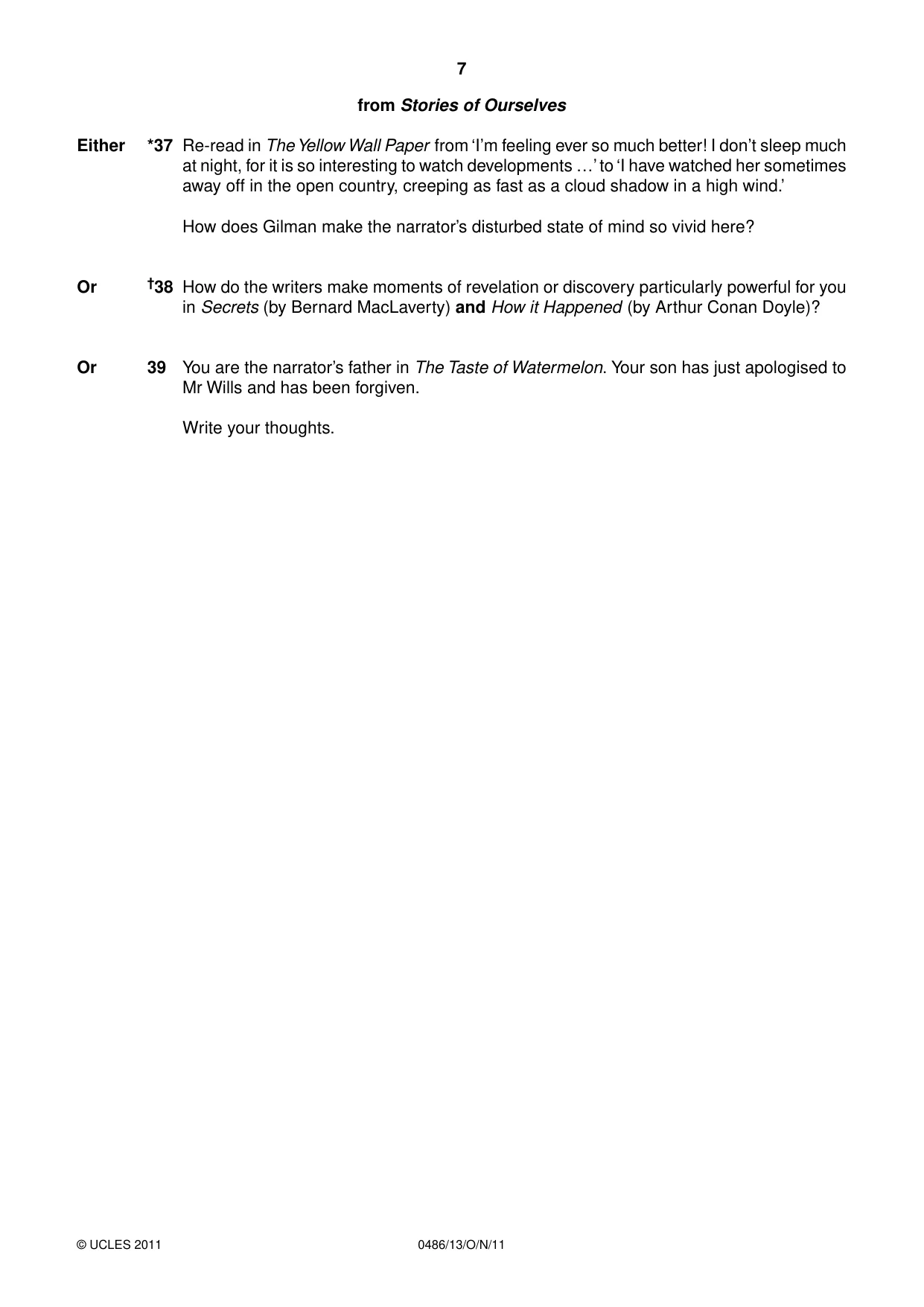
7 0486/13/O/N/11 © UCLES 2011 from Stories of Ourselves Either *37 Re-read in The Yellow Wall Paper from ‘I’m feeling ever so much better! I don’t sleep much at night, for it is so interesting to watch developments …’ to ‘I have watched her sometimes away off in the open country, creeping as fast as a cloud shadow in a high wind.’ How does Gilman make the narrator’s disturbed state of mind so vivid here? Or †38 How do the writers make moments of revelation or discovery particularly powerful for you in Secrets (by Bernard MacLaverty) and How it Happened (by Arthur Conan Doyle)? Or 39 You are the narrator’s father in The Taste of Watermelon. Your son has just apologised to Mr Wills and has been forgiven. Write your thoughts.
Question paper, page 8
8 0486/13/O/N/11 © UCLES 2011 BLANK PAGE Permission to reproduce items where third-party owned material protected by copyright is included has been sought and cleared where possible. Every reasonable effort has been made by the publisher (UCLES) to trace copyright holders, but if any items requiring clearance have unwittingly been included, the publisher will be pleased to make amends at the earliest possible opportunity. University of Cambridge International Examinations is part of the Cambridge Assessment Group. Cambridge Assessment is the brand name of University of Cambridge Local Examinations Syndicate (UCLES), which is itself a department of the University of Cambridge.
Mark scheme, page 1
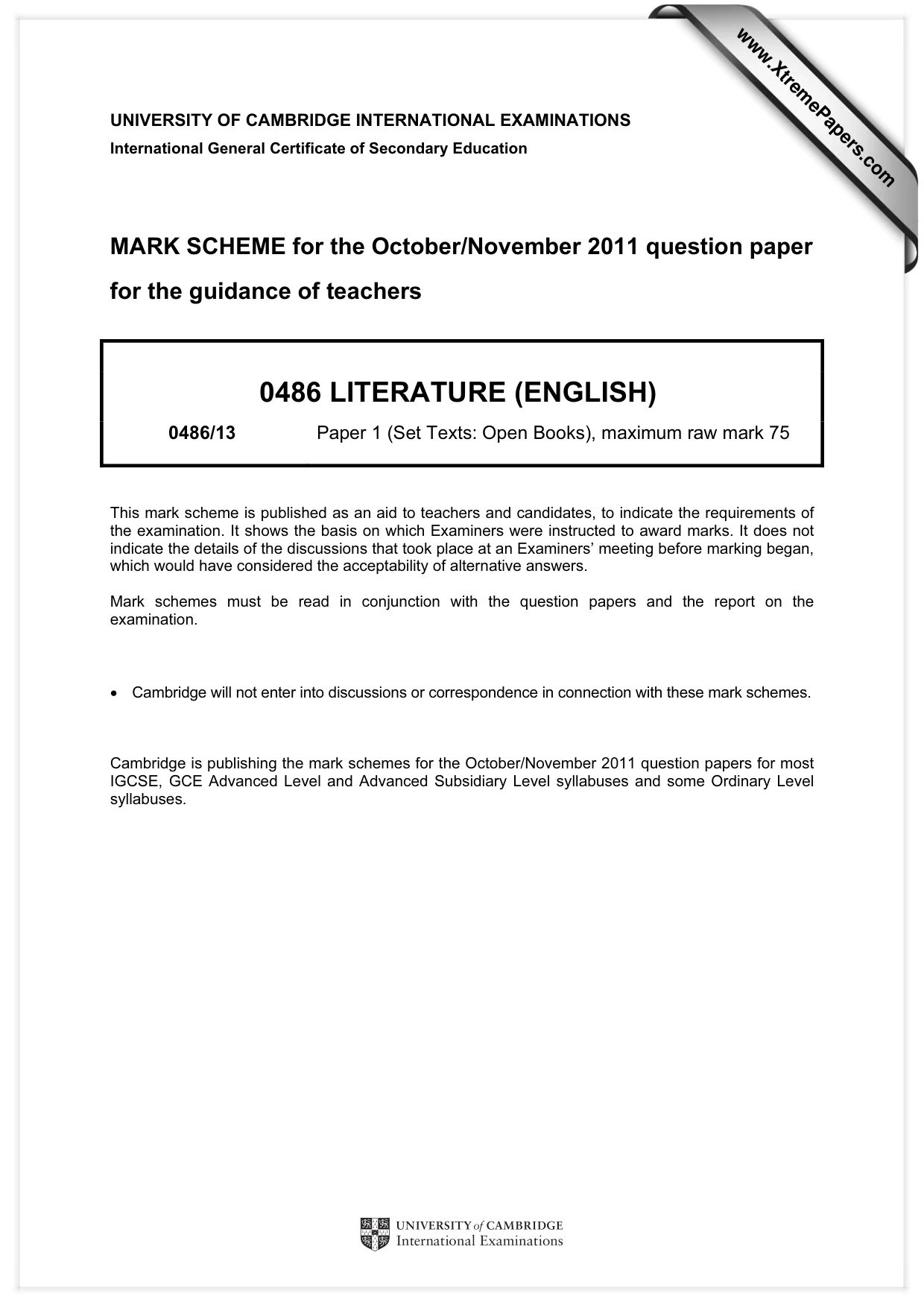
UNIVERSITY OF CAMBRIDGE INTERNATIONAL EXAMINATIONS International General Certificate of Secondary Education MARK SCHEME for the October/November 2011 question paper for the guidance of teachers 0486 LITERATURE (ENGLISH) 0486/13 Paper 1 (Set Texts: Open Books), maximum raw mark 75 This mark scheme is published as an aid to teachers and candidates, to indicate the requirements of the examination. It shows the basis on which Examiners were instructed to award marks. It does not indicate the details of the discussions that took place at an Examiners’ meeting before marking began, which would have considered the acceptability of alternative answers. Mark schemes must be read in conjunction with the question papers and the report on the examination. • Cambridge will not enter into discussions or correspondence in connection with these mark schemes. Cambridge is publishing the mark schemes for the October/November 2011 question papers for most IGCSE, GCE Advanced Level and Advanced Subsidiary Level syllabuses and some Ordinary Level syllabuses. www.XtremePapers.com
Mark scheme, page 2
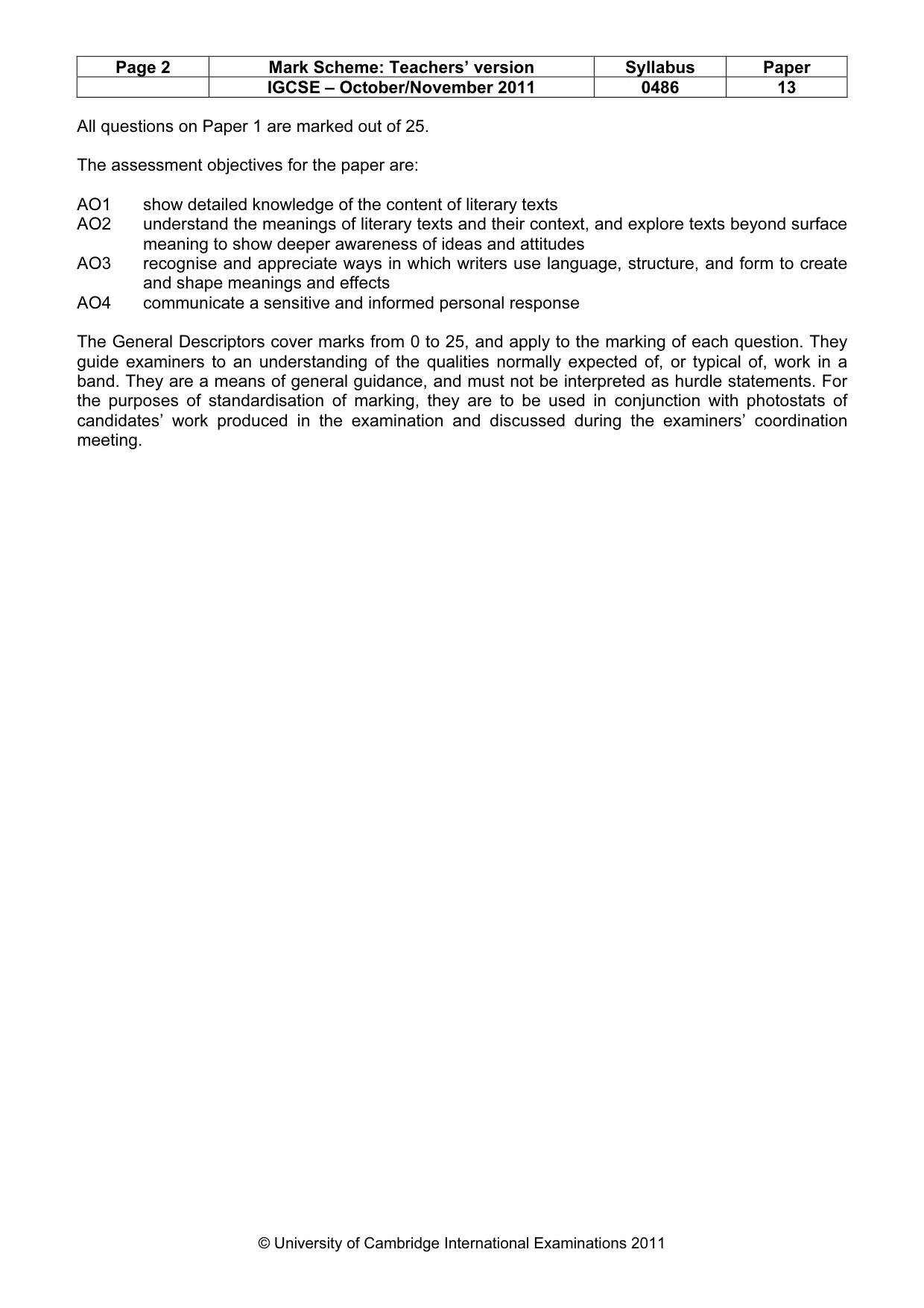
Page 2 Mark Scheme: Teachers’ version Syllabus Paper IGCSE – October/November 2011 0486 13 © University of Cambridge International Examinations 2011 All questions on Paper 1 are marked out of 25. The assessment objectives for the paper are: AO1 show detailed knowledge of the content of literary texts AO2 understand the meanings of literary texts and their context, and explore texts beyond surface meaning to show deeper awareness of ideas and attitudes AO3 recognise and appreciate ways in which writers use language, structure, and form to create and shape meanings and effects AO4 communicate a sensitive and informed personal response The General Descriptors cover marks from 0 to 25, and apply to the marking of each question. They guide examiners to an understanding of the qualities normally expected of, or typical of, work in a band. They are a means of general guidance, and must not be interpreted as hurdle statements. For the purposes of standardisation of marking, they are to be used in conjunction with photostats of candidates’ work produced in the examination and discussed during the examiners’ coordination meeting.
Mark scheme, page 3
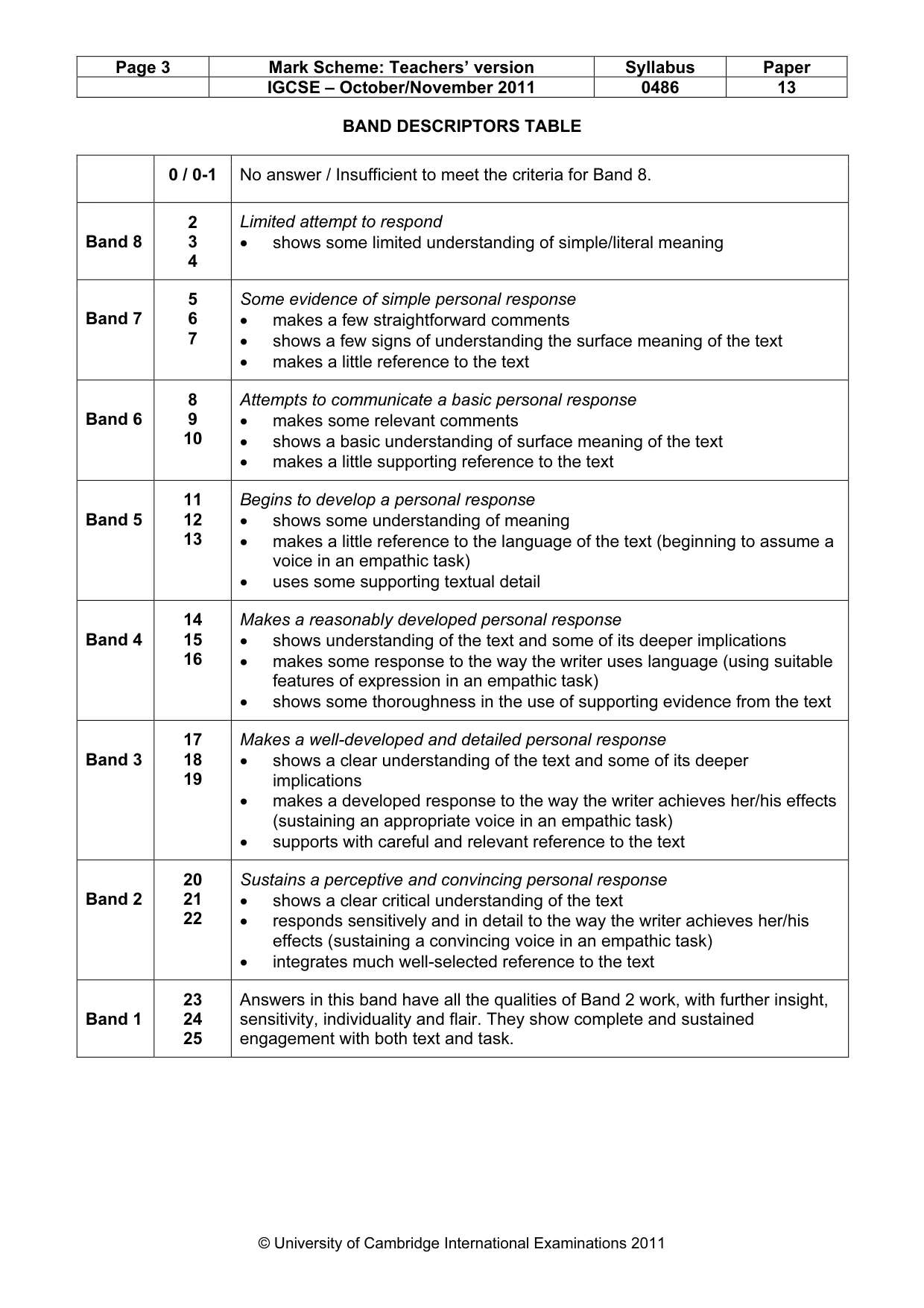
Page 3 Mark Scheme: Teachers’ version Syllabus Paper IGCSE – October/November 2011 0486 13 © University of Cambridge International Examinations 2011 BAND DESCRIPTORS TABLE 0 / 0-1 No answer / Insufficient to meet the criteria for Band 8. Band 8 2 3 4 Limited attempt to respond • shows some limited understanding of simple/literal meaning Band 7 5 6 7 Some evidence of simple personal response • makes a few straightforward comments • shows a few signs of understanding the surface meaning of the text • makes a little reference to the text Band 6 8 9 10 Attempts to communicate a basic personal response • makes some relevant comments • shows a basic understanding of surface meaning of the text • makes a little supporting reference to the text Band 5 11 12 13 Begins to develop a personal response • shows some understanding of meaning • makes a little reference to the language of the text (beginning to assume a voice in an empathic task) • uses some supporting textual detail Band 4 14 15 16 Makes a reasonably developed personal response • shows understanding of the text and some of its deeper implications • makes some response to the way the writer uses language (using suitable features of expression in an empathic task) • shows some thoroughness in the use of supporting evidence from the text Band 3 17 18 19 Makes a well-developed and detailed personal response • shows a clear understanding of the text and some of its deeper implications • makes a developed response to the way the writer achieves her/his effects (sustaining an appropriate voice in an empathic task) • supports with careful and relevant reference to the text Band 2 20 21 22 Sustains a perceptive and convincing personal response • shows a clear critical understanding of the text • responds sensitively and in detail to the way the writer achieves her/his effects (sustaining a convincing voice in an empathic task) • integrates much well-selected reference to the text Band 1 23 24 25 Answers in this band have all the qualities of Band 2 work, with further insight, sensitivity, individuality and flair. They show complete and sustained engagement with both text and task.
What you needed in this session
Cambridge’s own grade thresholds for 2011 Oct/Nov, Paper 1 · Variant 3. A higher threshold means an easier paper — the bar moves with how the cohort did.