Cambridge IGCSE English - Literature 0486 — 2011 Oct/Nov Paper 1 · Variant 1
0486/11/O/N/11 · 75 marks · ≈84 min
The question paper and its mark scheme, free to read here and free to download. This is Cambridge’s own paper, exactly as it was sat.
Question paper8 pages

Mark scheme3 pages
Answers below. Sit the paper first if you are practising.
Paper as text
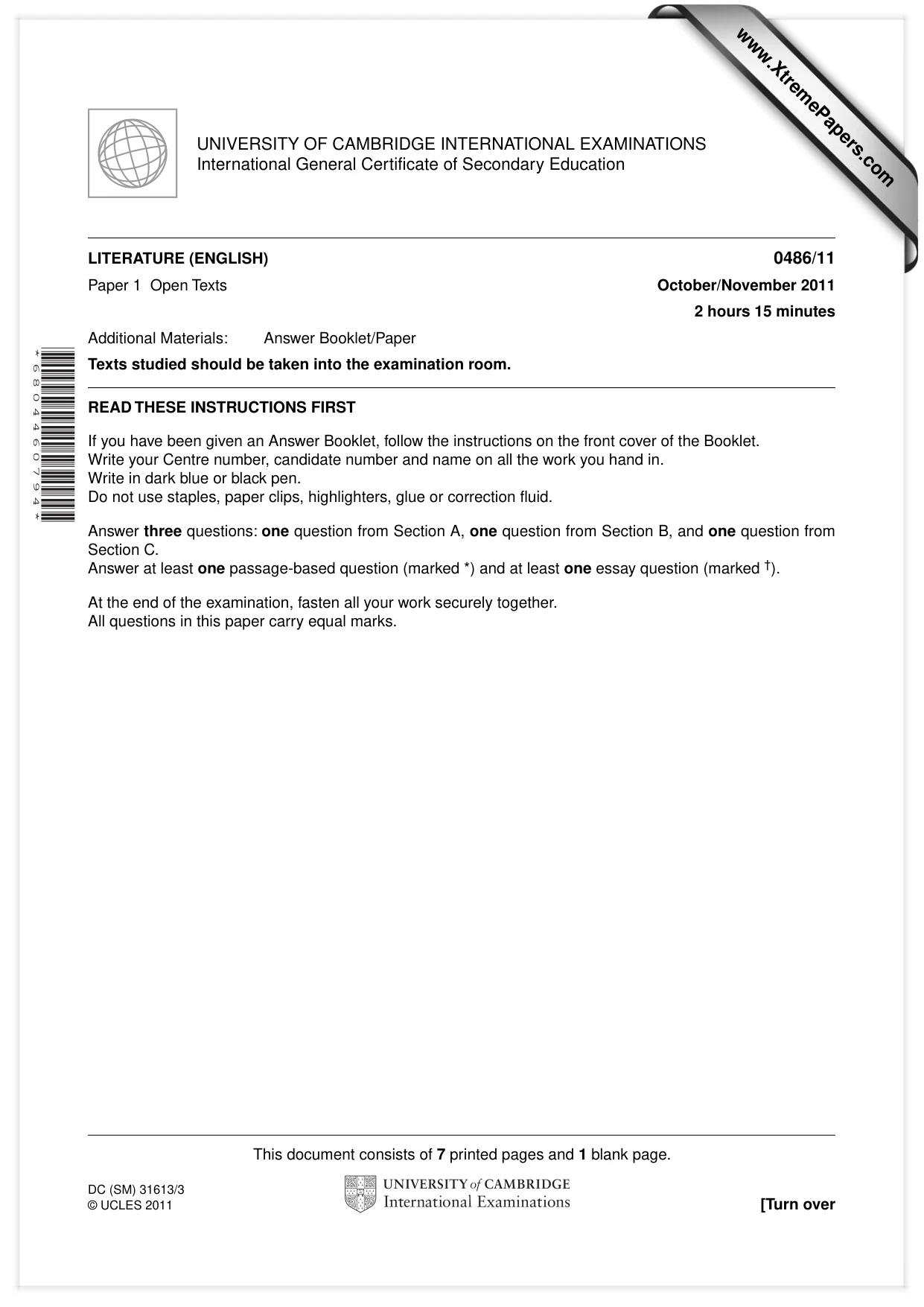
Question paper, page 1
This document consists of 7 printed pages and 1 blank page. DC (SM) 31613/3 © UCLES 2011 [Turn over UNIVERSITY OF CAMBRIDGE INTERNATIONAL EXAMINATIONS International General Certificate of Secondary Education * 6 8 0 4 4 6 0 7 9 4 * LITERATURE (ENGLISH) 0486/11 Paper 1 Open Texts October/November 2011 2 hours 15 minutes Additional Materials: Answer Booklet/Paper Texts studied should be taken into the examination room. READ THESE INSTRUCTIONS FIRST If you have been given an Answer Booklet, follow the instructions on the front cover of the Booklet. Write your Centre number, candidate number and name on all the work you hand in. Write in dark blue or black pen. Do not use staples, paper clips, highlighters, glue or correction fluid. Answer three questions: one question from Section A, one question from Section B, and one question from Section C. Answer at least one passage-based question (marked *) and at least one essay question (marked †). At the end of the examination, fasten all your work securely together. All questions in this paper carry equal marks. www.XtremePapers.com
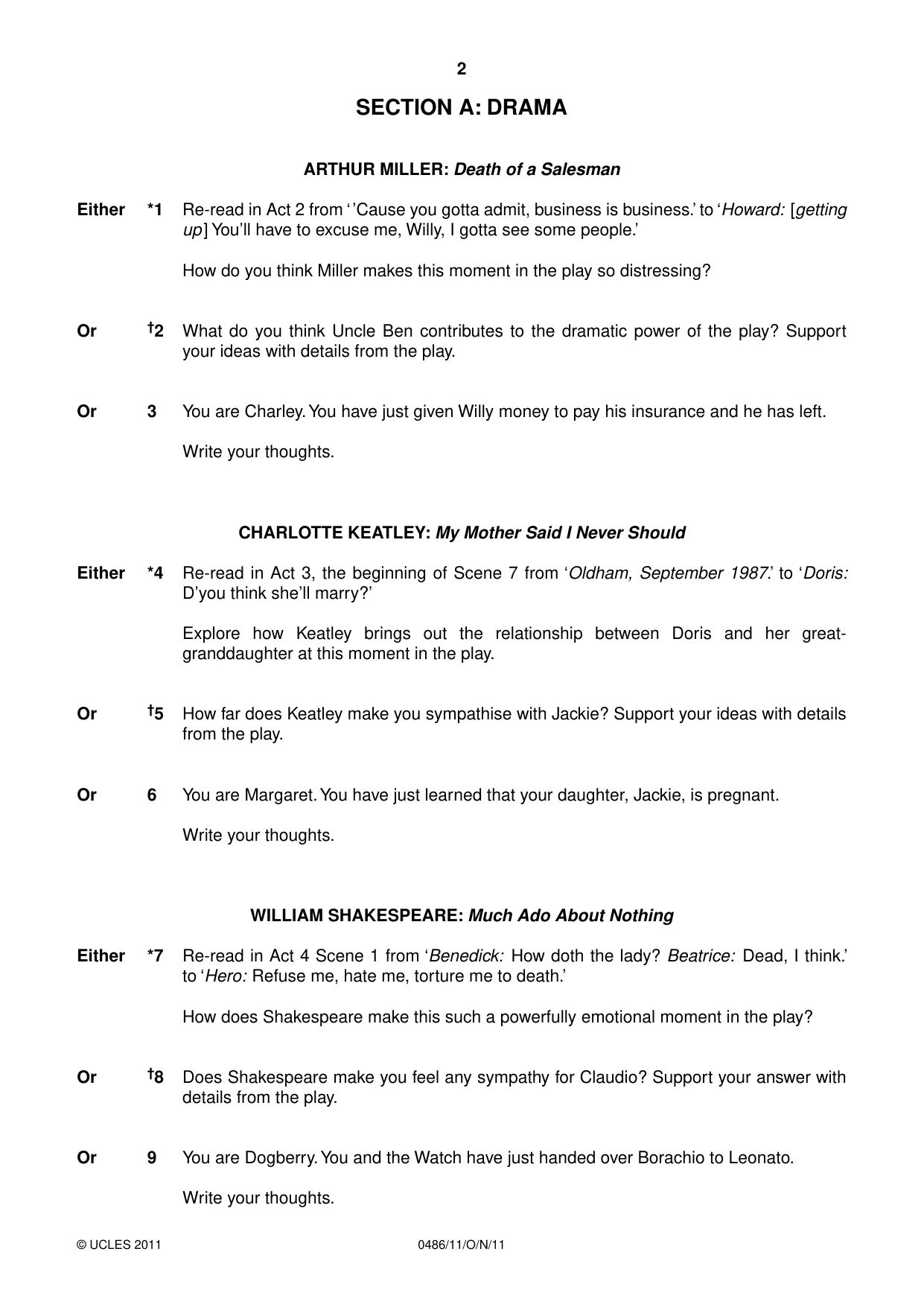
Question paper, page 2
2 0486/11/O/N/11 © UCLES 2011 SECTION A: DRAMA ARTHUR MILLER: Death of a Salesman Either *1 Re-read in Act 2 from ‘ ’Cause you gotta admit, business is business.’ to ‘Howard: [getting up ] You’ll have to excuse me, Willy, I gotta see some people.’ How do you think Miller makes this moment in the play so distressing? Or †2 What do you think Uncle Ben contributes to the dramatic power of the play? Support your ideas with details from the play. Or 3 You are Charley. You have just given Willy money to pay his insurance and he has left. Write your thoughts. CHARLOTTE KEATLEY: My Mother Said I Never Should Either *4 Re-read in Act 3, the beginning of Scene 7 from ‘Oldham, September 1987.’ to ‘Doris: D’you think she’ll marry?’ Explore how Keatley brings out the relationship between Doris and her great- granddaughter at this moment in the play. Or †5 How far does Keatley make you sympathise with Jackie? Support your ideas with details from the play. Or 6 You are Margaret. You have just learned that your daughter, Jackie, is pregnant. Write your thoughts. WILLIAM SHAKESPEARE: Much Ado About Nothing Either *7 Re-read in Act 4 Scene 1 from ‘Benedick: How doth the lady? Beatrice: Dead, I think.’ to ‘Hero: Refuse me, hate me, torture me to death.’ How does Shakespeare make this such a powerfully emotional moment in the play? Or †8 Does Shakespeare make you feel any sympathy for Claudio? Support your answer with details from the play. Or 9 You are Dogberry. You and the Watch have just handed over Borachio to Leonato. Write your thoughts.
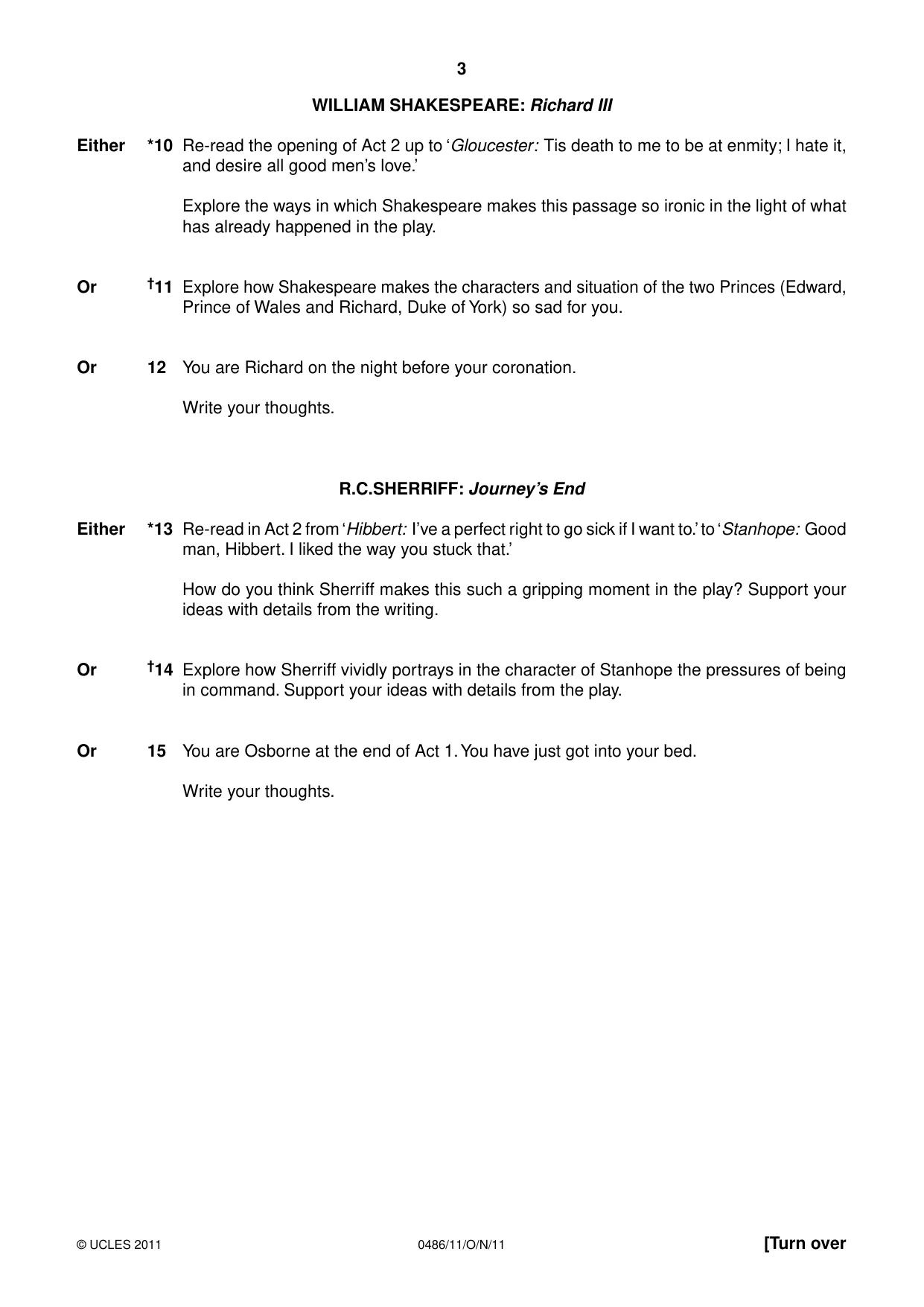
Question paper, page 3
3 0486/11/O/N/11 © UCLES 2011 [Turn over WILLIAM SHAKESPEARE: Richard III Either *10 Re-read the opening of Act 2 up to ‘Gloucester: Tis death to me to be at enmity; I hate it, and desire all good men’s love.’ Explore the ways in which Shakespeare makes this passage so ironic in the light of what has already happened in the play. Or †11 Explore how Shakespeare makes the characters and situation of the two Princes (Edward, Prince of Wales and Richard, Duke of York) so sad for you. Or 12 You are Richard on the night before your coronation. Write your thoughts. R.C.SHERRIFF: Journey’s End Either *13 Re-read in Act 2 from ‘Hibbert: I’ve a perfect right to go sick if I want to.’ to ‘Stanhope: Good man, Hibbert. I liked the way you stuck that.’ How do you think Sherriff makes this such a gripping moment in the play? Support your ideas with details from the writing. Or †14 Explore how Sherriff vividly portrays in the character of Stanhope the pressures of being in command. Support your ideas with details from the play. Or 15 You are Osborne at the end of Act 1. You have just got into your bed. Write your thoughts.
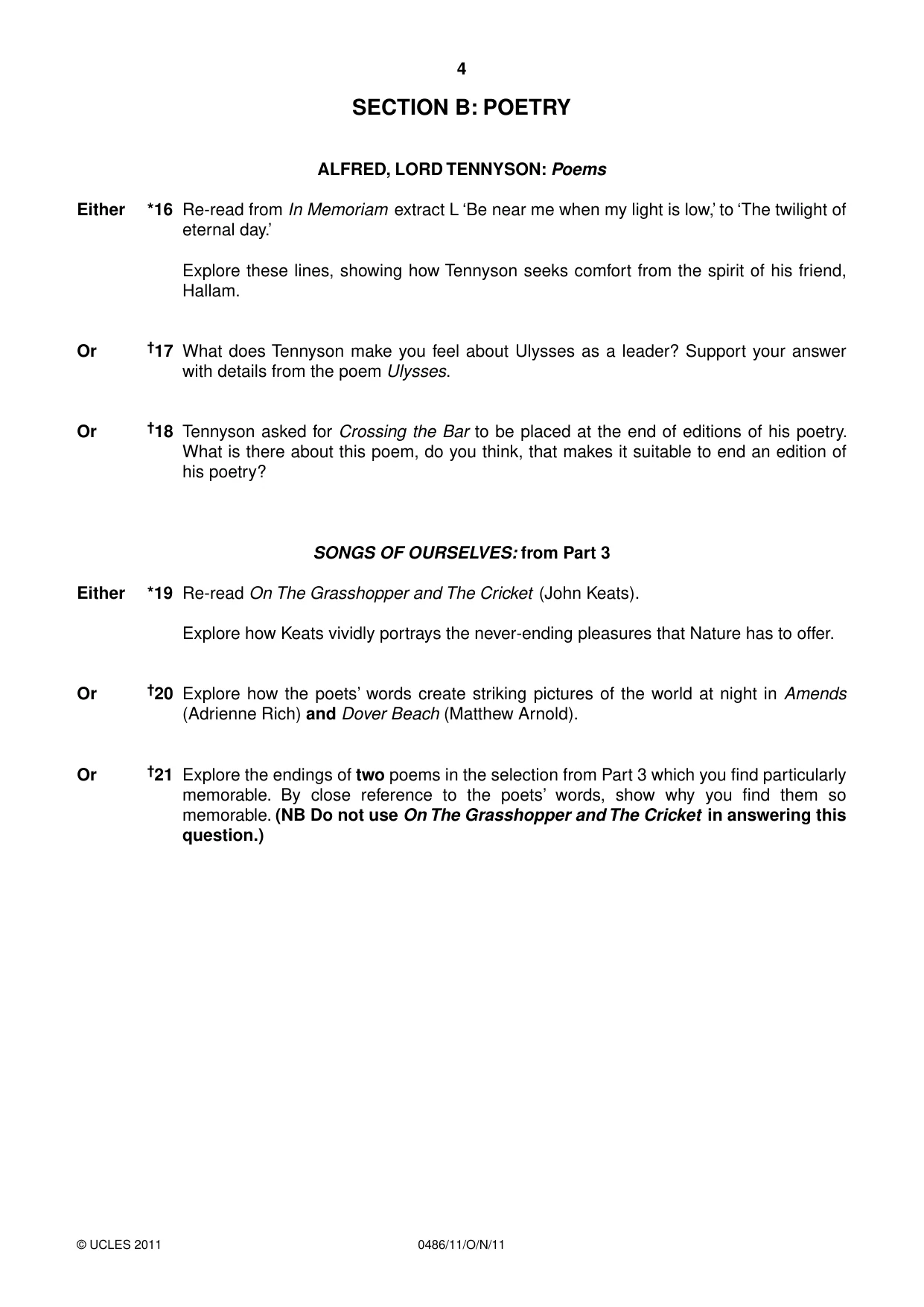
Question paper, page 4
4 0486/11/O/N/11 © UCLES 2011 SECTION B: POETRY ALFRED, LORD TENNYSON: Poems Either *16 Re-read from In Memoriam extract L ‘Be near me when my light is low,’ to ‘The twilight of eternal day.’ Explore these lines, showing how Tennyson seeks comfort from the spirit of his friend, Hallam. Or †17 What does Tennyson make you feel about Ulysses as a leader? Support your answer with details from the poem Ulysses. Or †18 Tennyson asked for Crossing the Bar to be placed at the end of editions of his poetry. What is there about this poem, do you think, that makes it suitable to end an edition of his poetry? SONGS OF OURSELVES: from Part 3 Either *19 Re-read On The Grasshopper and The Cricket (John Keats). Explore how Keats vividly portrays the never-ending pleasures that Nature has to offer. Or †20 Explore how the poets’ words create striking pictures of the world at night in Amends (Adrienne Rich) and Dover Beach (Matthew Arnold). Or †21 Explore the endings of two poems in the selection from Part 3 which you find particularly memorable. By close reference to the poets’ words, show why you find them so memorable. (NB Do not use On The Grasshopper and The Cricket in answering this question.)
Question paper, page 5
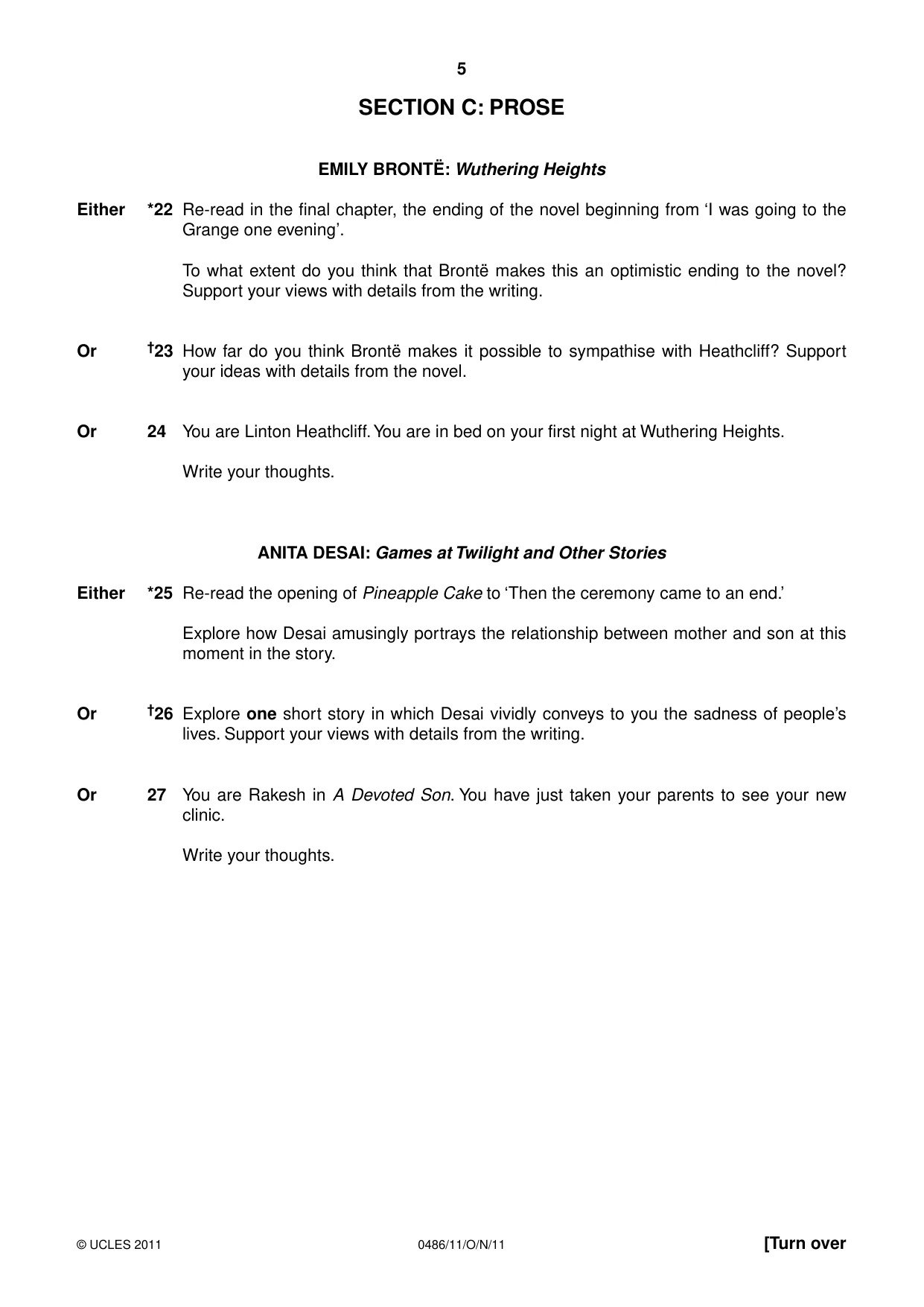
5 0486/11/O/N/11 © UCLES 2011 [Turn over SECTION C: PROSE EMILY BRONTË: Wuthering Heights Either *22 Re-read in the final chapter, the ending of the novel beginning from ‘I was going to the Grange one evening’. To what extent do you think that Brontë makes this an optimistic ending to the novel? Support your views with details from the writing. Or †23 How far do you think Brontë makes it possible to sympathise with Heathcliff? Support your ideas with details from the novel. Or 24 You are Linton Heathcliff. You are in bed on your first night at Wuthering Heights. Write your thoughts. ANITA DESAI: Games at Twilight and Other Stories Either *25 Re-read the opening of Pineapple Cake to ‘Then the ceremony came to an end.’ Explore how Desai amusingly portrays the relationship between mother and son at this moment in the story. Or †26 Explore one short story in which Desai vividly conveys to you the sadness of people’s lives. Support your views with details from the writing. Or 27 You are Rakesh in A Devoted Son. You have just taken your parents to see your new clinic. Write your thoughts.
Question paper, page 6
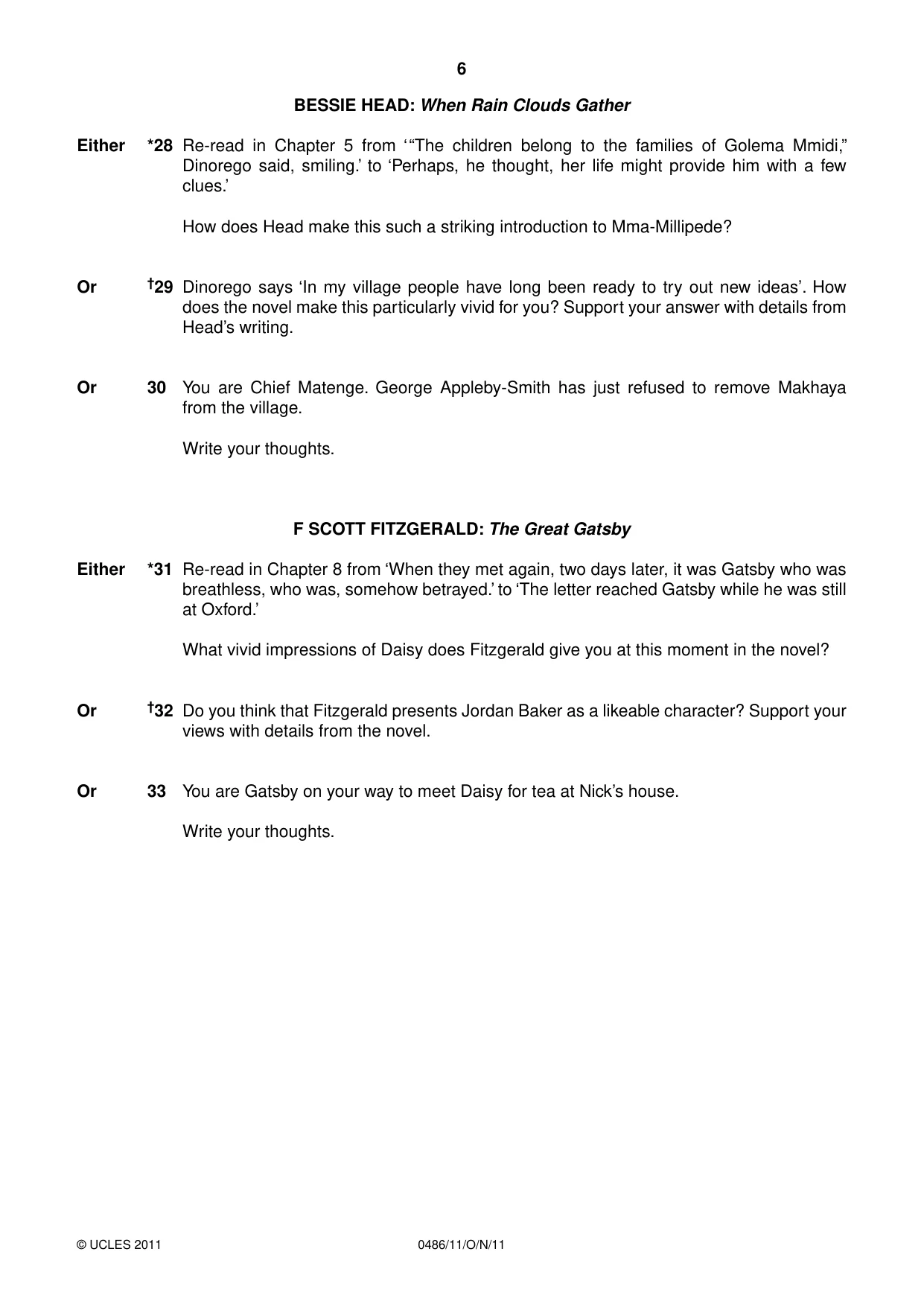
6 0486/11/O/N/11 © UCLES 2011 BESSIE HEAD: When Rain Clouds Gather Either *28 Re-read in Chapter 5 from ‘ “The children belong to the families of Golema Mmidi,” Dinorego said, smiling.’ to ‘Perhaps, he thought, her life might provide him with a few clues.’ How does Head make this such a striking introduction to Mma-Millipede? Or †29 Dinorego says ‘In my village people have long been ready to try out new ideas’. How does the novel make this particularly vivid for you? Support your answer with details from Head’s writing. Or 30 You are Chief Matenge. George Appleby-Smith has just refused to remove Makhaya from the village. Write your thoughts. F SCOTT FITZGERALD: The Great Gatsby Either *31 Re-read in Chapter 8 from ‘When they met again, two days later, it was Gatsby who was breathless, who was, somehow betrayed.’ to ‘The letter reached Gatsby while he was still at Oxford.’ What vivid impressions of Daisy does Fitzgerald give you at this moment in the novel? Or †32 Do you think that Fitzgerald presents Jordan Baker as a likeable character? Support your views with details from the novel. Or 33 You are Gatsby on your way to meet Daisy for tea at Nick’s house. Write your thoughts.
Question paper, page 7
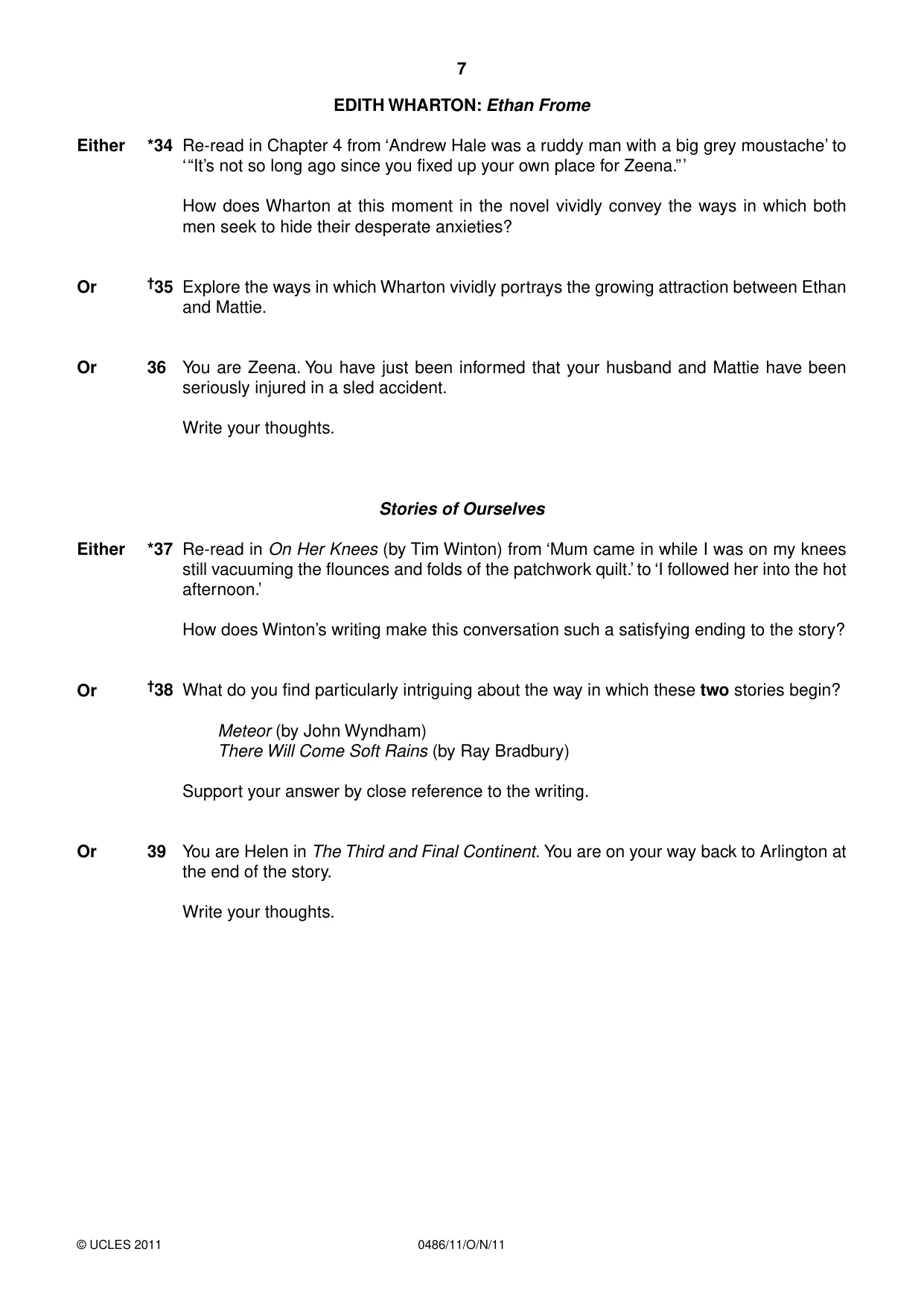
7 0486/11/O/N/11 © UCLES 2011 EDITH WHARTON: Ethan Frome Either *34 Re-read in Chapter 4 from ‘Andrew Hale was a ruddy man with a big grey moustache’ to ‘ “It’s not so long ago since you fixed up your own place for Zeena.” ’ How does Wharton at this moment in the novel vividly convey the ways in which both men seek to hide their desperate anxieties? Or †35 Explore the ways in which Wharton vividly portrays the growing attraction between Ethan and Mattie. Or 36 You are Zeena. You have just been informed that your husband and Mattie have been seriously injured in a sled accident. Write your thoughts. Stories of Ourselves Either *37 Re-read in On Her Knees (by Tim Winton) from ‘Mum came in while I was on my knees still vacuuming the flounces and folds of the patchwork quilt.’ to ‘I followed her into the hot afternoon.’ How does Winton’s writing make this conversation such a satisfying ending to the story? Or †38 What do you find particularly intriguing about the way in which these two stories begin? Meteor (by John Wyndham) There Will Come Soft Rains (by Ray Bradbury) Support your answer by close reference to the writing. Or 39 You are Helen in The Third and Final Continent. You are on your way back to Arlington at the end of the story. Write your thoughts.
Question paper, page 8
8 0486/11/O/N/11 © UCLES 2011 BLANK PAGE Permission to reproduce items where third-party owned material protected by copyright is included has been sought and cleared where possible. Every reasonable effort has been made by the publisher (UCLES) to trace copyright holders, but if any items requiring clearance have unwittingly been included, the publisher will be pleased to make amends at the earliest possible opportunity. University of Cambridge International Examinations is part of the Cambridge Assessment Group. Cambridge Assessment is the brand name of University of Cambridge Local Examinations Syndicate (UCLES), which is itself a department of the University of Cambridge.
Mark scheme, page 1
UNIVERSITY OF CAMBRIDGE INTERNATIONAL EXAMINATIONS International General Certificate of Secondary Education MARK SCHEME for the October/November 2011 question paper for the guidance of teachers 0486 LITERATURE (ENGLISH) 0486/11 Paper 1 (Set Texts: Open Books), maximum raw mark 75 This mark scheme is published as an aid to teachers and candidates, to indicate the requirements of the examination. It shows the basis on which Examiners were instructed to award marks. It does not indicate the details of the discussions that took place at an Examiners’ meeting before marking began, which would have considered the acceptability of alternative answers. Mark schemes must be read in conjunction with the question papers and the report on the examination. • Cambridge will not enter into discussions or correspondence in connection with these mark schemes. Cambridge is publishing the mark schemes for the October/November 2011 question papers for most IGCSE, GCE Advanced Level and Advanced Subsidiary Level syllabuses and some Ordinary Level syllabuses. www.XtremePapers.com
Mark scheme, page 2
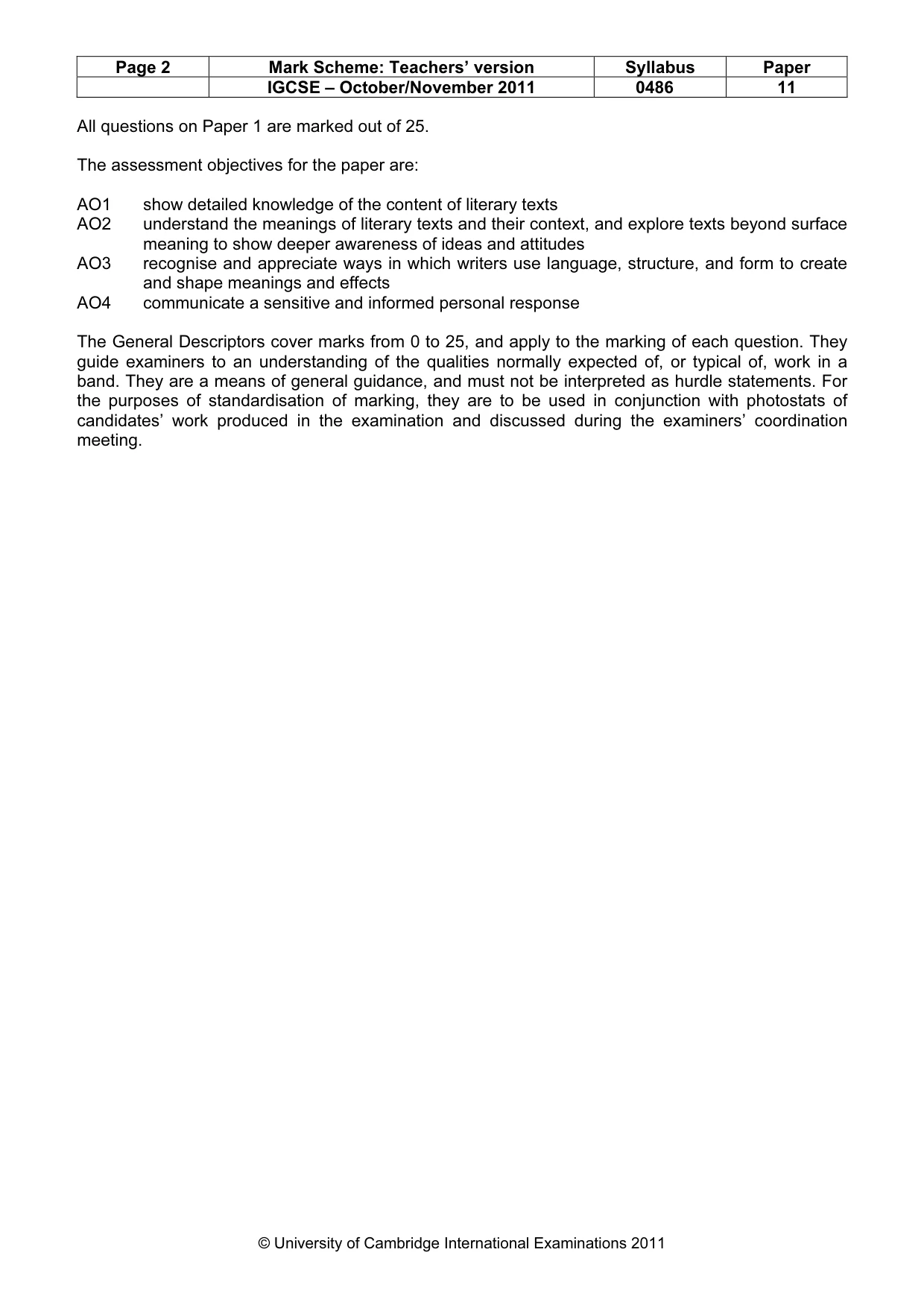
Page 2 Mark Scheme: Teachers’ version Syllabus Paper IGCSE – October/November 2011 0486 11 © University of Cambridge International Examinations 2011 All questions on Paper 1 are marked out of 25. The assessment objectives for the paper are: AO1 show detailed knowledge of the content of literary texts AO2 understand the meanings of literary texts and their context, and explore texts beyond surface meaning to show deeper awareness of ideas and attitudes AO3 recognise and appreciate ways in which writers use language, structure, and form to create and shape meanings and effects AO4 communicate a sensitive and informed personal response The General Descriptors cover marks from 0 to 25, and apply to the marking of each question. They guide examiners to an understanding of the qualities normally expected of, or typical of, work in a band. They are a means of general guidance, and must not be interpreted as hurdle statements. For the purposes of standardisation of marking, they are to be used in conjunction with photostats of candidates’ work produced in the examination and discussed during the examiners’ coordination meeting.
Mark scheme, page 3
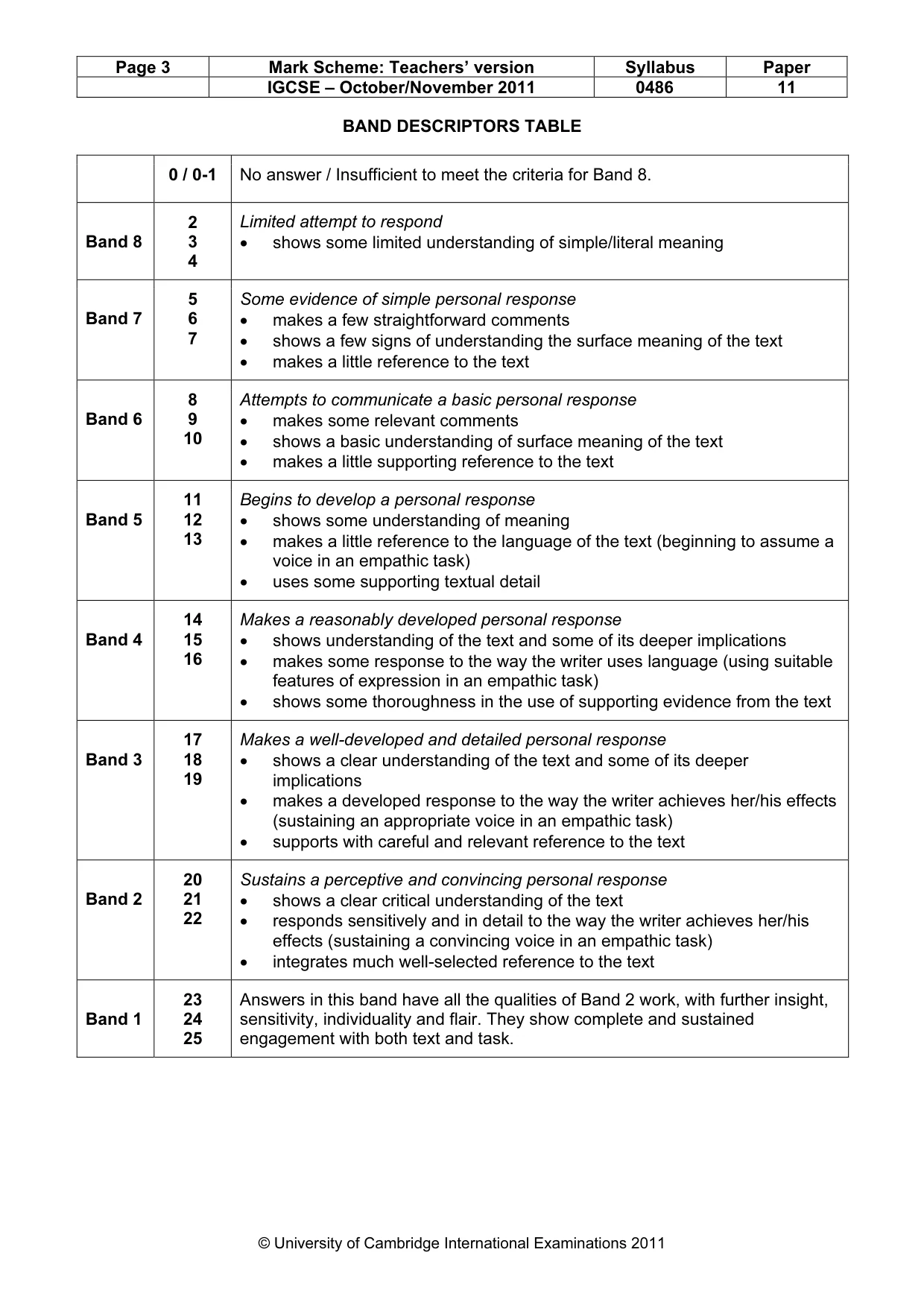
Page 3 Mark Scheme: Teachers’ version Syllabus Paper IGCSE – October/November 2011 0486 11 © University of Cambridge International Examinations 2011 BAND DESCRIPTORS TABLE 0 / 0-1 No answer / Insufficient to meet the criteria for Band 8. Band 8 2 3 4 Limited attempt to respond • shows some limited understanding of simple/literal meaning Band 7 5 6 7 Some evidence of simple personal response • makes a few straightforward comments • shows a few signs of understanding the surface meaning of the text • makes a little reference to the text Band 6 8 9 10 Attempts to communicate a basic personal response • makes some relevant comments • shows a basic understanding of surface meaning of the text • makes a little supporting reference to the text Band 5 11 12 13 Begins to develop a personal response • shows some understanding of meaning • makes a little reference to the language of the text (beginning to assume a voice in an empathic task) • uses some supporting textual detail Band 4 14 15 16 Makes a reasonably developed personal response • shows understanding of the text and some of its deeper implications • makes some response to the way the writer uses language (using suitable features of expression in an empathic task) • shows some thoroughness in the use of supporting evidence from the text Band 3 17 18 19 Makes a well-developed and detailed personal response • shows a clear understanding of the text and some of its deeper implications • makes a developed response to the way the writer achieves her/his effects (sustaining an appropriate voice in an empathic task) • supports with careful and relevant reference to the text Band 2 20 21 22 Sustains a perceptive and convincing personal response • shows a clear critical understanding of the text • responds sensitively and in detail to the way the writer achieves her/his effects (sustaining a convincing voice in an empathic task) • integrates much well-selected reference to the text Band 1 23 24 25 Answers in this band have all the qualities of Band 2 work, with further insight, sensitivity, individuality and flair. They show complete and sustained engagement with both text and task.
What you needed in this session
Cambridge’s own grade thresholds for 2011 Oct/Nov, Paper 1 · Variant 1. A higher threshold means an easier paper — the bar moves with how the cohort did.