Cambridge IGCSE English - Literature 0486 — 2018 May/June Paper 1 · Variant 3
0486/13/M/J/18 · 50 marks · ≈56 min
The question paper and its mark scheme, free to read here and free to download. This is Cambridge’s own paper, exactly as it was sat.
Question paper28 pages


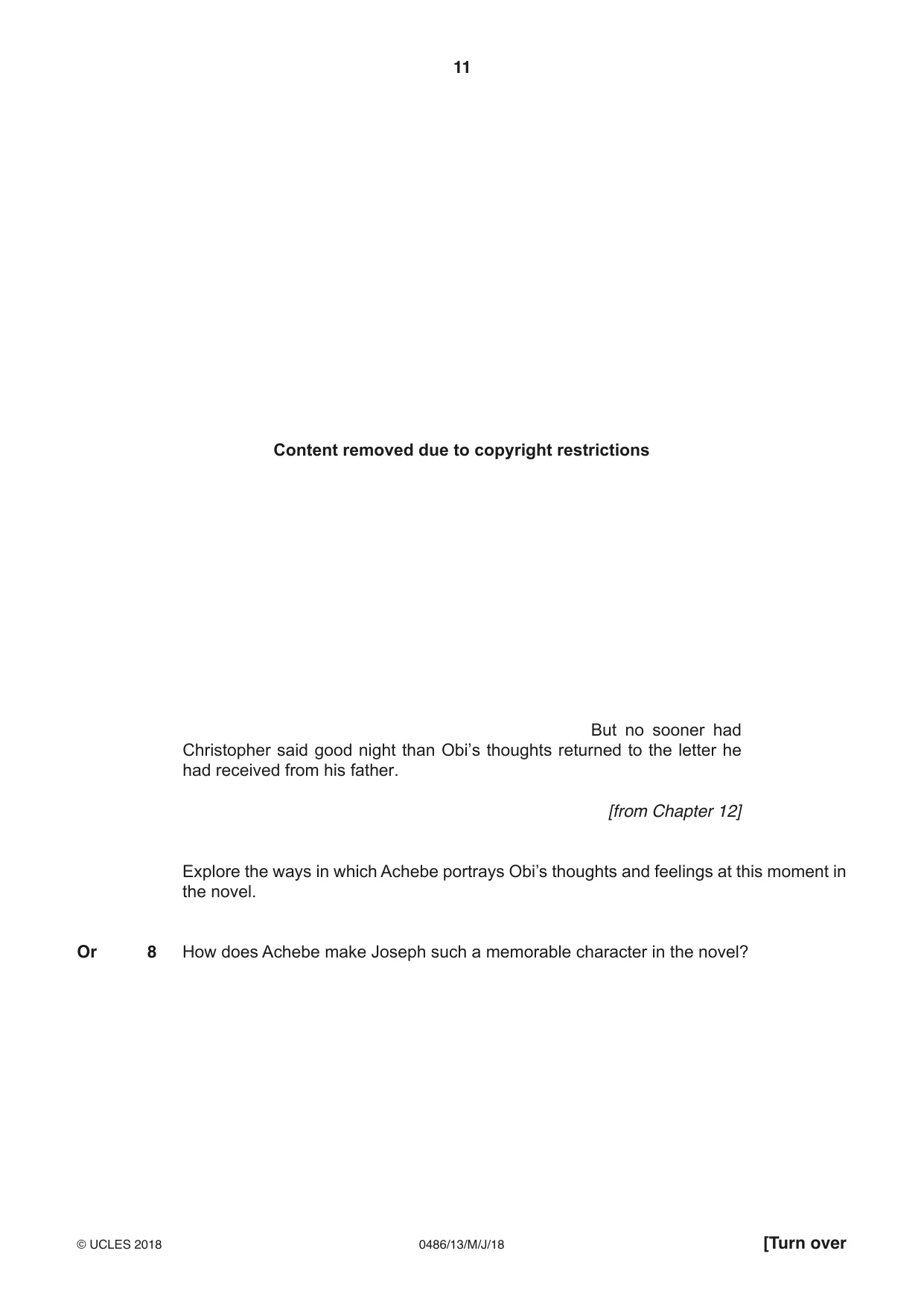
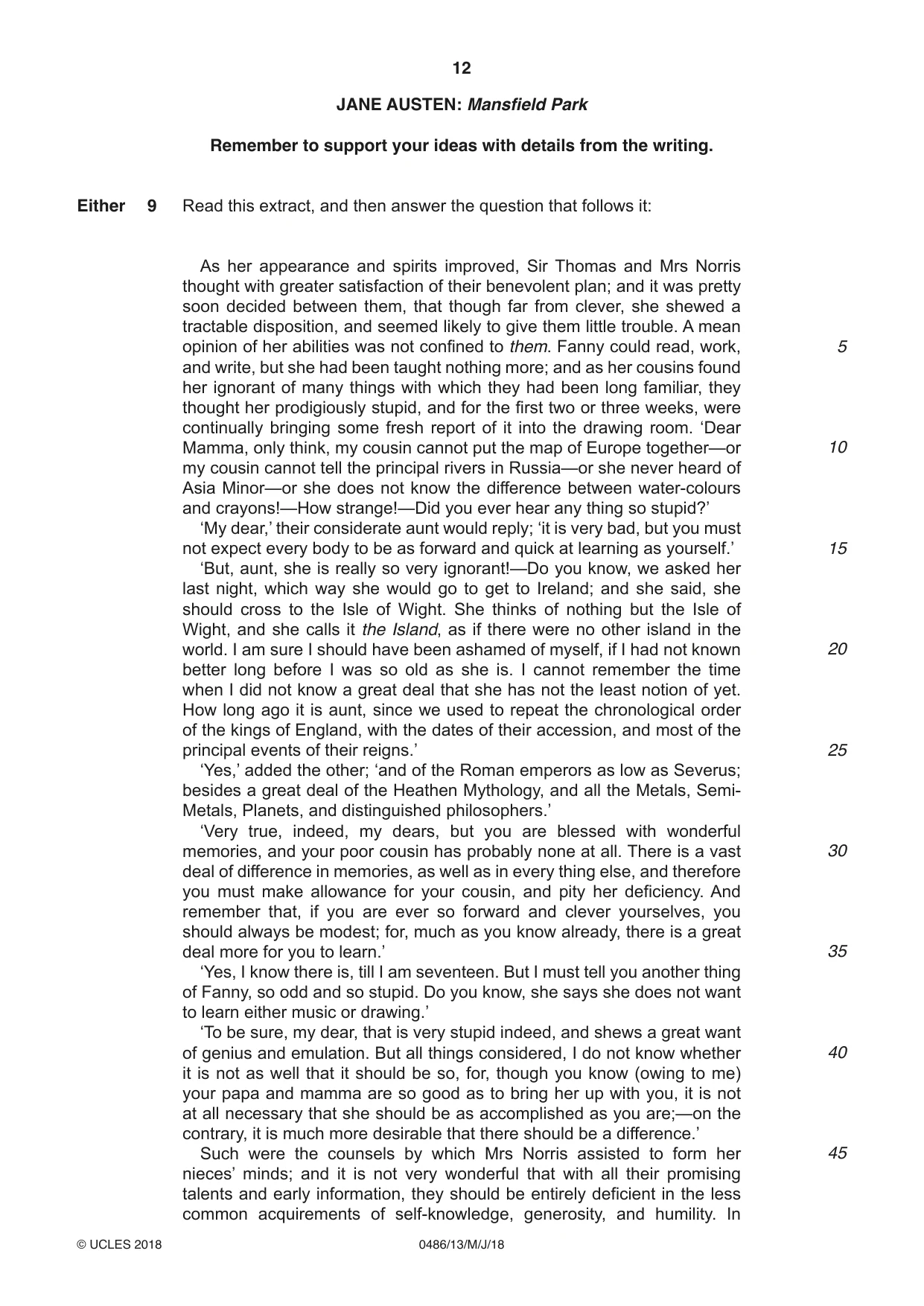
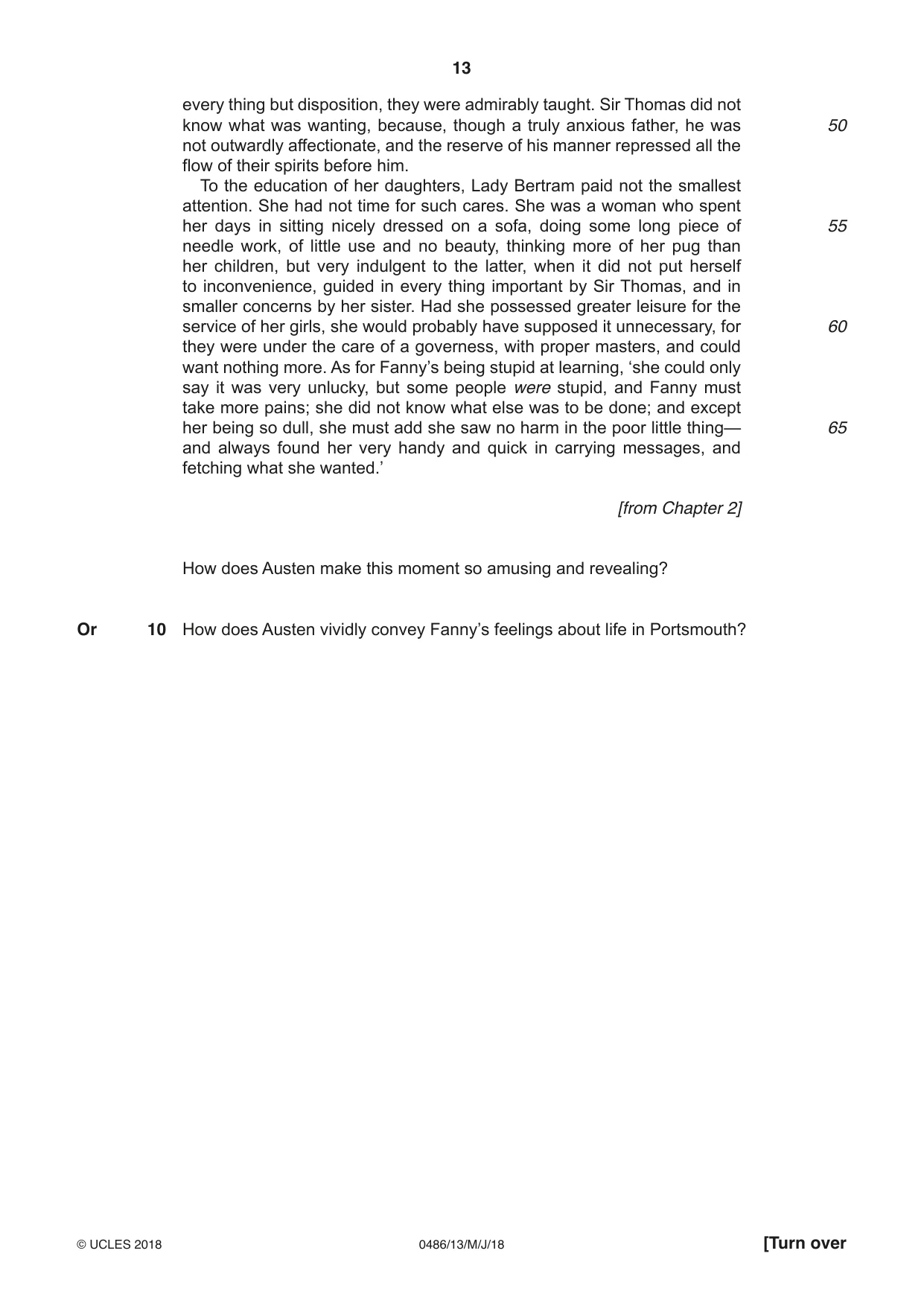
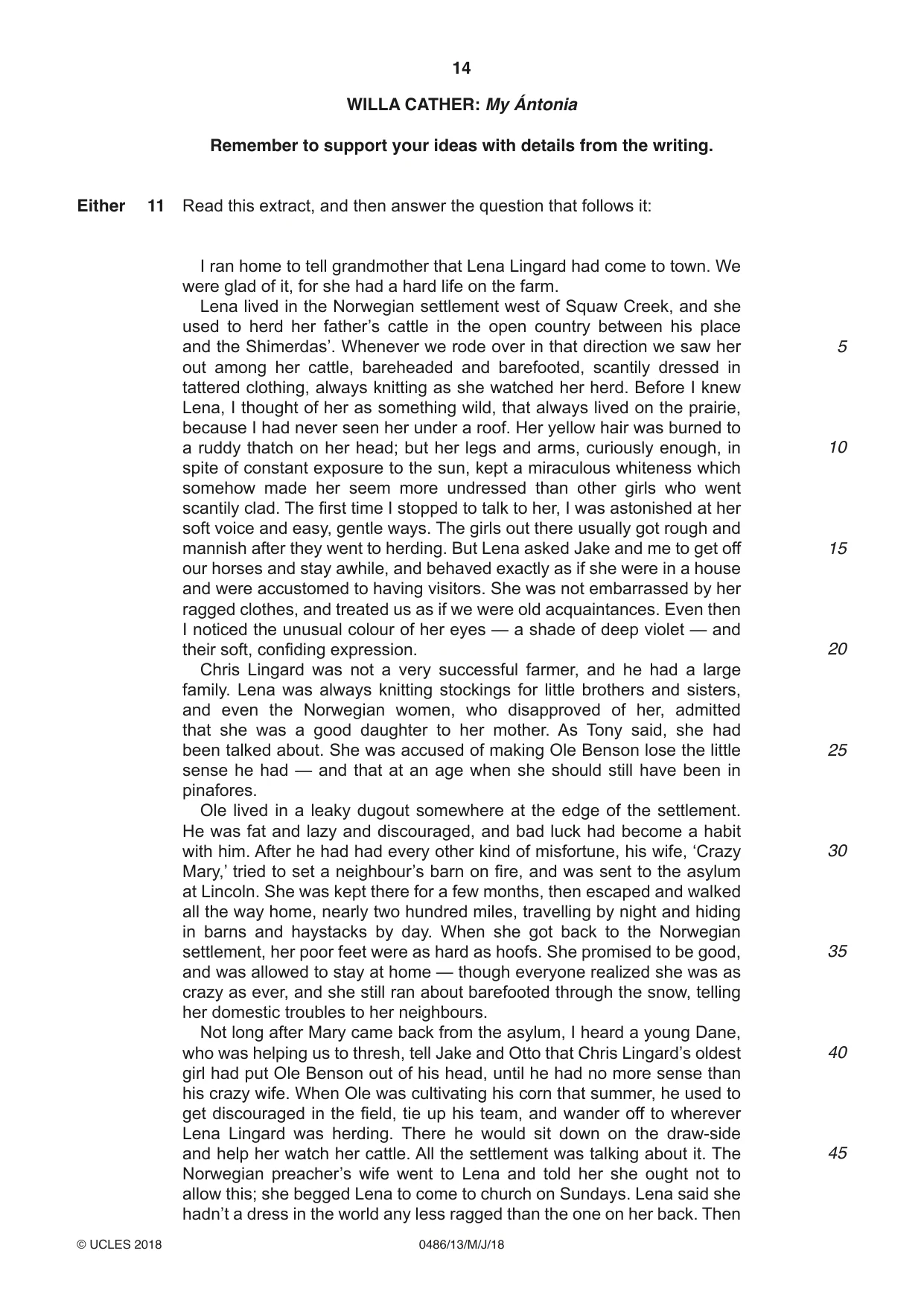

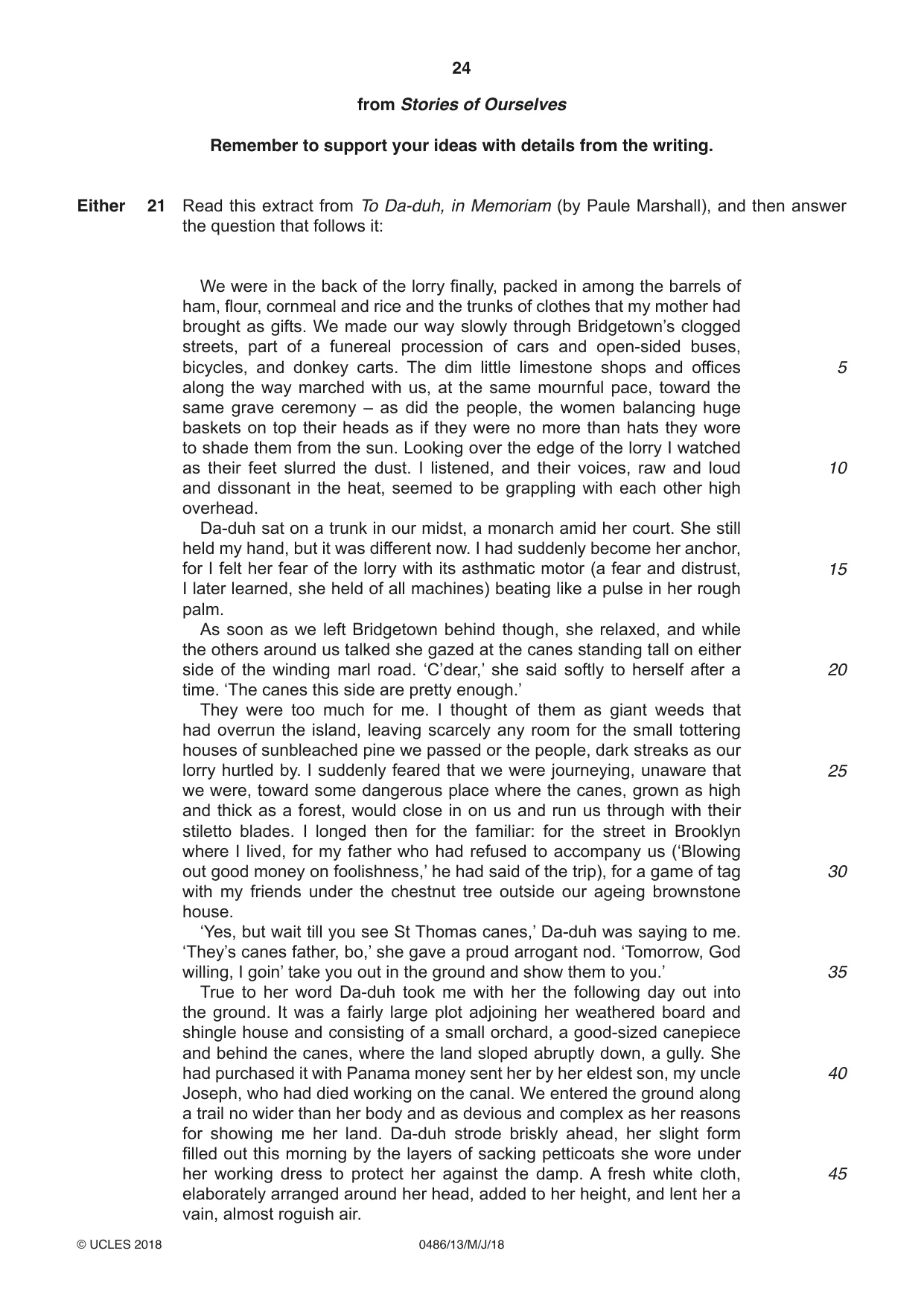
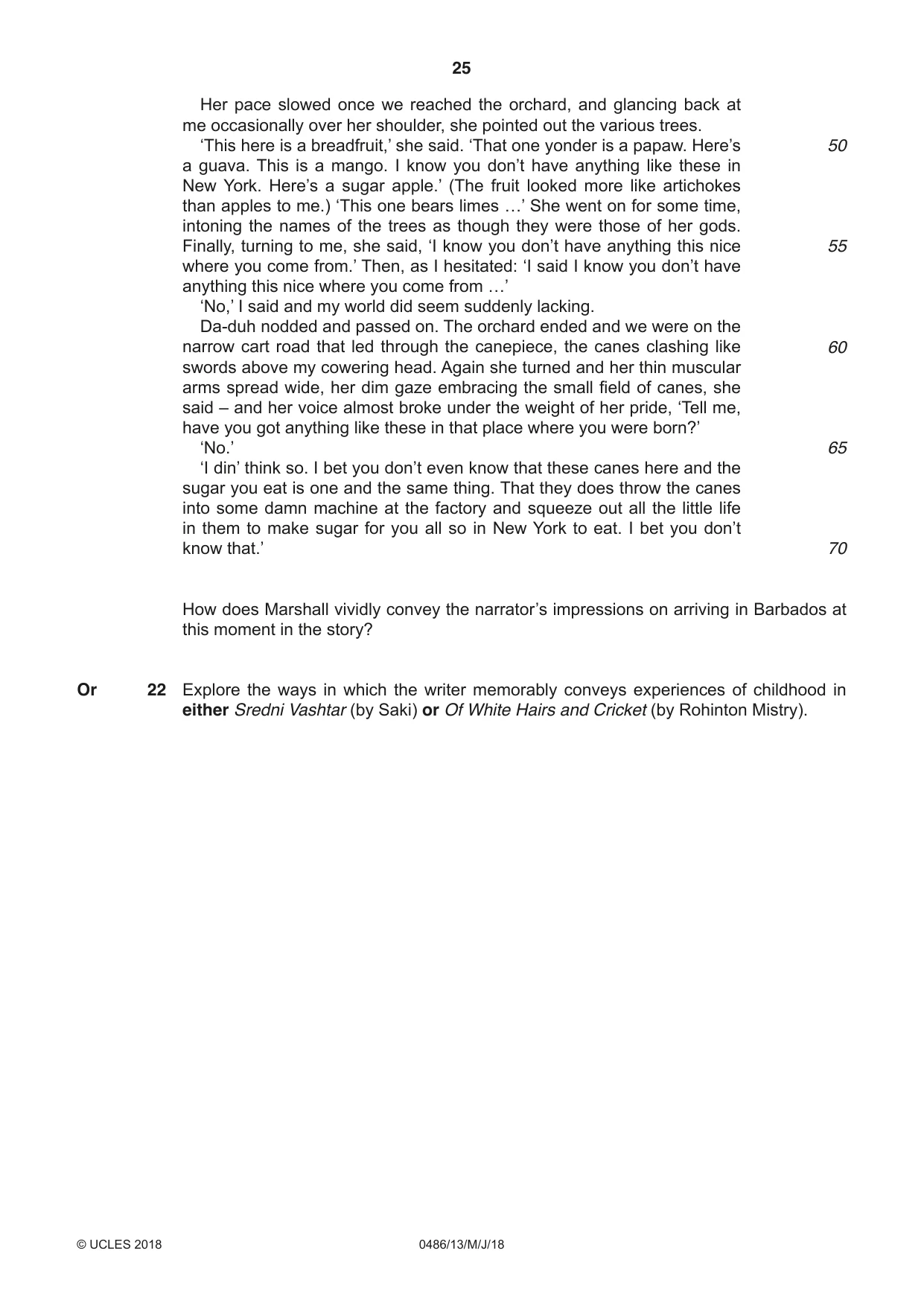



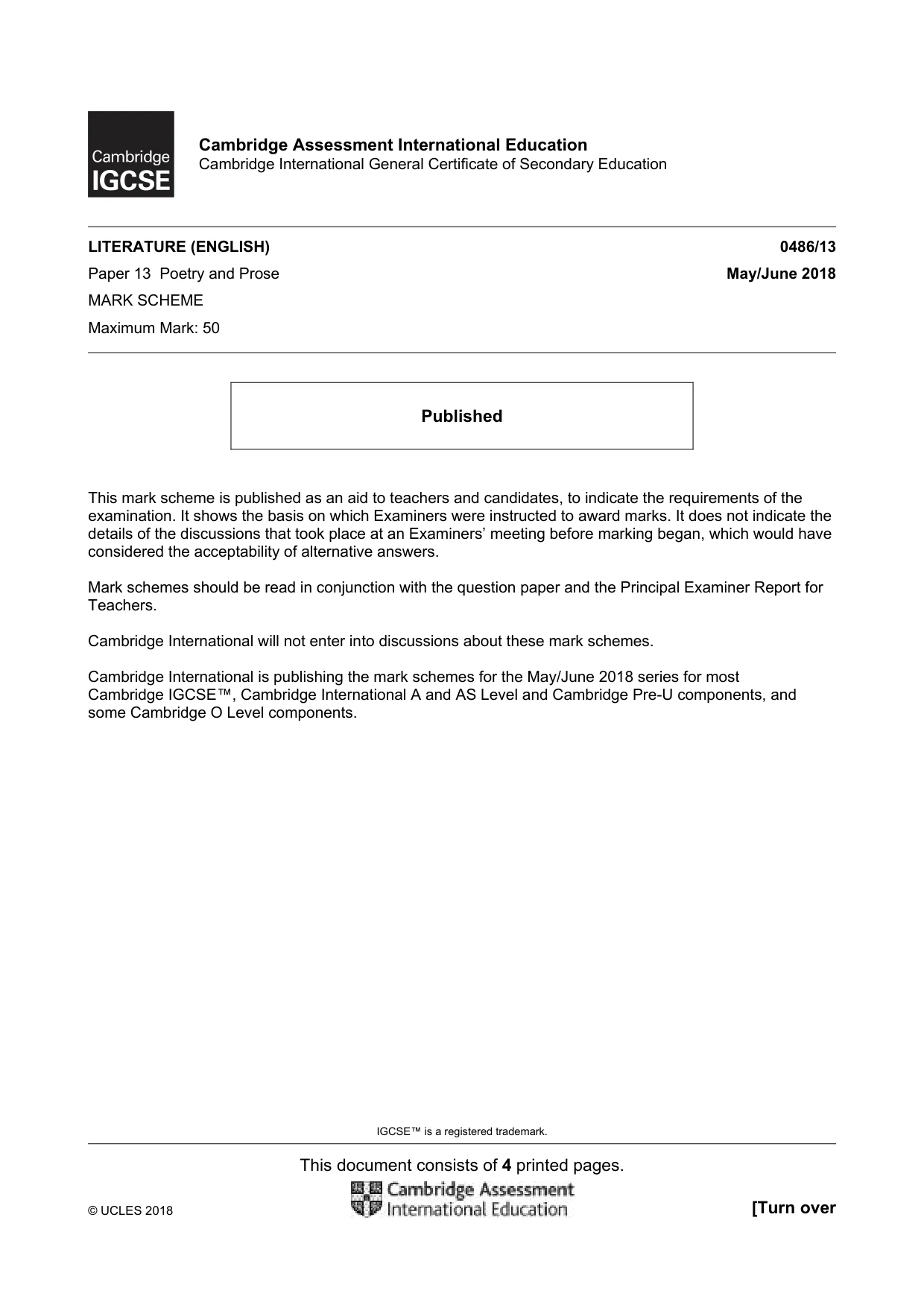
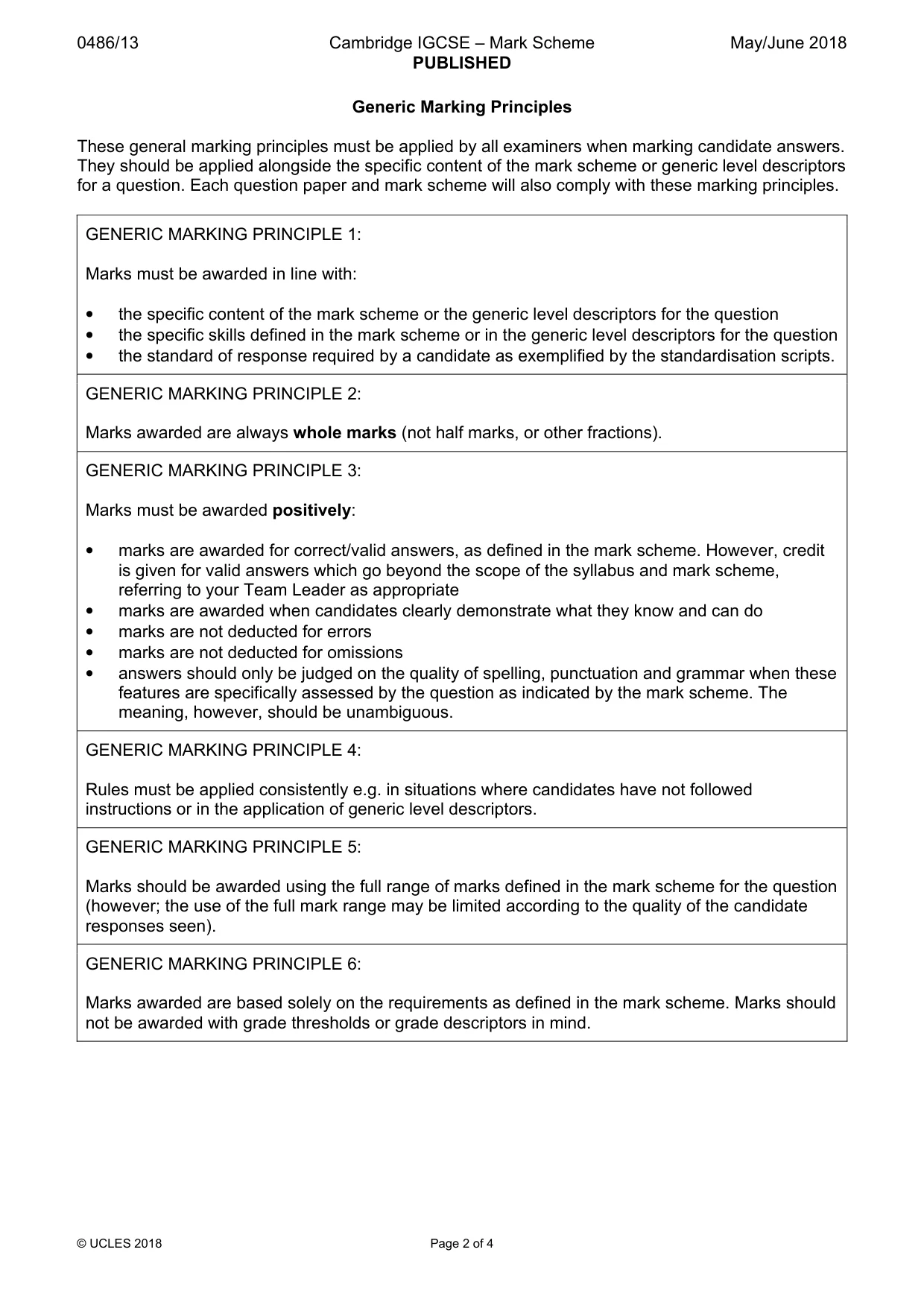
Mark scheme4 pages
Answers below. Sit the paper first if you are practising.
Paper as text
Question paper, page 1
This document consists of 24 printed pages, 4 blank pages and 1 Insert. DC (RCL (GO)) 148756/2 © UCLES 2018 [Turn over Cambridge International Examinations Cambridge International General Certificate of Secondary Education * 2 7 9 2 2 1 4 9 5 0 * LITERATURE (ENGLISH) 0486/13 Paper 1 Poetry and Prose May/June 2018 1 hour 30 minutes No Additional Materials are required. READ THESE INSTRUCTIONS FIRST An answer booklet is provided inside this question paper. You should follow the instructions on the front cover of the answer booklet. If you need additional paper ask the invigilator for a continuation booklet. Answer two questions: one question from Section A and one question from Section B. All questions in this paper carry equal marks.
Question paper, page 2
2 0486/13/M/J/18 © UCLES 2018 BLANK PAGE
Question paper, page 3
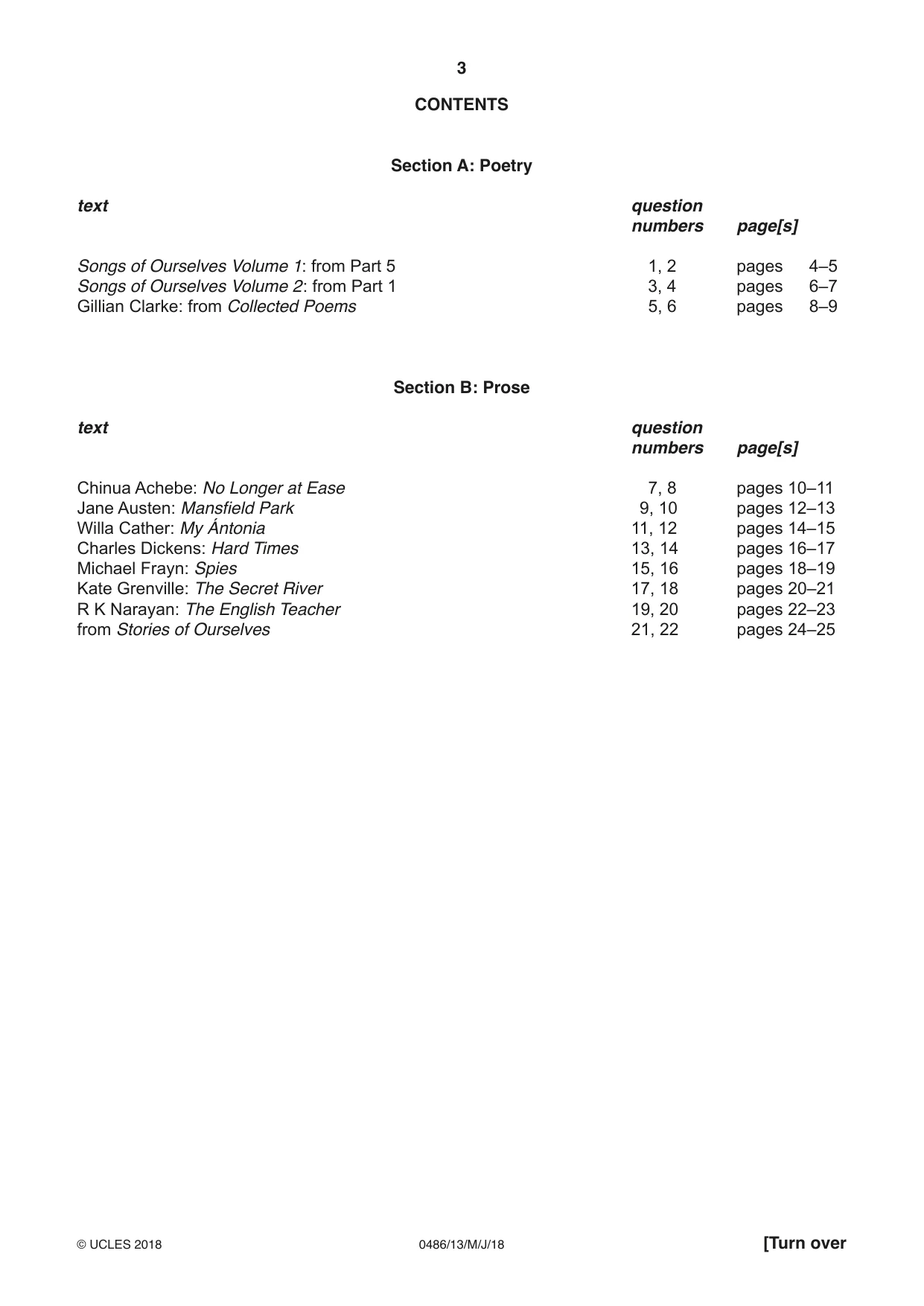
3 0486/13/M/J/18 © UCLES 2018 [Turn over CONTENTS Section A: Poetry text question numbers page[s] Songs of Ourselves Volume 1: from Part 5 1, 2 pages 4–5 Songs of Ourselves Volume 2 : from Part 1 3, 4 pages 6–7 Gillian Clarke: from Collected Poems 5, 6 pages 8–9 Section B: Prose text question numbers page[s] Chinua Achebe: No Longer at Ease 7, 8 pages 10–11 Jane Austen: Mansfield Park 9, 10 pages 12–13 Willa Cather: My Ántonia 11, 12 pages 14–15 Charles Dickens: Hard Times 13, 14 pages 16–17 Michael Frayn: Spies 15, 16 pages 18–19 Kate Grenville: The Secret River 17, 18 pages 20–21 R K Narayan: The English Teacher 19, 20 pages 22–23 from Stories of Ourselves 21, 22 pages 24–25
Question paper, page 4
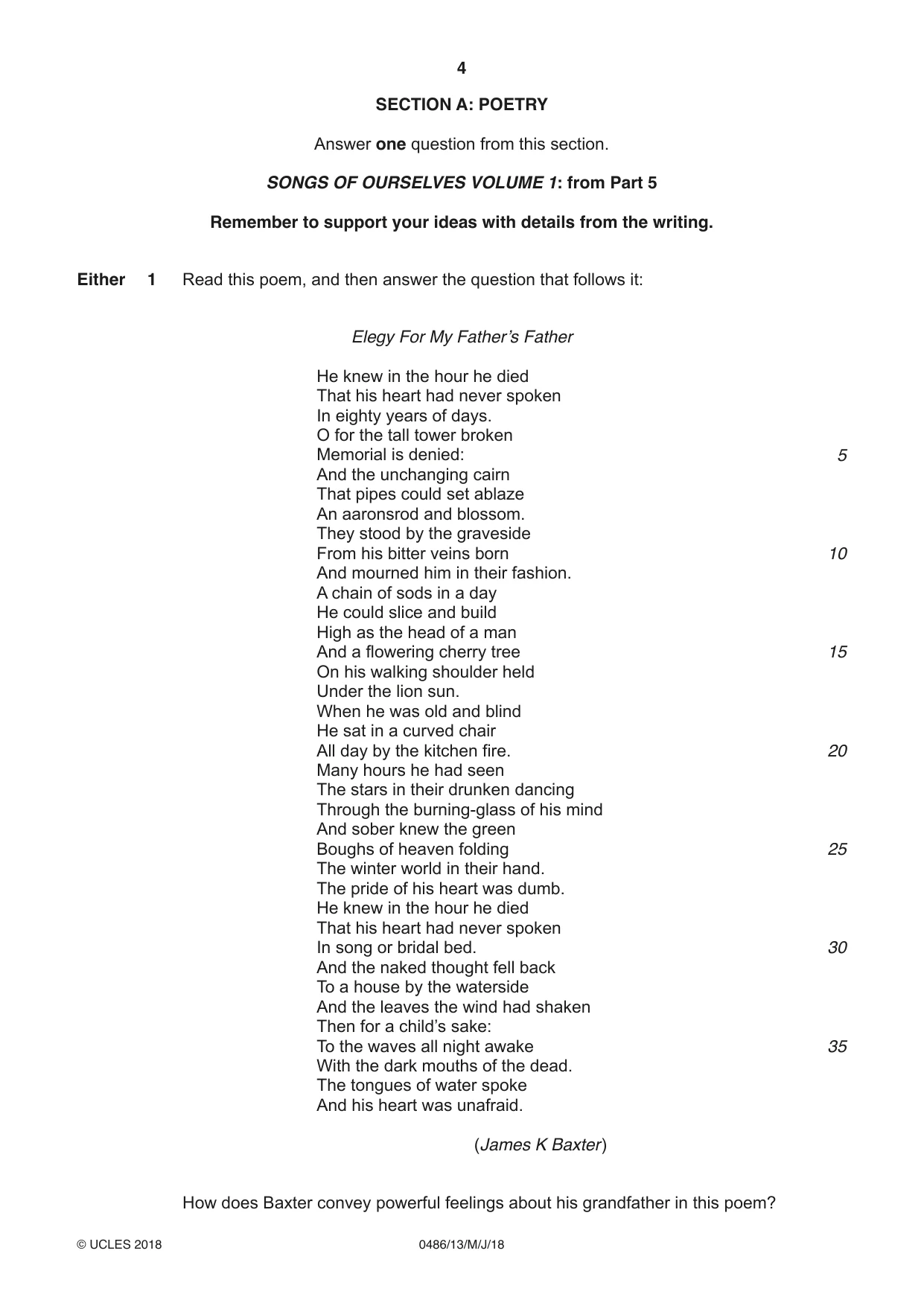
4 0486/13/M/J/18 © UCLES 2018 SECTION A: POETRY Answer one question from this section. SONGS OF OURSELVES VOLUME 1: from Part 5 Remember to support your ideas with details from the writing. Either 1 Read this poem, and then answer the question that follows it: Elegy For My Father’s Father He knew in the hour he died That his heart had never spoken In eighty years of days. O for the tall tower broken Memorial is denied: And the unchanging cairn That pipes could set ablaze An aaronsrod and blossom. They stood by the graveside From his bitter veins born And mourned him in their fashion. A chain of sods in a day He could slice and build High as the head of a man And a flowering cherry tree On his walking shoulder held Under the lion sun. When he was old and blind He sat in a curved chair All day by the kitchen fire. Many hours he had seen The stars in their drunken dancing Through the burning-glass of his mind And sober knew the green Boughs of heaven folding The winter world in their hand. The pride of his heart was dumb. He knew in the hour he died That his heart had never spoken In song or bridal bed. And the naked thought fell back To a house by the waterside And the leaves the wind had shaken Then for a child’s sake: To the waves all night awake With the dark mouths of the dead. The tongues of water spoke And his heart was unafraid. (James K Baxter) How does Baxter convey powerful feelings about his grandfather in this poem? 5 10 15 20 25 30 35
Question paper, page 5
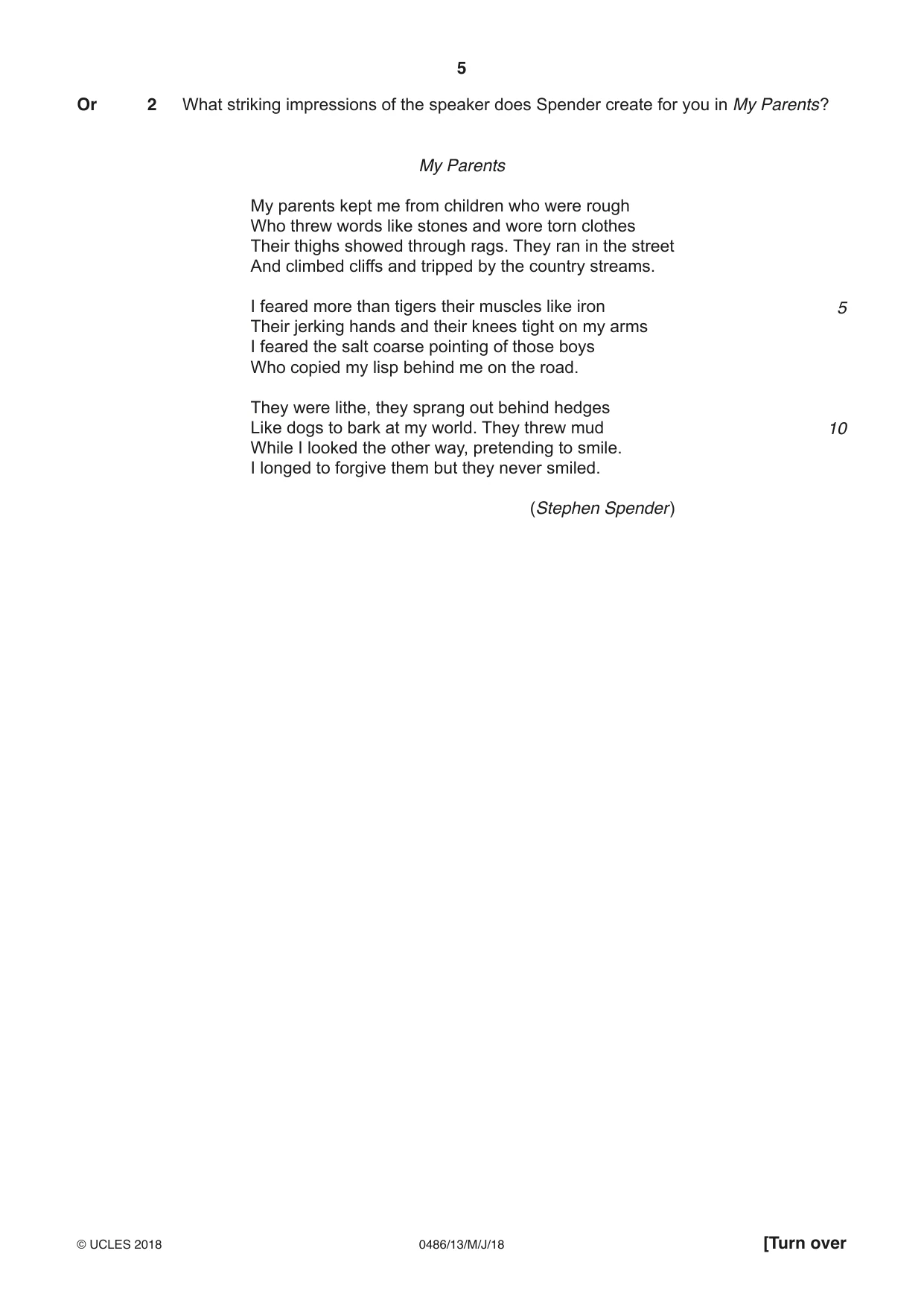
5 0486/13/M/J/18 © UCLES 2018 [Turn over Or 2 What striking impressions of the speaker does Spender create for you in My Parents? My Parents My parents kept me from children who were rough Who threw words like stones and wore torn clothes Their thighs showed through rags. They ran in the street And climbed cliffs and tripped by the country streams. I feared more than tigers their muscles like iron Their jerking hands and their knees tight on my arms I feared the salt coarse pointing of those boys Who copied my lisp behind me on the road. They were lithe, they sprang out behind hedges Like dogs to bark at my world. They threw mud While I looked the other way, pretending to smile. I longed to forgive them but they never smiled. (Stephen Spender) 5 10
Question paper, page 6
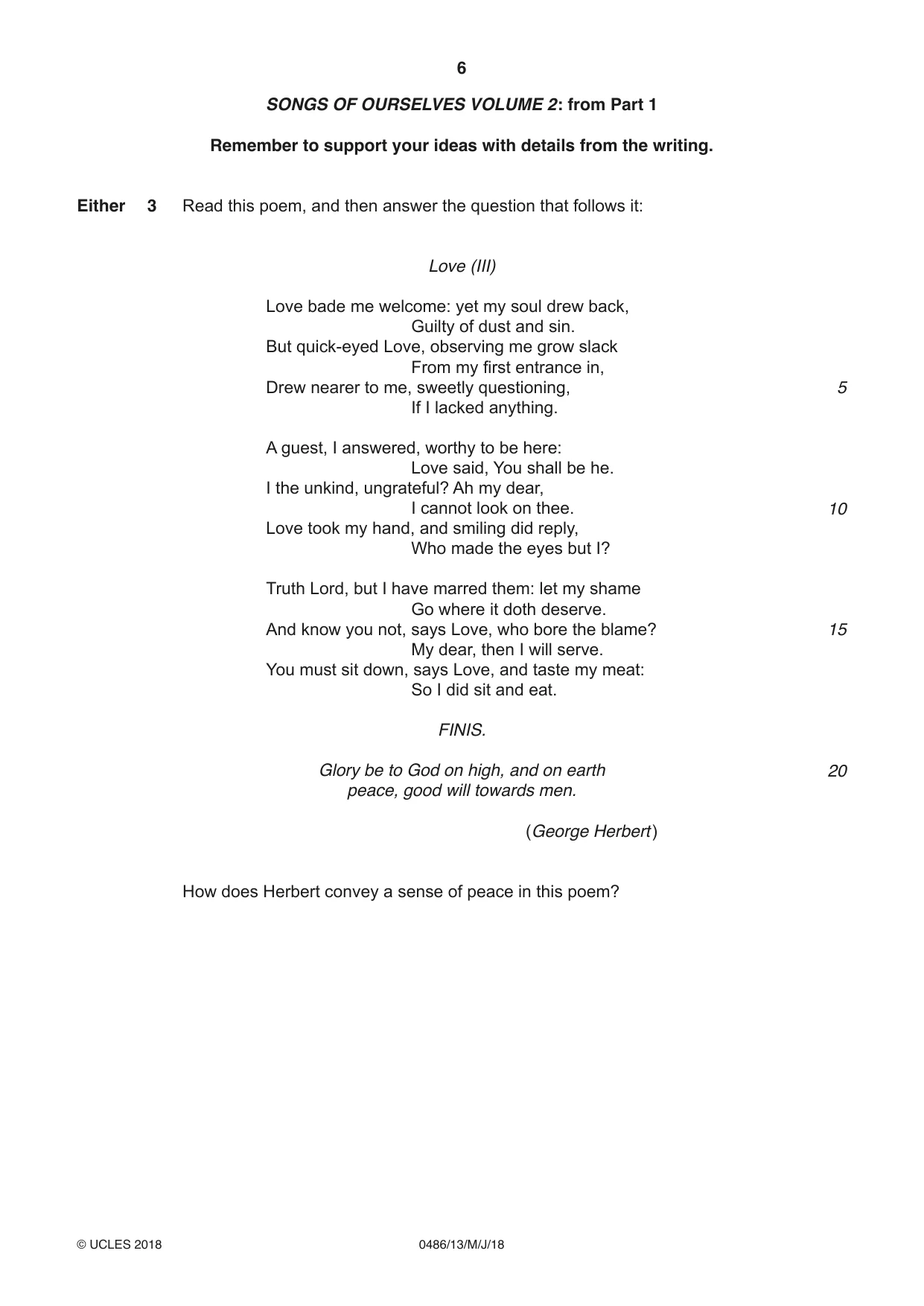
6 0486/13/M/J/18 © UCLES 2018 SONGS OF OURSELVES VOLUME 2: from Part 1 Remember to support your ideas with details from the writing. Either 3 Read this poem, and then answer the question that follows it: Love (III) Love bade me welcome: yet my soul drew back, Guilty of dust and sin. But quick-eyed Love, observing me grow slack From my first entrance in, Drew nearer to me, sweetly questioning, If I lacked anything. A guest, I answered, worthy to be here: Love said, You shall be he. I the unkind, ungrateful? Ah my dear, I cannot look on thee. Love took my hand, and smiling did reply, Who made the eyes but I? Truth Lord, but I have marred them: let my shame Go where it doth deserve. And know you not, says Love, who bore the blame? My dear, then I will serve. You must sit down, says Love, and taste my meat: So I did sit and eat. FINIS. Glory be to God on high, and on earth peace, good will towards men. (George Herbert) How does Herbert convey a sense of peace in this poem? 5 10 15 20
Question paper, page 7
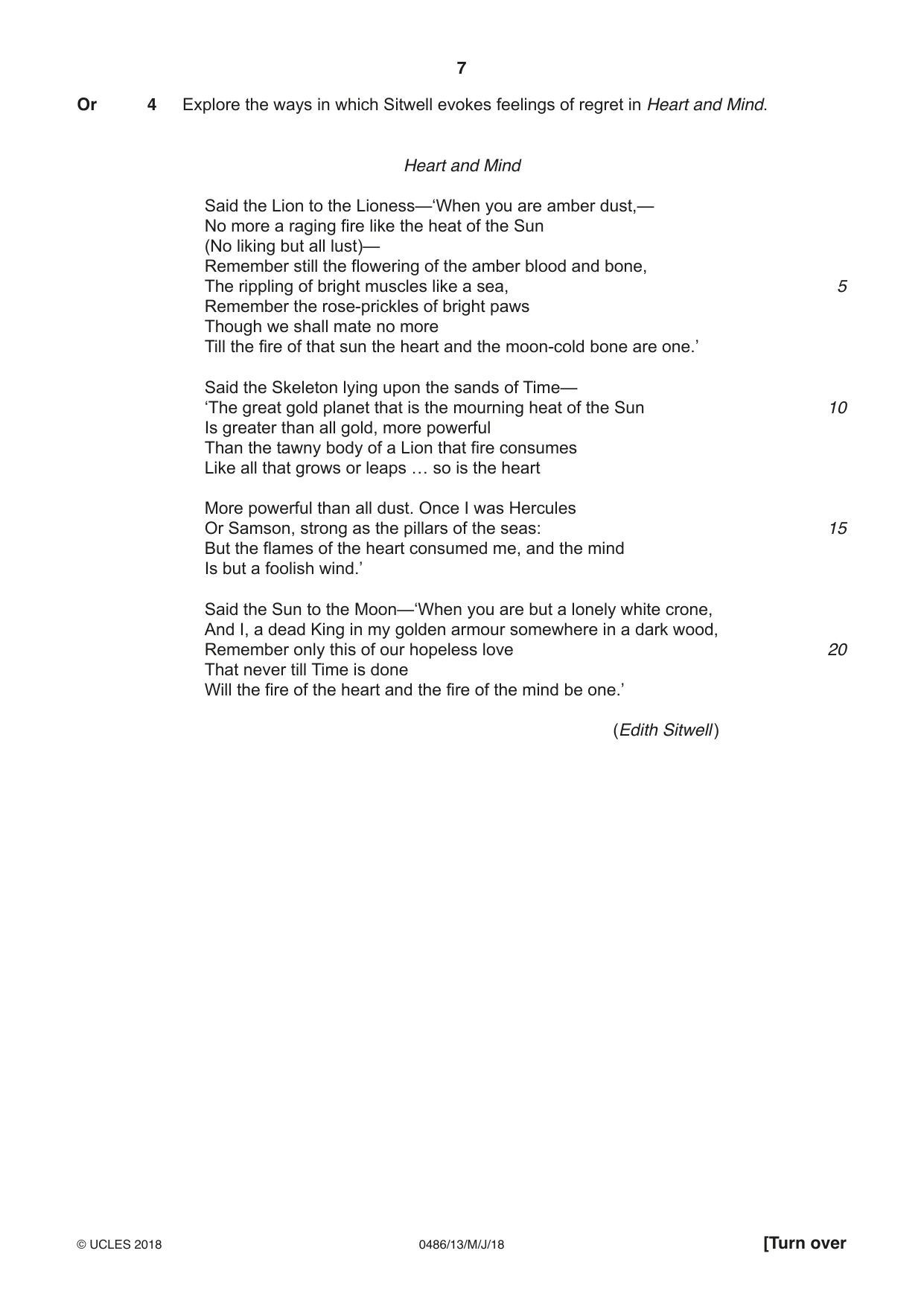
7 0486/13/M/J/18 © UCLES 2018 [Turn over Or 4 Explore the ways in which Sitwell evokes feelings of regret in Heart and Mind. Heart and Mind Said the Lion to the Lioness—‘When you are amber dust,— No more a raging fire like the heat of the Sun (No liking but all lust)— Remember still the flowering of the amber blood and bone, The rippling of bright muscles like a sea, Remember the rose-prickles of bright paws Though we shall mate no more Till the fire of that sun the heart and the moon-cold bone are one.’ Said the Skeleton lying upon the sands of Time— ‘The great gold planet that is the mourning heat of the Sun Is greater than all gold, more powerful Than the tawny body of a Lion that fire consumes Like all that grows or leaps … so is the heart More powerful than all dust. Once I was Hercules Or Samson, strong as the pillars of the seas: But the flames of the heart consumed me, and the mind Is but a foolish wind.’ Said the Sun to the Moon—‘When you are but a lonely white crone, And I, a dead King in my golden armour somewhere in a dark wood, Remember only this of our hopeless love That never till Time is done Will the fire of the heart and the fire of the mind be one.’ (Edith Sitwell) 5 10 15 20
Question paper, page 8
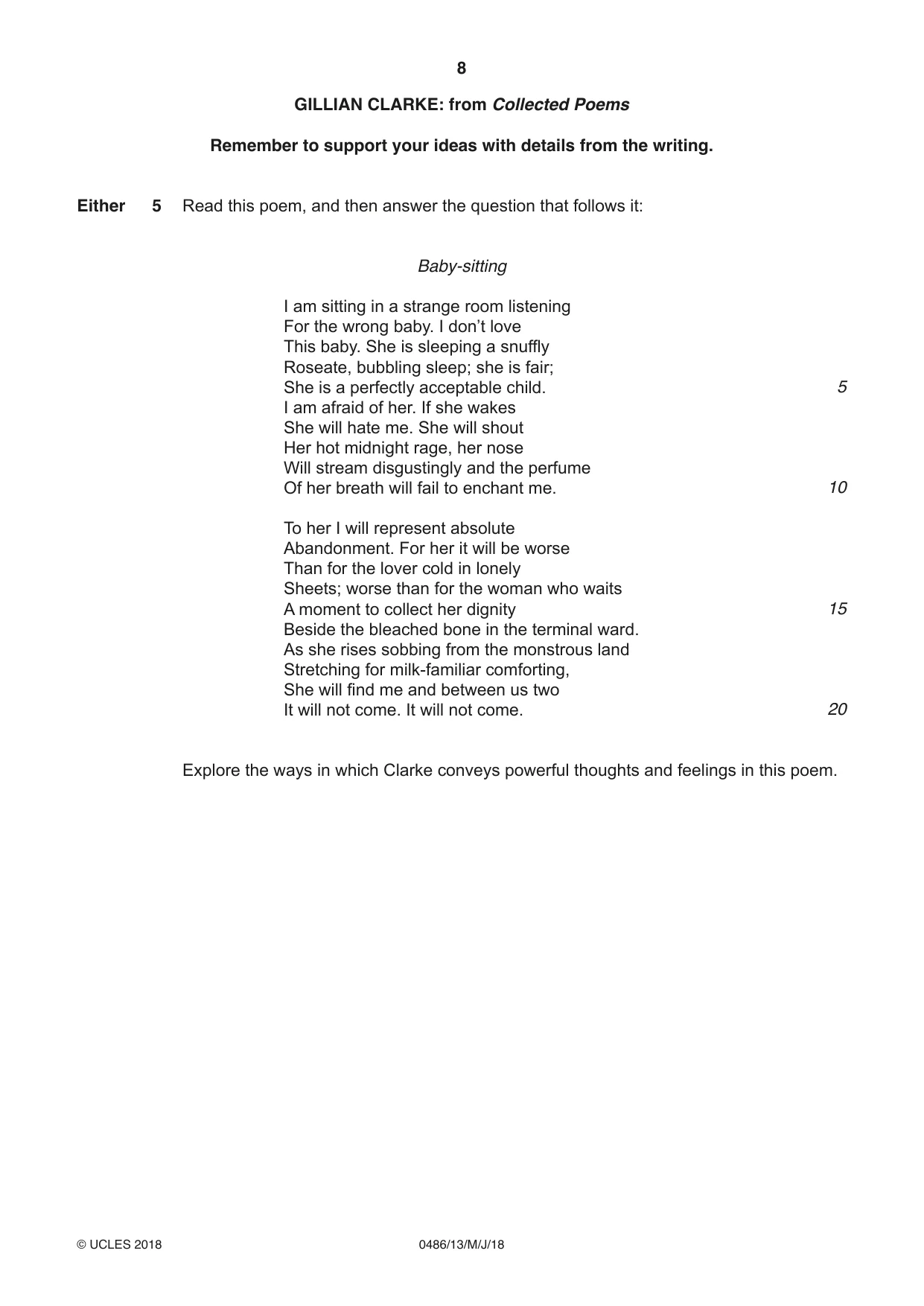
8 0486/13/M/J/18 © UCLES 2018 GILLIAN CLARKE: from Collected Poems Remember to support your ideas with details from the writing. Either 5 Read this poem, and then answer the question that follows it: Baby-sitting I am sitting in a strange room listening For the wrong baby. I don’t love This baby. She is sleeping a snuffly Roseate, bubbling sleep; she is fair; She is a perfectly acceptable child. I am afraid of her. If she wakes She will hate me. She will shout Her hot midnight rage, her nose Will stream disgustingly and the perfume Of her breath will fail to enchant me. To her I will represent absolute Abandonment. For her it will be worse Than for the lover cold in lonely Sheets; worse than for the woman who waits A moment to collect her dignity Beside the bleached bone in the terminal ward. As she rises sobbing from the monstrous land Stretching for milk-familiar comforting, She will find me and between us two It will not come. It will not come. Explore the ways in which Clarke conveys powerful thoughts and feelings in this poem. 5 10 15 20
Question paper, page 9
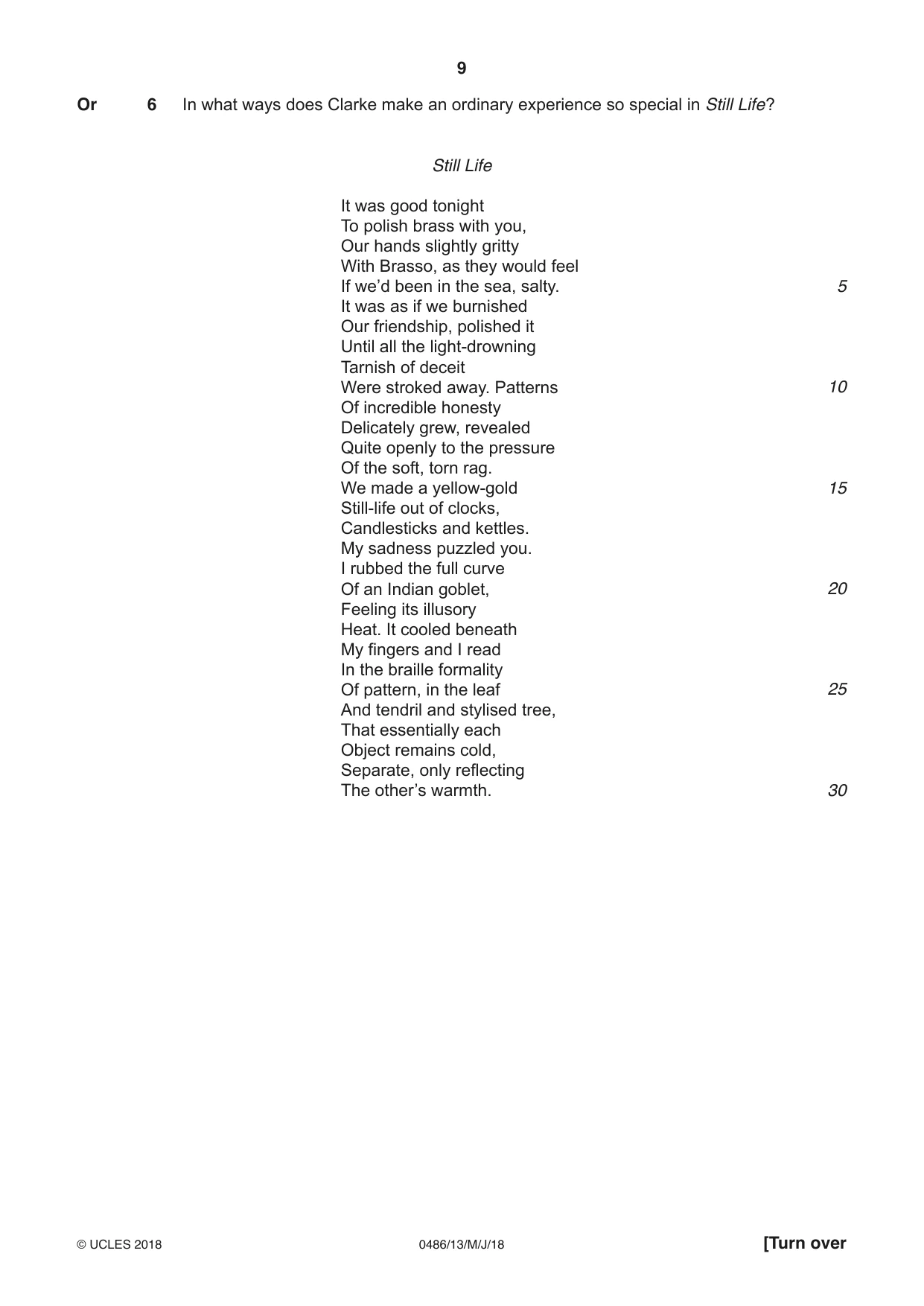
9 0486/13/M/J/18 © UCLES 2018 [Turn over Or 6 In what ways does Clarke make an ordinary experience so special in Still Life? Still Life It was good tonight To polish brass with you, Our hands slightly gritty With Brasso, as they would feel If we’d been in the sea, salty. It was as if we burnished Our friendship, polished it Until all the light-drowning Tarnish of deceit Were stroked away. Patterns Of incredible honesty Delicately grew, revealed Quite openly to the pressure Of the soft, torn rag. We made a yellow-gold Still-life out of clocks, Candlesticks and kettles. My sadness puzzled you. I rubbed the full curve Of an Indian goblet, Feeling its illusory Heat. It cooled beneath My fingers and I read In the braille formality Of pattern, in the leaf And tendril and stylised tree, That essentially each Object remains cold, Separate, only reflecting The other’s warmth. 5 10 15 20 25 30
Question paper, page 10
10 0486/13/M/J/18 © UCLES 2018 SECTION B: PROSE Answer one question from this section. CHINUA ACHEBE: No Longer at Ease Remember to support your ideas with details from the writing. Either 7 Read this extract, and then answer the question that follows it: ‘You see,’ said Christopher as soon as they got back into the car. Content removed due to copyright restrictions
Question paper, page 11
0486/13/M/J/18 © UCLES 2018 [Turn over Content removed due to copyright restrictions [from Chapter 12] Explore the ways in which Achebe portrays Obi’s thoughts and feelings at this moment in the novel. Or 8 How does Achebe make Joseph such a memorable character in the novel? But no sooner had Christopher said good night than Obi’s thoughts returned to the letter he had received from his father. 11
Question paper, page 12
12 0486/13/M/J/18 © UCLES 2018 JANE AUSTEN: Mansfield Park Remember to support your ideas with details from the writing. Either 9 Read this extract, and then answer the question that follows it: As her appearance and spirits improved, Sir Thomas and Mrs Norris thought with greater satisfaction of their benevolent plan; and it was pretty soon decided between them, that though far from clever, she shewed a tractable disposition, and seemed likely to give them little trouble. A mean opinion of her abilities was not confined to them. Fanny could read, work, and write, but she had been taught nothing more; and as her cousins found her ignorant of many things with which they had been long familiar, they thought her prodigiously stupid, and for the first two or three weeks, were continually bringing some fresh report of it into the drawing room. ‘Dear Mamma, only think, my cousin cannot put the map of Europe together—or my cousin cannot tell the principal rivers in Russia—or she never heard of Asia Minor—or she does not know the difference between water-colours and crayons!—How strange!—Did you ever hear any thing so stupid?’ ‘My dear,’ their considerate aunt would reply; ‘it is very bad, but you must not expect every body to be as forward and quick at learning as yourself.’ ‘But, aunt, she is really so very ignorant!—Do you know, we asked her last night, which way she would go to get to Ireland; and she said, she should cross to the Isle of Wight. She thinks of nothing but the Isle of Wight, and she calls it the Island, as if there were no other island in the world. I am sure I should have been ashamed of myself, if I had not known better long before I was so old as she is. I cannot remember the time when I did not know a great deal that she has not the least notion of yet. How long ago it is aunt, since we used to repeat the chronological order of the kings of England, with the dates of their accession, and most of the principal events of their reigns.’ ‘Yes,’ added the other; ‘and of the Roman emperors as low as Severus; besides a great deal of the Heathen Mythology, and all the Metals, Semi- Metals, Planets, and distinguished philosophers.’ ‘Very true, indeed, my dears, but you are blessed with wonderful memories, and your poor cousin has probably none at all. There is a vast deal of difference in memories, as well as in every thing else, and therefore you must make allowance for your cousin, and pity her deficiency. And remember that, if you are ever so forward and clever yourselves, you should always be modest; for, much as you know already, there is a great deal more for you to learn.’ ‘Yes, I know there is, till I am seventeen. But I must tell you another thing of Fanny, so odd and so stupid. Do you know, she says she does not want to learn either music or drawing.’ ‘To be sure, my dear, that is very stupid indeed, and shews a great want of genius and emulation. But all things considered, I do not know whether it is not as well that it should be so, for, though you know (owing to me) your papa and mamma are so good as to bring her up with you, it is not at all necessary that she should be as accomplished as you are;—on the contrary, it is much more desirable that there should be a difference.’ Such were the counsels by which Mrs Norris assisted to form her nieces’ minds; and it is not very wonderful that with all their promising talents and early information, they should be entirely deficient in the less common acquirements of self-knowledge, generosity, and humility. In 5 10 15 20 25 30 35 40 45
Question paper, page 13
13 0486/13/M/J/18 © UCLES 2018 [Turn over every thing but disposition, they were admirably taught. Sir Thomas did not know what was wanting, because, though a truly anxious father, he was not outwardly affectionate, and the reserve of his manner repressed all the flow of their spirits before him. To the education of her daughters, Lady Bertram paid not the smallest attention. She had not time for such cares. She was a woman who spent her days in sitting nicely dressed on a sofa, doing some long piece of needle work, of little use and no beauty, thinking more of her pug than her children, but very indulgent to the latter, when it did not put herself to inconvenience, guided in every thing important by Sir Thomas, and in smaller concerns by her sister. Had she possessed greater leisure for the service of her girls, she would probably have supposed it unnecessary, for they were under the care of a governess, with proper masters, and could want nothing more. As for Fanny’s being stupid at learning, ‘she could only say it was very unlucky, but some people were stupid, and Fanny must take more pains; she did not know what else was to be done; and except her being so dull, she must add she saw no harm in the poor little thing— and always found her very handy and quick in carrying messages, and fetching what she wanted.’ [from Chapter 2] How does Austen make this moment so amusing and revealing? Or 10 How does Austen vividly convey Fanny’s feelings about life in Portsmouth? 50 55 60 65
Question paper, page 14
14 0486/13/M/J/18 © UCLES 2018 WILLA CATHER: My Ántonia Remember to support your ideas with details from the writing. Either 11 Read this extract, and then answer the question that follows it: I ran home to tell grandmother that Lena Lingard had come to town. We were glad of it, for she had a hard life on the farm. Lena lived in the Norwegian settlement west of Squaw Creek, and she used to herd her father’s cattle in the open country between his place and the Shimerdas’. Whenever we rode over in that direction we saw her out among her cattle, bareheaded and barefooted, scantily dressed in tattered clothing, always knitting as she watched her herd. Before I knew Lena, I thought of her as something wild, that always lived on the prairie, because I had never seen her under a roof. Her yellow hair was burned to a ruddy thatch on her head; but her legs and arms, curiously enough, in spite of constant exposure to the sun, kept a miraculous whiteness which somehow made her seem more undressed than other girls who went scantily clad. The first time I stopped to talk to her, I was astonished at her soft voice and easy, gentle ways. The girls out there usually got rough and mannish after they went to herding. But Lena asked Jake and me to get off our horses and stay awhile, and behaved exactly as if she were in a house and were accustomed to having visitors. She was not embarrassed by her ragged clothes, and treated us as if we were old acquaintances. Even then I noticed the unusual colour of her eyes — a shade of deep violet — and their soft, confiding expression. Chris Lingard was not a very successful farmer, and he had a large family. Lena was always knitting stockings for little brothers and sisters, and even the Norwegian women, who disapproved of her, admitted that she was a good daughter to her mother. As Tony said, she had been talked about. She was accused of making Ole Benson lose the little sense he had — and that at an age when she should still have been in pinafores. Ole lived in a leaky dugout somewhere at the edge of the settlement. He was fat and lazy and discouraged, and bad luck had become a habit with him. After he had had every other kind of misfortune, his wife, ‘Crazy Mary,’ tried to set a neighbour’s barn on fire, and was sent to the asylum at Lincoln. She was kept there for a few months, then escaped and walked all the way home, nearly two hundred miles, travelling by night and hiding in barns and haystacks by day. When she got back to the Norwegian settlement, her poor feet were as hard as hoofs. She promised to be good, and was allowed to stay at home — though everyone realized she was as crazy as ever, and she still ran about barefooted through the snow, telling her domestic troubles to her neighbours. Not long after Mary came back from the asylum, I heard a young Dane, who was helping us to thresh, tell Jake and Otto that Chris Lingard’s oldest girl had put Ole Benson out of his head, until he had no more sense than his crazy wife. When Ole was cultivating his corn that summer, he used to get discouraged in the field, tie up his team, and wander off to wherever Lena Lingard was herding. There he would sit down on the draw-side and help her watch her cattle. All the settlement was talking about it. The Norwegian preacher’s wife went to Lena and told her she ought not to allow this; she begged Lena to come to church on Sundays. Lena said she hadn’t a dress in the world any less ragged than the one on her back. Then 5 10 15 20 25 30 35 40 45
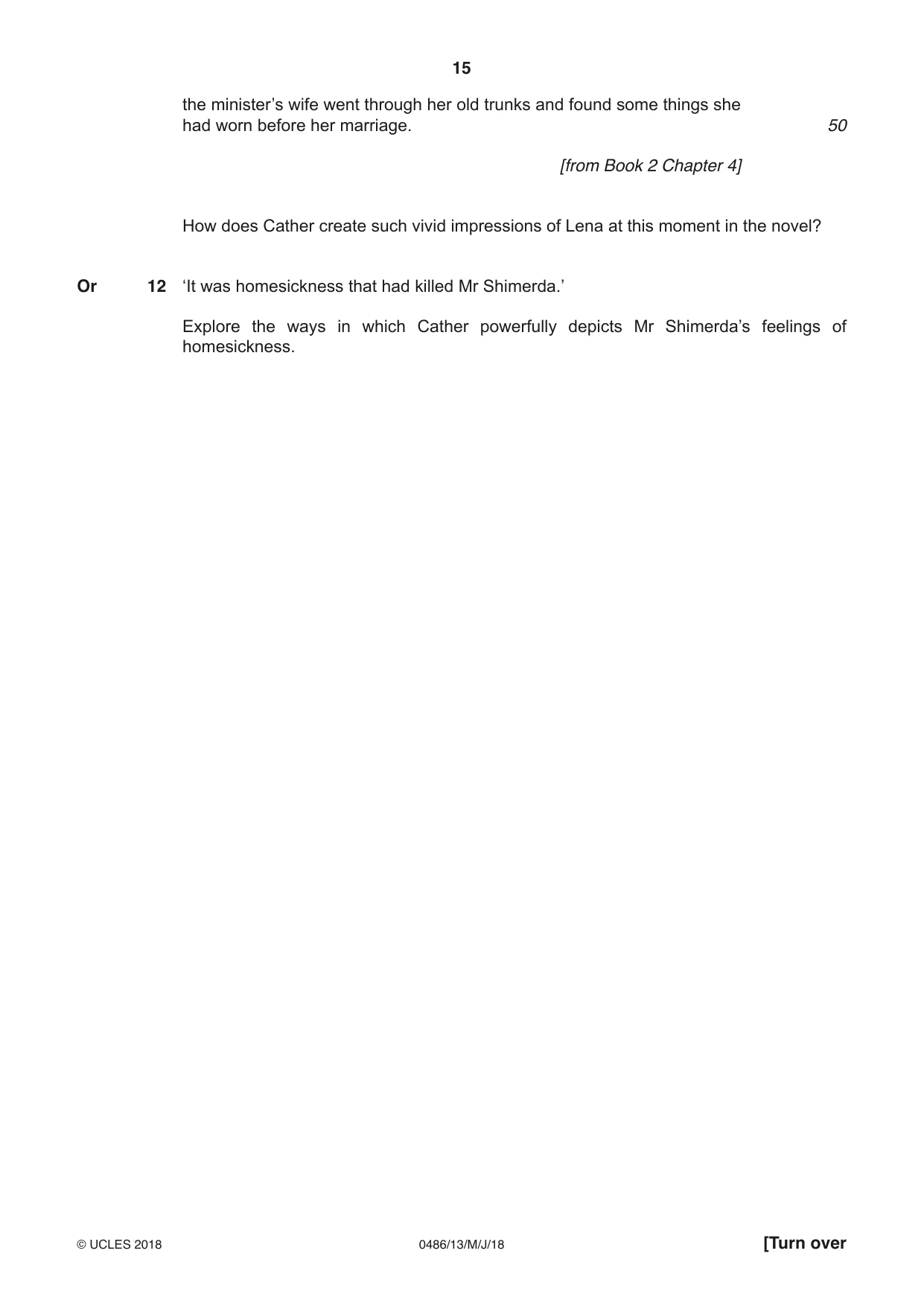
Question paper, page 15
15 0486/13/M/J/18 © UCLES 2018 [Turn over the minister’s wife went through her old trunks and found some things she had worn before her marriage. [from Book 2 Chapter 4] How does Cather create such vivid impressions of Lena at this moment in the novel? Or 12 ‘It was homesickness that had killed Mr Shimerda.’ Explore the ways in which Cather powerfully depicts Mr Shimerda’s feelings of homesickness. 50
Question paper, page 16
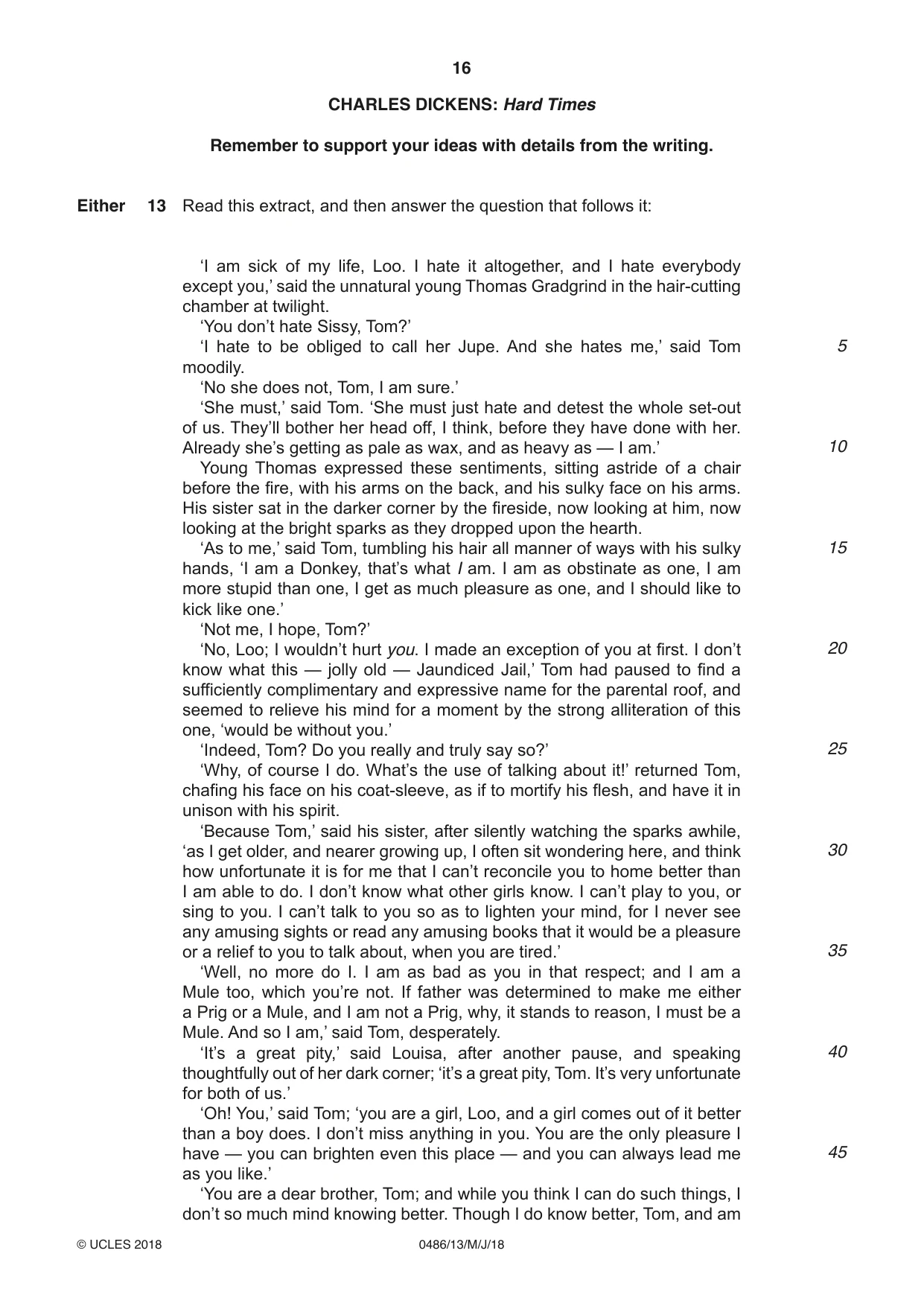
16 0486/13/M/J/18 © UCLES 2018 CHARLES DICKENS: Hard Times Remember to support your ideas with details from the writing. Either 13 Read this extract, and then answer the question that follows it: ‘I am sick of my life, Loo. I hate it altogether, and I hate everybody except you,’ said the unnatural young Thomas Gradgrind in the hair-cutting chamber at twilight. ‘You don’t hate Sissy, Tom?’ ‘I hate to be obliged to call her Jupe. And she hates me,’ said Tom moodily. ‘No she does not, Tom, I am sure.’ ‘She must,’ said Tom. ‘She must just hate and detest the whole set-out of us. They’ll bother her head off, I think, before they have done with her. Already she’s getting as pale as wax, and as heavy as — I am.’ Young Thomas expressed these sentiments, sitting astride of a chair before the fire, with his arms on the back, and his sulky face on his arms. His sister sat in the darker corner by the fireside, now looking at him, now looking at the bright sparks as they dropped upon the hearth. ‘As to me,’ said Tom, tumbling his hair all manner of ways with his sulky hands, ‘I am a Donkey, that’s what I am. I am as obstinate as one, I am more stupid than one, I get as much pleasure as one, and I should like to kick like one.’ ‘Not me, I hope, Tom?’ ‘No, Loo; I wouldn’t hurt you. I made an exception of you at first. I don’t know what this — jolly old — Jaundiced Jail,’ Tom had paused to find a sufficiently complimentary and expressive name for the parental roof, and seemed to relieve his mind for a moment by the strong alliteration of this one, ‘would be without you.’ ‘Indeed, Tom? Do you really and truly say so?’ ‘Why, of course I do. What’s the use of talking about it!’ returned Tom, chafing his face on his coat-sleeve, as if to mortify his flesh, and have it in unison with his spirit. ‘Because Tom,’ said his sister, after silently watching the sparks awhile, ‘as I get older, and nearer growing up, I often sit wondering here, and think how unfortunate it is for me that I can’t reconcile you to home better than I am able to do. I don’t know what other girls know. I can’t play to you, or sing to you. I can’t talk to you so as to lighten your mind, for I never see any amusing sights or read any amusing books that it would be a pleasure or a relief to you to talk about, when you are tired.’ ‘Well, no more do I. I am as bad as you in that respect; and I am a Mule too, which you’re not. If father was determined to make me either a Prig or a Mule, and I am not a Prig, why, it stands to reason, I must be a Mule. And so I am,’ said Tom, desperately. ‘It’s a great pity,’ said Louisa, after another pause, and speaking thoughtfully out of her dark corner; ‘it’s a great pity, Tom. It’s very unfortunate for both of us.’ ‘Oh! You,’ said Tom; ‘you are a girl, Loo, and a girl comes out of it better than a boy does. I don’t miss anything in you. You are the only pleasure I have — you can brighten even this place — and you can always lead me as you like.’ ‘You are a dear brother, Tom; and while you think I can do such things, I don’t so much mind knowing better. Though I do know better, Tom, and am 5 10 15 20 25 30 35 40 45
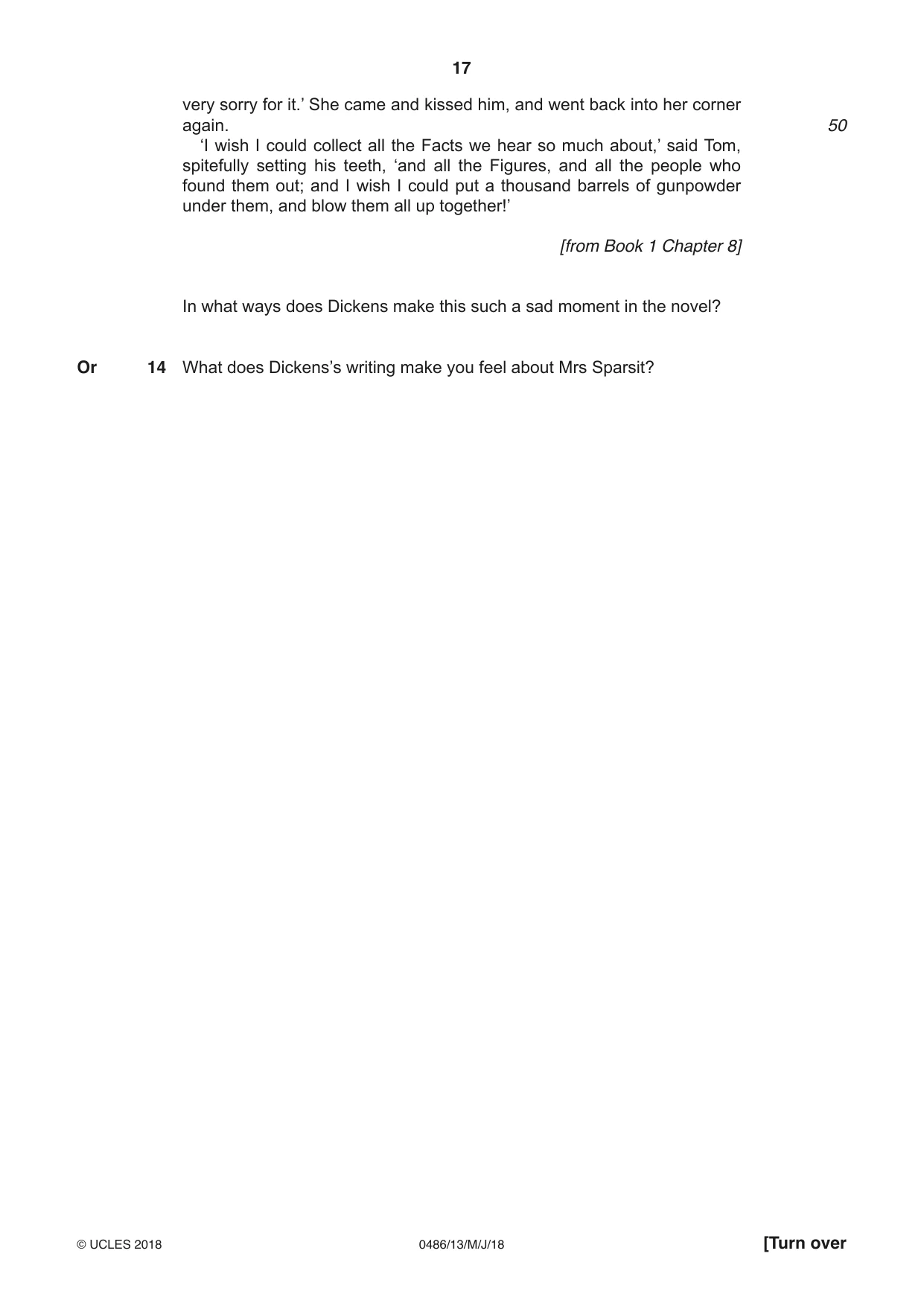
Question paper, page 17
17 0486/13/M/J/18 © UCLES 2018 [Turn over very sorry for it.’ She came and kissed him, and went back into her corner again. ‘I wish I could collect all the Facts we hear so much about,’ said Tom, spitefully setting his teeth, ‘and all the Figures, and all the people who found them out; and I wish I could put a thousand barrels of gunpowder under them, and blow them all up together!’ [from Book 1 Chapter 8] In what ways does Dickens make this such a sad moment in the novel? Or 14 What does Dickens’s writing make you feel about Mrs Sparsit? 50
Question paper, page 18
18 0486/13/M/J/18 © UCLES 2018 MICHAEL FRAYN: Spies Remember to support your ideas with details from the writing. Either 15 Read this extract, and then answer the question that follows it: ‘So will you do it for me, Stephen?’ Content removed due to copyright restrictions
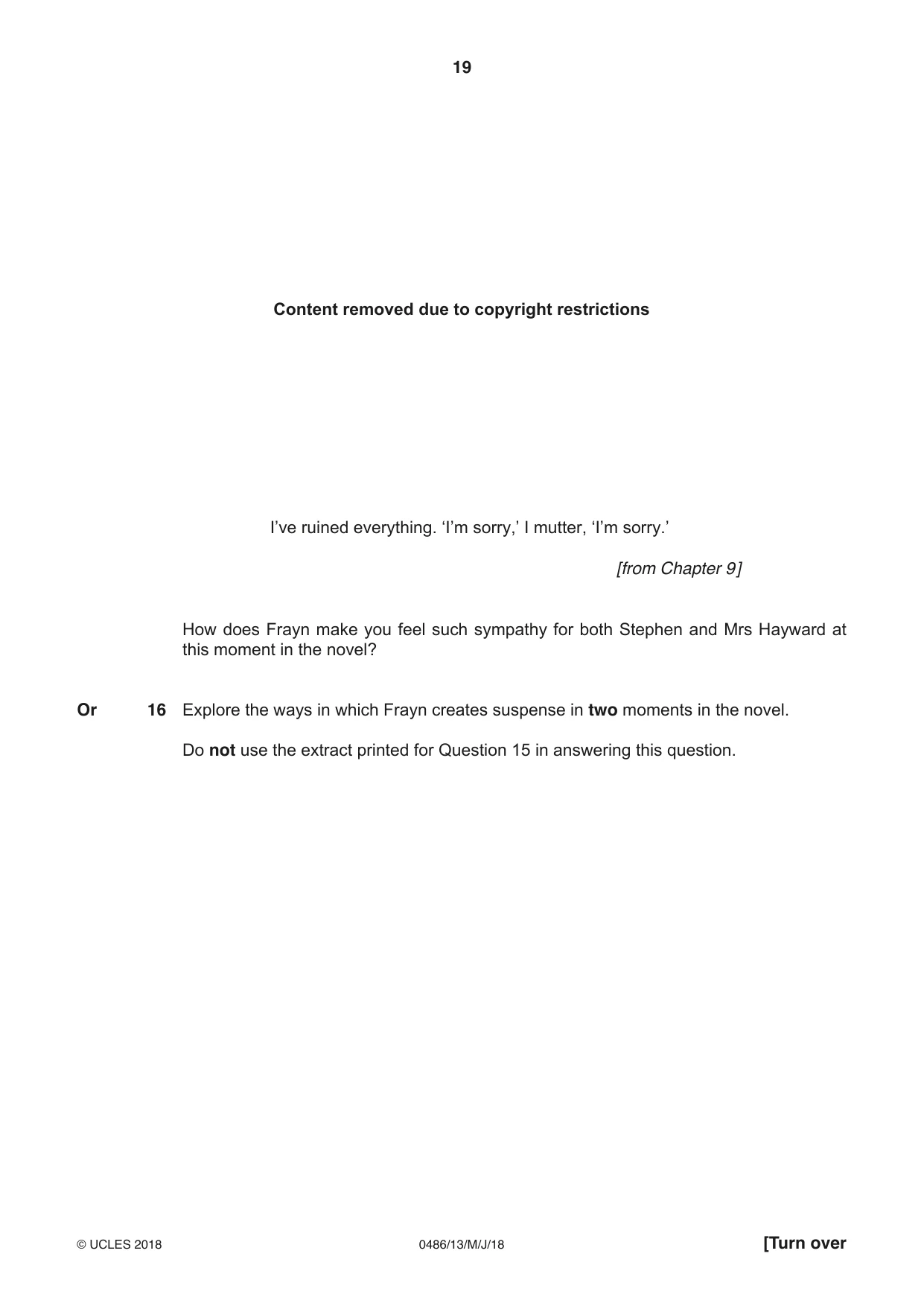
Question paper, page 19
0486/13/M/J/18 © UCLES 2018 [Turn over Content removed due to copyright restrictions [from Chapter 9] How does Frayn make you feel such sympathy for both Stephen and Mrs Hayward at this moment in the novel? Or 16 Explore the ways in which Frayn creates suspense in two moments in the novel. Do not use the extract printed for Question 15 in answering this question. I’ve ruined everything. ‘I’m sorry,’ I mutter, ‘I’m sorry.’ 19
Question paper, page 20
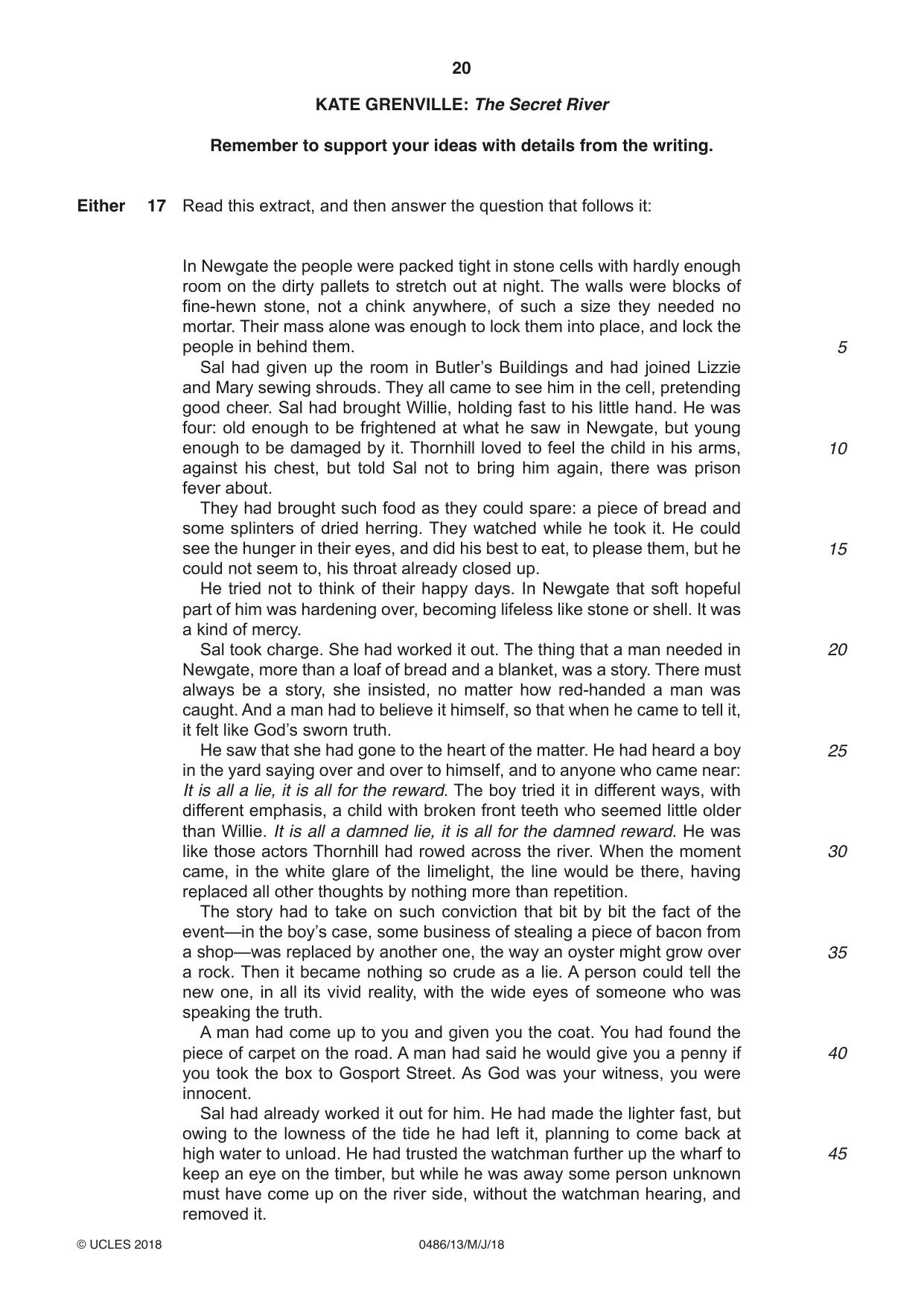
20 0486/13/M/J/18 © UCLES 2018 KATE GRENVILLE: The Secret River Remember to support your ideas with details from the writing. Either 17 Read this extract, and then answer the question that follows it: In Newgate the people were packed tight in stone cells with hardly enough room on the dirty pallets to stretch out at night. The walls were blocks of fine-hewn stone, not a chink anywhere, of such a size they needed no mortar. Their mass alone was enough to lock them into place, and lock the people in behind them. Sal had given up the room in Butler’s Buildings and had joined Lizzie and Mary sewing shrouds. They all came to see him in the cell, pretending good cheer. Sal had brought Willie, holding fast to his little hand. He was four: old enough to be frightened at what he saw in Newgate, but young enough to be damaged by it. Thornhill loved to feel the child in his arms, against his chest, but told Sal not to bring him again, there was prison fever about. They had brought such food as they could spare: a piece of bread and some splinters of dried herring. They watched while he took it. He could see the hunger in their eyes, and did his best to eat, to please them, but he could not seem to, his throat already closed up. He tried not to think of their happy days. In Newgate that soft hopeful part of him was hardening over, becoming lifeless like stone or shell. It was a kind of mercy. Sal took charge. She had worked it out. The thing that a man needed in Newgate, more than a loaf of bread and a blanket, was a story. There must always be a story, she insisted, no matter how red-handed a man was caught. And a man had to believe it himself, so that when he came to tell it, it felt like God’s sworn truth. He saw that she had gone to the heart of the matter. He had heard a boy in the yard saying over and over to himself, and to anyone who came near: It is all a lie, it is all for the reward. The boy tried it in different ways, with different emphasis, a child with broken front teeth who seemed little older than Willie. It is all a damned lie, it is all for the damned reward. He was like those actors Thornhill had rowed across the river. When the moment came, in the white glare of the limelight, the line would be there, having replaced all other thoughts by nothing more than repetition. The story had to take on such conviction that bit by bit the fact of the event—in the boy’s case, some business of stealing a piece of bacon from a shop—was replaced by another one, the way an oyster might grow over a rock. Then it became nothing so crude as a lie. A person could tell the new one, in all its vivid reality, with the wide eyes of someone who was speaking the truth. A man had come up to you and given you the coat. You had found the piece of carpet on the road. A man had said he would give you a penny if you took the box to Gosport Street. As God was your witness, you were innocent. Sal had already worked it out for him. He had made the lighter fast, but owing to the lowness of the tide he had left it, planning to come back at high water to unload. He had trusted the watchman further up the wharf to keep an eye on the timber, but while he was away some person unknown must have come up on the river side, without the watchman hearing, and removed it. 5 10 15 20 25 30 35 40 45
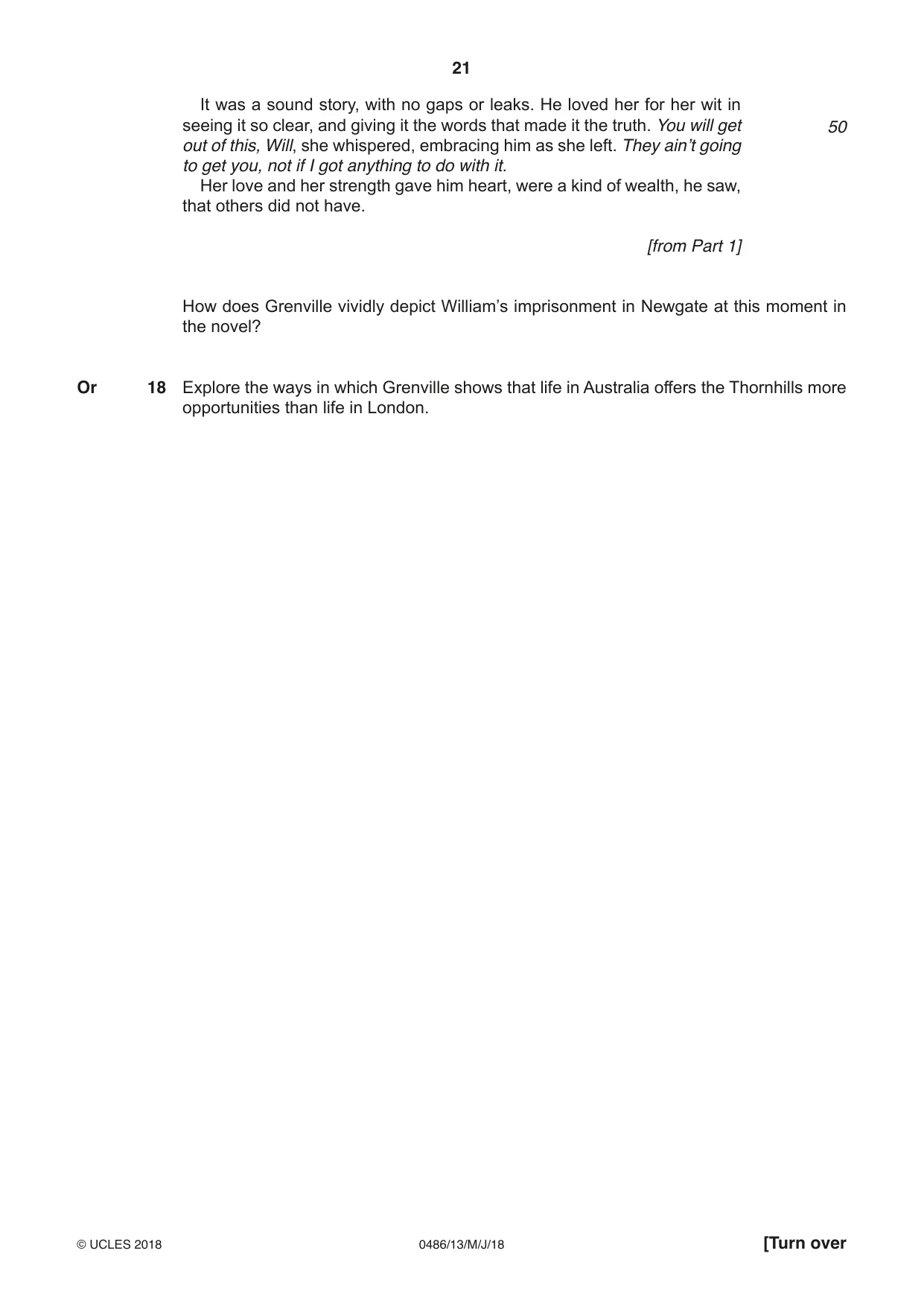
Question paper, page 21
21 0486/13/M/J/18 © UCLES 2018 [Turn over It was a sound story, with no gaps or leaks. He loved her for her wit in seeing it so clear, and giving it the words that made it the truth. You will get out of this, Will, she whispered, embracing him as she left. They ain’t going to get you, not if I got anything to do with it. Her love and her strength gave him heart, were a kind of wealth, he saw, that others did not have. [from Part 1] How does Grenville vividly depict William’s imprisonment in Newgate at this moment in the novel? Or 18 Explore the ways in which Grenville shows that life in Australia offers the Thornhills more opportunities than life in London. 50
Question paper, page 22
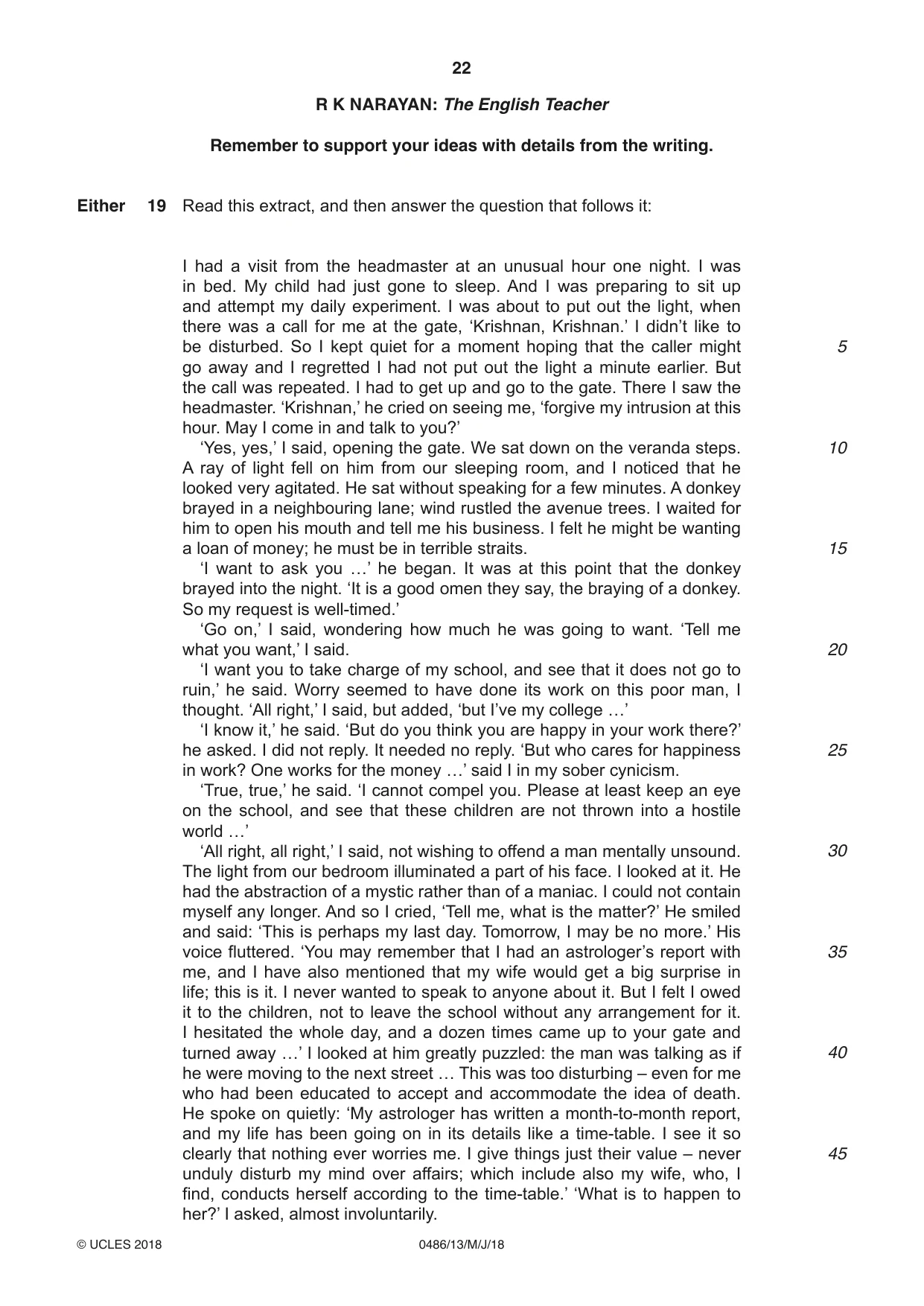
22 0486/13/M/J/18 © UCLES 2018 R K NARAYAN: The English Teacher Remember to support your ideas with details from the writing. Either 19 Read this extract, and then answer the question that follows it: I had a visit from the headmaster at an unusual hour one night. I was in bed. My child had just gone to sleep. And I was preparing to sit up and attempt my daily experiment. I was about to put out the light, when there was a call for me at the gate, ‘Krishnan, Krishnan.’ I didn’t like to be disturbed. So I kept quiet for a moment hoping that the caller might go away and I regretted I had not put out the light a minute earlier. But the call was repeated. I had to get up and go to the gate. There I saw the headmaster. ‘Krishnan,’ he cried on seeing me, ‘forgive my intrusion at this hour. May I come in and talk to you?’ ‘Yes, yes,’ I said, opening the gate. We sat down on the veranda steps. A ray of light fell on him from our sleeping room, and I noticed that he looked very agitated. He sat without speaking for a few minutes. A donkey brayed in a neighbouring lane; wind rustled the avenue trees. I waited for him to open his mouth and tell me his business. I felt he might be wanting a loan of money; he must be in terrible straits. ‘I want to ask you …’ he began. It was at this point that the donkey brayed into the night. ‘It is a good omen they say, the braying of a donkey. So my request is well-timed.’ ‘Go on,’ I said, wondering how much he was going to want. ‘Tell me what you want,’ I said. ‘I want you to take charge of my school, and see that it does not go to ruin,’ he said. Worry seemed to have done its work on this poor man, I thought. ‘All right,’ I said, but added, ‘but I’ve my college …’ ‘I know it,’ he said. ‘But do you think you are happy in your work there?’ he asked. I did not reply. It needed no reply. ‘But who cares for happiness in work? One works for the money …’ said I in my sober cynicism. ‘True, true,’ he said. ‘I cannot compel you. Please at least keep an eye on the school, and see that these children are not thrown into a hostile world …’ ‘All right, all right,’ I said, not wishing to offend a man mentally unsound. The light from our bedroom illuminated a part of his face. I looked at it. He had the abstraction of a mystic rather than of a maniac. I could not contain myself any longer. And so I cried, ‘Tell me, what is the matter?’ He smiled and said: ‘This is perhaps my last day. Tomorrow, I may be no more.’ His voice fluttered. ‘You may remember that I had an astrologer’s report with me, and I have also mentioned that my wife would get a big surprise in life; this is it. I never wanted to speak to anyone about it. But I felt I owed it to the children, not to leave the school without any arrangement for it. I hesitated the whole day, and a dozen times came up to your gate and turned away …’ I looked at him greatly puzzled: the man was talking as if he were moving to the next street … This was too disturbing – even for me who had been educated to accept and accommodate the idea of death. He spoke on quietly: ‘My astrologer has written a month-to-month report, and my life has been going on in its details like a time-table. I see it so clearly that nothing ever worries me. I give things just their value – never unduly disturb my mind over affairs; which include also my wife, who, I find, conducts herself according to the time-table.’ ‘What is to happen to her?’ I asked, almost involuntarily. 5 10 15 20 25 30 35 40 45
Question paper, page 23
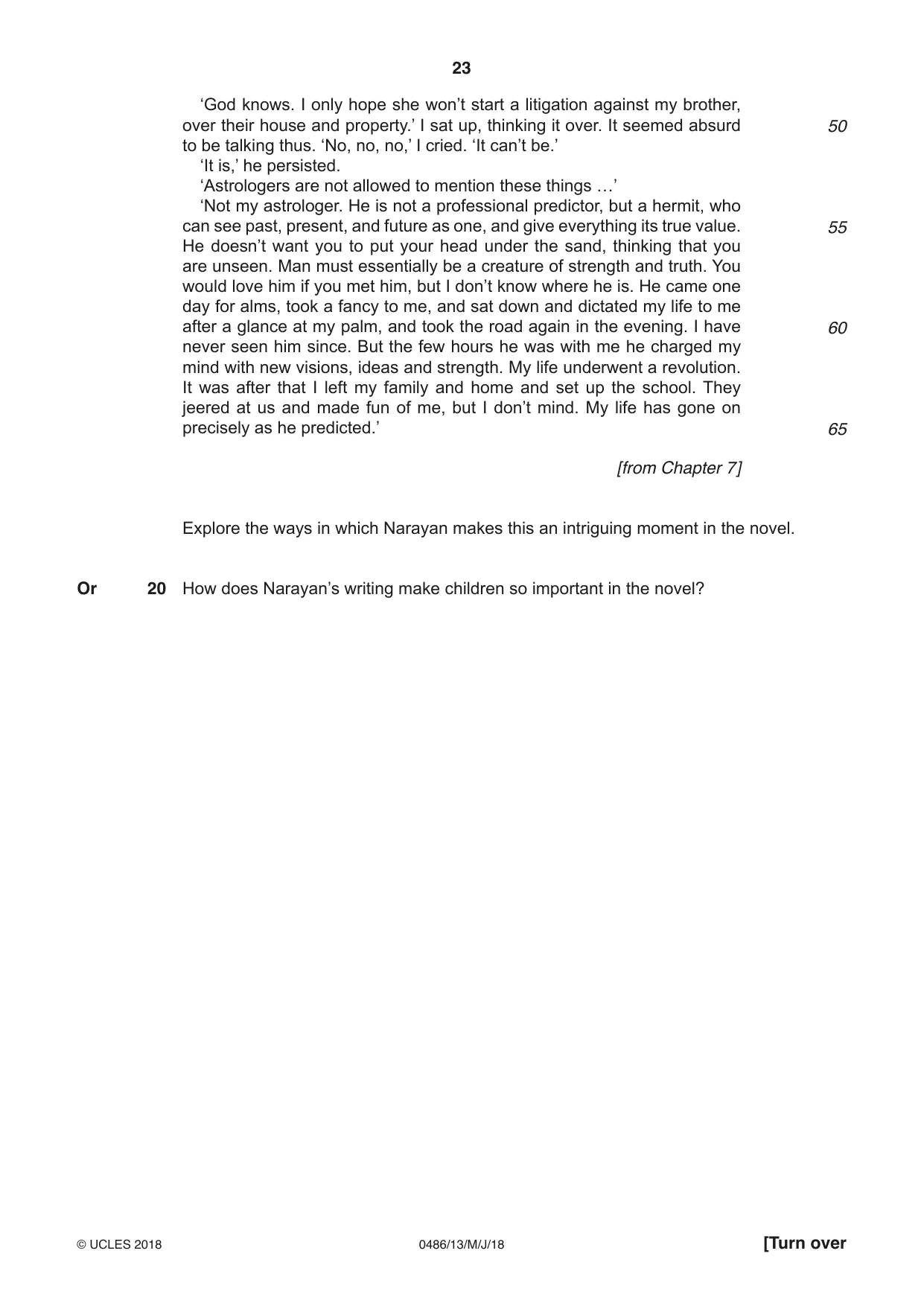
23 0486/13/M/J/18 © UCLES 2018 [Turn over ‘God knows. I only hope she won’t start a litigation against my brother, over their house and property.’ I sat up, thinking it over. It seemed absurd to be talking thus. ‘No, no, no,’ I cried. ‘It can’t be.’ ‘It is,’ he persisted. ‘Astrologers are not allowed to mention these things …’ ‘Not my astrologer. He is not a professional predictor, but a hermit, who can see past, present, and future as one, and give everything its true value. He doesn’t want you to put your head under the sand, thinking that you are unseen. Man must essentially be a creature of strength and truth. You would love him if you met him, but I don’t know where he is. He came one day for alms, took a fancy to me, and sat down and dictated my life to me after a glance at my palm, and took the road again in the evening. I have never seen him since. But the few hours he was with me he charged my mind with new visions, ideas and strength. My life underwent a revolution. It was after that I left my family and home and set up the school. They jeered at us and made fun of me, but I don’t mind. My life has gone on precisely as he predicted.’ [from Chapter 7] Explore the ways in which Narayan makes this an intriguing moment in the novel. Or 20 How does Narayan’s writing make children so important in the novel? 50 55 60 65
Question paper, page 24
24 0486/13/M/J/18 © UCLES 2018 from Stories of Ourselves Remember to support your ideas with details from the writing. Either 21 Read this extract from To Da-duh, in Memoriam (by Paule Marshall), and then answer the question that follows it: We were in the back of the lorry finally, packed in among the barrels of ham, flour, cornmeal and rice and the trunks of clothes that my mother had brought as gifts. We made our way slowly through Bridgetown’s clogged streets, part of a funereal procession of cars and open-sided buses, bicycles, and donkey carts. The dim little limestone shops and offices along the way marched with us, at the same mournful pace, toward the same grave ceremony – as did the people, the women balancing huge baskets on top their heads as if they were no more than hats they wore to shade them from the sun. Looking over the edge of the lorry I watched as their feet slurred the dust. I listened, and their voices, raw and loud and dissonant in the heat, seemed to be grappling with each other high overhead. Da-duh sat on a trunk in our midst, a monarch amid her court. She still held my hand, but it was different now. I had suddenly become her anchor, for I felt her fear of the lorry with its asthmatic motor (a fear and distrust, I later learned, she held of all machines) beating like a pulse in her rough palm. As soon as we left Bridgetown behind though, she relaxed, and while the others around us talked she gazed at the canes standing tall on either side of the winding marl road. ‘C’dear,’ she said softly to herself after a time. ‘The canes this side are pretty enough.’ They were too much for me. I thought of them as giant weeds that had overrun the island, leaving scarcely any room for the small tottering houses of sunbleached pine we passed or the people, dark streaks as our lorry hurtled by. I suddenly feared that we were journeying, unaware that we were, toward some dangerous place where the canes, grown as high and thick as a forest, would close in on us and run us through with their stiletto blades. I longed then for the familiar: for the street in Brooklyn where I lived, for my father who had refused to accompany us (‘Blowing out good money on foolishness,’ he had said of the trip), for a game of tag with my friends under the chestnut tree outside our ageing brownstone house. ‘Yes, but wait till you see St Thomas canes,’ Da-duh was saying to me. ‘They’s canes father, bo,’ she gave a proud arrogant nod. ‘Tomorrow, God willing, I goin’ take you out in the ground and show them to you.’ True to her word Da-duh took me with her the following day out into the ground. It was a fairly large plot adjoining her weathered board and shingle house and consisting of a small orchard, a good-sized canepiece and behind the canes, where the land sloped abruptly down, a gully. She had purchased it with Panama money sent her by her eldest son, my uncle Joseph, who had died working on the canal. We entered the ground along a trail no wider than her body and as devious and complex as her reasons for showing me her land. Da-duh strode briskly ahead, her slight form filled out this morning by the layers of sacking petticoats she wore under her working dress to protect her against the damp. A fresh white cloth, elaborately arranged around her head, added to her height, and lent her a vain, almost roguish air. 5 10 15 20 25 30 35 40 45
Question paper, page 25
25 0486/13/M/J/18 © UCLES 2018 Her pace slowed once we reached the orchard, and glancing back at me occasionally over her shoulder, she pointed out the various trees. ‘This here is a breadfruit,’ she said. ‘That one yonder is a papaw. Here’s a guava. This is a mango. I know you don’t have anything like these in New York. Here’s a sugar apple.’ (The fruit looked more like artichokes than apples to me.) ‘This one bears limes …’ She went on for some time, intoning the names of the trees as though they were those of her gods. Finally, turning to me, she said, ‘I know you don’t have anything this nice where you come from.’ Then, as I hesitated: ‘I said I know you don’t have anything this nice where you come from …’ ‘No,’ I said and my world did seem suddenly lacking. Da-duh nodded and passed on. The orchard ended and we were on the narrow cart road that led through the canepiece, the canes clashing like swords above my cowering head. Again she turned and her thin muscular arms spread wide, her dim gaze embracing the small field of canes, she said – and her voice almost broke under the weight of her pride, ‘Tell me, have you got anything like these in that place where you were born?’ ‘No.’ ‘I din’ think so. I bet you don’t even know that these canes here and the sugar you eat is one and the same thing. That they does throw the canes into some damn machine at the factory and squeeze out all the little life in them to make sugar for you all so in New York to eat. I bet you don’t know that.’ How does Marshall vividly convey the narrator’s impressions on arriving in Barbados at this moment in the story? Or 22 Explore the ways in which the writer memorably conveys experiences of childhood in either Sredni Vashtar (by Saki) or Of White Hairs and Cricket (by Rohinton Mistry). 50 55 60 65 70
Question paper, page 26
26 0486/13/M/J/18 © UCLES 2018 BLANK PAGE
Question paper, page 27
27 0486/13/M/J/18 © UCLES 2018 BLANK PAGE
Question paper, page 28
28 0486/13/M/J/18 © UCLES 2018 BLANK PAGE Permission to reproduce items where third-party owned material protected by copyright is included has been sought and cleared where possible. Every reasonable effort has been made by the publisher (UCLES) to trace copyright holders, but if any items requiring clearance have unwittingly been included, the publisher will be pleased to make amends at the earliest possible opportunity. To avoid the issue of disclosure of answer-related information to candidates, all copyright acknowledgements are reproduced online in the Cambridge International Examinations Copyright Acknowledgements Booklet. This is produced for each series of examinations and is freely available to download at www.cie.org.uk after the live examination series. Cambridge International Examinations is part of the Cambridge Assessment Group. Cambridge Assessment is the brand name of University of Cambridge Local Examinations Syndicate (UCLES), which is itself a department of the University of Cambridge.
Mark scheme, page 1
IGCSE™ is a registered trademark. This document consists of 4 printed pages. © UCLES 2018 [Turn over Cambridge Assessment International Education Cambridge International General Certificate of Secondary Education LITERATURE (ENGLISH) 0486/13 Paper 13 Poetry and Prose May/June 2018 MARK SCHEME Maximum Mark: 50 Published This mark scheme is published as an aid to teachers and candidates, to indicate the requirements of the examination. It shows the basis on which Examiners were instructed to award marks. It does not indicate the details of the discussions that took place at an Examiners’ meeting before marking began, which would have considered the acceptability of alternative answers. Mark schemes should be read in conjunction with the question paper and the Principal Examiner Report for Teachers. Cambridge International will not enter into discussions about these mark schemes. Cambridge International is publishing the mark schemes for the May/June 2018 series for most Cambridge IGCSE™, Cambridge International A and AS Level and Cambridge Pre-U components, and some Cambridge O Level components.
Mark scheme, page 2
0486/13 Cambridge IGCSE – Mark Scheme PUBLISHED May/June 2018 © UCLES 2018 Page 2 of 4 Generic Marking Principles These general marking principles must be applied by all examiners when marking candidate answers. They should be applied alongside the specific content of the mark scheme or generic level descriptors for a question. Each question paper and mark scheme will also comply with these marking principles. GENERIC MARKING PRINCIPLE 1: Marks must be awarded in line with: • the specific content of the mark scheme or the generic level descriptors for the question • the specific skills defined in the mark scheme or in the generic level descriptors for the question • the standard of response required by a candidate as exemplified by the standardisation scripts. GENERIC MARKING PRINCIPLE 2: Marks awarded are always whole marks (not half marks, or other fractions). GENERIC MARKING PRINCIPLE 3: Marks must be awarded positively: • marks are awarded for correct/valid answers, as defined in the mark scheme. However, credit is given for valid answers which go beyond the scope of the syllabus and mark scheme, referring to your Team Leader as appropriate • marks are awarded when candidates clearly demonstrate what they know and can do • marks are not deducted for errors • marks are not deducted for omissions • answers should only be judged on the quality of spelling, punctuation and grammar when these features are specifically assessed by the question as indicated by the mark scheme. The meaning, however, should be unambiguous. GENERIC MARKING PRINCIPLE 4: Rules must be applied consistently e.g. in situations where candidates have not followed instructions or in the application of generic level descriptors. GENERIC MARKING PRINCIPLE 5: Marks should be awarded using the full range of marks defined in the mark scheme for the question (however; the use of the full mark range may be limited according to the quality of the candidate responses seen). GENERIC MARKING PRINCIPLE 6: Marks awarded are based solely on the requirements as defined in the mark scheme. Marks should not be awarded with grade thresholds or grade descriptors in mind.
Mark scheme, page 3
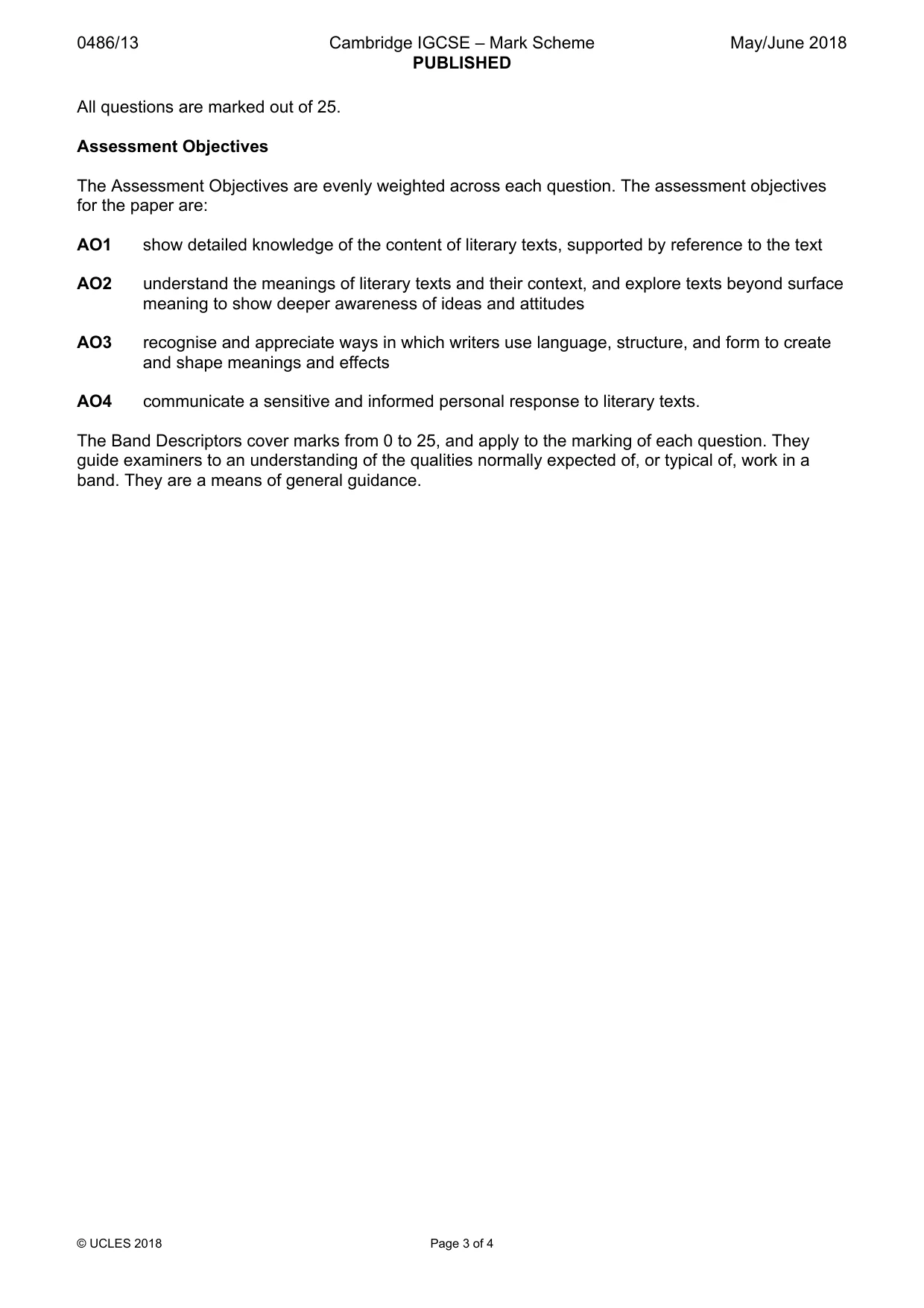
0486/13 Cambridge IGCSE – Mark Scheme PUBLISHED May/June 2018 © UCLES 2018 Page 3 of 4 All questions are marked out of 25. Assessment Objectives The Assessment Objectives are evenly weighted across each question. The assessment objectives for the paper are: AO1 show detailed knowledge of the content of literary texts, supported by reference to the text AO2 understand the meanings of literary texts and their context, and explore texts beyond surface meaning to show deeper awareness of ideas and attitudes AO3 recognise and appreciate ways in which writers use language, structure, and form to create and shape meanings and effects AO4 communicate a sensitive and informed personal response to literary texts. The Band Descriptors cover marks from 0 to 25, and apply to the marking of each question. They guide examiners to an understanding of the qualities normally expected of, or typical of, work in a band. They are a means of general guidance.
Mark scheme, page 4
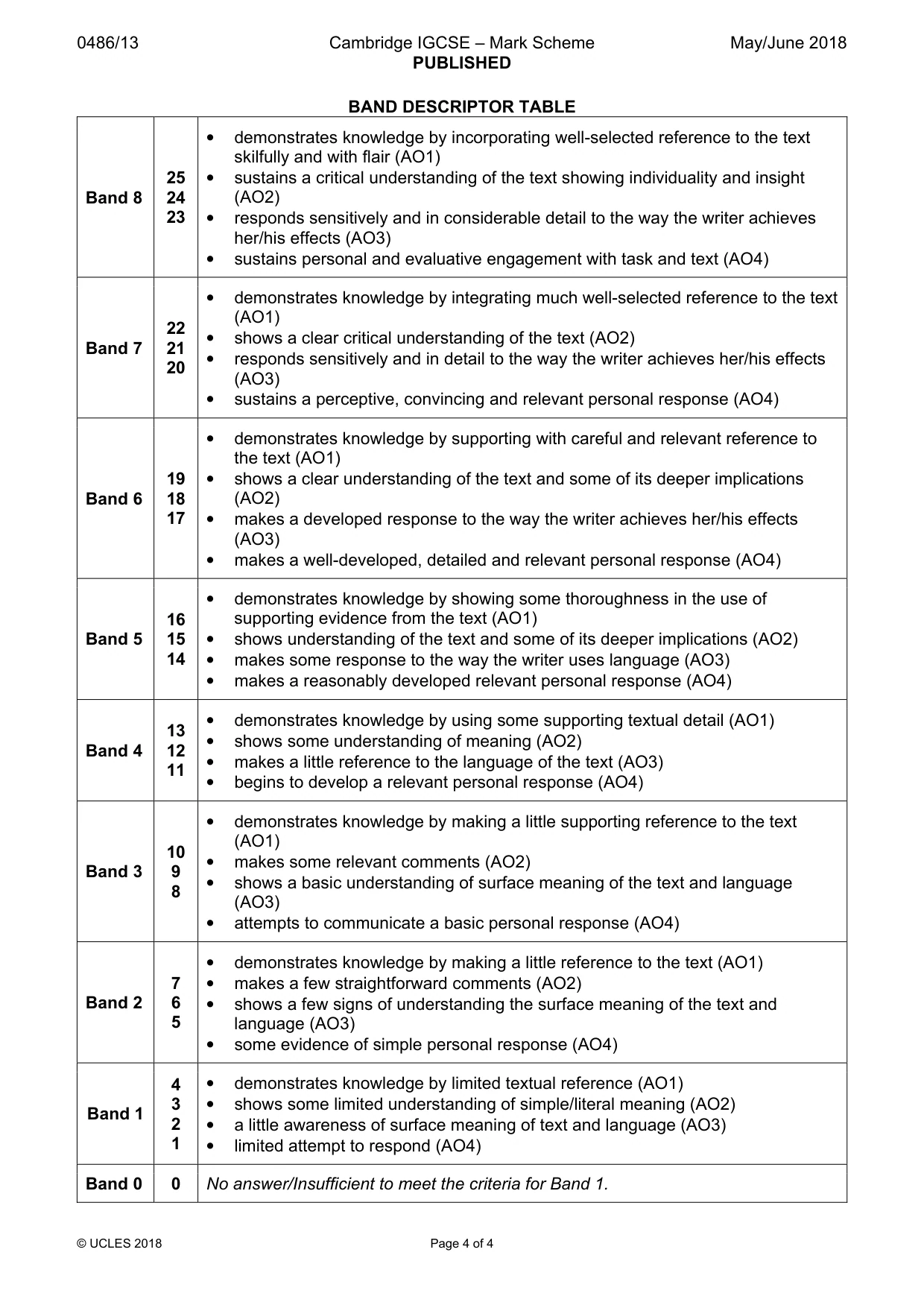
0486/13 Cambridge IGCSE – Mark Scheme PUBLISHED May/June 2018 © UCLES 2018 Page 4 of 4 BAND DESCRIPTOR TABLE Band 8 25 24 23 • demonstrates knowledge by incorporating well-selected reference to the text skilfully and with flair (AO1) • sustains a critical understanding of the text showing individuality and insight (AO2) • responds sensitively and in considerable detail to the way the writer achieves her/his effects (AO3) • sustains personal and evaluative engagement with task and text (AO4) Band 7 22 21 20 • demonstrates knowledge by integrating much well-selected reference to the text (AO1) • shows a clear critical understanding of the text (AO2) • responds sensitively and in detail to the way the writer achieves her/his effects (AO3) • sustains a perceptive, convincing and relevant personal response (AO4) Band 6 19 18 17 • demonstrates knowledge by supporting with careful and relevant reference to the text (AO1) • shows a clear understanding of the text and some of its deeper implications (AO2) • makes a developed response to the way the writer achieves her/his effects (AO3) • makes a well-developed, detailed and relevant personal response (AO4) Band 5 16 15 14 • demonstrates knowledge by showing some thoroughness in the use of supporting evidence from the text (AO1) • shows understanding of the text and some of its deeper implications (AO2) • makes some response to the way the writer uses language (AO3) • makes a reasonably developed relevant personal response (AO4) Band 4 13 12 11 • demonstrates knowledge by using some supporting textual detail (AO1) • shows some understanding of meaning (AO2) • makes a little reference to the language of the text (AO3) • begins to develop a relevant personal response (AO4) Band 3 10 9 8 • demonstrates knowledge by making a little supporting reference to the text (AO1) • makes some relevant comments (AO2) • shows a basic understanding of surface meaning of the text and language (AO3) • attempts to communicate a basic personal response (AO4) Band 2 7 6 5 • demonstrates knowledge by making a little reference to the text (AO1) • makes a few straightforward comments (AO2) • shows a few signs of understanding the surface meaning of the text and language (AO3) • some evidence of simple personal response (AO4) Band 1 4 3 2 1 • demonstrates knowledge by limited textual reference (AO1) • shows some limited understanding of simple/literal meaning (AO2) • a little awareness of surface meaning of text and language (AO3) • limited attempt to respond (AO4) Band 0 0 No answer/Insufficient to meet the criteria for Band 1.
What you needed in this session
Cambridge’s own grade thresholds for 2018 May/June, Paper 1 · Variant 3. A higher threshold means an easier paper — the bar moves with how the cohort did.