Cambridge IGCSE English - Literature 0486 — 2017 Oct/Nov Paper 1 · Variant 3
0486/13/O/N/17 · 50 marks · ≈56 min
The question paper and its mark scheme, free to read here and free to download. This is Cambridge’s own paper, exactly as it was sat.
Question paper28 pages









Mark scheme3 pages
Answers below. Sit the paper first if you are practising.
Paper as text
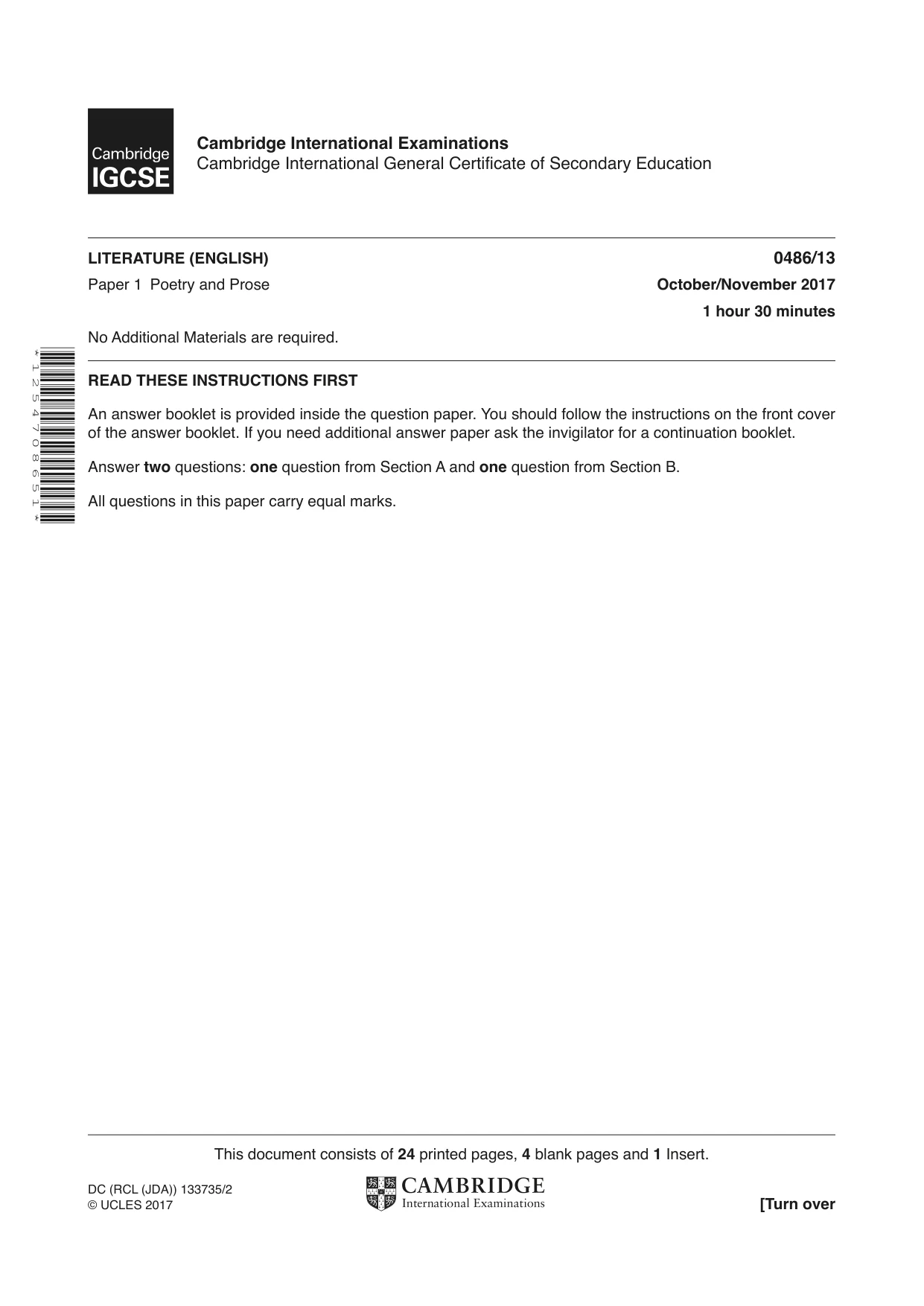
Question paper, page 1
This document consists of 24 printed pages, 4 blank pages and 1 Insert. DC (RCL (JDA)) 133735/2 © UCLES 2017 [Turn over Cambridge International Examinations Cambridge International General Certificate of Secondary Education * 1 2 5 4 7 0 8 6 5 1 * LITERATURE (ENGLISH) 0486/13 Paper 1 Poetry and Prose October/November 2017 1 hour 30 minutes No Additional Materials are required. READ THESE INSTRUCTIONS FIRST An answer booklet is provided inside the question paper. You should follow the instructions on the front cover of the answer booklet. If you need additional answer paper ask the invigilator for a continuation booklet. Answer two questions: one question from Section A and one question from Section B. All questions in this paper carry equal marks.
Question paper, page 2
2 0486/13/O/N/17 © UCLES 2017 BLANK PAGE
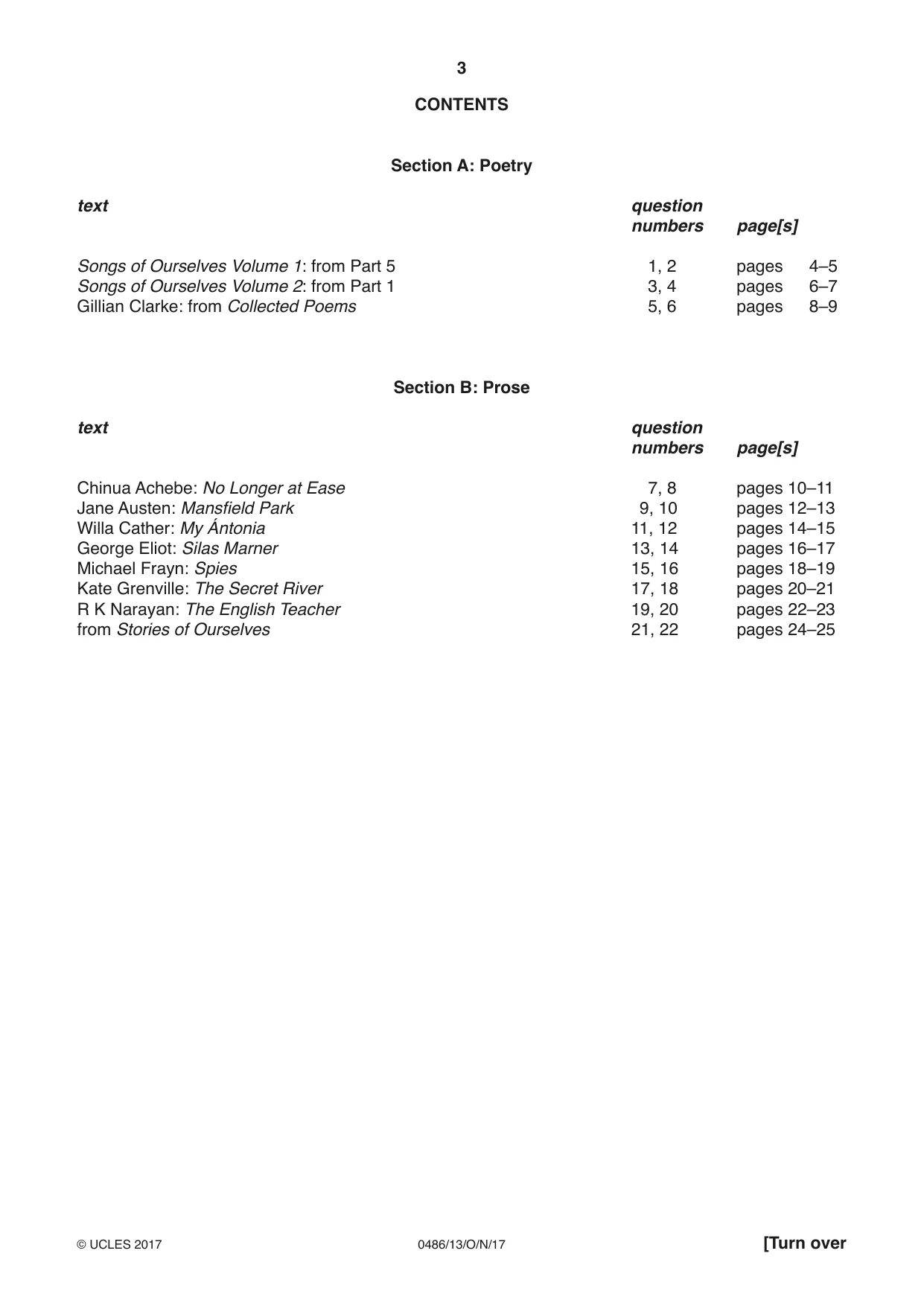
Question paper, page 3
3 0486/13/O/N/17 © UCLES 2017 [Turn over CONTENTS Section A: Poetry text question numbers page[s] Songs of Ourselves Volume 1: from Part 5 1, 2 pages 4–5 Songs of Ourselves Volume 2: from Part 1 3, 4 pages 6–7 Gillian Clarke: from Collected Poems 5, 6 pages 8–9 Section B: Prose text question numbers page[s] Chinua Achebe: No Longer at Ease 7, 8 pages 10–11 Jane Austen: Mansfield Park 9, 10 pages 12–13 Willa Cather: My Ántonia 11, 12 pages 14–15 George Eliot: Silas Marner 13, 14 pages 16–17 Michael Frayn: Spies 15, 16 pages 18–19 Kate Grenville: The Secret River 17, 18 pages 20–21 R K Narayan: The English Teacher 19, 20 pages 22–23 from Stories of Ourselves 21, 22 pages 24–25
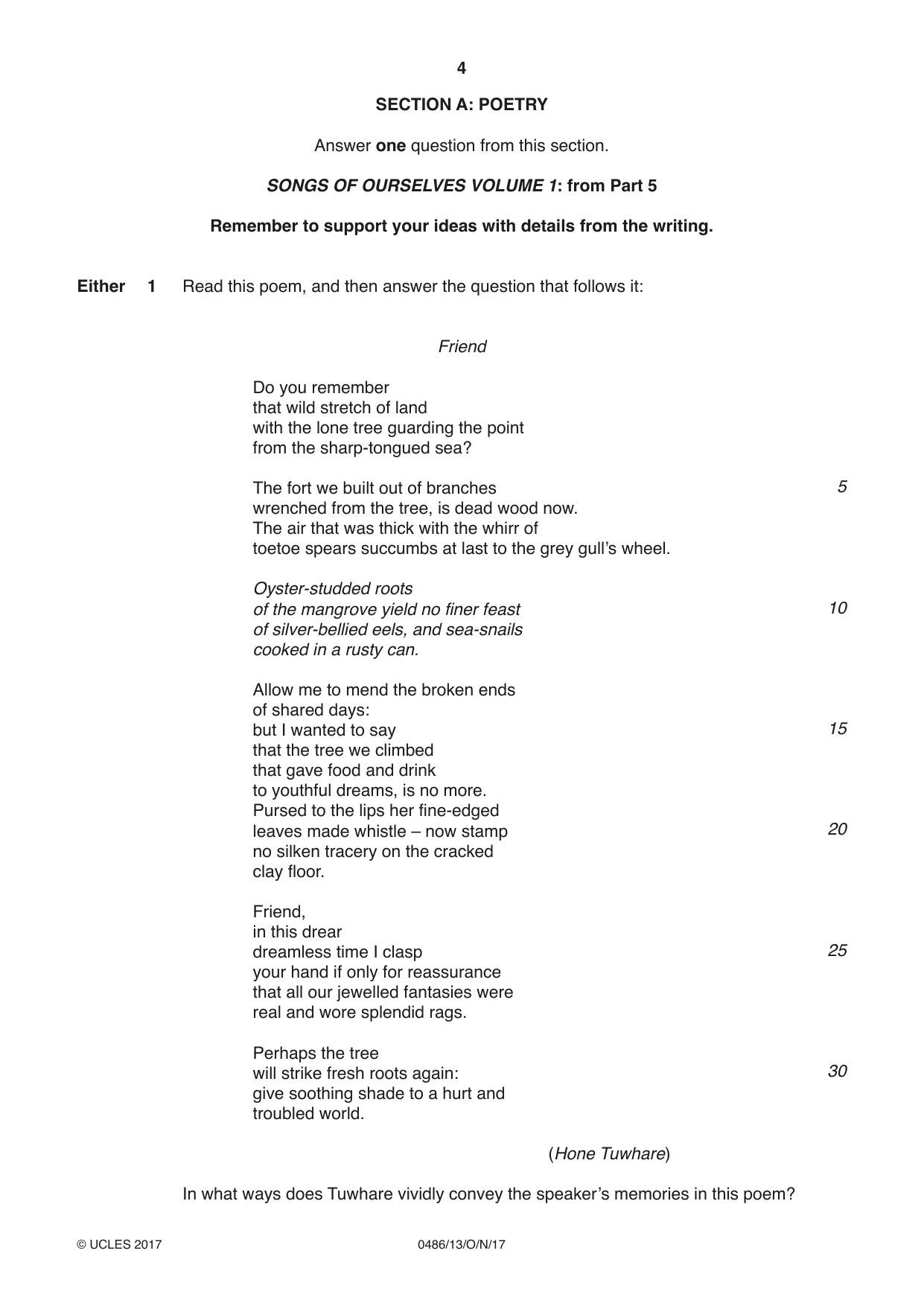
Question paper, page 4
4 0486/13/O/N/17 © UCLES 2017 SECTION A: POETRY Answer one question from this section. SONGS OF OURSELVES VOLUME 1: from Part 5 Remember to support your ideas with details from the writing. Either 1 Read this poem, and then answer the question that follows it: Friend Do you remember that wild stretch of land with the lone tree guarding the point from the sharp-tongued sea? The fort we built out of branches wrenched from the tree, is dead wood now. The air that was thick with the whirr of toetoe spears succumbs at last to the grey gull’s wheel. Oyster-studded roots of the mangrove yield no finer feast of silver-bellied eels, and sea-snails cooked in a rusty can. Allow me to mend the broken ends of shared days: but I wanted to say that the tree we climbed that gave food and drink to youthful dreams, is no more. Pursed to the lips her fine-edged leaves made whistle – now stamp no silken tracery on the cracked clay floor. Friend, in this drear dreamless time I clasp your hand if only for reassurance that all our jewelled fantasies were real and wore splendid rags. Perhaps the tree will strike fresh roots again: give soothing shade to a hurt and troubled world. (Hone Tuwhare) In what ways does Tuwhare vividly convey the speaker’s memories in this poem? 5 10 15 20 25 30
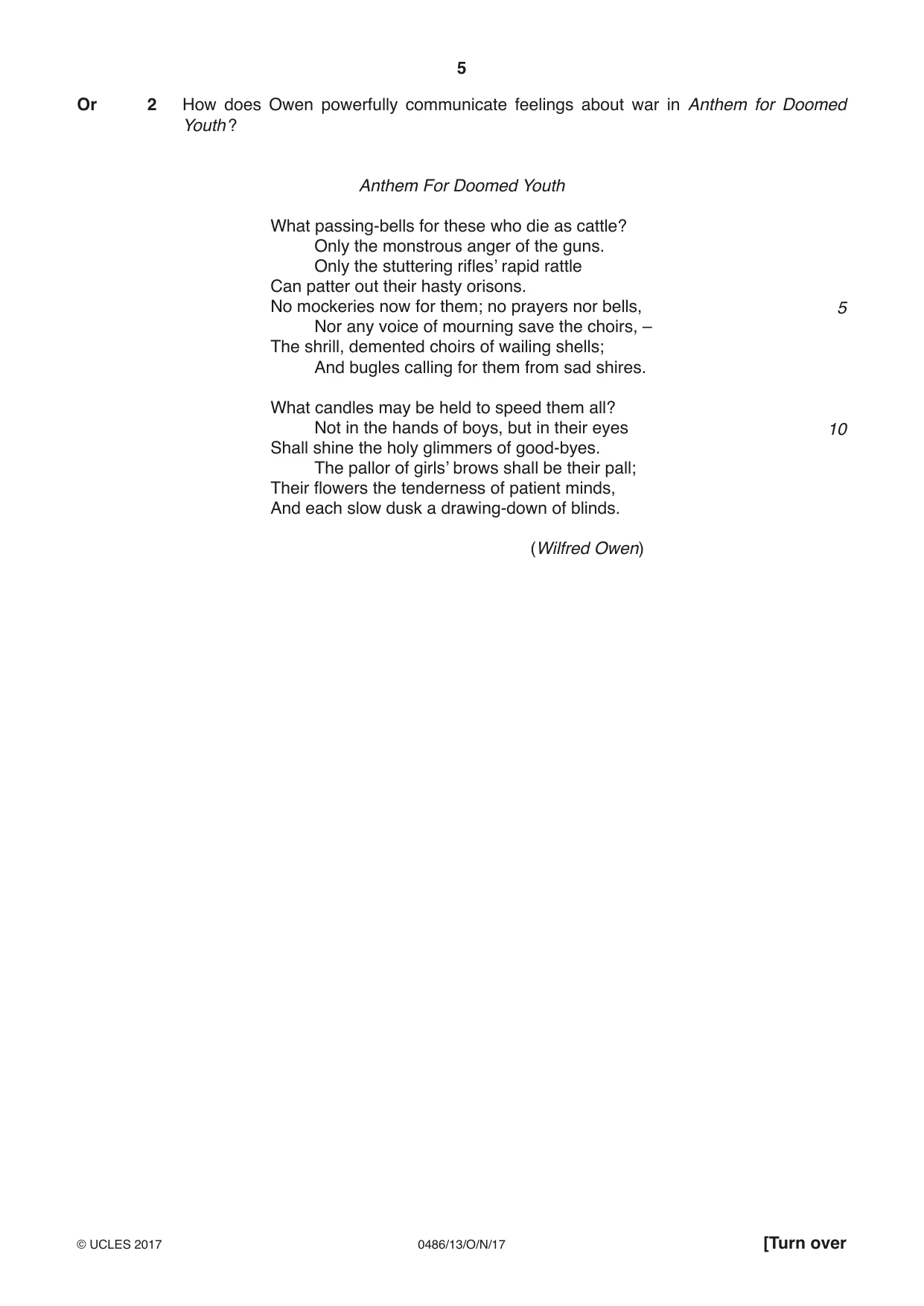
Question paper, page 5
5 0486/13/O/N/17 © UCLES 2017 [Turn over Or 2 How does Owen powerfully communicate feelings about war in Anthem for Doomed Youth ? Anthem For Doomed Youth What passing-bells for these who die as cattle? Only the monstrous anger of the guns. Only the stuttering rifles’ rapid rattle Can patter out their hasty orisons. No mockeries now for them; no prayers nor bells, Nor any voice of mourning save the choirs, – The shrill, demented choirs of wailing shells; And bugles calling for them from sad shires. What candles may be held to speed them all? Not in the hands of boys, but in their eyes Shall shine the holy glimmers of good-byes. The pallor of girls’ brows shall be their pall; Their flowers the tenderness of patient minds, And each slow dusk a drawing-down of blinds. (Wilfred Owen) 5 10
Question paper, page 6
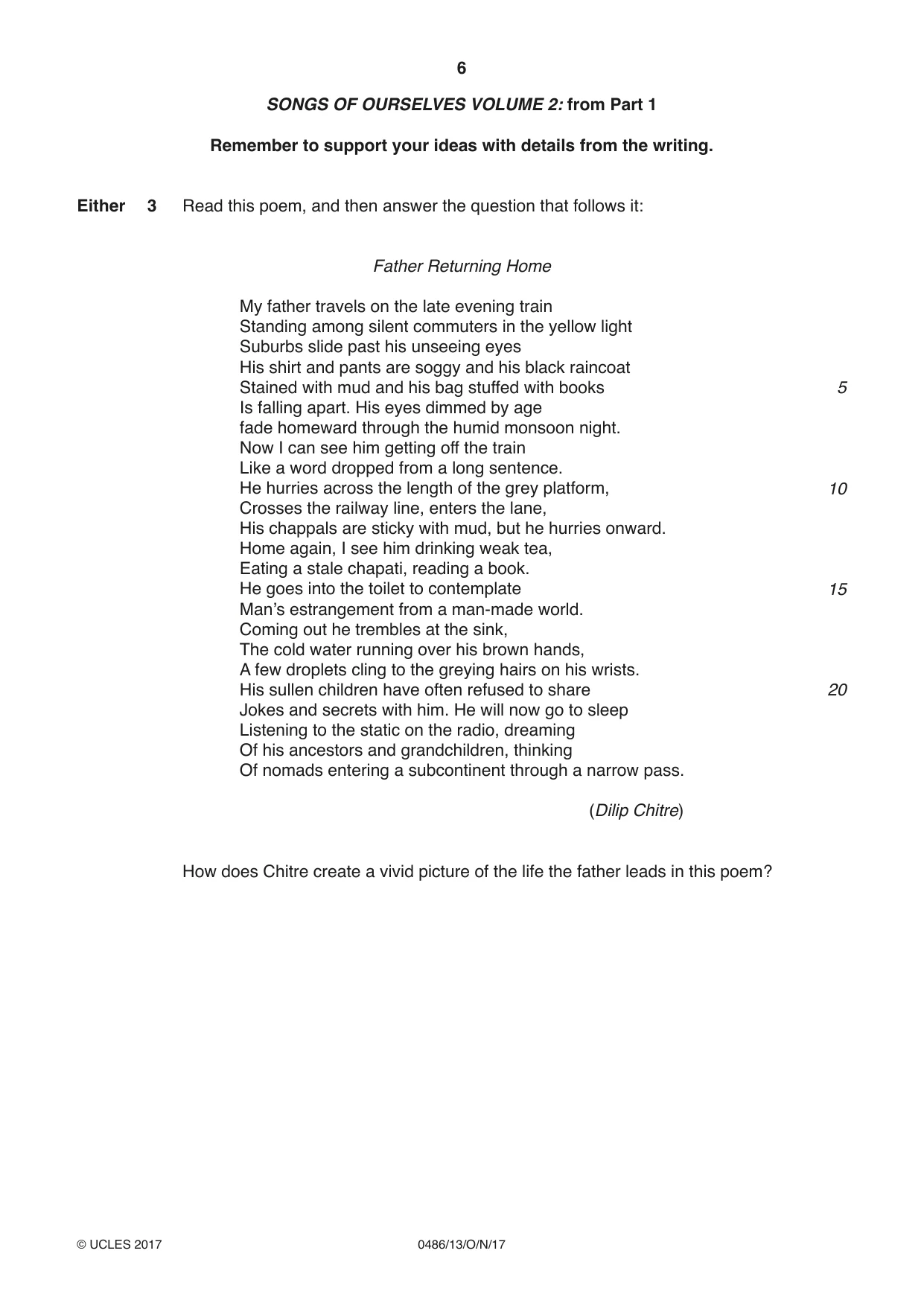
6 0486/13/O/N/17 © UCLES 2017 SONGS OF OURSELVES VOLUME 2: from Part 1 Remember to support your ideas with details from the writing. Either 3 Read this poem, and then answer the question that follows it: Father Returning Home My father travels on the late evening train Standing among silent commuters in the yellow light Suburbs slide past his unseeing eyes His shirt and pants are soggy and his black raincoat Stained with mud and his bag stuffed with books Is falling apart. His eyes dimmed by age fade homeward through the humid monsoon night. Now I can see him getting off the train Like a word dropped from a long sentence. He hurries across the length of the grey platform, Crosses the railway line, enters the lane, His chappals are sticky with mud, but he hurries onward. Home again, I see him drinking weak tea, Eating a stale chapati, reading a book. He goes into the toilet to contemplate Man’s estrangement from a man-made world. Coming out he trembles at the sink, The cold water running over his brown hands, A few droplets cling to the greying hairs on his wrists. His sullen children have often refused to share Jokes and secrets with him. He will now go to sleep Listening to the static on the radio, dreaming Of his ancestors and grandchildren, thinking Of nomads entering a subcontinent through a narrow pass. (Dilip Chitre) How does Chitre create a vivid picture of the life the father leads in this poem? 5 10 15 20
Question paper, page 7
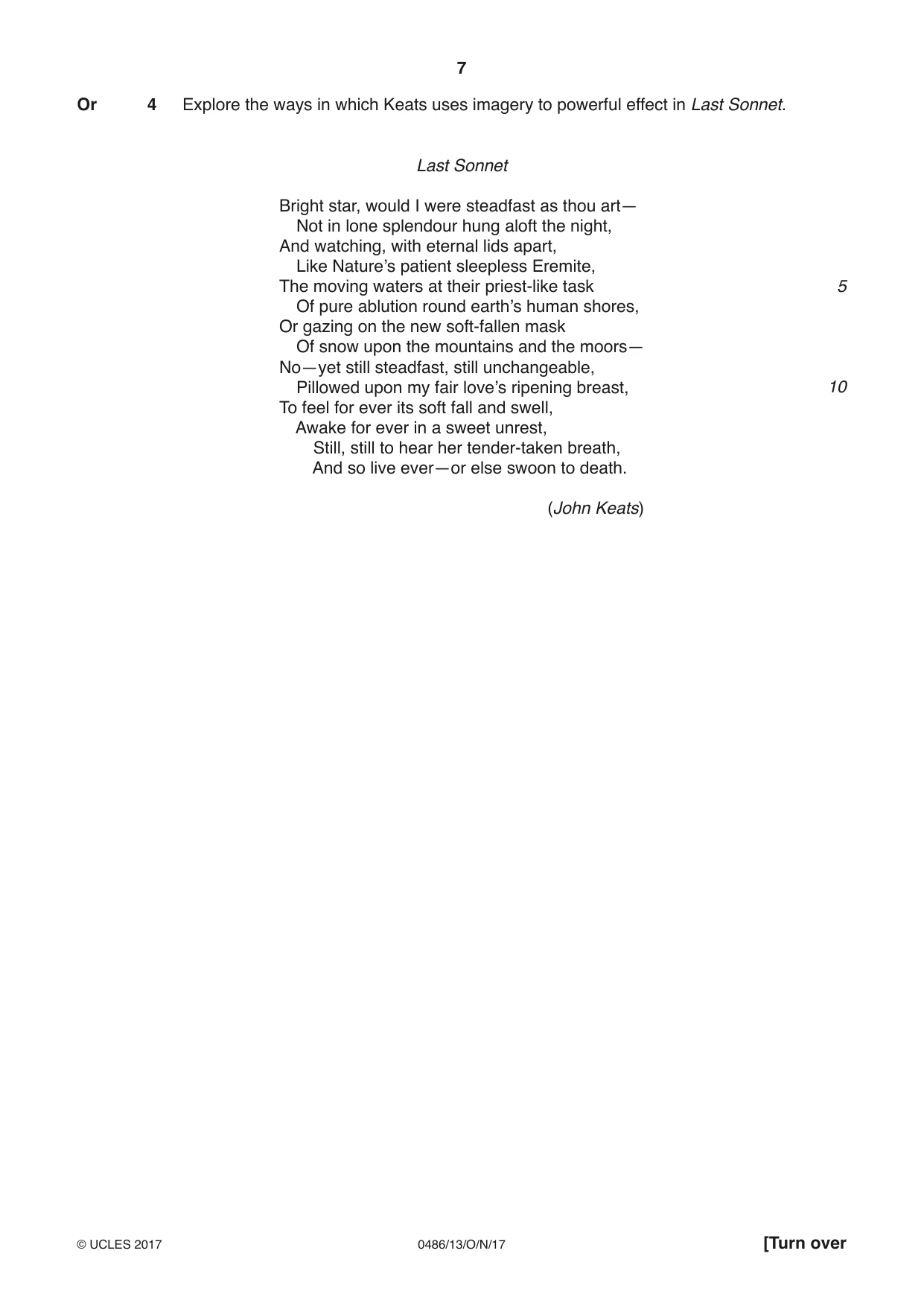
7 0486/13/O/N/17 © UCLES 2017 [Turn over Or 4 Explore the ways in which Keats uses imagery to powerful effect in Last Sonnet. Last Sonnet Bright star, would I were steadfast as thou art— Not in lone splendour hung aloft the night, And watching, with eternal lids apart, Like Nature’s patient sleepless Eremite, The moving waters at their priest-like task Of pure ablution round earth’s human shores, Or gazing on the new soft-fallen mask Of snow upon the mountains and the moors— No—yet still steadfast, still unchangeable, Pillowed upon my fair love’s ripening breast, To feel for ever its soft fall and swell, Awake for ever in a sweet unrest, Still, still to hear her tender-taken breath, And so live ever—or else swoon to death. (John Keats) 5 10
Question paper, page 8
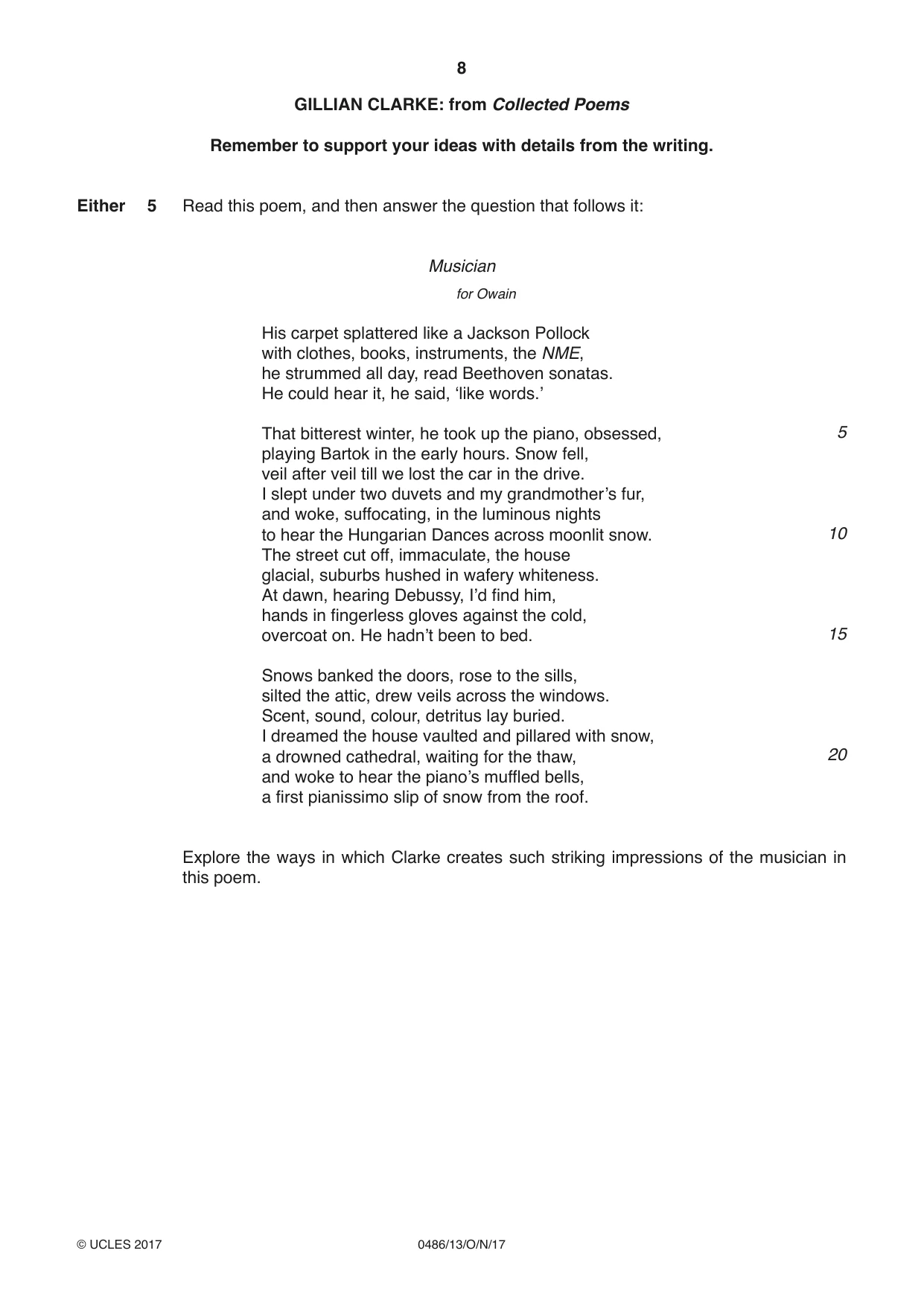
8 0486/13/O/N/17 © UCLES 2017 GILLIAN CLARKE: from Collected Poems Remember to support your ideas with details from the writing. Either 5 Read this poem, and then answer the question that follows it: Musician for Owain His carpet splattered like a Jackson Pollock with clothes, books, instruments, the NME, he strummed all day, read Beethoven sonatas. He could hear it, he said, ‘like words.’ That bitterest winter, he took up the piano, obsessed, playing Bartok in the early hours. Snow fell, veil after veil till we lost the car in the drive. I slept under two duvets and my grandmother’s fur, and woke, suffocating, in the luminous nights to hear the Hungarian Dances across moonlit snow. The street cut off, immaculate, the house glacial, suburbs hushed in wafery whiteness. At dawn, hearing Debussy, I’d find him, hands in fingerless gloves against the cold, overcoat on. He hadn’t been to bed. Snows banked the doors, rose to the sills, silted the attic, drew veils across the windows. Scent, sound, colour, detritus lay buried. I dreamed the house vaulted and pillared with snow, a drowned cathedral, waiting for the thaw, and woke to hear the piano’s muffled bells, a first pianissimo slip of snow from the roof. Explore the ways in which Clarke creates such striking impressions of the musician in this poem. 5 10 15 20
Question paper, page 9
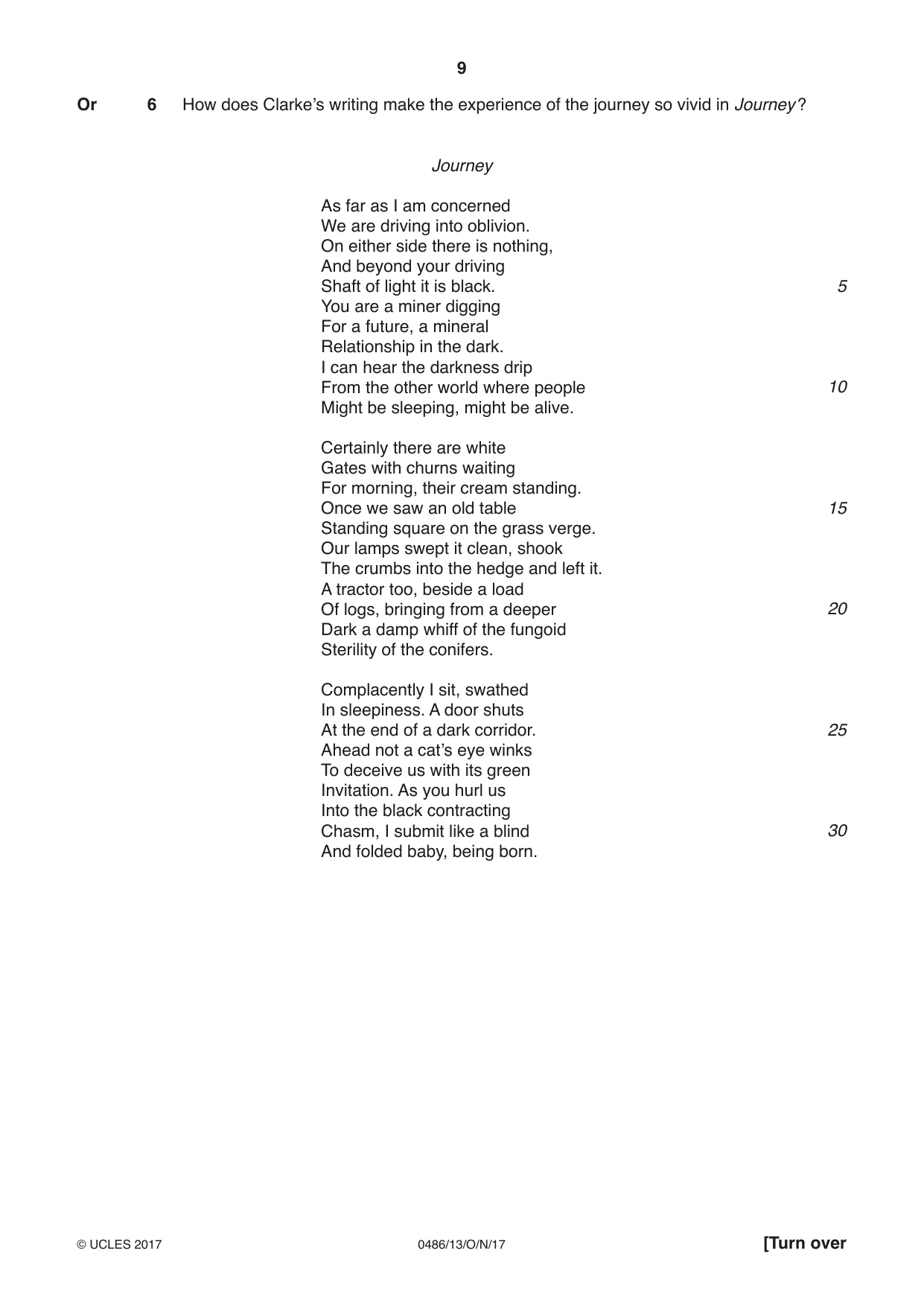
9 0486/13/O/N/17 © UCLES 2017 [Turn over Or 6 How does Clarke’s writing make the experience of the journey so vivid in Journey ? Journey As far as I am concerned We are driving into oblivion. On either side there is nothing, And beyond your driving Shaft of light it is black. You are a miner digging For a future, a mineral Relationship in the dark. I can hear the darkness drip From the other world where people Might be sleeping, might be alive. Certainly there are white Gates with churns waiting For morning, their cream standing. Once we saw an old table Standing square on the grass verge. Our lamps swept it clean, shook The crumbs into the hedge and left it. A tractor too, beside a load Of logs, bringing from a deeper Dark a damp whiff of the fungoid Sterility of the conifers. Complacently I sit, swathed In sleepiness. A door shuts At the end of a dark corridor. Ahead not a cat’s eye winks To deceive us with its green Invitation. As you hurl us Into the black contracting Chasm, I submit like a blind And folded baby, being born. 5 10 15 20 25 30
Question paper, page 10
10 0486/13/O/N/17 © UCLES 2017 SECTION B: PROSE Answer one question from this section. CHINUA ACHEBE: No Longer at Ease Remember to support your ideas with details from the writing. Either 7 Read this extract, and then answer the question that follows it: Obi’s homecoming was not in the end the happy event he had dreamt of. Content removed due to copyright restrictions
Question paper, page 11
11 0486/13/O/N/17 © UCLES 2017 [Turn over Content removed due to copyright restrictions all bloody hypocrites!’ It was not quite the same thing, though. His father believed fervently in God; the smooth M.P. was just a bloody hypocrite. [from Chapter 6] How does Achebe make this moment in the novel so moving? Or 8 How far does Achebe allow you to admire any of the European characters in the novel?
Question paper, page 12
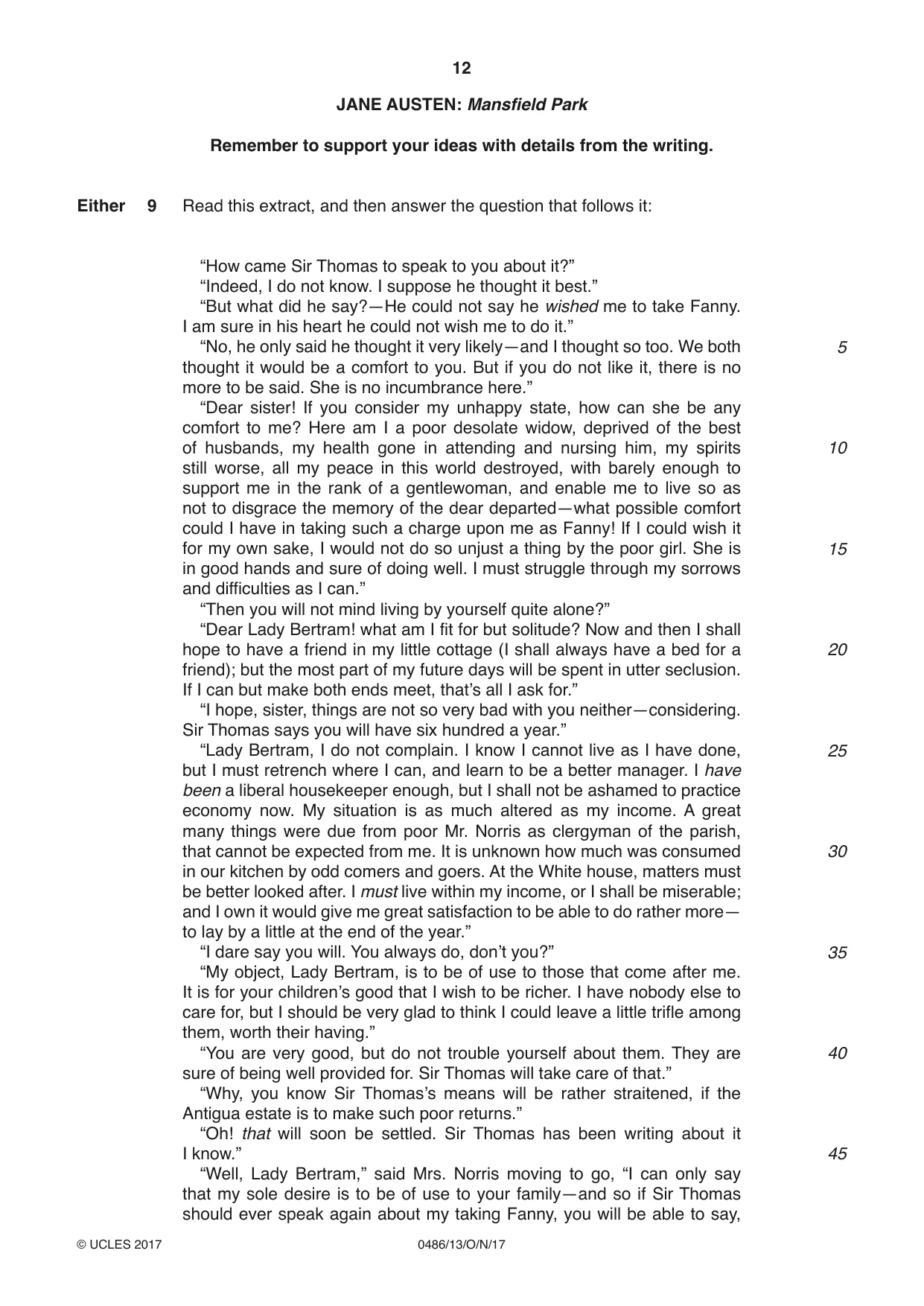
12 0486/13/O/N/17 © UCLES 2017 JANE AUSTEN: Mansfield Park Remember to support your ideas with details from the writing. Either 9 Read this extract, and then answer the question that follows it: “How came Sir Thomas to speak to you about it?” “Indeed, I do not know. I suppose he thought it best.” “But what did he say?—He could not say he wished me to take Fanny. I am sure in his heart he could not wish me to do it.” “No, he only said he thought it very likely—and I thought so too. We both thought it would be a comfort to you. But if you do not like it, there is no more to be said. She is no incumbrance here.” “Dear sister! If you consider my unhappy state, how can she be any comfort to me? Here am I a poor desolate widow, deprived of the best of husbands, my health gone in attending and nursing him, my spirits still worse, all my peace in this world destroyed, with barely enough to support me in the rank of a gentlewoman, and enable me to live so as not to disgrace the memory of the dear departed—what possible comfort could I have in taking such a charge upon me as Fanny! If I could wish it for my own sake, I would not do so unjust a thing by the poor girl. She is in good hands and sure of doing well. I must struggle through my sorrows and difficulties as I can.” “Then you will not mind living by yourself quite alone?” “Dear Lady Bertram! what am I fit for but solitude? Now and then I shall hope to have a friend in my little cottage (I shall always have a bed for a friend); but the most part of my future days will be spent in utter seclusion. If I can but make both ends meet, that’s all I ask for.” “I hope, sister, things are not so very bad with you neither—considering. Sir Thomas says you will have six hundred a year.” “Lady Bertram, I do not complain. I know I cannot live as I have done, but I must retrench where I can, and learn to be a better manager. I have been a liberal housekeeper enough, but I shall not be ashamed to practice economy now. My situation is as much altered as my income. A great many things were due from poor Mr. Norris as clergyman of the parish, that cannot be expected from me. It is unknown how much was consumed in our kitchen by odd comers and goers. At the White house, matters must be better looked after. I must live within my income, or I shall be miserable; and I own it would give me great satisfaction to be able to do rather more— to lay by a little at the end of the year.” “I dare say you will. You always do, don’t you?” “My object, Lady Bertram, is to be of use to those that come after me. It is for your children’s good that I wish to be richer. I have nobody else to care for, but I should be very glad to think I could leave a little trifle among them, worth their having.” “You are very good, but do not trouble yourself about them. They are sure of being well provided for. Sir Thomas will take care of that.” “Why, you know Sir Thomas’s means will be rather straitened, if the Antigua estate is to make such poor returns.” “Oh! that will soon be settled. Sir Thomas has been writing about it I know.” “Well, Lady Bertram,” said Mrs. Norris moving to go, “I can only say that my sole desire is to be of use to your family—and so if Sir Thomas should ever speak again about my taking Fanny, you will be able to say, 5 10 15 20 25 30 35 40 45
Question paper, page 13
13 0486/13/O/N/17 © UCLES 2017 [Turn over that my health and spirits put it quite out of the question—besides that, I really should not have a bed to give her, for I must keep a spare room for a friend.” [from Chapter 3] In what ways does Austen entertainingly reveal Mrs Norris’s character at this moment in the novel? Or 10 What memorable impressions of Mrs Grant does Austen’s writing create for you? 50
Question paper, page 14
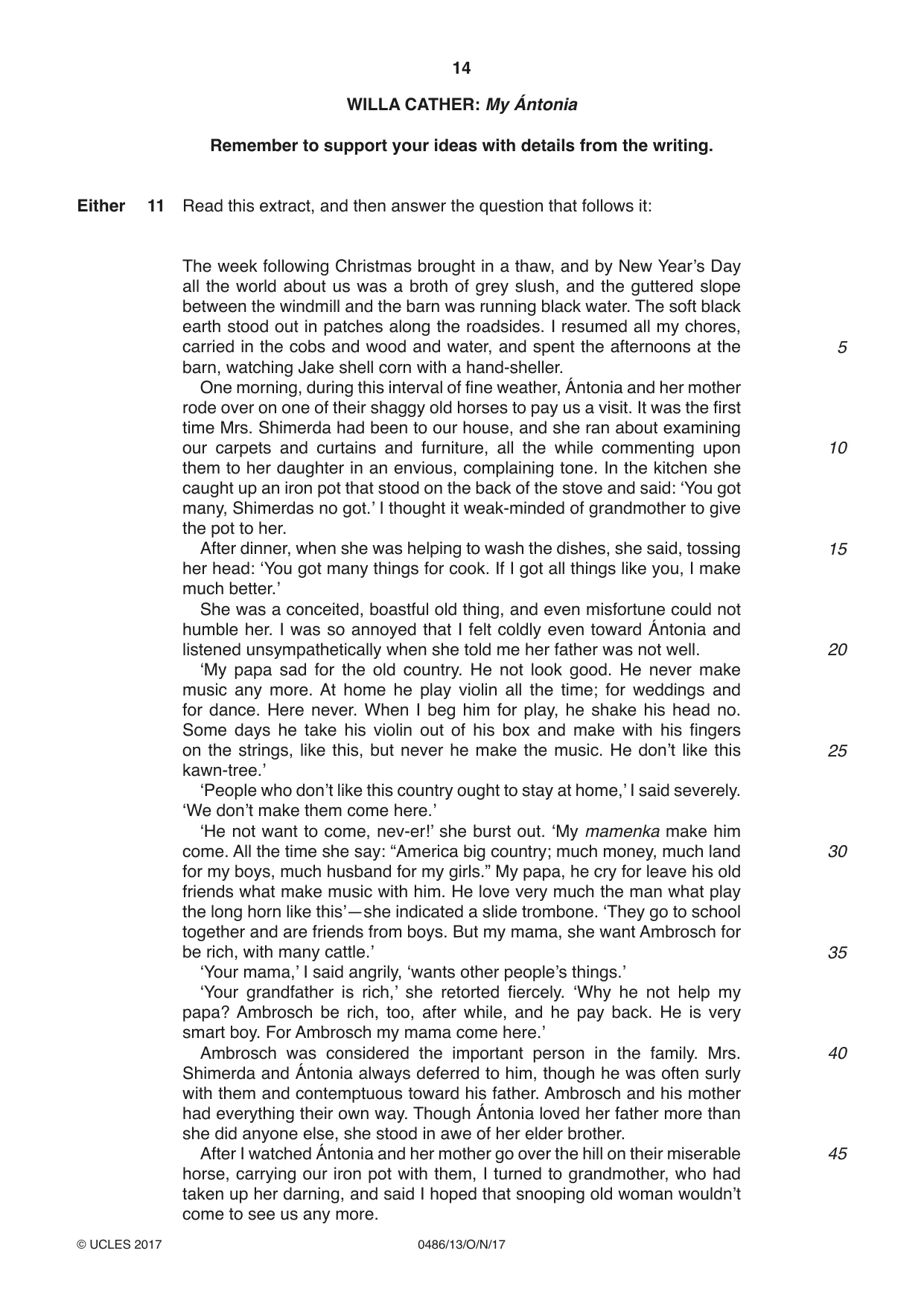
14 0486/13/O/N/17 © UCLES 2017 WILLA CATHER: My Ántonia Remember to support your ideas with details from the writing. Either 11 Read this extract, and then answer the question that follows it: The week following Christmas brought in a thaw, and by New Year’s Day all the world about us was a broth of grey slush, and the guttered slope between the windmill and the barn was running black water. The soft black earth stood out in patches along the roadsides. I resumed all my chores, carried in the cobs and wood and water, and spent the afternoons at the barn, watching Jake shell corn with a hand-sheller. One morning, during this interval of fine weather, Ántonia and her mother rode over on one of their shaggy old horses to pay us a visit. It was the first time Mrs. Shimerda had been to our house, and she ran about examining our carpets and curtains and furniture, all the while commenting upon them to her daughter in an envious, complaining tone. In the kitchen she caught up an iron pot that stood on the back of the stove and said: ‘You got many, Shimerdas no got.’ I thought it weak-minded of grandmother to give the pot to her. After dinner, when she was helping to wash the dishes, she said, tossing her head: ‘You got many things for cook. If I got all things like you, I make much better.’ She was a conceited, boastful old thing, and even misfortune could not humble her. I was so annoyed that I felt coldly even toward Ántonia and listened unsympathetically when she told me her father was not well. ‘My papa sad for the old country. He not look good. He never make music any more. At home he play violin all the time; for weddings and for dance. Here never. When I beg him for play, he shake his head no. Some days he take his violin out of his box and make with his fingers on the strings, like this, but never he make the music. He don’t like this kawn-tree.’ ‘People who don’t like this country ought to stay at home,’ I said severely. ‘We don’t make them come here.’ ‘He not want to come, nev-er!’ she burst out. ‘My mamenka make him come. All the time she say: “America big country; much money, much land for my boys, much husband for my girls.” My papa, he cry for leave his old friends what make music with him. He love very much the man what play the long horn like this’—she indicated a slide trombone. ‘They go to school together and are friends from boys. But my mama, she want Ambrosch for be rich, with many cattle.’ ‘Your mama,’ I said angrily, ‘wants other people’s things.’ ‘Your grandfather is rich,’ she retorted fiercely. ‘Why he not help my papa? Ambrosch be rich, too, after while, and he pay back. He is very smart boy. For Ambrosch my mama come here.’ Ambrosch was considered the important person in the family. Mrs. Shimerda and Ántonia always deferred to him, though he was often surly with them and contemptuous toward his father. Ambrosch and his mother had everything their own way. Though Ántonia loved her father more than she did anyone else, she stood in awe of her elder brother. After I watched Ántonia and her mother go over the hill on their miserable horse, carrying our iron pot with them, I turned to grandmother, who had taken up her darning, and said I hoped that snooping old woman wouldn’t come to see us any more. 5 10 15 20 25 30 35 40 45
Question paper, page 15
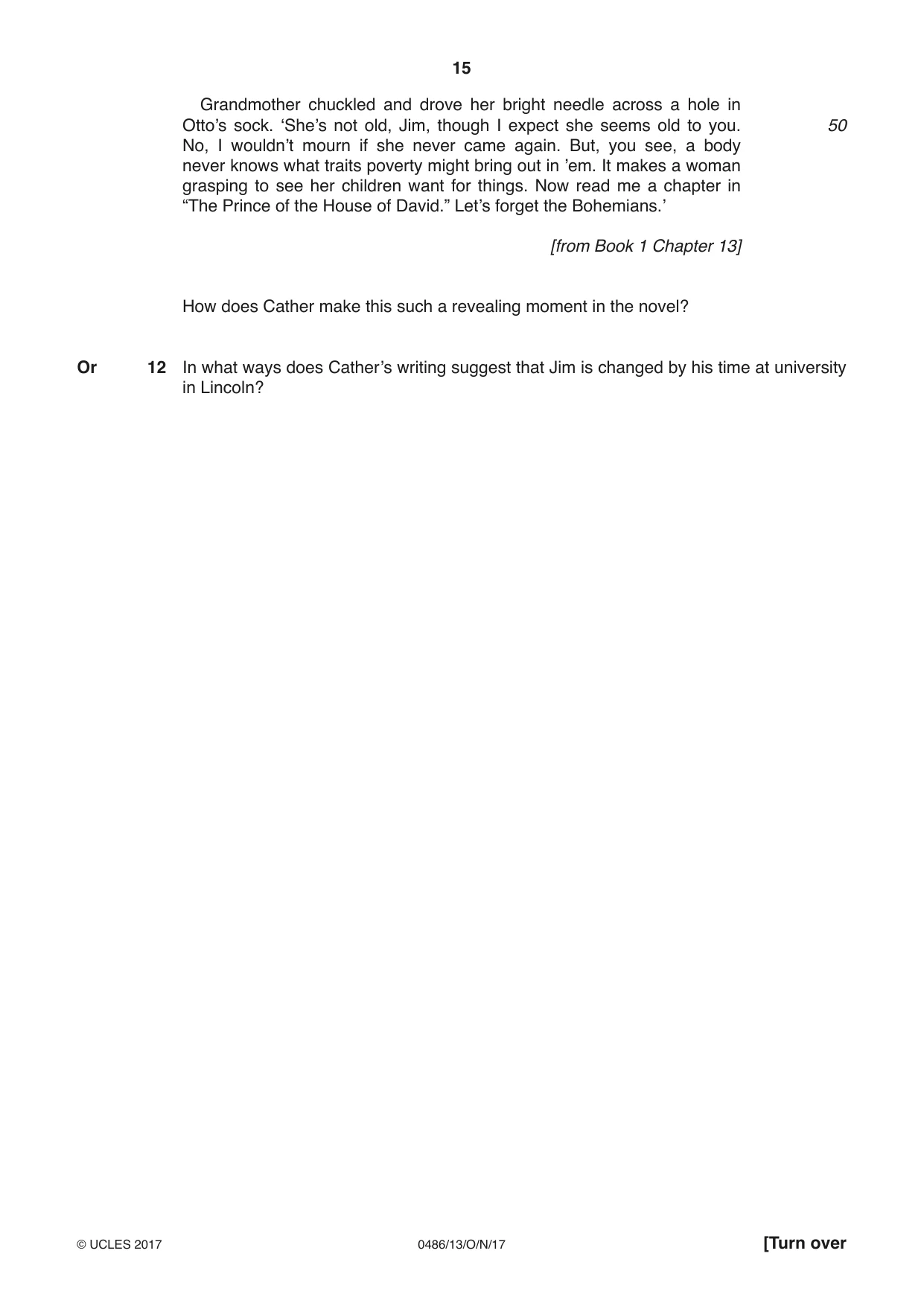
15 0486/13/O/N/17 © UCLES 2017 [Turn over Grandmother chuckled and drove her bright needle across a hole in Otto’s sock. ‘She’s not old, Jim, though I expect she seems old to you. No, I wouldn’t mourn if she never came again. But, you see, a body never knows what traits poverty might bring out in ’em. It makes a woman grasping to see her children want for things. Now read me a chapter in “The Prince of the House of David.” Let’s forget the Bohemians.’ [from Book 1 Chapter 13] How does Cather make this such a revealing moment in the novel? Or 12 In what ways does Cather’s writing suggest that Jim is changed by his time at university in Lincoln? 50
Question paper, page 16
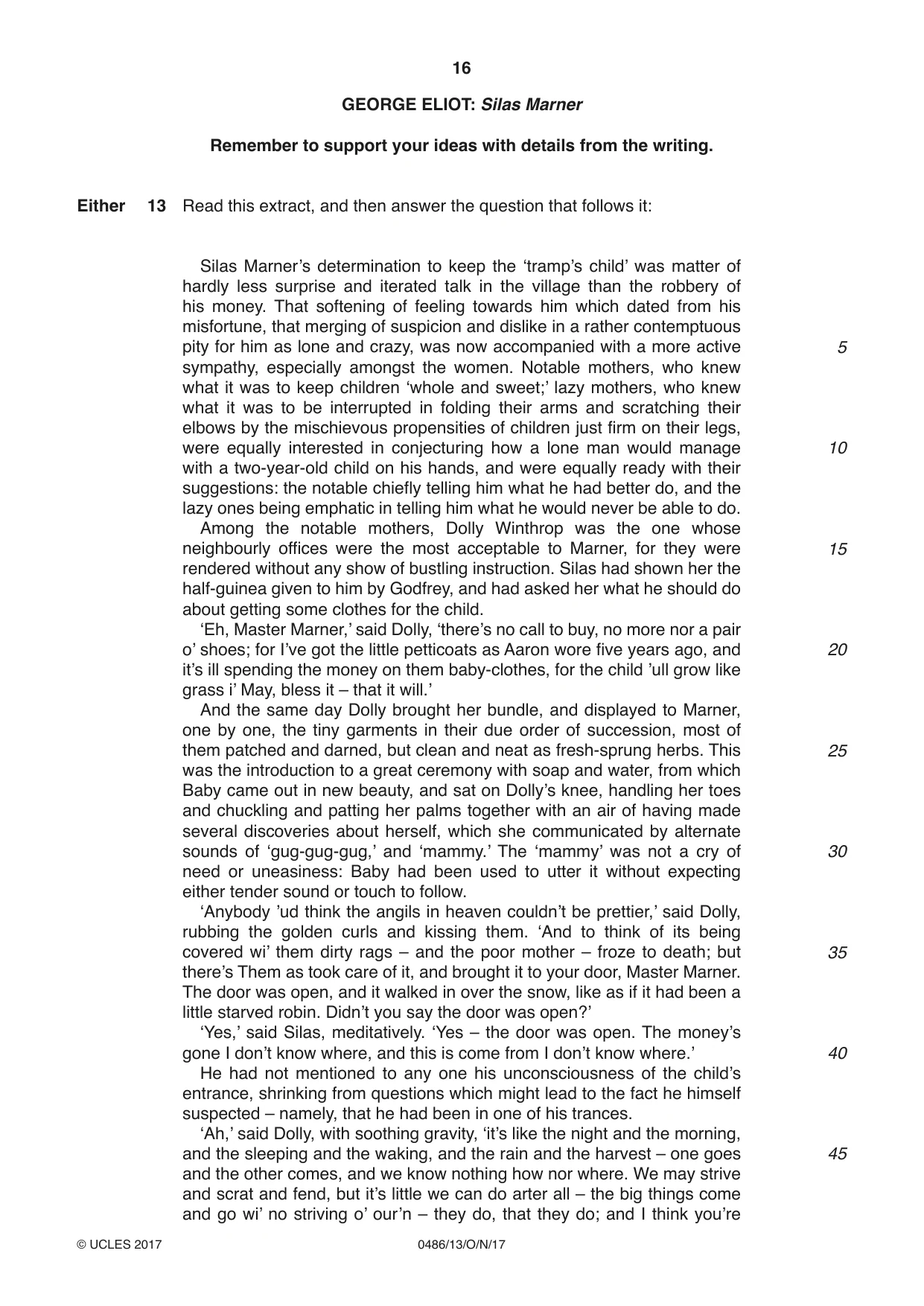
16 0486/13/O/N/17 © UCLES 2017 GEORGE ELIOT: Silas Marner Remember to support your ideas with details from the writing. Either 13 Read this extract, and then answer the question that follows it: Silas Marner’s determination to keep the ‘tramp’s child’ was matter of hardly less surprise and iterated talk in the village than the robbery of his money. That softening of feeling towards him which dated from his misfortune, that merging of suspicion and dislike in a rather contemptuous pity for him as lone and crazy, was now accompanied with a more active sympathy, especially amongst the women. Notable mothers, who knew what it was to keep children ‘whole and sweet;’ lazy mothers, who knew what it was to be interrupted in folding their arms and scratching their elbows by the mischievous propensities of children just firm on their legs, were equally interested in conjecturing how a lone man would manage with a two-year-old child on his hands, and were equally ready with their suggestions: the notable chiefly telling him what he had better do, and the lazy ones being emphatic in telling him what he would never be able to do. Among the notable mothers, Dolly Winthrop was the one whose neighbourly offices were the most acceptable to Marner, for they were rendered without any show of bustling instruction. Silas had shown her the half-guinea given to him by Godfrey, and had asked her what he should do about getting some clothes for the child. ‘Eh, Master Marner,’ said Dolly, ‘there’s no call to buy, no more nor a pair o’ shoes; for I’ve got the little petticoats as Aaron wore five years ago, and it’s ill spending the money on them baby-clothes, for the child ’ull grow like grass i’ May, bless it – that it will.’ And the same day Dolly brought her bundle, and displayed to Marner, one by one, the tiny garments in their due order of succession, most of them patched and darned, but clean and neat as fresh-sprung herbs. This was the introduction to a great ceremony with soap and water, from which Baby came out in new beauty, and sat on Dolly’s knee, handling her toes and chuckling and patting her palms together with an air of having made several discoveries about herself, which she communicated by alternate sounds of ‘gug-gug-gug,’ and ‘mammy.’ The ‘mammy’ was not a cry of need or uneasiness: Baby had been used to utter it without expecting either tender sound or touch to follow. ‘Anybody ’ud think the angils in heaven couldn’t be prettier,’ said Dolly, rubbing the golden curls and kissing them. ‘And to think of its being covered wi’ them dirty rags – and the poor mother – froze to death; but there’s Them as took care of it, and brought it to your door, Master Marner. The door was open, and it walked in over the snow, like as if it had been a little starved robin. Didn’t you say the door was open?’ ‘Yes,’ said Silas, meditatively. ‘Yes – the door was open. The money’s gone I don’t know where, and this is come from I don’t know where.’ He had not mentioned to any one his unconsciousness of the child’s entrance, shrinking from questions which might lead to the fact he himself suspected – namely, that he had been in one of his trances. ‘Ah,’ said Dolly, with soothing gravity, ‘it’s like the night and the morning, and the sleeping and the waking, and the rain and the harvest – one goes and the other comes, and we know nothing how nor where. We may strive and scrat and fend, but it’s little we can do arter all – the big things come and go wi’ no striving o’ our’n – they do, that they do; and I think you’re 5 10 15 20 25 30 35 40 45
Question paper, page 17
17 0486/13/O/N/17 © UCLES 2017 [Turn over in the right on it to keep the little un, Master Marner, seeing as it’s been sent to you, though there’s folks as thinks different. You’ll happen be a bit moithered with it while it’s so little; but I’ll come, and welcome, and see to it for you: I’ve a bit o’ time to spare most days, for when one gets up betimes i’ the morning, the clock seems to stan’ still tow’rt ten, afore it’s time to go about the victual. So, as I say, I’ll come and see to the child for you, and welcome.’ [from Part 1 Chapter 14] How does Eliot make this moment in the novel so moving? Or 14 In what ways does Eliot vividly portray the relationship between Nancy and her sister Priscilla? 50 55
Question paper, page 18
18 0486/13/O/N/17 © UCLES 2017 MICHAEL FRAYN: Spies Remember to support your ideas with details from the writing. Either 15 Read this extract, and then answer the question that follows it: Keith puts the construction kit away, and gets his cricket pads and boots out of the cupboard. I trail downstairs after him, and watch him spread Content removed due to copyright restrictions
Question paper, page 19
19 0486/13/O/N/17 © UCLES 2017 [Turn over Content removed due to copyright restrictions The game’s not over. It’s simply become a more terrible kind of game. [from Chapter 7] In what ways does Frayn make this moment in the novel so disturbing and revealing? Or 16 Explore one moment in the novel which Frayn makes particularly entertaining for you.
Question paper, page 20
20 0486/13/O/N/17 © UCLES 2017 KATE GRENVILLE: The Secret River Remember to support your ideas with details from the writing. Either 17 Read this extract, and then answer the question that follows it: Mr Knapp, the lawyer who had been assigned to speak for him, was a languid sort of a gent, and Thornhill held out no hope from that quarter, but Mr Knapp surprised him. Mr Lucas had said his piece, and then Knapp was speaking to him, in a weary sort of way, so that Thornhill did not at first realise he had found something of a chink: I understand you, Mr Lucas, to have said it was a very dark night, and therefore the only opportunity that you had of knowing who was the man, was that it was the voice of Thornhill? But Mr Lucas saw where this was going and coughed into his fist before saying stiffly, I knew him by his person, when I got to him, and Mr Knapp still seemed to pay no attention, asking casually, But you knew him only by his voice? A man with his sights set on the gold chain of office was not going to be confused by any half-asleep barrister and Lucas answered crisply, I believed that the person I saw in motion was the prisoner, and when I got to him, I knew him to be the prisoner at the bar. Now Thornhill was fully listening, and for the darkness of the night he began to give the greatest thanks. Knapp set a little trap, saying, That is, in other words, you knew Thornhill when you got up to him? But Lucas coughed again, shifted, rubbed an eye, could see the problem advancing towards him. I identified him by his voice repeatedly before, he said impatiently. Mr Knapp shot back, giving him no time to think, From that you were led to suppose it was Thornhill—you were not certain of it until you came up, and found that it was so? Lucas was too clever to be caught. He gripped the counter in front of him, sunlight falling across his shoulders and the eerie light of the mirror full on his face. When he spoke he seemed to be reading off the dust eddying in the shaft of sun. I did not hear any voice at the time the wood was in motion. At that time, if I had been asked, I could not have sworn to the person of Thornhill. He paused to pick his way between the words, then went on very steady and slow as if spelling something out for one of the Robs of this world: I can now swear that one of the persons that I saw, when the wood was in motion, was Thornhill, that I could not then swear to. When I got near him, that person was Thornhill, and I never lost sight of him, because I saw the very person that was moving the wood was Thornhill. Even Mr Knapp could find no chink in that masonry of words. When it was Yates’s turn, Thornhill saw how unhappy he was. He kept glancing across the well of the court at him, squinting against the light from the mirror, his big white eyebrows moving up and down, his hands busy fiddling with the edge of the counter in front of him as if to fiddle away so much trouble. Mr Knapp looked up at the far-off ceiling as he said, You had no opportunity of observing the face of the man—it was much too black a night to observe countenances? He was almost speaking to himself. Yates began to smooth the counter as if stroking a dog. It was, I allow, he said. I will speak by the voice, the shape and make of the man. And now Mr Knapp came to life, snapping out his words so Thornhill 5 10 15 20 25 30 35 40 45
Question paper, page 21
21 0486/13/O/N/17 © UCLES 2017 [Turn over could see how Yates cringed. What, speak to the shape and make of a man on a dark night? Poor Yates began to bluster. I do not say that I can, he said, unless I was particularly well acquainted with him. His bushy eyebrows were a semaphore of distress as he floundered on. I do not mean to say directly I can, or cannot speak to the facts in this case. Down at the witness table in the well of the court, Mr Lucas stared up at him. Even from the prisoner’s bar, Thornhill could see the beads of sweat appearing on Yates’s domed forehead. Mr Knapp insisted, It being a moonless night, you cannot make out that you knew him by shape and make? Thornhill thought, are those little words, shape and make, going to be the difference between life and death? Poor Yates, glancing from Lucas to Thornhill, began to mutter and stutter. I should be sorry to say anything that is an untruth, he said, but Mr Knapp had no mercy, and kept coming on. That was a hasty speech, that you knew him by shape and make? You mean that you could not? And now Yates was broken, uncertain of all his words, continually glancing at Mr Lucas. I was in the act of closing with this man, he mumbled. It was impossible but I must know him from his speaking to me. I knew him by his voice. He glanced quickly at Thornhill. I might have hastily spoke about his shape and make, he said, and then stood stiff as a bit of wood with his hat squashed under his arm, the wan light from the mirror falling full on his face, furrowed with misery. [from Part 1] How does Grenville make this such a powerfully dramatic moment in the novel? Or 18 Explore one moment in the novel where Grenville makes you particularly appreciate the strength of the relationship between Will and Sal. 50 55 60 65 70
Question paper, page 22
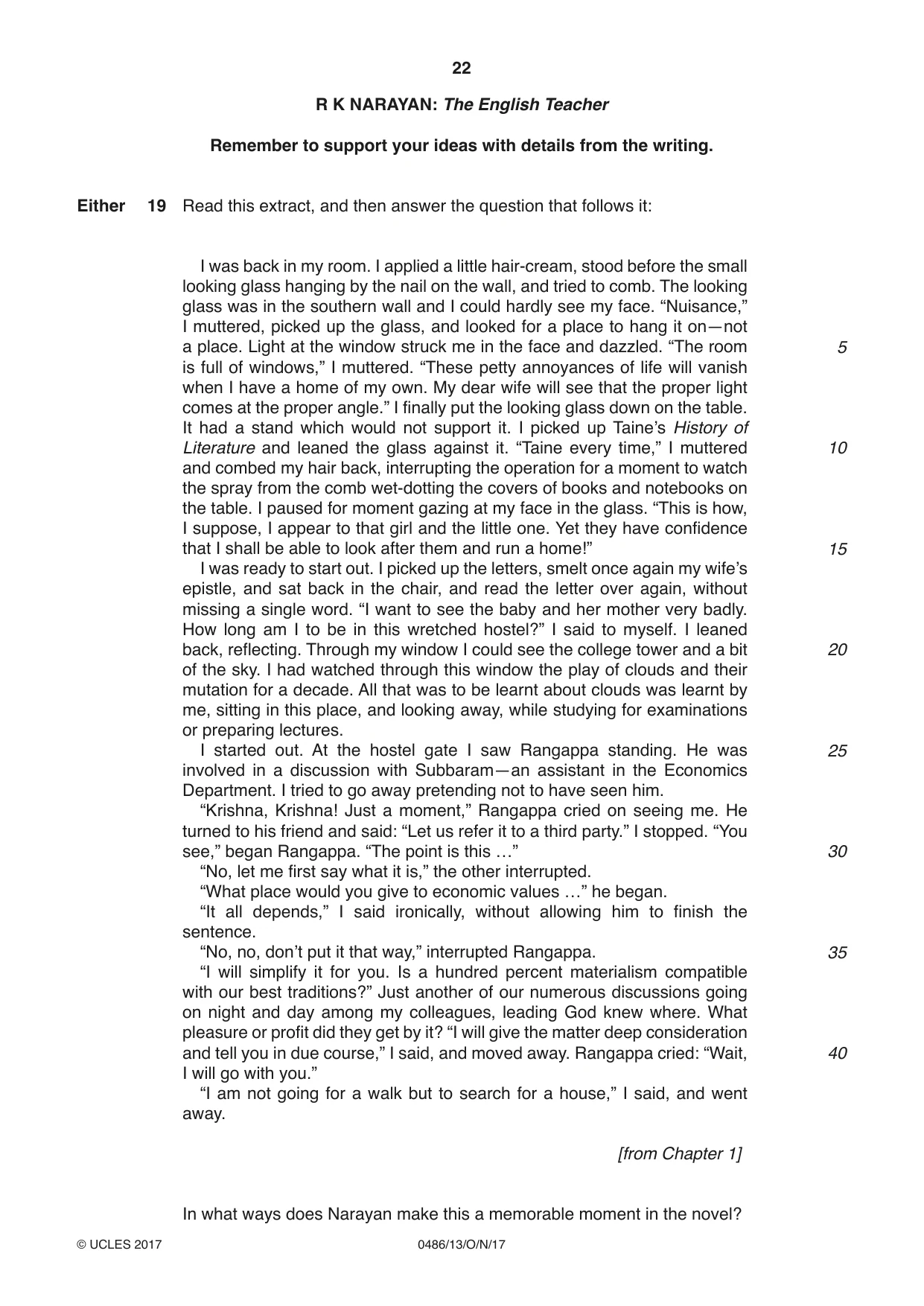
22 0486/13/O/N/17 © UCLES 2017 R K NARAYAN: The English Teacher Remember to support your ideas with details from the writing. Either 19 Read this extract, and then answer the question that follows it: I was back in my room. I applied a little hair-cream, stood before the small looking glass hanging by the nail on the wall, and tried to comb. The looking glass was in the southern wall and I could hardly see my face. “Nuisance,” I muttered, picked up the glass, and looked for a place to hang it on—not a place. Light at the window struck me in the face and dazzled. “The room is full of windows,” I muttered. “These petty annoyances of life will vanish when I have a home of my own. My dear wife will see that the proper light comes at the proper angle.” I finally put the looking glass down on the table. It had a stand which would not support it. I picked up Taine’s History of Literature and leaned the glass against it. “Taine every time,” I muttered and combed my hair back, interrupting the operation for a moment to watch the spray from the comb wet-dotting the covers of books and notebooks on the table. I paused for moment gazing at my face in the glass. “This is how, I suppose, I appear to that girl and the little one. Yet they have confidence that I shall be able to look after them and run a home!” I was ready to start out. I picked up the letters, smelt once again my wife’s epistle, and sat back in the chair, and read the letter over again, without missing a single word. “I want to see the baby and her mother very badly. How long am I to be in this wretched hostel?” I said to myself. I leaned back, reflecting. Through my window I could see the college tower and a bit of the sky. I had watched through this window the play of clouds and their mutation for a decade. All that was to be learnt about clouds was learnt by me, sitting in this place, and looking away, while studying for examinations or preparing lectures. I started out. At the hostel gate I saw Rangappa standing. He was involved in a discussion with Subbaram—an assistant in the Economics Department. I tried to go away pretending not to have seen him. “Krishna, Krishna! Just a moment,” Rangappa cried on seeing me. He turned to his friend and said: “Let us refer it to a third party.” I stopped. “You see,” began Rangappa. “The point is this …” “No, let me first say what it is,” the other interrupted. “What place would you give to economic values …” he began. “It all depends,” I said ironically, without allowing him to finish the sentence. “No, no, don’t put it that way,” interrupted Rangappa. “I will simplify it for you. Is a hundred percent materialism compatible with our best traditions?” Just another of our numerous discussions going on night and day among my colleagues, leading God knew where. What pleasure or profit did they get by it? “I will give the matter deep consideration and tell you in due course,” I said, and moved away. Rangappa cried: “Wait, I will go with you.” “I am not going for a walk but to search for a house,” I said, and went away. [from Chapter 1] In what ways does Narayan make this a memorable moment in the novel? 5 10 15 20 25 30 35 40
Question paper, page 23
23 0486/13/O/N/17 © UCLES 2017 [Turn over Or 20 How far does Narayan make Susila a likeable character?
Question paper, page 24
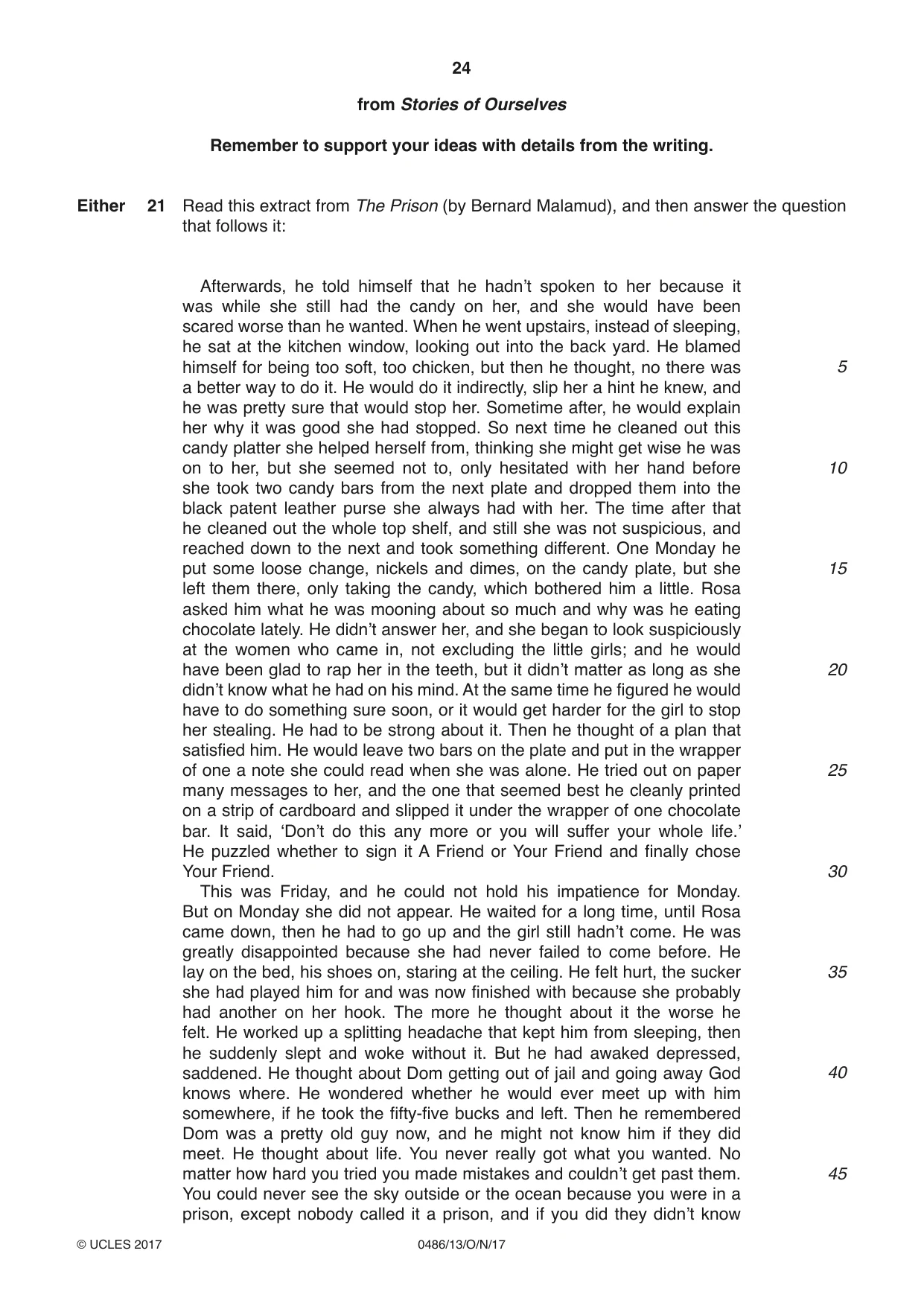
24 0486/13/O/N/17 © UCLES 2017 from Stories of Ourselves Remember to support your ideas with details from the writing. Either 21 Read this extract from The Prison (by Bernard Malamud), and then answer the question that follows it: Afterwards, he told himself that he hadn’t spoken to her because it was while she still had the candy on her, and she would have been scared worse than he wanted. When he went upstairs, instead of sleeping, he sat at the kitchen window, looking out into the back yard. He blamed himself for being too soft, too chicken, but then he thought, no there was a better way to do it. He would do it indirectly, slip her a hint he knew, and he was pretty sure that would stop her. Sometime after, he would explain her why it was good she had stopped. So next time he cleaned out this candy platter she helped herself from, thinking she might get wise he was on to her, but she seemed not to, only hesitated with her hand before she took two candy bars from the next plate and dropped them into the black patent leather purse she always had with her. The time after that he cleaned out the whole top shelf, and still she was not suspicious, and reached down to the next and took something different. One Monday he put some loose change, nickels and dimes, on the candy plate, but she left them there, only taking the candy, which bothered him a little. Rosa asked him what he was mooning about so much and why was he eating chocolate lately. He didn’t answer her, and she began to look suspiciously at the women who came in, not excluding the little girls; and he would have been glad to rap her in the teeth, but it didn’t matter as long as she didn’t know what he had on his mind. At the same time he figured he would have to do something sure soon, or it would get harder for the girl to stop her stealing. He had to be strong about it. Then he thought of a plan that satisfied him. He would leave two bars on the plate and put in the wrapper of one a note she could read when she was alone. He tried out on paper many messages to her, and the one that seemed best he cleanly printed on a strip of cardboard and slipped it under the wrapper of one chocolate bar. It said, ‘Don’t do this any more or you will suffer your whole life.’ He puzzled whether to sign it A Friend or Your Friend and finally chose Your Friend. This was Friday, and he could not hold his impatience for Monday. But on Monday she did not appear. He waited for a long time, until Rosa came down, then he had to go up and the girl still hadn’t come. He was greatly disappointed because she had never failed to come before. He lay on the bed, his shoes on, staring at the ceiling. He felt hurt, the sucker she had played him for and was now finished with because she probably had another on her hook. The more he thought about it the worse he felt. He worked up a splitting headache that kept him from sleeping, then he suddenly slept and woke without it. But he had awaked depressed, saddened. He thought about Dom getting out of jail and going away God knows where. He wondered whether he would ever meet up with him somewhere, if he took the fifty-five bucks and left. Then he remembered Dom was a pretty old guy now, and he might not know him if they did meet. He thought about life. You never really got what you wanted. No matter how hard you tried you made mistakes and couldn’t get past them. You could never see the sky outside or the ocean because you were in a prison, except nobody called it a prison, and if you did they didn’t know 5 10 15 20 25 30 35 40 45
Question paper, page 25
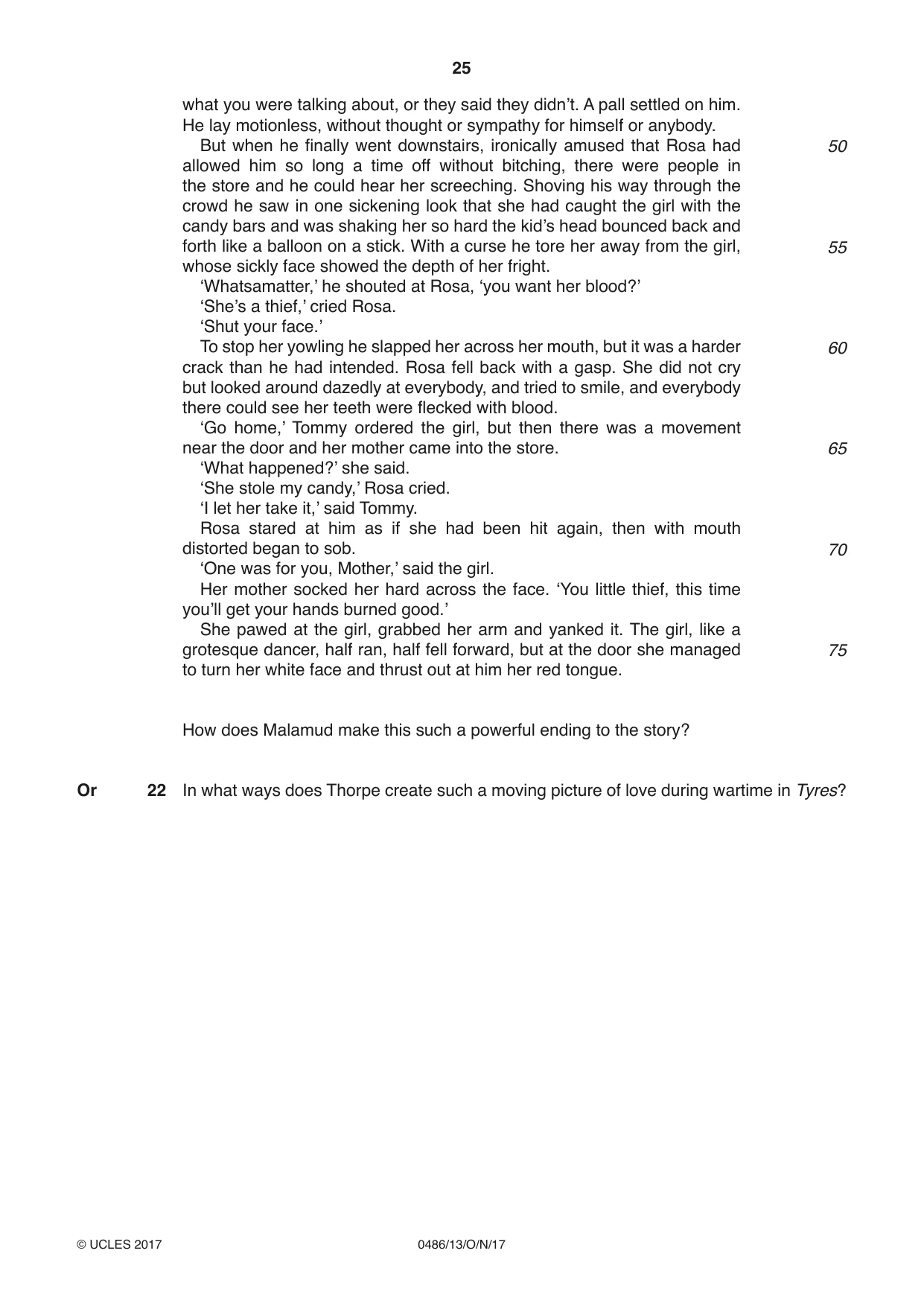
25 0486/13/O/N/17 © UCLES 2017 what you were talking about, or they said they didn’t. A pall settled on him. He lay motionless, without thought or sympathy for himself or anybody. But when he finally went downstairs, ironically amused that Rosa had allowed him so long a time off without bitching, there were people in the store and he could hear her screeching. Shoving his way through the crowd he saw in one sickening look that she had caught the girl with the candy bars and was shaking her so hard the kid’s head bounced back and forth like a balloon on a stick. With a curse he tore her away from the girl, whose sickly face showed the depth of her fright. ‘Whatsamatter,’ he shouted at Rosa, ‘you want her blood?’ ‘She’s a thief,’ cried Rosa. ‘Shut your face.’ To stop her yowling he slapped her across her mouth, but it was a harder crack than he had intended. Rosa fell back with a gasp. She did not cry but looked around dazedly at everybody, and tried to smile, and everybody there could see her teeth were flecked with blood. ‘Go home,’ Tommy ordered the girl, but then there was a movement near the door and her mother came into the store. ‘What happened?’ she said. ‘She stole my candy,’ Rosa cried. ‘I let her take it,’ said Tommy. Rosa stared at him as if she had been hit again, then with mouth distorted began to sob. ‘One was for you, Mother,’ said the girl. Her mother socked her hard across the face. ‘You little thief, this time you’ll get your hands burned good.’ She pawed at the girl, grabbed her arm and yanked it. The girl, like a grotesque dancer, half ran, half fell forward, but at the door she managed to turn her white face and thrust out at him her red tongue. How does Malamud make this such a powerful ending to the story? Or 22 In what ways does Thorpe create such a moving picture of love during wartime in Tyres? 50 55 60 65 70 75
Question paper, page 26
26 0486/13/O/N/17 © UCLES 2017 BLANK PAGE
Question paper, page 27
27 0486/13/O/N/17 © UCLES 2017 BLANK PAGE
Question paper, page 28
28 0486/13/O/N/17 © UCLES 2017 BLANK PAGE Permission to reproduce items where third-party owned material protected by copyright is included has been sought and cleared where possible. Every reasonable effort has been made by the publisher (UCLES) to trace copyright holders, but if any items requiring clearance have unwittingly been included, the publisher will be pleased to make amends at the earliest possible opportunity. To avoid the issue of disclosure of answer-related information to candidates, all copyright acknowledgements are reproduced online in the Cambridge International Examinations Copyright Acknowledgements Booklet. This is produced for each series of examinations and is freely available to download at www.cie.org.uk after the live examination series. Cambridge International Examinations is part of the Cambridge Assessment Group. Cambridge Assessment is the brand name of University of Cambridge Local Examinations Syndicate (UCLES), which is itself a department of the University of Cambridge.
Mark scheme, page 1
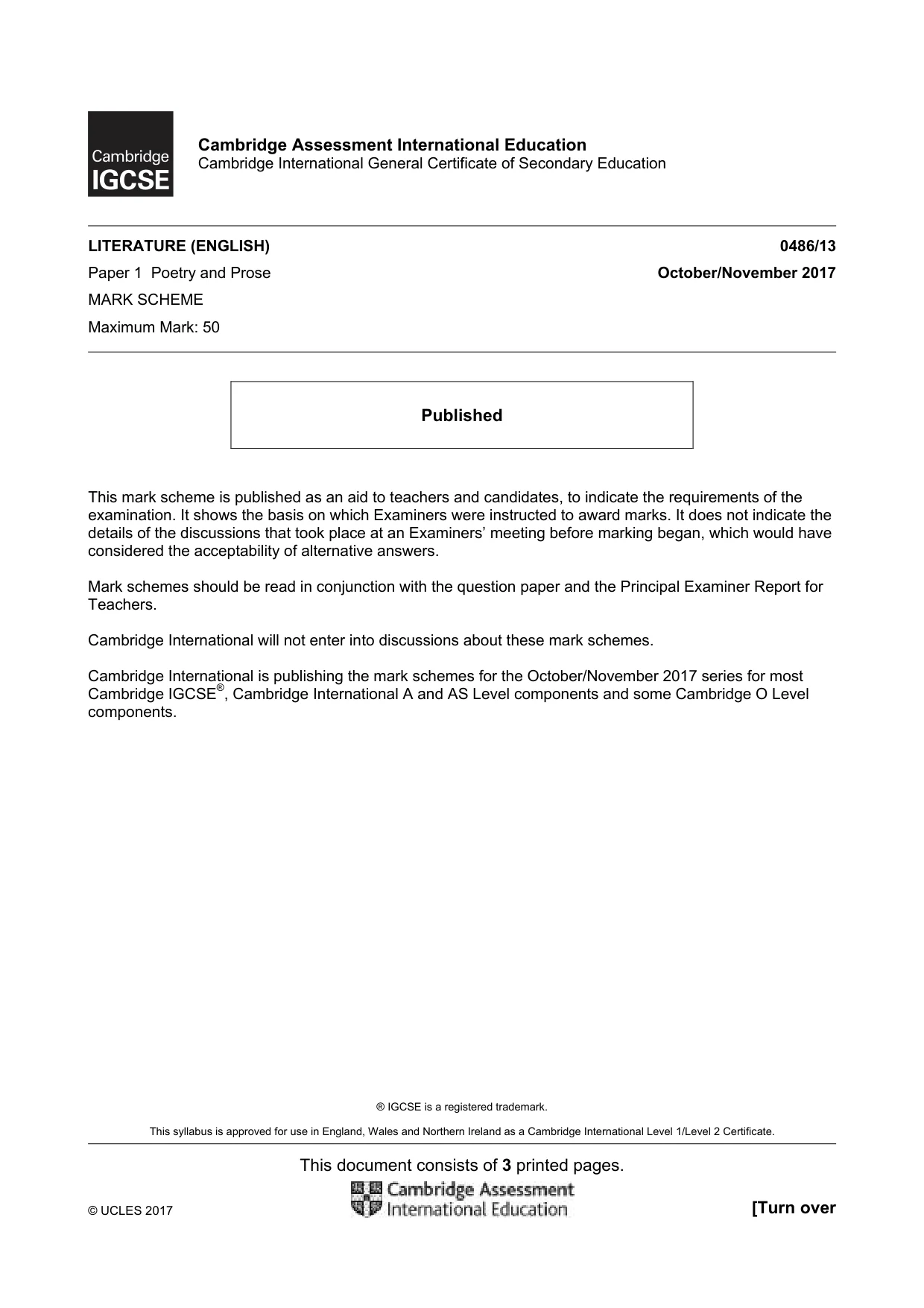
® IGCSE is a registered trademark. This syllabus is approved for use in England, Wales and Northern Ireland as a Cambridge International Level 1/Level 2 Certificate. This document consists of 3 printed pages. © UCLES 2017 [Turn over Cambridge Assessment International Education Cambridge International General Certificate of Secondary Education LITERATURE (ENGLISH) 0486/13 Paper 1 Poetry and Prose October/November 2017 MARK SCHEME Maximum Mark: 50 Published This mark scheme is published as an aid to teachers and candidates, to indicate the requirements of the examination. It shows the basis on which Examiners were instructed to award marks. It does not indicate the details of the discussions that took place at an Examiners’ meeting before marking began, which would have considered the acceptability of alternative answers. Mark schemes should be read in conjunction with the question paper and the Principal Examiner Report for Teachers. Cambridge International will not enter into discussions about these mark schemes. Cambridge International is publishing the mark schemes for the October/November 2017 series for most Cambridge IGCSE®, Cambridge International A and AS Level components and some Cambridge O Level components.
Mark scheme, page 2
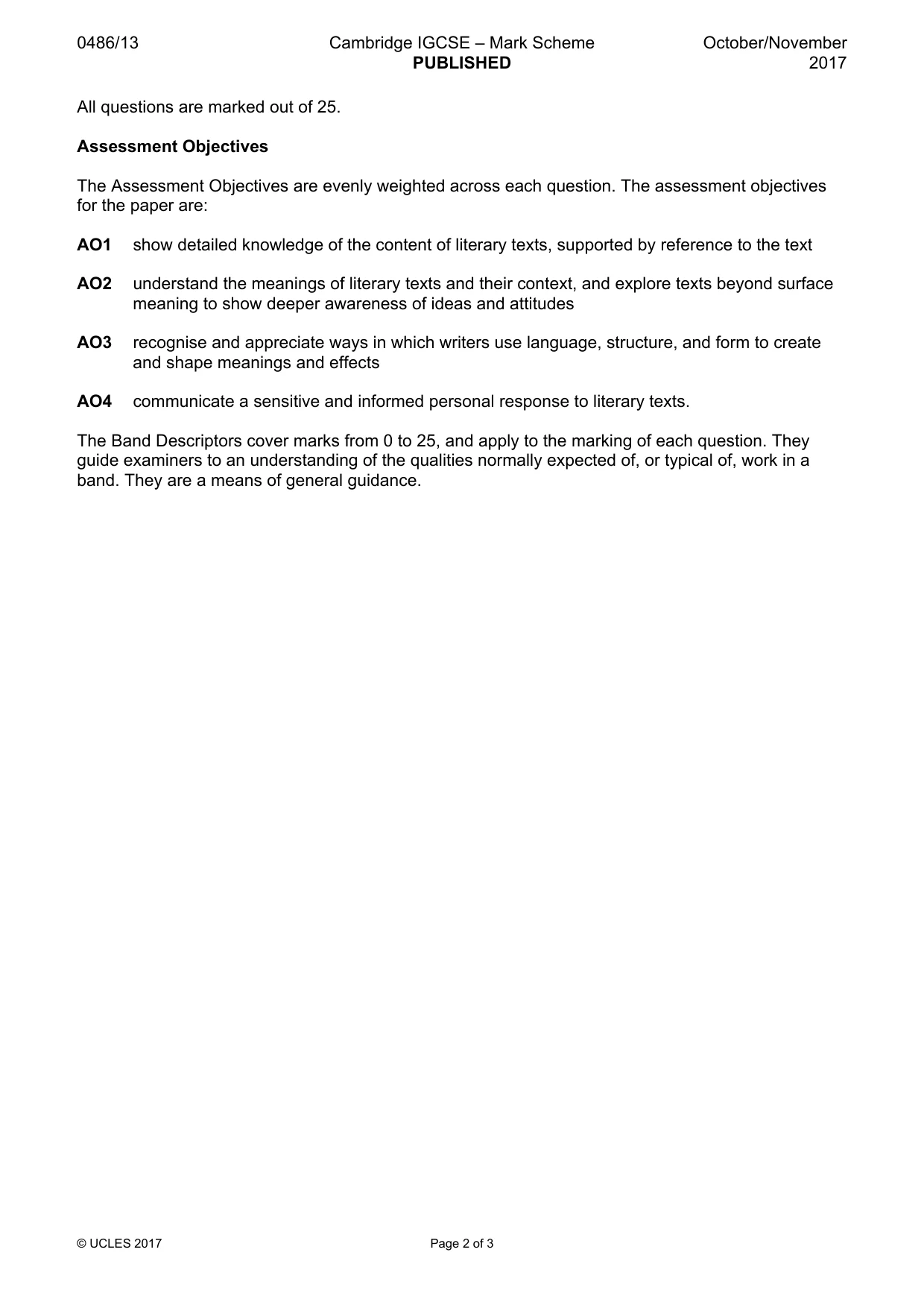
0486/13 Cambridge IGCSE – Mark Scheme PUBLISHED October/November 2017 © UCLES 2017 Page 2 of 3 All questions are marked out of 25. Assessment Objectives The Assessment Objectives are evenly weighted across each question. The assessment objectives for the paper are: AO1 show detailed knowledge of the content of literary texts, supported by reference to the text AO2 understand the meanings of literary texts and their context, and explore texts beyond surface meaning to show deeper awareness of ideas and attitudes AO3 recognise and appreciate ways in which writers use language, structure, and form to create and shape meanings and effects AO4 communicate a sensitive and informed personal response to literary texts. The Band Descriptors cover marks from 0 to 25, and apply to the marking of each question. They guide examiners to an understanding of the qualities normally expected of, or typical of, work in a band. They are a means of general guidance.
Mark scheme, page 3
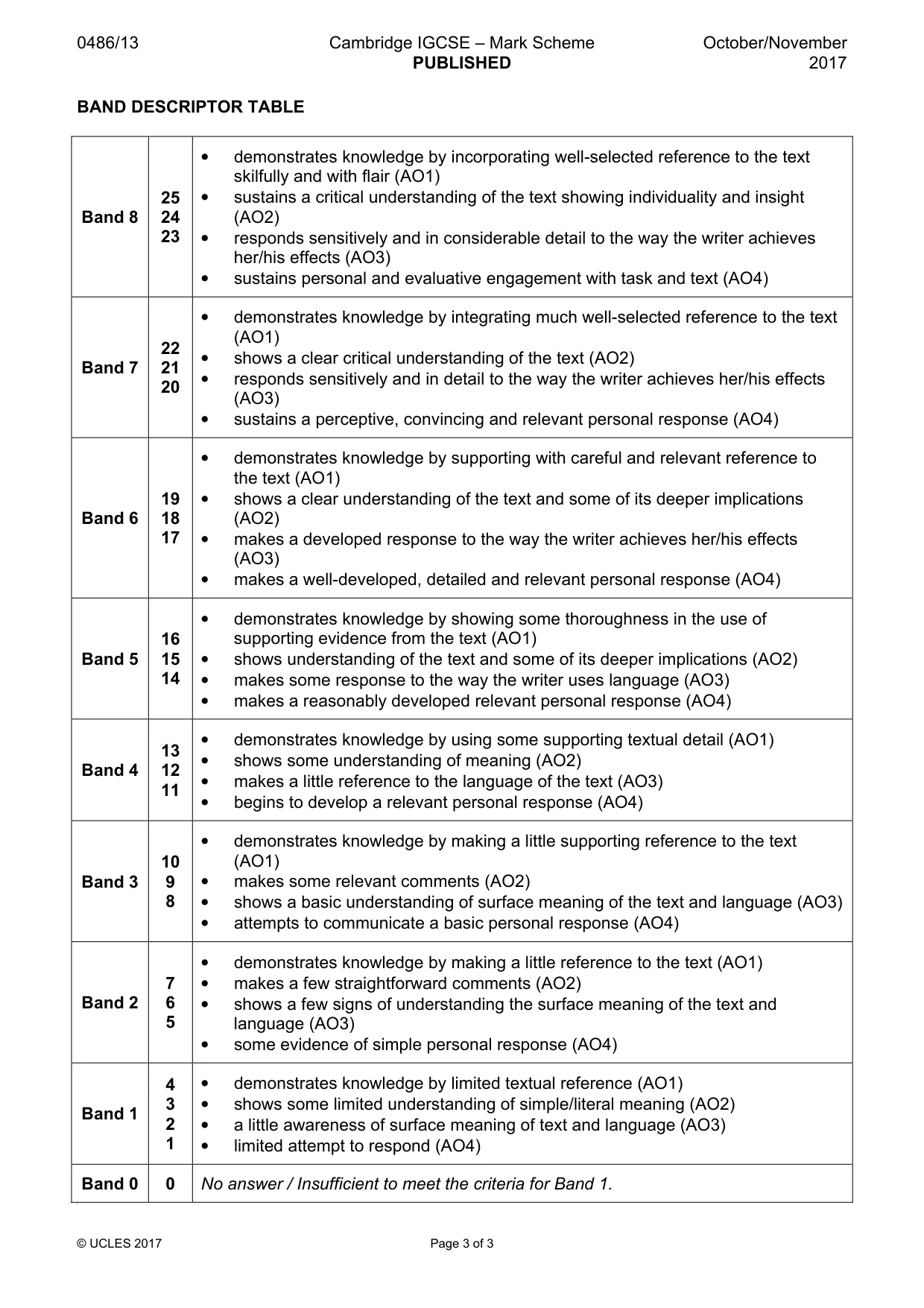
0486/13 Cambridge IGCSE – Mark Scheme PUBLISHED October/November 2017 © UCLES 2017 Page 3 of 3 BAND DESCRIPTOR TABLE Band 8 25 24 23 • demonstrates knowledge by incorporating well-selected reference to the text skilfully and with flair (AO1) • sustains a critical understanding of the text showing individuality and insight (AO2) • responds sensitively and in considerable detail to the way the writer achieves her/his effects (AO3) • sustains personal and evaluative engagement with task and text (AO4) Band 7 22 21 20 • demonstrates knowledge by integrating much well-selected reference to the text (AO1) • shows a clear critical understanding of the text (AO2) • responds sensitively and in detail to the way the writer achieves her/his effects (AO3) • sustains a perceptive, convincing and relevant personal response (AO4) Band 6 19 18 17 • demonstrates knowledge by supporting with careful and relevant reference to the text (AO1) • shows a clear understanding of the text and some of its deeper implications (AO2) • makes a developed response to the way the writer achieves her/his effects (AO3) • makes a well-developed, detailed and relevant personal response (AO4) Band 5 16 15 14 • demonstrates knowledge by showing some thoroughness in the use of supporting evidence from the text (AO1) • shows understanding of the text and some of its deeper implications (AO2) • makes some response to the way the writer uses language (AO3) • makes a reasonably developed relevant personal response (AO4) Band 4 13 12 11 • demonstrates knowledge by using some supporting textual detail (AO1) • shows some understanding of meaning (AO2) • makes a little reference to the language of the text (AO3) • begins to develop a relevant personal response (AO4) Band 3 10 9 8 • demonstrates knowledge by making a little supporting reference to the text (AO1) • makes some relevant comments (AO2) • shows a basic understanding of surface meaning of the text and language (AO3) • attempts to communicate a basic personal response (AO4) Band 2 7 6 5 • demonstrates knowledge by making a little reference to the text (AO1) • makes a few straightforward comments (AO2) • shows a few signs of understanding the surface meaning of the text and language (AO3) • some evidence of simple personal response (AO4) Band 1 4 3 2 1 • demonstrates knowledge by limited textual reference (AO1) • shows some limited understanding of simple/literal meaning (AO2) • a little awareness of surface meaning of text and language (AO3) • limited attempt to respond (AO4) Band 0 0 No answer / Insufficient to meet the criteria for Band 1. #
What you needed in this session
Cambridge’s own grade thresholds for 2017 Oct/Nov, Paper 1 · Variant 3. A higher threshold means an easier paper — the bar moves with how the cohort did.