Cambridge IGCSE English - Literature 0486 — 2019 May/June Paper 1 · Variant 3
0486/13/M/J/19 · 50 marks · ≈56 min
The question paper and its mark scheme, free to read here and free to download. This is Cambridge’s own paper, exactly as it was sat.
Question paper28 pages






Mark scheme4 pages
Answers below. Sit the paper first if you are practising.
Paper as text
Question paper, page 1
This document consists of 24 printed pages, 4 blank pages and 1 Insert. DC (RCL (GO)) 165363/3 © UCLES 2019 [Turn over Cambridge Assessment International Education Cambridge International General Certificate of Secondary Education * 1 1 1 3 2 8 4 0 6 0 * LITERATURE (ENGLISH) 0486/13 Paper 1 Poetry and Prose May/June 2019 1 hour 30 minutes No Additional Materials are required. READ THESE INSTRUCTIONS FIRST An answer booklet is provided inside this question paper. You should follow the instructions on the front cover of the answer booklet. If you need additional answer paper ask the invigilator for a continuation booklet. Answer two questions: one question from Section A and one question from Section B. All questions in this paper carry equal marks.
Question paper, page 2
2 0486/13/M/J/19 © UCLES 2019 BLANK PAGE
Question paper, page 3
3 0486/13/M/J/19 © UCLES 2019 [Turn over CONTENTS Section A: Poetry text question numbers page[s] Songs of Ourselves Volume 1: from Part 5 1, 2 pages 4–5 Songs of Ourselves Volume 2 : from Part 2 3, 4 pages 6–7 Gillian Clarke: from Collected Poems 5, 6 pages 8–9 Section B: Prose text question numbers page[s] Jane Austen: Mansfield Park 7, 8 pages 10–11 Willa Cather: My Ántonia 9, 10 pages 12–13 Anita Desai: In Custody 11, 12 pages 14–15 Charles Dickens: Hard Times 13, 14 pages 16–17 Kate Grenville: The Secret River 15, 16 pages 18–19 John Knowles: A Separate Peace 17, 18 pages 20–21 Alan Paton: Cry, the Beloved Country 19, 20 pages 22–23 from Stories of Ourselves 21, 22 pages 24–25
Question paper, page 4
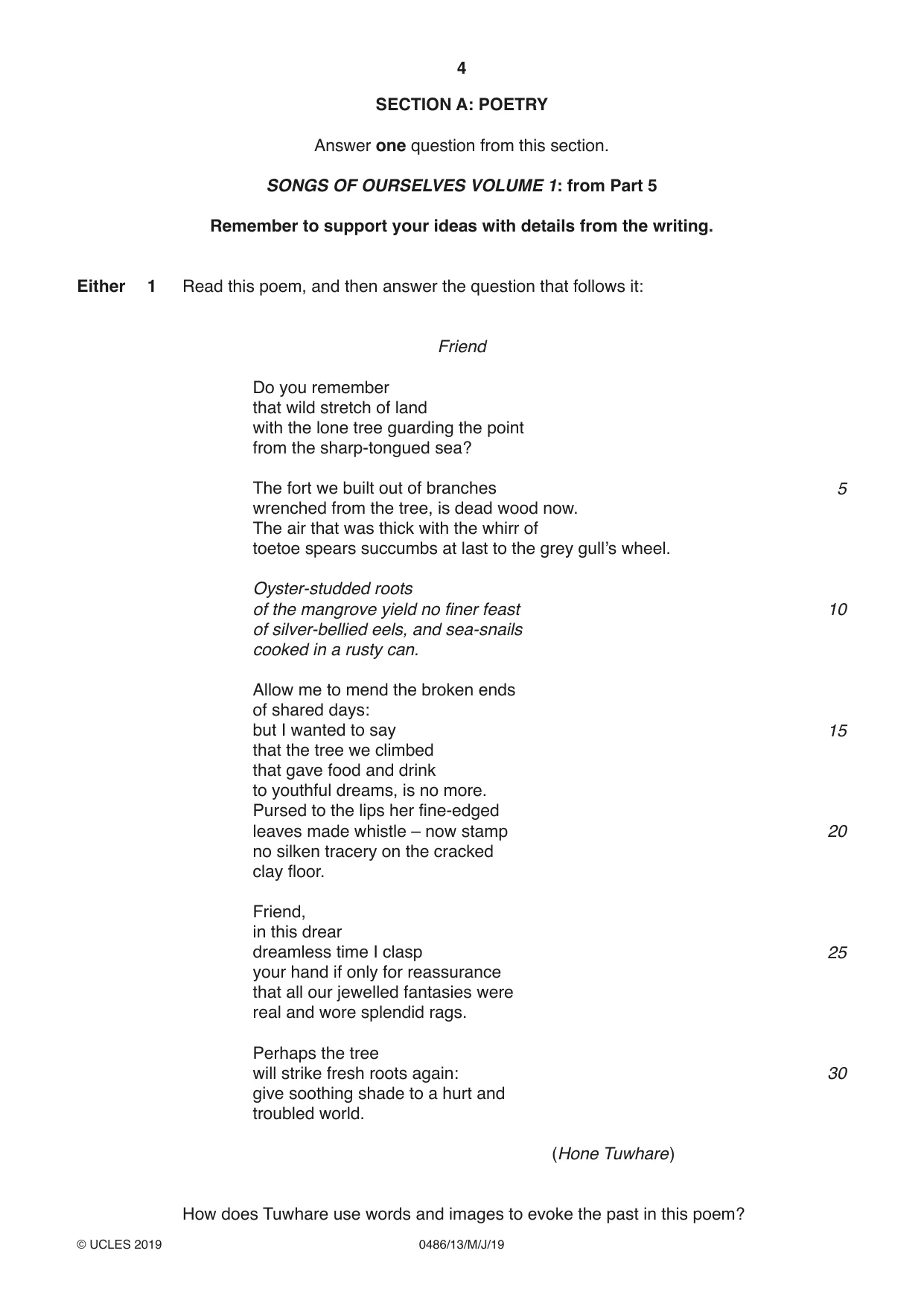
4 0486/13/M/J/19 © UCLES 2019 SECTION A: POETRY Answer one question from this section. SONGS OF OURSELVES VOLUME 1: from Part 5 Remember to support your ideas with details from the writing. Either 1 Read this poem, and then answer the question that follows it: Friend Do you remember that wild stretch of land with the lone tree guarding the point from the sharp-tongued sea? The fort we built out of branches wrenched from the tree, is dead wood now. The air that was thick with the whirr of toetoe spears succumbs at last to the grey gull’s wheel. Oyster-studded roots of the mangrove yield no finer feast of silver-bellied eels, and sea-snails cooked in a rusty can. Allow me to mend the broken ends of shared days: but I wanted to say that the tree we climbed that gave food and drink to youthful dreams, is no more. Pursed to the lips her fine-edged leaves made whistle – now stamp no silken tracery on the cracked clay floor. Friend, in this drear dreamless time I clasp your hand if only for reassurance that all our jewelled fantasies were real and wore splendid rags. Perhaps the tree will strike fresh roots again: give soothing shade to a hurt and troubled world. (Hone Tuwhare) How does Tuwhare use words and images to evoke the past in this poem? 5 10 15 20 25 30
Question paper, page 5
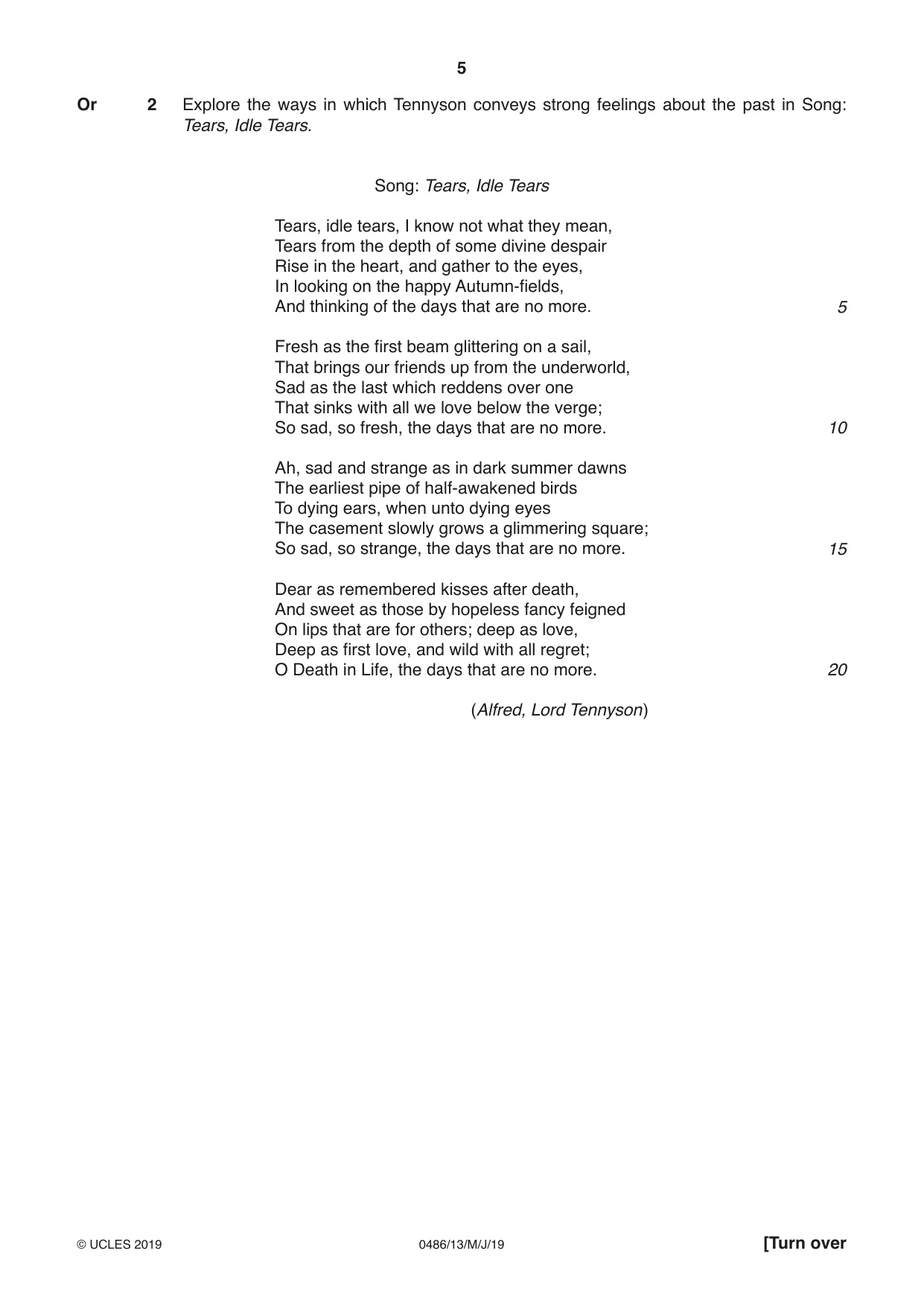
5 0486/13/M/J/19 © UCLES 2019 [Turn over Or 2 Explore the ways in which Tennyson conveys strong feelings about the past in Song: Tears, Idle Tears. Song: Tears, Idle Tears Tears, idle tears, I know not what they mean, Tears from the depth of some divine despair Rise in the heart, and gather to the eyes, In looking on the happy Autumn-fields, And thinking of the days that are no more. Fresh as the first beam glittering on a sail, That brings our friends up from the underworld, Sad as the last which reddens over one That sinks with all we love below the verge; So sad, so fresh, the days that are no more. Ah, sad and strange as in dark summer dawns The earliest pipe of half-awakened birds To dying ears, when unto dying eyes The casement slowly grows a glimmering square; So sad, so strange, the days that are no more. Dear as remembered kisses after death, And sweet as those by hopeless fancy feigned On lips that are for others; deep as love, Deep as first love, and wild with all regret; O Death in Life, the days that are no more. (Alfred, Lord Tennyson) 5 10 15 20
Question paper, page 6
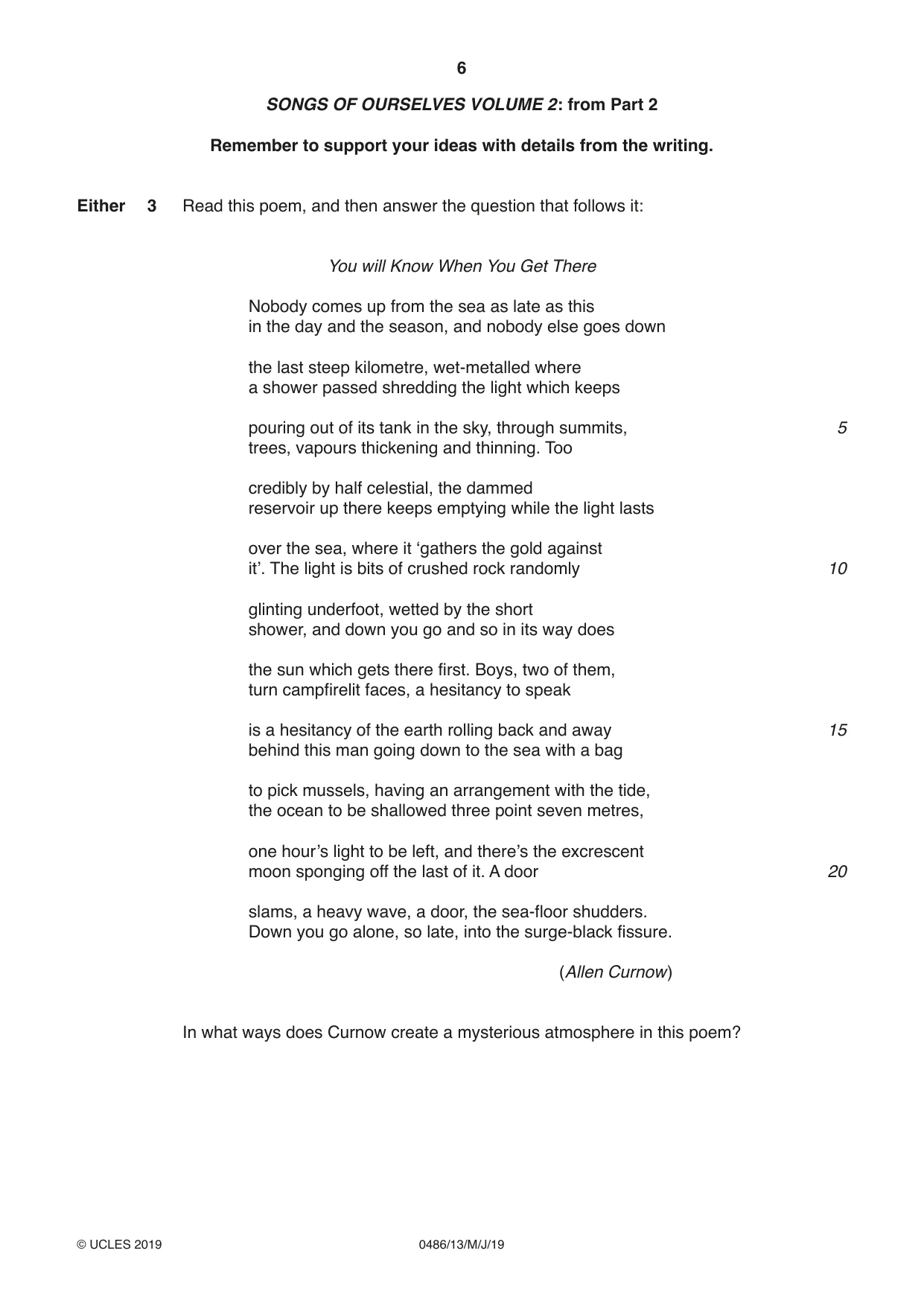
6 0486/13/M/J/19 © UCLES 2019 SONGS OF OURSELVES VOLUME 2: from Part 2 Remember to support your ideas with details from the writing. Either 3 Read this poem, and then answer the question that follows it: You will Know When You Get There Nobody comes up from the sea as late as this in the day and the season, and nobody else goes down the last steep kilometre, wet-metalled where a shower passed shredding the light which keeps pouring out of its tank in the sky, through summits, trees, vapours thickening and thinning. Too credibly by half celestial, the dammed reservoir up there keeps emptying while the light lasts over the sea, where it ‘gathers the gold against it’. The light is bits of crushed rock randomly glinting underfoot, wetted by the short shower, and down you go and so in its way does the sun which gets there first. Boys, two of them, turn campfirelit faces, a hesitancy to speak is a hesitancy of the earth rolling back and away behind this man going down to the sea with a bag to pick mussels, having an arrangement with the tide, the ocean to be shallowed three point seven metres, one hour’s light to be left, and there’s the excrescent moon sponging off the last of it. A door slams, a heavy wave, a door, the sea-floor shudders. Down you go alone, so late, into the surge-black fissure. (Allen Curnow) In what ways does Curnow create a mysterious atmosphere in this poem? 5 10 15 20
Question paper, page 7
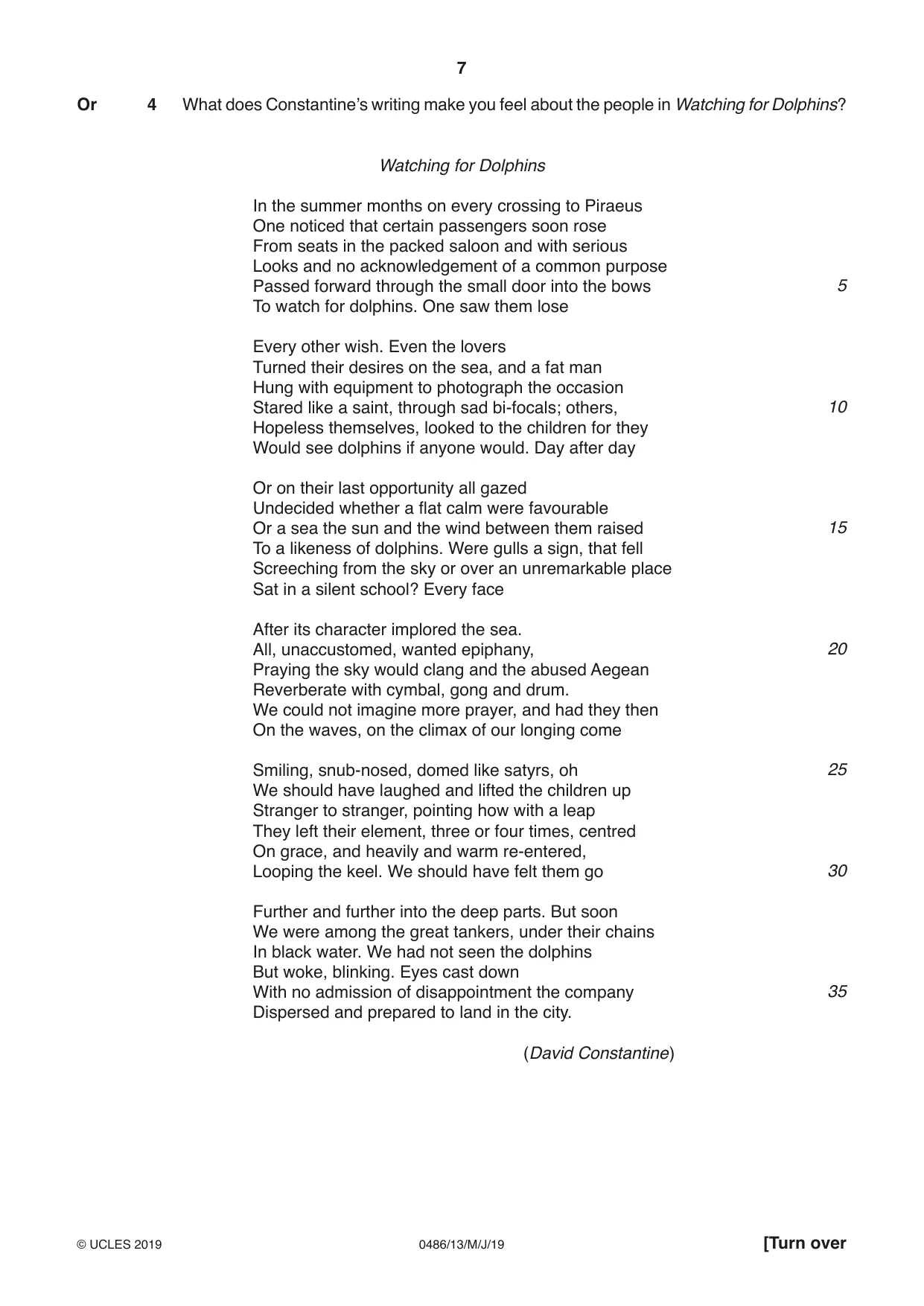
7 0486/13/M/J/19 © UCLES 2019 [Turn over Or 4 What does Constantine’s writing make you feel about the people in Watching for Dolphins? Watching for Dolphins In the summer months on every crossing to Piraeus One noticed that certain passengers soon rose From seats in the packed saloon and with serious Looks and no acknowledgement of a common purpose Passed forward through the small door into the bows To watch for dolphins. One saw them lose Every other wish. Even the lovers Turned their desires on the sea, and a fat man Hung with equipment to photograph the occasion Stared like a saint, through sad bi-focals; others, Hopeless themselves, looked to the children for they Would see dolphins if anyone would. Day after day Or on their last opportunity all gazed Undecided whether a flat calm were favourable Or a sea the sun and the wind between them raised To a likeness of dolphins. Were gulls a sign, that fell Screeching from the sky or over an unremarkable place Sat in a silent school? Every face After its character implored the sea. All, unaccustomed, wanted epiphany, Praying the sky would clang and the abused Aegean Reverberate with cymbal, gong and drum. We could not imagine more prayer, and had they then On the waves, on the climax of our longing come Smiling, snub-nosed, domed like satyrs, oh We should have laughed and lifted the children up Stranger to stranger, pointing how with a leap They left their element, three or four times, centred On grace, and heavily and warm re-entered, Looping the keel. We should have felt them go Further and further into the deep parts. But soon We were among the great tankers, under their chains In black water. We had not seen the dolphins But woke, blinking. Eyes cast down With no admission of disappointment the company Dispersed and prepared to land in the city. (David Constantine) 5 10 15 20 25 30 35
Question paper, page 8
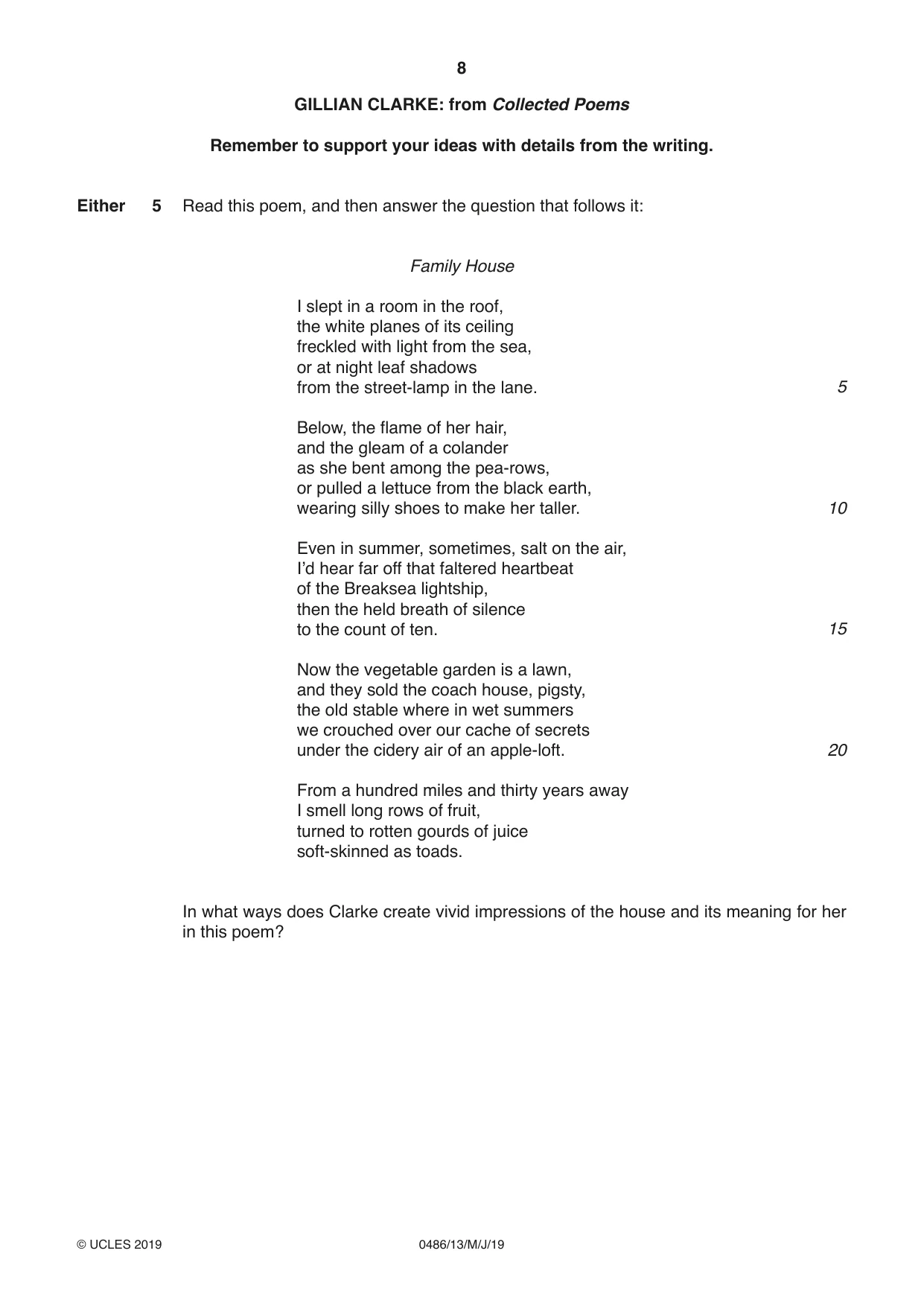
8 0486/13/M/J/19 © UCLES 2019 GILLIAN CLARKE: from Collected Poems Remember to support your ideas with details from the writing. Either 5 Read this poem, and then answer the question that follows it: Family House I slept in a room in the roof, the white planes of its ceiling freckled with light from the sea, or at night leaf shadows from the street-lamp in the lane. Below, the flame of her hair, and the gleam of a colander as she bent among the pea-rows, or pulled a lettuce from the black earth, wearing silly shoes to make her taller. Even in summer, sometimes, salt on the air, I’d hear far off that faltered heartbeat of the Breaksea lightship, then the held breath of silence to the count of ten. Now the vegetable garden is a lawn, and they sold the coach house, pigsty, the old stable where in wet summers we crouched over our cache of secrets under the cidery air of an apple-loft. From a hundred miles and thirty years away I smell long rows of fruit, turned to rotten gourds of juice soft-skinned as toads. In what ways does Clarke create vivid impressions of the house and its meaning for her in this poem? 5 10 15 20
Question paper, page 9
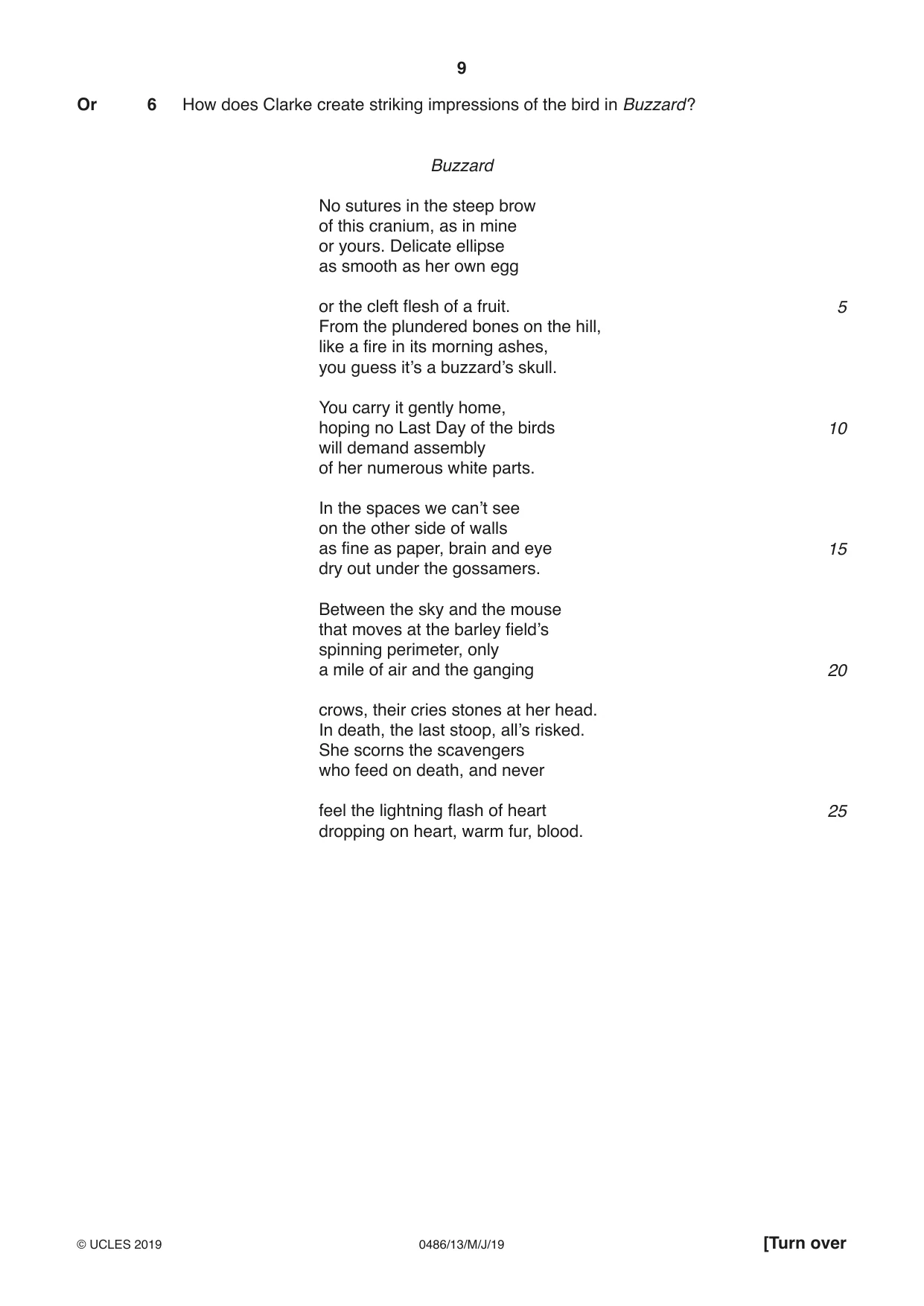
9 0486/13/M/J/19 © UCLES 2019 [Turn over Or 6 How does Clarke create striking impressions of the bird in Buzzard? Buzzard No sutures in the steep brow of this cranium, as in mine or yours. Delicate ellipse as smooth as her own egg or the cleft flesh of a fruit. From the plundered bones on the hill, like a fire in its morning ashes, you guess it’s a buzzard’s skull. You carry it gently home, hoping no Last Day of the birds will demand assembly of her numerous white parts. In the spaces we can’t see on the other side of walls as fine as paper, brain and eye dry out under the gossamers. Between the sky and the mouse that moves at the barley field’s spinning perimeter, only a mile of air and the ganging crows, their cries stones at her head. In death, the last stoop, all’s risked. She scorns the scavengers who feed on death, and never feel the lightning flash of heart dropping on heart, warm fur, blood. 5 10 15 20 25
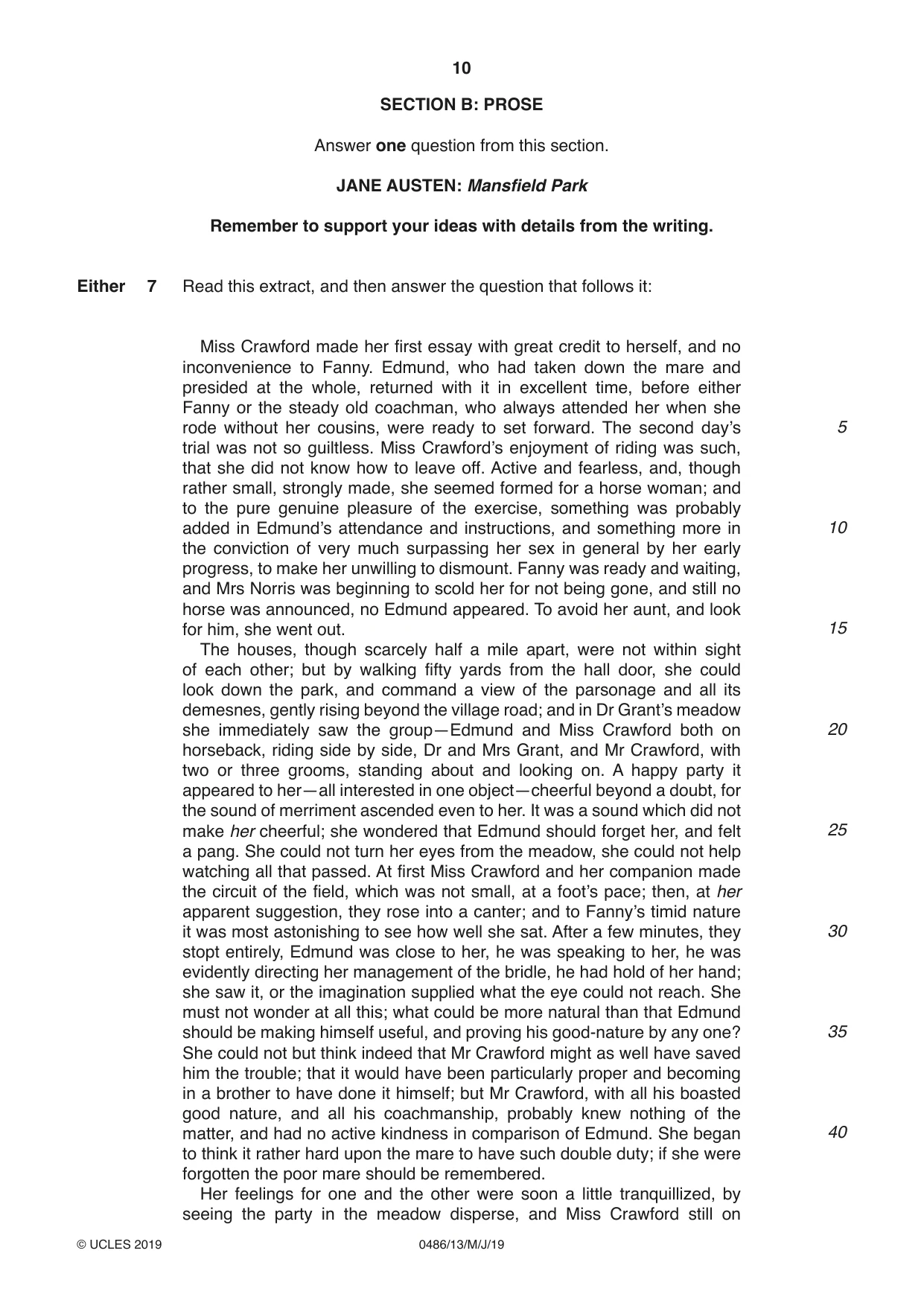
Question paper, page 10
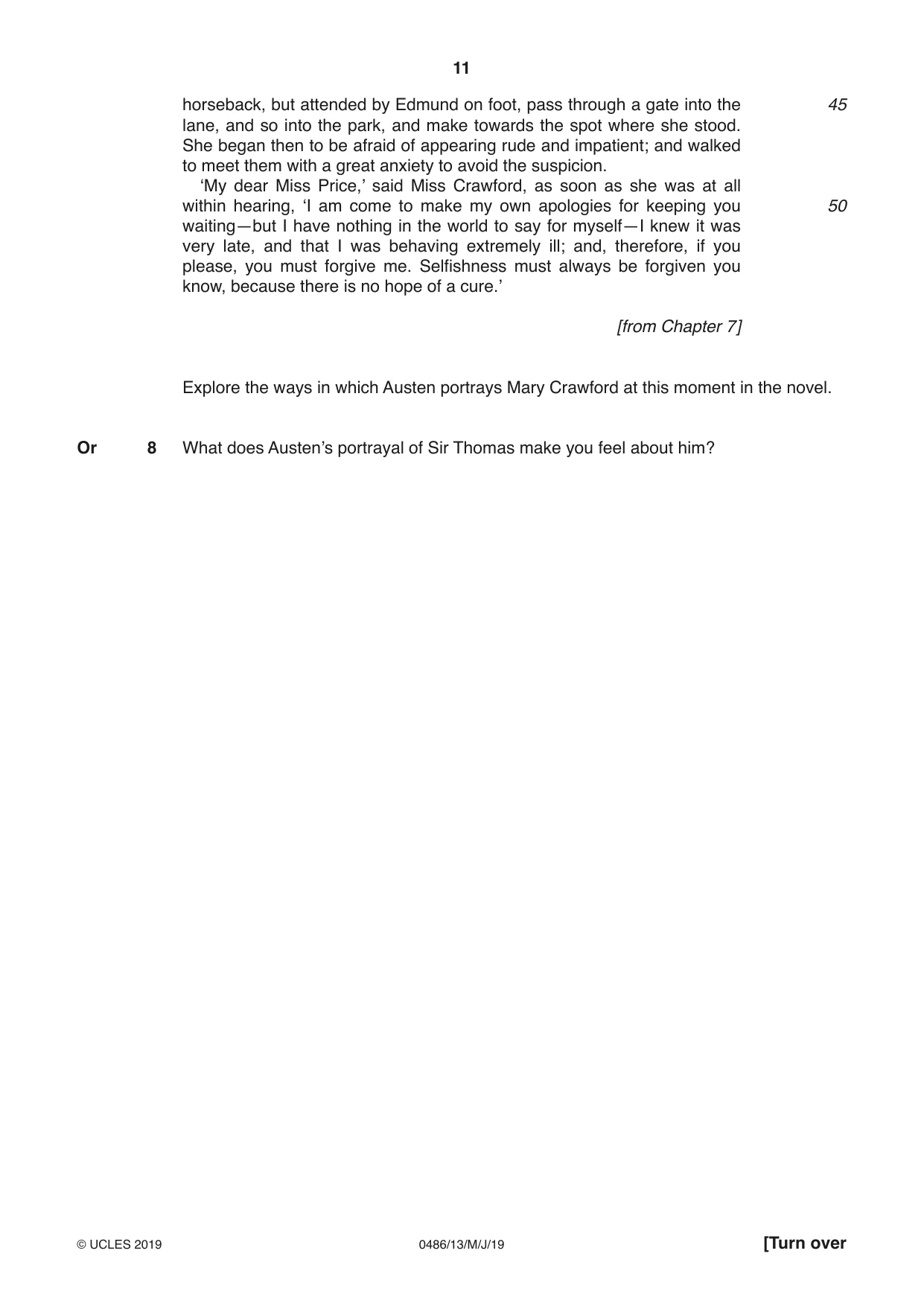
10 0486/13/M/J/19 © UCLES 2019 SECTION B: PROSE Answer one question from this section. JANE AUSTEN: Mansfield Park Remember to support your ideas with details from the writing. Either 7 Read this extract, and then answer the question that follows it: Miss Crawford made her first essay with great credit to herself, and no inconvenience to Fanny. Edmund, who had taken down the mare and presided at the whole, returned with it in excellent time, before either Fanny or the steady old coachman, who always attended her when she rode without her cousins, were ready to set forward. The second day’s trial was not so guiltless. Miss Crawford’s enjoyment of riding was such, that she did not know how to leave off. Active and fearless, and, though rather small, strongly made, she seemed formed for a horse woman; and to the pure genuine pleasure of the exercise, something was probably added in Edmund’s attendance and instructions, and something more in the conviction of very much surpassing her sex in general by her early progress, to make her unwilling to dismount. Fanny was ready and waiting, and Mrs Norris was beginning to scold her for not being gone, and still no horse was announced, no Edmund appeared. To avoid her aunt, and look for him, she went out. The houses, though scarcely half a mile apart, were not within sight of each other; but by walking fifty yards from the hall door, she could look down the park, and command a view of the parsonage and all its demesnes, gently rising beyond the village road; and in Dr Grant’s meadow she immediately saw the group—Edmund and Miss Crawford both on horseback, riding side by side, Dr and Mrs Grant, and Mr Crawford, with two or three grooms, standing about and looking on. A happy party it appeared to her—all interested in one object—cheerful beyond a doubt, for the sound of merriment ascended even to her. It was a sound which did not make her cheerful; she wondered that Edmund should forget her, and felt a pang. She could not turn her eyes from the meadow, she could not help watching all that passed. At first Miss Crawford and her companion made the circuit of the field, which was not small, at a foot’s pace; then, at her apparent suggestion, they rose into a canter; and to Fanny’s timid nature it was most astonishing to see how well she sat. After a few minutes, they stopt entirely, Edmund was close to her, he was speaking to her, he was evidently directing her management of the bridle, he had hold of her hand; she saw it, or the imagination supplied what the eye could not reach. She must not wonder at all this; what could be more natural than that Edmund should be making himself useful, and proving his good-nature by any one? She could not but think indeed that Mr Crawford might as well have saved him the trouble; that it would have been particularly proper and becoming in a brother to have done it himself; but Mr Crawford, with all his boasted good nature, and all his coachmanship, probably knew nothing of the matter, and had no active kindness in comparison of Edmund. She began to think it rather hard upon the mare to have such double duty; if she were forgotten the poor mare should be remembered. Her feelings for one and the other were soon a little tranquillized, by seeing the party in the meadow disperse, and Miss Crawford still on 5 10 15 20 25 30 35 40
Question paper, page 11
11 0486/13/M/J/19 © UCLES 2019 [Turn over horseback, but attended by Edmund on foot, pass through a gate into the lane, and so into the park, and make towards the spot where she stood. She began then to be afraid of appearing rude and impatient; and walked to meet them with a great anxiety to avoid the suspicion. ‘My dear Miss Price,’ said Miss Crawford, as soon as she was at all within hearing, ‘I am come to make my own apologies for keeping you waiting—but I have nothing in the world to say for myself—I knew it was very late, and that I was behaving extremely ill; and, therefore, if you please, you must forgive me. Selfishness must always be forgiven you know, because there is no hope of a cure.’ [from Chapter 7] Explore the ways in which Austen portrays Mary Crawford at this moment in the novel. Or 8 What does Austen’s portrayal of Sir Thomas make you feel about him? 45 50
Question paper, page 12
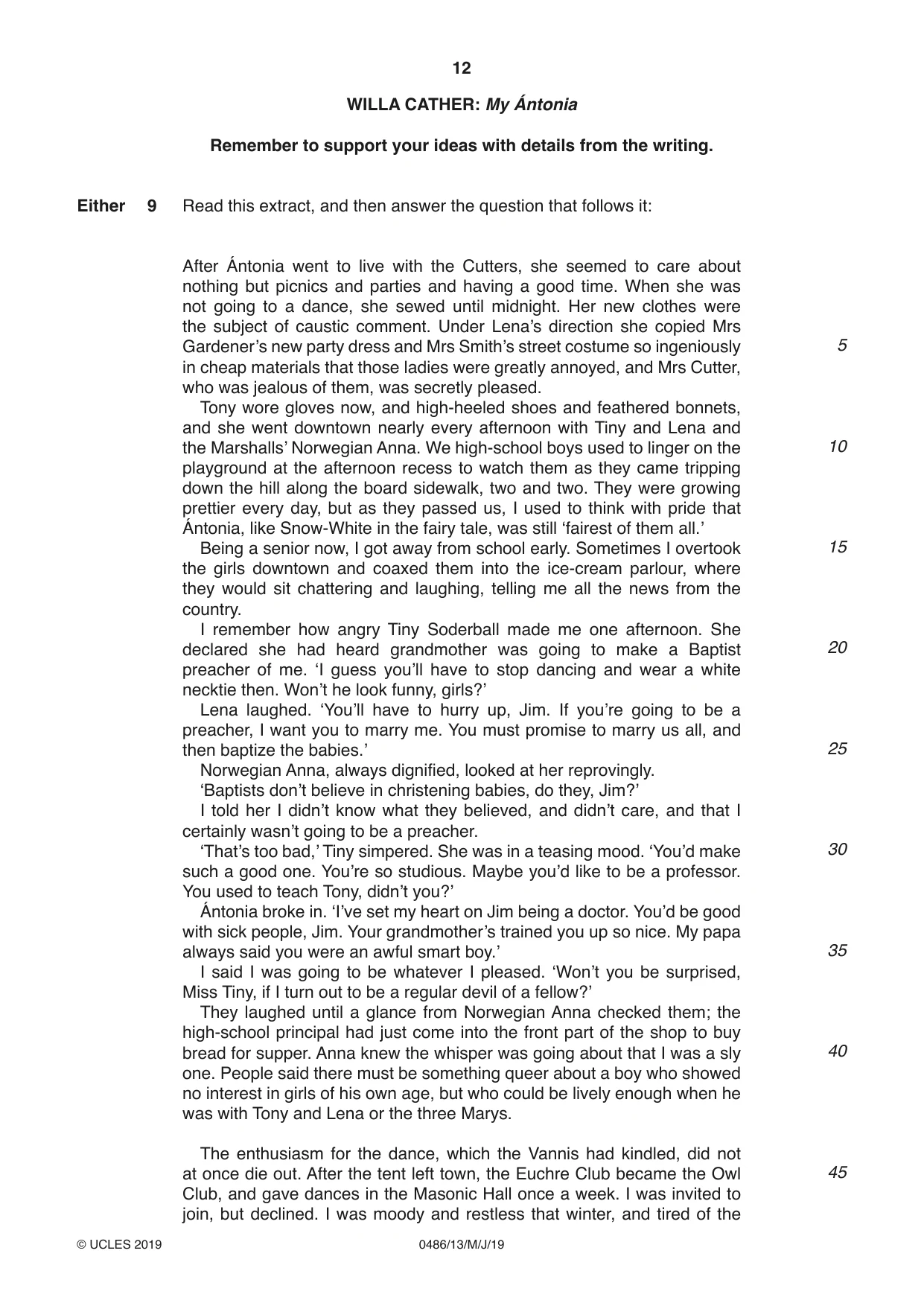
12 0486/13/M/J/19 © UCLES 2019 WILLA CATHER: My Ántonia Remember to support your ideas with details from the writing. Either 9 Read this extract, and then answer the question that follows it: After Ántonia went to live with the Cutters, she seemed to care about nothing but picnics and parties and having a good time. When she was not going to a dance, she sewed until midnight. Her new clothes were the subject of caustic comment. Under Lena’s direction she copied Mrs Gardener’s new party dress and Mrs Smith’s street costume so ingeniously in cheap materials that those ladies were greatly annoyed, and Mrs Cutter, who was jealous of them, was secretly pleased. Tony wore gloves now, and high-heeled shoes and feathered bonnets, and she went downtown nearly every afternoon with Tiny and Lena and the Marshalls’ Norwegian Anna. We high-school boys used to linger on the playground at the afternoon recess to watch them as they came tripping down the hill along the board sidewalk, two and two. They were growing prettier every day, but as they passed us, I used to think with pride that Ántonia, like Snow-White in the fairy tale, was still ‘fairest of them all.’ Being a senior now, I got away from school early. Sometimes I overtook the girls downtown and coaxed them into the ice-cream parlour, where they would sit chattering and laughing, telling me all the news from the country. I remember how angry Tiny Soderball made me one afternoon. She declared she had heard grandmother was going to make a Baptist preacher of me. ‘I guess you’ll have to stop dancing and wear a white necktie then. Won’t he look funny, girls?’ Lena laughed. ‘You’ll have to hurry up, Jim. If you’re going to be a preacher, I want you to marry me. You must promise to marry us all, and then baptize the babies.’ Norwegian Anna, always dignified, looked at her reprovingly. ‘Baptists don’t believe in christening babies, do they, Jim?’ I told her I didn’t know what they believed, and didn’t care, and that I certainly wasn’t going to be a preacher. ‘That’s too bad,’ Tiny simpered. She was in a teasing mood. ‘You’d make such a good one. You’re so studious. Maybe you’d like to be a professor. You used to teach Tony, didn’t you?’ Ántonia broke in. ‘I’ve set my heart on Jim being a doctor. You’d be good with sick people, Jim. Your grandmother’s trained you up so nice. My papa always said you were an awful smart boy.’ I said I was going to be whatever I pleased. ‘Won’t you be surprised, Miss Tiny, if I turn out to be a regular devil of a fellow?’ They laughed until a glance from Norwegian Anna checked them; the high-school principal had just come into the front part of the shop to buy bread for supper. Anna knew the whisper was going about that I was a sly one. People said there must be something queer about a boy who showed no interest in girls of his own age, but who could be lively enough when he was with Tony and Lena or the three Marys. The enthusiasm for the dance, which the Vannis had kindled, did not at once die out. After the tent left town, the Euchre Club became the Owl Club, and gave dances in the Masonic Hall once a week. I was invited to join, but declined. I was moody and restless that winter, and tired of the 5 10 15 20 25 30 35 40 45
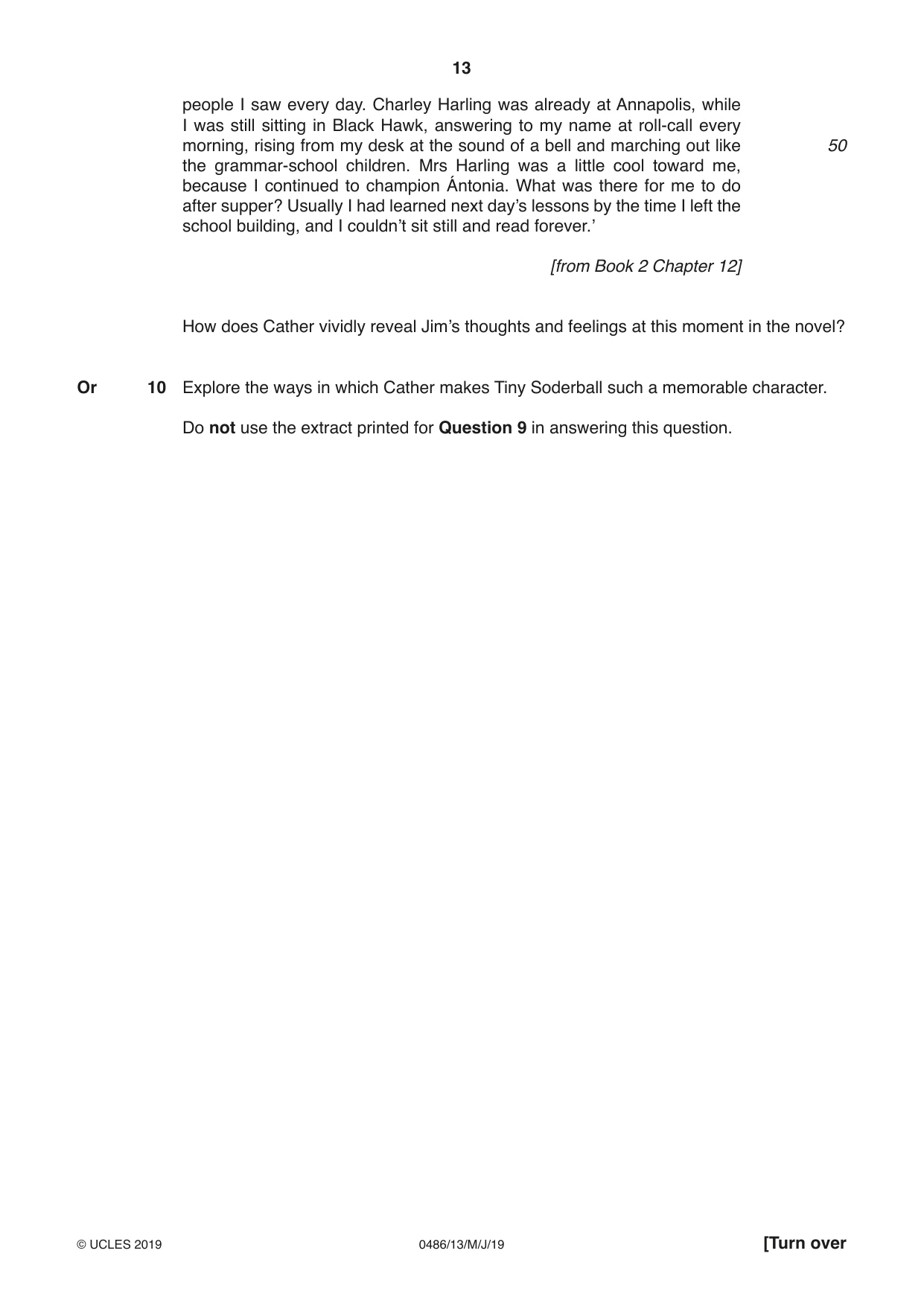
Question paper, page 13
13 0486/13/M/J/19 © UCLES 2019 [Turn over people I saw every day. Charley Harling was already at Annapolis, while I was still sitting in Black Hawk, answering to my name at roll-call every morning, rising from my desk at the sound of a bell and marching out like the grammar-school children. Mrs Harling was a little cool toward me, because I continued to champion Ántonia. What was there for me to do after supper? Usually I had learned next day’s lessons by the time I left the school building, and I couldn’t sit still and read forever.’ [from Book 2 Chapter 12] How does Cather vividly reveal Jim’s thoughts and feelings at this moment in the novel? Or 10 Explore the ways in which Cather makes Tiny Soderball such a memorable character. Do not use the extract printed for Question 9 in answering this question. 50
Question paper, page 14
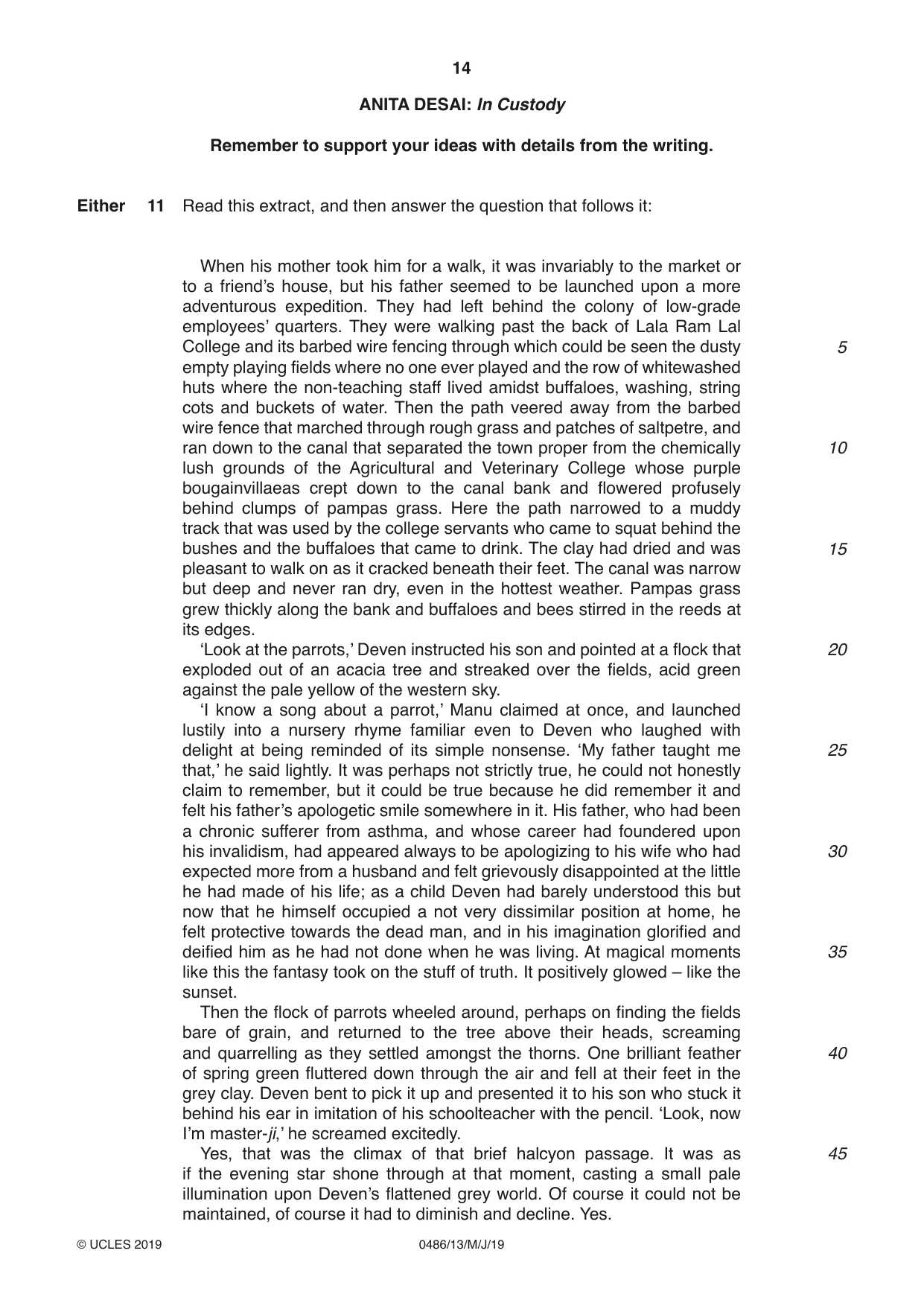
14 0486/13/M/J/19 © UCLES 2019 ANITA DESAI: In Custody Remember to support your ideas with details from the writing. Either 11 Read this extract, and then answer the question that follows it: When his mother took him for a walk, it was invariably to the market or to a friend’s house, but his father seemed to be launched upon a more adventurous expedition. They had left behind the colony of low-grade employees’ quarters. They were walking past the back of Lala Ram Lal College and its barbed wire fencing through which could be seen the dusty empty playing fields where no one ever played and the row of whitewashed huts where the non-teaching staff lived amidst buffaloes, washing, string cots and buckets of water. Then the path veered away from the barbed wire fence that marched through rough grass and patches of saltpetre, and ran down to the canal that separated the town proper from the chemically lush grounds of the Agricultural and Veterinary College whose purple bougainvillaeas crept down to the canal bank and flowered profusely behind clumps of pampas grass. Here the path narrowed to a muddy track that was used by the college servants who came to squat behind the bushes and the buffaloes that came to drink. The clay had dried and was pleasant to walk on as it cracked beneath their feet. The canal was narrow but deep and never ran dry, even in the hottest weather. Pampas grass grew thickly along the bank and buffaloes and bees stirred in the reeds at its edges. ‘Look at the parrots,’ Deven instructed his son and pointed at a flock that exploded out of an acacia tree and streaked over the fields, acid green against the pale yellow of the western sky. ‘I know a song about a parrot,’ Manu claimed at once, and launched lustily into a nursery rhyme familiar even to Deven who laughed with delight at being reminded of its simple nonsense. ‘My father taught me that,’ he said lightly. It was perhaps not strictly true, he could not honestly claim to remember, but it could be true because he did remember it and felt his father’s apologetic smile somewhere in it. His father, who had been a chronic sufferer from asthma, and whose career had foundered upon his invalidism, had appeared always to be apologizing to his wife who had expected more from a husband and felt grievously disappointed at the little he had made of his life; as a child Deven had barely understood this but now that he himself occupied a not very dissimilar position at home, he felt protective towards the dead man, and in his imagination glorified and deified him as he had not done when he was living. At magical moments like this the fantasy took on the stuff of truth. It positively glowed – like the sunset. Then the flock of parrots wheeled around, perhaps on finding the fields bare of grain, and returned to the tree above their heads, screaming and quarrelling as they settled amongst the thorns. One brilliant feather of spring green fluttered down through the air and fell at their feet in the grey clay. Deven bent to pick it up and presented it to his son who stuck it behind his ear in imitation of his schoolteacher with the pencil. ‘Look, now I’m master-ji,’ he screamed excitedly. Yes, that was the climax of that brief halcyon passage. It was as if the evening star shone through at that moment, casting a small pale illumination upon Deven’s flattened grey world. Of course it could not be maintained, of course it had to diminish and decline. Yes. 5 10 15 20 25 30 35 40 45
Question paper, page 15
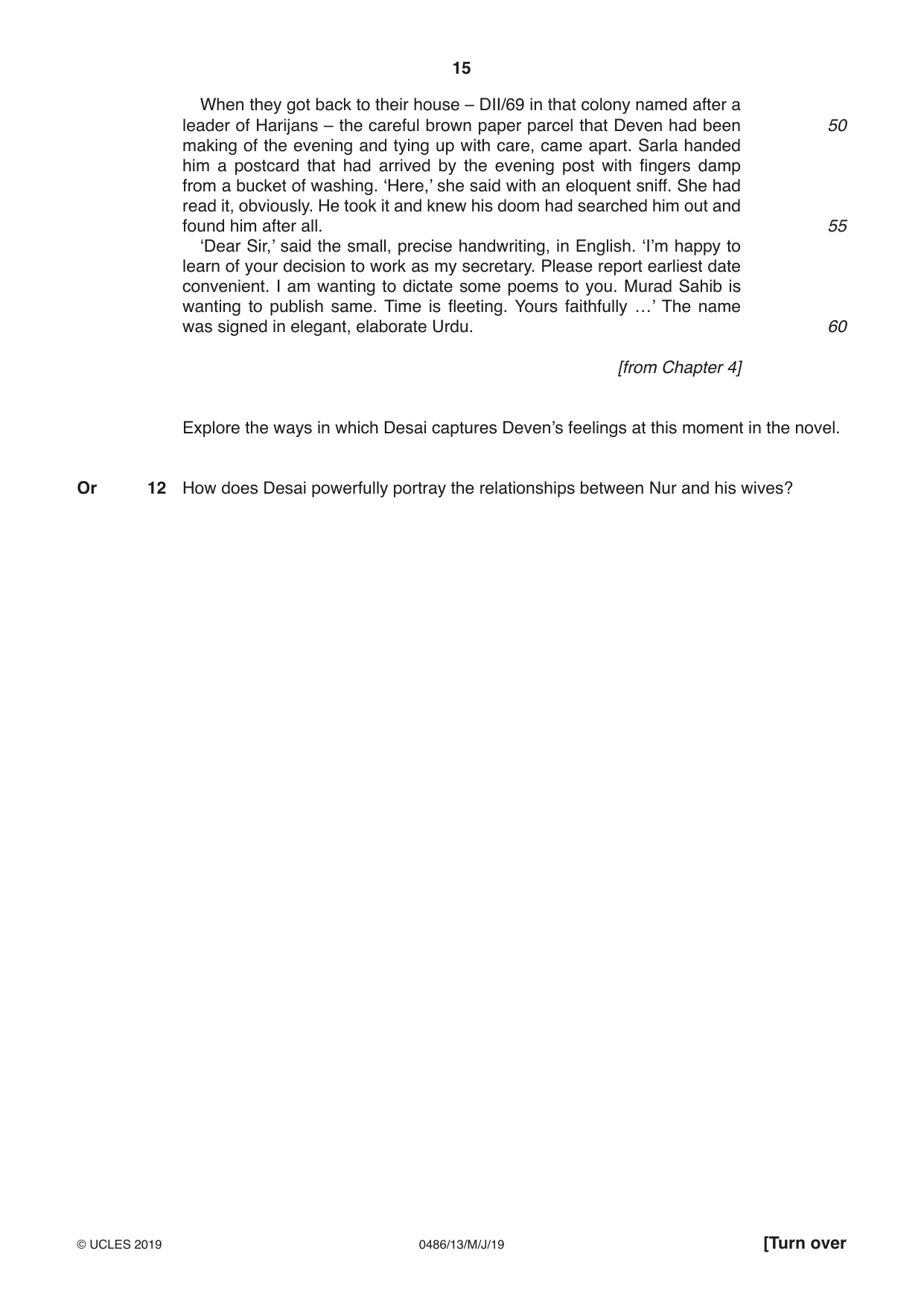
15 0486/13/M/J/19 © UCLES 2019 [Turn over When they got back to their house – DII/69 in that colony named after a leader of Harijans – the careful brown paper parcel that Deven had been making of the evening and tying up with care, came apart. Sarla handed him a postcard that had arrived by the evening post with fingers damp from a bucket of washing. ‘Here,’ she said with an eloquent sniff. She had read it, obviously. He took it and knew his doom had searched him out and found him after all. ‘Dear Sir,’ said the small, precise handwriting, in English. ‘I’m happy to learn of your decision to work as my secretary. Please report earliest date convenient. I am wanting to dictate some poems to you. Murad Sahib is wanting to publish same. Time is fleeting. Yours faithfully …’ The name was signed in elegant, elaborate Urdu. [from Chapter 4] Explore the ways in which Desai captures Deven’s feelings at this moment in the novel. Or 12 How does Desai powerfully portray the relationships between Nur and his wives? 50 55 60
Question paper, page 16
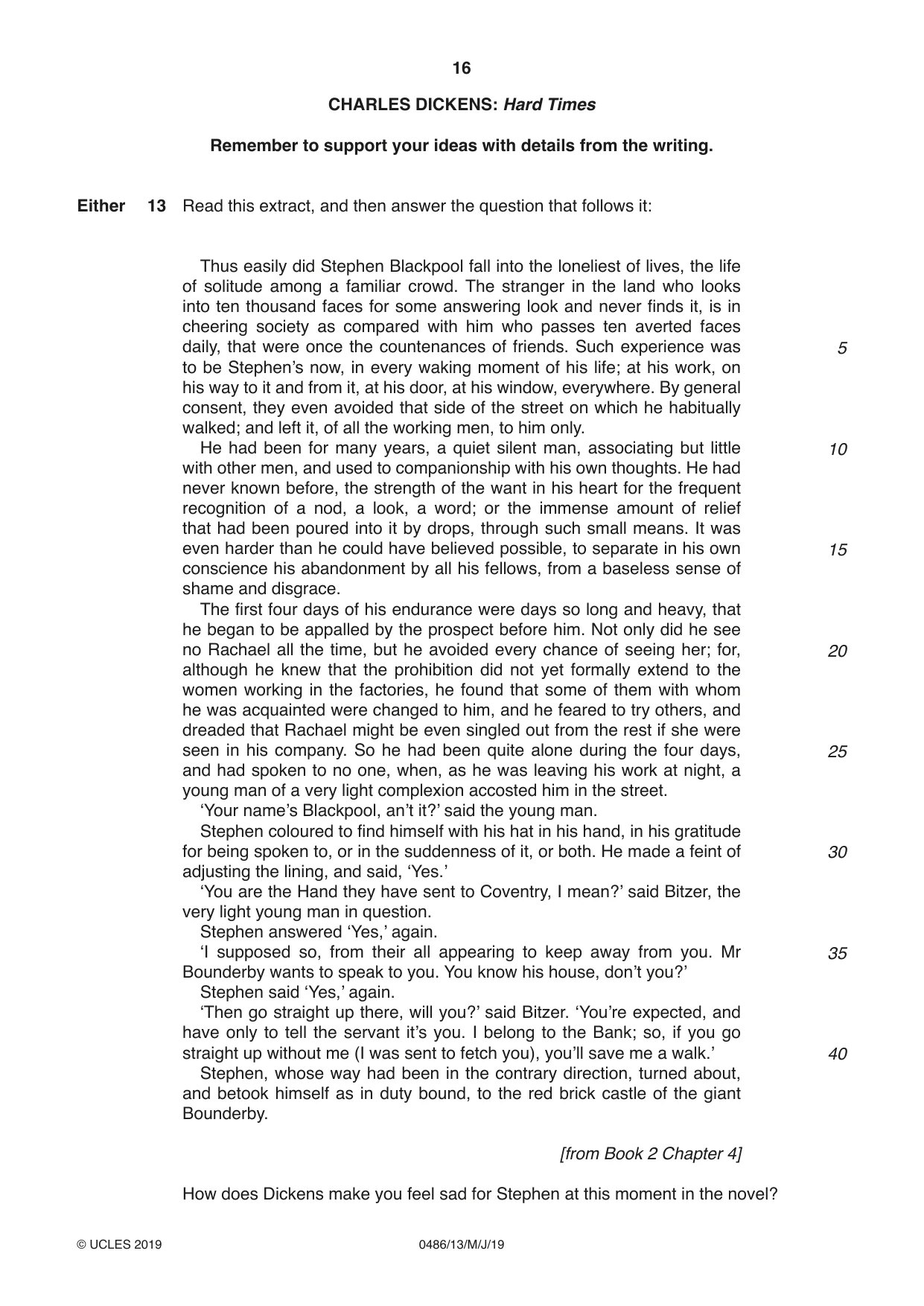
16 0486/13/M/J/19 © UCLES 2019 CHARLES DICKENS: Hard Times Remember to support your ideas with details from the writing. Either 13 Read this extract, and then answer the question that follows it: Thus easily did Stephen Blackpool fall into the loneliest of lives, the life of solitude among a familiar crowd. The stranger in the land who looks into ten thousand faces for some answering look and never finds it, is in cheering society as compared with him who passes ten averted faces daily, that were once the countenances of friends. Such experience was to be Stephen’s now, in every waking moment of his life; at his work, on his way to it and from it, at his door, at his window, everywhere. By general consent, they even avoided that side of the street on which he habitually walked; and left it, of all the working men, to him only. He had been for many years, a quiet silent man, associating but little with other men, and used to companionship with his own thoughts. He had never known before, the strength of the want in his heart for the frequent recognition of a nod, a look, a word; or the immense amount of relief that had been poured into it by drops, through such small means. It was even harder than he could have believed possible, to separate in his own conscience his abandonment by all his fellows, from a baseless sense of shame and disgrace. The first four days of his endurance were days so long and heavy, that he began to be appalled by the prospect before him. Not only did he see no Rachael all the time, but he avoided every chance of seeing her; for, although he knew that the prohibition did not yet formally extend to the women working in the factories, he found that some of them with whom he was acquainted were changed to him, and he feared to try others, and dreaded that Rachael might be even singled out from the rest if she were seen in his company. So he had been quite alone during the four days, and had spoken to no one, when, as he was leaving his work at night, a young man of a very light complexion accosted him in the street. ‘Your name’s Blackpool, an’t it?’ said the young man. Stephen coloured to find himself with his hat in his hand, in his gratitude for being spoken to, or in the suddenness of it, or both. He made a feint of adjusting the lining, and said, ‘Yes.’ ‘You are the Hand they have sent to Coventry, I mean?’ said Bitzer, the very light young man in question. Stephen answered ‘Yes,’ again. ‘I supposed so, from their all appearing to keep away from you. Mr Bounderby wants to speak to you. You know his house, don’t you?’ Stephen said ‘Yes,’ again. ‘Then go straight up there, will you?’ said Bitzer. ‘You’re expected, and have only to tell the servant it’s you. I belong to the Bank; so, if you go straight up without me (I was sent to fetch you), you’ll save me a walk.’ Stephen, whose way had been in the contrary direction, turned about, and betook himself as in duty bound, to the red brick castle of the giant Bounderby. [from Book 2 Chapter 4] How does Dickens make you feel sad for Stephen at this moment in the novel? 5 10 15 20 25 30 35 40
Question paper, page 17
17 0486/13/M/J/19 © UCLES 2019 [Turn over Or 14 To what extent does Dickens make you feel that Louisa is admirable?
Question paper, page 18
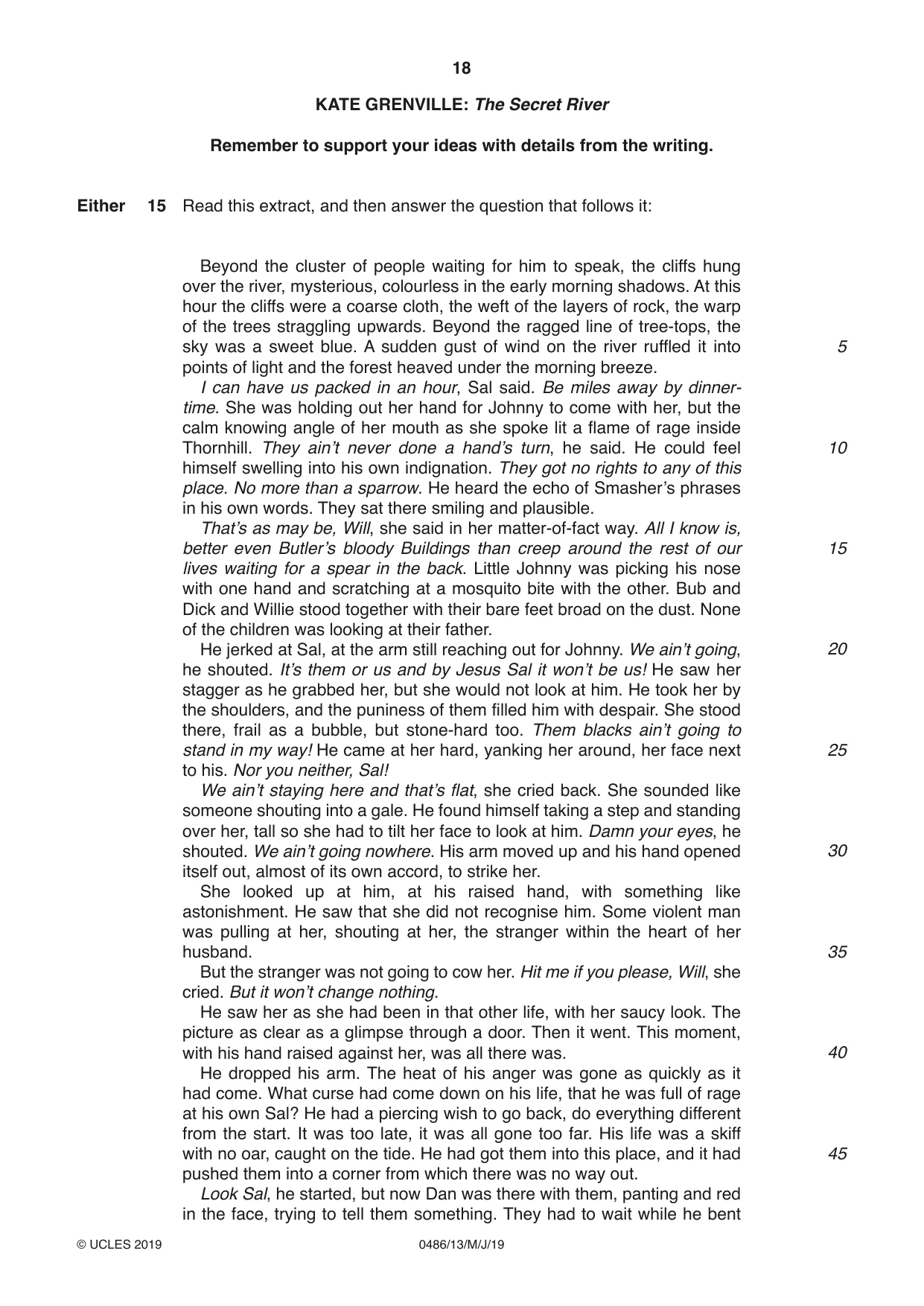
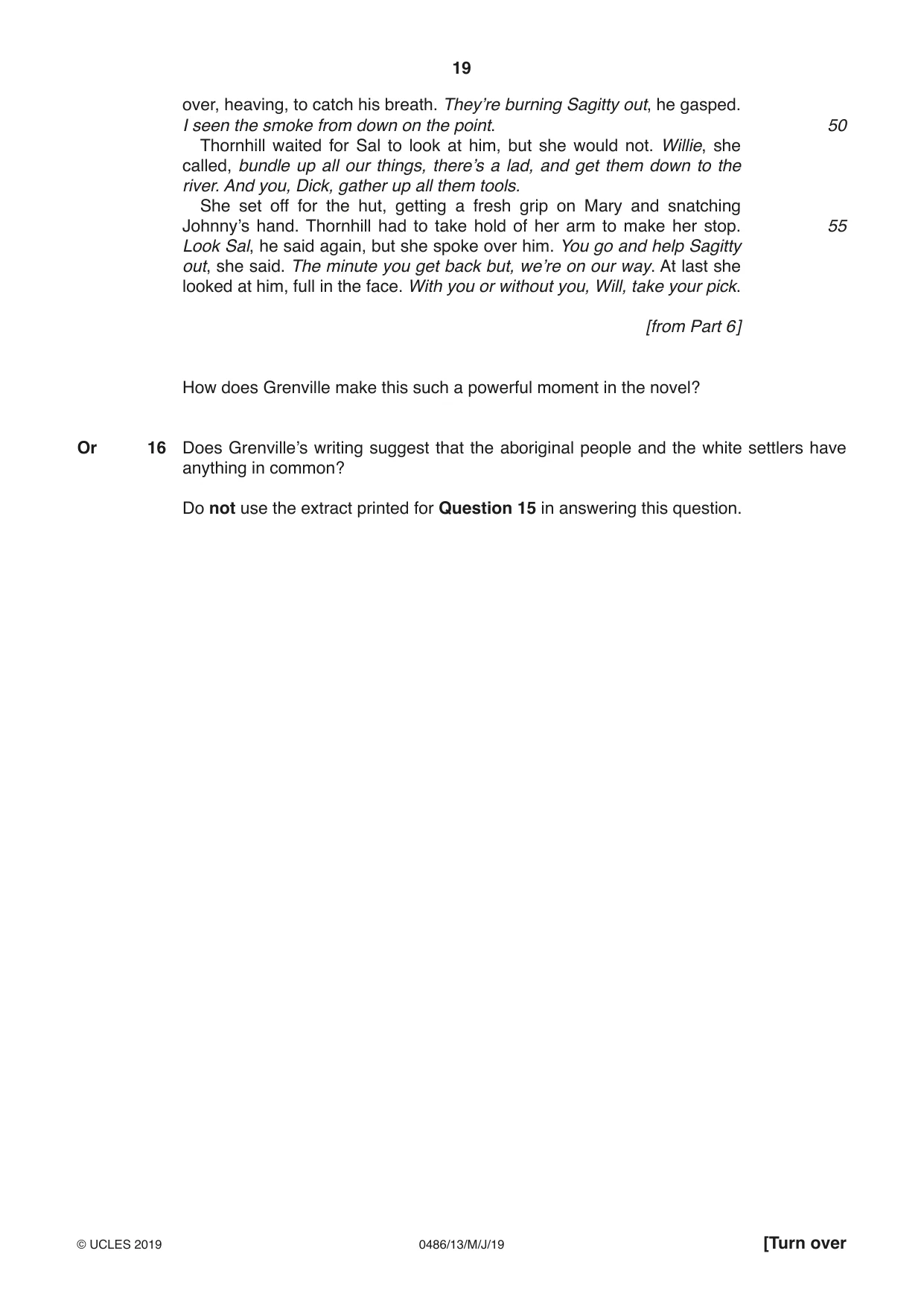
18 0486/13/M/J/19 © UCLES 2019 KATE GRENVILLE: The Secret River Remember to support your ideas with details from the writing. Either 15 Read this extract, and then answer the question that follows it: Beyond the cluster of people waiting for him to speak, the cliffs hung over the river, mysterious, colourless in the early morning shadows. At this hour the cliffs were a coarse cloth, the weft of the layers of rock, the warp of the trees straggling upwards. Beyond the ragged line of tree-tops, the sky was a sweet blue. A sudden gust of wind on the river ruffled it into points of light and the forest heaved under the morning breeze. I can have us packed in an hour, Sal said. Be miles away by dinner- time. She was holding out her hand for Johnny to come with her, but the calm knowing angle of her mouth as she spoke lit a flame of rage inside Thornhill. They ain’t never done a hand’s turn, he said. He could feel himself swelling into his own indignation. They got no rights to any of this place. No more than a sparrow. He heard the echo of Smasher’s phrases in his own words. They sat there smiling and plausible. That’s as may be, Will, she said in her matter-of-fact way. All I know is, better even Butler’s bloody Buildings than creep around the rest of our lives waiting for a spear in the back. Little Johnny was picking his nose with one hand and scratching at a mosquito bite with the other. Bub and Dick and Willie stood together with their bare feet broad on the dust. None of the children was looking at their father. He jerked at Sal, at the arm still reaching out for Johnny. We ain’t going, he shouted. It’s them or us and by Jesus Sal it won’t be us! He saw her stagger as he grabbed her, but she would not look at him. He took her by the shoulders, and the puniness of them filled him with despair. She stood there, frail as a bubble, but stone-hard too. Them blacks ain’t going to stand in my way! He came at her hard, yanking her around, her face next to his. Nor you neither, Sal! We ain’t staying here and that’s flat, she cried back. She sounded like someone shouting into a gale. He found himself taking a step and standing over her, tall so she had to tilt her face to look at him. Damn your eyes, he shouted. We ain’t going nowhere. His arm moved up and his hand opened itself out, almost of its own accord, to strike her. She looked up at him, at his raised hand, with something like astonishment. He saw that she did not recognise him. Some violent man was pulling at her, shouting at her, the stranger within the heart of her husband. But the stranger was not going to cow her. Hit me if you please, Will, she cried. But it won’t change nothing. He saw her as she had been in that other life, with her saucy look. The picture as clear as a glimpse through a door. Then it went. This moment, with his hand raised against her, was all there was. He dropped his arm. The heat of his anger was gone as quickly as it had come. What curse had come down on his life, that he was full of rage at his own Sal? He had a piercing wish to go back, do everything different from the start. It was too late, it was all gone too far. His life was a skiff with no oar, caught on the tide. He had got them into this place, and it had pushed them into a corner from which there was no way out. Look Sal, he started, but now Dan was there with them, panting and red in the face, trying to tell them something. They had to wait while he bent 5 10 15 20 25 30 35 40 45
Question paper, page 19
19 0486/13/M/J/19 © UCLES 2019 [Turn over over, heaving, to catch his breath. They’re burning Sagitty out, he gasped. I seen the smoke from down on the point. Thornhill waited for Sal to look at him, but she would not. Willie, she called, bundle up all our things, there’s a lad, and get them down to the river. And you, Dick, gather up all them tools. She set off for the hut, getting a fresh grip on Mary and snatching Johnny’s hand. Thornhill had to take hold of her arm to make her stop. Look Sal, he said again, but she spoke over him. You go and help Sagitty out, she said. The minute you get back but, we’re on our way. At last she looked at him, full in the face. With you or without you, Will, take your pick. [from Part 6] How does Grenville make this such a powerful moment in the novel? Or 16 Does Grenville’s writing suggest that the aboriginal people and the white settlers have anything in common? Do not use the extract printed for Question 15 in answering this question. 50 55
Question paper, page 20
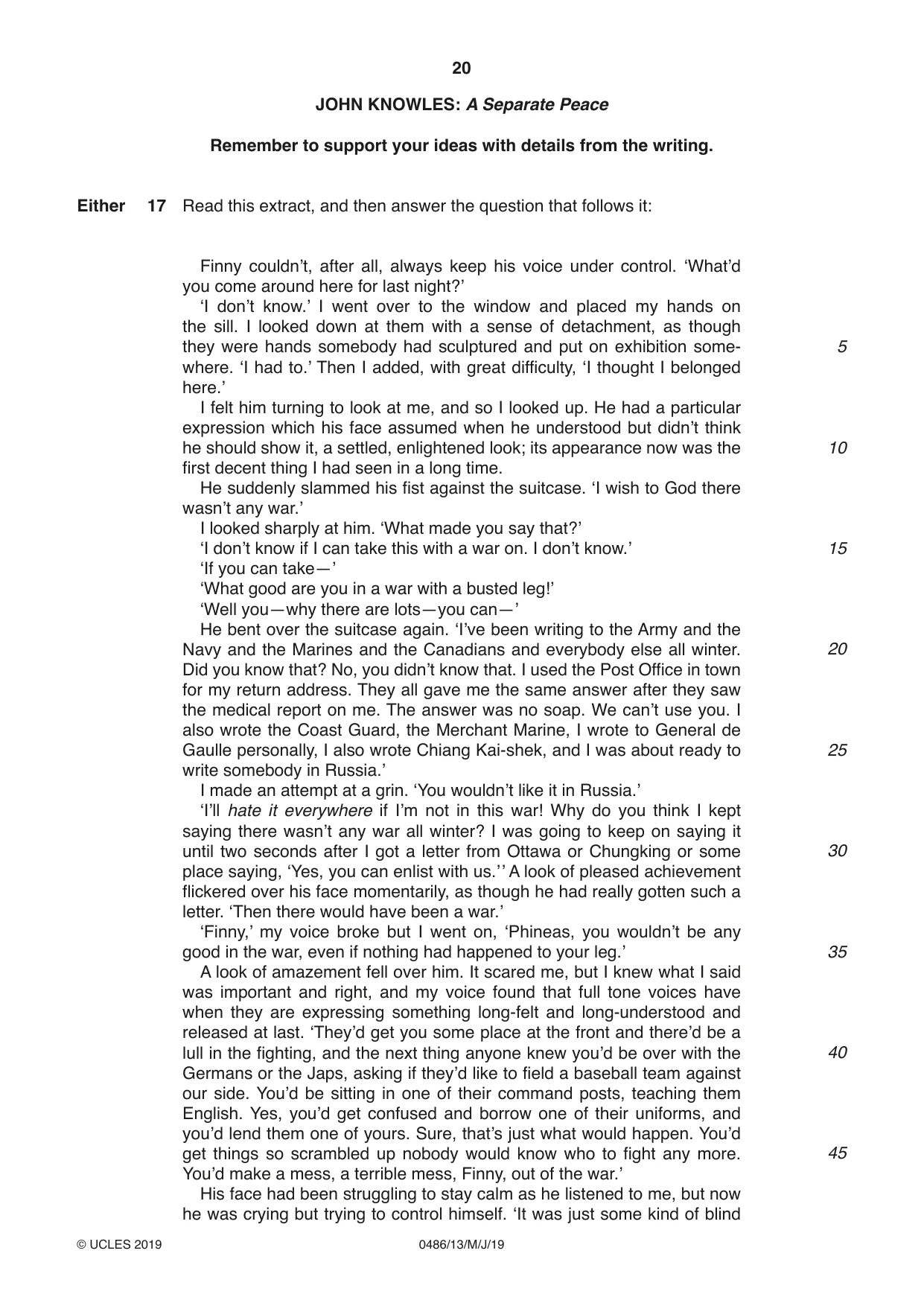
20 0486/13/M/J/19 © UCLES 2019 JOHN KNOWLES: A Separate Peace Remember to support your ideas with details from the writing. Either 17 Read this extract, and then answer the question that follows it: Finny couldn’t, after all, always keep his voice under control. ‘What’d you come around here for last night?’ ‘I don’t know.’ I went over to the window and placed my hands on the sill. I looked down at them with a sense of detachment, as though they were hands somebody had sculptured and put on exhibition some- where. ‘I had to.’ Then I added, with great difficulty, ‘I thought I belonged here.’ I felt him turning to look at me, and so I looked up. He had a particular expression which his face assumed when he understood but didn’t think he should show it, a settled, enlightened look; its appearance now was the first decent thing I had seen in a long time. He suddenly slammed his fist against the suitcase. ‘I wish to God there wasn’t any war.’ I looked sharply at him. ‘What made you say that?’ ‘I don’t know if I can take this with a war on. I don’t know.’ ‘If you can take—’ ‘What good are you in a war with a busted leg!’ ‘Well you—why there are lots—you can—’ He bent over the suitcase again. ‘I’ve been writing to the Army and the Navy and the Marines and the Canadians and everybody else all winter. Did you know that? No, you didn’t know that. I used the Post Office in town for my return address. They all gave me the same answer after they saw the medical report on me. The answer was no soap. We can’t use you. I also wrote the Coast Guard, the Merchant Marine, I wrote to General de Gaulle personally, I also wrote Chiang Kai-shek, and I was about ready to write somebody in Russia.’ I made an attempt at a grin. ‘You wouldn’t like it in Russia.’ ‘I’ll hate it everywhere if I’m not in this war! Why do you think I kept saying there wasn’t any war all winter? I was going to keep on saying it until two seconds after I got a letter from Ottawa or Chungking or some place saying, ‘Yes, you can enlist with us.’ ’ A look of pleased achievement flickered over his face momentarily, as though he had really gotten such a letter. ‘Then there would have been a war.’ ‘Finny,’ my voice broke but I went on, ‘Phineas, you wouldn’t be any good in the war, even if nothing had happened to your leg.’ A look of amazement fell over him. It scared me, but I knew what I said was important and right, and my voice found that full tone voices have when they are expressing something long-felt and long-understood and released at last. ‘They’d get you some place at the front and there’d be a lull in the fighting, and the next thing anyone knew you’d be over with the Germans or the Japs, asking if they’d like to field a baseball team against our side. You’d be sitting in one of their command posts, teaching them English. Yes, you’d get confused and borrow one of their uniforms, and you’d lend them one of yours. Sure, that’s just what would happen. You’d get things so scrambled up nobody would know who to fight any more. You’d make a mess, a terrible mess, Finny, out of the war.’ His face had been struggling to stay calm as he listened to me, but now he was crying but trying to control himself. ‘It was just some kind of blind 5 10 15 20 25 30 35 40 45
Question paper, page 21
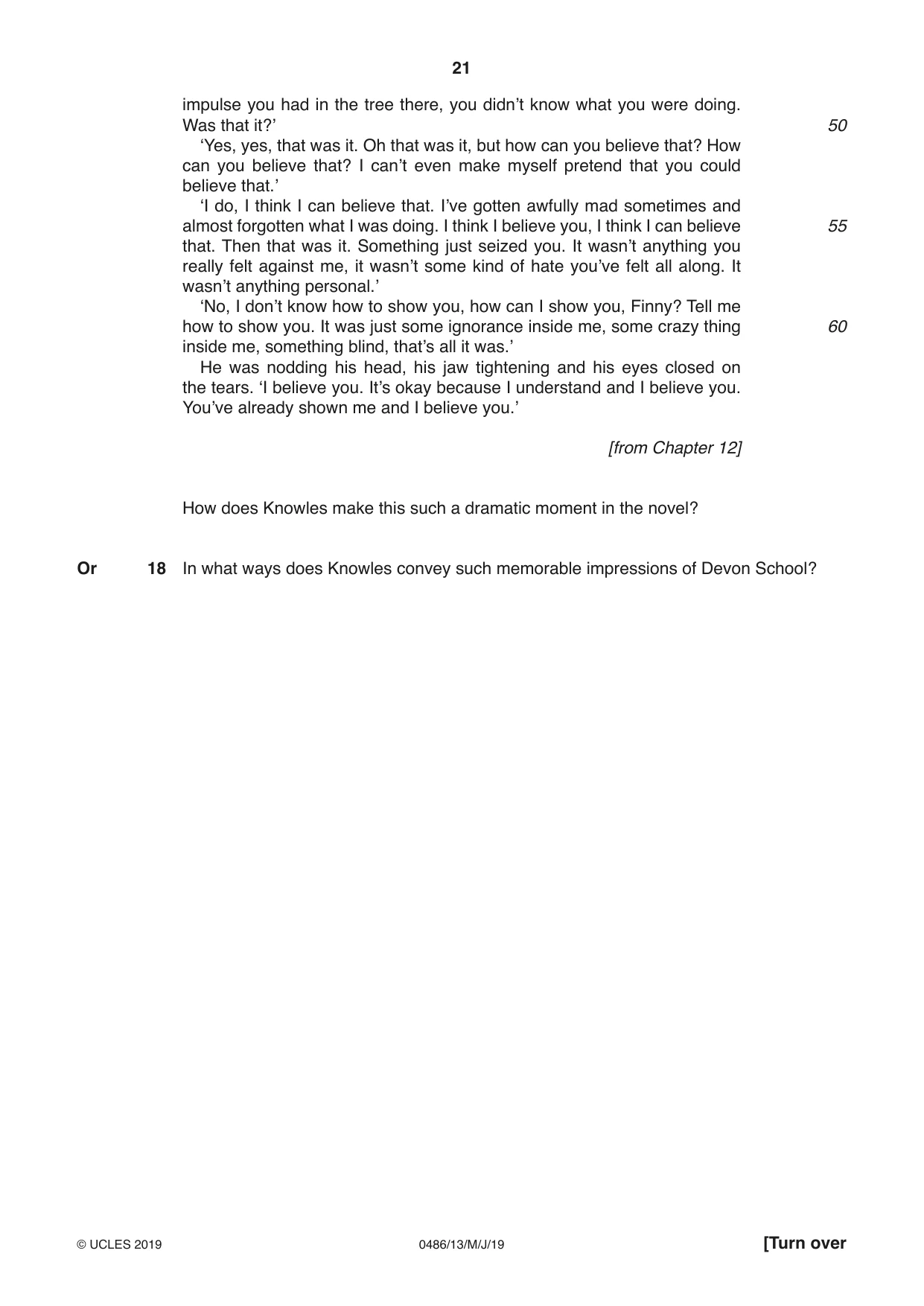
21 0486/13/M/J/19 © UCLES 2019 [Turn over impulse you had in the tree there, you didn’t know what you were doing. Was that it?’ ‘Yes, yes, that was it. Oh that was it, but how can you believe that? How can you believe that? I can’t even make myself pretend that you could believe that.’ ‘I do, I think I can believe that. I’ve gotten awfully mad sometimes and almost forgotten what I was doing. I think I believe you, I think I can believe that. Then that was it. Something just seized you. It wasn’t anything you really felt against me, it wasn’t some kind of hate you’ve felt all along. It wasn’t anything personal.’ ‘No, I don’t know how to show you, how can I show you, Finny? Tell me how to show you. It was just some ignorance inside me, some crazy thing inside me, something blind, that’s all it was.’ He was nodding his head, his jaw tightening and his eyes closed on the tears. ‘I believe you. It’s okay because I understand and I believe you. You’ve already shown me and I believe you.’ [from Chapter 12] How does Knowles make this such a dramatic moment in the novel? Or 18 In what ways does Knowles convey such memorable impressions of Devon School? 50 55 60
Question paper, page 22
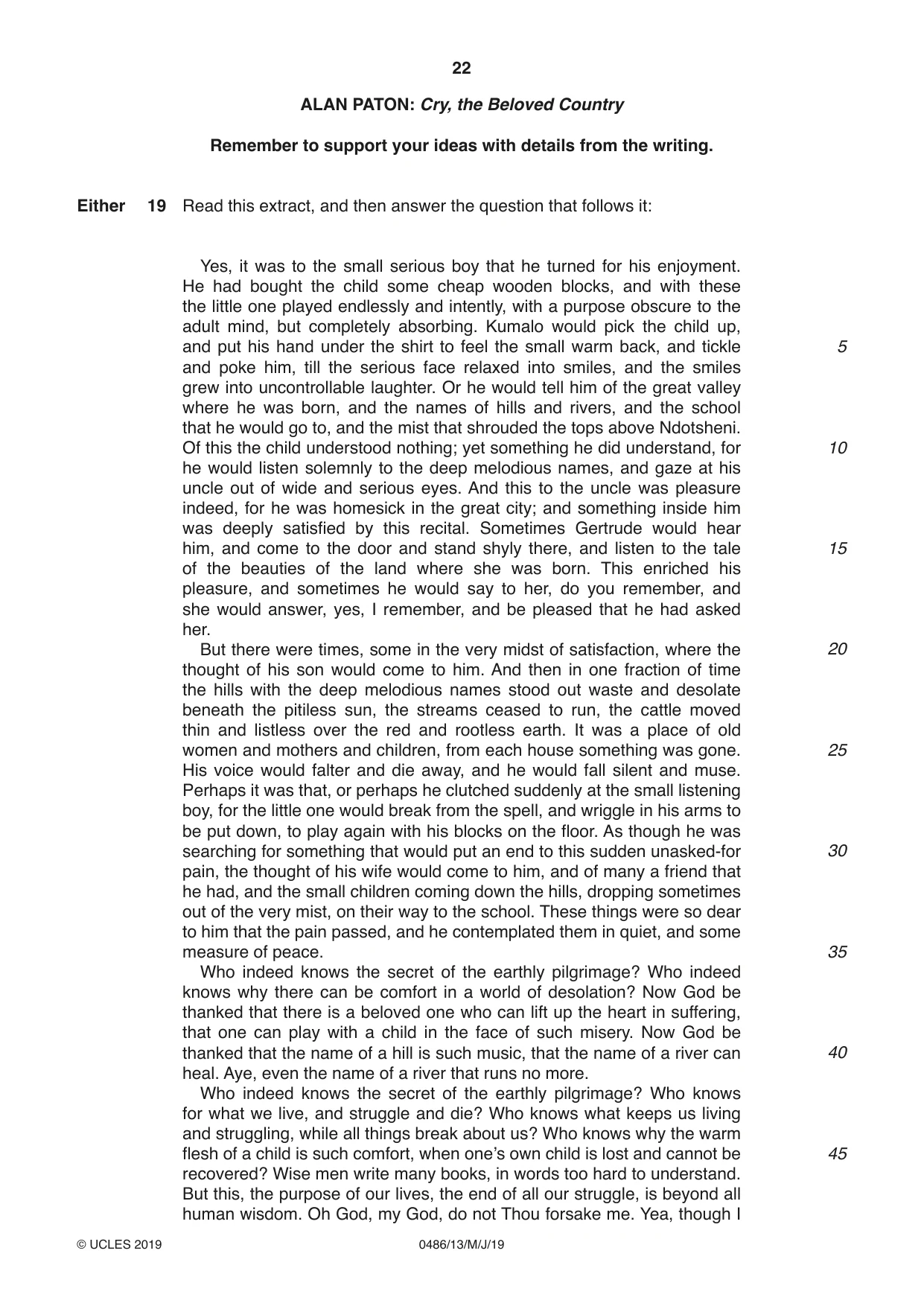
22 0486/13/M/J/19 © UCLES 2019 ALAN PATON: Cry, the Beloved Country Remember to support your ideas with details from the writing. Either 19 Read this extract, and then answer the question that follows it: Yes, it was to the small serious boy that he turned for his enjoyment. He had bought the child some cheap wooden blocks, and with these the little one played endlessly and intently, with a purpose obscure to the adult mind, but completely absorbing. Kumalo would pick the child up, and put his hand under the shirt to feel the small warm back, and tickle and poke him, till the serious face relaxed into smiles, and the smiles grew into uncontrollable laughter. Or he would tell him of the great valley where he was born, and the names of hills and rivers, and the school that he would go to, and the mist that shrouded the tops above Ndotsheni. Of this the child understood nothing; yet something he did understand, for he would listen solemnly to the deep melodious names, and gaze at his uncle out of wide and serious eyes. And this to the uncle was pleasure indeed, for he was homesick in the great city; and something inside him was deeply satisfied by this recital. Sometimes Gertrude would hear him, and come to the door and stand shyly there, and listen to the tale of the beauties of the land where she was born. This enriched his pleasure, and sometimes he would say to her, do you remember, and she would answer, yes, I remember, and be pleased that he had asked her. But there were times, some in the very midst of satisfaction, where the thought of his son would come to him. And then in one fraction of time the hills with the deep melodious names stood out waste and desolate beneath the pitiless sun, the streams ceased to run, the cattle moved thin and listless over the red and rootless earth. It was a place of old women and mothers and children, from each house something was gone. His voice would falter and die away, and he would fall silent and muse. Perhaps it was that, or perhaps he clutched suddenly at the small listening boy, for the little one would break from the spell, and wriggle in his arms to be put down, to play again with his blocks on the floor. As though he was searching for something that would put an end to this sudden unasked-for pain, the thought of his wife would come to him, and of many a friend that he had, and the small children coming down the hills, dropping sometimes out of the very mist, on their way to the school. These things were so dear to him that the pain passed, and he contemplated them in quiet, and some measure of peace. Who indeed knows the secret of the earthly pilgrimage? Who indeed knows why there can be comfort in a world of desolation? Now God be thanked that there is a beloved one who can lift up the heart in suffering, that one can play with a child in the face of such misery. Now God be thanked that the name of a hill is such music, that the name of a river can heal. Aye, even the name of a river that runs no more. Who indeed knows the secret of the earthly pilgrimage? Who knows for what we live, and struggle and die? Who knows what keeps us living and struggling, while all things break about us? Who knows why the warm flesh of a child is such comfort, when one’s own child is lost and cannot be recovered? Wise men write many books, in words too hard to understand. But this, the purpose of our lives, the end of all our struggle, is beyond all human wisdom. Oh God, my God, do not Thou forsake me. Yea, though I 5 10 15 20 25 30 35 40 45
Question paper, page 23
23 0486/13/M/J/19 © UCLES 2019 [Turn over walk through the valley of the shadow of death, I shall fear no evil, if Thou art with me.… But he stood up. That was Msimangu talking at the door. It was time to continue the search. [from Book 1 Chapter 10] Explore the ways in which Paton vividly conveys Stephen Kumalo’s thoughts and feelings at this moment in the novel. Or 20 How do you think Paton’s portrayal of James Jarvis contributes to the impact of the novel? 50
Question paper, page 24
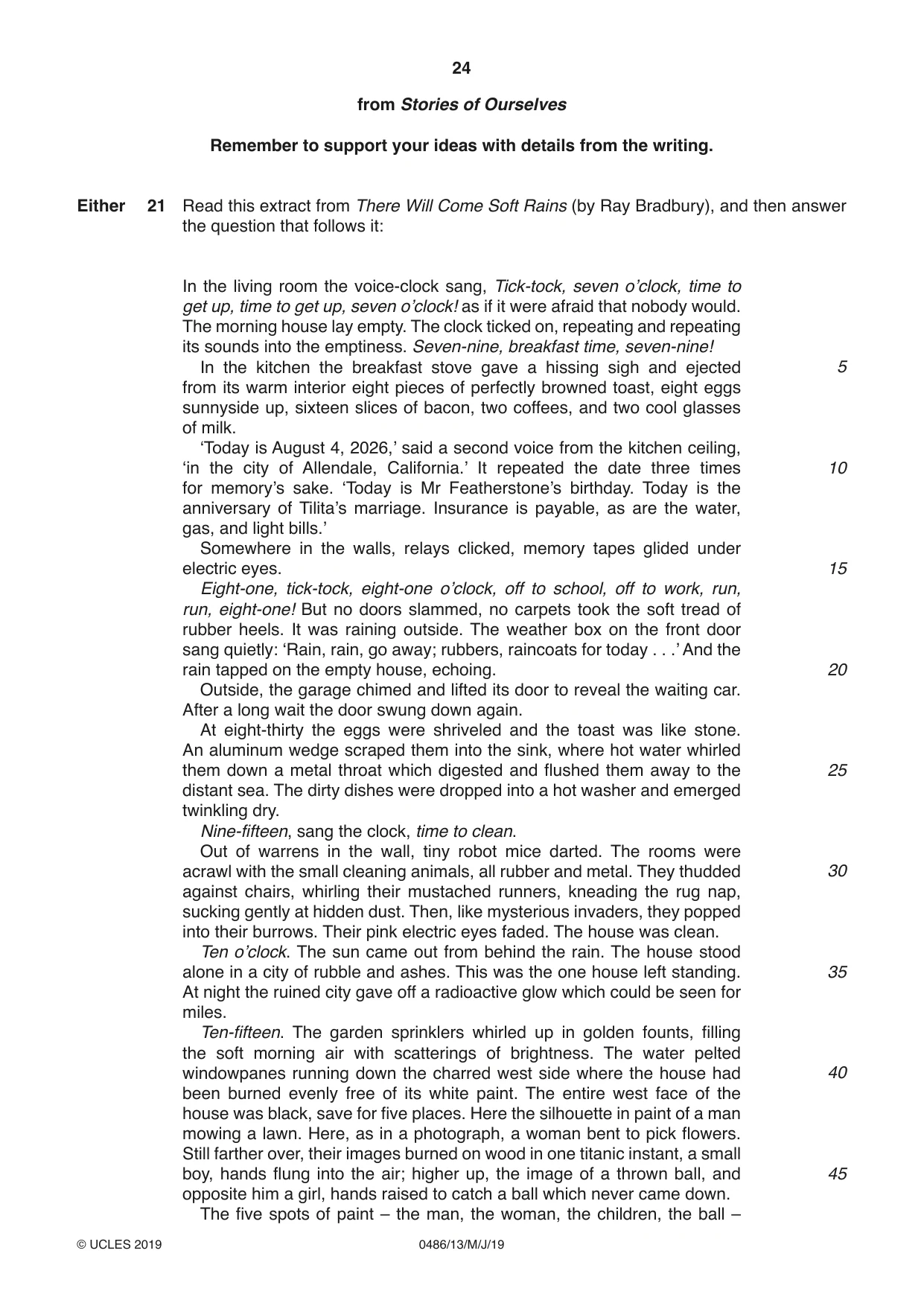
24 0486/13/M/J/19 © UCLES 2019 from Stories of Ourselves Remember to support your ideas with details from the writing. Either 21 Read this extract from There Will Come Soft Rains (by Ray Bradbury), and then answer the question that follows it: In the living room the voice-clock sang, Tick-tock, seven o’clock, time to get up, time to get up, seven o’clock! as if it were afraid that nobody would. The morning house lay empty. The clock ticked on, repeating and repeating its sounds into the emptiness. Seven-nine, breakfast time, seven-nine! In the kitchen the breakfast stove gave a hissing sigh and ejected from its warm interior eight pieces of perfectly browned toast, eight eggs sunnyside up, sixteen slices of bacon, two coffees, and two cool glasses of milk. ‘Today is August 4, 2026,’ said a second voice from the kitchen ceiling, ‘in the city of Allendale, California.’ It repeated the date three times for memory’s sake. ‘Today is Mr Featherstone’s birthday. Today is the anniversary of Tilita’s marriage. Insurance is payable, as are the water, gas, and light bills.’ Somewhere in the walls, relays clicked, memory tapes glided under electric eyes. Eight-one, tick-tock, eight-one o’clock, off to school, off to work, run, run, eight-one! But no doors slammed, no carpets took the soft tread of rubber heels. It was raining outside. The weather box on the front door sang quietly: ‘Rain, rain, go away; rubbers, raincoats for today . . .’ And the rain tapped on the empty house, echoing. Outside, the garage chimed and lifted its door to reveal the waiting car. After a long wait the door swung down again. At eight-thirty the eggs were shriveled and the toast was like stone. An aluminum wedge scraped them into the sink, where hot water whirled them down a metal throat which digested and flushed them away to the distant sea. The dirty dishes were dropped into a hot washer and emerged twinkling dry. Nine-fifteen, sang the clock, time to clean. Out of warrens in the wall, tiny robot mice darted. The rooms were acrawl with the small cleaning animals, all rubber and metal. They thudded against chairs, whirling their mustached runners, kneading the rug nap, sucking gently at hidden dust. Then, like mysterious invaders, they popped into their burrows. Their pink electric eyes faded. The house was clean. Ten o’clock. The sun came out from behind the rain. The house stood alone in a city of rubble and ashes. This was the one house left standing. At night the ruined city gave off a radioactive glow which could be seen for miles. Ten-fifteen. The garden sprinklers whirled up in golden founts, filling the soft morning air with scatterings of brightness. The water pelted windowpanes running down the charred west side where the house had been burned evenly free of its white paint. The entire west face of the house was black, save for five places. Here the silhouette in paint of a man mowing a lawn. Here, as in a photograph, a woman bent to pick flowers. Still farther over, their images burned on wood in one titanic instant, a small boy, hands flung into the air; higher up, the image of a thrown ball, and opposite him a girl, hands raised to catch a ball which never came down. The five spots of paint – the man, the woman, the children, the ball – 5 10 15 20 25 30 35 40 45
Question paper, page 25
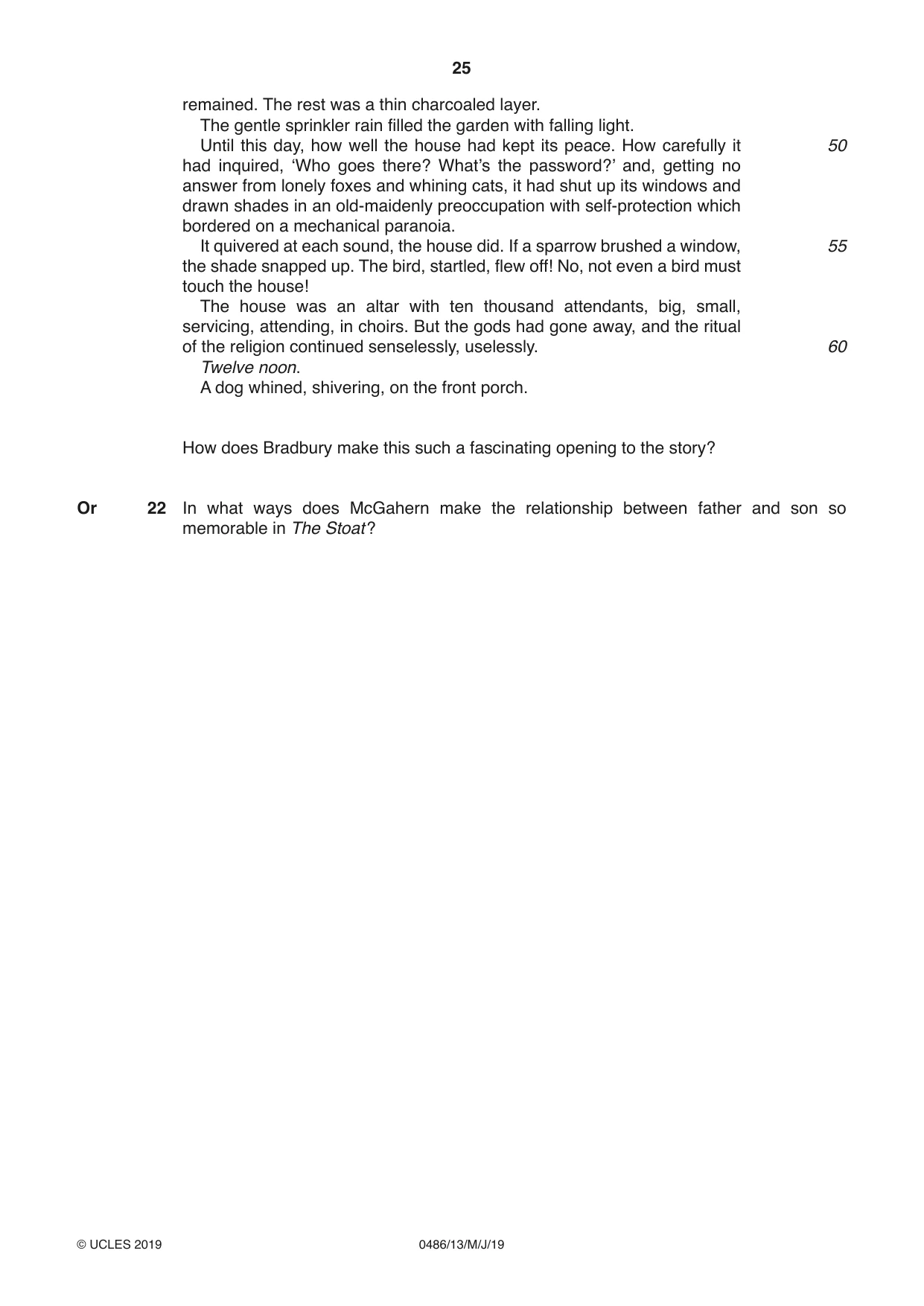
25 0486/13/M/J/19 © UCLES 2019 remained. The rest was a thin charcoaled layer. The gentle sprinkler rain filled the garden with falling light. Until this day, how well the house had kept its peace. How carefully it had inquired, ‘Who goes there? What’s the password?’ and, getting no answer from lonely foxes and whining cats, it had shut up its windows and drawn shades in an old-maidenly preoccupation with self-protection which bordered on a mechanical paranoia. It quivered at each sound, the house did. If a sparrow brushed a window, the shade snapped up. The bird, startled, flew off! No, not even a bird must touch the house! The house was an altar with ten thousand attendants, big, small, servicing, attending, in choirs. But the gods had gone away, and the ritual of the religion continued senselessly, uselessly. Twelve noon. A dog whined, shivering, on the front porch. How does Bradbury make this such a fascinating opening to the story? Or 22 In what ways does McGahern make the relationship between father and son so memorable in The Stoat? 50 55 60
Question paper, page 26
26 0486/13/M/J/19 © UCLES 2019 BLANK PAGE
Question paper, page 27
27 0486/13/M/J/19 © UCLES 2019 BLANK PAGE
Question paper, page 28
28 0486/13/M/J/19 © UCLES 2019 BLANK PAGE Permission to reproduce items where third-party owned material protected by copyright is included has been sought and cleared where possible. Every reasonable effort has been made by the publisher (UCLES) to trace copyright holders, but if any items requiring clearance have unwittingly been included, the publisher will be pleased to make amends at the earliest possible opportunity. To avoid the issue of disclosure of answer-related information to candidates, all copyright acknowledgements are reproduced online in the Cambridge Assessment International Education Copyright Acknowledgements Booklet. This is produced for each series of examinations and is freely available to download at www.cambridgeinternational.org after the live examination series. Cambridge Assessment International Education is part of the Cambridge Assessment Group. Cambridge Assessment is the brand name of the University of Cambridge Local Examinations Syndicate (UCLES), which itself is a department of the University of Cambridge.
Mark scheme, page 1
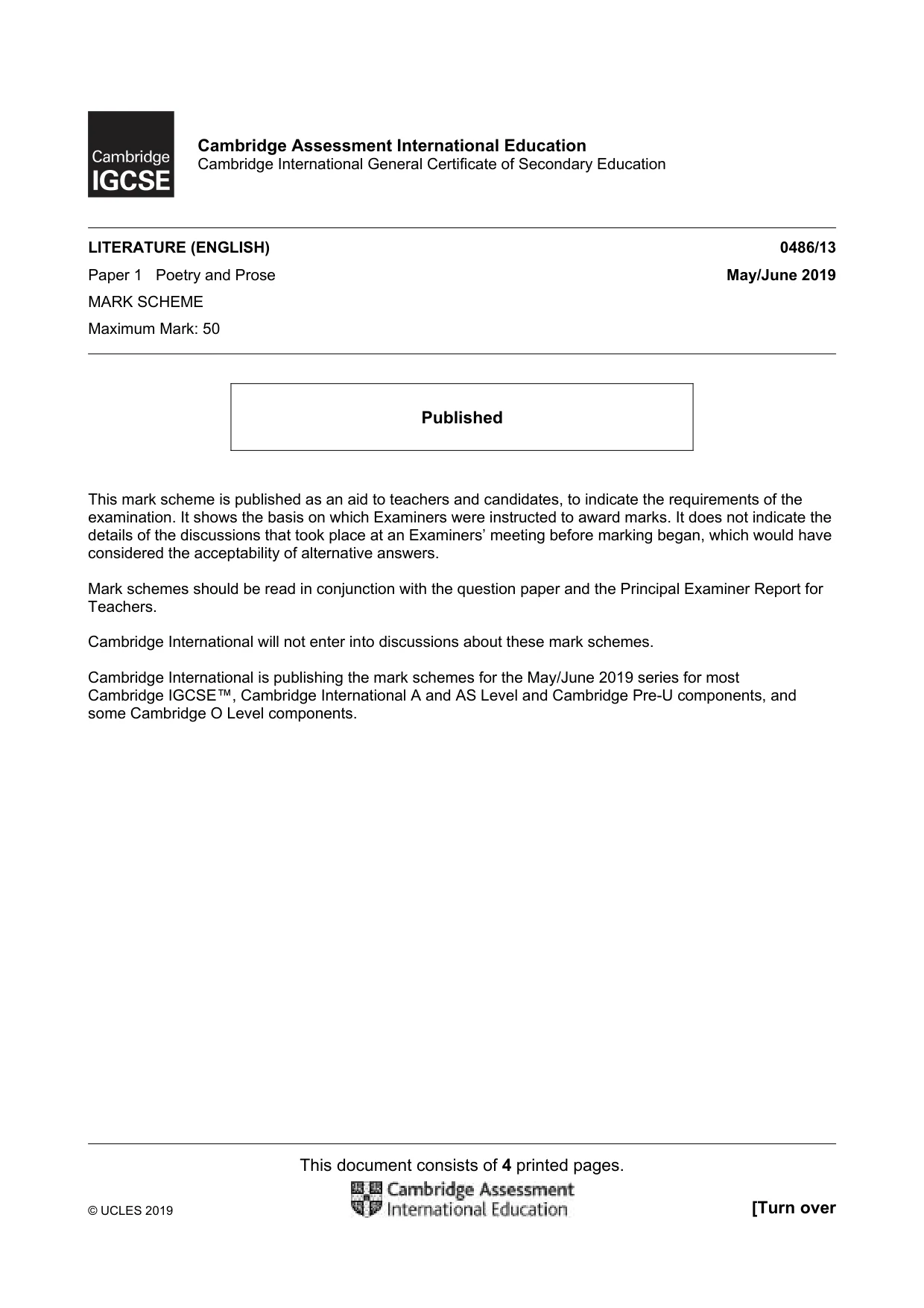
This document consists of 4 printed pages. © UCLES 2019 [Turn over Cambridge Assessment International Education Cambridge International General Certificate of Secondary Education LITERATURE (ENGLISH) 0486/13 Paper 1 Poetry and Prose May/June 2019 MARK SCHEME Maximum Mark: 50 Published This mark scheme is published as an aid to teachers and candidates, to indicate the requirements of the examination. It shows the basis on which Examiners were instructed to award marks. It does not indicate the details of the discussions that took place at an Examiners’ meeting before marking began, which would have considered the acceptability of alternative answers. Mark schemes should be read in conjunction with the question paper and the Principal Examiner Report for Teachers. Cambridge International will not enter into discussions about these mark schemes. Cambridge International is publishing the mark schemes for the May/June 2019 series for most Cambridge IGCSE™, Cambridge International A and AS Level and Cambridge Pre-U components, and some Cambridge O Level components.
Mark scheme, page 2
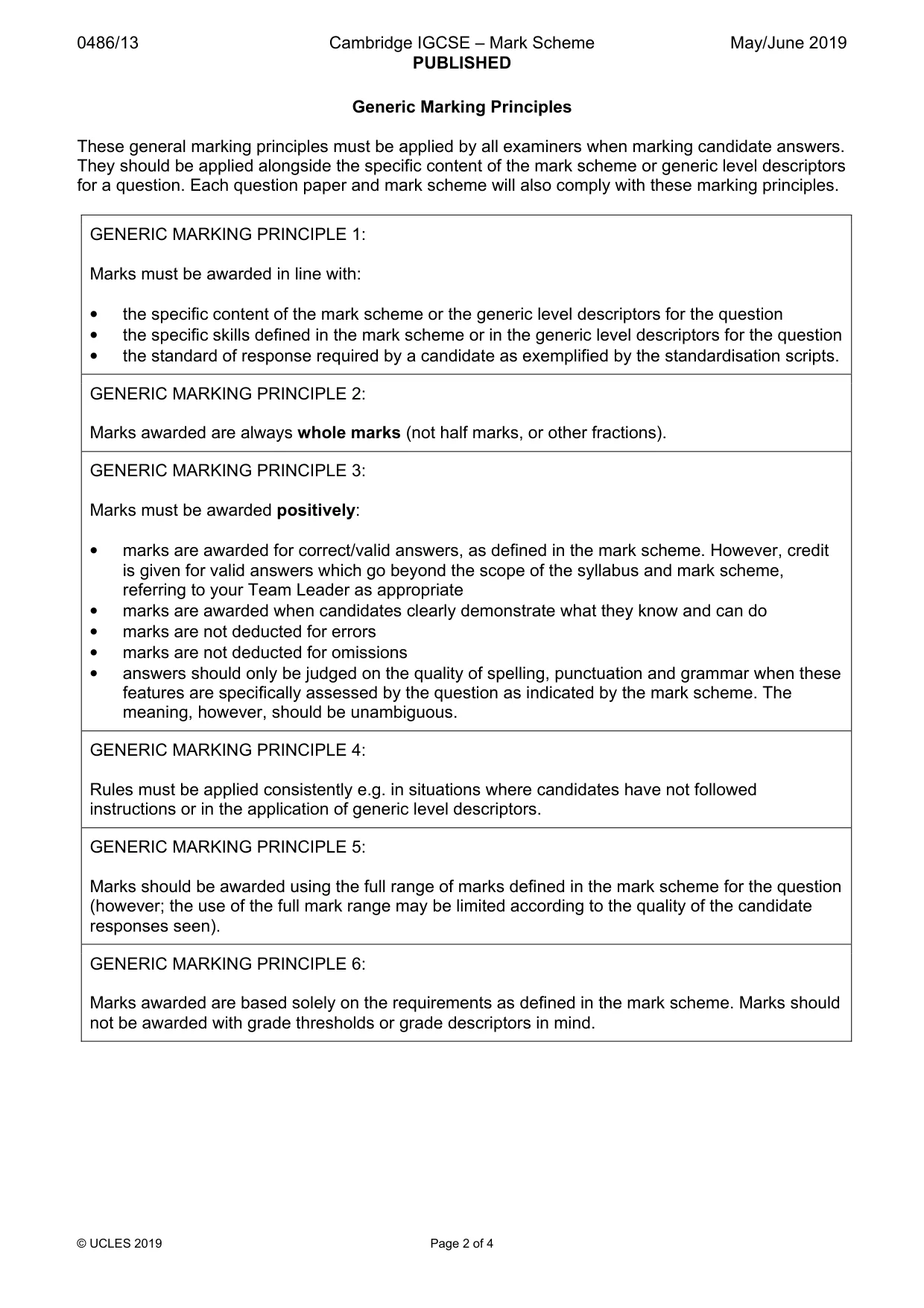
0486/13 Cambridge IGCSE – Mark Scheme PUBLISHED May/June 2019 © UCLES 2019 Page 2 of 4 Generic Marking Principles These general marking principles must be applied by all examiners when marking candidate answers. They should be applied alongside the specific content of the mark scheme or generic level descriptors for a question. Each question paper and mark scheme will also comply with these marking principles. GENERIC MARKING PRINCIPLE 1: Marks must be awarded in line with: • the specific content of the mark scheme or the generic level descriptors for the question • the specific skills defined in the mark scheme or in the generic level descriptors for the question • the standard of response required by a candidate as exemplified by the standardisation scripts. GENERIC MARKING PRINCIPLE 2: Marks awarded are always whole marks (not half marks, or other fractions). GENERIC MARKING PRINCIPLE 3: Marks must be awarded positively: • marks are awarded for correct/valid answers, as defined in the mark scheme. However, credit is given for valid answers which go beyond the scope of the syllabus and mark scheme, referring to your Team Leader as appropriate • marks are awarded when candidates clearly demonstrate what they know and can do • marks are not deducted for errors • marks are not deducted for omissions • answers should only be judged on the quality of spelling, punctuation and grammar when these features are specifically assessed by the question as indicated by the mark scheme. The meaning, however, should be unambiguous. GENERIC MARKING PRINCIPLE 4: Rules must be applied consistently e.g. in situations where candidates have not followed instructions or in the application of generic level descriptors. GENERIC MARKING PRINCIPLE 5: Marks should be awarded using the full range of marks defined in the mark scheme for the question (however; the use of the full mark range may be limited according to the quality of the candidate responses seen). GENERIC MARKING PRINCIPLE 6: Marks awarded are based solely on the requirements as defined in the mark scheme. Marks should not be awarded with grade thresholds or grade descriptors in mind.
Mark scheme, page 3
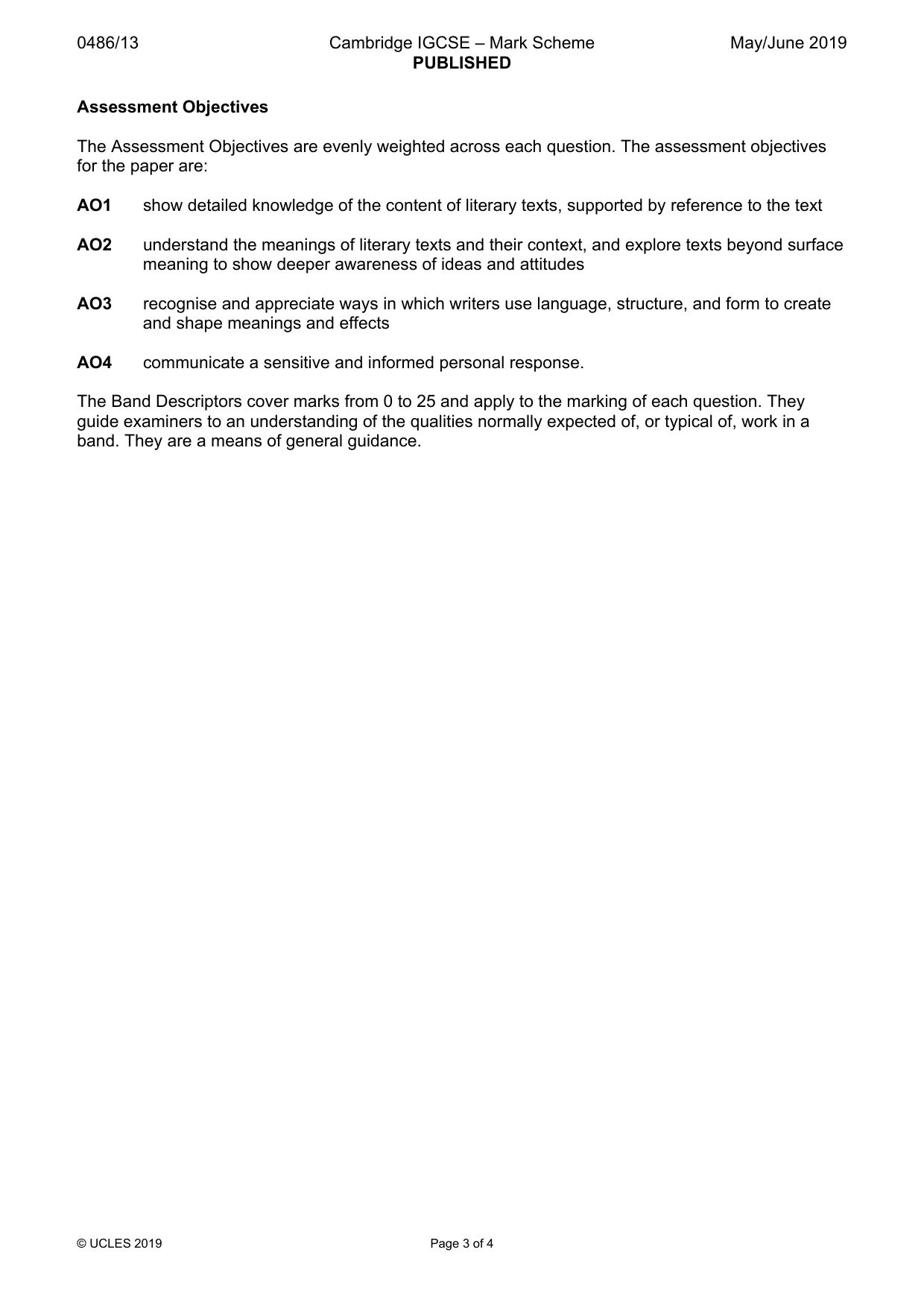
0486/13 Cambridge IGCSE – Mark Scheme PUBLISHED May/June 2019 © UCLES 2019 Page 3 of 4 Assessment Objectives The Assessment Objectives are evenly weighted across each question. The assessment objectives for the paper are: AO1 show detailed knowledge of the content of literary texts, supported by reference to the text AO2 understand the meanings of literary texts and their context, and explore texts beyond surface meaning to show deeper awareness of ideas and attitudes AO3 recognise and appreciate ways in which writers use language, structure, and form to create and shape meanings and effects AO4 communicate a sensitive and informed personal response. The Band Descriptors cover marks from 0 to 25 and apply to the marking of each question. They guide examiners to an understanding of the qualities normally expected of, or typical of, work in a band. They are a means of general guidance.
Mark scheme, page 4
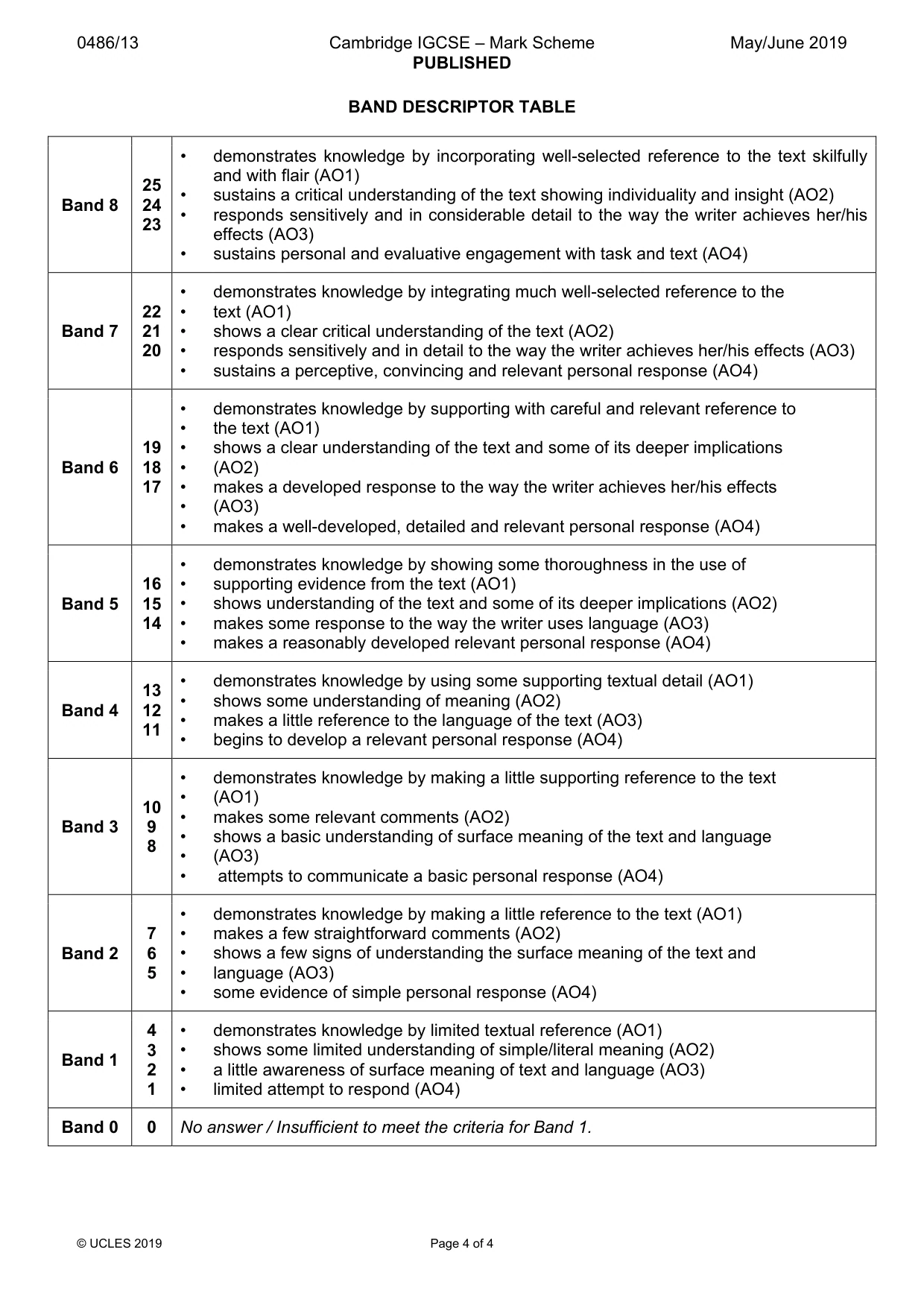
0486/13 Cambridge IGCSE – Mark Scheme PUBLISHED May/June 2019 © UCLES 2019 Page 4 of 4 BAND DESCRIPTOR TABLE Band 8 25 24 23 • demonstrates knowledge by incorporating well-selected reference to the text skilfully and with flair (AO1) • sustains a critical understanding of the text showing individuality and insight (AO2) • responds sensitively and in considerable detail to the way the writer achieves her/his effects (AO3) • sustains personal and evaluative engagement with task and text (AO4) Band 7 22 21 20 • demonstrates knowledge by integrating much well-selected reference to the • text (AO1) • shows a clear critical understanding of the text (AO2) • responds sensitively and in detail to the way the writer achieves her/his effects (AO3) • sustains a perceptive, convincing and relevant personal response (AO4) Band 6 19 18 17 • demonstrates knowledge by supporting with careful and relevant reference to • the text (AO1) • shows a clear understanding of the text and some of its deeper implications • (AO2) • makes a developed response to the way the writer achieves her/his effects • (AO3) • makes a well-developed, detailed and relevant personal response (AO4) Band 5 16 15 14 • demonstrates knowledge by showing some thoroughness in the use of • supporting evidence from the text (AO1) • shows understanding of the text and some of its deeper implications (AO2) • makes some response to the way the writer uses language (AO3) • makes a reasonably developed relevant personal response (AO4) Band 4 13 12 11 • demonstrates knowledge by using some supporting textual detail (AO1) • shows some understanding of meaning (AO2) • makes a little reference to the language of the text (AO3) • begins to develop a relevant personal response (AO4) Band 3 10 9 8 • demonstrates knowledge by making a little supporting reference to the text • (AO1) • makes some relevant comments (AO2) • shows a basic understanding of surface meaning of the text and language • (AO3) • attempts to communicate a basic personal response (AO4) Band 2 7 6 5 • demonstrates knowledge by making a little reference to the text (AO1) • makes a few straightforward comments (AO2) • shows a few signs of understanding the surface meaning of the text and • language (AO3) • some evidence of simple personal response (AO4) Band 1 4 3 2 1 • demonstrates knowledge by limited textual reference (AO1) • shows some limited understanding of simple/literal meaning (AO2) • a little awareness of surface meaning of text and language (AO3) • limited attempt to respond (AO4) Band 0 0 No answer / Insufficient to meet the criteria for Band 1.
What you needed in this session
Cambridge’s own grade thresholds for 2019 May/June, Paper 1 · Variant 3. A higher threshold means an easier paper — the bar moves with how the cohort did.