Cambridge IGCSE English - Literature 0486 — 2019 Oct/Nov Paper 1 · Variant 3
0486/13/O/N/19 · 50 marks · ≈56 min
The question paper and its mark scheme, free to read here and free to download. This is Cambridge’s own paper, exactly as it was sat.
Question paper28 pages





Mark scheme4 pages
Answers below. Sit the paper first if you are practising.
Paper as text
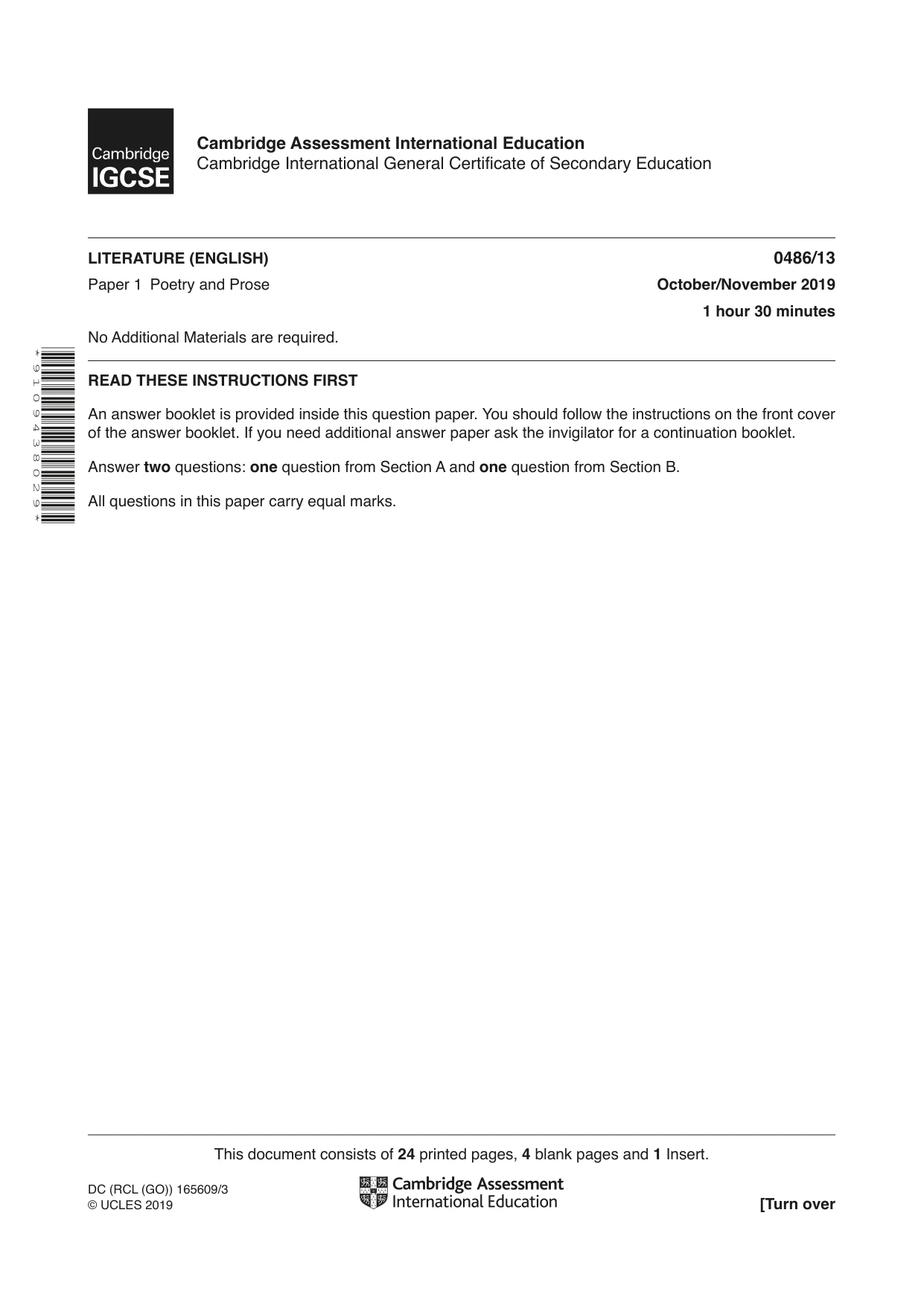
Question paper, page 1
This document consists of 24 printed pages, 4 blank pages and 1 Insert. DC (RCL (GO)) 165609/3 © UCLES 2019 [Turn over Cambridge Assessment International Education Cambridge International General Certificate of Secondary Education * 9 1 0 9 4 3 8 0 2 9 * LITERATURE (ENGLISH) 0486/13 Paper 1 Poetry and Prose October/November 2019 1 hour 30 minutes No Additional Materials are required. READ THESE INSTRUCTIONS FIRST An answer booklet is provided inside this question paper. You should follow the instructions on the front cover of the answer booklet. If you need additional answer paper ask the invigilator for a continuation booklet. Answer two questions: one question from Section A and one question from Section B. All questions in this paper carry equal marks.
Question paper, page 2
2 0486/13/O/N/19 © UCLES 2019 BLANK PAGE
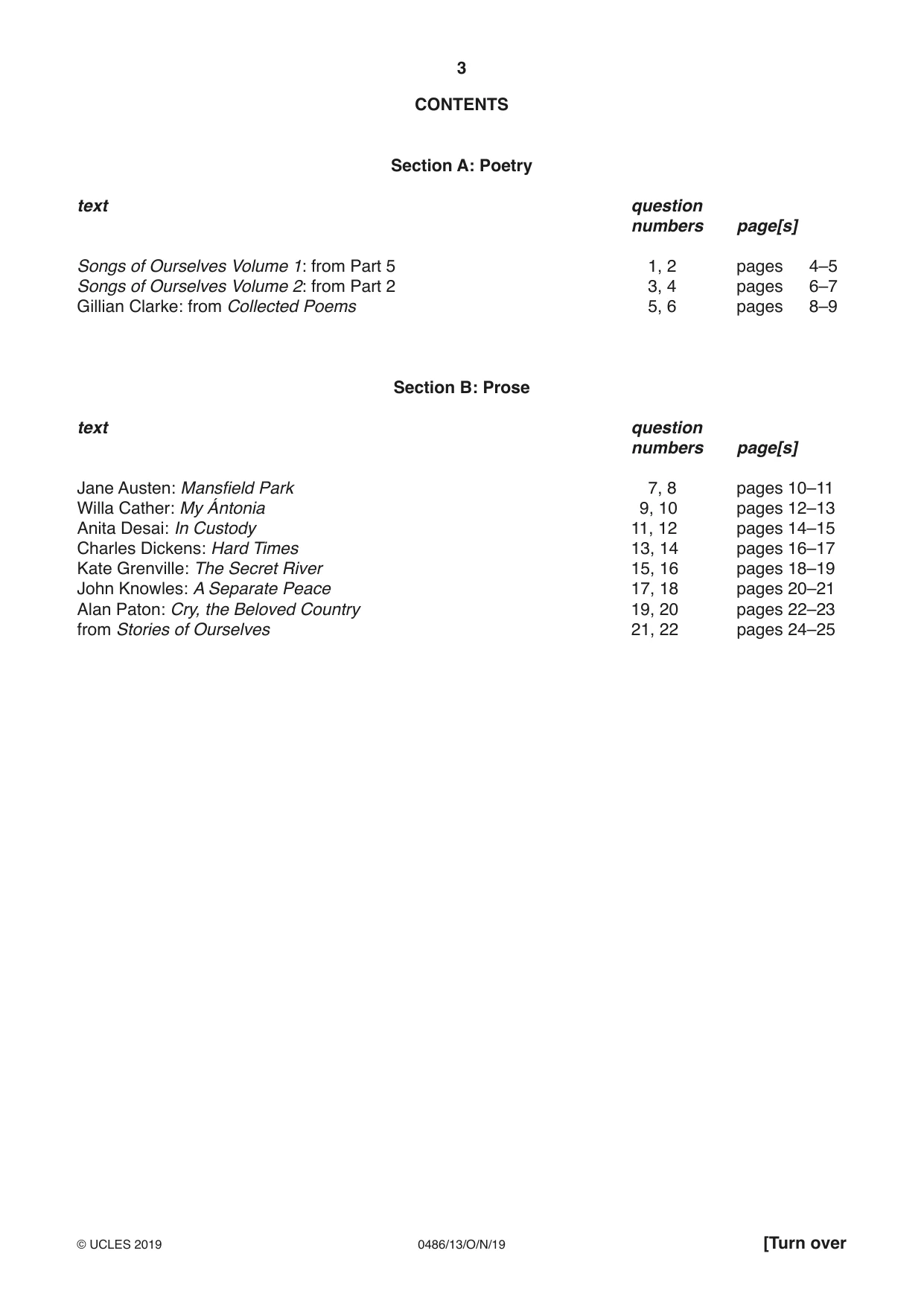
Question paper, page 3
3 0486/13/O/N/19 © UCLES 2019 [Turn over CONTENTS Section A: Poetry text question numbers page[s] Songs of Ourselves Volume 1: from Part 5 1, 2 pages 4–5 Songs of Ourselves Volume 2: from Part 2 3, 4 pages 6–7 Gillian Clarke: from Collected Poems 5, 6 pages 8–9 Section B: Prose text question numbers page[s] Jane Austen: Mansfield Park 7, 8 pages 10–11 Willa Cather: My Ántonia 9, 10 pages 12–13 Anita Desai: In Custody 11, 12 pages 14–15 Charles Dickens: Hard Times 13, 14 pages 16–17 Kate Grenville: The Secret River 15, 16 pages 18–19 John Knowles: A Separate Peace 17, 18 pages 20–21 Alan Paton: Cry, the Beloved Country 19, 20 pages 22–23 from Stories of Ourselves 21, 22 pages 24–25
Question paper, page 4
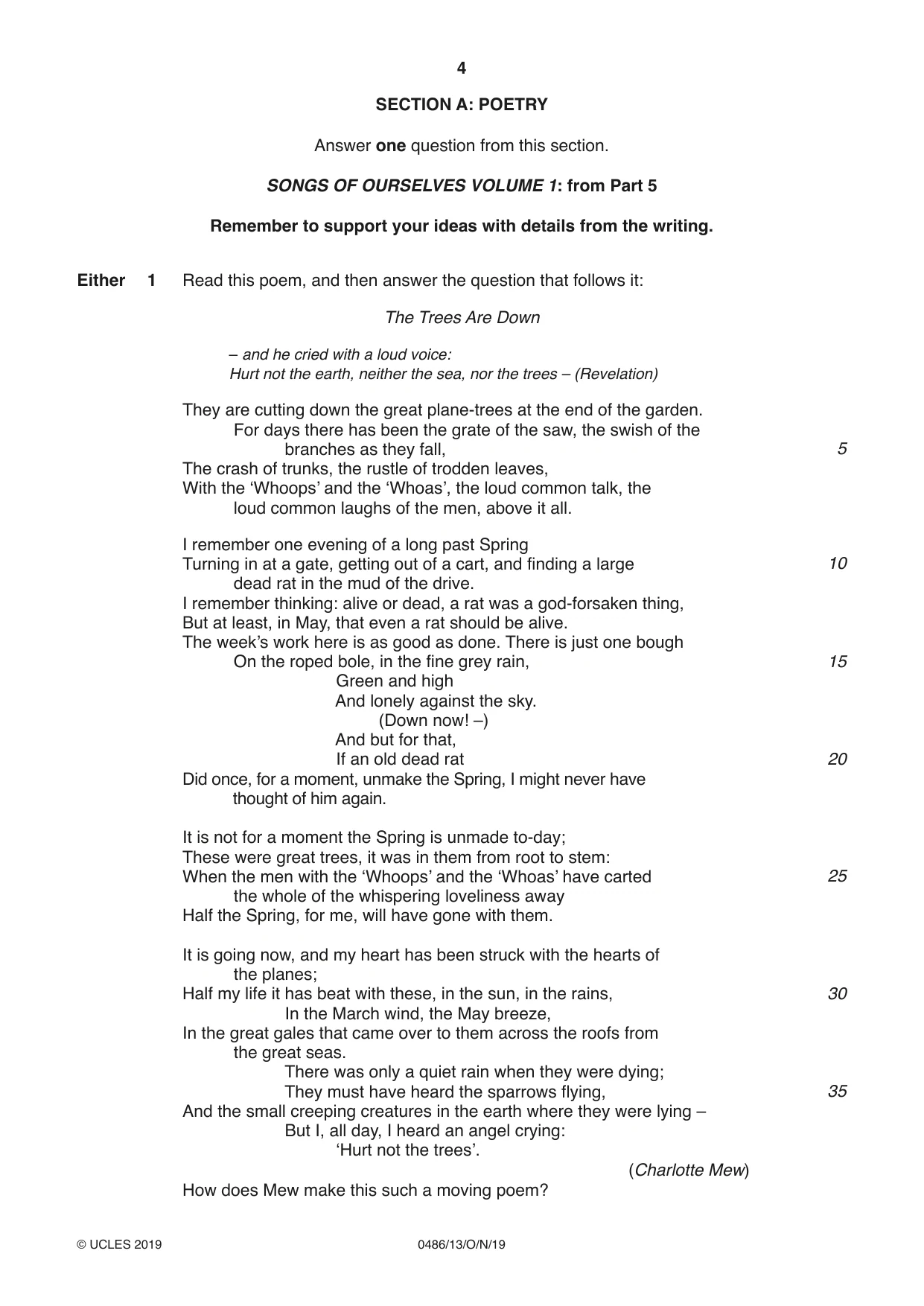
4 0486/13/O/N/19 © UCLES 2019 SECTION A: POETRY Answer one question from this section. SONGS OF OURSELVES VOLUME 1: from Part 5 Remember to support your ideas with details from the writing. Either 1 Read this poem, and then answer the question that follows it: The Trees Are Down – and he cried with a loud voice: Hurt not the earth, neither the sea, nor the trees – (Revelation) They are cutting down the great plane-trees at the end of the garden. For days there has been the grate of the saw, the swish of the branches as they fall, The crash of trunks, the rustle of trodden leaves, With the ‘Whoops’ and the ‘Whoas’, the loud common talk, the loud common laughs of the men, above it all. I remember one evening of a long past Spring Turning in at a gate, getting out of a cart, and finding a large dead rat in the mud of the drive. I remember thinking: alive or dead, a rat was a god-forsaken thing, But at least, in May, that even a rat should be alive. The week’s work here is as good as done. There is just one bough On the roped bole, in the fine grey rain, Green and high And lonely against the sky. (Down now! –) And but for that, If an old dead rat Did once, for a moment, unmake the Spring, I might never have thought of him again. It is not for a moment the Spring is unmade to-day; These were great trees, it was in them from root to stem: When the men with the ‘Whoops’ and the ‘Whoas’ have carted the whole of the whispering loveliness away Half the Spring, for me, will have gone with them. It is going now, and my heart has been struck with the hearts of the planes; Half my life it has beat with these, in the sun, in the rains, In the March wind, the May breeze, In the great gales that came over to them across the roofs from the great seas. There was only a quiet rain when they were dying; They must have heard the sparrows flying, And the small creeping creatures in the earth where they were lying – But I, all day, I heard an angel crying: ‘Hurt not the trees’. (Charlotte Mew) How does Mew make this such a moving poem? 5 10 15 20 25 30 35
Question paper, page 5
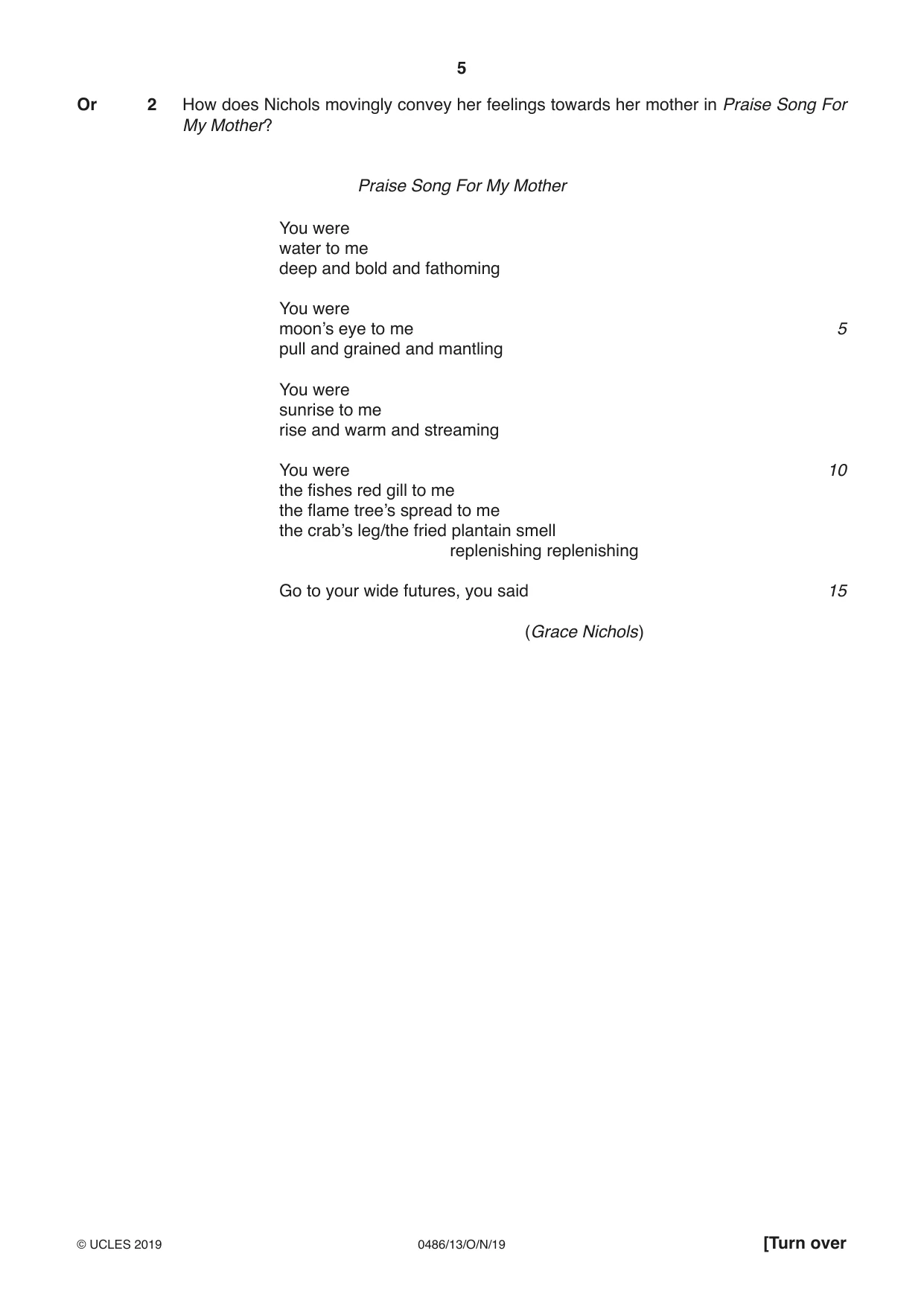
5 0486/13/O/N/19 © UCLES 2019 [Turn over Or 2 How does Nichols movingly convey her feelings towards her mother in Praise Song For My Mother? Praise Song For My Mother You were water to me deep and bold and fathoming You were moon’s eye to me pull and grained and mantling You were sunrise to me rise and warm and streaming You were the fishes red gill to me the flame tree’s spread to me the crab’s leg/the fried plantain smell replenishing replenishing Go to your wide futures, you said (Grace Nichols) 5 10 15
Question paper, page 6
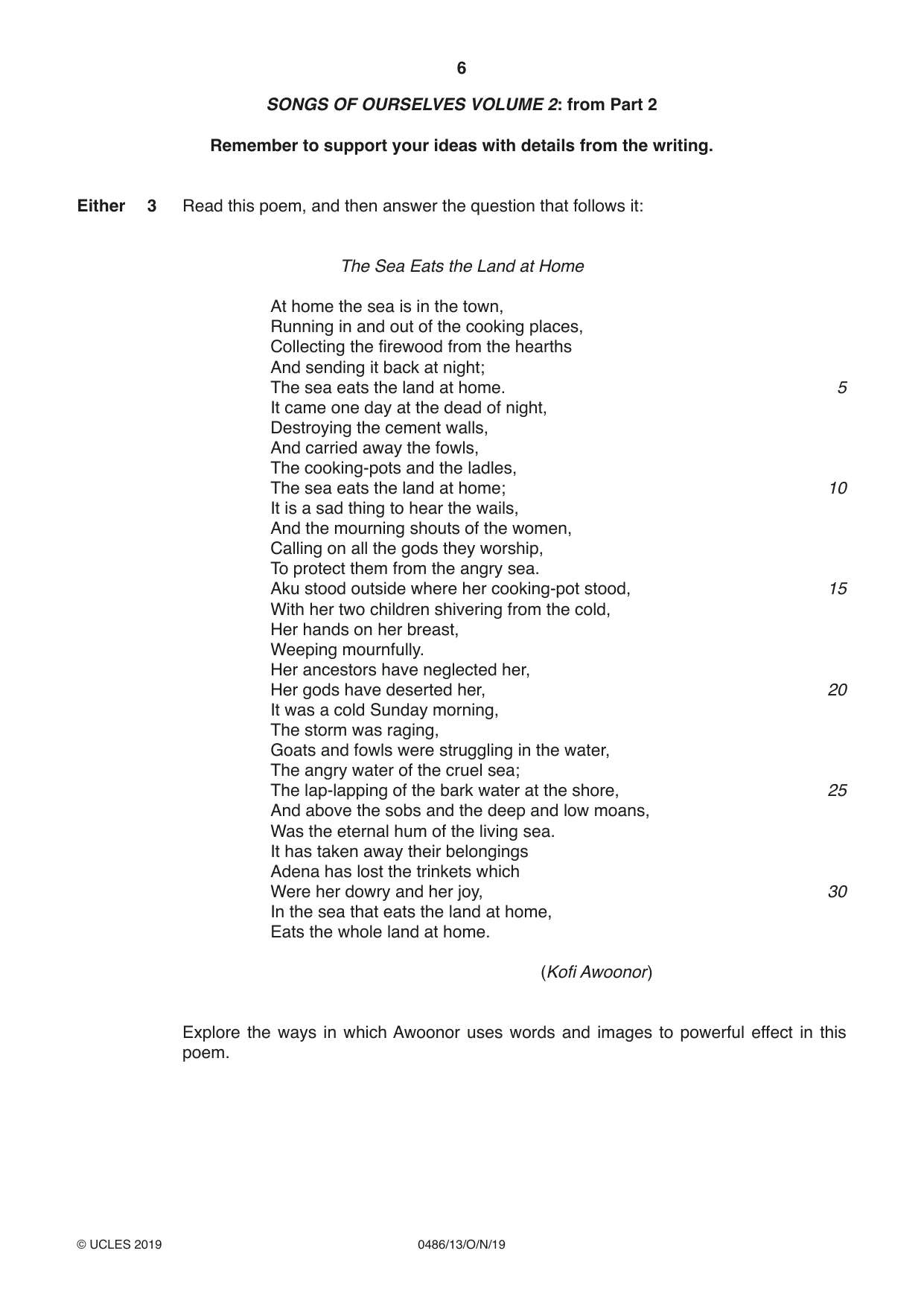
6 0486/13/O/N/19 © UCLES 2019 SONGS OF OURSELVES VOLUME 2: from Part 2 Remember to support your ideas with details from the writing. Either 3 Read this poem, and then answer the question that follows it: The Sea Eats the Land at Home At home the sea is in the town, Running in and out of the cooking places, Collecting the firewood from the hearths And sending it back at night; The sea eats the land at home. It came one day at the dead of night, Destroying the cement walls, And carried away the fowls, The cooking-pots and the ladles, The sea eats the land at home; It is a sad thing to hear the wails, And the mourning shouts of the women, Calling on all the gods they worship, To protect them from the angry sea. Aku stood outside where her cooking-pot stood, With her two children shivering from the cold, Her hands on her breast, Weeping mournfully. Her ancestors have neglected her, Her gods have deserted her, It was a cold Sunday morning, The storm was raging, Goats and fowls were struggling in the water, The angry water of the cruel sea; The lap-lapping of the bark water at the shore, And above the sobs and the deep and low moans, Was the eternal hum of the living sea. It has taken away their belongings Adena has lost the trinkets which Were her dowry and her joy, In the sea that eats the land at home, Eats the whole land at home. (Kofi Awoonor) Explore the ways in which Awoonor uses words and images to powerful effect in this poem. 5 10 15 20 25 30
Question paper, page 7
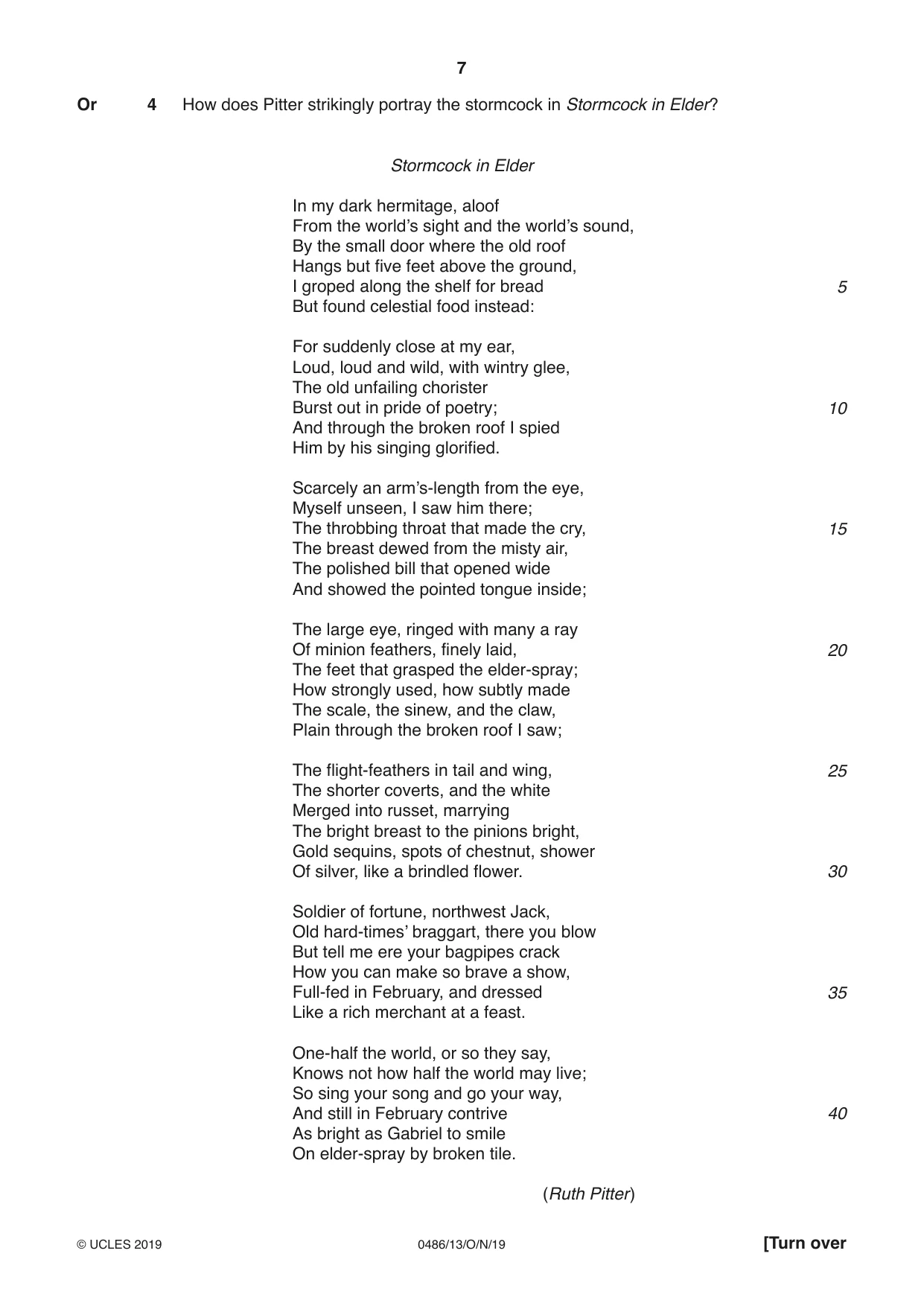
7 0486/13/O/N/19 © UCLES 2019 [Turn over Or 4 How does Pitter strikingly portray the stormcock in Stormcock in Elder? Stormcock in Elder In my dark hermitage, aloof From the world’s sight and the world’s sound, By the small door where the old roof Hangs but five feet above the ground, I groped along the shelf for bread But found celestial food instead: For suddenly close at my ear, Loud, loud and wild, with wintry glee, The old unfailing chorister Burst out in pride of poetry; And through the broken roof I spied Him by his singing glorified. Scarcely an arm’s-length from the eye, Myself unseen, I saw him there; The throbbing throat that made the cry, The breast dewed from the misty air, The polished bill that opened wide And showed the pointed tongue inside; The large eye, ringed with many a ray Of minion feathers, finely laid, The feet that grasped the elder-spray; How strongly used, how subtly made The scale, the sinew, and the claw, Plain through the broken roof I saw; The flight-feathers in tail and wing, The shorter coverts, and the white Merged into russet, marrying The bright breast to the pinions bright, Gold sequins, spots of chestnut, shower Of silver, like a brindled flower. Soldier of fortune, northwest Jack, Old hard-times’ braggart, there you blow But tell me ere your bagpipes crack How you can make so brave a show, Full-fed in February, and dressed Like a rich merchant at a feast. One-half the world, or so they say, Knows not how half the world may live; So sing your song and go your way, And still in February contrive As bright as Gabriel to smile On elder-spray by broken tile. (Ruth Pitter) 5 10 15 20 25 30 35 40
Question paper, page 8
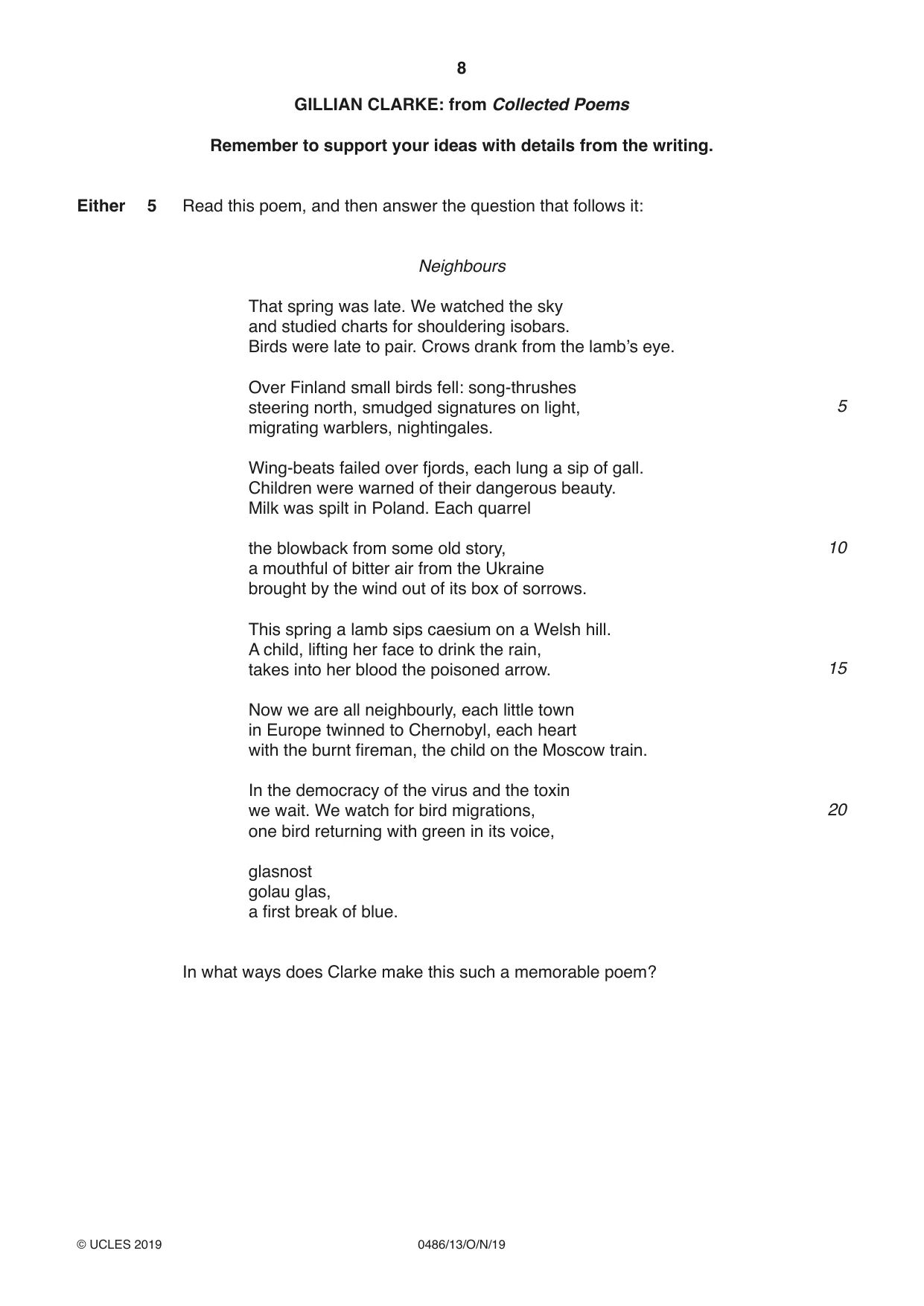
8 0486/13/O/N/19 © UCLES 2019 GILLIAN CLARKE: from Collected Poems Remember to support your ideas with details from the writing. Either 5 Read this poem, and then answer the question that follows it: Neighbours That spring was late. We watched the sky and studied charts for shouldering isobars. Birds were late to pair. Crows drank from the lamb’s eye. Over Finland small birds fell: song-thrushes steering north, smudged signatures on light, migrating warblers, nightingales. Wing-beats failed over fjords, each lung a sip of gall. Children were warned of their dangerous beauty. Milk was spilt in Poland. Each quarrel the blowback from some old story, a mouthful of bitter air from the Ukraine brought by the wind out of its box of sorrows. This spring a lamb sips caesium on a Welsh hill. A child, lifting her face to drink the rain, takes into her blood the poisoned arrow. Now we are all neighbourly, each little town in Europe twinned to Chernobyl, each heart with the burnt fireman, the child on the Moscow train. In the democracy of the virus and the toxin we wait. We watch for bird migrations, one bird returning with green in its voice, glasnost golau glas, a first break of blue. In what ways does Clarke make this such a memorable poem? 5 10 15 20
Question paper, page 9
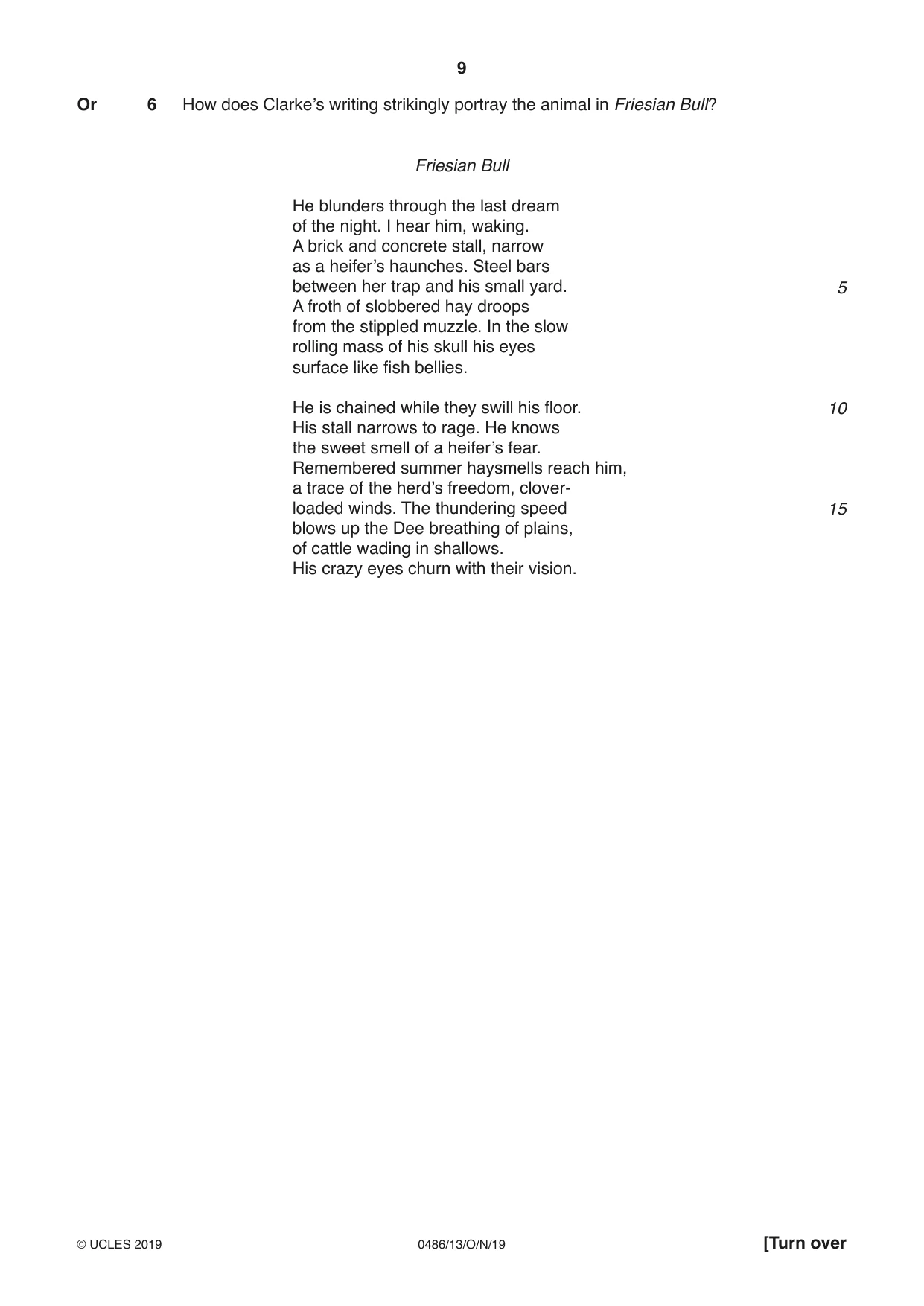
9 0486/13/O/N/19 © UCLES 2019 [Turn over Or 6 How does Clarke’s writing strikingly portray the animal in Friesian Bull? Friesian Bull He blunders through the last dream of the night. I hear him, waking. A brick and concrete stall, narrow as a heifer’s haunches. Steel bars between her trap and his small yard. A froth of slobbered hay droops from the stippled muzzle. In the slow rolling mass of his skull his eyes surface like fish bellies. He is chained while they swill his floor. His stall narrows to rage. He knows the sweet smell of a heifer’s fear. Remembered summer haysmells reach him, a trace of the herd’s freedom, clover- loaded winds. The thundering speed blows up the Dee breathing of plains, of cattle wading in shallows. His crazy eyes churn with their vision. 5 10 15
Question paper, page 10
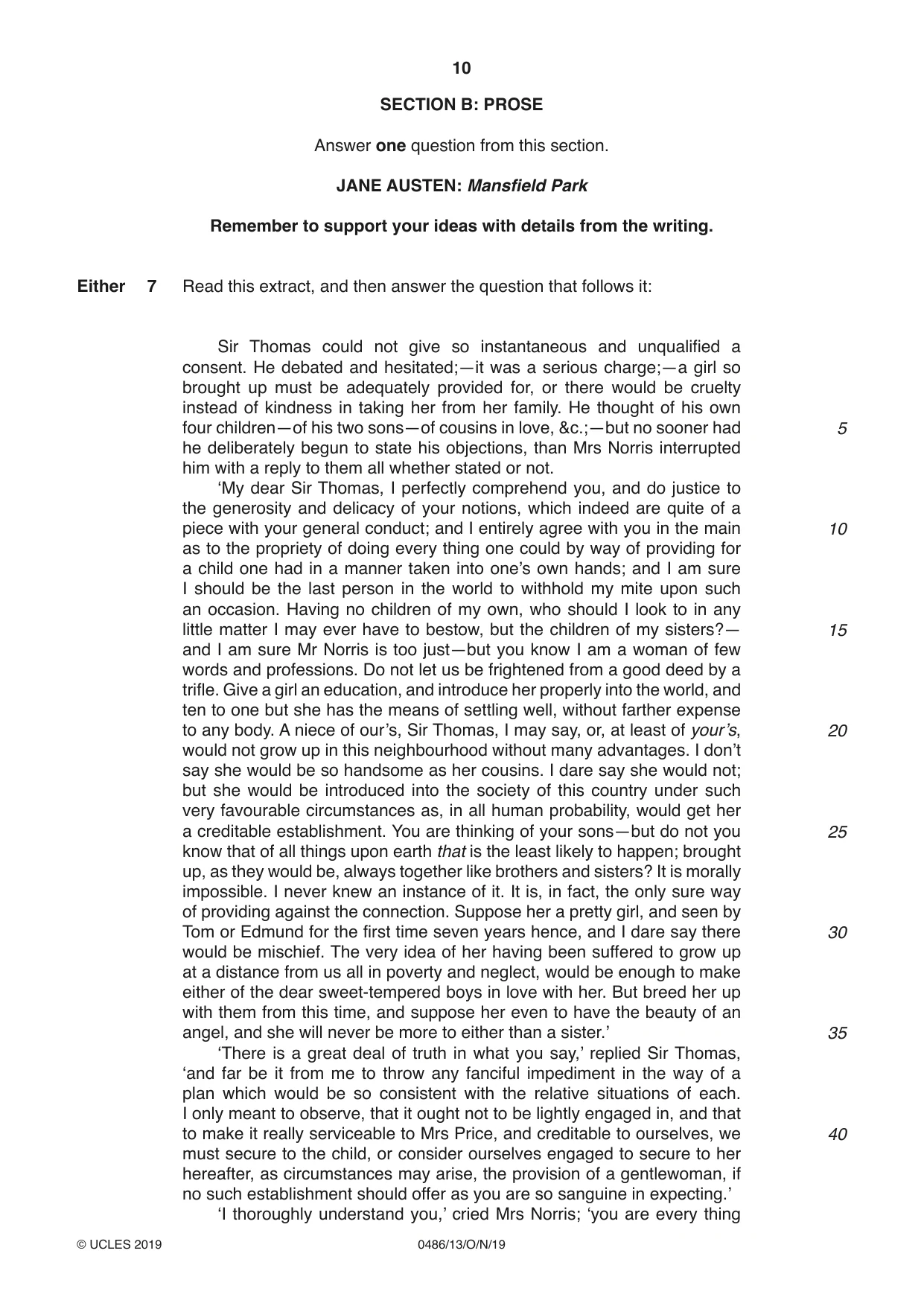
10 0486/13/O/N/19 © UCLES 2019 SECTION B: PROSE Answer one question from this section. JANE AUSTEN: Mansfield Park Remember to support your ideas with details from the writing. Either 7 Read this extract, and then answer the question that follows it: Sir Thomas could not give so instantaneous and unqualified a consent. He debated and hesitated;—it was a serious charge;—a girl so brought up must be adequately provided for, or there would be cruelty instead of kindness in taking her from her family. He thought of his own four children—of his two sons—of cousins in love, &c.;—but no sooner had he deliberately begun to state his objections, than Mrs Norris interrupted him with a reply to them all whether stated or not. ‘My dear Sir Thomas, I perfectly comprehend you, and do justice to the generosity and delicacy of your notions, which indeed are quite of a piece with your general conduct; and I entirely agree with you in the main as to the propriety of doing every thing one could by way of providing for a child one had in a manner taken into one’s own hands; and I am sure I should be the last person in the world to withhold my mite upon such an occasion. Having no children of my own, who should I look to in any little matter I may ever have to bestow, but the children of my sisters?— and I am sure Mr Norris is too just—but you know I am a woman of few words and professions. Do not let us be frightened from a good deed by a trifle. Give a girl an education, and introduce her properly into the world, and ten to one but she has the means of settling well, without farther expense to any body. A niece of our’s, Sir Thomas, I may say, or, at least of your’s, would not grow up in this neighbourhood without many advantages. I don’t say she would be so handsome as her cousins. I dare say she would not; but she would be introduced into the society of this country under such very favourable circumstances as, in all human probability, would get her a creditable establishment. You are thinking of your sons—but do not you know that of all things upon earth that is the least likely to happen; brought up, as they would be, always together like brothers and sisters? It is morally impossible. I never knew an instance of it. It is, in fact, the only sure way of providing against the connection. Suppose her a pretty girl, and seen by Tom or Edmund for the first time seven years hence, and I dare say there would be mischief. The very idea of her having been suffered to grow up at a distance from us all in poverty and neglect, would be enough to make either of the dear sweet-tempered boys in love with her. But breed her up with them from this time, and suppose her even to have the beauty of an angel, and she will never be more to either than a sister.’ ‘There is a great deal of truth in what you say,’ replied Sir Thomas, ‘and far be it from me to throw any fanciful impediment in the way of a plan which would be so consistent with the relative situations of each. I only meant to observe, that it ought not to be lightly engaged in, and that to make it really serviceable to Mrs Price, and creditable to ourselves, we must secure to the child, or consider ourselves engaged to secure to her hereafter, as circumstances may arise, the provision of a gentlewoman, if no such establishment should offer as you are so sanguine in expecting.’ ‘I thoroughly understand you,’ cried Mrs Norris; ‘you are every thing 5 10 15 20 25 30 35 40
Question paper, page 11
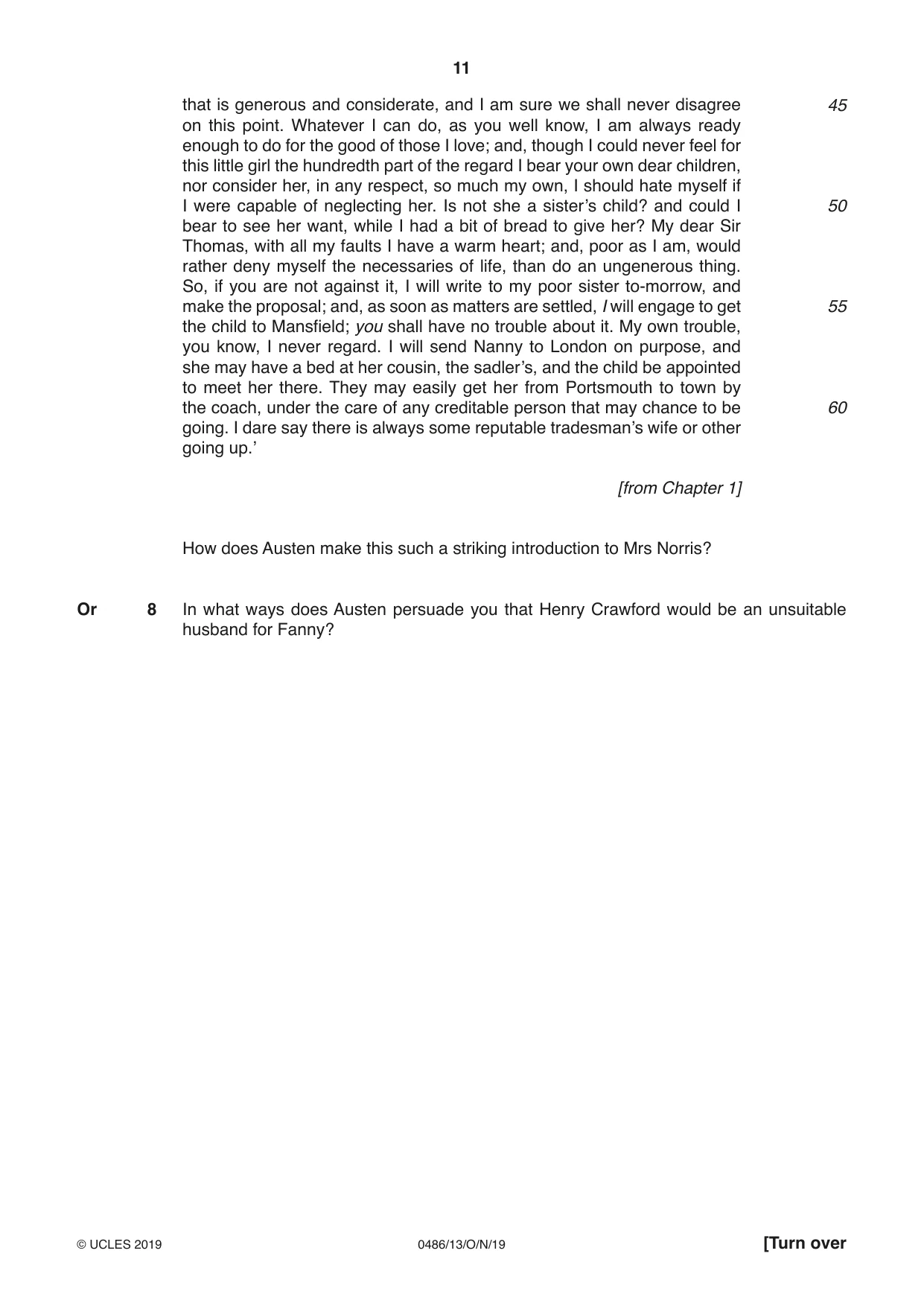
11 0486/13/O/N/19 © UCLES 2019 [Turn over that is generous and considerate, and I am sure we shall never disagree on this point. Whatever I can do, as you well know, I am always ready enough to do for the good of those I love; and, though I could never feel for this little girl the hundredth part of the regard I bear your own dear children, nor consider her, in any respect, so much my own, I should hate myself if I were capable of neglecting her. Is not she a sister’s child? and could I bear to see her want, while I had a bit of bread to give her? My dear Sir Thomas, with all my faults I have a warm heart; and, poor as I am, would rather deny myself the necessaries of life, than do an ungenerous thing. So, if you are not against it, I will write to my poor sister to-morrow, and make the proposal; and, as soon as matters are settled, I will engage to get the child to Mansfield; you shall have no trouble about it. My own trouble, you know, I never regard. I will send Nanny to London on purpose, and she may have a bed at her cousin, the sadler’s, and the child be appointed to meet her there. They may easily get her from Portsmouth to town by the coach, under the care of any creditable person that may chance to be going. I dare say there is always some reputable tradesman’s wife or other going up.’ [from Chapter 1] How does Austen make this such a striking introduction to Mrs Norris? Or 8 In what ways does Austen persuade you that Henry Crawford would be an unsuitable husband for Fanny? 45 50 55 60
Question paper, page 12
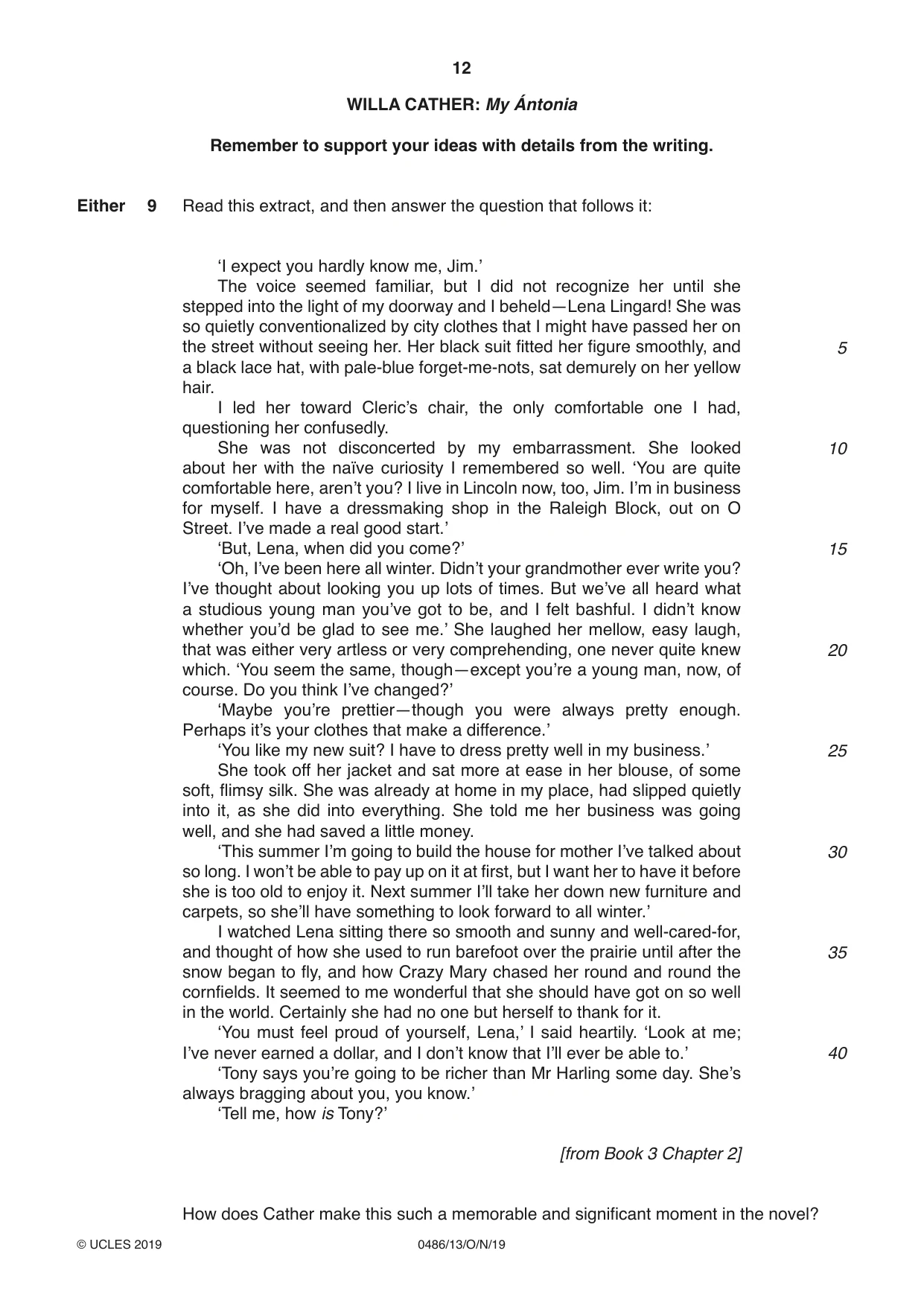
12 0486/13/O/N/19 © UCLES 2019 WILLA CATHER: My Ántonia Remember to support your ideas with details from the writing. Either 9 Read this extract, and then answer the question that follows it: ‘I expect you hardly know me, Jim.’ The voice seemed familiar, but I did not recognize her until she stepped into the light of my doorway and I beheld—Lena Lingard! She was so quietly conventionalized by city clothes that I might have passed her on the street without seeing her. Her black suit fitted her figure smoothly, and a black lace hat, with pale-blue forget-me-nots, sat demurely on her yellow hair. I led her toward Cleric’s chair, the only comfortable one I had, questioning her confusedly. She was not disconcerted by my embarrassment. She looked about her with the naïve curiosity I remembered so well. ‘You are quite comfortable here, aren’t you? I live in Lincoln now, too, Jim. I’m in business for myself. I have a dressmaking shop in the Raleigh Block, out on O Street. I’ve made a real good start.’ ‘But, Lena, when did you come?’ ‘Oh, I’ve been here all winter. Didn’t your grandmother ever write you? I’ve thought about looking you up lots of times. But we’ve all heard what a studious young man you’ve got to be, and I felt bashful. I didn’t know whether you’d be glad to see me.’ She laughed her mellow, easy laugh, that was either very artless or very comprehending, one never quite knew which. ‘You seem the same, though—except you’re a young man, now, of course. Do you think I’ve changed?’ ‘Maybe you’re prettier—though you were always pretty enough. Perhaps it’s your clothes that make a difference.’ ‘You like my new suit? I have to dress pretty well in my business.’ She took off her jacket and sat more at ease in her blouse, of some soft, flimsy silk. She was already at home in my place, had slipped quietly into it, as she did into everything. She told me her business was going well, and she had saved a little money. ‘This summer I’m going to build the house for mother I’ve talked about so long. I won’t be able to pay up on it at first, but I want her to have it before she is too old to enjoy it. Next summer I’ll take her down new furniture and carpets, so she’ll have something to look forward to all winter.’ I watched Lena sitting there so smooth and sunny and well-cared-for, and thought of how she used to run barefoot over the prairie until after the snow began to fly, and how Crazy Mary chased her round and round the cornfields. It seemed to me wonderful that she should have got on so well in the world. Certainly she had no one but herself to thank for it. ‘You must feel proud of yourself, Lena,’ I said heartily. ‘Look at me; I’ve never earned a dollar, and I don’t know that I’ll ever be able to.’ ‘Tony says you’re going to be richer than Mr Harling some day. She’s always bragging about you, you know.’ ‘Tell me, how is Tony?’ [from Book 3 Chapter 2] How does Cather make this such a memorable and significant moment in the novel? 5 10 15 20 25 30 35 40
Question paper, page 13
13 0486/13/O/N/19 © UCLES 2019 [Turn over Or 10 Explore the ways in which Cather strikingly portrays Peter and Pavel.
Question paper, page 14
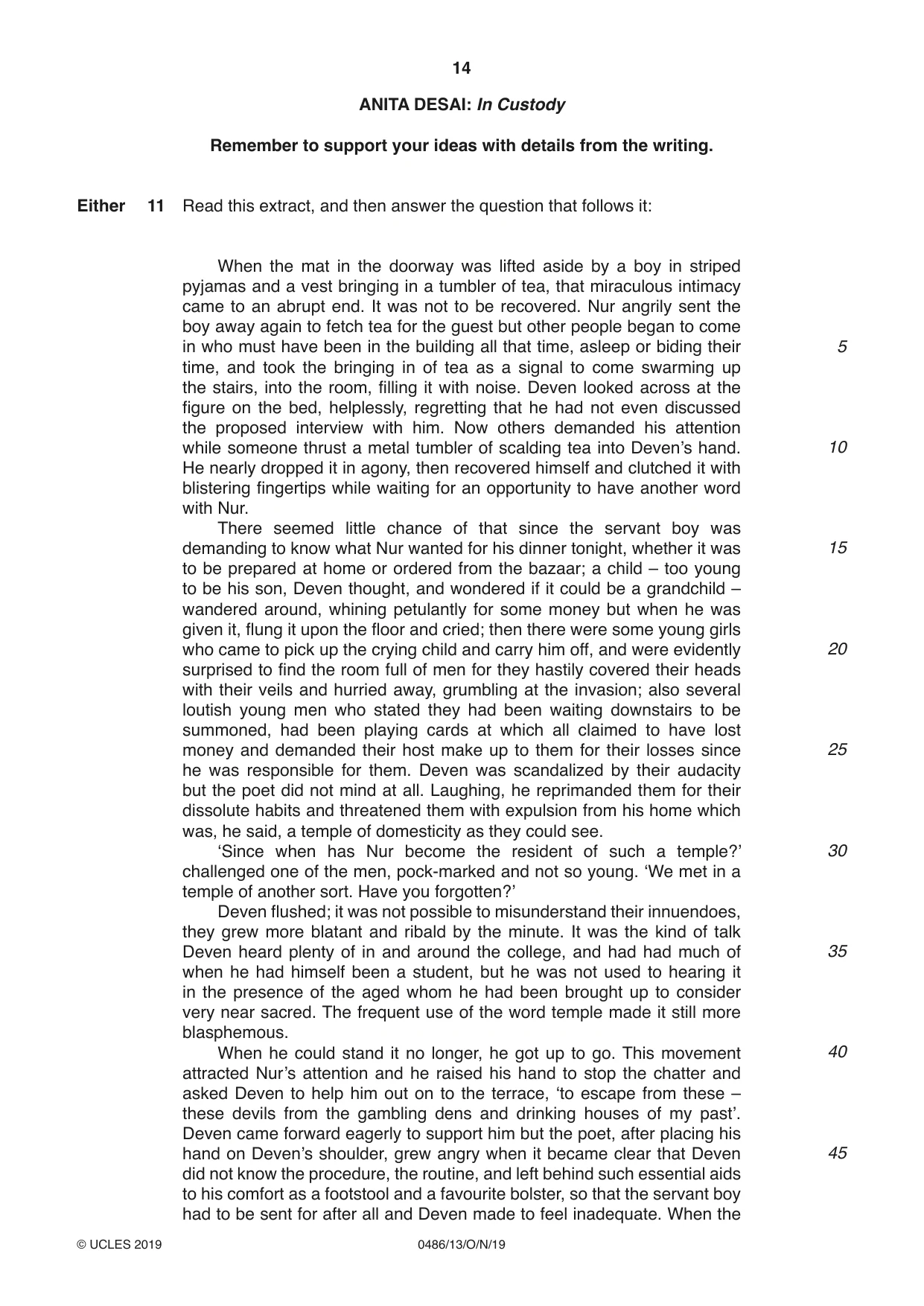
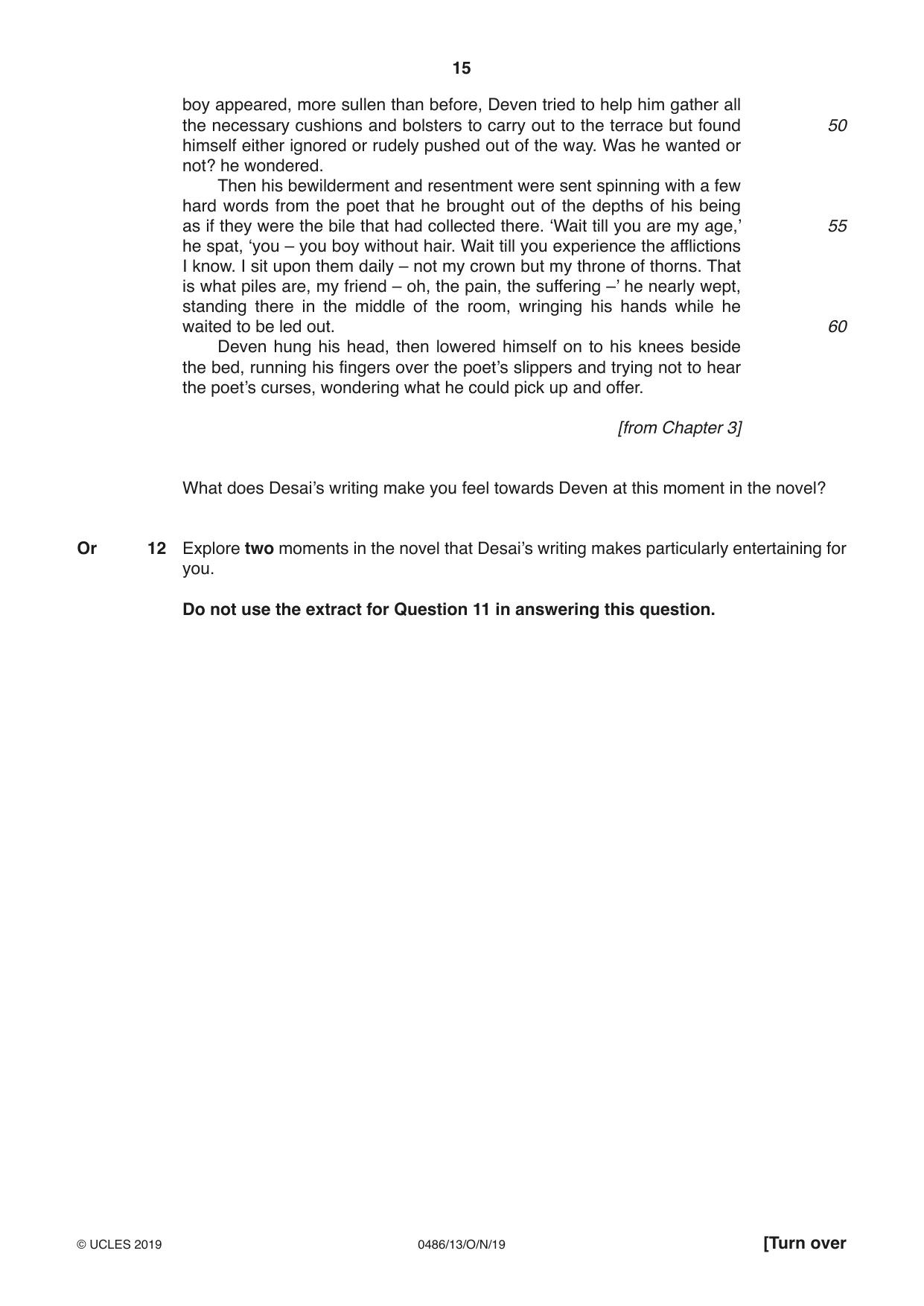
14 0486/13/O/N/19 © UCLES 2019 ANITA DESAI: In Custody Remember to support your ideas with details from the writing. Either 11 Read this extract, and then answer the question that follows it: When the mat in the doorway was lifted aside by a boy in striped pyjamas and a vest bringing in a tumbler of tea, that miraculous intimacy came to an abrupt end. It was not to be recovered. Nur angrily sent the boy away again to fetch tea for the guest but other people began to come in who must have been in the building all that time, asleep or biding their time, and took the bringing in of tea as a signal to come swarming up the stairs, into the room, filling it with noise. Deven looked across at the figure on the bed, helplessly, regretting that he had not even discussed the proposed interview with him. Now others demanded his attention while someone thrust a metal tumbler of scalding tea into Deven’s hand. He nearly dropped it in agony, then recovered himself and clutched it with blistering fingertips while waiting for an opportunity to have another word with Nur. There seemed little chance of that since the servant boy was demanding to know what Nur wanted for his dinner tonight, whether it was to be prepared at home or ordered from the bazaar; a child – too young to be his son, Deven thought, and wondered if it could be a grandchild – wandered around, whining petulantly for some money but when he was given it, flung it upon the floor and cried; then there were some young girls who came to pick up the crying child and carry him off, and were evidently surprised to find the room full of men for they hastily covered their heads with their veils and hurried away, grumbling at the invasion; also several loutish young men who stated they had been waiting downstairs to be summoned, had been playing cards at which all claimed to have lost money and demanded their host make up to them for their losses since he was responsible for them. Deven was scandalized by their audacity but the poet did not mind at all. Laughing, he reprimanded them for their dissolute habits and threatened them with expulsion from his home which was, he said, a temple of domesticity as they could see. ‘Since when has Nur become the resident of such a temple?’ challenged one of the men, pock-marked and not so young. ‘We met in a temple of another sort. Have you forgotten?’ Deven flushed; it was not possible to misunderstand their innuendoes, they grew more blatant and ribald by the minute. It was the kind of talk Deven heard plenty of in and around the college, and had had much of when he had himself been a student, but he was not used to hearing it in the presence of the aged whom he had been brought up to consider very near sacred. The frequent use of the word temple made it still more blasphemous. When he could stand it no longer, he got up to go. This movement attracted Nur’s attention and he raised his hand to stop the chatter and asked Deven to help him out on to the terrace, ‘to escape from these – these devils from the gambling dens and drinking houses of my past’. Deven came forward eagerly to support him but the poet, after placing his hand on Deven’s shoulder, grew angry when it became clear that Deven did not know the procedure, the routine, and left behind such essential aids to his comfort as a footstool and a favourite bolster, so that the servant boy had to be sent for after all and Deven made to feel inadequate. When the 5 10 15 20 25 30 35 40 45
Question paper, page 15
15 0486/13/O/N/19 © UCLES 2019 [Turn over boy appeared, more sullen than before, Deven tried to help him gather all the necessary cushions and bolsters to carry out to the terrace but found himself either ignored or rudely pushed out of the way. Was he wanted or not? he wondered. Then his bewilderment and resentment were sent spinning with a few hard words from the poet that he brought out of the depths of his being as if they were the bile that had collected there. ‘Wait till you are my age,’ he spat, ‘you – you boy without hair. Wait till you experience the afflictions I know. I sit upon them daily – not my crown but my throne of thorns. That is what piles are, my friend – oh, the pain, the suffering –’ he nearly wept, standing there in the middle of the room, wringing his hands while he waited to be led out. Deven hung his head, then lowered himself on to his knees beside the bed, running his fingers over the poet’s slippers and trying not to hear the poet’s curses, wondering what he could pick up and offer. [from Chapter 3] What does Desai’s writing make you feel towards Deven at this moment in the novel? Or 12 Explore two moments in the novel that Desai’s writing makes particularly entertaining for you. Do not use the extract for Question 11 in answering this question. 50 55 60
Question paper, page 16
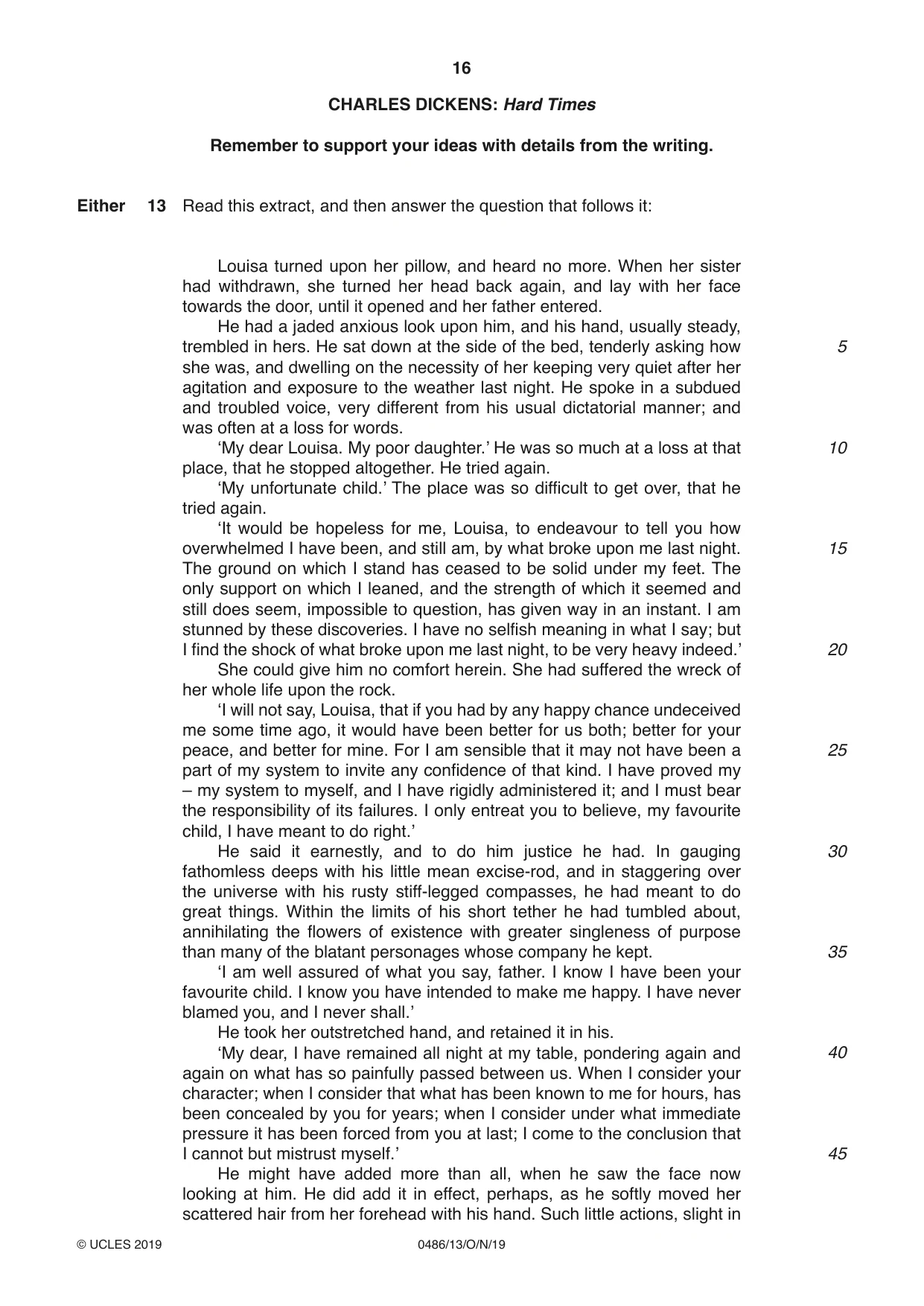
16 0486/13/O/N/19 © UCLES 2019 CHARLES DICKENS: Hard Times Remember to support your ideas with details from the writing. Either 13 Read this extract, and then answer the question that follows it: Louisa turned upon her pillow, and heard no more. When her sister had withdrawn, she turned her head back again, and lay with her face towards the door, until it opened and her father entered. He had a jaded anxious look upon him, and his hand, usually steady, trembled in hers. He sat down at the side of the bed, tenderly asking how she was, and dwelling on the necessity of her keeping very quiet after her agitation and exposure to the weather last night. He spoke in a subdued and troubled voice, very different from his usual dictatorial manner; and was often at a loss for words. ‘My dear Louisa. My poor daughter.’ He was so much at a loss at that place, that he stopped altogether. He tried again. ‘My unfortunate child.’ The place was so difficult to get over, that he tried again. ‘It would be hopeless for me, Louisa, to endeavour to tell you how overwhelmed I have been, and still am, by what broke upon me last night. The ground on which I stand has ceased to be solid under my feet. The only support on which I leaned, and the strength of which it seemed and still does seem, impossible to question, has given way in an instant. I am stunned by these discoveries. I have no selfish meaning in what I say; but I find the shock of what broke upon me last night, to be very heavy indeed.’ She could give him no comfort herein. She had suffered the wreck of her whole life upon the rock. ‘I will not say, Louisa, that if you had by any happy chance undeceived me some time ago, it would have been better for us both; better for your peace, and better for mine. For I am sensible that it may not have been a part of my system to invite any confidence of that kind. I have proved my – my system to myself, and I have rigidly administered it; and I must bear the responsibility of its failures. I only entreat you to believe, my favourite child, I have meant to do right.’ He said it earnestly, and to do him justice he had. In gauging fathomless deeps with his little mean excise-rod, and in staggering over the universe with his rusty stiff-legged compasses, he had meant to do great things. Within the limits of his short tether he had tumbled about, annihilating the flowers of existence with greater singleness of purpose than many of the blatant personages whose company he kept. ‘I am well assured of what you say, father. I know I have been your favourite child. I know you have intended to make me happy. I have never blamed you, and I never shall.’ He took her outstretched hand, and retained it in his. ‘My dear, I have remained all night at my table, pondering again and again on what has so painfully passed between us. When I consider your character; when I consider that what has been known to me for hours, has been concealed by you for years; when I consider under what immediate pressure it has been forced from you at last; I come to the conclusion that I cannot but mistrust myself.’ He might have added more than all, when he saw the face now looking at him. He did add it in effect, perhaps, as he softly moved her scattered hair from her forehead with his hand. Such little actions, slight in 5 10 15 20 25 30 35 40 45
Question paper, page 17
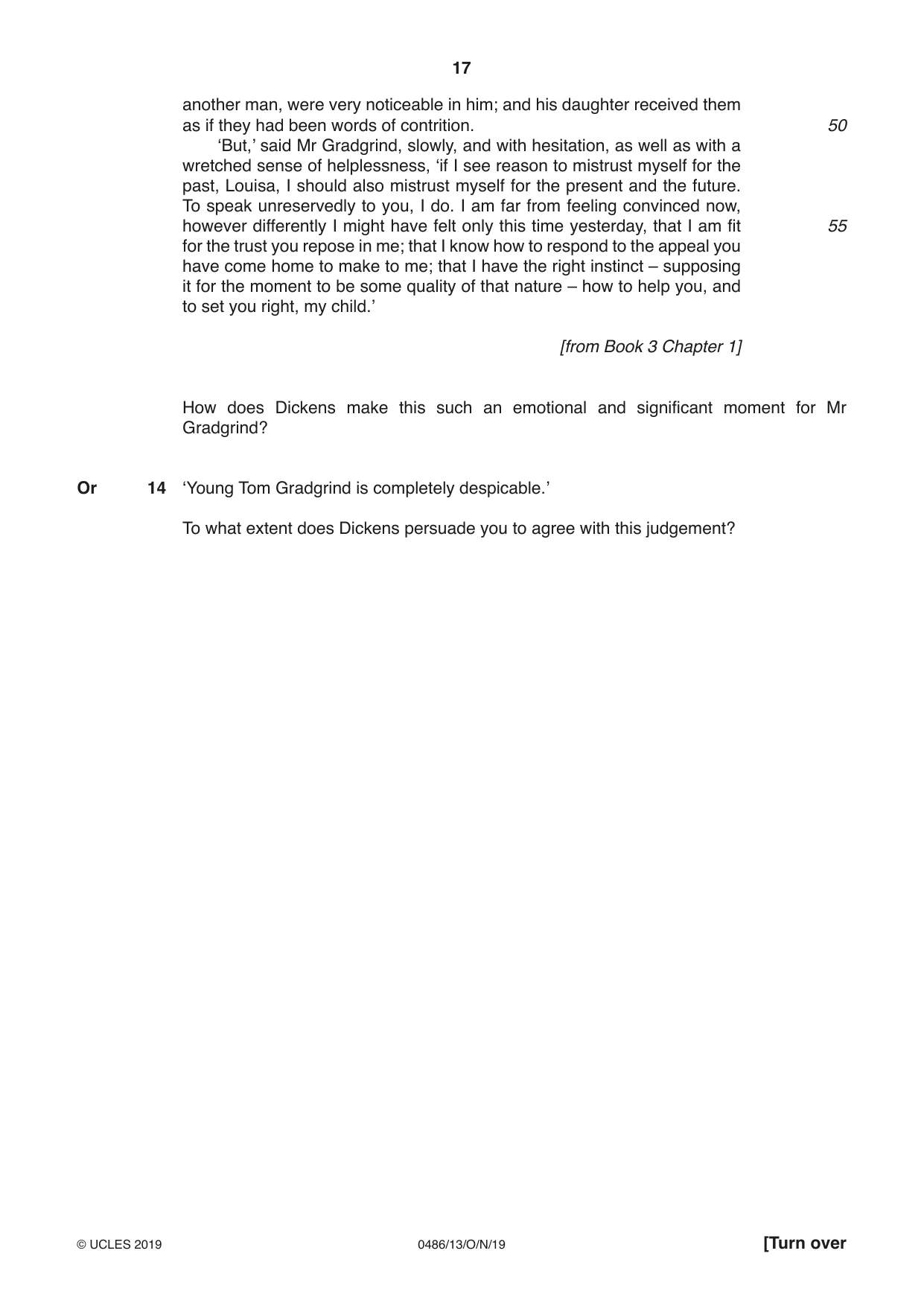
17 0486/13/O/N/19 © UCLES 2019 [Turn over another man, were very noticeable in him; and his daughter received them as if they had been words of contrition. ‘But,’ said Mr Gradgrind, slowly, and with hesitation, as well as with a wretched sense of helplessness, ‘if I see reason to mistrust myself for the past, Louisa, I should also mistrust myself for the present and the future. To speak unreservedly to you, I do. I am far from feeling convinced now, however differently I might have felt only this time yesterday, that I am fit for the trust you repose in me; that I know how to respond to the appeal you have come home to make to me; that I have the right instinct – supposing it for the moment to be some quality of that nature – how to help you, and to set you right, my child.’ [from Book 3 Chapter 1] How does Dickens make this such an emotional and significant moment for Mr Gradgrind? Or 14 ‘Young Tom Gradgrind is completely despicable.’ To what extent does Dickens persuade you to agree with this judgement? 50 55
Question paper, page 18
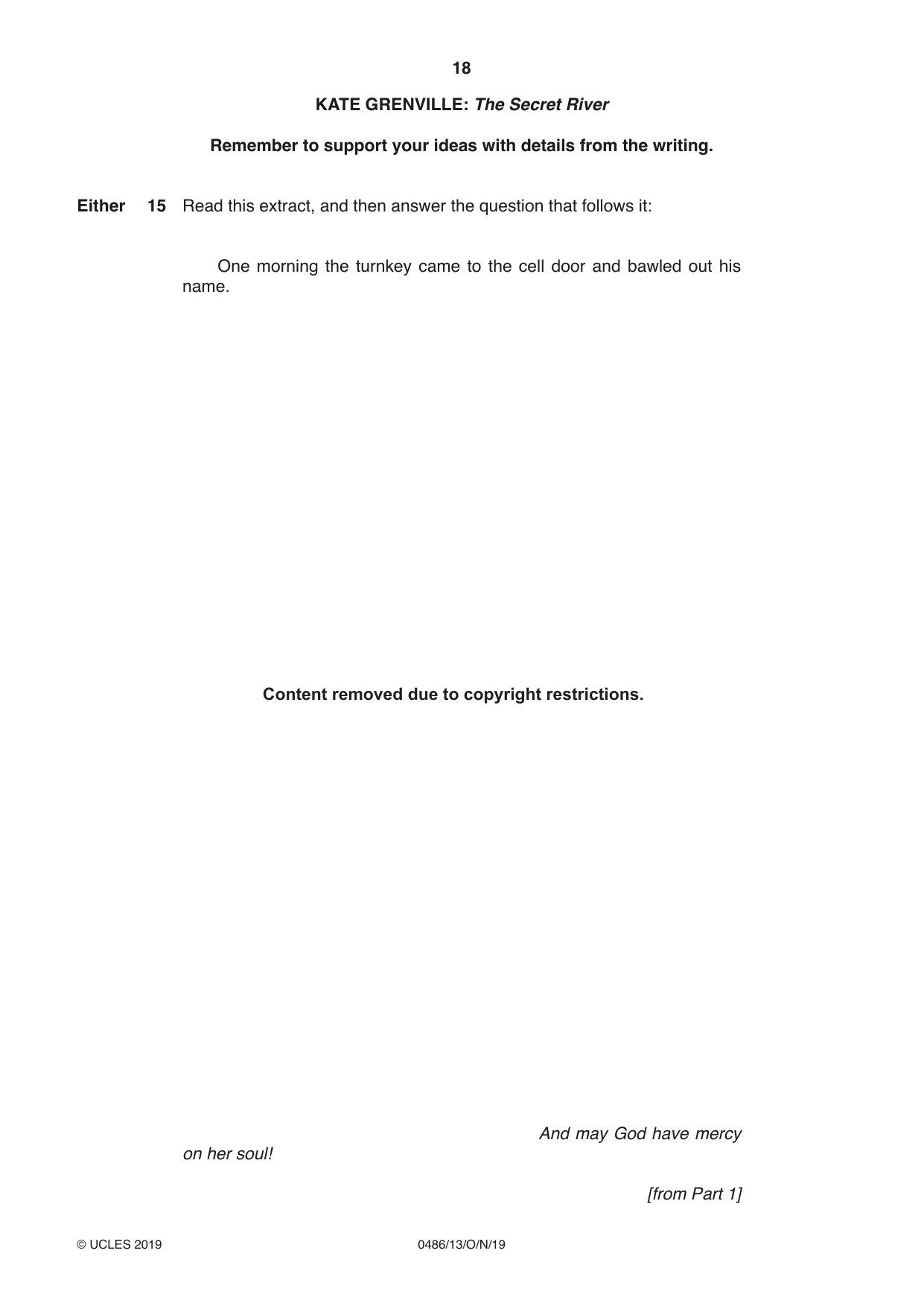
18 0486/13/O/N/19 © UCLES 2019 KATE GRENVILLE: The Secret River Remember to support your ideas with details from the writing. Either 15 Read this extract, and then answer the question that follows it: One morning the turnkey came to the cell door and bawled out his name. And may God have mercy on her soul! [from Part 1] Content removed due to copyright restrictions.
Question paper, page 19
19 0486/13/O/N/19 © UCLES 2019 [Turn over How does Grenville make this such a dramatic ending to the Thornhills’ life in London? Or 16 Explore the ways in which Grenville strikingly portrays Blackwood.
Question paper, page 20
20 0486/13/O/N/19 © UCLES 2019 JOHN KNOWLES: A Separate Peace Remember to support your ideas with details from the writing. Either 17 Read this extract, and then answer the question that follows it: ‘Everybody in this place is either a draft-dodging Kraut or a … a …’ the scornful force of his tone turned the word into a curse, ‘a nat-u-ral-ist!’ Brinker grabbed my arm agitatedly. ‘I’m giving it up, I’m going to enlist. Tomorrow.’ I felt a thrill when he said it. This was the logical climax of the whole misbegotten day, this whole out-of-joint term at Devon. I think I had been waiting for a long time for someone to say this so that I could entertain these decisive words myself. To enlist. To slam the door impulsively on the past, to shed everything down to my last bit of clothing, to break the pattern of my life—that complex design I had been weaving since birth with all its dark threads, its unexplainable symbols set against a conventional background of domestic white and schoolboy blue, all those tangled strands which required the dexterity of a virtuoso to keep flowing—I yearned to take giant military shears to it, snap! bitten off in an instant, and nothing left in my hands but spools of khaki which could weave only a plain, flat, khaki design, however twisted they might be. Not that it would be a good life. The war would be deadly all right. But I was used to finding something deadly in things that attracted me; there was always something deadly lurking in anything I wanted, anything I loved. And if it wasn’t there, as for example with Phineas, then I put it there myself. But in the war, there was no question about it at all; it was there. I separated from Brinker in the quadrangle, since one of his clubs was meeting and he could not go back to the dormitory yet—‘I’ve got to preside at a meeting of the Golden Fleece Debating Society tonight,’ he said in a tone of amazed contempt, ‘the Golden Fleece Debating Society! We’re mad here, all mad,’ and he went off raving to himself in the dark. It was a night made for hard thoughts. Sharp stars pierced singly through the blackness, not sweeps of them or clusters or Milky Ways as there might have been in the South, but single, chilled points of light, as unromantic as knife blades. Devon, muffled under the gentle occupation of the snow, was dominated by them; the cold Yankee stars ruled this night. They did not invoke in me thoughts of God, or sailing before the mast, or some great love as crowded night skies at home had done; I thought instead, in the light of those cold points, of the decision facing me. Why go through the motions of getting an education and watch the war slowly chip away at the one thing I had loved here, the peace, the measureless, careless peace of the Devon summer? Others, the Quackenbushes of this world, could calmly watch the war approach them and jump into it at the last and most advantageous instant, as though buying into the stock market. But I couldn’t. There was no one to stop me but myself. Putting aside soft reservations about What I Owed Devon and my duty to my parents and so on, I reckoned my responsibilities by the light of the unsentimental night sky and knew that I owed no one anything. I owed it to myself to meet this crisis in my life when I chose, and I chose now. 5 10 15 20 25 30 35 40 45
Question paper, page 21
21 0486/13/O/N/19 © UCLES 2019 [Turn over I bounced zestfully up the dormitory stairs. Perhaps because my mind still retained the image of the sharp night stars, those few fixed points of light in the darkness, perhaps because of that the warm yellow light streaming from under my own door came as such a shock. It was a simple case of a change of expectation. The light should have been off. Instead, as though alive itself, it poured in a thin yellow slab of brightness from under the door, illuminating the dust and splinters of the hall floor. I grabbed the knob and swung open the door. He was seated in my chair at the desk, bending down to adjust the gross encumbrance of his leg, so that only the familiar ears set close against his head were visible, and his short-cut brown hair. He looked up with a provocative grin, ‘Hi pal, where’s the brass band?’ Everything that had happened throughout the day faded like that first false snowfall of the winter. Phineas was back. [from Chapter 7] How does Knowles vividly convey Gene’s thoughts and feelings at this moment in the novel? Or 18 In what ways does Knowles strikingly portray the changes in Finny after his first fall? 50 55 60
Question paper, page 22
22 0486/13/O/N/19 © UCLES 2019 ALAN PATON: Cry, the Beloved Country Remember to support your ideas with details from the writing. Either 19 Read this extract, and then answer the question that follows it: He passed again through the great gate in the grim high wall, and they brought the boy to him. Again he took the lifeless hand in his own, and was again moved to tears, this time by the dejection of his son. – Are you in health, my son? The son stood and moved his head to one side, and looked for a while at the one window, and then moved and looked at the other, but not at his father. – I am in health, my father. – I have some business for you, my son. Are you certain that you wish to marry this girl? – I can marry her. – There is a friend of mine, a white priest, and he will see if it can be arranged, and he will see the Bishop to see if it can be done quickly. And he will get a lawyer for you. There is a spark of life in the eyes, of some hope maybe. – You would like a lawyer? – They say one can be helped by a lawyer. – You told the police that these other two were with you? – I told them. And now I have told them again. – And then? – And then they sent for them and fetched them from their cells. – And then? – And then they were angry with me, and cursed me in front of the police, and said that I was trying to bring them into trouble. – And then? – And then they asked what proof I had. And the only proof I had was that it was true, it was these two and no other and they stood there with me in the house, I here and they yonder. He showed his father with his hands, and the tears came into his eyes, and he said, Then they cursed me again, and stood looking angrily at me, and said one to the other, How can he lie so about us? – They were your friends? – Yes, they were my friends. – And they will leave you to suffer alone? – Now I see it. – And until this, were they friends you could trust? – I could trust them. – I see what you mean. You mean they were the kind of friends that a good man could choose, upright, hard-working, obeying the law? Old man, leave him alone. You lead him so far and then you spring upon him. He looks at you sullenly, soon he will not answer at all. – Tell me, were they such friends? But the boy made no answer. – And now they leave you alone? Silence, then – I see it. – Did you not see it before? Reluctantly the boy said, I saw it. The old man was tempted to ask, then why, why did you continue with them? But the boy’s eyes were filled 5 10 15 20 25 30 35 40 45
Question paper, page 23
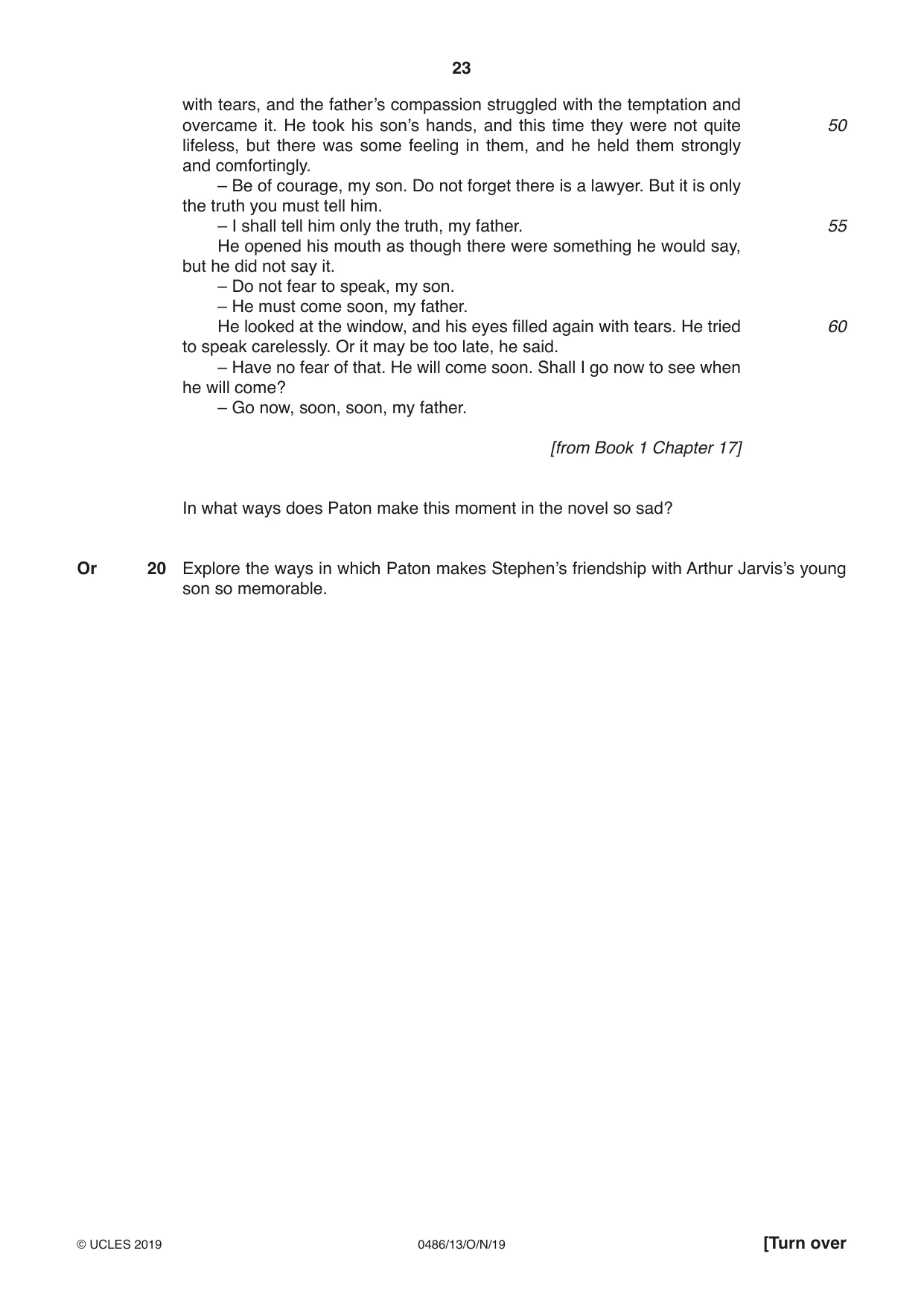
23 0486/13/O/N/19 © UCLES 2019 [Turn over with tears, and the father’s compassion struggled with the temptation and overcame it. He took his son’s hands, and this time they were not quite lifeless, but there was some feeling in them, and he held them strongly and comfortingly. – Be of courage, my son. Do not forget there is a lawyer. But it is only the truth you must tell him. – I shall tell him only the truth, my father. He opened his mouth as though there were something he would say, but he did not say it. – Do not fear to speak, my son. – He must come soon, my father. He looked at the window, and his eyes filled again with tears. He tried to speak carelessly. Or it may be too late, he said. – Have no fear of that. He will come soon. Shall I go now to see when he will come? – Go now, soon, soon, my father. [from Book 1 Chapter 17] In what ways does Paton make this moment in the novel so sad? Or 20 Explore the ways in which Paton makes Stephen’s friendship with Arthur Jarvis’s young son so memorable. 50 55 60
Question paper, page 24
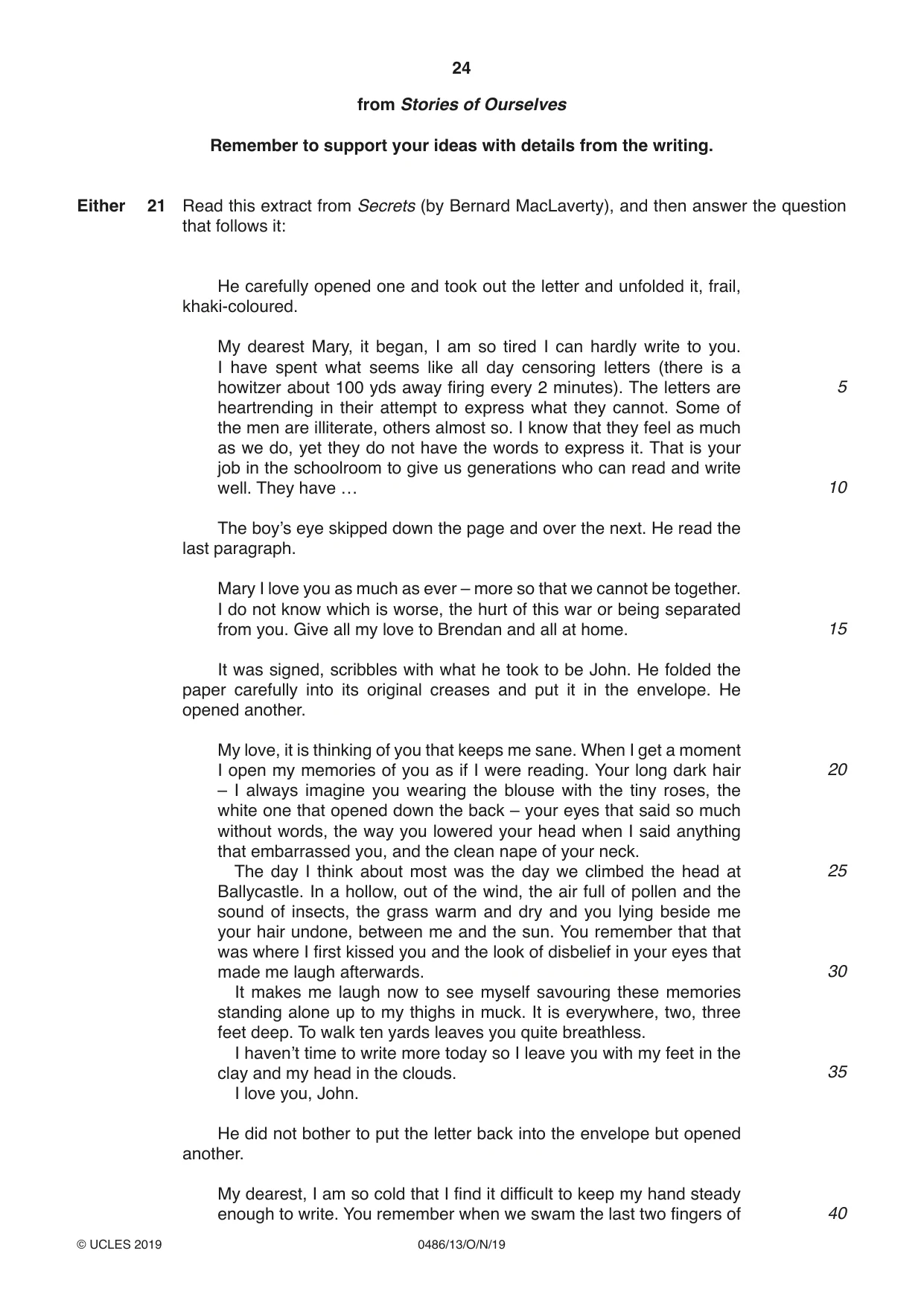
24 0486/13/O/N/19 © UCLES 2019 from Stories of Ourselves Remember to support your ideas with details from the writing. Either 21 Read this extract from Secrets (by Bernard MacLaverty), and then answer the question that follows it: He carefully opened one and took out the letter and unfolded it, frail, khaki-coloured. My dearest Mary, it began, I am so tired I can hardly write to you. I have spent what seems like all day censoring letters (there is a howitzer about 100 yds away firing every 2 minutes). The letters are heartrending in their attempt to express what they cannot. Some of the men are illiterate, others almost so. I know that they feel as much as we do, yet they do not have the words to express it. That is your job in the schoolroom to give us generations who can read and write well. They have … The boy’s eye skipped down the page and over the next. He read the last paragraph. Mary I love you as much as ever – more so that we cannot be together. I do not know which is worse, the hurt of this war or being separated from you. Give all my love to Brendan and all at home. It was signed, scribbles with what he took to be John. He folded the paper carefully into its original creases and put it in the envelope. He opened another. My love, it is thinking of you that keeps me sane. When I get a moment I open my memories of you as if I were reading. Your long dark hair – I always imagine you wearing the blouse with the tiny roses, the white one that opened down the back – your eyes that said so much without words, the way you lowered your head when I said anything that embarrassed you, and the clean nape of your neck. The day I think about most was the day we climbed the head at Ballycastle. In a hollow, out of the wind, the air full of pollen and the sound of insects, the grass warm and dry and you lying beside me your hair undone, between me and the sun. You remember that that was where I first kissed you and the look of disbelief in your eyes that made me laugh afterwards. It makes me laugh now to see myself savouring these memories standing alone up to my thighs in muck. It is everywhere, two, three feet deep. To walk ten yards leaves you quite breathless. I haven’t time to write more today so I leave you with my feet in the clay and my head in the clouds. I love you, John. He did not bother to put the letter back into the envelope but opened another. My dearest, I am so cold that I find it difficult to keep my hand steady enough to write. You remember when we swam the last two fingers of 5 10 15 20 25 30 35 40
Question paper, page 25
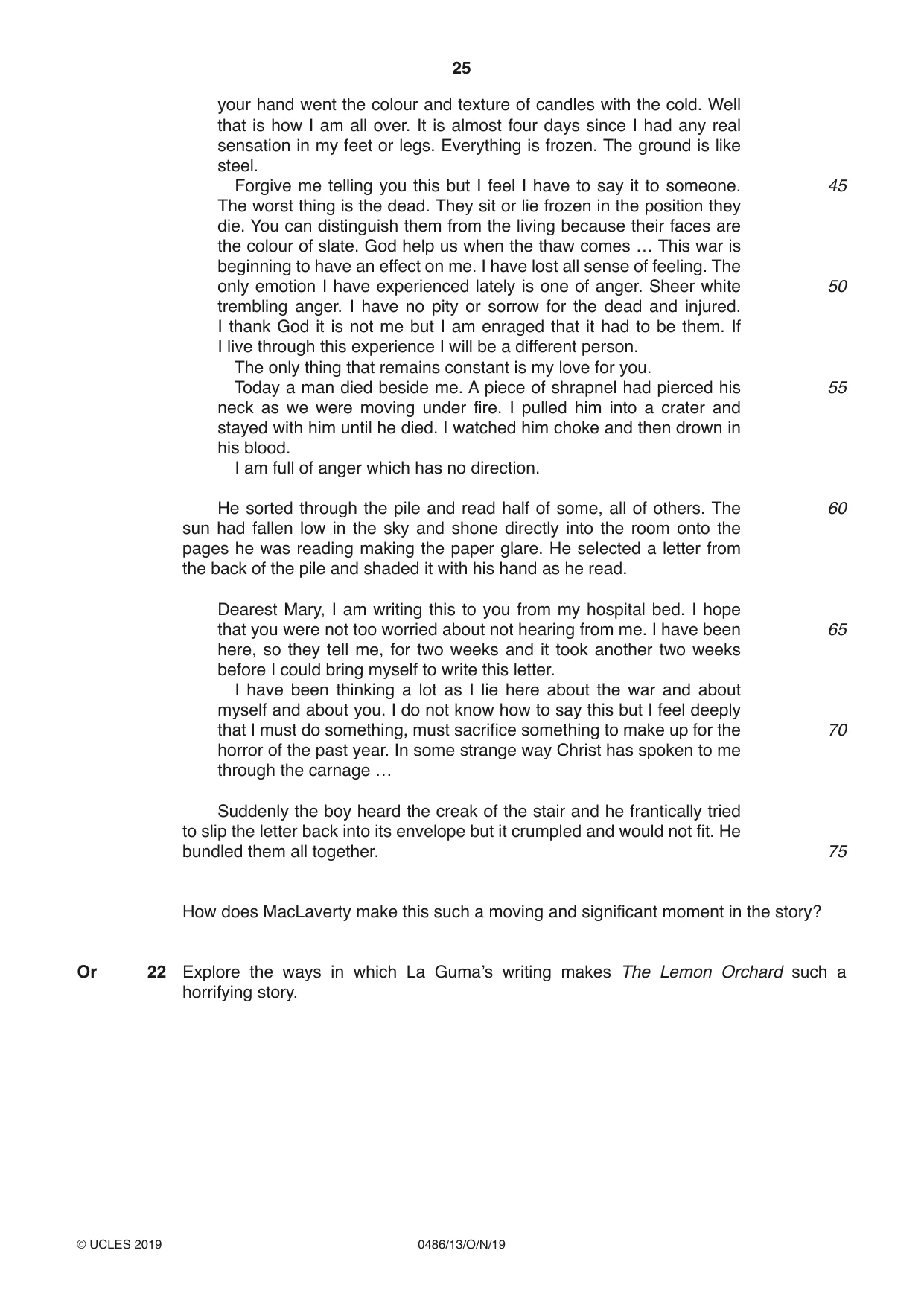
25 0486/13/O/N/19 © UCLES 2019 your hand went the colour and texture of candles with the cold. Well that is how I am all over. It is almost four days since I had any real sensation in my feet or legs. Everything is frozen. The ground is like steel. Forgive me telling you this but I feel I have to say it to someone. The worst thing is the dead. They sit or lie frozen in the position they die. You can distinguish them from the living because their faces are the colour of slate. God help us when the thaw comes … This war is beginning to have an effect on me. I have lost all sense of feeling. The only emotion I have experienced lately is one of anger. Sheer white trembling anger. I have no pity or sorrow for the dead and injured. I thank God it is not me but I am enraged that it had to be them. If I live through this experience I will be a different person. The only thing that remains constant is my love for you. Today a man died beside me. A piece of shrapnel had pierced his neck as we were moving under fire. I pulled him into a crater and stayed with him until he died. I watched him choke and then drown in his blood. I am full of anger which has no direction. He sorted through the pile and read half of some, all of others. The sun had fallen low in the sky and shone directly into the room onto the pages he was reading making the paper glare. He selected a letter from the back of the pile and shaded it with his hand as he read. Dearest Mary, I am writing this to you from my hospital bed. I hope that you were not too worried about not hearing from me. I have been here, so they tell me, for two weeks and it took another two weeks before I could bring myself to write this letter. I have been thinking a lot as I lie here about the war and about myself and about you. I do not know how to say this but I feel deeply that I must do something, must sacrifice something to make up for the horror of the past year. In some strange way Christ has spoken to me through the carnage … Suddenly the boy heard the creak of the stair and he frantically tried to slip the letter back into its envelope but it crumpled and would not fit. He bundled them all together. How does MacLaverty make this such a moving and significant moment in the story? Or 22 Explore the ways in which La Guma’s writing makes The Lemon Orchard such a horrifying story. 45 50 55 60 65 70 75
Question paper, page 26
26 0486/13/O/N/19 © UCLES 2019 BLANK PAGE
Question paper, page 27
27 0486/13/O/N/19 © UCLES 2019 BLANK PAGE
Question paper, page 28
28 0486/13/O/N/19 © UCLES 2019 BLANK PAGE Permission to reproduce items where third-party owned material protected by copyright is included has been sought and cleared where possible. Every reasonable effort has been made by the publisher (UCLES) to trace copyright holders, but if any items requiring clearance have unwittingly been included, the publisher will be pleased to make amends at the earliest possible opportunity. To avoid the issue of disclosure of answer-related information to candidates, all copyright acknowledgements are reproduced online in the Cambridge Assessment International Education Copyright Acknowledgements Booklet. This is produced for each series of examinations and is freely available to download at www.cambridgeinternational.org after the live examination series. Cambridge Assessment International Education is part of the Cambridge Assessment Group. Cambridge Assessment is the brand name of the University of Cambridge Local Examinations Syndicate (UCLES), which itself is a department of the University of Cambridge.
Mark scheme, page 1
This document consists of 4 printed pages. © UCLES 2019 [Turn over Cambridge Assessment International Education Cambridge International General Certificate of Secondary Education LITERATURE (ENGLISH) 0486/13 Paper 1 Poetry and Prose October/November 2019 MARK SCHEME Maximum Mark: 50 Published This mark scheme is published as an aid to teachers and candidates, to indicate the requirements of the examination. It shows the basis on which Examiners were instructed to award marks. It does not indicate the details of the discussions that took place at an Examiners’ meeting before marking began, which would have considered the acceptability of alternative answers. Mark schemes should be read in conjunction with the question paper and the Principal Examiner Report for Teachers. Cambridge International will not enter into discussions about these mark schemes. Cambridge International is publishing the mark schemes for the October/November 2019 series for most Cambridge IGCSE™, Cambridge International A and AS Level components and some Cambridge O Level components.
Mark scheme, page 2
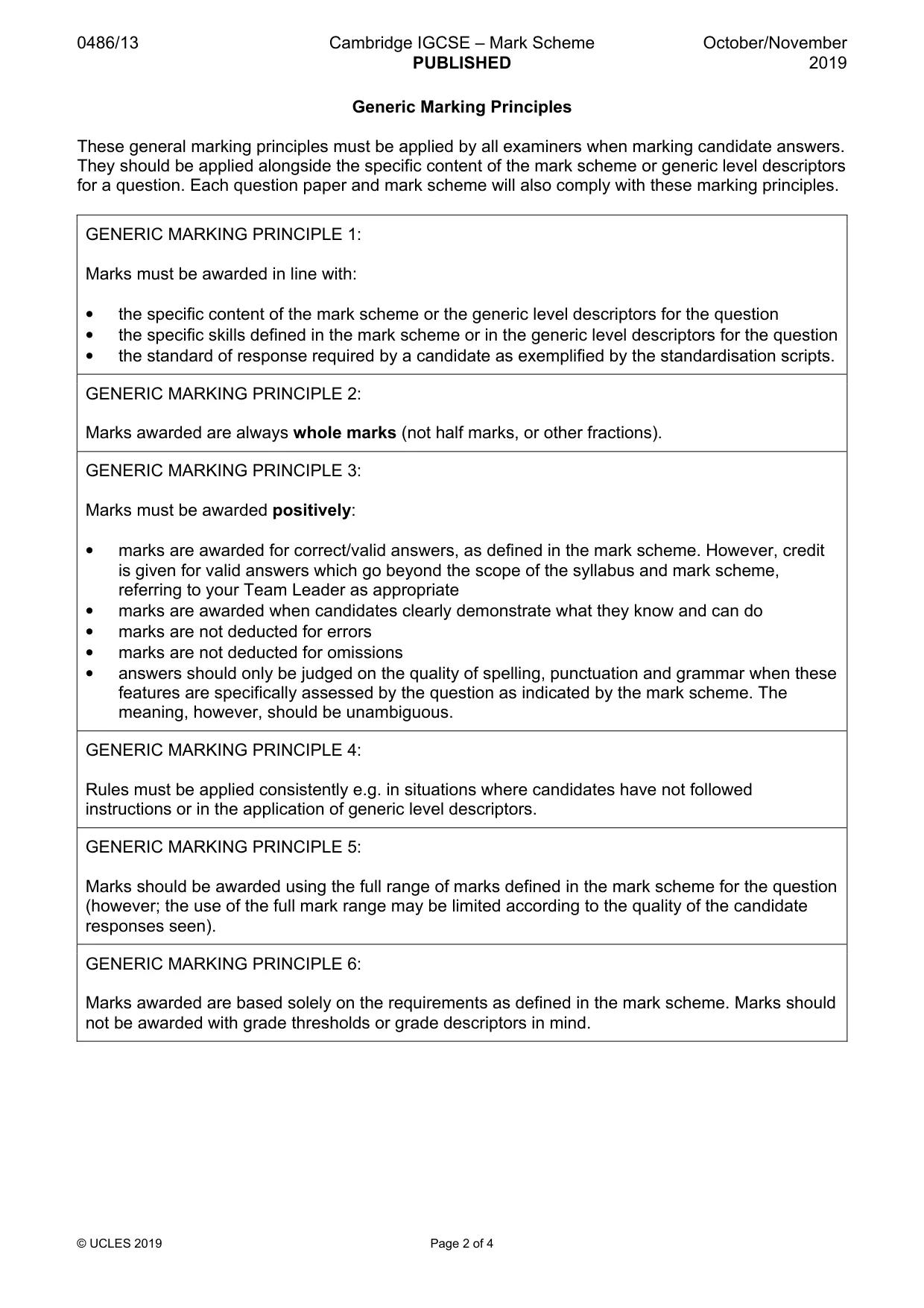
0486/13 Cambridge IGCSE – Mark Scheme PUBLISHED October/November 2019 © UCLES 2019 Page 2 of 4 Generic Marking Principles These general marking principles must be applied by all examiners when marking candidate answers. They should be applied alongside the specific content of the mark scheme or generic level descriptors for a question. Each question paper and mark scheme will also comply with these marking principles. GENERIC MARKING PRINCIPLE 1: Marks must be awarded in line with: • the specific content of the mark scheme or the generic level descriptors for the question • the specific skills defined in the mark scheme or in the generic level descriptors for the question • the standard of response required by a candidate as exemplified by the standardisation scripts. GENERIC MARKING PRINCIPLE 2: Marks awarded are always whole marks (not half marks, or other fractions). GENERIC MARKING PRINCIPLE 3: Marks must be awarded positively: • marks are awarded for correct/valid answers, as defined in the mark scheme. However, credit is given for valid answers which go beyond the scope of the syllabus and mark scheme, referring to your Team Leader as appropriate • marks are awarded when candidates clearly demonstrate what they know and can do • marks are not deducted for errors • marks are not deducted for omissions • answers should only be judged on the quality of spelling, punctuation and grammar when these features are specifically assessed by the question as indicated by the mark scheme. The meaning, however, should be unambiguous. GENERIC MARKING PRINCIPLE 4: Rules must be applied consistently e.g. in situations where candidates have not followed instructions or in the application of generic level descriptors. GENERIC MARKING PRINCIPLE 5: Marks should be awarded using the full range of marks defined in the mark scheme for the question (however; the use of the full mark range may be limited according to the quality of the candidate responses seen). GENERIC MARKING PRINCIPLE 6: Marks awarded are based solely on the requirements as defined in the mark scheme. Marks should not be awarded with grade thresholds or grade descriptors in mind.
Mark scheme, page 3
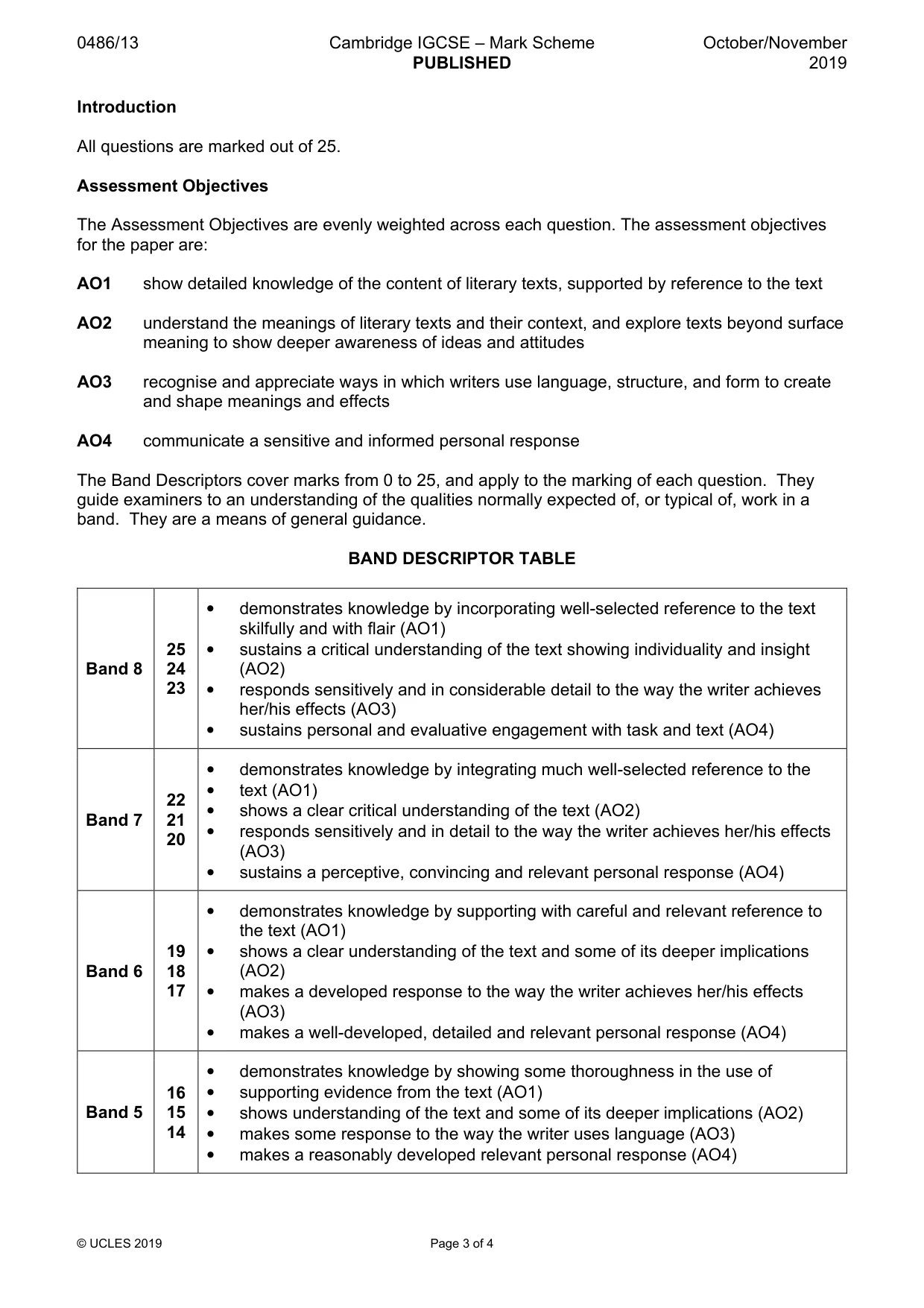
0486/13 Cambridge IGCSE – Mark Scheme PUBLISHED October/November 2019 © UCLES 2019 Page 3 of 4 Introduction All questions are marked out of 25. Assessment Objectives The Assessment Objectives are evenly weighted across each question. The assessment objectives for the paper are: AO1 show detailed knowledge of the content of literary texts, supported by reference to the text AO2 understand the meanings of literary texts and their context, and explore texts beyond surface meaning to show deeper awareness of ideas and attitudes AO3 recognise and appreciate ways in which writers use language, structure, and form to create and shape meanings and effects AO4 communicate a sensitive and informed personal response The Band Descriptors cover marks from 0 to 25, and apply to the marking of each question. They guide examiners to an understanding of the qualities normally expected of, or typical of, work in a band. They are a means of general guidance. BAND DESCRIPTOR TABLE Band 8 25 24 23 • demonstrates knowledge by incorporating well-selected reference to the text skilfully and with flair (AO1) • sustains a critical understanding of the text showing individuality and insight (AO2) • responds sensitively and in considerable detail to the way the writer achieves her/his effects (AO3) • sustains personal and evaluative engagement with task and text (AO4) Band 7 22 21 20 • demonstrates knowledge by integrating much well-selected reference to the • text (AO1) • shows a clear critical understanding of the text (AO2) • responds sensitively and in detail to the way the writer achieves her/his effects (AO3) • sustains a perceptive, convincing and relevant personal response (AO4) Band 6 19 18 17 • demonstrates knowledge by supporting with careful and relevant reference to the text (AO1) • shows a clear understanding of the text and some of its deeper implications (AO2) • makes a developed response to the way the writer achieves her/his effects (AO3) • makes a well-developed, detailed and relevant personal response (AO4) Band 5 16 15 14 • demonstrates knowledge by showing some thoroughness in the use of • supporting evidence from the text (AO1) • shows understanding of the text and some of its deeper implications (AO2) • makes some response to the way the writer uses language (AO3) • makes a reasonably developed relevant personal response (AO4)
Mark scheme, page 4
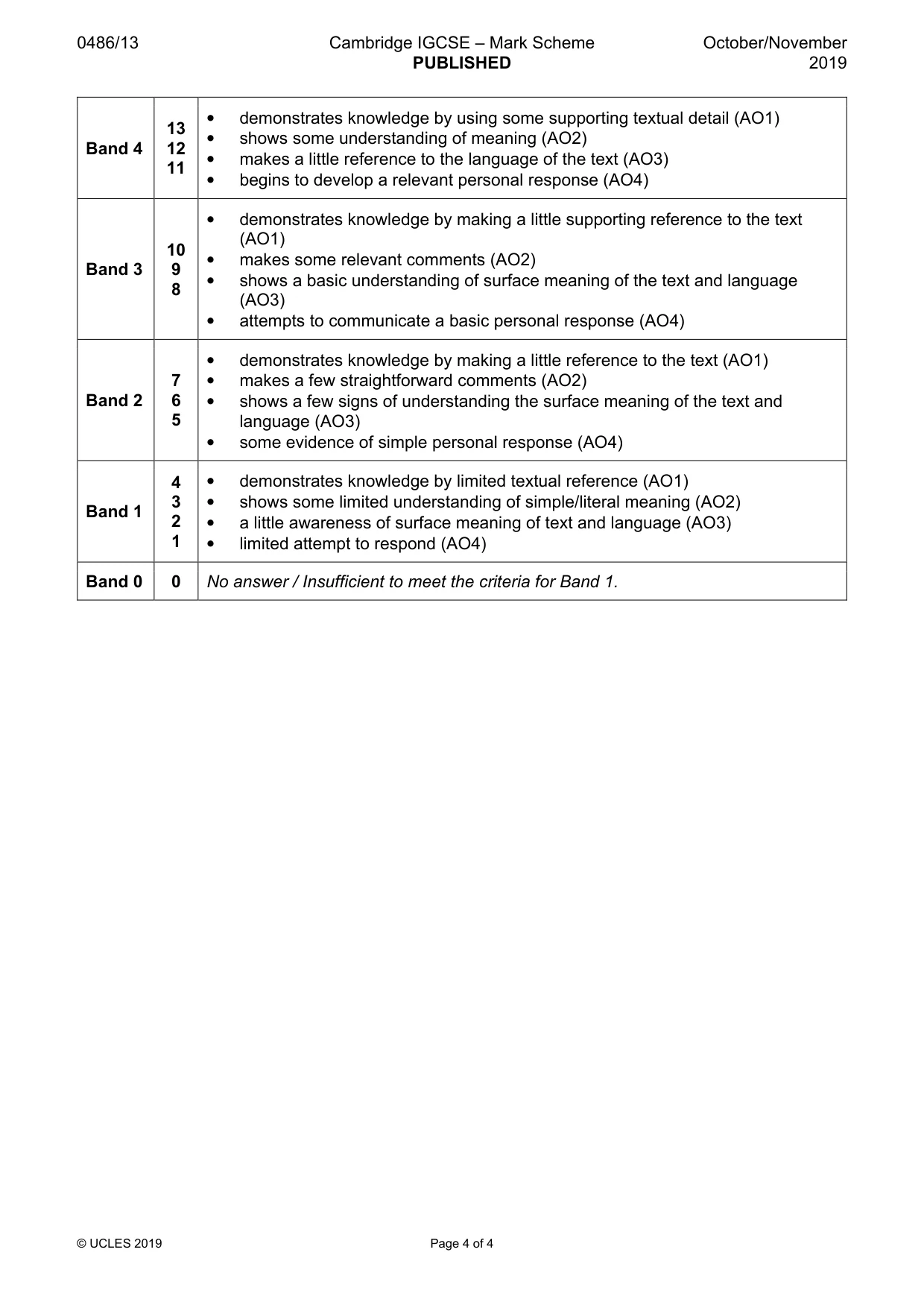
0486/13 Cambridge IGCSE – Mark Scheme PUBLISHED October/November 2019 © UCLES 2019 Page 4 of 4 Band 4 13 12 11 • demonstrates knowledge by using some supporting textual detail (AO1) • shows some understanding of meaning (AO2) • makes a little reference to the language of the text (AO3) • begins to develop a relevant personal response (AO4) Band 3 10 9 8 • demonstrates knowledge by making a little supporting reference to the text (AO1) • makes some relevant comments (AO2) • shows a basic understanding of surface meaning of the text and language (AO3) • attempts to communicate a basic personal response (AO4) Band 2 7 6 5 • demonstrates knowledge by making a little reference to the text (AO1) • makes a few straightforward comments (AO2) • shows a few signs of understanding the surface meaning of the text and language (AO3) • some evidence of simple personal response (AO4) Band 1 4 3 2 1 • demonstrates knowledge by limited textual reference (AO1) • shows some limited understanding of simple/literal meaning (AO2) • a little awareness of surface meaning of text and language (AO3) • limited attempt to respond (AO4) Band 0 0 No answer / Insufficient to meet the criteria for Band 1.
What you needed in this session
Cambridge’s own grade thresholds for 2019 Oct/Nov, Paper 1 · Variant 3. A higher threshold means an easier paper — the bar moves with how the cohort did.