Cambridge IGCSE English - Literature 0486 — 2010 Oct/Nov Paper 3 · Variant 3
0486/33/O/N/10 · 25 marks · ≈28 min
The question paper and its mark scheme, free to read here and free to download. This is Cambridge’s own paper, exactly as it was sat.
Question paper8 pages



Mark scheme9 pages
Answers below. Sit the paper first if you are practising.
Paper as text
Question paper, page 1
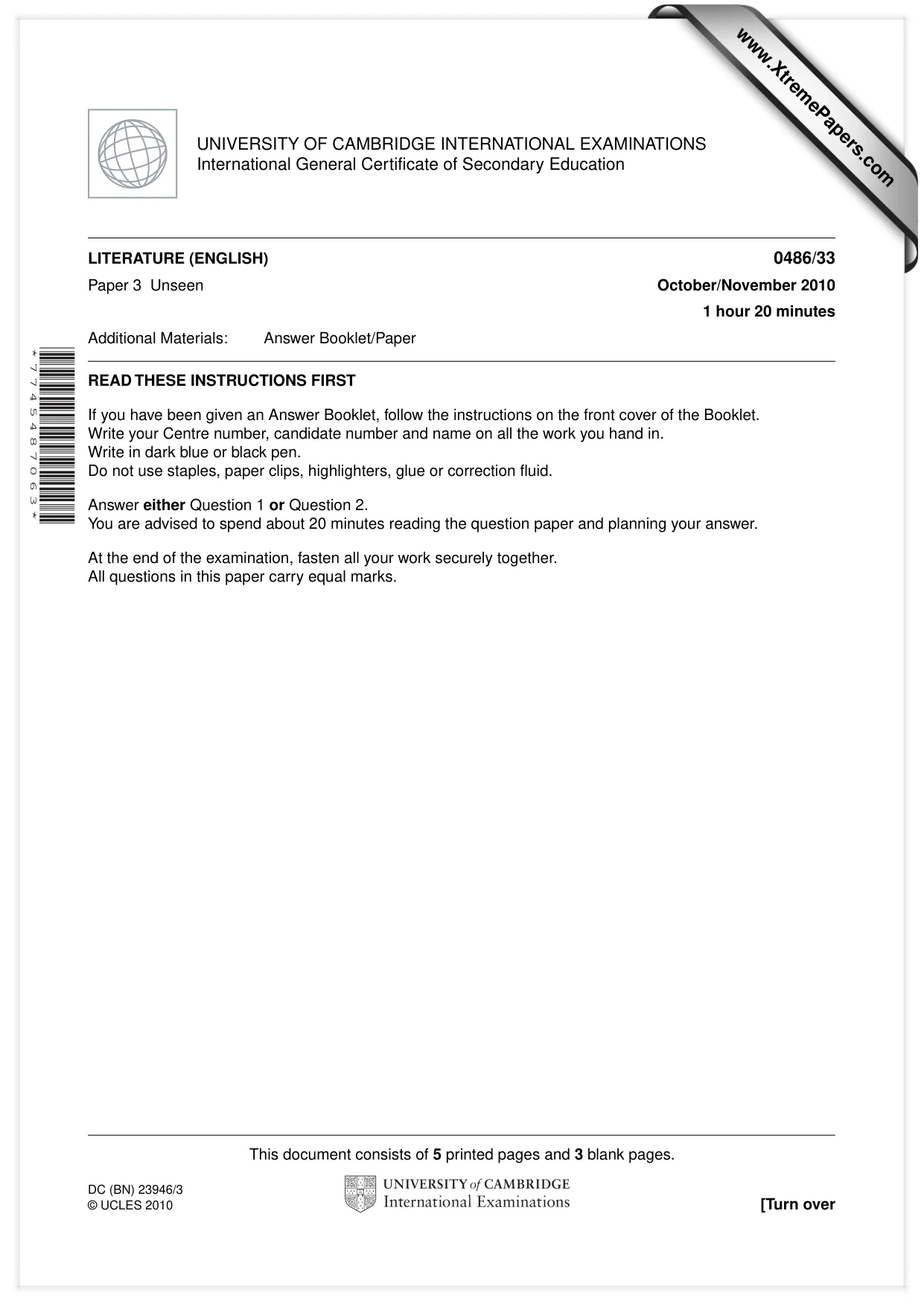
This document consists of 5 printed pages and 3 blank pages. DC (BN) 23946/3 © UCLES 2010 [Turn over UNIVERSITY OF CAMBRIDGE INTERNATIONAL EXAMINATIONS International General Certificate of Secondary Education * 7 7 4 5 4 8 7 0 6 3 * LITERATURE (ENGLISH) 0486/33 Paper 3 Unseen October/November 2010 1 hour 20 minutes Additional Materials: Answer Booklet/Paper READ THESE INSTRUCTIONS FIRST If you have been given an Answer Booklet, follow the instructions on the front cover of the Booklet. Write your Centre number, candidate number and name on all the work you hand in. Write in dark blue or black pen. Do not use staples, paper clips, highlighters, glue or correction fluid. Answer either Question 1 or Question 2. You are advised to spend about 20 minutes reading the question paper and planning your answer. At the end of the examination, fasten all your work securely together. All questions in this paper carry equal marks. www.XtremePapers.com
Question paper, page 2
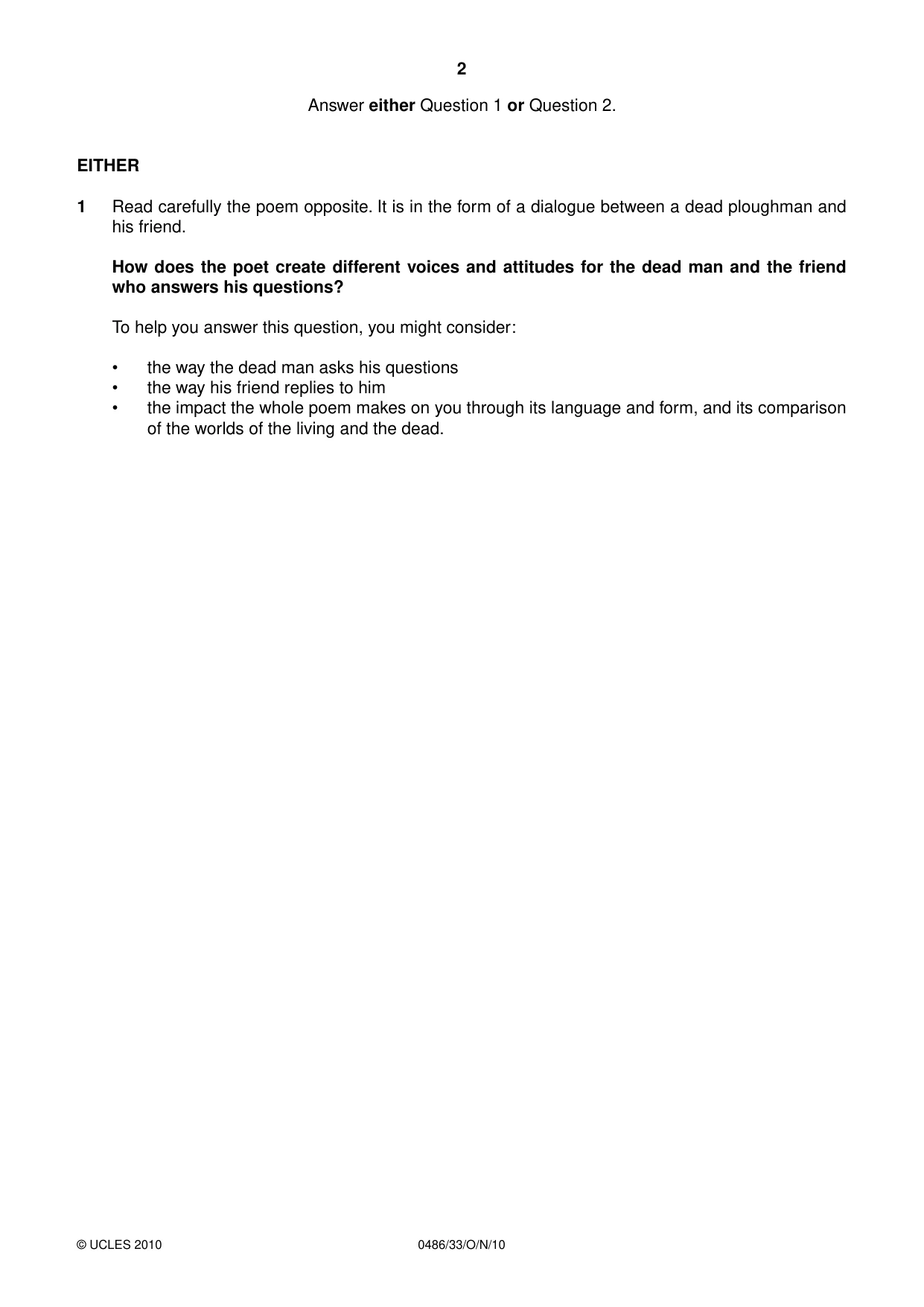
2 0486/33/O/N/10 © UCLES 2010 Answer either Question 1 or Question 2. EITHER 1 Read carefully the poem opposite. It is in the form of a dialogue between a dead ploughman and his friend. How does the poet create different voices and attitudes for the dead man and the friend who answers his questions? To help you answer this question, you might consider: • the way the dead man asks his questions • the way his friend replies to him • the impact the whole poem makes on you through its language and form, and its comparison of the worlds of the living and the dead.
Question paper, page 3
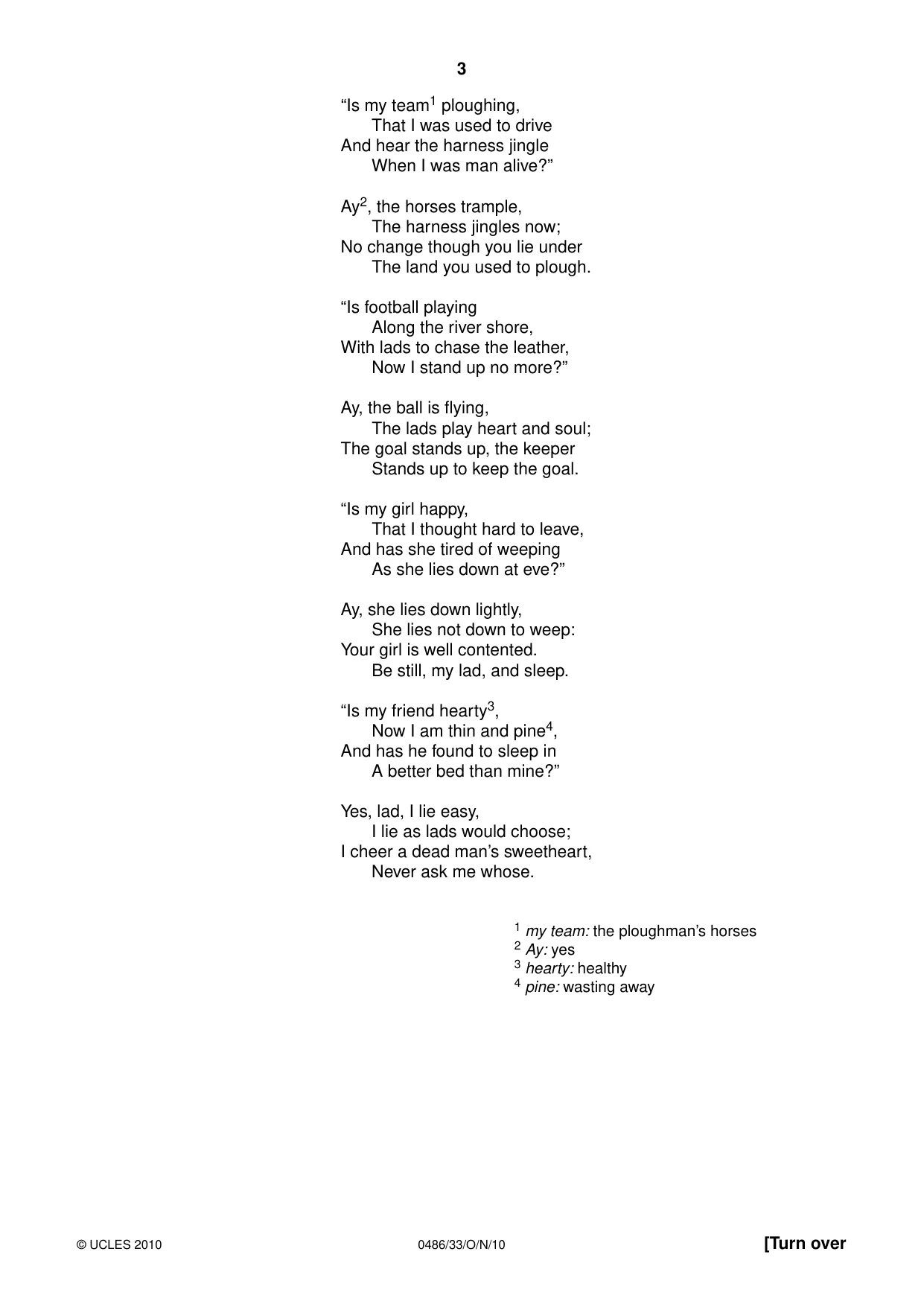
3 0486/33/O/N/10 © UCLES 2010 [Turn over “Is my team1 ploughing, That I was used to drive And hear the harness jingle When I was man alive?” Ay2, the horses trample, The harness jingles now; No change though you lie under The land you used to plough. “Is football playing Along the river shore, With lads to chase the leather, Now I stand up no more?” Ay, the ball is flying, The lads play heart and soul; The goal stands up, the keeper Stands up to keep the goal. “Is my girl happy, That I thought hard to leave, And has she tired of weeping As she lies down at eve?” Ay, she lies down lightly, She lies not down to weep: Your girl is well contented. Be still, my lad, and sleep. “Is my friend hearty3, Now I am thin and pine4, And has he found to sleep in A better bed than mine?” Yes, lad, I lie easy, I lie as lads would choose; I cheer a dead man’s sweetheart, Never ask me whose. 1 my team: the ploughman’s horses 2 Ay: yes 3 hearty: healthy 4 pine: wasting away
Question paper, page 4
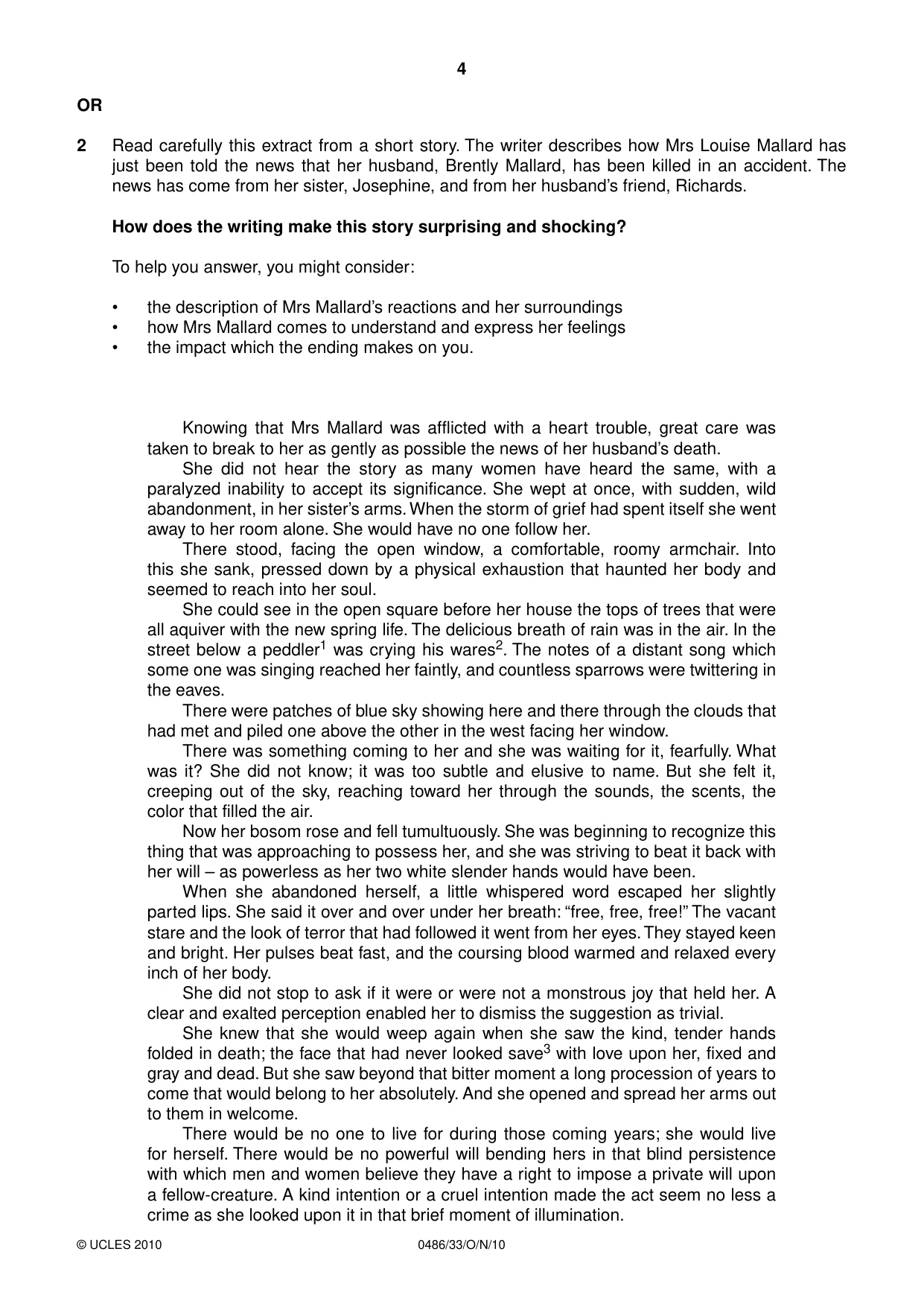
4 0486/33/O/N/10 © UCLES 2010 OR 2 Read carefully this extract from a short story. The writer describes how Mrs Louise Mallard has just been told the news that her husband, Brently Mallard, has been killed in an accident. The news has come from her sister, Josephine, and from her husband’s friend, Richards. How does the writing make this story surprising and shocking? To help you answer, you might consider: • the description of Mrs Mallard’s reactions and her surroundings • how Mrs Mallard comes to understand and express her feelings • the impact which the ending makes on you. Knowing that Mrs Mallard was afflicted with a heart trouble, great care was taken to break to her as gently as possible the news of her husband’s death. She did not hear the story as many women have heard the same, with a paralyzed inability to accept its significance. She wept at once, with sudden, wild abandonment, in her sister’s arms. When the storm of grief had spent itself she went away to her room alone. She would have no one follow her. There stood, facing the open window, a comfortable, roomy armchair. Into this she sank, pressed down by a physical exhaustion that haunted her body and seemed to reach into her soul. She could see in the open square before her house the tops of trees that were all aquiver with the new spring life. The delicious breath of rain was in the air. In the street below a peddler1 was crying his wares2. The notes of a distant song which some one was singing reached her faintly, and countless sparrows were twittering in the eaves. There were patches of blue sky showing here and there through the clouds that had met and piled one above the other in the west facing her window. There was something coming to her and she was waiting for it, fearfully. What was it? She did not know; it was too subtle and elusive to name. But she felt it, creeping out of the sky, reaching toward her through the sounds, the scents, the color that filled the air. Now her bosom rose and fell tumultuously. She was beginning to recognize this thing that was approaching to possess her, and she was striving to beat it back with her will – as powerless as her two white slender hands would have been. When she abandoned herself, a little whispered word escaped her slightly parted lips. She said it over and over under her breath: “free, free, free!” The vacant stare and the look of terror that had followed it went from her eyes. They stayed keen and bright. Her pulses beat fast, and the coursing blood warmed and relaxed every inch of her body. She did not stop to ask if it were or were not a monstrous joy that held her. A clear and exalted perception enabled her to dismiss the suggestion as trivial. She knew that she would weep again when she saw the kind, tender hands folded in death; the face that had never looked save3 with love upon her, fixed and gray and dead. But she saw beyond that bitter moment a long procession of years to come that would belong to her absolutely. And she opened and spread her arms out to them in welcome. There would be no one to live for during those coming years; she would live for herself. There would be no powerful will bending hers in that blind persistence with which men and women believe they have a right to impose a private will upon a fellow-creature. A kind intention or a cruel intention made the act seem no less a crime as she looked upon it in that brief moment of illumination.
Question paper, page 5
5 0486/33/O/N/10 © UCLES 2010 And yet she had loved him – sometimes. Often she had not. What did it matter! What could love, the unsolved mystery, count for in the face of this possession of self-assertion which she suddenly recognized as the strongest impulse of her being! “Free! Body and soul free!” she kept whispering. Josephine was kneeling before the closed door with her lips to the keyhole, imploring for admission. “Louise, open the door! I beg; open the door – you will make yourself ill. What are you doing, Louise? For heaven’s sake open the door.” “Go away. I am not making myself ill.” No; she was drinking in a very elixir4 of life through that open window. How fancy5 was running riot along those days ahead of her. Spring days, and summer days, and all sorts of days that would be her own. She breathed a quick prayer that life might be long. It was only yesterday that she had thought with a shudder that life might be long. She arose at length and opened the door to her sister’s importunities6. There was a feverish triumph in her eyes, and she carried herself unwittingly like a goddess of Victory. She clasped her sister’s waist and together they descended the stairs. Richards stood waiting for them at the bottom. Some one was opening the front door with a latch key. It was Brently Mallard who entered, a little travel-stained, composedly carrying his grip-sack7 and umbrella. He had been far from the scene of accident, and did not even know that there had been one. He stood amazed at Josephine’s piercing cry; at Richards’ quick motion to screen him from the view of his wife. But Richards was too late. When the doctors came they said she had died of heart disease – of joy that kills. 1 peddler: a street-seller 2 crying his wares: advertising his products 3 save: except 4 elixir: medicine 5 fancy: imagination 6 importunities: urgent requests 7 grip-sack: bag, briefcase
Question paper, page 6
6 0486/33/O/N/10 © UCLES 2010 BLANK PAGE
Question paper, page 7
7 0486/33/O/N/10 © UCLES 2010 BLANK PAGE
Question paper, page 8
8 0486/33/O/N/10 © UCLES 2010 Permission to reproduce items where third-party owned material protected by copyright is included has been sought and cleared where possible. Every reasonable effort has been made by the publisher (UCLES) to trace copyright holders, but if any items requiring clearance have unwittingly been included, the publisher will be pleased to make amends at the earliest possible opportunity. University of Cambridge International Examinations is part of the Cambridge Assessment Group. Cambridge Assessment is the brand name of University of Cambridge Local Examinations Syndicate (UCLES), which is itself a department of the University of Cambridge. BLANK PAGE
Mark scheme, page 1
UNIVERSITY OF CAMBRIDGE INTERNATIONAL EXAMINATIONS International General Certificate of Secondary Education MARK SCHEME for the October/November 2010 question paper for the guidance of teachers 0486 LITERATURE (ENGLISH) 0486/33 Paper 3 (Unseen), maximum raw mark 25 This mark scheme is published as an aid to teachers and candidates, to indicate the requirements of the examination. It shows the basis on which Examiners were instructed to award marks. It does not indicate the details of the discussions that took place at an Examiners’ meeting before marking began, which would have considered the acceptability of alternative answers. Mark schemes must be read in conjunction with the question papers and the report on the examination. • CIE will not enter into discussions or correspondence in connection with these mark schemes. CIE is publishing the mark schemes for the October/November 2010 question papers for most IGCSE, GCE Advanced Level and Advanced Subsidiary Level syllabuses and some Ordinary Level syllabuses. www.XtremePapers.com
Mark scheme, page 2
Page 2 Mark Scheme: Teachers’ version Syllabus Paper IGCSE – October/November 2010 0486 33 © UCLES 2010 All questions on this paper are marked out of 25. The Assessment Objectives for the paper are: AO1 show detailed knowledge of the content of literary texts AO2 understand the meanings of literary texts and their context, and explore texts beyond surface meaning to show deeper awareness of ideas and attitudes AO3 recognise and appreciate ways in which writers use language, structure, and form to create and shape meanings and effects AO4 communicate a sensitive and informed personal response The General Descriptors cover marks 0 to 25, and apply to the marking of each question. They guide examiners to an understanding of the qualities normally expected of, or typical of, work in a band. They are a means of general guidance, and must not be interpreted as hurdle statements. For the purposes of standardisation of marking, they are to be used in conjunction with photostats of candidates’ work produced in the examination and discussed during the examiners’ coordination meeting, as well as the question-specific notes. The notes for each question are related to the assessment objectives above. Because of the nature of the subject, these notes are for general guidance; they are not designed as prescriptions of required content and must not be treated as such.
Mark scheme, page 3
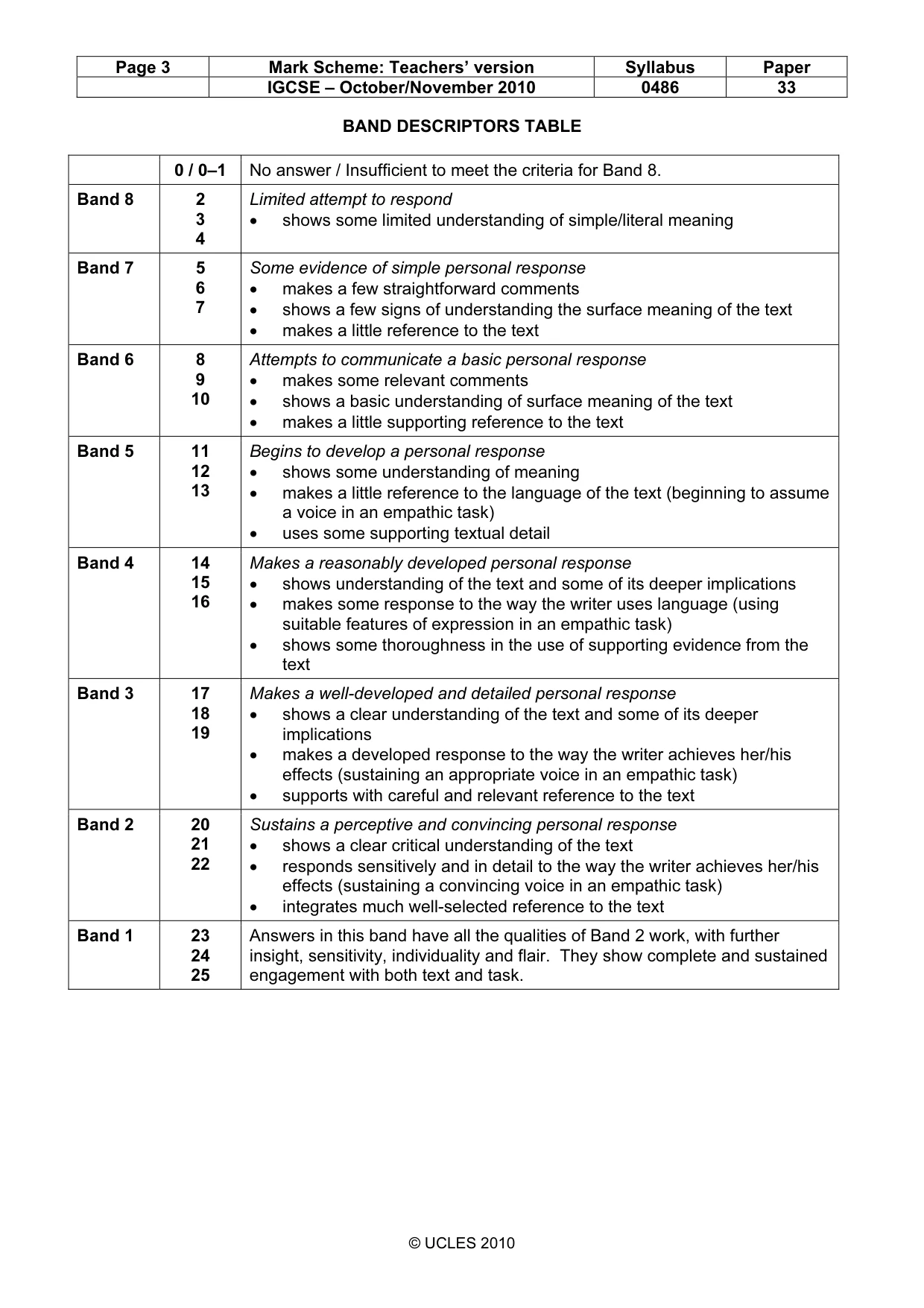
Page 3 Mark Scheme: Teachers’ version Syllabus Paper IGCSE – October/November 2010 0486 33 © UCLES 2010 BAND DESCRIPTORS TABLE 0 / 0–1 No answer / Insufficient to meet the criteria for Band 8. Band 8 2 3 4 Limited attempt to respond • shows some limited understanding of simple/literal meaning Band 7 5 6 7 Some evidence of simple personal response • makes a few straightforward comments • shows a few signs of understanding the surface meaning of the text • makes a little reference to the text Band 6 8 9 10 Attempts to communicate a basic personal response • makes some relevant comments • shows a basic understanding of surface meaning of the text • makes a little supporting reference to the text Band 5 11 12 13 Begins to develop a personal response • shows some understanding of meaning • makes a little reference to the language of the text (beginning to assume a voice in an empathic task) • uses some supporting textual detail Band 4 14 15 16 Makes a reasonably developed personal response • shows understanding of the text and some of its deeper implications • makes some response to the way the writer uses language (using suitable features of expression in an empathic task) • shows some thoroughness in the use of supporting evidence from the text Band 3 17 18 19 Makes a well-developed and detailed personal response • shows a clear understanding of the text and some of its deeper implications • makes a developed response to the way the writer achieves her/his effects (sustaining an appropriate voice in an empathic task) • supports with careful and relevant reference to the text Band 2 20 21 22 Sustains a perceptive and convincing personal response • shows a clear critical understanding of the text • responds sensitively and in detail to the way the writer achieves her/his effects (sustaining a convincing voice in an empathic task) • integrates much well-selected reference to the text Band 1 23 24 25 Answers in this band have all the qualities of Band 2 work, with further insight, sensitivity, individuality and flair. They show complete and sustained engagement with both text and task.
Mark scheme, page 4
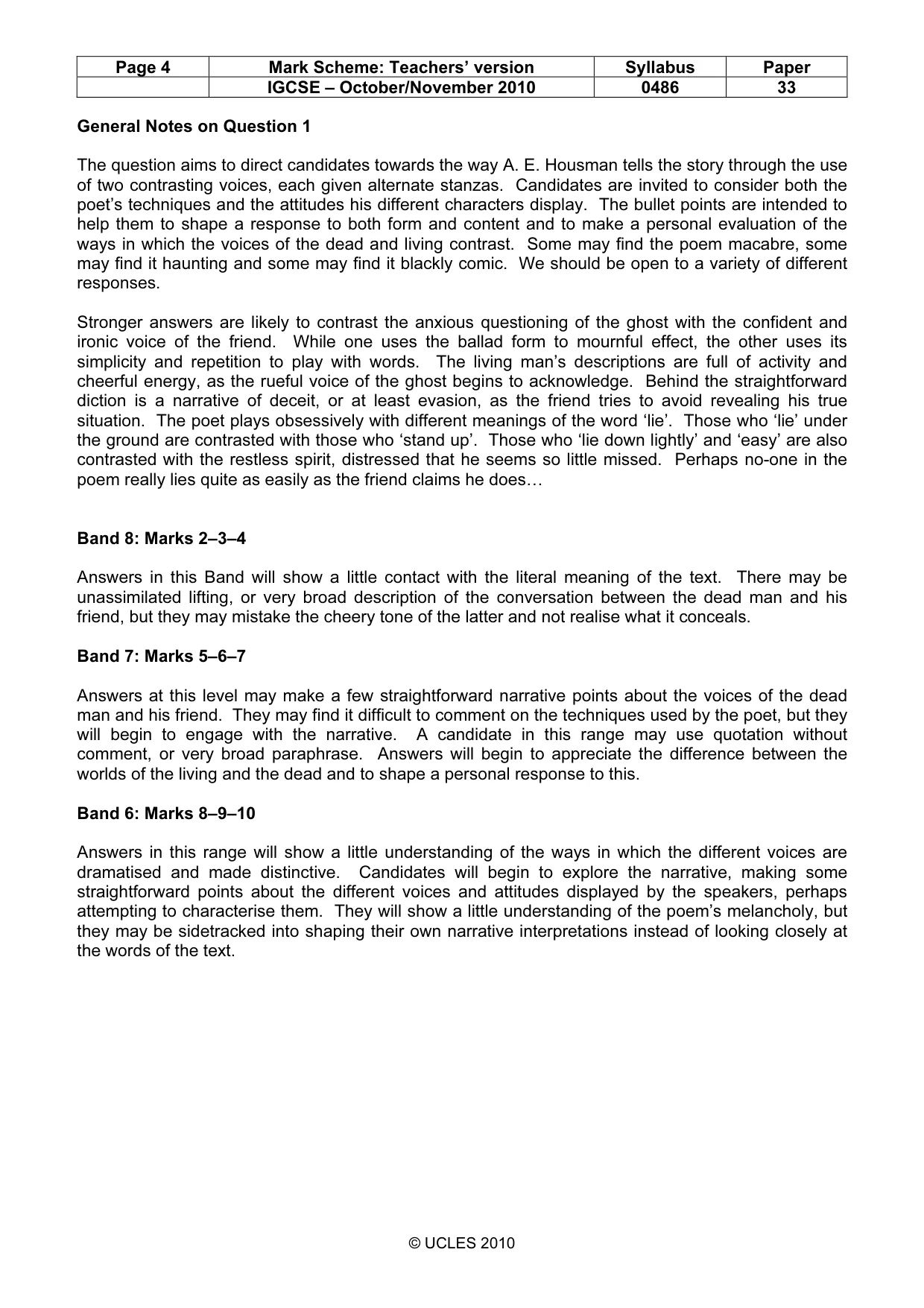
Page 4 Mark Scheme: Teachers’ version Syllabus Paper IGCSE – October/November 2010 0486 33 © UCLES 2010 General Notes on Question 1 The question aims to direct candidates towards the way A. E. Housman tells the story through the use of two contrasting voices, each given alternate stanzas. Candidates are invited to consider both the poet’s techniques and the attitudes his different characters display. The bullet points are intended to help them to shape a response to both form and content and to make a personal evaluation of the ways in which the voices of the dead and living contrast. Some may find the poem macabre, some may find it haunting and some may find it blackly comic. We should be open to a variety of different responses. Stronger answers are likely to contrast the anxious questioning of the ghost with the confident and ironic voice of the friend. While one uses the ballad form to mournful effect, the other uses its simplicity and repetition to play with words. The living man’s descriptions are full of activity and cheerful energy, as the rueful voice of the ghost begins to acknowledge. Behind the straightforward diction is a narrative of deceit, or at least evasion, as the friend tries to avoid revealing his true situation. The poet plays obsessively with different meanings of the word ‘lie’. Those who ‘lie’ under the ground are contrasted with those who ‘stand up’. Those who ‘lie down lightly’ and ‘easy’ are also contrasted with the restless spirit, distressed that he seems so little missed. Perhaps no-one in the poem really lies quite as easily as the friend claims he does… Band 8: Marks 2–3–4 Answers in this Band will show a little contact with the literal meaning of the text. There may be unassimilated lifting, or very broad description of the conversation between the dead man and his friend, but they may mistake the cheery tone of the latter and not realise what it conceals. Band 7: Marks 5–6–7 Answers at this level may make a few straightforward narrative points about the voices of the dead man and his friend. They may find it difficult to comment on the techniques used by the poet, but they will begin to engage with the narrative. A candidate in this range may use quotation without comment, or very broad paraphrase. Answers will begin to appreciate the difference between the worlds of the living and the dead and to shape a personal response to this. Band 6: Marks 8–9–10 Answers in this range will show a little understanding of the ways in which the different voices are dramatised and made distinctive. Candidates will begin to explore the narrative, making some straightforward points about the different voices and attitudes displayed by the speakers, perhaps attempting to characterise them. They will show a little understanding of the poem’s melancholy, but they may be sidetracked into shaping their own narrative interpretations instead of looking closely at the words of the text.
Mark scheme, page 5
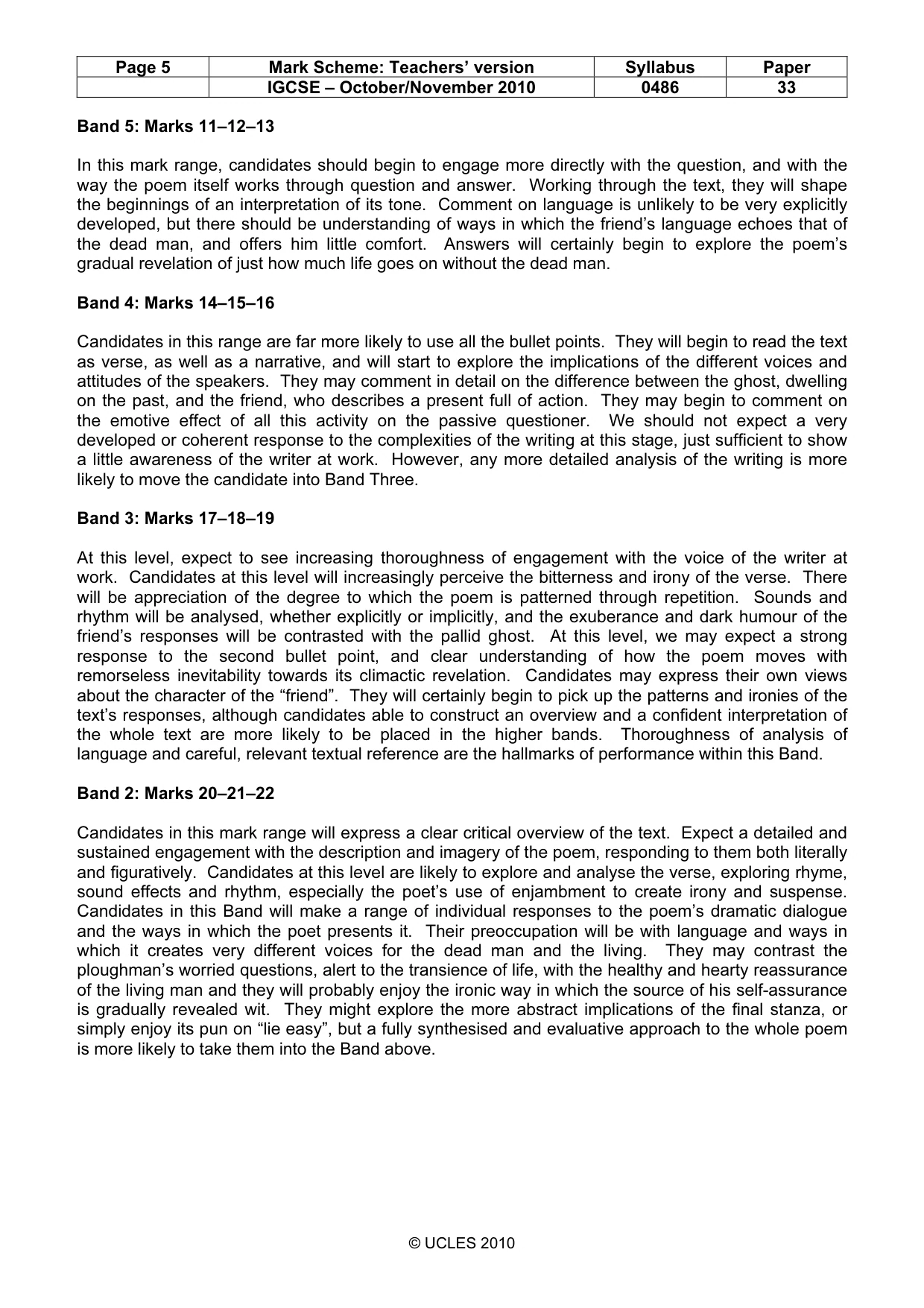
Page 5 Mark Scheme: Teachers’ version Syllabus Paper IGCSE – October/November 2010 0486 33 © UCLES 2010 Band 5: Marks 11–12–13 In this mark range, candidates should begin to engage more directly with the question, and with the way the poem itself works through question and answer. Working through the text, they will shape the beginnings of an interpretation of its tone. Comment on language is unlikely to be very explicitly developed, but there should be understanding of ways in which the friend’s language echoes that of the dead man, and offers him little comfort. Answers will certainly begin to explore the poem’s gradual revelation of just how much life goes on without the dead man. Band 4: Marks 14–15–16 Candidates in this range are far more likely to use all the bullet points. They will begin to read the text as verse, as well as a narrative, and will start to explore the implications of the different voices and attitudes of the speakers. They may comment in detail on the difference between the ghost, dwelling on the past, and the friend, who describes a present full of action. They may begin to comment on the emotive effect of all this activity on the passive questioner. We should not expect a very developed or coherent response to the complexities of the writing at this stage, just sufficient to show a little awareness of the writer at work. However, any more detailed analysis of the writing is more likely to move the candidate into Band Three. Band 3: Marks 17–18–19 At this level, expect to see increasing thoroughness of engagement with the voice of the writer at work. Candidates at this level will increasingly perceive the bitterness and irony of the verse. There will be appreciation of the degree to which the poem is patterned through repetition. Sounds and rhythm will be analysed, whether explicitly or implicitly, and the exuberance and dark humour of the friend’s responses will be contrasted with the pallid ghost. At this level, we may expect a strong response to the second bullet point, and clear understanding of how the poem moves with remorseless inevitability towards its climactic revelation. Candidates may express their own views about the character of the “friend”. They will certainly begin to pick up the patterns and ironies of the text’s responses, although candidates able to construct an overview and a confident interpretation of the whole text are more likely to be placed in the higher bands. Thoroughness of analysis of language and careful, relevant textual reference are the hallmarks of performance within this Band. Band 2: Marks 20–21–22 Candidates in this mark range will express a clear critical overview of the text. Expect a detailed and sustained engagement with the description and imagery of the poem, responding to them both literally and figuratively. Candidates at this level are likely to explore and analyse the verse, exploring rhyme, sound effects and rhythm, especially the poet’s use of enjambment to create irony and suspense. Candidates in this Band will make a range of individual responses to the poem’s dramatic dialogue and the ways in which the poet presents it. Their preoccupation will be with language and ways in which it creates very different voices for the dead man and the living. They may contrast the ploughman’s worried questions, alert to the transience of life, with the healthy and hearty reassurance of the living man and they will probably enjoy the ironic way in which the source of his self-assurance is gradually revealed wit. They might explore the more abstract implications of the final stanza, or simply enjoy its pun on “lie easy”, but a fully synthesised and evaluative approach to the whole poem is more likely to take them into the Band above.
Mark scheme, page 6
Page 6 Mark Scheme: Teachers’ version Syllabus Paper IGCSE – October/November 2010 0486 33 © UCLES 2010 Band 1: Marks 23–24–25 Candidates will draw their own conclusions about what both the narrative and the way it emerges say about the worlds of the dead and the living. They may feel that the friend is not as ‘easy’ as he claims, and that the ghost represents his own bad conscience. They might pity the ghost and his inability to let the sleeping lovers lie. Equally, they might take an interest in dark and bitter voicing of life’s ironies by the poet. Above all, there will be an appreciation, expressed through detailed analysis, of the poem’s simple but effective succession of images contrasting the narrow grave with the activities of life. A strong focus on specific ironies and contrast is likely to distinguish these answers, together with the ability to synthesise individual close readings into an interpretation. We should be prepared to reward any cogent overall reading of the poem, which the candidate has strongly grounded in detailed analysis of the effects of diction, rhythm, expression and imagery.
Mark scheme, page 7
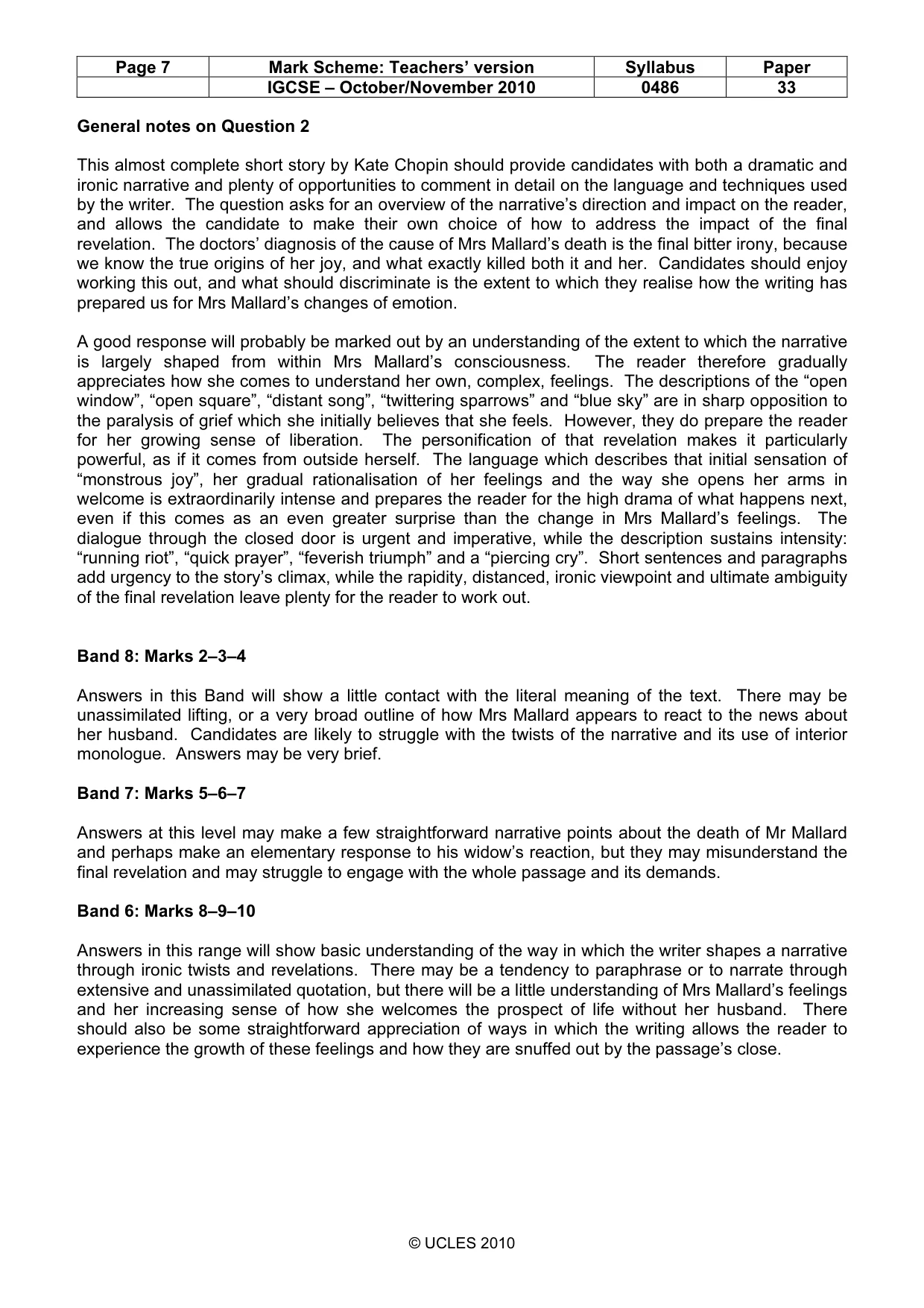
Page 7 Mark Scheme: Teachers’ version Syllabus Paper IGCSE – October/November 2010 0486 33 © UCLES 2010 General notes on Question 2 This almost complete short story by Kate Chopin should provide candidates with both a dramatic and ironic narrative and plenty of opportunities to comment in detail on the language and techniques used by the writer. The question asks for an overview of the narrative’s direction and impact on the reader, and allows the candidate to make their own choice of how to address the impact of the final revelation. The doctors’ diagnosis of the cause of Mrs Mallard’s death is the final bitter irony, because we know the true origins of her joy, and what exactly killed both it and her. Candidates should enjoy working this out, and what should discriminate is the extent to which they realise how the writing has prepared us for Mrs Mallard’s changes of emotion. A good response will probably be marked out by an understanding of the extent to which the narrative is largely shaped from within Mrs Mallard’s consciousness. The reader therefore gradually appreciates how she comes to understand her own, complex, feelings. The descriptions of the “open window”, “open square”, “distant song”, “twittering sparrows” and “blue sky” are in sharp opposition to the paralysis of grief which she initially believes that she feels. However, they do prepare the reader for her growing sense of liberation. The personification of that revelation makes it particularly powerful, as if it comes from outside herself. The language which describes that initial sensation of “monstrous joy”, her gradual rationalisation of her feelings and the way she opens her arms in welcome is extraordinarily intense and prepares the reader for the high drama of what happens next, even if this comes as an even greater surprise than the change in Mrs Mallard’s feelings. The dialogue through the closed door is urgent and imperative, while the description sustains intensity: “running riot”, “quick prayer”, “feverish triumph” and a “piercing cry”. Short sentences and paragraphs add urgency to the story’s climax, while the rapidity, distanced, ironic viewpoint and ultimate ambiguity of the final revelation leave plenty for the reader to work out. Band 8: Marks 2–3–4 Answers in this Band will show a little contact with the literal meaning of the text. There may be unassimilated lifting, or a very broad outline of how Mrs Mallard appears to react to the news about her husband. Candidates are likely to struggle with the twists of the narrative and its use of interior monologue. Answers may be very brief. Band 7: Marks 5–6–7 Answers at this level may make a few straightforward narrative points about the death of Mr Mallard and perhaps make an elementary response to his widow’s reaction, but they may misunderstand the final revelation and may struggle to engage with the whole passage and its demands. Band 6: Marks 8–9–10 Answers in this range will show basic understanding of the way in which the writer shapes a narrative through ironic twists and revelations. There may be a tendency to paraphrase or to narrate through extensive and unassimilated quotation, but there will be a little understanding of Mrs Mallard’s feelings and her increasing sense of how she welcomes the prospect of life without her husband. There should also be some straightforward appreciation of ways in which the writing allows the reader to experience the growth of these feelings and how they are snuffed out by the passage’s close.
Mark scheme, page 8
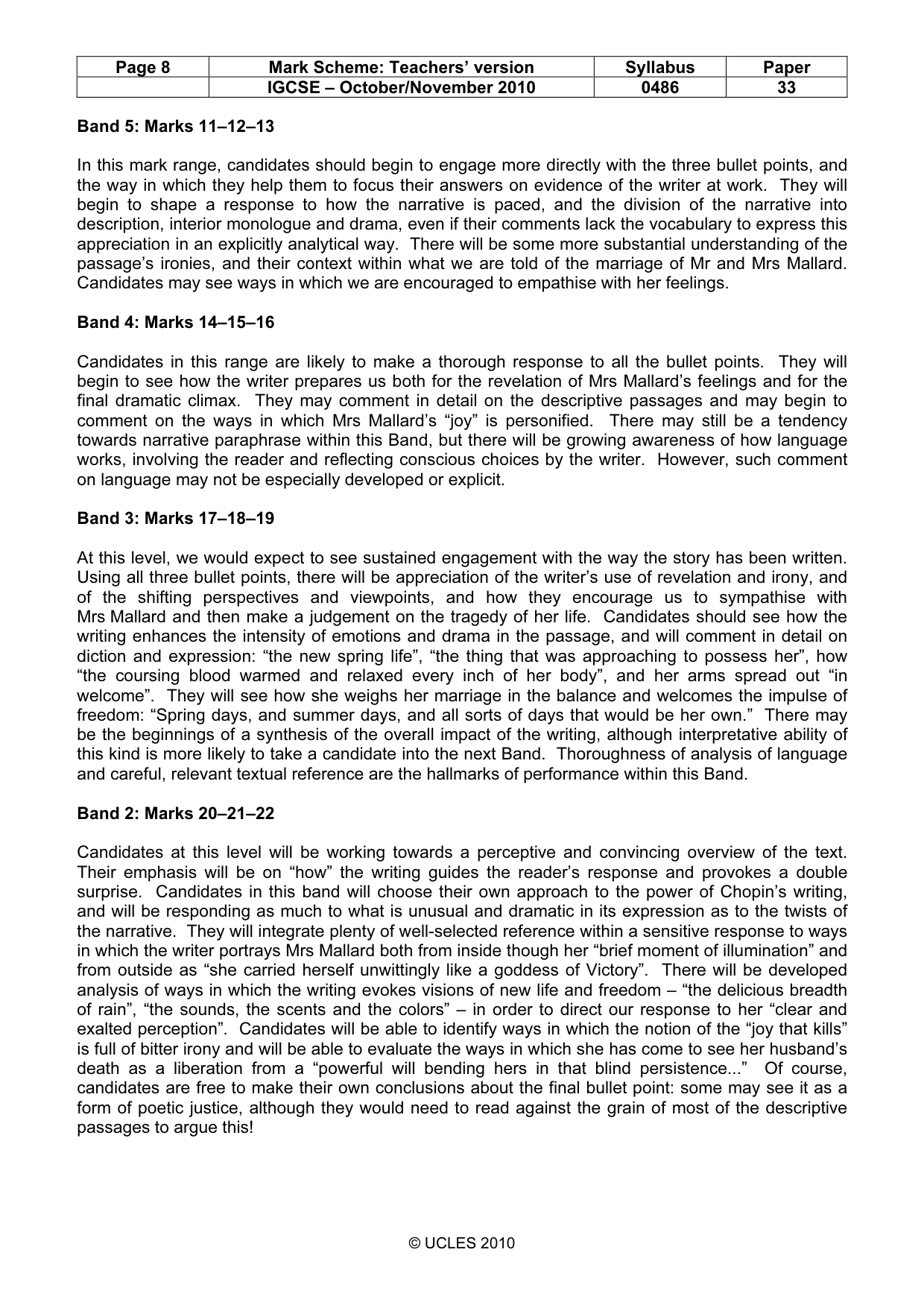
Page 8 Mark Scheme: Teachers’ version Syllabus Paper IGCSE – October/November 2010 0486 33 © UCLES 2010 Band 5: Marks 11–12–13 In this mark range, candidates should begin to engage more directly with the three bullet points, and the way in which they help them to focus their answers on evidence of the writer at work. They will begin to shape a response to how the narrative is paced, and the division of the narrative into description, interior monologue and drama, even if their comments lack the vocabulary to express this appreciation in an explicitly analytical way. There will be some more substantial understanding of the passage’s ironies, and their context within what we are told of the marriage of Mr and Mrs Mallard. Candidates may see ways in which we are encouraged to empathise with her feelings. Band 4: Marks 14–15–16 Candidates in this range are likely to make a thorough response to all the bullet points. They will begin to see how the writer prepares us both for the revelation of Mrs Mallard’s feelings and for the final dramatic climax. They may comment in detail on the descriptive passages and may begin to comment on the ways in which Mrs Mallard’s “joy” is personified. There may still be a tendency towards narrative paraphrase within this Band, but there will be growing awareness of how language works, involving the reader and reflecting conscious choices by the writer. However, such comment on language may not be especially developed or explicit. Band 3: Marks 17–18–19 At this level, we would expect to see sustained engagement with the way the story has been written. Using all three bullet points, there will be appreciation of the writer’s use of revelation and irony, and of the shifting perspectives and viewpoints, and how they encourage us to sympathise with Mrs Mallard and then make a judgement on the tragedy of her life. Candidates should see how the writing enhances the intensity of emotions and drama in the passage, and will comment in detail on diction and expression: “the new spring life”, “the thing that was approaching to possess her”, how “the coursing blood warmed and relaxed every inch of her body”, and her arms spread out “in welcome”. They will see how she weighs her marriage in the balance and welcomes the impulse of freedom: “Spring days, and summer days, and all sorts of days that would be her own.” There may be the beginnings of a synthesis of the overall impact of the writing, although interpretative ability of this kind is more likely to take a candidate into the next Band. Thoroughness of analysis of language and careful, relevant textual reference are the hallmarks of performance within this Band. Band 2: Marks 20–21–22 Candidates at this level will be working towards a perceptive and convincing overview of the text. Their emphasis will be on “how” the writing guides the reader’s response and provokes a double surprise. Candidates in this band will choose their own approach to the power of Chopin’s writing, and will be responding as much to what is unusual and dramatic in its expression as to the twists of the narrative. They will integrate plenty of well-selected reference within a sensitive response to ways in which the writer portrays Mrs Mallard both from inside though her “brief moment of illumination” and from outside as “she carried herself unwittingly like a goddess of Victory”. There will be developed analysis of ways in which the writing evokes visions of new life and freedom – “the delicious breadth of rain”, “the sounds, the scents and the colors” – in order to direct our response to her “clear and exalted perception”. Candidates will be able to identify ways in which the notion of the “joy that kills” is full of bitter irony and will be able to evaluate the ways in which she has come to see her husband’s death as a liberation from a “powerful will bending hers in that blind persistence...” Of course, candidates are free to make their own conclusions about the final bullet point: some may see it as a form of poetic justice, although they would need to read against the grain of most of the descriptive passages to argue this!
Mark scheme, page 9
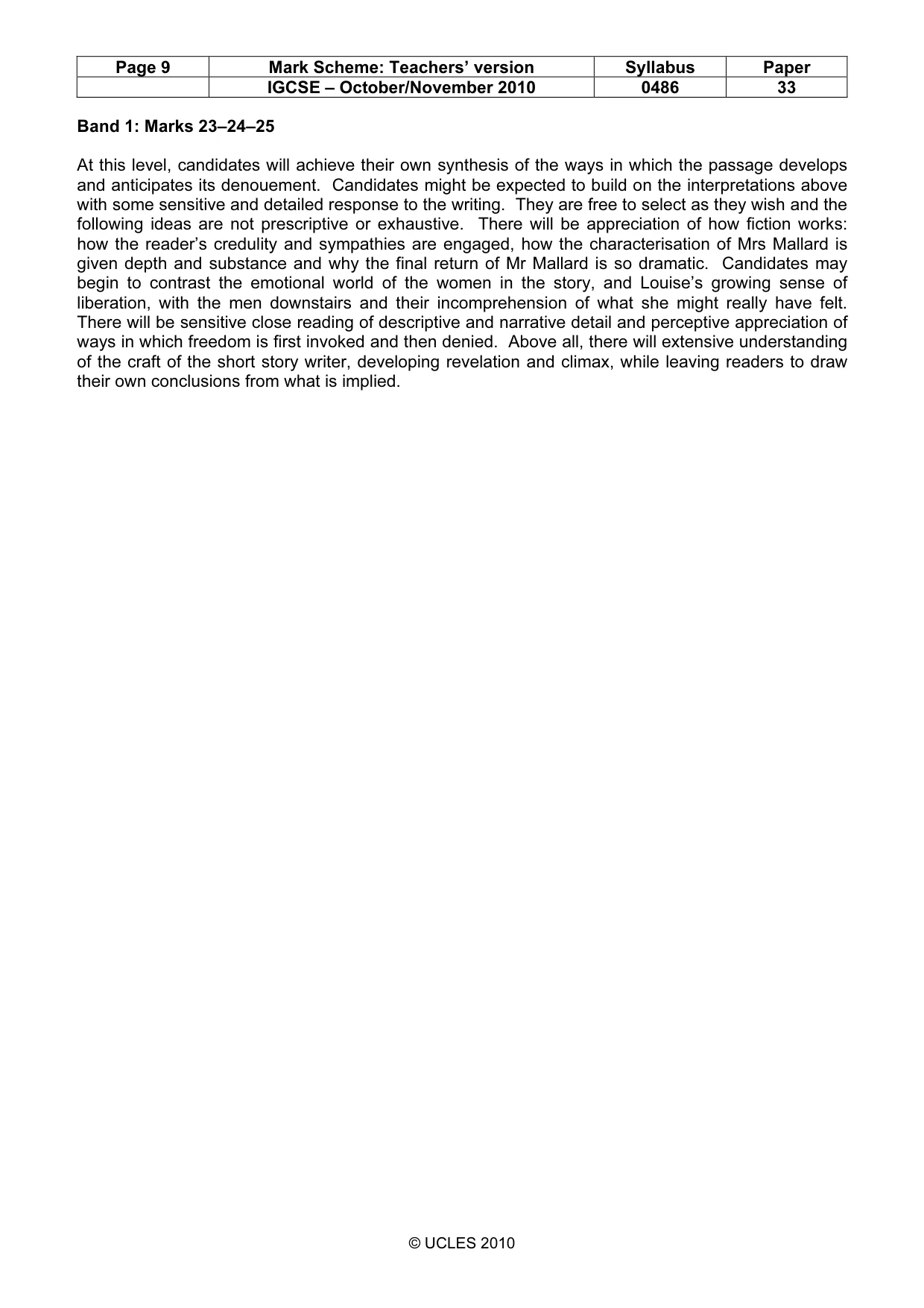
Page 9 Mark Scheme: Teachers’ version Syllabus Paper IGCSE – October/November 2010 0486 33 © UCLES 2010 Band 1: Marks 23–24–25 At this level, candidates will achieve their own synthesis of the ways in which the passage develops and anticipates its denouement. Candidates might be expected to build on the interpretations above with some sensitive and detailed response to the writing. They are free to select as they wish and the following ideas are not prescriptive or exhaustive. There will be appreciation of how fiction works: how the reader’s credulity and sympathies are engaged, how the characterisation of Mrs Mallard is given depth and substance and why the final return of Mr Mallard is so dramatic. Candidates may begin to contrast the emotional world of the women in the story, and Louise’s growing sense of liberation, with the men downstairs and their incomprehension of what she might really have felt. There will be sensitive close reading of descriptive and narrative detail and perceptive appreciation of ways in which freedom is first invoked and then denied. Above all, there will extensive understanding of the craft of the short story writer, developing revelation and climax, while leaving readers to draw their own conclusions from what is implied.
What you needed in this session
Cambridge’s own grade thresholds for 2010 Oct/Nov, Paper 3 · Variant 3. A higher threshold means an easier paper — the bar moves with how the cohort did.