Cambridge IGCSE English - Literature 0486 — 2010 Oct/Nov Paper 3 · Variant 1
0486/31/O/N/10 · 25 marks · ≈28 min
The question paper and its mark scheme, free to read here and free to download. This is Cambridge’s own paper, exactly as it was sat.
Question paper8 pages


Mark scheme8 pages
Answers below. Sit the paper first if you are practising.
Paper as text
Question paper, page 1
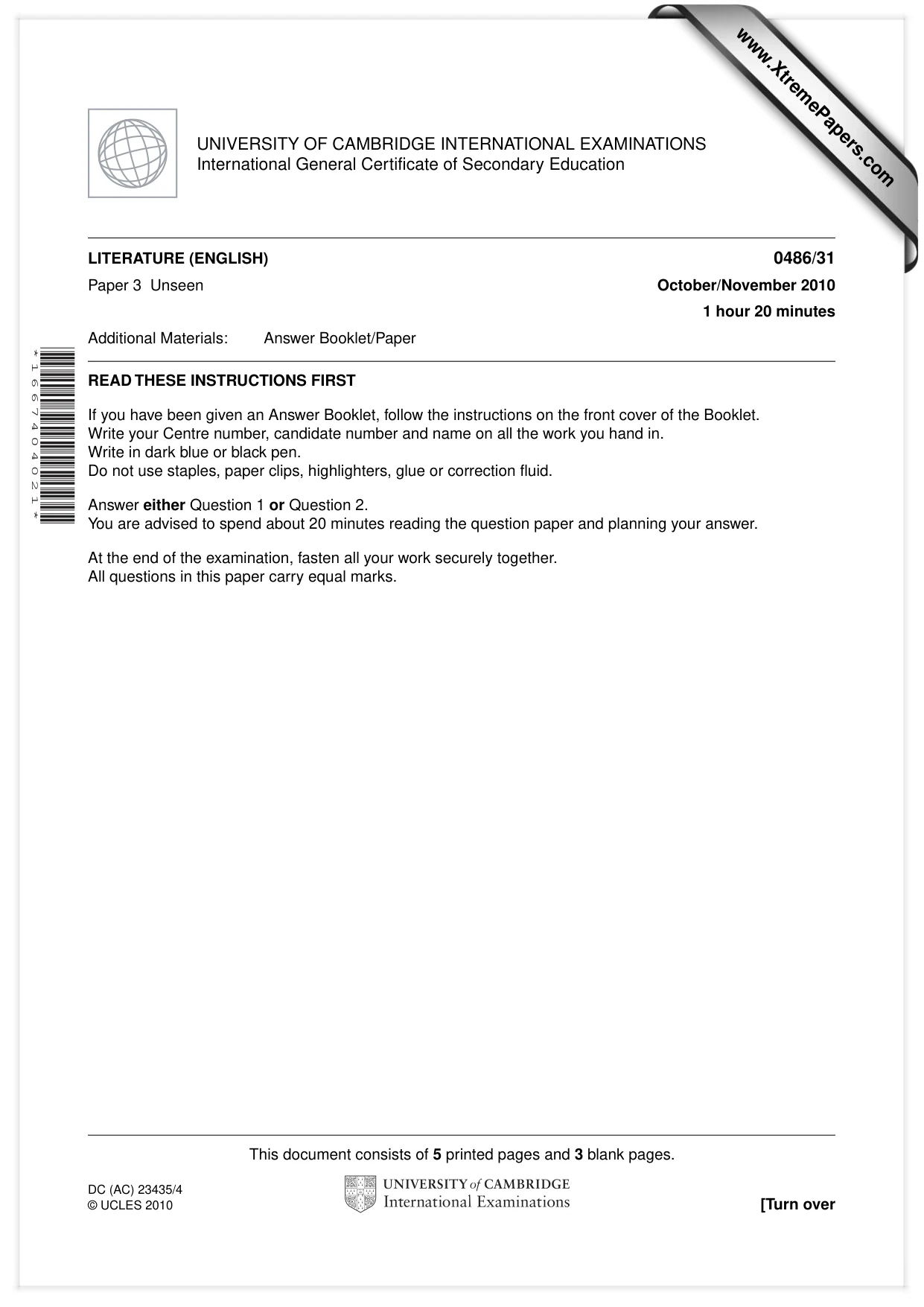
This document consists of 5 printed pages and 3 blank pages. DC (AC) 23435/4 © UCLES 2010 [Turn over UNIVERSITY OF CAMBRIDGE INTERNATIONAL EXAMINATIONS International General Certificate of Secondary Education * 1 6 6 7 4 0 4 0 2 1 * LITERATURE (ENGLISH) 0486/31 Paper 3 Unseen October/November 2010 1 hour 20 minutes Additional Materials: Answer Booklet/Paper READ THESE INSTRUCTIONS FIRST If you have been given an Answer Booklet, follow the instructions on the front cover of the Booklet. Write your Centre number, candidate number and name on all the work you hand in. Write in dark blue or black pen. Do not use staples, paper clips, highlighters, glue or correction fluid. Answer either Question 1 or Question 2. You are advised to spend about 20 minutes reading the question paper and planning your answer. At the end of the examination, fasten all your work securely together. All questions in this paper carry equal marks. www.XtremePapers.com
Question paper, page 2
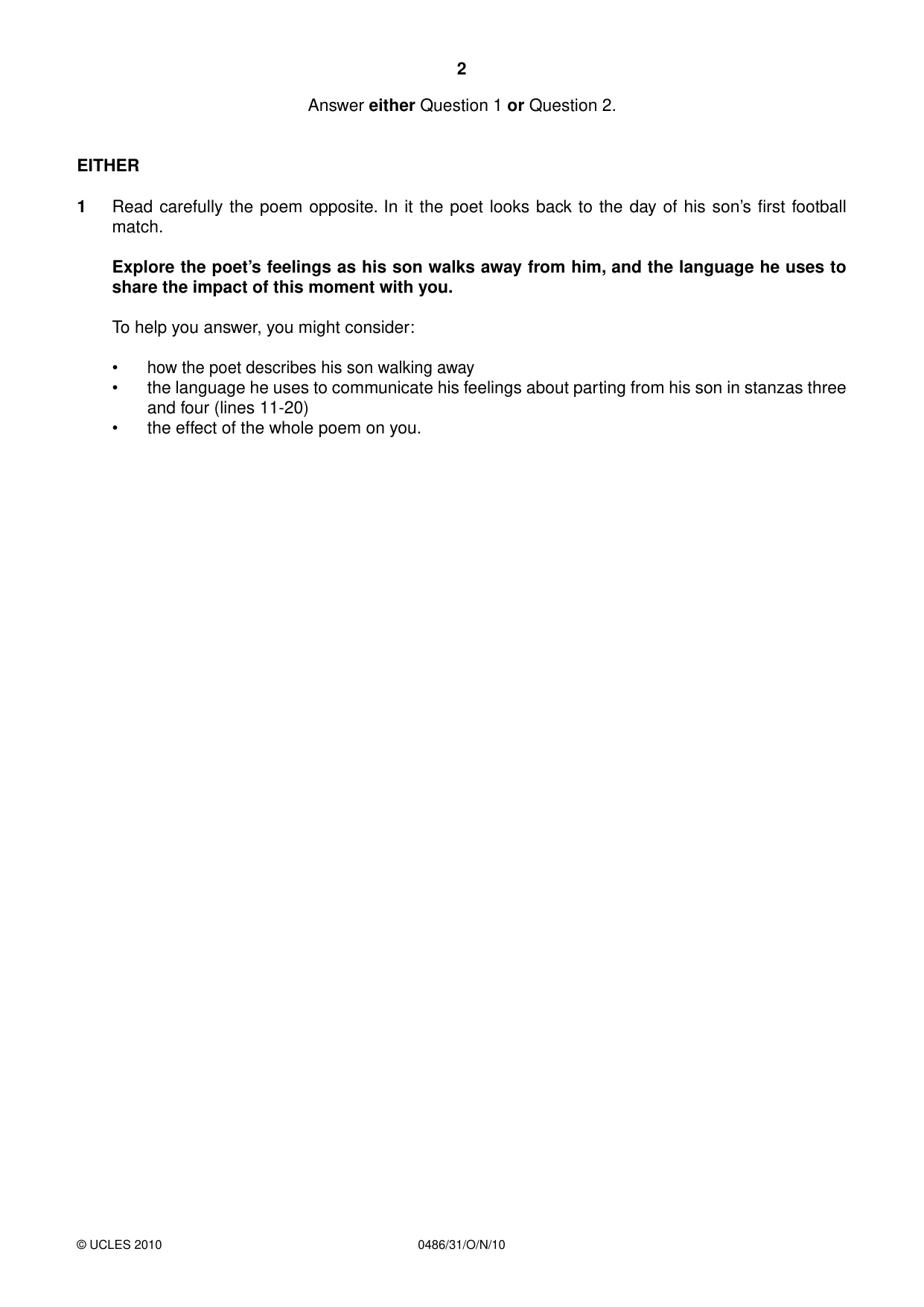
2 0486/31/O/N/10 © UCLES 2010 Answer either Question 1 or Question 2. EITHER 1 Read carefully the poem opposite. In it the poet looks back to the day of his son’s first football match. Explore the poet’s feelings as his son walks away from him, and the language he uses to share the impact of this moment with you. To help you answer, you might consider: • how the poet describes his son walking away • the language he uses to communicate his feelings about parting from his son in stanzas three and four (lines 11-20) • the effect of the whole poem on you.
Question paper, page 3
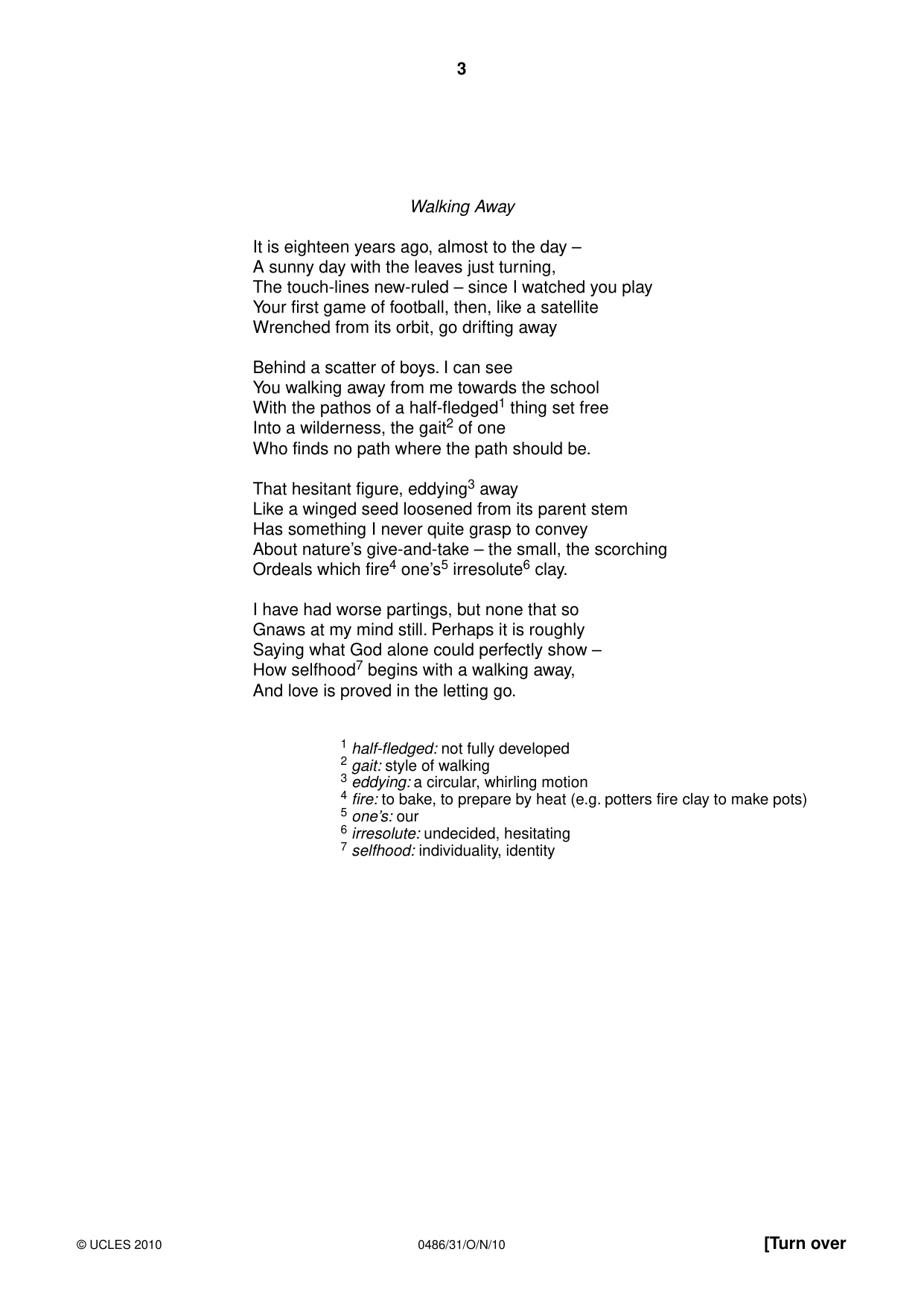
3 0486/31/O/N/10 © UCLES 2010 [Turn over Walking Away It is eighteen years ago, almost to the day – A sunny day with the leaves just turning, The touch-lines new-ruled – since I watched you play Your first game of football, then, like a satellite Wrenched from its orbit, go drifting away Behind a scatter of boys. I can see You walking away from me towards the school With the pathos of a half-fledged1 thing set free Into a wilderness, the gait2 of one Who finds no path where the path should be. That hesitant figure, eddying3 away Like a winged seed loosened from its parent stem Has something I never quite grasp to convey About nature’s give-and-take – the small, the scorching Ordeals which fire4 one’s5 irresolute6 clay. I have had worse partings, but none that so Gnaws at my mind still. Perhaps it is roughly Saying what God alone could perfectly show – How selfhood7 begins with a walking away, And love is proved in the letting go. 1 half-fledged: not fully developed 2 gait: style of walking 3 eddying: a circular, whirling motion 4 fire: to bake, to prepare by heat (e.g. potters fire clay to make pots) 5 one’s: our 6 irresolute: undecided, hesitating 7 selfhood: individuality, identity
Question paper, page 4
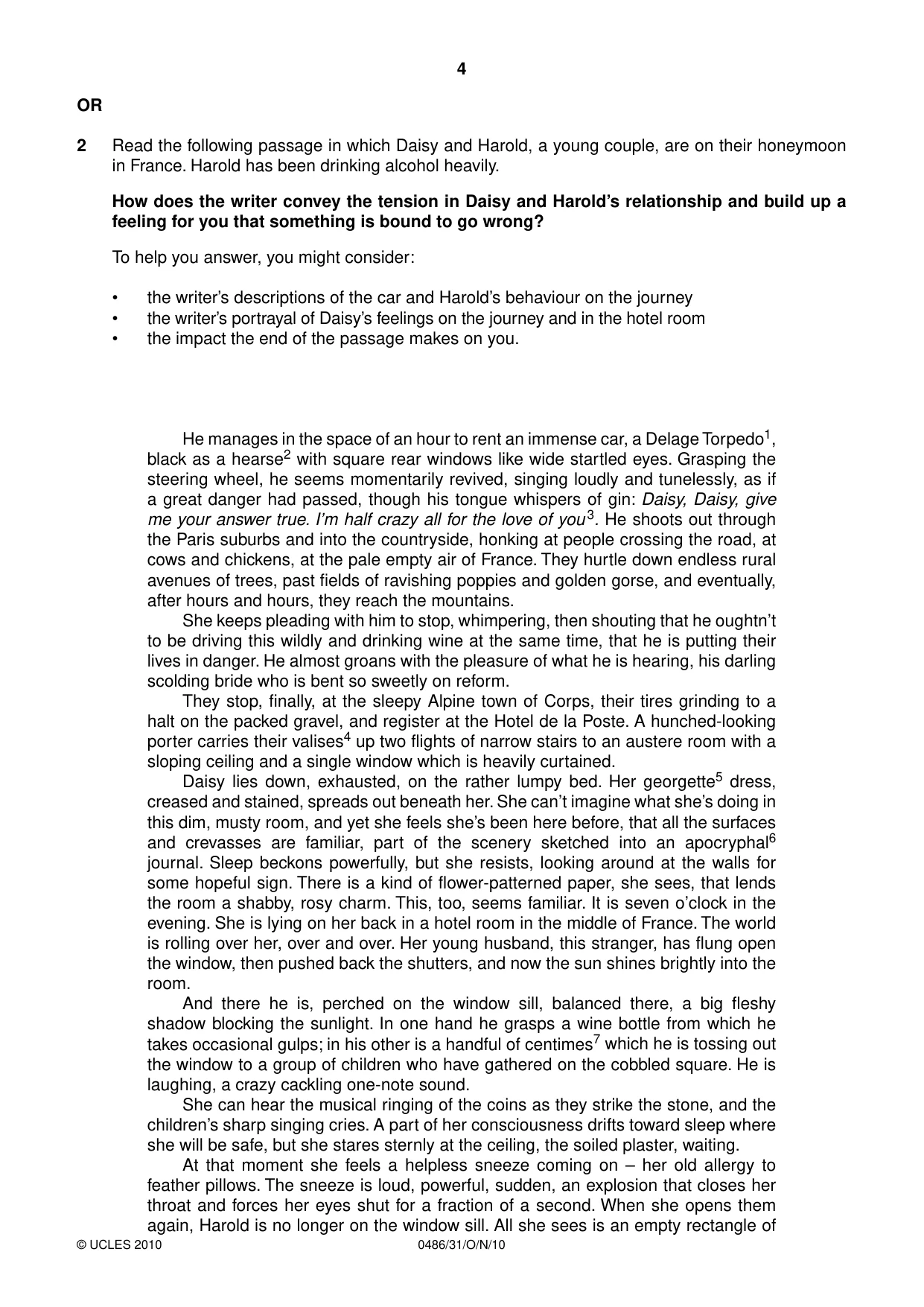
4 0486/31/O/N/10 © UCLES 2010 OR 2 Read the following passage in which Daisy and Harold, a young couple, are on their honeymoon in France. Harold has been drinking alcohol heavily. How does the writer convey the tension in Daisy and Harold’s relationship and build up a feeling for you that something is bound to go wrong? To help you answer, you might consider: • the writer’s descriptions of the car and Harold’s behaviour on the journey • the writer’s portrayal of Daisy’s feelings on the journey and in the hotel room • the impact the end of the passage makes on you. He manages in the space of an hour to rent an immense car, a Delage Torpedo1, black as a hearse2 with square rear windows like wide startled eyes. Grasping the steering wheel, he seems momentarily revived, singing loudly and tunelessly, as if a great danger had passed, though his tongue whispers of gin: Daisy, Daisy, give me your answer true. I’m half crazy all for the love of you 3. He shoots out through the Paris suburbs and into the countryside, honking at people crossing the road, at cows and chickens, at the pale empty air of France. They hurtle down endless rural avenues of trees, past fields of ravishing poppies and golden gorse, and eventually, after hours and hours, they reach the mountains. She keeps pleading with him to stop, whimpering, then shouting that he oughtn’t to be driving this wildly and drinking wine at the same time, that he is putting their lives in danger. He almost groans with the pleasure of what he is hearing, his darling scolding bride who is bent so sweetly on reform. They stop, finally, at the sleepy Alpine town of Corps, their tires grinding to a halt on the packed gravel, and register at the Hotel de la Poste. A hunched-looking porter carries their valises4 up two flights of narrow stairs to an austere room with a sloping ceiling and a single window which is heavily curtained. Daisy lies down, exhausted, on the rather lumpy bed. Her georgette5 dress, creased and stained, spreads out beneath her. She can’t imagine what she’s doing in this dim, musty room, and yet she feels she’s been here before, that all the surfaces and crevasses are familiar, part of the scenery sketched into an apocryphal6 journal. Sleep beckons powerfully, but she resists, looking around at the walls for some hopeful sign. There is a kind of flower-patterned paper, she sees, that lends the room a shabby, rosy charm. This, too, seems familiar. It is seven o’clock in the evening. She is lying on her back in a hotel room in the middle of France. The world is rolling over her, over and over. Her young husband, this stranger, has flung open the window, then pushed back the shutters, and now the sun shines brightly into the room. And there he is, perched on the window sill, balanced there, a big fleshy shadow blocking the sunlight. In one hand he grasps a wine bottle from which he takes occasional gulps; in his other is a handful of centimes7 which he is tossing out the window to a group of children who have gathered on the cobbled square. He is laughing, a crazy cackling one-note sound. She can hear the musical ringing of the coins as they strike the stone, and the children’s sharp singing cries. A part of her consciousness drifts toward sleep where she will be safe, but she stares sternly at the ceiling, the soiled plaster, waiting. At that moment she feels a helpless sneeze coming on – her old allergy to feather pillows. The sneeze is loud, powerful, sudden, an explosion that closes her throat and forces her eyes shut for a fraction of a second. When she opens them again, Harold is no longer on the window sill. All she sees is an empty rectangle of
Question paper, page 5
5 0486/31/O/N/10 © UCLES 2010 glaring light. A splinter of time passes, too small and quiet to register in the brain; she blinks back her disbelief, and then hears a bang, a crashing sound like a melon splitting, a wet injurious noise followed by the screaming of children and the sound of people running in the street. She remembers that she lay flat on the bed for a least a minute before she got up to investigate. 1 Delage Torpedo: a French luxury saloon car 2 hearse: a vehicle for carrying a coffin at funerals 3 “Daisy, Daisy…”: a popular song at the time the story is set 4 valises: suitcases 5 georgette: a thin silk dress material 6 apocryphal: invented, of doubtful authenticity 7 centimes: French coins of small value
Question paper, page 6
6 0486/31/O/N/10 © UCLES 2010 BLANK PAGE
Question paper, page 7
7 0486/31/O/N/10 © UCLES 2010 BLANK PAGE
Question paper, page 8
8 0486/31/O/N/10 © UCLES 2010 Copyright Acknowledgements: Question 1 © C. Day Lewis; ‘Poem for the Day One’, ed. Nicholas Albery; Walking Away; The Natural Death Centre; 2001. Question 2 © Carol Shields; The Stone Diaries; Fourth Estate/HarperCollins; 1993. Permission to reproduce items where third-party owned material protected by copyright is included has been sought and cleared where possible. Every reasonable effort has been made by the publisher (UCLES) to trace copyright holders, but if any items requiring clearance have unwittingly been included, the publisher will be pleased to make amends at the earliest possible opportunity. University of Cambridge International Examinations is part of the Cambridge Assessment Group. Cambridge Assessment is the brand name of University of Cambridge Local Examinations Syndicate (UCLES), which is itself a department of the University of Cambridge. BLANK PAGE
Mark scheme, page 1
UNIVERSITY OF CAMBRIDGE INTERNATIONAL EXAMINATIONS International General Certificate of Secondary Education MARK SCHEME for the October/November 2010 question paper for the guidance of teachers 0486 LITERATURE (ENGLISH) 0486/31 Paper 3 (Unseen), maximum raw mark 25 This mark scheme is published as an aid to teachers and candidates, to indicate the requirements of the examination. It shows the basis on which Examiners were instructed to award marks. It does not indicate the details of the discussions that took place at an Examiners’ meeting before marking began, which would have considered the acceptability of alternative answers. Mark schemes must be read in conjunction with the question papers and the report on the examination. • CIE will not enter into discussions or correspondence in connection with these mark schemes. CIE is publishing the mark schemes for the October/November 2010 question papers for most IGCSE, GCE Advanced Level and Advanced Subsidiary Level syllabuses and some Ordinary Level syllabuses. www.XtremePapers.com
Mark scheme, page 2
Page 2 Mark Scheme: Teachers’ version Syllabus Paper IGCSE – October/November 2010 0486 31 © UCLES 2010 All questions on this paper are marked out of 25. The Assessment Objectives for the paper are: AO1 show detailed knowledge of the content of literary texts AO2 understand the meanings of literary texts and their context, and explore texts beyond surface meaning to show deeper awareness of ideas and attitudes AO3 recognise and appreciate ways in which writers use language, structure, and form to create and shape meanings and effects AO4 communicate a sensitive and informed personal response The General Descriptors cover marks 0 to 25, and apply to the marking of each question. They guide examiners to an understanding of the qualities normally expected of, or typical of, work in a band. They are a means of general guidance, and must not be interpreted as hurdle statements. For the purposes of standardisation of marking, they are to be used in conjunction with photostats of candidates’ work produced in the examination and discussed during the examiners’ coordination meeting, as well as the question-specific notes. The notes for each question are related to the assessment objectives above. Because of the nature of the subject, these notes are for general guidance; they are not designed as prescriptions of required content and must not be treated as such.
Mark scheme, page 3
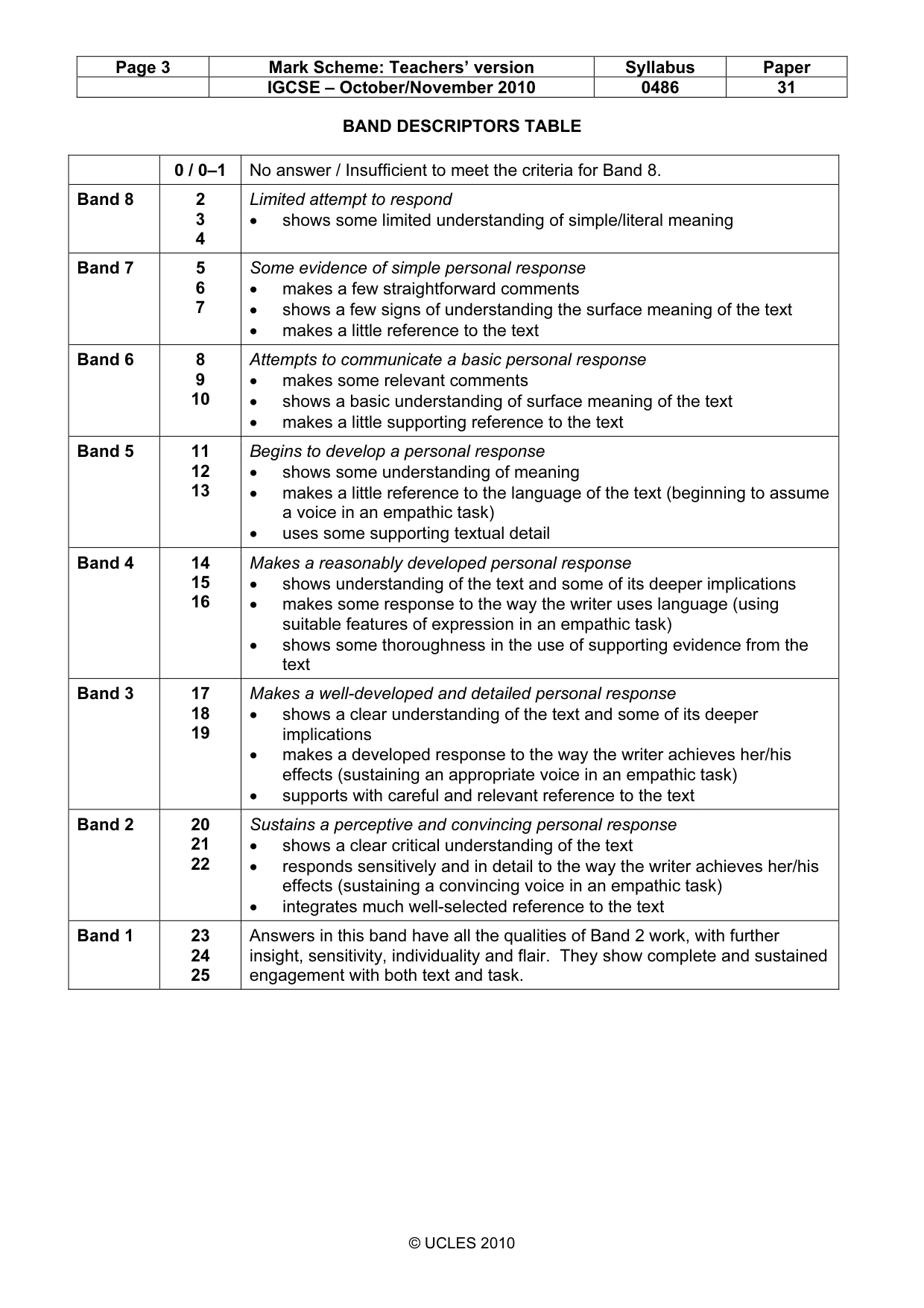
Page 3 Mark Scheme: Teachers’ version Syllabus Paper IGCSE – October/November 2010 0486 31 © UCLES 2010 BAND DESCRIPTORS TABLE 0 / 0–1 No answer / Insufficient to meet the criteria for Band 8. Band 8 2 3 4 Limited attempt to respond • shows some limited understanding of simple/literal meaning Band 7 5 6 7 Some evidence of simple personal response • makes a few straightforward comments • shows a few signs of understanding the surface meaning of the text • makes a little reference to the text Band 6 8 9 10 Attempts to communicate a basic personal response • makes some relevant comments • shows a basic understanding of surface meaning of the text • makes a little supporting reference to the text Band 5 11 12 13 Begins to develop a personal response • shows some understanding of meaning • makes a little reference to the language of the text (beginning to assume a voice in an empathic task) • uses some supporting textual detail Band 4 14 15 16 Makes a reasonably developed personal response • shows understanding of the text and some of its deeper implications • makes some response to the way the writer uses language (using suitable features of expression in an empathic task) • shows some thoroughness in the use of supporting evidence from the text Band 3 17 18 19 Makes a well-developed and detailed personal response • shows a clear understanding of the text and some of its deeper implications • makes a developed response to the way the writer achieves her/his effects (sustaining an appropriate voice in an empathic task) • supports with careful and relevant reference to the text Band 2 20 21 22 Sustains a perceptive and convincing personal response • shows a clear critical understanding of the text • responds sensitively and in detail to the way the writer achieves her/his effects (sustaining a convincing voice in an empathic task) • integrates much well-selected reference to the text Band 1 23 24 25 Answers in this band have all the qualities of Band 2 work, with further insight, sensitivity, individuality and flair. They show complete and sustained engagement with both text and task.
Mark scheme, page 4
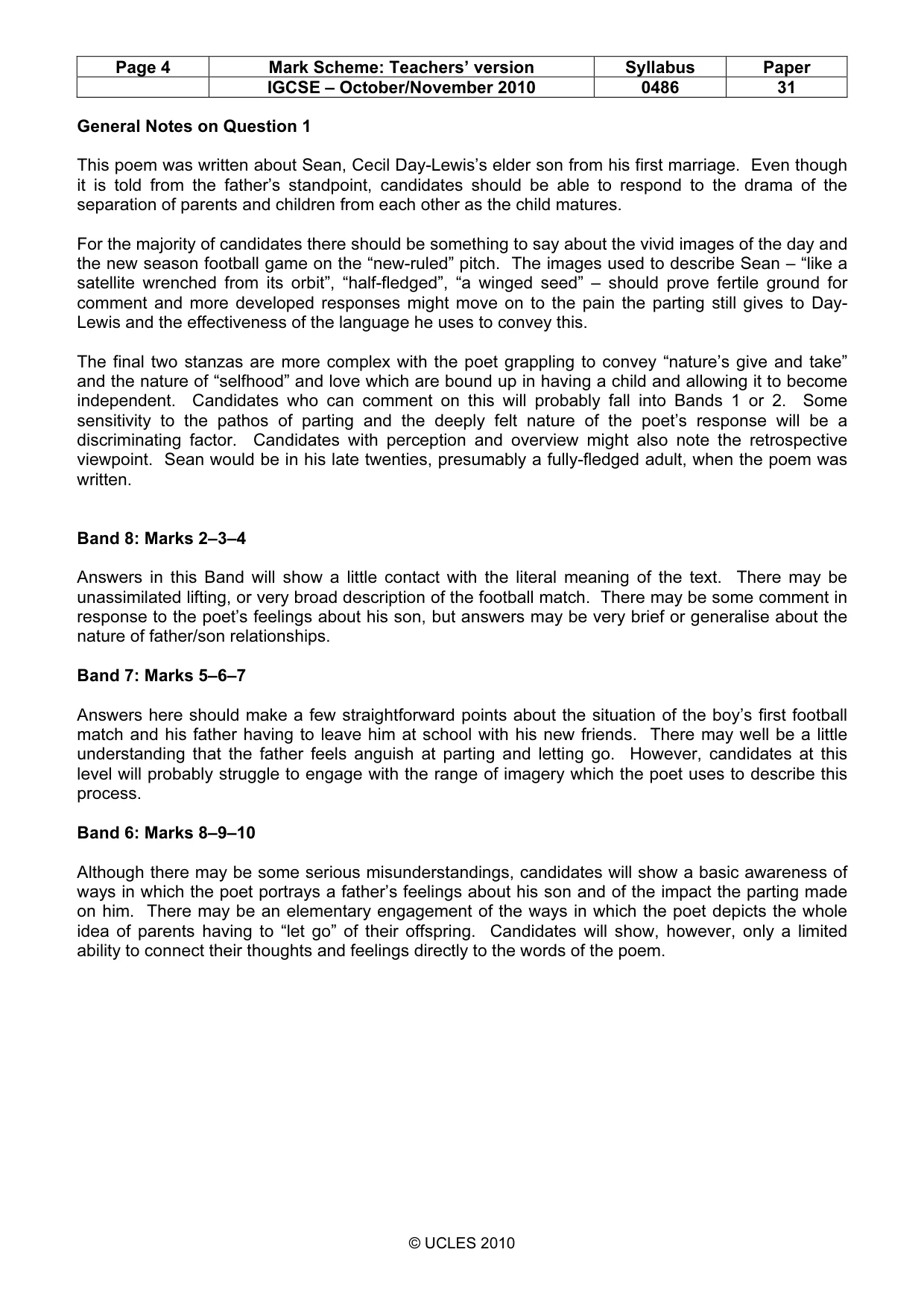
Page 4 Mark Scheme: Teachers’ version Syllabus Paper IGCSE – October/November 2010 0486 31 © UCLES 2010 General Notes on Question 1 This poem was written about Sean, Cecil Day-Lewis’s elder son from his first marriage. Even though it is told from the father’s standpoint, candidates should be able to respond to the drama of the separation of parents and children from each other as the child matures. For the majority of candidates there should be something to say about the vivid images of the day and the new season football game on the “new-ruled” pitch. The images used to describe Sean – “like a satellite wrenched from its orbit”, “half-fledged”, “a winged seed” – should prove fertile ground for comment and more developed responses might move on to the pain the parting still gives to Day- Lewis and the effectiveness of the language he uses to convey this. The final two stanzas are more complex with the poet grappling to convey “nature’s give and take” and the nature of “selfhood” and love which are bound up in having a child and allowing it to become independent. Candidates who can comment on this will probably fall into Bands 1 or 2. Some sensitivity to the pathos of parting and the deeply felt nature of the poet’s response will be a discriminating factor. Candidates with perception and overview might also note the retrospective viewpoint. Sean would be in his late twenties, presumably a fully-fledged adult, when the poem was written. Band 8: Marks 2–3–4 Answers in this Band will show a little contact with the literal meaning of the text. There may be unassimilated lifting, or very broad description of the football match. There may be some comment in response to the poet’s feelings about his son, but answers may be very brief or generalise about the nature of father/son relationships. Band 7: Marks 5–6–7 Answers here should make a few straightforward points about the situation of the boy’s first football match and his father having to leave him at school with his new friends. There may well be a little understanding that the father feels anguish at parting and letting go. However, candidates at this level will probably struggle to engage with the range of imagery which the poet uses to describe this process. Band 6: Marks 8–9–10 Although there may be some serious misunderstandings, candidates will show a basic awareness of ways in which the poet portrays a father’s feelings about his son and of the impact the parting made on him. There may be an elementary engagement of the ways in which the poet depicts the whole idea of parents having to “let go” of their offspring. Candidates will show, however, only a limited ability to connect their thoughts and feelings directly to the words of the poem.
Mark scheme, page 5
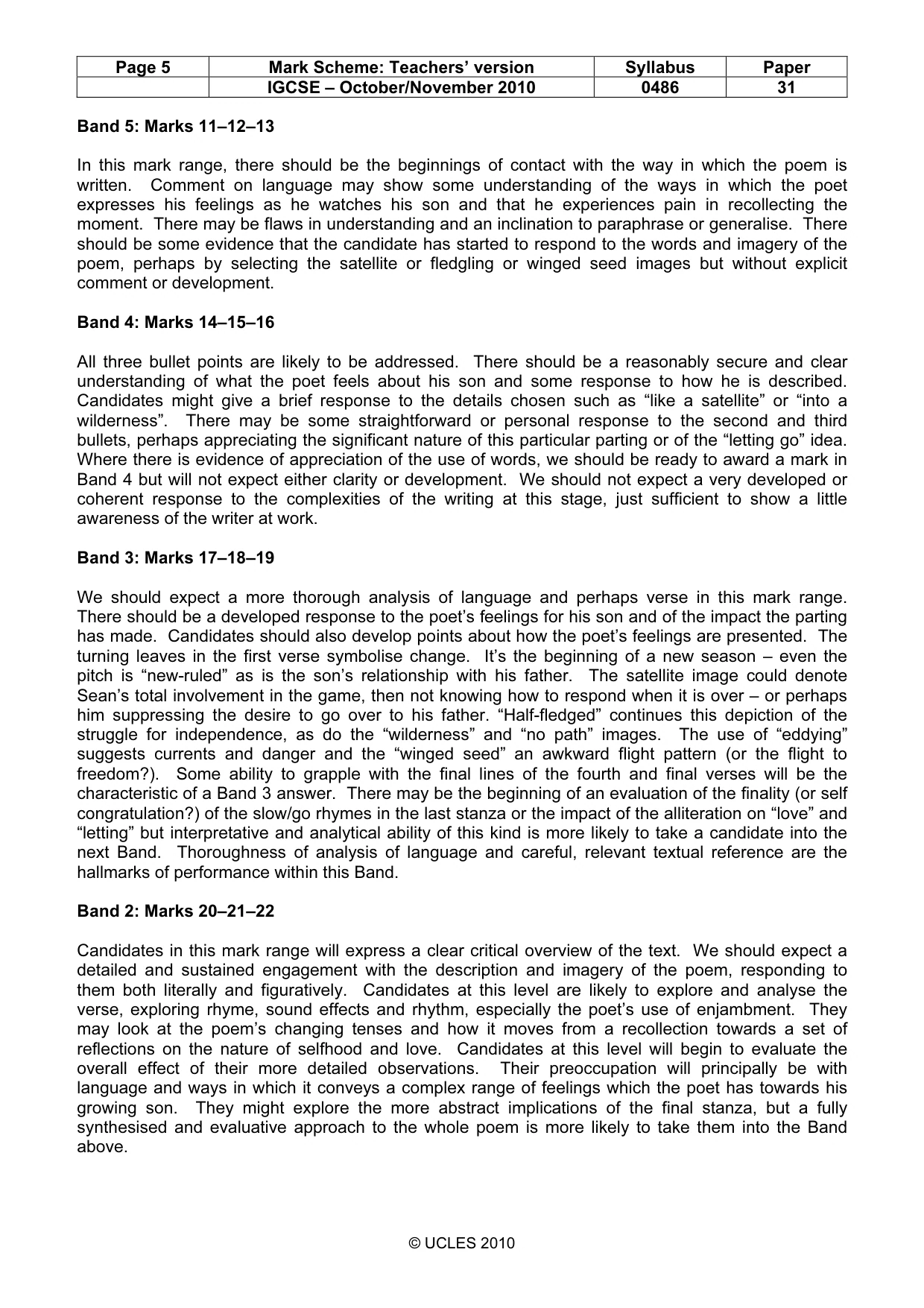
Page 5 Mark Scheme: Teachers’ version Syllabus Paper IGCSE – October/November 2010 0486 31 © UCLES 2010 Band 5: Marks 11–12–13 In this mark range, there should be the beginnings of contact with the way in which the poem is written. Comment on language may show some understanding of the ways in which the poet expresses his feelings as he watches his son and that he experiences pain in recollecting the moment. There may be flaws in understanding and an inclination to paraphrase or generalise. There should be some evidence that the candidate has started to respond to the words and imagery of the poem, perhaps by selecting the satellite or fledgling or winged seed images but without explicit comment or development. Band 4: Marks 14–15–16 All three bullet points are likely to be addressed. There should be a reasonably secure and clear understanding of what the poet feels about his son and some response to how he is described. Candidates might give a brief response to the details chosen such as “like a satellite” or “into a wilderness”. There may be some straightforward or personal response to the second and third bullets, perhaps appreciating the significant nature of this particular parting or of the “letting go” idea. Where there is evidence of appreciation of the use of words, we should be ready to award a mark in Band 4 but will not expect either clarity or development. We should not expect a very developed or coherent response to the complexities of the writing at this stage, just sufficient to show a little awareness of the writer at work. Band 3: Marks 17–18–19 We should expect a more thorough analysis of language and perhaps verse in this mark range. There should be a developed response to the poet’s feelings for his son and of the impact the parting has made. Candidates should also develop points about how the poet’s feelings are presented. The turning leaves in the first verse symbolise change. It’s the beginning of a new season – even the pitch is “new-ruled” as is the son’s relationship with his father. The satellite image could denote Sean’s total involvement in the game, then not knowing how to respond when it is over – or perhaps him suppressing the desire to go over to his father. “Half-fledged” continues this depiction of the struggle for independence, as do the “wilderness” and “no path” images. The use of “eddying” suggests currents and danger and the “winged seed” an awkward flight pattern (or the flight to freedom?). Some ability to grapple with the final lines of the fourth and final verses will be the characteristic of a Band 3 answer. There may be the beginning of an evaluation of the finality (or self congratulation?) of the slow/go rhymes in the last stanza or the impact of the alliteration on “love” and “letting” but interpretative and analytical ability of this kind is more likely to take a candidate into the next Band. Thoroughness of analysis of language and careful, relevant textual reference are the hallmarks of performance within this Band. Band 2: Marks 20–21–22 Candidates in this mark range will express a clear critical overview of the text. We should expect a detailed and sustained engagement with the description and imagery of the poem, responding to them both literally and figuratively. Candidates at this level are likely to explore and analyse the verse, exploring rhyme, sound effects and rhythm, especially the poet’s use of enjambment. They may look at the poem’s changing tenses and how it moves from a recollection towards a set of reflections on the nature of selfhood and love. Candidates at this level will begin to evaluate the overall effect of their more detailed observations. Their preoccupation will principally be with language and ways in which it conveys a complex range of feelings which the poet has towards his growing son. They might explore the more abstract implications of the final stanza, but a fully synthesised and evaluative approach to the whole poem is more likely to take them into the Band above.
Mark scheme, page 6
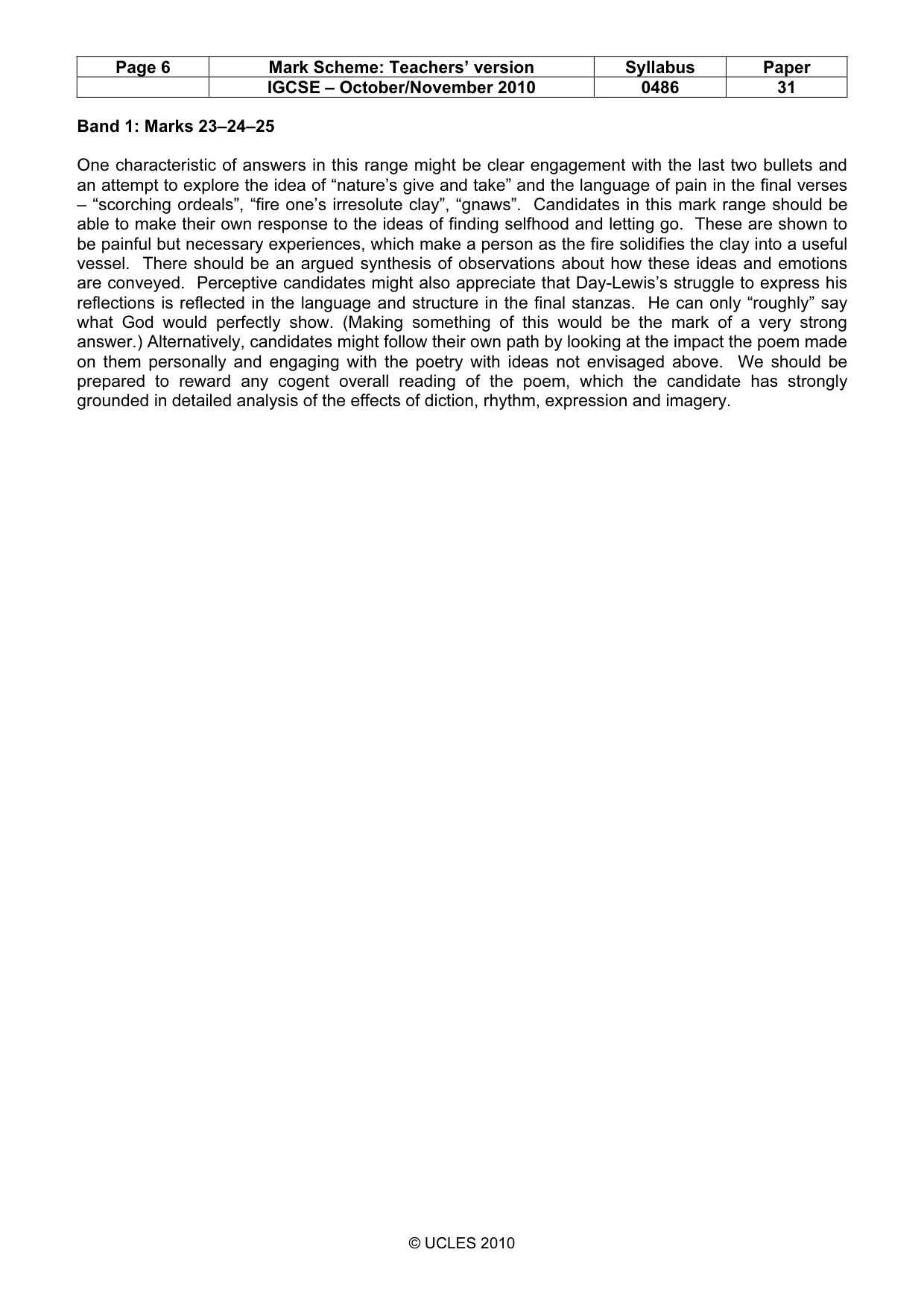
Page 6 Mark Scheme: Teachers’ version Syllabus Paper IGCSE – October/November 2010 0486 31 © UCLES 2010 Band 1: Marks 23–24–25 One characteristic of answers in this range might be clear engagement with the last two bullets and an attempt to explore the idea of “nature’s give and take” and the language of pain in the final verses – “scorching ordeals”, “fire one’s irresolute clay”, “gnaws”. Candidates in this mark range should be able to make their own response to the ideas of finding selfhood and letting go. These are shown to be painful but necessary experiences, which make a person as the fire solidifies the clay into a useful vessel. There should be an argued synthesis of observations about how these ideas and emotions are conveyed. Perceptive candidates might also appreciate that Day-Lewis’s struggle to express his reflections is reflected in the language and structure in the final stanzas. He can only “roughly” say what God would perfectly show. (Making something of this would be the mark of a very strong answer.) Alternatively, candidates might follow their own path by looking at the impact the poem made on them personally and engaging with the poetry with ideas not envisaged above. We should be prepared to reward any cogent overall reading of the poem, which the candidate has strongly grounded in detailed analysis of the effects of diction, rhythm, expression and imagery.
Mark scheme, page 7
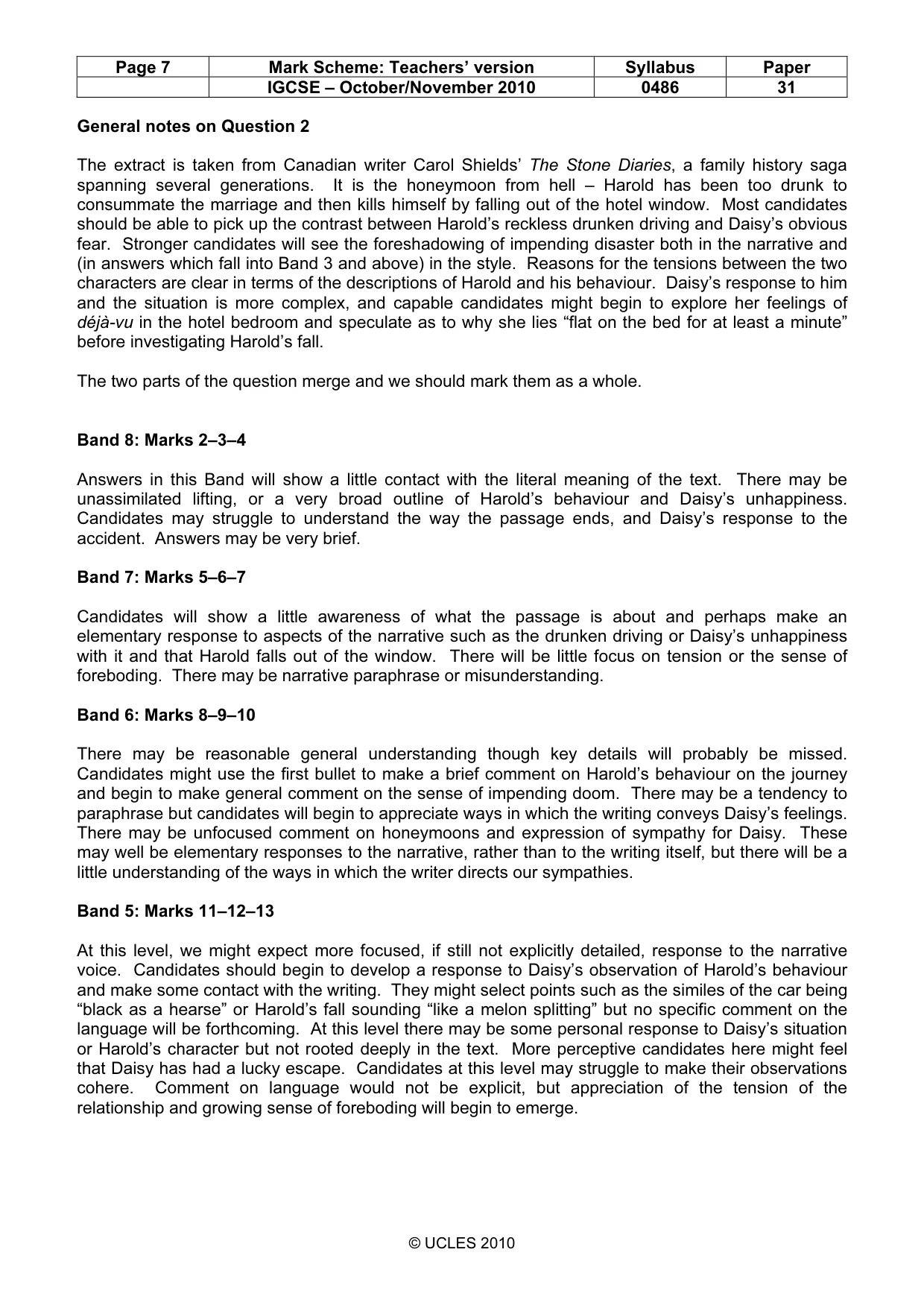
Page 7 Mark Scheme: Teachers’ version Syllabus Paper IGCSE – October/November 2010 0486 31 © UCLES 2010 General notes on Question 2 The extract is taken from Canadian writer Carol Shields’ The Stone Diaries, a family history saga spanning several generations. It is the honeymoon from hell – Harold has been too drunk to consummate the marriage and then kills himself by falling out of the hotel window. Most candidates should be able to pick up the contrast between Harold’s reckless drunken driving and Daisy’s obvious fear. Stronger candidates will see the foreshadowing of impending disaster both in the narrative and (in answers which fall into Band 3 and above) in the style. Reasons for the tensions between the two characters are clear in terms of the descriptions of Harold and his behaviour. Daisy’s response to him and the situation is more complex, and capable candidates might begin to explore her feelings of déjà-vu in the hotel bedroom and speculate as to why she lies “flat on the bed for at least a minute” before investigating Harold’s fall. The two parts of the question merge and we should mark them as a whole. Band 8: Marks 2–3–4 Answers in this Band will show a little contact with the literal meaning of the text. There may be unassimilated lifting, or a very broad outline of Harold’s behaviour and Daisy’s unhappiness. Candidates may struggle to understand the way the passage ends, and Daisy’s response to the accident. Answers may be very brief. Band 7: Marks 5–6–7 Candidates will show a little awareness of what the passage is about and perhaps make an elementary response to aspects of the narrative such as the drunken driving or Daisy’s unhappiness with it and that Harold falls out of the window. There will be little focus on tension or the sense of foreboding. There may be narrative paraphrase or misunderstanding. Band 6: Marks 8–9–10 There may be reasonable general understanding though key details will probably be missed. Candidates might use the first bullet to make a brief comment on Harold’s behaviour on the journey and begin to make general comment on the sense of impending doom. There may be a tendency to paraphrase but candidates will begin to appreciate ways in which the writing conveys Daisy’s feelings. There may be unfocused comment on honeymoons and expression of sympathy for Daisy. These may well be elementary responses to the narrative, rather than to the writing itself, but there will be a little understanding of the ways in which the writer directs our sympathies. Band 5: Marks 11–12–13 At this level, we might expect more focused, if still not explicitly detailed, response to the narrative voice. Candidates should begin to develop a response to Daisy’s observation of Harold’s behaviour and make some contact with the writing. They might select points such as the similes of the car being “black as a hearse” or Harold’s fall sounding “like a melon splitting” but no specific comment on the language will be forthcoming. At this level there may be some personal response to Daisy’s situation or Harold’s character but not rooted deeply in the text. More perceptive candidates here might feel that Daisy has had a lucky escape. Candidates at this level may struggle to make their observations cohere. Comment on language would not be explicit, but appreciation of the tension of the relationship and growing sense of foreboding will begin to emerge.
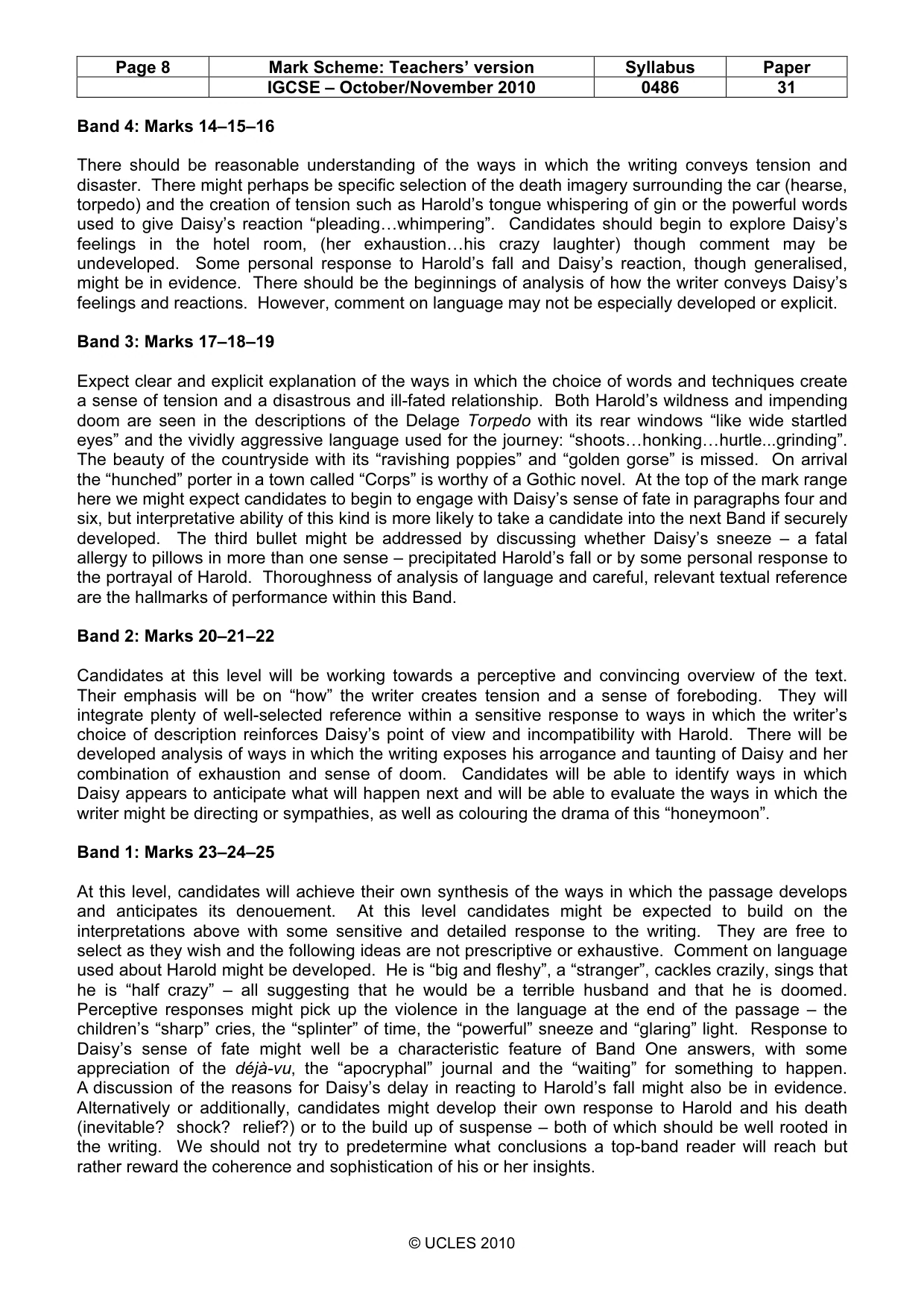
Mark scheme, page 8
Page 8 Mark Scheme: Teachers’ version Syllabus Paper IGCSE – October/November 2010 0486 31 © UCLES 2010 Band 4: Marks 14–15–16 There should be reasonable understanding of the ways in which the writing conveys tension and disaster. There might perhaps be specific selection of the death imagery surrounding the car (hearse, torpedo) and the creation of tension such as Harold’s tongue whispering of gin or the powerful words used to give Daisy’s reaction “pleading…whimpering”. Candidates should begin to explore Daisy’s feelings in the hotel room, (her exhaustion…his crazy laughter) though comment may be undeveloped. Some personal response to Harold’s fall and Daisy’s reaction, though generalised, might be in evidence. There should be the beginnings of analysis of how the writer conveys Daisy’s feelings and reactions. However, comment on language may not be especially developed or explicit. Band 3: Marks 17–18–19 Expect clear and explicit explanation of the ways in which the choice of words and techniques create a sense of tension and a disastrous and ill-fated relationship. Both Harold’s wildness and impending doom are seen in the descriptions of the Delage Torpedo with its rear windows “like wide startled eyes” and the vividly aggressive language used for the journey: “shoots…honking…hurtle...grinding”. The beauty of the countryside with its “ravishing poppies” and “golden gorse” is missed. On arrival the “hunched” porter in a town called “Corps” is worthy of a Gothic novel. At the top of the mark range here we might expect candidates to begin to engage with Daisy’s sense of fate in paragraphs four and six, but interpretative ability of this kind is more likely to take a candidate into the next Band if securely developed. The third bullet might be addressed by discussing whether Daisy’s sneeze – a fatal allergy to pillows in more than one sense – precipitated Harold’s fall or by some personal response to the portrayal of Harold. Thoroughness of analysis of language and careful, relevant textual reference are the hallmarks of performance within this Band. Band 2: Marks 20–21–22 Candidates at this level will be working towards a perceptive and convincing overview of the text. Their emphasis will be on “how” the writer creates tension and a sense of foreboding. They will integrate plenty of well-selected reference within a sensitive response to ways in which the writer’s choice of description reinforces Daisy’s point of view and incompatibility with Harold. There will be developed analysis of ways in which the writing exposes his arrogance and taunting of Daisy and her combination of exhaustion and sense of doom. Candidates will be able to identify ways in which Daisy appears to anticipate what will happen next and will be able to evaluate the ways in which the writer might be directing or sympathies, as well as colouring the drama of this “honeymoon”. Band 1: Marks 23–24–25 At this level, candidates will achieve their own synthesis of the ways in which the passage develops and anticipates its denouement. At this level candidates might be expected to build on the interpretations above with some sensitive and detailed response to the writing. They are free to select as they wish and the following ideas are not prescriptive or exhaustive. Comment on language used about Harold might be developed. He is “big and fleshy”, a “stranger”, cackles crazily, sings that he is “half crazy” – all suggesting that he would be a terrible husband and that he is doomed. Perceptive responses might pick up the violence in the language at the end of the passage – the children’s “sharp” cries, the “splinter” of time, the “powerful” sneeze and “glaring” light. Response to Daisy’s sense of fate might well be a characteristic feature of Band One answers, with some appreciation of the déjà-vu, the “apocryphal” journal and the “waiting” for something to happen. A discussion of the reasons for Daisy’s delay in reacting to Harold’s fall might also be in evidence. Alternatively or additionally, candidates might develop their own response to Harold and his death (inevitable? shock? relief?) or to the build up of suspense – both of which should be well rooted in the writing. We should not try to predetermine what conclusions a top-band reader will reach but rather reward the coherence and sophistication of his or her insights.
What you needed in this session
Cambridge’s own grade thresholds for 2010 Oct/Nov, Paper 3 · Variant 1. A higher threshold means an easier paper — the bar moves with how the cohort did.