Cambridge IGCSE English - Literature 0486 — 2010 May/June Paper 3 · Variant 2
0486/32/M/J/10 · 25 marks · ≈28 min
The question paper and its mark scheme, free to read here and free to download. This is Cambridge’s own paper, exactly as it was sat.
Question paper8 pages


Mark scheme7 pages
Answers below. Sit the paper first if you are practising.
Paper as text
Question paper, page 1
This document consists of 5 printed pages and 3 blank pages. DC (CB) 15833/4 © UCLES 2010 [Turn over UNIVERSITY OF CAMBRIDGE INTERNATIONAL EXAMINATIONS International General Certificate of Secondary Education READ THESE INSTRUCTIONS FIRST If you have been given an Answer Booklet, follow the instructions on the front cover of the Booklet. Write your Centre number, candidate number and name on all the work you hand in. Write in dark blue or black pen. Do not use staples, paper clips, highlighters, glue or correction fluid. Answer either Question 1 or Question 2. You are advised to spend about 20 minutes reading the question paper and planning your answer. At the end of the examination, fasten all your work securely together. Both questions in this paper carry equal marks. LITERATURE (ENGLISH) 0486/32 Paper 3 Unseen May/June 2010 1 hour 20 minutes Additional Materials: Answer Booklet/Paper * 6 9 2 9 9 2 5 4 3 7 * www.XtremePapers.com
Question paper, page 2
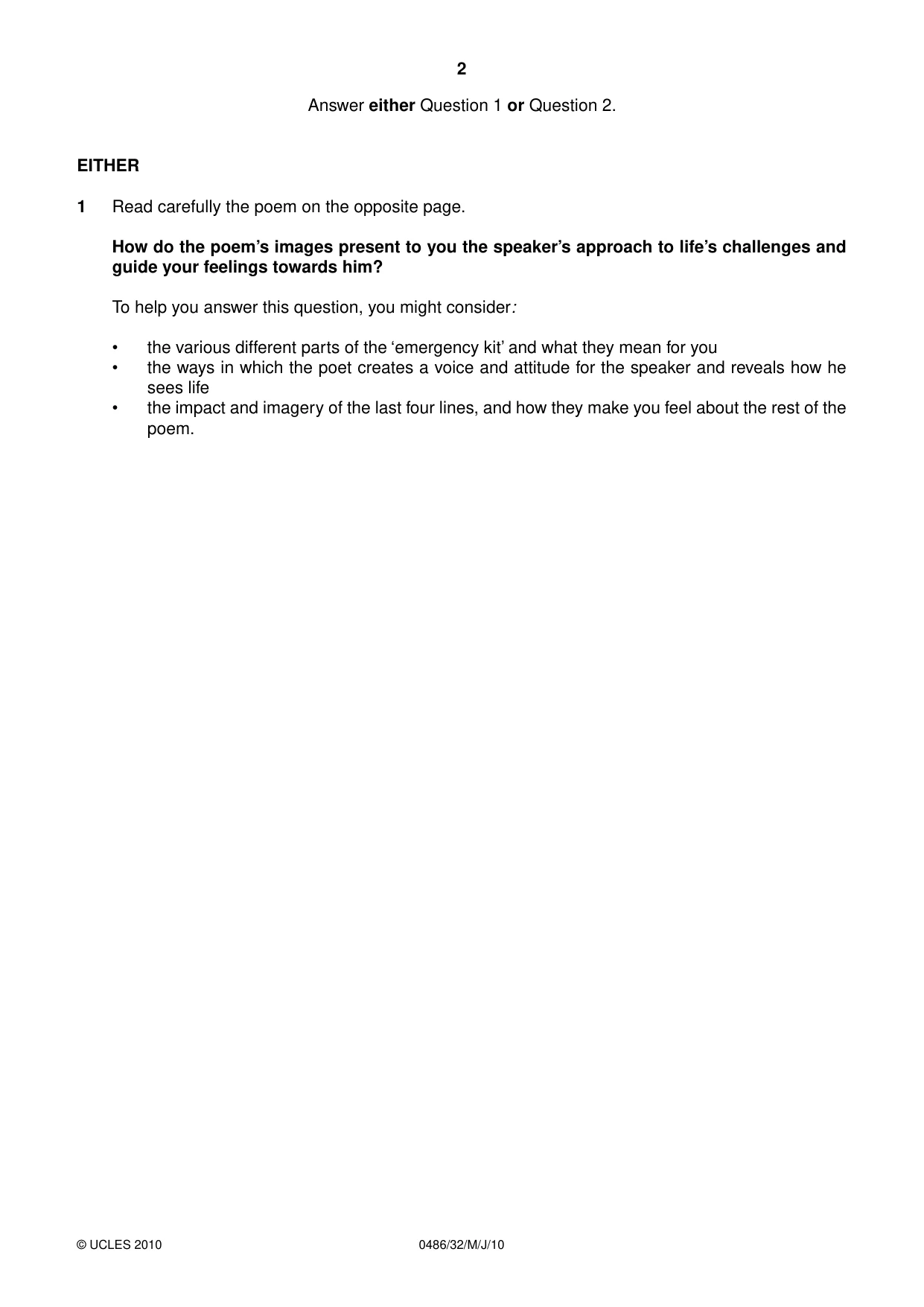
2 0486/32/M/J/10 © UCLES 2010 Answer either Question 1 or Question 2. EITHER 1 Read carefully the poem on the opposite page. How do the poem’s images present to you the speaker’s approach to life’s challenges and guide your feelings towards him? To help you answer this question, you might consider: • the various different parts of the ‘emergency kit’ and what they mean for you • the ways in which the poet creates a voice and attitude for the speaker and reveals how he sees life • the impact and imagery of the last four lines, and how they make you feel about the rest of the poem.
Question paper, page 3
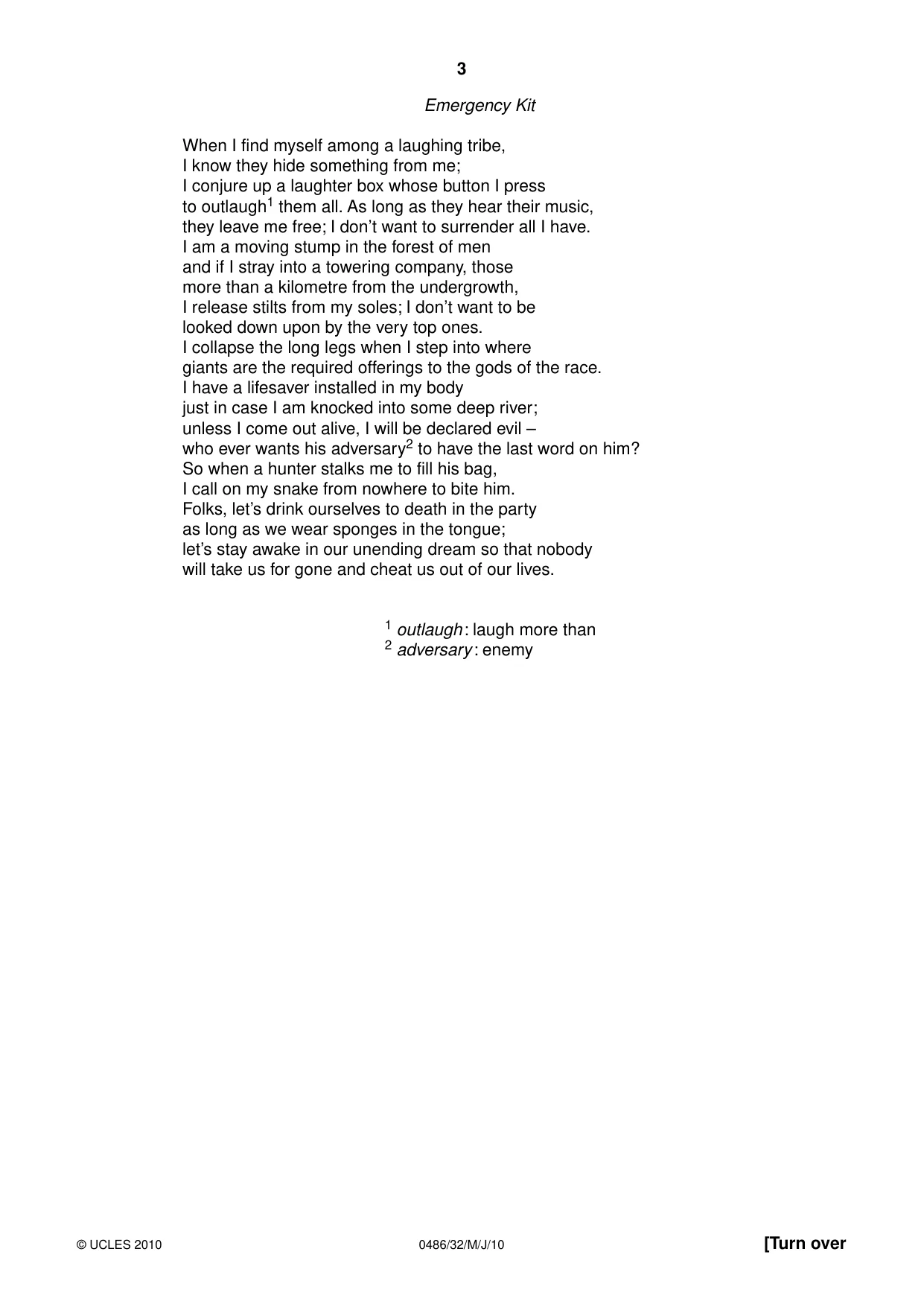
3 0486/32/M/J/10 © UCLES 2010 [Turn over Emergency Kit When I find myself among a laughing tribe, I know they hide something from me; I conjure up a laughter box whose button I press to outlaugh1 them all. As long as they hear their music, they leave me free; I don’t want to surrender all I have. I am a moving stump in the forest of men and if I stray into a towering company, those more than a kilometre from the undergrowth, I release stilts from my soles; I don’t want to be looked down upon by the very top ones. I collapse the long legs when I step into where giants are the required offerings to the gods of the race. I have a lifesaver installed in my body just in case I am knocked into some deep river; unless I come out alive, I will be declared evil – who ever wants his adversary2 to have the last word on him? So when a hunter stalks me to fill his bag, I call on my snake from nowhere to bite him. Folks, let’s drink ourselves to death in the party as long as we wear sponges in the tongue; let’s stay awake in our unending dream so that nobody will take us for gone and cheat us out of our lives. 1 outlaugh : laugh more than 2 adversary : enemy
Question paper, page 4
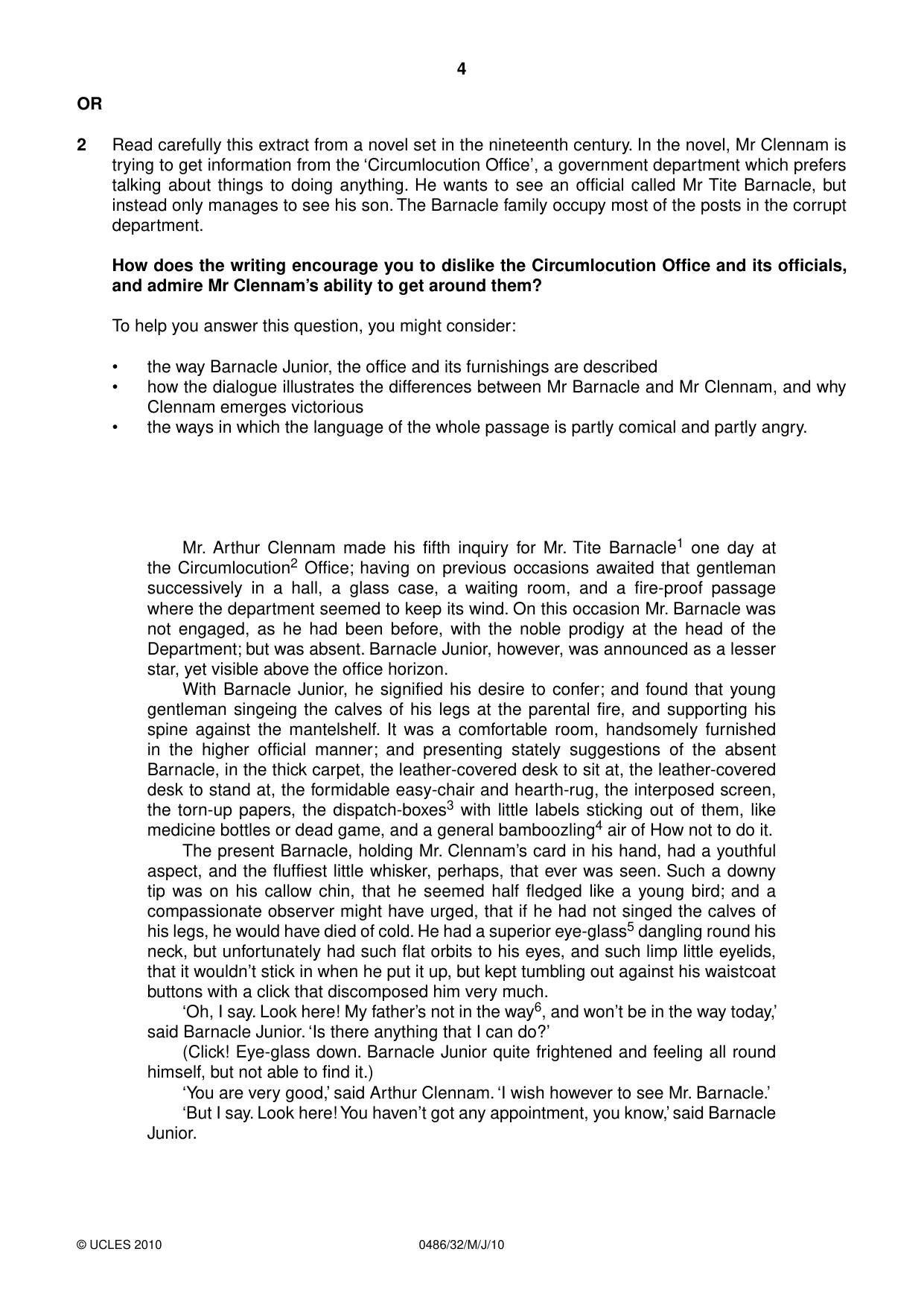
4 0486/32/M/J/10 © UCLES 2010 OR 2 Read carefully this extract from a novel set in the nineteenth century. In the novel, Mr Clennam is trying to get information from the ‘Circumlocution Office’, a government department which prefers talking about things to doing anything. He wants to see an official called Mr Tite Barnacle, but instead only manages to see his son. The Barnacle family occupy most of the posts in the corrupt department. How does the writing encourage you to dislike the Circumlocution Office and its officials, and admire Mr Clennam’s ability to get around them? To help you answer this question, you might consider: • the way Barnacle Junior, the office and its furnishings are described • how the dialogue illustrates the differences between Mr Barnacle and Mr Clennam, and why Clennam emerges victorious • the ways in which the language of the whole passage is partly comical and partly angry. Mr. Arthur Clennam made his fifth inquiry for Mr. Tite Barnacle1 one day at the Circumlocution2 Office; having on previous occasions awaited that gentleman successively in a hall, a glass case, a waiting room, and a fire-proof passage where the department seemed to keep its wind. On this occasion Mr. Barnacle was not engaged, as he had been before, with the noble prodigy at the head of the Department; but was absent. Barnacle Junior, however, was announced as a lesser star, yet visible above the office horizon. With Barnacle Junior, he signified his desire to confer; and found that young gentleman singeing the calves of his legs at the parental fire, and supporting his spine against the mantelshelf. It was a comfortable room, handsomely furnished in the higher official manner; and presenting stately suggestions of the absent Barnacle, in the thick carpet, the leather-covered desk to sit at, the leather-covered desk to stand at, the formidable easy-chair and hearth-rug, the interposed screen, the torn-up papers, the dispatch-boxes3 with little labels sticking out of them, like medicine bottles or dead game, and a general bamboozling4 air of How not to do it. The present Barnacle, holding Mr. Clennam’s card in his hand, had a youthful aspect, and the fluffiest little whisker, perhaps, that ever was seen. Such a downy tip was on his callow chin, that he seemed half fledged like a young bird; and a compassionate observer might have urged, that if he had not singed the calves of his legs, he would have died of cold. He had a superior eye-glass5 dangling round his neck, but unfortunately had such flat orbits to his eyes, and such limp little eyelids, that it wouldn’t stick in when he put it up, but kept tumbling out against his waistcoat buttons with a click that discomposed him very much. ‘Oh, I say. Look here! My father’s not in the way6, and won’t be in the way today,’ said Barnacle Junior. ‘Is there anything that I can do?’ (Click! Eye-glass down. Barnacle Junior quite frightened and feeling all round himself, but not able to find it.) ‘You are very good,’ said Arthur Clennam. ‘I wish however to see Mr. Barnacle.’ ‘But I say. Look here! You haven’t got any appointment, you know,’ said Barnacle Junior.
Question paper, page 5
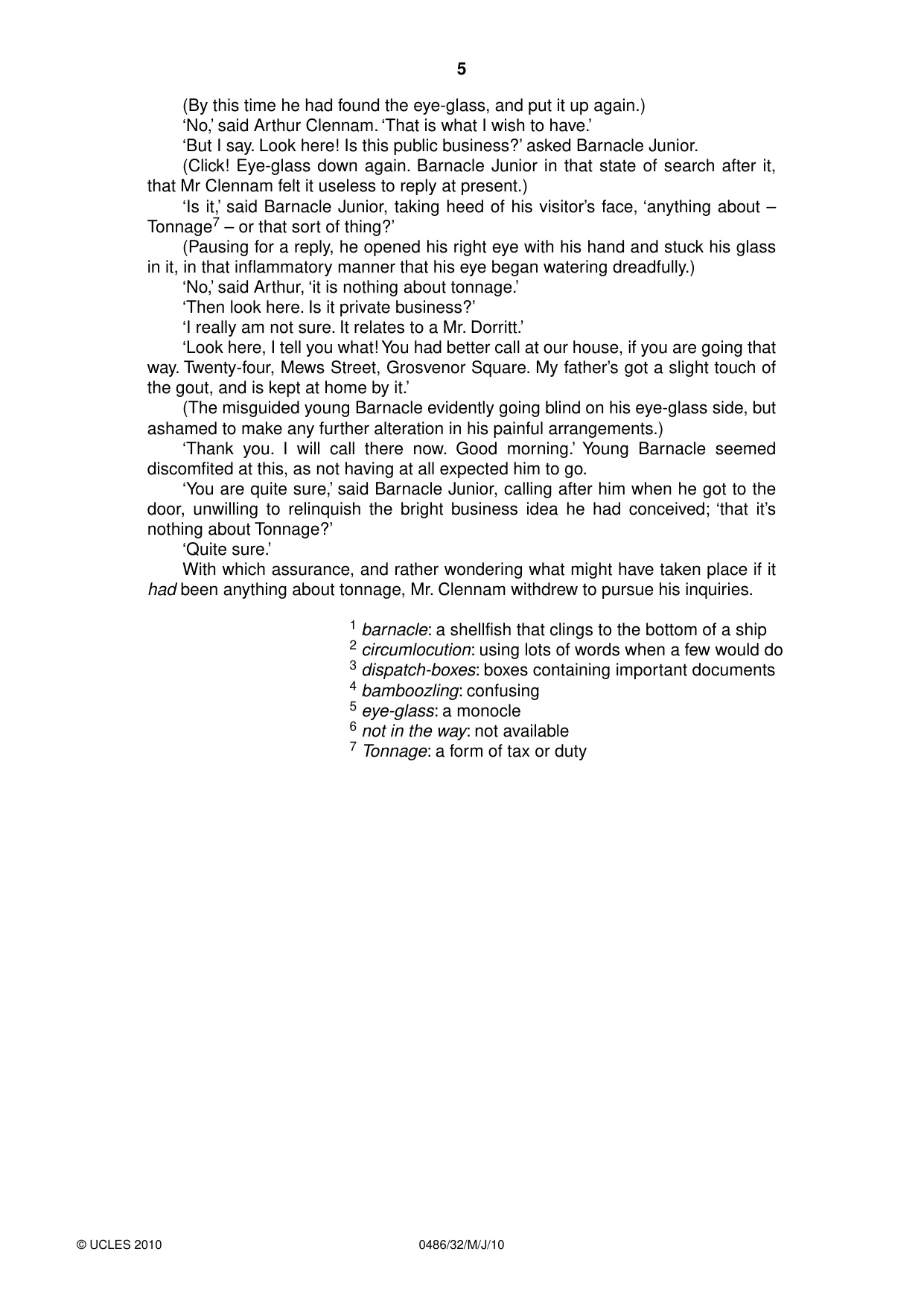
5 0486/32/M/J/10 © UCLES 2010 (By this time he had found the eye-glass, and put it up again.) ‘No,’ said Arthur Clennam. ‘That is what I wish to have.’ ‘But I say. Look here! Is this public business?’ asked Barnacle Junior. (Click! Eye-glass down again. Barnacle Junior in that state of search after it, that Mr Clennam felt it useless to reply at present.) ‘Is it,’ said Barnacle Junior, taking heed of his visitor’s face, ‘anything about – Tonnage7 – or that sort of thing?’ (Pausing for a reply, he opened his right eye with his hand and stuck his glass in it, in that inflammatory manner that his eye began watering dreadfully.) ‘No,’ said Arthur, ‘it is nothing about tonnage.’ ‘Then look here. Is it private business?’ ‘I really am not sure. It relates to a Mr. Dorritt.’ ‘Look here, I tell you what! You had better call at our house, if you are going that way. Twenty-four, Mews Street, Grosvenor Square. My father’s got a slight touch of the gout, and is kept at home by it.’ (The misguided young Barnacle evidently going blind on his eye-glass side, but ashamed to make any further alteration in his painful arrangements.) ‘Thank you. I will call there now. Good morning.’ Young Barnacle seemed discomfited at this, as not having at all expected him to go. ‘You are quite sure,’ said Barnacle Junior, calling after him when he got to the door, unwilling to relinquish the bright business idea he had conceived; ‘that it’s nothing about Tonnage?’ ‘Quite sure.’ With which assurance, and rather wondering what might have taken place if it had been anything about tonnage, Mr. Clennam withdrew to pursue his inquiries. 1 barnacle: a shellfish that clings to the bottom of a ship 2 circumlocution: using lots of words when a few would do 3 dispatch-boxes: boxes containing important documents 4 bamboozling: confusing 5 eye-glass: a monocle 6 not in the way: not available 7 Tonnage: a form of tax or duty
Question paper, page 6
6 0486/32/M/J/10 © UCLES 2010 BLANK PAGE
Question paper, page 7
7 © UCLES 2010 0486/32/M/J/10 BLANK PAGE
Question paper, page 8
8 0486/32/M/J/10 © UCLES 2010 Copyright Acknowledgements: Question 1 © Jo Shapcott & Mathew Sweeney (eds.); Tanure Ojaide; Emergency Kit: Poems for Strange Times; Faber. Permission to reproduce items where third-party owned material protected by copyright is included has been sought and cleared where possible. Every reasonable effort has been made by the publisher (UCLES) to trace copyright holders, but if any items requiring clearance have unwittingly been included, the publisher will be pleased to make amends at the earliest possible opportunity. University of Cambridge International Examinations is part of the Cambridge Assessment Group. Cambridge Assessment is the brand name of University of Cambridge Local Examinations Syndicate (UCLES), which is itself a department of the University of Cambridge. BLANK PAGE
Mark scheme, page 1
UNIVERSITY OF CAMBRIDGE INTERNATIONAL EXAMINATIONS International General Certificate of Secondary Education MARK SCHEME for the May/June 2010 question paper for the guidance of teachers 0486 LITERATURE (ENGLISH) 0486/32 Paper 32 (Unseen), maximum raw mark 25 This mark scheme is published as an aid to teachers and candidates, to indicate the requirements of the examination. It shows the basis on which Examiners were instructed to award marks. It does not indicate the details of the discussions that took place at an Examiners’ meeting before marking began, which would have considered the acceptability of alternative answers. Mark schemes must be read in conjunction with the question papers and the report on the examination. • CIE will not enter into discussions or correspondence in connection with these mark schemes. CIE is publishing the mark schemes for the May/June 2010 question papers for most IGCSE, GCE Advanced Level and Advanced Subsidiary Level syllabuses and some Ordinary Level syllabuses. www.XtremePapers.com
Mark scheme, page 2
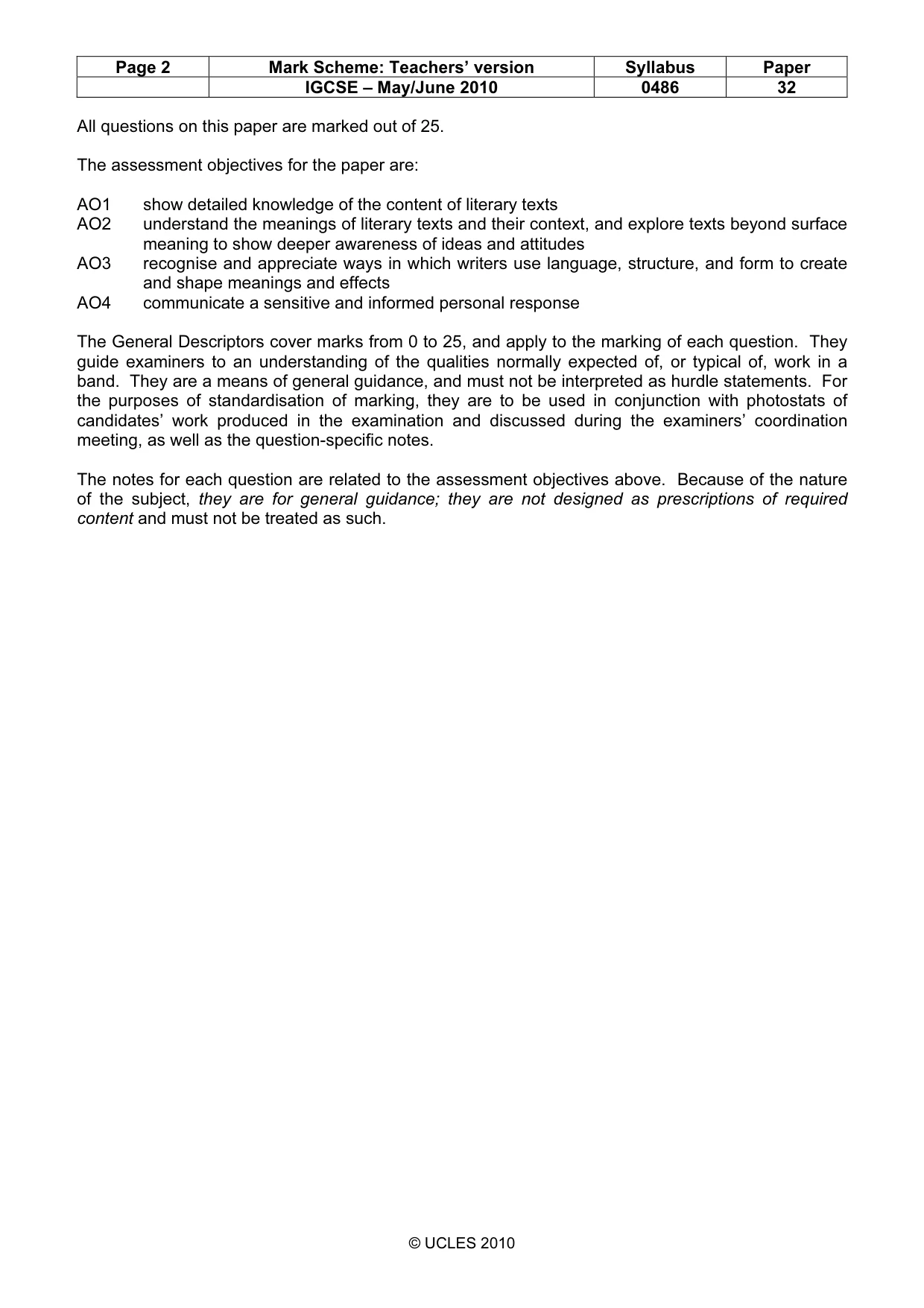
Page 2 Mark Scheme: Teachers’ version Syllabus Paper IGCSE – May/June 2010 0486 32 © UCLES 2010 All questions on this paper are marked out of 25. The assessment objectives for the paper are: AO1 show detailed knowledge of the content of literary texts AO2 understand the meanings of literary texts and their context, and explore texts beyond surface meaning to show deeper awareness of ideas and attitudes AO3 recognise and appreciate ways in which writers use language, structure, and form to create and shape meanings and effects AO4 communicate a sensitive and informed personal response The General Descriptors cover marks from 0 to 25, and apply to the marking of each question. They guide examiners to an understanding of the qualities normally expected of, or typical of, work in a band. They are a means of general guidance, and must not be interpreted as hurdle statements. For the purposes of standardisation of marking, they are to be used in conjunction with photostats of candidates’ work produced in the examination and discussed during the examiners’ coordination meeting, as well as the question-specific notes. The notes for each question are related to the assessment objectives above. Because of the nature of the subject, they are for general guidance; they are not designed as prescriptions of required content and must not be treated as such.
Mark scheme, page 3
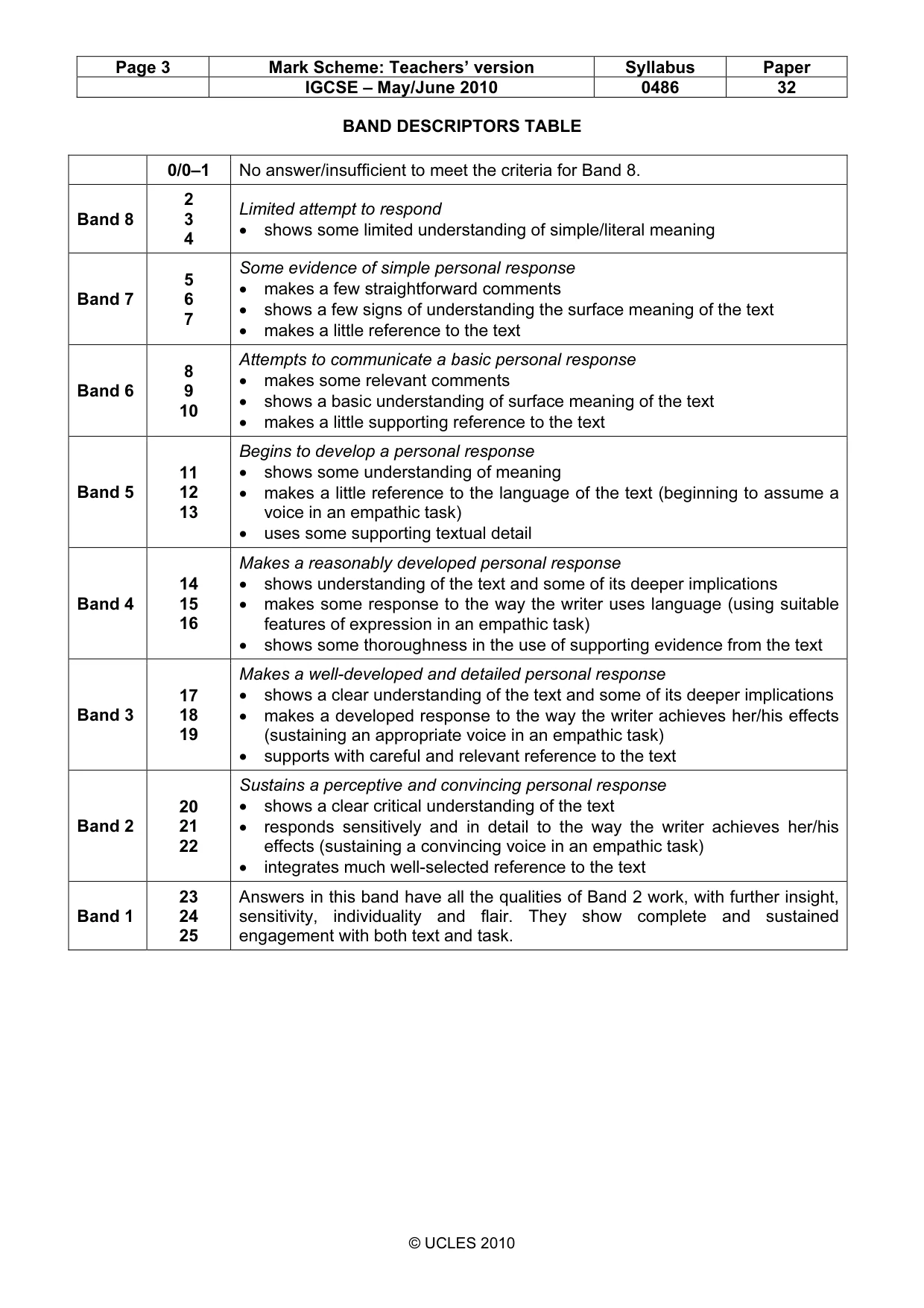
Page 3 Mark Scheme: Teachers’ version Syllabus Paper IGCSE – May/June 2010 0486 32 © UCLES 2010 BAND DESCRIPTORS TABLE 0/0–1 No answer/insufficient to meet the criteria for Band 8. Band 8 2 3 4 Limited attempt to respond • shows some limited understanding of simple/literal meaning Band 7 5 6 7 Some evidence of simple personal response • makes a few straightforward comments • shows a few signs of understanding the surface meaning of the text • makes a little reference to the text Band 6 8 9 10 Attempts to communicate a basic personal response • makes some relevant comments • shows a basic understanding of surface meaning of the text • makes a little supporting reference to the text Band 5 11 12 13 Begins to develop a personal response • shows some understanding of meaning • makes a little reference to the language of the text (beginning to assume a voice in an empathic task) • uses some supporting textual detail Band 4 14 15 16 Makes a reasonably developed personal response • shows understanding of the text and some of its deeper implications • makes some response to the way the writer uses language (using suitable features of expression in an empathic task) • shows some thoroughness in the use of supporting evidence from the text Band 3 17 18 19 Makes a well-developed and detailed personal response • shows a clear understanding of the text and some of its deeper implications • makes a developed response to the way the writer achieves her/his effects (sustaining an appropriate voice in an empathic task) • supports with careful and relevant reference to the text Band 2 20 21 22 Sustains a perceptive and convincing personal response • shows a clear critical understanding of the text • responds sensitively and in detail to the way the writer achieves her/his effects (sustaining a convincing voice in an empathic task) • integrates much well-selected reference to the text Band 1 23 24 25 Answers in this band have all the qualities of Band 2 work, with further insight, sensitivity, individuality and flair. They show complete and sustained engagement with both text and task.
Mark scheme, page 4
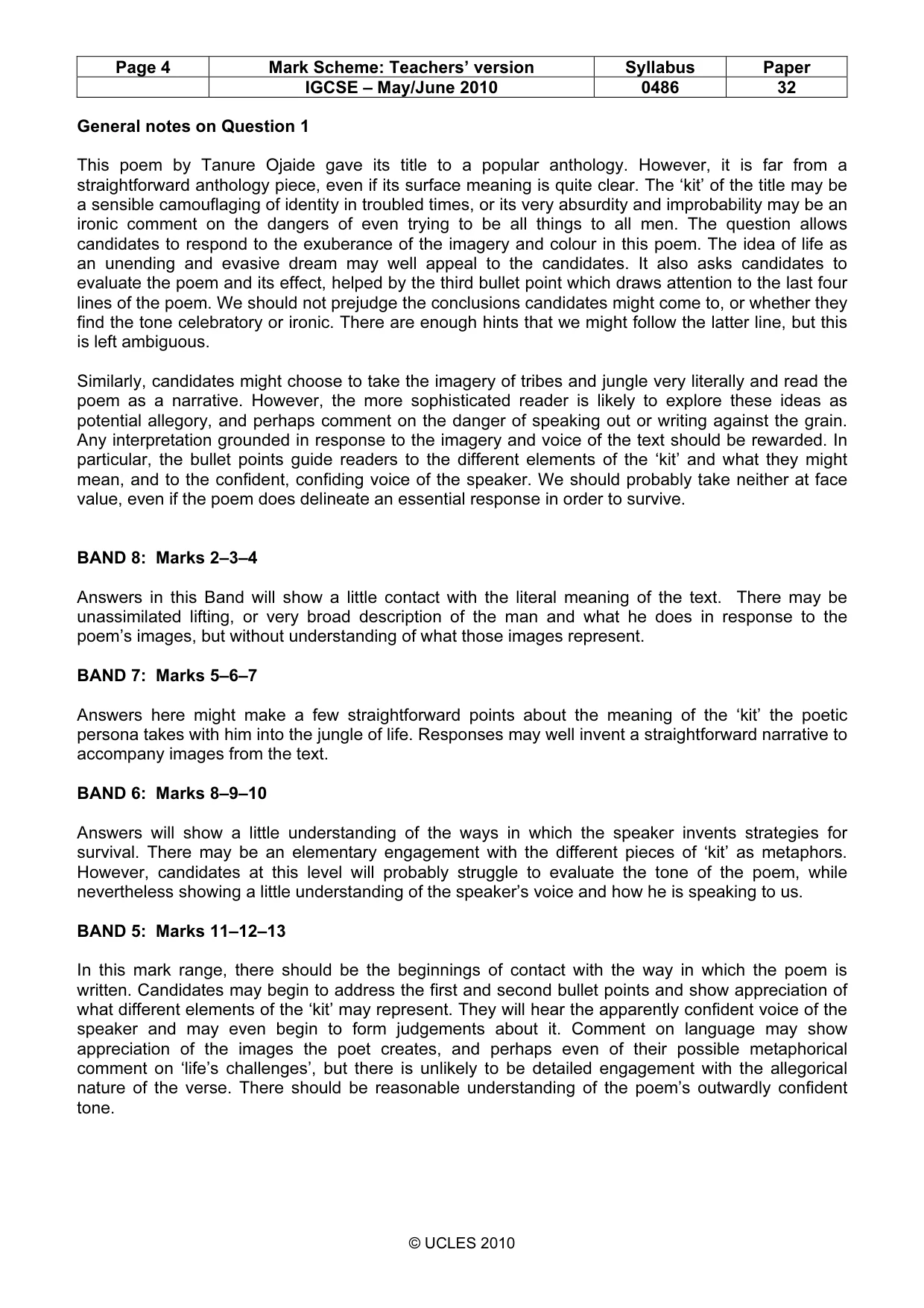
Page 4 Mark Scheme: Teachers’ version Syllabus Paper IGCSE – May/June 2010 0486 32 © UCLES 2010 General notes on Question 1 This poem by Tanure Ojaide gave its title to a popular anthology. However, it is far from a straightforward anthology piece, even if its surface meaning is quite clear. The ‘kit’ of the title may be a sensible camouflaging of identity in troubled times, or its very absurdity and improbability may be an ironic comment on the dangers of even trying to be all things to all men. The question allows candidates to respond to the exuberance of the imagery and colour in this poem. The idea of life as an unending and evasive dream may well appeal to the candidates. It also asks candidates to evaluate the poem and its effect, helped by the third bullet point which draws attention to the last four lines of the poem. We should not prejudge the conclusions candidates might come to, or whether they find the tone celebratory or ironic. There are enough hints that we might follow the latter line, but this is left ambiguous. Similarly, candidates might choose to take the imagery of tribes and jungle very literally and read the poem as a narrative. However, the more sophisticated reader is likely to explore these ideas as potential allegory, and perhaps comment on the danger of speaking out or writing against the grain. Any interpretation grounded in response to the imagery and voice of the text should be rewarded. In particular, the bullet points guide readers to the different elements of the ‘kit’ and what they might mean, and to the confident, confiding voice of the speaker. We should probably take neither at face value, even if the poem does delineate an essential response in order to survive. BAND 8: Marks 2–3–4 Answers in this Band will show a little contact with the literal meaning of the text. There may be unassimilated lifting, or very broad description of the man and what he does in response to the poem’s images, but without understanding of what those images represent. BAND 7: Marks 5–6–7 Answers here might make a few straightforward points about the meaning of the ‘kit’ the poetic persona takes with him into the jungle of life. Responses may well invent a straightforward narrative to accompany images from the text. BAND 6: Marks 8–9–10 Answers will show a little understanding of the ways in which the speaker invents strategies for survival. There may be an elementary engagement with the different pieces of ‘kit’ as metaphors. However, candidates at this level will probably struggle to evaluate the tone of the poem, while nevertheless showing a little understanding of the speaker’s voice and how he is speaking to us. BAND 5: Marks 11–12–13 In this mark range, there should be the beginnings of contact with the way in which the poem is written. Candidates may begin to address the first and second bullet points and show appreciation of what different elements of the ‘kit’ may represent. They will hear the apparently confident voice of the speaker and may even begin to form judgements about it. Comment on language may show appreciation of the images the poet creates, and perhaps even of their possible metaphorical comment on ‘life’s challenges’, but there is unlikely to be detailed engagement with the allegorical nature of the verse. There should be reasonable understanding of the poem’s outwardly confident tone.
Mark scheme, page 5
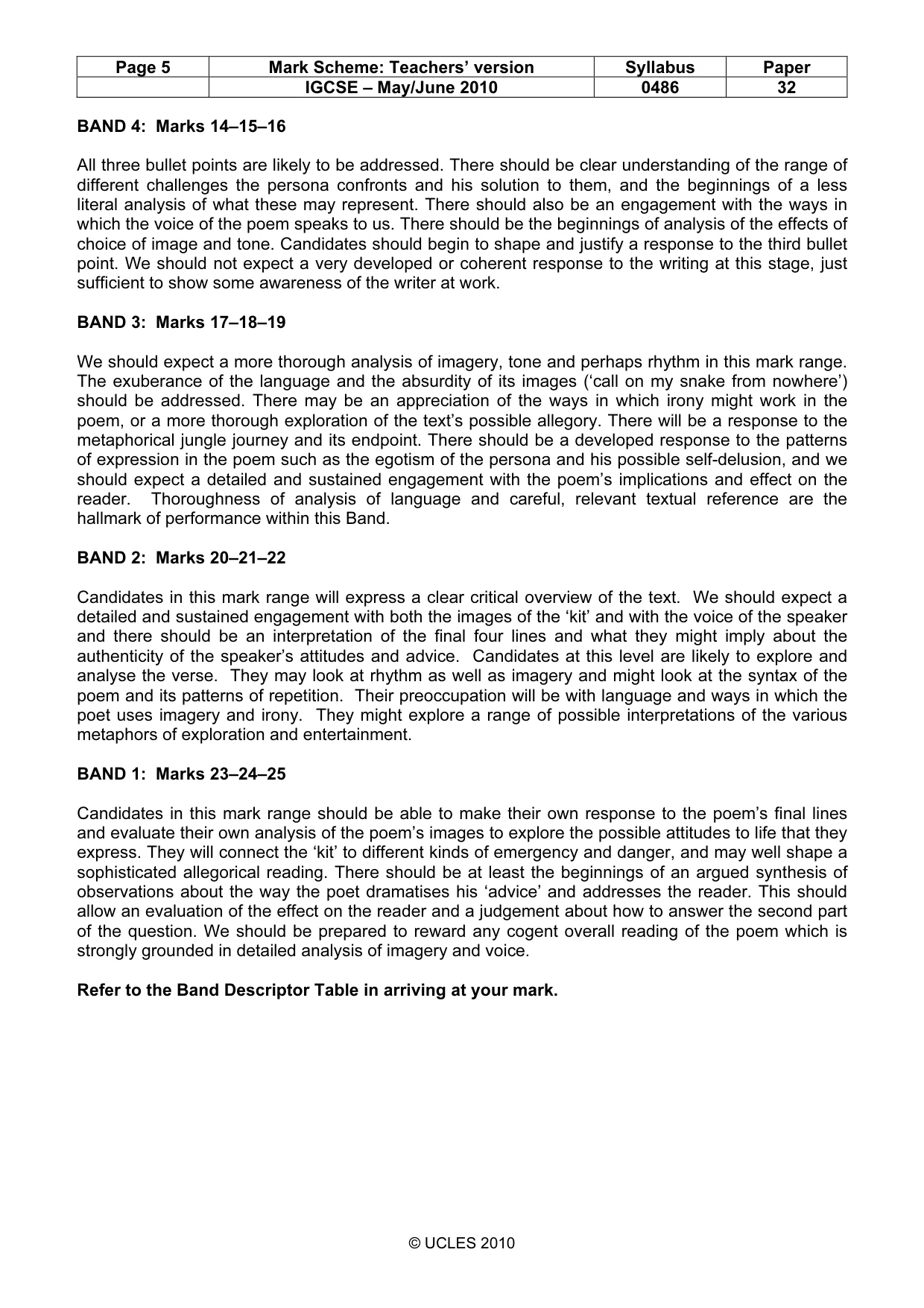
Page 5 Mark Scheme: Teachers’ version Syllabus Paper IGCSE – May/June 2010 0486 32 © UCLES 2010 BAND 4: Marks 14–15–16 All three bullet points are likely to be addressed. There should be clear understanding of the range of different challenges the persona confronts and his solution to them, and the beginnings of a less literal analysis of what these may represent. There should also be an engagement with the ways in which the voice of the poem speaks to us. There should be the beginnings of analysis of the effects of choice of image and tone. Candidates should begin to shape and justify a response to the third bullet point. We should not expect a very developed or coherent response to the writing at this stage, just sufficient to show some awareness of the writer at work. BAND 3: Marks 17–18–19 We should expect a more thorough analysis of imagery, tone and perhaps rhythm in this mark range. The exuberance of the language and the absurdity of its images (‘call on my snake from nowhere’) should be addressed. There may be an appreciation of the ways in which irony might work in the poem, or a more thorough exploration of the text’s possible allegory. There will be a response to the metaphorical jungle journey and its endpoint. There should be a developed response to the patterns of expression in the poem such as the egotism of the persona and his possible self-delusion, and we should expect a detailed and sustained engagement with the poem’s implications and effect on the reader. Thoroughness of analysis of language and careful, relevant textual reference are the hallmark of performance within this Band. BAND 2: Marks 20–21–22 Candidates in this mark range will express a clear critical overview of the text. We should expect a detailed and sustained engagement with both the images of the ‘kit’ and with the voice of the speaker and there should be an interpretation of the final four lines and what they might imply about the authenticity of the speaker’s attitudes and advice. Candidates at this level are likely to explore and analyse the verse. They may look at rhythm as well as imagery and might look at the syntax of the poem and its patterns of repetition. Their preoccupation will be with language and ways in which the poet uses imagery and irony. They might explore a range of possible interpretations of the various metaphors of exploration and entertainment. BAND 1: Marks 23–24–25 Candidates in this mark range should be able to make their own response to the poem’s final lines and evaluate their own analysis of the poem’s images to explore the possible attitudes to life that they express. They will connect the ‘kit’ to different kinds of emergency and danger, and may well shape a sophisticated allegorical reading. There should be at least the beginnings of an argued synthesis of observations about the way the poet dramatises his ‘advice’ and addresses the reader. This should allow an evaluation of the effect on the reader and a judgement about how to answer the second part of the question. We should be prepared to reward any cogent overall reading of the poem which is strongly grounded in detailed analysis of imagery and voice. Refer to the Band Descriptor Table in arriving at your mark.
Mark scheme, page 6
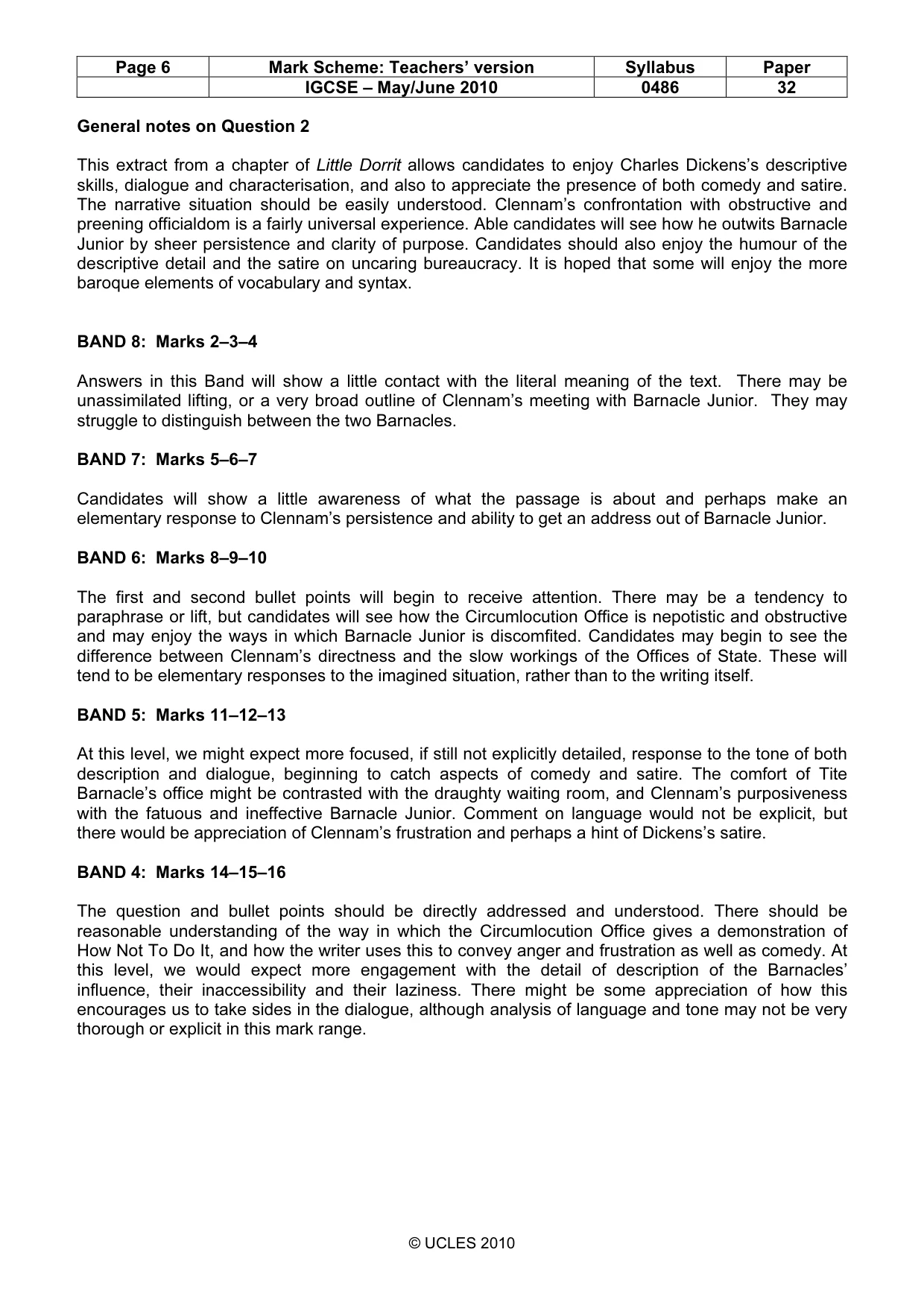
Page 6 Mark Scheme: Teachers’ version Syllabus Paper IGCSE – May/June 2010 0486 32 © UCLES 2010 General notes on Question 2 This extract from a chapter of Little Dorrit allows candidates to enjoy Charles Dickens’s descriptive skills, dialogue and characterisation, and also to appreciate the presence of both comedy and satire. The narrative situation should be easily understood. Clennam’s confrontation with obstructive and preening officialdom is a fairly universal experience. Able candidates will see how he outwits Barnacle Junior by sheer persistence and clarity of purpose. Candidates should also enjoy the humour of the descriptive detail and the satire on uncaring bureaucracy. It is hoped that some will enjoy the more baroque elements of vocabulary and syntax. BAND 8: Marks 2–3–4 Answers in this Band will show a little contact with the literal meaning of the text. There may be unassimilated lifting, or a very broad outline of Clennam’s meeting with Barnacle Junior. They may struggle to distinguish between the two Barnacles. BAND 7: Marks 5–6–7 Candidates will show a little awareness of what the passage is about and perhaps make an elementary response to Clennam’s persistence and ability to get an address out of Barnacle Junior. BAND 6: Marks 8–9–10 The first and second bullet points will begin to receive attention. There may be a tendency to paraphrase or lift, but candidates will see how the Circumlocution Office is nepotistic and obstructive and may enjoy the ways in which Barnacle Junior is discomfited. Candidates may begin to see the difference between Clennam’s directness and the slow workings of the Offices of State. These will tend to be elementary responses to the imagined situation, rather than to the writing itself. BAND 5: Marks 11–12–13 At this level, we might expect more focused, if still not explicitly detailed, response to the tone of both description and dialogue, beginning to catch aspects of comedy and satire. The comfort of Tite Barnacle’s office might be contrasted with the draughty waiting room, and Clennam’s purposiveness with the fatuous and ineffective Barnacle Junior. Comment on language would not be explicit, but there would be appreciation of Clennam’s frustration and perhaps a hint of Dickens’s satire. BAND 4: Marks 14–15–16 The question and bullet points should be directly addressed and understood. There should be reasonable understanding of the way in which the Circumlocution Office gives a demonstration of How Not To Do It, and how the writer uses this to convey anger and frustration as well as comedy. At this level, we would expect more engagement with the detail of description of the Barnacles’ influence, their inaccessibility and their laziness. There might be some appreciation of how this encourages us to take sides in the dialogue, although analysis of language and tone may not be very thorough or explicit in this mark range.
Mark scheme, page 7
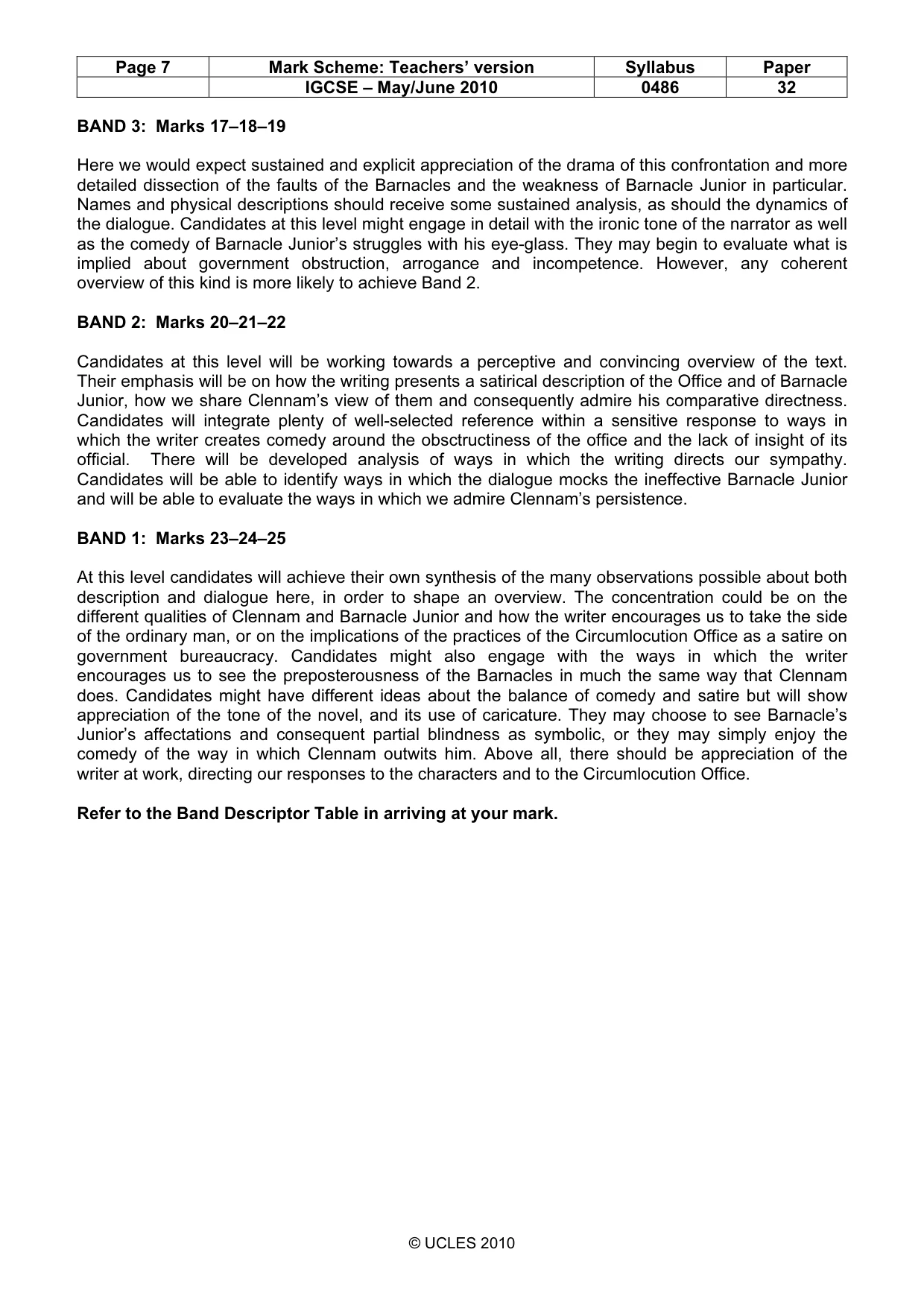
Page 7 Mark Scheme: Teachers’ version Syllabus Paper IGCSE – May/June 2010 0486 32 © UCLES 2010 BAND 3: Marks 17–18–19 Here we would expect sustained and explicit appreciation of the drama of this confrontation and more detailed dissection of the faults of the Barnacles and the weakness of Barnacle Junior in particular. Names and physical descriptions should receive some sustained analysis, as should the dynamics of the dialogue. Candidates at this level might engage in detail with the ironic tone of the narrator as well as the comedy of Barnacle Junior’s struggles with his eye-glass. They may begin to evaluate what is implied about government obstruction, arrogance and incompetence. However, any coherent overview of this kind is more likely to achieve Band 2. BAND 2: Marks 20–21–22 Candidates at this level will be working towards a perceptive and convincing overview of the text. Their emphasis will be on how the writing presents a satirical description of the Office and of Barnacle Junior, how we share Clennam’s view of them and consequently admire his comparative directness. Candidates will integrate plenty of well-selected reference within a sensitive response to ways in which the writer creates comedy around the obsctructiness of the office and the lack of insight of its official. There will be developed analysis of ways in which the writing directs our sympathy. Candidates will be able to identify ways in which the dialogue mocks the ineffective Barnacle Junior and will be able to evaluate the ways in which we admire Clennam’s persistence. BAND 1: Marks 23–24–25 At this level candidates will achieve their own synthesis of the many observations possible about both description and dialogue here, in order to shape an overview. The concentration could be on the different qualities of Clennam and Barnacle Junior and how the writer encourages us to take the side of the ordinary man, or on the implications of the practices of the Circumlocution Office as a satire on government bureaucracy. Candidates might also engage with the ways in which the writer encourages us to see the preposterousness of the Barnacles in much the same way that Clennam does. Candidates might have different ideas about the balance of comedy and satire but will show appreciation of the tone of the novel, and its use of caricature. They may choose to see Barnacle’s Junior’s affectations and consequent partial blindness as symbolic, or they may simply enjoy the comedy of the way in which Clennam outwits him. Above all, there should be appreciation of the writer at work, directing our responses to the characters and to the Circumlocution Office. Refer to the Band Descriptor Table in arriving at your mark.
What you needed in this session
Cambridge’s own grade thresholds for 2010 May/June, Paper 3 · Variant 2. A higher threshold means an easier paper — the bar moves with how the cohort did.