Cambridge IGCSE English - Literature 0486 — 2010 May/June Paper 3 · Variant 1
0486/31/M/J/10 · 25 marks · ≈28 min
The question paper and its mark scheme, free to read here and free to download. This is Cambridge’s own paper, exactly as it was sat.
Question paper8 pages



Mark scheme7 pages
Answers below. Sit the paper first if you are practising.
Paper as text
Question paper, page 1
This document consists of 5 printed pages and 3 blank pages. DC (CB) 11499/5 © UCLES 2010 [Turn over UNIVERSITY OF CAMBRIDGE INTERNATIONAL EXAMINATIONS International General Certificate of Secondary Education READ THESE INSTRUCTIONS FIRST If you have been given an Answer Booklet, follow the instructions on the front cover of the Booklet. Write your Centre number, candidate number and name on all the work you hand in. Write in dark blue or black pen. Do not use staples, paper clips, highlighters, glue or correction fluid. Answer either Question 1 or Question 2. You are advised to spend about 20 minutes reading the question paper and planning your answer. At the end of the examination, fasten all your work securely together. Both questions in this paper carry equal marks. LITERATURE (ENGLISH) 0486/31 Paper 3 Unseen May/June 2010 1 hour 20 minutes Additional Materials: Answer Booklet/Paper * 7 8 1 8 8 7 8 8 6 2 * www.XtremePapers.com
Question paper, page 2
2 0486/31/M/J/10 © UCLES 2010 Answer either Question 1 or Question 2. EITHER 1 Read carefully the following poem which describes the poet’s emotions on parting from a lover. How does the poet’s language and the way he addresses his lover show what he feels about her? To help you answer this question, you might consider: • the way the poet describes their final meeting; • how he reacts when other people speak about her; • the feelings he has towards her now, and how they are expressed.
Question paper, page 3
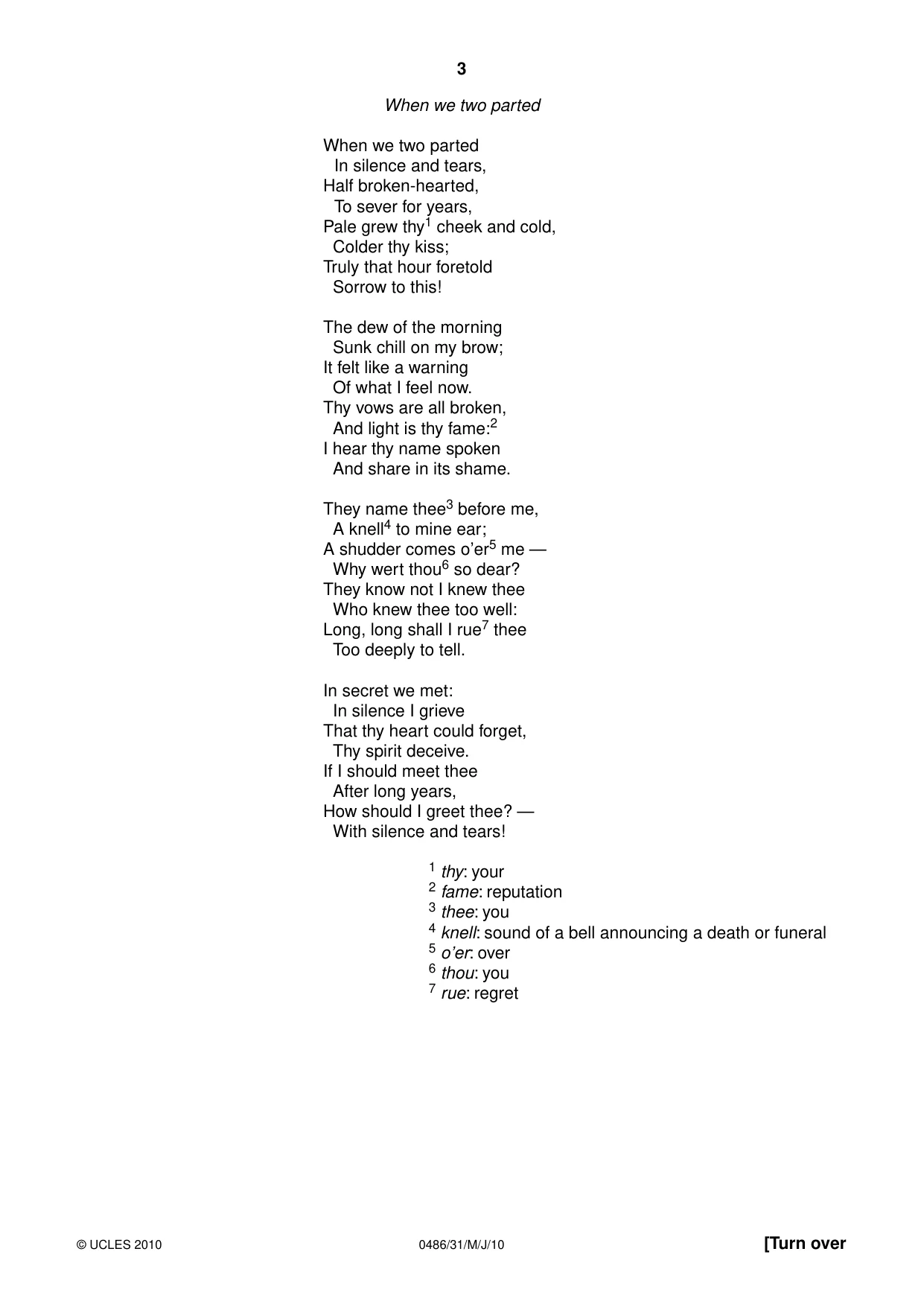
3 0486/31/M/J/10 © UCLES 2010 [Turn over When we two parted When we two parted In silence and tears, Half broken-hearted, To sever for years, Pale grew thy1 cheek and cold, Colder thy kiss; Truly that hour foretold Sorrow to this! The dew of the morning Sunk chill on my brow; It felt like a warning Of what I feel now. Thy vows are all broken, And light is thy fame:2 I hear thy name spoken And share in its shame. They name thee3 before me, A knell4 to mine ear; A shudder comes o’er5 me — Why wert thou6 so dear? They know not I knew thee Who knew thee too well: Long, long shall I rue7 thee Too deeply to tell. In secret we met: In silence I grieve That thy heart could forget, Thy spirit deceive. If I should meet thee After long years, How should I greet thee? — With silence and tears! 1 thy: your 2 fame: reputation 3 thee: you 4 knell: sound of a bell announcing a death or funeral 5 o’er: over 6 thou: you 7 rue: regret
Question paper, page 4
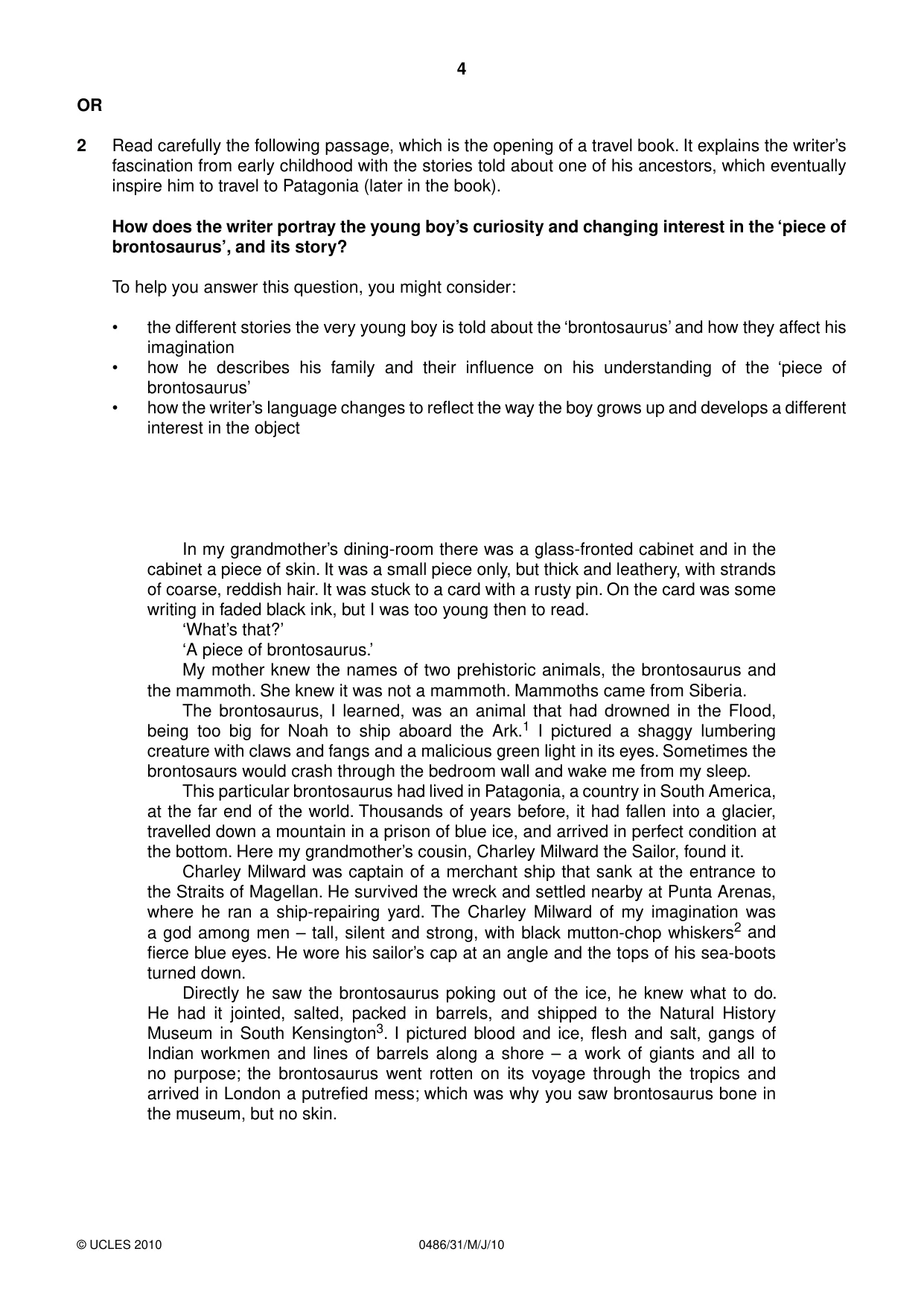
4 0486/31/M/J/10 © UCLES 2010 OR 2 Read carefully the following passage, which is the opening of a travel book. It explains the writer’s fascination from early childhood with the stories told about one of his ancestors, which eventually inspire him to travel to Patagonia (later in the book). How does the writer portray the young boy’s curiosity and changing interest in the ‘piece of brontosaurus’, and its story? To help you answer this question, you might consider: • the different stories the very young boy is told about the ‘brontosaurus’ and how they affect his imagination • how he describes his family and their influence on his understanding of the ‘piece of brontosaurus’ • how the writer’s language changes to reflect the way the boy grows up and develops a different interest in the object In my grandmother’s dining-room there was a glass-fronted cabinet and in the cabinet a piece of skin. It was a small piece only, but thick and leathery, with strands of coarse, reddish hair. It was stuck to a card with a rusty pin. On the card was some writing in faded black ink, but I was too young then to read. ‘What’s that?’ ‘A piece of brontosaurus.’ My mother knew the names of two prehistoric animals, the brontosaurus and the mammoth. She knew it was not a mammoth. Mammoths came from Siberia. The brontosaurus, I learned, was an animal that had drowned in the Flood, being too big for Noah to ship aboard the Ark.1 I pictured a shaggy lumbering creature with claws and fangs and a malicious green light in its eyes. Sometimes the brontosaurs would crash through the bedroom wall and wake me from my sleep. This particular brontosaurus had lived in Patagonia, a country in South America, at the far end of the world. Thousands of years before, it had fallen into a glacier, travelled down a mountain in a prison of blue ice, and arrived in perfect condition at the bottom. Here my grandmother’s cousin, Charley Milward the Sailor, found it. Charley Milward was captain of a merchant ship that sank at the entrance to the Straits of Magellan. He survived the wreck and settled nearby at Punta Arenas, where he ran a ship-repairing yard. The Charley Milward of my imagination was a god among men – tall, silent and strong, with black mutton-chop whiskers2 and fierce blue eyes. He wore his sailor’s cap at an angle and the tops of his sea-boots turned down. Directly he saw the brontosaurus poking out of the ice, he knew what to do. He had it jointed, salted, packed in barrels, and shipped to the Natural History Museum in South Kensington3. I pictured blood and ice, flesh and salt, gangs of Indian workmen and lines of barrels along a shore – a work of giants and all to no purpose; the brontosaurus went rotten on its voyage through the tropics and arrived in London a putrefied mess; which was why you saw brontosaurus bone in the museum, but no skin.
Question paper, page 5
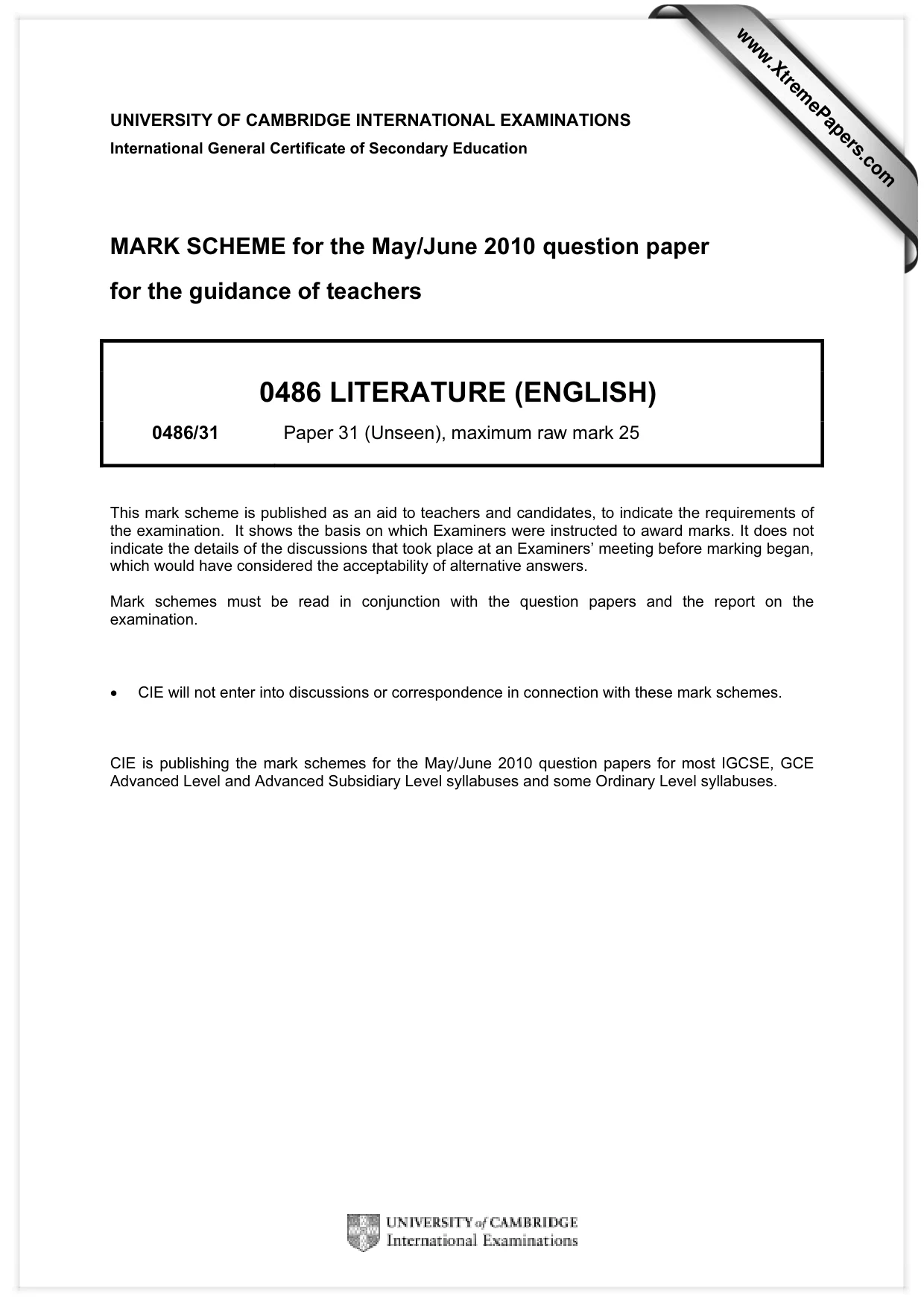
5 0486/31/M/J/10 © UCLES 2010 Fortunately cousin Charley had posted a scrap to my grandmother. My grandmother lived in a red-brick house set behind a screen of yellow- spattered laurels.4 It had tall chimneys, pointed gables and a garden of blood- coloured roses. Inside it smelled of church. I do not remember much about my grandmother except her size. I would clamber over her wide bosom, or watch, slyly, to see if she’d be able to rise from the chair. Above her hung paintings of Dutch burghers,5 their fat buttery faces nesting in white ruffs.6 On the mantelpiece were two Japanese homunculi7 with red and white ivory eyes that popped out on stalks. I would play with these, or with a German articulated monkey,8 but always I pestered her: ‘Please can I have the piece of brontosaurus.’ Never in my life have I wanted anything as I wanted that piece of skin. My grandmother said I should have it one day, perhaps. And when she died I said, ‘Now I can have the piece of brontosaurus,’ but my mother said: ‘Oh, that thing! I’m afraid we threw it away.’ At school they laughed at the story of the brontosaurus. The science master said I’d mixed it up with the Siberian mammoth. He told the class how Russian scientists had dined off deep-frozen mammoth and told me not to tell lies. Besides, he said, brontosauruses were reptiles. They had no hair, but scaly armoured hide. And he showed us an artist’s impression of the beast – so different from that of my imagination – grey-green, with a tiny head and a gigantic switchback of vertebrae, placidly eating weed in a lake. I was ashamed of my hairy brontosaurus, but I knew it was not a mammoth. It took some years to sort the story out. Charley Milward’s animal was not a brontosaurus, but the mylodon or Giant Sloth. He never found a whole specimen, or even a whole skeleton, but some skin and bones, preserved by the cold, dryness and salt, in a cave on Last Hope Sound in Chilean Patagonia. He sent the collection to England and sold it to the British Museum.9 This version was less romantic but had the merit of being true. 1 Ark : the ship in which Noah saved breeding pairs of animals from the Flood. 2 mutton-chop whiskers : long hair growing down the side of the face worn by men in the nineteenth century 3 Natural History Museum in South Kensington : a famous museum in London 4 laurels : plants (forming a hedge) 5 burghers : citizens 6 ruffs : old-fashioned stiff collars 7 homunculi : small ornamental human figures 8 articulated monkey : a toy animal with moveable limbs 9 British Museum : another museum in London
Question paper, page 6
6 0486/31/M/J/10 © UCLES 2010 BLANK PAGE
Question paper, page 7
7 © UCLES 2010 0486/31/M/J/10 BLANK PAGE
Question paper, page 8
8 0486/31/M/J/10 © UCLES 2010 Copyright Acknowledgements: Question 2 © Bruce Chatwin; In Patagonia; Picador; 1979. Permission to reproduce items where third-party owned material protected by copyright is included has been sought and cleared where possible. Every reasonable effort has been made by the publisher (UCLES) to trace copyright holders, but if any items requiring clearance have unwittingly been included, the publisher will be pleased to make amends at the earliest possible opportunity. University of Cambridge International Examinations is part of the Cambridge Assessment Group. Cambridge Assessment is the brand name of University of Cambridge Local Examinations Syndicate (UCLES), which is itself a department of the University of Cambridge.
Mark scheme, page 1
UNIVERSITY OF CAMBRIDGE INTERNATIONAL EXAMINATIONS International General Certificate of Secondary Education MARK SCHEME for the May/June 2010 question paper for the guidance of teachers 0486 LITERATURE (ENGLISH) 0486/31 Paper 31 (Unseen), maximum raw mark 25 This mark scheme is published as an aid to teachers and candidates, to indicate the requirements of the examination. It shows the basis on which Examiners were instructed to award marks. It does not indicate the details of the discussions that took place at an Examiners’ meeting before marking began, which would have considered the acceptability of alternative answers. Mark schemes must be read in conjunction with the question papers and the report on the examination. • CIE will not enter into discussions or correspondence in connection with these mark schemes. CIE is publishing the mark schemes for the May/June 2010 question papers for most IGCSE, GCE Advanced Level and Advanced Subsidiary Level syllabuses and some Ordinary Level syllabuses. www.XtremePapers.com
Mark scheme, page 2
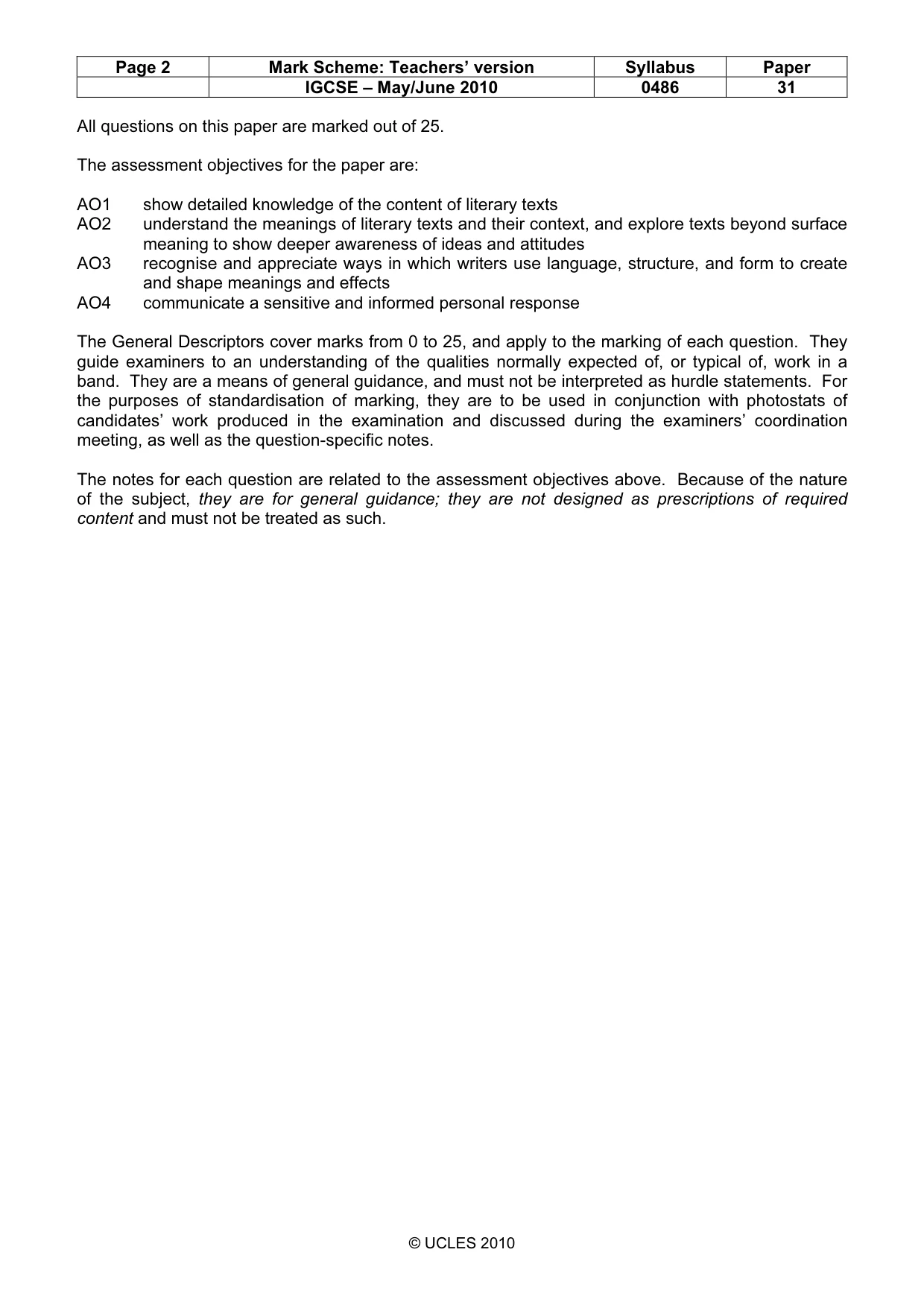
Page 2 Mark Scheme: Teachers’ version Syllabus Paper IGCSE – May/June 2010 0486 31 © UCLES 2010 All questions on this paper are marked out of 25. The assessment objectives for the paper are: AO1 show detailed knowledge of the content of literary texts AO2 understand the meanings of literary texts and their context, and explore texts beyond surface meaning to show deeper awareness of ideas and attitudes AO3 recognise and appreciate ways in which writers use language, structure, and form to create and shape meanings and effects AO4 communicate a sensitive and informed personal response The General Descriptors cover marks from 0 to 25, and apply to the marking of each question. They guide examiners to an understanding of the qualities normally expected of, or typical of, work in a band. They are a means of general guidance, and must not be interpreted as hurdle statements. For the purposes of standardisation of marking, they are to be used in conjunction with photostats of candidates’ work produced in the examination and discussed during the examiners’ coordination meeting, as well as the question-specific notes. The notes for each question are related to the assessment objectives above. Because of the nature of the subject, they are for general guidance; they are not designed as prescriptions of required content and must not be treated as such.
Mark scheme, page 3
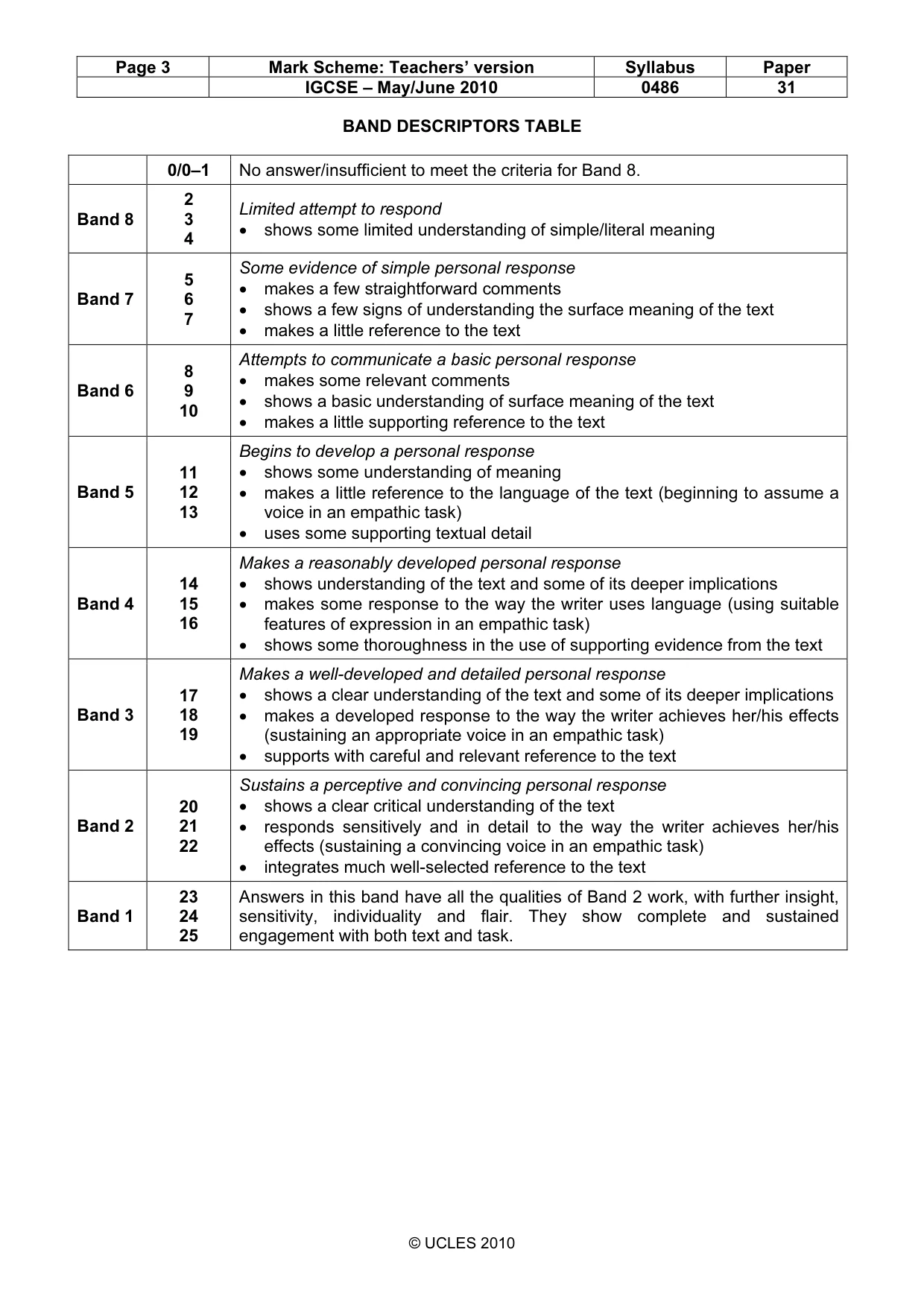
Page 3 Mark Scheme: Teachers’ version Syllabus Paper IGCSE – May/June 2010 0486 31 © UCLES 2010 BAND DESCRIPTORS TABLE 0/0–1 No answer/insufficient to meet the criteria for Band 8. Band 8 2 3 4 Limited attempt to respond • shows some limited understanding of simple/literal meaning Band 7 5 6 7 Some evidence of simple personal response • makes a few straightforward comments • shows a few signs of understanding the surface meaning of the text • makes a little reference to the text Band 6 8 9 10 Attempts to communicate a basic personal response • makes some relevant comments • shows a basic understanding of surface meaning of the text • makes a little supporting reference to the text Band 5 11 12 13 Begins to develop a personal response • shows some understanding of meaning • makes a little reference to the language of the text (beginning to assume a voice in an empathic task) • uses some supporting textual detail Band 4 14 15 16 Makes a reasonably developed personal response • shows understanding of the text and some of its deeper implications • makes some response to the way the writer uses language (using suitable features of expression in an empathic task) • shows some thoroughness in the use of supporting evidence from the text Band 3 17 18 19 Makes a well-developed and detailed personal response • shows a clear understanding of the text and some of its deeper implications • makes a developed response to the way the writer achieves her/his effects (sustaining an appropriate voice in an empathic task) • supports with careful and relevant reference to the text Band 2 20 21 22 Sustains a perceptive and convincing personal response • shows a clear critical understanding of the text • responds sensitively and in detail to the way the writer achieves her/his effects (sustaining a convincing voice in an empathic task) • integrates much well-selected reference to the text Band 1 23 24 25 Answers in this band have all the qualities of Band 2 work, with further insight, sensitivity, individuality and flair. They show complete and sustained engagement with both text and task.
Mark scheme, page 4
Page 4 Mark Scheme: Teachers’ version Syllabus Paper IGCSE – May/June 2010 0486 31 © UCLES 2010 General Notes on Question 1 This poem by Lord Byron tells an apparently straightforward story of parting, distance, and a combination of distaste, bitterness, regret and perhaps some lingering feelings of tenderness. The actual circumstances referred to in the poem are still a little mysterious even to Byron scholars, partly as Byron himself seems to have been deliberately misleading about who he really addressed it to and when he wrote it. The date was probably 1815, and the subject Lady Frances Wedderburn Webster, although Byron’s relationship with Lady Caroline Lamb seems to have inspired some of the lines. These women (both married) seem to have been doing their best to attract the attentions of the Duke of Wellington at the time! The poem’s popularity may have a little to do with male boastfulness and the application of double standards to women of ‘fame’, but it successfully dramatises emotions which go beyond their personal situation and makes a direct lyrical appeal. The poem was first published as a song sheet. The question allows candidates to treat the voice of the poem as ‘the poet’ i.e. a dramatic persona expressing a narrative of his emotions. There should be scope for a personal response to that voice, and his apparent feelings. The bullet points direct candidates to the stages of the narrative: that their love affair was passionate but has been over for some time and that the natural coldness of their parting in the chill morning dew was a foretaste of the coldness the poet feels now. The woman’s reputation has suffered; the gossip affects him because others talk about her without knowing what he used to feel about her. His feelings about her remain secret and hard to articulate: he mentions ‘silence’ three times. The repetition of ‘silence and tears’ at the end of the poem suggest that perhaps his emotions about her have not changed that much, despite his bitterness about her behaviour. There are plenty of opportunities to unpack the images of parting, coldness, and what the poet feels when his lover is named. His memories of her and his imagined reunion can be interpreted in different ways. We should be prepared to meet candidates on their own ground here. Good candidates might be expected to engage with the poem’s rhythm and compressed expression. They might enjoy the shudder that comes over him as she is mentioned by others, or feel that he still experiences emotions for her which go beyond words. BAND 8: Marks 2–3–4 Answers here will show a little contact with the literal meaning of the text. There may be unassimilated lifting, or very broad description of the break up of a relationship in response to the first bullet point. BAND 7: Marks 5–6–7 Answers here should make a few straightforward points about the parting of the lovers and show signs of understanding the bitter feelings the poet has towards the woman. There may well be a little understanding that the poet is writing retrospectively about his feelings. However, candidates at this level will probably struggle to make sense of the poem, and may attempt to construct their own narrative at variance with the one that develops from stanza 2 onwards. BAND 6: Marks 8–9–10 Answers will show basic understanding of the ways in which the poet tells a story of his relationship with his lover. There may be an elementary engagement with the way the poet describes his feelings about her, supported by some reference to detail from the text. They are likely to use the bullet points to construct a narrative response, but may struggle with the implied feelings of bitterness, betrayal and secrecy which the poet expresses.
Mark scheme, page 5
Page 5 Mark Scheme: Teachers’ version Syllabus Paper IGCSE – May/June 2010 0486 31 © UCLES 2010 BAND 5: Marks 11–12–13 In this mark range, there should be the beginnings of contact with the way in which the poem is written. Candidates may begin to address the first and second bullet points through appreciation of both the cold morning of parting and the chill of his feelings about the woman now, when she is mentioned by others. Comment on language may show some understanding of the ways in which the poet expresses sorrow and regret, and there will be the beginnings of a response to how language communicates feeling. BAND 4: Marks 14–15–16 All three bullet points are likely to be addressed. There should be clear understanding of the poet’s construction of a narrative of parting and bitter memory. There should be the beginnings of analysis of how his language shows both the tenderness of their parting and his reaction to a mention of her name now. There may be an understanding that the poem expresses a range of feelings and that he hints at emotions he does not fully explain. A very developed or coherent response to the complexities of the writing is not expected at this stage, just sufficient to show a little awareness of the writer at work. BAND 3: Marks 17–18–19 A more thorough analysis of language and perhaps verse is expected in this mark range. The short verse lines and epigrammatic expression make the narrative clear and memorable, but may hide deeper sentiments, or even be a way of expressing revenge. There should be a developed response to the poet’s feelings at different times: the past, his reaction to memories of the woman, and how he imagines meeting her again. There may be the beginning of an evaluation of how fair he is to her, or how honest about his own feelings, but interpretative ability of this kind is more likely to take a candidate into the next band. Thoroughness of analysis of language and careful, relevant textual reference are the hallmark of performance within this Band. BAND 2: Marks 20–21–22 Candidates in this mark range will express a clear critical overview of the text. We should expect a detailed and sustained engagement with the poet’s dramatisation of his own emotions and with his portrayal of his lover. Candidates at this level are likely to explore and analyse the verse. They may look at rhythm as well as imagery and might question the relationship between the poem’s narrative and the way it is expressed. Their preoccupation will be with language and ways in which it both reveals and perhaps conceals the depth of the poet’s feelings. They might explore both the narrative and the way in which the poet addresses his former lover now. BAND 1: Marks 23–24–25 Candidates in this mark range should be able to make their own response to the narrative and the poet’s expression of his feelings here. They will see that the coldness of the original parting is mirrored in the shudder he feels when the woman is mentioned now, and that the images of the poem reflect his attempt to make sense of their relationship and his feelings. There should be an argued synthesis of observations about how his language portrays, or even betrays, his feelings. Candidates may have their own ideas about how to interpret the ‘silence and tears’, or the poet’s reaction to the ‘scandal’ which now surrounds his former lover. They may feel sorry for his lover, or question what his ‘real’ feelings are. We should be prepared to reward any cogent overall reading of the poem, which the candidate has strongly grounded in detailed analysis of the effect of Byron’s choice of diction, rhythm, expression and imagery. Refer to the Band Descriptors Table in arriving at your mark.
Mark scheme, page 6
Page 6 Mark Scheme: Teachers’ version Syllabus Paper IGCSE – May/June 2010 0486 31 © UCLES 2010 General notes on Question 2 This piece of prose has elicited some controversy: is it the opening of a piece of non-fictional travel writing, or a kind of novel? Chatwin’s writing defied generic classification and deliberately blurred history and the creation of fiction or myth, not least when he wrote autobiographically. We should now be able to enjoy the humour and obsessiveness of the prose. The question and bullet points especially encourage candidates to explore the ways in which the narrator’s attitude to the ‘piece of brontosaurus’ change as he grows up. The fascination remains, as does the mythical status of the long-lost fragment, but the real story behind it grows in interest. Candidates are asked to distinguish between the way the ‘brontosaurus’ appealed to the child’s imagination, but may see that even the factual explanation has some echoes of the infant myth. BAND 8: Marks 2–3–4 Answers in this Band will show a little contact with the literal meaning of the text. There may be unassimilated lifting, or a very broad outline of the narrative of the ‘piece of brontosaurus’. They may take the brontosaurus rather literally. BAND 7: Marks 5–6–7 Candidates will show a little awareness of what the passage is about and perhaps make an elementary response to the way in which the boy becomes more aware of the true story of the ‘brontosaurus’ as he gets older. There may be a basic investigation of the difference between myth and truth, but this is more likely to be with reference to the ‘facts’ Chatwin tells us than to the way the piece is written. BAND 6: Marks 8–9–10 The first bullet point will receive more focused attention. There may be a tendency to paraphrase but candidates will begin to appreciate ways in which Chatwin shows the appeal of his grandmother’s story to his imagination. These may well be elementary responses to the narrative, rather than to the writing itself, but there will be a little understanding of the ways in which the boy’s perspective changes as he gets older, once his story is challenged by the schoolmaster. BAND 5: Marks 11–12–13 At this level, we might expect more focused, if still not explicitly detailed, response to the narrative voice, and the way in which Chatwin has shaped it to represent the different ways in which he saw the ‘brontosaurus’ at different times. There may well be the beginnings of appreciation of the way in which the chronology of the narrative has been organised, although candidates at this level may struggle to make their observations cohere. Comment on language would not be explicit, but the differences between the child’s eye view of his grandmother, her cabinet and her stories and the more mature interest of the older child will begin to emerge. BAND 4: Marks 14–15–16 There should be reasonable understanding of the ways in which Chatwin has deliberately combined stories and history to compel our interest in the artefact and its story. At this level, we would expect more engagement with the differences between the language of the earlier paragraphs, with their child-like credulity and mixture of dream and reality, and the more scientific tone of the final paragraph. There should be the beginnings of analysis of how Chatwin’s choices of language and descriptive detail allow us to understand the growing boy and his obsession. However, such comment on language may not be especially developed or explicit.
Mark scheme, page 7
Page 7 Mark Scheme: Teachers’ version Syllabus Paper IGCSE – May/June 2010 0486 31 © UCLES 2010 BAND 3: Marks 17–18–19 In this band, expect sustained and explicit explanation of the ways in which the choice of words and techniques of description highlight the difference between the young child’s world and the older boy. Candidates at this level might engage in detail with the contrast between the way the younger child confuses geographical fact and biblical myth, and the way the older child’s search for the truth is a response to his teacher’s rebuke. They may analyse the child’s dream images and/or his minute responsiveness to the details of his grandmother’s house and cabinet. They may begin to find humour in the difference between the child’s obsessions and the attitudes of his parents and classmates. Using the third bullet point, they could begin to explore the ways in which the passage combines fantasy and non-fiction. BAND 2: Marks 20–21–22 Candidates at this level will be working towards a perceptive and convincing overview of the text. Their emphasis will be on the ‘hows’ of both the question and the bullet points. They will integrate plenty of well-selected reference within a sensitive response to ways in which the writer recreates the child’s images of brontosaurus, Charley Milward and his grandmother’s house. There will be developed analysis of ways in which the writing recreates a young child’s pre-literate perspective and how the story works on his imagination. Candidates will be able to identify ways in which the writing changes as he recounts his humiliation at school and his discovery of the true story, and will be able to evaluate the ways in which the boy remains curious but gradually changes the nature of his interest in the object. BAND 1: Marks 23–24–25 At this level, candidates will achieve their own synthesis of the ways in which the passage combines description and fantasy. They should have their own ideas about ways in which the boys’ interest changes and develops and how this is reflected in the prose. The focus will be on the writer, and the way in which he describes the shaping of his own imagination and obsession. Candidates might with equal validity concentrate on the reader’s response, and how the writer encourages us to share his fascination with Patagonia or the true story behind the artefact. A very good candidate, sensitive to the description of the grandmother’s other ‘curiosities’, might see the true subject of the extract as our fascination with the stories behind the objects we collect or covet. We should not try to predetermine what conclusions a top-band reader will reach but, rather, reward the coherence and sophistication of her or his insights. Refer to the Band Descriptors Table in arriving at your mark.
What you needed in this session
Cambridge’s own grade thresholds for 2010 May/June, Paper 3 · Variant 1. A higher threshold means an easier paper — the bar moves with how the cohort did.