Cambridge IGCSE English - Literature 0486 — 2008 Oct/Nov Paper 4 · Variant 1
0486/41/O/N/08 · 80 marks · ≈90 min
The question paper and its mark scheme, free to read here and free to download. This is Cambridge’s own paper, exactly as it was sat.
Question paper36 pages





Mark scheme18 pages
Answers below. Sit the paper first if you are practising.
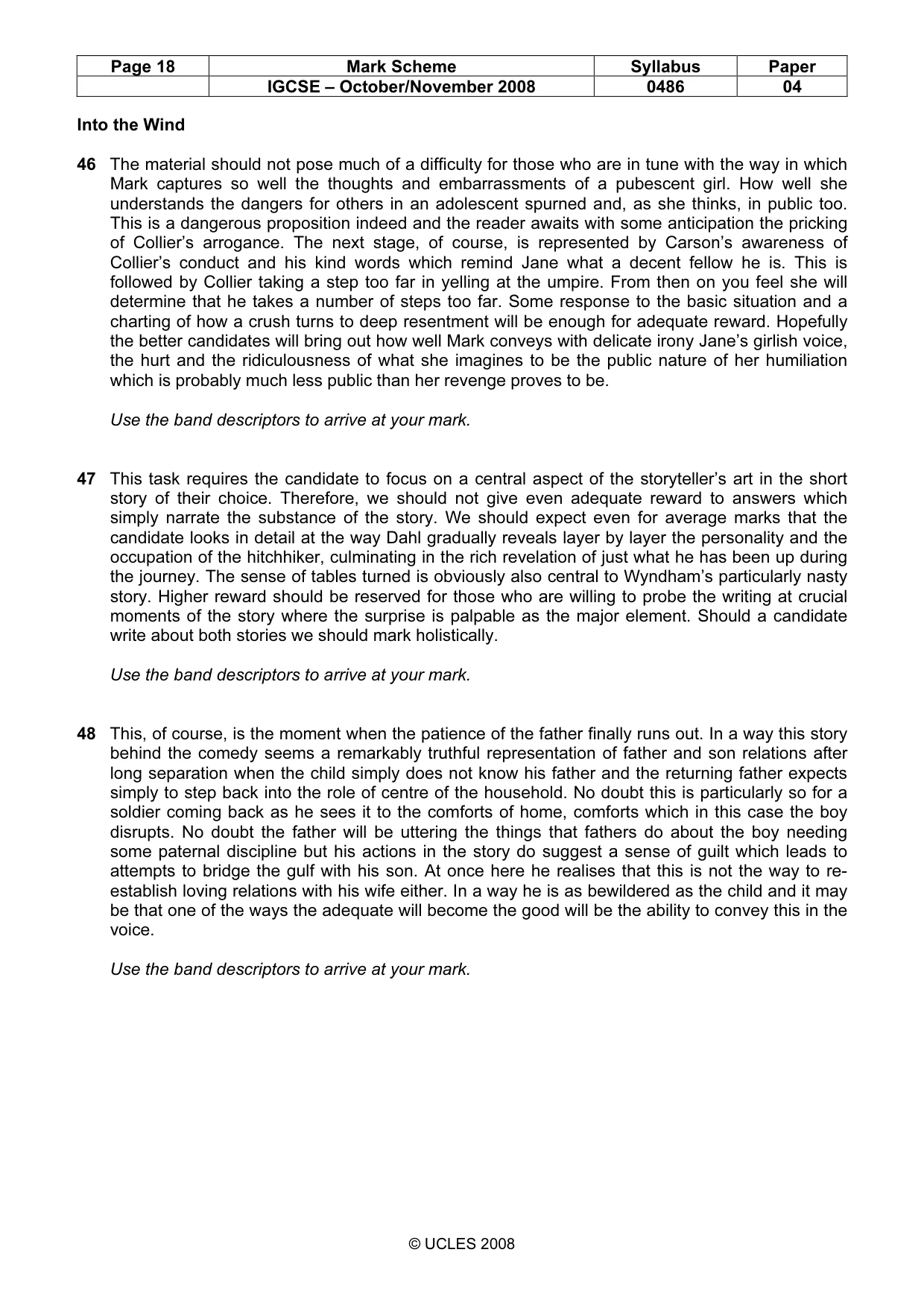
Paper as text
Question paper, page 1
This document consists of 32 printed pages and 4 blank pages. SP (SM) T52790/2 © UCLES 2008 [Turn over UNIVERSITY OF CAMBRIDGE INTERNATIONAL EXAMINATIONS International General Certificate of Secondary Education READ THESE INSTRUCTIONS FIRST If you have been given an Answer Booklet, follow the instructions on the front cover of the Booklet. Write your Centre number, candidate number and name on all the work you hand in. Write in dark blue or black pen. Do not use staples, paper clips, highlighters, glue or correction fluid. Answer four questions. Each of your answers must be on a different book. At least one question must be taken from each of the sections Poetry, Prose, Drama. Answer at least one passage-based question (marked *) and at least one essay/empathic question. At the end of the examination, fasten all your work securely together. All questions in this paper carry equal marks. LITERATURE (ENGLISH) 0486/04 Paper 4 October/November 2008 2 hours 40 minutes Additional Materials: Answer Booklet/Paper * 6 6 2 3 7 5 3 9 4 9 * www.XtremePapers.com
Question paper, page 2
2 0486/04/O/N/08 © UCLES 2008 CONTENTS Section A: Drama text question numbers page [s] Alan Ayckbourn: A Small Family Business 1, 2, 3 pages 3–5 Lorraine Hansberry: A Raisin in the Sun 4, 5, 6 pages 6–7 Arthur Miller: The Crucible 7, 8, 9 pages 8–10 William Shakespeare: As You Like It 10, 11, 12 pages 12–13 William Shakespeare: Macbeth 13, 14, 15 pages 14–15 Tennessee Williams: A Streetcar Named Desire 16, 17, 18 pages 16–17 Section B: Poetry text question numbers page [s] Songs of Ourselves: Section 3 19, 20, 21 page 18 John Keats: Poems 22, 23, 24 page 19 Section C: Prose text question numbers page [s] Chinua Achebe: Things Fall Apart 25, 26, 27 pages 20–21 Jane Austen: Pride and Prejudice 28, 29, 30 pages 22–23 Ian Cross: The God Boy 31, 32, 33 pages 24–25 Helen Dunmore: The Siege 34, 35, 36 pages 26–27 William Golding: Lord of the Flies 37, 38, 39 page 28 Thomas Hardy: Far from the Madding Crowd 40, 41, 42 page 29 Harper Lee: To Kill a Mockingbird 43, 44, 45 pages 30–31 Barrie Wade: Into the Wind 46, 47, 48 pages 32–33
Question paper, page 3
3 0486/04/O/N/08 © UCLES 2008 [Turn over SECTION A: DRAMA ALAN AYCKBOURN: A Small Family Business Either * 1 In this extract what makes the characters’ actions and attitudes shocking and at the same time very funny? Support your ideas with details from the passage. SAMANTHA enters the bathroom and surveys the scene in amazement. Samantha: What are you doing? Poppy: Sammy, will you please help us … Tina: Sammy, for Christ’s sake … He’s trying to kill us. Samantha: Oh, it’s you, is it? Sodding pukeface … (Leaps in vigorously. ) Right … Benedict: Hey! Hey! Gladys … Under the weight of this latest assault, BENEDICT topples backwards into the bath and out of sight. There is a sharp cry and a terrible thud. TINA and POPPY cease the struggle. POPPY recoils holding the nearly empty briefcase. TINA slides back on to the floor, exhausted. SAMANTHA continues her onslaught. Poppy: Sammy! Sammy! That’ll do! That’ll do! Tina (with a yell ): Sammy! SAMANTHA stops. Out of breath. She sits with the others on the floor. One gathers she was in a fairly dazed state when she started. A silence. ( panting) My God. Will you look at all this money? Samantha: Where’s it come from? Poppy: It’s your Dad’s … Samantha: Did he nick it? Poppy: No. Not your Dad. You should know better than that, Sammy. Tina: How is he? That man … Poppy: I don’t know, I’ll … (Examines BENEDICT.) He doesn’t seem to be breathing. (Listens.) He’s not breathing. (stunned ) He’s dead. Tina (in an appalled whisper ): Oh, God. Samantha: Good. Poppy: Sammy! He’s got this great cut in his head from somewhere, he’s … Look at all this blood. (appalled ) Oh, dear heaven, what’s Jack going to say? They all stay there in various attitudes of collapse, unable to move due to exhaustion and varying degrees of shock. JACK comes in the front door and closes it. The women react. JACK goes straight to the sitting room. Tina (softly ): It’s Dad. Jack (seeing the sitting room is empty ): Poppy! Poppy: What’s he going to say … Jack (glancing into the empty kitchen): Poppy! 5 10 15 20 25 30 35
Question paper, page 4
4 0486/04/O/N/08 © UCLES 2008 He grows slightly more alarmed. Tina (indicating BENEDICT): Perhaps we can hide him somewhere … Poppy: No, he’ll have to know. Your Dad will have to be told. Jack (at the foot of the stairs, calling): Poppy! Tina! Poppy (calling back feebly ): We’re up here, Jack … Jack (starting up the stairs): What? Tina: In here, Dad … JACK reaches the landing, uncertain as to where to locate them. He looks in the near bedroom, then the bathroom. He stops short, startled, as he sees the state of the three women. Poppy: Hallo, Jack … Tina: Hallo, Dad. Samantha: Hi … Jack: What are you doing? What are you all doing in here? Poppy: We were … Jack: What are you doing with all that money? What the hell’s been going on? Poppy: We were trying to save it for you, Jack … Jack: And where’s Mr Hough, then? Poppy: He’s – Samantha: He’s in the bath. Jack: What? Poppy ( pointing; almost inaudibly ): In the bath. Jack steps over them to see for himself. Jack: Oh, shit. (Stares at BENEDICT.) Oh, shit. Poppy, what have you done? (Pause.) Oh, shit. Poppy (very penitent ): I’m very sorry, Jack. Jack: Oh, (Sways.) I’m a bit dizzy … Poppy: Don’t faint, love, don’t faint in here … Tina: Steady, Dad … Poppy: He faints at blood … Jack: No, it’s all right. I’m all right. (recovering) What are we going to do …? Poppy (smiling feebly): At least he’s in the bath. Not so much of a mess … Jack (dully ): Good thinking, Poppy, yes. This strikes POPPY as funny. She laughs. First TINA, then SAMANTHA follow suit. They scream with laughter. JACK stares at them incredulously. All right, that’ll do. That’ll do. THAT’LL DO! They stop. A silence. Blimey O’Reilly. It’s like the bloody Borgias’ bathroom in here. What’s the matter with you all? Poppy (the tears coming now): What are we going to do, Jack …? Tina (starting to cry, too): What are we going to do, Dad? 40 45 50 55 60 65 70 75 80
Question paper, page 5
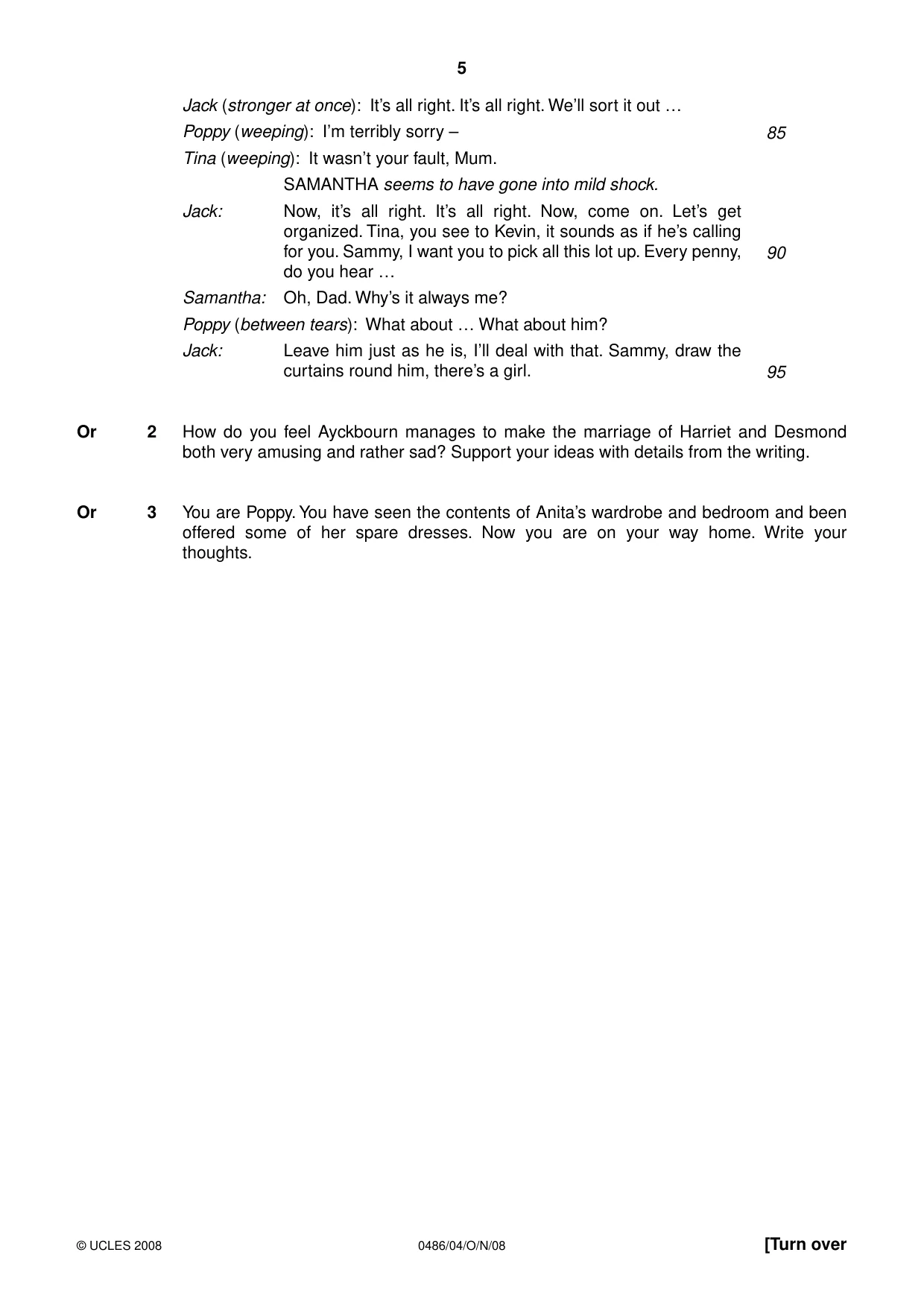
5 0486/04/O/N/08 © UCLES 2008 [Turn over Jack (stronger at once): It’s all right. It’s all right. We’ll sort it out … Poppy (weeping): I’m terribly sorry – Tina (weeping): It wasn’t your fault, Mum. SAMANTHA seems to have gone into mild shock. Jack: Now, it’s all right. It’s all right. Now, come on. Let’s get organized. Tina, you see to Kevin, it sounds as if he’s calling for you. Sammy, I want you to pick all this lot up. Every penny, do you hear … Samantha: Oh, Dad. Why’s it always me? Poppy (between tears): What about … What about him? Jack: Leave him just as he is, I’ll deal with that. Sammy, draw the curtains round him, there’s a girl. Or 2 How do you feel Ayckbourn manages to make the marriage of Harriet and Desmond both very amusing and rather sad? Support your ideas with details from the writing. Or 3 You are Poppy. You have seen the contents of Anita’s wardrobe and bedroom and been offered some of her spare dresses. Now you are on your way home. Write your thoughts. 85 90 95
Question paper, page 6
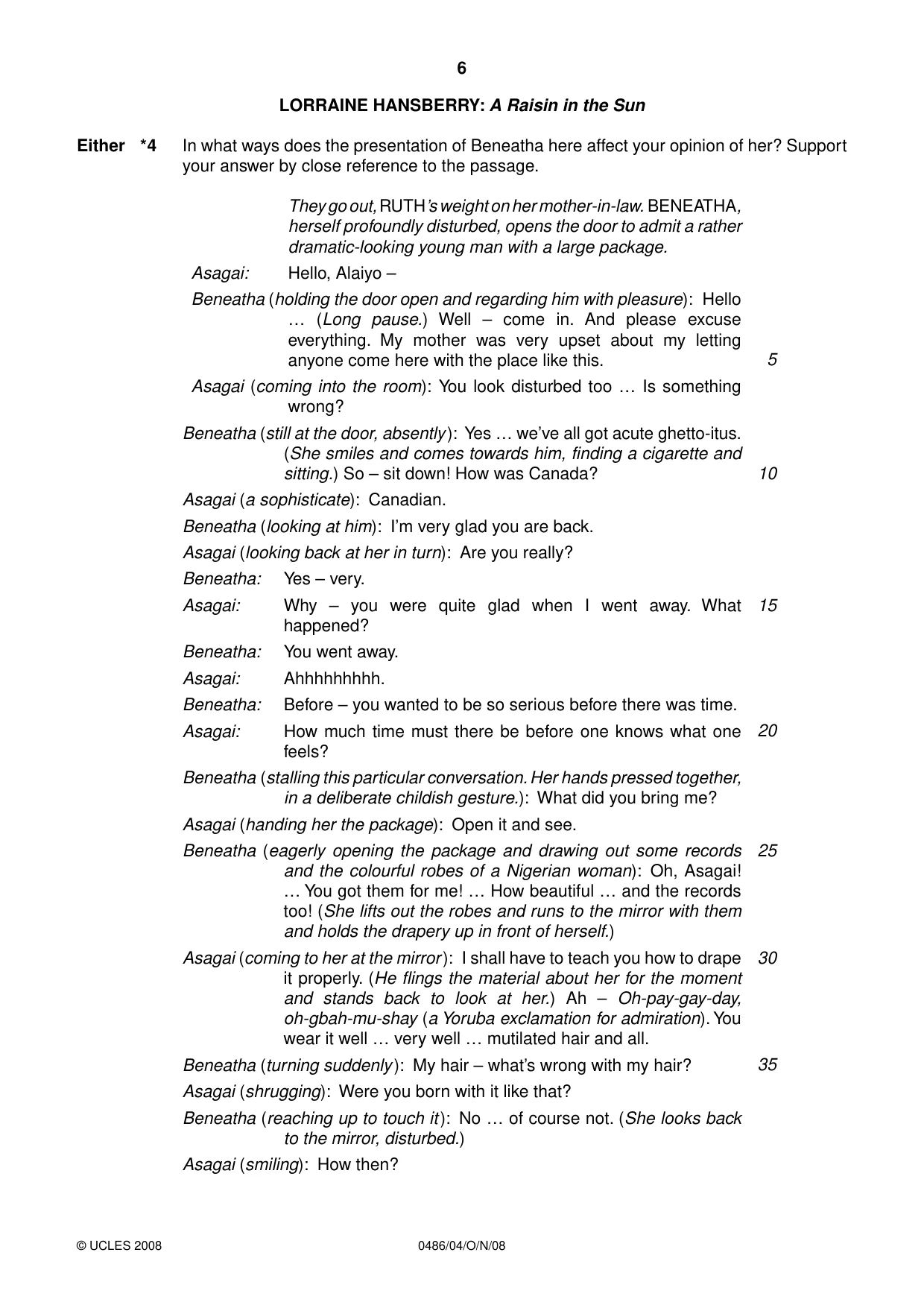
6 0486/04/O/N/08 © UCLES 2008 LORRAINE HANSBERRY: A Raisin in the Sun Either * 4 In what ways does the presentation of Beneatha here affect your opinion of her? Support your answer by close reference to the passage. They go out, RUTH’s weight on her mother-in-law. BENEATHA, herself profoundly disturbed, opens the door to admit a rather dramatic-looking young man with a large package. Asagai: Hello, Alaiyo – Beneatha (holding the door open and regarding him with pleasure): Hello … (Long pause.) Well – come in. And please excuse everything. My mother was very upset about my letting anyone come here with the place like this. Asagai (coming into the room): You look disturbed too … Is something wrong? Beneatha (still at the door, absently ): Yes … we’ve all got acute ghetto-itus. (She smiles and comes towards him, finding a cigarette and sitting.) So – sit down! How was Canada? Asagai (a sophisticate): Canadian. Beneatha (looking at him): I’m very glad you are back. Asagai (looking back at her in turn): Are you really? Beneatha: Yes – very. Asagai: Why – you were quite glad when I went away. What happened? Beneatha: You went away. Asagai: Ahhhhhhhhh. Beneatha: Before – you wanted to be so serious before there was time. Asagai: How much time must there be before one knows what one feels? Beneatha (stalling this particular conversation. Her hands pressed together, in a deliberate childish gesture.): What did you bring me? Asagai (handing her the package): Open it and see. Beneatha (eagerly opening the package and drawing out some records and the colourful robes of a Nigerian woman): Oh, Asagai! … You got them for me! … How beautiful … and the records too! (She lifts out the robes and runs to the mirror with them and holds the drapery up in front of herself.) Asagai (coming to her at the mirror ): I shall have to teach you how to drape it properly. (He flings the material about her for the moment and stands back to look at her.) Ah – Oh-pay-gay-day, oh-gbah-mu-shay (a Yoruba exclamation for admiration). You wear it well … very well … mutilated hair and all. Beneatha (turning suddenly ): My hair – what’s wrong with my hair? Asagai (shrugging): Were you born with it like that? Beneatha (reaching up to touch it ): No … of course not. (She looks back to the mirror, disturbed.) Asagai (smiling): How then? 5 10 15 20 25 30 35
Question paper, page 7
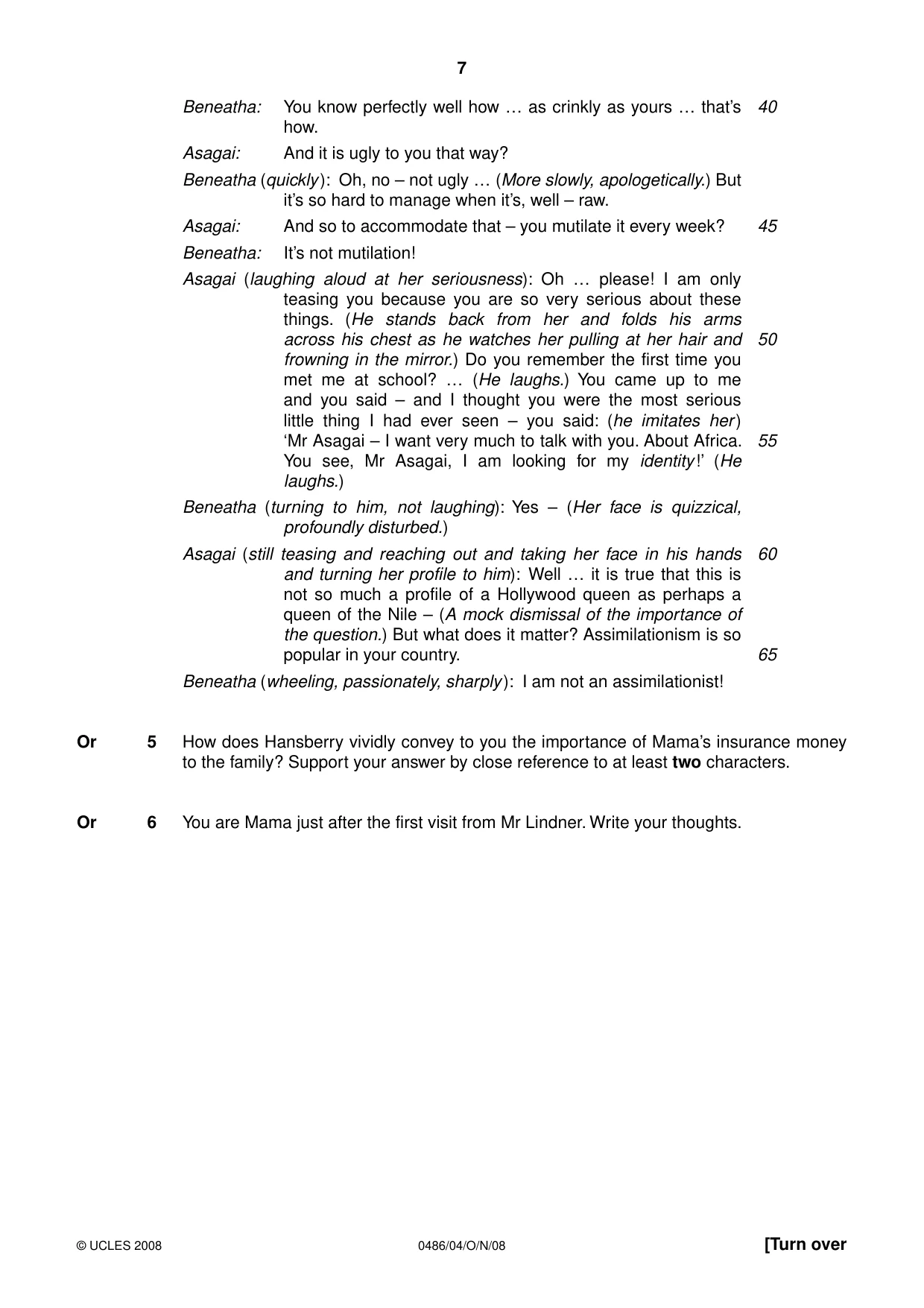
7 0486/04/O/N/08 © UCLES 2008 Beneatha: You know perfectly well how … as crinkly as yours … that’s how. Asagai: And it is ugly to you that way? Beneatha (quickly ): Oh, no – not ugly … (More slowly, apologetically.) But it’s so hard to manage when it’s, well – raw. Asagai: And so to accommodate that – you mutilate it every week? Beneatha: It’s not mutilation! Asagai (laughing aloud at her seriousness): Oh … please! I am only teasing you because you are so very serious about these things. (He stands back from her and folds his arms across his chest as he watches her pulling at her hair and frowning in the mirror.) Do you remember the first time you met me at school? … (He laughs.) You came up to me and you said – and I thought you were the most serious little thing I had ever seen – you said: (he imitates her ) ‘Mr Asagai – I want very much to talk with you. About Africa. You see, Mr Asagai, I am looking for my identity !’ (He laughs.) Beneatha (turning to him, not laughing): Yes – (Her face is quizzical, profoundly disturbed.) Asagai (still teasing and reaching out and taking her face in his hands and turning her profile to him): Well … it is true that this is not so much a profile of a Hollywood queen as perhaps a queen of the Nile – (A mock dismissal of the importance of the question.) But what does it matter? Assimilationism is so popular in your country. Beneatha (wheeling, passionately, sharply ): I am not an assimilationist! Or 5 How does Hansberry vividly convey to you the importance of Mama’s insurance money to the family? Support your answer by close reference to at least two characters. Or 6 You are Mama just after the first visit from Mr Lindner. Write your thoughts. 40 45 50 55 60 65 [Turn over
Question paper, page 8
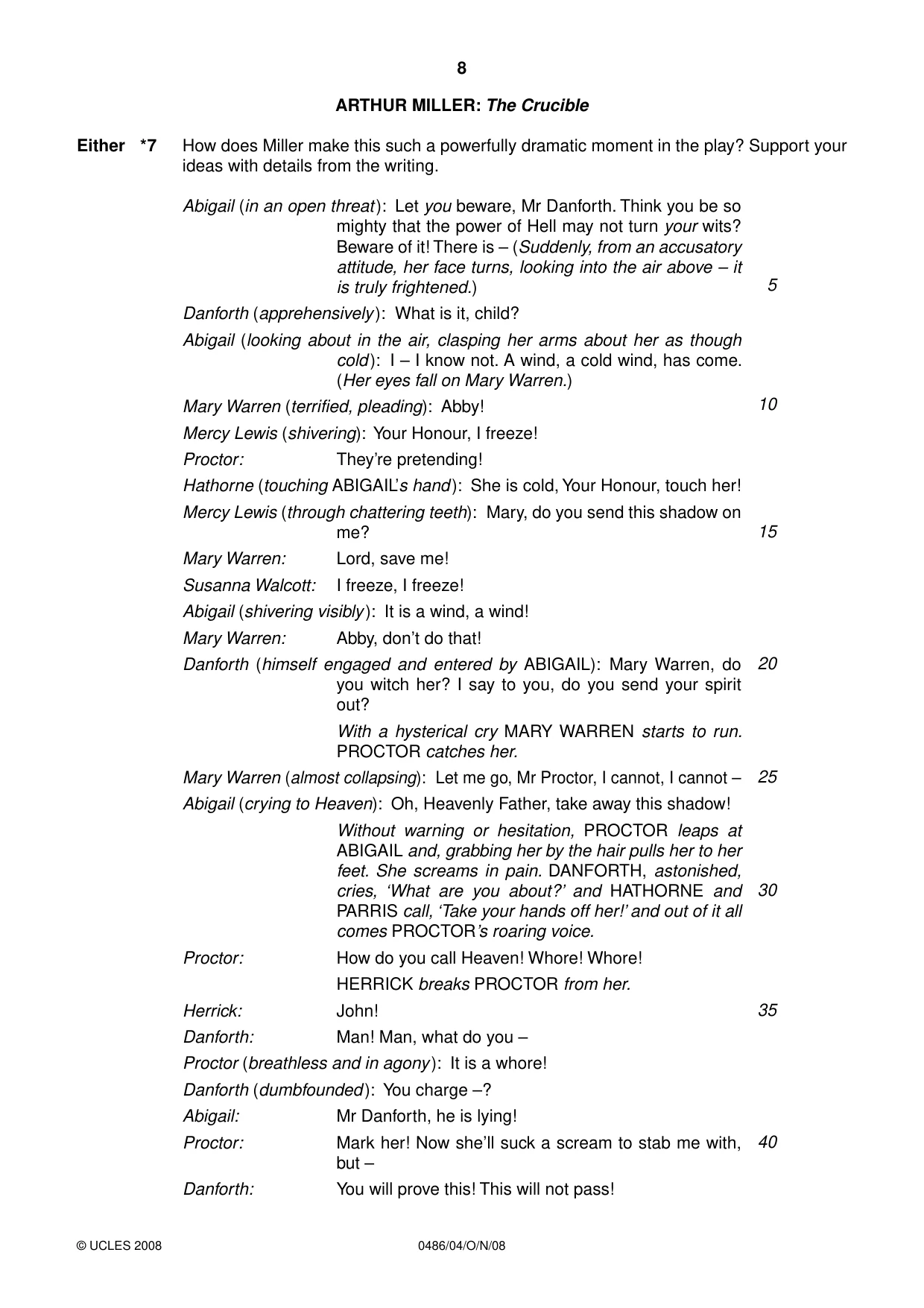
8 0486/04/O/N/08 ARTHUR MILLER: The Crucible Either * 7 How does Miller make this such a powerfully dramatic moment in the play? Support your ideas with details from the writing. Abigail (in an open threat ): Let you beware, Mr Danforth. Think you be so mighty that the power of Hell may not turn your wits? Beware of it! There is – (Suddenly, from an accusatory attitude, her face turns, looking into the air above – it is truly frightened.) Danforth (apprehensively ): What is it, child? Abigail (looking about in the air, clasping her arms about her as though cold ): I – I know not. A wind, a cold wind, has come. (Her eyes fall on Mary Warren.) Mary Warren (terrified, pleading): Abby! Mercy Lewis (shivering): Your Honour, I freeze! Proctor: They’re pretending! Hathorne (touching ABIGAIL’s hand ): She is cold, Your Honour, touch her! Mercy Lewis (through chattering teeth): Mary, do you send this shadow on me? Mary Warren: Lord, save me! Susanna Walcott: I freeze, I freeze! Abigail (shivering visibly ): It is a wind, a wind! Mary Warren: Abby, don’t do that! Danforth (himself engaged and entered by ABIGAIL): Mary Warren, do you witch her? I say to you, do you send your spirit out? With a hysterical cry MARY WARREN starts to run. PROCTOR catches her. Mary Warren (almost collapsing): Let me go, Mr Proctor, I cannot, I cannot – Abigail (crying to Heaven): Oh, Heavenly Father, take away this shadow! Without warning or hesitation, PROCTOR leaps at ABIGAIL and, grabbing her by the hair pulls her to her feet. She screams in pain. DANFORTH, astonished, cries, ‘What are you about?’ and HATHORNE and PARRIS call, ‘Take your hands off her!’ and out of it all comes PROCTOR’s roaring voice. Proctor: How do you call Heaven! Whore! Whore! HERRICK breaks PROCTOR from her. Herrick: John! Danforth: Man! Man, what do you – Proctor (breathless and in agony ): It is a whore! Danforth (dumbfounded ): You charge –? Abigail: Mr Danforth, he is lying! Proctor: Mark her! Now she’ll suck a scream to stab me with, but – Danforth: You will prove this! This will not pass! © UCLES 2008 5 10 15 20 25 30 35 40
Question paper, page 9
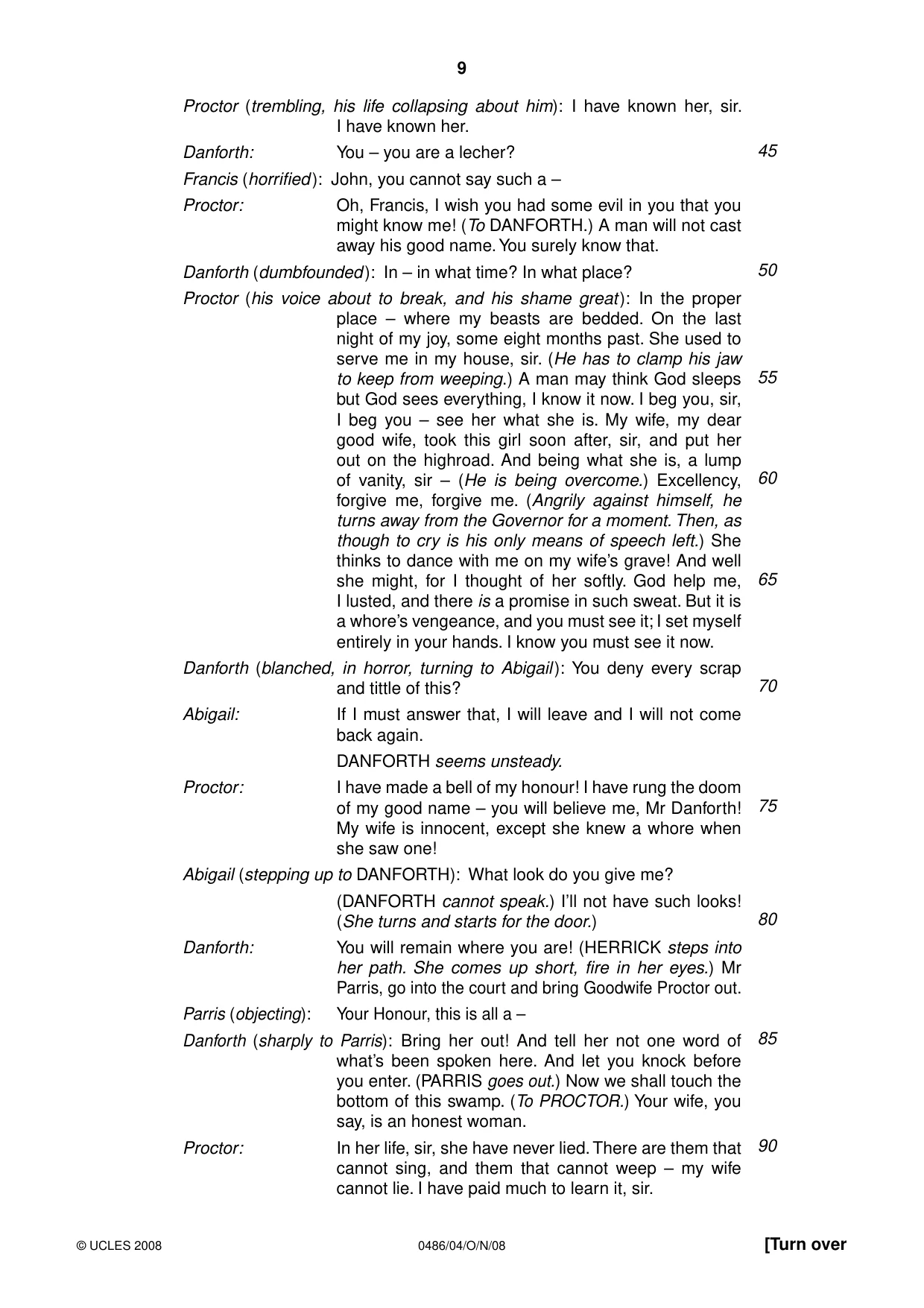
9 0486/04/O/N/08 Proctor (trembling, his life collapsing about him): I have known her, sir. I have known her. Danforth: You – you are a lecher? Francis (horrified ): John, you cannot say such a – Proctor: Oh, Francis, I wish you had some evil in you that you might know me! (To DANFORTH.) A man will not cast away his good name. You surely know that. Danforth (dumbfounded ): In – in what time? In what place? Proctor (his voice about to break, and his shame great ): In the proper place – where my beasts are bedded. On the last night of my joy, some eight months past. She used to serve me in my house, sir. (He has to clamp his jaw to keep from weeping.) A man may think God sleeps but God sees everything, I know it now. I beg you, sir, I beg you – see her what she is. My wife, my dear good wife, took this girl soon after, sir, and put her out on the highroad. And being what she is, a lump of vanity, sir – (He is being overcome.) Excellency, forgive me, forgive me. (Angrily against himself, he turns away from the Governor for a moment. Then, as though to cry is his only means of speech left.) She thinks to dance with me on my wife’s grave! And well she might, for I thought of her softly. God help me, I lusted, and there is a promise in such sweat. But it is a whore’s vengeance, and you must see it; I set myself entirely in your hands. I know you must see it now. Danforth (blanched, in horror, turning to Abigail ): You deny every scrap and tittle of this? Abigail: If I must answer that, I will leave and I will not come back again. DANFORTH seems unsteady. Proctor: I have made a bell of my honour! I have rung the doom of my good name – you will believe me, Mr Danforth! My wife is innocent, except she knew a whore when she saw one! Abigail (stepping up to DANFORTH): What look do you give me? (DANFORTH cannot speak.) I’ll not have such looks! (She turns and starts for the door.) Danforth: You will remain where you are! (HERRICK steps into her path. She comes up short, fire in her eyes.) Mr Parris, go into the court and bring Goodwife Proctor out. Parris (objecting): Your Honour, this is all a – Danforth (sharply to Parris): Bring her out! And tell her not one word of what’s been spoken here. And let you knock before you enter. (PARRIS goes out.) Now we shall touch the bottom of this swamp. (To PROCTOR.) Your wife, you say, is an honest woman. Proctor: In her life, sir, she have never lied. There are them that cannot sing, and them that cannot weep – my wife cannot lie. I have paid much to learn it, sir. [Turn over © UCLES 2008 45 50 55 60 65 70 75 80 85 90
Question paper, page 10
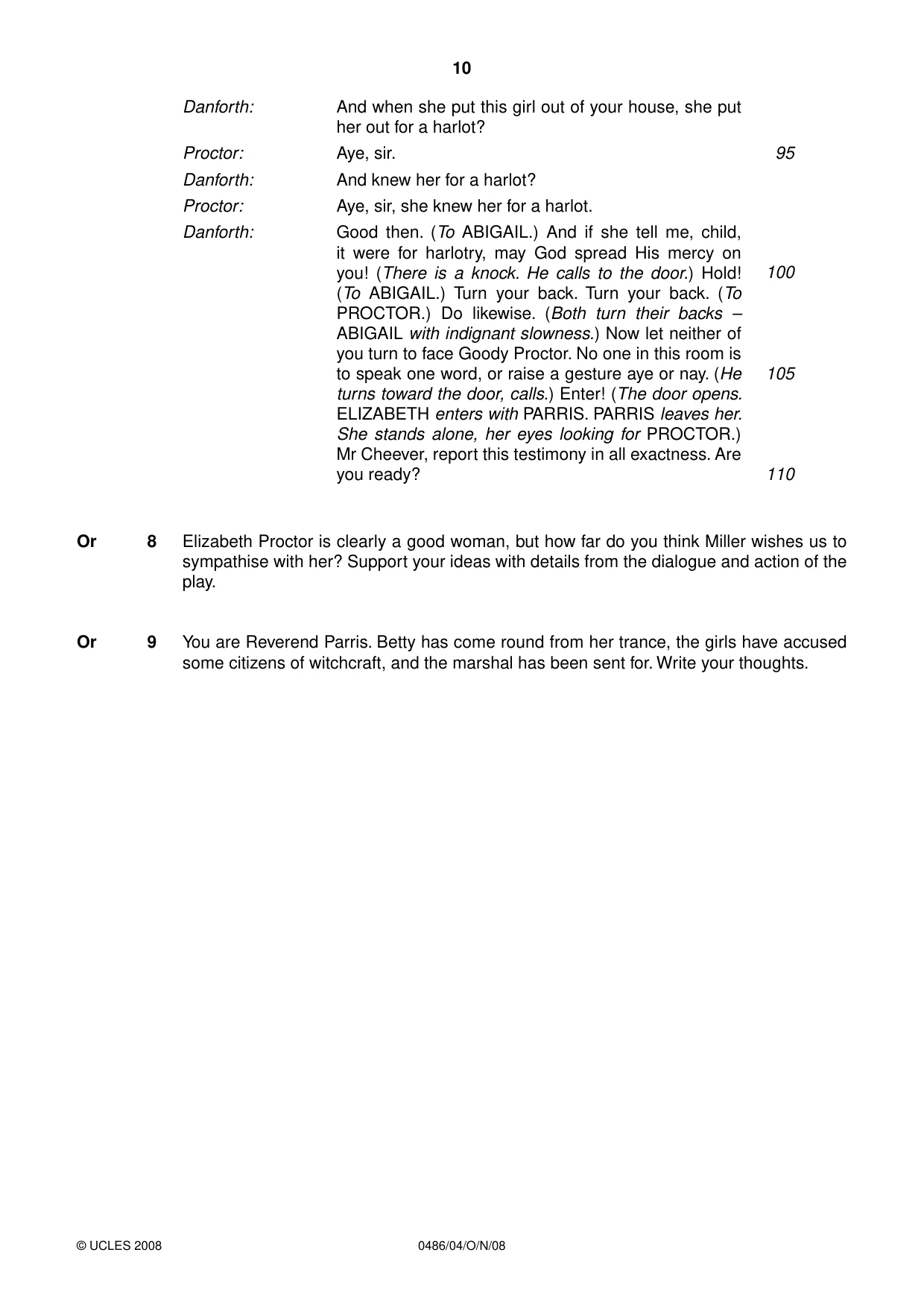
10 0486/04/O/N/08 © UCLES 2008 Danforth: And when she put this girl out of your house, she put her out for a harlot? Proctor: Aye, sir. Danforth: And knew her for a harlot? Proctor: Aye, sir, she knew her for a harlot. Danforth: Good then. (To ABIGAIL.) And if she tell me, child, it were for harlotry, may God spread His mercy on you! (There is a knock. He calls to the door.) Hold! (To ABIGAIL.) Turn your back. Turn your back. (To PROCTOR.) Do likewise. (Both turn their backs – ABIGAIL with indignant slowness.) Now let neither of you turn to face Goody Proctor. No one in this room is to speak one word, or raise a gesture aye or nay. (He turns toward the door, calls.) Enter! (The door opens. ELIZABETH enters with PARRIS. PARRIS leaves her. She stands alone, her eyes looking for PROCTOR.) Mr Cheever, report this testimony in all exactness. Are you ready? Or 8 Elizabeth Proctor is clearly a good woman, but how far do you think Miller wishes us to sympathise with her? Support your ideas with details from the dialogue and action of the play. Or 9 You are Reverend Parris. Betty has come round from her trance, the girls have accused some citizens of witchcraft, and the marshal has been sent for. Write your thoughts. 95 100 105 110
Question paper, page 11
11 0486/04/O/N/08 [Turn over BLANK PAGE Turn to page 12 for Question 10.
Question paper, page 12
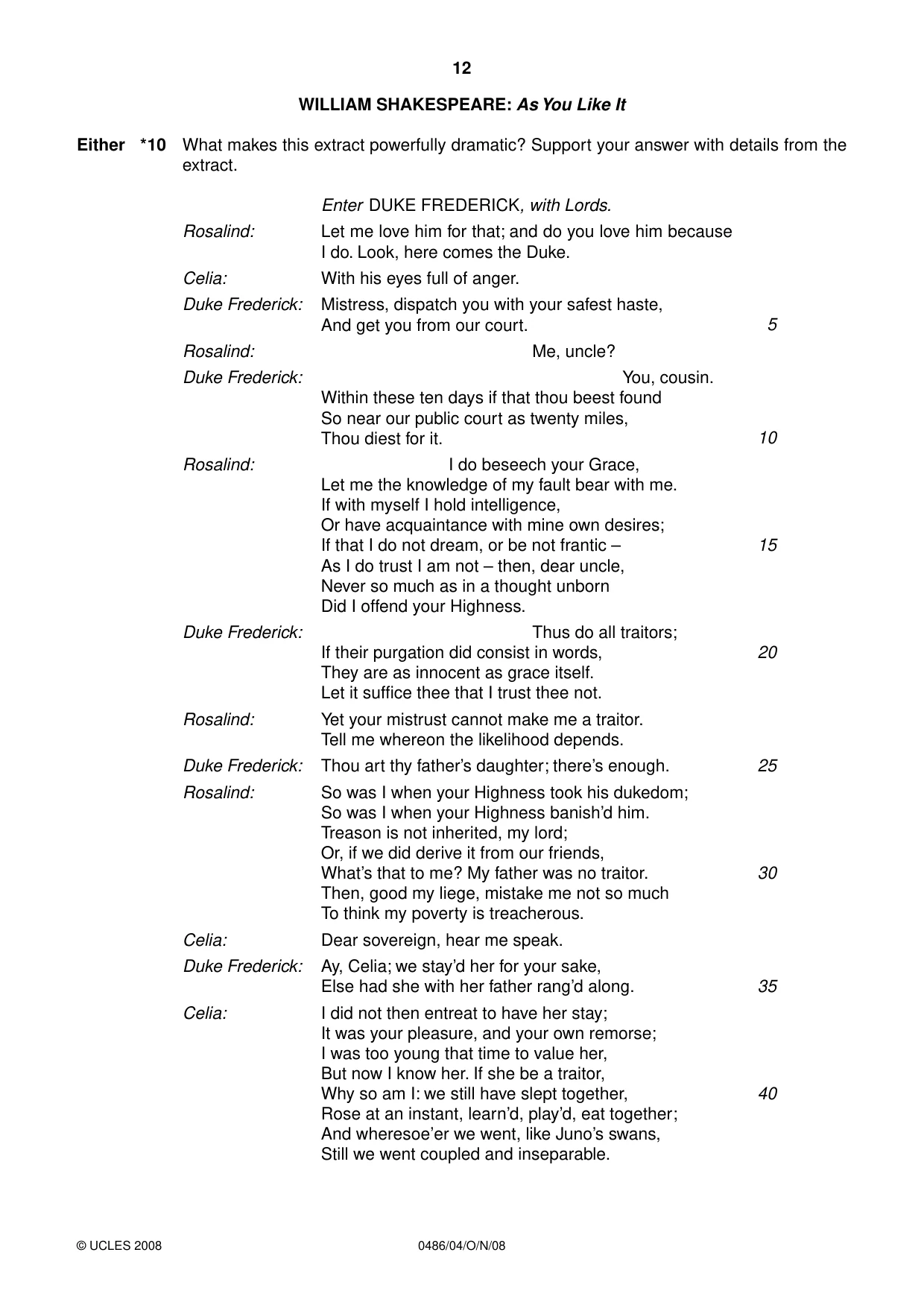
12 0486/04/O/N/08 © UCLES 2008 WILLIAM SHAKESPEARE: As You Like It Either * 10 What makes this extract powerfully dramatic? Support your answer with details from the extract. Enter DUKE FREDERICK, with Lords. Rosalind: Let me love him for that; and do you love him because I do. Look, here comes the Duke. Celia: With his eyes full of anger. Duke Frederick: Mistress, dispatch you with your safest haste, And get you from our court. Rosalind: Me, uncle? Duke Frederick: You, cousin. Within these ten days if that thou beest found So near our public court as twenty miles, Thou diest for it. Rosalind: I do beseech your Grace, Let me the knowledge of my fault bear with me. If with myself I hold intelligence, Or have acquaintance with mine own desires; If that I do not dream, or be not frantic – As I do trust I am not – then, dear uncle, Never so much as in a thought unborn Did I offend your Highness. Duke Frederick: Thus do all traitors; If their purgation did consist in words, They are as innocent as grace itself. Let it suffice thee that I trust thee not. Rosalind: Yet your mistrust cannot make me a traitor. Tell me whereon the likelihood depends. Duke Frederick: Thou art thy father’s daughter; there’s enough. Rosalind: So was I when your Highness took his dukedom; So was I when your Highness banish’d him. Treason is not inherited, my lord; Or, if we did derive it from our friends, What’s that to me? My father was no traitor. Then, good my liege, mistake me not so much To think my poverty is treacherous. Celia: Dear sovereign, hear me speak. Duke Frederick: Ay, Celia; we stay’d her for your sake, Else had she with her father rang’d along. Celia: I did not then entreat to have her stay; It was your pleasure, and your own remorse; I was too young that time to value her, But now I know her. If she be a traitor, Why so am I: we still have slept together, Rose at an instant, learn’d, play’d, eat together; And wheresoe’er we went, like Juno’s swans, Still we went coupled and inseparable. 5 10 15 20 25 30 35 40
Question paper, page 13
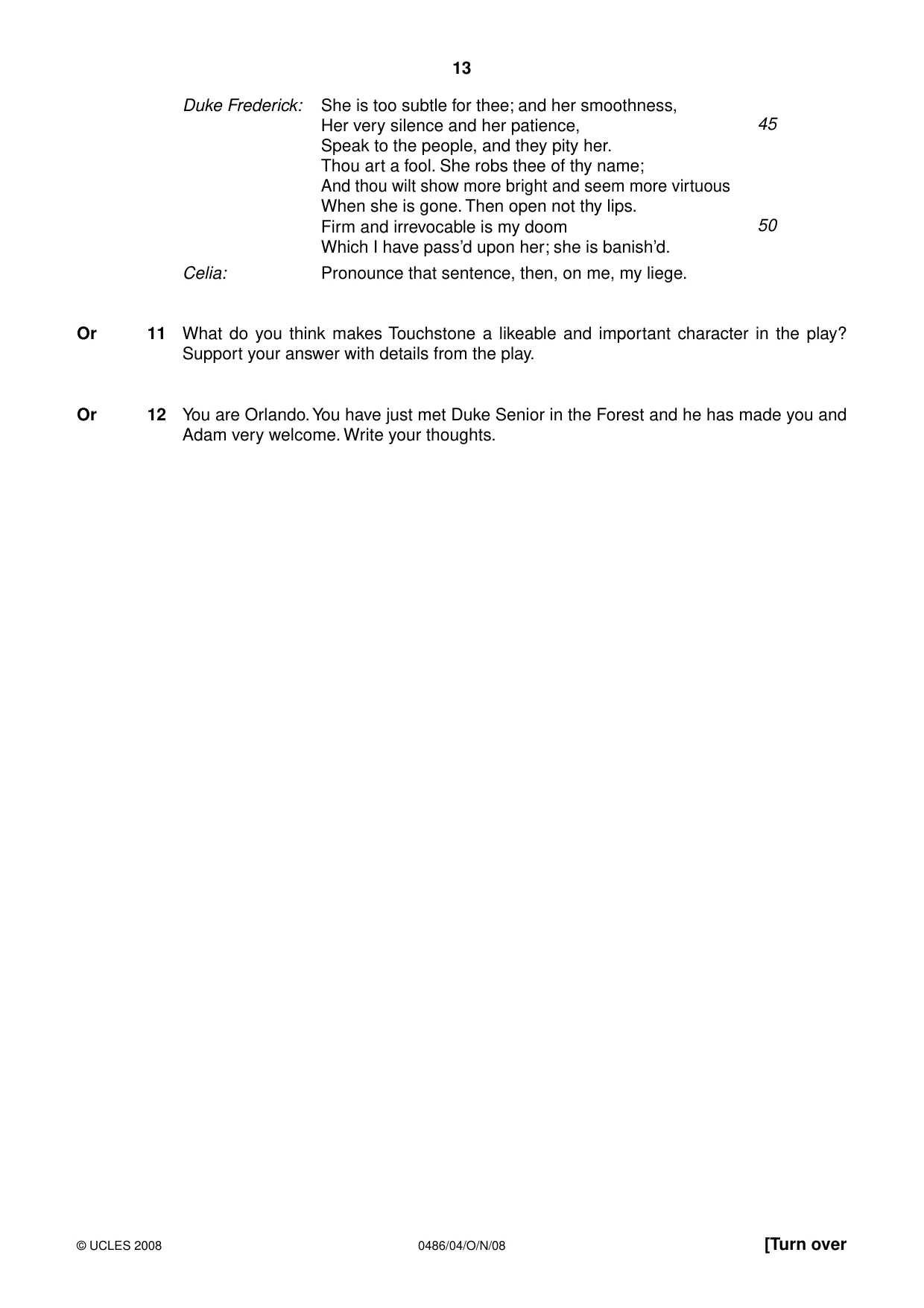
13 0486/04/O/N/08 © UCLES 2008 [Turn over Duke Frederick: She is too subtle for thee; and her smoothness, Her very silence and her patience, Speak to the people, and they pity her. Thou art a fool. She robs thee of thy name; And thou wilt show more bright and seem more virtuous When she is gone. Then open not thy lips. Firm and irrevocable is my doom Which I have pass’d upon her; she is banish’d. Celia: Pronounce that sentence, then, on me, my liege. Or 11 What do you think makes Touchstone a likeable and important character in the play? Support your answer with details from the play. Or 12 You are Orlando. You have just met Duke Senior in the Forest and he has made you and Adam very welcome. Write your thoughts. 45 50
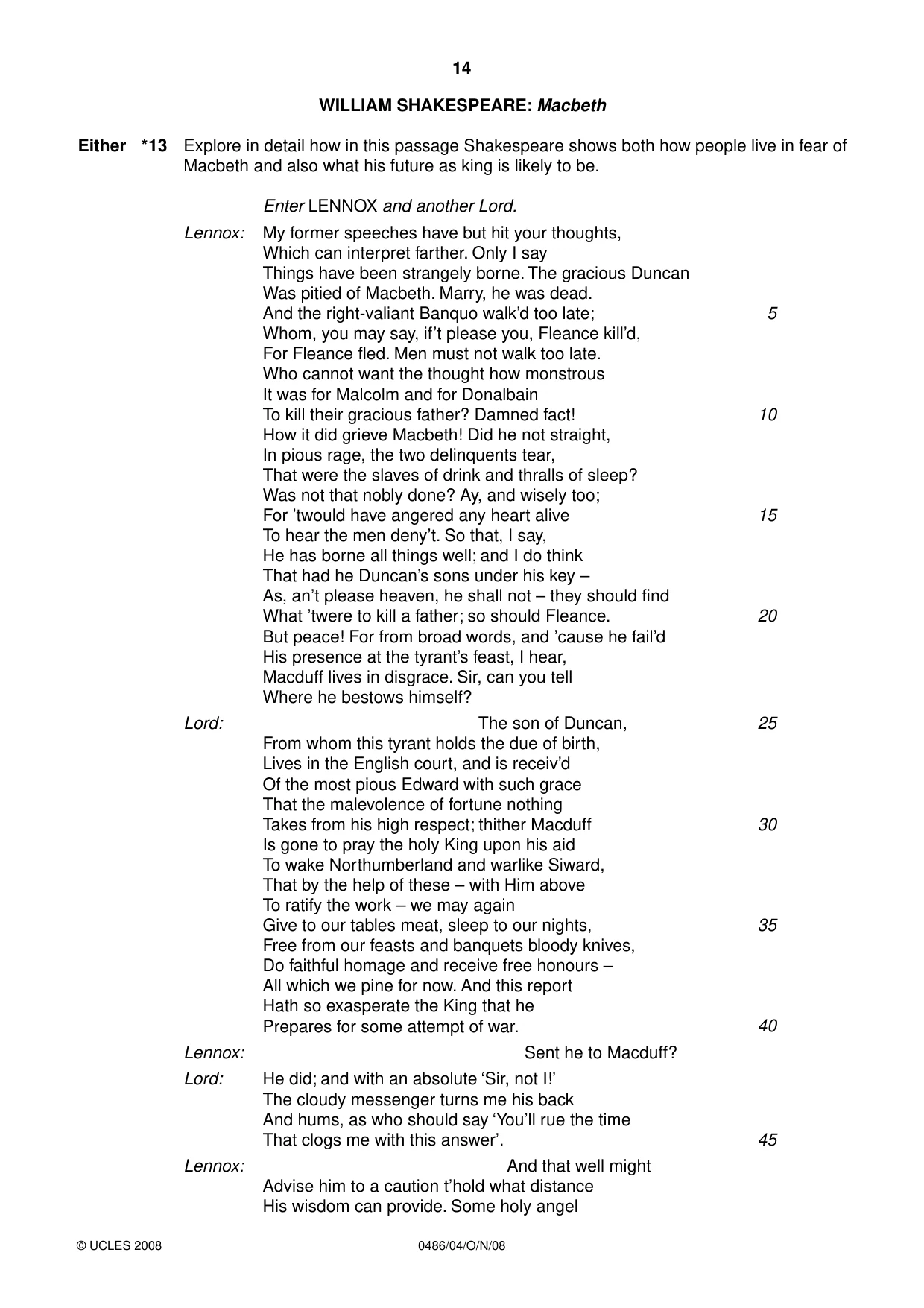
Question paper, page 14
14 0486/04/O/N/08 © UCLES 2008 WILLIAM SHAKESPEARE: Macbeth Either * 13 Explore in detail how in this passage Shakespeare shows both how people live in fear of Macbeth and also what his future as king is likely to be. Enter LENNOX and another Lord. Lennox: My former speeches have but hit your thoughts, Which can interpret farther. Only I say Things have been strangely borne. The gracious Duncan Was pitied of Macbeth. Marry, he was dead. And the right-valiant Banquo walk’d too late; Whom, you may say, if’t please you, Fleance kill’d, For Fleance fled. Men must not walk too late. Who cannot want the thought how monstrous It was for Malcolm and for Donalbain To kill their gracious father? Damned fact! How it did grieve Macbeth! Did he not straight, In pious rage, the two delinquents tear, That were the slaves of drink and thralls of sleep? Was not that nobly done? Ay, and wisely too; For ’twould have angered any heart alive To hear the men deny’t. So that, I say, He has borne all things well; and I do think That had he Duncan’s sons under his key – As, an’t please heaven, he shall not – they should find What ’twere to kill a father; so should Fleance. But peace! For from broad words, and ’cause he fail’d His presence at the tyrant’s feast, I hear, Macduff lives in disgrace. Sir, can you tell Where he bestows himself? Lord: The son of Duncan, From whom this tyrant holds the due of birth, Lives in the English court, and is receiv’d Of the most pious Edward with such grace That the malevolence of fortune nothing Takes from his high respect; thither Macduff Is gone to pray the holy King upon his aid To wake Northumberland and warlike Siward, That by the help of these – with Him above To ratify the work – we may again Give to our tables meat, sleep to our nights, Free from our feasts and banquets bloody knives, Do faithful homage and receive free honours – All which we pine for now. And this report Hath so exasperate the King that he Prepares for some attempt of war. Lennox: Sent he to Macduff? Lord: He did; and with an absolute ‘Sir, not I!’ The cloudy messenger turns me his back And hums, as who should say ‘You’ll rue the time That clogs me with this answer’. Lennox: And that well might Advise him to a caution t’hold what distance His wisdom can provide. Some holy angel 5 10 15 20 25 30 35 40 45
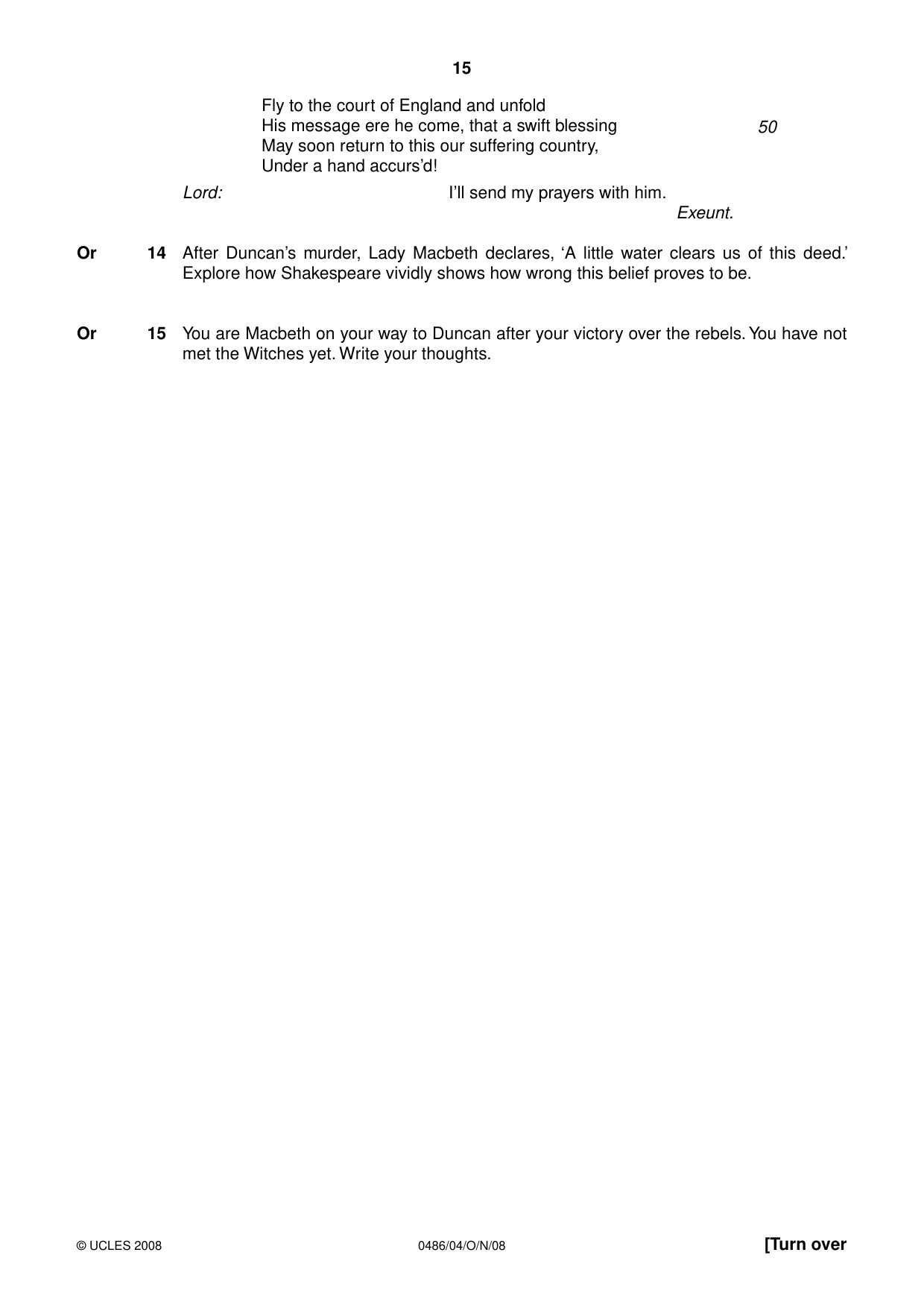
Question paper, page 15
15 0486/04/O/N/08 © UCLES 2008 [Turn over Fly to the court of England and unfold His message ere he come, that a swift blessing May soon return to this our suffering country, Under a hand accurs’d! Lord: I’ll send my prayers with him. Exeunt. Or 14 After Duncan’s murder, Lady Macbeth declares, ‘A little water clears us of this deed.’ Explore how Shakespeare vividly shows how wrong this belief proves to be. Or 15 You are Macbeth on your way to Duncan after your victory over the rebels. You have not met the Witches yet. Write your thoughts. 50
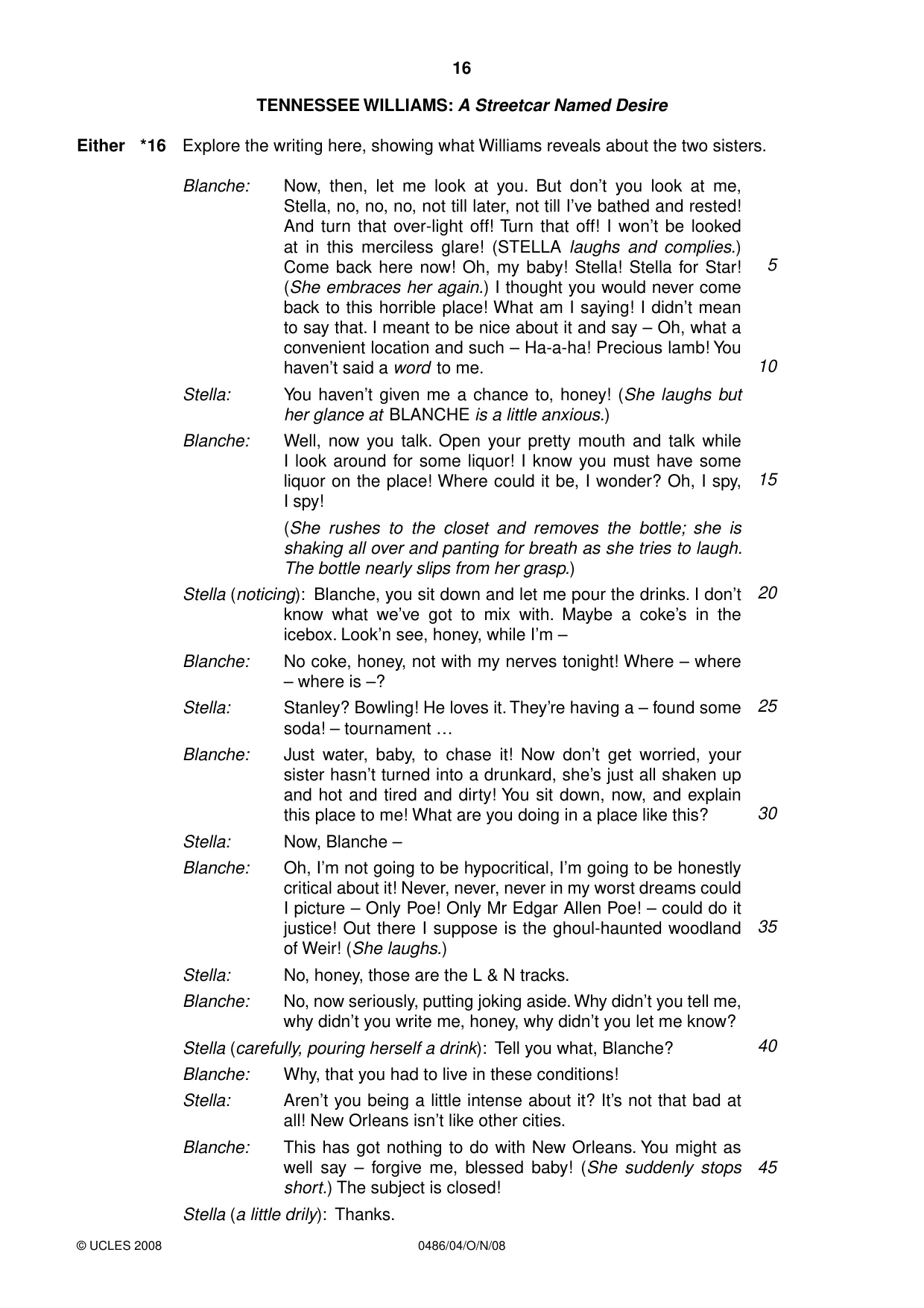
Question paper, page 16
16 0486/04/O/N/08 © UCLES 2008 TENNESSEE WILLIAMS: A Streetcar Named Desire Either * 16 Explore the writing here, showing what Williams reveals about the two sisters. Blanche: Now, then, let me look at you. But don’t you look at me, Stella, no, no, no, not till later, not till I’ve bathed and rested! And turn that over-light off! Turn that off! I won’t be looked at in this merciless glare! (STELLA laughs and complies.) Come back here now! Oh, my baby! Stella! Stella for Star! (She embraces her again.) I thought you would never come back to this horrible place! What am I saying! I didn’t mean to say that. I meant to be nice about it and say – Oh, what a convenient location and such – Ha-a-ha! Precious lamb! You haven’t said a word to me. Stella: You haven’t given me a chance to, honey! (She laughs but her glance at BLANCHE is a little anxious.) Blanche: Well, now you talk. Open your pretty mouth and talk while I look around for some liquor! I know you must have some liquor on the place! Where could it be, I wonder? Oh, I spy, I spy! (She rushes to the closet and removes the bottle; she is shaking all over and panting for breath as she tries to laugh. The bottle nearly slips from her grasp.) Stella (noticing): Blanche, you sit down and let me pour the drinks. I don’t know what we’ve got to mix with. Maybe a coke’s in the icebox. Look’n see, honey, while I’m – Blanche: No coke, honey, not with my nerves tonight! Where – where – where is –? Stella: Stanley? Bowling! He loves it. They’re having a – found some soda! – tournament … Blanche: Just water, baby, to chase it! Now don’t get worried, your sister hasn’t turned into a drunkard, she’s just all shaken up and hot and tired and dirty! You sit down, now, and explain this place to me! What are you doing in a place like this? Stella: Now, Blanche – Blanche: Oh, I’m not going to be hypocritical, I’m going to be honestly critical about it! Never, never, never in my worst dreams could I picture – Only Poe! Only Mr Edgar Allen Poe! – could do it justice! Out there I suppose is the ghoul-haunted woodland of Weir! (She laughs.) Stella: No, honey, those are the L & N tracks. Blanche: No, now seriously, putting joking aside. Why didn’t you tell me, why didn’t you write me, honey, why didn’t you let me know? Stella (carefully, pouring herself a drink): Tell you what, Blanche? Blanche: Why, that you had to live in these conditions! Stella: Aren’t you being a little intense about it? It’s not that bad at all! New Orleans isn’t like other cities. Blanche: This has got nothing to do with New Orleans. You might as well say – forgive me, blessed baby! (She suddenly stops short.) The subject is closed! Stella (a little drily): Thanks. 5 10 15 20 25 30 35 40 45
Question paper, page 17
17 0486/04/O/N/08 © UCLES 2008 [Turn over Or 17 How far does Williams make you feel sympathy for Stanley in the play? Refer to details in the play in your answer. Or 18 You are Stella, alone, at the end of the play, thinking about what has happened to your sister. Write your thoughts.
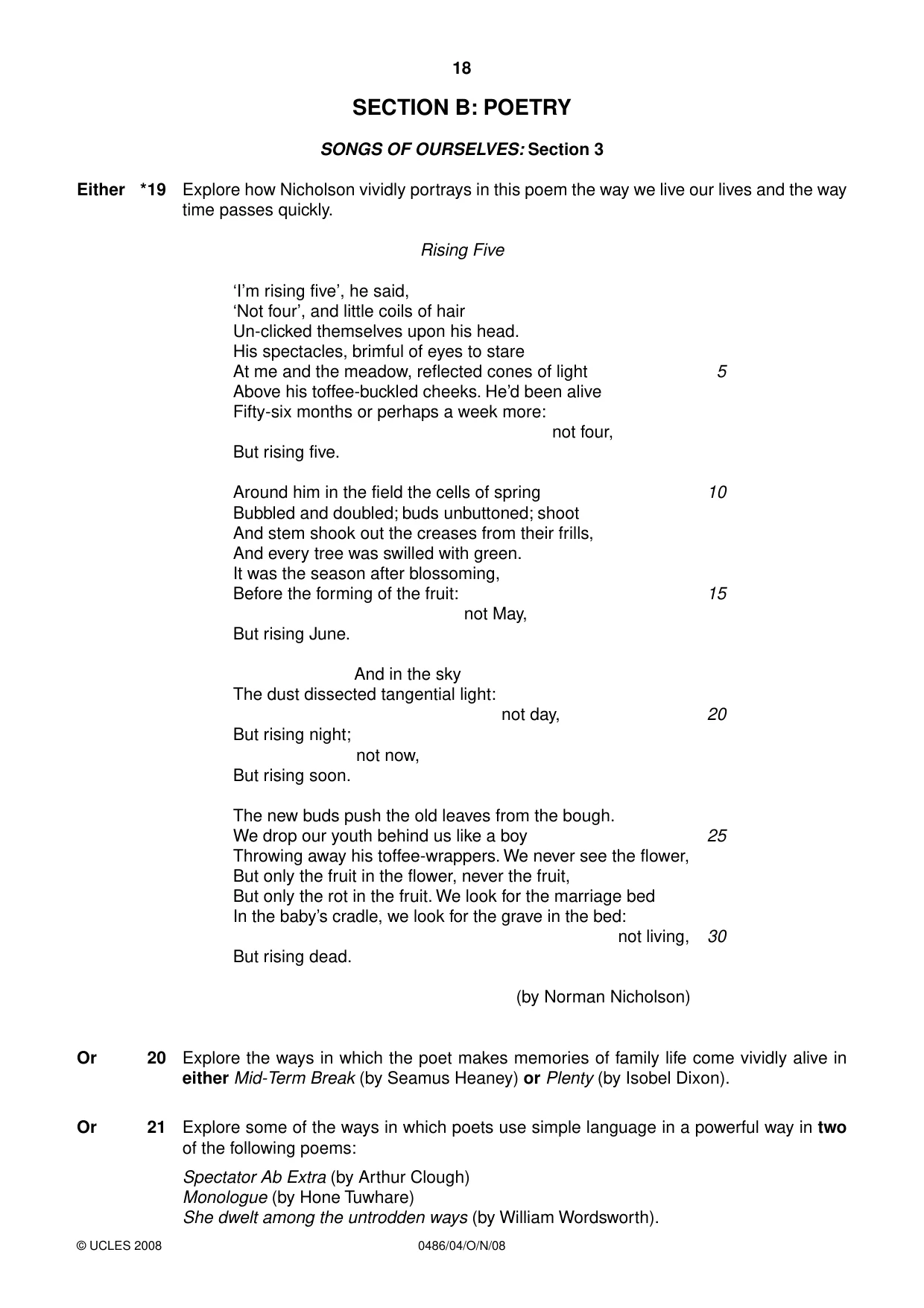
Question paper, page 18
18 0486/04/O/N/08 © UCLES 2008 SECTION B: POETRY SONGS OF OURSELVES: Section 3 Either * 19 Explore how Nicholson vividly portrays in this poem the way we live our lives and the way time passes quickly. Rising Five ‘I’m rising five’, he said, ‘Not four’, and little coils of hair Un-clicked themselves upon his head. His spectacles, brimful of eyes to stare At me and the meadow, reflected cones of light 5 Above his toffee-buckled cheeks. He’d been alive Fifty-six months or perhaps a week more: not four, But rising five. Around him in the field the cells of spring 10 Bubbled and doubled; buds unbuttoned; shoot And stem shook out the creases from their frills, And every tree was swilled with green. It was the season after blossoming, Before the forming of the fruit: 15 not May, But rising June. And in the sky The dust dissected tangential light: not day, 20 But rising night; not now, But rising soon. The new buds push the old leaves from the bough. We drop our youth behind us like a boy 25 Throwing away his toffee-wrappers. We never see the flower, But only the fruit in the flower, never the fruit, But only the rot in the fruit. We look for the marriage bed In the baby’s cradle, we look for the grave in the bed: not living, 30 But rising dead. (by Norman Nicholson) Or 20 Explore the ways in which the poet makes memories of family life come vividly alive in either Mid-Term Break (by Seamus Heaney) or Plenty (by Isobel Dixon). Or 21 Explore some of the ways in which poets use simple language in a powerful way in two of the following poems: Spectator Ab Extra (by Arthur Clough) Monologue (by Hone Tuwhare) She dwelt among the untrodden ways (by William Wordsworth).
Question paper, page 19
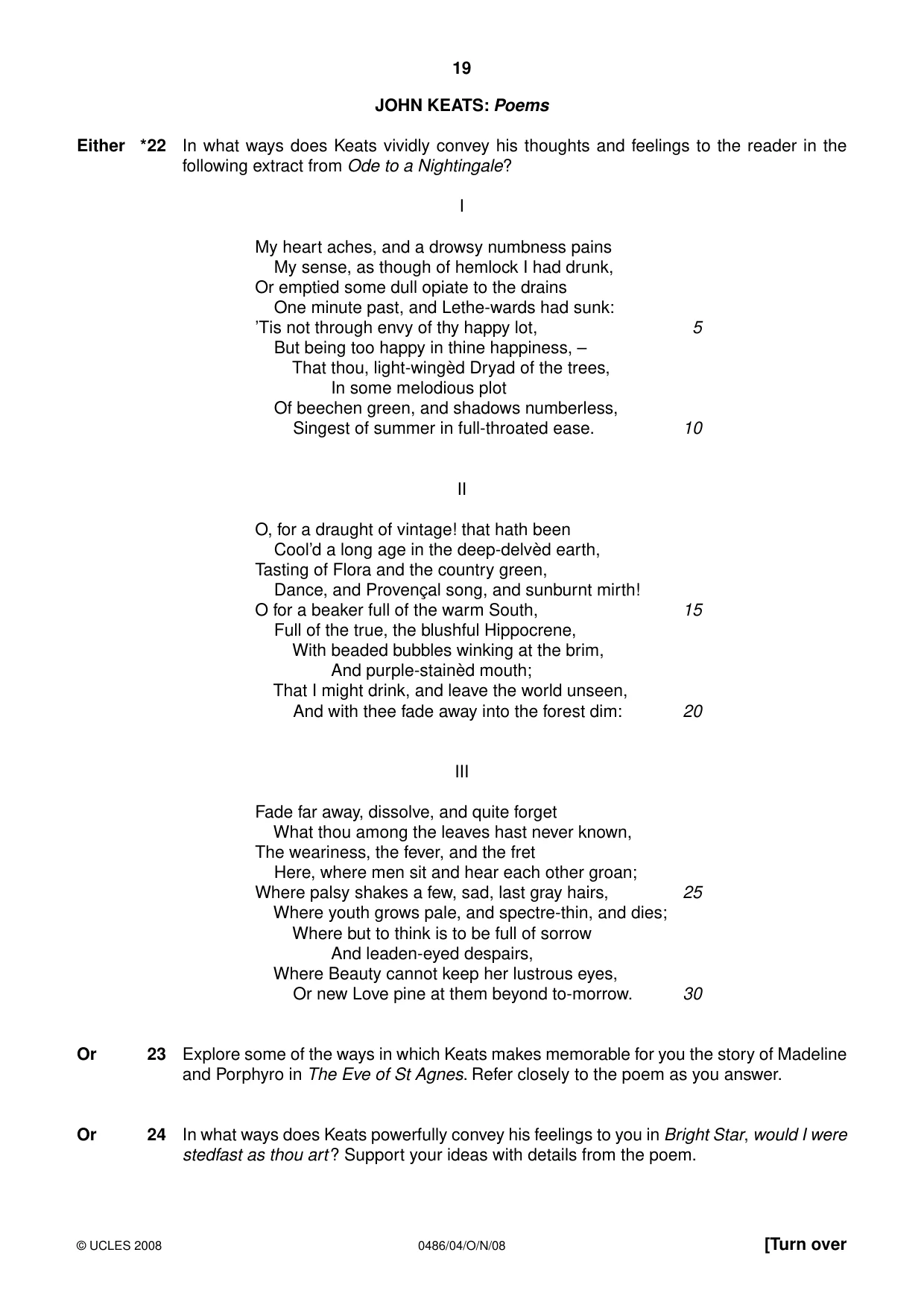
19 0486/04/O/N/08 © UCLES 2008 [Turn over JOHN KEATS: Poems Either * 22 In what ways does Keats vividly convey his thoughts and feelings to the reader in the following extract from Ode to a Nightingale? I My heart aches, and a drowsy numbness pains My sense, as though of hemlock I had drunk, Or emptied some dull opiate to the drains One minute past, and Lethe-wards had sunk: ’Tis not through envy of thy happy lot, 5 But being too happy in thine happiness, – That thou, light-wingèd Dryad of the trees, In some melodious plot Of beechen green, and shadows numberless, Singest of summer in full-throated ease. 10 II O, for a draught of vintage! that hath been Cool’d a long age in the deep-delvèd earth, Tasting of Flora and the country green, Dance, and Provençal song, and sunburnt mirth! O for a beaker full of the warm South, 15 Full of the true, the blushful Hippocrene, With beaded bubbles winking at the brim, And purple-stainèd mouth; That I might drink, and leave the world unseen, And with thee fade away into the forest dim: 20 III Fade far away, dissolve, and quite forget What thou among the leaves hast never known, The weariness, the fever, and the fret Here, where men sit and hear each other groan; Where palsy shakes a few, sad, last gray hairs, 25 Where youth grows pale, and spectre-thin, and dies; Where but to think is to be full of sorrow And leaden-eyed despairs, Where Beauty cannot keep her lustrous eyes, Or new Love pine at them beyond to-morrow. 30 Or 23 Explore some of the ways in which Keats makes memorable for you the story of Madeline and Porphyro in The Eve of St Agnes. Refer closely to the poem as you answer. Or 24 In what ways does Keats powerfully convey his feelings to you in Bright Star, would I were stedfast as thou art ? Support your ideas with details from the poem.
Question paper, page 20
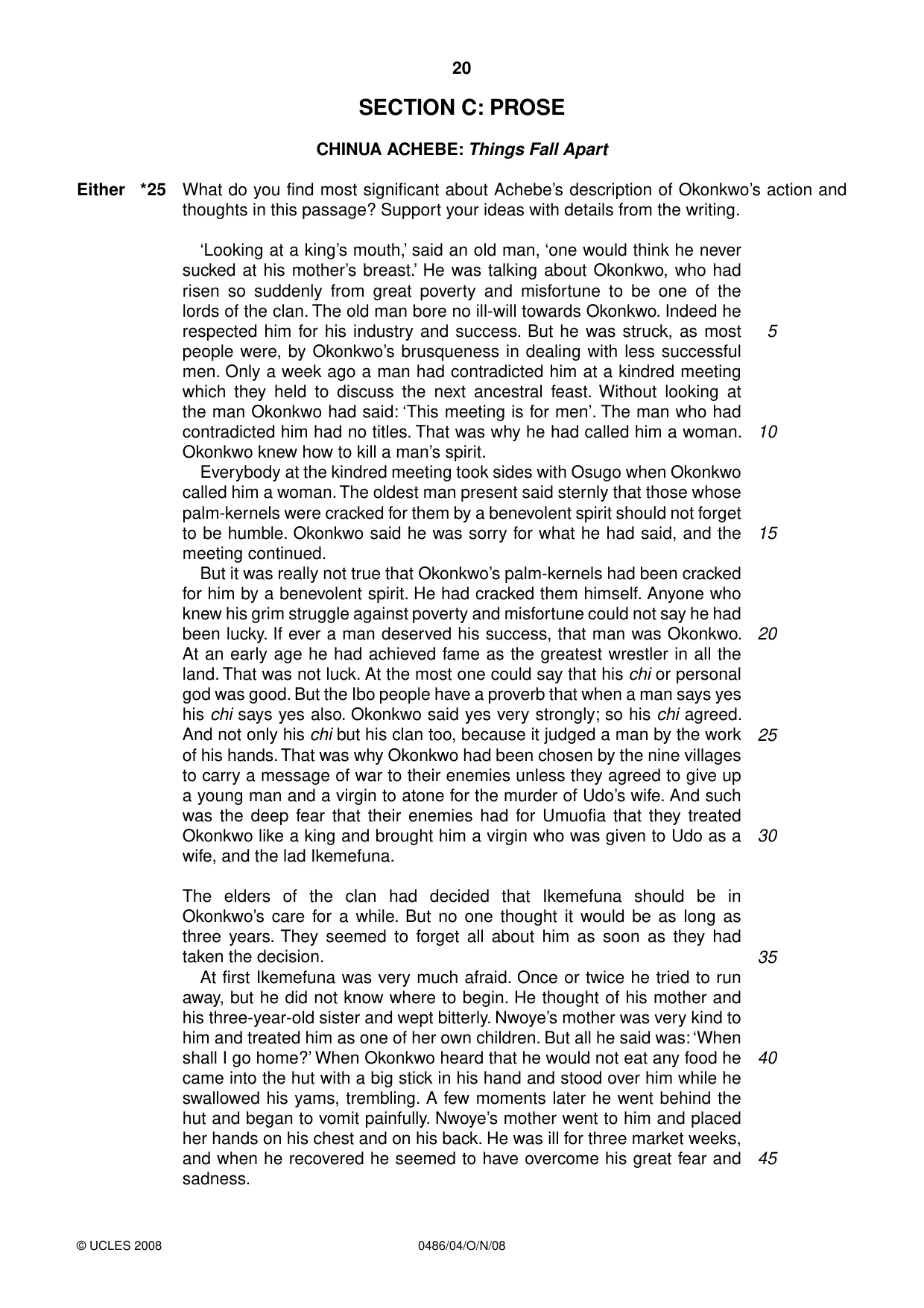
20 0486/04/O/N/08 © UCLES 2008 SECTION C: PROSE CHINUA ACHEBE: Things Fall Apart Either * 25 What do you find most significant about Achebe’s description of Okonkwo’s action and thoughts in this passage? Support your ideas with details from the writing. ‘Looking at a king’s mouth,’ said an old man, ‘one would think he never sucked at his mother’s breast.’ He was talking about Okonkwo, who had risen so suddenly from great poverty and misfortune to be one of the lords of the clan. The old man bore no ill-will towards Okonkwo. Indeed he respected him for his industry and success. But he was struck, as most people were, by Okonkwo’s brusqueness in dealing with less successful men. Only a week ago a man had contradicted him at a kindred meeting which they held to discuss the next ancestral feast. Without looking at the man Okonkwo had said: ‘This meeting is for men’. The man who had contradicted him had no titles. That was why he had called him a woman. Okonkwo knew how to kill a man’s spirit. Everybody at the kindred meeting took sides with Osugo when Okonkwo called him a woman. The oldest man present said sternly that those whose palm-kernels were cracked for them by a benevolent spirit should not forget to be humble. Okonkwo said he was sorry for what he had said, and the meeting continued. But it was really not true that Okonkwo’s palm-kernels had been cracked for him by a benevolent spirit. He had cracked them himself. Anyone who knew his grim struggle against poverty and misfortune could not say he had been lucky. If ever a man deserved his success, that man was Okonkwo. At an early age he had achieved fame as the greatest wrestler in all the land. That was not luck. At the most one could say that his chi or personal god was good. But the Ibo people have a proverb that when a man says yes his chi says yes also. Okonkwo said yes very strongly; so his chi agreed. And not only his chi but his clan too, because it judged a man by the work of his hands. That was why Okonkwo had been chosen by the nine villages to carry a message of war to their enemies unless they agreed to give up a young man and a virgin to atone for the murder of Udo’s wife. And such was the deep fear that their enemies had for Umuofia that they treated Okonkwo like a king and brought him a virgin who was given to Udo as a wife, and the lad Ikemefuna. The elders of the clan had decided that Ikemefuna should be in Okonkwo’s care for a while. But no one thought it would be as long as three years. They seemed to forget all about him as soon as they had taken the decision. At first Ikemefuna was very much afraid. Once or twice he tried to run away, but he did not know where to begin. He thought of his mother and his three-year-old sister and wept bitterly. Nwoye’s mother was very kind to him and treated him as one of her own children. But all he said was: ‘When shall I go home?’ When Okonkwo heard that he would not eat any food he came into the hut with a big stick in his hand and stood over him while he swallowed his yams, trembling. A few moments later he went behind the hut and began to vomit painfully. Nwoye’s mother went to him and placed her hands on his chest and on his back. He was ill for three market weeks, and when he recovered he seemed to have overcome his great fear and sadness. 5 10 15 20 25 30 35 40 45
Question paper, page 21
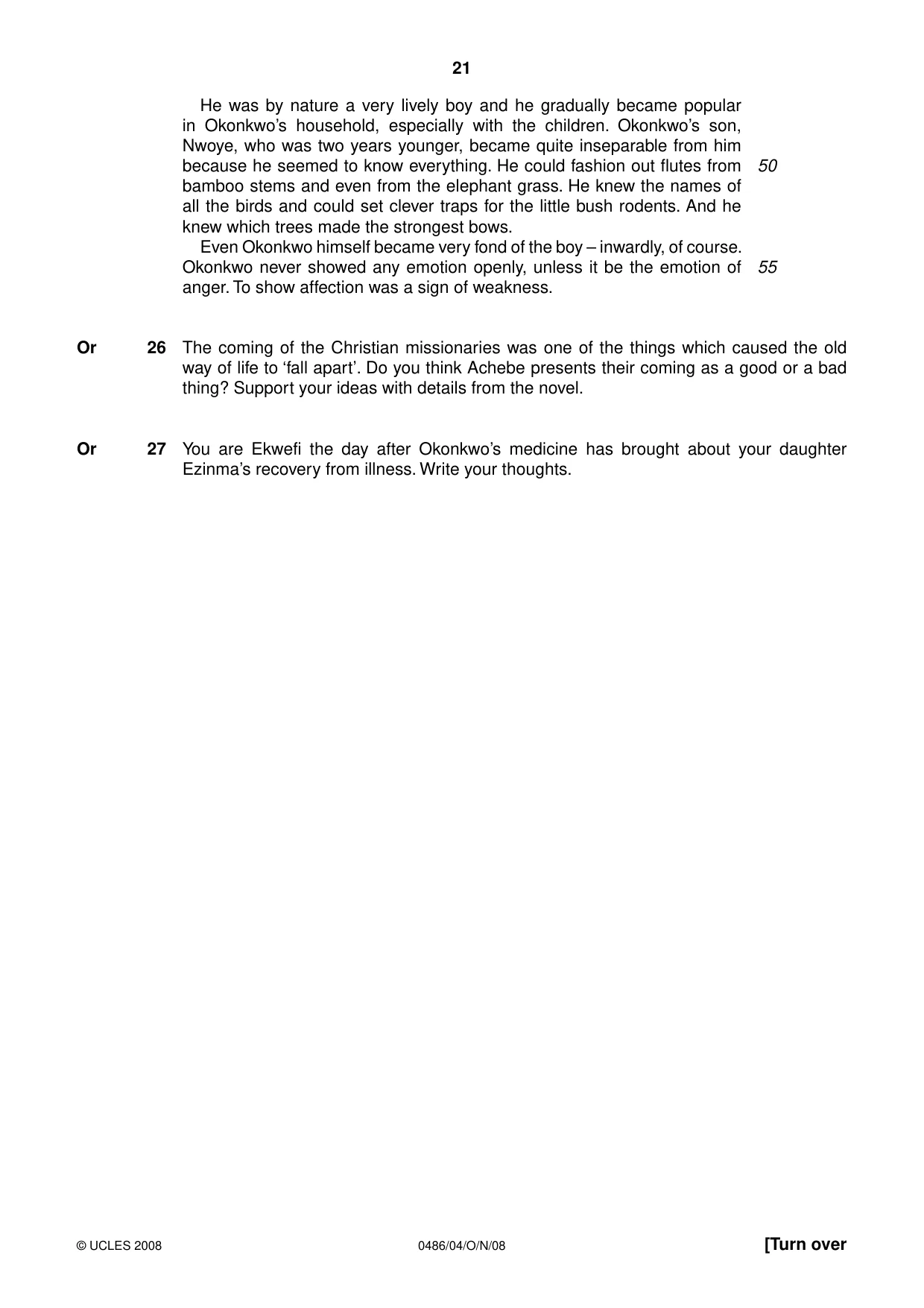
21 0486/04/O/N/08 © UCLES 2008 [Turn over He was by nature a very lively boy and he gradually became popular in Okonkwo’s household, especially with the children. Okonkwo’s son, Nwoye, who was two years younger, became quite inseparable from him because he seemed to know everything. He could fashion out flutes from bamboo stems and even from the elephant grass. He knew the names of all the birds and could set clever traps for the little bush rodents. And he knew which trees made the strongest bows. Even Okonkwo himself became very fond of the boy – inwardly, of course. Okonkwo never showed any emotion openly, unless it be the emotion of anger. To show affection was a sign of weakness. Or 26 The coming of the Christian missionaries was one of the things which caused the old way of life to ‘fall apart’. Do you think Achebe presents their coming as a good or a bad thing? Support your ideas with details from the novel. Or 27 You are Ekwefi the day after Okonkwo’s medicine has brought about your daughter Ezinma’s recovery from illness. Write your thoughts. 50 55
Question paper, page 22
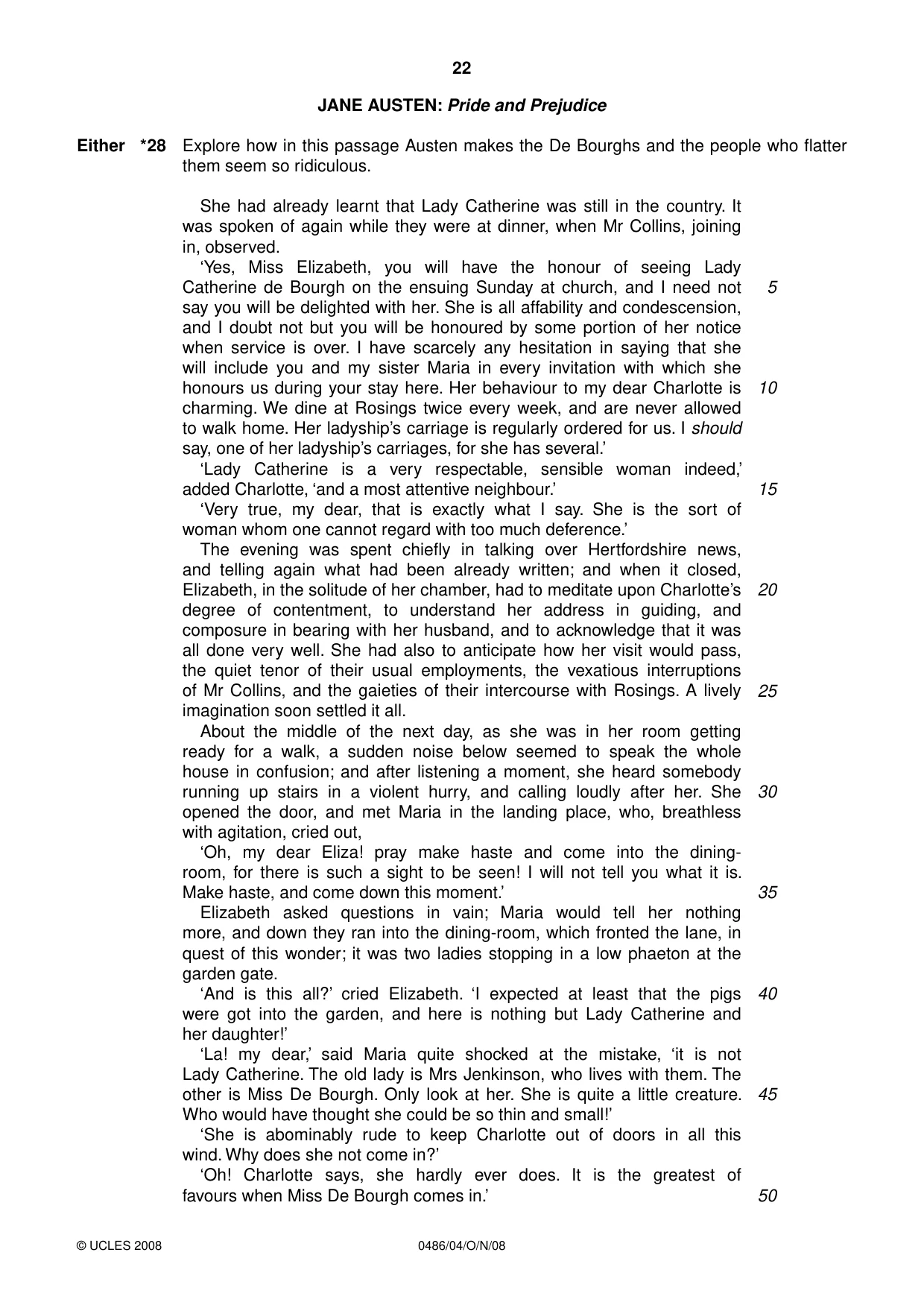
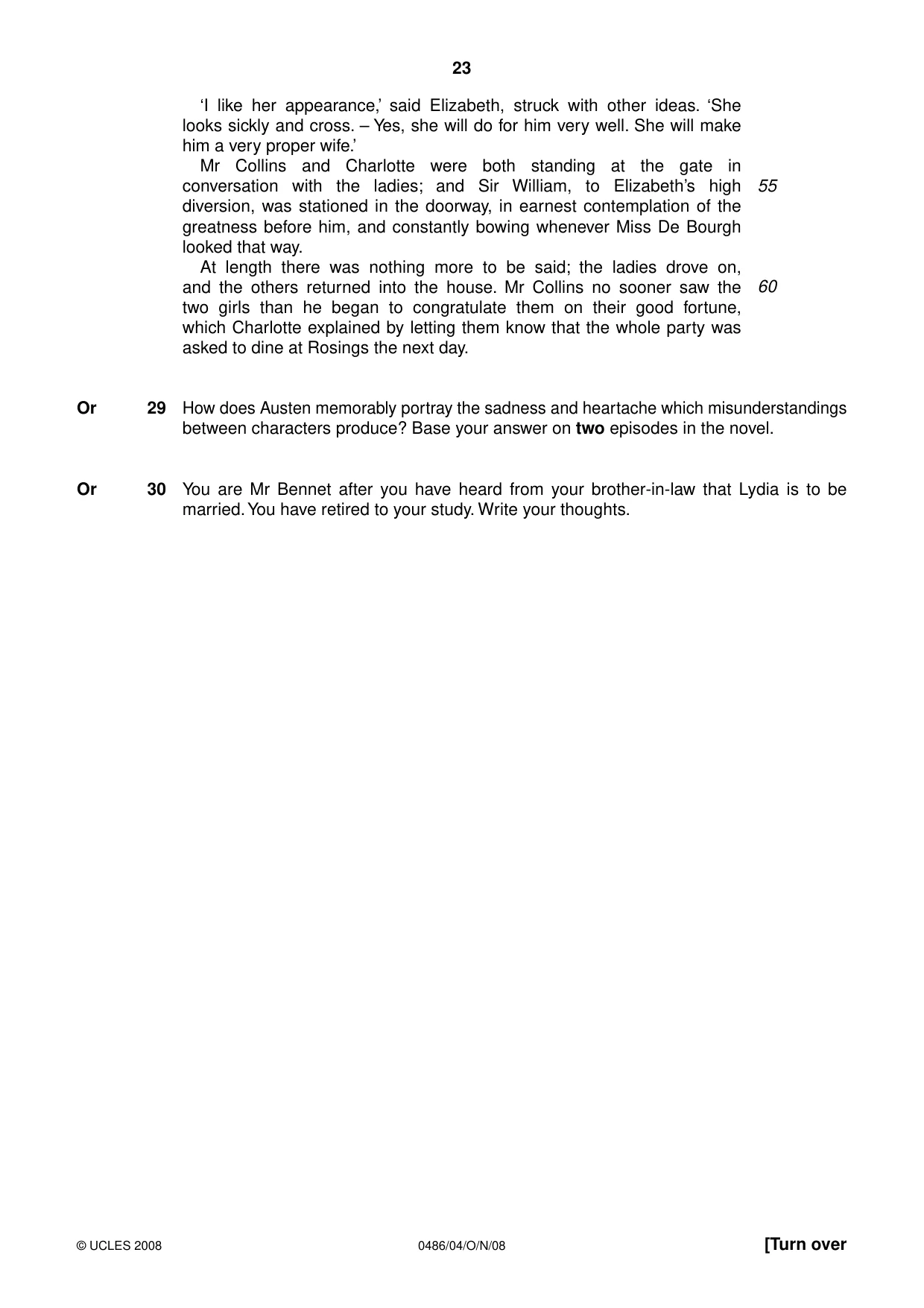
22 0486/04/O/N/08 © UCLES 2008 JANE AUSTEN: Pride and Prejudice Either * 28 Explore how in this passage Austen makes the De Bourghs and the people who flatter them seem so ridiculous. She had already learnt that Lady Catherine was still in the country. It was spoken of again while they were at dinner, when Mr Collins, joining in, observed. ‘Yes, Miss Elizabeth, you will have the honour of seeing Lady Catherine de Bourgh on the ensuing Sunday at church, and I need not say you will be delighted with her. She is all affability and condescension, and I doubt not but you will be honoured by some portion of her notice when service is over. I have scarcely any hesitation in saying that she will include you and my sister Maria in every invitation with which she honours us during your stay here. Her behaviour to my dear Charlotte is charming. We dine at Rosings twice every week, and are never allowed to walk home. Her ladyship’s carriage is regularly ordered for us. I should say, one of her ladyship’s carriages, for she has several.’ ‘Lady Catherine is a very respectable, sensible woman indeed,’ added Charlotte, ‘and a most attentive neighbour.’ ‘Very true, my dear, that is exactly what I say. She is the sort of woman whom one cannot regard with too much deference.’ The evening was spent chiefly in talking over Hertfordshire news, and telling again what had been already written; and when it closed, Elizabeth, in the solitude of her chamber, had to meditate upon Charlotte’s degree of contentment, to understand her address in guiding, and composure in bearing with her husband, and to acknowledge that it was all done very well. She had also to anticipate how her visit would pass, the quiet tenor of their usual employments, the vexatious interruptions of Mr Collins, and the gaieties of their intercourse with Rosings. A lively imagination soon settled it all. About the middle of the next day, as she was in her room getting ready for a walk, a sudden noise below seemed to speak the whole house in confusion; and after listening a moment, she heard somebody running up stairs in a violent hurry, and calling loudly after her. She opened the door, and met Maria in the landing place, who, breathless with agitation, cried out, ‘Oh, my dear Eliza! pray make haste and come into the dining- room, for there is such a sight to be seen! I will not tell you what it is. Make haste, and come down this moment.’ Elizabeth asked questions in vain; Maria would tell her nothing more, and down they ran into the dining-room, which fronted the lane, in quest of this wonder; it was two ladies stopping in a low phaeton at the garden gate. ‘And is this all?’ cried Elizabeth. ‘I expected at least that the pigs were got into the garden, and here is nothing but Lady Catherine and her daughter!’ ‘La! my dear,’ said Maria quite shocked at the mistake, ‘it is not Lady Catherine. The old lady is Mrs Jenkinson, who lives with them. The other is Miss De Bourgh. Only look at her. She is quite a little creature. Who would have thought she could be so thin and small!’ ‘She is abominably rude to keep Charlotte out of doors in all this wind. Why does she not come in?’ ‘Oh! Charlotte says, she hardly ever does. It is the greatest of favours when Miss De Bourgh comes in.’ 5 10 15 20 25 30 35 40 45 50
Question paper, page 23
23 0486/04/O/N/08 © UCLES 2008 [Turn over ‘I like her appearance,’ said Elizabeth, struck with other ideas. ‘She looks sickly and cross. – Yes, she will do for him very well. She will make him a very proper wife.’ Mr Collins and Charlotte were both standing at the gate in conversation with the ladies; and Sir William, to Elizabeth’s high diversion, was stationed in the doorway, in earnest contemplation of the greatness before him, and constantly bowing whenever Miss De Bourgh looked that way. At length there was nothing more to be said; the ladies drove on, and the others returned into the house. Mr Collins no sooner saw the two girls than he began to congratulate them on their good fortune, which Charlotte explained by letting them know that the whole party was asked to dine at Rosings the next day. Or 29 How does Austen memorably portray the sadness and heartache which misunderstandings between characters produce? Base your answer on two episodes in the novel. Or 30 You are Mr Bennet after you have heard from your brother-in-law that Lydia is to be married. You have retired to your study. Write your thoughts. 55 60
Question paper, page 24
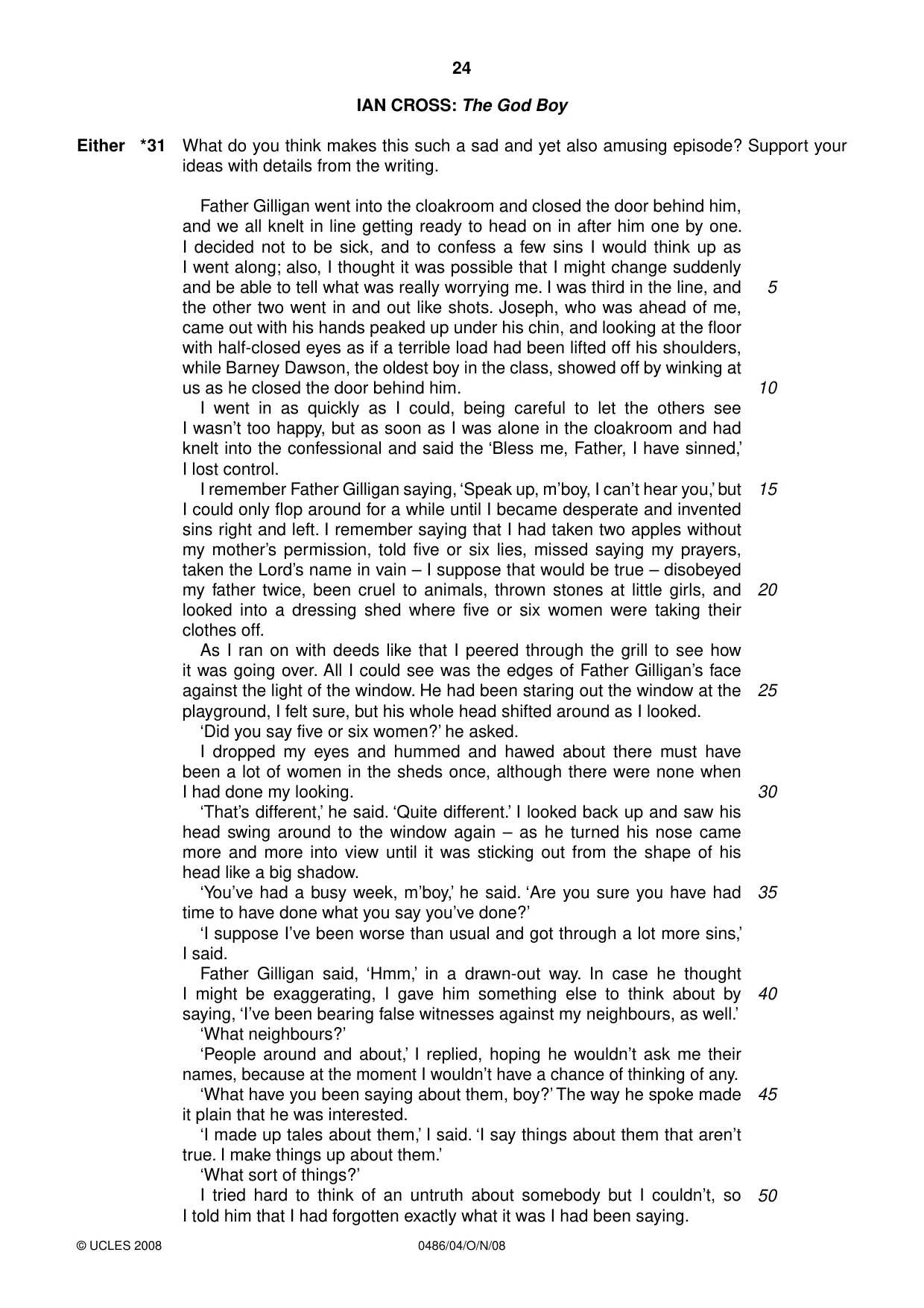
24 0486/04/O/N/08 © UCLES 2008 IAN CROSS: The God Boy Either * 31 What do you think makes this such a sad and yet also amusing episode? Support your ideas with details from the writing. Father Gilligan went into the cloakroom and closed the door behind him, and we all knelt in line getting ready to head on in after him one by one. I decided not to be sick, and to confess a few sins I would think up as I went along; also, I thought it was possible that I might change suddenly and be able to tell what was really worrying me. I was third in the line, and the other two went in and out like shots. Joseph, who was ahead of me, came out with his hands peaked up under his chin, and looking at the floor with half-closed eyes as if a terrible load had been lifted off his shoulders, while Barney Dawson, the oldest boy in the class, showed off by winking at us as he closed the door behind him. I went in as quickly as I could, being careful to let the others see I wasn’t too happy, but as soon as I was alone in the cloakroom and had knelt into the confessional and said the ‘Bless me, Father, I have sinned,’ I lost control. I remember Father Gilligan saying, ‘Speak up, m’boy, I can’t hear you,’ but I could only flop around for a while until I became desperate and invented sins right and left. I remember saying that I had taken two apples without my mother’s permission, told five or six lies, missed saying my prayers, taken the Lord’s name in vain – I suppose that would be true – disobeyed my father twice, been cruel to animals, thrown stones at little girls, and looked into a dressing shed where five or six women were taking their clothes off. As I ran on with deeds like that I peered through the grill to see how it was going over. All I could see was the edges of Father Gilligan’s face against the light of the window. He had been staring out the window at the playground, I felt sure, but his whole head shifted around as I looked. ‘Did you say five or six women?’ he asked. I dropped my eyes and hummed and hawed about there must have been a lot of women in the sheds once, although there were none when I had done my looking. ‘That’s different,’ he said. ‘Quite different.’ I looked back up and saw his head swing around to the window again – as he turned his nose came more and more into view until it was sticking out from the shape of his head like a big shadow. ‘You’ve had a busy week, m’boy,’ he said. ‘Are you sure you have had time to have done what you say you’ve done?’ ‘I suppose I’ve been worse than usual and got through a lot more sins,’ I said. Father Gilligan said, ‘Hmm,’ in a drawn-out way. In case he thought I might be exaggerating, I gave him something else to think about by saying, ‘I’ve been bearing false witnesses against my neighbours, as well.’ ‘What neighbours?’ ‘People around and about,’ I replied, hoping he wouldn’t ask me their names, because at the moment I wouldn’t have a chance of thinking of any. ‘What have you been saying about them, boy?’ The way he spoke made it plain that he was interested. ‘I made up tales about them,’ I said. ‘I say things about them that aren’t true. I make things up about them.’ ‘What sort of things?’ I tried hard to think of an untruth about somebody but I couldn’t, so I told him that I had forgotten exactly what it was I had been saying. 5 10 15 20 25 30 35 40 45 50
Question paper, page 25
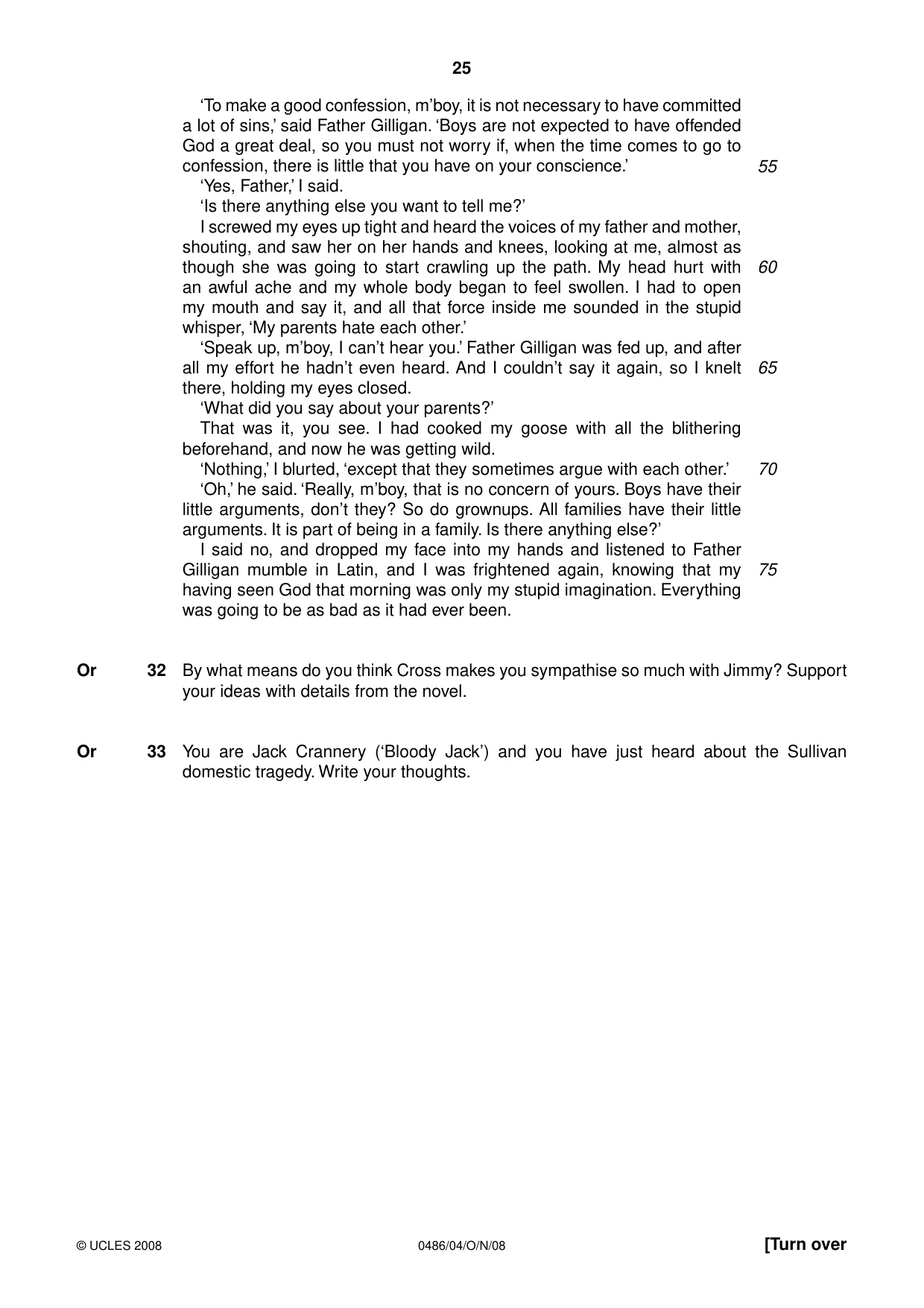
25 0486/04/O/N/08 © UCLES 2008 [Turn over ‘To make a good confession, m’boy, it is not necessary to have committed a lot of sins,’ said Father Gilligan. ‘Boys are not expected to have offended God a great deal, so you must not worry if, when the time comes to go to confession, there is little that you have on your conscience.’ ‘Yes, Father,’ I said. ‘Is there anything else you want to tell me?’ I screwed my eyes up tight and heard the voices of my father and mother, shouting, and saw her on her hands and knees, looking at me, almost as though she was going to start crawling up the path. My head hurt with an awful ache and my whole body began to feel swollen. I had to open my mouth and say it, and all that force inside me sounded in the stupid whisper, ‘My parents hate each other.’ ‘Speak up, m’boy, I can’t hear you.’ Father Gilligan was fed up, and after all my effort he hadn’t even heard. And I couldn’t say it again, so I knelt there, holding my eyes closed. ‘What did you say about your parents?’ That was it, you see. I had cooked my goose with all the blithering beforehand, and now he was getting wild. ‘Nothing,’ I blurted, ‘except that they sometimes argue with each other.’ ‘Oh,’ he said. ‘Really, m’boy, that is no concern of yours. Boys have their little arguments, don’t they? So do grownups. All families have their little arguments. It is part of being in a family. Is there anything else?’ I said no, and dropped my face into my hands and listened to Father Gilligan mumble in Latin, and I was frightened again, knowing that my having seen God that morning was only my stupid imagination. Everything was going to be as bad as it had ever been. Or 32 By what means do you think Cross makes you sympathise so much with Jimmy? Support your ideas with details from the novel. Or 33 You are Jack Crannery (‘Bloody Jack’) and you have just heard about the Sullivan domestic tragedy. Write your thoughts. 55 60 65 70 75
Question paper, page 26
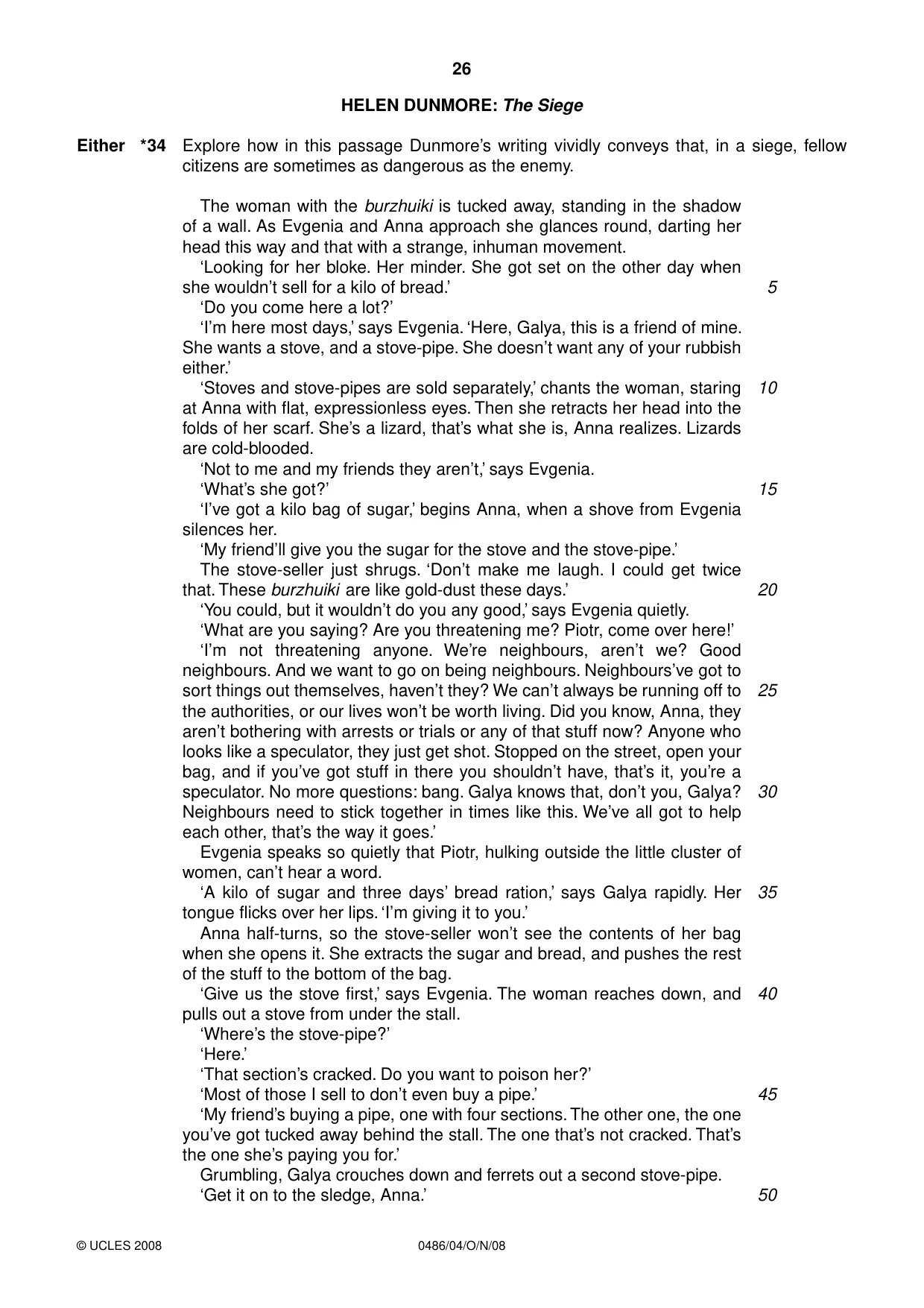
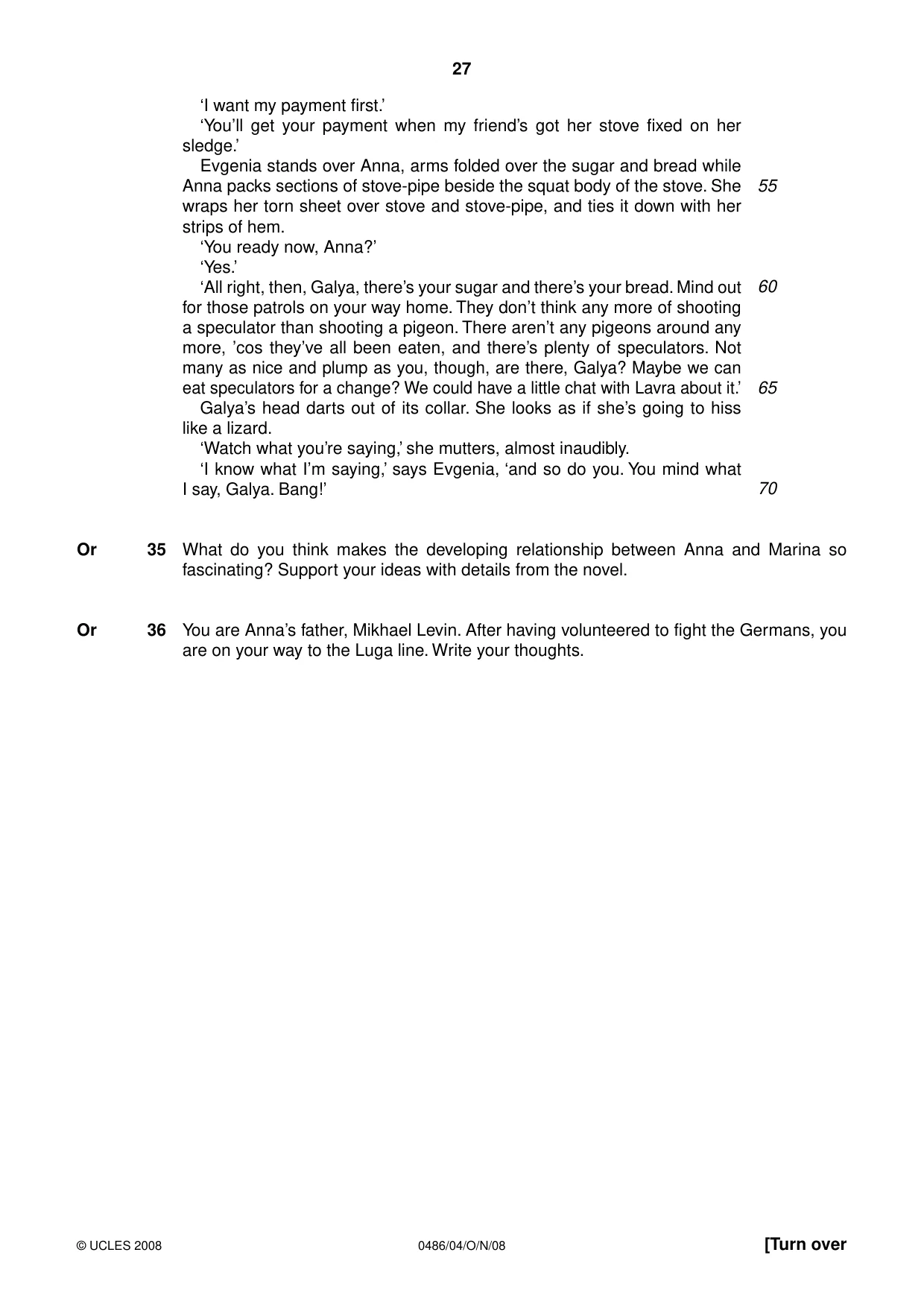
26 0486/04/O/N/08 © UCLES 2008 HELEN DUNMORE: The Siege Either * 34 Explore how in this passage Dunmore’s writing vividly conveys that, in a siege, fellow citizens are sometimes as dangerous as the enemy. The woman with the burzhuiki is tucked away, standing in the shadow of a wall. As Evgenia and Anna approach she glances round, darting her head this way and that with a strange, inhuman movement. ‘Looking for her bloke. Her minder. She got set on the other day when she wouldn’t sell for a kilo of bread.’ ‘Do you come here a lot?’ ‘I’m here most days,’ says Evgenia. ‘Here, Galya, this is a friend of mine. She wants a stove, and a stove-pipe. She doesn’t want any of your rubbish either.’ ‘Stoves and stove-pipes are sold separately,’ chants the woman, staring at Anna with flat, expressionless eyes. Then she retracts her head into the folds of her scarf. She’s a lizard, that’s what she is, Anna realizes. Lizards are cold-blooded. ‘Not to me and my friends they aren’t,’ says Evgenia. ‘What’s she got?’ ‘I’ve got a kilo bag of sugar,’ begins Anna, when a shove from Evgenia silences her. ‘My friend’ll give you the sugar for the stove and the stove-pipe.’ The stove-seller just shrugs. ‘Don’t make me laugh. I could get twice that. These burzhuiki are like gold-dust these days.’ ‘You could, but it wouldn’t do you any good,’ says Evgenia quietly. ‘What are you saying? Are you threatening me? Piotr, come over here!’ ‘I’m not threatening anyone. We’re neighbours, aren’t we? Good neighbours. And we want to go on being neighbours. Neighbours’ve got to sort things out themselves, haven’t they? We can’t always be running off to the authorities, or our lives won’t be worth living. Did you know, Anna, they aren’t bothering with arrests or trials or any of that stuff now? Anyone who looks like a speculator, they just get shot. Stopped on the street, open your bag, and if you’ve got stuff in there you shouldn’t have, that’s it, you’re a speculator. No more questions: bang. Galya knows that, don’t you, Galya? Neighbours need to stick together in times like this. We’ve all got to help each other, that’s the way it goes.’ Evgenia speaks so quietly that Piotr, hulking outside the little cluster of women, can’t hear a word. ‘A kilo of sugar and three days’ bread ration,’ says Galya rapidly. Her tongue flicks over her lips. ‘I’m giving it to you.’ Anna half-turns, so the stove-seller won’t see the contents of her bag when she opens it. She extracts the sugar and bread, and pushes the rest of the stuff to the bottom of the bag. ‘Give us the stove first,’ says Evgenia. The woman reaches down, and pulls out a stove from under the stall. ‘Where’s the stove-pipe?’ ‘Here.’ ‘That section’s cracked. Do you want to poison her?’ ‘Most of those I sell to don’t even buy a pipe.’ ‘My friend’s buying a pipe, one with four sections. The other one, the one you’ve got tucked away behind the stall. The one that’s not cracked. That’s the one she’s paying you for.’ Grumbling, Galya crouches down and ferrets out a second stove-pipe. ‘Get it on to the sledge, Anna.’ 5 10 15 20 25 30 35 40 45 50
Question paper, page 27
27 0486/04/O/N/08 © UCLES 2008 [Turn over ‘I want my payment first.’ ‘You’ll get your payment when my friend’s got her stove fixed on her sledge.’ Evgenia stands over Anna, arms folded over the sugar and bread while Anna packs sections of stove-pipe beside the squat body of the stove. She wraps her torn sheet over stove and stove-pipe, and ties it down with her strips of hem. ‘You ready now, Anna?’ ‘Yes.’ ‘All right, then, Galya, there’s your sugar and there’s your bread. Mind out for those patrols on your way home. They don’t think any more of shooting a speculator than shooting a pigeon. There aren’t any pigeons around any more, ’cos they’ve all been eaten, and there’s plenty of speculators. Not many as nice and plump as you, though, are there, Galya? Maybe we can eat speculators for a change? We could have a little chat with Lavra about it.’ Galya’s head darts out of its collar. She looks as if she’s going to hiss like a lizard. ‘Watch what you’re saying,’ she mutters, almost inaudibly. ‘I know what I’m saying,’ says Evgenia, ‘and so do you. You mind what I say, Galya. Bang!’ Or 35 What do you think makes the developing relationship between Anna and Marina so fascinating? Support your ideas with details from the novel. Or 36 You are Anna’s father, Mikhael Levin. After having volunteered to fight the Germans, you are on your way to the Luga line. Write your thoughts. 55 60 65 70
Question paper, page 28
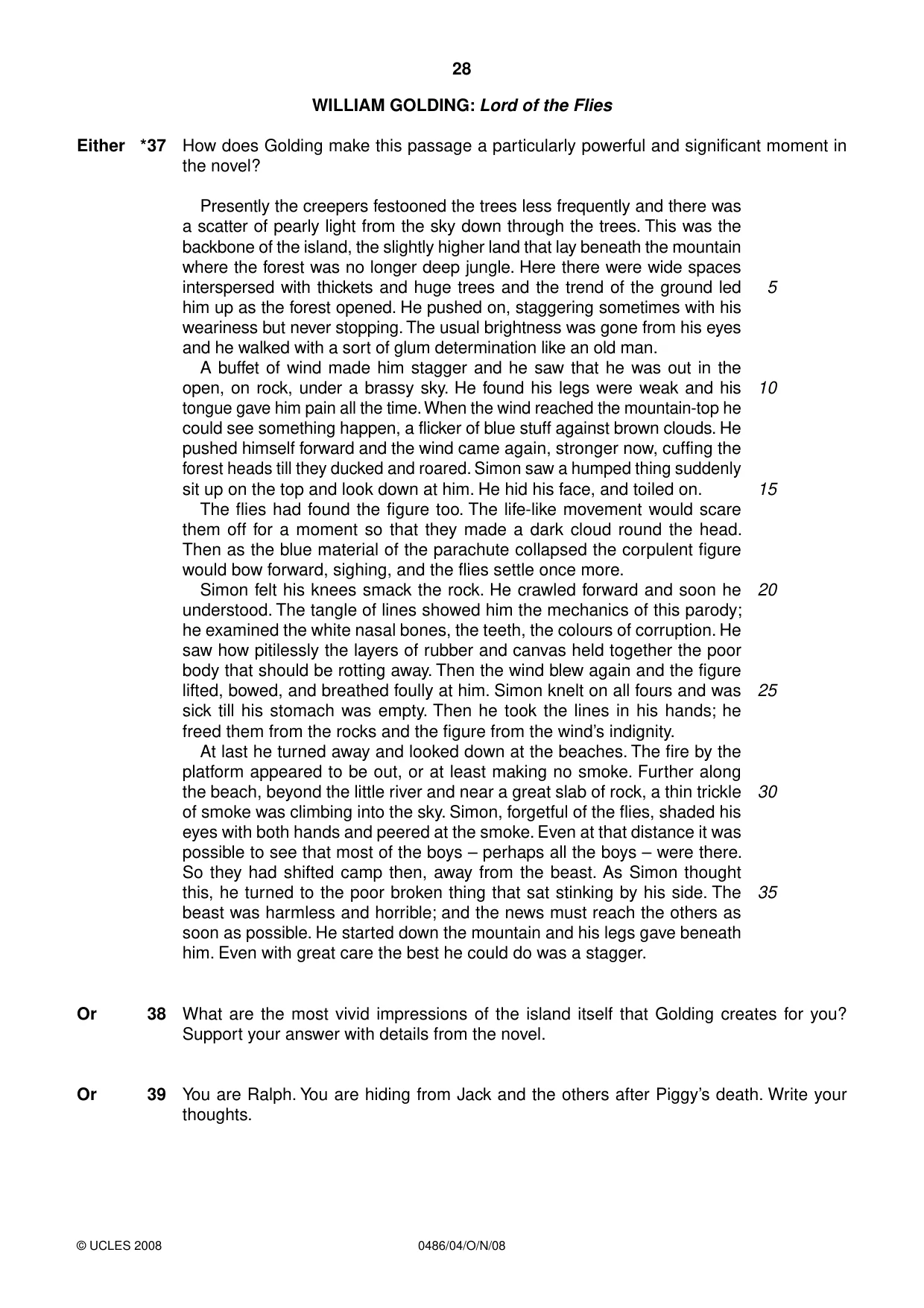
28 0486/04/O/N/08 WILLIAM GOLDING: Lord of the Flies Either * 37 How does Golding make this passage a particularly powerful and significant moment in the novel? Presently the creepers festooned the trees less frequently and there was a scatter of pearly light from the sky down through the trees. This was the backbone of the island, the slightly higher land that lay beneath the mountain where the forest was no longer deep jungle. Here there were wide spaces interspersed with thickets and huge trees and the trend of the ground led him up as the forest opened. He pushed on, staggering sometimes with his weariness but never stopping. The usual brightness was gone from his eyes and he walked with a sort of glum determination like an old man. A buffet of wind made him stagger and he saw that he was out in the open, on rock, under a brassy sky. He found his legs were weak and his tongue gave him pain all the time. When the wind reached the mountain-top he could see something happen, a flicker of blue stuff against brown clouds. He pushed himself forward and the wind came again, stronger now, cuffing the forest heads till they ducked and roared. Simon saw a humped thing suddenly sit up on the top and look down at him. He hid his face, and toiled on. The flies had found the figure too. The life-like movement would scare them off for a moment so that they made a dark cloud round the head. Then as the blue material of the parachute collapsed the corpulent figure would bow forward, sighing, and the flies settle once more. Simon felt his knees smack the rock. He crawled forward and soon he understood. The tangle of lines showed him the mechanics of this parody; he examined the white nasal bones, the teeth, the colours of corruption. He saw how pitilessly the layers of rubber and canvas held together the poor body that should be rotting away. Then the wind blew again and the figure lifted, bowed, and breathed foully at him. Simon knelt on all fours and was sick till his stomach was empty. Then he took the lines in his hands; he freed them from the rocks and the figure from the wind’s indignity. At last he turned away and looked down at the beaches. The fire by the platform appeared to be out, or at least making no smoke. Further along the beach, beyond the little river and near a great slab of rock, a thin trickle of smoke was climbing into the sky. Simon, forgetful of the flies, shaded his eyes with both hands and peered at the smoke. Even at that distance it was possible to see that most of the boys – perhaps all the boys – were there. So they had shifted camp then, away from the beast. As Simon thought this, he turned to the poor broken thing that sat stinking by his side. The beast was harmless and horrible; and the news must reach the others as soon as possible. He started down the mountain and his legs gave beneath him. Even with great care the best he could do was a stagger. Or 38 What are the most vivid impressions of the island itself that Golding creates for you? Support your answer with details from the novel. Or 39 You are Ralph. You are hiding from Jack and the others after Piggy’s death. Write your thoughts. 5 10 15 20 25 30 35 © UCLES 2008
Question paper, page 29
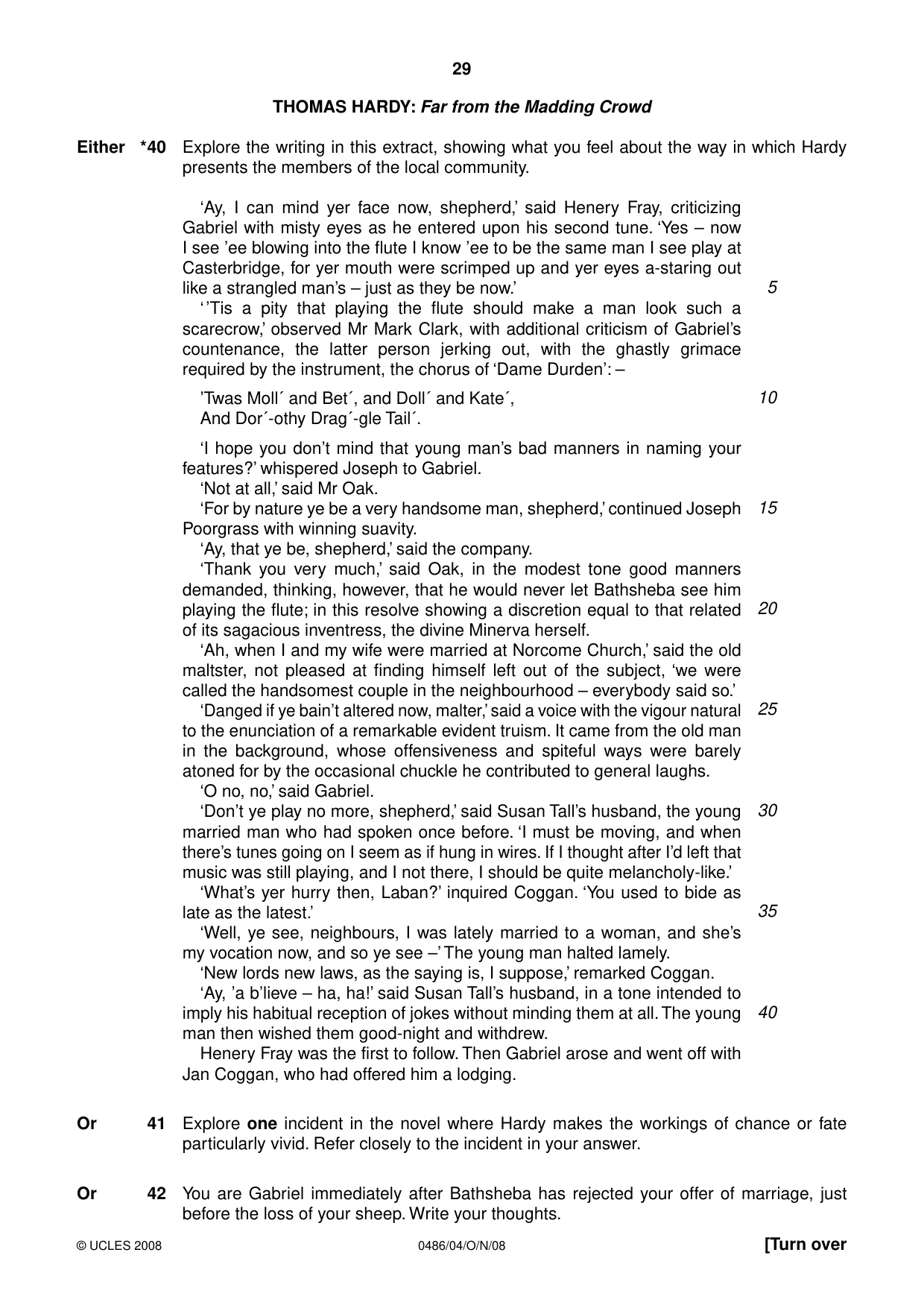
29 0486/04/O/N/08 [Turn over THOMAS HARDY: Far from the Madding Crowd Either * 40 Explore the writing in this extract, showing what you feel about the way in which Hardy presents the members of the local community. ‘Ay, I can mind yer face now, shepherd,’ said Henery Fray, criticizing Gabriel with misty eyes as he entered upon his second tune. ‘Yes – now I see ’ee blowing into the flute I know ’ee to be the same man I see play at Casterbridge, for yer mouth were scrimped up and yer eyes a-staring out like a strangled man’s – just as they be now.’ ‘ ’Tis a pity that playing the flute should make a man look such a scarecrow,’ observed Mr Mark Clark, with additional criticism of Gabriel’s countenance, the latter person jerking out, with the ghastly grimace required by the instrument, the chorus of ‘Dame Durden’: – ’Twas Moll´ and Bet´, and Doll´ and Kate´, And Dor´-othy Drag´-gle Tail´. ‘I hope you don’t mind that young man’s bad manners in naming your features?’ whispered Joseph to Gabriel. ‘Not at all,’ said Mr Oak. ‘For by nature ye be a very handsome man, shepherd,’ continued Joseph Poorgrass with winning suavity. ‘Ay, that ye be, shepherd,’ said the company. ‘Thank you very much,’ said Oak, in the modest tone good manners demanded, thinking, however, that he would never let Bathsheba see him playing the flute; in this resolve showing a discretion equal to that related of its sagacious inventress, the divine Minerva herself. ‘Ah, when I and my wife were married at Norcome Church,’ said the old maltster, not pleased at finding himself left out of the subject, ‘we were called the handsomest couple in the neighbourhood – everybody said so.’ ‘Danged if ye bain’t altered now, malter,’ said a voice with the vigour natural to the enunciation of a remarkable evident truism. It came from the old man in the background, whose offensiveness and spiteful ways were barely atoned for by the occasional chuckle he contributed to general laughs. ‘O no, no,’ said Gabriel. ‘Don’t ye play no more, shepherd,’ said Susan Tall’s husband, the young married man who had spoken once before. ‘I must be moving, and when there’s tunes going on I seem as if hung in wires. If I thought after I’d left that music was still playing, and I not there, I should be quite melancholy-like.’ ‘What’s yer hurry then, Laban?’ inquired Coggan. ‘You used to bide as late as the latest.’ ‘Well, ye see, neighbours, I was lately married to a woman, and she’s my vocation now, and so ye see –’ The young man halted lamely. ‘New lords new laws, as the saying is, I suppose,’ remarked Coggan. ‘Ay, ’a b’lieve – ha, ha!’ said Susan Tall’s husband, in a tone intended to imply his habitual reception of jokes without minding them at all. The young man then wished them good-night and withdrew. Henery Fray was the first to follow. Then Gabriel arose and went off with Jan Coggan, who had offered him a lodging. Or 41 Explore one incident in the novel where Hardy makes the workings of chance or fate particularly vivid. Refer closely to the incident in your answer. Or 42 You are Gabriel immediately after Bathsheba has rejected your offer of marriage, just before the loss of your sheep. Write your thoughts. 5 10 15 20 25 30 35 40 © UCLES 2008
Question paper, page 30
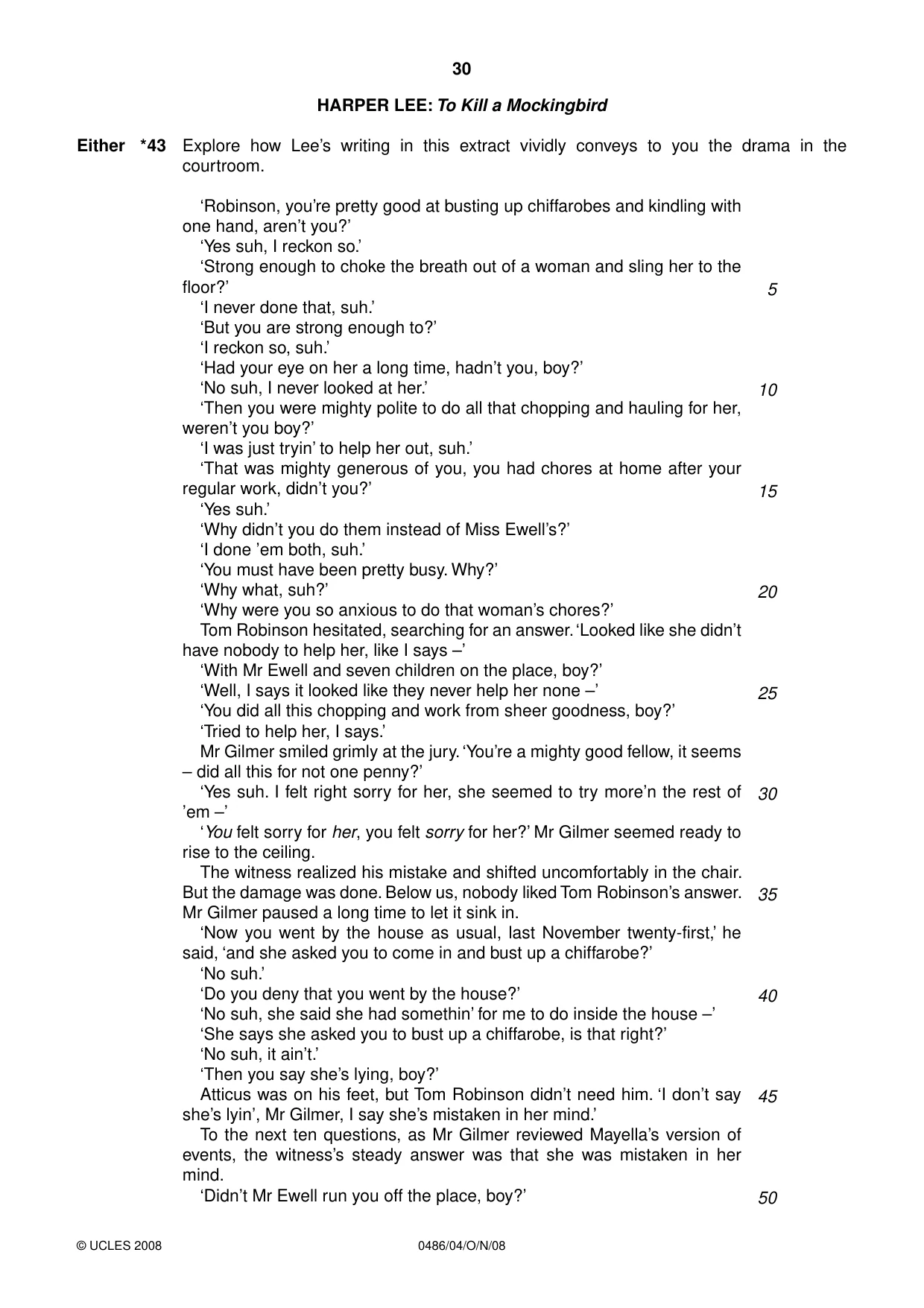
30 0486/04/O/N/08 © UCLES 2008 HARPER LEE: To Kill a Mockingbird Either * 43 Explore how Lee’s writing in this extract vividly conveys to you the drama in the courtroom. ‘Robinson, you’re pretty good at busting up chiffarobes and kindling with one hand, aren’t you?’ ‘Yes suh, I reckon so.’ ‘Strong enough to choke the breath out of a woman and sling her to the floor?’ ‘I never done that, suh.’ ‘But you are strong enough to?’ ‘I reckon so, suh.’ ‘Had your eye on her a long time, hadn’t you, boy?’ ‘No suh, I never looked at her.’ ‘Then you were mighty polite to do all that chopping and hauling for her, weren’t you boy?’ ‘I was just tryin’ to help her out, suh.’ ‘That was mighty generous of you, you had chores at home after your regular work, didn’t you?’ ‘Yes suh.’ ‘Why didn’t you do them instead of Miss Ewell’s?’ ‘I done ’em both, suh.’ ‘You must have been pretty busy. Why?’ ‘Why what, suh?’ ‘Why were you so anxious to do that woman’s chores?’ Tom Robinson hesitated, searching for an answer. ‘Looked like she didn’t have nobody to help her, like I says –’ ‘With Mr Ewell and seven children on the place, boy?’ ‘Well, I says it looked like they never help her none –’ ‘You did all this chopping and work from sheer goodness, boy?’ ‘Tried to help her, I says.’ Mr Gilmer smiled grimly at the jury. ‘You’re a mighty good fellow, it seems – did all this for not one penny?’ ‘Yes suh. I felt right sorry for her, she seemed to try more’n the rest of ’em –’ ‘You felt sorry for her, you felt sorry for her?’ Mr Gilmer seemed ready to rise to the ceiling. The witness realized his mistake and shifted uncomfortably in the chair. But the damage was done. Below us, nobody liked Tom Robinson’s answer. Mr Gilmer paused a long time to let it sink in. ‘Now you went by the house as usual, last November twenty-first,’ he said, ‘and she asked you to come in and bust up a chiffarobe?’ ‘No suh.’ ‘Do you deny that you went by the house?’ ‘No suh, she said she had somethin’ for me to do inside the house –’ ‘She says she asked you to bust up a chiffarobe, is that right?’ ‘No suh, it ain’t.’ ‘Then you say she’s lying, boy?’ Atticus was on his feet, but Tom Robinson didn’t need him. ‘I don’t say she’s lyin’, Mr Gilmer, I say she’s mistaken in her mind.’ To the next ten questions, as Mr Gilmer reviewed Mayella’s version of events, the witness’s steady answer was that she was mistaken in her mind. ‘Didn’t Mr Ewell run you off the place, boy?’ 5 10 15 20 25 30 35 40 45 50
Question paper, page 31
31 0486/04/O/N/08 © UCLES 2008 [Turn over ‘No suh, I don’t think he did.’ ‘Don’t think, what do you mean?’ ‘I mean I didn’t stay long enough for him to run me off.’ ‘You’re very candid about this, why did you run so fast?’ ‘I says I was scared, suh.’ ‘If you had a clear conscience, why were you scared?’ ‘Like I says before, it weren’t safe for any nigger to be in a – fix like that.’ ‘But you weren’t in a fix – you testified that you were resisting Miss Ewell. Were you so scared that she’d hurt you, you ran, a big buck like you?’ ‘No suh, I’s scared I’d be in court, just like I am now.’ Or 44 What does Lee make you feel about Robert Ewell? Refer to details in the novel in your answer. Or 45 You are Dill, having just returned home after the first summer in Maycomb, thinking about your childhood games and adventures with Scout and Jem. Write your thoughts. 55 60
Question paper, page 32
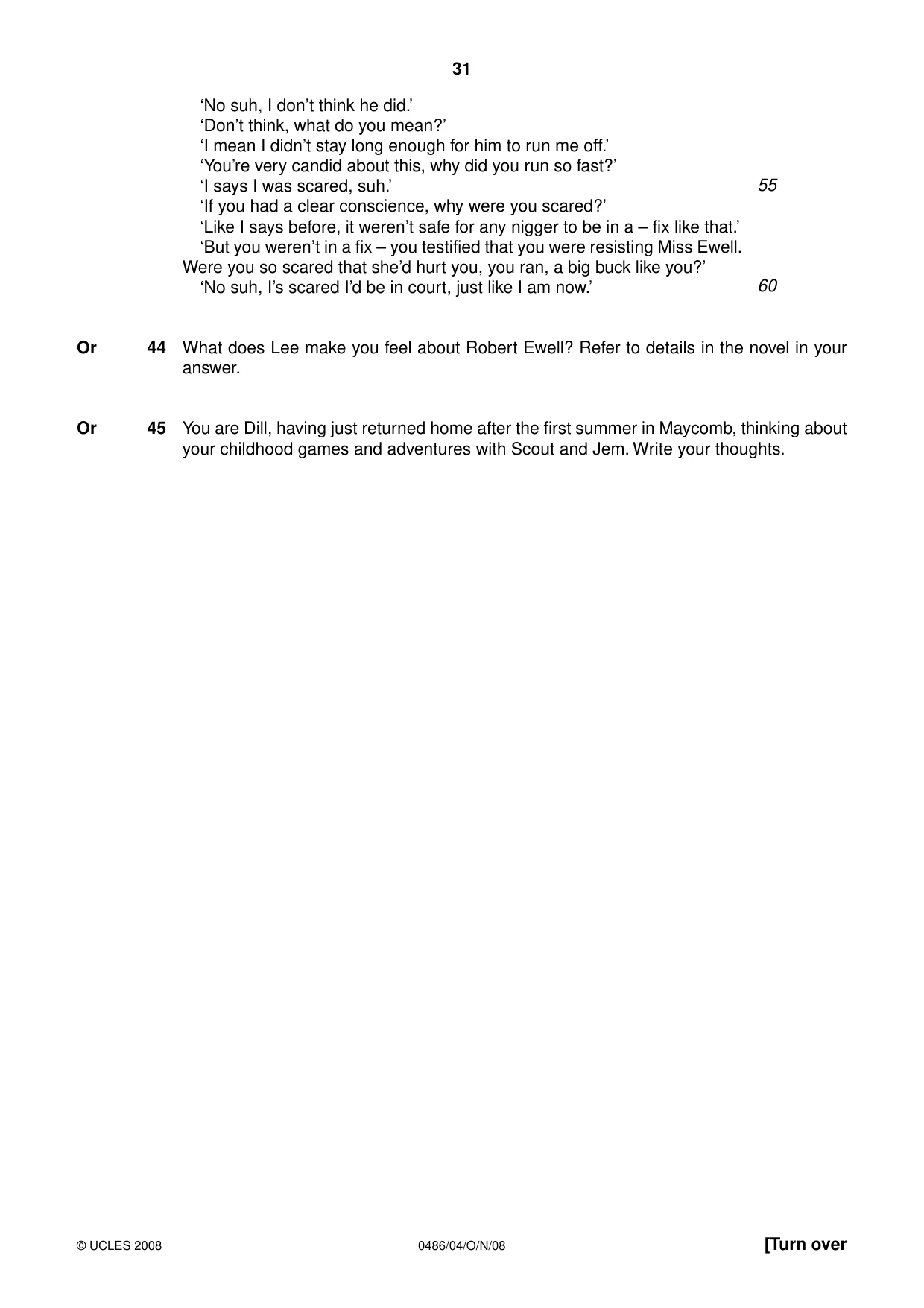
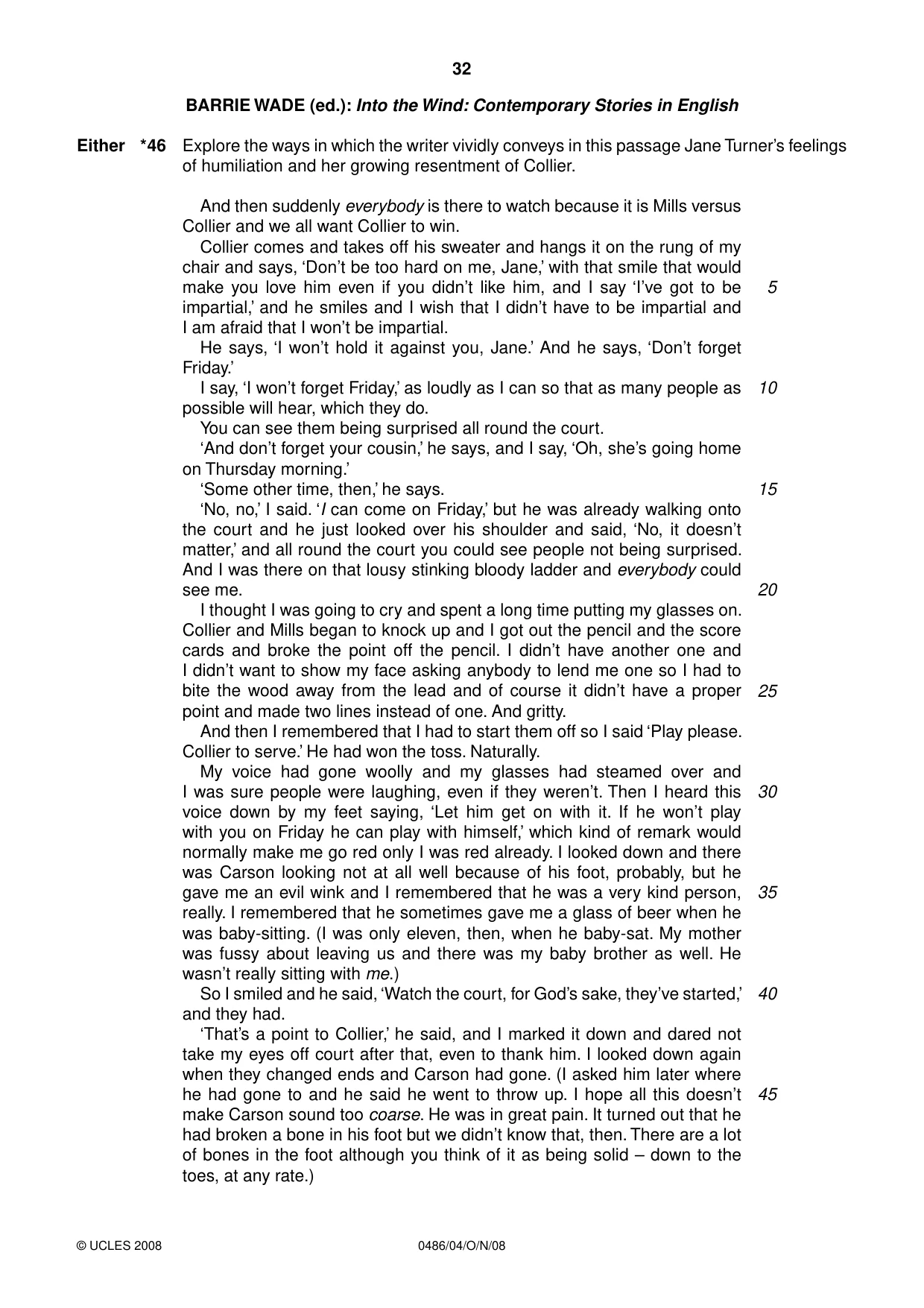
32 0486/04/O/N/08 © UCLES 2008 BARRIE WADE (ed.): Into the Wind: Contemporary Stories in English Either * 46 Explore the ways in which the writer vividly conveys in this passage Jane Turner’s feelings of humiliation and her growing resentment of Collier. And then suddenly everybody is there to watch because it is Mills versus Collier and we all want Collier to win. Collier comes and takes off his sweater and hangs it on the rung of my chair and says, ‘Don’t be too hard on me, Jane,’ with that smile that would make you love him even if you didn’t like him, and I say ‘I’ve got to be impartial,’ and he smiles and I wish that I didn’t have to be impartial and I am afraid that I won’t be impartial. He says, ‘I won’t hold it against you, Jane.’ And he says, ‘Don’t forget Friday.’ I say, ‘I won’t forget Friday,’ as loudly as I can so that as many people as possible will hear, which they do. You can see them being surprised all round the court. ‘And don’t forget your cousin,’ he says, and I say, ‘Oh, she’s going home on Thursday morning.’ ‘Some other time, then,’ he says. ‘No, no,’ I said. ‘I can come on Friday,’ but he was already walking onto the court and he just looked over his shoulder and said, ‘No, it doesn’t matter,’ and all round the court you could see people not being surprised. And I was there on that lousy stinking bloody ladder and everybody could see me. I thought I was going to cry and spent a long time putting my glasses on. Collier and Mills began to knock up and I got out the pencil and the score cards and broke the point off the pencil. I didn’t have another one and I didn’t want to show my face asking anybody to lend me one so I had to bite the wood away from the lead and of course it didn’t have a proper point and made two lines instead of one. And gritty. And then I remembered that I had to start them off so I said ‘Play please. Collier to serve.’ He had won the toss. Naturally. My voice had gone woolly and my glasses had steamed over and I was sure people were laughing, even if they weren’t. Then I heard this voice down by my feet saying, ‘Let him get on with it. If he won’t play with you on Friday he can play with himself,’ which kind of remark would normally make me go red only I was red already. I looked down and there was Carson looking not at all well because of his foot, probably, but he gave me an evil wink and I remembered that he was a very kind person, really. I remembered that he sometimes gave me a glass of beer when he was baby-sitting. (I was only eleven, then, when he baby-sat. My mother was fussy about leaving us and there was my baby brother as well. He wasn’t really sitting with me.) So I smiled and he said, ‘Watch the court, for God’s sake, they’ve started,’ and they had. ‘That’s a point to Collier,’ he said, and I marked it down and dared not take my eyes off court after that, even to thank him. I looked down again when they changed ends and Carson had gone. (I asked him later where he had gone to and he said he went to throw up. I hope all this doesn’t make Carson sound too coarse. He was in great pain. It turned out that he had broken a bone in his foot but we didn’t know that, then. There are a lot of bones in the foot although you think of it as being solid – down to the toes, at any rate.) 5 10 15 20 25 30 35 40 45
Question paper, page 33
33 0486/04/O/N/08 © UCLES 2008 Collier wasn’t having it all his own way hooray hooray. Mills was very good too and the first set went to a tiebreak. I still wasn’t making any mistakes. But when they came off the court after the tiebreak which Collier won, and did Wimbledonly things with towels and a bit of swigging and spitting, he kept not looking at me. I mean, you could definitely see him not looking at me. Everybody could see him not looking at me; remembering what he had said about Friday and what I had said about Friday, as loudly as I could. I was nearly crying again, and what with that and the state of the official school pencil, the score card began to be in a bit of a mess and I suddenly realized that I was putting Collier’s points on the wrong line. And of course, I called out ‘Advantage Mills,’ when it should have been forty- thirty to Collier and he yelled at me to look at what I was doing. You don’t argue with the umpire. You certainly don’t yell at the umpire, but he did. I know I was wrong but he didn’t have to yell. (from Feet by Jan Mark) Or 47 The ability to surprise the reader with the unexpected is often the sign of a good short story writer. Explore in detail how either The Hitch-hiker (by Roald Dahl) or Dumb Martian (by John Wyndham) achieves this surprise. Or 48 You are the father in My Oedipus Complex (by Frank O’Connor). You have smacked Larry that morning. Write your thoughts. 50 55 60
Question paper, page 36
36 0486/04/O/N/08 BLANK PAGE Copyright Acknowledgements: Question 1 A Small Family Business © Haydonning Ltd 1987. All rights whatsoever in this play are strictly reserved and application for performance etc., must be made before rehearsal to Casarotto Ramsay & Associates Ltd., Waverly House, 7–12 Noel Street, London W1F 8GQ England. No performance may be given unless a licence has been obtained. Question 4 © Lorraine Hansberry; A Raisin in the Sun; Methuen Publishing Ltd; 2001. Question 7 © Reprinted by permission of International Creative Management, Inc. Used by permission of The Arthur Miller 2004 Literary and Dramatic Property Trust. Question 16 © Tennessee Williams; A Streetcar Named Desire; copyright © 1947 by The University of the South. Reprinted by permission of New Directions Publishing Corp. Question 19 © Norman Nicholson; Rising Five. Question 25 © Chinua Achebe; Things Fall Apart ; David Higham Associates. Question 31 © Ian Cross; The God Boy ; Penguin Books; 2004. Question 34 © A. P. Watt Ltd on behalf of Helen Dunmore. Question 37 © William Golding; Lord of the Flies; copyright 1954, renewed © 1982 by William Gerald Golding. Used by permission of G. P. Putnam’s Sons, a division of Penguin Group (USA) Inc. Question 43 © Harper Lee; To Kill a Mockingbird. Question 46 © Jan Mark; Feet. Permission to reproduce items where third-party owned material protected by copyright is included has been sought and cleared where possible. Every reasonable effort has been made by the publisher (UCLES) to trace copyright holders, but if any items requiring clearance have unwittingly been included, the publisher will be pleased to make amends at the earliest possible opportunity. University of Cambridge International Examinations is part of the Cambridge Assessment Group. Cambridge Assessment is the brand name of University of Cambridge Local Examinations Syndicate (UCLES), which is itself a department of the University of Cambridge.
Mark scheme, page 1
UNIVERSITY OF CAMBRIDGE INTERNATIONAL EXAMINATIONS International General Certificate of Secondary Education MARK SCHEME for the October/November 2008 question paper 0486 LITERATURE (ENGLISH) 0486/04 Paper 4 (Closed Books), maximum raw mark 80 This mark scheme is published as an aid to teachers and candidates, to indicate the requirements of the examination. It shows the basis on which Examiners were instructed to award marks. It does not indicate the details of the discussions that took place at an Examiners’ meeting before marking began. All Examiners are instructed that alternative correct answers and unexpected approaches in candidates’ scripts must be given marks that fairly reflect the relevant knowledge and skills demonstrated. Mark schemes must be read in conjunction with the question papers and the report on the examination. • CIE will not enter into discussions or correspondence in connection with these mark schemes. CIE is publishing the mark schemes for October/November 2008 question papers for most IGCSE, GCE Advanced Level and Advanced Subsidiary Level syllabuses and some Ordinary Level syllabuses. www.XtremePapers.com
Mark scheme, page 2
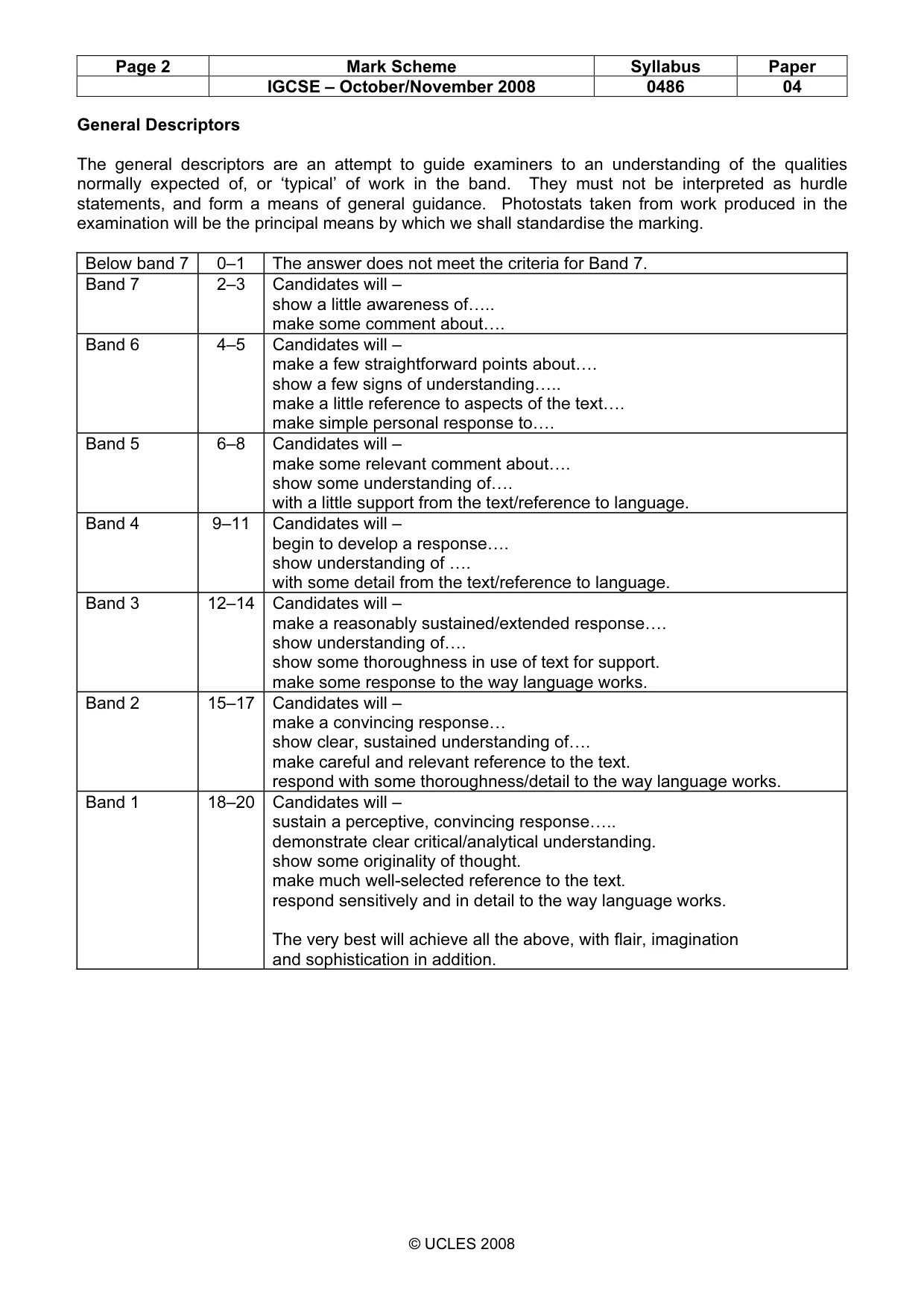
Page 2 Mark Scheme Syllabus Paper IGCSE – October/November 2008 0486 04 © UCLES 2008 General Descriptors The general descriptors are an attempt to guide examiners to an understanding of the qualities normally expected of, or ‘typical’ of work in the band. They must not be interpreted as hurdle statements, and form a means of general guidance. Photostats taken from work produced in the examination will be the principal means by which we shall standardise the marking. Below band 7 0–1 The answer does not meet the criteria for Band 7. Band 7 2–3 Candidates will – show a little awareness of….. make some comment about…. Band 6 4–5 Candidates will – make a few straightforward points about…. show a few signs of understanding….. make a little reference to aspects of the text…. make simple personal response to…. Band 5 6–8 Candidates will – make some relevant comment about…. show some understanding of…. with a little support from the text/reference to language. Band 4 9–11 Candidates will – begin to develop a response…. show understanding of …. with some detail from the text/reference to language. Band 3 12–14 Candidates will – make a reasonably sustained/extended response…. show understanding of…. show some thoroughness in use of text for support. make some response to the way language works. Band 2 15–17 Candidates will – make a convincing response… show clear, sustained understanding of…. make careful and relevant reference to the text. respond with some thoroughness/detail to the way language works. Band 1 18–20 Candidates will – sustain a perceptive, convincing response….. demonstrate clear critical/analytical understanding. show some originality of thought. make much well-selected reference to the text. respond sensitively and in detail to the way language works. The very best will achieve all the above, with flair, imagination and sophistication in addition.
Mark scheme, page 3
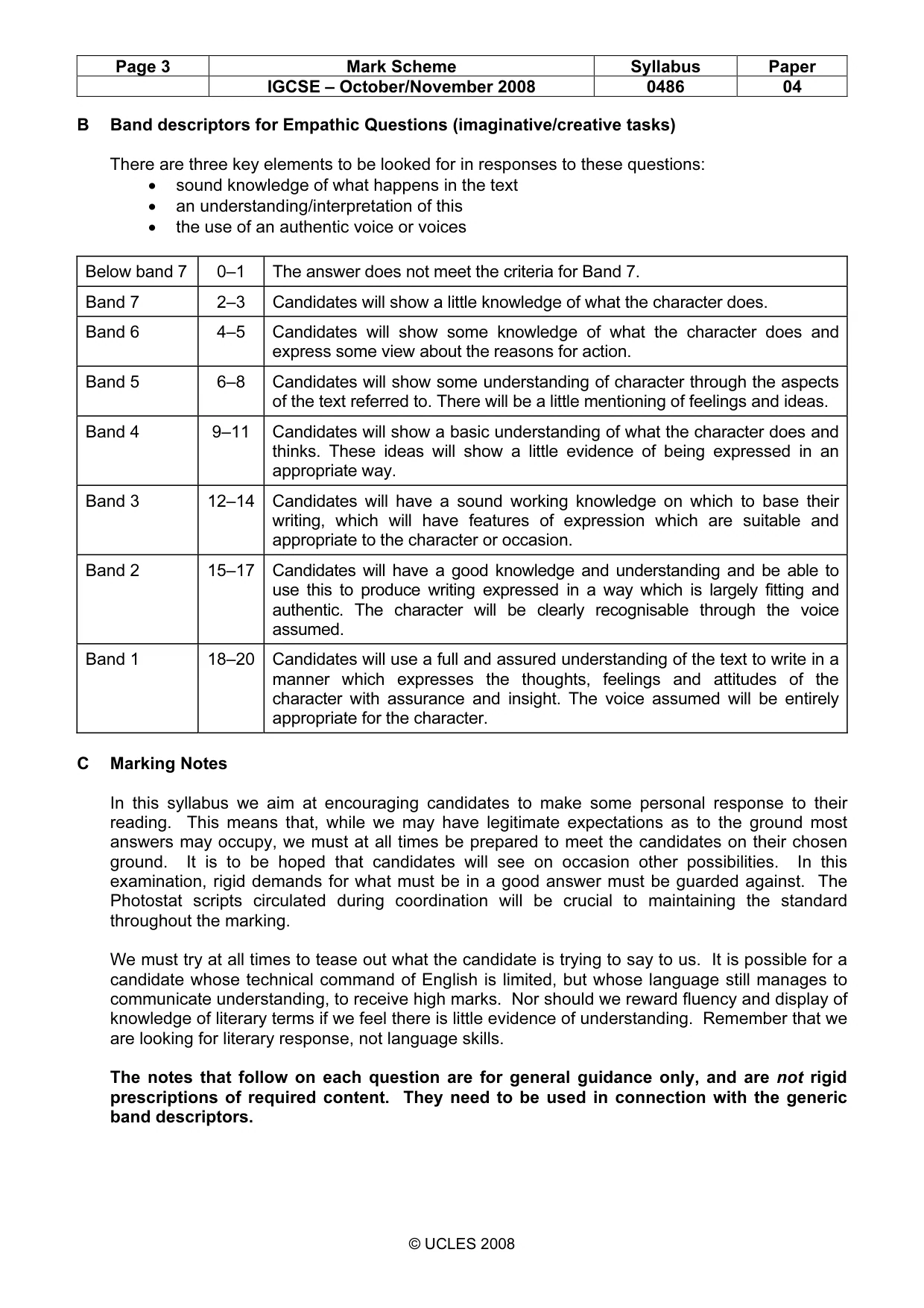
Page 3 Mark Scheme Syllabus Paper IGCSE – October/November 2008 0486 04 © UCLES 2008 B Band descriptors for Empathic Questions (imaginative/creative tasks) There are three key elements to be looked for in responses to these questions: • sound knowledge of what happens in the text • an understanding/interpretation of this • the use of an authentic voice or voices Below band 7 0–1 The answer does not meet the criteria for Band 7. Band 7 2–3 Candidates will show a little knowledge of what the character does. Band 6 4–5 Candidates will show some knowledge of what the character does and express some view about the reasons for action. Band 5 6–8 Candidates will show some understanding of character through the aspects of the text referred to. There will be a little mentioning of feelings and ideas. Band 4 9–11 Candidates will show a basic understanding of what the character does and thinks. These ideas will show a little evidence of being expressed in an appropriate way. Band 3 12–14 Candidates will have a sound working knowledge on which to base their writing, which will have features of expression which are suitable and appropriate to the character or occasion. Band 2 15–17 Candidates will have a good knowledge and understanding and be able to use this to produce writing expressed in a way which is largely fitting and authentic. The character will be clearly recognisable through the voice assumed. Band 1 18–20 Candidates will use a full and assured understanding of the text to write in a manner which expresses the thoughts, feelings and attitudes of the character with assurance and insight. The voice assumed will be entirely appropriate for the character. C Marking Notes In this syllabus we aim at encouraging candidates to make some personal response to their reading. This means that, while we may have legitimate expectations as to the ground most answers may occupy, we must at all times be prepared to meet the candidates on their chosen ground. It is to be hoped that candidates will see on occasion other possibilities. In this examination, rigid demands for what must be in a good answer must be guarded against. The Photostat scripts circulated during coordination will be crucial to maintaining the standard throughout the marking. We must try at all times to tease out what the candidate is trying to say to us. It is possible for a candidate whose technical command of English is limited, but whose language still manages to communicate understanding, to receive high marks. Nor should we reward fluency and display of knowledge of literary terms if we feel there is little evidence of understanding. Remember that we are looking for literary response, not language skills. The notes that follow on each question are for general guidance only, and are not rigid prescriptions of required content. They need to be used in connection with the generic band descriptors.
Mark scheme, page 4
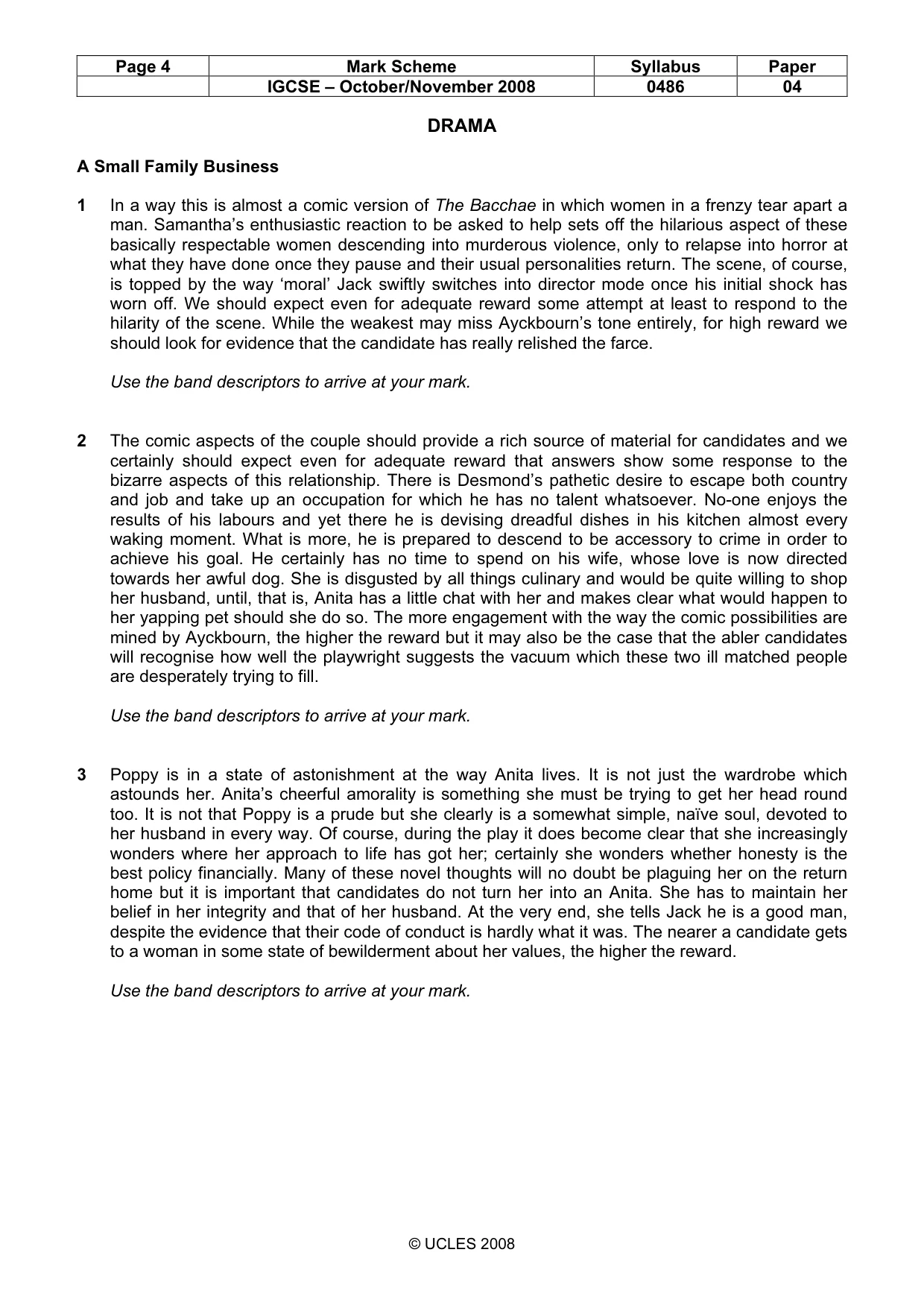
Page 4 Mark Scheme Syllabus Paper IGCSE – October/November 2008 0486 04 © UCLES 2008 DRAMA A Small Family Business 1 In a way this is almost a comic version of The Bacchae in which women in a frenzy tear apart a man. Samantha’s enthusiastic reaction to be asked to help sets off the hilarious aspect of these basically respectable women descending into murderous violence, only to relapse into horror at what they have done once they pause and their usual personalities return. The scene, of course, is topped by the way ‘moral’ Jack swiftly switches into director mode once his initial shock has worn off. We should expect even for adequate reward some attempt at least to respond to the hilarity of the scene. While the weakest may miss Ayckbourn’s tone entirely, for high reward we should look for evidence that the candidate has really relished the farce. Use the band descriptors to arrive at your mark. 2 The comic aspects of the couple should provide a rich source of material for candidates and we certainly should expect even for adequate reward that answers show some response to the bizarre aspects of this relationship. There is Desmond’s pathetic desire to escape both country and job and take up an occupation for which he has no talent whatsoever. No-one enjoys the results of his labours and yet there he is devising dreadful dishes in his kitchen almost every waking moment. What is more, he is prepared to descend to be accessory to crime in order to achieve his goal. He certainly has no time to spend on his wife, whose love is now directed towards her awful dog. She is disgusted by all things culinary and would be quite willing to shop her husband, until, that is, Anita has a little chat with her and makes clear what would happen to her yapping pet should she do so. The more engagement with the way the comic possibilities are mined by Ayckbourn, the higher the reward but it may also be the case that the abler candidates will recognise how well the playwright suggests the vacuum which these two ill matched people are desperately trying to fill. Use the band descriptors to arrive at your mark. 3 Poppy is in a state of astonishment at the way Anita lives. It is not just the wardrobe which astounds her. Anita’s cheerful amorality is something she must be trying to get her head round too. It is not that Poppy is a prude but she clearly is a somewhat simple, naïve soul, devoted to her husband in every way. Of course, during the play it does become clear that she increasingly wonders where her approach to life has got her; certainly she wonders whether honesty is the best policy financially. Many of these novel thoughts will no doubt be plaguing her on the return home but it is important that candidates do not turn her into an Anita. She has to maintain her belief in her integrity and that of her husband. At the very end, she tells Jack he is a good man, despite the evidence that their code of conduct is hardly what it was. The nearer a candidate gets to a woman in some state of bewilderment about her values, the higher the reward. Use the band descriptors to arrive at your mark.
Mark scheme, page 5
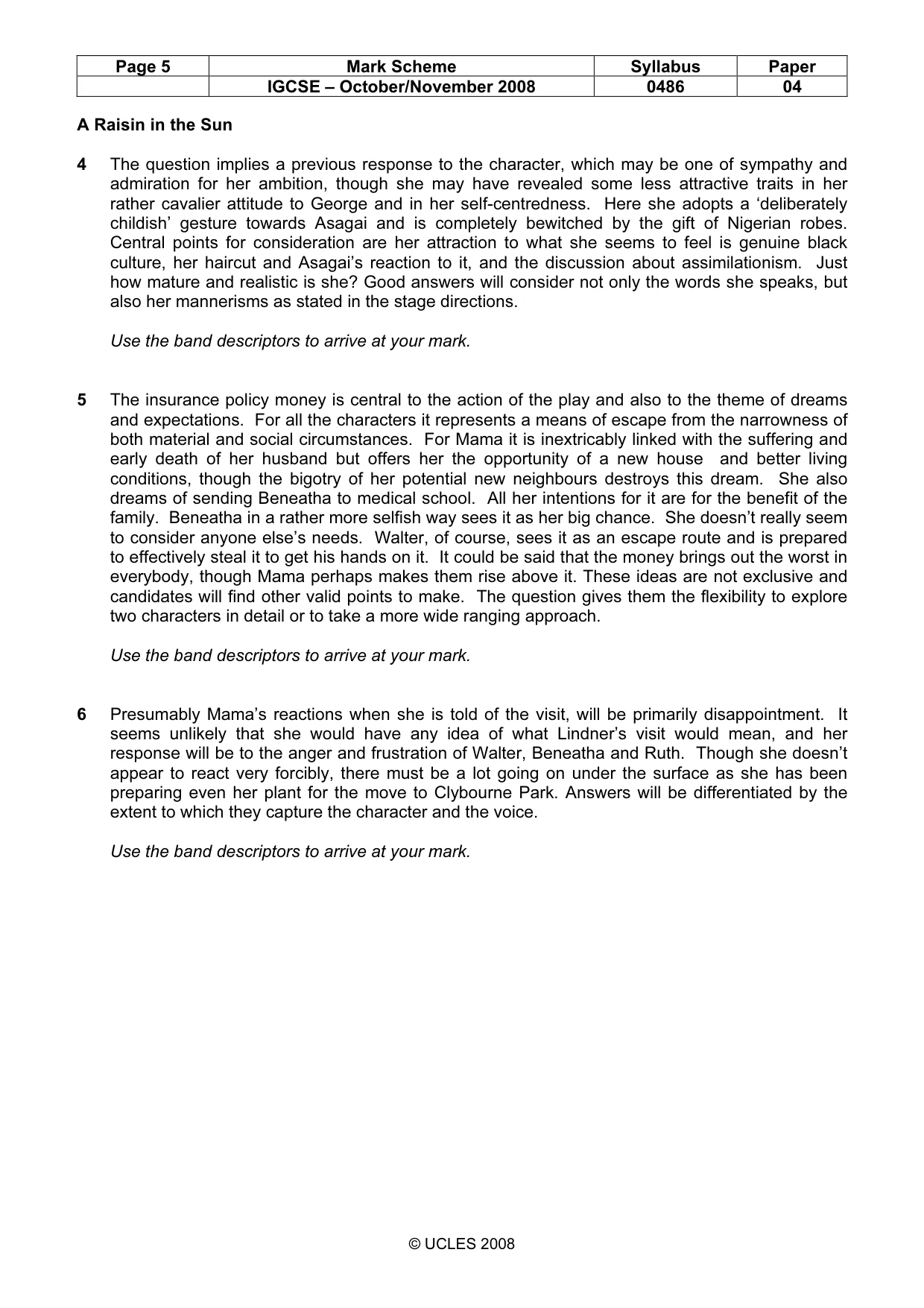
Page 5 Mark Scheme Syllabus Paper IGCSE – October/November 2008 0486 04 © UCLES 2008 A Raisin in the Sun 4 The question implies a previous response to the character, which may be one of sympathy and admiration for her ambition, though she may have revealed some less attractive traits in her rather cavalier attitude to George and in her self-centredness. Here she adopts a ‘deliberately childish’ gesture towards Asagai and is completely bewitched by the gift of Nigerian robes. Central points for consideration are her attraction to what she seems to feel is genuine black culture, her haircut and Asagai’s reaction to it, and the discussion about assimilationism. Just how mature and realistic is she? Good answers will consider not only the words she speaks, but also her mannerisms as stated in the stage directions. Use the band descriptors to arrive at your mark. 5 The insurance policy money is central to the action of the play and also to the theme of dreams and expectations. For all the characters it represents a means of escape from the narrowness of both material and social circumstances. For Mama it is inextricably linked with the suffering and early death of her husband but offers her the opportunity of a new house and better living conditions, though the bigotry of her potential new neighbours destroys this dream. She also dreams of sending Beneatha to medical school. All her intentions for it are for the benefit of the family. Beneatha in a rather more selfish way sees it as her big chance. She doesn’t really seem to consider anyone else’s needs. Walter, of course, sees it as an escape route and is prepared to effectively steal it to get his hands on it. It could be said that the money brings out the worst in everybody, though Mama perhaps makes them rise above it. These ideas are not exclusive and candidates will find other valid points to make. The question gives them the flexibility to explore two characters in detail or to take a more wide ranging approach. Use the band descriptors to arrive at your mark. 6 Presumably Mama’s reactions when she is told of the visit, will be primarily disappointment. It seems unlikely that she would have any idea of what Lindner’s visit would mean, and her response will be to the anger and frustration of Walter, Beneatha and Ruth. Though she doesn’t appear to react very forcibly, there must be a lot going on under the surface as she has been preparing even her plant for the move to Clybourne Park. Answers will be differentiated by the extent to which they capture the character and the voice. Use the band descriptors to arrive at your mark.
Mark scheme, page 6
Page 6 Mark Scheme Syllabus Paper IGCSE – October/November 2008 0486 04 © UCLES 2008 The Crucible 7 In this extract, of course, Proctor, in seeking to break the power of Abigail, does the almost unthinkable in this society and declares in public that he is guilty of lust. Just what a battle of wills this is is shown by Abigail’s outrageous power in this courtroom which she seeks to use as she realises that the game could soon be up. Her power over the other girls is given terrifying force by the hysteria and the physical violence which follows, all of which reduces even Danforth to a spectator at times. However, he recovers his authority after Abigail tries to leave and Miller for a moment offers the audience the prospect of reason being re-established since not for a moment does one expect Elizabeth Proctor not to tell the truth, no matter how unpalatable that truth might be for her and her husband. Ironically, the audience will not have reckoned with the power of her love. It is important that we do not give even adequate reward to answers which make no attempt to probe the reasons for the dramatic impact of the passage, which will no doubt assume some knowledge of the context. Higher reward should go to those who are able to engage with the detail of Miller’s craft and how he engineers moment after moment of tension here. Use the band descriptors to arrive at your mark. 8 The task is intentionally challenging the candidate to make judgments and will not be fully answered by a character sketch of Elizabeth Proctor since she is one of Miller’s most complex creations. Depending on the reading and the performance, the balance of sympathy can be quite decisively shifted. She is at times in the play a rather noble figure, nowhere more so than when she actually does show outright love in attempting to save her husband by lying about his affair with Abigail. Perhaps it is then that she implicitly accepts that the path of virtue is not as clear cut as she would have it be. Certainly earlier she comes across here and there as somewhat implacable and incapable of understanding the power of sexual attraction and its pleasure. Miller perhaps makes us feel that pleasure has always seemed to Elizabeth somewhat ungodly, in sexual matters mainly a duty to procreate. However, overall the balance that candidates strike may be varied indeed. We shall discriminate according to the range of support which the candidates use to support their viewpoints. Certainly for higher reward we should expect evidence that the complexity of the character is recognised. Use the band descriptors to arrive at your mark. 9 Parris is perhaps the least likeable figure in the play, a bitter, whining, weak, cowardly and vengeful man. Of course, at this moment he is scared to his vitals that the goings on in his own household should be made public for what they are. He knows how much he is despised by many of his parishioners and what further damage to his authority would be done by such exposure. Therefore, he is only too willing to have it explained by declaring it a matter of witchcraft and possession, not least because it would at a stroke give him the power over his congregation which has been so notably lacking hitherto. Now is the time, for instance, to make John Proctor pay for his failure to attend service. Perhaps the most problematic aspect of this task is what of his real motives he would admit to himself. Perhaps some of the assumptions will have him dress most of it up as carrying out God’s will, with him as his major instrument. We must recognise that there is scope for some variety of approach here. Whatever, something of this material with a sufficiently unpleasant tone should be enough to warrant adequate reward. The more the cowardly malice and spite of the man is caught in the voice, the higher the reward. Use the band descriptors to arrive at your mark.
Mark scheme, page 7
Page 7 Mark Scheme Syllabus Paper IGCSE – October/November 2008 0486 04 © UCLES 2008 As You Like It 10 This is the second instance of injustice that we see in the very early part of the play. Not only is Rosalind’s banishment unreasonable, no reason is given for it, other than that she is her father’s daughter. Furthermore, the violence of her Uncle’s language is surely excessive and irrational. Even Rosalind’s articulate justifications and Celia’s pleas on her behalf make no impression. This follows immediately upon a scene of light hearted banter between the two girls and soon after the wrestling match when Rosalind and Orlando have experienced the coup de foudre, so the mood of the play has turned on a sixpence. It also parallels the way in which Orlando has been treated by his brother so we now have two central characters cast out to fend for themselves. Good answers will explore the ways in which the scene fits into the structure of the play and will consider the language in some detail. Use the band descriptors to arrive at your mark. 11 More than a simple character sketch is required here; candidates are required to consider the dramatic function of Touchstone. The name itself, of course, suggests that he provides a sort of standard by which we can measure some of the other characters, and his relationship with Audrey, a way of bringing some of the more elaborate romanticism down to earth. Certainly his ironic and sarcastic comments put much of what goes on into perspective as well as providing a lot of the humour in the play. He is, like most of Shakespeare’s fools, a commentator on the action. Good answers will show a strong personal response, supported by apt reference. Use the band descriptors to arrive at your mark. 12 Orlando might be feeling somewhat bewildered following the wrestling match, his meeting with Rosalind, and his flight from both his brother and the ‘tyrant Duke’. He has been wandering around the forest for quite a long time and it must be something of a surprise, to say the least, to come upon such a company as that of Duke Senior. His treatment is somewhat different to what he has recently experienced and the Duke’s welcome and gentleness towards Adam will have made a big impression. Answers will be differentiated by the extent to which they create a convincing voice. Use the band descriptors to arrive at your mark.
Mark scheme, page 8
Page 8 Mark Scheme Syllabus Paper IGCSE – October/November 2008 0486 04 © UCLES 2008 Macbeth 13 The material with which to answer this question should be clear for anyone who has the slightest ability to respond to the play. In some parts the scene imparts important information about the disaffection of Macduff and of his flight to England. The comments of both these lords, of course, suggest that rebellion is near and speak tellingly of the failure of the King and Queen to hide the truth of events, whilst that moment in which the lord describes the response of the messenger and the possible outcome for Macduff’s family is a powerful indication of the danger for everyone close to the King. As far as the future is concerned, it is also notable that Lennox is the lord in attendance in the next scene, Macbeth presumably thinking him trustworthy. Candidates who grasp some of the things above and support their ideas with some detail should receive adequate reward. For something better, there should be a response to such things as the sarcasm of Lennox’s speech, the way its abrupt finish tellingly conveys his feeling that he may have said too much and the way the words used to describe Edward’s court create an image of political and moral order in direct contrast to the state of Scotland. Use the band descriptors to arrive at your mark. 14 There is so much in the latter part of the play which could be made relevant. Candidates might choose to focus on the increasingly hellish existence of the regicides, in their inability to find peace of any sort and any satisfaction arising from their deed. Others might choose to point to instances which show that all their best efforts to divert suspicion are conspicuously unsuccessful. Either approach, or a mixture, is perfectly acceptable. The key word for differentiation, though, is vividly. We should not give high reward unless candidates can respond to the dramatic way in which Shakespeare time and again makes a savage ironic juxtaposition between Lady Macbeth’s almost casual remark and the reality of what follows, culminating, of course, in her subconsciously recalling the statement in the sleepwalking scene. Use the band descriptors to arrive at your mark. 15 The choice of appropriate content could be particularly important in this empathic task. The fact that the task places Macbeth before he meets the witches is crucial. As his reaction to them makes plain, he does view himself as worthy of being King. He will no doubt be elated with his latest victories, perhaps even going over in his mind and relishing his prowess as a warrior so gruesomely described by the Captain. This is not a world for the fainthearted and any candidate who captures this celebration of violent deeds should at least receive adequate reward. As well, he will no doubt be anticipating and again relishing the prospect of the honours which he assumes will be heaped upon him. However, perhaps we should make a clear demarcation between this and going the next step to murdering Duncan. Shakespeare seems at pains to show that at this stage Macbeth has not taken that step, at least in his conscious mind. Use the band descriptors to arrive at your mark.
Mark scheme, page 9
Page 9 Mark Scheme Syllabus Paper IGCSE – October/November 2008 0486 04 © UCLES 2008 A Streetcar Named Desire 16 Blanche finds the kind of accommodation her sister lives in abhorrent; it is not good enough: she is contemptuous about ‘these conditions’. She overplays the gushing sister act: ‘Stella for Star’. She shows her vanity as she is afraid for her fading looks and asks for the light to be dimmed. She reveals a dependency on liquor. She shows her feelings of superiority in her dismissal of the area in which her sister lives. Her literary background is brought out in her reference to Edgar Allan Poe. Blanche appears as if she is continuously acting a part. Her pretence is revealed in her exaggerated speech. Stella, on the other hand, is much more down to earth, accepting things as they are rather than what they might be. Candidates who capture the flavour of the extract and the marked differences between the two sisters will deserve creditable reward; those who penetrate the nuances in the dialogue should score particularly highly. Use the band descriptors to arrive at your mark. 17 There may well be little sympathy for Stanley. His machismo, his male domination, his expecting women to know their place will surely figure in many answers as a good reason for showing him little sympathy. He can be coarse, very selfish, unfeeling, sarcastic and mocking. He lacks sensitivity; he can be contemptuous of the feelings of others; he can be physically violent; he is capable of rape. And yet he is tender at times to Stella; he is solicitous as he takes her to hospital. And then there is surely some sympathy for him through Blanche’s ‘invasion’ of his home and his privacy? She tries to monopolise his wife; she takes over the bathroom; she is cutting in her remarks; she is convinced that her sister has married beneath her. So there are good grounds for finding some sympathy for him. We should perhaps differentiate according to the degree of credible balance in candidates’ responses and the level of detailed textual reference that candidates adduce to support their views. Use the band descriptors to arrive at your mark. 18 No doubt Stella will feel guilty at what has happened to Blanche at the end of the play. She will also perhaps realise that Blanche had to be committed if her marriage was to be preserved. She may well think of Blanche’s relationship with Stanley and the cause of Blanche’s apparent madness. There will be contradictions and unsavoury conclusions to accept. There will surely be an argument going on inside of Stella’s mind as she contemplates the turn matters have taken. But surely, because of her total surrender to Stanley, she will have to conclude that there was no other way. Some may argue differently and we should look at such answers objectively. High reward should go to those who capture the voice of Stella and fold into their responses relevant references to events in the play. Use the band descriptors to arrive at your mark.
Mark scheme, page 10
Page 10 Mark Scheme Syllabus Paper IGCSE – October/November 2008 0486 04 © UCLES 2008 POETRY Questions 19–24 Poetry is literary language at its most intense. A poem in a short space can create a multiplicity of resonances and hence possible meanings. We must expect that candidates will offer a very wide variety of responses and interpretations, and as examiners must at all times keep a totally open mind when assessing work on a poem. In the exercise of our judgment, we may read work which shows manifestly little or no understanding of a poem and we will mark that accordingly. However, it is also a regular experience to find answers which offer valid perspectives new to the examiner and which, just as manifestly, deserve to be given high reward. We will differentiate first of all according to how directly the candidates answer the question. Examiners will notice that all the questions prescribe the poems from which the candidates should choose. This is to ensure that the candidate is writing on a poem appropriate to the question. It is also designed to send a strong signal to candidates that they are taking a large risk going into the examination with only one or two poems which they are determined to fit to one of the questions. The problem can be that some will choose a question because the poem they wish to write about appears in the list rather than because they can answer the question. We must be very careful not to give much reward for answers which manifestly are not addressing the question, even if they show a convincing grasp of the poem. Do not over-reward such run throughs and do not forget that all the tasks demand that the candidate engage with the poem through a specific route. They are never simple invitations to write about a poem. We should think very hard before putting such work in Band 3. Beyond focus on the question, we will also assess according to how well candidates convince us that they have engaged with the pleasure and excitement of good poetry. This means in effect that we do NOT give high reward to any explanation of "meaning" which shows little response to the words and how they create meaning. In all of the questions there is an explicit requirement to make a response to the words and it will be difficult for any work which fails to engage in this way to progress beyond Band 3. In addition, examiners should be careful not to over-reward comment which is able to isolate vivid features of a poem’s language but which is unable to probe the reasons for their vividness. For instance, the noting of rhyme, sound and movement, and the listing of significant words and figures of speech is only a very small first step to insightful personal response. Work given high reward should show the ability of the candidate to analyse how such features of a poem’s language achieve their effect. Use the band descriptors to arrive at your mark.
Mark scheme, page 11
Page 11 Mark Scheme Syllabus Paper IGCSE – October/November 2008 0486 04 © UCLES 2008 PROSE Things Fall Apart 25 In this passage Achebe draws out the paradoxes at the heart of Okonkwo’s personality. On the surface he appears a man of great intransigence. He is brusque and, though he is admired and respected, he doesn’t exactly encourage friendship. He knew how to kill a man’s spirit. As far as Ikemefuna is concerned, he seems to follow the same pattern in his treatment of the boy which at times is brutal. To show affection was a sign of weakness seems to be the key to his personality, a fear of appearing weak in any way. And yet the sad thing is that he is capable of feeling great affection, at least towards those of whom he approves and the boy is certainly one of those. In this extract, there is perhaps not much chance for good candidates to show themselves by engaging on any very deep level with the writing since most of it is unadorned description and statement. We shall probably discriminate therefore according to the range and detail of material the candidate chooses to comment upon from the extract. Use the band descriptors to arrive at your mark. 26 As with so much of this novel, Achebe seems deliberately to write in a voice which reports rather than comments. The title of the novel would suggest an elegy for a lost culture yet the voice that describes that culture is at times far from being elegiac. Conversely, the missionaries are often described with great sympathy, particularly in regard to the courage and gentleness of those first on the scene, Mr Kiaga and Mr. Brown, who brought with them attitudes which at times are shown in a much more favourable light than those, for example, of Okonkwo. However, it is their successor Mr. Smith who is presented as of a different metal, being quite unwilling to make any compromise with the customs and beliefs of the tribe, even though they have by and large come to be tolerant of the Christians. And it is his bigotry which precipitates the final confrontation at which, as far as the tribal society is concerned, things do fall apart. However, even he is shown as a man of courage. Therefore there are a wide range of responses possible. Candidates who show some knowledge of some of the major relevant incidents and couple this with sensible comment should receive adequate reward. The wider the answer ranges, the more there is an awareness of various alternative interpretations, the higher the reward. Use the band descriptors to arrive at your mark. 27 As a starting point, candidates need to know some basic facts about Ekwefi, that this child is her only child, that she has developed a bond with her despite her continual sicknesses and all the suspicion with which the sick or abnormal are viewed in this superstitious society. Another thing which needs to be known is the love which exists between her and Okonkwo. She had run away from her first husband to live with this man and on several occasions since Okonkwo is shown as acting in a way which belies his fierce and unforgiving exterior. Therefore this solicitude in trying to save the girl is in character. The gratitude and indeed love which Ekfewi would feel does not need much imagining and adequate assumptions of the character should echo that. As to voice, we may have to be charitable. This novel is short on extended dialogue and it may be that discrimination will have to rest largely upon the appropriateness and range of the material introduced. Use the band descriptors to arrive at your mark.
Mark scheme, page 12
Page 12 Mark Scheme Syllabus Paper IGCSE – October/November 2008 0486 04 © UCLES 2008 Pride and Prejudice 28 There are rich possibilities in this passage for the candidate who is responsive to irony. Some of Elizabeth’s irony is, of course, obvious. Her thinking that pigs in the front garden might be a better reason than the arrival of the De Bourgh carriage for the agitation of the household is a hilarious benchmark of authorial scorn for such abasement before aristocratic arrogance. Collins’ sickening sycophancy is another, delivered as it with such complacent certainty of the proper social order of things. The key phrase for discrimination is so ridiculous. We should expect for adequate reward some evidence of the candidate’s ability to see what it is that Austen so disapproves of. However, insight into the way the writing delivers the scorn is necessary for higher reward. Use the band descriptors to arrive at your mark. 29 This task is going to require some quite detailed knowledge of the novel and some apt choices. There are rich pickings for the well read candidate. As far the main protagonists are concerned there are, of course, many more moments in which we are privy to Elizabeth’s feelings than we are to Darcy’s. However, there are instances for both that come readily to mind, notably Darcy’s self-evident pain at having his proposal rejected in such outright terms by Elizabeth and her shocked realisation of her blindness when Darcy’s role in saving Lydia from ultimate ignominy is revealed. There are also, of course, other moments in the novel in which the misunderstanding involves pain for other characters. Jane and Bingley come to mind. Apt choices and some engagement with the detail of the passages should be enough for adequate reward. For anything higher we should expect the candidate to delve into the writing to bring home how Austen communicates the characters’ feelings. Use the band descriptors to arrive at your mark. 30 Mr. Bennet, for reasons we all know, spends much time in his study where he can think his thoughts and not have them compromised in the real world by his wife’s foolishness. Here, though, the outside world enters the study as he contemplates the humiliation of having had to rely on a brother-in-law to save the honour of his family. All his armour of wit cannot save him here as he sets about writing his letter. We may well in the assumptions quite properly hear a very angry man, furious with himself for time and again in the past having failed to impose his values on his family, as usual scornful of his wife as a mother and Lydia as a daughter, his sorrow only slightly mollified in this instance by the knowledge of his two elder daughters’ qualities. Adequate reward should go to those who accurately convey the details of his situation and portray his mood. Hopefully the better candidates will capture something of his witty, sardonic and fatalistic turn of phrase. Use the band descriptors to arrive at your mark.
Mark scheme, page 13
Page 13 Mark Scheme Syllabus Paper IGCSE – October/November 2008 0486 04 © UCLES 2008 The God Boy 31 The idea of confessions in the cloakroom is in itself comic and Jimmy’s desperate loss of control and his invention of a whole array of sins of course add to the laughter. However, once again what strikes home is the poignancy of the boy’s difficulty in articulating the words which will reveal the reality of his parents’ marriage and the fact that, when he does this for the first time in the novel, he is not heard. Once again, he is failed by the adult world. Father Gilligan’s rising impatience and his failure to detect that here is a boy who needs help is painful. In essence, of course, the confessional should be the ideal channel for adult help but what emerges here, as elsewhere, is that a celibate clergy has less insight into marital matters than even this small boy. Perhaps, underneath it all is a priest’s embarrassment in this area. Some grasp of the details which are amusing and the significance in the novel of my parents hate one another should be enough for adequate reward. Higher reward should go to those who engage with the comic aspect of Jimmy’s imaginative journey through the ‘sinful’ world and begin to probe more deeply the way Gilligan fails him. Use the band descriptors to arrive at your mark. 32 Obviously there are many possible approaches here and a range of incident and detail which could be mustered in support. One supposes that most candidates will at least be able to see that the basic thing which makes Jimmy such a deeply poignant figure is not just the dreadful quality of his home life but the way in which Cross depicts what an intelligent and lively youngster he is. Perhaps the most heart-rending aspect of his personality are his pathetic, even funny attempts at bravado and optimism when underneath it all his lack of confidence and at times his despair are so clear to the reader. It is probable that the average candidate will have no difficulty in pointing out some features which make Jimmy such a sad figure but for higher reward we should find some understanding of how so often the writing, even at ‘cheerful’ moments, creates a subtext which undermines surface meanings. We should certainly find engagement with the writing at this level. Use the band descriptors to arrive at your mark. 33 A starting point for this empathic task will, of course, be his letter to Jimmy. It shows a man who beneath the gruff, curmudgeonly exterior is capable of considerable feeling. What it is that has made him such a loner is another one of those mysterious histories with which this book is full. There is a hint of some matrimonial betrayal but no more. Of course, he has been outraged by the attack from a boy with whom he thought he had some bond and the letter, even the act of writing one, tells what shame he must have felt when he heard the full story behind it. He seems to rather pride himself on what he takes to be his insight into the human condition and yet here he was unable to recognise a plea for help from a deeply unhappy and lonely boy. What remained in the forefront of his mind was that he had had a stone thrown at him. The letter suggests that he feels that he has let down this boy by not persevering. It should not be too difficult for the average candidate to see something of this and there should be ample opportunity for the good candidate to find an aptly laconic voice beneath which there is real feeling, as in the letter. Use the band descriptors to arrive at your mark.
Mark scheme, page 14
Page 14 Mark Scheme Syllabus Paper IGCSE – October/November 2008 0486 04 © UCLES 2008 The Siege 34 This is a very evocative and powerful episode in the novel and we should expect even for adequate reward evidence that the candidate has responded to its power. The ownership of a stove is no less than a matter of life and death and in the circumstances Galya has great power. Add to that Anna’s youth and inexperience and one can see what a lifesaver Evgenia is. Dunmore’s wonderful description of the seller as a lizard conveys the danger in the woman and how helpless Anna would have been in any bargaining situation with her and how at best she would have come away with a stove which would have poisoned them all. Every action, even the timing of the handover of items, is dangerous but Dunmore makes one delight in the way Evgenia turns the tables on Galya and leaves behind a woman fearful of the future and effectively in her power. For high reward we shall want evidence of the candidate’s awareness of the writer’s brilliant evocation of the tension of this scene with detailed support from the writing. Use the band descriptors to arrive at your mark. 35 Of course, Anna is at the outset of the novel deeply wary, not to say suspicious of the woman who was her father’s mistress and in effect supplanted Anna’s mother. Loyalty, if nothing else, dictates that she should tend to reject any advances which Marina makes. And yet gradually she falls under the spell of this charismatic actress. Even when she knows that she is in a way being manipulated, she willingly succumbs. Gradually, of course, this latent hostility evaporates under the pressure of events and also perhaps because Anna recognises that her father is truly loved by this woman and that Marina is not just out for herself but trying in some way to make repayment to the dead mother by helping to protect her family. As to assessment, we should give adequate reward to those who describe some features of the relationship with basic support. For higher reward, the word fascinating should be taken up and some attempt be made to unravel the complexity and paradoxes of this developing friendship. Use the band descriptors to arrive at your mark. 36 Levin has, of course, for some years lived a life under threat from the regime. It has been a life in which his writing has had to be done in private and in which his capacity to support his children has been removed. Add to that the daily fear of the visit from the secret police and the oblivion which would follow and it can be seen that his life has been a best a twilight of despondency, at worst a nightmare of apprehension. Hence, the paradox that he should see the opportunity to fight for a regime that has oppressed him as some sort of release in action is all too understandable. Of course, he is also fighting for Russia and it could also be something in the nature of a kamikaze mission, heroic death rather than a bullet in the back of the neck. Some understanding of Levin’s position and his likely feelings of the moment should be enough for adequate reward. For something higher, we might hope for a voice that echoes also something of the man’s weary fatalism and irony. Use the band descriptors to arrive at your mark.
Mark scheme, page 15
Page 15 Mark Scheme Syllabus Paper IGCSE – October/November 2008 0486 04 © UCLES 2008 Lord of the Flies 37 Simon’s discovery of the parachutist is a very moving moment, following on immediately from the confrontation with the Lord of the Flies and the fit. Simon now knows two truths: that evil is within all the boys and that the Beast is a harmless dead parachutist. As we know, his intention to reveal that the beast is ‘harmless and horrible’ to the other boys is doomed to disaster. Though the tone of the writing is calm by contrast with what has gone before and what is to follow, there is a dreadful sadness to it and the frailty of Simon is emphasised throughout – he walks like an old man, his eyes have lost their brightness, he is in pain, he staggers etc., all a dreadful premonition of what is going to happen to him. No doubt the Christ parallel will be drawn by a lot of candidates here and should not be discounted. Good answers will focus on the writing in some detail. Use the band descriptors to arrive at your mark. 38 This is a very open question and candidates have a completely free choice of detail. Possible choices might be the idyllic appearance of the island at the beginning of the novel, the lushness that is conveyed on the boys’ first explorations, or the sinister qualities that emerge at Castle rock, but these are not exclusive. The success of the answer will be determined by the quality of supporting detail and better answers will perhaps begin to explore how the island seems to be an entity in itself, beautiful on the surface but with all sorts of hidden dangers for the boys. It may be that some candidates will interpret the ‘island’ as the community, but this will probably limit their answers. Good answers will, of course, focus in some detail on the writing. Use the band descriptors to arrive at your mark. 39 We are taken into Ralph’s thoughts to some extent in this section of the book, but it should be possible for candidates to empathise more fully with him. He will probably be thinking about Piggy’s death, of Jack and Roger’s behaviour, of the twins, of his isolation and most of all about the chances of survival. It must now be clear that he will not be taken prisoner. It is unlikely that he will be looking very far beyond the next few minutes and he will be very concerned with the physical details of his situation. Good answers will create a convincing voice for Ralph, one of the most vocal characters in the book. Use the band descriptors to arrive at your mark.
Mark scheme, page 16
Page 16 Mark Scheme Syllabus Paper IGCSE – October/November 2008 0486 04 © UCLES 2008 Far from the Madding Crowd 40 There is much rustic humour in the extract and for candidates to be given adequate reward, they must acknowledge that. What is attractive about the extract is the way in which Hardy individualises characters and, though having only minor parts in the novel, each comes across as a person in his own right. There are some delightful phrases: ‘winning suavity’; ‘the handsomest couple in the neighbourhood’; ‘hung in wires’; ‘melancholy-like’; ‘teeming with tidings’. The characters come alive and add to the enjoyment of the passage and the writing therein. The incident concerning Baily Pennyways and the way it is described in such graphic language add to the appeal of the passage and Hardy’s presentation of the characters. Candidates who engage fully with the writing in such a way as to show how they have enjoyed the liveliness of the humour and character interplay should be well rewarded. Use the band descriptors to arrive at your mark. 41 There are several appropriate incidents which would be suitable for consideration here. It is important that the chosen event fulfils the criteria of chance and difference in the development of the story. Mere re-telling of an incident should attract only modest reward. We should expect good answers to deal with how chance/fate has been developed by Hardy and then how change has affected characters and plot. As always, careful exploration of the writing is essential for high reward. Use the band descriptors to arrive at your mark. 42 Bathsheba had misled Gabriel earlier on in the story which was why he proposed marriage to her. Initially she liked the idea and told him so repeatedly. But it was the notion of having a husband to tend her and entertain her that she liked and when Gabriel mentioned babies she withdrew in quite a disdainful and capricious sort of way. Hardy writes: ‘No man likes to see his emotions the sport of a merry-go-round of skittishness’ and Gabriel’s response is firm: ‘Then I’ll ask you no more’. Much of all of this will be in Gabriel’s mind when he thinks about the incident, and candidates must include aspects in their responses. The voice of Gabriel will be crucial and we shall differentiate according to the success with which it is created. Use the band descriptors to arrive at your mark.
Mark scheme, page 17
Page 17 Mark Scheme Syllabus Paper IGCSE – October/November 2008 0486 04 © UCLES 2008 To Kill a Mockingbird 43 The excitement and tension are evident in the quick-fire one line questions and answers. The contempt of Mr Gilmer is evident in the way he speaks to Tom, calling him ‘boy’ and using heavy sarcasm as he tries to make Tom a liar in the eyes of the jury. But Lee gives Tom Robinson one or two sharp ripostes to balance the situation:’ I don’t say she’s lyin’, Mr Gilmer, I say she’s mistaken in her mind’; ‘No suh, I’s scared I’d be in court, just like I am now’. Candidates who explore the structure of the passage and probe the exchanges so as to identify the underlying innuendo will merit creditable reward. We must recognise strong engagement with the writing before we go higher. Use the band descriptors to arrive at your mark. 44 Robert Ewell is the most objectionable character in the novel. Lee gives him a mean-spirited outlook on life. He avoids work, or if he manages to get employment he quickly loses it. He spends his benefit money on liquor. He is highly racist and insulting to all. He accuses Atticus of ‘getting’ his job; he intimidates Helen Robinson and threatens Judge Taylor (Ch 27). He is described as ‘foul-mouthed’. His vicious attack on Jem is his final evil swan-song. His relationship with Mayella is questionable. His children lack any parental guidance or real affection. At the trial he is ordered by the Judge to keep ‘his testimony within the confines of Christian English usage’. Thus there is much to say about the way Lee has presented her villain. We should differentiate according to the detail with which candidates present their answers. Use the band descriptors to arrive at your mark. 45 Dill (Charles Baker Harris) spends his summers in Maycombe with his aunt and gets up to various mischievous antics with the Finch children. He particularly seems to relate to Scout. He is inquisitive, quick-thinking and inventive. It is Dill who suggests the Boo Radley escapade. He seems fearless and ready for any challenging experience and manages to persuade others to join him. Those who can capture Dill’s characteristics in his voice and give his perception of the the children’s various adventures and daring pranks should be well rewarded. There are hints that Dill’s precarious family life contrasts sharply with the more secure and loving life led by the Finches. Those who are able to fold this feature of Dill into their responses should be suitably recognised for so doing. Use the band descriptors to arrive at your mark.
Mark scheme, page 18
Page 18 Mark Scheme Syllabus Paper IGCSE – October/November 2008 0486 04 © UCLES 2008 Into the Wind 46 The material should not pose much of a difficulty for those who are in tune with the way in which Mark captures so well the thoughts and embarrassments of a pubescent girl. How well she understands the dangers for others in an adolescent spurned and, as she thinks, in public too. This is a dangerous proposition indeed and the reader awaits with some anticipation the pricking of Collier’s arrogance. The next stage, of course, is represented by Carson’s awareness of Collier’s conduct and his kind words which remind Jane what a decent fellow he is. This is followed by Collier taking a step too far in yelling at the umpire. From then on you feel she will determine that he takes a number of steps too far. Some response to the basic situation and a charting of how a crush turns to deep resentment will be enough for adequate reward. Hopefully the better candidates will bring out how well Mark conveys with delicate irony Jane’s girlish voice, the hurt and the ridiculousness of what she imagines to be the public nature of her humiliation which is probably much less public than her revenge proves to be. Use the band descriptors to arrive at your mark. 47 This task requires the candidate to focus on a central aspect of the storyteller’s art in the short story of their choice. Therefore, we should not give even adequate reward to answers which simply narrate the substance of the story. We should expect even for average marks that the candidate looks in detail at the way Dahl gradually reveals layer by layer the personality and the occupation of the hitchhiker, culminating in the rich revelation of just what he has been up during the journey. The sense of tables turned is obviously also central to Wyndham’s particularly nasty story. Higher reward should be reserved for those who are willing to probe the writing at crucial moments of the story where the surprise is palpable as the major element. Should a candidate write about both stories we should mark holistically. Use the band descriptors to arrive at your mark. 48 This, of course, is the moment when the patience of the father finally runs out. In a way this story behind the comedy seems a remarkably truthful representation of father and son relations after long separation when the child simply does not know his father and the returning father expects simply to step back into the role of centre of the household. No doubt this is particularly so for a soldier coming back as he sees it to the comforts of home, comforts which in this case the boy disrupts. No doubt the father will be uttering the things that fathers do about the boy needing some paternal discipline but his actions in the story do suggest a sense of guilt which leads to attempts to bridge the gulf with his son. At once here he realises that this is not the way to re- establish loving relations with his wife either. In a way he is as bewildered as the child and it may be that one of the ways the adequate will become the good will be the ability to convey this in the voice. Use the band descriptors to arrive at your mark.
What you needed in this session
Cambridge’s own grade thresholds for 2008 Oct/Nov, Paper 4 · Variant 1. A higher threshold means an easier paper — the bar moves with how the cohort did.