Cambridge IGCSE English - Literature 0486 — 2008 May/June Paper 4 · Variant 1
0486/41/M/J/08 · 80 marks · ≈90 min
The question paper and its mark scheme, free to read here and free to download. This is Cambridge’s own paper, exactly as it was sat.
Question paper36 pages







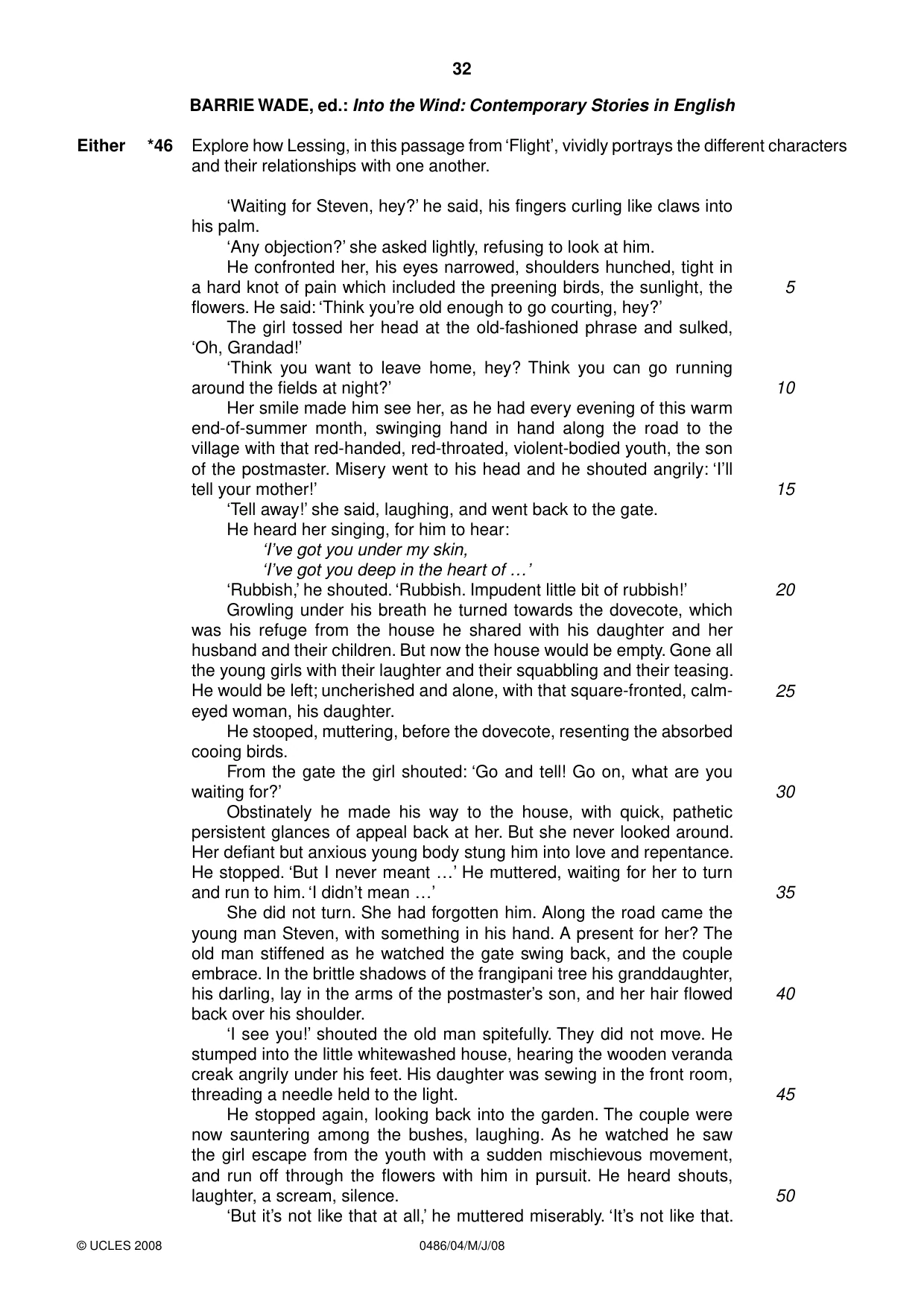
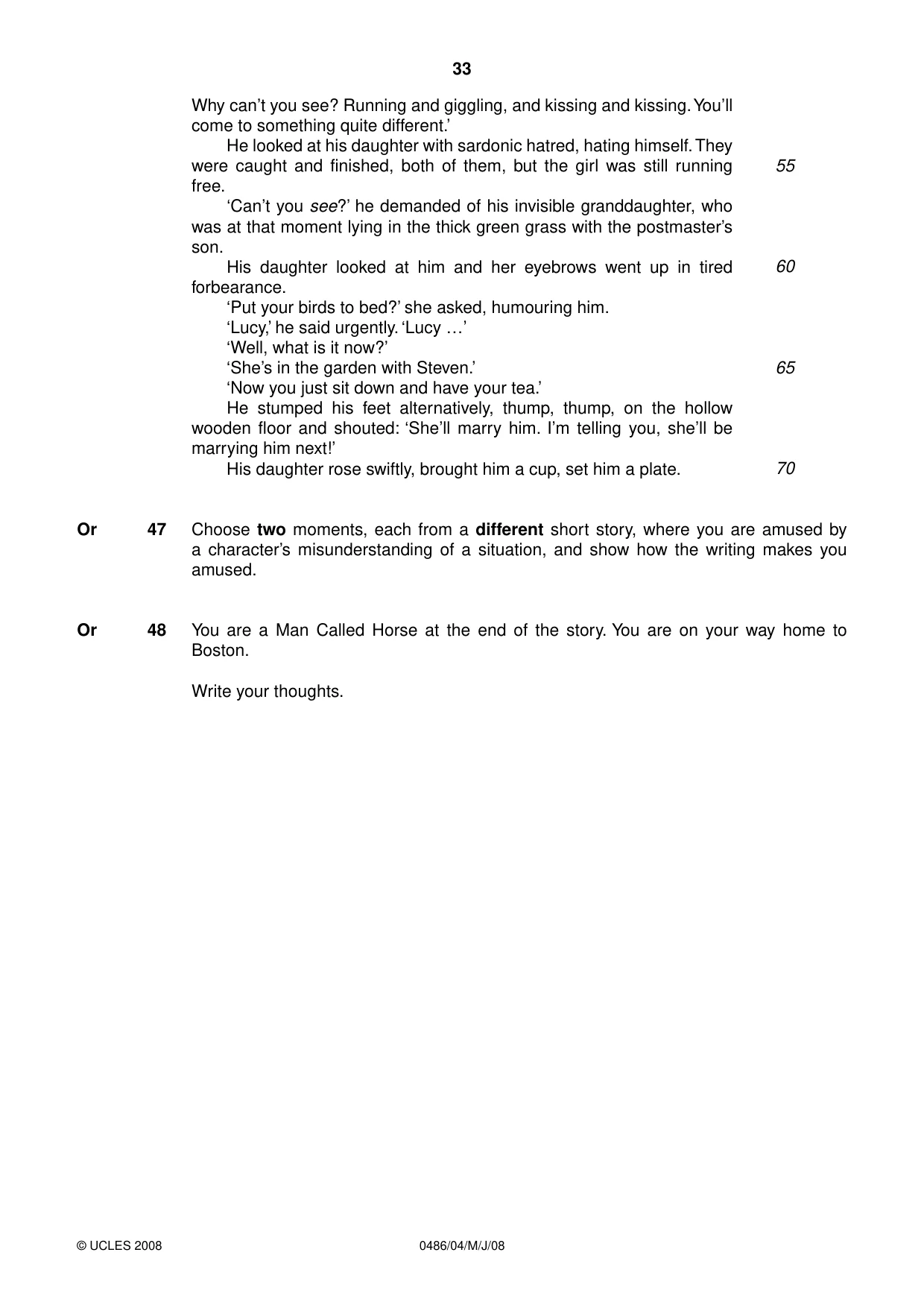



Mark scheme18 pages
Answers below. Sit the paper first if you are practising.
Paper as text
Question paper, page 1
This document consists of 32 printed pages and 4 blank pages. SP (NH) T61048/4 R © UCLES 2008 [Turn over UNIVERSITY OF CAMBRIDGE INTERNATIONAL EXAMINATIONS International General Certificate of Secondary Education READ THESE INSTRUCTIONS FIRST If you have been given an Answer Booklet, follow the instructions on the front cover of the Booklet. Write your Centre number, candidate number and name on all the work you hand in. Write in dark blue or black pen. Do not use staples, paper clips, highlighters, glue or correction fluid. Answer four questions. Answer at least one question from each section. Each of your answers must be on a different book. Answer at least one passage-based question (marked *) and at least one essay/empathic question. At the end of the examination, fasten all your work securely together. All questions in this paper carry equal marks. * 1 7 1 2 3 9 5 8 6 0 * LITERATURE (ENGLISH) 0486/04 Paper 4 May/June 2008 2 hours 40 minutes Additional Materials: Answer Booklet/Paper www.XtremePapers.com
Question paper, page 3
3 0486/04/M/J/08 © UCLES 2008 [Turn over CONTENTS Section A: Drama text question numbers page[s] Alan Ayckbourn: A Small Family Business *1, 2, 3 pages 4–5 Lorraine Hansberry: A Raisin in the Sun *4, 5, 6 pages 6–7 Arthur Miller: The Crucible *7, 8, 9 pages 8–9 William Shakespeare: As You Like It *10, 11, 12 pages 10–11 William Shakespeare: Macbeth *13, 14, 15 pages 12–13 Tennessee Williams: A Streetcar Named Desire *16, 17, 18 pages 14–15 Section B: Poetry text question numbers page[s] Songs of Ourselves: from Section 3 *19, 20, 21 page 16 John Keats: Poems *22, 23, 24 page 17 Section C: Prose text question numbers page[s] Chinua Achebe: Things Fall Apart *25, 26, 27 pages 18–19 Jane Austen: Pride and Prejudice *28, 29, 30 pages 20–21 Ian Cross: The God Boy *31, 32, 33 pages 22–23 Helen Dunmore: The Siege *34, 35, 36 pages 24–25 William Golding: Lord of the Flies *37, 38, 39 pages 26–27 Thomas Hardy: Far from the Madding Crowd *40, 41, 42 pages 28–29 Harper Lee: To Kill a Mockingbird *43, 44, 45 pages 30–31 Barrie Wade, ed., Into the Wind: Contemporary Stories in English *46, 47, 48 pages 32–33
Question paper, page 4
4 0486/04/M/J/08 © UCLES 2008 SECTION A: DRAMA ALAN AYCKBOURN: A Small Family Business Either *1 How do you think Ayckbourn makes this extract, towards the beginning of the play, so amusing? Support your ideas with details from the extract. Jack: [a horrid thought ] We’re not meant to be going out? Poppy: No, no. Jack: Thank God for that. I don’t want to see anyone else. Not today. He goes into the hall. Anita: [softly] Oh, dear, what a shame. Tina: Sssh! Poppy: Make us both a drink, will you? Poppy hangs his coat up in the hall. Jack: [calling back to her as he does so] I drove back past the factory this evening … Poppy: What’s that? Jack: On my way home just now I drove back past my new office. Do you know, I suddenly felt very excited. He has returned to the kitchen doorway. Poppy: I’m glad. Jack: We’re going to the stars with this one, darling, we really are. This is going to be the one. Poppy: It will be if you have anything to do with it … Jack: [holding her] No, no. Not me. Us. You and me. Poppy: [not really believing this] Yes. They kiss. Jack: Come on, what are you dressed up for, then? Poppy: No reason. I just felt like it. Jack: Trying to take my mind off my work, were you? Eh? Poppy: [coyly aware of her audience next door] Don’t be silly. Jack: Sammy upstairs? Poppy: No, she’s out tonight. Jack: Just us, is it? Poppy: Yes. There’s nobody here. Jack: I see. Poppy: Go on. Make us a drink. Jack: [taking her hand and starting to lead her] First of all, follow me. Poppy: Where are we going? Jack: [heading for the stairs] Not far, I promise. Not far. Poppy: [alarmed] Jack, no, we can’t. Not now. Jack: I fancy it right now, I don’t mind saying … Anita: [sotto] Oh, my God … Poppy: No, we can’t. Really. Jack. 5 10 15 20 25 30 35 40
Question paper, page 5
5 0486/04/M/J/08 © UCLES 2008 [Turn over Poppy pulls away from Jack and remains at the foot of the stairs. Jack continues to retreat upstairs. Jack: Come on. Poppy: No. Jack: [more firmly] Come on. Poppy: No. I’m going in here. [Indicates the sitting room.] I want a drink. Jack: Poppy … Poppy: [opening the door] I’ll be in here. Jack: Poppy, if I have to come down and fetch you … Poppy: Bye-bye. Poppy goes into the sitting room and closes the door. She crowds in with the rest of her guests. Jack: Poppy! Poppy: [calling girlishly] Woo-hoo! [to the others] I’m ever so sorry. This is so embarrassing. Tina: [hissing] Mum. What are you playing at? Poppy: It’s the only way I can get him in here. [calling] Woo-hoo! Jack: I’m going to have to come in there and get you, Poppy … Cliff: This’ll be entertaining. Anita: It’s all right, Poppy, we’ll shut our eyes. Poppy: Sssshh! Jack: Poppy! If I have to come and fetch you, Poppy … You know what that means, don’t you? [starting to take off his jacket ] It means rough trade. Rough. Rough. Poppy. [Throws his jacket over the banisters and starts to descend, treading heavily.] Right. Here come the Vikings. You hear him coming, Poppy? [Takes off his tie and starts to unbutton his shirt.] It’s Erik the Hairy, coming for you. Anita giggles. Roy: Eric the Who? Poppy: Oh God, I want to die. I really want to die. Jack: [in a strange Norwegian accent ] Nordsky! Nordsky! Where she hidey-hole the little Angley-Sexey girl? Here he come, Hairy Erik with his meatey axey – He opens the sitting room door, slowly reaching round for the light switch as he does so. [calling softly] Angley-Sexey Girl! Come for a little pillage. Look who’s here. Look who’s here … [switching on the light ] Look who’s … Oh, for crying out loud! Or 2 In what ways does Ayckbourn amusingly show how easy it is for decent people to become criminals? Support your ideas with details from the writing. Or 3 You are Jack at the end of the play. Write your thoughts. 45 50 55 60 65 70 75 80
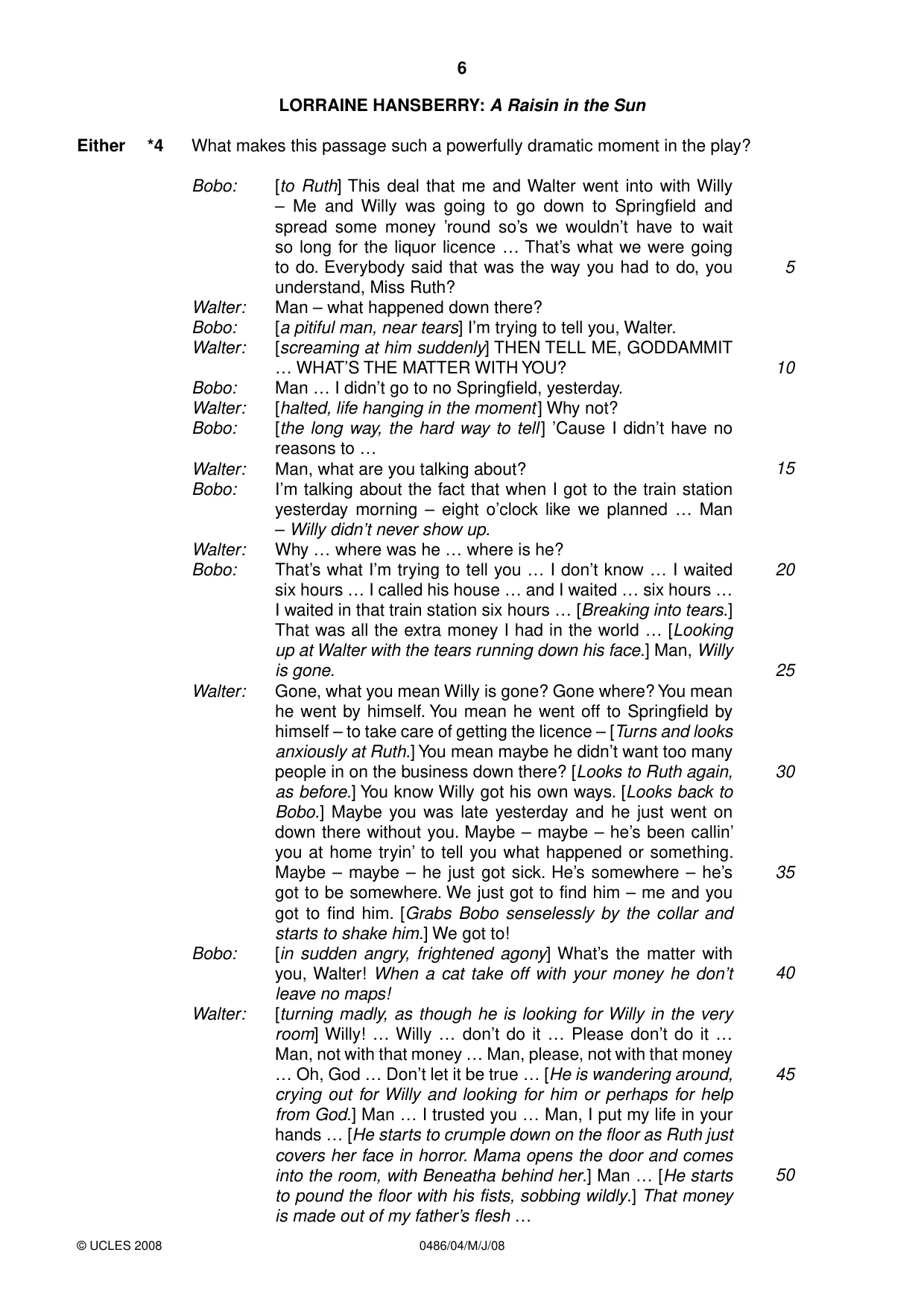
Question paper, page 6
6 0486/04/M/J/08 © UCLES 2008 LORRAINE HANSBERRY: A Raisin in the Sun Either *4 What makes this passage such a powerfully dramatic moment in the play? Bobo: [to Ruth] This deal that me and Walter went into with Willy – Me and Willy was going to go down to Springfield and spread some money ’round so’s we wouldn’t have to wait so long for the liquor licence … That’s what we were going to do. Everybody said that was the way you had to do, you understand, Miss Ruth? Walter: Man – what happened down there? Bobo: [a pitiful man, near tears] I’m trying to tell you, Walter. Walter: [screaming at him suddenly] THEN TELL ME, GODDAMMIT … WHAT’S THE MATTER WITH YOU? Bobo: Man … I didn’t go to no Springfield, yesterday. Walter: [halted, life hanging in the moment ] Why not? Bobo: [the long way, the hard way to tell ] ’Cause I didn’t have no reasons to … Walter: Man, what are you talking about? Bobo: I’m talking about the fact that when I got to the train station yesterday morning – eight o’clock like we planned … Man – Willy didn’t never show up. Walter: Why … where was he … where is he? Bobo: That’s what I’m trying to tell you … I don’t know … I waited six hours … I called his house … and I waited … six hours … I waited in that train station six hours … [Breaking into tears.] That was all the extra money I had in the world … [Looking up at Walter with the tears running down his face.] Man, Willy is gone. Walter: Gone, what you mean Willy is gone? Gone where? You mean he went by himself. You mean he went off to Springfield by himself – to take care of getting the licence – [Turns and looks anxiously at Ruth.] You mean maybe he didn’t want too many people in on the business down there? [Looks to Ruth again, as before.] You know Willy got his own ways. [Looks back to Bobo.] Maybe you was late yesterday and he just went on down there without you. Maybe – maybe – he’s been callin’ you at home tryin’ to tell you what happened or something. Maybe – maybe – he just got sick. He’s somewhere – he’s got to be somewhere. We just got to find him – me and you got to find him. [Grabs Bobo senselessly by the collar and starts to shake him.] We got to! Bobo: [in sudden angry, frightened agony] What’s the matter with you, Walter! When a cat take off with your money he don’t leave no maps! Walter: [turning madly, as though he is looking for Willy in the very room] Willy! … Willy … don’t do it … Please don’t do it … Man, not with that money … Man, please, not with that money … Oh, God … Don’t let it be true … [He is wandering around, crying out for Willy and looking for him or perhaps for help from God.] Man … I trusted you … Man, I put my life in your hands … [He starts to crumple down on the floor as Ruth just covers her face in horror. Mama opens the door and comes into the room, with Beneatha behind her.] Man … [He starts to pound the floor with his fists, sobbing wildly.] That money is made out of my father’s flesh … 5 10 15 20 25 30 35 40 45 50
Question paper, page 7
7 0486/04/M/J/08 © UCLES 2008 [Turn over Bobo: [standing over him helplessly] I’m sorry, Walter … [Only Walter’s sobs reply. Bobo puts on his hat.] I had my life staked on this deal, too … Or 5 How does Hansberry make it clear to you that Asagai is a better partner for Beneatha than George is? Support your answer with details from the play. Or 6 You are Ruth. Mama has just told Walter that you are expecting another baby. Write your thoughts. 55
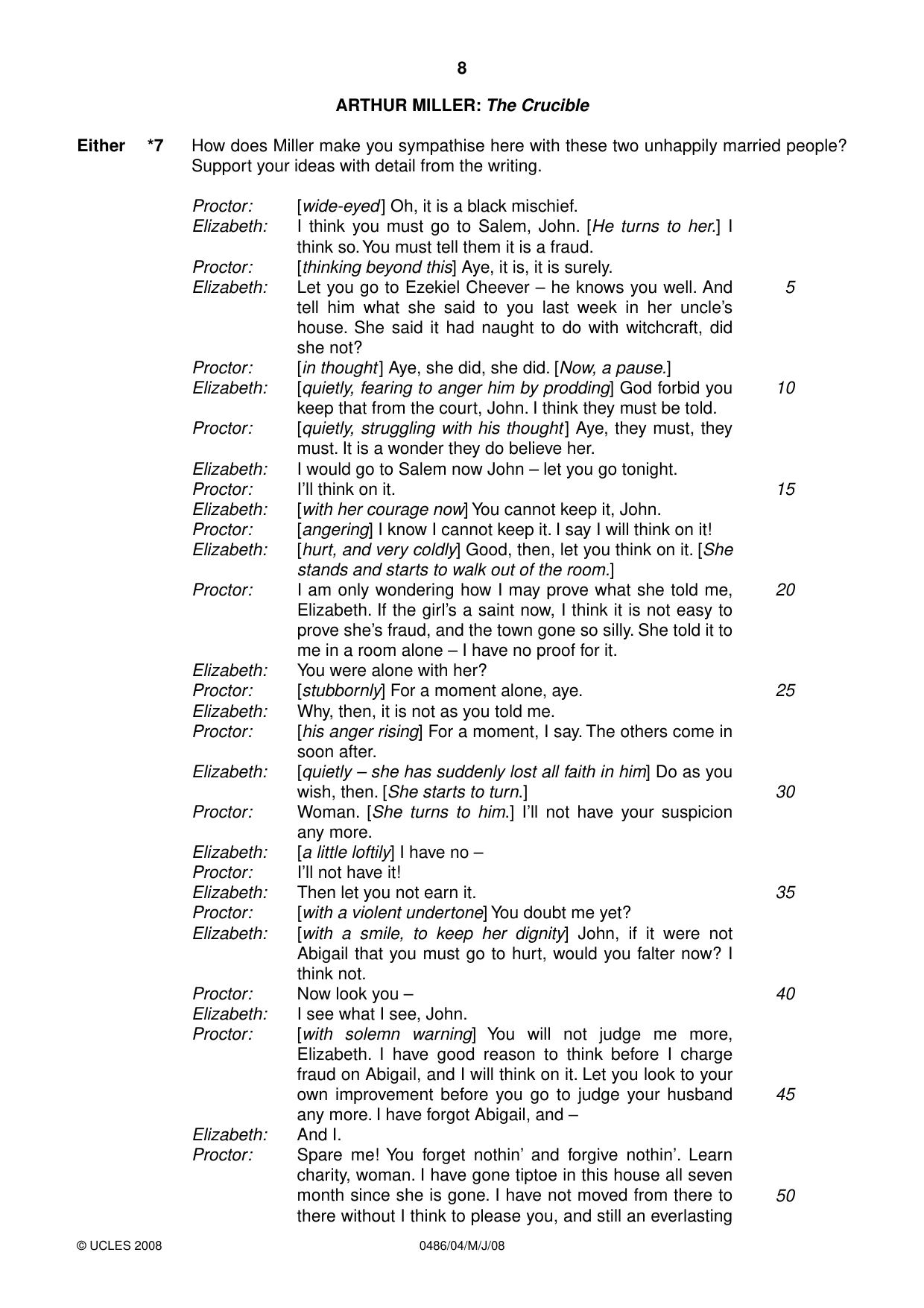
Question paper, page 8
8 0486/04/M/J/08 © UCLES 2008 ARTHUR MILLER: The Crucible Either *7 How does Miller make you sympathise here with these two unhappily married people? Support your ideas with detail from the writing. Proctor: [wide-eyed ] Oh, it is a black mischief. Elizabeth: I think you must go to Salem, John. [He turns to her.] I think so. You must tell them it is a fraud. Proctor: [thinking beyond this] Aye, it is, it is surely. Elizabeth: Let you go to Ezekiel Cheever – he knows you well. And tell him what she said to you last week in her uncle’s house. She said it had naught to do with witchcraft, did she not? Proctor: [in thought ] Aye, she did, she did. [Now, a pause.] Elizabeth: [quietly, fearing to anger him by prodding] God forbid you keep that from the court, John. I think they must be told. Proctor: [quietly, struggling with his thought ] Aye, they must, they must. It is a wonder they do believe her. Elizabeth: I would go to Salem now John – let you go tonight. Proctor: I’ll think on it. Elizabeth: [with her courage now] You cannot keep it, John. Proctor: [angering] I know I cannot keep it. I say I will think on it! Elizabeth: [hurt, and very coldly] Good, then, let you think on it. [She stands and starts to walk out of the room.] Proctor: I am only wondering how I may prove what she told me, Elizabeth. If the girl’s a saint now, I think it is not easy to prove she’s fraud, and the town gone so silly. She told it to me in a room alone – I have no proof for it. Elizabeth: You were alone with her? Proctor: [stubbornly] For a moment alone, aye. Elizabeth: Why, then, it is not as you told me. Proctor: [his anger rising] For a moment, I say. The others come in soon after. Elizabeth: [quietly – she has suddenly lost all faith in him] Do as you wish, then. [She starts to turn.] Proctor: Woman. [She turns to him.] I’ll not have your suspicion any more. Elizabeth: [a little loftily] I have no – Proctor: I’ll not have it! Elizabeth: Then let you not earn it. Proctor: [with a violent undertone] You doubt me yet? Elizabeth: [with a smile, to keep her dignity] John, if it were not Abigail that you must go to hurt, would you falter now? I think not. Proctor: Now look you – Elizabeth: I see what I see, John. Proctor: [with solemn warning] You will not judge me more, Elizabeth. I have good reason to think before I charge fraud on Abigail, and I will think on it. Let you look to your own improvement before you go to judge your husband any more. I have forgot Abigail, and – Elizabeth: And I. Proctor: Spare me! You forget nothin’ and forgive nothin’. Learn charity, woman. I have gone tiptoe in this house all seven month since she is gone. I have not moved from there to there without I think to please you, and still an everlasting 5 10 15 20 25 30 35 40 45 50
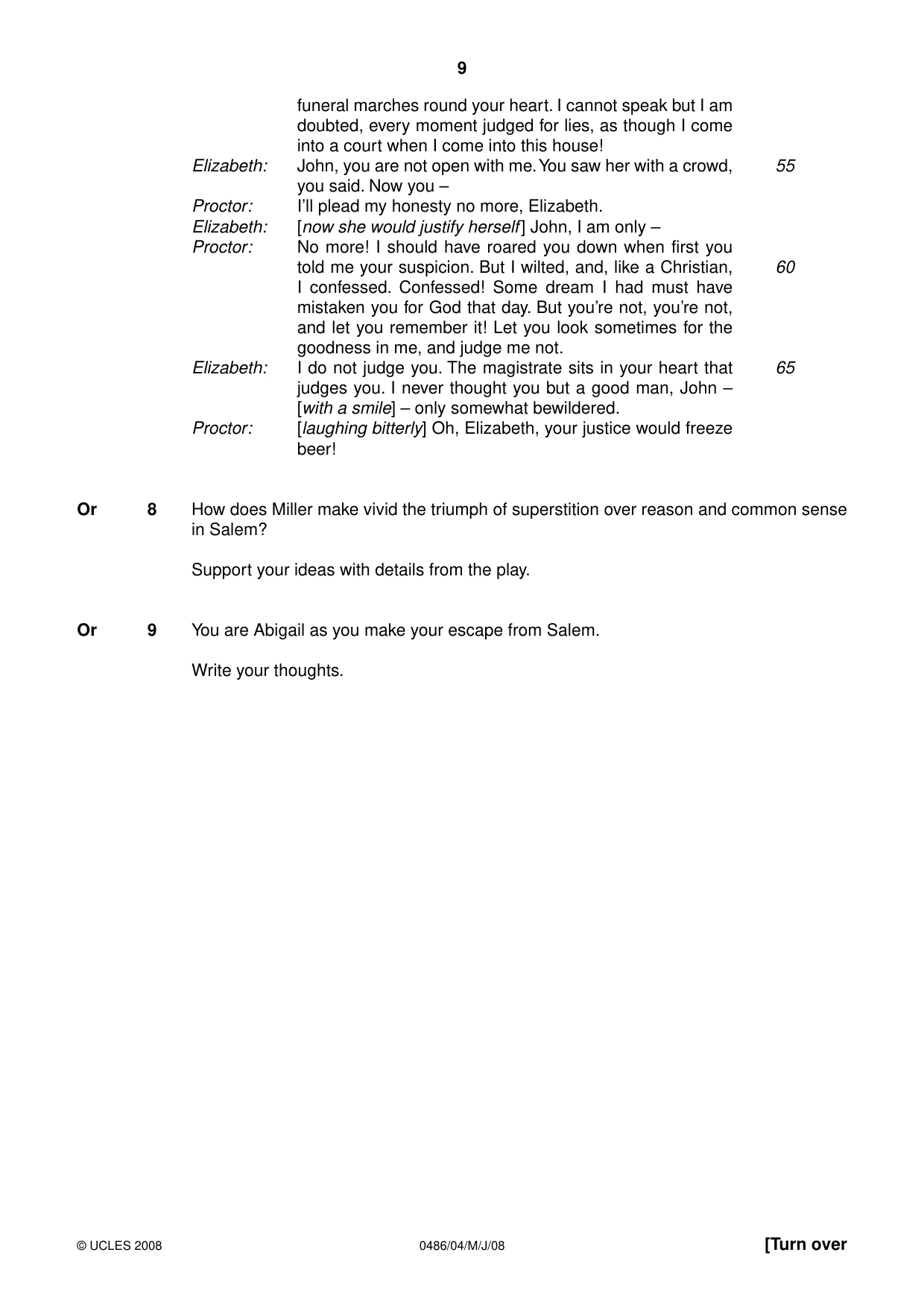
Question paper, page 9
9 0486/04/M/J/08 © UCLES 2008 [Turn over funeral marches round your heart. I cannot speak but I am doubted, every moment judged for lies, as though I come into a court when I come into this house! Elizabeth: John, you are not open with me. You saw her with a crowd, you said. Now you – Proctor: I’ll plead my honesty no more, Elizabeth. Elizabeth: [now she would justify herself ] John, I am only – Proctor: No more! I should have roared you down when first you told me your suspicion. But I wilted, and, like a Christian, I confessed. Confessed! Some dream I had must have mistaken you for God that day. But you’re not, you’re not, and let you remember it! Let you look sometimes for the goodness in me, and judge me not. Elizabeth: I do not judge you. The magistrate sits in your heart that judges you. I never thought you but a good man, John – [with a smile] – only somewhat bewildered. Proctor: [laughing bitterly] Oh, Elizabeth, your justice would freeze beer! Or 8 How does Miller make vivid the triumph of superstition over reason and common sense in Salem? Support your ideas with details from the play. Or 9 You are Abigail as you make your escape from Salem. Write your thoughts. 55 60 65
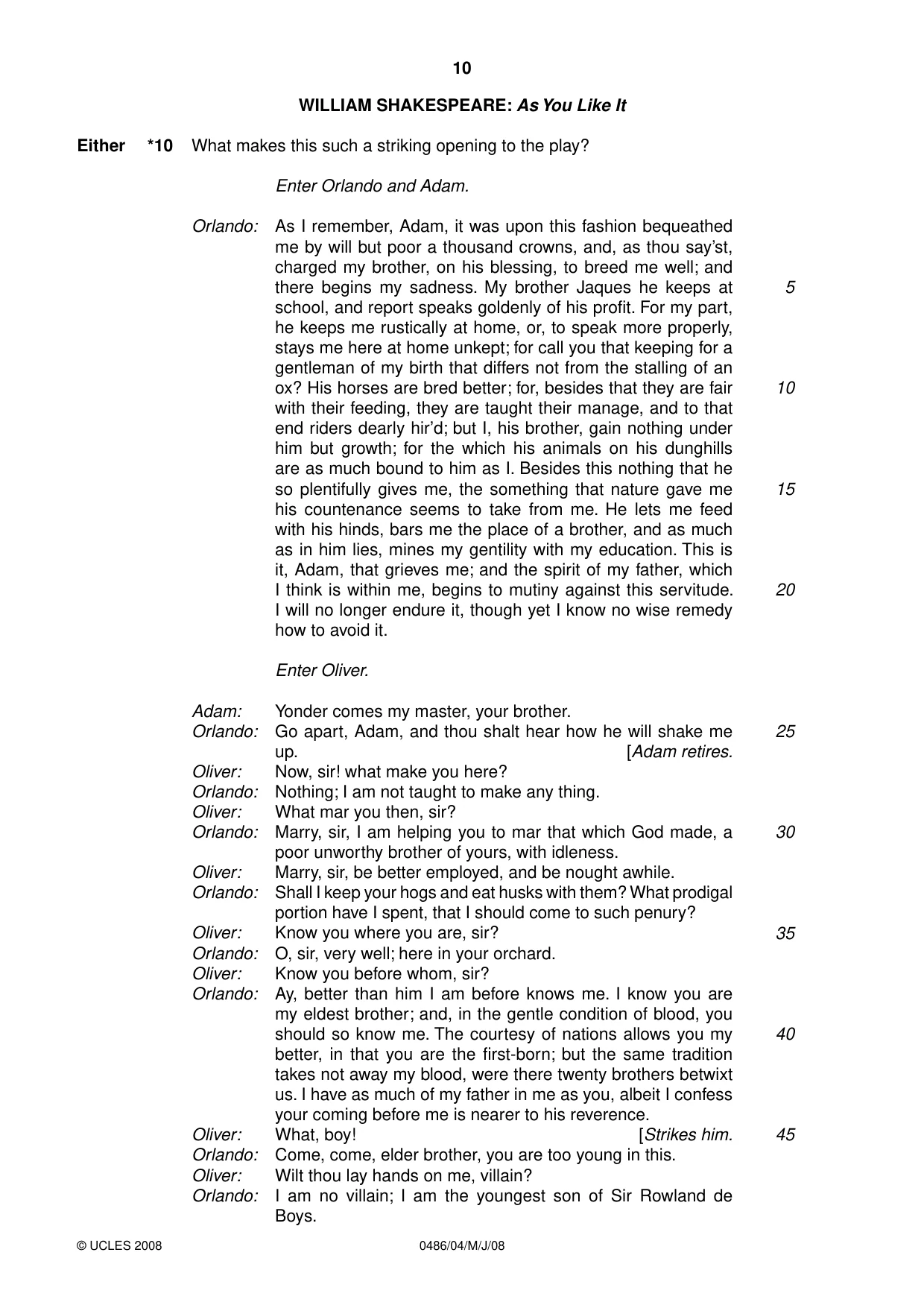
Question paper, page 10
10 0486/04/M/J/08 © UCLES 2008 WILLIAM SHAKESPEARE: As You Like It Either *10 What makes this such a striking opening to the play? Enter Orlando and Adam. Orlando: As I remember, Adam, it was upon this fashion bequeathed me by will but poor a thousand crowns, and, as thou say’st, charged my brother, on his blessing, to breed me well; and there begins my sadness. My brother Jaques he keeps at school, and report speaks goldenly of his profit. For my part, he keeps me rustically at home, or, to speak more properly, stays me here at home unkept; for call you that keeping for a gentleman of my birth that differs not from the stalling of an ox? His horses are bred better; for, besides that they are fair with their feeding, they are taught their manage, and to that end riders dearly hir’d; but I, his brother, gain nothing under him but growth; for the which his animals on his dunghills are as much bound to him as I. Besides this nothing that he so plentifully gives me, the something that nature gave me his countenance seems to take from me. He lets me feed with his hinds, bars me the place of a brother, and as much as in him lies, mines my gentility with my education. This is it, Adam, that grieves me; and the spirit of my father, which I think is within me, begins to mutiny against this servitude. I will no longer endure it, though yet I know no wise remedy how to avoid it. Enter Oliver. Adam: Yonder comes my master, your brother. Orlando: Go apart, Adam, and thou shalt hear how he will shake me up. [Adam retires. Oliver: Now, sir! what make you here? Orlando: Nothing; I am not taught to make any thing. Oliver: What mar you then, sir? Orlando: Marry, sir, I am helping you to mar that which God made, a poor unworthy brother of yours, with idleness. Oliver: Marry, sir, be better employed, and be nought awhile. Orlando: Shall I keep your hogs and eat husks with them? What prodigal portion have I spent, that I should come to such penury? Oliver: Know you where you are, sir? Orlando: O, sir, very well; here in your orchard. Oliver: Know you before whom, sir? Orlando: Ay, better than him I am before knows me. I know you are my eldest brother; and, in the gentle condition of blood, you should so know me. The courtesy of nations allows you my better, in that you are the first-born; but the same tradition takes not away my blood, were there twenty brothers betwixt us. I have as much of my father in me as you, albeit I confess your coming before me is nearer to his reverence. Oliver: What, boy! [Strikes him. Orlando: Come, come, elder brother, you are too young in this. Oliver: Wilt thou lay hands on me, villain? Orlando: I am no villain; I am the youngest son of Sir Rowland de Boys. 5 10 15 20 25 30 35 40 45
Question paper, page 11
11 0486/04/M/J/08 © UCLES 2008 [Turn over Or 11 How does Shakespeare make Rosalind such an attractive heroine? Support your answer by close reference to the play. Or 12 You are Duke Senior at the end of the play, reflecting on your time in the Forest. Write your thoughts.
Question paper, page 12
12 0486/04/M/J/08 © UCLES 2008 WILLIAM SHAKESPEARE: Macbeth Either *13 In this extract how does Shakespeare make the horror of this scene so memorable for you? Macbeth: I have done the deed. Didst thou not hear a noise? Lady Macbeth: I heard the owl scream and the cricket’s cry. Did not you speak? Macbeth: When? Lady Macbeth: Now. Macbeth: As I descended? Lady Macbeth: Ay. Macbeth: Hark! Who lies i’the second chamber? Lady Macbeth: Donalbain. Macbeth: This is a sorry sight. [Looking on his hands] Lady Macbeth: A foolish thought to say a sorry sight. Macbeth: There’s one did laugh in’s sleep, and one cried ‘Murder!’ That they did wake each other. I stood and heard them; But they did say their prayers, and address’d them Again to sleep. Lady Macbeth: There are two lodg’d together. Macbeth: One cried ‘God bless us’, and ‘Amen’ the other, As they had seen me with these hangman’s hands. List’ning their fear, I could not say ‘Amen’ When they did say ‘God bless us.’ Lady Macbeth: Consider it not so deeply. Macbeth: But wherefore could not I pronounce ‘Amen’? I had most need of blessing, and ‘Amen’ Stuck in my throat. Lady Macbeth: These deeds must not be thought After these ways: so, it will make us mad. Macbeth: Methought I heard a voice cry ‘Sleep no more; Macbeth does murder sleep’ – the innocent sleep, Sleep that knits up the ravell’d sleave of care, The death of each day’s life, sore labour’s bath, Balm of hurt minds, great nature’s second course, Chief nourisher in life’s feast. Lady Macbeth: What do you mean? Macbeth: Still it cried ‘Sleep no more’ to all the house; ‘Glamis hath murder’d sleep, and therefore Cawdor Shall sleep no more – Macbeth shall sleep no more.’ Lady Macbeth: Who was it that thus cried? Why, worthy Thane, You do unbend your noble strength, to think So brainsickly of things. Go, get some water, And wash this filthy witness from your hand. Why did you bring these daggers from the place? They must lie there. Go carry them, and smear The sleepy grooms with blood. Macbeth: I’ll go no more: I am afraid to think what I have done; Look on’t again I dare not. Lady Macbeth: Infirm of purpose! Give me the daggers. The sleeping and the dead Are but as pictures; ’tis the eye of childhood That fears a painted devil. If he do bleed, 5 10 15 20 25 30 35 40 45 50
Question paper, page 13
13 0486/04/M/J/08 © UCLES 2008 [Turn over I’ll gild the faces of the grooms withal, For it must seem their guilt. [Exit. Knocking within Macbeth: Whence is that knocking? How is’t with me, when every noise appals me? What hands are here! Ha! they pluck out mine eyes! Will all great Neptune’s ocean wash this blood Clean from my hand? No; this my hand will rather The multitudinous seas incarnadine, Making the green one red. [Re-enter Lady Macbeth.] Lady Macbeth: My hands are of your colour; but I shame To wear a heart so white. [Knock] I hear a knocking At the south entry; retire we to our chamber. A little water clears us of this deed. How easy is it then! Your constancy Hath left you unattended. [Knock] Hark! more knocking. Get on your nightgown, lest occasion call us And show us to be watchers. Be not lost So poorly in your thoughts. Macbeth: To know my deed ’twere best not know myself. [Knock. Wake Duncan with thy knocking! I would thou couldst! [Exeunt. Or 14 Explore the ways in which Shakespeare makes Macbeth’s brutality as a king so terrifying. Support your ideas with details from the play. Or 15 You are Lady Macbeth just after the banquet has come to such a disastrous end. You are now alone. Write your thoughts. 55 60 65 70
Question paper, page 14
14 0486/04/M/J/08 © UCLES 2008 TENNESSEE WILLIAMS: A Streetcar Named Desire Either *16 What does Williams make you feel about Blanche in this extract? Blanche: I’ll tell you what I want. Magic! [Mitch laughs.] Yes, yes, magic! I try to give that to people. I misrepresent things to them. I don’t tell the truth. I tell what ought to be truth. And if that is sinful, then let me be damned for it! – Don’t turn the light on! [Mitch crosses to the switch. He turns the light on and stares at her. She cries out and covers her face. He turns the light off again.] Mitch: [slowly and bitterly] I don’t mind you being older than what I thought. But all the rest of it – God! That pitch about your ideals being so old-fashioned and all the malarkey that you’ve dished out all summer. Oh, I knew you weren’t sixteen any more. But I was a fool enough to believe you was straight. Blanche: Who told you I wasn’t – ‘straight’? My loving brother-in-law. And you believed him. Mitch: I called him a liar at first. And then I checked on the story. First I asked our supply-man who travels through Laurel. And then I talked directly over long-distance to this merchant. Blanche: Who is the merchant? Mitch: Kiefaber. Blanche: The merchant Kiefaber of Laurel! I know the man. He whistled at me. I put him in his place. So now for revenge he makes up stories about me. Mitch: Three people, Kiefaber, Stanley, and Shaw, swore to them! Blanche: Rub-a-dub-dub, three men in a tub! And such a filthy tub! Mitch: Didn’t you stay at a hotel called The Flamingo? Blanche: Flamingo? No! Tarantula was the name of it! I stayed at a hotel called The Tarantula Arms! Mitch: [stupidly] Tarantula? Blanche: Yes, a big spider! That’s where I brought my victims. [She pours herself another drink.] Yes, I had many intimacies with strangers. After the death of Allan – intimacies with strangers was all I seemed able to fill my empty heart with … I think it was panic, just panic, that drove me from one to another, hunting for some protection – here and there, in the most – unlikely places – even, at last, in a seventeen-year-old boy but – somebody wrote the superintendent about it – ‘This woman is morally unfit for her position!’ [She throws back her head with convulsive, sobbing laughter. Then she repeats the statement, gasps, and drinks.] True? Yes, I suppose – unfit somehow – anyway … So I came here. There was nowhere else I could go. I was played out. You know what played out is? My youth was suddenly gone up the water-spout, and – I met you. You said you needed somebody. Well, I needed somebody, too. I thanked God for you, because you seemed to be gentle – a cleft in the rock of the world that I could hide in! The poor man’s Paradise – is a little peace … But I guess I was asking, hoping – too much! 5 10 15 20 25 30 35 40 45
Question paper, page 15
15 0486/04/M/J/08 © UCLES 2008 [Turn over Kiefaber, Stanley, and Shaw have tied an old tin can to the tail of the kite. [There is a pause. Mitch stares at her dumbly.] Mitch: You lied to me, Blanche. Blanche: Don’t say I lied to you. Mitch: Lies, lies, inside and out, all lies. Blanche: Never inside, I didn’t lie in my heart … Or 17 A loving and loyal wife A weak woman, easily led and naive How far do you think both these descriptions apply to Stella? Refer to details in the play in your answer. Or 18 You are Stanley, the day after hearing Blanche refer to you as acting ‘like an animal’, ‘a survivor of the Stone Age’, and ‘sub-human’. Write your thoughts. 50 55
Question paper, page 16
16 0486/04/M/J/08 © UCLES 2008 SECTION B: POETRY SONGS OF OURSELVES: The University of Cambridge International Examinations Anthology of Poetry in English – from Section 3 Either *19 In the following poem, how do you think the poet’s words make this man such a moving figure? Farmhand You will see him light a cigarette At the hall door careless, leaning his back Against the wall, or telling some new joke To a friend, or looking out into the secret night. But always his eyes turn To the dance floor and the girls drifting like flowers Before the music that tears Slowly in his mind an old wound open. His red sunburnt face and hairy hands Were not made for dancing or love-making But rather the earth wave breaking To the plough, and crops slow-growing as his mind. He has no girl to run her fingers through His sandy hair, and giggle at his side When Sunday couples walk. Instead He has his awkward hopes, his envious dreams to yarn to. But ah in harvest watch him Forking stooks, effortless and strong – Or listening like a lover to the song Clear, without fault, of a new tractor engine. (by James K. Baxter) Or 20 Explore the ways in which the poet vividly conveys a child’s experiences in either Rising Five (by Norman Nicholson) or Little Boy Crying (by Mervyn Morris). Or 21 Explore some of the descriptions which you find particularly effective in Carpet Weavers, Morocco (by Carol Rumens) and Muliebrity (by Sujata Bhatt). 5 10 15 20
Question paper, page 17
17 0486/04/M/J/08 © UCLES 2008 [Turn over JOHN KEATS: Poems Either *22 Explore the ways in which Keats brings to life for you the figures on the Grecian urn in the following stanzas: 1 Thou still unravish’d bride of quietness, Thou foster-child of silence and slow time, Sylvan historian, who canst thus express A flowery tale more sweetly than our rhyme: What leaf-fring’d legend haunts about thy shape Of deities or mortals, or of both, In Tempe or the dales of Arcady? What men or gods are these? What maidens loth? What mad pursuit? What struggle to escape? What pipes and timbrels? What wild ecstasy? 2 Heard melodies are sweet, but those unheard Are sweeter; therefore, ye soft pipes, play on; Not to the sensual ear, but, more endear’d, Pipe to the spirit ditties of no tone: Fair youth, beneath the trees, thou canst not leave Thy song, nor ever can those trees be bare; Bold lover, never, never canst thou kiss, Though winning near the goal – yet, do not grieve; She cannot fade, though thou hast not thy bliss, For ever wilt thou love, and she be fair! 3 Ah, happy, happy boughs! that cannot shed Your leaves, nor ever bid the Spring adieu; And, happy melodist, unwearied, For ever piping songs for ever new; More happy love! more happy, happy love! For ever warm and still to be enjoy’d, For ever panting, and for ever young; All breathing human passion far above, That leaves a heart high-sorrowful and cloy’d, A burning forehead, and a parching tongue. Or 23 Show how, in the extract from Endymion, Keats finds beauty in the world. Or 24 Explore Keats’s presentation of melancholy in his Ode on Melancholy. 5 10 15 20 25 30
Question paper, page 18
18 0486/04/M/J/08 © UCLES 2008 SECTION C: PROSE CHINUA ACHEBE: Things Fall Apart Either *25 Explore how in this passage Achebe strikingly portrays the power which the spirit world has over the lives of the Ibo people. It was a great funeral, such as befitted a noble warrior. As the evening drew near, the shouting and the firing of guns, the beating of drums and the brandishing and clanging of matchets increased. Ezeudu had taken three titles in his life. It was a rare achievement. There were only four titles in the clan, and only one or two men in any generation ever achieved the fourth and highest. When they did, they became the lords of the land. Because he had taken titles, Ezeudu was to be buried after dark with only a glowing brand to light the sacred ceremony. But before this quiet and final rite, the tumult increased tenfold. Drums beat violently and men leaped up and down in frenzy. Guns were fired on all sides and sparks flew out as matchets clanged together in warriors’ salutes. The air was full of dust and the smell of gunpowder. It was then that the one-handed spirit came, carrying a basket full of water. People made way for him on all sides and the noise subsided. Even the smell of gunpowder was swallowed in the sickly smell that now filled the air. He danced a few steps to the funeral drums and then went to see the corpse. ‘Ezeudu!’ he called in his guttural voice. ‘If you had been poor in your last life I would have asked you to be rich when you come again. But you were rich. If you had been a coward, I would have asked you to bring courage. But you were a fearless warrior. If you had died young, I would have asked you to get life. But you lived long. So I shall ask you to come again the way you came before. If your death was the death of nature, go in peace. But if a man caused it, do not allow him a moment’s rest.’ He danced a few more steps and went away. The drums and the dancing began again and reached fever-heat. Darkness was around the corner, and the burial was near. Guns fired the last salute and the cannon rent the sky. And then from the centre of the delirious fury came a cry of agony and shouts of horror. It was as if a spell had been cast. All was silent. In the centre of the crowd a boy lay in a pool of blood. It was the dead man’s sixteen-year-old son, who with his brothers and half-brothers had been dancing the traditional farewell to their father. Okonkwo’s gun had exploded and a piece of iron had pierced the boy’s heart. The confusion that followed was without parallel in the tradition of Umuofia. Violent deaths were frequent, but nothing like this had ever happened. The only course open to Okonkwo was to flee from the clan. It was a crime against the earth goddess to kill a clansman, and a man who committed it must flee from the land. The crime was of two kinds, male and female. Okonkwo had committed the female, because it had been inadvertent. He could return to the clan after seven years. That night he collected his most valuable belongings into headloads. His wives wept bitterly and their children wept with them without knowing why. Obierika and half a dozen other friends came to help and to console him. They each made nine or ten trips carrying Okonkwo’s yams to store in Obierika’s barn. And before the cock crowed Okonkwo and his family 5 10 15 20 25 30 35 40 45
Question paper, page 19
19 0486/04/M/J/08 © UCLES 2008 [Turn over were fleeing to his motherland. It was a little village called Mbanta, just beyond the borders of Mbaino. As soon as the day broke, a large crowd of men from Ezeudu’s quarter stormed Okonkwo’s compound, dressed in garbs of war. They set fire to his houses, demolished his red walls, killed his animals and destroyed his barn. It was the justice of the earth goddess, and they were merely her messengers. They had no hatred in their hearts against Okonkwo. His greatest friend, Obierika, was among them. They were merely cleansing the land which Okonkwo had polluted with the blood of a clansman. Obeirika was a man who thought about things. When the will of the goddess had been done, he sat down in his obi and mourned his friend’s calamity. Why should a man suffer so grievously for an offence he had committed inadvertently? But although he thought for a long time he found no answer. He was merely led into greater complexities. He remembered his wife’s twin children whom he had thrown away. What crime had they committed? The Earth had decreed that they were an offence on the land and must be destroyed. And if the clan did not exact punishment for an offence against the great goddess, her wrath was loosed on all the land and not just on the offender. As the elders said, if one finger brought oil it soiled the others. Or 26 What does Achebe make you feel about the customs of family life in the clan? Support your ideas with details from the novel. Or 27 You are Okonkwo, the night after Ikemefuna has been killed. Write your thoughts. 50 55 60 65
Question paper, page 20
20 0486/04/M/J/08 © UCLES 2008 JANE AUSTEN: Pride and Prejudice Either *28 How would you say this passage reflects the pride and prejudices of both Elizabeth and Darcy? ‘And this,’ cried Darcy, as he walked with quick steps across the room, ‘is your opinion of me! This is the estimation in which you hold me! I thank you for explaining it so fully. My faults, according to this calculation, are heavy indeed! But perhaps,’ added he, stopping in his walk, and turning towards her, ‘these offences might have been overlooked, had not your pride been hurt by my honest confession of the scruples that had long prevented my forming any serious design. These bitter accusations might have been suppressed, had I with greater policy concealed my struggles, and flattered you into the belief of my being impelled by unqualified, unalloyed inclination; by reason, by reflection, by every thing. But disguise of every sort is my abhorrence. Nor am I ashamed of the feelings I related. They were natural and just. Could you expect me to rejoice in the inferiority of your connections? To congratulate myself on the hope of relations, whose condition in life is so decidedly beneath my own?’ Elizabeth felt herself growing more angry every moment; yet she tried to the utmost to speak with composure when she said, ‘You are mistaken, Mr Darcy, if you suppose that the mode of your declaration affected me in any other way, than as it spared me the concern which I might have felt in refusing you, had you behaved in a more gentleman-like manner.’ She saw him start at this, but he said nothing, and she continued, ‘You could not have made me the offer of your hand in any possible way that would have tempted me to accept it.’ Again his astonishment was obvious; and he looked at her with an expression of mingled incredulity and mortification. She went on. ‘From the very beginning, from the first moment I may almost say, of my acquaintance with you, your manners impressing me with the fullest belief of your arrogance, your conceit, and your selfish disdain for the feelings of others, were such as to form that ground-work of disapprobation, on which succeeding events have built so immovable a dislike; and I had not known you a month before I felt that you were the last man in the world whom I could ever be prevailed on to marry.’ ‘You have said quite enough, madam. I perfectly comprehend your feelings, and have now only to be ashamed of what my own have been. Forgive me for having taken up so much of your time, and accept my best wishes for your health and happiness.’ And with these words he hastily left the room, and Elizabeth heard him the next moment open the front door and quit the house. The tumult of her mind was now painfully great. She knew not how to support herself, and from actual weakness sat down and cried for half an hour. Her astonishment, as she reflected on what had passed, was increased by every review of it. That she should receive an offer of marriage from Mr Darcy! that he should have been in love with her for so many months! so much in love as to wish to marry her in spite of all the objections which had made him prevent his friend’s marrying her sister, and which must appear at least with equal force in his own case; was almost incredible! it was gratifying to have inspired unconsciously so strong an affection. But his pride, his abominable pride, his shameless avowal of what he had done with respect to Jane, his unpardonable assurance in acknowledging, though he could not justify it, and the unfeeling manner in which he had mentioned Mr Wickham, his cruelty 5 10 15 20 25 30 35 40 45 50
Question paper, page 21
21 0486/04/M/J/08 © UCLES 2008 [Turn over towards whom he had not attempted to deny, soon overcame the pity which the consideration of his attachment had for a moment excited. She continued in very agitating reflections till the sound of Lady Catherine’s carriage made her feel how unequal she was to encounter Charlotte’s observation, and hurried her away to her room. Or 29 What do you think makes Elizabeth Bennet such an attractive heroine? Support your ideas with details from the novel. Or 30 You are Lydia as you approach Longbourn with Wickham, your new husband. Write your thoughts. 55
Question paper, page 22
22 0486/04/M/J/08 © UCLES 2008 IAN CROSS: The God Boy Either *31 Explore how this passage conveys the horror of Jimmy’s life in the Sullivan household and suggests that something dreadful is about to occur. ‘I’ve forgotten to wash my hands,’ I said, turning back and going out of the kitchen. I was afraid that I would have one of my queer turns in front of them. I don’t suppose there was any danger, really, but I went to the bathroom and washed myself with hot water, said a Hail Mary, and sang ‘It’s a Long Way to Tipperary’ as I dried myself, as a precaution. Dad heard me singing, because he started up on the same song himself, and kept it up until I got back. ‘That’s a great old song you’re trying to sing, Jimmy, and I’m glad you are so happy to sing a great old song like that. Why are you singing, eh?’ Mum put the plates on the table as he was talking, gave a hiss like a railway engine blowing off steam, and then glared at him. She didn’t say a word. That did it for me. Suddenly everything inside me, inside my head and my body, just lay down. It was as though what was me had been held up by a piece of string which had snapped and let me fall. It was a wonderful feeling, honestly; a little like the way you get when you are in a hot bath too long. I couldn’t even care or worry if I tried; if a pin had been stuck into me, I probably wouldn’t have felt it. ‘I was singing because I was singing, I suppose,’ I said to Dad. He sat up in his chair and pulled it over to his place at the table. ‘You are happy, Jimmy, old boy, old boy. That’s why you sing, because you are happy. Your old Dad has made you happy with that bike, and don’t you worry, your old Dad is going to do lots of things for you, old son, old son. He’s going to see you get the chance he didn’t have, and he’s going to see you don’t get the rotten luck he had. You can’t keep a Sullivan down, because they didn’t really lick your old man, no sir. They just gave him rotten luck and smashed him up and tied him to a she- devil. They didn’t lick him, by God no. They held him down and they’ll have to keep holding me down, but he’ll not give in, no sir. They’ll have to hold him down till the day he dies. And by God I bet they do hold him down, not giving him a chance.’ I shovelled my stew down, not bothering to look up. I was on one side of the table, Mum was on the other side, and Dad sat at the top talking his head off. As though it was somebody else, and nothing to do with me, I felt Mum getting boiling mad. I felt it, yet I didn’t care. Except for the time she was at the stove, I hadn’t even looked at her, and I wasn’t going to either. ‘Sure I take a few drinks, son,’ Dad said. ‘I take a few drinks and I can hold my drinks, as I’ve been around and no gentleman ever gets so drunk he can’t control himself, so you never have to be ashamed of me, not in your sweet life you don’t. You don’t have to be ashamed of me. Don’t I see that you get what you need, and a good bike that is, too, as good as any boy your age in this town or anywhere in the country? By God I can still see that my son gets a fair deal. They can’t stop me from doing that, no, sir, and I’ll see that you don’t get tied up with the wrong kind of woman if it is the last thing I do. There are lots of ignorant slobs of women waiting to get their clutches on you and when they do they turn their filthy backs on you and what you do is give them a boot in their backsides if you are a man, and you will be a man because you are a Sullivan.’ I kept scooping the food into my mouth, staring hard at the stuff as it came up to my mouth on the fork, and when Mum whispered, ‘If you 5 10 15 20 25 30 35 40 45 50
Question paper, page 23
23 0486/04/M/J/08 © UCLES 2008 [Turn over don’t stop that I’ll kill you,’ I wasn’t even surprised; it was as though I had heard her say it before she actually spoke. Dad’s voice was still as clear as a bell, except that it seemed to have faded, and he said, ‘I’m talking to my son, woman, so you keep your mouth shut.’ Mum said something else that I didn’t quite hear; then Dad whispered again from a long way away. I tried to jiggle my brain along so that I could hear them, but the effort was too much. I was tired out, and instead of not being able to keep my eyes open, the way it usually is when you are that far gone, I couldn’t keep my ears listening. Their voices were there, yet they sounded so light that as soon as they reached me they were gone before I could actually hear the words. A sort of happiness filled me up, the way it does when you are three-quarters asleep, warm in bed, and drifting around all over the place as though you are floating. All I could see, too, was my plate, and my knife and fork in my hands, silently moving. I dropped my knife without a sound and shifted the fork over to my right hand and scooped the last of the stew into my mouth. I could see the thin crack on the plate, and I stared at it till it wriggled. I took a deep breath and looked up, and I think I said, ‘I’m tired now and I want to go to bed.’ That’s what I meant to say, and my lips moved and my voice must have sounded, yet the words were swallowed up into thin air. Or 32 Though much in this novel is tragic, Cross often makes us laugh. Explore in detail two episodes which you find amusing, saying why you find them so. Or 33 You are Molly on your visit home just before the tragedy. You are described by Jimmy as ‘flopped out on the floor’ looking ‘so terribly sad’. Write your thoughts. 55 60 65 70
Question paper, page 24
24 0486/04/M/J/08 © UCLES 2008 HELEN DUNMORE: The Siege Either *34 Explore the ways in which Dunmore in this extract suggests what the two women are feeling when meeting one another again. The creak of the gate flushes out a pair of woodpigeons from the birch-scrub. The birds go up, clattering their wings, and then settle again on a branch way up above Anna’s head. Prr-coo, they say, prr-coo, as they smooth away the noise she’s made. The path is so narrow that she’d be better off leaving her bike here, just inside the wall where it can’t be seen. Anna is prickling with excitement now. In a few minutes she’ll be at the dacha. Marina Petrovna will be in front of her. Anna has studied a dozen photographs, trying to become objective, trying to separate the woman she is going to draw from the woman who was her parents’ friend. Her father’s friend. There she stands, in a pale dress, beside a chair where her father sits. Here, she is in trousers, crouched over a pail of berries, looking up. The sun must be bright, because she’s shielding her eyes. Anna’s father is slightly out of focus, behind her. He looks young. Another photograph shows Vera and Marina Petrovna together, side by side. But Vera seems to be pulling away, as if she’ll be gone as soon as the shutter clicks. These photographs, with many others, are pasted into her father’s scrapbooks. He ought to get rid of them. A bramble snags on Anna’s arm. The path is overgrown, and the trees are loaded with ivy and wild clematis. Anna treads softly, as if someone is listening. In the green rankness of the trees she catches shadows making faces. The path turns, and turns again. She might go on like this for ever, making her way soundlessly towards the house on this perfect summer morning. She might never reach it at all. After weeks or months, someone might find her bike with its tyres sagging into the dust. But not a trace of Anna anywhere. Not a note, not a bone, not a scrap of her clothing. Like all those others. Anna glances down at the crumpled sheet of instructions. Follow the path to a second gate … The second gate. Even more ramshackle than the first, this one is hanging off its hinges. Briars have closed around it. She steps over the gap. There is more light coming through the trees. Fir gives way to birch. There is rowan, and cherry. Sun streams between the tree-trunks, on to last year’s fallen, skeletal leaves. There is an acrid smell of fox. Anna stops. So far she’s been heading uphill, but from here tracks spill in all directions. Some of them are animal tracks. Surely there must be an easier way to the dacha. Perhaps she’s testing you. Marina Petrovna’s face rises in Anna’s mind. The sweep of her eyelids, the lift of her cheekbones, the downward glance. Her beauty is cool, not warm. Black hair, dark eyes, pale skin. She is said to have had a Tartar grandfather. They could slam that head against a cell wall. They might still. Think of what happened to Professor Kozlovsky. They let him out but he’d gone crazy. He couldn’t give lectures any more. Now the trees are thinning. The path must be coming out on top of the hill. Yes. Yes. A clearing, a thicket of lilacs, and through them the grey, quiet bulk of Berezovskaya’s dacha. Anna slips through the lilacs. A verandah runs the length of the house. There’s a door, and it’s half-open. She’s expected. 5 10 15 20 25 30 35 40 45 50
Question paper, page 25
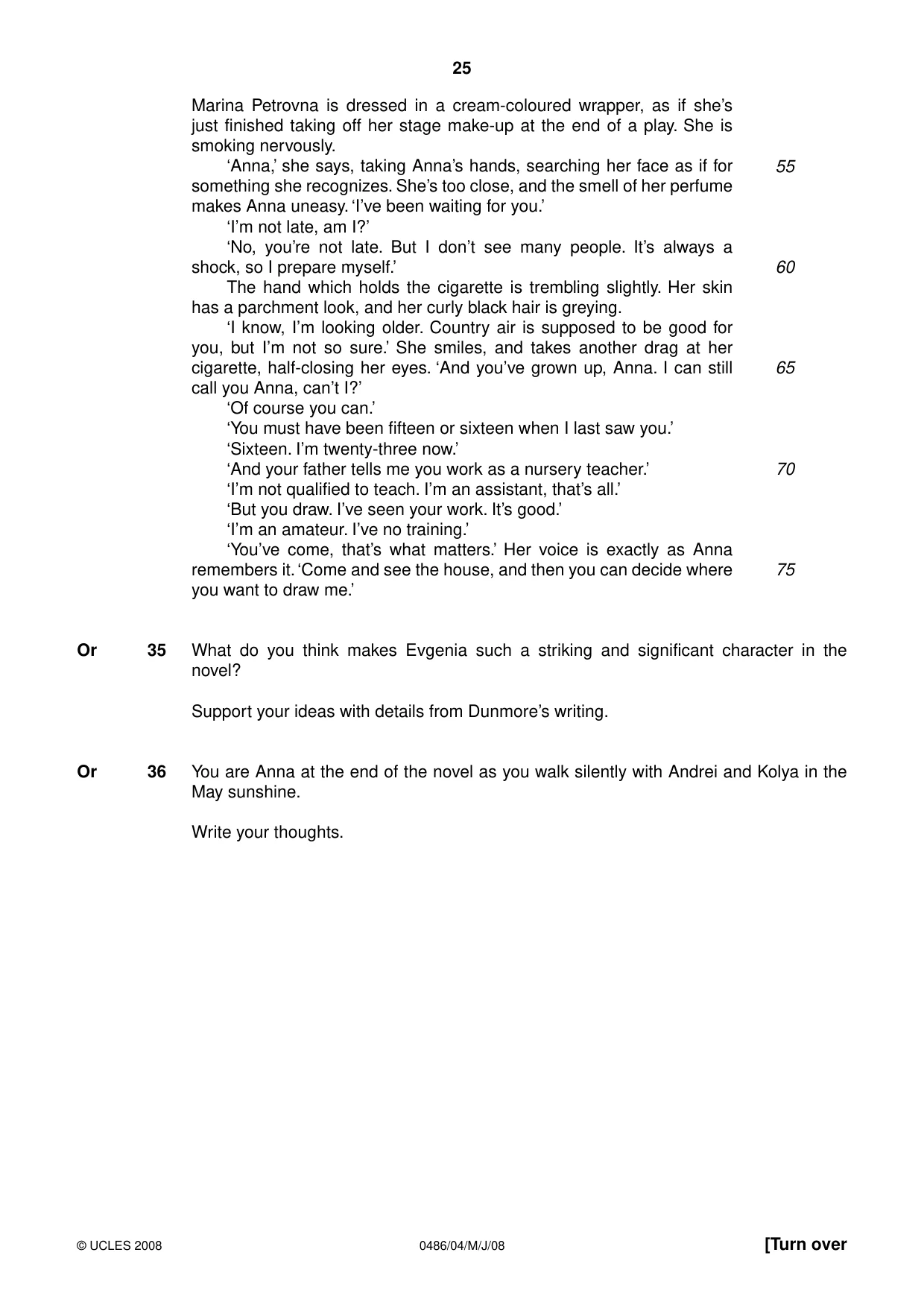
25 0486/04/M/J/08 © UCLES 2008 [Turn over Marina Petrovna is dressed in a cream-coloured wrapper, as if she’s just finished taking off her stage make-up at the end of a play. She is smoking nervously. ‘Anna,’ she says, taking Anna’s hands, searching her face as if for something she recognizes. She’s too close, and the smell of her perfume makes Anna uneasy. ‘I’ve been waiting for you.’ ‘I’m not late, am I?’ ‘No, you’re not late. But I don’t see many people. It’s always a shock, so I prepare myself.’ The hand which holds the cigarette is trembling slightly. Her skin has a parchment look, and her curly black hair is greying. ‘I know, I’m looking older. Country air is supposed to be good for you, but I’m not so sure.’ She smiles, and takes another drag at her cigarette, half-closing her eyes. ‘And you’ve grown up, Anna. I can still call you Anna, can’t I?’ ‘Of course you can.’ ‘You must have been fifteen or sixteen when I last saw you.’ ‘Sixteen. I’m twenty-three now.’ ‘And your father tells me you work as a nursery teacher.’ ‘I’m not qualified to teach. I’m an assistant, that’s all.’ ‘But you draw. I’ve seen your work. It’s good.’ ‘I’m an amateur. I’ve no training.’ ‘You’ve come, that’s what matters.’ Her voice is exactly as Anna remembers it. ‘Come and see the house, and then you can decide where you want to draw me.’ Or 35 What do you think makes Evgenia such a striking and significant character in the novel? Support your ideas with details from Dunmore’s writing. Or 36 You are Anna at the end of the novel as you walk silently with Andrei and Kolya in the May sunshine. Write your thoughts. 55 60 65 70 75
Question paper, page 26
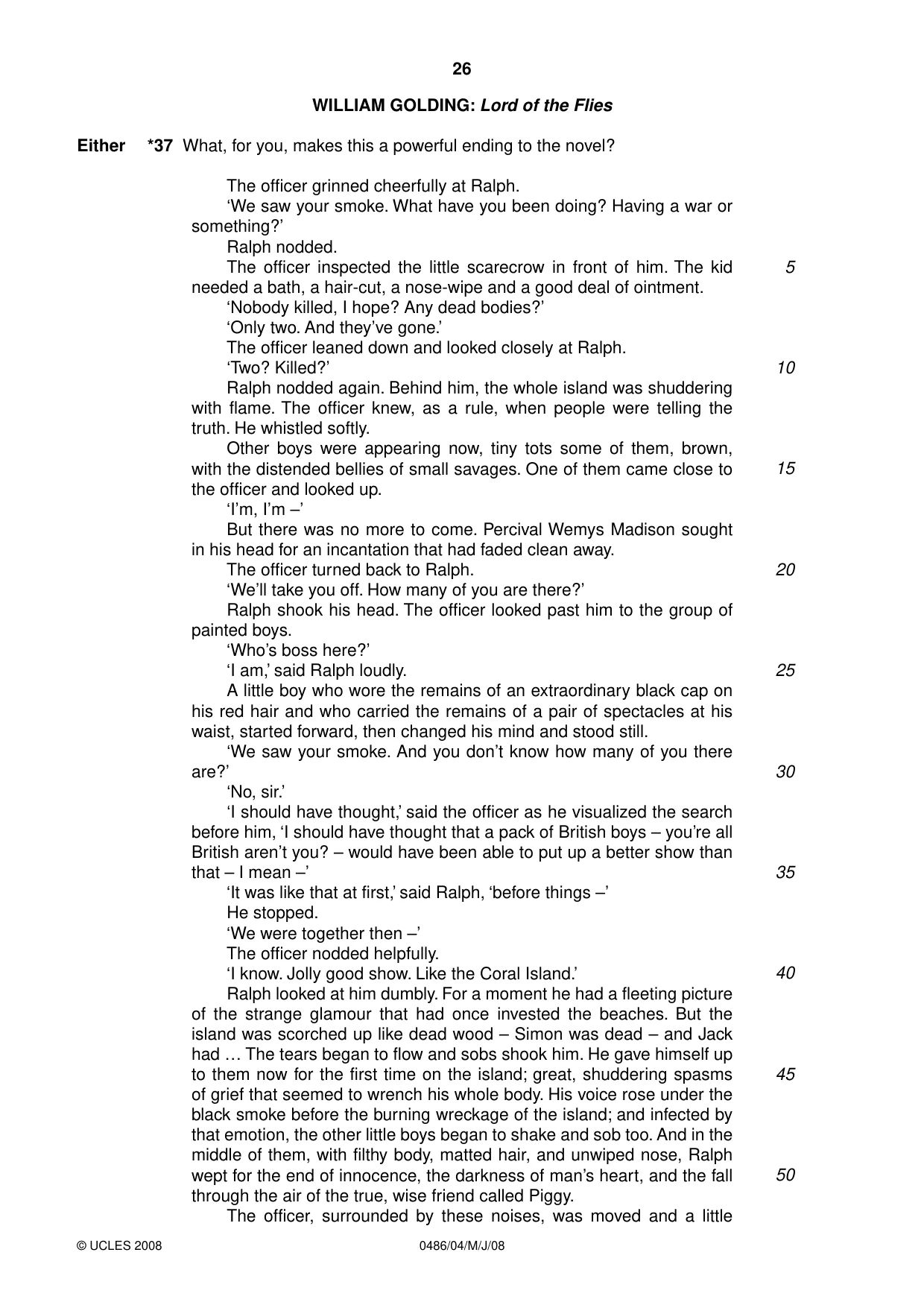
26 0486/04/M/J/08 © UCLES 2008 WILLIAM GOLDING: Lord of the Flies Either *37 What, for you, makes this a powerful ending to the novel? The officer grinned cheerfully at Ralph. ‘We saw your smoke. What have you been doing? Having a war or something?’ Ralph nodded. The officer inspected the little scarecrow in front of him. The kid needed a bath, a hair-cut, a nose-wipe and a good deal of ointment. ‘Nobody killed, I hope? Any dead bodies?’ ‘Only two. And they’ve gone.’ The officer leaned down and looked closely at Ralph. ‘Two? Killed?’ Ralph nodded again. Behind him, the whole island was shuddering with flame. The officer knew, as a rule, when people were telling the truth. He whistled softly. Other boys were appearing now, tiny tots some of them, brown, with the distended bellies of small savages. One of them came close to the officer and looked up. ‘I’m, I’m –’ But there was no more to come. Percival Wemys Madison sought in his head for an incantation that had faded clean away. The officer turned back to Ralph. ‘We’ll take you off. How many of you are there?’ Ralph shook his head. The officer looked past him to the group of painted boys. ‘Who’s boss here?’ ‘I am,’ said Ralph loudly. A little boy who wore the remains of an extraordinary black cap on his red hair and who carried the remains of a pair of spectacles at his waist, started forward, then changed his mind and stood still. ‘We saw your smoke. And you don’t know how many of you there are?’ ‘No, sir.’ ‘I should have thought,’ said the officer as he visualized the search before him, ‘I should have thought that a pack of British boys – you’re all British aren’t you? – would have been able to put up a better show than that – I mean –’ ‘It was like that at first,’ said Ralph, ‘before things –’ He stopped. ‘We were together then –’ The officer nodded helpfully. ‘I know. Jolly good show. Like the Coral Island.’ Ralph looked at him dumbly. For a moment he had a fleeting picture of the strange glamour that had once invested the beaches. But the island was scorched up like dead wood – Simon was dead – and Jack had … The tears began to flow and sobs shook him. He gave himself up to them now for the first time on the island; great, shuddering spasms of grief that seemed to wrench his whole body. His voice rose under the black smoke before the burning wreckage of the island; and infected by that emotion, the other little boys began to shake and sob too. And in the middle of them, with filthy body, matted hair, and unwiped nose, Ralph wept for the end of innocence, the darkness of man’s heart, and the fall through the air of the true, wise friend called Piggy. The officer, surrounded by these noises, was moved and a little 5 10 15 20 25 30 35 40 45 50
Question paper, page 27
27 0486/04/M/J/08 © UCLES 2008 [Turn over embarrassed. He turned away to give them time to pull themselves together; and waited, allowing his eyes to rest on the trim cruiser in the distance. Or 38 Explore in detail how Golding makes the violence and brutality that the boys are capable of particularly frightening in any one incident in the novel. Or 39 You are Jack. You have just heard the littluns describing the ‘twisty things in the trees’ and talking about their fears of the beast. Write your thoughts. 55
Question paper, page 28
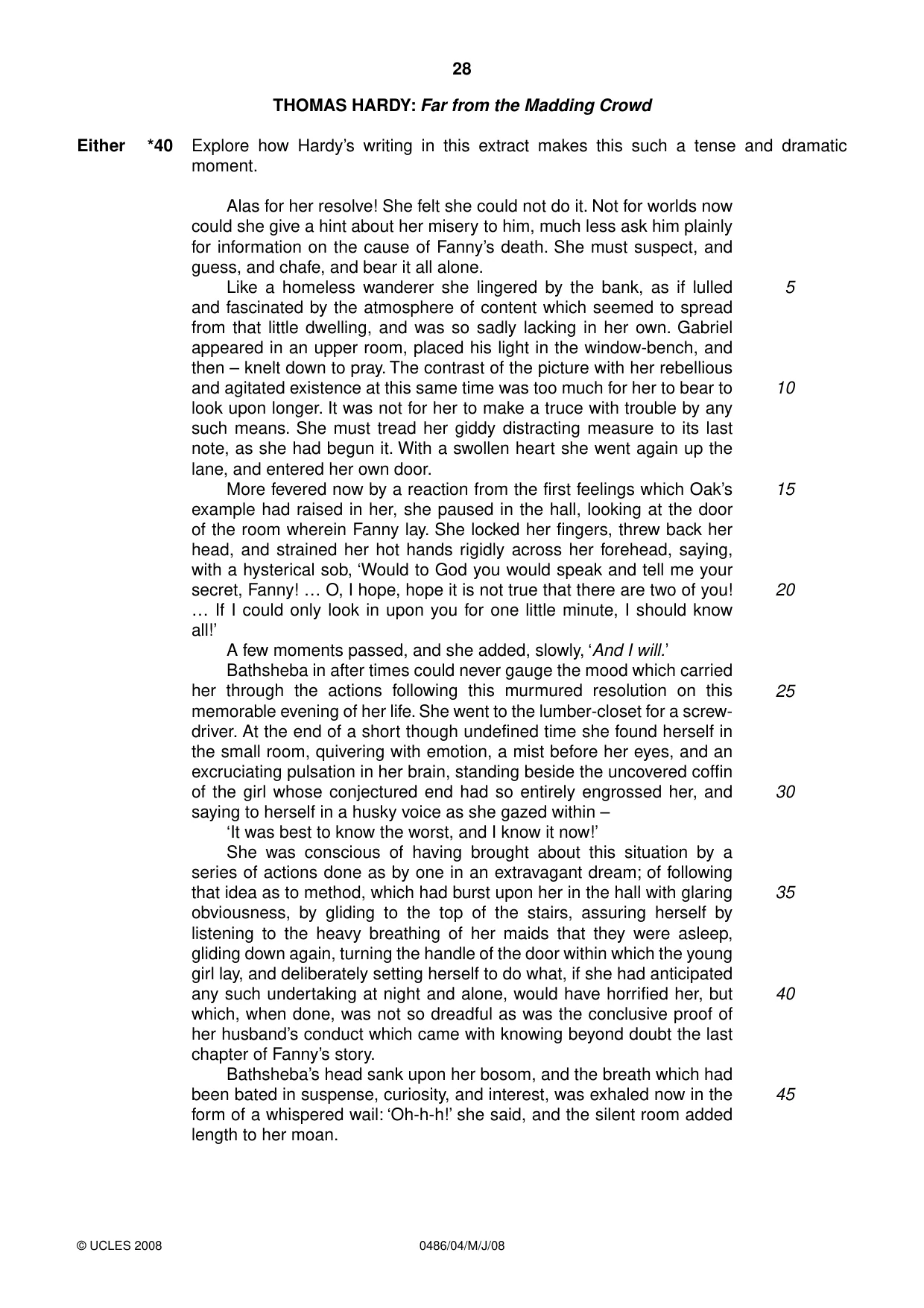
28 0486/04/M/J/08 © UCLES 2008 THOMAS HARDY: Far from the Madding Crowd Either *40 Explore how Hardy’s writing in this extract makes this such a tense and dramatic moment. Alas for her resolve! She felt she could not do it. Not for worlds now could she give a hint about her misery to him, much less ask him plainly for information on the cause of Fanny’s death. She must suspect, and guess, and chafe, and bear it all alone. Like a homeless wanderer she lingered by the bank, as if lulled and fascinated by the atmosphere of content which seemed to spread from that little dwelling, and was so sadly lacking in her own. Gabriel appeared in an upper room, placed his light in the window-bench, and then – knelt down to pray. The contrast of the picture with her rebellious and agitated existence at this same time was too much for her to bear to look upon longer. It was not for her to make a truce with trouble by any such means. She must tread her giddy distracting measure to its last note, as she had begun it. With a swollen heart she went again up the lane, and entered her own door. More fevered now by a reaction from the first feelings which Oak’s example had raised in her, she paused in the hall, looking at the door of the room wherein Fanny lay. She locked her fingers, threw back her head, and strained her hot hands rigidly across her forehead, saying, with a hysterical sob, ‘Would to God you would speak and tell me your secret, Fanny! … O, I hope, hope it is not true that there are two of you! … If I could only look in upon you for one little minute, I should know all!’ A few moments passed, and she added, slowly, ‘And I will.’ Bathsheba in after times could never gauge the mood which carried her through the actions following this murmured resolution on this memorable evening of her life. She went to the lumber-closet for a screw- driver. At the end of a short though undefined time she found herself in the small room, quivering with emotion, a mist before her eyes, and an excruciating pulsation in her brain, standing beside the uncovered coffin of the girl whose conjectured end had so entirely engrossed her, and saying to herself in a husky voice as she gazed within – ‘It was best to know the worst, and I know it now!’ She was conscious of having brought about this situation by a series of actions done as by one in an extravagant dream; of following that idea as to method, which had burst upon her in the hall with glaring obviousness, by gliding to the top of the stairs, assuring herself by listening to the heavy breathing of her maids that they were asleep, gliding down again, turning the handle of the door within which the young girl lay, and deliberately setting herself to do what, if she had anticipated any such undertaking at night and alone, would have horrified her, but which, when done, was not so dreadful as was the conclusive proof of her husband’s conduct which came with knowing beyond doubt the last chapter of Fanny’s story. Bathsheba’s head sank upon her bosom, and the breath which had been bated in suspense, curiosity, and interest, was exhaled now in the form of a whispered wail: ‘Oh-h-h!’ she said, and the silent room added length to her moan. 5 10 15 20 25 30 35 40 45
Question paper, page 29
29 0486/04/M/J/08 © UCLES 2008 [Turn over Or 41 Foolish and stubborn Decent and considerate How far do you think both these descriptions apply to Farmer Boldwood? Refer in detail to the novel in your answer. Or 42 You are Sergeant Troy thinking later in the day about your meeting with Fanny Robin, when, greatly distressed, she enquired about the Casterbridge-Union house. Write your thoughts.
Question paper, page 30
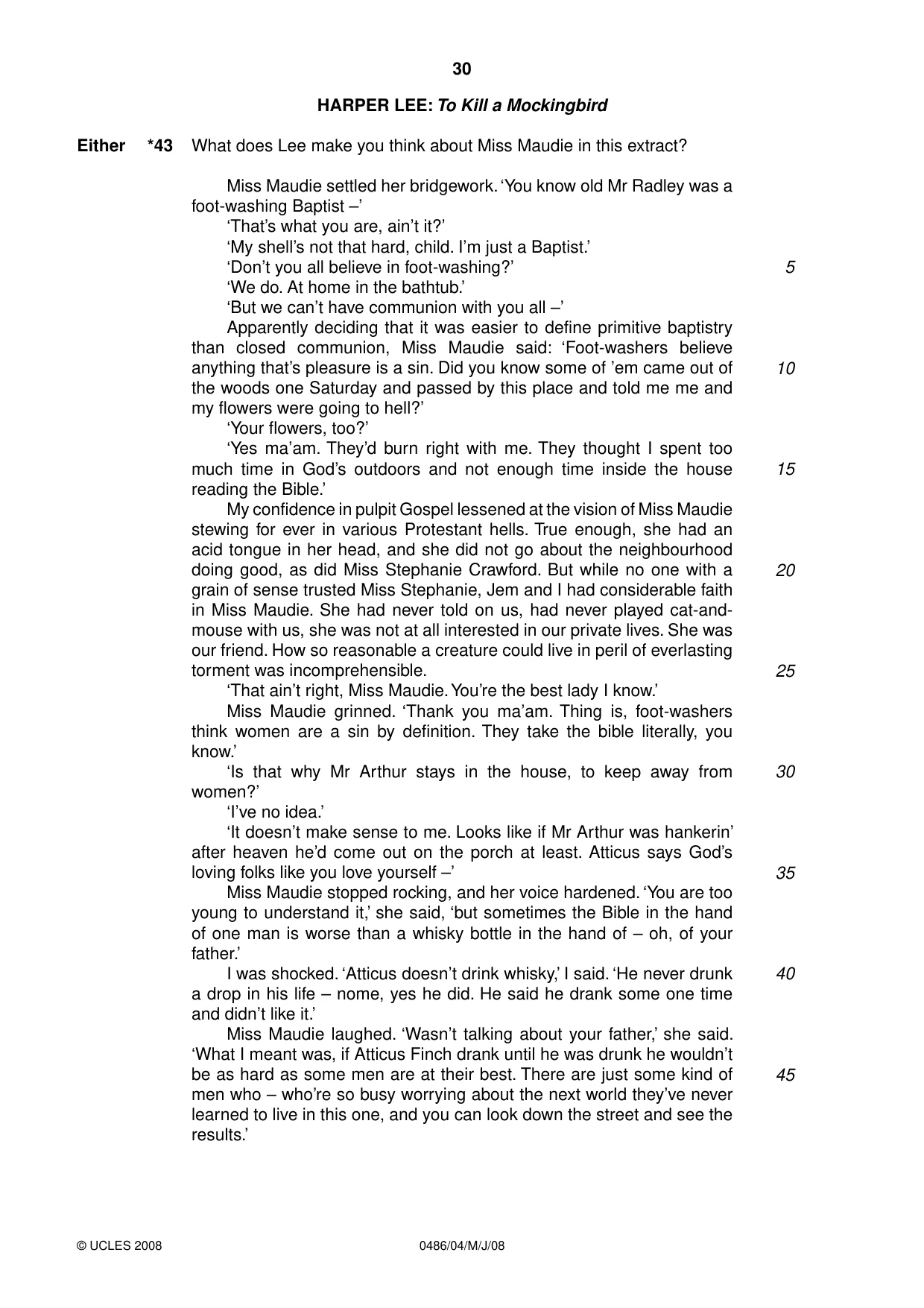
30 0486/04/M/J/08 © UCLES 2008 HARPER LEE: To Kill a Mockingbird Either *43 What does Lee make you think about Miss Maudie in this extract? Miss Maudie settled her bridgework. ‘You know old Mr Radley was a foot-washing Baptist –’ ‘That’s what you are, ain’t it?’ ‘My shell’s not that hard, child. I’m just a Baptist.’ ‘Don’t you all believe in foot-washing?’ ‘We do. At home in the bathtub.’ ‘But we can’t have communion with you all –’ Apparently deciding that it was easier to define primitive baptistry than closed communion, Miss Maudie said: ‘Foot-washers believe anything that’s pleasure is a sin. Did you know some of ’em came out of the woods one Saturday and passed by this place and told me me and my flowers were going to hell?’ ‘Your flowers, too?’ ‘Yes ma’am. They’d burn right with me. They thought I spent too much time in God’s outdoors and not enough time inside the house reading the Bible.’ My confidence in pulpit Gospel lessened at the vision of Miss Maudie stewing for ever in various Protestant hells. True enough, she had an acid tongue in her head, and she did not go about the neighbourhood doing good, as did Miss Stephanie Crawford. But while no one with a grain of sense trusted Miss Stephanie, Jem and I had considerable faith in Miss Maudie. She had never told on us, had never played cat-and- mouse with us, she was not at all interested in our private lives. She was our friend. How so reasonable a creature could live in peril of everlasting torment was incomprehensible. ‘That ain’t right, Miss Maudie. You’re the best lady I know.’ Miss Maudie grinned. ‘Thank you ma’am. Thing is, foot-washers think women are a sin by definition. They take the bible literally, you know.’ ‘Is that why Mr Arthur stays in the house, to keep away from women?’ ‘I’ve no idea.’ ‘It doesn’t make sense to me. Looks like if Mr Arthur was hankerin’ after heaven he’d come out on the porch at least. Atticus says God’s loving folks like you love yourself –’ Miss Maudie stopped rocking, and her voice hardened. ‘You are too young to understand it,’ she said, ‘but sometimes the Bible in the hand of one man is worse than a whisky bottle in the hand of – oh, of your father.’ I was shocked. ‘Atticus doesn’t drink whisky,’ I said. ‘He never drunk a drop in his life – nome, yes he did. He said he drank some one time and didn’t like it.’ Miss Maudie laughed. ‘Wasn’t talking about your father,’ she said. ‘What I meant was, if Atticus Finch drank until he was drunk he wouldn’t be as hard as some men are at their best. There are just some kind of men who – who’re so busy worrying about the next world they’ve never learned to live in this one, and you can look down the street and see the results.’ 5 10 15 20 25 30 35 40 45
Question paper, page 31
31 0486/04/M/J/08 © UCLES 2008 [Turn over Or 44 Explore the relationship between Calpurnia and the two children, showing why Atticus has such confidence in her. Refer to details in the novel in your answer. Or 45 You are Atticus, on your way to the opening day of the trial of Tom Robinson. Write your thoughts.
Question paper, page 32
32 0486/04/M/J/08 © UCLES 2008 BARRIE WADE, ed.: Into the Wind: Contemporary Stories in English Either *46 Explore how Lessing, in this passage from ‘Flight’, vividly portrays the different characters and their relationships with one another. ‘Waiting for Steven, hey?’ he said, his fingers curling like claws into his palm. ‘Any objection?’ she asked lightly, refusing to look at him. He confronted her, his eyes narrowed, shoulders hunched, tight in a hard knot of pain which included the preening birds, the sunlight, the flowers. He said: ‘Think you’re old enough to go courting, hey?’ The girl tossed her head at the old-fashioned phrase and sulked, ‘Oh, Grandad!’ ‘Think you want to leave home, hey? Think you can go running around the fields at night?’ Her smile made him see her, as he had every evening of this warm end-of-summer month, swinging hand in hand along the road to the village with that red-handed, red-throated, violent-bodied youth, the son of the postmaster. Misery went to his head and he shouted angrily: ‘I’ll tell your mother!’ ‘Tell away!’ she said, laughing, and went back to the gate. He heard her singing, for him to hear: ‘I’ve got you under my skin, ‘I’ve got you deep in the heart of …’ ‘Rubbish,’ he shouted. ‘Rubbish. Impudent little bit of rubbish!’ Growling under his breath he turned towards the dovecote, which was his refuge from the house he shared with his daughter and her husband and their children. But now the house would be empty. Gone all the young girls with their laughter and their squabbling and their teasing. He would be left; uncherished and alone, with that square-fronted, calm- eyed woman, his daughter. He stooped, muttering, before the dovecote, resenting the absorbed cooing birds. From the gate the girl shouted: ‘Go and tell! Go on, what are you waiting for?’ Obstinately he made his way to the house, with quick, pathetic persistent glances of appeal back at her. But she never looked around. Her defiant but anxious young body stung him into love and repentance. He stopped. ‘But I never meant …’ He muttered, waiting for her to turn and run to him. ‘I didn’t mean …’ She did not turn. She had forgotten him. Along the road came the young man Steven, with something in his hand. A present for her? The old man stiffened as he watched the gate swing back, and the couple embrace. In the brittle shadows of the frangipani tree his granddaughter, his darling, lay in the arms of the postmaster’s son, and her hair flowed back over his shoulder. ‘I see you!’ shouted the old man spitefully. They did not move. He stumped into the little whitewashed house, hearing the wooden veranda creak angrily under his feet. His daughter was sewing in the front room, threading a needle held to the light. He stopped again, looking back into the garden. The couple were now sauntering among the bushes, laughing. As he watched he saw the girl escape from the youth with a sudden mischievous movement, and run off through the flowers with him in pursuit. He heard shouts, laughter, a scream, silence. ‘But it’s not like that at all,’ he muttered miserably. ‘It’s not like that. 5 10 15 20 25 30 35 40 45 50
Question paper, page 33
33 0486/04/M/J/08 © UCLES 2008 Why can’t you see? Running and giggling, and kissing and kissing. You’ll come to something quite different.’ He looked at his daughter with sardonic hatred, hating himself. They were caught and finished, both of them, but the girl was still running free. ‘Can’t you see?’ he demanded of his invisible granddaughter, who was at that moment lying in the thick green grass with the postmaster’s son. His daughter looked at him and her eyebrows went up in tired forbearance. ‘Put your birds to bed?’ she asked, humouring him. ‘Lucy,’ he said urgently. ‘Lucy …’ ‘Well, what is it now?’ ‘She’s in the garden with Steven.’ ‘Now you just sit down and have your tea.’ He stumped his feet alternatively, thump, thump, on the hollow wooden floor and shouted: ‘She’ll marry him. I’m telling you, she’ll be marrying him next!’ His daughter rose swiftly, brought him a cup, set him a plate. Or 47 Choose two moments, each from a different short story, where you are amused by a character’s misunderstanding of a situation, and show how the writing makes you amused. Or 48 You are a Man Called Horse at the end of the story. You are on your way home to Boston. Write your thoughts. 55 60 65 70
Question paper, page 36
36 0486/04/M/J/08 BLANK PAGE Copyright Acknowledgements: Question 1 A SMALL FAMILY BUSINESS © Haydonning Ltd 1987. All rights whatsoever in this play are strictly reserved and application for performance etc., must be made before rehearsal to Casarotto Ramsay & Associates Ltd., Waverly House, 7–12 Noel Street, London W1F 8GQ England. No performance may be given unless a licence has been obtained. Question 4 © Lorraine Hansberry; A Raisin in the Sun ; Methuen Publishing Ltd; 2001. Question 7 © Arthur Miller; The Crucible. Question 16 © By Tennessee Williams, from A STREETCAR NAMED DESIRE, copyright © 1974 by The University of the South. Reprinted by permission of New Directions Publishing Corp. Question 19 © James Baxter; Farmhand. Question 25 © From Things Fall Apart by Chinua Achebe. Reprinted by permission of Harcourt Education. Question 31 © Ian Cross; The God Boy ; Penguin Books; 2004. Question 34 © A P Watt on behalf of Helen Dunmore. Question 37 From LORD OF THE FLIES by William Golding, copyright 1954, renewed © 1982 by William Gerald Golding. Used by permission of G.P. Putnam’s Sons, a division of Penguin Group (USA) Inc. Question 43 © Harper Lee; To Kill a Mockingbird ; Vintage; 2004. Question 46 © Doring Lessing; Flight. Permission to reproduce items where third-party owned material protected by copyright is included has been sought and cleared where possible. Every reasonable effort has been made by the publisher (UCLES) to trace copyright holders, but if any items requiring clearance have unwittingly been included, the publisher will be pleased to make amends at the earliest possible opportunity. University of Cambridge International Examinations is part of the Cambridge Assessment Group. Cambridge Assessment is the brand name of University of Cambridge Local Examinations Syndicate (UCLES), which is itself a department of the University of Cambridge.
Mark scheme, page 1
UNIVERSITY OF CAMBRIDGE INTERNATIONAL EXAMINATIONS International General Certificate of Secondary Education MARK SCHEME for the May/June 2008 question paper 0486 LITERATURE (ENGLISH) 0486/04 Paper 4 (Closed Books), maximum raw mark 80 This mark scheme is published as an aid to teachers and candidates, to indicate the requirements of the examination. It shows the basis on which Examiners were instructed to award marks. It does not indicate the details of the discussions that took place at an Examiners’ meeting before marking began. All Examiners are instructed that alternative correct answers and unexpected approaches in candidates’ scripts must be given marks that fairly reflect the relevant knowledge and skills demonstrated. Mark schemes must be read in conjunction with the question papers and the report on the examination. • CIE will not enter into discussions or correspondence in connection with these mark schemes. CIE is publishing the mark schemes for the May/June 2008 question papers for most IGCSE, GCE Advanced Level and Advanced Subsidiary Level syllabuses and some Ordinary Level syllabuses. www.XtremePapers.com
Mark scheme, page 2
Page 2 Mark Scheme Syllabus Paper IGCSE – May/June 2008 0486 04 © UCLES 2008 General Descriptors The general descriptors are an attempt to guide examiners to an understanding of the qualities normally expected of, or ‘typical’ of work in the band. They must not be interpreted as hurdle statements, and form a means of general guidance. Photostats taken from work produced in the examination will be the principal means by which we shall standardise the marking. A. Descriptors for essay/passage-based tasks 0–1 The answer does not meet the criteria for a mark in the next band. 2–3 Candidates will – show a little awareness of… make some comment about… 4–5 Candidates will – make a few straightforward points about… show a few signs of understanding… make a little reference to aspects of the text… make simple personal response to… 6–8 Candidates will – make some relevant comment about… show some understanding of… with a little support from the text/reference to language. 9–11 Candidates will – begin to develop a response… show understanding of … with some detail from the text/reference to language. 12–14 Candidates will – make a reasonably sustained/extended response… show understanding of… show some thoroughness in use of text for support. make some response to the way language works. 15–17 Candidates will – make a convincing response… show clear, sustained understanding of… make careful and relevant reference to the text. respond with some thoroughness/detail to the way language works. 18–20 Candidates will – sustain a perceptive, convincing response… demonstrate clear critical/analytical understanding. show some originality of thought. make much well-selected reference to the text. respond sensitively and in detail to the way language works. The very best will achieve all the above, with flair, imagination and sophistication in addition.
Mark scheme, page 3
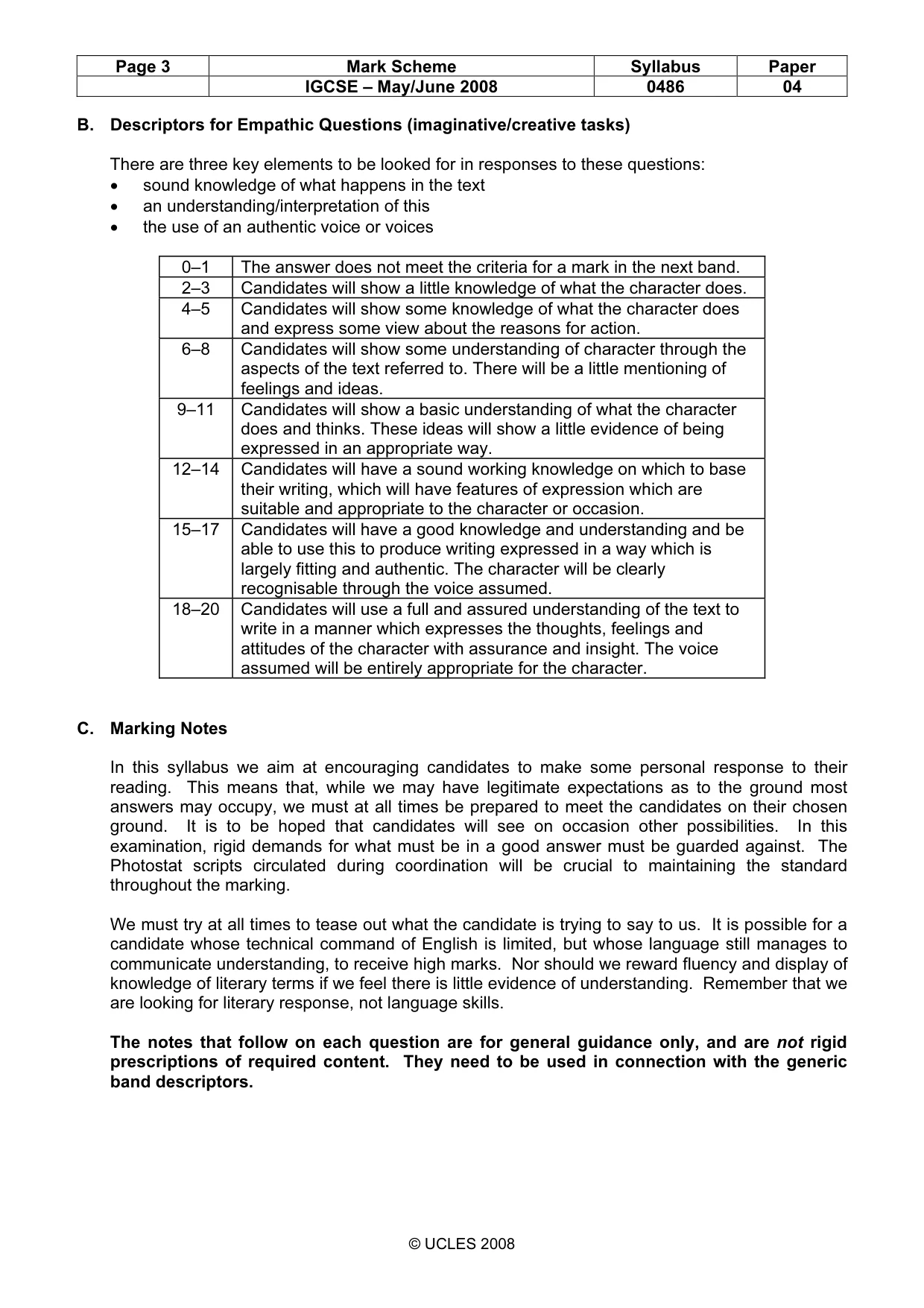
Page 3 Mark Scheme Syllabus Paper IGCSE – May/June 2008 0486 04 © UCLES 2008 B. Descriptors for Empathic Questions (imaginative/creative tasks) There are three key elements to be looked for in responses to these questions: • sound knowledge of what happens in the text • an understanding/interpretation of this • the use of an authentic voice or voices 0–1 The answer does not meet the criteria for a mark in the next band. 2–3 Candidates will show a little knowledge of what the character does. 4–5 Candidates will show some knowledge of what the character does and express some view about the reasons for action. 6–8 Candidates will show some understanding of character through the aspects of the text referred to. There will be a little mentioning of feelings and ideas. 9–11 Candidates will show a basic understanding of what the character does and thinks. These ideas will show a little evidence of being expressed in an appropriate way. 12–14 Candidates will have a sound working knowledge on which to base their writing, which will have features of expression which are suitable and appropriate to the character or occasion. 15–17 Candidates will have a good knowledge and understanding and be able to use this to produce writing expressed in a way which is largely fitting and authentic. The character will be clearly recognisable through the voice assumed. 18–20 Candidates will use a full and assured understanding of the text to write in a manner which expresses the thoughts, feelings and attitudes of the character with assurance and insight. The voice assumed will be entirely appropriate for the character. C. Marking Notes In this syllabus we aim at encouraging candidates to make some personal response to their reading. This means that, while we may have legitimate expectations as to the ground most answers may occupy, we must at all times be prepared to meet the candidates on their chosen ground. It is to be hoped that candidates will see on occasion other possibilities. In this examination, rigid demands for what must be in a good answer must be guarded against. The Photostat scripts circulated during coordination will be crucial to maintaining the standard throughout the marking. We must try at all times to tease out what the candidate is trying to say to us. It is possible for a candidate whose technical command of English is limited, but whose language still manages to communicate understanding, to receive high marks. Nor should we reward fluency and display of knowledge of literary terms if we feel there is little evidence of understanding. Remember that we are looking for literary response, not language skills. The notes that follow on each question are for general guidance only, and are not rigid prescriptions of required content. They need to be used in connection with the generic band descriptors.
Mark scheme, page 4
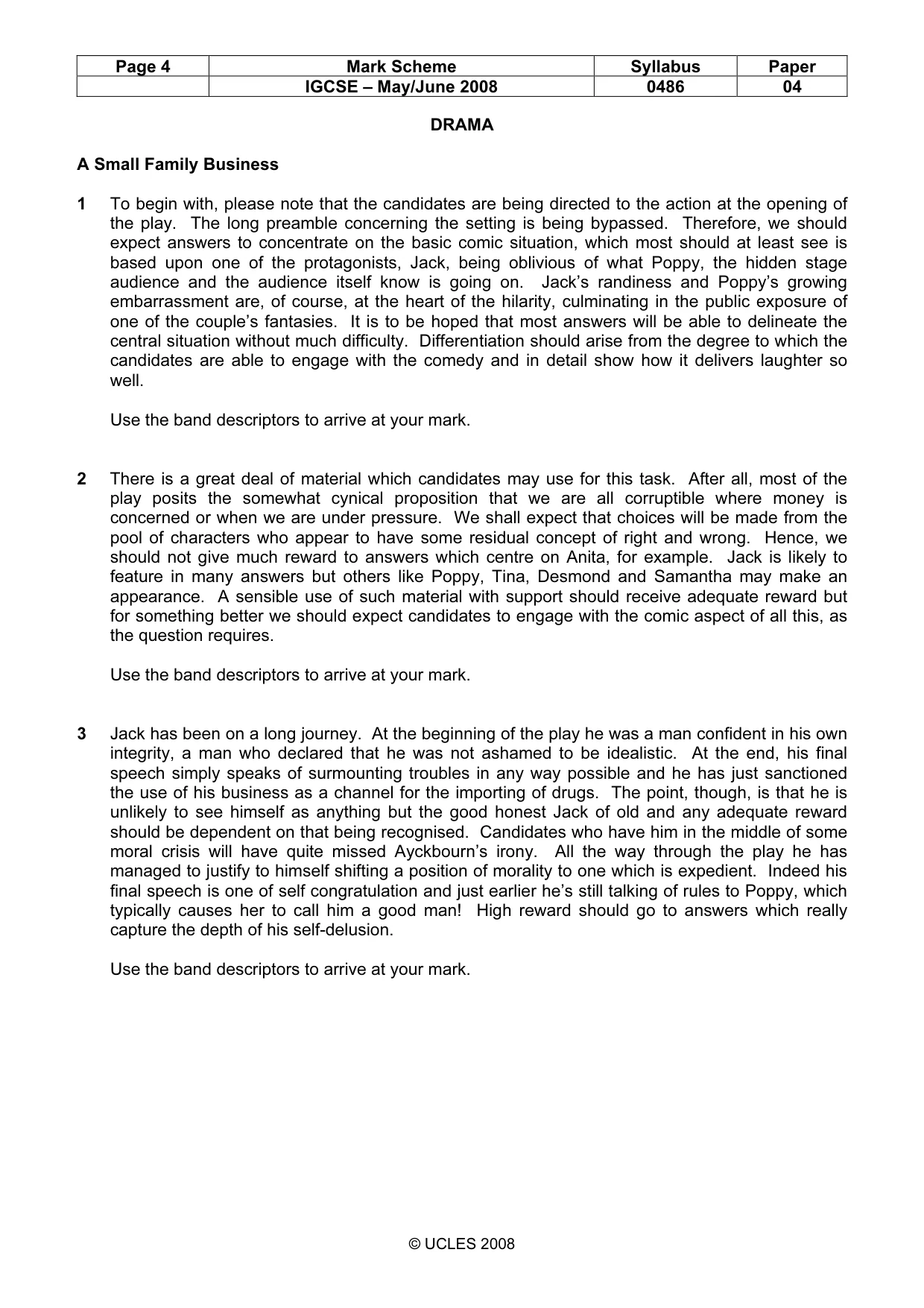
Page 4 Mark Scheme Syllabus Paper IGCSE – May/June 2008 0486 04 © UCLES 2008 DRAMA A Small Family Business 1 To begin with, please note that the candidates are being directed to the action at the opening of the play. The long preamble concerning the setting is being bypassed. Therefore, we should expect answers to concentrate on the basic comic situation, which most should at least see is based upon one of the protagonists, Jack, being oblivious of what Poppy, the hidden stage audience and the audience itself know is going on. Jack’s randiness and Poppy’s growing embarrassment are, of course, at the heart of the hilarity, culminating in the public exposure of one of the couple’s fantasies. It is to be hoped that most answers will be able to delineate the central situation without much difficulty. Differentiation should arise from the degree to which the candidates are able to engage with the comedy and in detail show how it delivers laughter so well. Use the band descriptors to arrive at your mark. 2 There is a great deal of material which candidates may use for this task. After all, most of the play posits the somewhat cynical proposition that we are all corruptible where money is concerned or when we are under pressure. We shall expect that choices will be made from the pool of characters who appear to have some residual concept of right and wrong. Hence, we should not give much reward to answers which centre on Anita, for example. Jack is likely to feature in many answers but others like Poppy, Tina, Desmond and Samantha may make an appearance. A sensible use of such material with support should receive adequate reward but for something better we should expect candidates to engage with the comic aspect of all this, as the question requires. Use the band descriptors to arrive at your mark. 3 Jack has been on a long journey. At the beginning of the play he was a man confident in his own integrity, a man who declared that he was not ashamed to be idealistic. At the end, his final speech simply speaks of surmounting troubles in any way possible and he has just sanctioned the use of his business as a channel for the importing of drugs. The point, though, is that he is unlikely to see himself as anything but the good honest Jack of old and any adequate reward should be dependent on that being recognised. Candidates who have him in the middle of some moral crisis will have quite missed Ayckbourn’s irony. All the way through the play he has managed to justify to himself shifting a position of morality to one which is expedient. Indeed his final speech is one of self congratulation and just earlier he’s still talking of rules to Poppy, which typically causes her to call him a good man! High reward should go to answers which really capture the depth of his self-delusion. Use the band descriptors to arrive at your mark.
Mark scheme, page 5
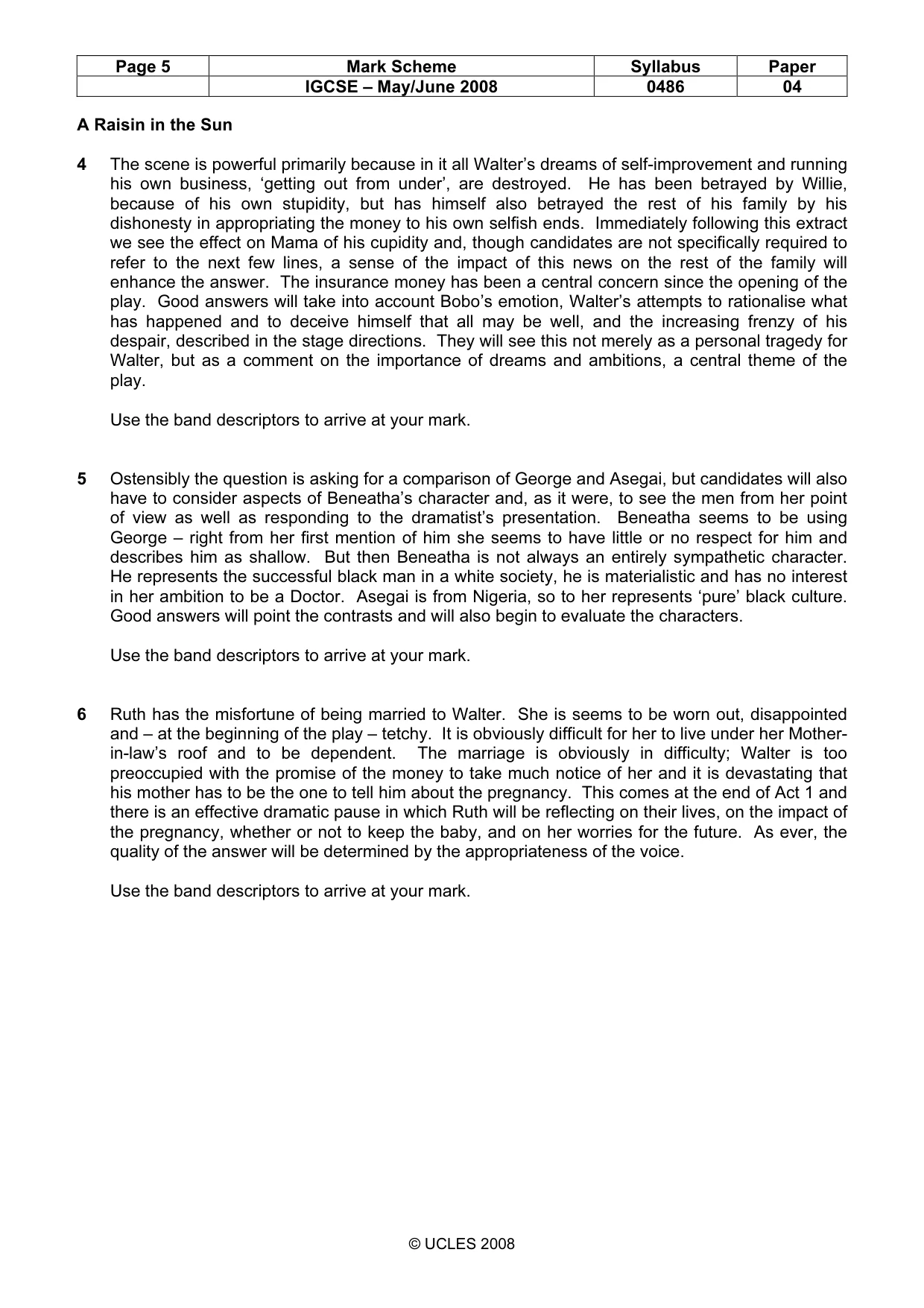
Page 5 Mark Scheme Syllabus Paper IGCSE – May/June 2008 0486 04 © UCLES 2008 A Raisin in the Sun 4 The scene is powerful primarily because in it all Walter’s dreams of self-improvement and running his own business, ‘getting out from under’, are destroyed. He has been betrayed by Willie, because of his own stupidity, but has himself also betrayed the rest of his family by his dishonesty in appropriating the money to his own selfish ends. Immediately following this extract we see the effect on Mama of his cupidity and, though candidates are not specifically required to refer to the next few lines, a sense of the impact of this news on the rest of the family will enhance the answer. The insurance money has been a central concern since the opening of the play. Good answers will take into account Bobo’s emotion, Walter’s attempts to rationalise what has happened and to deceive himself that all may be well, and the increasing frenzy of his despair, described in the stage directions. They will see this not merely as a personal tragedy for Walter, but as a comment on the importance of dreams and ambitions, a central theme of the play. Use the band descriptors to arrive at your mark. 5 Ostensibly the question is asking for a comparison of George and Asegai, but candidates will also have to consider aspects of Beneatha’s character and, as it were, to see the men from her point of view as well as responding to the dramatist’s presentation. Beneatha seems to be using George – right from her first mention of him she seems to have little or no respect for him and describes him as shallow. But then Beneatha is not always an entirely sympathetic character. He represents the successful black man in a white society, he is materialistic and has no interest in her ambition to be a Doctor. Asegai is from Nigeria, so to her represents ‘pure’ black culture. Good answers will point the contrasts and will also begin to evaluate the characters. Use the band descriptors to arrive at your mark. 6 Ruth has the misfortune of being married to Walter. She is seems to be worn out, disappointed and – at the beginning of the play – tetchy. It is obviously difficult for her to live under her Mother- in-law’s roof and to be dependent. The marriage is obviously in difficulty; Walter is too preoccupied with the promise of the money to take much notice of her and it is devastating that his mother has to be the one to tell him about the pregnancy. This comes at the end of Act 1 and there is an effective dramatic pause in which Ruth will be reflecting on their lives, on the impact of the pregnancy, whether or not to keep the baby, and on her worries for the future. As ever, the quality of the answer will be determined by the appropriateness of the voice. Use the band descriptors to arrive at your mark.
Mark scheme, page 6
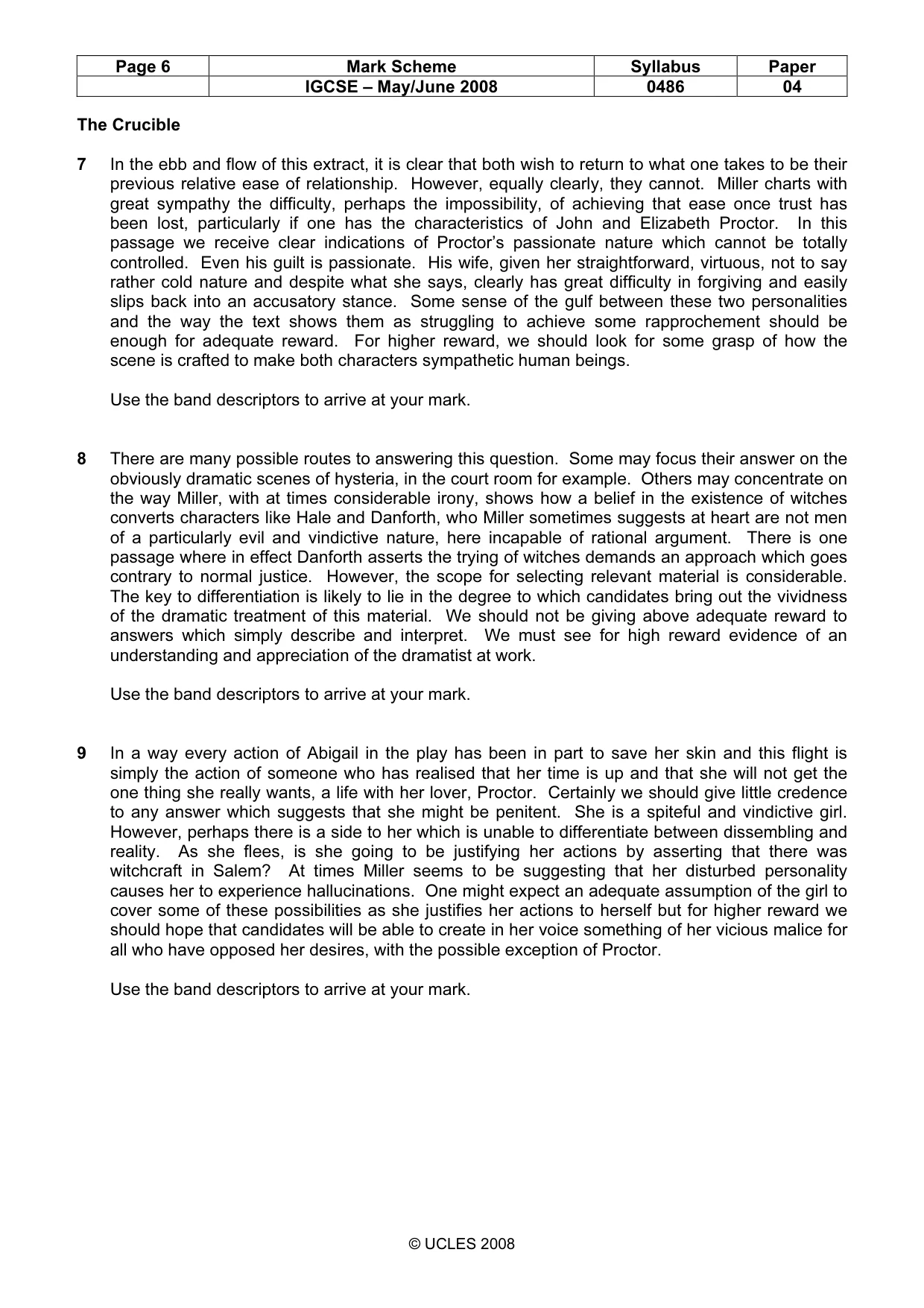
Page 6 Mark Scheme Syllabus Paper IGCSE – May/June 2008 0486 04 © UCLES 2008 The Crucible 7 In the ebb and flow of this extract, it is clear that both wish to return to what one takes to be their previous relative ease of relationship. However, equally clearly, they cannot. Miller charts with great sympathy the difficulty, perhaps the impossibility, of achieving that ease once trust has been lost, particularly if one has the characteristics of John and Elizabeth Proctor. In this passage we receive clear indications of Proctor’s passionate nature which cannot be totally controlled. Even his guilt is passionate. His wife, given her straightforward, virtuous, not to say rather cold nature and despite what she says, clearly has great difficulty in forgiving and easily slips back into an accusatory stance. Some sense of the gulf between these two personalities and the way the text shows them as struggling to achieve some rapprochement should be enough for adequate reward. For higher reward, we should look for some grasp of how the scene is crafted to make both characters sympathetic human beings. Use the band descriptors to arrive at your mark. 8 There are many possible routes to answering this question. Some may focus their answer on the obviously dramatic scenes of hysteria, in the court room for example. Others may concentrate on the way Miller, with at times considerable irony, shows how a belief in the existence of witches converts characters like Hale and Danforth, who Miller sometimes suggests at heart are not men of a particularly evil and vindictive nature, here incapable of rational argument. There is one passage where in effect Danforth asserts the trying of witches demands an approach which goes contrary to normal justice. However, the scope for selecting relevant material is considerable. The key to differentiation is likely to lie in the degree to which candidates bring out the vividness of the dramatic treatment of this material. We should not be giving above adequate reward to answers which simply describe and interpret. We must see for high reward evidence of an understanding and appreciation of the dramatist at work. Use the band descriptors to arrive at your mark. 9 In a way every action of Abigail in the play has been in part to save her skin and this flight is simply the action of someone who has realised that her time is up and that she will not get the one thing she really wants, a life with her lover, Proctor. Certainly we should give little credence to any answer which suggests that she might be penitent. She is a spiteful and vindictive girl. However, perhaps there is a side to her which is unable to differentiate between dissembling and reality. As she flees, is she going to be justifying her actions by asserting that there was witchcraft in Salem? At times Miller seems to be suggesting that her disturbed personality causes her to experience hallucinations. One might expect an adequate assumption of the girl to cover some of these possibilities as she justifies her actions to herself but for higher reward we should hope that candidates will be able to create in her voice something of her vicious malice for all who have opposed her desires, with the possible exception of Proctor. Use the band descriptors to arrive at your mark.
Mark scheme, page 7
Page 7 Mark Scheme Syllabus Paper IGCSE – May/June 2008 0486 04 © UCLES 2008 As You Like It 10 As with all answers to questions on drama texts, response to the visual qualities of what is going on on stage is important. The opening focuses on a dominant character, who turns out to be the hero, expounding on his misfortunes and on his wicked brother, and this is immediately followed up by a demonstration of the nastiness of the said brother. So, sympathy for Orlando is very quickly established and the audience will already be partisan and will be hooked into the basic question of how Orlando is going to get himself out of this. Good answers will begin to see how the question of blood relationships is likely to become an issue and will begin to explore the language of the scene. They will probably note that it is written in prose and will have different ideas about the reasons for this. They may note the liveliness and sharpness of the way in which Orlando uses words and the contrasting imperiousness of Oliver. The actual blow that Oliver gives Orlando is shocking and puts the audience even more on the side of the latter. Use the band descriptors to arrive at your mark. 11 This question may elicit lots of prepared character sketches, but answers will not be successful unless they show a strong personal response backed up by precise reference. Like Orlando, Rosalind is treated very unfairly at the start of the play, but does not sit about feeling sorry for herself. Orlando has already fallen for her, and the early banter between her and Celia demonstrates her intellect and humour, and this is carried even further in her use of disguise and in her further dealings with Orlando. It may be that candidates feel that she is too good to be true, but good answers will make at least some attempt at evaluation and will show awareness of the necessity to pay attention to the writing. Use the band descriptors to arrive at your mark. 12 More than just narrative is required from the Duke, though most answers will contain at least an element of it. It will be more important for him to consider the benefits of the Forest as against the Court, to consider the characters with whom he has been living, and the way in which he has be reunited with his daughter. He may also be looking forward to a new regime, though this is not required. As ever the quality of the answer will be determined by the appropriateness of the voice. Use the band descriptors to arrive at your mark.
Mark scheme, page 8
Page 8 Mark Scheme Syllabus Paper IGCSE – May/June 2008 0486 04 © UCLES 2008 Macbeth 13 The key words in this task are horror and memorable. The opportunities which Shakespeare’s language offers the candidate to respond to the nightmare quality of this scene are legion and therefore we should not give even adequate reward to answers which simply tell us what is going on with a little comment about significance. We should expect candidates to be able to respond at least in some degree to the way Shakespeare portrays the nature of the deed, the world Macbeth has now entered and the world he has for ever left behind. It may well be that some will also find horrifying Lady Macbeth’s apparently unimaginative imperviousness to the consequences of murdering Duncan. High reward should, as usual, only be given to those who can show engagement with the power of the dramatic verse together with some insight as to the roots of its power. Use the band descriptors to arrive at your mark. 14 There are a number of scenes or dramatic instances which bring home to the audience the nature of life under a tyrant. The Macduff scenes spring to mind, of course, as do those which concern Banquo’s murder. However, there are also a number of moments in which minor characters also illustrate just how terrifying is Macbeth’s Scotland, such as the conversation between Lennox and a lord and the role the Doctor plays in the demise of Lady Macbeth. Therefore, it should not be difficult for candidates to find relevant material and construct at least a worthwhile enough justification of their choice to warrant adequate reward. For anything higher, however, the key word in the question is terrifying. We should demand for higher reward engagement with Shakespeare’s dramatic power in some detail. Use the band descriptors to arrive at your mark. 15 We only see Lady Macbeth once more in the play after this. The Banquet, despite it showing her continuing ability to act decisively, has illustrated just how minimal is her influence now over her husband and what a gulf there is between them. She was, indeed, innocent of the knowledge of Banquo’s murder and is still, no doubt, bewildered as to the precise reason for her husband’s fits. She will, no doubt, feel her power slipping away from her and will perhaps in her desperation begin to sense that she has had little grasp of the consequences of regicide. Her situation now is in no way what she expected it to be as Queen of Scotland. In differentiation it is important that we are careful not to give much to candidates who virtually present what she says as she sleepwalks. To the very end she refuses to admit to her conscious self the full consequences of her actions. Here she will probably still be trying to buoy herself up, perhaps suggesting to herself that she can get Macbeth back on track. Her scorn for his behaviour at the banquet is evident. However, some of the better assumptions of her character may also give her a sense of rising desperation which has also been evident in one or two remarks she has made. Use the band descriptors to arrive at your mark.
Mark scheme, page 9
Page 9 Mark Scheme Syllabus Paper IGCSE – May/June 2008 0486 04 © UCLES 2008 A Streetcar Named Desire 16 Blanche is in some difficulty here as her cover is blown. The light reveals her appearance for what it is – considerably past its best. Furthermore, it symbolises how she is deceitful and pretends to be what she is not, which works when there is shade. Her high-flown speeches are a veil for the true Blanche. Williams here uses expressions such as ‘Rub-a-dub-dub, three men in a tub...’ to show the anger she feels that her deceit has been exposed. She will not admit her lies; she tells ‘...what ought to be the truth’. She ‘didn’t lie in her heart’. These and so many other phrases in Williams’s writing show us the pathetic state which Blanche has reached. Mitch is used as the conduit. We should differentiate through how far candidates explore the writing and the way in which Mitch is used to bring out the viciousness of Blanche’s attack on men and the ferocity with which she defends herself. Use the band descriptors to arrive at your mark. 17 That Stella loves Stanley there is no doubt. She is completely besotted with him and, although she takes criticism of herself, she will defend Stanley. There is plenty of evidence to support the first description, though some candidates may well use lust and passion for ‘love’. Even after physical abuse, she forgives even without thinking about it. The second description applies only to a degree. She is ‘weak’ insofar as she meekly accepts Stanley’s excesses and puts herself out so that he can play poker or go bowling and drinking with his friends. She weakly accepts Stanley’s lead in most matters. Although possessed of some intelligence, she has lost some of her taste and judgement in naively surrendering to Stanley. Blanche points out the untidiness of the apartment and hints that she has been easily led into bad habits by her boorish husband. She accepts him as her leader and always yields to him. Candidates who probe the details of Stella’s submissiveness and her obsessive feelings for Stanley in revealing her character should score well. Use the band descriptors to arrive at your mark. 18 Immediately following Blanche’s savage references to him, Stanley shows cunning self-control. He deliberately marches in and embraces Stella who responds passionately. The first part of a response here is likely to refer to Stanley’s clear attempt at putting Blanche down. Further reflection will have Stanley thinking about how he will wreak his revenge on Blanche; his determination to get her out of his apartment; perhaps even to his violent attack on her in Scene 10: ‘We’ve had this date with each other from the beginning.’ Comments about her lies, her pretences, her snobbishness, her self-deceit will surely figure. Those who see all or most of these characteristics in their portrayal of Stanley will do well; we should reserve the highest reward for those who capture his ungrammatical drawl, his grunts of contempt and his shrewd insight into the falseness of Blanche. Use the band descriptors to arrive at your mark.
Mark scheme, page 10
Page 10 Mark Scheme Syllabus Paper IGCSE – May/June 2008 0486 04 © UCLES 2008 POETRY 19–24 Refer to the photostats and the grade descriptors when arriving at your mark. Poetry is literary language at its most intense. A poem in a short space can create a multiplicity of resonances and hence possible meanings. We must expect that candidates will offer a very wide variety of responses and interpretations, and it is appropriate to emphasise that we as examiners must at all times keep a totally open mind when assessing work on a poem. In the exercise of our judgment, we shall, of course, read work which shows manifestly little or no understanding of a poem and we will mark that accordingly. However, it is also a regular experience to find answers which offer valid perspectives new to the examiner and which, just as manifestly, deserve to be given high reward. We will differentiate first of all according to how directly the candidates answer the question. Examiners will notice that all the questions prescribe the poems from which the candidates should choose. This is to ensure that the candidate is writing on a poem appropriate to the question. It is also designed to send a strong signal to candidates that they are taking a large risk going into the examination with only one or two poems which they are determined to fit to one of the questions. The problem can be that some will choose a question because the poem they wish to write about appears in the list rather than because they can answer the question. We must be very careful not to give much reward for answers which manifestly are not addressing the question, even if they show a convincing grasp of the poem. Also, examiners should guard against over-rewarding run throughs and always remember that all the tasks demand that the candidate engage with the poem in a specific way. They are never simple invitations just to write about a poem. We should think very hard before putting such work in Band 3. Beyond focus on the question, we will also assess according to how well candidates convince us that they have engaged with the pleasure and excitement of poetry. This means in effect that we do NOT give high reward to any explanation of "meaning" which shows little response to the words and how they create meaning. In all of the questions there is an explicit requirement to make a response to the words and it will be difficult for any work which fails to engage in this way to progress beyond Band 3. In addition, examiners should be careful not to over-reward comment which is able to isolate vivid features of a poem’s language but which is unable to probe the reasons for their vividness. For instance, the noting of rhyme, sound and movement, the listing of significant words and figures of speech is only a very small first step to insightful personal response. Work given high reward should show the ability of the candidate to analyse how such features of a poem’s language achieve their effect.
Mark scheme, page 11
Page 11 Mark Scheme Syllabus Paper IGCSE – May/June 2008 0486 04 © UCLES 2008 PROSE Things Fall Apart 25 There are a number of things which will no doubt feature in the answers. Firstly, there is in the description of the funeral the sense of the closeness of the spirit world in the people’s minds to their everyday life. Secondly, there is, of course, the fear which overwhelms the tribe if something like the accidental killing of the youth occurs, the fear of offending the deities and bringing down catastrophe upon the tribe. Hence, the offending individual must be removed from the society and thus Okonkwo’s life in a moment is ruined. Of course, Okonkwo does not for a moment question the ‘justice’ of this, though significantly at the end of the chapter the thoughtful Obereika does ponder the barbarities which are taken as necessary to appease the spirit world. Any answer which ranges over some of this material should receive adequate reward but for something better once again we should expect some response to the striking qualities of the extract and Achebe’s writing. Use the band descriptors to arrive at your mark. 26 This is an open question, as it tends to be in the novel. Many candidates are likely to feel critical of the profoundly subordinate role of women in this culture of polygamy. At least in Okonkwo’s case, the man’s word is absolute and beatings appear a regular feature. Indeed, there is one instance of the wife becoming a convenient scapegoat simply for a bad mood. Children, it goes without saying, are expected even more to hang upon the man’s every word and desire. All of that is clear. What is not so clear is the author’s attitude. Irony only occasionally surfaces and it is notable that there is no evidence in the novel that any woman sees this as other than the natural order of things. Does Achebe hint that such a culture, particularly when the man is as strong a personality as Okonkwo, gives the wives security and even pride in their role in the family community? Whatever the interpretation of Achebe’s intentions, differentiation is likely to occur from the range of reference offered in the answer in support of the argument. Use the band descriptors to arrive at your mark. 27 The important thing here is that of its nature this is the internal Okonkwo, who is somewhat different to his public persona. Not that it would be that different. For him tribal law is absolute and there is no possibility that it can be questioned. The elders have spoken and any real man does what needs to be done, and perhaps more. Typically for him, of course, his pride makes him go one step further than necessary in that he takes a prominent part in the sacrifice. Is that a way of illustrating that he the great warrior is not prey to personal sentiment? The central question is to what degree he would admit to his inner self the dreadfulness of his loss, of a boy who was becoming almost his own son. It is difficult to believe that he would entirely blot that out and for an adequate reward we might expect an assumption which depicts turmoil and sorrow. However, perhaps the better candidates will show themselves by setting a limit on that and recognising that even to himself Okonkwo cannot admit anything which might suggest weakness. Use the band descriptors to arrive at your mark.
Mark scheme, page 12
Page 12 Mark Scheme Syllabus Paper IGCSE – May/June 2008 0486 04 © UCLES 2008 Pride and Prejudice 28 There is such a wealth of material pertinent to the task that we must be prepared to accept a variety of responses, at least as far as the supporting detail is concerned. Darcy’s astonishment that this young woman from such an inferior family should first of all make him fall in love and then turn him down speaks volumes about his hauteur. Therefore, in part at least, the reader delights in the vehemence of Elizabeth’s rejection of him. However, like much in Austen, things are never that simple. Most candidates will no doubt see the obvious nature of Darcy’s pride but perhaps fewer might wonder whether there is some justice in his appraisal of most of the Bennet family and may also question whether the very strength of Elizabeth’s response does not suggest that pride and prejudice are playing a part in her response and that she is not being completely true to herself. The penultimate paragraph has her getting near to recognising what her true feelings might be before she buoys herself up once more by giving herself a pat on the back for doing the moral thing. Therefore it may be by candidates showing an awareness of the complexity of her reactions that we sort the good from the average. Use the band descriptors to arrive at your mark. 29 As usual, it is important to note that this task is not encouraging candidates to write their character sketch of Elizabeth Bennet. The key word is attractive and answers which show little engagement with features of her personality which do attract should receive only mediocre reward. We should expect even average candidates to be able to convey their enjoyment of this feisty young woman who, even in her failings, radiates an energetic independence, a ready eye for human absurdity and a fierce devotion to principle. Even her tendency to rush to judgment suggests a disarming absence of cold calculation. For higher reward we should look to candidates to show in some detail how Austen’s writing conveys this delightful young woman’s personality. Use the band descriptors to arrive at your mark. 30 This task should provide ample opportunity for the imaginative candidate to assume a characteristic voice; Lydia’s mode of speech is so memorable. For adequate reward we should expect the candidate as a starting point to recognise the mood in which she is returning to Longbourn. Limited reward only should go to those who think that she is apprehensive of visiting the family she has so nearly disgraced. Penitence is unknown to Lydia; for her it is a triumphant return. She is the first of Mrs Bennet’s offspring to have captured a husband and she is sufficiently like her mother to know that by her at least she will be welcomed with open arms. For Lydia it has been a jolly escapade, it has demonstrated her adult independence and resulted in marriage to the most handsome of men, her Wickham – one in the eye for her tiresome, and unmarried, elder sisters. Hopefully the better candidates will be able to capture something of her flighty language. Use the band descriptors to arrive at your mark.
Mark scheme, page 13
Page 13 Mark Scheme Syllabus Paper IGCSE – May/June 2008 0486 04 © UCLES 2008 The God Boy 31 The dreadfulness of the father’s speeches is obviously one of the features of this extract. His pathetic attempts to bolster his ego and the viciousness of his references to Jimmy’s mother make him out to be a despicable creature. This is also the one place in the novel where there is an explicit reference to what is about to happen as we see the mother at the end of her tether. Underpinning it all, though, is Jimmy’s unbearably poignant attempt to distance himself from what is happening and what is being said by pretending that he is elsewhere and happy. It should be possible for most candidates to mine some of the material and make a case for its horror but we should reserve high reward as usual for those who really engage with the detail of the writing and show how that horror is conveyed. Use the band descriptors to arrive at your mark. 32 There are many instances of humour in the book, some very obvious. One which might well prove popular is the wonderful description of the bicycle race which Jimmy has with Legs. Another is the almost surreal conversation Jimmy has with Sister Angela about the state of his soul. There is, of course, much pertinent material to be found in other episodes which tends to sit side by side with things of serious import, like the lies which Jimmy feels he has to invent about his family when he is visiting Joe’s family. Jimmy’s naivety is a constant source of amusement as well. However, whatever the choice made, the key to differentiation will lie in candidate’s ability to bring out how the writing makes the reader laugh. For high reward we should expect more than an apt choice and some description of the episode. We should look for engagement. Use the band descriptors to arrive at your mark. 33 In a way Molly’s life is another tragedy waiting to be written, a life which we can only guess at through the distortions of her younger brother’s understanding. However, by the end of the novel the reader has been able to piece together a picture of a girl/young woman in despair and desperate to escape. She has known the truth about her parents’ marriage for years; she has been sent off to boarding school; she probably knew or guessed about the abortion; she understands the hatred at the centre of her family and she can do nothing about it. Such was her despair that she tried when she was younger to take Jimmy with her on a suicide mission. Now she is nearly a grown woman and clearly determined to be independent. However, she is also desperately sorry for the brother who cannot escape and this presumably brings back all her anguish. We might presume that her sympathies lie with the mother but we have no evidence of this. She may well blame her as much as the father for her terrible childhood. For an adequate reward we should expect the girl’s wretched memories to emerge, together with her feelings of powerlessness. However, some ability to put into telling words her anguish will be necessary for higher reward. Use the band descriptors to arrive at your mark.
Mark scheme, page 14
Page 14 Mark Scheme Syllabus Paper IGCSE – May/June 2008 0486 04 © UCLES 2008 The Siege 34 The preamble to the actual meeting suggests Anna’s mixed feelings about the forthcoming meeting. Even the description of the journey and its difficulty perhaps is an image of her apprehension at meeting the woman who caused so much unhappiness to her mother. Is the description of what Anna thinks could still happen to this disgraced artist almost a half conscious wish that it might?(!) In the previous chapter she was furious with her father for arranging the meeting. However, there is also palpable excitement at the artistic challenge and opportunity it offers. What we see of Marina at the end of the extract suggests equal apprehension of how the meeting will go. An understanding of the situation and its context should be enough for adequate reward. For anything higher we should look for the candidate to show how the writing suggests the various under currents. Use the band descriptors to arrive at your mark. 35 Evgenia is one of the heroines of the book. Dunmore gives serious substance to what has been in the past something of a target for derision by many, shot putters featuring as Heroes of the Soviet Union. Evgenia does not have much imagination which, of course, is a help. However, her indomitable spirit, her strength, her good humour, her nose for survival and above all else her willingness to help and protect people like Anna who do not quite have the same survival instincts or knowledge of the world draws the reader’s admiration to her. Nowhere is this more so than in the way she deals with the ‘lizard’ Galya who otherwise would have ensured that Anna at the very least departed with a useless stove. She is an iconic figure of resistance and survival. Some knowledge of the detail of character and her significance should be enough for adequate reward to be given but for anything higher we should expect the candidate to be able to show in detail why Dunmore’s creation makes such an memorable impact upon the reader. Use the band descriptors to arrive at your mark. 36 Many things may well be going through your mind. The important thing which candidates should convey, of course, is that you are in love and you have survived. You will no doubt carry with you on this Spring day memories of those who have not survived; we should clearly not be prescriptive as to what these memories might be. However, the tone in which they are expressed is likely to be the main discriminator. Anna is not an effusive character; she has had too many harsh experiences to take anything for granted. Hence, we should not over-reward assumptions which read like the heroine of a romantic novel. Spring may be here but the siege and the war goes on and great uncertainties even as to survival must remain. Higher reward should go only to those who manage to communicate something of her cautious level headedness. Use the band descriptors to arrive at your mark.
Mark scheme, page 15
Page 15 Mark Scheme Syllabus Paper IGCSE – May/June 2008 0486 04 © UCLES 2008 Lord of the Flies 37 First of all, this is a dramatic ending: the culmination of the pursuit of Ralph whose death seemed almost inevitable. The passage is full of irony – the officer is completely unaware of what has been going on and wouldn’t have believed it anyway. The contrast between the appearances of the boys as seen from his point of view and the way in which the reader has come to view them is very striking (Ralph is here ‘a little scarecrow’ and Jack ‘a little boy’). The enormity of what has gone on becomes trivialised by the officer’s references to the expectations of British boys and the references to the Coral Island. And Ralph’s emotion is devastating. There will be lots of other points to make and good answers will pick on significant details and explore them in some depth. Use the band descriptors to arrive at your mark. 38 There are numerous suitable incidents, such as the death of Simon, the killing of the pig, the killing of Piggy, the hunting of Ralph. Even Roger throwing stones at Henry could be used to good effect. The key to a good answer is appropriate selection and focus on the way the writing elicits fear. Use the band descriptors to arrive at your mark. 39 Jack is unlikely to be moved by the ‘nightmares’ of the littluns. He will be anxious to rationalise and dismiss their fears and to keep focused on his priority – hunting. He will be intolerant of, and see as weak, Piggy and Ralph’s sympathy for the littluns. He may well demonstrate a good deal of bravado and will be thinking about what he can do with his hunters to overcome any possible threat. Good answers will create a convincing voice for Jack. Use the band descriptors to arrive at your mark.
Mark scheme, page 16
Page 16 Mark Scheme Syllabus Paper IGCSE – May/June 2008 0486 04 © UCLES 2008 Far From the Madding Crowd 40 This is a most distressing moment for Bathsheba. Hardy presents her as feeling guilty at trespassing on the dead Fanny. He heightens the tension through examining her thoughts as she comes to make the terrible decision. His description is carefully charted to create maximum suspense for the reader. It is emphasised further by the inner conviction which in vain she tries to dismiss that there is a child in the coffin which is her husband’s. Phrases such as ‘quivering with emotion’, ‘excruciating pulsation’, ‘the silent room added length to her moan’, all show the power of the writing. The clandestine way she has approached her gruesome task provides an appropriate and telling background. Candidates whose answers are firmly rooted in Hardy’s writing will deserve high reward. Those who respond with paraphrase without application to the way words are used should receive only modest reward. Use the band descriptors to arrive at your mark. 41 All four adjectives could apply to Boldwood. He is foolish in response to the Valentine and, of course, his actions later in the novel when Troy returns, are senseless. He is stubborn in his relentless pursuit of Bathsheba. That he is decent in many ways is beyond doubt. He is a thoughtful employer and treats his workers considerately. He is respectfully thought of in the community. He helps Fanny Robin and treats her compassionately. He is generous to Gabriel. We should differentiate as to how well candidates balance their answers and explore the writing to substantiate their comments. There may be answers that are slanted in one particular direction and we should look particularly for reasoned and convincing evidence to support such standpoints and ensure that they are not merely misunderstandings. Use the band descriptors to arrive at your mark. 42 Sergeant Troy would be quite angry and dismissive initially. He would go over the circumstances of Fanny’s stupidity again and again. Fanny’s character would come under close scrutiny as would the development of their relationship. Bearing in mind what happens later in the novel he may well soften his approach subsequently. We should differentiate by the degree to which candidates capture the voice and attitude of the swashbuckling Troy and the kind of impatience he reveals at times in other sections of the novel. Use the band descriptors to arrive at your mark.
Mark scheme, page 17
Page 17 Mark Scheme Syllabus Paper IGCSE – May/June 2008 0486 04 © UCLES 2008 To Kill a Mockingbird 43 Miss Maudie is a very straight character who does not talk down to Scout here and who is likeable. She is sensible and full of understanding and abhors small-minded prejudice. Her comments on the Bible are revealing of her level-headed thoughtfulness and her good sense. Scout’s comments say much about her and Lee’s view of her: ’She never told on us, had never played cat-and-mouse with us, she was not at all interested in our private lives. She was our friend. How so reasonable a creature could live in peril of everlasting torment was incomprehensible’. For high reward, we should look for responses that explore the writing fully and adhere to the terms of the question. There are several instances in the extract that reveal tellingly Lee’s attitude to Miss Maudie. Use the band descriptors to arrive at your mark. 44 Calpurnia looks after the children and has a strong influence on them. Atticus, in Chapter 14 refers to her as ‘a faithful member of the family.’ She is kind and understanding with the children, but she can also be firm and demanding when the need arises. She has the children’s best interests at heart. She is a link between the black and white communities and enhances the children’s understanding of her own people. The children learn much from her, for instance when she takes them to her church service. She embodies Atticus’s philosophy. Candidates who explore the writing fully and use moments in the book to support their comments will deserve to be rewarded well. Use the band descriptors to arrive at your mark. 45 Atticus is a man of great courage and eschews all prejudice. He is determined that Tom Robinson will receive a fair trial. He will have thoughts about how he can play his part, the hatred and prejudice he will face and the stance he will have to take on Tom’s behalf. He will no doubt be thinking of the safety and well-being of his family and be concerned that they are not adversely affected by the consequences of the trial. There are numerous examples of Atticus’s voice throughout the novel and we should perhaps differentiate according to how well candidates capture it and communicate Atticus’s qualities and worries for his family. Use the band descriptors to arrive at your mark.
Mark scheme, page 18
Page 18 Mark Scheme Syllabus Paper IGCSE – May/June 2008 0486 04 © UCLES 2008 Into the Wind 46 The first and perhaps central thing to note is that there is love or at least deep affection between all three. However, of course the grandfather’s is a poignantly possessive love. One suspects that Lucy, the youngest, is his favourite (she certainly comes across as lively, loveable and loving although now in urgent love with another) and he cannot bear to think of what the household will be like with her departure. Hence, he erects all manner of reasons why it should not be encouraged. In the fact the real reason for these feelings is that it will be almost as if all laughter and pleasure will be gone from the household since certainly his commonsensical square-fronted daughter seems merely to humour him and treat him almost like a child to be indulged. An understanding of the basic situation and reasons for the feelings of the three people with some support from the extract will be enough for adequate reward but deeper engagement with the way Lessing conveys the sadness of this moment of passage is needed for anything higher. Use the band descriptors to arrive at your mark. 47 Many of the stories offer some relevant material for an answer. The key word here is, of course, amused. It is repeated so there is no excuse for the candidate firstly not to choose an instance which is comic and secondly not to attempt to bring out the things in the writing which make it so. Use the band descriptors to arrive at your mark. 48 This man is now supremely confident in himself. No doubt he will be recalling the process by which he thinks he has grown to a kind of manhood which would not have been possible had he stayed in his life of luxury in Boston in a discontent he could not even define. Now he can define it as not feeling equal to many men. His experiences with the Crows have made him confident he is the equal of any man on earth and that is why the discontent has gone. No doubt he will ponder the events that resulted in this confidence and it is important even at this level that candidates should have him determined to be reticent over his history. He has no need boast or even tell anyone about what has made him such a man. Those who manage to communicate something of this state of mind should receive adequate reward. Something better should be reserved, however, for those who capture the way this is likely to be voiced. He is likely to embellish nothing. His life with the Crows has not been one of speech but one of action. Use the band descriptors to arrive at your mark.
What you needed in this session
Cambridge’s own grade thresholds for 2008 May/June, Paper 4 · Variant 1. A higher threshold means an easier paper — the bar moves with how the cohort did.