Cambridge IGCSE English - Literature 0486 — 2007 May/June Paper 4 · Variant 1
0486/41/M/J/07 · 80 marks · ≈90 min
The question paper and its mark scheme, free to read here and free to download. This is Cambridge’s own paper, exactly as it was sat.
Question paper34 pages










Mark scheme18 pages
Answers below. Sit the paper first if you are practising.
Paper as text
Question paper, page 1
This document consists of 31 printed pages and 5 blank pages. SP (NH) T31588/2 © UCLES 2007 [Turn over UNIVERSITY OF CAMBRIDGE INTERNATIONAL EXAMINATIONS International General Certificate of Secondary Education READ THESE INSTRUCTIONS FIRST If you have been given an Answer Booklet, follow the instructions on the front cover of the Booklet. Write your Centre number, candidate number and name on all the work you hand in. Write in dark blue or black pen. Do not use staples, paper clips, highlighters, glue or correction fluid. Answer four questions. Answer at least one question from each section. Each of your answers must be on a different book. Answer at least one passage-based question (marked *) and at least one essay/empathic question. At the end of the examination, fasten all your work securely together. All questions in this paper carry equal marks. * 4 1 4 8 3 1 9 4 5 5 * LITERATURE (ENGLISH) 0486/04 Paper 4 May/June 2007 2 hours 40 minutes Additional Materials: Answer Booklet/Paper www.XtremePapers.com For reasons of copyright, some material has been removed from this Question Paper.
Question paper, page 3
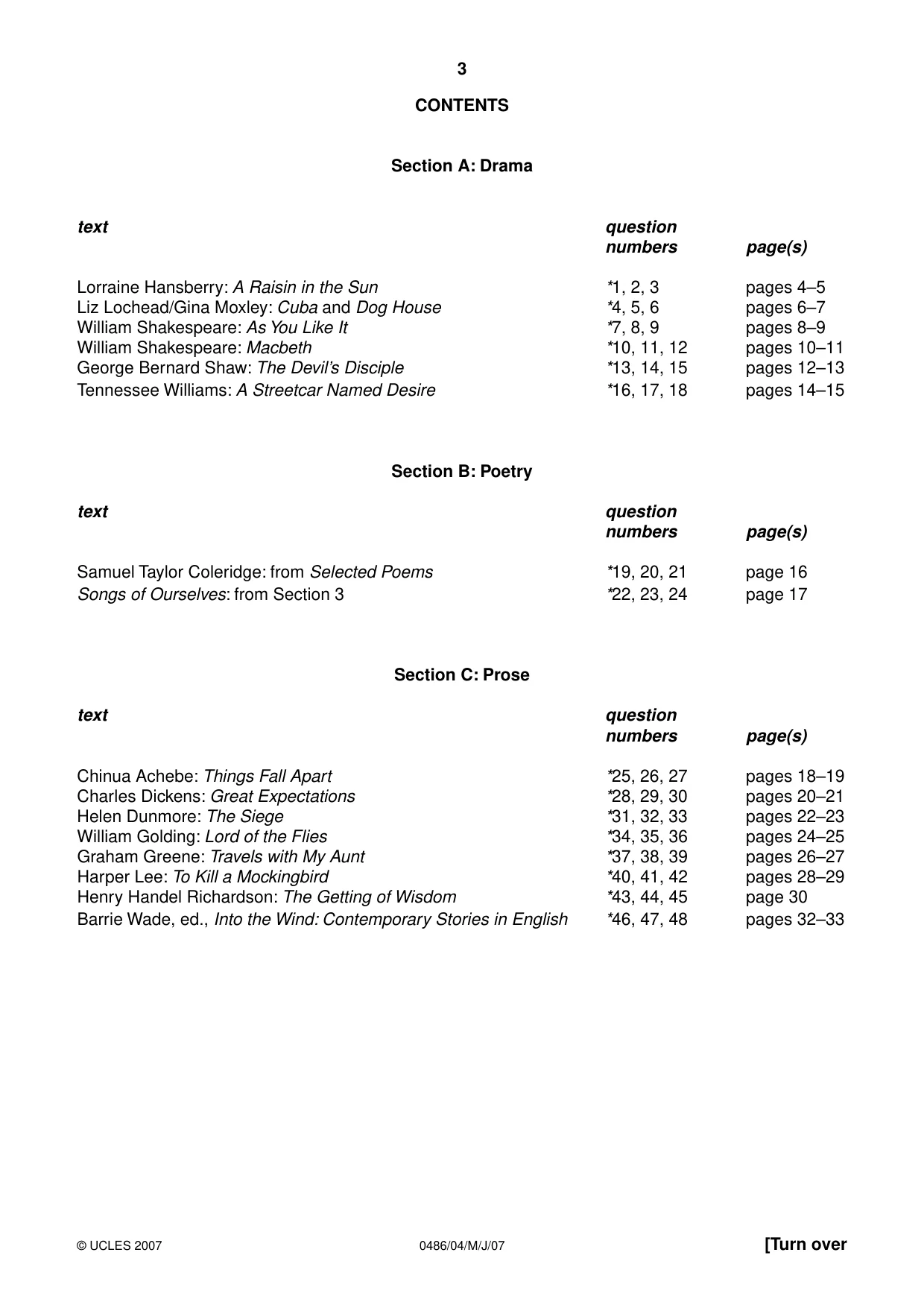
3 0486/04/M/J/07 © UCLES 2007 [Turn over CONTENTS Section A: Drama text question numbers page(s) Lorraine Hansberry: A Raisin in the Sun *1, 2, 3 pages 4–5 Liz Lochead/Gina Moxley: Cuba and Dog House *4, 5, 6 pages 6–7 William Shakespeare: As You Like It *7, 8, 9 pages 8–9 William Shakespeare: Macbeth *10, 11, 12 pages 10–11 George Bernard Shaw: The Devil’s Disciple *13, 14, 15 pages 12–13 Tennessee Williams: A Streetcar Named Desire *16, 17, 18 pages 14–15 Section B: Poetry text question numbers page(s) Samuel Taylor Coleridge: from Selected Poems *19, 20, 21 page 16 Songs of Ourselves: from Section 3 *22, 23, 24 page 17 Section C: Prose text question numbers page(s) Chinua Achebe: Things Fall Apart *25, 26, 27 pages 18–19 Charles Dickens: Great Expectations *28, 29, 30 pages 20–21 Helen Dunmore: The Siege *31, 32, 33 pages 22–23 William Golding: Lord of the Flies *34, 35, 36 pages 24–25 Graham Greene: Travels with My Aunt *37, 38, 39 pages 26–27 Harper Lee: To Kill a Mockingbird *40, 41, 42 pages 28–29 Henry Handel Richardson: The Getting of Wisdom *43, 44, 45 page 30 Barrie Wade, ed., Into the Wind: Contemporary Stories in English *46, 47, 48 pages 32–33
Question paper, page 4
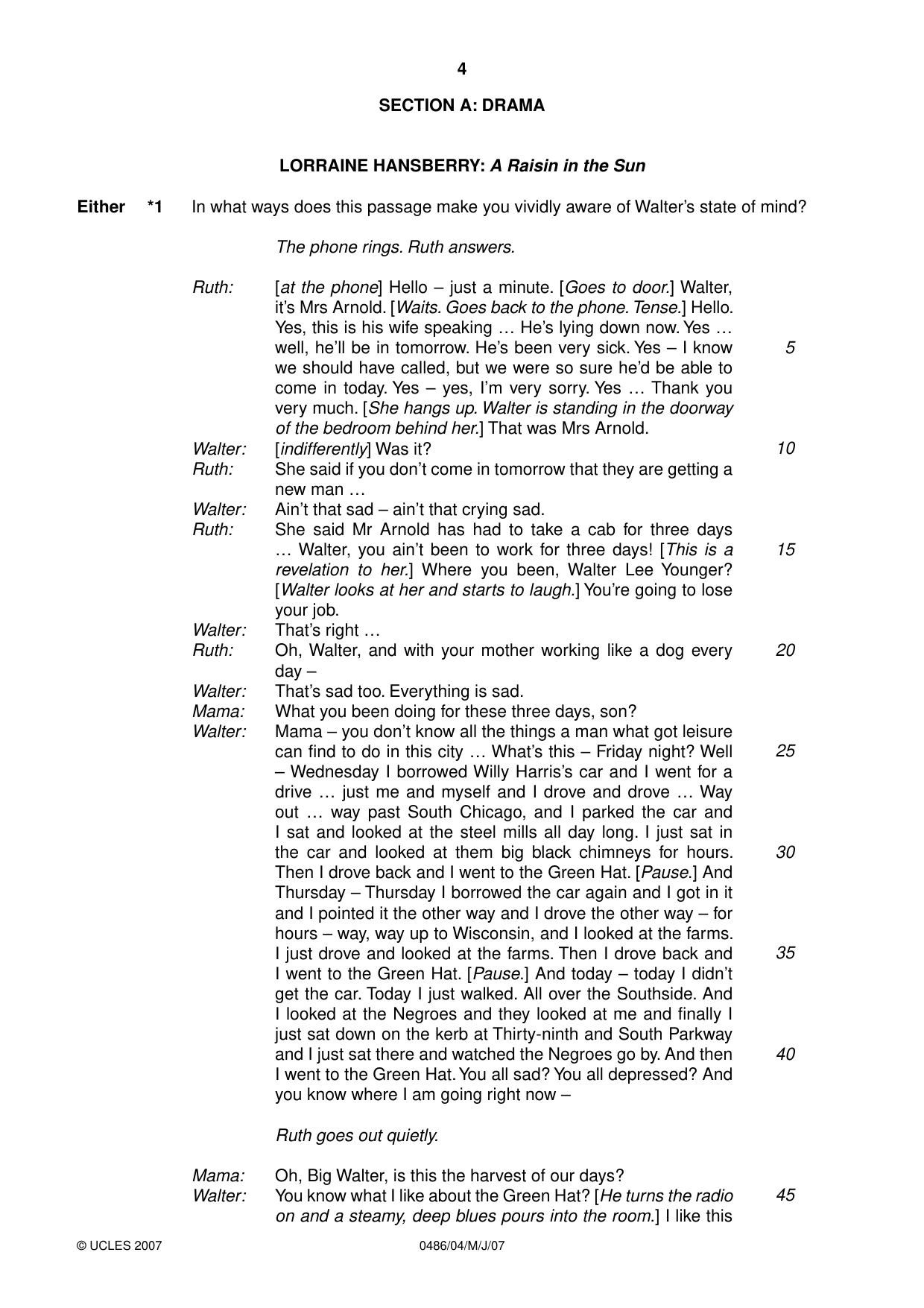
4 0486/04/M/J/07 © UCLES 2007 SECTION A: DRAMA LORRAINE HANSBERRY: A Raisin in the Sun Either *1 In what ways does this passage make you vividly aware of Walter’s state of mind? The phone rings. Ruth answers. Ruth: [at the phone] Hello – just a minute. [Goes to door.] Walter, it’s Mrs Arnold. [Waits. Goes back to the phone. Tense.] Hello. Yes, this is his wife speaking … He’s lying down now. Yes … well, he’ll be in tomorrow. He’s been very sick. Yes – I know we should have called, but we were so sure he’d be able to come in today. Yes – yes, I’m very sorry. Yes … Thank you very much. [She hangs up. Walter is standing in the doorway of the bedroom behind her.] That was Mrs Arnold. Walter: [indifferently] Was it? Ruth: She said if you don’t come in tomorrow that they are getting a new man … Walter: Ain’t that sad – ain’t that crying sad. Ruth: She said Mr Arnold has had to take a cab for three days … Walter, you ain’t been to work for three days! [This is a revelation to her.] Where you been, Walter Lee Younger? [Walter looks at her and starts to laugh.] You’re going to lose your job. Walter: That’s right … Ruth: Oh, Walter, and with your mother working like a dog every day – Walter: That’s sad too. Everything is sad. Mama: What you been doing for these three days, son? Walter: Mama – you don’t know all the things a man what got leisure can find to do in this city … What’s this – Friday night? Well – Wednesday I borrowed Willy Harris’s car and I went for a drive … just me and myself and I drove and drove … Way out … way past South Chicago, and I parked the car and I sat and looked at the steel mills all day long. I just sat in the car and looked at them big black chimneys for hours. Then I drove back and I went to the Green Hat. [Pause.] And Thursday – Thursday I borrowed the car again and I got in it and I pointed it the other way and I drove the other way – for hours – way, way up to Wisconsin, and I looked at the farms. I just drove and looked at the farms. Then I drove back and I went to the Green Hat. [Pause.] And today – today I didn’t get the car. Today I just walked. All over the Southside. And I looked at the Negroes and they looked at me and finally I just sat down on the kerb at Thirty-ninth and South Parkway and I just sat there and watched the Negroes go by. And then I went to the Green Hat. You all sad? You all depressed? And you know where I am going right now – Ruth goes out quietly. Mama: Oh, Big Walter, is this the harvest of our days? Walter: You know what I like about the Green Hat? [He turns the radio on and a steamy, deep blues pours into the room.] I like this 5 10 15 20 25 30 35 40 45
Question paper, page 5
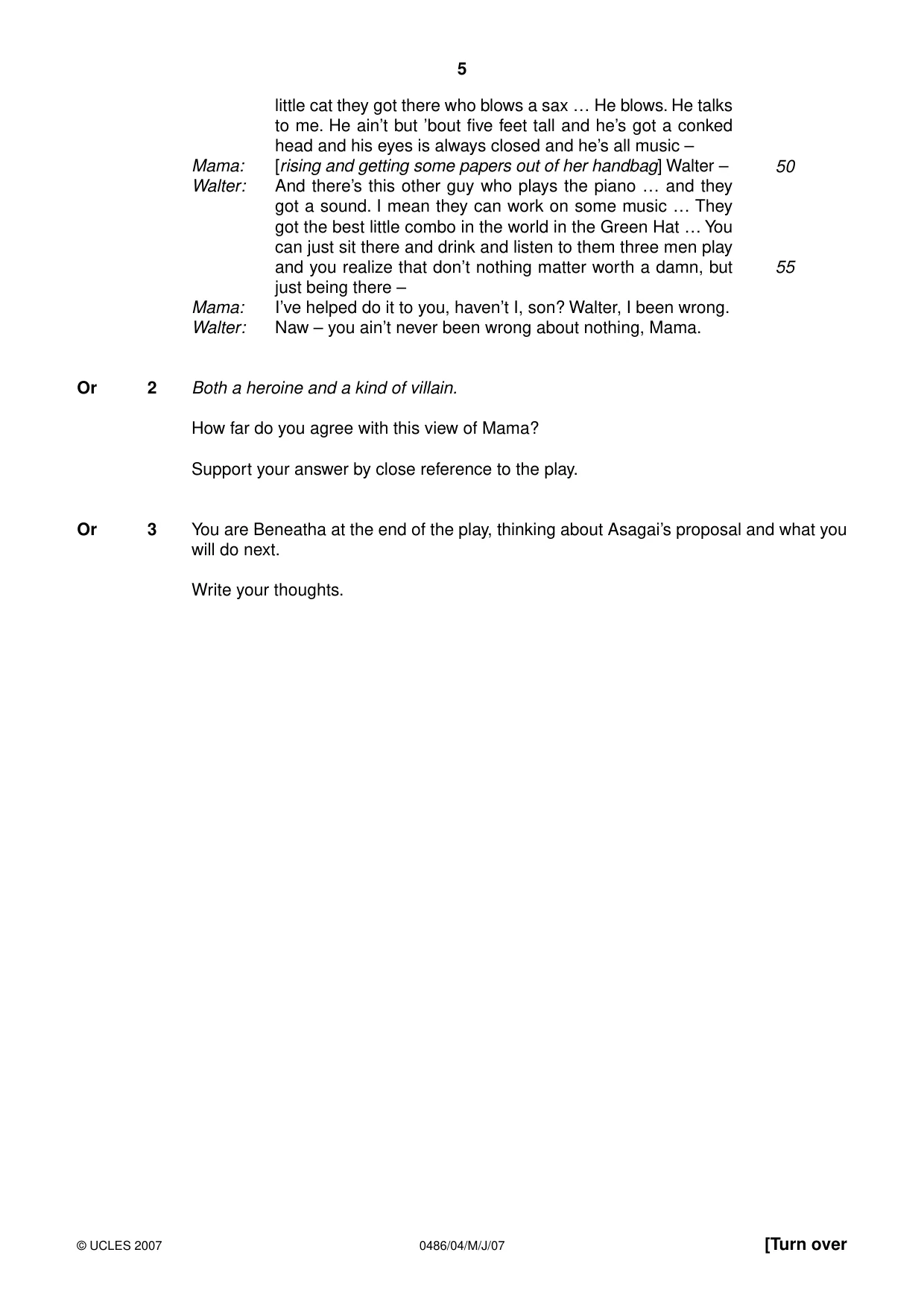
5 0486/04/M/J/07 © UCLES 2007 [Turn over little cat they got there who blows a sax … He blows. He talks to me. He ain’t but ’bout five feet tall and he’s got a conked head and his eyes is always closed and he’s all music – Mama: [rising and getting some papers out of her handbag] Walter – Walter: And there’s this other guy who plays the piano … and they got a sound. I mean they can work on some music … They got the best little combo in the world in the Green Hat … You can just sit there and drink and listen to them three men play and you realize that don’t nothing matter worth a damn, but just being there – Mama: I’ve helped do it to you, haven’t I, son? Walter, I been wrong. Walter: Naw – you ain’t never been wrong about nothing, Mama. Or 2 Both a heroine and a kind of villain. How far do you agree with this view of Mama? Support your answer by close reference to the play. Or 3 You are Beneatha at the end of the play, thinking about Asagai’s proposal and what you will do next. Write your thoughts. 50 55
Question paper, page 6
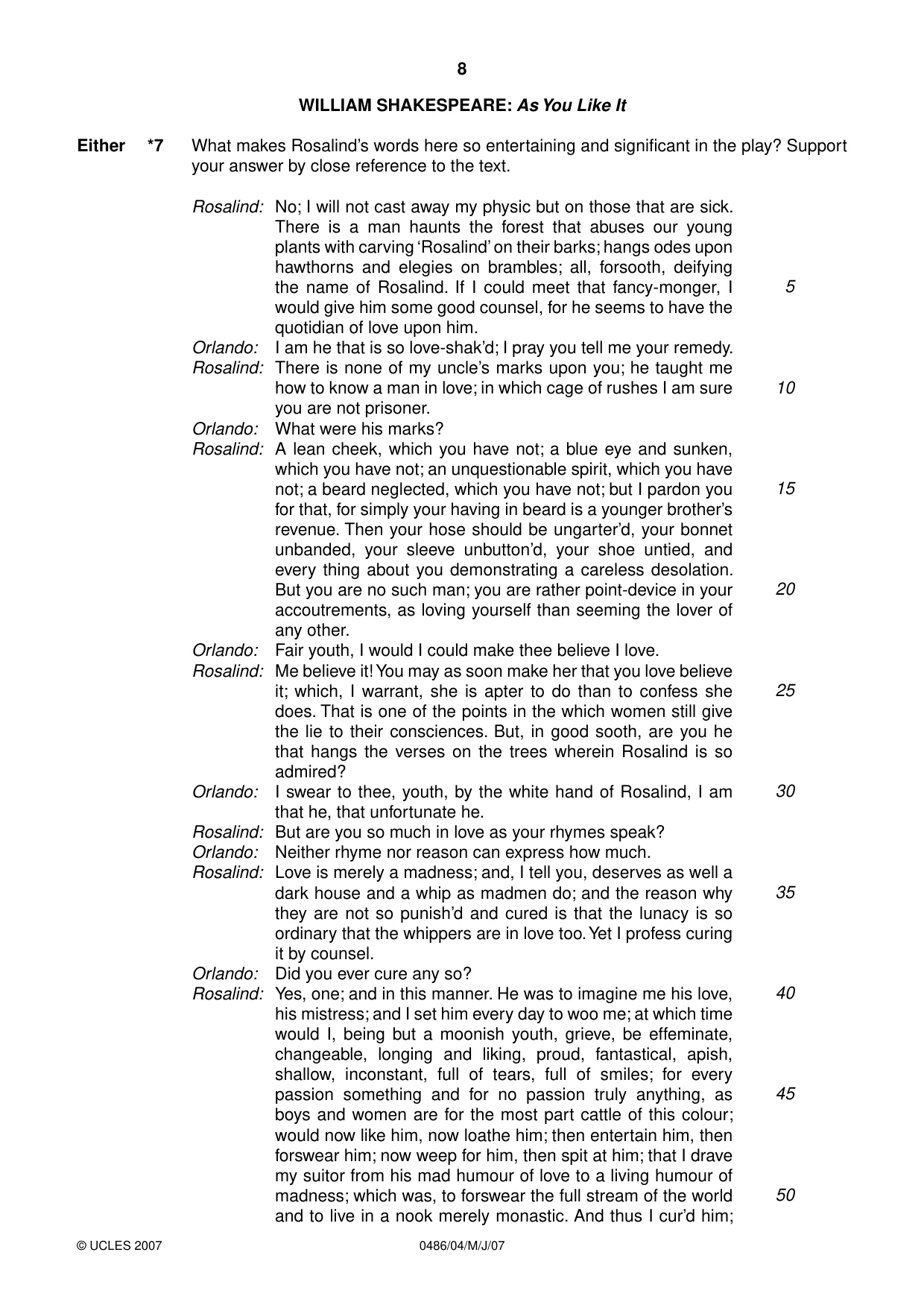
8 0486/04/M/J/07 © UCLES 2007 WILLIAM SHAKESPEARE: As You Like It Either *7 What makes Rosalind’s words here so entertaining and significant in the play? Support your answer by close reference to the text. Rosalind: No; I will not cast away my physic but on those that are sick. There is a man haunts the forest that abuses our young plants with carving ‘Rosalind’ on their barks; hangs odes upon hawthorns and elegies on brambles; all, forsooth, deifying the name of Rosalind. If I could meet that fancy-monger, I would give him some good counsel, for he seems to have the quotidian of love upon him. Orlando: I am he that is so love-shak’d; I pray you tell me your remedy. Rosalind: There is none of my uncle’s marks upon you; he taught me how to know a man in love; in which cage of rushes I am sure you are not prisoner. Orlando: What were his marks? Rosalind: A lean cheek, which you have not; a blue eye and sunken, which you have not; an unquestionable spirit, which you have not; a beard neglected, which you have not; but I pardon you for that, for simply your having in beard is a younger brother’s revenue. Then your hose should be ungarter’d, your bonnet unbanded, your sleeve unbutton’d, your shoe untied, and every thing about you demonstrating a careless desolation. But you are no such man; you are rather point-device in your accoutrements, as loving yourself than seeming the lover of any other. Orlando: Fair youth, I would I could make thee believe I love. Rosalind: Me believe it! You may as soon make her that you love believe it; which, I warrant, she is apter to do than to confess she does. That is one of the points in the which women still give the lie to their consciences. But, in good sooth, are you he that hangs the verses on the trees wherein Rosalind is so admired? Orlando: I swear to thee, youth, by the white hand of Rosalind, I am that he, that unfortunate he. Rosalind: But are you so much in love as your rhymes speak? Orlando: Neither rhyme nor reason can express how much. Rosalind: Love is merely a madness; and, I tell you, deserves as well a dark house and a whip as madmen do; and the reason why they are not so punish’d and cured is that the lunacy is so ordinary that the whippers are in love too. Yet I profess curing it by counsel. Orlando: Did you ever cure any so? Rosalind: Yes, one; and in this manner. He was to imagine me his love, his mistress; and I set him every day to woo me; at which time would I, being but a moonish youth, grieve, be effeminate, changeable, longing and liking, proud, fantastical, apish, shallow, inconstant, full of tears, full of smiles; for every passion something and for no passion truly anything, as boys and women are for the most part cattle of this colour; would now like him, now loathe him; then entertain him, then forswear him; now weep for him, then spit at him; that I drave my suitor from his mad humour of love to a living humour of madness; which was, to forswear the full stream of the world and to live in a nook merely monastic. And thus I cur’d him; 5 10 15 20 25 30 35 40 45 50
Question paper, page 7
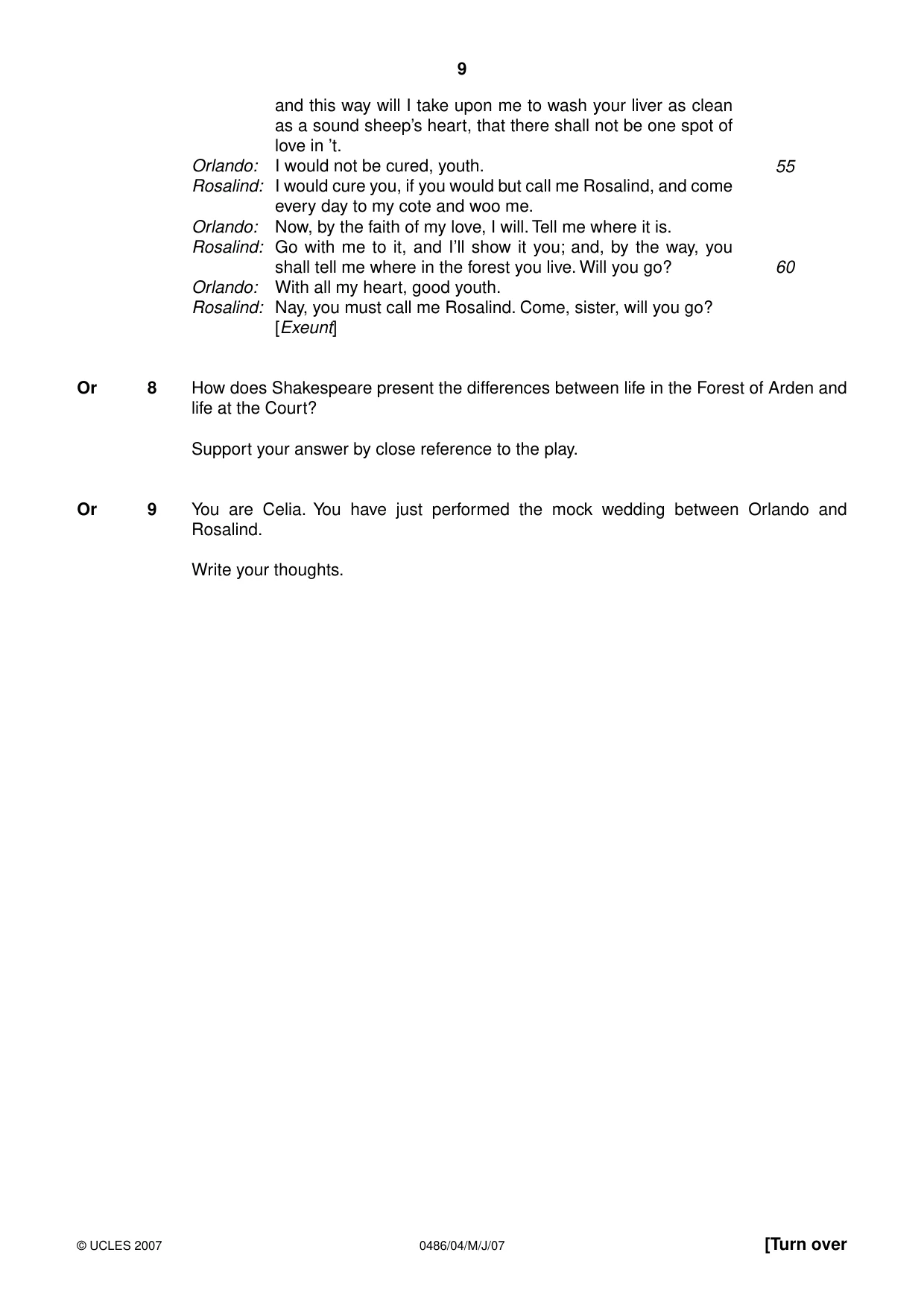
9 0486/04/M/J/07 © UCLES 2007 [Turn over and this way will I take upon me to wash your liver as clean as a sound sheep’s heart, that there shall not be one spot of love in ’t. Orlando: I would not be cured, youth. Rosalind: I would cure you, if you would but call me Rosalind, and come every day to my cote and woo me. Orlando: Now, by the faith of my love, I will. Tell me where it is. Rosalind: Go with me to it, and I’ll show it you; and, by the way, you shall tell me where in the forest you live. Will you go? Orlando: With all my heart, good youth. Rosalind: Nay, you must call me Rosalind. Come, sister, will you go? [ Exeunt] Or 8 How does Shakespeare present the differences between life in the Forest of Arden and life at the Court? Support your answer by close reference to the play. Or 9 You are Celia. You have just performed the mock wedding between Orlando and Rosalind. Write your thoughts. 55 60
Question paper, page 8
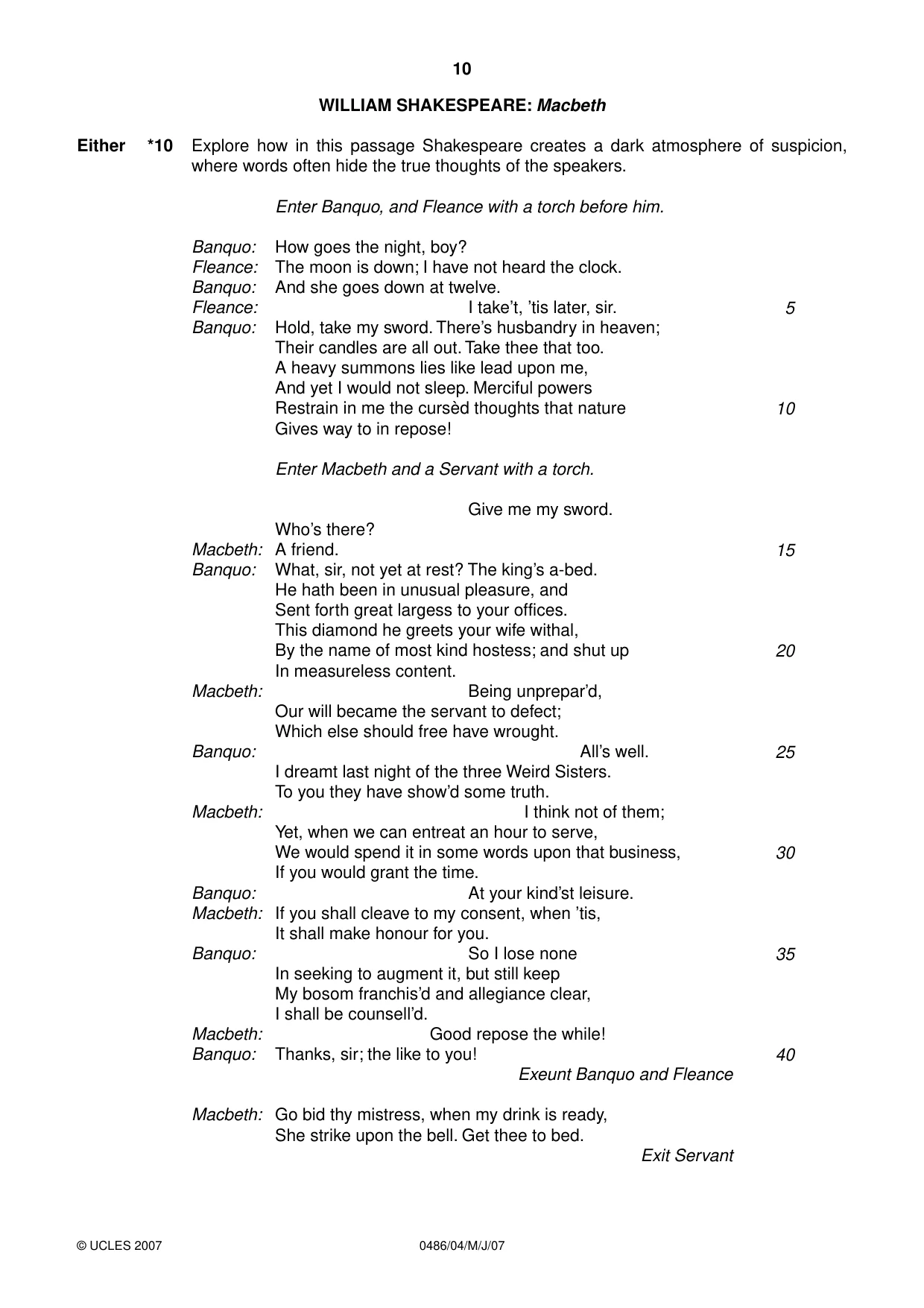
10 0486/04/M/J/07 © UCLES 2007 WILLIAM SHAKESPEARE: Macbeth Either *10 Explore how in this passage Shakespeare creates a dark atmosphere of suspicion, where words often hide the true thoughts of the speakers. Enter Banquo, and Fleance with a torch before him. Banquo: How goes the night, boy? Fleance: The moon is down; I have not heard the clock. Banquo: And she goes down at twelve. Fleance: I take’t, ’tis later, sir. Banquo: Hold, take my sword. There’s husbandry in heaven; Their candles are all out. Take thee that too. A heavy summons lies like lead upon me, And yet I would not sleep. Merciful powers Restrain in me the cursèd thoughts that nature Gives way to in repose! Enter Macbeth and a Servant with a torch. Give me my sword. Who’s there? Macbeth: A friend. Banquo: What, sir, not yet at rest? The king’s a-bed. He hath been in unusual pleasure, and Sent forth great largess to your offices. This diamond he greets your wife withal, By the name of most kind hostess; and shut up In measureless content. Macbeth: Being unprepar’d, Our will became the servant to defect; Which else should free have wrought. Banquo: All’s well. I dreamt last night of the three Weird Sisters. To you they have show’d some truth. Macbeth: I think not of them; Yet, when we can entreat an hour to serve, We would spend it in some words upon that business, If you would grant the time. Banquo: At your kind’st leisure. Macbeth: If you shall cleave to my consent, when ’tis, It shall make honour for you. Banquo: So I lose none In seeking to augment it, but still keep My bosom franchis’d and allegiance clear, I shall be counsell’d. Macbeth: Good repose the while! Banquo: Thanks, sir; the like to you! Exeunt Banquo and Fleance Macbeth: Go bid thy mistress, when my drink is ready, She strike upon the bell. Get thee to bed. Exit Servant 5 10 15 20 25 30 35 40
Question paper, page 9
11 0486/04/M/J/07 © UCLES 2007 [Turn over Or 11 How far do you think Macbeth is led into violence by his wife and the Witches – and how far do you think he himself is responsible for his actions? Support your ideas with detail from Shakespeare’s writing. Or 12 You are Malcolm in England. You have heard that Macduff has arrived from Scotland and wishes to see you. Write your thoughts.
Question paper, page 10
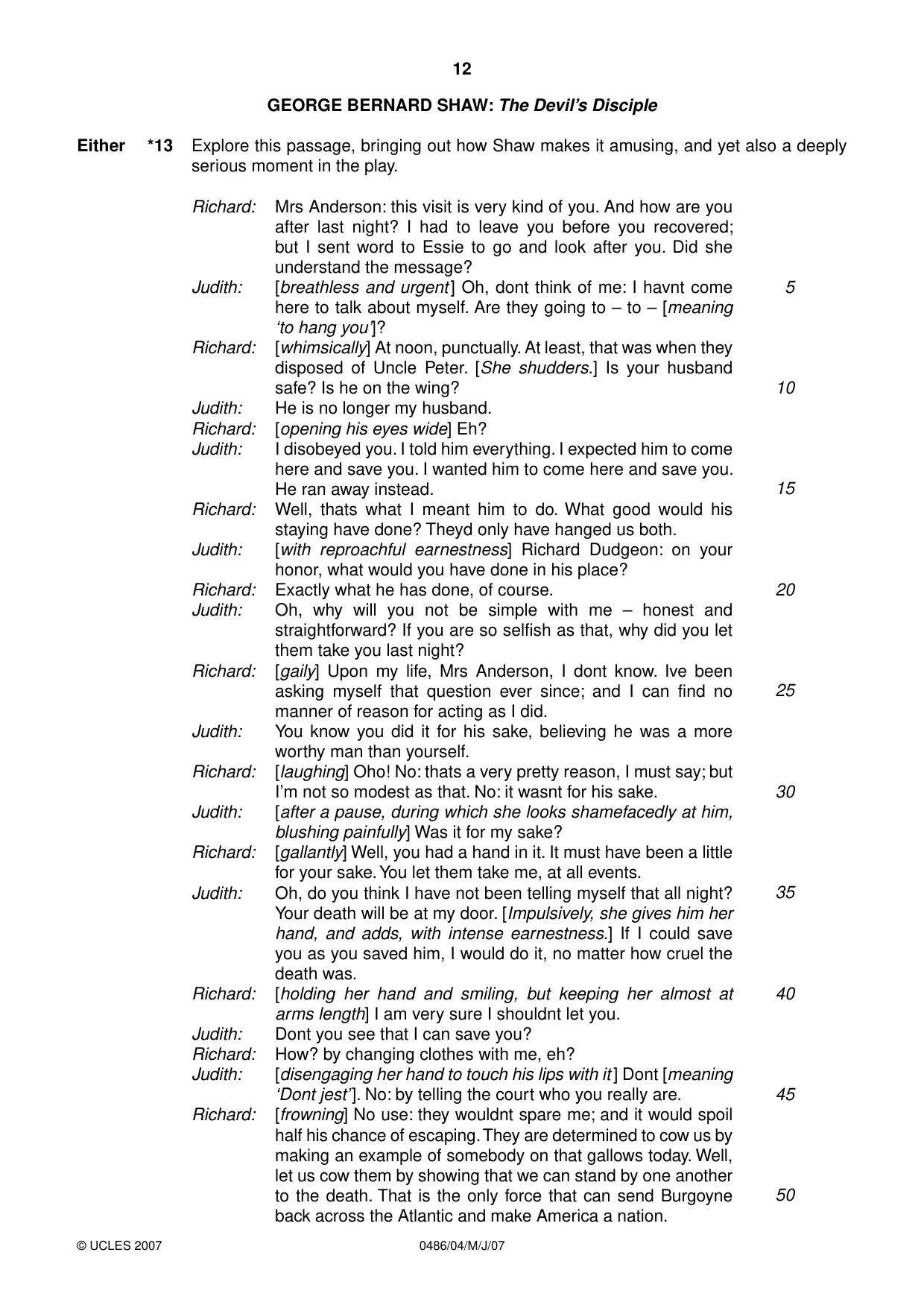
12 0486/04/M/J/07 © UCLES 2007 GEORGE BERNARD SHAW: The Devil’s Disciple Either *13 Explore this passage, bringing out how Shaw makes it amusing, and yet also a deeply serious moment in the play. Richard: Mrs Anderson: this visit is very kind of you. And how are you after last night? I had to leave you before you recovered; but I sent word to Essie to go and look after you. Did she understand the message? Judith: [breathless and urgent] Oh, dont think of me: I havnt come here to talk about myself. Are they going to – to – [meaning ‘to hang you’]? Richard: [whimsically] At noon, punctually. At least, that was when they disposed of Uncle Peter. [She shudders.] Is your husband safe? Is he on the wing? Judith: He is no longer my husband. Richard: [opening his eyes wide] Eh? Judith: I disobeyed you. I told him everything. I expected him to come here and save you. I wanted him to come here and save you. He ran away instead. Richard: Well, thats what I meant him to do. What good would his staying have done? Theyd only have hanged us both. Judith: [with reproachful earnestness] Richard Dudgeon: on your honor, what would you have done in his place? Richard: Exactly what he has done, of course. Judith: Oh, why will you not be simple with me – honest and straightforward? If you are so selfish as that, why did you let them take you last night? Richard: [gaily] Upon my life, Mrs Anderson, I dont know. Ive been asking myself that question ever since; and I can find no manner of reason for acting as I did. Judith: You know you did it for his sake, believing he was a more worthy man than yourself. Richard: [laughing] Oho! No: thats a very pretty reason, I must say; but I’m not so modest as that. No: it wasnt for his sake. Judith: [after a pause, during which she looks shamefacedly at him, blushing painfully] Was it for my sake? Richard: [gallantly] Well, you had a hand in it. It must have been a little for your sake. You let them take me, at all events. Judith: Oh, do you think I have not been telling myself that all night? Your death will be at my door. [Impulsively, she gives him her hand, and adds, with intense earnestness.] If I could save you as you saved him, I would do it, no matter how cruel the death was. Richard: [holding her hand and smiling, but keeping her almost at arms length] I am very sure I shouldnt let you. Judith: Dont you see that I can save you? Richard: How? by changing clothes with me, eh? Judith: [disengaging her hand to touch his lips with it ] Dont [meaning ‘Dont jest’]. No: by telling the court who you really are. Richard: [frowning] No use: they wouldnt spare me; and it would spoil half his chance of escaping. They are determined to cow us by making an example of somebody on that gallows today. Well, let us cow them by showing that we can stand by one another to the death. That is the only force that can send Burgoyne back across the Atlantic and make America a nation. 5 10 15 20 25 30 35 40 45 50
Question paper, page 11
13 0486/04/M/J/07 © UCLES 2007 [Turn over Judith: [impatiently] Oh, what does all that matter? Richard: [laughing] True: what does it matter? what does anything matter? You see, men have these strange notions, Mrs Anderson; and women see the folly of them. Judith: Women have to lose those they love through them. Richard: They can easily get fresh lovers. Judith: [revolted] Oh! [Vehemently] Do you realize that you are going to kill yourself? Richard: The only man I have any right to kill, Mrs Anderson. Dont be concerned: no woman will lose her lover through my death. [Smiling] Bless you, nobody cares for me. Have you heard that my mother is dead? Judith: Dead! Richard: Of heart disease – in the night. Her last word to me was her curse: I dont think I could have borne her blessing. My other relatives will not grieve much on my account. Essie will cry for a day or two; but I have provided for her: I made my own will last night. Judith: [stonily, after a moment’s silence] And I! Richard: [surprised] You? Judith: Yes, I. Am I not to care at all? Richard: [gaily and bluntly] Not a scrap. Oh, you expressed your feelings towards me very frankly yesterday. What happened may have softened you for the moment; but believe me, Mrs Anderson, you dont like a bone in my skin or a hair on my head. I shall be as good a riddance at 12 today as I should have been at 12 yesterday. Judith: [her voice trembling] What can I do to shew you that you are mistaken? Richard: Don’t trouble. I’ll give you credit for liking me a little better than you did. All I say is that my death will not break your heart. Judith: [almost in a whisper] How do you know? [She puts her hands on his shoulders and looks intently at him.] Richard: [amazed – divining the truth] Mrs Anderson! [The bell of the town clock strikes the quarter. He collects himself, and removes her hands, saying rather coldly] Excuse me: they will be here for me presently. It is too late. Or 14 What makes Dick Dudgeon such a dramatically compelling character? Support your ideas with detail from the play. Or 15 You are Mrs Dudgeon on your deathbed. Write your thoughts. 55 60 65 70 75 80 85
Question paper, page 12
14 0486/04/M/J/07 © UCLES 2007 TENNESSEE WILLIAMS: A Streetcar Named Desire Either *16 Explore the ways in which Stella and Stanley react in this extract. Blanche: [quickly] What is it? Is it for me? [He is holding a little envelope towards her.] Stanley: Yes, I hope you like it! Blanche: Why, why – Why, it’s a – Stanley: Ticket! Back to Laurel! On the Greyhound! Tuesday! [The Varsouviana music steals in softly and continues playing. Stella rises abruptly and turns her back. Blanche tries to smile. Then she tries to laugh. Then she gives both up and springs from the table and runs into the next room. She clutches her throat and then runs into the bathroom. Coughing, gagging sounds are heard.] Well! Stella: You didn’t need to do that. Stanley: Don’t forget all that I took off her. Stella: You needn’t have been so cruel to someone alone as she is. Stanley: Delicate piece she is. Stella: She is. She was. You didn’t know Blanche as a girl. Nobody, nobody, was tender and trusting as she was. But people like you abused her, and forced her to change. [He crosses into the bedroom, ripping off his shirt, and changes into a brilliant silk bowling shirt. She follows him.] Do you think you’re going bowling now? Stanley: Sure. Stella: You’re not going bowling. [She catches hold of his shirt.] Why did you do this to her? Stanley: I done nothing to no one. Let go of my shirt. You’ve torn it. Stella: I want to know why. Tell me why. Stanley: When we first met, me and you, you thought I was common. How right you was, baby. I was common as dirt. You showed me the snapshot of the place with the columns. I pulled you down off them columns and how you loved it, having them coloured lights going! And wasn’t we happy together, wasn’t it all okay till she showed here? [Stella makes a slight movement. Her look goes suddenly inward as if some interior voice had called her name. She begins a slow, shuffling progress from the bedroom to the kitchen, leaning and resting on the back of the chair and then on the edge of a table with a blind look and listening expression. Stanley, finishing with his shirt, is unaware of her reaction.] And wasn’t we happy together? Wasn’t it all okay? Till she showed here. Hoity-toity, describing me as an ape. [He suddenly notices the change in Stella.] Hey, what is it, Stell? [He crosses to her.] Stella: [quietly] Take me to the hospital. 5 10 15 20 25 30 35 40
Question paper, page 13
15 0486/04/M/J/07 © UCLES 2007 [Turn over Or 17 To what extent does Williams make you sympathise with Blanche? Refer to detail in the writing as you respond. Or 18 You are Stella, before Blanche’s arrival, thinking about the forthcoming visit of your sister. Write your thoughts.
Question paper, page 14
16 0486/04/M/J/07 © UCLES 2007 SECTION B: POETRY SAMUEL TAYLOR COLERIDGE: Selected Poems Either *19 Explore the ways in which Coleridge expresses his feelings for his child here. Dear Babe, that sleepest cradled by my side, Whose gentle breathings, heard in this deep calm, Fill up the intersperséd vacancies And momentary pauses of the thought! My babe so beautiful! it thrills my heart With tender gladness, thus to look at thee, And think that thou shalt learn far other lore, And in far other scenes! For I was reared In the great city, pent ’mid cloisters dim, And saw nought lovely but the sky and stars. But thou, my babe! shalt wander like a breeze By lakes and sandy shores, beneath the crags Of ancient mountain, and beneath the clouds, Which image in their bulk both lakes and shores And mountain crags: so shalt thou see and hear The lovely shapes and sounds intelligible Of that eternal language, which thy God Utters, who from eternity doth teach Himself in all, and all things in himself. Great universal Teacher! he shall mould Thy spirit, and by giving make it ask. Therefore all seasons shall be sweet to thee, Whether the summer clothe the general earth With greenness, or the redbreast sit and sing Betwixt the tufts of snow on the bare branch Of mossy apple-tree, while the nigh thatch Smokes in the sun-thaw; whether the eave-drops fall Heard only in the trances of the blast, Or if the secret ministry of frost Shall hang them up in silent icicles, Quietly shining to the quiet Moon. (from Frost at Midnight) Or 20 By what means does Coleridge make you feel sympathy for Christabel? Refer in detail to Coleridge’s poem as you answer. Or 21 Explore any one episode in The Rime of the Ancient Mariner which you find frightening. Justify your choice by referring in detail to the writing. 5 10 15 20 25 30
Question paper, page 15
17 0486/04/M/J/07 © UCLES 2007 [Turn over SONGS OF OURSELVES: The University of Cambridge International Examinations Anthology of Poetry in English – from Section 3 Either *22 In what ways do you think the poet makes vivid the power of the storyteller? Storyteller she sat down at the scoured table in the swept kitchen beside the dresser with its cracked delft. And every last crumb of daylight was salted away. No one could say the stories were useless for as the tongue clacked five or forty fingers stitched corn was grated from the husk patchwork was pieced or the darning done. Never the one to slander her shiftless. Daily sloven or spotless no matter whether dishwater or tasty was her soup. To tell the stories was her work. It was like spinning, gathering thin air to the singlest strongest thread. Night in she’d have us waiting, held breath, for the ending we knew by heart. And at first light as the women stirred themselves to build the fire as the peasant’s feet felt for clogs as thin grey washed over flat fields the stories dissolved in the whorl of the ear but they hung themselves upside down in the sleeping heads of the children till they flew again in the storytellers night. (by Liz Lochhead) Or 23 Explore the ways in which the poet’s words convey a sense of times past and the changes which growing older bring in either The Old Familiar Faces (by Charles Lamb) or Plenty (by Isobel Dixon). Or 24 Explore the ways in which the poets in two of the following poems use imagery to vivid effect. Use examples from both of the poems. Caged Bird (by Maya Angelou) Rising Five (by Norman Nicholson) Before the Sun (by Charles Mungoshi) 5 10 15 20 25 30
Question paper, page 16
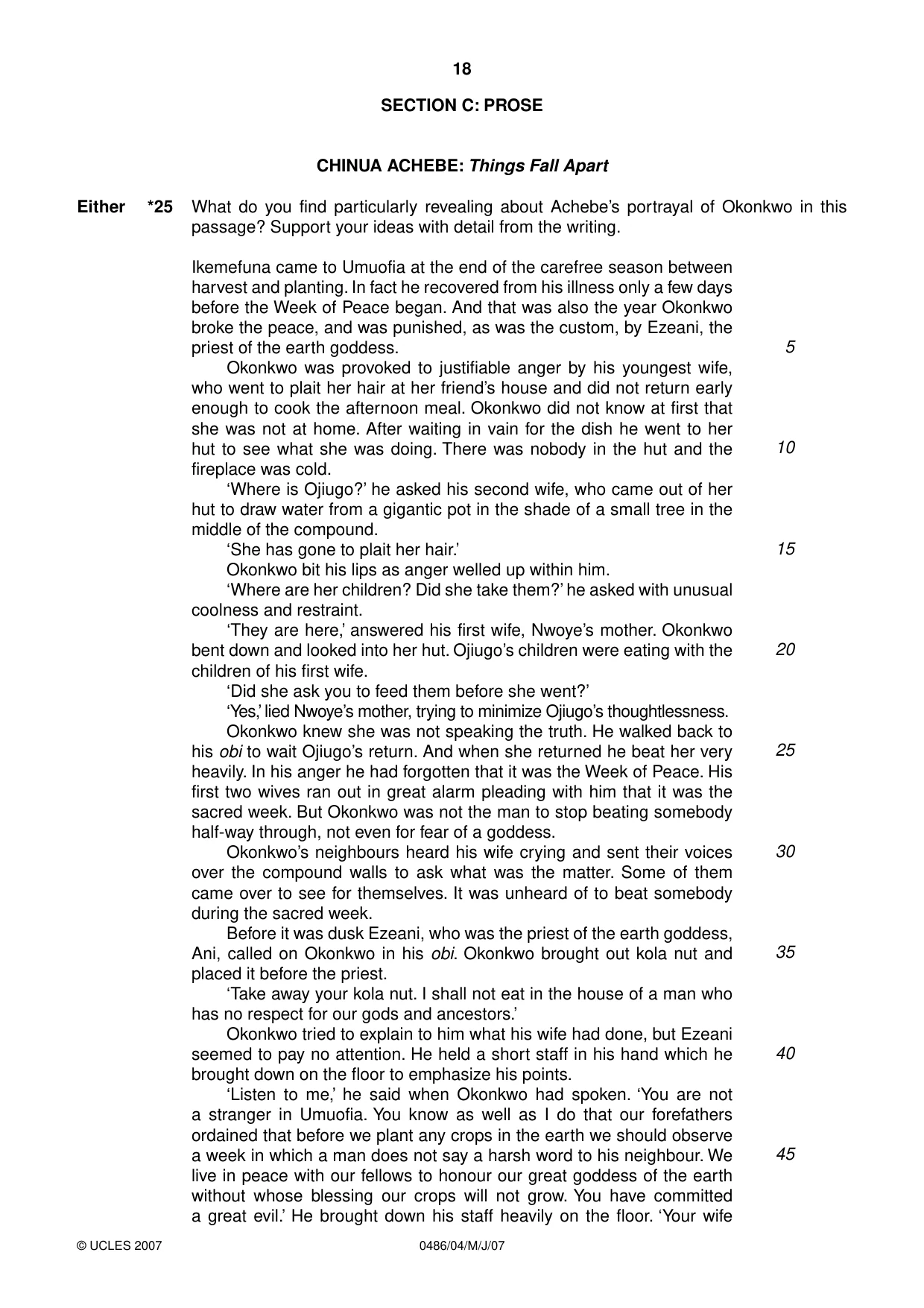
18 0486/04/M/J/07 © UCLES 2007 SECTION C: PROSE CHINUA ACHEBE: Things Fall Apart Either *25 What do you find particularly revealing about Achebe’s portrayal of Okonkwo in this passage? Support your ideas with detail from the writing. Ikemefuna came to Umuofia at the end of the carefree season between harvest and planting. In fact he recovered from his illness only a few days before the Week of Peace began. And that was also the year Okonkwo broke the peace, and was punished, as was the custom, by Ezeani, the priest of the earth goddess. Okonkwo was provoked to justifiable anger by his youngest wife, who went to plait her hair at her friend’s house and did not return early enough to cook the afternoon meal. Okonkwo did not know at first that she was not at home. After waiting in vain for the dish he went to her hut to see what she was doing. There was nobody in the hut and the fireplace was cold. ‘Where is Ojiugo?’ he asked his second wife, who came out of her hut to draw water from a gigantic pot in the shade of a small tree in the middle of the compound. ‘She has gone to plait her hair.’ Okonkwo bit his lips as anger welled up within him. ‘Where are her children? Did she take them?’ he asked with unusual coolness and restraint. ‘They are here,’ answered his first wife, Nwoye’s mother. Okonkwo bent down and looked into her hut. Ojiugo’s children were eating with the children of his first wife. ‘Did she ask you to feed them before she went?’ ‘Yes,’ lied Nwoye’s mother, trying to minimize Ojiugo’s thoughtlessness. Okonkwo knew she was not speaking the truth. He walked back to his obi to wait Ojiugo’s return. And when she returned he beat her very heavily. In his anger he had forgotten that it was the Week of Peace. His first two wives ran out in great alarm pleading with him that it was the sacred week. But Okonkwo was not the man to stop beating somebody half-way through, not even for fear of a goddess. Okonkwo’s neighbours heard his wife crying and sent their voices over the compound walls to ask what was the matter. Some of them came over to see for themselves. It was unheard of to beat somebody during the sacred week. Before it was dusk Ezeani, who was the priest of the earth goddess, Ani, called on Okonkwo in his obi. Okonkwo brought out kola nut and placed it before the priest. ‘Take away your kola nut. I shall not eat in the house of a man who has no respect for our gods and ancestors.’ Okonkwo tried to explain to him what his wife had done, but Ezeani seemed to pay no attention. He held a short staff in his hand which he brought down on the floor to emphasize his points. ‘Listen to me,’ he said when Okonkwo had spoken. ‘You are not a stranger in Umuofia. You know as well as I do that our forefathers ordained that before we plant any crops in the earth we should observe a week in which a man does not say a harsh word to his neighbour. We live in peace with our fellows to honour our great goddess of the earth without whose blessing our crops will not grow. You have committed a great evil.’ He brought down his staff heavily on the floor. ‘Your wife 5 10 15 20 25 30 35 40 45
Question paper, page 17
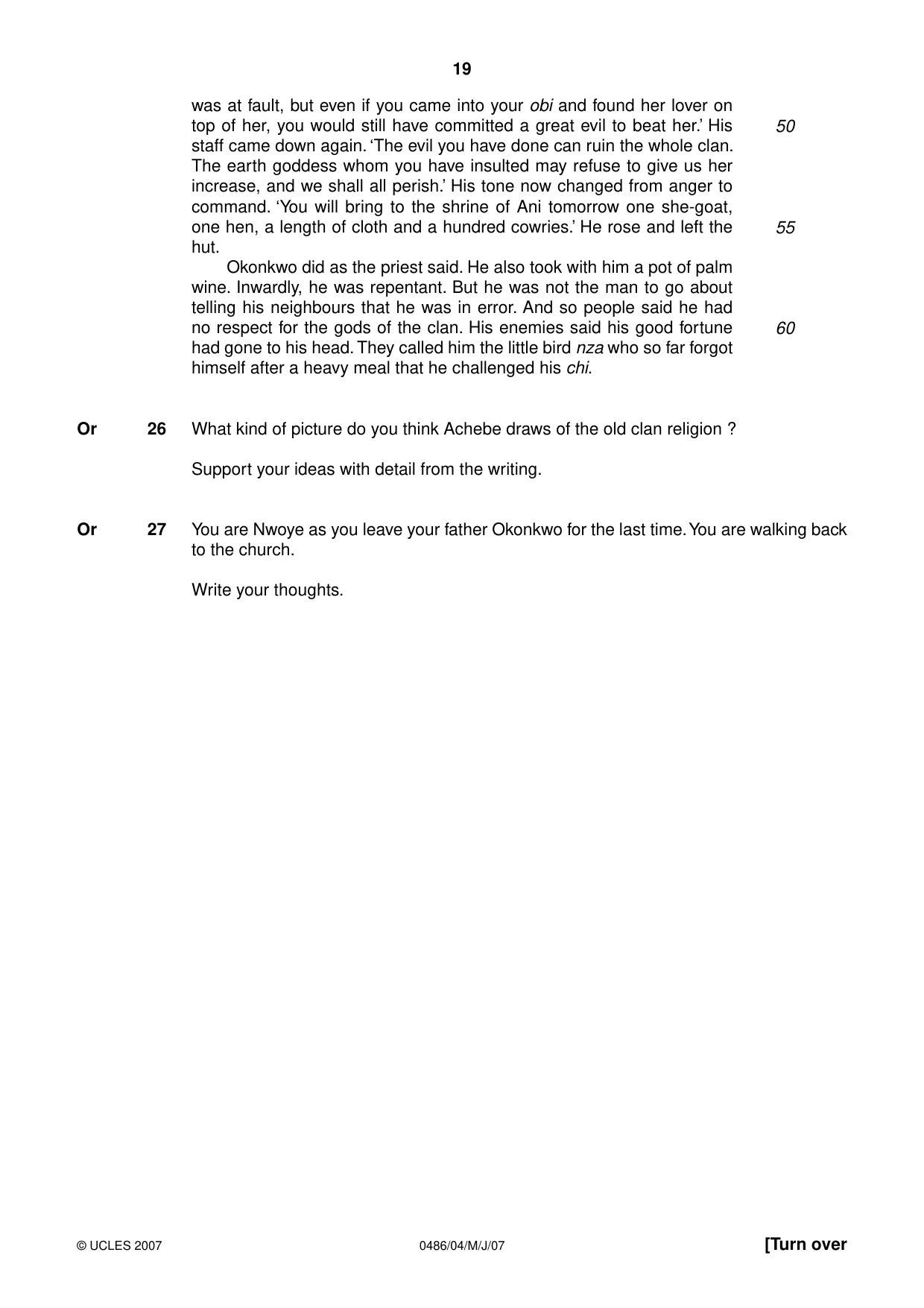
19 0486/04/M/J/07 © UCLES 2007 [Turn over was at fault, but even if you came into your obi and found her lover on top of her, you would still have committed a great evil to beat her.’ His staff came down again. ‘The evil you have done can ruin the whole clan. The earth goddess whom you have insulted may refuse to give us her increase, and we shall all perish.’ His tone now changed from anger to command. ‘You will bring to the shrine of Ani tomorrow one she-goat, one hen, a length of cloth and a hundred cowries.’ He rose and left the hut. Okonkwo did as the priest said. He also took with him a pot of palm wine. Inwardly, he was repentant. But he was not the man to go about telling his neighbours that he was in error. And so people said he had no respect for the gods of the clan. His enemies said his good fortune had gone to his head. They called him the little bird nza who so far forgot himself after a heavy meal that he challenged his chi. Or 26 What kind of picture do you think Achebe draws of the old clan religion ? Support your ideas with detail from the writing. Or 27 You are Nwoye as you leave your father Okonkwo for the last time. You are walking back to the church. Write your thoughts. 50 55 60
Question paper, page 18
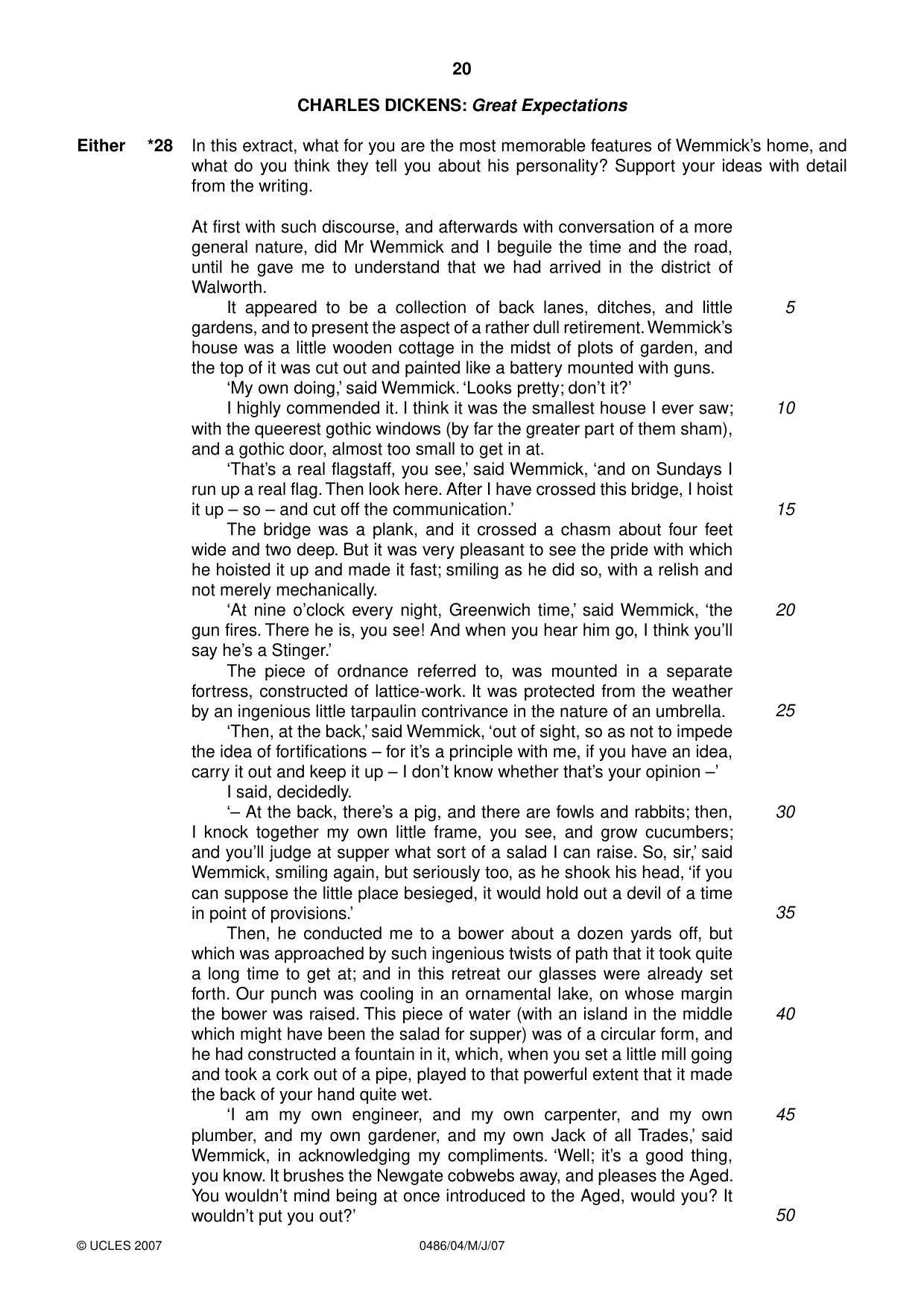
20 0486/04/M/J/07 © UCLES 2007 CHARLES DICKENS: Great Expectations Either *28 In this extract, what for you are the most memorable features of Wemmick’s home, and what do you think they tell you about his personality? Support your ideas with detail from the writing. At first with such discourse, and afterwards with conversation of a more general nature, did Mr Wemmick and I beguile the time and the road, until he gave me to understand that we had arrived in the district of Walworth. It appeared to be a collection of back lanes, ditches, and little gardens, and to present the aspect of a rather dull retirement. Wemmick’s house was a little wooden cottage in the midst of plots of garden, and the top of it was cut out and painted like a battery mounted with guns. ‘My own doing,’ said Wemmick. ‘Looks pretty; don’t it?’ I highly commended it. I think it was the smallest house I ever saw; with the queerest gothic windows (by far the greater part of them sham), and a gothic door, almost too small to get in at. ‘That’s a real flagstaff, you see,’ said Wemmick, ‘and on Sundays I run up a real flag. Then look here. After I have crossed this bridge, I hoist it up – so – and cut off the communication.’ The bridge was a plank, and it crossed a chasm about four feet wide and two deep. But it was very pleasant to see the pride with which he hoisted it up and made it fast; smiling as he did so, with a relish and not merely mechanically. ‘At nine o’clock every night, Greenwich time,’ said Wemmick, ‘the gun fires. There he is, you see! And when you hear him go, I think you’ll say he’s a Stinger.’ The piece of ordnance referred to, was mounted in a separate fortress, constructed of lattice-work. It was protected from the weather by an ingenious little tarpaulin contrivance in the nature of an umbrella. ‘Then, at the back,’ said Wemmick, ‘out of sight, so as not to impede the idea of fortifications – for it’s a principle with me, if you have an idea, carry it out and keep it up – I don’t know whether that’s your opinion –’ I said, decidedly. ‘– At the back, there’s a pig, and there are fowls and rabbits; then, I knock together my own little frame, you see, and grow cucumbers; and you’ll judge at supper what sort of a salad I can raise. So, sir,’ said Wemmick, smiling again, but seriously too, as he shook his head, ‘if you can suppose the little place besieged, it would hold out a devil of a time in point of provisions.’ Then, he conducted me to a bower about a dozen yards off, but which was approached by such ingenious twists of path that it took quite a long time to get at; and in this retreat our glasses were already set forth. Our punch was cooling in an ornamental lake, on whose margin the bower was raised. This piece of water (with an island in the middle which might have been the salad for supper) was of a circular form, and he had constructed a fountain in it, which, when you set a little mill going and took a cork out of a pipe, played to that powerful extent that it made the back of your hand quite wet. ‘I am my own engineer, and my own carpenter, and my own plumber, and my own gardener, and my own Jack of all Trades,’ said Wemmick, in acknowledging my compliments. ‘Well; it’s a good thing, you know. It brushes the Newgate cobwebs away, and pleases the Aged. You wouldn’t mind being at once introduced to the Aged, would you? It wouldn’t put you out?’ 5 10 15 20 25 30 35 40 45 50
Question paper, page 19
21 0486/04/M/J/07 © UCLES 2007 [Turn over Or 29 A wicked and violent criminal A victim of injustice Which of these two descriptions of Magwitch is nearer to your view of him? Support your ideas with detail from the writing. Or 30 You are Herbert Pocket and you have had to leave Pip with all his problems after the collapse of his expectations. You are on your way to Cairo. Write your thoughts.
Question paper, page 20
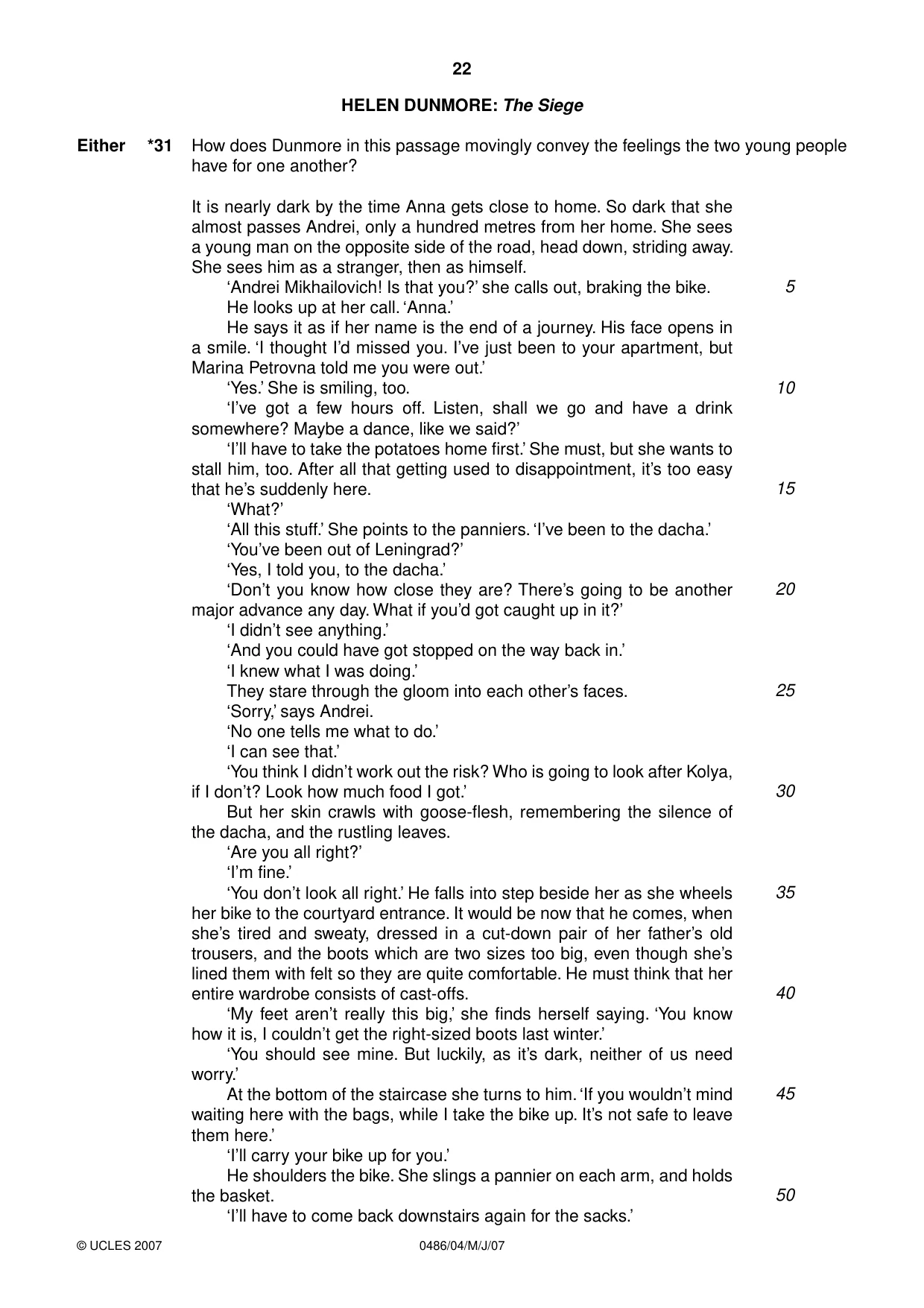
22 0486/04/M/J/07 © UCLES 2007 HELEN DUNMORE: The Siege Either *31 How does Dunmore in this passage movingly convey the feelings the two young people have for one another? It is nearly dark by the time Anna gets close to home. So dark that she almost passes Andrei, only a hundred metres from her home. She sees a young man on the opposite side of the road, head down, striding away. She sees him as a stranger, then as himself. ‘Andrei Mikhailovich! Is that you?’ she calls out, braking the bike. He looks up at her call. ‘Anna.’ He says it as if her name is the end of a journey. His face opens in a smile. ‘I thought I’d missed you. I’ve just been to your apartment, but Marina Petrovna told me you were out.’ ‘Yes.’ She is smiling, too. ‘I’ve got a few hours off. Listen, shall we go and have a drink somewhere? Maybe a dance, like we said?’ ‘I’ll have to take the potatoes home first.’ She must, but she wants to stall him, too. After all that getting used to disappointment, it’s too easy that he’s suddenly here. ‘What?’ ‘All this stuff.’ She points to the panniers. ‘I’ve been to the dacha.’ ‘You’ve been out of Leningrad?’ ‘Yes, I told you, to the dacha.’ ‘Don’t you know how close they are? There’s going to be another major advance any day. What if you’d got caught up in it?’ ‘I didn’t see anything.’ ‘And you could have got stopped on the way back in.’ ‘I knew what I was doing.’ They stare through the gloom into each other’s faces. ‘Sorry,’ says Andrei. ‘No one tells me what to do.’ ‘I can see that.’ ‘You think I didn’t work out the risk? Who is going to look after Kolya, if I don’t? Look how much food I got.’ But her skin crawls with goose-flesh, remembering the silence of the dacha, and the rustling leaves. ‘Are you all right?’ ‘I’m fine.’ ‘You don’t look all right.’ He falls into step beside her as she wheels her bike to the courtyard entrance. It would be now that he comes, when she’s tired and sweaty, dressed in a cut-down pair of her father’s old trousers, and the boots which are two sizes too big, even though she’s lined them with felt so they are quite comfortable. He must think that her entire wardrobe consists of cast-offs. ‘My feet aren’t really this big,’ she finds herself saying. ‘You know how it is, I couldn’t get the right-sized boots last winter.’ ‘You should see mine. But luckily, as it’s dark, neither of us need worry.’ At the bottom of the staircase she turns to him. ‘If you wouldn’t mind waiting here with the bags, while I take the bike up. It’s not safe to leave them here.’ ‘I’ll carry your bike up for you.’ He shoulders the bike. She slings a pannier on each arm, and holds the basket. ‘I’ll have to come back downstairs again for the sacks.’ 5 10 15 20 25 30 35 40 45 50
Question paper, page 21
23 0486/04/M/J/07 © UCLES 2007 [Turn over ‘You wait here while I take the bike up. I’ll come back down and help you with the rest of the stuff.’ Then he does a strange thing. He puts the bike down again, and takes a handkerchief out of his pocket. ‘If you’ll allow me, there’s something on your cheek. Mud, I think.’ He rubs at the mark with his handkerchief, but it won’t come off. ‘If you spit on the handkerchief –’ ‘You don’t mind?’ ‘No.’ ‘There.’ He wipes firmly. ‘It’s all gone.’ There they are. His spit on her cheek, like a seal. ‘I wanted to come before,’ he says. ‘I know.’ ‘I couldn’t. It’s been crazy –’ ‘I know.’ Or 32 What features of the siege do you think are most vividly created in this novel? Support your views with detail from Dunmore’s writing. Or 33 You are Marina, just after you have tried to give Mikhael Levin a renewed will to live. He has gone to sleep. Write your thoughts. 55 60 65
Question paper, page 22
24 0486/04/M/J/07 © UCLES 2007 WILLIAM GOLDING: Lord of the Flies Either *34 What makes this such a tense and significant moment in the novel? Remember to refer closely to details of the writing. The older boys first noticed the child when he resisted. There was a group of little boys urging him forward and he did not want to go. He was a shrimp of a boy, about six years old, and one side of his face was blotted out by a mulberry-coloured birthmark. He stood now, warped out of the perpendicular by the fierce light of publicity, and he bored into the coarse grass with one toe. He was muttering and about to cry. The other little boys, whispering but serious, pushed him towards Ralph. ‘All right,’ said Ralph, ‘come on then.’ The small boy looked round in panic. ‘Speak up!’ The small boy held out his hands for the conch and the assembly shouted with laughter; at once he snatched back his hands and started to cry. ‘Let him have the conch!’ shouted Piggy. ‘Let him have it!’ At last Ralph induced him to hold the shell but by then the blow of laughter had taken away the child’s voice. Piggy knelt by him, one hand on the great shell, listening and interpreting to the assembly. ‘He wants to know what you’re going to do about the snake-thing.’ Ralph laughed, and the other boys laughed with him. The small boy twisted further into himself. ‘Tell us about the snake-thing.’ ‘Now he says it was a beastie.’ ‘Beastie?’ ‘A snake-thing. Ever so big. He saw it.’ ‘Where?’ ‘In the woods.’ Either the wandering breezes or perhaps the decline of the sun allowed a little coolness to lie under the trees. The boys felt it and stirred restlessly. ‘You couldn’t have a beastie, a snake-thing, on an island this size,’ Ralph explained kindly. ‘You only get them in big countries, like Africa, or India.’ Murmur; and the grave nodding of heads. ‘He says the beastie came in the dark.’ ‘Then he couldn’t see it!’ Laughter and cheers. ‘Did you hear that? Says he saw the thing in the dark –’ ‘He still says he saw the beastie. It came and went away again an’ came back and wanted to eat him –’ ‘He was dreaming.’ Laughing, Ralph looked for confirmation round the ring of faces. The older boys agreed; but here and there among the little ones was the dubiety that required more than rational assurance. ‘He must have had a nightmare. Stumbling about among all those creepers.’ More grave nodding; they knew about nightmares. ‘He says he saw the beastie, the snake-thing, and will it come back to-night?’ ‘But there isn’t a beastie!’ ‘He says in the morning it turned into them things like ropes in the 5 10 15 20 25 30 35 40 45 50
Question paper, page 23
25 0486/04/M/J/07 © UCLES 2007 [Turn over trees and hung in the branches. He says will it come back to-night?’ ‘But there isn’t a beastie!’ There was no laughter at all now and more grave watching. Ralph pushed both hands through his hair and looked at the little boy in mixed amusement and exasperation. Or 35 Do you think that Golding suggests that Jack might have been a better leader than Ralph? Support your answer by close reference to the novel. Or 36 You are Piggy on your way to Castle Rock just after the theft of your glasses. Write your thoughts. 55
Question paper, page 24
26 0486/04/M/J/07 © UCLES 2007 GRAHAM GREENE: Travels with My Aunt Either *37 Do you think this passage suggests that Henry has made the right decision in obeying Aunt Augusta and travelling to South America? Support your ideas with detail from the passage. Wordsworth led me round the corner of the street and we approached the house from the back through a little door which he locked behind him and through the grove of sweet-smelling trees and bushes. ‘Hi!’ he called to the great square block of stone, ‘hi!’ and got no response. The house in its solidity and its silence reminded me of the great family tombs in the cemetery at Boulogne. This was a journey’s end too. ‘Your auntie she got a bit deaf,’ Wordsworth said, ‘she no young no more, no more.’ He spoke regretfully, as though he had known her as a girl, and yet she had been over seventy when she picked him up outside the Grenada Palace. We went up one flight of stone steps and into the hall of the house. Paved with cracked marble, the big hall was unfurnished. The windows had been shuttered and the only light came from a bare globe in the ceiling. There was no chair, no table, no sofa, no pictures. The one sign of human occupation was a mop which leant against one wall, but it might have been left there a generation ago by someone hired to tidy up after the furniture-removers had departed. ‘Hi!’ Wordsworth shouted. ‘Hi! Mr Pullen be here,’ and I heard the click of high heels along a passage overhead. A flight of pink marble stairs rose to the first floor, and at the head of them my aunt appeared. The light was too dim to see her clearly, and it may have been my imagination which read into her voice an older, more tremulous tone than I had remembered. ‘Why, Henry,’ she said, ‘you are welcome home.’ She came slowly down the stairs, and perhaps it was the bad light which caused her to clutch the banister. ‘I am so sorry’, she said, ‘that Mr Visconti is not here to greet you. I had expected him yesterday.’ ‘Mr Visconti?’ ‘Yes,’ my aunt said, ‘Mr Visconti. We are happily reunited. Did you bring the picture safely?’ ‘Ar got it,’ Wordsworth said, holding up his new suitcase. ‘Mr Visconti will be relieved. He was afraid of the customs. You look well, Henry,’ she said, kissing my cheek and leaving on the air a smell of lavender. ‘Come, let me show you your room.’ She led me up to the first landing which was as bare as the hall and opened a door. This room at least contained a bed and a chair and a cupboard, though nothing else. My aunt may have thought some explanation was needed, for she said, ‘The furniture will be arriving any day now.’ I opened another door and saw a room which was empty except for two mattresses laid together on the floor and a dressing-table and stool that looked new. ‘I have given you the bed,’ my aunt said, ‘but I couldn’t do without my dressing-table.’ ‘Is this your room?’ ‘Sometimes I miss my Venetian glass, but when the curtains go up and the furniture arrives. … You must be hungry, Henry. Wordsworth will bring your bags. I have a little meal prepared.’ I could no longer be surprised by the furnishing of the dining-room – an immense room which had been lit once by three chandeliers; the wires sprouted like weeds out of holes in the ceiling. There was a table but no cloth, and the chairs were packing-cases. ‘It’s all a little rough,’ my aunt said, ‘but when Mr Visconti returns you will see how soon we shall get things in order.’ The meal came out of tins, and there was a sweet 5 10 15 20 25 30 35 40 45 50
Question paper, page 25
27 0486/04/M/J/07 © UCLES 2007 [Turn over red wine of local origin which tasted like an evil medicine of childhood. I thought of my first-class ticket on the boat with shame. ‘When Mr Visconti is back,’ Aunt Augusta said, ‘we plan to give you a party. A house like this is made for parties. We shall have a barbecue with an ox roasted whole in the garden and there will be coloured lights in the trees, and music, of course, for dancing. A harp and a guitar – that is the fashion here. The polka and the gallop are the national dances. I shall invite the Chief of Police, the Jesuit Provincial (for his conversation of course), the British Ambassador and his wife. The Italian Ambassador, no – it would not be tactful. We must find some pretty girls for you, Henry.’ A splinter from the packing-case scratched my thigh. Or 38 Do you think Henry Pulling is better or worse off for having met Aunt Augusta? Support your ideas with detail from Greene’s writing. Or 39 You are Colonel Hakim after deporting Aunt Augusta and Henry Pulling from Turkey. Write your thoughts. 55 60
Question paper, page 26
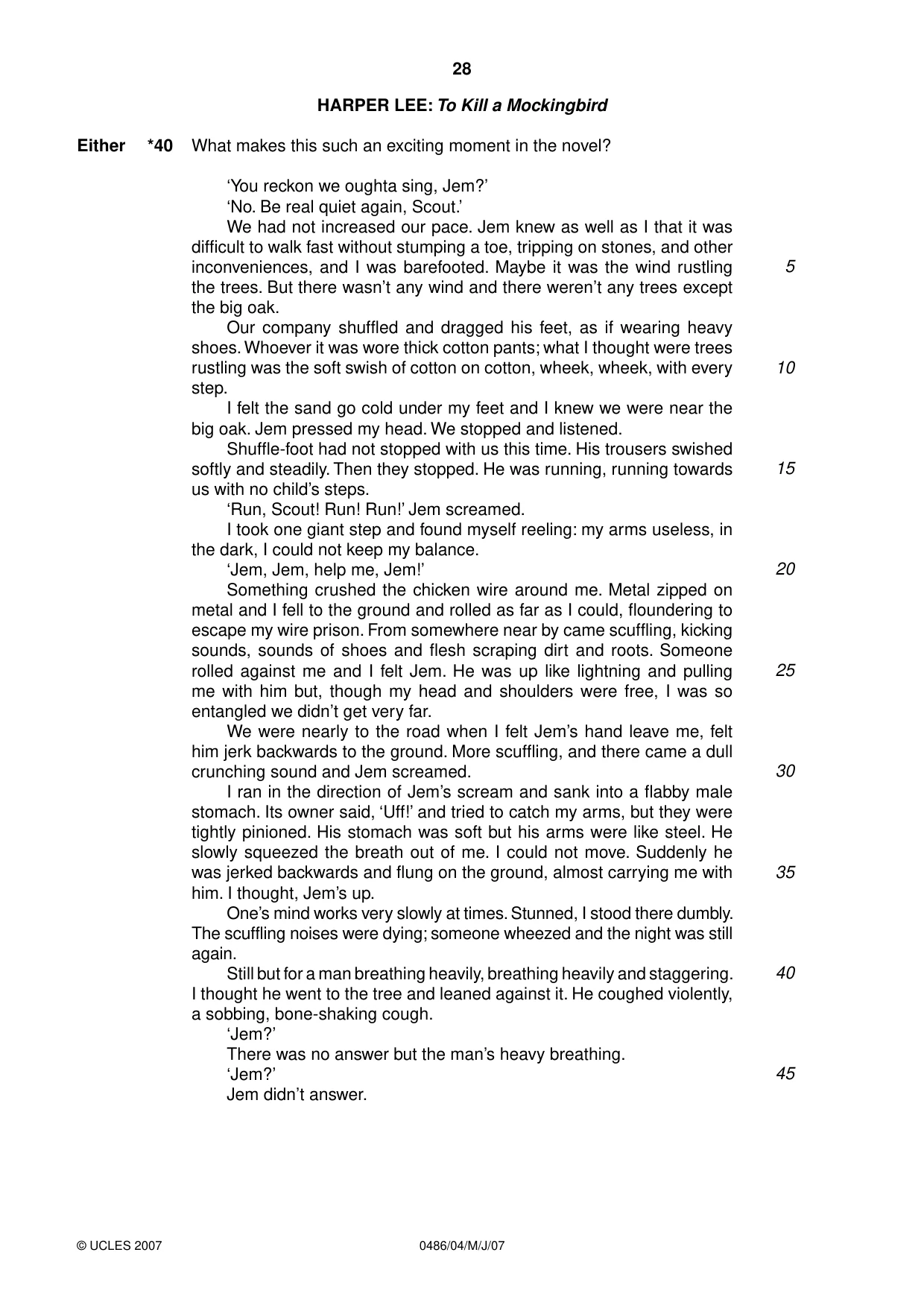
28 0486/04/M/J/07 © UCLES 2007 HARPER LEE: To Kill a Mockingbird Either *40 What makes this such an exciting moment in the novel? ‘You reckon we oughta sing, Jem?’ ‘No. Be real quiet again, Scout.’ We had not increased our pace. Jem knew as well as I that it was difficult to walk fast without stumping a toe, tripping on stones, and other inconveniences, and I was barefooted. Maybe it was the wind rustling the trees. But there wasn’t any wind and there weren’t any trees except the big oak. Our company shuffled and dragged his feet, as if wearing heavy shoes. Whoever it was wore thick cotton pants; what I thought were trees rustling was the soft swish of cotton on cotton, wheek, wheek, with every step. I felt the sand go cold under my feet and I knew we were near the big oak. Jem pressed my head. We stopped and listened. Shuffle-foot had not stopped with us this time. His trousers swished softly and steadily. Then they stopped. He was running, running towards us with no child’s steps. ‘Run, Scout! Run! Run!’ Jem screamed. I took one giant step and found myself reeling: my arms useless, in the dark, I could not keep my balance. ‘Jem, Jem, help me, Jem!’ Something crushed the chicken wire around me. Metal zipped on metal and I fell to the ground and rolled as far as I could, floundering to escape my wire prison. From somewhere near by came scuffling, kicking sounds, sounds of shoes and flesh scraping dirt and roots. Someone rolled against me and I felt Jem. He was up like lightning and pulling me with him but, though my head and shoulders were free, I was so entangled we didn’t get very far. We were nearly to the road when I felt Jem’s hand leave me, felt him jerk backwards to the ground. More scuffling, and there came a dull crunching sound and Jem screamed. I ran in the direction of Jem’s scream and sank into a flabby male stomach. Its owner said, ‘Uff!’ and tried to catch my arms, but they were tightly pinioned. His stomach was soft but his arms were like steel. He slowly squeezed the breath out of me. I could not move. Suddenly he was jerked backwards and flung on the ground, almost carrying me with him. I thought, Jem’s up. One’s mind works very slowly at times. Stunned, I stood there dumbly. The scuffling noises were dying; someone wheezed and the night was still again. Still but for a man breathing heavily, breathing heavily and staggering. I thought he went to the tree and leaned against it. He coughed violently, a sobbing, bone-shaking cough. ‘Jem?’ There was no answer but the man’s heavy breathing. ‘Jem?’ Jem didn’t answer. 5 10 15 20 25 30 35 40 45
Question paper, page 27
29 0486/04/M/J/07 © UCLES 2007 [Turn over Or 41 How does Lee make Tom Robinson’s conviction seem so unjust? Refer in detail to the novel as you respond. Or 42 You are Aunt Alexandra after hosting the tea-party for the meeting of the missionary circle, thinking about your relationship with your niece, Jean Louise. Write your thoughts.
Question paper, page 28
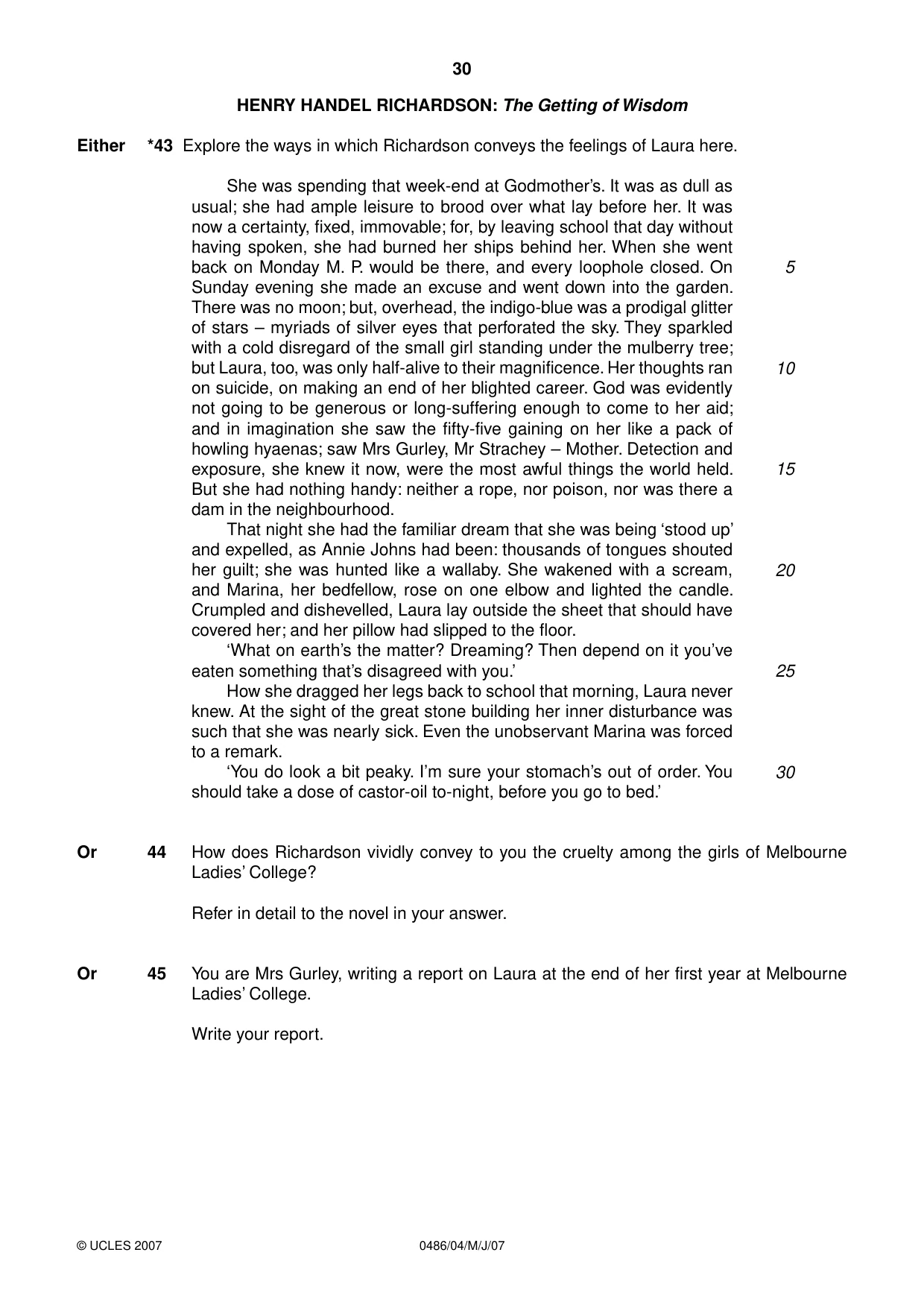
30 0486/04/M/J/07 © UCLES 2007 HENRY HANDEL RICHARDSON: The Getting of Wisdom Either *43 Explore the ways in which Richardson conveys the feelings of Laura here. She was spending that week-end at Godmother’s. It was as dull as usual; she had ample leisure to brood over what lay before her. It was now a certainty, fixed, immovable; for, by leaving school that day without having spoken, she had burned her ships behind her. When she went back on Monday M. P. would be there, and every loophole closed. On Sunday evening she made an excuse and went down into the garden. There was no moon; but, overhead, the indigo-blue was a prodigal glitter of stars – myriads of silver eyes that perforated the sky. They sparkled with a cold disregard of the small girl standing under the mulberry tree; but Laura, too, was only half-alive to their magnificence. Her thoughts ran on suicide, on making an end of her blighted career. God was evidently not going to be generous or long-suffering enough to come to her aid; and in imagination she saw the fifty-five gaining on her like a pack of howling hyaenas; saw Mrs Gurley, Mr Strachey – Mother. Detection and exposure, she knew it now, were the most awful things the world held. But she had nothing handy: neither a rope, nor poison, nor was there a dam in the neighbourhood. That night she had the familiar dream that she was being ‘stood up’ and expelled, as Annie Johns had been: thousands of tongues shouted her guilt; she was hunted like a wallaby. She wakened with a scream, and Marina, her bedfellow, rose on one elbow and lighted the candle. Crumpled and dishevelled, Laura lay outside the sheet that should have covered her; and her pillow had slipped to the floor. ‘What on earth’s the matter? Dreaming? Then depend on it you’ve eaten something that’s disagreed with you.’ How she dragged her legs back to school that morning, Laura never knew. At the sight of the great stone building her inner disturbance was such that she was nearly sick. Even the unobservant Marina was forced to a remark. ‘You do look a bit peaky. I’m sure your stomach’s out of order. You should take a dose of castor-oil to-night, before you go to bed.’ Or 44 How does Richardson vividly convey to you the cruelty among the girls of Melbourne Ladies’ College? Refer in detail to the novel in your answer. Or 45 You are Mrs Gurley, writing a report on Laura at the end of her first year at Melbourne Ladies’ College. Write your report. 5 10 15 20 25 30
Question paper, page 29
31 0486/04/M/J/07 BLANK PAGE Turn to page 32 for Question 46
Question paper, page 30
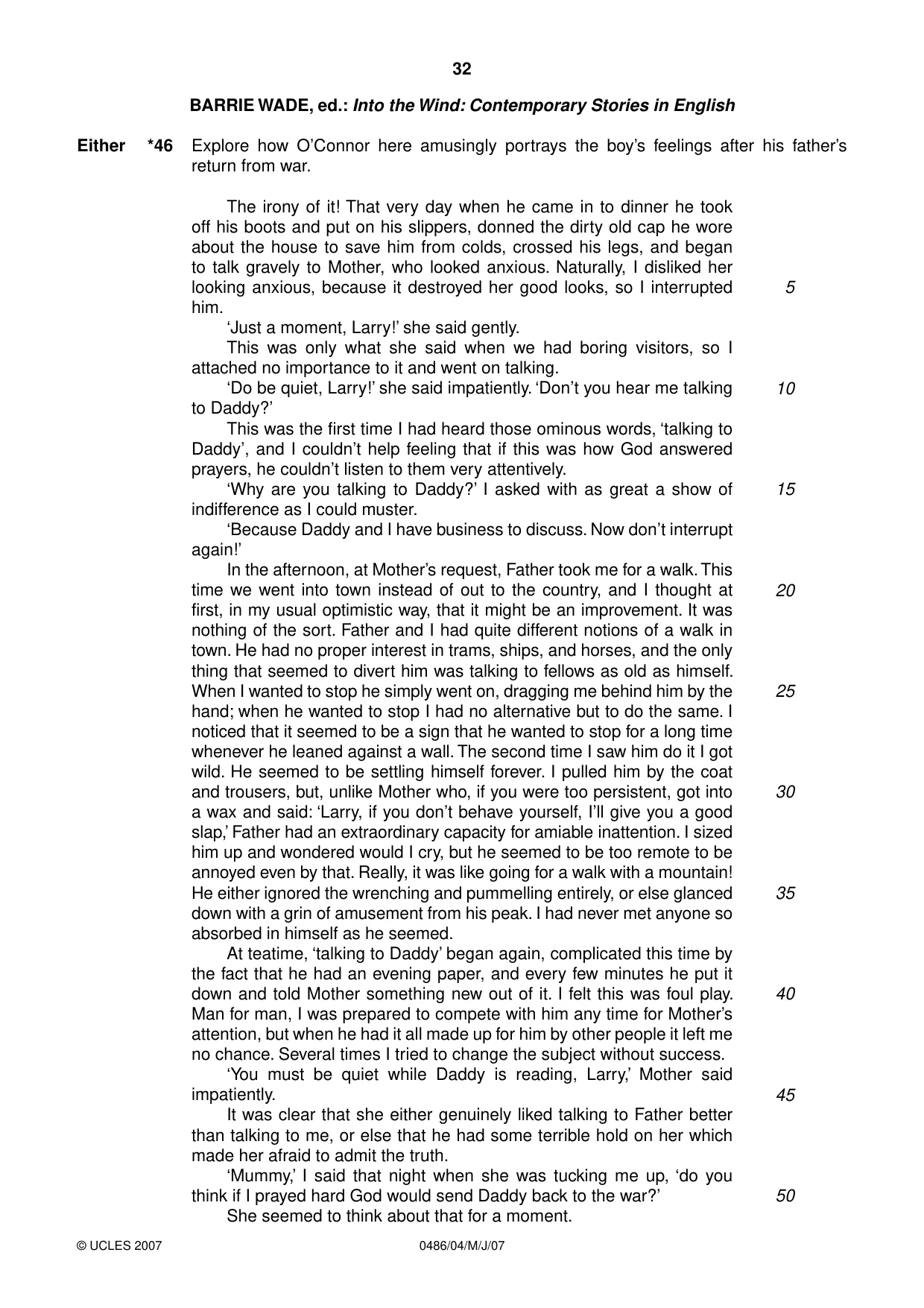
32 0486/04/M/J/07 © UCLES 2007 BARRIE WADE, ed.: Into the Wind: Contemporary Stories in English Either *46 Explore how O’Connor here amusingly portrays the boy’s feelings after his father’s return from war. The irony of it! That very day when he came in to dinner he took off his boots and put on his slippers, donned the dirty old cap he wore about the house to save him from colds, crossed his legs, and began to talk gravely to Mother, who looked anxious. Naturally, I disliked her looking anxious, because it destroyed her good looks, so I interrupted him. ‘Just a moment, Larry!’ she said gently. This was only what she said when we had boring visitors, so I attached no importance to it and went on talking. ‘Do be quiet, Larry!’ she said impatiently. ‘Don’t you hear me talking to Daddy?’ This was the first time I had heard those ominous words, ‘talking to Daddy’, and I couldn’t help feeling that if this was how God answered prayers, he couldn’t listen to them very attentively. ‘Why are you talking to Daddy?’ I asked with as great a show of indifference as I could muster. ‘Because Daddy and I have business to discuss. Now don’t interrupt again!’ In the afternoon, at Mother’s request, Father took me for a walk. This time we went into town instead of out to the country, and I thought at first, in my usual optimistic way, that it might be an improvement. It was nothing of the sort. Father and I had quite different notions of a walk in town. He had no proper interest in trams, ships, and horses, and the only thing that seemed to divert him was talking to fellows as old as himself. When I wanted to stop he simply went on, dragging me behind him by the hand; when he wanted to stop I had no alternative but to do the same. I noticed that it seemed to be a sign that he wanted to stop for a long time whenever he leaned against a wall. The second time I saw him do it I got wild. He seemed to be settling himself forever. I pulled him by the coat and trousers, but, unlike Mother who, if you were too persistent, got into a wax and said: ‘Larry, if you don’t behave yourself, I’ll give you a good slap,’ Father had an extraordinary capacity for amiable inattention. I sized him up and wondered would I cry, but he seemed to be too remote to be annoyed even by that. Really, it was like going for a walk with a mountain! He either ignored the wrenching and pummelling entirely, or else glanced down with a grin of amusement from his peak. I had never met anyone so absorbed in himself as he seemed. At teatime, ‘talking to Daddy’ began again, complicated this time by the fact that he had an evening paper, and every few minutes he put it down and told Mother something new out of it. I felt this was foul play. Man for man, I was prepared to compete with him any time for Mother’s attention, but when he had it all made up for him by other people it left me no chance. Several times I tried to change the subject without success. ‘You must be quiet while Daddy is reading, Larry,’ Mother said impatiently. It was clear that she either genuinely liked talking to Father better than talking to me, or else that he had some terrible hold on her which made her afraid to admit the truth. ‘Mummy,’ I said that night when she was tucking me up, ‘do you think if I prayed hard God would send Daddy back to the war?’ She seemed to think about that for a moment. 5 10 15 20 25 30 35 40 45 50
Question paper, page 31
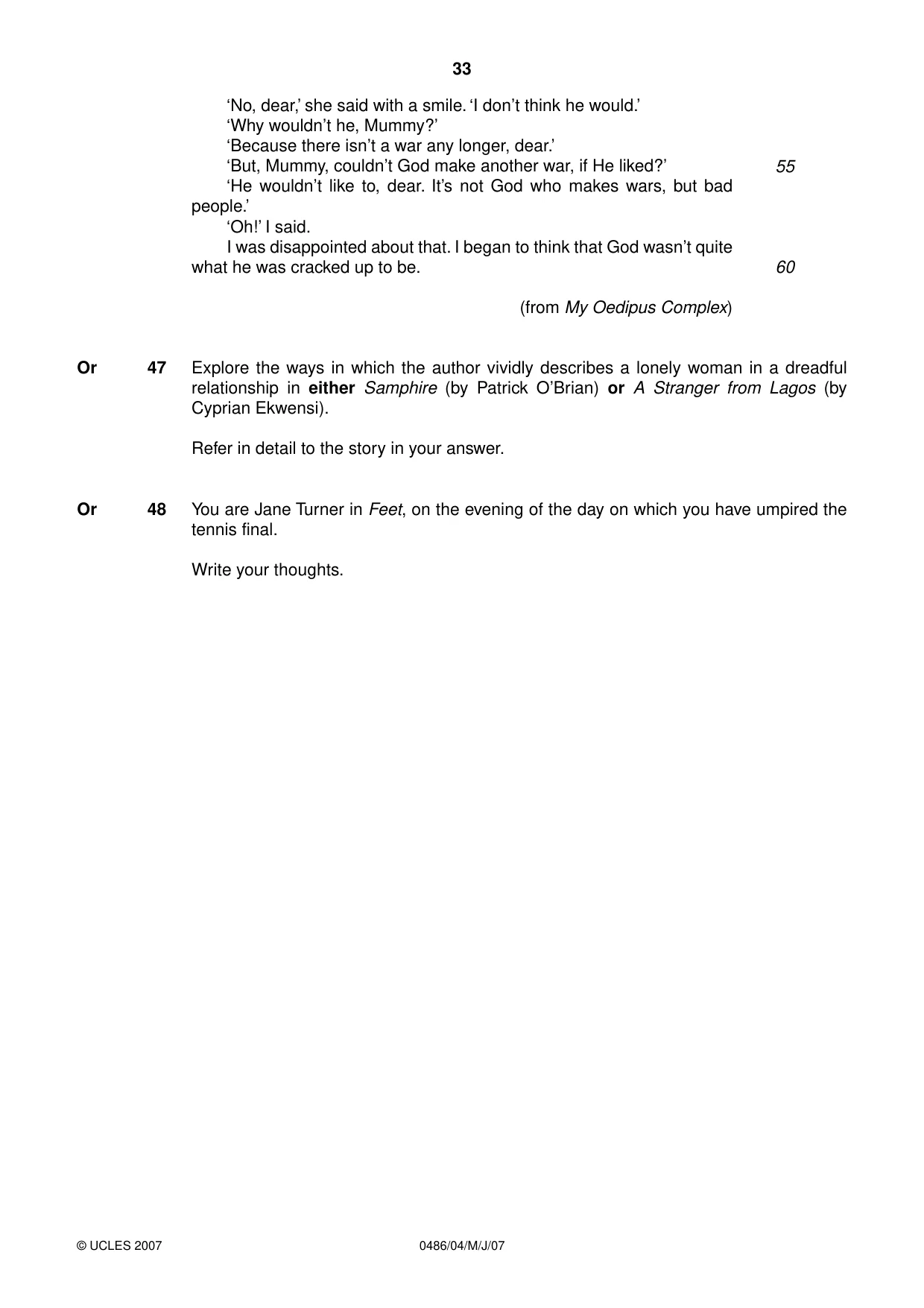
33 0486/04/M/J/07 © UCLES 2007 ‘No, dear,’ she said with a smile. ‘I don’t think he would.’ ‘Why wouldn’t he, Mummy?’ ‘Because there isn’t a war any longer, dear.’ ‘But, Mummy, couldn’t God make another war, if He liked?’ ‘He wouldn’t like to, dear. It’s not God who makes wars, but bad people.’ ‘Oh!’ I said. I was disappointed about that. I began to think that God wasn’t quite what he was cracked up to be. (from My Oedipus Complex) Or 47 Explore the ways in which the author vividly describes a lonely woman in a dreadful relationship in either Samphire (by Patrick O’Brian) or A Stranger from Lagos (by Cyprian Ekwensi). Refer in detail to the story in your answer. Or 48 You are Jane Turner in Feet, on the evening of the day on which you have umpired the tennis final. Write your thoughts. 55 60
Question paper, page 34
36 0486/04/M/J/07 Copyright Acknowledgements: Question 1 © Lorraine Hansberry; A Raisin in the Sun ; Methuen Publishing Ltd; 2001. Question 4 © Liz Lochhead and Gina Moxley; Cuba and Dog House; Faber & Faber Ltd. Question 13 © The Society of Authors, on behalf of the Bernard Shaw Estate. Question 16 © By Tennessee Williams, from A STREETCAR NAMED DESIRE, copyright © 1974 by The University of the South. Reprinted by permission of New Directions Publishing Corp. Question 22 © Liz Lochhead; Storyteller. Question 25 © Chinua Achebe; ‘Things Fall Apart’; The African Trilogy, Picador; 1988. Question 31 © A P Watt on behalf of Helen Dunmore. Question 34 “Fire on the Mountain”, from LORD OF THE FLIES by William Golding, copyright 1954, renewed © 1982 by William Gerald Golding. Used by permission of G.P. Putnam’s Sons, a division of Penguin Group (USA) Inc. Question 37 © Graham Greene; Travels with My Aunt ; Penguin; 2004. Question 40 © Harper Lee; To Kill a Mockingbird ; Vintage; 2004. Question 46 ‘My Oedipus Complex’ by Frank O’Connor (Copyright © Frank O’Connor 1953) is reproduced by permission of PFD (www.pdf.co.uk) on behalf of Frank O’Connor. Permission to reproduce items where third-party owned material protected by copyright is included has been sought and cleared where possible. Every reasonable effort has been made by the publisher (UCLES) to trace copyright holders, but if any items requiring clearance have unwittingly been included, the publisher will be pleased to make amends at the earliest possible opportunity. University of Cambridge International Examinations is part of the Cambridge Assessment Group. Cambridge Assessment is the brand name of University of Cambridge Local Examinations Syndicate (UCLES), which is itself a department of the University of Cambridge. BLANK PAGE
Mark scheme, page 1
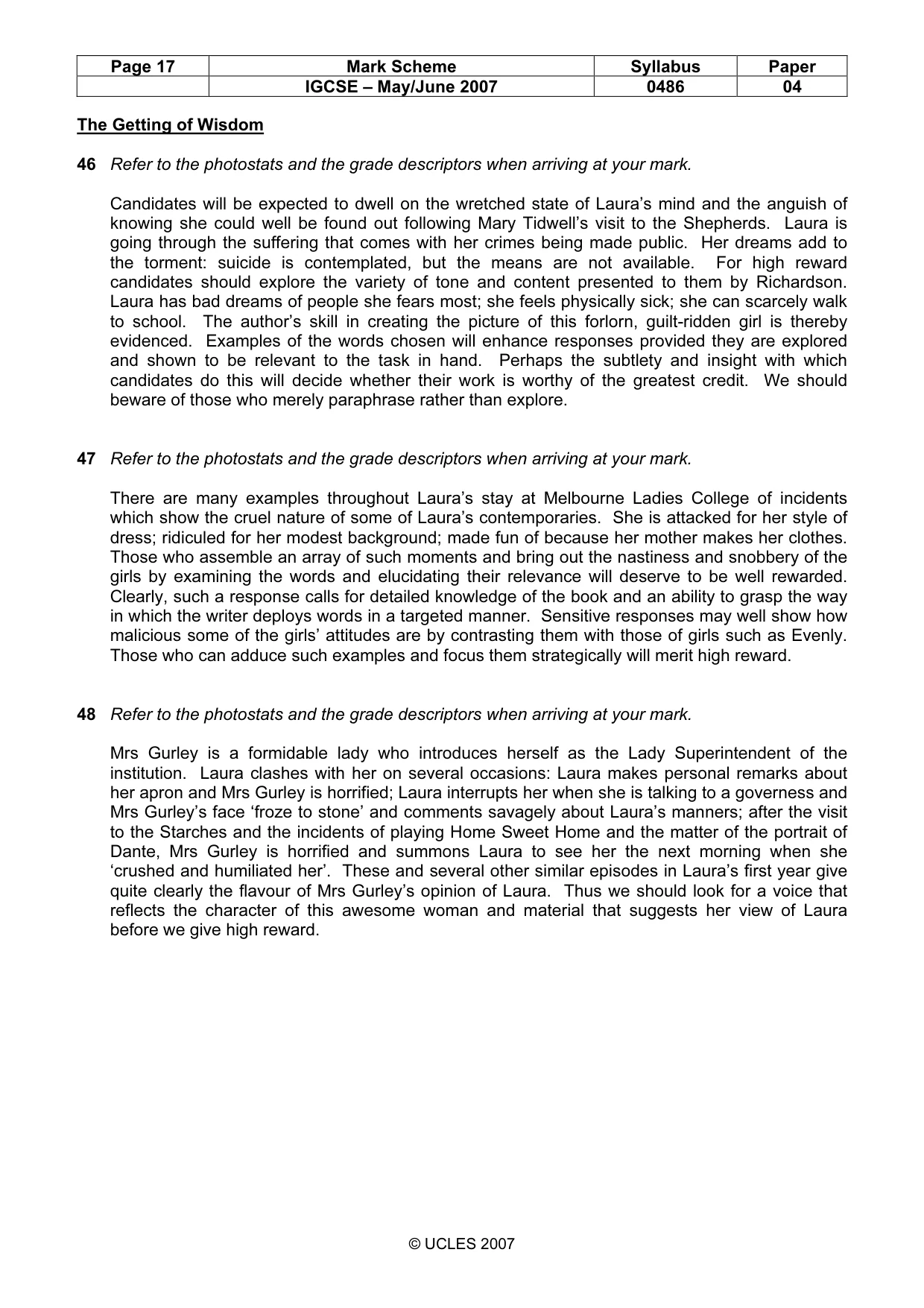
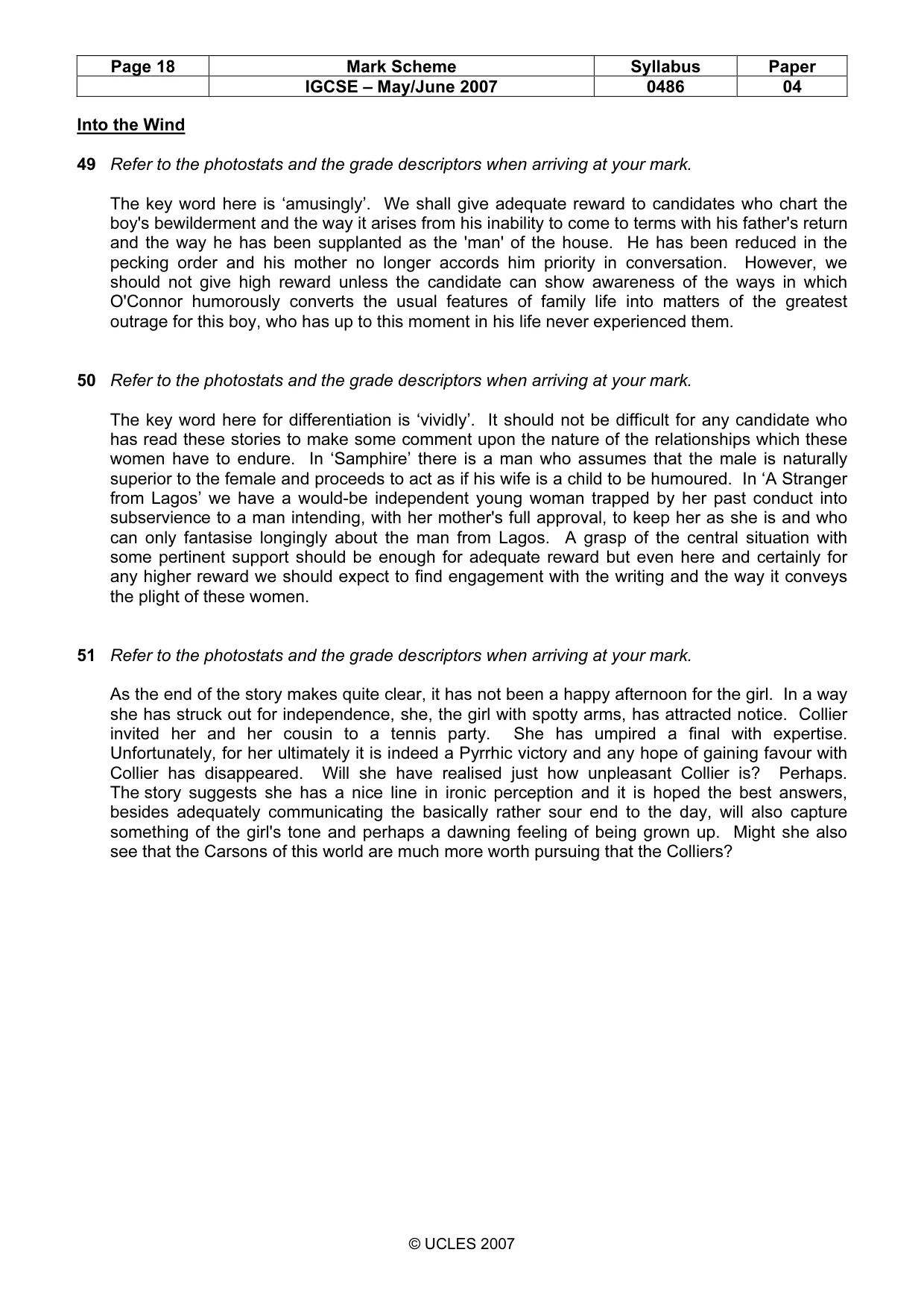
UNIVERSITY OF CAMBRIDGE INTERNATIONAL EXAMINATIONS International General Certificate of Secondary Education MARK SCHEME for the May/June 2007 question paper 0486 LITERATURE (ENGLISH) 0486/04 Paper 4 (Closed Books), maximum raw mark 80 This mark scheme is published as an aid to teachers and candidates, to indicate the requirements of the examination. It shows the basis on which Examiners were instructed to award marks. It does not indicate the details of the discussions that took place at an Examiners’ meeting before marking began. All Examiners are instructed that alternative correct answers and unexpected approaches in candidates’ scripts must be given marks that fairly reflect the relevant knowledge and skills demonstrated. Mark schemes must be read in conjunction with the question papers and the report on the examination. • CIE will not enter into discussions or correspondence in connection with these mark schemes. CIE is publishing the mark schemes for the May/June 2007 question papers for most IGCSE, GCE Advanced Level and Advanced Subsidiary Level syllabuses and some Ordinary Level syllabuses. www.XtremePapers.com
Mark scheme, page 2
Page 2 Mark Scheme Syllabus Paper IGCSE – May/June 2007 0486 04 © UCLES 2007 General Descriptors The general descriptors are an attempt to guide examiners to an understanding of the qualities normally expected of, or ‘typical’ of work in the band. They must not be interpreted as hurdle statements, and form a means of general guidance. Photostats taken from work produced in the examination will be the principal means by which we shall standardize the marking. A. Descriptors for essay/passage-based tasks 0-1 The answer does not meet the criteria for a mark in the next band. 2-3 Candidates will – show a little awareness of… make some comment about… 4-5 Candidates will – make a few straightforward points about… show a few signs of understanding… make a little reference to aspects of the text… make simple personal response to… 6-8 Candidates will – make some relevant comment about… show some understanding of… with a little support from the text/reference to language. 9-11 Candidates will – begin to develop a response… show understanding of … with some detail from the text/reference to language. 12-14 Candidates will – make a reasonably sustained/extended response… show understanding of… show some thoroughness in use of text for support. make some response to the way language works. 15-17 Candidates will – make a convincing response… show clear, sustained understanding of… make careful and relevant reference to the text. respond with some thoroughness/detail to the way language works. 18-20 Candidates will – sustain a perceptive, convincing response… demonstrate clear critical/analytical understanding. show some originality of thought. make much well-selected reference to the text. respond sensitively and in detail to the way language works. The very best will achieve all the above, with flair, imagination and sophistication in addition.
Mark scheme, page 3
Page 3 Mark Scheme Syllabus Paper IGCSE – May/June 2007 0486 04 © UCLES 2007 B. Descriptors for Empathic Questions (imaginative/creative tasks) There are three key elements to be looked for in responses to these questions: • sound knowledge of what happens in the text • an understanding/interpretation of this • the use of an authentic voice or voices It is possible that some candidates will shy away from assuming the voice and the phrasing of some tasks, particularly those referring to the character’s thoughts, may perforce allow this. Responses of this sort can sometimes show insight despite not entering fully into the imaginative challenge. They should be assessed on the strength of that insight rather than the band descriptors below. 0-1 The answer does not meet the criteria for a mark in the next band. 2-3 Candidates will show a little knowledge of what the character does. 4-5 Candidates will show some knowledge of what the character does and express some view about the reasons for action. 6-8 Candidates will show some understanding of character through the aspects of the text referred to. There will be a little mentioning of feelings and ideas. 9-11 Candidates will show a basic understanding of what the character does and thinks. These ideas will show a little evidence of being expressed in an appropriate way. 12-14 Candidates will have a sound working knowledge on which to base their writing, which will have features of expression which are suitable and appropriate to the character or occasion. 15-17 Candidates will have a good knowledge and understanding and be able to use this to produce writing expressed in a way which is largely fitting and authentic. The character will be clearly recognisable through the voice assumed. 18-20 Candidates will use a full and assured understanding of the text to write in a manner which expresses the thoughts, feelings and attitudes of the character with assurance and insight. The voice assumed will be entirely appropriate for the character C. Marking Notes In this syllabus, we aim at encouraging candidates to make some personal response to their reading. This means that, while we may have legitimate expectations as to the ground most answers may occupy, we must at all times be prepared to meet the candidates on their chosen ground. It is to be hoped that candidates will see on occasion other possibilities. In this examination, rigid demands for what must be in a good answer must be guarded against. The Photostat scripts circulated during coordination will be crucial to maintaining the standard throughout the marking. We must try at all times to tease out what the candidate is trying to say to us. It is possible for a candidate whose technical command of English is limited, but whose language still manages to communicate understanding, to receive high marks. Nor should be reward fluency and display of knowledge of literary terms if we feel there is little evidence of understanding. Remember that we are looking for literary response, not language skills. The notes that follow on each question are for general guidance only, and are not rigid prescriptions of required content. They need to be used in connection with the generic band descriptors.
Mark scheme, page 4
Page 4 Mark Scheme Syllabus Paper IGCSE – May/June 2007 0486 04 © UCLES 2007 DRAMA A Raisin in the Sun 1 Refer to the photostats and grade descriptors when arriving at your mark. This passage marks something of a crisis for Walter. Though the question does not specifically require external reference, it will be useful to candidates to place it in the context of Walter’s tiredness and disillusionment with his life and his dream of running a business. He has not been getting much support from Ruth and her pregnancy has put an even greater load on him. The marriage is severely at risk. He is sharply aware of the fact that the future holds very little different for him unless he can find a stake to go into business with Willy and he has just discovered that his only possible source of money, Mama, has used the windfall to buy a house in Clybourne park and is reserving the rest for Beneatha’s education. The tone of this extract is therefore very sour. Walter’s anger seems to have burnt out, and he appears ‘indifferent’ to both his job and to his wife. She clearly does not know what he has been up to for the past few days. It looks pretty much as though he is going to resort to drink – he seems to have given up on everything else. Candidates might profitably comment on his reference to ‘watching the Negroes go by’; he is distancing himself from them, yet empathising with their lack of purpose. His final comment to Mama is deeply sarcastic. 2 Refer to the photostats and grade descriptors when arriving at your mark. The quotation comes from the Bonny Greer introduction to the Methuen edition. The most likely meaning is that Mama’s survival and her support of her family through all the difficulties associated with being a black American in the fifties and without a husband is heroic. She has held them together, but this means she has controlled their lives. Even in adulthood she is making decisions for them such as the purchase of the house and she is certainly in command, not hesitating to tell Walter how he should be treating his wife. She does adapt, however. At the end of the play she allows Walter to take charge, though she is dismissive of Beneatha’s situation. She is deeply religious and this carries her through. There will be different reactions to the character and we should allow anything that can be supported from the text. 3 Refer to the photostats and grade descriptors when arriving at your mark. Answers need to be more than merely speculative. They should refer closely to the conversation between Asagai and Beneatha at the beginning of Act 3 and the earlier one in Act 1 scene ii. We do not know at the end of the play whether she will accept the proposal or conform to what mama says and it will be interesting to see what inferences are drawn by candidates into how persuasive Asagai has been. Beneatha has clearly been very impressed by his accounts of life in Africa. She is a feisty and vivacious character and good answers will capture some of the flavour of her personality.
Mark scheme, page 5
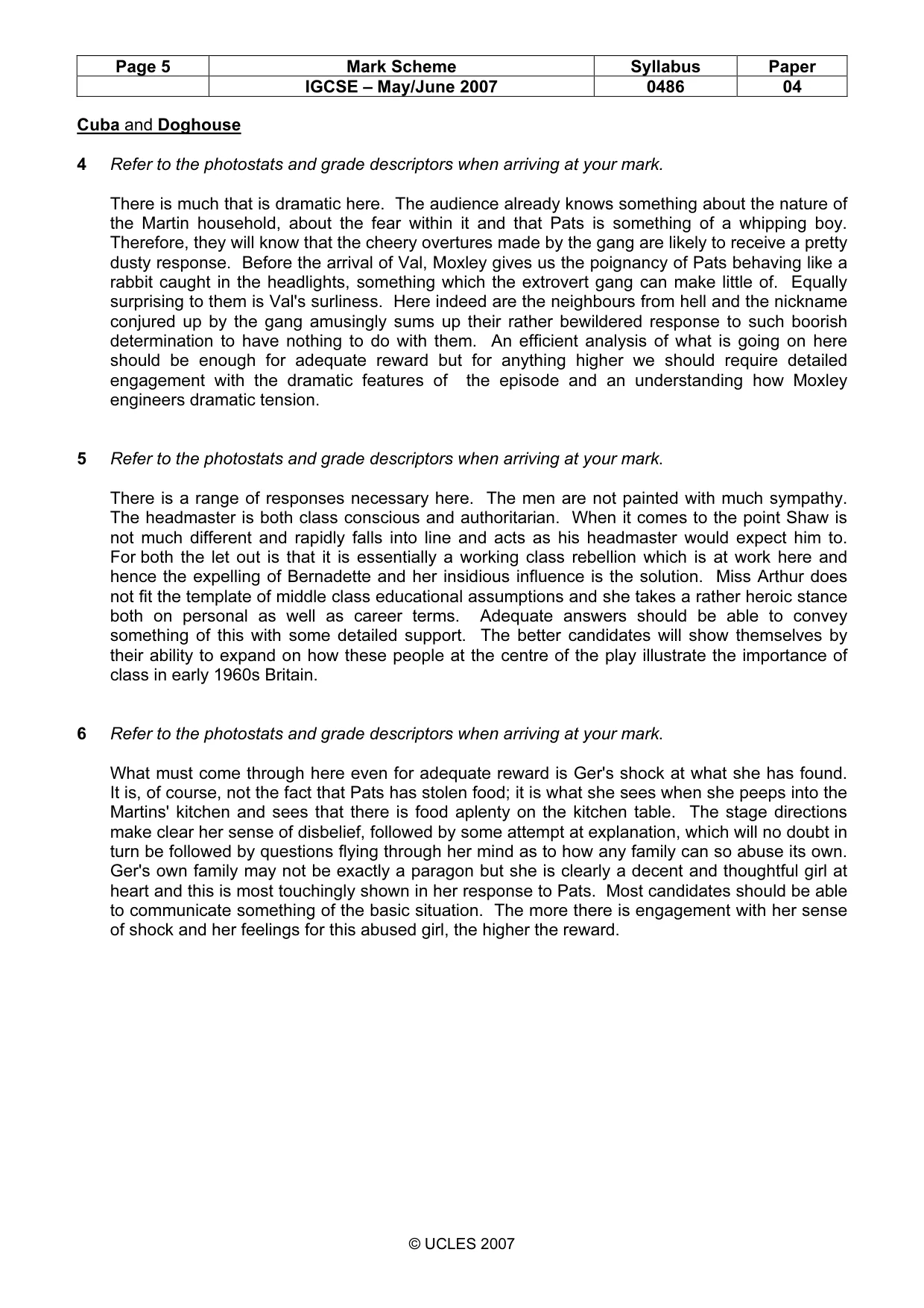
Page 5 Mark Scheme Syllabus Paper IGCSE – May/June 2007 0486 04 © UCLES 2007 Cuba and Doghouse 4 Refer to the photostats and grade descriptors when arriving at your mark. There is much that is dramatic here. The audience already knows something about the nature of the Martin household, about the fear within it and that Pats is something of a whipping boy. Therefore, they will know that the cheery overtures made by the gang are likely to receive a pretty dusty response. Before the arrival of Val, Moxley gives us the poignancy of Pats behaving like a rabbit caught in the headlights, something which the extrovert gang can make little of. Equally surprising to them is Val's surliness. Here indeed are the neighbours from hell and the nickname conjured up by the gang amusingly sums up their rather bewildered response to such boorish determination to have nothing to do with them. An efficient analysis of what is going on here should be enough for adequate reward but for anything higher we should require detailed engagement with the dramatic features of the episode and an understanding how Moxley engineers dramatic tension. 5 Refer to the photostats and grade descriptors when arriving at your mark. There is a range of responses necessary here. The men are not painted with much sympathy. The headmaster is both class conscious and authoritarian. When it comes to the point Shaw is not much different and rapidly falls into line and acts as his headmaster would expect him to. For both the let out is that it is essentially a working class rebellion which is at work here and hence the expelling of Bernadette and her insidious influence is the solution. Miss Arthur does not fit the template of middle class educational assumptions and she takes a rather heroic stance both on personal as well as career terms. Adequate answers should be able to convey something of this with some detailed support. The better candidates will show themselves by their ability to expand on how these people at the centre of the play illustrate the importance of class in early 1960s Britain. 6 Refer to the photostats and grade descriptors when arriving at your mark. What must come through here even for adequate reward is Ger's shock at what she has found. It is, of course, not the fact that Pats has stolen food; it is what she sees when she peeps into the Martins' kitchen and sees that there is food aplenty on the kitchen table. The stage directions make clear her sense of disbelief, followed by some attempt at explanation, which will no doubt in turn be followed by questions flying through her mind as to how any family can so abuse its own. Ger's own family may not be exactly a paragon but she is clearly a decent and thoughtful girl at heart and this is most touchingly shown in her response to Pats. Most candidates should be able to communicate something of the basic situation. The more there is engagement with her sense of shock and her feelings for this abused girl, the higher the reward.
Mark scheme, page 6
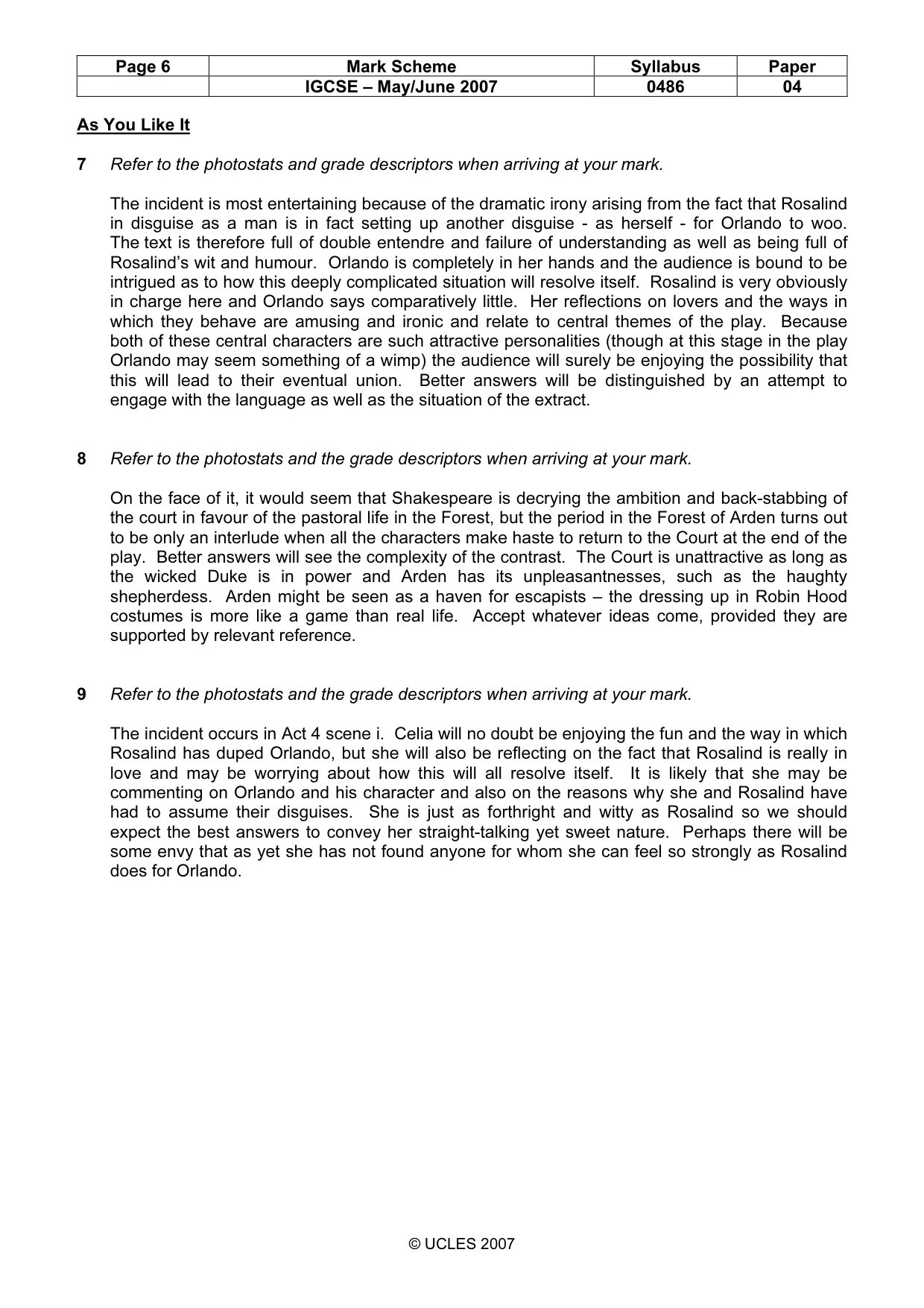
Page 6 Mark Scheme Syllabus Paper IGCSE – May/June 2007 0486 04 © UCLES 2007 As You Like It 7 Refer to the photostats and grade descriptors when arriving at your mark. The incident is most entertaining because of the dramatic irony arising from the fact that Rosalind in disguise as a man is in fact setting up another disguise - as herself - for Orlando to woo. The text is therefore full of double entendre and failure of understanding as well as being full of Rosalind’s wit and humour. Orlando is completely in her hands and the audience is bound to be intrigued as to how this deeply complicated situation will resolve itself. Rosalind is very obviously in charge here and Orlando says comparatively little. Her reflections on lovers and the ways in which they behave are amusing and ironic and relate to central themes of the play. Because both of these central characters are such attractive personalities (though at this stage in the play Orlando may seem something of a wimp) the audience will surely be enjoying the possibility that this will lead to their eventual union. Better answers will be distinguished by an attempt to engage with the language as well as the situation of the extract. 8 Refer to the photostats and the grade descriptors when arriving at your mark. On the face of it, it would seem that Shakespeare is decrying the ambition and back-stabbing of the court in favour of the pastoral life in the Forest, but the period in the Forest of Arden turns out to be only an interlude when all the characters make haste to return to the Court at the end of the play. Better answers will see the complexity of the contrast. The Court is unattractive as long as the wicked Duke is in power and Arden has its unpleasantnesses, such as the haughty shepherdess. Arden might be seen as a haven for escapists – the dressing up in Robin Hood costumes is more like a game than real life. Accept whatever ideas come, provided they are supported by relevant reference. 9 Refer to the photostats and the grade descriptors when arriving at your mark. The incident occurs in Act 4 scene i. Celia will no doubt be enjoying the fun and the way in which Rosalind has duped Orlando, but she will also be reflecting on the fact that Rosalind is really in love and may be worrying about how this will all resolve itself. It is likely that she may be commenting on Orlando and his character and also on the reasons why she and Rosalind have had to assume their disguises. She is just as forthright and witty as Rosalind so we should expect the best answers to convey her straight-talking yet sweet nature. Perhaps there will be some envy that as yet she has not found anyone for whom she can feel so strongly as Rosalind does for Orlando.
Mark scheme, page 7
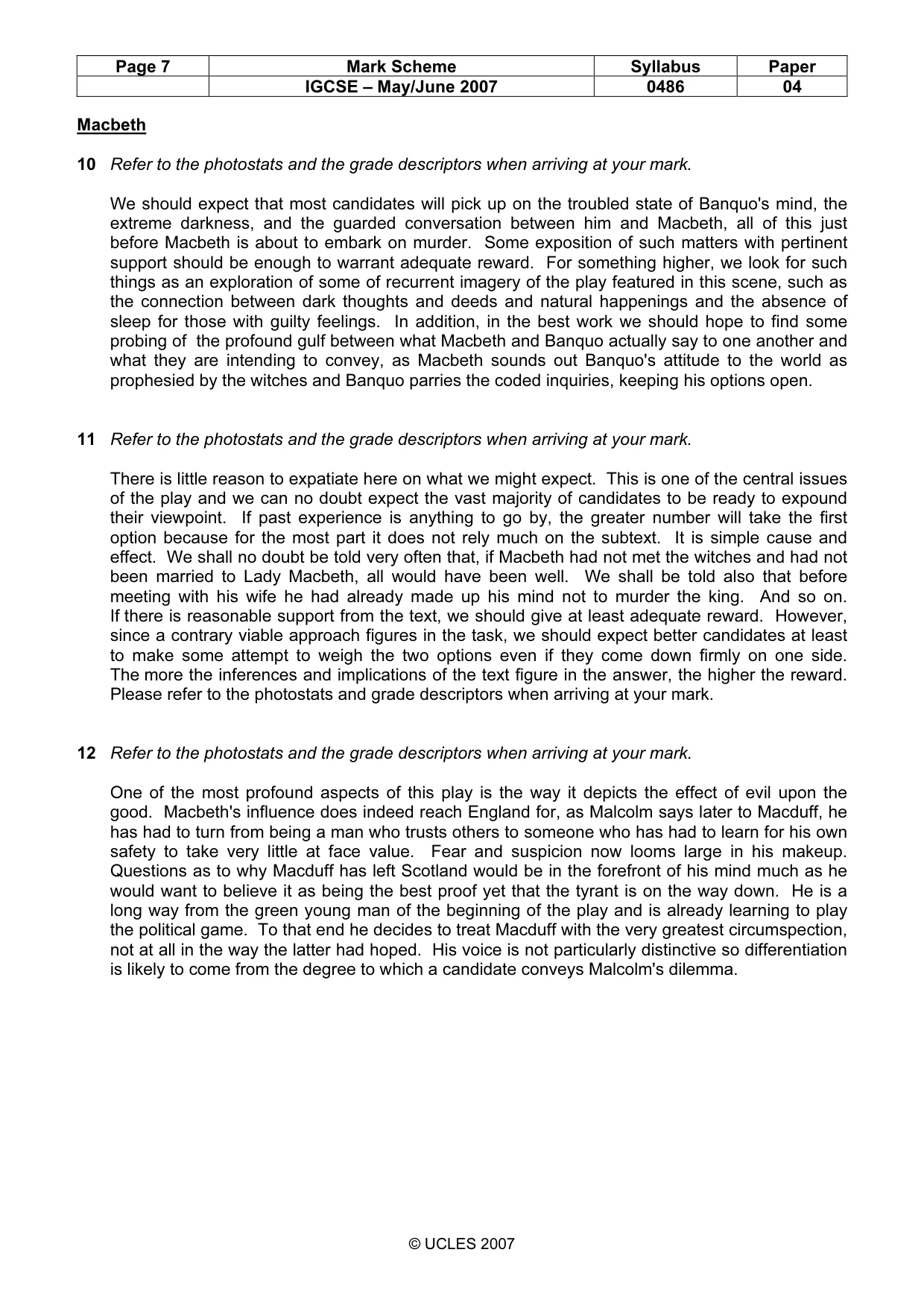
Page 7 Mark Scheme Syllabus Paper IGCSE – May/June 2007 0486 04 © UCLES 2007 Macbeth 10 Refer to the photostats and the grade descriptors when arriving at your mark. We should expect that most candidates will pick up on the troubled state of Banquo's mind, the extreme darkness, and the guarded conversation between him and Macbeth, all of this just before Macbeth is about to embark on murder. Some exposition of such matters with pertinent support should be enough to warrant adequate reward. For something higher, we look for such things as an exploration of some of recurrent imagery of the play featured in this scene, such as the connection between dark thoughts and deeds and natural happenings and the absence of sleep for those with guilty feelings. In addition, in the best work we should hope to find some probing of the profound gulf between what Macbeth and Banquo actually say to one another and what they are intending to convey, as Macbeth sounds out Banquo's attitude to the world as prophesied by the witches and Banquo parries the coded inquiries, keeping his options open. 11 Refer to the photostats and the grade descriptors when arriving at your mark. There is little reason to expatiate here on what we might expect. This is one of the central issues of the play and we can no doubt expect the vast majority of candidates to be ready to expound their viewpoint. If past experience is anything to go by, the greater number will take the first option because for the most part it does not rely much on the subtext. It is simple cause and effect. We shall no doubt be told very often that, if Macbeth had not met the witches and had not been married to Lady Macbeth, all would have been well. We shall be told also that before meeting with his wife he had already made up his mind not to murder the king. And so on. If there is reasonable support from the text, we should give at least adequate reward. However, since a contrary viable approach figures in the task, we should expect better candidates at least to make some attempt to weigh the two options even if they come down firmly on one side. The more the inferences and implications of the text figure in the answer, the higher the reward. Please refer to the photostats and grade descriptors when arriving at your mark. 12 Refer to the photostats and the grade descriptors when arriving at your mark. One of the most profound aspects of this play is the way it depicts the effect of evil upon the good. Macbeth's influence does indeed reach England for, as Malcolm says later to Macduff, he has had to turn from being a man who trusts others to someone who has had to learn for his own safety to take very little at face value. Fear and suspicion now looms large in his makeup. Questions as to why Macduff has left Scotland would be in the forefront of his mind much as he would want to believe it as being the best proof yet that the tyrant is on the way down. He is a long way from the green young man of the beginning of the play and is already learning to play the political game. To that end he decides to treat Macduff with the very greatest circumspection, not at all in the way the latter had hoped. His voice is not particularly distinctive so differentiation is likely to come from the degree to which a candidate conveys Malcolm's dilemma.
Mark scheme, page 8
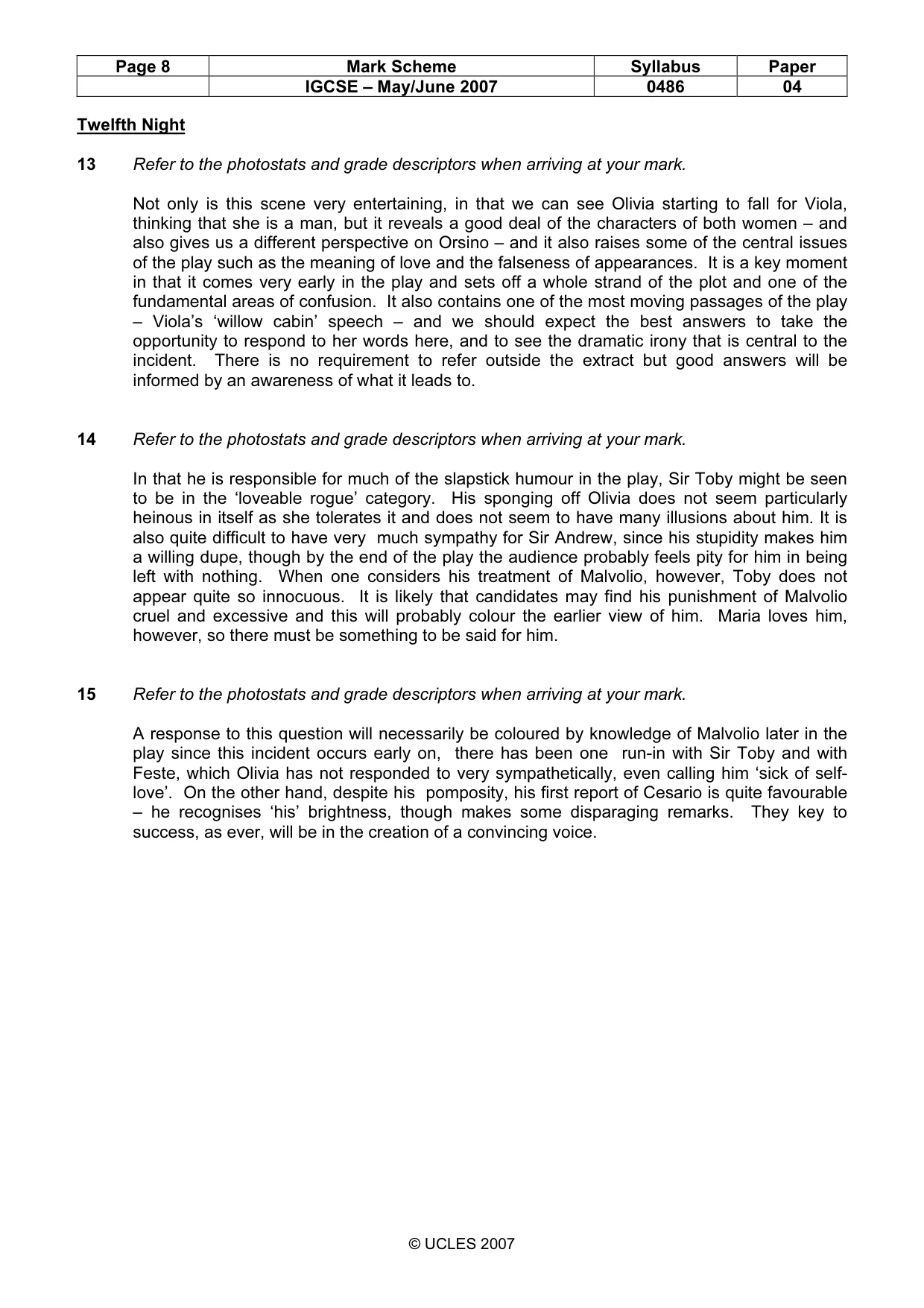
Page 8 Mark Scheme Syllabus Paper IGCSE – May/June 2007 0486 04 © UCLES 2007 Twelfth Night 13 Refer to the photostats and grade descriptors when arriving at your mark. Not only is this scene very entertaining, in that we can see Olivia starting to fall for Viola, thinking that she is a man, but it reveals a good deal of the characters of both women – and also gives us a different perspective on Orsino – and it also raises some of the central issues of the play such as the meaning of love and the falseness of appearances. It is a key moment in that it comes very early in the play and sets off a whole strand of the plot and one of the fundamental areas of confusion. It also contains one of the most moving passages of the play – Viola’s ‘willow cabin’ speech – and we should expect the best answers to take the opportunity to respond to her words here, and to see the dramatic irony that is central to the incident. There is no requirement to refer outside the extract but good answers will be informed by an awareness of what it leads to. 14 Refer to the photostats and grade descriptors when arriving at your mark. In that he is responsible for much of the slapstick humour in the play, Sir Toby might be seen to be in the ‘loveable rogue’ category. His sponging off Olivia does not seem particularly heinous in itself as she tolerates it and does not seem to have many illusions about him. It is also quite difficult to have very much sympathy for Sir Andrew, since his stupidity makes him a willing dupe, though by the end of the play the audience probably feels pity for him in being left with nothing. When one considers his treatment of Malvolio, however, Toby does not appear quite so innocuous. It is likely that candidates may find his punishment of Malvolio cruel and excessive and this will probably colour the earlier view of him. Maria loves him, however, so there must be something to be said for him. 15 Refer to the photostats and grade descriptors when arriving at your mark. A response to this question will necessarily be coloured by knowledge of Malvolio later in the play since this incident occurs early on, there has been one run-in with Sir Toby and with Feste, which Olivia has not responded to very sympathetically, even calling him ‘sick of self- love’. On the other hand, despite his pomposity, his first report of Cesario is quite favourable – he recognises ‘his’ brightness, though makes some disparaging remarks. They key to success, as ever, will be in the creation of a convincing voice.
Mark scheme, page 9
Page 9 Mark Scheme Syllabus Paper IGCSE – May/June 2007 0486 04 © UCLES 2007 The Devil's Disciple 16 Refer to the photostats and the grade descriptors when arriving at your mark. The main dramatic contrast in this scene is, of course, between the worldly wise Richard and the naive, romantic woman who is Judith, who thinks that she has discovered too late what a rascal her husband is compared to the hero Richard. Therefore, in her own terms she risks her moral reputation by almost declaring her love for Richard. Shaw delights in measuring her imagined world against reality. Only once does she display insight when she questions the primacy of politics over personal feeling. She has virtually everything else wrong and, rather like her husband, Richard has to speak to her almost as if she were a child to be humoured. More seriously there is a strain throughout the scene of Richard's control being close to breaking, for instance when he speaks of his Mother's dying curse on him. As usual the wider the candidate ranges, the higher the mark awarded, but we should reserve really high reward for those who engage with Shaw's stagecraft, in particular responding to the amusement offered by the scene. 17 Refer to the photostats and the grade descriptors when arriving at your mark. The key phrase here is dramatically compelling. In other words, more is being asked than a character sketch. We shall obviously reward understanding of how Shaw imbues this creation with all his own scorn for the values of the puritan. Not only is Dick a more moral person than many of the Christians in the play, he also embodies the Shavian life principle in which energy, wit and free thinking herald a new world. Some understanding of his personality in the play with some support should receive adequate reward but anything higher must be seen to respond to his melodramatic power as a character with detailed support from the words and actions of the play. 18 Refer to the photostats and the grade descriptors when arriving at your mark. Mrs Dudgeon did not go to her maker in a reposed fashion. We know that she cursed Richard and no doubt a number of others came in for the lash. Bitter disappointment that her rectitude has not met with greater reward on this earth is at the centre of her personality and there is very little reason to believe that this will not have remained so to the very end. Of course, she will no doubt be looking forward to all this being swiftly righted in the after life and that she will have the satisfaction of witnessing her enemies roasting for eternity at some time in the near future. Probably in this task the major part of differentiation will rest with the voice rather than with what she says. Since her thin lipped acerbic way of speaking is so distinctive, it is reasonable to expect good candidates to capture its tone quite accurately.
Mark scheme, page 10
Page 10 Mark Scheme Syllabus Paper IGCSE – May/June 2007 0486 04 © UCLES 2007 A Streetcar Named Desire 19 Refer to the photostats and the grade descriptors when arriving at your mark. Stanley shows his strong antipathy towards Blanche: he is clearly stung by her ‘hoity - toady’ view of him. He wants to hurt her - hence the trick with the ticket, designed to rile Blanche - and how well he succeeds! Stella, as throughout the play, takes a very different view of her sister, quite naturally. Before Blanche arrived, Stanley was in charge and everything was carried out to his requirements. Blanche has changed all that. Candidates who explore this latter perspective should be rewarded well. There are several telling pieces of dialogue in the extract which more astute candidates may well use to their advantage: ‘Delicate piece she is’; ‘I pulled you down off them columns, and how you loved it having them coloured lights going’; ‘…wasn’t it all okay till she showed here?’ Stanley shows his caring side for Stella also as in, ‘Hey, what is it, Stell?’ This other side of Stanley will be noted by the more insightful candidates. We may well differentiate by the degree to which candidates probe the writing to arrive at apposite views of these two characters. 20 Refer to the photostats and the grade descriptors when arriving at your mark. Although some might respond along the lines of ‘Blanche deserves all she gets’, that would be a very simplistic and unthinking reaction. When we bear in mind her unfortunate liaison with the young man early in her life, her lack of opportunity to enjoy a fulfilling relationship and her well developed self-deception, there are clearly grounds for sympathy. The way in which Williams has created the potential conflagration of putting her in close proximity to Stanley can hardly be conducive to her happiness. But Blanche’s self-generated feelings of superiority and her disdain for others do not make her an appealing character. This is a major issue and one which could certainly separate the good responses from the mediocre. To reward highly we should look for responses that see the full profile of Blanche and seek somehow to reconcile her endemic failings with the misfortunes fate has dealt her. 21 Refer to the photostats and the grade descriptors when arriving at your mark. Stella is very different from Blanche. She is more straightforward and lacks Blanche’s pretentiousness. She is the younger sister and looks up to Blanche. She lives in an area very different from where she and Blanche were brought up. She may well be ashamed of her modest apartment. She has married beneath her, and, although she loves her husband, she will doubtless feel sensitive about him as she contemplates the arrival of her sister. She will be aware of Blanche’s affectations and of Stanley’s straight talking and his proclivity to temper and possibly violence. Any worthwhile response will feature most if not all of these considerations. Those who capture well the voice of Stella, and hint at the possible tension and explosion that could arise between Blanche and Stanley, will merit high reward, provided they support their comments with evidence from Williams’ writing.
Mark scheme, page 11
Page 11 Mark Scheme Syllabus Paper IGCSE – May/June 2007 0486 04 © UCLES 2007 POETRY 22-27 Refer to the photostats and the grade descriptors when arriving at your mark. We will differentiate first of all according to how directly the candidates answer the question but also according to how well they convince us that they have engaged with the pleasure and excitement of good poetry. This means in effect that we do NOT give good reward to any explanation of "meaning" which shows little response to the words and how they create meaning. In all of the questions there is an explicit invitation to make a response to the words. It will be noticed that all the questions prescribe the poems from which the candidates should choose. This is to ensure that the candidate is writing on a poem appropriate to the question. It is also designed to send a strong signal to candidates that they are taking a large risk going into the examination with only one or two poems which they are determined to fit to one of the questions. The problem now is that some are choosing a task because the poem they wish to write about appears in the list rather than because they can answer the question. We should therefore be careful not to give much reward for answers which manifestly are not addressing the question, even if they show a convincing grasp of the poem. If the candidate chooses to write on a poem not in the list, then this should be treated as a rubric infringement. PROSE Things Fall Apart 28 Refer to the photostats and the grade descriptors when arriving at your mark. This extract reveals some of the characteristics of Okonkwo which become established throughout the novel. Principal amongst these are his egoism and his temper which lead to his embarking on a course of action which his head tells him is wrong. Obviously his capacity for sudden bursts of anger and violence is shown in his beating of his wife but perhaps more significant is the end where Achebe describes him as inwardly repentant but unable to acknowledge it in public. Hence he makes enemies and even amongst his friends has a reputation for unreliable hot-headedness despite his obvious qualities. For adequate reward candidates should be able to convey these salient points but the better candidates should be able to explore the extract in detail and to engage with aspects of Achebe's writing. 29 Refer to the photostats and the grade descriptors when arriving at your mark. Achebe's view of the old religion is quite ambivalent. He paints a picture of a world in which the ancestors and the gods are comfortingly close and embodied in the living. There are many instances in the novel of conversations with friends who in other circumstances become incarnations of the most powerful spirits. The kind of wholeness which this once gave to the clansmen's lives and is now lost is very much embodied in the novel's title. However, Achebe does not hold back in describing with horrifying intensity the brutal practices common in this worship nor the fear in which people live their daily lives. For adequate reward probably we should expect a candidate to have some grasp of either or both of these aspects; we should not expect at this level both sides to be covered. Better candidates will show themselves by their width of understanding but even here it should be possible for a candidate to achieve high reward by engaging with the power of Achebe's writing to convey one or both of the aspects. We should certainly not give high reward to answers which do not engage with the writing.
Mark scheme, page 12
Page 12 Mark Scheme Syllabus Paper IGCSE – May/June 2007 0486 04 © UCLES 2007 30 Refer to the photostats and the grade descriptors when arriving at your mark. The consistent thrust of this aspect of the novel is that Nwoye is a gentle boy who cannot live by his father's imperatives or those of his society, try as he would. And try he does, but not anymore. He is not without his father's courage; he must have known the likely reaction to his becoming Christian. However, the new religion suits his personality and at this moment his father's physical attack upon him simply confirms the rightness of his decision. Notice that he says nothing to his father. This could be residual fear and/or the new religion already at work in its teaching of non-violence. Even in answers which grasp the central situation we should not over reward those who make him angry. His main priority now is to learn more, to convert other members of his family and become a teacher. Perhaps the best answers will convey a sense of relief almost amounting to euphoria, that he has now made the giant leap. Great Expectations 31 Refer to the photostats and the grade descriptors when arriving at your mark. Most candidates should be able to grasp something of the significance of Wemmick's having constructed his house as a miniature castle. Of course, it is likely that many will concentrate upon Dickens' highlighting the eccentric aspects of this suburban residence but the better candidates will show themselves by highlighting the underlying serious point shown in Wemmick's need to erect such a dwelling as a refuge from the world of his work. It is to be noted how much forthcoming he becomes as he leaves London even though the dwelling itself, built as it is on the principles of defence and secrecy, illustrates how Wemmick still applies the same criteria to his personal life as he does as Jaggers' employee; for others to know how kind a man he is may, he feels, make him vulnerable. What is most touching is the delight this refuge gives him and the energy he invests in it. The best candidates will show themselves by responding to this rather tender picture; Dickens is doing much more than laughing at human eccentricity here. 32 Refer to the photostats and the grade descriptors when arriving at your mark. Here there is a challenge to make some sort of choice and then defend it but it may well be that some of the more intelligent answers will suggest that both propositions could be apt. We will also be faced with engaged answers which argue strongly for one or the other, most likely the second alternative, and these should be rewarded for the insights offered. After all, some of the most powerful moments in the novel have to do with Magwitch's wretched life. At a higher level we shall probably find the candidates who recognise that often Dickens' creation is not at all sentimental, that Pip's horror at being behoven to this basically violent man is not without some substance. In the end, though, the main differentiation will as usual arise from the candidates' ability to engage with pertinent details of Dickens' writing as required in the task. 33 Refer to the photostats and the grade descriptors when arriving at your mark. Most candidates should be able to convey something of Herbert's concern for the friend he has been forced to leave behind in his hour of need. He will no doubt be recalling some of the past events of his friendship and will certainly be upset about the way Pip has been manipulated. He does not at this stage, of course, know how much he himself owes to Pip's generosity and we should not be giving high reward to any candidate who makes that a central plank of Herbert's anguish at this moment. The better the candidate at managing to convey his sweet and considerate personality, even perhaps his moments of affectionate humour, the higher the reward.
Mark scheme, page 13
Page 13 Mark Scheme Syllabus Paper IGCSE – May/June 2007 0486 04 © UCLES 2007 The Siege 34 Refer to the photostats and the grade descriptors when arriving at your mark. This task is going to need attention to detail since little is made explicit. The two young people do not, of course, know for certain whether their feelings are reciprocated and hence are at times somewhat constrained with one another. Anna, in particular, is cautious to the point of prickliness at times. Andrei's feelings are perhaps more overt; witness his horror at the risks Anna has just taken and the gesture of wiping the speck of dirt from Anna's cheek. We shall probably find ourselves mainly differentiating according to the degree to which candidates can show themselves able to draw out significances from the little flecks of dialogue and action; the wider the range of reference, the higher the reward. 35 Refer to the photostats and the grade descriptors when arriving at your mark. As far as material is concerned, this is, of course, a wide open question. Various features come to mind as suitable: the general privation and suffering, the cold of the winter, the personal struggles for survival, the heroism as well as criminality of mankind in such circumstances. We shall, of course, accept any material for which an argument can be made that it is memorable since it is in this that the core of the task lies. Even for adequate reward we shall expect candidates to do more than describe; they should at least make some attempt to show what makes their chosen aspect vivid to them. For higher reward, however, we should look for direct responses to Dunmore's writing and not simply general assertions. 36 Refer to the photostats and the grade descriptors when arriving at your mark. Marina is a realist. Though a survivor and a woman of redoubtable spirit, she knows that she can do little for Levin and that she herself is unlikely to survive the winter. As later in the book, here no doubt she will turn her thoughts to her long love affair. The depth of her love is made clear later in the book and with it an understanding of the suffering she brought to Vera. Will she articulate how much of what she does in the siege is a form of repayment for that, an attempt to see that at least Anna and Kolya have a chance of surviving? Adequate answers should cover some of this ground whilst the better candidates should be able to find a voice that conveys the depth of feeling in this profoundly artistic woman who has had so much disappointment in life.
Mark scheme, page 14
Page 14 Mark Scheme Syllabus Paper IGCSE – May/June 2007 0486 04 © UCLES 2007 Lord of the Flies 37 Refer to the photostats and the grade descriptors when arriving at your mark. The incident occurs early in the novel and completely disrupts the relatively happy atmosphere. It will be very difficult for the question to be answered satisfactorily without the contrast being made between the optimistic mood of the boys who have organised themselves, set up a democracy of sorts with the conch and its rules and know that there is the possibility of a food supply, even see themselves as re-enacting Coral Island and having fun. Only Piggy has seen that they are isolated and that the prospects may be bleak. The little boy stands out because of the rather sinister birthmark. He introduces the idea of the ‘beastie thing’ which later comes to dominate the boys’ thoughts and which later takes the form of the Lord of the Flies. It is notable that the boys do not need much persuading that there might be an evil force on the island – ‘they knew about nightmares’. Despite Ralph’s rational explanations, the seeds have been planted and much of what is mentioned here has significance. Good answers will also see how Golding’s description of the surroundings introduces a more sombre feeling and the intimation of evil to come. 38 Refer to the photostats and the grade descriptors when arriving at your mark. Candidates’ views on this issue will differ and the best answers will perhaps give a balanced opinion rather than coming down on the side of one boy or the other. Ralph has charisma, kindness, intelligence and the ability to consult and delegate, though on occasions these turn out to be weaknesses rather than strengths. Jack is single-minded, brutal, authoritarian. He might have been able to provide the boys with food, but he has no interest in getting them off the island. There is a good deal of ground to cover, so expect well-selected supporting detail. 39 Refer to the photostats and the grade descriptors when arriving at your mark. The incident occurs just before Piggy’s death, which he of course has no premonition of, but the tone of answers might be coloured by knowledge of what happens next. Piggy will certainly be frightened – he is rendered almost completely helpless by the lack of glasses and the path to the fort is dangerous. He and Ralph and the twins are all that is left of the original ‘team’ as all the other boys have joined Jack’s hunters. He is clutching the conch and desperately holding on to the idea that it conveys some authority. There may be some description of the terror in the night when the glasses were stolen. Piggy’s ‘voice’ may be easier to capture than some – there are some obvious turns of phrase that come to mind, but the best answers will be strongly engaged with the character and his feelings at this particular moment.
Mark scheme, page 15
Page 15 Mark Scheme Syllabus Paper IGCSE – May/June 2007 0486 04 © UCLES 2007 Travels with My Aunt 40 Refer to the photostats and the grade descriptors when arriving at your mark. On the face of it, there is very little in this passage to suggest that Henry has not made the most catastrophic of decisions, even if yet again it proves not to be the case as the Aunt will be able to pick herself up off the floor in the near future. Most candidates should be able to point to a number of details to support what is an apparently rather grim picture. In general, the contrast between what this house was once imagined to be and what it is now is immense. The sense of dilapidation is emphasised by the lack of furniture and fittings. On top of that, perhaps the better candidates will respond to the way Aunt Augusta seems to be rather older and diminished in this setting, an impression only reinforced by her visions of what it will be like when they get furniture. The passage is full of comic details emphasising this sense of living on dreams, like the delicious end to the extract with Henry getting a very uncomfortable splinter in his thigh from the packing case as his Aunt speaks of the pretty girls she is going to obtain for him. 41 Refer to the photostats and the grade descriptors when arriving at your mark. No doubt the great majority will think that Greene intends the reader to feel that Henry was given a life which brought a much greater richness than is to be had from tending dahlias in suburbia. Adequate reward will be given to candidates who rehearse with some support the well trodden paths which describe Henry learning to enjoy what existence offers him without too many moral qualms. The wider a candidate ranges through the detail of the novel to support the argument, the higher should be the reward. However, there may well be stern moralists who see the Aunt as a female Mephistopheles and who might argue that the essentially decent Henry of Southwood was better off as he was. Perhaps this is not necessarily a complete distortion of Greene's intentions. We should accept that Greene does not romanticise the Aunt's world despite the author's love of outraging respectable opinion and his emphasis on Augusta's energy and joie de vivre. Her world is remarkably sleazy and certainly, though not the primrose way to the eternal bonfire, neither is it the path to paradise on earth. Indeed, though we should not expect it before giving high reward, it may be that some of the better candidates in ranging widely through the book will realise that there is occasionally a dark underbelly to this ‘entertainment’. 42 Refer to the photostats and the grade descriptors when arriving at your mark. Colonel Hakim is on the surface a gentleman and is most certainly a smooth operator. The way he has conducted the search shows that at every turn. He will know what has been going on, will probably be surprised that he found nothing incriminating in Aunt Augusta's bedroom but perhaps was rather pleased that the only action he needed to take was to put her and her nephew on the first plane out of the country. He seems rather to admire the old woman's spirit. Perhaps in the game of ruthless power politics in which he is engaged and in which the penalty of failure is deadly serious, he will rather rue his failure to find evidence of conspiracy but in his fatalistic way he will accept comparative failure given that he has General Abdul under lock and key. Adequate reward will go to any who communicate something of this cloak and dagger world in which the book Aunt Augusta is reading is startlingly mirrored in real life. In the better answers we shall look for a suave and controlled voice used to giving orders with perhaps just a touch of steely menace.
Mark scheme, page 16
Page 16 Mark Scheme Syllabus Paper IGCSE – May/June 2007 0486 04 © UCLES 2007 To Kill a Mockingbird 43 Refer to the photostats and the grade descriptors when arriving at your mark. More able candidates will sift carefully through the writing and note especially the effect of the darkness and the fear of the unknown that Lee has created. The pace of the writing quickens with the description of the chase. Jem’s concern for Jean Louise and his screamed injunctions to her add to the tension. Candidates should be credited for direct quotation from the text to support their comments. Phrases such as ’found myself reeling’; ‘scuffling, kicking sounds’; ‘I was so entangled’; ‘a sobbing, bone-shaking cough’ would be relevant. It is important that if candidates are to be given high reward they capture the spirit of the passage and indicate quite clearly that they have appreciated Lee’s writing in so doing. A trawl through the extract with mere paraphrasing should receive only modest recognition. 44 Refer to the photostats and the grade descriptors when arriving at your mark. Clear knowledge of the book will be a prerequisite here for high reward. Close familiarity with the development of the trial and its structure together with appreciation of the area of the plot’s setting should figure strongly in better answers. The endemic racialist attitudes and the natural acceptance of white superiority over blacks will be emphasised: no matter how innocent a black might appear, it would be inconceivable for a white man to be punished for a crime against him. Even Atticus’s powerful and seemingly incontrovertible arguments for the innocence of Tom Robinson can in no way counter this instinctive conviction in the minds of the white jurors. Outstanding candidates will make much of these basic points and adduce relevant supporting evidence from Lee’s writing. 45 Refer to the photostats and the grade descriptors when arriving at your mark. The more perceptive candidates will aim to capture the more staid and conventional personality of Aunt Alexandra in the voice that they assume. This particular moment in the novel is pivotal in that Aunt Alexandra has just witnessed her niece against the background of the missionary tea party and her guests to it. Hitherto she has by no means shown herself wholly approving of Jean Louise’s way of doing things. Although a loyal and unswerving defender of her brother, she is not in total agreement with him in the way he brings up his children. Not only is she sceptical about Jean Louise’s behaviour, she does not approve of her tomboyish escapades nor the way she dresses. Despite all this she loves her brother and his children dearly and sees the innate goodness in them. She feels for them and sympathises with them for the traumas they have to face. Candidates who bring out these characteristics in Aunt Alexandra and in so doing echo appropriate incidents in the novel, will deserve high reward. Perhaps we shall differentiate through the candidates’ selection of relevant and apposite moments in the novel embroidered into the empathic task they have chosen to undertake.
Mark scheme, page 17
Page 17 Mark Scheme Syllabus Paper IGCSE – May/June 2007 0486 04 © UCLES 2007 The Getting of Wisdom 46 Refer to the photostats and the grade descriptors when arriving at your mark. Candidates will be expected to dwell on the wretched state of Laura’s mind and the anguish of knowing she could well be found out following Mary Tidwell’s visit to the Shepherds. Laura is going through the suffering that comes with her crimes being made public. Her dreams add to the torment: suicide is contemplated, but the means are not available. For high reward candidates should explore the variety of tone and content presented to them by Richardson. Laura has bad dreams of people she fears most; she feels physically sick; she can scarcely walk to school. The author’s skill in creating the picture of this forlorn, guilt-ridden girl is thereby evidenced. Examples of the words chosen will enhance responses provided they are explored and shown to be relevant to the task in hand. Perhaps the subtlety and insight with which candidates do this will decide whether their work is worthy of the greatest credit. We should beware of those who merely paraphrase rather than explore. 47 Refer to the photostats and the grade descriptors when arriving at your mark. There are many examples throughout Laura’s stay at Melbourne Ladies College of incidents which show the cruel nature of some of Laura’s contemporaries. She is attacked for her style of dress; ridiculed for her modest background; made fun of because her mother makes her clothes. Those who assemble an array of such moments and bring out the nastiness and snobbery of the girls by examining the words and elucidating their relevance will deserve to be well rewarded. Clearly, such a response calls for detailed knowledge of the book and an ability to grasp the way in which the writer deploys words in a targeted manner. Sensitive responses may well show how malicious some of the girls’ attitudes are by contrasting them with those of girls such as Evenly. Those who can adduce such examples and focus them strategically will merit high reward. 48 Refer to the photostats and the grade descriptors when arriving at your mark. Mrs Gurley is a formidable lady who introduces herself as the Lady Superintendent of the institution. Laura clashes with her on several occasions: Laura makes personal remarks about her apron and Mrs Gurley is horrified; Laura interrupts her when she is talking to a governess and Mrs Gurley’s face ‘froze to stone’ and comments savagely about Laura’s manners; after the visit to the Starches and the incidents of playing Home Sweet Home and the matter of the portrait of Dante, Mrs Gurley is horrified and summons Laura to see her the next morning when she ‘crushed and humiliated her’. These and several other similar episodes in Laura’s first year give quite clearly the flavour of Mrs Gurley’s opinion of Laura. Thus we should look for a voice that reflects the character of this awesome woman and material that suggests her view of Laura before we give high reward.
Mark scheme, page 18
Page 18 Mark Scheme Syllabus Paper IGCSE – May/June 2007 0486 04 © UCLES 2007 Into the Wind 49 Refer to the photostats and the grade descriptors when arriving at your mark. The key word here is ‘amusingly’. We shall give adequate reward to candidates who chart the boy's bewilderment and the way it arises from his inability to come to terms with his father's return and the way he has been supplanted as the 'man' of the house. He has been reduced in the pecking order and his mother no longer accords him priority in conversation. However, we should not give high reward unless the candidate can show awareness of the ways in which O'Connor humorously converts the usual features of family life into matters of the greatest outrage for this boy, who has up to this moment in his life never experienced them. 50 Refer to the photostats and the grade descriptors when arriving at your mark. The key word here for differentiation is ‘vividly’. It should not be difficult for any candidate who has read these stories to make some comment upon the nature of the relationships which these women have to endure. In ‘Samphire’ there is a man who assumes that the male is naturally superior to the female and proceeds to act as if his wife is a child to be humoured. In ‘A Stranger from Lagos’ we have a would-be independent young woman trapped by her past conduct into subservience to a man intending, with her mother's full approval, to keep her as she is and who can only fantasise longingly about the man from Lagos. A grasp of the central situation with some pertinent support should be enough for adequate reward but even here and certainly for any higher reward we should expect to find engagement with the writing and the way it conveys the plight of these women. 51 Refer to the photostats and the grade descriptors when arriving at your mark. As the end of the story makes quite clear, it has not been a happy afternoon for the girl. In a way she has struck out for independence, she, the girl with spotty arms, has attracted notice. Collier invited her and her cousin to a tennis party. She has umpired a final with expertise. Unfortunately, for her ultimately it is indeed a Pyrrhic victory and any hope of gaining favour with Collier has disappeared. Will she have realised just how unpleasant Collier is? Perhaps. The story suggests she has a nice line in ironic perception and it is hoped the best answers, besides adequately communicating the basically rather sour end to the day, will also capture something of the girl's tone and perhaps a dawning feeling of being grown up. Might she also see that the Carsons of this world are much more worth pursuing that the Colliers?
What you needed in this session
Cambridge’s own grade thresholds for 2007 May/June, Paper 4 · Variant 1. A higher threshold means an easier paper — the bar moves with how the cohort did.