Cambridge IGCSE English - Literature 0486 — 2006 Oct/Nov Paper 4 · Variant 1
0486/41/O/N/06 · 80 marks · ≈90 min
The question paper and its mark scheme, free to read here and free to download. This is Cambridge’s own paper, exactly as it was sat.
Question paper32 pages







Mark scheme16 pages
Answers below. Sit the paper first if you are practising.

Paper as text
Question paper, page 1
This document consists of 28 printed pages and 4 blank pages. SP (NH) T09343/4 © UCLES 2006 [Turn over UNIVERSITY OF CAMBRIDGE INTERNATIONAL EXAMINATIONS International General Certificate of Secondary Education LITERATURE (ENGLISH) 0486/04 Paper 4 October/November 2006 2 hours 40 minutes Additional Materials: Answer Booklet/Paper READ THESE INSTRUCTIONS FIRST If you have been given an Answer Booklet, follow the instructions on the front cover of the Booklet. Write your Centre number, candidate number and name on all the work you hand in. Write in dark blue or black pen. Do not use staples, paper clips, highlighters, glue or correction fluid. Answer four questions. Each of your answers must be on a different book. At least one question must be taken from each of the sections Poetry, Prose, Drama. Answer at least one passage-based question (marked *) and at least one essay question. At the end of the examination, fasten all your work securely together. All questions in this paper carry equal marks. www.XtremePapers.com
Question paper, page 2
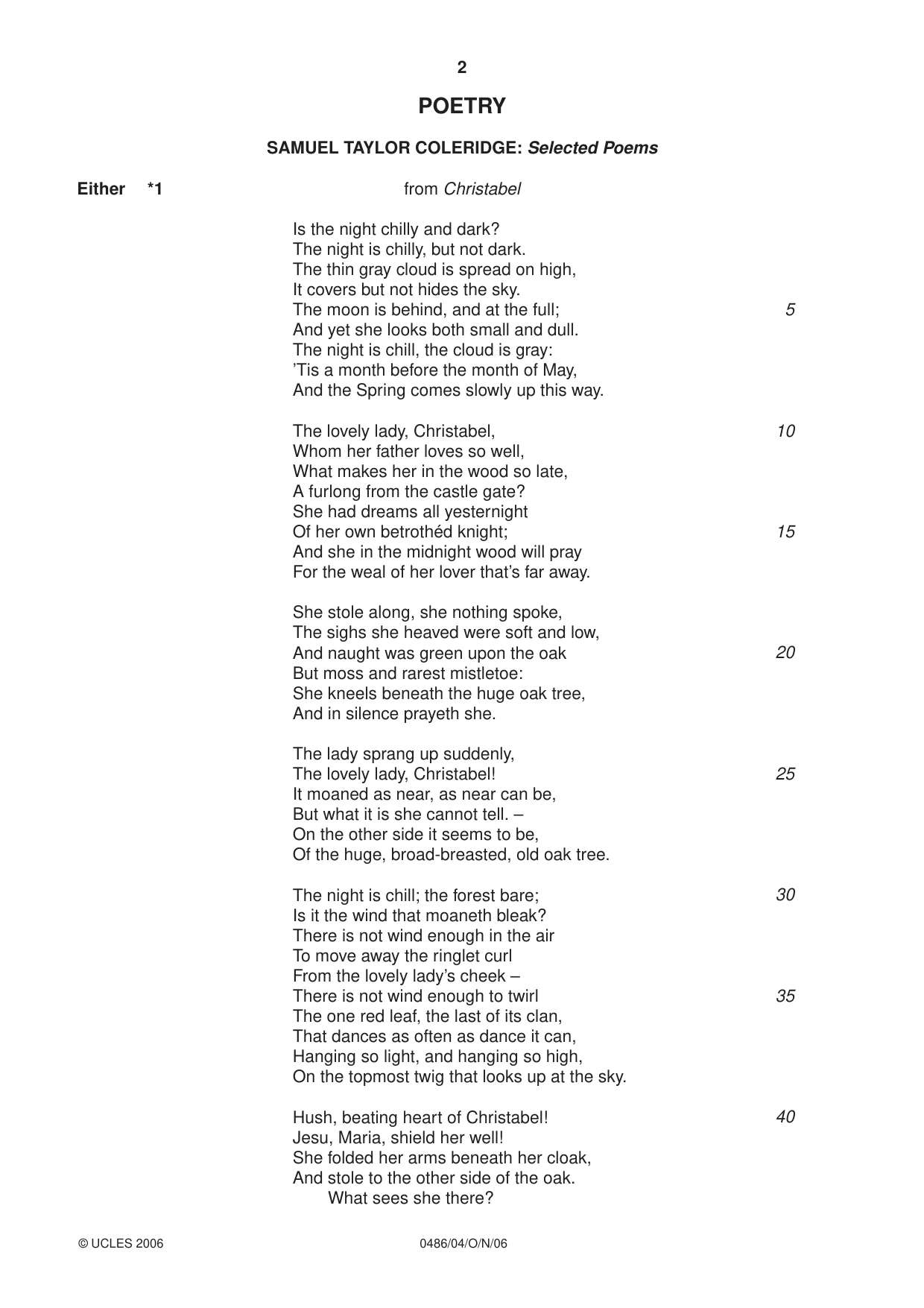
2 © UCLES 2006 0486/04/O/N/06 POETRY SAMUEL TAYLOR COLERIDGE: Selected Poems Either *1 from Christabel Is the night chilly and dark? The night is chilly, but not dark. The thin gray cloud is spread on high, It covers but not hides the sky. The moon is behind, and at the full; And yet she looks both small and dull. The night is chill, the cloud is gray: ’Tis a month before the month of May, And the Spring comes slowly up this way. The lovely lady, Christabel, Whom her father loves so well, What makes her in the wood so late, A furlong from the castle gate? She had dreams all yesternight Of her own betrothéd knight; And she in the midnight wood will pray For the weal of her lover that’s far away. She stole along, she nothing spoke, The sighs she heaved were soft and low, And naught was green upon the oak But moss and rarest mistletoe: She kneels beneath the huge oak tree, And in silence prayeth she. The lady sprang up suddenly, The lovely lady, Christabel! It moaned as near, as near can be, But what it is she cannot tell. – On the other side it seems to be, Of the huge, broad-breasted, old oak tree. The night is chill; the forest bare; Is it the wind that moaneth bleak? There is not wind enough in the air To move away the ringlet curl From the lovely lady’s cheek – There is not wind enough to twirl The one red leaf, the last of its clan, That dances as often as dance it can, Hanging so light, and hanging so high, On the topmost twig that looks up at the sky. Hush, beating heart of Christabel! Jesu, Maria, shield her well! She folded her arms beneath her cloak, And stole to the other side of the oak. What sees she there? 5 10 15 20 25 30 35 40
Question paper, page 3
3 © UCLES 2006 0486/04/O/N/06 [Turn over What impressions of ‘the lovely lady, Christabel’ does Coleridge give you here? Or 2 Choose two moments in The Rime of the Ancient Mariner which have surprised you. Explore them to show how the element of surprise is achieved. Or 3 What do you find moving about Coleridge’s ideas and language in Frost at Midnight? Be sure to support your answer with detail from the poem.
Question paper, page 4
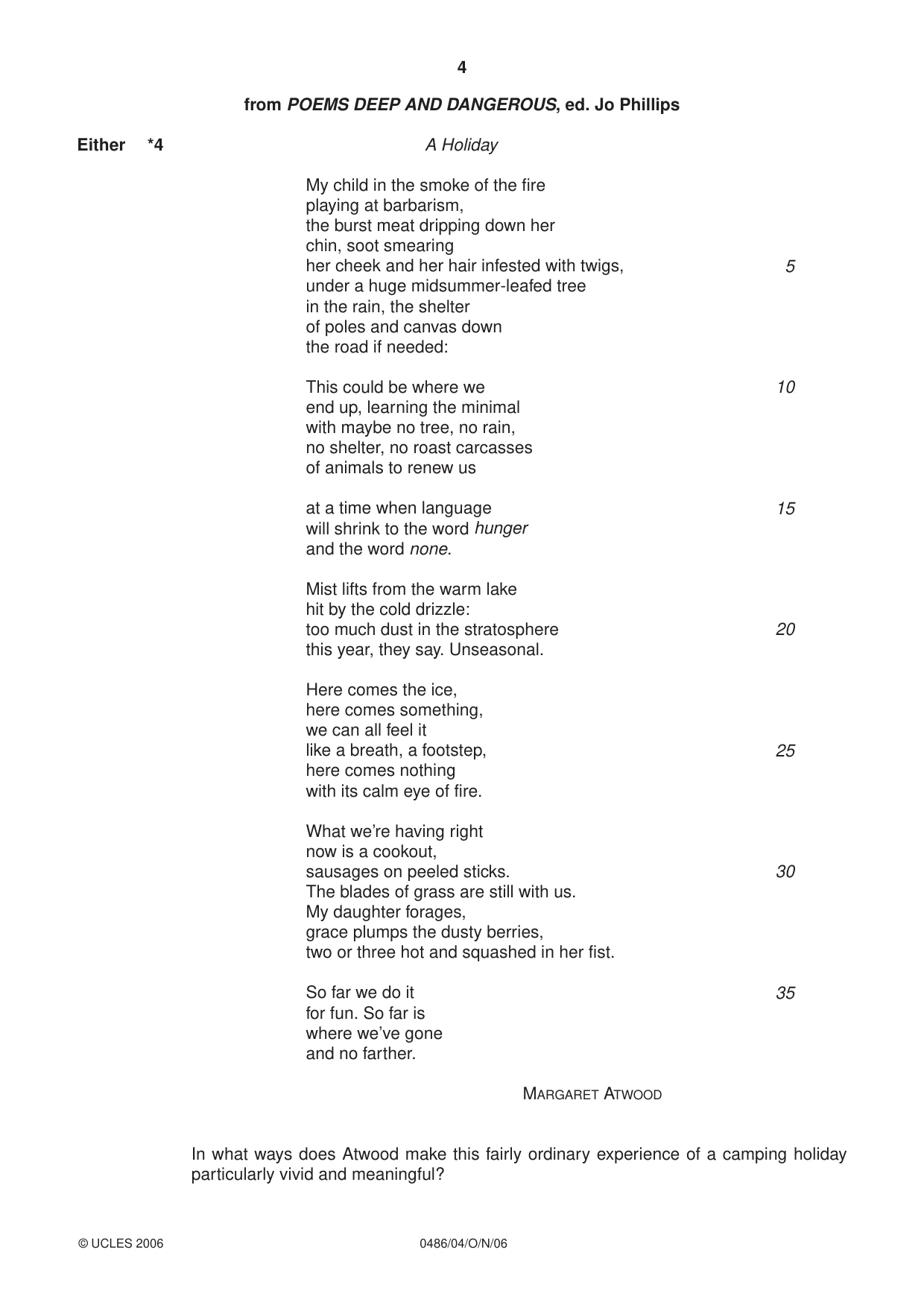
4 © UCLES 2006 0486/04/O/N/06 from POEMS DEEP AND DANGEROUS, ed. Jo Phillips Either *4 A Holiday My child in the smoke of the fire playing at barbarism, the burst meat dripping down her chin, soot smearing her cheek and her hair infested with twigs, under a huge midsummer-leafed tree in the rain, the shelter of poles and canvas down the road if needed: This could be where we end up, learning the minimal with maybe no tree, no rain, no shelter, no roast carcasses of animals to renew us at a time when language will shrink to the word hunger and the word none. Mist lifts from the warm lake hit by the cold drizzle: too much dust in the stratosphere this year, they say. Unseasonal. Here comes the ice, here comes something, we can all feel it like a breath, a footstep, here comes nothing with its calm eye of fire. What we’re having right now is a cookout, sausages on peeled sticks. The blades of grass are still with us. My daughter forages, grace plumps the dusty berries, two or three hot and squashed in her fist. So far we do it for fun. So far is where we’ve gone and no farther. MARGARET ATWOOD In what ways does Atwood make this fairly ordinary experience of a camping holiday particularly vivid and meaningful? 5 10 15 20 25 30 35
Question paper, page 5
5 © UCLES 2006 0486/04/O/N/06 [Turn over Or 5 Explore the ways in which either Charlotte Mew in The Trees Are Down or D. H. Lawrence in Mountain Lion uses the beauty and magnificence of nature to make a comment on human behaviour. Or 6 What feelings about the power of visual images do Essential Beauty (by Philip Larkin) and Snapshotland (by Sylvia Kantaris) convey to you?
Question paper, page 6
6 © UCLES 2006 0486/04/O/N/06 TOUCHED WITH FIRE, ed. Jack Hydes: from Section E Either *7 One Flesh Lying apart now, each in a separate bed, He with a book, keeping the light on late, She like a girl dreaming of childhood, All men elsewhere – it is as if they wait Some new event: the book he holds unread, Her eyes fixed on the shadows overhead. Tossed up like flotsam from a former passion, How cool they lie. They hardly ever touch, Or if they do it is like a confession Of having little feeling – or too much. Chastity faces them, a destination For which their whole lives were a preparation. Strangely apart, yet strangely close together, Silence between them like a thread to hold And not wind in. And time itself’s a feather Touching them gently. Do they know they’re old, These two who are my father and mother Whose fire from which I came, has now grown cold? ELIZABETH JENNINGS In this poem what feelings about her parents does the poet convey to you? How do the words and images she uses make those feelings memorable? Or 8 Explore how the poet’s words paint a vivid picture in one of the following poems: Refugee Mother and Child (by Chinua Achebe) To Autumn (by John Keats) Composed upon Westminster Bridge (by William Wordsworth). Or 9 How do you think the poet makes an event or situation dramatic in any one of the following poems? Horses (by Edwin Muir) Mid-Term Break (by Seamus Heaney) Snake (by D. H. Lawrence). 5 10 15
Question paper, page 7
7 0486/04/O/N/06 [Turn over BLANK PAGE Turn to page 8 for Question 10.
Question paper, page 8
8 © UCLES 2006 0486/04/O/N/06 PROSE ANITA DESAI: The Village by the Sea Either *10 ‘Oh you, you child of a rascal,’ he roared at her, standing by the log across the creek and swaying on his feet. ‘Where’s that father of yours, that rascal?’ ‘My father?’ said Lila wildly. ‘He – he has gone out.’ ‘Gone out – or hiding under his wife’s bed? Shall I come and drag him out?’ Lila gave a small scream which was echoed by the two girls who were hiding behind her. Now Pinto was growling, too, although held back by them from attacking the intruder. ‘He’s not here,’ she cried in a high- pitched voice. ‘Don’t come in – my mother is ill.’ ‘O very good, very good.’ He laughed maliciously, showing his yellow teeth in a mouth stained red with betel juice. ‘Mother ill – father out – little girls know nothing. Do you at least know where he keeps his money?’ he roared suddenly, like a lion, making Lila shrink back. ‘Money?’ she murmured, clenching her fists and wishing Hari would appear. ‘We have no money.’ ‘No money – we have no money,’ he mocked her. ‘Very nice answer. Did he teach you tell me that – that rogue, your father? Like father, like daughter. A family of liars, no-goods. No money, no good – all of you. But wait till I catch him. I’ll break his neck and find the money all right.’ Pinto, giving an uncontrollable yelp of rage at this man who stood shouting and swaying and waving his arms about in front of their house, suddenly broke away from the girls, darted past Lila and was out on the path, digging up sand with agitated claws, showing his sharp teeth and barking like a proper guard dog. He approached the man in short leaps and bounds, and when he was close enough to bite, the man raised his arms and roared, ‘Call that dog back. If you don’t keep him off – I’ll kill him.’ Bela and Kamal, screaming together, darted out after Pinto, flying to save him from the drunkard. Seeing them all out on the path, ready for a battle, Lila hurried after them, calling, ‘Pinto – Pinto – come back. Bela, Kamal, catch him. He won’t bite – he won’t bite –’ ‘If he bites,’ the man roared, ‘I’ll – I’ll –’ The uproar brought them some help after all. It was his old mother, the woman who had sent them the magic-man that morning, who came hobbling through the gap in the hedge to see what it was all about. Seeing her son there, tottering drunkenly in a circle and shouting, she grabbed him by the arm and gave him a quick, sharp shake. ‘You,’ she said fiercely, ‘you idiot. What are you doing here, frightening these little girls? Get back to the house – do you hear? Get back – you’re not fit to go out or talk to anyone. Go, hide yourself in your dirty black mud-hole. Stick your head in your toddy-pot and don’t show it around here again. Go.’ She gave him a push and he, silent now, stumbled off, half-falling over the round pandanus fruit and muttering to himself, ‘Go, go, go, they say. Where shall I go? I want my money. I’ll get my money. I’ll kill that rogue. I’ll kill his dog –’ ‘Be quiet,’ his mother screamed after him, picking up a stick and hitting it hard against a tree-trunk. ‘Be quiet, I say,’ she screamed again and went off after him without another look at the girls who stood like shadows cast by the coconut palms on the sand. 5 10 15 20 25 30 35 40 45 50
Question paper, page 9
9 © UCLES 2006 0486/04/O/N/06 [Turn over Explore the writing here, showing how it makes the incident threatening and upsetting for the children. Or 11 How does Desai make vivid for you the changes in Hari’s life when he moves from the village to the big city? Be sure to refer in detail to the novel as you answer. Or 12 You are Mrs de Silva at the end of the novel, thinking about Lila and Hari. Write your thoughts.
Question paper, page 10
10 © UCLES 2006 0486/04/O/N/06 CHARLES DICKENS: Great Expectations Either *13 I looked into the room where I had left her, and I saw her seated in the ragged chair upon the hearth close to the fire, with her back towards me. In the moment when I was withdrawing my head to go quietly away, I saw a great flaming light spring up. In the same moment, I saw her running at me, shrieking, with a whirl of fire blazing all about her, and soaring at least as many feet above her head as she was high. I had a double-caped great-coat on, and over my arm another thick coat. That I got them off, closed with her, threw her down, and got them over her; that I dragged the great cloth from the table for the same purpose, and with it dragged down the heap of rottenness in the midst, and all the ugly things that sheltered there; that we were on the ground struggling like desperate enemies, and that the closer I covered her, the more wildly she shrieked and tried to free herself; that this occurred I knew through the result, but not through anything I felt, or thought, or knew I did. I knew nothing until I knew that we were on the floor by the great table, and that patches of tinder yet alight were floating in the smoky air, which, a moment ago, had been her faded bridal dress. Then, I looked round and saw the disturbed beetles and spiders running away over the floor, and the servants coming in with breathless cries at the door. I still held her forcibly down with all my strength, like a prisoner who might escape; and I doubt if I even knew who she was, or why we had struggled, or that she had been in flames, or that the flames were out, until I saw the patches of tinder that had been her garments, no longer alight but falling in a black shower around us. She was insensible, and I was afraid to have her moved, or even touched. Assistance was sent for and I held her until it came, as if I unreasonably fancied (I think I did) that if I let her go, the fire would break out again and consume her. When I got up, on the surgeon’s coming to her with other aid, I was astonished to see that both my hands were burnt; for, I had no knowledge of it through the sense of feeling. On examination it was pronounced that she had received serious hurts, but that they of themselves were far from hopeless; the danger lay mainly in the nervous shock. By the surgeon’s directions, her bed was carried into that room and laid upon the great table: which happened to be well suited to the dressing of her injuries. When I saw her again, an hour afterwards, she lay indeed where I had seen her strike her stick, and had heard her say that she would lie one day. Though every vestige of her dress was burnt, as they told me, she still had something of her old ghastly bridal appearance; for, they had covered her to the throat with white cotton-wool, and as she lay with a white sheet loosely overlying that, the phantom air of something that had been and was changed, was still upon her. What do you think makes this passage such a powerful moment in the novel? Be sure to support your ideas with detail from Dickens’s writing. 5 10 15 20 25 30 35 40
Question paper, page 11
11 © UCLES 2006 0486/04/O/N/06 [Turn over Or 14 What do you find most memorable and striking about Dickens’s portrayal of London? Remember to support your views with detail from Dickens’s writing. Or 15 You are Mr Jaggers immediately after you have met Pip for the first time. Write your thoughts.
Question paper, page 12
12 © UCLES 2006 0486/04/O/N/06 HELEN DUNMORE: The Siege Either *16 It’s half past two, and already growing dark, by the time Anna sets out with Kolya’s empty sledge bumping behind her. She has a couple of empty sacks too, and some twine to tie them on to the sledge once they’re filled. It’s only a child’s sledge, but it’ll carry a fair load. The streets are almost empty. She passes the hump of a body frozen into a doorway, covered with drifted snow. It looks like a bag of rubbish, but Anna knows it’s a body because she saw it before the snow hid it. It’s an old woman. Maybe she stopped to rest on the way back from fetching her ration. Anna doesn’t like going past the park any more. There are people sitting on benches, swathed in snow, planted like bulbs to wait for spring. They stay there day after day. No one comes to take them away. It’s cold, so cold. Anna adjusts the scarf she has wound around her face. She’ll rest for a couple of minutes. No longer than that, because in her weakened state the cold could easily finish her off. The scorching frost goes down into her lungs like a knife. She coughs, gasps, shifts her weight from foot to foot, and bats her hands together. Her gloved hands make a muffled, ghostly sound. She thinks of the bulbs under their coverlet of snow, and shivers. Nothing seems surprising any more, not even the bodies piled by the Karpovka canal, or outside the cemeteries. Andrei has told her about them. They are like two walls on either side of the road. It is not surprising that her father is dying while Andrei makes his way to the hospital to work, leaning on the cherry-wood stick which he needs more than Anna does now. On his swollen legs the skin is drawn and shiny. He labours on, as she does, ten steps and then ten steps more, passing the bodies of the dead. They lie exposed, charred by frost until the next snowfall covers them. Being dead is normal. You have to patrol yourself all the time, to stop yourself slipping over the border between this world and the next. If you let go, and sit down in no man’s land, the snipers of cold and hunger will soon finish you off. Explore the ways in which Dunmore in this extract vividly conveys the effects of cold and starvation. Or 17 There are many horrific moments portrayed in this novel. Explore in detail two of them, bringing out the ways in which Dunmore’s words convey the horror. Or 18 You are Evgenia at the end of the novel, digging. Write your thoughts. 5 10 15 20 25 30
Question paper, page 13
13 0486/04/O/N/06 [Turn over BLANK PAGE Turn to page 14 for Question 19.
Question paper, page 14
14 © UCLES 2006 0486/04/O/N/06 GRAHAM GREENE: Travels With My Aunt Either *19 During that empty time I received one more letter from Miss Keene. She wrote in her own hand, for a clumsy servant had broken the keyboard of her typewriter. ‘I was just going to write,’ she said, ‘how stupid and clumsy these blacks are, and then I remembered how you and my father had discussed racialism one night at dinner and I felt as though I were betraying our old house in Southwood and the companionship of those days. Sometimes I fear that I am going to be quite assimilated. In Koffiefontein the Prime Minister no longer seems the monster we thought him at home: indeed he’s criticized here sometimes as an old-fashioned liberal. I find myself when I meet a tourist from England explaining apartheid so convincingly. I don’t want to be assimilated, and yet if I am to make my life here …’ The broken sentence sounded like an appeal which she was too shy to make clear. There followed the gossip of the farm: a dinner party to neighbours who lived more than a hundred miles away, and then one paragraph which I found a little disturbing: ‘I have met a Mr Hughes, a land surveyor, and he wants to marry me (please don’t laugh at me). He is a kind man in his late fifties, a widower with a teenage daughter whom I like well enough. I don’t know what to do. It would be the final assimilation, wouldn’t it? I’ve always had a silly dream of one day coming back to Southwood and finding the old house empty (how I miss that dark rhododendron walk) and beginning my life all over again. I am afraid of talking to anyone here about Mr Hughes – they would all be too encouraging. I wish you were not so far away, for I know you would counsel me wisely.’ Was I wrong to read an appeal in the last sentence, a desperate appeal in spite of its calm wording, an appeal for some decisive telegram ‘come back to Southwood and marry me’? Who knows whether I might not have sent one in my loneliness if a letter had not arrived which drove poor Miss Keene right out of my mind? It was from my aunt, written on stiff aristocratic note-paper bearing simply a scarlet rose and the name Lancaster with no address, like the title of a noble family. Only when I read a little way into the letter did I realize that Lancaster was the name of an hotel. My aunt made no appeal; she simply issued a command, and there was no explanation of her long silence. ‘I have decided,’ she wrote, ‘not to return to Europe and I am giving up my apartment over the Crown and Anchor at the end of the next quarter. I would be glad if you would pack what clothes there may be there and dispose of all the furniture. On second thoughts however keep the photograph of Freetown harbour for me as a memento of dear Wordsworth and bring it with you.’ (She had not even told me where to come at that point of the letter or asked me if it were possible). ‘Preserve it in its frame which has great sentimental value because it was given me by Mr V. I enclose a cheque on my account at the Crédit Suisse, Berne, which will be sufficient for a first-class ticket to Buenos Aires. Come as soon as you can, for I get no younger. I do not suffer from gout like an old friend whom I met the other day on a packet boat, but I feel nonetheless a certain stiffness in the joints. I want very much to have with me a member of my family whom I can trust in this rather bizarre country, not the less bizarre for having a shop called Harrods round the corner from the hotel, though it is less well stocked, I fear, than in the Brompton Road.’ 5 10 15 20 25 30 35 40 45 50
Question paper, page 15
15 © UCLES 2006 0486/04/O/N/06 [Turn over Explore in detail how the two letters in this passage convey the very different characters of Miss Keene and Aunt Augusta, and why Henry Pulling is likely to act on only one of the letters. Or 20 Most of Aunt Augusta’s acquaintances are very dishonest. Which one of these dishonest characters do you think Greene manages to make the most likeable? Be sure to support your views with detail from Greene’s writing. Or 21 You are Henry Pulling at the end of the novel, thinking about the changes that have come about in your life since you met Aunt Augusta. Write your thoughts.
Question paper, page 16
16 © UCLES 2006 0486/04/O/N/06 HENRY HANDEL RICHARDSON: The Getting Of Wisdom Either *22 Sea, sun and air did their healing work, as did also the long, idle days in the home garden; and Laura drank in health and vigour with every breath. She had need of it all when, the golden holidays over, she returned to school; for the half-year that broke was, in many ways, the most trying she had yet had to face. True, her dupes’ first virulence had waned – they no longer lashed her openly with their tongues – but the quiet, covert insults, that were now the rule, were every bit as hard to bear; and before a week had passed Laura was telling herself that, had she been a Christian Martyr, she would have preferred to be torn asunder with one jerk, rather than submit to the thumbkin. Not an eye but looked askance at her; on every face was painted a reminder of her moral inferiority; and even newcomers among the boarders soon learnt, without always knowing what her crime had been, that Laura Rambotham was ‘not the thing’. This system of slight and disparagement was similar to what she had had to endure in her first school term; but its effect upon her was different. Then, in her raw timidity, she had bowed her head beneath it; now, she could not be so lamb-like. In thought, she never ceased to lay half the blame of what had happened on her companions’ shoulders; and she was embittered by their injustice in making her alone responsible, when all she had done was to yield to their craving for romance. She became a rebel, wrapping herself round in the cloak of bitterness which the outcasts of fortune wear, feeding on her hate of those within the pale. Very well then, she said to herself: if her fellows chose to shut her out like this, she would stop outside, and never see eye to eye with them again. And it gave her an unholy pleasure to mock, in secret, at all they set store by. Her outward behaviour for many a day was, none the less, that of a footlicker; and by no sign did she indicate what she really was – a very unhappy girl. Like most rebels of her sex, she ardently desired to re-enter the fold of law and order; and it was to this end she worked, although, wherever she approached it, the place seemed to bristle with spears. But she did not let herself be daunted; she pocketed injuries, pretended not to hear them, played the spaniel to people she despised; and it soon became open talk, that no matter what you said to her, Laura Rambotham would not take offence. You could also rely on her to do a dirty job for you. – A horrid little toady was the verdict; especially of those who had no objection to be toadied to. Explore how Richardson in this extract vividly conveys Laura’s feelings on her return to school. Or 23 What impressions do you have of Mr Shepherd? Be sure to support your ideas with detail from the writing. Or 24 You are Laura at the end of the book, thinking about your relationship with your mother. Write your thoughts. 5 10 15 20 25 30 35
Question paper, page 17
17 0486/04/O/N/06 [Turn over BLANK PAGE Turn to page 18 for Question 25.
Question paper, page 18
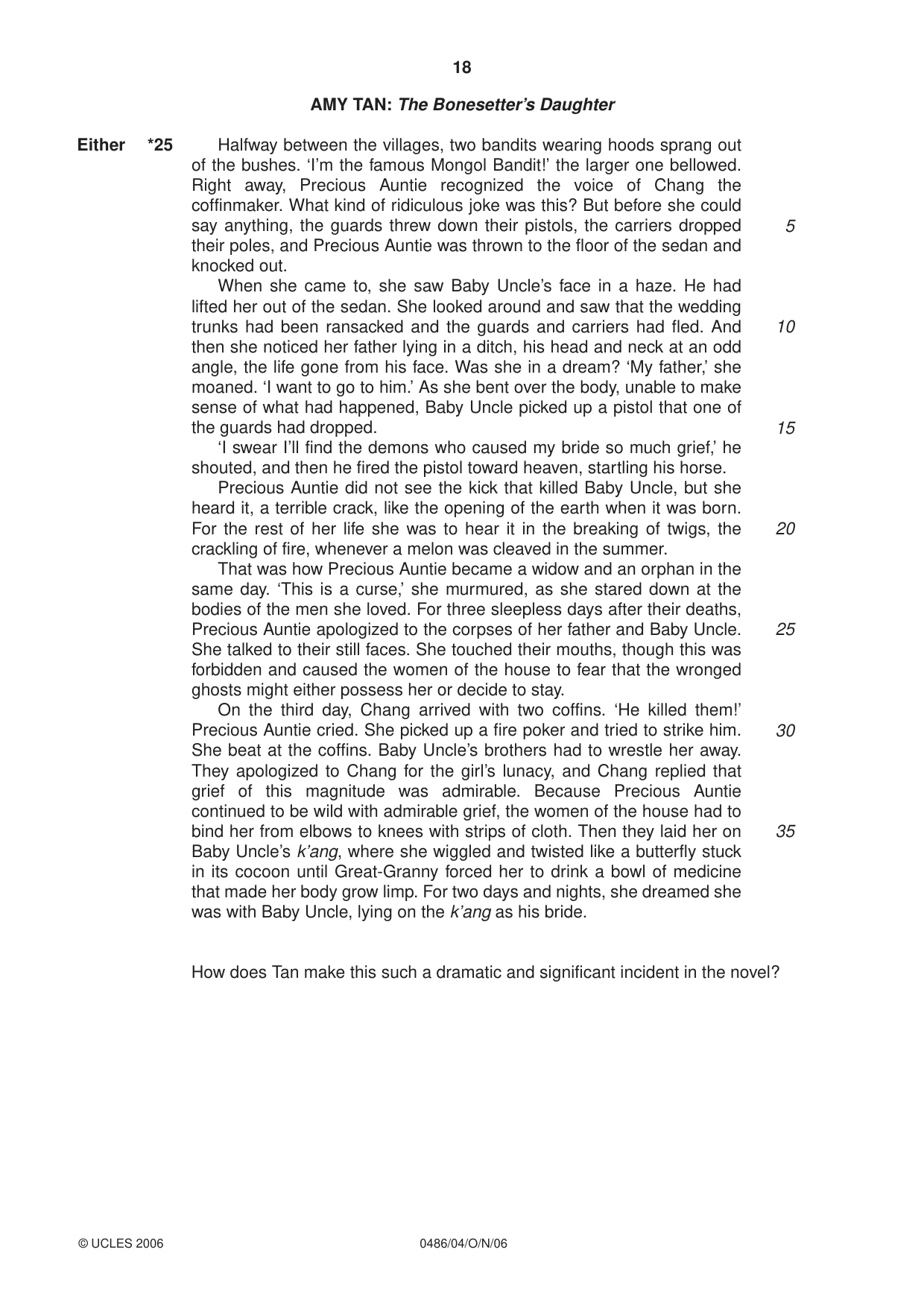
18 © UCLES 2006 0486/04/O/N/06 AMY TAN: The Bonesetter’s Daughter Either *25 Halfway between the villages, two bandits wearing hoods sprang out of the bushes. ‘I’m the famous Mongol Bandit!’ the larger one bellowed. Right away, Precious Auntie recognized the voice of Chang the coffinmaker. What kind of ridiculous joke was this? But before she could say anything, the guards threw down their pistols, the carriers dropped their poles, and Precious Auntie was thrown to the floor of the sedan and knocked out. When she came to, she saw Baby Uncle’s face in a haze. He had lifted her out of the sedan. She looked around and saw that the wedding trunks had been ransacked and the guards and carriers had fled. And then she noticed her father lying in a ditch, his head and neck at an odd angle, the life gone from his face. Was she in a dream? ‘My father,’ she moaned. ‘I want to go to him.’ As she bent over the body, unable to make sense of what had happened, Baby Uncle picked up a pistol that one of the guards had dropped. ‘I swear I’ll find the demons who caused my bride so much grief,’ he shouted, and then he fired the pistol toward heaven, startling his horse. Precious Auntie did not see the kick that killed Baby Uncle, but she heard it, a terrible crack, like the opening of the earth when it was born. For the rest of her life she was to hear it in the breaking of twigs, the crackling of fire, whenever a melon was cleaved in the summer. That was how Precious Auntie became a widow and an orphan in the same day. ‘This is a curse,’ she murmured, as she stared down at the bodies of the men she loved. For three sleepless days after their deaths, Precious Auntie apologized to the corpses of her father and Baby Uncle. She talked to their still faces. She touched their mouths, though this was forbidden and caused the women of the house to fear that the wronged ghosts might either possess her or decide to stay. On the third day, Chang arrived with two coffins. ‘He killed them!’ Precious Auntie cried. She picked up a fire poker and tried to strike him. She beat at the coffins. Baby Uncle’s brothers had to wrestle her away. They apologized to Chang for the girl’s lunacy, and Chang replied that grief of this magnitude was admirable. Because Precious Auntie continued to be wild with admirable grief, the women of the house had to bind her from elbows to knees with strips of cloth. Then they laid her on Baby Uncle’s k’ang, where she wiggled and twisted like a butterfly stuck in its cocoon until Great-Granny forced her to drink a bowl of medicine that made her body grow limp. For two days and nights, she dreamed she was with Baby Uncle, lying on the k’ang as his bride. How does Tan make this such a dramatic and significant incident in the novel? 5 10 15 20 25 30 35
Question paper, page 19
19 © UCLES 2006 0486/04/O/N/06 [Turn over Or 26 Why do you think the Bonesetter is important in the novel? Support your ideas with details from the writing. Or 27 You are Ruth. You are walking along the beach just after the incident when your mother has gone missing for the first time as a result of her increasing confusion. Write your thoughts.
Question paper, page 20
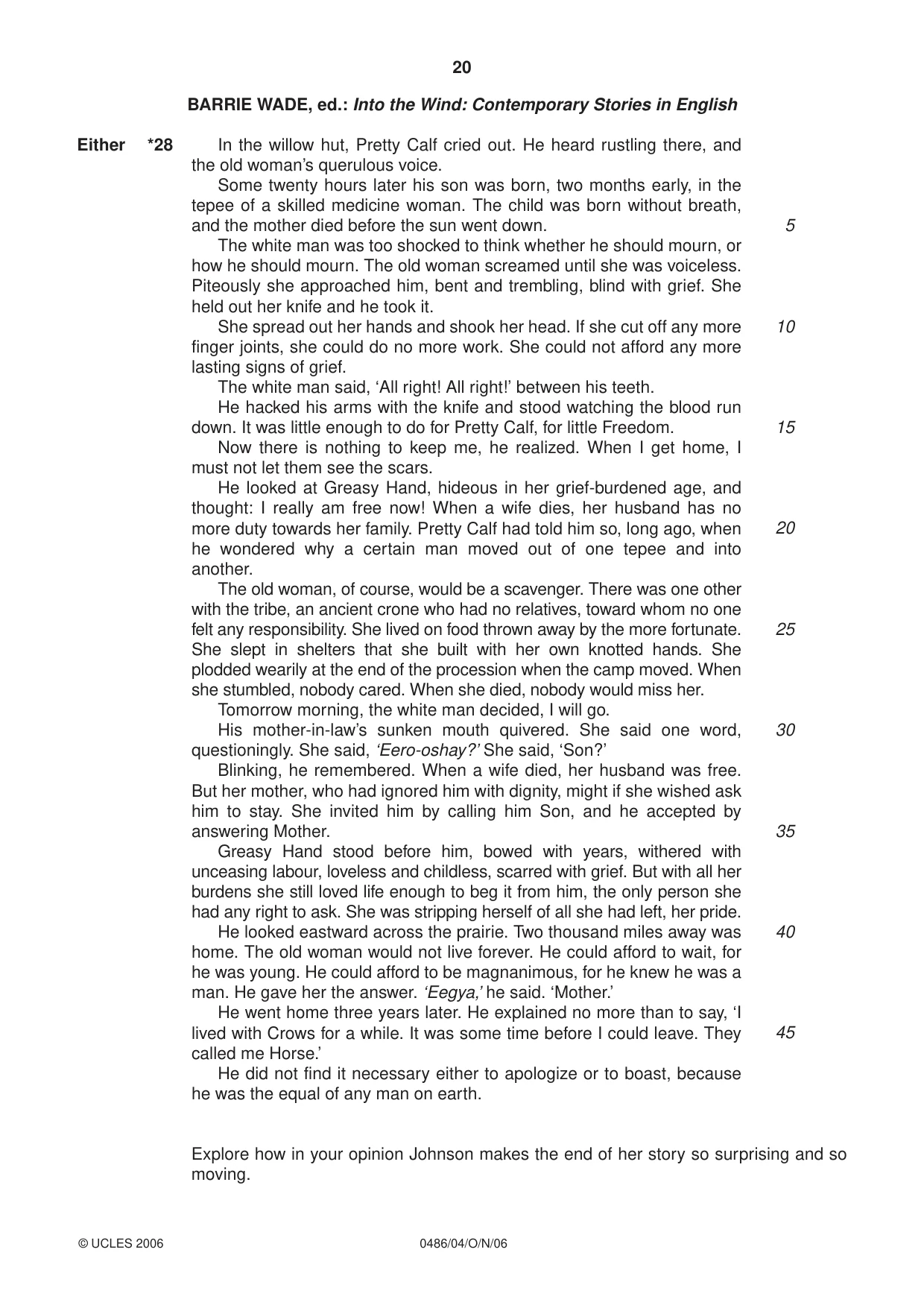
20 © UCLES 2006 0486/04/O/N/06 BARRIE WADE, ed.: Into the Wind: Contemporary Stories in English Either *28 In the willow hut, Pretty Calf cried out. He heard rustling there, and the old woman’s querulous voice. Some twenty hours later his son was born, two months early, in the tepee of a skilled medicine woman. The child was born without breath, and the mother died before the sun went down. The white man was too shocked to think whether he should mourn, or how he should mourn. The old woman screamed until she was voiceless. Piteously she approached him, bent and trembling, blind with grief. She held out her knife and he took it. She spread out her hands and shook her head. If she cut off any more finger joints, she could do no more work. She could not afford any more lasting signs of grief. The white man said, ‘All right! All right!’ between his teeth. He hacked his arms with the knife and stood watching the blood run down. It was little enough to do for Pretty Calf, for little Freedom. Now there is nothing to keep me, he realized. When I get home, I must not let them see the scars. He looked at Greasy Hand, hideous in her grief-burdened age, and thought: I really am free now! When a wife dies, her husband has no more duty towards her family. Pretty Calf had told him so, long ago, when he wondered why a certain man moved out of one tepee and into another. The old woman, of course, would be a scavenger. There was one other with the tribe, an ancient crone who had no relatives, toward whom no one felt any responsibility. She lived on food thrown away by the more fortunate. She slept in shelters that she built with her own knotted hands. She plodded wearily at the end of the procession when the camp moved. When she stumbled, nobody cared. When she died, nobody would miss her. Tomorrow morning, the white man decided, I will go. His mother-in-law’s sunken mouth quivered. She said one word, questioningly. She said, ‘Eero-oshay?’ She said, ‘Son?’ Blinking, he remembered. When a wife died, her husband was free. But her mother, who had ignored him with dignity, might if she wished ask him to stay. She invited him by calling him Son, and he accepted by answering Mother. Greasy Hand stood before him, bowed with years, withered with unceasing labour, loveless and childless, scarred with grief. But with all her burdens she still loved life enough to beg it from him, the only person she had any right to ask. She was stripping herself of all she had left, her pride. He looked eastward across the prairie. Two thousand miles away was home. The old woman would not live forever. He could afford to wait, for he was young. He could afford to be magnanimous, for he knew he was a man. He gave her the answer. ‘Eegya,’ he said. ‘Mother.’ He went home three years later. He explained no more than to say, ‘I lived with Crows for a while. It was some time before I could leave. They called me Horse.’ He did not find it necessary either to apologize or to boast, because he was the equal of any man on earth. Explore how in your opinion Johnson makes the end of her story so surprising and so moving. 5 10 15 20 25 30 35 40 45
Question paper, page 21
21 © UCLES 2006 0486/04/O/N/06 [Turn over Or 29 In Let Them Call It Jazz (by Jean Rhys) and My Oedipus Complex (by Frank O’Connor) the central characters struggle to understand the world they are in. Explore how the writer of one of these stories vividly portrays the character’s bewilderment. Or 30 You are Lellie in Dumb Martian while Duncan is outside the dome supervising what he thinks is the last ship to depart before you and he will also leave the station. Write your thoughts.
Question paper, page 22
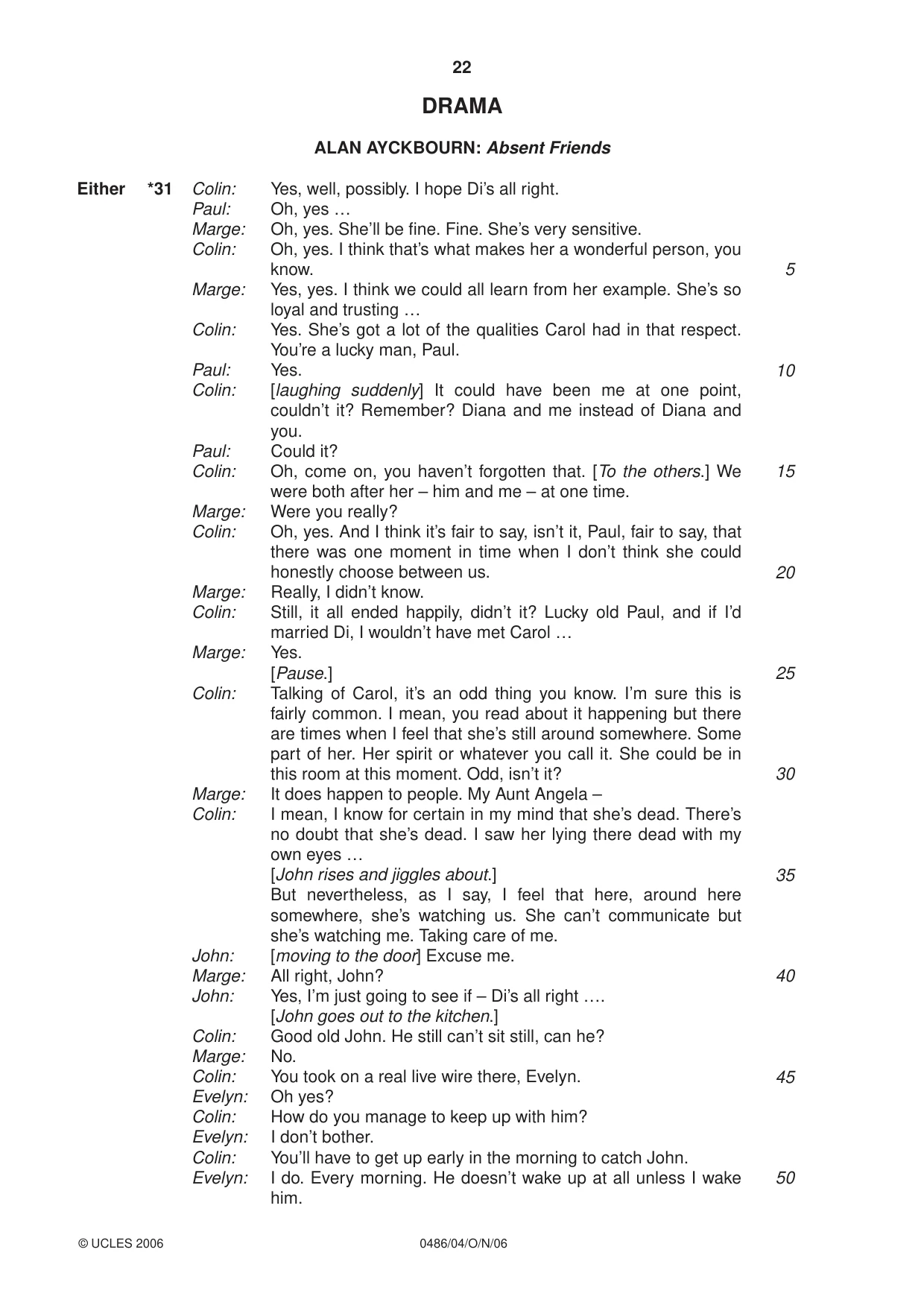
22 © UCLES 2006 0486/04/O/N/06 DRAMA ALAN AYCKBOURN: Absent Friends Either *31 Colin: Yes, well, possibly. I hope Di’s all right. Paul: Oh, yes … Marge: Oh, yes. She’ll be fine. Fine. She’s very sensitive. Colin: Oh, yes. I think that’s what makes her a wonderful person, you know. Marge: Yes, yes. I think we could all learn from her example. She’s so loyal and trusting … Colin: Yes. She’s got a lot of the qualities Carol had in that respect. You’re a lucky man, Paul. Paul: Yes. Colin: [laughing suddenly] It could have been me at one point, couldn’t it? Remember? Diana and me instead of Diana and you. Paul: Could it? Colin: Oh, come on, you haven’t forgotten that. [To the others.] We were both after her – him and me – at one time. Marge: Were you really? Colin: Oh, yes. And I think it’s fair to say, isn’t it, Paul, fair to say, that there was one moment in time when I don’t think she could honestly choose between us. Marge: Really, I didn’t know. Colin: Still, it all ended happily, didn’t it? Lucky old Paul, and if I’d married Di, I wouldn’t have met Carol … Marge: Yes. [Pause.] Colin: Talking of Carol, it’s an odd thing you know. I’m sure this is fairly common. I mean, you read about it happening but there are times when I feel that she’s still around somewhere. Some part of her. Her spirit or whatever you call it. She could be in this room at this moment. Odd, isn’t it? Marge: It does happen to people. My Aunt Angela – Colin: I mean, I know for certain in my mind that she’s dead. There’s no doubt that she’s dead. I saw her lying there dead with my own eyes … [John rises and jiggles about.] But nevertheless, as I say, I feel that here, around here somewhere, she’s watching us. She can’t communicate but she’s watching me. Taking care of me. John: [moving to the door] Excuse me. Marge: All right, John? John: Yes, I’m just going to see if – Di’s all right …. [John goes out to the kitchen.] Colin: Good old John. He still can’t sit still, can he? Marge: No. Colin: You took on a real live wire there, Evelyn. Evelyn: Oh yes? Colin: How do you manage to keep up with him? Evelyn: I don’t bother. Colin: You’ll have to get up early in the morning to catch John. Evelyn: I do. Every morning. He doesn’t wake up at all unless I wake him. 5 10 15 20 25 30 35 40 45 50
Question paper, page 23
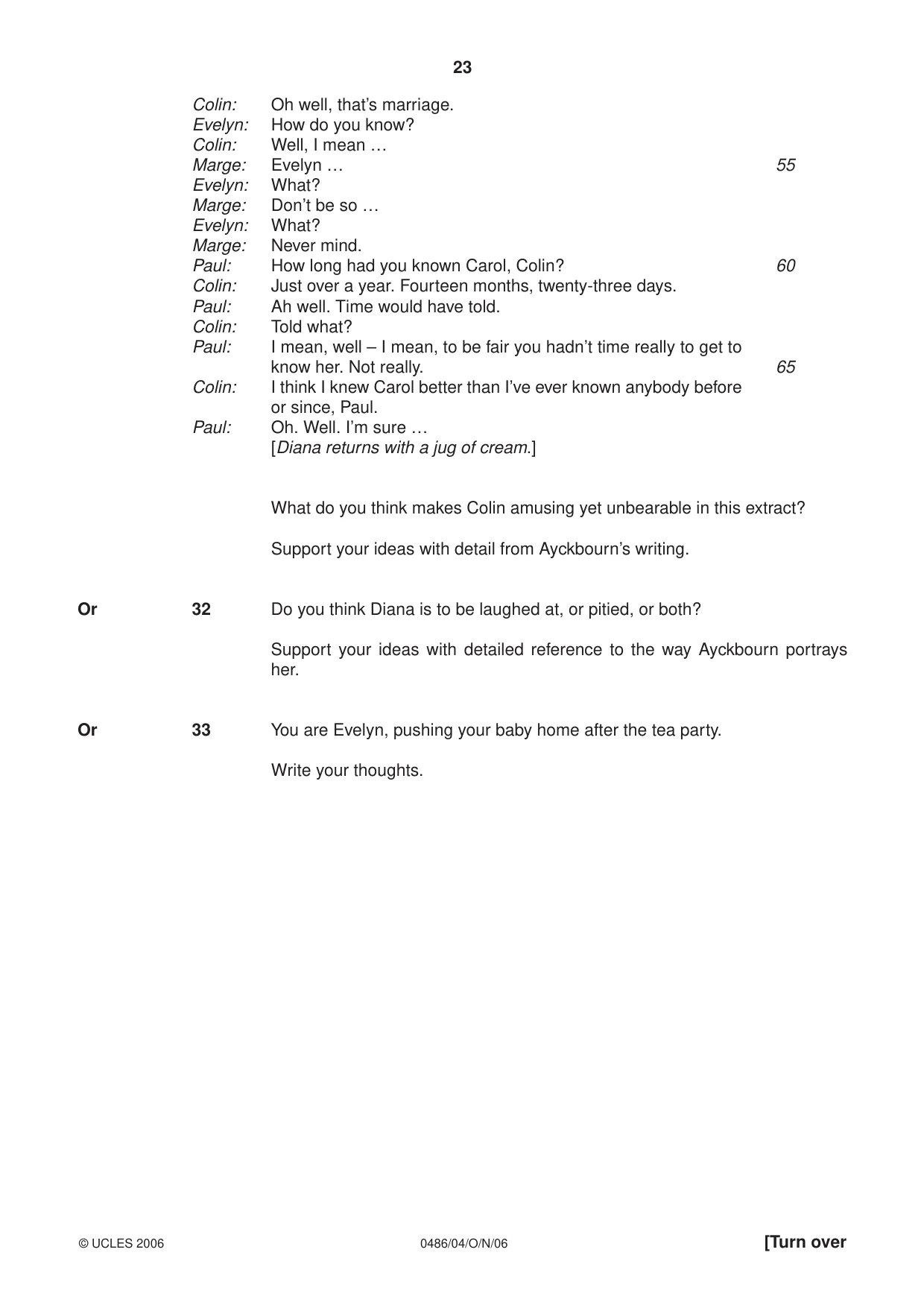
23 © UCLES 2006 0486/04/O/N/06 [Turn over Colin: Oh well, that’s marriage. Evelyn: How do you know? Colin: Well, I mean … Marge: Evelyn … Evelyn: What? Marge: Don’t be so … Evelyn: What? Marge: Never mind. Paul: How long had you known Carol, Colin? Colin: Just over a year. Fourteen months, twenty-three days. Paul: Ah well. Time would have told. Colin: Told what? Paul: I mean, well – I mean, to be fair you hadn’t time really to get to know her. Not really. Colin: I think I knew Carol better than I’ve ever known anybody before or since, Paul. Paul: Oh. Well. I’m sure … [Diana returns with a jug of cream.] What do you think makes Colin amusing yet unbearable in this extract? Support your ideas with detail from Ayckbourn’s writing. Or 32 Do you think Diana is to be laughed at, or pitied, or both? Support your ideas with detailed reference to the way Ayckbourn portrays her. Or 33 You are Evelyn, pushing your baby home after the tea party. Write your thoughts. 55 60 65
Question paper, page 24
24 © UCLES 2006 0486/04/O/N/06 LIZ LOCHHEAD/GINA MOXLEY: Cuba and Dog House Either *34 SCENE NINE The sound of the father’s car can be heard taking off, backfiring as it goes. Pats comes into the garden. She’s more relaxed than usual, though she looks thin and undernourished. She’s in the same clothes as always. Ger is coming back from the shops with newspapers, fruit and milk. She spots Pats and stands aside and watches her. Pats checks to see whether the food she dropped the previous night is still there. She finds it where Ger has left it. She scoffs it. Ger: Hey, Pats, what’s going on? Pats looks up, startled, and is about to run away. Hang on. Hang on. I’ll only follow you in. I saw your crowd going off in the car. It’s all right, I won’t bite. Pats: Going off to see our cousins. There wasn’t room for me. Ger: So? Pats: I have to stay to watch the dog. Ger: You know well what I mean. Ger’s caring tone has Pats on the verge of tears. She stares at the ground. Pats: Sorry. Don’t say nothing, sure you won’t. I’ll pay ye back. Ger: Look, it doesn’t matter, it was only a bit of bread and jam and some fruit. Just my mother isn’t great at the moment, it’s … well it’s her nerves, my sister had … ah, anyway, you know what I mean, and she’d have a hernia if she came down and found someone in the kitchen. Pats: We just ran out of shopping and I woke up in the night ravenous. I was half sleepwalking, I’m sure. Don’t ask me what made me go … Ger: I looked in the window and saw stuff on the table though. Pats: Gooseberry. Ger: Gooseberry? Pats: Gooseberry jam. That’s all we have and … I hate that. I hate it. If there’s anything I hate in the whole world it’s gooseberries. Pats is getting desperate. It’s clear Ger doesn’t believe a word Pats is saying, so she tries a different tack. Ger: So how are you getting used to Lime Lawn? Do you like it? Pats: Lime Lawn? Ehm … grand, grand. Where we were before was in the middle of nowhere. The country. I like seeing people around. There’s more noise. Cars and noise. Yeah. Ger: And did you sleep on the floor in your last house as well? Pats looks at her, shocked that she knows. Jimmy comes along. Jimmy: How’s it going? Ger: Oh, hiya, Jimmy. Well, you didn’t last long last night. [to Pats] A gang of us were up at Highfield. It’s a dance. 5 10 15 20 25 30 35 40
Question paper, page 25
25 © UCLES 2006 0486/04/O/N/06 [Turn over Jimmy: A bit boring. No point in staying holding up the wall. None of the lads around, no? Ger: Probably down in the park airing their brains. Jimmy: I might take a wander down so, see what the crack is like. Ger: Why don’t you go with him, Pats, see some of the local sights. Pats and Jimmy: What? Ger: Go on, why don’t you? Pats: They don’t … I’ve to be back before … I can’t stay out, like. Ger: It’s only down the road. Jimmy’s very responsible. He’ll make sure you’re back on time. Won’t you, Jim? She takes some bananas from a bag and hands them to Pats. Here, look, why don’t ye have a bit of a picnic while you’re at it? I’m all heart, aren’t I? Ger goes off into her house. Pats and Jimmy smile at each other and walk off in the other direction. What do you think makes this such a touching and moving scene? Remember to refer to detail from Moxley’s writing. Or 35 Choose one moment from each play which you think the dramatist makes especially memorable, and show in detail why you feel each moment is so successful dramatically. (Do not use the extract printed in Question 34 in answering this question.) Or 36 You are Miss Arthur in Cuba after you have resigned and after you have broken off your engagement to Mr Shaw. Write your thoughts. 45 50 55
Question paper, page 26
26 © UCLES 2006 0486/04/O/N/06 WILLIAM SHAKESPEARE: Macbeth Either *37 Thunder and lightning. Enter three Witches. First Witch: When shall we three meet again? In thunder, lightning, or in rain? Second Witch: When the hurlyburly’s done, When the battle’s lost and won. Third Witch: That will be ere the set of sun. First Witch: Where the place? Second Witch: Upon the heath. Third Witch: There to meet with Macbeth. First Witch: I come, Graymalkin. Second Witch: Paddock calls. Third Witch: Anon! All: Fair is foul, and foul is fair: Hover through the fog and filthy air. [Witches vanish. A camp near Forres. Alarum within. Enter King Duncan, Malcolm, Donalbain, Lennox, with Attendants, meeting a bleeding Sergeant. Duncan: What bloody man is that? He can report, As seemeth by his plight, of the revolt The newest state. Malcolm: This is the sergeant Who like a good and hardy soldier fought ’Gainst my captivity. Hail, brave friend! Say to the King the knowledge of the broil As thou didst leave it. Sergeant: Doubtful it stood, As two spent swimmers that do cling together And choke their art. The merciless Macdonwald – Worthy to be a rebel, for to that The multiplying villainies of nature Do swarm upon him – from the Western Isles Of kerns and gallowglasses is supplied; And Fortune, on his damned quarrel smiling, Show’d like a rebel’s whore. But all’s too weak; For brave Macbeth – well he deserves that name – Disdaining Fortune, with his brandish’d steel, Which smok’d with bloody execution, Like valour’s minion, carv’d out his passage Till he fac’d the slave; Which ne’er shook hands, nor bade farewell to him, Till he unseam’d him from the nave to th’ chaps, And fix’d his head upon our battlements. Duncan: O valiant cousin! worthy gentleman! How do you think Shakespeare manages to interest and intrigue the audience here? 5 10 15 20 25 30 35 40
Question paper, page 27
27 © UCLES 2006 0486/04/O/N/06 [Turn over Or 38 How do you think Shakespeare makes you pity Macbeth even though he is a pitiless murderer? Be sure to support your ideas with detail from the play. Or 39 You are Macduff, riding to England to offer your support to Malcolm. Write your thoughts.
Question paper, page 28
28 © UCLES 2006 0486/04/O/N/06 GEORGE BERNARD SHAW: The Devil’s Disciple Either *40 Judith: [running to him] Oh, here you are at last, at last! [She attempts to embrace him]. Anderson: [keeping her off] Take care, my love: I’m wet. Wait till I get my cloak off. [He places a chair with its back to the fire; hangs his cloak on it to dry; shakes the rain from his hat and puts it on the fender; and at last turns with his hands outstretched to Judith]. Now! [She flies into his arms]. I am not late, am I? The town clock struck the quarter as I came in at the front door. And the town clock is always fast. Judith: I’m sure it’s slow this evening. I’m so glad youre back. Anderson: [taking her more closely in his arms] Anxious, my dear? Judith: A little. Anderson: Why, youve been crying. Judith: Only a little. Never mind: it’s all over now. [A bugle call is heard in the distance. She starts in terror and retreats to the long seat, listening.] Whats that? Anderson: [following her tenderly to the seat and making her sit down with him] Only King George, my dear. He’s returning to barracks, or having his roll called, or getting ready for tea, or booting or saddling or something. Soldiers dont ring the bell or call over the banisters when they want anything: they send a boy out with a bugle to disturb the whole town. Judith: Do you think there is really any danger? Anderson: Not the least in the world. Judith: You say that to comfort me, not because you believe it. Anderson: My dear: in this world there is always danger for those who are afraid of it. Theres a danger that the house will catch fire in the night; but we shant sleep any the less soundly for that. Judith: Yes, I know what you always say; and youre quite right. Oh, quite right: I know it. But – I suppose I’m not brave: thats all. My heart shrinks every time I think of the soldiers. Anderson: Never mind that, dear: bravery is none the worse for costing a little pain. Judith: Yes, I suppose so, [Embracing him again] Oh how brave you are, my dear! [With tears in her eyes] Well, I’ll be brave too: you shant be ashamed of your wife. Anderson: Thats right. Now you make me happy. Well, well! [He rises and goes cheerily to the fire to dry his shoes]. I called on Richard Dudgeon on my way back; but he wasnt in. Judith: [rising in consternation] You called on that man! Anderson: [reassuring her] Oh, nothing happened, dearie. He was out. Judith: [almost in tears, as if the visit were a personal humiliation to her] But why did you go there? Anderson: [gravely] Well, it is all the talk that Major Swindon is going to do what he did in Springtown – make an example of some notorious rebel, as he calls us. He pounced on Peter Dudgeon as the worst character there; and it is the general belief that he will pounce on Richard as the worst here. Judith: But Richard said – Anderson: [goodhumoredly cutting her short] Pooh! Richard said! He said what he thought would frighten you and frighten me, my dear. He said what perhaps (God forgive him!) he would 5 10 15 20 25 30 35 40 45 50
Question paper, page 29
29 © UCLES 2006 0486/04/O/N/06 [Turn over like to believe. It’s a terrible thing to think of what death must mean for a man like that. I felt that I must warn him. I left a message for him. Judith: [querulously] What message? Anderson: Only that I should be glad to see him for a moment on a matter of importance to himself, and that if he would look in here when he was passing he would be welcome. Judith: [aghast] You asked that man to come here! Anderson: I did. Judith: [sinking on the seat and clasping her hands] I hope he wont come! Oh, I pray that he may not come! Anderson: Why? Dont you want him to be warned? Judith: He must know his danger. Oh, Tony, is it wrong to hate a blasphemer and a villain? I do hate him! I cant get him out of my mind: I know he will bring harm with him. He insulted you: he insulted me: he insulted his mother. Anderson: [quaintly] Well, dear, lets forgive him; and then it wont matter. This is the first time we see Judith and Anderson alone together. What do you think Shaw is suggesting about the nature of their marriage? Remember to support your views with detail from the writing. Or 41 Explore the ways in which Shaw makes Anderson such a dramatic character in the play. Or 42 You are Essie at the end of the play as you watch Richard carried away by the jubilant crowd. Write your thoughts. 55 60 65 70
Question paper, page 30
30 © UCLES 2006 0486/04/O/N/06 TENNESSEE WILLIAMS: A Streetcar Named Desire Either *43 It is six o’clock the following evening. Blanche is bathing. Stella is completing her toilette. Blanche’s dress, a flowered print, is laid out on Stella’s bed. [Stanley enters the kitchen from outside, leaving the door open on the perpetual ‘blue piano’ around the corner.] Stanley: What’s all this monkey doings? Stella: Oh, Stan! [She jumps up and kisses him which he accepts with lordly composure.] I’m taking Blanche to Galatoires’ for supper and then to a show, because it’s your poker night. Stanley: How about my supper, huh? I’m not going to no Galatoires’ for supper! Stella: I put you a cold plate on ice. Stanley: Well, isn’t that just dandy! Stella: I’m going to try to keep Blanche out till the party breaks up because I don’t know how she would take it. So we’ll go to one of the little places in the Quarter afterwards and you’d better give me some money. Stanley: Where is she? Stella: She’s soaking in a hot tub to quiet her nerves. She’s terribly upset. Stanley: Over what? Stella: She’s been through such an ordeal. Stanley: Yeah? Stella: Stan, we’ve – lost Belle Reve! Stanley: The place in the country? Stella: Yes. Stanley: How? Stella: [vaguely] Oh, it had to be – sacrificed or something. [There is a pause while Stanley considers. Stella is changing into her dress.] When she comes in be sure to say something nice about her appearance. And, oh! Don’t mention the baby. I haven’t said anything yet, I’m waiting until she gets in a quieter condition. Stanley: [ominously] So? Stella: And try to understand her and be nice to her, Stan. Blanche: [singing in the bathroom] ‘From the land of the sky blue water, They brought a captive maid!’ Stella: She wasn’t expecting to find us in such a small place. You see I’d tried to gloss things over a little in my letters. Stanley: So? Stella: And admire her dress and tell her she’s looking wonderful. That’s important with Blanche. Her little weakness! Stanley: Yeah. I get the idea. Now let’s skip back a little to where you said the country place was disposed of. Stella: Oh! – yes …. Stanley: How about that? Let’s have a few more details on that subject. Stella: It’s best not to talk much about it until she’s calmed down. Stanley: So that’s the deal, huh? Sister Blanche cannot be annoyed with business details right now! 5 10 15 20 25 30 35 40 45 50
Question paper, page 31
31 © UCLES 2006 0486/04/O/N/06 Stella: You saw how she was last night. Stanley: Uh-hum, I saw how she was. Now let’s have a gander at the bill of sale. Stella: I haven’t seen any. Stanley: She didn’t show you no papers, no deed of sale or nothing like that, huh? Stella: It seems like it wasn’t sold. Stanley: Well, what in hell was it then, give away? To charity? Stella: Shhh! She’ll hear you. Stanley: I don’t care if she hears me. Let’s see the papers! Explore the writing here, showing how Williams reveals the differing attitudes of Stella and Stanley. Or 44 To what extent do you think that Blanche is responsible for her own misfortunes? Be sure to refer to the writing as you answer. Or 45 You are Stanley at the end of the play, thinking about your treatment of Blanche. Write your thoughts. 55 60
Question paper, page 32
32 0486/04/O/N/06 BLANK PAGE Copyright Acknowledgements: Question 4 © Reproduced with permission of Curtis Brown Group Ltd, London on behalf of Margaret Atwood © 1984. ‘A Holiday’ © 1984 by Margaret Atwood, reprinted by permission of the Author. Originally appeared in INTERLUNAR, published in Canada by Oxford University Press. (Out of Print). Question 7 © Elizabeth Jennings; ‘One Flesh’; New Collected Poems, Carcanet. Question 10 Copyright © 1984 Anita Desai. Reproduced by permission of the author c/o Rogers, Coleridge & White Ltd., 20 Powis News, London W11 1JN. Question 16 © A P Watt Ltd on behalf of Helen Dunmore. Question 19 © Graham Greene; Travels with My Aunt; Penguin; 1991. Question 25 Copyright © 2001 by Amy Tan. Excerpt of THE BONESETTER’S DAUGHTER. Reprinted by permission of the author and the Sandra Dijkstra Literary Agency. Used by permission of G. P. Putnam’s Sons, a division of Penguin Group (USA) Inc. Question 28 © Dorothy M. Johnson; ‘A Man Called Horse’; Into the Wind: Contemporary Stories in English, Nelson; 1988. Question 31 ABSENT FRIENDS copyright © 1975 Haydonning Ltd. All rights whatsoever in this play are strictly reserved and application for performance, etc., must be made before rehearsal to Casarotto Ramsay & Associates Ltd., National House, 60-66 Wardour Street, London W1V 4ND. No performance may be given unless a licence has been obtained. From Absent Friends in Three Plays by Alan Ayckbourn, published by Chatto & Windus. Reprinted by permission of The Random House Group Ltd. Question 34 © Liz Lochhead the Gina Moxley; Cuba and Dog House; Faber & Faber Ltd. Question 40 © The Society of Authors, on behalf of the Bernard Shaw Estate. Question 43 By Tennessee Williams, from A STREETCAR NAMED DESIRE, copyright © 1947 by The University of the South. Reprinted by permission of New Directions Publishing Corp. Permission to reproduce items where third-party owned material protected by copyright is included has been sought and cleared where possible. Every reasonable effort has been made by the publisher (UCLES) to trace copyright holders, but if any items requiring clearance have unwittingly been included, the publisher will be pleased to make amends at the earliest possible opportunity. University of Cambridge International Examinations is part of the University of Cambridge Local Examinations Syndicate (UCLES), which is itself a department of the University of Cambridge.
Mark scheme, page 1
UNIVERSITY OF CAMBRIDGE INTERNATIONAL EXAMINATIONS International General Certificate of Secondary Education MARK SCHEME for the October/November 2006 question paper 0486 LITERATURE (ENGLISH) 0486/04 Paper 4 (Closed Books), maximum raw mark 80 This mark scheme is published as an aid to teachers and students, to indicate the requirements of the examination. It shows the basis on which Examiners were instructed to award marks. It does not indicate the details of the discussions that took place at an Examiners’ meeting before marking began. All Examiners are instructed that alternative correct answers and unexpected approaches in candidates’ scripts must be given marks that fairly reflect the relevant knowledge and skills demonstrated. Mark schemes must be read in conjunction with the question papers and the report on the examination. The grade thresholds for various grades are published in the report on the examination for most IGCSE, GCE Advanced Level and Advanced Subsidiary Level syllabuses. • CIE will not enter into discussions or correspondence in connection with these mark schemes. CIE is publishing the mark schemes for the October/November 2006 question papers for most IGCSE, GCE Advanced Level and Advanced Subsidiary Level syllabuses and some Ordinary Level syllabuses. www.XtremePapers.com
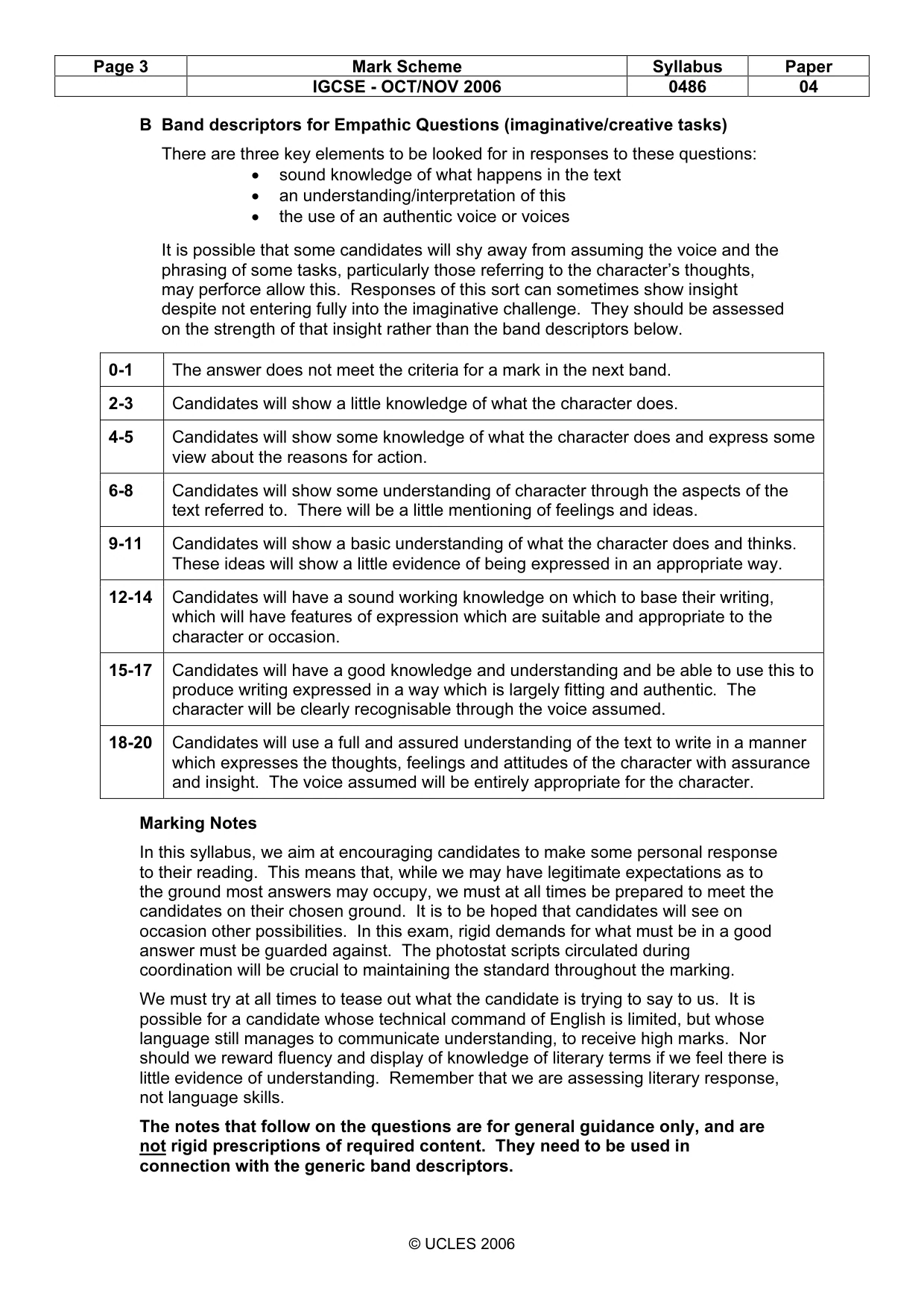
Mark scheme, page 2
Page 2 Mark Scheme Syllabus Paper IGCSE - OCT/NOV 2006 0486 04 © UCLES 2006 General Descriptors The general descriptors are an attempt to guide examiners to an understanding of the qualities normally expected of, or ‘typical’ of, work in the band. They must not be interpreted as hurdle statements, and form a means of general guidance. Photostats taken from work produced in the examination will be the principal means by which we shall standardise the marking. A Descriptors for essay/passage-based tasks 0-1 The answer does not meet the criteria for a mark in the next band 2-3 Candidates will – show a little awareness of… make some comment about… 4-5 Candidates will – make a few straightforward points about… show a few signs of understanding… make a little reference to aspects of the text… make simple personal response to… 6-8 Candidates will – make some relevant comment about… show some understanding of… with a little support from the text/reference to language. 9-11 Candidates will – begin to develop a response… show understanding of … with some detail from the text/reference to language. 12-14 Candidates will – make a reasonably sustained/extended response… show understanding of… show some thoroughness in use of text for support. make some response to the way language works. 15-17 Candidates will – make a convincing response… show clear, sustained understanding of… make careful and relevant reference to the text. respond with some thoroughness/detail to the way language works. 18-20 Candidates will – sustain a perceptive, convincing response… demonstrate clear critical/analytical understanding. show some originality of thought. make much well-selected reference to the text. respond sensitively and in detail to the way language works. The very best will achieve all the above, with flair, imagination and sophistication in addition.
Mark scheme, page 3
Page 3 Mark Scheme Syllabus Paper IGCSE - OCT/NOV 2006 0486 04 © UCLES 2006 B Band descriptors for Empathic Questions (imaginative/creative tasks) There are three key elements to be looked for in responses to these questions: • sound knowledge of what happens in the text • an understanding/interpretation of this • the use of an authentic voice or voices It is possible that some candidates will shy away from assuming the voice and the phrasing of some tasks, particularly those referring to the character’s thoughts, may perforce allow this. Responses of this sort can sometimes show insight despite not entering fully into the imaginative challenge. They should be assessed on the strength of that insight rather than the band descriptors below. 0-1 The answer does not meet the criteria for a mark in the next band. 2-3 Candidates will show a little knowledge of what the character does. 4-5 Candidates will show some knowledge of what the character does and express some view about the reasons for action. 6-8 Candidates will show some understanding of character through the aspects of the text referred to. There will be a little mentioning of feelings and ideas. 9-11 Candidates will show a basic understanding of what the character does and thinks. These ideas will show a little evidence of being expressed in an appropriate way. 12-14 Candidates will have a sound working knowledge on which to base their writing, which will have features of expression which are suitable and appropriate to the character or occasion. 15-17 Candidates will have a good knowledge and understanding and be able to use this to produce writing expressed in a way which is largely fitting and authentic. The character will be clearly recognisable through the voice assumed. 18-20 Candidates will use a full and assured understanding of the text to write in a manner which expresses the thoughts, feelings and attitudes of the character with assurance and insight. The voice assumed will be entirely appropriate for the character. Marking Notes In this syllabus, we aim at encouraging candidates to make some personal response to their reading. This means that, while we may have legitimate expectations as to the ground most answers may occupy, we must at all times be prepared to meet the candidates on their chosen ground. It is to be hoped that candidates will see on occasion other possibilities. In this exam, rigid demands for what must be in a good answer must be guarded against. The photostat scripts circulated during coordination will be crucial to maintaining the standard throughout the marking. We must try at all times to tease out what the candidate is trying to say to us. It is possible for a candidate whose technical command of English is limited, but whose language still manages to communicate understanding, to receive high marks. Nor should we reward fluency and display of knowledge of literary terms if we feel there is little evidence of understanding. Remember that we are assessing literary response, not language skills. The notes that follow on the questions are for general guidance only, and are not rigid prescriptions of required content. They need to be used in connection with the generic band descriptors.
Mark scheme, page 4
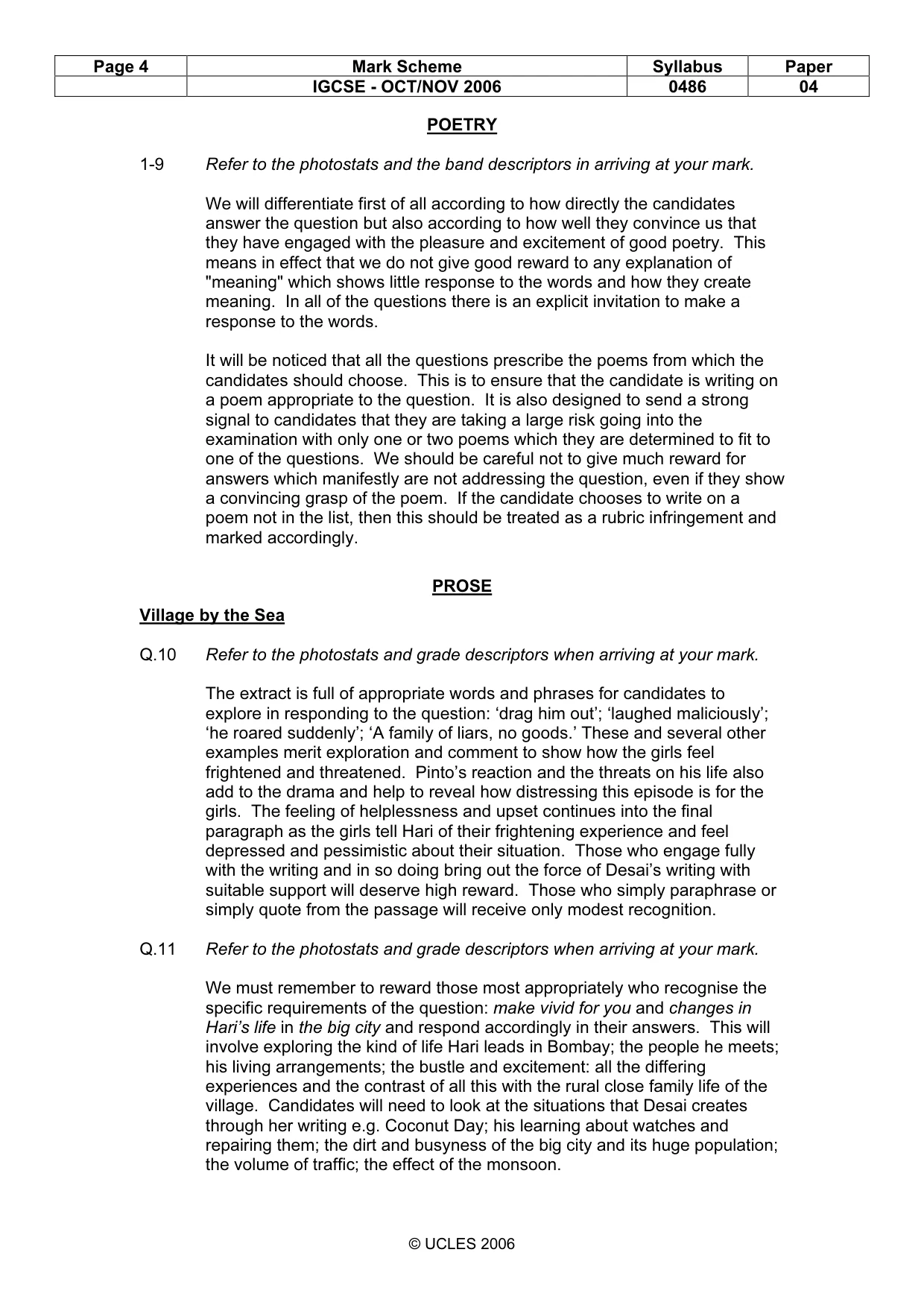
Page 4 Mark Scheme Syllabus Paper IGCSE - OCT/NOV 2006 0486 04 © UCLES 2006 POETRY 1-9 Refer to the photostats and the band descriptors in arriving at your mark. We will differentiate first of all according to how directly the candidates answer the question but also according to how well they convince us that they have engaged with the pleasure and excitement of good poetry. This means in effect that we do not give good reward to any explanation of "meaning" which shows little response to the words and how they create meaning. In all of the questions there is an explicit invitation to make a response to the words. It will be noticed that all the questions prescribe the poems from which the candidates should choose. This is to ensure that the candidate is writing on a poem appropriate to the question. It is also designed to send a strong signal to candidates that they are taking a large risk going into the examination with only one or two poems which they are determined to fit to one of the questions. We should be careful not to give much reward for answers which manifestly are not addressing the question, even if they show a convincing grasp of the poem. If the candidate chooses to write on a poem not in the list, then this should be treated as a rubric infringement and marked accordingly. PROSE Village by the Sea Q.10 Refer to the photostats and grade descriptors when arriving at your mark. The extract is full of appropriate words and phrases for candidates to explore in responding to the question: ‘drag him out’; ‘laughed maliciously’; ‘he roared suddenly’; ‘A family of liars, no goods.’ These and several other examples merit exploration and comment to show how the girls feel frightened and threatened. Pinto’s reaction and the threats on his life also add to the drama and help to reveal how distressing this episode is for the girls. The feeling of helplessness and upset continues into the final paragraph as the girls tell Hari of their frightening experience and feel depressed and pessimistic about their situation. Those who engage fully with the writing and in so doing bring out the force of Desai’s writing with suitable support will deserve high reward. Those who simply paraphrase or simply quote from the passage will receive only modest recognition. Q.11 Refer to the photostats and grade descriptors when arriving at your mark. We must remember to reward those most appropriately who recognise the specific requirements of the question: make vivid for you and changes in Hari’s life in the big city and respond accordingly in their answers. This will involve exploring the kind of life Hari leads in Bombay; the people he meets; his living arrangements; the bustle and excitement: all the differing experiences and the contrast of all this with the rural close family life of the village. Candidates will need to look at the situations that Desai creates through her writing e.g. Coconut Day; his learning about watches and repairing them; the dirt and busyness of the big city and its huge population; the volume of traffic; the effect of the monsoon.
Mark scheme, page 5
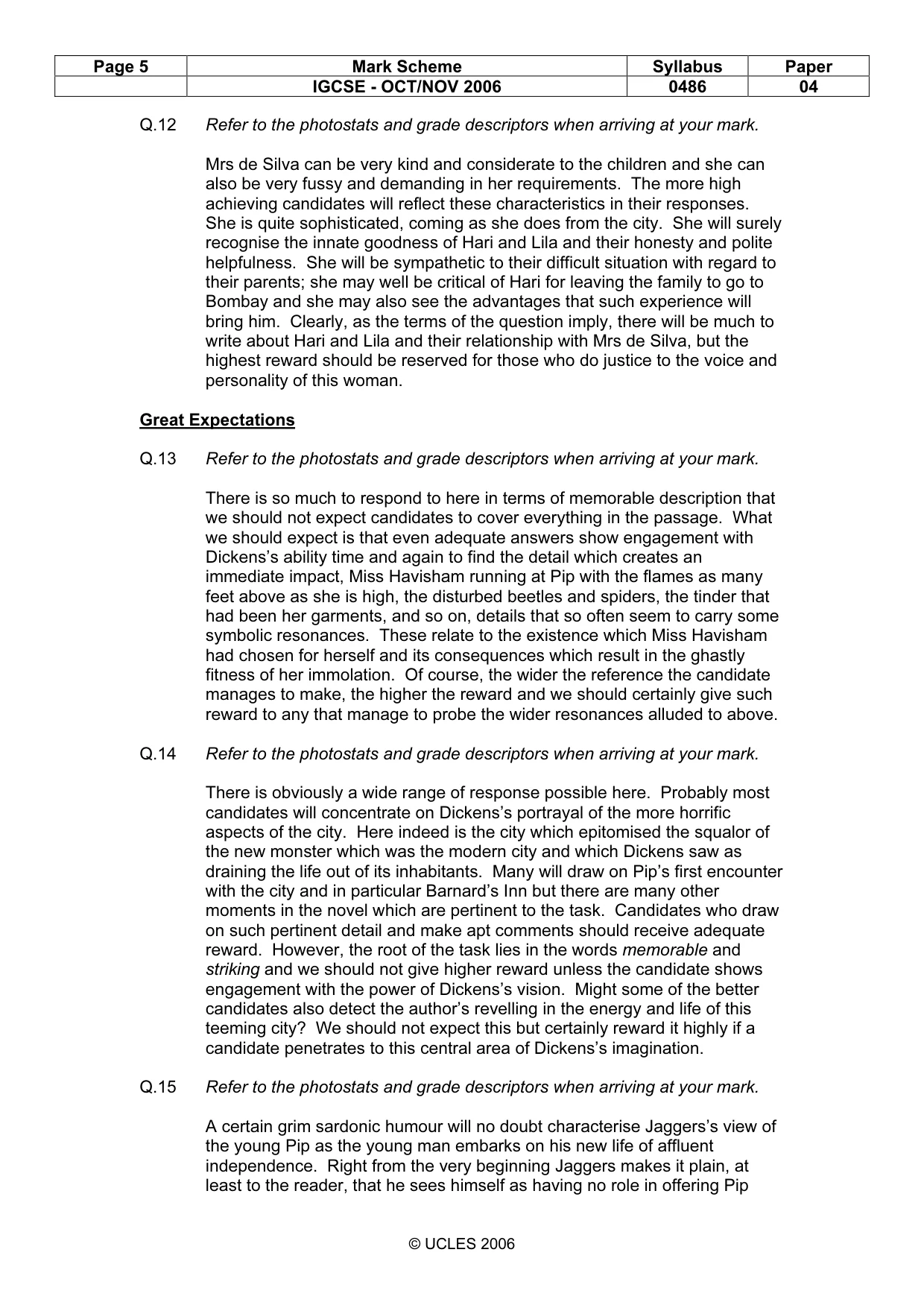
Page 5 Mark Scheme Syllabus Paper IGCSE - OCT/NOV 2006 0486 04 © UCLES 2006 Q.12 Refer to the photostats and grade descriptors when arriving at your mark. Mrs de Silva can be very kind and considerate to the children and she can also be very fussy and demanding in her requirements. The more high achieving candidates will reflect these characteristics in their responses. She is quite sophisticated, coming as she does from the city. She will surely recognise the innate goodness of Hari and Lila and their honesty and polite helpfulness. She will be sympathetic to their difficult situation with regard to their parents; she may well be critical of Hari for leaving the family to go to Bombay and she may also see the advantages that such experience will bring him. Clearly, as the terms of the question imply, there will be much to write about Hari and Lila and their relationship with Mrs de Silva, but the highest reward should be reserved for those who do justice to the voice and personality of this woman. Great Expectations Q.13 Refer to the photostats and grade descriptors when arriving at your mark. There is so much to respond to here in terms of memorable description that we should not expect candidates to cover everything in the passage. What we should expect is that even adequate answers show engagement with Dickens’s ability time and again to find the detail which creates an immediate impact, Miss Havisham running at Pip with the flames as many feet above as she is high, the disturbed beetles and spiders, the tinder that had been her garments, and so on, details that so often seem to carry some symbolic resonances. These relate to the existence which Miss Havisham had chosen for herself and its consequences which result in the ghastly fitness of her immolation. Of course, the wider the reference the candidate manages to make, the higher the reward and we should certainly give such reward to any that manage to probe the wider resonances alluded to above. Q.14 Refer to the photostats and grade descriptors when arriving at your mark. There is obviously a wide range of response possible here. Probably most candidates will concentrate on Dickens’s portrayal of the more horrific aspects of the city. Here indeed is the city which epitomised the squalor of the new monster which was the modern city and which Dickens saw as draining the life out of its inhabitants. Many will draw on Pip’s first encounter with the city and in particular Barnard’s Inn but there are many other moments in the novel which are pertinent to the task. Candidates who draw on such pertinent detail and make apt comments should receive adequate reward. However, the root of the task lies in the words memorable and striking and we should not give higher reward unless the candidate shows engagement with the power of Dickens’s vision. Might some of the better candidates also detect the author’s revelling in the energy and life of this teeming city? We should not expect this but certainly reward it highly if a candidate penetrates to this central area of Dickens’s imagination. Q.15 Refer to the photostats and grade descriptors when arriving at your mark. A certain grim sardonic humour will no doubt characterise Jaggers’s view of the young Pip as the young man embarks on his new life of affluent independence. Right from the very beginning Jaggers makes it plain, at least to the reader, that he sees himself as having no role in offering Pip
Mark scheme, page 6
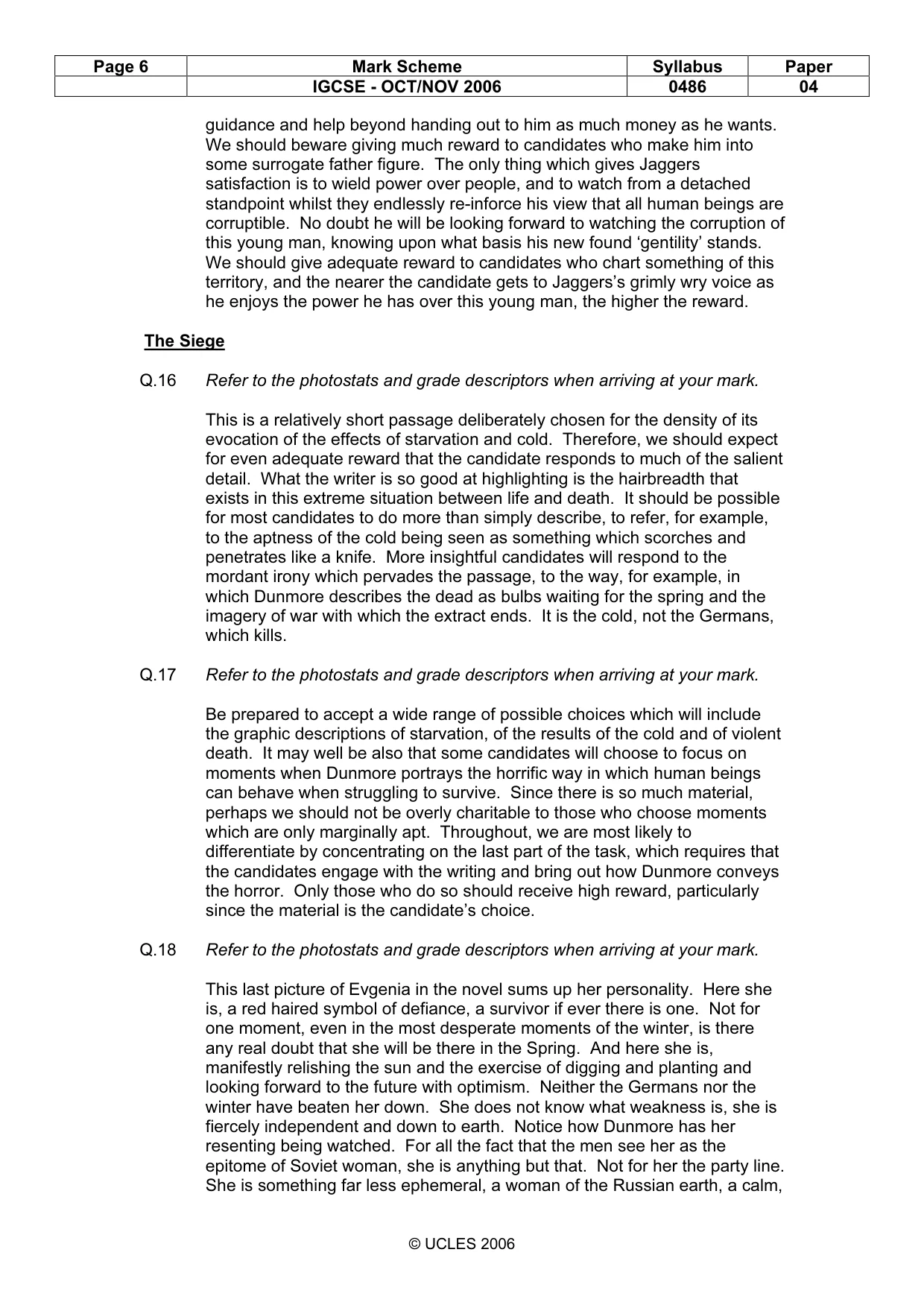
Page 6 Mark Scheme Syllabus Paper IGCSE - OCT/NOV 2006 0486 04 © UCLES 2006 guidance and help beyond handing out to him as much money as he wants. We should beware giving much reward to candidates who make him into some surrogate father figure. The only thing which gives Jaggers satisfaction is to wield power over people, and to watch from a detached standpoint whilst they endlessly re-inforce his view that all human beings are corruptible. No doubt he will be looking forward to watching the corruption of this young man, knowing upon what basis his new found ‘gentility’ stands. We should give adequate reward to candidates who chart something of this territory, and the nearer the candidate gets to Jaggers’s grimly wry voice as he enjoys the power he has over this young man, the higher the reward. The Siege Q.16 Refer to the photostats and grade descriptors when arriving at your mark. This is a relatively short passage deliberately chosen for the density of its evocation of the effects of starvation and cold. Therefore, we should expect for even adequate reward that the candidate responds to much of the salient detail. What the writer is so good at highlighting is the hairbreadth that exists in this extreme situation between life and death. It should be possible for most candidates to do more than simply describe, to refer, for example, to the aptness of the cold being seen as something which scorches and penetrates like a knife. More insightful candidates will respond to the mordant irony which pervades the passage, to the way, for example, in which Dunmore describes the dead as bulbs waiting for the spring and the imagery of war with which the extract ends. It is the cold, not the Germans, which kills. Q.17 Refer to the photostats and grade descriptors when arriving at your mark. Be prepared to accept a wide range of possible choices which will include the graphic descriptions of starvation, of the results of the cold and of violent death. It may well be also that some candidates will choose to focus on moments when Dunmore portrays the horrific way in which human beings can behave when struggling to survive. Since there is so much material, perhaps we should not be overly charitable to those who choose moments which are only marginally apt. Throughout, we are most likely to differentiate by concentrating on the last part of the task, which requires that the candidates engage with the writing and bring out how Dunmore conveys the horror. Only those who do so should receive high reward, particularly since the material is the candidate’s choice. Q.18 Refer to the photostats and grade descriptors when arriving at your mark. This last picture of Evgenia in the novel sums up her personality. Here she is, a red haired symbol of defiance, a survivor if ever there is one. Not for one moment, even in the most desperate moments of the winter, is there any real doubt that she will be there in the Spring. And here she is, manifestly relishing the sun and the exercise of digging and planting and looking forward to the future with optimism. Neither the Germans nor the winter have beaten her down. She does not know what weakness is, she is fiercely independent and down to earth. Notice how Dunmore has her resenting being watched. For all the fact that the men see her as the epitome of Soviet woman, she is anything but that. Not for her the party line. She is something far less ephemeral, a woman of the Russian earth, a calm,
Mark scheme, page 7
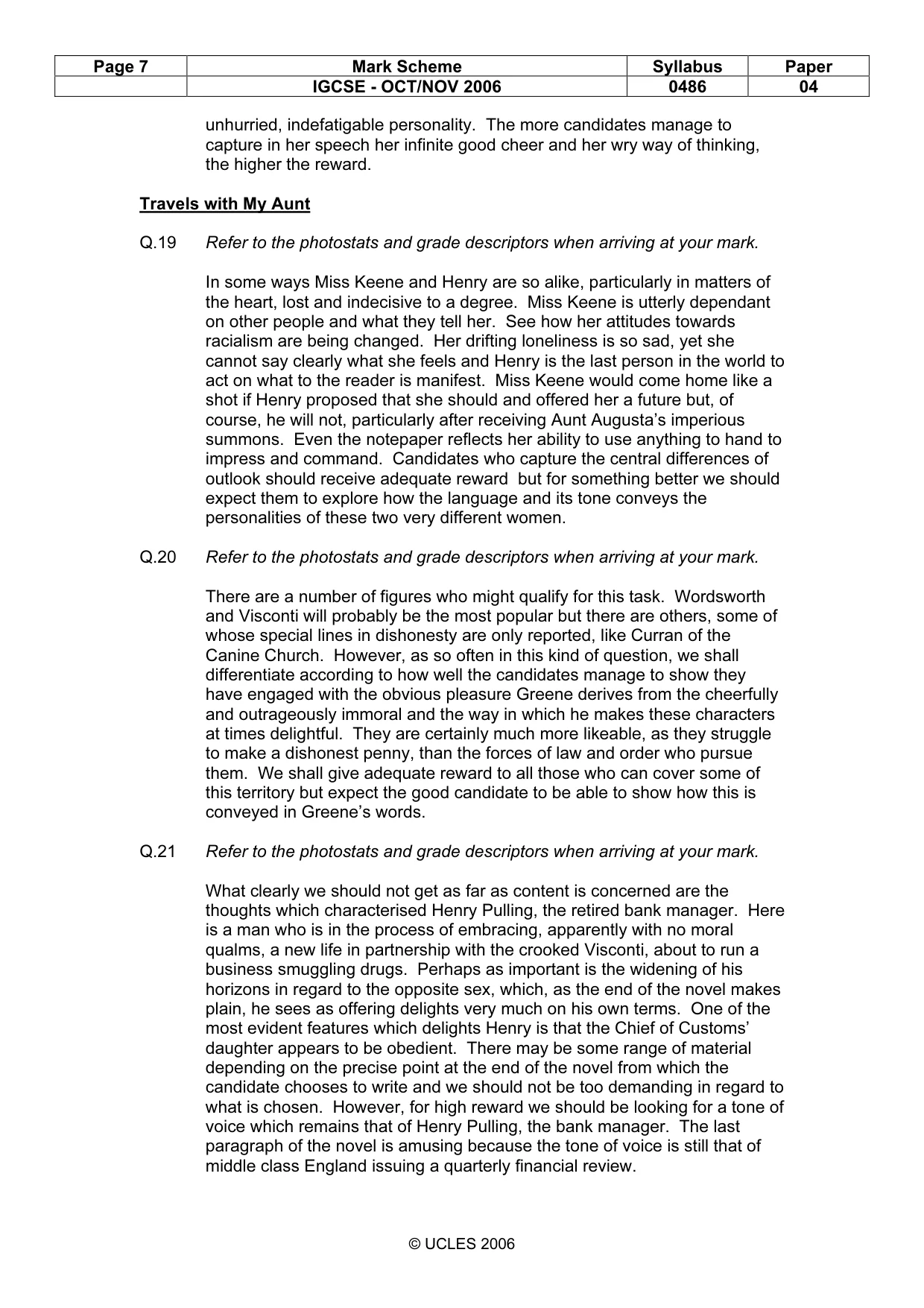
Page 7 Mark Scheme Syllabus Paper IGCSE - OCT/NOV 2006 0486 04 © UCLES 2006 unhurried, indefatigable personality. The more candidates manage to capture in her speech her infinite good cheer and her wry way of thinking, the higher the reward. Travels with My Aunt Q.19 Refer to the photostats and grade descriptors when arriving at your mark. In some ways Miss Keene and Henry are so alike, particularly in matters of the heart, lost and indecisive to a degree. Miss Keene is utterly dependant on other people and what they tell her. See how her attitudes towards racialism are being changed. Her drifting loneliness is so sad, yet she cannot say clearly what she feels and Henry is the last person in the world to act on what to the reader is manifest. Miss Keene would come home like a shot if Henry proposed that she should and offered her a future but, of course, he will not, particularly after receiving Aunt Augusta’s imperious summons. Even the notepaper reflects her ability to use anything to hand to impress and command. Candidates who capture the central differences of outlook should receive adequate reward but for something better we should expect them to explore how the language and its tone conveys the personalities of these two very different women. Q.20 Refer to the photostats and grade descriptors when arriving at your mark. There are a number of figures who might qualify for this task. Wordsworth and Visconti will probably be the most popular but there are others, some of whose special lines in dishonesty are only reported, like Curran of the Canine Church. However, as so often in this kind of question, we shall differentiate according to how well the candidates manage to show they have engaged with the obvious pleasure Greene derives from the cheerfully and outrageously immoral and the way in which he makes these characters at times delightful. They are certainly much more likeable, as they struggle to make a dishonest penny, than the forces of law and order who pursue them. We shall give adequate reward to all those who can cover some of this territory but expect the good candidate to be able to show how this is conveyed in Greene’s words. Q.21 Refer to the photostats and grade descriptors when arriving at your mark. What clearly we should not get as far as content is concerned are the thoughts which characterised Henry Pulling, the retired bank manager. Here is a man who is in the process of embracing, apparently with no moral qualms, a new life in partnership with the crooked Visconti, about to run a business smuggling drugs. Perhaps as important is the widening of his horizons in regard to the opposite sex, which, as the end of the novel makes plain, he sees as offering delights very much on his own terms. One of the most evident features which delights Henry is that the Chief of Customs’ daughter appears to be obedient. There may be some range of material depending on the precise point at the end of the novel from which the candidate chooses to write and we should not be too demanding in regard to what is chosen. However, for high reward we should be looking for a tone of voice which remains that of Henry Pulling, the bank manager. The last paragraph of the novel is amusing because the tone of voice is still that of middle class England issuing a quarterly financial review.
Mark scheme, page 8
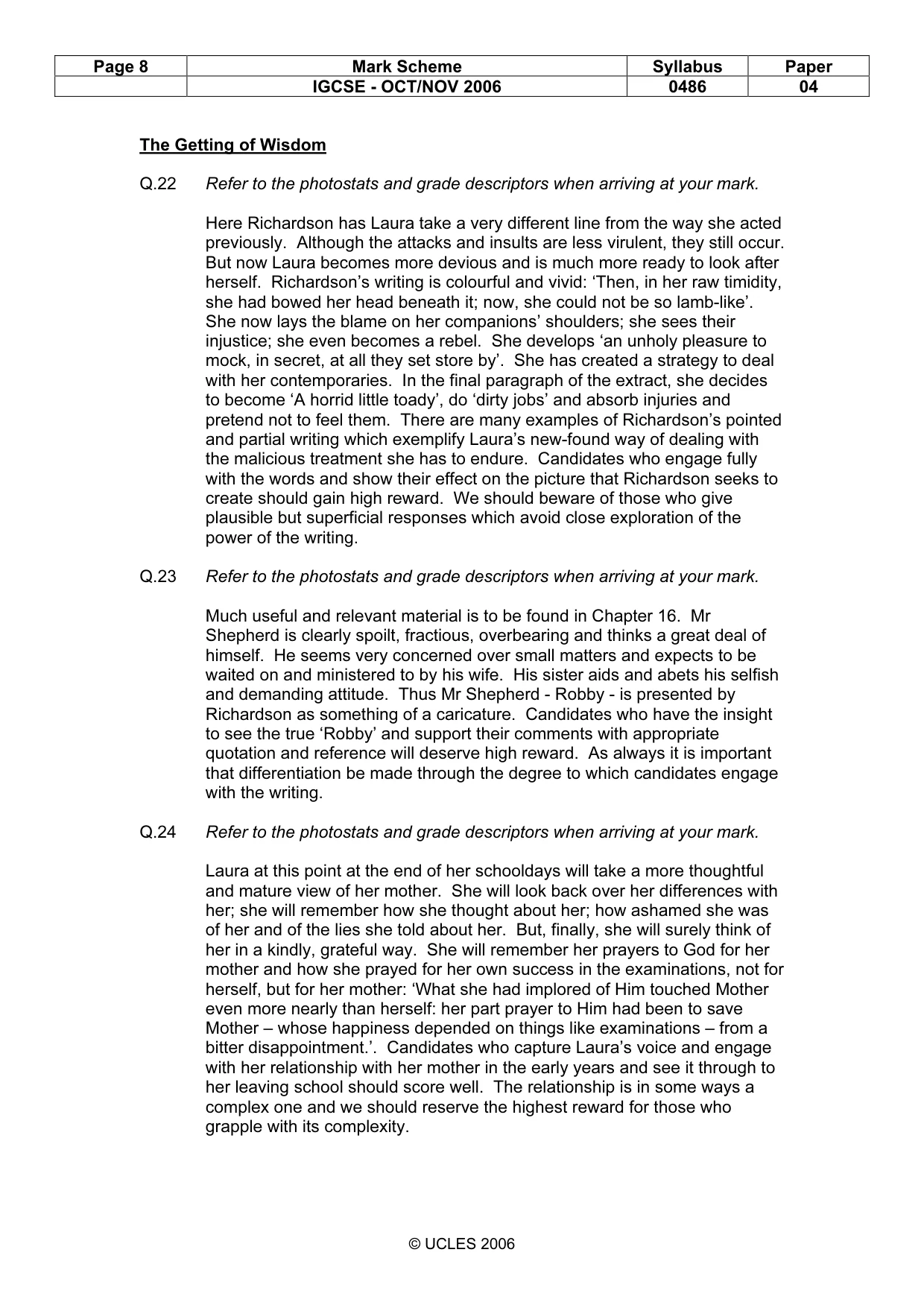
Page 8 Mark Scheme Syllabus Paper IGCSE - OCT/NOV 2006 0486 04 © UCLES 2006 The Getting of Wisdom Q.22 Refer to the photostats and grade descriptors when arriving at your mark. Here Richardson has Laura take a very different line from the way she acted previously. Although the attacks and insults are less virulent, they still occur. But now Laura becomes more devious and is much more ready to look after herself. Richardson’s writing is colourful and vivid: ‘Then, in her raw timidity, she had bowed her head beneath it; now, she could not be so lamb-like’. She now lays the blame on her companions’ shoulders; she sees their injustice; she even becomes a rebel. She develops ‘an unholy pleasure to mock, in secret, at all they set store by’. She has created a strategy to deal with her contemporaries. In the final paragraph of the extract, she decides to become ‘A horrid little toady’, do ‘dirty jobs’ and absorb injuries and pretend not to feel them. There are many examples of Richardson’s pointed and partial writing which exemplify Laura’s new-found way of dealing with the malicious treatment she has to endure. Candidates who engage fully with the words and show their effect on the picture that Richardson seeks to create should gain high reward. We should beware of those who give plausible but superficial responses which avoid close exploration of the power of the writing. Q.23 Refer to the photostats and grade descriptors when arriving at your mark. Much useful and relevant material is to be found in Chapter 16. Mr Shepherd is clearly spoilt, fractious, overbearing and thinks a great deal of himself. He seems very concerned over small matters and expects to be waited on and ministered to by his wife. His sister aids and abets his selfish and demanding attitude. Thus Mr Shepherd - Robby - is presented by Richardson as something of a caricature. Candidates who have the insight to see the true ‘Robby’ and support their comments with appropriate quotation and reference will deserve high reward. As always it is important that differentiation be made through the degree to which candidates engage with the writing. Q.24 Refer to the photostats and grade descriptors when arriving at your mark. Laura at this point at the end of her schooldays will take a more thoughtful and mature view of her mother. She will look back over her differences with her; she will remember how she thought about her; how ashamed she was of her and of the lies she told about her. But, finally, she will surely think of her in a kindly, grateful way. She will remember her prayers to God for her mother and how she prayed for her own success in the examinations, not for herself, but for her mother: ‘What she had implored of Him touched Mother even more nearly than herself: her part prayer to Him had been to save Mother – whose happiness depended on things like examinations – from a bitter disappointment.’. Candidates who capture Laura’s voice and engage with her relationship with her mother in the early years and see it through to her leaving school should score well. The relationship is in some ways a complex one and we should reserve the highest reward for those who grapple with its complexity.
Mark scheme, page 9
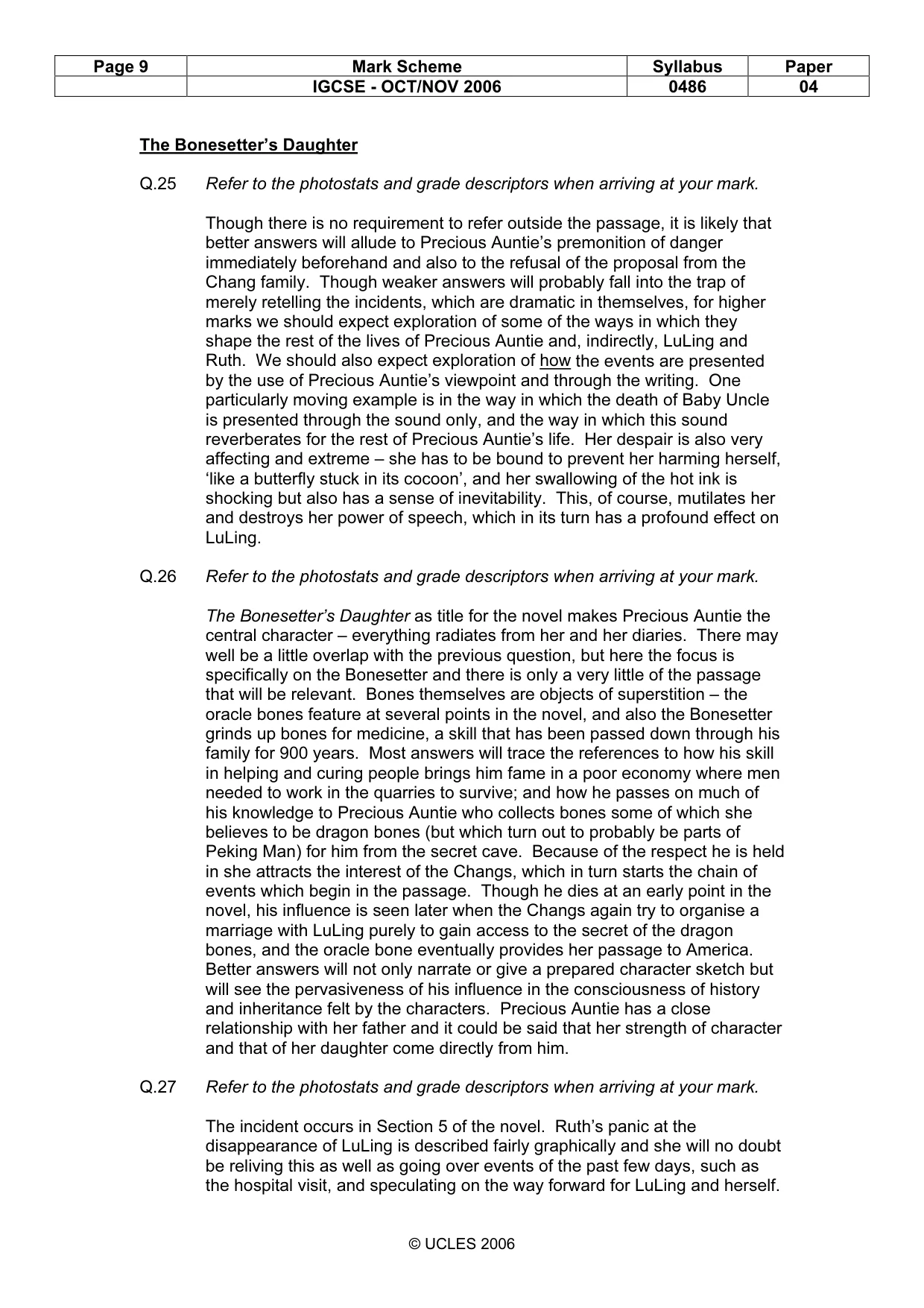
Page 9 Mark Scheme Syllabus Paper IGCSE - OCT/NOV 2006 0486 04 © UCLES 2006 The Bonesetter’s Daughter Q.25 Refer to the photostats and grade descriptors when arriving at your mark. Though there is no requirement to refer outside the passage, it is likely that better answers will allude to Precious Auntie’s premonition of danger immediately beforehand and also to the refusal of the proposal from the Chang family. Though weaker answers will probably fall into the trap of merely retelling the incidents, which are dramatic in themselves, for higher marks we should expect exploration of some of the ways in which they shape the rest of the lives of Precious Auntie and, indirectly, LuLing and Ruth. We should also expect exploration of how the events are presented by the use of Precious Auntie’s viewpoint and through the writing. One particularly moving example is in the way in which the death of Baby Uncle is presented through the sound only, and the way in which this sound reverberates for the rest of Precious Auntie’s life. Her despair is also very affecting and extreme – she has to be bound to prevent her harming herself, ‘like a butterfly stuck in its cocoon’, and her swallowing of the hot ink is shocking but also has a sense of inevitability. This, of course, mutilates her and destroys her power of speech, which in its turn has a profound effect on LuLing. Q.26 Refer to the photostats and grade descriptors when arriving at your mark. The Bonesetter’s Daughter as title for the novel makes Precious Auntie the central character – everything radiates from her and her diaries. There may well be a little overlap with the previous question, but here the focus is specifically on the Bonesetter and there is only a very little of the passage that will be relevant. Bones themselves are objects of superstition – the oracle bones feature at several points in the novel, and also the Bonesetter grinds up bones for medicine, a skill that has been passed down through his family for 900 years. Most answers will trace the references to how his skill in helping and curing people brings him fame in a poor economy where men needed to work in the quarries to survive; and how he passes on much of his knowledge to Precious Auntie who collects bones some of which she believes to be dragon bones (but which turn out to probably be parts of Peking Man) for him from the secret cave. Because of the respect he is held in she attracts the interest of the Changs, which in turn starts the chain of events which begin in the passage. Though he dies at an early point in the novel, his influence is seen later when the Changs again try to organise a marriage with LuLing purely to gain access to the secret of the dragon bones, and the oracle bone eventually provides her passage to America. Better answers will not only narrate or give a prepared character sketch but will see the pervasiveness of his influence in the consciousness of history and inheritance felt by the characters. Precious Auntie has a close relationship with her father and it could be said that her strength of character and that of her daughter come directly from him. Q.27 Refer to the photostats and grade descriptors when arriving at your mark. The incident occurs in Section 5 of the novel. Ruth’s panic at the disappearance of LuLing is described fairly graphically and she will no doubt be reliving this as well as going over events of the past few days, such as the hospital visit, and speculating on the way forward for LuLing and herself.
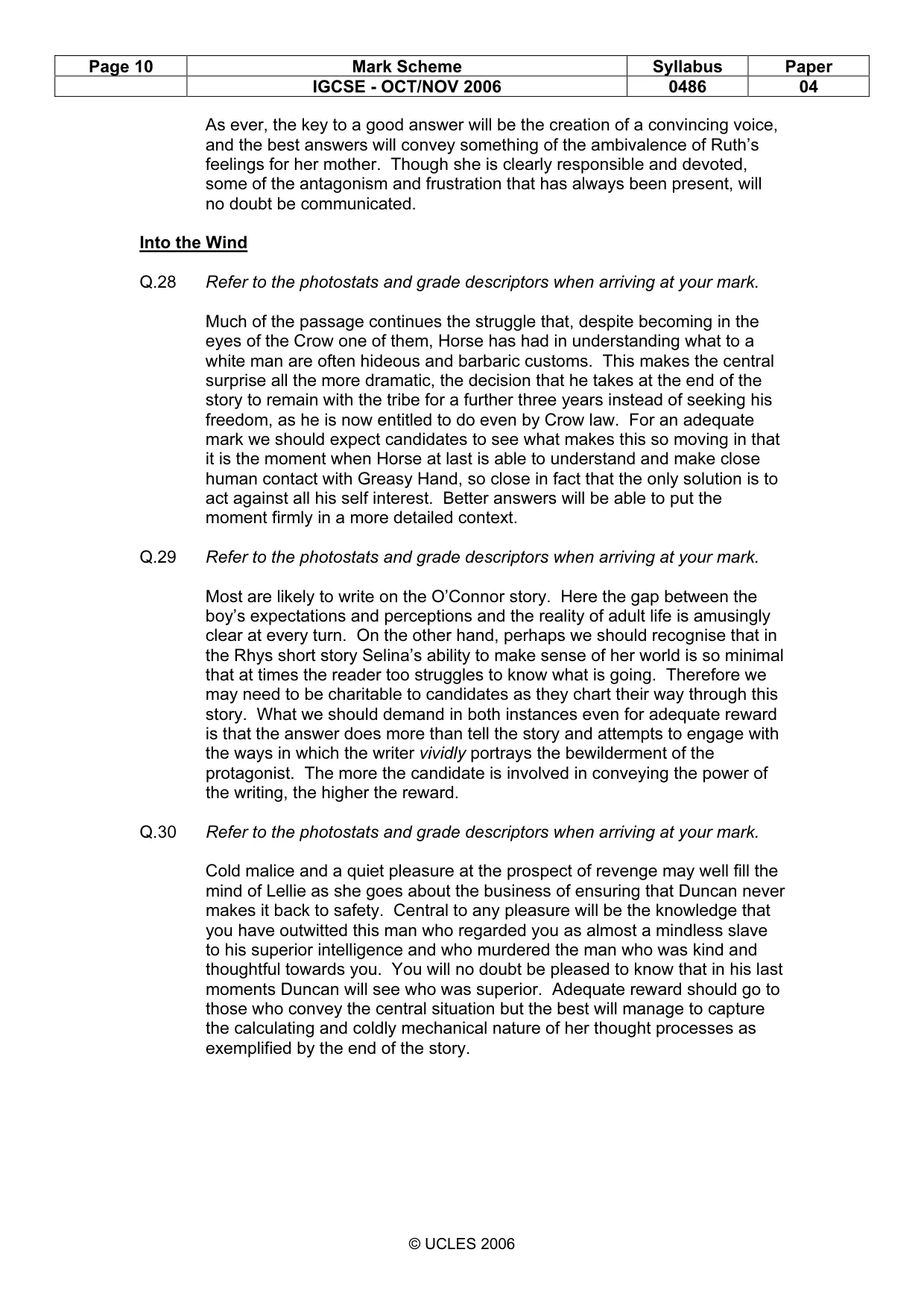
Mark scheme, page 10
Page 10 Mark Scheme Syllabus Paper IGCSE - OCT/NOV 2006 0486 04 © UCLES 2006 As ever, the key to a good answer will be the creation of a convincing voice, and the best answers will convey something of the ambivalence of Ruth’s feelings for her mother. Though she is clearly responsible and devoted, some of the antagonism and frustration that has always been present, will no doubt be communicated. Into the Wind Q.28 Refer to the photostats and grade descriptors when arriving at your mark. Much of the passage continues the struggle that, despite becoming in the eyes of the Crow one of them, Horse has had in understanding what to a white man are often hideous and barbaric customs. This makes the central surprise all the more dramatic, the decision that he takes at the end of the story to remain with the tribe for a further three years instead of seeking his freedom, as he is now entitled to do even by Crow law. For an adequate mark we should expect candidates to see what makes this so moving in that it is the moment when Horse at last is able to understand and make close human contact with Greasy Hand, so close in fact that the only solution is to act against all his self interest. Better answers will be able to put the moment firmly in a more detailed context. Q.29 Refer to the photostats and grade descriptors when arriving at your mark. Most are likely to write on the O’Connor story. Here the gap between the boy’s expectations and perceptions and the reality of adult life is amusingly clear at every turn. On the other hand, perhaps we should recognise that in the Rhys short story Selina’s ability to make sense of her world is so minimal that at times the reader too struggles to know what is going. Therefore we may need to be charitable to candidates as they chart their way through this story. What we should demand in both instances even for adequate reward is that the answer does more than tell the story and attempts to engage with the ways in which the writer vividly portrays the bewilderment of the protagonist. The more the candidate is involved in conveying the power of the writing, the higher the reward. Q.30 Refer to the photostats and grade descriptors when arriving at your mark. Cold malice and a quiet pleasure at the prospect of revenge may well fill the mind of Lellie as she goes about the business of ensuring that Duncan never makes it back to safety. Central to any pleasure will be the knowledge that you have outwitted this man who regarded you as almost a mindless slave to his superior intelligence and who murdered the man who was kind and thoughtful towards you. You will no doubt be pleased to know that in his last moments Duncan will see who was superior. Adequate reward should go to those who convey the central situation but the best will manage to capture the calculating and coldly mechanical nature of her thought processes as exemplified by the end of the story.
Mark scheme, page 11
Page 11 Mark Scheme Syllabus Paper IGCSE - OCT/NOV 2006 0486 04 © UCLES 2006 DRAMA Absent Friends Q.31 Refer to the photostats and grade descriptors when arriving at your mark. In some ways Colin is the acid test of a candidate’s grasp of the play. It has been known for him to appear in answers as the hero of the play, in other words for candidates to miss entirely the playwright’s scornful irony. He is, of course, the epitome of egocentric self satisfaction, completely certain of his moral integrity and of the acuteness of his perception. The result is that he is quite oblivious to the frequency with which he utterly mistakes the situation and says things which offend and hurt and make that situation worse. There are an number of instances of this in this extract which candidates will latch onto, for instance, his perception, probably untrue, that he was a serious suitor of Diana, followed by his hopeless analysis of Evelyn’s marriage. Some grasp of the central point of his character with support from the passage should be enough for adequate reward. Better answers will show engagement with Ayckbourn’s wicked wit as he charts Colin’s obliviousness both to the ripples he is creating and to the acidness of one or two of the responses. One of the thoughts raised at the end of the passage is just how lucky Carol was in avoiding marriage to this man, that is if it would ever have come to that. One finishes by wondering about the reality of the memory which he so lovingly burnishes. Q.32 Refer to the photostats and grade descriptors when arriving at your mark. There is much that could be said on both sides here but, given that Diana is married to a beast of a husband who has had an affair with the despicable Evelyn after many other infidelities, has removed her children from her in the name of education and generally ignores her, many will no doubt think her much to be pitied. On the other hand, some might find her something of a limp, ineffectual woman with an inferiority complex who has never stood up for herself and simply dreamed about joining the Canadian Mounties! Still, we are witness perhaps to a watershed when she empties the cream over Paul and one wonders what the future holds as she leaves the stage for the last time. As usual we shall differentiate according to how well the candidate uses the material of the play to re-inforce whatever stance is taken. Q.33 Refer to the photostats and grade descriptors when arriving at your mark. This should provide plenty of opportunity for the imaginative. Evelyn is one of the most amusing characters in the play with her scornful view of everyone at the party and her seething discontent with her present life. In a way she is a sharply observant young woman who sees all too clearly the prison in which she is living. She is clearly bored out of her skin, ready to try anything which might give some variety to her life. Why else should she have consented to sordid and, if she is to be believed, highly unsuccessful sex with Paul? Of course, she is also an extremely selfish young woman who cares for no one, not even apparently her child. Adequate reward should go to those who choose something of the above material but we should reserve high reward for those who capture her characteristic tone of sarcastic contempt for all and sundry.
Mark scheme, page 12
Page 12 Mark Scheme Syllabus Paper IGCSE - OCT/NOV 2006 0486 04 © UCLES 2006 Cuba and Doghouse Q.34 Refer to the photostats and grade descriptors when arriving at your mark. There are two main elements which make this such a moving little scene. One is obviously Pats’s desperate attempts out of family loyalty and pride to cover what she knows must be plain to anyone, that she is the victim of the most dreadful abuse. The other is the delicacy and compassion with which Ger handles the situation and at the end ensures that Pats has some opportunity briefly to escape and to make a new acquaintance. A grasp of the central situation with some pertinent support should be enough for adequate reward. The more detailed the candidates become in their exploration of how the dialogue suggests the unspoken knowledge that exists between the speakers and how this makes the scene so moving, the higher should be the reward. Q.35 Refer to the photostats and grade descriptors when arriving at your mark. There is not much that can be said that is specific about this task since it will depend first of all on the candidates making an apt choice, one which allows them ample opportunity to engage with the drama of the moment. This, of course, will be the key to the kind of reward we shall give. We should expect even for an adequate mark that the candidate shows an ability to respond to the text as drama. It will not be enough simply to describe; there must be some evidence of understanding how the dramatist manipulates the audience’s feelings. The more surely the answer is rooted in this approach and the greater the insight, the higher the reward. Q.36 Refer to the photostats and grade descriptors when arriving at your mark. Miss Arthur will no doubt be a saddened and embittered woman. She is the one adult in the play who has some understanding of the terror felt by the young girls at the prospect of nuclear war. Whilst she might have had some understanding of the traditional and class base of the school in which she works, it is unlikely that she can have conceived that the management response to the girls’ actions would be what it is. Even more devastating would be the recognition that the man she was engaged to is a man of straw, simply a younger version of Cairncross and part of the male middle class consensus. Recognition of her views should be enough for adequate reward but for something better we should hope that candidates will convey her outrage and fury at the way the girls have been treated and the way she would be distraught at the collapse of all her hopes, both in terms of her career and of her personal life. Macbeth Q.37 Refer to the photostats and grade descriptors when arriving at your mark. The point to make about this task straightaway is that it requires the candidate to engage with the way drama makes its effect. We should not give much reward to those answers which simply describe what is going on without reflecting upon its dramatic impact. Here, right at the beginning of the play, the audience is pitchforked without any attempt at explanation into the dark and mysterious world of the dark spirits, a world which is pervasive
Mark scheme, page 13
Page 13 Mark Scheme Syllabus Paper IGCSE - OCT/NOV 2006 0486 04 © UCLES 2006 throughout the play. In addition, in the Captain’s dramatic description the audience gets both an idea of a kingdom convulsed in civil war and its first sighting of Macbeth, a sighting which on one level is intended to laud his patriotic loyalty but which also leaves an indelible picture of the savage strength and violence which lies at the centre of the man. In the main we shall differentiate in the higher areas according to how deeply the candidates become engaged with the drama of the words in this opening to the play. Q.38 Refer to the photostats and grade descriptors when arriving at your mark. Character sketches which occasionally connect with the question should not receive much reward. The question does not ask whether we pity Macbeth. It starts from the position that in some way we do and we should hope that most candidates will be able to isolate elements in the play which cause the audience to do so. Most likely many will refer to such things as the element of persuasion to which Macbeth is subject, the desperate state into which he lapses once he has murdered the King, and the dreadful wasteland which his spirit enters as he descends into barbarity. Perhaps, some of the best candidates may argue that our pity is particularly linked to the characteristics which pick out Macbeth as a man truly above the common, someone at times of remarkable imagination and feeling. Unlike his wife, he sees all too clearly the consequences of taking the path to regicide. However, in general, we shall differentiate according to how pertinent and detailed is the support to the argument. Q.39 Refer to the photostats and grade descriptors when arriving at your mark. Macduff from the very beginning guesses that Macbeth had a hand in Duncan’s murder and there are a number of reported references to his reactions to Macbeth becoming King as the text unfolds. His defiance grows, he refuses to go to the coronation and is referred to as a potential rebel asking Malcolm to raise a force. Therefore, there cannot be much doubt about his thoughts in that respect. What is the grey area is the way he leaves his family to the mercy of Macbeth. Does he believe that they can be in no danger when all his other reported thoughts and what he says to Malcolm suggests that he is under no illusions as to Macbeth’s murderous nature? Or does he believe that national imperatives are more important than personal ones? There can be no absolute answer to this nor should we expect assumptions of Macduff’s forthright character to go into this territory. However, we should give high reward to those who do and, of course, not give much to those who think that at this stage he knows his family has been murdered.
Mark scheme, page 14
Page 14 Mark Scheme Syllabus Paper IGCSE - OCT/NOV 2006 0486 04 © UCLES 2006 The Devil’s Disciple Q.40 Refer to the photostats and grade descriptors when arriving at your mark. This should, in essence at least, be a fairly straightforward task in that there can be little doubt as to the central feature of this relationship. It is quite unlike that of husband and wife, it is more that of a father and daughter. That would not be so laughable had in the previous Act Judith not played the role of instructress and self appointed protector of Essie from Richard. Here she behaves just like a little girl herself who needs to be cosseted at every moment. As the dialogue makes plain, Anderson rather enjoys playing the role of her manly protector as he continually condescends to her and, of course, hides many an unpalatable fact from her, not least about his real character. An understanding of the basic situation with apt support should be enough for adequate reward. The more wide-ranging the detail from the passage, the higher the reward. It may be that better candidates will also show themselves by probing the degree of Shaw’s scornful irony as he portrays a marriage common in the new drama of Ibsen, that of the wife who is both a child and content to be treated as one by her hero-worshipped husband. Only after Judith’s experiences with Richard does some dawning of adulthood occur. Q.41 Refer to the photostats and grade descriptors when arriving at your mark. Anderson’s dramatic change of roles in Act 2 will probably be at the centre of most answers and some examination of what makes this dramatic with relevant support should be enough to gain adequate reward. As usual, character sketches which do not make the next step into engaging with the drama should not be so rewarded. Perhaps, though, we should look for a more rounded response before going higher because right from the very beginning in Act 1 Anderson seems much more interesting than the run of the mill Puritan pastor. His marriage and the very fact that Mrs. Dudgeon disapproves of him is enough to raise his dramatic profile, as is his reaction to Richard, which is not at all what one might expect. As usual, the wider the reference and pertinent support, the higher the reward. Q.42 Refer to the photostats and grade descriptors when arriving at your mark. Richard is a heroic life saver for Essie and we should not expect a great deal of subtlety in any assumption of this supremely grateful girl. She may well recall the grim days of her upbringing with Mrs. Dudgeon from which she was rescued so dramatically, only for it all to turn to ashes when Richard was arrested and sentenced to death. Now, though, everything is wonderful and no doubt many answers will gush over the wonder of it all. Good answers will capture the starry eyed optimism of this girl at the end of the play and her child-like tones. I’ll be good, she says in her last speech as she trots off to see the soldiers.
Mark scheme, page 15
Page 15 Mark Scheme Syllabus Paper IGCSE - OCT/NOV 2006 0486 04 © UCLES 2006 A Streetcar Named Desire. Q.43 Refer to the photostats and grade descriptors when arriving at your mark. Stella takes a very thoughtful and understanding view of Blanche. She is concerned about her feelings and wants to do nothing that would upset her. In this she is in sharp contrast to Stanley. He is cynical: ‘Well, isn’t that just dandy?’ ‘Over what?’ ‘Yeah?’ He is anxious to know more about Belle Reve as he clearly suspects some plot on Blanche’s part. He is totally impervious to Stella’s requests for sympathy for Blanche and shows his suspicious, unfeeling side. He has little time for Blanche’s feelings or her quest for special treatment. Almost every line in the extract highlights the gulf between Stella and Stanley in their feelings about Blanche. Candidates who explore the writing meticulously and evaluate its impact in the scene with appropriate reference and inference will very likely merit the highest reward. Pedestrian trawls through the dialogue should be given only modest recognition. Q.44 Refer to the photostats and grade descriptors when arriving at your mark. Blanche is vulnerable in so many ways because in seeking to deceive others, she deceives herself. She pretends to be the fine, delicate lady and yet has baser instincts. She flirts with the gauche young man in Scene 5; she flirts even with Stanley. She re-writes history, pretending her experiences and past life are quite different from what they are. Much of her character is based on pretence and seeking to give the impression that she is much more than she actually is in the way of attractiveness and social position. She reveals her feelings of superiority when she dismisses Eunice and the help of the black woman in the opening scene. She looks down on Stella’s apartment and regards it as inferior. Her pretentious attitude pervades much of the play and she tends to crumble when she is faced with reality. She seeks to hide her past and becomes embarrassed when faced with facts that might reveal her previous history, for example, when Stanley mentions a man called Shaw who had allegedly met her in Laurel. She is reliant on alcohol to a large extent. All this suggests that Williams has created a character who makes false claims, who deceives and who cannot face reality. Perhaps had Blanche been straight and honest with herself her many misfortunes may have been avoided. However, Blanche is Williams’s creation and candidates must deal with her as she is. There is much material throughout the play to show that, given her character, Blanche is to a considerable degree responsible for her fate. But then could she have avoided it? Candidates who dwell on this last point and discuss it insightfully will deserve high reward. There are opportunities here for considerable perspicacity to be shown. More mundane answers will concentrate on Blanche’s faults and foibles and in so doing should receive adequate recognition. Q.45 Refer to the photostats and grade descriptors when arriving at your mark. Expect a variety of responses to this question which will take rather differing views of Stanley. We should be prepared to consider each on its merits. Stanley is macho man. He thinks well of himself, is a leader amongst his male friends and thinks of himself as attractive to women. He can be a bully and show little mercy especially when he senses pretence or deceit. But
Mark scheme, page 16
Page 16 Mark Scheme Syllabus Paper IGCSE - OCT/NOV 2006 0486 04 © UCLES 2006 there is a tenderer side to Stanley particularly in his treatment of Stella. The play ends on Stanley being a very different figure as he comforts Stella in a loving and sensitive way. We may well expect, therefore, that some candidates will see a change in Stanley compared with how he has been portrayed for much of the play and bring out this more sympathetic side. There will be others who will have the grasping, mean-spirited Stanley showing little but contempt for Blanche and no regret at the way he has treated her. Perhaps we may well see the very best answers as those which capture Stanley’s ungrammatical drawl which in itself tells us a good deal about him. We can certainly look forward to some very interesting answers.
What you needed in this session
Cambridge’s own grade thresholds for 2006 Oct/Nov, Paper 4 · Variant 1. A higher threshold means an easier paper — the bar moves with how the cohort did.