Cambridge IGCSE English - Literature 0486 — 2006 May/June Paper 4 · Variant 1
0486/41/M/J/06 · 80 marks · ≈90 min
The question paper and its mark scheme, free to read here and free to download. This is Cambridge’s own paper, exactly as it was sat.
Question paper28 pages








Mark scheme14 pages
Answers below. Sit the paper first if you are practising.
Paper as text
Question paper, page 1
This document consists of 28 printed pages and 4 blank pages. SP (NH) T05921/3 © UCLES 2006 [Turn over UNIVERSITY OF CAMBRIDGE INTERNATIONAL EXAMINATIONS International General Certificate of Secondary Education LITERATURE (ENGLISH) 0486/04 Paper 4 May/June 2006 2 hours 40 minutes Additional Materials: Answer Booklet/Paper READ THESE INSTRUCTIONS FIRST If you have been given an Answer Booklet, follow the instructions on the front cover of the Booklet. Write your Centre number, candidate number and name on all the work you hand in. Write in dark blue or black pen. Do not use staples, paper clips, highlighters, glue or correction fluid. Answer four questions. Each of your answers must be on a different book. At least one question must be taken from each of the sections Poetry, Prose, Drama. Answer at least one passage-based question (marked *) and at least one essay question. At the end of the examination, fasten all your work securely together. All questions in this paper carry equal marks. www.XtremePapers.com
Question paper, page 2
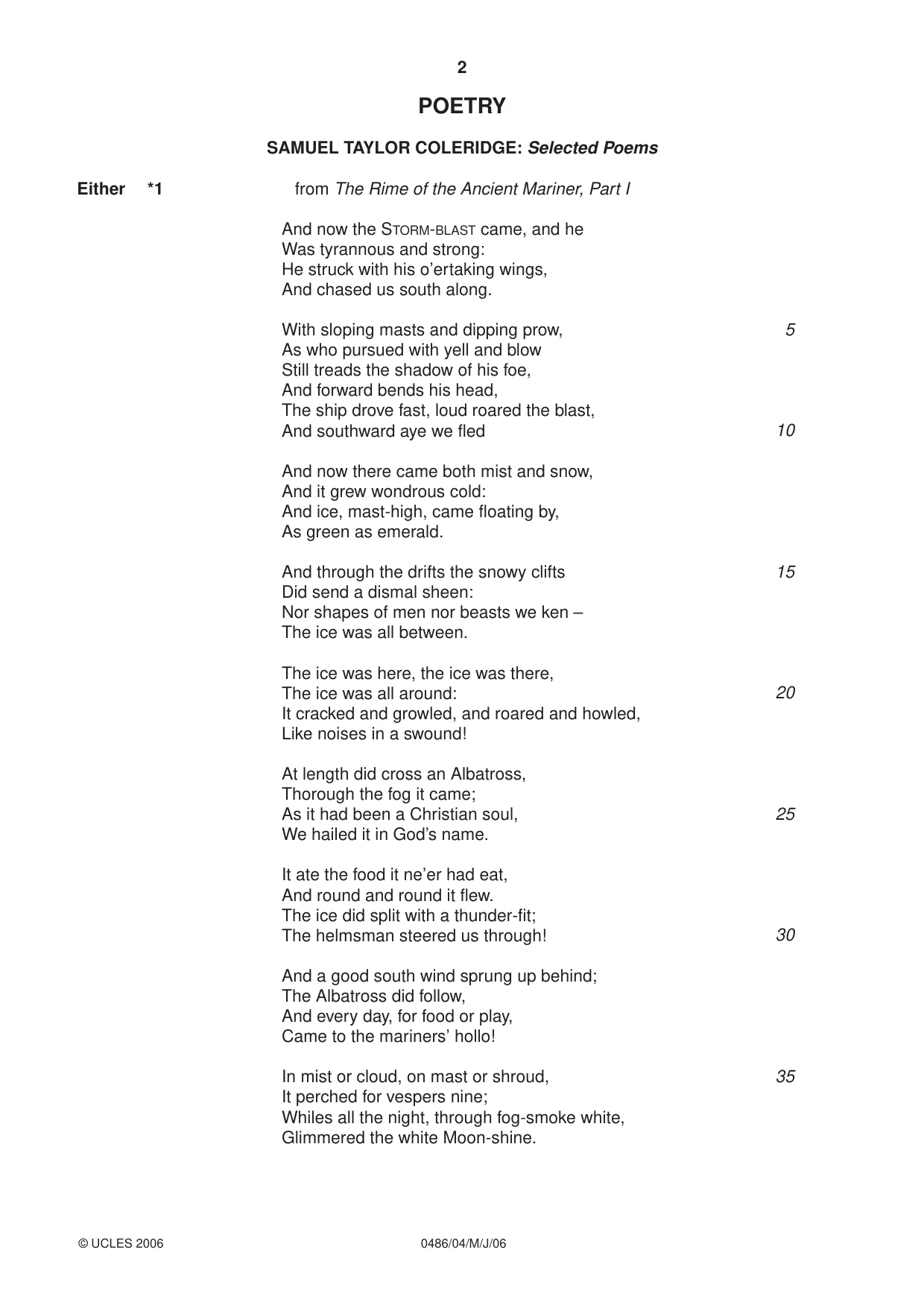
2 © UCLES 2006 0486/04/M/J/06 POETRY SAMUEL TAYLOR COLERIDGE: Selected Poems Either *1 from The Rime of the Ancient Mariner, Part I And now the STORM-BLAST came, and he Was tyrannous and strong: He struck with his o’ertaking wings, And chased us south along. With sloping masts and dipping prow, As who pursued with yell and blow Still treads the shadow of his foe, And forward bends his head, The ship drove fast, loud roared the blast, And southward aye we fled And now there came both mist and snow, And it grew wondrous cold: And ice, mast-high, came floating by, As green as emerald. And through the drifts the snowy clifts Did send a dismal sheen: Nor shapes of men nor beasts we ken – The ice was all between. The ice was here, the ice was there, The ice was all around: It cracked and growled, and roared and howled, Like noises in a swound! At length did cross an Albatross, Thorough the fog it came; As it had been a Christian soul, We hailed it in God’s name. It ate the food it ne’er had eat, And round and round it flew. The ice did split with a thunder-fit; The helmsman steered us through! And a good south wind sprung up behind; The Albatross did follow, And every day, for food or play, Came to the mariners’ hollo! In mist or cloud, on mast or shroud, It perched for vespers nine; Whiles all the night, through fog-smoke white, Glimmered the white Moon-shine. 5 10 15 20 25 30 35
Question paper, page 3
3 © UCLES 2006 0486/04/M/J/06 [Turn over ‘God save thee, ancient Mariner! From the fiends, that plague thee thus! – Why look’st thou so?’ – With my cross-bow I shot the ALBATROSS. How do Coleridge’s words create a mysterious atmosphere in these lines? Or 2 What do you find most striking about the poem, Kubla Khan? Be sure to refer to the writing in your answer. Or 3 Explore the ways in which Coleridge presents Geraldine in his poem, Christabel. Be sure to refer to the writing as you respond. 40
Question paper, page 4
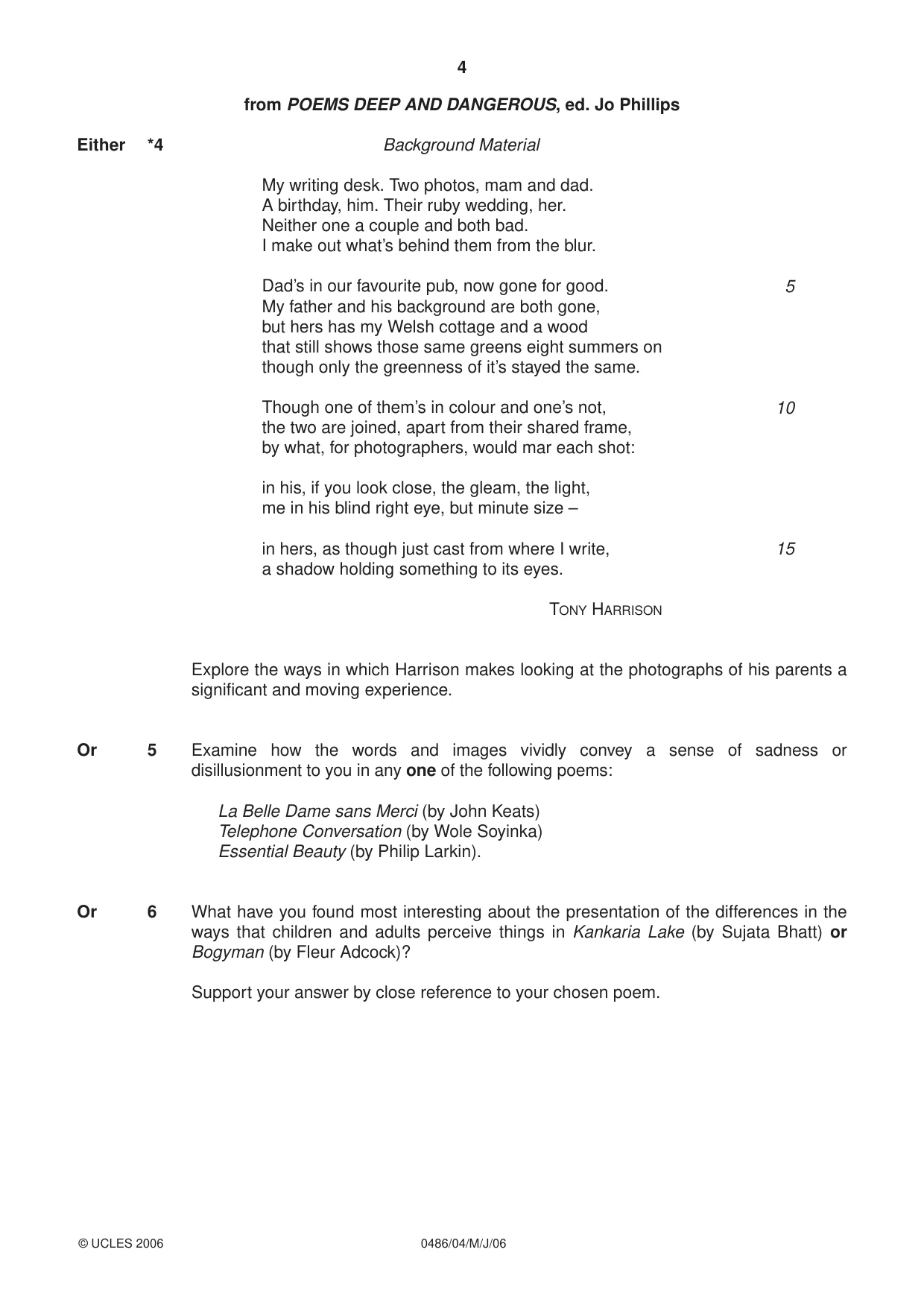
4 © UCLES 2006 0486/04/M/J/06 from POEMS DEEP AND DANGEROUS, ed. Jo Phillips Either *4 Background Material My writing desk. Two photos, mam and dad. A birthday, him. Their ruby wedding, her. Neither one a couple and both bad. I make out what’s behind them from the blur. Dad’s in our favourite pub, now gone for good. My father and his background are both gone, but hers has my Welsh cottage and a wood that still shows those same greens eight summers on though only the greenness of it’s stayed the same. Though one of them’s in colour and one’s not, the two are joined, apart from their shared frame, by what, for photographers, would mar each shot: in his, if you look close, the gleam, the light, me in his blind right eye, but minute size – in hers, as though just cast from where I write, a shadow holding something to its eyes. TONY HARRISON Explore the ways in which Harrison makes looking at the photographs of his parents a significant and moving experience. Or 5 Examine how the words and images vividly convey a sense of sadness or disillusionment to you in any one of the following poems: La Belle Dame sans Merci (by John Keats) Telephone Conversation (by Wole Soyinka) Essential Beauty (by Philip Larkin). Or 6 What have you found most interesting about the presentation of the differences in the ways that children and adults perceive things in Kankaria Lake (by Sujata Bhatt) or Bogyman (by Fleur Adcock)? Support your answer by close reference to your chosen poem. 5 10 15
Question paper, page 5
5 0486/04/M/J/06 [Turn over BLANK PAGE Turn to page 6 for Question 7.
Question paper, page 6
6 © UCLES 2006 0486/04/M/J/06 TOUCHED WITH FIRE, ed. Jack Hydes: from Section E Either *7 To His Coy Mistress Had we but world enough, and time, This coyness, Lady, were no crime. We would sit down, and think which way To walk, and pass our long love’s day. Thou by the Indian Ganges’ side Shouldst rubies find: I by the tide Of Humber would complain. I would Love you ten years before the flood: And you should, if you please, refuse Till the conversion of the Jews. My vegetable love should grow Vaster than empires, and more slow. An hundred years should go to praise Thine eyes, and on thy forehead gaze. Two hundred to adore each breast: But thirty thousand to the rest. An age at least to every part, And the last age should show your heart: For, Lady, you deserve this state; Nor would I love at lower rate. But at my back I always hear Time’s wingèd chariot hurrying near: And yonder all before us lie Deserts of vast eternity. Thy beauty shall no more be found; Nor, in thy marble vault, shall sound My echoing song: then worms shall try That long-preserved virginity: And your quaint honour turn to dust; And into ashes all my lust. The grave’s a fine and private place, But none, I think do there embrace. Now, therefore, while the youthful hew Sits on thy skin like morning dew, And while thy willing soul transpires At every pore with instant fires, Now let us sport us while we may; And now, like amorous birds of prey, Rather at once our time devour, Than languish in his slow-chapped power. Let us roll all our strength, and all Our sweetness, up into one ball: And tear our pleasures with rough strife, Thorough the iron grates of life. Thus, though we cannot make our sun Stand still, yet we will make him run. ANDREW MARVELL 5 10 15 20 25 30 35 40 45
Question paper, page 7
7 © UCLES 2006 0486/04/M/J/06 [Turn over Explore the ways in which Marvell attempts to persuade his lady. Or 8 Explore in detail the ways in which the poet brings out a sense of joy and pleasure in any one of the following poems. To Autumn (by John Keats) Stopping by Woods on a Snowy Evening (by Robert Frost) Poem in October (by Dylan Thomas). Or 9 How does the poet powerfully convey a critical view of human beings in any one of the following poems? Support your ideas with details from the poem. Snake (by D. H. Lawrence) Diary of a Church Mouse (by John Betjeman) Prayer before Birth (by Louis MacNeice).
Question paper, page 8
8 © UCLES 2006 0486/04/M/J/06 PROSE ANITA DESAI: The Village by the Sea Either *10 The visitor who was to stay at Mon Repos through the monsoon arrived in Thul the day before the de Silvas left and in the hubbub and confusion, Lila and her sisters did not become aware of his presence immediately. He came on the bus from Bombay and walked down the path, carrying his own bag, and therefore made no grand, impressive entrance. The family was so large and noisy that an extra person in its midst made no difference at all. Only the dog, Misha, seemed to be barking and running around more excitedly than usual. Lila was busy helping the cook clear the kitchen and pack their belongings. Her sisters went to collect flowers for the memsahib before she left – allamanda and hibiscus and frangipani blossom, and garlands of jasmine for the children. The children were all over the veranda, quarrelling over the shells and pebbles they had collected on the beach and which their mother refused to let them take back to their flat in Bombay. ‘At least, not all – you can choose just a few of the best,’ she told them, which caused much heartache as they looked through their collections and decided what to take. Bela and Kamal giggled at the sight – they themselves were so used to the shells and pebbles littered on the beach that they hardly noticed them. At last the luggage was loaded onto the car and the family climbed in, leaning out of the windows to call goodbye to Lila and her sisters. ‘Don’t you worry about your mother,’ Mr de Silva said again and again. ‘You leave her in the hospital for the monsoon, d’you hear – it’s too wet and damp in your hut during the rains and she is better off in the hospital with your father to keep an eye on her. I’m going to stop in Alibagh to give him some money to keep him going till she is well and they can come back. The doctor thinks he can send her home at Diwali – will that be all right?’ Lila nodded and nodded, grateful to him for repeating what she had already been told but she liked to hear again. It was so quiet in their hut without Hari, without father or mother, without even Pinto, and would be even quieter now with the de Silvas gone from Mon Repos. ‘And look after Sayyid Ali Sahib well,’ Mrs de Silva called. ‘Be sure to see he eats his meals – it’s the sort of thing he forgets to do, so you will have to remember. He is a very great man – take good care of him. I’ve left enough money with you to give him fish and milk and eggs every day, and he likes vegetables – so get plenty of vegetables. Clean the kitchen every night before you lock it up so that cockroaches and rats and snakes don’t come –’ What impressions do you have of Mr and Mrs de Silva here? Refer in detail to the extract as you answer. 5 10 15 20 25 30 35
Question paper, page 9
9 © UCLES 2006 0486/04/M/J/06 [Turn over Or 11 Before he leaves for Bombay, Hari and his sisters find a lot of happiness in their lives despite their difficulties. Why do you think this is so? Support your ideas with detail from the writing. Or 12 You are the children’s father at the end of the novel. Write your thoughts.
Question paper, page 10
10 © UCLES 2006 0486/04/M/J/06 CHARLES DICKENS: Great Expectations Either *13 My convict never looked at me, except that once. While we stood in the hut, he stood before the fire looking thoughtfully at it, or putting up his feet by turns upon the hob, and looking thoughtfully at them as if he pitied them for their recent adventures. Suddenly, he turned to the sergeant, and remarked: ‘I wish to say something respecting this escape. It may prevent some persons laying under suspicion alonger me.’ ‘You can say what you like,’ returned the sergeant, standing coolly looking at him with his arms folded, ‘but you have no call to say it here. You’ll have opportunity enough to say about it, and hear about it, before it’s done with, you know.’ ‘I know, but this is another pint, a separate matter. A man can’t starve; at least I can’t. I took some wittles, up at the willage over yonder – where the church stands a’most out on the marshes.’ ‘You mean stole,’ said the sergeant. ‘And I’ll tell you where from. From the blacksmith’s.’ ‘Halloa!’ said the sergeant, staring at Joe. ‘Halloa, Pip!’ said Joe, staring at me. ‘It was some broken wittles – that’s what it was – and a dram of liquor, and a pie.’ ‘Have you happened to miss such an article as a pie, blacksmith?’ asked the sergeant, confidentially. ‘My wife did, at the very moment when you came in. Don’t you know, Pip?’ ‘So,’ said my convict, turning his eyes on Joe in a moody manner, and without the least glance at me; ‘so you’re the blacksmith, are you? Then I’m sorry to say, I’ve eat your pie.’ ‘God knows you’re welcome to it – so far as it was ever mine,’ returned Joe, with a saving remembrance of Mrs Joe. ‘We don't know what you have done, but we wouldn’t have you starved to death for it, poor miserable fellow-creatur. – Would us, Pip?’ The something that I had noticed before clicked in the man’s throat again, and he turned his back. The boat had returned, and his guard were ready, so we followed him to the landing-place made of rough stakes and stones, and saw him put into the boat, which was rowed by a crew of convicts like himself. No one seemed surprised to see him, or interested in seeing him, or glad to see him, or sorry to see him, or spoke a word, except that somebody in the boat growled as if to dogs, ‘Give way, you!’ which was the signal for the dip of the oars. By the light of the torches, we saw the black Hulk lying out a little way from the mud of the shore, like a wicked Noah’s ark. Cribbed and barred and moored by massive rusty chains, the prison-ship seemed in my young eyes to be ironed like the prisoners. We saw the boat go alongside, and we saw him taken up the side and disappear. Then, the ends of the torches were flung hissing into the water, and went out, as if it were all over with him. Why do you think this is such an important moment in the novel, and how does Dickens’s writing make it so moving and dramatic? 5 10 15 20 25 30 35 40 45
Question paper, page 11
11 © UCLES 2006 0486/04/M/J/06 [Turn over Or 14 What does Dickens make you feel about Pip’s life before money gives him independence? Remember to support your ideas with detail from the novel. Or 15 You are Mr Pumblechook at the end of the novel, ‘holding forth to a select group’ as the humbled Pip passes down the High Street. Write what you say to this group.
Question paper, page 12
12 © UCLES 2006 0486/04/M/J/06 HELEN DUNMORE: The Siege Either *16 But that moment when the ice-sheath finally loosens, and the brown earth shows, long after you’ve given up hope that it ever will! At first there’s the stink of sour earth, which has been covered all winter with layers of ice. Before the ice melts, it grows grey and rotten. Maybe it’s worth having winter, when it leads to such a spring. ‘Kolya! Don’t roll in the mud like that!’ He stopped in his play, on all fours on the wet earth, and stared at her. ‘Don’t talk in your nursery voice –’ ‘What?’ ‘Talk to me in your home voice.’ She laughed, squatted down by him, seized his round little body in its padded jacket, and snuffed the scent of his skin. He laughed back at her, his eyes squeezed into slits. ‘I’ll show you a nursery voice. Children, what is the meaning of this disturbance?’ She grates out the words, and sees him flinch. ‘You sound like Elizaveta Antonovna.’ ‘Let’s not talk about her. Listen, do you know what radish seed looks like? Because I’m going to need you to plant some. Radishes, spring onions and lettuce. And then, before you know where you are, we’ll be eating our first salads.’ ‘Can I pick them?’ ‘First you have to plant them. We’ll start in this bit over here, where I’ve dug. You remember, you have to rake it over carefully, then make the lines with a stick to show where the seeds have to go … they’re called drills.’ ‘I know.’ ‘And then you can put in the seeds. But not all at once, mind – just a little pinch of seed in your fingers, like this.’ Kolya peered into the brown-paper bags which held the seed, some of it saved from last year, some bought at the market. He poked a finger into the radish seed. ‘It’s all dry and dead.’ ‘No, it’s not dead. Don’t you remember last year? Inside the seed there’s a tiny germ of life, waiting until we put it in the soil. Once the sun warms it up, and the rain softens it, it’ll start to grow –’ Kolya yawned, showing the rosy inside of his mouth, and his milk teeth. ‘Never mind, Kolya. Just put the seeds in and see what happens. Maybe you’ll find radishes growing by magic.’ ‘By magic,’ he repeated. ‘Is this drill deep enough, Anna?’ ‘It’s perfect. When the radishes are big enough, you can pull them up. You know how Dad likes them on a saucer, with the leaves arranged round them. You could do that.’ ‘He’ll be surprised that I grew them all by myself, won’t he?’ ‘If you’re going to say you grew them yourself, then you have to take care of them. Weed them, and water them if they need it. I’ll show you what to do.’ But Kolya was losing interest. He dumped the last of the seed into his drill. ‘Can I go and play?’ Anna went back to the potato patch. She wasn’t going to make any mistakes this year. She would plant as much as possible. As long as you’ve got potatoes, and onions, and a bit of sausage, you’ll always come through. 5 10 15 20 25 30 35 40 45 50
Question paper, page 13
13 © UCLES 2006 0486/04/M/J/06 [Turn over What do you think makes this scene such a touching and sad moment in the novel? Be sure to support your ideas with detail from the passage. Or 17 What do you find particularly memorable about Dunmore’s portrayal of Anna? Remember to support your views with detail from the novel. Or 18 You are Pavlov going on the plane to Leningrad to take control of food distribution in the city. Write your thoughts.
Question paper, page 14
14 © UCLES 2006 0486/04/M/J/06 GRAHAM GREENE: Travels With My Aunt Either *19 ‘And then – Oh praise to the Holiest in the height, as Wordsworth is fond of saying – I was putting in a little part-time behind the Messaggero when who should walk into the reception room but Mr Visconti. A pure coincidence. He wasn’t looking for me. But how happy we were. How happy. Just to see each other again. The girls didn’t understand when we joined hands then and there and danced between the sofas. It was one o’clock in the morning. We didn’t go upstairs. We went straight out into the lane outside. There was a drinking fountain shaped like an animal’s head, and he splashed my face with water before he kissed me.’ ‘What was that half-time employment?’ I suddenly broke out. ‘Who were the girls? What were the sofas there for?’ ‘What does it matter now?’ my aunt said. ‘What did any of it matter? We were together again and he splashed me and splashed me and he kissed me and kissed me.’ ‘But surely you must have despised the man after all he had done to you?’ We were crossing the long aqueduct through the lagoons which leads to Venice-Mestre, but there were no signs of the beautiful city, only tall chimneys with pale gas flames hardly visible in the late afternoon sunlight. I was not expecting my aunt’s outburst. She turned on me with real fury as though I were a child who had carelessly broken some vase she had cherished over the years for its beauty and the memories it contained. ‘I despise no one,’ she said, ‘no one. Regret your own actions, if you like that kind of wallowing in self-pity, but never, never despise. Never presume yours is a better morality. What do you suppose I was doing in the house behind the Messaggero? I was cheating, wasn’t I? So why shouldn’t Mr Visconti cheat me? But you, I suppose, never cheated in all your little provincial banker’s life because there’s not anything you wanted enough, not even money, not even a woman. You looked after people’s money like a nanny who looks after other people’s children. Can’t I see you in your cage, stacking up the little fivers endlessly before you hand them over to their proper owner? Angelica certainly brought you up as she wanted you. Your poor father didn’t have a chance. He was a cheat too, and I only wish you were. Then perhaps we’d have something in common.’ I was astonished. I could find nothing to say in reply. I thought of leaving the train at Venice, but then there was Tooley and I felt responsible for Tooley. The squalid station wrapped us round with its dirt and its noise. I said, ‘I think I’d better find Tooley,’ and I went away, leaving the old lady glaring on her couchette. Only as I closed the door of the compartment I thought I heard her laugh. Explore the ways in which Greene makes you aware of the importance of this moment in the novel and the ways he makes it amusing at the same time. 5 10 15 20 25 30 35 40
Question paper, page 15
15 © UCLES 2006 0486/04/M/J/06 [Turn over Or 20 In this novel things are very often not what they seem to be. Explore two moments when Greene surprises and amuses you by revealing the real truth about something or someone. Or 21 You are Aunt Augusta after you have met Henry Pulling at his mother’s funeral and after he has left your flat. Write your thoughts.
Question paper, page 16
16 © UCLES 2006 0486/04/M/J/06 HENRY HANDEL RICHARDSON: The Getting Of Wisdom Either *22 It was an odd thing, all the same, how easy it was to be friends with Lilith Gordon: though she did not belong to Laura’s set, though Laura did not even like her, and though she had had ample proof that Lilith was double- faced, not to be trusted. Yet, in the months that followed the affair of the purple dress, Laura grew more intimate with the plump, sandy-haired girl than with either Bertha, or Inez, or Tilly. Or, to put it more exactly, she was continually having lapses into intimacy, and repenting them when it was too late. In one way Lilith was responsible for this: she could make herself very pleasant when she chose, seem to be your friend through thick and thin, thus luring you on to unbosom yourself; and afterwards she would go away and laugh over what you had told her, with other girls. And Laura was peculiarly helpless under such circumstances: if it was done with tact, and with a certain assumed warmth of manner, anyone could make a cat’s paw of her. That Lilith and she undressed for bed together had also something to do with their intimacy: this half-hour when one’s hair was unbound and replaited, and fat and thin arms wielded the brush, was the time of all others for confidences. The governess who occupied the fourth bed did not come upstairs till ten o’clock; the publican’s daughter, a lazy girl, was usually half asleep before the other two had their clothes off. It was in the course of one of these confidential chats that Laura did a very foolish thing. In a moment of weakness, she gratuitously gave away the secret that Mother supported her family by the work of her hands. The two girls were sitting on the side of Lilith’s bed. Laura had a day of mishaps behind her – that partly, no doubt, accounted for her self- indulgence. But, in addition, her companion had just told her, unasked, that she thought her ‘very pretty’. It was not in Laura’s nature to let this pass: she was never at ease under an obligation; she had to pay the coin back in kind. ‘Embroidery? What sort? However does she do it?’ – Lilith’s interest was on tiptoe at once – a false and slimy interest, the victim afterwards told herself. ‘Oh, my mother’s awfully clever. It’s just lovely, too, what she does – all in silk – and ever so many different colours. She made a piano-cover once, and got fifty pounds for it.’ ‘How perfectly splendid!’ ‘But that was only a lucky chance … that she got that to do. She mostly does children’s dresses and cloaks and things like that.’ ‘But she’s not a dressmaker, is she?’ ‘A dressmaker? I should think not indeed! They’re sent up, all ready to work, from the biggest shops in town.’ ‘I say! – she must be clever.’ ‘She is; she can do anything. She makes the patterns up all out of her own head.’ – And filled with pride in Mother’s accomplishments and Lilith’s appreciation of them, Laura fell asleep that night without a qualm. Explore the writing here, showing what impression it gives you of Lilith. 5 10 15 20 25 30 35 40 45
Question paper, page 17
17 © UCLES 2006 0486/04/M/J/06 [Turn over Or 23 What impressions do you have of the Principal and his wife, Mr and Mrs Strachey? Support your ideas with detail from the writing. Or 24 You are Evelyn, after you have left school, thinking about your relationship with Laura. Write your thoughts.
Question paper, page 18
18 © UCLES 2006 0486/04/M/J/06 AMY TAN: The Bonesetter’s Daughter Either *25 Once she had hung up, Ruth reminded herself of the tasks she needed to do today. Ten things, and she tapped first her thumb. One, take the girls to skating school. Two, pick up Art’s suits at the dry cleaner’s. Three, buy groceries for dinner. Four, pick up the girls from the rink and drop them off at their friend’s house on Jackson Street. Five and Six, phone calls to that arrogant client, Ted, then Agapi Agnos, whom she actually liked. Seven, finish the outline for a chapter of Agapi Agnos’s book. Eight, call her agent, Gideon, whom Wendy disliked. And Nine – what the hell was Nine? She knew what Ten was, the last task of the day. She had to call Miriam, Art’s ex-wife, to ask if she would let them have the girls the weekend of the Full Moon Festival dinner, the annual reunion of the Youngs, which she was hosting this year. So what was Nine? She always organized her day by the number of digits on her hands. Each day was either a five or a ten. She wasn’t rigid about it: add-ons were accommodated on the toes of her feet, room for ten unexpected tasks. Nine, Nine … She could make calling Wendy number One and bump everything back. But she knew that call should be a toe, an extra, an Eleven. What was Nine? Nine was usually something important, a significant number, what her mother termed the number of fullness, a number that also stood for Do not forget, or risk losing all. Did Nine have something to do with her mother? There was always something to worry about with her mother. That was not anything she had to remember in particular. It was a state of mind. LuLing was the one who had taught her to count fingers as a memory device. With this method, LuLing never forgot a thing, especially lies, betrayals, and all the bad deeds Ruth had done since she was born. Ruth could still picture her mother counting in the Chinese style, pointing first to her baby finger and bending each finger down toward her palm, a motion that Ruth took to mean that all other possibilities and escape routes were closed. Ruth kept her own fingers open and splayed, American style. What was Nine? She put on a pair of sturdy sandals. Art appeared at the doorway. ‘Sweetie? Don’t forget to call the plumber about the hot-water tank.’ The plumber was not going to be number Nine, Ruth told herself, absolutely not. ‘Sorry, honey, but could you call? I’ve got a pretty full day.’ How far do you find this presentation of Ruth typical of how she appears in the novel as a whole? Or 26 Explore one incident in the novel that you think best demonstrates the complexity of the relationship between mother and daughter. Or 27 You are GaoLing (Auntie Gal) on the boat to America at the end of the war. Write your thoughts. 5 10 15 20 25 30 35
Question paper, page 19
19 0486/04/M/J/06 [Turn over BLANK PAGE Turn to page 20 for Question 28.
Question paper, page 20
20 © UCLES 2006 0486/04/M/J/06 BARRIE WADE, ed.: Into the Wind: Contemporary Stories in English Either *28 The men came down between two long, regular rows of trees. The winter had not passed completely and there was a chill in the air; and the moon was hidden behind long, high parallels of cloud which hung like suspended streamers of dirty cotton wool in the sky. All of the men but one wore thick clothes against the coolness of the night. The night and earth was cold and damp, and the shoes of the men sank into the soil and left exact, ridged footprints, but they could not be seen in the dark. One of the men walked ahead holding a small cycle lantern that worked from a battery, leading the way down the avenue of trees while the others came behind in the dark. The night close around was quiet now that the crickets had stopped their small noises, but far out others that did not feel the presence of the men continued the monotonous creek-creek-creek. Somewhere, even further, a dog started barking in short high yaps, and then stopped abruptly. The men were walking through an orchard of lemons and the sharp, bitter-sweet citrus smell hung gently on the night air. ‘Do not go so fast,’ the man who brought up the rear of the party called to the man with the lantern. ‘It’s as dark as a kaffir’s soul here at the back.’ He called softly, as if the darkness demanded silence. He was a big man and wore khaki trousers and laced-up riding boots, and an old shooting jacket with leather patches on the right breast and the elbows. The shotgun was loaded. In the dark this man’s face was invisible except for a blur of shadowed hollows and lighter crags. Although he walked in the rear he was the leader of the party. The lantern-bearer slowed down for the rest to catch up with him. ‘It’s cold, too, Oom,’ another man said. ‘Cold?’ the man with the shotgun asked, speaking with sarcasm. ‘Are you colder than this verdomte hotnot, here?’ And he gestured in the dark with the muzzle of the gun at the man who stumbled along in their midst and who was the only one not warmly dressed. This man wore trousers and a raincoat which they had allowed him to pull on over his pyjamas when they had taken him from his lodgings, and he shivered now with chill, clenching his teeth to prevent them from chattering. He had not been given time to tie his shoes and the metal- covered ends of the laces clicked as he moved. ‘Are you cold, hotnot?’ the man with the light jeered. The coloured man did not reply. He was afraid, but his fear was mixed with a stubbornness which forbade him to answer them. ‘He is not cold,’ the fifth man in the party said. ‘He is shivering with fear. Is it not so, hotnot?’ The coloured man said nothing, but stared ahead of himself into the half-light made by the small lantern. He could see the silhouette of the man who carried the light, but he did not want to look at the two who flanked him, the one who had complained of the cold, and the one who had spoken of his fear. They each carried a sjambok and every now and then one of them slapped a corduroyed leg with his. Explore the ways in which La Guma creates an atmosphere of fear and menace in this opening to the story. 5 10 15 20 25 30 35 40 45
Question paper, page 21
21 © UCLES 2006 0486/04/M/J/06 [Turn over Or 29 Explore how the author in one of the stories in the anthology captures the moment when someone’s life changes dramatically. Or 30 You are the hitch-hiker at the end of The Hitch-hiker. The motorist has just put you down in London. Write your thoughts.
Question paper, page 22
22 © UCLES 2006 0486/04/M/J/06 DRAMA ALAN AYCKBOURN: Absent Friends Either *31 3 p.m. Saturday. The open plan living room of a modern executive-style house. Archways leading off to the kitchen and back doors. Another to the front door and bedrooms etc. Primarily furnished with English Swedish style furniture. A lot of wrought iron for gates in lieu of doors and as used for room dividers. Also artistic frosted glass. Doubtful pictures. Possibly a bar. It all cost a great deal of money. Parquet floor with rugs. At the start, Evelyn, a heavily made-up, reasonably trendily dressed, expressionless girl, is sitting by a pram which she is rocking absently with one hand whilst gazing blankly out of the window. Near her, on the table, underneath suitable coverings, tea is laid out in the form of sandwiches and cakes. Only the teapot and hot water jug are missing. Evelyn chews and sings to herself. After a moment, Diana enters. She is older, mid to later thirties. She always gives the impression of being slightly fraught. She smiles occasionally but it’s painful. Her sharp darting eyes don’t miss much after years of suspicions both genuine and unfounded. Diana: Have you got him to sleep? Evelyn: Yes. Diana: [looking into the pram] Aaah! They look so lovely like that. Like little cherubims. Evelyn: [unenthusiastic] Mmm. Diana: Just like little cherubims. [Anxious.] Should he be covered up as much as that, dear? Evelyn: Yes. Diana: Won’t he get too hot? Evelyn: He likes it hot. Diana: Oh. I was just worried he wasn’t getting enough air. Evelyn: He’s all right. He doesn’t need much air. Diana: Oh, well … [She looks about her.] Well, I think we’re all ready for them. John’s on his way, you say? Evelyn: Yes. Diana: How is he these days? I haven’t seen John for ages. Evelyn: He’s all right. Diana: I haven’t seen either of you. Evelyn: We’re all right. Diana: Not for ages. Well, I’m glad you could come this afternoon. Colin really will appreciate that, I’m sure. Seeing us all. [Pause.] Paul should be home soon. I think he’s playing his squash again. Evelyn: Oh. Diana: Him and his squash. It used to be tennis – now he’s squash mad. Squash, squash, squash. Can’t see what he sees in it. All afternoon hitting a ball against a wall. It’s so noisy. Bang, bang, bang. He’s not even out of doors. No fresh air at all. It can’t be good for him. Does John play squash? 5 10 15 20 25 30 35 40 45 50
Question paper, page 23
23 © UCLES 2006 0486/04/M/J/06 [Turn over Evelyn: No. Diana: Oh. Evelyn: He doesn’t play anything. Diana: Oh, well. He probably doesn’t need it. Exercise. Some men don’t. My father never took a stroke of exercise. Till he died. He seemed fit enough. He managed to do what he wanted to do. Mind you, he never did very much. He just used to sit and shout at we girls. Most of the time. He got calmer though when he got older. After my mother left him. [Looking into the pram.] Did you knit that little jacket for him? Evelyn: No. Diana: Pretty. [Pause.] No, there are times when I think that’s the principal trouble between Paul and me. I mean, I know now I’m running myself down but Paul basically, he’s got much more go – well, I mean let’s face it, he’s much cleverer than me. Let’s face it. Basically. I mean, I was the bright one in our family but I can’t keep up with Paul sometimes. When he has one of his moods, I think to myself, now if I was really clever, I could probably talk him round or something but I mean the thing is, really and truly, and I know I’m running myself down when I say this, I don’t think I’m really enough for him. He needs me, I can tell; he doesn’t say as much but I know he does. It’s just, as I say, I don’t think I’m really enough for him. [She reflects.] At the start of the play a playwright needs to gain the audience’s interest quickly. How do you think Ayckbourn achieves this here? Or 32 Good comedies often make the audience laugh by creating situations in which the audience knows more than the characters. Explore one episode in Absent Friends where you think Ayckbourn does this particularly well. Or 33 You are John at the beginning of the play. You are on your way to the tea party. Write your thoughts. 55 60 65 70
Question paper, page 24
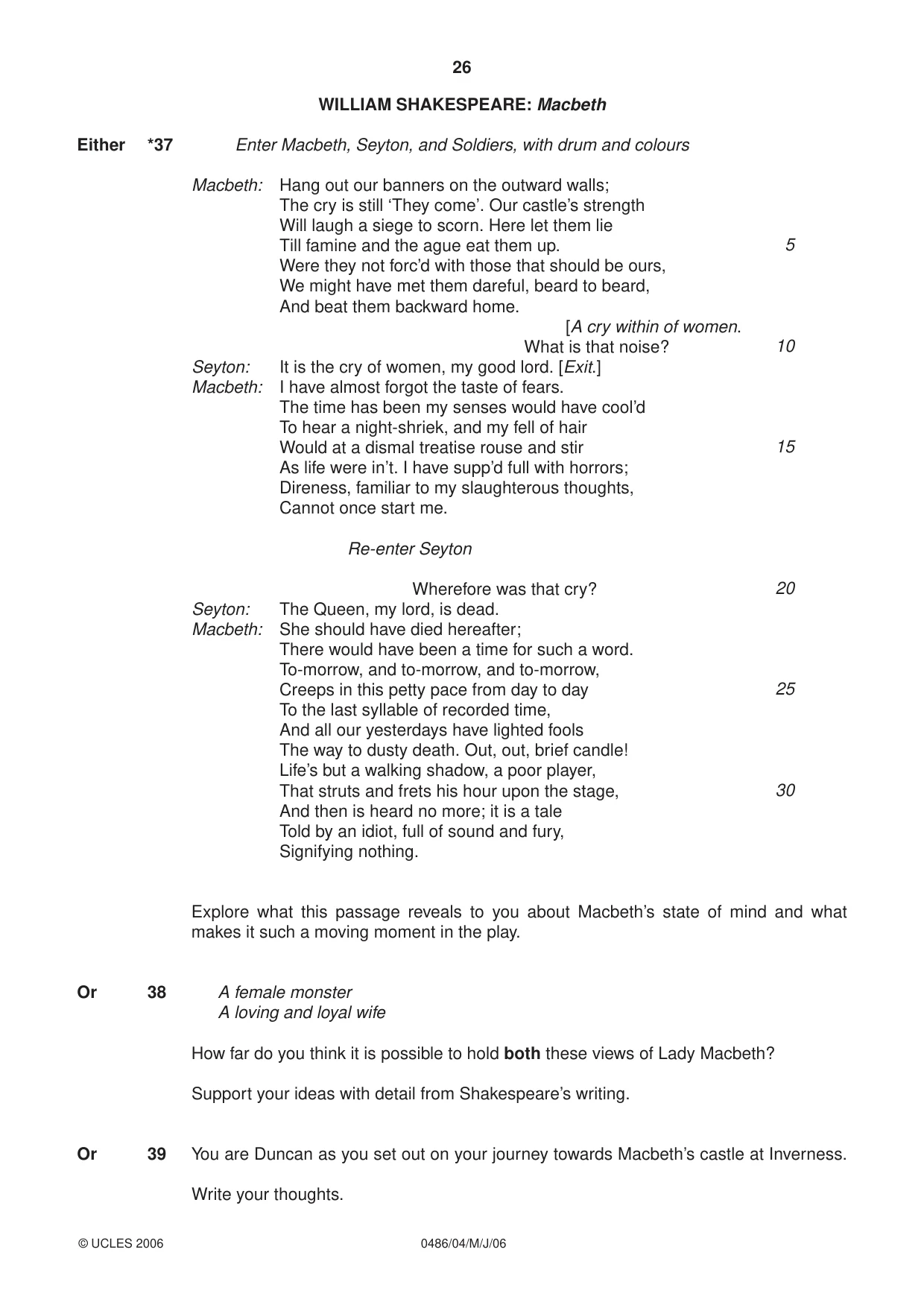
26 © UCLES 2006 0486/04/M/J/06 WILLIAM SHAKESPEARE: Macbeth Either *37 Enter Macbeth, Seyton, and Soldiers, with drum and colours Macbeth: Hang out our banners on the outward walls; The cry is still ‘They come’. Our castle’s strength Will laugh a siege to scorn. Here let them lie Till famine and the ague eat them up. Were they not forc’d with those that should be ours, We might have met them dareful, beard to beard, And beat them backward home. [A cry within of women. What is that noise? Seyton: It is the cry of women, my good lord. [Exit.] Macbeth: I have almost forgot the taste of fears. The time has been my senses would have cool’d To hear a night-shriek, and my fell of hair Would at a dismal treatise rouse and stir As life were in’t. I have supp’d full with horrors; Direness, familiar to my slaughterous thoughts, Cannot once start me. Re-enter Seyton Wherefore was that cry? Seyton: The Queen, my lord, is dead. Macbeth: She should have died hereafter; There would have been a time for such a word. To-morrow, and to-morrow, and to-morrow, Creeps in this petty pace from day to day To the last syllable of recorded time, And all our yesterdays have lighted fools The way to dusty death. Out, out, brief candle! Life’s but a walking shadow, a poor player, That struts and frets his hour upon the stage, And then is heard no more; it is a tale Told by an idiot, full of sound and fury, Signifying nothing. Explore what this passage reveals to you about Macbeth’s state of mind and what makes it such a moving moment in the play. Or 38 A female monster A loving and loyal wife How far do you think it is possible to hold both these views of Lady Macbeth? Support your ideas with detail from Shakespeare’s writing. Or 39 You are Duncan as you set out on your journey towards Macbeth’s castle at Inverness. Write your thoughts. 5 10 15 20 25 30
Question paper, page 25
27 0486/04/M/J/06 [Turn over BLANK PAGE Turn to page 28 for Question 40.
Question paper, page 26
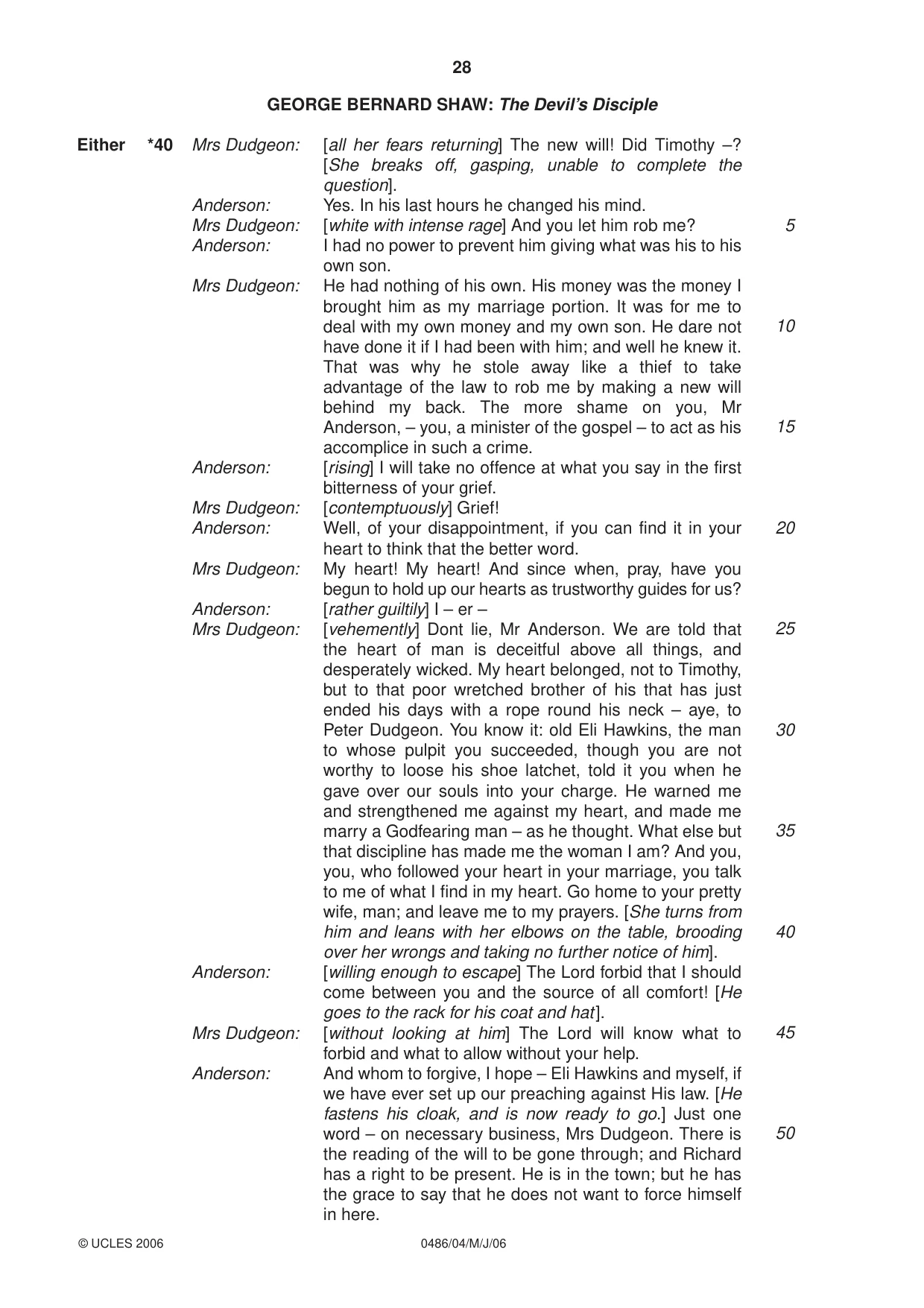
28 © UCLES 2006 0486/04/M/J/06 GEORGE BERNARD SHAW: The Devil’s Disciple Either *40 Mrs Dudgeon: [all her fears returning] The new will! Did Timothy –? [She breaks off, gasping, unable to complete the question]. Anderson: Yes. In his last hours he changed his mind. Mrs Dudgeon: [white with intense rage] And you let him rob me? Anderson: I had no power to prevent him giving what was his to his own son. Mrs Dudgeon: He had nothing of his own. His money was the money I brought him as my marriage portion. It was for me to deal with my own money and my own son. He dare not have done it if I had been with him; and well he knew it. That was why he stole away like a thief to take advantage of the law to rob me by making a new will behind my back. The more shame on you, Mr Anderson, – you, a minister of the gospel – to act as his accomplice in such a crime. Anderson: [rising] I will take no offence at what you say in the first bitterness of your grief. Mrs Dudgeon: [contemptuously] Grief! Anderson: Well, of your disappointment, if you can find it in your heart to think that the better word. Mrs Dudgeon: My heart! My heart! And since when, pray, have you begun to hold up our hearts as trustworthy guides for us? Anderson: [rather guiltily] I – er – Mrs Dudgeon: [vehemently] Dont lie, Mr Anderson. We are told that the heart of man is deceitful above all things, and desperately wicked. My heart belonged, not to Timothy, but to that poor wretched brother of his that has just ended his days with a rope round his neck – aye, to Peter Dudgeon. You know it: old Eli Hawkins, the man to whose pulpit you succeeded, though you are not worthy to loose his shoe latchet, told it you when he gave over our souls into your charge. He warned me and strengthened me against my heart, and made me marry a Godfearing man – as he thought. What else but that discipline has made me the woman I am? And you, you, who followed your heart in your marriage, you talk to me of what I find in my heart. Go home to your pretty wife, man; and leave me to my prayers. [She turns from him and leans with her elbows on the table, brooding over her wrongs and taking no further notice of him]. Anderson: [willing enough to escape] The Lord forbid that I should come between you and the source of all comfort! [He goes to the rack for his coat and hat]. Mrs Dudgeon: [without looking at him] The Lord will know what to forbid and what to allow without your help. Anderson: And whom to forgive, I hope – Eli Hawkins and myself, if we have ever set up our preaching against His law. [He fastens his cloak, and is now ready to go.] Just one word – on necessary business, Mrs Dudgeon. There is the reading of the will to be gone through; and Richard has a right to be present. He is in the town; but he has the grace to say that he does not want to force himself in here. 5 10 15 20 25 30 35 40 45 50
Question paper, page 27
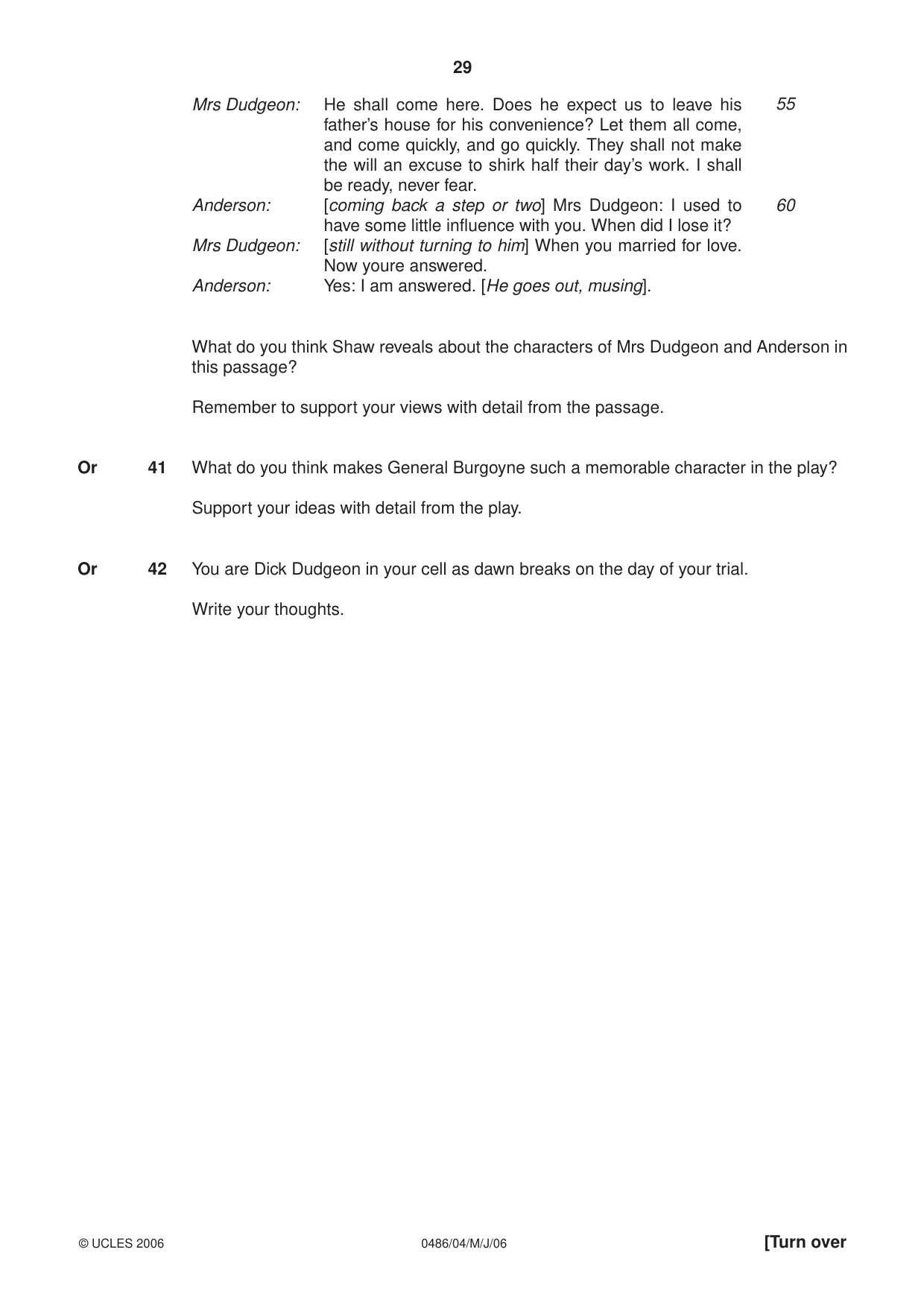
29 © UCLES 2006 0486/04/M/J/06 [Turn over Mrs Dudgeon: He shall come here. Does he expect us to leave his father’s house for his convenience? Let them all come, and come quickly, and go quickly. They shall not make the will an excuse to shirk half their day’s work. I shall be ready, never fear. Anderson: [coming back a step or two] Mrs Dudgeon: I used to have some little influence with you. When did I lose it? Mrs Dudgeon: [still without turning to him] When you married for love. Now youre answered. Anderson: Yes: I am answered. [He goes out, musing]. What do you think Shaw reveals about the characters of Mrs Dudgeon and Anderson in this passage? Remember to support your views with detail from the passage. Or 41 What do you think makes General Burgoyne such a memorable character in the play? Support your ideas with detail from the play. Or 42 You are Dick Dudgeon in your cell as dawn breaks on the day of your trial. Write your thoughts. 55 60
Question paper, page 28
32 0486/04/M/J/06 BLANK PAGE Copyright Acknowledgements: Question 4 © Tony Harrison; Selection Poems; Penguin Books Ltd; 1995. Question 10 Copyright © 1984 Anita Desai. Reproduced by permission of the author c/o Rogers, Coleridge & White Ltd., 20 Powis Mews, London W11 1JN. Question 16 © Helen Dunmore; The Siege; Penguin Books Ltd; 2002. Question 19 © Graham Greene; Travels with My Aunt; Penguin; 1991. Question 25 Copyright © 2001 by Amy Tan. Excerpt of THE BONESETTER’S DAUGHTER. Reprinted by permission of the author and the Sandra Dijkstra Literary Agency. Used by permission of G.P. Putnam’s Sons, a division of Penguin Group (USA) Inc. Question 28 © Alex La Guma; ‘The Lemon Orchard’; Into the Wind: Contemporary Stories in English. Question 31 ABSENT FRIENDS copyright © 1975 Haydonning Ltd. All rights whatsoever in this play are strictly reserved and application for performance, etc., must be made before rehearsal to Casarotto Ramsay & Associates Ltd., National House, 60–66 Wardour Street, London W1V4ND. No performance may be given unless a licence has been obtained. From Absent Friends in Three Plays by Alan Ayckbourn, published by Chatto & Windus. Reprinted by permission of The Random House Group Ltd. Question 34 © Liz Lochhead and Gina Moxley; Cuba and Dog House; Faber & Faber Ltd. Question 40 © The Society of Authors, on behalf of the Bernard Shaw Estate. Question 43 By Tennessee Williams, from A STREETCAR NAMED DESIRE, copyright © 1947 by The University of the South. Reprinted by permission of New Directions Publishing Corp. Permission to reproduce items where third-party owned material protected by copyright is included has been sought and cleared where possible. Every reasonable effort has been made by the publisher (UCLES) to trace copyright holders, but if any items requiring clearance have unwittingly been included, the publisher will be pleased to make amends at the earliest possible opportunity. University of Cambridge International Examinations is part of the University of Cambridge Local Examinations Syndicate (UCLES), which is itself a department of the University of Cambridge.
Mark scheme, page 1
UNIVERSITY OF CAMBRIDGE INTERNATIONAL EXAMINATIONS International General Certificate of Secondary Education MARK SCHEME for the May/June 2006 question paper 0486 LITERATURE (ENGLISH) 0486/04 Paper 4, maximum raw mark 80 These mark schemes are published as an aid to teachers and students, to indicate the requirements of the examination. They show the basis on which Examiners were initially instructed to award marks. They do not indicate the details of the discussions that took place at an Examiners’ meeting before marking began. Any substantial changes to the mark scheme that arose from these discussions will be recorded in the published Report on the Examination. All Examiners are instructed that alternative correct answers and unexpected approaches in candidates’ scripts must be given marks that fairly reflect the relevant knowledge and skills demonstrated. Mark schemes must be read in conjunction with the question papers and the Report on the Examination. The minimum marks in these components needed for various grades were previously published with these mark schemes, but are now instead included in the Report on the Examination for this session. • CIE will not enter into discussion or correspondence in connection with these mark schemes. CIE is publishing the mark schemes for the May/June 2006 question papers for most IGCSE and GCE Advanced Level and Advanced Subsidiary Level syllabuses and some Ordinary Level syllabuses. www.XtremePapers.com
Mark scheme, page 2
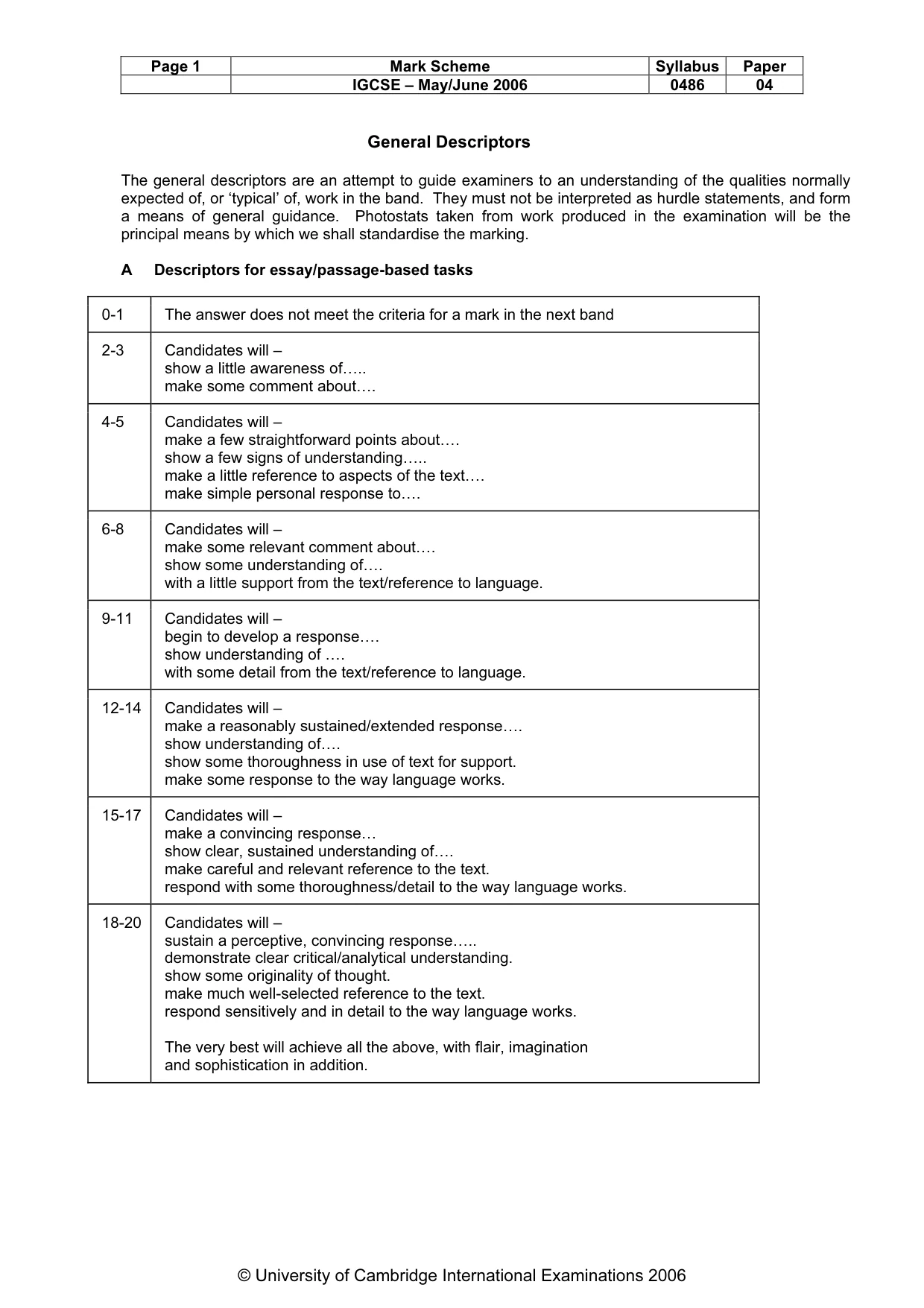
Page 1 Mark Scheme Syllabus Paper IGCSE – May/June 2006 0486 04 © University of Cambridge International Examinations 2006 General Descriptors The general descriptors are an attempt to guide examiners to an understanding of the qualities normally expected of, or ‘typical’ of, work in the band. They must not be interpreted as hurdle statements, and form a means of general guidance. Photostats taken from work produced in the examination will be the principal means by which we shall standardise the marking. A Descriptors for essay/passage-based tasks 0-1 The answer does not meet the criteria for a mark in the next band 2-3 Candidates will – show a little awareness of….. make some comment about…. 4-5 Candidates will – make a few straightforward points about…. show a few signs of understanding….. make a little reference to aspects of the text…. make simple personal response to…. 6-8 Candidates will – make some relevant comment about…. show some understanding of…. with a little support from the text/reference to language. 9-11 Candidates will – begin to develop a response…. show understanding of …. with some detail from the text/reference to language. 12-14 Candidates will – make a reasonably sustained/extended response…. show understanding of…. show some thoroughness in use of text for support. make some response to the way language works. 15-17 Candidates will – make a convincing response… show clear, sustained understanding of…. make careful and relevant reference to the text. respond with some thoroughness/detail to the way language works. 18-20 Candidates will – sustain a perceptive, convincing response….. demonstrate clear critical/analytical understanding. show some originality of thought. make much well-selected reference to the text. respond sensitively and in detail to the way language works. The very best will achieve all the above, with flair, imagination and sophistication in addition.
Mark scheme, page 3
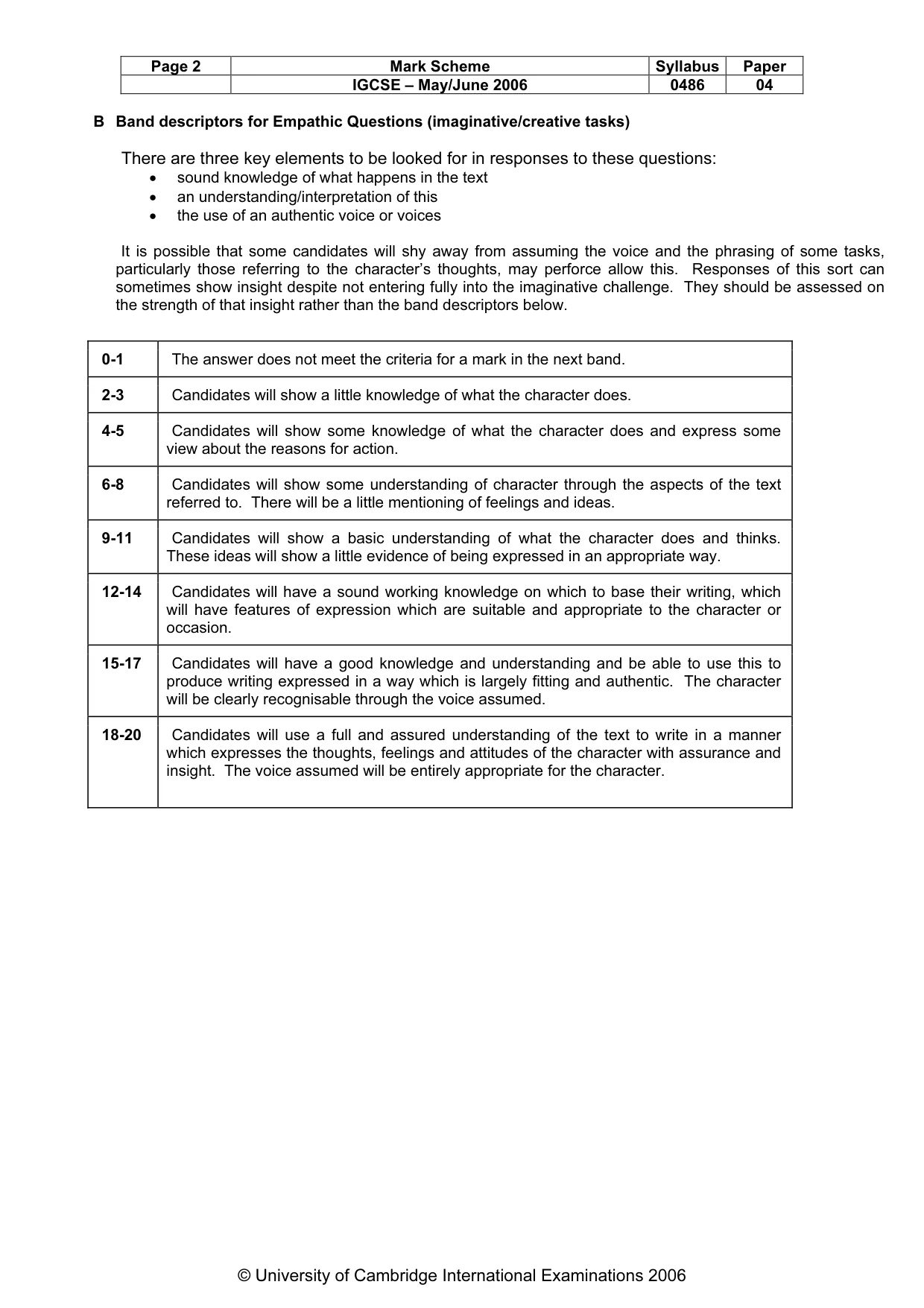
Page 2 Mark Scheme Syllabus Paper IGCSE – May/June 2006 0486 04 © University of Cambridge International Examinations 2006 B Band descriptors for Empathic Questions (imaginative/creative tasks) There are three key elements to be looked for in responses to these questions: • sound knowledge of what happens in the text • an understanding/interpretation of this • the use of an authentic voice or voices It is possible that some candidates will shy away from assuming the voice and the phrasing of some tasks, particularly those referring to the character’s thoughts, may perforce allow this. Responses of this sort can sometimes show insight despite not entering fully into the imaginative challenge. They should be assessed on the strength of that insight rather than the band descriptors below. 0-1 The answer does not meet the criteria for a mark in the next band. 2-3 Candidates will show a little knowledge of what the character does. 4-5 Candidates will show some knowledge of what the character does and express some view about the reasons for action. 6-8 Candidates will show some understanding of character through the aspects of the text referred to. There will be a little mentioning of feelings and ideas. 9-11 Candidates will show a basic understanding of what the character does and thinks. These ideas will show a little evidence of being expressed in an appropriate way. 12-14 Candidates will have a sound working knowledge on which to base their writing, which will have features of expression which are suitable and appropriate to the character or occasion. 15-17 Candidates will have a good knowledge and understanding and be able to use this to produce writing expressed in a way which is largely fitting and authentic. The character will be clearly recognisable through the voice assumed. 18-20 Candidates will use a full and assured understanding of the text to write in a manner which expresses the thoughts, feelings and attitudes of the character with assurance and insight. The voice assumed will be entirely appropriate for the character.
Mark scheme, page 4
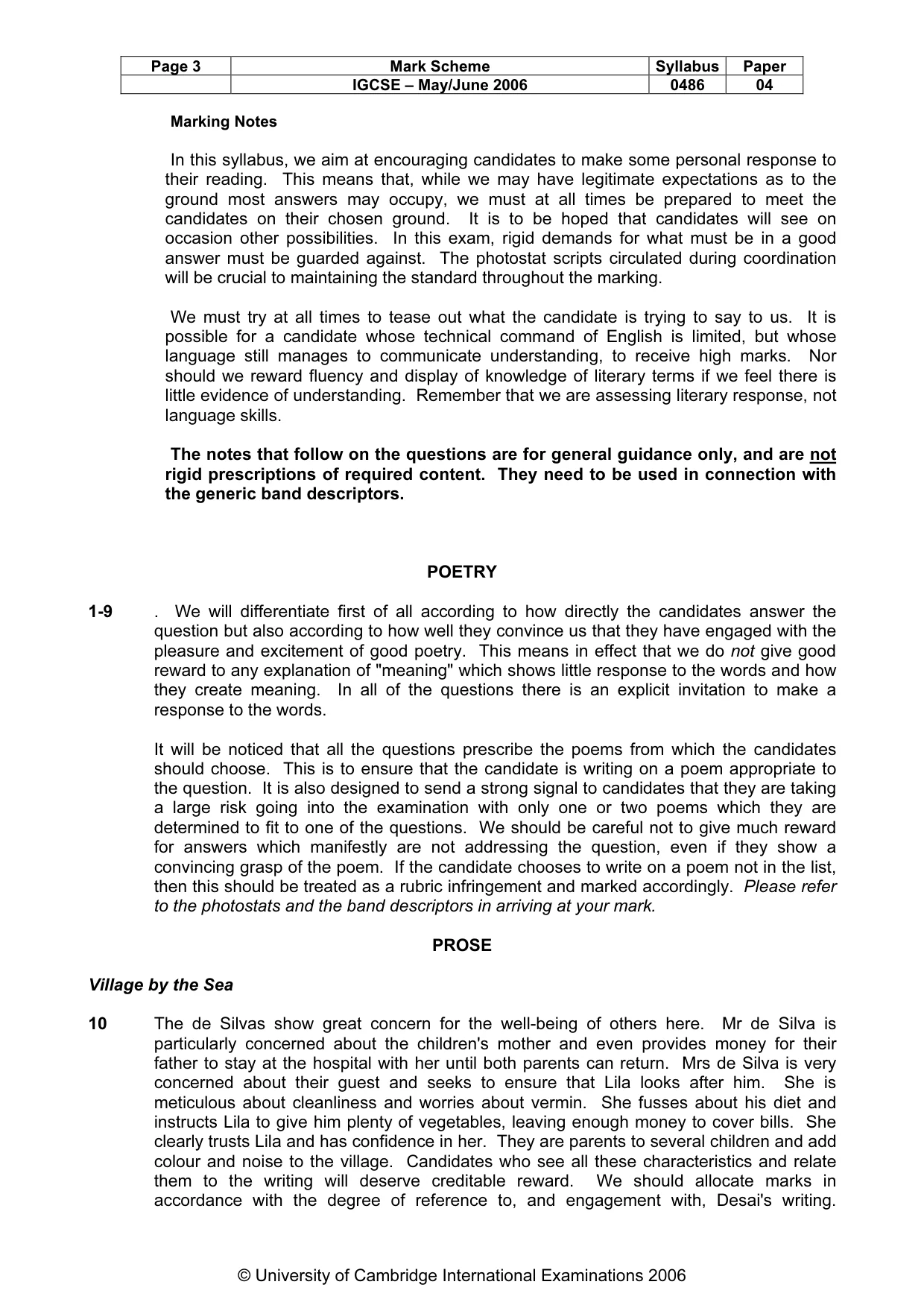
Page 3 Mark Scheme Syllabus Paper IGCSE – May/June 2006 0486 04 © University of Cambridge International Examinations 2006 Marking Notes In this syllabus, we aim at encouraging candidates to make some personal response to their reading. This means that, while we may have legitimate expectations as to the ground most answers may occupy, we must at all times be prepared to meet the candidates on their chosen ground. It is to be hoped that candidates will see on occasion other possibilities. In this exam, rigid demands for what must be in a good answer must be guarded against. The photostat scripts circulated during coordination will be crucial to maintaining the standard throughout the marking. We must try at all times to tease out what the candidate is trying to say to us. It is possible for a candidate whose technical command of English is limited, but whose language still manages to communicate understanding, to receive high marks. Nor should we reward fluency and display of knowledge of literary terms if we feel there is little evidence of understanding. Remember that we are assessing literary response, not language skills. The notes that follow on the questions are for general guidance only, and are not rigid prescriptions of required content. They need to be used in connection with the generic band descriptors. POETRY 1-9 . We will differentiate first of all according to how directly the candidates answer the question but also according to how well they convince us that they have engaged with the pleasure and excitement of good poetry. This means in effect that we do not give good reward to any explanation of "meaning" which shows little response to the words and how they create meaning. In all of the questions there is an explicit invitation to make a response to the words. It will be noticed that all the questions prescribe the poems from which the candidates should choose. This is to ensure that the candidate is writing on a poem appropriate to the question. It is also designed to send a strong signal to candidates that they are taking a large risk going into the examination with only one or two poems which they are determined to fit to one of the questions. We should be careful not to give much reward for answers which manifestly are not addressing the question, even if they show a convincing grasp of the poem. If the candidate chooses to write on a poem not in the list, then this should be treated as a rubric infringement and marked accordingly. Please refer to the photostats and the band descriptors in arriving at your mark. PROSE Village by the Sea 10 The de Silvas show great concern for the well-being of others here. Mr de Silva is particularly concerned about the children's mother and even provides money for their father to stay at the hospital with her until both parents can return. Mrs de Silva is very concerned about their guest and seeks to ensure that Lila looks after him. She is meticulous about cleanliness and worries about vermin. She fusses about his diet and instructs Lila to give him plenty of vegetables, leaving enough money to cover bills. She clearly trusts Lila and has confidence in her. They are parents to several children and add colour and noise to the village. Candidates who see all these characteristics and relate them to the writing will deserve creditable reward. We should allocate marks in accordance with the degree of reference to, and engagement with, Desai's writing.
Mark scheme, page 5
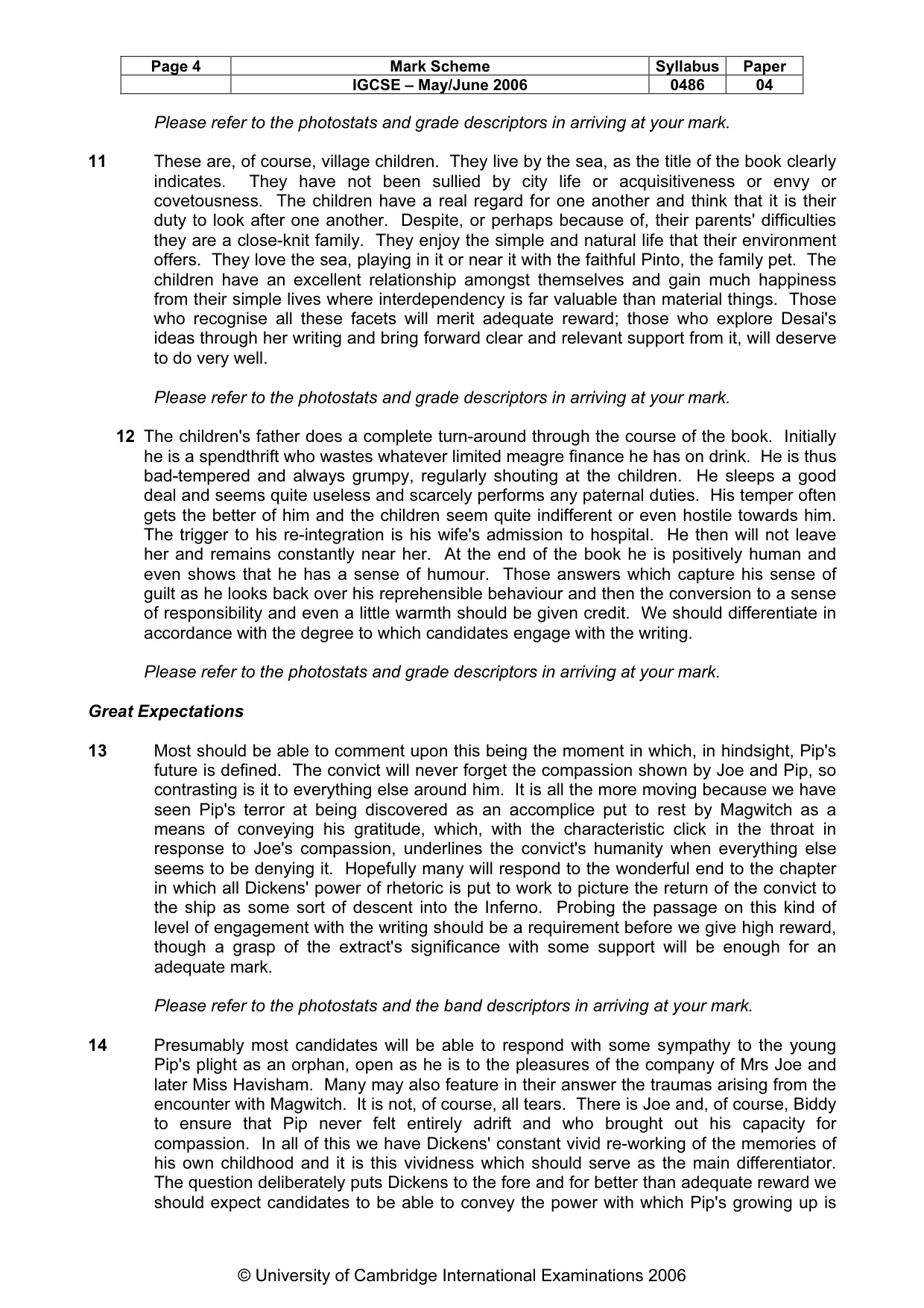
Page 4 Mark Scheme Syllabus Paper IGCSE – May/June 2006 0486 04 © University of Cambridge International Examinations 2006 Please refer to the photostats and grade descriptors in arriving at your mark. 11 These are, of course, village children. They live by the sea, as the title of the book clearly indicates. They have not been sullied by city life or acquisitiveness or envy or covetousness. The children have a real regard for one another and think that it is their duty to look after one another. Despite, or perhaps because of, their parents' difficulties they are a close-knit family. They enjoy the simple and natural life that their environment offers. They love the sea, playing in it or near it with the faithful Pinto, the family pet. The children have an excellent relationship amongst themselves and gain much happiness from their simple lives where interdependency is far valuable than material things. Those who recognise all these facets will merit adequate reward; those who explore Desai's ideas through her writing and bring forward clear and relevant support from it, will deserve to do very well. Please refer to the photostats and grade descriptors in arriving at your mark. 12 The children's father does a complete turn-around through the course of the book. Initially he is a spendthrift who wastes whatever limited meagre finance he has on drink. He is thus bad-tempered and always grumpy, regularly shouting at the children. He sleeps a good deal and seems quite useless and scarcely performs any paternal duties. His temper often gets the better of him and the children seem quite indifferent or even hostile towards him. The trigger to his re-integration is his wife's admission to hospital. He then will not leave her and remains constantly near her. At the end of the book he is positively human and even shows that he has a sense of humour. Those answers which capture his sense of guilt as he looks back over his reprehensible behaviour and then the conversion to a sense of responsibility and even a little warmth should be given credit. We should differentiate in accordance with the degree to which candidates engage with the writing. Please refer to the photostats and grade descriptors in arriving at your mark. Great Expectations 13 Most should be able to comment upon this being the moment in which, in hindsight, Pip's future is defined. The convict will never forget the compassion shown by Joe and Pip, so contrasting is it to everything else around him. It is all the more moving because we have seen Pip's terror at being discovered as an accomplice put to rest by Magwitch as a means of conveying his gratitude, which, with the characteristic click in the throat in response to Joe's compassion, underlines the convict's humanity when everything else seems to be denying it. Hopefully many will respond to the wonderful end to the chapter in which all Dickens' power of rhetoric is put to work to picture the return of the convict to the ship as some sort of descent into the Inferno. Probing the passage on this kind of level of engagement with the writing should be a requirement before we give high reward, though a grasp of the extract's significance with some support will be enough for an adequate mark. Please refer to the photostats and the band descriptors in arriving at your mark. 14 Presumably most candidates will be able to respond with some sympathy to the young Pip's plight as an orphan, open as he is to the pleasures of the company of Mrs Joe and later Miss Havisham. Many may also feature in their answer the traumas arising from the encounter with Magwitch. It is not, of course, all tears. There is Joe and, of course, Biddy to ensure that Pip never felt entirely adrift and who brought out his capacity for compassion. In all of this we have Dickens' constant vivid re-working of the memories of his own childhood and it is this vividness which should serve as the main differentiator. The question deliberately puts Dickens to the fore and for better than adequate reward we should expect candidates to be able to convey the power with which Pip's growing up is
Mark scheme, page 6
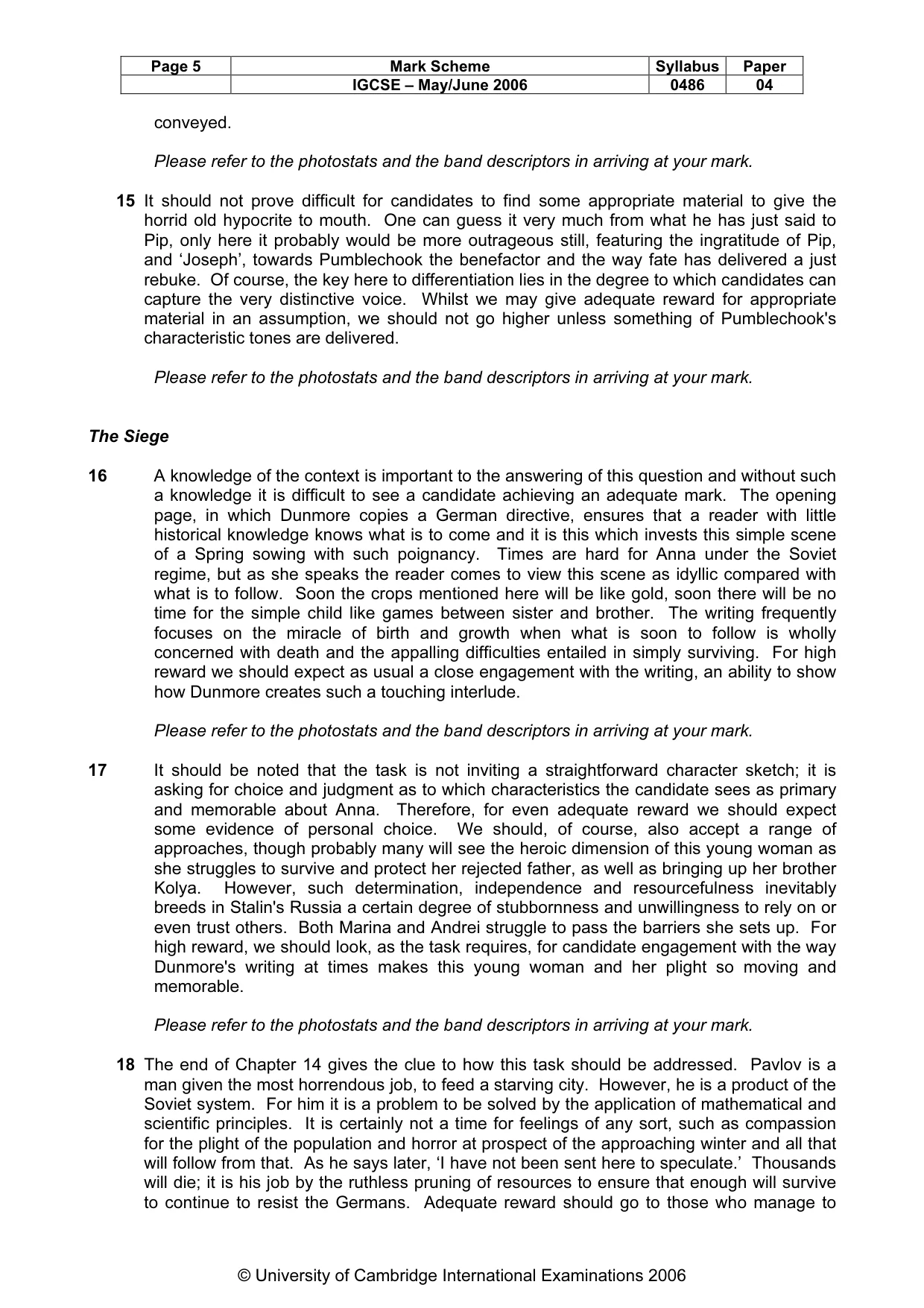
Page 5 Mark Scheme Syllabus Paper IGCSE – May/June 2006 0486 04 © University of Cambridge International Examinations 2006 conveyed. Please refer to the photostats and the band descriptors in arriving at your mark. 15 It should not prove difficult for candidates to find some appropriate material to give the horrid old hypocrite to mouth. One can guess it very much from what he has just said to Pip, only here it probably would be more outrageous still, featuring the ingratitude of Pip, and ‘Joseph’, towards Pumblechook the benefactor and the way fate has delivered a just rebuke. Of course, the key here to differentiation lies in the degree to which candidates can capture the very distinctive voice. Whilst we may give adequate reward for appropriate material in an assumption, we should not go higher unless something of Pumblechook's characteristic tones are delivered. Please refer to the photostats and the band descriptors in arriving at your mark. The Siege 16 A knowledge of the context is important to the answering of this question and without such a knowledge it is difficult to see a candidate achieving an adequate mark. The opening page, in which Dunmore copies a German directive, ensures that a reader with little historical knowledge knows what is to come and it is this which invests this simple scene of a Spring sowing with such poignancy. Times are hard for Anna under the Soviet regime, but as she speaks the reader comes to view this scene as idyllic compared with what is to follow. Soon the crops mentioned here will be like gold, soon there will be no time for the simple child like games between sister and brother. The writing frequently focuses on the miracle of birth and growth when what is soon to follow is wholly concerned with death and the appalling difficulties entailed in simply surviving. For high reward we should expect as usual a close engagement with the writing, an ability to show how Dunmore creates such a touching interlude. Please refer to the photostats and the band descriptors in arriving at your mark. 17 It should be noted that the task is not inviting a straightforward character sketch; it is asking for choice and judgment as to which characteristics the candidate sees as primary and memorable about Anna. Therefore, for even adequate reward we should expect some evidence of personal choice. We should, of course, also accept a range of approaches, though probably many will see the heroic dimension of this young woman as she struggles to survive and protect her rejected father, as well as bringing up her brother Kolya. However, such determination, independence and resourcefulness inevitably breeds in Stalin's Russia a certain degree of stubbornness and unwillingness to rely on or even trust others. Both Marina and Andrei struggle to pass the barriers she sets up. For high reward, we should look, as the task requires, for candidate engagement with the way Dunmore's writing at times makes this young woman and her plight so moving and memorable. Please refer to the photostats and the band descriptors in arriving at your mark. 18 The end of Chapter 14 gives the clue to how this task should be addressed. Pavlov is a man given the most horrendous job, to feed a starving city. However, he is a product of the Soviet system. For him it is a problem to be solved by the application of mathematical and scientific principles. It is certainly not a time for feelings of any sort, such as compassion for the plight of the population and horror at prospect of the approaching winter and all that will follow from that. As he says later, ‘I have not been sent here to speculate.’ Thousands will die; it is his job by the ruthless pruning of resources to ensure that enough will survive to continue to resist the Germans. Adequate reward should go to those who manage to
Mark scheme, page 7
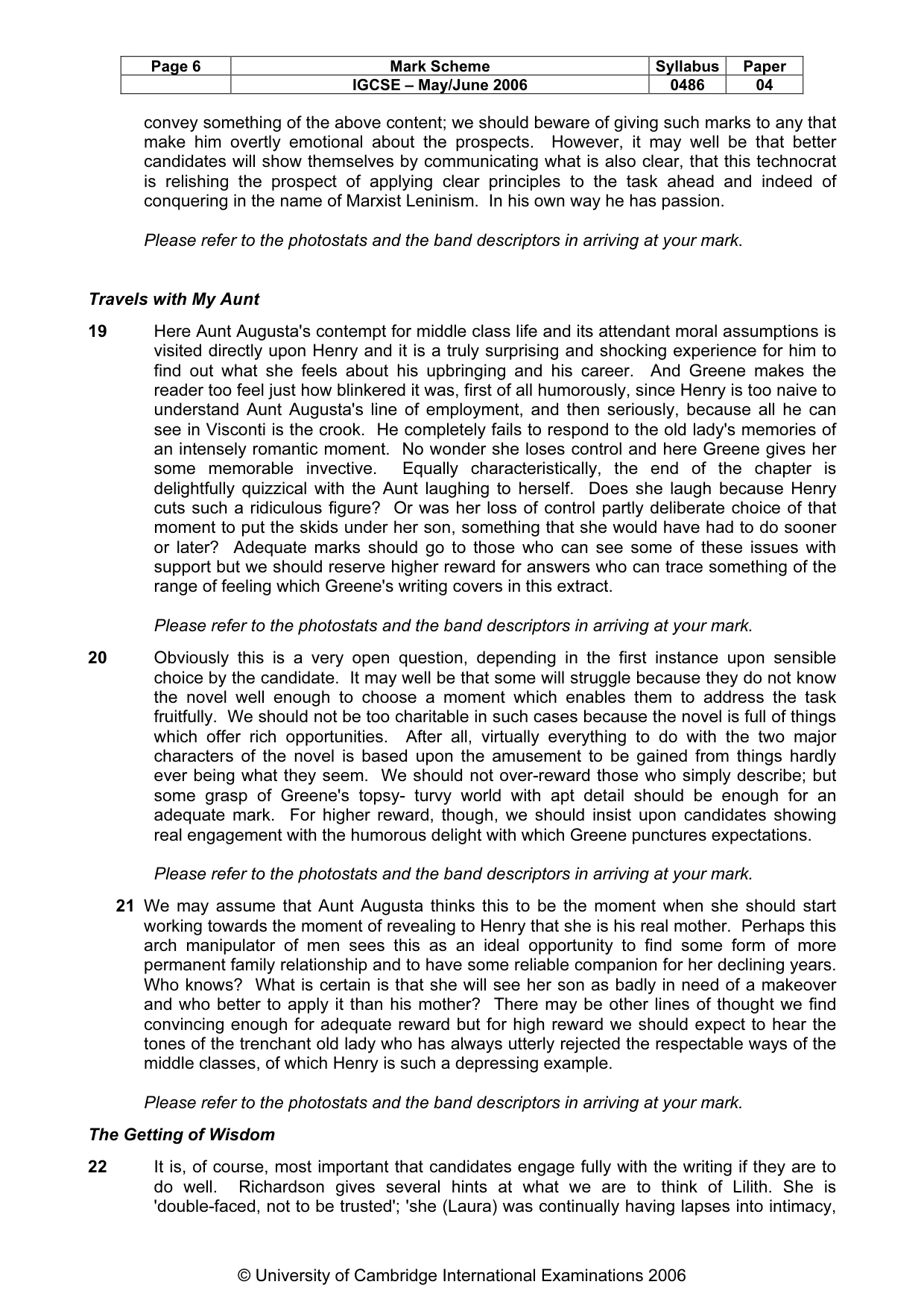
Page 6 Mark Scheme Syllabus Paper IGCSE – May/June 2006 0486 04 © University of Cambridge International Examinations 2006 convey something of the above content; we should beware of giving such marks to any that make him overtly emotional about the prospects. However, it may well be that better candidates will show themselves by communicating what is also clear, that this technocrat is relishing the prospect of applying clear principles to the task ahead and indeed of conquering in the name of Marxist Leninism. In his own way he has passion. Please refer to the photostats and the band descriptors in arriving at your mark. Travels with My Aunt 19 Here Aunt Augusta's contempt for middle class life and its attendant moral assumptions is visited directly upon Henry and it is a truly surprising and shocking experience for him to find out what she feels about his upbringing and his career. And Greene makes the reader too feel just how blinkered it was, first of all humorously, since Henry is too naive to understand Aunt Augusta's line of employment, and then seriously, because all he can see in Visconti is the crook. He completely fails to respond to the old lady's memories of an intensely romantic moment. No wonder she loses control and here Greene gives her some memorable invective. Equally characteristically, the end of the chapter is delightfully quizzical with the Aunt laughing to herself. Does she laugh because Henry cuts such a ridiculous figure? Or was her loss of control partly deliberate choice of that moment to put the skids under her son, something that she would have had to do sooner or later? Adequate marks should go to those who can see some of these issues with support but we should reserve higher reward for answers who can trace something of the range of feeling which Greene's writing covers in this extract. Please refer to the photostats and the band descriptors in arriving at your mark. 20 Obviously this is a very open question, depending in the first instance upon sensible choice by the candidate. It may well be that some will struggle because they do not know the novel well enough to choose a moment which enables them to address the task fruitfully. We should not be too charitable in such cases because the novel is full of things which offer rich opportunities. After all, virtually everything to do with the two major characters of the novel is based upon the amusement to be gained from things hardly ever being what they seem. We should not over-reward those who simply describe; but some grasp of Greene's topsy- turvy world with apt detail should be enough for an adequate mark. For higher reward, though, we should insist upon candidates showing real engagement with the humorous delight with which Greene punctures expectations. Please refer to the photostats and the band descriptors in arriving at your mark. 21 We may assume that Aunt Augusta thinks this to be the moment when she should start working towards the moment of revealing to Henry that she is his real mother. Perhaps this arch manipulator of men sees this as an ideal opportunity to find some form of more permanent family relationship and to have some reliable companion for her declining years. Who knows? What is certain is that she will see her son as badly in need of a makeover and who better to apply it than his mother? There may be other lines of thought we find convincing enough for adequate reward but for high reward we should expect to hear the tones of the trenchant old lady who has always utterly rejected the respectable ways of the middle classes, of which Henry is such a depressing example. Please refer to the photostats and the band descriptors in arriving at your mark. The Getting of Wisdom 22 It is, of course, most important that candidates engage fully with the writing if they are to do well. Richardson gives several hints at what we are to think of Lilith. She is 'double-faced, not to be trusted'; 'she (Laura) was continually having lapses into intimacy,
Mark scheme, page 8
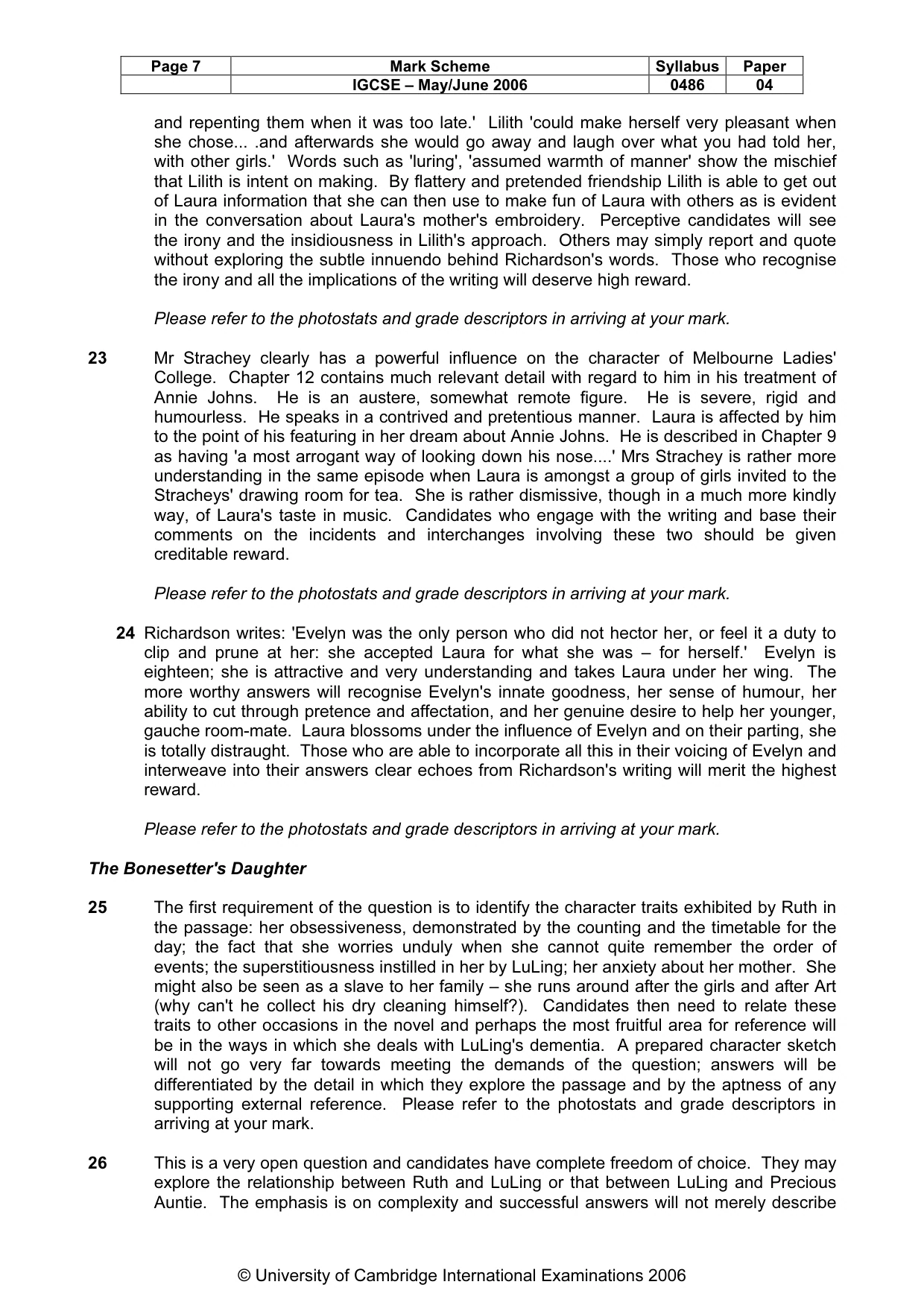
Page 7 Mark Scheme Syllabus Paper IGCSE – May/June 2006 0486 04 © University of Cambridge International Examinations 2006 and repenting them when it was too late.' Lilith 'could make herself very pleasant when she chose... .and afterwards she would go away and laugh over what you had told her, with other girls.' Words such as 'luring', 'assumed warmth of manner' show the mischief that Lilith is intent on making. By flattery and pretended friendship Lilith is able to get out of Laura information that she can then use to make fun of Laura with others as is evident in the conversation about Laura's mother's embroidery. Perceptive candidates will see the irony and the insidiousness in Lilith's approach. Others may simply report and quote without exploring the subtle innuendo behind Richardson's words. Those who recognise the irony and all the implications of the writing will deserve high reward. Please refer to the photostats and grade descriptors in arriving at your mark. 23 Mr Strachey clearly has a powerful influence on the character of Melbourne Ladies' College. Chapter 12 contains much relevant detail with regard to him in his treatment of Annie Johns. He is an austere, somewhat remote figure. He is severe, rigid and humourless. He speaks in a contrived and pretentious manner. Laura is affected by him to the point of his featuring in her dream about Annie Johns. He is described in Chapter 9 as having 'a most arrogant way of looking down his nose…' Mrs Strachey is rather more understanding in the same episode when Laura is amongst a group of girls invited to the Stracheys' drawing room for tea. She is rather dismissive, though in a much more kindly way, of Laura's taste in music. Candidates who engage with the writing and base their comments on the incidents and interchanges involving these two should be given creditable reward. Please refer to the photostats and grade descriptors in arriving at your mark. 24 Richardson writes: 'Evelyn was the only person who did not hector her, or feel it a duty to clip and prune at her: she accepted Laura for what she was – for herself.' Evelyn is eighteen; she is attractive and very understanding and takes Laura under her wing. The more worthy answers will recognise Evelyn's innate goodness, her sense of humour, her ability to cut through pretence and affectation, and her genuine desire to help her younger, gauche room-mate. Laura blossoms under the influence of Evelyn and on their parting, she is totally distraught. Those who are able to incorporate all this in their voicing of Evelyn and interweave into their answers clear echoes from Richardson's writing will merit the highest reward. Please refer to the photostats and grade descriptors in arriving at your mark. The Bonesetter's Daughter 25 The first requirement of the question is to identify the character traits exhibited by Ruth in the passage: her obsessiveness, demonstrated by the counting and the timetable for the day; the fact that she worries unduly when she cannot quite remember the order of events; the superstitiousness instilled in her by LuLing; her anxiety about her mother. She might also be seen as a slave to her family – she runs around after the girls and after Art (why can't he collect his dry cleaning himself?). Candidates then need to relate these traits to other occasions in the novel and perhaps the most fruitful area for reference will be in the ways in which she deals with LuLing's dementia. A prepared character sketch will not go very far towards meeting the demands of the question; answers will be differentiated by the detail in which they explore the passage and by the aptness of any supporting external reference. Please refer to the photostats and grade descriptors in arriving at your mark. 26 This is a very open question and candidates have complete freedom of choice. They may explore the relationship between Ruth and LuLing or that between LuLing and Precious Auntie. The emphasis is on complexity and successful answers will not merely describe
Mark scheme, page 9
Page 8 Mark Scheme Syllabus Paper IGCSE – May/June 2006 0486 04 © University of Cambridge International Examinations 2006 the characters, but will examine the nature of the ways in which they react to each other. They will evaluate and support their ideas with well selected reference. Please refer to the photostats and grade descriptors in arriving at your mark. 27 It is likely that GaoLing would be thinking about what she has left behind; her escape from unhappy marriage with Fu Nan, the opium addict; the teachers and children in the orphanage where she worked with LuLing; the self-sacrifice of LuLing in allowing her to have the first chance of freedom; even her early life in China. She would also be looking forward to her new life in the USA. There is plenty of material to be found in the last few chapters of the novel. Good answers will not merely recount what happens to GaoLing, but will create a convincing voice for her. She speaks in a rather broken English and it may well be that they will try to replicate this. Please refer to the photostats and grade descriptors in arriving at your mark. Into the Wind 28 For anything like adequate reward we should demand that answers directly address the primary words of the question, fear and menace. However, there are many details in this passage which candidates might think relevant to the question and we must not become prescriptive in regard to their interpretation. For instance, some might think there is nothing particularly menacing about the beginning except perhaps the dark setting. One does not even know where one is until the word kaffir is used. However, some might choose to re-read it in a very different light, once the reader has established some bearings from what emerges in the next few lines. It is the kind of task, however, which demands even for adequate reward a close attention to the detail of the writing and for high reward a capacity to analyse why it manages to build such apprehension in the reader. Hopefully the better candidates will relish how La Guma makes little details resonate, such as all the men carrying sjamboks. Please refer to the photostats and the band descriptors in arriving at your mark. 29 The choice is wide in this collection of stories; indeed all the stories have elements relevant to the task. Therefore, we have no need to be charitable to candidates who choose to write about their favourite short story which they then have difficulty fitting to the requirements of the question. The question puts the effectiveness of the writing up front, so answers which simply describe the happenings of the story should only receive limited reward. For adequate reward we should be able to find some evident response to the drama of the situation and some understanding of how the writer achieves that. High reward should go only to those who show a detailed grasp of the author's intentions and her/his techniques for delivering those intentions. Please refer to the photostats and the band descriptors in arriving at your mark. 30 ‘Michael Fish’ has had a very pleasurable ride to London. Like all artists, he clearly loves a receptive audience to his magic and, luckily for him, that is what the driver provides. The hitchhiker clearly fancies himself as a bit of a Robin Hood and one might expect the driver to come into the category of those to be preyed upon. However, giving him a lift and becoming the victim of authority lifts him into the category of those who are approved of and are to be protected. Of course, the hitchhiker takes great pleasure in pulling maximum drama out of any situation so he does not reveal his final coup until the journey is over. Something of the above material will be enough for an adequate mark but as usual we shall look for good candidates to be able to communicate the hitchhiker's bright, breezy and self
Mark scheme, page 10
Page 9 Mark Scheme Syllabus Paper IGCSE – May/June 2006 0486 04 © University of Cambridge International Examinations 2006 confident voice. Please refer to the photostats and the band descriptors in arriving at your mark. DRAMA Absent Friends 31 Basic information is quickly conveyed to the audience. There is going to be a tea party for Colin to which a number of ‘friends' are invited. Right from the start, however, it is clear that Diana's intentions that the party should be a pleasant reunion of old friends gathered to offer solace to Colin is likely to be thwarted. Her ‘conversation' with Evelyn is comically one way, she admits that she has not seen her or John in ages, and everything that she says draws nil response. The comic result of this is that Diana gradually gets herself drawn into revealing her unhappy childhood and her deeply unsatisfactory marriage to a husband who seems to spend as little time with her as possible. That she should be revealing this to such an unsympathetic and apparently uninterested listener as Evelyn is, of course, later shown to be even more richly ironic. Adequate reward should go to those who efficiently see something of the little significances of the above and who really relate the material to it being at the opening of the play. We should hope, perhaps, that better candidates will place the extract firmly in context and show an ability to engage in detail with Ayckbourn's comically ironic tone. Please refer to the photostats and grade descriptors in arriving at your mark. 32 There are a number of prime instances of this kind of comic situation in the play. The audience is aware that something is going to make Diana snap as her husband blithely motors on unaware that his adultery with Evelyn has been revealed. There are also at the comic centre of the play Colin's many moments in which he shows complete lack of awareness of the true state of affairs whilst congratulating himself upon his perspicacity. There will, no doubt, be many other incidents which emerge in candidates' answers. However, the main source of differentiation will be the response to the comic aspects of the moment chosen. Bland description should have only limited reward. Even for adequate reward we should expect some attempt to engage with and analyse the reasons why it is so amusing. The closer that engagement, the higher the reward. Please refer to the photostats and grade descriptors in arriving at your mark. 33 This empathic task is likely to show only too clearly those who have a detailed knowledge of the play and those who do not. To begin with, John is late for the party and is not likely to be bothered. He makes it quite clear on arrival that he feels he has nothing to offer Colin in the way of consolation. Much more important for him is what he sees as his business triumphs of the afternoon, the acquisitions he has made for his car. He also wishes to speak to Paul and presumably not to speak much to his unloving wife. Of course, he has no certain idea that she has recently had sex with Paul and, if he had, he would not care. She flaunts her promiscuity and he has apparently long accepted that his wife thinks little of him. Perhaps, since his voice is not particularly distinctive, we shall find ourselves differentiating in this task more on the fine distinctions of content than anything else. Please refer to the photostats and grade descriptors in arriving at your mark.
Mark scheme, page 11
Page 10 Mark Scheme Syllabus Paper IGCSE – May/June 2006 0486 04 © University of Cambridge International Examinations 2006 Cuba and Doghouse 34 Even adequate answers should show some awareness of the importance of stage spectacle as well as dialogue in this opening to the play. Some might think particularly effective the way the stage chorus becomes an ancient school photo brought to life as a consequence of the awakening of B's memories of some apparently painful episode in her/their youth. This playing with time is made more complex in that the audience is given a glimpse of the end of the incident that is being remembered in the present time. Also, Lochhead seeks to intrigue by juxtaposing B's comment about the differences between the two girls' families by enacting the parents at this stage as virtually indistinguishable, thus setting up more questions to be answered. A genuine attempt to explore the dramatic possibilities, as distinct from a simple description of the opening of the play, should be enough for adequate reward. An ability to respond to the way Lochhead creates a dramatic sense of re-awakened pain as well as intrigue as to what occasioned this pain should ensure higher reward. Please refer to the photostats and grade descriptors in arriving at your mark. 35 Lochhead sees the parents as stereotypical of the differences of working class and middle class values. Their attitudes on p.19 towards the conflict provides a snapshot of this. However, the dramatist is also at pains to point to the similarities of parental attitudes at times. Both sets of parents are supportive in very much the same way, both find their teenage daughters irksome at times, and each mother comforts her girl with exactly the same words at the end. The irony is it is the end of Bernadette's chance of being accepted into the middle class world of her erstwhile friend and into a world in which academic education is the norm and not the exception, as parental comment makes clear on occasions earlier in the play. Little needs to be said about the powerful influence exerted by parents in Doghouse, particularly by Mr Martin. Probably most who choose this question will choose to write on that play. In either case, we should expect only to reward highly those who engage with the way all this is conveyed dramatically. Please refer to the photostats and grade descriptors in arriving at your mark. 36 There cannot be much doubt about Dessie's basic attitude. His father's treatment of Pats, and now him when he tried to protect his sister, had so driven him to the edge of desperation that he was prepared to use a shotgun on his father. This was very much his rite of passage as the only other male in the family and on the edge of adulthood. He certainly did not accept Pats's defence of his father's conduct. When the cartridges were removed, he was dreading his father's return, so relief and probably joy would be his likely response, with a few well chosen words amounting to saying good riddance. He might even relish the irony of the escaped Bran being the cause of the accident. There is laughter at the funeral, though Dessie certainly does go through the motions of paying his respects as every Irishman should. It should not be difficult to capture at least the tone of the voice and we should reserve high reward for those who enter that territory. Please refer to the photostats and grade descriptors in arriving at your mark. Macbeth 37 Despair and desperation are at the centre of this extract. Macbeth's opening defiance hardly convinces and that pretence evaporates as he contemplates the nightmarish world to which his actions have consigned him. He has no time for grief when he hears of his wife's death as he sinks into voicing perhaps the most powerful denial of life having any meaning ever penned. Here is a man upon whom once fortune smiled, and who was only too aware of moral imperatives, reduced to nihilism. It should not be difficult for candidates to grasp Macbeth's state of mind but we should expect even for adequate reward that there is some evidence of response to the shocking power of the words Shakespeare gives him and perhaps some awareness of the dreadful journey Macbeth
Mark scheme, page 12
Page 11 Mark Scheme Syllabus Paper IGCSE – May/June 2006 0486 04 © University of Cambridge International Examinations 2006 has made since the beginning of the play. The more the candidate engages with the poetic detail which creates this sense of the collapse of everything human, the higher the reward. Please refer to the photostats and grade descriptors in arriving at your mark. 38 Once again it is the intention of the task to drive candidates to do some thinking in the examination rather than to trot out a character sketch. Therefore it follows that even for adequate reward we should expect some evidence of an argument according to the parameters set down. We should, of course, allow a wide range of opinion providing that it supported by relevant dramatic detail. However, it may well be that the best candidates will show themselves by arguing that Lady Macbeth is a much more complex and interesting creation than an epitome of evil. Even when at her most frightful there is a strand of vulnerability. The very act of trying to subjugate all her feminine feelings coupled with the sleepwalking scene suggests something much more interesting than a monster. Please refer to the photostats and grade descriptors in arriving at your mark. 39 Duncan may be a good man but he is not a good king. As the opening mayhem of the play suggests, he is weak and trusting. Why, one wonders, was he so far from the fighting himself? Not content with having made a great mistake and having risked his kingdom and the security of his people by failing to detect the Earl of Cawdor's treason, he is now about to repeat the mistake in regard to the man to whom he has given the title. He has sung Macbeth's praises and no doubt looks to cement the bond between them by visiting his castle and showering him and his hostess with further presents. As he makes clear when he reaches Inverness, he is in blissful mood. He thinks civil discord is over. Conveying his basic attitude so well documented in the play should be enough to obtain adequate marks. What we should look for in something higher is an establishment of his mood and perhaps rather gushing voice. Please refer to the photostats and grade descriptors in arriving at your mark. The Devil's Disciple 40 There should be no doubt that we are intended to find Mrs Dudgeon a deeply unlovely human being. Hate, bitterness, implacability, avarice are not exactly Christian traits, though it would appear that this woman has little difficulty in thinking them proper characteristics of a person dedicated to combating the sin around her. However, as ever with Shaw, things are not that simple. It becomes clear that there are legitimate reasons for her bitterness. She had been forced to deny her heart by her religion, only to find that the man she chose was no better than the man she had been forced to reject. And now she is to be left penniless, even though the money was hers originally. On top of that, Shaw makes clear that Anderson, after an attempt to occupy the moral high ground by forgiving the sinner in front of him, is surprisingly uncomfortable in her presence and seems even at this early stage of the play to recognise that her charge of hypocrisy is not without substance. It may well be that adequate candidates will reveal themselves by dealing efficiently with the dislikeable elements in Mrs Dudgeon, whilst the better ones recognise features which suggest something more complex. However, we should be prepared to give high reward also to one track answers which really engage with Shaw's powerful portrayal of the dreadful life denying features of Puritanism. Please refer to the photostats and grade descriptors in arriving at your mark. 41 There is not much to say about this task except once again to point to the key word memorable. It is this which makes it imperative that even an adequate candidate does more than describe Burgoyne's characteristics, his intelligence, his wit, his brutal truth
Mark scheme, page 13
Page 12 Mark Scheme Syllabus Paper IGCSE – May/June 2006 0486 04 © University of Cambridge International Examinations 2006 telling and , behind the suave, courteous mask, his passion. He is no dilettante. What in addition we must require is some engagement with the ways in which Shaw makes him a riveting presence on the stage. It follows that this should be at the centre of any answer which is given high reward. Please refer to the photostats and grade descriptors in arriving at your mark. 42 Many thoughts of a varying hue may be going through his mind. It is very likely that, even in these dire straits, Dick would find the irony of being a prospective martyr for a community which he spent all his life detesting somewhat piquant. He will no doubt also be diverted by the way Judith has behaved towards him, though he has yet to have evidence of how far that will go. However, more sombre thoughts will also be present. He may well be thinking of his mother, of whose death he has learnt. His feelings about her will be at best equivocal but certainly he will be much concerned about Essie's future. As regards his own execution, he is hardly likely to emote. Adequate reward should go to candidates who range through some of the above possibilities. We should reserve higher reward for those who capture something of Dick's voice, his combination of deep seriousness with swashbuckling bravado and wit. Please refer to the photostats and grade descriptors in arriving at your mark. A Streetcar Named Desire 43 Williams helps to heighten the tension by having the conversation between Stella and Blanche overheard by Stanley without their knowledge. Clearly Blanche's opinion of him will increase his antipathy towards her and presage the violence that is to come. There are clear differences between Stella and Blanche here. Indeed, the words that Williams puts into Blanche's mouth are like dynamite. Stanley is likened to an animal – an ape – sub-human. Such words will smoulder within Stanley and erupt. The words themselves indicate the apparent loathing that Blanche feels for Stanley and enhance her own pretentiousness and feeling of superiority. And yet it is the animal attraction in Stanley that draws Blanche to him later in the play. So the writing here makes the audience aware of the tensions between brother-in-law and sister-in-law and between the two sisters. Those who explore the volcanic dialogue here and relate it graphically to the tensions seen in the interplay of the characters will deserve high reward. Please refer to the photostats and grade descriptors in arriving at your mark. 44 That Stella loves Stanley, there can be no doubt. She is physically very attracted to him and has surrendered herself to him. She accepts his poker games, his readiness to be one of the boys and his taking of so much freedom to himself. She is a long way from the supposed genteel of Belle Reve. Stanley dominates Stella and when the need arises (end of Scene 8) will treat her with tenderness and love. In some ways they are opposites and yet Stella has moved much more towards Stanley than the other way round. Where candidates explore the relationship throughout the play and engage with Williams' writing and creation of appropriate and revealing situations, they should score highly. We should beware of over-simplistic and superficial answers that ignore the quality of the writing. Please refer to the photostats and grade descriptors in arriving at your mark. 45 Mitch may well feel on their return to the Kowolskis' flat that the evening has been a disaster and the relationship with Blanche is going nowhere. Mitch feels inadequate and that the evening has not been pleasant for Blanche on whom he wanted to make a favourable impression. But during the course of their discussion they exchange thoughts about themselves and their experiences: Blanche about her early disastrous marriage and Blanche about his mother. They become closer and Mitch believes that they both need
Mark scheme, page 14
Page 13 Mark Scheme Syllabus Paper IGCSE – May/June 2006 0486 04 © University of Cambridge International Examinations 2006 somebody. Could they have found that somebody in each other? These thoughts will surely go through Stanley's mind at this juncture in the play. Mitch is not deep or subtle but has a natural inclination to be thoughtful and kind. We should expect candidates' answers to reflect these characteristics if they are to score well. Please refer to the photostats and grade descriptors in arriving at your mark.
What you needed in this session
Cambridge’s own grade thresholds for 2006 May/June, Paper 4 · Variant 1. A higher threshold means an easier paper — the bar moves with how the cohort did.