Cambridge IGCSE English - Literature 0486 — 2005 Oct/Nov Paper 4 · Variant 1
0486/41/O/N/05
The question paper and its mark scheme, free to read here and free to download. This is Cambridge’s own paper, exactly as it was sat.
Question paper32 pages






Mark scheme15 pages
Answers below. Sit the paper first if you are practising.
Paper as text
Question paper, page 1
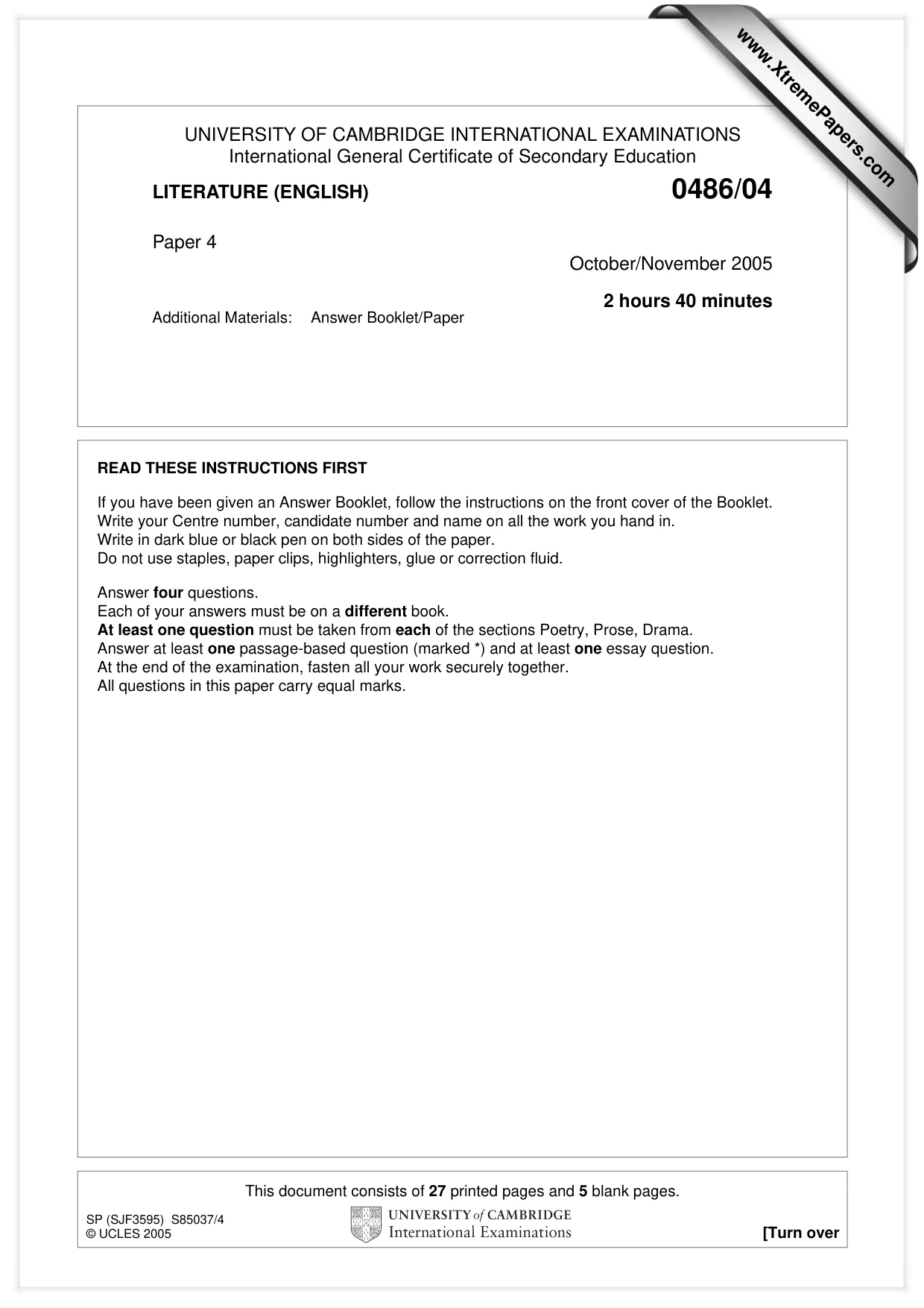
This document consists of 27 printed pages and 5 blank pages. SP (SJF3595) S85037/4 © UCLES 2005 [Turn over UNIVERSITY OF CAMBRIDGE INTERNATIONAL EXAMINATIONS International General Certificate of Secondary Education LITERATURE (ENGLISH) 0486/04 Paper 4 October/November 2005 2 hours 40 minutes Additional Materials: Answer Booklet/Paper READ THESE INSTRUCTIONS FIRST If you have been given an Answer Booklet, follow the instructions on the front cover of the Booklet. Write your Centre number, candidate number and name on all the work you hand in. Write in dark blue or black pen on both sides of the paper. Do not use staples, paper clips, highlighters, glue or correction fluid. Answer four questions. Each of your answers must be on a different book. At least one question must be taken from each of the sections Poetry, Prose, Drama. Answer at least one passage-based question (marked *) and at least one essay question. At the end of the examination, fasten all your work securely together. All questions in this paper carry equal marks. www.XtremePapers.com
Question paper, page 3
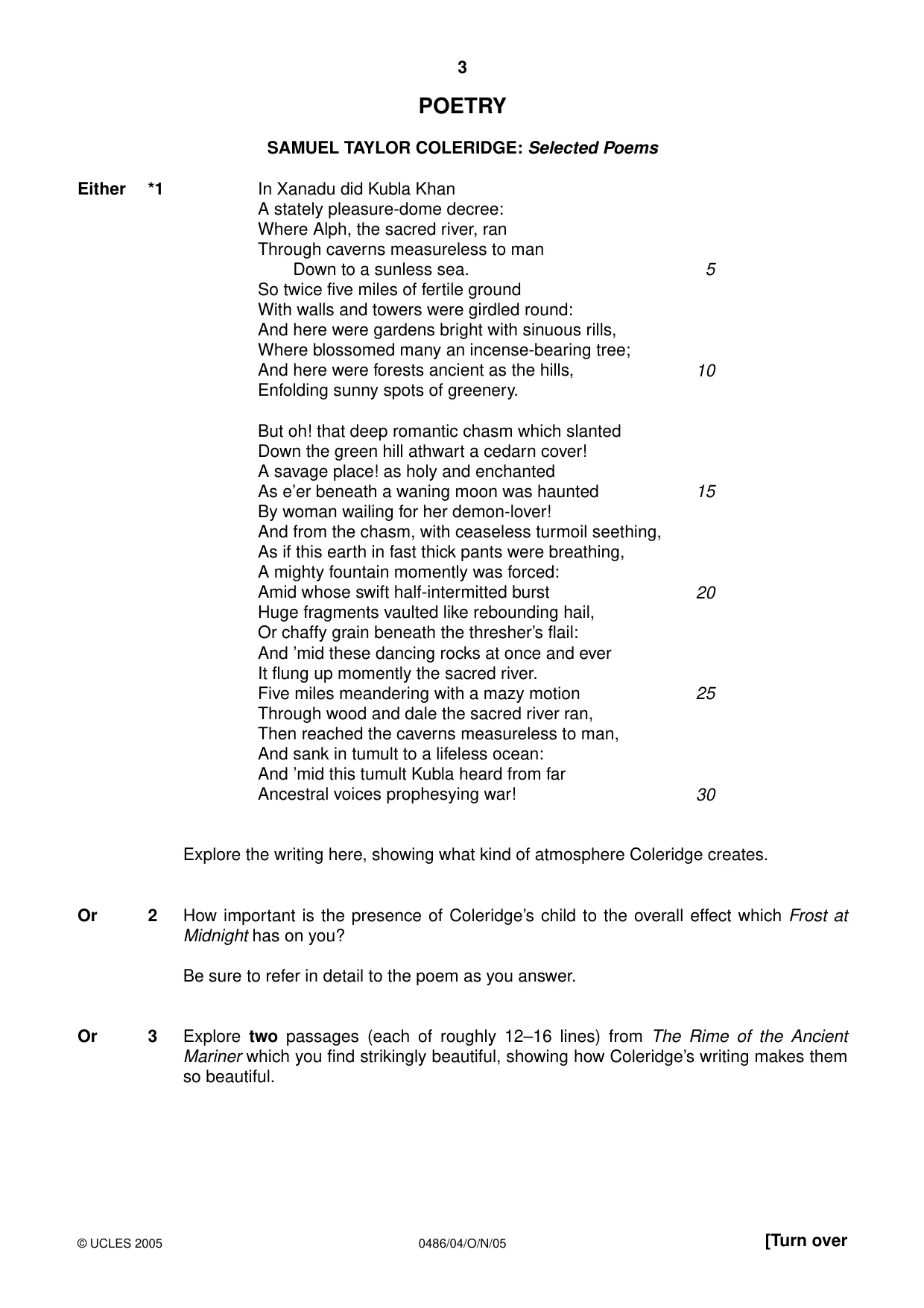
3 0486/04/O/N/05 [Turn over © UCLES 2005 POETRY SAMUEL TAYLOR COLERIDGE: Selected Poems Either *1 In Xanadu did Kubla Khan A stately pleasure-dome decree: Where Alph, the sacred river, ran Through caverns measureless to man Down to a sunless sea. So twice five miles of fertile ground With walls and towers were girdled round: And here were gardens bright with sinuous rills, Where blossomed many an incense-bearing tree; And here were forests ancient as the hills, Enfolding sunny spots of greenery. But oh! that deep romantic chasm which slanted Down the green hill athwart a cedarn cover! A savage place! as holy and enchanted As e’er beneath a waning moon was haunted By woman wailing for her demon-lover! And from the chasm, with ceaseless turmoil seething, As if this earth in fast thick pants were breathing, A mighty fountain momently was forced: Amid whose swift half-intermitted burst Huge fragments vaulted like rebounding hail, Or chaffy grain beneath the thresher’s flail: And ’mid these dancing rocks at once and ever It flung up momently the sacred river. Five miles meandering with a mazy motion Through wood and dale the sacred river ran, Then reached the caverns measureless to man, And sank in tumult to a lifeless ocean: And ’mid this tumult Kubla heard from far Ancestral voices prophesying war! Explore the writing here, showing what kind of atmosphere Coleridge creates. Or 2 How important is the presence of Coleridge’s child to the overall effect which Frost at Midnight has on you? Be sure to refer in detail to the poem as you answer. Or 3 Explore two passages (each of roughly 12–16 lines) from The Rime of the Ancient Mariner which you find strikingly beautiful, showing how Coleridge’s writing makes them so beautiful. 5 10 15 20 25 30
Question paper, page 4
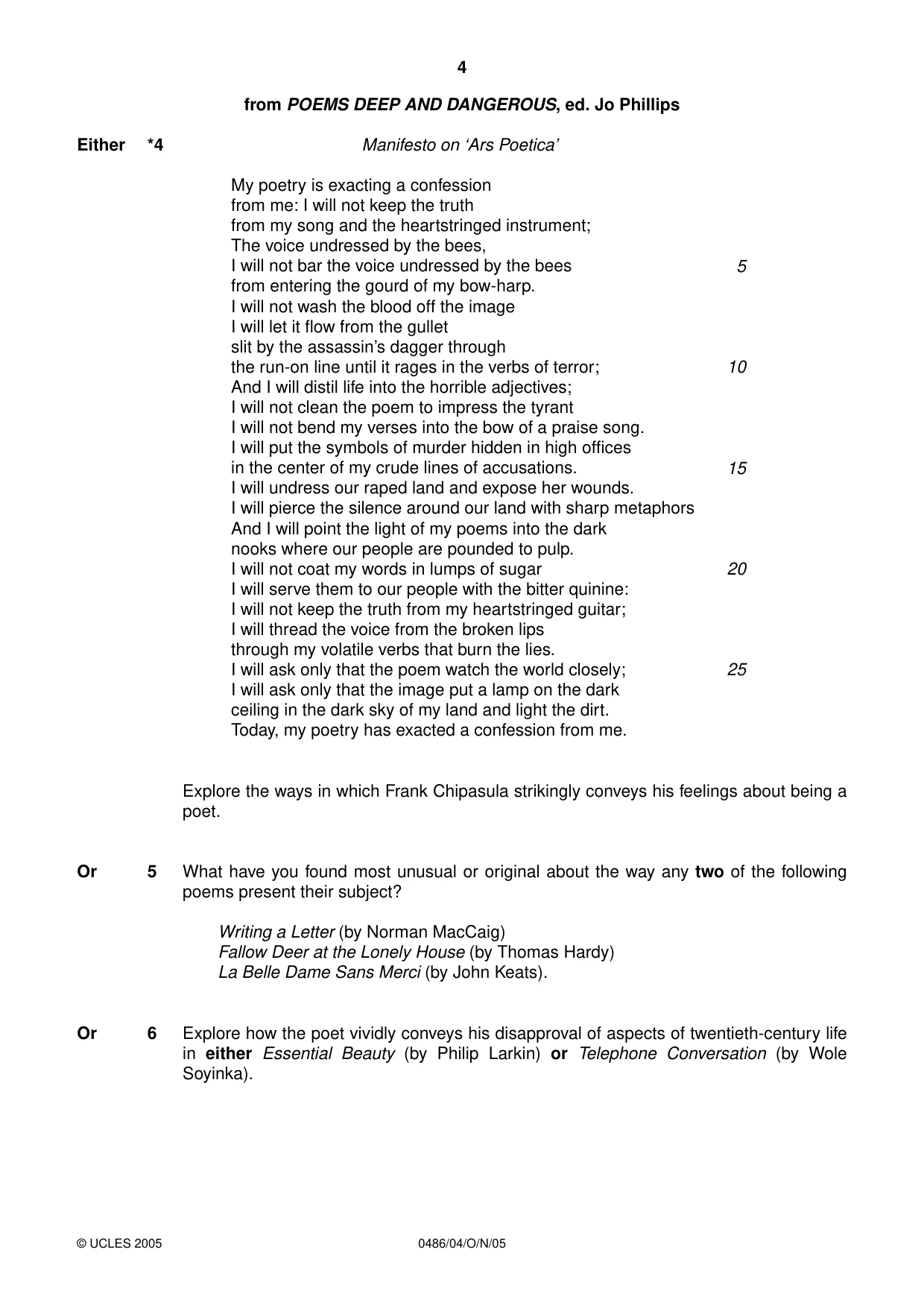
4 0486/04/O/N/05 from POEMS DEEP AND DANGEROUS, ed. Jo Phillips Either *4 Manifesto on ‘Ars Poetica’ My poetry is exacting a confession from me: I will not keep the truth from my song and the heartstringed instrument; The voice undressed by the bees, I will not bar the voice undressed by the bees from entering the gourd of my bow-harp. I will not wash the blood off the image I will let it flow from the gullet slit by the assassin’s dagger through the run-on line until it rages in the verbs of terror; And I will distil life into the horrible adjectives; I will not clean the poem to impress the tyrant I will not bend my verses into the bow of a praise song. I will put the symbols of murder hidden in high offices in the center of my crude lines of accusations. I will undress our raped land and expose her wounds. I will pierce the silence around our land with sharp metaphors And I will point the light of my poems into the dark nooks where our people are pounded to pulp. I will not coat my words in lumps of sugar I will serve them to our people with the bitter quinine: I will not keep the truth from my heartstringed guitar; I will thread the voice from the broken lips through my volatile verbs that burn the lies. I will ask only that the poem watch the world closely; I will ask only that the image put a lamp on the dark ceiling in the dark sky of my land and light the dirt. Today, my poetry has exacted a confession from me. Explore the ways in which Frank Chipasula strikingly conveys his feelings about being a poet. Or 5 What have you found most unusual or original about the way any two of the following poems present their subject? Writing a Letter (by Norman MacCaig) Fallow Deer at the Lonely House (by Thomas Hardy) La Belle Dame Sans Merci (by John Keats). Or 6 Explore how the poet vividly conveys his disapproval of aspects of twentieth-century life in either Essential Beauty (by Philip Larkin) or Telephone Conversation (by Wole Soyinka). © UCLES 2005 5 10 15 20 25
Question paper, page 5
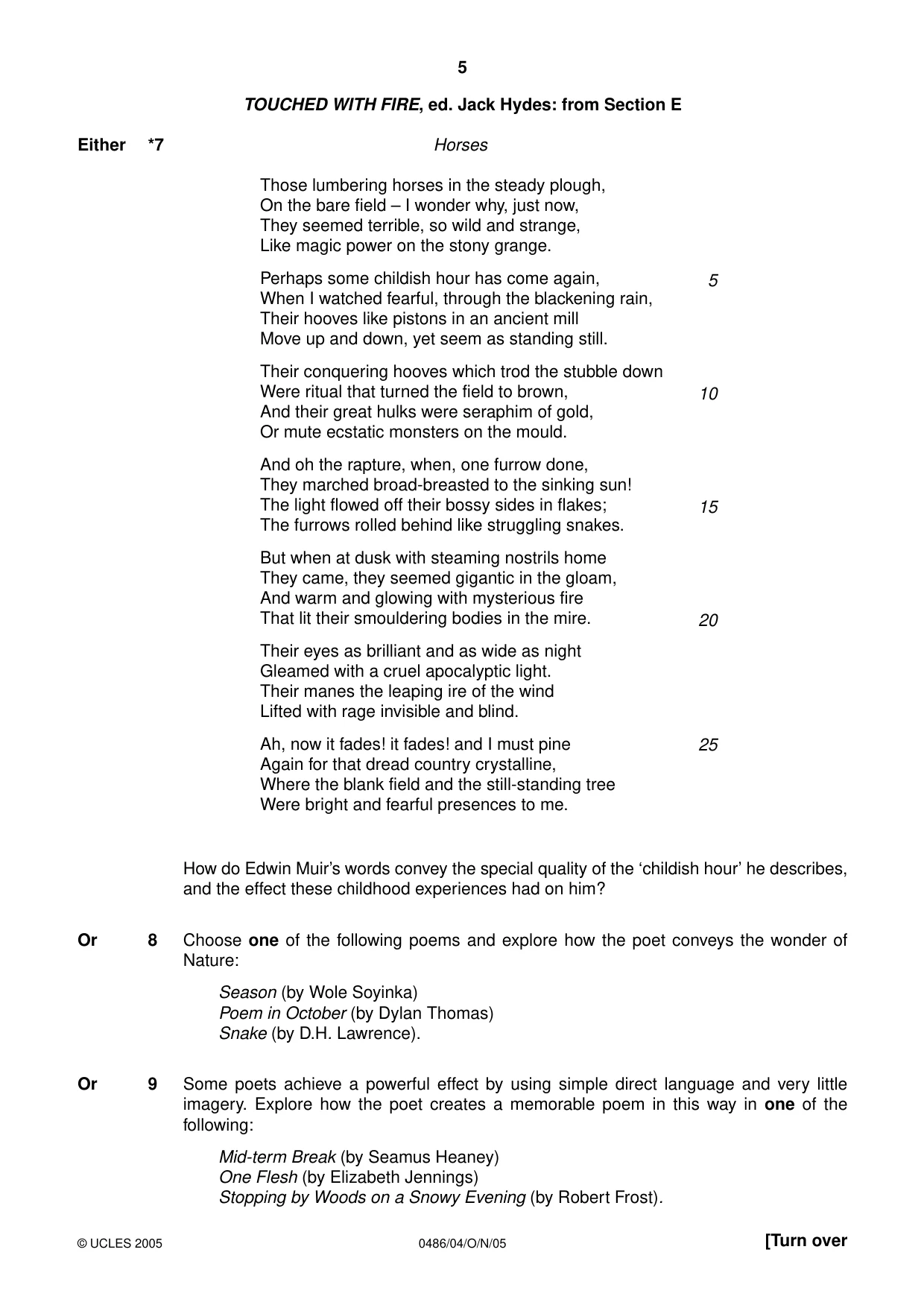
5 0486/04/O/N/05 [Turn over © UCLES 2005 TOUCHED WITH FIRE, ed. Jack Hydes: from Section E Either *7 Horses Those lumbering horses in the steady plough, On the bare field – I wonder why, just now, They seemed terrible, so wild and strange, Like magic power on the stony grange. Perhaps some childish hour has come again, When I watched fearful, through the blackening rain, Their hooves like pistons in an ancient mill Move up and down, yet seem as standing still. Their conquering hooves which trod the stubble down Were ritual that turned the field to brown, And their great hulks were seraphim of gold, Or mute ecstatic monsters on the mould. And oh the rapture, when, one furrow done, They marched broad-breasted to the sinking sun! The light flowed off their bossy sides in flakes; The furrows rolled behind like struggling snakes. But when at dusk with steaming nostrils home They came, they seemed gigantic in the gloam, And warm and glowing with mysterious fire That lit their smouldering bodies in the mire. Their eyes as brilliant and as wide as night Gleamed with a cruel apocalyptic light. Their manes the leaping ire of the wind Lifted with rage invisible and blind. Ah, now it fades! it fades! and I must pine Again for that dread country crystalline, Where the blank field and the still-standing tree Were bright and fearful presences to me. How do Edwin Muir’s words convey the special quality of the ‘childish hour’ he describes, and the effect these childhood experiences had on him? Or 8 Choose one of the following poems and explore how the poet conveys the wonder of Nature: Season (by Wole Soyinka) Poem in October (by Dylan Thomas) Snake (by D.H. Lawrence). Or 9 Some poets achieve a powerful effect by using simple direct language and very little imagery. Explore how the poet creates a memorable poem in this way in one of the following: Mid-term Break (by Seamus Heaney) One Flesh (by Elizabeth Jennings) Stopping by Woods on a Snowy Evening (by Robert Frost). 5 10 15 20 25
Question paper, page 6
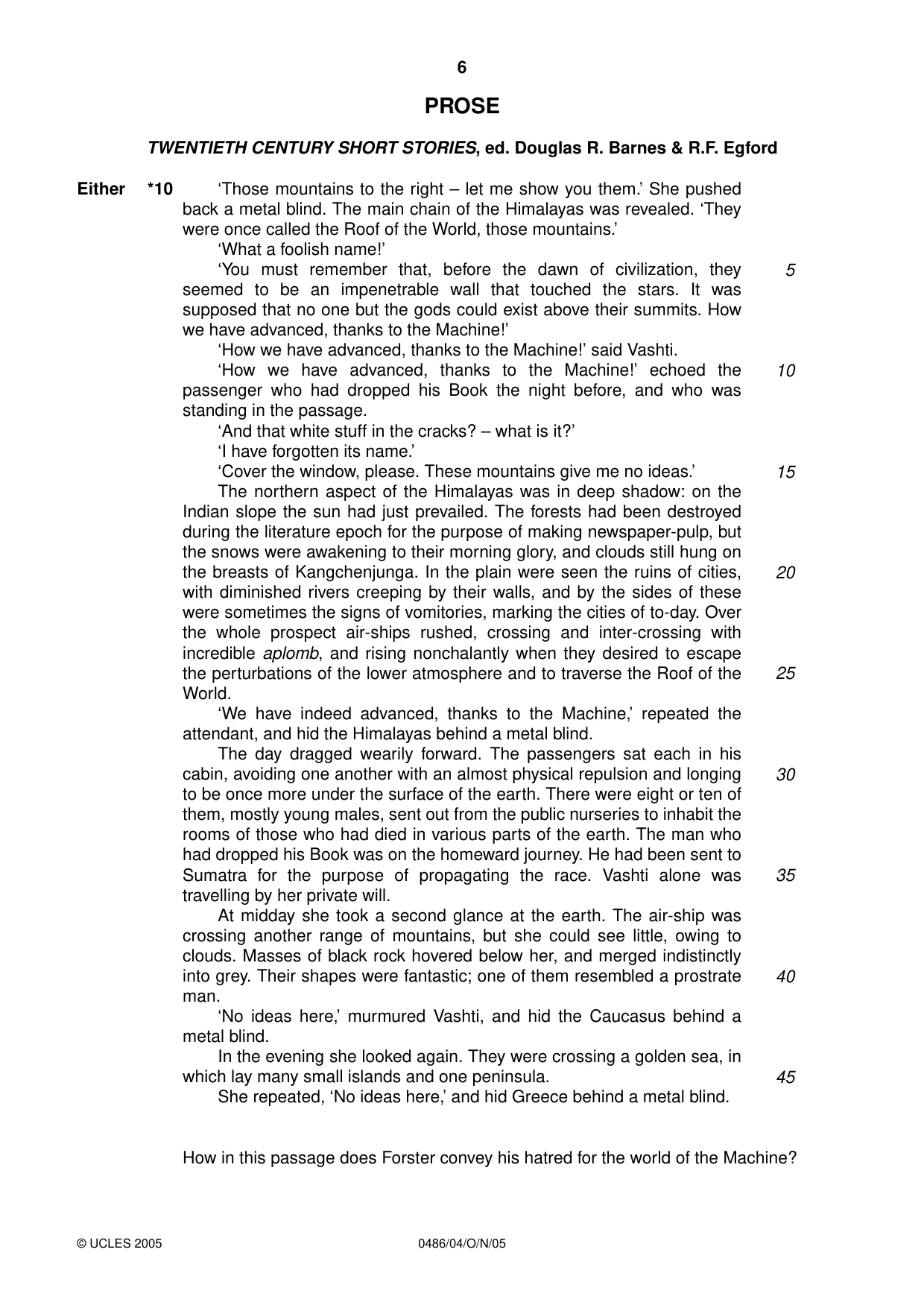
6 0486/04/O/N/05 PROSE TWENTIETH CENTURY SHORT STORIES, ed. Douglas R. Barnes & R.F. Egford Either *10 ‘Those mountains to the right – let me show you them.’ She pushed back a metal blind. The main chain of the Himalayas was revealed. ‘They were once called the Roof of the World, those mountains.’ ‘What a foolish name!’ ‘You must remember that, before the dawn of civilization, they seemed to be an impenetrable wall that touched the stars. It was supposed that no one but the gods could exist above their summits. How we have advanced, thanks to the Machine!’ ‘How we have advanced, thanks to the Machine!’ said Vashti. ‘How we have advanced, thanks to the Machine!’ echoed the passenger who had dropped his Book the night before, and who was standing in the passage. ‘And that white stuff in the cracks? – what is it?’ ‘I have forgotten its name.’ ‘Cover the window, please. These mountains give me no ideas.’ The northern aspect of the Himalayas was in deep shadow: on the Indian slope the sun had just prevailed. The forests had been destroyed during the literature epoch for the purpose of making newspaper-pulp, but the snows were awakening to their morning glory, and clouds still hung on the breasts of Kangchenjunga. In the plain were seen the ruins of cities, with diminished rivers creeping by their walls, and by the sides of these were sometimes the signs of vomitories, marking the cities of to-day. Over the whole prospect air-ships rushed, crossing and inter-crossing with incredible aplomb, and rising nonchalantly when they desired to escape the perturbations of the lower atmosphere and to traverse the Roof of the World. ‘We have indeed advanced, thanks to the Machine,’ repeated the attendant, and hid the Himalayas behind a metal blind. The day dragged wearily forward. The passengers sat each in his cabin, avoiding one another with an almost physical repulsion and longing to be once more under the surface of the earth. There were eight or ten of them, mostly young males, sent out from the public nurseries to inhabit the rooms of those who had died in various parts of the earth. The man who had dropped his Book was on the homeward journey. He had been sent to Sumatra for the purpose of propagating the race. Vashti alone was travelling by her private will. At midday she took a second glance at the earth. The air-ship was crossing another range of mountains, but she could see little, owing to clouds. Masses of black rock hovered below her, and merged indistinctly into grey. Their shapes were fantastic; one of them resembled a prostrate man. ‘No ideas here,’ murmured Vashti, and hid the Caucasus behind a metal blind. In the evening she looked again. They were crossing a golden sea, in which lay many small islands and one peninsula. She repeated, ‘No ideas here,’ and hid Greece behind a metal blind. How in this passage does Forster convey his hatred for the world of the Machine? © UCLES 2005 5 10 15 20 25 30 35 40 45
Question paper, page 7
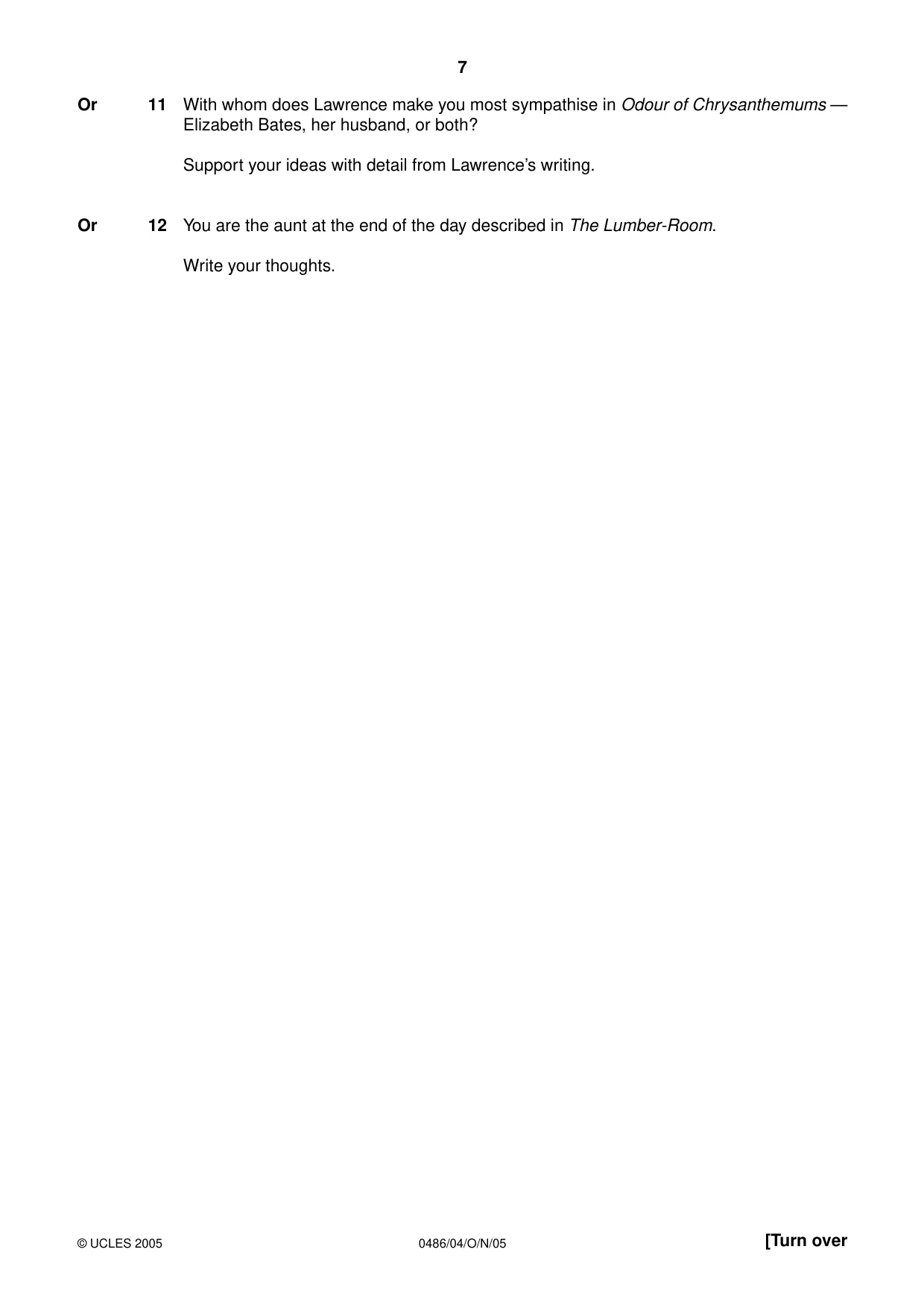
7 0486/04/O/N/05 [Turn over Or 11 With whom does Lawrence make you most sympathise in Odour of Chrysanthemums — Elizabeth Bates, her husband, or both? Support your ideas with detail from Lawrence’s writing. Or 12 You are the aunt at the end of the day described in The Lumber-Room. Write your thoughts. © UCLES 2005
Question paper, page 8
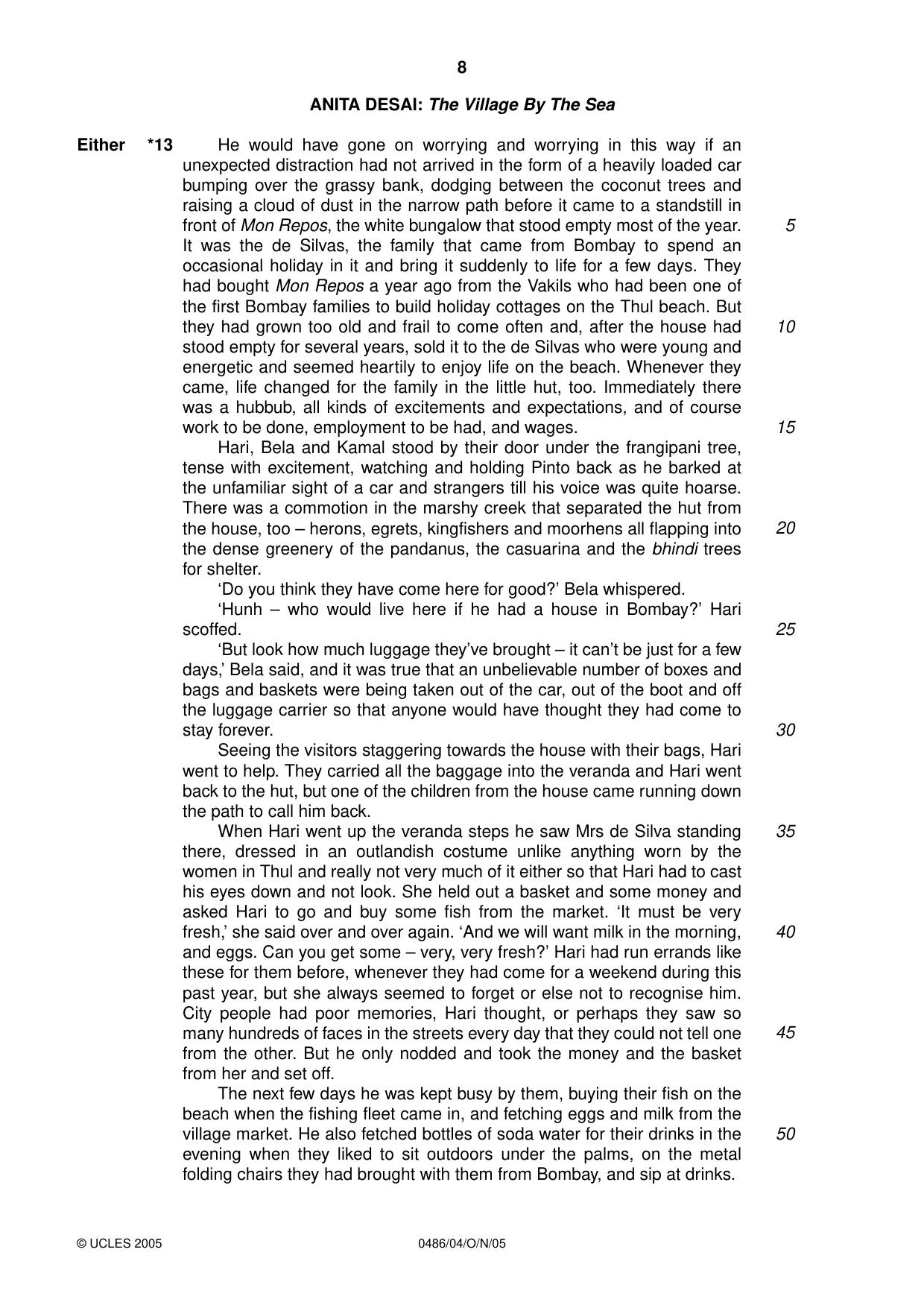
8 0486/04/O/N/05 ANITA DESAI: The Village By The Sea Either *13 He would have gone on worrying and worrying in this way if an unexpected distraction had not arrived in the form of a heavily loaded car bumping over the grassy bank, dodging between the coconut trees and raising a cloud of dust in the narrow path before it came to a standstill in front of Mon Repos, the white bungalow that stood empty most of the year. It was the de Silvas, the family that came from Bombay to spend an occasional holiday in it and bring it suddenly to life for a few days. They had bought Mon Repos a year ago from the Vakils who had been one of the first Bombay families to build holiday cottages on the Thul beach. But they had grown too old and frail to come often and, after the house had stood empty for several years, sold it to the de Silvas who were young and energetic and seemed heartily to enjoy life on the beach. Whenever they came, life changed for the family in the little hut, too. Immediately there was a hubbub, all kinds of excitements and expectations, and of course work to be done, employment to be had, and wages. Hari, Bela and Kamal stood by their door under the frangipani tree, tense with excitement, watching and holding Pinto back as he barked at the unfamiliar sight of a car and strangers till his voice was quite hoarse. There was a commotion in the marshy creek that separated the hut from the house, too – herons, egrets, kingfishers and moorhens all flapping into the dense greenery of the pandanus, the casuarina and the bhindi trees for shelter. ‘Do you think they have come here for good?’ Bela whispered. ‘Hunh – who would live here if he had a house in Bombay?’ Hari scoffed. ‘But look how much luggage they’ve brought – it can’t be just for a few days,’ Bela said, and it was true that an unbelievable number of boxes and bags and baskets were being taken out of the car, out of the boot and off the luggage carrier so that anyone would have thought they had come to stay forever. Seeing the visitors staggering towards the house with their bags, Hari went to help. They carried all the baggage into the veranda and Hari went back to the hut, but one of the children from the house came running down the path to call him back. When Hari went up the veranda steps he saw Mrs de Silva standing there, dressed in an outlandish costume unlike anything worn by the women in Thul and really not very much of it either so that Hari had to cast his eyes down and not look. She held out a basket and some money and asked Hari to go and buy some fish from the market. ‘It must be very fresh,’ she said over and over again. ‘And we will want milk in the morning, and eggs. Can you get some – very, very fresh?’ Hari had run errands like these for them before, whenever they had come for a weekend during this past year, but she always seemed to forget or else not to recognise him. City people had poor memories, Hari thought, or perhaps they saw so many hundreds of faces in the streets every day that they could not tell one from the other. But he only nodded and took the money and the basket from her and set off. The next few days he was kept busy by them, buying their fish on the beach when the fishing fleet came in, and fetching eggs and milk from the village market. He also fetched bottles of soda water for their drinks in the evening when they liked to sit outdoors under the palms, on the metal folding chairs they had brought with them from Bombay, and sip at drinks. © UCLES 2005 5 10 15 20 25 30 35 40 45 50
Question paper, page 9
9 0486/04/O/N/05 [Turn over What sort of people do you take the de Silvas to be from this extract, and what effect do they have on the children here? Or 14 Do you think Hari was right to leave home and go to Bombay? Support your ideas with detail from the writing. Or 15 You are Lila at the end of the book, thinking about the difficulties caused by your mother’s illness and your father’s drunkenness. Write your thoughts. © UCLES 2005
Question paper, page 10
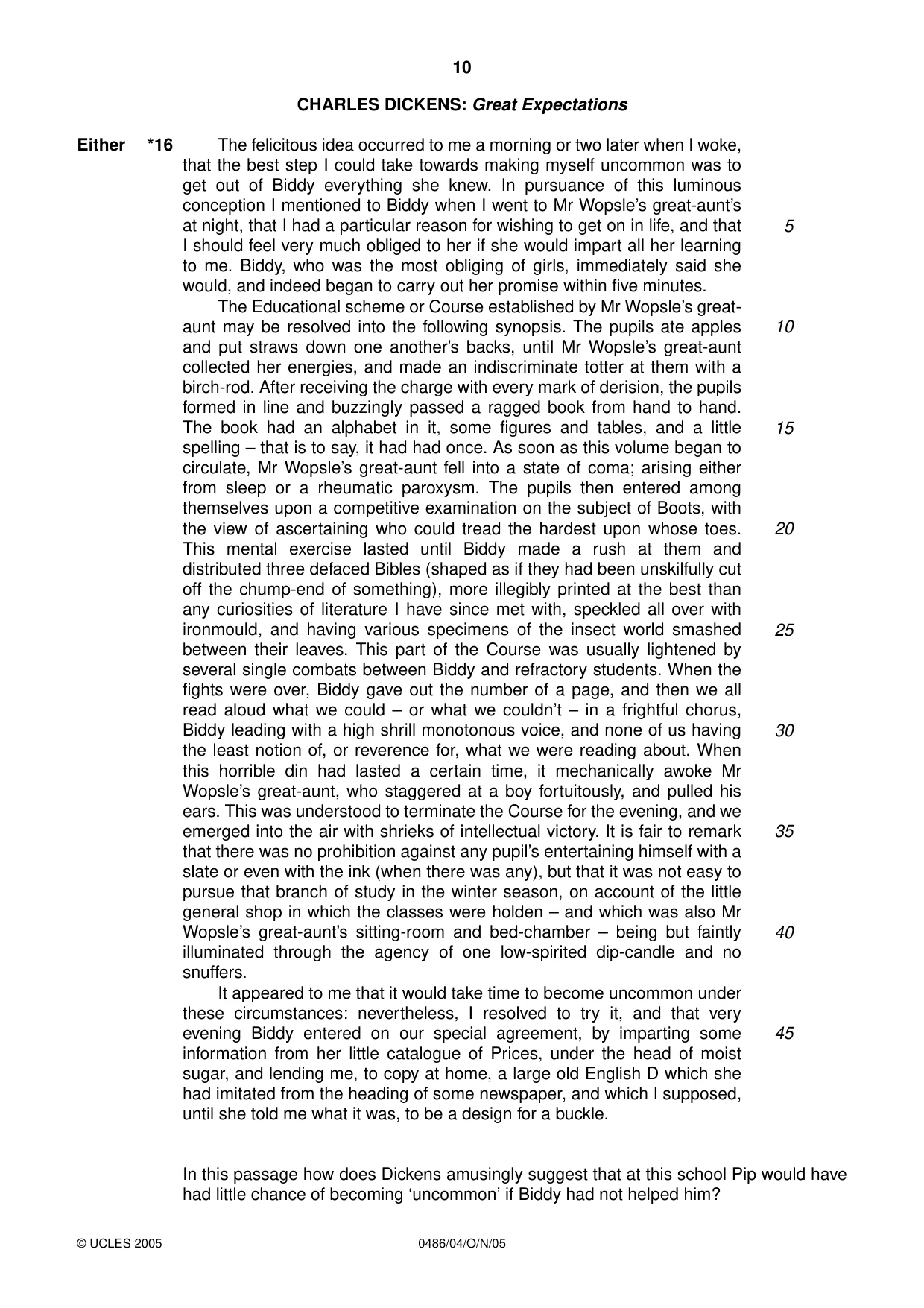
10 0486/04/O/N/05 © UCLES 2005 CHARLES DICKENS: Great Expectations Either *16 The felicitous idea occurred to me a morning or two later when I woke, that the best step I could take towards making myself uncommon was to get out of Biddy everything she knew. In pursuance of this luminous conception I mentioned to Biddy when I went to Mr Wopsle’s great-aunt’s at night, that I had a particular reason for wishing to get on in life, and that I should feel very much obliged to her if she would impart all her learning to me. Biddy, who was the most obliging of girls, immediately said she would, and indeed began to carry out her promise within five minutes. The Educational scheme or Course established by Mr Wopsle’s great- aunt may be resolved into the following synopsis. The pupils ate apples and put straws down one another’s backs, until Mr Wopsle’s great-aunt collected her energies, and made an indiscriminate totter at them with a birch-rod. After receiving the charge with every mark of derision, the pupils formed in line and buzzingly passed a ragged book from hand to hand. The book had an alphabet in it, some figures and tables, and a little spelling – that is to say, it had had once. As soon as this volume began to circulate, Mr Wopsle’s great-aunt fell into a state of coma; arising either from sleep or a rheumatic paroxysm. The pupils then entered among themselves upon a competitive examination on the subject of Boots, with the view of ascertaining who could tread the hardest upon whose toes. This mental exercise lasted until Biddy made a rush at them and distributed three defaced Bibles (shaped as if they had been unskilfully cut off the chump-end of something), more illegibly printed at the best than any curiosities of literature I have since met with, speckled all over with ironmould, and having various specimens of the insect world smashed between their leaves. This part of the Course was usually lightened by several single combats between Biddy and refractory students. When the fights were over, Biddy gave out the number of a page, and then we all read aloud what we could – or what we couldn’t – in a frightful chorus, Biddy leading with a high shrill monotonous voice, and none of us having the least notion of, or reverence for, what we were reading about. When this horrible din had lasted a certain time, it mechanically awoke Mr Wopsle’s great-aunt, who staggered at a boy fortuitously, and pulled his ears. This was understood to terminate the Course for the evening, and we emerged into the air with shrieks of intellectual victory. It is fair to remark that there was no prohibition against any pupil’s entertaining himself with a slate or even with the ink (when there was any), but that it was not easy to pursue that branch of study in the winter season, on account of the little general shop in which the classes were holden – and which was also Mr Wopsle’s great-aunt’s sitting-room and bed-chamber – being but faintly illuminated through the agency of one low-spirited dip-candle and no snuffers. It appeared to me that it would take time to become uncommon under these circumstances: nevertheless, I resolved to try it, and that very evening Biddy entered on our special agreement, by imparting some information from her little catalogue of Prices, under the head of moist sugar, and lending me, to copy at home, a large old English D which she had imitated from the heading of some newspaper, and which I supposed, until she told me what it was, to be a design for a buckle. In this passage how does Dickens amusingly suggest that at this school Pip would have had little chance of becoming ‘uncommon’ if Biddy had not helped him? 5 10 15 20 25 30 35 40 45
Question paper, page 11
11 0486/04/O/N/05 [Turn over Or 17 Do you think you are encouraged by Dickens to pity or to despise Pip after he becomes a gentleman? Support your ideas with detail from the writing. Or 18 You are Magwitch returning from Australia, the day before you land in England. Write your thoughts. © UCLES 2005
Question paper, page 12
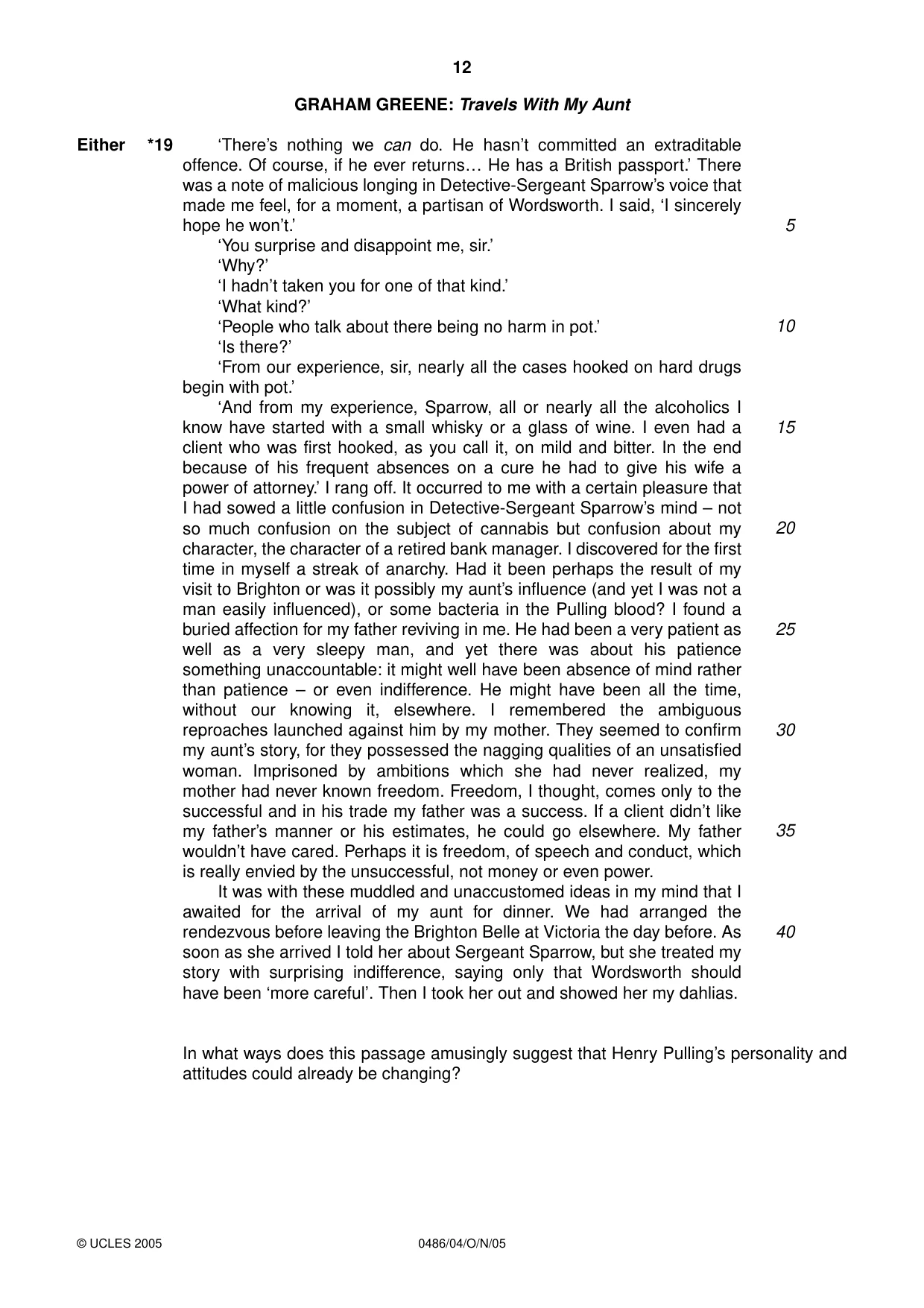
12 0486/04/O/N/05 GRAHAM GREENE: Travels With My Aunt Either *19 ‘There’s nothing we can do. He hasn’t committed an extraditable offence. Of course, if he ever returns… He has a British passport.’ There was a note of malicious longing in Detective-Sergeant Sparrow’s voice that made me feel, for a moment, a partisan of Wordsworth. I said, ‘I sincerely hope he won’t.’ ‘You surprise and disappoint me, sir.’ ‘Why?’ ‘I hadn’t taken you for one of that kind.’ ‘What kind?’ ‘People who talk about there being no harm in pot.’ ‘Is there?’ ‘From our experience, sir, nearly all the cases hooked on hard drugs begin with pot.’ ‘And from my experience, Sparrow, all or nearly all the alcoholics I know have started with a small whisky or a glass of wine. I even had a client who was first hooked, as you call it, on mild and bitter. In the end because of his frequent absences on a cure he had to give his wife a power of attorney.’ I rang off. It occurred to me with a certain pleasure that I had sowed a little confusion in Detective-Sergeant Sparrow’s mind – not so much confusion on the subject of cannabis but confusion about my character, the character of a retired bank manager. I discovered for the first time in myself a streak of anarchy. Had it been perhaps the result of my visit to Brighton or was it possibly my aunt’s influence (and yet I was not a man easily influenced), or some bacteria in the Pulling blood? I found a buried affection for my father reviving in me. He had been a very patient as well as a very sleepy man, and yet there was about his patience something unaccountable: it might well have been absence of mind rather than patience – or even indifference. He might have been all the time, without our knowing it, elsewhere. I remembered the ambiguous reproaches launched against him by my mother. They seemed to confirm my aunt’s story, for they possessed the nagging qualities of an unsatisfied woman. Imprisoned by ambitions which she had never realized, my mother had never known freedom. Freedom, I thought, comes only to the successful and in his trade my father was a success. If a client didn’t like my father’s manner or his estimates, he could go elsewhere. My father wouldn’t have cared. Perhaps it is freedom, of speech and conduct, which is really envied by the unsuccessful, not money or even power. It was with these muddled and unaccustomed ideas in my mind that I awaited for the arrival of my aunt for dinner. We had arranged the rendezvous before leaving the Brighton Belle at Victoria the day before. As soon as she arrived I told her about Sergeant Sparrow, but she treated my story with surprising indifference, saying only that Wordsworth should have been ‘more careful’. Then I took her out and showed her my dahlias. In what ways does this passage amusingly suggest that Henry Pulling’s personality and attitudes could already be changing? © UCLES 2005 5 10 15 20 25 30 35 40
Question paper, page 13
13 0486/04/O/N/05 [Turn over Or 20 What do you think makes Aunt Augusta so memorable a personality? Support your ideas with detail from Greene’s writing. Or 21 You are Wordsworth in Paris just after Henry Pulling has driven away in a taxi, leaving you on the pavement. Write your thoughts. © UCLES 2005
Question paper, page 14
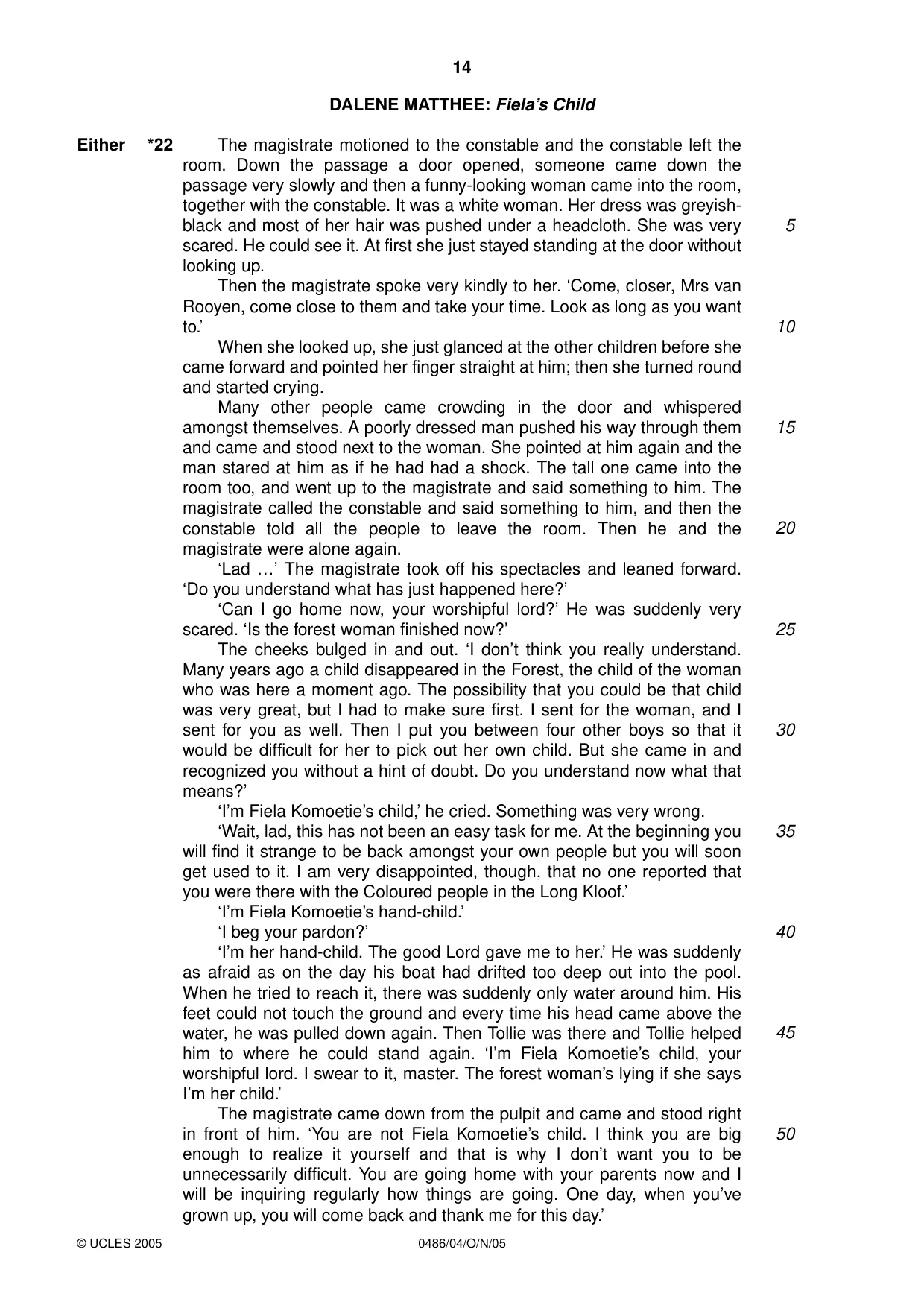
14 0486/04/O/N/05 © UCLES 2005 DALENE MATTHEE: Fiela’s Child Either *22 The magistrate motioned to the constable and the constable left the room. Down the passage a door opened, someone came down the passage very slowly and then a funny-looking woman came into the room, together with the constable. It was a white woman. Her dress was greyish- black and most of her hair was pushed under a headcloth. She was very scared. He could see it. At first she just stayed standing at the door without looking up. Then the magistrate spoke very kindly to her. ‘Come, closer, Mrs van Rooyen, come close to them and take your time. Look as long as you want to.’ When she looked up, she just glanced at the other children before she came forward and pointed her finger straight at him; then she turned round and started crying. Many other people came crowding in the door and whispered amongst themselves. A poorly dressed man pushed his way through them and came and stood next to the woman. She pointed at him again and the man stared at him as if he had had a shock. The tall one came into the room too, and went up to the magistrate and said something to him. The magistrate called the constable and said something to him, and then the constable told all the people to leave the room. Then he and the magistrate were alone again. ‘Lad …’ The magistrate took off his spectacles and leaned forward. ‘Do you understand what has just happened here?’ ‘Can I go home now, your worshipful lord?’ He was suddenly very scared. ‘Is the forest woman finished now?’ The cheeks bulged in and out. ‘I don’t think you really understand. Many years ago a child disappeared in the Forest, the child of the woman who was here a moment ago. The possibility that you could be that child was very great, but I had to make sure first. I sent for the woman, and I sent for you as well. Then I put you between four other boys so that it would be difficult for her to pick out her own child. But she came in and recognized you without a hint of doubt. Do you understand now what that means?’ ‘I’m Fiela Komoetie’s child,’ he cried. Something was very wrong. ‘Wait, lad, this has not been an easy task for me. At the beginning you will find it strange to be back amongst your own people but you will soon get used to it. I am very disappointed, though, that no one reported that you were there with the Coloured people in the Long Kloof.’ ‘I’m Fiela Komoetie’s hand-child.’ ‘I beg your pardon?’ ‘I’m her hand-child. The good Lord gave me to her.’ He was suddenly as afraid as on the day his boat had drifted too deep out into the pool. When he tried to reach it, there was suddenly only water around him. His feet could not touch the ground and every time his head came above the water, he was pulled down again. Then Tollie was there and Tollie helped him to where he could stand again. ‘I’m Fiela Komoetie’s child, your worshipful lord. I swear to it, master. The forest woman’s lying if she says I’m her child.’ The magistrate came down from the pulpit and came and stood right in front of him. ‘You are not Fiela Komoetie’s child. I think you are big enough to realize it yourself and that is why I don’t want you to be unnecessarily difficult. You are going home with your parents now and I will be inquiring regularly how things are going. One day, when you’ve grown up, you will come back and thank me for this day.’ 5 10 15 20 25 30 35 40 45 50
Question paper, page 15
15 0486/04/O/N/05 [Turn over ‘I’m Fiela Komoetie’s child, master, we’re not penniless people, I swear. I have five shillings to prove it.’ He was saying everything round the wrong way because he had to hurry for the magistrate was already on his way to the door. ‘Please, master!’ ‘I never want to hear you use the word master again! You’re a white child and you will learn to speak like a white child.’ ‘Please, your worshipful lord, I’m Fiela Komoetie’s child and Selling Komoetie is my father!’ But the magistrate did not believe him. What do you think makes this such a powerful moment in the novel? Support your ideas with detail from the words of the passage. Or 23 Matthee creates sympathy even for those characters who do not seem to deserve it. Explore two instances in the novel where you think this is particularly true, bringing out how the writing makes you sympathetic. Or 24 You are Nina at Miss Weatherbury’s on the evening after you have told Lukas you are not going back to the Forest. Write your thoughts. © UCLES 2005 55 60
Question paper, page 16
16 0486/04/O/N/05 © UCLES 2005 HENRY HANDEL RICHARDSON: The Getting Of Wisdom Either *25 This discovery thrilled Laura – just as, at the play, the fact of one spectator being moved to tears intensifies his neighbour’s enjoyment. – But when Mr Strachey left the field of personal narration and went on to the moral aspects of the affair, Laura ceased to be gripped by him, and turned anew to study the pale, dogged face of the accused, though she had to crane her neck to do it. Before such a stony mask as this, she was driven to imagine what must be going on behind it; and, while thus engrossed, she felt her arm angrily tweaked. It was Tilly. ‘You are a beast to stare like that!’ ‘I’m not staring.’ She turned her eyes away at once, more than half believing her own words; and then, for some seconds, she tried to do what was expected of her: to feel a decent unconcern. At her back, Bertha’s purry crying went steadily on. What on earth did she cry for? She had certainly not heard a word Mr Strachey said. Laura fidgeted in her seat, and stole a sideglance at Tilly’s profile. She could not, really could not miss the last scene of all, when, in masterly fashion, the Principal was gathering the threads together. And so, feeling rather like ‘Peeping Tom’, she cautiously raised her eyes again, and this time managed to use them without turning her head. All other eyes were still charitably lowered. Several girls were crying now, but without a sound. And, as the last, awful moments drew near, even Bertha was hushed, and of all the odd hundreds of throats not one dared to cough. Laura’s heart began to palpitate, for she felt the approach of the final climax, Mr Strachey’s periods growing ever slower and more massive. When, after a burst of eloquence which, the child felt, would not have shamed a Bishop, the Principal drew himself up to his full height, and, with uplifted arm, thundered forth: ‘Herewith, Miss Annie Johns, I publicly expel you from the school! Leave it, now, this moment, and never darken its doors again!’ – when this happened, Laura was shot through by an ecstatic quiver, such as she had felt once only in her life before; and that was when a beautiful, golden-haired Hamlet, who had held a Ballarat theatre entranced for a whole evening, fell dead by Laertes’ sword, to the rousing plaudits of the house. Breathing unevenly, she watched, lynx-eyed, every inch of Annie Johns’ progress: watched her pick up her books, edge out of her seat and sidle through the rows of desks; watched her walk to the door with short, jerky movements, mount the two steps that led to it, fumble with the handle, turn it, and vanish from sight; and when it was all over, and there was nothing more to see, she fell back in her seat with an audible sigh. How does the writing here make the incident so dramatic? Or 26 Do you think Evelyn is a good influence on Laura? Support your ideas with detail from the writing. Or 27 You are Laura at the end of your first year at Melbourne Ladies’ College, thinking about your experiences over the year. Write your thoughts. 5 10 15 20 25 30 35 40
Question paper, page 17
17 0486/04/O/N/05 [Turn over BLANK PAGE Turn to page 18 for question 28
Question paper, page 18
18 0486/04/O/N/05 AMY TAN: The Bonesetter’s Daughter Either *28 And what about LuLing’s other hiding spots? At the never used fireplace, Ruth lifted a basket containing photo albums. She pried at a loose brick, pulled it out, and – sure enough – it was still there, a twenty- dollar bill wrapped around four singles. Unbelievable! She felt giddy at finding this small treasure, a memento from her adolescent past. When they moved into this place, LuLing had put five twenty-dollar bills under the brick. Ruth would check every now and then, always noting that the bills lay in the same perfectly aligned wad. One day she put a piece of her hair on top of the money; she had seen this trick in a movie about a boy detective. Every time she looked after that, the hair was still there. When Ruth was fifteen, she began to borrow from the stash during times of her own emergencies – when she needed a dollar here and there for forbidden things: mascara, a movie ticket, and later, Marlboro cigarettes. At first she was always anxious until she could replace the bill. And when she did, she felt relieved and elated that she had not been caught. She rationalized that she deserved the money – for mowing the lawn, washing the dishes, being yelled at for no good reason. She replaced the missing twenties with tens, then fives, and eventually, just the singles wrapped with the one remaining twenty. And now, thirty-one years afterward, in seeing the reminder of her small larceny, she was both the girl she once was and the observer of that younger version of herself. She remembered the unhappy girl who lived in her body, who was full of passion, rage, and sudden impulses. She used to wonder: Should she believe in God or be a nihilist? Be Buddhist or a beatnik? And whichever it should be, what was the lesson in her mother’s being miserable all the time? Were there really ghosts? If not, did that mean her mother was really crazy? Was there really such a thing as luck? If not, why did Ruth’s cousins live in Saratoga? At times, she became resolute in wanting to be exactly the opposite of her mother. Rather than complain about the world, she wanted to do something constructive. She would join the Peace Corps and go into remote jungles. Another day, she chose to become a veterinarian and help injured animals. Still later, she thought about becoming a teacher to kids who were retarded. She wouldn’t point out what was wrong, as her mother did with her, exclaiming that half her brain must be missing. She would treat them as living souls equal to everyone else. She gave vent to these feelings by writing them down in a diary that Auntie Gal had given her for Christmas. She had just finished reading The Diary of Anne Frank in sophomore English class, and like all the other girls, she was imbued with a sense that she too was different, an innocent on a path to tragedy that would make her posthumously admired. The diary would be proof of her existence, that she mattered, and more important, that someone somewhere would one day understand her, even if it was not in her lifetime. There was a tremendous comfort in believing her miseries weren’t for naught. In her diary, she could be as truthful as she wanted to be. What insights does this passage give you into the character of Ruth and into her attitudes to her mother over the years? © UCLES 2005 5 10 15 20 25 30 35 40 45
Question paper, page 19
19 0486/04/O/N/05 [Turn over Or 29 Which one incident in the novel has most impressed you by vividly conveying a sense of what it would have been like to live in China when LuLing was young? Support your answer by close reference to your chosen incident. Or 30 You are Auntie Gal, just after your conversation with Ruth at your seventy-seventh (or eighty-second) birthday party and after LuLing has fallen in the pool. Write your thoughts. © UCLES 2005
Question paper, page 20
20 0486/04/O/N/05 DRAMA ALAN AYCKBOURN: Absent Friends Either *31 Evelyn: [furious] You’ve woken him up now. John: I didn’t wake him up. Paul: I mean, seriously, how can a man live with a woman like that? Marge: Jumjums, how did you get it on your trousers … well, look, take them off, dear. Take the bottoms off. John: Where are you going? Evelyn: [starting to push the pram out] I’m taking him home. John: Oh, Evelyn … Paul: I mean, am I unreasonable? Marge: There’s some more in the bottom drawer. The stripy ones. John: [calling after her] Evelyn. Marge: Yes, well, you will be sticky. You’ll have to wash. [Doorbell.] Diana: How can you stand there looking so damned innocent … Paul: Listen, if you could tell me what I’m being accused of, I could perhaps answer you. [Doorbell.] John: I think that’s the doorbell. Marge: Now, keep warm, Jumjums, keep warm … [Evelyn re-enters with the pram, baby still crying.] John: What are you doing? Evelyn: I can’t get out that way. There’s somebody at the front door. Diana: Get out of my house. Evelyn: I’m trying to. Marge: Bye bye, darling. John: It’ll be Colin. Marge: Bye. Paul: Colin? Evelyn: I’m taking Wayne in the garden. Marge: Bye. [She hangs up.] John: Don’t go home, Evelyn. Paul: Now listen, Di, Marge … Evelyn: [as she goes out] I can’t, can I? [Evelyn goes out to the kitchen with the pram.] Marge: He has spilt cough mixture not only on the sheet, but on the pillow … [Doorbell.] Paul: Would you listen a minute? Marge: … his clean pyjama bottoms … Paul: Marge, please. Would you mind? Di, get a grip on yourself, Di. Diana: What? Paul: Colin is here now at the door. Diana: Oh no. [Diana runs out to the kitchen.] Paul: Di … Marge: Shall I let him in? Paul: Would you mind, Marge. You seem to be the calmest among us. Marge: I am not calm, believe me. That linctus will have gone through that undersheet straight into that mattress. [As she goes.] I don’t know how I’m going to get it out, I don’t. © UCLES 2005 5 10 15 20 25 30 35 40 45 50
Question paper, page 21
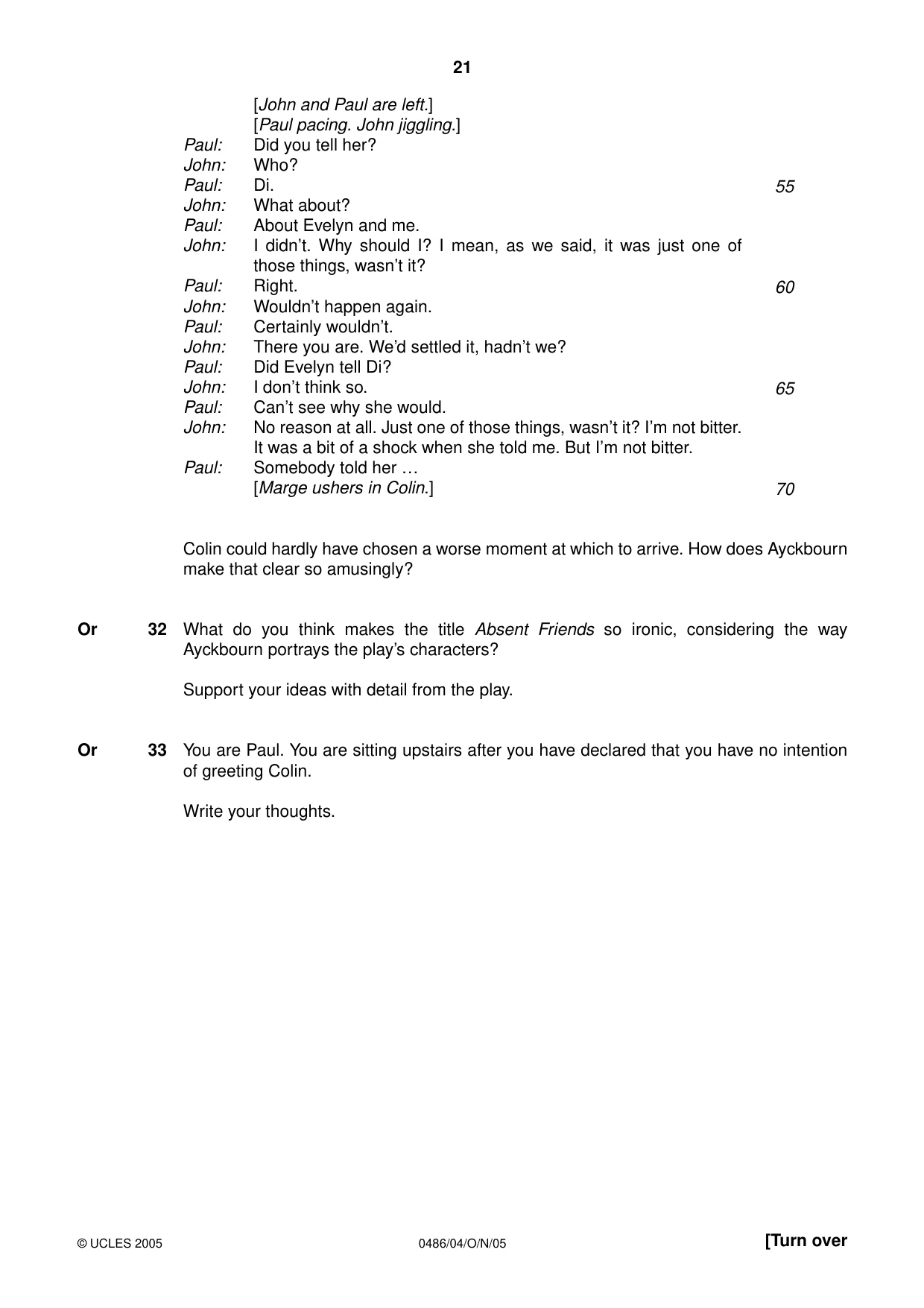
21 0486/04/O/N/05 [Turn over [John and Paul are left.] [Paul pacing. John jiggling.] Paul: Did you tell her? John: Who? Paul: Di. John: What about? Paul: About Evelyn and me. John: I didn’t. Why should I? I mean, as we said, it was just one of those things, wasn’t it? Paul: Right. John: Wouldn’t happen again. Paul: Certainly wouldn’t. John: There you are. We’d settled it, hadn’t we? Paul: Did Evelyn tell Di? John: I don’t think so. Paul: Can’t see why she would. John: No reason at all. Just one of those things, wasn’t it? I’m not bitter. It was a bit of a shock when she told me. But I’m not bitter. Paul: Somebody told her … [Marge ushers in Colin.] Colin could hardly have chosen a worse moment at which to arrive. How does Ayckbourn make that clear so amusingly? Or 32 What do you think makes the title Absent Friends so ironic, considering the way Ayckbourn portrays the play’s characters? Support your ideas with detail from the play. Or 33 You are Paul. You are sitting upstairs after you have declared that you have no intention of greeting Colin. Write your thoughts. © UCLES 2005 55 60 65 70
Question paper, page 22
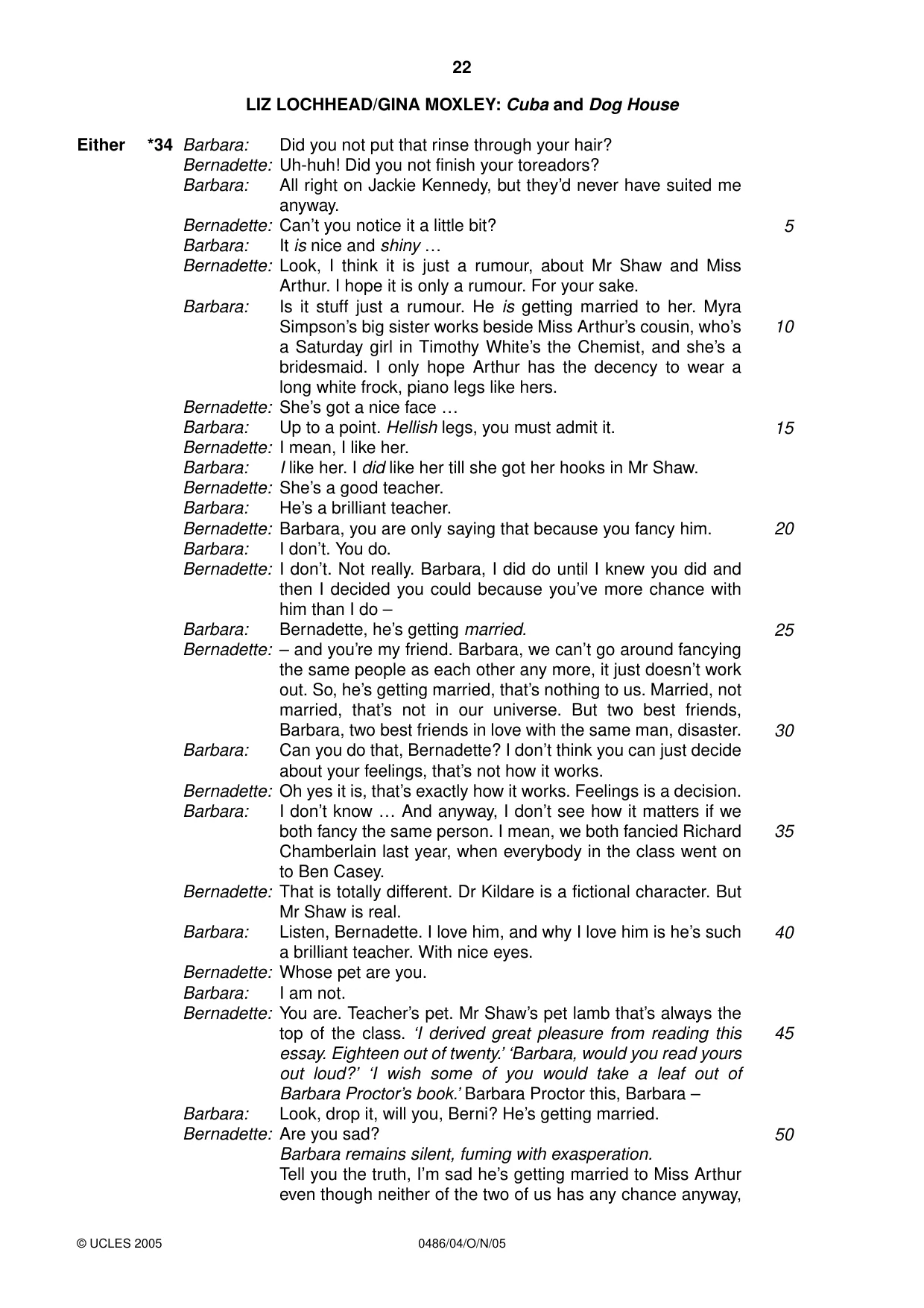
22 0486/04/O/N/05 © UCLES 2005 LIZ LOCHHEAD/GINA MOXLEY: Cuba and Dog House Either *34 Barbara: Did you not put that rinse through your hair? Bernadette: Uh-huh! Did you not finish your toreadors? Barbara: All right on Jackie Kennedy, but they’d never have suited me anyway. Bernadette: Can’t you notice it a little bit? Barbara: It is nice and shiny … Bernadette: Look, I think it is just a rumour, about Mr Shaw and Miss Arthur. I hope it is only a rumour. For your sake. Barbara: Is it stuff just a rumour. He is getting married to her. Myra Simpson’s big sister works beside Miss Arthur’s cousin, who’s a Saturday girl in Timothy White’s the Chemist, and she’s a bridesmaid. I only hope Arthur has the decency to wear a long white frock, piano legs like hers. Bernadette: She’s got a nice face … Barbara: Up to a point. Hellish legs, you must admit it. Bernadette: I mean, I like her. Barbara: I like her. I did like her till she got her hooks in Mr Shaw. Bernadette: She’s a good teacher. Barbara: He’s a brilliant teacher. Bernadette: Barbara, you are only saying that because you fancy him. Barbara: I don’t. You do. Bernadette: I don’t. Not really. Barbara, I did do until I knew you did and then I decided you could because you’ve more chance with him than I do – Barbara: Bernadette, he’s getting married. Bernadette: – and you’re my friend. Barbara, we can’t go around fancying the same people as each other any more, it just doesn’t work out. So, he’s getting married, that’s nothing to us. Married, not married, that’s not in our universe. But two best friends, Barbara, two best friends in love with the same man, disaster. Barbara: Can you do that, Bernadette? I don’t think you can just decide about your feelings, that’s not how it works. Bernadette: Oh yes it is, that’s exactly how it works. Feelings is a decision. Barbara: I don’t know … And anyway, I don’t see how it matters if we both fancy the same person. I mean, we both fancied Richard Chamberlain last year, when everybody in the class went on to Ben Casey. Bernadette: That is totally different. Dr Kildare is a fictional character. But Mr Shaw is real. Barbara: Listen, Bernadette. I love him, and why I love him is he’s such a brilliant teacher. With nice eyes. Bernadette: Whose pet are you. Barbara: I am not. Bernadette: You are. Teacher’s pet. Mr Shaw’s pet lamb that’s always the top of the class. ‘I derived great pleasure from reading this essay. Eighteen out of twenty.’ ‘Barbara, would you read yours out loud?’ ‘I wish some of you would take a leaf out of Barbara Proctor’s book.’ Barbara Proctor this, Barbara – Barbara: Look, drop it, will you, Berni? He’s getting married. Bernadette: Are you sad? Barbara remains silent, fuming with exasperation. Tell you the truth, I’m sad he’s getting married to Miss Arthur even though neither of the two of us has any chance anyway, 5 10 15 20 25 30 35 40 45 50
Question paper, page 23
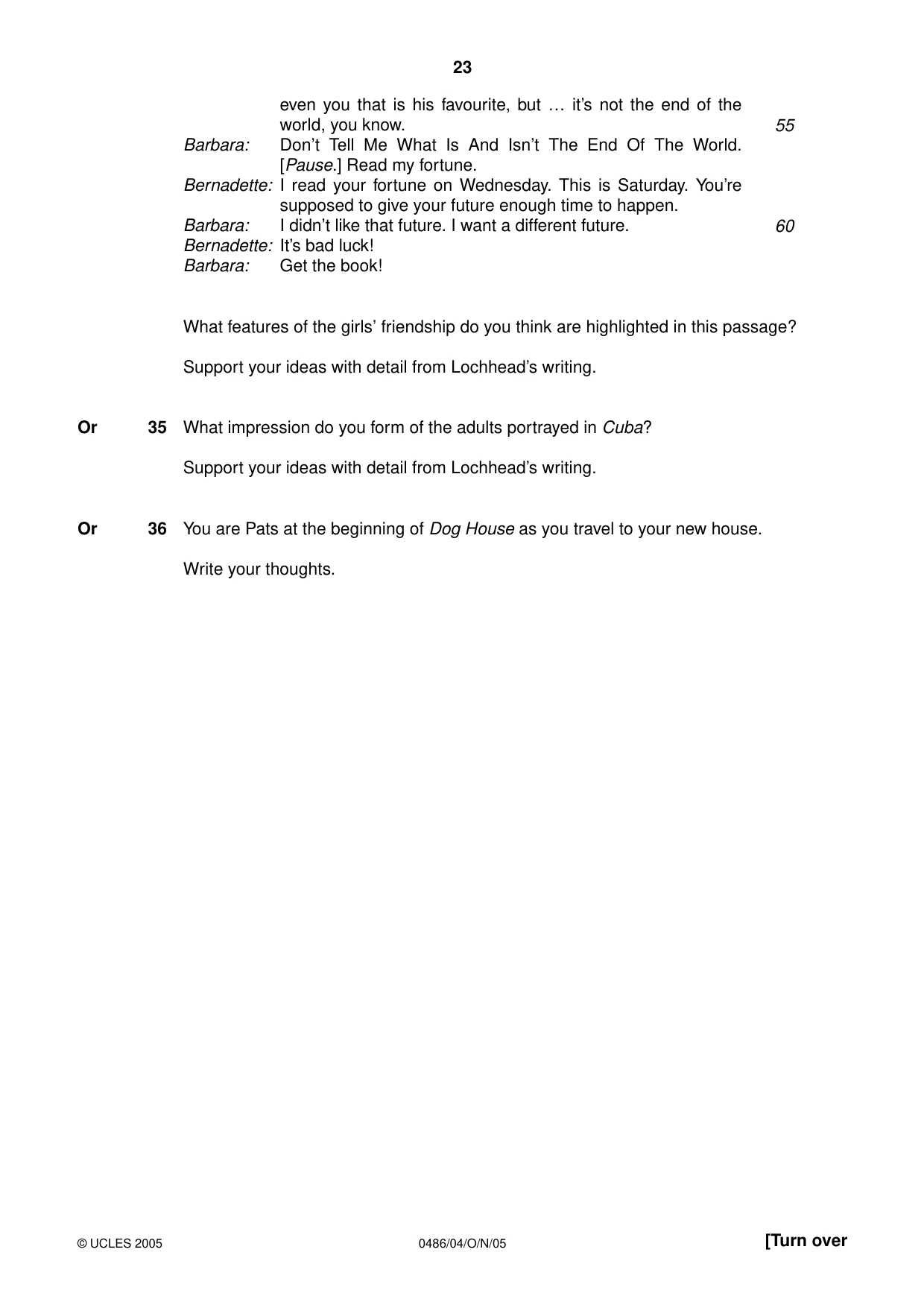
23 0486/04/O/N/05 [Turn over even you that is his favourite, but … it’s not the end of the world, you know. Barbara: Don’t Tell Me What Is And Isn’t The End Of The World. [Pause.] Read my fortune. Bernadette: I read your fortune on Wednesday. This is Saturday. You’re supposed to give your future enough time to happen. Barbara: I didn’t like that future. I want a different future. Bernadette: It’s bad luck! Barbara: Get the book! What features of the girls’ friendship do you think are highlighted in this passage? Support your ideas with detail from Lochhead’s writing. Or 35 What impression do you form of the adults portrayed in Cuba? Support your ideas with detail from Lochhead’s writing. Or 36 You are Pats at the beginning of Dog House as you travel to your new house. Write your thoughts. © UCLES 2005 55 60
Question paper, page 24
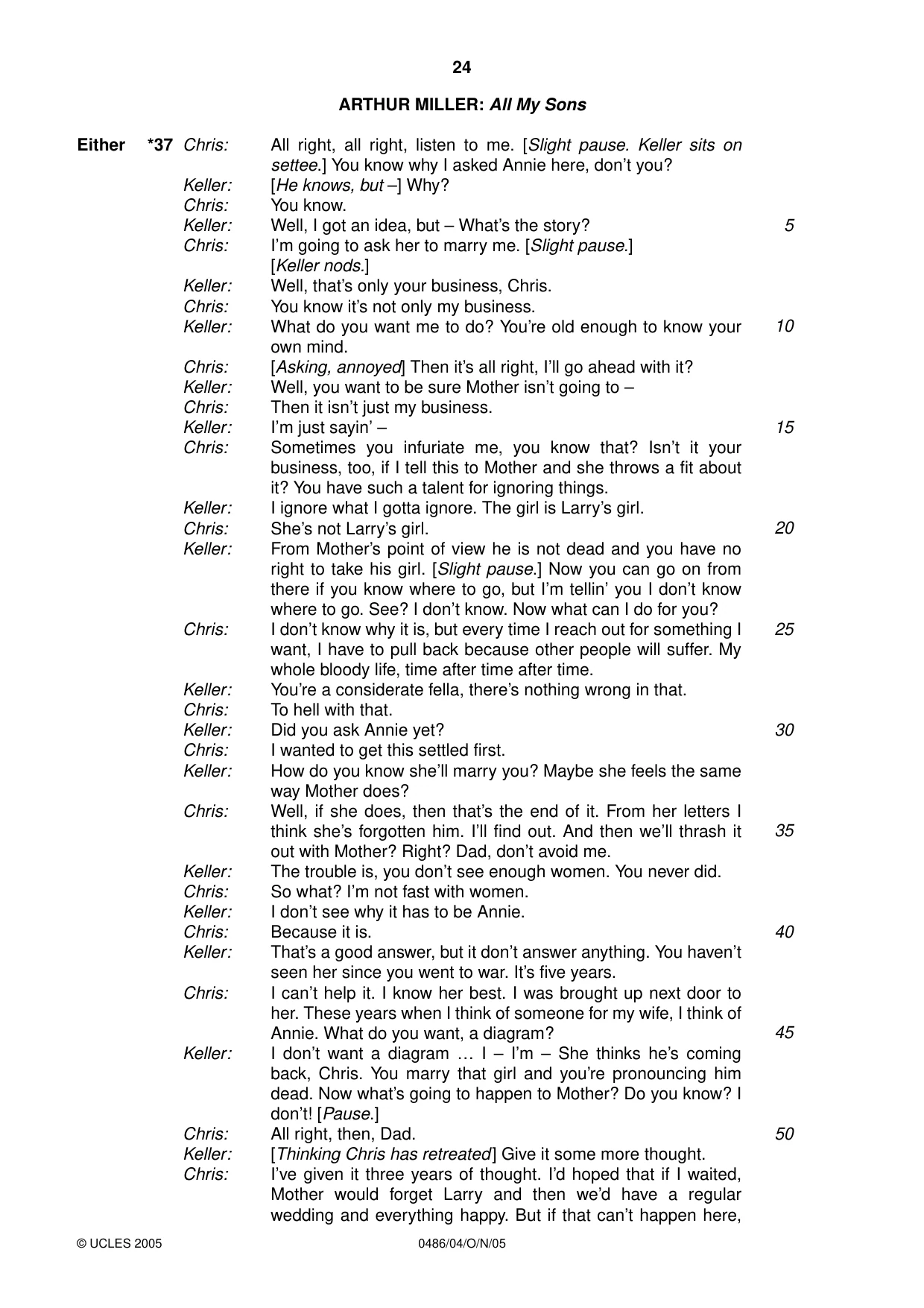
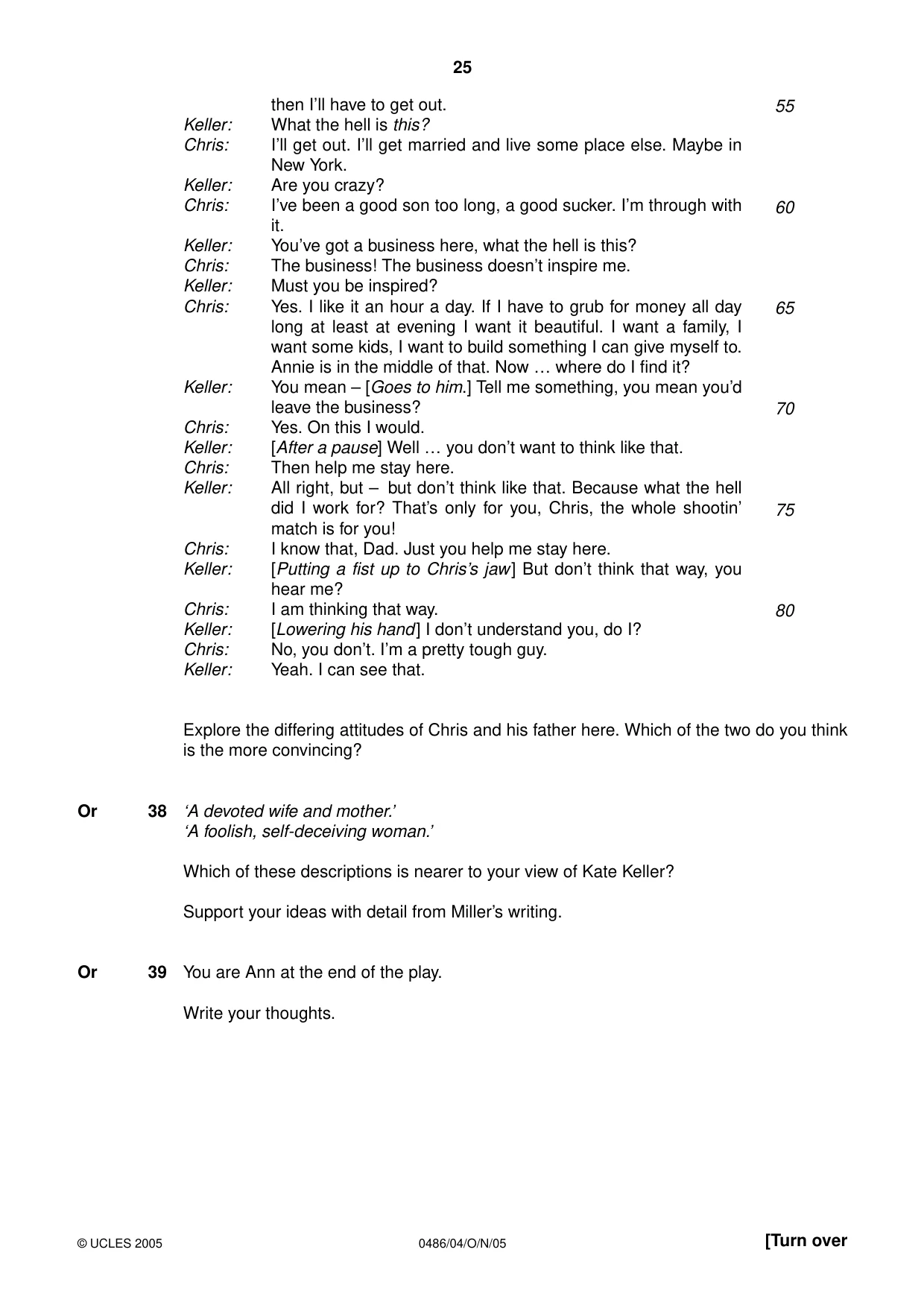
24 0486/04/O/N/05 ARTHUR MILLER: All My Sons Either *37 Chris: All right, all right, listen to me. [Slight pause. Keller sits on settee.] You know why I asked Annie here, don’t you? Keller: [He knows, but –] Why? Chris: You know. Keller: Well, I got an idea, but – What’s the story? Chris: I’m going to ask her to marry me. [Slight pause.] [Keller nods.] Keller: Well, that’s only your business, Chris. Chris: You know it’s not only my business. Keller: What do you want me to do? You’re old enough to know your own mind. Chris: [Asking, annoyed] Then it’s all right, I’ll go ahead with it? Keller: Well, you want to be sure Mother isn’t going to – Chris: Then it isn’t just my business. Keller: I’m just sayin’ – Chris: Sometimes you infuriate me, you know that? Isn’t it your business, too, if I tell this to Mother and she throws a fit about it? You have such a talent for ignoring things. Keller: I ignore what I gotta ignore. The girl is Larry’s girl. Chris: She’s not Larry’s girl. Keller: From Mother’s point of view he is not dead and you have no right to take his girl. [Slight pause.] Now you can go on from there if you know where to go, but I’m tellin’ you I don’t know where to go. See? I don’t know. Now what can I do for you? Chris: I don’t know why it is, but every time I reach out for something I want, I have to pull back because other people will suffer. My whole bloody life, time after time after time. Keller: You’re a considerate fella, there’s nothing wrong in that. Chris: To hell with that. Keller: Did you ask Annie yet? Chris: I wanted to get this settled first. Keller: How do you know she’ll marry you? Maybe she feels the same way Mother does? Chris: Well, if she does, then that’s the end of it. From her letters I think she’s forgotten him. I’ll find out. And then we’ll thrash it out with Mother? Right? Dad, don’t avoid me. Keller: The trouble is, you don’t see enough women. You never did. Chris: So what? I’m not fast with women. Keller: I don’t see why it has to be Annie. Chris: Because it is. Keller: That’s a good answer, but it don’t answer anything. You haven’t seen her since you went to war. It’s five years. Chris: I can’t help it. I know her best. I was brought up next door to her. These years when I think of someone for my wife, I think of Annie. What do you want, a diagram? Keller: I don’t want a diagram … I – I’m – She thinks he’s coming back, Chris. You marry that girl and you’re pronouncing him dead. Now what’s going to happen to Mother? Do you know? I don’t! [Pause.] Chris: All right, then, Dad. Keller: [Thinking Chris has retreated] Give it some more thought. Chris: I’ve given it three years of thought. I’d hoped that if I waited, Mother would forget Larry and then we’d have a regular wedding and everything happy. But if that can’t happen here, © UCLES 2005 5 10 15 20 25 30 35 40 45 50
Question paper, page 25
25 0486/04/O/N/05 [Turn over then I’ll have to get out. Keller: What the hell is this? Chris: I’ll get out. I’ll get married and live some place else. Maybe in New York. Keller: Are you crazy? Chris: I’ve been a good son too long, a good sucker. I’m through with it. Keller: You’ve got a business here, what the hell is this? Chris: The business! The business doesn’t inspire me. Keller: Must you be inspired? Chris: Yes. I like it an hour a day. If I have to grub for money all day long at least at evening I want it beautiful. I want a family, I want some kids, I want to build something I can give myself to. Annie is in the middle of that. Now … where do I find it? Keller: You mean – [Goes to him.] Tell me something, you mean you’d leave the business? Chris: Yes. On this I would. Keller: [After a pause] Well … you don’t want to think like that. Chris: Then help me stay here. Keller: All right, but – but don’t think like that. Because what the hell did I work for? That’s only for you, Chris, the whole shootin’ match is for you! Chris: I know that, Dad. Just you help me stay here. Keller: [Putting a fist up to Chris’s jaw] But don’t think that way, you hear me? Chris: I am thinking that way. Keller: [Lowering his hand] I don’t understand you, do I? Chris: No, you don’t. I’m a pretty tough guy. Keller: Yeah. I can see that. Explore the differing attitudes of Chris and his father here. Which of the two do you think is the more convincing? Or 38 ‘A devoted wife and mother.’ ‘A foolish, self-deceiving woman.’ Which of these descriptions is nearer to your view of Kate Keller? Support your ideas with detail from Miller’s writing. Or 39 You are Ann at the end of the play. Write your thoughts. © UCLES 2005 55 60 65 70 75 80
Question paper, page 26
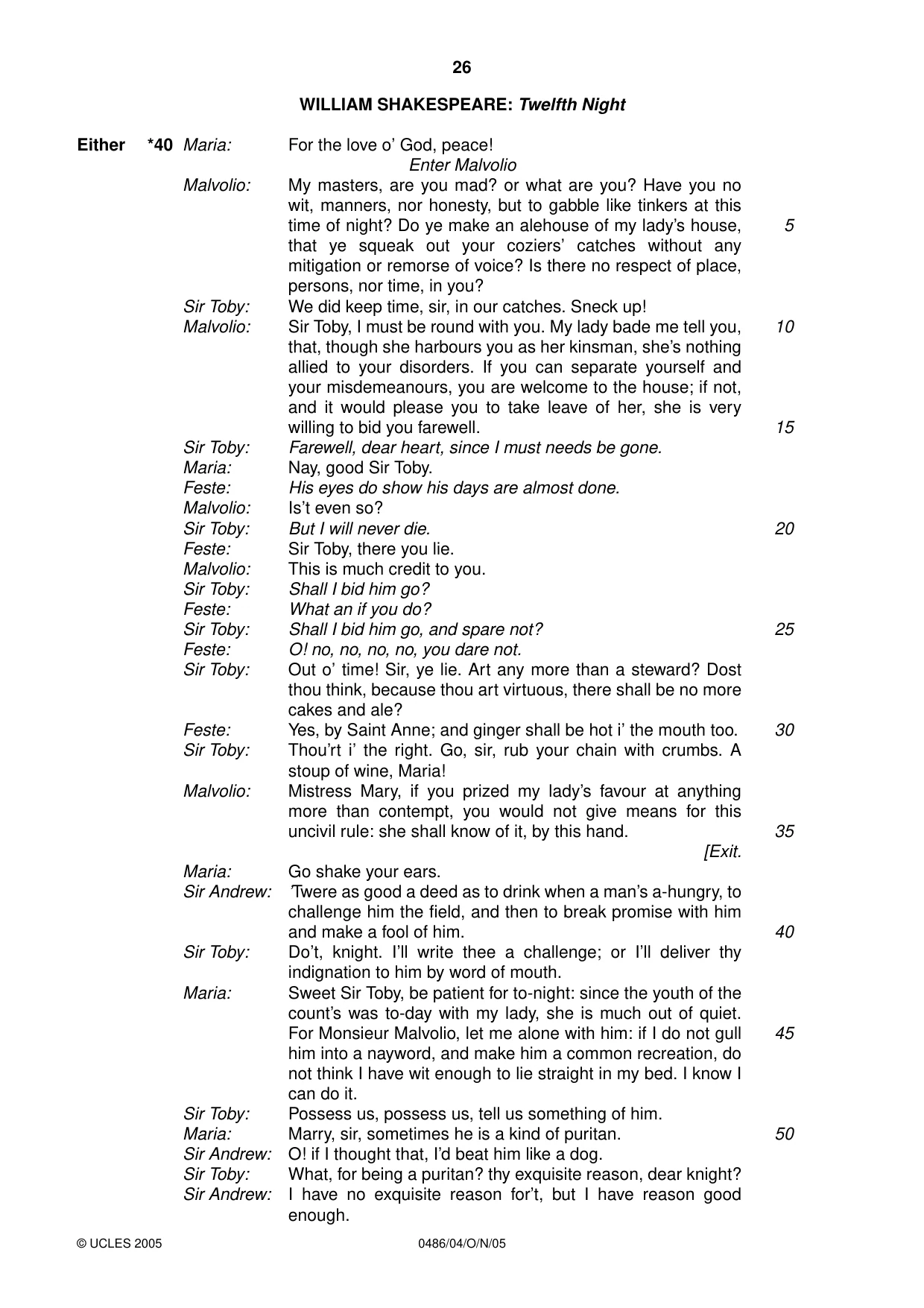
26 0486/04/O/N/05 © UCLES 2005 WILLIAM SHAKESPEARE: Twelfth Night Either *40 Maria: For the love o’ God, peace! Enter Malvolio Malvolio: My masters, are you mad? or what are you? Have you no wit, manners, nor honesty, but to gabble like tinkers at this time of night? Do ye make an alehouse of my lady’s house, that ye squeak out your coziers’ catches without any mitigation or remorse of voice? Is there no respect of place, persons, nor time, in you? Sir Toby: We did keep time, sir, in our catches. Sneck up! Malvolio: Sir Toby, I must be round with you. My lady bade me tell you, that, though she harbours you as her kinsman, she’s nothing allied to your disorders. If you can separate yourself and your misdemeanours, you are welcome to the house; if not, and it would please you to take leave of her, she is very willing to bid you farewell. Sir Toby: Farewell, dear heart, since I must needs be gone. Maria: Nay, good Sir Toby. Feste: His eyes do show his days are almost done. Malvolio: Is’t even so? Sir Toby: But I will never die. Feste: Sir Toby, there you lie. Malvolio: This is much credit to you. Sir Toby: Shall I bid him go? Feste: What an if you do? Sir Toby: Shall I bid him go, and spare not? Feste: O! no, no, no, no, you dare not. Sir Toby: Out o’ time! Sir, ye lie. Art any more than a steward? Dost thou think, because thou art virtuous, there shall be no more cakes and ale? Feste: Yes, by Saint Anne; and ginger shall be hot i’ the mouth too. Sir Toby: Thou’rt i’ the right. Go, sir, rub your chain with crumbs. A stoup of wine, Maria! Malvolio: Mistress Mary, if you prized my lady’s favour at anything more than contempt, you would not give means for this uncivil rule: she shall know of it, by this hand. [Exit. Maria: Go shake your ears. Sir Andrew: ’Twere as good a deed as to drink when a man’s a-hungry, to challenge him the field, and then to break promise with him and make a fool of him. Sir Toby: Do’t, knight. I’ll write thee a challenge; or I’ll deliver thy indignation to him by word of mouth. Maria: Sweet Sir Toby, be patient for to-night: since the youth of the count’s was to-day with my lady, she is much out of quiet. For Monsieur Malvolio, let me alone with him: if I do not gull him into a nayword, and make him a common recreation, do not think I have wit enough to lie straight in my bed. I know I can do it. Sir Toby: Possess us, possess us, tell us something of him. Maria: Marry, sir, sometimes he is a kind of puritan. Sir Andrew: O! if I thought that, I’d beat him like a dog. Sir Toby: What, for being a puritan? thy exquisite reason, dear knight? Sir Andrew: I have no exquisite reason for’t, but I have reason good enough. 5 10 15 20 25 30 35 40 45 50
Question paper, page 27
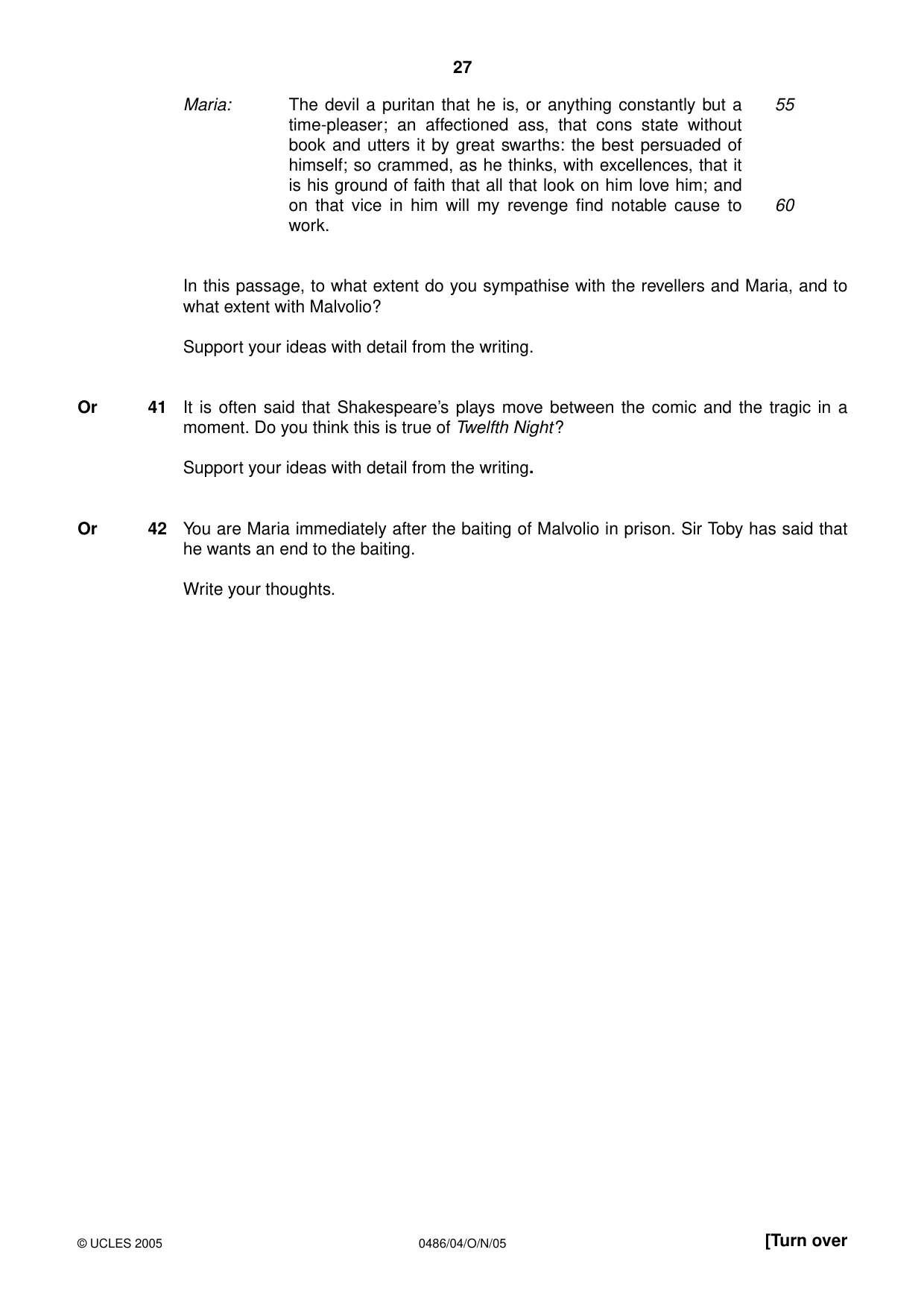
27 0486/04/O/N/05 [Turn over Maria: The devil a puritan that he is, or anything constantly but a time-pleaser; an affectioned ass, that cons state without book and utters it by great swarths: the best persuaded of himself; so crammed, as he thinks, with excellences, that it is his ground of faith that all that look on him love him; and on that vice in him will my revenge find notable cause to work. In this passage, to what extent do you sympathise with the revellers and Maria, and to what extent with Malvolio? Support your ideas with detail from the writing. Or 41 It is often said that Shakespeare’s plays move between the comic and the tragic in a moment. Do you think this is true of Twelfth Night? Support your ideas with detail from the writing. Or 42 You are Maria immediately after the baiting of Malvolio in prison. Sir Toby has said that he wants an end to the baiting. Write your thoughts. © UCLES 2005 55 60
Question paper, page 28
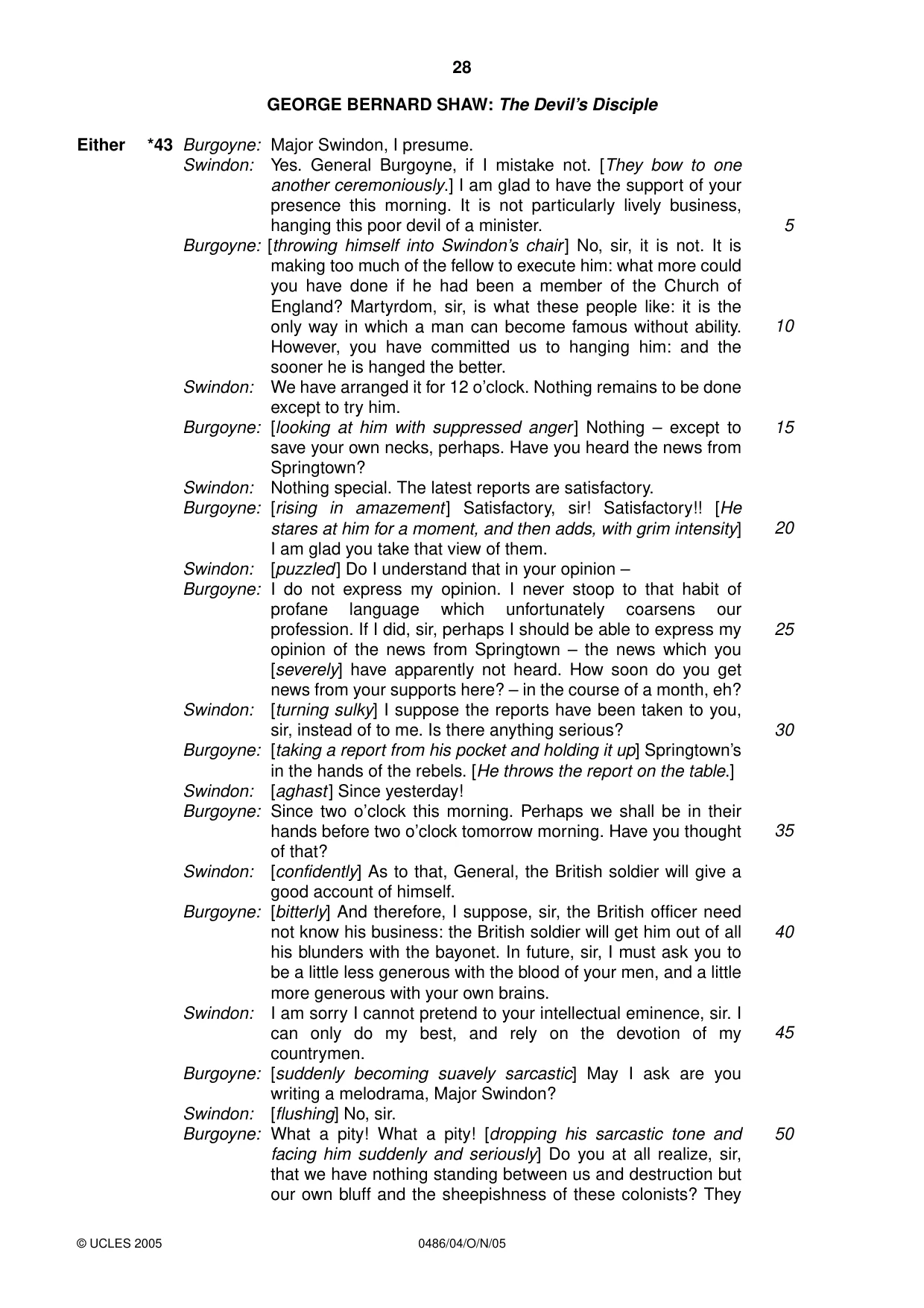
28 0486/04/O/N/05 © UCLES 2005 GEORGE BERNARD SHAW: The Devil’s Disciple Either *43 Burgoyne: Major Swindon, I presume. Swindon: Yes. General Burgoyne, if I mistake not. [They bow to one another ceremoniously.] I am glad to have the support of your presence this morning. It is not particularly lively business, hanging this poor devil of a minister. Burgoyne: [throwing himself into Swindon’s chair] No, sir, it is not. It is making too much of the fellow to execute him: what more could you have done if he had been a member of the Church of England? Martyrdom, sir, is what these people like: it is the only way in which a man can become famous without ability. However, you have committed us to hanging him: and the sooner he is hanged the better. Swindon: We have arranged it for 12 o’clock. Nothing remains to be done except to try him. Burgoyne: [looking at him with suppressed anger] Nothing – except to save your own necks, perhaps. Have you heard the news from Springtown? Swindon: Nothing special. The latest reports are satisfactory. Burgoyne: [rising in amazement] Satisfactory, sir! Satisfactory!! [He stares at him for a moment, and then adds, with grim intensity] I am glad you take that view of them. Swindon: [puzzled] Do I understand that in your opinion – Burgoyne: I do not express my opinion. I never stoop to that habit of profane language which unfortunately coarsens our profession. If I did, sir, perhaps I should be able to express my opinion of the news from Springtown – the news which you [severely] have apparently not heard. How soon do you get news from your supports here? – in the course of a month, eh? Swindon: [turning sulky] I suppose the reports have been taken to you, sir, instead of to me. Is there anything serious? Burgoyne: [taking a report from his pocket and holding it up] Springtown’s in the hands of the rebels. [He throws the report on the table.] Swindon: [aghast] Since yesterday! Burgoyne: Since two o’clock this morning. Perhaps we shall be in their hands before two o’clock tomorrow morning. Have you thought of that? Swindon: [confidently] As to that, General, the British soldier will give a good account of himself. Burgoyne: [bitterly] And therefore, I suppose, sir, the British officer need not know his business: the British soldier will get him out of all his blunders with the bayonet. In future, sir, I must ask you to be a little less generous with the blood of your men, and a little more generous with your own brains. Swindon: I am sorry I cannot pretend to your intellectual eminence, sir. I can only do my best, and rely on the devotion of my countrymen. Burgoyne: [suddenly becoming suavely sarcastic] May I ask are you writing a melodrama, Major Swindon? Swindon: [flushing] No, sir. Burgoyne: What a pity! What a pity! [dropping his sarcastic tone and facing him suddenly and seriously] Do you at all realize, sir, that we have nothing standing between us and destruction but our own bluff and the sheepishness of these colonists? They 5 10 15 20 25 30 35 40 45 50
Question paper, page 29
29 0486/04/O/N/05 are men of the same English stock as ourselves: six to one of us [repeating it emphatically] six to one, sir; and nearly half our troops are Hessians, Brunswickers, German dragoons, and Indians with scalping knives. These are the countrymen on whose devotion you rely! Suppose the colonists find a leader! Suppose the news from Springtown should turn out to mean that they have already found a leader! What shall we do then? Eh? Swindon: [sullenly] Our duty, sir, I presume. Burgoyne: [again sarcastic – giving him up as a fool] Quite so, quite so. Thank you, Major Swindon, thank you. Now you’ve settled the question, sir – thrown a flood of light on the situation. What a comfort to me to feel that I have at my side so devoted and able an officer to support me in this emergency! I think, sir, it will probably relieve both our feelings if we proceed to hang this dissenter without further delay. How does Shaw make General Burgoyne’s first appearance in the play so memorable? Or 44 What do you think Shaw intends the audience to see in Dick Dudgeon which makes him a heroic figure? Support your ideas with detail from the play. Or 45 You are Judith after the end of the play looking back on your actions in it. Write your thoughts. © UCLES 2005 55 60 65
Question paper, page 32
32 0486/04/O/N/05 BLANK PAGE Copyright Acknowledgements: Question 4 © Frank Chipasula; Manifesto on Ars Poetica; taken from Poems: Deep and Dangerous; ed. Jo Phillips; Cambridge University Press. Question 7 “The Horses”, from COLLECTED POEMS, by Edwin Muir, copyright © 1960 by Willa Muir. Used by permission of Oxford University Press, Inc. Question 13 Copyright © 1984 Anita Desai. Reproduced by permission of the author c/o Rogers, Coleridge & White Ltd, 20 Powis Mews, London W11 1JN. Question 19 © Graham Greene; Travels with my Aunt; Random House Ltd. Question 22 © Dalene Matthee; Fiela’s Child; Viking, 1986. Question 28 Copyright © 2001 by Amy Tan. Excerpt of THE BONESETTER’S DAUGHTER. Reprinted by permission of the author and the Sandra Dijkstra Literary Agency. Used by permission of G. P. Putnam’s Sons, a division of Penguin Group (USA) Inc. Question 31 © Extract from ABSENT FRIENDS by Alan Ayckbourn published by Chatto & Windus. Used by permission of The Random House Group Limited. ABSENT FRIENDS copyright © 1975 Haydonning Ltd. All rights whatsoever in this play are strictly reserved and application for performance etc., must be made before rehearsal to Casarotto Ramsay & Associates Ltd., National House, 60–66 Wardour Street, London W1V 4ND. No performance may be given unless a licence has been obtained. Question 34 © Liz Lochhead and Gina Moxley; Cuba and Dog House; Faber & Faber Ltd. Question 37 “All My Sons”, copyright 1947, renewed © 1975 by Arthur Miller, from ARTHUR MILLER’S COLLECTED PLAYS by Arthur Miller. Used by permission of Viking Penguin, a division of Penguin Group (USA) Inc. Question 43 George Bernard Shaw; The Devil’s Disciple; © The Society of Authors, on behalf of the Bernard Shaw Estate. Permission to reproduce items where third-party owned material protected by copyright is included has been sought and cleared where possible. Every reasonable effort has been made by the publisher (UCLES) to trace copyright holders, but if any items requiring clearance have unwittingly been included, the publisher will be pleased to make amends at the earliest possible opportunity. University of Cambridge International Examinations is part of the University of Cambridge Local Examinations Syndicate (UCLES), which is itself a department of the University of Cambridge.
Mark scheme, page 1
UNIVERSITY OF CAMBRIDGE INTERNATIONAL EXAMINATIONS International General Certificate of Secondary Education MARK SCHEME for the November 2005 question paper 0486 LITERATURE (ENGLISH) 0486/04 Paper 4 Maximum mark 80 This mark scheme is published as an aid to teachers and students, to indicate the requirements of the examination. It shows the basis on which Examiners were initially instructed to award marks. They do not indicate the details of the discussions that took place at an Examiners’ meeting before marking began. Any substantial changes to the mark scheme that arose from these discussions will be recorded in the published Report on the Examination. All Examiners are instructed that alternative correct answers and unexpected approaches in candidates’ scripts must be given marks that fairly reflect the relevant knowledge and skills demonstrated. Mark schemes must be read in conjunction with the question papers and the Report on the Examination. The minimum marks in these components needed for various grades were previously published with these mark schemes, but are now instead included in the Report on the Examination for this session. • CIE will not enter into discussion or correspondence in connection with these mark schemes. CIE is publishing the mark schemes for the November 2005 question papers for most IGCSE and GCE Advanced Level and Advanced Subsidiary Level syllabuses and some Ordinary Level syllabuses’. www.XtremePapers.com
Mark scheme, page 2
Page 1 Mark Scheme Syllabus Paper IGCSE - NOVEMBER 2005 0486 4 © University of Cambridge International Examinations 2005 POETRY 1-9. As usual no specific marking notes will be offered on the questions in this section since a good poem offers the reader so many possibilities. We will differentiate first of all according to how directly the candidates answer the question but also according to how well they convince us that they have engaged with the pleasure and excitement of good poetry. This means in effect that we do NOT give good reward to any explanation of "meaning" which shows little response to the words and how they create meaning. In all of the questions there is an explicit invitation to make a response to the words. It will be noticed that all the questions prescribe the poems from which the candidates should choose. This is to ensure that the candidate is writing on a poem appropriate to the question. It is also designed to send a strong signal to candidates that they are taking a large risk going into the examination with only one or two poems which they are determined to fit to one of the questions. The problem now is that some are choosing a task because the poem they wish to write about appears in the list rather than because they can answer the question. We should therefore be careful not to give much reward for answers which manifestly are not addressing the question, even if they show a convincing grasp of the poem. If the candidate chooses to write on a poem not in the list, then this should be treated as a rubric infringement and marked accordingly. Please refer to the photostats and the band descriptors when arriving at your mark. PROSE 20th Century Short Stories 10 Probably the great majority of candidates will grasp the fact that Forster is being corrosively ironic in this passage, in the way, for instance, things of wonder and awe are summarily dismissed throughout by the travellers. At the very basis of passage is the picture of a race who have lost any sense of the excitement of travel; Vashti was the only private traveller and she was hating it. Add to this the allusions to the devastated planet, to the way that the human race has been reduced to living like moles, to the fact that the Machine has become virtually God and Forster’s purposes should be obvious to anyone who hopes for adequate reward. However, we should note the emphasis in the task upon means. Even for an adequate mark we should expect to find the candidate able to point to some of the ways the writing delivers, for instance how Forster frequently uses romantic description to convey wonder to the reader, only for this way of looking at things to be derided by the passengers. The more that kind of detail is engaged with, the greater the reward. Please refer to the photostats and the band descriptors when arriving at your mark.
Mark scheme, page 3
Page 2 Mark Scheme Syllabus Paper IGCSE - NOVEMBER 2005 0486 4 © University of Cambridge International Examinations 2005 11 As usual with this kind of question the stimulus is intended to allow for a considerable variety of opinion. Adequate reward should be given to any answer which inclines either to the wife or the husband as long as there is reasonable support from relevant detail in the story. It may well be that the majority of candidates will be impressed by the bulk of the narrative, which for the most part seems to paint a picture of a woman struggling to raise a family with little support from a feckless husband. It may well be that some candidates will present a passionate case on behalf of Elizabeth Bates which will deserve high reward. However, the final moment of understanding in the story gives another dramatic dimension to the relationship and probably the better candidates will declare themselves by exploring this, as well as showing how Lawrence’s writing makes it so powerful an ending to the story. Please refer to the photostats and the band descriptors when arriving at your mark. 12 Of one thing one can be sure and that is that the aunt will go to bed that night profoundly out of humour! She clearly embodies Saki’s view of many adults in their relations with children. She is self-important, views herself as a teacher of morality and yet is personally inclined to being vengeful when crossed. In addition, she is utterly without imagination and humour, as is evidenced by her actions against Nicholas and the contents of the lumber room to which she has consigned all manner of beautiful things in order to “preserve” them. Yet here she is, bested by a child and ignominiously rescued from a water tank. She will probably view all of this through her distorted mirror which will simply confirm to her the evil still to be exorcised. It may well be that candidates will have her plotting revenge and punishments for the next morning. Any candidate who manages to communicate her unpleasantness should receive adequate reward. Hopefully the best candidates will penetrate to the puritanical soul of this woman so memorably conveyed in her pompous, preaching, self congratulatory tones. Please refer to the photostats and the band descriptors when arriving at your mark. The Village by the Sea 13 Adequate responses will point out the wealth of the de Silvas in that they own a second home for occasional holiday use. Certainly, in relation to the children’s circumstances they are in a different league. The de Silvas are young and energetic and enjoy life on the beach. Their relative wealth is clearly on display as they unload their packed car. Mrs de Silva, with her “outlandish costume”, is quite a surprise - and quite different from what the children would see in the village of Thul. She is also rather fussy and demanding as she gives Hari her orders. Nevertheless, the de Silvas have a beneficial effect on the children as they bring work and payment, and, of course, much interest and curiosity. The higher achieving candidates will deal well with both parts of the question and use Desai’s words to substantiate their comments and opinions. Please refer to the photostats and grade descriptors when arriving at your mark.
Mark scheme, page 4
Page 3 Mark Scheme Syllabus Paper IGCSE - NOVEMBER 2005 0486 4 © University of Cambridge International Examinations 2005 14 Candidates will see that this was a very difficult decision for Hari, and will no doubt recognise his innate goodness and concern for the welfare of the members of his family. It will be important for them to remember that, although Hari is in reality the head of the family, he is still very young. There is no question of his abandoning his sisters and he leaves with the best of intentions. On his return, of course, he brings experience and some material benefits for his sisters. Nevertheless, thoughtful responses will point out the difficulties his departure creates for his sisters, especially Lila. Does Hari fully appreciate the effect his actions have on his sisters? Those who marshal their material well and refer in detail to Desai’s writing will merit high reward. Please refer to the photostats and grade descriptors when arriving at your mark. 15 Lila is a sensible and, for her years, a mature child. She is thoughtful and responsible and with a sense of humour. She is permitted to feel that life has in some ways been hard for her as she is left to shoulder the responsibility for the family without adequate parental support and guidance. Although she will sympathise deeply with her mother’s illness, she may well be highly critical of her father’s addiction to drink. Answers deserving sound reward should bring out these characteristics and attitudes in their portrayal of Lila and seek to capture her character and personality in the voice they create. The relief and joy that she feels when her family are finally re-united will also feature in the best answers. High reward should be given in addition to those who echo Desai’s writing and show how well they have understood Lila. Great Expectations 16 This should be a straightforward task. It is, of course, one of those passages from a Dickens’ novel where all his satirical power is visited upon contemporary education. One supposes that most candidates will grasp that all is not well at this “school” and will be able to point with some accuracy to its shortcomings. The key word in this task, however, is amusingly and even for adequate reward we should expect to find some evidence of engagement with the laughter that Dickens’ derision engenders. For higher reward we should demand more detailed engagement with some of the wonderful descriptions of the mayhem, with comment perhaps on such things as the great aunt’s preliminary indiscriminate totter and her consequent lapsing into a state of coma. Poor Biddy's ineffectual efforts at control may well also feature. Please refer to the photostats and the band descriptors when arriving at your mark. 17 Again, this is a deliberately open question which mirrors the range of possible responses to Dickens’ creation. Most candidates should have little problem in identifying a number of deeply unlovable traits in Pip’s character which surface as a result of wealth, and this with support should be enough for an adequate reward or perhaps more. However, money clearly does not bring happiness, some aspects of the likeable younger Pip remain and Dickens, even before the arrival of Magwitch, subtly creates the sense of his being a young man who is in some way being used. The wider a candidate ranges through the alternatives Dickens offers, the higher the reward, particularly when coupled with insight as to how the writing powerfully conveys this subtle balance. Please refer to the photostats and the band descriptors when arriving at your mark.
Mark scheme, page 5
Page 4 Mark Scheme Syllabus Paper IGCSE - NOVEMBER 2005 0486 4 © University of Cambridge International Examinations 2005 18 This is the most exciting moment in Magwitch’s life, his moment of revenge against the society which in his view has so conspicuously betrayed and rejected him. His attitudes are made plain in his meeting with Pip after his arrival and are a terrible mixture of gloating and love for the boy who showed him kindness and whose kindness he thinks he has now repaid. It does not occur to him that he may have damaged the life of the object of this love or that his boy might react with horror. Adequate candidates will communicate his excitement and anticipation with some detail as to the reasons for these feelings. Better candidates should be able to communicate something of his personality through his very distinctive speech, bringing out the obsessive fervour of the man. Please refer to the photostats and the band descriptors when arriving at your mark. Travels with My Aunt 19 The key sentence in this passage is, of course, I discovered for the first time in myself a streak of anarchy. The staid, respectable bank manager argues with a police inspector in a manner which would have been hitherto quite out of character. The argument makes him thoughtful about the character of his parents, which for the reader with hindsight takes on a rather different perspective. Of course, there are also moments when the old Henry Pulling finds it all somewhat disconcerting; the bacteria in the blood is an example of this. It should not be very difficult for candidates to chart from the passage some of the thoughts which suggest that Henry is changing. With some detailed support, this should be enough for adequate reward. Anything higher, though, should only go to those who manage as required in the question to unlock something of Greene’s humour. This humour is, for instance, at the expense of policemen and, of course, middle class attitudes, the way, for instance, at the end Henry gets back onto safe ground for a while by showing his “aunt” his dahlias. Please refer to the photostats and the band descriptors when arriving at your mark. 20 There are many approaches possible to this character. For a young readership it may be that many will be much impressed by the energy, vitality of this elderly lady. Some may focus on her humour, her indomitable optimism even in adversity and the lessons she gives to Henry in the acceptance of human failings. It may be that quite a few will even find her highly original morality engaging, particularly in the way she reveals how arid is a life led according to the tenets of middle class respectability. In the end, of course, we will assess according to how convincingly the candidate links the argument to the detail of the novel and how much personal involvement and understanding emerges. We should not give high reward to candidates who describe without convincingly communicating what is memorable to them about this character. Please refer to the photostats and the band descriptors when arriving at your mark.
Mark scheme, page 6
Page 5 Mark Scheme Syllabus Paper IGCSE - NOVEMBER 2005 0486 4 © University of Cambridge International Examinations 2005 21 Poor Wordsworth is left stranded on the pavement with a CTC which Henry Pulling wishes he had made larger. As Henry makes clear, Wordsworth is in many ways an innocent and is unlikely to be able to work out whether he had been left by Henry in anger or in friendship. One thing is certain; he is quite unable to understand why there should be such a fuss about using the urn to conceal the dope from the police. Nor is he likely to grasp why Pulling seemed uninterested in the girls. One thing which is likely to make him deeply unhappy and desperately jealous is the knowledge that somewhere in this city is Aunt Augusta and he does not know where. An adequate answer should cover some of these possibilities but in this character there should be ample opportunity to adopt his highly individual mode of speech and for high reward we should expect a candidate to be able to create a convincing voice. Please refer to the photostats and the band descriptors when arriving at your mark. Fiela’s Child 22 It is to be presumed that most candidates will feel quite confident about what makes this in essence a moving moment in the novel. A child is being ripped away from everything he has known and handed over to another family as its child. There is a racial undercurrent throughout, from the child’s noting of the whiteness of the woman, to the concept of his being returned to his own people, to the admonition about his using the word master. A grasp of such matters with some detailed support should be enough for adequate reward. However, better candidates hopefully will see that the poignancy of the passage comes in the main from the reader following the proceedings largely through Benjamin’s eyes and sharing his growing alarm and mystification, culminating in his pathetic final assertion that he is Fiela’s hand-child. To this is also added the fact that the magistrate appears to be genuinely trying to dispense justice, even if later in the novel the proceedings are shown to be rigged. Please refer to the photostats and the band descriptors when arriving at your mark. 23 Obviously this is a wide open question. As long as some case is made for a character being undeserving of sympathy, we should be flexible. Probably the Van Rooyens will be prime targets but there will be others, perhaps the magistrate for instance. What is important is that the candidate does as asked, and that is firstly to concentrate on two instances, perhaps even concerning the same character, and secondly to engage with the writing. The latter is particularly important when considering high reward. It is likely to be a crucial determining factor between the adequate and the good. Please refer to the photostats and the band descriptors when arriving at your mark.
Mark scheme, page 7
Page 6 Mark Scheme Syllabus Paper IGCSE - NOVEMBER 2005 0486 4 © University of Cambridge International Examinations 2005 24 There is a slight problem here in that there are actually two instances when Nina tells Lukas this, in Chapter 22 and, as intended in the question, Chapter 25. It should make little difference since her state of mind is really the same in either, though the latter makes clearer the way she is torn between her love of the forest and her unhappiness with her life there. In addition, there is the fact that she is growing into a woman and can make little sense at times of what she is feeling, particularly towards Lukas. She will no doubt find it equally difficult to know what she feels about her situation with Miss Weatherbury. Here is a life comforting and secure but also irksome. For adequate reward we should be able to discern from the assumption something of Nina’s turmoil. For higher reward we should look for personal characteristics emerging, like her fieriness of personality. Please refer to the photostats and the band descriptors when arriving at your mark. The Getting of Wisdom 25 This extract is surely a classic example of how tension and suspense increase the dramatic effect of an incident: a crescendo of expectation and excitement reaches its climax as the Principal draws himself up to his full height, and, with uplifted arm, thunders forth: “Herewith, Miss Annie Johns, I publicly expel you from the school! Leave it, now, this moment, and never darken its doors again!” The prelude to this point refers to the fidgeting of the girls and their sideways glances, thus adding to the drama of the occasion. The drama continues after the climax as Laura breathes unevenly and “lynx-eyed” watches Annie Johns’ progress. There are rich pickings in this passage to support an answer to the question and those who recognise them and show how they enhance the episode will merit high reward. Please refer to the photostats and the grade descriptors when arriving at your mark. 26 In many ways Evelyn is the saviour of Laura. She provides security and stability and gives Laura some self-esteem and helps her to mature after her unfortunate and often self-inflicted experiences. We should be sure to look for appropriate examples of the development of their relationship and the many ways in which Evelyn responds to the younger girl’s difficulties as she helps in the rehabilitation of Laura. Her greater maturity and evident good sense help Laura to see through and overcome the problems she faces and finally put them into perspective. Please refer to the photostats and the grade descriptors when arriving at your mark. 27 When attempting this empathic question it will be important for candidates to capture the voice of Laura and project something of her personality. She is very young and has been away from home for the first time for a long period. After scarcely two months, Richardson describes her as “a listless and unsuccessful pupil”. Laura faces much in her first year: she has to endure the formidable Mrs Gurney who has “crushed and humiliated her”; she has suffered under the taunts and jibes of her fellow pupils with regard to her background and her clothing. Those who are able to present Laura authentically and refer to apposite incidents in her first year at the College will deserve to be well rewarded. Please refer to the photostats and the grade descriptors when arriving at your mark.
Mark scheme, page 8
Page 7 Mark Scheme Syllabus Paper IGCSE - NOVEMBER 2005 0486 4 © University of Cambridge International Examinations 2005 The Bonesetter’s Daughter 28 The passage clearly indicates the lack of trust that has always existed between Ruth and her mother. In a way Ruth’s duplicity in borrowing money for cigarettes, makeup and other “forbidden things” might be regarded as the behaviour of a typical adolescent, but LuLing’s secretiveness is a result of the hardships experienced in her previous life in China. To the reader it appears natural that she should have a secret hoard of money, presumably for a rainy day, but the young Ruth would not have comprehended this as she had no knowledge of what her mother had been through. The fact that the dollar bills are always perfectly aligned is suggestive of LuLing’s obsessiveness, and the placing of the hair might indicate a similar tendency in Ruth. The fact that Ruth justifies her borrowings by saying that she “deserves” the money for tasks done, shows the resentment that her mother has engendered in her and the lack of communication between them. LuLing is “always miserable” and perhaps harsh in her responses — the indication is that she had told Ruth that she “had half a brain”. In summary, on Ruth’s side is incomprehension and resentment, on LuLing’s, lack of sensitivity. Candidates will, of course, make other points and good answers will be informed by knowledge of the whole text. Please refer to the photostats and the band descriptors when arriving at your mark. 29 This is a very open question and the quality of the answer will be determined by the appropriateness of the material selected. We should allow some flexibility in the interpretation of “incident”; some candidates may choose quite large chunks of the novel, and write generally about, for example, life in Immortal Heart village, others may write about one small incident. The most successful answers will give a clear response to the particular place and time, focusing on details which communicate a feeling for the period and exploring the writing in some detail. Please refer to the photostats and the band descriptors when arriving at your mark. 30 The conversation referred to takes place at the beginning of Section III, Chapter Two. More than a re-telling of the conversation is required; it has been illuminating for both the reader and for Ruth in that Auntie Gal has offered entirely different perspectives on LuLing and her life in China. Successful answers will be focused on Ruth’s reactions to what her Aunt has told her and on concerns for LuLing’s health and future. There may, of course, be some reminiscing about the past in China. As ever, good answers will be characterised by a convincing voice for the character. Please refer to the photostats and the band descriptors when arriving at your mark.
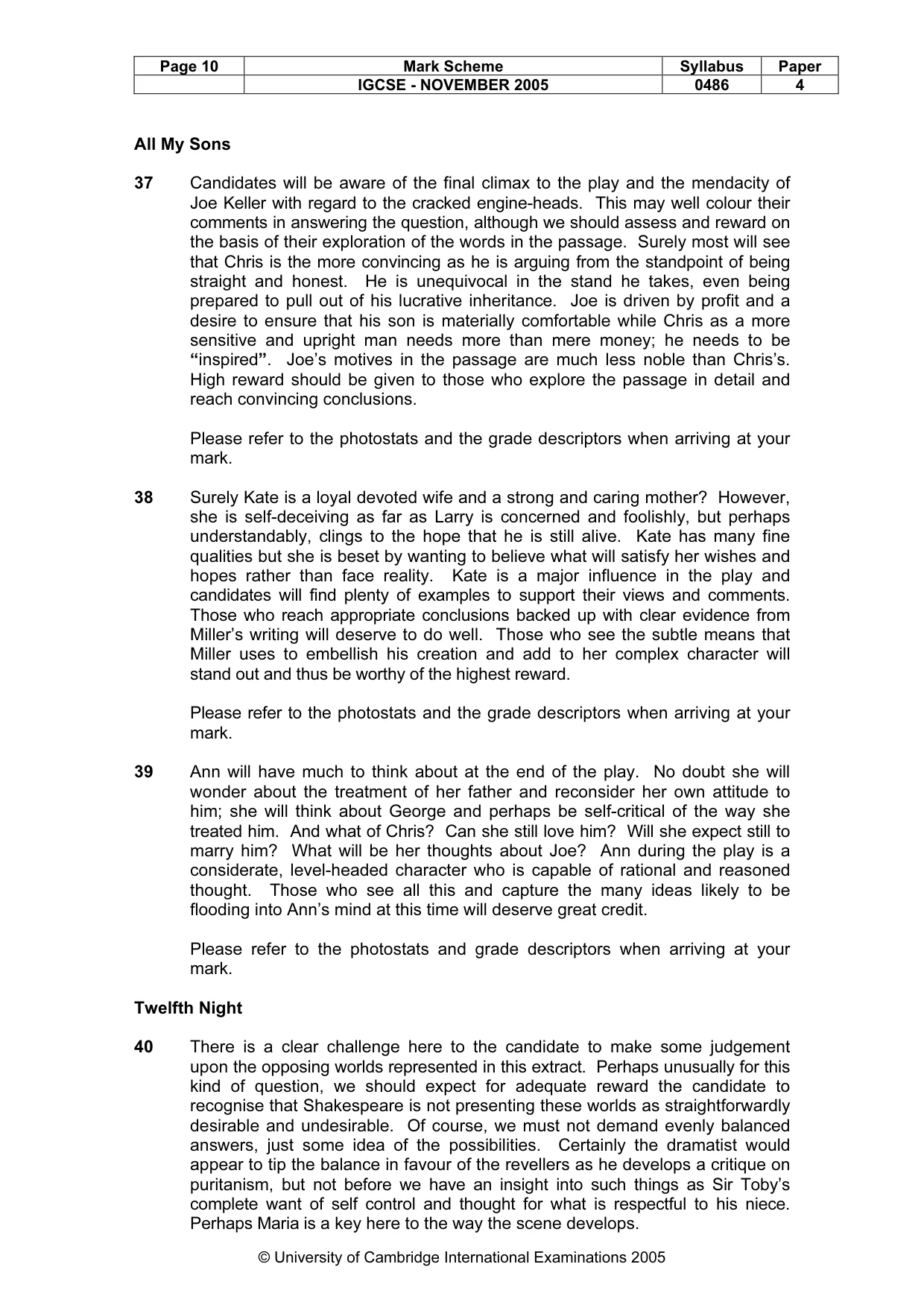
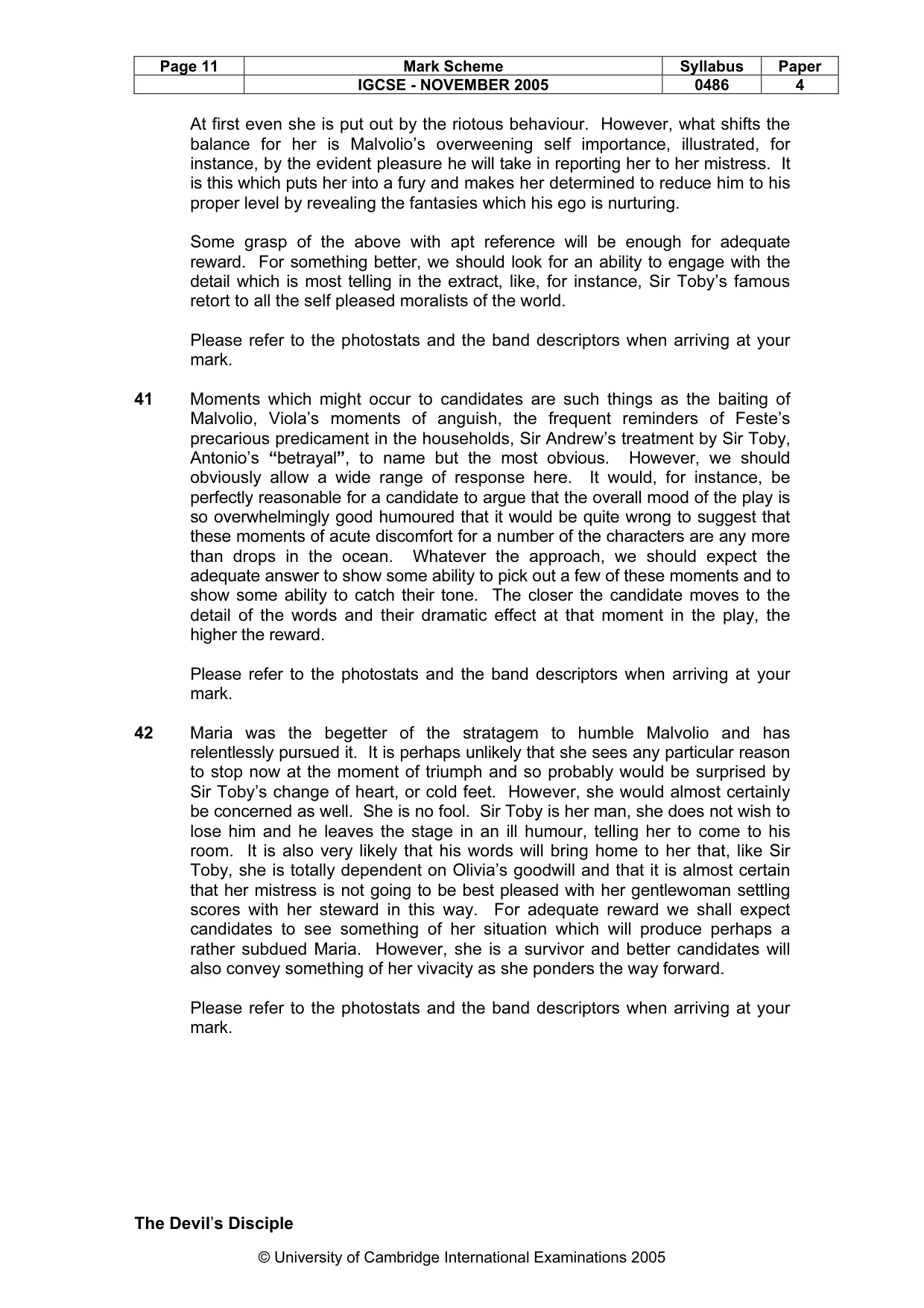
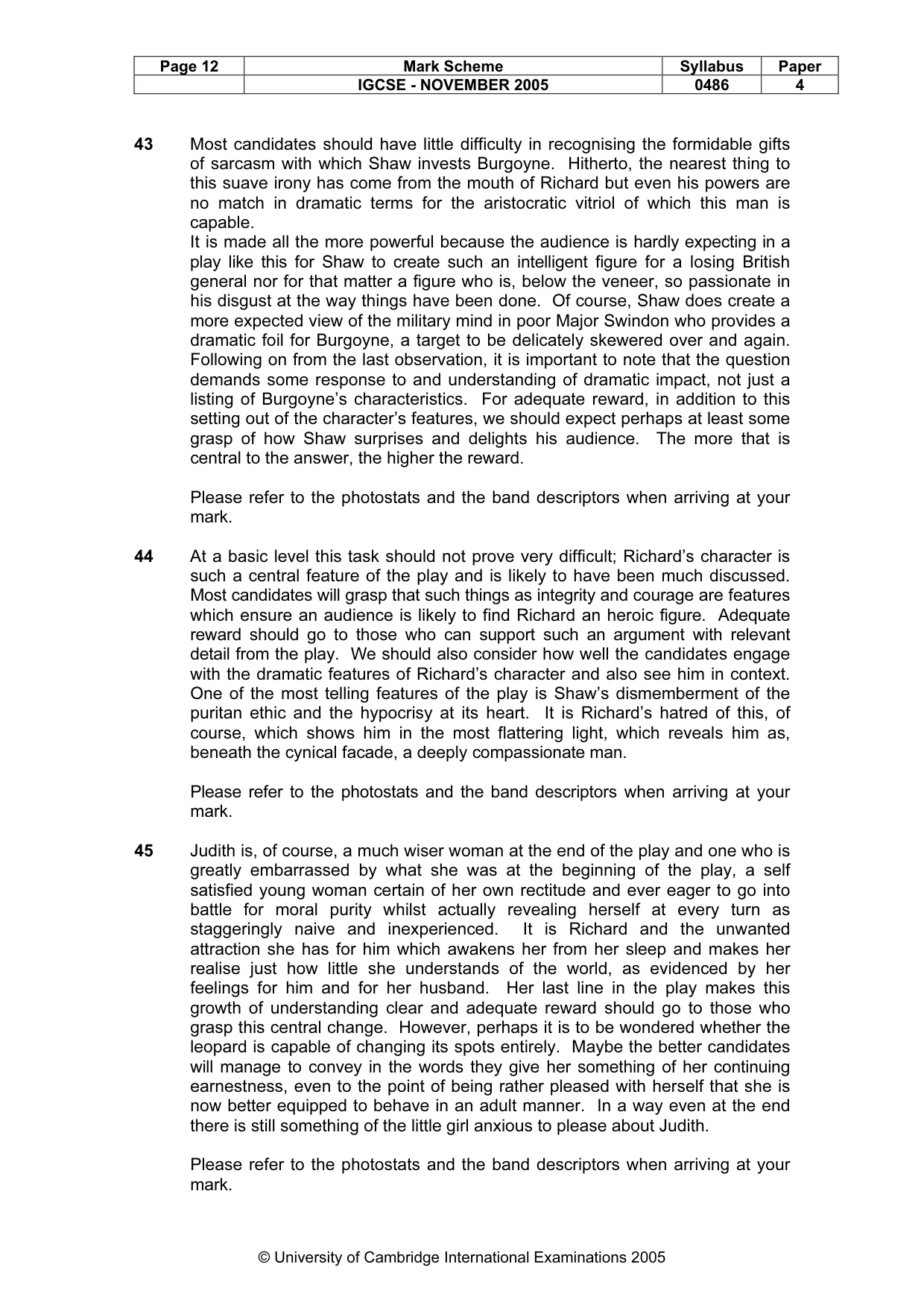
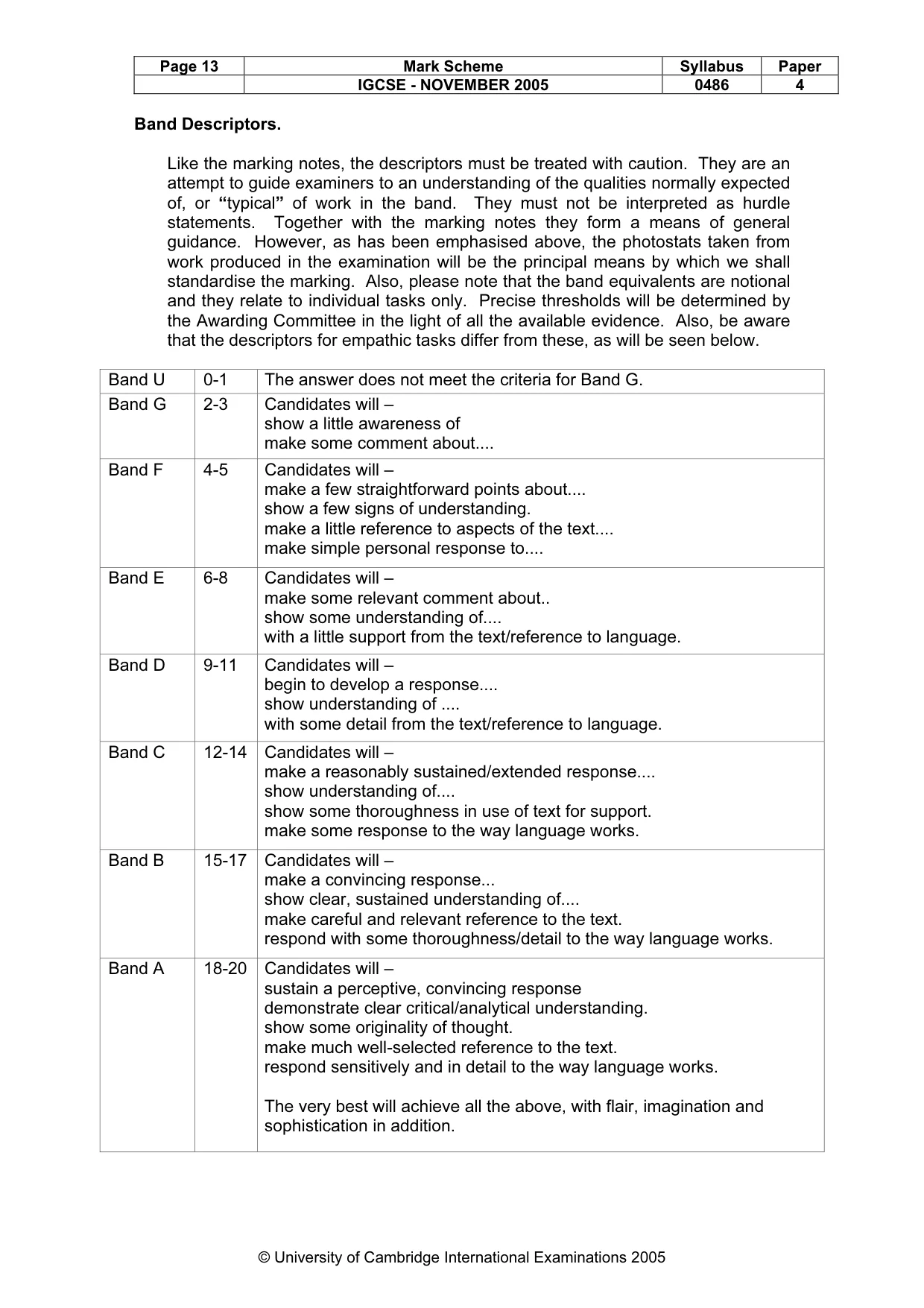
Mark scheme, page 9
Page 8 Mark Scheme Syllabus Paper IGCSE - NOVEMBER 2005 0486 4 © University of Cambridge International Examinations 2005 DRAMA Absent Friends 31 Of course, the welcoming party is on the point of disintegration. Diana is hysterical over Paul’s infidelity, Evelyn is attempting to escape and is furious that her child has been awoken, Marge is frantic with the problem of her husband having spilt linctus over the mattress, John is jiggling. It is obvious that they have forgotten why they are where they are, as is delightfully made clear by Paul’s seeming to forget for a moment who Colin is! A description of the mayhem with some detail will probably be enough for adequate reward but for something higher we should expect some evident engagement with the hilarity and an ability to see how Ayckbourn’s wonderful ability to keep several strands going at once, with all the attendant juxtapositions, has the pot bubbling merrily. Please refer to the photostats and the band descriptors when arriving at your mark. 32 This should be a fairly straightforward task despite having within it the dreaded word irony. The second part of the question should make clear the focus of the question. Hopefully the majority of candidates will at least penetrate to the point that there is very little real friendship on display in this play, that Colin is not the only friend who has been absent in a wider sense. Some may, of course, focus their answer on the central fact which is gradually revealed, that Colin is not and never was a real friend of anyone at the tea party, a pretence which is well and truly shattered by the end of the play. However, of course, it is not the only ‘friendship’ or relationship revealed to be on the rocks as things progress. There is much material from which to choose and we should not expect an answer to be inclusive. What we should expect for adequate reward is for a candidate to reveal in some detail aspects of these characters’ inability for the most part to act and feel in the way friends should. For higher reward we should look for a response to the ironic way in which Ayckbourn presents this, in which so much that is said and done at the beginning of the play is revealed as a facade for far less palatable truths later on. Please refer to the photostats and the band descriptors when arriving at your mark. 33 Paul is perhaps the most unpleasant character in the play. He is entirely selfish and wrapped up in his own affairs and has no compunction whatsoever about humiliating his wife in public, and incidentally in front of the woman with whom he has been, apparently rather unsatisfactorily, unfaithful. He has no desire to meet Colin despite Diana asserting that the two of them were once bosom pals and, as she with probable truth asserts, he invents work which must be attended to. However, the tantrum would appear to pass and, tiresome as it is to attend a tea party with people whom, as is shown later in the play, he mostly despises, he decides to put in an appearance. Is he likely to feel some guilt about his original action? Probably not but we should allow a candidate to give him a passing twinge. A more likely explanation is curiosity and his sensing that here is an opportunity to impress. Look at the way he makes his entrance. Whatever, we shall expect the adequate candidate to be able to convey something of the man’s unpleasant self-centredness. Perhaps, the better candidates will be able to capture his habitual blustering tone. Please refer to the photostats and the band descriptors when arriving at your mark.
Mark scheme, page 10
Page 9 Mark Scheme Syllabus Paper IGCSE - NOVEMBER 2005 0486 4 © University of Cambridge International Examinations 2005 Cuba and Doghouse 34 Lochhead manages to convey very much the feel of a girls’ friendship. They keep on reminding each other that they are “best friends” They passingly talk about clothes and hair do’s but central to the conversation is their crush on their teachers, ironically the very ones who are going to land them both in trouble. Their banter shows how easy they are with one another and what lively young people they are. Perhaps, and rather poignantly given what is to happen later, it is Bernadette who comes across as having rather greater grasp of what the world might have in wait. Just how long the friendship would have lasted had Bernadette not been expelled must be open to doubt. At the end of the passage Barbara fumes with exasperation at being called a teacher’s pet. Some ideas about the substance of this friendship with apt support should be enough for adequate reward but for anything better we should look for candidates to convey some of the more subtle possibilities alluded to above and something of the dramatic life of the extract. Please refer to the photostats and the band descriptors when arriving at your mark. 35 It is difficult to imagine that the overwhelming verdict on the adults in this play will not be negative. This is a world in which, when the children’s world collides with that of the adults, the latter expect the former to conform to its beliefs and attitudes. It is also an acutely class conscious society in which there is one set of rules for the middle class and another for the working class. Look at the way Cairncross hands out punishment according to whether the parent is known and is a member of the local golf club. The teachers’ betrayal of Bernadette sums up these attitudes. Of course, the one exception to this is Miss Arthur who puts her career and relationship on the line. For adequate reward, we shall expect the candidate to be able to grasp the essence of this adult world with some apt reference. The better candidates should be able to communicate just how powerfully (and indeed accurately) Lochhead conveys the polite awfulness of this long past world. Please refer to the photostats and the band descriptors when arriving at your mark. 36 Pats as she travels to this new house might for a moment or two wonder whether the new environment will produce a change of attitude towards her. However, as the play makes plain, life has left her with very little to hope for. Therefore, realistically she would in the end see that a change of address is not going to change things and that all she can look forward to is more of the same brutality from her father and disdain from her elder sister. Of course, beside the resigned character of the girl, there is also a strand in her of bitter fury that she is treated in this manner. For adequate reward, something of the above should feature but we should reserve the higher marks for those who can enter into the tormented world of this abused girl. Please refer to the photostats and the band descriptors when arriving at your mark.
Mark scheme, page 11
Page 10 Mark Scheme Syllabus Paper IGCSE - NOVEMBER 2005 0486 4 © University of Cambridge International Examinations 2005 All My Sons 37 Candidates will be aware of the final climax to the play and the mendacity of Joe Keller with regard to the cracked engine-heads. This may well colour their comments in answering the question, although we should assess and reward on the basis of their exploration of the words in the passage. Surely most will see that Chris is the more convincing as he is arguing from the standpoint of being straight and honest. He is unequivocal in the stand he takes, even being prepared to pull out of his lucrative inheritance. Joe is driven by profit and a desire to ensure that his son is materially comfortable while Chris as a more sensitive and upright man needs more than mere money; he needs to be “inspired”. Joe’s motives in the passage are much less noble than Chris’s. High reward should be given to those who explore the passage in detail and reach convincing conclusions. Please refer to the photostats and the grade descriptors when arriving at your mark. 38 Surely Kate is a loyal devoted wife and a strong and caring mother? However, she is self-deceiving as far as Larry is concerned and foolishly, but perhaps understandably, clings to the hope that he is still alive. Kate has many fine qualities but she is beset by wanting to believe what will satisfy her wishes and hopes rather than face reality. Kate is a major influence in the play and candidates will find plenty of examples to support their views and comments. Those who reach appropriate conclusions backed up with clear evidence from Miller’s writing will deserve to do well. Those who see the subtle means that Miller uses to embellish his creation and add to her complex character will stand out and thus be worthy of the highest reward. Please refer to the photostats and the grade descriptors when arriving at your mark. 39 Ann will have much to think about at the end of the play. No doubt she will wonder about the treatment of her father and reconsider her own attitude to him; she will think about George and perhaps be self-critical of the way she treated him. And what of Chris? Can she still love him? Will she expect still to marry him? What will be her thoughts about Joe? Ann during the play is a considerate, level-headed character who is capable of rational and reasoned thought. Those who see all this and capture the many ideas likely to be flooding into Ann’s mind at this time will deserve great credit. Please refer to the photostats and grade descriptors when arriving at your mark. Twelfth Night 40 There is a clear challenge here to the candidate to make some judgement upon the opposing worlds represented in this extract. Perhaps unusually for this kind of question, we should expect for adequate reward the candidate to recognise that Shakespeare is not presenting these worlds as straightforwardly desirable and undesirable. Of course, we must not demand evenly balanced answers, just some idea of the possibilities. Certainly the dramatist would appear to tip the balance in favour of the revellers as he develops a critique on puritanism, but not before we have an insight into such things as Sir Toby’s complete want of self control and thought for what is respectful to his niece. Perhaps Maria is a key here to the way the scene develops.
Mark scheme, page 12
Page 11 Mark Scheme Syllabus Paper IGCSE - NOVEMBER 2005 0486 4 © University of Cambridge International Examinations 2005 At first even she is put out by the riotous behaviour. However, what shifts the balance for her is Malvolio’s overweening self importance, illustrated, for instance, by the evident pleasure he will take in reporting her to her mistress. It is this which puts her into a fury and makes her determined to reduce him to his proper level by revealing the fantasies which his ego is nurturing. Some grasp of the above with apt reference will be enough for adequate reward. For something better, we should look for an ability to engage with the detail which is most telling in the extract, like, for instance, Sir Toby’s famous retort to all the self pleased moralists of the world. Please refer to the photostats and the band descriptors when arriving at your mark. 41 Moments which might occur to candidates are such things as the baiting of Malvolio, Viola’s moments of anguish, the frequent reminders of Feste’s precarious predicament in the households, Sir Andrew’s treatment by Sir Toby, Antonio’s “betrayal”, to name but the most obvious. However, we should obviously allow a wide range of response here. It would, for instance, be perfectly reasonable for a candidate to argue that the overall mood of the play is so overwhelmingly good humoured that it would be quite wrong to suggest that these moments of acute discomfort for a number of the characters are any more than drops in the ocean. Whatever the approach, we should expect the adequate answer to show some ability to pick out a few of these moments and to show some ability to catch their tone. The closer the candidate moves to the detail of the words and their dramatic effect at that moment in the play, the higher the reward. Please refer to the photostats and the band descriptors when arriving at your mark. 42 Maria was the begetter of the stratagem to humble Malvolio and has relentlessly pursued it. It is perhaps unlikely that she sees any particular reason to stop now at the moment of triumph and so probably would be surprised by Sir Toby’s change of heart, or cold feet. However, she would almost certainly be concerned as well. She is no fool. Sir Toby is her man, she does not wish to lose him and he leaves the stage in an ill humour, telling her to come to his room. It is also very likely that his words will bring home to her that, like Sir Toby, she is totally dependent on Olivia’s goodwill and that it is almost certain that her mistress is not going to be best pleased with her gentlewoman settling scores with her steward in this way. For adequate reward we shall expect candidates to see something of her situation which will produce perhaps a rather subdued Maria. However, she is a survivor and better candidates will also convey something of her vivacity as she ponders the way forward. Please refer to the photostats and the band descriptors when arriving at your mark. The Devil’s Disciple
Mark scheme, page 13
Page 12 Mark Scheme Syllabus Paper IGCSE - NOVEMBER 2005 0486 4 © University of Cambridge International Examinations 2005 43 Most candidates should have little difficulty in recognising the formidable gifts of sarcasm with which Shaw invests Burgoyne. Hitherto, the nearest thing to this suave irony has come from the mouth of Richard but even his powers are no match in dramatic terms for the aristocratic vitriol of which this man is capable. It is made all the more powerful because the audience is hardly expecting in a play like this for Shaw to create such an intelligent figure for a losing British general nor for that matter a figure who is, below the veneer, so passionate in his disgust at the way things have been done. Of course, Shaw does create a more expected view of the military mind in poor Major Swindon who provides a dramatic foil for Burgoyne, a target to be delicately skewered over and again. Following on from the last observation, it is important to note that the question demands some response to and understanding of dramatic impact, not just a listing of Burgoyne’s characteristics. For adequate reward, in addition to this setting out of the character’s features, we should expect perhaps at least some grasp of how Shaw surprises and delights his audience. The more that is central to the answer, the higher the reward. Please refer to the photostats and the band descriptors when arriving at your mark. 44 At a basic level this task should not prove very difficult; Richard’s character is such a central feature of the play and is likely to have been much discussed. Most candidates will grasp that such things as integrity and courage are features which ensure an audience is likely to find Richard an heroic figure. Adequate reward should go to those who can support such an argument with relevant detail from the play. We should also consider how well the candidates engage with the dramatic features of Richard’s character and also see him in context. One of the most telling features of the play is Shaw’s dismemberment of the puritan ethic and the hypocrisy at its heart. It is Richard’s hatred of this, of course, which shows him in the most flattering light, which reveals him as, beneath the cynical facade, a deeply compassionate man. Please refer to the photostats and the band descriptors when arriving at your mark. 45 Judith is, of course, a much wiser woman at the end of the play and one who is greatly embarrassed by what she was at the beginning of the play, a self satisfied young woman certain of her own rectitude and ever eager to go into battle for moral purity whilst actually revealing herself at every turn as staggeringly naive and inexperienced. It is Richard and the unwanted attraction she has for him which awakens her from her sleep and makes her realise just how little she understands of the world, as evidenced by her feelings for him and for her husband. Her last line in the play makes this growth of understanding clear and adequate reward should go to those who grasp this central change. However, perhaps it is to be wondered whether the leopard is capable of changing its spots entirely. Maybe the better candidates will manage to convey in the words they give her something of her continuing earnestness, even to the point of being rather pleased with herself that she is now better equipped to behave in an adult manner. In a way even at the end there is still something of the little girl anxious to please about Judith. Please refer to the photostats and the band descriptors when arriving at your mark.
Mark scheme, page 14
Page 13 Mark Scheme Syllabus Paper IGCSE - NOVEMBER 2005 0486 4 © University of Cambridge International Examinations 2005 Band Descriptors. Like the marking notes, the descriptors must be treated with caution. They are an attempt to guide examiners to an understanding of the qualities normally expected of, or “typical” of work in the band. They must not be interpreted as hurdle statements. Together with the marking notes they form a means of general guidance. However, as has been emphasised above, the photostats taken from work produced in the examination will be the principal means by which we shall standardise the marking. Also, please note that the band equivalents are notional and they relate to individual tasks only. Precise thresholds will be determined by the Awarding Committee in the light of all the available evidence. Also, be aware that the descriptors for empathic tasks differ from these, as will be seen below. Band U 0-1 The answer does not meet the criteria for Band G. Band G 2-3 Candidates will – show a little awareness of make some comment about… Band F 4-5 Candidates will – make a few straightforward points about… show a few signs of understanding. make a little reference to aspects of the text… make simple personal response to… Band E 6-8 Candidates will – make some relevant comment about.. show some understanding of… with a little support from the text/reference to language. Band D 9-11 Candidates will – begin to develop a response… show understanding of … with some detail from the text/reference to language. Band C 12-14 Candidates will – make a reasonably sustained/extended response… show understanding of… show some thoroughness in use of text for support. make some response to the way language works. Band B 15-17 Candidates will – make a convincing response... show clear, sustained understanding of… make careful and relevant reference to the text. respond with some thoroughness/detail to the way language works. Band A 18-20 Candidates will – sustain a perceptive, convincing response demonstrate clear critical/analytical understanding. show some originality of thought. make much well-selected reference to the text. respond sensitively and in detail to the way language works. The very best will achieve all the above, with flair, imagination and sophistication in addition.
Mark scheme, page 15
Page 14 Mark Scheme Syllabus Paper IGCSE - NOVEMBER 2005 0486 4 © University of Cambridge International Examinations 2005 Band descriptors for Empathic Questions (imaginative/creative tasks). There are three key elements to be looked for in responses to these questions: • sound knowledge of what happens in the text. • an understanding/interpretation of this. • the use of an authentic voice or voices. It is possible that some candidates will shy away from assuming the voice and the phrasing of some tasks, particularly those referring to the character’s thoughts, may perforce allow this. Responses of this sort can sometimes show insight despite not entering fully into the imaginative challenge. They should be assessed on the strength of that insight rather than the band descriptors below. Band U 0-1 The answer does not meet the criteria for Band G. Band G 2-3 Candidates will show a little knowledge of what the character does. Band F 4-5 Candidates will show some knowledge of what the character does and express some view about the reasons for action. Band E 6-8 Candidates will show some understanding of character through the aspects of the text referred to. There will be a little mentioning of feelings and ideas. Band D 9-11 Candidates will show a basic understanding of what the character does and thinks. These ideas will show a little evidence of being expressed in an appropriate way. Band C 12-14 Candidates will have a sound working knowledge on which to base their writing, which will have features of expression which are suitable and appropriate to the character or occasion. Band B 15-17 Candidates will have a good knowledge and understanding and be able to use this to produce writing expressed in a way which is largely fitting and authentic. The character will be clearly recognisable through the voice assumed. Band A 18-20 Candidates will use a full and assured understanding of the text to write in a manner which expresses the thoughts, feelings and attitudes of the character with assurance and insight. The voice assumed will be entirely appropriate for the character.