Cambridge IGCSE English - Literature 0486 — 2005 May/June Paper 4 · Variant 1
0486/41/M/J/05
The question paper and its mark scheme, free to read here and free to download. This is Cambridge’s own paper, exactly as it was sat.
Question paper28 pages





Mark scheme18 pages
Answers below. Sit the paper first if you are practising.
Paper as text
Question paper, page 1
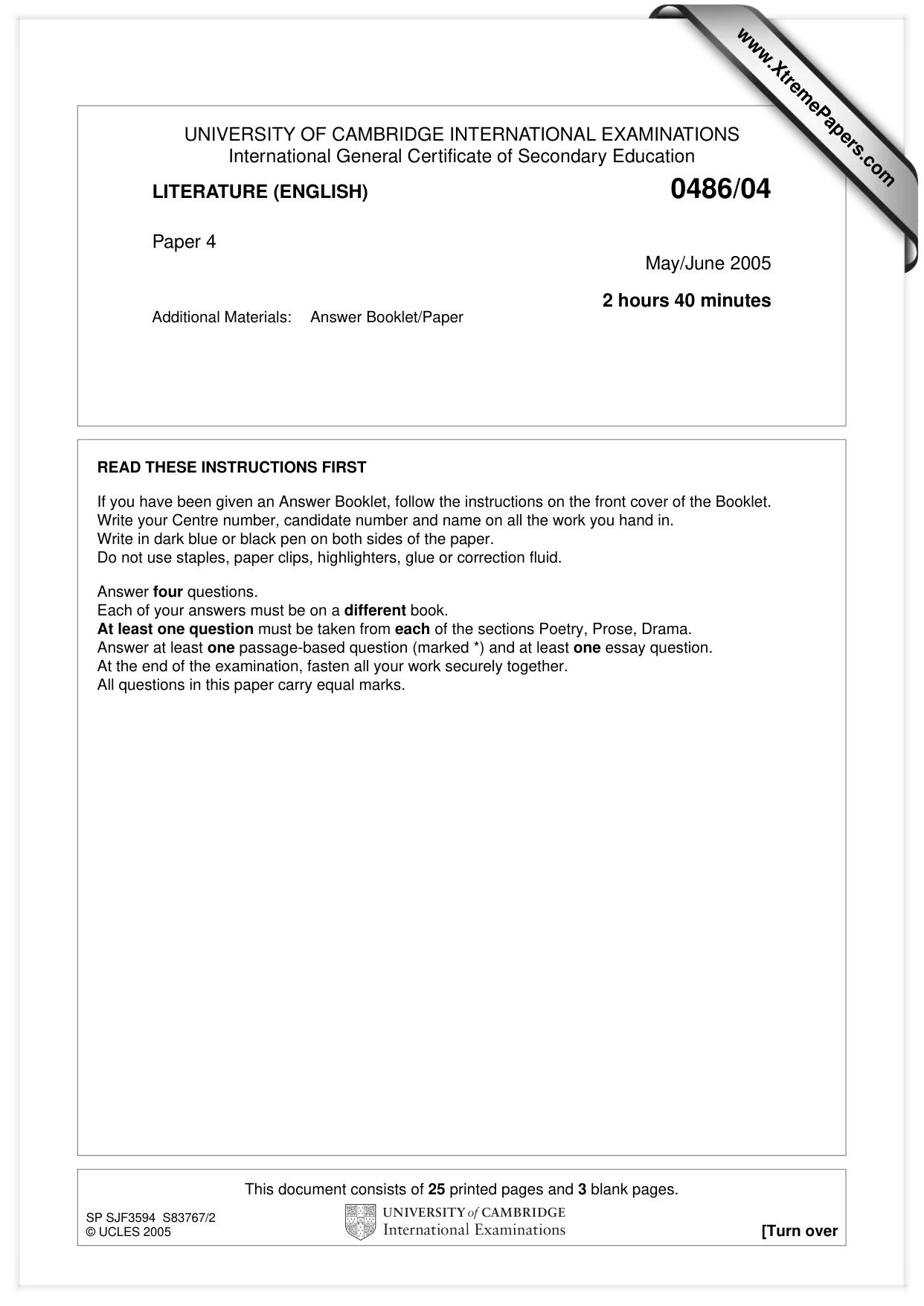
This document consists of 25 printed pages and 3 blank pages. SP SJF3594 S83767/2 © UCLES 2005 [Turn over UNIVERSITY OF CAMBRIDGE INTERNATIONAL EXAMINATIONS International General Certificate of Secondary Education LITERATURE (ENGLISH) 0486/04 Paper 4 May/June 2005 2 hours 40 minutes Additional Materials: Answer Booklet/Paper READ THESE INSTRUCTIONS FIRST If you have been given an Answer Booklet, follow the instructions on the front cover of the Booklet. Write your Centre number, candidate number and name on all the work you hand in. Write in dark blue or black pen on both sides of the paper. Do not use staples, paper clips, highlighters, glue or correction fluid. Answer four questions. Each of your answers must be on a different book. At least one question must be taken from each of the sections Poetry, Prose, Drama. Answer at least one passage-based question (marked *) and at least one essay question. At the end of the examination, fasten all your work securely together. All questions in this paper carry equal marks. www.XtremePapers.com
Question paper, page 2
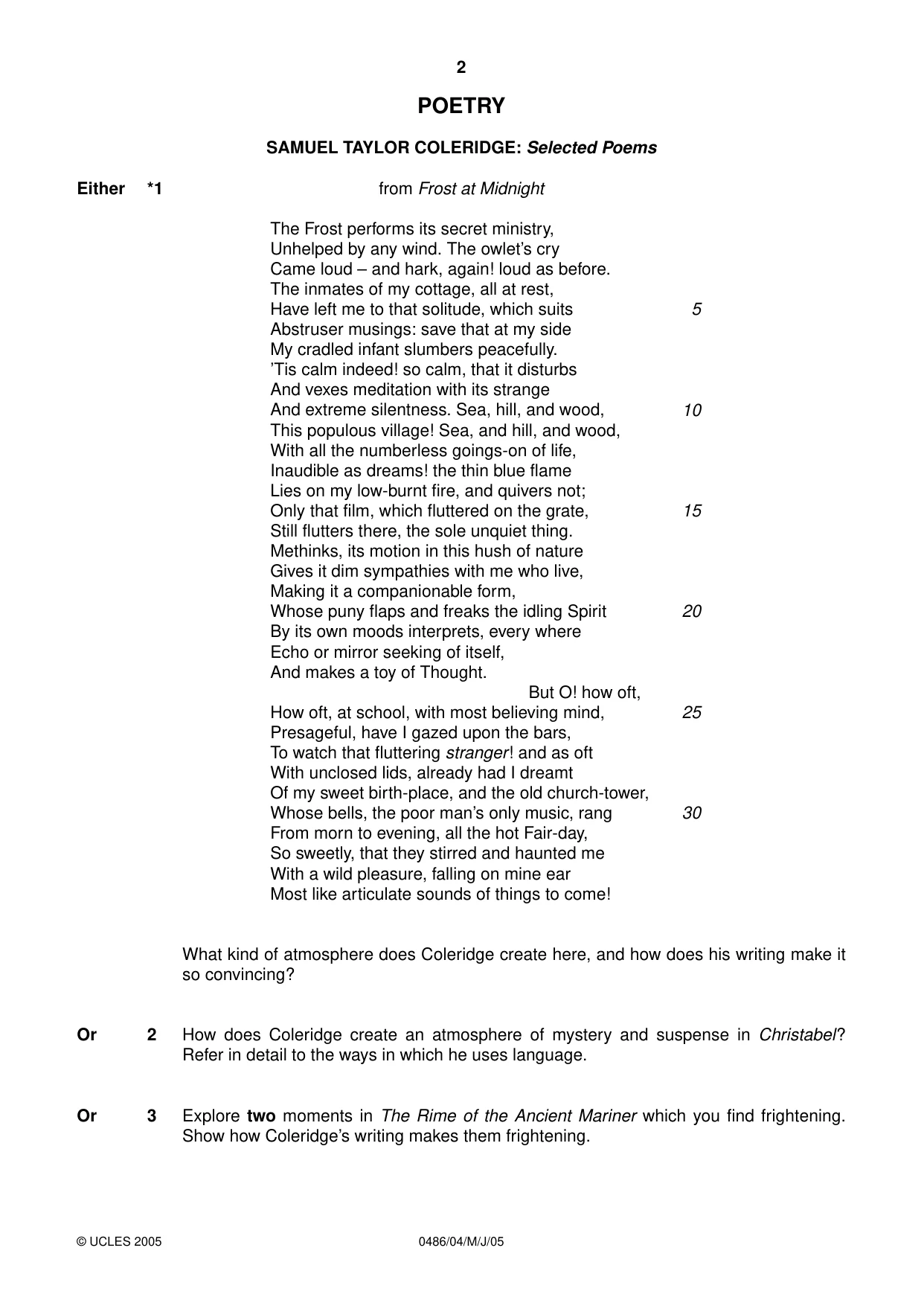
2 0486/04/M/J/05 POETRY SAMUEL TAYLOR COLERIDGE: Selected Poems Either *1 from Frost at Midnight The Frost performs its secret ministry, Unhelped by any wind. The owlet’s cry Came loud – and hark, again! loud as before. The inmates of my cottage, all at rest, Have left me to that solitude, which suits Abstruser musings: save that at my side My cradled infant slumbers peacefully. ’Tis calm indeed! so calm, that it disturbs And vexes meditation with its strange And extreme silentness. Sea, hill, and wood, This populous village! Sea, and hill, and wood, With all the numberless goings-on of life, Inaudible as dreams! the thin blue flame Lies on my low-burnt fire, and quivers not; Only that film, which fluttered on the grate, Still flutters there, the sole unquiet thing. Methinks, its motion in this hush of nature Gives it dim sympathies with me who live, Making it a companionable form, Whose puny flaps and freaks the idling Spirit By its own moods interprets, every where Echo or mirror seeking of itself, And makes a toy of Thought. But O! how oft, How oft, at school, with most believing mind, Presageful, have I gazed upon the bars, To watch that fluttering stranger! and as oft With unclosed lids, already had I dreamt Of my sweet birth-place, and the old church-tower, Whose bells, the poor man’s only music, rang From morn to evening, all the hot Fair-day, So sweetly, that they stirred and haunted me With a wild pleasure, falling on mine ear Most like articulate sounds of things to come! What kind of atmosphere does Coleridge create here, and how does his writing make it so convincing? Or 2 How does Coleridge create an atmosphere of mystery and suspense in Christabel? Refer in detail to the ways in which he uses language. Or 3 Explore two moments in The Rime of the Ancient Mariner which you find frightening. Show how Coleridge’s writing makes them frightening. © UCLES 2005 5 10 15 20 25 30
Question paper, page 3
3 0486/04/M/J/05 [Turn over Turn to page 4 for question 4 © UCLES 2005
Question paper, page 4
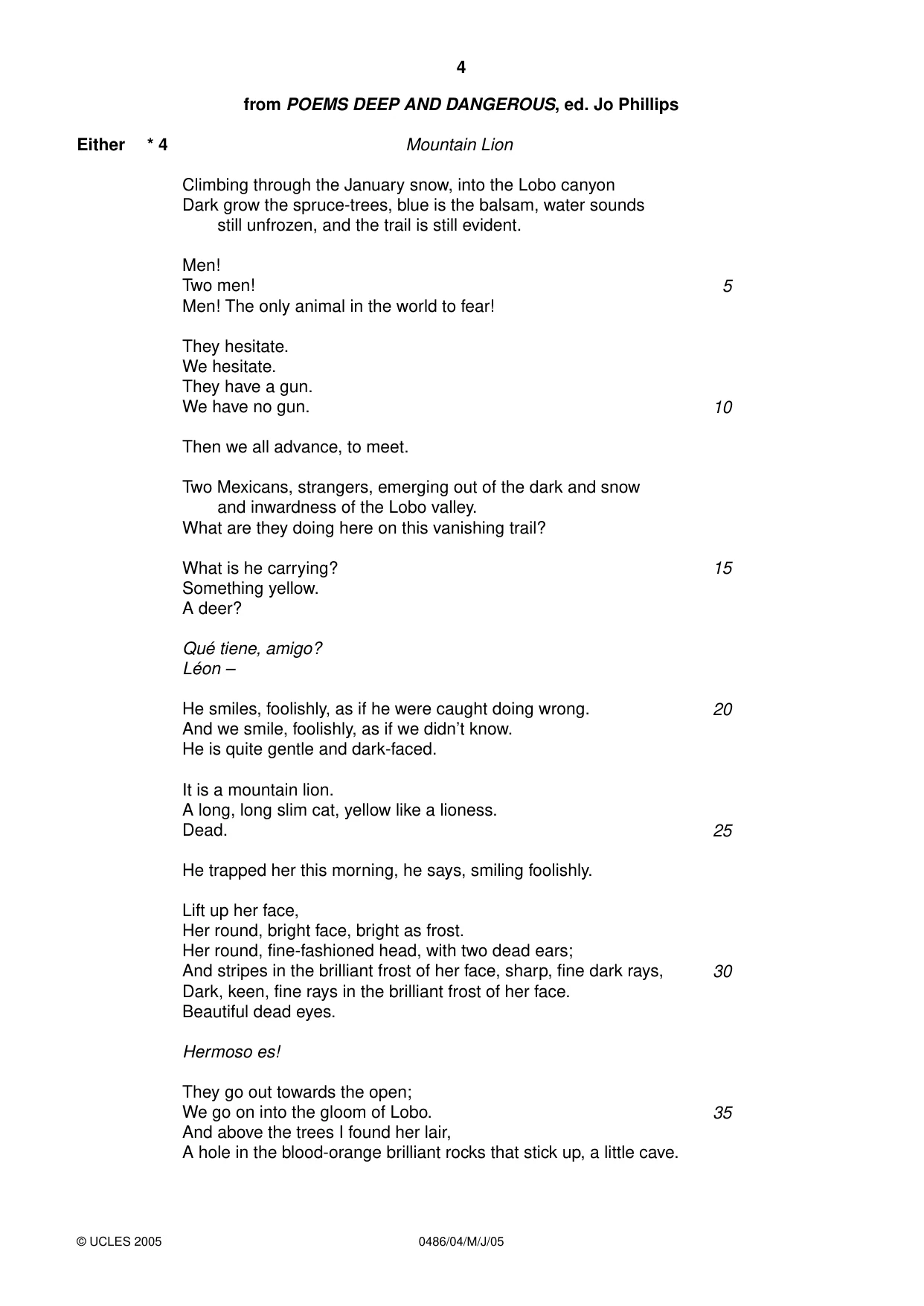
4 0486/04/M/J/05 from POEMS DEEP AND DANGEROUS, ed. Jo Phillips Either * 4 Mountain Lion Climbing through the January snow, into the Lobo canyon Dark grow the spruce-trees, blue is the balsam, water sounds still unfrozen, and the trail is still evident. Men! Two men! Men! The only animal in the world to fear! They hesitate. We hesitate. They have a gun. We have no gun. Then we all advance, to meet. Two Mexicans, strangers, emerging out of the dark and snow and inwardness of the Lobo valley. What are they doing here on this vanishing trail? What is he carrying? Something yellow. A deer? Qué tiene, amigo? Léon – He smiles, foolishly, as if he were caught doing wrong. And we smile, foolishly, as if we didn’t know. He is quite gentle and dark-faced. It is a mountain lion. A long, long slim cat, yellow like a lioness. Dead. He trapped her this morning, he says, smiling foolishly. Lift up her face, Her round, bright face, bright as frost. Her round, fine-fashioned head, with two dead ears; And stripes in the brilliant frost of her face, sharp, fine dark rays, Dark, keen, fine rays in the brilliant frost of her face. Beautiful dead eyes. Hermoso es! They go out towards the open; We go on into the gloom of Lobo. And above the trees I found her lair, A hole in the blood-orange brilliant rocks that stick up, a little cave. © UCLES 2005 5 10 15 20 25 30 35
Question paper, page 5
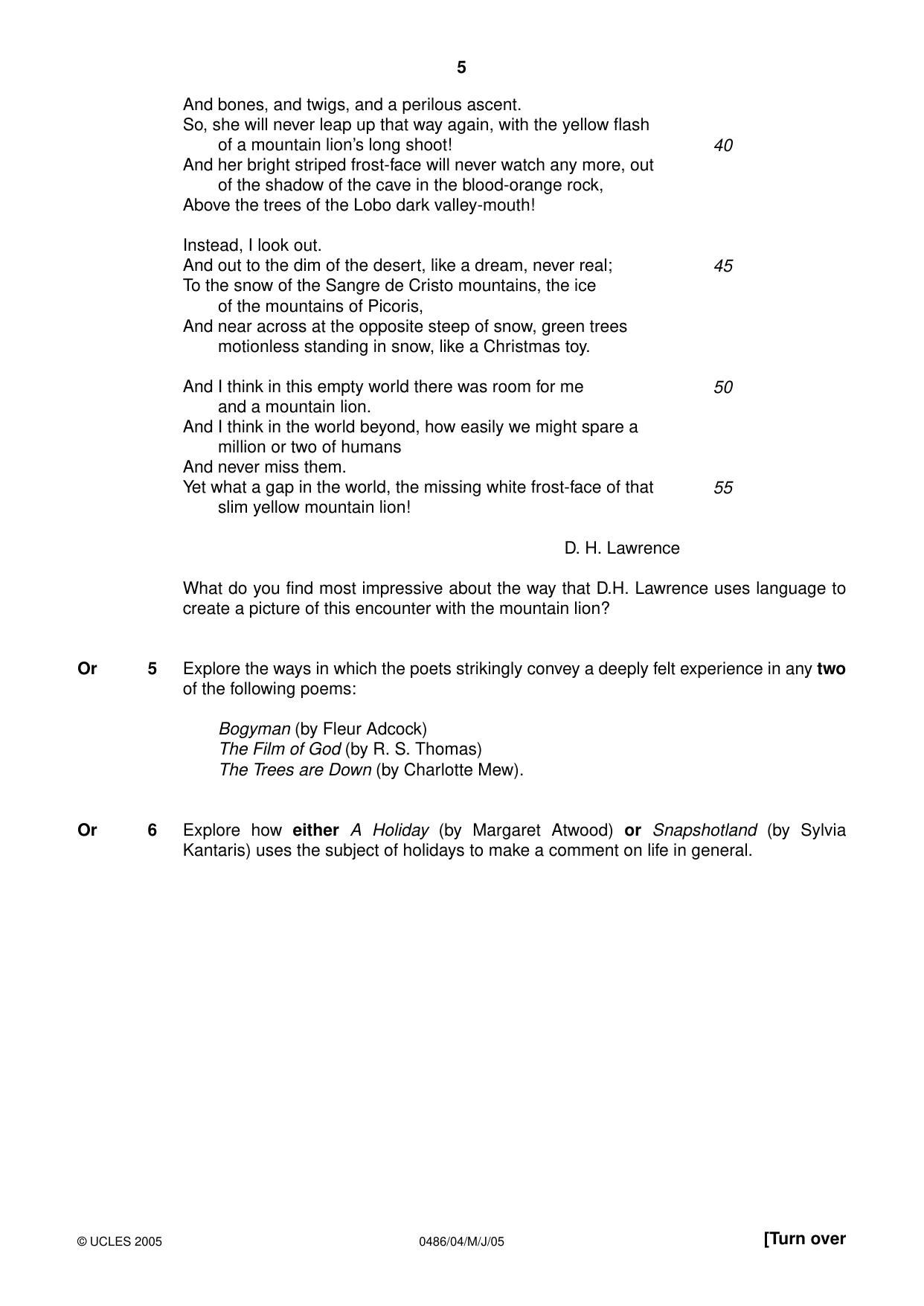
5 0486/04/M/J/05 [Turn over And bones, and twigs, and a perilous ascent. So, she will never leap up that way again, with the yellow flash of a mountain lion’s long shoot! And her bright striped frost-face will never watch any more, out of the shadow of the cave in the blood-orange rock, Above the trees of the Lobo dark valley-mouth! Instead, I look out. And out to the dim of the desert, like a dream, never real; To the snow of the Sangre de Cristo mountains, the ice of the mountains of Picoris, And near across at the opposite steep of snow, green trees motionless standing in snow, like a Christmas toy. And I think in this empty world there was room for me and a mountain lion. And I think in the world beyond, how easily we might spare a million or two of humans And never miss them. Yet what a gap in the world, the missing white frost-face of that slim yellow mountain lion! D. H. Lawrence What do you find most impressive about the way that D.H. Lawrence uses language to create a picture of this encounter with the mountain lion? Or 5 Explore the ways in which the poets strikingly convey a deeply felt experience in any two of the following poems: Bogyman (by Fleur Adcock) The Film of God (by R. S. Thomas) The Trees are Down (by Charlotte Mew). Or 6 Explore how either A Holiday (by Margaret Atwood) or Snapshotland (by Sylvia Kantaris) uses the subject of holidays to make a comment on life in general. © UCLES 2005 40 45 50 55
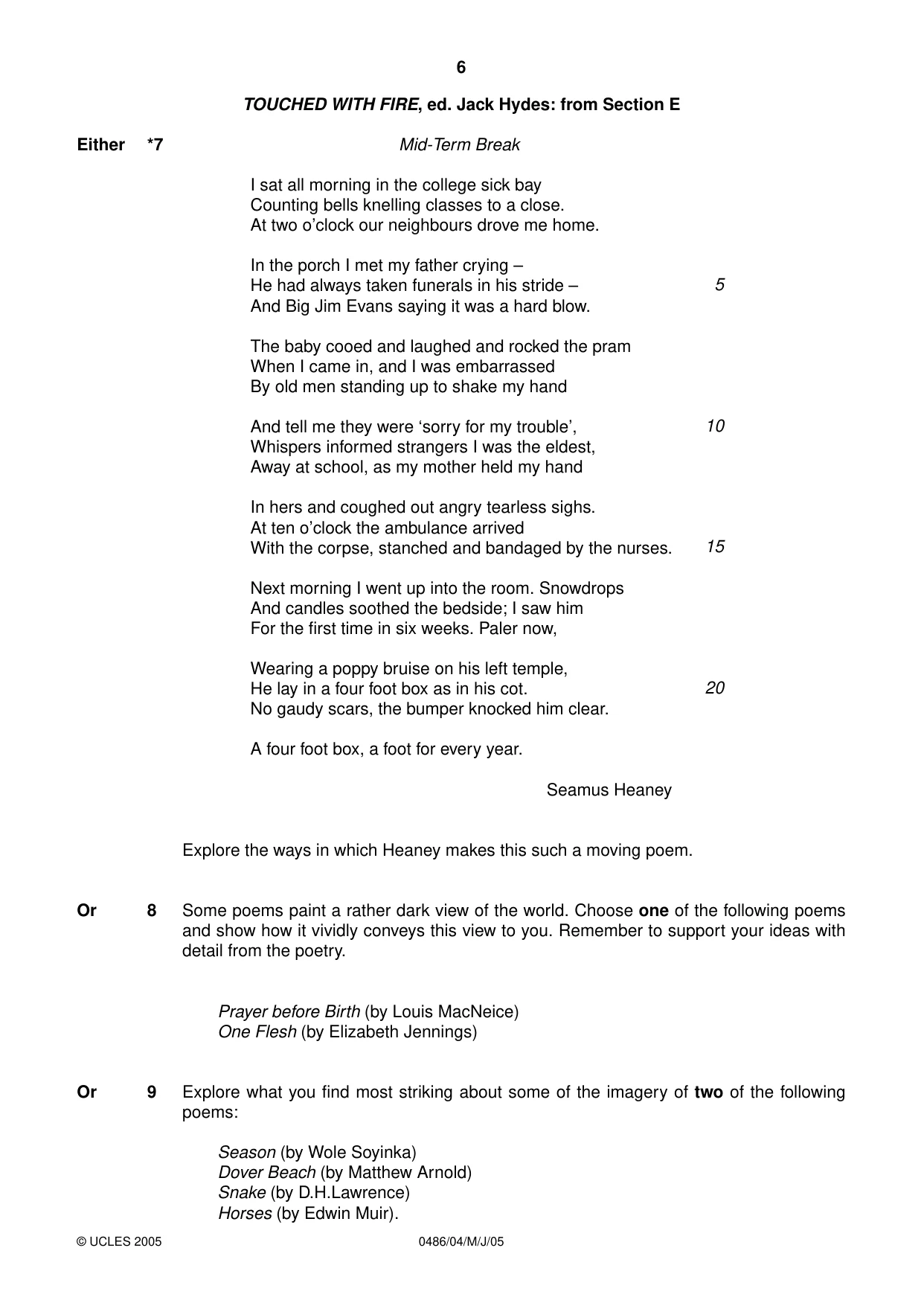
Question paper, page 6
6 0486/04/M/J/05 TOUCHED WITH FIRE, ed. Jack Hydes: from Section E Either *7 Mid-Term Break I sat all morning in the college sick bay Counting bells knelling classes to a close. At two o’clock our neighbours drove me home. In the porch I met my father crying – He had always taken funerals in his stride – And Big Jim Evans saying it was a hard blow. The baby cooed and laughed and rocked the pram When I came in, and I was embarrassed By old men standing up to shake my hand And tell me they were ‘sorry for my trouble’, Whispers informed strangers I was the eldest, Away at school, as my mother held my hand In hers and coughed out angry tearless sighs. At ten o’clock the ambulance arrived With the corpse, stanched and bandaged by the nurses. Next morning I went up into the room. Snowdrops And candles soothed the bedside; I saw him For the first time in six weeks. Paler now, Wearing a poppy bruise on his left temple, He lay in a four foot box as in his cot. No gaudy scars, the bumper knocked him clear. A four foot box, a foot for every year. Seamus Heaney Explore the ways in which Heaney makes this such a moving poem. Or 8 Some poems paint a rather dark view of the world. Choose one of the following poems and show how it vividly conveys this view to you. Remember to support your ideas with detail from the poetry. Prayer before Birth (by Louis MacNeice) One Flesh (by Elizabeth Jennings) Or 9 Explore what you find most striking about some of the imagery of two of the following poems: Season (by Wole Soyinka) Dover Beach (by Matthew Arnold) Snake (by D.H.Lawrence) Horses (by Edwin Muir). © UCLES 2005 5 10 15 20
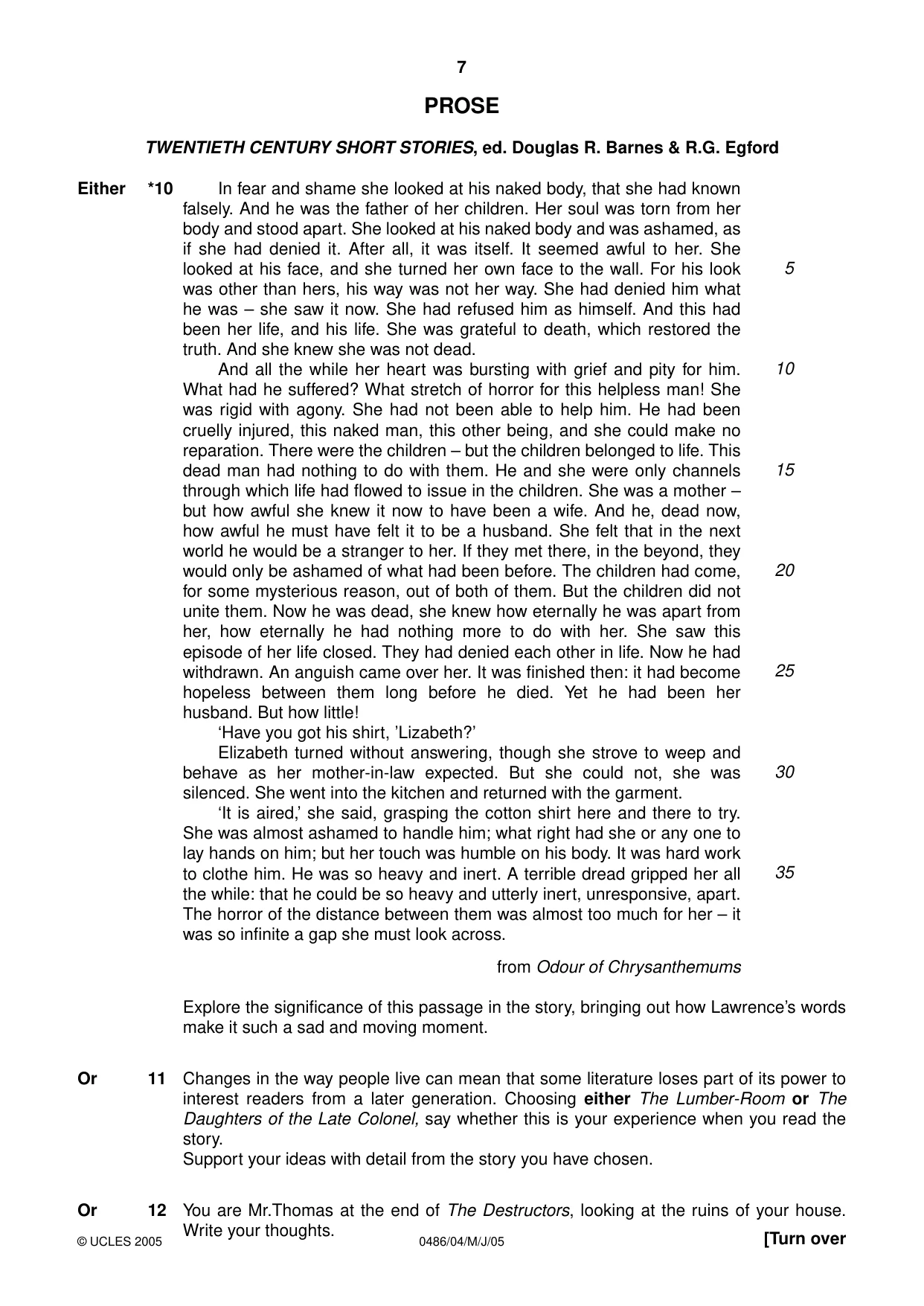
Question paper, page 7
7 0486/04/M/J/05 [Turn over PROSE TWENTIETH CENTURY SHORT STORIES, ed. Douglas R. Barnes & R.G. Egford Either *10 In fear and shame she looked at his naked body, that she had known falsely. And he was the father of her children. Her soul was torn from her body and stood apart. She looked at his naked body and was ashamed, as if she had denied it. After all, it was itself. It seemed awful to her. She looked at his face, and she turned her own face to the wall. For his look was other than hers, his way was not her way. She had denied him what he was – she saw it now. She had refused him as himself. And this had been her life, and his life. She was grateful to death, which restored the truth. And she knew she was not dead. And all the while her heart was bursting with grief and pity for him. What had he suffered? What stretch of horror for this helpless man! She was rigid with agony. She had not been able to help him. He had been cruelly injured, this naked man, this other being, and she could make no reparation. There were the children – but the children belonged to life. This dead man had nothing to do with them. He and she were only channels through which life had flowed to issue in the children. She was a mother – but how awful she knew it now to have been a wife. And he, dead now, how awful he must have felt it to be a husband. She felt that in the next world he would be a stranger to her. If they met there, in the beyond, they would only be ashamed of what had been before. The children had come, for some mysterious reason, out of both of them. But the children did not unite them. Now he was dead, she knew how eternally he was apart from her, how eternally he had nothing more to do with her. She saw this episode of her life closed. They had denied each other in life. Now he had withdrawn. An anguish came over her. It was finished then: it had become hopeless between them long before he died. Yet he had been her husband. But how little! ‘Have you got his shirt, ’Lizabeth?’ Elizabeth turned without answering, though she strove to weep and behave as her mother-in-law expected. But she could not, she was silenced. She went into the kitchen and returned with the garment. ‘It is aired,’ she said, grasping the cotton shirt here and there to try. She was almost ashamed to handle him; what right had she or any one to lay hands on him; but her touch was humble on his body. It was hard work to clothe him. He was so heavy and inert. A terrible dread gripped her all the while: that he could be so heavy and utterly inert, unresponsive, apart. The horror of the distance between them was almost too much for her – it was so infinite a gap she must look across. from Odour of Chrysanthemums Explore the significance of this passage in the story, bringing out how Lawrence’s words make it such a sad and moving moment. Or 11 Changes in the way people live can mean that some literature loses part of its power to interest readers from a later generation. Choosing either The Lumber-Room or The Daughters of the Late Colonel, say whether this is your experience when you read the story. Support your ideas with detail from the story you have chosen. Or 12 You are Mr.Thomas at the end of The Destructors, looking at the ruins of your house. Write your thoughts. © UCLES 2005 5 10 15 20 25 30 35
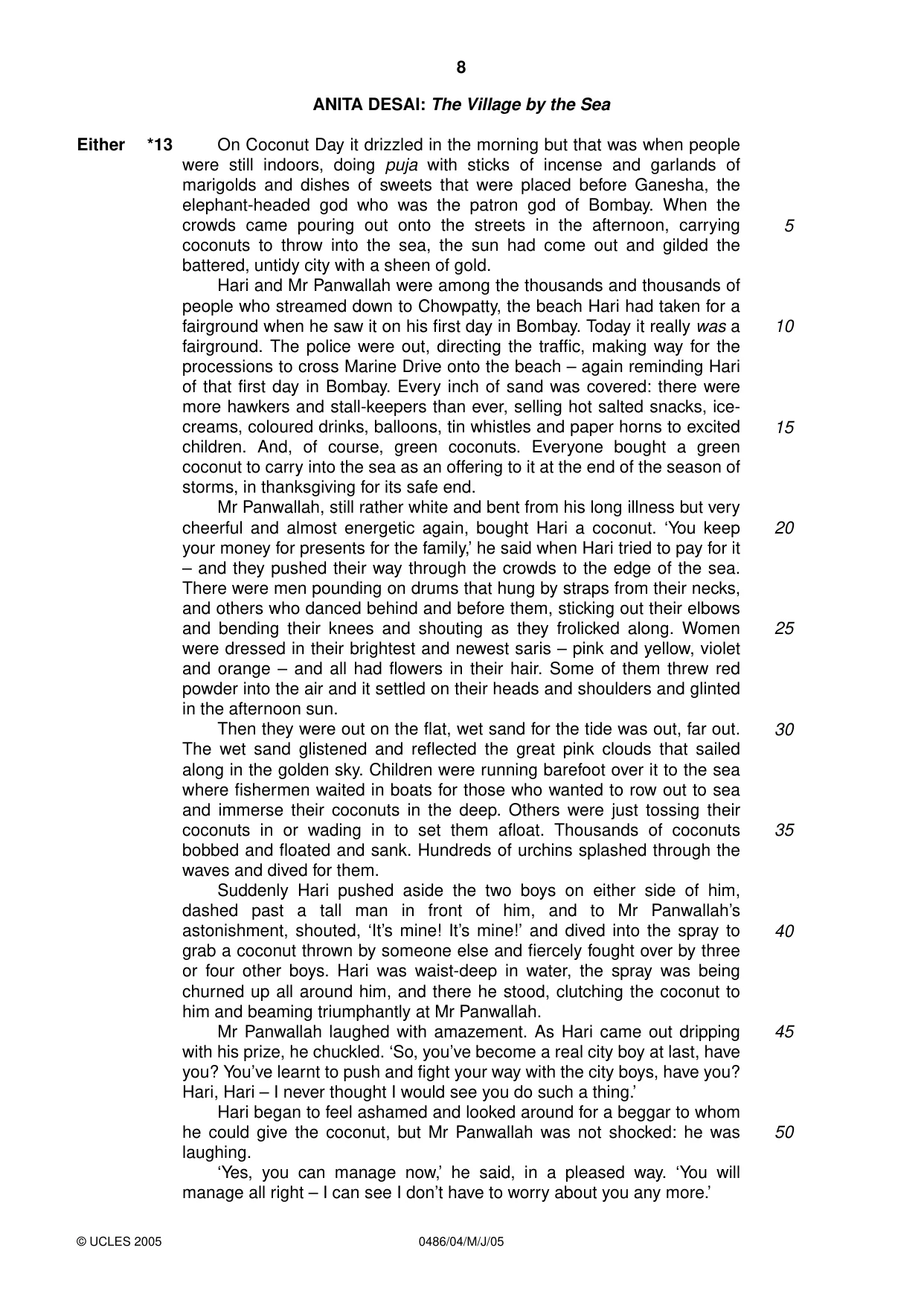
Question paper, page 8
8 0486/04/M/J/05 ANITA DESAI: The Village by the Sea Either *13 On Coconut Day it drizzled in the morning but that was when people were still indoors, doing puja with sticks of incense and garlands of marigolds and dishes of sweets that were placed before Ganesha, the elephant-headed god who was the patron god of Bombay. When the crowds came pouring out onto the streets in the afternoon, carrying coconuts to throw into the sea, the sun had come out and gilded the battered, untidy city with a sheen of gold. Hari and Mr Panwallah were among the thousands and thousands of people who streamed down to Chowpatty, the beach Hari had taken for a fairground when he saw it on his first day in Bombay. Today it really was a fairground. The police were out, directing the traffic, making way for the processions to cross Marine Drive onto the beach – again reminding Hari of that first day in Bombay. Every inch of sand was covered: there were more hawkers and stall-keepers than ever, selling hot salted snacks, ice- creams, coloured drinks, balloons, tin whistles and paper horns to excited children. And, of course, green coconuts. Everyone bought a green coconut to carry into the sea as an offering to it at the end of the season of storms, in thanksgiving for its safe end. Mr Panwallah, still rather white and bent from his long illness but very cheerful and almost energetic again, bought Hari a coconut. ‘You keep your money for presents for the family,’ he said when Hari tried to pay for it – and they pushed their way through the crowds to the edge of the sea. There were men pounding on drums that hung by straps from their necks, and others who danced behind and before them, sticking out their elbows and bending their knees and shouting as they frolicked along. Women were dressed in their brightest and newest saris – pink and yellow, violet and orange – and all had flowers in their hair. Some of them threw red powder into the air and it settled on their heads and shoulders and glinted in the afternoon sun. Then they were out on the flat, wet sand for the tide was out, far out. The wet sand glistened and reflected the great pink clouds that sailed along in the golden sky. Children were running barefoot over it to the sea where fishermen waited in boats for those who wanted to row out to sea and immerse their coconuts in the deep. Others were just tossing their coconuts in or wading in to set them afloat. Thousands of coconuts bobbed and floated and sank. Hundreds of urchins splashed through the waves and dived for them. Suddenly Hari pushed aside the two boys on either side of him, dashed past a tall man in front of him, and to Mr Panwallah’s astonishment, shouted, ‘It’s mine! It’s mine!’ and dived into the spray to grab a coconut thrown by someone else and fiercely fought over by three or four other boys. Hari was waist-deep in water, the spray was being churned up all around him, and there he stood, clutching the coconut to him and beaming triumphantly at Mr Panwallah. Mr Panwallah laughed with amazement. As Hari came out dripping with his prize, he chuckled. ‘So, you’ve become a real city boy at last, have you? You’ve learnt to push and fight your way with the city boys, have you? Hari, Hari – I never thought I would see you do such a thing.’ Hari began to feel ashamed and looked around for a beggar to whom he could give the coconut, but Mr Panwallah was not shocked: he was laughing. ‘Yes, you can manage now,’ he said, in a pleased way. ‘You will manage all right – I can see I don’t have to worry about you any more.’ © UCLES 2005 5 10 15 20 25 30 35 40 45 50
Question paper, page 9
9 0486/04/M/J/05 [Turn over How does the writing here reveal the bustle and excitement of Coconut Day and its effect on Hari? Or 14 How far do you find the children’s father to be an unpleasant character? Be sure to support your views with evidence from the novel. Or 15 You are Hari returning to Thul after your stay in Bombay. Write your thoughts. © UCLES 2005
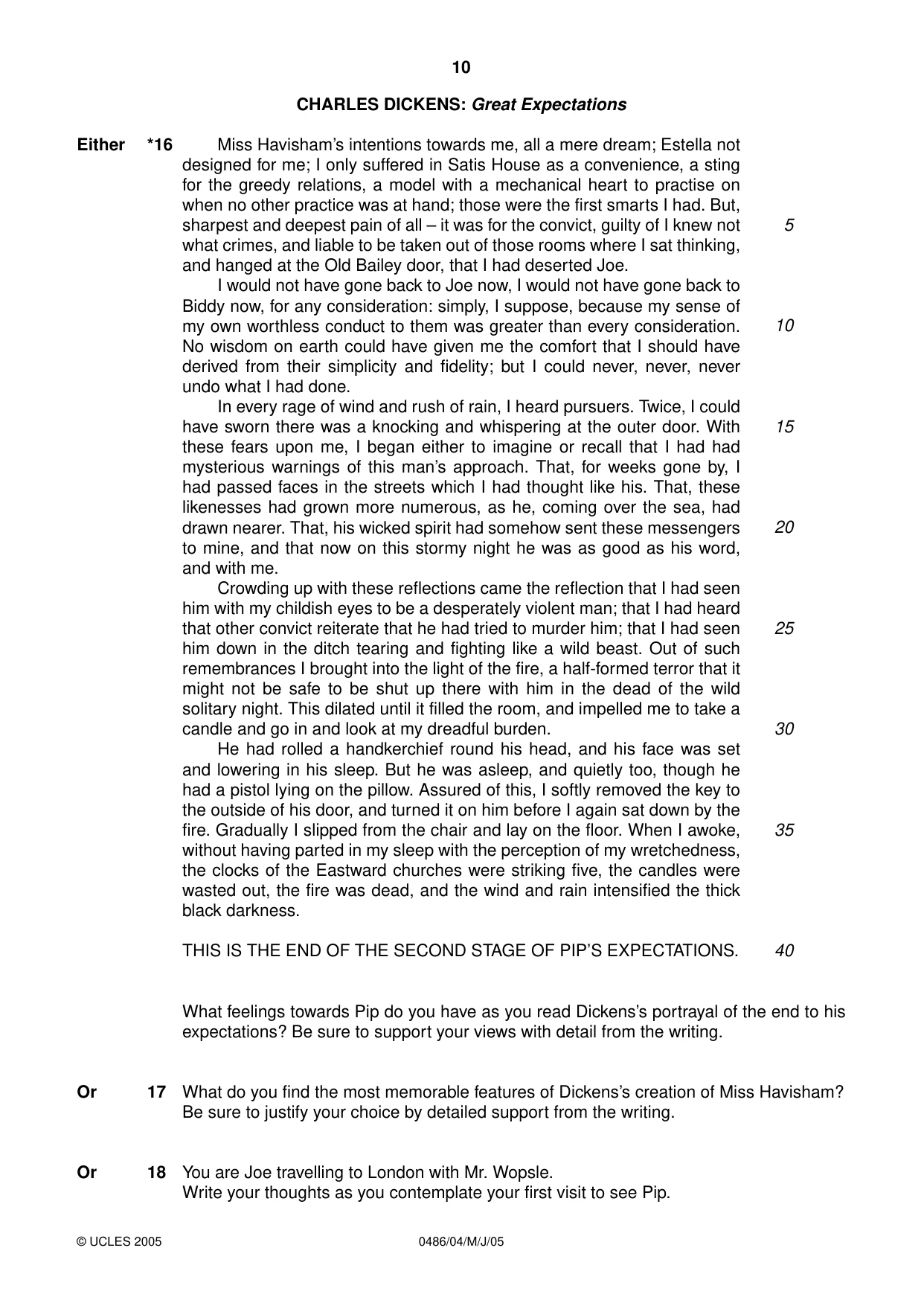
Question paper, page 10
10 0486/04/M/J/05 CHARLES DICKENS: Great Expectations Either *16 Miss Havisham’s intentions towards me, all a mere dream; Estella not designed for me; I only suffered in Satis House as a convenience, a sting for the greedy relations, a model with a mechanical heart to practise on when no other practice was at hand; those were the first smarts I had. But, sharpest and deepest pain of all – it was for the convict, guilty of I knew not what crimes, and liable to be taken out of those rooms where I sat thinking, and hanged at the Old Bailey door, that I had deserted Joe. I would not have gone back to Joe now, I would not have gone back to Biddy now, for any consideration: simply, I suppose, because my sense of my own worthless conduct to them was greater than every consideration. No wisdom on earth could have given me the comfort that I should have derived from their simplicity and fidelity; but I could never, never, never undo what I had done. In every rage of wind and rush of rain, I heard pursuers. Twice, I could have sworn there was a knocking and whispering at the outer door. With these fears upon me, I began either to imagine or recall that I had had mysterious warnings of this man’s approach. That, for weeks gone by, I had passed faces in the streets which I had thought like his. That, these likenesses had grown more numerous, as he, coming over the sea, had drawn nearer. That, his wicked spirit had somehow sent these messengers to mine, and that now on this stormy night he was as good as his word, and with me. Crowding up with these reflections came the reflection that I had seen him with my childish eyes to be a desperately violent man; that I had heard that other convict reiterate that he had tried to murder him; that I had seen him down in the ditch tearing and fighting like a wild beast. Out of such remembrances I brought into the light of the fire, a half-formed terror that it might not be safe to be shut up there with him in the dead of the wild solitary night. This dilated until it filled the room, and impelled me to take a candle and go in and look at my dreadful burden. He had rolled a handkerchief round his head, and his face was set and lowering in his sleep. But he was asleep, and quietly too, though he had a pistol lying on the pillow. Assured of this, I softly removed the key to the outside of his door, and turned it on him before I again sat down by the fire. Gradually I slipped from the chair and lay on the floor. When I awoke, without having parted in my sleep with the perception of my wretchedness, the clocks of the Eastward churches were striking five, the candles were wasted out, the fire was dead, and the wind and rain intensified the thick black darkness. THIS IS THE END OF THE SECOND STAGE OF PIP’S EXPECTATIONS. What feelings towards Pip do you have as you read Dickens’s portrayal of the end to his expectations? Be sure to support your views with detail from the writing. Or 17 What do you find the most memorable features of Dickens’s creation of Miss Havisham? Be sure to justify your choice by detailed support from the writing. Or 18 You are Joe travelling to London with Mr. Wopsle. Write your thoughts as you contemplate your first visit to see Pip. © UCLES 2005 5 10 15 20 25 30 35 40
Question paper, page 11
11 0486/04/M/J/05 [Turn over GRAHAM GREENE: Travels with My Aunt Either *19 I stooped down and picked the object up. It was Wordsworth’s knife. The tool for taking stones out of horse’s hoofs was open – perhaps he had meant to open the blade and in his hurry he had made an error. I struck a match and before the flame went out I saw the body on the ground and the black face starred with white orange petals, which had been blown from the trees in the small breeze of early morning. I knelt down and felt for the pulse in the heart. There was no life in the black body and my hand was wet from the wound I couldn’t see. ‘Poor Wordsworth,’ I said aloud with some idea of showing to his murderer if he were anywhere nearby that Wordsworth had a friend. I thought how his bizarre love for an old woman had taken him from the doors of the Grenada cinema, where he used to stand so proudly in his uniform, to die on the wet grass near the Paraguay river, but I knew that if this was the price he had to pay, he would have paid it gladly. He was a romantic, and in the only form of poetry he knew, the poetry which he had learnt at St George’s Cathedral, Freetown, he would have found the right words to express his love and his death. I could imagine him at the last, refusing to admit that she had dismissed him forever, reciting a hymn to keep his courage up as he walked towards the house through the hollow in the little wood: ‘If I ask Her to receive me, Will she say me nay? Not till earth and not till heav’n Pass away.’ The sentiment had always been sincere even if the changes in the words were unliturgical. There was no sound except my own breathing. I closed the knife and put it in my pocket. Had he drawn it when he first entered the grounds with the intention of attacking Visconti? I preferred to think otherwise – that he had come with the simple purpose of appealing to his love once more before abandoning hope and that when he heard someone move among the trees he had drawn the knife hurriedly in self-defence, pointing at his unseen enemy the useless tool for horses’ hooves. Explore the ways in which Greene’s writing here makes Wordsworth’s death seem tragic but also comic. Or 20 Henry Pulling is never actually described by Greene; instead his character emerges from what he says and does. What kind of man do you think he is? Support your ideas with detail from Greene’s writing. Or 21 You are Tooley just after leaving Henry Pulling in Istanbul. Write your thoughts about your journey with him. © UCLES 2005 5 10 15 20 25 30
Question paper, page 12
12 0486/04/M/J/05 DALENE MATTHEE: Fiela’s Child Either *22 She walked till it was dark and until she could walk no more. Not for a moment, ever, had she feared the forest woman. Not for a moment had she thought she would lose Benjamin that way, that her hands would be empty when she went home. Never. She did not look for shelter. She put the sack with her things under her head, folded her overcoat round her body and lay down in the soft driftsand along the forest road. Deep within the thickets a branch cracked. And another. Elephants? Her mind was too weary to find room for fear as well. Somewhere in that vast forest Benjamin would also be lying down to sleep. Where? What was going through his mind? How was he to understand? You tied an umbilical cord, you did not rip it off! Benjamin had always been the one standing at the roadside if she had stayed away a little too long visiting Miss Baby or Auntie Maria. He had never joined the other children when they talked and dreamed about where they wanted to go and work or live one day. He was the one that had always said, ‘I just want to stay with ma.’ Sheer hatred came up in her against the woman without a face that had taken him after nine years. Woodcutter’s woman, forest woman, white woman. Had she watched over him when the fever of the measles would not subside? Had she comforted him when his boat drifted away or when the mongoose stole his broody hen’s eggs? Had she seen him laugh, seen him cry, seen him grow out of his clothes? God, how could this happen? She fell asleep from exhaustion. When she woke up at dawn, she felt death stirring in her; she knew she would have difficulty reaching home and that she would have to take every short cut to get there. She came through the hills above the house shortly before midday on the next day, limping for the last part of the way. They were expecting her from the other direction. Selling was sitting beside the house with the whip thongs slack in his hands and his eyes on the road in the Kloof. Kittie was standing behind him. Emma was doing the mending. Tollie was standing guard with the thorn branch in the ostrich enclosure while Dawid gathered the dung in the tin bucket. There was not a sign of redness on Kicker’s beak or shins. Pollie was pecking along the ground behind him. Selling was the first to look round. Then they were all there with her. Selling’s hands kept fidgeting and the words seemed to stick in his throat. ‘Ma, what’s happened?’ Dawid asked, aghast. Someone took the sack from her, someone brought her something to sit on, someone put the beaker of water in her hands, someone took off her headcloth. And Selling asked: ‘Where’s Benjamin, Fiela?’ She did not look at them, she looked away to the ground. ‘He’s the forest woman’s child.’ When she looked up, tears were running over Selling’s face and the children were just standing there, defeated. Behind them, at the hedge, Kicker stood there, looking straight at her. Explore the ways in which in this passage Matthee conveys the terrible sense of loss which Fiela is feeling. © UCLES 2005 5 10 15 20 25 30 35 40
Question paper, page 13
13 0486/04/M/J/05 [Turn over Or 23 The mystery of Benjamin/Lukas’s birth is central to the novel. By exploring one episode from the first part of the novel and one episode from towards the end of the novel, show how Matthee’s writing makes the mystery so compelling. Or 24 You are Fiela on the evening after Benjamin has returned to the Forest to confront Barta van Rooyen (following your advice). Write your thoughts. © UCLES 2005
Question paper, page 14
14 0486/04/M/J/05 HENRY HANDEL RICHARDSON: The Getting of Wisdom Either *25 All of a sudden, from out the spacious halls of which they had caught a glimpse on arriving, brisk steps began to come towards them over the oilcloth – at first as a mere tapping in the distance, then rapidly gaining in weight and decision. Laura’s palpitations reached their extreme limit – another second and they might have burst her chest. Cousin Grace ceased to giggle; the door opened with a peculiar flourish; and all three rose to their feet. The person who entered was a very stately lady; she wore a cap with black ribbons. With the door-handle still in her hand she made a slight obeisance, in which her whole body joined, afterwards to become more erect than before. Having introduced herself to Godmother as Mrs. Gurley, the Lady Superintendent of the institution, she drew up a chair, let herself down upon it, and began to converse with an air of ineffable condescension. While she talked Laura examined her, with a child’s thirst for detail. Mrs. Gurley was large and generous of form, and she carried her head in such a haughty fashion that it made her look taller than she really was. She had a high colour, her black hair was touched with grey, her upper teeth were prominent. She wore gold eyeglasses, many rings, a long gold chain, which hung from an immense cameo brooch at her throat, and a black apron with white flowers on it, one point of which was pinned to her ample bosom. The fact that Laura had just such an apron in her box went only a very little way towards reviving her spirits; for altogether Mrs. Gurley was the most impressive person she had ever set eyes on. Beside her, Godmother was nothing but a plump, shortsighted fidgety lady. Particularly awe-inspiring was Mrs. Gurley when she listened to another speaking. She held her head a little to one side, her teeth met her underlip and her be-ringed hands toyed incessantly with the long gold chain, in a manner which seemed to denote that she set little value on what was being said. Awful, too, was the habit she had of suddenly lowering her head and looking at you over the tops of her glasses: when she did this, and when her teeth came down on her lip, you would have liked to shrink to the size of a mouse. Godmother, it was true, was not afraid of her; but Cousin Grace was hushed at last; and as for Laura herself, she consciously wore a fixed little simper, which was meant to put it beyond doubt that butter would not melt in her mouth. Godmother now asked if she might say a few words in private, and the two ladies left the room. As the door closed behind them Cousin Grace began to be audible again. ‘Oh, snakes!’ she giggled, and her double chin spread itself. ‘There’s a Tartar for you! Don’t I thank my stars it’s not me that’s being shunted off here! She’ll give you what-for.’ What picture of Mrs Gurley emerges here? Be sure to refer in some detail to the writing in the extract as you answer. Or 26 Explore two moments in this novel which you find amusing, showing how the writing creates the humour for you. Or 27 You are Mother just after Laura has left home for the first time to go to Melbourne Ladies’ College. Write your thoughts. © UCLES 2005 5 10 15 20 25 30 35 40
Question paper, page 15
15 0486/04/M/J/05 [Turn over Turn to page 16 for question 28 © UCLES 2005
Question paper, page 16
16 0486/04/M/J/05 AMY TAN: The Bonesetter’s Daughter Either *28 ‘Epilogue’ It is the twelfth of August and Ruth is in the Cubbyhole, silent. Foghorns blow in the night, welcoming ships into the bay. Ruth still has her voice. Her ability to speak is not governed by curses or shooting stars or illness. She knows that for certain now. But she does not need to talk. She can write. Before, she never had a reason to write for herself, only for others. Now she has that reason. The picture of her grandmother is in front of her. Ruth looks at it daily. Through it, she can see from the past clear into the present. Could her grandmother ever have imagined she would have a granddaughter like her – a woman who has a husband who loves her, two girls who adore her, a house she co-owns, dear friends, a life with only the usual worries about leaks and calories? Ruth remembers how her mother used to talk of dying, by curse or her own hand. She never stopped feeling the urge, not until she began to lose her mind, the memory web that held her woes in place. And though her mother still remembers the past, she has begun to change it. She doesn’t recount the sad parts. She only recalls being loved very, very much. She remembers that to Bao Bomu she was the reason for life itself. The other day Ruth’s mother called her. She sounded like her old self, scared and fretful. ‘Luyi,’ she said, and she spoke quickly in Chinese, ‘I’m worried that I did terrible things to you when you were a child, that I hurt you very much. But I can’t remember what I did …’ ‘There’s nothing –’ Ruth began. ‘I just wanted to say that I hope you can forget just as I’ve forgotten. I hope you can forgive me, because if I hurt you, I’m sorry.’ After they hung up, Ruth cried for an hour she was so happy. It was not too late for them to forgive each other and themselves. As Ruth now stares at the photo, she thinks about her mother as a little girl, about her grandmother as a young woman. These are the women who shaped her life, who are in her bones. They caused her to question whether the order and disorder of her life were due to fate or luck, self- determination or the actions of others. They taught her to worry. But she has also learned that these warnings were passed down, not simply to scare her, but to force her to avoid their footsteps, to hope for something better. They wanted her to get rid of the curses. In the Cubbyhole, Ruth returns to the past. The laptop becomes a sand tray. Ruth is six years old again, the same child, her broken arm healed, her other hand holding a chopstick, ready to divine the words. Bao Bomu comes, as always, and sits next to her. Her face is smooth, as beautiful as it is in the photo. She grinds an inkstick into an inkstone of duan. ‘Think about your intentions,’ Bao Bomu says. ‘What is in your heart, what you want to put in others’. And side by side, Ruth and her grandmother begin. Words flow. They have become the same person, six years old, sixteen, forty-six, eighty-two. They write about what happened, why it happened, how they can make other things happen. They write stories of things that are but should not have been. They write about what could have been, what still might be. They write of a past that can be changed. After all, Bao Bomu says, what is the past but what we choose to remember? They can choose not to hide it, to take what’s broken, to feel the pain and know that it will heal. They know where happiness lies, not in © UCLES 2005 5 10 15 20 25 30 35 40 45 50
Question paper, page 17
17 0486/04/M/J/05 [Turn over a cave or a country, but in love and the freedom to give and take what has been there all along. Ruth remembers this as she writes a story. It is for her grandmother, for herself, for the little girl who became her mother. What makes this passage a satisfying ending to the novel? Or 29 What have you found particularly interesting about the way in which a picture of Immortal Heart village is created in the novel? Support your answer by close reference to relevant details. Or 30 You are Precious Auntie. LuLing has just told you that she is going to join the Chang family despite having read your papers. Write your thoughts. © UCLES 2005 55
Question paper, page 18
18 0486/04/M/J/05 DRAMA ALAN AYCKBOURN: Absent Friends Either *31 Colin: Yes. [Pause.] [Looking at his watch.] Good heavens, yes. Look at the … It’s a long drive. I’d better make a start. [Pause.] Good-bye, all … Marge: [Coming out of her reverie]. Oh, Colin, are you off? Colin: Yes, I think I’d … Marge: Yes. Don’t forget your photographs … Colin: Oh, no. I wouldn’t do that. Not likely to do that. Marge: I hope you – manage all right, Colin. Colin: Me? Oh, I’m fine. I’ve always fallen on my feet, you know … I’ve still got a good job – health and strength – and lately, I think I’ve found a few good friends over there as well. Carol’s parents, to name but two. I’m always round with them these days. You know, talking over old times and things. And if I really get a bit depressed, out come the old albums. It’s a pity you didn’t meet her, Marge. You’d have got on like a house on fire. Marge: Yes, I’m sure. Colin: Well. Good-bye, Evelyn. Been a great pleasure meeting you. Evelyn: Bye. John: Cheerio, old Col. See you. Colin: You bet. Come over and see me. John: Might just do that. When I get the new car. Have a few – [drinking gesture.] … together. Colin: Any time, Paul. Paul: Bye, Colin. Take care. Colin: And you. Say good-bye to Di, will you? Paul: Oh, sure. She’ll be sorry she missed you. Colin: Bye-bye, Marge. No, it’s all right, I’ll see myself out. [Hesitating.] Er – I really appreciated you all inviting me over here this afternoon, you know and, well … thanks a lot. You’ve really been great. All of you. Marge: Good-bye, Colin. And I hope perhaps, you know – later on – you’ll … once you’ve got over … I mean, I know it will be difficult for a time for you to forget about Carol … Colin: Forget her? Oh come on, Marge. You know me better than that, don’t you? [Smiling round.] Bye-bye, all. [Colin goes out. A pause.] Marge: He’s a nice boy, isn’t he? John: Good old Col. Just the same. Marge: Paul, I’ll have to go home to Gordon in a minute. Paul: Yes. Fine, Marge. Fine. You do that … Marge: But if by any chance you need help – with her – you know my number. As soon as I’ve cleaned Gordon up, I can easily look back. Paul: No, we’ll manage, Marge, honestly. Marge: She should sleep now. [Evelyn starts singing, still rocking the pram.] [Paul sits and starts to doze.] John: [who has sat down for once] I’ll cut that carpet up for the car tomorrow. © UCLES 2005 5 10 15 20 25 30 35 40 45 50
Question paper, page 19
19 0486/04/M/J/05 [Turn over Marge: [Sitting down herself for a moment.] I don’t think I’d better leave Gordon on his own again when he’s ill, you know. He doesn’t like it. He prefers it if I’m there. [Slight pause.] Oh, it’s terrible. I haven’t got the energy to move now. Once I’ve sat down … I think those shoes will go with that coat. I hope so … oh, look at us. Honestly. All drooping about like wet weekends … still, why shouldn’t we, I say. There are worse ways of spending the time. Than sitting peacefully with your friends. Nice to sit with your friends now and again. Nice … [Evelyn continues her singing.] [Marge daydreams.] [Paul starts to snore loudly.] [John jiggles.] CURTAIN What kind of impression of the ‘friends’ do you think Ayckbourn wants to leave with us as the play finishes? Support your ideas with detail from the passage. Or 32 Horrifyingly self-centred Honest and amusingly direct Explore these two descriptions of Evelyn, bringing out by close reference to the play which you think is the more truthful. Or 33 You are Diana at the end of the play, lying on your bed. You hear the front door close as the last of the guests leave. Write your thoughts. © UCLES 2005 55 60
Question paper, page 20
20 0486/04/M/J/05 LIZ LOCHHEAD/GINA MOXLEY: Cuba and Dog House Either *34 SCENE SEVEN Ger, Debs, Jimmy and Marian are standing by the wall of the hall at a disco. The lights are flashing and the music’s thumping but nobody is dancing yet. Debs: Don’t know what we keep coming to this for, there’s never any talent here. Ger: There is some here, OK, it’s just that you’ve shifted all of them. Barry comes in and Marian becomes very interested in the floor. Barry: How’s the gang? They all salute him, glad to be associated with an older, cooler person. No sign of Mossie, no? It’s not all off, I hope. Only slagging, Ger, only slagging. Ger: Naw, he’s off with Connie somewhere. They’re like two parrots on a perch since the baby was born. They’ll get a right gonk when Dee comes home. Jimmy: Isn’t he coming tonight? Ger: He said he’d see me inside. Debs: What’s the point in jagging someone if they don’t pay in for you? That’s what I think, anyway. Barry isn’t really interested. He’s scanning the room. Marian: Were you working earlier? Barry doesn’t hear. Barry: Very few here. A lot must be away on hols, I suppose. Well for some. Jimmy: Ah, it’s early yet. Barry: Fair do’s, Jimmy, ever hopeful. Might as well have a look at the menu anyway. There’s a few Spanish or is it French students over there? Debs: Jimmy’s holding out for one of the Flying Saucers, aren’t you, Jim? Jimmy: Wha? Debs: Wha? I saw you. Barry: They’re only razzing you, boy. Catch you later, gang. (He moves off.) Marian: Did you see the hairs on his chest, poking out of his shirt? Debs: No chiffon scarf test for Barry, that’s for sure. Ger: No test of any kind for Barry, I’m afraid. Marian: Oh, you’re very pass-remarkable, aren’t you? Black-out. Lights up and Ger, Debs, Barry, Marian and Jimmy are dancing. Marian tries to edge closer to Barry, who dances away every time. Jimmy is as good at dancing as he is at football. Connie staggers in, followed by Mossie, who’s drunk as well, but not as bad. They’re both holding sparklers aloft. They dance over to the others, Connie gives a sparkler to Jimmy. He obviously feels foolish with it. Everybody shouts to be heard over the music. Ger: Oh, Jesus. Cop on, will ye? If your man on the door sees ye we’ll all be out on our ear. Connie and Mossie are beyond caring and continue dancing around the floor. Jimmy drops his sparkler and leaves the dance floor. © UCLES 2005 5 10 15 20 25 30 35 40 45 50
Question paper, page 21
21 0486/04/M/J/05 [Turn over Barry: The lads are in flying form, aren’t they? Debs: So would you be if you had as much to drink as they’ve had. Connie’s palatic. Ger: So’s Mossie. And he told me he had no money. Bloody chancer. Marian: Who’d give him drink? He doesn’t even look his age, much less act it. There is much tension in this scene. Explore the ways in which Moxley’s writing brings this out. Or 35 In both plays there are moments which convey the pain of ceasing to be a child and becoming an adult. Explore in detail one moment from Cuba and one moment from Dog House which you think vividly convey that change. Or 36 You are Bernadette on the evening of the day on which you have been expelled from the grammar school. Write your thoughts. © UCLES 2005 55
Question paper, page 22
22 0486/04/M/J/05 ARTHUR MILLER: All My Sons Either *37 Chris: Mother, Mother! [She looks into his face.] The wind blew it down. What significance has that got? What are you talking about? Mother, please … don’t go through it all again, will you? It’s no good, it doesn’t accomplish anything. I’ve been thinking, y’know? – maybe we ought to put our minds to forgetting him? Mother: That’s the third time you’ve said that this week. Chris: Because it’s not right; we never took up our lives again. We’re like at a railroad station waiting for a train that never comes in. Mother: [pressing top of her head] Get me an aspirin, heh? Chris: Sure, and let’s break out of this, heh, Mom? I thought the four of us might go out to dinner a couple of nights, maybe go dancing out at the shore. Mother: Fine. [to Keller] We can do it tonight. Keller: Swell with me! Chris: Sure, let’s have some fun. [To Mother] You’ll start with this aspirin. [he goes up and into house with new spirit. Her smile vanishes.] Mother: [with an accusing undertone] Why did he invite her here? Keller: Why does that bother you? Mother: She’s been in New York three and a half years, why all of a sudden – ? Keller: Well, maybe – maybe he just wanted to see her. Mother: Nobody comes seven hundred miles ‘just to see’. Keller: What do you mean? He lived next door to the girl all his life, why shouldn’t he want to see her again? [Mother looks at him critically.] Don’t look at me like that, he didn’t tell me any more than he told you. Mother: [– a warning and a question] He’s not going to marry her. Keller: How do you know he’s even thinking of it? Mother: It’s got that about it. Keller: [sharply watching her reaction] Well? So what? Mother: [alarmed] What’s going on here, Joe? Keller: Now listen, kid – Mother: [avoiding contact with him] She’s not his girl, Joe; she knows she’s not. Keller: You can’t read her mind. Mother: Then why is she still single? New York is full of men, why isn’t she married? [Pause.] Probably a hundred people told her she’s foolish, but she’s waited. Keller: How do you know why she waited? Mother: She knows what I know, that’s why. She’s faithful as a rock. In my worst moments, I think of her waiting, and I know again that I’m right. Keller: Look, it’s a nice day. What are we arguing for? Mother: [warningly] Nobody in this house dast take her faith away, Joe. Strangers might. But not his father, not his brother. Keller: [exasperated] What do you want me to do? What do you want? Mother: I want you to act like he’s coming back. Both of you. Don’t think I haven’t noticed you since Chris invited her. I won’t stand for any nonsense. Keller: But, Kate – Mother: Because if he’s not coming back, then I’ll kill myself! Laugh. Laugh at me. [She points to tree.] But why did that happen the very night she came back? Laugh, but there are meanings in © UCLES 2005 5 10 15 20 25 30 35 40 45 50
Question paper, page 23
23 0486/04/M/J/05 [Turn over such things. She goes to sleep in his room and his memorial breaks in pieces. Look at it; look. [She sits on bench.] Joe – Keller: Calm yourself. Mother: Believe with me, Joe. I can’t stand all alone. Keller: Calm yourself. Mother: Only last week a man turned up in Detroit, missing longer than Larry. You read it yourself. What do you think the writing here reveals of Kate Keller’s state of mind, particularly with regard to her two sons? Or 38 How far does Miller encourage you to feel sympathy for Joe Keller during the play? Be sure to refer to the writing as you answer. Or 39 You are George on your way to the Kellers’ house to meet Ann. Write your thoughts. © UCLES 2005 55 60
Question paper, page 24
24 0486/04/M/J/05 WILLIAM SHAKESPEARE: Twelfth Night OLIVIA’S HOUSE. Either *40 Enter SIR TOBY BELCH and MARIA Sir Toby: What a plague means my niece, to take the death of her brother thus? I am sure care’s an enemy to life. Maria: By my troth, Sir Toby, you must come in earlier o’ nights: your cousin, my lady, takes great exceptions to your ill hours. Sir Toby: Why, let her except before excepted. Maria: Ay, but you must confine yourself within the modest limits of order. Sir Toby: Confine! I’ll confine myself no finer than I am. These clothes are good enough to drink in, and so be these boots too: an they be not, let them hang themselves in their own straps. Maria: That quaffing and drinking will undo you: I heard my lady talk of it yesterday; and of a foolish knight that you brought in one night here to be her wooer. Sir Toby: Who? Sir Andrew Aguecheek? Maria: Ay, he. Sir Toby: He’s as tall a man as any’s in Illyria. Maria: What’s that to the purpose? Sir Toby: Why, he has three thousand ducats a year. Maria: Ay, but he’ll have but a year in all these ducats: he’s a very fool and a prodigal. Sir Toby: Fie, that you’ll say so! he plays o’ the viol-de-gamboys, and speaks three or four languages word for word without book, and hath all the good gifts of nature. Maria: He hath indeed, almost natural: for, besides that he’s a fool, he’s a great quarreller: and but that he hath the gift of a coward to allay the gust he hath in quarrelling, ’tis thought among the prudent he would quickly have the gift of a grave. Sir Toby: By this hand, they are scoundrels and substractors that say so of him. Who are they? Maria: They that add, moreover, he’s drunk nightly in your company. Sir Toby: With drinking healths to my niece. I’ll drink to her as long as there is a passage in my throat and drink in Illyria. He’s a coward and a coystril that will not drink to my niece till his brains turn o’ the toe like a parish-top. What, wench! Castiliano vulgo! for here comes Sir Andrew Agueface. Enter SIR ANDREW AGUECHEEK Sir Andrew: Sir Toby Belch! how now, Sir Toby Belch! Sir Toby: Sweet Sir Andrew! Sir Andrew: Bless you, fair shrew. Maria: And you too, sir. Sir Toby: Accost, Sir Andrew, accost. Sir Andrew: What’s that? Sir Toby: My niece’s chambermaid. Sir Andrew: Good Mistress Accost, I desire better acquaintance. Maria: My name is Mary, sir. Sir Andrew: Good Mistress Mary Accost, – The audience is here introduced to Sir Toby, Maria, and Sir Andrew. What do you think Shakespeare in this passage suggests about their characters and the roles they are to play in the drama? © UCLES 2005 5 10 15 20 25 30 35 40 45
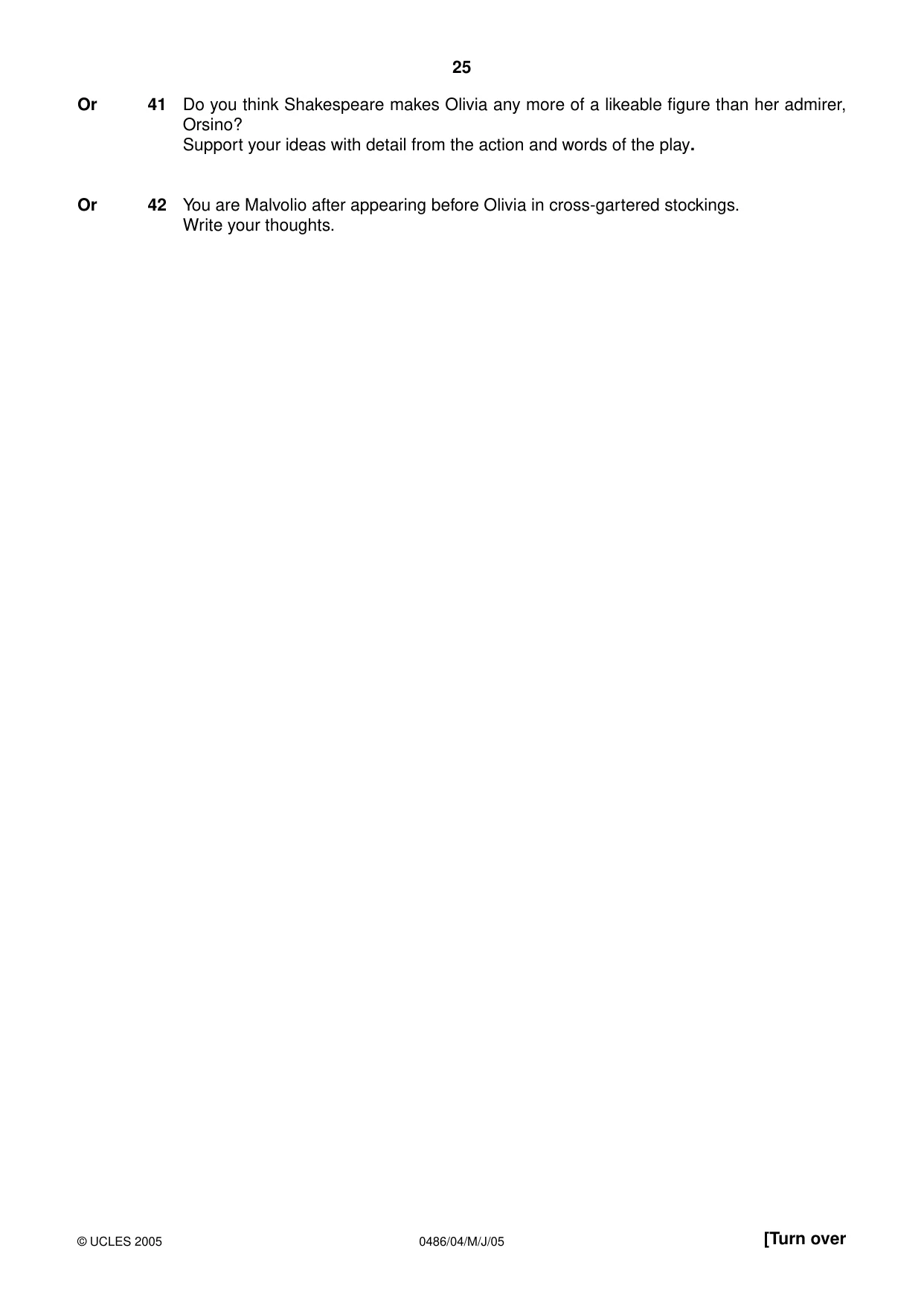
Question paper, page 25
25 0486/04/M/J/05 [Turn over Or 41 Do you think Shakespeare makes Olivia any more of a likeable figure than her admirer, Orsino? Support your ideas with detail from the action and words of the play. Or 42 You are Malvolio after appearing before Olivia in cross-gartered stockings. Write your thoughts. © UCLES 2005
Question paper, page 26
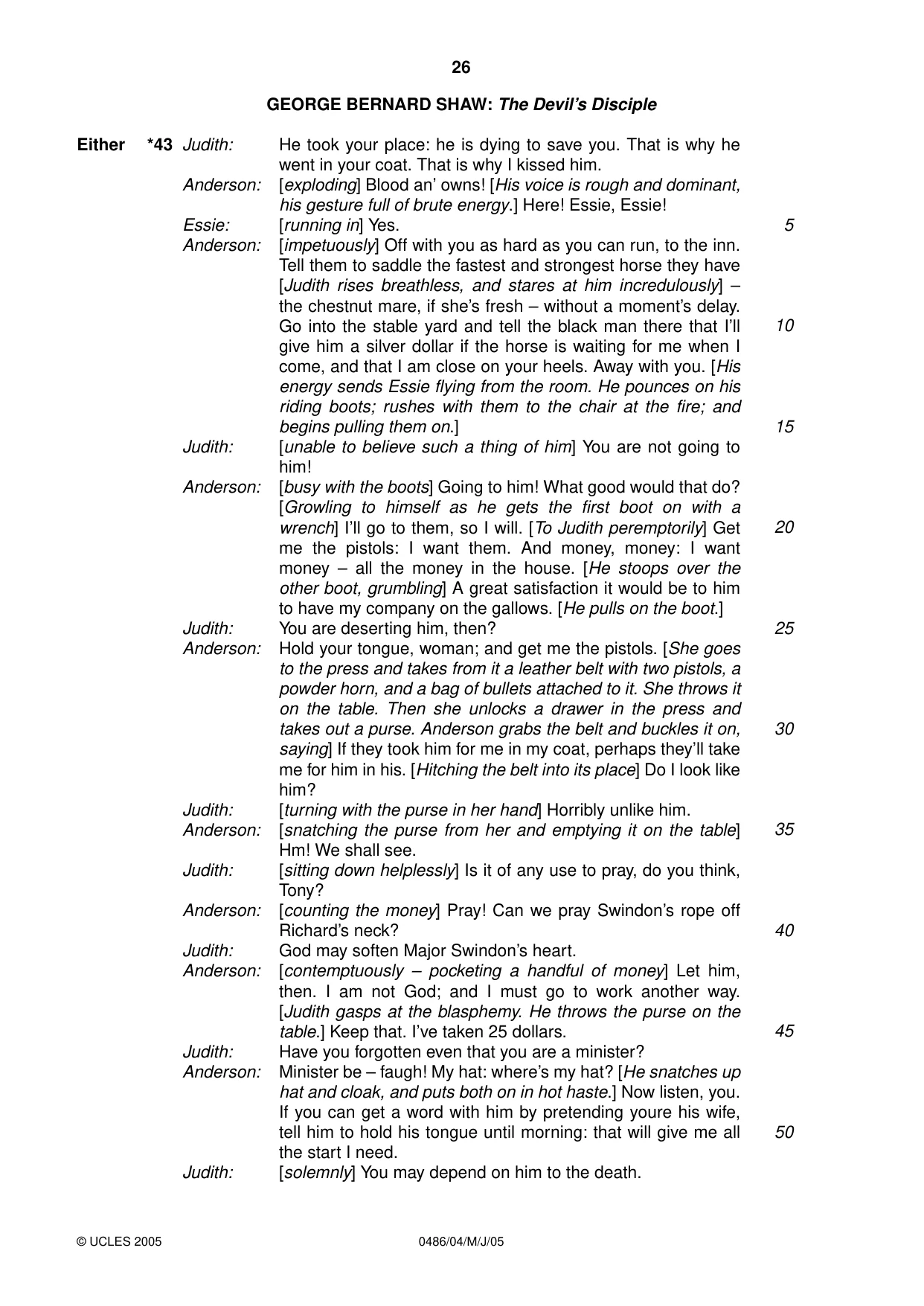
26 0486/04/M/J/05 GEORGE BERNARD SHAW: The Devil’s Disciple Either *43 Judith: He took your place: he is dying to save you. That is why he went in your coat. That is why I kissed him. Anderson: [exploding] Blood an’ owns! [His voice is rough and dominant, his gesture full of brute energy.] Here! Essie, Essie! Essie: [running in] Yes. Anderson: [impetuously] Off with you as hard as you can run, to the inn. Tell them to saddle the fastest and strongest horse they have [Judith rises breathless, and stares at him incredulously] – the chestnut mare, if she’s fresh – without a moment’s delay. Go into the stable yard and tell the black man there that I’ll give him a silver dollar if the horse is waiting for me when I come, and that I am close on your heels. Away with you. [His energy sends Essie flying from the room. He pounces on his riding boots; rushes with them to the chair at the fire; and begins pulling them on.] Judith: [unable to believe such a thing of him] You are not going to him! Anderson: [busy with the boots] Going to him! What good would that do? [Growling to himself as he gets the first boot on with a wrench] I’ll go to them, so I will. [To Judith peremptorily] Get me the pistols: I want them. And money, money: I want money – all the money in the house. [He stoops over the other boot, grumbling] A great satisfaction it would be to him to have my company on the gallows. [He pulls on the boot.] Judith: You are deserting him, then? Anderson: Hold your tongue, woman; and get me the pistols. [She goes to the press and takes from it a leather belt with two pistols, a powder horn, and a bag of bullets attached to it. She throws it on the table. Then she unlocks a drawer in the press and takes out a purse. Anderson grabs the belt and buckles it on, saying] If they took him for me in my coat, perhaps they’ll take me for him in his. [Hitching the belt into its place] Do I look like him? Judith: [turning with the purse in her hand] Horribly unlike him. Anderson: [snatching the purse from her and emptying it on the table] Hm! We shall see. Judith: [sitting down helplessly] Is it of any use to pray, do you think, Tony? Anderson: [counting the money] Pray! Can we pray Swindon’s rope off Richard’s neck? Judith: God may soften Major Swindon’s heart. Anderson: [contemptuously – pocketing a handful of money] Let him, then. I am not God; and I must go to work another way. [Judith gasps at the blasphemy. He throws the purse on the table.] Keep that. I’ve taken 25 dollars. Judith: Have you forgotten even that you are a minister? Anderson: Minister be – faugh! My hat: where’s my hat? [He snatches up hat and cloak, and puts both on in hot haste.] Now listen, you. If you can get a word with him by pretending youre his wife, tell him to hold his tongue until morning: that will give me all the start I need. Judith: [solemnly] You may depend on him to the death. © UCLES 2005 5 10 15 20 25 30 35 40 45 50
Question paper, page 27
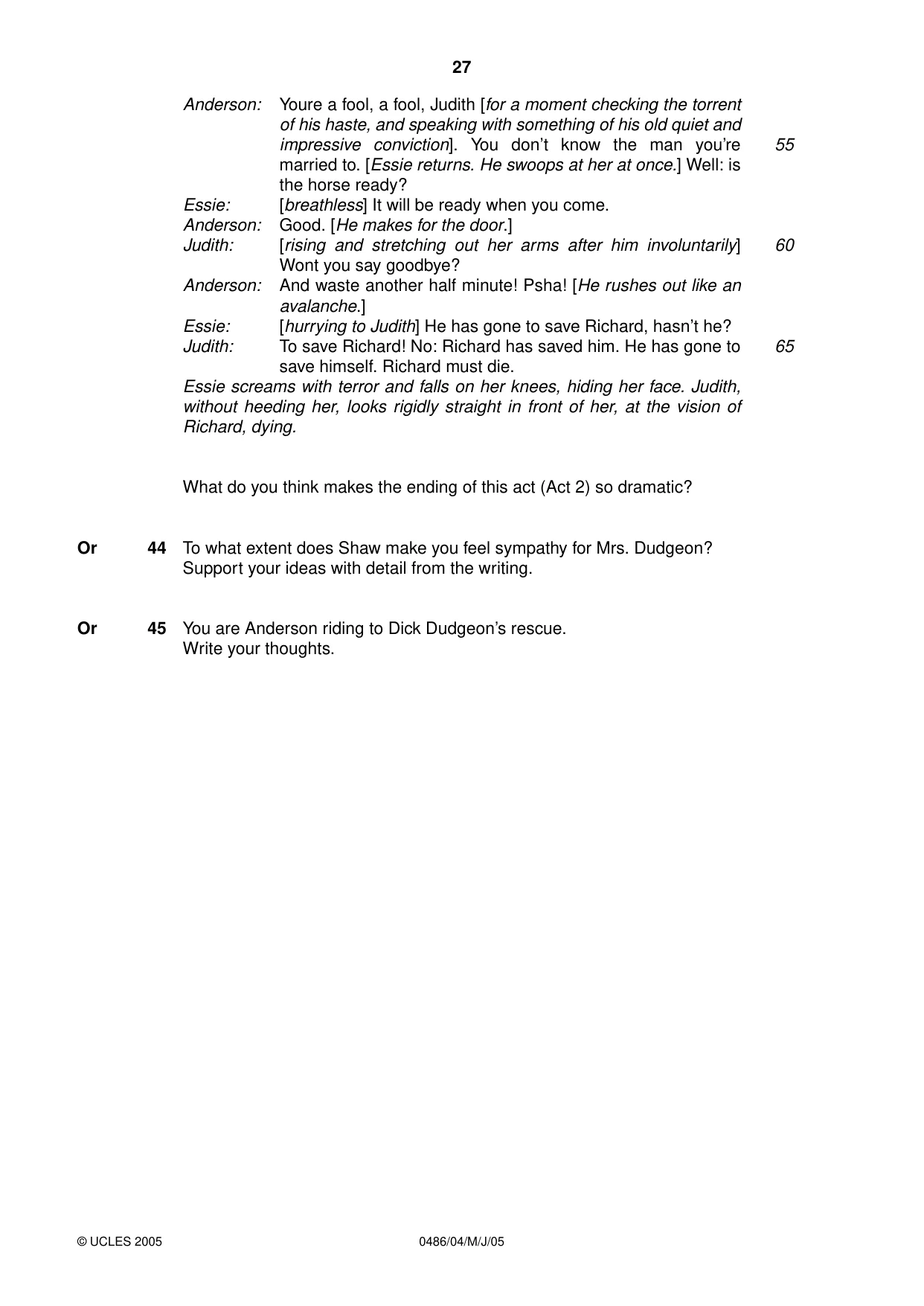
27 0486/04/M/J/05 Anderson: Youre a fool, a fool, Judith [for a moment checking the torrent of his haste, and speaking with something of his old quiet and impressive conviction]. You don’t know the man you’re married to. [Essie returns. He swoops at her at once.] Well: is the horse ready? Essie: [breathless] It will be ready when you come. Anderson: Good. [He makes for the door.] Judith: [rising and stretching out her arms after him involuntarily] Wont you say goodbye? Anderson: And waste another half minute! Psha! [He rushes out like an avalanche.] Essie: [hurrying to Judith] He has gone to save Richard, hasn’t he? Judith: To save Richard! No: Richard has saved him. He has gone to save himself. Richard must die. Essie screams with terror and falls on her knees, hiding her face. Judith, without heeding her, looks rigidly straight in front of her, at the vision of Richard, dying. What do you think makes the ending of this act (Act 2) so dramatic? Or 44 To what extent does Shaw make you feel sympathy for Mrs. Dudgeon? Support your ideas with detail from the writing. Or 45 You are Anderson riding to Dick Dudgeon’s rescue. Write your thoughts. © UCLES 2005 55 60 65
Question paper, page 28
28 0486/04/M/J/05 BLANK PAGE Copyright Acknowledgements: Question 7. © Seamus Heaney; Mid Term Break; Faber & Faber. Question 13. Copyright © Anita Desai 1984. Reproduced by permission of the author c/o Rogers, Coleridge & White Ltd., 20 Powis Mews, London W11 1JN. Question 19. © Graham Greene; TRAVELS WITH MY AUNT; Random House. Question 22. © Dalene Matthee; Fielas Child; Viking, 1986. Question 28. Copyright © 2001 by Amy Tan. Excerpt of THE BONESETTER’S DAUGHTER. Reprinted by permission of the author and the Sandra Dijkstra Literary Agency. Question 31. © Extract from ABSENT FRIENDS by Alan Ayckbourn published by Chatto & Windus. Used by permission of The Random House Group Limited. ABSENT FRIENDS copyright © 1975 Haydonning Ltd. All rights whatsoever in this play are strictly reserved and application for performance etc. must be made before rehearsal to Casarotto Ramsay & Associates Ltd., National House, 60–66 Wardour Street, London W1V 4ND. No performance may be given unless a licence has been obtained. Question 34. © Liz Lochhead and Gina Moxley; Cuba AND Dog House; Faber & Faber Ltd. Question 37. ‘All My Sons’, copyright 1947, renewed © 1975 by Arthur Miller, from ARTHUR MILLER’S COLLECTED PLAYS by Arthur Miller. Used by permission of Viking Penguin, a division of Penguin Group (USA) Inc. Question 43. © The Society of Authors, on behalf of the Bernard Shaw Estate. Permission to reproduce items where third-party owned material protected by copyright is included has been sought and cleared where possible. Every reasonable effort has been made by the publisher (UCLES) to trace copyright holders, but if any items requiring clearance have unwittingly been included, the publisher will be pleased to make amends at the earliest possible opportunity. University of Cambridge International Examinations is part of the University of Cambridge Local Examinations Syndicate (UCLES), which is itself a department of the University of Cambridge.
Mark scheme, page 1
UNIVERSITY OF CAMBRIDGE INTERNATIONAL EXAMINATIONS International General Certificate of Secondary Education MARK SCHEME for the June 2005 question paper 0486 LITERATURE (ENGLISH) 0486/04 Paper 4 (Closed Books), maximum mark 80 This mark scheme is published as an aid to teachers and students, to indicate the requirements of the examination. It shows the basis on which Examiners were initially instructed to award marks. They do not indicate the details of the discussions that took place at an Examiners’ meeting before marking began. Any substantial changes to the mark scheme that arose from these discussions will be recorded in the published Report on the Examination. All Examiners are instructed that alternative correct answers and unexpected approaches in candidates’ scripts must be given marks that fairly reflect the relevant knowledge and skills demonstrated. Mark schemes must be read in conjunction with the question papers and the Report on the Examination. • CIE will not enter into discussion or correspondence in connection with these mark schemes. CIE is publishing the mark schemes for the June 2005 question papers for most IGCSE and GCE Advanced Level and Advanced Subsidiary Level syllabuses and some Ordinary Level syllabuses’. www.XtremePapers.com
Mark scheme, page 2
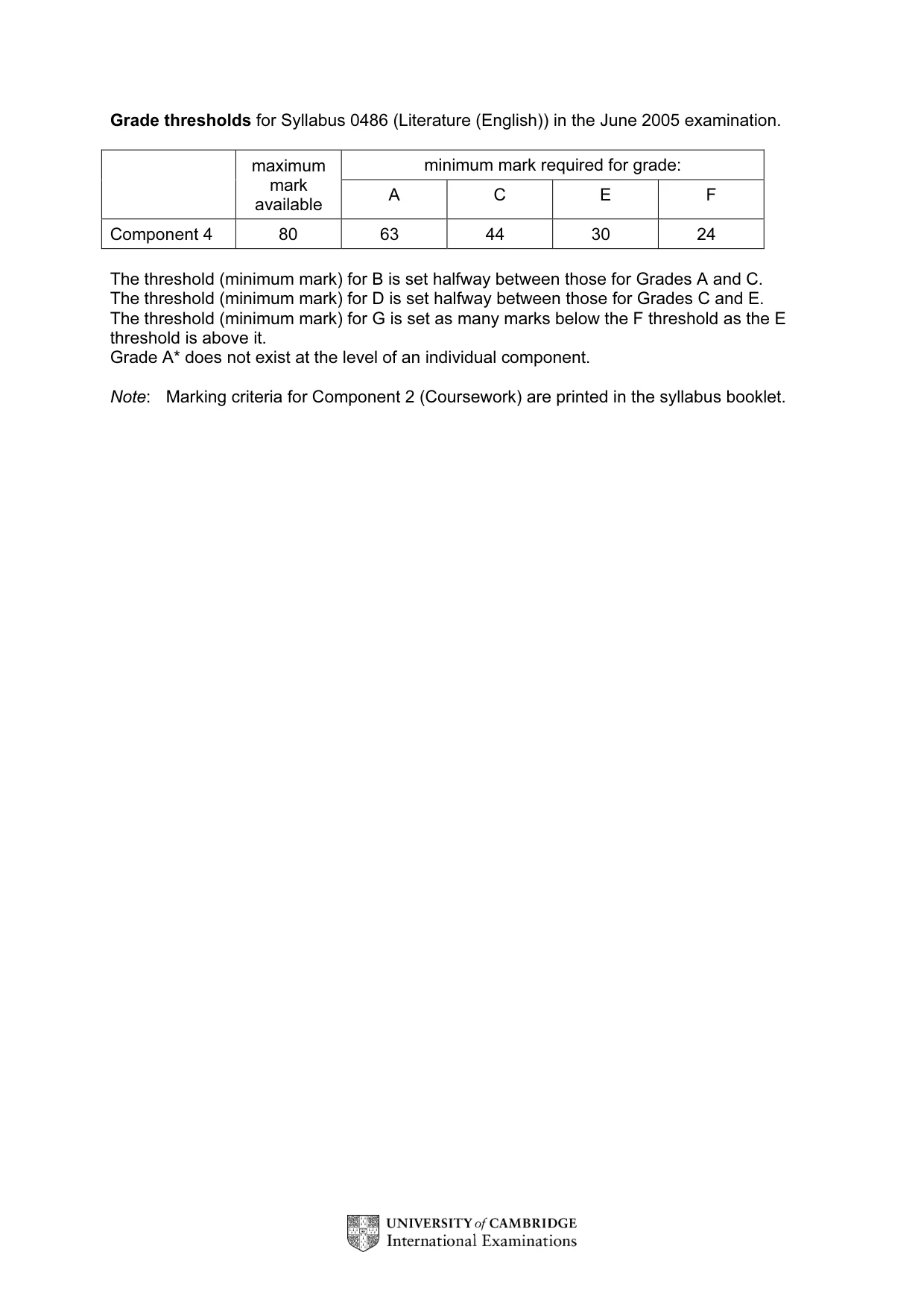
Grade thresholds for Syllabus 0486 (Literature (English)) in the June 2005 examination. minimum mark required for grade: maximum mark available A C E F Component 4 80 63 44 30 24 The threshold (minimum mark) for B is set halfway between those for Grades A and C. The threshold (minimum mark) for D is set halfway between those for Grades C and E. The threshold (minimum mark) for G is set as many marks below the F threshold as the E threshold is above it. Grade A* does not exist at the level of an individual component. Note: Marking criteria for Component 2 (Coursework) are printed in the syllabus booklet.
Mark scheme, page 3
JUNE 2005 IGCSE MARK SCHEME MAXIMUM MARK: 80 SYLLABUS/COMPONENT: 0486/04 LITERATURE (ENGLISH) Paper 4 (Closed Books)
Mark scheme, page 4
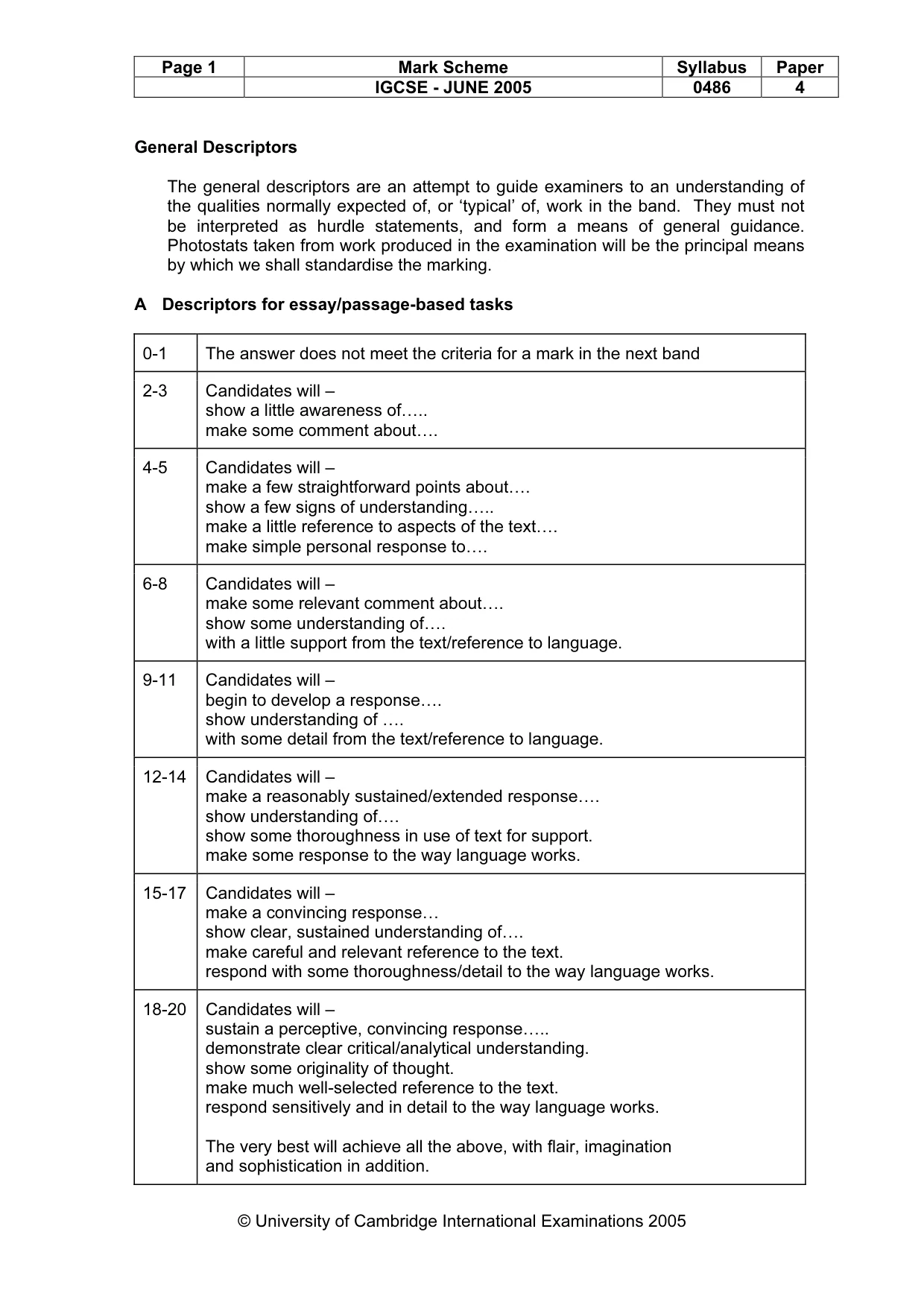
Page 1 Mark Scheme Syllabus Paper IGCSE - JUNE 2005 0486 4 © University of Cambridge International Examinations 2005 General Descriptors The general descriptors are an attempt to guide examiners to an understanding of the qualities normally expected of, or ‘typical’ of, work in the band. They must not be interpreted as hurdle statements, and form a means of general guidance. Photostats taken from work produced in the examination will be the principal means by which we shall standardise the marking. A Descriptors for essay/passage-based tasks 0-1 The answer does not meet the criteria for a mark in the next band 2-3 Candidates will – show a little awareness of….. make some comment about…. 4-5 Candidates will – make a few straightforward points about…. show a few signs of understanding….. make a little reference to aspects of the text…. make simple personal response to…. 6-8 Candidates will – make some relevant comment about…. show some understanding of…. with a little support from the text/reference to language. 9-11 Candidates will – begin to develop a response…. show understanding of …. with some detail from the text/reference to language. 12-14 Candidates will – make a reasonably sustained/extended response…. show understanding of…. show some thoroughness in use of text for support. make some response to the way language works. 15-17 Candidates will – make a convincing response… show clear, sustained understanding of…. make careful and relevant reference to the text. respond with some thoroughness/detail to the way language works. 18-20 Candidates will – sustain a perceptive, convincing response….. demonstrate clear critical/analytical understanding. show some originality of thought. make much well-selected reference to the text. respond sensitively and in detail to the way language works. The very best will achieve all the above, with flair, imagination and sophistication in addition.
Mark scheme, page 5
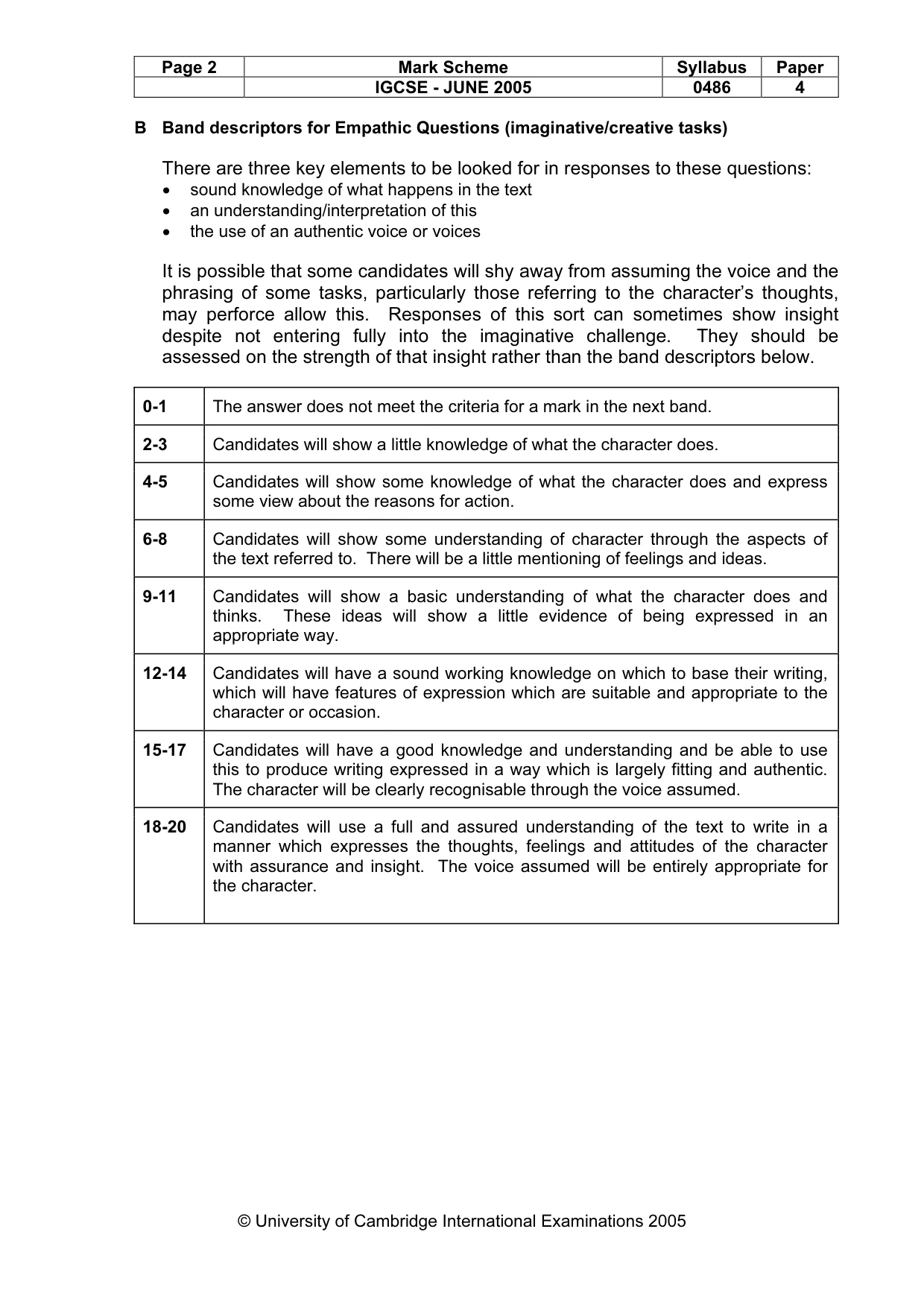
Page 2 Mark Scheme Syllabus Paper IGCSE - JUNE 2005 0486 4 © University of Cambridge International Examinations 2005 B Band descriptors for Empathic Questions (imaginative/creative tasks) There are three key elements to be looked for in responses to these questions: • sound knowledge of what happens in the text • an understanding/interpretation of this • the use of an authentic voice or voices It is possible that some candidates will shy away from assuming the voice and the phrasing of some tasks, particularly those referring to the character’s thoughts, may perforce allow this. Responses of this sort can sometimes show insight despite not entering fully into the imaginative challenge. They should be assessed on the strength of that insight rather than the band descriptors below. 0-1 The answer does not meet the criteria for a mark in the next band. 2-3 Candidates will show a little knowledge of what the character does. 4-5 Candidates will show some knowledge of what the character does and express some view about the reasons for action. 6-8 Candidates will show some understanding of character through the aspects of the text referred to. There will be a little mentioning of feelings and ideas. 9-11 Candidates will show a basic understanding of what the character does and thinks. These ideas will show a little evidence of being expressed in an appropriate way. 12-14 Candidates will have a sound working knowledge on which to base their writing, which will have features of expression which are suitable and appropriate to the character or occasion. 15-17 Candidates will have a good knowledge and understanding and be able to use this to produce writing expressed in a way which is largely fitting and authentic. The character will be clearly recognisable through the voice assumed. 18-20 Candidates will use a full and assured understanding of the text to write in a manner which expresses the thoughts, feelings and attitudes of the character with assurance and insight. The voice assumed will be entirely appropriate for the character.
Mark scheme, page 6
Page 3 Mark Scheme Syllabus Paper IGCSE - JUNE 2005 0486 4 © University of Cambridge International Examinations 2005 Marking Notes In this syllabus, we aim at encouraging candidates to make some personal response to their reading. This means that, while we may have legitimate expectations as to the ground most answers may occupy, we must at all times be prepared to meet the candidates on their chosen ground. It is to be hoped that candidates will see on occasion other possibilities. In this exam, rigid demands for what must be in a good answer must be guarded against. The photostat scripts circulated during coordination will be crucial to maintaining the standard throughout the marking. We must try at all times to tease out what the candidate is trying to say to us. It is possible for a candidate whose technical command of English is limited, but whose language still manages to communicate understanding, to receive high marks. Nor should we reward fluency and display of knowledge of literary terms if we feel there is little evidence of understanding. Remember that we are looking for literary response, not language skills. The notes that follow on each question are for general guidance only, and are not rigid prescriptions of required content. They need to be used in connection with the generic band descriptors.
Mark scheme, page 7
Page 4 Mark Scheme Syllabus Paper IGCSE - JUNE 2005 0486 4 © University of Cambridge International Examinations 2005 Marking Notes POETRY 1 - 9 We will differentiate according to how directly the candidates answer the question and also according to how well they convince us that they have engaged with the pleasure and excitement of good poetry. This means in effect that we do not give good reward to any explanation of ‘meaning’ which shows little response to the words and how they create meaning. In all of the questions there is an explicit invitation to make a response to the words. All the questions prescribe the poems from which the candidates should choose. This is to ensure that the candidate is writing on a poem appropriate to the question. It is also designed to send a strong signal to candidates that they are taking a large risk going into the examination with only one or two poems which they are determined to fit to one of the questions. We should be careful not to give much reward for answers which manifestly are not addressing the question, even if they show a convincing grasp of the poem. If the candidate chooses to write on a poem not in the list, then this should be treated as a rubric infringement and marked accordingly. Please refer to the photostats and the band descriptors when arriving at your mark. PROSE 20th Century Short Stories 10 ‘She saw it now…’ is perhaps the key phrase in the passage. This is the moment in the story when Lawrence dramatically shifts the perspective and Elizabeth, and the reader, for the first time sees the marriage from Walter’s viewpoint. The sadness of what she sees is made all the more terrible because it requires death to create the insight, the agony of recognition and the guilt which will remain with the living. Naturally we shall expect any candidate deserving of adequate reward to show that this absolutely central point of the story has been grasped. Further reward should be decided on the extent to which the candidate engages with Lawrence’s writing. It has at times distinct echoes of the judgmental, epic tones of the King James Bible, though at this level examiners would not of course, expect candidates to recognise it as such. We should expect good candidates, however, to be able to probe some of the aspects of the writing which makes this such a memorable piece of writing. Please refer to the photostats and the band descriptors when arriving at your mark.
Mark scheme, page 8
Page 5 Mark Scheme Syllabus Paper IGCSE - JUNE 2005 0486 4 © University of Cambridge International Examinations 2005 11 Both of these stories have been chosen deliberately because they are based in a society driven by conventions and assumptions which will be somewhat alien to most present day candidates. Therefore, we should expect, for adequate reward, the answer to show some recognition of this. We should beware of over-marking a run through of the story which makes little attempt to adapt material to the angle of the question. We must allow for a negative response, though the challenge of the question should lead many to argue that both Mansfield and Saki are writing about live issues. In Saki, these might be the clash between adult and children’s perceptions; in Mansfield, the way people’s lives can shrivel; and in both how in the lives people lead the imagination is often locked away. However, there are many other approaches possible. We shall differentiate in the last instance according to how closely the candidate probes the words in support of the argument. Please refer to the photostats and the band descriptors when arriving at your mark. 12 Not for nothing is Mr Thomas called Old Misery and clearly any adequate response is going to have to communicate why he was an obvious target for the Wormsley Common Gang and how now he really has something to be miserable about. However, the story also makes clear that he is rather a decent old man and he will hardly be able to comprehend why this has happened to him and why he has been singled out. It will be expected that in the good answer some compassionate feeling for the old man will emerge. Will he be able to work out who is responsible, one wonders? Perhaps, but some candidates will choose to leave him bewildered and we should accept that. Please refer to the photostats and the band descriptors when arriving at your mark. The Village by the Sea 13 In answering the first part of the question, candidates should focus on ‘bustle’ and ‘excitement’ if they are to do well. The catalogue of activities and the energy with which Desai writes will be noted by the more discerning. The many stalls and activities, the colour and pageantry all add to the atmosphere of enjoyment and excitement. It will be essential for candidates to engage enthusiastically with the writing if they are to receive high reward. With regard to the second part of the question, candidates should see how Hari’s development as a character is portrayed. He is positive and has lost his diffidence to such an extent that Mr Panwallah is able to say: ‘You will manage all right - I can see I don’t have to worry about you anymore’. We shall differentiate according to the insight and perspicacity of the candidate in recognising how this bustling atmosphere is created by Desai through her words and style of writing. Please refer to the photostats and the band descriptors when arriving at your mark
Mark scheme, page 9
Page 6 Mark Scheme Syllabus Paper IGCSE - JUNE 2005 0486 4 © University of Cambridge International Examinations 2005 14 The children’s father has two sides to him: he is unpleasant, selfish and addicted to alcohol in the first part of the novel, but changes later on when his wife is taken to hospital; he then becomes a devoted protector, never leaving the hospital until his wife improves sufficiently to be discharged. He even apologises for his part in Pinto’s death (Chapter 13). So we should check that candidates see both sides of the children’s father and that they explore the writing assiduously to ascertain how Desai presents this contradictory figure. Those who engage fully with this task and adduce appropriate references and examples to support their ideas should be highly rewarded. We should beware of those who simply narrate without engaging with the language. Please refer to the photostats and the band descriptors when arriving at your mark 15 The beginning of Chapter 12 will be relevant to a good answer as Hari looks forward to his return to the village by the sea. He is excited and enthused by what he sees out of the bus window and notes changes, developments and contrasts. Hari, true to his character, will have plans to help his sisters; he will be concerned about his mother and be unaware that she is in hospital; he will think of his father, little knowing the changes that have occurred in him. He will perhaps wonder how they will react to his return and the presents he has brought for them. There will surely be a determination in him to improve the conditions that they live in and perhaps a little guilt at having left them. Those who capture this more mature Hari following his sojourn in the big city and refer to the events in the novel will merit high reward. Please refer to the photostats and the band descriptors when arriving at your mark. Great Expectations 16 Most responses, it is hoped, will engage sympathetically with Pip’s realisation of how he has been duped and, as significantly, has deceived himself. This latter application of the scourge to himself as much as to others is a powerful reason for the reader to feel compassion. The end of the chapter is a wonderful example of Dickensian atmospheric setting used to reinforce the mood of the moment. Exploration of some of these issues with detail from the passage will be enough for adequate reward. Will some of the better candidates, besides engaging with a range of detail, also show themselves alert to Pip’s rather less admirable reaction to Magwitch, in which we see all the unpleasant assumptions which have characterised Pip the gentleman? Please refer to the photostats and the band descriptors when arriving at your mark. 17 As usual the key words here are memorable and creation. Most candidates will certainly be able to offer some understanding of Miss Havisham’s character and we should reward such material moderately. However, for higher reward we should require that candidates engage with Dickens’ writing and begin to bring out all the terrible aspects of Miss Havisham’s nightmare world and the prison which she has created for herself. There is no more powerful evocation of the futility of revenge in literature and we should expect that the best will manage to bring out something of that by detailed reference to the text. Please refer to the photostats and the band descriptors when arriving at your mark. 18 Clearly Joe will be embarking on this visit with some eager anticipation to see Pip in his new grand situation and with perhaps some pride in how his Pip has become a gentleman. However, there will also be considerable trepidation and any adequate
Mark scheme, page 10
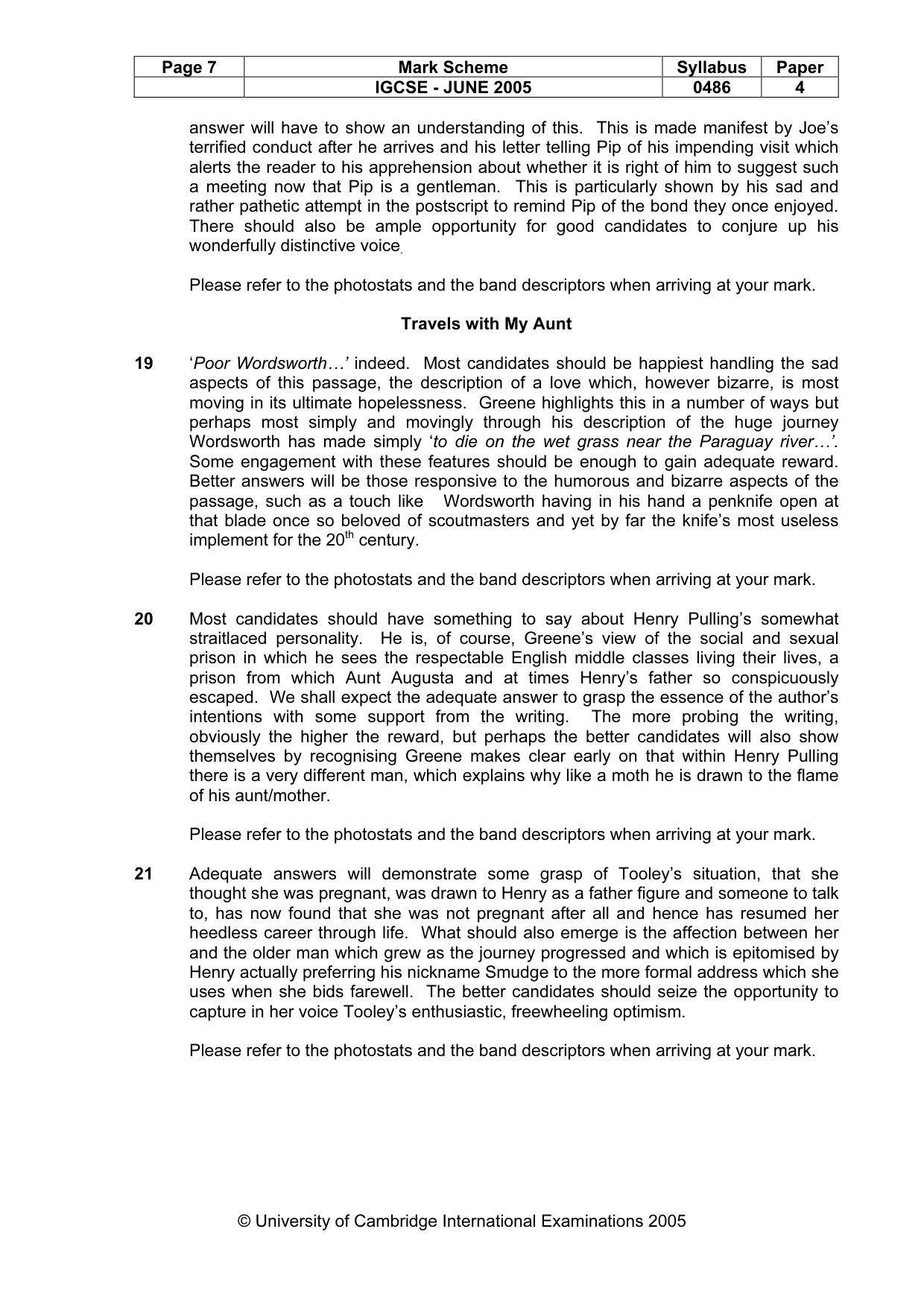
Page 7 Mark Scheme Syllabus Paper IGCSE - JUNE 2005 0486 4 © University of Cambridge International Examinations 2005 answer will have to show an understanding of this. This is made manifest by Joe’s terrified conduct after he arrives and his letter telling Pip of his impending visit which alerts the reader to his apprehension about whether it is right of him to suggest such a meeting now that Pip is a gentleman. This is particularly shown by his sad and rather pathetic attempt in the postscript to remind Pip of the bond they once enjoyed. There should also be ample opportunity for good candidates to conjure up his wonderfully distinctive voice. Please refer to the photostats and the band descriptors when arriving at your mark. Travels with My Aunt 19 ‘Poor Wordsworth…’ indeed. Most candidates should be happiest handling the sad aspects of this passage, the description of a love which, however bizarre, is most moving in its ultimate hopelessness. Greene highlights this in a number of ways but perhaps most simply and movingly through his description of the huge journey Wordsworth has made simply ‘to die on the wet grass near the Paraguay river…’. Some engagement with these features should be enough to gain adequate reward. Better answers will be those responsive to the humorous and bizarre aspects of the passage, such as a touch like Wordsworth having in his hand a penknife open at that blade once so beloved of scoutmasters and yet by far the knife’s most useless implement for the 20th century. Please refer to the photostats and the band descriptors when arriving at your mark. 20 Most candidates should have something to say about Henry Pulling’s somewhat straitlaced personality. He is, of course, Greene’s view of the social and sexual prison in which he sees the respectable English middle classes living their lives, a prison from which Aunt Augusta and at times Henry’s father so conspicuously escaped. We shall expect the adequate answer to grasp the essence of the author’s intentions with some support from the writing. The more probing the writing, obviously the higher the reward, but perhaps the better candidates will also show themselves by recognising Greene makes clear early on that within Henry Pulling there is a very different man, which explains why like a moth he is drawn to the flame of his aunt/mother. Please refer to the photostats and the band descriptors when arriving at your mark. 21 Adequate answers will demonstrate some grasp of Tooley’s situation, that she thought she was pregnant, was drawn to Henry as a father figure and someone to talk to, has now found that she was not pregnant after all and hence has resumed her heedless career through life. What should also emerge is the affection between her and the older man which grew as the journey progressed and which is epitomised by Henry actually preferring his nickname Smudge to the more formal address which she uses when she bids farewell. The better candidates should seize the opportunity to capture in her voice Tooley’s enthusiastic, freewheeling optimism. Please refer to the photostats and the band descriptors when arriving at your mark.
Mark scheme, page 11
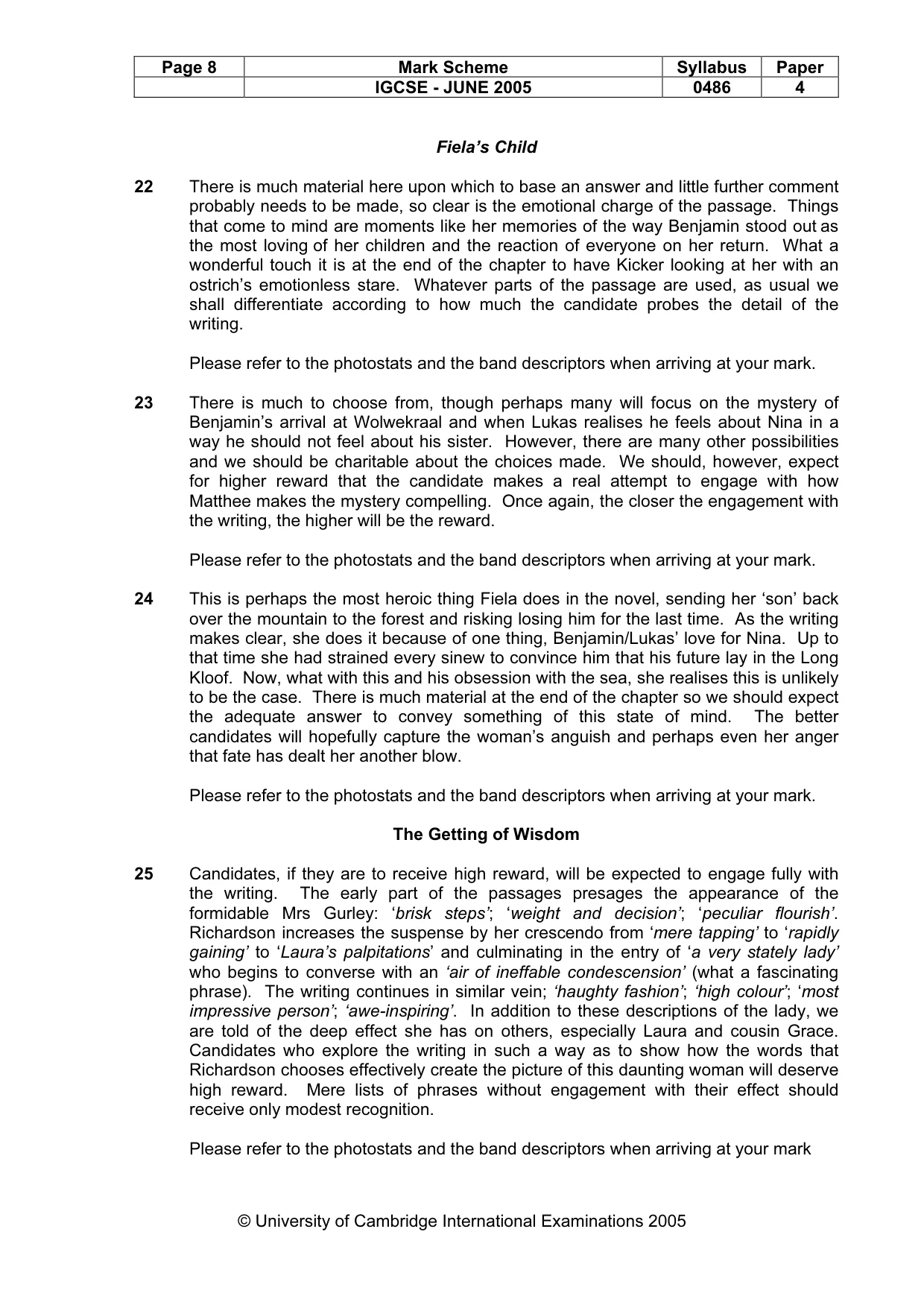
Page 8 Mark Scheme Syllabus Paper IGCSE - JUNE 2005 0486 4 © University of Cambridge International Examinations 2005 Fiela’s Child 22 There is much material here upon which to base an answer and little further comment probably needs to be made, so clear is the emotional charge of the passage. Things that come to mind are moments like her memories of the way Benjamin stood out as the most loving of her children and the reaction of everyone on her return. What a wonderful touch it is at the end of the chapter to have Kicker looking at her with an ostrich’s emotionless stare. Whatever parts of the passage are used, as usual we shall differentiate according to how much the candidate probes the detail of the writing. Please refer to the photostats and the band descriptors when arriving at your mark. 23 There is much to choose from, though perhaps many will focus on the mystery of Benjamin’s arrival at Wolwekraal and when Lukas realises he feels about Nina in a way he should not feel about his sister. However, there are many other possibilities and we should be charitable about the choices made. We should, however, expect for higher reward that the candidate makes a real attempt to engage with how Matthee makes the mystery compelling. Once again, the closer the engagement with the writing, the higher will be the reward. Please refer to the photostats and the band descriptors when arriving at your mark. 24 This is perhaps the most heroic thing Fiela does in the novel, sending her ‘son’ back over the mountain to the forest and risking losing him for the last time. As the writing makes clear, she does it because of one thing, Benjamin/Lukas’ love for Nina. Up to that time she had strained every sinew to convince him that his future lay in the Long Kloof. Now, what with this and his obsession with the sea, she realises this is unlikely to be the case. There is much material at the end of the chapter so we should expect the adequate answer to convey something of this state of mind. The better candidates will hopefully capture the woman’s anguish and perhaps even her anger that fate has dealt her another blow. Please refer to the photostats and the band descriptors when arriving at your mark. The Getting of Wisdom 25 Candidates, if they are to receive high reward, will be expected to engage fully with the writing. The early part of the passages presages the appearance of the formidable Mrs Gurley: ‘brisk steps’; ‘weight and decision’; ‘peculiar flourish’. Richardson increases the suspense by her crescendo from ‘mere tapping’ to ‘rapidly gaining’ to ‘Laura’s palpitations’ and culminating in the entry of ‘a very stately lady’ who begins to converse with an ‘air of ineffable condescension’ (what a fascinating phrase). The writing continues in similar vein; ‘haughty fashion’; ‘high colour’; ‘most impressive person’; ‘awe-inspiring’. In addition to these descriptions of the lady, we are told of the deep effect she has on others, especially Laura and cousin Grace. Candidates who explore the writing in such a way as to show how the words that Richardson chooses effectively create the picture of this daunting woman will deserve high reward. Mere lists of phrases without engagement with their effect should receive only modest recognition. Please refer to the photostats and the band descriptors when arriving at your mark
Mark scheme, page 12
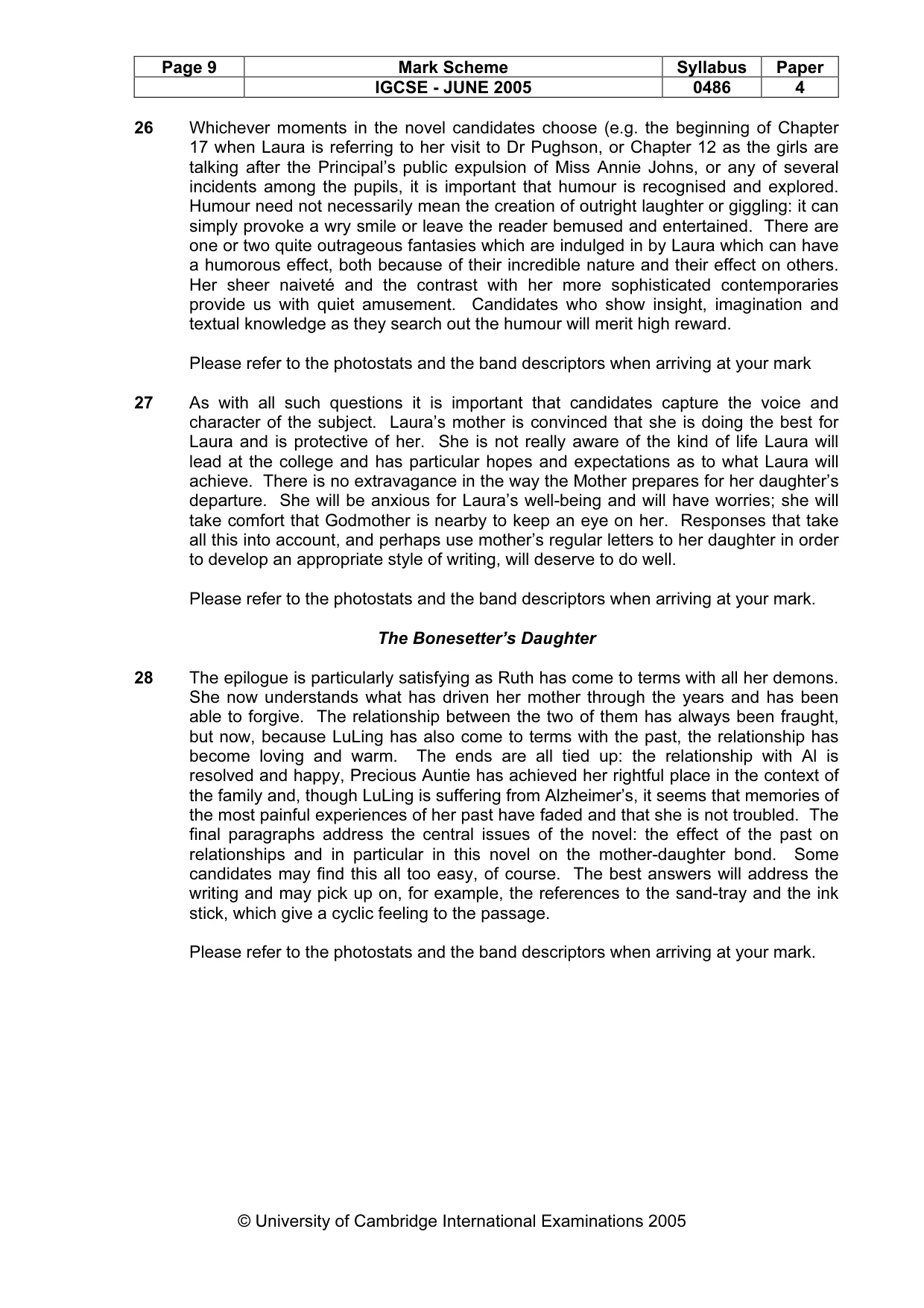
Page 9 Mark Scheme Syllabus Paper IGCSE - JUNE 2005 0486 4 © University of Cambridge International Examinations 2005 26 Whichever moments in the novel candidates choose (e.g. the beginning of Chapter 17 when Laura is referring to her visit to Dr Pughson, or Chapter 12 as the girls are talking after the Principal’s public expulsion of Miss Annie Johns, or any of several incidents among the pupils, it is important that humour is recognised and explored. Humour need not necessarily mean the creation of outright laughter or giggling: it can simply provoke a wry smile or leave the reader bemused and entertained. There are one or two quite outrageous fantasies which are indulged in by Laura which can have a humorous effect, both because of their incredible nature and their effect on others. Her sheer naiveté and the contrast with her more sophisticated contemporaries provide us with quiet amusement. Candidates who show insight, imagination and textual knowledge as they search out the humour will merit high reward. Please refer to the photostats and the band descriptors when arriving at your mark 27 As with all such questions it is important that candidates capture the voice and character of the subject. Laura’s mother is convinced that she is doing the best for Laura and is protective of her. She is not really aware of the kind of life Laura will lead at the college and has particular hopes and expectations as to what Laura will achieve. There is no extravagance in the way the Mother prepares for her daughter’s departure. She will be anxious for Laura’s well-being and will have worries; she will take comfort that Godmother is nearby to keep an eye on her. Responses that take all this into account, and perhaps use mother’s regular letters to her daughter in order to develop an appropriate style of writing, will deserve to do well. Please refer to the photostats and the band descriptors when arriving at your mark. The Bonesetter’s Daughter 28 The epilogue is particularly satisfying as Ruth has come to terms with all her demons. She now understands what has driven her mother through the years and has been able to forgive. The relationship between the two of them has always been fraught, but now, because LuLing has also come to terms with the past, the relationship has become loving and warm. The ends are all tied up: the relationship with Al is resolved and happy, Precious Auntie has achieved her rightful place in the context of the family and, though LuLing is suffering from Alzheimer’s, it seems that memories of the most painful experiences of her past have faded and that she is not troubled. The final paragraphs address the central issues of the novel: the effect of the past on relationships and in particular in this novel on the mother-daughter bond. Some candidates may find this all too easy, of course. The best answers will address the writing and may pick up on, for example, the references to the sand-tray and the ink stick, which give a cyclic feeling to the passage. Please refer to the photostats and the band descriptors when arriving at your mark.
Mark scheme, page 13
Page 10 Mark Scheme Syllabus Paper IGCSE - JUNE 2005 0486 4 © University of Cambridge International Examinations 2005 29 Material for this question is to be found in Part II, ‘Heart’, where the village is described in physical terms - the ravine in which it sits resembling the shape of a heart, and the streams that feed into it the arteries. This in itself may offer opportunity for comment, as may the legends and superstitions associated with the village. LuLing also describes it as a busy and thriving place when she was a child. Candidates may also comment on the way in which the ravine continually encroaches on the village, giving a sense of precariousness to the existence of the family. Other subjects for comment may be the industry of ink-making, the extended families, and the bonesetter, though strictly speaking he is located in The Mouth of the Mountain rather than Immortal Heart. Better answers may comment on the fact that all the description/narrative is coloured by the childish and distant memories of LuLing, and that the rather gothic and romantic impression may be exaggerated. It is important, however, in that it is part of her history and make-up and ultimately of Ruth’s and makes clear the contrast between traditional life in China and their life in the USA. Please refer to the photostats and the band descriptors when arriving at your mark. 30 The incident referred to takes place at the beginning of ‘Ghost’ and at the end of the preceding chapter. Precious Auntie does not, in fact, know that LuLing has not read to the end of the papers so does not know that Precious Auntie is her mother. The latter is likely to be expressing her horror at the union with the Changs, reflecting on the way in which they were responsible for the death of Baby Uncle and on the fact that she has been unable to influence LuLing. She may be feeling guilty for the violence of her response to LuLing’s news; she will certainly be hurt that her papers do not seem to have made any difference, and worried as to her own and LuLing’s future. The best answers will engage with the character and create an authentic ‘voice’. Please refer to the photostats and the band descriptors when arriving at your mark. DRAMA Absent Friends 31 The most apparent feature of this ending is the feeling that, despite the dramatic way Colin’s visit has opened a number of cans of worms, things rapidly seem to fall back into the shape in which they were at the beginning of the play. This is Ayckbourn at his most sardonic about the middle classes; it would, one feels, take an earthquake to shake these people into conscious recognition for any length of time of any unpleasant realities, at least in public. Paul goes to sleep, Marge offers further succour to the sick, John thinks about his car, Evelyn sings to her baby. For adequate reward we shall expect some understanding of Ayckbourn’s irony in the passage. We must also be alert to the possibility that some may miss this entirely. As a general rule the more the candidate is in touch with the ironic humour, the higher the mark we shall award. Please refer to the photostats and the band descriptors when arriving at your mark.
Mark scheme, page 14
Page 11 Mark Scheme Syllabus Paper IGCSE - JUNE 2005 0486 4 © University of Cambridge International Examinations 2005 32 This task is designed to stimulate the candidate to think of the different perspectives offered by an author’s creation rather than simply to offload a ‘prepared’ character sketch.. Therefore, in practice most of the best answers may well explore at least something of both views of Evelyn. After all, there are many moments in the play when she appears as someone about whom little positive can be said. She’s morose, rude, derisive of her husband and seemingly lacking in maternal feelings. However, when you see what her life is like and the pretences of the other characters, it is also clear that Ayckbourn uses her as a knife that cuts ruthlessly through those pretensions. For all that, we should not expect candidates to produce a balance of viewpoints. We should differentiate according to how well the candidates use the text to support their response to the character and for better than adequate reward should expect some personal awareness of the dramatic effect she has. Please refer to the photostats and the band descriptors when arriving at your mark. 33 Diana has had quite an afternoon and she will no doubt be heartily glad that the last of her guests have gone. She has had confirmed her husband’s adultery, she has publicly humiliated him, she has publicly declared her whole life to have been one long mistaken offering on the altar of domestic duty rather than one with the Canadian Mounted Police(!). She has, for the moment, lost the capacity to preserve appearances in the face of her friends and the awful Colin. Will she be ashamed of her performance or will she see this as a watershed and decide to leave her unpleasant husband? Will she have achieved her usual outward control again or will something have permanently snapped in her as when in her last words in the play she called Evelyn a bitch? We should accept either possibility but should expect any adequate response to show a clear grasp of what has occurred that afternoon. The way the voice is developed for higher reward will probably depend on which road the candidate goes down. Please refer to the photostats and the band descriptors when arriving at your mark. Cuba and Doghouse 34 The tensions in this scene are mostly below the surface but clear enough for all that. They obviously revolve round two relationships, one would-be and one that is under strain. Marian is besotted with Barry who thinks himself superior to any of them and makes that opinion quite clear to all of them, something hardly conducive to helping the good humour of the occasion. Marian is seen as a pitiable figure and Ger has to put on a brave face as she deals with her drunken boyfriend’s antics. She is clearly furious with him. We shall expect the adequate answer to grasp the essence of this with some pertinent detail to back up the argument. For higher reward, though, an ability to pick out the numerous inferences of the dialogue and the action will be looked for. Please refer to the photostats and the band descriptors when arriving at your mark.
Mark scheme, page 15
Page 12 Mark Scheme Syllabus Paper IGCSE - JUNE 2005 0486 4 © University of Cambridge International Examinations 2005 35 There are many moments in both plays which should suit the question so selection should present little difficulty for a candidate. In general terms, Cuba depicts the moment in both girls’ lives when they become politically aware, in this instance of the dangers of nuclear conflict. However, it also highlights the realities of class divisions which even going to the same school cannot hide. Doghouse primarily depicts the growth of course, primarily depicts the growth of sexual awareness, the cruelty inflicted upon children by adults and the way children’s view of their parents changes as they themselves grow into adults. Candidates who explore some of these issues, or find other angles which fit the task, and who support their ideas with some detail, should receive adequate reward. However, as usual we should reserve higher reward for those who really bring out the drama of their chosen moments as the question encourages them to do. Please refer to the photostats and the band descriptors when arriving at your mark. 36 On the face of it, Bernadette is the victim of outrageous social discrimination and there is a hint that she realises it in the description of her possible motives for taking the blame upon herself, perhaps a realisation that her working class background makes her the likely culprit any way in the eyes of the school. Even so, she is devastated by the punishment as is made clear at the end of the play with her parents, as well as the way she is described as looking straight through Barbara when they meet in the street and she is with her mates from the ‘rough’ school. Some grasp of this mixture of responses should be enough for adequate reward but for something higher perhaps we should expect something of the pithiness of her expression. Please refer to the photostats and the band descriptors when arriving at your mark. All My Sons 37 Kate will not believe that Larry is dead, despite the lapse of three and a half years. She uses the symbol of the tree breaking to help convince herself. Ann is Larry’s girl, but to Kate she is more than that; she is a faithful girl, believing like herself that Larry will come back. Thus, Kate here will grasp at anything to bolster her misconceived belief. When Chris tries to get her to see reason, she develops a headache. Kate is a classic case of self-deception and she has no compunction in harnessing others to seek to strengthen what she wants to believe. All the ingredients for a convincing response are contained in the extract. Those who use the writing judiciously to support their clearly stated ideas should receive high reward. We should differentiate in accordance with the degree of insight that candidates display in their engagement with Miller’s words. Please refer to the photostats and the band descriptors when arriving at your mark.
Mark scheme, page 16
Page 13 Mark Scheme Syllabus Paper IGCSE - JUNE 2005 0486 4 © University of Cambridge International Examinations 2005 38 Joe, not unlike his wife, seeks to deceive himself; perhaps he hopes time will be the proverbial healer. Miller presents Joe as, apparently, a decent American who lives a lie and faces up to the enormity of his action only when he is presented with the stark evidence of Ann’s letter. There is very little to dislike about Joe: he gets on with the neighbours, he has a good relationship with Chris and is welcoming to Ann. He is much more realistic than Kate about the survival of Larry. Thus Miller, through his portrayal of Joe, enlists the sympathy of the audience until the final moments of the play, and even then, it is not perhaps difficult to feel sorry for Joe as he faces the truth about Larry and his fellow airmen, resulting in his tragic end. Candidates who see all this and write about Joe in relation to his presence during the play should be rewarded highly. We should also be ready to recognise that some candidates may take a different line with regard to Joe and be less sympathetic for the deceit he has practised. Please refer to the photostats and the band descriptors when arriving at your mark. 39 Candidates should take their ideas about George from his subsequent appearance in the play and from his telephone conversation with Ann. He will be angry and very bitter; he will not at this point in the play have been charmed by Kate, nor will he have learned of Joe’s unfailing good health, especially during the time that the decision was made about the damaged cylinder heads! He will express, in no uncertain terms, his antipathy towards Joe and he will be opposed to any possible relationship between his sister and the son of Joe Keller whom he blames for his father’s conviction and imprisonment. He will dwell on his meeting with his father in prison and his reaction to it. Those who see the side of George which temporarily succumbs to the motherly teasing of Kate will show the insight essential for the highest reward. Thus, we shall expect there to be a range of responses and should be prepared to reward accordingly. Please refer to the photostats and the band descriptors when arriving at your mark. Twelfth Night 40 We must be on our guard not to over-reward those who simply use the passage as a starting point for general discussion of the play. There is plenty of detail here which establishes their respective personalities and the roles they will play. Here is Toby as some Lord of Misrule but with pertinent things to say about the absurdities of his niece and Sir Andrew. The latter is quickly established as the thickest of gulls and Maria as the sharpest of women and anxious to keep Toby out of trouble. Once again differentiation is likely to come from the range of detail candidates can summon up to support an argument along the above lines, the degree to which they can engage with Shakespeare’s language and, to a lesser extent, upon their ability to contextualise the scene. Please refer to the photostats and the band descriptors when arriving at your mark.
Mark scheme, page 17
Page 14 Mark Scheme Syllabus Paper IGCSE - JUNE 2005 0486 4 © University of Cambridge International Examinations 2005 41 This, of course, is a deliberately provocative question intended to make candidates think hard about Olivia. It may well be that many will hardly see that there is any problem with her and it may well be that some candidates will wish to make comparisons with Orsino. We should accept this approach. They will perhaps view her as a sad and kind young woman rather beset by a grasping uncle, an ambitious steward and an importunate and egotistical lover whom she does not love. However, perhaps the better candidates will show themselves by exploring the way she is also shown at times as having the same tunnel vision as Orsino. Her mourning is shown as faintly ridiculous, a show which rapidly disintegrates once she has met Viola. Of course, there is a final twist in that she is then shown as having the sense to accept her ‘madness’. Any candidate who enters this territory is likely to be worthy of high reward. Please refer to the photostats and the band descriptors when arriving at your mark. 42 This should provide ample opportunity for the imaginative to have some fun. Malvolio is at this stage totally wrapped up in the dream-world largely of his own making. Any answer which gives him a shred of understanding what is the reality is wide of the mark. He sees himself as the preferred suitor despite Olivia’s astonished response, and dismisses the taunts of the plotters. We must allow for a certain amount of echo from the text but beware of over marking those who do little more than patch together some of his words. One interesting thing is what happens to get him into the locked room. It would appear that they set upon him and this might feature at the end of some of the monologues. As usual, we shall reserve the higher reward for those who grasp the situation clearly and create a convincing voice. Please refer to the photostats and the band descriptors when arriving at your mark. The Devil’s Disciple 43 Melodrama usually entails startling reversals and this is startling enough and fairly simple to spot, one would have thought. Anderson is revealed both in action and speech as a very different man to the one Judith thought she had married. All her fatuous idealism and morality is thrown in her face and she suddenly sees, or thinks she sees, how little she matters to him. As far as Anderson is concerned, he has not any time to indulge his childlike wife. This is a grown-up world and urgent action is required. Most candidates should be able to see the essence of this and answers which do, and produce some reasonable detail in support, should receive adequate reward. However, we should reserve higher reward from those who show real awareness of how Shaw makes episode so dramatic, right down to the surprises in the manner in which Anderson speaks, no longer the emollient and restrained preacher but the soldier for whom deeds, not words are important. Please refer to the photostats and the band descriptors when arriving at your mark.
Mark scheme, page 18
Page 15 Mark Scheme Syllabus Paper IGCSE - JUNE 2005 0486 4 © University of Cambridge International Examinations 2005 44 There is no reason to expect candidates to find anything in Mrs Dudgeon which demands sympathy. She is, after all, a fairly awful example of the puritan who sees any pleasure in life as sinful and who is endlessly critical of all her fellow human beings. Nor would she qualify for sainthood, albeit the kind of saint who has the effect of making sin seem intensely agreeable to most people. She is after all both avaricious and malicious, to refer to but two of the deadly sins. Those who argue from this point may be rewarded right up to the top, depending on the level of detailed support they give to their argument. However, the better candidates may usually show themselves by seeing that Shaw does occasionally offer a different perspective of her. Anderson recognises that she was right about his vocation, for instance. Also, she has had a hard existence. She has had to be the driving force of the family and in her straight talking she could rarely be accused of hypocrisy. Any candidate who begins exploring these areas with detailed support is likely to be showing the powers of thought which we habitually reward highly. Please refer to the photostats and the band descriptors when arriving at your mark. 45 Most candidates should realise the thing in the forefront of his mind is to make sure that he gets to the town before Dick is hung. No doubt the adrenalin will be flowing, not least because he knows that militarily he now holds the whiphand, which, of course, would make it all the worse if Richard were to die on his behalf. However, other things would probably be going through his mind. He has at last shown to his wife his real personality, that of a man of action, leaving her in deep consternation. This is the moment in his life when he has chosen the path he must take and he will probably be wondering whether she will travel it with him. As usual, some of the above content should ensure adequate reward, though perhaps we should reserve higher reward for those who get beyond the obvious reason for his ride. We should also expect those candidates to have grasped that his mode of speech now suits the military commander rather more than the man of the cloth. Please refer to the photostats and the band descriptors when arriving at your mark.