Cambridge IGCSE English - Literature 0486 — 2004 Oct/Nov Paper 4 · Variant 1
0486/41/O/N/04
The question paper and its mark scheme, free to read here and free to download. This is Cambridge’s own paper, exactly as it was sat.
Question paper32 pages



Mark scheme19 pages
Answers below. Sit the paper first if you are practising.


Paper as text
Question paper, page 1
This document consists of 31 printed pages and 1 blank page. SP (SM) S71789/2 © UCLES 2004 [Turn over CAMBRIDGE INTERNATIONAL EXAMINATIONS International General Certificate of Secondary Education LITERATURE (ENGLISH) 0486/04 Paper 4 October/November 2004 2 hours 40 minutes Additional Materials: Answer Booklet/Paper READ THESE INSTRUCTIONS FIRST If you have been given an Answer Booklet, follow the instructions on the front cover of the Booklet. Write your Centre number, candidate number and name on all the work you hand in. Write in dark blue or black pen on both sides of the paper. Do not use staples, paper clips, highlighters, glue or correction fluid. Answer four questions. Each of your answers must be on a different book. At least one question must be taken from each of the sections Poetry, Prose, Drama. Answer at least one passage-based question (marked *) and at least one essay question. At the end of the examination, fasten all your work securely together. All questions in this paper carry equal marks. www.XtremePapers.com
Question paper, page 2
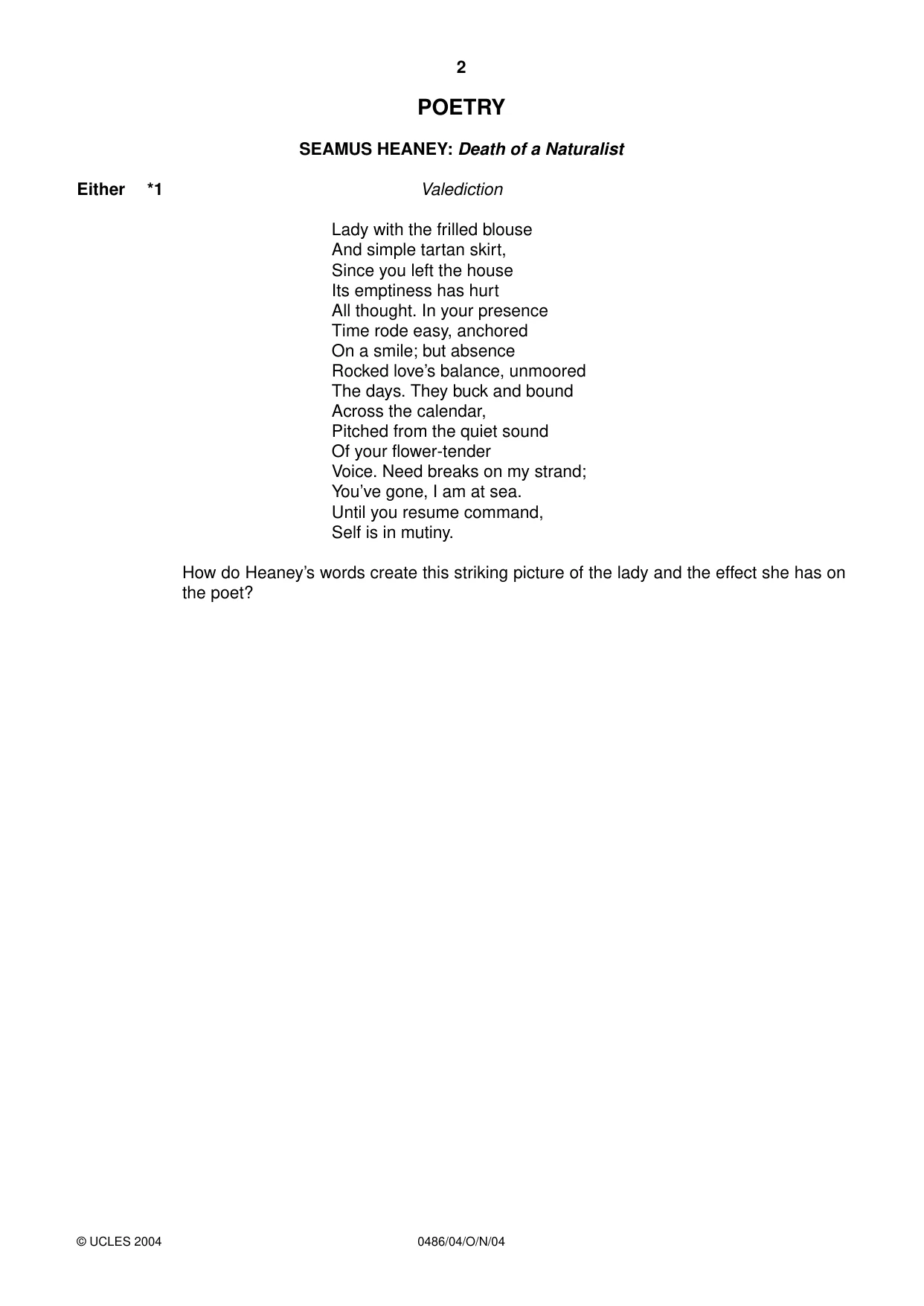
2 0486/04/O/N/04 POETRY SEAMUS HEANEY: Death of a Naturalist Either *1 Valediction Lady with the frilled blouse And simple tartan skirt, Since you left the house Its emptiness has hurt All thought. In your presence Time rode easy, anchored On a smile; but absence Rocked love’s balance, unmoored The days. They buck and bound Across the calendar, Pitched from the quiet sound Of your flower-tender Voice. Need breaks on my strand; You’ve gone, I am at sea. Until you resume command, Self is in mutiny. How do Heaney’s words create this striking picture of the lady and the effect she has on the poet? © UCLES 2004
Question paper, page 3
3 0486/04/O/N/04 [Turn over Or 2 Explore how any one of the following poems shocks or horrifies through its images. For the Commander of the Eliza At a Potato Digging Death of a Naturalist Or 3 Explore either The Barn or An Advancement of Learning, showing how the writing reveals the poet’s boyhood fears and worries. © UCLES 2004
Question paper, page 4
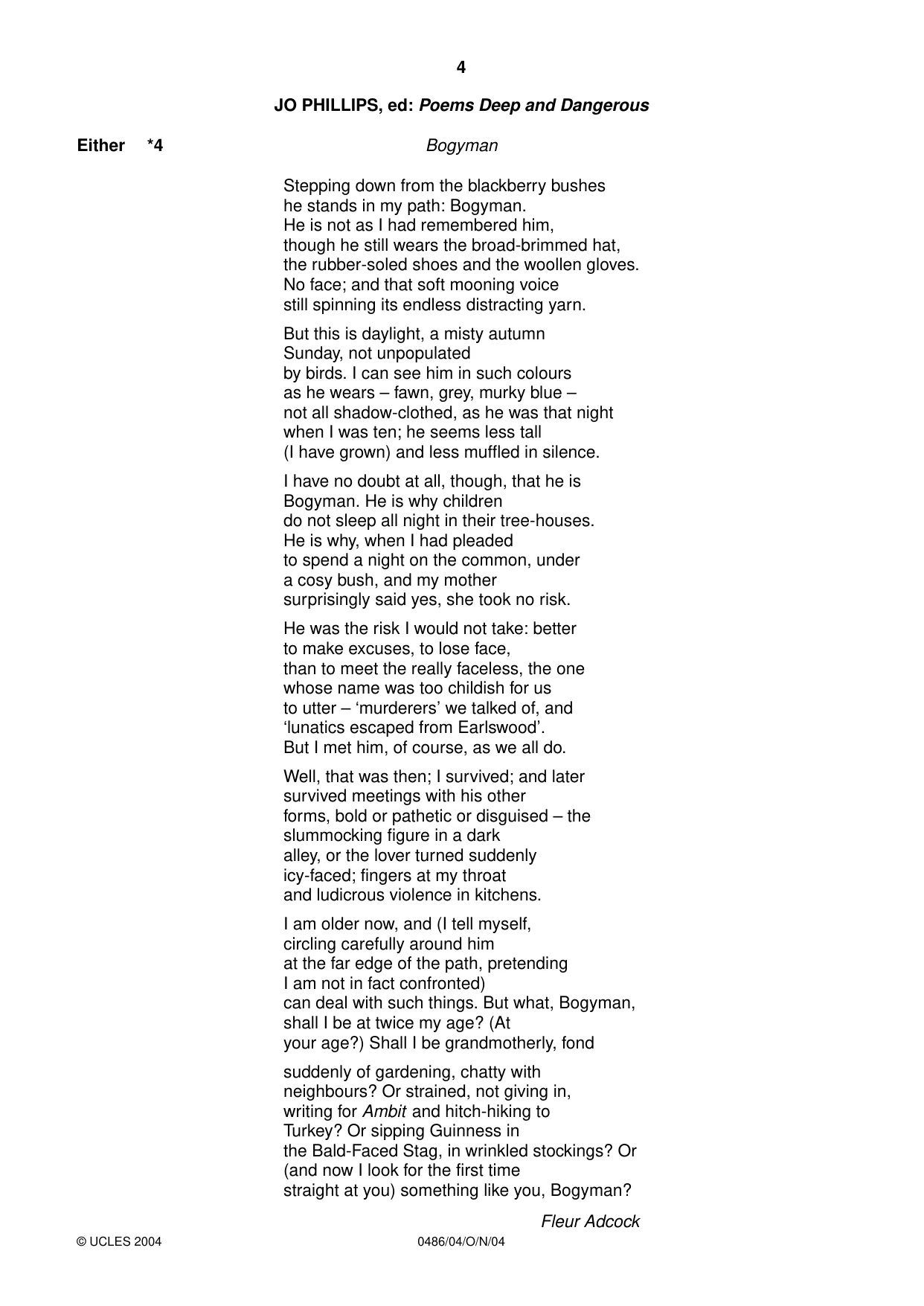
4 0486/04/O/N/04 JO PHILLIPS, ed: Poems Deep and Dangerous Either *4 Bogyman Stepping down from the blackberry bushes he stands in my path: Bogyman. He is not as I had remembered him, though he still wears the broad-brimmed hat, the rubber-soled shoes and the woollen gloves. No face; and that soft mooning voice still spinning its endless distracting yarn. But this is daylight, a misty autumn Sunday, not unpopulated by birds. I can see him in such colours as he wears – fawn, grey, murky blue – not all shadow-clothed, as he was that night when I was ten; he seems less tall (I have grown) and less muffled in silence. I have no doubt at all, though, that he is Bogyman. He is why children do not sleep all night in their tree-houses. He is why, when I had pleaded to spend a night on the common, under a cosy bush, and my mother surprisingly said yes, she took no risk. He was the risk I would not take: better to make excuses, to lose face, than to meet the really faceless, the one whose name was too childish for us to utter – ‘murderers’ we talked of, and ‘lunatics escaped from Earlswood’. But I met him, of course, as we all do. Well, that was then; I survived; and later survived meetings with his other forms, bold or pathetic or disguised – the slummocking figure in a dark alley, or the lover turned suddenly icy-faced; fingers at my throat and ludicrous violence in kitchens. I am older now, and (I tell myself, circling carefully around him at the far edge of the path, pretending I am not in fact confronted) can deal with such things. But what, Bogyman, shall I be at twice my age? (At your age?) Shall I be grandmotherly, fond suddenly of gardening, chatty with neighbours? Or strained, not giving in, writing for Ambit and hitch-hiking to Turkey? Or sipping Guinness in the Bald-Faced Stag, in wrinkled stockings? Or (and now I look for the first time straight at you) something like you, Bogyman? Fleur Adcock © UCLES 2004
Question paper, page 5
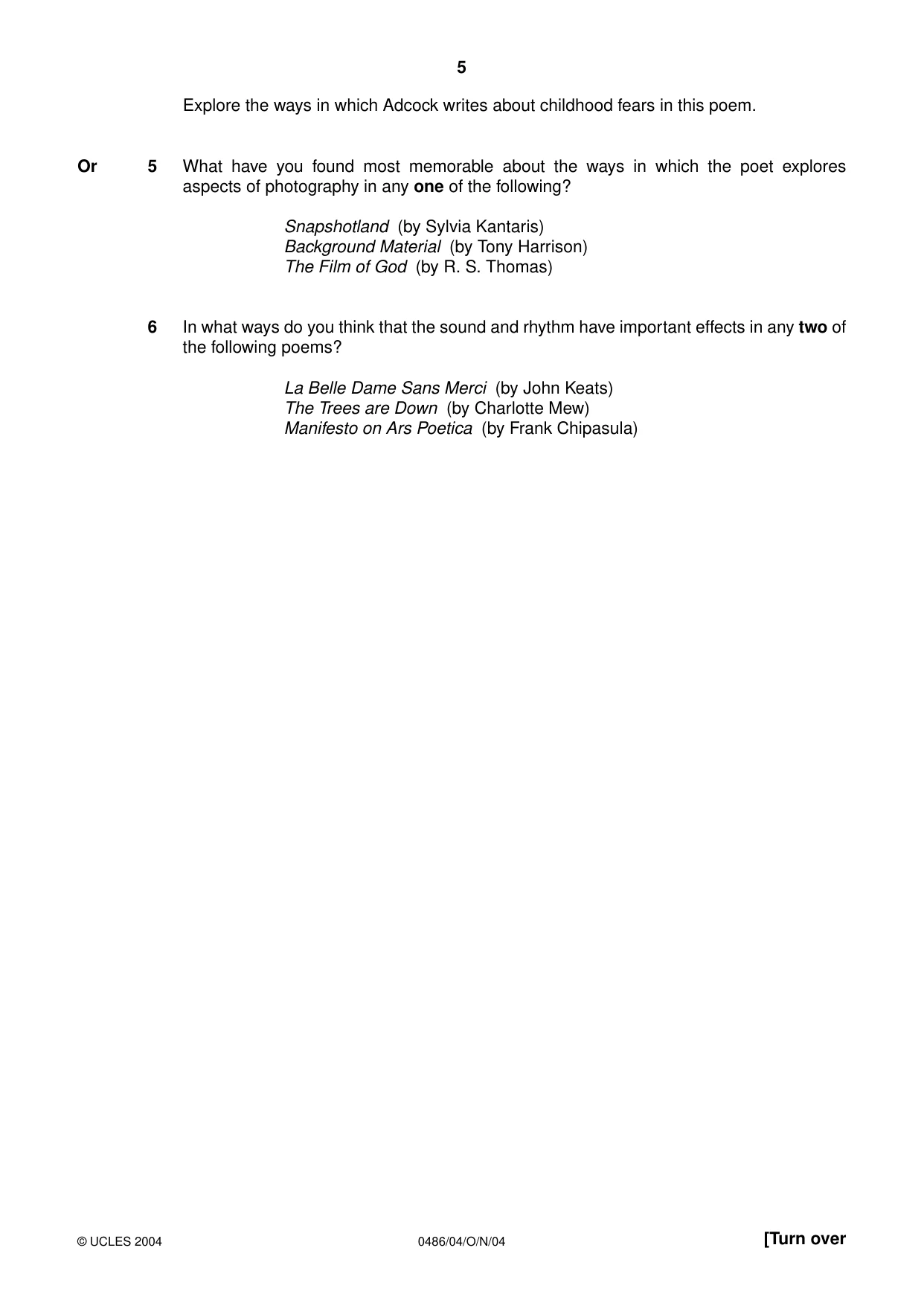
5 0486/04/O/N/04 [Turn over Explore the ways in which Adcock writes about childhood fears in this poem. Or 5 What have you found most memorable about the ways in which the poet explores aspects of photography in any one of the following? Snapshotland (by Sylvia Kantaris) Background Material (by Tony Harrison) The Film of God (by R. S. Thomas) 6 In what ways do you think that the sound and rhythm have important effects in any two of the following poems? La Belle Dame Sans Merci (by John Keats) The Trees are Down (by Charlotte Mew) Manifesto on Ars Poetica (by Frank Chipasula) © UCLES 2004
Question paper, page 6
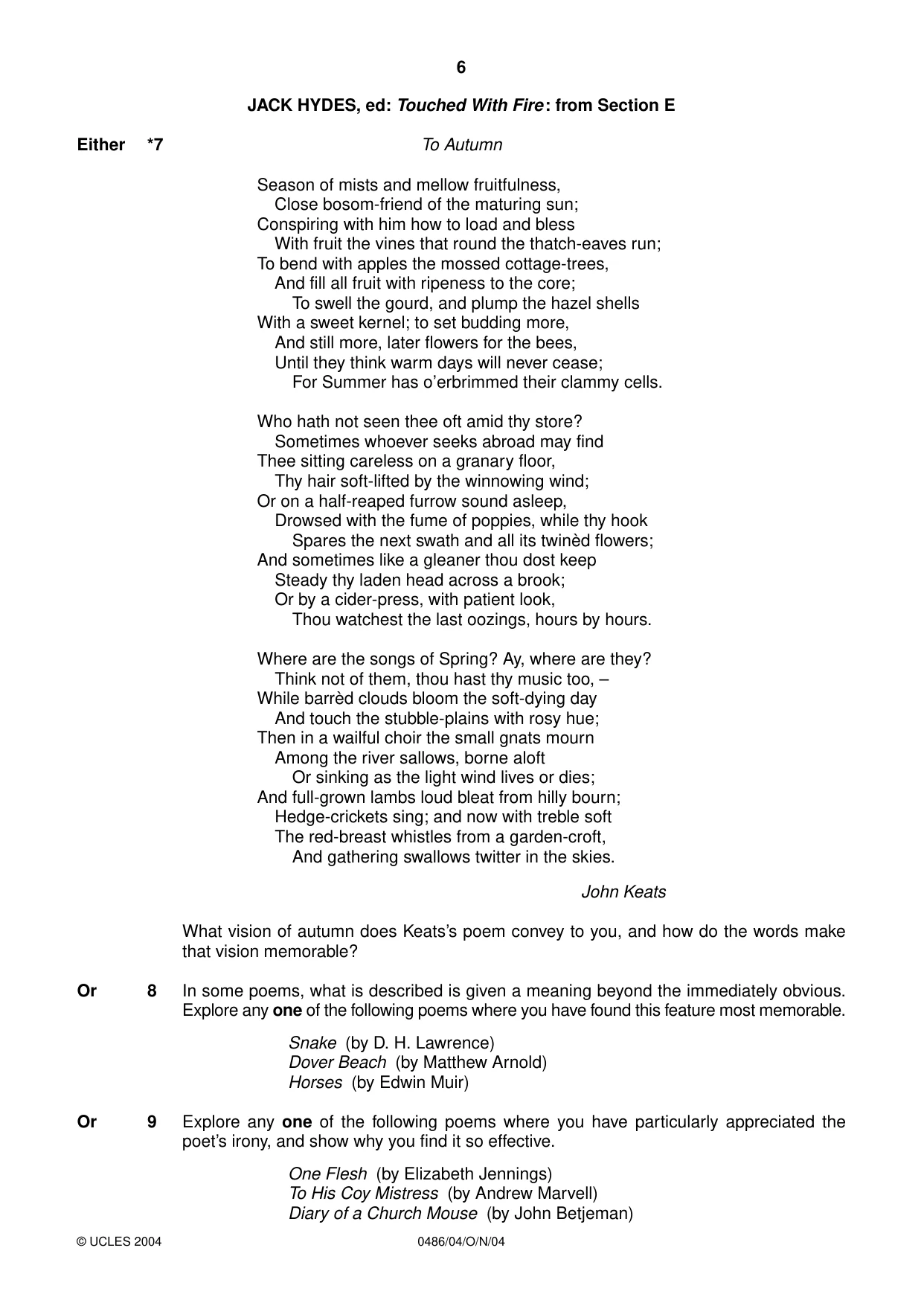
6 0486/04/O/N/04 JACK HYDES, ed: Touched With Fire: from Section E Either *7 To Autumn Season of mists and mellow fruitfulness, Close bosom-friend of the maturing sun; Conspiring with him how to load and bless With fruit the vines that round the thatch-eaves run; To bend with apples the mossed cottage-trees, And fill all fruit with ripeness to the core; To swell the gourd, and plump the hazel shells With a sweet kernel; to set budding more, And still more, later flowers for the bees, Until they think warm days will never cease; For Summer has o’erbrimmed their clammy cells. Who hath not seen thee oft amid thy store? Sometimes whoever seeks abroad may find Thee sitting careless on a granary floor, Thy hair soft-lifted by the winnowing wind; Or on a half-reaped furrow sound asleep, Drowsed with the fume of poppies, while thy hook Spares the next swath and all its twinèd flowers; And sometimes like a gleaner thou dost keep Steady thy laden head across a brook; Or by a cider-press, with patient look, Thou watchest the last oozings, hours by hours. Where are the songs of Spring? Ay, where are they? Think not of them, thou hast thy music too, – While barrèd clouds bloom the soft-dying day And touch the stubble-plains with rosy hue; Then in a wailful choir the small gnats mourn Among the river sallows, borne aloft Or sinking as the light wind lives or dies; And full-grown lambs loud bleat from hilly bourn; Hedge-crickets sing; and now with treble soft The red-breast whistles from a garden-croft, And gathering swallows twitter in the skies. John Keats What vision of autumn does Keats’s poem convey to you, and how do the words make that vision memorable? Or 8 In some poems, what is described is given a meaning beyond the immediately obvious. Explore any one of the following poems where you have found this feature most memorable. Snake (by D. H. Lawrence) Dover Beach (by Matthew Arnold) Horses (by Edwin Muir) Or 9 Explore any one of the following poems where you have particularly appreciated the poet’s irony, and show why you find it so effective. One Flesh (by Elizabeth Jennings) To His Coy Mistress (by Andrew Marvell) Diary of a Church Mouse (by John Betjeman) © UCLES 2004
Question paper, page 7
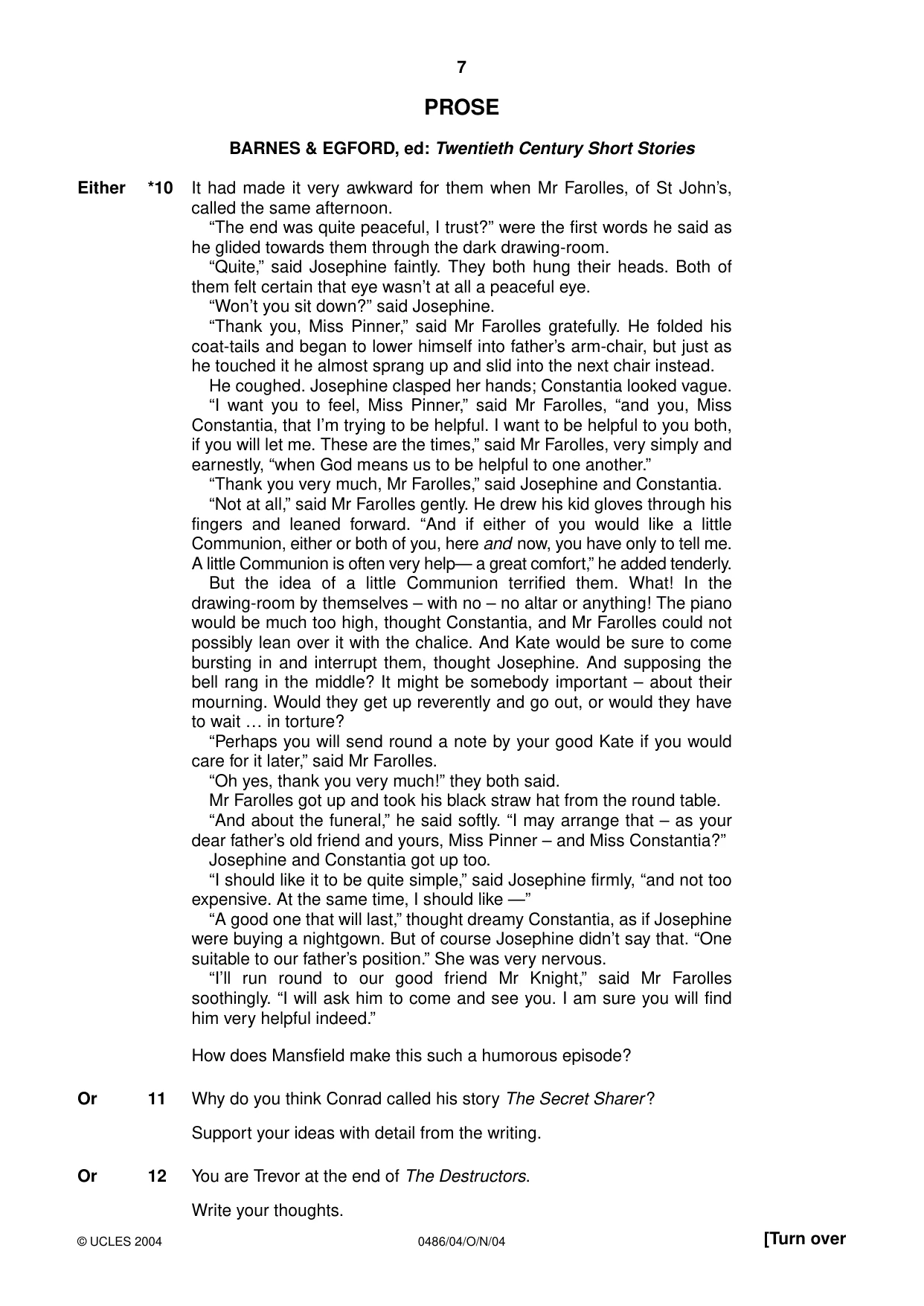
7 0486/04/O/N/04 [Turn over PROSE BARNES & EGFORD, ed: Twentieth Century Short Stories Either *10 It had made it very awkward for them when Mr Farolles, of St John’s, called the same afternoon. “The end was quite peaceful, I trust?” were the first words he said as he glided towards them through the dark drawing-room. “Quite,” said Josephine faintly. They both hung their heads. Both of them felt certain that eye wasn’t at all a peaceful eye. “Won’t you sit down?” said Josephine. “Thank you, Miss Pinner,” said Mr Farolles gratefully. He folded his coat-tails and began to lower himself into father’s arm-chair, but just as he touched it he almost sprang up and slid into the next chair instead. He coughed. Josephine clasped her hands; Constantia looked vague. “I want you to feel, Miss Pinner,” said Mr Farolles, “and you, Miss Constantia, that I’m trying to be helpful. I want to be helpful to you both, if you will let me. These are the times,” said Mr Farolles, very simply and earnestly, “when God means us to be helpful to one another.” “Thank you very much, Mr Farolles,” said Josephine and Constantia. “Not at all,” said Mr Farolles gently. He drew his kid gloves through his fingers and leaned forward. “And if either of you would like a little Communion, either or both of you, here and now, you have only to tell me. A little Communion is often very help— a great comfort,” he added tenderly. But the idea of a little Communion terrified them. What! In the drawing-room by themselves – with no – no altar or anything! The piano would be much too high, thought Constantia, and Mr Farolles could not possibly lean over it with the chalice. And Kate would be sure to come bursting in and interrupt them, thought Josephine. And supposing the bell rang in the middle? It might be somebody important – about their mourning. Would they get up reverently and go out, or would they have to wait … in torture? “Perhaps you will send round a note by your good Kate if you would care for it later,” said Mr Farolles. “Oh yes, thank you very much!” they both said. Mr Farolles got up and took his black straw hat from the round table. “And about the funeral,” he said softly. “I may arrange that – as your dear father’s old friend and yours, Miss Pinner – and Miss Constantia?” Josephine and Constantia got up too. “I should like it to be quite simple,” said Josephine firmly, “and not too expensive. At the same time, I should like —” “A good one that will last,” thought dreamy Constantia, as if Josephine were buying a nightgown. But of course Josephine didn’t say that. “One suitable to our father’s position.” She was very nervous. “I’ll run round to our good friend Mr Knight,” said Mr Farolles soothingly. “I will ask him to come and see you. I am sure you will find him very helpful indeed.” How does Mansfield make this such a humorous episode? Or 11 Why do you think Conrad called his story The Secret Sharer? Support your ideas with detail from the writing. Or 12 You are Trevor at the end of The Destructors. Write your thoughts. © UCLES 2004
Question paper, page 8
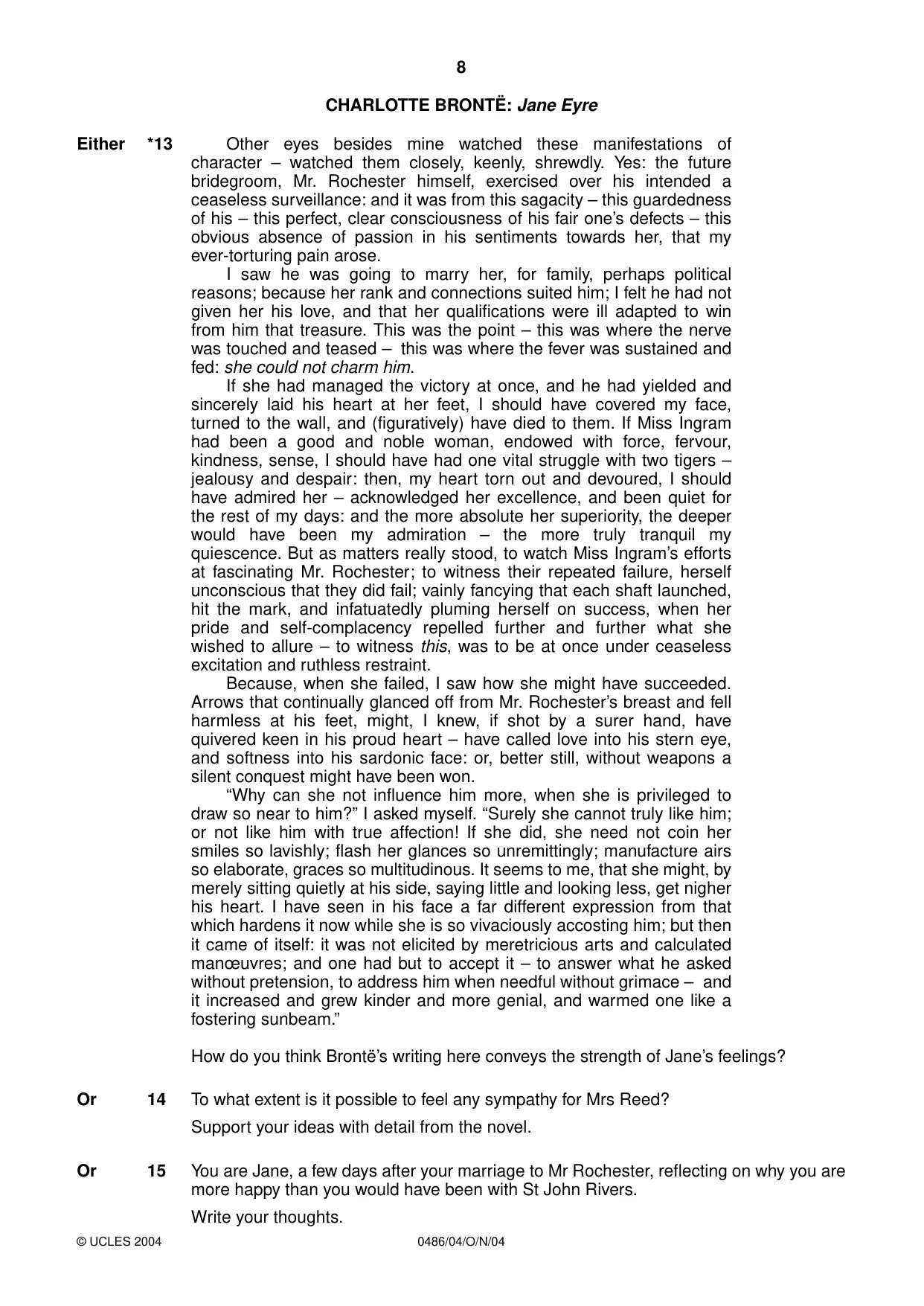
8 0486/04/O/N/04 CHARLOTTE BRONTË: Jane Eyre Either *13 Other eyes besides mine watched these manifestations of character – watched them closely, keenly, shrewdly. Yes: the future bridegroom, Mr. Rochester himself, exercised over his intended a ceaseless surveillance: and it was from this sagacity – this guardedness of his – this perfect, clear consciousness of his fair one’s defects – this obvious absence of passion in his sentiments towards her, that my ever-torturing pain arose. I saw he was going to marry her, for family, perhaps political reasons; because her rank and connections suited him; I felt he had not given her his love, and that her qualifications were ill adapted to win from him that treasure. This was the point – this was where the nerve was touched and teased – this was where the fever was sustained and fed: she could not charm him. If she had managed the victory at once, and he had yielded and sincerely laid his heart at her feet, I should have covered my face, turned to the wall, and (figuratively) have died to them. If Miss Ingram had been a good and noble woman, endowed with force, fervour, kindness, sense, I should have had one vital struggle with two tigers – jealousy and despair: then, my heart torn out and devoured, I should have admired her – acknowledged her excellence, and been quiet for the rest of my days: and the more absolute her superiority, the deeper would have been my admiration – the more truly tranquil my quiescence. But as matters really stood, to watch Miss Ingram’s efforts at fascinating Mr. Rochester; to witness their repeated failure, herself unconscious that they did fail; vainly fancying that each shaft launched, hit the mark, and infatuatedly pluming herself on success, when her pride and self-complacency repelled further and further what she wished to allure – to witness this, was to be at once under ceaseless excitation and ruthless restraint. Because, when she failed, I saw how she might have succeeded. Arrows that continually glanced off from Mr. Rochester’s breast and fell harmless at his feet, might, I knew, if shot by a surer hand, have quivered keen in his proud heart – have called love into his stern eye, and softness into his sardonic face: or, better still, without weapons a silent conquest might have been won. “Why can she not influence him more, when she is privileged to draw so near to him?” I asked myself. “Surely she cannot truly like him; or not like him with true affection! If she did, she need not coin her smiles so lavishly; flash her glances so unremittingly; manufacture airs so elaborate, graces so multitudinous. It seems to me, that she might, by merely sitting quietly at his side, saying little and looking less, get nigher his heart. I have seen in his face a far different expression from that which hardens it now while she is so vivaciously accosting him; but then it came of itself: it was not elicited by meretricious arts and calculated manœuvres; and one had but to accept it – to answer what he asked without pretension, to address him when needful without grimace – and it increased and grew kinder and more genial, and warmed one like a fostering sunbeam.” How do you think Brontë’s writing here conveys the strength of Jane’s feelings? Or 14 To what extent is it possible to feel any sympathy for Mrs Reed? Support your ideas with detail from the novel. Or 15 You are Jane, a few days after your marriage to Mr Rochester, reflecting on why you are more happy than you would have been with St John Rivers. Write your thoughts. © UCLES 2004
Question paper, page 9
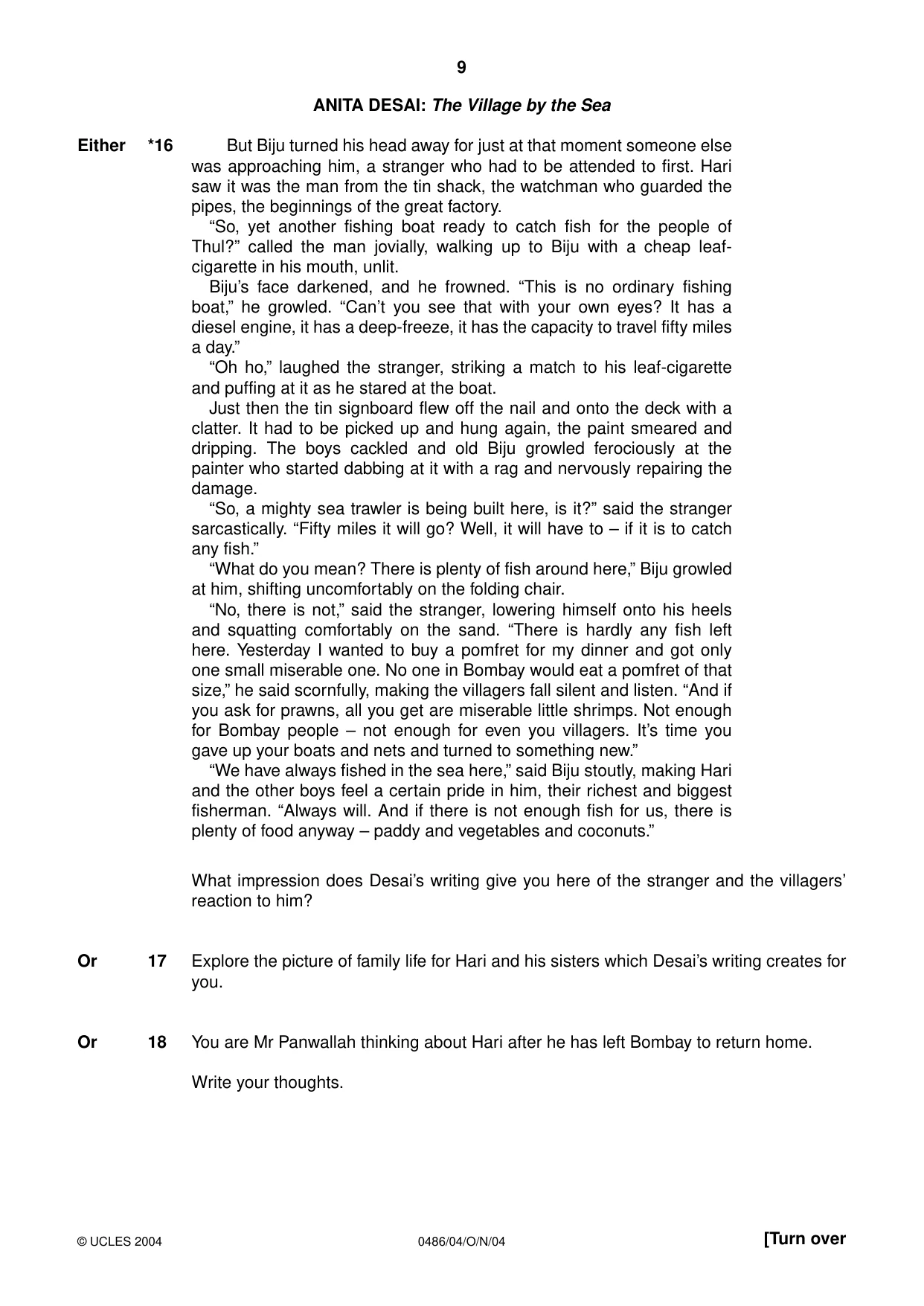
9 0486/04/O/N/04 [Turn over ANITA DESAI: The Village by the Sea Either *16 But Biju turned his head away for just at that moment someone else was approaching him, a stranger who had to be attended to first. Hari saw it was the man from the tin shack, the watchman who guarded the pipes, the beginnings of the great factory. “So, yet another fishing boat ready to catch fish for the people of Thul?” called the man jovially, walking up to Biju with a cheap leaf- cigarette in his mouth, unlit. Biju’s face darkened, and he frowned. “This is no ordinary fishing boat,” he growled. “Can’t you see that with your own eyes? It has a diesel engine, it has a deep-freeze, it has the capacity to travel fifty miles a day.” “Oh ho,” laughed the stranger, striking a match to his leaf-cigarette and puffing at it as he stared at the boat. Just then the tin signboard flew off the nail and onto the deck with a clatter. It had to be picked up and hung again, the paint smeared and dripping. The boys cackled and old Biju growled ferociously at the painter who started dabbing at it with a rag and nervously repairing the damage. “So, a mighty sea trawler is being built here, is it?” said the stranger sarcastically. “Fifty miles it will go? Well, it will have to – if it is to catch any fish.” “What do you mean? There is plenty of fish around here,” Biju growled at him, shifting uncomfortably on the folding chair. “No, there is not,” said the stranger, lowering himself onto his heels and squatting comfortably on the sand. “There is hardly any fish left here. Yesterday I wanted to buy a pomfret for my dinner and got only one small miserable one. No one in Bombay would eat a pomfret of that size,” he said scornfully, making the villagers fall silent and listen. “And if you ask for prawns, all you get are miserable little shrimps. Not enough for Bombay people – not enough for even you villagers. It’s time you gave up your boats and nets and turned to something new.” “We have always fished in the sea here,” said Biju stoutly, making Hari and the other boys feel a certain pride in him, their richest and biggest fisherman. “Always will. And if there is not enough fish for us, there is plenty of food anyway – paddy and vegetables and coconuts.” What impression does Desai’s writing give you here of the stranger and the villagers’ reaction to him? Or 17 Explore the picture of family life for Hari and his sisters which Desai’s writing creates for you. Or 18 You are Mr Panwallah thinking about Hari after he has left Bombay to return home. Write your thoughts. © UCLES 2004
Question paper, page 10
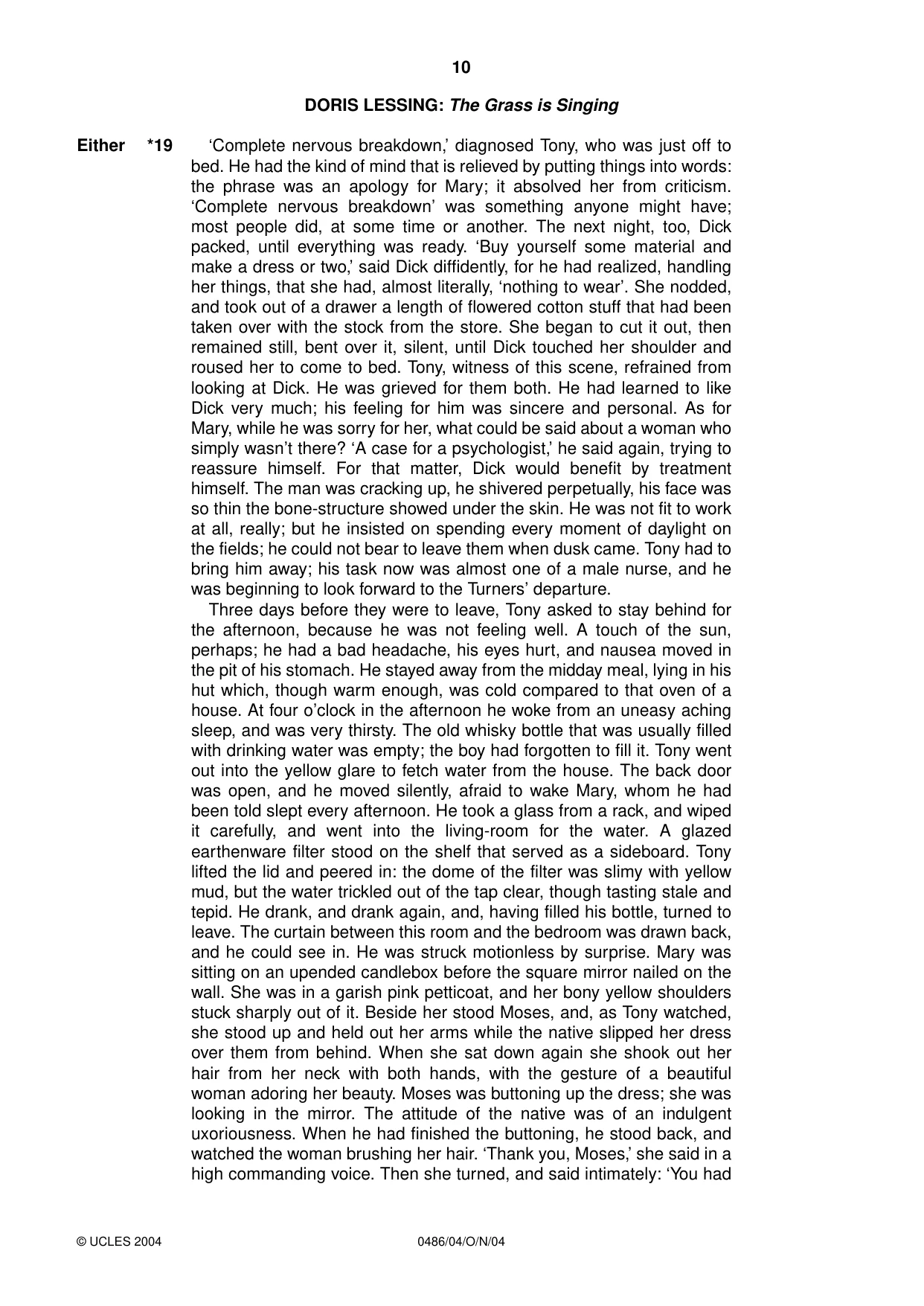
10 0486/04/O/N/04 DORIS LESSING: The Grass is Singing Either *19 ‘Complete nervous breakdown,’ diagnosed Tony, who was just off to bed. He had the kind of mind that is relieved by putting things into words: the phrase was an apology for Mary; it absolved her from criticism. ‘Complete nervous breakdown’ was something anyone might have; most people did, at some time or another. The next night, too, Dick packed, until everything was ready. ‘Buy yourself some material and make a dress or two,’ said Dick diffidently, for he had realized, handling her things, that she had, almost literally, ‘nothing to wear’. She nodded, and took out of a drawer a length of flowered cotton stuff that had been taken over with the stock from the store. She began to cut it out, then remained still, bent over it, silent, until Dick touched her shoulder and roused her to come to bed. Tony, witness of this scene, refrained from looking at Dick. He was grieved for them both. He had learned to like Dick very much; his feeling for him was sincere and personal. As for Mary, while he was sorry for her, what could be said about a woman who simply wasn’t there? ‘A case for a psychologist,’ he said again, trying to reassure himself. For that matter, Dick would benefit by treatment himself. The man was cracking up, he shivered perpetually, his face was so thin the bone-structure showed under the skin. He was not fit to work at all, really; but he insisted on spending every moment of daylight on the fields; he could not bear to leave them when dusk came. Tony had to bring him away; his task now was almost one of a male nurse, and he was beginning to look forward to the Turners’ departure. Three days before they were to leave, Tony asked to stay behind for the afternoon, because he was not feeling well. A touch of the sun, perhaps; he had a bad headache, his eyes hurt, and nausea moved in the pit of his stomach. He stayed away from the midday meal, lying in his hut which, though warm enough, was cold compared to that oven of a house. At four o’clock in the afternoon he woke from an uneasy aching sleep, and was very thirsty. The old whisky bottle that was usually filled with drinking water was empty; the boy had forgotten to fill it. Tony went out into the yellow glare to fetch water from the house. The back door was open, and he moved silently, afraid to wake Mary, whom he had been told slept every afternoon. He took a glass from a rack, and wiped it carefully, and went into the living-room for the water. A glazed earthenware filter stood on the shelf that served as a sideboard. Tony lifted the lid and peered in: the dome of the filter was slimy with yellow mud, but the water trickled out of the tap clear, though tasting stale and tepid. He drank, and drank again, and, having filled his bottle, turned to leave. The curtain between this room and the bedroom was drawn back, and he could see in. He was struck motionless by surprise. Mary was sitting on an upended candlebox before the square mirror nailed on the wall. She was in a garish pink petticoat, and her bony yellow shoulders stuck sharply out of it. Beside her stood Moses, and, as Tony watched, she stood up and held out her arms while the native slipped her dress over them from behind. When she sat down again she shook out her hair from her neck with both hands, with the gesture of a beautiful woman adoring her beauty. Moses was buttoning up the dress; she was looking in the mirror. The attitude of the native was of an indulgent uxoriousness. When he had finished the buttoning, he stood back, and watched the woman brushing her hair. ‘Thank you, Moses,’ she said in a high commanding voice. Then she turned, and said intimately: ‘You had © UCLES 2004
Question paper, page 11
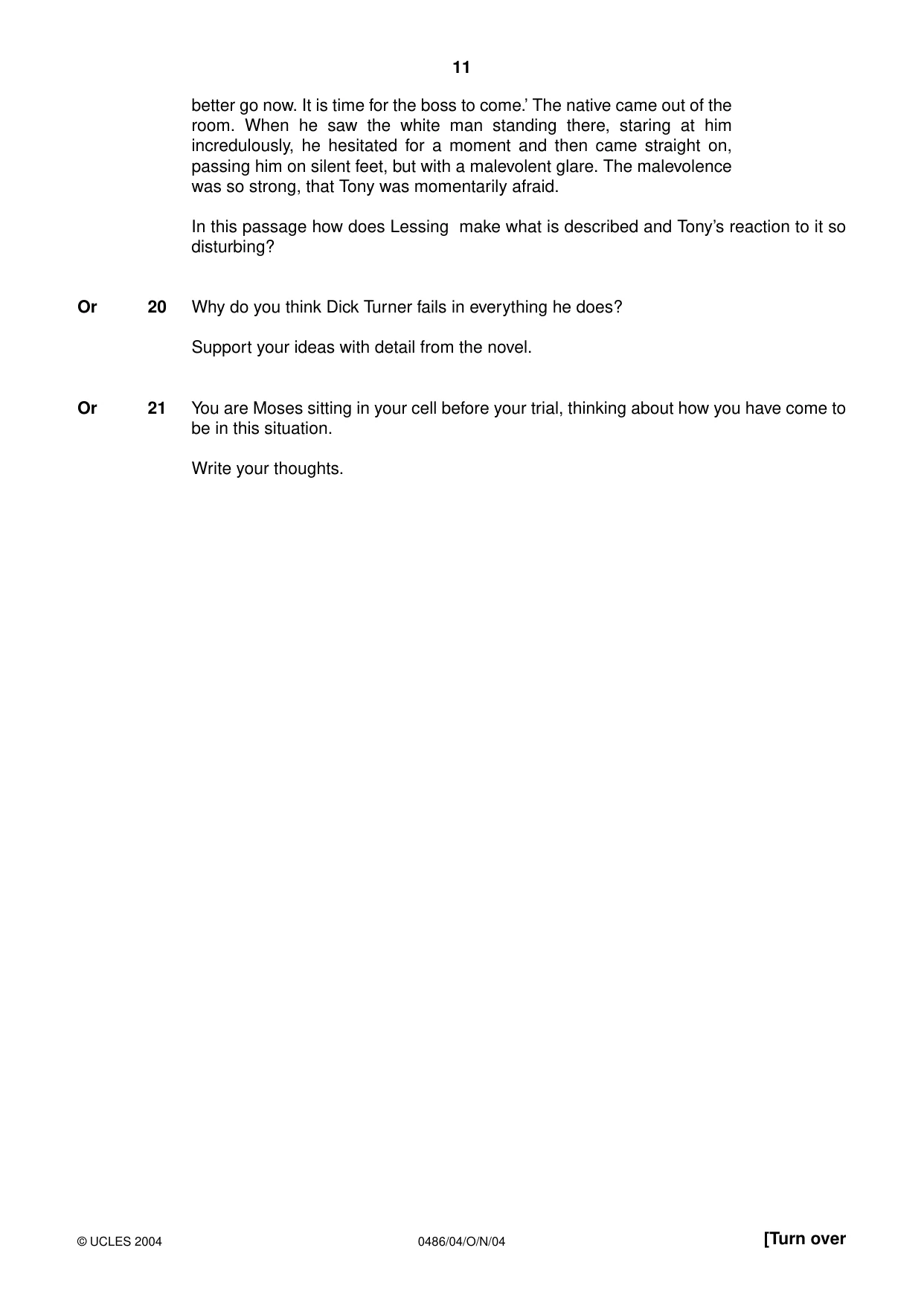
11 0486/04/O/N/04 [Turn over better go now. It is time for the boss to come.’ The native came out of the room. When he saw the white man standing there, staring at him incredulously, he hesitated for a moment and then came straight on, passing him on silent feet, but with a malevolent glare. The malevolence was so strong, that Tony was momentarily afraid. In this passage how does Lessing make what is described and Tony’s reaction to it so disturbing? Or 20 Why do you think Dick Turner fails in everything he does? Support your ideas with detail from the novel. Or 21 You are Moses sitting in your cell before your trial, thinking about how you have come to be in this situation. Write your thoughts. © UCLES 2004
Question paper, page 12
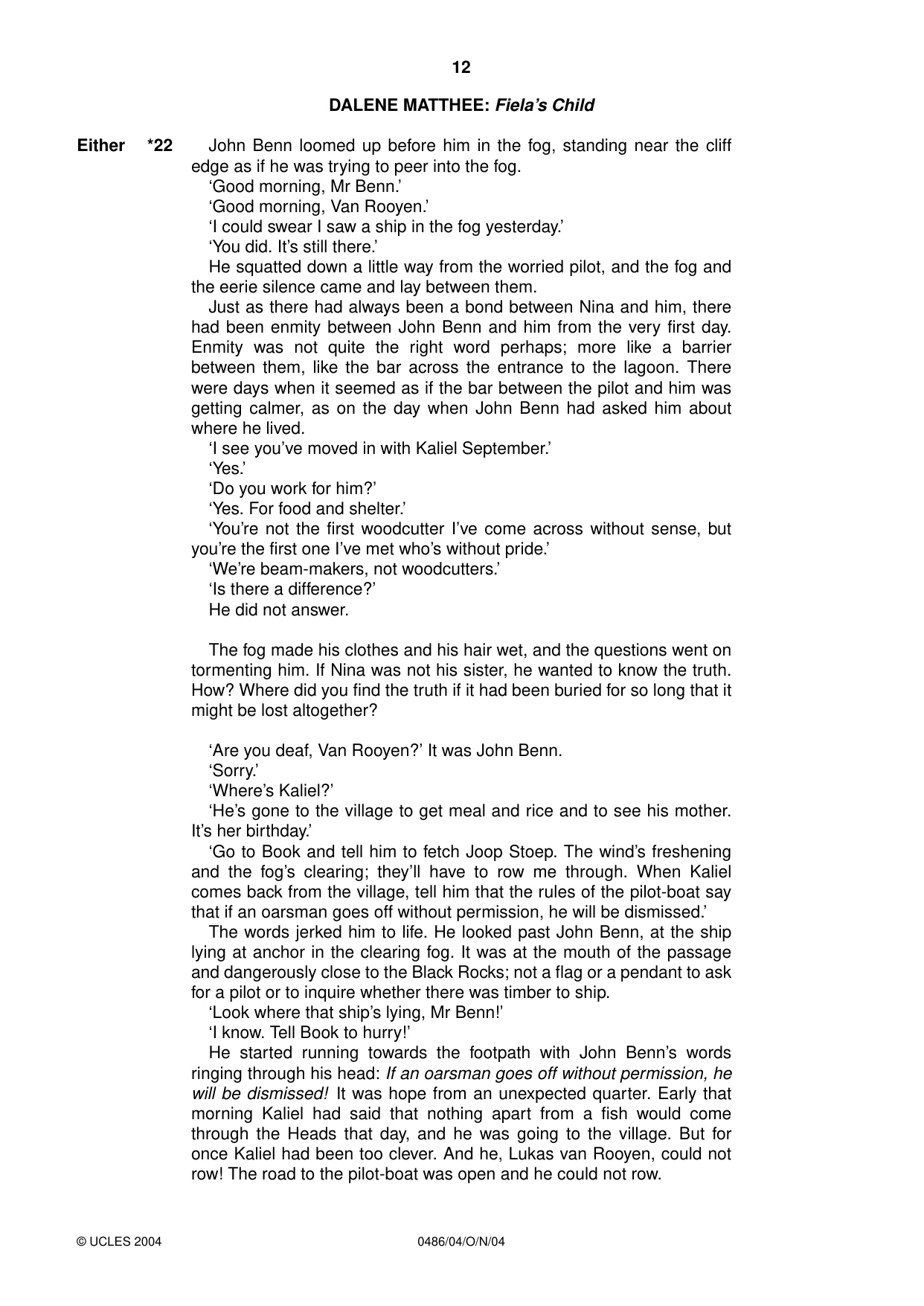
12 0486/04/O/N/04 DALENE MATTHEE: Fiela’s Child Either *22 John Benn loomed up before him in the fog, standing near the cliff edge as if he was trying to peer into the fog. ‘Good morning, Mr Benn.’ ‘Good morning, Van Rooyen.’ ‘I could swear I saw a ship in the fog yesterday.’ ‘You did. It’s still there.’ He squatted down a little way from the worried pilot, and the fog and the eerie silence came and lay between them. Just as there had always been a bond between Nina and him, there had been enmity between John Benn and him from the very first day. Enmity was not quite the right word perhaps; more like a barrier between them, like the bar across the entrance to the lagoon. There were days when it seemed as if the bar between the pilot and him was getting calmer, as on the day when John Benn had asked him about where he lived. ‘I see you’ve moved in with Kaliel September.’ ‘Yes.’ ‘Do you work for him?’ ‘Yes. For food and shelter.’ ‘You’re not the first woodcutter I’ve come across without sense, but you’re the first one I’ve met who’s without pride.’ ‘We’re beam-makers, not woodcutters.’ ‘Is there a difference?’ He did not answer. The fog made his clothes and his hair wet, and the questions went on tormenting him. If Nina was not his sister, he wanted to know the truth. How? Where did you find the truth if it had been buried for so long that it might be lost altogether? ‘Are you deaf, Van Rooyen?’ It was John Benn. ‘Sorry.’ ‘Where’s Kaliel?’ ‘He’s gone to the village to get meal and rice and to see his mother. It’s her birthday.’ ‘Go to Book and tell him to fetch Joop Stoep. The wind’s freshening and the fog’s clearing; they’ll have to row me through. When Kaliel comes back from the village, tell him that the rules of the pilot-boat say that if an oarsman goes off without permission, he will be dismissed.’ The words jerked him to life. He looked past John Benn, at the ship lying at anchor in the clearing fog. It was at the mouth of the passage and dangerously close to the Black Rocks; not a flag or a pendant to ask for a pilot or to inquire whether there was timber to ship. ‘Look where that ship’s lying, Mr Benn!’ ‘I know. Tell Book to hurry!’ He started running towards the footpath with John Benn’s words ringing through his head: If an oarsman goes off without permission, he will be dismissed! It was hope from an unexpected quarter. Early that morning Kaliel had said that nothing apart from a fish would come through the Heads that day, and he was going to the village. But for once Kaliel had been too clever. And he, Lukas van Rooyen, could not row! The road to the pilot-boat was open and he could not row. © UCLES 2004
Question paper, page 13
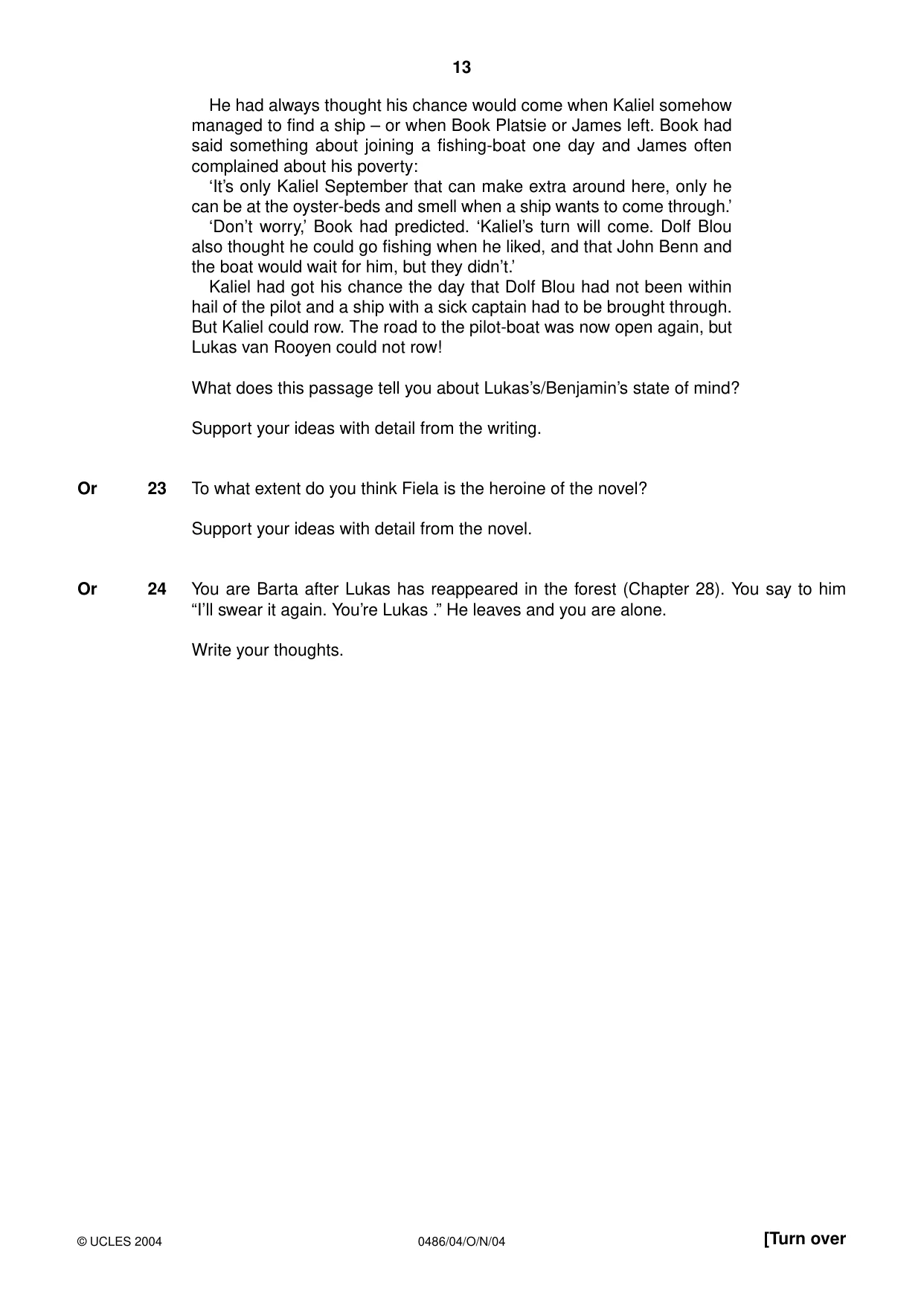
13 0486/04/O/N/04 [Turn over He had always thought his chance would come when Kaliel somehow managed to find a ship – or when Book Platsie or James left. Book had said something about joining a fishing-boat one day and James often complained about his poverty: ‘It’s only Kaliel September that can make extra around here, only he can be at the oyster-beds and smell when a ship wants to come through.’ ‘Don’t worry,’ Book had predicted. ‘Kaliel’s turn will come. Dolf Blou also thought he could go fishing when he liked, and that John Benn and the boat would wait for him, but they didn’t.’ Kaliel had got his chance the day that Dolf Blou had not been within hail of the pilot and a ship with a sick captain had to be brought through. But Kaliel could row. The road to the pilot-boat was now open again, but Lukas van Rooyen could not row! What does this passage tell you about Lukas’s/Benjamin’s state of mind? Support your ideas with detail from the writing. Or 23 To what extent do you think Fiela is the heroine of the novel? Support your ideas with detail from the novel. Or 24 You are Barta after Lukas has reappeared in the forest (Chapter 28). You say to him “I’ll swear it again. You’re Lukas .” He leaves and you are alone. Write your thoughts. © UCLES 2004
Question paper, page 14
14 0486/04/O/N/04 GEORGE ORWELL: Animal Farm Either *25 As for the pigs, they could already read and write perfectly. The dogs learned to read fairly well, but were not interested in reading anything except the Seven Commandments. Muriel, the goat, could read somewhat better than the dogs, and sometimes used to read to the others in the evenings from scraps of newspaper which she found on the rubbish heap. Benjamin could read as well as any pig, but never exercised his faculty. So far as he knew, he said, there was nothing worth reading. Clover learnt the whole alphabet, but could not put words together. Boxer could not get beyond the letter D. He would trace out A, B, C, D, in the dust with his great hoof, and then would stand staring at the letters with his ears back, sometimes shaking his forelock, trying with all his might to remember what came next and never succeeding. On several occasions, indeed, he did learn E, F, G, H, but by the time he knew them, it was always discovered that he had forgotten A, B, C, and D. Finally he decided to be content with the first four letters, and used to write them out once or twice every day to refresh his memory. Mollie refused to learn any but the six letters which spelt her own name. She would form these very neatly out of pieces of twig, and would then decorate them with a flower or two and walk round them admiring them. None of the other animals on the farm could get further than the letter A. It was also found that the stupider animals, such as the sheep, hens, and ducks, were unable to learn the Seven Commandments by heart. After much thought Snowball declared that the Seven Commandments could in effect be reduced to a single maxim, namely: ‘Four legs good, two legs bad.’ This, he said, contained the essential principle of Animalism. Whoever had thoroughly grasped it would be safe from human influences. The birds at first objected, since it seemed to them that they also had two legs, but Snowball proved to them that this was not so. ‘A bird’s wing, comrades,’ he said, ‘is an organ of propulsion and not of manipulation. It should therefore be regarded as a leg. The distinguishing mark of Man is the hand, the instrument with which he does all his mischief.’ The birds did not understand Snowball’s long words, but they accepted his explanation, and all the humbler animals set to work to learn the new maxim by heart. FOUR LEGS GOOD, TWO LEGS BAD, was inscribed on the end wall of the barn, above the Seven Commandments and in bigger letters. When they had once got it by heart, the sheep developed a great liking for this maxim, and often as they lay in the field they would all start bleating ‘Four legs good, two legs bad! Four legs good, two legs bad!’ and kept it up for hours on end, never growing tired of it. Napoleon took no interest in Snowball’s committees. He said that the education of the young was more important than anything that could be done for those who were already grown up. It happened that Jessie and Bluebell had both whelped soon after the hay harvest, giving birth between them to nine sturdy puppies. As soon as they were weaned, Napoleon took them away from their mothers, saying that he would make himself responsible for their education. He took them up into a loft which could only be reached by a ladder from the harness-room, and there kept them in such seclusion that the rest of the farm soon forgot their existence. © UCLES 2004
Question paper, page 15
15 0486/04/O/N/04 [Turn over The mystery of where the milk went to was soon cleared up. It was mixed every day into the pigs’ mash. The early apples were now ripening, and the grass of the orchard was littered with windfalls. The animals had assumed as a matter of course that these would be shared out equally; one day, however, the order went forth that all the windfalls were to be collected and brought to the harness-room for the use of the pigs. At this some of the other animals murmured, but it was no use. All the pigs were in full agreement on this point, even Snowball and Napoleon. Squealer was sent to make the necessary explanation to the others. ‘Comrades!’ he cried. ‘You do not imagine, I hope, that we pigs are doing this in a spirit of selfishness and privilege? Many of us actually dislike milk and apples. I dislike them myself. Our sole object in taking these things is to preserve our health. Milk and apples (this has been proved by Science, comrades) contain substances absolutely necessary to the well-being of a pig. We pigs are brain-workers. The whole management and organization of this farm depend on us. Day and night we are watching over your welfare. If is for your sake that we drink that milk and eat those apples. Do you know what would happen if we pigs failed in our duty? Jones would come back! Yes, Jones would come back! Surely, comrades,’ cried Squealer almost pleadingly, skipping from side to side and whisking his tail, ‘surely there is no one among you who wants to see Jones come back?’ Now if there was one thing that the animals were completely certain of, it was that they did not want Jones back. When it was put to them in this light, they had no more to say. The importance of keeping the pigs in good health was all too obvious. So it was agreed without further argument that the milk and the windfall apples (and also the main crop of apples when they ripened) should be reserved for the pigs alone. How does Orwell’s irony in this passage suggest what Animal Farm is to become in the future? Or 26 How does Orwell manage to make Napoleon such a hateful figure? Support your ideas with detail from the writing. Or 27 You are Boxer as you lie ill, just before you are removed to ‘hospital’. You are thinking about what has happened at Animal Farm since the expulsion of Jones. Write your thoughts. © UCLES 2004
Question paper, page 16
16 0486/04/O/N/04 AMY TAN: The Bonesetter’s Daughter Either *28 At five-fifteen, Ruth called her mother to remind her she was coming. No answer. She was probably in the bathroom. Ruth waited five minutes, then called again. Still no answer. Did she have constipation? Had she fallen asleep? Ruth tidied her desk, put the phone on speaker, and hit automatic redial. After fifteen minutes of unanswered ringing, she had run through all the possibilities, until they culminated in the inevitable worst possible thing. Flames leaping from a pot left on the stove. LuLing dousing the flames with oil. Her sleeve catching fire. As Ruth drove to her mother’s, she braced herself to see a crackling blaze eating the roof, her mother lying twisted in a blackened heap. Just as she feared, when Ruth arrived she saw lights flickering in the upper level, shadows dancing. She rushed in. The front door was unlocked. ‘Mom? Mommy! Where are you?’ The television was on, blasting Amor sin Límite at high volume. LuLing had never figured out how to use the remote control, even though Ruth had taped over all but the Power, Channel Up, and Channel Down buttons. She turned off the TV, and the sudden silence frightened her. She ran to the back rooms, flung open closets, looked out the windows. Her throat tightened. ‘Mommy, where are you?’ she whimpered. ‘Answer me.’ She ran down the front steps and knocked on the tenant’s door. She tried to sound casual. ‘By any chance, have you seen my mother?’ Francine rolled her eyes and nodded knowingly. ‘She went charging down the sidewalk about two or three hours ago. I noticed because she was wearing slippers and pajamas, and I said to myself, “Wow, she looks really flipped out.” … Like it’s none of my business, but you should take her to the doctor and get her medicated or something. I mean that in the good sense.’ Ruth raced back upstairs. With shaky fingers, she called a former client who was a captain in the police department. Minutes later, a Latino officer stood at the doorway. He was bulging with weapons and paraphernalia and his face was serious. Ruth’s panic notched up. She stepped outside. ‘She has Alzheimer’s,’ Ruth jabbered. ‘She’s seventy-seven but has the mind of a child.’ ‘Description.’ ‘Four-eleven, eighty-five pounds, black hair pulled into a bun, probably wearing pink or lilac pajamas and slippers …’ Ruth was picturing LuLing as she said this: the puzzled look on her mother’s face, her inert body lying in the street. Ruth’s voice started to wobble. ‘Oh God, she’s so tiny and helpless …’ ‘Does she look anything like that lady there?’ Ruth looked up to see LuLing standing stock still at the end of the walkway. She was wearing a sweater over her pajamas. ‘Ai-ya! What happen?’ LuLing cried. ‘Robber?’ Ruth ran toward her. ‘Where were you?’ She appraised her mother for signs of damage. The officer walked up to the two of them. ‘Happy ending,’ he said, then turned toward his patrol car. ‘Stay there,’ Ruth ordered her mother. ‘I’ll be right back.’ She went to the patrol car and the officer rolled down his window. ‘I’m sorry for all the trouble,’ she said. ‘She’s never done this before.’ And then she considered that maybe she had, but she just didn’t know it. Maybe she did this every day, every night. Maybe she roamed the neighborhood in her underwear! © UCLES 2004
Question paper, page 17
17 0486/04/O/N/04 [Turn over ‘Hey, no problem,’ the policeman said. ‘My mother-in-law did the same thing. Sundowning. The sun went down, she went wandering. We had to put alarm triggers on all the doors. That was one tough year, until we put her in a nursing home. My wife couldn’t do it anymore – keeping an eye on her day and night.’ Day and night? And Ruth thought she was being diligent by having her mother over for dinner and trying to hire a part-time housekeeper. ‘Well, thanks anyway,’ she said. When she returned to her mother, LuLing complained right away: ‘Grocery store ’round the corner? I walk ’round and ’round, gone! Turn into bank. You don’t believe, go see yourself!’ Ruth wound up staying the night at her mother’s, sleeping in her old bedroom. The foghorns were louder in this section of the city. She remembered listening to them at night when she was a teenager. She would lie in bed, counting the blasts, matching them to the number of years it would be before she could move out. Five years, then four, then three. Now she was back. In the morning, Ruth opened the cupboards to look for cereal. She found dirty paper napkins folded and stacked. Hundreds. She opened the fridge. It was packed with plastic bags of black and greenish mush, cartons of half-eaten food, orange peels, cantaloupe rinds, frozen goods long defrosted. In the freezer were a carton of eggs, a pair of shoes, the alarm clock, and what appeared to have been bean sprouts. Ruth felt sick. This had happened in just one week? What makes this passage a particularly powerful moment in the novel? Or 29 Explore how Tan shows the effects of superstition and imagination on Ruth and LuLing. Support your answer by referring to one incident for Ruth and one for LuLing. Or 30 You are Ruth after reading your mother’s story. Write your thoughts. © UCLES 2004
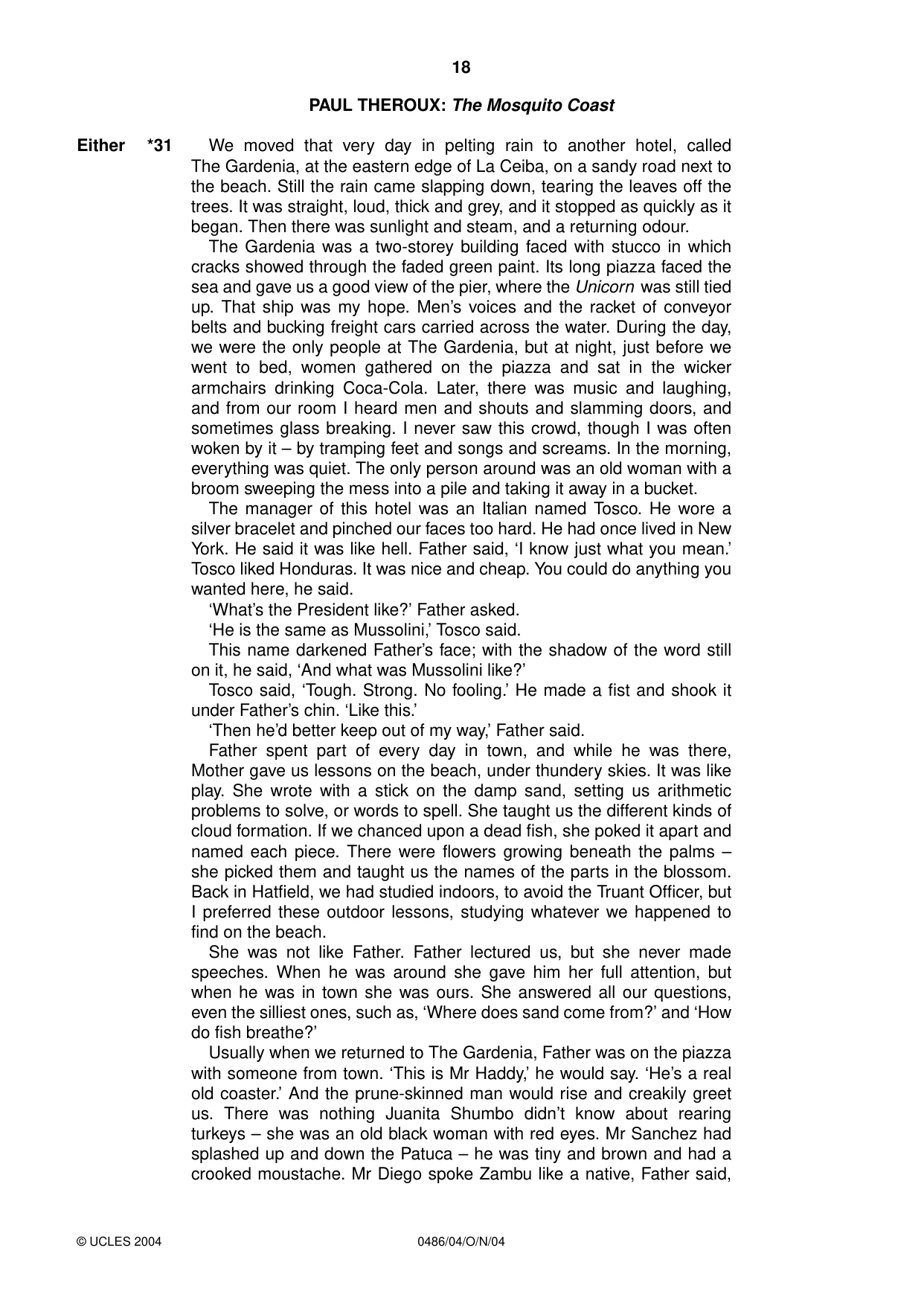
Question paper, page 18
18 0486/04/O/N/04 PAUL THEROUX: The Mosquito Coast Either *31 We moved that very day in pelting rain to another hotel, called The Gardenia, at the eastern edge of La Ceiba, on a sandy road next to the beach. Still the rain came slapping down, tearing the leaves off the trees. It was straight, loud, thick and grey, and it stopped as quickly as it began. Then there was sunlight and steam, and a returning odour. The Gardenia was a two-storey building faced with stucco in which cracks showed through the faded green paint. Its long piazza faced the sea and gave us a good view of the pier, where the Unicorn was still tied up. That ship was my hope. Men’s voices and the racket of conveyor belts and bucking freight cars carried across the water. During the day, we were the only people at The Gardenia, but at night, just before we went to bed, women gathered on the piazza and sat in the wicker armchairs drinking Coca-Cola. Later, there was music and laughing, and from our room I heard men and shouts and slamming doors, and sometimes glass breaking. I never saw this crowd, though I was often woken by it – by tramping feet and songs and screams. In the morning, everything was quiet. The only person around was an old woman with a broom sweeping the mess into a pile and taking it away in a bucket. The manager of this hotel was an Italian named Tosco. He wore a silver bracelet and pinched our faces too hard. He had once lived in New York. He said it was like hell. Father said, ‘I know just what you mean.’ Tosco liked Honduras. It was nice and cheap. You could do anything you wanted here, he said. ‘What’s the President like?’ Father asked. ‘He is the same as Mussolini,’ Tosco said. This name darkened Father’s face; with the shadow of the word still on it, he said, ‘And what was Mussolini like?’ Tosco said, ‘Tough. Strong. No fooling.’ He made a fist and shook it under Father’s chin. ‘Like this.’ ‘Then he’d better keep out of my way,’ Father said. Father spent part of every day in town, and while he was there, Mother gave us lessons on the beach, under thundery skies. It was like play. She wrote with a stick on the damp sand, setting us arithmetic problems to solve, or words to spell. She taught us the different kinds of cloud formation. If we chanced upon a dead fish, she poked it apart and named each piece. There were flowers growing beneath the palms – she picked them and taught us the names of the parts in the blossom. Back in Hatfield, we had studied indoors, to avoid the Truant Officer, but I preferred these outdoor lessons, studying whatever we happened to find on the beach. She was not like Father. Father lectured us, but she never made speeches. When he was around she gave him her full attention, but when he was in town she was ours. She answered all our questions, even the silliest ones, such as, ‘Where does sand come from?’ and ‘How do fish breathe?’ Usually when we returned to The Gardenia, Father was on the piazza with someone from town. ‘This is Mr Haddy,’ he would say. ‘He’s a real old coaster.’ And the prune-skinned man would rise and creakily greet us. There was nothing Juanita Shumbo didn’t know about rearing turkeys – she was an old black woman with red eyes. Mr Sanchez had splashed up and down the Patuca – he was tiny and brown and had a crooked moustache. Mr Diego spoke Zambu like a native, Father said, © UCLES 2004
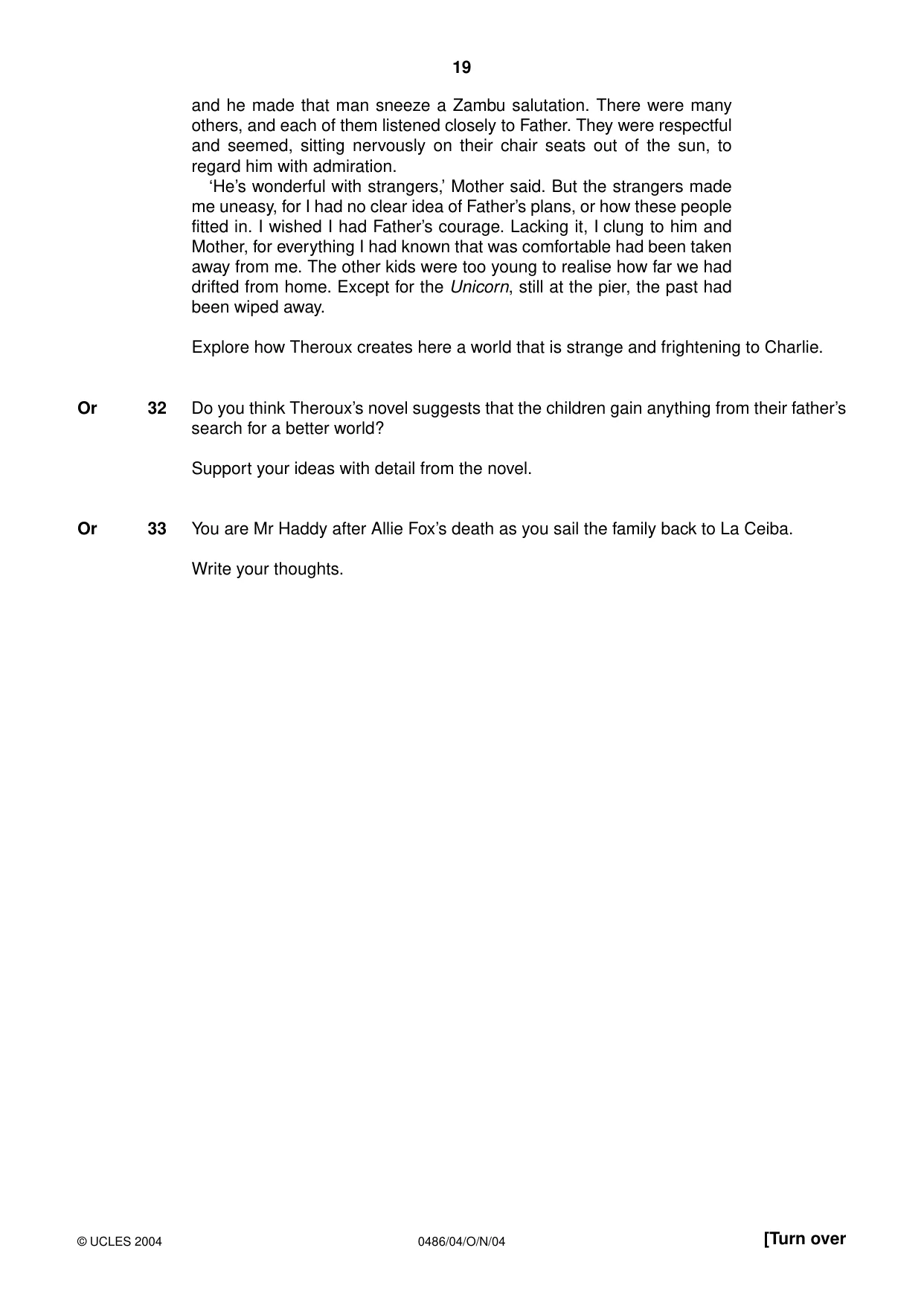
Question paper, page 19
19 0486/04/O/N/04 [Turn over and he made that man sneeze a Zambu salutation. There were many others, and each of them listened closely to Father. They were respectful and seemed, sitting nervously on their chair seats out of the sun, to regard him with admiration. ‘He’s wonderful with strangers,’ Mother said. But the strangers made me uneasy, for I had no clear idea of Father’s plans, or how these people fitted in. I wished I had Father’s courage. Lacking it, I clung to him and Mother, for everything I had known that was comfortable had been taken away from me. The other kids were too young to realise how far we had drifted from home. Except for the Unicorn, still at the pier, the past had been wiped away. Explore how Theroux creates here a world that is strange and frightening to Charlie. Or 32 Do you think Theroux’s novel suggests that the children gain anything from their father’s search for a better world? Support your ideas with detail from the novel. Or 33 You are Mr Haddy after Allie Fox’s death as you sail the family back to La Ceiba. Write your thoughts. © UCLES 2004
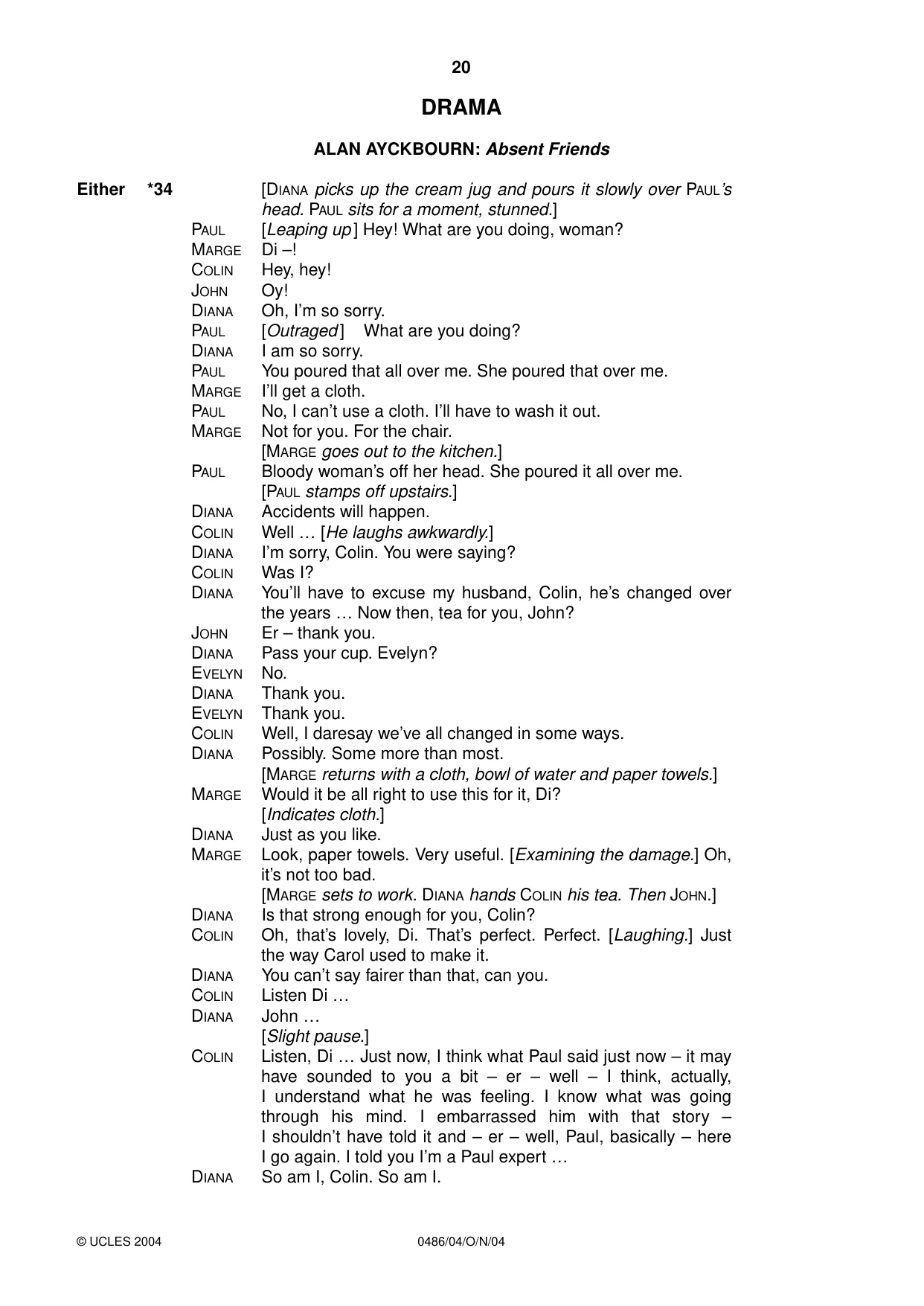
Question paper, page 20
20 0486/04/O/N/04 DRAMA ALAN AYCKBOURN: Absent Friends Either *34 [DIANA picks up the cream jug and pours it slowly over PAUL’s head. PAUL sits for a moment, stunned.] PAUL [Leaping up ] Hey! What are you doing, woman? MARGE Di –! COLIN Hey, hey! JOHN Oy! DIANA Oh, I’m so sorry. PAUL [Outraged ] What are you doing? DIANA I am so sorry. PAUL You poured that all over me. She poured that over me. MARGE I’ll get a cloth. PAUL No, I can’t use a cloth. I’ll have to wash it out. MARGE Not for you. For the chair. [MARGE goes out to the kitchen.] PAUL Bloody woman’s off her head. She poured it all over me. [PAUL stamps off upstairs.] DIANA Accidents will happen. COLIN Well … [He laughs awkwardly.] DIANA I’m sorry, Colin. You were saying? COLIN Was I? DIANA You’ll have to excuse my husband, Colin, he’s changed over the years … Now then, tea for you, John? JOHN Er – thank you. DIANA Pass your cup. Evelyn? EVELYN No. DIANA Thank you. EVELYN Thank you. COLIN Well, I daresay we’ve all changed in some ways. DIANA Possibly. Some more than most. [MARGE returns with a cloth, bowl of water and paper towels.] MARGE Would it be all right to use this for it, Di? [Indicates cloth.] DIANA Just as you like. MARGE Look, paper towels. Very useful. [Examining the damage.] Oh, it’s not too bad. [MARGE sets to work. DIANA hands COLIN his tea. Then JOHN.] DIANA Is that strong enough for you, Colin? COLIN Oh, that’s lovely, Di. That’s perfect. Perfect. [Laughing.] Just the way Carol used to make it. DIANA You can’t say fairer than that, can you. COLIN Listen Di … DIANA John … [Slight pause.] COLIN Listen, Di … Just now, I think what Paul said just now – it may have sounded to you a bit – er – well – I think, actually, I understand what he was feeling. I know what was going through his mind. I embarrassed him with that story – I shouldn’t have told it and – er – well, Paul, basically – here I go again. I told you I’m a Paul expert … DIANA So am I, Colin. So am I. © UCLES 2004
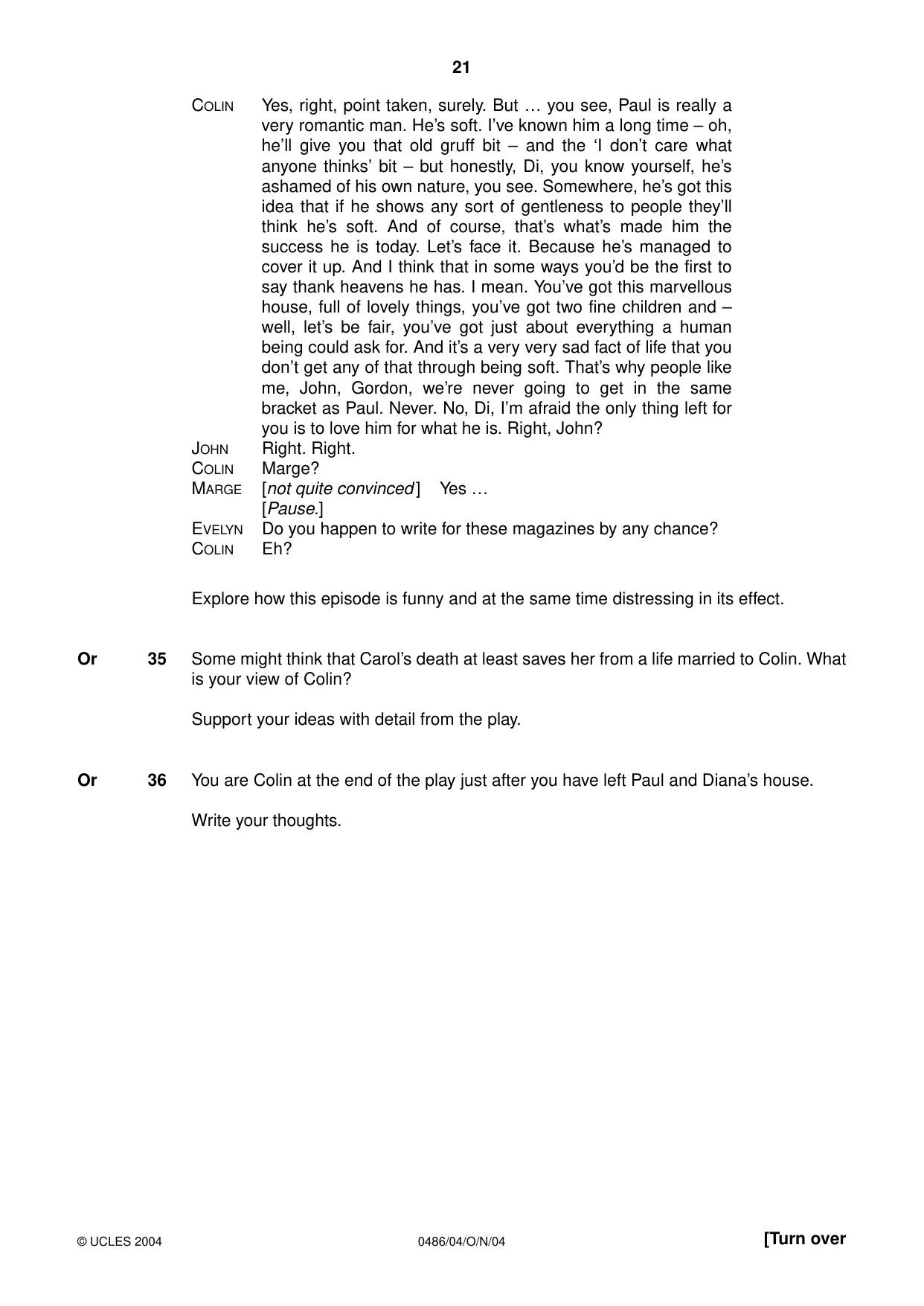
Question paper, page 21
21 0486/04/O/N/04 [Turn over COLIN Yes, right, point taken, surely. But … you see, Paul is really a very romantic man. He’s soft. I’ve known him a long time – oh, he’ll give you that old gruff bit – and the ‘I don’t care what anyone thinks’ bit – but honestly, Di, you know yourself, he’s ashamed of his own nature, you see. Somewhere, he’s got this idea that if he shows any sort of gentleness to people they’ll think he’s soft. And of course, that’s what’s made him the success he is today. Let’s face it. Because he’s managed to cover it up. And I think that in some ways you’d be the first to say thank heavens he has. I mean. You’ve got this marvellous house, full of lovely things, you’ve got two fine children and – well, let’s be fair, you’ve got just about everything a human being could ask for. And it’s a very very sad fact of life that you don’t get any of that through being soft. That’s why people like me, John, Gordon, we’re never going to get in the same bracket as Paul. Never. No, Di, I’m afraid the only thing left for you is to love him for what he is. Right, John? JOHN Right. Right. COLIN Marge? MARGE [not quite convinced ] Yes … [Pause.] EVELYN Do you happen to write for these magazines by any chance? COLIN Eh? Explore how this episode is funny and at the same time distressing in its effect. Or 35 Some might think that Carol’s death at least saves her from a life married to Colin. What is your view of Colin? Support your ideas with detail from the play. Or 36 You are Colin at the end of the play just after you have left Paul and Diana’s house. Write your thoughts. © UCLES 2004
Question paper, page 22
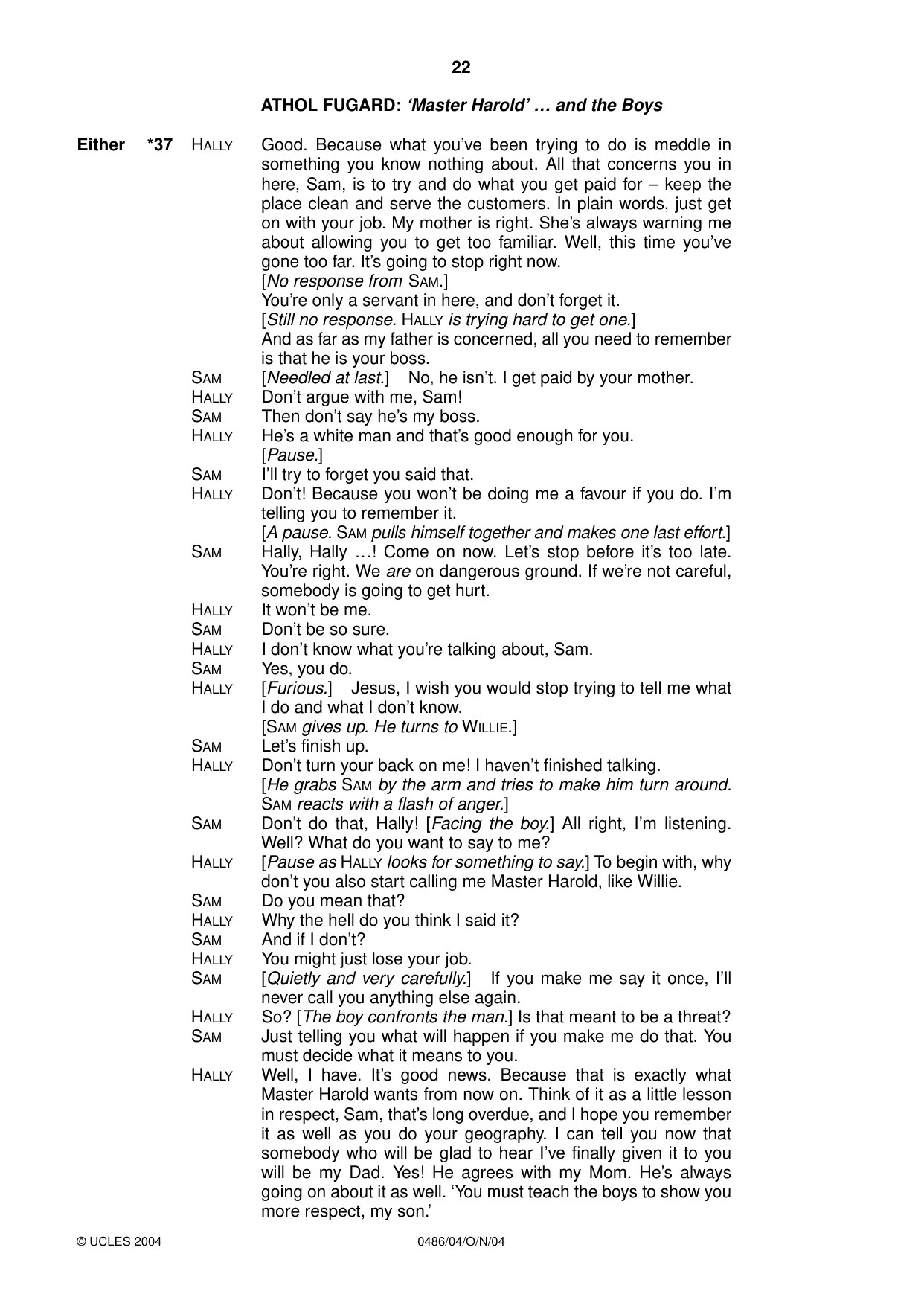
22 0486/04/O/N/04 ATHOL FUGARD: ‘Master Harold’ … and the Boys Either *37 HALLY Good. Because what you’ve been trying to do is meddle in something you know nothing about. All that concerns you in here, Sam, is to try and do what you get paid for – keep the place clean and serve the customers. In plain words, just get on with your job. My mother is right. She’s always warning me about allowing you to get too familiar. Well, this time you’ve gone too far. It’s going to stop right now. [No response from SAM.] You’re only a servant in here, and don’t forget it. [Still no response. HALLY is trying hard to get one.] And as far as my father is concerned, all you need to remember is that he is your boss. SAM [Needled at last.] No, he isn’t. I get paid by your mother. HALLY Don’t argue with me, Sam! SAM Then don’t say he’s my boss. HALLY He’s a white man and that’s good enough for you. [Pause.] SAM I’ll try to forget you said that. HALLY Don’t! Because you won’t be doing me a favour if you do. I’m telling you to remember it. [A pause. SAM pulls himself together and makes one last effort.] SAM Hally, Hally …! Come on now. Let’s stop before it’s too late. You’re right. We are on dangerous ground. If we’re not careful, somebody is going to get hurt. HALLY It won’t be me. SAM Don’t be so sure. HALLY I don’t know what you’re talking about, Sam. SAM Yes, you do. HALLY [Furious.] Jesus, I wish you would stop trying to tell me what I do and what I don’t know. [SAM gives up. He turns to WILLIE.] SAM Let’s finish up. HALLY Don’t turn your back on me! I haven’t finished talking. [He grabs SAM by the arm and tries to make him turn around. SAM reacts with a flash of anger.] SAM Don’t do that, Hally! [Facing the boy.] All right, I’m listening. Well? What do you want to say to me? HALLY [Pause as HALLY looks for something to say.] To begin with, why don’t you also start calling me Master Harold, like Willie. SAM Do you mean that? HALLY Why the hell do you think I said it? SAM And if I don’t? HALLY You might just lose your job. SAM [Quietly and very carefully.] If you make me say it once, I’ll never call you anything else again. HALLY So? [The boy confronts the man.] Is that meant to be a threat? SAM Just telling you what will happen if you make me do that. You must decide what it means to you. HALLY Well, I have. It’s good news. Because that is exactly what Master Harold wants from now on. Think of it as a little lesson in respect, Sam, that’s long overdue, and I hope you remember it as well as you do your geography. I can tell you now that somebody who will be glad to hear I’ve finally given it to you will be my Dad. Yes! He agrees with my Mom. He’s always going on about it as well. ‘You must teach the boys to show you more respect, my son.’ © UCLES 2004
Question paper, page 23
23 0486/04/O/N/04 [Turn over How does Fugard make this passage such an explosive moment in the play? Or 38 In what ways does Fugard make Hally’s parents important dramatically even though they never appear on the stage? Or 39 You are Willie as you walk home after the events of the play. Write your thoughts. © UCLES 2004
Question paper, page 24
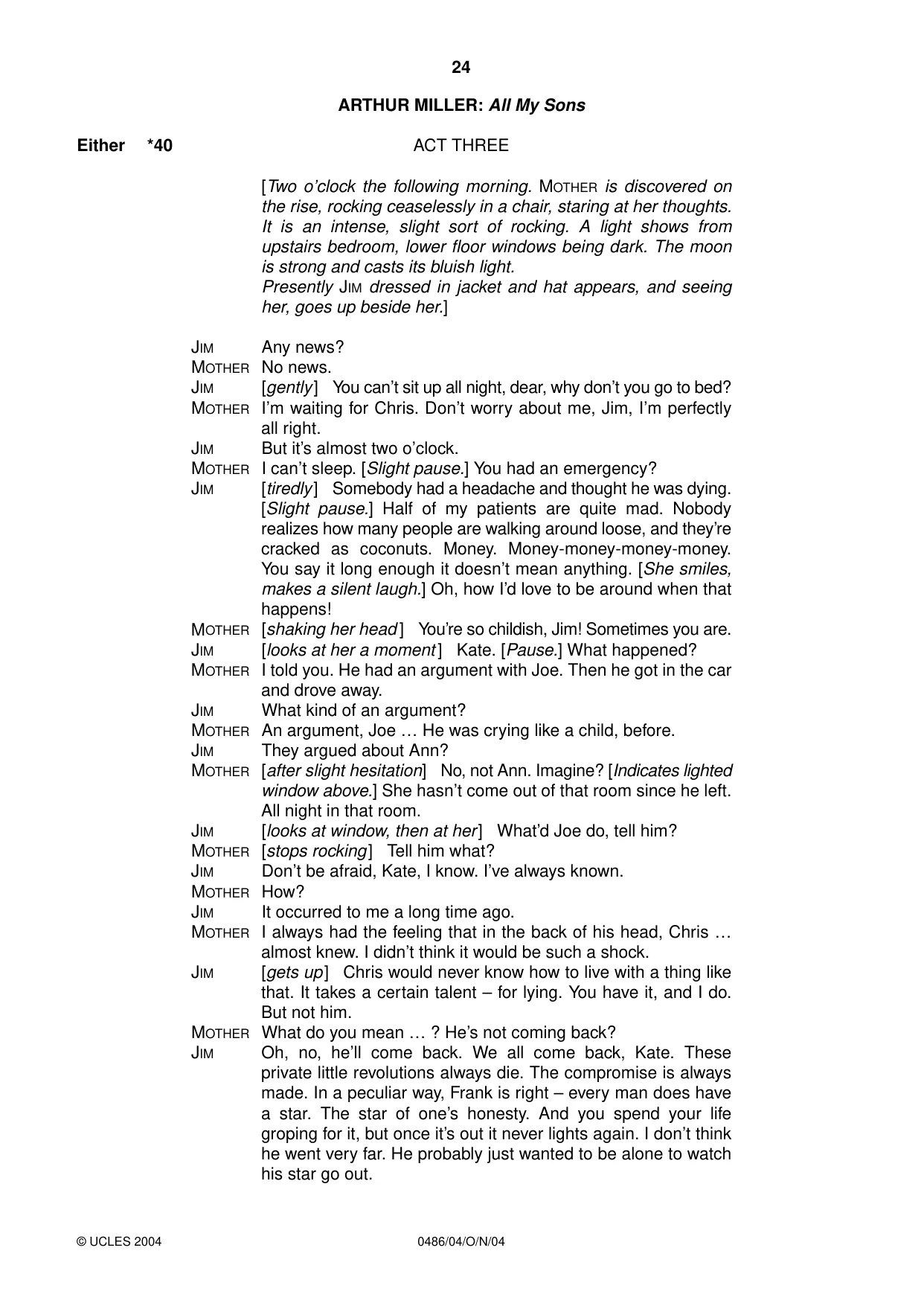
24 0486/04/O/N/04 ARTHUR MILLER: All My Sons Either *40 ACT THREE [Two o’clock the following morning. MOTHER is discovered on the rise, rocking ceaselessly in a chair, staring at her thoughts. It is an intense, slight sort of rocking. A light shows from upstairs bedroom, lower floor windows being dark. The moon is strong and casts its bluish light. Presently JIM dressed in jacket and hat appears, and seeing her, goes up beside her.] JIM Any news? MOTHER No news. JIM [gently] You can’t sit up all night, dear, why don’t you go to bed? MOTHER I’m waiting for Chris. Don’t worry about me, Jim, I’m perfectly all right. JIM But it’s almost two o’clock. MOTHER I can’t sleep. [Slight pause.] You had an emergency? JIM [tiredly] Somebody had a headache and thought he was dying. [Slight pause.] Half of my patients are quite mad. Nobody realizes how many people are walking around loose, and they’re cracked as coconuts. Money. Money-money-money-money. You say it long enough it doesn’t mean anything. [She smiles, makes a silent laugh.] Oh, how I’d love to be around when that happens! MOTHER [shaking her head ] You’re so childish, Jim! Sometimes you are. JIM [looks at her a moment ] Kate. [Pause.] What happened? MOTHER I told you. He had an argument with Joe. Then he got in the car and drove away. JIM What kind of an argument? MOTHER An argument, Joe … He was crying like a child, before. JIM They argued about Ann? MOTHER [after slight hesitation] No, not Ann. Imagine? [Indicates lighted window above.] She hasn’t come out of that room since he left. All night in that room. JIM [looks at window, then at her] What’d Joe do, tell him? MOTHER [stops rocking] Tell him what? JIM Don’t be afraid, Kate, I know. I’ve always known. MOTHER How? JIM It occurred to me a long time ago. MOTHER I always had the feeling that in the back of his head, Chris … almost knew. I didn’t think it would be such a shock. JIM [gets up] Chris would never know how to live with a thing like that. It takes a certain talent – for lying. You have it, and I do. But not him. MOTHER What do you mean … ? He’s not coming back? JIM Oh, no, he’ll come back. We all come back, Kate. These private little revolutions always die. The compromise is always made. In a peculiar way, Frank is right – every man does have a star. The star of one’s honesty. And you spend your life groping for it, but once it’s out it never lights again. I don’t think he went very far. He probably just wanted to be alone to watch his star go out. © UCLES 2004
Question paper, page 25
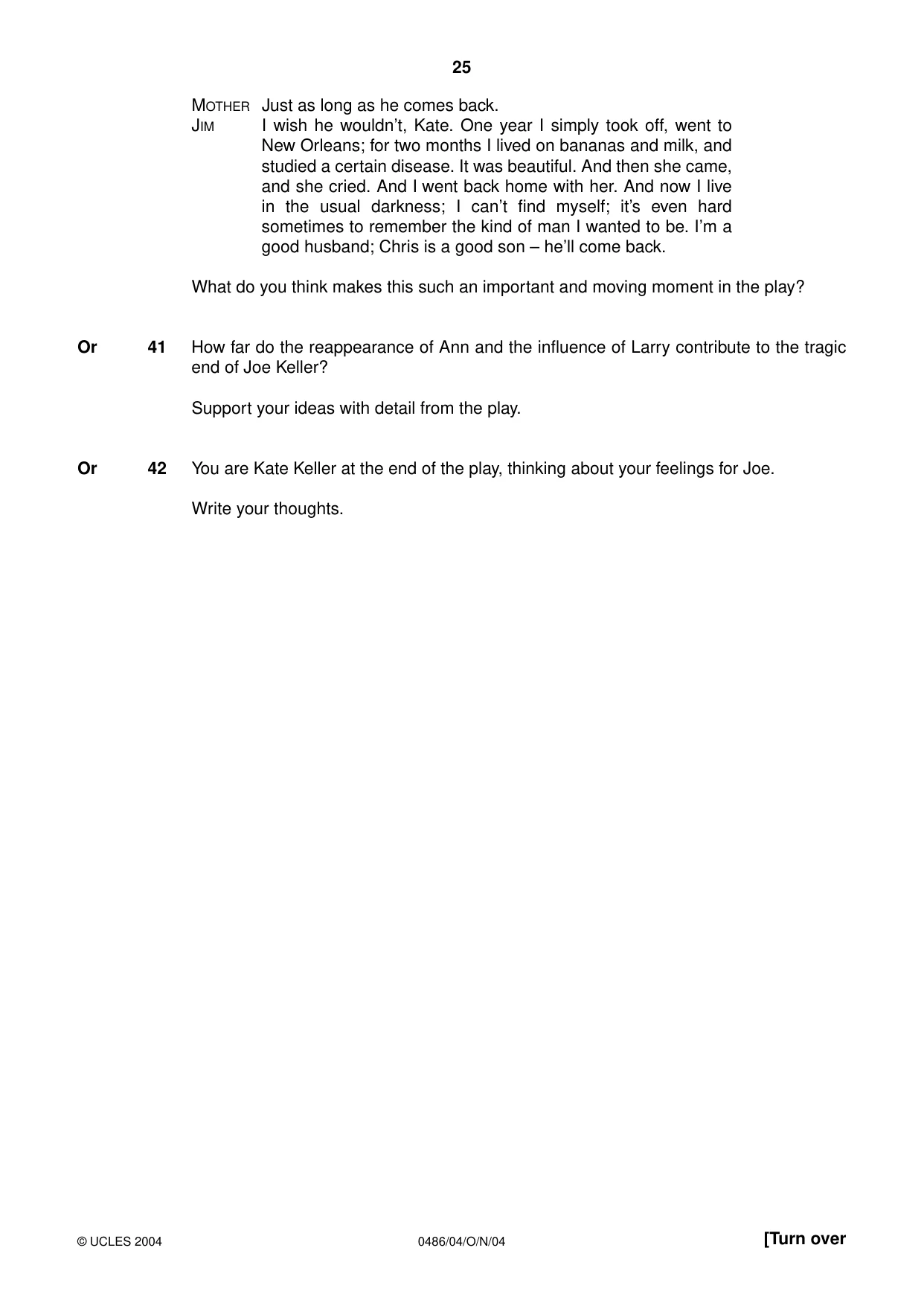
25 0486/04/O/N/04 [Turn over MOTHER Just as long as he comes back. JIM I wish he wouldn’t, Kate. One year I simply took off, went to New Orleans; for two months I lived on bananas and milk, and studied a certain disease. It was beautiful. And then she came, and she cried. And I went back home with her. And now I live in the usual darkness; I can’t find myself; it’s even hard sometimes to remember the kind of man I wanted to be. I’m a good husband; Chris is a good son – he’ll come back. What do you think makes this such an important and moving moment in the play? Or 41 How far do the reappearance of Ann and the influence of Larry contribute to the tragic end of Joe Keller? Support your ideas with detail from the play. Or 42 You are Kate Keller at the end of the play, thinking about your feelings for Joe. Write your thoughts. © UCLES 2004
Question paper, page 26
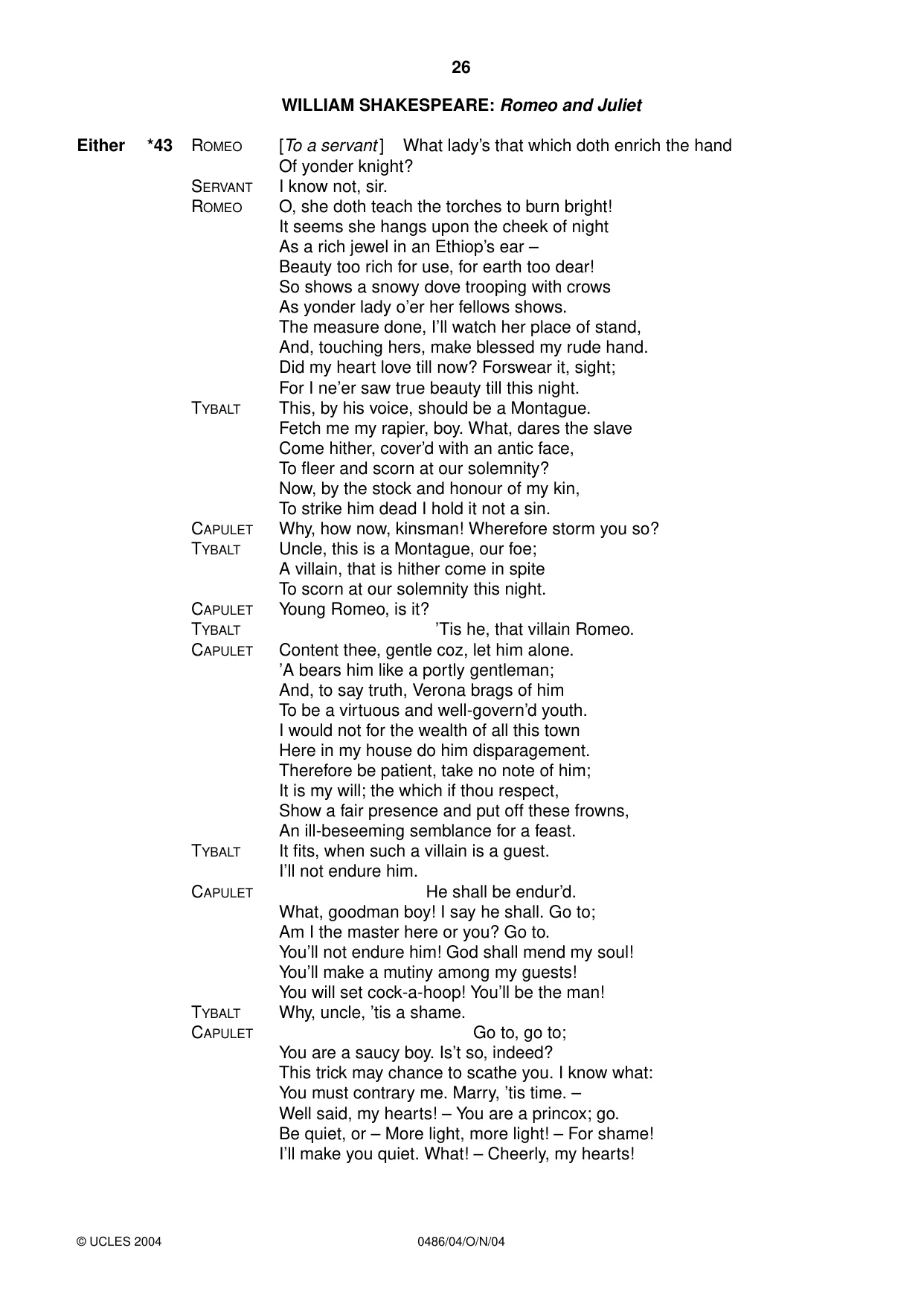
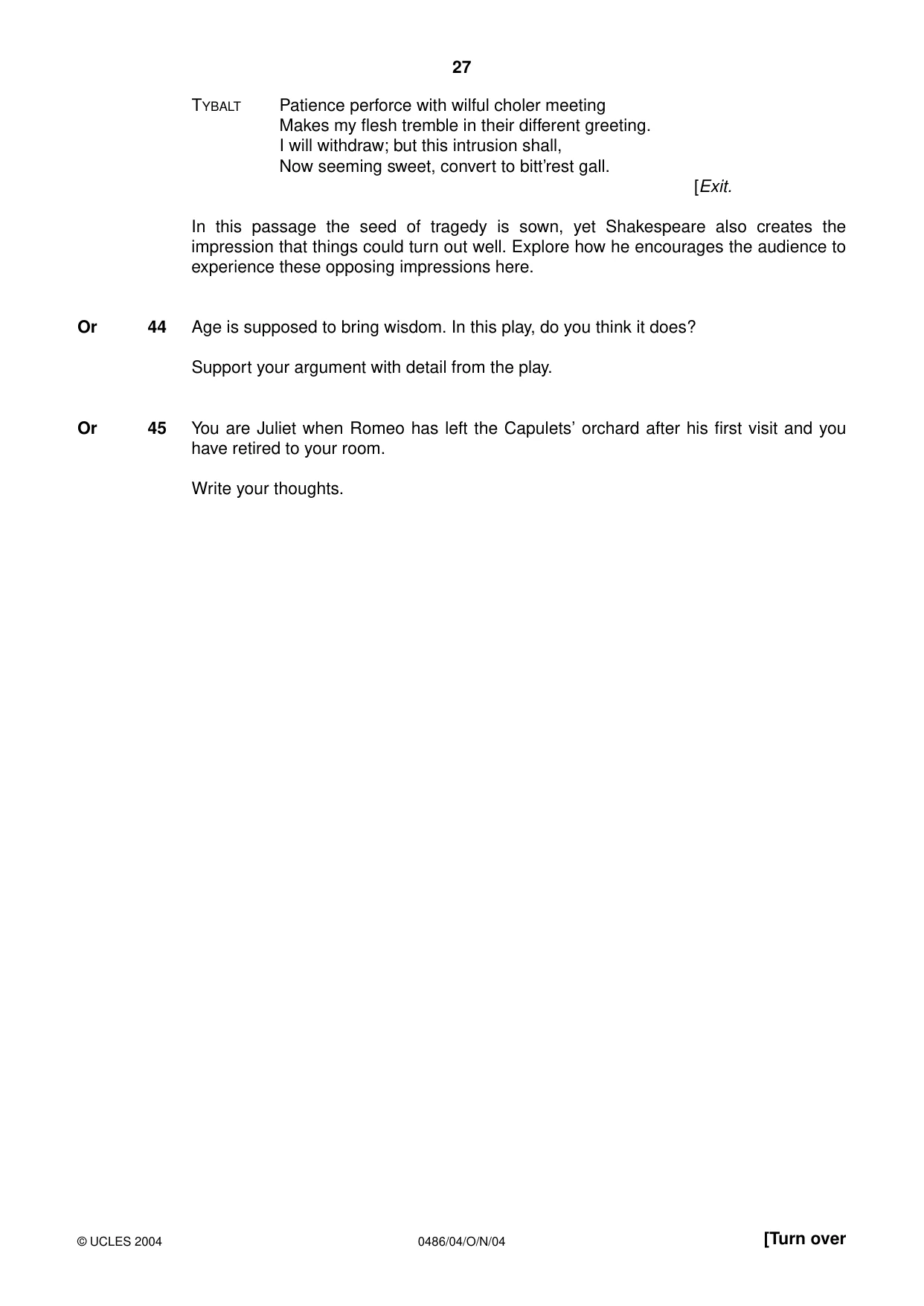
26 0486/04/O/N/04 WILLIAM SHAKESPEARE: Romeo and Juliet Either *43 ROMEO [To a servant ] What lady’s that which doth enrich the hand Of yonder knight? SERVANT I know not, sir. ROMEO O, she doth teach the torches to burn bright! It seems she hangs upon the cheek of night As a rich jewel in an Ethiop’s ear – Beauty too rich for use, for earth too dear! So shows a snowy dove trooping with crows As yonder lady o’er her fellows shows. The measure done, I’ll watch her place of stand, And, touching hers, make blessed my rude hand. Did my heart love till now? Forswear it, sight; For I ne’er saw true beauty till this night. TYBALT This, by his voice, should be a Montague. Fetch me my rapier, boy. What, dares the slave Come hither, cover’d with an antic face, To fleer and scorn at our solemnity? Now, by the stock and honour of my kin, To strike him dead I hold it not a sin. CAPULET Why, how now, kinsman! Wherefore storm you so? TYBALT Uncle, this is a Montague, our foe; A villain, that is hither come in spite To scorn at our solemnity this night. CAPULET Young Romeo, is it? TYBALT ’Tis he, that villain Romeo. CAPULET Content thee, gentle coz, let him alone. ’A bears him like a portly gentleman; And, to say truth, Verona brags of him To be a virtuous and well-govern’d youth. I would not for the wealth of all this town Here in my house do him disparagement. Therefore be patient, take no note of him; It is my will; the which if thou respect, Show a fair presence and put off these frowns, An ill-beseeming semblance for a feast. TYBALT It fits, when such a villain is a guest. I’ll not endure him. CAPULET He shall be endur’d. What, goodman boy! I say he shall. Go to; Am I the master here or you? Go to. You’ll not endure him! God shall mend my soul! You’ll make a mutiny among my guests! You will set cock-a-hoop! You’ll be the man! TYBALT Why, uncle, ’tis a shame. CAPULET Go to, go to; You are a saucy boy. Is’t so, indeed? This trick may chance to scathe you. I know what: You must contrary me. Marry, ’tis time. – Well said, my hearts! – You are a princox; go. Be quiet, or – More light, more light! – For shame! I’ll make you quiet. What! – Cheerly, my hearts! © UCLES 2004
Question paper, page 27
27 0486/04/O/N/04 [Turn over TYBALT Patience perforce with wilful choler meeting Makes my flesh tremble in their different greeting. I will withdraw; but this intrusion shall, Now seeming sweet, convert to bitt’rest gall. [Exit. In this passage the seed of tragedy is sown, yet Shakespeare also creates the impression that things could turn out well. Explore how he encourages the audience to experience these opposing impressions here. Or 44 Age is supposed to bring wisdom. In this play, do you think it does? Support your argument with detail from the play. Or 45 You are Juliet when Romeo has left the Capulets’ orchard after his first visit and you have retired to your room. Write your thoughts. © UCLES 2004
Question paper, page 28
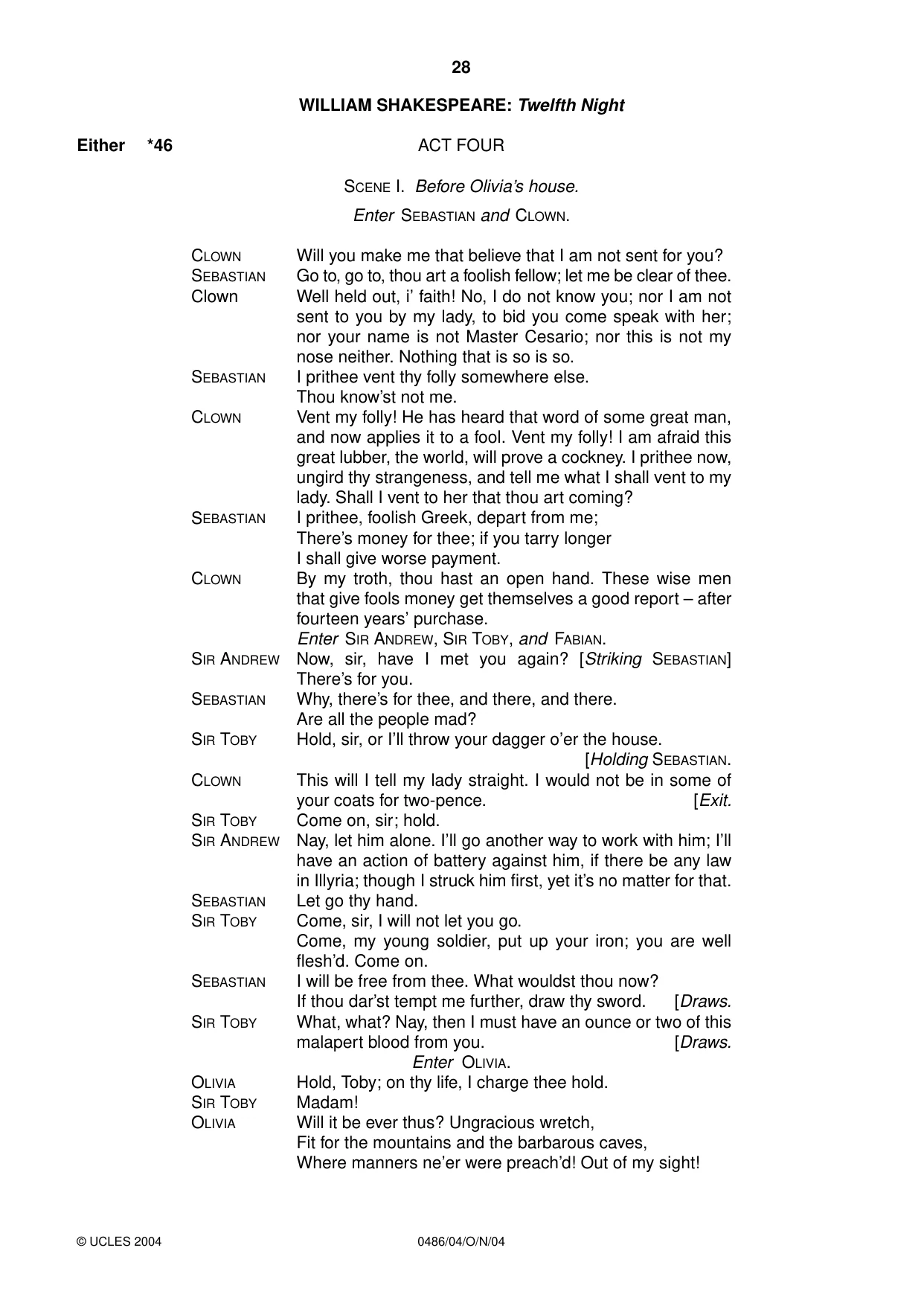
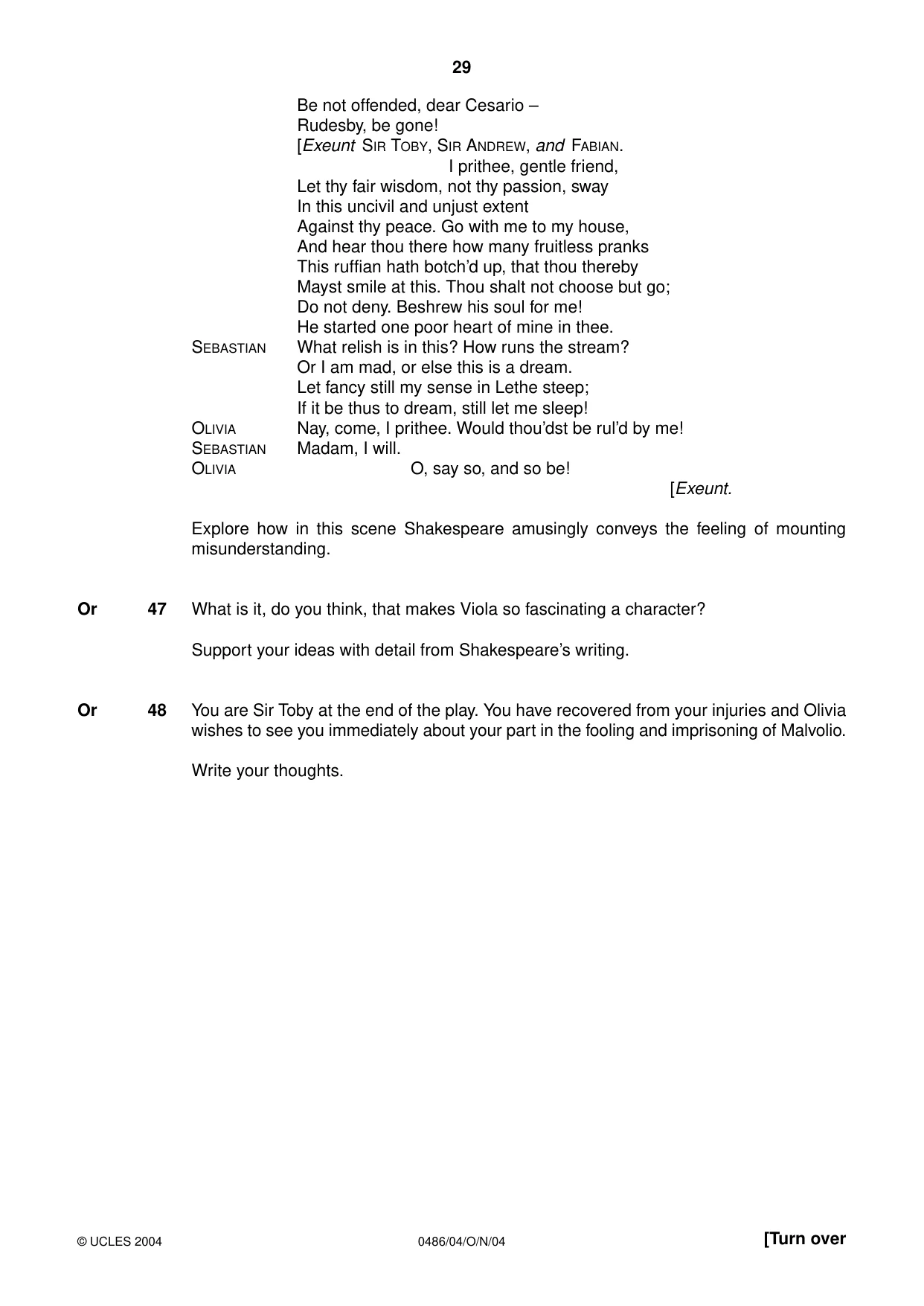
28 0486/04/O/N/04 WILLIAM SHAKESPEARE: Twelfth Night Either *46 ACT FOUR SCENE I. Before Olivia’s house. Enter SEBASTIAN and CLOWN. CLOWN Will you make me that believe that I am not sent for you? SEBASTIAN Go to, go to, thou art a foolish fellow; let me be clear of thee. Clown Well held out, i’ faith! No, I do not know you; nor I am not sent to you by my lady, to bid you come speak with her; nor your name is not Master Cesario; nor this is not my nose neither. Nothing that is so is so. SEBASTIAN I prithee vent thy folly somewhere else. Thou know’st not me. CLOWN Vent my folly! He has heard that word of some great man, and now applies it to a fool. Vent my folly! I am afraid this great lubber, the world, will prove a cockney. I prithee now, ungird thy strangeness, and tell me what I shall vent to my lady. Shall I vent to her that thou art coming? SEBASTIAN I prithee, foolish Greek, depart from me; There’s money for thee; if you tarry longer I shall give worse payment. CLOWN By my troth, thou hast an open hand. These wise men that give fools money get themselves a good report – after fourteen years’ purchase. Enter SIR ANDREW, SIR TOBY, and FABIAN. SIR ANDREW Now, sir, have I met you again? [Striking SEBASTIAN] There’s for you. SEBASTIAN Why, there’s for thee, and there, and there. Are all the people mad? SIR TOBY Hold, sir, or I’ll throw your dagger o’er the house. [Holding SEBASTIAN. CLOWN This will I tell my lady straight. I would not be in some of your coats for two-pence. [Exit. SIR TOBY Come on, sir; hold. SIR ANDREW Nay, let him alone. I’ll go another way to work with him; I’ll have an action of battery against him, if there be any law in Illyria; though I struck him first, yet it’s no matter for that. SEBASTIAN Let go thy hand. SIR TOBY Come, sir, I will not let you go. Come, my young soldier, put up your iron; you are well flesh’d. Come on. SEBASTIAN I will be free from thee. What wouldst thou now? If thou dar’st tempt me further, draw thy sword. [Draws. SIR TOBY What, what? Nay, then I must have an ounce or two of this malapert blood from you. [Draws. Enter OLIVIA. OLIVIA Hold, Toby; on thy life, I charge thee hold. SIR TOBY Madam! OLIVIA Will it be ever thus? Ungracious wretch, Fit for the mountains and the barbarous caves, Where manners ne’er were preach’d! Out of my sight! © UCLES 2004
Question paper, page 29
29 0486/04/O/N/04 [Turn over Be not offended, dear Cesario – Rudesby, be gone! [Exeunt SIR TOBY, SIR ANDREW, and FABIAN. I prithee, gentle friend, Let thy fair wisdom, not thy passion, sway In this uncivil and unjust extent Against thy peace. Go with me to my house, And hear thou there how many fruitless pranks This ruffian hath botch’d up, that thou thereby Mayst smile at this. Thou shalt not choose but go; Do not deny. Beshrew his soul for me! He started one poor heart of mine in thee. SEBASTIAN What relish is in this? How runs the stream? Or I am mad, or else this is a dream. Let fancy still my sense in Lethe steep; If it be thus to dream, still let me sleep! OLIVIA Nay, come, I prithee. Would thou’dst be rul’d by me! SEBASTIAN Madam, I will. OLIVIA O, say so, and so be! [Exeunt. Explore how in this scene Shakespeare amusingly conveys the feeling of mounting misunderstanding. Or 47 What is it, do you think, that makes Viola so fascinating a character? Support your ideas with detail from Shakespeare’s writing. Or 48 You are Sir Toby at the end of the play. You have recovered from your injuries and Olivia wishes to see you immediately about your part in the fooling and imprisoning of Malvolio. Write your thoughts. © UCLES 2004
Question paper, page 30
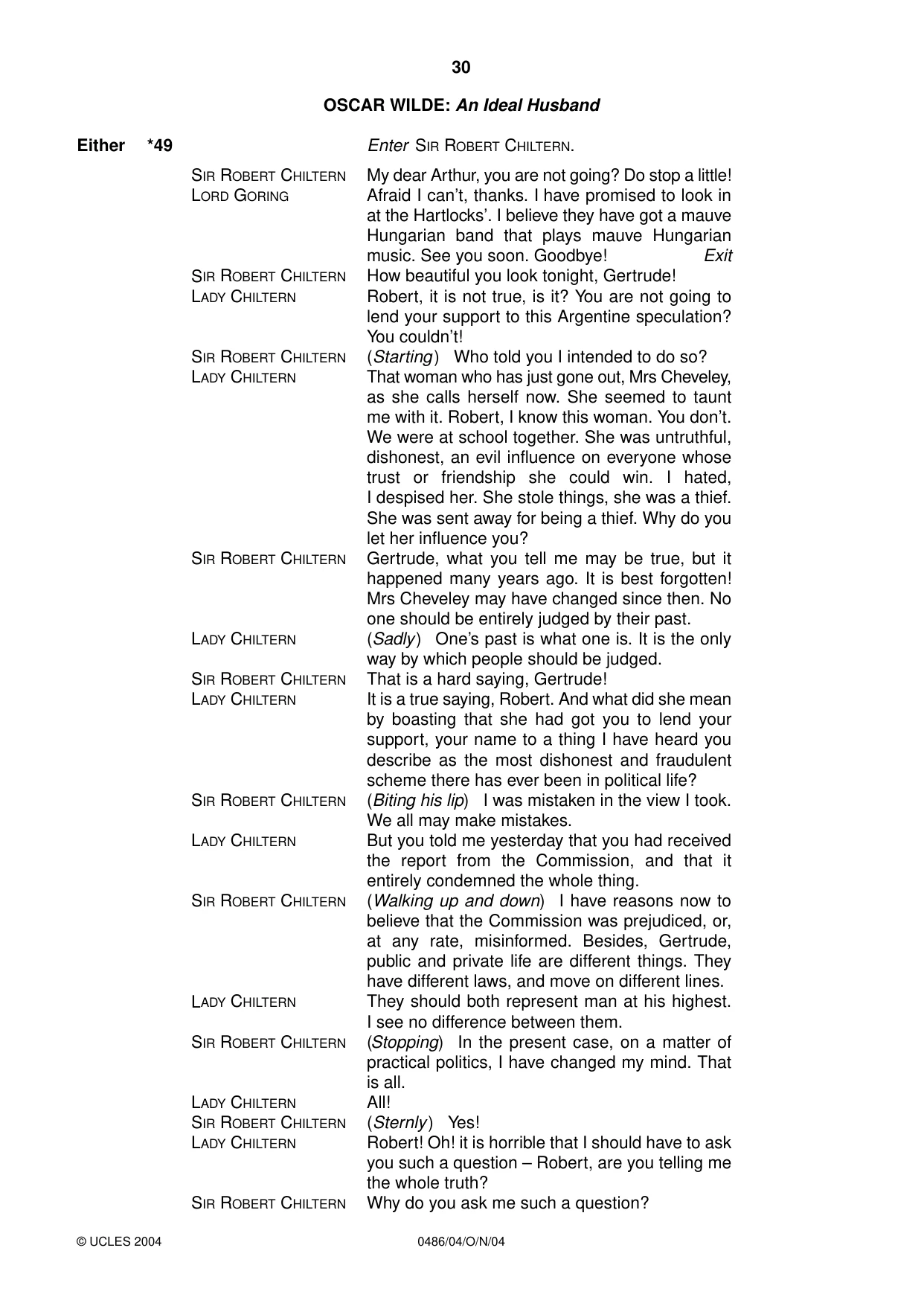
30 0486/04/O/N/04 OSCAR WILDE: An Ideal Husband Either *49 Enter SIR ROBERT CHILTERN. SIR ROBERT CHILTERN My dear Arthur, you are not going? Do stop a little! LORD GORING Afraid I can’t, thanks. I have promised to look in at the Hartlocks’. I believe they have got a mauve Hungarian band that plays mauve Hungarian music. See you soon. Goodbye! Exit SIR ROBERT CHILTERN How beautiful you look tonight, Gertrude! LADY CHILTERN Robert, it is not true, is it? You are not going to lend your support to this Argentine speculation? You couldn’t! SIR ROBERT CHILTERN (Starting) Who told you I intended to do so? LADY CHILTERN That woman who has just gone out, Mrs Cheveley, as she calls herself now. She seemed to taunt me with it. Robert, I know this woman. You don’t. We were at school together. She was untruthful, dishonest, an evil influence on everyone whose trust or friendship she could win. I hated, I despised her. She stole things, she was a thief. She was sent away for being a thief. Why do you let her influence you? SIR ROBERT CHILTERN Gertrude, what you tell me may be true, but it happened many years ago. It is best forgotten! Mrs Cheveley may have changed since then. No one should be entirely judged by their past. LADY CHILTERN (Sadly) One’s past is what one is. It is the only way by which people should be judged. SIR ROBERT CHILTERN That is a hard saying, Gertrude! LADY CHILTERN It is a true saying, Robert. And what did she mean by boasting that she had got you to lend your support, your name to a thing I have heard you describe as the most dishonest and fraudulent scheme there has ever been in political life? SIR ROBERT CHILTERN (Biting his lip) I was mistaken in the view I took. We all may make mistakes. LADY CHILTERN But you told me yesterday that you had received the report from the Commission, and that it entirely condemned the whole thing. SIR ROBERT CHILTERN (Walking up and down) I have reasons now to believe that the Commission was prejudiced, or, at any rate, misinformed. Besides, Gertrude, public and private life are different things. They have different laws, and move on different lines. LADY CHILTERN They should both represent man at his highest. I see no difference between them. SIR ROBERT CHILTERN (Stopping) In the present case, on a matter of practical politics, I have changed my mind. That is all. LADY CHILTERN All! SIR ROBERT CHILTERN (Sternly) Yes! LADY CHILTERN Robert! Oh! it is horrible that I should have to ask you such a question – Robert, are you telling me the whole truth? SIR ROBERT CHILTERN Why do you ask me such a question? © UCLES 2004
Question paper, page 31
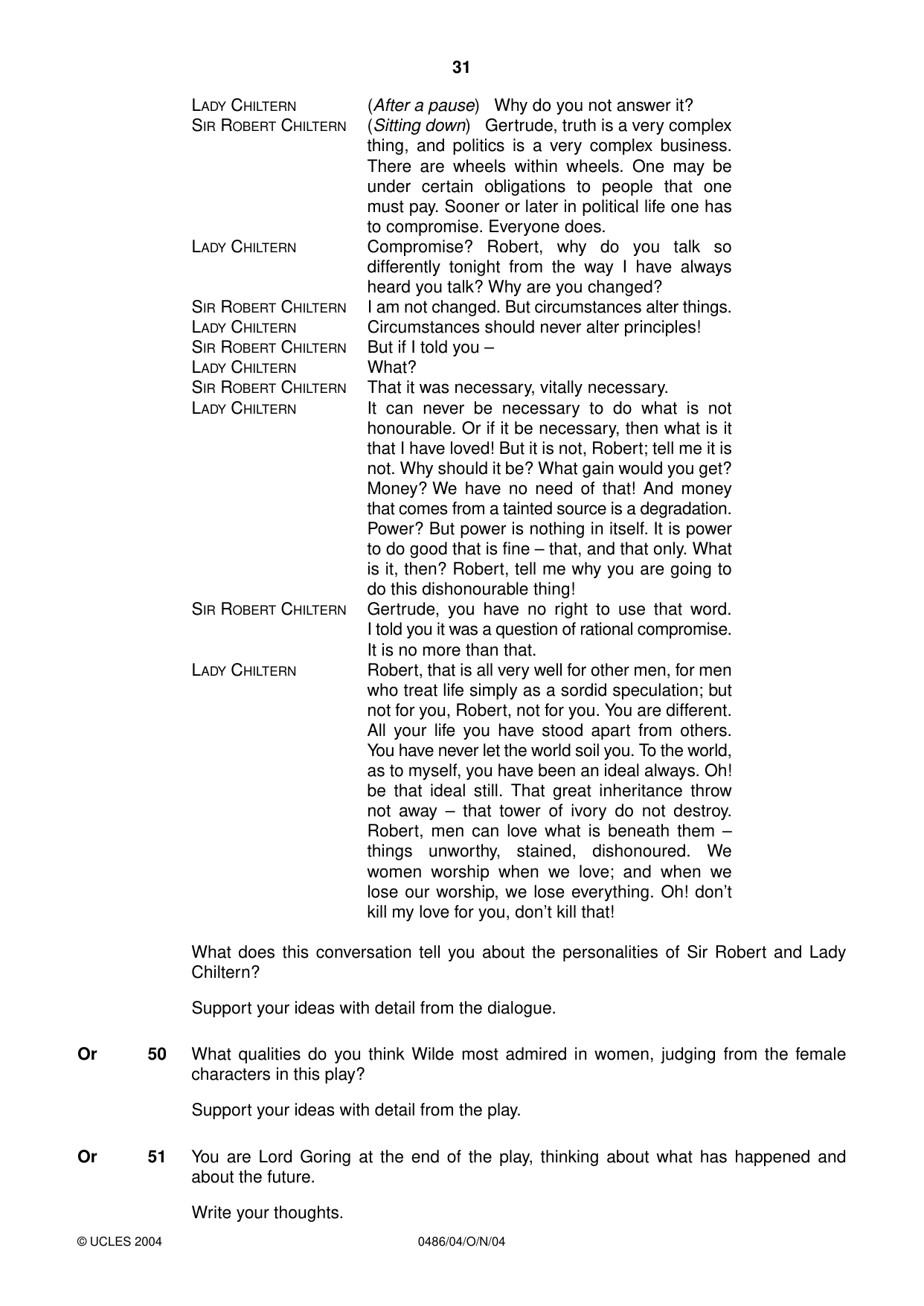
31 0486/04/O/N/04 LADY CHILTERN (After a pause) Why do you not answer it? SIR ROBERT CHILTERN (Sitting down) Gertrude, truth is a very complex thing, and politics is a very complex business. There are wheels within wheels. One may be under certain obligations to people that one must pay. Sooner or later in political life one has to compromise. Everyone does. LADY CHILTERN Compromise? Robert, why do you talk so differently tonight from the way I have always heard you talk? Why are you changed? SIR ROBERT CHILTERN I am not changed. But circumstances alter things. LADY CHILTERN Circumstances should never alter principles! SIR ROBERT CHILTERN But if I told you – LADY CHILTERN What? SIR ROBERT CHILTERN That it was necessary, vitally necessary. LADY CHILTERN It can never be necessary to do what is not honourable. Or if it be necessary, then what is it that I have loved! But it is not, Robert; tell me it is not. Why should it be? What gain would you get? Money? We have no need of that! And money that comes from a tainted source is a degradation. Power? But power is nothing in itself. It is power to do good that is fine – that, and that only. What is it, then? Robert, tell me why you are going to do this dishonourable thing! SIR ROBERT CHILTERN Gertrude, you have no right to use that word. I told you it was a question of rational compromise. It is no more than that. LADY CHILTERN Robert, that is all very well for other men, for men who treat life simply as a sordid speculation; but not for you, Robert, not for you. You are different. All your life you have stood apart from others. You have never let the world soil you. To the world, as to myself, you have been an ideal always. Oh! be that ideal still. That great inheritance throw not away – that tower of ivory do not destroy. Robert, men can love what is beneath them – things unworthy, stained, dishonoured. We women worship when we love; and when we lose our worship, we lose everything. Oh! don’t kill my love for you, don’t kill that! What does this conversation tell you about the personalities of Sir Robert and Lady Chiltern? Support your ideas with detail from the dialogue. Or 50 What qualities do you think Wilde most admired in women, judging from the female characters in this play? Support your ideas with detail from the play. Or 51 You are Lord Goring at the end of the play, thinking about what has happened and about the future. Write your thoughts. © UCLES 2004
Question paper, page 32
32 0486/04/O/N/04 BLANK PAGE Copyright Acknowledgements: Question 1 Seamus Heaney; Death of a Naturalist; Faber and Faber. Question 4 © Fleur Adcock; Poems 1960–2000 (Bloodaxe Books, 2000). Question 10 Katherine Mansfield; ‘Daughters of the Late Colonel’; Twentieth Century Short Stories, Barnes & Egford. Question 16 © Anita Desai; The Village by the Sea: An Indian Family Story (Puffin, 1984). Copyright © Anita Desai, 1984. Question 19 © Doris Lessing; The Grass is Singing. Reproduced by permission of Jonathan Clowes Ltd. © Doris Lessing. Question 22 Dalene Matthee; Fiela’s Child. Reproduced by permission of © Dinah Weiner. Question 25 © George Orwell; Animal Farm (Copyright © George Orwell, 1945) by permission of Bill Hamilton as the Literary Executor of the Estate of the Late Sonia Brownell Orwell and Secker & Warburg Ltd. Question 28 Amy Tan; The Bonesetter’s Daughter; copyright © 2001 by Amy Tan. Used by permission of G. P. Putnam’s Sons, a division of Penguin Group (USA) Inc. Question 31 © Paul Theroux 1981; The Mosquito Coast, reprinted with the permission of The Wylie Agency, Inc. Question 34 Alan Ayckbourn; Absent Friends; Act 2; Faber and Faber. Question 37 © Athol Fugard; ‘Master Harold’ … and the Boys. Reproduced by permission of Oxford University Press. © Athol Fugard. Question 40 ‘All My Sons’, copyright 1947, renewed © 1975 by Arthur Miller, from Arthur Miller’s Collected Plays. By Arthur Miller. Used by permission of Viking Penguin, a division of Penguin Putnam. Every reasonable effort has been made to trace all copyright holders where the publishers (i.e. UCLES) are aware that third-party material has been reproduced. The publishers would be pleased to hear from anyone whose rights they have unwittingly infringed. University of Cambridge International Examinations is part of the University of Cambridge Local Examinations Syndicate (UCLES), which is itself a department of the University of Cambridge. © UCLES 2004
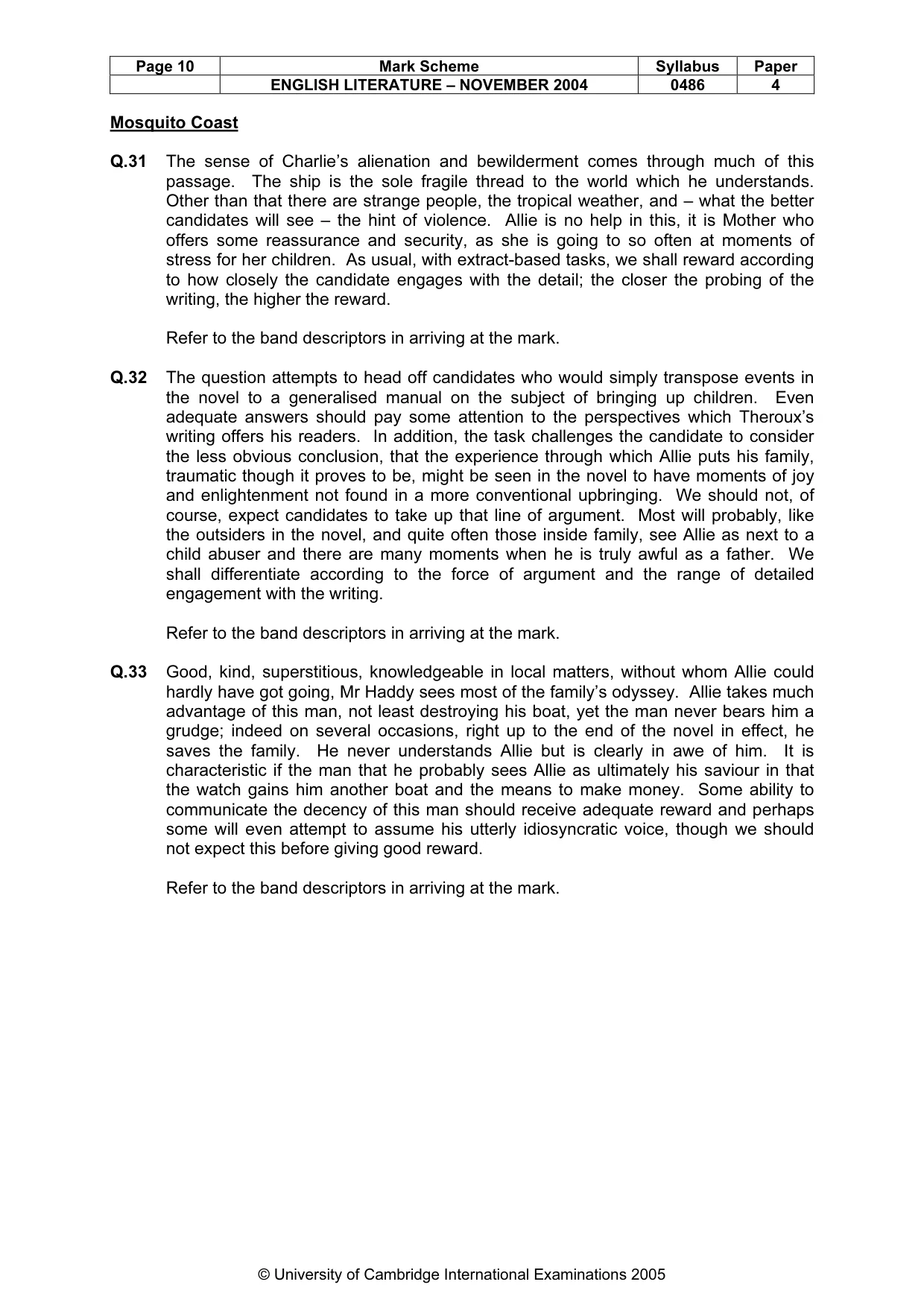
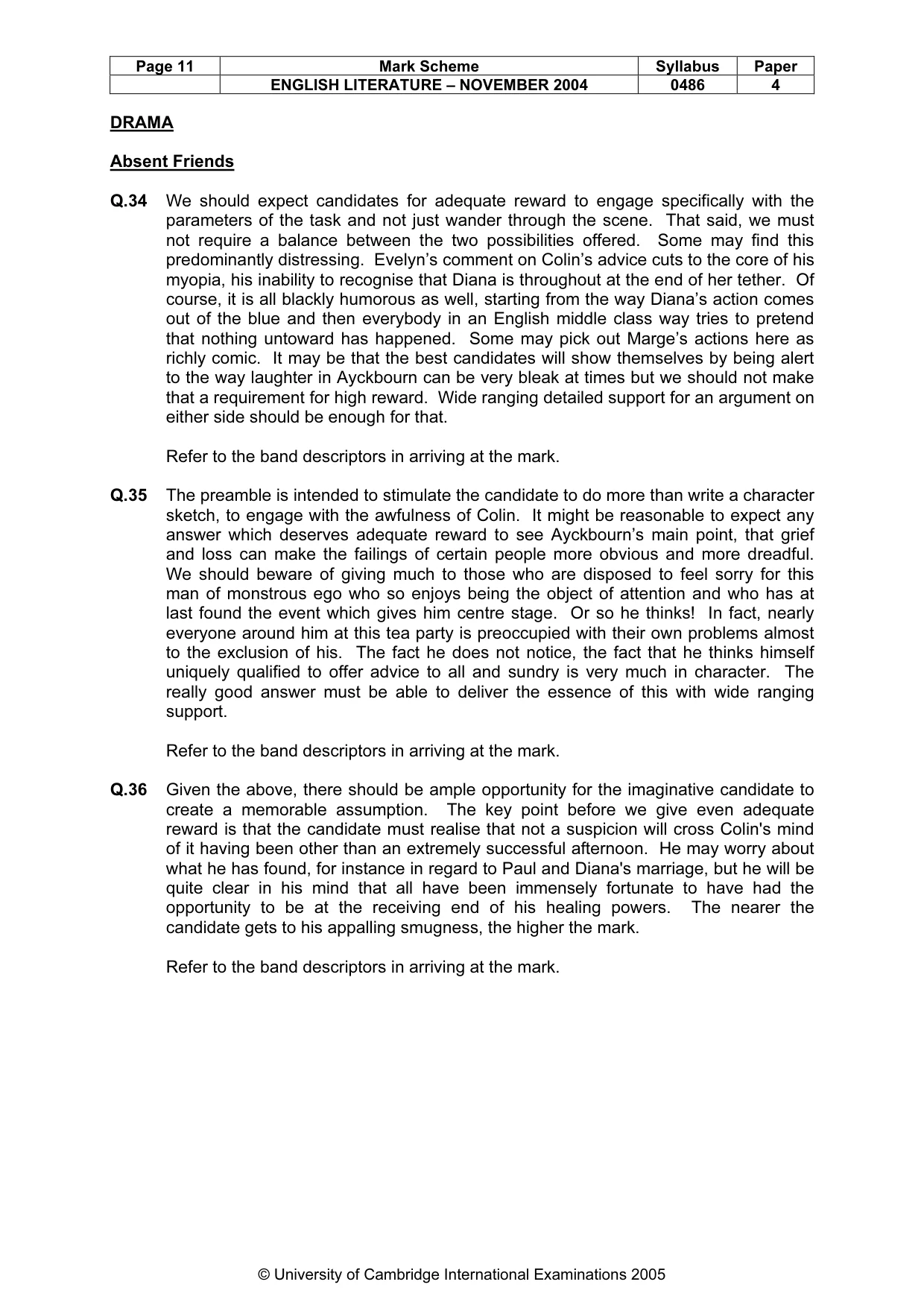
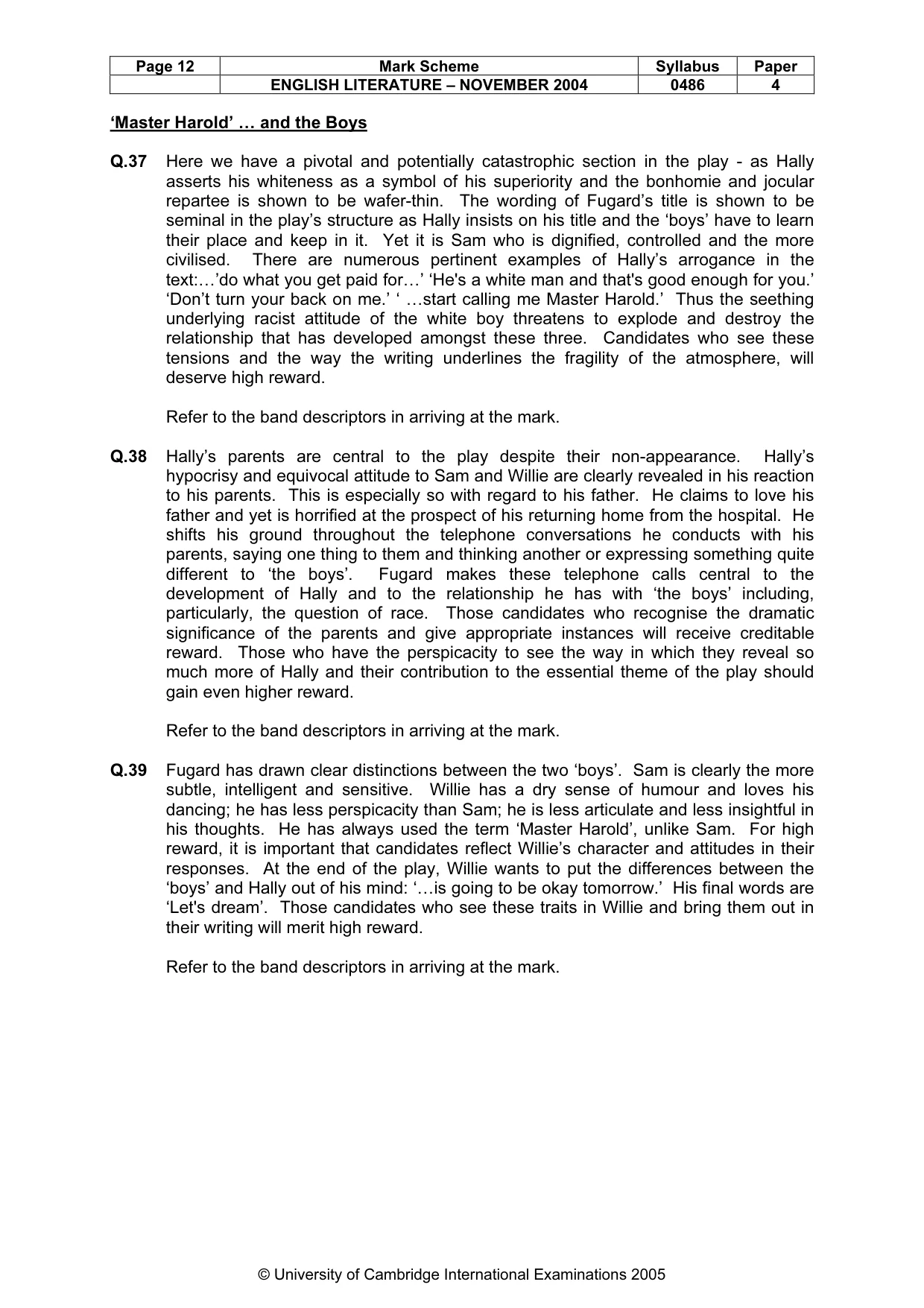
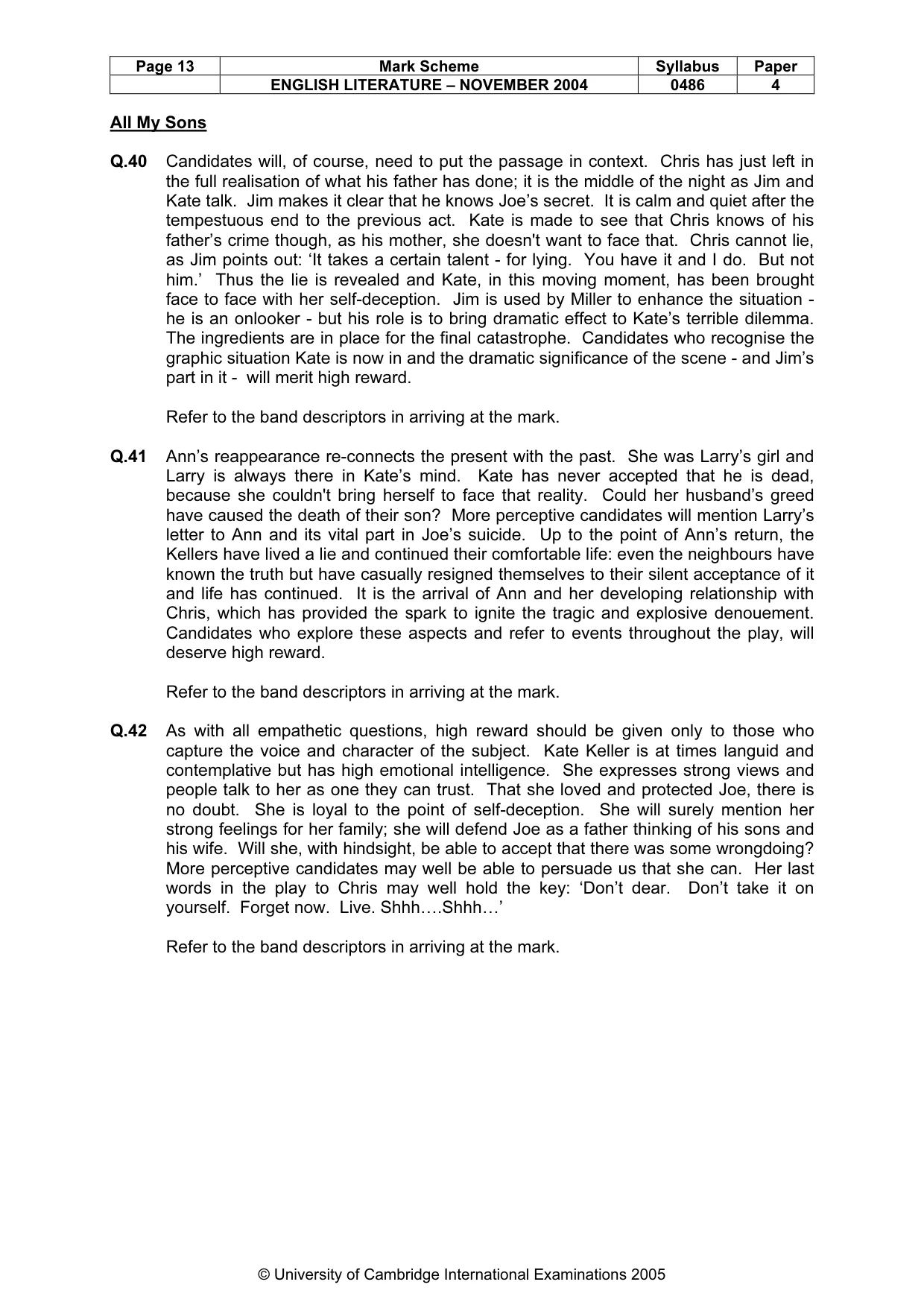
Mark scheme, page 1
UNIVERSITY OF CAMBRIDGE INTERNATIONAL EXAMINATIONS International General Certificate of Secondary Education MARK SCHEME for the November 2004 question paper 0486 LITERATURE (ENGLISH) 0486/04 Paper 4 (Closed Books), maximum mark 80 This mark scheme is published as an aid to teachers and students, to indicate the requirements of the examination. It shows the basis on which Examiners were initially instructed to award marks. They do not indicate the details of the discussions that took place at an Examiners’ meeting before marking began. Any substantial changes to the mark scheme that arose from these discussions will be recorded in the published Report on the Examination. All Examiners are instructed that alternative correct answers and unexpected approaches in candidates’ scripts must be given marks that fairly reflect the relevant knowledge and skills demonstrated. Mark schemes must be read in conjunction with the question papers and the Report on the Examination. • CIE will not enter into discussion or correspondence in connection with these mark schemes. CIE is publishing the mark schemes for the November 2004 question papers for most IGCSE and GCE Advanced Level syllabuses. www.XtremePapers.com
Mark scheme, page 2
Grade thresholds taken for Syllabus 0486 (Literature (English)) in the November 2004 examination. minimum mark required for grade: maximum mark available A C E F Component 4 80 63 43 30 16 The threshold (minimum mark) for B is set halfway between those for Grades A and C. The threshold (minimum mark) for D is set halfway between those for Grades C and E. The threshold (minimum mark) for G is set as many marks below the F threshold as the E threshold is above it. Grade A* does not exist at the level of an individual component. Note: Marking criteria for Component 2 (Coursework) are printed in the syllabus booklet.
Mark scheme, page 3
November 2004 INTERNATIONAL GCSE MARK SCHEME MAXIMUM MARK: 80 SYLLABUS/COMPONENT: 0486/04 LITERATURE (ENGLISH) Paper 4 (Closed Books)
Mark scheme, page 4
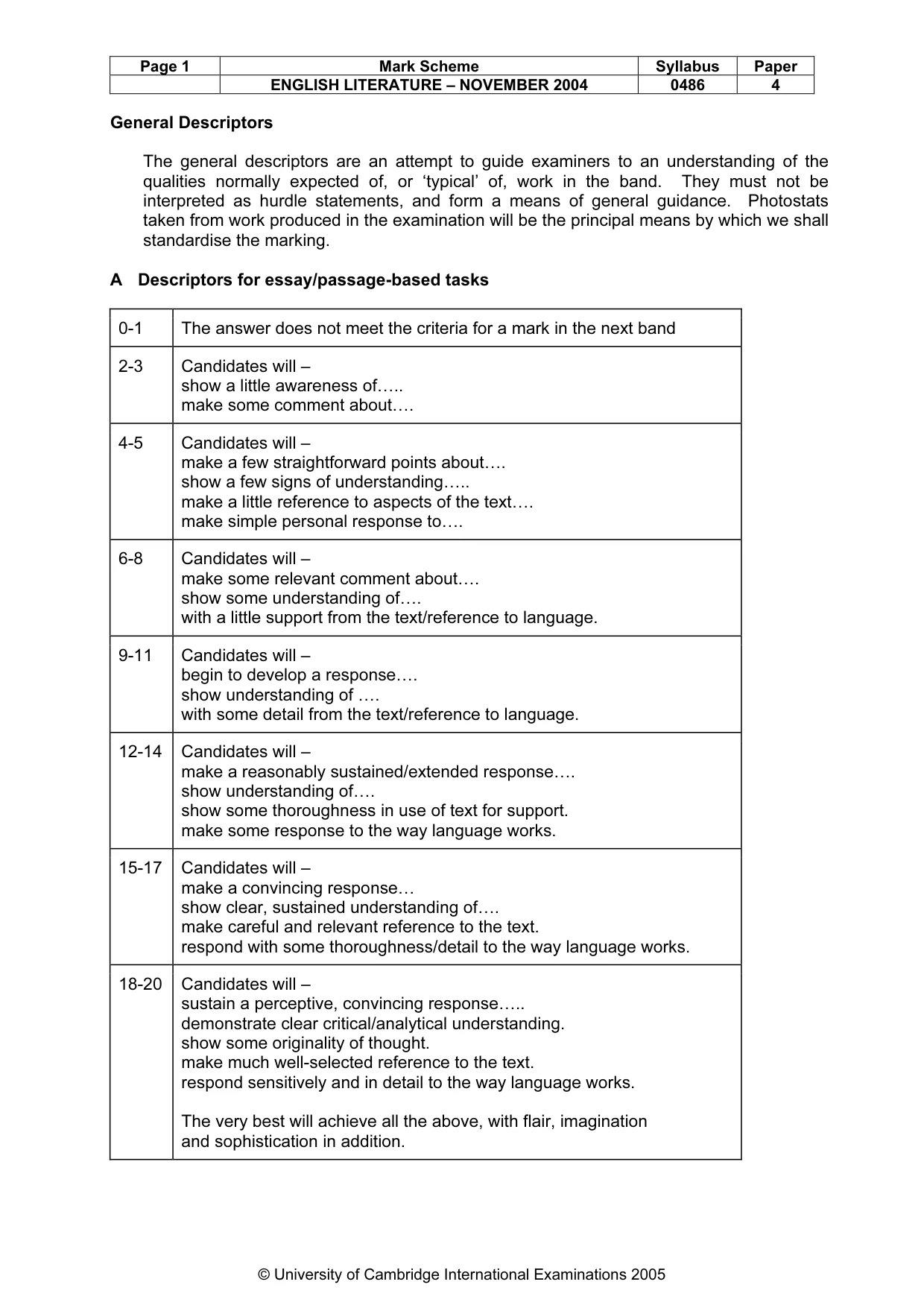
Page 1 Mark Scheme Syllabus Paper ENGLISH LITERATURE – NOVEMBER 2004 0486 4 © University of Cambridge International Examinations 2005 General Descriptors The general descriptors are an attempt to guide examiners to an understanding of the qualities normally expected of, or ‘typical’ of, work in the band. They must not be interpreted as hurdle statements, and form a means of general guidance. Photostats taken from work produced in the examination will be the principal means by which we shall standardise the marking. A Descriptors for essay/passage-based tasks 0-1 The answer does not meet the criteria for a mark in the next band 2-3 Candidates will – show a little awareness of….. make some comment about…. 4-5 Candidates will – make a few straightforward points about…. show a few signs of understanding….. make a little reference to aspects of the text…. make simple personal response to…. 6-8 Candidates will – make some relevant comment about…. show some understanding of…. with a little support from the text/reference to language. 9-11 Candidates will – begin to develop a response…. show understanding of …. with some detail from the text/reference to language. 12-14 Candidates will – make a reasonably sustained/extended response…. show understanding of…. show some thoroughness in use of text for support. make some response to the way language works. 15-17 Candidates will – make a convincing response… show clear, sustained understanding of…. make careful and relevant reference to the text. respond with some thoroughness/detail to the way language works. 18-20 Candidates will – sustain a perceptive, convincing response….. demonstrate clear critical/analytical understanding. show some originality of thought. make much well-selected reference to the text. respond sensitively and in detail to the way language works. The very best will achieve all the above, with flair, imagination and sophistication in addition.
Mark scheme, page 5
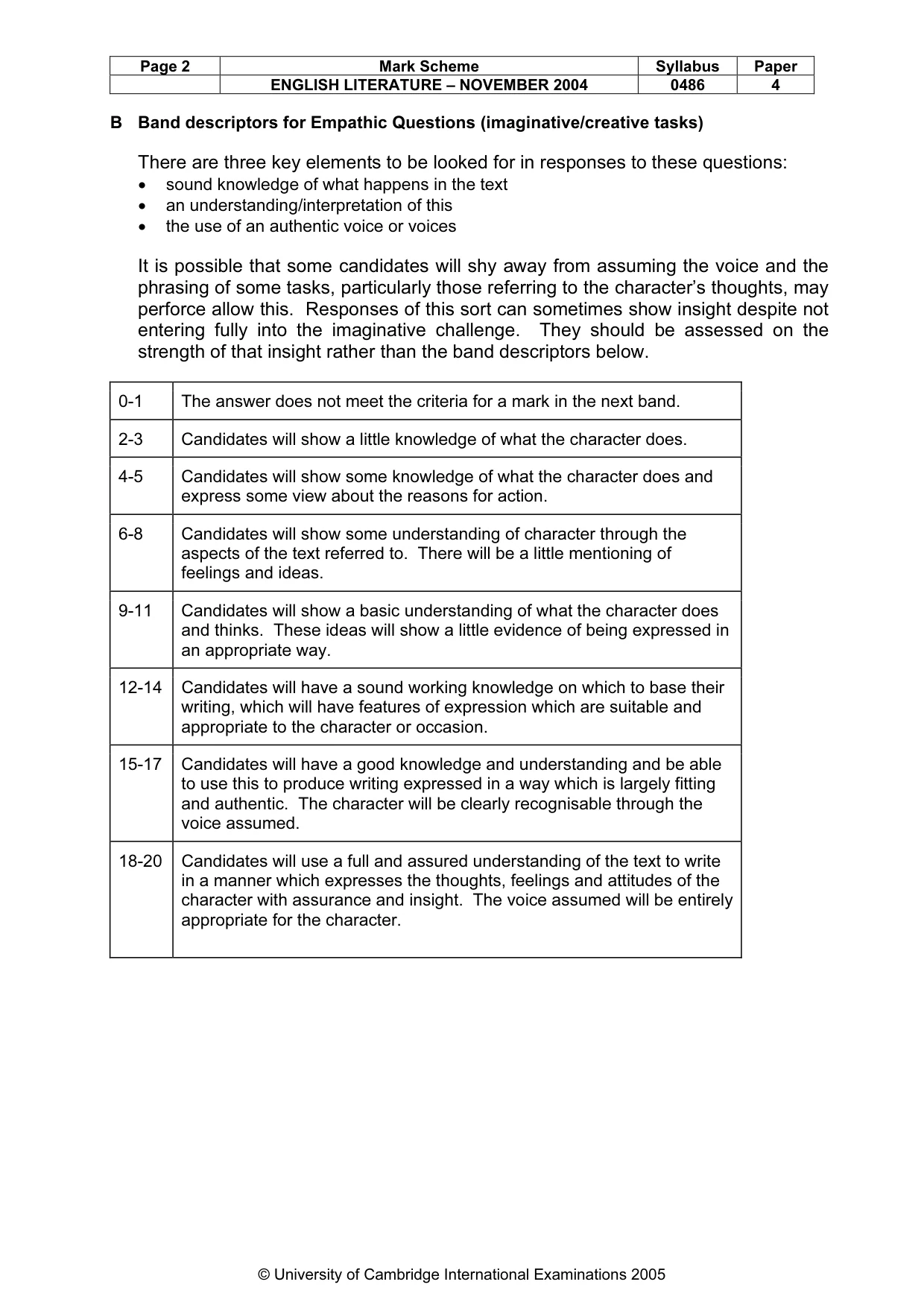
Page 2 Mark Scheme Syllabus Paper ENGLISH LITERATURE – NOVEMBER 2004 0486 4 © University of Cambridge International Examinations 2005 B Band descriptors for Empathic Questions (imaginative/creative tasks) There are three key elements to be looked for in responses to these questions: • sound knowledge of what happens in the text • an understanding/interpretation of this • the use of an authentic voice or voices It is possible that some candidates will shy away from assuming the voice and the phrasing of some tasks, particularly those referring to the character’s thoughts, may perforce allow this. Responses of this sort can sometimes show insight despite not entering fully into the imaginative challenge. They should be assessed on the strength of that insight rather than the band descriptors below. 0-1 The answer does not meet the criteria for a mark in the next band. 2-3 Candidates will show a little knowledge of what the character does. 4-5 Candidates will show some knowledge of what the character does and express some view about the reasons for action. 6-8 Candidates will show some understanding of character through the aspects of the text referred to. There will be a little mentioning of feelings and ideas. 9-11 Candidates will show a basic understanding of what the character does and thinks. These ideas will show a little evidence of being expressed in an appropriate way. 12-14 Candidates will have a sound working knowledge on which to base their writing, which will have features of expression which are suitable and appropriate to the character or occasion. 15-17 Candidates will have a good knowledge and understanding and be able to use this to produce writing expressed in a way which is largely fitting and authentic. The character will be clearly recognisable through the voice assumed. 18-20 Candidates will use a full and assured understanding of the text to write in a manner which expresses the thoughts, feelings and attitudes of the character with assurance and insight. The voice assumed will be entirely appropriate for the character.
Mark scheme, page 6
Page 3 Mark Scheme Syllabus Paper ENGLISH LITERATURE – NOVEMBER 2004 0486 4 © University of Cambridge International Examinations 2005 Marking Notes In this syllabus, we aim at encouraging candidates to make some personal response to their reading. This means that, while we may have legitimate expectations as to the ground most answers may occupy, we must at all times be prepared to meet the candidates on their chosen ground. It is to be hoped that candidates will see on occasion other possibilities. In this exam, rigid demands for what must be in a good answer must be guarded against. The photostat scripts circulated during coordination will be crucial to maintaining the standard throughout the marking. We must try at all times to tease out what the candidate is trying to say to us. It is possible for a candidate whose technical command of English is limited, but whose language still manages to communicate understanding, to receive high marks. Nor should we reward fluency and display of knowledge of literary terms if we feel there is little evidence of understanding. Remember that we are looking for literary response, not language skills. The notes that follow on each question are for general guidance only, and are not rigid prescriptions of required content. They need to be used in connection with the generic band descriptors.
Mark scheme, page 7
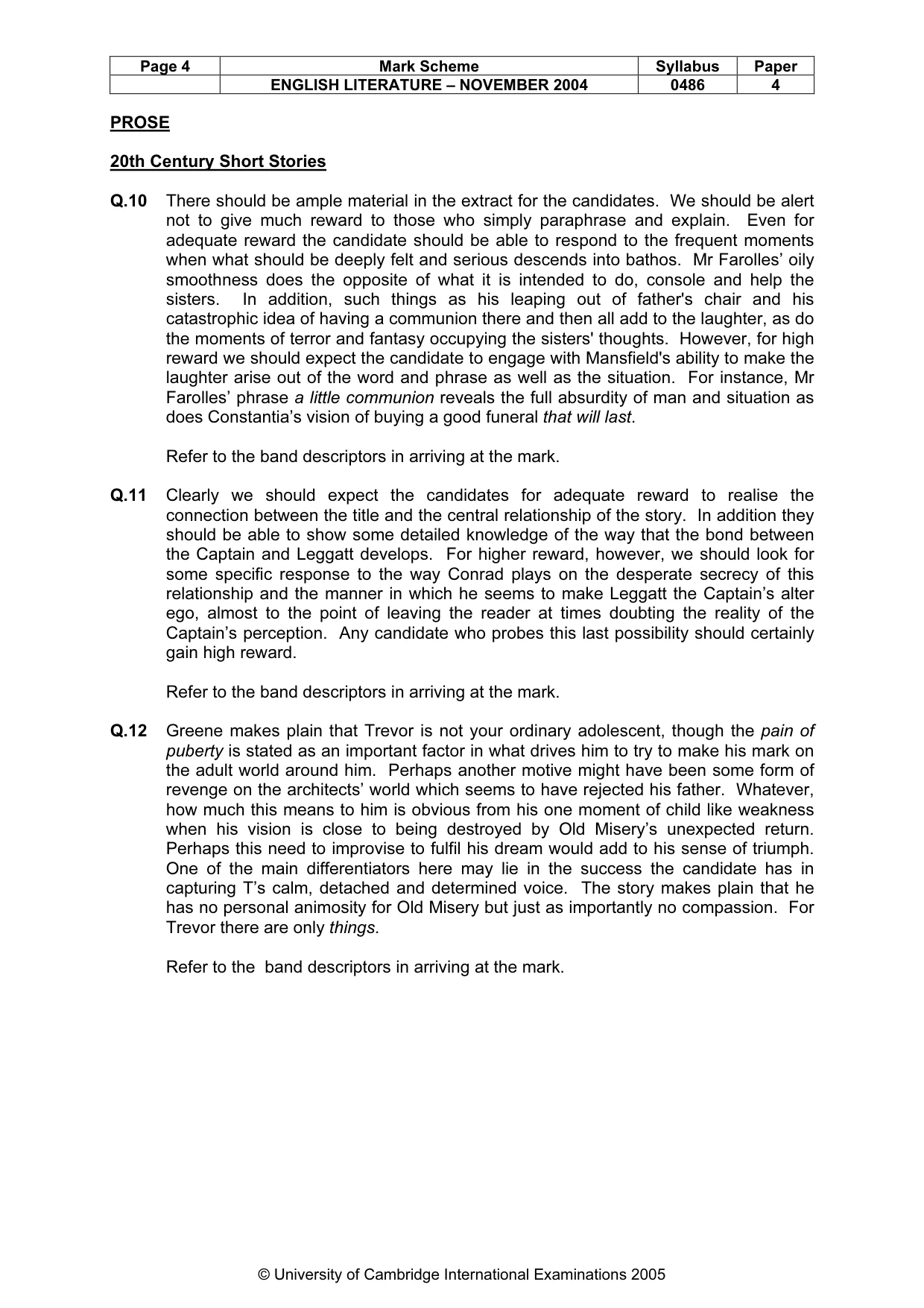
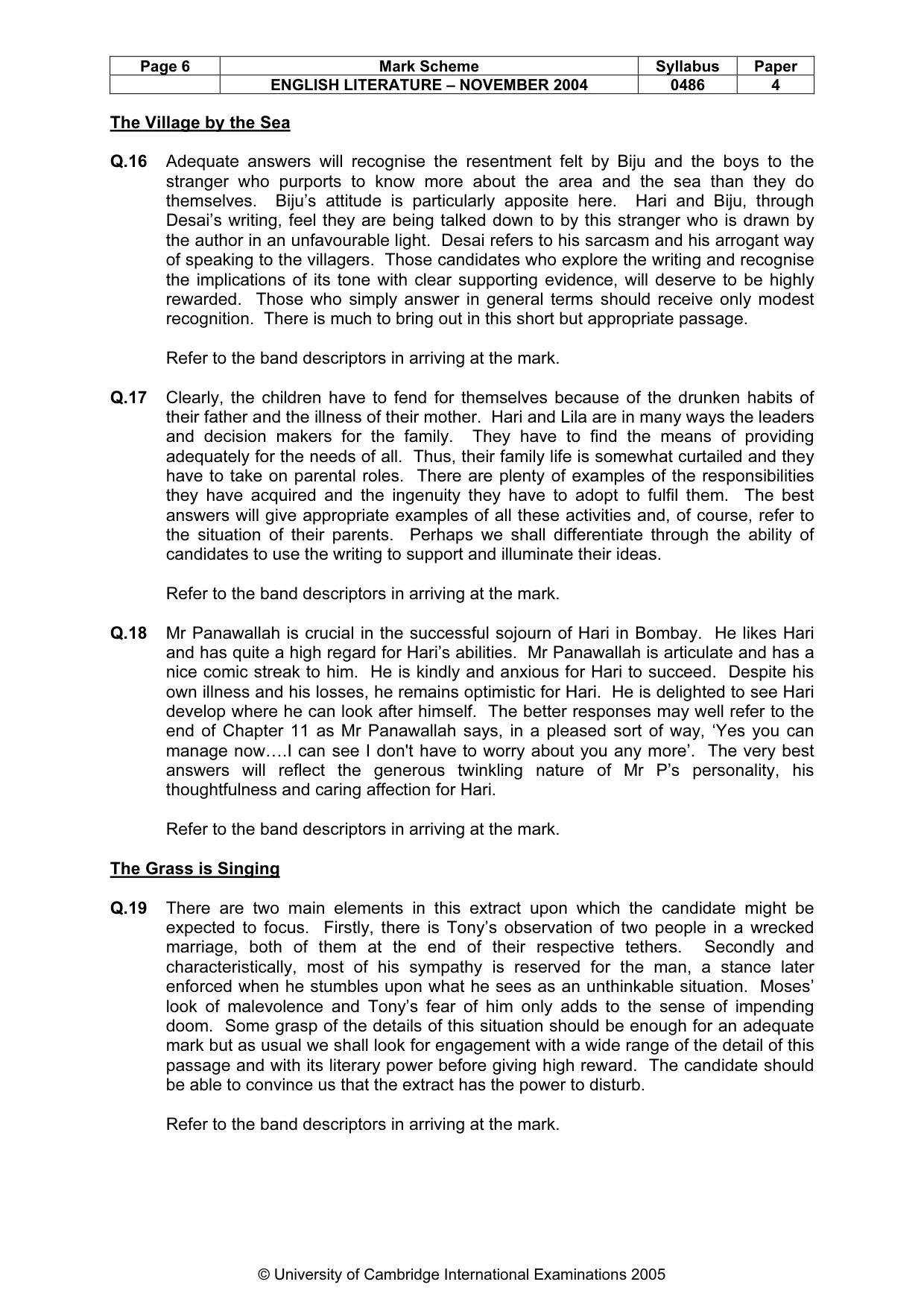
Page 4 Mark Scheme Syllabus Paper ENGLISH LITERATURE – NOVEMBER 2004 0486 4 © University of Cambridge International Examinations 2005 PROSE 20th Century Short Stories Q.10 There should be ample material in the extract for the candidates. We should be alert not to give much reward to those who simply paraphrase and explain. Even for adequate reward the candidate should be able to respond to the frequent moments when what should be deeply felt and serious descends into bathos. Mr Farolles’ oily smoothness does the opposite of what it is intended to do, console and help the sisters. In addition, such things as his leaping out of father's chair and his catastrophic idea of having a communion there and then all add to the laughter, as do the moments of terror and fantasy occupying the sisters' thoughts. However, for high reward we should expect the candidate to engage with Mansfield's ability to make the laughter arise out of the word and phrase as well as the situation. For instance, Mr Farolles’ phrase a little communion reveals the full absurdity of man and situation as does Constantia’s vision of buying a good funeral that will last. Refer to the band descriptors in arriving at the mark. Q.11 Clearly we should expect the candidates for adequate reward to realise the connection between the title and the central relationship of the story. In addition they should be able to show some detailed knowledge of the way that the bond between the Captain and Leggatt develops. For higher reward, however, we should look for some specific response to the way Conrad plays on the desperate secrecy of this relationship and the manner in which he seems to make Leggatt the Captain’s alter ego, almost to the point of leaving the reader at times doubting the reality of the Captain’s perception. Any candidate who probes this last possibility should certainly gain high reward. Refer to the band descriptors in arriving at the mark. Q.12 Greene makes plain that Trevor is not your ordinary adolescent, though the pain of puberty is stated as an important factor in what drives him to try to make his mark on the adult world around him. Perhaps another motive might have been some form of revenge on the architects’ world which seems to have rejected his father. Whatever, how much this means to him is obvious from his one moment of child like weakness when his vision is close to being destroyed by Old Misery’s unexpected return. Perhaps this need to improvise to fulfil his dream would add to his sense of triumph. One of the main differentiators here may lie in the success the candidate has in capturing T’s calm, detached and determined voice. The story makes plain that he has no personal animosity for Old Misery but just as importantly no compassion. For Trevor there are only things. Refer to the band descriptors in arriving at the mark.
Mark scheme, page 8
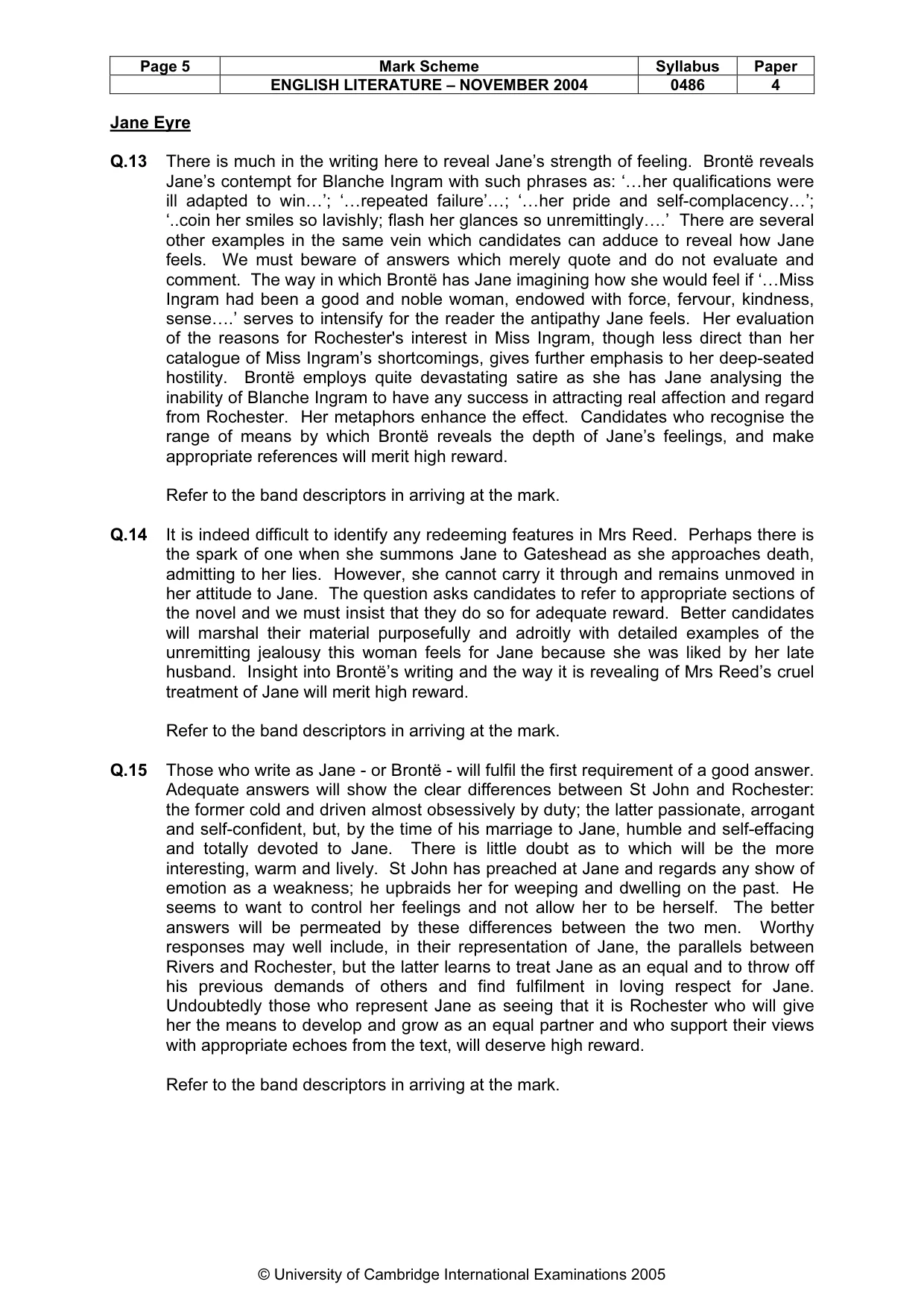
Page 5 Mark Scheme Syllabus Paper ENGLISH LITERATURE – NOVEMBER 2004 0486 4 © University of Cambridge International Examinations 2005 Jane Eyre Q.13 There is much in the writing here to reveal Jane’s strength of feeling. Brontë reveals Jane’s contempt for Blanche Ingram with such phrases as: ‘…her qualifications were ill adapted to win…’; ‘…repeated failure’…; ‘…her pride and self-complacency…’; ‘..coin her smiles so lavishly; flash her glances so unremittingly….’ There are several other examples in the same vein which candidates can adduce to reveal how Jane feels. We must beware of answers which merely quote and do not evaluate and comment. The way in which Brontë has Jane imagining how she would feel if ‘…Miss Ingram had been a good and noble woman, endowed with force, fervour, kindness, sense….’ serves to intensify for the reader the antipathy Jane feels. Her evaluation of the reasons for Rochester's interest in Miss Ingram, though less direct than her catalogue of Miss Ingram’s shortcomings, gives further emphasis to her deep-seated hostility. Brontë employs quite devastating satire as she has Jane analysing the inability of Blanche Ingram to have any success in attracting real affection and regard from Rochester. Her metaphors enhance the effect. Candidates who recognise the range of means by which Brontë reveals the depth of Jane’s feelings, and make appropriate references will merit high reward. Refer to the band descriptors in arriving at the mark. Q.14 It is indeed difficult to identify any redeeming features in Mrs Reed. Perhaps there is the spark of one when she summons Jane to Gateshead as she approaches death, admitting to her lies. However, she cannot carry it through and remains unmoved in her attitude to Jane. The question asks candidates to refer to appropriate sections of the novel and we must insist that they do so for adequate reward. Better candidates will marshal their material purposefully and adroitly with detailed examples of the unremitting jealousy this woman feels for Jane because she was liked by her late husband. Insight into Brontë’s writing and the way it is revealing of Mrs Reed’s cruel treatment of Jane will merit high reward. Refer to the band descriptors in arriving at the mark. Q.15 Those who write as Jane - or Brontë - will fulfil the first requirement of a good answer. Adequate answers will show the clear differences between St John and Rochester: the former cold and driven almost obsessively by duty; the latter passionate, arrogant and self-confident, but, by the time of his marriage to Jane, humble and self-effacing and totally devoted to Jane. There is little doubt as to which will be the more interesting, warm and lively. St John has preached at Jane and regards any show of emotion as a weakness; he upbraids her for weeping and dwelling on the past. He seems to want to control her feelings and not allow her to be herself. The better answers will be permeated by these differences between the two men. Worthy responses may well include, in their representation of Jane, the parallels between Rivers and Rochester, but the latter learns to treat Jane as an equal and to throw off his previous demands of others and find fulfilment in loving respect for Jane. Undoubtedly those who represent Jane as seeing that it is Rochester who will give her the means to develop and grow as an equal partner and who support their views with appropriate echoes from the text, will deserve high reward. Refer to the band descriptors in arriving at the mark.
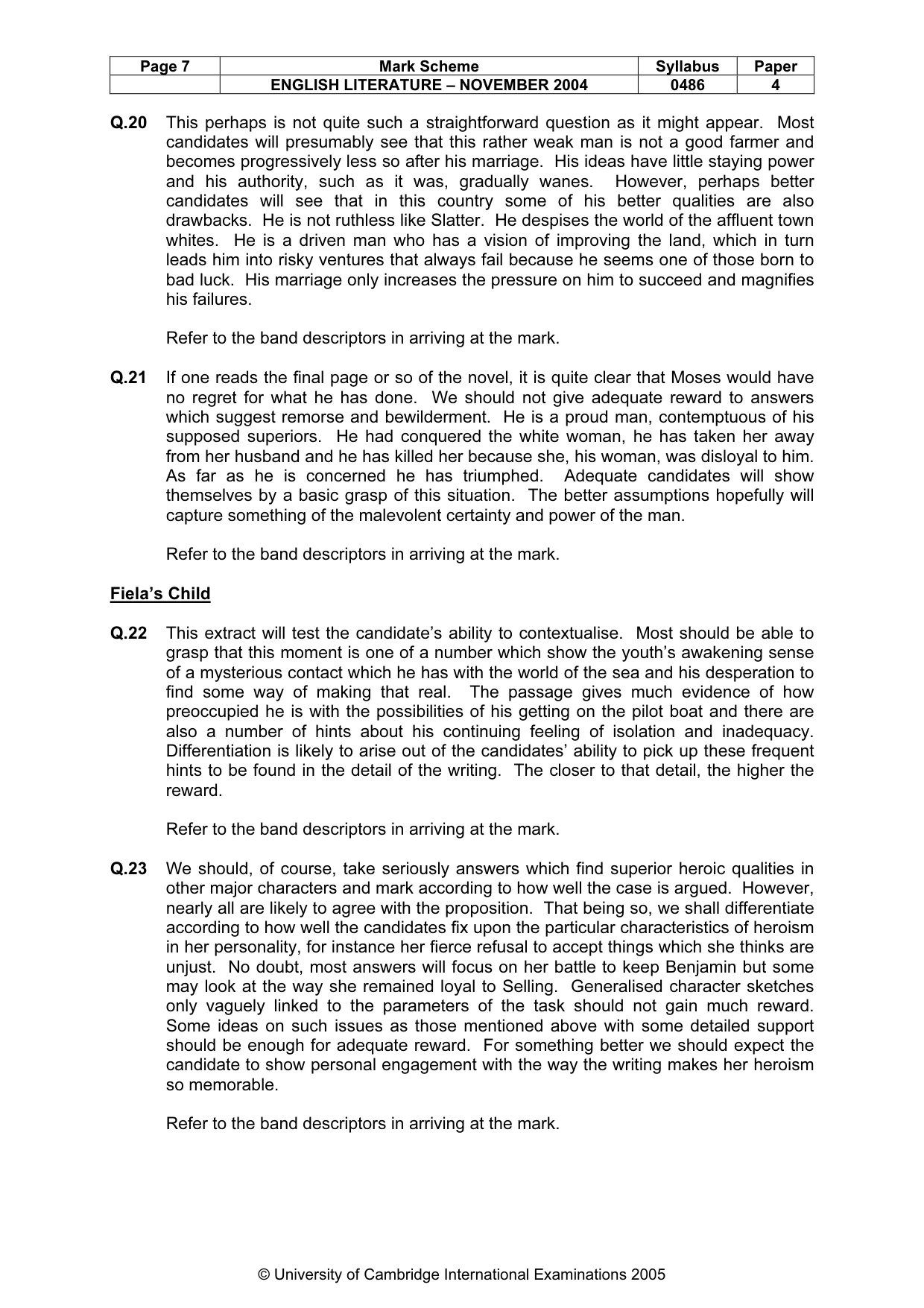
Mark scheme, page 9
Page 6 Mark Scheme Syllabus Paper ENGLISH LITERATURE – NOVEMBER 2004 0486 4 © University of Cambridge International Examinations 2005 The Village by the Sea Q.16 Adequate answers will recognise the resentment felt by Biju and the boys to the stranger who purports to know more about the area and the sea than they do themselves. Biju’s attitude is particularly apposite here. Hari and Biju, through Desai’s writing, feel they are being talked down to by this stranger who is drawn by the author in an unfavourable light. Desai refers to his sarcasm and his arrogant way of speaking to the villagers. Those candidates who explore the writing and recognise the implications of its tone with clear supporting evidence, will deserve to be highly rewarded. Those who simply answer in general terms should receive only modest recognition. There is much to bring out in this short but appropriate passage. Refer to the band descriptors in arriving at the mark. Q.17 Clearly, the children have to fend for themselves because of the drunken habits of their father and the illness of their mother. Hari and Lila are in many ways the leaders and decision makers for the family. They have to find the means of providing adequately for the needs of all. Thus, their family life is somewhat curtailed and they have to take on parental roles. There are plenty of examples of the responsibilities they have acquired and the ingenuity they have to adopt to fulfil them. The best answers will give appropriate examples of all these activities and, of course, refer to the situation of their parents. Perhaps we shall differentiate through the ability of candidates to use the writing to support and illuminate their ideas. Refer to the band descriptors in arriving at the mark. Q.18 Mr Panawallah is crucial in the successful sojourn of Hari in Bombay. He likes Hari and has quite a high regard for Hari’s abilities. Mr Panawallah is articulate and has a nice comic streak to him. He is kindly and anxious for Hari to succeed. Despite his own illness and his losses, he remains optimistic for Hari. He is delighted to see Hari develop where he can look after himself. The better responses may well refer to the end of Chapter 11 as Mr Panawallah says, in a pleased sort of way, ‘Yes you can manage now….I can see I don't have to worry about you any more’. The very best answers will reflect the generous twinkling nature of Mr P’s personality, his thoughtfulness and caring affection for Hari. Refer to the band descriptors in arriving at the mark. The Grass is Singing Q.19 There are two main elements in this extract upon which the candidate might be expected to focus. Firstly, there is Tony’s observation of two people in a wrecked marriage, both of them at the end of their respective tethers. Secondly and characteristically, most of his sympathy is reserved for the man, a stance later enforced when he stumbles upon what he sees as an unthinkable situation. Moses’ look of malevolence and Tony’s fear of him only adds to the sense of impending doom. Some grasp of the details of this situation should be enough for an adequate mark but as usual we shall look for engagement with a wide range of the detail of this passage and with its literary power before giving high reward. The candidate should be able to convince us that the extract has the power to disturb. Refer to the band descriptors in arriving at the mark.
Mark scheme, page 10
Page 7 Mark Scheme Syllabus Paper ENGLISH LITERATURE – NOVEMBER 2004 0486 4 © University of Cambridge International Examinations 2005 Q.20 This perhaps is not quite such a straightforward question as it might appear. Most candidates will presumably see that this rather weak man is not a good farmer and becomes progressively less so after his marriage. His ideas have little staying power and his authority, such as it was, gradually wanes. However, perhaps better candidates will see that in this country some of his better qualities are also drawbacks. He is not ruthless like Slatter. He despises the world of the affluent town whites. He is a driven man who has a vision of improving the land, which in turn leads him into risky ventures that always fail because he seems one of those born to bad luck. His marriage only increases the pressure on him to succeed and magnifies his failures. Refer to the band descriptors in arriving at the mark. Q.21 If one reads the final page or so of the novel, it is quite clear that Moses would have no regret for what he has done. We should not give adequate reward to answers which suggest remorse and bewilderment. He is a proud man, contemptuous of his supposed superiors. He had conquered the white woman, he has taken her away from her husband and he has killed her because she, his woman, was disloyal to him. As far as he is concerned he has triumphed. Adequate candidates will show themselves by a basic grasp of this situation. The better assumptions hopefully will capture something of the malevolent certainty and power of the man. Refer to the band descriptors in arriving at the mark. Fiela’s Child Q.22 This extract will test the candidate’s ability to contextualise. Most should be able to grasp that this moment is one of a number which show the youth’s awakening sense of a mysterious contact which he has with the world of the sea and his desperation to find some way of making that real. The passage gives much evidence of how preoccupied he is with the possibilities of his getting on the pilot boat and there are also a number of hints about his continuing feeling of isolation and inadequacy. Differentiation is likely to arise out of the candidates’ ability to pick up these frequent hints to be found in the detail of the writing. The closer to that detail, the higher the reward. Refer to the band descriptors in arriving at the mark. Q.23 We should, of course, take seriously answers which find superior heroic qualities in other major characters and mark according to how well the case is argued. However, nearly all are likely to agree with the proposition. That being so, we shall differentiate according to how well the candidates fix upon the particular characteristics of heroism in her personality, for instance her fierce refusal to accept things which she thinks are unjust. No doubt, most answers will focus on her battle to keep Benjamin but some may look at the way she remained loyal to Selling. Generalised character sketches only vaguely linked to the parameters of the task should not gain much reward. Some ideas on such issues as those mentioned above with some detailed support should be enough for adequate reward. For something better we should expect the candidate to show personal engagement with the way the writing makes her heroism so memorable. Refer to the band descriptors in arriving at the mark.
Mark scheme, page 11
Page 8 Mark Scheme Syllabus Paper ENGLISH LITERATURE – NOVEMBER 2004 0486 4 © University of Cambridge International Examinations 2005 Q.24 Of course, Barta knows at least in her heart of hearts that she is lying. It is possible perhaps to suggest that she is still in denial, and she desperately wants to continue to view Lukas as her son. However, soon after when he comes back again she forces herself to confess that he is not. We should, of course, allow the candidate a degree of leeway as to the exact stage she has reached in the monologue. We will expect, however, the adequate candidate to show detailed knowledge of what in context this moment represents in Barta’s life and reward more highly those who manage to communicate the terrible torment she is suffering as she finds it ever more difficult to hide the truth. Refer to the band descriptors in arriving at the mark. Animal Farm Q.25 There is a wealth of material which might be chosen to answer this question. What we shall look for in all answers which deserve adequate or better reward is some response to the ironic tone of the extract rather than simple explanation. There are many examples of irony in Orwell’s description of the animals’ stupidity, their inability to grasp the simplest of things, their willingness to accept the erosion of the revolution’s beliefs. In addition there is the disappearance of the puppies and the incident of the apples. No better example of Orwell’s ironic methods is to be found in the passage than the way at the end, almost as an afterthought, he slips in the fact that the pigs from then on take the whole apple crop. Hopefully, the better candidates will show themselves by their ability to pick up such details. Refer to the band descriptors in arriving at the mark. Q.26 We cannot give good reward to answers which simply churn out material simply lifted from study aids, which argue in this instance that Napoleon is hateful because he represents the tyrant Stalin and then simply describe what he does in Orwell’s fable. The question deliberately puts Orwell’s writing central to the task and demands a response to the power of the created figure. For adequate reward some evidence of both elements must be in the answer. The more extensively those features are found in the answer, the higher the mark. Refer to the band descriptors in arriving at the mark. Q.27 The key to this empathic task is an understanding of the precise moment at which question puts Boxer. Any answer which has him bemoaning his fate and Napoleon’s treachery will have spectacularly missed the point and should receive little reward. He may well be depressed that he can no longer aid the revolution as in the past, he may well be bewildered that things have not gone as well he had hoped and find some features of the revolution as it has become puzzling, but not for a moment does he disbelieve what Squealer has told him. In his conversations with Clover and Benjamin, he professes to be looking forward to his retirement. The nearer the candidate gets to transmitting his good nature, his pathetic innocence and naiveté, the higher the mark. Refer to the band descriptors in arriving at the mark.
Mark scheme, page 12
Page 9 Mark Scheme Syllabus Paper ENGLISH LITERATURE – NOVEMBER 2004 0486 4 © University of Cambridge International Examinations 2005 The Bonesetter’s Daughter Q.28 The development of Alzheimer’s in LuLing is one of the central threads of the novel and one which arouses deep sympathy in the reader, even though it does have its lighter moments. Candidates are not specifically required to refer outside the passage, but better answers will probably show how Ruth’s anxieties are growing following the earlier visit to the doctor and by the increasingly erratic behaviour of her mother. Here these anxieties become most acute because this is the first time that LuLing has actually gone missing, so this is a turning point. Ruth’s feelings are vividly conveyed and successful answers may well make reference to the ambivalence of the daughter/mother bond; Ruth’s panic is no doubt coloured by guilt to some extent. The matter-of-factness of the police officer calms her but it is clear after his departure that she is fully aware of the implications of the incident. Successful answers will go beyond a mere explanation of what is happening to a consideration of the ways in which the reader is persuaded to engage with Ruth’s feelings. Refer to the band descriptors in arriving at the mark. Q.29 Superstition and imagination feature in the novel from the very first chapter which describes Ruth’s obsession with numbers: ‘Each day was a five or a ten………Nine was usually something important, a significant number’ etc. This has been instilled in her by LuLing since babyhood and is just one aspect of their Chinese heritage. There are striking examples of the impact of superstitions, such as baby Uncle’s visit to the fortune-teller at the Mouth of the Mountain. Allow some latitude in the interpretation of the terms of the question and candidates will, of course, choose their own supporting detail. The most successful answers may make the point that, though, in theory, Ruth’s education should make her more rational than her mother, her upbringing has had an indelible effect. Both characters should be considered but we should not necessarily expect an equal amount of attention to be given to each. Refer to the band descriptors in arriving at the mark. Q.30 There is a good deal of ground to cover here and we should expect more than a narrative of the second section of the book. The focus is on Ruth’s feelings and these are likely to centre on the general points that the story reveals new dimensions to her mother’s background and character; apart from anything else it shows how courageous and resilient she has been. Her story also clears up the identity of Precious Auntie. There is useful material in the last chapter or two of the novel. Reading the story has clearly brought Ruth to a deeper understanding of her mother and a closer relationship with her: ‘It was not too late for them to forgive each other and themselves’. As always, the best answers will be characterised by a clear sense of engagement with the character conveyed through an appropriate voice and by relevant supporting detail. Refer to the band descriptors in arriving at the mark.
Mark scheme, page 13
Page 10 Mark Scheme Syllabus Paper ENGLISH LITERATURE – NOVEMBER 2004 0486 4 © University of Cambridge International Examinations 2005 Mosquito Coast Q.31 The sense of Charlie’s alienation and bewilderment comes through much of this passage. The ship is the sole fragile thread to the world which he understands. Other than that there are strange people, the tropical weather, and – what the better candidates will see – the hint of violence. Allie is no help in this, it is Mother who offers some reassurance and security, as she is going to so often at moments of stress for her children. As usual, with extract-based tasks, we shall reward according to how closely the candidate engages with the detail; the closer the probing of the writing, the higher the reward. Refer to the band descriptors in arriving at the mark. Q.32 The question attempts to head off candidates who would simply transpose events in the novel to a generalised manual on the subject of bringing up children. Even adequate answers should pay some attention to the perspectives which Theroux’s writing offers his readers. In addition, the task challenges the candidate to consider the less obvious conclusion, that the experience through which Allie puts his family, traumatic though it proves to be, might be seen in the novel to have moments of joy and enlightenment not found in a more conventional upbringing. We should not, of course, expect candidates to take up that line of argument. Most will probably, like the outsiders in the novel, and quite often those inside family, see Allie as next to a child abuser and there are many moments when he is truly awful as a father. We shall differentiate according to the force of argument and the range of detailed engagement with the writing. Refer to the band descriptors in arriving at the mark. Q.33 Good, kind, superstitious, knowledgeable in local matters, without whom Allie could hardly have got going, Mr Haddy sees most of the family’s odyssey. Allie takes much advantage of this man, not least destroying his boat, yet the man never bears him a grudge; indeed on several occasions, right up to the end of the novel in effect, he saves the family. He never understands Allie but is clearly in awe of him. It is characteristic if the man that he probably sees Allie as ultimately his saviour in that the watch gains him another boat and the means to make money. Some ability to communicate the decency of this man should receive adequate reward and perhaps some will even attempt to assume his utterly idiosyncratic voice, though we should not expect this before giving good reward. Refer to the band descriptors in arriving at the mark.
Mark scheme, page 14
Page 11 Mark Scheme Syllabus Paper ENGLISH LITERATURE – NOVEMBER 2004 0486 4 © University of Cambridge International Examinations 2005 DRAMA Absent Friends Q.34 We should expect candidates for adequate reward to engage specifically with the parameters of the task and not just wander through the scene. That said, we must not require a balance between the two possibilities offered. Some may find this predominantly distressing. Evelyn’s comment on Colin’s advice cuts to the core of his myopia, his inability to recognise that Diana is throughout at the end of her tether. Of course, it is all blackly humorous as well, starting from the way Diana’s action comes out of the blue and then everybody in an English middle class way tries to pretend that nothing untoward has happened. Some may pick out Marge’s actions here as richly comic. It may be that the best candidates will show themselves by being alert to the way laughter in Ayckbourn can be very bleak at times but we should not make that a requirement for high reward. Wide ranging detailed support for an argument on either side should be enough for that. Refer to the band descriptors in arriving at the mark. Q.35 The preamble is intended to stimulate the candidate to do more than write a character sketch, to engage with the awfulness of Colin. It might be reasonable to expect any answer which deserves adequate reward to see Ayckbourn’s main point, that grief and loss can make the failings of certain people more obvious and more dreadful. We should beware of giving much to those who are disposed to feel sorry for this man of monstrous ego who so enjoys being the object of attention and who has at last found the event which gives him centre stage. Or so he thinks! In fact, nearly everyone around him at this tea party is preoccupied with their own problems almost to the exclusion of his. The fact he does not notice, the fact that he thinks himself uniquely qualified to offer advice to all and sundry is very much in character. The really good answer must be able to deliver the essence of this with wide ranging support. Refer to the band descriptors in arriving at the mark. Q.36 Given the above, there should be ample opportunity for the imaginative candidate to create a memorable assumption. The key point before we give even adequate reward is that the candidate must realise that not a suspicion will cross Colin's mind of it having been other than an extremely successful afternoon. He may worry about what he has found, for instance in regard to Paul and Diana's marriage, but he will be quite clear in his mind that all have been immensely fortunate to have had the opportunity to be at the receiving end of his healing powers. The nearer the candidate gets to his appalling smugness, the higher the mark. Refer to the band descriptors in arriving at the mark.
Mark scheme, page 15
Page 12 Mark Scheme Syllabus Paper ENGLISH LITERATURE – NOVEMBER 2004 0486 4 © University of Cambridge International Examinations 2005 ‘Master Harold’ … and the Boys Q.37 Here we have a pivotal and potentially catastrophic section in the play - as Hally asserts his whiteness as a symbol of his superiority and the bonhomie and jocular repartee is shown to be wafer-thin. The wording of Fugard’s title is shown to be seminal in the play’s structure as Hally insists on his title and the ‘boys’ have to learn their place and keep in it. Yet it is Sam who is dignified, controlled and the more civilised. There are numerous pertinent examples of Hally’s arrogance in the text:…’do what you get paid for…’ ‘He's a white man and that's good enough for you.’ ‘Don’t turn your back on me.’ ‘ …start calling me Master Harold.’ Thus the seething underlying racist attitude of the white boy threatens to explode and destroy the relationship that has developed amongst these three. Candidates who see these tensions and the way the writing underlines the fragility of the atmosphere, will deserve high reward. Refer to the band descriptors in arriving at the mark. Q.38 Hally’s parents are central to the play despite their non-appearance. Hally’s hypocrisy and equivocal attitude to Sam and Willie are clearly revealed in his reaction to his parents. This is especially so with regard to his father. He claims to love his father and yet is horrified at the prospect of his returning home from the hospital. He shifts his ground throughout the telephone conversations he conducts with his parents, saying one thing to them and thinking another or expressing something quite different to ‘the boys’. Fugard makes these telephone calls central to the development of Hally and to the relationship he has with ‘the boys’ including, particularly, the question of race. Those candidates who recognise the dramatic significance of the parents and give appropriate instances will receive creditable reward. Those who have the perspicacity to see the way in which they reveal so much more of Hally and their contribution to the essential theme of the play should gain even higher reward. Refer to the band descriptors in arriving at the mark. Q.39 Fugard has drawn clear distinctions between the two ‘boys’. Sam is clearly the more subtle, intelligent and sensitive. Willie has a dry sense of humour and loves his dancing; he has less perspicacity than Sam; he is less articulate and less insightful in his thoughts. He has always used the term ‘Master Harold’, unlike Sam. For high reward, it is important that candidates reflect Willie’s character and attitudes in their responses. At the end of the play, Willie wants to put the differences between the ‘boys’ and Hally out of his mind: ‘…is going to be okay tomorrow.’ His final words are ‘Let's dream’. Those candidates who see these traits in Willie and bring them out in their writing will merit high reward. Refer to the band descriptors in arriving at the mark.
Mark scheme, page 16
Page 13 Mark Scheme Syllabus Paper ENGLISH LITERATURE – NOVEMBER 2004 0486 4 © University of Cambridge International Examinations 2005 All My Sons Q.40 Candidates will, of course, need to put the passage in context. Chris has just left in the full realisation of what his father has done; it is the middle of the night as Jim and Kate talk. Jim makes it clear that he knows Joe’s secret. It is calm and quiet after the tempestuous end to the previous act. Kate is made to see that Chris knows of his father’s crime though, as his mother, she doesn't want to face that. Chris cannot lie, as Jim points out: ‘It takes a certain talent - for lying. You have it and I do. But not him.’ Thus the lie is revealed and Kate, in this moving moment, has been brought face to face with her self-deception. Jim is used by Miller to enhance the situation - he is an onlooker - but his role is to bring dramatic effect to Kate’s terrible dilemma. The ingredients are in place for the final catastrophe. Candidates who recognise the graphic situation Kate is now in and the dramatic significance of the scene - and Jim’s part in it - will merit high reward. Refer to the band descriptors in arriving at the mark. Q.41 Ann’s reappearance re-connects the present with the past. She was Larry’s girl and Larry is always there in Kate’s mind. Kate has never accepted that he is dead, because she couldn't bring herself to face that reality. Could her husband’s greed have caused the death of their son? More perceptive candidates will mention Larry’s letter to Ann and its vital part in Joe’s suicide. Up to the point of Ann’s return, the Kellers have lived a lie and continued their comfortable life: even the neighbours have known the truth but have casually resigned themselves to their silent acceptance of it and life has continued. It is the arrival of Ann and her developing relationship with Chris, which has provided the spark to ignite the tragic and explosive denouement. Candidates who explore these aspects and refer to events throughout the play, will deserve high reward. Refer to the band descriptors in arriving at the mark. Q.42 As with all empathetic questions, high reward should be given only to those who capture the voice and character of the subject. Kate Keller is at times languid and contemplative but has high emotional intelligence. She expresses strong views and people talk to her as one they can trust. That she loved and protected Joe, there is no doubt. She is loyal to the point of self-deception. She will surely mention her strong feelings for her family; she will defend Joe as a father thinking of his sons and his wife. Will she, with hindsight, be able to accept that there was some wrongdoing? More perceptive candidates may well be able to persuade us that she can. Her last words in the play to Chris may well hold the key: ‘Don’t dear. Don’t take it on yourself. Forget now. Live. Shhh….Shhh…’ Refer to the band descriptors in arriving at the mark.
Mark scheme, page 17
Page 14 Mark Scheme Syllabus Paper ENGLISH LITERATURE – NOVEMBER 2004 0486 4 © University of Cambridge International Examinations 2005 Romeo and Juliet Q.43 Most candidates should be able to isolate elements that point in opposite directions as the scene develops. The beauty of Romeo’s first sight of Juliet is then rudely interrupted by the danger posed by Tybalt. However, Capulet suggests that without the feud Romeo would be very much persona grata at his feast; his anger is reserved very much for his nephew. Of course, in the long term, Tybalt’s ominous final words make it quite clear that he might as well have saved his breath. For adequate reward, we should expect candidates to be able to chart this dramatic progress. Higher reward should go to those who show themselves responsive to the way Shakespeare creates dramatic suspense. Refer to the band descriptors in arriving at the mark. Q.44 The material for this may, of course, range over a number of characters and we must not expect a particular balance. It should be possible to expect the adequate candidate to make some judicious choices from the basic pool of ‘oldies’ – Friar Lawrence, the Nurse, the Capulets – and to make some sensible comments. Arguably we should expect, even at this level, some recognition that the play makes the failings of this group fairly evident but also that as always with Shakespeare there is never a simple answer. The more the candidates show themselves aware of the other side of a particular coin, the wider the range of the material, the higher the reward should be. Refer to the band descriptors in arriving at the mark. Q.45 This should be a fairly straightforward task in some ways. We shall, no doubt, receive many assumptions which deserve adequate reward for managing to communicate the romantic girl bowled over by intense first love. It is very possible that some will show themselves even able to copy quite convincingly her poetic voice, though we should not, of course, expect this before giving high reward. Perhaps, what we should look for at this level is some sense of her fright at the storm that has hit her, together with some quite mature understanding of the dangers consequent upon it. Her powers of insight are, at this stage, noticeably better developed that Romeo’s. Refer to the band descriptors in arriving at the mark. Twelfth Night Q.46 Well might Sebastian wonder whether all the people around him are mad. First he is pestered by a clown who he knows not, then he is set upon and finally he is importuned by an unknown beautiful woman. Any adequate answer should be able to point to this progress with some detailed support. However, higher reward should be reserved for those who are responsive to the words mounting and amusingly. They will be able to engage with the comic drama unleashed by the way these things happen in quick and breathless succession. Refer to the band descriptors in arriving at the mark.
Mark scheme, page 18
Page 15 Mark Scheme Syllabus Paper ENGLISH LITERATURE – NOVEMBER 2004 0486 4 © University of Cambridge International Examinations 2005 Q.47 The key word here is fascinating. We should be on our guard not to give good, or perhaps even moderate, reward to candidates who do no more than trot out a character sketch of Viola without engaging with the qualities which make her such an attractive figure. We should not expect our own particular favourite characteristics to figure but, for adequate reward, we should expect candidates to make a case for their choices from the play. The closer the candidate is involved with the way Shakespeare’s writing creates this charismatic figure, the higher the reward. Refer to the band descriptors in arriving at the mark. Q.48 It is clear that Sir Toby is in trouble and we should expect any adequate answer to communicate this. He will recognise that he may have outstayed his welcome and that he will have to eat some degree of humble pie. However, he is a man who is rarely down for long. Will he sense that there might be some hope in that his niece has come out of mourning and is in love, that she does recognise that Malvolio was full of self love and that Sir Toby’s brand of merriment might be in tune with the new spirit abroad? There is also the matter of Sir Toby’s attachment to Maria. Should we hope that the really good assumptions will allow the flashes of this Sir Toby to light up the gloom? Certainly something of his vigour should feature at this level. Refer to the band descriptors in arriving at the mark. An Ideal Husband Q.49 There is plenty of scope for a variety of responses here in this clash between the uncompromising principles of Lady Chiltern and the shifting sands of Sir Robert’s world. Some may view the former as in essence still the judgmental and puritanical schoolgirl she was when she knew Cheveley, making her love for her husband conditional on her ideal notion of him. Others may, on the other hand, contrast her morality with that of Sir Robert’s which shows evidence of being pushed aside in the interests of expediency. Wilde clearly does not expect his audience to be much convinced by Sir Robert’s arguments, not least because he seems so distinctly uneasy at times. Showing awareness of some of these issues should be enough for an adequate mark but for something higher we should expect more of a detailed weighing of the words of two protagonists. Refer to the band descriptors in arriving at the mark. Q.50 There are a quite number of possible viewpoints here; there always are in Wilde. The one obvious point that even adequate candidates might be expected to grasp is that Wilde’s ideal women have to be witty and beautiful! After that, it gets interesting. What are we to make of Lady Chiltern? She is certainly beautiful and certainly too serious to be deemed at all witty. Should we expect even adequate answers to recognise that her limits of personality, her intransigent seriousness and morality, make her anything but the ideal? Indeed at times Wilde almost seems to suggest that Mrs Cheveley is at least capable of greater honesty about herself, even if it leads to despicable actions. Perhaps Lord Goring once again shows his faultless taste by deciding to marry Mabel at long last! Consider all these possibilities but, recognising that candidates find this play rather difficult to fathom, be charitable. Certainly any answer which explores the issues raised above, even if the conclusions may be occasionally questionable, should be considered for high reward. Refer to the band descriptors in arriving at the mark.
Mark scheme, page 19
Page 16 Mark Scheme Syllabus Paper ENGLISH LITERATURE – NOVEMBER 2004 0486 4 © University of Cambridge International Examinations 2005 Q.51 Lord Goring would have much with which to be satisfied at the end of the play. He has got himself an admirable wife: witty, fun to be with but also sensible and good. He has shown himself to be thoroughly good under the superficial flippancy; he has saved a marriage and a political career and seen off a villainess. However – and here is perhaps the crucial point for differentiating between the average and the good – he would be self deprecating and humorous about it all. Any sense of self congratulation would be quite out of character. Refer to the band descriptors in arriving at the mark.