Questions as text
Q1 · Many low-income countries rely on exports of raw materials such as coffee or iron ore to… 0987/11 May/June 2020
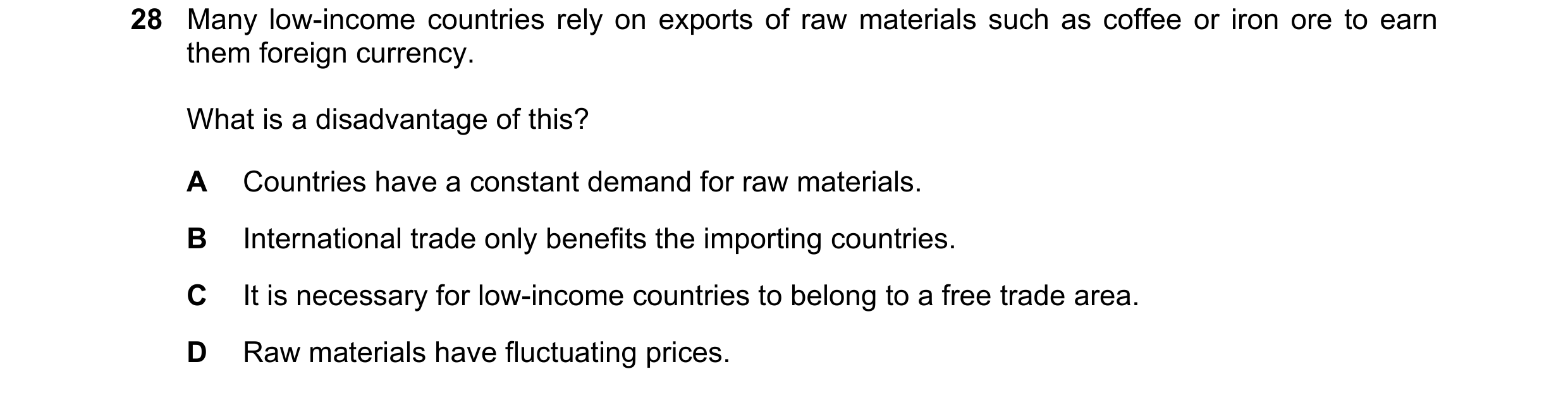
28 Many low-income countries rely on exports of raw materials such as coffee or iron ore to earn them foreign currency. What is a disadvantage of this? A Countries have a constant demand for raw materials. B International trade only benefits the importing countries. C It is necessary for low-income countries to belong to a free trade area. D Raw materials have fluctuating prices.
1 marks
Answer: D
This question in 0987/11 May/June 2020
Q2 · Saudi Arabia specialises in oil extraction and refining 0987/12 May/June 2020
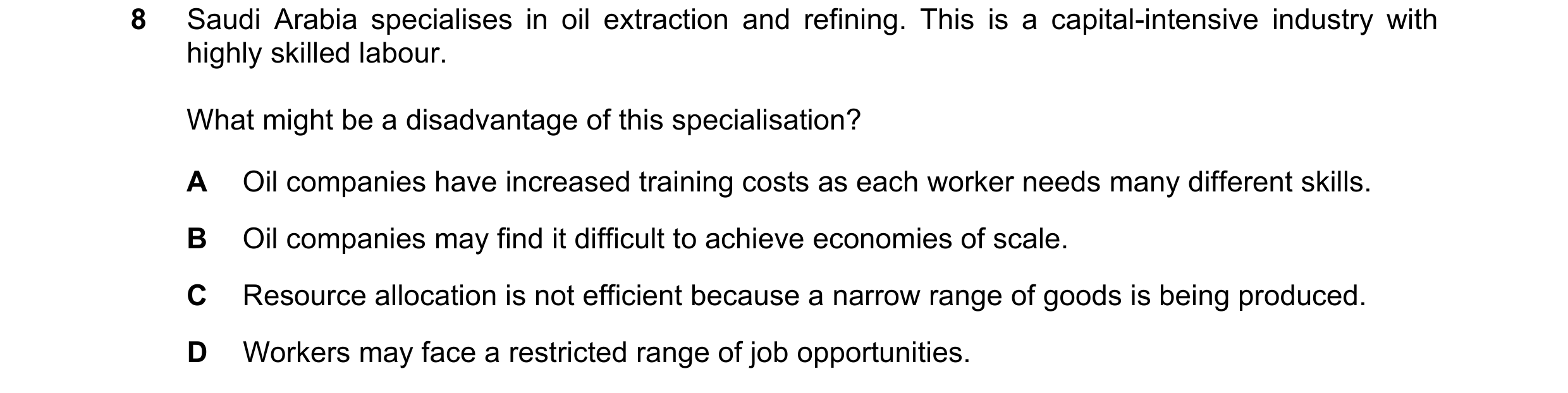
8 Saudi Arabia specialises in oil extraction and refining. This is a capital-intensive industry with highly skilled labour. What might be a disadvantage of this specialisation? A Oil companies have increased training costs as each worker needs many different skills. B Oil companies may find it difficult to achieve economies of scale. C Resource allocation is not efficient because a narrow range of goods is being produced. D Workers may face a restricted range of job opportunities.
1 marks
Answer: D
This question in 0987/12 May/June 2020
Q3 · What is a disadvantage of increased specialisation by a country? 0987/12 May/June 2020
29 What is a disadvantage of increased specialisation by a country? A It becomes more reliant on imports to meet all its needs. B It reduces the potential for international trade. C It results in access to a greater variety of goods for consumers. D It results in lower costs for home produced goods.
1 marks
Answer: A
This question in 0987/12 May/June 2020
Q4 · What is a disadvantage of increasing international specialisation? 0987/11 May/June 2021
27 What is a disadvantage of increasing international specialisation? A Consumers pay higher prices for goods and services reducing their welfare. B Domestic firms may be uncompetitive leading to structural unemployment. C Domestic firms may experience rising costs as they pay more for imports. D Resources may be used less efficiently as domestic firms face less competition.
1 marks
Answer: B
This question in 0987/11 May/June 2021
Q5 · What would be a disadvantage of specialisation for a worker? 0987/12 May/June 2021
10 What would be a disadvantage of specialisation for a worker? A a low price of the product that they make B boredom due to repetition of the same task C higher quality of the good D the opportunity to undertake training
1 marks
Answer: B
This question in 0987/12 May/June 2021
Q6 · Which result of increased specialisation in a firm is an advantage for the firm, but a… 0987/12 Oct/Nov 2021
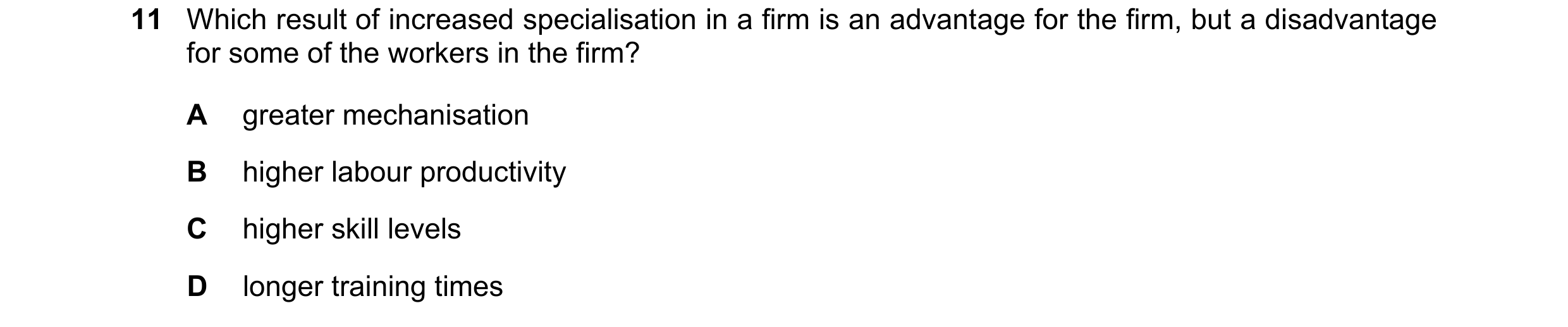
11 Which result of increased specialisation in a firm is an advantage for the firm, but a disadvantage for some of the workers in the firm? A greater mechanisation B higher labour productivity C higher skill levels D longer training times
1 marks
Answer: A
This question in 0987/12 Oct/Nov 2021
Q7 · A country specialises in the production of steel, toys and textiles 0987/12 Oct/Nov 2021
27 A country specialises in the production of steel, toys and textiles. What is a disadvantage of specialisation for the country’s workers? A They cannot afford to buy products from other countries. B They could become structurally unemployed if global demand changes. C They have to learn a variety of skills. D They have too much choice which wastes their time.
1 marks
Answer: B
This question in 0987/12 Oct/Nov 2021
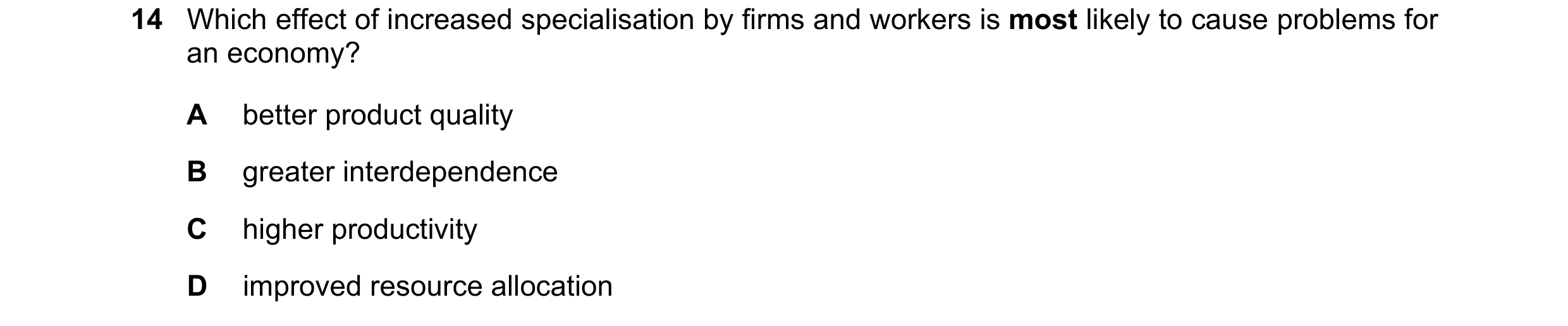
Q8 · Which effect of increased specialisation by firms and workers is most likely to cause… 0987/12 Oct/Nov 2022
14 Which effect of increased specialisation by firms and workers is most likely to cause problems for an economy? A better product quality B greater interdependence C higher productivity D improved resource allocation
1 marks
Answer: B
This question in 0987/12 Oct/Nov 2022
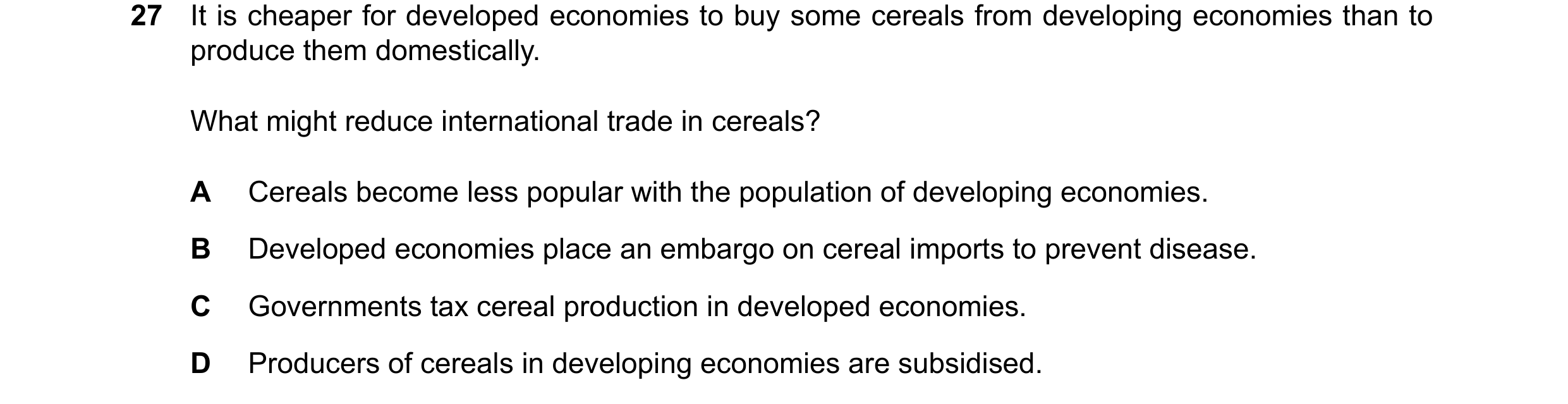
Q9 · It is cheaper for developed economies to buy some cereals from developing economies than… 0987/11 May/June 2023
27 It is cheaper for developed economies to buy some cereals from developing economies than to produce them domestically. What might reduce international trade in cereals? A Cereals become less popular with the population of developing economies. B Developed economies place an embargo on cereal imports to prevent disease. C Governments tax cereal production in developed economies. D Producers of cereals in developing economies are subsidised.
1 marks
Answer: B
This question in 0987/11 May/June 2023
Q10 · What might encourage international specialisation between countries? 0987/12 Oct/Nov 2024
27 What might encourage international specialisation between countries? A free trade B inefficiencies in production C labour immobility D tariffs
1 marks
Answer: A
This question in 0987/12 Oct/Nov 2024
Q11 · What will increase the level of specialisation in an economy? 0987/11 May/June 2025
27 What will increase the level of specialisation in an economy? A A computer manufacturer takes over an advertising company. B A retail store issues its own credit card. C A travel agent provides transport to the airport. D A vehicle assembler reduces its range of vehicles.
1 marks
Answer: D
This question in 0987/11 May/June 2025
Q12 · What is an advantage of international specialisation? 0987/12 Oct/Nov 2025
27 What is an advantage of international specialisation? A Choice is limited. B Countries become over-dependent on each other. C Resources are used more efficiently. D Transport costs are decreased.
1 marks
Answer: C
This question in 0987/12 Oct/Nov 2025



 1 / 2
1 / 2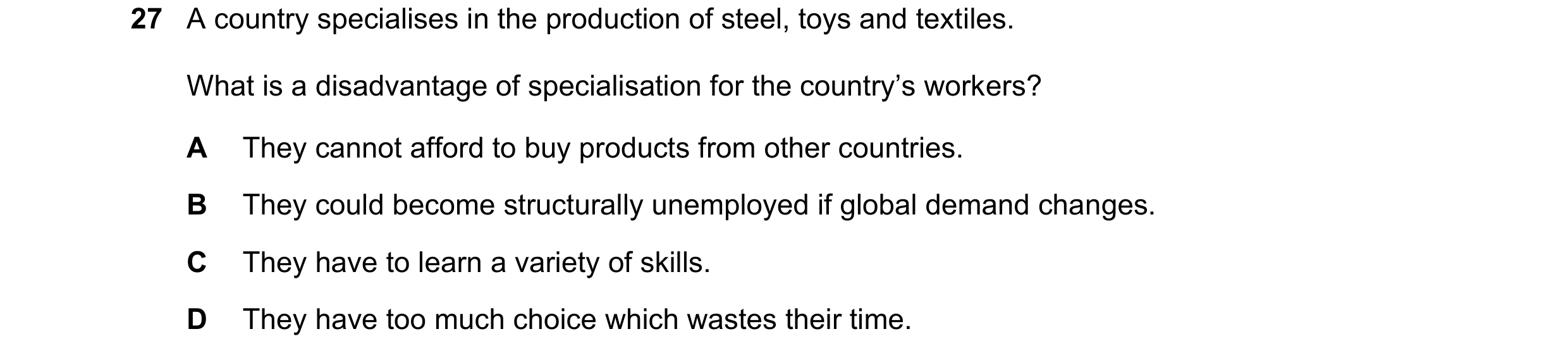


 2 / 2
2 / 2