Questions as text
Q1 · The wage of labour in a firm increases 0987/11 May/June 2020
8 The wage of labour in a firm increases. What is the most likely effect on the production process? A Capital replaces labour immediately. B Capital replaces labour in the long run. C Labour replaces capital immediately. D Labour replaces capital in the long run.
1 marks
Answer: B
This question in 0987/11 May/June 2020
Q2 · Which statement proves there has been an increase in productivity for a factory making… 0987/12 May/June 2020
14 Which statement proves there has been an increase in productivity for a factory making tractors? A 10% more workers results in a 10% increase in tractors produced each week. B Output per worker increases from 3 tractors to 4 tractors per month. C Production increases as more workers are hired. D Starting a night shift leads to an increase in production of 10 tractors a day.
1 marks
Answer: B
This question in 0987/12 May/June 2020
Q3 · When do economies of scale take place? 0987/12 May/June 2020
15 When do economies of scale take place? A in the short run B if variable factors become fixed C when all factors of production are fixed D when all factors of production are variable
1 marks
Answer: D
This question in 0987/12 May/June 2020
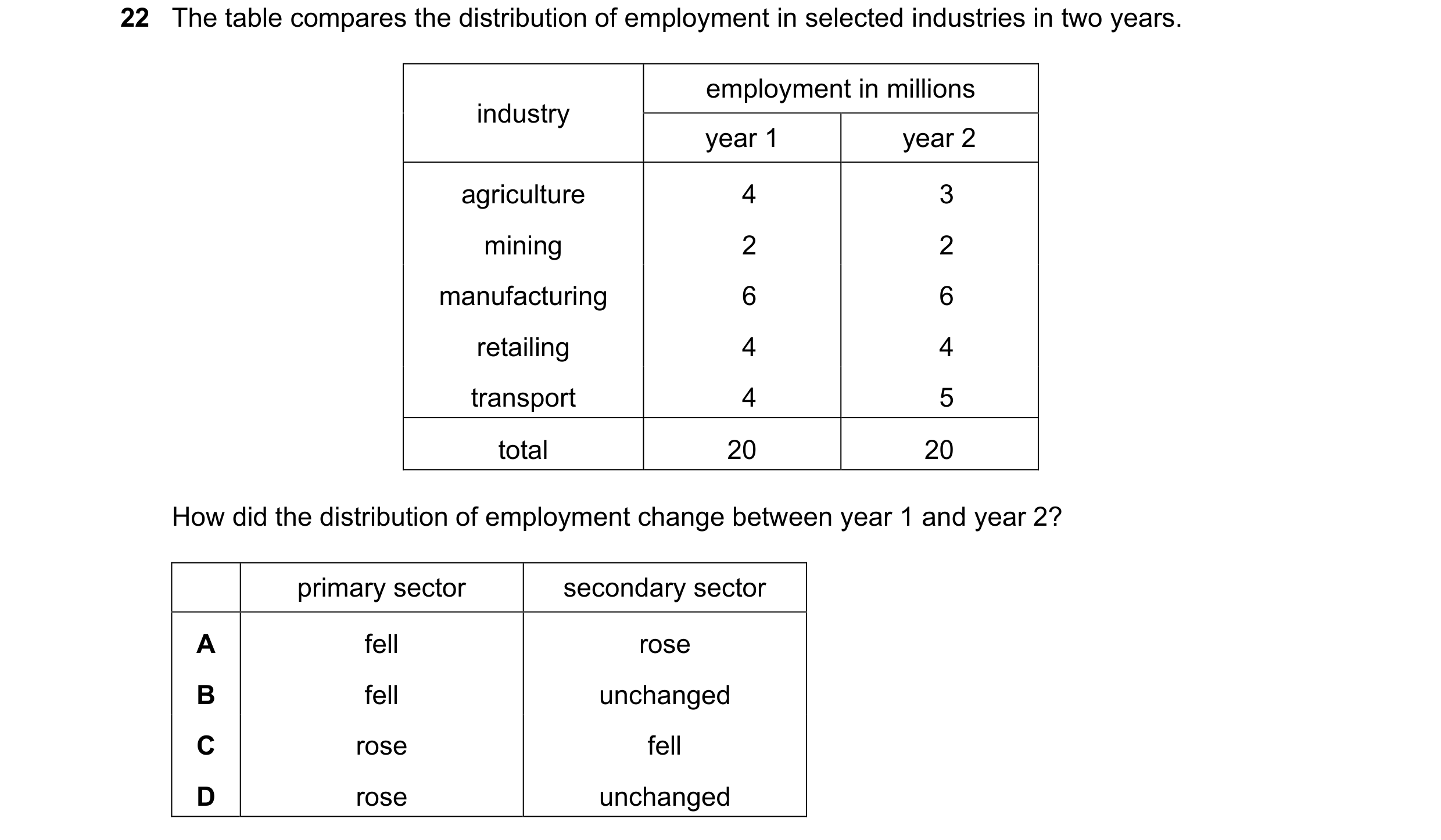
Q4 · The table compares the distribution of employment in selected industries in two years 0987/11 May/June 2021
22 The table compares the distribution of employment in selected industries in two years. employment in millions industry year 1 year 2 agriculture 4 3 mining 2 2 manufacturing 6 6 retailing 4 4 transport 4 5 total 20 20 How did the distribution of employment change between year 1 and year 2? primary sector secondary sector A fell rose B fell unchanged C rose fell D rose unchanged
1 marks
Answer: B
This question in 0987/11 May/June 2021
Q5 · The table compares the distribution of employment in selected industries in two years 0987/12 May/June 2021
22 The table compares the distribution of employment in selected industries in two years. employment in millions industry year 1 year 2 agriculture 4 3 mining 2 2 manufacturing 6 6 retailing 4 4 transport 4 5 total 20 20 How did the distribution of employment change between year 1 and year 2? primary sector secondary sector A fell rose B fell unchanged C rose fell D rose unchanged
1 marks
Answer: B
This question in 0987/12 May/June 2021
Q6 · Which government policy will increase productivity? 0987/12 Oct/Nov 2021
9 Which government policy will increase productivity? A decreasing the number of training programmes B encouraging labour-intensive production C promoting good industrial relations D reducing private sector investment
1 marks
Answer: C
This question in 0987/12 Oct/Nov 2021
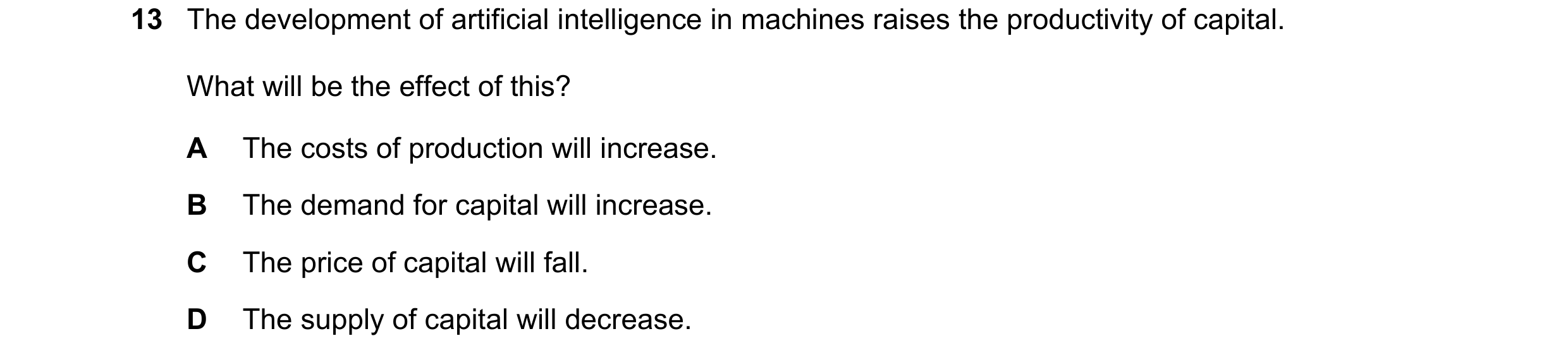
Q7 · The development of artificial intelligence in machines raises the productivity of capital 0987/11 May/June 2022
13 The development of artificial intelligence in machines raises the productivity of capital. What will be the effect of this? A The costs of production will increase. B The demand for capital will increase. C The price of capital will fall. D The supply of capital will decrease.
1 marks
Answer: B
This question in 0987/11 May/June 2022
Q8 · The table shows the units of factors of production that a firm needs to employ for two… 0987/11 May/June 2023
16 The table shows the units of factors of production that a firm needs to employ for two different levels of output. land labour capital output 5 2 4 100 10 4 8 150 What is the firm experiencing? A constant returns to scale B diseconomies of scale C external diseconomies of scale D external economies of scale
1 marks
Answer: B
This question in 0987/11 May/June 2023
Q9 · What could cause internal diseconomies of scale for a firm? 0987/12 May/June 2023
16 What could cause internal diseconomies of scale for a firm? A a fall in demand for the products produced by the firm B a merger with another firm that results in slower decision-making C spending more on research and development to create new products D the lack of skilled labour in the geographical area where the firm is based
1 marks
Answer: B
This question in 0987/12 May/June 2023
Q10 · What is most likely to encourage capital-intensive production methods in a low-income… 0987/12 Oct/Nov 2024
14 What is most likely to encourage capital-intensive production methods in a low-income economy? A expensive capital equipment costs B grants from foreign aid programmes C supplies of local low-cost labour D a shortage of highly trained supervisors A firm’s average revenue is $20. It sells 1000 units.
1 marks
Answer: B
This question in 0987/12 Oct/Nov 2024
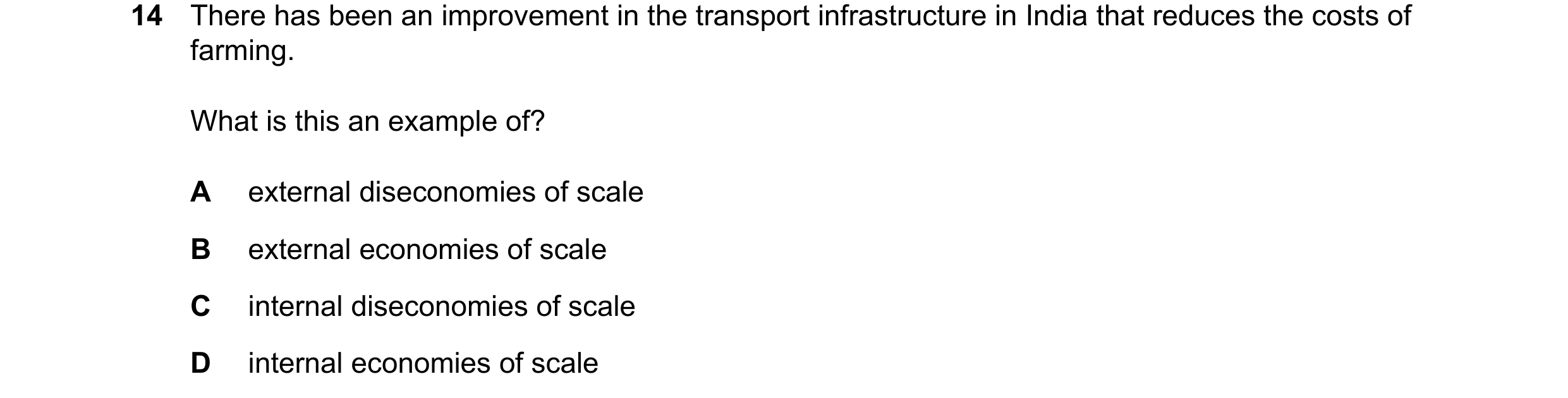
Q11 · There has been an improvement in the transport infrastructure in India that reduces the… 0987/11 May/June 2025
14 There has been an improvement in the transport infrastructure in India that reduces the costs of farming. What is this an example of? A external diseconomies of scale B external economies of scale C internal diseconomies of scale D internal economies of scale
1 marks
Answer: B
This question in 0987/11 May/June 2025
Q12 · A firm chooses to become more capital-intensive 0987/11 May/June 2025
15 A firm chooses to become more capital-intensive. What is least likely to have increased? A interest rates B minimum wages C the power of trade unions D the productivity of capital
1 marks
Answer: A
This question in 0987/11 May/June 2025
Q13 · A restaurant employs two chefs who make all of the meals that are served to customers 0987/12 May/June 2025
12 A restaurant employs two chefs who make all of the meals that are served to customers. What is most likely to increase the productivity of the chefs? A a decrease in the number of customers in the restaurant B a decrease in the chefs’ pay C an increase in the quality of the food D an increase in training for the chefs
1 marks
Answer: D
This question in 0987/12 May/June 2025



 1 / 4
1 / 4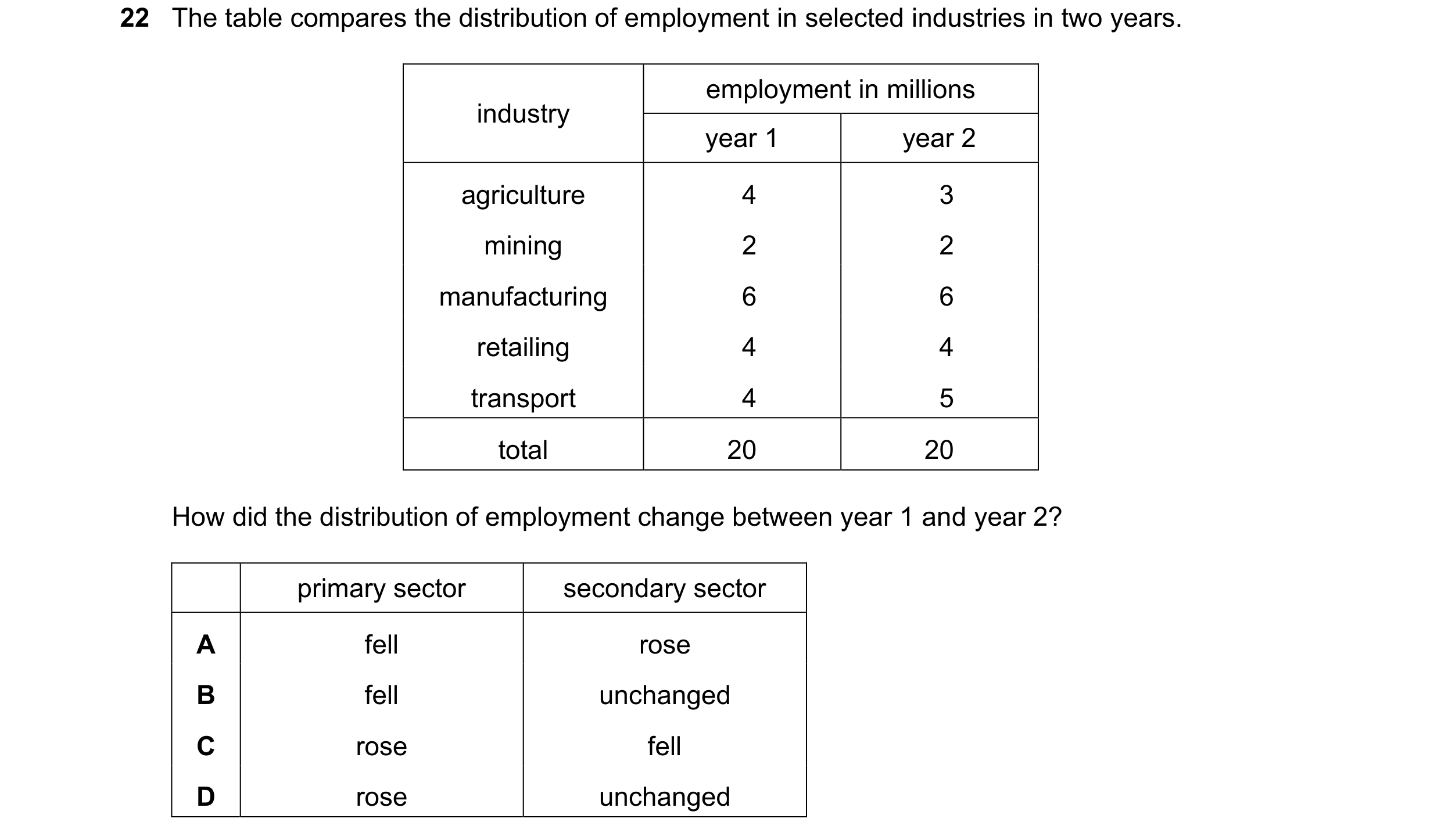

 2 / 4
2 / 4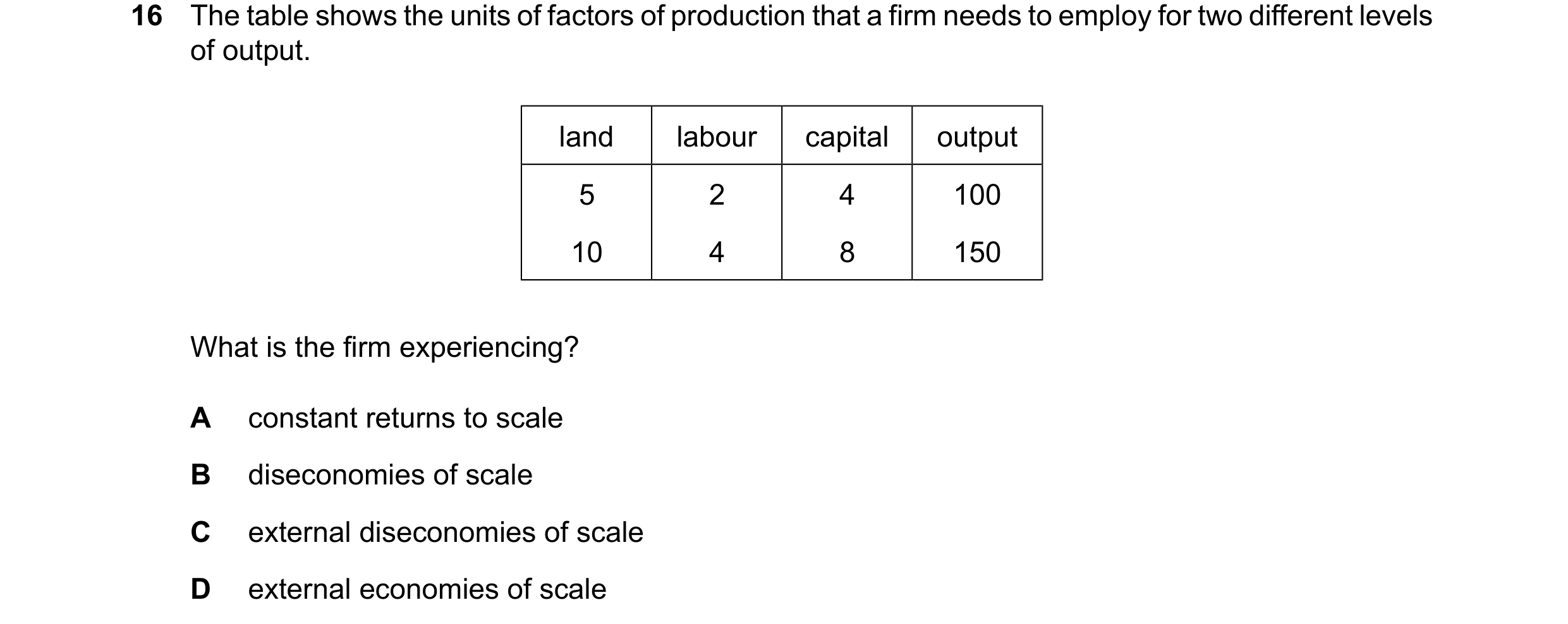


 3 / 4
3 / 4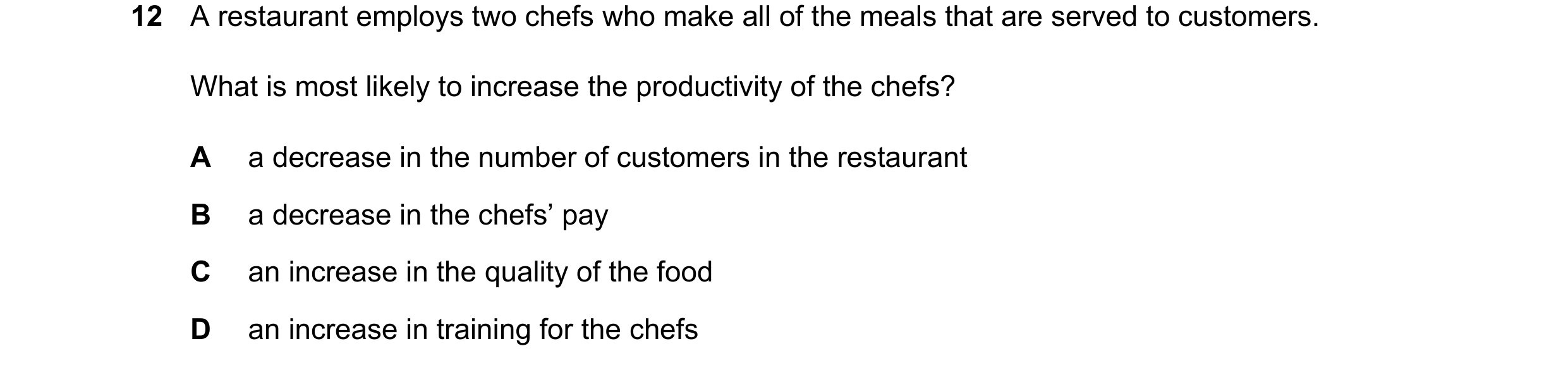 4 / 4
4 / 4