Cambridge IGCSE Economics 0455 — 2016 Oct/Nov Paper 2 · Variant 3
0455/23/O/N/16 · 90 marks · ≈101 min
The question paper and its mark scheme, free to read here and free to download. This is Cambridge’s own paper, exactly as it was sat.
Question paper4 pages
Mark scheme10 pages
Answers below. Sit the paper first if you are practising.
Paper as text
Question paper, page 1
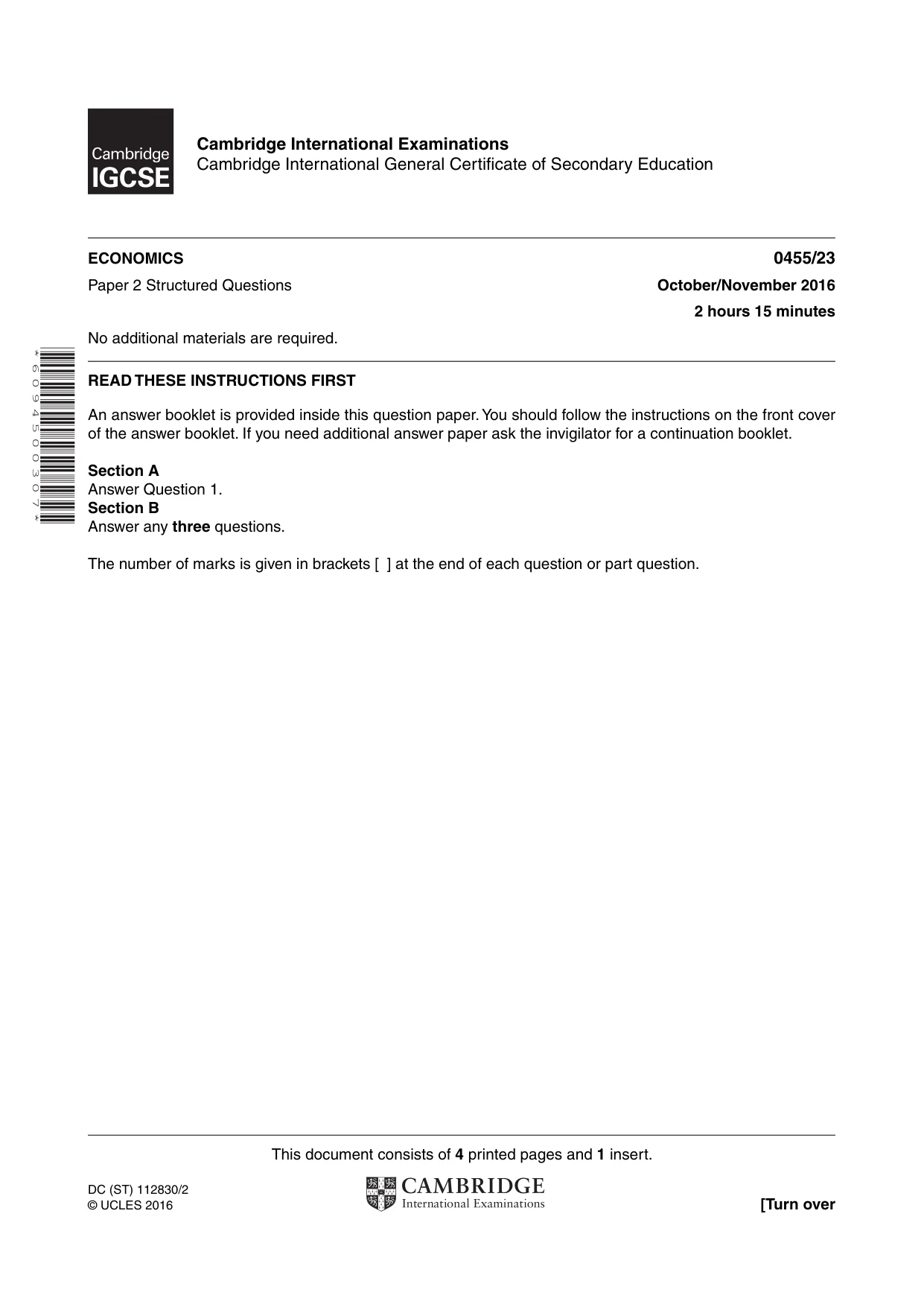
This document consists of 4 printed pages and 1 insert. DC (ST) 112830/2 © UCLES 2016 [Turn over Cambridge International Examinations Cambridge International General Certificate of Secondary Education * 6 0 9 4 5 0 0 3 0 7 * ECONOMICS 0455/23 Paper 2 Structured Questions October/November 2016 2 hours 15 minutes No additional materials are required. READ THESE INSTRUCTIONS FIRST An answer booklet is provided inside this question paper. You should follow the instructions on the front cover of the answer booklet. If you need additional answer paper ask the invigilator for a continuation booklet. Section A Answer Question 1. Section B Answer any three questions. The number of marks is given in brackets [ ] at the end of each question or part question.
Question paper, page 2
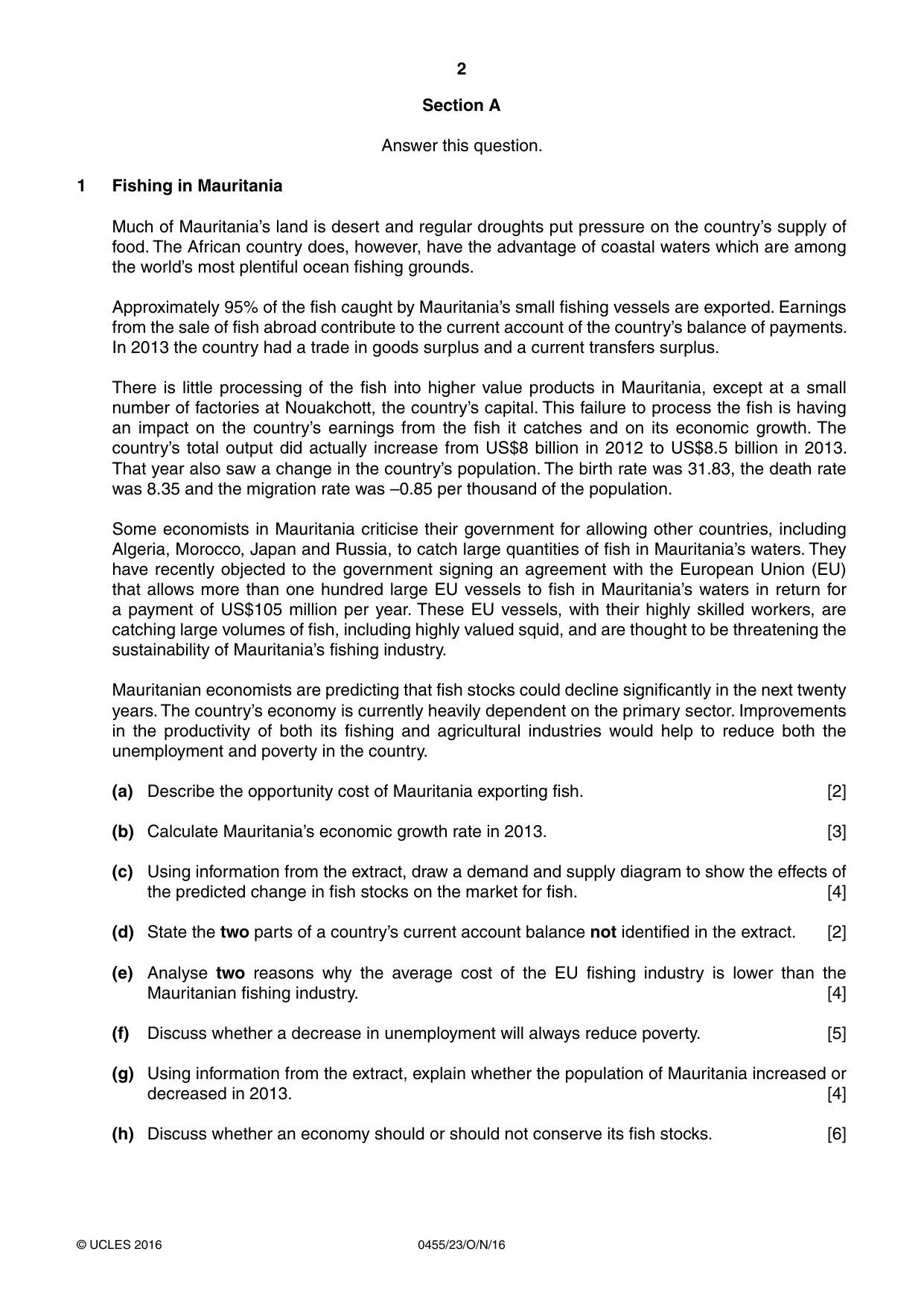
2 0455/23/O/N/16 © UCLES 2016 Section A Answer this question. 1 Fishing in Mauritania Much of Mauritania’s land is desert and regular droughts put pressure on the country’s supply of food. The African country does, however, have the advantage of coastal waters which are among the world’s most plentiful ocean fishing grounds. Approximately 95% of the fish caught by Mauritania’s small fishing vessels are exported. Earnings from the sale of fish abroad contribute to the current account of the country’s balance of payments. In 2013 the country had a trade in goods surplus and a current transfers surplus. There is little processing of the fish into higher value products in Mauritania, except at a small number of factories at Nouakchott, the country’s capital. This failure to process the fish is having an impact on the country’s earnings from the fish it catches and on its economic growth. The country’s total output did actually increase from US$8 billion in 2012 to US$8.5 billion in 2013. That year also saw a change in the country’s population. The birth rate was 31.83, the death rate was 8.35 and the migration rate was –0.85 per thousand of the population. Some economists in Mauritania criticise their government for allowing other countries, including Algeria, Morocco, Japan and Russia, to catch large quantities of fish in Mauritania’s waters. They have recently objected to the government signing an agreement with the European Union (EU) that allows more than one hundred large EU vessels to fish in Mauritania’s waters in return for a payment of US$105 million per year. These EU vessels, with their highly skilled workers, are catching large volumes of fish, including highly valued squid, and are thought to be threatening the sustainability of Mauritania’s fishing industry. Mauritanian economists are predicting that fish stocks could decline significantly in the next twenty years. The country’s economy is currently heavily dependent on the primary sector. Improvements in the productivity of both its fishing and agricultural industries would help to reduce both the unemployment and poverty in the country. (a) Describe the opportunity cost of Mauritania exporting fish. [2] (b) Calculate Mauritania’s economic growth rate in 2013. [3] (c) Using information from the extract, draw a demand and supply diagram to show the effects of the predicted change in fish stocks on the market for fish. [4] (d) State the two parts of a country’s current account balance not identified in the extract. [2] (e) Analyse two reasons why the average cost of the EU fishing industry is lower than the Mauritanian fishing industry. [4] (f) Discuss whether a decrease in unemployment will always reduce poverty. [5] (g) Using information from the extract, explain whether the population of Mauritania increased or decreased in 2013. [4] (h) Discuss whether an economy should or should not conserve its fish stocks. [6]
Question paper, page 3
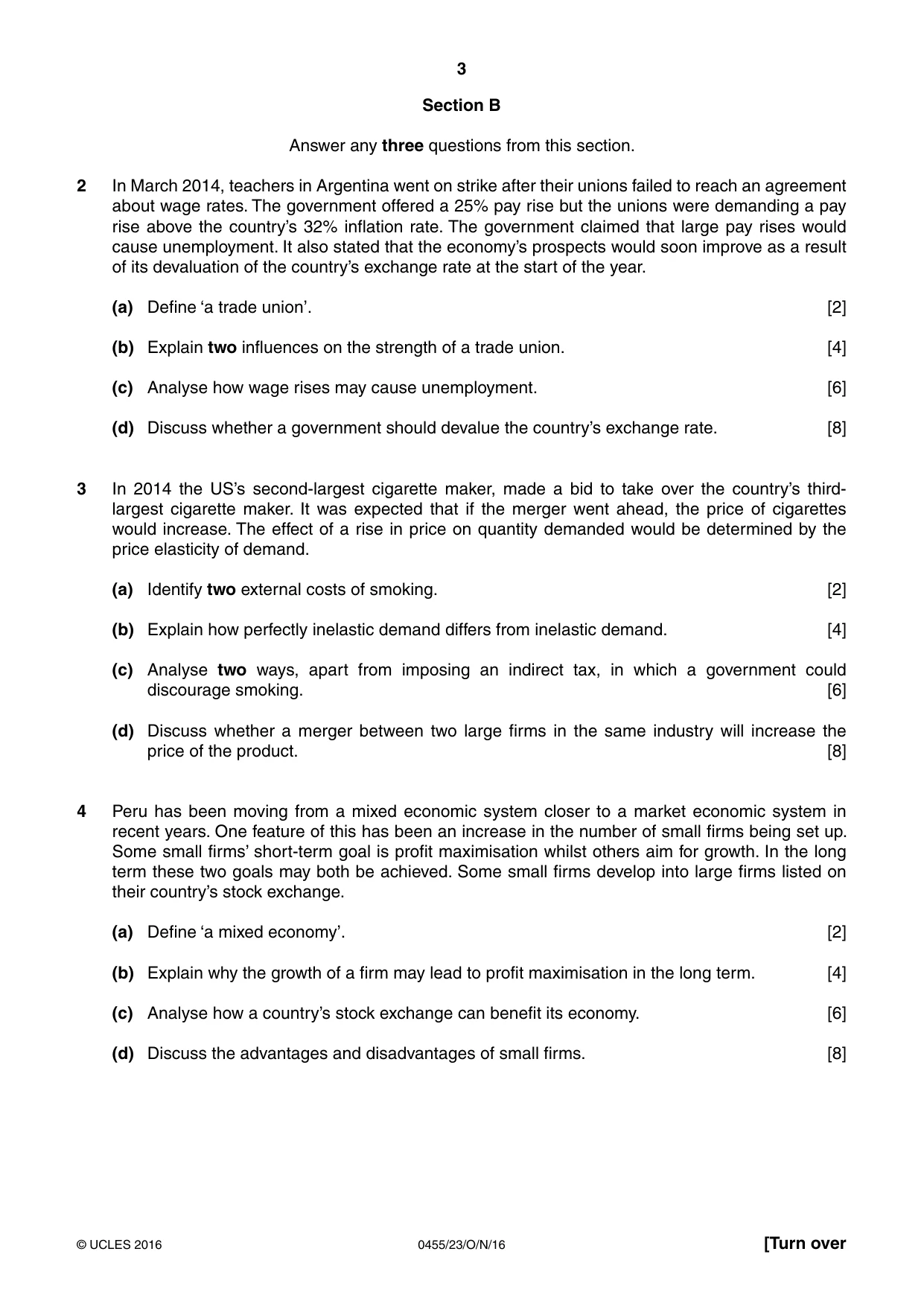
3 0455/23/O/N/16 © UCLES 2016 [Turn over Section B Answer any three questions from this section. 2 In March 2014, teachers in Argentina went on strike after their unions failed to reach an agreement about wage rates. The government offered a 25% pay rise but the unions were demanding a pay rise above the country’s 32% inflation rate. The government claimed that large pay rises would cause unemployment. It also stated that the economy’s prospects would soon improve as a result of its devaluation of the country’s exchange rate at the start of the year. (a) Define ‘a trade union’. [2] (b) Explain two influences on the strength of a trade union. [4] (c) Analyse how wage rises may cause unemployment. [6] (d) Discuss whether a government should devalue the country’s exchange rate. [8] 3 In 2014 the US’s second-largest cigarette maker, made a bid to take over the country’s third- largest cigarette maker. It was expected that if the merger went ahead, the price of cigarettes would increase. The effect of a rise in price on quantity demanded would be determined by the price elasticity of demand. (a) Identify two external costs of smoking. [2] (b) Explain how perfectly inelastic demand differs from inelastic demand. [4] (c) Analyse two ways, apart from imposing an indirect tax, in which a government could discourage smoking. [6] (d) Discuss whether a merger between two large firms in the same industry will increase the price of the product. [8] 4 Peru has been moving from a mixed economic system closer to a market economic system in recent years. One feature of this has been an increase in the number of small firms being set up. Some small firms’ short-term goal is profit maximisation whilst others aim for growth. In the long term these two goals may both be achieved. Some small firms develop into large firms listed on their country’s stock exchange. (a) Define ‘a mixed economy’. [2] (b) Explain why the growth of a firm may lead to profit maximisation in the long term. [4] (c) Analyse how a country’s stock exchange can benefit its economy. [6] (d) Discuss the advantages and disadvantages of small firms. [8]
Question paper, page 4
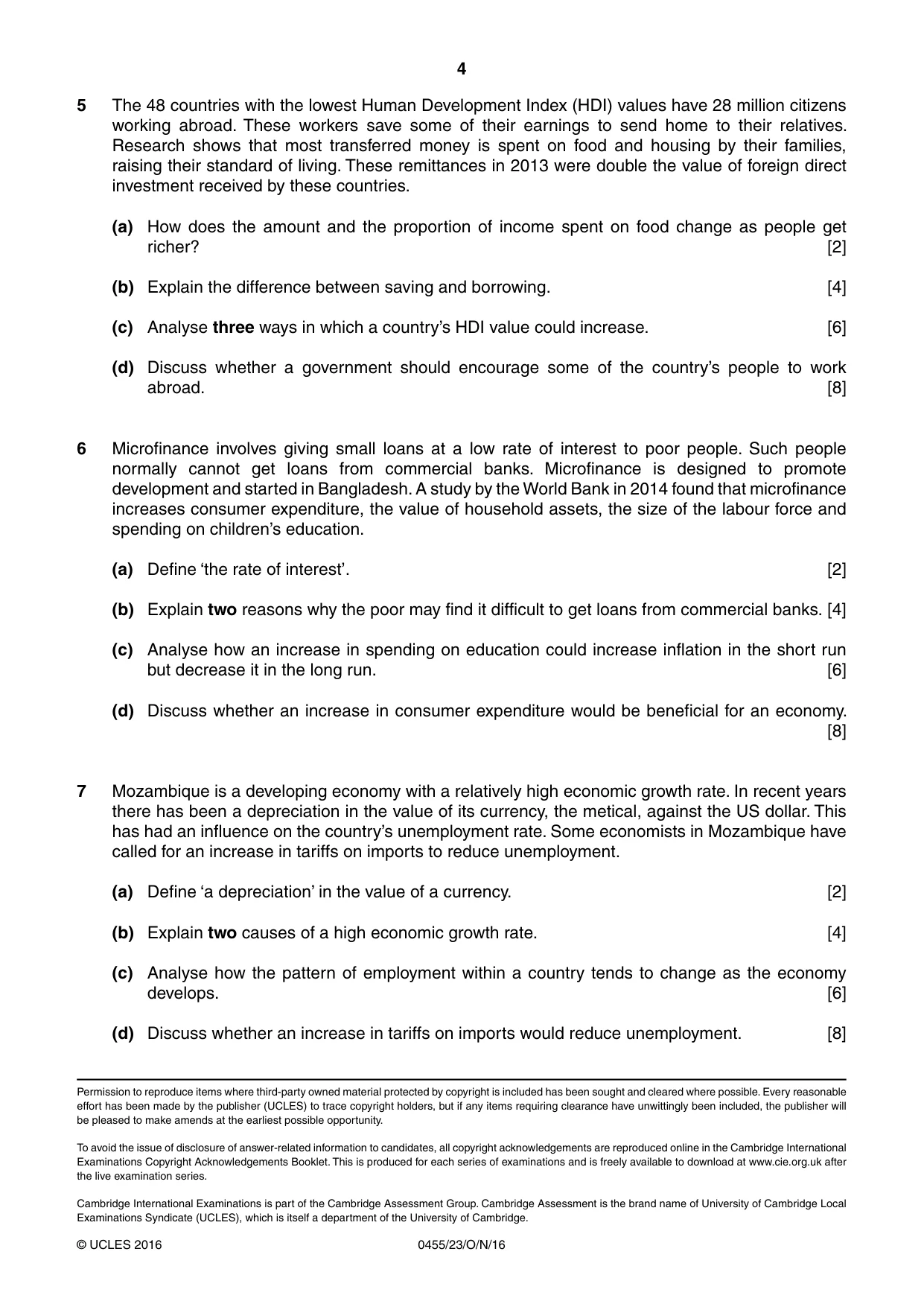
4 0455/23/O/N/16 © UCLES 2016 5 The 48 countries with the lowest Human Development Index (HDI) values have 28 million citizens working abroad. These workers save some of their earnings to send home to their relatives. Research shows that most transferred money is spent on food and housing by their families, raising their standard of living. These remittances in 2013 were double the value of foreign direct investment received by these countries. (a) How does the amount and the proportion of income spent on food change as people get richer? [2] (b) Explain the difference between saving and borrowing. [4] (c) Analyse three ways in which a country’s HDI value could increase. [6] (d) Discuss whether a government should encourage some of the country’s people to work abroad. [8] 6 Microfinance involves giving small loans at a low rate of interest to poor people. Such people normally cannot get loans from commercial banks. Microfinance is designed to promote development and started in Bangladesh. A study by the World Bank in 2014 found that microfinance increases consumer expenditure, the value of household assets, the size of the labour force and spending on children’s education. (a) Define ‘the rate of interest’. [2] (b) Explain two reasons why the poor may find it difficult to get loans from commercial banks. [4] (c) Analyse how an increase in spending on education could increase inflation in the short run but decrease it in the long run. [6] (d) Discuss whether an increase in consumer expenditure would be beneficial for an economy. [8] 7 Mozambique is a developing economy with a relatively high economic growth rate. In recent years there has been a depreciation in the value of its currency, the metical, against the US dollar. This has had an influence on the country’s unemployment rate. Some economists in Mozambique have called for an increase in tariffs on imports to reduce unemployment. (a) Define ‘a depreciation’ in the value of a currency. [2] (b) Explain two causes of a high economic growth rate. [4] (c) Analyse how the pattern of employment within a country tends to change as the economy develops. [6] (d) Discuss whether an increase in tariffs on imports would reduce unemployment. [8] Permission to reproduce items where third-party owned material protected by copyright is included has been sought and cleared where possible. Every reasonable effort has been made by the publisher (UCLES) to trace copyright holders, but if any items requiring clearance have unwittingly been included, the publisher will be pleased to make amends at the earliest possible opportunity. To avoid the issue of disclosure of answer-related information to candidates, all copyright acknowledgements are reproduced online in the Cambridge International Examinations Copyright Acknowledgements Booklet. This is produced for each series of examinations and is freely available to download at www.cie.org.uk after the live examination series. Cambridge International Examinations is part of the Cambridge Assessment Group. Cambridge Assessment is the brand name of University of Cambridge Local Examinations Syndicate (UCLES), which is itself a department of the University of Cambridge.
Mark scheme, page 1
® IGCSE is the registered trademark of Cambridge International Examinations. This document consists of 10 printed pages. © UCLES 2016 [Turn over Cambridge International Examinations Cambridge International General Certificate of Secondary Education ECONOMICS 0455/23 Paper 2 Structured Questions October/November 2016 MARK SCHEME Maximum Mark: 90 Published This mark scheme is published as an aid to teachers and candidates, to indicate the requirements of the examination. It shows the basis on which Examiners were instructed to award marks. It does not indicate the details of the discussions that took place at an Examiners’ meeting before marking began, which would have considered the acceptability of alternative answers. Mark schemes should be read in conjunction with the question paper and the Principal Examiner Report for Teachers. Cambridge will not enter into discussions about these mark schemes. Cambridge is publishing the mark schemes for the October/November 2016 series for most Cambridge IGCSE®, Cambridge International A and AS Level components and some Cambridge O Level components.
Mark scheme, page 2
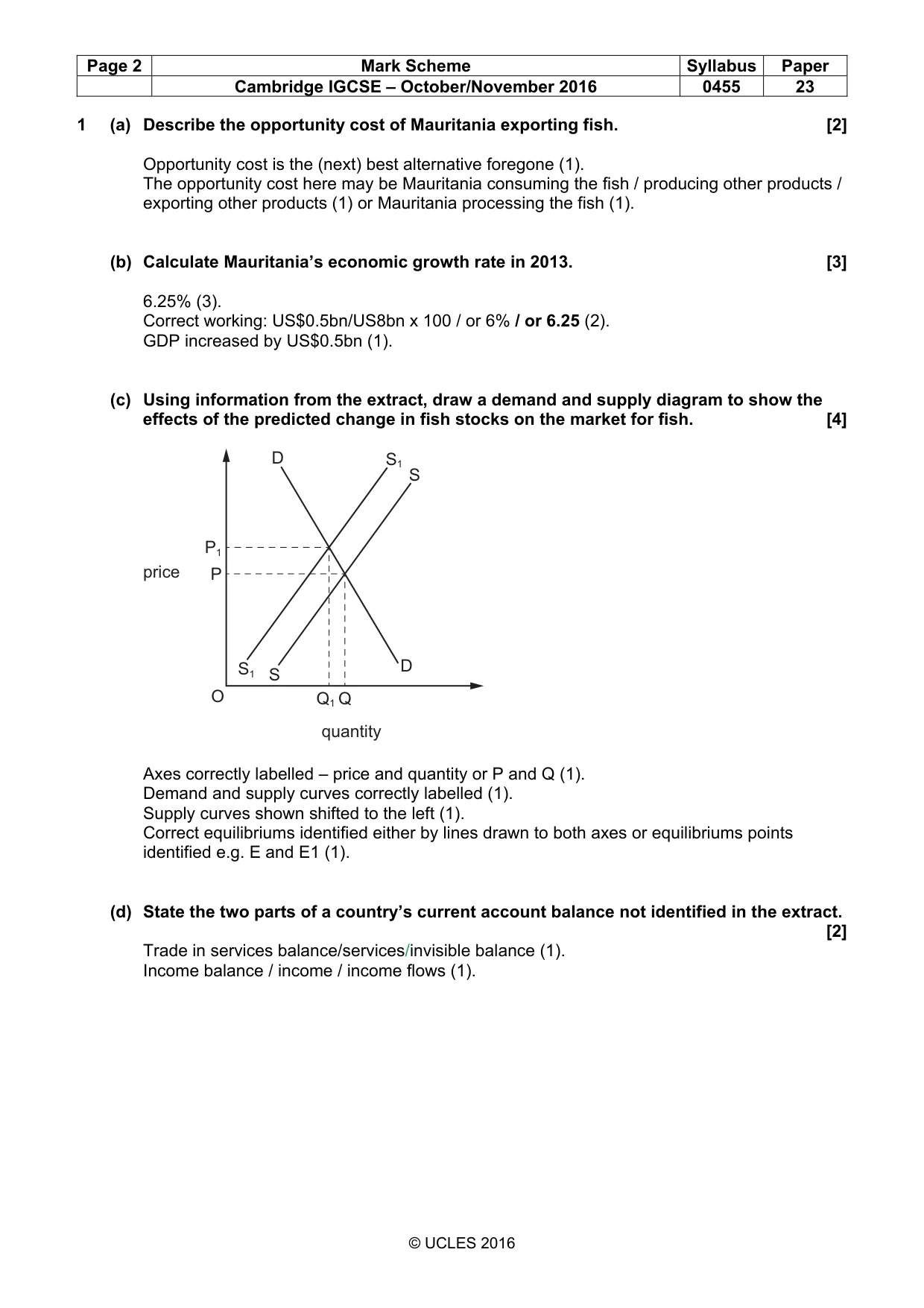
Page 2 Mark Scheme Syllabus Paper Cambridge IGCSE – October/November 2016 0455 23 © UCLES 2016 1 (a) Describe the opportunity cost of Mauritania exporting fish. [2] Opportunity cost is the (next) best alternative foregone (1). The opportunity cost here may be Mauritania consuming the fish / producing other products / exporting other products (1) or Mauritania processing the fish (1). (b) Calculate Mauritania’s economic growth rate in 2013. [3] 6.25% (3). Correct working: US$0.5bn/US8bn x 100 / or 6% / or 6.25 (2). GDP increased by US$0.5bn (1). (c) Using information from the extract, draw a demand and supply diagram to show the effects of the predicted change in fish stocks on the market for fish. [4] Axes correctly labelled – price and quantity or P and Q (1). Demand and supply curves correctly labelled (1). Supply curves shown shifted to the left (1). Correct equilibriums identified either by lines drawn to both axes or equilibriums points identified e.g. E and E1 (1). (d) State the two parts of a country’s current account balance not identified in the extract. [2] Trade in services balance/services/invisible balance (1). Income balance / income / income flows (1). D D S S1 S1 S P Q Q1 P1 O price quantity
Mark scheme, page 3
Page 3 Mark Scheme Syllabus Paper Cambridge IGCSE – October/November 2016 0455 23 © UCLES 2016 (e) Analyse two reasons why the average cost of the EU fishing industry is lower than the Mauritian fishing industry. [4] The EU fishing industry has larger fishing vessels (1) benefit from economies of scale /technical economies of scale (1) as a result costs e.g. fuel/labour costs per unit of fish caught will be lower/costs can be spread over a higher output (1). EU fishermen are more skilled (1) higher productivity / more efficient (1). Note. Accept analysis based on why the Mauritian fishing industry has higher average cost. (f) Discuss whether a decrease in unemployment will always reduce poverty. [5] Up to 3 marks for why it might: Lower unemployment may increase incomes (1) higher incomes enable people to buy more basic necessities (1) more likely to be able to educate children (1) reduce future poverty (1) reducing absolute poverty (1). Less expenditure by government on benefits (1) enables government to increase spending on education/healthcare (1) reducing gap between rich and poor (1) Up to 3 marks for why it might not: A decrease in unemployment does not necessarily mean a rise in employment/income (1) unemployment could fall due to e.g. people retiring early (1) or emigrated (1) Unemployment may fall and relative poverty may increase (1) gap between rich and poor may rise (1). Income may still be below others (1) relative poverty remains (1) Income may still not be enough to afford basic necessities (1). Lower unemployment may increase inflation (1) making it more difficult for some people to buy basic necessities (1). Increased employment results in higher tax revenue for the government (1) which enables them to spend on education/healthcare etc. that support the poor (1). (g) Using information from the extract, explain whether the population of Mauritania increased or decreased in 2013. [4] Increased (1) birth rate exceeded death rate (1) by 23.48 (1) natural increase (1) natural increase is greater than the loss from net emigration (1) by 22.63 (1). Note. Accept a numerical approach to the question. If state population increases at a rate of 22.63 (per 1,000) award all 4 marks. (h) Discuss whether an economy should or should not conserve its fish stocks. [6] Up to 4 marks for why it should: May avoid depleting fish stocks (1) enabling fishing to continue in the future / benefit future generations / reduce imports in the long-term (1) reduces pollution from overfishing (1) preserves the eco system (1). Global demand may currently be lower (1) demand may be higher in the future (1). The country’s skills catching and processing the fish may grow in the future (1). Country should not be reliant on fishing (1) government should seek to develop other industries whilst fishing stocks last / develop fish processing so that same value of exports but fewer fish caught (1)’
Mark scheme, page 4
Page 4 Mark Scheme Syllabus Paper Cambridge IGCSE – October/November 2016 0455 23 © UCLES 2016 Up to 4 marks for why it should not: May reduce income (1) and employment now (1). May reduce export revenue (1) worsen the current account position (1). Demand may fall in the future (1) so income earned in the future may be lower in the future (1). Conservation may not work (1). 2 (a) Define ‘a trade union’. [2] An association / body / organisation/group of people (1) which represents workers / members (1). (b) Explain two influences on the strength of a trade union. [4] Level of economic activity/unemployment rate (1) if there is high income economic growth/low unemployment demand for workers is likely to be high (1). Size of membership/proportion of workers who are members (1) affects funds available/makes it more difficult to replace workers (1). Level of skills/qualifications of workers (1) more skilled workers are harder to replace (1). If elasticity of demand for workers is elastic (1) trade unions unlikely to be successful in raising wages (1). If wages are a small proportion of total costs (1) unions have greater bargaining strength (1). If an essential industry /example (1) unions more likely to be successful because important that industry/service is not interrupted by industrial action (1). Government legislation (1) the more restrictions placed on trade unions, the less power they will have (1). Quality of the leadership (1) skilful leaders are likely to be effective negotiators (1). (c) Analyse how wage increases may cause unemployment. [6] Wage rises may increase costs of production (1) if rise more rapidly than productivity (1) higher costs of production may increase prices (1) higher prices may reduce demand (1) lower demand will reduce firms. revenue/profits (1) firms may reduce output (1) fewer workers will be needed to make a lower output (1). Higher wages may increase costs of production (1) firms reduce costs by substituting capital for labour (1). Firms may relocate to areas where wages are lower (1) to reduce costs (1). Expect higher skills if pay higher wages (1) so may make some unskilled workers redundant (1) as return from their labour is not sufficient (1). Higher wages may affect particular industries (1) resulting in structural unemployment (1).
Mark scheme, page 5
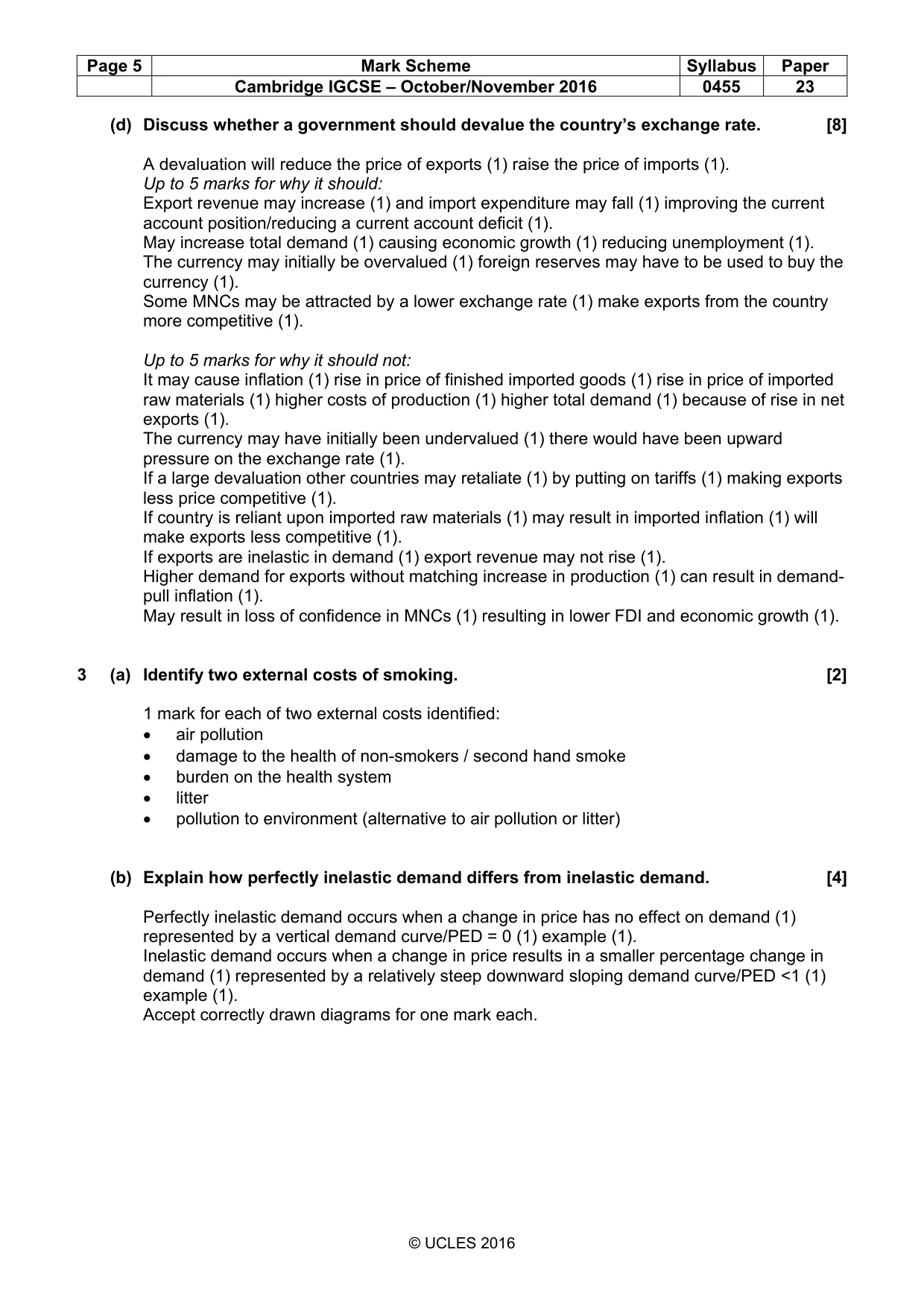
Page 5 Mark Scheme Syllabus Paper Cambridge IGCSE – October/November 2016 0455 23 © UCLES 2016 (d) Discuss whether a government should devalue the country’s exchange rate. [8] A devaluation will reduce the price of exports (1) raise the price of imports (1). Up to 5 marks for why it should: Export revenue may increase (1) and import expenditure may fall (1) improving the current account position/reducing a current account deficit (1). May increase total demand (1) causing economic growth (1) reducing unemployment (1). The currency may initially be overvalued (1) foreign reserves may have to be used to buy the currency (1). Some MNCs may be attracted by a lower exchange rate (1) make exports from the country more competitive (1). Up to 5 marks for why it should not: It may cause inflation (1) rise in price of finished imported goods (1) rise in price of imported raw materials (1) higher costs of production (1) higher total demand (1) because of rise in net exports (1). The currency may have initially been undervalued (1) there would have been upward pressure on the exchange rate (1). If a large devaluation other countries may retaliate (1) by putting on tariffs (1) making exports less price competitive (1). If country is reliant upon imported raw materials (1) may result in imported inflation (1) will make exports less competitive (1). If exports are inelastic in demand (1) export revenue may not rise (1). Higher demand for exports without matching increase in production (1) can result in demand- pull inflation (1). May result in loss of confidence in MNCs (1) resulting in lower FDI and economic growth (1). 3 (a) Identify two external costs of smoking. [2] 1 mark for each of two external costs identified: • air pollution • damage to the health of non-smokers / second hand smoke • burden on the health system • litter • pollution to environment (alternative to air pollution or litter) (b) Explain how perfectly inelastic demand differs from inelastic demand. [4] Perfectly inelastic demand occurs when a change in price has no effect on demand (1) represented by a vertical demand curve/PED = 0 (1) example (1). Inelastic demand occurs when a change in price results in a smaller percentage change in demand (1) represented by a relatively steep downward sloping demand curve/PED <1 (1) example (1). Accept correctly drawn diagrams for one mark each.
Mark scheme, page 6
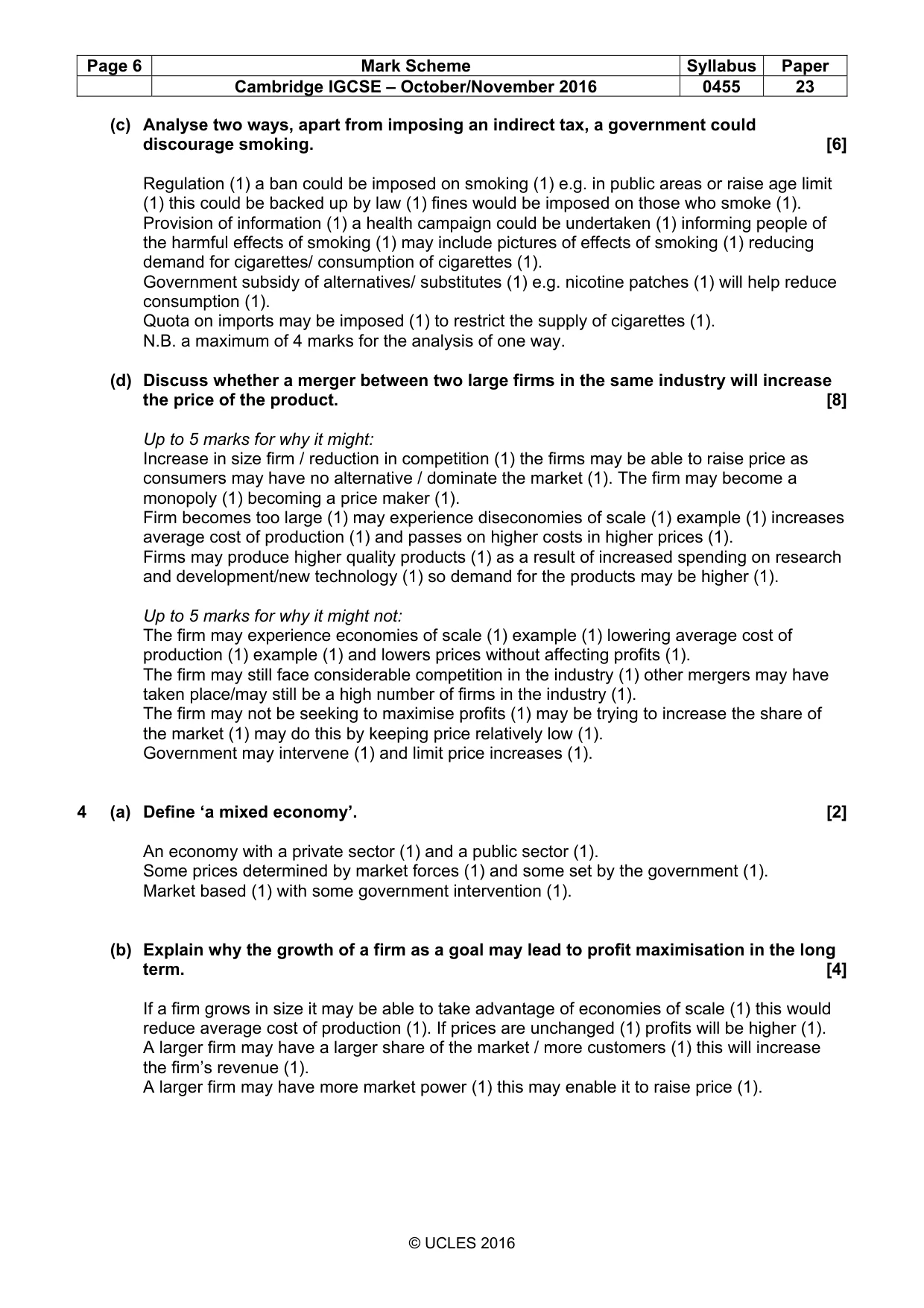
Page 6 Mark Scheme Syllabus Paper Cambridge IGCSE – October/November 2016 0455 23 © UCLES 2016 (c) Analyse two ways, apart from imposing an indirect tax, a government could discourage smoking. [6] Regulation (1) a ban could be imposed on smoking (1) e.g. in public areas or raise age limit (1) this could be backed up by law (1) fines would be imposed on those who smoke (1). Provision of information (1) a health campaign could be undertaken (1) informing people of the harmful effects of smoking (1) may include pictures of effects of smoking (1) reducing demand for cigarettes/ consumption of cigarettes (1). Government subsidy of alternatives/ substitutes (1) e.g. nicotine patches (1) will help reduce consumption (1). Quota on imports may be imposed (1) to restrict the supply of cigarettes (1). N.B. a maximum of 4 marks for the analysis of one way. (d) Discuss whether a merger between two large firms in the same industry will increase the price of the product. [8] Up to 5 marks for why it might: Increase in size firm / reduction in competition (1) the firms may be able to raise price as consumers may have no alternative / dominate the market (1). The firm may become a monopoly (1) becoming a price maker (1). Firm becomes too large (1) may experience diseconomies of scale (1) example (1) increases average cost of production (1) and passes on higher costs in higher prices (1). Firms may produce higher quality products (1) as a result of increased spending on research and development/new technology (1) so demand for the products may be higher (1). Up to 5 marks for why it might not: The firm may experience economies of scale (1) example (1) lowering average cost of production (1) example (1) and lowers prices without affecting profits (1). The firm may still face considerable competition in the industry (1) other mergers may have taken place/may still be a high number of firms in the industry (1). The firm may not be seeking to maximise profits (1) may be trying to increase the share of the market (1) may do this by keeping price relatively low (1). Government may intervene (1) and limit price increases (1). 4 (a) Define ‘a mixed economy’. [2] An economy with a private sector (1) and a public sector (1). Some prices determined by market forces (1) and some set by the government (1). Market based (1) with some government intervention (1). (b) Explain why the growth of a firm as a goal may lead to profit maximisation in the long term. [4] If a firm grows in size it may be able to take advantage of economies of scale (1) this would reduce average cost of production (1). If prices are unchanged (1) profits will be higher (1). A larger firm may have a larger share of the market / more customers (1) this will increase the firm’s revenue (1). A larger firm may have more market power (1) this may enable it to raise price (1).
Mark scheme, page 7
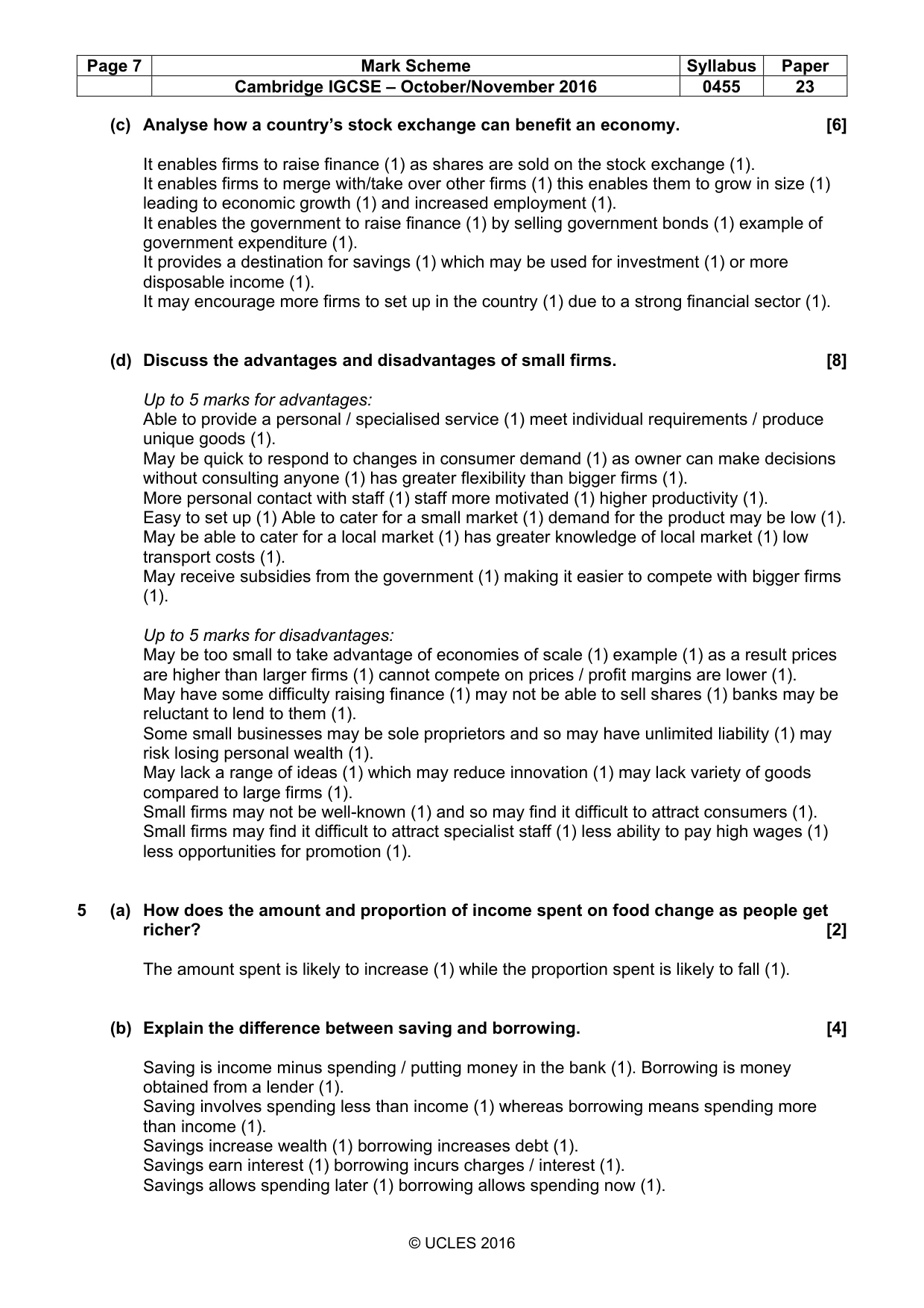
Page 7 Mark Scheme Syllabus Paper Cambridge IGCSE – October/November 2016 0455 23 © UCLES 2016 (c) Analyse how a country’s stock exchange can benefit an economy. [6] It enables firms to raise finance (1) as shares are sold on the stock exchange (1). It enables firms to merge with/take over other firms (1) this enables them to grow in size (1) leading to economic growth (1) and increased employment (1). It enables the government to raise finance (1) by selling government bonds (1) example of government expenditure (1). It provides a destination for savings (1) which may be used for investment (1) or more disposable income (1). It may encourage more firms to set up in the country (1) due to a strong financial sector (1). (d) Discuss the advantages and disadvantages of small firms. [8] Up to 5 marks for advantages: Able to provide a personal / specialised service (1) meet individual requirements / produce unique goods (1). May be quick to respond to changes in consumer demand (1) as owner can make decisions without consulting anyone (1) has greater flexibility than bigger firms (1). More personal contact with staff (1) staff more motivated (1) higher productivity (1). Easy to set up (1) Able to cater for a small market (1) demand for the product may be low (1). May be able to cater for a local market (1) has greater knowledge of local market (1) low transport costs (1). May receive subsidies from the government (1) making it easier to compete with bigger firms (1). Up to 5 marks for disadvantages: May be too small to take advantage of economies of scale (1) example (1) as a result prices are higher than larger firms (1) cannot compete on prices / profit margins are lower (1). May have some difficulty raising finance (1) may not be able to sell shares (1) banks may be reluctant to lend to them (1). Some small businesses may be sole proprietors and so may have unlimited liability (1) may risk losing personal wealth (1). May lack a range of ideas (1) which may reduce innovation (1) may lack variety of goods compared to large firms (1). Small firms may not be well-known (1) and so may find it difficult to attract consumers (1). Small firms may find it difficult to attract specialist staff (1) less ability to pay high wages (1) less opportunities for promotion (1). 5 (a) How does the amount and proportion of income spent on food change as people get richer? [2] The amount spent is likely to increase (1) while the proportion spent is likely to fall (1). (b) Explain the difference between saving and borrowing. [4] Saving is income minus spending / putting money in the bank (1). Borrowing is money obtained from a lender (1). Saving involves spending less than income (1) whereas borrowing means spending more than income (1). Savings increase wealth (1) borrowing increases debt (1). Savings earn interest (1) borrowing incurs charges / interest (1). Savings allows spending later (1) borrowing allows spending now (1).
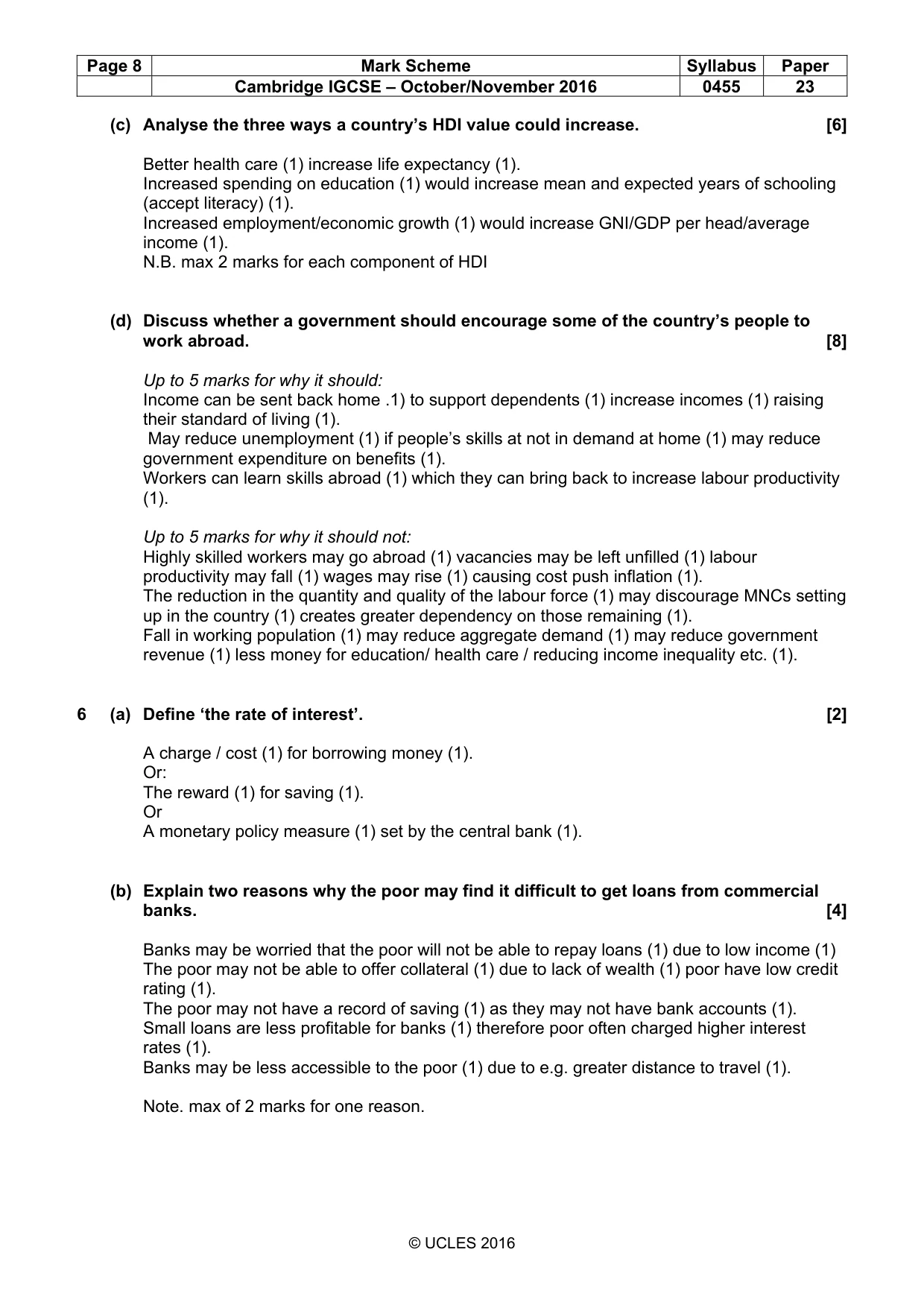
Mark scheme, page 8
Page 8 Mark Scheme Syllabus Paper Cambridge IGCSE – October/November 2016 0455 23 © UCLES 2016 (c) Analyse the three ways a country’s HDI value could increase. [6] Better health care (1) increase life expectancy (1). Increased spending on education (1) would increase mean and expected years of schooling (accept literacy) (1). Increased employment/economic growth (1) would increase GNI/GDP per head/average income (1). N.B. max 2 marks for each component of HDI (d) Discuss whether a government should encourage some of the country’s people to work abroad. [8] Up to 5 marks for why it should: Income can be sent back home .1) to support dependents (1) increase incomes (1) raising their standard of living (1). May reduce unemployment (1) if people’s skills at not in demand at home (1) may reduce government expenditure on benefits (1). Workers can learn skills abroad (1) which they can bring back to increase labour productivity (1). Up to 5 marks for why it should not: Highly skilled workers may go abroad (1) vacancies may be left unfilled (1) labour productivity may fall (1) wages may rise (1) causing cost push inflation (1). The reduction in the quantity and quality of the labour force (1) may discourage MNCs setting up in the country (1) creates greater dependency on those remaining (1). Fall in working population (1) may reduce aggregate demand (1) may reduce government revenue (1) less money for education/ health care / reducing income inequality etc. (1). 6 (a) Define ‘the rate of interest’. [2] A charge / cost (1) for borrowing money (1). Or: The reward (1) for saving (1). Or A monetary policy measure (1) set by the central bank (1). (b) Explain two reasons why the poor may find it difficult to get loans from commercial banks. [4] Banks may be worried that the poor will not be able to repay loans (1) due to low income (1) The poor may not be able to offer collateral (1) due to lack of wealth (1) poor have low credit rating (1). The poor may not have a record of saving (1) as they may not have bank accounts (1). Small loans are less profitable for banks (1) therefore poor often charged higher interest rates (1). Banks may be less accessible to the poor (1) due to e.g. greater distance to travel (1). Note. max of 2 marks for one reason.
Mark scheme, page 9
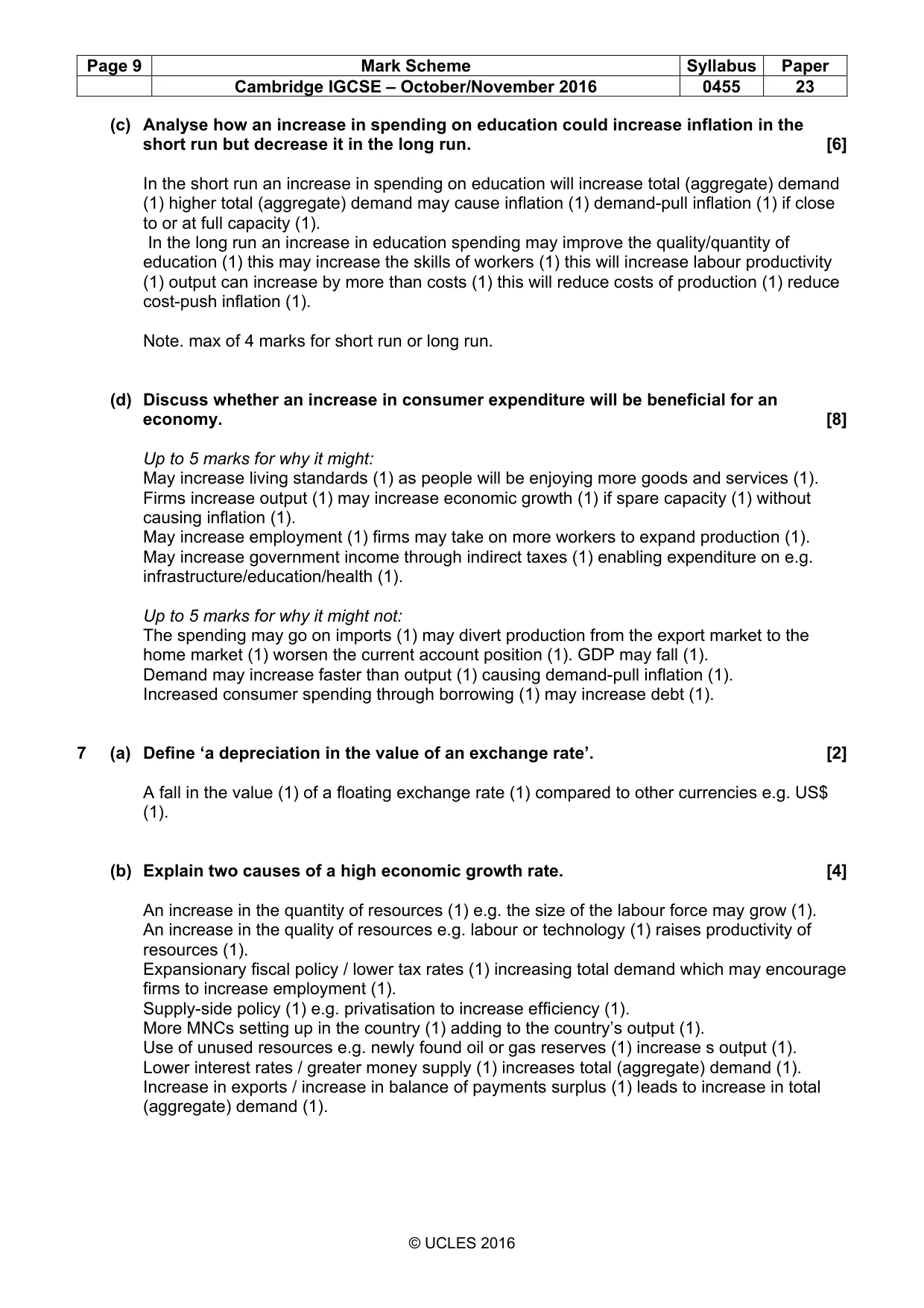
Page 9 Mark Scheme Syllabus Paper Cambridge IGCSE – October/November 2016 0455 23 © UCLES 2016 (c) Analyse how an increase in spending on education could increase inflation in the short run but decrease it in the long run. [6] In the short run an increase in spending on education will increase total (aggregate) demand (1) higher total (aggregate) demand may cause inflation (1) demand-pull inflation (1) if close to or at full capacity (1). In the long run an increase in education spending may improve the quality/quantity of education (1) this may increase the skills of workers (1) this will increase labour productivity (1) output can increase by more than costs (1) this will reduce costs of production (1) reduce cost-push inflation (1). Note. max of 4 marks for short run or long run. (d) Discuss whether an increase in consumer expenditure will be beneficial for an economy. [8] Up to 5 marks for why it might: May increase living standards (1) as people will be enjoying more goods and services (1). Firms increase output (1) may increase economic growth (1) if spare capacity (1) without causing inflation (1). May increase employment (1) firms may take on more workers to expand production (1). May increase government income through indirect taxes (1) enabling expenditure on e.g. infrastructure/education/health (1). Up to 5 marks for why it might not: The spending may go on imports (1) may divert production from the export market to the home market (1) worsen the current account position (1). GDP may fall (1). Demand may increase faster than output (1) causing demand-pull inflation (1). Increased consumer spending through borrowing (1) may increase debt (1). 7 (a) Define ‘a depreciation in the value of an exchange rate’. [2] A fall in the value (1) of a floating exchange rate (1) compared to other currencies e.g. US$ (1). (b) Explain two causes of a high economic growth rate. [4] An increase in the quantity of resources (1) e.g. the size of the labour force may grow (1). An increase in the quality of resources e.g. labour or technology (1) raises productivity of resources (1). Expansionary fiscal policy / lower tax rates (1) increasing total demand which may encourage firms to increase employment (1). Supply-side policy (1) e.g. privatisation to increase efficiency (1). More MNCs setting up in the country (1) adding to the country’s output (1). Use of unused resources e.g. newly found oil or gas reserves (1) increase s output (1). Lower interest rates / greater money supply (1) increases total (aggregate) demand (1). Increase in exports / increase in balance of payments surplus (1) leads to increase in total (aggregate) demand (1).
Mark scheme, page 10
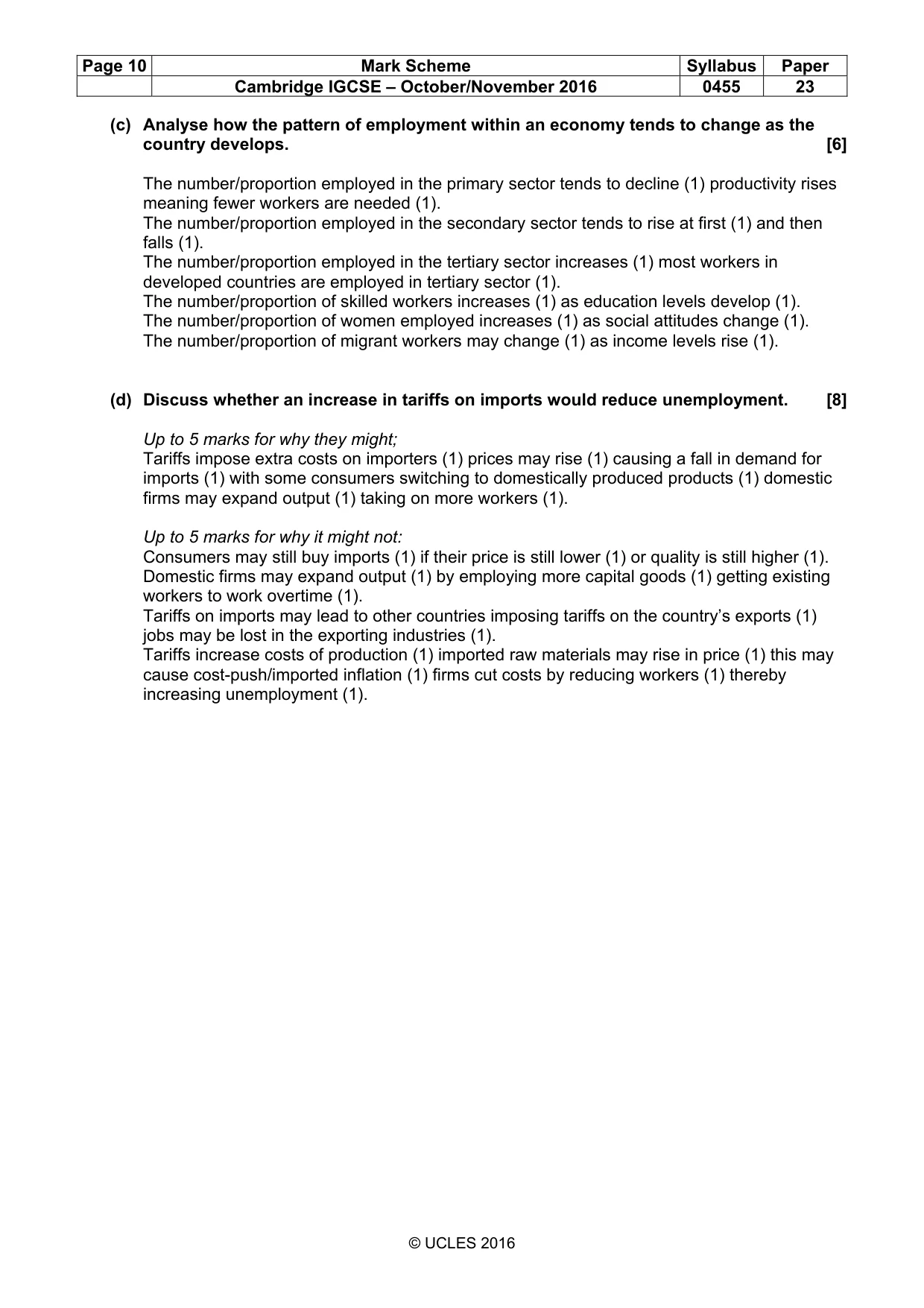
Page 10 Mark Scheme Syllabus Paper Cambridge IGCSE – October/November 2016 0455 23 © UCLES 2016 (c) Analyse how the pattern of employment within an economy tends to change as the country develops. [6] The number/proportion employed in the primary sector tends to decline (1) productivity rises meaning fewer workers are needed (1). The number/proportion employed in the secondary sector tends to rise at first (1) and then falls (1). The number/proportion employed in the tertiary sector increases (1) most workers in developed countries are employed in tertiary sector (1). The number/proportion of skilled workers increases (1) as education levels develop (1). The number/proportion of women employed increases (1) as social attitudes change (1). The number/proportion of migrant workers may change (1) as income levels rise (1). (d) Discuss whether an increase in tariffs on imports would reduce unemployment. [8] Up to 5 marks for why they might; Tariffs impose extra costs on importers (1) prices may rise (1) causing a fall in demand for imports (1) with some consumers switching to domestically produced products (1) domestic firms may expand output (1) taking on more workers (1). Up to 5 marks for why it might not: Consumers may still buy imports (1) if their price is still lower (1) or quality is still higher (1). Domestic firms may expand output (1) by employing more capital goods (1) getting existing workers to work overtime (1). Tariffs on imports may lead to other countries imposing tariffs on the country’s exports (1) jobs may be lost in the exporting industries (1). Tariffs increase costs of production (1) imported raw materials may rise in price (1) this may cause cost-push/imported inflation (1) firms cut costs by reducing workers (1) thereby increasing unemployment (1).
What you needed in this session
Cambridge’s own grade thresholds for 2016 Oct/Nov, Paper 2 · Variant 3. A higher threshold means an easier paper — the bar moves with how the cohort did.