Cambridge IGCSE Economics 0455 — 2015 Oct/Nov Paper 2 · Variant 2
0455/22/O/N/15 · 90 marks · ≈101 min
The question paper and its mark scheme, free to read here and free to download. This is Cambridge’s own paper, exactly as it was sat.
Question paper8 pages



Mark scheme12 pages
Answers below. Sit the paper first if you are practising.
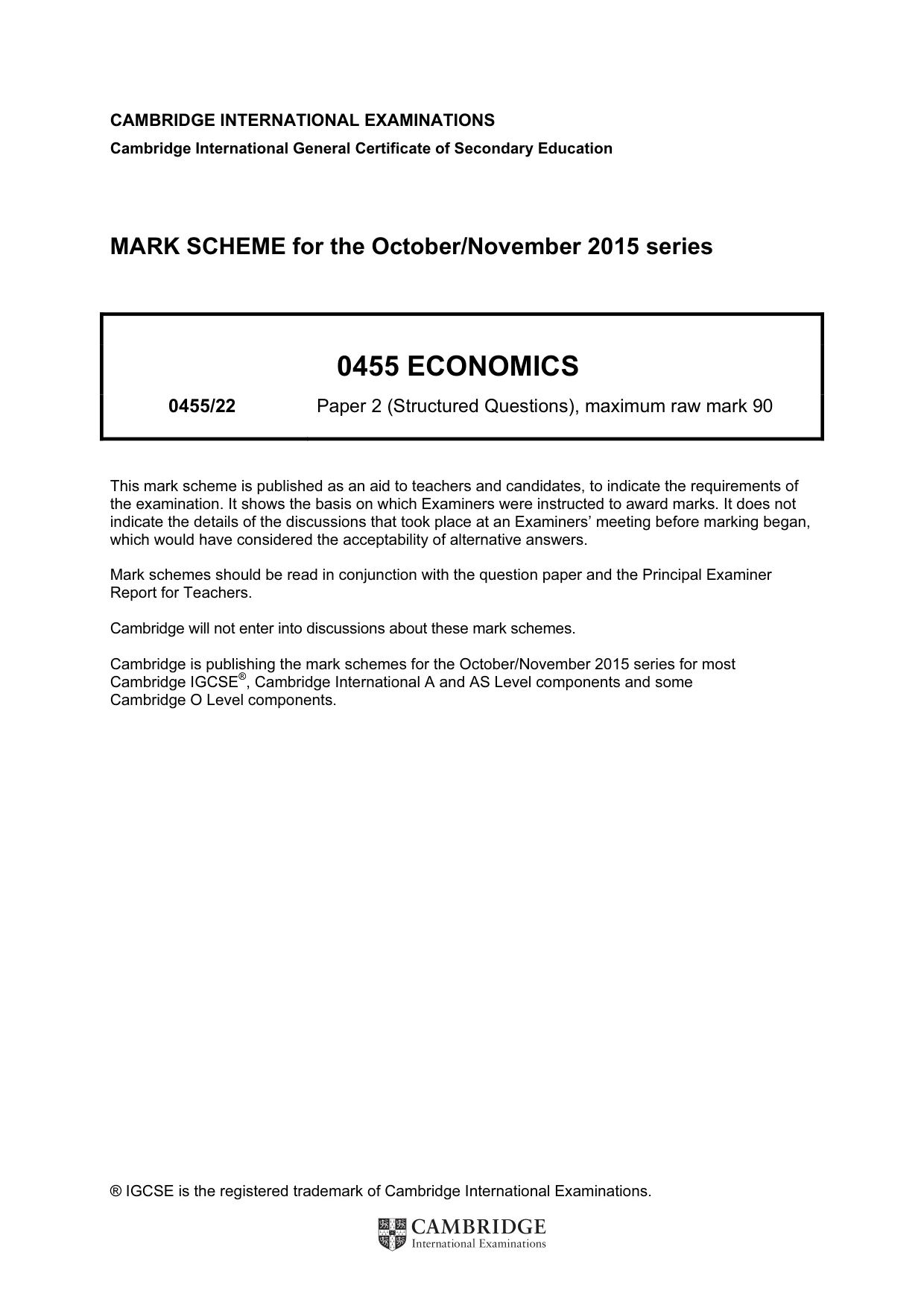
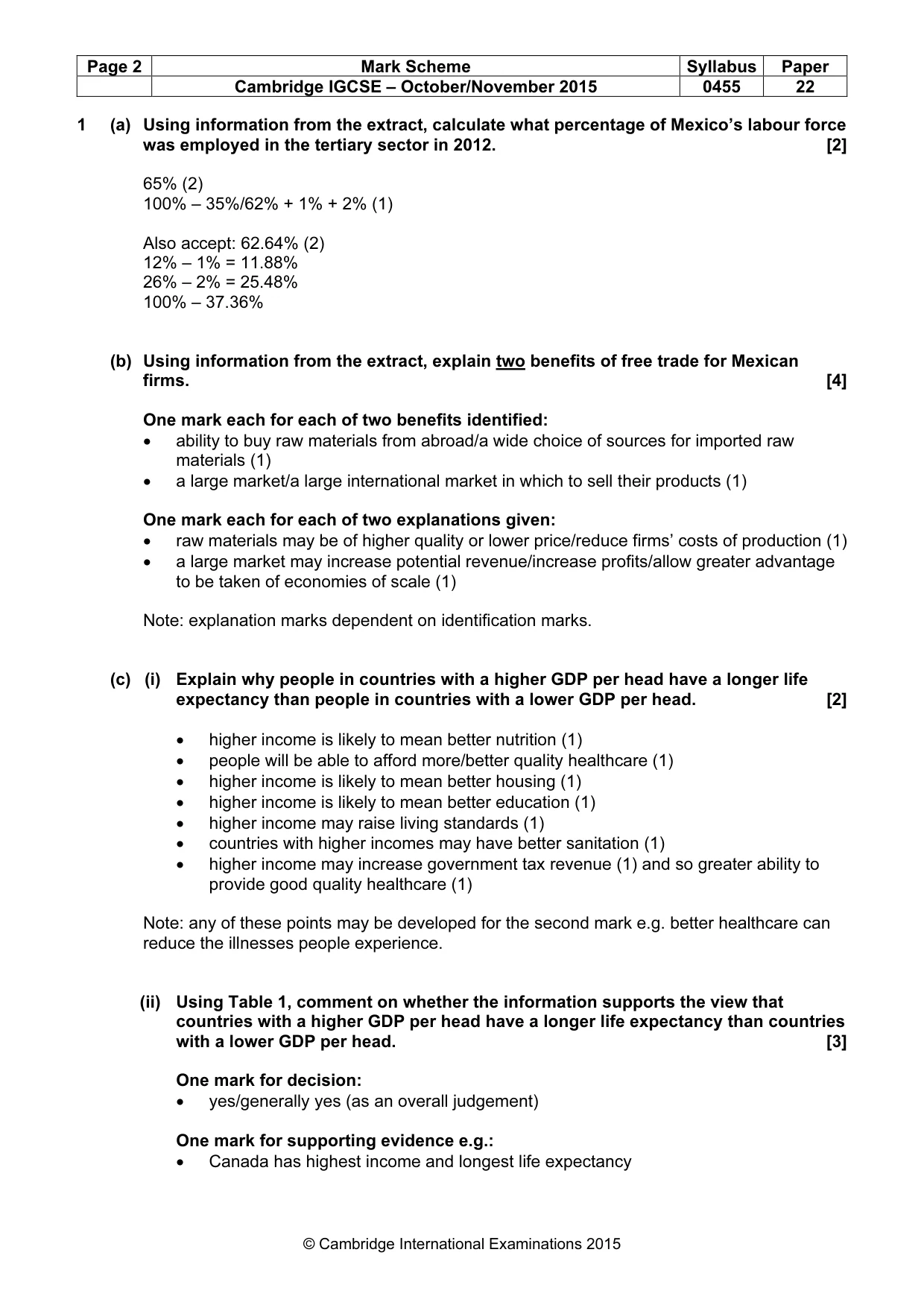
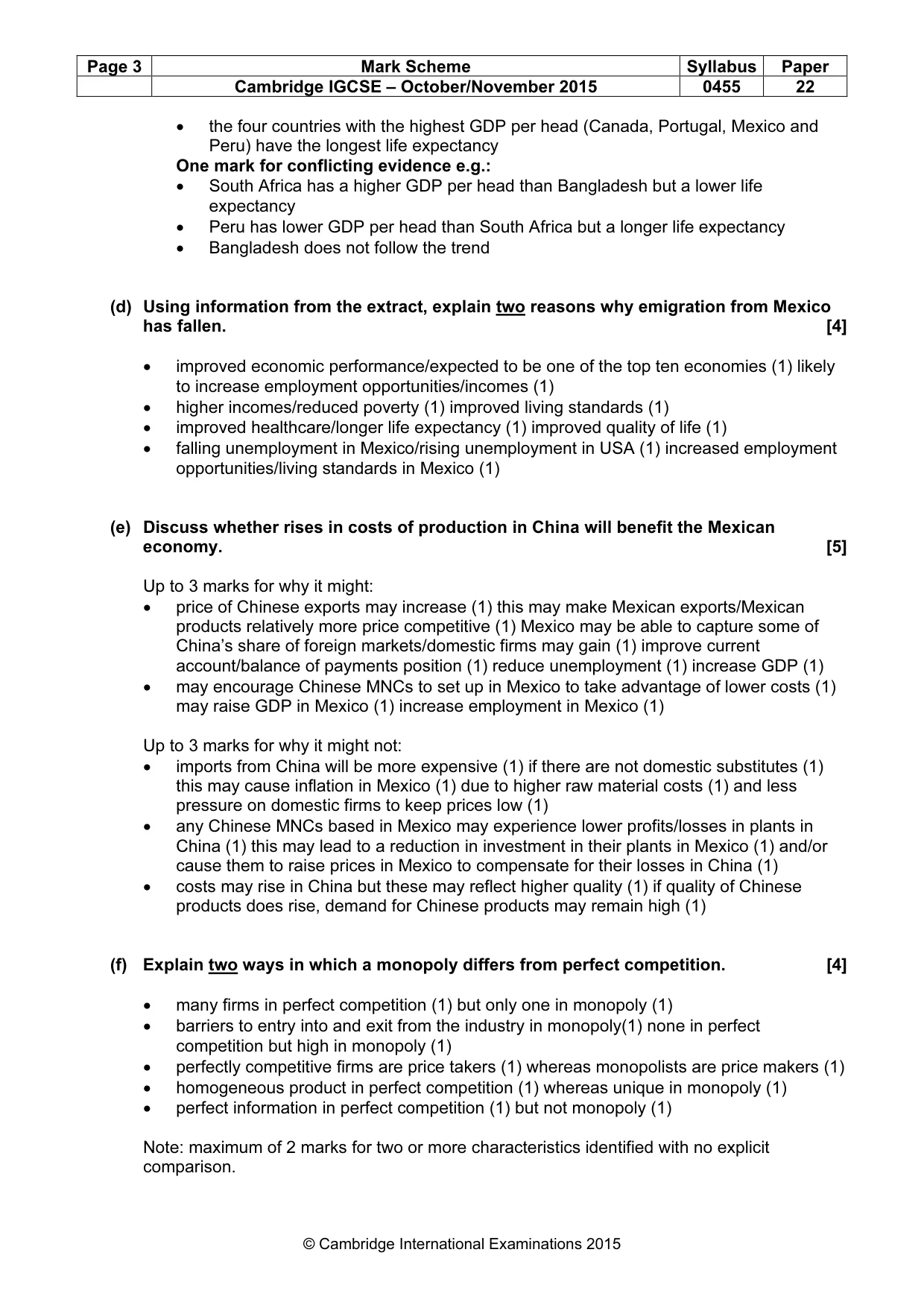
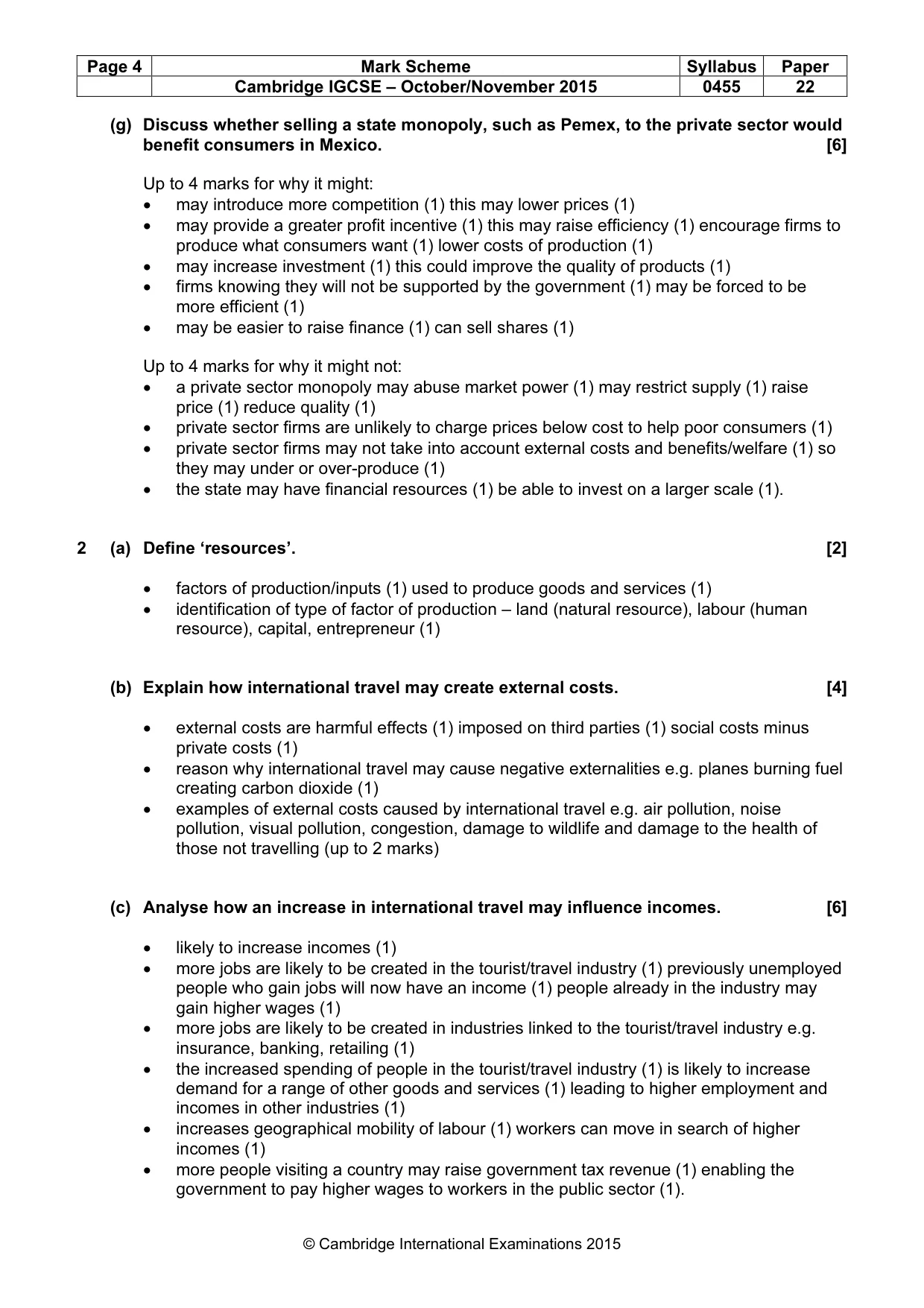
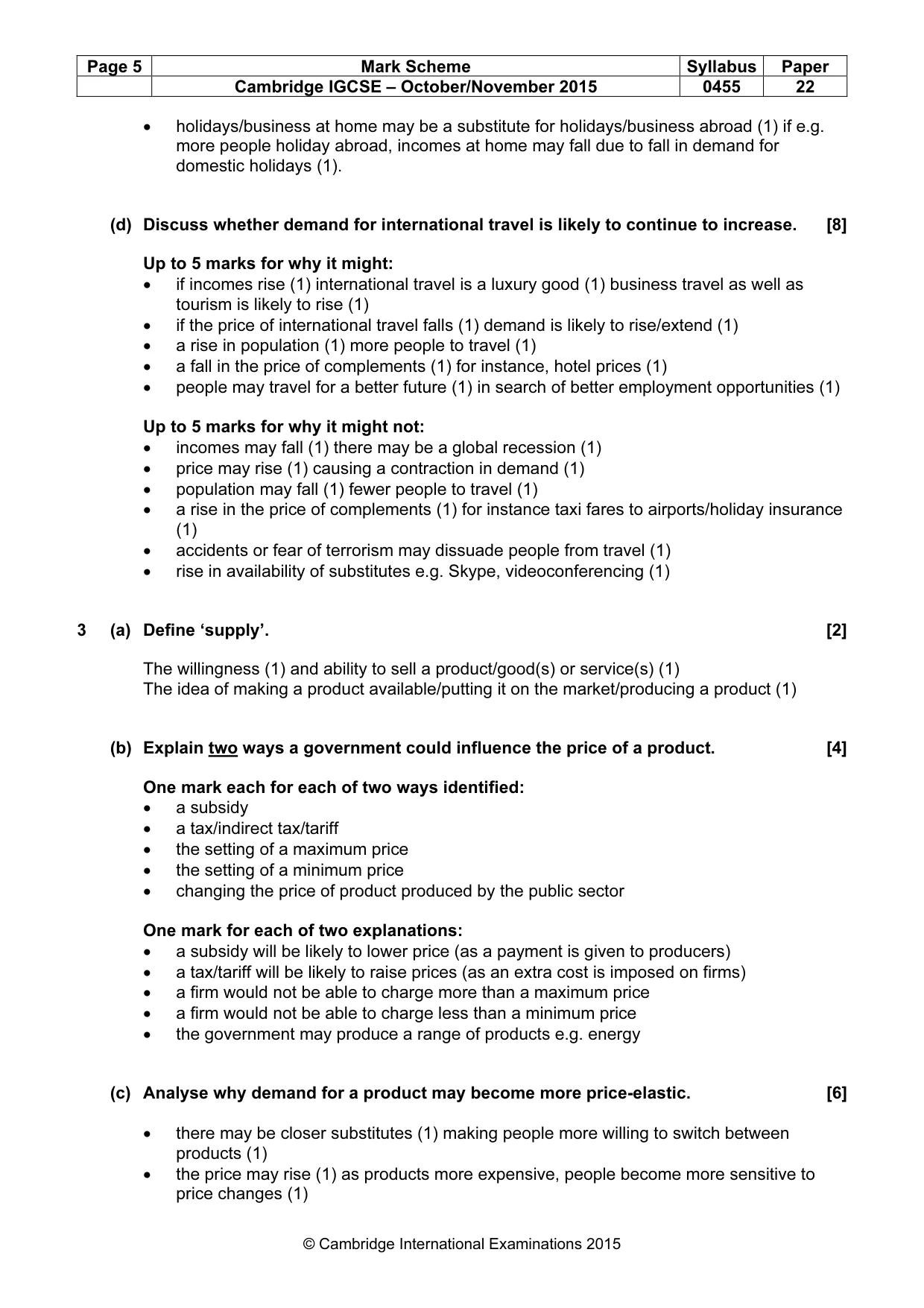
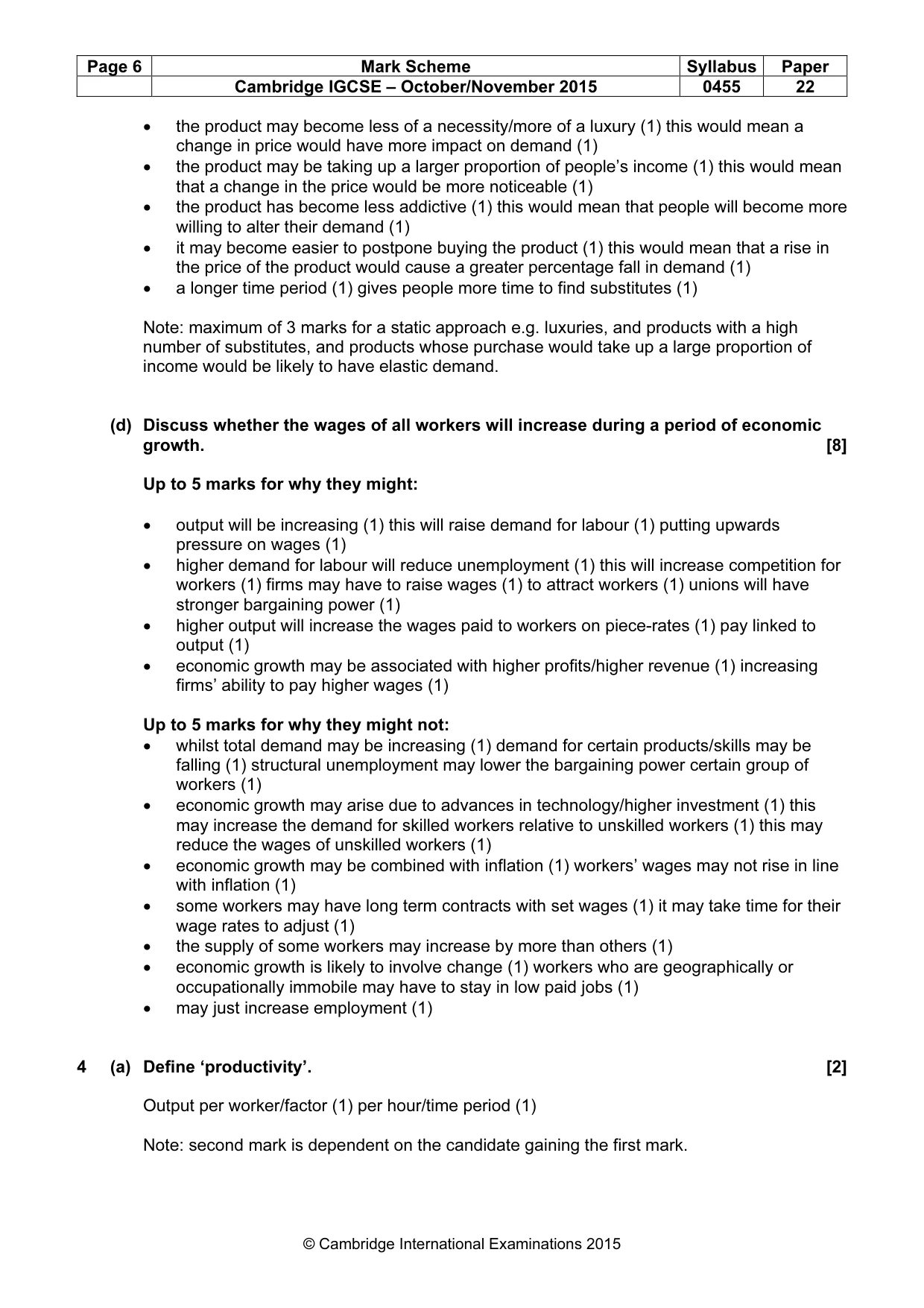
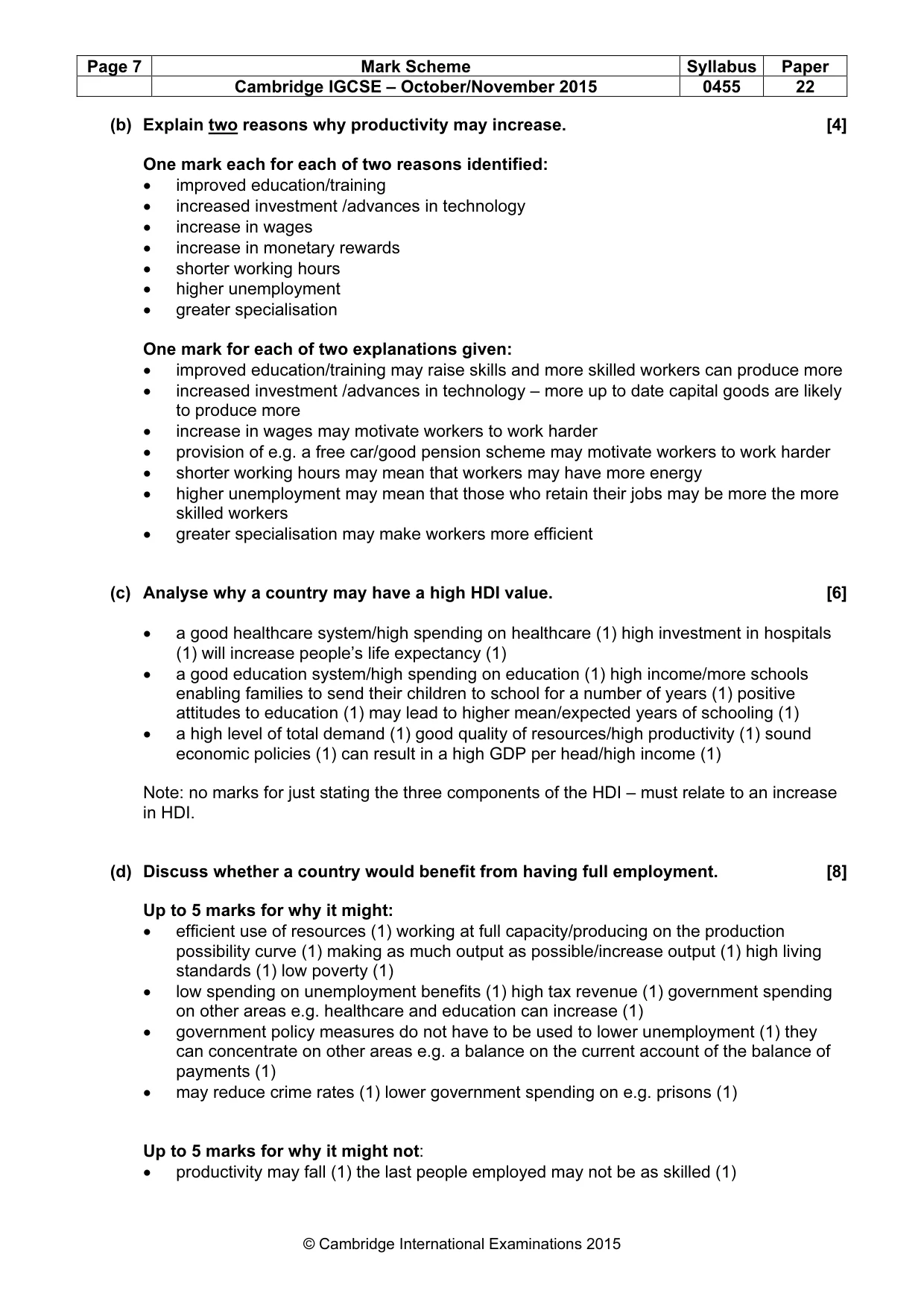
Paper as text
Question paper, page 1
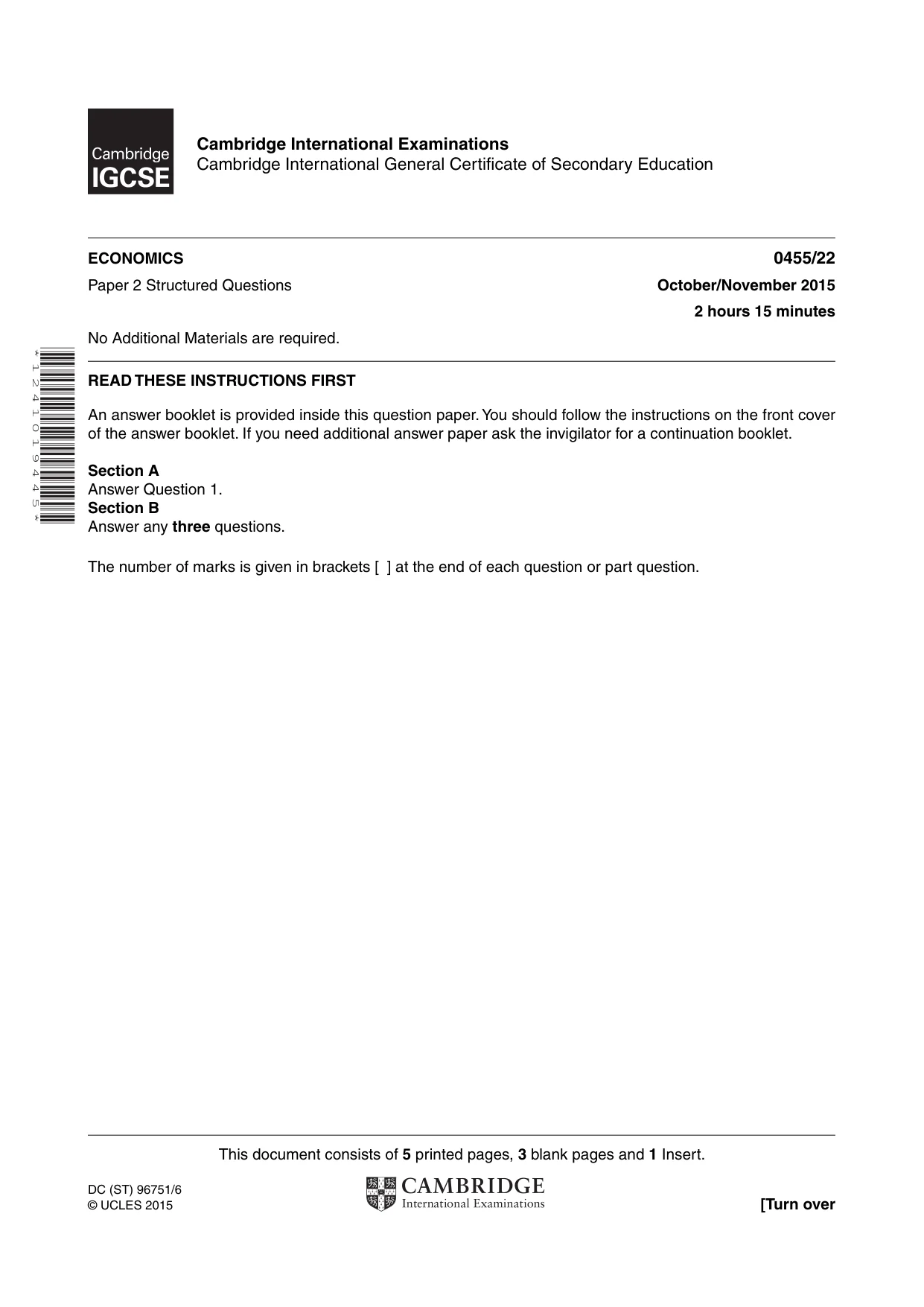
This document consists of 5 printed pages, 3 blank pages and 1 Insert. DC (ST) 96751/6 © UCLES 2015 [Turn over Cambridge International Examinations Cambridge International General Certificate of Secondary Education * 1 2 4 1 0 1 9 4 4 5 * ECONOMICS 0455/22 Paper 2 Structured Questions October/November 2015 2 hours 15 minutes No Additional Materials are required. READ THESE INSTRUCTIONS FIRST An answer booklet is provided inside this question paper. You should follow the instructions on the front cover of the answer booklet. If you need additional answer paper ask the invigilator for a continuation booklet. Section A Answer Question 1. Section B Answer any three questions. The number of marks is given in brackets [ ] at the end of each question or part question.
Question paper, page 2
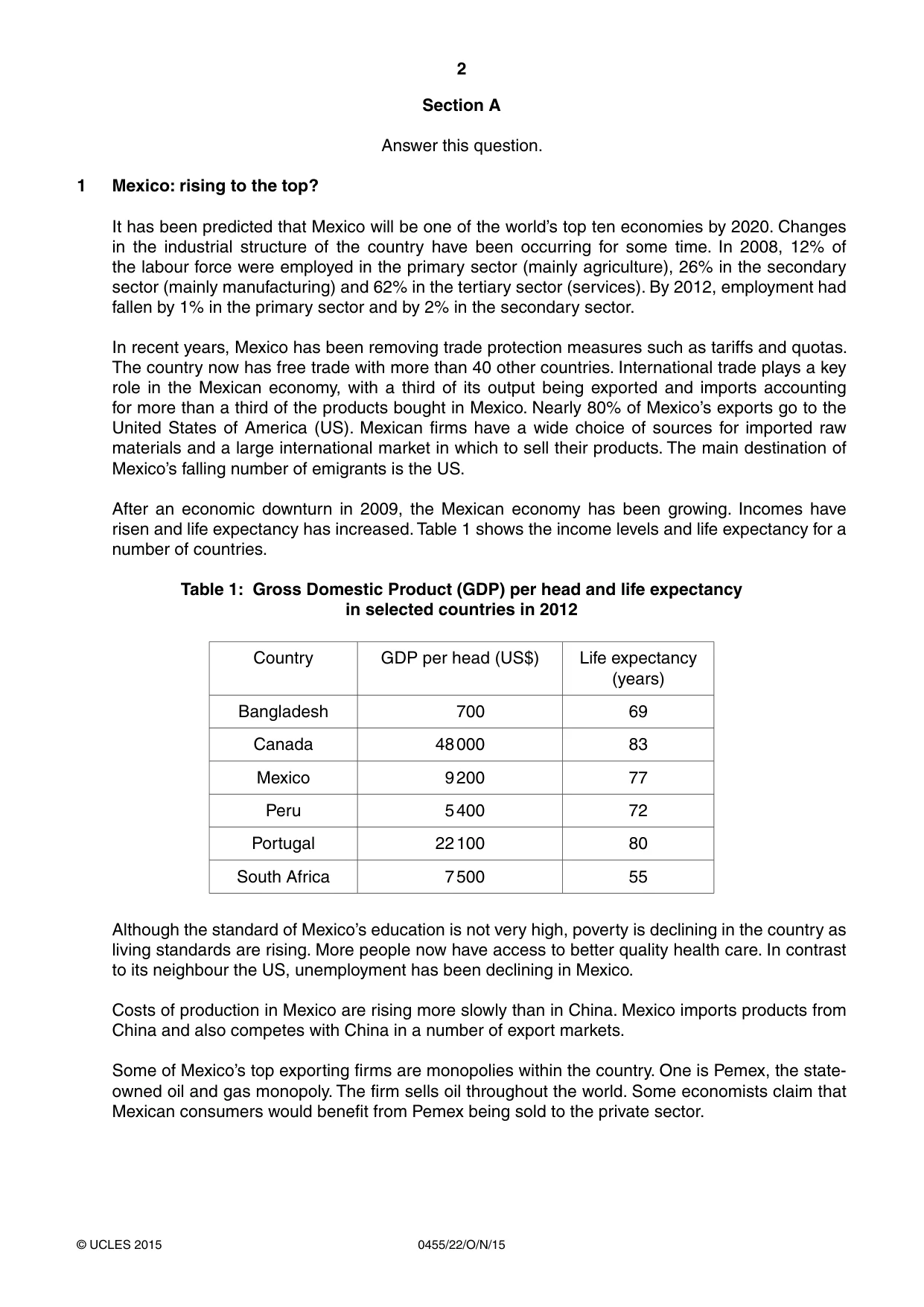
2 0455/22/O/N/15 © UCLES 2015 Section A Answer this question. 1 Mexico: rising to the top? It has been predicted that Mexico will be one of the world’s top ten economies by 2020. Changes in the industrial structure of the country have been occurring for some time. In 2008, 12% of the labour force were employed in the primary sector (mainly agriculture), 26% in the secondary sector (mainly manufacturing) and 62% in the tertiary sector (services). By 2012, employment had fallen by 1% in the primary sector and by 2% in the secondary sector. In recent years, Mexico has been removing trade protection measures such as tariffs and quotas. The country now has free trade with more than 40 other countries. International trade plays a key role in the Mexican economy, with a third of its output being exported and imports accounting for more than a third of the products bought in Mexico. Nearly 80% of Mexico’s exports go to the United States of America (US). Mexican firms have a wide choice of sources for imported raw materials and a large international market in which to sell their products. The main destination of Mexico’s falling number of emigrants is the US. After an economic downturn in 2009, the Mexican economy has been growing. Incomes have risen and life expectancy has increased. Table 1 shows the income levels and life expectancy for a number of countries. Table 1: Gross Domestic Product (GDP) per head and life expectancy in selected countries in 2012 Country GDP per head (US$) Life expectancy (years) Bangladesh 700 69 Canada 48 000 83 Mexico 9 200 77 Peru 5 400 72 Portugal 22 100 80 South Africa 7 500 55 Although the standard of Mexico’s education is not very high, poverty is declining in the country as living standards are rising. More people now have access to better quality health care. In contrast to its neighbour the US, unemployment has been declining in Mexico. Costs of production in Mexico are rising more slowly than in China. Mexico imports products from China and also competes with China in a number of export markets. Some of Mexico’s top exporting firms are monopolies within the country. One is Pemex, the state- owned oil and gas monopoly. The firm sells oil throughout the world. Some economists claim that Mexican consumers would benefit from Pemex being sold to the private sector.
Question paper, page 3
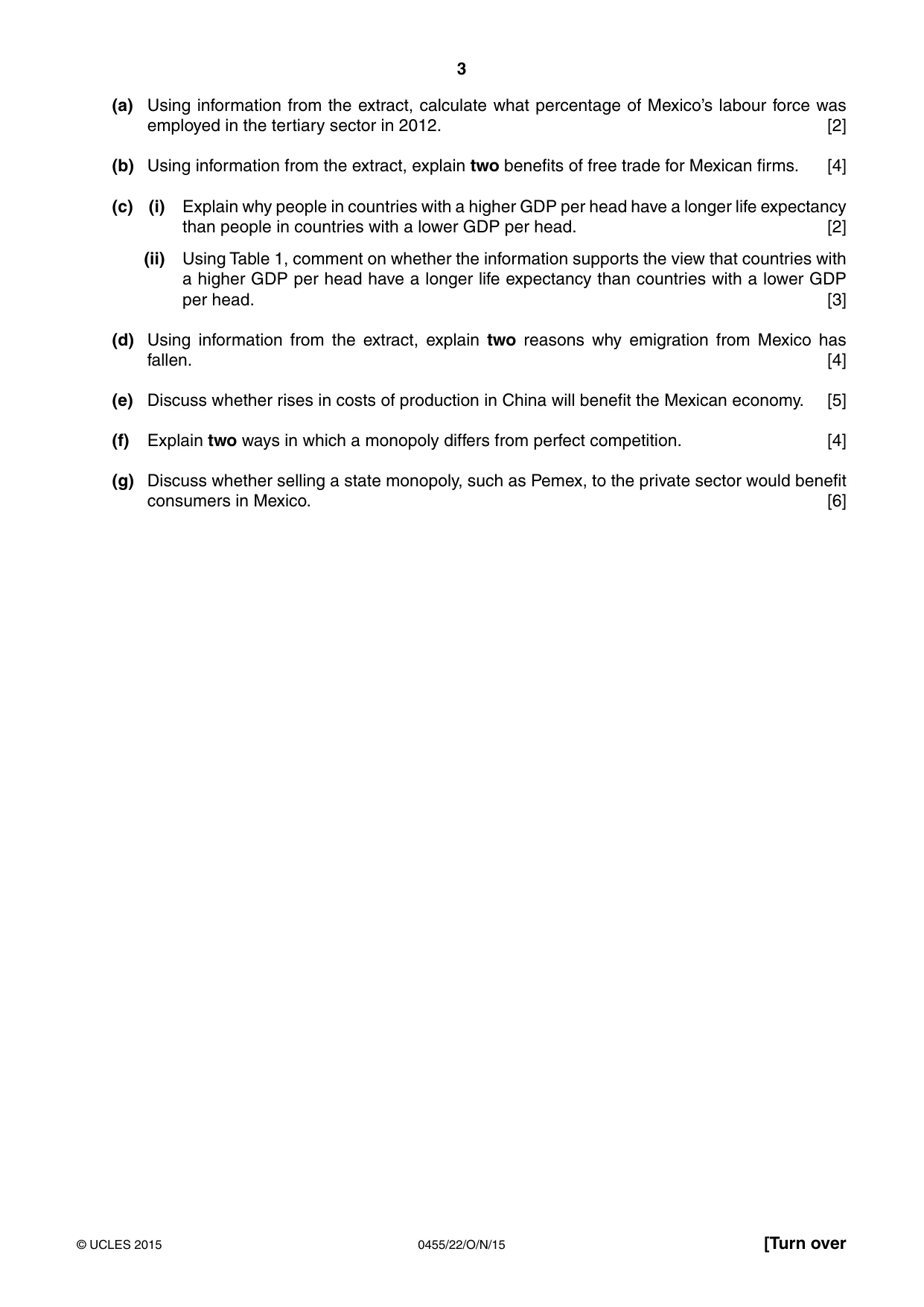
3 0455/22/O/N/15 © UCLES 2015 [Turn over (a) Using information from the extract, calculate what percentage of Mexico’s labour force was employed in the tertiary sector in 2012. [2] (b) Using information from the extract, explain two benefits of free trade for Mexican firms. [4] (c) (i) Explain why people in countries with a higher GDP per head have a longer life expectancy than people in countries with a lower GDP per head. [2] (ii) Using Table 1, comment on whether the information supports the view that countries with a higher GDP per head have a longer life expectancy than countries with a lower GDP per head. [3] (d) Using information from the extract, explain two reasons why emigration from Mexico has fallen. [4] (e) Discuss whether rises in costs of production in China will benefit the Mexican economy. [5] (f) Explain two ways in which a monopoly differs from perfect competition. [4] (g) Discuss whether selling a state monopoly, such as Pemex, to the private sector would benefit consumers in Mexico. [6]
Question paper, page 4
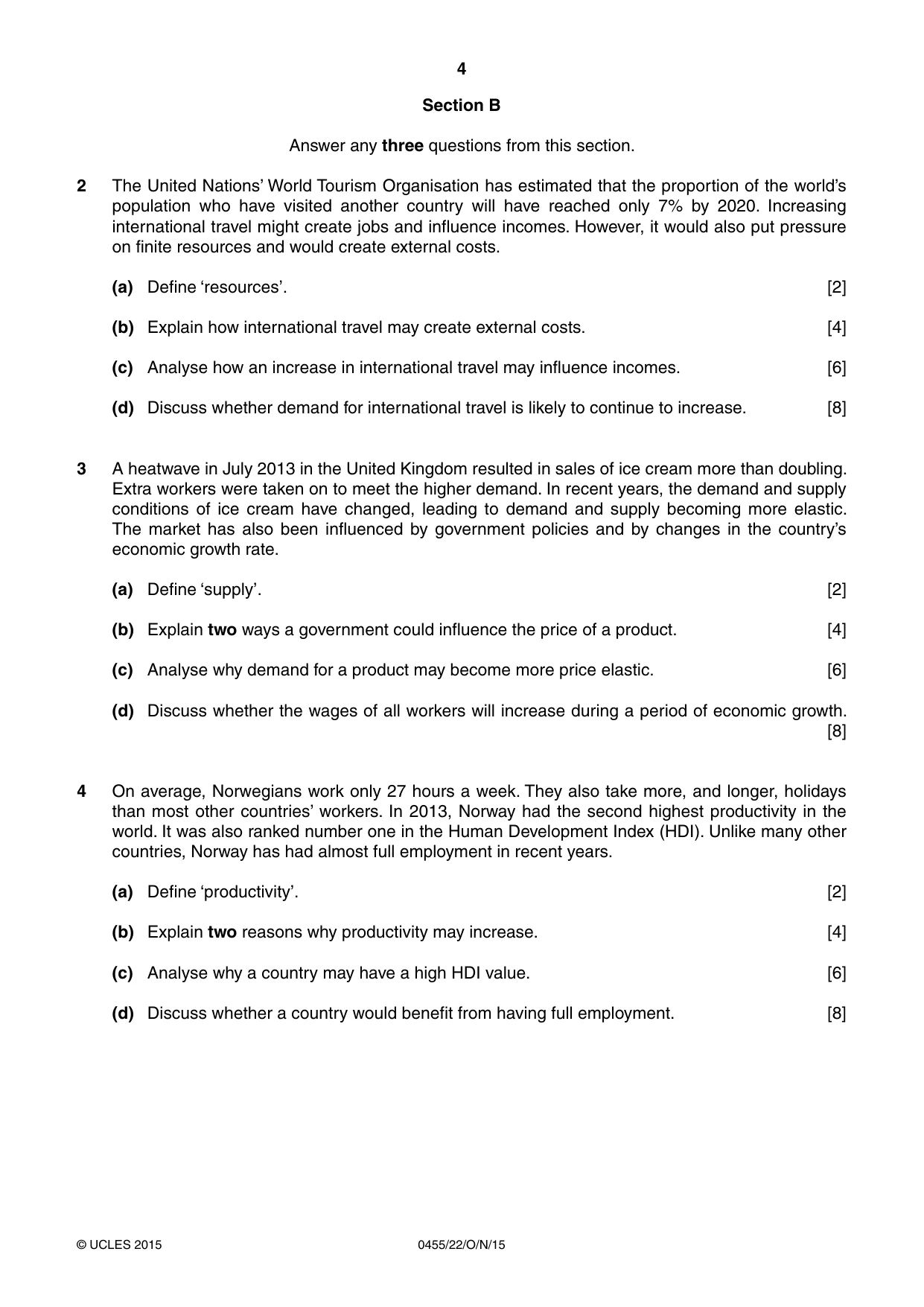
4 0455/22/O/N/15 © UCLES 2015 Section B Answer any three questions from this section. 2 The United Nations’ World Tourism Organisation has estimated that the proportion of the world’s population who have visited another country will have reached only 7% by 2020. Increasing international travel might create jobs and influence incomes. However, it would also put pressure on finite resources and would create external costs. (a) Define ‘resources’. [2] (b) Explain how international travel may create external costs. [4] (c) Analyse how an increase in international travel may influence incomes. [6] (d) Discuss whether demand for international travel is likely to continue to increase. [8] 3 A heatwave in July 2013 in the United Kingdom resulted in sales of ice cream more than doubling. Extra workers were taken on to meet the higher demand. In recent years, the demand and supply conditions of ice cream have changed, leading to demand and supply becoming more elastic. The market has also been influenced by government policies and by changes in the country’s economic growth rate. (a) Define ‘supply’. [2] (b) Explain two ways a government could influence the price of a product. [4] (c) Analyse why demand for a product may become more price elastic. [6] (d) Discuss whether the wages of all workers will increase during a period of economic growth. [8] 4 On average, Norwegians work only 27 hours a week. They also take more, and longer, holidays than most other countries’ workers. In 2013, Norway had the second highest productivity in the world. It was also ranked number one in the Human Development Index (HDI). Unlike many other countries, Norway has had almost full employment in recent years. (a) Define ‘productivity’. [2] (b) Explain two reasons why productivity may increase. [4] (c) Analyse why a country may have a high HDI value. [6] (d) Discuss whether a country would benefit from having full employment. [8]
Question paper, page 5
5 0455/22/O/N/15 © UCLES 2015 5 In 2009, a digital currency called Bitcoin was invented. Between 2009 and 2014 there was a growth in the number of people and firms accepting it as a medium of exchange and store of value. Financial experts have called for digital money to be regulated by central banks. One of their concerns is that it could increase the money supply and cause inflation. (a) Define ‘medium of exchange’. [2] (b) Explain two ways in which a central bank differs from a commercial bank. [4] (c) Analyse how an increase in the money supply may cause inflation and a fall in saving. [6] (d) Discuss whether price stability should be a government’s main economic aim. [8] 6 Capital goods make up over half of Japanese exports. In 2013, although Japan’s imports rose more rapidly than its exports, there was still a surplus on the current account of its balance of payments. Across the world, increasing trade was leading to new airports being opened to meet the demand for transporting goods. (a) Define ‘capital good’. [2] (b) Explain two reasons why a country’s export revenue might increase when export prices rise. [4] (c) Analyse how a government could increase the surplus on the country’s current account of the balance of payments. [6] (d) Discuss whether new airports should be built and operated by governments or the private sector. [8] 7 Myanmar (Burma) is seeking to move from being a developing to a developed country. It has a lower savings ratio than most other Asian economies, with its people spending most of their income. The country’s Government is encouraging investment from abroad to increase its economic growth. The Government is using fiscal policy in an attempt to reduce poverty, which affects a third of its population. (a) Identify two characteristics of a developed country. [2] (b) Explain two reasons why people may spend most of their income. [4] (c) Analyse how an increase in investment may increase a country’s economic growth rate. [6] (d) Discuss whether fiscal policy measures will reduce poverty. [8]
Question paper, page 6
6 0455/22/O/N/15 © UCLES 2015 BLANK PAGE
Question paper, page 7
7 0455/22/O/N/15 © UCLES 2015 BLANK PAGE
Question paper, page 8
8 0455/22/O/N/15 © UCLES 2015 BLANK PAGE Permission to reproduce items where third-party owned material protected by copyright is included has been sought and cleared where possible. Every reasonable effort has been made by the publisher (UCLES) to trace copyright holders, but if any items requiring clearance have unwittingly been included, the publisher will be pleased to make amends at the earliest possible opportunity. To avoid the issue of disclosure of answer-related information to candidates, all copyright acknowledgements are reproduced online in the Cambridge International Examinations Copyright Acknowledgements Booklet. This is produced for each series of examinations and is freely available to download at www.cie.org.uk after the live examination series. Cambridge International Examinations is part of the Cambridge Assessment Group. Cambridge Assessment is the brand name of University of Cambridge Local Examinations Syndicate (UCLES), which is itself a department of the University of Cambridge.
Mark scheme, page 1
® IGCSE is the registered trademark of Cambridge International Examinations. CAMBRIDGE INTERNATIONAL EXAMINATIONS Cambridge International General Certificate of Secondary Education MARK SCHEME for the October/November 2015 series 0455 ECONOMICS 0455/22 Paper 2 (Structured Questions), maximum raw mark 90 This mark scheme is published as an aid to teachers and candidates, to indicate the requirements of the examination. It shows the basis on which Examiners were instructed to award marks. It does not indicate the details of the discussions that took place at an Examiners’ meeting before marking began, which would have considered the acceptability of alternative answers. Mark schemes should be read in conjunction with the question paper and the Principal Examiner Report for Teachers. Cambridge will not enter into discussions about these mark schemes. Cambridge is publishing the mark schemes for the October/November 2015 series for most Cambridge IGCSE®, Cambridge International A and AS Level components and some Cambridge O Level components.
Mark scheme, page 2
Page 2 Mark Scheme Syllabus Paper Cambridge IGCSE – October/November 2015 0455 22 © Cambridge International Examinations 2015 1 (a) Using information from the extract, calculate what percentage of Mexico’s labour force was employed in the tertiary sector in 2012. [2] 65% (2) 100% – 35%/62% + 1% + 2% (1) Also accept: 62.64% (2) 12% – 1% = 11.88% 26% – 2% = 25.48% 100% – 37.36% (b) Using information from the extract, explain two benefits of free trade for Mexican firms. [4] One mark each for each of two benefits identified: • ability to buy raw materials from abroad/a wide choice of sources for imported raw materials (1) • a large market/a large international market in which to sell their products (1) One mark each for each of two explanations given: • raw materials may be of higher quality or lower price/reduce firms’ costs of production (1) • a large market may increase potential revenue/increase profits/allow greater advantage to be taken of economies of scale (1) Note: explanation marks dependent on identification marks. (c) (i) Explain why people in countries with a higher GDP per head have a longer life expectancy than people in countries with a lower GDP per head. [2] • higher income is likely to mean better nutrition (1) • people will be able to afford more/better quality healthcare (1) • higher income is likely to mean better housing (1) • higher income is likely to mean better education (1) • higher income may raise living standards (1) • countries with higher incomes may have better sanitation (1) • higher income may increase government tax revenue (1) and so greater ability to provide good quality healthcare (1) Note: any of these points may be developed for the second mark e.g. better healthcare can reduce the illnesses people experience. (ii) Using Table 1, comment on whether the information supports the view that countries with a higher GDP per head have a longer life expectancy than countries with a lower GDP per head. [3] One mark for decision: • yes/generally yes (as an overall judgement) One mark for supporting evidence e.g.: • Canada has highest income and longest life expectancy
Mark scheme, page 3
Page 3 Mark Scheme Syllabus Paper Cambridge IGCSE – October/November 2015 0455 22 © Cambridge International Examinations 2015 • the four countries with the highest GDP per head (Canada, Portugal, Mexico and Peru) have the longest life expectancy One mark for conflicting evidence e.g.: • South Africa has a higher GDP per head than Bangladesh but a lower life expectancy • Peru has lower GDP per head than South Africa but a longer life expectancy • Bangladesh does not follow the trend (d) Using information from the extract, explain two reasons why emigration from Mexico has fallen. [4] • improved economic performance/expected to be one of the top ten economies (1) likely to increase employment opportunities/incomes (1) • higher incomes/reduced poverty (1) improved living standards (1) • improved healthcare/longer life expectancy (1) improved quality of life (1) • falling unemployment in Mexico/rising unemployment in USA (1) increased employment opportunities/living standards in Mexico (1) (e) Discuss whether rises in costs of production in China will benefit the Mexican economy. [5] Up to 3 marks for why it might: • price of Chinese exports may increase (1) this may make Mexican exports/Mexican products relatively more price competitive (1) Mexico may be able to capture some of China’s share of foreign markets/domestic firms may gain (1) improve current account/balance of payments position (1) reduce unemployment (1) increase GDP (1) • may encourage Chinese MNCs to set up in Mexico to take advantage of lower costs (1) may raise GDP in Mexico (1) increase employment in Mexico (1) Up to 3 marks for why it might not: • imports from China will be more expensive (1) if there are not domestic substitutes (1) this may cause inflation in Mexico (1) due to higher raw material costs (1) and less pressure on domestic firms to keep prices low (1) • any Chinese MNCs based in Mexico may experience lower profits/losses in plants in China (1) this may lead to a reduction in investment in their plants in Mexico (1) and/or cause them to raise prices in Mexico to compensate for their losses in China (1) • costs may rise in China but these may reflect higher quality (1) if quality of Chinese products does rise, demand for Chinese products may remain high (1) (f) Explain two ways in which a monopoly differs from perfect competition. [4] • many firms in perfect competition (1) but only one in monopoly (1) • barriers to entry into and exit from the industry in monopoly(1) none in perfect competition but high in monopoly (1) • perfectly competitive firms are price takers (1) whereas monopolists are price makers (1) • homogeneous product in perfect competition (1) whereas unique in monopoly (1) • perfect information in perfect competition (1) but not monopoly (1) Note: maximum of 2 marks for two or more characteristics identified with no explicit comparison.
Mark scheme, page 4
Page 4 Mark Scheme Syllabus Paper Cambridge IGCSE – October/November 2015 0455 22 © Cambridge International Examinations 2015 (g) Discuss whether selling a state monopoly, such as Pemex, to the private sector would benefit consumers in Mexico. [6] Up to 4 marks for why it might: • may introduce more competition (1) this may lower prices (1) • may provide a greater profit incentive (1) this may raise efficiency (1) encourage firms to produce what consumers want (1) lower costs of production (1) • may increase investment (1) this could improve the quality of products (1) • firms knowing they will not be supported by the government (1) may be forced to be more efficient (1) • may be easier to raise finance (1) can sell shares (1) Up to 4 marks for why it might not: • a private sector monopoly may abuse market power (1) may restrict supply (1) raise price (1) reduce quality (1) • private sector firms are unlikely to charge prices below cost to help poor consumers (1) • private sector firms may not take into account external costs and benefits/welfare (1) so they may under or over-produce (1) • the state may have financial resources (1) be able to invest on a larger scale (1). 2 (a) Define ‘resources’. [2] • factors of production/inputs (1) used to produce goods and services (1) • identification of type of factor of production – land (natural resource), labour (human resource), capital, entrepreneur (1) (b) Explain how international travel may create external costs. [4] • external costs are harmful effects (1) imposed on third parties (1) social costs minus private costs (1) • reason why international travel may cause negative externalities e.g. planes burning fuel creating carbon dioxide (1) • examples of external costs caused by international travel e.g. air pollution, noise pollution, visual pollution, congestion, damage to wildlife and damage to the health of those not travelling (up to 2 marks) (c) Analyse how an increase in international travel may influence incomes. [6] • likely to increase incomes (1) • more jobs are likely to be created in the tourist/travel industry (1) previously unemployed people who gain jobs will now have an income (1) people already in the industry may gain higher wages (1) • more jobs are likely to be created in industries linked to the tourist/travel industry e.g. insurance, banking, retailing (1) • the increased spending of people in the tourist/travel industry (1) is likely to increase demand for a range of other goods and services (1) leading to higher employment and incomes in other industries (1) • increases geographical mobility of labour (1) workers can move in search of higher incomes (1) • more people visiting a country may raise government tax revenue (1) enabling the government to pay higher wages to workers in the public sector (1).
Mark scheme, page 5
Page 5 Mark Scheme Syllabus Paper Cambridge IGCSE – October/November 2015 0455 22 © Cambridge International Examinations 2015 • holidays/business at home may be a substitute for holidays/business abroad (1) if e.g. more people holiday abroad, incomes at home may fall due to fall in demand for domestic holidays (1). (d) Discuss whether demand for international travel is likely to continue to increase. [8] Up to 5 marks for why it might: • if incomes rise (1) international travel is a luxury good (1) business travel as well as tourism is likely to rise (1) • if the price of international travel falls (1) demand is likely to rise/extend (1) • a rise in population (1) more people to travel (1) • a fall in the price of complements (1) for instance, hotel prices (1) • people may travel for a better future (1) in search of better employment opportunities (1) Up to 5 marks for why it might not: • incomes may fall (1) there may be a global recession (1) • price may rise (1) causing a contraction in demand (1) • population may fall (1) fewer people to travel (1) • a rise in the price of complements (1) for instance taxi fares to airports/holiday insurance (1) • accidents or fear of terrorism may dissuade people from travel (1) • rise in availability of substitutes e.g. Skype, videoconferencing (1) 3 (a) Define ‘supply’. [2] The willingness (1) and ability to sell a product/good(s) or service(s) (1) The idea of making a product available/putting it on the market/producing a product (1) (b) Explain two ways a government could influence the price of a product. [4] One mark each for each of two ways identified: • a subsidy • a tax/indirect tax/tariff • the setting of a maximum price • the setting of a minimum price • changing the price of product produced by the public sector One mark for each of two explanations: • a subsidy will be likely to lower price (as a payment is given to producers) • a tax/tariff will be likely to raise prices (as an extra cost is imposed on firms) • a firm would not be able to charge more than a maximum price • a firm would not be able to charge less than a minimum price • the government may produce a range of products e.g. energy (c) Analyse why demand for a product may become more price-elastic. [6] • there may be closer substitutes (1) making people more willing to switch between products (1) • the price may rise (1) as products more expensive, people become more sensitive to price changes (1)
Mark scheme, page 6
Page 6 Mark Scheme Syllabus Paper Cambridge IGCSE – October/November 2015 0455 22 © Cambridge International Examinations 2015 • the product may become less of a necessity/more of a luxury (1) this would mean a change in price would have more impact on demand (1) • the product may be taking up a larger proportion of people’s income (1) this would mean that a change in the price would be more noticeable (1) • the product has become less addictive (1) this would mean that people will become more willing to alter their demand (1) • it may become easier to postpone buying the product (1) this would mean that a rise in the price of the product would cause a greater percentage fall in demand (1) • a longer time period (1) gives people more time to find substitutes (1) Note: maximum of 3 marks for a static approach e.g. luxuries, and products with a high number of substitutes, and products whose purchase would take up a large proportion of income would be likely to have elastic demand. (d) Discuss whether the wages of all workers will increase during a period of economic growth. [8] Up to 5 marks for why they might: • output will be increasing (1) this will raise demand for labour (1) putting upwards pressure on wages (1) • higher demand for labour will reduce unemployment (1) this will increase competition for workers (1) firms may have to raise wages (1) to attract workers (1) unions will have stronger bargaining power (1) • higher output will increase the wages paid to workers on piece-rates (1) pay linked to output (1) • economic growth may be associated with higher profits/higher revenue (1) increasing firms’ ability to pay higher wages (1) Up to 5 marks for why they might not: • whilst total demand may be increasing (1) demand for certain products/skills may be falling (1) structural unemployment may lower the bargaining power certain group of workers (1) • economic growth may arise due to advances in technology/higher investment (1) this may increase the demand for skilled workers relative to unskilled workers (1) this may reduce the wages of unskilled workers (1) • economic growth may be combined with inflation (1) workers’ wages may not rise in line with inflation (1) • some workers may have long term contracts with set wages (1) it may take time for their wage rates to adjust (1) • the supply of some workers may increase by more than others (1) • economic growth is likely to involve change (1) workers who are geographically or occupationally immobile may have to stay in low paid jobs (1) • may just increase employment (1) 4 (a) Define ‘productivity’. [2] Output per worker/factor (1) per hour/time period (1) Note: second mark is dependent on the candidate gaining the first mark.
Mark scheme, page 7
Page 7 Mark Scheme Syllabus Paper Cambridge IGCSE – October/November 2015 0455 22 © Cambridge International Examinations 2015 (b) Explain two reasons why productivity may increase. [4] One mark each for each of two reasons identified: • improved education/training • increased investment /advances in technology • increase in wages • increase in monetary rewards • shorter working hours • higher unemployment • greater specialisation One mark for each of two explanations given: • improved education/training may raise skills and more skilled workers can produce more • increased investment /advances in technology – more up to date capital goods are likely to produce more • increase in wages may motivate workers to work harder • provision of e.g. a free car/good pension scheme may motivate workers to work harder • shorter working hours may mean that workers may have more energy • higher unemployment may mean that those who retain their jobs may be more the more skilled workers • greater specialisation may make workers more efficient (c) Analyse why a country may have a high HDI value. [6] • a good healthcare system/high spending on healthcare (1) high investment in hospitals (1) will increase people’s life expectancy (1) • a good education system/high spending on education (1) high income/more schools enabling families to send their children to school for a number of years (1) positive attitudes to education (1) may lead to higher mean/expected years of schooling (1) • a high level of total demand (1) good quality of resources/high productivity (1) sound economic policies (1) can result in a high GDP per head/high income (1) Note: no marks for just stating the three components of the HDI – must relate to an increase in HDI. (d) Discuss whether a country would benefit from having full employment. [8] Up to 5 marks for why it might: • efficient use of resources (1) working at full capacity/producing on the production possibility curve (1) making as much output as possible/increase output (1) high living standards (1) low poverty (1) • low spending on unemployment benefits (1) high tax revenue (1) government spending on other areas e.g. healthcare and education can increase (1) • government policy measures do not have to be used to lower unemployment (1) they can concentrate on other areas e.g. a balance on the current account of the balance of payments (1) • may reduce crime rates (1) lower government spending on e.g. prisons (1) Up to 5 marks for why it might not: • productivity may fall (1) the last people employed may not be as skilled (1)
Mark scheme, page 8
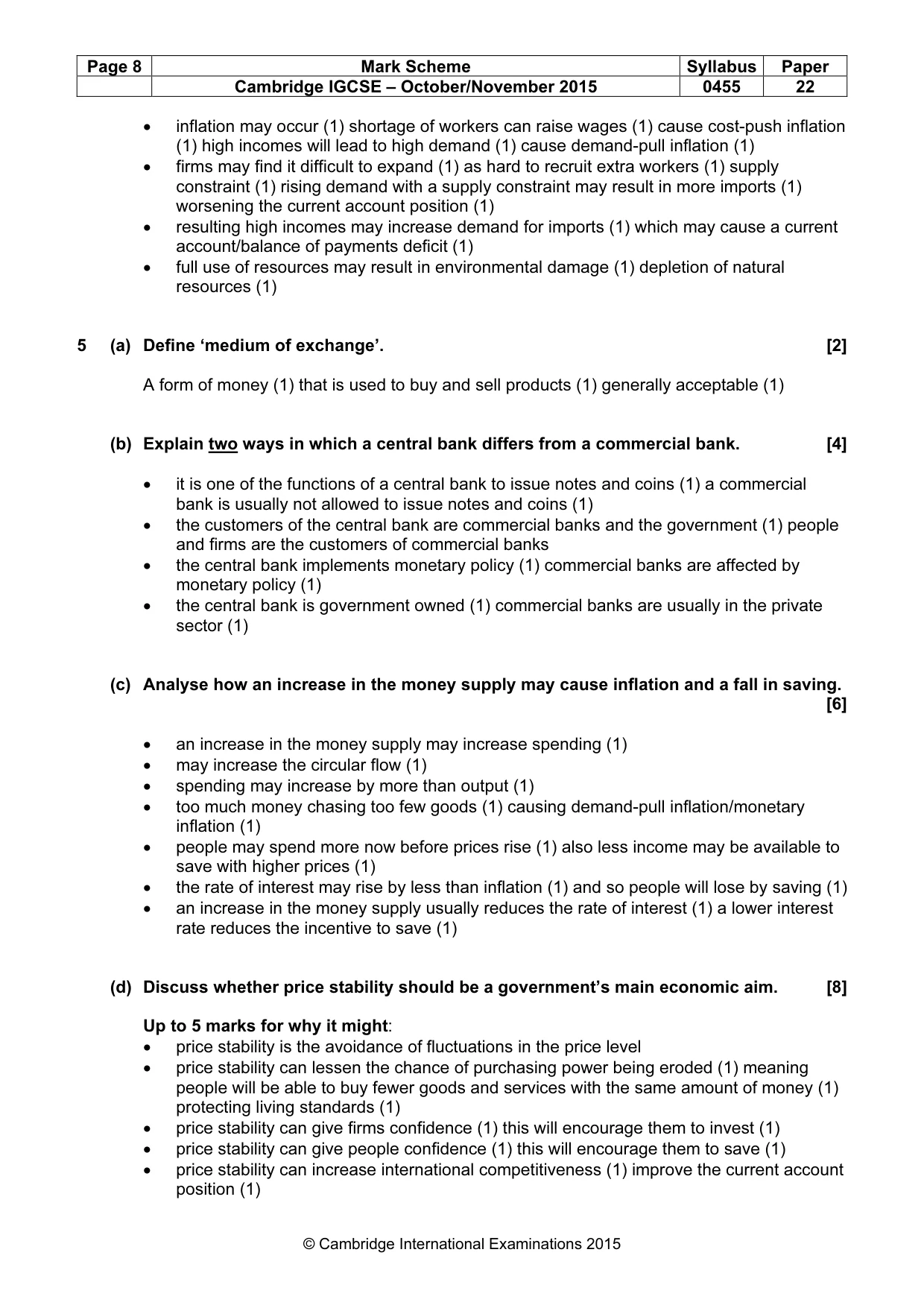
Page 8 Mark Scheme Syllabus Paper Cambridge IGCSE – October/November 2015 0455 22 © Cambridge International Examinations 2015 • inflation may occur (1) shortage of workers can raise wages (1) cause cost-push inflation (1) high incomes will lead to high demand (1) cause demand-pull inflation (1) • firms may find it difficult to expand (1) as hard to recruit extra workers (1) supply constraint (1) rising demand with a supply constraint may result in more imports (1) worsening the current account position (1) • resulting high incomes may increase demand for imports (1) which may cause a current account/balance of payments deficit (1) • full use of resources may result in environmental damage (1) depletion of natural resources (1) 5 (a) Define ‘medium of exchange’. [2] A form of money (1) that is used to buy and sell products (1) generally acceptable (1) (b) Explain two ways in which a central bank differs from a commercial bank. [4] • it is one of the functions of a central bank to issue notes and coins (1) a commercial bank is usually not allowed to issue notes and coins (1) • the customers of the central bank are commercial banks and the government (1) people and firms are the customers of commercial banks • the central bank implements monetary policy (1) commercial banks are affected by monetary policy (1) • the central bank is government owned (1) commercial banks are usually in the private sector (1) (c) Analyse how an increase in the money supply may cause inflation and a fall in saving. [6] • an increase in the money supply may increase spending (1) • may increase the circular flow (1) • spending may increase by more than output (1) • too much money chasing too few goods (1) causing demand-pull inflation/monetary inflation (1) • people may spend more now before prices rise (1) also less income may be available to save with higher prices (1) • the rate of interest may rise by less than inflation (1) and so people will lose by saving (1) • an increase in the money supply usually reduces the rate of interest (1) a lower interest rate reduces the incentive to save (1) (d) Discuss whether price stability should be a government’s main economic aim. [8] Up to 5 marks for why it might: • price stability is the avoidance of fluctuations in the price level • price stability can lessen the chance of purchasing power being eroded (1) meaning people will be able to buy fewer goods and services with the same amount of money (1) protecting living standards (1) • price stability can give firms confidence (1) this will encourage them to invest (1) • price stability can give people confidence (1) this will encourage them to save (1) • price stability can increase international competitiveness (1) improve the current account position (1)
Mark scheme, page 9
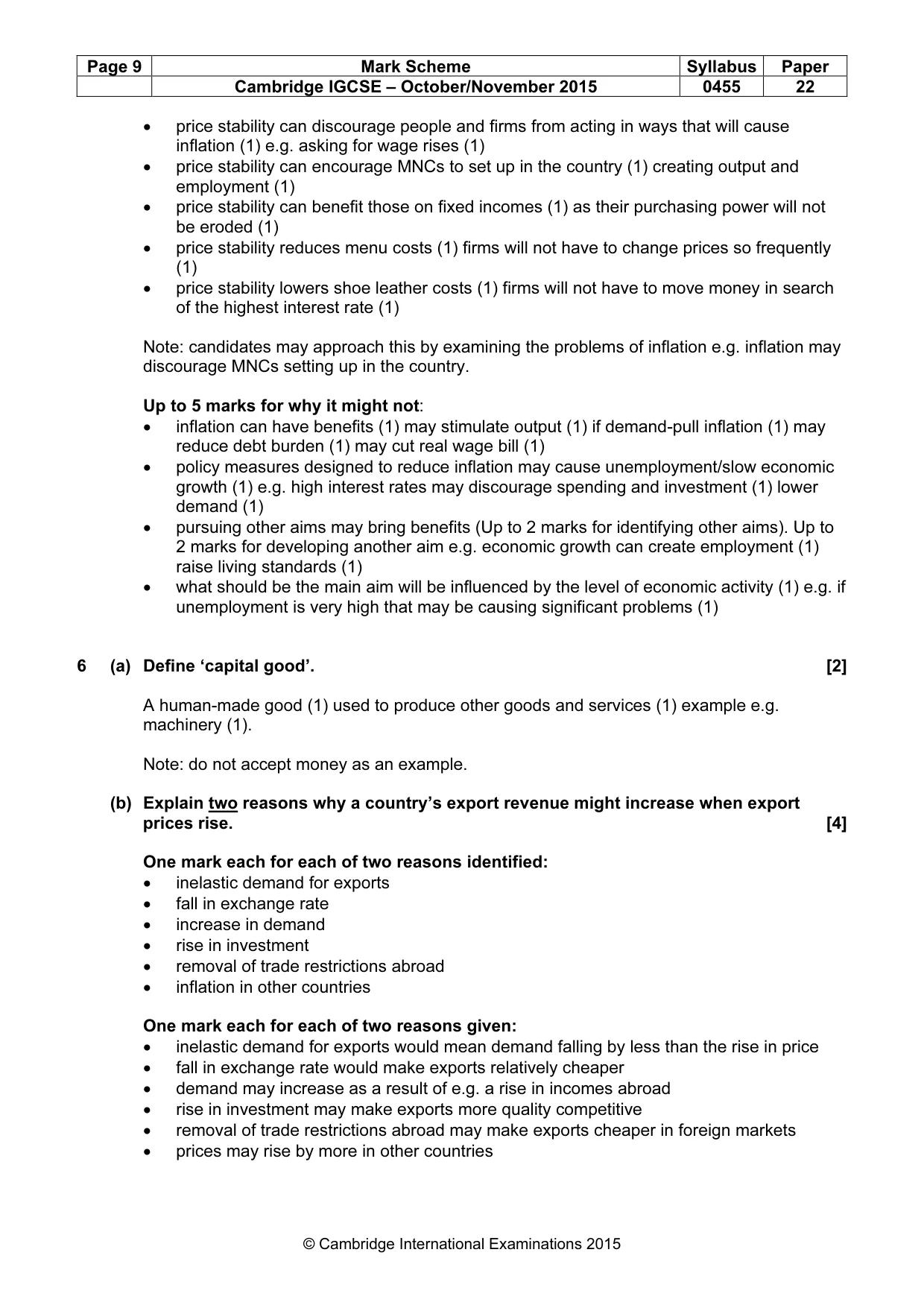
Page 9 Mark Scheme Syllabus Paper Cambridge IGCSE – October/November 2015 0455 22 © Cambridge International Examinations 2015 • price stability can discourage people and firms from acting in ways that will cause inflation (1) e.g. asking for wage rises (1) • price stability can encourage MNCs to set up in the country (1) creating output and employment (1) • price stability can benefit those on fixed incomes (1) as their purchasing power will not be eroded (1) • price stability reduces menu costs (1) firms will not have to change prices so frequently (1) • price stability lowers shoe leather costs (1) firms will not have to move money in search of the highest interest rate (1) Note: candidates may approach this by examining the problems of inflation e.g. inflation may discourage MNCs setting up in the country. Up to 5 marks for why it might not: • inflation can have benefits (1) may stimulate output (1) if demand-pull inflation (1) may reduce debt burden (1) may cut real wage bill (1) • policy measures designed to reduce inflation may cause unemployment/slow economic growth (1) e.g. high interest rates may discourage spending and investment (1) lower demand (1) • pursuing other aims may bring benefits (Up to 2 marks for identifying other aims). Up to 2 marks for developing another aim e.g. economic growth can create employment (1) raise living standards (1) • what should be the main aim will be influenced by the level of economic activity (1) e.g. if unemployment is very high that may be causing significant problems (1) 6 (a) Define ‘capital good’. [2] A human-made good (1) used to produce other goods and services (1) example e.g. machinery (1). Note: do not accept money as an example. (b) Explain two reasons why a country’s export revenue might increase when export prices rise. [4] One mark each for each of two reasons identified: • inelastic demand for exports • fall in exchange rate • increase in demand • rise in investment • removal of trade restrictions abroad • inflation in other countries One mark each for each of two reasons given: • inelastic demand for exports would mean demand falling by less than the rise in price • fall in exchange rate would make exports relatively cheaper • demand may increase as a result of e.g. a rise in incomes abroad • rise in investment may make exports more quality competitive • removal of trade restrictions abroad may make exports cheaper in foreign markets • prices may rise by more in other countries
Mark scheme, page 10
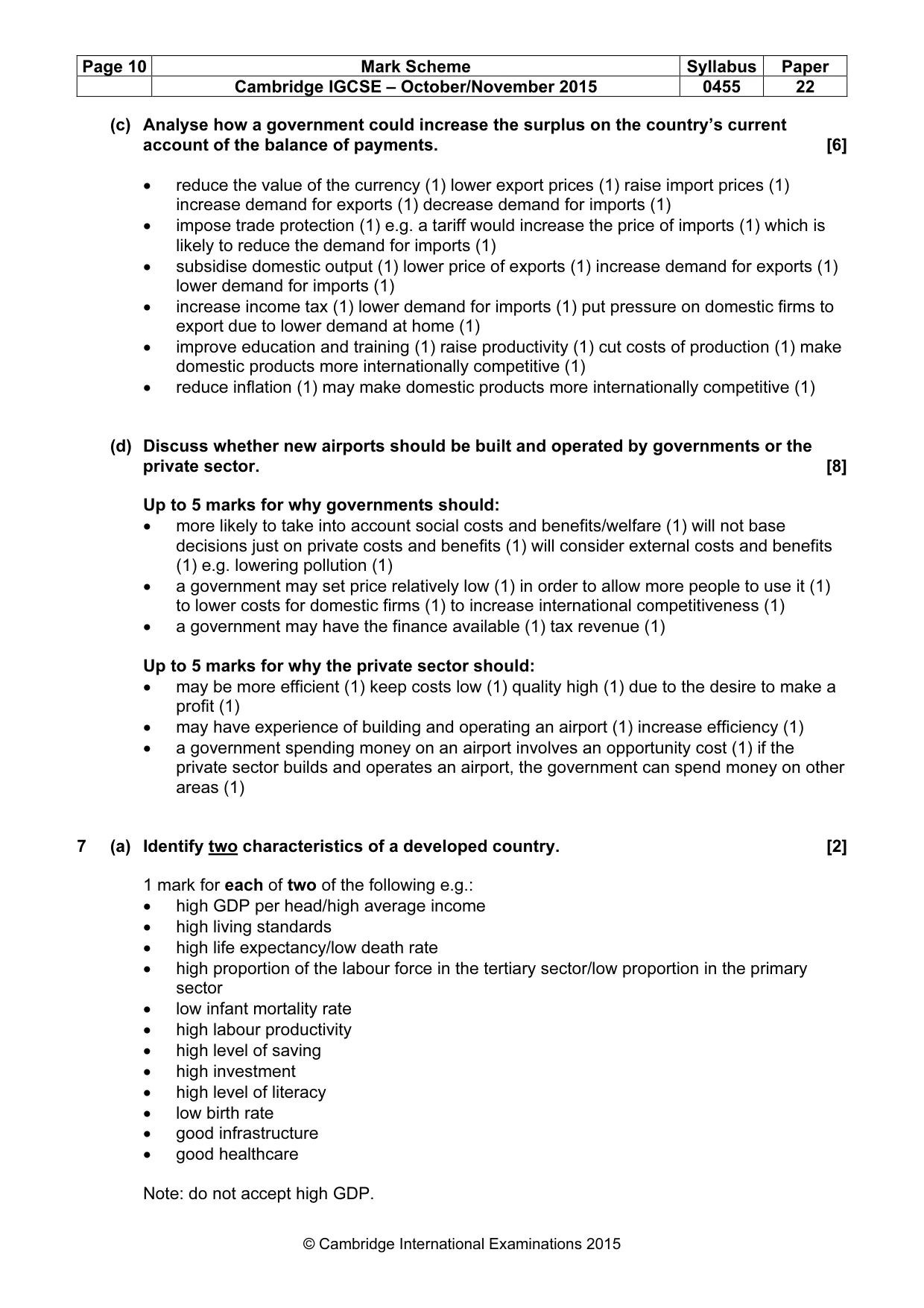
Page 10 Mark Scheme Syllabus Paper Cambridge IGCSE – October/November 2015 0455 22 © Cambridge International Examinations 2015 (c) Analyse how a government could increase the surplus on the country’s current account of the balance of payments. [6] • reduce the value of the currency (1) lower export prices (1) raise import prices (1) increase demand for exports (1) decrease demand for imports (1) • impose trade protection (1) e.g. a tariff would increase the price of imports (1) which is likely to reduce the demand for imports (1) • subsidise domestic output (1) lower price of exports (1) increase demand for exports (1) lower demand for imports (1) • increase income tax (1) lower demand for imports (1) put pressure on domestic firms to export due to lower demand at home (1) • improve education and training (1) raise productivity (1) cut costs of production (1) make domestic products more internationally competitive (1) • reduce inflation (1) may make domestic products more internationally competitive (1) (d) Discuss whether new airports should be built and operated by governments or the private sector. [8] Up to 5 marks for why governments should: • more likely to take into account social costs and benefits/welfare (1) will not base decisions just on private costs and benefits (1) will consider external costs and benefits (1) e.g. lowering pollution (1) • a government may set price relatively low (1) in order to allow more people to use it (1) to lower costs for domestic firms (1) to increase international competitiveness (1) • a government may have the finance available (1) tax revenue (1) Up to 5 marks for why the private sector should: • may be more efficient (1) keep costs low (1) quality high (1) due to the desire to make a profit (1) • may have experience of building and operating an airport (1) increase efficiency (1) • a government spending money on an airport involves an opportunity cost (1) if the private sector builds and operates an airport, the government can spend money on other areas (1) 7 (a) Identify two characteristics of a developed country. [2] 1 mark for each of two of the following e.g.: • high GDP per head/high average income • high living standards • high life expectancy/low death rate • high proportion of the labour force in the tertiary sector/low proportion in the primary sector • low infant mortality rate • high labour productivity • high level of saving • high investment • high level of literacy • low birth rate • good infrastructure • good healthcare Note: do not accept high GDP.
Mark scheme, page 11
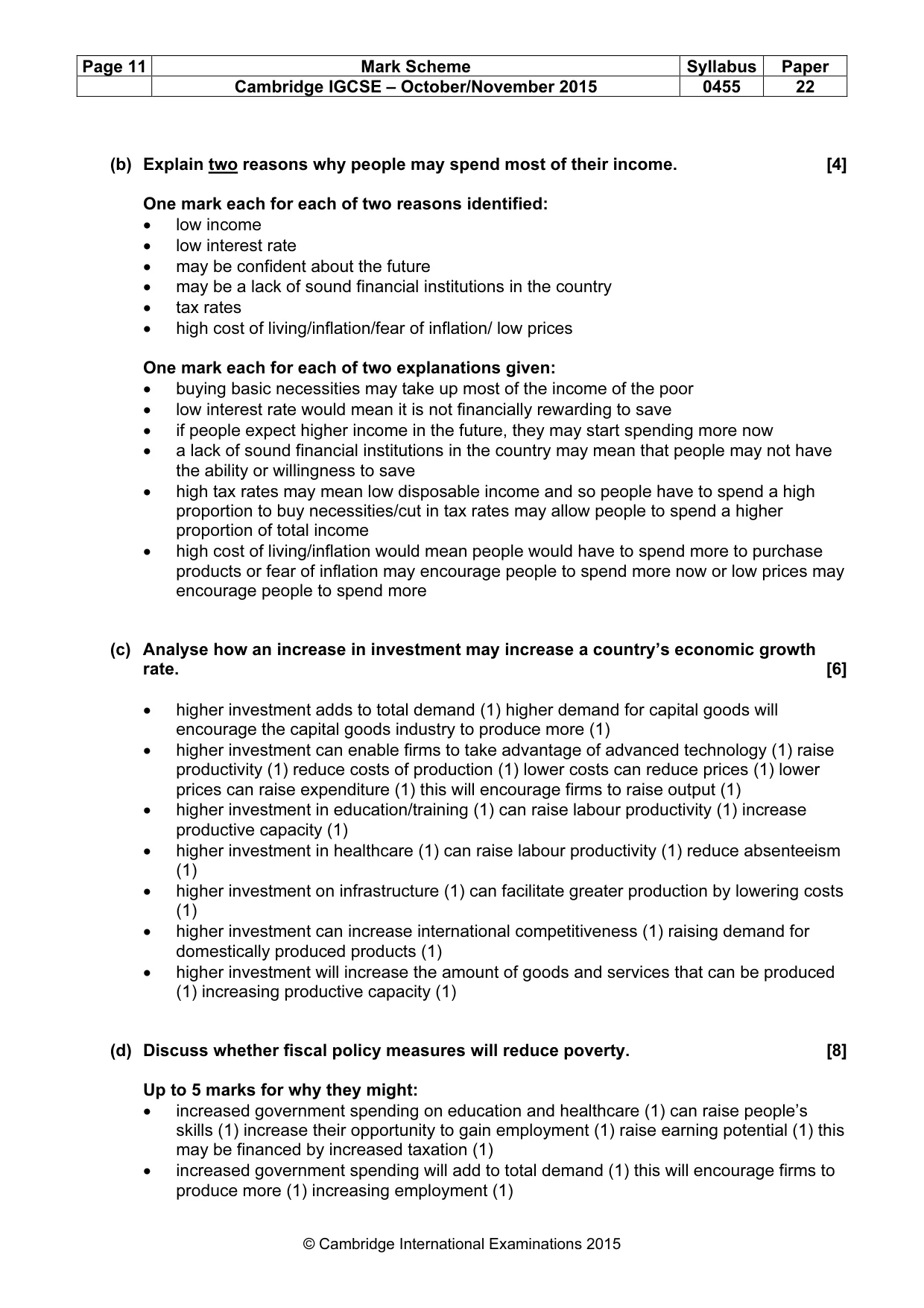
Page 11 Mark Scheme Syllabus Paper Cambridge IGCSE – October/November 2015 0455 22 © Cambridge International Examinations 2015 (b) Explain two reasons why people may spend most of their income. [4] One mark each for each of two reasons identified: • low income • low interest rate • may be confident about the future • may be a lack of sound financial institutions in the country • tax rates • high cost of living/inflation/fear of inflation/ low prices One mark each for each of two explanations given: • buying basic necessities may take up most of the income of the poor • low interest rate would mean it is not financially rewarding to save • if people expect higher income in the future, they may start spending more now • a lack of sound financial institutions in the country may mean that people may not have the ability or willingness to save • high tax rates may mean low disposable income and so people have to spend a high proportion to buy necessities/cut in tax rates may allow people to spend a higher proportion of total income • high cost of living/inflation would mean people would have to spend more to purchase products or fear of inflation may encourage people to spend more now or low prices may encourage people to spend more (c) Analyse how an increase in investment may increase a country’s economic growth rate. [6] • higher investment adds to total demand (1) higher demand for capital goods will encourage the capital goods industry to produce more (1) • higher investment can enable firms to take advantage of advanced technology (1) raise productivity (1) reduce costs of production (1) lower costs can reduce prices (1) lower prices can raise expenditure (1) this will encourage firms to raise output (1) • higher investment in education/training (1) can raise labour productivity (1) increase productive capacity (1) • higher investment in healthcare (1) can raise labour productivity (1) reduce absenteeism (1) • higher investment on infrastructure (1) can facilitate greater production by lowering costs (1) • higher investment can increase international competitiveness (1) raising demand for domestically produced products (1) • higher investment will increase the amount of goods and services that can be produced (1) increasing productive capacity (1) (d) Discuss whether fiscal policy measures will reduce poverty. [8] Up to 5 marks for why they might: • increased government spending on education and healthcare (1) can raise people’s skills (1) increase their opportunity to gain employment (1) raise earning potential (1) this may be financed by increased taxation (1) • increased government spending will add to total demand (1) this will encourage firms to produce more (1) increasing employment (1)
Mark scheme, page 12
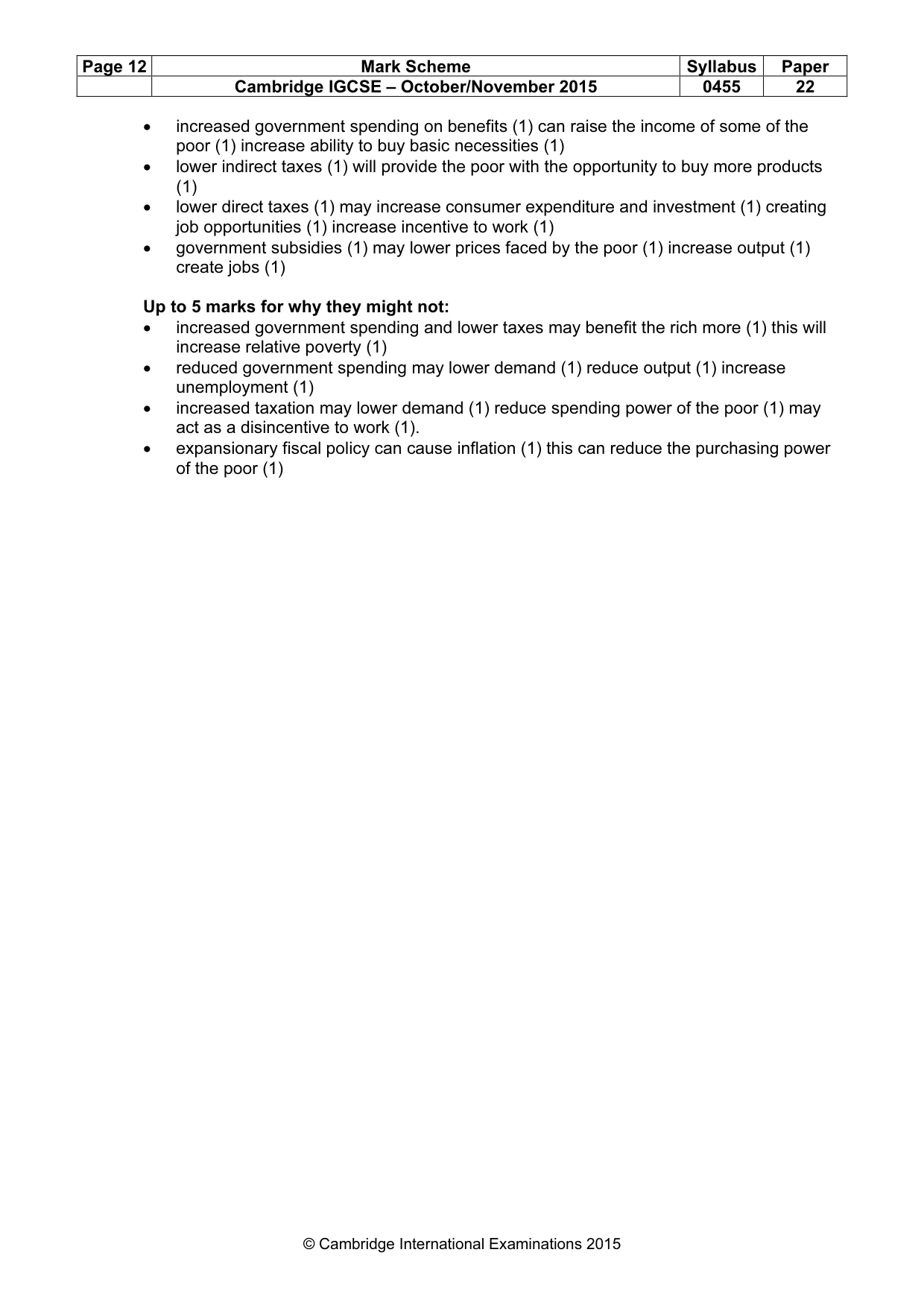
Page 12 Mark Scheme Syllabus Paper Cambridge IGCSE – October/November 2015 0455 22 © Cambridge International Examinations 2015 • increased government spending on benefits (1) can raise the income of some of the poor (1) increase ability to buy basic necessities (1) • lower indirect taxes (1) will provide the poor with the opportunity to buy more products (1) • lower direct taxes (1) may increase consumer expenditure and investment (1) creating job opportunities (1) increase incentive to work (1) • government subsidies (1) may lower prices faced by the poor (1) increase output (1) create jobs (1) Up to 5 marks for why they might not: • increased government spending and lower taxes may benefit the rich more (1) this will increase relative poverty (1) • reduced government spending may lower demand (1) reduce output (1) increase unemployment (1) • increased taxation may lower demand (1) reduce spending power of the poor (1) may act as a disincentive to work (1). • expansionary fiscal policy can cause inflation (1) this can reduce the purchasing power of the poor (1)
What you needed in this session
Cambridge’s own grade thresholds for 2015 Oct/Nov, Paper 2 · Variant 2. A higher threshold means an easier paper — the bar moves with how the cohort did.