Cambridge IGCSE Economics 0455 — 2013 Oct/Nov Paper 2 · Variant 2
0455/22/O/N/13 · 80 marks · ≈90 min
The question paper and its mark scheme, free to read here and free to download. This is Cambridge’s own paper, exactly as it was sat.
Question paper4 pages
Mark scheme9 pages
Answers below. Sit the paper first if you are practising.
Paper as text
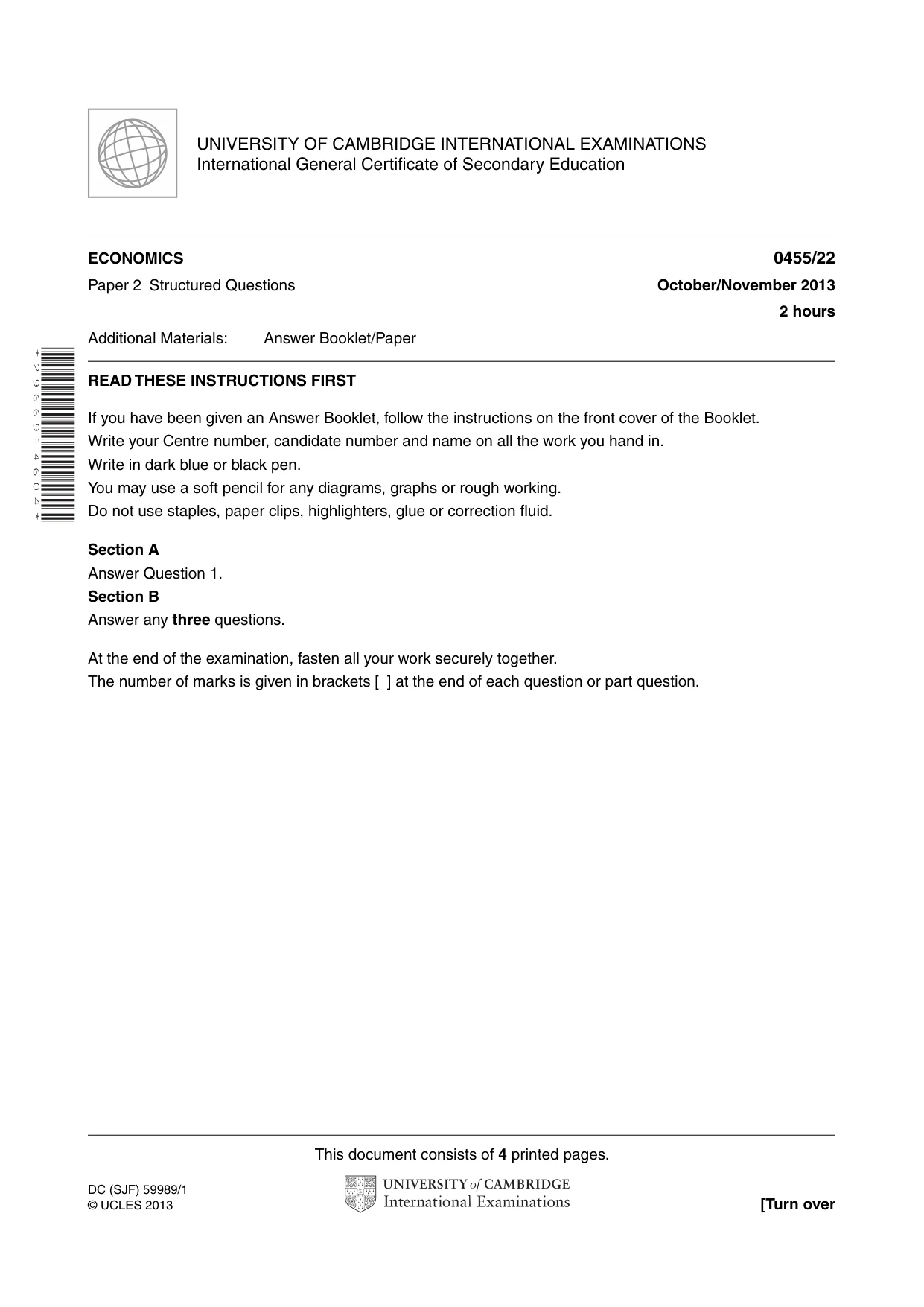
Question paper, page 1
This document consists of 4 printed pages. DC (SJF) 59989/1 © UCLES 2013 [Turn over UNIVERSITY OF CAMBRIDGE INTERNATIONAL EXAMINATIONS International General Certificate of Secondary Education * 2 9 6 6 9 1 4 6 0 4 * ECONOMICS 0455/22 Paper 2 Structured Questions October/November 2013 2 hours Additional Materials: Answer Booklet/Paper READ THESE INSTRUCTIONS FIRST If you have been given an Answer Booklet, follow the instructions on the front cover of the Booklet. Write your Centre number, candidate number and name on all the work you hand in. Write in dark blue or black pen. You may use a soft pencil for any diagrams, graphs or rough working. Do not use staples, paper clips, highlighters, glue or correction fluid. Section A Answer Question 1. Section B Answer any three questions. At the end of the examination, fasten all your work securely together. The number of marks is given in brackets [ ] at the end of each question or part question.
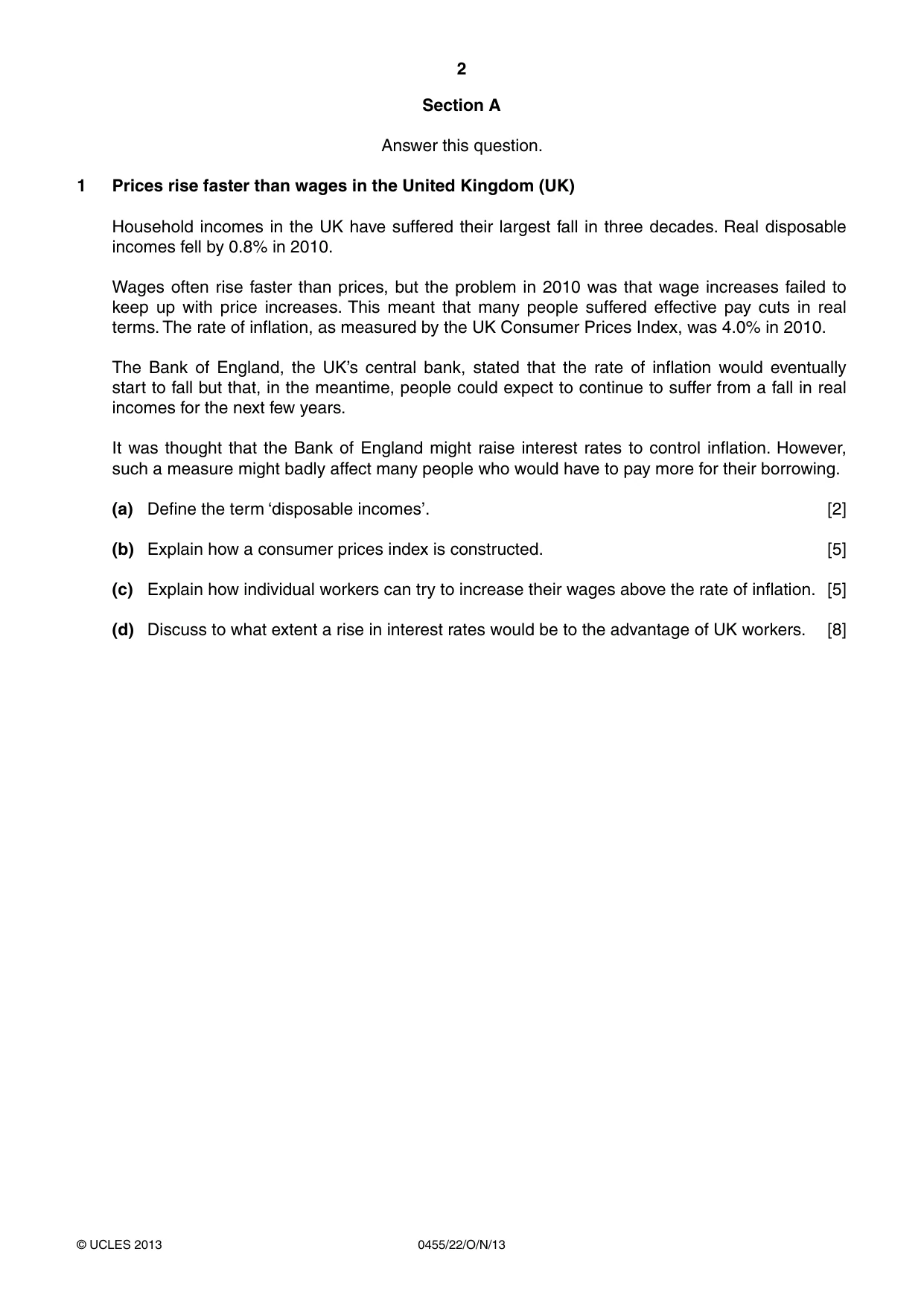
Question paper, page 2
2 0455/22/O/N/13 © UCLES 2013 Section A Answer this question. 1 Prices rise faster than wages in the United Kingdom (UK) Household incomes in the UK have suffered their largest fall in three decades. Real disposable incomes fell by 0.8% in 2010. Wages often rise faster than prices, but the problem in 2010 was that wage increases failed to keep up with price increases. This meant that many people suffered effective pay cuts in real terms. The rate of inflation, as measured by the UK Consumer Prices Index, was 4.0% in 2010. The Bank of England, the UK’s central bank, stated that the rate of inflation would eventually start to fall but that, in the meantime, people could expect to continue to suffer from a fall in real incomes for the next few years. It was thought that the Bank of England might raise interest rates to control inflation. However, such a measure might badly affect many people who would have to pay more for their borrowing. (a) Define the term ‘disposable incomes’. [2] (b) Explain how a consumer prices index is constructed. [5] (c) Explain how individual workers can try to increase their wages above the rate of inflation. [5] (d) Discuss to what extent a rise in interest rates would be to the advantage of UK workers. [8]
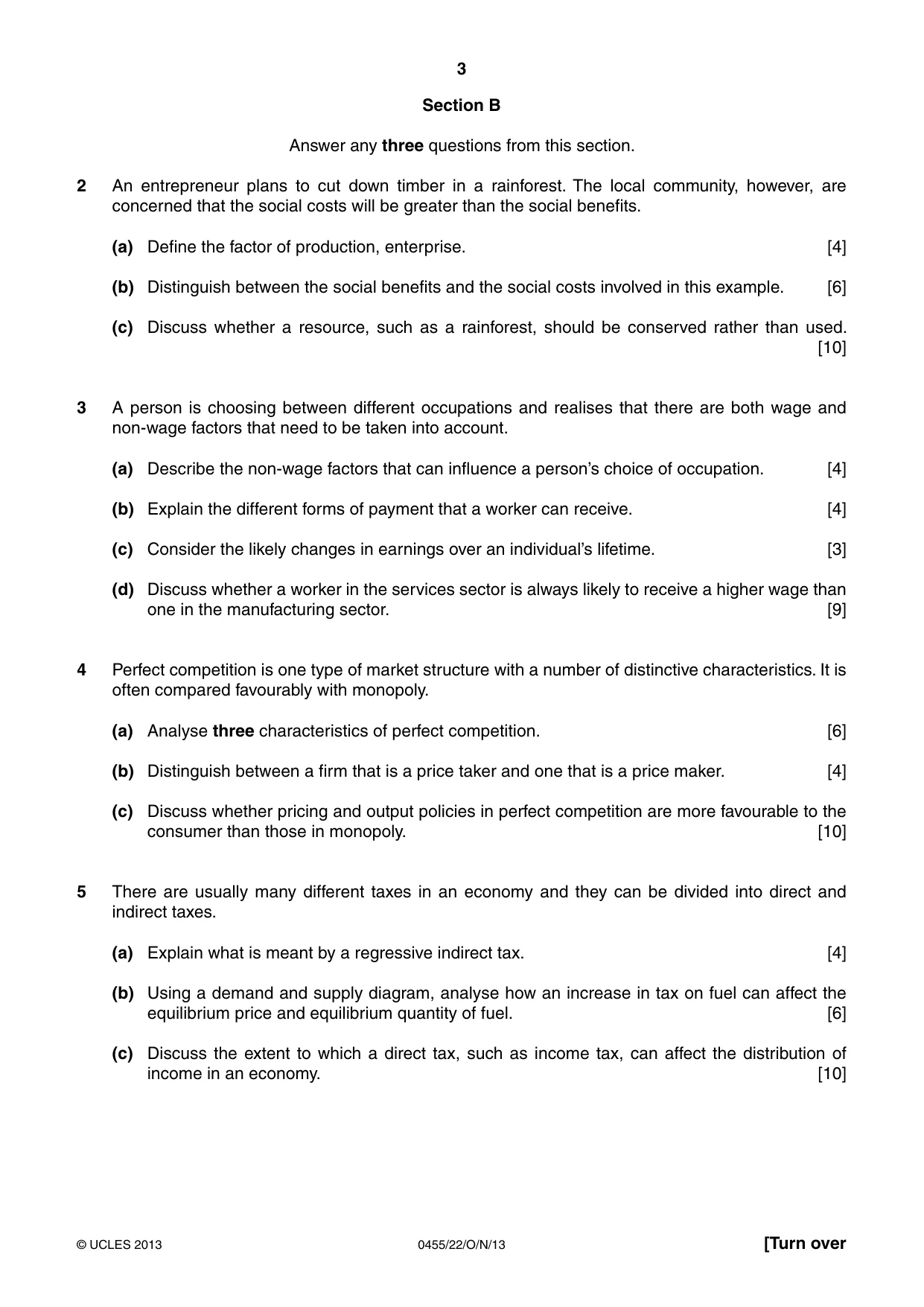
Question paper, page 3
3 0455/22/O/N/13 © UCLES 2013 [Turn over Section B Answer any three questions from this section. 2 An entrepreneur plans to cut down timber in a rainforest. The local community, however, are concerned that the social costs will be greater than the social benefits. (a) Define the factor of production, enterprise. [4] (b) Distinguish between the social benefits and the social costs involved in this example. [6] (c) Discuss whether a resource, such as a rainforest, should be conserved rather than used. [10] 3 A person is choosing between different occupations and realises that there are both wage and non-wage factors that need to be taken into account. (a) Describe the non-wage factors that can influence a person’s choice of occupation. [4] (b) Explain the different forms of payment that a worker can receive. [4] (c) Consider the likely changes in earnings over an individual’s lifetime. [3] (d) Discuss whether a worker in the services sector is always likely to receive a higher wage than one in the manufacturing sector. [9] 4 Perfect competition is one type of market structure with a number of distinctive characteristics. It is often compared favourably with monopoly. (a) Analyse three characteristics of perfect competition. [6] (b) Distinguish between a firm that is a price taker and one that is a price maker. [4] (c) Discuss whether pricing and output policies in perfect competition are more favourable to the consumer than those in monopoly. [10] 5 There are usually many different taxes in an economy and they can be divided into direct and indirect taxes. (a) Explain what is meant by a regressive indirect tax. [4] (b) Using a demand and supply diagram, analyse how an increase in tax on fuel can affect the equilibrium price and equilibrium quantity of fuel. [6] (c) Discuss the extent to which a direct tax, such as income tax, can affect the distribution of income in an economy. [10]
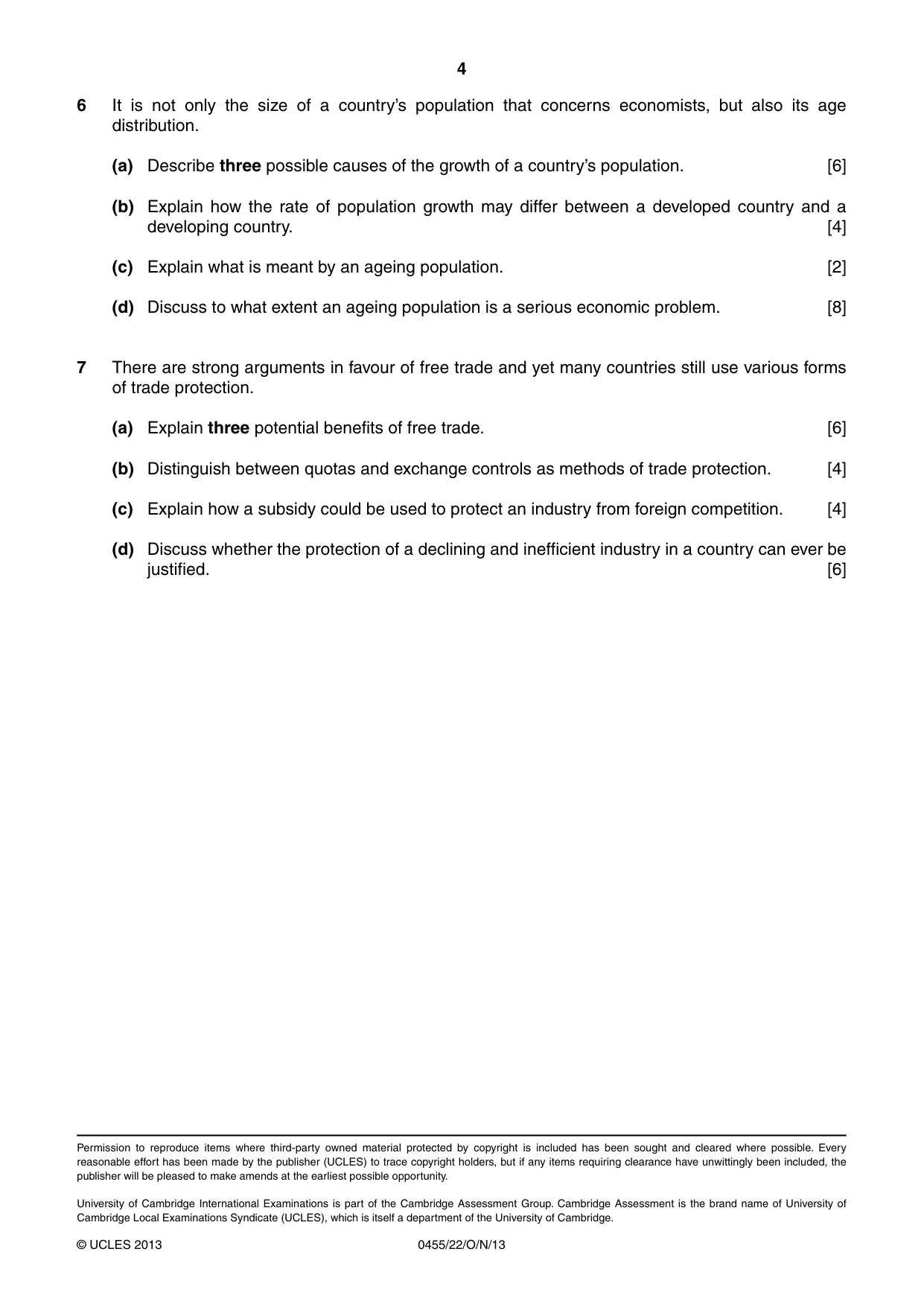
Question paper, page 4
4 0455/22/O/N/13 © UCLES 2013 6 It is not only the size of a country’s population that concerns economists, but also its age distribution. (a) Describe three possible causes of the growth of a country’s population. [6] (b) Explain how the rate of population growth may differ between a developed country and a developing country. [4] (c) Explain what is meant by an ageing population. [2] (d) Discuss to what extent an ageing population is a serious economic problem. [8] 7 There are strong arguments in favour of free trade and yet many countries still use various forms of trade protection. (a) Explain three potential benefits of free trade. [6] (b) Distinguish between quotas and exchange controls as methods of trade protection. [4] (c) Explain how a subsidy could be used to protect an industry from foreign competition. [4] (d) Discuss whether the protection of a declining and inefficient industry in a country can ever be justified. [6] Permission to reproduce items where third-party owned material protected by copyright is included has been sought and cleared where possible. Every reasonable effort has been made by the publisher (UCLES) to trace copyright holders, but if any items requiring clearance have unwittingly been included, the publisher will be pleased to make amends at the earliest possible opportunity. University of Cambridge International Examinations is part of the Cambridge Assessment Group. Cambridge Assessment is the brand name of University of Cambridge Local Examinations Syndicate (UCLES), which is itself a department of the University of Cambridge.
Mark scheme, page 1
CAMBRIDGE INTERNATIONAL EXAMINATIONS International General Certificate of Secondary Education MARK SCHEME for the October/November 2013 series 0455 ECONOMICS 0455/22 Paper 2 (Structured Questions), maximum raw mark 80 This mark scheme is published as an aid to teachers and candidates, to indicate the requirements of the examination. It shows the basis on which Examiners were instructed to award marks. It does not indicate the details of the discussions that took place at an Examiners’ meeting before marking began, which would have considered the acceptability of alternative answers. Mark schemes should be read in conjunction with the question paper and the Principal Examiner Report for Teachers. Cambridge will not enter into discussions about these mark schemes. Cambridge is publishing the mark schemes for the October/November 2013 series for most IGCSE, GCE Advanced Level and Advanced Subsidiary Level components and some Ordinary Level components.
Mark scheme, page 2
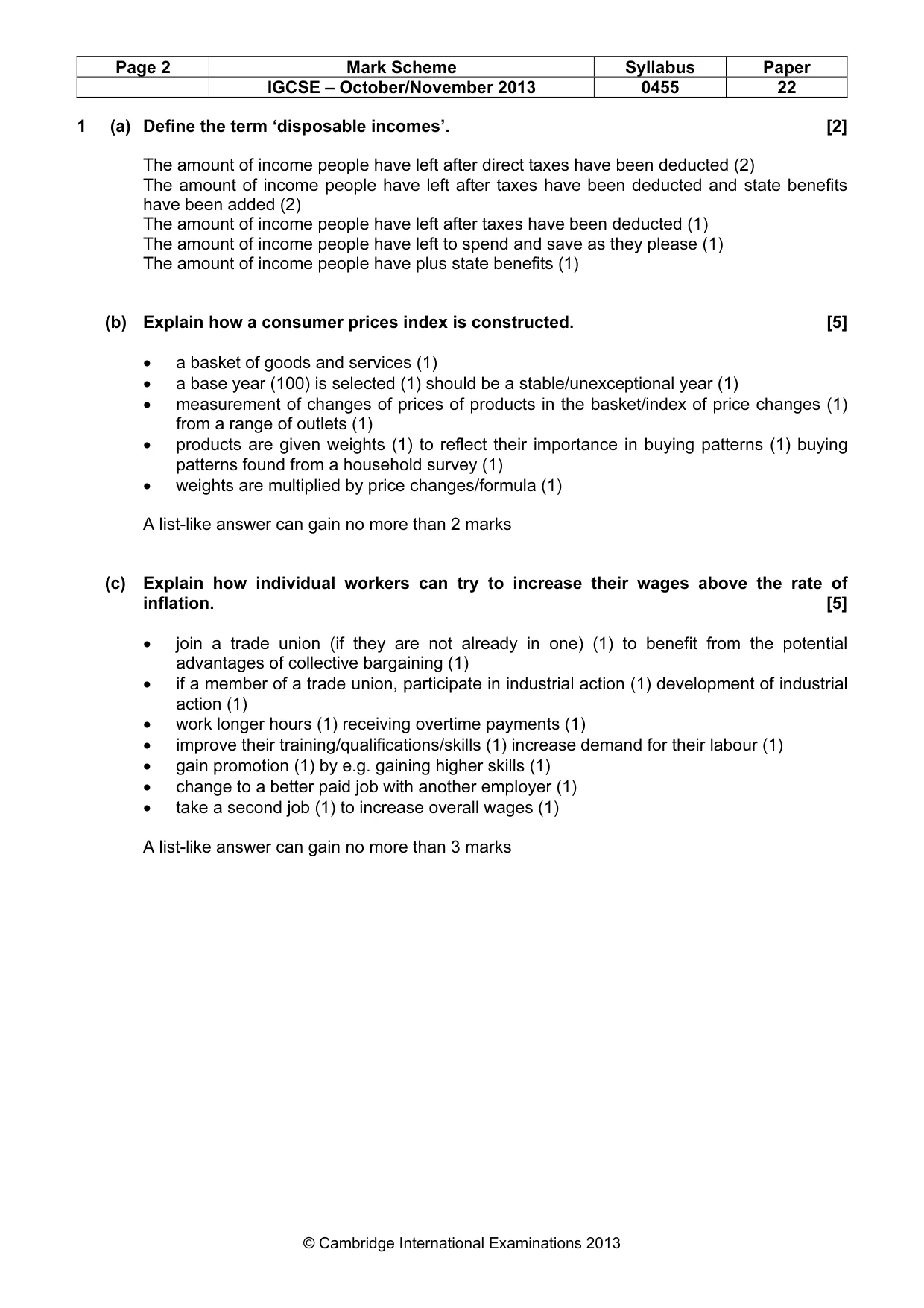
Page 2 Mark Scheme Syllabus Paper IGCSE – October/November 2013 0455 22 © Cambridge International Examinations 2013 1 (a) Define the term ‘disposable incomes’. [2] The amount of income people have left after direct taxes have been deducted (2) The amount of income people have left after taxes have been deducted and state benefits have been added (2) The amount of income people have left after taxes have been deducted (1) The amount of income people have left to spend and save as they please (1) The amount of income people have plus state benefits (1) (b) Explain how a consumer prices index is constructed. [5] • a basket of goods and services (1) • a base year (100) is selected (1) should be a stable/unexceptional year (1) • measurement of changes of prices of products in the basket/index of price changes (1) from a range of outlets (1) • products are given weights (1) to reflect their importance in buying patterns (1) buying patterns found from a household survey (1) • weights are multiplied by price changes/formula (1) A list-like answer can gain no more than 2 marks (c) Explain how individual workers can try to increase their wages above the rate of inflation. [5] • join a trade union (if they are not already in one) (1) to benefit from the potential advantages of collective bargaining (1) • if a member of a trade union, participate in industrial action (1) development of industrial action (1) • work longer hours (1) receiving overtime payments (1) • improve their training/qualifications/skills (1) increase demand for their labour (1) • gain promotion (1) by e.g. gaining higher skills (1) • change to a better paid job with another employer (1) • take a second job (1) to increase overall wages (1) A list-like answer can gain no more than 3 marks
Mark scheme, page 3
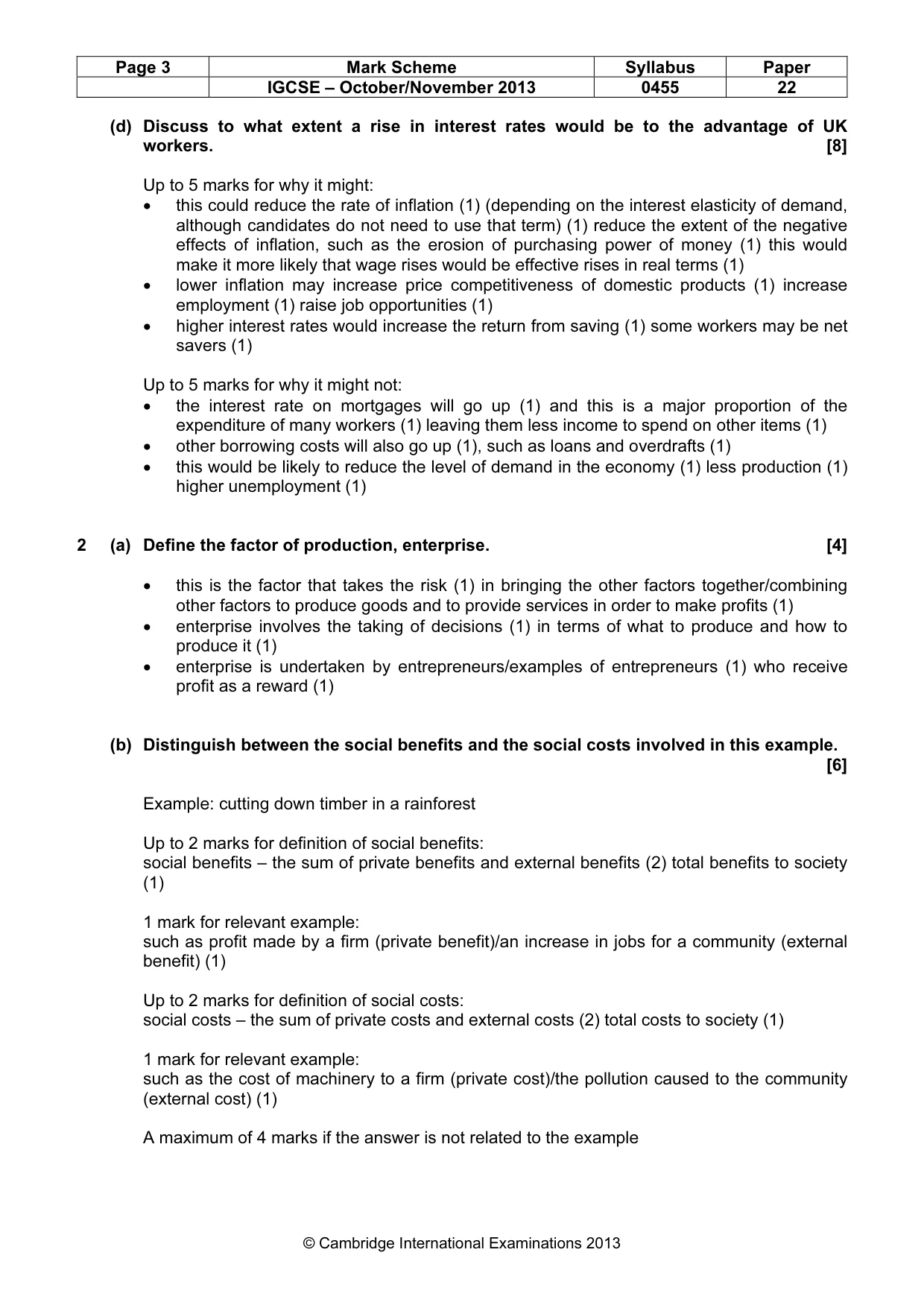
Page 3 Mark Scheme Syllabus Paper IGCSE – October/November 2013 0455 22 © Cambridge International Examinations 2013 (d) Discuss to what extent a rise in interest rates would be to the advantage of UK workers. [8] Up to 5 marks for why it might: • this could reduce the rate of inflation (1) (depending on the interest elasticity of demand, although candidates do not need to use that term) (1) reduce the extent of the negative effects of inflation, such as the erosion of purchasing power of money (1) this would make it more likely that wage rises would be effective rises in real terms (1) • lower inflation may increase price competitiveness of domestic products (1) increase employment (1) raise job opportunities (1) • higher interest rates would increase the return from saving (1) some workers may be net savers (1) Up to 5 marks for why it might not: • the interest rate on mortgages will go up (1) and this is a major proportion of the expenditure of many workers (1) leaving them less income to spend on other items (1) • other borrowing costs will also go up (1), such as loans and overdrafts (1) • this would be likely to reduce the level of demand in the economy (1) less production (1) higher unemployment (1) 2 (a) Define the factor of production, enterprise. [4] • this is the factor that takes the risk (1) in bringing the other factors together/combining other factors to produce goods and to provide services in order to make profits (1) • enterprise involves the taking of decisions (1) in terms of what to produce and how to produce it (1) • enterprise is undertaken by entrepreneurs/examples of entrepreneurs (1) who receive profit as a reward (1) (b) Distinguish between the social benefits and the social costs involved in this example. [6] Example: cutting down timber in a rainforest Up to 2 marks for definition of social benefits: social benefits – the sum of private benefits and external benefits (2) total benefits to society (1) 1 mark for relevant example: such as profit made by a firm (private benefit)/an increase in jobs for a community (external benefit) (1) Up to 2 marks for definition of social costs: social costs – the sum of private costs and external costs (2) total costs to society (1) 1 mark for relevant example: such as the cost of machinery to a firm (private cost)/the pollution caused to the community (external cost) (1) A maximum of 4 marks if the answer is not related to the example
Mark scheme, page 4
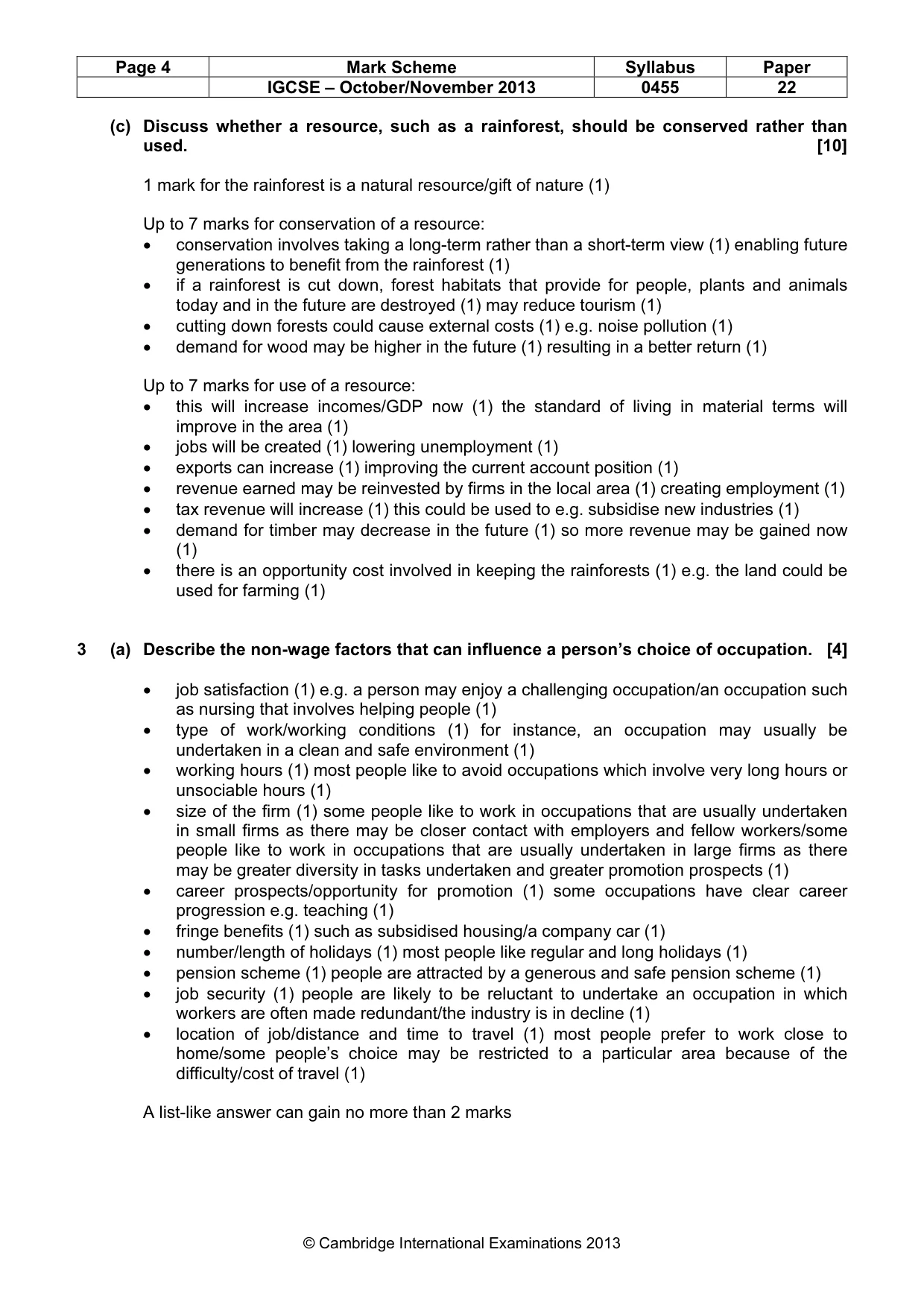
Page 4 Mark Scheme Syllabus Paper IGCSE – October/November 2013 0455 22 © Cambridge International Examinations 2013 (c) Discuss whether a resource, such as a rainforest, should be conserved rather than used. [10] 1 mark for the rainforest is a natural resource/gift of nature (1) Up to 7 marks for conservation of a resource: • conservation involves taking a long-term rather than a short-term view (1) enabling future generations to benefit from the rainforest (1) • if a rainforest is cut down, forest habitats that provide for people, plants and animals today and in the future are destroyed (1) may reduce tourism (1) • cutting down forests could cause external costs (1) e.g. noise pollution (1) • demand for wood may be higher in the future (1) resulting in a better return (1) Up to 7 marks for use of a resource: • this will increase incomes/GDP now (1) the standard of living in material terms will improve in the area (1) • jobs will be created (1) lowering unemployment (1) • exports can increase (1) improving the current account position (1) • revenue earned may be reinvested by firms in the local area (1) creating employment (1) • tax revenue will increase (1) this could be used to e.g. subsidise new industries (1) • demand for timber may decrease in the future (1) so more revenue may be gained now (1) • there is an opportunity cost involved in keeping the rainforests (1) e.g. the land could be used for farming (1) 3 (a) Describe the non-wage factors that can influence a person’s choice of occupation. [4] • job satisfaction (1) e.g. a person may enjoy a challenging occupation/an occupation such as nursing that involves helping people (1) • type of work/working conditions (1) for instance, an occupation may usually be undertaken in a clean and safe environment (1) • working hours (1) most people like to avoid occupations which involve very long hours or unsociable hours (1) • size of the firm (1) some people like to work in occupations that are usually undertaken in small firms as there may be closer contact with employers and fellow workers/some people like to work in occupations that are usually undertaken in large firms as there may be greater diversity in tasks undertaken and greater promotion prospects (1) • career prospects/opportunity for promotion (1) some occupations have clear career progression e.g. teaching (1) • fringe benefits (1) such as subsidised housing/a company car (1) • number/length of holidays (1) most people like regular and long holidays (1) • pension scheme (1) people are attracted by a generous and safe pension scheme (1) • job security (1) people are likely to be reluctant to undertake an occupation in which workers are often made redundant/the industry is in decline (1) • location of job/distance and time to travel (1) most people prefer to work close to home/some people’s choice may be restricted to a particular area because of the difficulty/cost of travel (1) A list-like answer can gain no more than 2 marks
Mark scheme, page 5
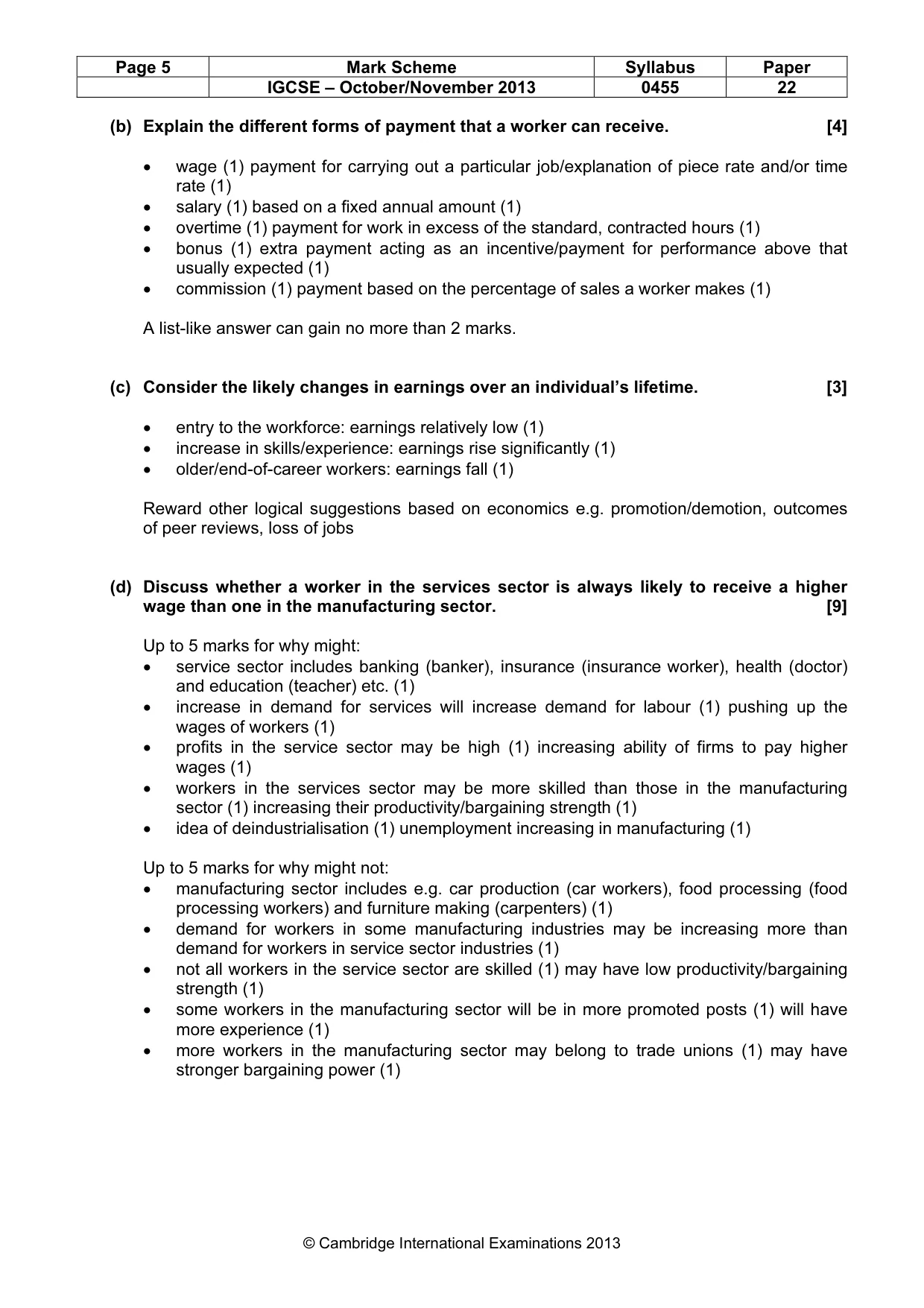
Page 5 Mark Scheme Syllabus Paper IGCSE – October/November 2013 0455 22 © Cambridge International Examinations 2013 (b) Explain the different forms of payment that a worker can receive. [4] • wage (1) payment for carrying out a particular job/explanation of piece rate and/or time rate (1) • salary (1) based on a fixed annual amount (1) • overtime (1) payment for work in excess of the standard, contracted hours (1) • bonus (1) extra payment acting as an incentive/payment for performance above that usually expected (1) • commission (1) payment based on the percentage of sales a worker makes (1) A list-like answer can gain no more than 2 marks. (c) Consider the likely changes in earnings over an individual’s lifetime. [3] • entry to the workforce: earnings relatively low (1) • increase in skills/experience: earnings rise significantly (1) • older/end-of-career workers: earnings fall (1) Reward other logical suggestions based on economics e.g. promotion/demotion, outcomes of peer reviews, loss of jobs (d) Discuss whether a worker in the services sector is always likely to receive a higher wage than one in the manufacturing sector. [9] Up to 5 marks for why might: • service sector includes banking (banker), insurance (insurance worker), health (doctor) and education (teacher) etc. (1) • increase in demand for services will increase demand for labour (1) pushing up the wages of workers (1) • profits in the service sector may be high (1) increasing ability of firms to pay higher wages (1) • workers in the services sector may be more skilled than those in the manufacturing sector (1) increasing their productivity/bargaining strength (1) • idea of deindustrialisation (1) unemployment increasing in manufacturing (1) Up to 5 marks for why might not: • manufacturing sector includes e.g. car production (car workers), food processing (food processing workers) and furniture making (carpenters) (1) • demand for workers in some manufacturing industries may be increasing more than demand for workers in service sector industries (1) • not all workers in the service sector are skilled (1) may have low productivity/bargaining strength (1) • some workers in the manufacturing sector will be in more promoted posts (1) will have more experience (1) • more workers in the manufacturing sector may belong to trade unions (1) may have stronger bargaining power (1)
Mark scheme, page 6
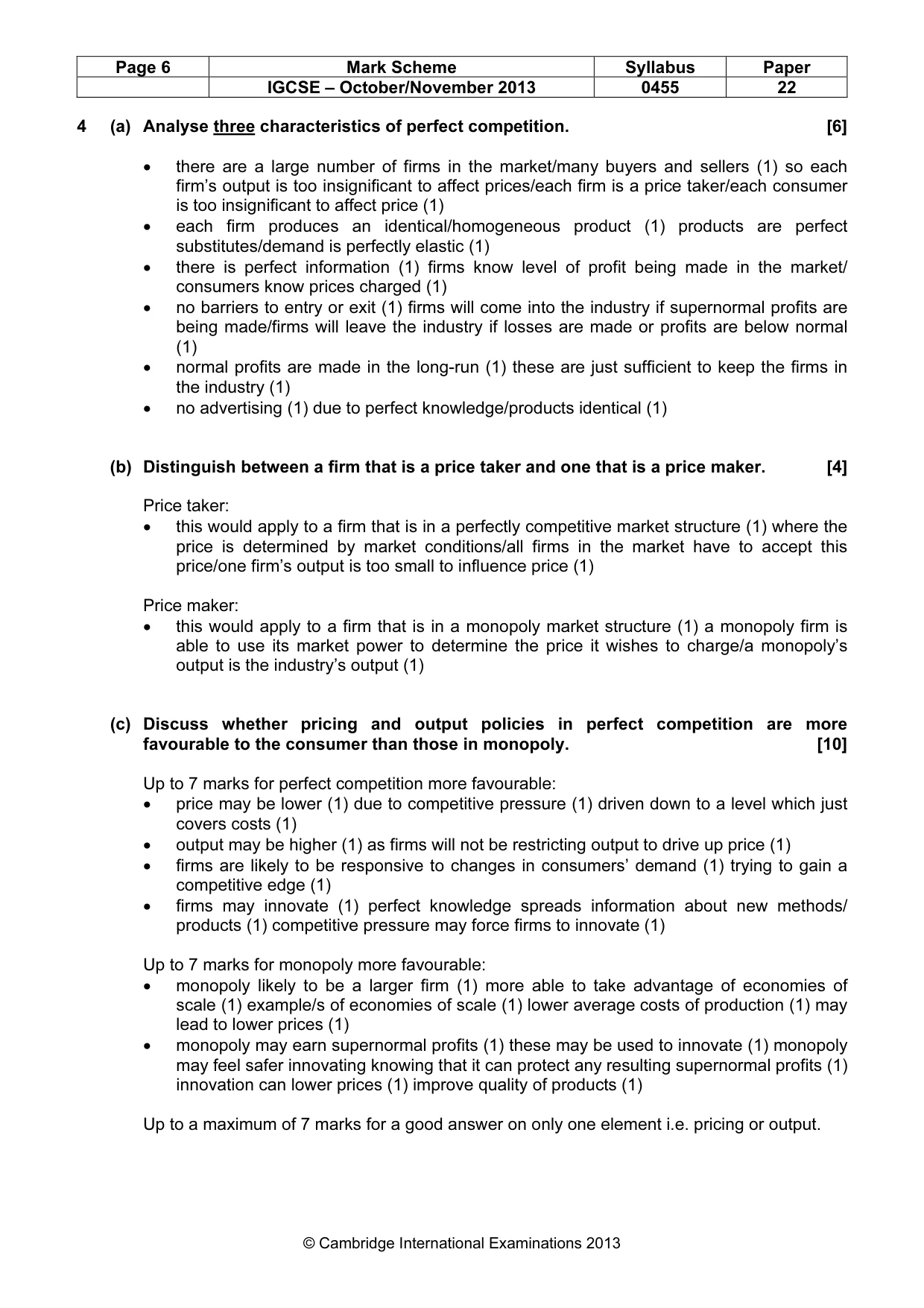
Page 6 Mark Scheme Syllabus Paper IGCSE – October/November 2013 0455 22 © Cambridge International Examinations 2013 4 (a) Analyse three characteristics of perfect competition. [6] • there are a large number of firms in the market/many buyers and sellers (1) so each firm’s output is too insignificant to affect prices/each firm is a price taker/each consumer is too insignificant to affect price (1) • each firm produces an identical/homogeneous product (1) products are perfect substitutes/demand is perfectly elastic (1) • there is perfect information (1) firms know level of profit being made in the market/ consumers know prices charged (1) • no barriers to entry or exit (1) firms will come into the industry if supernormal profits are being made/firms will leave the industry if losses are made or profits are below normal (1) • normal profits are made in the long-run (1) these are just sufficient to keep the firms in the industry (1) • no advertising (1) due to perfect knowledge/products identical (1) (b) Distinguish between a firm that is a price taker and one that is a price maker. [4] Price taker: • this would apply to a firm that is in a perfectly competitive market structure (1) where the price is determined by market conditions/all firms in the market have to accept this price/one firm’s output is too small to influence price (1) Price maker: • this would apply to a firm that is in a monopoly market structure (1) a monopoly firm is able to use its market power to determine the price it wishes to charge/a monopoly’s output is the industry’s output (1) (c) Discuss whether pricing and output policies in perfect competition are more favourable to the consumer than those in monopoly. [10] Up to 7 marks for perfect competition more favourable: • price may be lower (1) due to competitive pressure (1) driven down to a level which just covers costs (1) • output may be higher (1) as firms will not be restricting output to drive up price (1) • firms are likely to be responsive to changes in consumers’ demand (1) trying to gain a competitive edge (1) • firms may innovate (1) perfect knowledge spreads information about new methods/ products (1) competitive pressure may force firms to innovate (1) Up to 7 marks for monopoly more favourable: • monopoly likely to be a larger firm (1) more able to take advantage of economies of scale (1) example/s of economies of scale (1) lower average costs of production (1) may lead to lower prices (1) • monopoly may earn supernormal profits (1) these may be used to innovate (1) monopoly may feel safer innovating knowing that it can protect any resulting supernormal profits (1) innovation can lower prices (1) improve quality of products (1) Up to a maximum of 7 marks for a good answer on only one element i.e. pricing or output.
Mark scheme, page 7
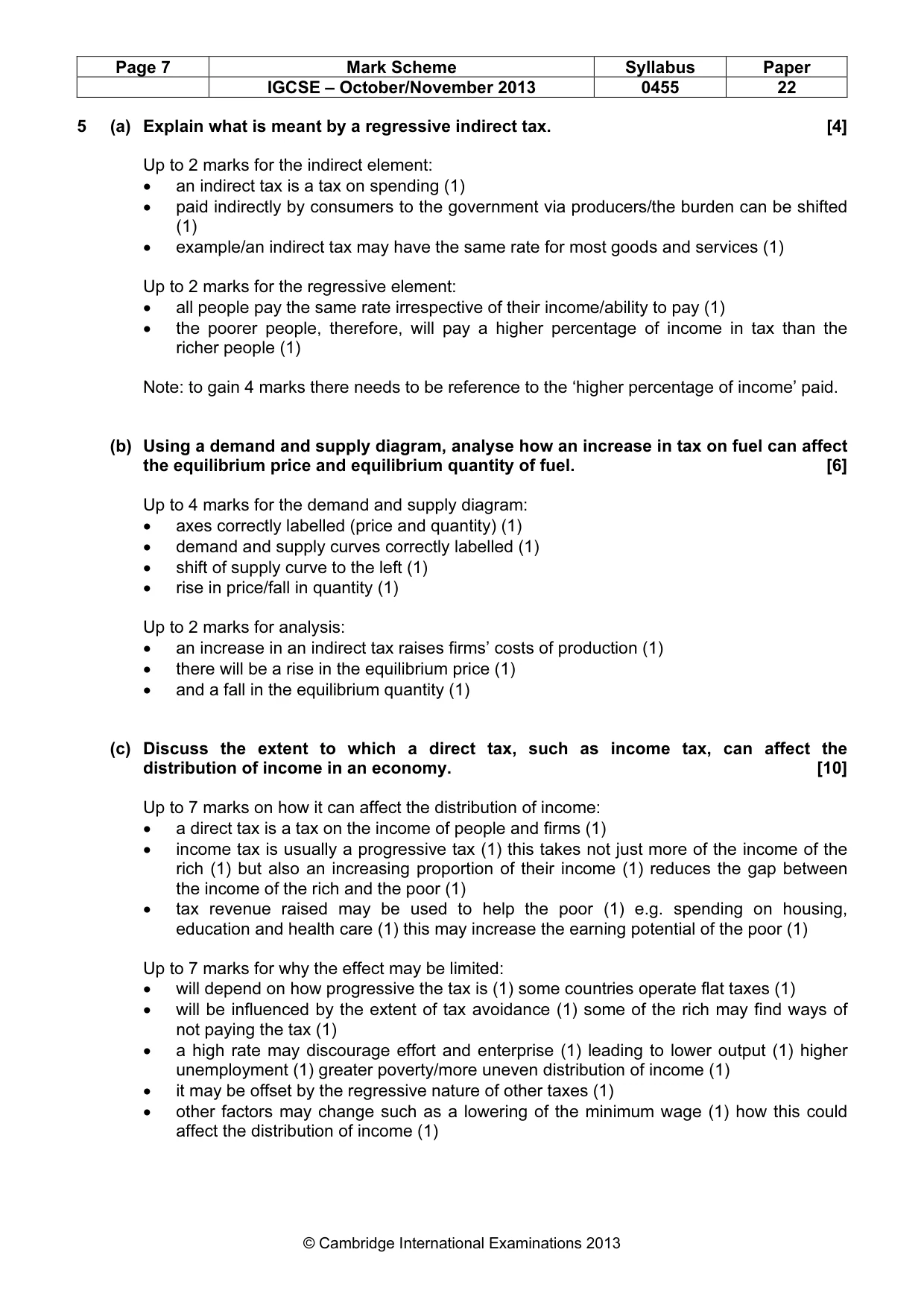
Page 7 Mark Scheme Syllabus Paper IGCSE – October/November 2013 0455 22 © Cambridge International Examinations 2013 5 (a) Explain what is meant by a regressive indirect tax. [4] Up to 2 marks for the indirect element: • an indirect tax is a tax on spending (1) • paid indirectly by consumers to the government via producers/the burden can be shifted (1) • example/an indirect tax may have the same rate for most goods and services (1) Up to 2 marks for the regressive element: • all people pay the same rate irrespective of their income/ability to pay (1) • the poorer people, therefore, will pay a higher percentage of income in tax than the richer people (1) Note: to gain 4 marks there needs to be reference to the ‘higher percentage of income’ paid. (b) Using a demand and supply diagram, analyse how an increase in tax on fuel can affect the equilibrium price and equilibrium quantity of fuel. [6] Up to 4 marks for the demand and supply diagram: • axes correctly labelled (price and quantity) (1) • demand and supply curves correctly labelled (1) • shift of supply curve to the left (1) • rise in price/fall in quantity (1) Up to 2 marks for analysis: • an increase in an indirect tax raises firms’ costs of production (1) • there will be a rise in the equilibrium price (1) • and a fall in the equilibrium quantity (1) (c) Discuss the extent to which a direct tax, such as income tax, can affect the distribution of income in an economy. [10] Up to 7 marks on how it can affect the distribution of income: • a direct tax is a tax on the income of people and firms (1) • income tax is usually a progressive tax (1) this takes not just more of the income of the rich (1) but also an increasing proportion of their income (1) reduces the gap between the income of the rich and the poor (1) • tax revenue raised may be used to help the poor (1) e.g. spending on housing, education and health care (1) this may increase the earning potential of the poor (1) Up to 7 marks for why the effect may be limited: • will depend on how progressive the tax is (1) some countries operate flat taxes (1) • will be influenced by the extent of tax avoidance (1) some of the rich may find ways of not paying the tax (1) • a high rate may discourage effort and enterprise (1) leading to lower output (1) higher unemployment (1) greater poverty/more uneven distribution of income (1) • it may be offset by the regressive nature of other taxes (1) • other factors may change such as a lowering of the minimum wage (1) how this could affect the distribution of income (1)
Mark scheme, page 8
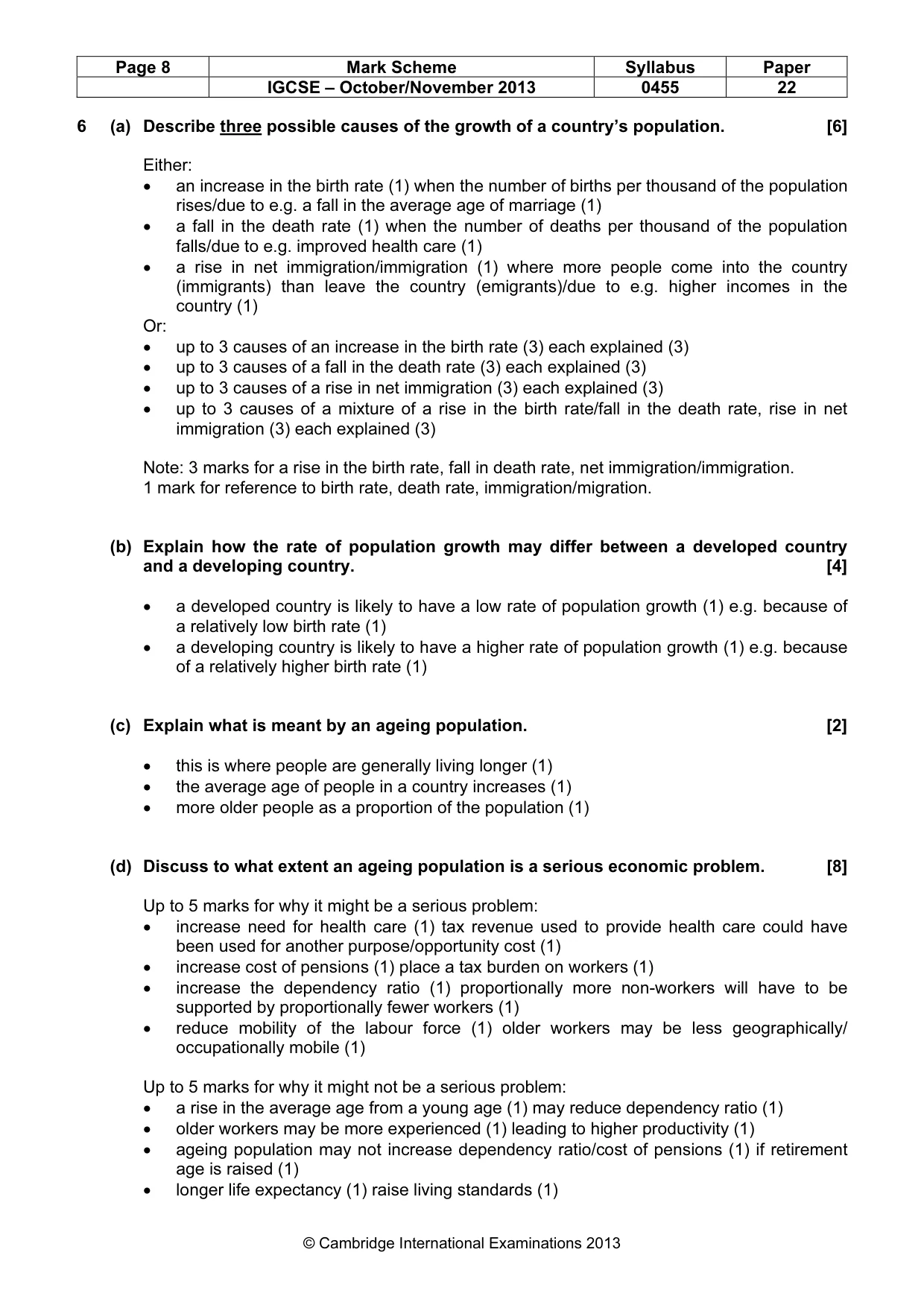
Page 8 Mark Scheme Syllabus Paper IGCSE – October/November 2013 0455 22 © Cambridge International Examinations 2013 6 (a) Describe three possible causes of the growth of a country’s population. [6] Either: • an increase in the birth rate (1) when the number of births per thousand of the population rises/due to e.g. a fall in the average age of marriage (1) • a fall in the death rate (1) when the number of deaths per thousand of the population falls/due to e.g. improved health care (1) • a rise in net immigration/immigration (1) where more people come into the country (immigrants) than leave the country (emigrants)/due to e.g. higher incomes in the country (1) Or: • up to 3 causes of an increase in the birth rate (3) each explained (3) • up to 3 causes of a fall in the death rate (3) each explained (3) • up to 3 causes of a rise in net immigration (3) each explained (3) • up to 3 causes of a mixture of a rise in the birth rate/fall in the death rate, rise in net immigration (3) each explained (3) Note: 3 marks for a rise in the birth rate, fall in death rate, net immigration/immigration. 1 mark for reference to birth rate, death rate, immigration/migration. (b) Explain how the rate of population growth may differ between a developed country and a developing country. [4] • a developed country is likely to have a low rate of population growth (1) e.g. because of a relatively low birth rate (1) • a developing country is likely to have a higher rate of population growth (1) e.g. because of a relatively higher birth rate (1) (c) Explain what is meant by an ageing population. [2] • this is where people are generally living longer (1) • the average age of people in a country increases (1) • more older people as a proportion of the population (1) (d) Discuss to what extent an ageing population is a serious economic problem. [8] Up to 5 marks for why it might be a serious problem: • increase need for health care (1) tax revenue used to provide health care could have been used for another purpose/opportunity cost (1) • increase cost of pensions (1) place a tax burden on workers (1) • increase the dependency ratio (1) proportionally more non-workers will have to be supported by proportionally fewer workers (1) • reduce mobility of the labour force (1) older workers may be less geographically/ occupationally mobile (1) Up to 5 marks for why it might not be a serious problem: • a rise in the average age from a young age (1) may reduce dependency ratio (1) • older workers may be more experienced (1) leading to higher productivity (1) • ageing population may not increase dependency ratio/cost of pensions (1) if retirement age is raised (1) • longer life expectancy (1) raise living standards (1)
Mark scheme, page 9
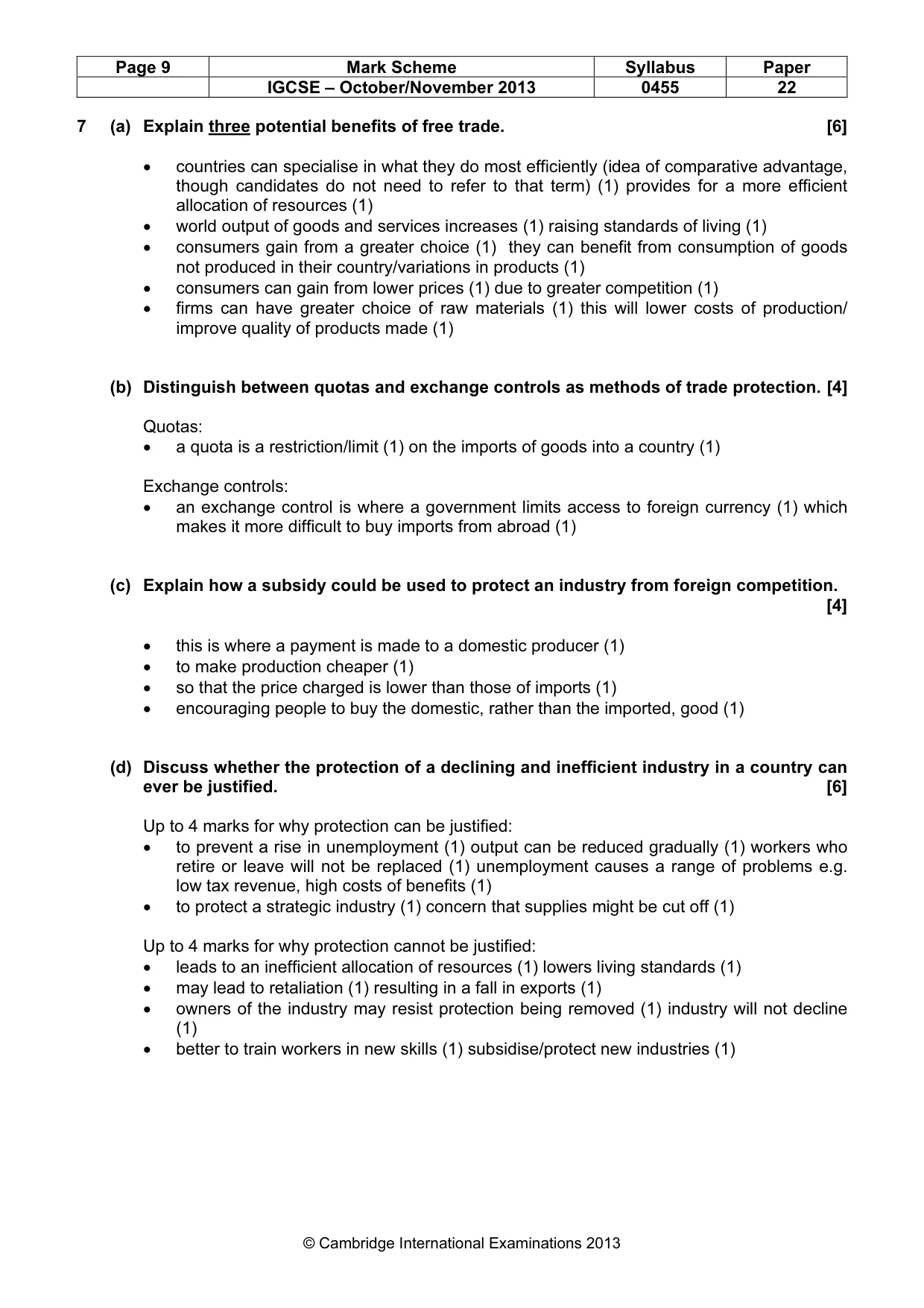
Page 9 Mark Scheme Syllabus Paper IGCSE – October/November 2013 0455 22 © Cambridge International Examinations 2013 7 (a) Explain three potential benefits of free trade. [6] • countries can specialise in what they do most efficiently (idea of comparative advantage, though candidates do not need to refer to that term) (1) provides for a more efficient allocation of resources (1) • world output of goods and services increases (1) raising standards of living (1) • consumers gain from a greater choice (1) they can benefit from consumption of goods not produced in their country/variations in products (1) • consumers can gain from lower prices (1) due to greater competition (1) • firms can have greater choice of raw materials (1) this will lower costs of production/ improve quality of products made (1) (b) Distinguish between quotas and exchange controls as methods of trade protection. [4] Quotas: • a quota is a restriction/limit (1) on the imports of goods into a country (1) Exchange controls: • an exchange control is where a government limits access to foreign currency (1) which makes it more difficult to buy imports from abroad (1) (c) Explain how a subsidy could be used to protect an industry from foreign competition. [4] • this is where a payment is made to a domestic producer (1) • to make production cheaper (1) • so that the price charged is lower than those of imports (1) • encouraging people to buy the domestic, rather than the imported, good (1) (d) Discuss whether the protection of a declining and inefficient industry in a country can ever be justified. [6] Up to 4 marks for why protection can be justified: • to prevent a rise in unemployment (1) output can be reduced gradually (1) workers who retire or leave will not be replaced (1) unemployment causes a range of problems e.g. low tax revenue, high costs of benefits (1) • to protect a strategic industry (1) concern that supplies might be cut off (1) Up to 4 marks for why protection cannot be justified: • leads to an inefficient allocation of resources (1) lowers living standards (1) • may lead to retaliation (1) resulting in a fall in exports (1) • owners of the industry may resist protection being removed (1) industry will not decline (1) • better to train workers in new skills (1) subsidise/protect new industries (1)
What you needed in this session
Cambridge’s own grade thresholds for 2013 Oct/Nov, Paper 2 · Variant 2. A higher threshold means an easier paper — the bar moves with how the cohort did.