Cambridge IGCSE Economics 0455 — 2009 Oct/Nov Paper 2 · Variant 1
0455/21/O/N/09 · 80 marks · ≈90 min
The question paper and its mark scheme, free to read here and free to download. This is Cambridge’s own paper, exactly as it was sat.
Question paper4 pages
Mark scheme4 pages
Answers below. Sit the paper first if you are practising.
Paper as text
Question paper, page 1
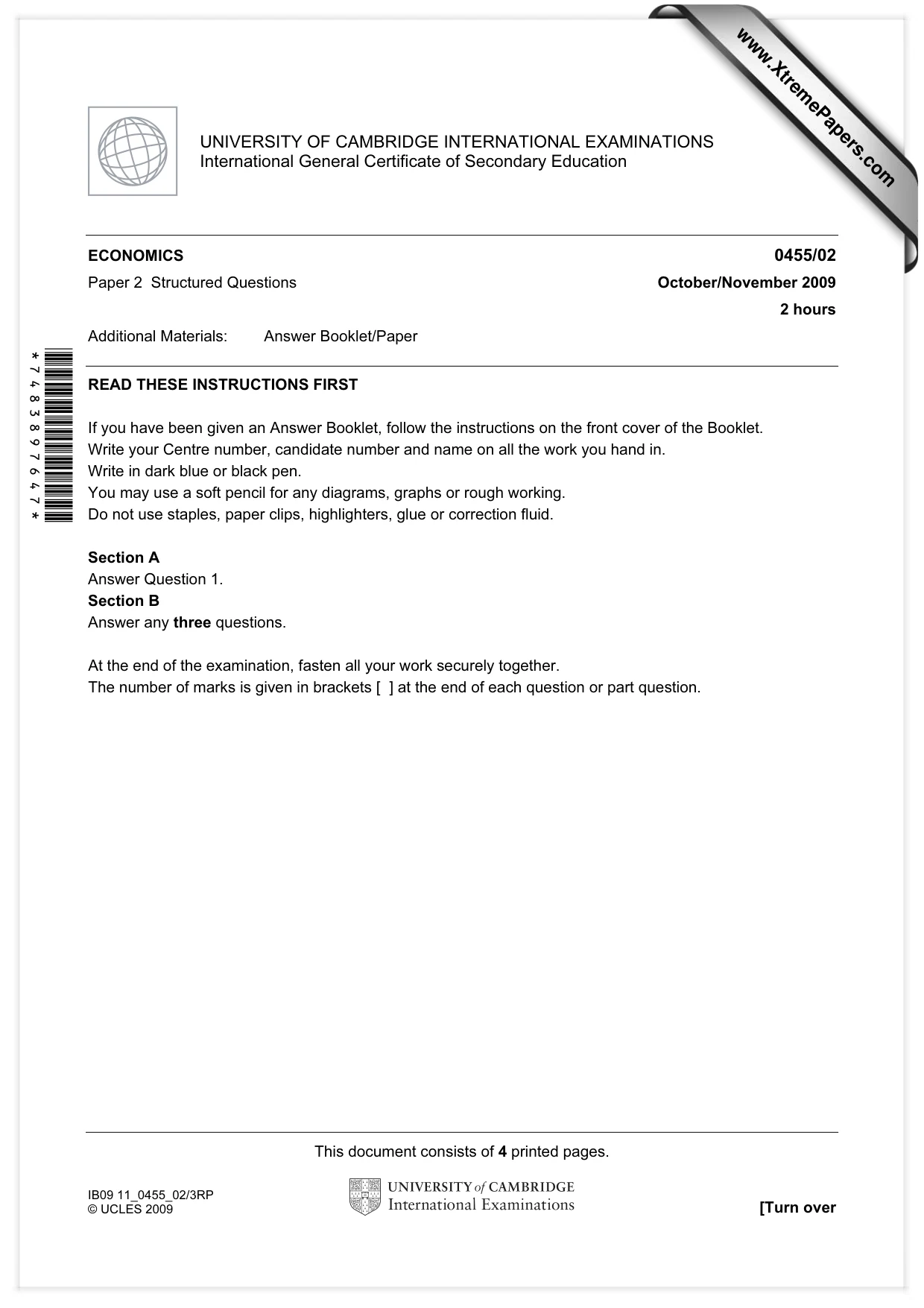
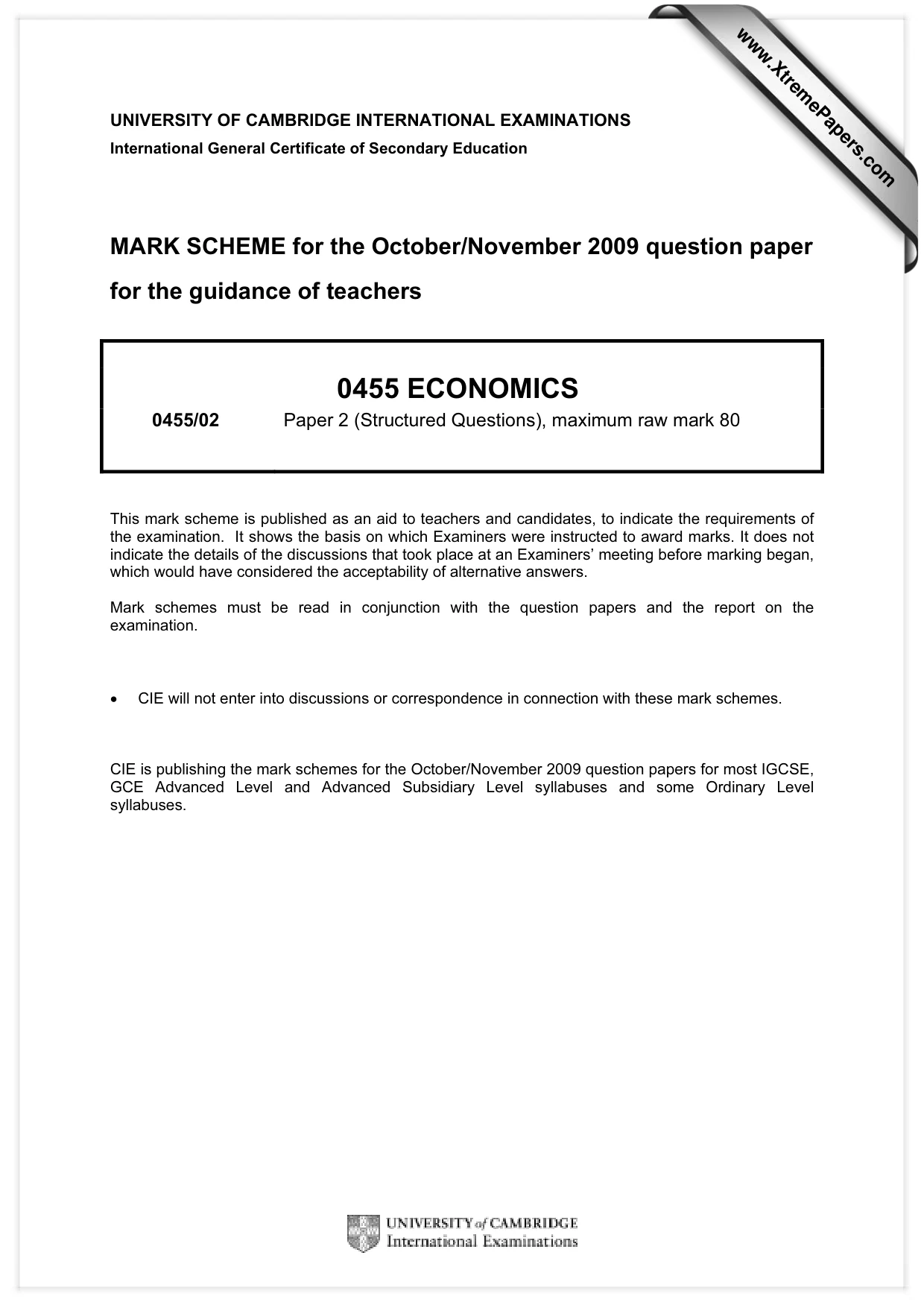
This document consists of 4 printed pages. IB09 11_0455_02/3RP © UCLES 2009 [Turn over *7483897647* UNIVERSITY OF CAMBRIDGE INTERNATIONAL EXAMINATIONS International General Certificate of Secondary Education ECONOMICS 0455/02 Paper 2 Structured Questions October/November 2009 2 hours Additional Materials: Answer Booklet/Paper READ THESE INSTRUCTIONS FIRST If you have been given an Answer Booklet, follow the instructions on the front cover of the Booklet. Write your Centre number, candidate number and name on all the work you hand in. Write in dark blue or black pen. You may use a soft pencil for any diagrams, graphs or rough working. Do not use staples, paper clips, highlighters, glue or correction fluid. Section A Answer Question 1. Section B Answer any three questions. At the end of the examination, fasten all your work securely together. The number of marks is given in brackets [ ] at the end of each question or part question. www.XtremePapers.com
Question paper, page 2
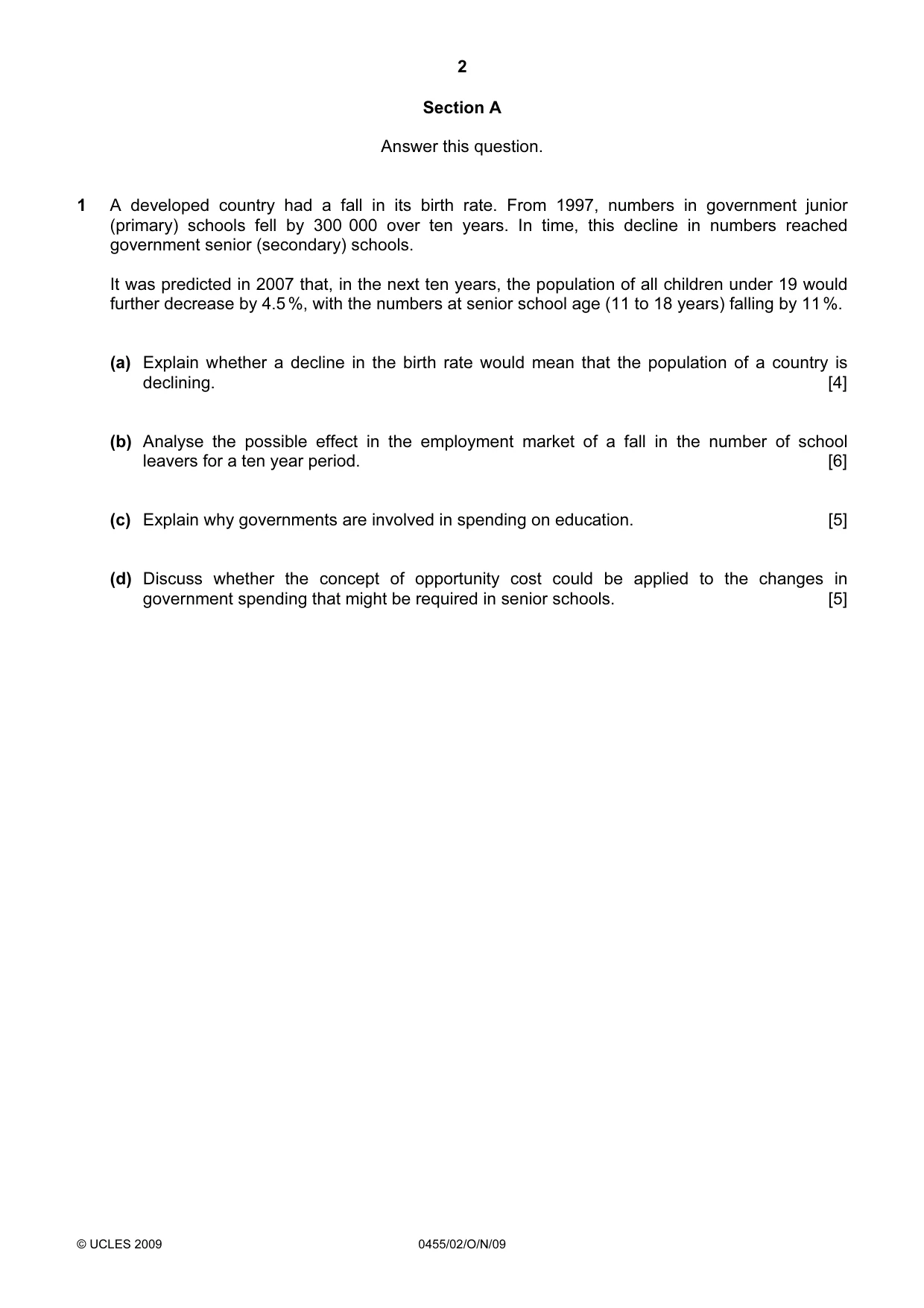
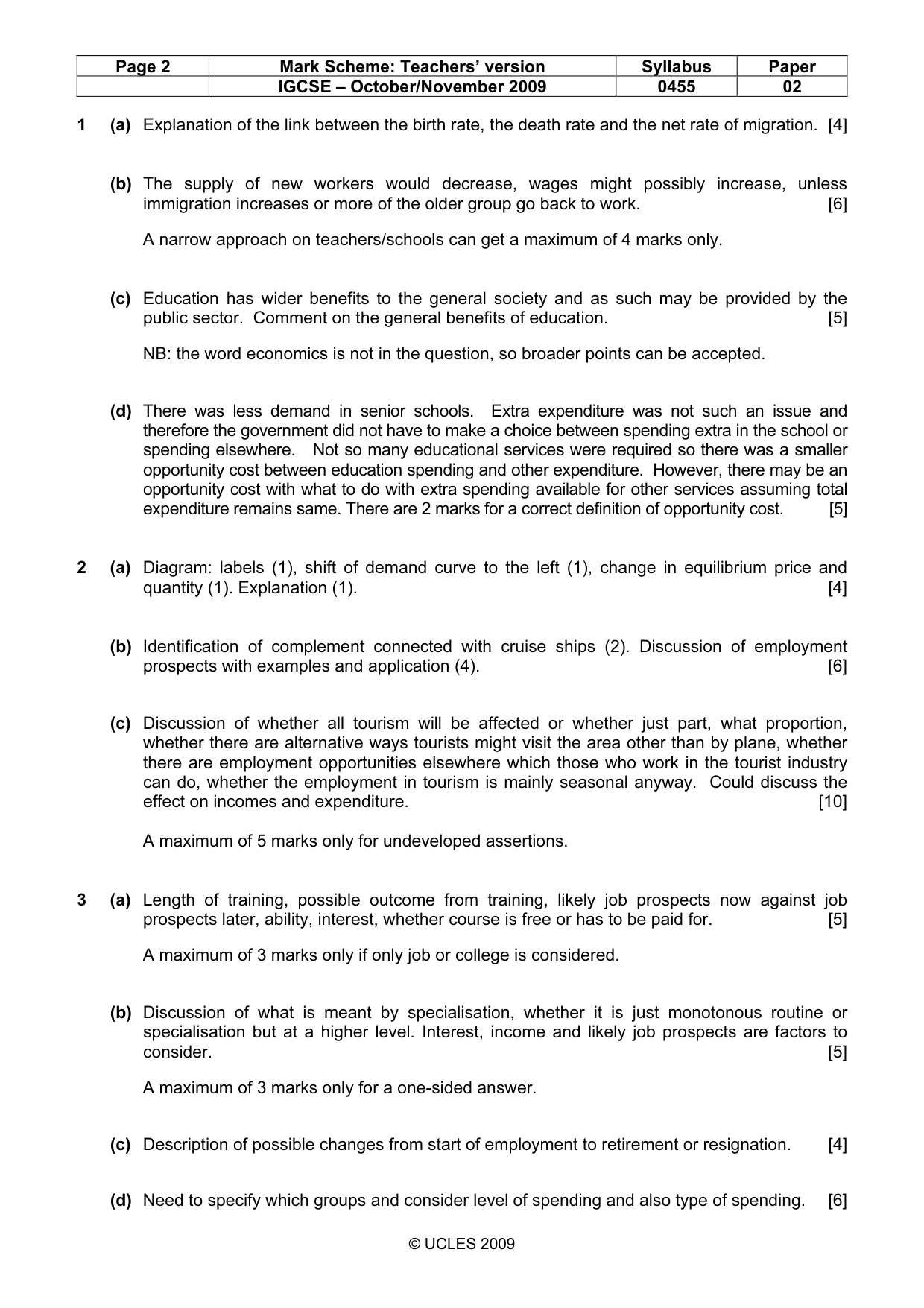
2 © UCLES 2009 0455/02/O/N/09 Section A Answer this question. 1 A developed country had a fall in its birth rate. From 1997, numbers in government junior (primary) schools fell by 300 000 over ten years. In time, this decline in numbers reached government senior (secondary) schools. It was predicted in 2007 that, in the next ten years, the population of all children under 19 would further decrease by 4.5 %, with the numbers at senior school age (11 to 18 years) falling by 11 %. (a) Explain whether a decline in the birth rate would mean that the population of a country is declining. [4] (b) Analyse the possible effect in the employment market of a fall in the number of school leavers for a ten year period. [6] (c) Explain why governments are involved in spending on education. [5] (d) Discuss whether the concept of opportunity cost could be applied to the changes in government spending that might be required in senior schools. [5]
Question paper, page 3
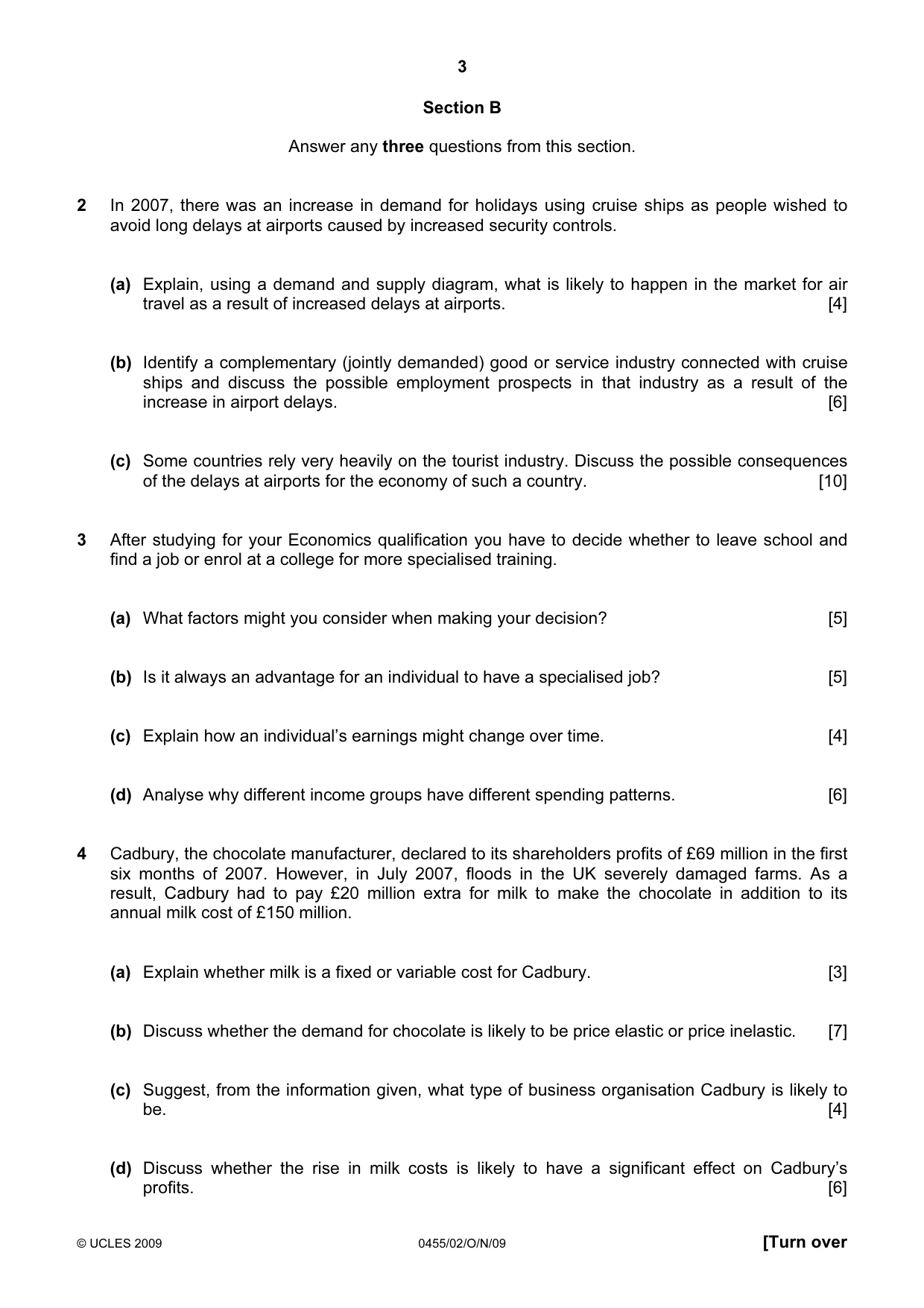
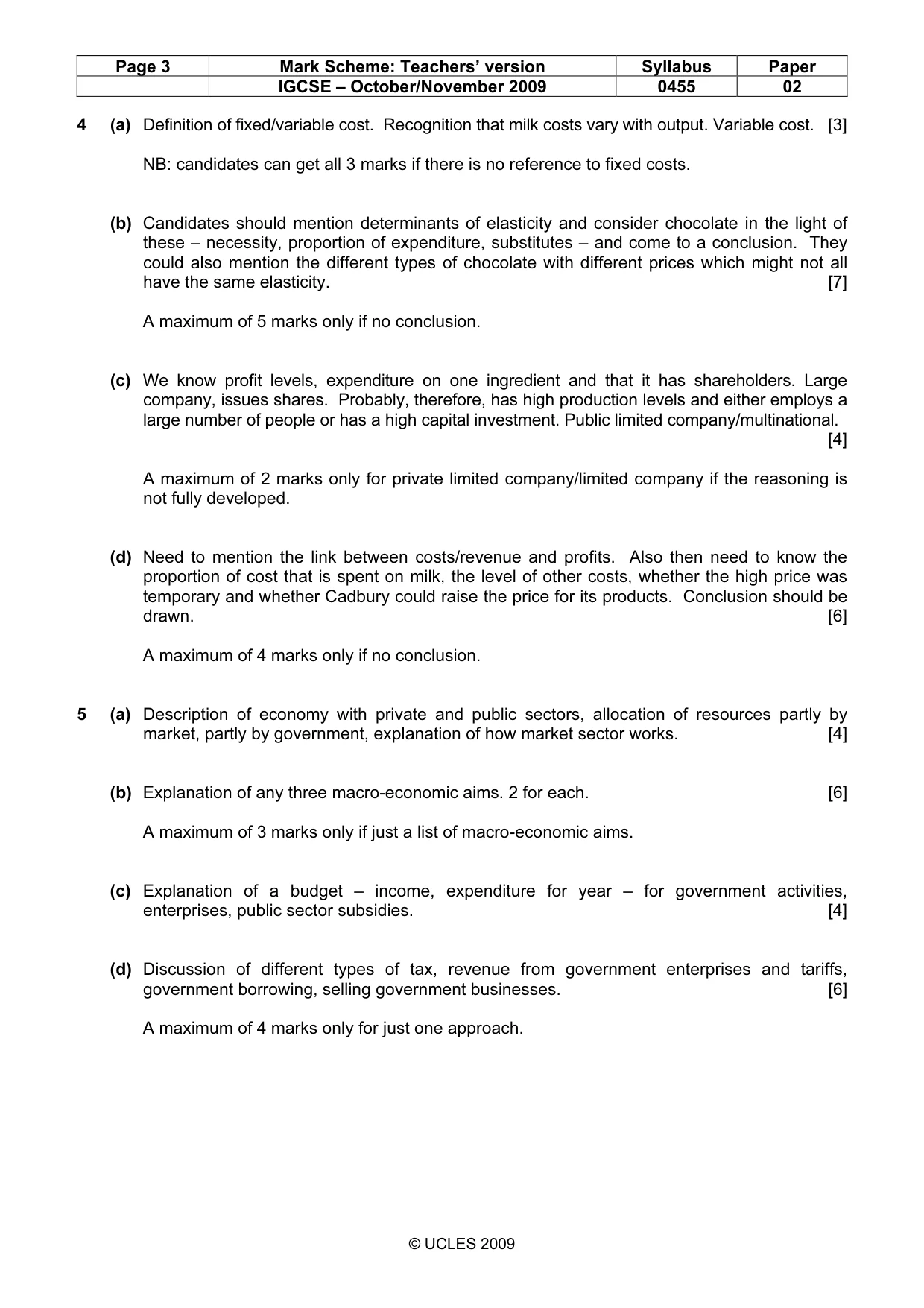
3 © UCLES 2009 0455/02/O/N/09 [Turn over Section B Answer any three questions from this section. 2 In 2007, there was an increase in demand for holidays using cruise ships as people wished to avoid long delays at airports caused by increased security controls. (a) Explain, using a demand and supply diagram, what is likely to happen in the market for air travel as a result of increased delays at airports. [4] (b) Identify a complementary (jointly demanded) good or service industry connected with cruise ships and discuss the possible employment prospects in that industry as a result of the increase in airport delays. [6] (c) Some countries rely very heavily on the tourist industry. Discuss the possible consequences of the delays at airports for the economy of such a country. [10] 3 After studying for your Economics qualification you have to decide whether to leave school and find a job or enrol at a college for more specialised training. (a) What factors might you consider when making your decision? [5] (b) Is it always an advantage for an individual to have a specialised job? [5] (c) Explain how an individual’s earnings might change over time. [4] (d) Analyse why different income groups have different spending patterns. [6] 4 Cadbury, the chocolate manufacturer, declared to its shareholders profits of £69 million in the first six months of 2007. However, in July 2007, floods in the UK severely damaged farms. As a result, Cadbury had to pay £20 million extra for milk to make the chocolate in addition to its annual milk cost of £150 million. (a) Explain whether milk is a fixed or variable cost for Cadbury. [3] (b) Discuss whether the demand for chocolate is likely to be price elastic or price inelastic. [7] (c) Suggest, from the information given, what type of business organisation Cadbury is likely to be. [4] (d) Discuss whether the rise in milk costs is likely to have a significant effect on Cadbury’s profits. [6]
Question paper, page 4
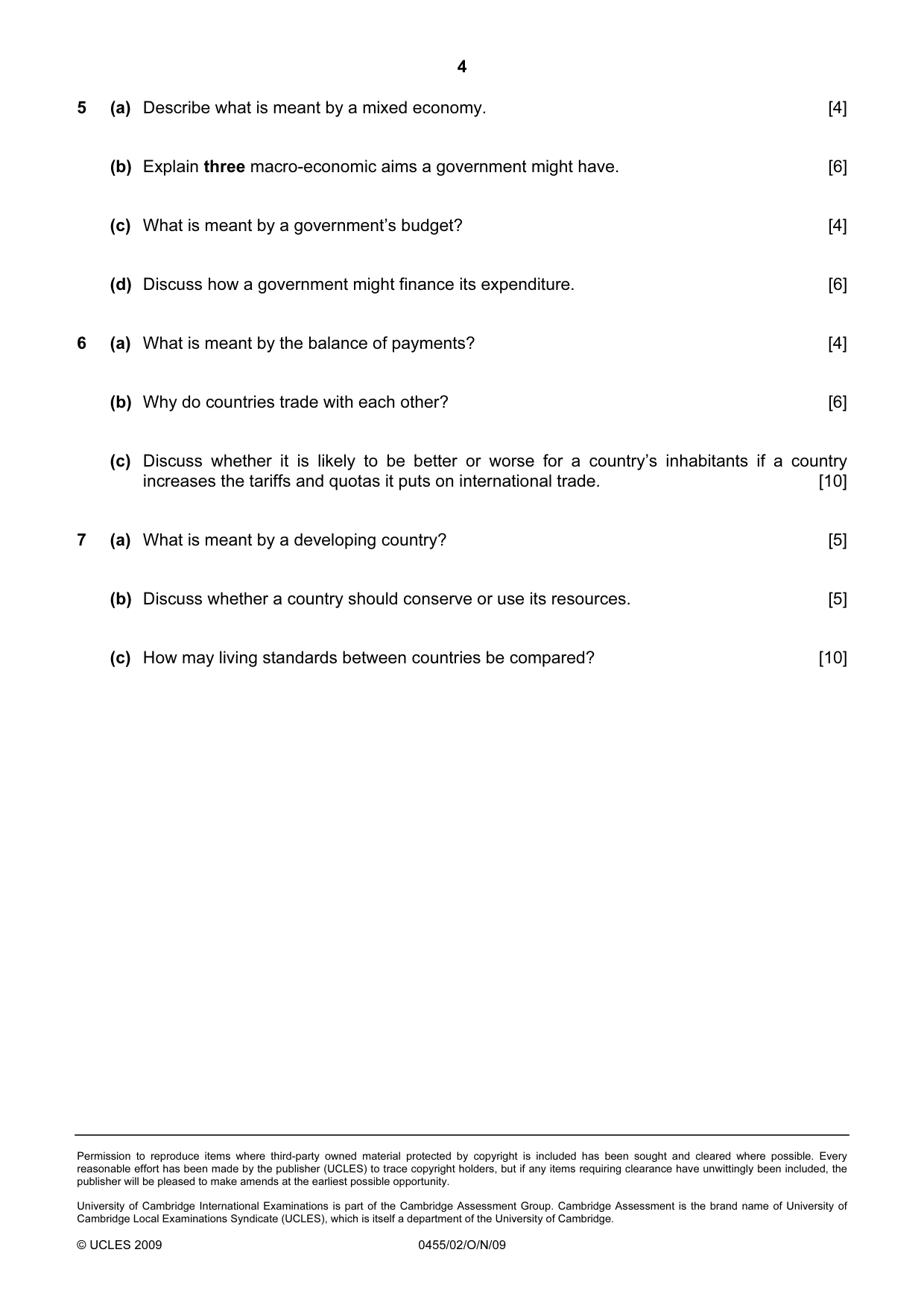
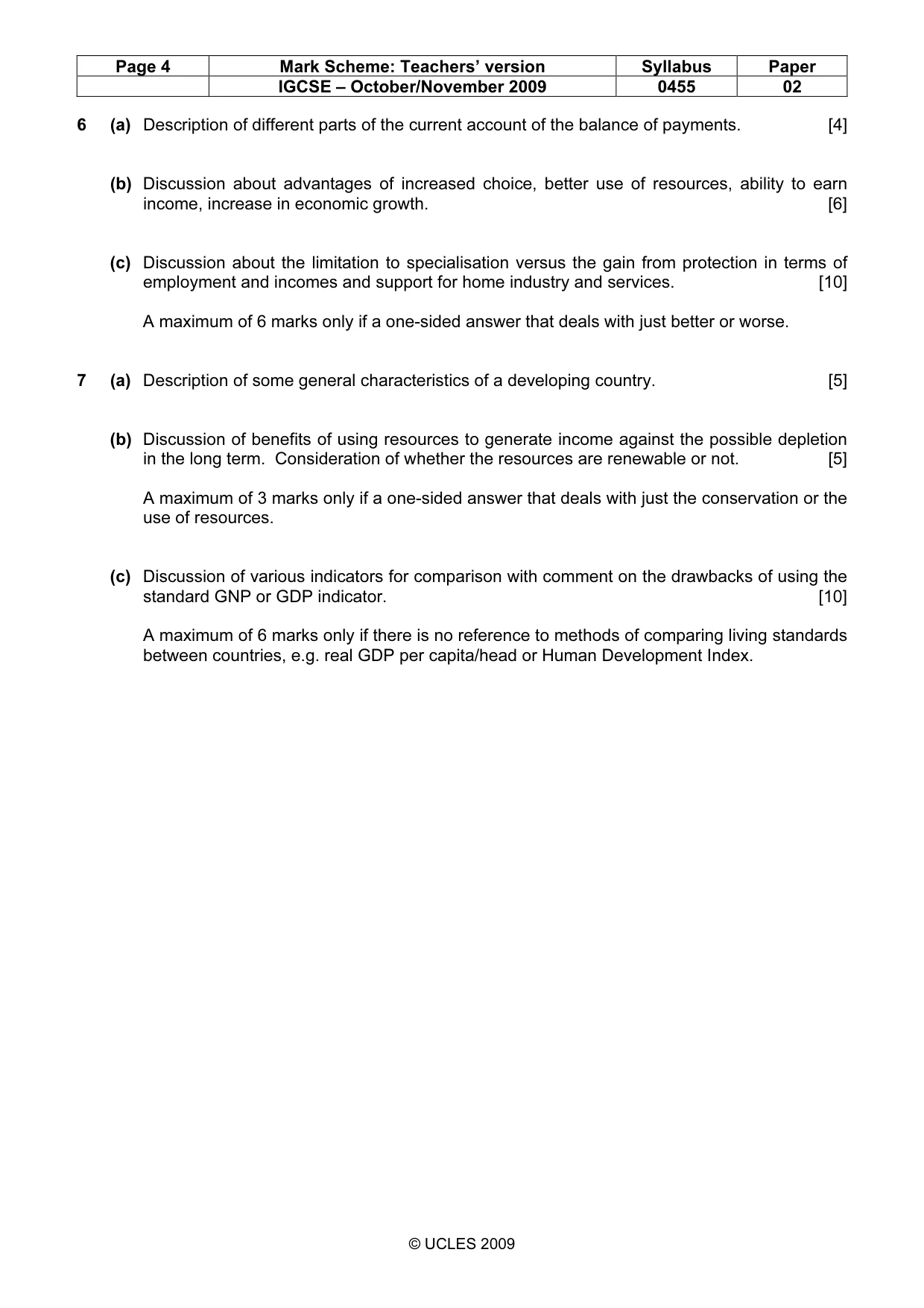
4 Permission to reproduce items where third-party owned material protected by copyright is included has been sought and cleared where possible. Every reasonable effort has been made by the publisher (UCLES) to trace copyright holders, but if any items requiring clearance have unwittingly been included, the publisher will be pleased to make amends at the earliest possible opportunity. University of Cambridge International Examinations is part of the Cambridge Assessment Group. Cambridge Assessment is the brand name of University of Cambridge Local Examinations Syndicate (UCLES), which is itself a department of the University of Cambridge. © UCLES 2009 0455/02/O/N/09 5 (a) Describe what is meant by a mixed economy. [4] (b) Explain three macro-economic aims a government might have. [6] (c) What is meant by a government’s budget? [4] (d) Discuss how a government might finance its expenditure. [6] 6 (a) What is meant by the balance of payments? [4] (b) Why do countries trade with each other? [6] (c) Discuss whether it is likely to be better or worse for a country’s inhabitants if a country increases the tariffs and quotas it puts on international trade. [10] 7 (a) What is meant by a developing country? [5] (b) Discuss whether a country should conserve or use its resources. [5] (c) How may living standards between countries be compared? [10]
Mark scheme, page 1
UNIVERSITY OF CAMBRIDGE INTERNATIONAL EXAMINATIONS International General Certificate of Secondary Education MARK SCHEME for the October/November 2009 question paper for the guidance of teachers 0455 ECONOMICS 0455/02 Paper 2 (Structured Questions), maximum raw mark 80 This mark scheme is published as an aid to teachers and candidates, to indicate the requirements of the examination. It shows the basis on which Examiners were instructed to award marks. It does not indicate the details of the discussions that took place at an Examiners’ meeting before marking began, which would have considered the acceptability of alternative answers. Mark schemes must be read in conjunction with the question papers and the report on the examination. • CIE will not enter into discussions or correspondence in connection with these mark schemes. CIE is publishing the mark schemes for the October/November 2009 question papers for most IGCSE, GCE Advanced Level and Advanced Subsidiary Level syllabuses and some Ordinary Level syllabuses. www.XtremePapers.com
Mark scheme, page 2
Page 2 Mark Scheme: Teachers’ version Syllabus Paper IGCSE – October/November 2009 0455 02 © UCLES 2009 1 (a) Explanation of the link between the birth rate, the death rate and the net rate of migration. [4] (b) The supply of new workers would decrease, wages might possibly increase, unless immigration increases or more of the older group go back to work. [6] A narrow approach on teachers/schools can get a maximum of 4 marks only. (c) Education has wider benefits to the general society and as such may be provided by the public sector. Comment on the general benefits of education. [5] NB: the word economics is not in the question, so broader points can be accepted. (d) There was less demand in senior schools. Extra expenditure was not such an issue and therefore the government did not have to make a choice between spending extra in the school or spending elsewhere. Not so many educational services were required so there was a smaller opportunity cost between education spending and other expenditure. However, there may be an opportunity cost with what to do with extra spending available for other services assuming total expenditure remains same. There are 2 marks for a correct definition of opportunity cost. [5] 2 (a) Diagram: labels (1), shift of demand curve to the left (1), change in equilibrium price and quantity (1). Explanation (1). [4] (b) Identification of complement connected with cruise ships (2). Discussion of employment prospects with examples and application (4). [6] (c) Discussion of whether all tourism will be affected or whether just part, what proportion, whether there are alternative ways tourists might visit the area other than by plane, whether there are employment opportunities elsewhere which those who work in the tourist industry can do, whether the employment in tourism is mainly seasonal anyway. Could discuss the effect on incomes and expenditure. [10] A maximum of 5 marks only for undeveloped assertions. 3 (a) Length of training, possible outcome from training, likely job prospects now against job prospects later, ability, interest, whether course is free or has to be paid for. [5] A maximum of 3 marks only if only job or college is considered. (b) Discussion of what is meant by specialisation, whether it is just monotonous routine or specialisation but at a higher level. Interest, income and likely job prospects are factors to consider. [5] A maximum of 3 marks only for a one-sided answer. (c) Description of possible changes from start of employment to retirement or resignation. [4] (d) Need to specify which groups and consider level of spending and also type of spending. [6]
Mark scheme, page 3
Page 3 Mark Scheme: Teachers’ version Syllabus Paper IGCSE – October/November 2009 0455 02 © UCLES 2009 4 (a) Definition of fixed/variable cost. Recognition that milk costs vary with output. Variable cost. [3] NB: candidates can get all 3 marks if there is no reference to fixed costs. (b) Candidates should mention determinants of elasticity and consider chocolate in the light of these – necessity, proportion of expenditure, substitutes – and come to a conclusion. They could also mention the different types of chocolate with different prices which might not all have the same elasticity. [7] A maximum of 5 marks only if no conclusion. (c) We know profit levels, expenditure on one ingredient and that it has shareholders. Large company, issues shares. Probably, therefore, has high production levels and either employs a large number of people or has a high capital investment. Public limited company/multinational. [4] A maximum of 2 marks only for private limited company/limited company if the reasoning is not fully developed. (d) Need to mention the link between costs/revenue and profits. Also then need to know the proportion of cost that is spent on milk, the level of other costs, whether the high price was temporary and whether Cadbury could raise the price for its products. Conclusion should be drawn. [6] A maximum of 4 marks only if no conclusion. 5 (a) Description of economy with private and public sectors, allocation of resources partly by market, partly by government, explanation of how market sector works. [4] (b) Explanation of any three macro-economic aims. 2 for each. [6] A maximum of 3 marks only if just a list of macro-economic aims. (c) Explanation of a budget – income, expenditure for year – for government activities, enterprises, public sector subsidies. [4] (d) Discussion of different types of tax, revenue from government enterprises and tariffs, government borrowing, selling government businesses. [6] A maximum of 4 marks only for just one approach.
Mark scheme, page 4
Page 4 Mark Scheme: Teachers’ version Syllabus Paper IGCSE – October/November 2009 0455 02 © UCLES 2009 6 (a) Description of different parts of the current account of the balance of payments. [4] (b) Discussion about advantages of increased choice, better use of resources, ability to earn income, increase in economic growth. [6] (c) Discussion about the limitation to specialisation versus the gain from protection in terms of employment and incomes and support for home industry and services. [10] A maximum of 6 marks only if a one-sided answer that deals with just better or worse. 7 (a) Description of some general characteristics of a developing country. [5] (b) Discussion of benefits of using resources to generate income against the possible depletion in the long term. Consideration of whether the resources are renewable or not. [5] A maximum of 3 marks only if a one-sided answer that deals with just the conservation or the use of resources. (c) Discussion of various indicators for comparison with comment on the drawbacks of using the standard GNP or GDP indicator. [10] A maximum of 6 marks only if there is no reference to methods of comparing living standards between countries, e.g. real GDP per capita/head or Human Development Index.
What you needed in this session
Cambridge’s own grade thresholds for 2009 Oct/Nov, Paper 2 · Variant 1. A higher threshold means an easier paper — the bar moves with how the cohort did.