Cambridge IGCSE Economics 0455 — 2009 May/June Paper 3 · Variant 1
0455/31/M/J/09 · 40 marks · ≈45 min
The question paper and its mark scheme, free to read here and free to download. This is Cambridge’s own paper, exactly as it was sat.
Question paper8 pages
Mark scheme4 pages
Answers below. Sit the paper first if you are practising.
Paper as text
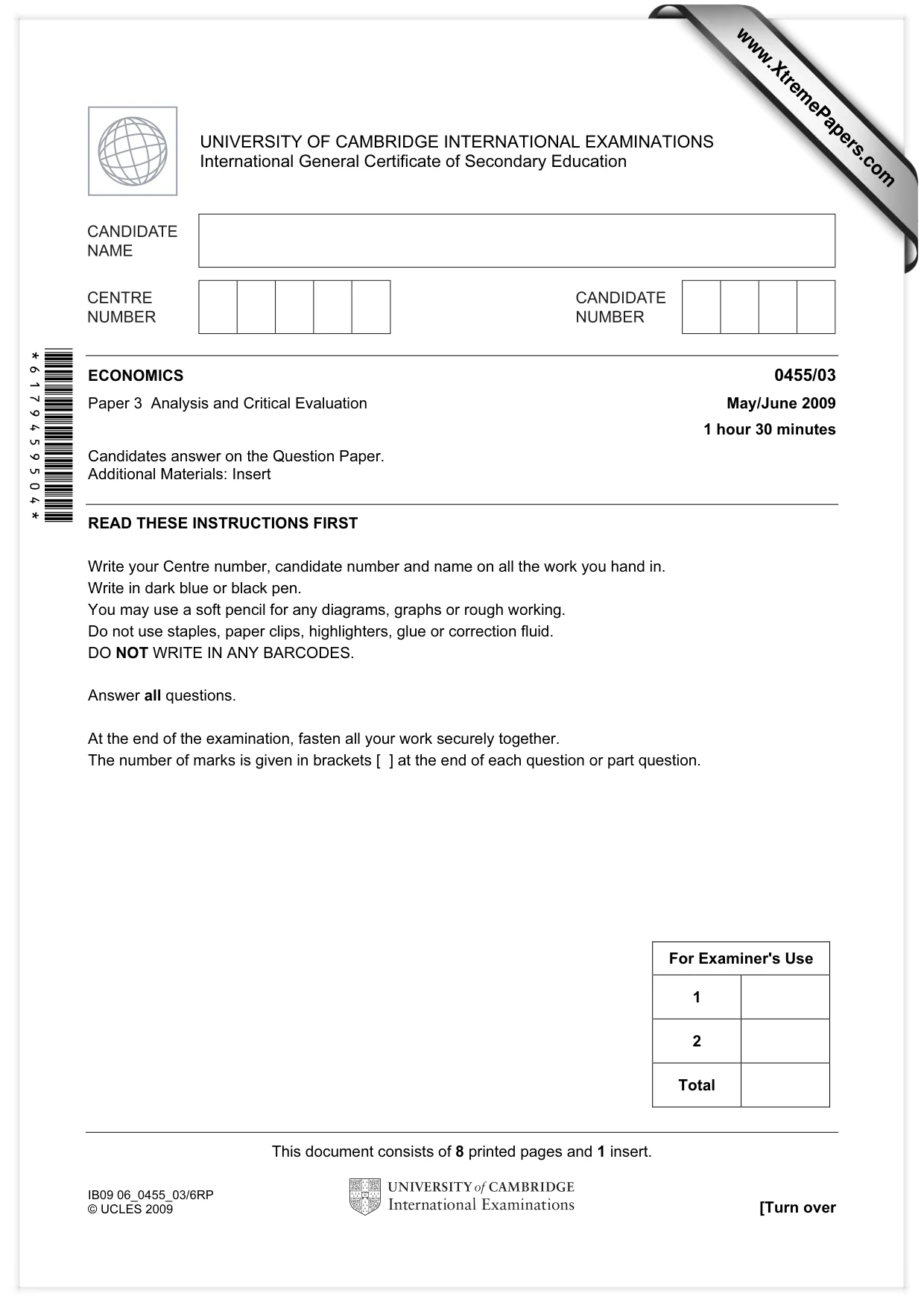
Question paper, page 1
This document consists of 8 printed pages and 1 insert. IB09 06_0455_03/6RP © UCLES 2009 [Turn over *6179459504* For Examiner's Use 1 2 Total UNIVERSITY OF CAMBRIDGE INTERNATIONAL EXAMINATIONS International General Certificate of Secondary Education ECONOMICS 0455/03 Paper 3 Analysis and Critical Evaluation May/June 2009 1 hour 30 minutes Candidates answer on the Question Paper. Additional Materials: Insert READ THESE INSTRUCTIONS FIRST Write your Centre number, candidate number and name on all the work you hand in. Write in dark blue or black pen. You may use a soft pencil for any diagrams, graphs or rough working. Do not use staples, paper clips, highlighters, glue or correction fluid. DO NOT WRITE IN ANY BARCODES. Answer all questions. At the end of the examination, fasten all your work securely together. The number of marks is given in brackets [ ] at the end of each question or part question. www.XtremePapers.com
Question paper, page 2
2 © UCLES 2009 0455/03/M/J/09 For Examiner's Use The extract ‘Skin-care Products’ will be needed for this question. 1 (a) Identify three reasons why products containing rice are popular with consumers. [3]
Question paper, page 3
3 © UCLES 2009 0455/03/M/J/09 [Turn over For Examiner's Use (b) Explain, using demand and supply diagrams, what is likely to happen in the market for rice and in the market for cosmetics if there were to be a failure in the rice harvest. [5]
Question paper, page 4
4 © UCLES 2009 0455/03/M/J/09 For Examiner's Use (c) The extract says the government wishes to encourage exports. Why might this be a government aim? [5] (d) Explain what is meant by a subsidy. [2]
Question paper, page 5
5 © UCLES 2009 0455/03/M/J/09 [Turn over For Examiner's Use (e) The extract says ‘subsidies have been moved away from small farmers towards larger, more efficient, operations’. If you were asked to discover whether small farmers are in fact inefficient, what would you need to know? [7] [Total: 22]
Question paper, page 6
6 © UCLES 2009 0455/03/M/J/09 For Examiner's Use The extract ‘Economic Growth in Vietnam’ will be needed for this question. 2 (a) What is meant by GDP per capita? [3] (b) Identify from the chart which country had the biggest increase in GDP per capita between 1990-2005. [1] (c) Do the charts support the view that the higher the increase in GDP per capita the greater the reduction in poverty levels? [4]
Question paper, page 7
7 © UCLES 2009 0455/03/M/J/09 [Turn over For Examiner's Use (d) Explain, using examples, what the extract says is happening to the primary and secondary sectors in Vietnam. [3] (e) Discuss possible reasons why the European Union (EU) introduced tariffs. [3] Part (f) is on the next page.
Question paper, page 8
8 Permission to reproduce items where third-party owned material protected by copyright is included has been sought and cleared where possible. Every reasonable effort has been made by the publisher (UCLES) to trace copyright holders, but if any items requiring clearance have unwittingly been included, the publisher will be pleased to make amends at the earliest possible opportunity. University of Cambridge International Examinations is part of the Cambridge Assessment Group. Cambridge Assessment is the brand name of University of Cambridge Local Examinations Syndicate (UCLES), which is itself a department of the University of Cambridge. © UCLES 2009 0455/03/M/J/09 (f) Discuss whether the evidence given suggests that Vietnam is a market economy. [4] [Total: 18]
Mark scheme, page 1
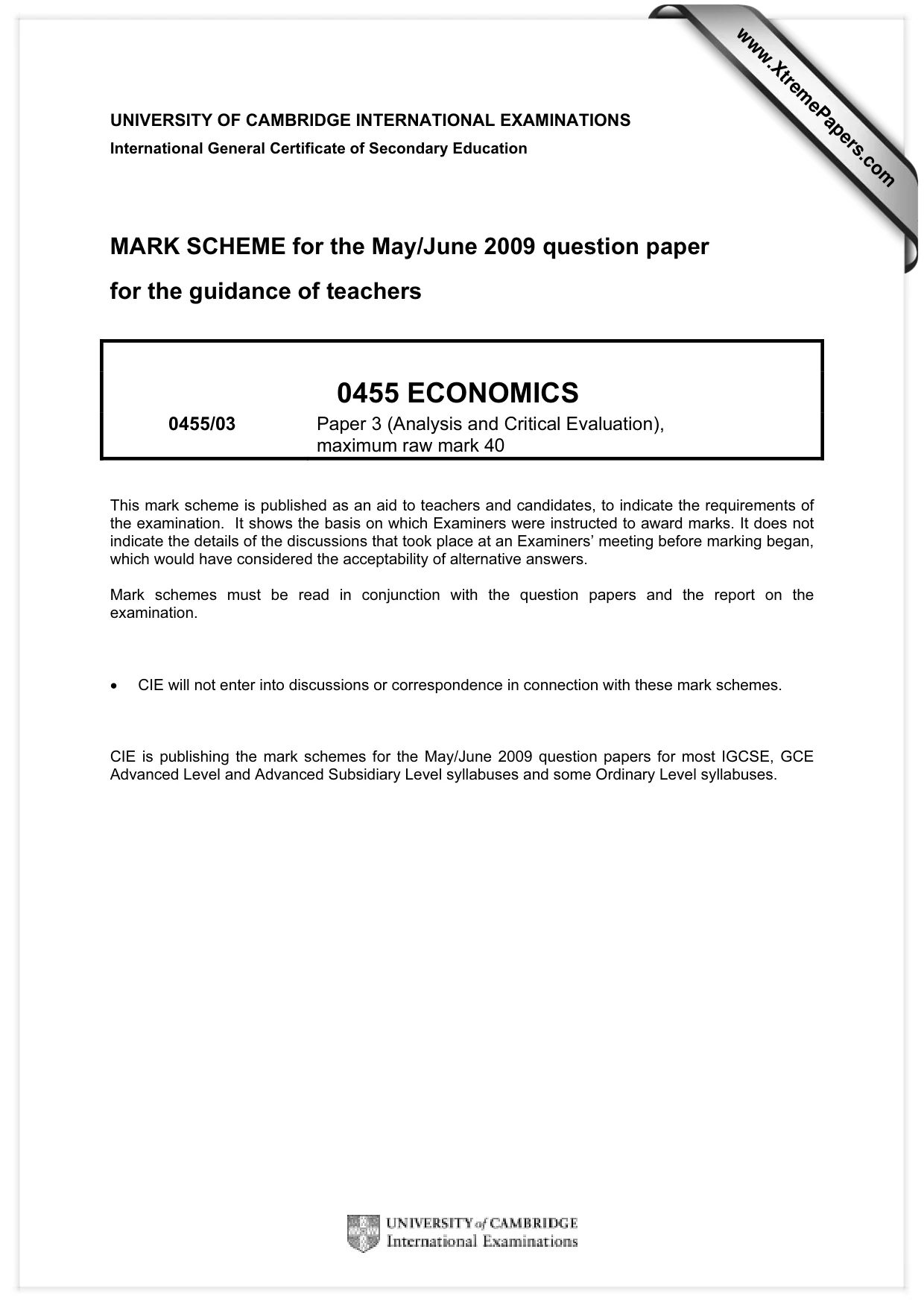
UNIVERSITY OF CAMBRIDGE INTERNATIONAL EXAMINATIONS International General Certificate of Secondary Education MARK SCHEME for the May/June 2009 question paper for the guidance of teachers 0455 ECONOMICS 0455/03 Paper 3 (Analysis and Critical Evaluation), maximum raw mark 40 This mark scheme is published as an aid to teachers and candidates, to indicate the requirements of the examination. It shows the basis on which Examiners were instructed to award marks. It does not indicate the details of the discussions that took place at an Examiners’ meeting before marking began, which would have considered the acceptability of alternative answers. Mark schemes must be read in conjunction with the question papers and the report on the examination. • CIE will not enter into discussions or correspondence in connection with these mark schemes. CIE is publishing the mark schemes for the May/June 2009 question papers for most IGCSE, GCE Advanced Level and Advanced Subsidiary Level syllabuses and some Ordinary Level syllabuses. www.XtremePapers.com
Mark scheme, page 2
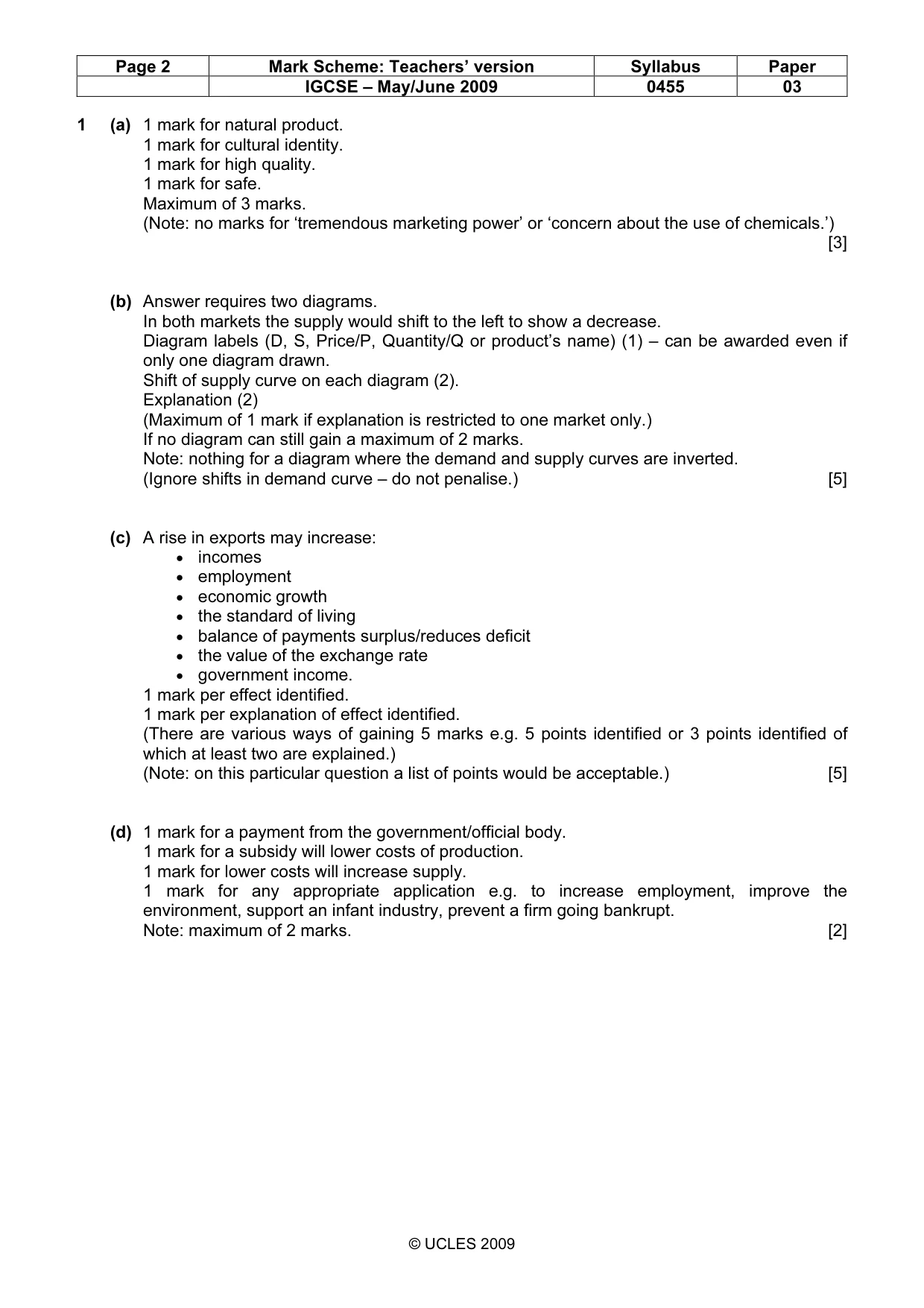
Page 2 Mark Scheme: Teachers’ version Syllabus Paper IGCSE – May/June 2009 0455 03 © UCLES 2009 1 (a) 1 mark for natural product. 1 mark for cultural identity. 1 mark for high quality. 1 mark for safe. Maximum of 3 marks. (Note: no marks for ‘tremendous marketing power’ or ‘concern about the use of chemicals.’) [3] (b) Answer requires two diagrams. In both markets the supply would shift to the left to show a decrease. Diagram labels (D, S, Price/P, Quantity/Q or product’s name) (1) – can be awarded even if only one diagram drawn. Shift of supply curve on each diagram (2). Explanation (2) (Maximum of 1 mark if explanation is restricted to one market only.) If no diagram can still gain a maximum of 2 marks. Note: nothing for a diagram where the demand and supply curves are inverted. (Ignore shifts in demand curve – do not penalise.) [5] (c) A rise in exports may increase: • incomes • employment • economic growth • the standard of living • balance of payments surplus/reduces deficit • the value of the exchange rate • government income. 1 mark per effect identified. 1 mark per explanation of effect identified. (There are various ways of gaining 5 marks e.g. 5 points identified or 3 points identified of which at least two are explained.) (Note: on this particular question a list of points would be acceptable.) [5] (d) 1 mark for a payment from the government/official body. 1 mark for a subsidy will lower costs of production. 1 mark for lower costs will increase supply. 1 mark for any appropriate application e.g. to increase employment, improve the environment, support an infant industry, prevent a firm going bankrupt. Note: maximum of 2 marks. [2]
Mark scheme, page 3
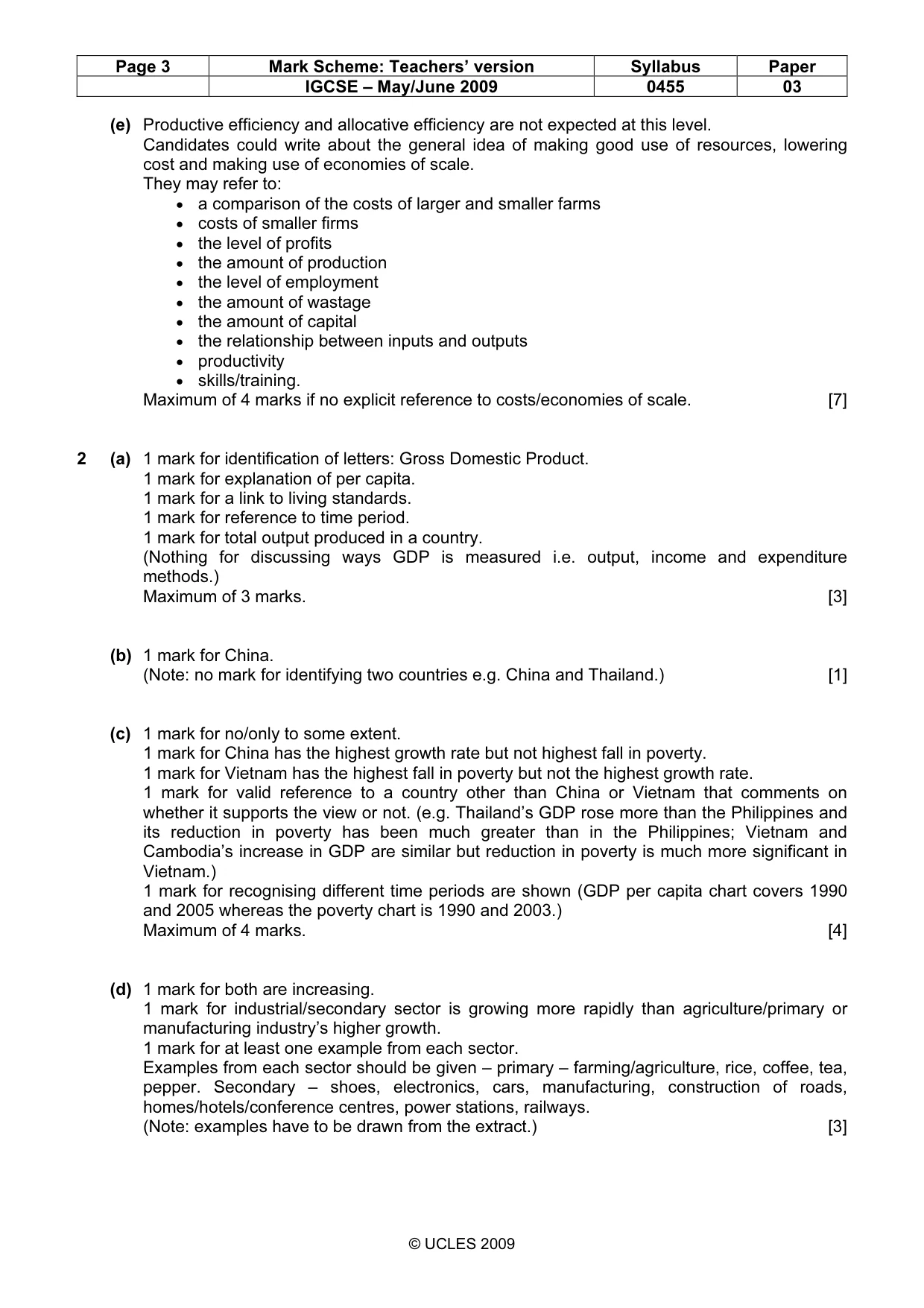
Page 3 Mark Scheme: Teachers’ version Syllabus Paper IGCSE – May/June 2009 0455 03 © UCLES 2009 (e) Productive efficiency and allocative efficiency are not expected at this level. Candidates could write about the general idea of making good use of resources, lowering cost and making use of economies of scale. They may refer to: • a comparison of the costs of larger and smaller farms • costs of smaller firms • the level of profits • the amount of production • the level of employment • the amount of wastage • the amount of capital • the relationship between inputs and outputs • productivity • skills/training. Maximum of 4 marks if no explicit reference to costs/economies of scale. [7] 2 (a) 1 mark for identification of letters: Gross Domestic Product. 1 mark for explanation of per capita. 1 mark for a link to living standards. 1 mark for reference to time period. 1 mark for total output produced in a country. (Nothing for discussing ways GDP is measured i.e. output, income and expenditure methods.) Maximum of 3 marks. [3] (b) 1 mark for China. (Note: no mark for identifying two countries e.g. China and Thailand.) [1] (c) 1 mark for no/only to some extent. 1 mark for China has the highest growth rate but not highest fall in poverty. 1 mark for Vietnam has the highest fall in poverty but not the highest growth rate. 1 mark for valid reference to a country other than China or Vietnam that comments on whether it supports the view or not. (e.g. Thailand’s GDP rose more than the Philippines and its reduction in poverty has been much greater than in the Philippines; Vietnam and Cambodia’s increase in GDP are similar but reduction in poverty is much more significant in Vietnam.) 1 mark for recognising different time periods are shown (GDP per capita chart covers 1990 and 2005 whereas the poverty chart is 1990 and 2003.) Maximum of 4 marks. [4] (d) 1 mark for both are increasing. 1 mark for industrial/secondary sector is growing more rapidly than agriculture/primary or manufacturing industry’s higher growth. 1 mark for at least one example from each sector. Examples from each sector should be given – primary – farming/agriculture, rice, coffee, tea, pepper. Secondary – shoes, electronics, cars, manufacturing, construction of roads, homes/hotels/conference centres, power stations, railways. (Note: examples have to be drawn from the extract.) [3]
Mark scheme, page 4
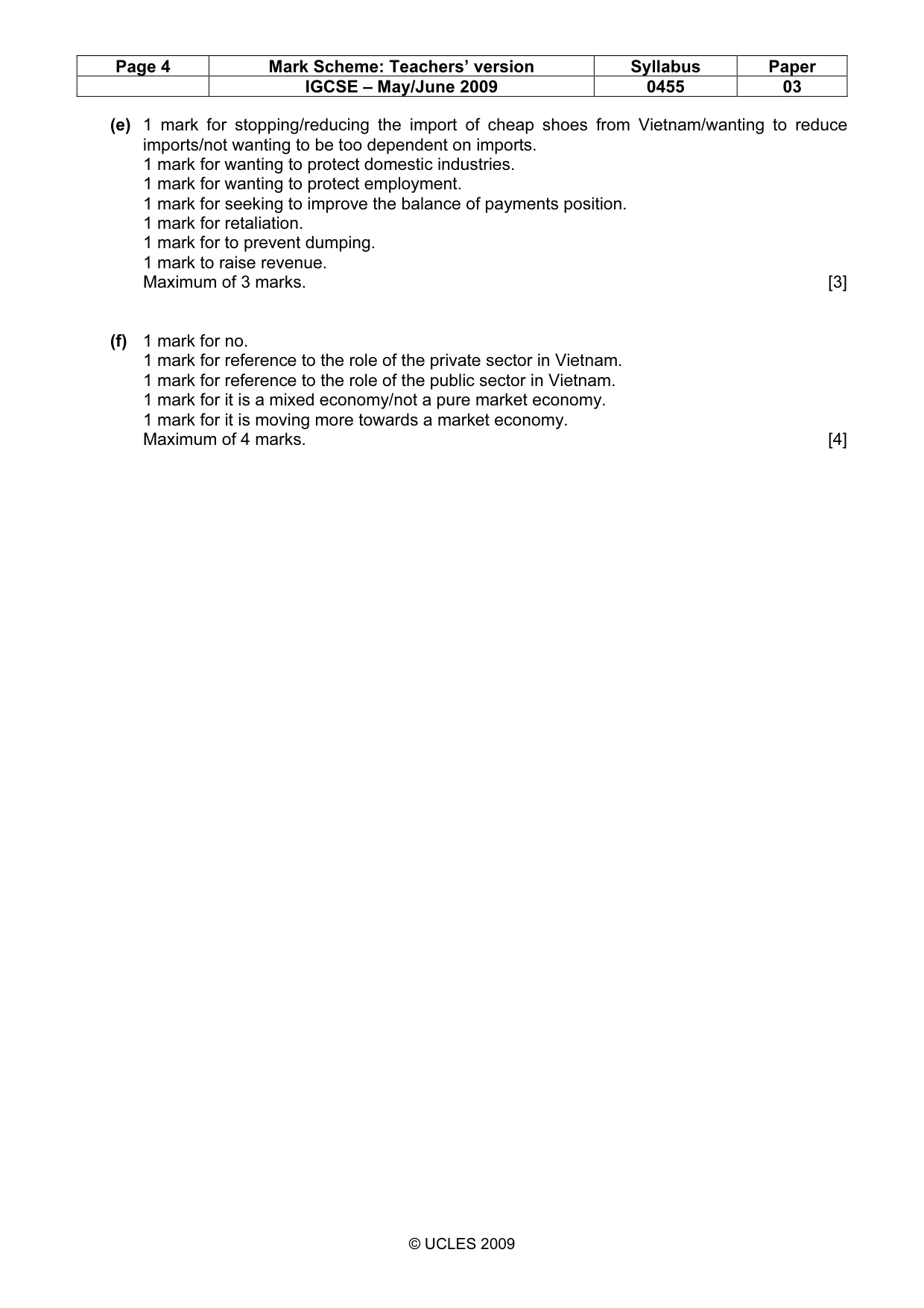
Page 4 Mark Scheme: Teachers’ version Syllabus Paper IGCSE – May/June 2009 0455 03 © UCLES 2009 (e) 1 mark for stopping/reducing the import of cheap shoes from Vietnam/wanting to reduce imports/not wanting to be too dependent on imports. 1 mark for wanting to protect domestic industries. 1 mark for wanting to protect employment. 1 mark for seeking to improve the balance of payments position. 1 mark for retaliation. 1 mark for to prevent dumping. 1 mark to raise revenue. Maximum of 3 marks. [3] (f) 1 mark for no. 1 mark for reference to the role of the private sector in Vietnam. 1 mark for reference to the role of the public sector in Vietnam. 1 mark for it is a mixed economy/not a pure market economy. 1 mark for it is moving more towards a market economy. Maximum of 4 marks. [4]
What you needed in this session
Cambridge’s own grade thresholds for 2009 May/June, Paper 3 · Variant 1. A higher threshold means an easier paper — the bar moves with how the cohort did.