Cambridge IGCSE Economics 0455 — 2009 May/June Paper 2 · Variant 1
0455/21/M/J/09 · 80 marks · ≈90 min
The question paper and its mark scheme, free to read here and free to download. This is Cambridge’s own paper, exactly as it was sat.
Question paper4 pages
Mark scheme3 pages
Answers below. Sit the paper first if you are practising.
Paper as text
Question paper, page 1
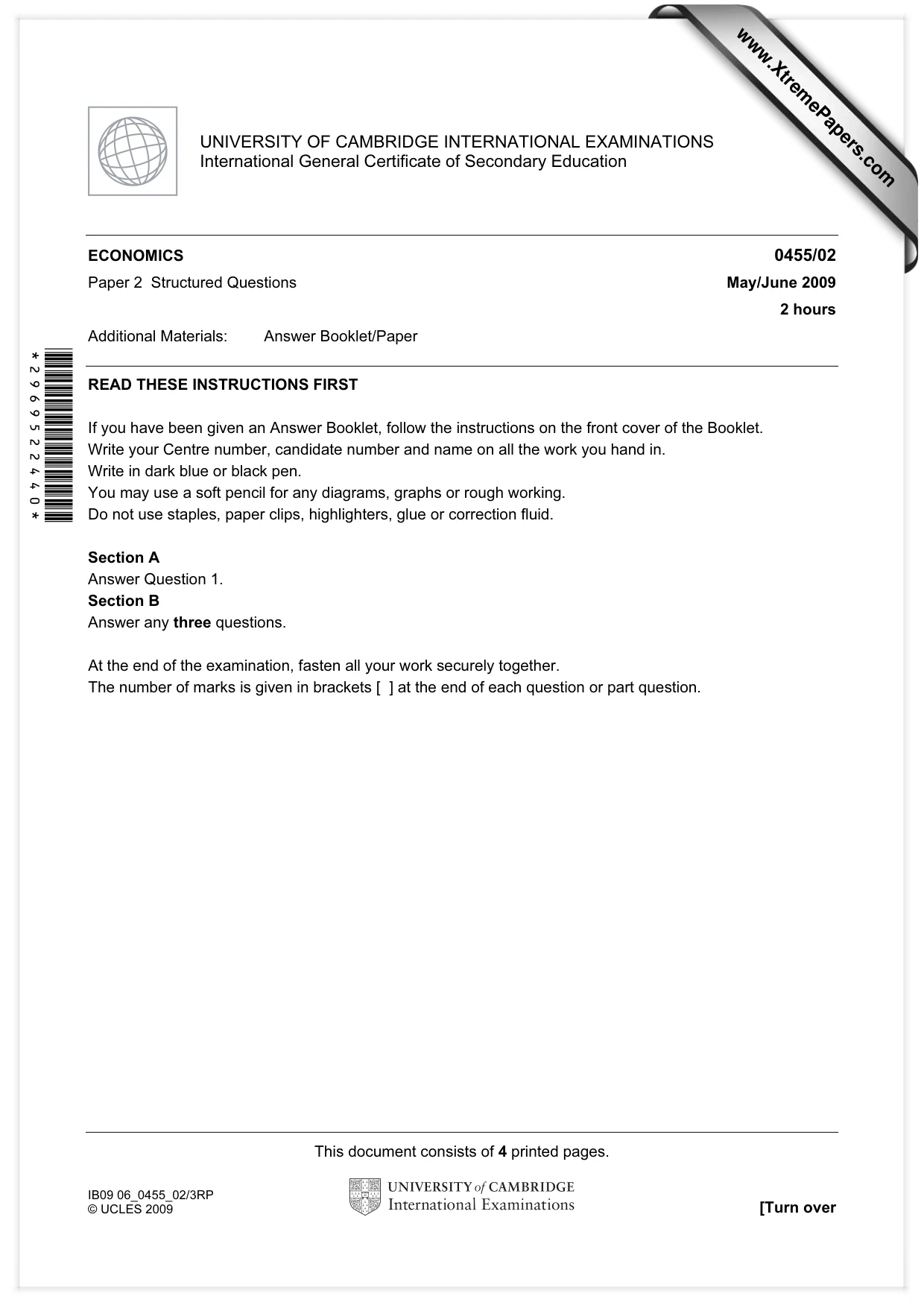
This document consists of 4 printed pages. IB09 06_0455_02/3RP © UCLES 2009 [Turn over *2969522440* UNIVERSITY OF CAMBRIDGE INTERNATIONAL EXAMINATIONS International General Certificate of Secondary Education ECONOMICS 0455/02 Paper 2 Structured Questions May/June 2009 2 hours Additional Materials: Answer Booklet/Paper READ THESE INSTRUCTIONS FIRST If you have been given an Answer Booklet, follow the instructions on the front cover of the Booklet. Write your Centre number, candidate number and name on all the work you hand in. Write in dark blue or black pen. You may use a soft pencil for any diagrams, graphs or rough working. Do not use staples, paper clips, highlighters, glue or correction fluid. Section A Answer Question 1. Section B Answer any three questions. At the end of the examination, fasten all your work securely together. The number of marks is given in brackets [ ] at the end of each question or part question. www.XtremePapers.com
Question paper, page 2
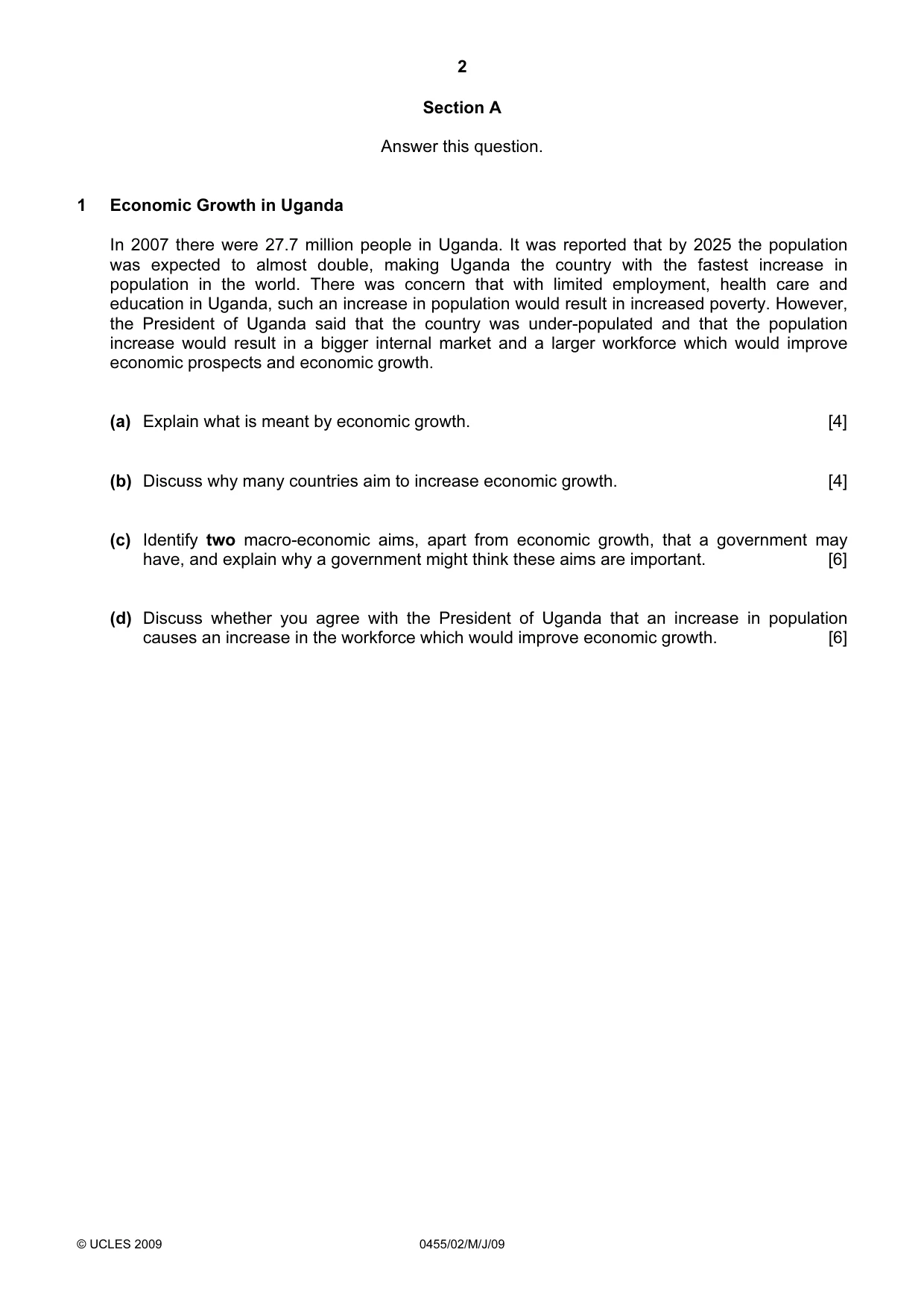
2 © UCLES 2009 0455/02/M/J/09 Section A Answer this question. 1 Economic Growth in Uganda In 2007 there were 27.7 million people in Uganda. It was reported that by 2025 the population was expected to almost double, making Uganda the country with the fastest increase in population in the world. There was concern that with limited employment, health care and education in Uganda, such an increase in population would result in increased poverty. However, the President of Uganda said that the country was under-populated and that the population increase would result in a bigger internal market and a larger workforce which would improve economic prospects and economic growth. (a) Explain what is meant by economic growth. [4] (b) Discuss why many countries aim to increase economic growth. [4] (c) Identify two macro-economic aims, apart from economic growth, that a government may have, and explain why a government might think these aims are important. [6] (d) Discuss whether you agree with the President of Uganda that an increase in population causes an increase in the workforce which would improve economic growth. [6]
Question paper, page 3
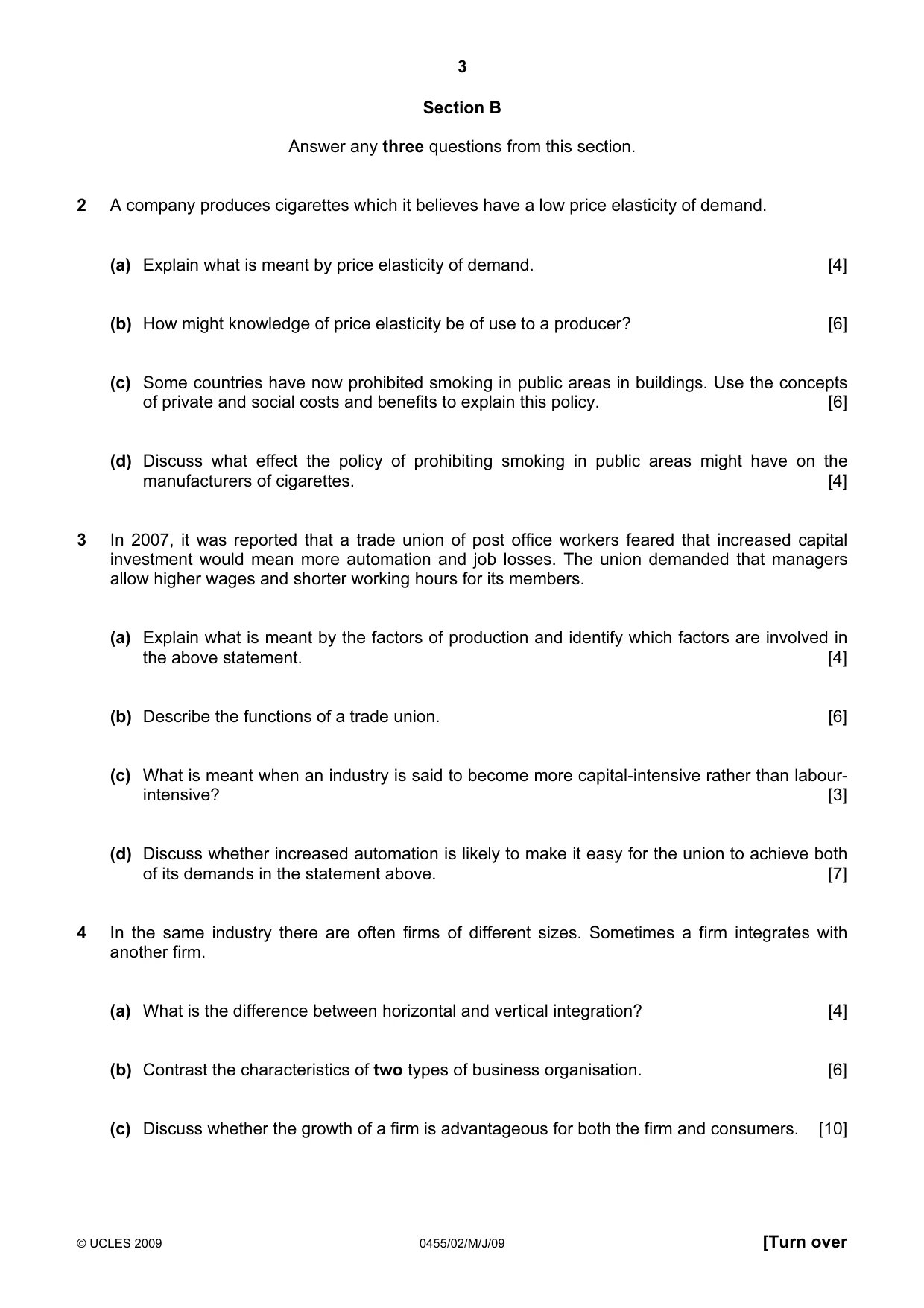
3 © UCLES 2009 0455/02/M/J/09 [Turn over Section B Answer any three questions from this section. 2 A company produces cigarettes which it believes have a low price elasticity of demand. (a) Explain what is meant by price elasticity of demand. [4] (b) How might knowledge of price elasticity be of use to a producer? [6] (c) Some countries have now prohibited smoking in public areas in buildings. Use the concepts of private and social costs and benefits to explain this policy. [6] (d) Discuss what effect the policy of prohibiting smoking in public areas might have on the manufacturers of cigarettes. [4] 3 In 2007, it was reported that a trade union of post office workers feared that increased capital investment would mean more automation and job losses. The union demanded that managers allow higher wages and shorter working hours for its members. (a) Explain what is meant by the factors of production and identify which factors are involved in the above statement. [4] (b) Describe the functions of a trade union. [6] (c) What is meant when an industry is said to become more capital-intensive rather than labour- intensive? [3] (d) Discuss whether increased automation is likely to make it easy for the union to achieve both of its demands in the statement above. [7] 4 In the same industry there are often firms of different sizes. Sometimes a firm integrates with another firm. (a) What is the difference between horizontal and vertical integration? [4] (b) Contrast the characteristics of two types of business organisation. [6] (c) Discuss whether the growth of a firm is advantageous for both the firm and consumers. [10]
Question paper, page 4
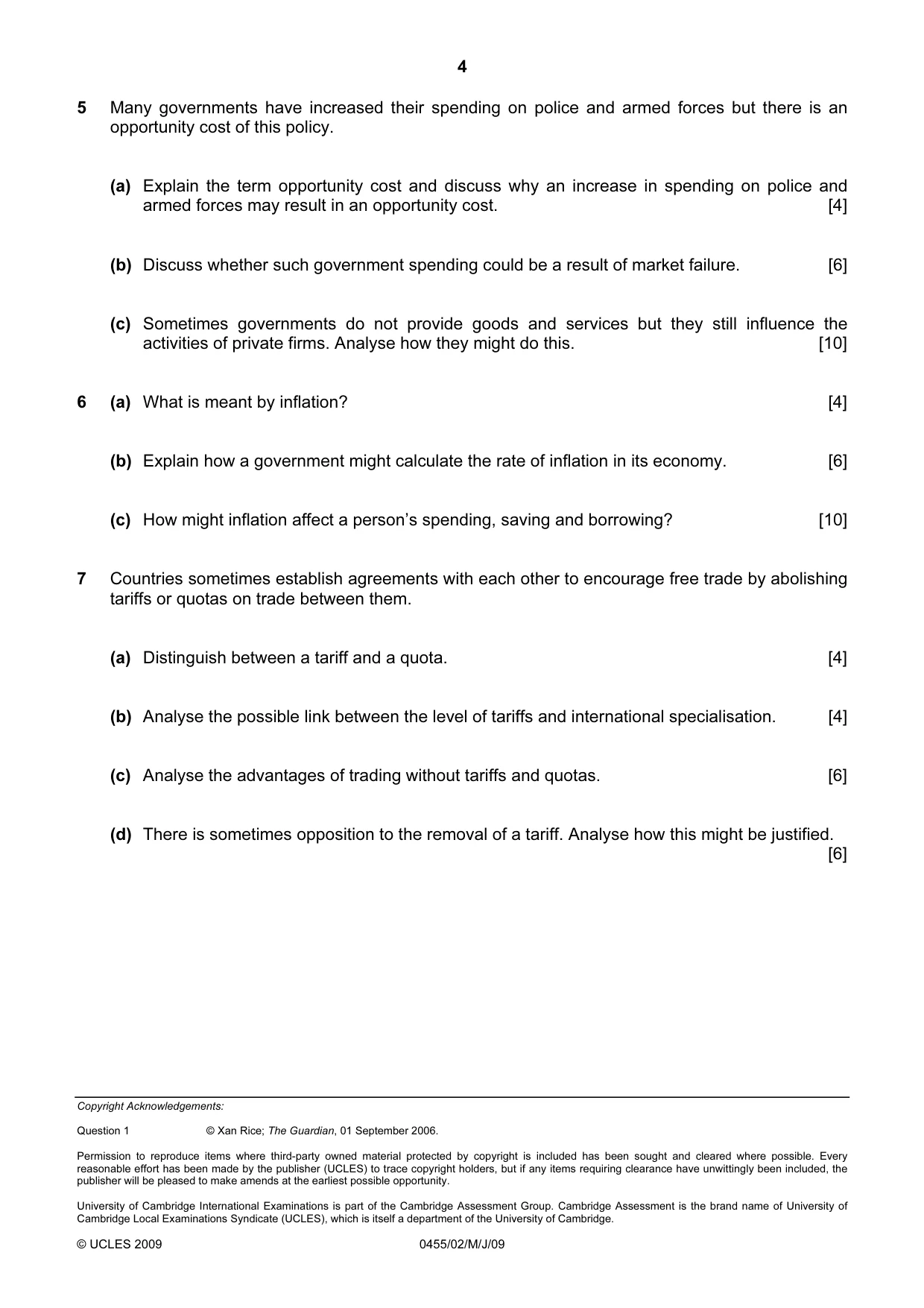
4 Copyright Acknowledgements: Question 1 © Xan Rice; The Guardian, 01 September 2006. Permission to reproduce items where third-party owned material protected by copyright is included has been sought and cleared where possible. Every reasonable effort has been made by the publisher (UCLES) to trace copyright holders, but if any items requiring clearance have unwittingly been included, the publisher will be pleased to make amends at the earliest possible opportunity. University of Cambridge International Examinations is part of the Cambridge Assessment Group. Cambridge Assessment is the brand name of University of Cambridge Local Examinations Syndicate (UCLES), which is itself a department of the University of Cambridge. © UCLES 2009 0455/02/M/J/09 5 Many governments have increased their spending on police and armed forces but there is an opportunity cost of this policy. (a) Explain the term opportunity cost and discuss why an increase in spending on police and armed forces may result in an opportunity cost. [4] (b) Discuss whether such government spending could be a result of market failure. [6] (c) Sometimes governments do not provide goods and services but they still influence the activities of private firms. Analyse how they might do this. [10] 6 (a) What is meant by inflation? [4] (b) Explain how a government might calculate the rate of inflation in its economy. [6] (c) How might inflation affect a person’s spending, saving and borrowing? [10] 7 Countries sometimes establish agreements with each other to encourage free trade by abolishing tariffs or quotas on trade between them. (a) Distinguish between a tariff and a quota. [4] (b) Analyse the possible link between the level of tariffs and international specialisation. [4] (c) Analyse the advantages of trading without tariffs and quotas. [6] (d) There is sometimes opposition to the removal of a tariff. Analyse how this might be justified. [6]
Mark scheme, page 1
UNIVERSITY OF CAMBRIDGE INTERNATIONAL EXAMINATIONS International General Certificate of Secondary Education MARK SCHEME for the May/June 2009 question paper for the guidance of teachers 0455 ECONOMICS 0455/02 Paper 2 (Structured Questions), maximum raw mark 80 This mark scheme is published as an aid to teachers and candidates, to indicate the requirements of the examination. It shows the basis on which Examiners were instructed to award marks. It does not indicate the details of the discussions that took place at an Examiners’ meeting before marking began, which would have considered the acceptability of alternative answers. Mark schemes must be read in conjunction with the question papers and the report on the examination. • CIE will not enter into discussions or correspondence in connection with these mark schemes. CIE is publishing the mark schemes for the May/June 2009 question papers for most IGCSE, GCE Advanced Level and Advanced Subsidiary Level syllabuses and some Ordinary Level syllabuses. www.XtremePapers.com
Mark scheme, page 2
Page 2 Mark Scheme: Teachers’ version Syllabus Paper IGCSE – May/June 2009 0455 02 © UCLES 2009 1 (a) Explanation in terms of output, employment, GDP. [4] (b) Discuss the use of resources, the increase in standard of living, the increase in incomes and well-being. [4] (c) Identify two aims with a comment on why they are important. 2 marks for identification, 2 marks for comment on each of the aims. [6] (d) Candidates could use the information given to discuss whether there will be enough resources to deal with the population, whether increased labour resource will be matched by capital and land resources, whether there will be unemployment or increased use of natural resources. An entirely one-sided answer gets a maximum of 4 marks. [6] 2 (a) Explanation in terms of formula, or description (2). Comment on range of elasticity and the meaning of high and low elasticity (2). [4] (b) Comment on the ability to predict what would happen to demand and therefore to income and to profits. Might use knowledge of elasticity of different products to decide which to expand. Might use knowledge of elasticity to help form pricing policy. Link between elasticity/price changes/total revenue. Supply elasticity not required but could allow this. [6] (c) Smokers derive a private benefit, but may also incur a private cost in buying cigarettes and in health terms. Non-smokers incur an external cost. Candidates could contrast the net private benefit with the overall net social benefit/cost. After the ban, there will be a reduction in external costs and, therefore, social costs. [6] (d) Manufacturers might decide that the low elasticity will mean that demand will be unchanged. They may decide that more people will be persuaded not to smoke, so may need to diversify. They may reduce costs by closing some production units, or try to find other markets where smoking is not prohibited. [4] 3 (a) Explanation of factors as means of production (2). Those in the extract are labour, capital and enterprise (2). [4] (b) Description of union functions, protect working conditions, be concerned about safety issues, negotiate over wages, sometimes provide education, take active role in collective bargaining, negotiate favourable deals for members with retail/service industries. [6] (c) Explanation about proportionate use of capital/machines/automation to other factors, rather than higher proportionate use of labour. [3]
Mark scheme, page 3
Page 3 Mark Scheme: Teachers’ version Syllabus Paper IGCSE – May/June 2009 0455 02 © UCLES 2009 (d) Need to discuss the relative demand for labour with and without the automation. The value of some labour may increase if they need to operate specialist machines, and the hours and wages of these workers may change as the union would like. However, for most workers, the unions may be able to negotiate about shorter hours, but it is unlikely that they will achieve this together with higher pay. [7] 4 (a) Definition of terms (2), explanation and examples (2), or 1 mark each for vertical back, vertical forward and horizontal with 1 mark for application. [4] (b) Any two types may be chosen. Candidates should contrast the size in terms of market, employment, output, the organisation, the structure, the method of raising finance. [6] (c) Discussion of benefits of size in terms of economies contrasted with possible diseconomies. Also, discussion for consumer on possible effect on prices, choice, limitation of other possible competitors. Up to 6 marks for discussion of either firm or consumer without a comment on the other element. [10] 5 (a) Explanation of term (2), application to example (2). [4] (b) Market failure is new to the syllabus. Candidates should define the term, give examples and discuss whether it applies in this case. [6] (c) Analysis of the use of regulation, taxation, subsidies. [10] 6 (a) Definition of inflation – a persistent (1) increase (1) in the general (1) level of prices (1). [4] (b) Explanation of calculation of retail price index. [6] (c) May consider using 3 marks for each, or mark as a whole. Will depend on person’s situation, whether they consider inflation likely to continue and at what rate may affect savings. Unless incomes rise, spending as a proportion of income will increase, borrowing may increase to match spending or because of anticipated changes in future inflation. [10] 7 (a) Distinction between different ways of limiting international trade by quota and by tariff. [4] (b) Analysis of possible effects on specialisation of tariffs. [4] (c) Analysis of effect of free trade on those who export and those who import in terms of quantity, prices, choice, effect on balance of payments. [6] (d) Analysis of reasons for protection and support of home industry and employment with possible changes in incomes if tariffs are abolished. [6]
What you needed in this session
Cambridge’s own grade thresholds for 2009 May/June, Paper 2 · Variant 1. A higher threshold means an easier paper — the bar moves with how the cohort did.